WO2014057784A1 - 光学補償フィルム、偏光板及び液晶表示装置 - Google Patents
光学補償フィルム、偏光板及び液晶表示装置 Download PDFInfo
- Publication number
- WO2014057784A1 WO2014057784A1 PCT/JP2013/075333 JP2013075333W WO2014057784A1 WO 2014057784 A1 WO2014057784 A1 WO 2014057784A1 JP 2013075333 W JP2013075333 W JP 2013075333W WO 2014057784 A1 WO2014057784 A1 WO 2014057784A1
- Authority
- WO
- WIPO (PCT)
- Prior art keywords
- cellulose acylate
- film
- acid
- meth
- range
- Prior art date
- Legal status (The legal status is an assumption and is not a legal conclusion. Google has not performed a legal analysis and makes no representation as to the accuracy of the status listed.)
- Ceased
Links
Images


Classifications
-
- G—PHYSICS
- G02—OPTICS
- G02B—OPTICAL ELEMENTS, SYSTEMS OR APPARATUS
- G02B5/00—Optical elements other than lenses
- G02B5/30—Polarising elements
- G02B5/3083—Birefringent or phase retarding elements
-
- G—PHYSICS
- G02—OPTICS
- G02B—OPTICAL ELEMENTS, SYSTEMS OR APPARATUS
- G02B5/00—Optical elements other than lenses
- G02B5/30—Polarising elements
- G02B5/3025—Polarisers, i.e. arrangements capable of producing a definite output polarisation state from an unpolarised input state
- G02B5/3033—Polarisers, i.e. arrangements capable of producing a definite output polarisation state from an unpolarised input state in the form of a thin sheet or foil, e.g. Polaroid
-
- B—PERFORMING OPERATIONS; TRANSPORTING
- B29—WORKING OF PLASTICS; WORKING OF SUBSTANCES IN A PLASTIC STATE IN GENERAL
- B29C—SHAPING OR JOINING OF PLASTICS; SHAPING OF MATERIAL IN A PLASTIC STATE, NOT OTHERWISE PROVIDED FOR; AFTER-TREATMENT OF THE SHAPED PRODUCTS, e.g. REPAIRING
- B29C41/00—Shaping by coating a mould, core or other substrate, i.e. by depositing material and stripping-off the shaped article; Apparatus therefor
- B29C41/24—Shaping by coating a mould, core or other substrate, i.e. by depositing material and stripping-off the shaped article; Apparatus therefor for making articles of indefinite length
- B29C41/32—Making multilayered or multicoloured articles
-
- B—PERFORMING OPERATIONS; TRANSPORTING
- B29—WORKING OF PLASTICS; WORKING OF SUBSTANCES IN A PLASTIC STATE IN GENERAL
- B29C—SHAPING OR JOINING OF PLASTICS; SHAPING OF MATERIAL IN A PLASTIC STATE, NOT OTHERWISE PROVIDED FOR; AFTER-TREATMENT OF THE SHAPED PRODUCTS, e.g. REPAIRING
- B29C55/00—Shaping by stretching, e.g. drawing through a die; Apparatus therefor
- B29C55/02—Shaping by stretching, e.g. drawing through a die; Apparatus therefor of plates or sheets
- B29C55/023—Shaping by stretching, e.g. drawing through a die; Apparatus therefor of plates or sheets using multilayered plates or sheets
-
- B—PERFORMING OPERATIONS; TRANSPORTING
- B29—WORKING OF PLASTICS; WORKING OF SUBSTANCES IN A PLASTIC STATE IN GENERAL
- B29C—SHAPING OR JOINING OF PLASTICS; SHAPING OF MATERIAL IN A PLASTIC STATE, NOT OTHERWISE PROVIDED FOR; AFTER-TREATMENT OF THE SHAPED PRODUCTS, e.g. REPAIRING
- B29C55/00—Shaping by stretching, e.g. drawing through a die; Apparatus therefor
- B29C55/02—Shaping by stretching, e.g. drawing through a die; Apparatus therefor of plates or sheets
- B29C55/04—Shaping by stretching, e.g. drawing through a die; Apparatus therefor of plates or sheets uniaxial, e.g. oblique
- B29C55/08—Shaping by stretching, e.g. drawing through a die; Apparatus therefor of plates or sheets uniaxial, e.g. oblique transverse to the direction of feed
-
- C—CHEMISTRY; METALLURGY
- C08—ORGANIC MACROMOLECULAR COMPOUNDS; THEIR PREPARATION OR CHEMICAL WORKING-UP; COMPOSITIONS BASED THEREON
- C08J—WORKING-UP; GENERAL PROCESSES OF COMPOUNDING; AFTER-TREATMENT NOT COVERED BY SUBCLASSES C08B, C08C, C08F, C08G or C08H
- C08J5/00—Manufacture of articles or shaped materials containing macromolecular substances
- C08J5/18—Manufacture of films or sheets
-
- C—CHEMISTRY; METALLURGY
- C08—ORGANIC MACROMOLECULAR COMPOUNDS; THEIR PREPARATION OR CHEMICAL WORKING-UP; COMPOSITIONS BASED THEREON
- C08L—COMPOSITIONS OF MACROMOLECULAR COMPOUNDS
- C08L1/00—Compositions of cellulose, modified cellulose or cellulose derivatives
- C08L1/08—Cellulose derivatives
- C08L1/10—Esters of organic acids, i.e. acylates
-
- C—CHEMISTRY; METALLURGY
- C08—ORGANIC MACROMOLECULAR COMPOUNDS; THEIR PREPARATION OR CHEMICAL WORKING-UP; COMPOSITIONS BASED THEREON
- C08L—COMPOSITIONS OF MACROMOLECULAR COMPOUNDS
- C08L1/00—Compositions of cellulose, modified cellulose or cellulose derivatives
- C08L1/08—Cellulose derivatives
- C08L1/10—Esters of organic acids, i.e. acylates
- C08L1/12—Cellulose acetate
-
- B—PERFORMING OPERATIONS; TRANSPORTING
- B29—WORKING OF PLASTICS; WORKING OF SUBSTANCES IN A PLASTIC STATE IN GENERAL
- B29K—INDEXING SCHEME ASSOCIATED WITH SUBCLASSES B29B, B29C OR B29D, RELATING TO MOULDING MATERIALS OR TO MATERIALS FOR MOULDS, REINFORCEMENTS, FILLERS OR PREFORMED PARTS, e.g. INSERTS
- B29K2201/00—Use of cellulose, modified cellulose or cellulose derivatives, e.g. viscose, as reinforcement
- B29K2201/08—Cellulose derivatives
-
- C—CHEMISTRY; METALLURGY
- C08—ORGANIC MACROMOLECULAR COMPOUNDS; THEIR PREPARATION OR CHEMICAL WORKING-UP; COMPOSITIONS BASED THEREON
- C08J—WORKING-UP; GENERAL PROCESSES OF COMPOUNDING; AFTER-TREATMENT NOT COVERED BY SUBCLASSES C08B, C08C, C08F, C08G or C08H
- C08J2301/00—Characterised by the use of cellulose, modified cellulose or cellulose derivatives
- C08J2301/08—Cellulose derivatives
- C08J2301/10—Esters of organic acids
-
- G—PHYSICS
- G02—OPTICS
- G02B—OPTICAL ELEMENTS, SYSTEMS OR APPARATUS
- G02B1/00—Optical elements characterised by the material of which they are made; Optical coatings for optical elements
- G02B1/04—Optical elements characterised by the material of which they are made; Optical coatings for optical elements made of organic materials, e.g. plastics
Definitions
- the present invention relates to an optical compensation film, a polarizing plate, and a liquid crystal display device. More specifically, when a thin film optical compensation film containing cellulose acylate and an additive is bonded to a polarizer using a photocurable adhesive, the adhesiveness to the polarizer is high, and the degree of polarization is further increased.
- the present invention relates to an optical compensation film that alleviates the decrease in the thickness.
- a cellulose acylate film having a low acyl group substitution degree such as diacetyl cellulose (DAC) having a low degree of acetyl group substitution has high retardation, so that it can be used as an optical compensation film without adding a retardation increasing agent. Function can be demonstrated.
- DAC diacetyl cellulose
- polyvinyl alcohol-based adhesives have been widely used for bonding between a polarizer and an optical compensation film made of cellulose acylate. At that time, it was necessary to hydrophilize the surface of the cellulose acylate film in advance with an alkali saponification solution or the like.
- the cellulose acylate film having a low degree of acyl group substitution has a problem that in the alkali saponification step, a part of the film is eluted into the alkali saponification solution and contaminates the step. Therefore, an adhesive that does not require an alkali saponification step has been desired.
- a photocurable adhesive has attracted attention as an adhesive for bonding a polarizer and a polarizing plate protective film (see, for example, Patent Document 1 and Patent Document 2). Since the photocurable adhesive can be bonded to the film and the polarizer without going through an alkali saponification step, it can be expected to be applied to a cellulose acylate film having a low degree of acyl group substitution.
- JP 2009-244860 A JP 2009-211057 A JP 2012-144690 A
- the present invention has been made in view of the above-mentioned problems and situations, and the solution is to use a thin film optical compensation film containing cellulose acylate and an additive as a polarizer using a photocurable adhesive.
- An object of the present invention is to provide an optical compensation film that has high adhesiveness with a polarizer and further reduces the occurrence of curling and a decrease in the degree of polarization when bonded. Moreover, it is providing the polarizing plate excellent in the curl characteristic which bonded the said optical compensation film and polarizer using the photocurable adhesive agent, and a liquid crystal display device provided with the same.
- the present inventor contains cellulose acylate having a low acyl group substitution degree and an additive in the process of examining the cause of the above-mentioned problems, and the penetration amount of hydroxyethyl acrylate has a specific value.
- a thin-film optical compensation film controlled to a range has high adhesion to the polarizer when using a photo-curable adhesive and further reduces the occurrence of curling and the decrease in the degree of polarization. The inventors have found that an optical compensation film can be provided, and have reached the present invention.
- Item 3 The optical compensation film according to Item 1 or 2, wherein the cellulose acylate has a Ca content in the range of 10 to 60 ppm.
- the SP value measured by the Fedors method at a temperature of 25 ° C. of the additive is in the range of 10.0 to 11.5 (cal / cm 3 ) 1/2.
- the optical compensation film according to any one of the above.
- the r value represented by the following formula (1) is 1.1 to 1.5. 5.
- the optical compensation film according to any one of items 1 to 4, wherein the optical compensation film is in the range of. Equation (1) r d 1 / d 2 6).
- a polarizing plate, wherein a surface satisfying a range of penetration amount of hydroxyethyl acrylate of the optical compensation film according to item 1 is bonded to one surface of a polarizer using a photocurable adhesive.
- a liquid crystal display device comprising the polarizing plate according to item 6.
- the adhesiveness to the polarizer is high, Furthermore, it is possible to provide an optical compensation film that alleviates the occurrence of curling and the decrease in polarization degree. Moreover, the polarizing plate excellent in the curl property which bonded the said optical compensation film and polarizer using the photocurable adhesive agent, and a liquid crystal display device provided with the same can be provided.
- At least one surface of the optical compensation film has a drop of 50 pl of hydroxyethyl acrylate (hereinafter abbreviated as HEA) dropped on the film in an environment of 23 ° C. and 55% RH.
- HEA hydroxyethyl acrylate
- the permeation amount of the droplet is in the range of 10 to 25 pl / 15 seconds.
- the reason why HEA was used as an indicator of the penetration amount of the photocurable adhesive is that it defines the penetration amount of HEA having the greatest permeability to the cellulose ester film among the monomers of typical photocurable adhesives.
- the effect of alleviating the decrease in adhesiveness, curl characteristics, and polarization degree of the present invention can be obtained without any problem. It is. Since the SP value of HEA is 12.5 (cal / cm 3 ) 1/2 and the SP value of diacetyl cellulose is in the range of 12 to 13 (cal / cm 3 ) 1/2 , the cellulose of HEA It is confirmed that the permeability to the ester film is large.
- the optical compensation film of the present invention can optimally control the permeability of the photocurable adhesive on the film side, no adhesion failure occurs even when a conventional photocurable adhesive is used, and a large amount of adhesive is used. Therefore, the occurrence of curling and the decrease in the degree of polarization can be alleviated. In addition, the degree of freedom in selecting the composition and type on the adhesive side is greatly improved.
- the inventor is effective to make the weight average molecular weight Mw of the cellulose acylate within a specific range as a means for controlling the penetration amount of the HEA, and further increasing the Ca content.
- Making the SP value range of the additive a specific range, controlling the distribution in the film thickness direction of the additive on the surface of the optical compensation film, and increasing the content of the additive on the surface on the adhesive side, And it was found that any combination of these means can form a state in which HEA is less likely to penetrate.
- the optical compensation film of the present invention contains cellulose acylate having a low acyl group substitution degree and an additive, and the permeation amount of hydroxyethyl acrylate (HEA) on at least one surface of the optical compensation film falls within a specific value range. It is characterized by being a thin film optical compensation film. This feature is a technical feature common to the inventions according to claims 1 to 7.
- the weight average molecular weight Mw of the cellulose acylate is in the range of 120,000 to 200,000 from the viewpoint of controlling the amount of HEA permeation and manifesting the effect of the present invention.
- the Ca content of the cellulose acylate is preferably in the range of 10 to 60 ppm. It is presumed that Ca ions serve as cross-linking points between cellulose acylate molecules and have an effect of increasing the apparent molecular weight of cellulose acylate.
- the additive according to the present invention preferably has an SP value measured by the Fedors method at a temperature of 25 ° C. within the range of 10.0 to 11.5 (cal / cm 3 ) 1/2 . It is preferable that the HEA is appropriately separated from the SP value because the amount of HEA permeation can be controlled. Moreover, when the SP value of the additive is within the above range, it is not too far from the SP value of diacetyl cellulose, and therefore, the transparency of the film is not deteriorated, which is preferable.
- the amount of the HEA penetrated can be more controlled by biasing the distribution of the additive on one surface of the optical compensation film to be larger than that on the other surface.
- the penetration amount of HEA it is preferable to appropriately combine the use of an additive having an SP value in the above preferred range and the adjustment of the distribution of the additive in the film.
- a surface satisfying the HEA penetration amount range of the optical compensation film of the present invention is bonded to one surface of a polarizer using a photocurable adhesive to form a polarizing plate,
- the adhesiveness of the polarizing plate is high, curling of the polarizing plate can be prevented, and the decrease in the degree of polarization can be reduced.
- the polarizing plate can be suitably provided in a liquid crystal display device.
- ⁇ is used to mean that the numerical values described before and after it are included as a lower limit value and an upper limit value.
- the optical compensation film of the present invention is an optical compensation film containing a cellulose acylate having an acyl group substitution degree in the range of 2.0 to 2.5 and an additive and having a thickness in the range of 15 to 40 ⁇ m. Then, when at least one surface of the optical compensation film drops 50 pl of hydroxyethyl acrylate on the film in an environment of 23 ° C. and 55% RH, the permeation amount of the droplet is 10 to 25 pl. / 15 seconds, this structure has high adhesiveness to the polarizer and prevents curling of the polarizing plate when it is bonded to the polarizer using a photocurable adhesive. Furthermore, the present invention provides an optical compensation film that alleviates the decrease in the degree of polarization.
- the penetration amount of the hydroxyethyl acrylate can be measured using a micro contact angle meter.
- MCA-3 micro contact angle meter
- the droplet volume at this time is X (FIG. 1A).
- An image is captured every second immediately after dropping, and Y is a droplet volume calculated from a photograph after 15 seconds (FIG. 1B).
- cellulose acylate film the “optical compensation film containing cellulose acylate” of the present invention will be referred to as “cellulose acylate film”.
- the cellulose acylate film of the present invention contains a cellulose acylate having an acyl group substitution degree in the range of 2.0 to 2.5.
- a cellulose acylate having a low degree of acyl group substitution in this manner, high retardation development is exhibited, and even when an optical compensation film having a high retardation is obtained, it is possible to reduce the thickness.
- the draw ratio can be kept low, and failures such as breakage can be avoided.
- unlike the case of cellulose acylate having an acyl group substitution degree exceeding 2.5 it is not necessary to use a large amount of a retardation increasing agent, so that occurrence of haze failure or bleedout can be avoided. Advantages such as are obtained.
- the cellulose molecule consists of many glucose units connected, and the glucose unit has three hydroxy groups (hydroxyl groups).
- the number of acyl groups derived from these three hydroxy groups (hydroxyl groups) is called the acyl group substitution degree.
- diacetylcellulose (DAC) has an acetyl group bonded to an average of 2 to 2.5 hydroxy groups among the three hydroxy groups (hydroxyl groups) of the glucose unit.
- DAC diacetylcellulose
- Examples of the cellulose acylate according to the present invention include carboxylic acid esters having about 2 to 22 carbon atoms, which may be aromatic carboxylic acid esters, but are particularly preferably lower fatty acid esters of cellulose.
- the lower fatty acid in the lower fatty acid ester of cellulose means a fatty acid having 6 or less carbon atoms.
- the acyl group bonded to the hydroxy group (hydroxyl group) may be linear or branched, and may form a ring. Furthermore, another substituent may be substituted.
- the carbon number is preferably selected from acyl groups having 2 to 6 carbon atoms.
- the acyl group preferably has 2 to 4 carbon atoms, more preferably 2 to 3 carbon atoms.
- mixed fatty acid esters such as butyrate and cellulose acetate phthalate.
- diacetylcellulose it is particularly preferable to use diacetylcellulose.
- the measurement of the acyl group substitution degree of cellulose acylate can be carried out according to ASTM D-817-91, and the preferred acyl group substitution degree is 2.18 to 2.45.
- acyl group substitution degree of cellulose acylate is less than 2.0, the water absorption and moisture permeability of the film are increased, and the protective function of the polarizer becomes insufficient.
- the weight average molecular weight Mw of the cellulose acylate is preferably in the range of 100,000 to 200,000, and more preferably in the range of 120,000 to 200,000, in order to control the penetration amount of HEA.
- the higher the molecular weight of a polymer the lower the solubility in a solvent.
- the density of the cellulose molecular chain can be increased to decrease the mobility of the cellulose molecule, and the solubility in the solvent can be decreased. By this effect, the effect of controlling the penetration amount of the HEA is exhibited.
- the weight average molecular weight Mw When the weight average molecular weight Mw is in the range of 100,000 to 120,000, the HEA permeability tends to increase. However, the amount of penetration can be adjusted by adjusting the amount of CA ions in the resin or adjusting with an additive described later. Is possible. When the weight average molecular weight Mw is less than 100,000, the HEA permeation amount becomes too large, which is not suitable for the present invention.
- the weight average molecular weight Mw is in the above range, it is excellent in physical properties such as mechanical strength as an optical compensation film in addition to controlling the penetration amount of HEA.
- the number average molecular weight (Mn) of the cellulose acylate is preferably in the range of 30000 to 150,000, and the resulting cellulose acylate film is preferably strong in mechanical strength. Further, cellulose acylate having a number average molecular weight of 40,000 to 100,000 is preferably used.
- the ratio (Mw / Mn) of the weight average molecular weight (Mw) and the number average molecular weight (Mn) of the cellulose acylate is preferably 1.4 to 3.0.
- the number average molecular weight (Mn) and the weight average molecular weight (Mw) of cellulose acylate are measured using gel permeation chromatography (GPC).
- the measurement conditions are as follows.
- the cellulose acylate according to the present invention can be synthesized by a known method. Specifically, it can be synthesized with reference to the method described in JP-A-10-45804.
- cellulose as a raw material for cellulose acylate, but examples include cotton linters, wood pulp (derived from coniferous trees, derived from hardwoods), kenaf and the like. Moreover, you may use the cellulose acylate obtained from them by mixing in arbitrary ratios, respectively.
- a commercially available cellulose acylate may be used.
- examples of commercially available cellulose acylates include L20, L30, L40, and L50 manufactured by Daicel, and Ca398-3, Ca398-6, Ca398-10, Ca398-30, and Ca394-60S manufactured by Eastman Chemical.
- the content of calcium (Ca) in the cellulose acetate is preferably in the range of 10 to 60 ppm. Within this range, the bright spot foreign matter and film haze are not increased, and the decrease in the degree of polarization of the polarizing plate can be suppressed, which is preferable.
- a known method can be used for quantification of calcium (Ca). For example, after the dried cellulose acylate is completely burned, the ash is dissolved in hydrochloric acid and pretreated, and then the atomic absorption method is used. Can be measured. The measured value is obtained in ppm as the calcium content in 1 g of cellulose acylate in an absolutely dry state.
- Ca ions are known to cause an increase in film haze, an increase in dope viscosity, and the like.
- the present inventors have found that the presence of a certain amount of Ca ions can control the amount of HEA permeation even when cellulose acylate having a low molecular weight is used. This is presumed to be because the Ca ion became a cross-linking point between cellulose acylate molecules and the apparent molecular weight increased. Therefore, the inclusion of Ca ions in the above range is consistent with the purpose of the present application.
- the reaction mixture was brought to 100 ° C. in the atmosphere.
- the reaction mixture was mixed with a dilute aqueous acetic acid solution with stirring, separated as flaky cellulose acetate, sufficiently washed with water, taken out and dried.
- the obtained flaky cellulose acetate had an acetyl group substitution degree of 2.4, a number average molecular weight of 47500, and a weight average molecular weight of 166,000.
- Synthesis Example 2 In Synthesis Example 1, instead of 35 parts by mass of 20% calcium acetate aqueous solution, it was changed to 29 parts by mass of 20% magnesium acetate aqueous solution (1.00 equivalent to sulfuric acid).
- a cellulose acylate other than the above cellulose acetate and the following thermoplastic resin can be used in combination as long as the effects of the present invention are not impaired.
- thermoplastic resins include polyethylene (PE), high density polyethylene, medium density polyethylene, low density polyethylene, polypropylene (PP), polyvinyl chloride (PVC), polyvinylidene chloride, polystyrene (PS).
- PE polyethylene
- PVC polyvinyl chloride
- PS polyvinylidene chloride
- PS polystyrene
- PA polyamide
- nylon polyacetal
- PC polycarbonate
- m-PPE modified polyphenylene ether
- PBT polybutylene terephthalate
- PET Polyethylene terephthalate
- GF-PET glass fiber reinforced polyethylene terephthalate
- COP cyclic polyolefin
- polyphenylene sulfide PPS
- polytetrafluoroethylene PTFE
- polysulfone polyethersulfone
- amorphous polyarylate liquid crystal polymer
- polyether Ether ketone thermoplastic polyimide (PI)
- PAI polyamideimide
- the cellulose acylate film of the present invention is also characterized by containing an additive. Additives play an important role in controlling the amount of penetration of the photocurable adhesive.
- the amount of HEA penetrating into the film largely depends on the properties of cellulose acylate. However, the penetration amount of HEA can be adjusted also by the additive.
- the additive In order to control the amount of HEA penetration by the additive, it is effective to make an appropriate difference between the SP value of the additive and the SP value of HEA (12.5 (cal / cm 3 ) 1/2. It is preferably 1.0 (cal / cm 3 ) 1/2 or more, more preferably 1.5 (cal / cm 3 ) 1/2 or more, that is, the SP value is 10.0 to 11. It is preferred to select an additive that is in the range of 5 (cal / cm 3 ) 1/2 .
- SP value The “solubility parameter (SP value)” as used in the present application is a value represented by the square root of the molecular aggregation energy, and is described in Polymer Hand Book (Second Edition) Chapter IV, Solubility Parameter Values. However, in this application, a unit is (cal / cm ⁇ 3 >) ⁇ 1/2 > and shows the value in 25 degreeC.
- the SP values of the cellulose acylate, additive, HEA, and other adhesive compositions according to the present invention are the above-mentioned R.P. F. Based on the concept of Fedors, Scigress Explorer Ver. It can be calculated using 2.4 (manufactured by Fujitsu Limited).
- the amount of such an additive is preferably at least 5% by mass or more, more preferably 10% by mass or more, and more preferably 20% by mass from the viewpoint of bleeding out of the additive.
- the following are preferably included.
- the inclusion of 10% by mass or more may cause deterioration of film properties such as crying and deterioration of mechanical properties.
- the additive while limiting the total amount of additive in the film, the additive is unevenly distributed on the surface on the adhesive surface side with the polarizer, so that the additive in the vicinity of the interface with the adhesive is added.
- a method of increasing the amount and reducing the amount of HEA permeation is effective.
- the permeability of the adhesive can be suppressed without impairing the physical properties of the film in the bulk, which is preferable.
- the method of unevenly distributing the additive on one side will be described later, as a preferred method, the amount of residual solvent at the time of peeling is lowered and cast metal support (referred to as metal support, cast support, belt, etc.).
- the additive can be biased to the metal support surface side surface of the film.
- the additive may be biased to one surface of the film, for example, the metal support surface side surface. it can.
- Preferable additives include polyesters represented by the following general formula (I).
- the polyester represented by the general formula (I) is a dicarboxylic acid having an aromatic ring (6 to 14 carbon atoms), a linear or branched alkylene group, or a linear or branched cycloalkylene group (both having 2 to 6 carbon atoms).
- An alternating copolymer obtained by alternating copolymerization of an acid and a linear or branched alkylene diol or cycloalkylene diol having 2 to 6 carbon atoms.
- aromatic dicarboxylic acid and the dicarboxylic acid having a linear or branched alkylene group or cycloalkylene group may be used alone or as a mixture, but from the viewpoint of compatibility with cellulose acylate. It is preferable that at least 10% or more of the aromatic dicarboxylic acid is contained. Alternatively, both ends may be sealed with a monocarboxylic acid having an aromatic ring (having 6 to 14 carbon atoms).
- dicarboxylic acids having an aromatic ring (6 to 14 carbon atoms) that is, aromatic dicarboxylic acids having 6 to 16 carbon atoms
- aromatic dicarboxylic acids having 6 to 16 carbon atoms include phthalic acid, isophthalic acid, terephthalic acid, 1,5-naphthalenedicarboxylic acid, 1,4- Naphthalenedicarboxylic acid, 1,8-naphthalenedicarboxylic acid, 2,3-naphthalenedicarboxylic acid, 2,6-naphthalenedicarboxylic acid, 2,8-naphthalenedicarboxylic acid, 2,2'-biphenyldicarboxylic acid, 4,4'- And biphenyl dicarboxylic acid.
- terephthalic acid, 2,6-naphthalenedicarboxylic acid, and 4,4′-biphenyldicarboxylic acid are preferable.
- dicarboxylic acid having a linear or branched alkylene group or cycloalkylene group examples include malonic acid, succinic acid, glutaric acid, adipic acid, pimelic acid, suberic acid, and 1,2-cyclohexanedicarboxylic acid. Acid, 1,4-cyclohexanedicarboxylic acid, and the like. Of these, succinic acid, adipic acid, and 1,4-cyclohexanedicarboxylic acid are preferable.
- linear or branched alkylene diol or cycloalkylene diol having 2 to 6 carbon atoms examples include ethanediol (ethylene glycol), 1,2-propanediol, 1,3-propanediol, and 1,2-butane.
- ethanediol ethylene glycol
- 1,2-propanediol, 1,3-propanediol, and 1,3-butanediol are preferable.
- A is preferably a benzene ring, naphthalene ring or biphenyl ring which may have a substituent, from the viewpoint of excellent Tg lowering ability.
- the substituent that the benzene ring, naphthalene ring or biphenyl ring may have is an alkyl group having 1 to 6 carbon atoms, an alkenyl group having 2 to 6 carbon atoms, or an alkoxy group having 1 to 6 carbon atoms.
- Examples of the monocarboxylic acid having an aromatic ring (having 6 to 14 carbon atoms) that seals both ends of the polyester include benzoic acid, orthotoluic acid, metatoluic acid, p-toluic acid, p-tert-butylbenzoic acid, dimethylbenzoic acid, Examples include paramethoxybenzoic acid. Of these, benzoic acid, p-toluic acid and p-tert-butylbenzoic acid are preferred.
- the aromatic polyester may be any one of the above-mentioned polyesterification reaction of dicarboxylic acid and alkylene diol or cycloalkylene diol by a conventional method, hot melt condensation method by transesterification, or interfacial condensation method of acid chloride of these acids and glycols. It can be easily synthesized by any method. Furthermore, by adding the above-described aromatic monocarboxylic acid, it is possible to synthesize polyester with both ends sealed.
- aromatic polyesters (PES-1) to (PES-14) and (ar-1) to (ar-20) that can be used in the present invention are shown below.
- the detected values of the additives on the bonding surface with the polarizer and other surfaces have a certain degree of bias.
- the detected value of the additive is detected using time-of-flight secondary ion mass spectrometry.
- the r value represented by the following formula (1) is 1.1 to 1.5. It is preferable to be within the range.
- the r value may be 1.1 or more, preferably 1.2 or more, more preferably 1.3 or more, and still more preferably 1.4 or more.
- the r value is 1.5 or less, curling of the polarizing plate due to heat generated by the penetration of HEA hardly occurs during the production of the polarizing plate, which is preferable.
- time-of-flight secondary ion mass spectrometry can measure chemical information of atoms and molecules on solid samples with a sensitivity of one molecular layer or less. This is a mass spectrometry method in which the distribution of specific atoms and molecules can be observed with a spatial resolution of 100 nm or less.
- Time-of-flight secondary ion mass spectrometry is a type of secondary ion mass spectrometry (SIMS), in which a solid sample is irradiated with a primary ion beam, and ions emitted from the outermost surface of the sample (two Analysis is performed by detecting (secondary ions). Since a time-of-flight mass spectrometer (TOF-MS) is used as the mass spectrometer, it is referred to as TOF-SIMS.
- TOF-MS time-of-flight mass spectrometer
- time-of-flight secondary ion mass spectrometry it is possible to measure a sample substantially non-destructively by irradiating the sample with an ion beam in a pulsed manner. It has been widely applied to the analysis of
- G represents a monosaccharide or disaccharide residue.
- R 2 represents an aliphatic group or an aromatic group.
- m represents the total number of hydroxy groups (hydroxyl groups) directly bonded to the monosaccharide or disaccharide residues.
- l represents the total number of — (O—C ( ⁇ O) —R 2 ) groups directly bonded to the monosaccharide or disaccharide residue, 3 ⁇ m + l ⁇ 8, and l ⁇ 0. .
- monosaccharide of the residue represented by G in the general formula (II) include, for example, allose, altrose, glucose, mannose, gulose, idose, galactose, talose, ribose, arabinose, xylose, lyxose, and the like.
- disaccharide of the residue represented by G examples include trehalose, sucrose, maltose, cellobiose, gentiobiose, lactose, and isotrehalose.
- the aliphatic group or aromatic group represented by R 2 may each independently have a substituent.
- m and l are preferably 3 ⁇ m + l ⁇ 8, and more preferably 4 ⁇ m + l ⁇ 8. Also, l ⁇ 0.
- the — (O—C ( ⁇ O) —R 2 ) groups may be the same or different.
- the aliphatic group in the definition of R 2 in the general formula (II) may be linear, branched or cyclic.
- the aliphatic group preferably has 1 to 25 carbon atoms, more preferably 1 to 20 carbon atoms, and still more preferably 2 to 15 carbon atoms.
- Specific examples of the aliphatic group include, for example, methyl, ethyl, n-propyl, iso-propyl, cyclopropyl, n-butyl, iso-butyl, tert-butyl, amyl, iso-amyl, tert-amyl, n-hexyl.
- the aromatic group in the definition of R 2 in the general formula (II) may be an aromatic hydrocarbon group or an aromatic heterocyclic group, and more preferably an aromatic hydrocarbon group.
- the aromatic hydrocarbon group preferably has 6 to 24 carbon atoms, more preferably 6 to 12 carbon atoms.
- Specific examples of the aromatic hydrocarbon group include benzene, naphthalene, anthracene, biphenyl, terphenyl and the like.
- the aromatic hydrocarbon group benzene, naphthalene, and biphenyl are particularly preferable.
- As the aromatic heterocyclic group those containing at least one of an oxygen atom, a nitrogen atom or a sulfur atom are preferable.
- heterocyclic ring examples include, for example, furan, pyrrole, thiophene, imidazole, pyrazole, pyridine, pyrazine, pyridazine, triazole, triazine, indole, indazole, purine, thiazoline, thiadiazole, oxazoline, oxazole, oxadiazole, quinoline, isoquinoline.
- aromatic heterocyclic group pyridine, triazine, and quinoline are particularly preferable.
- a four-headed colben equipped with a stirrer, a reflux condenser, a thermometer, and a nitrogen gas inlet tube was mixed with 34.2 g (0.1 mol) of sucrose, 180.8 g (0.8 mol) of benzoic anhydride, 379. 7 g (4.8 mol) was charged, the temperature was raised while bubbling nitrogen gas from a nitrogen gas introduction tube with stirring, and an esterification reaction was carried out at 70 ° C. for 5 hours.
- the inside of the Kolben was depressurized to 4 ⁇ 10 2 Pa or less, and after excess pyridine was distilled off at 60 ° C., the inside of the Kolben was depressurized to 1.3 ⁇ 10 Pa or less and the temperature was raised to 120 ° C. Most of the acid and benzoic acid formed were distilled off. Then, 1 L of toluene and 300 g of a 0.5% by mass aqueous sodium carbonate solution were added, and the mixture was stirred at 50 ° C. for 30 minutes and then allowed to stand to separate a toluene layer.
- the compound represented by the general formula (II) is preferably contained in the range of 5 to 15% by mass with respect to the cellulose and rate film of the present invention.
- the cellulose acylate film of the present invention may contain a conventionally known plasticizer as necessary to obtain the effects of the present invention.
- a plasticizer such as ethylene glycol dimethacrylate, polymethyl methacrylate, polymethyl methacrylate, polymethyl methacrylate, polymethyl methacrylate, polymethyl methacrylate, polymethyl methacrylate, polymethyl methacrylate, polymethyl methacrylate, polymethyl methacrylate, polymethyl methacrylate, polymethyl methacrylate, polymethyl methacrylate, polymethyl methacrylate, polymethyl methacrylate, polymethyl methacrylate, polymethyl methacrylate, polymethyl methacrylate, polymethyl methacrylate, polymethyl methacrylate, polymethyl methacrylate, polymethyl methacrylate, polymethyl methacrylate, polymethyl methacrylate, polymethyl methacrylate, polymethyl methacrylate, polymethyl methacrylate, polymethyl methacrylate, polymethyl methacrylate, polymethyl methacrylate, poly
- the specific form of the other plasticizer is not particularly limited, but is preferably a polycarboxylic acid ester plasticizer, a glycolate plasticizer, a phthalate ester plasticizer, a fatty acid ester plasticizer, or a polyhydric alcohol ester. Selected from plasticizers, ester plasticizers, acrylic plasticizers, and the like. Of these, when two or more plasticizers are used, at least one of them is preferably a polyhydric alcohol ester plasticizer.
- the polyhydric alcohol ester plasticizer is a plasticizer composed of a dihydric or higher aliphatic polyhydric alcohol and a monocarboxylic acid ester, and preferably has an aromatic ring or a cycloalkyl ring in the molecule.
- a divalent to 20-valent aliphatic polyhydric alcohol ester is preferred.
- the polyhydric alcohol preferably used in the present invention is represented by the following general formula (III).
- R 11 represents an n-valent organic group.
- n represents an integer of 2 or more.
- the OH group represents an alcoholic or phenolic hydroxy group (hydroxyl group).
- Preferred polyhydric alcohols include, for example, adonitol, arabitol, ethylene glycol, diethylene glycol, triethylene glycol, tetraethylene glycol, 1,2-propanediol, 1,3-propanediol, dipropylene glycol, tripropylene glycol, 1,2 -Butanediol, 1,3-butanediol, 1,4-butanediol, dibutylene glycol, 1,2,4-butanetriol, 1,5-pentanediol, 1,6-hexanediol, hexanetriol, galactitol Mannitol, 3-methylpentane-1,3,5-triol, pinacol, sorbitol
- monocarboxylic acid used for polyhydric alcohol ester there is no restriction
- Preferred examples of the monocarboxylic acid include the following, but the present invention is not limited to this.
- aliphatic monocarboxylic acid a fatty acid having a straight chain or a side chain having 1 to 32 carbon atoms can be preferably used.
- the number of carbon atoms is more preferably 1-20, and particularly preferably 1-10.
- acetic acid is contained, the compatibility with cellulose acylate is increased, and it is also preferable to use a mixture of acetic acid and another monocarboxylic acid.
- Preferred aliphatic monocarboxylic acids include acetic acid, propionic acid, butyric acid, valeric acid, caproic acid, enanthic acid, caprylic acid, pelargonic acid, capric acid, 2-ethyl-hexanoic acid, undecylic acid, lauric acid, tridecylic acid, Saturated fatty acids such as myristic acid, pentadecylic acid, palmitic acid, heptadecylic acid, stearic acid, nonadecanoic acid, arachidic acid, behenic acid, lignoceric acid, serotic acid, heptacosanoic acid, montanic acid, melicic acid, and laccelic acid, undecylenic acid, olein Examples thereof include unsaturated fatty acids such as acid, sorbic acid, linoleic acid, linolenic acid, and arachidonic acid.
- Examples of preferred alicyclic monocarboxylic acids include cyclopentane carboxylic acid, cyclohexane carboxylic acid, cyclooctane carboxylic acid, and derivatives thereof.
- aromatic monocarboxylic acids examples include those in which 1 to 3 alkoxy groups such as alkyl group, methoxy group or ethoxy group are introduced into the benzene ring of benzoic acid such as benzoic acid or toluic acid, biphenylcarboxylic acid, Examples thereof include aromatic monocarboxylic acids having two or more benzene rings such as naphthalenecarboxylic acid and tetralincarboxylic acid, or derivatives thereof. Benzoic acid is particularly preferable.
- the molecular weight of the polyhydric alcohol ester is not particularly limited, but is preferably 300 to 1500, and more preferably 350 to 750. A higher molecular weight is preferable because it is less likely to volatilize, and a lower molecular weight is preferable in terms of moisture permeability and compatibility with cellulose acylate.
- the carboxylic acid used in the polyhydric alcohol ester may be one kind or a mixture of two or more kinds. Moreover, all the OH groups in the polyhydric alcohol may be esterified, or a part of the OH groups may be left as they are.
- polyhydric alcohol esters (ae-1) to (ae-34) are shown below.
- the SP values of the polyhydric alcohol ester compounds are shown in Table 2 below.
- the polyhydric alcohol ester compound is preferably contained in the range of 5 to 20% by mass with respect to the cellulose acylate.
- the glycolate plasticizer is not particularly limited, but alkylphthalylalkyl glycolates can be preferably used.
- alkyl phthalyl alkyl glycolates include methyl phthalyl methyl glycolate, ethyl phthalyl ethyl glycolate, propyl phthalyl propyl glycolate, butyl phthalyl butyl glycolate, octyl phthalyl octyl glycolate, methyl phthalyl ethyl Glycolate, ethyl phthalyl methyl glycolate, ethyl phthalyl propyl glycolate, methyl phthalyl butyl glycolate, ethyl phthalyl butyl glycolate, butyl phthalyl methyl glycolate, butyl phthalyl ethyl glycolate, propyl phthalyl butyl glycol Butyl phthalyl propyl glycolate, methyl phthalyl octyl glycolate, ethyl phthalyl octyl glycolate, octyl phthalyl
- phthalate ester plasticizer examples include diethyl phthalate, dimethoxyethyl phthalate, dimethyl phthalate, dioctyl phthalate, dibutyl phthalate, di-2-ethylhexyl phthalate, dioctyl phthalate, dicyclohexyl phthalate, and dicyclohexyl terephthalate.
- citrate plasticizer examples include acetyl trimethyl citrate, acetyl triethyl citrate, and acetyl tributyl citrate.
- fatty acid ester plasticizers examples include butyl oleate, methylacetyl ricinoleate, and dibutyl sebacate.
- phosphate ester plasticizer examples include triphenyl phosphate, tricresyl phosphate, cresyl diphenyl phosphate, octyl diphenyl phosphate, diphenyl biphenyl phosphate, trioctyl phosphate, tributyl phosphate, and the like.
- the polyvalent carboxylic acid ester is composed of an ester of a divalent or higher, preferably 2-20 valent polycarboxylic acid and an alcohol.
- the aliphatic polyvalent carboxylic acid is preferably divalent to 20-valent, and in the case of an aromatic polyvalent carboxylic acid or alicyclic polyvalent carboxylic acid, it is preferably trivalent to 20-valent.
- the polyvalent carboxylic acid is represented by the following general formula (IV).
- R 12 (COOH) m1 (OH) n1
- R 12 represents an (m1 + n1) -valent organic group
- m1 represents an integer of 2 or more
- n1 represents an integer of 0 or more
- a COOH group represents a carboxy group
- an OH group represents an alcoholic group and / or Or represents a phenolic hydroxy group (hydroxyl group).
- Examples of preferred polyvalent carboxylic acids include the following, but the present invention is not limited to these.
- Trivalent or higher aromatic polyvalent carboxylic acids such as trimellitic acid, trimesic acid, pyromellitic acid or derivatives thereof, succinic acid, adipic acid, azelaic acid, sebacic acid, oxalic acid, fumaric acid, maleic acid, tetrahydrophthal
- An aliphatic polyvalent carboxylic acid such as an acid, an oxypolyvalent carboxylic acid such as tartaric acid, tartronic acid, malic acid and citric acid can be preferably used.
- the alcohol used in the polyvalent carboxylic acid ester that can be used in the present invention is not particularly limited, and known alcohols and phenols can be used.
- an aliphatic saturated alcohol or aliphatic unsaturated alcohol having a straight chain or a side chain having 1 to 32 carbon atoms can be preferably used. More preferably, it has 1 to 20 carbon atoms, and particularly preferably 1 to 10 carbon atoms.
- alicyclic alcohols such as cyclopentanol and cyclohexanol or derivatives thereof
- aromatic alcohols such as benzyl alcohol and cinnamyl alcohol, or derivatives thereof can also be preferably used.
- the alcoholic or phenolic hydroxy group (hydroxyl group) of the oxypolycarboxylic acid may be esterified with a monocarboxylic acid.
- the molecular weight of the polyvalent carboxylic acid ester is not particularly limited, but is preferably in the range of 300 to 1000, and more preferably in the range of 350 to 750.
- the larger one is preferable in terms of improvement in retention, and the smaller one is preferable in terms of moisture permeability and compatibility with cellulose acylate.
- the alcohol used for the polyvalent carboxylic acid ester that can be used in the present invention may be one kind or a mixture of two or more kinds.
- the acid value of the polyvalent carboxylic acid ester that can be used in the present invention is preferably 1 mgKOH / g or less, and more preferably 0.2 mgKOH / g or less. Setting the acid value in the above range is preferable because the environmental fluctuation of the retardation is also suppressed.
- the acid value refers to the number of milligrams of potassium hydroxide necessary for neutralizing the acid (carboxy group present in the sample) contained in 1 g of the sample.
- As the acid value a value measured according to JIS K0070 is adopted.
- tributyl trimellitic acid and tetrabutyl pyromellitic acid.
- the cellulose acylate film of the present invention can also contain an ultraviolet absorber.
- the ultraviolet absorber is added for the purpose of improving the durability of the cellulose acylate film by absorbing ultraviolet rays of 400 nm or less.
- the transmittance at a wavelength of 370 nm in the cellulose acylate film is preferably 10% or less, more preferably 5% or less, and further preferably 2% or less.
- the ultraviolet absorber used in the present invention is not particularly limited, for example, oxybenzophenone compounds, benzotriazole compounds, salicylic acid ester compounds, benzophenone compounds, cyanoacrylate compounds, triazine compounds, nickel complex compounds, inorganic powders Examples include the body.
- These are commercially available products made by BASF Japan and can be preferably used.
- the UV absorbers preferably used in the present invention are benzotriazole UV absorbers, benzophenone UV absorbers, and triazine UV absorbers, particularly preferably benzotriazole UV absorbers and benzophenone UV absorbers. .
- a discotic compound such as a compound having a 1,3,5-triazine ring is also preferably used as the ultraviolet absorber.
- a polymeric ultraviolet absorber can be preferably used, and in particular, a polymer type ultraviolet absorber described in JP-A-6-148430 is preferably used.
- the method of adding the UV absorber may be added to the dope after the UV absorber is dissolved in an alcohol such as methanol, ethanol or butanol, an organic solvent such as methylene chloride, methyl acetate, acetone or dioxolane, or a mixed solvent thereof. Or you may add directly in dope composition.
- an alcohol such as methanol, ethanol or butanol
- an organic solvent such as methylene chloride, methyl acetate, acetone or dioxolane, or a mixed solvent thereof.
- the amount of UV absorber used is not uniform depending on the type of UV absorber, the operating conditions, etc., but when the dry film thickness of the cellulose acylate film is in the range of 15 to 40 ⁇ m, it is 0 with respect to the total mass of the film.
- the range is preferably from 5 to 10% by mass, and more preferably from 0.6 to 4% by mass.
- Antioxidant are also referred to as deterioration inhibitors.
- a liquid crystal image display device or the like When a liquid crystal image display device or the like is placed in a high humidity and high temperature state, the cellulose acylate film may be deteriorated.
- the antioxidant has a role of delaying or preventing the cellulose acylate film from being decomposed by, for example, halogen in the residual solvent amount in the cellulose acylate film or phosphoric acid of the phosphoric acid plasticizer. It is preferable to make it contain in a cellulose acylate film.
- a hindered phenol compound is preferably used.
- 2,6-di-t-butyl-p-cresol, pentaerythrityl-tetrakis [3- (3,5-di- -T-butyl-4-hydroxyphenyl) propionate] triethylene glycol-bis [3- (3-t-butyl-5-methyl-4-hydroxyphenyl) propionate], 1,6-hexanediol-bis [3 -(3,5-di-t-butyl-4-hydroxyphenyl) propionate], 2,4-bis- (n-octylthio) -6- (4-hydroxy-3,5-di-t-butylanilino)- 1,3,5-triazine, 2,2-thio-diethylenebis [3- (3,5-di-t-butyl-4-hydroxyphenyl) propionate], oct Decyl-3- (3,5-di-t-butyl-4-hydroxyphenyl
- 2,6-di-t-butyl-p-cresol, pentaerythrityl-tetrakis [3- (3,5-di-t-butyl-4-hydroxyphenyl) propionate], triethylene glycol-bis [3 -(3-tert-butyl-5-methyl-4-hydroxyphenyl) propionate] is preferred.
- hydrazine-based metal deactivators such as N, N′-bis [3- (3,5-di-t-butyl-4-hydroxyphenyl) propionyl] hydrazine and tris (2,4-di- A phosphorus processing stabilizer such as t-butylphenyl) phosphite may be used in combination.
- the amount of these compounds added is preferably 1 to 5000 ppm, more preferably 10 to 1000 ppm in terms of mass ratio with respect to the cellulose acylate film.
- any compound that reacts with an acid to inactivate the acid can be used without limitation, and among them, a compound having an epoxy group described in US Pat. No. 4,137,201. Is preferred.
- Epoxy compounds as such acid scavengers are known in the art and are derived by condensation of diglycidyl ethers of various polyglycols, particularly about 8 to 40 moles of ethylene oxide per mole of polyglycol. Examples include polyglycol and diglycidyl ether of glycerol. Also, in or together with the vinyl chloride polymer composition, metal epoxy compounds, epoxidized ether condensation products, diglycidyl ethers of bisphenol A (ie, 4,4′- Dihydroxydiphenyldimethylmethane), epoxidized unsaturated fatty acid ester and the like can also be mentioned.
- the epoxidized unsaturated fatty acid ester is particularly preferably an ester of a fatty acid having 2 to 22 carbon atoms and an alcohol having 2 to 4 carbon atoms, and examples thereof include butyl epoxy stearate.
- Others include epoxidized vegetable oils and other unsaturated natural oils that may be represented and exemplified by compositions such as various epoxidized long chain fatty acid triglycerides such as epoxidized soybean oil. These fats are also referred to as epoxidized natural glycerides or unsaturated fatty acids, and the fatty acids of these fats generally contain 12 to 22 carbon atoms.
- EPON 815C can also be preferably used as a commercially available epoxy group-containing epoxide resin compound.
- acid scavengers that can be used in addition to the above are oxetane compounds, oxazoline compounds, organic acid salts of alkaline earth metals, acetylacetonate complexes, and paragraphs 0068 to 0105 of JP-A-5-194788. Are included.
- the acid scavenger may be referred to as an acid scavenger, an acid scavenger, an acid catcher, etc., but in the present invention, they can be used without any difference due to their names.
- the cellulose acylate film of the present invention has, for example, silicon dioxide, titanium dioxide, aluminum oxide, zirconium oxide, calcium carbonate, kaolin, talc, calcined calcium silicate, hydrated calcium silicate, silicic acid in order to improve handleability. It is preferable to contain a matting agent such as inorganic fine particles such as aluminum, magnesium silicate and calcium phosphate, and a crosslinked polymer. Of these, silicon dioxide is preferable because haze of the cellulose acylate film can be reduced.
- the primary average particle diameter of the fine particles is preferably 20 nm or less, more preferably in the range of 5 to 16 nm, and particularly preferably in the range of 5 to 12 nm.
- These fine particles are preferably included in the cellulose acylate film by forming secondary particles having an average particle size in the range of 0.1 to 5 ⁇ m, and more preferable average particle size is in the range of 0.1 to 2 ⁇ m. More preferably, it is in the range of 0.2 to 0.6 ⁇ m.
- irregularities having a height of about 0.1 to 1.0 ⁇ m can be formed on the surface of the cellulose acylate film, and appropriate slipperiness can be imparted to the surface by the irregularities.
- the primary average particle diameter of the fine particles used in the present invention is measured by observing the particles with a transmission electron microscope (magnification of 500,000 to 2,000,000 times), observing 100 particles, measuring the particle diameter, and measuring the average value. To the primary average particle size.
- the fine particles are preferably contained in the range of 0.5 to 5% by mass, more preferably in the range of 0.6 to 4% by mass with respect to the total mass of the film.
- the method for producing a cellulose acylate film of the present invention includes a step of drying a cellulose acylate film obtained by casting a dope on a support, peeling it, and then stretching it. Since the dope essentially includes a cellulose acylate having an acyl group substitution degree in the range of 2.0 to 2.5 and an additive, the amount of the additive present on both surfaces of the obtained cellulose acylate film is It is preferable to perform the above-described process so as to be biased to some extent.
- the method for producing the cellulose acylate film may be a method by a solution casting method or a method by a melt casting method, but is preferably a method by a solution casting method.
- the cellulose acylate film is produced by the solution casting method.
- cellulose acylate having an acyl group substitution degree in the range of 2.0 to 2.5 and additives, and other additives as necessary are dissolved in a solvent.
- Preparing the dope casting the dope onto an endless metal support that moves indefinitely, drying the cast dope as a web, peeling from the metal support, stretching or holding the width It goes through a process, a process of drying, and a process of winding up the finished film.
- the concentration of cellulose acylate in the dope is preferable because it can reduce the drying load after casting on a metal support. However, if the concentration of cellulose acylate is too high, the load during filtration increases and the filtration accuracy increases. Becomes worse.
- the concentration that achieves both of these is preferably in the range of 10 to 35% by mass, and more preferably in the range of 15 to 25% by mass.
- the additive it is preferable to batch add a specified amount to the dope preparation kettle.
- the solvent used for the preparation of the dope may be used alone or in combination of two or more, but it is preferable in terms of production efficiency to use a mixture of a good solvent and a poor solvent of cellulose acylate, A larger amount of good solvent is preferred from the viewpoint of the solubility of cellulose acylate.
- a preferable range of the mixing ratio of the good solvent and the poor solvent is 70 to 98% by mass for the good solvent and 2 to 30% by mass for the poor solvent.
- the solvent which dissolves the cellulose acylate to be used alone is defined as a good solvent
- a solvent which swells alone or does not dissolve is defined as a poor solvent. Therefore, the good solvent and the poor solvent change depending on the acyl group substitution degree of cellulose acylate.
- the good solvent used in the present invention is not particularly limited, and examples thereof include organic halogen compounds such as methylene chloride, dioxolanes, acetone, methyl acetate, and methyl acetoacetate. Particularly preferred is methylene chloride or methyl acetate.
- the poor solvent used in the present invention is not particularly limited, but for example, methanol, ethanol, n-butanol, cyclohexane, cyclohexanone and the like are preferably used.
- the dope preferably contains water in the range of 0.01 to 2% by mass.
- the solvent used for dissolving cellulose acylate can be reused.
- the solvent removed from the film by drying in the film forming process can be recovered and reused.
- the recovered solvent may contain trace amounts of additives added to cellulose acylate, such as plasticizers, UV absorbers, polymers, monomer components, etc. Can be purified and reused if necessary.
- additives added to cellulose acylate such as plasticizers, UV absorbers, polymers, monomer components, etc. Can be purified and reused if necessary.
- a general method can be used as a method for dissolving cellulose acylate when preparing the dope described above. When heating and pressurization are combined, it is possible to heat above the boiling point at normal pressure.
- Heating is preferably performed from the outside.
- a jacket type is preferable because temperature control is easy.
- the heating temperature with the addition of the solvent is preferably higher from the viewpoint of the solubility of cellulose acylate, but if the heating temperature is too high, the required pressure increases and the productivity deteriorates.
- the preferable heating temperature range is 45 to 120 ° C, more preferably 60 to 110 ° C, and even more preferably 70 to 105 ° C.
- the pressurization may be performed by a method of injecting an inert gas such as nitrogen gas or a method of increasing the vapor pressure of the solvent by heating.
- the pressure is adjusted so that the solvent does not boil at the set temperature.
- a method for dissolving cellulose acylate a method in which cellulose acylate is mixed with a poor solvent and wetted or swollen, and then a good solvent is further added and dissolved is preferably used.
- a cooling dissolution method is also preferably used, whereby cellulose acylate can be dissolved in a solvent such as methyl acetate.
- the cellulose acylate solution is filtered using a suitable filter medium such as filter paper.
- a suitable filter medium such as filter paper.
- the filter medium it is preferable that the absolute filtration accuracy is small in order to remove insoluble matters and the like, but if the absolute filtration accuracy is too small, there is a problem that the filter medium is likely to be clogged. Therefore, a filter medium having an absolute filtration accuracy of 0.008 mm or less is preferable, a filter medium in the range of 0.001 to 0.008 mm is more preferable, and a filter medium in the range of 0.003 to 0.006 mm is more preferable.
- the material of the filter medium there are no particular restrictions on the material of the filter medium, and ordinary filter media can be used. However, plastic filter media such as polypropylene and Teflon (registered trademark), and metal filter media such as stainless steel can cause fibers to fall off. Less preferred.
- Bright spot foreign matter means that when two polarizing plates are placed in a crossed Nicol state, an optical film or the like is placed between them, light is applied from one polarizing plate side, and observation is performed from the other polarizing plate side. The point (foreign matter) that the light from the opposite side appears to leak.
- the number of bright spot foreign matters having a diameter of 0.01 mm or more is preferably 200 pieces / cm 2 or less, more preferably 100 pieces / cm 2 or less, further preferably 50 pieces / m 2 or less, Particularly preferably, it is 0 to 10 pieces / cm 2 or less. Further, it is preferable that the number of bright spot foreign matters having a diameter of 0.01 mm or less is small.
- the dope can be filtered by a normal method, but the method of filtering while heating at a temperature not lower than the boiling point of the solvent at normal pressure and under a pressure so that the solvent does not boil is the difference in filtration pressure before and after filtration.
- the rise of the is small and preferable.
- the preferred temperature range is 45 to 120 ° C., more preferably 45 to 70 ° C., and even more preferably 45 to 55 ° C.
- the filtration pressure is preferably 1.6 MPa or less, more preferably 1.2 MPa or less, and further preferably 1.0 MPa or less.
- a series of steps are performed so that the amount of the additive present on both surfaces of the obtained cellulose acylate film is biased to some extent.
- the series of the above so that the r value determined from the detected values d 1 and d 2 of the additive on one side and the other side of the produced cellulose acylate film is 1.1 or more. The process is performed.
- the above process can be performed by selecting various materials when preparing the dope. Specifically, there are three essential components of the dope: cellulose acylate, additive, and solvent, but the materials are selected so that the solubility parameters of each of these three components satisfy the predetermined relationship. To do. Thereby, it became clear that the distribution of the additive can be biased in the thickness direction in the obtained cellulose acylate film. More specifically, when the Hansi solubility parameters of cellulose acylate, additive and solvent are HSP C , HSP G and HSP S in this order, respectively, the following formula (2) is satisfied. The material should be selected.
- HSP Hansen Solubility Parameter
- HSP C HSP G
- Hansen Solubility Parameter (HSP) is a parameter developed by Charles Hansen to indicate the solubility of a substance.
- the Hansen solubility parameters HSP C , HSP G , and HSP S are described in Hansen, Charles (2007).
- there may be a form in which the cellulose acylate, additive and solvent are each a mixture of two or more, but the values of HSP C , HSP G and HSP S in such a form are measured as a mixture. Adopted values.
- HSP G -HSP C is the absolute value of the difference between the value HSP C solubility parameter values HSP G cellulose acylate solubility parameter of the additive Means.
- HSP G ⁇ HSP S means the absolute value of the difference between the solubility parameter value HSP G of the additive and the solubility parameter value HSP S of the solvent.
- the fact that the formula (2) is established means that the former is larger than the latter, that is, the solubility parameter value HSP G of the additive is closer to the solvent value HSP S than the cellulose acylate value HSP C. means.
- the mechanism in which the distribution of additives is biased in the thickness direction of the film is not completely clear, but the closer the solubility parameter is, Since the solubility (affinity) means higher, the following mechanism is estimated. That is, when dried on a metal support, the solvent gradually evaporates from the surface that is not in contact with the support (interface with air), so the concentration gradient of the solvent in the thickness direction of the cellulose acylate film Occurs. At that time, if the affinity of the additive to the solvent is higher than that of the cellulose acylate, it is considered that the additive is biased toward the metal support having a higher solvent concentration.
- may be 1.1 times or more of
- it is 1.2 times or more, more preferably 1.5 times or more.
- the metal support used in the casting process is preferably a mirror-finished surface, and as the metal support, a stainless steel belt or a drum whose surface is plated with a casting is preferably used.
- the cast width can be in the range of 1-4m.
- the surface temperature of the metal support in the casting step is ⁇ 50 ° C. to less than the boiling point of the solvent, and a higher temperature is preferable because the web can be dried faster. However, if the temperature is too high, the web may foam or the flatness may deteriorate.
- the preferred support temperature range is from 0 to 55 ° C, more preferably from 25 to 50 ° C.
- the web is gelled by cooling and peeled off from the drum in a state containing a large amount of residual solvent.
- the method for controlling the temperature of the metal support is not particularly limited, but there are a method of blowing hot air or cold air, and a method of contacting hot water with the back side of the metal support. It is preferable to use hot water because heat transfer is effectively performed, so that the time until the temperature of the metal support becomes constant is shortened. When warm air is used, wind at a temperature higher than the target temperature may be used.
- the cellulose acylate film obtained by casting is dried and peeled off.
- the amount of residual solvent in the film at the time of peeling the cellulose acylate film from the support is reduced. That is, it has been found that, by drying under harsher conditions, the additive distribution can be biased in the thickness direction in the obtained cellulose acylate film. More specifically, it is preferable to control the process conditions so that the residual solvent amount in the cellulose acylate film at the time of peeling from the support is 90% or less. In addition, the residual solvent amount in the film at the time of peeling from the support is preferably 85% or less, more preferably 80% or less. In addition, the control according to the second mode and the control according to the first mode (selection of material at the time of dope preparation) described above may be performed together. Of course, it is possible to produce a cellulose acylate film having an uneven distribution of additives by controlling only one of them.
- the amount of residual solvent is defined by the following formula (3).
- Residual solvent amount (% by mass) ⁇ (MN) / N ⁇ ⁇ 100
- M represents the mass of a sample collected at any time during or after production of the web or cellulose acylate film
- N represents the mass after heating the sample at 115 ° C. for 1 hour.
- Examples of the process conditions that are controlled so that the value of the residual solvent amount is not more than a predetermined value include drying conditions before peeling the film from the support. There is no particular limitation on the specific form of the drying conditions before film peeling from the support, and it is appropriate to control the drying conditions so that the value of the residual solvent amount of the film at the time of peeling is not more than a predetermined value.
- the drying temperature range is preferably about 25 to 50 ° C., more preferably 35 to 45 ° C.
- the drying time is preferably about 15 to 150 seconds, more preferably 25 to 120 seconds.
- the value of the residual solvent amount of the film at the time of peeling is not more than a predetermined value, conditions outside these ranges may be adopted.
- drying means employ
- a well-known knowledge can be referred suitably.
- Specific examples of the drying means include hot air, infrared rays, a heating roller, and microwaves. From the viewpoint of simplicity, it is preferable to use hot air.
- the cellulose acylate film (web) peeled from the support is stretched.
- stretching of the peeled cellulose acylate film (web) in the width direction can be performed by a tenter method in which both ends of the peeled cellulose acylate film (web) are gripped by clips or the like.
- the peeling tension from a support body shall be 300 N / m or less.
- the film thickness and retardation value of the obtained cellulose acylate film can be controlled by adjusting the conditions during the stretching treatment.
- the retardation can be changed by lowering or increasing the tension in the longitudinal direction.
- the retardation can be varied by biaxially or uniaxially stretching sequentially or simultaneously with respect to the longitudinal direction (also referred to as the film forming direction or the casting direction) and the width direction of the cellulose acylate film.
- the draw ratios in the biaxial directions perpendicular to each other are each preferably in the range of 0.8 to 1.5 times in the longitudinal direction and 1.1 to 2.0 times in the width direction. More preferably, it is performed in the range of 0.8 to 1.1 times and in the range of 1.3 to 1.7 times in the width direction, and particularly preferably in the range of 1.3 to 1.5 times in the width direction.
- the cellulose acylate film of the present invention is easily stretched and retardation is likely to develop, and has high resistance to process failures such as fracture.
- the temperature range during stretching is preferably in the range of 120 ° C. to 200 ° C., more preferably in the range of 130 ° C. to 170 ° C., and even more preferably over 140 ° C. and 160 ° C. or less.
- the range of the residual solvent amount in the cellulose acylate film during the stretching treatment is preferably in the range of 0 to 20%, more preferably in the range of 0 to 15%. More specifically, for example, it is preferable that the residual solvent amount is stretched by 11% at a temperature of 155 ° C., or the residual solvent amount is stretched by 2% at a temperature of 155 ° C. Alternatively, it is preferable to stretch at a temperature of 160 ° C. with a residual solvent amount of 11%, or at 160 ° C. with a residual solvent amount of less than 1%.
- the method of stretching the web For example, a method in which a circumferential speed difference is applied to a plurality of rollers, and the roller is stretched in the longitudinal direction using the circumferential speed difference between the rollers. Both ends of the web are fixed with clips and pins, and the interval between the clips and pins is widened in the traveling direction. And a method of stretching in the vertical direction, a method of stretching in the horizontal direction and stretching in the horizontal direction, a method of stretching in the vertical and horizontal directions and stretching in both the vertical and horizontal directions, and the like. Of course, these methods may be used in combination.
- a tenter it may be a pin tenter or a clip tenter.
- a further drying step is performed to make the residual solvent amount 1% by mass or less, more preferably 0.1% by mass or less, and further preferably 0 to 0.01% by mass or less. is there.
- the drying temperature after stretching is preferably 125 ° C. or higher, and more preferably 140 ° C. or higher. If it exceeds 150 ° C., it approaches the glass transition temperature Tg of the cellulose acylate film, which may lead to a decrease in retardation value or misalignment of the orientation angle.
- the manufacturing method by the solution casting method was mentioned as an example, it may be manufactured by the melt casting method from the viewpoint of manufacturing cost.
- a desired cellulose acylate film can be obtained by the control according to the second embodiment described above.
- the molding method by melt casting that is heated and melted is a melt extrusion molding method, a press molding method, an inflation method, an injection molding method, a blow molding method, It can be classified into a stretch molding method.
- the melt extrusion method is excellent for obtaining a cellulose acylate film having excellent mechanical strength and surface accuracy.
- the specific method for obtaining the cellulose acylate web by the melt casting method and known knowledge can be referred to as appropriate.
- a cellulose acylate film having an additive distribution biased in the thickness direction can be produced by a co-casting method.
- the manufacturing method according to the third embodiment includes a step of co-casting a plurality of dopes with different concentrations of additives on a support, after drying and peeling a film obtained by casting. A step of stretching. (Third form) First, a plurality of dopes including cellulose acylate, additives, and other additives are prepared.
- a dope A having a low additive concentration and a dope B having a high additive concentration are prepared, with the dope A being a surface layer side and the dope B being a metal support layer side. As such, it may be co-cast on the support. The reverse is also possible.
- the respective dopes are laminated from the surface layer side to the support layer side in order of increasing additive concentration, and co-casting is performed. A form is mentioned preferably.
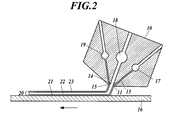
- FIG. 2 is a schematic view showing a co-casting die and cast to form a multilayered web (the web may also be referred to as a dope film immediately after casting).
- the co-casting has a plurality of (three in FIG. 2) skin layer slits 13 and 15 and a core layer slit 14 in the die part 11 of the co-casting die 10, and is made of metal.
- the skin layer dope 17 By simultaneously casting the skin layer dope 17, the core layer dope 18, and the skin layer dope 19 on the support 16 from the respective slits, a multilayer structure of skin layer 21 / core layer 22 / skin layer 23 is obtained.
- the web 20 is formed.
- a known co-casting method can be used for the cellulose acylate film of the present invention.
- a film may be produced while casting and laminating a solution containing cellulose acetate from a plurality of casting openings provided at intervals in the traveling direction of the metal support, for example, as disclosed in JP-A-61-158414.
- the methods described in Japanese Patent Laid-Open Nos. 1-122419 and 11-198285 can be applied.
- it may be formed into a film by casting a cellulose acetate solution from two casting ports.
- JP-B-60-27562, JP-A-61-94724, JP-A-61-947245 It can be carried out by the methods described in JP-A Nos.
- the cellulose ester film casting method described in JP-A-56-162617 is a method of wrapping a flow of a high-viscosity cellulose ester solution with a low-viscosity cellulose ester solution and simultaneously extruding the high- and low-viscosity cellulose ester solution. Good. Furthermore, it is also a preferable aspect that the outer solution described in JP-A-61-94724 and JP-A-61-94725 contains a larger amount of an alcohol component which is a poor solvent than the inner solution.
- the film thickness of the cellulose acylate film of the present invention is preferably a thin film, and a range of 15 to 40 ⁇ m is used. From the viewpoint of weight reduction and curling resistance of the polarizing plate, the thickness is preferably in the range of 15 to 35 ⁇ m.
- the width of the cellulose acylate film of the present invention is in the range of 1 to 4 m.
- a width in the range of 1.4 to 4 m is preferable, and a range of 1.6 to 3 m is more preferable. If the width exceeds 4 m, conveyance may be difficult.
- the retardation value Ro in the in-plane direction and the retardation value Rth in the thickness direction of the cellulose acylate film of the present invention are obtained by the following formulas (4) and (5).
- n x a refractive index in a slow axis direction of the cellulose acylate film plane.
- n y represents a fast axis direction of the refractive index of the cellulose acylate film plane.
- nz represents the refractive index in the thickness direction of the cellulose acylate film.
- the measurement condition of the refractive index is a wavelength of 590 nm in an environment of 23 ° C. and 55% RH.
- d represents the thickness (nm) of the cellulose acylate film.
- the retardation values Ro and Rth were obtained by cutting out a 35 mm ⁇ 35 mm sample from the obtained cellulose acylate film, adjusting the humidity at 23 ° C. and 55% RH for 2 hours, and using an automatic birefringence meter (KOBRA21ADH, Oji Scientific Co., Ltd.) It can be calculated from the value measured from the vertical direction at 590 nm and the extrapolated value of the retardation value measured in the same manner while tilting the cellulose acylate film surface.
- KBRA21ADH automatic birefringence meter
- the retardation required for the cellulose acylate film of the present invention varies depending on the required optical compensation effect
- the retardation values Ro and Rth preferably satisfy the following ranges from the viewpoint of taking advantage of high retardation development. .
- the retardation value Ro is preferably in the range of 30 to 70 (nm), more preferably in the range of 40 to 60 (nm), and still more preferably in the range of 45 to 55 (nm).
- the retardation value Rth is preferably in the range of 90 to 230 (nm), more preferably in the range of 100 to 170 (nm), and still more preferably in the range of 110 to 160 (nm).
- the slow axis or the fast axis of the cellulose acylate film is present in the cellulose acylate film surface, and ⁇ 1 is preferably ⁇ 1 ° or more and + 1 ° or less when the angle formed with the film forming direction is ⁇ 1. It is more preferably ⁇ 0.5 ° or more and + 0.5 ° or less.
- This ⁇ 1 can be defined as an orientation angle, and ⁇ 1 can be measured using an automatic birefringence meter KOBRA-21ADH (Oji Scientific Instruments).
- KOBRA-21ADH automatic birefringence meter
- the moisture permeability can be measured according to the method described in JIS Z0208.
- the range of elongation at break of the cellulose acylate film is preferably in the range of 10 to 80%, more preferably in the range of 20 to 50%.
- the visible light transmittance range of the cellulose acylate film is preferably 90% or more, and more preferably 93% or more.
- the haze of the cellulose acylate film is preferably less than 1%, and more preferably in the range of 0 to 0.1%.
- Preferred examples of the photocurable adhesive for laminating the polarizer and the cellulose acylate film include a photocurable adhesive composition containing the following components ( ⁇ ) to ( ⁇ ). .
- the cationically polymerizable compound ( ⁇ ), which is a main component of the photocurable adhesive composition and serves as a component that gives adhesive force by polymerization and curing, may be any compound that can be cured by cationic polymerization. It is preferable to include an epoxy compound having one epoxy group.
- the epoxy compound includes an aromatic epoxy compound having an aromatic ring in the molecule, an alicyclic epoxy compound having at least two epoxy groups in the molecule, and at least one of which is bonded to the alicyclic ring.
- a fatty acid that does not have an aromatic ring in the molecule and one carbon atom of the ring containing the two carbon atoms to which it is bonded (usually an oxirane ring) is bonded to another aliphatic carbon atom Group epoxy compounds.
- the photocurable adhesive composition used in the present invention is preferably a cation polymerizable compound ( ⁇ ) having, as a main component, an epoxy resin not containing an aromatic ring or an alicyclic epoxy compound.
- a cationically polymerizable compound containing an alicyclic epoxy compound as a main component is used, a cured product having a high storage elastic modulus is given, and the cellulose acylate film and the polarizer are bonded via the cured product (adhesive layer).
- the polarizer is difficult to break.
- the alicyclic epoxy compound has at least two epoxy groups in the molecule, and at least one of them is bonded to the alicyclic ring.
- the epoxy group bonded to the alicyclic ring means that two bonds of the epoxy group (—O—) constitute the alicyclic ring as shown in the following general formula (ep). It means that it is directly bonded to each carbon atom (usually adjacent carbon atom).
- ep the following general formula (ep)
- m represents an integer of 2 to 5.
- a compound in which a group in which one or more hydrogen atoms in (CH 2 ) m in the general formula (ep) are removed is bonded to another chemical structure can be an alicyclic epoxy compound.
- Hydrogen constituting the alicyclic ring may be appropriately substituted with a linear alkyl group such as a methyl group or an ethyl group.
- any of the following compounds (ep-1) to (ep-11) is more preferable because they are easily available and have a large effect of increasing the storage elastic modulus of the cured product.
- R 1 to R 24 each independently represents a hydrogen atom or an alkyl group having 1 to 6 carbon atoms.
- the alkyl group having 1 to 6 carbon atoms may be a straight chain, may be branched, or may have an alicyclic ring.
- Y 8 represents an oxygen atom or an alkanediyl group having 1 to 20 carbon atoms.
- Y 1 to Y 7 each independently represents a straight chain, may be branched, and may represent an alkanediyl group having 1 to 20 carbon atoms which may have an alicyclic ring.
- n, p, q and r each independently represents a number from 0 to 20.
- the alicyclic diepoxy compound represented by the formula (ep-2) is preferable because it is easily available.
- the alicyclic diepoxy compound of the formula (ep-2) includes 3,4-epoxycyclohexylmethanol (an alkyl group having 1 to 6 carbon atoms may be bonded to the cyclohexane ring) and 3,4-epoxycyclohexane.
- An ester with a carboxylic acid an alkyl group having 1 to 6 carbon atoms may be bonded to the cyclohexane ring).
- an alicyclic epoxy compound in combination with an epoxy resin substantially free of an alicyclic epoxy group. If a cation-polymerizable compound containing an alicyclic epoxy compound as the main component and an epoxy resin substantially free of an alicyclic epoxy group is used as a cationically polymerizable compound, the cured product has a high storage elastic modulus. However, the adhesion between the polarizer and the cellulose acylate film can be further enhanced.
- an epoxy resin having substantially no alicyclic epoxy group means that one carbon atom of a ring (usually an oxirane ring) containing an epoxy group and two carbon atoms to which the epoxy group is bonded in the molecule.
- a compound bonded to another aliphatic carbon atom examples thereof include polyglycidyl ether of polyhydric alcohol (phenol).
- phenol polyhydric alcohol
- a diglycidyl ether compound represented by the following general formula (ge) is preferable because it is easily available and has a large effect of improving the adhesion between the polarizer and the cellulose acylate film.
- X represents a direct bond, a methylene group, an alkylidene group having 1 to 4 carbon atoms, an alicyclic hydrocarbon group, O, S, SO 2 , SS, SO, CO, OCO or the following formula (ge-1 )
- To (ge-3) represents a substituent selected from the group consisting of three types of substituents, and the alkylidene group may be substituted with a halogen atom.
- R 25 and R 26 may be each independently substituted with a hydrogen atom, an alkyl group having 1 to 3 carbon atoms, an alkyl group having 1 to 10 carbon atoms, or an alkoxy group.
- Good may be
- a and D are each independently an alkyl group having 1 to 10 carbon atoms which may be substituted with a halogen atom, or 6 carbon atoms which may be substituted with a halogen atom.
- the methylene group in the alkyl group, aryl group or arylalkyl group may be interrupted by an unsaturated bond, —O— or —S—.
- a represents a number from 0 to 4
- d represents a number from 0 to 4.
- Examples of the diglycidyl ether compound of the general formula (ge) include bisphenol-type epoxy resins such as diglycidyl ether of bisphenol A, diglycidyl ether of bisphenol F, diglycidyl ether of bisphenol S; glycidyl ether of tetrahydroxyphenylmethane , Glycidyl ether of tetrahydroxybenzophenone, polyfunctional epoxy resin such as epoxidized polyvinylphenol; polyglycidyl ether of aliphatic polyhydric alcohol; polyglycidyl ether of alkylene oxide adduct of aliphatic polyhydric alcohol; Examples thereof include diglycidyl ether, and among them, polyglycidyl ether of aliphatic polyhydric alcohol is preferable because it is easily available.
- Examples of the aliphatic polyhydric alcohol include those having 2 to 20 carbon atoms. More specifically, for example, ethylene glycol, 1,2-propanediol, 1,3-propanediol, 2-methyl-1,3-propanediol, 2-butyl-2-ethyl-1,3-propanediol, 1,4-butanediol, neopentyl glycol, 3-methyl-2,4-pentanediol, 2,4-pentanediol, 1,5-pentanediol, 3-methyl-1,5-pentanediol, 2-methyl -2,4-pentanediol, 2,4-diethyl-1,5-pentanediol, 1,6-hexanediol, 1,7-heptanediol, 3,5-heptanediol, 1,8-octanediol, -Aliphatic
- the blending ratio of both is 50 to 50 based on the total amount of the cationic polymerizable compound. It is preferable that 95% by mass and an epoxy resin substantially not having an alicyclic epoxy group be 5% by mass or more.
- the adhesiveness of a polarizer and a cellulose acylate film improves by mix
- the amount of the epoxy resin having substantially no alicyclic epoxy group is 50 based on the total amount of the cation polymerizable compound when the cation polymerizable compound is a two-component system with the alicyclic epoxy compound.
- the amount is 45% by mass or less based on the total amount of the cationically polymerizable compound. Is preferred.
- cationically polymerizable compound ( ⁇ ) constituting the photocurable adhesive composition when using an alicyclic epoxy compound and an epoxy resin substantially free of an alicyclic epoxy group as described above, in the range where becomes the above-mentioned amount, in addition to these, other cationically polymerizable compounds may be included.
- examples of other cationically polymerizable compounds include epoxy compounds other than formulas (ep-1) to (ep-11) and general formula (ge), oxetane compounds, and the like.
- Epoxy compounds other than those represented by formulas (ep-1) to (ep-11) and formula (ge) include at least one alicyclic ring in the molecule other than those represented by formulas (ep-1) to (ep-11).
- Examples of alicyclic epoxy compounds having an epoxy group bonded to at least one alicyclic ring in a molecule other than those represented by formulas (ep-1) to (ep-11) include 4-vinylcyclohexene diepoxide, 1, 2: diepoxides of vinylcyclohexenes such as 8,8,9-diepoxy limonene.
- Examples of the aliphatic epoxy compound having an oxirane ring bonded to an aliphatic carbon atom other than the general formula (ge) include triglycidyl ether of glycerin, triglycidyl ether of trimethylolpropane, and diglycidyl ether of polyethylene glycol.
- the aromatic epoxy compound having an aromatic ring and an epoxy group in the molecule can be a glycidyl ether of an aromatic polyhydroxy compound having at least two phenolic hydroxy groups (hydroxyl groups) in the molecule.
- a hydrogenated epoxy compound in which an aromatic ring in an aromatic epoxy compound is hydrogenated is an aromatic polyhydroxy compound having at least two phenolic hydroxy groups (hydroxyl groups) in a molecule as a raw material of the aromatic epoxy compound.
- Specific examples include diglycidyl ether of hydrogenated bisphenol A, diglycidyl ether of hydrogenated bisphenol F, diglycidyl ether of hydrogenated bisphenol S, and the like.
- epoxy compounds other than formulas (ep-1) to (ep-11) and general formula (ge) they have an epoxy group bonded to an alicyclic ring, and are classified as the alicyclic epoxy compounds defined above.
- the sum of the alicyclic epoxy compounds represented by the formulas (ep-1) to (ep-11) does not exceed 95% by mass based on the total amount of the cationic polymerizable compound Used in a range.
- An oxetane compound that can be any cationically polymerizable compound is a compound having a 4-membered cyclic ether (oxetanyl group) in the molecule. Specific examples thereof include 3-ethyl-3-hydroxymethyloxetane, 1,4-bis [(3-ethyl-3-oxetanyl) methoxymethyl] benzene, 3-ethyl-3- (phenoxymethyl) oxetane, di [ (3-ethyl-3-oxetanyl) methyl] ether, 3-ethyl-3- (2-ethylhexyloxymethyl) oxetane, 3-ethyl-3- (cyclohexyloxymethyl) oxetane, phenol novolak oxetane, 1,3-bis [(3-Ethyloxetane-3-yl) methoxy] benzene, oxetanylsilsesquio
- the oxetane compound By blending the oxetane compound at a ratio of 30% by mass or less based on the total amount of the cationic polymerizable compound, an effect of improving curability is expected compared to the case where only the epoxy compound is used as the cationic polymerizable compound. There are things you can do.
- Photocationic polymerization initiator ( ⁇ ) In the present invention, the cationically polymerizable compound as described above is cationically polymerized by irradiation with active energy rays and cured to form an adhesive layer. Therefore, the photocurable adhesive composition has photocationic polymerization initiation. It is preferable to blend the agent ( ⁇ ).
- the cationic photopolymerization initiator generates a cationic species or a Lewis acid upon irradiation with active energy rays such as visible light, ultraviolet rays, X-rays, and electron beams, and initiates a polymerization reaction of the cationic polymerizable compound ( ⁇ ). It is. Since the cationic photopolymerization initiator acts catalytically by light, it is excellent in storage stability and workability even when mixed with the cationically polymerizable compound ( ⁇ ).
- Examples of compounds that generate cation species and Lewis acids upon irradiation with active energy rays include aromatic diazonium salts; onium salts such as aromatic iodonium salts and aromatic sulfonium salts; and iron-allene complexes.
- aromatic diazonium salt examples include benzenediazonium hexafluoroantimonate, benzenediazonium hexafluorophosphate, and benzenediazonium hexafluoroborate.
- aromatic iodonium salt examples include diphenyliodonium tetrakis (pentafluorophenyl) borate, diphenyliodonium hexafluorophosphate, diphenyliodonium hexafluoroantimonate, di (4-nonylphenyl) iodonium hexafluorophosphate, and the like.
- aromatic sulfonium salt examples include triphenylsulfonium hexafluorophosphate, triphenylsulfonium hexafluoroantimonate, triphenylsulfonium tetrakis (pentafluorophenyl) borate, 4,4′-bis [diphenylsulfonio] diphenyl sulfide bishexafluoro.
- iron-allene complexes examples include xylene-cyclopentadienyl iron (II) hexafluoroantimonate, cumene-cyclopentadienyl iron (II) hexafluorophosphate, xylene-cyclopentadienyl iron (II) tris (tri Fluoromethylsulfonyl) methanide and the like.
- photocationic polymerization initiators may be used alone or in admixture of two or more.
- aromatic sulfonium salts are particularly preferably used because they have ultraviolet absorption characteristics even in the wavelength region near 300 nm, and thus can provide a cured product having excellent curability and good mechanical strength and adhesive strength. .
- the amount of the cationic photopolymerization initiator ( ⁇ ) is in the range of 1 to 10 parts by mass with respect to 100 parts by mass of the entire cationic polymerizable compound ( ⁇ ).
- the cationic photopolymerization initiator ( ⁇ ) can be sufficiently cured, and the resulting polarizing plate has high mechanical strength. And give adhesive strength.
- the amount is increased, the ionic substance in the cured product increases, so that the hygroscopic property of the cured product increases and the durability performance of the polarizing plate may be lowered.
- the amount of the cationic photopolymerization initiator ( ⁇ ) is preferably 2 parts by mass or more and preferably 6 parts by mass or less per 100 parts by mass of the cationic polymerizable compound ( ⁇ ).
- the photocurable adhesive composition that can be used in the present invention is suitable for light having a wavelength longer than 380 nm in addition to the cationic polymerizable compound ( ⁇ ) and the cationic photopolymerization initiator ( ⁇ ) including the epoxy compound as described above. Contains a photosensitizer ( ⁇ ) exhibiting maximum absorption.
- the cationic photopolymerization initiator ( ⁇ ) exhibits maximum absorption at a wavelength near or shorter than 300 nm, generates a cationic species or a Lewis acid in response to light having a wavelength near the wavelength, and generates a cationic polymerizable compound ( ⁇ ) Is initiated, but a photosensitizer ( ⁇ ) that exhibits maximum absorption in light having a wavelength longer than 380 nm is blended so as to be sensitive to light having a longer wavelength than that.
- an anthracene compound represented by the following general formula (at) is advantageously used.
- R 5 and R 6 each independently represents an alkyl group having 1 to 6 carbon atoms or an alkoxyalkyl group having 2 to 12 carbon atoms.
- R 7 represents a hydrogen atom or an alkyl group having 1 to 6 carbon atoms.
- anthracene compound represented by the general formula (at) include 9,10-dimethoxyanthracene, 9,10-diethoxyanthracene, 9,10-dipropoxyanthracene, 9,10-diisopropoxyanthracene, 9 , 10-dibutoxyanthracene, 9,10-dipentyloxyanthracene, 9,10-dihexyloxyanthracene, 9,10-bis (2-methoxyethoxy) anthracene, 9,10-bis (2-ethoxyethoxy) anthracene, 9 , 10-bis (2-butoxyethoxy) anthracene, 9,10-bis (3-butoxypropoxy) anthracene, 2-methyl or 2-ethyl-9,10-dimethoxyanthracene, 2-methyl or 2-ethyl-9, 10-diethoxyanthracene, 2-methyl or 2 Ethyl-9,10-dipropoxyanthracene
- the curability of the photocurable adhesive composition is improved as compared with the case where it is not blended. Curability is improved by setting the blending amount of the photosensitizer ( ⁇ ) to 100 parts by mass of the cationic polymerizable compound ( ⁇ ) constituting the photocurable adhesive composition to be 0.1 parts by mass or more. The effect is manifested.
- the blending amount of the photosensitizer ( ⁇ ) increases, problems such as precipitation during low-temperature storage occur, so the blending amount of 2 parts by weight or less with respect to 100 parts by weight of the cationic polymerizable compound ( ⁇ ) To do.
- the blending amount of the photosensitizer ( ⁇ ) within a range in which the adhesiveness between the polarizer and the cellulose acylate film is appropriately maintained.
- the amount of the photosensitizer ( ⁇ ) is in the range of 0.1 to 0.5 parts by mass, further 0.1 to 0.3 parts by mass. Is preferred.
- the photocurable adhesive composition that can be used in the present invention includes the following cationic polymerizable compound ( ⁇ ) containing an epoxy compound, a cationic photopolymerization initiator ( ⁇ ), and a photosensitizer ( ⁇ ). It contains a naphthalene-based photosensitization aid ( ⁇ ) represented by the general formula (nf).
- R 1 and R 2 are each an alkyl group having 1 to 6 carbon atoms.
- naphthalene photosensitizer ( ⁇ ) include 1,4-dimethoxynaphthalene, 1-ethoxy-4-methoxynaphthalene, 1,4-diethoxynaphthalene, 1,4-dipropoxynaphthalene, 1, 4-dibutoxynaphthalene and the like can be mentioned.
- the curability of the photocurable adhesive composition is improved as compared with the case where it is not blended.
- the blending amount of the naphthalene photosensitizer ( ⁇ ) is set to 100 parts by mass of the cationic polymerizable compound ( ⁇ ) constituting the photocurable adhesive composition to be 0.1 parts by mass or more, curability is improved. The improvement effect is manifested.
- the amount of the naphthalene-based photosensitization aid ( ⁇ ) increases, problems such as precipitation during low-temperature storage occur, and therefore the amount is 10 parts by mass or less with respect to 100 parts by mass of the cationic polymerizable compound ( ⁇ ).
- the blending amount Preferably, the blending amount is 5 parts by mass or less with respect to 100 parts by mass of the cationic polymerizable compound ( ⁇ ).
- the photocurable adhesive composition that can be used in the present invention can contain an additive component as an optional component as long as the effects of the present invention are not impaired.
- additive components in addition to the above-mentioned photocationic polymerization initiator and photosensitizer ( ⁇ ), photosensitizers other than the photosensitizer ( ⁇ ), thermal cationic polymerization initiators, polyols, ion trapping agents , Antioxidants, light stabilizers, chain transfer agents, tackifiers, thermoplastic resins, fillers, flow regulators, plasticizers, antifoaming agents, leveling agents, dyes, organic solvents, and the like.
- the amount of the additive component used is preferably 1000 parts by mass or less with respect to 100 parts by mass of the cationic polymerizable compound ( ⁇ ).
- the amount used is 1000 parts by mass or less, a cationically polymerizable compound ( ⁇ ), a photocationic polymerization initiator ( ⁇ ), and a photosensitizer, which are essential components of the photocurable adhesive composition that can be used in the present invention.
- the adhesive for laminating the polarizer and the cellulose acylate film include a photocurable adhesive that essentially contains the following three components ( ⁇ 1), ( ⁇ 2), and ( ⁇ 1). A composition is included.
- epoxy compound of ( ⁇ 1) Epoxy compound having at least two epoxy groups in the molecule ( ⁇ 2)
- Photocationic polymerization initiator the epoxy compound of ( ⁇ 1) above, The oxetane compound ( ⁇ 2) and the photocationic polymerization initiator ( ⁇ 1) are simply referred to as epoxy compound ( ⁇ 1), oxetane compound ( ⁇ 2), and photocationic polymerization initiator ( ⁇ 1), respectively.
- the mass ratio of the epoxy compound ( ⁇ 1) to the oxetane compound ( ⁇ 2) is preferably about 90:10 to 10:90.
- the cationic photopolymerization initiator ( ⁇ 1) is preferably blended in the composition at a ratio of about 0.5 to 20% by mass.
- This photo-curable adhesive can optionally contain an unsaturated compound having at least one ethylenically unsaturated bond in the molecule as the ( ⁇ ) component.
- an unsaturated compound ( ⁇ ) When such an unsaturated compound ( ⁇ ) is contained, it is preferable to contain a radical photopolymerization initiator as the ( ⁇ ) component.
- this photocurable adhesive agent can also contain the other component which does not have polymerizability as ((eta)) component.
- the unsaturated compound ( ⁇ ), the photoradical polymerization initiator as the ( ⁇ ) component, and the other non-polymerizable component as the ( ⁇ ) component are simply referred to as the unsaturated compound ( ⁇ ) and the photoradical, respectively. It is referred to as a polymerization initiator ( ⁇ ) and other component ( ⁇ ) having no polymerizability.
- the epoxy compound ( ⁇ 1) is not particularly limited as long as it has at least two epoxy groups in the molecule, and various kinds of generally known curings.
- a functional epoxy compound can be used.
- a preferable epoxy compound ( ⁇ 1) a compound having at least two epoxy groups and at least one aromatic ring in the molecule (hereinafter referred to as an aromatic epoxy compound), or having at least two epoxy groups in the molecule.
- the compound include at least one compound formed between two adjacent carbon atoms constituting the alicyclic ring (hereinafter referred to as an alicyclic epoxy compound).
- the aromatic epoxy compound is not particularly limited as long as the effect of the present invention is not hindered, but bisphenol type epoxy such as diglycidyl ether of bisphenol A, diglycidyl ether of bisphenol F, diglycidyl ether of brominated bisphenol A, and the like.
- Novolak type epoxy resin such as phenol novolac type epoxy resin, cresol novolak type epoxy resin; other, biphenyl type epoxy resin, hydroquinone diglycidyl ether, resorcin diglycidyl ether, terephthalic acid diglycidyl ester, phthalic acid diglycidyl ester, Epoxidized styrene-butadiene copolymer, epoxidized styrene-isoprene copolymer, addition of terminal carboxylic acid polybutadiene and bisphenol A type epoxy resin Applied Physics, etc. as an example.
- the epoxy resin means a compound or polymer having an average of two or more epoxy groups in the molecule and cured by reaction.
- a monomer may be referred to as an epoxy resin as long as it has two or more curable epoxy groups in the molecule.
- the alicyclic epoxy compound is not particularly limited as long as the effects of the present invention are not hindered, but dicyclopentadiene dioxide, limonene dioxide, 4-vinylcyclohexene dioxide, 3,4-epoxycyclohexylmethyl-3,4- Examples include compounds having at least one epoxidized cyclohexyl group such as epoxycyclohexanecarboxylate and bis (3,4-epoxycyclohexylmethyl) adipate.
- aliphatic epoxy compounds such as 1,6-hexanediol diglycidyl ether, trimethylolpropane triglycidyl ether, pentaerythritol tetraglycidyl ether, polytetramethylene glycol diglycidyl ether; dihydrogenated bisphenol A Epoxy compounds with hydrogenated aromatic rings, such as glycidyl ether; compounds with polybutadiene having both ends hydroxy groups (hydroxyl groups) having both ends glycidyl ether, polybutadiene internal epoxidation product, styrene-butadiene copolymer A compound in which the heavy bond is partially epoxidized (for example, Epofriend manufactured by Daicel Corporation), a compound in which the isoprene unit of the block copolymer of ethylene-butylene copolymer and polyisoprene is partially epoxidized (eg, If, polymeric epoxy compounds, such as 1,6-he
- aromatic epoxy compounds are preferable because they are excellent in durability when used for polarizing plates, and particularly excellent in adhesion to polarizers and cellulose acylate films.
- preferred examples of the aromatic epoxy compound include glycidyl ethers of aromatic compounds or glycidyl esters of aromatic compounds.
- glycidyl ethers of aromatic compounds include bisphenol type epoxy resins such as diglycidyl ether of bisphenol A, diglycidyl ether of bisphenol F, diglycidyl ether of brominated bisphenol A; phenol novolac type epoxy resin, cresol novolac type Preferred examples include novolak-type epoxy resins such as epoxy resins; biphenyl-type epoxy resins; hydroquinone diglycidyl ether; resorcin diglycidyl ether and the like.
- Specific examples of glycidyl esters of aromatic compounds include terephthalic acid diglycidyl ester and phthalic acid diglycidyl ester.
- the glycidyl ether of an aromatic compound is more excellent in the adhesiveness between a polarizer and a cellulose acylate film, and durability when used for a polarizing plate, it is particularly preferable.
- the glycidyl ethers of aromatic compounds particularly preferable compounds include diglycidyl ether of bisphenol A, diglycidyl ether of bisphenol F, and phenol novolac type epoxy resin.
- the epoxy compound ( ⁇ 1) can be used alone or as a mixture of two or more.
- two or more aromatic epoxy compounds can be mixed and used, or an aromatic epoxy compound as a main component and an alicyclic epoxy compound can also be mixed.
- the oxetane compound ( ⁇ 2) is not particularly limited as long as it has at least one oxetanyl group in the molecule, and various compounds having an oxetanyl group are also used. be able to.
- Preferred examples of the oxetane compound ( ⁇ 2) include a compound having one oxetanyl group in the molecule (hereinafter referred to as monofunctional oxetane) and a compound having two or more oxetanyl groups in the molecule (hereinafter referred to as polyfunctional oxetane). As mentioned.
- monofunctional oxetane monofunctional oxetane containing alkoxyalkyl group such as 3-ethyl-3- (2-ethylhexyloxymethyl) oxetane, and monofunctional containing aromatic group such as 3-ethyl-3-phenoxymethyloxetane.
- alkoxyalkyl group such as 3-ethyl-3- (2-ethylhexyloxymethyl) oxetane
- monofunctional containing aromatic group such as 3-ethyl-3-phenoxymethyloxetane.
- Preferred examples include hydroxy group (hydroxyl group) -containing monofunctional oxetane such as oxetane and 3-ethyl-3-hydroxymethyloxetane.
- polyfunctional oxetane examples include 3-ethyl-3-[(3-ethyloxetane-3-yl) methoxymethyl] oxetane, 1,4-bis [(3-ethyloxetane-3-yl) methoxymethyl] benzene, 1,4-bis [(3-ethyloxetane-3-yl) methoxy] benzene, 1,3-bis [(3-ethyloxetane-3-yl) methoxy] benzene, 1,2-bis [(3-ethyl Oxetane-3-yl) methoxy] benzene, 4,4'-bis [(3-ethyloxetane-3-yl) methoxy] biphenyl, 2,2'-bis [(3-ethyloxetane-3-yl) methoxy] Biphenyl, 3,3 ′, 5,5′-tetramethyl-4,4′-bis [(3-
- the oxetane compound ( ⁇ 2) is preferably liquid at room temperature with a molecular weight of 500 or less from the viewpoint of coating properties and adhesion to a cellulose acylate film when used for a polarizing plate. Furthermore, in terms of excellent durability of the polarizing plate, a monofunctional oxetane is more preferably an aromatic ring in the molecule or a polyfunctional oxetane.
- oxetane compounds examples include 3-ethyl-3-phenoxymethyloxetane, 3-ethyl-3-[(3-ethyloxetane-3-yl) methoxymethyl] oxetane, 1,4-bis [(3 -Ethyloxetane-3-yl) methoxymethyl] benzene and the like.
- the oxetane compound ( ⁇ 2) can also be used alone or in combination of two or more.
- the mass ratio of the epoxy compound ( ⁇ 1) to the oxetane compound ( ⁇ 2) is 90:10 to 10:90. If this mass ratio is excessive or insufficient, the effect of curing in a short time, which is one of the important characteristics in the photocurable adhesive composition that can be used in the present invention, is not sufficiently exhibited.
- a preferred mass ratio is about 70:30 to 20:80, more preferably 60:40, because it has a low viscosity before curing, excellent coating properties, and can exhibit sufficient adhesion and flexibility after curing. It is about 25:75.
- the photocurable adhesive composition that can be used in the present invention contains the above-described epoxy compound ( ⁇ 1) and oxetane compound ( ⁇ 2) as curing components, and these are all cured by cationic polymerization.
- a photocationic polymerization initiator ( ⁇ 1) is blended.
- the cationic photopolymerization initiator ( ⁇ 1) generates a cationic species or a Lewis acid by irradiation with active energy rays such as visible light, ultraviolet rays, X-rays, and electron beams, and initiates a polymerization reaction of an epoxy group or an oxetanyl group.
- the cationic photopolymerization initiator ( ⁇ 1) By blending the cationic photopolymerization initiator ( ⁇ 1), curing at room temperature is possible, and there is little need to consider the heat resistance of the polarizer and distortion due to expansion or contraction, and the cellulose acylate film is adhered well. be able to.
- the cationic photopolymerization initiator ( ⁇ 1) acts catalytically upon irradiation with active energy rays, it is excellent in storage stability and workability even when mixed with the epoxy compound ( ⁇ 1) and the oxetane compound ( ⁇ 2). .
- Photocationic polymerization initiators ( ⁇ 1) that generate cationic species and Lewis acids upon irradiation with such active energy rays include, for example, onium salts such as aromatic diazonium salts, aromatic iodonium salts and aromatic sulfonium salts, iron- An allene complex etc. can be mentioned.
- aromatic diazonium salt examples include benzenediazonium hexafluoroantimonate, benzenediazonium hexafluorophosphate, and benzenediazonium hexafluoroborate.
- aromatic iodonium salt examples include diphenyliodonium tetrakis (pentafluorophenyl) borate, diphenyliodonium hexafluorophosphate, diphenyliodonium hexafluoroantimonate, di (4-nonylphenyl) iodonium hexafluorophosphate, and the like.
- aromatic sulfonium salt examples include triphenylsulfonium hexafluorophosphate, triphenylsulfonium hexafluoroantimonate, triphenylsulfonium tetrakis (pentafluorophenyl) borate, diphenyl [4- (phenylthio) phenyl] sulfonium hexafluorophosphate, diphenyl [ 4- (phenylthio) phenyl] sulfonium hexafluoroantimonate, 4,4'-bis (diphenylsulfonio) diphenyl sulfide bishexafluorophosphate, 4,4'-bis [di ( ⁇ -hydroxyethoxy) phenylsulfonio] diphenyl Sulfide bishexafluoroantimonate, 4,4'-bis [di ( ⁇ -hydroxyethoxy) phenylsulfon
- iron-allene complexes examples include xylene-cyclopentadienyl iron (II) hexafluoroantimonate, cumene-cyclopentadienyl iron (II) hexafluorophosphate, xylene-cyclopentadienyl iron (II) -tris ( (Trifluoromethylsulfonyl) methanide and the like.
- photocationic polymerization initiators ( ⁇ 1) may be used alone or in combination of two or more.
- aromatic sulfonium salts are particularly preferably used because they have ultraviolet absorption characteristics even in a wavelength region of 300 nm or more, and therefore can provide a cured product having excellent curability and good mechanical strength and adhesive strength. It is done.
- cationic photopolymerization initiator ( ⁇ 1) commercially available products can be easily obtained.
- Kayrad PCI-220 and Kayalad PCI-620 (above, manufactured by Nippon Kayaku Co., Ltd.) under the trade names, respectively.
- UVI-6992 (manufactured by Dow Chemical Co.), Adeka optomer SP-150, Adeka optomer SP-170 (above, manufactured by ADEKA), CI-5102, CIT-1370, CIT-1682S, CIP-1866S , CIP-2048S, CIP-2064S (manufactured by Nippon Soda Co., Ltd.), DPI-101, DPI-102, DPI-103, DPI-105, MPI-103, MPI-105, BBI-101, BBI-102 , BBI-103, BBI-105, TPS-101, TPS-102, TPS-103, TPS-105 MDS-103, MDS-105, DTS-102, DTS-103 (above, manufactured by Midori Chemical Co., Ltd.), PI-2074 (manufactured by Rhodia), Irgacure 250, Irgacure PAG103, Irgacure PAG108, Irgacure PAG121
- UVI-6992, CPI-100P, CPI-101A, CPI-200K, and CPI-210S containing diphenyl [4- (phenylthio) phenyl] sulfonium as a cation component are preferable.
- the blending ratio of the photocationic polymerization initiator ( ⁇ 1) is in the range of 0.5 to 20% by mass based on the entire photocurable adhesive.
- the blending ratio is less than 0.5% by mass, curing of the photocurable adhesive becomes insufficient, and mechanical strength and adhesive strength are lowered.
- the blending ratio exceeds 20% by mass, the ionic substance in the cured product is increased, so that the hygroscopic property of the cured product is increased and the durability may be lowered.
- a radical photocurable adhesive composition containing the following components ( ⁇ ) and ( ⁇ ): Is mentioned.
- the photocurable adhesive preferably contains an unsaturated compound ( ⁇ ) having at least one ethylenically unsaturated bond in the molecule as necessary.
- a typical example of such an unsaturated compound ( ⁇ ) includes a (meth) acrylic compound having at least one (meth) acryloyl group in the molecule.
- the (meth) acrylic compound is not particularly limited, and examples thereof include (meth) acrylates, (meth) acrylamides, (meth) acrylic acid, (meth) acryloylmorpholine, and (meth) acrylaldehyde.
- the (meth) acrylates having one (meth) acryloyl group in the molecule are not particularly limited, but for example, methyl (meth) acrylate, ethyl (meth) acrylate, Propyl (meth) acrylate, isopropyl (meth) acrylate, butyl (meth) acrylate, isobutyl (meth) acrylate, 2-ethylhexyl (meth) acrylate, octyl (meth) acrylate, isooctyl (meth) acrylate, lauryl (meth) acrylate, Alkyl (meth) acrylates such as stearyl (meth) acrylate; hydrides such as 2-hydroxyethyl (meth) acrylate, 2-hydroxypropyl (meth) acrylate, 4-hydroxybutyl (meth) acrylate Roxyalkyl (meth)
- (meth) acrylates having two or more (meth) acryloyl groups in the molecule are not particularly limited, and examples thereof include the following compounds.
- Alicyclic rings such as tricyclodecane dimethylol di (meth) acrylate, 1,4-cyclohexane dimethylol di (meth) acrylate, norbornane dimethylol di (meth) acrylate, di (meth) acrylate of hydrogenated bisphenol A Di (meth) acrylates having bisphenol A ethylene oxide adduct di (meth) acrylate, bisphenol A propylene oxide adduct di (meth) acrylate containing di (meth) acrylate, bisphenol A Di (meth) acrylates having an aromatic ring such as di (meth) acrylate of A diglycidyl ether; ethylene glycol di (meth) acrylate, propylene glycol di (meth) acrylate, penta Di (meth) acrylates of alkylene glycols such as diol di (meth) acrylate and hexanediol di (meth) acrylate; diethylene glycol di
- (Meth) acrylamides include (meth) acrylamide, N, N-dimethyl (meth) acrylamide, N, N-diethyl (meth) acrylamide, N-methylol (meth) acrylamide, N- (3-N, N- Examples thereof include dimethylaminopropyl) (meth) acrylamide, methylene bis (meth) acrylamide, and ethylene bis (meth) acrylamide.
- oligomers such as urethane (meth) acrylate, polyester (meth) acrylate, and epoxy (meth) acrylate can be used as the (meth) acrylic compound.
- a compound having an ethylenically unsaturated bond other than the (meth) acryloyl group can also be used as the (meth) acrylic compound.
- Specific examples thereof include allyl (meth) acrylate and N, N-diallyl (meth) acrylamide.
- the unsaturated compound ( ⁇ ) is not particularly limited, and in addition to the above (meth) acrylic compounds, vinyl compounds such as N-vinyl-2-pyrrolidone, divinyl adipate and divinyl sebacate; triallyl isocyan Allyl compounds such as nurate, triallylamine, tetraallyl pyromellitate, N, N, N ′, N′-tetraallyl-1,4-diaminobutane, tetraallylammonium salt, allylamine; such as maleic acid and itaconic acid Unsaturated carboxylic acids and the like can also be used.
- vinyl compounds such as N-vinyl-2-pyrrolidone, divinyl adipate and divinyl sebacate
- triallyl isocyan Allyl compounds such as nurate, triallylamine, tetraallyl pyromellitate, N, N, N ′, N′-tetraallyl-1,4-diamino
- (meth) acrylic compounds are preferable. Furthermore, when a polarizer and a cellulose acylate film are bonded via an adhesive containing the same to produce a polarizing plate, at least one alicyclic group is included in the molecule from the viewpoint of enhancing durability such as heat resistance.
- a (meth) acrylic compound having a skeleton or an aromatic ring skeleton is more preferable. Specific examples of the (meth) acrylic compound having at least one alicyclic skeleton or aromatic ring skeleton in the molecule include the above-described alicyclic monofunctional (meth) acrylates and monofunctional having an aromatic ring.
- Preferable examples include (meth) acrylates, di (meth) acrylates having an alicyclic ring, or di (meth) acrylates having an aromatic ring.
- di (meth) acrylate having a tricyclodecane skeleton is preferable, and specific examples of such (meth) acrylic compounds are tricyclodecane dimethylol di (meth) acrylate and the like. be able to.
- the unsaturated compound ( ⁇ ) can be used to adjust the curing speed, the adhesion between the polarizer and the cellulose acylate film, the elastic modulus of the adhesive layer, the durability of the adhesive, and the like.
- An unsaturated compound ((epsilon)) can be used individually by 1 type or in mixture of 2 or more types.
- the blending ratio is preferably 35% by mass or less based on the entire composition. Thereby, the adhesiveness between a polarizer and a cellulose acylate film becomes excellent.
- the amount of the unsaturated compound ( ⁇ ) is 35% by mass or less, sufficient adhesive strength with the polarizer can be obtained.
- the blending ratio of the unsaturated compound ( ⁇ ) is more preferably 30% by mass or less, more preferably about 5 to 25% by mass, and particularly preferably about 10 to 20% by mass.
- Photoradical polymerization initiator ( ⁇ ) When the photocurable adhesive contains an unsaturated compound ( ⁇ ), it is preferable to add a photoradical polymerization initiator ( ⁇ ) in order to promote the radical polymerizability and make the curing rate sufficient.
- radical photopolymerization initiator ( ⁇ ) are not particularly limited, but for example, 4′-phenoxy-2,2-dichloroacetophenone, 4′-tert-butyl-2,2-dichloroacetophenone, 2,2- Dimethoxy-2-phenylacetophenone, 2-methyl-1- (4-methylthiophenyl) -2-morpholinopropan-1-one, 1-hydroxycyclohexyl phenyl ketone, ⁇ , ⁇ -diethoxyacetophenone, 2-hydroxy-2 -Methyl-1-phenylpropan-1-one, 1- (4-isopropylphenyl) -2-hydroxy-2-methylpropan-1-one, 1- (4-dodecylphenyl) -2-hydroxy-2-methyl Propan-1-one, 1- [4- (2-hydroxyethoxy) phenyl] -2-hydroxy-2- Acetophenone photopolymerization initiators such as tilpropan-1-one and 2-benzyl-2-di
- the photo radical polymerization initiator ( ⁇ ) can be used alone or in combination of two or more according to the desired performance.
- the blending ratio is preferably 10% by mass or less, more preferably about 0.1 to 3% by mass based on the whole composition. If the amount of the photo radical polymerization initiator ( ⁇ ) is too large, sufficient strength may not be obtained. Moreover, when the amount is insufficient, the adhesive may not be sufficiently cured.
- the other component there may be mentioned compounds having cationic polymerizability other than the epoxy compound ( ⁇ 1) and the oxetane compound ( ⁇ 2). Specific examples include, but are not limited to, an epoxy compound having one epoxy group in the molecule, and the like. Further, as another type belonging to the other component, other component ( ⁇ ) having no polymerizability can be exemplified. When the other component ( ⁇ ) having no polymerizability is blended, the blending ratio is preferably about 10% by mass or less based on the entire composition.
- a photosensitizer is mentioned. By blending a photosensitizer, the reactivity is improved and the mechanical strength and adhesive strength of the cured product can be improved.
- the photosensitizer include carbonyl compounds, organic sulfur compounds, persulfides, redox compounds, azo and diazo compounds, halogen compounds, and photoreductive dyes.
- benzoin derivatives such as benzoin methyl ether, benzoin isopropyl ether, ⁇ , ⁇ -dimethoxy- ⁇ -phenylacetophenone; benzophenone, 2,4-dichlorobenzophenone, o
- a benzophenone derivative such as methyl benzoylbenzoate, 4,4′-bis (dimethylamino) benzophenone, 4,4′-bis (diethylamino) benzophenone; a thioxanthone derivative such as 2-chlorothioxanthone, 2-isopropylthioxanthone;
- Anthraquinone derivatives such as chloroanthraquinone and 2-methylanthraquinone; acridone derivatives such as N-methylacridone and N-butylacridone; other ⁇ , ⁇ -diethoxyacetophenone, benzyl, Luenone, xanth
- the photo sensitizer here is particularly one that functions as a sensitizer for the photo cationic polymerization initiator ( ⁇ 1). It is not limited. These may be used alone or in combination of two or more.
- the photosensitizer is a cationically polymerizable monomer (including the above epoxy compound ( ⁇ 1) and oxetane compound ( ⁇ 2) in the photocurable adhesive composition that can be used in the present invention, and has the other cationic polymerization properties described above.
- the total amount of the compound is also included in the range of 0.1 to 20 parts by mass based on 100 parts by mass.
- thermal cationic polymerization initiator can also be used as another component ( ⁇ ) having no polymerizability.
- the thermal cationic polymerization initiator include benzylsulfonium salt, thiophenium salt, thiolanium salt, benzylammonium salt, pyridinium salt, hydrazinium salt, carboxylic acid ester, sulfonic acid ester, and amine imide. These initiators can be easily obtained as commercial products.
- both of these initiators are indicated by trade names, and ADEKA OPTON CP77 and ADEKA OPTON CP66 (manufactured by ADEKA Corporation), CI-2639, CI- 2624 (manufactured by Nippon Soda Co., Ltd.), Sun Aid SI-60L, Sun Aid SI-80L, Sun Aid SI-100L (manufactured by Sanshin Chemical Industry Co., Ltd.) and the like.
- polyols Since polyols have the property of promoting cationic polymerization, they can also be used as other components ( ⁇ ) that do not have polymerizability.
- the polyols those having no acidic group other than the phenolic hydroxy group (hydroxyl group) are preferable.
- a polyol compound having no functional group other than the hydroxy group (hydroxyl group) a polyester polyol compound, a polycaprolactone polyol compound, and a phenolic compound. Examples thereof include a polyol compound having a hydroxy group (hydroxyl group) and a polycarbonate polyol compound.
- other components ( ⁇ ) having no polymerizability include silane coupling agents, ion trapping agents, antioxidants, light stabilizers, chain transfer agents, sensitizers, and tackifiers.
- An agent, a thermoplastic resin, a filler, a flow regulator, a plasticizer, an antifoaming agent, a leveling agent, a dye, an organic solvent, and the like can be blended.
- thermoplastic resin as another component ( ⁇ ) having no polymerizability for the purpose of further improving the adhesion with the cellulose acylate film.
- thermoplastic resin those having a glass transition temperature of 70 ° C. or higher are preferable from the viewpoint of enhancing the durability of the polarizer, and particularly preferred examples include a methyl methacrylate polymer.
- a polarizer which is a main component of the polarizing plate, is an element that allows only light having a plane of polarization in a certain direction to pass through.
- a typical polarizer currently known is a polyvinyl alcohol polarizing film.
- the polyvinyl alcohol polarizing film includes those obtained by dyeing iodine on a polyvinyl alcohol film and those obtained by dyeing a dichroic dye.
- polarizer a polarizer obtained by forming a polyvinyl alcohol aqueous solution into a film and dyeing it by uniaxial stretching or dyeing and then uniaxially stretching and then preferably performing a durability treatment with a boron compound may be used.
- the thickness of the polarizer is preferably in the range of 5 to 30 ⁇ m, particularly preferably in the range of 10 to 20 ⁇ m.
- the ethylene unit content described in JP-A-2003-248123, JP-A-2003-342322, etc. is 1 to 4 mol%
- the degree of polymerization is 2000 to 4000
- the degree of saponification is 99.0 to 99.99 mol%.
- the ethylene-modified polyvinyl alcohol is also preferably used.
- an ethylene-modified polyvinyl alcohol film having a hot water cutting temperature of 66 to 73 ° C. is preferably used.
- a polarizer using this ethylene-modified polyvinyl alcohol film is excellent in polarizing performance and durability, and has little color unevenness, and is particularly preferably used for a large liquid crystal display device.
- the polarizing plate can be produced by bonding a surface satisfying the permeation amount of hydroxyethyl acrylate of the cellulose acylate film of the present invention to one surface of the polarizer using a photocurable adhesive. For example during lamination, among both surfaces of the cellulose acylate film, a surface d 1 where r value satisfies the above 1.1 has been detected, it is preferable to bond the polarizer by using a photocurable adhesive.
- the cellulose acylate film of the present invention may be used on the other surface of the polarizer constituting the polarizing plate, and other optical films are preferably bonded.
- other optical films include commercially available cellulose ester films (for example, Konica Minoltak KC8UX, KC5UX, KC8UCR3, KC8UCR4, KC8UCR5, KC8UY, KC4UY, KC4UE, KC8UE, KC8UY-HA, HC8UX-HA, HC8UX -RHA-C, KC8UXW-RHA-NC, KC4UXW-RHA-NC, manufactured by Konica Minolta Co., Ltd.) are preferably used.
- the polarizing plate satisfies the permeation amount of the hydroxyethyl acrylate according to the present invention among the pretreatment step for easily adhering the surface of the cellulose acylate film to which the polarizer is adhered, and the adhesive surface of the polarizer and the cellulose acylate film.
- Adhesive application process for applying the following photo-curable adhesive to the surface, a polarizer and a cellulose acylate film are bonded via an adhesive layer, and a bonding process for bonding, and an adhesive layer It can manufacture by the manufacturing method including the hardening process which hardens an adhesive bond layer in the state to which the polarizer and the cellulose acylate film were adhere
- Pretreatment process the surface of the cellulose acylate film that adheres to the polarizer is subjected to an easy adhesion treatment.
- an easy adhesion treatment is performed on each cellulose acylate film.
- the surface subjected to the easy adhesion treatment is treated as a bonding surface with the polarizer, so that, for example, among both surfaces of the cellulose acylate film, the r value satisfies 1.1 or more, d 1 The surface where is detected is easily adhered.
- the photo-curable adhesive is applied to a surface satisfying the permeation amount of hydroxyethyl acrylate among the adhesive surfaces of the polarizer and the cellulose acylate film.
- the photocurable adhesive is applied directly to the surface of the polarizer or the cellulose acylate film, there is no particular limitation on the application method.
- various coating methods such as a doctor blade, a wire bar, a die coater, a comma coater, and a gravure coater can be used.
- a method in which a photocurable adhesive is cast between a polarizer and a cellulose acylate film, and then pressed with a roller or the like to uniformly spread the film can be used.
- Bonding process For example, when a photocurable adhesive is applied to the surface of the polarizer in the previous application step, a cellulose acylate film is superimposed thereon.
- a photocurable adhesive is applied to the surface of the cellulose acylate film in the previous application step, a polarizer is superimposed thereon.
- a photocurable adhesive agent is cast between a polarizer and a cellulose acylate film, a polarizer and a cellulose acylate film are piled up in that state.
- both sides When a cellulose acylate film is bonded to both sides of a polarizer and a photocurable adhesive is used on both sides, the cellulose acylate film is superimposed on each side of the polarizer via a photocurable adhesive. Is done.
- both sides when a cellulose acylate film is overlaid on one side of the polarizer, when the cellulose acylate film is overlaid on both the polarizer side and the cellulose acylate film side, or on both sides of the polarizer
- Is pressed between the two sides of the cellulose acylate film with a roller or the like.
- the material of the roller metal, rubber or the like can be used.
- the rollers arranged on both sides may be made of the same material or different materials.
- an uncured photocurable adhesive is irradiated with active energy rays to cure the adhesive layer containing an epoxy compound or an oxetane compound, and the polarizer and cellulose layered via the photocurable adhesive Adhere to acylate film.
- the active energy ray may be irradiated from either the polarizer side or the cellulose acylate film side.
- either cellulose acylate film is in a state in which the cellulose acylate film is superposed on both surfaces of the polarizer via a photocurable adhesive.
- the active energy ray visible light, ultraviolet ray, X-ray, electron beam and the like can be used, but ultraviolet ray is generally preferably used because it is easy to handle and has a sufficient curing rate.
- the light source of the active energy ray is not particularly limited, but has a light emission distribution at a wavelength of 400 nm or less, for example, a low pressure mercury lamp, a medium pressure mercury lamp, a high pressure mercury lamp, an ultrahigh pressure mercury lamp, a chemical lamp, a black light lamp, a microwave excitation mercury lamp, a metal halide lamp.
- An LED lamp or the like can be used.
- the light irradiation intensity to the photocurable adhesive is determined for each target composition and is not particularly limited, but the irradiation intensity in the wavelength region effective for activating the polymerization initiator is UV. Adjustment is preferably made so that it is in the range of 1 to 3000 mW / cm 2 as -B (ultraviolet light of 280 to 320 nm).
- the irradiation intensity is less than 1 mW / cm 2 , the reaction time becomes too long, and when the irradiation intensity exceeds 3000 mW / cm 2 , photocuring occurs due to heat radiated from the lamp and heat generation during polymerization of the photocurable adhesive. May cause yellowing of the adhesive and deterioration of the polarizer.
- the light irradiation time to the photocurable adhesive is controlled for each composition to be cured and is not particularly limited.
- the integrated light amount represented by the product of the irradiation intensity and the irradiation time is 10 to 5000 mJ / cm. It is preferably set to be in the range of 2 .
- the integrated light quantity is less than 10 mJ / cm 2 , active species derived from the polymerization initiator are not sufficiently generated, and the adhesive layer may be insufficiently cured.
- the integrated light quantity exceeds 5000 mJ / cm 2 , the irradiation time becomes very long, which is disadvantageous for improving productivity.
- the photocurable adhesive When curing the photocurable adhesive by irradiating active energy rays, it is cured under conditions that do not deteriorate the various functions of the polarizing plate, such as the degree of polarization of the polarizer, the transmittance, the hue, and the transparency of the cellulose acylate film. It is preferable.
- the thickness of the adhesive layer is not particularly limited, but is usually 50 ⁇ m or less, preferably 20 ⁇ m or less, more preferably 10 ⁇ m or less, and further preferably 5 ⁇ m or less.
- the polarizing plate of the present invention can be suitably used for a liquid crystal display device.
- the liquid crystal display device using the polarizing plate of the present invention is excellent in visibility because a cellulose acylate film having an excellent optical compensation function is used.
- such a liquid crystal display device has excellent durability because of high adhesion between the polarizer and the cellulose acylate film.
- Bonding between the surface of the polarizing plate on the cellulose acylate film side and at least one surface of the liquid crystal cell can be performed by a known method. Depending on the case, it may be bonded through an adhesive layer.
- the mode (driving method) of the liquid crystal display device is not particularly limited, and liquid crystal display devices of various drive modes such as STN, TN, OCB, HAN, VA (MVA, PVA), IPS, OCB, and the like can be used.
- a VA (MVA, PVA) type liquid crystal display device is preferable.
- Example 1 ⁇ Preparation of cellulose acylate dope 101> (Preparation of fine particle dispersion 1) Fine particles (Aerosil R972V manufactured by Nippon Aerosil Co., Ltd.) 11 parts by mass Ethanol 89 parts by mass The above was stirred and mixed with a dissolver for 50 minutes, and then dispersed with Manton Gorin to prepare a fine particle dispersion 1.
- Fine particle additive solution 1 The fine particle dispersion 1 was slowly added to the dissolution tank containing methylene chloride with sufficient stirring. The masses of methylene chloride and the fine particle dispersion are as follows. Further, the particles were dispersed by an attritor so that the secondary particles had a predetermined particle size. This was filtered through Finemet NF manufactured by Nippon Seisen Co., Ltd. to prepare a fine particle additive solution 1.
- ⁇ Preparation of cellulose acylate dope 102 to 115 Cellulose acylate dopes 102 to 115 were prepared in the same manner as the cellulose acylate dope 101 except that the cellulose acylate types and additives described in Table 3 were changed.
- the commercial product 1 represents Ca398-6 (manufactured by Eastman Chemical)
- the commercial product 2 represents Ca398-10 (manufactured by Eastman Chemical).
- Table 3 shows cellulose acylate type, average acetyl group substitution degree, number average molecular weight Mn, weight average molecular weight Mw, Ca content, SP value of cellulose acylate, additive type, additive amount, additive SP value, SP The value difference (
- the number average molecular weight (Mn) and the weight average molecular weight (Mw) of cellulose acylate are measured using gel permeation chromatography (GPC).
- the measurement conditions are as follows.
- Quantification of calcium (Ca) content Quantification of the calcium (Ca) content was measured by atomic absorption spectrometry after the dried cellulose acylate was completely burned and the ash was dissolved in hydrochloric acid and pretreated. The measured value is obtained in ppm as the calcium content in 1 g of cellulose acylate in an absolutely dry state.
- SP value measurement The solubility parameter (SP value) is described in Polymer Hand Book (Second Edition), Chapter IV, Solubility Parameter Values, and the value was used. However, in this application, a unit is (cal / cm ⁇ 3 >) ⁇ 1/2 > and shows the value in 25 degreeC.
- the SP values of the cellulose acylate, additive, HEA, and other adhesive compositions according to the present invention are the above-mentioned R.P. F. Based on the concept of Fedors, Scigress Explorer Ver. The calculation was performed using 2.4 (manufactured by Fujitsu Limited).
- ⁇ Preparation of Cellulose Acylate Film 201> Using the cellulose acylate dope 102 prepared as described above, an endless metal support casting apparatus was used to uniformly cast the dope on a metal support at a temperature of 33 ° C. and a width of 1500 mm. The temperature of the metal support was controlled at 30 ° C.
- the solvent was evaporated until the residual solvent amount in the cast cellulose acylate film reached 89%, and then peeled off from the metal support with a peeling tension of 130 N / m.
- the peeled cellulose acylate film was stretched 1.15 times in the width direction using a tenter while applying heat at 160 ° C.
- the residual solvent amount at the start of stretching was 10%.
- drying was terminated while the drying zone was conveyed by a number of rollers.
- the drying temperature was 130 ° C. and the conveyance tension was 100 N / m.
- a cellulose acylate film 201 having a dry film thickness of 35 ⁇ m and a length of 2000 m was obtained.
- the metal support side of the cellulose acylate film 201 was the B surface, and the side opposite to the metal support side (the air surface side) was the A surface.
- Table 4 shows the dope numbers of the cellulose acylate films 201 to 216. , Residual solvent amount at the time of peeling, film thickness, SP value difference (
- Measuring apparatus 2100TRIFT2 (manufactured by Physical Electronics) Measurement mode: Cooling measurement (temperature range -95 to -105 ° C) Primary ion: Ga (15 kV) Measurement area: 60 ⁇ m square Integration time: 2 minutes Reference ion m / Z in the case of additive (ar-14)): 119 ⁇ HEA penetration amount of A side and B side of cellulose acylate film>
- the penetration amount of HEA was measured by the following procedure using a micro contact angle meter (MCA-3) manufactured by Kyowa Interface Chemical Co., Ltd. (1) In an environment of 23 ° C. and 55% RH, 50 pl of HEA was dropped onto the film from a glass tube having an inner diameter of 5 ⁇ m.
- the retardation value Ro in the in-plane direction and the retardation value Rth in the thickness direction of the cellulose acylate films 201 to 216 were determined by the following formulas (4) and (5).
- n x a refractive index in a slow axis direction of the cellulose acylate film plane.
- n y represents a fast axis direction of the refractive index of the cellulose acylate film plane.
- nz represents the refractive index in the thickness direction of the cellulose acylate film.
- the measurement condition of the refractive index is a wavelength of 590 nm in an environment of 23 ° C. and 55% RH.
- d represents the thickness (nm) of the cellulose acylate film.
- the retardation values Ro and Rth were obtained by cutting out a 35 mm ⁇ 35 mm sample from the obtained cellulose acylate film, adjusting the humidity at 25 ° C. ⁇ 55% RH for 2 hours, and automatic birefringence meter (KOBRA21ADH, Oji Scientific Co., Ltd.) And calculated from the value measured from the vertical direction at 590 nm and the extrapolated value of the retardation value measured in the same manner while tilting the cellulose acylate film surface.
- the retardation values Ro and Rth of the cellulose acylate films 201 to 216 are both within the following ranges, and it was found that the cellulose acylate film of the present invention satisfies the function (retardation value) as an optical compensation film.
- Table 3 shows the SP value difference ( ⁇ SP value
- Polarizing plates each using the cellulose acylate films 201 to 216 were produced as follows.
- a KC4UA (Konica Minolta Co., Ltd.) film was prepared, and the surface was subjected to corona discharge treatment.
- the corona discharge treatment was performed at a corona output intensity of 2.0 kW and a line speed of 18 m / min.
- the adhesive solution prepared above was applied to the corona discharge treated surface of the film with a bar coater so that the film thickness after curing was about 3 ⁇ m to form an adhesive layer.
- a polyvinyl alcohol-iodine polarizer prepared as described above was bonded to the obtained adhesive layer.
- corona discharge treatment was applied to the surface A of the cellulose acylate films 201 to 216.
- the conditions for the corona discharge treatment were a corona output intensity of 2.0 kW and a line speed of 18 m / min.
- the adhesive solution prepared above is applied to the corona discharge treated surfaces of the cellulose acylate films 201 to 216 with a bar coater so that the film thickness after curing is about 0.8 ⁇ m to form an adhesive layer. did.
- a polarizer having a KC4UA film (manufactured by Konica Minolta Co., Ltd.) bonded on one side is bonded to the adhesive layer, and cellulose acylate films 201 to 216 (A surface) / polarizer / KC4UA (Konica Minolta) are bonded. Obtained). At that time, the cellulose acylate films 201 to 216 were laminated so that the slow axis of the cellulose acylate films 201 to 216 and the absorption axis of the polarizer were orthogonal to each other.
- the cellulose acylate film 217 was produced by subjecting the cellulose acylate film 205 to an alkali saponification treatment under the following conditions instead of the corona discharge treatment.
- the amount of HEA permeation of the cellulose acylate film 217 was measured, it was 7 pL / 15 seconds for both the A side and the B side.
- Table 7 shows which of the cellulose acylate films 201 to 216 used for the production of each of the polarizing plates 301 to 316 and whether the bonding surface with the polarizer is the A surface or the B surface. It is shown.
- polarizing plate> The obtained polarizing plates 301 to 316 were evaluated by measuring the adhesion between the polarizer and the cellulose acylate film and the degree of polarization of the polarizing plate by the following measurement methods. The evaluation results are shown in Table 2 below. (Evaluation method for adhesion between polarizer and cellulose acylate film) Each of the polarizing plates 301 to 316 was allowed to stand for 500 hours under wet heat conditions of a temperature of 60 ° C. and 90% RH. Thereafter, the adhesiveness was evaluated based on whether or not the polarizer constituting the polarizing plates 301 to 316 and the cellulose acylate film could be peeled by hand.
- the evaluation criteria are as follows.
- the degree of polarization was calculated.
- the parallel transmittance (H0) is a transmittance value of a parallel laminated polarizing plate produced by superposing two identical polarizing plates so that their absorption axes are parallel to each other.
- the orthogonal transmittance (H90) is a transmittance value of an orthogonal laminated polarizing plate produced by superposing two identical polarizing plates so that their absorption axes are orthogonal to each other.
- These transmittances are Y values obtained by correcting the visibility using a two-degree field of view (C light source) of JIS Z 8701 (1982 edition).
- the evaluation criteria for the degree of polarization are as follows. ⁇ : Polarization degree is 99.990 or more ⁇ : Polarization degree is 99.980 or more and less than 99.990 ⁇ : Polarization degree is less than 99.980
- the polarizing plates of the present invention are all excellent in adhesiveness with a polarizer, and are excellent in polarizing plate curl and due to an axial deviation at the time of bonding with the polarizer. It can be seen that a decrease in the degree of polarization is also suppressed.
- the penetration amount of HEA can be controlled within the scope of the present invention, and the above effect can be obtained. It turns out that it is effective.
- any of the polarizing plates using the cellulose acylate film of the comparative example has poor adhesion to the polarizer, and the polarizing plate curl and the degree of polarization are reduced, and cannot be suppressed at a satisfactory level.
- Example 2 ⁇ Preparation of Cellulose Acylate Film 218>
- a cellulose acylate film 218 is produced by a three-layer simultaneous casting method (co-casting method) according to the following procedure using a casting facility having an endless metal support as the casting support shown in FIG. did.
- Each cellulose acylate dope prepared in Example 1 was used as a casting dope.
- the acylate dope 101 is supplied to the casting die 10 at the same time, and the casting film 20 is a laminate composed of the skin layer (B surface) / core layer / skin layer (A surface) by one casting operation.
- the dope laminate supplied on the endless metal support 16 was dried with a drying air at 40 ° C. to form a cellulose acylate film, and then peeled off from the endless metal support 16.
- the peeled cellulose acylate film was stretched 1.15 times in the width direction using a tenter while applying heat at 160 ° C.
- the residual solvent amount at the start of stretching was 10%.
- drying was terminated while the drying zone was conveyed by a number of rollers.
- the drying temperature was 130 ° C. and the conveyance tension was 100 N / m.
- a cellulose acylate film 218 having a dry film thickness of 36 ⁇ m and a length of 2000 m was obtained.
- a polarizing plate 317-1 in which a polarizer was sandwiched between two films using each of the A side and B side of the cellulose acylate film 218 was produced.
- Polarizing Plates 318-1 to 318-3, 319-1 to 319-3, 320-1 to 320-3, and 321-1 to 321-3 By changing the type of the cellulose acylate film to the cellulose acylate film 219 to 222 and further selecting the type of the adhesive from the range of 301 to 305 according to the configuration shown in Table 9, the polarizing plates 317-1 to 317-3 The polarizing plates 318-1 to 318-3, 319-1 to 319-3, 320-1 to 320-3, and 321-1 to 321-3 were produced in the same manner as the production.
- the polarizing plates of the present invention are all excellent in adhesiveness with a polarizer, and are excellent in polarizing plate curl and are caused by axial misalignment at the time of bonding with the polarizer. It can be seen that a decrease in the degree of polarization is also suppressed.
- the optical compensation film of the present invention of the present invention is a thin film optical compensation film containing cellulose acylate and an additive, and when bonded with a polarizer using a photocurable adhesive, It has high adhesiveness and has characteristics of mitigating curling and lowering of the degree of polarization, and can be suitably used for thin film polarizing plates and liquid crystal display devices.
Landscapes
- Chemical & Material Sciences (AREA)
- Engineering & Computer Science (AREA)
- Physics & Mathematics (AREA)
- Organic Chemistry (AREA)
- Mechanical Engineering (AREA)
- Chemical Kinetics & Catalysis (AREA)
- Medicinal Chemistry (AREA)
- Polymers & Plastics (AREA)
- Health & Medical Sciences (AREA)
- General Physics & Mathematics (AREA)
- Optics & Photonics (AREA)
- Manufacturing & Machinery (AREA)
- Materials Engineering (AREA)
- Polarising Elements (AREA)
- Liquid Crystal (AREA)
- Nonlinear Science (AREA)
- Mathematical Physics (AREA)
- Crystallography & Structural Chemistry (AREA)
Description
これまで、偏光子とセルロースアシレートからなる光学補償フィルムとの接着には、ポリビニルアルコール系接着剤が広く用いられてきた。その際、セルロースアシレートフィルムをあらかじめアルカリケン化液等で表面を親水化する必要があった。しかし、アシル基置換度の低いセルロースアシレートフィルムは、アルカリケン化工程において、フィルムの一部がアルカリケン化液に溶出し、工程を汚染するといった問題点があった。したがって、アルカリケン化工程を必要としない接着剤が望まれていた。
一般に、接着剤はフィルム等にある程度浸みこんで混合層を形成することで、最も接着力が発現することがわかっている。しかし、浸透量がある一定量を超えてしまうと、界面に存在する接着剤量が減少し、逆に接着不良を起こすことが判明した。
したがって、薄膜である光学補償フィルムを光硬化接着した時の、接着性不良、偏光板カール、及び偏光度の低下という問題点の改善が待たれる状況にある。
式(1) r=d1/d2
6.第1項に記載の光学補償フィルムのヒドロキシエチルアクリレートの浸透量の範囲を満たす面を、光硬化性接着剤を用いて偏光子の一方の面に貼り合わせたことを特徴とする偏光板。
HEAの浸透量を制御する手段として、上記好ましい範囲のSP値を有する添加剤を用いること、及び添加剤のフィルム内の分布を調整することとを、適宜組み合わせることが、好ましい。
本発明の光学補償フィルムは、アシル基置換度が2.0~2.5の範囲内にあるセルロースアシレートと添加剤を含有し、膜厚が15~40μmの範囲内である光学補償フィルムであって、当該光学補償フィルムの少なくとも一方の面が、23℃、55%RHの環境下、ヒドロキシエチルアクリレートの液滴50plを当該フィルム上に滴下したとき、当該液滴の浸透量が10~25pl/15秒の範囲内であることを特徴とし、かかる構成によって、光硬化性接着剤を使用して偏光子と貼合する場合に、偏光子との接着性が高く、偏光板のカールを防止し、さらに偏光度の低下を緩和する光学補償フィルムを提供するものである。
前記ヒドロキシエチルアクリレートの浸透量は、微小接触角計を用いて測定することができる。例えば、協和界面化学(株)製の微小接触角計(MCA-3)を用いて以下の手順にて測定することができる。
(1)23℃、55%RHの環境下、内径5μmのガラス管より、HEAをフィルム上に50pl滴下。
(2)滴下直後に、液滴画像を取り込み、微小接触角計附属のソフトにて、液滴の体積を計算する。このときの液滴体積をXとする(図1A)。
(3)滴下直後から1秒毎に画像を取り込み、15秒経過後の写真から計算した液滴体積をYとする(図1B)。
(4)X-Yから、15秒間でフィルムに浸みこんだHEAの体積を求めることができる。
本発明のセルロースアシレートフィルムは、アシル基置換度が2.0~2.5の範囲内にあるセルロースアシレートを含む。このようにアシル基置換度が低いセルロースアシレートを採用することで、高い位相差発現性が発揮され、位相差の高い光学補償フィルムとする場合であっても薄膜化が可能となる。また、高い位相差を発現させる場合にも、例えば延伸倍率を低く抑えることができ、破断等の故障を回避できる。また、アシル基置換度が2.5を超えるようなセルロースアシレートの場合のように、リターデーション上昇剤を多量に用いる必要がないため、ヘイズ故障やブリードアウトの発生等を回避することができるなどの利点が得られる。
本発明に係るセルロースアシレートとしては、炭素数2~22程度のカルボン酸エステルが挙げられ、芳香族カルボン酸のエステルでもよいが、特にセルロースの低級脂肪酸エステルであることが好ましい。セルロースの低級脂肪酸エステルにおける低級脂肪酸とは炭素原子数が6以下の脂肪酸を意味する。ヒドロキシ基(水酸基)に結合するアシル基は、直鎖であっても分岐してもよく、また環を形成してもよい。さらに別の置換基が置換してもよい。炭素数としては炭素数2~6のアシル基の中で選択することが好ましい。当該アシル基の炭素数は2~4であることが好ましく、炭素数が2~3であることがより好ましい。
一般に、ポリマーは高分子量化するほど、溶剤への溶解性が低下することが知られている。本発明では、上記範囲にセルロースアシレートの重量平均分子量Mwを調整することで、セルロース分子鎖の密度を増してセルロース分子の運動性を低下し、溶剤への溶解性を低下することができ、この効果によって、上記HEAの浸透量を制御する効果を発現する。また、上記範囲内であると、HEAの浸透量を効果的に制御できるばかりでなく、溶液流延時のドープ粘度を高くしすぎることがなく、流延時のダイスジ等の外観不良等が発生しにくく、好ましい。
カラム: Shodex K806、K805、K803G(昭和電工(株)製を3本接続して使用する)
カラム温度:25℃
試料濃度: 0.1質量%
検出器: RI Model 504(GLサイエンス社製)
ポンプ: L6000(日立製作所(株)製)
流量: 1.0ml/min
校正曲線: 標準ポリスチレンSTK standard ポリスチレン(東ソー(株)製)Mw=1000000~500の13サンプルによる校正曲線を使用する。13サンプルは、ほぼ等間隔に用いる。
(合成例1)
クラフト法溶解パルプ(α-セルロース含有率93%)を水解砕後、アセトン置換し乾燥した。このパルプ100質量部に対し、500質量部の酢酸を均一に散布し40℃にて30分間混合し、前処理活性化した。
合成例1において、35質量部20%の酢酸カルシウム水溶液の代わりに、29質量部の20%酢酸マグネシウム水溶液に変更した(硫酸に対して1.00倍等量)。
合成例1において、20%酢酸カルシウム水溶液の添加量を39質量部に変更した(硫酸に対して、1.21倍等量)。
合成例2において、20%酢酸マグネシウム水溶液の添加量を37質量部に変更した(硫酸に対して、1.28倍等量)。
合成例1において、20%酢酸カルシウム水溶液の添加量を28質量部に変更した(硫酸に対して、0.98倍等量)。
本発明のセルロースアシレートフィルムは添加剤を含有することも特徴である。添加剤は、光硬化性接着剤の浸透量を制御する重要な働きをする。
本願でいう「溶解度パラメーター(SP値)」とは、分子凝集エネルギーの平方根で表される値で、Polymer Hand Book (Second Edition)第IV章 Solubility Parameter Valuesに記載があり、その値を用いる。ただし、本願では、単位は(cal/cm3)1/2であり、25℃における値を示す。
ここで、△Eは凝集エネルギー密度を表す。Vは分子容を表す。
添加剤を片面に偏在させる方法は後述するが、好ましい方法として、剥離時の残留溶媒量を低くして、流延金属支持体(金属支持体、流延支持体、ベルト等呼称される。)上での乾燥を促進することで、添加剤をフィルムの金属支持体面側表面に偏らせることができる。
また、後述する共流延法を用いて、添加剤を多量に含有するスキン層をコア層上に設けることで、添加剤をフィルムの一方の面、例えば金属支持体面側表面に偏らせることができる。
好ましい添加剤は下記一般式(I)で表されるポリエステルが挙げられる。
一般式(I) X-O-B-{O-C(=O)-A-C(=O)-O-B}n-O-X〔式中、Bは炭素数2~6の直鎖若しくは分岐のアルキレン基、又は直鎖若しくは分岐のシクロアルキレン基を表す。Aは炭素数6~14の芳香環、炭素数2~6の直鎖若しくは分岐のアルキレン基、又は炭素数2~6の直鎖若しくは分岐のシクロアルキレン基を表す。Xは水素原子又は炭素数6~14の芳香環を含むモノカルボン酸残基を表す。nは1以上の自然数を表す。〕
一般式(I)で表されるポリエステルは、芳香環(炭素数6~14)、直鎖若しくは分岐のアルキレン基、又は直鎖若しくは分岐のシクロアルキレン基(ともに炭素数2~6)を有するジカルボン酸と、炭素数2~6の直鎖若しくは分岐のアルキレンジオール又はシクロアルキレンジオールとの交互共重合により得られる交互共重合体である。

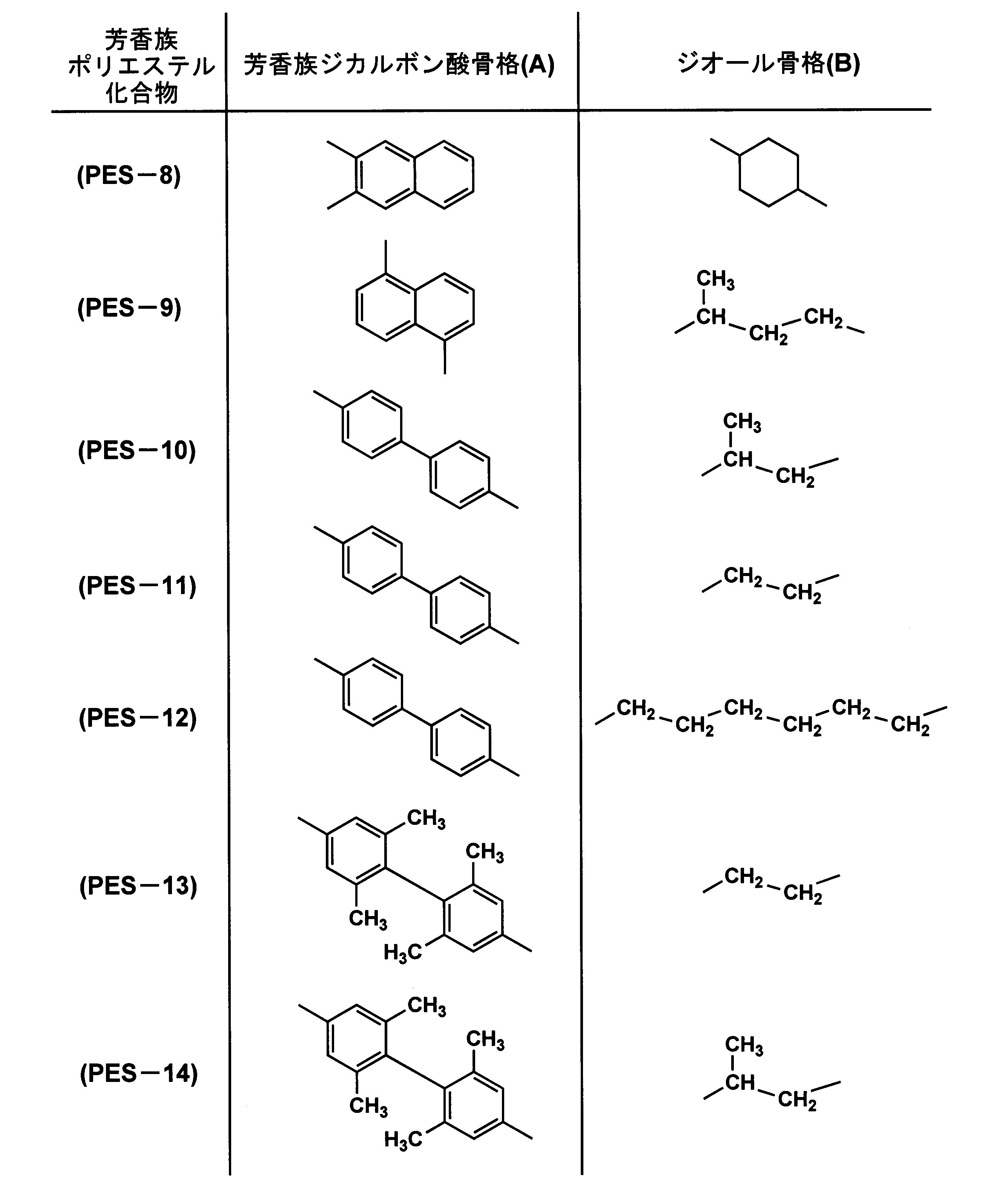
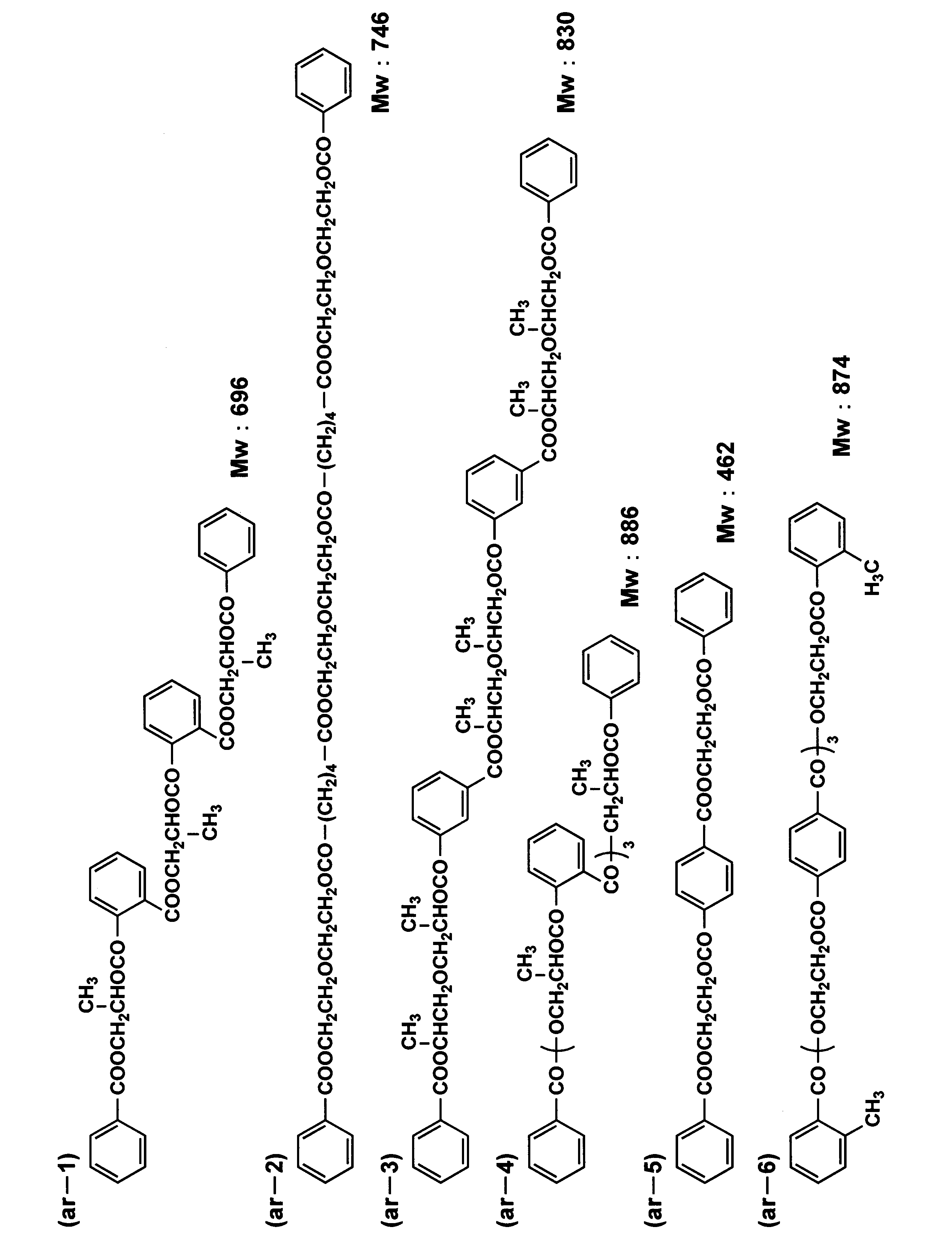

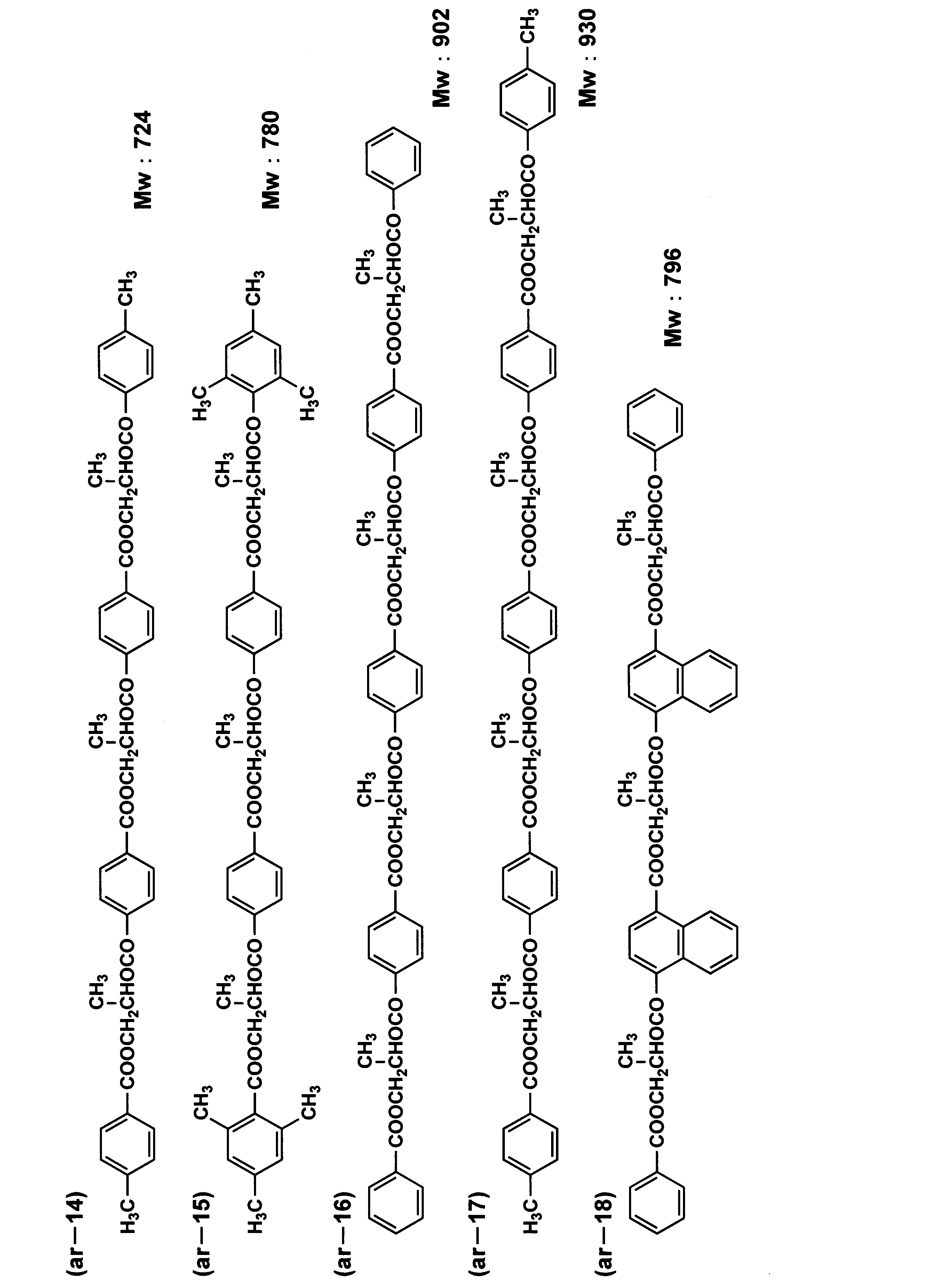

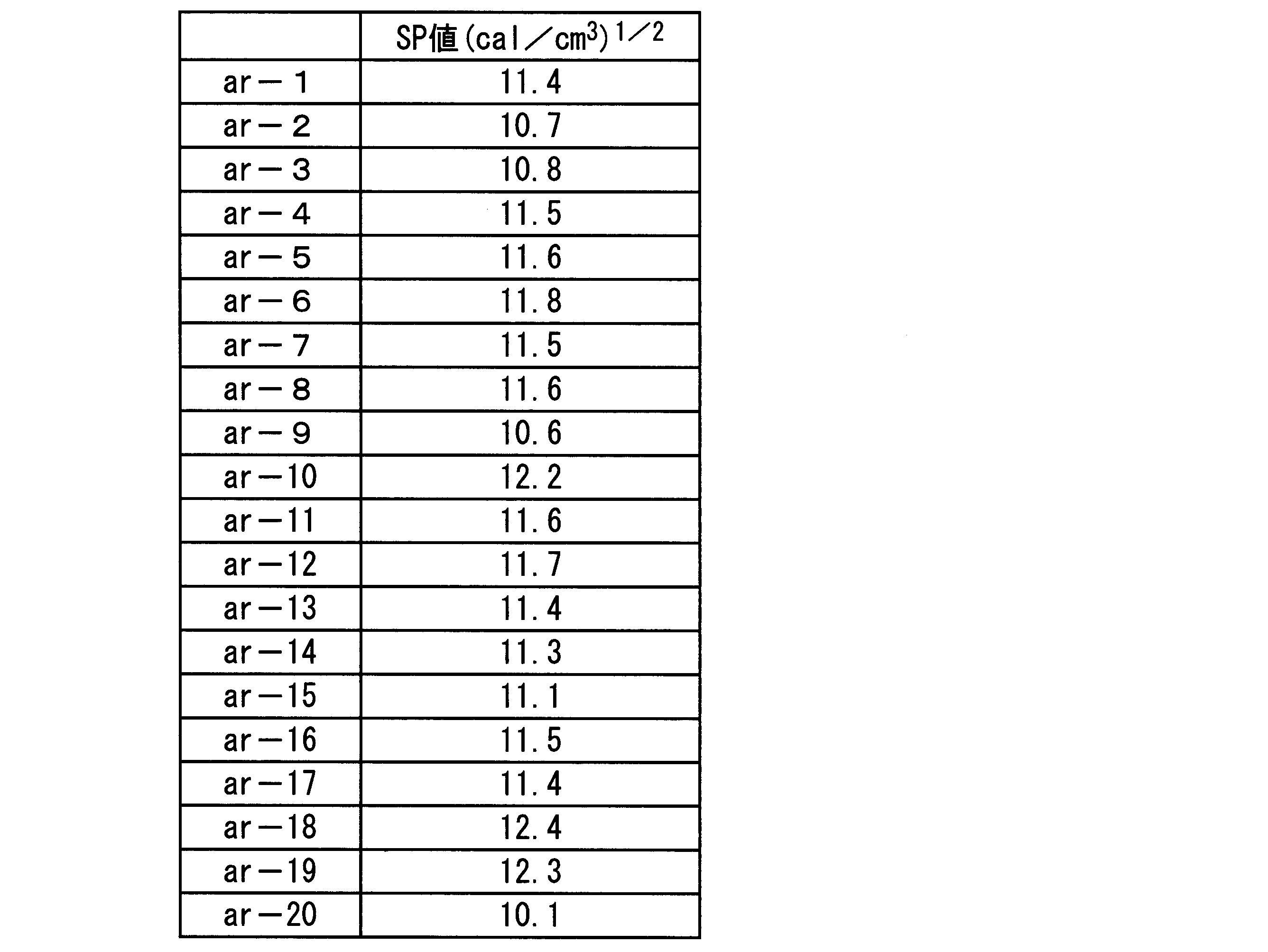
上記r値が1.1以上であるとHEAの浸透量を制限することが可能となる。上記r値は1.1以上であればよいが、好ましくは1.2以上であり、より好ましくは1.3以上であり、さらに好ましくは1.4以上である。一方、r値が1.5以下であると偏光板製造時において、HEAの浸透に伴う発熱による偏光板のカール発生が生じにくく、好ましい。
その他の好ましい添加剤の一例としては、下記一般式(II)で表される糖エステルが挙げられる。
一般式(II)で表される構造を有する化合物は、ヒドロキシ基(水酸基)の合計数m、-(O-C(=O)-R2)基の合計数lが固定された単一種の化合物として単離することは困難であり、式中のm、lの異なる成分が数種類混合された化合物となることが知られている。したがって、ヒドロキシ基(水酸基)の数(m)、-(O-C(=O)-R2)基の数(l)が各々変化した混合物としての性能が重要である。
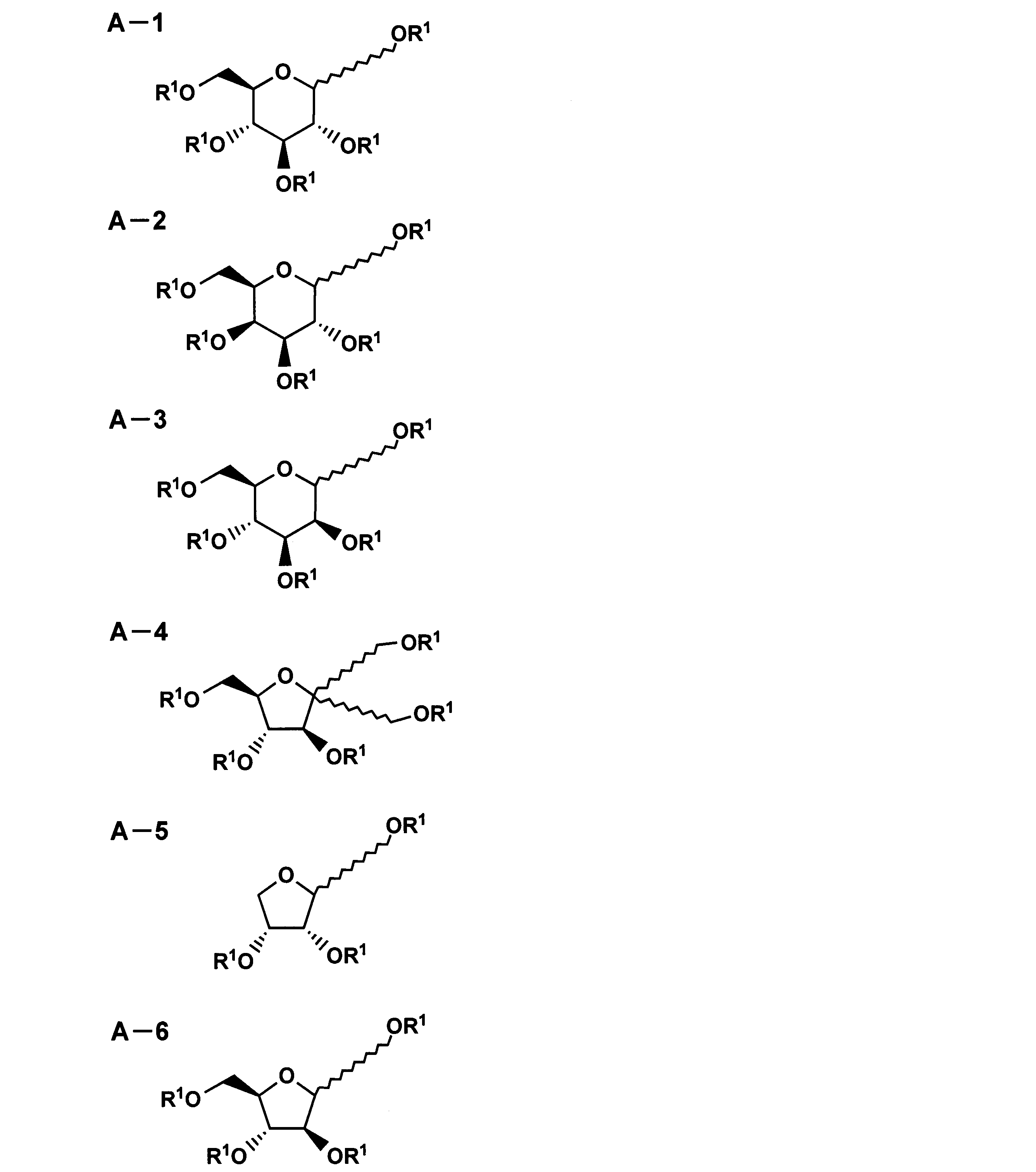
また、Gが表す残基の二糖類の具体例としては、例えばトレハロース、スクロース、マルトース、セロビオース、ゲンチオビオース、ラクトース、イソトレハロース等が挙げられる。
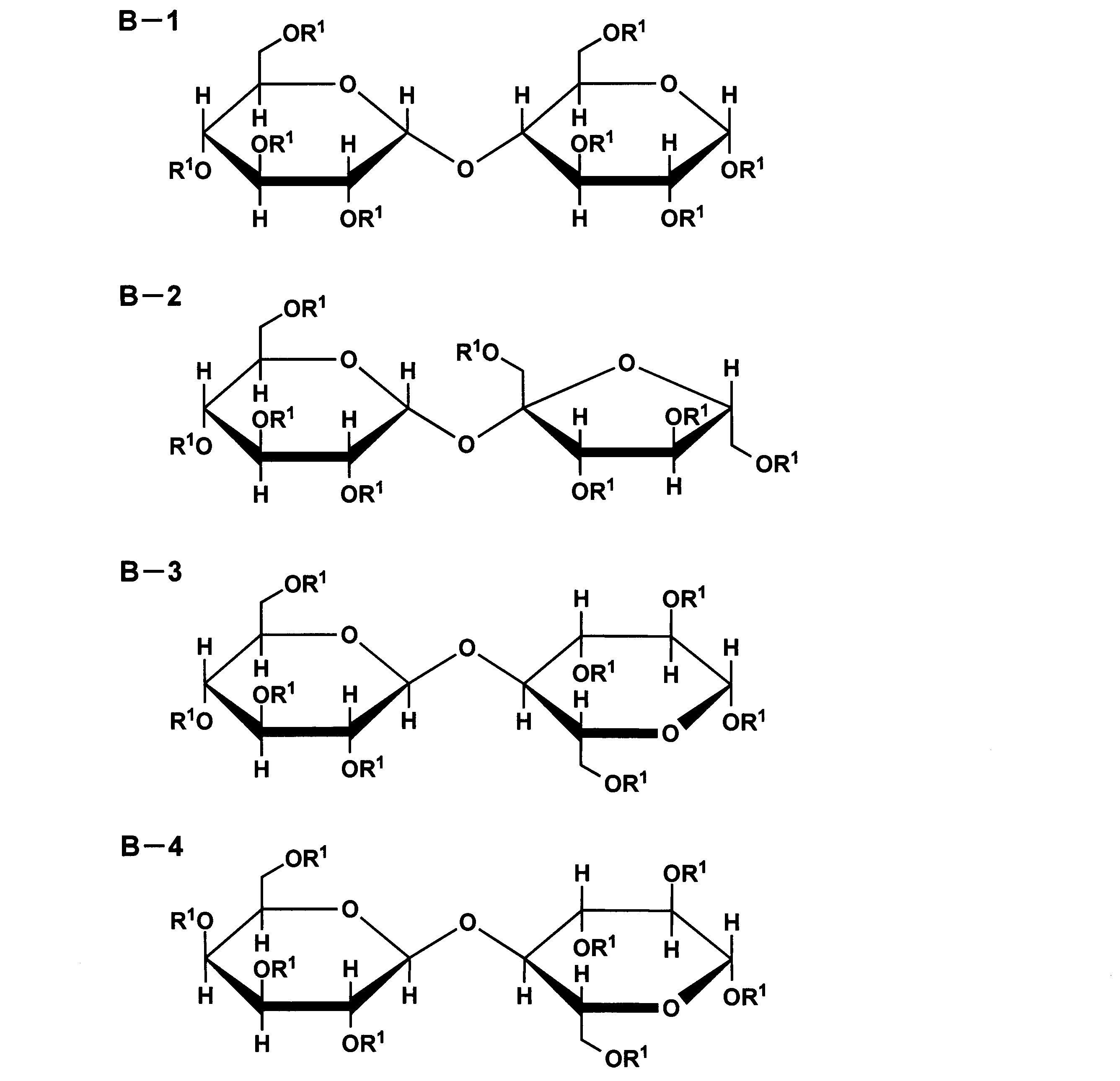
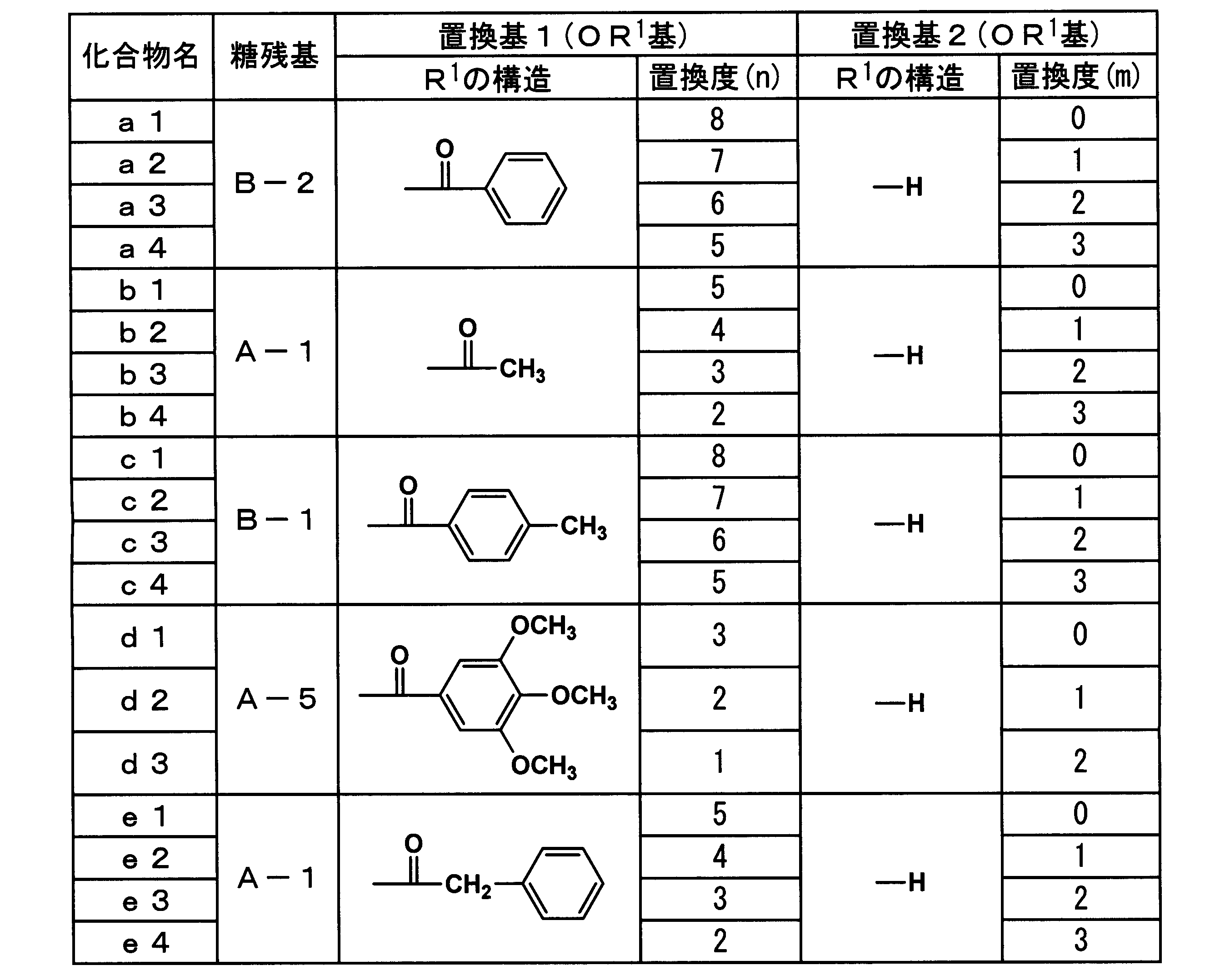
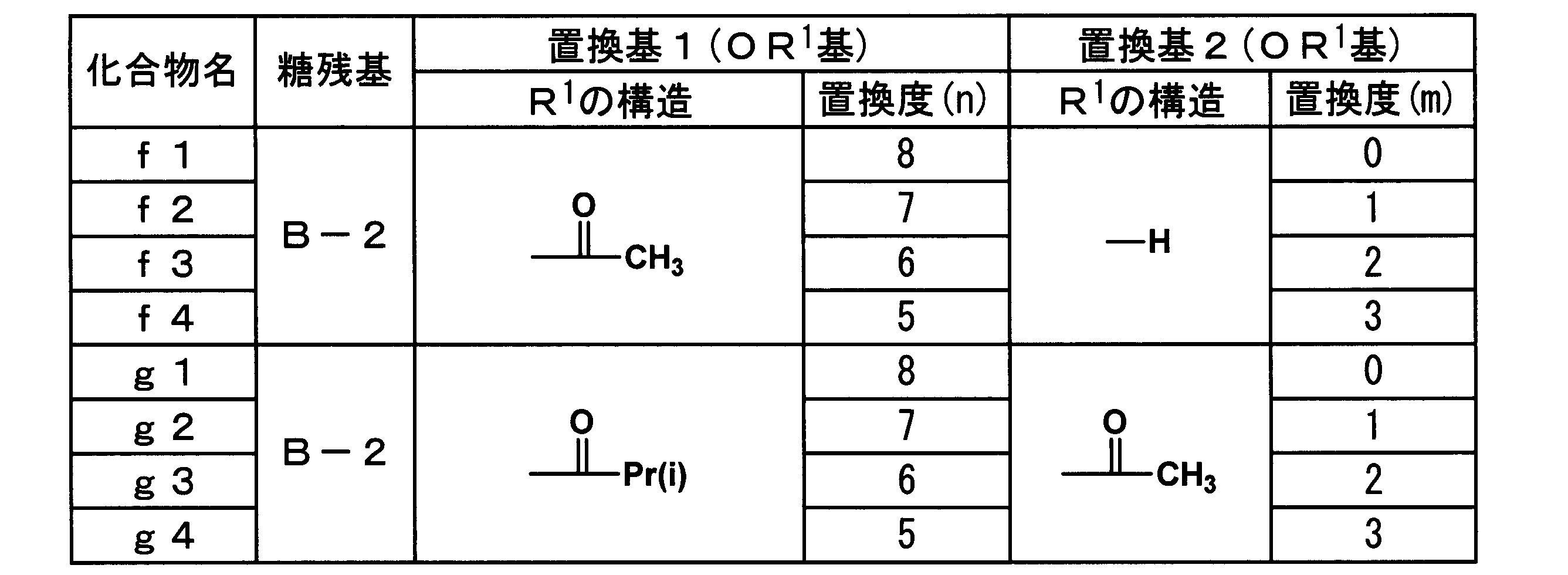

〔式中、R11はn価の有機基を表す。nは2以上の整数を表す。OH基はアルコール性又はフェノール性ヒドロキシ基(水酸基)を表す。〕
好ましい多価アルコールとしては、例えばアドニトール、アラビトール、エチレングリコール、ジエチレングリコール、トリエチレングリコール、テトラエチレングリコール、1,2-プロパンジオール、1,3-プロパンジオール、ジプロピレングリコール、トリプロピレングリコール、1,2-ブタンジオール、1,3-ブタンジオール、1,4-ブタンジオール、ジブチレングリコール、1,2,4-ブタントリオール、1,5-ペンタンジオール、1,6-ヘキサンジオール、ヘキサントリオール、ガラクチトール、マンニトール、3-メチルペンタン-1,3,5-トリオール、ピナコール、ソルビトール、トリメチロールプロパン、トリメチロールエタン、キシリトール等が挙げられる。特に、トリエチレングリコール、テトラエチレングリコール、ジプロピレングリコール、トリプロピレングリコール、ソルビトール、トリメチロールプロパン、キシリトールが好ましい。

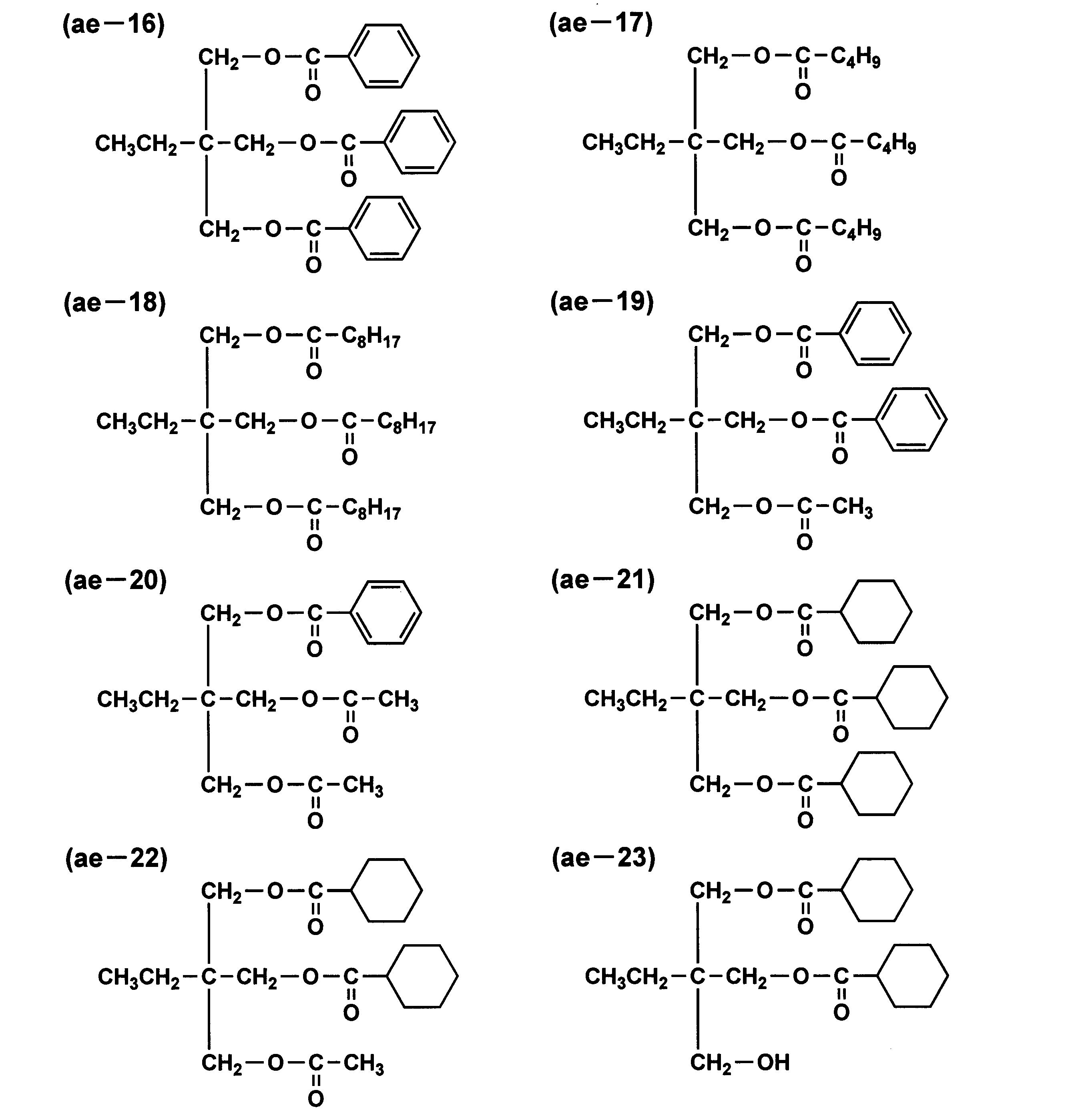

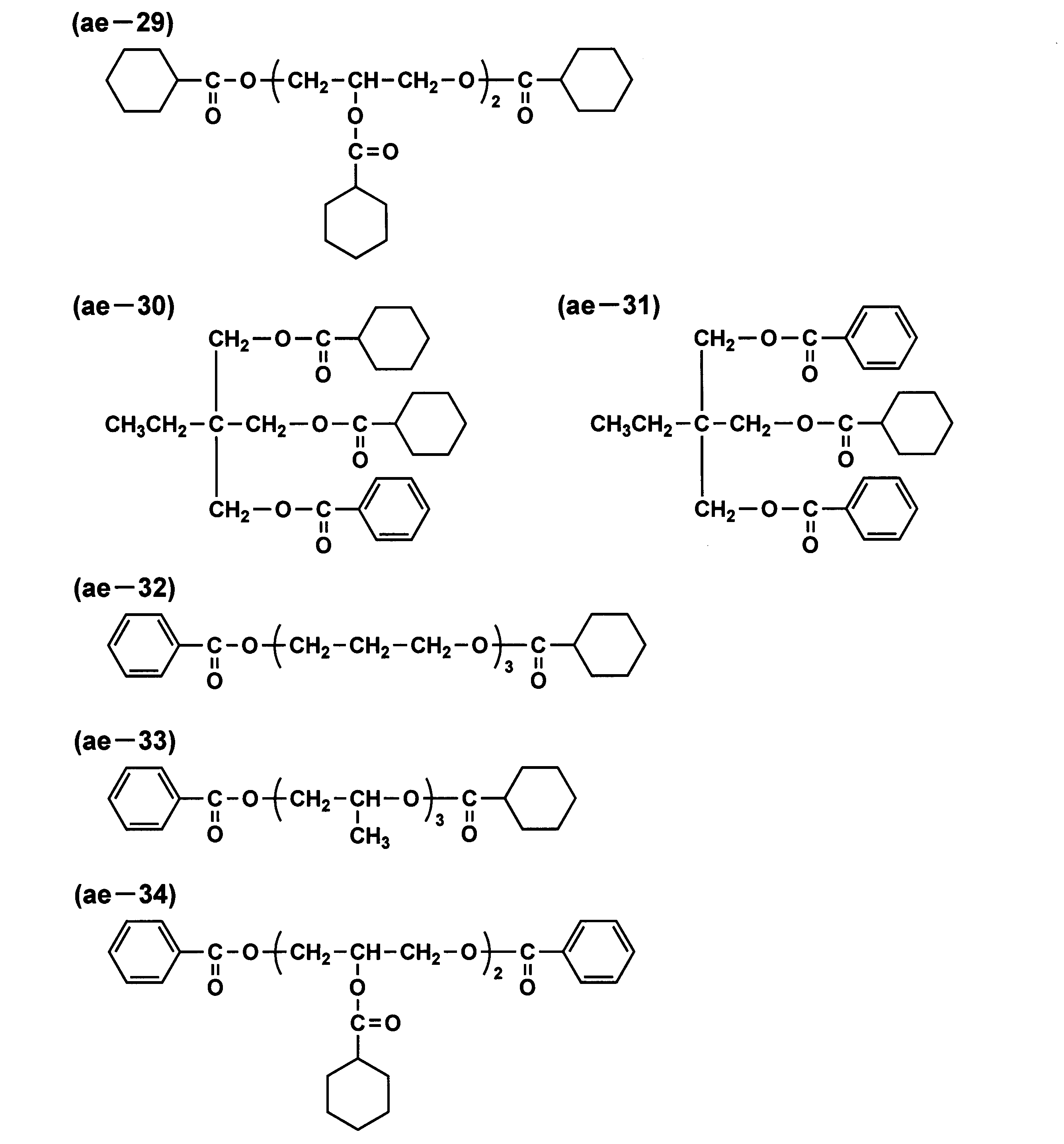

上記多価アルコールエステル系化合物は、セルロースアシレートに対して5~20質量%の範囲で含有することが好ましい。
〔式中、R12は(m1+n1)価の有機基を表し、m1は2以上の整数を表し、n1は0以上の整数を表し、COOH基はカルボキシ基を表し、OH基はアルコール性及び/又はフェノール性ヒドロキシ基(水酸基)を表す。〕
好ましい多価カルボン酸の例としては、例えば以下のようなものを挙げることができるが、本発明はこれらに限定されるものではない。
本発明のセルロースアシレートフィルムは、紫外線吸収剤を含有することもできる。紫外線吸収剤は400nm以下の紫外線を吸収することにより、セルロースアシレートフィルムの耐久性の向上を目的として添加される。セルロースアシレートフィルムにおける波長370nmでの透過率が10%以下であることが好ましく、より好ましくは5%以下、さらに好ましくは2%以下である。
酸化防止剤は劣化防止剤とも称される。高湿高温の状態に液晶画像表示装置等が置かれた場合には、セルロースアシレートフィルムの劣化が起こる場合がある。
セルロースアシレートは高温下では酸によっても分解が促進されるため、本発明のセルロースアシレートフィルムに用いる場合においては酸捕捉剤を含有することが好ましい。
本発明のセルロースアシレートフィルムには、取扱性を向上させるため、例えば二酸化ケイ素、二酸化チタン、酸化アルミニウム、酸化ジルコニウム、炭酸カルシウム、カオリン、タルク、焼成ケイ酸カルシウム、水和ケイ酸カルシウム、ケイ酸アルミニウム、ケイ酸マグネシウム、リン酸カルシウム等の無機微粒子や架橋高分子等のマット剤を含有させることが好ましい。なかでも二酸化ケイ素が、セルロースアシレートフィルムのヘイズを小さくできるため、好ましい。
本発明のセルロースアシレートフィルムの製造方法は、ドープを支持体上に流延して得られたセルロースアシレートフィルムを乾燥し、剥離した後に延伸する工程を含む。当該ドープは、アシル基置換度が2.0~2.5の範囲内であるセルロースアシレート及び添加剤を必須に含むので、得られたセルロースアシレートフィルムの両表面における添加剤の存在量がある程度偏るように、上記工程を行うことが好ましい。
上記記載のドープを調製するときの、セルロースアシレートの溶解方法としては、一般的な方法を用いることができる。加熱と加圧を組み合わせると常圧における沸点以上に加熱できる。
(第1の形態)
第1の形態は、ドープを調製する際の各種材料の選択により、上記工程の実施を可能とする。具体的には、ドープの必須成分として、セルロースアシレート、添加剤及び溶媒の3成分があるが、これら3成分のそれぞれのハンセンの溶解度パラメーターの値が、所定の関係を満たすように材料を選択する。これにより、得られたセルロースアシレートフィルムにおいて添加剤の分布が厚さ方向に偏らせることができることが判明した。より詳細には、セルロースアシレート、添加剤及び溶媒のそれぞれのハンセンの溶解度パラメーターの値を、この順に、HSPC、HSPG、HSPSとしたとき、下記式(2)を満足するようにそれぞれの材料を選択すればよい。
ハンセンの溶解度パラメーター(HSP)は、チャールズ・ハンセンによって開発された、物質の溶解性の示すためのパラメーターである。上記ハンセンの溶解度パラメーターHSPC、HSPG、HSPSの値として、Hansen, Charles (2007). Hansen Solubility Parameters: A user’s handbook, Second Editionに記載された方法により測定された値を採用する。なお、セルロースアシレート、添加剤及び溶媒が、それぞれ2種以上の混合物となっている形態もあり得るが、そのような形態におけるHSPC、HSPG、HSPSの値としては、混合物として測定された値を採用する。
より詳細には、支持体から剥離する時点におけるセルロースアシレートフィルム中の残留溶媒量が、90%以下となるようにプロセス条件を制御することが好ましい。なお、支持体から剥離する時点におけるフィルム中の残留溶媒量は、好ましくは85%以下であり、より好ましくは80%以下である。また、この第2の形態による制御と、上述した第1の形態(ドープ調製時の材料の選択)による制御とが併せて実施されてもよい。もちろん、いずれか一方のみの制御によっても、添加剤の分布の偏りを有するセルロースアシレートフィルムを製造することが可能である。
〔式中、Mはウェブ又はセルロースアシレートフィルムを製造中又は製造後の任意の時点で採取した試料の質量を表し、Nは当該試料を115℃にて1時間加熱した後の質量を表す。〕
残留溶媒量の値を所定の値以下とするために制御されるプロセス条件としては、支持体からフィルムを剥離する前の乾燥条件が挙げられる。支持体からのフィルム剥離前の乾燥条件の具体的な形態について特に制限はなく、剥離時点でのフィルムの残留溶媒量の値が所定の値以下となるように乾燥条件を制御することは、当業者であれば特段の困難性を伴うことなく実施することが可能である。乾燥条件の一例を挙げると、乾燥温度の範囲は、好ましくは25~50℃程度であり、より好ましくは35~45℃の範囲である。また、乾燥時間は、好ましくは15~150秒間程度であり、より好ましくは25~120秒間である。剥離時点でのフィルムの残留溶媒量の値が所定の値以下となるのであれば、これらの範囲を外れる条件が採用されてもよいことはもちろんである。
(第3の形態)
まず、セルロースアシレート、添加剤、その他の添加剤を含む複数のドープを調製する。共流延するドープが二つの場合、添加剤の濃度が低いドープAと、添加剤の濃度が高いドープBとを調製し、ドープAが表面層側、ドープBが金属支持体層側となるように支持体上に共流延すればよい。またその逆でもよい。添加剤の濃度が異なる三つ以上のドープを共流延する場合、添加剤の濃度が高くなる順に、表面層側から支持体層側に向かって各ドープを積層して共流延を行うという形態が好ましく挙げられる。なお、この第3の形態におけるドープ中の添加剤の濃度の具体的な値について特に制限はなく、得られるセルロースアシレートフィルム全体のHEA浸透量を考慮して、適宜調節すればよい。
<セルロースアシレートフィルムの物性>
本発明のセルロースアシレートフィルムの膜厚は、薄膜であることが好ましく、15~40μmの範囲が用いられる。偏光板の軽量化及びカール耐性の観点から、好ましくは、15~35μmの範囲である。
式(5) Rth={(nx+ny)/2-nz}×d [nm]
〔式中、nxはセルロースアシレートフィルム面内の遅相軸方向の屈折率を表す。nyはセルロースアシレートフィルム面内の進相軸方向の屈折率を表す。nzはセルロースアシレートフィルムの厚さ方向の屈折率を表す。屈折率の測定条件は23℃、55%RHの環境下、波長590nmである。dはセルロースアシレートフィルムの厚さ(nm)を表す。〕
上記リターデーション値Ro、Rthは、得られたセルロースアシレートフィルムから試料35mm×35mmを切り出し、23℃・55%RHで2時間調湿し、自動複屈折計(KOBRA21ADH、王子計測(株)やAxometrics社製Axoscan)で、590nmにおける垂直方向から測定した値と、セルロースアシレートフィルム面を傾けながら同様に測定したリターデーション値の外挿値から算出することができる。
70 ≦ Rth(nm)≦ 300
ここで、リターデーション値Roは、好ましくは30~70(nm)の範囲であり、より好ましくは40~60(nm)の範囲であり、さらに好ましくは45~55(nm)の範囲である。
<光硬化性接着剤>
偏光子とセルロースアシレートフィルムとを貼合するための光硬化性接着剤の好ましい例には、以下の(α)~(δ)の各成分を含有する光硬化性接着剤組成物が含まれる。
(β)光カチオン重合開始剤
(γ)380nmより長い波長の光に極大吸収を示す光増感剤
(δ)ナフタレン系光増感助剤
(カチオン重合性化合物(α))
光硬化性接着剤組成物の主成分であり、重合硬化により接着力を与える成分となるカチオン重合性化合物(α)は、カチオン重合により硬化する化合物であればよいが、特に分子内に少なくとも2個のエポキシ基を有するエポキシ化合物を含むことが好ましい。エポキシ化合物には、分子内に芳香環を有する芳香族エポキシ化合物、分子内に少なくとも2個のエポキシ基を有し、そのうちの少なくとも1個が脂環式環に結合している脂環式エポキシ化合物、分子内に芳香環を有さず、エポキシ基とそれが結合する2個の炭素原子を含む環(通常はオキシラン環)の一方の炭素原子が別の脂肪族炭素原子に結合している脂肪族エポキシ化合物等がある。本発明に用いる光硬化性接着剤組成物は、カチオン重合性化合物(α)として、特に芳香環を含まないエポキシ樹脂、脂環式エポキシ化合物を主成分とするものが好ましい。脂環式エポキシ化合物を主成分とするカチオン重合性化合物を用いれば、貯蔵弾性率の高い硬化物を与え、その硬化物(接着剤層)を介してセルロースアシレートフィルムと偏光子が接着された偏光板において、偏光子が割れにくくなる。


〔式中、Xは直接結合、メチレン基、炭素原子数1~4のアルキリデン基、脂環式炭化水素基、O、S、SO2、SS、SO、CO、OCO又は下記式(ge-1)~(ge-3)で表される3種の置換基からなる群から選ばれる置換基を表し、アルキリデン基はハロゲン原子で置換されていてもよい。〕

(光カチオン重合開始剤(β))
本発明では、以上のようなカチオン重合性化合物を、活性エネルギー線の照射によってカチオン重合させて硬化させ、接着剤層を形成することから、光硬化性接着剤組成物には、光カチオン重合開始剤(β)を配合することが好ましい。
(光増感剤(γ))
本発明に用いられ得る光硬化性接着剤組成物は、以上のようなエポキシ化合物を含むカチオン重合性化合物(α)及び光カチオン重合開始剤(β)に加えて、380nmより長い波長の光に極大吸収を示す光増感剤(γ)を含有する。上記光カチオン重合開始剤(β)は、300nm付近又はそれより短い波長に極大吸収を示し、その付近の波長の光に感応して、カチオン種又はルイス酸を発生させ、カチオン重合性化合物(α)のカチオン重合を開始させるが、それよりも長い波長の光にも感応するように、380nmより長い波長の光に極大吸収を示す光増感剤(γ)が配合される。

〔式中、R5及びR6は、それぞれ独立に炭素数1~6のアルキル基又は炭素数2~12のアルコキシアルキル基を表す。R7は、水素原子又は炭素数1~6のアルキル基を表す。〕
一般式(at)で示されるアントラセン系化合物の具体例としては、9,10-ジメトキシアントラセン、9,10-ジエトキシアントラセン、9,10-ジプロポキシアントラセン、9,10-ジイソプロポキシアントラセン、9,10-ジブトキシアントラセン、9,10-ジペンチルオキシアントラセン、9,10-ジヘキシルオキシアントラセン、9,10-ビス(2-メトキシエトキシ)アントラセン、9,10-ビス(2-エトキシエトキシ)アントラセン、9,10-ビス(2-ブトキシエトキシ)アントラセン、9,10-ビス(3-ブトキシプロポキシ)アントラセン、2-メチル又は2-エチル-9,10-ジメトキシアントラセン、2-メチル又は2-エチル-9,10-ジエトキシアントラセン、2-メチル又は2-エチル-9,10-ジプロポキシアントラセン、2-メチル又は2-エチル-9,10-ジイソプロポキシアントラセン、2-メチル又は2-エチル-9,10-ジブトキシアントラセン、2-メチル又は2-エチル-9,10-ジペンチルオキシアントラセン、2-メチル又は2-エチル-9,10-ジヘキシルオキシアントラセン等が挙げられる。
本発明に用いられ得る光硬化性接着剤組成物は、上述したエポキシ化合物を含むカチオン重合性化合物(α)、光カチオン重合開始剤(β)及び光増感剤(γ)に加えて、下記一般式(nf)で示されるナフタレン系光増感助剤(δ)を含有する。

〔式中、R1及びR2はそれぞれ、炭素数1~6のアルキル基である。〕
ナフタレン系光増感助剤(δ)の具体例としては、1,4-ジメトキシナフタレン、1-エトキシ-4-メトキシナフタレン、1,4-ジエトキシナフタレン、1,4-ジプロポキシナフタレン、1,4-ジブトキシナフタレン等が挙げられる。
(α2)分子内に少なくとも1個のオキセタニル基を有するオキセタン化合物
(β1)光カチオン重合開始剤
以下、上記(α1)のエポキシ化合物、上記(α2)のオキセタン化合物、上記(β1)の光カチオン重合開始剤を、それぞれ単に、エポキシ化合物(α1)、オキセタン化合物(α2)、光カチオン重合開始剤(β1)という。
本発明に用いられ得る光硬化性接着剤組成物において、エポキシ化合物(α1)は、分子内に少なくとも2個のエポキシ基を有するものであれば特に限定されず、一般に知られている各種の硬化性エポキシ化合物を用いることができる。好ましいエポキシ化合物(α1)として、分子内に少なくとも2個のエポキシ基と少なくとも1個の芳香環を有する化合物(以下、芳香族系エポキシ化合物という)や、分子内に少なくとも2個のエポキシ基を有し、そのうちの少なくとも1個は脂環式環を構成する隣り合う2個の炭素原子との間で形成されている化合物(以下、脂環式エポキシ化合物という)等が例として挙げられる。
なかでも、芳香族化合物のグリシジルエーテルが、偏光子とセルロースアシレートフィルム間の密着性や、偏光板に用いたときの耐久性においてより優れるため、特に好ましい。芳香族化合物のグリシジルエーテルのなかでも、とりわけ好ましい化合物として、ビスフェノールAのジグリシジルエーテル、ビスフェノールFのジグリシジルエーテル、フェノールノボラック型エポキシ樹脂が挙げられる。
本発明に用いられ得る光硬化性接着剤において、オキセタン化合物(α2)は、分子内に少なくとも1個のオキセタニル基を有するものであれば特に限定されず、やはりオキセタニル基を有する種々の化合物を用いることができる。オキセタン化合物(α2)として、分子内に1個のオキセタニル基を有する化合物(以下、単官能オキセタンという)、分子内に2個以上のオキセタニル基を有する化合物(以下、多官能オキセタンという)が好ましい例として挙げられる。
本発明に用いられ得る光硬化性接着剤組成物は、硬化成分として上述のエポキシ化合物(α1)及びオキセタン化合物(α2)を含有し、これらはいずれもカチオン重合により硬化するものであることから、そのカチオン重合を開始させるため、光カチオン重合開始剤(β1)が配合される。光カチオン重合開始剤(β1)は、可視光線、紫外線、X線、電子線等の活性エネルギー線の照射によって、カチオン種又はルイス酸を発生させ、エポキシ基やオキセタニル基の重合反応を開始させる。
(ζ)光ラジカル重合開始剤
(不飽和化合物(ε))
光硬化性接着剤は、必要に応じて、分子内に少なくとも1個のエチレン性不飽和結合を有する不飽和化合物(ε)を含有することが好ましい。
光硬化性接着剤が不飽和化合物(ε)を含む場合、そのラジカル重合性を促進し、硬化速度を十分なものとするために、光ラジカル重合開始剤(ζ)を配合することが好ましい。
さらに、本発明に用いられ得る光硬化性接着剤組成物には、本発明の効果を損なわない範囲で、前記(α1)~(ζ)成分とは異なる他の成分を、任意に配合することができる。
偏光板の主たる構成要素である偏光子は、一定方向の偏波面の光だけを通す素子であり、現在知られている代表的な偏光子は、ポリビニルアルコール系偏光フィルムである。ポリビニルアルコール系偏光フィルムには、ポリビニルアルコール系フィルムにヨウ素を染色させたものと、二色性染料を染色させたものとがある。
偏光板は、光硬化性接着剤を用いて、偏光子の一方の面に、本発明のセルロースアシレートフィルムのヒドロキシエチルアクリレートの浸透量を満たす面を貼り合わせることにより製造することができる。例えば貼合時、セルロースアシレートフィルムの両表面のうち、r値が1.1以上を満たすd1が検出された表面を、光硬化性接着剤を用いて偏光子に貼り合わせることが好ましい。
前処理工程では、偏光子と接着するセルロースアシレートフィルムの表面が易接着処理される。偏光子の両面にそれぞれセルロースアシレートフィルムが接着される場合は、それぞれのセルロースアシレートフィルムに対し易接着処理が行われる。次の接着剤塗布工程では、易接着処理された表面が偏光子との貼合面として扱われるので、例えばセルロースアシレートフィルムの両表面のうち、r値が1.1以上を満たす、d1が検出された表面を易接着処理する。
接着剤塗布工程では、偏光子とセルロースアシレートフィルムの接着面のうち、ヒドロキシエチルアクリレートの浸透量を満たす面に、上記光硬化性接着剤が塗布される。偏光子又はセルロースアシレートフィルムの表面に直接、光硬化性接着剤を塗布する場合、その塗布方法に特別な限定はない。例えば、ドクターブレード、ワイヤーバー、ダイコーター、カンマコーター、グラビアコーター等、種々の塗工方式が利用できる。また、偏光子とセルロースアシレートフィルムの間に、光硬化性接着剤を流延させたのち、ローラ等で加圧して均一に押し広げる方法も利用できる。
こうして光硬化性接着剤を塗布した後は、貼合工程に供される。この貼合工程では、例えば、先の塗布工程で偏光子の表面に光硬化性接着剤を塗布した場合、そこにセルロースアシレートフィルムが重ね合わされる。先の塗布工程でセルロースアシレートフィルムの表面に光硬化性接着剤を塗布した場合は、そこに偏光子が重ね合わされる。また、偏光子とセルロースアシレートフィルムの間に光硬化性接着剤を流延させた場合は、その状態で偏光子とセルロースアシレートフィルムとが重ね合わされる。偏光子の両面にセルロースアシレートフィルムを接着する場合であって、両面とも光硬化性接着剤を用いる場合は、偏光子の両面にそれぞれ、光硬化性接着剤を介してセルロースアシレートフィルムが重ね合わされる。そして通常は、この状態で両面(偏光子の片面にセルロースアシレートフィルムを重ね合わせた場合は、偏光子側とセルロースアシレートフィルム側、また偏光子の両面にセルロースアシレートフィルムを重ね合わせた場合は、その両面のセルロースアシレートフィルム側)からローラ等で挟んで加圧することになる。ローラの材質は、金属やゴム等を用いることが可能である。両面に配置されるローラは、同じ材質であってもよいし、異なる材質であってもよい。
硬化工程では、未硬化の光硬化性接着剤に活性エネルギー線を照射して、エポキシ化合物やオキセタン化合物を含む接着剤層を硬化させ、光硬化性接着剤を介して重ね合わせた偏光子とセルロースアシレートフィルムとを接着させる。偏光子の片面にセルロースアシレートフィルムを貼合する場合、活性エネルギー線は、偏光子側又はセルロースアシレートフィルム側のいずれから照射してもよい。また、偏光子の両面にセルロースアシレートフィルムを貼合する場合、偏光子の両面にそれぞれ光硬化性接着剤を介してセルロースアシレートフィルムを重ね合わせた状態で、いずれか一方のセルロースアシレートフィルム側から活性エネルギー線を照射し、両面の光硬化性接着剤を同時に硬化させるのが有利である。ただし、いずれか一方のセルロースアシレートフィルムに紫外線吸収剤が配合されている場合であって、活性エネルギー線が紫外線である場合、通常、紫外線吸収剤が配合されていない他方のセルロースアシレートフィルム側から紫外線が照射される。
本発明の偏光板は、液晶表示装置に好適に用いることができる。本発明の偏光板が用いられた液晶表示装置は、優れた光学補償機能を有するセルロースアシレートフィルムが用いられていることから、視認性に優れている。また、このような液晶表示装置は、偏光子とセルロースアシレートフィルム間の密着性が高いことから、耐久性にも優れている。
<セルロースアシレートドープ101の調製>
(微粒子分散液1の調製)
微粒子(アエロジル R972V 日本アエロジル(株)製) 11質量部
エタノール 89質量部
以上をディゾルバーで50分間撹拌混合した後、マントンゴーリンで分散を行って、微粒子分散液1を調製した。
メチレンクロライドを入れた溶解タンクに十分撹拌しながら、微粒子分散液1をゆっくりと添加した。メチレンクロライドと微粒子分散液の質量は、下記のとおりである。さらに、二次粒子の粒径が所定の大きさとなるようにアトライターにて分散を行った。これを日本精線(株)製のファインメットNFで濾過し、微粒子添加液1を調製した。
微粒子分散液1 5質量部
(主ドープの調製)
下記組成の主ドープを調製した。
・エタノール 64質量部
・セルロースアシレート(合成例1:平均アセチル基置換度2.45、重量平均分子量Mw166000、数平均分子量Mn47500、Ca含有量12ppm、Sp値12.1(cal/cm3)1/2) 100質量部
・添加剤(一般式(I)で表される化合物ar-14:SP値11.3(cal/cm3)1/2、SP値差(|HEA-添加剤|)1.2) 5質量部
・微粒子添加液1 1質量部
まず、加圧溶解タンクに上記組成のメチレンクロライドとエタノールを添加した。この溶剤の入った加圧溶解タンクに、上記セルロースアシレート、添加剤及び微粒子添加液1を、撹拌しながら投入した。これを加熱し、撹拌しながら、完全に溶解させた後、安積濾紙(株)製の安積濾紙No.244を使用して濾過し、主ドープを調製した。
表3記載のセルロースアシレート種類、添加剤種類に変更した以外は、セルロースアシレートドープ101と同様にして、セルロースアシレートドープ102~115を調製した。
セルロースアシレートの数平均分子量(Mn)及び重量平均分子量(Mw)は、ゲルパーミエーションクロマトグラフィー(GPC)を用いて測定される。
カラム: Shodex K806、K805、K803G(昭和電工(株)製を3本接続して使用する)
カラム温度:25℃
試料濃度: 0.1質量%
検出器: RI Model 504(GLサイエンス社製)
ポンプ: L6000(日立製作所(株)製)
流量: 1.0ml/min
校正曲線: 標準ポリスチレンSTK standard ポリスチレン(東ソー(株)製)Mw=500~1000000の13サンプルによる校正曲線を使用する。13サンプルは、ほぼ等間隔に用いる。
カルシウム(Ca)含有量の定量は、乾燥したセルロースアシレートを完全に燃焼させた後、灰分を塩酸に溶解して前処理を行った上で原子吸光法により測定した。測定値は絶乾状態のセルロースアシレート1g中のカルシウム含有量としてppmを単位として得られる。
溶解度パラメーター(SP値)は、Polymer Hand Book (Second Edition)第IV章 Solubility Parameter Valuesに記載があり、その値を用いた。ただし、本願では、単位は(cal/cm3)1/2であり、25℃における値を示す。
ここで、△Eは凝集エネルギー密度を表す。Vは分子容を表す。
上記調製したセルロースアシレートドープ102を用いて、無端の金属支持体流延装置を用い、ドープを温度33℃、1500mm幅で金属支持体上に均一に流延した。金属支持体の温度は30℃に制御した。
ドープ組成物及び製造条件を、下記表4に示すように変更した以外は、セルロースアシレートフィルム201と同様にして、セルロースアシレートフィルム202~216を作製した。
作製したセルロースアシレートフィルム201のB面(金属支持体側)とA面(B面とは反対側)の添加剤の検出値を、飛行時間型二次イオン質量分析法(TOF-SIMS)で測定したところ、B面>A面であり、下記式で表されるr値は1.26であった。
d1:フィルムB面(金属支持体側)の添加剤の検出値
d2:フィルムA面(B面とは反対側)の添加剤の検出値
(r値の測定方法)
下記測定条件によって、飛行時間型二次イオン質量分析法を用いて、セルロースアシレートフィルム201の各表面における添加剤ar-14の検出値を得た。同様にして、セルロースアシレートフィルム202~216の添加剤分布:r値も得た。
測定モード:冷却測定(温度範囲-95~-105℃)
一次イオン:Ga(15kV)
測定領域 :60μm角
積算時間 :2分
添加剤(ar-14))の場合の参照イオンm/Z:119
〈セルロースアシレートフィルムのA面及びB面のHEA浸透量〉
HEAの浸透量は、協和界面化学(株)製の微小接触角計(MCA-3)を用いて以下の手順にて測定した。
(1)23℃、55%RHの環境下、内径5μmのガラス管より、HEAをフィルム上に50pl滴下した。
(2)滴下直後に、液滴画像を取り込み、微小接触角計附属のソフトにて、液滴の体積を計算する。このときの液滴体積をXとする(図1A)。
(3)滴下直後から1秒毎に画像を取り込み、15秒経過後の写真から計算した液滴体積をYとする(図1B)。
(4)X-Yから、15秒間でフィルムに浸みこんだHEAの体積を求めた。
セルロースアシレートフィルム201~216の面内方向のリターデーション値Ro、厚さ方向のリターデーション値Rthを、下記式(4)、(5)により求めた。
式(5) Rth={(nx+ny)/2-nz}×d [nm]
〔式中、nxはセルロースアシレートフィルム面内の遅相軸方向の屈折率を表す。nyはセルロースアシレートフィルム面内の進相軸方向の屈折率を表す。nzはセルロースアシレートフィルムの厚さ方向の屈折率を表す。屈折率の測定条件は23℃、55%RHの環境下、波長590nmである。dはセルロースアシレートフィルムの厚さ(nm)を表す。〕
上記リターデーション値Ro、Rthは、得られたセルロースアシレートフィルムから試料35mm×35mmを切り出し、25℃×55%RHで2時間調湿し、自動複屈折計(KOBRA21ADH、王子計測(株))で、590nmにおける垂直方向から測定した値と、セルロースアシレートフィルム面を傾けながら同様に測定したリターデーション値の外挿値から算出する。
70 ≦ Rth(nm)≦ 300
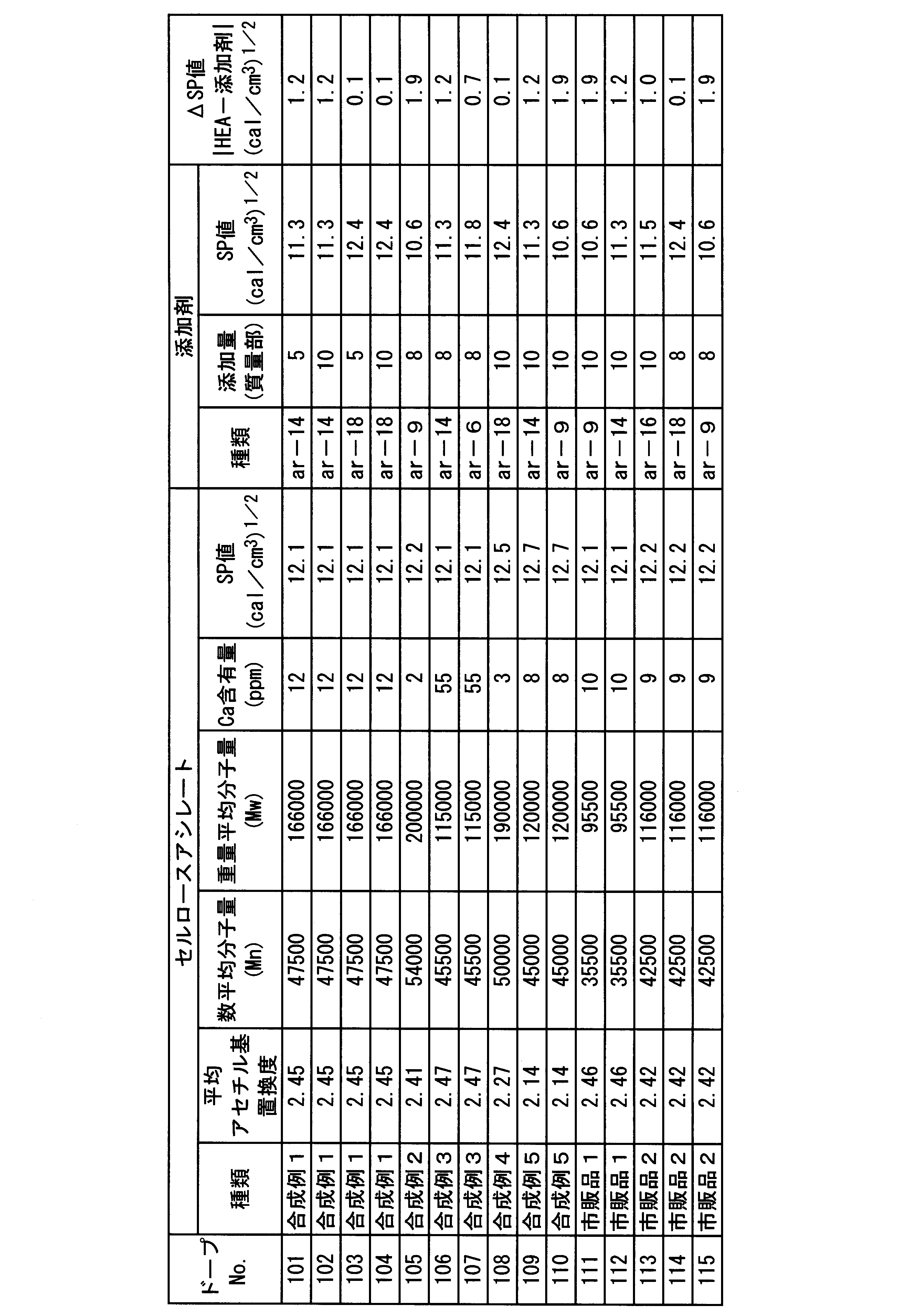
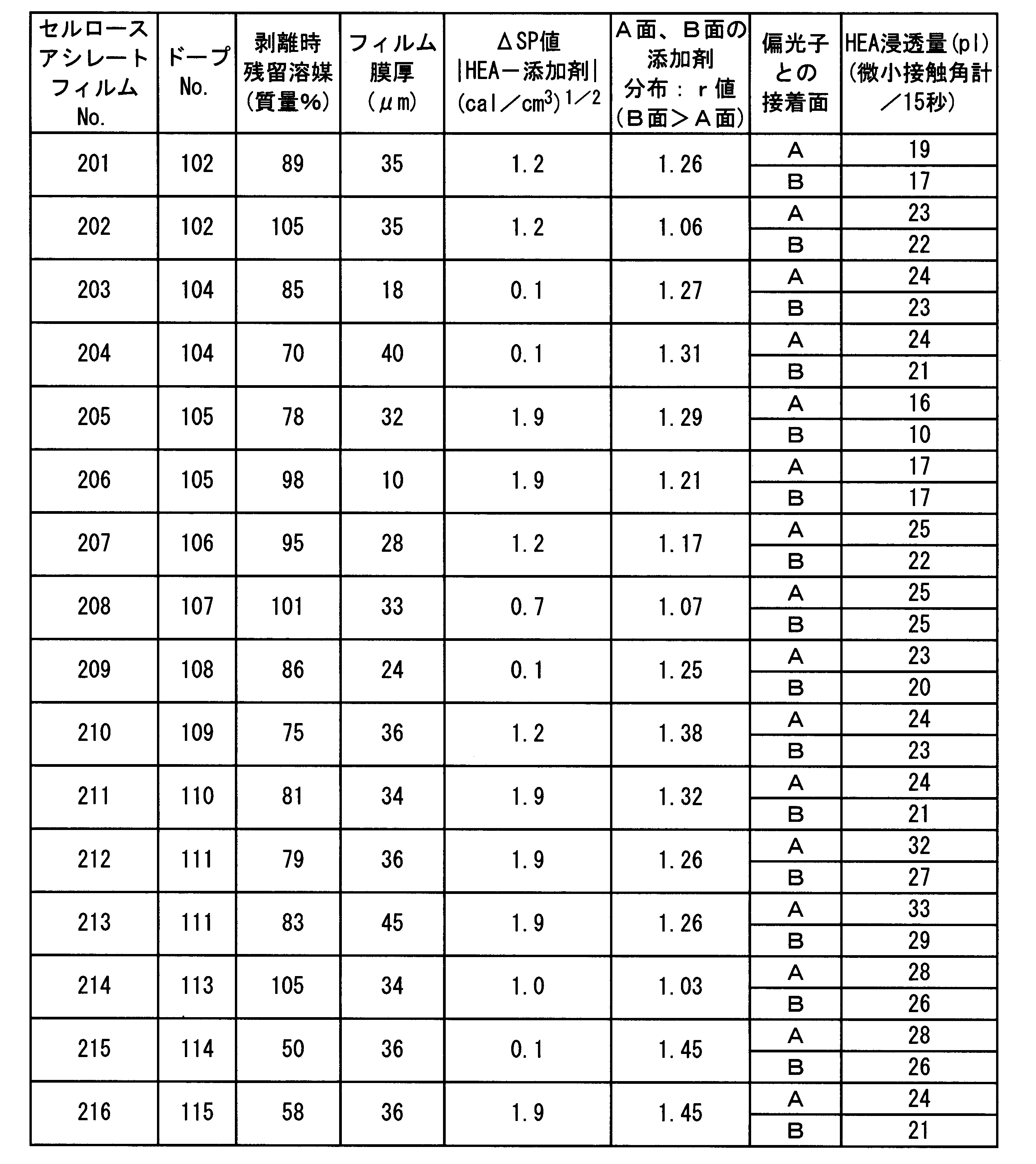
〈接着剤301の調製〉
下記表5で示される各成分を混合した後、脱泡して、光硬化性接着剤液を調製した。
ヒドロキシエチルアクリルアミド(HEAA) 50質量部
ヒドロキシエチルアクリレート(HEA) 50質量部
イルガキュアー907(BASFジャパン製) 1.5質量部
〈接着剤302~305の調製〉
表5に示す各成分を混合した後、脱泡して、光硬化性接着剤液302~305を各々調製した。表5に示した化合物の略称は、各々表6に記載の化合物であり、表5中の数字は各々質量部を表す。
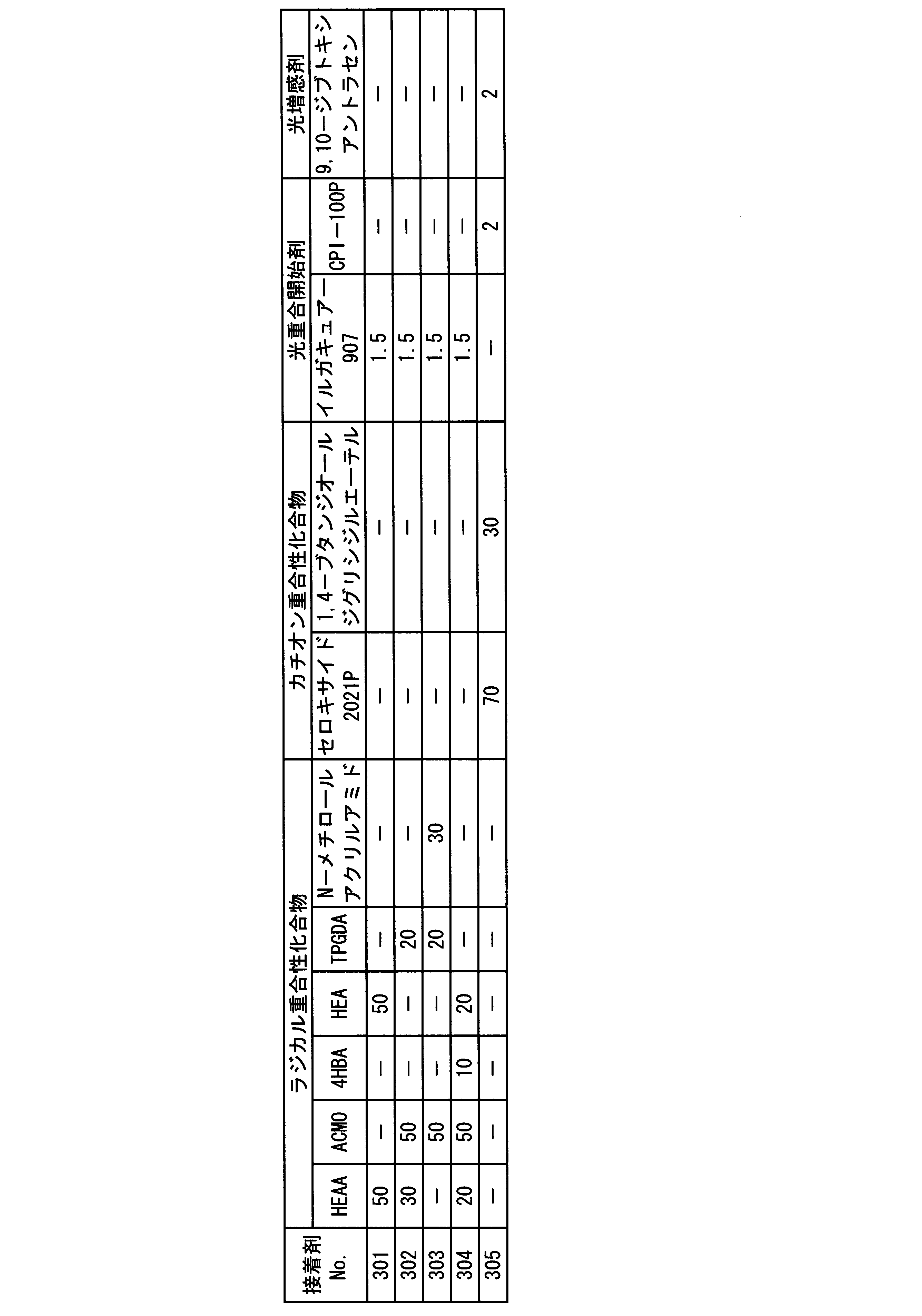
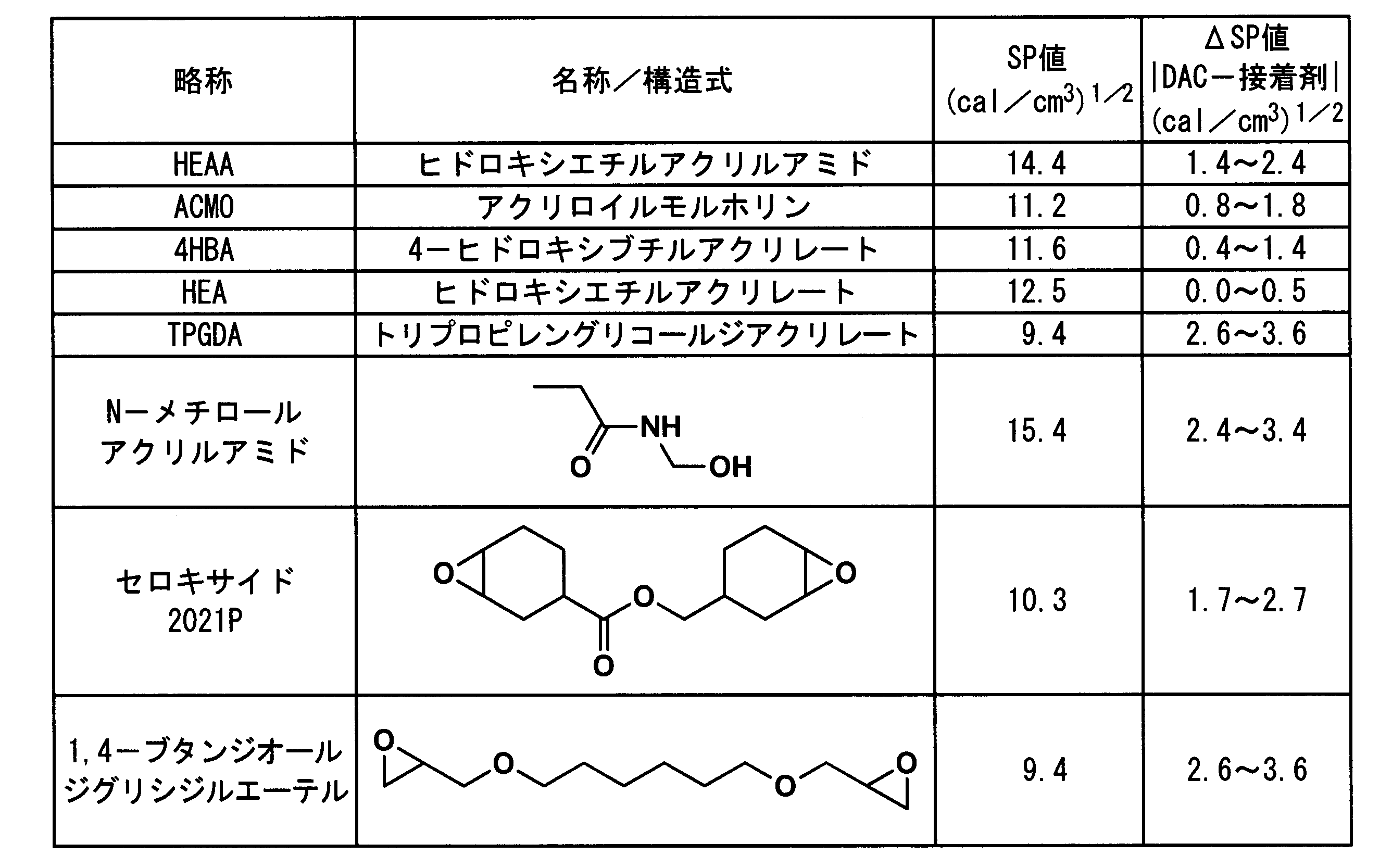
厚さ70μmのポリビニルアルコールフィルムを、35℃の水で膨潤させた。得られたフィルムを、ヨウ素0.075g、ヨウ化カリウム5g及び水100gからなる水溶液に60秒間浸漬し、さらにヨウ化カリウム3g、ホウ酸7.5g及び水100gからなる45℃の水溶液に浸漬した。得られたフィルムを、延伸温度55℃、延伸倍率5倍の条件で一軸延伸した。この一軸延伸フィルムを、水洗した後、乾燥させて、厚さ20μmの偏光子を得た。
セルロースアシレートフィルム201~216をそれぞれ用いた偏光板を、下記のように作製した。
ケン化工程 1.5モル/L-KOH水溶液 50℃ 20秒
水洗工程 水 30℃ 60秒
また、偏光板314は接着剤301の塗布厚を3μmとした以外は同様にして偏光板を作製した。
得られた偏光板301~316について、以下の測定方法により、偏光子とセルロースアシレートフィルムとの密着性と、偏光板の偏光度を測定し、評価した。評価結果は、下記表2に示される。
(偏光子とセルロースアシレートフィルムとの接着性の評価方法)
偏光板301~316を、各々10枚ずつ温度60℃、90%RHの湿熱条件下に500時間静置した。その後、偏光板301~316を構成する偏光子とセルロースアシレートフィルムとを手で剥離することができるか否かにより、接着性を評価した。
△:手で剥離することができたフィルムが2枚以内
×:手で剥離することができたフィルムが3枚以上
(偏光板カールの評価方法)
偏光板を巾手方向35mm、長手方向1mmに切り取ってカール測定用サンプルを作製した。これを25℃、55%RH雰囲気下で3日間放置した後、カール度の測定を行った。カール度は曲率半径の逆数を表すが、具体的にはJIS-K7619-1988のA法に準じて測定した。カール度に対する評価は以下のとおりである。
○:0~5%
△:5~30%
×:30%~100%
(偏光板の偏光度の評価方法)
偏光板301~316の偏光度を、日本分光(株)製「V-7100」を用いて測定した。
○:偏光度が99.990以上
△:偏光度が99.980以上99.990未満
×:偏光度が99.980未満
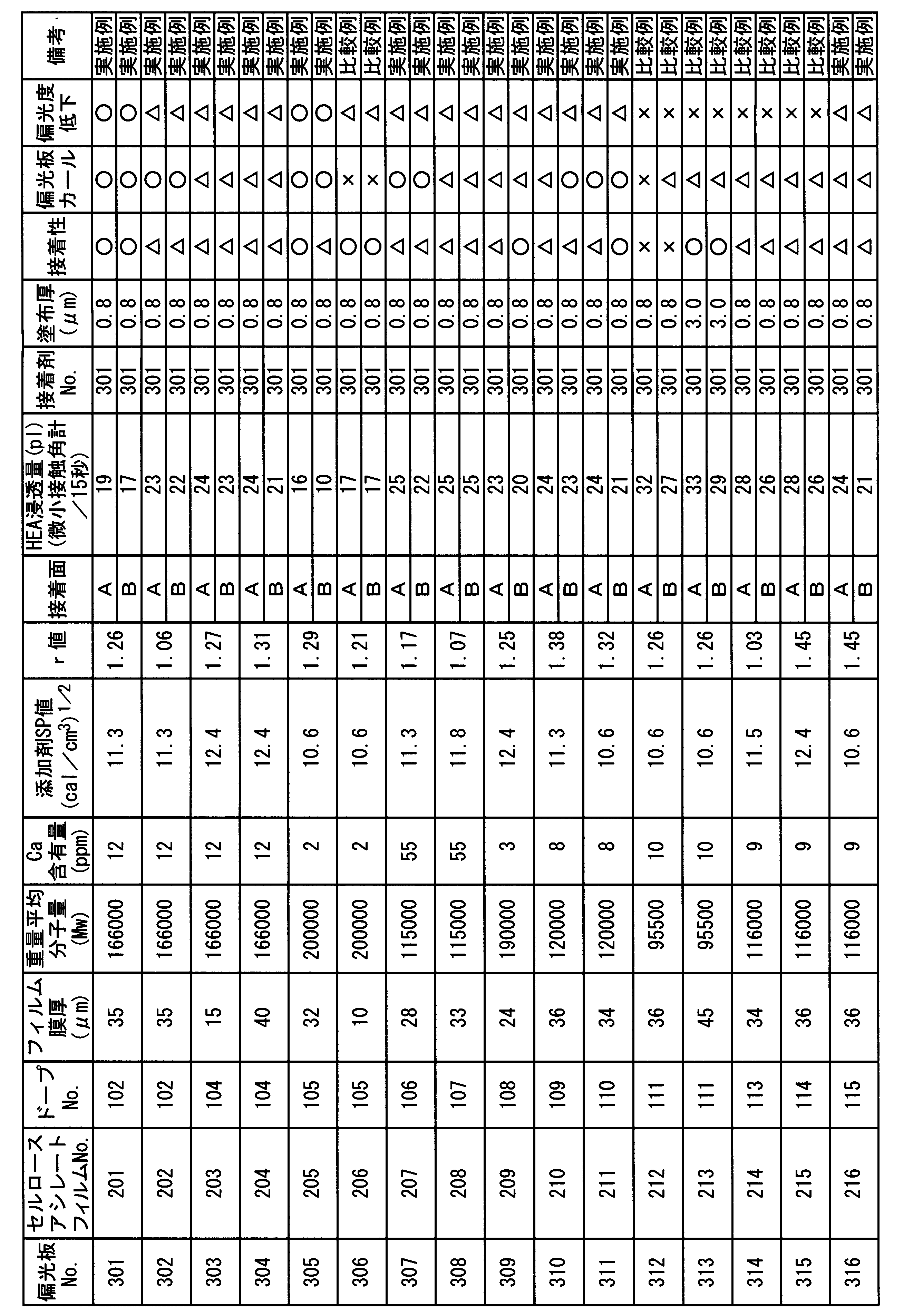
<セルロースアシレートフィルム218の作製>
図2に示す流延用支持体として無端の金属支持体を有する流延設備を用いて、下記の手順にしたがって、3層同時流延法(共流延法)によりセルロースアシレートフィルム218を作製した。
表8記載のスキン層(A面)/コア層/スキン層(B面)の構成で各々実施例1で調製したセルロースアシレートドープを用いた以外は、セルロースアシレートフィルム218と同様にして、3層同時流延法によりセルロースアシレートフィルム219~222を作製した。

作製したセルロースアシレートフィルム218のA面及びB面にコロナ放電処理を行い、実施例1と同様にして、接着剤301を塗布厚0.8μmとして、セルロースアシレートフィルム218/偏光子/KC4UA(コニカミノルタ(株)製)の積層物を作製し、この積層物のセルロースアシレートフィルム218側から、ベルトコンベア付き紫外線照射装置(ランプは、フュージョンUVシステムズ社製のDバルブを使用)を用いて、積算光量が750mJ/cm2となるように紫外線を照射し、接着剤層を硬化させた。
表9の構成により、セルロースアシレートフィルムの種類をセルロースアシレートフィルム219~222に変更し、更に接着剤の種類を301~305の範囲から選択しながら、偏光板317-1~317-3の作製と同様にして、上記偏光板318-1~318-3、319-1~319-3、320-1~320-3、及び321-1~321-3を作製した。

X HEA滴下直後の液滴体積
Y HEA滴下15秒後の液滴体積
10 共流延ダイ
11 口金部分
13、15 スキン層用スリット
14 コア層用スリット
16 金属支持体
17、19 スキン層用ドープ
18 コア層用ドープ
20 多層構造ウェブ
21 スキン層
22 コア層
23 スキン層
Claims (7)
- アシル基置換度が2.0~2.5の範囲内にあるセルロースアシレートと添加剤を含有し、膜厚が15~40μmの範囲内である光学補償フィルムであって、当該光学補償フィルムの少なくとも一方の面が、23℃、55%RHの環境下、ヒドロキシエチルアクリレートの液滴50plを当該フィルム上に滴下したとき、当該液滴の浸透量が10~25pl/15秒の範囲内であることを特徴とする光学補償フィルム。
- 前記セルロースアシレートの重量平均分子量Mwが、120000~200000の範囲内であることを特徴とする請求項1に記載の光学補償フィルム。
- 前記セルロースアシレートのCa含有量が、10~60ppmの範囲内であることを特徴とする請求項1又は請求項2に記載の光学補償フィルム。
- 前記添加剤の温度25℃におけるFedors法で測定したSP値が、10.0~11.5(cal/cm3)1/2の範囲内であることを特徴とする請求項1から請求項3までのいずれか一項に記載の光学補償フィルム。
- 前記光学補償フィルムの一方の面の前記添加剤の検出値をd1、他方の面の検出値をd2としたとき、下記式(1)により示されるr値が1.1~1.5の範囲内であることを特徴とする請求項1から請求項4までのいずれか一項に記載の光学補償フィルム。
式(1) r=d1/d2 - 請求項1に記載の光学補償フィルムのヒドロキシエチルアクリレートの浸透量の範囲を満たす面を、光硬化性接着剤を用いて偏光子の一方の面に貼り合わせたことを特徴とする偏光板。
- 請求項6に記載の偏光板を具備したことを特徴とする液晶表示装置。
Priority Applications (4)
| Application Number | Priority Date | Filing Date | Title |
|---|---|---|---|
| KR1020157008912A KR101719077B1 (ko) | 2012-10-11 | 2013-09-19 | 광학 보상 필름, 편광판 및 액정 표시 장치 |
| CN201380053102.3A CN104704403A (zh) | 2012-10-11 | 2013-09-19 | 光学补偿膜、偏振片及液晶显示装置 |
| US14/432,382 US9625631B2 (en) | 2012-10-11 | 2013-09-19 | Optical compensation film, polarizing plate, and liquid crystal display device |
| JP2014540791A JPWO2014057784A1 (ja) | 2012-10-11 | 2013-09-19 | 光学補償フィルム、偏光板及び液晶表示装置 |
Applications Claiming Priority (2)
| Application Number | Priority Date | Filing Date | Title |
|---|---|---|---|
| JP2012225780 | 2012-10-11 | ||
| JP2012-225780 | 2012-10-11 |
Publications (1)
| Publication Number | Publication Date |
|---|---|
| WO2014057784A1 true WO2014057784A1 (ja) | 2014-04-17 |
Family
ID=50477255
Family Applications (1)
| Application Number | Title | Priority Date | Filing Date |
|---|---|---|---|
| PCT/JP2013/075333 Ceased WO2014057784A1 (ja) | 2012-10-11 | 2013-09-19 | 光学補償フィルム、偏光板及び液晶表示装置 |
Country Status (6)
| Country | Link |
|---|---|
| US (1) | US9625631B2 (ja) |
| JP (1) | JPWO2014057784A1 (ja) |
| KR (1) | KR101719077B1 (ja) |
| CN (1) | CN104704403A (ja) |
| TW (1) | TWI515247B (ja) |
| WO (1) | WO2014057784A1 (ja) |
Cited By (4)
| Publication number | Priority date | Publication date | Assignee | Title |
|---|---|---|---|---|
| US20160291224A1 (en) * | 2015-03-31 | 2016-10-06 | Dongwoo Fine-Chem Co., Ltd. | Composite polarizing plate |
| US10392484B2 (en) | 2015-09-30 | 2019-08-27 | Fujifilm Corporation | Cellulose acylate film, production method of cellulose acylate film, stack, polarizing plate, and liquid crystal display device |
| JP2021009231A (ja) * | 2019-07-01 | 2021-01-28 | 日東電工株式会社 | 偏光フィルム及びその製造方法、光学フィルム、並びに画像表示装置 |
| JP2021177230A (ja) * | 2020-04-30 | 2021-11-11 | 日東電工株式会社 | 偏光板および位相差層付偏光板 |
Families Citing this family (5)
| Publication number | Priority date | Publication date | Assignee | Title |
|---|---|---|---|---|
| JP6393651B2 (ja) * | 2015-03-31 | 2018-09-19 | 富士フイルム株式会社 | セルロースアシレートフィルムの製造方法 |
| CN107300831B (zh) * | 2016-04-15 | 2021-01-15 | 常州强力电子新材料股份有限公司 | 一种应用于led光固化的可固化组合物 |
| CN111303417B (zh) * | 2019-11-14 | 2023-03-21 | 上海极紫科技有限公司 | 一种可光交联的聚酰亚胺树脂 |
| JP7788243B2 (ja) * | 2020-09-30 | 2025-12-18 | 日東電工株式会社 | 偏光フィルム、光学フィルムおよび画像表示装置 |
| CN115354038B (zh) * | 2022-09-13 | 2026-03-20 | 陕西科技大学 | 一种基于可见光诱导接枝聚合的碳酸酐酶固定化方法 |
Citations (2)
| Publication number | Priority date | Publication date | Assignee | Title |
|---|---|---|---|---|
| JP2009251017A (ja) * | 2008-04-01 | 2009-10-29 | Konica Minolta Opto Inc | 楕円偏光板、及びそれを用いた液晶表示装置 |
| WO2012043385A1 (ja) * | 2010-09-29 | 2012-04-05 | 積水化学工業株式会社 | フィルム表面処理方法及び装置 |
Family Cites Families (13)
| Publication number | Priority date | Publication date | Assignee | Title |
|---|---|---|---|---|
| JP2008077070A (ja) | 2006-08-21 | 2008-04-03 | Fujifilm Corp | ポリマーフィルム、その製造方法、それを用いた偏光板並びに液晶表示装置 |
| JP5454857B2 (ja) | 2008-02-04 | 2014-03-26 | 住友化学株式会社 | 偏光板 |
| JP5454862B2 (ja) | 2008-03-10 | 2014-03-26 | 住友化学株式会社 | 偏光板、光学部材および液晶表示装置 |
| JP5427738B2 (ja) | 2009-09-29 | 2014-02-26 | 富士フイルム株式会社 | セルロースアシレートフィルム、位相差フィルム、偏光板及び液晶表示装置 |
| JP5606110B2 (ja) * | 2009-09-30 | 2014-10-15 | 富士フイルム株式会社 | セルロースアシレートフィルム、位相差フィルム、偏光板および液晶表示装置 |
| JP5395724B2 (ja) * | 2010-03-31 | 2014-01-22 | 富士フイルム株式会社 | セルロースアシレートフィルムとその製造方法、位相差フィルム、偏光板及び液晶表示装置 |
| US9040129B2 (en) * | 2010-04-26 | 2015-05-26 | Fujifilm Corporation | Protective film of polarizer, polarizer and method for producing it, and liquid crystal display device |
| JP5481338B2 (ja) * | 2010-09-27 | 2014-04-23 | 富士フイルム株式会社 | 光学フィルムとその製造方法、偏光板および液晶表示装置 |
| JP5701716B2 (ja) * | 2010-10-07 | 2015-04-15 | 富士フイルム株式会社 | 偏光板保護フィルム、偏光板および液晶表示装置 |
| TWI519830B (zh) | 2010-12-23 | 2016-02-01 | Konica Minolta Opto Inc | A polarizing plate, a method for manufacturing the same, and a liquid crystal display device using the same |
| JP5313297B2 (ja) | 2010-12-24 | 2013-10-09 | 日東電工株式会社 | 活性エネルギー線硬化型接着剤組成物、偏光板、光学フィルムおよび画像表示装置 |
| JP5593237B2 (ja) * | 2011-01-11 | 2014-09-17 | 富士フイルム株式会社 | セルロースアシレートフィルム、偏光板、及び液晶表示装置 |
| KR101917591B1 (ko) * | 2012-06-19 | 2018-11-13 | 다우 글로벌 테크놀로지스 엘엘씨 | 고 혼화성 중합체 블렌드 및 이의 용도 |
-
2013
- 2013-09-19 JP JP2014540791A patent/JPWO2014057784A1/ja not_active Ceased
- 2013-09-19 CN CN201380053102.3A patent/CN104704403A/zh active Pending
- 2013-09-19 US US14/432,382 patent/US9625631B2/en not_active Expired - Fee Related
- 2013-09-19 KR KR1020157008912A patent/KR101719077B1/ko active Active
- 2013-09-19 WO PCT/JP2013/075333 patent/WO2014057784A1/ja not_active Ceased
- 2013-10-03 TW TW102135839A patent/TWI515247B/zh active
Patent Citations (2)
| Publication number | Priority date | Publication date | Assignee | Title |
|---|---|---|---|---|
| JP2009251017A (ja) * | 2008-04-01 | 2009-10-29 | Konica Minolta Opto Inc | 楕円偏光板、及びそれを用いた液晶表示装置 |
| WO2012043385A1 (ja) * | 2010-09-29 | 2012-04-05 | 積水化学工業株式会社 | フィルム表面処理方法及び装置 |
Cited By (5)
| Publication number | Priority date | Publication date | Assignee | Title |
|---|---|---|---|---|
| US20160291224A1 (en) * | 2015-03-31 | 2016-10-06 | Dongwoo Fine-Chem Co., Ltd. | Composite polarizing plate |
| CN106019448A (zh) * | 2015-03-31 | 2016-10-12 | 东友精细化工有限公司 | 复合偏光板 |
| US10392484B2 (en) | 2015-09-30 | 2019-08-27 | Fujifilm Corporation | Cellulose acylate film, production method of cellulose acylate film, stack, polarizing plate, and liquid crystal display device |
| JP2021009231A (ja) * | 2019-07-01 | 2021-01-28 | 日東電工株式会社 | 偏光フィルム及びその製造方法、光学フィルム、並びに画像表示装置 |
| JP2021177230A (ja) * | 2020-04-30 | 2021-11-11 | 日東電工株式会社 | 偏光板および位相差層付偏光板 |
Also Published As
| Publication number | Publication date |
|---|---|
| KR20150054908A (ko) | 2015-05-20 |
| KR101719077B1 (ko) | 2017-03-22 |
| JPWO2014057784A1 (ja) | 2016-09-05 |
| US20150219815A1 (en) | 2015-08-06 |
| TWI515247B (zh) | 2016-01-01 |
| CN104704403A (zh) | 2015-06-10 |
| TW201428039A (zh) | 2014-07-16 |
| US9625631B2 (en) | 2017-04-18 |
Similar Documents
| Publication | Publication Date | Title |
|---|---|---|
| WO2014057784A1 (ja) | 光学補償フィルム、偏光板及び液晶表示装置 | |
| JP2017122936A (ja) | 偏光板保護フィルム、偏光板、液晶表示装置および偏光板保護フィルムの製造方法 | |
| JP5855947B2 (ja) | 光硬化性接着剤、それを用いた偏光板および積層光学部材 | |
| JP2013061561A (ja) | 偏光板およびこれを用いた表示装置 | |
| JP5682517B2 (ja) | 偏光板保護フィルム及び偏光板 | |
| JP2014038180A (ja) | 光学フィルム、光学フィルムの製造方法、偏光板及び液晶表示装置 | |
| WO2014188935A1 (ja) | 位相差フィルム、該位相差フィルムを用いた円偏光板および画像表示装置 | |
| JP6079008B2 (ja) | 偏光板及び液晶表示装置 | |
| JP5888333B2 (ja) | 偏光板及び液晶表示装置 | |
| KR102181860B1 (ko) | 접착제 조성물, 이를 이용하여 형성된 접착제층을 포함하는 편광판 | |
| WO2013115178A1 (ja) | 偏光板およびこれを用いた表示装置 | |
| JP2013152457A (ja) | 偏光板およびこれを用いた表示装置 | |
| JP5942710B2 (ja) | 光学フィルム、偏光板及び液晶表示装置 | |
| JP5962660B2 (ja) | 偏光板及び液晶表示装置 | |
| JP2014066955A (ja) | 偏光板及び液晶表示装置 | |
| KR102713734B1 (ko) | 편광판용 접착제 조성물, 편광판용 보호필름, 편광판 및 화상 표시 장치 | |
| WO2015104940A1 (ja) | セルロースエステルフィルム及びセルロースエステルフィルムの製造方法 | |
| CN116500717A (zh) | 偏振板和图像显示装置 | |
| KR20230144085A (ko) | 편광판 보호 필름의 제조 방법 | |
| JP2014048433A (ja) | 光学フィルム、光学フィルムの製造方法、偏光板及び液晶表示装置 |
Legal Events
| Date | Code | Title | Description |
|---|---|---|---|
| 121 | Ep: the epo has been informed by wipo that ep was designated in this application |
Ref document number: 13845379 Country of ref document: EP Kind code of ref document: A1 |
|
| ENP | Entry into the national phase |
Ref document number: 2014540791 Country of ref document: JP Kind code of ref document: A |
|
| WWE | Wipo information: entry into national phase |
Ref document number: 14432382 Country of ref document: US |
|
| ENP | Entry into the national phase |
Ref document number: 20157008912 Country of ref document: KR Kind code of ref document: A |
|
| NENP | Non-entry into the national phase |
Ref country code: DE |
|
| 122 | Ep: pct application non-entry in european phase |
Ref document number: 13845379 Country of ref document: EP Kind code of ref document: A1 |