WO2014054804A1 - ヘテロダイマータンパク質組成物 - Google Patents
ヘテロダイマータンパク質組成物 Download PDFInfo
- Publication number
- WO2014054804A1 WO2014054804A1 PCT/JP2013/077172 JP2013077172W WO2014054804A1 WO 2014054804 A1 WO2014054804 A1 WO 2014054804A1 JP 2013077172 W JP2013077172 W JP 2013077172W WO 2014054804 A1 WO2014054804 A1 WO 2014054804A1
- Authority
- WO
- WIPO (PCT)
- Prior art keywords
- polypeptide
- antibody
- heterodimeric protein
- amino acid
- protein
- Prior art date
- Legal status (The legal status is an assumption and is not a legal conclusion. Google has not performed a legal analysis and makes no representation as to the accuracy of the status listed.)
- Ceased
Links
- XDTMQSROBMDMFD-UHFFFAOYSA-N C1CCCCC1 Chemical compound C1CCCCC1 XDTMQSROBMDMFD-UHFFFAOYSA-N 0.000 description 1
Images
















Classifications
-
- C—CHEMISTRY; METALLURGY
- C07—ORGANIC CHEMISTRY
- C07K—PEPTIDES
- C07K16/00—Immunoglobulins [IG], e.g. monoclonal or polyclonal antibodies
- C07K16/18—Immunoglobulins [IG], e.g. monoclonal or polyclonal antibodies against material from animals or humans
- C07K16/28—Immunoglobulins [IG], e.g. monoclonal or polyclonal antibodies against material from animals or humans against receptors, cell surface antigens or cell surface determinants
- C07K16/2803—Immunoglobulins [IG], e.g. monoclonal or polyclonal antibodies against material from animals or humans against receptors, cell surface antigens or cell surface determinants against the immunoglobulin superfamily
- C07K16/2833—Immunoglobulins [IG], e.g. monoclonal or polyclonal antibodies against material from animals or humans against receptors, cell surface antigens or cell surface determinants against the immunoglobulin superfamily against MHC-molecules, e.g. HLA-molecules
-
- C—CHEMISTRY; METALLURGY
- C07—ORGANIC CHEMISTRY
- C07K—PEPTIDES
- C07K16/00—Immunoglobulins [IG], e.g. monoclonal or polyclonal antibodies
- C07K16/18—Immunoglobulins [IG], e.g. monoclonal or polyclonal antibodies against material from animals or humans
- C07K16/28—Immunoglobulins [IG], e.g. monoclonal or polyclonal antibodies against material from animals or humans against receptors, cell surface antigens or cell surface determinants
- C07K16/2887—Immunoglobulins [IG], e.g. monoclonal or polyclonal antibodies against material from animals or humans against receptors, cell surface antigens or cell surface determinants against CD20
-
- C—CHEMISTRY; METALLURGY
- C07—ORGANIC CHEMISTRY
- C07K—PEPTIDES
- C07K16/00—Immunoglobulins [IG], e.g. monoclonal or polyclonal antibodies
- C07K16/18—Immunoglobulins [IG], e.g. monoclonal or polyclonal antibodies against material from animals or humans
- C07K16/32—Immunoglobulins [IG], e.g. monoclonal or polyclonal antibodies against material from animals or humans against translation products of oncogenes
-
- C—CHEMISTRY; METALLURGY
- C07—ORGANIC CHEMISTRY
- C07K—PEPTIDES
- C07K16/00—Immunoglobulins [IG], e.g. monoclonal or polyclonal antibodies
- C07K16/46—Hybrid immunoglobulins
- C07K16/468—Immunoglobulins having two or more different antigen binding sites, e.g. multifunctional antibodies
-
- C—CHEMISTRY; METALLURGY
- C07—ORGANIC CHEMISTRY
- C07K—PEPTIDES
- C07K2317/00—Immunoglobulins specific features
- C07K2317/40—Immunoglobulins specific features characterized by post-translational modification
- C07K2317/41—Glycosylation, sialylation, or fucosylation
-
- C—CHEMISTRY; METALLURGY
- C07—ORGANIC CHEMISTRY
- C07K—PEPTIDES
- C07K2317/00—Immunoglobulins specific features
- C07K2317/60—Immunoglobulins specific features characterized by non-natural combinations of immunoglobulin fragments
- C07K2317/64—Immunoglobulins specific features characterized by non-natural combinations of immunoglobulin fragments comprising a combination of variable region and constant region components
-
- C—CHEMISTRY; METALLURGY
- C07—ORGANIC CHEMISTRY
- C07K—PEPTIDES
- C07K2317/00—Immunoglobulins specific features
- C07K2317/70—Immunoglobulins specific features characterized by effect upon binding to a cell or to an antigen
- C07K2317/72—Increased effector function due to an Fc-modification
-
- C—CHEMISTRY; METALLURGY
- C07—ORGANIC CHEMISTRY
- C07K—PEPTIDES
- C07K2317/00—Immunoglobulins specific features
- C07K2317/70—Immunoglobulins specific features characterized by effect upon binding to a cell or to an antigen
- C07K2317/73—Inducing cell death, e.g. apoptosis, necrosis or inhibition of cell proliferation
- C07K2317/732—Antibody-dependent cellular cytotoxicity [ADCC]
-
- C—CHEMISTRY; METALLURGY
- C07—ORGANIC CHEMISTRY
- C07K—PEPTIDES
- C07K2317/00—Immunoglobulins specific features
- C07K2317/70—Immunoglobulins specific features characterized by effect upon binding to a cell or to an antigen
- C07K2317/73—Inducing cell death, e.g. apoptosis, necrosis or inhibition of cell proliferation
- C07K2317/734—Complement-dependent cytotoxicity [CDC]
Definitions
- the present invention relates to a heterodimeric protein composition that is efficiently and stably separated and purified.
- Monoclonal antibodies are biopolymers that have high binding affinity and specificity for antigens, and are applied to the treatment of cancer or immune diseases as molecular target therapeutics.
- Immunoglobulin G (hereinafter abbreviated as IgG), which is widely used as a therapeutic monoclonal antibody, includes antigen neutralizing action, receptor agonist or antagonist action, apoptosis inducing action, phagocytosis, Induction of complement or effector cell-dependent injury activity and transport of chemotherapeutic agents, toxins and radioisotopes are known.
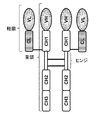
- An IgG antibody is a tetramer molecule composed of two antibody heavy chains (hereinafter abbreviated as H chain) and two antibody light chains (hereinafter abbreviated as L chain), and includes a variable region that is an antigen binding site; It constitutes a constant region consisting of a certain amino acid sequence (FIG. 1).
- the antigen binding site is formed by a heavy chain variable region (hereinafter abbreviated as VH) and a light chain variable region (hereinafter abbreviated as VL), and has various antigen specificities due to the variability of the primary sequence and the higher order structure. And bring about binding affinity.
- VH heavy chain variable region
- VL light chain variable region
- the constant region of IgG H chain (hereinafter abbreviated as CH) is composed of CH1, hinge, CH2, and CH3 domains.
- the Fc region (hereinafter also simply referred to as Fc) is a region composed of hinge, CH2, and CH3.
- ADCC antibody-dependent cytotoxic activity
- Fc ⁇ R Fc ⁇ receptor
- CDC complement-dependent cytotoxic activity
- IgG antibody Fc binds to fetal Fc receptor (hereinafter abbreviated as FcRn) under low pH conditions in endosomes and avoids degradation in lysosomes, thereby extending blood half-life. Is involved.
- the primary sequence of the Fc region is different for each subclass (IgG1, IgG2, IgG3, IgG4), and the binding activity to Fc ⁇ R, FcRn, and complement components is different, resulting in a difference in biological properties (Non-patent Document 1). .
- IgG antibody molecules have two regions called Fabs consisting of VH, CH1, VL, and L chain constant regions (hereinafter abbreviated as CL), and these two Fabs bind to antigen molecules bivalently.
- This bivalent binding activity not only increases the avidity for the antigen, but may induce an intracellular signal due to cross-linking of the antigen when bound to an antigen molecule such as a receptor present on the cell membrane surface.
- Non-patent Document 2 a monovalent antibody with one antigen binding site (monovalent) or an antibody variant having an Fc variant containing an amino acid residue substitution that eliminates Fc ⁇ R binding activity Antibody engineering studies such as production have been made.
- a Fab fragment containing an antigen binding site shows a monovalent binding activity to an antigen, but since it lacks Fc, it has a short half-life in blood and is not useful as a therapeutic drug (Non-patent Document 2).
- bispecific antibodies enable a mechanism of action that cannot be exhibited by conventional IgG monoclonal antibodies due to their bispecificity.
- bispecific T cell engager [BiTE (registered trademark)] binds to both CD3 and a cancer antigen, thereby mobilizing T cells and efficiently damaging cancer cells (Non-patent Document 3).
- BiTE registered trademark
- Fc ⁇ RIIb an inhibitory Fc ⁇ receptor
- the first technique for producing a bispecific antibody is called quadroma, which is a production method using cells obtained by further fusing two hybridomas.
- quadroma A tetramer composed of two types of H chains and two types of L chains is produced as a mixture of theoretically up to 10 combinations, and the antibody having the desired bispecific activity is only one of them, and has similar physics. It is difficult to separate a target bispecific antibody from a by-product having chemical properties (Non-patent Document 6).
- Non-patent Documents 7, 8, 9 and Patents Document 4 a method of introducing amino acid residue substitution that stabilizes “heterologous association” between different H chains into the CH3 domain
- Patent Document 4 a method of stabilizing a hetero-combination of H chains by using a chimeric CH3 domain of IgG1 antibody and IgA antibody is known (Patent Document 1).
- Lindhofer et al. Disclose a method for purifying a bispecific antibody composed of rat IgG2b and mouse IgG2a by utilizing the characteristics that rat IgG2b does not bind to protein A and mouse IgG2a binds to protein A. That is, rat IgG2b and mouse IgG2a heterodimers and mouse IgG2a homodimers are known to bind to protein A and to separate heterodimeric bispecific antibodies by adjusting the pH during elution (Non-Patent Documents). 10).
- Samuel et al. Have proposed a method for specifically purifying a human IgG type bispecific antibody by a purification method utilizing the difference in affinity to protein A. Protein A binding activity by altering the amino acid residue of Arg at position 435 and Phe at position 436 of the EU index in the CH3 domain of one of the two different H chains constituting the bispecific antibody As a result, it is disclosed that a heterodimeric IgG type bispecific antibody can be separated and purified from three types of molecules having different affinity for protein A by adjusting the pH during elution (Patent Document 2). ).
- heterodimer proteins known so far have low heterodimer formation efficiency and are unstable, and it has been difficult to specifically generate heterodimer protein molecules, and to separate and purify them. Accordingly, there is a need for heterodimeric protein compositions that can be produced efficiently and stably, and methods for purifying and producing the protein compositions.
- the present invention relates to the following (1) to (24).
- a protein comprising a first polypeptide containing immunoglobulin CH and a second polypeptide containing CL-Fc in which immunoglobulin CL and Fc region are fused, and the IgG antibody has an L chain-H chain A heterodimeric protein in which a Cys residue related to an intermolecular disulfide bond is deleted or substituted.
- (2) a protein comprising a first polypeptide containing immunoglobulin CH and a second polypeptide containing CL-Fc in which immunoglobulin CL and Fc region are fused, and the second polypeptide is a CH conjugate A heterodimeric protein which is a polypeptide having a reduced binding activity to.
- the first polypeptide is a polypeptide containing a CH1 domain, a hinge domain, a CH2 domain, and a CH3 domain
- the second polypeptide is a polypeptide containing a CL domain, a hinge domain, a CH2 domain, and a CH3 domain
- the heterodimeric protein according to any one of (1) to (3).
- the CH conjugate is any one conjugate selected from anti-CH1 domain antibody, anti-hinge antibody, anti-CH2 domain antibody, anti-CH3 domain antibody, Fc receptor protein, protein A and protein G.
- the second polypeptide is a peptide containing a hinge domain in which amino acid residues at positions 216 to 220 of the EU index are deleted or a polypeptide in which the amino acid residue at positions 220 of the EU index is substituted with Ser.
- the first polypeptide and / or the second polypeptide is P247I, F243L, R292P, Y300L, Y300F, P396L, T393A, H433P, S239D, S298A, A330L, I332E, E333A, K334A, L235E, P238A, N297A, K322A, P331S, K326A, S267E, H268F, S324T, K274Q, N276K, Y296F, K326W, K326Y, E333A, E333S, A339T, A339D, D356E, L358M, N384T, 3938
- the first polypeptide and / or the second polypeptide is a polypeptide in which at least one binding protein is bound to the N-terminus and / or C-terminus of CH and CL-Fc.
- the heterodimeric protein according to any one of 17).
- (i) The first polypeptide is a polypeptide in which immunoglobulin VH is bound to the N terminus of CH, and the second polypeptide is an immunoglobulin VL bound to the N terminus of CL-Fc.
- a heterodimeric protein that is a polypeptide and (ii) the first polypeptide is a polypeptide in which VL is bound to the N-terminus of CH, and the second polypeptide is VH to the N-terminus of CL-Fc
- the heterodimeric protein according to any one of (1) to (19), which is selected from heterodimeric proteins that are bound polypeptides.
- (21) (i) The first polypeptide is a polypeptide in which VH is bound to the C terminus of CH, and the second polypeptide is a polypeptide in which VL is bound to the C terminus of CL-Fc.
- a heterodimeric protein and (ii) the first polypeptide is a polypeptide in which VL is bound to the C-terminus of CH, and the second polypeptide is a polypeptide in which VH is bound to the C-terminus of CL-Fc
- the heterodimeric protein according to any one of (1) to (20) which is selected from heterodimeric proteins that are: (22)
- (23) A DNA encoding the heterodimeric protein according to any one of (1) to (22).
- a heterodimeric protein expressing cell comprising a protein expression vector comprising the DNA of (23).
- a method for producing a heterodimeric protein comprising a step of culturing the cell expressing the heterodimeric protein according to (24) and purifying the heterodimeric protein from the culture supernatant.
- the heterodimeric protein of the present invention includes a first polypeptide containing an immunoglobulin heavy chain constant region (CH) and a second polypeptide containing CL-Fc in which an immunoglobulin light chain constant region (CL) and an Fc region are fused. And the amount of multimers, hemimers, and multimers generated when producing a heterodimeric protein by the deletion or substitution of the Cys residue related to the intermolecular disulfide bond of the L chain and H chain in the IgG antibody. / The production of hemimers can be suppressed and production can be carried out efficiently and stably.
- FIG. 1 shows a schematic diagram of an IgG antibody.
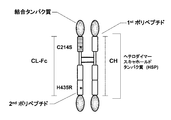
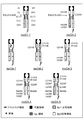
- FIG. 2A shows a schematic diagram of the structure of the heterodimeric protein of the present invention.
- FIG. 2B shows a schematic diagram of typical monovalent to tetravalent antibody structures that can be generated based on the heterodimeric scaffold protein structure (HSP) of the present invention.
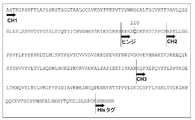
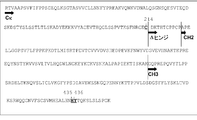
- FIG. 3A shows an IgG1-type monovalent antibody. The underlined amino acid residues are sites where amino acid residue substitutions have been introduced (Table 1), and the numbers indicate the numbers defined by the EU index.
- FIG. 3B shows the amino acid sequence (IgG1-CH, IgG4-CH) of the heavy chain constant region of an IgG4-type monovalent antibody.
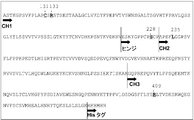
- FIG. 4A shows an IgG1-type monovalent antibody.
- the underlined amino acid residues are the sites where amino acid residue substitution was introduced (Table 2), and the numbers indicate the numbers defined by the EU index.
- FIG. 4B shows the amino acid sequence of IgG-type monovalent antibody CL-Fc (IgG1-L, IgG4-L).
- the underlined amino acid residues are the sites where amino acid residue substitution was introduced (Table 2), and the numbers indicate the numbers defined by the EU index.
- FIG. 5 shows the structures of various monovalent antibodies.
- FIG. 6 shows the amino acid sequence of the second polypeptide of the bispecific antibody.
- FIG. 6 shows the amino acid sequence of the second polypeptide of the bispecific antibody.
- FIG. 7 shows the structure of a bispecific antibody.
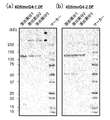
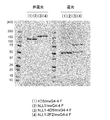
- 8A (a) and (b) show the results of SDS-PAGE analysis of anti-HER2 IgG4 type monovalent antibodies 4D5 / mvG4-1 DF and 4D5 / mvG4-2 DF under non-reducing conditions.
- SDS-PAGE analysis elution fractions 1 to 3 eluted at each pH in protein A purification were used. Arrows in the figure indicate multimeric bands.
- FIG. 8B shows the results of SDS-PAGE analysis of anti-HER2 IgG4 type monovalent antibodies 4D5 / mvG4-3 DF and 4D5 / mvG4-4 DF under non-reducing conditions.
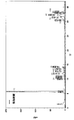
- FIG. 9 shows the analysis result of anti-HER2 IgG4 type monovalent antibody 4D5 / mvG4-2 DF by cation exchange chromatography. Peaks (1) to (10) in the figure indicate fractions collected.
- FIG. 10 shows the results of Western blot analysis of an anti-HER2 IgG4 type monovalent antibody 4D5 / mvG4-2 DF sample (FIG. 9) sorted by cation exchange chromatography.
- FIG. 11 shows the fraction X that is one of the fractions eluted at pH 3.5 and the fraction Y that is eluted at pH 5.0 in the protein A purification of anti-HER2 IgG4 type monovalent antibody 4D5 / mvG4-2 DF.
- 4 shows the results of SDS-PAGE, light chain-specific western blot, and light chain-specific western blot of 4D5 / mvG4-3 DF purified with protein A or protein G.
- the fractions X and Y of 4D5 / mvG4-2 DF are an elution fraction mainly composed of HL and an elution fraction mainly composed of LL.
- the 4D5 / mvG4-3 DF protein G purified product and protein A purified product are samples obtained by purifying the expression cell culture supernatant obtained at the same time with protein G or protein A and eluting them together.
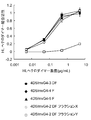
- FIG. 12 shows the amount of HL heterodimer of IgG4-type monovalent antibody by sandwich ELISA.
- the vertical axis represents the HL heterodimer binding activity, and the horizontal axis represents the concentration of HL heterodimer ( ⁇ g / mL).
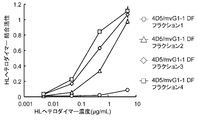
- FIG. 13A shows the amount of IgG4-type monovalent antibody HL heterodimer in each protein A purified fraction by sandwich ELISA.
- the vertical axis represents the HL heterodimer binding activity, and the horizontal axis represents the concentration of HL heterodimer ( ⁇ g / mL).
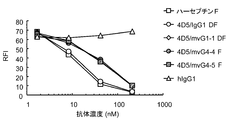
- FIG. 14A shows the results of evaluating the competitive binding inhibition of various monovalent antibodies under a binding assay of the anti-HER2 humanized antibody Herceptin using a flow cytometer, and the binding activity to HER2-positive human breast cancer cell line SK-BR-3. Indicates.
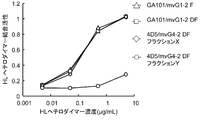
- FIG. 14B is a result of evaluating competitive binding inhibition of various monovalent antibodies under a binding assay of anti-CD20 humanized antibody GA101 using a flow cytometer, and shows binding activity to CD20-positive human lymphoma cell line Raji.
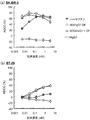
- FIGS. 15A (a) and (b) show the anti-HER2 IgG1-type monovalent antibody 4D5mvG1-1DF anti-body cellular cytotoxicity (ADCC) against human breast cancer cell line SK-BR-3 of IgG1-type and IgG4-type anti-HER2 monovalent antibody. Shows activity.
- fraction 1 (FIG. 13) having the highest HL heterodimer content was used.
- 15B (a) and (b) show the ADCC activity of anti-HER2 IgG4 type monovalent antibody against human breast cancer cell line BT-20 of IgG1 type and IgG4 type antiHER2 monovalent antibody.
- FIG. 16 (a)-(c) show ADCC activity of anti-CD20 IgG1-type monovalent antibody against Burkitt lymphoma cell lines Raji and ST-486 and chronic B cell leukemia cell line MEC-1.
- the vertical axis represents ADDC activity (%), and the horizontal axis represents antibody concentration (nM).
- FIG. 17 shows anti-HER2 IgG4 type monovalent antibody 4D5 / mvG4-4F, anti-CD74 IgG4 type monovalent antibody hLL1 / mvG4-4F, HER2-CD74 bispecific antibody hLL1-4D5 / mvG4-4 F and CD74-CD20.
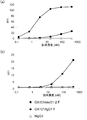
- FIGS. 18 (a) and (b) show the binding activity of the HER2-CD74 bispecific antibody hLL1-4D5 / mvG4-4F to the recombinant HER2 protein and the recombinant CD74 protein by ELISA.
- the vertical axis represents antigen binding activity (OD415-490).
- the abscissa shows the bispecific antibody concentration (nM).
- IgG1 antibodies against each antigen anti-HER2 humanized antibody Herceptin and anti-CD74 antibody hLL1 antibody were used.
- FIG. 19 shows complement-dependent cytotoxic activity (CDC activity) of anti-CD20 IgG1-type monovalent antibody GA101 / mvG1-2 and anti-CD20 IgG1 antibody GA101 / IgG1 against Burkitt lymphoma cell line ST-486.
- the vertical axis represents CDC activity (%), and the horizontal axis represents the molar concentration (nM) of each monovalent antibody and IgG1 antibody.
- FIG. 20 (a) shows the amount of anti-CD20 IgG1-type monovalent antibody GA101 / mvG1-2 and anti-CD20 IgG1 antibody GA101 / IgG1 bound to Burkitt lymphoma cell line Raji.
- FIG. 20 (b) shows the amount of complement factor C1q binding.
- the vertical axis represents the relative fluorescence intensity (RFI) value
- the horizontal axis represents the molar concentration (nM) of each monovalent antibody and IgG1 antibody.
- FIG. 21 (a) shows the amount of anti-CD20 IgG1-type monovalent antibody GA101 / mvG1-2 and anti-CD20 IgG1 antibody GA101 / IgG1 bound to Burkitt lymphoma cell line ST-486.
- FIG. 21 (b) shows the amount of complement factor C1q binding.
- the vertical axis represents the relative fluoresceinness intensity (RFI) value
- the horizontal axis represents the molar concentration (nM) of each monovalent antibody and IgG1 antibody.
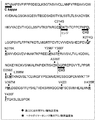
- FIG. 22A shows the amino acid sequence of the heavy chain constant region domain of a heterodimeric protein containing a high CDC active constant region.
- the amino acid number is represented by the EU index defined by Kabat et al.
- ⁇ represents the amino acid substitution site from IgG1 type to high CDC activity type
- * represents the amino acid substitution site of the heterodimeric protein.
- FIG. 22B shows the amino acid sequence of the CL-Fc chain of a heterodimeric protein containing a high CDC active constant region.
- the amino acid number is represented by the EU index defined by Kabat et al.
- ⁇ represents the amino acid substitution site from IgG1 type to high CDC activity type
- * represents the amino acid substitution site of the heterodimeric protein.
- FIGS. 24 (a) and (b) show anti-CD20 IgG1-type monovalent antibody GA101 / mvG1-2 and anti-CD20 high CDC active monovalent antibody GA101 / mvCom Burkitt lymphoma cell line Raji or chronic B-cell leukemia cell MEC. CDC activity against -1.
- FIGS. 25 (a) and (b) show anti-CD20 IgG1-type monovalent antibody GA101 / mvG1-2 and anti-CD20 high CDC active monovalent antibody GA101 / mvCom Burkitt lymphoma cell line Raji or chronic B-cell leukemia cell MEC. 1 shows ADCC activity against -1.
- the vertical axis represents ADCC activity (%), and the horizontal axis represents the molar concentration (nM) of each monovalent antibody and IgG1 antibody.
- the present invention is a protein comprising a first polypeptide comprising an immunoglobulin heavy chain constant region (CH) and a second polypeptide comprising CL-Fc in which an immunoglobulin light chain constant region (CL) and an Fc region are fused.
- a dimeric protein in which an Cys residue related to an intermolecular disulfide bond between L chain and H chain is deleted or substituted in an IgG antibody, a method for purifying the protein, a method for producing the protein, a DNA encoding the protein, and a vector About.
- the heterodimeric protein of the present invention is a protein comprising a first polypeptide containing immunoglobulin CH and a second polypeptide containing CL-Fc obtained by fusing immunoglobulin CL and antibody Fc. And a heterodimeric protein in which a Cys residue related to an intermolecular disulfide bond of an L chain to an H chain is deleted or substituted in a normal IgG antibody.
- amino acid numbers are given by Kabat et al. [Sequences of Proteins of Immunological Interest, US Dept. A number based on the EU index (hereinafter simply referred to as EU index) by Health and Human Services (1991)].
- EU index based on the EU index (hereinafter simply referred to as EU index) by Health and Human Services (1991)].
- the number before the amino acid residue substitution is before the number, and the amino acid residue after the substitution is after the number.
- the Cys residue related to the disulfide bond between CL and CH usually indicates a Cys residue required for the H chain and L chain of an antibody to form an intermolecular disulfide bond.
- the heterodimeric protein of the present invention is a Cys residue contained in CH contained in the first polypeptide and / or CL-Fc contained in the second polypeptide, and the L chain-H chain in the IgG antibody.
- the Cys residue for the intermolecular disulfide bond is deleted or substituted.
- production of an unnecessary multipolymer can be reduced because this Cys residue is deleted or substituted.
- Cys residue related to the disulfide bond between CL and CH1 in the L chain examples include the Cys residue at the EU index position 214 of human ⁇ chain and ⁇ chain.
- examples of the Cys residue relating to the disulfide bond between CL and CH1 in the H chain include a Cys residue at position 220 in human IgG1, and a Cys residue at position 131 in IgG4 antibody.
- the amino acid residue can be deleted or substituted, the Cys residue of the CH1 domain or the hinge domain can be replaced or deleted together with the replacement or deletion of the Cys residue contained in the above-mentioned CL.
- the CH contained in the first polypeptide and the CH of CL-Fc contained in the second polypeptide are disulfide-bonded only by the hinge domain.
- the heterodimeric protein of the present invention is a protein comprising a first polypeptide containing CH and a second polypeptide containing CL-Fc in which CL and Fc are fused, and the second polypeptide binds to CH.
- heterodimeric proteins which are polypeptides that have reduced binding activity to the body.
- the second polypeptide having a reduced or deleted binding activity to the CH conjugate and / or Fc-binding protein is added to, deleted from and / or deleted from the amino acid sequence of CL-Fc contained in the second polypeptide.
- the CH conjugate may be any protein, chemical substance, resin, or the like that specifically binds to the antibody H chain constant region, for example, Fc binding protein, antibody H chain constant region. Examples thereof include an antibody that binds to (CH).
- Fc-binding protein examples include Staphylococcus Aureus-derived Protein A, hemolytic Streptococcus-derived Protein G, Fc receptor, the subclass (Fc ⁇ RI, IIA, IIB, IIIA, IIIB), and binding partial fragments of the above-described proteins. Can be mentioned.
- the antibody that binds to CH may be any antibody that binds to at least one selected from the CH1 domain, hinge domain, CH2 domain, and CH3 domain, and includes monoclonal antibodies and polyclonal antibodies.
- the CH1 domain is not included in the second polypeptide constituting the heterodimer of the present invention, and the CH1 domain is included in the first polypeptide. Therefore, the heterodimeric protein of the present invention can be purified by using an anti-CH1 antibody as the CH conjugate.
- the second polypeptide having a decreased or lost binding activity to a CH conjugate means that the binding activity is substantially reduced or lost by reducing the affinity for the CH conjugate.
- the second polypeptide having a decreased or deleted binding activity is the addition, deletion or substitution of amino acid residues by adding, deleting or substituting amino acid residues in the second polypeptide having binding activity to the CH conjugate.
- This is a second polypeptide that has a reduced or deficient binding activity to the CH conjugate compared to the original second polypeptide that has not been substituted.
- the binding activity to the CH conjugate can be confirmed by using a measurement system such as a binding ELISA or surface plasma resonance method (SPR) described later.
- the first polypeptide containing CH contained in the heterodimeric protein of the present invention specifically binds to the above-mentioned CH conjugate, and the second polypeptide containing CL-Fc has reduced or defective binding activity to the CH conjugate. Therefore, only the heterodimeric protein consisting of the first polypeptide and the second polypeptide binds to the CH conjugate and can be specifically separated and purified.
- the heterodimeric protein of the present invention when expressed in cells, the homodimer of the first polypeptide containing CH is not secreted outside the cell, and the monomer and homodimer of the second polypeptide containing CL-Fc are: Although they are secreted outside the cell, the binding activity to the CH conjugate is reduced or lacked. Therefore, if purification based on the specific binding activity with the CH conjugate is performed, the first polypeptide and the second polypeptide It is possible to specifically separate and purify heterodimeric proteins composed of polypeptides.
- a fusion in which an appropriate tag is fused to the N-terminus or C-terminus of the first polypeptide of the present invention is used. Proteins can also be used.
- the tag examples include a histidine tag (hereinafter also abbreviated as His tag), a myc tag, a FLAG tag, a hemagglutinin (HA) tag, a glutathione-S transferase (GST) tag, and the like.
- His tag histidine tag
- myc tag a tag
- FLAG tag a tag
- HA hemagglutinin
- GST glutathione-S transferase
- the second polypeptide with reduced or defective binding activity to the CH conjugate is produced by adding, deleting, and substituting the amino acid sequence of CL-Fc contained in the second polypeptide.
- At least one amino acid residue selected from EU index positions 253, 310, 433, 435, and 436 is deleted or substituted.
- CL-Fc preferably CL-Fc in which the amino acid residue at EU index position 435 is substituted
- CL-Fc in which the amino acid residues in EU index positions 435 and 436 are substituted
- CL-Fc in which His at position 435 is substituted with Arg is substituted with Arg.
- the binding activity to the CH binding protein can be reduced by adding, deleting or substituting the amino acid sequence of the CH to which the binding protein binds.
- at least one of the epitopes present on the CH of the heterodimeric protein of the present invention such as a binding site in Fc to which protein G binds, an epitope to which an anti-Fc antibody binds, and an epitope to which an anti-hinge domain antibody binds
- a second polypeptide having a reduced binding activity to each CH-binding protein or antibody can be produced.
- the antibody can be a polyclonal antibody or a monoclonal antibody, and an amino acid residue contained in any antibody epitope can be substituted if the epitope specified by each antibody is clear.
- the heterodimeric protein of the present invention is a protein comprising a first polypeptide containing CH and a second polypeptide containing CL-Fc in which CL and Fc are fused, wherein the second polypeptide is a CH conjugate. And a heterodimeric protein in which a Cys residue related to an intermolecular disulfide bond between L and H chains is deleted or substituted in an IgG antibody.
- the heterodimeric protein of the present invention is a protein comprising a first polypeptide containing CH and a second polypeptide containing CL-Fc in which CL and Fc are fused, wherein the second polypeptide is against the CH conjugate.
- a heterodimeric protein that is a polypeptide having a reduced binding activity and that is disulfide-bonded between CH and CL-Fc only by a hinge domain.
- the heterodimeric protein of the present invention is a protein comprising a first polypeptide containing CH and a second polypeptide containing CL-Fc, and the second polypeptide is represented by the EU index (i ) A polypeptide in which the amino acid residue at position 214 is replaced with another amino acid residue, (ii) a polypeptide in which the amino acid residue in position 220 is replaced with another amino acid residue, (iii) an amino acid residue at position 214 A polypeptide in which the group is substituted with Ser, (iv) a polypeptide in which the amino acid residue at position 220 is substituted with Ser, (v) a polypeptide in which the amino acid residue at position 435 is substituted with Arg, (vi) 214 A polypeptide in which amino acid residues at positions 435 and 435 are substituted with Ser and Arg, (vii) amino acid residues at positions 220 and 435 are S a polypeptide substituted for r and Arg and (viii) any one polypeptide selected
- the heterodimeric protein of the present invention is a protein comprising a first polypeptide and a second polypeptide in which a binding domain is bound to at least one selected from the N-terminal side and C-terminal side of CH and CL-Fc. And a heterodimeric protein in which the second polypeptide is a polypeptide with reduced or defective binding activity to a CH conjugate.
- the binding domain may be any protein as long as it has a binding activity to other molecules, and specifically, an antibody fragment, an antibody variable region (hereinafter sometimes abbreviated as V).
- V antibody variable region
- scFv Single chain Fv
- Fab fragment-binding protein
- Fab ′ fragment-binding protein
- F (ab ′) 2 single chain Fv
- dsFv disulphide-stable Fv
- VHH single variable domain
- ligand protein and receptor protein etc.
- CH contained in the first polypeptide of the heterodimeric protein of the present invention is composed of the CH1 domain, hinge domain, CH2 domain, and CH3 domain, which are constant regions of antibodies, and may be any isotype, preferably an IgG isotype. It is done.
- the IgG subclass may be any of IgG1, IgG2, and IgG4 subclasses.
- the first polypeptide may include a hinge domain in which each immunoglobulin isotype, subclass hinge domain, or partial amino acid sequence is added, deleted or substituted.
- the same isotype as Fc, a subclass hinge domain, a hinge domain substituted with the amino acid residue, and the like can be mentioned.
- the hinge domain can be lengthened or shortened as appropriate in producing the heterodimeric protein of the present invention.
- the CH contained in the first polypeptide may be any CH having any amino acid sequence as long as it is a CH for efficiently and stably producing a heterodimeric protein, and is preferably added to or deleted from the amino acid sequence. And CH including loss and substitution.
- the EU index includes at least one amino acid residue substitution selected from amino acid residue substitutions in which the 131st is S, the 133th is K, the 220th is S, the 228th is P, and the 409th is K. CH.
- the number of amino acid residue substitutions is 1 to 15, preferably 1 to 10, more preferably 1 to several, and most preferably 1 to 5 amino acid residue substitutions.
- CH containing C220S substitution of the hinge domain can be mentioned.
- amino acid residue at position 220 of the EU index is known to be involved in disulfide bonds with the L chain in IgG1, and this substitution or deletion of amino acid residues may cause loss of the disulfide bond in the CL-hinge domain. it can.
- the amino acid residue at position 409 of the EU index is known to be involved in a stable interaction between the CH3-CH3 domains of the antibody Fc region
- the amino acid residues of R409K, R409T, R409M and R409L Modification of the group provides an effect of increasing the stability of the Fc-Fc interaction, an effect of suppressing Fab-arm exchange, and an effect of suppressing aggregates under low pH.
- amino acid residue modification International Publication No. 2009/089004
- immunoglobulin subclass of K409D / K392D and D399K / E356K was used.
- SEED technology WO 2007/110205
- the Ser residue at position 228 of the EU index is known to be involved in the instability of disulfide bonds between hinge domains, and the amino acid residue modification of S228P is involved in the stabilization of the hinge domain.
- the CL contained in the second polypeptide of the heterodimeric protein of the present invention may be either ⁇ chain or ⁇ chain.
- Fc contained in the second polypeptide consists of a hinge domain, a CH2 domain, and a CH3 domain, and may be any isotype, preferably an IgG isotype, and an IgG subclass includes any of IgG1, IgG2, and IgG4 It may be a subclass.
- the second polypeptide may include a hinge domain to which each immunoglobulin isotype, subclass hinge domain or partial amino acid sequence is added, deleted or substituted, and preferably has the same isotype, subclass as Fc. And the hinge domain in which the amino acid residue is substituted. Further, the hinge domain can be lengthened or shortened as appropriate in producing the heterodimeric protein of the present invention.
- the CL-Fc contained in the second polypeptide may be any CL-Fc having any amino acid sequence as long as it is a CL-Fc for efficiently and stably producing a heterodimeric protein.
- CL-Fc that includes additions, deletions and substitutions in the amino acid sequence.
- the number of amino acid residue substitutions is 1 to 15, preferably 1 to 10, more preferably 1 to several, and most preferably 1 to 5 amino acid residue substitutions.
- CL-Fc including at least one amino acid residue substitution selected from C214S, C220S, H435R and Y436F
- CL-Fc including the amino acid residue substitution of C220S at EU index position 220, EU index 216-220 CL-Fc containing deletions of EPKSC, preferably CL-Fc containing amino acid residue substitutions of C214S and H435R, CL-Fc containing amino acid residue substitutions of C214S, C220S and H435R, more preferably C214S, H435R and Y436F CL-Fc containing amino acid residue substitutions of CL-Fc, C214S, C220S, H435R and Y436F.
- CL-Fc containing any one amino acid residue substitution selected from C214S, S228P, L235E, R409K, H435R and Y436F preferably CL-Fc containing amino acid residue substitutions of C214S and H435R, CL-Fc comprising amino acid residue substitutions of C214S, R409K and H435R, more preferably CL-Fc comprising amino acid residue substitutions of C214S, R409K, H435R and Y436F, most preferably C214S, S228P, L235E, R409K, H435R and CL-Fc containing an amino acid residue substitution of Y436F.
- a monoclonal antibody is an antibody that is secreted by a single clone of antibody-producing cells, recognizes only one epitope (also referred to as an antigenic determinant), and has an amino acid sequence (primary structure) constituting the monoclonal antibody. It is uniform.
- Epitopes include, for example, a single amino acid sequence that is recognized and bound by a monoclonal antibody, a three-dimensional structure composed of amino acid sequences, an amino acid sequence in which modified residues such as sugar chains, amino groups, carboxyl groups, phosphates, and sulfuric acids are bound. Examples thereof include a three-dimensional structure composed of an amino acid sequence to which the modified residue is bonded.
- the three-dimensional structure is a three-dimensional structure possessed by a naturally occurring protein and refers to a three-dimensional structure constituted by a protein expressed in a cell or on a cell membrane.
- an antibody molecule is also referred to as an immunoglobulin (hereinafter referred to as Ig), and human antibodies are divided into IgA1, IgA2, IgD, IgE, IgG1, IgG2, IgG3, IgG4 and IgM depending on the molecular structure. Classified as isotype. IgG1, IgG2, IgG3, and IgG4 having relatively high amino acid sequence homology are collectively referred to as IgG.
- Antibody molecules are composed of polypeptides called heavy chains (hereinafter referred to as H chains) and light chains (hereinafter referred to as L chains).
- the H chain is an H chain variable region (also expressed as VH), an H chain constant region (also expressed as CH) from the N terminal side, and an L chain is also expressed as an L chain variable region (VL) from the N terminal side. ),
- Each region of the L chain constant region also expressed as CL.
- CH ⁇ , ⁇ , ⁇ , ⁇ , and ⁇ chains are known for each subclass.
- CL ⁇ and ⁇ are known.
- a domain refers to a functional structural unit constituting each polypeptide of an antibody molecule.
- the Fc and Fc regions in the present invention refer to a partial sequence and partial structure of an H chain constant region comprising a hinge domain, a CH2 domain, and a CH3 domain.
- CH is further composed of each domain of CH1 domain, hinge domain, CH2 domain, and CH3 domain from the N-terminal side.
- the CH1 domain, hinge domain, CH2 domain, CH3 domain and Fc region are represented by EU index [Kabat et al. , Sequences of Proteins of Immunological Interest, US Dept. Health and Human Services (1991)] can be specified by the number of amino acid residues from the N-terminus.
- CH1 is an amino acid sequence of EU indexes 118 to 215
- hinge is an amino acid sequence of EU indexes 216 to 230
- CH2 is an amino acid sequence of EU indexes 231 to 340
- CH3 is an EU index 341 to 447. Each amino acid sequence is identified.
- CL-Fc is composed of CL domain, hinge domain, CH2 domain, and CH3 domain from the N-terminal side.
- CL-Fc in the present invention is defined by Kabat et al. [Kabat et al. , Sequences of Proteins of Immunological Interest, US Dept. Health and Human Services (1991)] can be specified by the number of amino acid residues from the N-terminus.
- CL of CL-Fc is the 108th to 214th amino acid sequence of the L chain defined by Kabat et al.
- Fc of CL-Fc is the hinge is the amino acid sequence of EU indexes 216 to 230
- CH2 is the EU index.
- the amino acid sequences 231 to 340 and CH3 are specified as the amino acid sequences of EU indexes 341 to 447, respectively.
- the antibody includes a recombinant antibody produced by a gene recombination technique in addition to a monoclonal antibody obtained from a hybridoma.
- a recombinant antibody a chimeric antibody in which a human antibody constant region is bound to a non-human antibody variable region, a complementarity determining region of the H chain and L chain of the non-human antibody variable region (hereinafter abbreviated as CDR).
- CDR complementarity determining region of the H chain and L chain of the non-human antibody variable region
- a humanized antibody (or a CDR-grafted antibody) prepared by inserting a human antibody variable region into a framework region of a human antibody variable region (hereinafter abbreviated as FR), a human antibody produced using a human antibody-producing animal, etc. Is included.
- the chimeric antibody is obtained by obtaining cDNA encoding VH and VL from a hybridoma derived from a non-human animal cell producing a monoclonal antibody, and inserting it into an expression vector for animal cells having DNA encoding the CH and CL of the human antibody.
- human chimeric antibody expression vectors can be constructed and introduced into animal cells for expression and production.
- a humanized antibody refers to an antibody obtained by grafting the amino acid sequences of CDRs of VH and VL of a non-human animal antibody into CDRs corresponding to VH and VL of a human antibody.
- An area other than the CDRs of VH and VL is referred to as a framework area (hereinafter referred to as FR).
- the humanized antibody is composed of a cDNA encoding a VH amino acid sequence consisting of a VH CDR amino acid sequence of a non-human animal antibody and a VH FR amino acid sequence of any human antibody, and a VL CDR amino acid of a non-human animal antibody.
- a cDNA encoding the amino acid sequence of VL consisting of the sequence and the amino acid sequence of FR of VL of any human antibody is constructed, and inserted into an expression vector for animal cells having DNA encoding CH and CL of human antibody, respectively.
- An antibody expression vector can be constructed and introduced into animal cells for expression and production.
- Human antibodies originally refer to antibodies that exist naturally in the human body, but human antibody phage libraries and immortalized human peripherals created by recent advances in genetic engineering, cell engineering, and developmental engineering techniques. Also included are antibodies obtained from cloning of blood lymphocytes or human antibody-producing transgenic animals.
- a human antibody can be obtained by immunizing a mouse carrying a human immunoglobulin gene (Tomizuka K. et. Al., Proc Natl Acad Sci USA. 97, 722-7, 2000) with a desired antigen. . Further, by using a phage display library obtained by amplifying antibody genes from human-derived B cells, a human antibody can be obtained without immunization by selecting a human antibody having a desired binding activity ( Winter G. et.al., Annu Rev Immunol. 12: 433-55.1994).
- the antibody present in the human body can be cultured, for example, by immortalizing lymphocytes isolated from human peripheral blood by infecting EB virus or the like and then cloning the lymphocytes, The antibody can be purified from the culture.
- the human antibody phage library is a phage library in which antibody fragments such as Fab or scFv are expressed on the surface by inserting antibody genes prepared from human B cells into the phage genes. From the library, phages expressing antibody fragments having a desired antigen-binding activity can be collected using the binding activity to the substrate on which the antigen is immobilized as an index. The antibody fragment can be further converted into a human antibody molecule comprising two complete heavy chains and two complete light chains by genetic engineering techniques.
- a human antibody-producing transgenic animal is an animal in which a human antibody gene is integrated into the chromosome of a host animal.
- a human antibody-producing transgenic animal can be produced by introducing a human antibody gene into mouse ES cells, and then transplanting the ES cells into early embryos of other mice and then generating them.
- a human antibody production method from a human antibody-producing transgenic animal is obtained by obtaining and culturing a human antibody-producing hybridoma by a hybridoma production method performed in a normal non-human mammal. Production can be accumulated.
- the amino acid sequences of VH and VL to be bound to the heterodimeric protein of the present invention include the VH and VL amino acid sequences of human antibodies, the VH and VL amino acid sequences of non-human animal antibodies, and the CDRs of non-human animal antibodies. Any of the amino acid sequences of humanized antibodies transplanted to the framework of VH and VL derived from human antibodies may be used.
- Non-human animal antibodies produced by hybridomas or antibody-producing cells include non-human animal antibodies produced by hybridomas or antibody-producing cells, humanized antibodies, and human antibody VH and VL amino acid sequences.
- the amino acid sequence of CL in the heterodimeric protein of the present invention may be either an amino acid sequence of a human antibody or an amino acid sequence of a non-human animal antibody, but a human antibody C ⁇ or C ⁇ amino acid sequence is preferred.
- the CH in the heterodimeric protein of the present invention may be any CH as long as it belongs to an immunoglobulin, but preferably any of subclasses belonging to the human IgG class, ⁇ 1 (IgG1), ⁇ 2 (IgG2), and ⁇ 4 (IgG4) is used. be able to.
- Examples of the antibody fragment in the present invention include Fab, Fab ′, F (ab ′) 2 , scFv, diabody, dsFv, a peptide containing a plurality of CDRs, preferably a peptide containing 6 CDRs of an antibody.
- Fab is a fragment obtained by treating IgG antibody with proteolytic enzyme papain (cleaved at the amino acid residue at position 224 of the H chain). It is an antibody fragment having an antigen binding activity of about 50,000 molecular weight bound by (SS bond).
- F (ab ′) 2 is a fragment obtained by treating IgG with proteolytic enzyme pepsin (which is cleaved at the amino acid residue at position 234 of the H chain), and Fab is linked via an SS bond in the hinge region.
- Antibody fragment having an antigen-binding activity with a molecular weight of about 100,000, which is slightly larger than those bound together.
- Fab ′ is an antibody fragment having an antigen binding activity of about 50,000 molecular weight obtained by cleaving the SS bond in the hinge region of F (ab ′) 2 .
- scFv uses an appropriate peptide linker (P) such as a linker peptide in which one VH and one VL are connected to an arbitrary number of linkers (G4S) consisting of four Gly and one Ser residue.
- P peptide linker
- G4S linkers
- VH-P-VL or VL-P-VH polypeptide which is an antibody fragment having antigen-binding activity.
- Diabody is an antibody fragment in which scFv having the same or different antigen binding specificity forms a dimer, and is an antibody fragment having a bivalent antigen-binding activity for the same antigen or a bispecific antigen-binding activity for different antigens.
- DsFv refers to a polypeptide in which one amino acid residue in each of VH and VL is substituted with a cysteine residue, which are bound via an SS bond between the cysteine residues.
- the peptide containing CDR is configured to contain at least one region of CDR of VH or VL.
- a peptide containing a plurality of CDRs can be linked to each other directly or via an appropriate peptide linker.
- a DNA encoding the VH and VL CDRs of the heterodimeric protein of the present invention is constructed, the DNA is inserted into a prokaryotic expression vector or eukaryotic expression vector, and the expression vector is introduced into a prokaryotic or eukaryotic organism. It can be expressed and produced by introduction.
- the peptide containing CDR can also be manufactured by chemical synthesis methods, such as Fmoc method or tBoc method.
- the heterodimeric protein of the present invention may be a heterodimeric protein in which the two antibody variable regions formed by the first polypeptide and the second polypeptide bind to two different epitopes.
- the regions may be heterodimeric proteins that each bind to the same epitope.
- heterodimeric protein in which a binding protein further binds to at least one of the C terminus of CH and CL-Fc described above and binds to two or more epitopes is also encompassed in the present invention.
- control of heterodimeric protein activity (1) Control of effector activity Since the heterodimer of the present invention has an Fc region comprising a hinge domain, a CH2 domain and a CH3 domain, it imparts an effector activity dependent on the Fc region of the heterodimeric protein. You can also The effector activity of the heterodimer of the present invention can be controlled by various methods.
- the effector activity refers to antibody-dependent activity caused through the Fc region of an antibody.
- Antibody-dependent cellular cytotoxicity (ADCC activity), complement-dependent cytotoxicity (Complement-Dependent) Cytotoxicity (CDC activity) or antibody-dependent phagocytosis (ADP activity) by phagocytic cells such as macrophages or dendritic cells is known.
- ADCC activity and CDC activity are measured using a known measurement method [Cancer Immunol. Immunother. , 36, 373 (1993)].
- ADCC activity means that an antibody bound to an antigen on a target cell binds to an Fc receptor of an immune cell through the Fc region of the antibody, thereby activating an immune cell (natural killer cell, etc.) and damaging the target cell. Activity.
- the Fc receptor (hereinafter also referred to as FcR) is a receptor that binds to the Fc region of an antibody, and induces various effector activities by the binding of the antibody.
- FcR corresponds to an antibody subclass, and IgG, IgE, IgA, and IgM specifically bind to Fc ⁇ R, Fc ⁇ R, Fc ⁇ R, and Fc ⁇ R, respectively. Furthermore, Fc ⁇ R has Fc ⁇ RI (CD64), Fc ⁇ RII (CD32) and Fc ⁇ RIII (CD16) subtypes, and Fc ⁇ RIA, Fc ⁇ RIB, Fc ⁇ RIIC, Fc ⁇ RIIA, Fc ⁇ RIIB, Fc ⁇ RIIC, Fc ⁇ RIIIA, and Fc ⁇ RIIIB isoforms, respectively. To do. These different Fc ⁇ Rs are present on different cells [Annu. Rev. Immunol. 9: 457-492 (1991)].
- Fc ⁇ RIIIB is specifically expressed in neutrophils, and Fc ⁇ RIIIA is expressed in monocytes, Natural Killer cells (NK cells) and some T cells. Antibody binding via Fc ⁇ RIIIA induces NK cell-dependent ADCC activity.
- CDC activity refers to an activity in which an antibody bound to an antigen on a target cell activates a series of cascades (complement activation pathways) composed of complement-related proteins in the blood and damages the target cell.
- cascades complement activation pathways
- migration and activation of immune cells can be induced by protein fragments generated by complement activation.
- the cascade of CDC activity starts when C1q having a binding domain with the Fc region of an antibody binds to the Fc region and binds to two serine proteases C1r and C1s to form a C1 complex.
- Examples of the method for controlling the effector activity of the heterodimeric protein of the present invention include the following methods.
- an N-linked complex sugar chain that binds to Asn at EU position 297 using the IgG1 subclass Fc amino acid sequence (hereinafter sometimes simply referred to as complex sugar chain)
- a method for controlling the amount of fucose (also referred to as core fucose) that binds ⁇ -1,6 to N-acetylglucosamine (GlcNAc) present at the reducing end of (a) is (WO 2005/035586, WO 2002/31140). , WO 00/61739), or by substituting amino acid residues in the Fc region of an antibody, the effector activity of the heterodimeric protein can be controlled.
- Control of effector activity by sugar chain modification Effector activity of heterodimeric protein is controlled by controlling the content of fucose added to N-acetylglucosamine at the reducing end of complex sugar chain bound to Fc region of heterodimeric protein Can be increased or decreased.
- an antibody using CHO cells deficient in the ⁇ 1,6-fucose transferase gene (FUT8) is used.
- FUT8 CHO cells deficient in the ⁇ 1,6-fucose transferase gene
- heterodimeric protein using a host cell into which an ⁇ 1,6-fucose transferase gene has been introduced is used. By expressing the protein, a heterodimeric protein to which fucose is bound can be obtained. Heterodimeric proteins to which fucose is bound have a lower ADCC activity than heterodimeric proteins to which fucose is not bound.
- N-linked sugar chain binds to the Asn residue at EU position 297 in the Fc region of the heterodimeric protein of the present invention, but the sugar chain binds to the Asn residues of other Fc regions. It is not done. Therefore, normally, two N-glycoside-linked sugar chains are bound per molecule of heterodimeric protein.
- N-linked sugar chains high mannose type, complex type and hybrid type are known, and any N-linked sugar chain is a sugar chain to which fucose is not bound. Higher ADCC activity can be obtained.
- the complex sugar chain that binds to the Fc region of the heterodimeric protein of the present invention includes one or more N-acetylglucosamine (GlcNAc) or mannose (Man) on the non-reducing terminal side of the core structure (trimannosyl core structure) or Examples thereof include sugar chains in which galactose-N-acetylglucosamine (hereinafter referred to as Gal-GlcNAc) is ⁇ 1-2 linked or ⁇ 1-4 bonded.
- Gal-GlcNAc galactose-N-acetylglucosamine
- a complex type (complex type) sugar chain having sialic acid, bisecting N-acetylglucosamine (hereinafter referred to as “bicing GlcNAc”), etc. on the non-reducing end side of Gal-GlcNAc can be mentioned.
- core-fucose or ⁇ 1,6-fucose means N-acetylglucosamine (hereinafter also referred to as GlcNAc) at the N-glycoside-linked complex type sugar chain reducing end and fucose (hereinafter also referred to as GlcNAc).
- GlcNAc N-acetylglucosamine
- Fuc fucose
- the fact that fucose is not bound to N-acetylglucosamine at the reducing end of the N-glycoside-linked complex sugar chain is simply referred to as a sugar chain having no fucose or no core fucose.
- the core structure or trimannosyl core structure means a Man ⁇ 1-6 (Man ⁇ 1-3) Man ⁇ 1-4GlcNAc ⁇ 1-4GlcNAc structure.
- a double-stranded N-glycoside-linked complex sugar chain (also referred to as a biantennary complex sugar chain) is represented by the following chemical formula.
- the heterodimeric protein composition of the present invention is a heterodimeric protein molecule having an Fc region in which a complex type sugar chain is bound to Asn at position 297 of the heterodimeric protein molecule, and has the above-mentioned sugar chain structure. , It may be composed of a heterodimeric protein molecule having a single sugar chain structure, or may be composed of heterodimeric protein molecules having a plurality of different sugar chain structures.
- the heterodimeric protein composition of the present invention means a composition comprising heterodimeric protein molecules having single or plural different sugar chain structures. Specifically, of all N-glycoside-linked sugar chains that bind to the Fc region contained in the heterodimeric protein, 20% or more of the sugar chains have no fucose bound to N-acetylglucosamine at the sugar chain reducing end. Some heterodimeric proteins are mentioned.
- the proportion of sugar chains without core fucose includes any proportion of heterodimeric protein composition as long as the ADCC activity of the heterodimeric protein is increased, but is preferably 20% or more, more preferably 51% -100%, More preferably 80% -100%, particularly preferably 90%, 91%, 92%, 93%, 94%, 95%, 96%, 97%, 98%, 99%, most preferably 100% Can be mentioned.
- the proportion of sugar chains without core fucose is 50%, which means that a molecule in which fucose is not bound to one sugar chain of N-glycoside-linked sugar chains that are bound to the first and second polypeptides of the heterodimeric protein molecule.
- 50% of the heterodimeric protein composition comprising 100% or 50 molecules without fucose binding to both sugar chains of the N-glycoside-linked sugar chains bound to the first and second polypeptides of the heterodimeric protein molecule
- Heterodimeric protein composition comprising 50% fucose bound to both sugar chains of the N-glycoside-linked sugar chain that is contained in the first and second polypeptides of the heterodimeric protein molecule Both are included.
- the sugar chain having no fucose has any non-reducing terminal sugar chain structure as long as fucose is not bound to N-acetylglucosamine on the reducing terminal side in the chemical formula shown above. May be.
- fucose is not bound to N-acetylglucosamine at the sugar chain reducing end means that fucose is not substantially bound.
- the heterodimeric protein body composition to which fucose is not substantially bound is a heterodimeric protein composition in which fucose is not substantially detectable in the sugar chain analysis described below. Say. The level that cannot be substantially detected means that it is below the detection limit of measurement.
- a heterodimeric protein composition having no core fucose in all sugar chains has the highest ADCC activity.
- the proportion of heterodimeric protein molecules having a sugar chain without fucose contained in a composition comprising a heterodimeric protein molecule having an Fc region bound to an N-glycoside-linked complex type sugar chain is determined by hydrazine degradation from the heterodimeric protein molecule.
- a known method such as enzymatic digestion [Biochemical Experimental Method 23-Glycoprotein Glycan Research Method (Academic Publishing Center) Takahashi Eiko (1989)] is used to release the sugar chain, and the released sugar chain is fluorescently labeled.
- it can be determined by labeling with an isotope and separating the labeled sugar chain by a chromatographic method.
- the ratio of heterodimeric protein molecules bound to sugar chains without fucose contained in the composition comprising heterodimeric protein molecules containing Fc to which complex sugar chains are bound is determined by the HPAED-PAD method. (J. Liq. Chromatogr., 6, 1577, 1983).
- the heterodimeric protein of the present invention has the ADCC activity, ADCP activity and CDC activity by changing the antibody subclass of Fc constituting the heterodimeric protein or by substituting the amino acid residues of Fc. Can be increased or decreased.
- the CDC activity of an antibody can be increased by using the amino acid sequence of the Fc region described in US Patent Application Publication No. 2007/0148165. Further, by performing amino acid residue substitution described in US Pat. No. 6,737,056, US Pat. No. 7,297,775 and US Pat. No. 7,317,091, heterogeneity is achieved.
- the ADCC activity or CDC activity of the dimer protein can be increased or decreased.
- Specific amino acid residue substitutions that enhance ADCC activity include P247I, A339D, F243L, R292P, Y300L, P396L, T393A, H433P, S239D, S298A, A330L, I332E, E333A, and K334A.
- specific amino acid residue substitutions that decrease ADCC activity include L235E, P238A, N297A, K322A and P331S.
- Specific amino acid residue substitutions that increase CDC activity include K326A, S267E, H268F, S324T, K274Q, N276K, Y296F, Y300F, K326W, K326Y, E333A, E333S, A339T, D356E, L358M, N384T, K392N, , T394Y, V397M and V422I at least one amino acid residue substitution.
- CDC activity can be increased by combining two or more amino acid residue substitutions, and the number of amino acid residues to be substituted can be increased according to the purpose.
- the amino acid residue substitution that increases CDC activity is preferably at least one amino acid residue substitution selected from N276K, A339T, T394F and T394Y, N276K and A339T amino acid residue substitutions, and K274Q, N276K, Y296F, Y300F, A339T. , D356E, L358M, N384S, V397M and V422I amino acid residue positions and the like.
- specific amino acid residue substitutions that decrease CDC activity include L235E, N297A, K322A, P329A and P331S.
- blood half-life can be extended by introducing amino acid mutations such as T250Q, M428L, M252Y, S254T, and T256E into Fc of the human IgG1 subclass.
- ADCC activity, ADCP activity, CDC activity, etc. by using Fc from which N-linked sugar chain has been removed by introducing amino acid mutation at position N297, human IgG2 or IgG4 subclass Fc, IgG2 and IgG4 chimeric Fc, etc. Can reduce the cytotoxic activity.
- the heterodimeric protein of the present invention includes any heterodimeric protein in which the above effector activity is increased or decreased.
- the IgG1-type heterodimeric protein of the present invention is a heterodimeric protein comprising a first polypeptide containing CH of IgG1 antibody and a second polypeptide containing Fc and CL of IgG1, and the following (1) (9) Any one of IgG1-type heterodimer protein and the like can be mentioned.
- the first polypeptide contains a substitution of EU index C220S
- the second polypeptide is a heterodimeric protein containing a substitution of H435R.
- the first polypeptide has no amino acid substitution and the second polypeptide is C214S.
- a heterodimeric protein comprising a substitution of H435R (3) the first polypeptide comprises a substitution of EU index C220S, and the second polypeptide is a heterodimeric protein comprising a substitution of C214S and H435R (4) the first polypeptide is EU
- the second polypeptide includes a substitution of C220S, C214S and H435R, and the second polypeptide includes a substitution of EU index C220S, and the second polypeptide includes C214S and H43.
- the first polypeptide contains a substitution of EU index C220S
- the second polypeptide is a heterozygous containing substitutions of C214S, H435R and Y436F Dimeric protein (7)
- the first polypeptide comprises a substitution of EU index C220S
- the second polypeptide comprises a substitution of C214S, H435R and Y436F and a deletion of EPKSC of EU index 216-220.
- the first polypeptide comprises a substitution of EU index C220S, K322A and P331S
- the second polypeptide comprises a substitution of C214S, K322A, P331S, H435R and Y436F and a deletion of EPKSC of EU index 216-220.
- Heterodimeric protein containing. the first polypeptide comprises a substitution of EU indexes C220S and I332E
- the second polypeptide comprises a substitution of C214S, I332E, H435R and Y436F and a deletion of EPKSC of EU index 216-220 .
- the IgG4-type heterodimeric protein of the present invention is specifically a heterodimeric protein comprising a first polypeptide containing CH of IgG4 antibody and a second polypeptide containing Fc and CL of IgG4, and Examples include IgG4-type heterodimer protein which is any one of (1) to (10).
- the first polypeptide comprises a substitution of EU index C131S
- the second polypeptide comprises a heterodimeric protein comprising substitutions of C214S and H435R
- the first polypeptide comprises a substitution of EU index C131S
- the polypeptide comprises a heterodimeric protein comprising substitutions of C214S, H435R and Y436F
- the first polypeptide comprises substitutions of EU indices C131S and R409K
- the second polypeptide comprises substitutions of C214S, R409K, H435R and Y436F.
- the heterodimeric protein comprising (4) the first polypeptide comprises substitutions of EU indices C131S, S228P and R409K, and the second polypeptide comprises C214S, S228P, R409K, H435R and Y436F.
- Heterodimeric protein containing substitution (5) The first polypeptide contains substitutions of EU indices C131S, S228P, L235E and R409K, and the second polypeptide is heterozygous containing substitutions of C214S, S228P, L235E, R409K, H435R and Y436F Dimer protein.
- the first polypeptide contains substitutions of EU indices C131S and R133K
- the second polypeptide contains a heterodimeric protein comprising substitutions of C214S and H435R.
- the first polypeptide contains substitutions of EU indices C131S and R133K.
- the second polypeptide comprises a heterodimeric protein comprising substitutions of C214S, H435R and Y436F (8) the first polypeptide comprises substitutions of EU indices C131S, R133K and R409K, and the second polypeptide comprises C214S, R409K, A heterodimeric protein (9) first polypeptide comprising substitutions of H435R and Y436F comprises a substitution of EU indices C131S, R133K, S228P and R409K, and a second polypeptide comprises C214 , S228P, R409K, H435R and Y436F containing heterodimeric protein (10) The first polypeptide contains EU index C131S, R133K, S228P, L235E and R409K substitutions, the second polypeptide is C214S, S228P, L235E , R409K, H435R and Y436F containing heterodimeric proteins.
- heterodimeric protein of the present invention is composed of CH and CL-Fc (hereinafter referred to as heterodimeric scaffold protein: HSP) constituting the heterodimeric molecule.
- HSP heterodimeric scaffold protein
- a heterodimeric protein having a monovalent to tetravalent binding activity can be prepared by binding a molecule-specific binding protein to the N-terminus and C-terminus of each polypeptide.
- heterodimeric protein of the present invention examples include a heterodimeric protein including HSP composed of CH and CL-Fc, and a heterodimeric protein in which at least one binding protein is bound to HSP (FIGS. 2A and 2B).
- the heterodimeric protein having a monovalent binding domain of the present invention (hereinafter sometimes referred to as a monovalent antibody, monovalent antibody, or monomeric antibody) binds VH and VL to the N-terminus of CH and CL-Fc, respectively.
- monovalent antibodies composed of the first polypeptide and the second polypeptide monovalent antibodies composed of the first polypeptide in which scFv is bound to the N-terminus of CH and the second polypeptide of CL-Fc, etc. .
- the heterodimeric protein having a bivalent binding domain of the present invention (hereinafter sometimes referred to as a bispecific antibody or a bivalent antibody) binds the first scFv and the second scFv to the N-terminus of CH and CL-Fc, respectively.
- Bispecific antibody comprising the first polypeptide and the second polypeptide, VH bound to the N-terminus of CH, and VL bound to the N-terminus of CL-Fc, the first polypeptide having scFv bound to the C-terminus
- a bispecific antibody comprising the second polypeptide (FIG. 2B).
- the heterodimeric protein which has bivalent binding activity which combined scFv with the N terminal side of the said monovalent antibody is also mentioned.
- the heterodimeric protein having a trivalent or tetravalent binding domain of the present invention includes 3 to 3 at the N-terminus and C-terminus of CH and CL-Fc. Examples thereof include a trivalent antibody or a tetravalent antibody in which four scFvs are bound and bound.
- a heterodimeric protein having a trivalent binding activity in which the first scFv and the second scFv are bound to the N-terminal side of the above-described monovalent antibody is also included.
- the monovalent antibody of the present invention binds to one epitope, it does not cause an influence such as antigen cross-linking, and does not cause an unnecessary activity based on antigen cross-linking.
- Method for Producing Heterodimeric Protein Composition examples include the following production methods including the steps (i) to (iii).
- the substitution of the EU index C131S in the first polypeptide and the substitution of the EU index C214S in the second polypeptide , C220S substitution, H435R and Y436F substitution, and the step of adding any one substitution may be appropriately performed depending on the subclass of the antibody constant region contained in the heterodimeric protein.
- substitution of EU index C131S in the first polypeptide and substitution of EU index H435R in the second polypeptide substitution of EU indexes C214S and H435R in the second polypeptide, substitution of EU indexes C220S and H435R
- substitution of EU indexes C220S and H435R Or a step of adding substitution of EU indexes C214S, H435R and Y436F.
- Examples of the method for producing a heterodimeric protein of the present invention include the following methods (i) to (v).
- heterodimeric protein composition of the present invention is molecular cloning 2nd edition, Current Protocols in Molecular Biology, Antibodies, A Laboratory Manual, Cold Spring Laboratory, 1988, Monoclonal Antibodies: Edition, Acad. Using the methods described in Press, 1993, Antibody Engineering, A Practical Approach, IRL Press at Oxford University Press, 1996, etc., for example, it can be expressed in a host cell as follows.
- heterodimeric protein composition expression vector of the present invention refers to the first polypeptide of the heterodimeric protein molecule contained in the heterodimeric protein composition of the present invention and the first polypeptide.
- the heterodimeric protein composition expression vector is constructed by cloning genes encoding the first polypeptide and the second polypeptide of the heterodimeric protein molecule contained in the heterodimeric protein composition into the animal cell expression vector, respectively. be able to.
- the gene encoding the first polypeptide constituting the heterodimeric protein molecule contained in the heterodimeric protein composition of the present invention is the amino acid of the desired binding protein at the N-terminus or C-terminus of the antibody heavy chain constant region (CH). It can be prepared by preparing an amino acid sequence in which the sequences are linked.
- the gene encoding the second polypeptide is an amino acid in which the amino acid sequence of the desired binding protein is linked to the N-terminus or C-terminus of CL-Fc fused with the antibody L chain constant region (CL) and Fc. It can be created by creating an array.
- PCR method polymerase chain reaction
- a gene encoding a heterodimeric protein can be produced by combining a plurality of these techniques.
- an IgG4 type monovalent antibody having a monovalent binding domain is specifically prepared as the heterodimeric protein of the present invention
- the amino acid sequence of C131S / R133K / S228P / L235E / R409K is added to the CH amino acid sequence of the human IgG4 antibody.
- the amino acid sequence to which substitution is added is designed, and the amino acid sequence of the first polypeptide in which the amino acid sequence of VH is linked to the N-terminus of the IgG4-CH amino acid sequence is prepared.
- amino acid substitution of C214S / S228P / L235E / R409K / H435R / Y436F was added to IgG4-CL-Fc in which the amino acid sequence of human CL ⁇ and the amino acid sequence of hinge domain, CH2 domain and CH3 domain of human IgG4 antibody were linked
- the amino acid sequence is designed, and the amino acid sequence of the second polypeptide in which the amino acid sequence of VL is linked to the N-terminus of the amino acid sequence is prepared.
- a base sequence of DNA encoding the amino acid sequences of the first polypeptide and the second polypeptide thus prepared can be prepared and inserted into an animal cell expression vector to prepare the monovalent antibody expression vector of the present invention.
- any expression vector can be used as long as it can function in animal cells.
- pcDNAI, pCDM8 (manufactured by Funakoshi), pAGE107 Japanese Unexamined Patent Publication No. 3]. No. 22979; Cytotechnology, 3, 133 (1990)], pAS3-3 (Japanese Patent Laid-Open No. 2-227075), pCDM8 [Nature, 329, 840 (1987)], pcDNAI / Amp (manufactured by Invitrogen) PcDNA3.1 (manufactured by Invitrogen), pREP4 (manufactured by Invitrogen), pAGE103 [J.
- Any promoter can be used as long as it can function in animal cells.
- a cytomegalovirus (CMV) immediate early (IE) gene promoter for example, a cytomegalovirus (CMV) immediate early (IE) gene promoter, an SV40 early promoter, a retroviral promoter. , Metallothionein promoter, heat shock promoter, SR ⁇ promoter, or Moloney murine leukemia virus promoter or enhancer.
- CMV cytomegalovirus
- IE immediate early
- IE SV40 early promoter
- a retroviral promoter e.g., a promoter for example, a cytomegalovirus (CMV) immediate early (IE) gene promoter, an SV40 early promoter, a retroviral promoter.
- Metallothionein promoter e.g., Metallothionein promoter, heat shock promoter, SR ⁇ promoter, or Moloney murine leukemia virus promoter or enhancer.
- heterodimeric protein composition expression vector of the present invention may be used with either the type in which the antibody H chain and L chain are on separate vectors or the type on the same vector (hereinafter referred to as tandem type). be able to.
- CDNA is synthesized using mRNA extracted from a hybridoma cell producing any antibody as a template.
- the synthesized cDNA is inserted into a vector such as a phage or a plasmid to prepare a cDNA library.
- Each phage or recombinant plasmid is isolated.
- the entire base sequence of VH and VL of the antibody of interest on the recombinant phage or recombinant plasmid is determined, and the entire amino acid sequence of VH and VL is deduced from the base sequence.
- Hybridoma cells producing any non-human animal antibody immunize the non-human animal with the antigen to which the antibody binds, and use a well-known method [Molecular Cloning 2nd Edition, Current Protocols in Molecular Biology, Antibodies]. , A Laboratory manual, Cold Spring Harbor Laboratory, 1988, Monoclonal Antibodies: principals and practices, Third Edition, Acad. According to Press, 1993, Antibody Engineering, A Practical Approach, IRL Press at Oxford University Press, 1996], hybridomas are produced with antibody-producing cells of immunized animals and myeloma cells. Subsequently, a single-cell cloned hybridoma can be selected, cultured, purified from the culture supernatant, and obtained.
- any mouse, rat, hamster, rabbit or the like can be used as long as it can produce hybridoma cells.
- Methods for preparing total RNA from hybridoma cells include, for example, the guanidine thiocyanate-cesium trifluoroacetate method [Methods in Enzymology, 154, 3 (1987)], RNeasy kit (QIAGEN).
- a method for preparing mRNA from total RNA oligo (dT) -immobilized cellulose column method [Molecular Cloning: A Laboratory Manual, Cold Spring Harbor Lab. Press New York, 1989].
- kits for preparing mRNA from hybridoma cells include Fast Track mRNA Isolation Kit (manufactured by Invitrogen), Quick Prep mRNA Purification Kit (manufactured by Pharmacia), and the like.
- any vector can be used as a vector into which cDNA synthesized using mRNA extracted from hybridoma cells as a template can be incorporated.
- ZAP Express (Strategies, 5, 58, 1992), pBluescript II SK (+) (Nucleic Acids Research, 17, 9494, 1989), ⁇ ZAP II (manufactured by Stratagene), ⁇ gt10, Clgt11Aclp , I, 49, 1985), Lambda BlueMid (manufactured by Clontech), ⁇ ExCell, pT7T3 18U (manufactured by Pharmacia), pcD2 (Mol. Cell. Biol., 3,280, 1983) and pUC18 (Gene, 33, 103, 1985) and the like can be used.
- Any Escherichia coli for introducing a cDNA library constructed by a phage or plasmid vector can be used as long as it can introduce, express and maintain the cDNA library.
- the cDNA selected by the above method is cleaved with an appropriate restriction enzyme or the like, and then cloned into a plasmid such as pBluescript II SK (-) (manufactured by Stratagene), and a commonly used base sequence analysis method, for example, dideoxy of Sanger et al. Reaction (Proc. Natl. Acad. Sci., USA, 74, 5463, 1977), etc., and a base sequence automatic analyzer, such as ABI PRISM377 DNA Sequencer (Applied Biosystems), etc.
- the base sequence of the cDNA can be determined by analysis using a base sequence analyzer.
- amino acid sequence of the antibody variable region or the base sequence of DNA encoding the variable region is already known, it can be produced by the following method.
- the base sequence of the DNA encoding the variable region is designed in consideration of the codon usage frequency (Sequences of Proteins of Immunological Intersect, US Dept. Health and Human Services, 1991), Based on the base sequence of the designed DNA, several synthetic DNAs with a length of about 100 to 150 bases are synthesized, and PCR is performed using them, or DNA is synthesized by synthesizing full-length DNA. Obtainable.
- DNA can be obtained in the same manner as described above based on the information.
- amino acid sequence of the variable region of the antibody Regarding the complete amino acid sequence of the antibody VH and VL including the secretory signal sequence, the amino acid sequence of the known antibody VH and VL (Sequences of Proteins of Immunological, US Dept. (Health and Human Services, 1991), the length of the secretory signal sequence and the N-terminal amino acid sequence can be estimated, and further, the subgroup to which the antibody belongs can be known.
- the amino acid sequences of CDRs of VH and VL can also be found by the same method.
- cDNA encoding VH and VL of humanized antibody can be constructed as follows. First, the amino acid sequences of the VH and VL framework regions (hereinafter referred to as FR) of a human antibody to be grafted with the CDRs of the target non-human animal antibody VH and VL are selected. As the amino acid sequences of human antibody VH and VL FRs, any human antibody can be used.
- FR VH and VL framework regions
- human antibody VH and VL FR amino acid sequences registered in databases such as Protein Data Bank, human antibody VH and VL FR subgroup common amino acid sequences (Sequences of Proteins of Immunological Institute, US Dept. Health and Human Services, 1991).
- an amino acid sequence having as high a homology as possible (at least 60% or more) with the VH and VL FR amino acid sequences of the target non-human animal antibody is selected. It is preferable to do.
- the VH and VL CDR amino acid sequences of the target non-human animal antibody are transplanted into the VH and VL FR amino acid sequences of the selected human antibody, and the VH and VL amino acid sequences of the humanized antibody are designed.
- the designed amino acid sequence is converted into a DNA base sequence in consideration of the frequency of use of codons found in the base sequence of the antibody gene (Sequences of Proteins of Immunological Intersect, US Dept. Health and Human Services, 1991).
- the nucleotide sequence of DNA encoding the amino acid sequence of the VH and VL of the antibody is designed. Completely synthesize the nucleotide sequence of the designed DNA.
- the amplified product is cloned into a plasmid such as pBluescript II SK (-) (manufactured by Stratagene), the nucleotide sequence is determined by the method described in 3 (2) above, and VH and VL of the desired humanized antibody are determined.
- a plasmid having a DNA base sequence encoding the amino acid sequence is obtained.
- a humanized antibody can be obtained by transplanting only the VH and VL CDRs of a non-human animal antibody into the VH and VL FRs of a human antibody. It is known that it is lower than the original non-human animal antibody (BIO / TECHNOLOGY, 9, 266, 1991).
- humanized antibodies interact directly with the amino acid residues of CDRs or CDRs that are directly involved in binding to the antigen in the VH and VL FR amino acid sequences of human antibodies. Or the amino acid residues that are indirectly involved in binding to the antigen while maintaining the three-dimensional structure of the antibody, and changing them to amino acid residues derived from the original non-human animal antibody, resulting in a lowered antigen Increasing the binding activity has been carried out (BIO / TECHNOLOGY, 9, 266, 1991).
- Modification of the VH and VL FR amino acid residues of a human antibody can be achieved by performing the PCR method described in 3 (4) using the synthetic DNA for modification.
- the base sequence of the amplified product after PCR is determined by the method described in 3 (2), and it is confirmed that the target modification has been performed.
- the heterodimeric protein of the present invention is a protein comprising a first polypeptide containing CH and a second polypeptide containing CL-Fc, wherein the Cys residue relating to the disulfide bond between CL and CH1 is deleted or substituted
- the heterodimeric protein of the present invention is a molecule that efficiently forms a heterodimeric structure consisting of a first polypeptide containing CH and a second polypeptide containing CL-Fc.
- the present invention also provides a heterodimeric protein comprising a heterodimeric protein comprising a first polypeptide containing CH and a second polypeptide containing CL-Fc by deleting or substituting a Cys residue related to a disulfide bond between CL and CH1. Also included is a method of reducing the multi-polymer.
- any cell can be used as long as it can express the heterodimeric protein.
- COS-7 cells American Type Culture Collection (ATCC) number: CRL1651] are used. (Methods in Nucleic Acids Res., CRC press, 283, 1991).
- an expression vector For introduction of an expression vector into COS-7 cells, the DEAE-dextran method (Methods in Nucleic Acids Res., CRC press, 1991) or the lipofection method (Proc. Natl. Acad. Sci. USA, 84, 7413, 1987). ) Etc.
- the expression level and antigen-binding activity of the heterodimeric protein in the culture supernatant are measured by enzyme-linked immunosorbent assay [Monoclonal Antibodies-Principles and Practice, Third edition, Academic Press (1996), Antibodies-A L Spring Harbor Laboratory (1988), monoclonal antibody experiment manual, Kodansha Scientific (1987)] and the like.
- (6-b) Stable expression of heterodimeric protein By introducing the heterodimeric protein expression vector obtained in (1) into an appropriate host cell, a transformed strain that stably expresses the heterodimeric protein can be obtained.
- any method can be used as long as it introduces DNA into the host cell.
- electroporation method Cytotechnology, 3, 133, 1990 calcium phosphate method
- lipofection method Proc. Natl. Acad. Sci. USA, 84, 7413, 1987
- injection method [Manipulating the Mouse Embryo a Laboratory Manual ]
- Method using particle gun (gene gun) Japanese Patent No. 2606856, Japanese Patent No.
- DEAE-dextran method Biomanual Series 4-Gene Introduction and Expression / Analysis Method (Sheep) Earthen company) Takashi Yokota, Kenichi Arai 1994)
- virus vector method which can include Manipulating the Mouse Embryo, Second Edition
- Any host cell capable of expressing a heterodimeric protein can be used as the host cell into which the heterodimeric protein expression vector is introduced.
- Human leukemia cells Namalwa cells, monkey COS cells, CHO cells that are Chinese hamster cells, HBT5637 (Japanese Unexamined Patent Publication No. 63-299), rat myeloma cells, mouse myeloma cells, Syrian hamster kidney-derived cells And embryonic stem cells and fertilized egg cells.
- PER. C6 CHO-K1 (ATCC CCL-61), DUKXB11 (ATCC CCL-9096), Pro-5 (ATCC CCL-1781), CHO-S (Life Technologies, Cat # 11619), Lec13 cells, rat myeloma cells YB2 / 3HL. P2. G11.16 Ag.
- mice 20 (ATCC number: CRL1662 or YB2 / 0), mouse myeloma cell NS0, mouse myeloma cell SP2 / 0-Ag14 (ATCC number: CRL1581), mouse P3X63-Ag8.653 cell (ATCC number: CRL1580), dihydro CHO cells (CHO / DG44) deficient in the folate reductase gene (Dihydroformate Reductase, hereinafter referred to as dhfr) [Proc. Natl. Acad. Sci. USA, 77, 4216 (1980)], Syrian hamster cells BHK, HBT563 cells, sub-cells of the above cell lines and cells conditioned under serum-free culture, cells conditioned under non-adherent culture conditions Etc. can be used.
- dhfr dihydro CHO cells
- cells used for production of heterodimeric proteins can be cells that reduce or lack the amount of core fucose of sugar chains that bind to Asn of EU index 297 in Fc. Specifically, it is obtained by selecting cells in which the enzyme involved in the synthesis of GDP-L-fucose or transport to the Golgi apparatus or the enzyme involved in the binding of core fucose is reduced or deleted, or obtained by various artificial techniques. Cells can also be used as host cells.
- cells in which core fucose is controlled can be produced, such as a method for reducing or eliminating the enzyme activity related to core fucose sugar chain modification, or a method for increasing core fucose cleaving enzyme activity.
- Examples of the enzyme related to core fucose sugar chain modification include an enzyme involved in the synthesis or transport of GDP-L-fucose or an enzyme involved in the binding of core fucose of an N-glycoside-linked complex sugar chain.
- GMD GDP-mannose 4,6-dehydratase
- Fx GDP-4-keto-6- Deoxy-D-mannose-3,5-epimerase
- GFPP GDP-beta-L-fucose-pyrophosphorylase
- fucokinase GDP-L-fucose transporter and the like.
- FUT8 ⁇ 1,6-fucosyltransferase
- the cell that produces the heterodimeric protein of the present invention may be one in which the above-mentioned single enzyme activity may be reduced or eliminated, or a plurality of enzyme activities may be reduced or eliminated in combination.
- A a gene disruption technique targeting an enzyme gene
- B a technique for introducing a dominant negative form of the enzyme gene
- C a technique for introducing mutations for enzymes
- D a technique for suppressing transcription or translation of an enzyme gene
- E A method of selecting a strain resistant to a lectin that recognizes a sugar chain structure in which the 6-position of N-acetylglucosamine at the reducing end of N-glycoside-linked sugar chain and the 1-position of fucose are ⁇ -linked.
- lentil lectin LCA Lins Culinaris derived Lentil Agglutinin
- pea lectin PSA Pan sativum derived Pea Lectin
- faba bean lectin VFA Vaniacia ava aurin urine aurine L , A lectin that binds to 6 fucose.
- CHO cells deficient in the FUT8 gene International Publication No. 2005/035586, International Publication No. 2002/31140, International Publication No. 2000/061739
- Lec13 that has acquired lectin resistance Somatic Cell and Molecular genetics, 12, 55, 1986
- cells lacking the GDP-fucose transporter gene International Publication No. 2003/085102
- cells lacking the GDP-mannose 4,6-dehydratase (GMD) gene international) Publication No. 2002/31140
- WGA lectin resistant cells International Publication No. 2002/31140
- LCA lectin resistant cells International Publication No. 2002/31140
- telodimeric protein composition having a reduced amount of core fucose is produced. You can also.
- Transformants that stably express the heterodimeric protein after introduction of the expression vector are G418 sulfate (hereinafter referred to as G418), cycloheximide (hereinafter abbreviated as CHX), and methotrexate (hereinafter abbreviated as MTX). It is selected by culturing in an animal cell culture medium containing a drug such as JP-A-2-257891.
- RPMI1640 medium manufactured by Invitrogen
- GIT medium manufactured by Nippon Pharmaceutical
- EX-CELL301 medium EX-CELL302, EX-CELL325 medium (manufactured by JRH)
- IMDM medium manufactured by Invitrogen
- Hybridoma-SFM medium manufactured by Invitrogen
- FBS fetal calf serum
- the obtained transformant is cultured in a medium to express and accumulate heterodimeric protein in the culture supernatant.
- the expression level and antigen binding activity of the heterodimeric protein in the culture supernatant can be measured by an ELISA method or the like.
- the expression level of the heterodimeric protein produced by the transformed strain can be improved using a dhfr gene amplification system (Japanese Patent Laid-Open No. 2-257891).
- heterodimeric protein composition using animal cells as a host has been shown.
- yeast insect cells, plant cells, individual animals, or individual plants
- heterozygous protein compositions can be produced in the same manner as animal cells based on known techniques.
- a dimer protein composition can be produced.
- yeast When yeast is used as a host cell, microorganisms belonging to the genus Saccharomyces, Schizosaccharomyces, Kluyveromyces, Trichosporon, Schwaniomyces, such as Saccharomyces cerevisiae, Schizosaccharomyces pombe, Kluyverspires, Kluyveris Etc.
- any method can be used as long as it is a method for introducing DNA into yeast.
- electroporation method Metals. Enzymol.
- 194, 182, 1990 electroporation method
- spheroplast method Proc. Natl. Acad. Sci. USA
- 84, 1929, 1978 lithium acetate method
- J. Bacteriology, 153, 163, 1983 Proc. Natl. Acad. Sci. US. A)
- the heterodimeric protein gene is introduced into the host cell shown below, the cell is cultured, and the target heterodimeric protein is obtained from the culture.
- the heterodimeric protein composition of the present invention can be produced by purifying the composition.
- an animal individual into which the gene has been introduced (transgenic non-human animal) or a plant individual (transgenic plant) is created, and these individuals are used for heterogeneity. Dimer protein compositions can also be produced.
- the transformant When the transformant is an animal individual or a plant individual, it is bred or cultivated according to a usual method to produce and accumulate a heterodimeric protein composition, and the heterodimeric protein composition is collected from the animal individual or plant individual. Thus, the heterodimeric protein composition can be produced.
- a method for producing a heterodimeric protein composition using an animal individual for example, a known method [American Journal of Clinical Nutrition), 63, 639S, 1996; American Journal of Clinical Nutrition, 63, 627S, 1996; Bio / gol. , 9, 830, 1991], and a method for producing a target heterodimeric protein composition in an animal constructed by introducing a gene.
- a transgenic non-human animal introduced with DNA encoding a heterodimeric protein molecule is bred, and a heterodimeric protein composition is produced and accumulated in the animal. By collecting the composition, a heterodimeric protein composition can be produced.
- Examples of the production / accumulation location in the animal include milk of the animal (Japanese Unexamined Patent Publication No. 63-309192) or eggs. Any promoter can be used as long as it can be expressed in animals.
- ⁇ -casein promoter, ⁇ -casein promoter, ⁇ -lactoglobulin promoter, whey acidic protein promoter, and the like which are mammary cell-specific promoters, are preferably used.
- a transgenic plant into which DNA encoding a heterodimeric protein molecule is introduced is known [tissue culture, 20 (1994); tissue culture, 21 ( 1995); Trends in Biotechnology, 15, 45 (1997)], heterodimer protein composition is produced and accumulated in the plant, and the heterodimeric protein composition is collected from the plant. And a method for producing a heterodimeric protein composition.
- heterodimeric protein of the present invention is a protein comprising a first polypeptide containing CH and a second polypeptide containing CL-Fc, and the second polypeptide has reduced or lacked binding activity to a CH conjugate. Since it is a polypeptide, only the heterodimeric protein containing the first polypeptide that binds to the CH conjugate is specifically separated and purified.
- the purification method used in the present invention includes a step of binding a heterodimeric protein to a CH conjugate and a step of eluting the heterodimeric protein. That is, the method for purifying the heterodimeric protein of the present invention includes a purification method including the following steps (i) to (iii). (I) A step of reducing or eliminating the binding activity of the heterodimeric protein comprising the first polypeptide containing CH and the second polypeptide containing CL-Fc to the CH conjugate of the second polypeptide. (Ii) A step of binding a heterodimeric protein to a CH conjugate. (Iii) A step of eluting the heterodimeric protein.
- the step of producing a production cell for producing the heterodimeric protein described in (i) above from the substitution of EU index C214S, substitution of C220S, substitution of H435R and Y436F in the second polypeptide
- the step of adding any one selected substitution may be appropriately performed depending on the subclass of the antibody constant region contained in the heterodimeric protein.
- Examples of the method for purifying a heterodimeric protein of the present invention include a purification method including the following steps (i) to (iv).
- the half-dimer formation and / or multimer formation of the heterodimeric protein of the present invention can be achieved by deleting or substituting the Cys residue related to the disulfide bond between CH and CL. It can also be reduced.
- Examples of the method for reducing the half-dimer formation of the heterodimeric protein of the present invention include a method for reducing the half-dimer formation of the heterodimeric protein including the following steps (i) to (iii). (I) introducing a substitution of EU index R409K in a heterodimeric protein comprising a first polypeptide containing CH and a second polypeptide containing FL. (Ii) A step of binding a heterodimeric protein to a CH conjugate. (Iii) A step of purifying the heterodimeric protein.
- the present invention includes a method for reducing multimer formation of a heterodimeric protein including the following steps (i) to (iii).
- steps (i) to (iii). (I) A step of deleting or replacing a Cys residue related to a disulfide bond between CH and CL in a heterodimeric protein comprising a first polypeptide containing CH and a second polypeptide containing FL.
- steps (ii) A step of binding a heterodimeric protein to a CH conjugate.
- IIii A step of purifying the heterodimeric protein.
- Examples of the method for reducing the formation of a half-dimer and a multimer of a heterodimeric protein of the present invention include a method for reducing the formation of a half-dimer of a heterodimer protein including the following steps (i) to (iv).
- a step of purifying the heterodimeric protein A step of purifying the heterodimeric protein.
- substitution of EU index C214S, substitution of C220S, substitution of R409K in the second polypeptide may be appropriately performed depending on the subclass of the antibody constant region contained in the heterodimeric protein.
- the heterodimeric protein of the present invention can be purified as follows.
- a heterodimeric protein composition produced by a transformant introduced with a gene encoding a heterodimeric protein molecule, for example, when the heterodimeric protein composition is expressed as a soluble protein in the cell The cells are collected by centrifugation, suspended in an aqueous buffer solution, and then disrupted with an ultrasonic crusher, French press, Manton Gaurin homogenizer, Dynomill, etc. to obtain a cell-free extract.
- a usual enzyme isolation and purification method that is, a solvent extraction method, a salting-out method using ammonium sulfate, a desalting method, a precipitation method using an organic solvent, diethylamino Anion exchange chromatography using a resin such as ethyl (DEAE) -Sepharose, DIAION HPA-75 [Mitsubishi Chemical Co., Ltd.], Cation exchange chromatography using a resin such as S-Sepharose FF (Pharmacia) Methods such as electrophoresis, hydrophobic chromatography using resins such as butyl sepharose and phenyl sepharose, gel filtration using molecular sieve, affinity chromatography, chromatofocusing, isoelectric focusing etc. Heterodimeric protein set used alone or in combination It can be obtained object of purified product.
- affinity chromatography using a CH conjugate is used as the affinity chromatography (Monoclonal Antibodies-Principles and Practice, Third edition, Academic Press (1996), Antibodies-A LaboratoriesLaboratoryLaboratoryLaboratoryLaboratory. .
- the heterodimeric protein composition when expressed by forming an insoluble substance in the cells, the cells are similarly collected and then crushed and centrifuged to obtain a precipitate fraction as an insoluble substance of the heterodimeric protein composition. Recover.
- the recovered insoluble matter of the heterodimeric protein composition is solubilized with a protein denaturant. After diluting or dialyzing the solubilized solution, the heterodimeric protein composition is returned to a normal three-dimensional structure, and then a purified preparation of the heterodimeric protein composition is obtained by the same isolation and purification method as described above. Can do.
- the heterodimeric protein composition or a derivative thereof can be recovered in the culture supernatant. That is, the culture supernatant is obtained by treating the culture by a technique such as centrifugation similar to the above, and the heterodimeric protein composition is obtained from the culture supernatant using the same isolation and purification method as described above. A purified product can be obtained.
- the CH conjugate or Fc conjugate may be any protein, resin, etc., as long as it binds to CH or Fc.
- Fc binding protein antibody heavy chain constant region (CH) Examples include antibodies that bind.
- Fc-binding proteins include Staphylococcus Aureus-derived Protein A, hemolytic Streptococcus-derived Protein G, Fc receptors and their subclasses (Fc ⁇ RI, IIA, IIB, IIIA, IIIB), and binding partial fragments thereof. It is done.
- antibodies that bind to CH include antibodies that bind to the CH1 domain, hinge domain, CH2 domain, or CH3 domain.
- CH conjugate in the present invention include Protein A, Protein G, anti-CH1 antibody and the binding partial fragment.
- the culture supernatant cultured using the transformed cell line prepared in 3 (6) above was loaded into a Protein A column or a Protein G column. Thereafter, the column is washed with a phosphate buffer (hereinafter abbreviated as PBS).
- PBS phosphate buffer
- the heterodimeric protein is eluted from the column with a low pH (pH 2.0-6.0) citrate buffer or the like, and the eluate is neutralized with an alkaline Tris buffer or the like.
- the neutralized eluate can be dialyzed with a sufficient amount of PBS or the like to obtain a purified heterodimeric protein.
- the molecular weight of the purified heterodimeric protein molecule can be determined by polyacrylamide gel electrophoresis [Nature, 227, 680 (1970)] or Western blotting [Monoclonal Antibodies-Principles and practitioners, Third edition, Academic 96, A Laboratory Manual, Cold Spring Harbor Laboratory (1988)].
- Evaluation of the activity of the heterodimeric protein composition As a method for measuring the protein amount, FcR binding activity, C1q binding activity, antigen binding activity, or cytotoxic activity such as ADCC activity or CDC activity of the purified heterodimeric protein composition, for example , Molecular Cloning 2nd Eidion, Current Protocols in Molecular Biology, Antibodies, A Laboratory Biologics, Cold Spring Harbor Laboratory, 1988, Monoclonal. Press, 1993, Antibody Engineering, A Practical Approach, IRL Press at Oxford University Press, 1996, and the like.
- the binding activity of the heterodimeric protein composition to the antigen and the binding activity to the antigen-positive cultured cell line are measured by ELISA method and fluorescent antibody method (Cancer Immunol. Immunother, 36, 373, 1993) and the like. it can.
- the cytotoxic activity against an antigen-positive cultured cell line can be evaluated by measuring CDC activity, ADCC activity, etc. [Cancer Immunol. Immunother, 36, 373, 1993, US Patent Application Publication No. 2004/0259150].
- heterodimeric protein composition of the present invention has FcR binding activity by preparing a recombinant Fc ⁇ RIIIA protein or a recombinant fetal FcR (neonal Fc receptor, FcRn) protein and measuring the binding activity.
- a target substance labeled with a radioisotope, a fluorescent substance or a dye, a heterodimeric protein, and an effector cell are contacted, and then a labeling substance released from the damaged target cell is used.
- a method for measuring the activity of the enzyme or the physiological activity of the released enzyme for example, a method for measuring the activity of the enzyme or the physiological activity of the released enzyme.
- a target cell labeled with a radioisotope, a fluorescent substance, a dye, or the like, a biological sample such as serum containing a heterodimeric protein and a complement component, and the like were contacted and then damaged.
- a biological sample such as serum containing a heterodimeric protein and a complement component, and the like were contacted and then damaged. Examples include a method of measuring the activity of a labeling substance released from a target cell or the physiological activity of an enzyme released.
- sugar chain structure of a heterodimeric protein molecule expressed in various cells can be performed according to the analysis of the sugar chain structure of a normal glycoprotein.
- sugar chains bound to IgG molecules include neutral sugars such as galactose (Gal), mannose (Man) or fucose (Fuc), amino sugars such as N-acetylglucosamine (GlcNAc), or sialic acid (Sial). It can be carried out using techniques such as sugar composition analysis and sugar chain structure analysis using a two-dimensional sugar chain map method.
- the sugar chain composition analysis of the heterodimeric protein composition is carried out by acid hydrolysis of the sugar chain with trifluoroacetic acid or the like to release neutral sugars or amino sugars.
- the composition ratio can be analyzed.
- BioLC is an apparatus for analyzing the sugar composition by the HPAEC-PAD (high performance anion-exchange chromatography-pulsed amperometric detection) method (J. Liq. Chromatogr., 6, 1577, 1983).
- HPAEC-PAD high performance anion-exchange chromatography-pulsed amperometric detection
- the composition ratio can also be analyzed by fluorescence labeling with 2-aminopyridine. Specifically, a known method [Agric. Biol. Chem. , 55 (1), 283-284, 1991], the sample can be fluorescently labeled with 2-aminopyridylation and analyzed by HPLC to calculate the composition ratio.
- sugar chain structure analysis The structure analysis of the sugar chain of the heterodimeric protein composition is performed by a two-dimensional sugar chain mapping method [Anal. Biochem. 171, 73, 1988, Biochemical Experimental Method 23-Glycoprotein Glycan Research Method (Academic Publishing Center), Takahashi Ryoko Edition (1989)].
- the two-dimensional sugar chain mapping method for example, the retention time or elution position of sugar chains by reverse phase chromatography is plotted on the X axis, and the retention time or elution position of sugar chains by normal phase chromatography is plotted on the Y axis. And it is the method of estimating sugar chain structure by comparing with those results of known sugar chains.
- the heterodimeric protein is hydrazine-degraded to release sugar chains from the heterodimeric protein, and fluorescent labeling of sugar chains with 2-aminopyridine (hereinafter abbreviated as PA) (J. Biochem., 95, 197, 1984), the sugar chain is separated from excess PA reagent by gel filtration, and reverse phase chromatography is performed. Next, normal phase chromatography is performed on each peak of the separated sugar chain. Based on these results, the glycan structure was plotted on a two-dimensional glycan map, and the glycan structure was determined by comparing the glycan standard (manufactured by TaKaRa) and the spot (Anal. Biochem., 171, 73, 1988). Can be estimated.
- PA 2-aminopyridine
- mass analysis such as MALDI-TOF-MS of each sugar chain can be performed to confirm the structure estimated by the two-dimensional sugar chain map method.
- Which part of the Fc region of the heterodimeric protein is bound to the sugar chain is determined by treating the heterodimeric protein treated with reductive alkylation with an endoprotease such as trypsin, pepsin, Lys-C, Asp-N, etc. After separation by reverse phase chromatography (LC), it can be confirmed by analysis with a mass spectrometer (MS) or the like.
- an endoprotease such as trypsin, pepsin, Lys-C, Asp-N, etc.
- MS mass spectrometer
- the molecular weight of the peptide that can be produced by protease treatment and the molecular weight of the peptide to which the sugar chain is bound are actually matched with the MS analysis value. It can be confirmed whether or not a sugar chain is bound to.
- the heterodimeric protein composition is composed of heterodimeric protein molecules having different sugar chain structures that bind to Asn at position 297 of heterodimeric protein Fc.
- the heterodimeric protein composition in which the proportion of sugar chains without core fucose is 20% or more of all N-glycoside-bonded complex sugar chains that bind to Fc of the heterodimeric protein composition of the present invention exhibits high ADCC activity.
- Such a heterodimeric protein composition is the above-mentioned 5.
- the lectin that recognizes the sugar chain structure of the heterodimeric protein molecule contained in the heterodimeric protein composition is labeled, and the labeled lectin is reacted with the sample heterodimeric protein composition. Next, the amount of the complex of labeled lectin and heterodimeric protein molecule is measured.
- Examples of the lectin used for identifying the sugar chain structure of the heterodimeric protein molecule include WGA (Wheat-germ agglutinin derived from T. vulgaris), Con A (concanavalin A derived from C. ensiformis), RIC (derived from R. communis). Toxin), L-PHA (leukoagglutinin derived from P. vulgaris), LCA (lentil agglutinin derived from L. culinaris), PSA (Pelectin from P.
- AAL Acresola aurantia Lactin Lactin AC
- BPL Bactia pururea Lectin
- DS Natural stramonium Lectin
- DBA Dolichos biflorus Agglutinin
- EBL Elderberry Balk Lectin
- ECL Erythrina cristagalli Lectin
- EEL Euonymus europaeus Lectin
- GNL Galanthus nivalis Lectin
- GSL Griffonia simplicifolia Lectin
- HPA Helix pomatia Agglutinin
- HHL Hippeastrum Hybrid Lectin
- Jacalin LTL (Lotus tetragonolobus Lectin), LEL (Lycopy) sicon esculentum Lectin), MAL (Maackia amurensis Lectin), MPL (Maclura pomifera
- lentil lectin LCA Lins Culinaris-derived Lentil Agglutinin
- pea lectin PSA Pan sativum-derived Pea Lectin
- broad bean lectin VFA Vicia
- Agaria aurantia-derived Lectin a lectin that specifically recognizes core fucose.
- heterodimeric protein composition of the present invention is specific to the N-terminus and C-terminus of CH and CL-Fc (heterodimer scaffold protein: HSP) constituting the heterodimeric protein molecule.
- HSP heterodimer scaffold protein
- the heterodimeric protein composition of the present invention can be a heterodimeric protein pharmaceutical since a molecular form matched to the target antigen can be used.
- the heterodimeric protein of the present invention when the heterodimeric protein of the present invention is a monovalent antibody having a monovalent binding domain, it binds 1: 1 to the target epitope, so that the antigen can be activated without cross-linking the antigen. And can inhibit the activity of the antigen.
- the heterodimeric protein of the present invention is a bivalent antibody having bivalent binding activity (also referred to as a bispecific antibody), it binds to two epitopes to cause cross-linkage of two antigens or separately. By binding to two antigens expressed on the cells, cell-cell cross-linkage can be caused.
- heterodimeric protein of the present invention cross-links between cells, the antigen on the target cell and cytotoxic T cells (CTL), B cells, NK cells, macrophages, neutrophils, neutrophils, By cross-linking antigens on the cell surface such as eosinophils, basophils and mast cells, various immunocompetent cells can be accumulated and activated in the vicinity of the target cells.
- CTL cytotoxic T cells
- B cells NK cells
- macrophages neutrophils
- neutrophils neutrophils
- neutrophils neutrophils
- the antigen to which the heterodimeric protein of the present invention binds may be any antigen, and preferably includes an antigen molecule relating to cancer, immune disease, allergic disease or cardiovascular disease. Examples include cytokines, chemokines, growth factors and the receptors, and CD antigens.
- cytokines or growth factors examples include interferon (hereinafter referred to as INF) - ⁇ , INF- ⁇ , INF- ⁇ , interleukin (hereinafter referred to as IL) -2, IL-3, IL-4, IL- 5, IL-6, IL-7, IL-8, IL-9, IL-10, IL-12, IL-13, IL-15, IL-17, IL-18, IL-21, IL-23, IL-27, granulocyte colony stimulating factor (G-CSF), granulocyte / macrophage colony stimulating factor (GM-CSF), or macrophage colony stimulating factor (M-CSF) and the receptor thereof.
- chemokines examples include SLC, ELC, I-309, TARC, MDC, MIP-3 ⁇ , CTACK, and receptors for the chemokines.
- Growth factors include, for example, Epidermal Growth Factor (EGF), vascular endothelial growth factor (VEGF), angiopoietin, fibroblast growth factor (FGF), and hepatic growth factor (FGF), hepatic growth factor (FGF), and hepatic growth factor (FGF).
- EGF Epidermal Growth Factor
- VEGF vascular endothelial growth factor
- FGF fibroblast growth factor
- FGF hepatic growth factor
- FGF hepatic growth factor
- FGF hepatic growth factor
- FGF hepatic growth factor
- FGF hepatic growth factor
- FGF hepatic growth factor
- FGF hepatic growth factor
- FGF hepatic growth factor
- FGF hepatic growth factor
- FGF hepatic growth factor
- FGF hepatic growth factor
- FGF hepatic growth factor
- FGF hepatic growth factor
- FGF hepatic growth factor
- CD Cluster of differentiation
- CD2 CD3, CD4, CD7, CD10, CD14, CD16, CD19, CD20, CD21, CD22, CD23, CD24, CD28, CD32, CD37, CD40 , CD44, CD52, CD64, CD53, CD56, CD72, CD73, CD74, CDw75, CDw76, CD77, CDw78, CD79a, CD79b, CD80 (B7.1), CD81, CD82, CD83, CDw84, CD85, CD86 (B7. 2), CD98, human leukocyte antigen (HLA) -Class II and HLA-I.
- HLA human leukocyte antigen
- antigens related to tumor pathogenesis or antibodies that regulate immune function include gangliosides GM1, GM2, GD2, GD3, Lewis X, Lewis Y, CD3, CD4, CD40, CD40 ligand, B7 family molecules.
- a ligand for a B7 family molecule eg, CD28, CTLA-4, ICOS, PD-1, or BTLA
- OX-40, OX-40 ligand CD137
- tumour necrosis factor (TNF) receptor family molecule eg, DR3, DR4, DR5, TNFR1, or TNFR2
- TNF-related apoptosis-inducing ligand receptor (TRAIL) family molecule receptor family of TRAIL family molecules (for example, TRAIL-R1, TRAIL-R2, TRAIL-R3, or TRAIL-R4)
- receptor activator of nuclear factorKAPRABligand KN CD25, folate receptor
- Mesothelin cytokine [eg IL-1 ⁇ , IL-1 ⁇ , IL-4, IL-5, IL-6, IL-10, IL-13, transforming factor APRABligand KN , CD25, folate receptor, Mesothelin, cytokine [eg IL-1 ⁇ ,
- Suitable target molecules for monovalent antibodies include antigens activated by dimerization or aggregation.
- molecules having such properties include enzyme-linked receptors and cell adhesion molecules. Enzyme-linked receptors include receptor tyrosine kinases, tyrosine kinase associated receptors, receptor serine / threonine kinases, receptor guanylate cyclase.
- receptor tyrosine kinases examples include EGF receptor, insulin receptor, IGF-1 receptor, NGF receptor, PDGF receptor, M-CSF receptor, FGF receptor, VEGF receptor and Eph receptor. Can be mentioned.
- tyrosine kinase associated receptors examples include cytokine receptors and Fc receptors.
- cell adhesion molecules include cadherin and integrin.
- interleukin-1 acceptor 1 IL-1R1
- interleukin-1 acceptor accessory protein IL-1RAP
- c-Met hepatocyte grow factor acceptor
- macrophageceptor c-Met
- Derived growth factor receptor PDGFR
- junctional adhesion molecular-like JAML
- nectin-like protein 5 Necl-5
- tumor necrosis factor1 FrequencyReceptN
- TNF-R2 tumor necrosis factor1
- TNF-R2 mor necrosis factor receptor 2
- TNF-related apoptosis-inducing licensing receptor 1 TRAIL-R1
- TNF-related apoptosis 2 -InducedRTR 6 DR6
- receptor activator of NF-kB RANK
- NGFR lymphotoxin-beta receptor
- L ⁇ R lymphotoxin-beta receptor
- OX40 TNFRSF4N, FRS) B
- TNFRSF9 Fn14
- the medicament containing the heterodimeric protein composition of the present invention can be administered alone as a therapeutic agent, but is usually mixed together with one or more pharmacologically acceptable carriers, It is preferably provided as a pharmaceutical preparation produced by any method well known in the technical field of pharmaceutics.
- oral administration or parenteral administration such as buccal, intratracheal, rectal, subcutaneous, intramuscular and intravenous can be mentioned, and in the case of a heterodimeric protein preparation, preferably intravenous administration can be mentioned. .
- administration forms include sprays, capsules, tablets, granules, syrups, emulsions, suppositories, injections, ointments, tapes and the like.
- preparations suitable for oral administration include emulsions, syrups, capsules, tablets, powders, granules and the like.
- Liquid preparations such as emulsions and syrups include water, sucrose, sorbitol, sugars such as fructose, glycols such as polyethylene glycol or propylene glycol, oils such as sesame oil or olive oil, soybean oil, p-hydroxybenzoic acid Preservatives such as esters, or flavors such as strawberry flavor or peppermint can be used as additives.
- Capsules, tablets, powders, granules, etc. are excipients such as lactose, glucose, sucrose or mannitol, disintegrants such as starch or sodium alginate, lubricants such as magnesium stearate or talc, polyvinyl alcohol, hydroxy It can be produced using a binder such as propylcellulose or gelatin, a surfactant such as a fatty acid ester, or a plasticizer such as glycerin as an additive.
- preparations suitable for parenteral administration include injections, suppositories, and sprays.
- Injections are prepared using a carrier made of a salt solution or a glucose solution or a mixture of both.
- a powdered injection can be prepared by lyophilizing a heterodimeric protein composition according to a conventional method and adding sodium chloride thereto.
- Suppositories are prepared using a carrier such as cacao butter, hydrogenated fat or carboxylic acid.
- the propellant is not mixed with the heterodimeric protein composition itself or the recipient's oral cavity and airway mucosa, and the carrier is used to facilitate the absorption by dispersing the heterodimeric protein composition as fine particles. Prepared.
- the carrier include lactose and glycerin.
- preparations such as aerosols and dry powders are possible.
- the components exemplified as additives for oral preparations can also be added.
- the dose or frequency of administration varies depending on the intended therapeutic effect, administration method, treatment period, age, weight, etc., but the amount of active ingredient is usually 10 ⁇ g / kg to 20 mg / kg per day for an adult.
- methods for examining the antitumor effect of heterodimeric protein compositions on various tumor cells include in vitro experiments such as CDC activity assay, ADCC activity assay, etc., and in vivo experiments as laboratory animals such as mice. And antitumor experiments using tumor systems.
- Example 1 Preparation of heterodimeric protein expression vector (1) Introduction of amino acid modification into heavy chain constant region Human IgG1CH (Mol. Immunol., 2000; 37: 1035) and human IgG4CH (J. Immunol. Methods, 2005) 306: 151) amino acid sequence IgG1 in which 6 residues of histidine (hereinafter referred to as His tag) are bound to the C-terminus of the amino acid sequence (SEQ ID NO: 2, 4) (DNA base sequence: SEQ ID NO: 1, 3). -CH and IgG4-CH (FIGS.
- 3A and 3B were designed (SEQ ID NOs: 6 and 8), and DNA base sequences encoding amino acid sequences were prepared (SEQ ID NOs: 5 and 7).
- the recognition sequences of restriction enzyme ApaI and restriction enzyme BamHI were inserted into the 5 ′ end and 3 ′ end of the base sequence of the DNA to prepare DNA fragments of IgG1-CH and IgG4-CH.
- the prepared IgG1-CH fragment, IgG4-CH fragment, and plasmid pBluescript SK- were treated with restriction enzymes ApaI and BamHI, followed by ligation reaction, and each fragment in pBluescript SK-vector. Were inserted to prepare IgG1-CH vector and IgG4-CH vector.
- CHs containing amino acid residue substitutions are the amino acid residues shown in Table 1 using QuikChange (registered trademark) II XL Site-Directed Mutagenesis Kit (Stratagene) using the prepared IgG1-CH and IgG4-CH vectors as templates. IgG1-CH vectors containing substitutions and IgG4-CH vectors containing amino acid residue substitutions were made. In IgG1, the Cys residue at position 220 in the hinge domain is known to form an intermolecular disulfide bond with the Cys residue in the L chain. It was.
- amino acid sequence is the EU index [Sequences of Proteins of Immunological Interest, US Dept. by Kabat et al. Based on Health and Human Services (1991)].
- amino acid residue before substitution is described before the number
- amino acid residue after substitution is described after the number.
- the base sequences of the DNA of each IgG H chain are shown in SEQ ID NOs: 9, 11, 13, 15, 17, and 19, respectively.
- a hinge domain was used in which amino acid residues EPKSC at positions 216 to 220 corresponding to 5 amino acid residues from the N-terminal of the hinge domain were deleted (FIG. 4A). As described above, since there is a Cys residue involved in the intermolecular disulfide bond with the L chain in the hinge domain of IgG1, EPKSC was deleted to remove this.
- the 3′-translated region (UTR) of the L light chain contained in the pKANTEX93 vector (J. Immunol. Methods, 2005; 306: 151) and the recognition sequence of the restriction enzyme KpnI are added to the 3 ′ end of CL-Fc. Further, a gene sequence in which a recognition sequence for the restriction enzyme BsiWI was further linked to the 5 ′ end was prepared.
- the prepared BsiWI-KpnI gene fragment was cloned using the Target Clone-Plus-kit (manufactured by TOYOBO) with the pTA2 vector (manufactured by TOYOBO) attached to the kit, and the IgG1-L vector and the IgG4-L vector were cloned. Produced.
- IgG3 without protein A binding activity is Arg and Phe at positions 435 and 436 of IgG3, by introducing amino acid residue substitution of H435R and Y436F into the L chain, the protein A binding activity of the monovalent antibody CL-Fc chain Decreases.
- CL-Fc containing amino acid substitution described in Table 2 was prepared using QuikChange (registered trademark) IIXL Site-Directed Mutagenesis Kit (Stratagene) using IgG1-L vector and IgG4-L vector as templates.
- the nucleotide sequences of the DNAs of each CL-Fc are shown in SEQ ID NOs: 21, 23, 25, 27, 29, 31 and 33, respectively.
- VH antibody heavy chain variable region
- VL light chain variable region
- a heterodimeric protein having a monovalent binding domain (hereinafter abbreviated as a monovalent antibody) was prepared as follows.
- the first polypeptide may be referred to as the H chain
- the second polypeptide may be referred to as the L chain.
- Binding proteins to be bound to CH and CL-Fc are anti-CD20 antibody humanized B-Ly1 (B-HH2 and B-KV1, hereinafter referred to as GA101) (Japanese Patent No. 2010-81940) and anti-HER2 antibody
- GA101 humanized B-Ly1
- 4D5 The variable region of humAb4D5-8 (hereinafter also referred to as 4D5) (Proc. Natl. Acad. Sci. USA, 1992; 89: 4285) was used.
- the base sequence and amino acid sequence of DNA are GA101-VH (SEQ ID NO: 35, 36), GA101-VL (SEQ ID NO: 37, 38), 4D5-VH (SEQ ID NO: 39, 40) and 4D5-VL (SEQ ID NO: 41, 42) was used.
- a DNA base sequence is prepared by binding a restriction enzyme NotI recognition sequence to the 5 'end of the DNA sequence encoding the VH amino acid sequence of GA101 antibody and 4D5 antibody, and a restriction enzyme ApaI recognition sequence to the 3' end. And inserted into the NotI-ApaI site of the pKANTEX93 vector (J. Immunol. Methods, 2005; 306: 151).
- an expression vector pKANTEX93 / GA101-VH containing the anti-CD20 humanized antibody VH and an expression vector pKANTEX93 / 4D5-VH containing the anti-HER2 humanized antibody VH were prepared.
- anti-CD20 humanized antibody GA101 expression vector pKANTEX93 / GA101 and anti-HER2 humanized antibody expression vector pKANTEX93 / humAb4D5-8 were obtained.
- the CH1 contained in the ApaI-BamHI site of the anti-CD20 humanized antibody GA101 expression vector pKANTEX93 / GA101 and the anti-HER2 humanized antibody expression vector pKANTEX93 / humAb4D5-8 are the various IgG1-CH prepared in Example 1 (1) above or Replaced with IgG4-CH.
- CL contained in the BsiWI-KpnI site of the expression vector was replaced with various CL-Fc in which the CL prepared in Example 1 (2) was fused with the hinge domain, the CH2 domain, and the CH3 domain.
- Example 2 Preparation of Bispecific Heterodimeric Protein Expression Vector
- a bispecific antibody comprising a polypeptide and a second polypeptide in which VL is bound to the N-terminus of CL-Fc and a single chain Fv (scFv) type variable region is bound to the C-terminus was designed (FIGS. 6 and 7). .
- the bispecific antibody has a bivalent binding activity in which a binding domain consisting of VH-VL specifically binds to CD74, and scFv linked to the C-terminal of the second polypeptide specifically binds to Her2 or CD20.
- a bispecific antibody was prepared as follows.
- anti-CD74 antibody expression vector As the anti-CD74 antibody, a known anti-CD74 humanized antibody hLL1 (US Pat. No. 7,312,318) was used (SEQ ID NOs: 43-46). A restriction enzyme recognition sequence was ligated to the VH and VL of the anti-CD74 humanized antibody hLL1 at the 5 ′ end and 3 ′ end in the same manner as in Example 1 (3) above, and inserted into the pKANTEX93 vector. A humanized antibody expression vector pKANTEX93 / hLL1 was prepared.
- Example 2 (2) Preparation of anti-CD74 IgG4 type monovalent antibody expression vector
- VH and VL DNA fragments of anti-CD74 humanized antibody hLL1 antibody were prepared and prepared in Example 1 (3).
- the NotI-ApaI site and EcoRI-BsiWI site of the pKANTEX93 / mvG4-4 vector were inserted.
- an anti-CD74 IgG4 type monovalent antibody expression vector pKANTEX93 / G4-4 / hLL1 was prepared.
- the anti-HER2 antibody uses the VH and VL sequences of the anti-HER2 humanized antibody 4D5-8 described in Example 1 (3) above, and the anti-CD20 antibody is the anti-CD20 antibody 2F2 (US Patent Application Publication No. 2004 / 067319) VH and VL sequences (SEQ ID NOs: 49-52) were used.
- the CL-Fc stop codon of the anti-CD74 IgG4-type monovalent antibody expression vector pKANTEX93 / G4-4 / hLL1 is deleted, followed by the DNA base sequence encoding the GS linker, the DNA encoding VH, [Gly-Gly -Gly-Gly-Ser] ⁇ 3, DNA encoding a linker consisting of 15 amino acid residues, and DNA bases of CD74VL-CL-Fc-2F2scFv and CD74VL-CL-Fc-4D5scFv to which DNA encoding VL is bound
- the sequence was designed (SEQ ID NOs: 53-56).
- anti-HER2 4D5-8scFv or anti-CD20 2F2scFv was inserted into each of anti-CD74 IgG4-type monovalent antibody expression vectors pKANTEX93 / G4-4 / hLL1, and pKANTEX93 / G4-4 / hLL1-4D5-8scFv and pKANTEX93 / G4 -4 / hLL1-2F2scFv was prepared.
- Example 3 Production of heterodimeric protein (1) Expression of heterodimeric protein Cells were cultured in a 5% CO 2 incubator at 37 ° C. In order to express various monovalent antibodies and bispecific antibodies, expression vectors were introduced by the following method.
- the heterodimeric protein composition produced in CHO cells has a heterodimeric protein composition in which fucose is bound to N-acetylglucosamine contained in the reducing end of the N-glycoside sugar chain that binds to Fc, but the heterodimer protein composition produced in CHO / FUT8KO cells. In the dimer protein composition, fucose is not bound to the sugar chain.
- F fucocosylated
- DF defusylated
- IMDM- (10) IMDM medium
- dFBS dialyzed bovine serum
- a 3 ⁇ 10 5 cell / mL G418 resistant strain was suspended in IMDM- (10G) and cultured for 3 days. Then, the medium was changed to Excell 302 (SAFC Biosciences), and the culture supernatant was cultured for 7 to 11 days. Was recovered.
- 4D5 / mvG4-3 DF and 4D5 / mvG4-4 DF were also purified using a protein G carrier.
- the culture supernatant was passed at a flow rate of 0.5 to 1.0 mL / min through a column packed with ProSep-G (MILLIPORE) carrier. After washing the column with PBS, the protein was eluted with 0.1 M citrate buffer of pH 5.0 to 2.5 and immediately neutralized with 2 M Tris-HCl buffer (pH 8.0).
- the eluted fraction with a high protein concentration was dialyzed against a buffer containing 10 mM citrate adjusted to pH 6.0 with sodium hydroxide and 150 mM sodium chloride (hereinafter abbreviated as citrate buffer). After collecting the sample, the low concentration sample was concentrated by an ultrafiltration filter (MILLIPORE), and after sterilization by a 0.22 ⁇ m filter (MILLIPORE), the protein concentration was calculated from the absorbance at 280 nm (OD 280 ).
- MILLIPORE ultrafiltration filter
- OD 280 0.22 ⁇ m filter
- both the H chain and L chain of the monovalent antibody have a molecular weight of about 50 kDa, so that a plurality of bands of two or more of 250 kDa or more predicted to be multimers in SDS-PAGE under non-reducing conditions and two polypeptides A band near about 100 kDa predicted to be a monomer composed of a chain and a band near about 50 kDa predicted to be a halfmer composed of a single polypeptide chain were observed [FIGS. 8A (a) and (b), FIG. 8B).
- the H chain C220S lacking the Cys residue involved in the disulfide bond between IgG1-CH and C ⁇ It was shown that formation of multimers can be suppressed by substitution, substitution of L chain C214S, substitution of H chain C220S and substitution of L chain C214S.
- the heterodimer protein composition of the present invention is a composition in which the amount of multimers, hemimers, and multimers / hemimers generated when producing heterodimer proteins is reduced. .
- Example 4 Component analysis of monovalent antibody (1) Separation of components by cation exchange chromatography As described above, anti-HER2 IgG4 type monovalent antibody 4D5 / mvG4 subjected to affinity purification using a protein A column in Example 3 -2 Cation exchange chromatography was performed to perform detailed component analysis of DF. In 4D5 / mvG4-2 DF, C214S and C131S / R133K amino acid residue substitutions are added to CL, and fucose binds to N-acetylglucosamine contained at the reducing end of the N-glycoside sugar chain that binds to Fc. IgG4 type monovalent antibody not present.
- a WCX-10 (manufactured by DIONEX) column was connected to a High Performance Liquid Chromatography (HPLC) analyzer (LC-10Avp series, Shimadzu Corporation), and a buffer of 10 mM sodium phosphate, pH 6.2 (hereinafter abbreviated as A buffer).
- a buffer 10 mM sodium phosphate, pH 6.2
- B buffer 10 mM sodium phosphate, 500 mM sodium chloride, pH 6.2 buffer
- the A buffer was started to flow at a flow rate of 1 mL / min, and the ratio of the B buffer was increased by 1% per minute, and analysis was performed for 30 minutes. Thereafter, the running buffer was changed to B buffer, and analysis was performed for 10 minutes.
- the detection antibody is a peroxidase (hereinafter abbreviated as HRP) labeled anti-His tag antibody (Nacalai Tesque, Cat. No. 04546-34) diluted 1000-fold for detecting the H chain, and diluted 5000-fold for detecting the L chain.
- HRP peroxidase
- Peroxidase-labeled anti-human kappa chain antibody SIGMA, catalog number A7164
- peroxidase-labeled anti-human IgG antibody American Qualex, Cat. No. A110PD
- Tween-PBS PBS containing 0.1% Tween 20
- Tween-PBS PBS containing 0.1% Tween 20
- peaks (8) and (9) were detected in the vicinity of 100 kDa, which is expected to be a monomer, and reacted with all detection antibodies of anti-human ⁇ chain antibody, anti-His tag antibody and anti-hIgG antibody. From the results, it was shown that it is an HL heterodimer monomer (hereinafter abbreviated as HL form) containing H and L chains containing His tags (FIG. 10).
- fraction X had a HL content of 74.9% or more, and fraction Y had a LL content of 93.8% or more.
- the fraction X was used to control the sample mainly composed of the HL body, and the fraction Y was used to control the sample mainly composed of the LL body.
- the numerical values in Table 5 represent the area ratio (%), and “nd” represents unanalyzed.
- Protein G is known to bind to any subclass of human IgG, and human IgG3 without protein A binding activity can bind to protein G. Therefore, in the purification using protein G, it is considered that all antibody molecules can be purified regardless of the presence or absence of the amino acid residue substitution in the present example at the protein A binding site.
- IgG1 EU index 435 His and 436 Tyr which are known to be involved in protein A binding, are amino acid residues of human IgG3 without protein A binding activity.
- Arg and Phe By substituting Arg and Phe, a heterodimeric protein (4D5 / mvG4-3DF) containing CL-Fc with reduced protein A binding activity was prepared and analyzed.
- the X fraction of 4D5 / mvG4-2 which mainly contains HL
- the Y fraction of 4D5 / mvG4-2 which mainly contains LL pairs.
- a band was confirmed on the polymer side. Therefore, it was suggested that the high molecular weight band was HL and the low molecular weight band was LL.
- the HL heteromonomer and LL homomonomer can be separated by increasing the migration time (FIG. 11).
- 4D5 / mvG4-3 DF Protein G purified product obtained by elution with Protein G at pH 2.5, both HL and LL bands were observed.
- 4D5 / mvG4-3 DF was found to contain both HL and LL bodies as in 4D5 / mvG4-2 DF (FIG. 11, SDS-PAGE). Therefore, it was shown that 4D5 / mvG4-3DF, in which amino acid residue substitution of H435R and Y436F is added to 4D5 / mvG4-2, expresses both HL and LL molecules.
- cells expressing 4D5 / mvG4-3 DF express HL heterodimer and LL homodimer in the culture supernatant, but by purification using protein A, 4D5 / mvG4-3 DF HL heterodimer is expressed. It was shown that the protein can be selectively purified (FIG. 11).
- 4D5 / mvG4-2 DF in which the amino acid substitution of H435R and Y436F is not added to the L chain, is purified not only by the HL form but also by the LL form by Protein A.
- only the HL form can be specifically purified from the LL form having no protein A binding activity and the HL form having protein A binding activity.
- Example 5 Detection ELISA of heterodimeric protein (1) IgG4-type monovalent antibody sandwich ELISA In order to detect HL bodies, the construction of a sandwich enzyme-linked immunosorbent assay (ELISA) system was examined.
- the monovalent antibody prepared in this example is a heterodimeric protein consisting of an H chain in which a His tag is bound to the C terminus of CH and an L chain in which Fc and C ⁇ chains are fused as shown in the structure shown in FIG.
- An anti-His tag antibody can be used as an antibody that specifically binds to an H chain
- an anti-human ⁇ chain antibody can be used as an antibody that specifically binds to an L chain.
- Anti-His tag antibody (QIAGEN, Cat. No. 34670) was immobilized on an ELISA plate (2 ⁇ g / mL, 50 ⁇ L / well, 4 ° C., 16 hours), washed with PBS, and then blocked with BSA-PBS. (100 ⁇ L / well, room temperature, 1 hour).
- Tween-PBS horseradish peroxidase labeled anti-human ⁇ chain antibody
- ABTS chromogenic substrate [2.2-azinobis (3-ethylbenzothiazole-6-sulfonic acid) ammonium] substrate solution [1 mmoL / L ABTS / 0.1 moL / L citrate buffer (PH 4.2), 0.1% H 2 O 2 ] was added at 50 ⁇ L / well, a color reaction was carried out for 15 minutes at room temperature, and a 5% SDS aqueous solution was added at 50 ⁇ L / well to stop the color reaction. Absorbance at 415 nm was measured with a plate reader using 490 nm as a reference. For the data analysis, SoftMax Pro (Molecular Devices) was used. The experiment was repeated 3 times.
- fraction X consisting of HL heterodimer of 4D5 / mvG4-2 DF was used, and fraction Y consisting of LL homodimer of 4D5 / mvG4-2 DF was used as a negative control.
- IgG4 type monovalent antibodies 4D5 / mvG4-3DF, 4D5 / mvG4-4 F and 4D5 / mvG4-5 F are both a first polypeptide containing a CH-His tag and a second polypeptide containing CL-Fc. It was shown to be an HL heterodimeric protein consisting of (Fig. 12).
- IgG4 type monovalent antibody 4D5 / mvG4-2 DF HL heterodimer protein further added amino acid substitutions of H435Y and R436F to the L chain
- IgG4 type monovalent antibody 4D5 / mvG4-3 DF further added amino acid substitutions of H435Y and R436F to the L chain
- IgG4 type monovalent antibody 4D5 / mvG4-3 DF further added amino acid substitutions of H435Y and R436F to the L chain
- IgG4 type monovalent antibody 4D5 / mvG4-3 DF further added amino acid substitutions of H435Y and R436F to the L chain
- IgG4 type monovalent antibody 4D5 / mvG4-3 DF further added amino acid substitutions of H435Y and R436F to the L chain
- IgG4 type monovalent antibody 4D5 / mvG4-3 DF further added amino acid substitutions of H435Y
- fraction 2 having the highest protein content contains both HL and LL isomers.
- the most reactive fraction 1 was used as 4D5 / mvG1-1 DF in the subsequent in vitro activity evaluation.
- heterodimer proteins containing L435 H435R / Y436F amino acid residue substitutions can be specifically purified by protein A not only in IgG4-type monovalent antibodies but also in IgG1-type monovalent antibodies. Indicated.
- binding activity of heterodimeric protein to cancer cells was confirmed by binding inhibition experiments of each IgG1 antibody.
- hIgG1_Alx was used as a negative control. After washing with a FACS buffer, measurement was performed with a flow cytometer Cytomics FC 500 MPL (Beckman Coulter).
- the negative control hIgG1 antibody did not inhibit the binding of the anti-HER2 antibody Herceptin_Alx to SK-BR-3 cells, but the anti-HER2 IgG1 antibody Herceptin, the anti-HER2 IgG1 defucose antibody 4D5 / IgG1 DF, and the anti-HER2 IgG1 Type monovalent antibody 4D5 / mvG1-1 DF, anti-HER2, IgG4 type monovalent antibody 4D5 / mvG4-4 F and 4D5 / mvG4-5 F inhibit the binding of Herceptin_Alx to SK-BR-3 in an antibody concentration-dependent manner (FIG. 14A).
- the anti-HER2 monovalent antibody binds specifically to HER2. That is, it was shown that the heterodimeric protein produced based on the heterodimer scaffold protein (HSP) composed of CH and CL-Fc is a heterodimeric protein having a monovalent binding activity.
- HSP heterodimer scaffold protein
- the binding inhibitory effect per unit molar concentration of the monovalent antibody was lower than that of the anti-HER2 IgG1 antibody Herceptin and 4D5 / IgG1DF (FIG. 14A).
- the negative control hIgG1 antibody did not inhibit the binding of GA101_Alx to Raji cells, but anti-CD20 IgG1 antibody GA101, anti-CD20 IgG1 defucose antibody GA101 / IgG1 DF, Anti-CD20 IgG1-type monovalent antibodies GA101 / mvG1-2F and GA101 / mvG1-2DF inhibited GA101_Alx binding to Raji cells in an antibody concentration-dependent manner (FIG. 14B).
- the anti-CD20 monovalent antibody binds specifically to CD20. Similarly to the HER2 antibody, the binding inhibition effect per unit molar concentration of the monovalent antibody was weaker than that of the anti-CD20 IgG1 antibodies GA101 / IgG1 F and GA101 / IgG1 DF (FIG. 14B).
- Example 7 Antibody-dependent cytotoxic activity of heterodimeric protein (1) Antibody-dependent cytotoxic activity of anti-HER2 monovalent antibody The ADCC activity of the antibody was measured by the method described in International Publication No. 2007/011041. Repeated 3 times.
- HER2-positive human breast cancer cells SK-BR-3 (ATCC: HTB-30), human breast cancer BT-20 (ATCC: HTB-19), CD20-positive human lymphoma cells Raji (JCRB9012), Burkitt lymphoma cells ST -486 (ATCC: CRL-1647) and chronic B cell leukemia cells, MEC-1 (DSMZ: ACC-497), and peripheral blood mononuclear cells (PBMC) prepared from healthy donors were used as effector cells.
- HIgG1 was used as a negative control
- Herceptin and anti-HER2 IgG1 defucose antibody 4D5 / IgG1 DF were used as a positive control
- PBMCs prepared from separate volunteer donors were used as effector cells.
- Wells in which target cells were lysed by Triton X-100 were designated as 100% reaction wells.
- the anti-HER2 monovalent antibody 4D5 / mvG1-1DF protein A purified fraction 1
- the anti-HER2 monovalent antibody 4D5 / mvG1-1DF protein A purified fraction 1
- the anti-HER2 IgG4 type monovalent antibodies mvG4-4 F and mvG4-5 F showed ADCC activity (FIG. 15B).
- a heterodimeric protein consisting of a first polypeptide containing IgG1-CH and a second polypeptide containing CL fused to IgG1-Fc (IgG1-L) can confer ADCC activity
- IgG4-CH It was shown that a heterodimeric protein consisting of a first polypeptide containing and a second polypeptide containing CL fused to IgG4-Fc (IgG4-L) can eliminate ADCC activity.
- the IgG1-type monovalent antibody can obtain the same effect as the IgG1 antibody under the same conditions even though the antigen binding site is reduced from bivalent to monovalent compared to the IgG1 antibody. It has been shown that monovalent antibodies can be made that have reduced valence binding activity and maintained ADCC activity.
- the anti-CD20 IgG1-type defucose monovalent antibody GA101 / mvG1-2 DF significantly increased ADCC activity compared to the anti-CD20 IgG1-type monovalent antibody GA101 / mvG1-2F [FIG. 16 (a) to ( c)].
- ADCC activity is known to be enhanced by removal of core fucose.
- IgG1 type monovalent antibody comprising a first polypeptide containing CH and a second polypeptide containing CL-Fc is also used.
- removal of core fucose binding to Fc has been shown to increase ADCC activity. That is, it is shown that the ADCC activity of the heterodimeric protein consisting of the first polypeptide containing CH and the second polypeptide containing CH-Fc can be increased or decreased by changing the content of core fucose bound to Fc. It was.
- the anti-CD20 IgG1-type defucose monovalent antibody GA101 / mvG1-2 DF has a reduced potency of ADCC activity that can be induced per unit molar concentration compared to the anti-CD20 IgG1 defucose antibody GA101 / IgG1 DF.
- the maximum activity was almost equivalent. That is, the anti-CD20 IgG1-type monovalent antibody increases the number of monovalent antibody molecules under the same conditions, even though the antigen binding site decreases from bivalent to monovalent, compared to anti-CD20 IgG1 antibody. It shows that an effect equivalent to that of an antibody can be obtained.
- Example 8 Production of bivalent heterodimeric protein (1) Production of bispecific antibody As bivalent heterodimeric protein, the first polypeptide containing CD74 antibody H chain and the anti-CD20scFv antibody at the C-terminus of CD74 antibody VL-Fc Alternatively, a bispecific antibody composed of the second polypeptide to which an anti-HER2scFv antibody was bound and an anti-CD74 IgG4 type monovalent antibody hLL1 / mvG4-4 F were prepared.
- Example 2 By using the bispecific antibody expression vector of Example 2 (3) to express and purify the bispecific antibody in the same manner as in Example 3, the CD74-HER2 bispecific antibody, CD74-CD20 bispecific antibody and anti-CD74 An IgG4-type monovalent antibody hLL1 / mvG4-4 F was obtained.
- BSA-PBS is discarded, and 50 ⁇ L / well of each concentration of anti-HER2 IgG1 antibody Herceptin F, anti-CD74 IgG1 antibody hLL1 F or CD74-HER2 bispecific antibody hLL1-4D5 / mvG4-4 F as the primary antibody on the plate. Poured and left at room temperature for 1 hour.
- the reaction was stopped by adding 50 ⁇ L / well of 5% sodium dodecyl sulfate (SDS) solution, and the absorbance (OD415-490) at a sample wavelength of 415 nm and a reference wavelength of 490 nm was measured using a plate reader (SPECTRA Max 340PC, Molecular Devices). did.
- SDS sodium dodecyl sulfate
- CD74-HER2 bispecific antibody hLL1-4D5 / mvG4-4F bound to HER2 protein in the same manner as anti-HER2 IgG1 antibody Herceptin F. Further, hLL1-4D5 / mvG4-4F bound to the CD74 protein in the same manner as the anti-CD74 IgG1 antibody hLL1 F [FIGS. 18 (a) to (c)].
- the CD74-HER2 bispecific antibody hLL1-4D5 / mvG4-4 F produced based on the heterodimer scaffold protein (HSP) composed of CH and CH-Fc is a heterodimeric protein having a bivalent binding activity. Indicated.
- Example 9 Complement-dependent cytotoxic activity (CDC activity) of heterodimeric protein
- the CDC activity of the monovalent antibody composed of the two polypeptides of the H chain and the CL-Fc chain prepared in Example 3 was measured by the method described in WO 2011/108502. The experiment was repeated 3 times.
- CD20 positive Burkitt lymphoma cell line ST-486 (ATCC: CRL-1647) was used as a target cell.
- HIgG1 50 ⁇ L of target cells diluted to 1.0 ⁇ 10 6 cells / mL using RPMI 1640 (Wako Pure Chemical Industries, Ltd.) containing 10% FBS (JRH) in each well of a 96-well flat bottom plate (Sumitomo Bakelite) 50 ⁇ L of an antibody solution adjusted to 3 times the final concentration and 50 ⁇ L of human complement (SIGMA) diluted to 2 times were dispensed.
- HIgG1 was used as a negative control
- anti-CD20 antibody GA101 / IgG1 F and anti-CD20 defucose antibody GA101 / IgG1 DF were used as a positive control.
- a well containing no antibody was prepared as a 0% reaction well, and a well containing no target cells was prepared as a 100% reaction well. After culturing at 37 ° C. (5% CO 2 ) for 2 hours, 15 ⁇ L of WST-1 (ROCHE) was added to each reaction well, followed by culturing at 37 ° C. (5% CO 2 ) for 3 hours.
- ROCHE WST-1
- Cytotoxic activity (%) 100 ⁇ ⁇ 1 ⁇ (reaction well absorbance ⁇ 100% reaction well absorbance) / (0% reaction well absorbance ⁇ 100% reaction well absorbance) ⁇
- FIG. 19 shows the CDC activity per molar concentration of the anti-CD20 IgG1-type monovalent antibody.
- anti-CD20 IgG1-type monovalent antibody GA101 / mvG1-2F and anti-CD20 IgG1-type defucose monovalent antibody GA101 / mvG1-2 DF are compared with anti-CD20 antibodies GA101 / IgG1 F and GA101 / IgG1 DF, CDC activity increased.
- C1q binding activity of heterodimeric protein The binding of IgG antibody, monovalent antibody and C1q on the cell surface was measured with a flow cytometer.
- Target cells were prepared to 4 ⁇ 10 6 cells / mL with BSA-PBS (Nacalai Tesque), 1/20 diluted mouse serum (CEDARLANE) was added, and the mixture was allowed to stand at room temperature for 5 minutes.
- FITC-labeled anti-human IgG-Fc antibody (Abcam, ab99763) or FITC-labeled anti-C1q antibody (Dako, F0254) was added to each well 30 ⁇ L and allowed to stand on ice for 30 minutes. . Thereafter, the above washing operation was repeated twice and suspended in 180 ⁇ L of BSA-PBS to prepare a measurement sample.
- FIG. 20 (a) and FIG. 20 (b) show the amount of antibody binding to Raji cells and the amount of C1q binding, respectively, and FIG. 21A shows the amount of antibody binding and C1q binding to ST-486 cells. And shown in FIG. 21B, respectively.
- the anti-IgG-Fc antibodies used in this study have the same affinity for GA101 / IgG1 F and GA101 / mvG1-2 F (data not shown). From this result, although the antigen-binding activity of the anti-CD20 IgG1-type monovalent antibody GA101 / mvG1-2 F is lower than that of the anti-CD20 IgG antibody GA101 / IgG1F, the anti-CD20 IgG1-type monovalent antibody GA101 / mvG1 It was revealed that the C1q binding activity of -2F was increased compared to anti-CD20 IgG antibody GA101 / IgG1 F.
- Example 11 Production of a high CDC activity type heterodimeric protein
- a high CDC activity type Fc region (WO 2011/108502) was prepared.
- a monovalent antibody expression vector containing was prepared as follows.
- H chain vector The amino acid sequence of the F chain region of H chain constant region 1H1 described in Example 1 is the Fc of the high CDC type constant region represented by SEQ ID NO: 3 described in International Publication No. 2011/108502. Substitution with the amino acid sequence of the region. Fragments of the CH2 and CH3 regions of IgG1-CH vector 1H1 were excised using restriction enzymes BmgBI and EcoT22I.
- a pKTX93 / 113F-N392K vector (International Publication No. 2011/108502) containing a high CDC active Fc region was treated with restriction enzymes BmgBI and EcoT22I, and the excised BmgBI-EcoT22I fragment was converted into an IgG1- It inserted in CH vector 1H1.
- a monovalent antibody H chain vector (hereinafter abbreviated as HCVcom) containing a high CDC activity type Fc was obtained.
- pKANTEX93 / mvCom monovalent antibody expression vector containing high CDC activity type Fc
- DNA encoding the amino acid sequences of GA101-VH and VL was transformed into a pKTX93 / 113F-N392K vector (International Publication No. 2011/108502).
- the anti-CD20 high CDC active bivalent antibody GA101 / IgG1-Com expression vector was prepared.
- the purification of the monovalent antibody was performed in the same manner as in Example 2 (2) except that Protein A purification was performed using MabSelectSuRe (GE Healthcare) carrier, and 0.1 M citrate buffer having a pH of 3.9 was used as an elution buffer. It carried out according to the same method.
- the purified protein was subjected to SDS-PAGE analysis in the same manner as in Example 2 (3).
- both the CL-Fc chain and the H chain of the monovalent antibody have a molecular weight of about 50 kDa, a single band around 50 kDa under reducing conditions, and an H chain and CL-Fc chain under non-reducing conditions. And a single band around 100 kDa, which is expected to be a heterodimer composed of two polypeptide chains. Therefore, uniform monovalent antibodies GA101 / mvG1-2 DF and GA101 / mvCom DF were purified.
- Example 12 CDC activity of heterodimer protein of high CDC activity type
- the CDC activity of the monovalent antibody consisting of two polypeptides of H chain and CL-Fc chain prepared in Example 11 is disclosed in International Publication No. 2011/108502. It measured by the method of description. The experiment was repeated 3 times. CD20 positive human lymphoma cells Raji (JCRB9012) and chronic B cell leukemia cells MEC-1 (DSMZ: ACC-497) were used as target cells. In the following, CDC activity was measured in the same manner as in Example 9.
- the results are shown in FIGS. 24 (a) and 24 (b).
- the anti-CD20 high CDC active monovalent antibody GA101 / mvCom DF showed higher CDC activity than the anti-CD20 IgG1-type monovalent antibody GA101 / mvG1-2 DF.
- the anti-CD20 high CDC active monovalent antibody GA101 / mvCom DF exhibits the same CDC activity in a high concentration range as the divalent anti-CD20 high CDC active antibody GA101 / IgG1-Com DF. .
- Example 13 ADCC activity of heterodimeric protein
- Example 7 shows the measurement of ADCC activity of anti-CD20 high CDC active monovalent antibody GA101 / mvCom DF, which is the high CDC active heterodimeric protein prepared in Example 11. It carried out like (2).
- Target cells were performed using CD20 positive human lymphoma cells Raji (JCRB9012) and chronic B cell leukemia cells MEC-1 (DSMZ: ACC-497).
- the negative control is hIgG1 (Millipore, AG-502)
- the positive control is anti-CD20 IgG1-type defucose monovalent antibody GA101 / mvG1-2 DF
- the comparison is anti-CD20 IgG1-type fucose monovalent antibody GA101 / mvG1- 2 F was used.
- FIGS. 25 (a) and (b) The results are shown in FIGS. 25 (a) and (b). It was shown that the anti-CD20 high CDC activity type defucose monovalent antibody GA101 / mvCom DF has a high ADCC activity equivalent to the anti-CD20 IgG1 type defucose monovalent antibody GA101 / mvG1-2 DF.
- SEQ ID NO: 1 base sequence of human IgG1CH DNA
- SEQ ID NO: 2 amino acid sequence of human IgG1CH SEQ ID NO: 3: base sequence of human IgG4CH DNA
- SEQ ID NO: 4 amino acid sequence of human IgG4CH SEQ ID NO: 5: human IgG1CH-His DNA
- SEQ ID NO: 6 amino acid sequence of human IgG1CH-His SEQ ID NO: 7: nucleotide sequence of human IgG4CH-His DNA
- SEQ ID NO: 8 amino acid sequence of human IgG4CH-His SEQ ID NO: 9: nucleotide sequence of SEQ ID NO: DNA 10: 1 H0 amino acid sequence SEQ ID NO: 11: 1H1 DNA base sequence SEQ ID NO: 12: 1H1 amino acid sequence SEQ ID NO: 13: 4H0 DNA base sequence SEQ ID NO: 14: 4H0 amino acid sequence SEQ ID NO: 15: 4H1 DNA Nucleotide sequence SEQ ID NO:
Landscapes
- Health & Medical Sciences (AREA)
- Chemical & Material Sciences (AREA)
- Immunology (AREA)
- Organic Chemistry (AREA)
- Medicinal Chemistry (AREA)
- Biophysics (AREA)
- General Health & Medical Sciences (AREA)
- Genetics & Genomics (AREA)
- Biochemistry (AREA)
- Molecular Biology (AREA)
- Proteomics, Peptides & Aminoacids (AREA)
- Life Sciences & Earth Sciences (AREA)
- Oncology (AREA)
- Peptides Or Proteins (AREA)
- Preparation Of Compounds By Using Micro-Organisms (AREA)
- Micro-Organisms Or Cultivation Processes Thereof (AREA)
- Medicines Containing Antibodies Or Antigens For Use As Internal Diagnostic Agents (AREA)
Description
本発明は、効率的かつ安定に分離、精製されるヘテロダイマータンパク質組成物に関する。
モノクローナル抗体は、抗原に対する高い結合親和性と特異性を有する生体高分子であり、分子標的治療薬として癌または免疫疾患などの治療に応用されている。治療用のモノクローナル抗体として広く用いられているイムノグロブリンG(以下、IgGと略記する)の作用機序は、抗原の中和作用、受容体のアゴニストまたはアンタゴニスト作用、アポトーシス誘導作用、ファゴサイトーシス、補体またはエフェクター細胞依存的傷害活性の誘導、並びに化学療法剤、毒素および放射性同位体の輸送、などが知られている。
IgG抗体は、2本の抗体重鎖(以下、H鎖と略記する)および2本の抗体軽鎖(以下、L鎖と略記する)からなるテトラマー分子であり、抗原結合部位である可変領域と一定のアミノ酸配列からなる定常領域を構成する(図1)。
抗体の各構造に基いて、様々な機能に関与することが知られている。抗原結合部位は重鎖可変領域(以下、VHと略記する)と軽鎖可変領域(以下、VLと略記する)により形成されており、一次配列および高次構造の可変性により多様な抗原特異性と結合親和性をもたらす。
IgGH鎖の定常領域(以下、CHと略記する)はCH1、ヒンジ、CH2、CH3の各ドメインからなり、この内Fc領域(以下、単にFcとも記載する)はヒンジ、CH2、CH3からなる領域を指す。Fcは、白血球細胞上のFcγ受容体(以下、FcγRと略記する)と結合して炎症性メディエーターの放出、貪食作用、抗体依存性細胞傷害活性(以下、ADCCと略記する)に関与すると共に、補体成分と結合することで補体依存性細胞傷害活性(以下、CDCと略記する)にも関与する。
また、IgG抗体のFcは、エンドソームでの低pH条件において胎児性Fc受容体(以下、FcRnと略記する)に結合し、リソソームでの分解を回避することで、血中半減期の延長にも関与している。Fc領域の一次配列はサブクラス(IgG1、IgG2、IgG3、IgG4)ごとに異なっており、FcγR、FcRn、補体成分に対する結合活性が異なるため、生物学的性質の違いをもたらす(非特許文献1)。
IgG抗体分子はVH、CH1、VL、L鎖定常領域(以下CLと略記する)からなるFabと呼ばれる領域を2つ有し、この2つのFabにより抗原分子に対し2価で結合する。この2価結合活性は、抗原に対すアビディティーを上昇させるだけでなく、細胞膜表面に存在する受容体などの抗原分子に結合する場合、抗原の架橋による細胞内シグナルを誘導する場合がある。
このようなIgG抗体の2価結合活性を回避するために、抗原結合部位を1つ(一価)にした一価抗体またはFcγR結合活性を無くすアミノ酸残基置換を含むFc variantを有する抗体variantの作製など、抗体工学的な検討がなされている。一方、抗原結合部位を含むFab断片は、抗原に対して一価の結合活性を示すが、Fcが無いために血中半減期が短く、治療薬として有用ではない(非特許文献2)。
一方バイスペシフィック抗体は、その二重特異性によって、従来のIgGモノクローナル抗体では発揮することの出来ない作用機序を可能にする。例えば、bispecific T cell engager[BiTE(登録商標)]は、CD3と癌抗原との両方に結合することで、T細胞を動員して癌細胞を効率的に傷害する(非特許文献3)。また、抑制性のFcγ受容体であるFcγRIIbと受容体を架橋することで、活性化した細胞内シグナルを抑制できる可能性がある(非特許文献4、5)。
バイスペシフィック抗体の最初の作製技術はクアドローマ(quadroma)と呼ばれる、二つのハイブリドーマをさらに融合した細胞による生産法である。二種のH鎖と二種のL鎖からなる4量体は、理論上最大10通りの組み合わせの混合物として生産され、目的のバイスペシフィック活性を有する抗体はそのうちのたった一種であり、類似の物理化学的性質を有する副産物から目的のバイスペシフィック抗体を分離することが困難である(非特許文献6)。
バイスペシフィック抗体の副産物の種類を減らすための方法として、異なるH鎖同士の”heterologousな会合“を安定化するアミノ酸残基置換をCH3ドメインに導入する方法(非特許文献7、8、9および特許文献4)、およびIgG1抗体およびIgA抗体のキメラ型のCH3ドメインを用いることで、H鎖のヘテロな組合せを安定化させる方法が知られている(特許文献1)。
これに対して、バイスペシフィック抗体を発現させた場合に生じる、同種のH鎖同士の“homologousな会合”による望まれない副産物を、精製の段階で除去する方法も報告されており、IgG抗体サブクラスのプロテインAへの結合活性の違いを利用した精製方法が知られている。
Lindhoferらは、ラットIgG2bはプロテインAに結合せず、マウスIgG2aはプロテインAに結合する特徴を利用して、ラットIgG2bおよびマウスIgG2aから構成されるバイスペシフィック抗体の精製方法を開示している。即ち、ラットIgG2bおよびマウスIgG2aのヘテロダイマーならびにマウスIgG2aホモダイマーは、プロテインAに結合し、溶出時のpHを調節することによりヘテロダイメリックなバイスペシフィック抗体を分離できることが知られている(非特許文献10)。
さらにSamuelらは、プロテインAへのアフィニティの違いを利用して精製法によってヒトIgG型のバイスペシフィック抗体を特異的に精製する方法を提示している。バイスペシフィック抗体を構成する異なる2本のH鎖のうち、一方のH鎖のCH3ドメインにEUインデックスの435位のArgおよび436位のPheのアミノ酸残基改変を行うことで、プロテインAに対する結合活性を低下させた結果、溶出時のpHを調節することで、プロテインAに対するアフィニティが異なる3種類の分子から、ヘテロダイメリックなIgG型バイスペシフィック抗体を分離精製できることが開示されている(特許文献2)。
ヘテロダイマー構造を応用した抗体分子の1つとして、ヒトκ型軽鎖とヒトIgG1のFcを融合させた融合タンパク質とヒトIgG1抗体H鎖とのヘテロダイマー型一価抗体が報告されている(特許文献3)。
しかし、このような分子を発現させた場合、H鎖-H鎖ホモダイマーは分泌されないが、H鎖-融合タンパク質ヘテロダイマー、融合タンパク質ホモダイマーおよび多量体も培養上清中に分泌されること、更に、分泌されたタンパク質から特異的なヘテロダイマー型一価抗体を取得するために、H鎖にタグ配列を融合させる必要があり、このタグを用いた精製が必要とされることなどが知られている。このような一価抗体分子を医薬として用いる場合は、予期せぬ生物活性を持つ可能性がある多量体による副作用、および煩雑で高コストなタグ配列を利用したアフィニティ精製が課題である。
Cater et al,Nature Review,2006;6:343.
Labrjin A F et al,Current Opinion in Immunology,2008;20:1
Wolf et al,Drug Discovery Today,2005;10:1237
Kufer et al,TRENDS in Biotech.,2004;22:238
Jackman et al.,J.Biol.Chem.,2010;285:20850
Cater et al.J.Immunol.Methods,2001;248:7
Ridway et al.Protein Eng.,1996;9:617
Merchant et al.,Nature Biotech.,1998;16:677
Gunasekaran et al.,J.Biol.Chem.,2010;285:19637
Lindhofer H et al.,J.Immunol.,1995;155:219
これまでに知られていたヘテロダイマータンパク質は、ヘテロダイマー形成効率が低く、不安定であり、特異的にヘテロダイマータンパク質分子を生成させ、分離および精製することが困難であった。従って、効率的かつ安定に生産できるヘテロダイマータンパク質組成物、該タンパク質組成物の精製方法および製造方法が求められている。
本発明は、以下の(1)~(24)に関する。
(1)イムノグロブリンCHを含む第1ポリペプチドおよびイムノグロブリンCLとFc領域とが融合したCL-Fcを含む第2ポリペプチドからなるタンパク質であって、かつ、IgG抗体においてL鎖-H鎖の分子間ジスルフィド結合に関するCys残基が欠損または置換されたヘテロダイマータンパク質。
(2)イムノグロブリンCHを含む第1ポリペプチドおよびイムノグロブリンCLとFc領域とが融合したCL-Fcを含む第2ポリペプチドからなるタンパク質であって、かつ、該第2ポリペプチドがCH結合体に対する結合活性が低下したポリペプチドであるヘテロダイマータンパク質。
(3)前記第2ポリペプチドが、KabatらによるEUインデックス(以下、EUインデックスと記す)214位のアミノ酸残基がSerに置換されたポリペプチドである、(1)または(2)に記載のヘテロダイマータンパク質。
(4)前記第1ポリペプチドがCH1ドメイン、ヒンジドメイン、CH2ドメインおよびCH3ドメインを含むポリペプチドであり、かつ前記第2ポリペプチドがCLドメイン、ヒンジドメイン、CH2ドメインおよびCH3ドメインを含むポリペプチドである、(1)~(3)のいずれか1項に記載のヘテロダイマータンパク質。
(5)前記CH結合体が、抗CH1ドメイン抗体、抗ヒンジ抗体、抗CH2ドメイン抗体、抗CH3ドメイン抗体、Fc受容体タンパク質、プロテインAおよびプロテインGから選ばれるいずれか1つの結合体である、(2)~(4)のいずれか1項に記載のヘテロダイマータンパク質。
(6)イムノグロブリンサブクラスがIgG1、IgG2およびIgG4から選ばれるいずれか1つのサブクラスである、(1)~(5)のいずれか1項に記載のヘテロダイマータンパク質。
(7)前記第2ポリペプチドが、EUインデックス435位のアミノ酸残基がArgに置換されたポリペプチドである、(1)~(6)のいずれか1項に記載のヘテロダイマータンパク質。
(8)イムノグロブリンサブクラスがIgG4である(1)~(7)のいずれか1項に記載のヘテロダイマータンパク質。
(9)前記第1ポリペプチドが、EUインデックス131位のアミノ酸残基がSerに置換されたポリペプチドである、(8)に記載のヘテロダイマータンパク質。
(10)前記第1ポリペプチドおよび前記第2ポリペプチドが、EUインデックス228位のアミノ酸残基がProに置換されたポリペプチドである、(9)に記載のヘテロダイマータンパク質。
(11)前記第1ポリペプチドおよび前記第2ポリペプチドが、EUインデックス409位のアミノ酸残基がLysに置換されたポリペプチドである、(10)に記載のヘテロダイマータンパク質。
(12)前記第1ポリペプチドおよび前記第2ポリペプチドが、EUインデックス235位のアミノ酸残基がGluに置換されたポリペプチドである、(11)に記載のヘテロダイマータンパク質。
(13)イムノグロブリンサブクラスがIgG1である、(1)~(7)のいずれか1項に記載のヘテロダイマータンパク質。
(14)前記第1ポリペプチドが、EUインデックスの220位のアミノ酸残基がSerに置換されたポリペプチドである、(13)に記載のヘテロダイマータンパク質。
(15)前記第2ポリペプチドが、EUインデックスの216~220位のアミノ酸残基が欠損したヒンジドメインを含むペプチドまたはEUインデックスの220位のアミノ酸残基がSerに置換されたポリペプチドである、(14)に記載のヘテロダイマータンパク質。
(16)ヘテロダイマータンパク質に含まれるFc領域に結合する全N-グリコシド結合型糖鎖のうち、糖鎖還元末端のN-アセチルグルコサミンにフコースが結合していない糖鎖が20%以上である、(15)に記載のヘテロダイマータンパク質。
(17)前記第1ポリペプチドおよび/または前記第2ポリペプチドが、P247I、F243L、R292P、Y300L、Y300F、P396L、T393A、H433P、S239D、S298A、A330L、I332E、E333A、K334A、L235E、P238A、N297A、K322A、P331S、K326A、S267E、H268F、S324T、K274Q、N276K、Y296F、K326W、K326Y、E333A、E333S、A339T、A339D、D356E、L358M、N384S、K392N、T394F、T394Y、V397MおよびV422Iから選ばれる少なくとも一つのアミノ酸残基置換を含むポリペプチドである、(15)または(16)に記載のヘテロダイマータンパク質。
(18)前記第1ポリペプチドおよび/または前記第2ポリペプチドが、少なくとも1つの結合タンパク質がCHおよびCL-FcのN末端および/またはC末端に結合したポリペプチドである、(1)~(17)のいずれか1項に記載のヘテロダイマータンパク質。
(19)前記結合タンパク質が、抗体可変領域、single chain Fv(scFv)、single variable domain(VHH)、リガンドタンパク質および受容体タンパク質から選ばれるいずれか1つのタンパク質である、(18)に記載にヘテロダイマータンパク質。
(20)(i)前記第1ポリペプチドが、イムノグロブリンVHがCHのN末端に結合したポリペプチドであり、かつ前記第2ポリペプチドが、イムノグロブリンVLがCL-FcのN末端に結合したポリペプチドであるヘテロダイマータンパク質、および(ii)前記第1ポリペプチドが、VLがCHのN末端に結合したポリペプチドであり、かつ前記第2ポリペプチドが、VHがCL-FcのN末端に結合したポリペプチドであるヘテロダイマータンパク質から選ばれる、(1)~(19)のいずれか1項に記載のヘテロダイマータンパク質。
(21)(i)前記第1ポリペプチドが、VHがCHのC末端に結合したポリペプチドであり、かつ前記第2ポリペプチドが、VLがCL-FcのC末端に結合したポリペプチドであるヘテロダイマータンパク質、および(ii)前記第1ポリペプチドが、VLがCHのC末端に結合したポリペプチドであり、かつ前記第2ポリペプチドが、VHがCL-FcのC末端に結合したポリペプチドであるヘテロダイマータンパク質から選ばれる、(1)~(20)のいずれか1項に記載のヘテロダイマータンパク質。
(22)一価抗体、二価抗体、三価抗体および四価抗体から選ばれる1つの抗体である、(1)~(21)のいずれか1項に記載のヘテロダイマータンパク質。
(23)(1)~(22)のいずれか1項に記載のヘテロダイマータンパク質をコードするDNA。
(24)(23)に記載のDNAを含むタンパク質発現ベクターを含むヘテロダイマータンパク質の発現細胞。
(25)(24)に記載のヘテロダイマータンパク質の発現細胞を培養し、該培養上清からヘテロダイマータンパク質を精製する工程を含む、ヘテロダイマータンパク質の製造方法。
(1)イムノグロブリンCHを含む第1ポリペプチドおよびイムノグロブリンCLとFc領域とが融合したCL-Fcを含む第2ポリペプチドからなるタンパク質であって、かつ、IgG抗体においてL鎖-H鎖の分子間ジスルフィド結合に関するCys残基が欠損または置換されたヘテロダイマータンパク質。
(2)イムノグロブリンCHを含む第1ポリペプチドおよびイムノグロブリンCLとFc領域とが融合したCL-Fcを含む第2ポリペプチドからなるタンパク質であって、かつ、該第2ポリペプチドがCH結合体に対する結合活性が低下したポリペプチドであるヘテロダイマータンパク質。
(3)前記第2ポリペプチドが、KabatらによるEUインデックス(以下、EUインデックスと記す)214位のアミノ酸残基がSerに置換されたポリペプチドである、(1)または(2)に記載のヘテロダイマータンパク質。
(4)前記第1ポリペプチドがCH1ドメイン、ヒンジドメイン、CH2ドメインおよびCH3ドメインを含むポリペプチドであり、かつ前記第2ポリペプチドがCLドメイン、ヒンジドメイン、CH2ドメインおよびCH3ドメインを含むポリペプチドである、(1)~(3)のいずれか1項に記載のヘテロダイマータンパク質。
(5)前記CH結合体が、抗CH1ドメイン抗体、抗ヒンジ抗体、抗CH2ドメイン抗体、抗CH3ドメイン抗体、Fc受容体タンパク質、プロテインAおよびプロテインGから選ばれるいずれか1つの結合体である、(2)~(4)のいずれか1項に記載のヘテロダイマータンパク質。
(6)イムノグロブリンサブクラスがIgG1、IgG2およびIgG4から選ばれるいずれか1つのサブクラスである、(1)~(5)のいずれか1項に記載のヘテロダイマータンパク質。
(7)前記第2ポリペプチドが、EUインデックス435位のアミノ酸残基がArgに置換されたポリペプチドである、(1)~(6)のいずれか1項に記載のヘテロダイマータンパク質。
(8)イムノグロブリンサブクラスがIgG4である(1)~(7)のいずれか1項に記載のヘテロダイマータンパク質。
(9)前記第1ポリペプチドが、EUインデックス131位のアミノ酸残基がSerに置換されたポリペプチドである、(8)に記載のヘテロダイマータンパク質。
(10)前記第1ポリペプチドおよび前記第2ポリペプチドが、EUインデックス228位のアミノ酸残基がProに置換されたポリペプチドである、(9)に記載のヘテロダイマータンパク質。
(11)前記第1ポリペプチドおよび前記第2ポリペプチドが、EUインデックス409位のアミノ酸残基がLysに置換されたポリペプチドである、(10)に記載のヘテロダイマータンパク質。
(12)前記第1ポリペプチドおよび前記第2ポリペプチドが、EUインデックス235位のアミノ酸残基がGluに置換されたポリペプチドである、(11)に記載のヘテロダイマータンパク質。
(13)イムノグロブリンサブクラスがIgG1である、(1)~(7)のいずれか1項に記載のヘテロダイマータンパク質。
(14)前記第1ポリペプチドが、EUインデックスの220位のアミノ酸残基がSerに置換されたポリペプチドである、(13)に記載のヘテロダイマータンパク質。
(15)前記第2ポリペプチドが、EUインデックスの216~220位のアミノ酸残基が欠損したヒンジドメインを含むペプチドまたはEUインデックスの220位のアミノ酸残基がSerに置換されたポリペプチドである、(14)に記載のヘテロダイマータンパク質。
(16)ヘテロダイマータンパク質に含まれるFc領域に結合する全N-グリコシド結合型糖鎖のうち、糖鎖還元末端のN-アセチルグルコサミンにフコースが結合していない糖鎖が20%以上である、(15)に記載のヘテロダイマータンパク質。
(17)前記第1ポリペプチドおよび/または前記第2ポリペプチドが、P247I、F243L、R292P、Y300L、Y300F、P396L、T393A、H433P、S239D、S298A、A330L、I332E、E333A、K334A、L235E、P238A、N297A、K322A、P331S、K326A、S267E、H268F、S324T、K274Q、N276K、Y296F、K326W、K326Y、E333A、E333S、A339T、A339D、D356E、L358M、N384S、K392N、T394F、T394Y、V397MおよびV422Iから選ばれる少なくとも一つのアミノ酸残基置換を含むポリペプチドである、(15)または(16)に記載のヘテロダイマータンパク質。
(18)前記第1ポリペプチドおよび/または前記第2ポリペプチドが、少なくとも1つの結合タンパク質がCHおよびCL-FcのN末端および/またはC末端に結合したポリペプチドである、(1)~(17)のいずれか1項に記載のヘテロダイマータンパク質。
(19)前記結合タンパク質が、抗体可変領域、single chain Fv(scFv)、single variable domain(VHH)、リガンドタンパク質および受容体タンパク質から選ばれるいずれか1つのタンパク質である、(18)に記載にヘテロダイマータンパク質。
(20)(i)前記第1ポリペプチドが、イムノグロブリンVHがCHのN末端に結合したポリペプチドであり、かつ前記第2ポリペプチドが、イムノグロブリンVLがCL-FcのN末端に結合したポリペプチドであるヘテロダイマータンパク質、および(ii)前記第1ポリペプチドが、VLがCHのN末端に結合したポリペプチドであり、かつ前記第2ポリペプチドが、VHがCL-FcのN末端に結合したポリペプチドであるヘテロダイマータンパク質から選ばれる、(1)~(19)のいずれか1項に記載のヘテロダイマータンパク質。
(21)(i)前記第1ポリペプチドが、VHがCHのC末端に結合したポリペプチドであり、かつ前記第2ポリペプチドが、VLがCL-FcのC末端に結合したポリペプチドであるヘテロダイマータンパク質、および(ii)前記第1ポリペプチドが、VLがCHのC末端に結合したポリペプチドであり、かつ前記第2ポリペプチドが、VHがCL-FcのC末端に結合したポリペプチドであるヘテロダイマータンパク質から選ばれる、(1)~(20)のいずれか1項に記載のヘテロダイマータンパク質。
(22)一価抗体、二価抗体、三価抗体および四価抗体から選ばれる1つの抗体である、(1)~(21)のいずれか1項に記載のヘテロダイマータンパク質。
(23)(1)~(22)のいずれか1項に記載のヘテロダイマータンパク質をコードするDNA。
(24)(23)に記載のDNAを含むタンパク質発現ベクターを含むヘテロダイマータンパク質の発現細胞。
(25)(24)に記載のヘテロダイマータンパク質の発現細胞を培養し、該培養上清からヘテロダイマータンパク質を精製する工程を含む、ヘテロダイマータンパク質の製造方法。
本発明のヘテロダイマータンパク質は、イムノグロブリン重鎖定常領域(CH)を含む第1ポリペプチドおよびイムノグロブリン軽鎖定常領域(CL)とFc領域とが融合したCL-Fcを含む第2ポリペプチドからなり、かつIgG抗体においてL鎖-H鎖の分子間ジスルフィド結合に関するCys残基が欠損または置換されていることにより、ヘテロダイマータンパク質を生産する際に生じる多量体量、半量体量、並びに多量体/半量体の生成を抑制し、効率的かつ安定に生産することができる。
本発明は、イムノグロブリン重鎖定常領域(CH)を含む第1ポリペプチドおよびイムノグロブリン軽鎖定常領域(CL)とFc領域とが融合したCL-Fcを含む第2ポリペプチドからなるタンパク質であって、かつIgG抗体においてL鎖-H鎖の分子間ジスルフィド結合に関するCys残基が欠損または置換されたヘテロダイマータンパク質、該タンパク質の精製方法、該タンパク質の製造方法、該タンパク質をコードするDNAおよびベクターに関する。
1.ヘテロダイマータンパク質の構造
本発明のヘテロダイマータンパク質としては、イムノグロブリンCHを含む第1ポリペプチドおよびイムノグロブリンCLと抗体Fcとを融合させたCL-Fcを含む第2ポリペプチドからなるタンパク質であって、かつ通常のIgG抗体においてL鎖-H鎖の分子間ジスルフィド結合に関するCys残基が欠損または置換されたヘテロダイマータンパク質が挙げられる。
本発明のヘテロダイマータンパク質としては、イムノグロブリンCHを含む第1ポリペプチドおよびイムノグロブリンCLと抗体Fcとを融合させたCL-Fcを含む第2ポリペプチドからなるタンパク質であって、かつ通常のIgG抗体においてL鎖-H鎖の分子間ジスルフィド結合に関するCys残基が欠損または置換されたヘテロダイマータンパク質が挙げられる。
以下、特に断りの無い限りアミノ酸番号は、Kabatら[Sequences of Proteins of Immunological Interest,US Dept.Health and Human Services(1991)]によるEUインデックス(以下、単にEUインデックスと記す)に基づいた番号を示す。また、番号の前がアミノ酸残基置換前、番号の後ろが置換後のアミノ酸残基を示す。
本発明において、CLとCHのジスルフィド結合に関するCys残基としては、通常、抗体のH鎖とL鎖とが分子間ジスルフィド結合を形成するために必要とされるCys残基のことを示す。
従って、本発明のヘテロダイマータンパク質は、第1ポリペプチドに含まれるCHおよび/または第2ポリペプチドに含まれるCL-Fcに含まれるCys残基であって、かつIgG抗体においてL鎖-H鎖の分子間ジスルフィド結合に関するCys残基が欠損または置換されている。該Cys残基が欠損または置換されていることで、不要な多重合体の生成を減少させることができる。
L鎖中のCLとCH1とのジスルフィド結合に関するCys残基としては、例えば、ヒトκ鎖およびλ鎖のEUインデックス214位のCys残基が挙げられる。
また、H鎖中のCLとCH1とのジスルフィド結合に関するCys残基としては、例えば、ヒトIgG1では220位のCys残基、IgG4抗体では131位のCys残基が挙げられる。
更にアミノ酸残基の欠損または置換することもできるので、上述CLに含まれるCys残基の置換または欠損と合わせて、CH1ドメインまたはヒンジドメインのCys残基を置換または欠損することもできる。
従って、本発明のヘテロダイマータンパク質は、第1ポリペプチドに含まれるCHと第2ポリペプチドに含まれるCL-FcのCHとの間がヒンジドメインのみでジスルフィド結合されている。
また本発明のヘテロダイマータンパク質としては、CHを含む第1ポリペプチドおよびCLとFcとが融合したCL-Fcを含む第2ポリペプチドからなるタンパク質であって、かつ該第2ポリペプチドがCH結合体に対する結合活性が低下したポリペプチドであるヘテロダイマータンパク質が挙げられる。
本発明において、CH結合体および/またはFc結合タンパク質への結合活性が低下または欠損した第2ポリペプチドとは、第2ポリペプチドに含まれるCL-Fcのアミノ酸配列に付加、欠失および/または置換を行うことにより、CH結合体および/またはFc結合体に対する結合活性が低下または欠損した第2ポリペプチドをいう。
CH結合体とは、抗体H鎖定常領域に結合するものであればタンパク質、化学物質、樹脂など特異的に結合するものであればいかなるものでもよく、例えば、Fc結合タンパク質、抗体H鎖定常領域(CH)に結合する抗体などが挙げられる。
Fc結合タンパク質として具体的には、例えば、Staphylococcus Aureus由来Protein A、hemolytic Streptococcus由来Protein G、Fc受容体、該サブクラス(FcγRI、,IIA、IIB、IIIA、IIIB)および上述タンパク質の結合部分断片などが挙げられる。
CHに結合する抗体としては、CH1ドメイン、ヒンジドメイン、CH2ドメインおよびCH3ドメインから選ばれる少なくとも1つに結合する抗体であればいずれの抗体でもよく、モノクローナル抗体またはポリクローナル抗体が挙げられる。
本発明のヘテロダイマーを構成する第2ポリペプチドにはCH1ドメインが含まれておらず、第1ポリペプチドにはCH1ドメインが含まれている。従って、CH結合体として抗CH1抗体を用いることにより、本発明のヘテロダイマータンパク質を精製することもできる。
本発明において、CH結合体への結合活性が低下または欠損した第2ポリペプチドとは、CH結合体に対するアフィニティが低下することで、実質的に結合活性が低下または欠損することをいう。結合活性が低下または欠損した第2ポリペプチドとは、CH結合体への結合活性を有する第2ポリペプチドにアミノ酸残基付加、欠損または置換を行うことで、アミノ酸残基の付加、欠失または置換を行っていない元の第2ポリペプチドと比べてCH結合体への結合活性が低下または欠損した第2ポリペプチドである。CH結合体への結合活性は、後述記載のbinding ELISA、surface plasmon resonance法(SPR)等の測定系を使用することで確認することができる。
従って本発明のヘテロダイマータンパク質に含まれるCHを含む第1ポリペプチドは、上述CH結合体に特異的に結合しCL-Fcを含む第2ポリペプチドはCH結合体への結合活性が低下または欠損しているため、第1ポリペプチドと第2ポリペプチドからなるヘテロダイマータンパク質のみがCH結合体に結合し、特異的に分離・精製することができる。
ここで、本発明のヘテロダイマータンパク質を細胞で発現させた場合、CHを含む第1ポリペプチドのホモダイマーは細胞外へ分泌されず、またCL-Fcを含む第2ポリペプチドのモノマーおよびホモダイマーは、細胞外へ分泌されるが、いずれもCH結合体に対する結合活性が低下または欠損していることから、CH結合体との特異的結合活性に基づいた精製を行えば、第1ポリペプチドおよび第2ポリペプチドからなるヘテロダイマータンパク質を特異的に分離、精製することが可能である。
CH結合体を使用せずに本発明のヘテロダイマータンパク質を特異的に発現、分離、精製する方法としては、本発明の第1ポリペプチドのN末端またはC末端に適当なタグを融合させた融合タンパク質を用いることもできる。
タグとして具体的には、例えば、ヒスチジンタグ(以下、Hisタグとも略記される)、mycタグ、FLAGタグ、ヘマグルチニン(HA)タグおよびグルタチオン-S トランスフェラーゼ(GST)タグなどが挙げられる。上述の方法も本発明のヘテロダイマータンパク質の分離、精製と組み合わせて応用することができる。
本発明においてCH結合体への結合活性が低下または欠損した第2ポリペプチドは、第2ポリペプチドに含まれるCL-Fcのアミノ酸配列に付加、欠失および置換を行うことで作製される。
例えば、Protein Aに対する結合活性を低下または欠損させたCL-Fcとしては、EUインデックス253位、310位、433位、435位、および436位から選ばれる少なくとも1つのアミノ酸残基が欠損または置換されたCL-Fc、好ましくはEUインデックス435位のアミノ酸残基が置換されたCL-Fc、EUインデックス435位および436位のアミノ酸残基が置換されたCL-Fc、より好ましくは435位のHisがArgに置換されかつ436位のTyrがPheに置換されたCL-Fc、435位のHisがArgに置換されたCL-Fcが挙げられる。
他のCH結合タンパク質に関しても、該結合タンパク質が結合するCHのアミノ酸配列に付加、欠失または置換を行うことで、CH結合タンパク質に対する結合活性を低下させることができる。例えば、プロテインGが結合するFc中の結合部位、抗Fc抗体が結合するエピトープおよび抗ヒンジドメイン抗体が結合するエピトープなど、本発明のヘテロダイマータンパク質のCH上に存在するエピトープに含まれる少なくとも1つのアミノ酸残基を置換および/または欠損させることで、各CH結合タンパク質または抗体への結合活性が低下した第2ポリペプチドを作製することができる。
抗体はポリクローナル抗体であっても、モノクローナル抗体であっても用いることができ、各抗体によって特定されたエピトープが明らかであればいずれの抗体のエピトープに含まれるアミノ酸残基を置換することもできる。
また本発明のヘテロダイマータンパク質としては、CHを含む第1ポリペプチドおよびCLとFcとが融合したCL-Fcを含む第2ポリペプチドからなるタンパク質であって、該第2ポリペプチドがCH結合体に対する結合活性が低下したポリペプチドであり、かつIgG抗体においてL鎖-H鎖の分子間ジスルフィド結合に関するCys残基が欠損または置換されたヘテロダイマータンパク質が挙げられる。
本発明のヘテロダイマータンパク質としては、CHを含む第1ポリペプチドおよびCLとFcとが融合したCL-Fcを含む第2ポリペプチドからなるタンパク質であって、該第2ポリペプチドがCH結合体に対する結合活性が低下したポリペプチドであり、かつCHとCL-Fcとの間がヒンジドメインのみでジスルフィド結合されたヘテロダイマータンパク質が挙げられる。
本発明のヘテロダイマータンパク質として具体的には、CHを含む第1ポリペプチドと、CL-Fcを含む第2ポリペプチドからなるタンパク質であって、第2ポリペプチドが、EUインデックスで示される(i)214位のアミノ酸残基が他のアミノ酸残基に置換されたポリペプチド、(ii)220位のアミノ酸残基が他のアミノ酸残基に置換されたポリペプチド、(iii)214位のアミノ酸残基がSerへ置換されたポリペプチド、(iv)220位のアミノ酸残基がSerへ置換されたポリペプチド、(v)435位のアミノ酸残基がArgに置換されたポリペプチド、(vi)214位および435位のアミノ酸残基がSerおよびArgへ置換されたポリペプチド、(vii)220位および435位のアミノ酸残基がSerおよびArgへ置換されたポリペプチド並びに(viii)214位、435位および436位のアミノ酸残基がSer、ArgおよびPheへ置換されたポリペプチドのグループから選ばれるいずれか1つのポリペプチドを含むヘテロダイマータンパク質が挙げられる。
また、本発明のヘテロダイマータンパク質としては、CHおよびCL-FcのN末端側およびC末端側から選ばれる少なくとも1つに結合ドメインが結合した第1ポリペプチド並びに第2ポリペプチドからなるタンパク質であって、第2ポリペプチドがCH結合体に対する結合活性が低下または欠損したポリペプチドであるヘテロダイマータンパク質が挙げられる。
本発明において結合ドメインとは、他の分子に結合活性を有するタンパク質であればいずれのタンパク質であってもよく、具体的には抗体断片、抗体可変領域(以下、Vと略記することもある)、single chain Fv(scFv)、Fab、Fab’、F(ab’)2、diabody、disulfide-stabilized Fv(dsFv)およびCDRを含むペプチド、single variable domain(VHH)、リガンドタンパク質および受容体タンパク質等が挙げられる。
本発明のヘテロダイマータンパク質の第1ポリペプチドに含まれるCHは、抗体の定常領域であるCH1ドメイン、ヒンジドメイン、CH2ドメインおよびCH3ドメインからなり、いずれのアイソタイプでもよいが、好ましくはIgGアイソタイプが挙げられる。
IgGサブクラスとしては、IgG1、IgG2およびIgG4のいずれのサブクラスであってもよい。更に、第1ポリペプチドには、各イムノグロブリンアイソタイプ、サブクラスのヒンジドメインまたは一部アミノ酸配列が付加、欠失または置換されたヒンジドメインが含まれていてもよい。好ましくはFcと同じアイソタイプ、サブクラスのヒンジドメインおよび該アミノ酸残基置換されたヒンジドメインなどが挙げられる。また、ヒンジドメインは本発明のヘテロダイマータンパク質を生産する上で適宜、長くすることも短くすることもできる。
本発明において第1ポリペプチドに含まれるCHとしては、ヘテロダイマータンパク質が効率的かつ安定に生成されるためのCHであればいずれのアミノ酸配列を有するCHでもよく、好ましくはアミノ酸配列に付加、欠失および置換を含むCHが挙げられる。
具体的には、EUインデックスの131番目がS、133番目がK、220番目がS、228番目がPおよび409番目がKになるアミノ酸残基置換から選られる少なくとも1つのアミノ酸残基置換を含むCHが挙げられる。
アミノ酸残基置換の数は、1~15個、好ましくは1~10個、より好ましくは1~数個、最も好ましくは1~5個のアミノ酸残基置換が挙げられる。IgG1サブクラスの場合は、ヒンジドメインのC220Sの置換を含むCHが挙げられる。
EUインデックスの220位のアミノ酸残基は、IgG1においてL鎖とのジスルフィド結合に関与することが知られており、本アミノ酸残基置換または欠損は、CL-ヒンジドメインのジスルフィド結合を欠損させることができる。
IgG4サブクラスの場合は、CH1ドメインのC131S、R133K、ヒンジドメインのS228P、CH3ドメインのR409K、R409T、R409MおよびR409Lから選らばれる少なくとも1つのアミノ酸残基置換を含むCH、好ましくはC131SおよびR409Kのアミノ酸残基置換を含むCH、より好ましくはC131S、R133KおよびR409Kのアミノ酸残基置換を含むCH並びにC131S、R133K、S228PおよびR409Kのアミノ酸残基置換を含むCHが挙げられる。
EUインデックスの409位のアミノ酸残基は、抗体Fc領域のCH3-CH3ドメイン間の安定的な相互作用に関与していることが知られていることから、R409K、R409T、R409MおよびR409Lのアミノ酸残基改変はFc-Fc相互作用の安定性の増加効果、Fab-arm exchangeの抑制効果、低pH下における凝集体抑制効果が得られる。
また、ヘテロダイマータンパク質に含まれるCH3-CH3のヘテロダイマー形成能を増加させる目的で、K409D/K392DおよびD399K/E356Kのアミノ酸残基改変(国際公開第2009/089004号)またはイムノグロブリンサブクラスを利用したSEED技術(国際公開第2007/110205号)も本発明のヘテロダイマーに組合わせることができる。
EUインデックスの228位のSer残基は、ヒンジドメイン間のジスルフィド結合の不安定性に関与していることが知られており、S228Pのアミノ酸残基改変はヒンジドメインの安定化に関与する。
本発明のヘテロダイマータンパク質の第2ポリペプチドに含まれるCLは、κ鎖およびλ鎖いずれでもよい。また、第2ポリペプチドに含まれるFcはヒンジドメイン、CH2ドメインおよびCH3ドメインからなり、いずれのアイソタイプでもよいが、好ましくはIgGアイソタイプが挙げられ、IgGサブクラスとしては、IgG1、IgG2およびIgG4のいずれのサブクラスであってもよい。
更に、第2ポリペプチドには、各イムノグロブリンアイソタイプ、サブクラスのヒンジドメインまたは一部アミノ酸配列が付加、欠失または置換されたヒンジドメインが含まれていてもよく、好ましくはFcと同じアイソタイプ、サブクラスのヒンジドメインおよび該アミノ酸残基置換されたヒンジドメインなどが挙げられる。また、ヒンジドメインは本発明のヘテロダイマータンパク質を生産する上で適宜、長くすることも短くすることもできる。
本発明において第2ポリペプチドに含まれるCL-Fcとしては、ヘテロダイマータンパク質が効率的かつ安定に生成されるためのCL-Fcであればいずれのアミノ酸配列を有するCL-Fcでもよく、好ましくはアミノ酸配列に付加、欠失および置換を含むCL-Fcが挙げられる。
具体的には、EUインデックスの214番目がS、220番目がS、228番目がP、409番目がK、435番目がRおよび436番目がFになるアミノ酸残基置換から選られる少なくとも1つのアミノ酸残基置換を含むCL-Fcが挙げられる。
具体的には、EUインデックスの214番目がS、220番目がS、228番目がP、409番目がK、435番目がRおよび436番目がFになるアミノ酸残基置換から選られる少なくとも1つのアミノ酸残基置換を含むCL-Fcが挙げられる。
アミノ酸残基置換の数は、1~15個、好ましくは1~10個、より好ましくは1~数個、最も好ましくは1~5個のアミノ酸残基置換が挙げられる。
IgG1 サブクラスの場合は、C214S、C220S、H435RおよびY436Fから選ばれる少なくとも1つのアミノ酸残基置換含むCL-Fc、EUインデックス220位のC220Sのアミノ酸残基置換を含むCL-Fc、EUインデックス216-220のEPKSCの欠損を含むCL-Fc、好ましくはC214SおよびH435Rのアミノ酸残基置換を含むCL-Fc、C214S、C220SおよびH435Rのアミノ酸残基置換を含むCL-Fc、より好ましくはC214S、H435RおよびY436Fのアミノ酸残基置換を含むCL-Fc、C214S、C220S、H435RおよびY436Fのアミノ酸残基置換を含むCL-Fcが挙げられる。
IgG4サブクラスの場合は、C214S、S228P、L235E、R409K、H435RおよびY436Fから選ばれるいずれか1つのアミノ酸残基置換を含むCL-Fc、好ましくはC214SおよびH435Rのアミノ酸残基置換を含むCL-Fc、C214S、R409KおよびH435Rのアミノ酸残基置換を含むCL-Fc、より好ましくはC214S、R409K、H435RおよびY436Fのアミノ酸残基置換を含むCL-Fc、最も好ましくはC214S、S228P、L235E、R409K、H435RおよびY436Fのアミノ酸残基置換を含むCL-Fcが挙げられる。
本発明においてモノクローナル抗体とは、単一クローンの抗体産生細胞が分泌する抗体であり、ただ一つのエピトープ(抗原決定基ともいう)を認識し、モノクローナル抗体を構成するアミノ酸配列(1次構造)が均一である。
エピトープとしては、例えば、モノクローナル抗体が認識し、結合する単一のアミノ酸配列、アミノ酸配列からなる立体構造、糖鎖、アミノ基、カルボキシル基、リン酸、硫酸など修飾残基が結合したアミノ酸配列および該修飾残基が結合したアミノ酸配列からなる立体構造などが挙げられる。立体構造は、天然に存在するタンパク質が有する3次元立体構造であり、細胞内または細胞膜上に発現しているタンパク質が構成する立体構造をいう。
本発明において抗体分子はイムノグロブリン(以下、Igと表記する)とも称され、ヒト抗体は、分子構造の違いに応じて、IgA1、IgA2、IgD、IgE、IgG1、IgG2、IgG3、IgG4およびIgMのアイソタイプに分類される。アミノ酸配列の相同性が比較的高いIgG1、IgG2、IgG3およびIgG4を総称してIgGともいう。
抗体分子は重鎖(heavy chain、以下H鎖と記す)および軽鎖(light chain、以下L鎖と記す)と呼ばれるポリペプチドより構成される。
また、H鎖はN末端側よりH鎖可変領域(VHとも表記される)、H鎖定常領域(CHとも表記される)、L鎖はN末端側よりL鎖可変領域(VLとも表記される)、L鎖定常領域(CLとも表記される)の各領域により、それぞれ構成される。CHは各サブクラスごとに、α、δ、ε、γおよびμ鎖がそれぞれ知られている。CLは、λおよびκが知られている。
ドメインとは、抗体分子の各ポリペプチドを構成する機能的な構造単位をいう。また、本発明におけるFcおよびFc領域とは、ヒンジドメイン、CH2ドメインおよびCH3ドメインから成るH鎖定常領域の部分配列および部分構造を指す。
CHはさらに、N末端側よりCH1ドメイン、ヒンジドメイン、CH2ドメインおよびCH3ドメインの各ドメインにより構成される。本発明におけるCH1ドメイン、ヒンジドメイン、CH2ドメイン、CH3ドメインおよびFc領域は、EUインデックス[Kabat et al.,Sequences of Proteins of Immunological Interest,US Dept.Health and Human Services(1991)]により、N末端からのアミノ酸残基の番号で特定することができる。
具体的には、CH1はEUインデックス118~215番のアミノ酸配列、ヒンジはEUインデックス216~230番のアミノ酸配列、CH2はEUインデックス231~340番のアミノ酸配列、CH3はEUインデックス341~447番のアミノ酸配列とそれぞれ特定される。
CL-FcはN末端側よりCLドメイン、ヒンジドメイン、CH2ドメインおよびCH3ドメインの各ドメインにより構成される。本発明におけるCL-Fcは、Kabatらの定義[Kabat et al.,Sequences of Proteins of Immunological Interest,US Dept.Health and Human Services(1991)]により、N末端からのアミノ酸残基の番号で特定することができる。
具体的には、CL-FcのCLはKabatらにより定義されたL鎖108~214番目のアミノ酸配列、CL-FcのFcは、ヒンジはEUインデックス216~230番のアミノ酸配列、CH2はEUインデックス231~340番のアミノ酸配列、CH3はEUインデックス341~447番のアミノ酸配列とそれぞれ特定される。
本発明において抗体としては、ハイブリドーマから取得されるモノクローナル抗体の他に、遺伝子組換え技術により作製された遺伝子組換え抗体も含まれる。遺伝子組換え抗体としては、ヒト抗体定常領域を非ヒト抗体可変領域に結合させたキメラ抗体、非ヒト抗体可変領域のH鎖およびL鎖の相補性決定領域(complementarity determining region、以下、CDRと略記する)をヒト抗体可変領域のフレームワーク領域(以下、FRと略記する)に挿入することで作製されるヒト化抗体(または、CDR移植抗体)、ヒト抗体産生動物など用いて作製されるヒト抗体が包含される。
キメラ抗体は、モノクローナル抗体を生産する非ヒト動物細胞由来のハイブリドーマより、VHおよびVLをコードするcDNAを取得し、ヒト抗体のCHおよびCLをコードするDNAを有する動物細胞用発現ベクターにそれぞれ挿入してヒト型キメラ抗体発現ベクターを構築し、動物細胞へ導入することにより発現させ、製造することができる。
ヒト化抗体とは、非ヒト動物抗体のVHおよびVLのCDRのアミノ酸配列をヒト抗体のVHおよびVLの対応するCDRに移植した抗体をいう。VHおよびVLのCDR以外の領域はフレームワーク領域(以下、FRと表記する)と称される。
ヒト化抗体は、非ヒト動物抗体のVHのCDRのアミノ酸配列と任意のヒト抗体のVHのFRのアミノ酸配列からなるVHのアミノ酸配列をコードするcDNAと、非ヒト動物抗体のVLのCDRのアミノ酸配列と任意のヒト抗体のVLのFRのアミノ酸配列からなるVLのアミノ酸配列をコードするcDNAを構築し、ヒト抗体のCHおよびCLをコードするDNAを有する動物細胞用発現ベクターにそれぞれ挿入してヒト化抗体発現ベクターを構築し、動物細胞へ導入することにより発現させ、製造することができる。
ヒト抗体は、元来、ヒト体内に天然に存在する抗体をいうが、最近の遺伝子工学的、細胞工学的、発生工学的な技術の進歩により作製されたヒト抗体ファージライブラリー、不死化ヒト末梢血リンパ球のクローニングまたはヒト抗体産生トランスジェニック動物から得られる抗体等も含まれる。
ヒト抗体は、ヒトイムノグロブリン遺伝子を保持するマウス(Tomizuka K.et.al.,Proc Natl Acad Sci USA.97,722-7,2000)に所望の抗原を免疫することにより、取得することが出来る。また、ヒト由来のB細胞から抗体遺伝子を増幅したphage displayライブラリーを用いることにより、所望の結合活性を有するヒト抗体を選択することで、免疫を行わずにヒト抗体を取得することができる(Winter G.et.al.,Annu Rev Immunol.12:433-55.1994)。
さらに、EBウイルスを用いてヒトB細胞を不死化することにより、所望の結合活性を有するヒト抗体を生産する細胞を作製し、ヒト抗体を取得することができる(Rosen A.et.al.,Nature 267,52-54.1977)。
ヒト体内に存在する抗体は、例えば、ヒト末梢血から単離したリンパ球を、EBウイルス等を感染させることによって不死化した後、クローニングすることにより、該抗体を産生するリンパ球を培養でき、培養物中より該抗体を精製することができる。
ヒト抗体ファージライブラリーは、ヒトB細胞から調製した抗体遺伝子をファージ遺伝子に挿入することにより、FabまたはscFv等の抗体断片を表面に発現させたファージのライブラリーである。該ライブラリーより、抗原を固定化した基質に対する結合活性を指標として所望の抗原結合活性を有する抗体断片を発現しているファージを回収することができる。該抗体断片は、更に遺伝子工学的手法により、2本の完全なH鎖および2本の完全なL鎖からなるヒト抗体分子へも変換することができる。
ヒト抗体産生トランスジェニック動物は、ヒト抗体遺伝子が宿主動物の染色体内に組込まれた動物をいう。具体的には、マウスES細胞へヒト抗体遺伝子を導入し、該ES細胞を他のマウスの初期胚へ移植後、発生させることによりヒト抗体産生トランスジェニック動物を作製することができる。
ヒト抗体産生トランスジェニック動物からのヒト抗体の作製方法は、通常のヒト以外の哺乳動物で行われているハイブリドーマ作製方法によりヒト抗体産生ハイブリドーマを取得し、培養することで培養物中にヒト抗体を産生蓄積させることができる。
本発明のヘテロダイマータンパク質に結合させるVHおよびVLのアミノ酸配列としては、ヒト抗体のVHおよびVLのアミノ酸配列、非ヒト動物抗体のVHおよびVLのアミノ酸配列、非ヒト動物抗体のCDRを、ヒト抗体のフレームワークに移植したヒト化抗体のアミノ酸配列並びにヒト抗体由来のVHおよびVLのアミノ酸配列のいずれでもよい。
具体的には、ハイブリドーマまたは抗体産生細胞が産生する非ヒト動物抗体、ヒト化抗体およびヒト抗体のVHおよびVLのアミノ酸配列などが挙げられる。
本発明のヘテロダイマータンパク質におけるCLのアミノ酸配列としては、ヒト抗体のアミノ酸配列または非ヒト動物抗体のアミノ酸配列のいずれでもよいが、ヒト抗体のCκまたはCλのアミノ酸配列が好ましい。
本発明のヘテロダイマータンパク質におけるCHとしては、イムノグロブリンに属すればいかなるものでもよいが、好ましくはヒトIgGクラスに属するサブクラス、γ1(IgG1)、γ2(IgG2)、γ4(IgG4)のいずれも用いることができる。
本発明において抗体断片としては、Fab、Fab’、F(ab’)2、scFv、diabody、dsFv、複数のCDRを含むペプチド、好ましくは抗体の6個のCDRを含むペプチドなどが挙げられる。
Fabは、IgG抗体をタンパク質分解酵素パパインで処理して得られる断片のうち(H鎖の224位のアミノ酸残基で切断される)、H鎖のN末端側約半分とL鎖全体がジスルフィド結合(S-S結合)で結合した分子量約5万の抗原結合活性を有する抗体断片である。
F(ab’)2は、IgGをタンパク質分解酵素ペプシンで処理して得られる断片のうち(H鎖の234位のアミノ酸残基で切断される)、Fabがヒンジ領域のS-S結合を介して結合されたものよりやや大きい、分子量約10万の抗原結合活性を有する抗体断片である。
Fab’は、上記F(ab’)2のヒンジ領域のS-S結合を切断した分子量約5万の抗原結合活性を有する抗体断片である。
scFvは、1本のVHと1本のVLとを4個のGlyおよび1個のSer残基からなるリンカー(G4S)を任意の個数つなげたリンカーペプチドなどの適当なペプチドリンカー(P)を用いて連結した、VH-P-VLないしはVL-P-VHポリペプチドで、抗原結合活性を有する抗体断片である。
Diabodyは、抗原結合特異性の同じまたは異なるscFvが2量体を形成した抗体断片で、同じ抗原に対する2価の抗原結合活性または異なる抗原に対する2特異的な抗原結合活性を有する抗体断片である。
dsFvは、VHおよびVL中のそれぞれ1アミノ酸残基をシステイン残基に置換したポリペプチドを該システイン残基間のS-S結合を介して結合させたものをいう。
CDRを含むペプチドは、VHまたはVLのCDRの少なくとも1領域以上を含んで構成される。複数のCDRを含むペプチドは、CDR同士を直接または適当なペプチドリンカーを介して結合させることができる。
本発明のヘテロダイマータンパク質のVHおよびVLのCDRをコードするDNAを構築し、該DNAを原核生物用発現ベクターあるいは真核生物用発現ベクターに挿入し、該発現ベクターを原核生物あるいは真核生物へ導入することにより発現させ、製造することができる。また、CDRを含むペプチドは、Fmoc法またはtBoc法などの化学合成法によって製造することもできる。
本発明のヘテロダイマータンパク質としては、第1ポリペプチドおよび第2ポリペプチドによって形成される2つの抗体可変領域が、異なる2つのエピトープに結合するヘテロダイマータンパク質であってもよいし、2つの抗体可変領域が、同じエピトープにそれぞれ結合するヘテロダイマータンパク質であっても、いずれでもよい。
さらに、上述のCHおよびCL-FcのC末端の少なくともいずれか1つに更に結合タンパク質が結合し、2つ以上のエピトープに結合するヘテロダイマータンパク質も本発明に包含される。
2.ヘテロダイマータンパク質の活性の制御
(1)エフェクター活性の制御
本発明のヘテロダイマーは、ヒンジドメイン、CH2ドメインおよびCH3ドメインからなるFc領域を有するため、ヘテロダイマータンパク質のFc領域に依存したエフェクター活性を付与することもできる。本発明のヘテロダイマーのエフェクター活性は、種々の方法により制御することができる。
(1)エフェクター活性の制御
本発明のヘテロダイマーは、ヒンジドメイン、CH2ドメインおよびCH3ドメインからなるFc領域を有するため、ヘテロダイマータンパク質のFc領域に依存したエフェクター活性を付与することもできる。本発明のヘテロダイマーのエフェクター活性は、種々の方法により制御することができる。
エフェクター活性とは、抗体のFc領域を介して引き起こされる抗体依存性の活性をいい、抗体依存性細胞傷害活性(Antibody-Dependent Cellular Cytotoxicity activity;ADCC活性)、補体依存性傷害活性(Complement-Dependent Cytotoxicity activity;CDC活性)、またはマクロファージ若しくは樹状細胞などの食細胞による抗体依存性ファゴサイトーシス(Antibody-Dependent Phagocytosis activity;ADP活性)などが知られている。本発明においてADCC活性およびCDC活性は、公知の測定方法[Cancer Immunol.Immunother.,36,373(1993)]を用いて測定することができる。
ADCC活性とは、標的細胞上の抗原に結合した抗体が、抗体のFc領域を介して免疫細胞のFc受容体と結合することで免疫細胞(ナチュラルキラー細胞など)を活性化し、標的細胞を傷害する活性をいう。
Fc受容体(以下、FcRと記すこともある)とは、抗体のFc領域に結合する受容体であり、抗体の結合によりさまざまなエフェクター活性を誘導する。
FcRは抗体のサブクラスに対応しており、IgG、IgE、IgA、IgMはそれぞれFcγR、FcεR、FcαR、FcμRに特異的に結合する。更にFcγRには、FcγRI(CD64)、FcγRII(CD32)およびFcγRIII(CD16)のサブタイプが存在し、ぞれぞれFcγRIA、FcγRIB、FcγRIC、FcγRIIA、FcγRIIB、FcγRIIC、FcγRIIIA、FcγRIIIBのアイソフォームが存在する。これらの異なるFcγRは異なる細胞上に存在している[Annu.Rev.Immunol.9:457-492(1991)]。
ヒトにおいては、FcγRIIIBは好中球に特異的に発現しており、FcγRIIIAは、単球、Natural Killer細胞(NK細胞)および一部のT細胞に発現している。FcγRIIIAを介した抗体の結合は、NK細胞依存的なADCC活性を誘導する。
CDC活性とは標的細胞上の抗原に結合した抗体が血液中の補体関連タンパク質群からなる一連のカスケード(補体活性化経路)を活性化し、標的細胞を傷害する活性をいう。また、補体の活性化により生じるタンパク質断片により免疫細胞の遊走、活性化を誘導することができる。
CDC活性のカスケードは、抗体のFc領域との結合ドメインを有するC1qが、Fc領域に結合し、2つのセリンプロテアーゼであるC1rおよびC1sと結合することでC1複合体を形成することで開始する。
本発明のヘテロダイマータンパク質のエフェクター活性を制御する方法としては以下のような方法が挙げられる。
例えば、本発明のヘテロダイマータンパク質のFcとして、IgG1サブクラスのFcのアミノ酸配列を用いて、EUインデックス297位のAsnに結合するN結合複合型糖鎖(以下、単にコンプレックス糖鎖と略記する場合もある)の還元末端に存在するN-アセチルグルコサミン(GlcNAc)にα-1,6結合するフコース(コアフコースともいう)の量を制御する方法(国際公開第2005/035586号、国際公開第2002/31140号、国際公開第00/61739号)、または抗体のFc領域のアミノ酸残基を置換することで、ヘテロダイマータンパク質のエフェクター活性を制御することができる。
1)糖鎖改変によるエフェクター活性の制御
ヘテロダイマータンパク質のFc領域に結合しているコンプレックス糖鎖の還元末端のN-アセチルグルコサミンに付加するフコースの含量を制御することで、ヘテロダイマータンパク質のエフェクター活性を増加または低下させることができる。
ヘテロダイマータンパク質のFc領域に結合しているコンプレックス糖鎖の還元末端のN-アセチルグルコサミンに付加するフコースの含量を制御することで、ヘテロダイマータンパク質のエフェクター活性を増加または低下させることができる。
ヘテロダイマータンパク質のFc領域に結合しているN結合複合型糖鎖に付加するフコースの含量を低下させる方法としては、α1,6-フコース転移酵素遺伝子(FUT8)が欠損したCHO細胞を用いて抗体を発現することで、フコースが結合していないヘテロダイマータンパク質を取得することができる。フコースが結合していないヘテロダイマータンパク質は高いADCC活性を有する。
一方、ヘテロダイマータンパク質のFc領域に結合しているN結合複合型糖鎖に付加するフコースの含量を増加させる方法としては、α1,6-フコース転移酵素遺伝子を導入した宿主細胞を用いてヘテロダイマータンパク質を発現させることで、フコースが結合しているヘテロダイマータンパク質を取得できる。フコースが結合しているヘテロダイマータンパク質は、フコースが結合していないヘテロダイマータンパク質よりも低いADCC活性を有する。
本発明のヘテロダイマータンパク質のFc領域には、EUインデックス297位のAsn残基にN結合型糖鎖が結合するが、それ以外のFc領域のAsn残基には糖鎖は結合することは知られていない。従って、通常、ヘテロダイマータンパク質1分子あたり2本のN-グリコシド結合糖鎖が結合している。
N結合型糖鎖としてはハイマンノース型、コンプレックス型およびハイブリッド型が知られており、いずれのN結合型糖鎖でもフコースが結合していない糖鎖であれば、フコースが結合している糖鎖と比べて高いADCC活性を得ることができる。
本発明のヘテロダイマータンパク質のFc領域に結合するコンプレックス糖鎖としては、コア構造(トリマンノシルコア構造)の非還元末端側のマンノース(Man)に、1つ以上のN-アセチルグルコサミン(GlcNAc)またはガラクトース-N-アセチルグルコサミン(以下、Gal-GlcNAcと表記する)がα1-2結合またはα1-4結合している糖鎖が挙げられる。
更にGal-GlcNAcの非還元末端側にシアル酸、バイセクティングのN-アセチルグルコサミン(以下、bisecting GlcNAcと記す)などを有するコンプレックス型(複合型)糖鎖を挙げることができる。
本発明において、コアフコース(core-fucose)またはα1,6-フコースとは、N-グリコシド結合複合型糖鎖還元末端のN-アセチルグルコサミン(以下、GlcNAcと記す場合もある)の6位とフコース(以下、Fucと記す場合もある)の1位がα結合した糖鎖構造をいう。また、N-グリコシド結合複合型糖鎖還元末端のN-アセチルグルコサミンにフコースが結合していないことを、単にフコースが無いまたはコアフコースが無い糖鎖という。
また、本発明において、コア構造またはトリマンノシルコア構造(tri-mannosyl core structure)とは、Manα1-6(Manα1-3)Manβ1-4GlcNAcβ1-4GlcNAc構造をいう。
本発明のヘテロダイマータンパク質に結合している糖鎖として、2本鎖N-グリコシド結合コンプレックス糖鎖(バイアンテナリーコンプレックス糖鎖ともいう)は、下記化学式で示される。

本発明のヘテロダイマータンパク質組成物は、ヘテロダイマータンパク質分子の297位のAsnにコンプレックス型糖鎖が結合したFc領域を有するヘテロダイマータンパク質分子であって、上記の糖鎖構造を有していれば、単一の糖鎖構造を有するヘテロダイマータンパク質分子から構成されていてもよいし、複数の異なる糖鎖構造を有するヘテロダイマータンパク質分子から構成されていてもよい。
すなわち、本発明のヘテロダイマータンパク質組成物とは、単一または複数の異なる糖鎖構造を有するヘテロダイマータンパク質分子からなる組成物を意味する。具体的には、ヘテロダイマータンパク質に含まれるFc領域に結合する全N-グリコシド結合型糖鎖のうち、糖鎖還元末端のN-アセチルグルコサミンにフコースが結合していない糖鎖が20%以上であるヘテロダイマータンパク質が挙げられる。
コアフコースが無い糖鎖の割合としては、ヘテロダイマータンパク質のADCC活性が増加すれば、いずれの割合のヘテロダイマータンパク質組成物も含まれるが、好ましくは20%以上、より好ましくは51%-100%、更に好ましくは80%-100%、特に好ましくは90%、91%、92%、93%、94%、95%、96%、97%、98%、99%、最も好ましくは100%の割合が挙げられる。
コアフコースが無い糖鎖の割合が50%とは、ヘテロダイマータンパク質分子の第1および第2ポリペプチドに結合しているN-グリコシド結合糖鎖の片方の糖鎖にフコースが結合していない分子が100%含まれるヘテロダイマータンパク質組成物、またはへテロダイマータンパク質分子の第1および第2ポリペプチドに結合しているN-グリコシド結合糖鎖の両方の糖鎖にフコースが結合していない分子が50%含まれかつヘテロダイマータンパク質分子の第1および第2ポリペプチドに結合しているN-グリコシド結合糖鎖の両方の糖鎖にフコースが結合している分子が50%含まれるヘテロダイマータンパク質組成物いずれも含まれる。
本発明において、フコースが無い糖鎖としては、上記で示された化学式中、還元末端側のN-アセチルグルコサミンにフコースが結合していなければ、非還元末端の糖鎖の構造はいかなるものであってもよい。
本発明において、糖鎖還元末端のN-アセチルグルコサミンにフコースが結合していない(コアフコースが無い)とは、実質的にフコースが結合していないことをいう。実質的にフコースが結合していないヘテロダイマータンパク質体組成物とは、具体的には、後述に記載の糖鎖分析において、フコースが実質的に検出できない程度のヘテロダイマータンパク質組成物である場合をいう。実質的に検出できない程度とは、測定の検出限界以下であることをいう。全ての糖鎖にコアフコースが無いヘテロダイマータンパク質組成物は、最も高いADCC活性を有する。
N-グリコシド結合複合型糖鎖が結合したFc領域を有するヘテロダイマータンパク質分子からなる組成物中に含まれる、フコースが無い糖鎖を有するヘテロダイマータンパク質分子の割合は、ヘテロダイマータンパク質分子からヒドラジン分解または酵素消化などの公知の方法[生物化学実験法23-糖蛋白質糖鎖研究法(学会出版センター)高橋禮子編(1989)]を用い、糖鎖を遊離させ、遊離させた糖鎖を蛍光標識または同位元素標識し、標識した糖鎖をクロマトグラフィー法にて分離することによって決定することができる。
また、コンプレックス糖鎖が結合したFcを含むヘテロダイマータンパク質分子からなる組成物中に含まれる、フコースが無い糖鎖が結合したヘテロダイマータンパク質分子の割合は、遊離させた糖鎖をHPAED-PAD法(J.Liq.Chromatogr.,6,1577、1983)によって分析することで決定することができる。
2)アミノ酸残基置換によるエフェクター活性の制御
本発明のヘテロダイマータンパク質は、ヘテロダイマータンパク質を構成するFcの抗体サブクラスの変換またはFcのアミノ酸残基を置換することでADCC活性、ADCP活性およびCDC活性を増加または低下させることができる。
本発明のヘテロダイマータンパク質は、ヘテロダイマータンパク質を構成するFcの抗体サブクラスの変換またはFcのアミノ酸残基を置換することでADCC活性、ADCP活性およびCDC活性を増加または低下させることができる。
例えば、米国特許出願公開第2007/0148165号明細書に記載のFc領域のアミノ酸配列を用いることで、抗体のCDC活性を増加させることができる。また、米国特許第6,737,056号明細書、米国特許第7,297,775号明細書および米国特許第7,317,091号明細書に記載のアミノ酸残基置換を行うことで、ヘテロダイマータンパク質のADCC活性またはCDC活性を増加させることも低下させることもできる。
ADCC活性を増強させる具体的なアミノ酸残基置換としては、P247I、A339D、F243L、R292P、Y300L、P396L、T393A、H433P、S239D、S298A、A330L、I332E、E333AおよびK334Aなどが挙げられる。一方、ADCC活性を減少させる具体的なアミノ酸置残基置換としては、L235E、P238A、N297A、K322AおよびP331Sなどが挙げられる。
CDC活性を増加させる具体的なアミノ酸残基置換としては、K326A、S267E、H268F、S324T、K274Q、N276K、Y296F、Y300F、K326W、K326Y、E333A、E333S、A339T、D356E、L358M、N384S、K392N、T394F、T394Y、V397MおよびV422Iから選ばれる少なくとも1つのアミノ酸残基置換が挙げられる。
いずれのアミノ酸残基置換を2つ以上組み合わせてCDC活性を増加させることもでき、目的に応じて置換するアミノ酸残基を増やすことができる。CDC活性を増加させるアミノ酸残基置換として好ましくは、N276K、A339T、T394FおよびT394Yから選ばれる少なくとも1つのアミノ酸残基置換、N276KおよびA339Tのアミノ酸残基置換、並びにK274Q、N276K、Y296F、Y300F、A339T、D356E、L358M、N384S、V397MおよびV422Iのアミノ酸残基置などが挙げられる。一方、CDC活性を減少させる具体的なアミノ酸残基置換としては、L235E、N297A、K322A、P329AおよびP331Sなどが挙げられる。
またT250Q、M428L、M252Y、S254T、T256Eなどのアミノ酸変異をヒトIgG1サブクラスのFcに導入することにより血中半減期を延長することができる。またN297位にアミノ酸変異を導入することによりN結合型糖鎖を除去したFcまたはヒトIgG2あるいはIgG4サブクラスのFc、IgG2とIgG4のキメラFcなどを用いることにより、ADCC活性、ADCP活性、CDC活性などの細胞傷害活性を低下させることができる。
またヒトIgG1にG236D、L328F、S239D、S267Eなどのアミノ酸変異を導入することにより、抑制性Fc受容体であるFcγRIIbへの結合活性を上昇させることができる。
本発明のヘテロダイマータンパク質としては、上述のエフェクター活性が増加または低下されたヘテロダイマータンパク質いずれのものも包含される。
本発明のIgG1型ヘテロダイマータンパク質として具体的には、IgG1抗体のCHを含む第1ポリペプチドおよびIgG1のFcとCLを含む第2ポリペプチドからなるヘテロダイマータンパク質であって、かつ以下(1)~(9)いずれか1つであるIgG1型ヘテロダイマータンパク質などが挙げられる。
(1)第1ポリペプチドはEUインデックスC220Sの置換を含み、第2ポリペプチドは、H435Rの置換を含むヘテロダイマータンパク質
(2)第1ポリペプチドはアミノ酸置換が無く、第2ポリペプチドは、C214SおよびH435Rの置換を含むヘテロダイマータンパク質
(3)第1ポリペプチドはEUインデックスC220Sの置換を含み、第2ポリペプチドは、C214SおよびH435Rの置換を含むヘテロダイマータンパク質
(4)第1ポリペプチドはEUインデックスC220Sの置換を含み、第2ポリペプチドは、C220S、C214SおよびH435Rの置換を含むヘテロダイマータンパク質
(5)第1ポリペプチドはEUインデックスC220Sの置換を含み、第2ポリペプチドは、C214SおよびH435Rの置換並びにEUインデックス216-220のEPKSCの欠損を含むヘテロダイマータンパク質
(6)第1ポリペプチドはEUインデックスC220Sの置換を含み、第2ポリペプチドは、C214S、H435RおよびY436Fの置換を含むヘテロダイマータンパク質
(7)該第1ポリペプチドはEUインデックスC220Sの置換を含み、該第2ポリペプチドは、C214S、H435RおよびY436Fの置換並びにEUインデックス216-220のEPKSCの欠損を含むヘテロダイマータンパク質。
(8)該第1ポリペプチドはEUインデックスC220S、K322AおよびP331Sの置換を含み、該第2ポリペプチドは、C214S、K322A、P331S、H435RおよびY436Fの置換並びにEUインデックス216-220のEPKSCの欠損を含むヘテロダイマータンパク質。
(9)該第1ポリペプチドはEUインデックスC220SおよびI332Eの置換を含み、該第2ポリペプチドは、C214S、I332E、H435RおよびY436Fの置換並びにEUインデックス216-220のEPKSCの欠損を含むヘテロダイマータンパク質。
(1)第1ポリペプチドはEUインデックスC220Sの置換を含み、第2ポリペプチドは、H435Rの置換を含むヘテロダイマータンパク質
(2)第1ポリペプチドはアミノ酸置換が無く、第2ポリペプチドは、C214SおよびH435Rの置換を含むヘテロダイマータンパク質
(3)第1ポリペプチドはEUインデックスC220Sの置換を含み、第2ポリペプチドは、C214SおよびH435Rの置換を含むヘテロダイマータンパク質
(4)第1ポリペプチドはEUインデックスC220Sの置換を含み、第2ポリペプチドは、C220S、C214SおよびH435Rの置換を含むヘテロダイマータンパク質
(5)第1ポリペプチドはEUインデックスC220Sの置換を含み、第2ポリペプチドは、C214SおよびH435Rの置換並びにEUインデックス216-220のEPKSCの欠損を含むヘテロダイマータンパク質
(6)第1ポリペプチドはEUインデックスC220Sの置換を含み、第2ポリペプチドは、C214S、H435RおよびY436Fの置換を含むヘテロダイマータンパク質
(7)該第1ポリペプチドはEUインデックスC220Sの置換を含み、該第2ポリペプチドは、C214S、H435RおよびY436Fの置換並びにEUインデックス216-220のEPKSCの欠損を含むヘテロダイマータンパク質。
(8)該第1ポリペプチドはEUインデックスC220S、K322AおよびP331Sの置換を含み、該第2ポリペプチドは、C214S、K322A、P331S、H435RおよびY436Fの置換並びにEUインデックス216-220のEPKSCの欠損を含むヘテロダイマータンパク質。
(9)該第1ポリペプチドはEUインデックスC220SおよびI332Eの置換を含み、該第2ポリペプチドは、C214S、I332E、H435RおよびY436Fの置換並びにEUインデックス216-220のEPKSCの欠損を含むヘテロダイマータンパク質。
また、本発明のIgG4型へテロダイマータンパク質として具体的には、IgG4抗体のCHを含む第1ポリペプチドおよびIgG4のFcとCLを含む第2ポリペプチドからなるヘテロダイマータンパク質であって、かつ以下(1)~(10)のいずれか1つであるIgG4型ヘテロダイマータンパク質などが挙げられる。
(1)第1ポリペプチドはEUインデックスC131Sの置換を含み、第2ポリペプチドは、C214SおよびH435Rの置換を含むヘテロダイマータンパク質
(2)第1ポリペプチドはEUインデックスC131Sの置換を含み、第2ポリペプチドは、C214S、H435RおよびY436Fの置換を含むヘテロダイマータンパク質
(3)第1ポリペプチドはEUインデックスC131SおよびR409Kの置換を含み、第2ポリペプチドは、C214S、R409K、H435RおよびY436Fの置換を含むヘテロダイマータンパク質
(4)第1ポリペプチドはEUインデックスC131S、S228PおよびR409Kの置換を含み、第2ポリペプチドは、C214S、S228P、R409K、H435RおよびY436Fの置換を含むヘテロダイマータンパク質
(5)第1ポリペプチドはEUインデックスC131S、S228P、L235EおよびR409Kの置換を含み、第2ポリペプチドは、C214S、S228P、L235E、R409K、H435RおよびY436Fの置換を含むヘテロダイマータンパク質。
(6)第1ポリペプチドはEUインデックスC131SおよびR133Kの置換を含み、第2ポリペプチドは、C214SおよびH435Rの置換を含むヘテロダイマータンパク質
(7)第1ポリペプチドはEUインデックスC131SおよびR133Kの置換を含み、第2ポリペプチドは、C214S、H435RおよびY436Fの置換を含むヘテロダイマータンパク質
(8)第1ポリペプチドはEUインデックスC131S、R133KおよびR409Kの置換を含み、第2ポリペプチドは、C214S、R409K、H435RおよびY436Fの置換を含むヘテロダイマータンパク質
(9)第1ポリペプチドはEUインデックスC131S、R133K、S228PおよびR409Kの置換を含み、第2ポリペプチドは、C214S、S228P、R409K、H435RおよびY436Fの置換を含むヘテロダイマータンパク質
(10)第1ポリペプチドはEUインデックスC131S、R133K、S228P、L235EおよびR409Kの置換を含み、第2ポリペプチドは、C214S、S228P、L235E、R409K、H435RおよびY436Fの置換を含むヘテロダイマータンパク質。
(1)第1ポリペプチドはEUインデックスC131Sの置換を含み、第2ポリペプチドは、C214SおよびH435Rの置換を含むヘテロダイマータンパク質
(2)第1ポリペプチドはEUインデックスC131Sの置換を含み、第2ポリペプチドは、C214S、H435RおよびY436Fの置換を含むヘテロダイマータンパク質
(3)第1ポリペプチドはEUインデックスC131SおよびR409Kの置換を含み、第2ポリペプチドは、C214S、R409K、H435RおよびY436Fの置換を含むヘテロダイマータンパク質
(4)第1ポリペプチドはEUインデックスC131S、S228PおよびR409Kの置換を含み、第2ポリペプチドは、C214S、S228P、R409K、H435RおよびY436Fの置換を含むヘテロダイマータンパク質
(5)第1ポリペプチドはEUインデックスC131S、S228P、L235EおよびR409Kの置換を含み、第2ポリペプチドは、C214S、S228P、L235E、R409K、H435RおよびY436Fの置換を含むヘテロダイマータンパク質。
(6)第1ポリペプチドはEUインデックスC131SおよびR133Kの置換を含み、第2ポリペプチドは、C214SおよびH435Rの置換を含むヘテロダイマータンパク質
(7)第1ポリペプチドはEUインデックスC131SおよびR133Kの置換を含み、第2ポリペプチドは、C214S、H435RおよびY436Fの置換を含むヘテロダイマータンパク質
(8)第1ポリペプチドはEUインデックスC131S、R133KおよびR409Kの置換を含み、第2ポリペプチドは、C214S、R409K、H435RおよびY436Fの置換を含むヘテロダイマータンパク質
(9)第1ポリペプチドはEUインデックスC131S、R133K、S228PおよびR409Kの置換を含み、第2ポリペプチドは、C214S、S228P、R409K、H435RおよびY436Fの置換を含むヘテロダイマータンパク質
(10)第1ポリペプチドはEUインデックスC131S、R133K、S228P、L235EおよびR409Kの置換を含み、第2ポリペプチドは、C214S、S228P、L235E、R409K、H435RおよびY436Fの置換を含むヘテロダイマータンパク質。
(2)ヘテロダイマータンパク質の結合活性の制御
本発明のヘテロダイマータンパク質は、ヘテロダイマー分子を構成するCHおよびCL-Fc(以下、ヘテロダイマー足場構造タンパク質、heterodimer scaffold protein;HSPと記す場合がある)のそれぞれのポリペプチドのN末端およびC末端に分子特異的な結合タンパク質を結合させることで、一価~四価の結合活性を有するヘテロダイマータンパク質を作製することができる。
本発明のヘテロダイマータンパク質は、ヘテロダイマー分子を構成するCHおよびCL-Fc(以下、ヘテロダイマー足場構造タンパク質、heterodimer scaffold protein;HSPと記す場合がある)のそれぞれのポリペプチドのN末端およびC末端に分子特異的な結合タンパク質を結合させることで、一価~四価の結合活性を有するヘテロダイマータンパク質を作製することができる。
従って、本発明のヘテロダイマータンパク質としては、CHおよびCL-FcからなるHSPを含むヘテロダイマータンパク質、HSPに少なくとも1つの結合タンパク質が結合したヘテロダイマータンパク質が挙げられる(図2Aおよび図2B)。
本発明の一価の結合ドメインを有するヘテロダイマータンパク質(以下、一価抗体、monovalent antibody、またはmonomeric antibodyと記す場合もある)としては、CHおよびCL-FcのN末端にVHおよびVLをそれぞれ結合させた、第1ポリペプチドおよび第2ポリペプチドからなる一価抗体、CHのN末端にscFvを結合させた第1ポリペプチドとCL-Fcの第2ポリペプチドからなる一価抗体などが挙げられる。
本発明の2価の結合ドメインを有するヘテロダイマータンパク質(以下、バイスペシフィック抗体または2価抗体と記す場合もある)としては、CHおよびCL-FcのN末端にそれぞれ、第1scFvおよび第2scFvを結合させた第1ポリペプチドおよび第2ポリペプチドからなるバイスペシフィック抗体、CHのN末端にVHを結合させ、C末端にscFvを結合させた第1ポリペプチドおよびCL-FcのN末端にVLを結合させた第2ポリペプチドからなるバイスペシフィック抗体などが挙げられる(図2B)。また、上述一価抗体のN末端側にscFvを結合させた2価結合活性を有するヘテロダイマータンパク質も挙げられる。
本発明の3価または4価の結合ドメインを有するヘテロダイマータンパク質(以下、3価抗体または4価抗体と記す場合もある)としては、CHおよびCL-FcのN末端およびC末端に、3から4個のscFvを結合結合させた3価抗体または4価抗体などが挙げられる。また、上述一価抗体のN末端側に第1scFv、第2scFvを結合させた3価結合活性を有するヘテロダイマータンパク質も挙げられる。
本発明の一価抗体は、1つのエピトープに結合することから、抗原のクロスリンケージ等の影響を引き起こすことが無く、抗原架橋に基く不要な活性を引き起こすことが無い。
以下に、本発明のヘテロダイマータンパク質組成物の製造方法を具体的に説明する。
3.ヘテロダイマータンパク質組成物の製造方法
本発明のヘテロダイマータンパク質の製造方法は、以下(i)~(iii)の工程を含む製造方法が挙げられる。
(i)CHを含む第1ポリペプチドをコードするDNA含むベクターおよびCH結合体への結合活性が低下したCL-Fcを含む第2ポリペプチドをコードするDNAを含むベクターを細胞へ導入する工程。
(ii)該細胞を培養し、培養上清を回収する工程。
(iii)CH結合体にヘテロダイマータンパク質を結合させて精製する工程。
本発明のヘテロダイマータンパク質の製造方法は、以下(i)~(iii)の工程を含む製造方法が挙げられる。
(i)CHを含む第1ポリペプチドをコードするDNA含むベクターおよびCH結合体への結合活性が低下したCL-Fcを含む第2ポリペプチドをコードするDNAを含むベクターを細胞へ導入する工程。
(ii)該細胞を培養し、培養上清を回収する工程。
(iii)CH結合体にヘテロダイマータンパク質を結合させて精製する工程。
より具体的には、例えば、上述(i)のヘテロダイマータンパク質を製造させるための生産細胞を作製する工程において、第1ポリペプチドにEUインデックスC131Sの置換、第2ポリペプチドにEUインデックスC214Sの置換、C220Sの置換、H435RおよびY436Fの置換から選ばれるいずれか1つの置換を加える工程を、ヘテロダイマータンパク質に含まれる抗体定常領域のサブクラスに応じて適宜行うことが挙げられる。
より具体的には、例えば、第1ポリペプチドのEUインデックスC131Sの置換および第2ポリペプチドにEUインデックスH435Rの置換、第2ポリペプチドにEUインデックスC214SおよびH435Rの置換、EUインデックスC220SおよびH435Rの置換、またはEUインデックスC214S、H435RおよびY436Fの置換を加える工程などが挙げられる。
また、本発明のヘテロダイマータンパク質の製造方法は、以下(i)~(v)の工程を含む製造方法が挙げられる。
(i)CHを含む第1ポリペプチドおよびCL-Fcを含む第2ポリペプチドからなるヘテロダイマータンパク質の、第2ポリペプチドのCH結合体への結合活性を低下または欠損させる工程。
(ii)ヘテロダイマータンパク質の、CHとCLとのジスルフィド結合に関するCys残基を欠損または置換させる工程。
(iii)CHを含む第1ポリペプチドをコードするDNA含むベクターおよびCH結合体への結合活性が低下したCL-Fcを含む第2ポリペプチドをコードするDNAを含むベクターを細胞へ導入する工程。
(iv)該細胞を培養し、培養上清を回収する工程。
(v)CH結合体にヘテロダイマータンパク質を結合させ精製する工程。
(i)CHを含む第1ポリペプチドおよびCL-Fcを含む第2ポリペプチドからなるヘテロダイマータンパク質の、第2ポリペプチドのCH結合体への結合活性を低下または欠損させる工程。
(ii)ヘテロダイマータンパク質の、CHとCLとのジスルフィド結合に関するCys残基を欠損または置換させる工程。
(iii)CHを含む第1ポリペプチドをコードするDNA含むベクターおよびCH結合体への結合活性が低下したCL-Fcを含む第2ポリペプチドをコードするDNAを含むベクターを細胞へ導入する工程。
(iv)該細胞を培養し、培養上清を回収する工程。
(v)CH結合体にヘテロダイマータンパク質を結合させ精製する工程。
本発明のヘテロダイマータンパク質組成物は、モレキュラー・クローニング第2版、カレント・プロトコールズ・イン・モレキュラー・バイオロジー、Antibodies,A Laboratory manual,Cold Spring Harbor Laboratory,1988、Monoclonal Antibodies:principles and practice,Third Edition,Acad.Press,1993、Antibody Engineering,A Practical Approach,IRL Press at Oxford University Press,1996等に記載された方法を用い、例えば、以下のように宿主細胞中で発現させて取得することができる。
(1)本発明のヘテロダイマータンパク質組成物発現ベクターの構築
本発明のヘテロダイマータンパク質組成物発現ベクターとは、本発明のヘテロダイマータンパク質組成物に含まれるヘテロダイマータンパク質分子の第1ポリペプチドおよび第2ポリペプチドをコードする遺伝子が組み込まれた動物細胞用発現ベクターである。
本発明のヘテロダイマータンパク質組成物発現ベクターとは、本発明のヘテロダイマータンパク質組成物に含まれるヘテロダイマータンパク質分子の第1ポリペプチドおよび第2ポリペプチドをコードする遺伝子が組み込まれた動物細胞用発現ベクターである。
ヘテロダイマータンパク質組成物発現用ベクターは、動物細胞用発現ベクターにヘテロダイマータンパク質組成物に含まれるヘテロダイマータンパク質分子の第1ポリペプチドおよび第2ポリペプチドをコードする遺伝子をそれぞれクローニングすることにより構築することができる。
本発明のヘテロダイマータンパク質組成物に含まれるヘテロダイマータンパク質分子を構成する第1ポリペプチドをコードする遺伝子は、抗体H鎖定常領域(CH)のN末端またはC末端に、所望の結合タンパク質のアミノ酸配列を連結したアミノ酸配列を作製することで作製することができる。
同様にして、第2ポリペプチドをコードする遺伝子は、抗体L鎖定常領域(CL)とFcを融合させたCL-FcのN末端またはC末端に、所望の結合タンパク質のアミノ酸配列を連結したアミノ酸配列を作製することで、作製することができる。
また、合成DNAを用いて全DNAを合成することもでき、polymerase chain reaction(PCR法)による合成も可能である(モレキュラー・クローニング第2版)。さらに、これらの手法を複数組み合わせることにより、ヘテロダイマータンパク質をコードする遺伝子を作製することもできる。
本発明のヘテロダイマータンパク質として、具体的に一価の結合ドメインを有するIgG4型一価抗体を作製する場合は、ヒトIgG4抗体のCHのアミノ酸配列に、C131S/R133K/S228P/L235E/R409Kのアミノ酸置換を加えたアミノ酸配列を設計し、該IgG4-CHアミノ酸配列のN末端にVHのアミノ酸配列を連結した第1ポリペプチドのアミノ酸配列を作成する。
一方、ヒトCLκのアミノ酸配列とヒトIgG4抗体のヒンジドメイン、CH2ドメインおよびCH3ドメインのアミノ酸配列を連結したIgG4-CL-Fcに、C214S/S228P/L235E/R409K/H435R/Y436Fのアミノ酸置換を加えたアミノ酸配列を設計し、該アミノ酸配列のN末端にVLのアミノ酸配列を連結した第2ポリペプチドのアミノ酸配列を作成する。作成した第1ポリペプチドおよび第2ポリペプチドのアミノ酸配列をコードするDNAの塩基配列を作製し、動物細胞発現用ベクターに挿入し、本発明の一価抗体発現ベクターを作製することができる。
動物細胞を宿主として用いる場合、発現ベクターとしては、動物細胞中で機能を発揮できるものであればいずれも用いることができ、例えば、pcDNAI、pCDM8(フナコシ社製)、pAGE107[日本国特開平3-22979号公報;Cytotechnology,3,133(1990)]、pAS3-3(日本国特開平2-227075号公報)、pCDM8[Nature,329,840(1987)]、pcDNAI/Amp(インビトロジェン社製)、pcDNA3.1(インビトロジェン社製)、pREP4(インビトロジェン社製)、pAGE103[J.Biochemistry,101,1307(1987)]、pAGE210、pME18SFL3、pKANTEX93(国際公開第97/10354号)、N5KG1val(米国特許第6,001,358号明細書)およびTol2トランスポゾンベクター(国際公開第2010/143698号)などが挙げられる。
プロモーターとしては、動物細胞中で機能を発揮できるものであればいずれも用いることができ、例えば、サイトメガロウイルス(CMV)のimmediate early(IE)遺伝子のプロモーター、SV40の初期プロモーター、レトロウイルスのプロモーター、メタロチオネインプロモーター、ヒートショックプロモーター、SRαプロモーター、またはモロニーマウス白血病ウイルスのプロモーターあるいはエンハンサーが挙げられる。また、ヒトCMVのIE遺伝子のエンハンサーをプロモーターと共に用いてもよい。
本発明のヘテロダイマータンパク質組成物発現用ベクターは、抗体H鎖およびL鎖が別々のベクター上に存在するタイプあるいは同一のベクター上に存在するタイプ(以下、タンデム型と表記する)のどちらでも用いることができる。
(2)抗体の可変領域をコードするcDNAの取得
任意の抗体のVHおよびVLをコードするcDNAは以下のようにして取得することができる。
任意の抗体のVHおよびVLをコードするcDNAは以下のようにして取得することができる。
任意の抗体を産生するハイブリドーマ細胞から抽出したmRNAを鋳型として用い、cDNAを合成する。合成したcDNAをファージ或いはプラスミド等のベクターに挿入してcDNAライブラリーを作製する。
前記ライブラリーより、既存の抗体の定常領域または可変領域をコードするDNAをプローブとして用い、VHをコードするcDNAを有する組換えファージ或いは組換えプラスミドおよびL鎖可変領域をコードするcDNAを有する組換えファージまたは組換えプラスミドをそれぞれ単離する。組換えファージ或いは組換えプラスミド上の目的の抗体のVHおよびVLの全塩基配列を決定し、塩基配列よりVHおよびVLの全アミノ酸配列を推定する。
任意の非ヒト動物抗体を生産するハイブリドーマ細胞は、抗体が結合する抗原を非ヒト動物に免疫し、周知の方法[モレキュラー・クローニング第2版、カレント・プロトコールズ・イン・モレキュラー・バイオロジー、Antibodies,A Laboratory manual,Cold Spring Harbor Laboratory,1988、Monoclonal Antibodies:principles and practice,Third Edition,Acad.Press,1993、Antibody Engineering,A Practical Approach,IRL Press at Oxford University Press,1996]に従って、免疫された動物の抗体産生細胞とミエローマ細胞とでハイブリドーマを作製する。次いでシングルセルクローニングしたハイブリドーマを選択し、これを培養し、培養上清から精製し、取得することができる。
非ヒト動物としては、マウス、ラット、ハムスターまたはウサギ等、ハイブリドーマ細胞を作製することが可能であれば、いかなるものも用いることができる。
ハイブリドーマ細胞から全RNAを調製する方法としては、例えば、チオシアン酸グアニジン-トリフルオロ酢酸セシウム法[メソッズ・イン・エンザイモロジー(Methods in Enzymol.),154,3(1987)]、RNeasy kit(QIAGEN社製)、また全RNAからmRNAを調製する方法としては、オリゴ(dT)固定化セルロースカラム法[モレキュラー・クローニング:ア・ラボラトリー・マニュアル(Molecular Cloning:A Laboratory Manual),Cold Spring Harbor Lab.Press New York,1989]等が挙げられる。
また、例えば、ハイブリドーマ細胞からmRNAを調製するキットとしては、Fast Track mRNA Isolation Kit(Invitrogen社製)、Quick Prep mRNA Purification Kit(Pharmacia社製)等が挙げられる。
cDNAの合成およびcDNAライブラリー作製法としては、常法(Molecular Cloning:A Laboratory Manual,Cold Spring Harbor Lab.Press New York,1989;Current Protocols in MolecularBiology,Supplement 1-34]、または市販のキット、例えば、Super Script(登録商標)Plasmid System for cDNA Synthesis and Plasmid Cloning(GIBCO BRL社製)またはZAP-cDNA Synthesis Kit(Stratagene社製)を用いる方法などが挙げられる。
cDNAライブラリーの作製の際、ハイブリドーマ細胞から抽出したmRNAを鋳型として合成したcDNAを組み込むベクターは、該cDNAを組み込めるベクターであればいかなるものでも用いることができる。
例えば、ZAP Express(Strategies,5,58,1992)、pBluescript II SK(+)(Nucleic Acids Research,17,9494,1989)、λZAP II(Stratagene社製)、λgt10、λgt11(DNA Cloning:A Practical Approach,I,49,1985)、Lambda BlueMid(Clontech社製)、λExCell、pT7T3 18U(Pharmacia社製)、pcD2(Mol.Cell.Biol.,3,280,1983)およびpUC18(Gene,33,103,1985)等を用いることができる。
ファージ或いはプラスミドベクターにより構築されるcDNAライブラリーを導入する大腸菌としては該cDNAライブラリーを導入、発現および維持できるものであればいかなるものでも用いることができる。
例えば、XL1-Blue MRF(Strategies,5,81 ,1992)、C600(Genetics,39,440,1954)、Y1088、Y1090(Science,222,778,1983)、NM522 ジャーナル・オブ・モレキュラー・バイオロジー(J.Mol.Biol.,166,1,1983)、K802(J.Mol.Biol.,16,118,1966)およびJM105(Gene,38,275,1985)等が用いられる。
cDNAライブラリーからの非ヒト動物抗体のVHおよびVLをコードするcDNAクローンを選択する方法としては、アイソトープ或いは蛍光などで標識したプローブを用いたコロニー・ハイブリダイゼーション法或いはプラーク・ハイブリダイゼーション法(Molecular Cloning:A Laboratory Manual,Cold Spring Harbor Lab.Press NewYork,1989)により選択することができる。
また、プライマーを調製し、cDNA或いはcDNAライブラリーを鋳型として、PCR(Molecular Cloning:A Laboratory Manual,Cold Spring Harbor Lab.Press New York,1989;Current Protocols in Molecular Biology,Supplement 1-34)によりVHおよびVLをコードするcDNAを調製することもできる。
上記方法により選択されたcDNAを、適当な制限酵素などで切断後、pBluescript II SK(-)(Stratagene社製)等のプラスミドにクローニングし、通常用いられる塩基配列解析方法、例えば、Sangerらのジデオキシ法(Proc.Natl.Acad.Sci.,U.S.A.,74,5463,1977)等の反応を行い、塩基配列自動分析装置、例えば、ABI PRISM377 DNAシークエンサー(Applied Biosystems社製)等の塩基配列分析装置を用いて分析することにより該cDNAの塩基配列を決定することができる。
決定した塩基配列からVHおよびVLの全アミノ酸配列を推定し、既知の抗体のVHおよびVLの全アミノ酸配列(Sequences of Proteins of ImmunologicalInterest,US Dept.Health and Human Services,1991)と比較することにより、取得したcDNAが分泌シグナル配列を含む抗体のVHおよびVLを完全に含んでいるアミノ酸配列をコードしているかを確認することができる。
さらに、抗体可変領域のアミノ酸配列または該可変領域をコードするDNAの塩基配列がすでに公知である場合には、以下の方法を用いて製造することができる。
アミノ酸配列が公知である場合には、コドンの使用頻度(Sequences of Proteins of Immunological Interest,US Dept.Health and Human Services,1991)を考慮して該可変領域をコードするDNAの塩基配列を設計し、設計したDNAの塩基配列に基づき、100~150塩基前後の長さからなる数本の合成DNAを合成し、それらを用いてPCR法を行うか、完全長のDNAを合成することで、DNAを得ることができる。塩基配列が公知である場合には、その情報を基に上述と同様にしてDNAを得ることができる。
(3)抗体の可変領域のアミノ酸配列の解析
分泌シグナル配列を含む抗体のVHおよびVLの完全なアミノ酸配列に関しては、既知の抗体のVHおよびVLのアミノ酸配列(Sequences of Proteins of Immunological Interest,US Dept.Health and Human Services,1991)と比較することにより、分泌シグナル配列の長さおよびN末端アミノ酸配列を推定でき、更には抗体が属するサブグループを知ることができる。また、VHおよびVLの各CDRのアミノ酸配列についても、同様の方法で見出すことができる。
分泌シグナル配列を含む抗体のVHおよびVLの完全なアミノ酸配列に関しては、既知の抗体のVHおよびVLのアミノ酸配列(Sequences of Proteins of Immunological Interest,US Dept.Health and Human Services,1991)と比較することにより、分泌シグナル配列の長さおよびN末端アミノ酸配列を推定でき、更には抗体が属するサブグループを知ることができる。また、VHおよびVLの各CDRのアミノ酸配列についても、同様の方法で見出すことができる。
(4)ヒト化抗体の可変領域をコードするcDNAの構築
ヒト化抗体のVHおよびVLをコードするcDNAは、以下のようにして構築することができる。まず、目的の非ヒト動物抗体のVHおよびVLのCDRを移植するヒト抗体のVHおよびVLのフレームワーク領域(以下、FRと表記する)のアミノ酸配列を選択する。ヒト抗体のVHおよびVLのFRのアミノ酸配列としては、ヒト抗体のものであれば、いかなるものでも用いることができる。
ヒト化抗体のVHおよびVLをコードするcDNAは、以下のようにして構築することができる。まず、目的の非ヒト動物抗体のVHおよびVLのCDRを移植するヒト抗体のVHおよびVLのフレームワーク領域(以下、FRと表記する)のアミノ酸配列を選択する。ヒト抗体のVHおよびVLのFRのアミノ酸配列としては、ヒト抗体のものであれば、いかなるものでも用いることができる。
例えば、Protein Data Bank等のデータベースに登録されているヒト抗体のVHおよびVLのFRのアミノ酸配列、ヒト抗体のVHおよびVLのFRの各サブグループの共通アミノ酸配列(Sequences of Proteins of Immunological Interest,US Dept.Health and Human Services,1991)等が挙げられる。
その中でも、十分な活性を有するヒト化抗体を作製するためには、目的の非ヒト動物抗体のVHおよびVLのFRのアミノ酸配列とできるだけ高い相同性(少なくとも60%以上)を有するアミノ酸配列を選択することが好ましい。
次に、選択したヒト抗体のVHおよびVLのFRのアミノ酸配列に目的の非ヒト動物抗体のVHおよびVLのCDRのアミノ酸配列を移植し、ヒト化抗体のVHおよびVLのアミノ酸配列を設計する。設計したアミノ酸配列を抗体の遺伝子の塩基配列に見られるコドンの使用頻度(Sequences of Proteins of Immunological Interest,US Dept.Health and Human Services,1991)を考慮してDNAの塩基配列に変換し、ヒト化抗体のVHおよびVLのアミノ酸配列をコードするDNAの塩基配列を設計する。設計したDNAの塩基配列を完全合成する。
また、両端に位置する合成DNAの5’末端に適当な制限酵素の認識配列を導入することで、上述3(1)で構築した本発明のヘテロダイマータンパク質組成物発現用ベクターに容易にクローニングすることができる。PCR後、増幅産物をpBluescript II SK(-)(Stratagene社製)等のプラスミドにクローニングし、上述3(2)に記載の方法により、塩基配列を決定し、所望のヒト化抗体のVHおよびVLのアミノ酸配列をコードするDNAの塩基配列を有するプラスミドを取得する。
(5)ヒト化抗体の可変領域のアミノ酸配列の改変
ヒト化抗体は、非ヒト動物抗体のVHおよびVLのCDRのみをヒト抗体のVHおよびVLのFRに移植しただけでは、その抗原結合活性は元の非ヒト動物抗体に比べて低下してしまうことが知られている(BIO/TECHNOLOGY,9,266,1991)。
ヒト化抗体は、非ヒト動物抗体のVHおよびVLのCDRのみをヒト抗体のVHおよびVLのFRに移植しただけでは、その抗原結合活性は元の非ヒト動物抗体に比べて低下してしまうことが知られている(BIO/TECHNOLOGY,9,266,1991)。
この原因としては、元の非ヒト動物抗体のVHおよびVLでは、CDRのみならず、FRのいくつかのアミノ酸残基が直接的或いは間接的に抗原結合活性に関与しており、それらアミノ酸残基がCDRの移植に伴い、ヒト抗体のVHおよびVLのFRの異なるアミノ酸残基へと変化してしまうことが考えられている。
この問題を解決するため、ヒト化抗体では、ヒト抗体のVHおよびVLのFRのアミノ酸配列の中で、直接抗原との結合に関与しているアミノ酸残基またはCDRのアミノ酸残基と相互作用したり、抗体の立体構造を維持し、間接的に抗原との結合に関与しているアミノ酸残基を同定し、それらを元の非ヒト動物抗体に由来するアミノ酸残基に改変し、低下した抗原結合活性を上昇させることが行われている(BIO/TECHNOLOGY,9,266,1991)。
ヒト化抗体の作製においては、それら抗原結合活性に関わるFRのアミノ酸残基を如何に効率よく同定するかが、最も重要な点であり、そのためにX線結晶解析(J.Mol.Biol.,112,535,1977)或いはコンピューターモデリング(Protein Engineering,7,1501,1994)等による抗体の立体構造の構築および解析が行われている。
これら抗体の立体構造の情報は、ヒト化抗体の作製に多くの有益な情報をもたらして来た。しかしながら、あらゆる抗体に適応可能なヒト化抗体の作製法は未だ確立されていない。現状ではそれぞれの抗体について数種の改変体を作製し、それぞれの抗原結合活性との相関を検討する等の種々の試行錯誤が必要である。
ヒト抗体のVHおよびVLのFRのアミノ酸残基の改変は、改変用合成DNAを用いて3(4)に記載のPCR法を行うことにより、達成できる。PCR後の増幅産物について3(2)に記載の方法により、塩基配列を決定し、目的の改変が施されたことを確認する。
(6)ヘテロダイマータンパク質の発現
上述3(1)のヘテロダイマータンパク質発現ベクターを適当な動物細胞に導入することにより一過性または安定的にヘテロダイマータンパク質を生産する形質転換株を得ることができる。
上述3(1)のヘテロダイマータンパク質発現ベクターを適当な動物細胞に導入することにより一過性または安定的にヘテロダイマータンパク質を生産する形質転換株を得ることができる。
本発明のヘテロダイマータンパク質は、CH含む第1ポリペプチドおよびCL-Fcを含む第2ポリペプチドからなるタンパク質であって、かつCLとCH1のジスルフィド結合に関するCys残基が欠損または置換されたヘテロダイマータンパク質であり、該発現ベクターを導入した宿主細胞では、ヘテロダイマータンパク質の多重合体量が顕著に減少する。従って、本発明のヘテロダイマータンパク質は、CHを含む第1ポリペプチドおよびCL-Fcを含む第2ポリペプチドからなるヘテロダイマー構造を効率的に形成する分子である。
また、本発明は、CH含む第1ポリペプチドおよびCL-Fcを含む第2ポリペプチドからなるヘテロダイマータンパク質の、CLとCH1のジスルフィド結合に関するCys残基を欠損または置換することにより、ヘテロダイマータンパク質の多重合体を減少させる方法も含む。
(6-a)ヘテロダイマータンパク質の一過性発現
(3)および(6)で得られるヘテロダイマータンパク質発現ベクター、またはそれらを改変した発現ベクターを用いてヘテロダイマータンパク質の一過性発現を行い、作製した多種類のヘテロダイマータンパク質の抗原結合活性を効率的に評価することができる。
(3)および(6)で得られるヘテロダイマータンパク質発現ベクター、またはそれらを改変した発現ベクターを用いてヘテロダイマータンパク質の一過性発現を行い、作製した多種類のヘテロダイマータンパク質の抗原結合活性を効率的に評価することができる。
発現ベクターを導入する宿主細胞には、ヘテロダイマータンパク質を発現できる宿主細胞であれば、いかなる細胞でも用いることができるが、例えばCOS-7細胞[American Type Culture Collection(ATCC)番号:CRL1651]を用いる(Methods in Nucleic Acids Res.,CRC press,283,1991)。
COS-7細胞への発現ベクターの導入には、DEAE-デキストラン法(Methods in Nucleic Acids Res.,CRC press,1991)、またはリポフェクション法(Proc.Natl.Acad.Sci.USA,84,7413,1987)などを用いる。
発現ベクターの導入後、培養上清中のヘテロダイマータンパク質の発現量および抗原結合活性は酵素免疫抗体法[Monoclonal Antibodies-Principles and practice,Third edition,Academic Press(1996)、Antibodies - A Laboratory Manual,Cold Spring Harbor Laboratory(1988)、単クローン抗体実験マニュアル,講談社サイエンティフィック(1987)]などを用いて測定する。
発現ベクターの導入後、培養上清中のヘテロダイマータンパク質の発現量および抗原結合活性は酵素免疫抗体法[Monoclonal Antibodies-Principles and practice,Third edition,Academic Press(1996)、Antibodies - A Laboratory Manual,Cold Spring Harbor Laboratory(1988)、単クローン抗体実験マニュアル,講談社サイエンティフィック(1987)]などを用いて測定する。
(6-b)ヘテロダイマータンパク質の安定発現
(1)で得られたヘテロダイマータンパク質発現ベクターを適当な宿主細胞に導入することによりヘテロダイマータンパク質を安定に発現する形質転換株を得ることができる。
(1)で得られたヘテロダイマータンパク質発現ベクターを適当な宿主細胞に導入することによりヘテロダイマータンパク質を安定に発現する形質転換株を得ることができる。
宿主細胞への発現ベクターの導入には、宿主細胞にDNAを導入する方法であればいずれも用いることができ、例えば、エレクトロポレーション法Cytotechnology,3,133,1990)、リン酸カルシウム法(日本国特開平2-227075号公報)、リポフェクション法(Proc.Natl.Acad.Sci.U.S.A.,84,7413,1987)、インジェクション法[マニピュレイティング・ザ・マウス・エンブリオ・ア・ラボラトリー・マニュアル]、パーティクルガン(遺伝子銃)を用いる方法(日本国特許第2606856号明細書、日本国特許第2517813号明細書)、DEAE-デキストラン法[バイオマニュアルシリーズ4―遺伝子導入と発現・解析法(羊土社)横田崇・新井賢一編(1994)]、ウイルスベクター法(マニピュレーティング・マウス・エンブリオ第2版)等を挙げることができる。
ヘテロダイマータンパク質発現ベクターを導入する宿主細胞には、ヘテロダイマータンパク質を発現させることができる宿主細胞であれば、いかなる細胞でも用いることができる。ヒト白血病細胞ナマルバ(Namalwa)細胞、サルCOS細胞、チャイニーズ・ハムスターの細胞であるCHO細胞、HBT5637(日本国特開昭63-299号公報)、ラットミエローマ細胞、マウスミエローマ細胞、シリアンハムスター腎臓由来細胞、胚性幹細胞、受精卵細胞等を挙げることができる。
具体的には、例えば、PER.C6、CHO-K1(ATCC CCL-61)、DUKXB11(ATCC CCL-9096)、Pro-5(ATCC CCL-1781)、CHO-S(Life Technologies,Cat # 11619)、Lec13細胞、ラットミエローマ細胞YB2/3HL.P2.G11.16Ag.20(ATCC番号:CRL1662、またはYB2/0ともいう)、マウスミエローマ細胞NS0、マウスミエローマ細胞SP2/0-Ag14(ATCC番号:CRL1581)、マウスP3X63-Ag8.653細胞(ATCC番号:CRL1580)、ジヒドロ葉酸還元酵素遺伝子(Dihydroforate Reductase、以下、dhfrと表記する)が欠損したCHO細胞(CHO/DG44)[Proc.Natl.Acad.Sci.USA,77,4216(1980)]、シリアンハムスター細胞BHK、HBT563細胞、上述細胞株の亜株細胞および上述細胞株を無血清培養下で馴化した細胞、非接着条件下の培養条件で馴化した細胞などを用いることができる。
本発明においてヘテロダイマータンパク質の生産に用いる細胞としては、FcにおけるEUインデックス297のAsnに結合する糖鎖のコアフコース量を低下または欠損させる細胞を用いることもできる。具体的には、GDP-L-フコースの合成またはゴルジ体への輸送に関与する酵素またはコアフコースの結合に関与する酵素が低下または欠損した細胞を選択するか、または種々の人為的手法により得られた細胞を宿主細胞として用いることもできる。
具体的には、コアフコース糖鎖修飾に関連する酵素活性を減少または欠損させる方法、またはコアフコース切断酵素活性を増加させる方法など、コアフコースを制御した細胞を作製することができる。
コアフコース糖鎖修飾に関連する酵素としては、GDP-L-フコースの合成あるいは輸送に関与する酵素またはN-グリコシド結合複合型糖鎖のコアフコースの結合に関与する酵素が挙げられる。
GDP-L-フコースの合成またはゴルジ体への輸送に関与する酵素としては、具体的には、GDP-マンノース 4,6-デヒドラターゼ(以下、GMDと表記する)、GDP-4-ケト-6-デオキシ-D-マンノース-3,5-エピメラーゼ(以下、Fxと表記する)、GDP-ベータ-L-フコース-ピロホスフォリラーゼ(GFPP)、フコキナーゼ、GDP-L-フコーストランスポーターなどが挙げられる。
コアフコースの結合に関与する酵素としてはα1,6-フコシルトランスフェラーゼ(以下、FUT8と表記する)などが挙げられる。
本発明のヘテロダイマータンパク質を生産する細胞としては、上述の1つの酵素活性を低下または欠損させてもよいし、複数の酵素活性を組み合わせて低下または欠損させてもいずれでもよい。
上述の酵素活性を低下または欠損させる方法としては、
(a)酵素の遺伝子を標的とした遺伝子破壊の手法;
(b)酵素の遺伝子のドミナントネガティブ体を導入する手法;
(c)酵素についての突然変異を導入する手法;
(d)酵素の遺伝子の転写または翻訳を抑制する手法;
(e)N-グリコシド結合糖鎖還元末端のN-アセチルグルコサミンの6位とフコースの1位がα結合した糖鎖構造を認識するレクチンに耐性である株を選択する手法
などが挙げられる。
(a)酵素の遺伝子を標的とした遺伝子破壊の手法;
(b)酵素の遺伝子のドミナントネガティブ体を導入する手法;
(c)酵素についての突然変異を導入する手法;
(d)酵素の遺伝子の転写または翻訳を抑制する手法;
(e)N-グリコシド結合糖鎖還元末端のN-アセチルグルコサミンの6位とフコースの1位がα結合した糖鎖構造を認識するレクチンに耐性である株を選択する手法
などが挙げられる。
レクチンとしては、レンズマメレクチンLCA(LensCulinaris由来のLentil Agglutinin)エンドウマメレクチンPSA(Pisum sativum由来のPea Lectin)、ソラマメレクチンVFA(Viciafaba由来のAgglutinin)、ヒイロチャワンタケレクチンAAL(Aleuriaaurantia由来のLectin)などのα1,6フコースに結合するレクチンが挙げられる。
具体的な細胞としては、例えば、FUT8遺伝子が欠損したCHO細胞(国際公開第2005/035586号、国際公開第2002/31140号、国際公開第2000/061739号)、レクチン耐性を獲得したLec13(Somatic Cell and Molecular genetics,12,55,1986)、GDP-フコーストランスポーター遺伝子が欠損した細胞(国際公開第2003/085102号)、GDP-mannose 4,6-dehydratase(GMD)遺伝子が欠損した細胞(国際公開第2002/31140号)、WGAレクチン耐性細胞およびLCAレクチン耐性細胞(国際公開第2002/31140号)などを用いることもできる。
上述の方法以外に、N結合型糖鎖の合成系に関する酵素であるmannosidase I,mannosidase IIなどの酵素を阻害することにより、high mannose型のN結合型糖鎖が結合し、コアフコース量が減少したヘテロダイマータンパク質組成物を発現させることもできる。
また、N-acetylglucosamine transferase III(GnTIII)を過剰発現させた宿主細胞を用いることで、bisecting GlcNAcが結合したコンプレックスおよびハイブリッド糖鎖が結合し、かつコアフコース量が減少したテロダイマータンパク質組成物を生産することもできる。
発現ベクターの導入後、ヘテロダイマータンパク質を安定に発現する形質転換株は、G418硫酸塩(以下、G418と表記する)、シクロヘキシミド(以下、CHXと略記する)、メトトレキセート(以下、MTXと略記する)などの薬剤を含む動物細胞培養用培地で培養することにより選択する(日本国特開平2-257891号公報)。
動物細胞培養用培地には、RPMI1640培地(インビトロジェン社製)、GIT培地(日本製薬社製)、EX-CELL301培地、EX-CELL302、EX-CELL325培地(JRH社製)、IMDM培地(インビトロジェン社製)、Hybridoma-SFM培地(インビトロジェン社製)、またはこれら培地にウシ胎児血清(以下、FBSと略記する)などの各種添加物を添加した培地などを用いることができる。
得られた形質転換株を培地中で培養することで培養上清中にヘテロダイマータンパク質を発現蓄積させる。培養上清中のヘテロダイマータンパク質の発現量および抗原結合活性はELISA法などにより測定できる。また、dhfr遺伝子増幅系(日本国特開平2-257891号公報)などを利用して、形質転換株の産生するヘテロダイマータンパク質の発現量を向上させることができる。
以上、動物細胞を宿主としたヘテロダイマータンパク質組成物の発現方法を示したが、酵母、昆虫細胞、植物細胞または動物個体あるいは植物個体においても、公知技術に基いて動物細胞と同様の方法によりヘテロダイマータンパク質組成物を製造することができる。
酵母を宿主細胞とする場合は、サッカロミセス属、シゾサッカロミセス属、クリュイベロミセス属、トリコスポロン属、シュワニオミセス属等に属する微生物、例えば、Saccharomyces cerevisiae、Schizosaccharomyces pombe、Kluyveromyces lactis、Trichosporon pullulans、Schwanniomyces alluvius等を挙げることができる。
組換えベクターの導入方法としては、酵母にDNAを導入する方法であればいずれも用いることができ、例えば、エレクトロポレーション法(Methods.Enzymol.),194,182,1990)、スフェロプラスト法(Proc.Natl.Acad.Sci.U.S.A),84,1929,1978)、酢酸リチウム法(J.Bacteriology,153,163,1983)、(Proc.Natl.Acad.Sci.U.S.A),75,1929,1978)に記載の方法等を挙げることができる。
昆虫細胞を宿主として用いる場合には、例えば、カレント・プロトコールズ・イン・モレキュラー・バイオロジーBaculovirus Expression Vectors,A Laboratory Manual,W.H.Freeman and Company,New York,1992)、Bio/Technology,6,47,1988等に記載された方法によって、ヘテロダイマータンパク質を発現することができる。
したがって、宿主細胞がヘテロダイマータンパク質分子を発現する能力を有する場合には、以下に示す宿主細胞にヘテロダイマータンパク質遺伝子を導入した後に、該細胞を培養し、該培養物から目的とするヘテロダイマータンパク質組成物を精製することにより、本発明のヘテロダイマータンパク質組成物を製造することができる。
さらに、遺伝子導入した動物または植物の細胞を再分化させることにより、遺伝子が導入された動物個体(トランスジェニック非ヒト動物)または植物個体(トランスジェニック植物)を造成し、これらの個体を用いてヘテロダイマータンパク質組成物を製造することもできる。
形質転換体が動物個体または植物個体の場合は、通常の方法に従って、飼育または栽培し、ヘテロダイマータンパク質組成物を生成蓄積させ、該動物個体または植物個体より該ヘテロダイマータンパク質組成物を採取することにより、該ヘテロダイマータンパク質組成物を製造することができる。
動物個体を用いてヘテロダイマータンパク質組成物を製造する方法としては、例えば公知の方法[American Journal of Clinical Nutrition),63,639S,1996;American Journal of Clinical Nutrition,63,627S,1996;Bio/Technology,9,830,1991]に準じて遺伝子を導入して造成した動物中に目的とするヘテロダイマータンパク質組成物を生産させる方法が挙げられる。
動物個体の場合は、例えば、ヘテロダイマータンパク質分子をコードするDNAを導入したトランスジェニック非ヒト動物を飼育し、ヘテロダイマータンパク質組成物を該動物中に生成・蓄積させ、該動物中よりヘテロダイマータンパク質組成物を採取することにより、ヘテロダイマータンパク質組成物を製造することができる。
前記動物中の生成・蓄積場所としては、例えば、該動物のミルク(日本国特開昭63-309192号公報)または卵等を挙げることができる。この際に用いられるプロモーターとしては、動物で発現できるものであればいずれも用いることができる。例えば、乳腺細胞特異的なプロモーターであるαカゼインプロモーター、βカゼインプロモーター、βラクトグロブリンプロモーターおよびホエー酸性プロテインプロモーター等が好適に用いられる。
植物個体を用いてヘテロダイマータンパク質組成物を製造する方法としては、例えばヘテロダイマータンパク質分子をコードするDNAを導入したトランスジェニック植物を公知の方法[組織培養,20(1994);組織培養,21(1995);Trends in Biotechnology,15,45(1997)]に準じて栽培し、ヘテロダイマータンパク質組成物を該植物中に生成・蓄積させ、該植物中より該ヘテロダイマータンパク質組成物を採取することにより、ヘテロダイマータンパク質組成物を生産する方法が挙げられる。
(7)ヘテロダイマータンパク質の精製
ヘテロダイマータンパク質発現ベクターを導入した宿主細胞を培養した場合、2本の第2ポリペプチドからなるホモダイマータンパク質と、第1ポリペプチドと第2ポリペプチドからなるヘテロダイマータンパク質を産生する。本発明のヘテロダイマータンパク質は、CHを含む第1ポリペプチドおよびCL-Fcを含む第2ポリペプチドからなるタンパク質であって、かつ該第2ポリペプチドがCH結合体に対する結合活性が低下または欠損したポリペプチドであるため、CH結合体に結合する第1ポリペプチドを含むヘテロダイマータンパク質のみが、特異的に分離、精製される。
ヘテロダイマータンパク質発現ベクターを導入した宿主細胞を培養した場合、2本の第2ポリペプチドからなるホモダイマータンパク質と、第1ポリペプチドと第2ポリペプチドからなるヘテロダイマータンパク質を産生する。本発明のヘテロダイマータンパク質は、CHを含む第1ポリペプチドおよびCL-Fcを含む第2ポリペプチドからなるタンパク質であって、かつ該第2ポリペプチドがCH結合体に対する結合活性が低下または欠損したポリペプチドであるため、CH結合体に結合する第1ポリペプチドを含むヘテロダイマータンパク質のみが、特異的に分離、精製される。
従って本発明で用いる精製方法としては、CH結合体にヘテロダイマータンパク質を結合させる工程とヘテロダイマータンパク質を溶出する工程を含む。すなわち本発明のヘテロダイマータンパク質の精製方法は、以下(i)~(iii)の工程を含む精製方法が挙げられる。
(i)CHを含む第1ポリペプチドおよびCL-Fcを含む第2ポリペプチドからなるヘテロダイマータンパク質の、第2ポリペプチドのCH結合体への結合活性を低下または欠損させる工程。
(ii)CH結合体にヘテロダイマータンパク質を結合させる工程。
(iii)ヘテロダイマータンパク質を溶出する工程。
(i)CHを含む第1ポリペプチドおよびCL-Fcを含む第2ポリペプチドからなるヘテロダイマータンパク質の、第2ポリペプチドのCH結合体への結合活性を低下または欠損させる工程。
(ii)CH結合体にヘテロダイマータンパク質を結合させる工程。
(iii)ヘテロダイマータンパク質を溶出する工程。
より具体的には、例えば、上述(i)のヘテロダイマータンパク質を製造させるための生産細胞を作製する工程において、第2ポリペプチドにEUインデックスC214Sの置換、C220Sの置換、H435RおよびY436Fの置換から選ばれるいずれか1つの置換を加える工程を、ヘテロダイマータンパク質に含まれる抗体定常領域のサブクラスに応じて適宜行うことが挙げられる。
より具体的には、例えば、第2ポリペプチドにEUインデックスC214SおよびH435Rの置換、EUインデックスC220SおよびH435Rの置換またはEUインデックスC214S、H435RおよびY436Fの置換を加える工程などが挙げられる。
また、本発明のヘテロダイマータンパク質の精製方法は、以下(i)~(iv)の工程を含む精製方法が挙げられる。
(i)CHを含む第1ポリペプチドおよびCL-Fcを含む第2ポリペプチドからなるヘテロダイマータンパク質の、第2ポリペプチドのCH結合体への結合活性を低下または欠損させる工程。
(ii)ヘテロダイマータンパク質の、CHとCLとのジスルフィド結合に関するCys残基を欠損または置換させる工程。
(iii)CH結合体にヘテロダイマータンパク質を結合させる工程。
(iv)ヘテロダイマータンパク質を溶出する工程。
(i)CHを含む第1ポリペプチドおよびCL-Fcを含む第2ポリペプチドからなるヘテロダイマータンパク質の、第2ポリペプチドのCH結合体への結合活性を低下または欠損させる工程。
(ii)ヘテロダイマータンパク質の、CHとCLとのジスルフィド結合に関するCys残基を欠損または置換させる工程。
(iii)CH結合体にヘテロダイマータンパク質を結合させる工程。
(iv)ヘテロダイマータンパク質を溶出する工程。
更に本発明では、上述の製造工程(i)において、CHとCLとのジスルフィド結合に関するCys残基を欠損または置換させることにより、本発明のヘテロダイマータンパク質の半量体形成および/または多量体形成を低下させることもできる。
本発明のヘテロダイマータンパク質の半量体形成を低下させる方法は、以下(i)~(iii)の工程を含むヘテロダイマータンパク質の半量体形成を低下させる方法が挙げられる。
(i)CHを含む第1ポリペプチドおよびFLを含む第2ポリペプチドからなるヘテロダイマータンパク質において、EUインデックスR409Kの置換を導入する工程。
(ii)CH結合体にヘテロダイマータンパク質を結合させる工程。
(iii)ヘテロダイマータンパク質を精製する工程。
(i)CHを含む第1ポリペプチドおよびFLを含む第2ポリペプチドからなるヘテロダイマータンパク質において、EUインデックスR409Kの置換を導入する工程。
(ii)CH結合体にヘテロダイマータンパク質を結合させる工程。
(iii)ヘテロダイマータンパク質を精製する工程。
本発明は、以下(i)~(iii)の工程を含むヘテロダイマータンパク質の多量体形成を低下させる方法が挙げられる。
(i)CHを含む第1ポリペプチドおよびFLを含む第2ポリペプチドからなるヘテロダイマータンパク質の、CHとCLとのジスルフィド結合に関するCys残基を欠損または置換させる工程。
(ii)CH結合体にヘテロダイマータンパク質を結合させる工程。
(iii)ヘテロダイマータンパク質を精製する工程。
(i)CHを含む第1ポリペプチドおよびFLを含む第2ポリペプチドからなるヘテロダイマータンパク質の、CHとCLとのジスルフィド結合に関するCys残基を欠損または置換させる工程。
(ii)CH結合体にヘテロダイマータンパク質を結合させる工程。
(iii)ヘテロダイマータンパク質を精製する工程。
本発明のヘテロダイマータンパク質の半量体形成および多量体形成を低下させる方法は、以下(i)~(iv)の工程を含むヘテロダイマータンパク質の半量体形成を低下させる方法が挙げられる。
(i)CHを含む第1ポリペプチドおよびFLを含む第2ポリペプチドからなるヘテロダイマータンパク質の、CHとCLとのジスルフィド結合に関するCys残基を欠損または置換させる工程。
(ii)EUインデックスR409Kの置換を導入する工程。
(iii)CH結合体にヘテロダイマータンパク質を結合させる工程。
(iv)ヘテロダイマータンパク質を精製する工程。
(i)CHを含む第1ポリペプチドおよびFLを含む第2ポリペプチドからなるヘテロダイマータンパク質の、CHとCLとのジスルフィド結合に関するCys残基を欠損または置換させる工程。
(ii)EUインデックスR409Kの置換を導入する工程。
(iii)CH結合体にヘテロダイマータンパク質を結合させる工程。
(iv)ヘテロダイマータンパク質を精製する工程。
より具体的には、例えば、上述(i)または(ii)のヘテロダイマータンパク質を製造させるための生産細胞を作製する工程において、第2ポリペプチドにEUインデックスC214Sの置換、C220Sの置換、R409Kの置換およびH435Rの置換から選ばれるいずれか1つの置換を加える工程を、ヘテロダイマータンパク質に含まれる抗体定常領域のサブクラスに応じて適宜行うことが挙げられる。
より具体的には、例えば、第2ポリペプチドにEUインデックスC214S、R409KおよびH435Rの置換、EUインデックスC220S、R409KおよびH435Rの置換またはEUインデックスC214S、R409K、H435RおよびY436Fの置換を加える工程などが挙げられる。
本発明のヘテロダイマータンパク質は以下のようにして精製することができる。ヘテロダイマータンパク質分子をコードする遺伝子を導入した形質転換体により製造されたヘテロダイマータンパク質組成物は、例えばヘテロダイマータンパク質分組成物が、細胞内に可溶性タンパク質として発現した場合には、培養終了後、細胞を遠心分離により回収し、水系緩衝液に懸濁後、超音波破砕機、フレンチプレス、マントンガウリンホモゲナイザー、ダイノミル等により細胞を破砕し、無細胞抽出液を得る。
前記無細胞抽出液を遠心分離することにより得られる上清から、通常の酵素の単離精製法、即ち、溶媒抽出法、硫安等による塩析法、脱塩法、有機溶媒による沈殿法、ジエチルアミノエチル(DEAE)-セファロース、DIAION HPA-75[三菱化学(株)製]等レジンを用いた陰イオン交換クロマトグラフィー法、S-Sepharose FF(Pharmacia社)等のレジンを用いた陽イオン交換クロマトグラフィー法、ブチルセファロース、フェニルセファロース等のレジンを用いた疎水性クロマトグラフィー法、分子篩を用いたゲルろ過法、アフィニティクロマトグラフィー法、クロマトフォーカシング法、等電点電気泳動等の電気泳動法等の手法を単独あるいは組み合わせて用い、ヘテロダイマータンパク質組成物の精製標品を得ることができる。
本発明においては、アフィニティクロマトグラフィとして、CH結合体を用いたアフィニティクロマトグラフィが用いられる(Monoclonal Antibodies-Principles and practice,Third edition,Academic Press(1996)、Antibodies-A Laboratory Manual,Cold Spring Harbor Laboratory,1988)。
また、ヘテロダイマータンパク質組成物が細胞内に不溶体を形成して発現した場合は、同様に細胞を回収後破砕し、遠心分離を行うことにより、沈殿画分としてヘテロダイマータンパク質組成物の不溶体を回収する。回収したヘテロダイマータンパク質組成物の不溶体をタンパク質変性剤で可溶化する。該可溶化液を希釈または透析することにより、該ヘテロダイマータンパク質組成物を正常な立体構造に戻した後、上記と同様の単離精製法により該ヘテロダイマータンパク質組成物の精製標品を得ることができる。
ヘテロダイマータンパク質組成物が細胞外に分泌された場合には、培養上清に該ヘテロダイマータンパク質組成物あるいはその誘導体を回収することができる。即ち、該培養物を上記と同様の遠心分離等の手法により処理することにより培養上清を取得し、該培養上清から、上記と同様の単離精製法を用いることにより、ヘテロダイマータンパク質組成物の精製標品を得ることができる。
CH結合体またはFc結合体として具体的には、CHまたはFcに結合するものであればタンパク質、樹脂などいかなるものであってもよく、例えば、Fc結合タンパク質、抗体H鎖定常領域(CH)に結合する抗体などが挙げられる。
Fc結合タンパク質として、具体的には、例えば、Staphylococcus Aureus由来Protein A、hemolytic Streptococcus由来Protein G、Fc受容体および該サブクラス(FcγRI、IIA、IIB、IIIA、IIIB)並びにこれらの結合部分断片などが挙げられる。
CHに結合する抗体としては、例えば、CH1ドメイン、ヒンジドメイン、CH2ドメインまたはCH3ドメインに結合する抗体が挙げられる。
本発明においてCH結合体としてより好ましくは、Protein A、Protein G、抗CH1抗体および該結合部分断片が挙げられる。
本発明のヘテロダイマータンパク質の精製方法として、具体的には、例えば、上述3(6)で作製した形質転換細胞株を用いて培養した培養上清を、Protein AカラムまたはProtein Gカラムのロードした後、該カラムをリン酸バッファー(phosphase buffer saline,以下PBSと略記する)を用いて洗浄する。
その後、低pH(pH2.0-6.0)のクエン酸バッファー等でカラムからヘテロダイマータンパク質を溶出させ、溶出液をアルカリ性のTrisバッファー等で中和する。中和された溶出液は十分量のPBS等で透析を行い、精製されたヘテロダイマータンパク質を取得することができる。
精製したヘテロダイマータンパク質分子の分子量は、ポリアクリルアミドゲル電気泳動法[Nature,227,680(1970)]、またはウェスタンブロッティング法[Monoclonal Antibodies - Principles and practice,Third edition,Academic Press(1996)、Antibodies-A Laboratory Manual,Cold Spring Harbor Laboratory(1988)]など用いて測定することができる。
4.ヘテロダイマータンパク質組成物の活性評価
精製したヘテロダイマータンパク質組成物のタンパク量、FcR結合活性、C1q結合活性、抗原結合活性、またはADCC活性若しくはCDC活性等の細胞傷害活性を測定する方法としては、例えば、Molecular Cloning 2nd Eidition,Current Protocoals in Molecular Biology、Antibodies,A Laboratory manual,Cold Spring Harbor Laboratory,1988、Monoclonal Antibodies:principles and practice,Third Edition,Acad.Press,1993、Antibody Engineering,A Practical Approach,IRL Press at Oxford University Press,1996等に記載の公知の方法が挙げられる。
精製したヘテロダイマータンパク質組成物のタンパク量、FcR結合活性、C1q結合活性、抗原結合活性、またはADCC活性若しくはCDC活性等の細胞傷害活性を測定する方法としては、例えば、Molecular Cloning 2nd Eidition,Current Protocoals in Molecular Biology、Antibodies,A Laboratory manual,Cold Spring Harbor Laboratory,1988、Monoclonal Antibodies:principles and practice,Third Edition,Acad.Press,1993、Antibody Engineering,A Practical Approach,IRL Press at Oxford University Press,1996等に記載の公知の方法が挙げられる。
具体的な例としては、ヘテロダイマータンパク質組成物の、抗原との結合活性、抗原陽性培養細胞株に対する結合活性はELISA法および蛍光抗体法(Cancer Immunol.Immunother,36,373,1993)等により測定できる。抗原陽性培養細胞株に対する細胞傷害活性は、CDC活性、ADCC活性等を測定することにより、評価することができる[Cancer Immunol.Immunother,36,373,1993、米国特許出願公開第2004/0259150号明細書]。
本発明のヘテロダイマータンパク質組成物がFcRへの結合活性を有することは、遺伝子組み換えFcγRIIIAタンパク質または遺伝子組換え胎児FcR(neonatal Fc receptor,FcRn)タンパク質を作製して、結合活性を測定することで確認することができる(米国特許出願公開2004/0259150号明細書)。
ADCC活性を測定する方法としては、例えば、放射性同位体、蛍光物質または色素等で標識された標的細胞、ヘテロダイマータンパク質およびエフェクター細胞を接触させた後、傷害された標的細胞から遊離される標識物質の活性または遊離する酵素の生理活性等を測定する方法など挙げられる。
CDC活性を測定する方法としては、例えば、放射性同位体、蛍光物質または色素等で標識された標的細胞、ヘテロダイマータンパク質および補体成分を含む血清等の生体試料を接触させた後、傷害された標的細胞から遊離される標識物質の活性または遊離する酵素の生理活性を測定する方法など挙げられる。
5.ヘテロダイマータンパク質組成物の糖鎖の分析
各種細胞で発現させたヘテロダイマータンパク質分子の糖鎖構造は、通常の糖タンパク質の糖鎖構造の解析に準じて行うことができる。例えば、IgG分子に結合している糖鎖はガラクトース(Gal)、マンノース(Man)若しくはフコース(Fuc)などの中性糖、N-アセチルグルコサミン(GlcNAc)などのアミノ糖またはシアル酸(Sial)などの酸性糖から構成されており、糖組成分析および二次元糖鎖マップ法などを用いた糖鎖構造解析等の手法を用いて行うことができる。
各種細胞で発現させたヘテロダイマータンパク質分子の糖鎖構造は、通常の糖タンパク質の糖鎖構造の解析に準じて行うことができる。例えば、IgG分子に結合している糖鎖はガラクトース(Gal)、マンノース(Man)若しくはフコース(Fuc)などの中性糖、N-アセチルグルコサミン(GlcNAc)などのアミノ糖またはシアル酸(Sial)などの酸性糖から構成されており、糖組成分析および二次元糖鎖マップ法などを用いた糖鎖構造解析等の手法を用いて行うことができる。
(1)中性糖・アミノ糖組成分析
ヘテロダイマータンパク質組成物の糖鎖の組成分析は、トリフルオロ酢酸等で、糖鎖の酸加水分解を行うことにより、中性糖またはアミノ糖を遊離し、その組成比を分析することができる。
ヘテロダイマータンパク質組成物の糖鎖の組成分析は、トリフルオロ酢酸等で、糖鎖の酸加水分解を行うことにより、中性糖またはアミノ糖を遊離し、その組成比を分析することができる。
具体的な方法として、例えば、Dionex社製糖組成分析装置を用いる方法が挙げられる。BioLCはHPAEC-PAD(high performance anion-exchange chromatography-pulsed amperometric detection)法(J.Liq.Chromatogr.,6,1577,1983)によって糖組成を分析する装置である。
また、2-アミノピリジンによる蛍光標識化法でも組成比を分析することができる。具体的には、公知の方法[Agric.Biol.Chem.,55(1),283-284,1991]に従って酸加水分解した試料を2-アミノピリジル化で蛍光ラベル化し、HPLC分析して組成比を算出することができる。
(2)糖鎖構造解析
ヘテロダイマータンパク質組成物の糖鎖の構造解析は、2次元糖鎖マップ法[Anal.Biochem.,171,73,1988、生物化学実験法23-糖蛋白質糖鎖研究法(学会出版センター)高橋禮子編(1989年)]により行うことができる。2次元糖鎖マップ法は、例えば、X軸には逆相クロマトグラフィーによる糖鎖の保持時間または溶出位置を、Y軸には順相クロマトグラフィーによる糖鎖の保持時間または溶出位置を、それぞれプロットし、既知糖鎖のそれらの結果と比較することにより、糖鎖構造を推定する方法である。
ヘテロダイマータンパク質組成物の糖鎖の構造解析は、2次元糖鎖マップ法[Anal.Biochem.,171,73,1988、生物化学実験法23-糖蛋白質糖鎖研究法(学会出版センター)高橋禮子編(1989年)]により行うことができる。2次元糖鎖マップ法は、例えば、X軸には逆相クロマトグラフィーによる糖鎖の保持時間または溶出位置を、Y軸には順相クロマトグラフィーによる糖鎖の保持時間または溶出位置を、それぞれプロットし、既知糖鎖のそれらの結果と比較することにより、糖鎖構造を推定する方法である。
具体的には、ヘテロダイマータンパク質をヒドラジン分解して、ヘテロダイマータンパク質から糖鎖を遊離し、2-アミノピリジン(以下、PAと略記する)による糖鎖の蛍光標識(J.Biochem.,95,197,1984)を行った後、ゲルろ過により糖鎖を過剰のPA化試薬などと分離し、逆相クロマトグラフィーを行う。次いで、分取した糖鎖の各ピークについて順相クロマトグラフィーを行う。これらの結果をもとに、2次元糖鎖マップ上にプロットし、糖鎖スタンダード(TaKaRa社製)、文献(Anal.Biochem.,171,73,1988)とのスポットの比較より糖鎖構造を推定することができる。
さらに各糖鎖のMALDI-TOF-MSなどの質量分析を行い、2次元糖鎖マップ法により推定される構造を確認することができる。
ヘテロダイマータンパク質のFc領域のいずれの部分に糖鎖が結合しているのかは、還元アルキル化処理したヘテロダイマータンパク質をトリプシン、ペプシン、Lys-C、Asp-Nなどのエンドプロテアーゼで処理したものを、逆相クロマトグラフィー(LC)で分離した後に、質量分析計(MS)などで分析することにより確認できる。
即ち、目的とするヘテロダイマータンパク質のFc領域のアミノ酸配列に基き、プロテアーゼ処理により生成しうるペプチドの分子量および糖鎖が結合したペプチドの分子量と、MSの分析値が一致するか否かにより、実際に糖鎖が結合しているか否かを確かめることができる。
6.ヘテロダイマータンパク質分子の糖鎖構造の識別方法
ヘテロダイマータンパク質組成物は、ヘテロダイマータンパク質Fcの297位のAsnに結合する糖鎖構造が異なったヘテロダイマータンパク質分子から構成されている。本発明のヘテロダイマータンパク質組成物のFcに結合する全N-グリコシド結合複合型糖鎖のうち、コアフコースの無い糖鎖の割合が20%以上であるヘテロダイマータンパク質組成物は、高いADCC活性を示す。このようなヘテロダイマータンパク質組成物は、上記5.に記載のヘテロダイマータンパク質分子の糖鎖構造の分析法を用いることにより識別できる。また、レクチンを用いた免疫学的定量方法を用いることによっても識別できる。
ヘテロダイマータンパク質組成物は、ヘテロダイマータンパク質Fcの297位のAsnに結合する糖鎖構造が異なったヘテロダイマータンパク質分子から構成されている。本発明のヘテロダイマータンパク質組成物のFcに結合する全N-グリコシド結合複合型糖鎖のうち、コアフコースの無い糖鎖の割合が20%以上であるヘテロダイマータンパク質組成物は、高いADCC活性を示す。このようなヘテロダイマータンパク質組成物は、上記5.に記載のヘテロダイマータンパク質分子の糖鎖構造の分析法を用いることにより識別できる。また、レクチンを用いた免疫学的定量方法を用いることによっても識別できる。
レクチンを用いた免疫学的定量方法を用いたヘテロダイマータンパク質分子の糖鎖構造の識別は、文献[モノクローナル・アンティボディズ:プリンシプルズ・アンド・アプリケーションズ(Monoclonal Antibodies:Principles and Applications),Wiley-Liss,Inc.,(1995);酵素免疫測定法,第3版,医学書院(1987);改訂版,酵素抗体法,学際企画(1985)]等に記載のウエスタン染色、RIA(Radioimmunoassay)、VIA(Viroimmunoassay)、EIA(Enzymoimmunoassay)、FIA(Fluoroimmunoassay)、MIA(Metalloimmunoassay)などの免疫学的定量方法に準じて、例えば、以下のように行うことができる。
ヘテロダイマータンパク質組成物含まれるヘテロダイマータンパク質分子の糖鎖構造を認識するレクチンを標識し、標識したレクチンと試料であるヘテロダイマータンパク質組成物を反応させる。次に、標識したレクチンとヘテロダイマータンパク質分子の複合体の量を測定する。
ヘテロダイマータンパク質分子の糖鎖構造を識別に用いられるレクチンとしては、例えば、WGA(T.vulgaris由来のwheat-germ agglutinin)、ConA(C.ensiformis由来のconcanavalin A)、RIC(R.communis由来の毒素)、L-PHA(P.vulgaris由来のleukoagglutinin)、LCA(L.culinaris由来のlentil agglutinin)、PSA(P.sativum由来のPea lectin)、AAL(Aleuria aurantia Lectin)、ACL(Amaranthus caudatus Lectin)、BPL(Bauhinia purpurea Lectin)、DSL(Datura stramonium Lectin)、DBA(Dolichos biflorus Agglutinin)、EBL(Elderberry Balk Lectin)、ECL(Erythrina cristagalli Lectin)、EEL(Euonymus europaeus Lectin)、GNL(Galanthus nivalis Lectin)、GSL(Griffonia simplicifolia Lectin)、HPA(Helix pomatia Agglutinin)、HHL(Hippeastrum Hybrid Lectin)、Jacalin、LTL(Lotus tetragonolobus Lectin)、LEL(Lycopersicon esculentum Lectin)、MAL(Maackia amurensis Lectin)、MPL(Maclura pomifera Lectin)、NPL(Narcissus pseudonarcissus Lectin)、PNA(Peanut Agglutinin)、E-PHA(Phaseolus vulgaris Erythroagglutinin)、PTL(Psophocarpus tetragonolobus Lectin)、RCA(Ricinus communis Agglutinin)、STL(Solanum tuberosum Lectin)、SJA(Sophora japonica Agglutinin)、SBA(Soybean Agglutinin)、UEA(Ulex europaeus Agglutinin)、VVL(Vicia villosa Lectin)、WFA(Wisteria floribunda Agglutinin)が挙げられる。
コアフコースを特異的に認識するレクチンを用いることが好ましく、具体的には、例えば、レンズマメレクチンLCA(Lens Culinaris由来のLentil Agglutinin)エンドウマメレクチンPSA(Pisum sativum由来のPea Lectin)、ソラマメレクチンVFA(Vicia faba由来のAgglutinin)およびヒイロチャワンタケレクチンAAL(Aleuria aurantia由来のLectin)を挙げることができる。
7.本発明のヘテロダイマータンパク質組成物の使用
本発明のヘテロダイマータンパク質組成物は、ヘテロダイマータンパク質分子を構成するCHおよびCL-Fc(heterodimer scaffold protein;HSP)のN末端およびC末端に分子特異的な結合タンパク質を結合させることで、一価から四価の結合活性を有するヘテロダイマータンパク質を作製することができる。
本発明のヘテロダイマータンパク質組成物は、ヘテロダイマータンパク質分子を構成するCHおよびCL-Fc(heterodimer scaffold protein;HSP)のN末端およびC末端に分子特異的な結合タンパク質を結合させることで、一価から四価の結合活性を有するヘテロダイマータンパク質を作製することができる。
従って、本発明のヘテロダイマータンパク質組成物は、標的とする抗原に合わせた分子形体を用いることができるため、ヘテロダイマータンパク質医薬品になる。
例えば、本発明のヘテロダイマータンパク質が一価の結合ドメインを有する一価抗体の場合には、標的のエピトープに対して1:1で結合するため、抗原のクロスリンケージをすること無く、抗原を活性化また抗原の活性を阻害することができる。
また本発明のヘテロダイマータンパク質が2価の結合活性を有する2価抗体(バイスペシフィック抗体ともいう)の場合には、2個のエピトープに結合することで、2抗原のクロスリンケージを引き起こしたり、別々の細胞上に発現する2抗原に結合することで、細胞-細胞のクロスリンケージを引き起こすことができる。
また、本発明のヘテロダイマータンパク質が、細胞-細胞間のクロスリンケージする場合は、標的細胞上の抗原と、細胞傷害性T細胞(CTL)、B細胞、NK細胞、マクロファージ、好中球、好酸球、好塩基球および肥満細胞などの細胞表面上の抗原をクロスリンケージすることにより、標的細胞付近へ種々の免疫担当細胞を集積、活性化させることができる。
本発明のヘテロダイマータンパク質が結合する抗原としては、いずれの抗原であってもよく、好ましくは癌、免疫疾患、アレルギー疾患または循環器疾患等に関する抗原分子が挙げられる。例えば、サイトカイン、ケモカイン、増殖因子および該受容体並びにCD抗原などが挙げられる。
サイトカインあるいは増殖因子としては、例えば、インターフェロン(以下、INFと記す)-α、INF-β、INF-γ、インターロイキン(以下、ILと記す)-2、IL-3、IL-4 、IL-5、IL-6、IL-7、IL-8、IL-9、IL-10、IL-12、IL-13、IL-15、IL-17、IL-18、IL-21、IL-23、IL-27、顆粒球コロニー刺激因子(G-CSF)、顆粒球/マクロファージコロニー刺激因子(GM-CSF)、またはマクロファージコロニー刺激因子(M-CSF)および該受容体などが挙げられる。
ケモカインとしては、例えば、SLC、ELC、I-309、TARC、MDC、MIP-3α、CTACKおよび該ケモカインの受容体が挙げられる。
増殖因子としては、例えば、Epidermal Growth Factor(EGF)、vascular endothelial growth factor(VEGF)、angiopoietin、fibroblast growth factor(FGF)、hepatocyte growth factor(HGF)、platelet-derived growth factor(PDGF)、insulin-like growth factor(IGF)、erythropoietin(EPO)、TGFβ、Iephrin、angiopoietin、Frizzled ligand、SDF-1および該受容体などが挙げられる。
Cluster of differentiation(以下、CDと記載する)抗原としては、例えば、CD2、CD3、CD4、CD7、CD10、CD14、CD16、CD19、CD20、CD21、CD22、CD23、CD24、CD28、CD32、CD37、CD40、CD44、CD52、CD64、CD53、CD56、CD72、CD73、CD74、CDw75、CDw76、CD77、CDw78、CD79a、CD79b、CD80(B7.1)、CD81、CD82、CD83、CDw84、CD85、CD86(B7.2)、CD98、human leukocyte antigen(HLA)-Class IIおよびHLA-Iなど挙げられる。
更に、腫瘍の病態形成に関わる抗原または免疫機能を調節する抗体の抗原としては、例えば、ガングリオシドGM1、GM2、GD2、GD3、Lewis X、Lewis Y、CD3、CD4、CD40、CD40リガンド、B7ファミリー分子(例えば、CD80、CD86、CD274、B7-DC、B7-H2、B7-H3、またはB7-H4)、B7ファミリー分子のリガンド(例えば、CD28、CTLA-4、ICOS、PD-1、またはBTLA)、OX-40、OX-40リガンド、CD137、tumor necrosis factor(TNF)受容体ファミリー分子(例えば、DR3、DR4、DR5、TNFR1、またはTNFR2)、TNF-related apoptosis-inducing ligand receptor(TRAIL)ファミリー分子、TRAILファミリー分子の受容体ファミリー(例えば、TRAIL-R1、TRAIL-R2、TRAIL-R3、またはTRAIL-R4)、receptor activator of nuclear factor kappa B ligand(RANK)、RANKリガンド、CD25、葉酸受容体、Mesothelin、サイトカイン[例えば、IL-1α、IL-1β、IL-4、IL-5、IL-6、IL-10、IL-13、transforming growth factor(TGF)β、またはTNFαなど]、これらのサイトカインの受容体、ケモカイン(例えば、SLC、ELC、I-309、TARC、MDC、またはCTACKなど)、またはこれらのケモカインの受容体が挙げられる。
一価抗体の適した標的分子として二量体化または凝集などで活性化される抗原が挙げられる。そのような性質を有する分子として、例えば、酵素連結型受容体および細胞接着分子などが挙げられる。酵素連結型受容体には受容体チロシンキナーゼ、チロシンキナーゼ会合型受容体、受容体セリン/トレオニンキナーゼ、受容体グアニル酸環化酵素が含まれる。
受容体チロシンキナーゼとしては、例えば、EGF受容体、インスリン受容体、IGF-1受容体、NGF受容体、PDGF受容体、M-CSF受容体、FGF受容体、VEGF受容体およびEph受容体などが挙げられる。チロシンキナーゼ会合型受容体としては、例えば、サイトカイン受容体およびFc受容体などが挙げられる。また、細胞接着分子としては、例えば、カドヘリンおよびインテグリンなどが挙げられる。
具体的には、例えば、interleukin-1 receptor 1(IL-1R1)、interleukin-1 receptor accessory protein(IL-1RAP)、hepatocyte growth factor receptor(c-Met)、macrophage stimulating 1 receptor(RON)、platelet-derived growth factor receptor(PDGFR)、junctional adhesion molecule-like(JAML)、nectin-like protein 5(Necl-5)、tumor necrosis factor receptor 1(TNF-R1)、tumor necrosis factor receptor 2(TNF-R2)、TNF-related apoptosis-inducing ligand receptor 1(TRAIL-R1)、TNF-related apoptosis-inducing ligand receptor 2(TRAIL-R2)、death receptor 3(DR3)、death receptor 6(DR6)、receptor activator of NF-kB(RANK)、nerve growth factor receptor(NGFR)、lymphotoxin-beta receptor(LTβR)、OX40(TNFRSF4)、Fas(TNFRSF6)、4-1BB(TNFRSF9)、Fn14(TNFRSF12A)、TACI(TNFRSF13B)、BAFF-R(TNFRSF13C)、HVEM(TNFRSF14)、BCMA(TNFRSF17)、GITR(TNFRSF18)、TROY(TNFRSF19)、ectodysplasin A1 receptor(EDAR)、ectodysplasin A2 receptor(XEDAR)、receptor expressed in lymphoid tissues(RELT)、CD3、CD27、CD30、CD40、FcαRI、FcγRIIIおよびFcεRI、などが挙げられる。
本発明のヘテロダイマータンパク質組成物を含有する医薬は、治療薬として単独で投与することも可能ではあるが、通常は薬理学的に許容される一つまたはそれ以上の担体と一緒に混合し、製剤学の技術分野においてよく知られる任意の方法により製造した医薬製剤として提供するのが好ましい。
投与経路は、治療に際して最も効果的なものを使用するのが好ましい。例えば、経口投与、または口腔内、気道内、直腸内、皮下、筋肉内および静脈内等の非経口投与を挙げることができ、ヘテロダイマータンパク質製剤の場合、好ましくは静脈内投与を挙げることができる。
投与形態としては、例えば、噴霧剤、カプセル剤、錠剤、顆粒剤、シロップ剤、乳剤、座剤、注射剤、軟膏、テープ剤等が挙げられる。
経口投与に適当な製剤としては、例えば、乳剤、シロップ剤、カプセル剤、錠剤、散剤、顆粒剤等が挙げられる。
乳剤およびシロップ剤のような液体調製物は、水、ショ糖、ソルビトール、果糖等の糖類、ポリエチレングリコール若しくはプロピレングリコール等のグリコール類、ごま油若しくはオリーブ油、大豆油等の油類、p-ヒドロキシ安息香酸エステル類等の防腐剤、またはストロベリーフレーバー若しくはペパーミント等のフレーバー類等を添加剤として用いて製造できる。
カプセル剤、錠剤、散剤または顆粒剤等は、乳糖、ブドウ糖、ショ糖若しくはマンニトール等の賦形剤、デンプン若しくはアルギン酸ナトリウム等の崩壊剤、ステアリン酸マグネシウム若しくはタルク等の滑沢剤、ポリビニルアルコール、ヒドロキシプロピルセルロース若しくはゼラチン等の結合剤、脂肪酸エステル等の界面活性剤、またはグリセリン等の可塑剤等を添加剤として用いて製造できる。
非経口投与に適当な製剤としては、例えば、注射剤、座剤、噴霧剤等が挙げられる。
注射剤は、塩溶液若しくはブドウ糖溶液または両者の混合物からなる担体等を用いて調製される。または、ヘテロダイマータンパク質組成物を常法に従って凍結乾燥し、これに塩化ナトリウムを加えることによって粉末注射剤を調製することもできる。
座剤はカカオ脂、水素化脂肪またはカルボン酸等の担体を用いて調製される。
また、噴霧剤は該ヘテロダイマータンパク質組成物そのもの、ないしは受容者の口腔および気道粘膜を刺激せず、かつ該ヘテロダイマータンパク質組成物を微細な粒子として分散させ吸収を容易にさせる担体等を用いて調製される。
担体として、具体的には、乳糖、グリセリン等が例示される。該ヘテロダイマータンパク質組成物および用いる担体の性質により、エアロゾル、ドライパウダー等の製剤が可能である。また、これらの非経口剤においても経口剤で添加剤として例示した成分を添加することもできる。
投与量または投与回数は、目的とする治療効果、投与方法、治療期間、年齢、体重等により異なるが、有効成分の量として、通常成人1日当たり10μg/kg~20mg/kgである。
また、ヘテロダイマータンパク質組成物の各種腫瘍細胞に対する抗腫瘍効果を検討する方法は、インビトロ実験としては、CDC活性測定法、ADCC活性測定法等が挙げられ、インビボ実験としては、マウス等の実験動物での腫瘍系を用いた抗腫瘍実験等が挙げられる。
[実施例1]ヘテロダイマータンパク質発現ベクターの作製
(1)H鎖定常領域へのアミノ酸改変の導入
ヒトIgG1CH(Mol.Immunol.,2000;37:1035)およびヒトIgG4CH(J.Immunol.Methods,2005;306:151)のアミノ酸配列(配列番号2、4)(DNAの塩基配列:配列番号1、3)のC末端にヒスチジン6残基(以下、Hisタグと記す)を結合させたアミノ酸配列IgG1-CHおよびIgG4-CH(図3A、図3B)をデザインし(配列番号6、8)、アミノ酸配列をコードするDNAの塩基配列を作製した(配列番号5、7)。該DNAの塩基配列の5’末端および3’末端に制限酵素ApaIと制限酵素BamHIの認識配列を挿入しIgG1-CHおよびIgG4-CHのDNA断片を作製した。
(1)H鎖定常領域へのアミノ酸改変の導入
ヒトIgG1CH(Mol.Immunol.,2000;37:1035)およびヒトIgG4CH(J.Immunol.Methods,2005;306:151)のアミノ酸配列(配列番号2、4)(DNAの塩基配列:配列番号1、3)のC末端にヒスチジン6残基(以下、Hisタグと記す)を結合させたアミノ酸配列IgG1-CHおよびIgG4-CH(図3A、図3B)をデザインし(配列番号6、8)、アミノ酸配列をコードするDNAの塩基配列を作製した(配列番号5、7)。該DNAの塩基配列の5’末端および3’末端に制限酵素ApaIと制限酵素BamHIの認識配列を挿入しIgG1-CHおよびIgG4-CHのDNA断片を作製した。
作製したIgG1-CH断片、IgG4-CH断片およびプラスミドpBluescript SK-(Stratagene社製)を制限酵素ApaIおよび制限酵素BamHIで酵素処理を行った後、それぞれライゲーション反応を行ない、pBluescript SK-ベクターに各断片を挿入して、IgG1-CHベクターおよびIgG4-CHベクターを作製した。
アミノ酸残基置換を含むCHは、それぞれ作製したIgG1-CHおよびIgG4-CHベクターを鋳型として、QuikChange(登録商標)II XL Site-Directed Mutagenesis Kit(Stratagene社)を用いて表1に示すアミノ酸残基置換を含むIgG1-CHベクターおよびアミノ酸残基置換を含むIgG4-CHベクターを作製した。IgG1においてヒンジドメインに存在する220位のCys残基は、L鎖中のCys残基と分子間ジスルフィド結合を形成することが知られているため、Serに置換することでジスルフィド結合の除去を行った。
一方、IgG4においてはCH1ドメインに存在する131位のCys残基は、L鎖中のCys残基と分子間ジスルフィド結合を形成することが知られている。IgG1の131位および133位はSer残基およびLysであることから、ジスルフィド結合の除去と抗原性を低下させるために、CH1-CL間のジスルフィド結合に関与するCys残基を含む部分配列C131/R133を、IgG1型の配列にするためにC131S/R133Kのアミノ酸残基置換をIgG4型一価抗体へ加えた。
また、IgG4においてヒンジドメインに存在する228位のSer残基とCH3ドメインに存在する409位のArg残基は、IgG4特有のFab-arm exchangeに関与することが知られている。IgG1においては228位はPro、409位はLysであるため、Fab-arm exchangeを抑制するために、S228PおよびR409Kのアミノ酸残基置換をIgG4型一価抗体のH鎖に加えた。また、IgG4におけるL235Eアミノ酸残基置換はエフェクター活性を低下させることができる。
以下、特に断りの無い場合は、アミノ酸配列は、Kabat らによるEUインデックス[Sequences of Proteins of Immunological Interest,US Dept.Health and Human Services(1991)]に基いて1文字で表記した。また、置換する前のアミノ酸残基を数字の前に、置換した後のアミノ酸残基を数字の後に記載した。各IgG H鎖のDNAの塩基配列を、それぞれ配列番号9、11、13、15、17および19に示す。
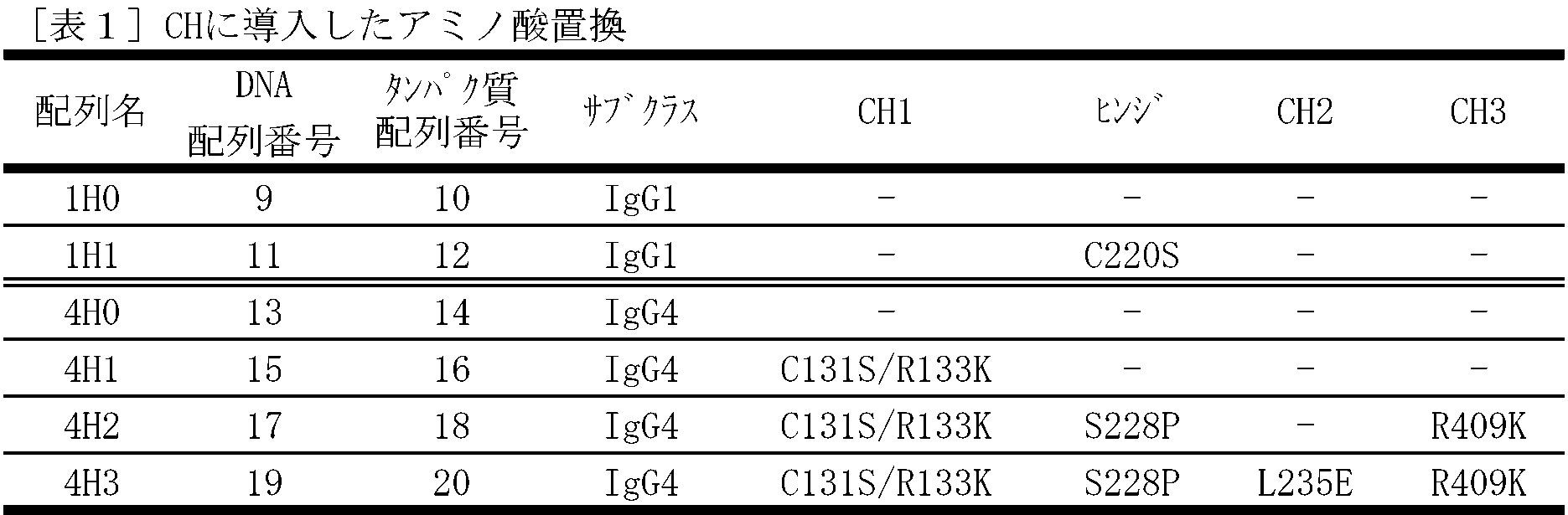
(2)ヒトκ鎖定常領域(CL)とIgG抗体Fcが融合した人工定常領域へのアミノ酸改変の導入
ヒトκ鎖定常領域(配列番号57、58)のC末端に、ヒトIgG1またはヒトIgG4の定常領域のヒンジドメイン、CH2ドメインおよびCH3ドメインの順に結合させたCL-Fcのアミノ酸配列をデザインし(以下、IgG1-L、IgG4-Lと記す)(配列番号22、配列番号26)(図4A、図4B)、該アミノ酸配列をコードするDNAの塩基配列(配列番号21、配列番号25)を作製した。以下、CL-Fcを含む第2ポリペプチドをL鎖と記載する場合がある。
ヒトκ鎖定常領域(配列番号57、58)のC末端に、ヒトIgG1またはヒトIgG4の定常領域のヒンジドメイン、CH2ドメインおよびCH3ドメインの順に結合させたCL-Fcのアミノ酸配列をデザインし(以下、IgG1-L、IgG4-Lと記す)(配列番号22、配列番号26)(図4A、図4B)、該アミノ酸配列をコードするDNAの塩基配列(配列番号21、配列番号25)を作製した。以下、CL-Fcを含む第2ポリペプチドをL鎖と記載する場合がある。
尚、IgG1-Lにおいては、ヒンジドメインのN末端から5アミノ酸残基に当たるEUインデックス216位から220位のアミノ酸残基EPKSCを削除したヒンジドメインを用いた(図4A)。先に記載したように、IgG1のヒンジドメイン中には、L鎖との分子間ジスルフィド結合に関与するCys残基が存在するため、これを除去するためにEPKSCを削除した。
次に、CL-Fcの3’末端に、pKANTEX93ベクター(J.Immunol.Methods,2005;306:151)に含まれるL軽鎖の3’-untranslated region(UTR)および制限酵素KpnIの認識配列を結合させ、更に5’末端に、制限酵素BsiWIの認識配列を結合させた遺伝子配列を作製した。
作製したBsiWI-KpnI遺伝子断片をTarget Clone-Plus-キット(TOYOBO社製)を用いて、キットに添付されたpTA2ベクター(TOYOBO社製)でクローニングを行い、IgG1-LベクターおよびIgG4-Lベクターを作製した。
ヒトκ鎖の214位のCys残基は、H鎖中のCys残基と分子間ジスルフィド結合を形成することが知られているため、Serに置換することでジスルフィド結合の除去を行った。また、IgG1およびIgG4のCH3ドメインに存在する435位のHis残基および436位のTyr残基は抗体のプロテインA結合に関与していることが知られている。
プロテインA結合活性が無いIgG3の435位および436位はArgおよびPheであるため、H435RおよびY436Fのアミノ酸残基置換をL鎖に導入することによって、一価抗体CL-Fc鎖のプロテインA結合活性が低下する。
IgG1-LベクターおよびIgG4-Lベクターを鋳型として、表2に記載のアミノ酸置換を含むCL-FcをQuikChange(登録商標)IIXL Site-Directed Mutagenesis Kit(Stratagene社)を用いて作製した。各CL-FcのDNAの塩基配列を、それぞれ配列番号21、23、25、27、29、31および33に示す。

(3)一価抗体発現ベクターの作製
上述、実施例1(1)および(2)において作製したCHおよびCL-Fcに、IgG抗体のH鎖可変領域(VH)およびL鎖可変領域(VL)を結合させた、一価の結合ドメインを有するヘテロダイマータンパク質(以下、一価抗体と略記する)を以下のようにして作製した。以下、第1ポリペプチドをH鎖、第2ポリペプチドをL鎖と記載する場合がある。
上述、実施例1(1)および(2)において作製したCHおよびCL-Fcに、IgG抗体のH鎖可変領域(VH)およびL鎖可変領域(VL)を結合させた、一価の結合ドメインを有するヘテロダイマータンパク質(以下、一価抗体と略記する)を以下のようにして作製した。以下、第1ポリペプチドをH鎖、第2ポリペプチドをL鎖と記載する場合がある。
CHおよびCL-Fcに結合させる結合タンパク質は、抗CD20抗体ヒト化B-Ly1(B-HH2とB-KV1、以降GA101と記載)(日本国特許第2010-81940号明細書)および抗HER2抗体humAb4D5-8(以降4D5とも記載)(Proc.Natl.Acad.Sci.U.S.A.,1992;89:4285)の可変領域を用いた。DNAの塩基配列およびアミノ酸配列は、GA101-VH(配列番号35、36)、GA101-VL(配列番号37、38)、4D5-VH(配列番号39、40)および4D5-VL(配列番号41、42)を用いた。
GA101抗体および4D5抗体のVHのアミノ酸配列をコードするDNAの塩基配列の5’末端に、制限酵素NotIの認識配列、また3’末端に制限酵素ApaIの認識配列を結合したDNAの塩基配列を作製し、pKANTEX93ベクター(J.Immunol.Methods,2005;306:151)のNotI-ApaIサイトに挿入した。
この結果、抗CD20ヒト化抗体VHを含む発現ベクターpKANTEX93/GA101-VHおよび抗HER2ヒト化抗体VHを含む発現ベクターpKANTEX93/4D5-VHを作製した。
次に、GA101抗体および4D5抗体のVLのアミノ酸配列をコードするDNAの塩基配列の5’末端に、制限酵素BsiWIの認識配列、また3’末端に制限酵素KpnIの認識配列を結合したDNAの塩基配列を作製し、それぞれpKANTEX93/GA101-VHべクターまたはpKANTEX93/4D5-VHベクターのNotI-ApaIサイトに挿入した。
この結果、抗CD20ヒト化抗体GA101発現ベクターpKANTEX93/GA101および抗HER2ヒト化抗体発現ベクターpKANTEX93/humAb4D5-8を取得した。
抗CD20ヒト化抗体GA101発現ベクターpKANTEX93/GA101および抗HER2ヒト化抗体発現ベクターpKANTEX93/humAb4D5-8のApaI-BamHIサイトに含まれるCHを、上述実施例1(1)で作製した各種IgG1-CHまたはIgG4-CHと置換した。
次に、該発現ベクターのBsiWI-KpnIサイトに含まれるCLを、上述実施例1(2)で作製したCLにヒンジドメイン、CH2ドメインおよびCH3ドメインを融合した各種CL-Fcに置換した。
その結果、VH-CHを含む第1ポリペプチドおよびVL-CL-Fcを含む第2ポリペプチドからなる、各種一価抗体発現ベクターを作製した(表3)。また、各種一価抗体分子の構造を図5に示す。
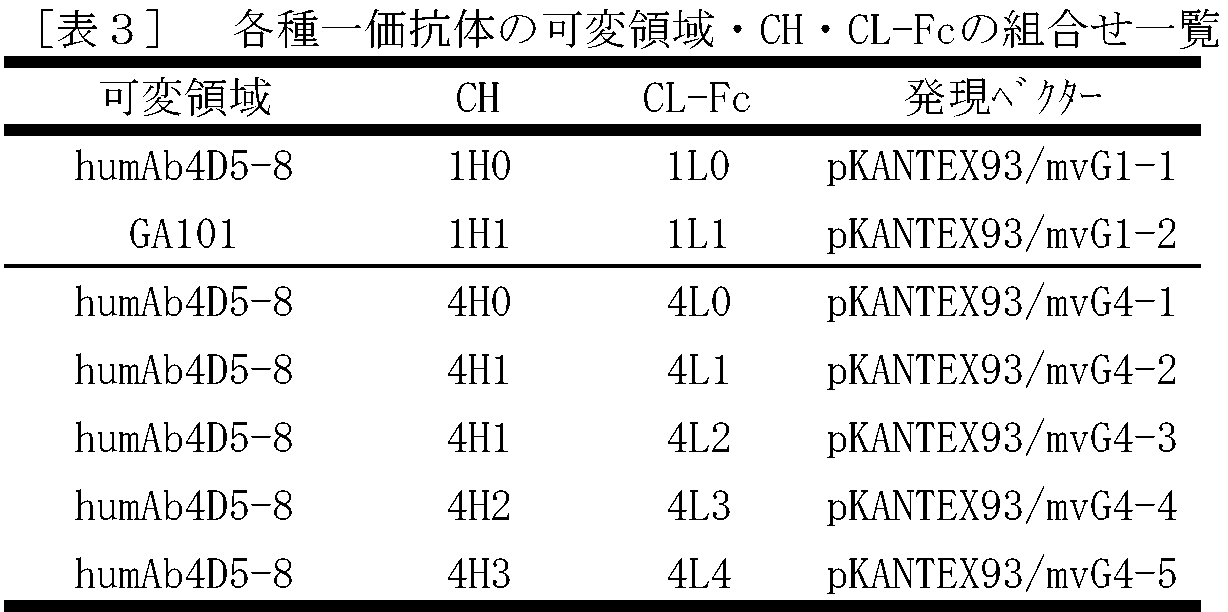
[実施例2]バイスペシフィックヘテロダイマータンパク質発現ベクターの作製
2価の結合ドメインを有するヘテロダイマータンパク質(以下、バイスペシフィック抗体と記す)を作製するために、CHのN末端にVHが結合した第1ポリペプチド、並びにCL-FcのN末端にVLが結合しかつC末端にsingle chain Fv(scFv)型可変領域が結合した第2ポリペプチドからなるバイスペシフィック抗体をデザインした(図6、図7)。
2価の結合ドメインを有するヘテロダイマータンパク質(以下、バイスペシフィック抗体と記す)を作製するために、CHのN末端にVHが結合した第1ポリペプチド、並びにCL-FcのN末端にVLが結合しかつC末端にsingle chain Fv(scFv)型可変領域が結合した第2ポリペプチドからなるバイスペシフィック抗体をデザインした(図6、図7)。
該バイスペシフィック抗体は、VH-VLからなる結合ドメインがCD74特異的に結合し、第2ポリペプチドのC末端に連結したscFvがHer2またはCD20に特異的に結合する2価結合活性を有する。バイスペシフィック抗体は以下のようにして作製した。
(1)抗CD74抗体発現ベクターの作製
抗CD74抗体は、公知の抗CD74ヒト化抗体 hLL1(米国特許第7,312,318号明細書)を用いた(配列番号43-46)。抗CD74ヒト化抗体hLL1のVHおよびVLの、5’末端および3’末端に、上述実施例1(3)と同様にして制限酵素認識配列を結合させ、pKANTEX93ベクターに挿入することで、抗CD74ヒト化抗体発現ベクターpKANTEX93/hLL1を作製した。
抗CD74抗体は、公知の抗CD74ヒト化抗体 hLL1(米国特許第7,312,318号明細書)を用いた(配列番号43-46)。抗CD74ヒト化抗体hLL1のVHおよびVLの、5’末端および3’末端に、上述実施例1(3)と同様にして制限酵素認識配列を結合させ、pKANTEX93ベクターに挿入することで、抗CD74ヒト化抗体発現ベクターpKANTEX93/hLL1を作製した。
(2)抗CD74 IgG4型一価抗体発現ベクターの作製
実施例2(1)と同様に、抗CD74ヒト化抗体hLL1抗体のVHおよびVLのDNA断片を調製し、実施例1(3)で作製したpKANTEX93/mvG4-4ベクターのNotI-ApaIサイトおよびEcoRI-BsiWIサイト挿入を行った。その結果、抗CD74 IgG4型一価抗体発現ベクターpKANTEX93/G4-4/hLL1を作製した。
実施例2(1)と同様に、抗CD74ヒト化抗体hLL1抗体のVHおよびVLのDNA断片を調製し、実施例1(3)で作製したpKANTEX93/mvG4-4ベクターのNotI-ApaIサイトおよびEcoRI-BsiWIサイト挿入を行った。その結果、抗CD74 IgG4型一価抗体発現ベクターpKANTEX93/G4-4/hLL1を作製した。
(3)CD74-HER2バイスペシフィック抗体およびCD74-CD20バイスペシフィック抗体発現ベクターの作製
上述実施例2(2)において作製した抗CD74 IgG4型一価抗体の第2ポリペプチドのC末端に、抗HER2scFvまたは抗CD20 scFvを融合させたCD74-HER2バイスペシフィック抗体およびCD74-CD20バイスペシフィック抗体を作製するために、CL-FcとscFv とを[Ser-Gly-Gly-Gly-Gly]×3、15アミノ酸残基からなるリンカー(以下、GSリンカーと記す)(配列番号47、48)で連結し、CL-Fc-linker-VH-linker-VL(図6、図7)をデザインした。また各scFvを以下のように作製した。
上述実施例2(2)において作製した抗CD74 IgG4型一価抗体の第2ポリペプチドのC末端に、抗HER2scFvまたは抗CD20 scFvを融合させたCD74-HER2バイスペシフィック抗体およびCD74-CD20バイスペシフィック抗体を作製するために、CL-FcとscFv とを[Ser-Gly-Gly-Gly-Gly]×3、15アミノ酸残基からなるリンカー(以下、GSリンカーと記す)(配列番号47、48)で連結し、CL-Fc-linker-VH-linker-VL(図6、図7)をデザインした。また各scFvを以下のように作製した。
抗HER2抗体は、上述実施例1(3)に記載の抗HER2ヒト化抗体4D5-8のVHおよびVLの配列を使用し、抗CD20抗体は、抗CD20 抗体2F2(米国特許出願公開第2004/0167319号明細書)のVHおよびVLの配列(配列番号49-52)を使用した。
抗CD74 IgG4型一価抗体発現ベクターpKANTEX93/G4-4/hLL1のCL-Fcの終止コドンを欠損させ、続けて、GSリンカーをコードするDNAの塩基配列、VHをコードするDNA、[Gly-Gly-Gly-Gly-Ser]×3、15アミノ酸残基からなるリンカーをコードするDNAおよびVLをコードするDNAを結合させたCD74VL-CL-Fc-2F2scFvおよびCD74VL-CL-Fc-4D5scFvのDNAの塩基配列を設計した(配列番号53-56)。
次に、抗HER2 4D5-8scFvまたは抗CD20 2F2scFvを、それぞれ抗CD74 IgG4型一価抗体発現ベクターpKANTEX93/G4-4/hLL1挿入して、pKANTEX93/G4-4/hLL1-4D5-8scFvおよびpKANTEX93/G4-4/hLL1-2F2scFvを作製した。
[実施例3]ヘテロダイマータンパク質の生産
(1)へテロダイマータンパク質の発現
細胞の培養は37℃の5%CO2インキュベーターで行った。各種一価抗体およびバイスペシフィック抗体を発現させるために、以下の方法で発現ベクターの導入を行った。
(1)へテロダイマータンパク質の発現
細胞の培養は37℃の5%CO2インキュベーターで行った。各種一価抗体およびバイスペシフィック抗体を発現させるために、以下の方法で発現ベクターの導入を行った。
4×10⁶個のチャイニーズ・ハムスター卵巣細胞CHO/DG44細胞(Somatic Cell Mol.Genet.,12,555,1986)またはα1,6-フコシルトランスフェラーゼ遺伝子(FUT8)をノックアウトしたCHO/DG44細胞(以下、CHO/FUT8KO細胞と略記する)(米国特許第6,946,292号明細書)に、8μgの各種一価抗体発現ベクターまたはバイスペシフィック抗体発現ベクターを加え、エレクトロポレーション法[Cytotechnology,3,133(1990)]により遺伝子導入を行った。宿主細胞、発現ベクターおよび生産されるヘテロダイマータンパク質の名称は表4にまとめた。
CHO細胞で作製されたヘテロダイマータンパク質組成物は、Fcに結合するN-グリコシド糖鎖の還元末端に含まれるN-アセチルグルコサミンにフコースが結合しているが、CHO/FUT8KO細胞で作製されたヘテロダイマータンパク質組成物は、該糖鎖にフコースが結合していない。以下、それぞれの細胞で作製したヘテロダイマータンパク質組成物をF(fucosylated)およびDF(defucosylated)をサンプル名の後ろに付記する。
遺伝子導入後、各細胞は、10%透析牛血清(以下、dFBSと略記する)を含むIMDM培地(GIBCO社)[以下、IMDM-(10)と略記する]で2日間培養後、培地を0.5mg/mL G418硫酸塩(ナカライテスク社)を含むIMDM-(10)[以下、IMDM-(10G)と略記する]に交換して培養を続け、G418耐性株を取得した。
3×10⁵個細胞/mL G418耐性株をIMDM-(10G)に懸濁して3日間培養した後、Excell302(SAFC Biosciences社)に培地を交換して、7~11日間培養後、培養上清を回収した。
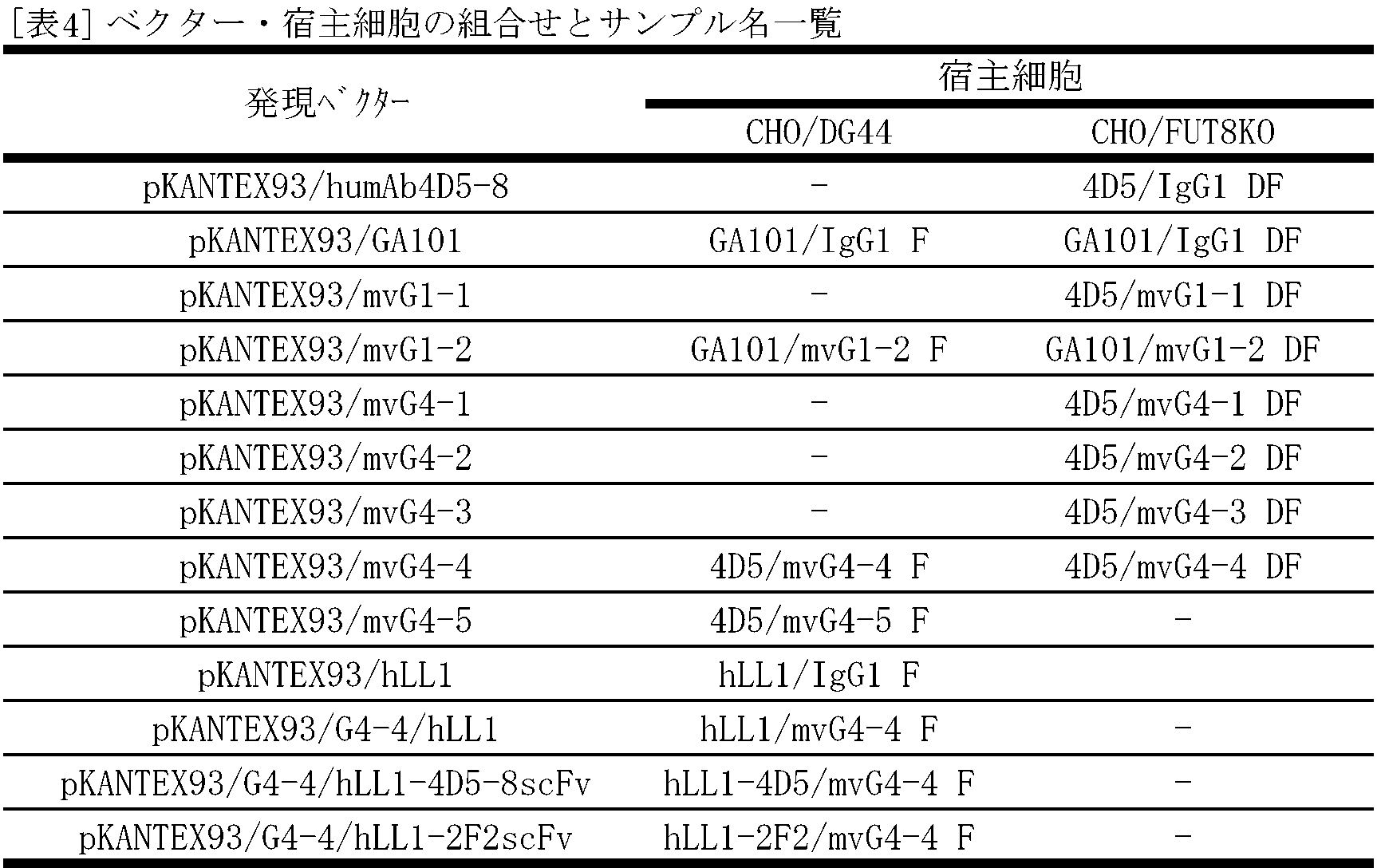
(2)ヘテロダイマータンパク質の精製
上述実施例3(1)で取得した各種一価抗体、バイスペシフィック抗体の培養上清を、ProSep-vA High Capacity(MILLIPORE社)担体を充填したカラムに、流速0.5~1.0mL/minで通過させた。カラムをohosphate buffer saline(PBS)で洗浄後、pH5.0~pH3.0の0.1Mクエン酸緩衝液を用いてタンパク質を溶出し、2Mトリス-塩酸緩衝液(pH8.0)により直ちに中和した。
上述実施例3(1)で取得した各種一価抗体、バイスペシフィック抗体の培養上清を、ProSep-vA High Capacity(MILLIPORE社)担体を充填したカラムに、流速0.5~1.0mL/minで通過させた。カラムをohosphate buffer saline(PBS)で洗浄後、pH5.0~pH3.0の0.1Mクエン酸緩衝液を用いてタンパク質を溶出し、2Mトリス-塩酸緩衝液(pH8.0)により直ちに中和した。
4D5/mvG4-3 DFと4D5/mvG4-4 DFはプロテインG担体を用いた精製も実施した。ProSep-G(MILLIPORE社)担体を充填したカラムに、培養上清を流速0.5~1.0mL/minで通過させた。カラムをPBSで洗浄後、pH5.0~pH2.5の0.1Mクエン酸緩衝液を用いてタンパク質を溶出し、2Mトリス-塩酸緩衝液(pH8.0)により直ちに中和した。
タンパク質濃度が高かった溶出画分を、水酸化ナトリウムでpH6.0に調整した10mMクエン酸、および150mM塩化ナトリウムを含むバッファー(以下、クエン酸緩衝液と略記する)で透析した。サンプルを回収後、低濃度のサンプルは限外ろ過フィルター(MILLIPORE社)によって濃縮を行い、0.22μmフィルター(MILLIPORE社)による滅菌後に、280nmにおける吸光度(OD280)からタンパク質濃度を算出した。
in vitro活性評価には、ゲルろ過クロマトグラフィーでさらに精製したサンプルを用いた。高速液体クロマトグラフィーシステムAKTA explore 10S(GEヘルスケア)に、Superdex 200 10/300 GLカラム(GEヘルスケア)を接続し、クエン酸緩衝液をランニング緩衝液に使用して、サンプルを0.5mL/minの流速でカラムに通過させた。25~30分付近にピークとして検出される画分を回収して各種解析に用いた。
(3)ヘテロダイマータンパク質のSDS-PAGE解析
プロテインAで精製した各種一価抗体のSDS-PAGE解析を行った。0mM dithiothreitol(DTT)(非還元条件)または10mM DTT(還元条件)を含有する0.3Mトリス塩酸(pH6.8)、10%ドデシル硫酸ナトリウムおよび50%グリセロールを含むバッファー(以下、サンプルバッファーと略記する)で調整したサンプルを、100℃で5分間処理し、ポリアクリルアミドゲル(ATTOカタログ番号E-T520L)に1μg/レーンで電気泳動を行った。分子量マーカーには、Precision plus protein all blue standards(BIO-RAD社)を用い、5μL/レーンで添加した。ゲルを回収後、Quick CBB(WAKO社)を用いて製品手順書に従い染色を行った。
プロテインAで精製した各種一価抗体のSDS-PAGE解析を行った。0mM dithiothreitol(DTT)(非還元条件)または10mM DTT(還元条件)を含有する0.3Mトリス塩酸(pH6.8)、10%ドデシル硫酸ナトリウムおよび50%グリセロールを含むバッファー(以下、サンプルバッファーと略記する)で調整したサンプルを、100℃で5分間処理し、ポリアクリルアミドゲル(ATTOカタログ番号E-T520L)に1μg/レーンで電気泳動を行った。分子量マーカーには、Precision plus protein all blue standards(BIO-RAD社)を用い、5μL/レーンで添加した。ゲルを回収後、Quick CBB(WAKO社)を用いて製品手順書に従い染色を行った。
その結果、一価抗体のH鎖およびL鎖はいずれも分子量が約50kDaであることから、非還元条件のSDS-PAGEにおいて多量体と予測される250kDa以上の複数のバンド、2本のポリペプチド鎖からなる単量体と予測される約100kDa付近のバンドおよび一本のポリペプチド鎖からなる半量体と予測される約50kDa付近のバンドが認められた[図8A(a)および(b)、図8B)。
抗HER2 IgG4型一価抗体4D5/mvG4-1 DFでは、250kDa以上の多量体と予測されるバンドが多数確認され、複数の多量体が形成されていることが示された。しかしながら、C131S/R133K置換を含むH鎖およびC214S置換を含むL鎖からなる4D5/mvG4-2 DFでは、多量体は殆ど検出されなかった(図8A)。
従って、IgG4-CHを含む第1ポリペプチドおよびIgG4-Lを含む第2ポリペプチドからなるヘテロダイマータンパク質において、IgG4-CHとCκとのジスルフィド結合に関与するCys残基を欠損させるH鎖C131S/R133Kの置換、L鎖C214Sの置換、並びにH鎖C131S/R133KおよびL鎖C214Sの置換は、分子間ジスルフィド結合によって形成される多量体の形成を抑制できることが示された。
同様にH鎖C131S/R133KおよびL鎖C214S置換を有する4D5/mvG4-3 DF、4D5/mvG4-4 DF、4D5/mvG4-4 F、4D5/mvG4-5 Fにおいても多量体のバンドは認められなかった。また、4D5/mvG1-1 DFでは多量体が顕著に観察されたが、H鎖C220SおよびL鎖C214S置換を含むGA101/mvG1-2 DFおよびGA101/mvG1-2 Fでは多量体は検出されなかった。
従って、IgG1-CHを含む第1ポリペプチドおよびIgG1-Lを含む第2ポリペプチドからなるヘテロダイマータンパク質において、IgG1-CHとCκとのジスルフィド結合に関与するCys残基を欠損させるH鎖C220Sの置換、L鎖C214Sの置換、並びにH鎖C220Sの置換およびL鎖C214S置換により多量体の形成を抑制できることが示された。
一方、4D5/mvG4-1 DF、4D5/mvG4-2 DFおよび4D5/mvG4-3 DFでは半量体と予測される約50kDa付近のバンドが認められたが、H鎖およびL鎖の両方にS228P/R409K置換を含む4D5/mvG4-4 DF、4D5/mvG4-4 Fおよび4D5/mvG4-5 Fでは、半量体のバンドは殆ど認められなかったことから、H鎖およびL鎖におけるS228P置換、R409K置換およびS228P/R409K置換は、半量体の形成を抑制できることが示された(図8B)。
以上の結果から、本発明のヘテロダイマータンパク質組成物は、ヘテロダイマータンパク質を生産する際に生じる多量体量、半量体量、並びに多量体/半量体が低下した組成物であることが示された。
[実施例4]一価抗体の成分分析
(1)陽イオン交換クロマトグラフィーによる成分の分離
上述、実施例3においてプロテインAカラムを用いたアフィニティ精製を行った抗HER2 IgG4型一価抗体4D5/mvG4-2 DFの詳細な成分分析を行うために、陽イオン交換クロマトグラフィーを行った。4D5/mvG4-2 DFは、CLにC214SとCH1にC131S/R133Kのアミノ酸残基置換が加えられ、Fcに結合するN-グリコシド糖鎖の還元末端に含まれるN-アセチルグルコサミンにフコースが結合していないIgG4型一価抗体である。
(1)陽イオン交換クロマトグラフィーによる成分の分離
上述、実施例3においてプロテインAカラムを用いたアフィニティ精製を行った抗HER2 IgG4型一価抗体4D5/mvG4-2 DFの詳細な成分分析を行うために、陽イオン交換クロマトグラフィーを行った。4D5/mvG4-2 DFは、CLにC214SとCH1にC131S/R133Kのアミノ酸残基置換が加えられ、Fcに結合するN-グリコシド糖鎖の還元末端に含まれるN-アセチルグルコサミンにフコースが結合していないIgG4型一価抗体である。
High Performance Liquid Chromatography(HPLC)分析装置(LC-10Avpシリーズ、島津製作所社)にWCX-10(DIONEX社製)カラムを接続し、10mMリン酸ナトリウム、pH6.2のバッファー(以下、Aバッファーと略記する)を開始バッファーに、10mMリン酸ナトリウム、500mM塩化ナトリウム、pH6.2のバッファー(以下、Bバッファーと略記する)を溶出バッファーに用いた。
サンプルを流した後、流速1mL/minでAバッファーを流し始め、1分間に1%ずつBバッファーの比率を増加させ、30分間分析を行った。その後、Bバッファーにランニング緩衝液を変更し、10分間分析を行った。
4D5/mvG4-2 DFを陽イオン交換クロマトグラフィーで分析した結果、図9に示すようにピーク(1)、(2)~(6)および(7)~(10)の3つのピーク群に分離されたことから、Protein A精製タンパク質には複数の成分が含まれていることが示された。従って、更にピーク(1)~(10)を分取して、各ピーク成分の解析を行った。
(2)ウェスタンブロット解析による成分の同定
上述、実施例3(3)と同様の方法で、非還元条件で1レーンあたり40ngを添加してSDS-PAGE電気泳動を行い、0.1Mトリス、0.2Mグリシンおよび20%メタノールを含むトランスファーバッファーに浸した濾紙でPVDF膜とゲルを挟み、タンパク質をPVDFメンブレンにブロッティングした(2.5mA/cm2、40分間)。その後、1% bovine serum albumin(BSA)を含むPBS(以下、BSA-PBSと略記する)を用いてタンパク質をトランスファーしたPVDFメンブレンをブロッキングした。
上述、実施例3(3)と同様の方法で、非還元条件で1レーンあたり40ngを添加してSDS-PAGE電気泳動を行い、0.1Mトリス、0.2Mグリシンおよび20%メタノールを含むトランスファーバッファーに浸した濾紙でPVDF膜とゲルを挟み、タンパク質をPVDFメンブレンにブロッティングした(2.5mA/cm2、40分間)。その後、1% bovine serum albumin(BSA)を含むPBS(以下、BSA-PBSと略記する)を用いてタンパク質をトランスファーしたPVDFメンブレンをブロッキングした。
検出抗体には、H鎖検出用として1000倍希釈したペルオキシダーゼ(以下、HRPと略記する)標識抗Hisタグ抗体(ナカライテスク社、Cat.No.04546-34)、L鎖検出用として5000倍希釈したペルオキシダーゼ標識抗ヒトκ鎖抗体(SIGMA社、カタログ番号A7164)、IgG検出用として、5000倍希釈したペルオキシダーゼ標識抗ヒトIgG抗体(American Qualex社、Cat.No.A110PD)を用いて、室温で1時間反応させた。
その後、PVDFメンブレンは0.1% Tween20を含むPBS(以下、Tween-PBSと略記する)で洗浄を行い、SuperSignal West Dura Extended Duration Substrate(Thermo Scientific社製)を反応させてイメージアナライザー(富士フイルム社製)で検出した。
4D5/mvG4-2 DFの陽イオン交換クロマトグラフィー(図9)で見られたピーク(1)~(10)のウェスタンブロット解析行った結果(図10)、ピーク(1)および(3)は、2本のポリペプチド鎖からなる単量体と予測される100kDa付近にバンドが検出され、抗ヒトκ鎖抗体および抗hIgG抗体の両方と反応し、抗Hisタグ抗体には反応しなかったことから、Hisタグを含むH鎖は含まれていないL鎖のみを成分とするL鎖-L鎖ホモダイマー単量体(以下、LL体と略記する)であることが示された。
また、ピーク(8)および(9)は、単量体と予測される100kDa付近にバンドが検出され、抗ヒトκ鎖抗体、抗Hisタグ抗体および抗hIgG抗体のすべての検出抗体と反応したことから、Hisタグを含むH鎖とL鎖を成分とするHLヘテロダイマー単量体(以下、HL体と略記する)であることが示された(図10)。
また、ペルオキシダーゼ標識抗hIgG抗体による検出結果から、ピーク(1)、(3)とピーク(8)、(9)の成分は分子量の異なる成分であり、SDS-PAGEにより分離可能であることが示された。また、その他のピーク(2)、(4)~(7)および(10)のサンプルはウェスタンブロット解析の検出限界以下であったため、その成分を同定することができなかった。
(3)ヘテロダイマーおよびホモダイマーの混合物からの分離
前項から、プロテインAで精製した4D5/mvG4-2 DFにおいて、HL体とLL体が含まれていることが示唆された。続いて、HL体とLL体の標準品を取得するため、プロテインA精製時に溶出pHを変えて得られた各画分を、陽イオン交換クロマトグラフィーで分析した結果、プロテインA精製においてpH3.5で溶出された画分の1つであるフラクションXはピーク(8)および(9)を主成分とし、プロテインA精製においてpH5.0で溶出されたフラクションYはピーク(1)を主成分とすることを同定した。
前項から、プロテインAで精製した4D5/mvG4-2 DFにおいて、HL体とLL体が含まれていることが示唆された。続いて、HL体とLL体の標準品を取得するため、プロテインA精製時に溶出pHを変えて得られた各画分を、陽イオン交換クロマトグラフィーで分析した結果、プロテインA精製においてpH3.5で溶出された画分の1つであるフラクションXはピーク(8)および(9)を主成分とし、プロテインA精製においてpH5.0で溶出されたフラクションYはピーク(1)を主成分とすることを同定した。
表5に示すように、フラクションXはHL体含量が74.9%以上、フラクションYはLL体含量が93.8%以上であることが示された。以降の解析では、HL体を主成分とするサンプルのコントロールにフラクションXを用い、LL体を主成分とするサンプルのコントロールにフラクションYを用いた。なお、表5中の数値は面積比(%)を、「n.d.」は未解析であることを表す。

(4)ヘテロダイマータンパク質の特異的精製
CH結合体への結合活性が低下したCL-Fcを含む第2ポリペプチドを含むヘテロダイマータンパク質が、特異的に分離、精製されることを確認するため、プロテインGおよびプロテインAを用いた精製を行い、精製タンパク質の比較を行った。
CH結合体への結合活性が低下したCL-Fcを含む第2ポリペプチドを含むヘテロダイマータンパク質が、特異的に分離、精製されることを確認するため、プロテインGおよびプロテインAを用いた精製を行い、精製タンパク質の比較を行った。
プロテインGはヒトIgGの何れのサブクラスも結合することが知られており、プロテインA結合活性の無いヒトIgG3はプロテインGには結合することができる。従って、プロテインGを用いた精製では、プロテインA結合部位の本実施例のアミノ酸残基置換の有無に関わらず、全ての抗体分子を精製することが出来ると考えられる。
本実施例では、プロテインAへの結合に関与していることが知られているIgG1のEUインデックス435位のHisおよび436位のTyrを、プロテインA結合活性の無いヒトIgG3のアミノ酸残基であるArgおよびPheへ置換することで、プロテインA結合活性が低下したCL-Fcを含むヘテロダイマータンパク質(4D5/mvG4-3 DF)を作製して解析を行った。
上述の実施例3(3)および実施例4(2)と同様の方法で非還元条件でのSDS-PAGE解析およびウエスタンブロティングを実施した。
非還元条件下のSDS-PAGEにおいて長時間の電気泳動を行った結果、主にHL体を含む4D5/mvG4-2のXフラクションは、主にLL対を含む4D5/mvG4-2 DFのYフラクションと比べて、バンドが高分子側に確認された。従って、高分子量側のバンドがHL体、低分子量側のバンドがLL体であることが示唆された。また、泳動時間を長くすることでHLヘテロ単量体およびLLホモ単量体を分離可能であることが示された(図11)。
同様に、抗κ鎖抗体を用いたウェスタンブロットの結果でも、4D5/mvG4-2のXフラクションのバンドは、4D5/mvG4-2のYフラクションのバンドと比べて高分子側に確認された(図11)。
また、プロテインGまたはプロテインAを用いて精製した4D5/mvG4-3 DFにおいて、それぞれの精製品をSDS-PAGEを行い比較を行った。
また、プロテインGまたはプロテインAを用いて精製した4D5/mvG4-3 DFにおいて、それぞれの精製品をSDS-PAGEを行い比較を行った。
初めに、各担体を用いた4D5/mvG4-3 DFの精製条件を検討した結果、プロテインGではpH2.5で、プロテインAではpH3.0で全てのタンパク質が溶出されることを確認した。
プロテインGを用いてpH2.5で溶出して得られた4D5/mvG4-3 DF(プロテインG精製品)では、HL体とLL体の両方のバンドが観察されたことから、プロテインGで精製された4D5/mvG4-3 DFには、4D5/mvG4-2 DFと同様にHL体とLL体との両方が含まれていることが明らかになった(図11、SDS-PAGE)。従って、4D5/mvG4-2にH435RおよびY436Fのアミノ酸残基置換を加えた4D5/mvG4-3 DFは、HLおよびLLの両分子が発現していることが示された。
一方、プロテインG精製に用いた培養上清と同じ培養上清から、プロテインAを用いて、pH3.0で溶出して得られた4D5/mvG4-3 DF(プロテインA精製品)のSDS-PAGEの結果では、HLのバンドは観察されたがLLのバンドは殆ど観察されず、また抗κ鎖抗体によるウェスタンブロット解析の結果でも、高分子量側のHLのバンドのみが確認された(図11)。
従って、4D5/mvG4-3 DFを発現する細胞は、培養上清中にHLヘテロダイマーおよびLLホモダイマーを発現しているが、プロテインA用いた精製によって、4D5/mvG4-3 DFのHLへテロダイマータンパク質を選択的に精製できることが示された(図11)。
一方、L鎖にH435RおよびY436Fのアミノ酸置換を加えていない4D5/mvG4-2 DFは、HL体だけでなくLL体もプロテインAにより精製されることから、H435RおよびY436Fのアミノ酸置換をL鎖へ加えることによって、プロテインA結合活性の無いLL体とプロテインA結合活性のあるHL体から、HL体のみが特異的に精製できるようになった。
[実施例5]ヘテロダイマータンパク質の検出ELISA
(1)IgG4型一価抗体のサンドイッチELISA
HL体を検出するために、sandwich enzyme-linked immunosorbent assay(ELISA)系の構築を検討した。本実施例において作製した一価抗体は図5に示す構造のようにCHのC末端にHisタグが結合したH鎖とFcとCκ鎖とが融合したL鎖からなるヘテロダイマータンパク質であることから、H鎖特異的に結合する抗体として抗Hisタグ抗体を、L鎖特異的に結合する抗体として抗ヒトκ鎖抗体を用いることができる。
(1)IgG4型一価抗体のサンドイッチELISA
HL体を検出するために、sandwich enzyme-linked immunosorbent assay(ELISA)系の構築を検討した。本実施例において作製した一価抗体は図5に示す構造のようにCHのC末端にHisタグが結合したH鎖とFcとCκ鎖とが融合したL鎖からなるヘテロダイマータンパク質であることから、H鎖特異的に結合する抗体として抗Hisタグ抗体を、L鎖特異的に結合する抗体として抗ヒトκ鎖抗体を用いることができる。
抗Hisタグ抗体(QIAGEN社、Cat.No.34670)をELISAプレートに固相化(2μg/mL、50μL/ウェル、4℃、16時間)し、PBSで洗浄した後、BSA-PBSによってブロッキングを行った(100μL/ウェル、室温、1時間)。
ブロッキング液を廃棄した後、各種濃度の一価抗体4D5/mvG4-2 DFフラクションX、4D5/mvG4-2 DFフラクションY、プロテインAを用いて精製した4D5/mvG4-3 DF、4D5/mvG4-4Fおよび4D5/mvG4-5 Fを反応させた(50μL/ウェル、室温、2時間)。
続いて0.05% Tween20を含むPBS(以下、Tween-PBSと略記する)で洗浄した後、5000倍希釈したhorseradish peroxidase(以下、HRPと略記する)標識抗ヒトκ鎖抗体(SIGMA社、Cat.No.A7164)を反応させた(50μL/ウェル、2時間)。
次に、Tween-PBSで洗浄した後、ABTS発色基質〔2.2-アジノビス(3-エチルベンゾチアゾール-6-スルホン酸)アンモニウム〕基質液〔1mmoL/L ABTS/0.1moL/L クエン酸バッファー(pH4.2)、0.1% H2O2〕を50μL/ウェルを加え、室温15分間発色反応を行ない、5% SDS水溶液を50μL/ウェル添加して、発色反応を停止した。プレートリーダーで490nmをリファレンスとし、415nmの吸光度を測定した。データの解析にはSoftMax Pro(Molecular Devices社)を用いた。実験は繰り返し回数3で行った。
Binding ELISA系の陽性対照として4D5/mvG4-2 DFのHLヘテロダイマーからなるフラクションX、陰性対照として4D5/mvG4-2 DFのLLホモダイマーからなるフラクションYを用いた。
その結果、プロテインA精製により取得した4D5/mvG4-3 DF、4D5/mvG4-4 Fおよび4D5/mvG4-5 Fは、4D5/mvG4-2 DFフラクションXと同等に結合したが、4D5/mvG4-2 DFフラクションYは殆ど結合しなかった(図12)。
従って、IgG4型一価抗体4D5/mvG4-3DF、4D5/mvG4-4 Fおよび4D5/mvG4-5 Fは、いずれもCH-Hisタグを含む第1ポリペプチドおよびCL-Fcを含む第2ポリペプチドからなるHLヘテロダイマータンパク質であることが示された(図12)。
また、IgG4型一価抗体4D5/mvG4-2 DFのHLヘテロダイマータンパク質に、更にL鎖にH435YおよびR436Fのアミノ酸置換を加えたIgG4型一価抗体4D5/mvG4-3 DF、更にS228P/R409Kのアミノ酸置換を加えた4D5/mvG4-4 F、4D5/mvG4-4 Fに更にL235Eのアミノ酸置換を加えた4D5/mvG4-5 Fは、いずれもプロテインAを用いた精製によって、HLヘテロダイマーを特異的に精製できることが示された(図12)。
従って、L鎖にH435YおよびR436Fのアミノ酸置換を加えることでHLヘテロダイマー体をプロテインAによって特異的に精製できる効果は、S228P/R409KおよびL235Eのアミノ酸置換が存在しても変化しないことが示された。
(2)IgG1型一価抗体のサンドイッチELISA
上述実施例5(1)と同様な方法に従いIgG1型一価抗体4D5/mvG1-1 DFのプロテインA精製フラクションのsandwich ELISAを行った。
上述実施例5(1)と同様な方法に従いIgG1型一価抗体4D5/mvG1-1 DFのプロテインA精製フラクションのsandwich ELISAを行った。
その結果、プロテインA精製における各pHの溶出フラクション1~4は、sandwich ELISAの反応性が異なっていた。従って各フラクションに含まれるHLヘテロダイマー含量が異なることが示された(図13A)。
従って、最もタンパク質含量の多かったフラクション2は、HL体とLL体の両方を含んでいることが示唆された。また、最も反応性の高かったフラクション1を、以降のin vitro活性評価では4D5/mvG1-1 DFとして用いた。
一方、H435RおよびY436 Fのアミノ酸残基置換を含むIgG1型一価抗体GA101/mvG1-2 FおよびGA101/mvG1-2 DFでは、HLヘテロダイマーが主成分である4D5/mvG4-2 DFフラクションXと同等の反応性であった(図13B)。
従って、プロテインAを用いて精製されたIgG1型一価抗体GA101/mvG1-2 FおよびGA101/mvG1-2 DFは、HLヘテロダイマーが特異的に精製されていることが示された(図13B)。
以上の結果から、IgG4型一価抗体だけでなくIgG1型一価抗体においても、L鎖のH435R/Y436Fアミノ酸残基置換を含むヘテロダイマータンパク質は、プロテインAによる特異的精製が可能であることが示された。
[実施例6]ヘテロダイマータンパク質の癌細胞への結合活性
IgG1型およびIgG4型一価抗体の癌細胞に対する結合活性は、各IgG1抗体の結合阻害実験で確認した。初めに、コントロール抗体として、Alexa488標識キット(インビトロジェン社、A20181)を用いて抗CD20 IgG1抗体GA101/IgG1F、抗HER2 IgG1抗体Herceptin(Proc.Natl.Acad.Sci.U.S.A.,1992;89:4285)およびhuman IgG1(ミリポア社製、AG502)をAlexa488で標識して、GA101_Alx、Herceptin_AlxおよびhIgG1_Alxを作製した。
IgG1型およびIgG4型一価抗体の癌細胞に対する結合活性は、各IgG1抗体の結合阻害実験で確認した。初めに、コントロール抗体として、Alexa488標識キット(インビトロジェン社、A20181)を用いて抗CD20 IgG1抗体GA101/IgG1F、抗HER2 IgG1抗体Herceptin(Proc.Natl.Acad.Sci.U.S.A.,1992;89:4285)およびhuman IgG1(ミリポア社製、AG502)をAlexa488で標識して、GA101_Alx、Herceptin_AlxおよびhIgG1_Alxを作製した。
CD20陽性ヒトリンパ腫細胞株Raji(JCRB9012)およびHER2陽性ヒト乳癌細胞株SK-BR-3(ATCC:HTB-30)を用いてフローサイトメーターによる解析を行った。実験は繰り返し回数2で行った。1% BSA、0.02% ethylene diamine tetracetate(EDTA)、および0.05%アジ化ナトリウムを含むPBSバッファー(以下、FACSバッファーと略記する)を用いて1×10⁵個細胞を懸濁し、該懸濁液に2.0μg/mL Alexa標識抗体および同時に210nM~1.68nMの非標識IgG1抗体または各種一価抗体を添加し、4℃、遮光条件下で1.5時間反応させた。
また、陰性対照としてhIgG1_Alx用いた。FACSバッファーで洗浄後、フローサイトメーターCytomics FC 500 MPL(Beckman Coulter社)で測定を行った。
その結果、ネガティブコントロールhIgG1抗体は、抗HER2抗体Herceptin_AlxのSK-BR-3細胞への結合を阻害しなかったが、抗HER2 IgG1抗体Herceptin、抗HER2 IgG1 デフコース化抗体4D5/IgG1 DF、抗HER2 IgG1型一価抗体4D5/mvG1-1 DF、抗HER2 IgG4型一価抗体4D5/mvG4-4 Fおよび4D5/mvG4-5 Fは、Herceptin_AlxのSK-BR-3への結合を抗体濃度依存的に阻害した(図14A)。
従って、抗HER2一価抗体はHER2特異的に結合することが示された。即ち、CHおよびCL-Fcからなるheterodimer scaffold protein(HSP)を元に作製されたヘテロダイマータンパク質は、一価の結合活性を有するヘテロダイマータンパク質であることが示された。
しかし、一価抗体の単位モル濃度あたりの結合阻害効果は、抗HER2 IgG1抗体Herceptinおよび4D5/IgG1DFに比べて低かった(図14A)。
一方、CD20陽性リンパ腫細胞株Rajiにしても同様に、ネガティブコントロールhIgG1抗体はGA101_AlxのRaji細胞への結合を阻害しなったが、抗CD20 IgG1抗体GA101、抗CD20 IgG1 デフコース化抗体GA101/IgG1 DF、抗CD20 IgG1型一価抗体GA101/mvG1-2 FおよびGA101/mvG1-2DFは、GA101_AlxのRaji細胞への結合を抗体濃度依存的に阻害した(図14B)。
従って、抗CD20一価抗体がCD20特異的に結合することが示された。また、HER2抗体と同様に、一価抗体の単位モル濃度あたりの結合阻害効果は、抗CD20 IgG1抗体GA101/IgG1 FおよびGA101/IgG1 DFと比べて弱かった(図14B)。
[実施例7]ヘテロダイマータンパク質の抗体依存性細胞傷害活性
(1)抗HER2一価抗体の抗体依存性細胞傷害活性
抗体のADCC活性は、国際公開第2007/011041号に記載の方法で測定し、3回繰り返して行った。
(1)抗HER2一価抗体の抗体依存性細胞傷害活性
抗体のADCC活性は、国際公開第2007/011041号に記載の方法で測定し、3回繰り返して行った。
標的細胞としてHER2陽性ヒト乳癌細胞SK-BR-3(ATCC:HTB-30)、ヒト乳腺癌BT-20(ATCC:HTB-19)、CD20陽性ヒトリンパ腫細胞Raji(JCRB9012)、バーキットリンパ腫細胞ST-486(ATCC:CRL-1647)および慢性B細胞白血病細胞 MEC-1(DSMZ:ACC-497)を用い、エフェクター細胞には健常人ドナーより調製した末梢血単核球(PBMC)を用いた。
ターゲット細胞に対するエフェクター細胞の比は1:25で実験を行い、細胞傷害活性(%)は以下の式より算出した。
細胞傷害活性(%)=100×(S-Ab)/(Max-T)
S=サンプル反応ウェル吸光度-培地ウェル吸光度
Ab=抗体無添加ウェル吸光度-培地ウェル吸光度
T=標的ウェル吸光度-培地ウェル吸光度
Max=100%反応ウェル吸光度-100%反応対照ウェル吸光度
細胞傷害活性(%)=100×(S-Ab)/(Max-T)
S=サンプル反応ウェル吸光度-培地ウェル吸光度
Ab=抗体無添加ウェル吸光度-培地ウェル吸光度
T=標的ウェル吸光度-培地ウェル吸光度
Max=100%反応ウェル吸光度-100%反応対照ウェル吸光度
陰性対照にはhIgG1、陽性対照には抗HER2 IgG1抗体Herceptinと抗HER2 IgG1デフコース抗体4D5/IgG1 DFを用い、エフェクター細胞は、別々のボランティアドナーから調製されたPBMCを用いた。TritonX-100によって標的細胞を溶解したウェルを、100%反応ウェルとした。
その結果、抗HER2一価抗体4D5/mvG1-1DF(プロテインA精製フラクション1)は、抗HER2 IgG1抗体4D5/IgG1 DFと同等の抗体濃度依存的な高いADCC活性を示した(図15A)。一方、抗HER2 IgG4型一価抗体mvG4-4 FおよびmvG4-5 Fは何れもADCC活性を示さなかった(図15B)。
従って、IgG1-CHを含む第1ポリペプチドおよびIgG1-Fcが融合したCL(IgG1-L)を含む第2ポリペプチドからなるヘテロダイマータンパク質は、ADCC活性を付与することができ、IgG4-CHを含む第1ポリペプチドおよびIgG4-Fcが融合したCL(IgG4-L)を含む第2ポリペプチドからなるヘテロダイマータンパク質は、ADCC活性を除くことができることが示された。
更に、IgG1型一価抗体は、IgG1抗体と比べて抗原結合部位が二価から一価へ減少するにもかかわらず、同一条件においてIgG1抗体と同等の効果を得ることができることから、不要な二価結合活性を低下させかつADCC活性を維持した一価抗体が作製され得ることが示された。
(2)抗CD20一価抗体の抗体依存性細胞傷害活性
上述実施例7(1)と同様にして、陰性対照にはhIgG1、陽性対照には抗CD20 IgG1抗体GA101/IgG1 Fと抗CD20 IgG1デフコース抗体GA101/IgG1 DFを用い、全ての実験は健常人ドナー1名から調製したPBMCを用いて行った。
上述実施例7(1)と同様にして、陰性対照にはhIgG1、陽性対照には抗CD20 IgG1抗体GA101/IgG1 Fと抗CD20 IgG1デフコース抗体GA101/IgG1 DFを用い、全ての実験は健常人ドナー1名から調製したPBMCを用いて行った。
その結果、抗CD20 IgG1型デフコース一価抗体GA101/mvG1-2 DFは、抗CD20 IgG1型一価抗体GA101/mvG1-2 Fと比べてADCC活性が顕著に増加した[図16(a)~(c)]。
ヒトIgGにおいては、コアフコースの除去によりADCC活性が増強されていることが知られているが、CHを含む第1ポリペプチドおよびCL-Fcを含む第2ポリペプチドからなるIgG1型一価抗体においても同様に、Fcに結合するコアフコースを除去することで、ADCC活性が増加することが示された。即ち、CHを含む第1ポリペプチドおよびCH-Fcを含む第2ポリペプチドからなるヘテロダイマータンパク質のADCC活性は、Fcに結合するコアフコース含量を変化させることで増加または低下させることができることが示された。
また、抗CD20 IgG1型デフコース一価抗体GA101/mvG1-2 DFは、抗CD20 IgG1デフコース抗体GA101/IgG1 DFと比較すると、単位モル濃度あたりで誘導できるADCC活性の有効性(potency)は減少したが、最大活性(efficacy)はほぼ同等であった。即ち、抗CD20 IgG1型一価抗体は、抗CD20 IgG1抗体と比べて、抗原結合部位が二価から一価へ減少するにもかかわらず、同一条件において一価抗体分子数を増やすことで、IgG1抗体と同等の効果を得ることができることを示している。
[実施例8]二価ヘテロダイマータンパク質の作製
(1)バイスペシフィック抗体の作製
二価ヘテロダイマータンパク質として、CD74抗体H鎖を含む第1ポリペプチドおよびCD74抗体VL-FcのC末端に抗CD20scFv抗体または抗HER2scFv抗体を結合させた第2ポリペプチドからなるバイスペシフィック抗体並びに抗CD74 IgG4型一価抗体hLL1/mvG4-4 Fを作製した。
(1)バイスペシフィック抗体の作製
二価ヘテロダイマータンパク質として、CD74抗体H鎖を含む第1ポリペプチドおよびCD74抗体VL-FcのC末端に抗CD20scFv抗体または抗HER2scFv抗体を結合させた第2ポリペプチドからなるバイスペシフィック抗体並びに抗CD74 IgG4型一価抗体hLL1/mvG4-4 Fを作製した。
実施例2(3)のバイスペシフィック抗体発現ベクターを用いて、実施例3と同様にしてバイスペシフィック抗体を発現、精製することで、CD74-HER2バイスペシフィック抗体、CD74-CD20バイスペシフィック抗体および抗CD74 IgG4型一価抗体hLL1/mvG4-4 Fを取得した。
SDS-PAGEの結果、hLL1/mvG4-4 F、hLL1-4D5/mvG4-4 FおよびhLL1-2F2/mvG4-4 F組成物の精製度は高く、交雑物、分解物および会合体などはほとんど含まれていなかった(図17)。
(2)ELISA法によるリコンビナントヒトHER2およびCD74への結合活性評価
アッセイには96ウェルのELISA用プレート(グライナー社)を用いた。2μg/mLリコンビナントヒトHER2-Fc(R&D Systems社)または2μg/mL CD74(Santa Cruz Biotechnology社)を50μL/ウェルで分注し、4℃で一晩静置して吸着させた。プレートをPBSで洗浄後、BSA-PBSを100μL/ウェル加え、室温で1時間静置して残っている活性基をブロックした。
アッセイには96ウェルのELISA用プレート(グライナー社)を用いた。2μg/mLリコンビナントヒトHER2-Fc(R&D Systems社)または2μg/mL CD74(Santa Cruz Biotechnology社)を50μL/ウェルで分注し、4℃で一晩静置して吸着させた。プレートをPBSで洗浄後、BSA-PBSを100μL/ウェル加え、室温で1時間静置して残っている活性基をブロックした。
その後、BSA-PBSを捨て、該プレートに一次抗体として各濃度の抗HER2 IgG1抗体Herceptin F、抗CD74 IgG1抗体hLL1 FまたはCD74-HER2バイスペシフィック抗体hLL1-4D5/mvG4-4 Fを50μL/ウェル分注し、1時間室温で静置した。
該プレートをTween-PBSで洗浄後、2次抗体としてペルオキシダーゼ標識ヤギ抗ヒトκ鎖抗体(Southern Biotech社)を50μL/ウェル加えて1時間室温で静置した。該プレートをTween-PBSで洗浄し、ABTS発色基質〔2.2-アジノビス(3-エチルベンゾチアゾール-6-スルホン酸)アンモニウム〕基質液〔1mmoL/L ABTS/0.1moL/L クエン酸バッファー(pH4.2)、0.1% H2O2〕を50μL/ウェルを添加して発色させた。
5% sodium dodecyl sulfate(SDS)溶液を50μL/ウェル添加して反応を止め、サンプル波長415nm、リファレンス波長490nmにおける吸光度(OD415-490)をプレートリーダー(SPECTRA Max 340PC、Molecular Devices社)を用いて測定した。
その結果、CD74-HER2バイスペシフィック抗体hLL1-4D5/mvG4-4 Fは、抗HER2 IgG1抗体Herceptin Fと同様にHER2タンパク質に結合した。また、hLL1-4D5/mvG4-4 Fは、抗CD74 IgG1抗体hLL1 Fと同様にCD74タンパク質に結合した[図18(a)~(c)]。
従って、CHおよびCH-Fcからなるheterodimer scaffold protein(HSP)を元に作製されたCD74-HER2バイスペシフィック抗体hLL1-4D5/mvG4-4 Fは、二価結合活性を有するヘテロダイマータンパク質であることが示された。
[実施例9]ヘテロダイマータンパク質の補体依存性細胞傷害活性(CDC活性)
実施例3で作製したH鎖およびCL-Fc鎖の2つのポリペプチドからなる一価抗体のCDC活性を、国際公開第2011/108502号に記載の方法により測定した。実験は繰り返し回数3回で行った。標的細胞としてCD20陽性バーキットリンパ腫細胞株ST-486(ATCC:CRL-1647)を用いた。
実施例3で作製したH鎖およびCL-Fc鎖の2つのポリペプチドからなる一価抗体のCDC活性を、国際公開第2011/108502号に記載の方法により測定した。実験は繰り返し回数3回で行った。標的細胞としてCD20陽性バーキットリンパ腫細胞株ST-486(ATCC:CRL-1647)を用いた。
96ウェル平底プレート(住友ベークライト社)の各ウェルに、10%FBS(JRH社)を含むRPMI1640(和光純薬工業社)を用いて1.0×10⁶個/mLに希釈した標的細胞50μL、終濃度の3倍に調整した抗体溶液50μLおよび2倍に希釈したヒト補体(SIGMA社)50μLを分注した。陰性対照にはhIgG1、陽性対照には抗CD20抗体GA101/IgG1 Fと抗CD20 デフコース化抗体GA101/IgG1 DFを用いた。
また、抗体を含まないウェルを0%反応ウェル、標的細胞を含まないウェルを100%反応ウェルとして用意した。37℃(5% CO2)で2時間培養後、各反応ウェルにWST-1(ROCHE社)を15μLずつ添加し37℃(5% CO2)で3時間培養した。
反応終了後、各ウェルのOD450を測定し、下式を用いて細胞傷害活性(%)を算出した。
細胞傷害活性(%)=100×{1-(反応ウェル吸光度‐100%反応ウェル吸光度)/(0%反応ウェル吸光度-100%反応ウェル吸光度)}
細胞傷害活性(%)=100×{1-(反応ウェル吸光度‐100%反応ウェル吸光度)/(0%反応ウェル吸光度-100%反応ウェル吸光度)}
抗CD20 IgG1型一価抗体のモル濃度あたりのCDC活性を図19に示す。その結果、抗CD20 IgG1型一価抗体GA101/mvG1-2 Fおよび抗CD20 IgG1型デフコース化一価抗体GA101/mvG1-2 DFは、抗CD20抗体GA101/IgG1 FおよびGA101/IgG1 DFと比べて、CDC活性が増加した。
[実施例10]ヘテロダイマータンパク質のC1q結合活性
細胞表面上へのIgG抗体、一価抗体の結合およびC1qの結合をフローサイトメーターで測定した。標的細胞にはCD20陽性腫瘍細胞株Raji(JCRB9012)およびST-486(ATCC:CRL-1647)を用いた。標的細胞をBSA-PBS(ナカライテスク社)で4×10⁶ 個/mLに調製し、更に1/20希釈マウス血清(CEDARLANE社)をを加え、室温で5分間静置した。
細胞表面上へのIgG抗体、一価抗体の結合およびC1qの結合をフローサイトメーターで測定した。標的細胞にはCD20陽性腫瘍細胞株Raji(JCRB9012)およびST-486(ATCC:CRL-1647)を用いた。標的細胞をBSA-PBS(ナカライテスク社)で4×10⁶ 個/mLに調製し、更に1/20希釈マウス血清(CEDARLANE社)をを加え、室温で5分間静置した。
この細胞懸濁液を96ウェルU字プレート(FALCON社)の各ウェルに50μLずつ分注し、BSA-PBSで3倍濃度に希釈した抗体溶液(GA101/IgG1 F,GA101/mvG1-2 F,hIgG1)、3倍濃度の精製C1q(SIGMA社、C1740)をそれぞれ50μLずつ添加した。陰性対象として、バッファーを加えた。
各ウェルを懸濁し、氷上で1時間静置後、遠心分離により上清だけを除去した。BSA-PBSを180μLずつ各ウェルに加え、再び遠心分離により上清を除去した。この操作を2回繰り返すことで洗浄を行った。
その後、10μg/mL FITC標識抗ヒトIgG-Fc抗体(Abcam社、ab99763)またはFITC標識抗C1q抗体(Dako社、F0254)を各ウェルに30μLずつ添加し、氷上で30分間遮光して静置した。その後、上述の洗浄操作を2回繰り返し、180μLのBSA-PBSに懸濁して測定サンプルとした。
フローサイトメーターにより、各測定サンプルのMean Fluorescent Intensity(MFI)を測定した。陰性対照ウェルのMFI値に対するサンプルウェルのMFI値の比を計算してRelative Fluorescent Intensity(RFI)とした。抗体濃度とRFI値の関係をRaji細胞への抗体結合量、C1q結合量をそれぞれ図20(a)および図20(b)に、ST-486細胞への抗体結合量およびC1q結合量を図21Aおよび図21Bにそれぞれ示す。
Raji[図20(a)および(b)]およびST-486[図21(a)および(b)]のいずれにおいても、抗IgG-Fc抗体の結合量は、一価抗体GA101/mvG1-2 FはIgG1抗体GA101/IgG1 Fと比べて増加したのに対し[図20(a)および図21(a)]、抗C1q抗体の結合量はIgG1抗体GA101/IgG1 Fと比べて一価抗体GA101/mvG1-2 Fで増加した[図20(b)および図21(b)]。
尚、本試験で使用した抗IgG-Fc抗体のGA101/IgG1 FおよびGA101/mvG1-2 Fに対するアフィニティは同等であることを事前に確認している(data not shown)。この結果から、抗CD20 IgG1型一価抗体GA101/mvG1-2 Fの抗原結合活性は、抗CD20 IgG抗体GA101/IgG1 Fと比べて低下しているものの、抗CD20 IgG1型一価抗体GA101/mvG1-2FのC1q結合活性は、抗CD20 IgG抗体GA101/IgG1 Fと比べて増加していることが明らかになった。
[実施例11]高CDC活性型ヘテロダイマータンパク質の作製
高CDC活性型ヘテロダイマータンパク質として、高CDC活性型一価抗体を作製するために、高CDC活性型Fc領域(国際公開第2011/108502号)を含む一価抗体発現ベクターを以下のようにして作製した。
高CDC活性型ヘテロダイマータンパク質として、高CDC活性型一価抗体を作製するために、高CDC活性型Fc領域(国際公開第2011/108502号)を含む一価抗体発現ベクターを以下のようにして作製した。
(1)H鎖ベクターの作製
実施例1に記載のH鎖定常領域1H1のFc領域のアミノ酸配列を、国際公開第2011/108502号に記載の配列番号3で示される高CDC型定常領域のFc領域のアミノ酸配列に置換した。IgG1‐CHベクター1H1のCH2およびCH3領域の断片を、制限酵素BmgBIおよびEcoT22I用いて切り出した。
実施例1に記載のH鎖定常領域1H1のFc領域のアミノ酸配列を、国際公開第2011/108502号に記載の配列番号3で示される高CDC型定常領域のFc領域のアミノ酸配列に置換した。IgG1‐CHベクター1H1のCH2およびCH3領域の断片を、制限酵素BmgBIおよびEcoT22I用いて切り出した。
同様にして、高CDC活性型Fc領域を含むpKTX93/113F-N392Kベクター(国際公開第2011/108502号)を制限酵素BmgBIおよびEcoT22Iを用いて酵素処理し、切り出されたBmgBI-EcoT22I断片をIgG1-CHベクター1H1に挿入した。その結果、高CDC活性型Fcを含む一価抗体H鎖ベクター(以下、HCVcomと略記する)を取得した。
(2)L鎖ベクターの作製
(1)と同様の操作により、実施例1に記載のCL-Fc(1L1)のFc領域のアミノ酸配列を、国際公開第2011/108502号に記載の配列番号3で示される高CDC型定常領域のFc領域のアミノ酸配列に置換して、高CDC活性型Fcを含む一価抗体L鎖ベクター(以下、LCVcomと略記する)を取得した。
(1)と同様の操作により、実施例1に記載のCL-Fc(1L1)のFc領域のアミノ酸配列を、国際公開第2011/108502号に記載の配列番号3で示される高CDC型定常領域のFc領域のアミノ酸配列に置換して、高CDC活性型Fcを含む一価抗体L鎖ベクター(以下、LCVcomと略記する)を取得した。
(3)高CDC活性型一価抗体発現ベクターの作製
上述(1)および(2)より取得されたHCVcomおよびLCVcomを、実施例1 表3に記載のpKANTEX93/mvG1-2のCH領域およびCL領域に以下の操作に従って導入した。HCVcomのCH1領域の5’末端に存在するApaIサイトとCH3領域の3’末端に存在するBamHIサイトを各制限酵素で切断し、pKANTEX93/mvG1-2の同サイトに挿入し、続いて、LCVcomのCκ領域の5’末端に存在するBsiWIサイトとCH3領域の3’末端に存在するPmaCIサイトを各制限酵素で切断して、同サイトに挿入した。
上述(1)および(2)より取得されたHCVcomおよびLCVcomを、実施例1 表3に記載のpKANTEX93/mvG1-2のCH領域およびCL領域に以下の操作に従って導入した。HCVcomのCH1領域の5’末端に存在するApaIサイトとCH3領域の3’末端に存在するBamHIサイトを各制限酵素で切断し、pKANTEX93/mvG1-2の同サイトに挿入し、続いて、LCVcomのCκ領域の5’末端に存在するBsiWIサイトとCH3領域の3’末端に存在するPmaCIサイトを各制限酵素で切断して、同サイトに挿入した。
その結果、高CDC活性型Fcを含む一価抗体発現ベクター(以下、pKANTEX93/mvComと記載する)を取得した。作製したpKANTEX93/mvComのH鎖およびL鎖の定常領域アミノ酸配列を図22Aおよび図22Bに示す。
また、高CDC活性型の抗CD20抗体GA101を作製するために、GA101-VHおよびVLのアミノ酸配列(配列番号36、38)をコードするDNAをpKTX93/113F-N392Kベクター(国際公開第2011/108502号)の適切な部位に挿入して、抗CD20高CDC活性型二価抗体GA101/IgG1-Com発現ベクターを作製した。
(4)高CDC活性型一価抗体の生産
高CDC活性型一価抗体および二価抗体の生産は、実施例3に記載の方法と同様にして行い、抗CD20一価抗体発現ベクターpKANTEX93/mvG1-2および抗CD20高CDC活性型一価抗体発現ベクターpKANTEX93/mvComを、それぞれCHO/FUT8KO細胞へ導入し、N結合型糖鎖にα1,6-フコースが結合していない一価抗体、GA101/mvG1-2 DFおよびGA101/mvCom DFまたは二価抗体GA101/IgG1-Com DFを発現させた。
高CDC活性型一価抗体および二価抗体の生産は、実施例3に記載の方法と同様にして行い、抗CD20一価抗体発現ベクターpKANTEX93/mvG1-2および抗CD20高CDC活性型一価抗体発現ベクターpKANTEX93/mvComを、それぞれCHO/FUT8KO細胞へ導入し、N結合型糖鎖にα1,6-フコースが結合していない一価抗体、GA101/mvG1-2 DFおよびGA101/mvCom DFまたは二価抗体GA101/IgG1-Com DFを発現させた。
一価抗体の精製は、MabSelectSuRe(GE Healthcare社)担体を用いたProteinA精製を実施し、溶出バッファーをpH3.9の0.1M クエン酸緩衝液を用いた以外は、実施例2(2)と同様の方法に従って実施した。精製タンパク質を実施例2(3)と同様の方法でSDS-PAGE解析を行った。
その結果、図23に示す通り一価抗体のCL-Fc鎖およびH鎖は共に分子量が約50kDaであり、還元条件では50kDa付近の単一バンドが、非還元条件ではH鎖とCL-Fc鎖との2本のポリペプチド鎖で構成されたヘテロダイマーと予想される100kDa付近の単一バンドが認められた。従って、均一な一価抗体GA101/mvG1-2 DFおよびGA101/mvCom DFが精製された。
以上の結果は、IgG1およびIgG4型一価抗体だけでなく、抗体定常領域に複数のアミノ酸残基置換を含む高CDC活性型一価抗体もまた、H435R/Y436Fアミノ酸残基置換がCL-Fc鎖へ加えられることで、プロテインAによるヘテロダイマータンパク質特異的な精製が可能であることが示された。
即ち、第1ポリペプチドおよび/または第2ポリペプチドに、複数のアミノ酸残基置換が含まれているヘテロダイマータンパク質が、製造可能であることが明らかになった。
[実施例12]高CDC活性型ヘテロダイマータンパク質のCDC活性
実施例11で作製したH鎖およびCL-Fc鎖の2つのポリペプチドからなる一価抗体のCDC活性は、国際公開第2011/108502号に記載の方法により測定した。実験は繰り返し回数3回で行った。標的細胞としてCD20陽性ヒトリンパ腫細胞Raji(JCRB9012)および慢性B細胞白血病細胞MEC-1(DSMZ:ACC-497)を用いた。以下は、実施例9と同様にしてCDC活性を測定した。
実施例11で作製したH鎖およびCL-Fc鎖の2つのポリペプチドからなる一価抗体のCDC活性は、国際公開第2011/108502号に記載の方法により測定した。実験は繰り返し回数3回で行った。標的細胞としてCD20陽性ヒトリンパ腫細胞Raji(JCRB9012)および慢性B細胞白血病細胞MEC-1(DSMZ:ACC-497)を用いた。以下は、実施例9と同様にしてCDC活性を測定した。
その結果を図24(a)および(b)に示す。抗CD20高CDC活性型一価抗体GA101/mvCom DFは、抗CD20 IgG1型一価抗体GA101/mvG1-2 DFと比べて高いCDC活性を示した。また、抗CD20高CDC活性型一価抗体GA101/mvCom DFは、二価の抗CD20高CDC活性型抗体GA101/IgG1-Com DFと高濃度域において同等のCDC活性を示すことが明らかになった。
従って、H鎖とCL-Fcからなるヘテロダイマータンパク質である一価抗体においても、二価のIgG抗体と同様に体定常領域の複数のアミノ酸残基置換によって、一価抗体のCDC活性が増加すること明らかになった。
[実施例13]ヘテロダイマータンパク質のADCC活性
実施例11で作製した高CDC活性型ヘテロダイマータンパク質である、抗CD20高CDC活性型一価抗体GA101/mvCom DFのADCC活性の測定を、実施例7(2)と同様にして行った。標的細胞はCD20陽性ヒトリンパ腫細胞Raji(JCRB9012)および慢性B細胞白血病細胞MEC-1(DSMZ:ACC-497)を用いて実施した。
実施例11で作製した高CDC活性型ヘテロダイマータンパク質である、抗CD20高CDC活性型一価抗体GA101/mvCom DFのADCC活性の測定を、実施例7(2)と同様にして行った。標的細胞はCD20陽性ヒトリンパ腫細胞Raji(JCRB9012)および慢性B細胞白血病細胞MEC-1(DSMZ:ACC-497)を用いて実施した。
陰性対照にはhIgG1(Millipore社,AG-502)、陽性対照には抗CD20 IgG1型デフコース化一価抗体GA101/mvG1-2 DF、比較対照として抗CD20 IgG1型フコース化一価抗体GA101/mvG1-2 Fを用いた。
その結果を図25(a)および(b)に示す。抗CD20高CDC活性型デフコース化一価抗体GA101/mvCom DFは、抗CD20 IgG1型デフコース化一価抗体GA101/mvG1-2 DFと同等の高いADCC活性を有していることが示された。
本発明を特定の態様を用いて詳細に説明したが、本発明の意図と範囲を離れることなく様々な変更および変形が可能であることは、当業者にとって明らかである。なお、本出願は、2012年10月5日付けで出願された米国仮出願(61/710,221号)に基づいており、その全体が引用により援用される。
配列番号1:ヒトIgG1CHのDNAの塩基配列
配列番号2:ヒトIgG1CHのアミノ酸配列
配列番号3:ヒトIgG4CHのDNAの塩基配列
配列番号4:ヒトIgG4CHのアミノ酸配列
配列番号5:ヒトIgG1CH-HisのDNAの塩基配列
配列番号6:ヒトIgG1CH-Hisのアミノ酸配列
配列番号7:ヒトIgG4CH-HisのDNAの塩基配列
配列番号8:ヒトIgG4CH-Hisのアミノ酸配列
配列番号9:1H0のDNAの塩基配列
配列番号10:1H0のアミノ酸配列
配列番号11:1H1のDNAの塩基配列
配列番号12:1H1のアミノ酸配列
配列番号13:4H0のDNAの塩基配列
配列番号14:4H0のアミノ酸配列
配列番号15:4H1のDNAの塩基配列
配列番号16:4H1のアミノ酸配列
配列番号17:4H2のDNAの塩基配列
配列番号18:4H2のアミノ酸配列
配列番号19:4H3のDNAの塩基配列
配列番号20:4H3のアミノ酸配列
配列番号21:1L0のDNAの塩基配列
配列番号22:1L0のアミノ酸配列
配列番号23:1L1のDNAの塩基配列
配列番号24:1L1のアミノ酸配列
配列番号25:4L0のDNAの塩基配列
配列番号26:4L0のアミノ酸配列
配列番号27:4L1のDNAの塩基配列
配列番号28:4L1のアミノ酸配列
配列番号29:4L2のDNAの塩基配列
配列番号30:4L2のアミノ酸配列
配列番号31:4L3のDNAの塩基配列
配列番号32:4L3のアミノ酸配列
配列番号33:4L4のDNAの塩基配列
配列番号34:4L4のアミノ酸配列
配列番号35:GA101 VHのDNAの塩基配列
配列番号36:GA101 VHのアミノ酸配列
配列番号37:GA101 VLのDNAの塩基配列
配列番号38:GA101 VLのアミノ酸配列
配列番号39:4D5 VHのDNAの塩基配列
配列番号40:4D5 VHのアミノ酸配列
配列番号41:4D5 VLのDNAの塩基配列
配列番号42:4D5 VLのアミノ酸配列
配列番号43:CD74 VHのDNAの塩基配列
配列番号44:CD74 VHのアミノ酸配列
配列番号45:CD74 VLのDNAの塩基配列
配列番号46:CD74 VLのアミノ酸配列
配列番号47:GSリンカーのDNAの塩基配列
配列番号48:GSリンカーのアミノ酸配列
配列番号49:2F2 VHのDNAの塩基配列
配列番号50:2F2 VHのアミノ酸配列
配列番号51:2F2 VLのDNAの塩基配列
配列番号52:2F2 VLのアミノ酸配列
配列番号53:CD74VL-CL-Fc-2F2scFvのDNAの塩基配列
配列番号54:CD74VL-CL-Fc-2F2scFvのアミノ酸配列
配列番号55:CD74VL-CL-Fc-4D5scFvのDNAの塩基配列
配列番号56:CD74VL-CL-Fc-4D5scFvのアミノ酸配列
配列番号57:ヒトCκのDNAの塩基配列
配列番号58:ヒトCκのアミノ酸配列
配列番号2:ヒトIgG1CHのアミノ酸配列
配列番号3:ヒトIgG4CHのDNAの塩基配列
配列番号4:ヒトIgG4CHのアミノ酸配列
配列番号5:ヒトIgG1CH-HisのDNAの塩基配列
配列番号6:ヒトIgG1CH-Hisのアミノ酸配列
配列番号7:ヒトIgG4CH-HisのDNAの塩基配列
配列番号8:ヒトIgG4CH-Hisのアミノ酸配列
配列番号9:1H0のDNAの塩基配列
配列番号10:1H0のアミノ酸配列
配列番号11:1H1のDNAの塩基配列
配列番号12:1H1のアミノ酸配列
配列番号13:4H0のDNAの塩基配列
配列番号14:4H0のアミノ酸配列
配列番号15:4H1のDNAの塩基配列
配列番号16:4H1のアミノ酸配列
配列番号17:4H2のDNAの塩基配列
配列番号18:4H2のアミノ酸配列
配列番号19:4H3のDNAの塩基配列
配列番号20:4H3のアミノ酸配列
配列番号21:1L0のDNAの塩基配列
配列番号22:1L0のアミノ酸配列
配列番号23:1L1のDNAの塩基配列
配列番号24:1L1のアミノ酸配列
配列番号25:4L0のDNAの塩基配列
配列番号26:4L0のアミノ酸配列
配列番号27:4L1のDNAの塩基配列
配列番号28:4L1のアミノ酸配列
配列番号29:4L2のDNAの塩基配列
配列番号30:4L2のアミノ酸配列
配列番号31:4L3のDNAの塩基配列
配列番号32:4L3のアミノ酸配列
配列番号33:4L4のDNAの塩基配列
配列番号34:4L4のアミノ酸配列
配列番号35:GA101 VHのDNAの塩基配列
配列番号36:GA101 VHのアミノ酸配列
配列番号37:GA101 VLのDNAの塩基配列
配列番号38:GA101 VLのアミノ酸配列
配列番号39:4D5 VHのDNAの塩基配列
配列番号40:4D5 VHのアミノ酸配列
配列番号41:4D5 VLのDNAの塩基配列
配列番号42:4D5 VLのアミノ酸配列
配列番号43:CD74 VHのDNAの塩基配列
配列番号44:CD74 VHのアミノ酸配列
配列番号45:CD74 VLのDNAの塩基配列
配列番号46:CD74 VLのアミノ酸配列
配列番号47:GSリンカーのDNAの塩基配列
配列番号48:GSリンカーのアミノ酸配列
配列番号49:2F2 VHのDNAの塩基配列
配列番号50:2F2 VHのアミノ酸配列
配列番号51:2F2 VLのDNAの塩基配列
配列番号52:2F2 VLのアミノ酸配列
配列番号53:CD74VL-CL-Fc-2F2scFvのDNAの塩基配列
配列番号54:CD74VL-CL-Fc-2F2scFvのアミノ酸配列
配列番号55:CD74VL-CL-Fc-4D5scFvのDNAの塩基配列
配列番号56:CD74VL-CL-Fc-4D5scFvのアミノ酸配列
配列番号57:ヒトCκのDNAの塩基配列
配列番号58:ヒトCκのアミノ酸配列
Claims (25)
- イムノグロブリン重鎖(以下、H鎖と略記する)定常領域(以下、CHと略記する)を含む第1ポリペプチドおよびイムノグロブリン軽鎖(以下、L鎖と略記する)定常領域(以下、CLと略記する)とFc領域とが融合した定常領域配列(以降CL-Fcと記載する)を含む第2ポリペプチドからなるタンパク質であって、かつ、IgG抗体においてL鎖-H鎖の分子間ジスルフィド結合に関するCys残基が欠損または置換されたヘテロダイマータンパク質。
- イムノグロブリンCHを含む第1ポリペプチドおよびイムノグロブリンCLとFc領域とが融合したCL-Fcを含む第2ポリペプチドからなるタンパク質であって、かつ、該第2ポリペプチドがCH結合体に対する結合活性が低下したポリペプチドであるヘテロダイマータンパク質。
- 前記第2ポリペプチドが、KabatらによるEUインデックス(以下、EUインデックスと記す)214位のアミノ酸残基がSerに置換されたポリペプチドである、請求項1または2に記載のヘテロダイマータンパク質。
- 前記第1ポリペプチドがCH1ドメイン、ヒンジドメイン、CH2ドメインおよびCH3ドメインを含むポリペプチドであり、かつ前記第2ポリペプチドがCLドメイン、ヒンジドメイン、CH2ドメインおよびCH3ドメインを含むポリペプチドである、請求項1~3のいずれか1項に記載のヘテロダイマータンパク質。
- 前記CH結合体が、抗CH1ドメイン抗体、抗ヒンジ抗体、抗CH2ドメイン抗体、抗CH3ドメイン抗体、Fc受容体タンパク質、プロテインAおよびプロテインGから選ばれるいずれか1つの結合体である、請求項2~4のいずれか1項に記載のヘテロダイマータンパク質。
- イムノグロブリンサブクラスがIgG1、IgG2およびIgG4から選ばれるいずれか1つのサブクラスである、請求項1~5のいずれか1項に記載のヘテロダイマータンパク質。
- 前記第2ポリペプチドが、EUインデックス435位のアミノ酸残基がArgに置換されたポリペプチドである、請求項1~6のいずれか1項に記載のヘテロダイマータンパク質。
- イムノグロブリンサブクラスがIgG4である、請求項1~7のいずれか1項に記載のヘテロダイマータンパク質。
- 前記第1ポリペプチドが、EUインデックス131位のアミノ酸残基がSerに置換されたポリペプチドである、請求項8に記載のヘテロダイマータンパク質。
- 前記第1ポリペプチドおよび前記第2ポリペプチドが、EUインデックス228位のアミノ酸残基がProに置換されたポリペプチドである、請求項9に記載のヘテロダイマータンパク質。
- 前記第1ポリペプチドおよび前記第2ポリペプチドが、EUインデックス409位のアミノ酸残基がLysに置換されたポリペプチドである、請求項10に記載のヘテロダイマータンパク質。
- 前記第1ポリペプチドおよび前記第2ポリペプチドが、EUインデックス235位のアミノ酸残基がGluに置換されたポリペプチドである、請求項11に記載のヘテロダイマータンパク質。
- イムノグロブリンサブクラスがIgG1である、請求項1~7のいずれか1項に記載のヘテロダイマータンパク質。
- 前記第1ポリペプチドが、EUインデックスの220位のアミノ酸残基がSerに置換されたポリペプチドである、請求項13に記載のヘテロダイマータンパク質。
- 前記第2ポリペプチドが、EUインデックスの216~220位のアミノ酸残基が欠損したヒンジドメインを含むペプチドまたはEUインデックスの220位のアミノ酸残基がSerに置換されたポリペプチドである、請求項14に記載のヘテロダイマータンパク質。
- ヘテロダイマータンパク質に含まれるFc領域に結合する全N-グリコシド結合型糖鎖のうち、糖鎖還元末端のN-アセチルグルコサミンにフコースが結合していない糖鎖が20%以上である、請求項15に記載のヘテロダイマータンパク質。
- 前記第1ポリペプチドおよび/または前記第2ポリペプチドが、P247I、F243L、R292P、Y300L、Y300F、P396L、T393A、H433P、S239D、S298A、A330L、I332E、E333A、K334A、L235E、P238A、N297A、K322A、P331S、K326A、S267E、H268F、S324T、K274Q、N276K、Y296F、K326W、K326Y、E333A、E333S、A339T、A339D、D356E、L358M、N384S、K392N、T394F、T394Y、V397MおよびV422Iから選ばれる少なくとも一つのアミノ酸残基置換を含むポリペプチドである、請求項15または16に記載のヘテロダイマータンパク質。
- 前記第1ポリペプチドおよび/または前記第2ポリペプチドが、少なくとも1つの結合タンパク質がCHおよびCL-FcのN末端および/またはC末端に結合したポリペプチドである、請求項1~17のいずれか1項に記載のヘテロダイマータンパク質。
- 前記結合タンパク質が、抗体可変領域、single chain Fv(scFv)、single variable domain(VHH)、リガンドタンパク質および受容体タンパク質から選ばれるいずれか1つのタンパク質である、請求項18に記載にヘテロダイマータンパク質。
- (i)前記第1ポリペプチドが、イムノグロブリン重鎖可変領域(以下、VHと記す)がCHのN末端に結合したポリペプチドであり、かつ前記第2ポリペプチドが、イムノグロブリン軽鎖可変領域(以下、VLと記す)がCL-FcのN末端に結合したポリペプチドであるヘテロダイマータンパク質、および(ii)前記第1ポリペプチドが、VLがCHのN末端に結合したポリペプチドであり、かつ前記第2ポリペプチドが、VHがCL-FcのN末端に結合したポリペプチドであるヘテロダイマータンパク質から選ばれる、請求項1~19のいずれか1項に記載のヘテロダイマータンパク質。
- (i)前記第1ポリペプチドが、VHがCHのC末端に結合したポリペプチドであり、かつ前記第2ポリペプチドが、VLがCL-FcのC末端に結合したポリペプチドであるヘテロダイマータンパク質、および(ii)前記第1ポリペプチドが、VLがCHのC末端に結合したポリペプチドであり、かつ前記第2ポリペプチドが、VHがCL-FcのC末端に結合したポリペプチドであるヘテロダイマータンパク質から選ばれる、請求項1~20のいずれか1項に記載のヘテロダイマータンパク質。
- 一価抗体、二価抗体、三価抗体および四価抗体から選ばれる1つの抗体である請求項1~21のいずれか1項に記載のヘテロダイマータンパク質。
- 請求項1~22のいずれか1項に記載のヘテロダイマータンパク質をコードするDNA。
- 請求項23に記載のDNAを含むタンパク質発現ベクターを含むヘテロダイマータンパク質の発現細胞。
- 請求項24に記載のヘテロダイマータンパク質の発現細胞を培養し、該培養上清からヘテロダイマータンパク質を精製する工程を含む、ヘテロダイマータンパク質の製造方法。
Priority Applications (3)
| Application Number | Priority Date | Filing Date | Title |
|---|---|---|---|
| EP13843485.7A EP2905290B1 (en) | 2012-10-05 | 2013-10-04 | Heterodimeric protein composition |
| ES13843485T ES2773107T3 (es) | 2012-10-05 | 2013-10-04 | Composición de proteína heterodimérica |
| JP2014539855A JP6273205B2 (ja) | 2012-10-05 | 2013-10-04 | ヘテロダイマータンパク質組成物 |
Applications Claiming Priority (2)
| Application Number | Priority Date | Filing Date | Title |
|---|---|---|---|
| US201261710221P | 2012-10-05 | 2012-10-05 | |
| US61/710,221 | 2012-10-05 |
Publications (1)
| Publication Number | Publication Date |
|---|---|
| WO2014054804A1 true WO2014054804A1 (ja) | 2014-04-10 |
Family
ID=50435122
Family Applications (1)
| Application Number | Title | Priority Date | Filing Date |
|---|---|---|---|
| PCT/JP2013/077172 Ceased WO2014054804A1 (ja) | 2012-10-05 | 2013-10-04 | ヘテロダイマータンパク質組成物 |
Country Status (5)
| Country | Link |
|---|---|
| US (2) | US9714291B2 (ja) |
| EP (1) | EP2905290B1 (ja) |
| JP (1) | JP6273205B2 (ja) |
| ES (1) | ES2773107T3 (ja) |
| WO (1) | WO2014054804A1 (ja) |
Cited By (25)
| Publication number | Priority date | Publication date | Assignee | Title |
|---|---|---|---|---|
| WO2016159213A1 (ja) * | 2015-04-01 | 2016-10-06 | 中外製薬株式会社 | ポリペプチド異種多量体の製造方法 |
| JP2017525690A (ja) * | 2014-08-04 | 2017-09-07 | エフ・ホフマン−ラ・ロシュ・アクチェンゲゼルシャフト | 二重特異性t細胞活性化抗原結合分子 |
| US9975966B2 (en) | 2014-09-26 | 2018-05-22 | Chugai Seiyaku Kabushiki Kaisha | Cytotoxicity-inducing theraputic agent |
| US10011858B2 (en) | 2005-03-31 | 2018-07-03 | Chugai Seiyaku Kabushiki Kaisha | Methods for producing polypeptides by regulating polypeptide association |
| US10066018B2 (en) | 2009-03-19 | 2018-09-04 | Chugai Seiyaku Kabushiki Kaisha | Antibody constant region variant |
| US10150808B2 (en) | 2009-09-24 | 2018-12-11 | Chugai Seiyaku Kabushiki Kaisha | Modified antibody constant regions |
| US10253091B2 (en) | 2009-03-19 | 2019-04-09 | Chugai Seiyaku Kabushiki Kaisha | Antibody constant region variant |
| US10435458B2 (en) | 2010-03-04 | 2019-10-08 | Chugai Seiyaku Kabushiki Kaisha | Antibody constant region variants with reduced Fcgammar binding |
| US10450381B2 (en) | 2010-11-17 | 2019-10-22 | Chugai Seiyaku Kabushiki Kaisha | Methods of treatment that include the administration of bispecific antibodies |
| WO2020004490A1 (ja) | 2018-06-26 | 2020-01-02 | 協和キリン株式会社 | コンドロイチン硫酸プロテオグリカン-5に結合する抗体 |
| WO2020004492A1 (ja) | 2018-06-26 | 2020-01-02 | 協和キリン株式会社 | Cell Adhesion Molecule3に結合する抗体 |
| US10934344B2 (en) | 2006-03-31 | 2021-03-02 | Chugai Seiyaku Kabushiki Kaisha | Methods of modifying antibodies for purification of bispecific antibodies |
| US11046784B2 (en) | 2006-03-31 | 2021-06-29 | Chugai Seiyaku Kabushiki Kaisha | Methods for controlling blood pharmacokinetics of antibodies |
| US11072666B2 (en) | 2016-03-14 | 2021-07-27 | Chugai Seiyaku Kabushiki Kaisha | Cell injury inducing therapeutic drug for use in cancer therapy |
| WO2021162098A1 (ja) | 2020-02-14 | 2021-08-19 | 協和キリン株式会社 | Cd3に結合するバイスペシフィック抗体 |
| US11124576B2 (en) | 2013-09-27 | 2021-09-21 | Chungai Seiyaku Kabushiki Kaisha | Method for producing polypeptide heteromultimer |
| US11248053B2 (en) | 2007-09-26 | 2022-02-15 | Chugai Seiyaku Kabushiki Kaisha | Method of modifying isoelectric point of antibody via amino acid substitution in CDR |
| US11332533B2 (en) | 2007-09-26 | 2022-05-17 | Chugai Seiyaku Kabushiki Kaisha | Modified antibody constant region |
| JP2022528869A (ja) * | 2019-04-05 | 2022-06-16 | セルジーン コーポレイション | Cd47の腫瘍選択的結合のための抗体の操作 |
| US11649262B2 (en) | 2015-12-28 | 2023-05-16 | Chugai Seiyaku Kabushiki Kaisha | Method for promoting efficiency of purification of Fc region-containing polypeptide |
| US11851476B2 (en) | 2011-10-31 | 2023-12-26 | Chugai Seiyaku Kabushiki Kaisha | Antigen-binding molecule having regulated conjugation between heavy-chain and light-chain |
| US12195547B2 (en) | 2021-04-30 | 2025-01-14 | Hoffmann-La Roche Inc. | Dosing for combination treatment with anti-CD20/anti-CD3 bispecific antibody and anti-CD79B antibody drug conjugate |
| US12421322B2 (en) | 2017-11-01 | 2025-09-23 | Chugai Seiyaku Kabushiki Kaisha | Antibody variant and isoform with lowered biological activity |
| US12460014B2 (en) | 2016-04-28 | 2025-11-04 | Chugai Seiyaku Kabushiki Kaisha | Antibody-containing preparation |
| US12600798B2 (en) | 2017-03-31 | 2026-04-14 | Public University Corporation Nara Medical University | Medicinal composition usable for preventing and/or treating blood coagulation factor IX abnormality, comprising multispecific antigen binding molecule replacing function of blood coagulation factor VIII |
Families Citing this family (26)
| Publication number | Priority date | Publication date | Assignee | Title |
|---|---|---|---|---|
| TWI635098B (zh) | 2013-02-01 | 2018-09-11 | 再生元醫藥公司 | 含嵌合恆定區之抗體 |
| SG11201601424PA (en) | 2013-08-28 | 2016-03-30 | Stemcentrx Inc | Site-specific antibody conjugation methods and compositions |
| RU2016122041A (ru) | 2013-11-06 | 2017-12-11 | ЭББВИ СТЕМСЕНТРКС ЭлЭлСи | Новые анти-клаудин антитела и способы их применения |
| SG11201604664PA (en) | 2013-12-12 | 2016-07-28 | Stemcentrx Inc | Novel anti-dpep3 antibodies and methods of use |
| CA2939941A1 (en) | 2014-02-21 | 2015-08-27 | Abbvie Stemcentrx Llc | Anti-dll3 antibodies and drug conjugates for use in melanoma |
| TWI701042B (zh) | 2014-03-19 | 2020-08-11 | 美商再生元醫藥公司 | 用於腫瘤治療之方法及抗體組成物 |
| CN105085680A (zh) * | 2014-05-23 | 2015-11-25 | 复旦大学 | 人源化抗PD-1及c-MET双特异性抗体及其制备方法和应用 |
| GB201411320D0 (en) | 2014-06-25 | 2014-08-06 | Ucb Biopharma Sprl | Antibody construct |
| TW201617368A (zh) | 2014-09-05 | 2016-05-16 | 史坦森特瑞斯公司 | 新穎抗mfi2抗體及使用方法 |
| KR102614189B1 (ko) | 2014-11-17 | 2023-12-18 | 리제너론 파아마슈티컬스, 인크. | Cd3xcd20 이특이적 항체를 이용한 종양의 치료 방법 |
| CA2969225C (en) | 2014-12-01 | 2023-08-22 | Amgen Inc. | Process for manipulating the level of glycan content of a glycoprotein |
| WO2016161010A2 (en) | 2015-03-30 | 2016-10-06 | Regeneron Pharmaceuticals, Inc. | Heavy chain constant regions with reduced binding to fc gamma receptors |
| KR20250053203A (ko) * | 2015-07-24 | 2025-04-21 | 글리크닉 인코포레이티드 | 향상된 상보체 결합을 갖는 규칙적으로 다형체화된 면역글로불린 fc 조성물을 생성하기 위한 인간 단백질 단편의 융합 단백질 |
| AU2016325630B2 (en) | 2015-09-23 | 2022-11-17 | Regeneron Pharmaceuticals, Inc. | Optimized anti-CD3 bispecific antibodies and uses thereof |
| AU2017279538A1 (en) | 2016-06-07 | 2019-01-03 | Gliknik Inc. | Cysteine-optimized stradomers |
| US10696722B2 (en) | 2016-08-10 | 2020-06-30 | Ajou University Industry-Academic Cooperation Foundation | Heterodimeric Fc-fused cytokine and pharmaceutical composition comprising the same |
| MX2019013210A (es) | 2017-05-05 | 2020-07-20 | Trefoil Therapeutics Inc | Factores de crecimiento recombinantes modificados de fibroblastos y usos terapéuticos de los mismos. |
| CA3110513A1 (en) | 2018-08-31 | 2020-03-05 | Regeneron Pharmaceuticals, Inc. | Dosing strategy that mitigates cytokine release syndrome for cd3/c20 bispecific antibodies |
| SG11202104136YA (en) * | 2018-10-23 | 2021-05-28 | Dragonfly Therapeutics Inc | Heterodimeric fc-fused proteins |
| WO2021071979A1 (en) * | 2019-10-08 | 2021-04-15 | Board Of Trustees Of The Leland Stanford Junior University | Compositions and methods for increasing epithelial barrier function |
| US20230340119A1 (en) * | 2019-12-05 | 2023-10-26 | Arbele Corp | Composition of triax antibodies and method of making and using thereof |
| TWI908779B (zh) * | 2020-03-17 | 2025-12-21 | 美商西雅圖免疫公司 | 引導及導航控制(gnc)抗體樣蛋白質及製造與使用其之方法 |
| CN116710568A (zh) * | 2020-06-26 | 2023-09-05 | 特里福伊尔治疗公司 | 重组修饰成纤维细胞生长因子及其治疗用途 |
| CA3234552A1 (en) | 2021-10-20 | 2023-04-27 | Synthekine, Inc. | Heterodimeric fc cytokines and uses thereof |
| EP4671271A1 (en) * | 2023-04-06 | 2025-12-31 | Korea University Research and Business Foundation | FC VARIANTS WITH IMPROVED HUMAN C1Q LINKAGE AFFINITY |
| WO2025162460A1 (zh) * | 2024-02-04 | 2025-08-07 | 南通壹宸生物医药科技有限公司 | 一种轭合化合物及其制备和应用 |
Citations (36)
| Publication number | Priority date | Publication date | Assignee | Title |
|---|---|---|---|---|
| JPS63299A (ja) | 1986-04-22 | 1988-01-05 | イミユネツクス・コ−ポレ−シヨン | ヒトg−csfタンパク質の発現 |
| JPS63309192A (ja) | 1987-02-17 | 1988-12-16 | ファーミング ビーブイ | 効率的な分泌のための乳腺に出される蛋白におけるdna配列 |
| JPH02227075A (ja) | 1988-09-29 | 1990-09-10 | Kyowa Hakko Kogyo Co Ltd | 新規ポリペプチド |
| JPH02257891A (ja) | 1989-03-31 | 1990-10-18 | Kyowa Hakko Kogyo Co Ltd | 組換え動物細胞による蛋白質の製造 |
| JPH0322979A (ja) | 1989-06-19 | 1991-01-31 | Kyowa Hakko Kogyo Co Ltd | 新規プラスミノーゲン活性化因子 |
| JP2517813B2 (ja) | 1990-05-29 | 1996-07-24 | イー・アイ・デュポン・ドゥ・ヌムール・アンド・カンパニー | 生きている細胞に生物学的物質を導入するための改良された方法および装置 |
| WO1997010354A1 (fr) | 1995-09-11 | 1997-03-20 | Kyowa Hakko Kogyo Co., Ltd. | Anticorps de la chaine alpha du recepteur de l'interleukine 5 humaine |
| JP2606856B2 (ja) | 1986-12-05 | 1997-05-07 | アグラシータス | 生細胞中に遺伝物質担持担体粒子を注入するための装置 |
| US6001358A (en) | 1995-11-07 | 1999-12-14 | Idec Pharmaceuticals Corporation | Humanized antibodies to human gp39, compositions containing thereof |
| WO2000061739A1 (fr) | 1999-04-09 | 2000-10-19 | Kyowa Hakko Kogyo Co., Ltd. | Methode de regulation de l'activite d'une molecule immunologiquement fonctionnelle |
| WO2002031140A1 (en) | 2000-10-06 | 2002-04-18 | Kyowa Hakko Kogyo Co., Ltd. | Cells producing antibody compositions |
| WO2003085102A1 (en) | 2002-04-09 | 2003-10-16 | Kyowa Hakko Kogyo Co., Ltd. | Cell with depression or deletion of the activity of protein participating in gdp-fucose transport |
| WO2004029207A2 (en) * | 2002-09-27 | 2004-04-08 | Xencor Inc. | Optimized fc variants and methods for their generation |
| US6737056B1 (en) | 1999-01-15 | 2004-05-18 | Genentech, Inc. | Polypeptide variants with altered effector function |
| US20040167319A1 (en) | 2002-10-17 | 2004-08-26 | Jessica Teeling | Human monoclonal antibodies against CD20 |
| US20040259150A1 (en) | 2002-04-09 | 2004-12-23 | Kyowa Hakko Kogyo Co., Ltd. | Method of enhancing of binding activity of antibody composition to Fcgamma receptor IIIa |
| WO2005035586A1 (ja) | 2003-10-08 | 2005-04-21 | Kyowa Hakko Kogyo Co., Ltd. | 融合蛋白質組成物 |
| US6946292B2 (en) | 2000-10-06 | 2005-09-20 | Kyowa Hakko Kogyo Co., Ltd. | Cells producing antibody compositions with increased antibody dependent cytotoxic activity |
| WO2007011041A1 (ja) | 2005-07-22 | 2007-01-25 | Kyowa Hakko Kogyo Co., Ltd. | 遺伝子組換え抗体組成物 |
| WO2007048037A2 (en) | 2005-10-21 | 2007-04-26 | Amgen Inc. | METHODS FOR GENERATING MONOVALENT IgG |
| WO2007059782A1 (en) * | 2005-11-28 | 2007-05-31 | Genmab A/S | Recombinant monovalent antibodies and methods for production thereof |
| US20070148165A1 (en) | 2005-07-22 | 2007-06-28 | Kyowa Hakko Kogyo Co., Ltd. | Recombinant antibody composition |
| WO2007110205A2 (en) | 2006-03-24 | 2007-10-04 | Merck Patent Gmbh | Engineered heterodimeric protein domains |
| US7297775B2 (en) | 1998-04-02 | 2007-11-20 | Genentech, Inc. | Polypeptide variants |
| US7312318B2 (en) | 2002-03-01 | 2007-12-25 | Immunomedics, Inc. | Internalizing anti-CD74 antibodies and methods of use |
| US7317091B2 (en) | 2002-03-01 | 2008-01-08 | Xencor, Inc. | Optimized Fc variants |
| WO2009080251A1 (en) * | 2007-12-21 | 2009-07-02 | F. Hoffmann-La Roche Ag | Bivalent, bispecific antibodies |
| WO2009080253A1 (en) * | 2007-12-21 | 2009-07-02 | F. Hoffmann-La Roche Ag | Bivalent, bispecific antibodies |
| WO2009089004A1 (en) | 2008-01-07 | 2009-07-16 | Amgen Inc. | Method for making antibody fc-heterodimeric molecules using electrostatic steering effects |
| JP2010081940A (ja) | 2003-11-05 | 2010-04-15 | Glycart Biotechnology Ag | Fcレセプター結合親和性およびエフェクター機能の増加を有する抗原結合分子 |
| WO2010136172A1 (en) * | 2009-05-27 | 2010-12-02 | F. Hoffmann-La Roche Ag | Tri- or tetraspecific antibodies |
| WO2010143698A1 (ja) | 2009-06-11 | 2010-12-16 | 大学共同利用機関法人情報・システム研究機構 | タンパク質の生産方法 |
| WO2010145793A1 (en) * | 2009-06-18 | 2010-12-23 | F. Hoffmann-La Roche Ag | Bispecific, tetravalent antigen binding proteins |
| WO2010151792A1 (en) | 2009-06-26 | 2010-12-29 | Regeneron Pharmaceuticals, Inc. | Readily isolated bispecific antibodies with native immunoglobulin format |
| WO2011108502A1 (ja) | 2010-03-02 | 2011-09-09 | 協和発酵キリン株式会社 | 改変抗体組成物 |
| WO2012116927A1 (en) * | 2011-02-28 | 2012-09-07 | F. Hoffmann-La Roche Ag | Monovalent antigen binding proteins |
Family Cites Families (13)
| Publication number | Priority date | Publication date | Assignee | Title |
|---|---|---|---|---|
| US20020062010A1 (en) | 1997-05-02 | 2002-05-23 | Genentech, Inc. | Method for making multispecific antibodies having heteromultimeric and common components |
| RU2420537C2 (ru) | 2001-01-17 | 2011-06-10 | Трабьон Фармасьютикалз Инк. | Слитые белки связывающий домен-иммуноглобулин |
| WO2002079415A2 (en) * | 2001-03-30 | 2002-10-10 | Lexigen Pharmaceuticals Corp. | Reducing the immunogenicity of fusion proteins |
| US20040132101A1 (en) | 2002-09-27 | 2004-07-08 | Xencor | Optimized Fc variants and methods for their generation |
| GB0230203D0 (en) | 2002-12-27 | 2003-02-05 | Domantis Ltd | Fc fusion |
| NZ544924A (en) | 2003-06-27 | 2009-03-31 | Biogen Idec Inc | Modified binding molecules comprising connecting peptides |
| US20060134105A1 (en) * | 2004-10-21 | 2006-06-22 | Xencor, Inc. | IgG immunoglobulin variants with optimized effector function |
| PT1718677E (pt) | 2003-12-19 | 2012-07-18 | Genentech Inc | Fragmentos de anticorpo monovalentes úteis como agentes terapêuticos |
| ES3006441T3 (en) * | 2007-09-14 | 2025-03-18 | Amgen Inc | Homogeneous antibody populations |
| EP2210902A1 (en) | 2009-01-14 | 2010-07-28 | TcL Pharma | Recombinant monovalent antibodies |
| CA2785414C (en) * | 2009-12-25 | 2019-01-22 | Tomoyuki Igawa | Polypeptide modification method for purifying polypeptide multimers |
| CA2785907A1 (en) * | 2009-12-29 | 2011-07-28 | Emergent Product Development Seattle, Llc | Ron binding constructs and methods of use thereof |
| EP2686345B1 (en) | 2011-03-16 | 2018-04-25 | Amgen Inc. | Fc variants |
-
2013
- 2013-10-04 US US14/046,478 patent/US9714291B2/en active Active
- 2013-10-04 JP JP2014539855A patent/JP6273205B2/ja active Active
- 2013-10-04 EP EP13843485.7A patent/EP2905290B1/en active Active
- 2013-10-04 ES ES13843485T patent/ES2773107T3/es active Active
- 2013-10-04 WO PCT/JP2013/077172 patent/WO2014054804A1/ja not_active Ceased
-
2017
- 2017-06-15 US US15/624,581 patent/US10494437B2/en active Active
Patent Citations (36)
| Publication number | Priority date | Publication date | Assignee | Title |
|---|---|---|---|---|
| JPS63299A (ja) | 1986-04-22 | 1988-01-05 | イミユネツクス・コ−ポレ−シヨン | ヒトg−csfタンパク質の発現 |
| JP2606856B2 (ja) | 1986-12-05 | 1997-05-07 | アグラシータス | 生細胞中に遺伝物質担持担体粒子を注入するための装置 |
| JPS63309192A (ja) | 1987-02-17 | 1988-12-16 | ファーミング ビーブイ | 効率的な分泌のための乳腺に出される蛋白におけるdna配列 |
| JPH02227075A (ja) | 1988-09-29 | 1990-09-10 | Kyowa Hakko Kogyo Co Ltd | 新規ポリペプチド |
| JPH02257891A (ja) | 1989-03-31 | 1990-10-18 | Kyowa Hakko Kogyo Co Ltd | 組換え動物細胞による蛋白質の製造 |
| JPH0322979A (ja) | 1989-06-19 | 1991-01-31 | Kyowa Hakko Kogyo Co Ltd | 新規プラスミノーゲン活性化因子 |
| JP2517813B2 (ja) | 1990-05-29 | 1996-07-24 | イー・アイ・デュポン・ドゥ・ヌムール・アンド・カンパニー | 生きている細胞に生物学的物質を導入するための改良された方法および装置 |
| WO1997010354A1 (fr) | 1995-09-11 | 1997-03-20 | Kyowa Hakko Kogyo Co., Ltd. | Anticorps de la chaine alpha du recepteur de l'interleukine 5 humaine |
| US6001358A (en) | 1995-11-07 | 1999-12-14 | Idec Pharmaceuticals Corporation | Humanized antibodies to human gp39, compositions containing thereof |
| US7297775B2 (en) | 1998-04-02 | 2007-11-20 | Genentech, Inc. | Polypeptide variants |
| US6737056B1 (en) | 1999-01-15 | 2004-05-18 | Genentech, Inc. | Polypeptide variants with altered effector function |
| WO2000061739A1 (fr) | 1999-04-09 | 2000-10-19 | Kyowa Hakko Kogyo Co., Ltd. | Methode de regulation de l'activite d'une molecule immunologiquement fonctionnelle |
| WO2002031140A1 (en) | 2000-10-06 | 2002-04-18 | Kyowa Hakko Kogyo Co., Ltd. | Cells producing antibody compositions |
| US6946292B2 (en) | 2000-10-06 | 2005-09-20 | Kyowa Hakko Kogyo Co., Ltd. | Cells producing antibody compositions with increased antibody dependent cytotoxic activity |
| US7317091B2 (en) | 2002-03-01 | 2008-01-08 | Xencor, Inc. | Optimized Fc variants |
| US7312318B2 (en) | 2002-03-01 | 2007-12-25 | Immunomedics, Inc. | Internalizing anti-CD74 antibodies and methods of use |
| US20040259150A1 (en) | 2002-04-09 | 2004-12-23 | Kyowa Hakko Kogyo Co., Ltd. | Method of enhancing of binding activity of antibody composition to Fcgamma receptor IIIa |
| WO2003085102A1 (en) | 2002-04-09 | 2003-10-16 | Kyowa Hakko Kogyo Co., Ltd. | Cell with depression or deletion of the activity of protein participating in gdp-fucose transport |
| WO2004029207A2 (en) * | 2002-09-27 | 2004-04-08 | Xencor Inc. | Optimized fc variants and methods for their generation |
| US20040167319A1 (en) | 2002-10-17 | 2004-08-26 | Jessica Teeling | Human monoclonal antibodies against CD20 |
| WO2005035586A1 (ja) | 2003-10-08 | 2005-04-21 | Kyowa Hakko Kogyo Co., Ltd. | 融合蛋白質組成物 |
| JP2010081940A (ja) | 2003-11-05 | 2010-04-15 | Glycart Biotechnology Ag | Fcレセプター結合親和性およびエフェクター機能の増加を有する抗原結合分子 |
| WO2007011041A1 (ja) | 2005-07-22 | 2007-01-25 | Kyowa Hakko Kogyo Co., Ltd. | 遺伝子組換え抗体組成物 |
| US20070148165A1 (en) | 2005-07-22 | 2007-06-28 | Kyowa Hakko Kogyo Co., Ltd. | Recombinant antibody composition |
| WO2007048037A2 (en) | 2005-10-21 | 2007-04-26 | Amgen Inc. | METHODS FOR GENERATING MONOVALENT IgG |
| WO2007059782A1 (en) * | 2005-11-28 | 2007-05-31 | Genmab A/S | Recombinant monovalent antibodies and methods for production thereof |
| WO2007110205A2 (en) | 2006-03-24 | 2007-10-04 | Merck Patent Gmbh | Engineered heterodimeric protein domains |
| WO2009080251A1 (en) * | 2007-12-21 | 2009-07-02 | F. Hoffmann-La Roche Ag | Bivalent, bispecific antibodies |
| WO2009080253A1 (en) * | 2007-12-21 | 2009-07-02 | F. Hoffmann-La Roche Ag | Bivalent, bispecific antibodies |
| WO2009089004A1 (en) | 2008-01-07 | 2009-07-16 | Amgen Inc. | Method for making antibody fc-heterodimeric molecules using electrostatic steering effects |
| WO2010136172A1 (en) * | 2009-05-27 | 2010-12-02 | F. Hoffmann-La Roche Ag | Tri- or tetraspecific antibodies |
| WO2010143698A1 (ja) | 2009-06-11 | 2010-12-16 | 大学共同利用機関法人情報・システム研究機構 | タンパク質の生産方法 |
| WO2010145793A1 (en) * | 2009-06-18 | 2010-12-23 | F. Hoffmann-La Roche Ag | Bispecific, tetravalent antigen binding proteins |
| WO2010151792A1 (en) | 2009-06-26 | 2010-12-29 | Regeneron Pharmaceuticals, Inc. | Readily isolated bispecific antibodies with native immunoglobulin format |
| WO2011108502A1 (ja) | 2010-03-02 | 2011-09-09 | 協和発酵キリン株式会社 | 改変抗体組成物 |
| WO2012116927A1 (en) * | 2011-02-28 | 2012-09-07 | F. Hoffmann-La Roche Ag | Monovalent antigen binding proteins |
Non-Patent Citations (84)
| Title |
|---|
| "Antibodies, A Laboratory manual", 1988, COLD SPRING HARBOR LABORATORY, article "Molecular Cloning, Second Edition Current protocols in molecular biology" |
| "Antibodies-A Laboratory Manual", 1988, COLD SPRING HARBOR LABORATORY |
| "Antibody Engineering, A Practical Approach", 1996, IRL PRESS AT OXFORD UNIVERSITY PRESS |
| "Biochemical Experimentation Methods 23- Methods of Studies on Glycoprotein Sugar Chains", 1989, JAPAN SCIENTIFIC SOCIETIES PRESS |
| "Current Protocols in Molecular Biology, Antibodies, A Laboratory manual", 1988, COLD SPRING HARBOR LABORATORY, article "Molecular Cloning" |
| "current Protocols in Molecular Biology; Baculovirus Expression Vectors, A Laboratory Manual", 1992, W.H.FREEMAN AND COMPANY |
| "Enzyme Antibody Technique", 1985, GAKUSAI KIKAKU |
| "Enzyme Immunoassay, 3rd Ed.,", 1987, IGAKU-SHOIN LTD. |
| "Manual for Monoclonal Antibody Experiment", 1987, KODANSHA SCIENTIFIC LTD |
| "Methods in Nucleic Acids Res.", 1991, CRC PRESS |
| "Methods in Nucleic Acids Res.", 1991, CRC PRESS, pages: 283 |
| "Molecular Cloning: A Laboratory Manual", 1989, COLD SPRING HARBOR LAB. PRESS |
| "Molecular Cloning:A Laboratory Manual", 1989, COLD SPRING HARBOR LAB. PRESS |
| "Monoclonal Antibodies: Principles and Applications", 1995, WILEY-LISS, INC. |
| "Monoclonal Antibodies: principles and practice, Third Edition,", 1993, ACAD. PRESS |
| "Monoclonal Antibodies-Principles and practice, Third edition,", 1996, ACADEMIC PRESS |
| "Sequences of Proteins of Immunological Interest", 1991, US DEPT. HEALTH AND HUMAN SERVICES |
| .: "Current Protocols in Molecular Biology", article "Supplement 1-34" |
| AGRIC. BIOL. CHEM., vol. 55, no. 1, 1991, pages 283 - 284 |
| AMERICAN JOURNAL OF CLINICAL NUTRITION, vol. 63, 1996, pages 627S |
| AMERICAN JOURNAL OF CLINICAL NUTRITION, vol. 63, 1996, pages 639S |
| ANAI.BIOCHEM., vol. 171, 1988, pages 73 |
| ANAL. BIOCHEM., vol. 171, 1988, pages 73 |
| ANNU REV. IMMUNOL., vol. 9, 1991, pages 457 - 492 |
| BIO/TECHNOLOGY, vol. 6, 1988, pages 47 |
| BIO/TECHNOLOGY, vol. 9, 1991, pages 266 |
| BIO/TECHNOLOGY, vol. 9, 1991, pages 830 |
| CANCER IMMUNOL. IMMUNOTHER, vol. 36, 1993, pages 373 |
| CANCER IMMUNOL. IMMUNOTHER., vol. 36, 1933, pages 373 |
| CANCER IMMUNOL.IMMUNOTHER, vol. 36, 1993, pages 373 |
| CATER ET AL., J. IMMUNOL. METHODS, vol. 248, 2001, pages 7 |
| CATER ET AL., NATURE REVIEW, vol. 6, 2006, pages 343 |
| CYTOTECHNOLOGY, vol. 3, 1990, pages 133 |
| DNA CLONING: A PRACTICAL APPROACH, vol. I, 1985, pages 49 |
| GENE, vol. 33, 1985, pages 103 |
| GENE, vol. 38, 1985, pages 275 |
| GENETICS, vol. 39, 1954, pages 440 |
| GUNASEKARAN ET AL., J. BIOL. CHEM., vol. 285, 2010, pages 19637 |
| GUNASEKARAN K. ET AL.: "Enhancing antibody Fc heterodimer formation through electrostatic steering effects: applications to bispecific molecules and monovalent IgG.", J. BIOL. CHEM., vol. 285, no. 25, 2010, pages 19637 - 19646, XP055001947 * |
| J. BACTERIOLOGY, vol. 153, 1983, pages 163 |
| J. BIOCHEM., vol. 95, 1984, pages 197 |
| J. BIOCHEMISTRY, vol. 101, 1987, pages 1307 |
| J. IMMUNOL. METHODS, vol. 306, 2005, pages 151 |
| J. LIQ. CHROMATOGR., vol. 6, 1983, pages 1577 |
| J. MOL. BIOL., vol. 112, 1977, pages 535 |
| J. MOL. BIOL., vol. 16, 1966, pages 118 |
| J.IMMUNOL. METHODS, vol. 306, 2005, pages 151 |
| JACKMAN ET AL., J. BIOL. CHEM., vol. 285, 2010, pages 20850 |
| JOURNAL OF MOLECULAR BIOLOGY; J. MOL. BIOL., vol. 166, 1983, pages 1 |
| KABAT ET AL.: "Sequences of Proteins of Immunological Interest", 1991, US DEPT. HEALTH AND HUMAN SERVICES |
| KUFER ET AL., TRENDS IN BIOTECH., vol. 22, 2004, pages 238 8 |
| LABRJIN A F ET AL., CURRENT OPINION IN IMMUNOLOGY, vol. 20, 2008, pages 1 |
| LINDHOFER H ET AL., J. IMMUNOL., vol. 155, 1995, pages 219 |
| MERCHANT ET AL., NATURE BIOTECH., vol. 16, 1998, pages 677 |
| METHODS ENZYMOL., vol. 194, 1990, pages 182 |
| METHODS IN ENZYMOL., vol. 154, 1987, pages 3 |
| MOL. CELL. BIOL., vol. 3, 1983, pages 280 |
| MOL. IMMUNOL., vol. 37, 2000, pages 1035 |
| NATURE, vol. 227, 1970, pages 680 |
| NATURE, vol. 329, 1987, pages 840 |
| NUCLEIC ACIDS RESEARCH, vol. 17, 1989, pages 9494 |
| PROC. NATL. ACAD. SCI. U.S.A., vol. 84, 1987, pages 7413 |
| PROC. NATL. ACAD. SCI. U.S.A., vol. 89, 1992, pages 4285 |
| PROC. NATL. ACAD. SCI. USA, vol. 75, 1978, pages 1929 |
| PROC. NATL. ACAD. SCI. USA, vol. 77, 1980, pages 4216 |
| PROC. NATL. ACAD. SCI. USA, vol. 84, 1978, pages 1929 |
| PROC. NATL. ACAD. SCI. USA, vol. 84, 1987, pages 7413 |
| PROTEIN ENGINEERING, vol. 7, 1994, pages 1501 |
| REIKO TAKAHASHI: "Biochemical Experimentation Methods 23-Method for Studying Glycoprotein Sugar Chain", 1989, JAPAN SCIENTIFIC SOCIETIES PRESS |
| RIDWAY ET AL., PROTEIN ENG., vol. 9, 1996, pages 617 |
| ROSEN A. ET AL., NATURE, vol. 267, 1977, pages 52 - 54 |
| SANGER ET AL., PROC. NATL. ACAD. SCI., vol. 74, 1977, pages 5463 |
| SCIENCE, vol. 222, 1983, pages 778 |
| SOMATIC CELL AND MOLECULAR GENETICS, vol. 12, 1986, pages 55 |
| SOMATIC CELL MOL.GENET., vol. 12, 1986, pages 555 |
| STRATEGIES, vol. 5, 1992, pages 58 |
| STRATEGIES, vol. 5, 1992, pages 81 |
| TAKASHI YOKOTA AND KENICHI ARAI: "Biomanual Series 4-Methods of Gene Transfer, Expression and Analysis", 1994, YODOSHA |
| TISSUE CULTURE, 1994, pages 20 |
| TISSUE CULTURE, 1995, pages 21 |
| TOMIZUKA K. ET AL., PROC NATL ACAD SCI USA., vol. 97, 2000, pages 722 - 7 |
| TRENDS IN BIOTECHNOLOGY, vol. 15, 1997, pages 45 |
| WINTER G. ET AL., ANNU REV IMMUNOL., vol. 12, 1994, pages 433 - 55 |
| WOLF ET AL., DRUG DISCOVERY TODAY, vol. 10, 2005, pages 1237 |
Cited By (45)
| Publication number | Priority date | Publication date | Assignee | Title |
|---|---|---|---|---|
| US10011858B2 (en) | 2005-03-31 | 2018-07-03 | Chugai Seiyaku Kabushiki Kaisha | Methods for producing polypeptides by regulating polypeptide association |
| US11168344B2 (en) | 2005-03-31 | 2021-11-09 | Chugai Seiyaku Kabushiki Kaisha | Methods for producing polypeptides by regulating polypeptide association |
| US12473375B2 (en) | 2006-03-31 | 2025-11-18 | Chugai Seiyaku Kabushiki Kaisha | Methods for controlling blood pharmacokinetics of antibodies |
| US11046784B2 (en) | 2006-03-31 | 2021-06-29 | Chugai Seiyaku Kabushiki Kaisha | Methods for controlling blood pharmacokinetics of antibodies |
| US10934344B2 (en) | 2006-03-31 | 2021-03-02 | Chugai Seiyaku Kabushiki Kaisha | Methods of modifying antibodies for purification of bispecific antibodies |
| US11248053B2 (en) | 2007-09-26 | 2022-02-15 | Chugai Seiyaku Kabushiki Kaisha | Method of modifying isoelectric point of antibody via amino acid substitution in CDR |
| US12600789B2 (en) | 2007-09-26 | 2026-04-14 | Chugai Seiyaku Kabushiki Kaisha | Modified antibody constant region |
| US11332533B2 (en) | 2007-09-26 | 2022-05-17 | Chugai Seiyaku Kabushiki Kaisha | Modified antibody constant region |
| US12116414B2 (en) | 2007-09-26 | 2024-10-15 | Chugai Seiyaku Kabushiki Kaisha | Method of modifying isoelectric point of antibody via amino acid substitution in CDR |
| US12122840B2 (en) | 2007-09-26 | 2024-10-22 | Chugai Seiyaku Kabushiki Kaisha | Method of modifying isoelectric point of antibody via amino acid substitution in CDR |
| US10066018B2 (en) | 2009-03-19 | 2018-09-04 | Chugai Seiyaku Kabushiki Kaisha | Antibody constant region variant |
| US10253091B2 (en) | 2009-03-19 | 2019-04-09 | Chugai Seiyaku Kabushiki Kaisha | Antibody constant region variant |
| US10150808B2 (en) | 2009-09-24 | 2018-12-11 | Chugai Seiyaku Kabushiki Kaisha | Modified antibody constant regions |
| US10435458B2 (en) | 2010-03-04 | 2019-10-08 | Chugai Seiyaku Kabushiki Kaisha | Antibody constant region variants with reduced Fcgammar binding |
| US10450381B2 (en) | 2010-11-17 | 2019-10-22 | Chugai Seiyaku Kabushiki Kaisha | Methods of treatment that include the administration of bispecific antibodies |
| US11851476B2 (en) | 2011-10-31 | 2023-12-26 | Chugai Seiyaku Kabushiki Kaisha | Antigen-binding molecule having regulated conjugation between heavy-chain and light-chain |
| US11124576B2 (en) | 2013-09-27 | 2021-09-21 | Chungai Seiyaku Kabushiki Kaisha | Method for producing polypeptide heteromultimer |
| US10611841B2 (en) | 2014-08-04 | 2020-04-07 | Hoffmann-La Roche Inc. | Bispecific T cell activating antigen binding molecules |
| US10611840B2 (en) | 2014-08-04 | 2020-04-07 | Hoffman-La Roche Inc. | Bispecific T cell activating antigen binding molecules |
| US11117965B2 (en) | 2014-08-04 | 2021-09-14 | Hoffmann-La Roche Inc. | Bispecific T cell activating antigen binding molecules |
| JP2017525690A (ja) * | 2014-08-04 | 2017-09-07 | エフ・ホフマン−ラ・ロシュ・アクチェンゲゼルシャフト | 二重特異性t細胞活性化抗原結合分子 |
| US11001643B2 (en) | 2014-09-26 | 2021-05-11 | Chugai Seiyaku Kabushiki Kaisha | Cytotoxicity-inducing therapeutic agent |
| US9975966B2 (en) | 2014-09-26 | 2018-05-22 | Chugai Seiyaku Kabushiki Kaisha | Cytotoxicity-inducing theraputic agent |
| US11142587B2 (en) | 2015-04-01 | 2021-10-12 | Chugai Seiyaku Kabushiki Kaisha | Method for producing polypeptide hetero-oligomer |
| JP2021080260A (ja) * | 2015-04-01 | 2021-05-27 | 中外製薬株式会社 | ポリペプチド異種多量体の製造方法 |
| JPWO2016159213A1 (ja) * | 2015-04-01 | 2018-02-15 | 中外製薬株式会社 | ポリペプチド異種多量体の製造方法 |
| US12359001B2 (en) | 2015-04-01 | 2025-07-15 | Chugai Seiyaku Kabushiki Kaisha | Method for producing polypeptide hetero-oligomer |
| WO2016159213A1 (ja) * | 2015-04-01 | 2016-10-06 | 中外製薬株式会社 | ポリペプチド異種多量体の製造方法 |
| US11649262B2 (en) | 2015-12-28 | 2023-05-16 | Chugai Seiyaku Kabushiki Kaisha | Method for promoting efficiency of purification of Fc region-containing polypeptide |
| US11072666B2 (en) | 2016-03-14 | 2021-07-27 | Chugai Seiyaku Kabushiki Kaisha | Cell injury inducing therapeutic drug for use in cancer therapy |
| US12460014B2 (en) | 2016-04-28 | 2025-11-04 | Chugai Seiyaku Kabushiki Kaisha | Antibody-containing preparation |
| US12600798B2 (en) | 2017-03-31 | 2026-04-14 | Public University Corporation Nara Medical University | Medicinal composition usable for preventing and/or treating blood coagulation factor IX abnormality, comprising multispecific antigen binding molecule replacing function of blood coagulation factor VIII |
| US12421322B2 (en) | 2017-11-01 | 2025-09-23 | Chugai Seiyaku Kabushiki Kaisha | Antibody variant and isoform with lowered biological activity |
| WO2020004492A1 (ja) | 2018-06-26 | 2020-01-02 | 協和キリン株式会社 | Cell Adhesion Molecule3に結合する抗体 |
| WO2020004490A1 (ja) | 2018-06-26 | 2020-01-02 | 協和キリン株式会社 | コンドロイチン硫酸プロテオグリカン-5に結合する抗体 |
| JP7503075B2 (ja) | 2019-04-05 | 2024-06-19 | セルジーン コーポレイション | Cd47の腫瘍選択的結合のための抗体の操作 |
| JP7581231B2 (ja) | 2019-04-05 | 2024-11-12 | セルジーン コーポレイション | Cd47の腫瘍選択的結合のための抗体の操作 |
| JP2024074941A (ja) * | 2019-04-05 | 2024-05-31 | セルジーン コーポレイション | Cd47の腫瘍選択的結合のための抗体の操作 |
| US12428488B2 (en) | 2019-04-05 | 2025-09-30 | Celgene Corporation | Engineering of an antibody for tumor-selective binding of CD47 |
| JP2022535324A (ja) * | 2019-04-05 | 2022-08-08 | セルジーン コーポレイション | Cd47の腫瘍選択的結合のための抗体の操作 |
| US12545740B2 (en) | 2019-04-05 | 2026-02-10 | Celgene Corporation | Engineering of an antibody for tumor-selective binding of CD47 |
| JP2022528869A (ja) * | 2019-04-05 | 2022-06-16 | セルジーン コーポレイション | Cd47の腫瘍選択的結合のための抗体の操作 |
| KR20220142441A (ko) | 2020-02-14 | 2022-10-21 | 쿄와 기린 가부시키가이샤 | Cd3에 결합하는 이중 특이적 항체 |
| WO2021162098A1 (ja) | 2020-02-14 | 2021-08-19 | 協和キリン株式会社 | Cd3に結合するバイスペシフィック抗体 |
| US12195547B2 (en) | 2021-04-30 | 2025-01-14 | Hoffmann-La Roche Inc. | Dosing for combination treatment with anti-CD20/anti-CD3 bispecific antibody and anti-CD79B antibody drug conjugate |
Also Published As
| Publication number | Publication date |
|---|---|
| EP2905290A4 (en) | 2016-05-25 |
| JPWO2014054804A1 (ja) | 2016-08-25 |
| US10494437B2 (en) | 2019-12-03 |
| ES2773107T3 (es) | 2020-07-09 |
| EP2905290B1 (en) | 2019-12-04 |
| US20170362323A1 (en) | 2017-12-21 |
| EP2905290A1 (en) | 2015-08-12 |
| US20140120581A1 (en) | 2014-05-01 |
| US9714291B2 (en) | 2017-07-25 |
| JP6273205B2 (ja) | 2018-01-31 |
Similar Documents
| Publication | Publication Date | Title |
|---|---|---|
| JP6273205B2 (ja) | ヘテロダイマータンパク質組成物 | |
| US10040861B2 (en) | Antibody variants composition | |
| JP5511686B2 (ja) | 抗cd4抗体 | |
| US20170190781A1 (en) | Anti-death receptor 3 (dr3) antagonistic antibodies with reduced agonistic activity | |
| JP7529568B2 (ja) | 抗体組成物 | |
| JP7744330B2 (ja) | 抗体組成物 | |
| TWI888487B (zh) | 與cd3結合之雙特異性抗體 |
Legal Events
| Date | Code | Title | Description |
|---|---|---|---|
| 121 | Ep: the epo has been informed by wipo that ep was designated in this application |
Ref document number: 13843485 Country of ref document: EP Kind code of ref document: A1 |
|
| WWE | Wipo information: entry into national phase |
Ref document number: 2013843485 Country of ref document: EP |
|
| ENP | Entry into the national phase |
Ref document number: 2014539855 Country of ref document: JP Kind code of ref document: A |
|
| NENP | Non-entry into the national phase |
Ref country code: DE |