WO2014050707A1 - リチウムイオン二次電池用の多孔膜セパレータの製造方法、及び、リチウムイオン二次電池用積層体の製造方法 - Google Patents
リチウムイオン二次電池用の多孔膜セパレータの製造方法、及び、リチウムイオン二次電池用積層体の製造方法 Download PDFInfo
- Publication number
- WO2014050707A1 WO2014050707A1 PCT/JP2013/075362 JP2013075362W WO2014050707A1 WO 2014050707 A1 WO2014050707 A1 WO 2014050707A1 JP 2013075362 W JP2013075362 W JP 2013075362W WO 2014050707 A1 WO2014050707 A1 WO 2014050707A1
- Authority
- WO
- WIPO (PCT)
- Prior art keywords
- porous membrane
- water
- group
- membrane separator
- porous
- Prior art date
- Legal status (The legal status is an assumption and is not a legal conclusion. Google has not performed a legal analysis and makes no representation as to the accuracy of the status listed.)
- Ceased
Links
Classifications
-
- H—ELECTRICITY
- H01—ELECTRIC ELEMENTS
- H01M—PROCESSES OR MEANS, e.g. BATTERIES, FOR THE DIRECT CONVERSION OF CHEMICAL ENERGY INTO ELECTRICAL ENERGY
- H01M50/00—Constructional details or processes of manufacture of the non-active parts of electrochemical cells other than fuel cells, e.g. hybrid cells
- H01M50/40—Separators; Membranes; Diaphragms; Spacing elements inside cells
- H01M50/489—Separators, membranes, diaphragms or spacing elements inside the cells, characterised by their physical properties, e.g. swelling degree, hydrophilicity or shut down properties
-
- H—ELECTRICITY
- H01—ELECTRIC ELEMENTS
- H01M—PROCESSES OR MEANS, e.g. BATTERIES, FOR THE DIRECT CONVERSION OF CHEMICAL ENERGY INTO ELECTRICAL ENERGY
- H01M50/00—Constructional details or processes of manufacture of the non-active parts of electrochemical cells other than fuel cells, e.g. hybrid cells
- H01M50/40—Separators; Membranes; Diaphragms; Spacing elements inside cells
- H01M50/403—Manufacturing processes of separators, membranes or diaphragms
-
- H—ELECTRICITY
- H01—ELECTRIC ELEMENTS
- H01M—PROCESSES OR MEANS, e.g. BATTERIES, FOR THE DIRECT CONVERSION OF CHEMICAL ENERGY INTO ELECTRICAL ENERGY
- H01M50/00—Constructional details or processes of manufacture of the non-active parts of electrochemical cells other than fuel cells, e.g. hybrid cells
- H01M50/40—Separators; Membranes; Diaphragms; Spacing elements inside cells
- H01M50/409—Separators, membranes or diaphragms characterised by the material
- H01M50/411—Organic material
- H01M50/414—Synthetic resins, e.g. thermoplastics or thermosetting resins
- H01M50/417—Polyolefins
-
- H—ELECTRICITY
- H01—ELECTRIC ELEMENTS
- H01M—PROCESSES OR MEANS, e.g. BATTERIES, FOR THE DIRECT CONVERSION OF CHEMICAL ENERGY INTO ELECTRICAL ENERGY
- H01M50/00—Constructional details or processes of manufacture of the non-active parts of electrochemical cells other than fuel cells, e.g. hybrid cells
- H01M50/40—Separators; Membranes; Diaphragms; Spacing elements inside cells
- H01M50/409—Separators, membranes or diaphragms characterised by the material
- H01M50/411—Organic material
- H01M50/429—Natural polymers
-
- H—ELECTRICITY
- H01—ELECTRIC ELEMENTS
- H01M—PROCESSES OR MEANS, e.g. BATTERIES, FOR THE DIRECT CONVERSION OF CHEMICAL ENERGY INTO ELECTRICAL ENERGY
- H01M50/00—Constructional details or processes of manufacture of the non-active parts of electrochemical cells other than fuel cells, e.g. hybrid cells
- H01M50/40—Separators; Membranes; Diaphragms; Spacing elements inside cells
- H01M50/409—Separators, membranes or diaphragms characterised by the material
- H01M50/449—Separators, membranes or diaphragms characterised by the material having a layered structure
- H01M50/451—Separators, membranes or diaphragms characterised by the material having a layered structure comprising layers of only organic material and layers containing inorganic material
-
- H—ELECTRICITY
- H01—ELECTRIC ELEMENTS
- H01M—PROCESSES OR MEANS, e.g. BATTERIES, FOR THE DIRECT CONVERSION OF CHEMICAL ENERGY INTO ELECTRICAL ENERGY
- H01M50/00—Constructional details or processes of manufacture of the non-active parts of electrochemical cells other than fuel cells, e.g. hybrid cells
- H01M50/40—Separators; Membranes; Diaphragms; Spacing elements inside cells
- H01M50/409—Separators, membranes or diaphragms characterised by the material
- H01M50/449—Separators, membranes or diaphragms characterised by the material having a layered structure
- H01M50/457—Separators, membranes or diaphragms characterised by the material having a layered structure comprising three or more layers
-
- H—ELECTRICITY
- H01—ELECTRIC ELEMENTS
- H01M—PROCESSES OR MEANS, e.g. BATTERIES, FOR THE DIRECT CONVERSION OF CHEMICAL ENERGY INTO ELECTRICAL ENERGY
- H01M50/00—Constructional details or processes of manufacture of the non-active parts of electrochemical cells other than fuel cells, e.g. hybrid cells
- H01M50/40—Separators; Membranes; Diaphragms; Spacing elements inside cells
- H01M50/46—Separators, membranes or diaphragms characterised by their combination with electrodes
- H01M50/461—Separators, membranes or diaphragms characterised by their combination with electrodes with adhesive layers between electrodes and separators
-
- H—ELECTRICITY
- H01—ELECTRIC ELEMENTS
- H01M—PROCESSES OR MEANS, e.g. BATTERIES, FOR THE DIRECT CONVERSION OF CHEMICAL ENERGY INTO ELECTRICAL ENERGY
- H01M10/00—Secondary cells; Manufacture thereof
- H01M10/05—Accumulators with non-aqueous electrolyte
- H01M10/052—Li-accumulators
- H01M10/0525—Rocking-chair batteries, i.e. batteries with lithium insertion or intercalation in both electrodes; Lithium-ion batteries
-
- H—ELECTRICITY
- H01—ELECTRIC ELEMENTS
- H01M—PROCESSES OR MEANS, e.g. BATTERIES, FOR THE DIRECT CONVERSION OF CHEMICAL ENERGY INTO ELECTRICAL ENERGY
- H01M10/00—Secondary cells; Manufacture thereof
- H01M10/05—Accumulators with non-aqueous electrolyte
- H01M10/058—Construction or manufacture
- H01M10/0585—Construction or manufacture of accumulators having only flat construction elements, i.e. flat positive electrodes, flat negative electrodes and flat separators
-
- Y—GENERAL TAGGING OF NEW TECHNOLOGICAL DEVELOPMENTS; GENERAL TAGGING OF CROSS-SECTIONAL TECHNOLOGIES SPANNING OVER SEVERAL SECTIONS OF THE IPC; TECHNICAL SUBJECTS COVERED BY FORMER USPC CROSS-REFERENCE ART COLLECTIONS [XRACs] AND DIGESTS
- Y02—TECHNOLOGIES OR APPLICATIONS FOR MITIGATION OR ADAPTATION AGAINST CLIMATE CHANGE
- Y02E—REDUCTION OF GREENHOUSE GAS [GHG] EMISSIONS, RELATED TO ENERGY GENERATION, TRANSMISSION OR DISTRIBUTION
- Y02E60/00—Enabling technologies; Technologies with a potential or indirect contribution to GHG emissions mitigation
- Y02E60/10—Energy storage using batteries
-
- Y—GENERAL TAGGING OF NEW TECHNOLOGICAL DEVELOPMENTS; GENERAL TAGGING OF CROSS-SECTIONAL TECHNOLOGIES SPANNING OVER SEVERAL SECTIONS OF THE IPC; TECHNICAL SUBJECTS COVERED BY FORMER USPC CROSS-REFERENCE ART COLLECTIONS [XRACs] AND DIGESTS
- Y02—TECHNOLOGIES OR APPLICATIONS FOR MITIGATION OR ADAPTATION AGAINST CLIMATE CHANGE
- Y02P—CLIMATE CHANGE MITIGATION TECHNOLOGIES IN THE PRODUCTION OR PROCESSING OF GOODS
- Y02P70/00—Climate change mitigation technologies in the production process for final industrial or consumer products
- Y02P70/50—Manufacturing or production processes characterised by the final manufactured product
Definitions
- the present invention relates to a method for producing a porous membrane separator for a lithium ion secondary battery and a method for producing a laminate for a lithium ion secondary battery.
- lithium ion secondary batteries exhibit a high energy density, and are often used especially for small electronics. In addition to small-sized applications, development for automobiles is also expected.
- a lithium ion secondary battery generally includes a positive electrode and a negative electrode, a separator, and a non-aqueous electrolyte.
- a separator made of a stretched resin such as a stretched polyethylene resin is also heated.
- a separator made of stretched resin tends to shrink even at a temperature of 150 ° C. or less, and easily causes a short circuit of the battery.
- a separator having a porous film containing non-conductive particles such as an inorganic filler (hereinafter sometimes referred to as a “porous film separator” as appropriate) has been proposed (patent). Reference 1).
- the porous film is unlikely to shrink due to heat, so in a battery using the porous film separator, the risk of short circuit is greatly reduced, and a significant improvement in safety is expected.
- the porous film has pores, the electrolytic solution can penetrate into the porous film, and the battery reaction is not inhibited by the porous film.
- Patent Document 2 it has been proposed to provide an adhesive layer on the porous film.
- an adhesive layer is provided on the porous film, the adhesion between the porous film and the electrode can be improved. For this reason, since the porous membrane can be stably fixed to the electrode, for example, shrinkage due to heat of the porous membrane can be further suppressed, and safety can be further improved.
- the porous film can be produced, for example, by applying a slurry composition containing non-conductive particles and a solvent, and if necessary, an optional component on a separator substrate, and drying the solvent.
- the adhesive layer can be prepared, for example, by applying a slurry composition containing a polymer and a solvent, and if necessary, an optional component on the porous film and drying the solvent.
- an organic solvent has been generally used as a solvent for a slurry composition for producing a porous film and an adhesive layer.
- an organic solvent there are problems that it is necessary to recycle the organic solvent or to ensure safety by using the organic solvent. Therefore, in recent years, a production method using an aqueous slurry composition containing water as a solvent has been studied.
- the porous film may be dissolved by the slurry composition for the adhesive layer.
- the porous film formed by applying and drying an aqueous slurry composition contains a water-soluble component. Therefore, when an aqueous slurry composition is applied on the porous film in order to form an adhesive layer, water-soluble components of the porous film are dissolved in the solvent contained in the applied slurry composition, and as a result, the porous film is formed. It was sometimes melted.
- the separator has a sheet-like shape. Moreover, these sheet-like separators are usually transported or stored in a state of being wound up in a roll shape. However, when blocking occurs in the separator, the separators that are overlapped with each other in a roll shape are fixed to each other, and handling properties may be impaired.
- a porous membrane separator having better adhesion to electrodes tends to cause blocking. Therefore, in a porous membrane separator provided with an adhesive layer, blocking is particularly likely to occur. Therefore, development of a method for producing a porous membrane separator excellent in both adhesiveness and blocking resistance has also been desired.
- the present invention was devised in view of the above problems, and is a method for producing a porous membrane separator for a lithium ion secondary battery provided with a porous membrane and an adhesive layer, using an aqueous slurry composition containing water.
- the purpose is to provide.
- an object of this invention is to provide the manufacturing method of the laminated body for lithium ion secondary batteries provided with the porous membrane separator manufactured with the manufacturing method of the porous membrane separator of this invention.
- the present inventor has obtained a porous film containing non-conductive particles, a water-soluble polymer compound, water, and at least one low-molecular compound selected from the group consisting of ammonia and an amine compound. Applying the slurry composition for at least one side of the separator substrate and drying to obtain a porous film; and the slurry composition for an adhesive layer containing a particulate polymer having a glass transition temperature in a predetermined range and water.
- the manufacturing method including the steps of applying onto the film and drying to obtain the adhesive layer, while suppressing the porous film from being dissolved by the slurry composition for the adhesive layer, was excellent in both adhesion and blocking resistance
- the inventors have found that a porous membrane separator can be produced, and completed the present invention. That is, the present invention is as follows.
- a slurry composition for a porous membrane containing at least one kind of low-molecular compound selected from the group consisting of non-conductive particles, water-soluble polymer compound, water, and ammonia and an amine compound is used as at least one surface of a separator substrate.
- a lithium ion secondary comprising a step of applying a slurry composition for an adhesive layer containing a particulate polymer having a glass transition temperature of 10 ° C. or higher and 110 ° C. or lower and water on the porous film and drying to obtain an adhesive layer.
- a method for producing a porous membrane separator for a battery is containing at least one kind of low-molecular compound selected from the group consisting of non-conductive particles, water-soluble polymer compound, water, and ammonia and an amine compound.
- the water-soluble polymer compound is at least one selected from the group consisting of carboxymethylcellulose and a maleimide-maleic acid copolymer containing a structural unit represented by the following formula (I): ]-[5]
- R 1 is a hydrogen atom, an alkyl group having 1 to 6 carbon atoms, a cycloalkyl group having 3 to 12 carbon atoms, a phenyl group, a phenyl group substituted with an alkyl group having 1 to 6 carbon atoms, (It is at least one selected from the group consisting of a phenyl group substituted with an alkyloxy group having 1 to 6 carbon atoms, a phenyl group substituted with a halogen atom, and a hydroxyphenyl group.)
- a porous membrane separator for a lithium ion secondary battery having a porous membrane and an adhesive layer can be produced.
- a porous film and an adhesive layer can be produced using a slurry composition containing water, and the porous film is hardly dissolved in the slurry composition for the adhesive layer.
- a porous membrane separator excellent in both adhesion to electrodes and blocking resistance can be obtained.
- the manufacturing method of the laminated body for lithium ion secondary batteries of this invention the laminated body for lithium ion secondary batteries provided with the porous membrane separator manufactured with the manufacturing method of the porous membrane separator of this invention is obtained. .
- (meth) acrylic acid means acrylic acid and methacrylic acid.
- (meth) acrylate means an acrylate and a methacrylate.
- (meth) acrylonitrile means acrylonitrile and methacrylonitrile.
- a certain substance is water-soluble means that an insoluble content is less than 0.5% by weight when 0.5 g of the substance is dissolved in 100 g of water at 25 ° C.
- a certain substance is water-insoluble means that an insoluble content is 90% by weight or more when 0.5 g of the substance is dissolved in 100 g of water at 25 ° C.
- the method for producing a porous membrane separator of the present invention comprises a step of applying a slurry composition for a porous membrane to at least one surface of a separator substrate and drying to obtain a porous membrane; and a slurry composition for an adhesive layer on the porous membrane.
- the process includes applying and drying to obtain an adhesive layer.
- the thing containing water is used as said slurry composition for porous films, and the slurry composition for contact bonding layers.
- the slurry composition for porous film is applied to at least one surface of the separator substrate and dried to obtain the porous film.
- a porous film formed using a conventional slurry composition containing water as a solvent is generally easily soluble in water.
- the porous film formed using the slurry composition for porous films according to the present invention is hardly soluble in water. Therefore, even if the slurry composition for adhesive layers containing water is applied on the porous film, the porous film is hardly dissolved.
- separator base material any member that can prevent short-circuiting of electrodes without interfering with charge / discharge of the battery in the lithium ion secondary battery can be used.
- separator substrate for example, a porous substrate having fine pores can be used.
- a porous substrate made of an organic material that is, an organic separator
- the separator base material include microporous membranes and nonwoven fabrics containing polyolefin resins such as polyethylene and polypropylene, aromatic polyamide resins, and the like.
- the thickness of the separator substrate is usually 0.5 ⁇ m or more, preferably 1 ⁇ m or more, and usually 40 ⁇ m or less, preferably 30 ⁇ m or less, more preferably 10 ⁇ m or less. Within this range, the resistance due to the separator substrate in the battery is reduced, and the workability during battery production is excellent.
- the slurry composition for porous film comprises at least one low-molecular compound selected from the group consisting of non-conductive particles, water-soluble polymer compound, water, and ammonia and an amine compound (hereinafter referred to as “low-molecular compound X” as appropriate). May be called.) Moreover, it is preferable that the slurry composition for porous films contains a binder.
- Non-conductive particles As the non-conductive particles, inorganic particles or organic particles may be used.
- Inorganic particles are excellent in dispersion stability in a solvent, hardly settled in the slurry composition for porous membranes, and can usually maintain a uniform slurry state for a long time. In addition, when inorganic particles are used, the heat resistance of the porous film can usually be increased.
- the material for the non-conductive particles an electrochemically stable material is preferable.
- inorganic materials for non-conductive particles include aluminum oxide (alumina), aluminum oxide hydrate (boehmite (AlOOH), gibbsite (Al (OH) 3 ), silicon oxide, Oxide particles such as magnesium oxide (magnesia), magnesium hydroxide, calcium oxide, titanium oxide (titania), BaTiO 3 , ZrO, alumina-silica composite oxide; nitride particles such as aluminum nitride and boron nitride; silicon, diamond Covalent crystal particles such as barium sulfate, calcium fluoride, barium fluoride, etc. Insoluble ion crystal particles such as talc, montmorillonite clay fine particles, etc.
- oxide particles are preferable, and in particular, water absorption is low.
- Titanium oxide, aluminum oxide, aluminum oxide hydrate, magnesium oxide and magnesium hydroxide are more preferred from the viewpoint of excellent heat resistance (for example, resistance to high temperature of 180 ° C. or higher), and aluminum oxide, aluminum oxide hydrate, oxidation Magnesium and magnesium hydroxide are more preferred, and aluminum oxide is particularly preferred.
- Polymer particles are usually used as the organic particles.
- the organic particles can control the affinity for water by adjusting the type and amount of the functional group on the surface of the organic particles, and thus can control the amount of water contained in the porous film.
- Organic particles are excellent in that they usually have less metal ion elution.
- the organic material for the non-conductive particles include various polymers such as polystyrene, polyethylene, polyimide, melamine resin, and phenol resin.
- the polymer forming the particles may be a mixture, a modified product, a derivative, a random copolymer, an alternating copolymer, a graft copolymer, a block copolymer, a crosslinked product, or the like.
- the organic particles may be formed by a mixture of two or more kinds of polymers.
- the glass transition temperature may not be present, but when the organic material forming the organic particles has a glass transition temperature, the glass transition temperature is usually 150 ° C. or higher, preferably Is 200 ° C or higher, more preferably 250 ° C or higher, and usually 400 ° C or lower.
- Non-conductive particles may be subjected to, for example, element substitution, surface treatment, solid solution, and the like as necessary. Further, the non-conductive particles may include one kind of the above materials alone in one particle, or may contain two or more kinds in combination at an arbitrary ratio. . Further, the non-conductive particles may be used in combination of two or more kinds of particles formed of different materials.
- Examples of the shape of the nonconductive particles include a spherical shape, an elliptical spherical shape, a polygonal shape, a tetrapod (registered trademark) shape, a plate shape, and a scale shape.
- a tetrapod (registered trademark) shape, a plate shape, and a scale shape are preferable.
- the volume average particle diameter D50 of the nonconductive particles is usually 0.1 ⁇ m or more, preferably 0.2 ⁇ m or more, and usually 5 ⁇ m or less, preferably 2 ⁇ m or less, more preferably 1 ⁇ m or less.
- the volume average particle diameter D50 represents the particle diameter at which the cumulative volume calculated from the small diameter side becomes 50% in the particle diameter distribution measured by the laser diffraction method.
- the BET specific surface area of the non-conductive particles is, for example, preferably 0.9 m 2 / g or more, more preferably 1.5 m 2 / g or more. Further, from the viewpoint of suppressing aggregation of non-conductive particles and optimizing the fluidity of the slurry composition for a porous membrane, the BET specific surface area is preferably not too large, for example, 150 m 2 / g or less. .
- the water-soluble polymer compound has a function of binding nonconductive particles to each other in the porous film. Therefore, the strength of the porous membrane can be increased by including the water-soluble polymer compound. It is also possible to prevent the nonconductive particles from falling off the porous film.
- the water-soluble polymer compound has a function of binding non-conductive particles and the separator base material in the porous membrane separator. Therefore, the binding property between the porous membrane and the separator base material can be enhanced by including the water-soluble polymer compound in the porous membrane.
- the water-soluble polymer compound can usually function as a viscosity modifier in the slurry composition for a porous membrane. Therefore, the application
- the water-soluble polymer compound preferably has an acidic group. Since an acidic group has the effect
- the acidic group usually has an effect of enhancing the binding property of the water-soluble polymer compound to the non-conductive particles and the binding property of the porous membrane to the separator substrate in the porous membrane separator.
- Examples of the acidic group possessed by the water-soluble polymer compound include a carboxyl group, a sulfo group, a phosphate group, and a hydroxyl group, and among them, a carboxyl group is preferable.
- an acidic group may be used individually by 1 type, and may be used combining two or more types by arbitrary ratios.
- water-soluble polymer compounds include maleimide-maleic acid copolymers containing a structural unit (a) represented by the following formula (I).
- a structural unit (a) represented by the following formula (I) By using this maleimide-maleic acid copolymer, a porous membrane separator having excellent heat shrinkage resistance can be realized, so that the safety of the lithium ion secondary battery can be improved.
- a porous membrane separator having excellent heat shrinkage resistance can be realized, so that the safety of the lithium ion secondary battery can be improved.
- a porous membrane separator having excellent heat shrinkage resistance
- decomposition of the electrolytic solution due to residual moisture can be suppressed. Therefore, since the expansion of the lithium ion secondary battery due to the decomposition of the electrolytic solution can be suppressed, the cycle characteristics of the lithium ion secondary battery can be improved.
- R 1 is a hydrogen atom, an alkyl group having 1 to 6 carbon atoms, a cycloalkyl group having 3 to 12 carbon atoms, a phenyl group, a phenyl group substituted with an alkyl group having 1 to 6 carbon atoms, It represents at least one selected from the group consisting of a phenyl group substituted with an alkyloxy group having 1 to 6 carbon atoms, a phenyl group substituted with a halogen atom, and a hydroxyphenyl group.
- the structural unit (a) represented by the formula (I) represents a maleimide unit of a maleimide-maleic acid copolymer.
- the structural unit (a) represented by the formula (I) can be derived from, for example, maleimides represented by the following formula (I-1).
- R 2 is a phenyl substituted by a hydrogen atom, an alkyl group having 1 to 6 carbon atoms, a cycloalkyl group having 3 to 12 carbon atoms, a phenyl group, or an alkyl group having 1 to 6 carbon atoms. And at least one selected from the group consisting of a group, a phenyl group substituted with an alkyloxy group having 1 to 6 carbon atoms, a phenyl group substituted with a halogen atom, and a hydroxyphenyl group.
- maleimides represented by the formula (I-1) include maleimide; N-methylmaleimide, N-ethylmaleimide, N-propylmaleimide, N-butylmaleimide, N-pentylmaleimide, N-hexylmaleimide; N-phenylmaleimide; N- (2-methylphenyl) maleimide, N- (3-methylphenyl) maleimide, N- (4-methylphenyl) maleimide, N- (2-ethylphenyl) maleimide, N- (3- Ethylphenyl) maleimide, N- (2-N-propylphenyl) maleimide, N- (2-i-propylphenyl) maleimide, N- (2-N-butylphenyl) maleimide, N- (2,6-dimethylphenyl) ) Maleimide, N- (2,4,6-trimethylphenyl) maleimide, N- (2,6-diethylphenyl)
- the structural unit (a) represented by the formula (I) can also be obtained, for example, by imidizing the structural unit (b) represented by the formula (II) described later.
- the maleimide-maleic acid copolymer containing the structural unit (a) represented by the formula (I) contains a maleic acid unit in addition to the maleimide unit. Therefore, the maleimide-maleic acid copolymer including the structural unit (a) represented by the formula (I) includes the structural unit (b) represented by the following formula (II).
- X represents a maleic acid unit.
- the maleic acid unit represents a structural unit having a structure formed by polymerizing maleic acid.
- the maleic acid unit represented by X may be partially neutralized with ions other than hydrogen ions, may be partially anhydrous, or may be partially esterified.
- the structural unit (b) represented by the formula (II) can be derived from, for example, maleic acids represented by the following formula (II-1) or maleic anhydride represented by the formula (II-2).
- R 3 and R 4 are at least one selected from the group consisting of a hydrogen atom, an alkyl group, an alkali metal ion, an alkaline earth metal ion, an ammonium ion, an alkyl ammonium ion, and an alkanol ammonium ion.
- the alkylammonium ion refers to a cation obtained by adding one hydrogen atom to the nitrogen atom of alkylamine.
- the alkanol ammonium ion refers to a cation obtained by adding one hydrogen atom to the nitrogen atom of alkanolamine.
- R 3 and R 4 may be the same or different.
- formula (II-1) represents a maleate ester.
- R 3 or R 4 is an alkali metal ion, an alkaline earth metal ion, an ammonium ion, an alkyl ammonium ion, or an alkanol ammonium ion
- the formula (II-1) represents a maleate.
- maleic acids represented by the formula (II-1) include maleic acid esters and maleic acid salts.
- maleic acid esters include monomethyl maleate, dimethyl maleate, monoethyl maleate, diethyl maleate, monopropyl maleate, dipropyl maleate and the like.
- maleates include alkali metal salts of maleic acid such as monolithium maleate, dilithium maleate, monosodium maleate, disodium maleate, monopotassium maleate, dipotassium maleate; calcium maleate, maleic acid Alkaline earth metal salts of maleic acid such as magnesium; ammonium salts of maleic acid such as monoammonium maleate and diammonium maleate; monomethylammonium maleate, bismonomethylammonium maleate, monodimethylammonium maleate, bisdimethylmaleate Alkylamine salts of maleic acid such as ammonium; 2-hydroxyethylammonium maleate, bis-2-hydroxyethylammonium maleate, di (2-hydroxymaleate) And the like; chill) ammonium, alkanol amine salts of maleic acid, such as Bisuji maleate (2-hydroxyethyl) ammonium. Moreover, these may be used individually by 1 type and may be used combining two or more types by arbitrary ratios
- the maleimide-maleic acid copolymer containing the structural unit (a) represented by the formula (I) is a structural unit represented by the structural unit (a) and the formula (II) represented by the formula (I).
- the maleimide-maleic acid copolymer containing the structural unit (a) represented by the formula (I) has the structural unit (c) represented by the formula (III), thereby reducing the water content in the porous membrane. Therefore, the cycle characteristics of the lithium ion secondary battery can be improved.
- Y represents a hydrocarbon group having 2 to 12 carbon atoms.
- the valence of this hydrocarbon group is usually divalent.
- the structural unit (c) represented by the formula (III) includes, for example, ethylene, 1-butene, isobutene, 1-hexene, 4-methyl-1-pentene, 1-heptene, 1-octene, isobutylene, diisobutylene, It can be derived from hydrocarbon compounds such as 1-nonene, 1-decene, 1-dodecene and other olefinic hydrocarbons; styrene, ⁇ -methylstyrene and other aromatic hydrocarbons. Moreover, these may be used individually by 1 type and may be used combining two or more types by arbitrary ratios.
- the structural unit (a) represented by the formula (I) when the amount of all the structural units is 100 mol%, the structural unit (a) represented by the formula (I) Is preferably 5 mol% or more, more preferably 10 mol% or more, particularly preferably 15 mol% or more, preferably 75 mol% or less, more preferably 60 mol% or less, particularly preferably 45 mol%. % Or less.
- the content ratio of the structural unit (a) in the maleimide-maleic acid copolymer to be equal to or higher than the lower limit of the above range, the heat shrinkage resistance of the porous film can be effectively enhanced.
- the binding property between the non-conductive particles and the water-soluble polymer compound can be improved. Furthermore, by making the amount not more than the upper limit of the above range, the swelling property of the water-soluble polymer compound with respect to the electrolytic solution in the lithium ion secondary battery can be reduced, so that the cycle characteristics of the lithium ion secondary battery are improved. be able to.
- the structural unit (b) represented by the formula (II) Is preferably 5 mol% or more, more preferably 10 mol% or more, particularly preferably 15 mol% or more, preferably 75 mol% or less, more preferably 60 mol% or less, particularly preferably 45 mol%. % Or less.
- the structural unit (c) represented by the formula (III) Is preferably 5 mol% or more, more preferably 10 mol% or more, particularly preferably 15 mol% or more, preferably 75 mol% or less, more preferably 60 mol% or less, particularly preferably 45 mol%. % Or less.
- Examples of the method for producing a maleimide-maleic acid copolymer containing the structural unit (a) represented by the formula (I) include the following production method A and production method B.
- Production Method A A method of polymerizing maleimides represented by the formula (I-1) and maleic acids represented by the formula (II-1) or maleic anhydride represented by the formula (II-2).
- Production method B a structural unit formed by polymerizing maleic acid represented by formula (II-1) or maleic anhydride represented by (II-2) and then polymerizing the maleic acid or maleic anhydride.
- a method in which a part is maleamically oxidized with a compound having the group R 2 in formula (I-1), and a part thereof is cyclized and dehydrated (imidized).
- a known polymerization method may be employed as the polymerization method in production method A.
- a solution polymerization method is preferable because polymerization in a homogeneous system is preferable.
- the solvent used in the solution polymerization method include methanol, isopropyl alcohol, isobutyl alcohol, acetone, methyl ethyl ketone, methyl isobutyl ketone, cyclohexanone, ethyl acetate, butyl acetate, ethyl lactate, tetrahydrofuran, dioxane, butyl cellosolve, dimethylformamide, dimethyl sulfoxide.
- the amount of the solvent used is usually 600 parts by weight or less, preferably 400 parts by weight or less with respect to 100 parts by weight of the maleimide-maleic acid copolymer to be produced. Thereby, a maleimide-maleic acid copolymer having a high molecular weight can be obtained.
- the lower limit is not particularly limited as long as a solution can be formed.
- polymerization is usually carried out by charging a polymerization raw material into a reaction vessel.
- the polymerization it is desirable to exclude dissolved oxygen from the reaction system in advance, for example, by vacuum degassing or nitrogen replacement.
- the polymerization temperature is preferably ⁇ 50 ° C. or higher, more preferably 50 ° C. or higher, preferably 200 ° C. or lower, more preferably 150 ° C. or lower in terms of efficiently proceeding the reaction.
- the polymerization time is preferably 1 hour or longer, preferably 100 hours or shorter, more preferably 50 hours or shorter.
- examples of the compound having the group R 2 in the formula (I-1) include ammonia; and primary amines having the group R 2 such as aminophenol and normal butylamine. These compounds may be used individually by 1 type, and may be used combining two or more types by arbitrary ratios.
- production method B as a production method using a polymer containing units obtained by polymerizing maleic anhydride, for example, a copolymer of a hydrocarbon group having 2 to 12 carbon atoms and maleic anhydride is used. Examples thereof include Production Method B-1 and Production Method B-2.
- Production method B-1 A copolymer of a hydrocarbon group having 2 to 12 carbon atoms and maleic anhydride and an aminophenol are usually reacted in an organic solvent such as dimethylformaldehyde at a reaction temperature of usually 40 ° C. or higher and 150 ° C. or lower. The reaction is allowed for 20 hours. Thereby, a part of the maleic anhydride unit is changed to an N- (hydroxyphenyl) malemic acid unit.
- the maleic anhydride unit represents a structural unit having a structure formed by polymerizing maleic anhydride.
- the N- (hydroxyphenyl) maleamic acid unit represents a structural unit having a structure formed by polymerizing N- (hydroxyphenyl) malemic acid units.
- an azeotropic solvent is mixed in order to further remove the water generated by the cyclization dehydration, and the cyclization dehydration reaction is usually carried out at a reaction temperature of 80 ° C. or more and 200 ° C. or less for usually 1 hour to 20 hours.
- An acid copolymer is obtained.
- Production method B-2 A copolymer of a hydrocarbon group having 2 to 12 carbon atoms and maleic anhydride, and aminophenol are usually 80 ° C. or higher and 200 ° C. in an organic solvent such as dimethylformaldehyde in the presence of an azeotropic solvent. The reaction is usually carried out at the following reaction temperature for 1 to 20 hours. Thereby, a part of the maleic anhydride unit is subjected to cyclization dehydration through the N- (hydroxyphenyl) malemic acid unit to obtain a maleimide-maleic acid copolymer.
- copolymer of a hydrocarbon group having 2 to 12 carbon atoms and maleic anhydride described in the above production method B-1 and production method B-2 include a copolymer of isobutylene and maleic anhydride (hereinafter, referred to as “copolymer of maleic anhydride”). As appropriate, it may be referred to as “isobutylene-maleic anhydride copolymer”).
- water may be removed without using an azeotropic solvent during the cyclization dehydration reaction.
- water can be removed at a temperature of 100 ° C. or higher and 200 ° C. or lower.
- the dehydration reaction can be effectively performed by the circulation of nitrogen gas.
- Examples of the azeotropic solvent used for removing water generated in the cyclization dehydration reaction include benzene, toluene, xylene and the like. One of these may be used alone, or two or more of these may be used in combination at any ratio.
- 1 mol of water is generated from 1 mol of N- (hydroxyphenyl) malemic acid unit generated by the reaction of maleic anhydride unit and aminophenol in the isobutylene-maleic anhydride copolymer.
- the amount of the azeotropic solvent used may be an amount sufficient to azeotropically remove the generated water.
- reaction of the first stage reaction The temperature is usually 40 ° C. or higher, preferably 50 ° C. or higher, and is usually 150 ° C. or lower, preferably 100 ° C. or lower.
- the reaction temperature of the second stage reaction is usually 80 ° C. or higher, preferably 100 ° C. or higher, and is usually 200 ° C. or lower, preferably 150 ° C. or lower.
- the reaction in the first stage is to produce a copolymer of N- (hydroxyphenyl) malemic acid by reaction of a copolymer of a hydrocarbon group having 2 to 12 carbon atoms with maleic anhydride and aminophenol.
- Means a reaction to The second-stage reaction means a reaction in which a copolymer of N- (hydroxyphenyl) malemic acid is cyclized and dehydrated.
- the reaction of a hydrocarbon group having 2 to 12 carbon atoms, a maleic anhydride copolymer and aminophenol is carried out in one step in the presence of an azeotropic solvent for dehydration.
- the reaction temperature is usually 80 ° C. or higher, preferably 100 ° C. or higher, and is usually 200 ° C. or lower, preferably 150 ° C. or lower.
- the reaction time of the copolymer of a hydrocarbon group having 2 to 12 carbon atoms and maleic anhydride and aminophenol is the reaction temperature, the amount of aminophenol used, and the purpose. It depends on the reaction rate.
- examples of the reaction rate include a modification rate of maleic anhydride units to N- (hydroxyphenyl) maleimide units in the isobutylene-maleic anhydride copolymer.
- both the first stage reaction and the second stage reaction can be performed for 1 hour to 20 hours.
- the reaction time in production method B-2 can be 1 to 20 hours.
- the content of the structural unit (a) represented by the formula (I) in the target maleimide-maleic acid copolymer is controlled by, for example, using the amount of aminophenol used, the reaction temperature, and the reaction time. It can be easily done by adjusting.
- the maleimide-maleic acid copolymer is easily recovered from the reaction solution by, for example, precipitating the maleimide-maleic acid copolymer using an inert solvent such as water and ethers. sell.
- the maleimide-maleic acid copolymer obtained as described above can be made soluble in water by, for example, hydrolysis or neutralization of maleic acid units in the maleimide-maleic acid copolymer.
- Specific examples include (1) a method in which maleic anhydride units in a maleimide-maleic acid copolymer are hydrolyzed at a high temperature (80 ° C. or more and 100 ° C. or less); (2) a malein in the maleimide-maleic acid copolymer; The method of neutralizing an acid unit with a neutralizing agent is mentioned.
- the temperature at which the neutralizing agent is mixed is not particularly limited, and may be, for example, room temperature.
- Examples of the neutralizing agent include alkali metal hydroxides such as lithium hydroxide, sodium hydroxide, and potassium hydroxide; alkaline earth metal hydroxides such as calcium hydroxide, magnesium hydroxide, and barium hydroxide; Hydroxides such as hydroxides of metals belonging to Group IIIA in the long periodic table such as aluminum hydroxide; Alkali metal carbonates such as sodium carbonate and potassium carbonate; Alkaline earth metal carbonates such as magnesium carbonate And carbonates of organic amines.
- Examples of the organic amine include alkyl amines such as ethylamine, diethylamine, and propylamine; alcohol amines such as monomethanolamine, monoethanolamine, and monopropanolamine; ammonia such as ammonia.
- a neutralizing agent may be used individually by 1 type, and may be used combining two or more types by arbitrary ratios.
- water-soluble polymer compounds include: carboxymethylcellulose, carboxymethylethylcellulose, methylcellulose, ethylcellulose, ethylhydroxyethylcellulose, hydroxyethylcellulose, hydroxypropylcellulose and other cellulose derivatives; poly (meth) acrylic acid polymers Etc.
- water-soluble polymer compound include salts such as ammonium salts and alkali metal salts. Among these, a salt of carboxymethyl cellulose is preferable, and an ammonium salt of carboxymethyl cellulose is particularly preferable.
- a commercially available ammonium salt of carboxymethyl cellulose can be used.
- ammonia used for neutralization may remain in the commercially available ammonium salt of carboxymethyl cellulose. In this case, the remaining ammonia is treated as the low molecular compound X.
- the degree of etherification of the cellulose derivative is preferably 0.5 or more, preferably 2 or less, more preferably 1.5 or less.
- the degree of etherification is a value representing how many hydroxyl groups contained per 3 glucose units of cellulose are etherified on average.
- the slurry composition has high stability, and it is possible to make it difficult for sedimentation and aggregation of solids to occur.
- liquidity of a coating material improve by using a cellulose derivative.
- a maleimide-maleic acid copolymer containing carboxymethylcellulose and the structural unit (a) represented by the formula (I) is preferable.
- a water-soluble high molecular compound may be used individually by 1 type, and may be used combining two or more types by arbitrary ratios.
- the weight average molecular weight of the water-soluble polymer compound is preferably 1000 or more, more preferably 1500 or more, particularly preferably 2000 or more, preferably 500,000 or less, more preferably 250,000 or less, and particularly preferably 150,000 or less.
- the weight average molecular weight of the maleimide-maleic acid copolymer containing the structural unit (a) represented by the formula (I) is preferably 50,000 or more and 100,000 or less.
- the water-soluble polymer compound can be softened by setting it to the upper limit value or less of the above range, for example, the binding property of the porous film to the separator substrate can be improved.
- the weight average molecular weight of the water-soluble polymer compound is a value in terms of polystyrene by GPC (gel permeation chromatography) and by gel permeation chromatography (GPC) using N, N-dimethylformamide (DMF) as a developing solution.
- GPC gel permeation chromatography
- GPC gel permeation chromatography
- DMF N, N-dimethylformamide
- the amount of the water-soluble polymer compound is usually 0.1% by weight or more and usually 30% by weight or less as the amount in the porous membrane.
- the amount is preferably 10% by weight or less, more preferably 5% by weight or less.
- the amount is preferably 3% by weight or more, and preferably 10% by weight or less.
- the amount of the water-soluble polymer compound is preferably 0.01 parts by weight or more, more preferably 0.1 parts by weight or more, particularly preferably 0.5 parts by weight or more with respect to 100 parts by weight of the non-conductive particles.
- It is preferably 20 parts by weight or less, more preferably 15 parts by weight or less, and particularly preferably 10 parts by weight or less.
- the amount of the water-soluble polymer compound is preferably equal to or higher than the lower limit of the above range, it is possible to improve the strength and binding property of the porous film and the applicability of the slurry composition for porous film.
- strength and porosity of a porous membrane can be made high by setting it as an upper limit or less, both the short circuit resistance by a porous membrane separator and the battery characteristic of a lithium ion secondary battery can be made favorable.
- the slurry composition for a porous film has at least one low molecular compound X selected from the group consisting of ammonia and an amine compound. Since the low molecular compound X is usually vaporized when the film of the slurry composition for porous film is dried, it hardly remains in the porous film. However, it is considered that the removal of the low molecular weight compound X during the above-described drying causes some action, improves the water resistance of the porous film, and makes the porous film difficult to dissolve in water.
- Examples of the low molecular weight compound X include ammonia; secondary amines such as dimethylamine, diethylamine, and dibutylamine; tertiary amines such as trimethylamine, triethylamine, tributylamine, and malariaabicyclononene. Of these, ammonia is preferable. One of these may be used alone, or two or more of these may be used in combination at any ratio.
- the molecular weight of the low molecular compound X is preferably 17 or more, preferably less than 1000, more preferably 200 or less, and particularly preferably 150 or less.
- the low molecular compound X can be stably vaporized and removed from the porous film when the film of the slurry composition for porous film is dried. .
- the boiling point of the low molecular compound X is usually 100 ° C. or lower, preferably 90 ° C. or lower, more preferably 80 ° C. or lower. When the boiling point is so low, the low molecular weight compound X can be stably vaporized and removed from the porous membrane when the membrane of the slurry composition for porous membrane is dried.
- the lower limit is not limited, but is usually ⁇ 33 ° C. or higher.
- the amount of the low molecular compound X is preferably 0.01 parts by weight or more, more preferably 0.05 parts by weight or more, particularly preferably 100 parts by weight of the water-soluble polymer compound. It is 0.1 parts by weight or more, preferably 50 parts by weight or less, more preferably 40 parts by weight or less, and particularly preferably 30 parts by weight or less.
- the amount of the low molecular compound X is not less than the lower limit of the above range, the water-soluble polymer compound can be neutralized and dissolved.
- the low molecular compound X can be vaporized stably.
- the amount of water in the slurry composition for porous membranes is such that the viscosity of the slurry composition for porous membranes is in a range suitable for coating depending on the types of non-conductive particles, water-soluble polymer compound and low-molecular compound X. It is preferable to adjust.
- the solid content concentration of the non-conductive particles, the water-soluble polymer compound and the low-molecular compound X, and the binder and optional components used as necessary is preferably 20% by weight or more. More preferably, water is used in an amount of 30% by weight or more, preferably 60% by weight or less, more preferably 50% by weight or less.
- the slurry composition for porous films contains a binder.
- the binder By including the binder, the binding property of the porous membrane is improved, and the strength against mechanical force applied to the porous membrane separator during handling such as winding and transportation can be improved.
- binder various polymer components can be used. Examples include styrene / butadiene copolymer (SBR), acrylonitrile / butadiene copolymer (NBR), hydrogenated SBR, hydrogenated NBR, styrene-isoprene-styrene block copolymer (SIS), acrylic polymer, and the like. .
- SBR styrene / butadiene copolymer
- NBR acrylonitrile / butadiene copolymer
- SIS styrene-isoprene-styrene block copolymer
- acrylic polymer and the like.
- an acrylic polymer is preferable as the binder, and a copolymer of a (meth) acrylic acid ester monomer and a (meth) acrylonitrile monomer is particularly preferable.
- Examples of (meth) acrylic acid ester monomers include compounds represented by CH 2 ⁇ CR 5 —COOR 6 .
- R 5 represents a hydrogen atom or a methyl group
- R 6 represents an alkyl group or a cycloalkyl group.
- Examples of (meth) acrylate monomers include methyl acrylate, ethyl acrylate, n-propyl acrylate, isopropyl acrylate, n-butyl acrylate, isobutyl acrylate, t-butyl acrylate, acrylic N-amyl acid, isoamyl acrylate, n-hexyl acrylate, 2-ethylhexyl acrylate, 2-methoxyethyl acrylate, 2-ethoxyethyl acrylate, hexyl acrylate, nonyl acrylate, lauryl acrylate, acrylic Acrylates such as stearyl acid and benzyl acrylate; methyl methacrylate, ethyl methacrylate, propyl methacrylate, isopropyl methacrylate, n-butyl methacrylate, isobutyl methacrylate, t-butyl methacrylate, n-a
- acrylate is preferable, and n-butyl acrylate and 2-ethylhexyl acrylate are particularly preferable in that the strength of the porous film can be improved.
- these monomers may be used individually by 1 type, and may be used combining two or more types by arbitrary ratios.
- the (meth) acrylonitrile monomer and the (meth) acrylonitrile monomer unit may be used alone or in combination of two or more at any ratio.
- the polymerization ratio of the (meth) acrylic acid ester monomer to the (meth) acrylonitrile monomer is preferably 1/99 or more. Preferably it is 5/95 or more, preferably 30/70 or less, more preferably 25/75 or less.
- the copolymer of the (meth) acrylic acid ester monomer and the (meth) acrylonitrile monomer may include a (meth) acrylic acid ester monomer and a (meth) acrylonitrile monomer, if necessary.
- copolymerization components other than those may be further copolymerized. Examples of the structural unit corresponding to these copolymer components include a structural unit having a structure formed by polymerizing a vinyl monomer having an acidic group, a crosslinkable monomer unit, and the like.
- Examples of the vinyl monomer having an acidic group include a monomer having a —COOH group (carboxyl group; also referred to as “carboxylic acid group”), a monomer having an —OH group (hydroxyl group), and —SO 3.
- a monomer having an H group (sulfo group; also referred to as “sulfonic acid group”), a monomer having a —PO 3 H 2 group, a —PO (OH) (OR) group (R represents a hydrocarbon group) )
- R represents a hydrocarbon group)
- generates a carboxylic acid group by a hydrolysis can be used similarly.
- Examples of the monomer having a carboxylic acid group include monocarboxylic acids, dicarboxylic acids, dicarboxylic acid anhydrides, and derivatives thereof.
- Examples of the monocarboxylic acid include acrylic acid, methacrylic acid, crotonic acid, 2-ethylacrylic acid, and isocrotonic acid.
- Examples of the dicarboxylic acid include maleic acid, fumaric acid, itaconic acid, and methylmaleic acid.
- Examples of the acid anhydride of dicarboxylic acid include maleic anhydride, acrylic anhydride, methyl maleic anhydride, dimethyl maleic anhydride and the like.
- Examples of the monomer having a hydroxyl group include ethylenically unsaturated alcohols such as (meth) allyl alcohol, 3-buten-1-ol, 5-hexen-1-ol; 2-hydroxyethyl acrylate, acrylic acid Alkanol esters of ethylenically unsaturated carboxylic acids such as -2-hydroxypropyl and methacrylic acid-2-hydroxyethyl; general formula CH 2 ⁇ CR 7 —COO— (C n H 2n O) m —H (m is 2 An integer of 1 to 9, n is an integer of 2 to 4, R 7 represents hydrogen or a methyl group) and esters of (meth) acrylic acid and 2-hydroxyethyl-2 ′-( Dicarboxylic acids such as (meth) acryloyloxyphthalate and 2-hydroxyethyl-2 '-(meth) acryloyloxysuccinate Mono (meth) acrylic esters of droxy esters; vinyl ethers such as
- Examples of the monomer having a sulfonic acid group include vinyl sulfonic acid, methyl vinyl sulfonic acid, (meth) allyl sulfonic acid, styrene sulfonic acid, (meth) acrylic acid-2-ethyl sulfonate, 2-acrylamide-2. -Methylpropanesulfonic acid, 3-allyloxy-2-hydroxypropanesulfonic acid and the like.
- Examples of a monomer having a —PO 3 H 2 group and / or —PO (OH) (OR) group include, for example, 2- (meth) acryloyloxyethyl phosphate, phosphorus Examples include methyl-2- (meth) acryloyloxyethyl acid, and ethyl (meth) acryloyloxyethyl phosphate.
- Examples of the monomer having a lower polyoxyalkylene group include poly (alkylene oxide) such as poly (ethylene oxide).
- the vinyl monomer having an acidic group is a single monomer having a carboxylic acid group because of excellent adhesion to an organic separator and efficient capture of transition metal ions eluted from a positive electrode active material.
- monocarboxylic acids having 5 or less carbon atoms having carboxylic acid groups such as acrylic acid and methacrylic acid
- dicarboxylic acids having 5 or less carbon atoms having two carboxylic acid groups such as maleic acid and itaconic acid. Is preferred.
- acrylic acid, methacrylic acid, and itaconic acid are preferable from the viewpoint that the prepared slurry composition has high storage stability.
- the content ratio of the structural unit having a structure formed by polymerizing a vinyl monomer having an acidic group is The content is preferably 1.0% by weight or more, more preferably 1.5% by weight or more, preferably 3.0% by weight or less, more preferably 2.5% by weight or less.
- the crosslinkable monomer unit is a structural unit obtained by polymerizing a crosslinkable monomer.
- the crosslinkable monomer is a monomer that can form a crosslinked structure during or after polymerization by heating or energy ray irradiation.
- a monomer having thermal crosslinkability can be usually mentioned. More specifically, a monofunctional crosslinkable monomer having a thermally crosslinkable crosslinkable group and one olefinic double bond per molecule; a polyfunctional monomer having two or more olefinic double bonds per molecule.
- a functional crosslinkable monomer is mentioned.
- thermally crosslinkable groups examples include epoxy groups, N-methylolamide groups, oxetanyl groups, oxazoline groups, and combinations thereof.
- an epoxy group is more preferable in terms of easy adjustment of crosslinking and crosslinking density.
- crosslinkable monomer having an epoxy group as a thermally crosslinkable group and having an olefinic double bond examples include vinyl glycidyl ether, allyl glycidyl ether, butenyl glycidyl ether, o-allylphenyl glycidyl.
- Unsaturated glycidyl ethers such as ether; butadiene monoepoxide, chloroprene monoepoxide, 4,5-epoxy-2-pentene, 3,4-epoxy-1-vinylcyclohexene, 1,2-epoxy-5,9-cyclododecadiene Monoepoxides of dienes or polyenes such as; alkenyl epoxides such as 3,4-epoxy-1-butene, 1,2-epoxy-5-hexene, 1,2-epoxy-9-decene; and glycidyl acrylate, glycidyl methacrylate, Glycidyl crotonate, Unsaturated carboxylic acids such as glycidyl-4-heptenoate, glycidyl sorbate, glycidyl linoleate, glycidyl-4-methyl-3-pentenoate, glycidyl este
- crosslinkable monomer having an N-methylolamide group as a thermally crosslinkable group and having an olefinic double bond have a methylol group such as N-methylol (meth) acrylamide (meta ) Acrylamides.
- crosslinkable monomer having an oxetanyl group as a thermally crosslinkable group and having an olefinic double bond examples include 3-((meth) acryloyloxymethyl) oxetane, 3-((meth) Acryloyloxymethyl) -2-trifluoromethyloxetane, 3-((meth) acryloyloxymethyl) -2-phenyloxetane, 2-((meth) acryloyloxymethyl) oxetane, and 2-((meth) acryloyloxymethyl) ) -4-Trifluoromethyloxetane.
- crosslinkable monomer having an oxazoline group as a heat crosslinkable group and having an olefinic double bond examples include 2-vinyl-2-oxazoline, 2-vinyl-4-methyl-2- Oxazoline, 2-vinyl-5-methyl-2-oxazoline, 2-isopropenyl-2-oxazoline, 2-isopropenyl-4-methyl-2-oxazoline, 2-isopropenyl-5-methyl-2-oxazoline, and 2-isopropenyl-5-ethyl-2-oxazoline.
- crosslinkable monomers having two or more olefinic double bonds per molecule examples include allyl (meth) acrylate, ethylene di (meth) acrylate, diethylene glycol di (meth) acrylate, and triethylene glycol di (meth).
- crosslinkable monomer ethylene dimethacrylate, allyl glycidyl ether, and glycidyl methacrylate are particularly preferable.
- crosslinked monomer may be used individually by 1 type, and may be used combining two or more types by arbitrary ratios.
- the content ratio of the crosslinkable monomer unit in the copolymer of the (meth) acrylic acid ester monomer and the (meth) acrylonitrile monomer is preferably 0.1% by weight or more, preferably 10%. % By weight or less, more preferably 5% by weight or less.
- the binder may be used alone or in combination of two or more at any ratio.
- the weight average molecular weight of the polymer forming the binder is preferably 10,000 or more, more preferably 20,000 or more, preferably 1,000,000 or less, more preferably 500,000 or less.
- the weight average molecular weight of the polymer forming the binder is in the above range, the strength of the porous membrane separator and the dispersibility of the nonconductive particles are easily improved.
- the glass transition temperature of the binder is preferably ⁇ 60 ° C. or higher, more preferably ⁇ 55 ° C. or higher, particularly preferably ⁇ 50 ° C. or higher, usually 20 ° C. or lower, preferably 15 ° C. or lower, more preferably 5 ° C. or lower. is there.
- the glass transition temperature of a binder more than the lower limit of the said range, the intensity
- flexibility of a porous membrane separator can be made high by setting it as an upper limit or less.
- the binder can be bound to the non-conductive particles by points rather than surfaces. For this reason, the space
- the binder is usually water-insoluble polymer particles.
- the volume average particle diameter D50 of the particulate binder is preferably 50 nm or more, more preferably 70 nm or more, preferably 500 nm or less, more preferably 400 nm or less.
- the volume average particle diameter D50 of the particulate binder is in the above range, the strength and flexibility of the obtained porous membrane separator can be improved.
- the amount of the binder in the slurry composition for a porous membrane is preferably 0.1 parts by weight or more, more preferably 0.2 parts by weight or more, particularly preferably 0.5 parts by weight with respect to 100 parts by weight of the non-conductive particles.
- the amount is preferably 20 parts by weight or less, more preferably 15 parts by weight or less, and particularly preferably 10 parts by weight or less.
- the method for producing the binder is not particularly limited, and any method such as a solution polymerization method, a suspension polymerization method, or an emulsion polymerization method may be used.
- the emulsion polymerization method and the suspension polymerization method are preferable because they can be polymerized in water and used as they are as a material for the slurry composition for porous membranes.
- the dispersant those used in usual synthesis can be used.
- the amount of the dispersant can be arbitrarily set, and is usually about 0.01 to 10 parts by weight with respect to 100 parts by weight of the total amount of monomers. By using a dispersing agent, sedimentation and aggregation of solid content in the slurry can be suppressed.
- the slurry composition for porous films may contain arbitrary components other than what was mentioned above as needed. As such components, those that do not affect the battery reaction can be used. Examples of these components include isothiazoline compounds, chelate compounds, pyrithione compounds, dispersants, leveling agents, antioxidants, thickeners, antifoaming agents, and surfactants. Moreover, the electrolyte solution additive which has functions, such as electrolytic solution decomposition suppression, is also mentioned. Moreover, these components may be used individually by 1 type, and may be used combining two or more types by arbitrary ratios.
- the slurry composition for a porous membrane is usually fluid.
- the nonconductive particles are dispersed in water, and the water-soluble polymer compound and the low-molecular compound X are dissolved in water.
- a part of the water-soluble polymer compound is usually free in water, but another part is adsorbed on the surface of the non-conductive particle, thereby causing non-conductive particles. Is covered with a stable layer of a water-soluble polymer compound, and the dispersibility of non-conductive particles in water is improved.
- the slurry composition for porous films has good coating properties when applied to the separator substrate.
- the binder may be dissolved in water or dispersed.
- the binder is usually dispersed in water.
- the slurry composition for a porous membrane is obtained by mixing non-conductive particles, a water-soluble polymer compound, water, a low-molecular compound X, and a binder and optional components as necessary. Mixing may be performed by supplying the above components all at once to a mixer. Moreover, you may divide and mix in multiple steps in arbitrary orders. Further, when the water-soluble polymer compound has an acidic group, the water-soluble polymer compound may form a salt with the low-molecular compound X in some cases.
- a ball mill, sand mill, pigment disperser, crusher, ultrasonic disperser, homogenizer, planetary mixer, Hobart mixer, or the like may be used.
- the slurry composition for porous membranes is applied onto the separator substrate. Thereby, the film
- coating method of the slurry composition for porous films include a doctor blade method, a dipping method, a die coating method, a reverse roll method, a direct roll method, a gravure method, an extrusion method, and a brush coating method.
- the application amount of the slurry composition for a porous film is usually within a range where a porous film having a desired thickness can be obtained.
- membrane of the slurry composition for porous films is dried.
- water is removed from the membrane of the slurry composition for porous membrane, and a porous membrane is obtained.
- most of the low molecular weight compound X is vaporized and removed from the membrane of the porous membrane slurry composition. Thereby, the water resistance of the porous film is remarkably improved, and the porous film is hardly dissolved in water.
- drying method examples include drying with warm air, hot air, low-humidity air, and the like, vacuum drying, drying with irradiation of energy rays such as infrared rays, far infrared rays, and electron beams.
- the temperature during drying is preferably 40 ° C. or higher, more preferably 45 ° C. or higher, particularly preferably 50 ° C. or higher, preferably 90 ° C. or lower, more preferably 80 ° C. or lower, particularly preferably 70 ° C. or lower. .
- the drying temperature is preferably 40 ° C. or higher, more preferably 45 ° C. or higher, particularly preferably 50 ° C. or higher, preferably 90 ° C. or lower, more preferably 80 ° C. or lower, particularly preferably 70 ° C. or lower.
- the drying time is preferably 5 seconds or more, more preferably 10 seconds or more, particularly preferably 15 seconds or more, preferably 3 minutes or less, more preferably 2 minutes or less, and particularly preferably 1 minute or less.
- any operation other than those described above may be performed.
- the porous film may be subjected to pressure treatment by a pressing method such as a mold press and a roll press.
- a pressing method such as a mold press and a roll press.
- the pressure treatment By performing the pressure treatment, the binding property between the separator substrate and the porous film can be improved.
- the pressure treatment is excessively performed, the porosity of the porous film may be impaired. Therefore, it is preferable to appropriately control the pressure and the pressure time.
- Porous membrane By passing through the process mentioned above, a porous film is formed on a separator base material.
- This porous film contains non-conductive particles and a water-soluble polymer compound, and, if necessary, a binder and optional components.
- the amounts of the non-conductive particles, the water-soluble polymer compound and the binder are usually the same as the amounts contained in the porous membrane slurry composition.
- the porous film Since the voids between the non-conductive particles form pores in the porous film, the porous film has a porous structure. For this reason, since the porous film has liquid permeability, the movement of ions is not hindered by the porous film. Therefore, in the lithium ion secondary battery, the porous film does not inhibit the battery reaction. In addition, since the non-conductive particles do not have conductivity, the porous film can exhibit insulation. Furthermore, since the rigidity of the porous film can be increased by including non-conductive particles, the rigidity of the porous film separator can be increased, and a short circuit can be stably prevented.
- This porous film is excellent in water resistance and hardly dissolves in water. That is, the water-soluble polymer compound contained in the porous film is difficult to elute into water. Therefore, the porous film has a high binding property with respect to the separator substrate. Moreover, since water is removed by drying, the porous film has a low water content. Therefore, since generation of gas due to water can be suppressed, a decrease in discharge capacity due to charge / discharge can be suppressed. For this reason, it is possible to improve the cycle characteristics of a lithium ion secondary battery.
- the concentration of the low molecular compound X remaining in the porous membrane is small.
- the concentration of the low molecular compound X in the porous membrane is usually 1000 ppm or less, preferably 500 ppm or less, more preferably 200 ppm or less per weight of the porous membrane.
- the lower limit is ideally 0 ppm, but is usually 1 ppm or more.
- the thickness of the porous membrane is preferably 0.1 ⁇ m or more, more preferably 0.2 ⁇ m or more, particularly preferably 0.3 ⁇ m or more, preferably 20 ⁇ m or less, more preferably 15 ⁇ m or less, and particularly preferably 10 ⁇ m or less.
- Step of obtaining an adhesive layer In the step of obtaining the adhesive layer, the adhesive layer slurry composition is applied onto the porous film and dried to obtain the adhesive layer. At this time, since the porous film has high water resistance, the porous film is hardly dissolved even when the slurry composition for adhesive layer containing water is applied.
- the slurry composition for an adhesive layer contains a particulate polymer and water. Moreover, the slurry composition for adhesive layers may contain the binder.
- the particulate polymer usually has a glass transition temperature of 10 ° C. or higher, preferably 30 ° C. or higher, more preferably 40 ° C. or higher, and usually 110 ° C. or lower, preferably 100 ° C. or lower, more preferably 90 ° C. or lower.
- a particulate polymer is used.
- the glass transition temperature of the particulate polymer is equal to or higher than the lower limit of the above range, the softening of the particulate polymer can be suppressed during storage, transportation and handling of the porous membrane separator, and blocking can be prevented.
- the heat resistance of a contact bonding layer improves by using a particulate polymer with a high glass transition temperature.
- the particulate polymer can be easily softened by heat when the porous membrane separator is bonded to the electrode.
- the adhesive layer can be heat-sealed at a low temperature without damaging the elements constituting the battery such as the separator substrate. Therefore, the porous membrane separator and the electrode can be easily bonded by hot pressing.
- the particulate polymer various polymers having a glass transition temperature in the above range can be used.
- a polymer containing a structural unit having a structure formed by polymerizing an acrylate monomer hereinafter sometimes referred to as “acrylate ester monomer unit” as appropriate. Is preferred.
- acrylate monomer examples include methyl acrylate, ethyl acrylate, n-propyl acrylate, isopropyl acrylate, n-butyl acrylate, t-butyl acrylate, pentyl acrylate, hexyl acrylate, heptyl acrylate, octyl acrylate, 2-ethylhexyl.
- acrylic acid alkyl esters such as acrylate, nonyl acrylate, decyl acrylate, lauryl acrylate, n-tetradecyl acrylate, and stearyl acrylate. These may use only 1 type and may use it combining 2 or more types by arbitrary ratios.
- the ratio of the acrylate monomer in the total amount of the monomer of the particulate polymer is usually 1% by weight or more, preferably 5% by weight or more, more preferably 10% by weight or more, and usually 95% by weight or less. Preferably it is 90 weight% or less, More preferably, it is 85 weight% or less.
- the ratio of the acrylate monomer is set to be equal to or higher than the lower limit of the above range, the binding property between the adhesive layer and the porous film can be enhanced.
- the ionic conductivity of a porous membrane separator can be made high by suppressing the swelling property with respect to the electrolyte solution of an adhesive layer by setting it as an upper limit or less.
- the ratio of the acrylate monomer in the total amount of the monomer of the particulate polymer usually coincides with the ratio of the acrylate monomer unit in the particulate polymer.
- the particulate polymer may be referred to as a structural unit having a structure formed by polymerizing an ethylenically unsaturated carboxylic acid monomer (hereinafter, referred to as “ethylenically unsaturated carboxylic acid monomer unit” as appropriate). ) Is preferred.
- the ethylenically unsaturated carboxylic acid monomer include ethylenically unsaturated monocarboxylic acid, ethylenically unsaturated dicarboxylic acid and acid anhydrides thereof.
- the ethylenically unsaturated monocarboxylic acid include acrylic acid, methacrylic acid, crotonic acid and the like.
- Examples of the ethylenically unsaturated dicarboxylic acid include maleic acid, fumaric acid, itaconic acid and the like.
- Examples of the acid anhydride of the ethylenically unsaturated dicarboxylic acid include maleic anhydride, acrylic anhydride, methyl maleic anhydride, dimethyl maleic anhydride and the like.
- ethylenically unsaturated monocarboxylic acids such as acrylic acid and methacrylic acid are preferable. This is because the dispersibility of the particulate polymer in water can be further improved. These may use only 1 type and may use it combining 2 or more types by arbitrary ratios.
- the ratio of the ethylenically unsaturated carboxylic acid monomer in the total amount of the monomer of the particulate polymer is usually 0.1% by weight or more, preferably 0.5% by weight or more, more preferably 1% by weight or more. In general, it is 95% by weight or less, preferably 90% by weight or less, more preferably 85% by weight or less.
- the ratio of the ethylenically unsaturated carboxylic acid monomer in the total amount of the monomer of the particulate polymer usually coincides with the ratio of the ethylenically unsaturated carboxylic acid monomer unit in the particulate polymer.
- a polymer containing a structural unit having a structure formed by polymerizing an aromatic vinyl monomer (hereinafter sometimes referred to as “aromatic vinyl monomer unit” as appropriate).
- aromatic vinyl monomer unit examples include styrene, ⁇ -methylstyrene, vinyltoluene, and divinylbenzene. Of these, styrene is preferred. One of these may be used alone, or two or more of these may be used in combination at any ratio.
- the ratio of the aromatic vinyl monomer to the total amount of the monomer of the particulate polymer is usually 0.1% by weight or more, preferably 0.5% by weight or more, more preferably 1% by weight or more, usually 95%. % By weight or less, preferably 90% by weight or less, more preferably 85% by weight or less.
- the ratio of the aromatic vinyl monomer equal to or higher than the lower limit of the above range, the blocking resistance of the porous membrane separator can be enhanced.
- the adhesive strength of a porous membrane separator and an electrode can be raised by setting it as below an upper limit.
- the ratio of the aromatic vinyl monomer in the total amount of the monomer of the particulate polymer usually coincides with the ratio of the aromatic vinyl monomer unit in the particulate polymer.
- the particulate polymer includes a structural unit having a structure formed by polymerizing a (meth) acrylonitrile monomer (hereinafter sometimes referred to as “(meth) acrylonitrile monomer unit” as appropriate). Polymers are preferred. Examples of the (meth) acrylonitrile monomer include acrylonitrile and methacrylonitrile. As the (meth) acrylonitrile monomer, only acrylonitrile may be used, methacrylonitrile alone may be used, or both acrylonitrile and methacrylonitrile may be used in combination at any ratio.
- the ratio of the (meth) acrylonitrile monomer in the total amount of the monomer of the particulate polymer is usually 0.1% by weight or more, preferably 0.5% by weight or more, more preferably 1% by weight or more. It is 95 weight% or less, Preferably it is 90 weight% or less, More preferably, it is 85 weight% or less.
- the ratio of the (meth) acrylonitrile monomer to the lower limit value or more of the above range, the adhesive strength between the porous membrane separator and the electrode can be increased.
- the binding property of a contact bonding layer and a porous film can be improved by setting it as an upper limit or less.
- the ratio of the (meth) acrylonitrile monomer in the total amount of the monomer of the particulate polymer usually coincides with the ratio of the (meth) acrylonitrile monomer unit in the particulate polymer.
- the crosslinkable monomer represents a monomer capable of forming a crosslinked structure during or after polymerization by heating.
- the crosslinkable monomer include a monomer having thermal crosslinkability. More specifically, for example, a monofunctional monomer having a thermally crosslinkable crosslinkable group and one olefinic double bond per molecule; a polyfunctional monomer having two or more olefinic double bonds per molecule; A functional monomer is mentioned.
- thermally crosslinkable groups examples include epoxy groups, N-methylolamide groups, oxetanyl groups, oxazoline groups, and combinations thereof.
- an epoxy group is more preferable in terms of easy adjustment of crosslinking and crosslinking density.
- crosslinkable monomer having an epoxy group as a thermally crosslinkable group and having an olefinic double bond examples include vinyl glycidyl ether, allyl glycidyl ether, butenyl glycidyl ether, o-allylphenyl glycidyl.
- Unsaturated glycidyl ethers such as ether; butadiene monoepoxide, chloroprene monoepoxide, 4,5-epoxy-2-pentene, 3,4-epoxy-1-vinylcyclohexene, 1,2-epoxy-5,9-cyclododecadiene Monoepoxides of dienes or polyenes such as; alkenyl epoxides such as 3,4-epoxy-1-butene, 1,2-epoxy-5-hexene, 1,2-epoxy-9-decene; and glycidyl acrylate, glycidyl methacrylate, Glycidyl crotonate, Unsaturated carboxylic acids such as glycidyl-4-heptenoate, glycidyl sorbate, glycidyl linoleate, glycidyl-4-methyl-3-pentenoate, glycidyl este
- crosslinkable monomer having an N-methylolamide group as a thermally crosslinkable group and having an olefinic double bond have a methylol group such as N-methylol (meth) acrylamide (meta ) Acrylamides.
- crosslinkable monomer having an oxetanyl group as a thermally crosslinkable group and having an olefinic double bond examples include 3-((meth) acryloyloxymethyl) oxetane, 3-((meth) Acryloyloxymethyl) -2-trifluoromethyloxetane, 3-((meth) acryloyloxymethyl) -2-phenyloxetane, 2-((meth) acryloyloxymethyl) oxetane, and 2-((meth) acryloyloxymethyl) ) -4-Trifluoromethyloxetane.
- crosslinkable monomer having an oxazoline group as a heat crosslinkable group and having an olefinic double bond examples include 2-vinyl-2-oxazoline, 2-vinyl-4-methyl-2- Oxazoline, 2-vinyl-5-methyl-2-oxazoline, 2-isopropenyl-2-oxazoline, 2-isopropenyl-4-methyl-2-oxazoline, 2-isopropenyl-5-methyl-2-oxazoline, and 2-isopropenyl-5-ethyl-2-oxazoline.
- crosslinkable monomers having two or more olefinic double bonds per molecule examples include allyl (meth) acrylate, ethylene di (meth) acrylate, diethylene glycol di (meth) acrylate, and triethylene glycol di (meth).
- crosslinkable monomer ethylene dimethacrylate, allyl glycidyl ether, and glycidyl methacrylate are particularly preferable as the crosslinkable monomer.
- crosslinked monomer may be used individually by 1 type, and may be used combining two or more types by arbitrary ratios.
- the ratio of the crosslinkable monomer in the total amount of the monomer of the particulate polymer is usually 0.01% by weight or more, preferably 0.05% by weight or more, usually 5% by weight or less, preferably 3% by weight. Hereinafter, it is more preferably 2% by weight or less.
- the volume average particle diameter D50 of the particulate polymer is preferably 10 nm or more, more preferably 50 nm or more, particularly preferably 100 nm or more, preferably 1000 nm or less, more preferably 800 nm or less, and particularly preferably 500 nm or less. Since the volume average particle diameter D50 of the particulate polymer is not less than the lower limit of the above range, it is possible to suppress an increase in the particle filling rate in the porous film, and thus the ionic conductivity in the porous film is reduced. Can be suppressed, and excellent cycle characteristics can be realized. Moreover, since it becomes easy to control the dispersion state of a slurry because it is below an upper limit, manufacture of the porous film of uniform predetermined thickness becomes easy.
- the slurry composition for adhesive layers may contain a binder. By including the binder, the binding property of the adhesive layer to the porous film can be enhanced.
- the binder for example, the same binder as described in the section of the slurry composition for porous film can be used.
- the particulate polymer whose glass transition temperature falls within the temperature range described in the section of the particulate polymer is handled not as a binder but as a particulate polymer.
- the amount of the binder in the slurry composition for the adhesive layer is preferably 0.1 parts by weight or more, more preferably 0.5 parts by weight or more, and particularly preferably 1 part by weight or more with respect to 100 parts by weight of the particulate polymer. Yes, preferably 20 parts by weight or less, more preferably 15 parts by weight or less, and particularly preferably 10 parts by weight or less.
- the amount of water in the slurry composition for the adhesive layer should be adjusted so that the viscosity of the slurry composition for the adhesive layer is in a range suitable for coating depending on the type of the particulate polymer and the binder used as necessary. Is preferred. Specifically, the solid content of the particulate polymer and the binder and optional components used as necessary is preferably 10% by weight or more, more preferably 20% by weight or more, and preferably Is used in an amount of 60% by weight or less, more preferably 50% by weight or less.
- the slurry composition for adhesive layers may contain arbitrary components other than what was mentioned above as needed. As such components, those that do not affect the battery reaction can be used. Examples of these components include water-soluble polymers for adjusting viscosity and preventing sedimentation, and wetting agents for improving wettability to organic separators. Moreover, these components may be used individually by 1 type, and may be used combining two or more types by arbitrary ratios.
- the slurry composition for an adhesive layer is usually fluid.
- the particulate polymer is dispersed in water.
- the binder may be dispersed in water or dissolved.
- the binder is usually dispersed in water.
- the method for producing the slurry composition for the adhesive layer is not particularly limited. Usually, it is obtained by mixing the above-mentioned particulate polymer and water, and a binder and optional components used as necessary. There is no particular limitation on the mixing order. There is no particular limitation on the mixing method.
- the slurry composition for adhesive layers is apply
- membrane of the slurry composition for contact bonding layers is formed on a porous film.
- the coating method include a doctor blade method, a dipping method, a die coating method, a reverse roll method, a direct roll method, a gravure method, an extrusion method, and a brush coating method.
- the application amount of the slurry composition for the adhesive layer is usually in a range where an adhesive layer having a desired thickness can be obtained.
- drying method examples include drying with warm air, hot air, low-humidity air, and the like, vacuum drying, drying with irradiation of energy rays such as infrared rays, far infrared rays, and electron beams.
- the temperature during drying is preferably 40 ° C or higher, more preferably 45 ° C or higher, particularly preferably 50 ° C or higher, preferably 80 ° C or lower, more preferably 75 ° C or lower, particularly preferably 70 ° C or lower. .
- the drying temperature is preferably 40 ° C or higher, more preferably 45 ° C or higher, particularly preferably 50 ° C or higher, preferably 80 ° C or lower, more preferably 75 ° C or lower, particularly preferably 70 ° C or lower.
- the drying time is preferably 5 seconds or more, more preferably 10 seconds or more, particularly preferably 15 seconds or more, preferably 3 minutes or less, more preferably 2 minutes or less, and particularly preferably 1 minute or less.
- any operation other than those described above may be performed.
- a drying process may be performed in vacuum drying or a dry room, or a heat treatment may be performed.
- Adhesive layer By passing through the process mentioned above, an adhesion layer is formed on a porous membrane and a porous membrane separator is obtained.
- This adhesive layer contains a particulate polymer and, if necessary, a binder and optional components.
- the amount of the particulate polymer and the binder is usually the same as the amount contained in the adhesive layer slurry composition.
- the adhesive layer Since the voids between the particulate polymers form pores in the adhesive layer, the adhesive layer has a porous structure. For this reason, since the adhesive layer has liquid permeability, the movement of ions is not hindered by the adhesive layer. Therefore, in the lithium ion secondary battery, the battery reaction is not inhibited by the adhesive layer. In addition, since the particulate polymer does not have conductivity, the adhesive layer can exhibit insulation.
- the particulate polymer can be softened by heating. Therefore, the adhesive layer can be favorably adhered to other members such as an electrode by performing pressure adhesion while heating. Therefore, the porous membrane separator provided with the adhesive layer can be adhered to the electrode with high adhesive strength. Moreover, since the particulate polymer has a high glass transition temperature, the adhesive layer has high heat resistance. Therefore, even when the temperature of the lithium ion secondary battery becomes high due to charging / discharging, the porous membrane separator is difficult to peel off from the electrode. Therefore, short circuit can be prevented more stably, and safety can be improved.
- the thickness of the adhesive layer is preferably 0.1 ⁇ m or more, more preferably 0.2 ⁇ m or more, particularly preferably 0.3 ⁇ m or more, preferably 8.0 ⁇ m or less, more preferably 5.0 ⁇ m or less, particularly preferably 3 0.0 ⁇ m or less.
- steps other than those described above may be performed as long as a desired porous membrane separator is obtained.
- a drying process may be performed in vacuum drying or a dry room, or a heat treatment may be performed.
- the porous membrane separator produced by the method for producing a porous membrane separator of the present invention comprises a separator substrate, a porous membrane, and an adhesive layer in this order. Since the electrolytic solution can permeate into these separator base material, porous membrane and adhesive layer, the porous membrane separator does not adversely affect the battery characteristics. Moreover, since the porous film is difficult to dissolve into the slurry composition for the adhesive layer, the strength and binding property of the porous film are good. Therefore, since the adhesive strength of the porous membrane separator to the electrode can be increased, the safety of the lithium ion secondary battery can be improved. Furthermore, the particulate polymer contained in the adhesive layer is difficult to soften in the normal use environment of the porous membrane separator. Therefore, the porous membrane separator has excellent blocking resistance.
- the porous membrane separator may include components other than the separator substrate, the porous membrane, and the adhesive layer.
- the porous film and the adhesive layer may be provided on only one side of the separator substrate or on both sides.
- the manufacturing method of the laminated body for lithium ion secondary batteries of this invention includes pressure-bonding an electrode and the porous membrane separator manufactured with the manufacturing method of the porous membrane separator of this invention.
- the electrode usually includes a current collector and an electrode active material layer provided on the current collector.
- the current collector a material having electrical conductivity and electrochemical durability can be used.
- metal materials such as iron, copper, aluminum, nickel, stainless steel, titanium, tantalum, gold, and platinum are preferable from the viewpoint of heat resistance.
- aluminum is particularly preferable for the positive electrode
- copper is particularly preferable for the negative electrode.
- the shape of the current collector is not particularly limited, but for example, a sheet shape having a thickness of 0.001 mm to 0.5 mm is preferable.
- the current collector is preferably used after roughening in advance.
- the roughening method include a mechanical polishing method, an electrolytic polishing method, and a chemical polishing method.
- the mechanical polishing method for example, an abrasive cloth paper to which abrasive particles are fixed, a grindstone, an emery buff, a wire brush provided with a steel wire, or the like can be used.
- an intermediate layer may be formed on the current collector surface in order to increase the adhesive strength and conductivity with the electrode active material layer.
- the electrode active material layer includes an electrode active material.
- the electrode active material for the positive electrode may be referred to as “positive electrode active material”
- the electrode active material for the negative electrode may be referred to as “negative electrode active material”.
- the electrode active material a material capable of reversibly inserting and releasing lithium ions by applying a potential in an electrolytic solution can be used.
- the electrode active material an inorganic compound or an organic compound may be used.
- the positive electrode active material is roughly classified into those made of inorganic compounds and those made of organic compounds.
- Examples of the positive electrode active material made of an inorganic compound include transition metal oxides, composite oxides of lithium and transition metals, and transition metal sulfides.
- Examples of the transition metal include Fe, Co, Ni, and Mn.
- inorganic compounds used for the positive electrode active material include LiCoO 2 , LiNiO 2 , LiMnO 2 , LiMn 2 O 4 , LiFePO 4 , LiFeVO 4, and other lithium-containing composite metal oxides; TiS 2 , TiS 3 , non- Transition metal sulfides such as crystalline MoS 2 ; transition metal oxides such as Cu 2 V 2 O 3 , amorphous V 2 O—P 2 O 5 , MoO 3 , V 2 O 5 , V 6 O 13, etc. Can be mentioned.
- examples of the positive electrode active material made of an organic compound include conductive polymers such as polyacetylene and poly-p-phenylene.
- the positive electrode active material which consists of a composite material which combined the inorganic compound and the organic compound.
- a composite material covered with a carbon material may be produced by reducing and firing an iron-based oxide in the presence of a carbon source material, and the composite material may be used as a positive electrode active material.
- Iron-based oxides tend to have poor electrical conductivity, but can be used as a high-performance positive electrode active material by using a composite material as described above.
- you may use as a positive electrode active material what carried out the element substitution of the said compound partially.
- These positive electrode active materials may be used alone or in combination of two or more at any ratio.
- the particle size of the positive electrode active material is appropriately selected in consideration of other constituent elements of the battery.
- the volume average particle diameter D50 of the positive electrode active material is usually 0.1 ⁇ m or more, preferably 1 ⁇ m or more, and usually 50 ⁇ m or less, preferably 20 ⁇ m or less.
- the volume average particle diameter D50 of the positive electrode active material is within this range, a battery having a large charge / discharge capacity can be obtained, and handling in producing the slurry composition for an active material layer and the electrode is easy.
- the negative electrode active material examples include carbonaceous materials such as amorphous carbon, graphite, natural graphite, mesocarbon microbeads, and pitch-based carbon fibers; and conductive polymers such as polyacene.
- metals such as silicon, tin, zinc, manganese, iron and nickel, and alloys thereof; oxides of the metals or alloys; sulfates of the metals or alloys; Further, metallic lithium; lithium alloys such as Li—Al, Li—Bi—Cd, and Li—Sn—Cd; lithium transition metal nitride; silicon and the like may be used.
- an electrode active material having a conductive material attached to the surface by a mechanical modification method may be used. These negative electrode active materials may be used alone or in combination of two or more at any ratio.
- the particle size of the negative electrode active material is appropriately selected in consideration of other constituent elements of the battery. From the viewpoint of improving battery characteristics such as initial efficiency, load characteristics, and cycle characteristics, the volume average particle diameter D50 of the negative electrode active material is usually 1 ⁇ m or more, preferably 15 ⁇ m or more, and usually 50 ⁇ m or less, preferably 30 ⁇ m or less. .
- the electrode active material layer preferably contains a binder in addition to the electrode active material.
- a binder By including the binder, the binding property of the electrode active material layer in the electrode is improved, and the strength against the mechanical force is increased in the process of winding the electrode.
- the electrode active material layer in the electrode is difficult to be detached, the risk of a short circuit due to the desorbed material is reduced.
- binder for the electrode active material layer various polymer components can be used.
- polyethylene polytetrafluoroethylene (PTFE), polyvinylidene fluoride (PVDF), tetrafluoroethylene-hexafluoropropylene copolymer (FEP), polyacrylic acid derivatives, polyacrylonitrile derivatives, and the like may be used.
- PTFE polytetrafluoroethylene
- PVDF polyvinylidene fluoride
- FEP tetrafluoroethylene-hexafluoropropylene copolymer
- polyacrylic acid derivatives polyacrylonitrile derivatives
- polyacrylonitrile derivatives and the like
- a binder may be used individually by 1 type and may be used combining two or more types by arbitrary ratios.
- the amount of the binder in the electrode active material layer is preferably 0.1 parts by weight or more, more preferably 0.2 parts by weight or more, and particularly preferably 0.5 parts by weight or more with respect to 100 parts by weight of the electrode active material.
- the amount is preferably 5 parts by weight or less, more preferably 4 parts by weight or less, and particularly preferably 3 parts by weight or less.
- the electrode active material layer may contain any component other than the electrode active material and the binder as long as the effects of the present invention are not significantly impaired. Examples thereof include a conductive material and a reinforcing material.
- arbitrary components may be used individually by 1 type, and may be used combining two or more types by arbitrary ratios.
- Examples of the conductive material include conductive carbon such as acetylene black, ketjen black, carbon black, graphite, vapor-grown carbon fiber, and carbon nanotube; carbon powder such as graphite; fiber and foil of various metals; .
- conductive carbon such as acetylene black, ketjen black, carbon black, graphite, vapor-grown carbon fiber, and carbon nanotube
- carbon powder such as graphite
- fiber and foil of various metals .
- the reinforcing material for example, various inorganic and organic spherical, plate, rod or fiber fillers can be used.
- the amount of the conductive material and the reinforcing material used is usually 0 part by weight or more, preferably 1 part by weight or more, and usually 20 parts by weight or less, preferably 10 parts by weight or less, with respect to 100 parts by weight of the electrode active material. is there.
- the thickness of the electrode active material layer for both the positive electrode and the negative electrode is usually 5 ⁇ m or more, preferably 10 ⁇ m or more, and usually 300 ⁇ m or less, preferably 250 ⁇ m or less.
- the method for producing the electrode active material layer is not particularly limited.
- the electrode active material layer can be produced, for example, by applying a slurry containing an electrode active material and a solvent, and, if necessary, a binder and optional components on a current collector and drying it.
- a solvent either water or an organic solvent can be used.
- a laminate for a lithium secondary battery is obtained by pressure-bonding the electrode and the porous membrane separator.
- the electrode and the porous membrane separator are usually stacked and bonded so that the electrode active material layer of the electrode and the adhesive layer of the porous membrane separator face each other.
- the magnitude of the pressure applied during bonding is usually 0.01 MPa or more, preferably 0.05 MPa or more, more preferably 0.1 MPa or more, and usually 2 MPa or less, preferably 1.5 MPa or less, more preferably 1 MPa or less. It is.
- the magnitude of the pressure equal to or greater than the lower limit of the above range, the electrode plate and the adhesive layer can be sufficiently bonded.
- the film breakage of a porous membrane separator can be prevented at the time of adhesion
- the porous membrane separator is usually heated at the time of bonding.
- the specific temperature at this time is usually not lower than the glass transition temperature of the particulate polymer contained in the adhesive layer of the porous membrane separator, preferably 40 ° C. or higher, more preferably 50 ° C. or higher, particularly preferably 60 ° C.
- the temperature is preferably 100 ° C. or lower, more preferably 95 ° C. or lower, and particularly preferably 90 ° C. or lower.
- the time for applying pressure and heat as described above is preferably 0.5 seconds or more, more preferably 1 second or more, particularly preferably 2 seconds or more, preferably 30 seconds or less, more preferably 20 seconds or less, particularly Preferably it is 10 seconds or less.
- a laminate for a lithium ion secondary battery including an electrode and a porous membrane separator is obtained.
- the electrode may be adhered to only one surface of the porous membrane separator, or the electrode may be adhered to both surfaces.
- a porous membrane separator provided with a porous membrane and an adhesive layer on both sides of the separator substrate, a laminate for a lithium ion secondary battery comprising a positive electrode, a porous membrane separator, and a negative electrode in this order can be produced.
- the electrode and the separator may be embedded, embedded in a laminate film, injected with an electrolytic solution, sealed, and then pressed together with the cell to adhere to the electrode and the separator.
- Lithium ion secondary battery A lithium ion secondary battery can be manufactured by using the porous membrane separator or the laminate for a lithium ion secondary battery obtained by the manufacturing method described above.
- This lithium ion secondary battery includes a positive electrode, a porous membrane separator, and a negative electrode in this order, and further includes an electrolytic solution.
- This lithium ion secondary battery has high adhesiveness between the porous membrane separator and the electrode, and usually has high safety because the porous membrane separator has high heat resistance.
- porous membrane separator As a porous membrane separator, what was manufactured by the manufacturing method mentioned above is used. Moreover, as an electrode, what was demonstrated in the term of the manufacturing method of the laminated body for lithium ion secondary batteries can be used, for example.
- the electrolytic solution for example, a solution obtained by dissolving a lithium salt as a supporting electrolyte in a non-aqueous solvent can be used.
- the lithium salt include LiPF 6 , LiAsF 6 , LiBF 4 , LiSbF 6 , LiAlCl 4 , LiClO 4 , CF 3 SO 3 Li, C 4 F 9 SO 3 Li, CF 3 COOLi, (CF 3 CO) 2 NLi , (CF 3 SO 2 ) 2 NLi, (C 2 F 5 SO 2 ) NLi, and other lithium salts.
- LiPF 6 , LiClO 4 , and CF 3 SO 3 Li that are easily soluble in a solvent and exhibit a high degree of dissociation are preferably used.
- One of these may be used alone, or two or more of these may be used in combination at any ratio.
- the amount of the supporting electrolyte is usually 1% by weight or more, preferably 5% by weight or more, and usually 30% by weight or less, preferably 20% by weight or less with respect to the electrolytic solution. By keeping the amount of the supporting electrolyte within this range, the ionic conductivity can be increased, and the charging characteristics and discharging characteristics of the lithium ion secondary battery can be improved.
- a solvent capable of dissolving the supporting electrolyte can be used.
- the solvent include alkyl carbonates such as dimethyl carbonate (DMC), ethylene carbonate (EC), diethyl carbonate (DEC), propylene carbonate (PC), butylene carbonate (BC), methyl ethyl carbonate (MEC); Esters such as butyrolactone and methyl formate; ethers such as 1,2-dimethoxyethane and tetrahydrofuran; sulfur-containing compounds such as sulfolane and dimethyl sulfoxide;
- DMC dimethyl carbonate
- EC ethylene carbonate
- DEC diethyl carbonate
- PC propylene carbonate
- BC butylene carbonate
- MEC methyl ethyl carbonate
- Esters such as butyrolactone and methyl formate
- ethers such as 1,2-dimethoxyethane and tetrahydrofuran
- sulfur-containing compounds such as sulfolane
- an additive may be included in the electrolytic solution as necessary.
- carbonate compounds such as vinylene carbonate (VC) are preferable.
- An additive may be used individually by 1 type and may be used combining two or more types by arbitrary ratios.
- Examples of the electrolytic solution other than the above include a gel polymer electrolyte obtained by impregnating a polymer electrolyte such as polyethylene oxide and polyacrylonitrile with an electrolytic solution; an inorganic solid electrolyte such as lithium sulfide, LiI, and Li 3 N; Can do.
- an electrode, a porous membrane separator, and a laminated body for a lithium ion secondary battery are appropriately combined as necessary, and are rolled, folded, or the like according to the battery shape.
- Examples of the method include putting the battery in a battery container, injecting an electrolyte into the battery container, and sealing.
- an overcurrent prevention element such as a fuse or a PTC element, a lead plate, an expanded metal, or the like may be inserted to prevent overcharging / discharging or an increase in pressure inside the battery.
- the shape of the battery may be any of a coin shape, a button shape, a sheet shape, a cylindrical shape, a square shape, a flat shape, and the like.
- the prepared aqueous solution is applied onto a copper foil having a thickness of 20 ⁇ m so that the thickness after drying is 2 ⁇ m and dried at 120 ° C. for 10 minutes to form a film of a water-soluble polymer compound.
- a copper foil having a film of a water-soluble polymer compound on the surface is obtained.
- This copper foil is cut into 1 ⁇ 1 cm 2 and used as a test piece. The weight M1 of this test piece is measured.
- a copper foil in which a film of a water-soluble polymer compound is not formed is cut out with the same size as the above test piece, and its weight M0 is measured.
- test piece is immersed in 25 ° C. ion exchange water for 1 hour. Thereafter, the test piece is taken out from the ion exchange water and dried at 120 ° C. for 10 minutes. After drying, the weight M2 of the test piece is measured.
- the re-dissolution rate ⁇ M is calculated by the following equation. It shows that it is excellent in form maintenance property, so that re-dissolution rate (DELTA) M is small.
- ⁇ M (M1-M2) / (M1-M0) ⁇ 100 (%)
- D Re-dissolution rate ⁇ M is 15 % Or more
- Heat shrinkage A porous membrane separator is cut into a square having a width of 5 cm and a length of 5 cm to obtain a test piece. After putting a test piece into a 150 degreeC thermostat and leaving to stand for 1 hour, a square area change is calculated
- C Thermal contraction rate is 5% or more and less than 10%.
- D Thermal contraction rate is 10% or more.
- a porous membrane separator is cut into a width of 5 cm and a length of 5 cm, and superimposed on a negative electrode having an electrode active material layer (width of 4 cm and length of 4 cm), and pressed under conditions of 90 ° C., 0.5 MPa, and 10 seconds.
- a laminate comprising a porous membrane separator and a negative electrode having an electrode active material layer is prepared. The prepared laminate is cut into a width of 10 mm to obtain a sample. This sample is immersed for 3 days at a temperature of 60 ° C. in the same electrolyte used for the production of the battery.
- a sample is taken out from electrolyte solution and a porous membrane separator is peeled from a negative electrode in the moist state.
- the adhesiveness at this time is evaluated according to the following criteria. The larger the resistance when the porous membrane separator is peeled from the negative electrode active material, the higher the retention property of the adhesive strength of the adhesive layer in the electrolytic solution.
- the laminated body provided with the positive electrode which has a porous membrane separator and an electrode active material layer similarly to the laminated body provided with the said porous membrane separator and a negative electrode is prepared.
- This laminate is also evaluated for adhesiveness in the same manner as a laminate comprising a porous membrane separator and a negative electrode.
- C It has already peeled off when taken out from the electrolyte.
- the porous membrane separator is cut into squares each having a width of 5 cm ⁇ a length of 5 cm and a width of 4 cm ⁇ a length of 4 cm to prepare a test piece. These two test pieces are overlapped. 24 samples, which were superposed but not pressurized (samples that were not pressed), and samples that were superposed at a temperature of 40 ° C. and a pressure of 10 g / cm 2 (pressed samples) were each 24 Leave for hours. After standing for 24 hours, the sample was visually observed to confirm the adhesion state (blocking state) of the laminated porous membrane separator and evaluated according to the following criteria.
- blocking refers to a phenomenon in which the laminated porous membrane separators adhere to each other.
- the temperature of 150 ° C is held for 30 minutes. Thereafter, the sample is heated to 200 ° C. at a rate of 10 ° C./min, and the generated volatile components are collected in a trap tube. After collection, the temperature of the purge vessel is returned to room temperature.
- the trap tube collecting the volatile components is heated from 130 ° C. to 280 ° C. at a rate of 50 ° C./min, and the volatile components are quantified using gas chromatography under the following conditions. Since the component that volatilizes when heated to a temperature of 150 ° C. or more and 200 ° C. or less is considered to be the low molecular compound X, the residual concentration of the low molecular compound X can be measured by quantifying the volatile component. .
- Example 1 (1.1. Production of meta (acrylic) polymer) In a reactor equipped with a stirrer, 0.06 part of sodium dodecyl sulfate, 0.23 part of ammonium persulfate and 100 parts of ion-exchanged water were added and mixed to obtain a mixture A1. The mixture A1 was heated to 80 ° C.
- the obtained aqueous dispersion containing the binder was cooled to 25 ° C., and ammonia water was added thereto to adjust the pH to 7. Thereafter, steam was introduced to remove unreacted monomers. Immediately after that, while further adjusting the solid content concentration with ion-exchanged water, it is filtered through a 200 mesh (mesh size of about 77 ⁇ m) stainless steel wire mesh, and the binder is dispersed in water with an average particle size of 370 nm and a solid content concentration of 40%. A liquid was obtained.
- carboxymethyl cellulose ammonium salt (“DN10L” manufactured by Daicel Finechem) was used as a viscosity modifier. This carboxymethylcellulose ammonium salt was prepared in a state of an aqueous solution containing carboxymethylcellulose ammonium salt and ammonia.
- the viscosity of a 1% aqueous solution of this viscosity modifier was 10 mPa ⁇ s or more and 50 mPa ⁇ s or less.
- the aqueous solution of carboxymethyl cellulose ammonium salt as a viscosity modifier is 1.5 parts in total of carboxymethyl cellulose ammonium salt and ammonia, and the solid content concentration of ion-exchanged water is 40% by weight.
- 4 parts of an aqueous dispersion containing the (meth) acrylic polymer obtained in the step (1.1) as a binder was mixed with a solid content.
- 0.2 part of a polyethylene glycol type surfactant (“SN wet 366” manufactured by San Nopco) was mixed to produce a slurry composition for a porous membrane.
- the carboxymethylcellulose ammonium salt used as a viscosity modifier is a neutralized salt of carboxymethylcellulose and ammonia.
- the slurry composition for a porous membrane produced using this carboxymethyl cellulose ammonium salt contains 1.4 parts of carboxymethyl cellulose ammonium salt which is a water-soluble polymer compound with respect to 100 parts of non-conductive particles, and has a high water solubility. 5 parts of ammonia which is a low molecular compound X is contained with respect to 100 parts of carboxymethylcellulose ammonium salt which is a molecular compound. Using this carboxymethylcellulose ammonium salt, the re-dissolution rate of the water-soluble polymer compound film in water was measured in the manner described above.
- the reaction was stopped by cooling to obtain an aqueous dispersion containing a particulate polymer.
- the obtained particulate polymer had a volume average particle diameter D50 of 0.15 ⁇ m and a glass transition temperature of 76 ° C.
- a separator substrate (thickness 16 ⁇ m) made of a polyethylene porous substrate was prepared.
- the said slurry composition for porous films was apply
- the adhesive layer slurry composition was applied on each porous film and dried at 50 ° C. for 1 minute to form an adhesive layer having a thickness of 0.5 ⁇ m per layer.
- a porous membrane separator provided with an adhesive layer, a porous membrane, a separator substrate, a porous membrane, and an adhesive layer in this order was obtained.
- heat shrinkability the adhesiveness of the contact bonding layer in electrolyte solution, and blocking resistance were evaluated.
- EC ethylene carbonate
- DEC diethyl carbonate
- Example 4 Manufacture of polymer particles
- 0.06 part of sodium dodecyl sulfate, 0.23 part of ammonium persulfate, and 100 parts of ion-exchanged water were added and mixed to obtain a mixture A4.
- This mixture A4 was heated to 80 ° C.
- the dispersion of the monomer mixture B4 was continuously added and polymerized in the mixture A4 over 4 hours. During the continuous addition of the dispersion of the monomer mixture B4, the reaction was carried out while maintaining the temperature of the reaction system at 80 ° C. After completion of the continuous addition, the reaction was further continued at 90 ° C. for 3 hours. Thereby, an aqueous dispersion of seed polymer particles C4 having an average particle diameter of 370 nm was obtained.
- the polymer particles were used as non-conductive particles instead of alumina particles. Except for the above, a porous membrane separator, a secondary battery laminate and a lithium ion secondary battery were produced and evaluated in the same manner as in Example 1.
- Example 5 (5.1. Production of maleimide-maleic acid copolymer)
- Isoban-04 isobutylene-maleic anhydride copolymer manufactured by Kuraray Co., Ltd.
- Ammonia gas was blown into the reactor and the reaction was continued for about 1 hour while cooling with a water bath until the exotherm stopped.
- ammonia gas was injected while heating in an oil bath, and the temperature was raised to 200 ° C. while distilling off the generated water to perform imidization reaction. After completion of the reaction, the reaction product was taken out and dried by heating to obtain a maleimide-maleic acid copolymer.
- the composition of the obtained maleimide-maleic acid copolymer was 50 mol% of isobutylene units, 18 mol% of maleic anhydride units, 12 mol% of maleic acid units, and 20 mol% of maleimide units. Also, 100 parts of the obtained maleimide-maleic acid copolymer and 540 parts of 25% strength aqueous ammonia were placed in a reactor equipped with a stirrer, and stirred at 90 ° C. for 5 hours, so that the solid concentration was An aqueous solution of 20% maleimide-maleic acid copolymer was obtained. The weight average molecular weight of the maleimide-maleic acid copolymer was 60000.
- step (1.2) polymer particles produced in Example 4 were used as non-conductive particles instead of alumina particles.
- step (1.2) 100 parts of the maleimide-maleic acid copolymer obtained in the step (5.1) was used instead of the aqueous solution of carboxymethyl cellulose ammonium salt. At this time, the maleimide-maleic acid copolymer was added in the form of an aqueous solution.
- the obtained slurry for porous membrane contains 15 parts of ammonia with respect to 100 parts of maleimide-maleic acid copolymer which is a water-soluble polymer compound. Except for the above, a porous membrane separator, a secondary battery laminate and a lithium ion secondary battery were produced and evaluated in the same manner as in Example 1.
- Example 6 In the step (1.3), the amount of butyl acrylate was changed to 52.2 parts, the amount of styrene was changed to 45 parts, and the glass transition temperature of the particulate polymer of the adhesive layer was adjusted to 15 ° C. did. Except for the above, a porous membrane separator, a secondary battery laminate and a lithium ion secondary battery were produced and evaluated in the same manner as in Example 1.
- Example 7 In the step (1.3), the amount of butyl acrylate was changed to 27.2 parts, the amount of styrene was changed to 70 parts, and the glass transition temperature of the particulate polymer of the adhesive layer was adjusted to 35 ° C. did. Except for the above, a porous membrane separator, a secondary battery laminate and a lithium ion secondary battery were produced and evaluated in the same manner as in Example 1.
- Example 8 In the step (1.3), the amount of butyl acrylate was changed to 7.2 parts, the amount of styrene was changed to 90 parts, and the glass transition temperature of the particulate polymer of the adhesive layer was adjusted to 93 ° C. did. Except for the above, a porous membrane separator, a secondary battery laminate and a lithium ion secondary battery were produced and evaluated in the same manner as in Example 1.
- Example 9 In the said process (1.2), the quantity of the aqueous solution of carboxymethylcellulose ammonium salt was changed into 7 parts by the total amount of carboxymethylcellulose ammonium salt and ammonia.
- This aqueous solution of carboxymethyl cellulose ammonium salt contains 6.6 parts of carboxymethyl cellulose ammonium salt and 0.4 part of ammonia.
- the amount of ammonia with respect to 100 parts of carboxymethylcellulose ammonium salt which is a water-soluble polymer compound was 5 parts.
- a porous membrane separator, a secondary battery laminate and a lithium ion secondary battery were produced and evaluated in the same manner as in Example 1.
- Example 10 An aqueous solution containing carboxymethylcellulose and 2-aminoethanol was prepared. In this aqueous solution, the amount of 2-aminoethanol with respect to 100 parts of carboxymethylcellulose was 18 parts. In this aqueous solution, carboxymethylcellulose and 2-aminoethanol react to form a neutralized salt of carboxymethylcellulose and 2-aminoethanol, which is a water-soluble polymer compound, and partially unreacted 2-aminoethanol is converted to Remains. The aqueous solution thus prepared was used in place of the aqueous solution of carboxymethyl cellulose ammonium salt in the step (1.2).
- the amount of the aqueous solution at this time was an amount containing 1.5 parts of carboxymethyl cellulose, neutralized salt of 2-aminoethanol and 0.1 part of 2-aminoethanol. Except for the above, a porous membrane separator, a secondary battery laminate and a lithium ion secondary battery were produced and evaluated in the same manner as in Example 1.
- Example 11 In the step (1.2), by adding an aqueous ammonia solution to the slurry composition for a porous membrane, the amount of ammonia that is the low molecular compound X is 10 parts with respect to 100 parts of the carboxymethyl cellulose ammonium salt that is the water-soluble polymer compound. I made it. Except for the above, a porous membrane separator, a secondary battery laminate and a lithium ion secondary battery were produced and evaluated in the same manner as in Example 1.
- Example 12 In the step (1.2), by adding an aqueous ammonia solution to the slurry composition for porous membrane, the amount of ammonia as the low molecular compound X with respect to 100 parts of the carboxymethyl cellulose ammonium salt as the water soluble polymer compound is 20 parts. I made it. Except for the above, a porous membrane separator, a secondary battery laminate and a lithium ion secondary battery were produced and evaluated in the same manner as in Example 1.
- step (1.3) 87.8 parts of ethyl acrylate was used instead of butyl acrylate, the amount of methacrylic acid was changed to 2 parts, 10 parts of acrylonitrile was used instead of styrene, and ethylene dimethacrylate The amount was changed to 0.2 part, and the glass transition temperature of the particulate polymer of the adhesive layer was adjusted to 5 ° C. Except for the above, a porous membrane separator, a secondary battery laminate and a lithium ion secondary battery were produced and evaluated in the same manner as in Example 1.
Landscapes
- Chemical & Material Sciences (AREA)
- Chemical Kinetics & Catalysis (AREA)
- Electrochemistry (AREA)
- General Chemical & Material Sciences (AREA)
- Engineering & Computer Science (AREA)
- Manufacturing & Machinery (AREA)
- Inorganic Chemistry (AREA)
- Cell Separators (AREA)
- Secondary Cells (AREA)
- Battery Electrode And Active Subsutance (AREA)
Description
また、接着層は、例えば、重合体及び溶媒、並びに必要に応じて任意の成分を含んだスラリー組成物を多孔膜上に塗布し、溶媒を乾燥させて作製しうる。
また、本発明は、本発明の多孔膜セパレータの製造方法で製造された多孔膜セパレータを備えるリチウムイオン二次電池用積層体の製造方法を提供することを目的とする。
すなわち、本発明は以下の通りである。
ガラス転移温度が10℃以上110℃以下である粒子状重合体及び水を含む接着層用スラリー組成物を前記多孔膜上に塗布し、乾燥して接着層を得る工程を含む、リチウムイオン二次電池用の多孔膜セパレータの製造方法。
〔2〕 前記水溶性高分子化合物が、酸性基を有する、〔1〕記載の多孔膜セパレータの製造方法。
〔3〕 前記酸性基が、カルボキシル基である、〔2〕記載の多孔膜セパレータの製造方法。
〔4〕 前記多孔膜における前記低分子化合物の濃度が、多孔膜の単位重量あたり1000ppm以下である、〔1〕~〔3〕のいずれか一項に記載の多孔膜セパレータの製造方法。
〔5〕 前記低分子化合物が、アンモニアである、〔1〕~〔4〕のいずれか一項に記載の多孔膜セパレータの製造方法。
〔6〕 前記水溶性高分子化合物が、カルボキシメチルセルロース、及び、下記式(I)で表される構造単位を含むマレイミド-マレイン酸共重合体からなる群より選ばれる少なくとも1種である、〔1〕~〔5〕のいずれか一項に記載のセパレータの製造方法。

〔7〕 電極と、〔1〕~〔6〕のいずれか一項に記載の製造方法で製造された多孔膜セパレータとを加圧接着することを含む、リチウムイオン二次電池用積層体の製造方法。
また、本発明のリチウムイオン二次電池用積層体の製造方法によれば、本発明の多孔膜セパレータの製造方法で製造された多孔膜セパレータを備えたリチウムイオン二次電池用積層体が得られる。
本発明の多孔膜セパレータの製造方法は、多孔膜用スラリー組成物をセパレータ基材の少なくとも片面に塗布し、乾燥して多孔膜を得る工程と、接着層用スラリー組成物を前記多孔膜上に塗布し、乾燥して接着層を得る工程を含む。本発明の多孔膜セパレータの製造方法では、前記の多孔膜用スラリー組成物及び接着層用スラリー組成物として、水を含むものを用いる。
多孔膜を得る工程では、多孔膜用スラリー組成物をセパレータ基材の少なくとも片面に塗布し、乾燥して多孔膜を得る。水を溶媒として含む従来のスラリー組成物を用いて形成された多孔膜は、一般に、水に容易に溶けやすいものであった。しかし、本発明に係る多孔膜用スラリー組成物を用いて形成した多孔膜は、水に溶け難い。したがって、この多孔膜上に、水を含む接着層用スラリー組成物を塗布しても、多孔膜は溶け難くなっている。
セパレータ基材は、リチウムイオン二次電池において電池の充放電を妨げることなく電極の短絡を防止しうる任意の部材を使用しうる。セパレータ基材としては、例えば、微細な孔を有する多孔性基材を用いうる。通常は、有機材料からなる多孔性基材(すなわち、有機セパレータ)を、セパレータ基材として用いる。セパレータ基材の具体例を挙げると、ポリエチレン、ポリプロピレン等のポリオレフィン樹脂、芳香族ポリアミド樹脂などを含む微孔膜または不織布などが挙げられる。
多孔膜用スラリー組成物は、非導電性粒子、水溶性高分子化合物、水、並びに、アンモニア及びアミン化合物からなる群より選ばれる少なくとも1種類の低分子化合物(以下、適宜「低分子化合物X」と呼ぶことがある。)を含む。また、多孔膜用スラリー組成物は、バインダーを含むことが好ましい。
非導電性粒子としては、無機粒子を用いてもよく、有機粒子を用いてもよい。
水溶性高分子化合物は多孔膜において非導電性粒子同士を結着させる機能を有する。したがって、水溶性高分子化合物を含むことにより、多孔膜の強度を高めることができる。また、多孔膜から非導電性粒子が脱落することを防止することもできる。
また、水溶性高分子化合物は、多孔膜セパレータにおいて非導電性粒子とセパレータ基材とを結着させる機能を有する。したがって、多孔膜が水溶性高分子化合物を含むことにより、多孔膜とセパレータ基材との結着性を高めることができる。
さらに、水溶性高分子化合物は、通常、多孔膜用スラリー組成物において粘度調整剤として機能しうる。したがって、多孔膜用スラリー組成物が水溶性高分子化合物を含むことにより、多孔膜用スラリー組成物の塗布性を改善することができる。



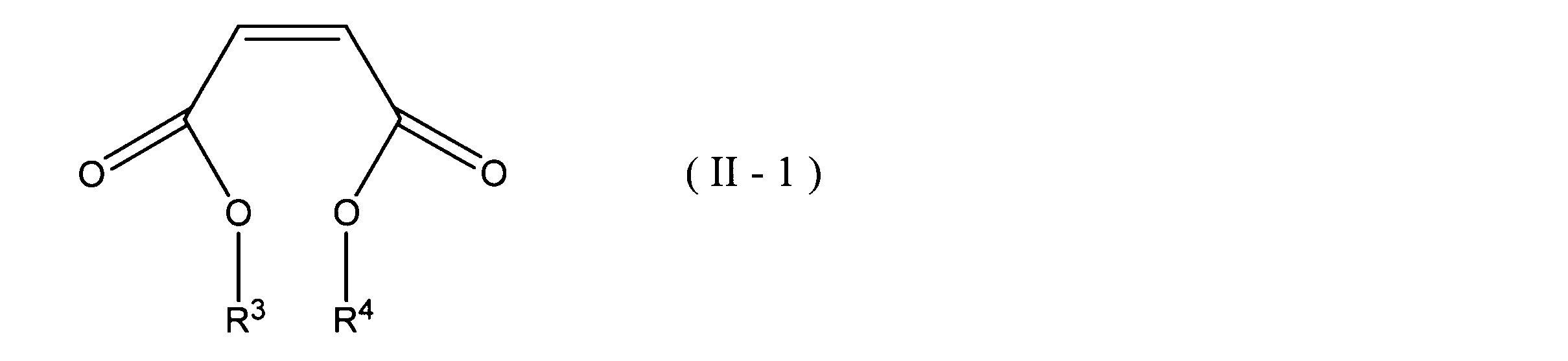

マレイン酸エステルとしては、例えば、マレイン酸モノメチル、マレイン酸ジメチル、マレイン酸モノエチル、マレイン酸ジエチル、マレイン酸モノプロピル、マレイン酸ジプロピルなどが挙げられる。
マレイン酸塩としては、例えば、マレイン酸モノリチウム、マレイン酸ジリチウム、マレイン酸モノナトリウム、マレイン酸ジナトリウム、マレイン酸モノカリウム、マレイン酸ジカリウム等のマレイン酸のアルカリ金属塩;マレイン酸カルシウム、マレイン酸マグネシウム等のマレイン酸のアルカリ土類金属塩;マレイン酸モノアンモニウム、マレイン酸ジアンモニウム等のマレイン酸のアンモニウム塩;マレイン酸モノメチルアンモニウム、マレイン酸ビスモノメチルアンモニウム、マレイン酸モノジメチルアンモニウム、マレイン酸ビスジメチルアンモニウム等のマレイン酸のアルキルアミン塩;マレイン酸-2-ヒドロキシエチルアンモニウム、マレイン酸ビス-2-ヒドロキシエチルアンモニウム、マレイン酸ジ(2-ヒドロキシエチル)アンモニウム、マレイン酸ビスジ(2-ヒドロキシエチル)アンモニウム等のマレイン酸のアルカノールアミン塩;などが挙げられる。
また、これらは、1種類を単独で用いてもよく、2種類以上を任意の比率で組み合わせて用いてもよい。

製法A:式(I-1)で表されるマレイミド類と、式(II-1)で表されるマレイン酸類又は式(II-2)で表される無水マレイン酸とを重合する方法。
製法B:式(II-1)で表されるマレイン酸類又は(II-2)で表される無水マレイン酸を重合した後に、そのマレイン酸類又は無水マレイン酸を重合して形成される構造単位の一部を、式(I-1)における基R2を有する化合物でマレアミック酸化し、さらにその一部を環化脱水(イミド化)する方法。
環化脱水反応では、イソブチレン-無水マレイン酸共重合体中の無水マレイン酸単位とアミノフェノールとが反応して生成したN-(ヒドロキシフェニル)マレアミック酸単位1モルから、水1モルが生成する。共沸溶媒の使用量は、前記の生成水を共沸除去するに足る量としうる。
上述した水溶性高分子化合物の中でも、カルボキシメチルセルロース及び式(I)で表される構造単位(a)を含むマレイミド-マレイン酸共重合体が好ましい。
また、水溶性高分子化合物は、1種類を単独で用いてもよく、2種類以上を任意の比率で組み合わせて用いてもよい。
多孔膜用スラリー組成物は、アンモニア及びアミン化合物からなる群より選ばれる少なくとも1種類の低分子化合物Xを有する。前記の低分子化合物Xは、通常、多孔膜用スラリー組成物の膜を乾燥させる時に気化するので、多孔膜にはほとんど残留しない。しかし、前記の乾燥の際に低分子化合物Xが除去されることで何らかの作用が働き、多孔膜の耐水性が向上して、多孔膜が水に対して溶け難くなるものと考えられる。
多孔膜用スラリー組成物における水の量は、非導電性粒子、水溶性高分子化合物及び低分子化合物Xの種類に応じ、多孔膜用スラリー組成物の粘度が塗布に好適な範囲になるように調整することが好ましい。具体的には、前記の非導電性粒子、水溶性高分子化合物及び低分子化合物X、並びに必要に応じて用いられるバインダー及び任意の成分を合わせた固形分の濃度が、好ましくは20重量%以上、より好ましくは30重量%以上、また、好ましくは60重量%以下、より好ましくは50重量%以下となる量の水を用いる。
多孔膜用スラリー組成物は、バインダーを含むことが好ましい。バインダーを含むことにより、多孔膜の結着性が向上し、撒回時、運搬時等の取扱い時に多孔膜セパレータにかかる機械的な力に対する強度を向上させることができる。
(メタ)アクリル酸エステル単量体の例を挙げると、アクリル酸メチル、アクリル酸エチル、アクリル酸n-プロピル、アクリル酸イソプロピル、アクリル酸n-ブチル、アクリル酸イソブチル、アクリル酸t-ブチル、アクリル酸n-アミル、アクリル酸イソアミル、アクリル酸n-ヘキシル、アクリル酸2-エチルヘキシル、アクリル酸-2-メトキシエチル、アクリル酸-2-エトキシエチル、アクリル酸ヘキシル、アクリル酸ノニル、アクリル酸ラウリル、アクリル酸ステアリル、ベンジルアクリレートなどのアクリレート;メタクリル酸メチル、メタクリル酸エチル、メタクリル酸プロピル、メタクリル酸イソプロピル、メタクリル酸n-ブチル、メタクリル酸イソブチル、メタクリル酸t-ブチル、メタクリル酸n-アミル、メタクリル酸イソアミル、メタクリル酸n-ヘキシル、メタクリル酸2-エチルヘキシル、メタクリル酸オクチル、メタクリル酸イソデシル、メタクリル酸ラウリル、メタクリル酸トリデシル、メタクリル酸ステアリル、ベンジルメタクリレートなどのメタアクリレート等が挙げられる。これらの中でも、アクリレートが好ましく、アクリル酸n-ブチルおよびアクリル酸2-エチルヘキシルが、多孔膜の強度を向上できる点で、特に好ましい。また、これらの単量体は、1種類を単独で用いてもよく、2種類以上を任意の比率で組み合わせて用いてもよい。
また、架橋性単量体は、1種類を単独で用いてもよく、2種類以上を任意の比率で組み合わせて用いてもよい。
多孔膜用スラリー組成物は、必要に応じて、上述したもの以外の任意の成分を含んでいてもよい。このような成分としては、電池反応に影響を及ぼさないものを用いうる。これらの成分としては、例えば、イソチアゾリン系化合物、キレート化合物、ピリチオン化合物、分散剤、レベリング剤、酸化防止剤、増粘剤、消泡剤、界面活性剤が挙げられる。また、電解液分解抑制等の機能を有する電解液添加剤も挙げられる。また、これらの成分は、1種類を単独で用いてもよく、2種類以上を任意の比率で組み合わせて用いてもよい。
多孔膜用スラリー組成物は、通常、流体状となっている。多孔膜用スラリー組成物において、非導電性粒子は水に分散しており、前記の水溶性高分子化合物及び低分子化合物Xは水に溶解している。また、多孔膜用スラリー組成物では、通常、水溶性高分子化合物の一部は水中で遊離しているが、別の一部が非導電性粒子の表面に吸着することによって、非導電性粒子が水溶性高分子化合物の安定な層で覆われて、非導電性粒子の水中での分散性が向上している。このため、多孔膜用スラリー組成物は、セパレータ基材に塗布する際の塗工性が良好である。また、多孔膜用スラリー組成物がバインダーを含む場合、当該バインダーは水に溶解していてもよく、分散していてもよい。バインダーとして粒子状バインダーを用いる場合、通常は、バインダーは水に分散している。
多孔膜用スラリー組成物を用意した後で、多孔膜用スラリー組成物をセパレータ基材上に塗布する。これにより、多孔膜用スラリー組成物の膜がセパレータ基材上に形成される。
多孔膜用スラリー組成物の塗布方法に制限は無い。塗布方法の例を挙げると、ドクターブレード法、ディップ法、ダイコート法、リバースロール法、ダイレクトロール法、グラビア法、エクストルージョン法、ハケ塗り法などが挙げられる。
多孔膜用スラリー組成物の塗布量は、通常、所望の厚みの多孔膜が得られる範囲にする。
セパレータ基材上に多孔膜用スラリー組成物の膜を形成した後で、その膜を乾燥させる。乾燥により、多孔膜用スラリー組成物の膜から水が除去されて、多孔膜が得られる。また、乾燥の際には、低分子化合物Xの大部分は気化して多孔膜用スラリー組成物の膜から除去される。これにより、多孔膜の耐水性が顕著に向上し、当該多孔膜は水に溶け難くなる。
多孔膜を得る工程においては、上述した以外の任意の操作を行ってもよい。例えば、金型プレス及びロールプレス等のプレス方法によって、多孔膜に加圧処理を施してもよい。加圧処理を施すことにより、セパレータ基材と多孔膜との結着性を向上させることができる。ただし、過度に加圧処理を行うと、多孔膜の空隙率が損なわれる可能性があるため、圧力および加圧時間を適切に制御することが好ましい。また、残留水分除去のため真空乾燥やドライルーム内で乾燥することが好ましい。加熱処理することも好ましく、これによりバインダー内の熱架橋性基が架橋し、より結着力が向上する。
上述した工程を経ることにより、セパレータ基材上に多孔膜が形成される。この多孔膜は、非導電性粒子及び水溶性高分子化合物、並びに、必要に応じてバインダー及び任意の成分を含む。非導電性粒子、水溶性高分子化合物及びバインダーの量は、通常は、多孔膜用スラリー組成物に含まれていた量と同様になる。
また、多孔膜は、乾燥によって水が除去されているので、水分の含有量が少ない。したがって、水によるガス発生を抑制できるので、充放電による放電容量の低下を抑制できる。このため、リチウムイオン二次電池のサイクル特性を改善することが可能である。
接着層を得る工程では、接着層用スラリー組成物を前記多孔膜上に塗布し、乾燥して接着層を得る。この際、多孔膜は高い耐水性を有するので、水を含む接着層用スラリー組成物を塗布しても、多孔膜は溶け難くなっている。
接着層用スラリー組成物は、粒子状重合体及び水を含む。また、接着層用スラリー組成物は、バインダーを含んでいてもよい。
粒子状重合体としては、通常10℃以上、好ましくは30℃以上、より好ましくは40℃以上、また、通常110℃以下、好ましくは100℃以下、より好ましくは90℃以下のガラス転移温度を有する粒子状の重合体を用いる。粒子状重合体のガラス転移温度が前記範囲の下限値以上であることにより、多孔膜セパレータの保存時、運搬時及び取り扱い時において粒子状重合体の軟化を抑制して、ブロッキングを防止できる。また、ガラス転移温度が高い粒子状重合体を用いることにより、接着層の耐熱性が向上する。そのため、リチウムイオン二次電池の使用時に当該電池が高温となっても多孔膜セパレータの剥離を防止でき、電池の安全性を高めることができる。また、上限値以下であることにより、多孔膜セパレータを電極に貼り合せる際に、熱により粒子状重合体を容易に軟化させることができる。また、セパレータ基材等の電池を構成する要素を損なわない低温において接着層の熱融着が可能となる。したがって、熱プレスによる多孔膜セパレータと電極との接着を容易に行うことが可能となる。
中でも、粒子状重合体としては、アクリル酸エステル単量体を重合して形成される構造を有する構造単位(以下、適宜「アクリル酸エステル単量体単位」ということがある。)を含む重合体が好ましい。
アクリル酸エステル単量体としては、例えば、メチルアクリレート、エチルアクリレート、n-プロピルアクリレート、イソプロピルアクリレート、n-ブチルアクリレート、t-ブチルアクリレート、ペンチルアクリレート、ヘキシルアクリレート、ヘプチルアクリレート、オクチルアクリレート、2-エチルヘキシルアクリレート、ノニルアクリレート、デシルアクリレート、ラウリルアクリレート、n-テトラデシルアクリレート、ステアリルアクリレート等のアクリル酸アルキルエステルが挙げられる。これらは1種類だけを用いてもよく、2種類以上を任意の比率で組み合わせて用いてもよい。
エチレン性不飽和カルボン酸単量体としては、例えば、エチレン性不飽和モノカルボン酸、エチレン性不飽和ジカルボン酸及びその酸無水物などが挙げられる。エチレン性不飽和モノカルボン酸の例としては、アクリル酸、メタクリル酸、クロトン酸などが挙げられる。エチレン性不飽和ジカルボン酸の例としては、マレイン酸、フマル酸、イタコン酸などが挙げられる。エチレン性不飽和ジカルボン酸の酸無水物の例としては、無水マレイン酸、アクリル酸無水物、メチル無水マレイン酸、ジメチル無水マレイン酸などが挙げられる。これらの中でも、アクリル酸、メタクリル酸等のエチレン性不飽和モノカルボン酸が好ましい。粒子状重合体の水に対する分散性がより高めることができるからである。これらは1種類だけを用いてもよく、2種類以上を任意の比率で組み合わせて用いてもよい。
芳香族ビニル単量体としては、例えば、スチレン、α-メチルスチレン、ビニルトルエン、及びジビニルベンゼンが挙げられる。中でも、スチレンが好ましい。これらは、1種類を単独で用いてもよく、2種類以上を任意の比率で組み合わせて用いてもよい。
(メタ)アクリロニトリル単量体としては、例えば、アクリロニトリル及びメタクリロニトリルが挙げられる。(メタ)アクリロニトリル単量体は、アクリロニトリルだけを用いてもよく、メタクリロニトリルだけを用いてもよく、アクリロニトリル及びメタクリロニトリルの両方を任意の比率で組み合わせて用いてもよい。
架橋性単量体としては、例えば、熱架橋性を有する単量体が挙げられる。より具体的には、例えば、熱架橋性の架橋性基及び1分子あたり1つのオレフィン性二重結合を有する単官能性単量体;1分子あたり2つ以上のオレフィン性二重結合を有する多官能性単量体が挙げられる。
また、架橋性単量体は、1種類を単独で用いてもよく、2種類以上を任意の比率で組み合わせて用いてもよい。
接着層用スラリー組成物は、バインダーを含んでいてもよい。バインダーを含むことにより、接着層の多孔膜に対する結着性を高めることができる。
接着層用スラリー組成物における水の量は、粒子状重合体及び必要に応じて用いられるバインダーの種類に応じ、接着層用スラリー組成物の粘度が塗布に好適な範囲になるように調整することが好ましい。具体的には、前記の粒子状重合体並びに必要に応じて用いられるバインダー及び任意の成分を合わせた固形分の濃度が、好ましくは10重量%以上、より好ましくは20重量%以上、また、好ましくは60重量%以下、より好ましくは50重量%以下となる量の水を用いる。
接着層用スラリー組成物は、必要に応じて、上述したもの以外の任意の成分を含んでいてもよい。このような成分としては、電池反応に影響を及ぼさないものを用いうる。これらの成分としては、例えば、粘度調整、沈降防止のための水溶性高分子、有機セパレータへの濡れ性向上のための濡れ剤などが挙げられる。また、これらの成分は、1種類を単独で用いてもよく、2種類以上を任意の比率で組み合わせて用いてもよい。
接着層用スラリー組成物は、通常、流体状となっている。接着層用スラリー組成物において、粒子状重合体は水に分散している。また、バインダーは、水に分散していてもよく、溶解していてもよい。バインダーとして粒子状バインダーを用いる場合、通常は、バインダーは水に分散している。
接着層用スラリー組成物を用意した後で、接着層用スラリー組成物を多孔膜上に塗布する。これにより、接着層用スラリー組成物の膜が多孔膜上に形成される。
接着層用スラリー組成物の塗布方法に制限は無い。塗布方法の例を挙げると、ドクターブレード法、ディップ法、ダイコート法、リバースロール法、ダイレクトロール法、グラビア法、エクストルージョン法、ハケ塗り法などが挙げられる。
接着層用スラリー組成物の塗布量は、通常、所望の厚みの接着層が得られる範囲にする。
多孔膜上に接着層用スラリー組成物の膜を形成した後で、その膜を乾燥させる。乾燥により、接着層用スラリー組成物の膜から水が除去されて、接着層が得られる。
接着層を得る工程においては、上述した以外の任意の操作を行ってもよい。例えば、残留水分除去のため真空乾燥やドライルーム内で乾燥処理を行ってよいし、加熱処理を行ってもよい。
上述した工程を経ることにより、多孔膜上に接着層が形成され、多孔膜セパレータが得られる。この接着層は、粒子状重合体並びに必要に応じてバインダー及び任意の成分を含む。粒子状重合体及びバインダーの量は、通常は、接着層用スラリー組成物に含まれていた量と同様になる。
本発明の多孔膜セパレータの製造方法では、所望の多孔膜セパレータが得られる限り、上述した以外の工程を行ってもよい。例えば、残留水分除去のため真空乾燥やドライルーム内で乾燥処理を行ってよいし、加熱処理を行ってもよい。
本発明の多孔膜セパレータの製造方法で製造される多孔膜セパレータは、セパレータ基材、多孔膜及び接着層をこの順に備える。これらのセパレータ基材、多孔膜及び接着層には電解液が浸透できるので、電池特性に対して多孔膜セパレータが悪影響を及ぼすことは無い。また、多孔膜が接着層用スラリー組成物に溶け出し難いため、多孔膜の強度及び結着性は良好である。したがって、多孔膜セパレータの電極に対する接着強度を高くできるので、リチウムイオン二次電池の安全性を向上させることができる。さらに、接着層に含まれる粒子状重合体は、多孔膜セパレータの通常の使用環境において軟化し難くなっている。そのため、多孔膜セパレータは優れた耐ブロッキング性を有する。
また、多孔膜及び接着層は、それぞれ、セパレータ基材の片面だけに設けてもよく、両面に設けてもよい。
本発明のリチウムイオン二次電池用積層体の製造方法は、電極と、本発明の多孔膜セパレータの製造方法で製造された多孔膜セパレータとを加圧接着することを含む。
電極は、通常、集電体と、集電体上に設けられた電極活物質層とを備える。
集電体は、電気導電性を有し且つ電気化学的に耐久性のある材料を用いうる。中でも、耐熱性を有するとの観点から、例えば、鉄、銅、アルミニウム、ニッケル、ステンレス鋼、チタン、タンタル、金、白金などの金属材料が好ましい。その中でも、正極用としてはアルミニウムが特に好ましく、負極用としては銅が特に好ましい。
集電体は、電極活物質層との接着強度を高めるため、予め粗面化処理して使用するのが好ましい。粗面化方法としては、例えば、機械的研磨法、電解研磨法、化学研磨法などが挙げられる。機械的研磨法においては、例えば、研磨剤粒子を固着した研磨布紙、砥石、エメリバフ、鋼線などを備えたワイヤーブラシ等が使用されうる。
また、電極活物質層との接着強度や導電性を高めるために、集電体表面に中間層を形成してもよい。
電極活物質層は、電極活物質を含む。以下の説明においては、適宜、電極活物質の中でも特に正極用の電極活物質のことを「正極活物質」、負極用の電極活物質のことを「負極活物質」と呼ぶことがある。
また、例えば、鉄系酸化物を炭素源物質の存在下において還元焼成することで、炭素材料で覆われた複合材料を作製し、この複合材料を正極活物質として用いてもよい。鉄系酸化物は電気伝導性に乏しい傾向があるが、前記のような複合材料にすることにより、高性能な正極活物質として使用できる。
さらに、前記の化合物を部分的に元素置換したものを正極活物質として用いてもよい。
これらの正極活物質は、1種類だけを用いてもよく、2種類以上を任意の比率で組み合わせて用いてもよい。
電極と多孔膜セパレータとを加圧接着することにより、リチウム二次電池用積層体が得られる。電極が電極活物質層を備える場合、通常は、電極の電極活物質層と多孔膜セパレータの接着層とが向き合うように電極と多孔膜セパレータとを重ねて、接着を行う。
本発明のリチウムイオン二次電池用積層体の製造方法においては、上述した工程に加えて、更に任意の工程を行ってもよい。
例えば、電極とセパレータを巻回または積層後、ラミネートフィルムに包埋し、電解液を注液し、セルを封した後にセルごと加圧して、電極とセパレータと接着してもよい。
上述した製造方法によって得られた多孔膜セパレータ又はリチウムイオン二次電池用積層体を用いることにより、リチウムイオン二次電池を製造しうる。このリチウムイオン二次電池は、正極、多孔膜セパレータ及び負極をこの順に備え、更に電解液を備える。このリチウムイオン二次電池は、多孔膜セパレータと電極との接着性が高く、また通常は多孔膜セパレータの耐熱性が高いので、高い安全性を有する。
また、電極としては、例えば、リチウムイオン二次電池用積層体の製造方法の項で説明したものを用いうる。
以下の説明において、量を表す「%」及び「部」は、別に断らない限り重量基準である。また、以下に説明する操作は、別に断らない限り、常温及び常圧の条件において行った。
〔水溶性高分子化合物のフィルムの、水に対する再溶解率〕
実施例1~4、6~9、11及び12、並びに比較例1~3では、カルボキシメチルセルロースアンモニウム塩及びアンモニアを含む水溶液を用意する。この水溶液としては、カルボキシメチルセルロースアンモニウム塩及びアンモニアを、各実施例及び比較例に係る多孔膜用スラリー組成物と同様の比率で含むものを用いる。
実施例5及び10では、各実施例で用いた水溶性高分子化合物及び低分子化合物Xを、各実施例に係る多孔膜用スラリー組成物と同様の比率で含む水溶液を用意する。
ΔM=(M1-M2)/(M1-M0)×100(%)
A:再溶解率ΔMが5%未満である
B:再溶解率ΔMが5%以上10%未満である
C:再溶解率ΔMが10%以上15%未満である
D:再溶解率ΔMが15%以上である
多孔膜セパレータを、幅5cm×長さ5cmの正方形に切って試験片とする。試験片を150℃の恒温槽に入れ1時間放置した後、正方形の面積変化を熱収縮率として求める。熱収縮率が小さいほど、多孔膜セパレータの熱収縮性が優れることを示す。
A:熱収縮率が1%未満である。
B:熱収縮率が1%以上5%未満である。
C:熱収縮率が5%以上10%未満である。
D:熱収縮率が10%以上である。
多孔膜セパレータを幅5cm×長さ5cmに切り取り、これに電極活物質層を有する負極(幅4cm×長さ4cm)と重ね合わせて、90℃、0.5MPa、10秒間の条件でプレスを行い、多孔膜セパレータと電極活物質層を有する負極とを備える積層体を用意する。用意した積層体を10mm幅に切断してサンプルを得る。このサンプルを、電池の製造に用いたものと同じ電解液中に温度60℃で3日間浸漬する。その後、サンプルを電解液から取り出し、湿った状態で多孔膜セパレータを負極から剥離する。このときの接着性を以下の基準で評価する。多孔膜セパレータを負極の電極活物質から剥離するときに抵抗が大きいほど、電解液中における接着層の接着力の保持特性が高いことを示す。
A:剥離した時に抵抗がある(接着性にすぐれる)。
B:剥離した時に抵抗が殆どない(接着性に劣る)。
C:電解液から取り出した時点で既に剥がれている。
多孔膜セパレータを、幅5cm×長さ5cm及び幅4cm×長さ4cmでそれぞれ正方形に切り取って、試験片を用意する。これら二枚の試験片を重ね合わせる。重ね合わせたが加圧していないサンプル(プレスされていないサンプル)と、重ね合わせた後に温度40℃、圧力10g/cm2で加圧下に置いたサンプル(プレスされているサンプル)とを、それぞれ24時間放置する。24時間放置後、サンプルを目視で観察して、重ね合わせた多孔膜セパレータの接着状態(ブロッキング状態)を確認し、下記基準で評価した。ここでブロッキングするとは、重ね合わせた多孔膜セパレータ同士が接着する現象のことをいう。
A:加圧した多孔膜セパレータ同士がブロッキングしないもの。
B:加圧した多孔膜セパレータ同士がブロッキングするが剥がれるもの。
C:加圧した二次電池用セパレータ同士がブロッキングし剥がれないもの。
D:加圧していない多孔膜セパレータ同士がブロッキングするもの。
多孔膜に含まれる、アンモニア及びアミン化合物からなる群より選ばれる少なくとも1種類の低分子化合物Xの定量は、以下に示すパージ&トラップ/ガスクロマトグラフィー(P&T/GC)法により行った。
セパレータ基材、多孔膜及び接着層を備える多孔膜セパレータ0.1gをパージ容器に入れる。パージ容器にキャリアガスとしてヘリウムガスを50ml/分で流しながら、パージ容器内の温度を、10℃/分の速度で加熱する。加熱前は室温であったパージ容器内の温度は、加熱の開始後に上昇する。温度が150℃になったら、150℃の温度を30分間保持する。その後、10℃/分の速度で200℃まで加熱し、発生した揮発成分をトラップ管に捕集する。捕集後は、パージ容器の温度は室温に戻す。
測定装置:アジレント社製ガスクロマトグラフ9890(FID法)
データ処理装置:島津製C-R7Aクロマトパック
パージ&トラップサンプラー:アジレント社製TDS
カラム:J&W社製DB-5(L=30m、I.D=0.32mm、Film=0.25μm)
カラム温度:50℃(保持2分)~270℃(10℃/分昇温)
試料送入温度:280℃
検出温度:280℃
キャリアガス:ヘリウムガス
流量:1ml/分
(1.1.メタ(アクリル)重合体の製造)
撹拌機を備えた反応器に、ドデシル硫酸ナトリウムを0.06部、過硫酸アンモニウムを0.23部、及びイオン交換水を100部入れて混合し、混合物A1を得た。この混合物A1は、80℃に昇温した。
一方、別の容器中で、アクリル酸ブチル83.8部、メタクリル酸2.0部、アクリロニトリル12.0部、アリルグリシジルエーテル1.0部、N-メチロールアクリルアミド1.2部、ドデシル硫酸ナトリウム0.1部、及びイオン交換水100部を混合して、単量体混合物B1の分散体を調製した。
この単量体混合物B1の分散体を、4時間かけて、上記の混合物A1中に、連続的に添加して重合させた。単量体混合物B1の分散体の連続的な添加中は、反応系の温度は80℃に維持し、反応を行った。連続的な添加の終了後、さらに90℃で3時間反応を継続させた。これにより、(メタ)アクリル重合体からなるバインダーを含む水分散体を得た。
非導電性粒子としてアルミナ粒子(住友化学社製「AKP-3000」、体積平均粒子径D50=0.45μm、テトラポッド(登録商標)状粒子)を用意した。
粘度調整剤として、カルボキシメチルセルロースアンモニウム塩(ダイセルファインケム社製「DN10L」)を用いた。このカルボキシメチルセルロースアンモニウム塩は、カルボキシメチルセルロースアンモニウム塩及びアンモニアを含む水溶液の状態で用意した。また、この粘度調整剤の1%水溶液の粘度は、10mPa・s以上50mPa・s以下であった。
このカルボキシメチルセルロースアンモニウム塩を用いて、上述した要領で、水溶性高分子化合物のフィルムの水に対する再溶解率を測定した。
攪拌機付きの5MPa耐圧容器に、(メタ)アクリル酸エステル単量体としてアクリル酸ブチル22.2部、エチレン性不飽和カルボン酸単量体としてメタクリル酸2部、芳香族ビニル単量体としてスチレン75部、架橋性単量体としてエチレンジメタクリレート0.8部、乳化剤としてドデシルベンゼンスルホン酸ナトリウム1部、イオン交換水150部、及び、重合開始剤として過硫酸カリウム0.5部を入れ、十分に攪拌した。その後、60℃に加温して、重合を開始した。重合転化率が96%になった時点で冷却して反応を停止し、粒子状重合体を含む水分散液を得た。得られた粒子状重合体の体積平均粒子径D50は0.15μm、ガラス転移温度は76℃であった。
前記工程(1.3)で得た粒子状重合体の水分散液を固形分で100部、及び、バインダとして前記工程(1.1)で得た(メタ)アクリル重合体を固形分で4部混合した。さらに、イオン交換水を混合して固形分濃度を20%にして、接着層用スラリー組成物を得た。
ポリエチレン製の多孔基材からなるセパレータ基材(厚み16μm)を用意した。用意したセパレータ基材の両面に、前記多孔膜用スラリー組成物を塗布し、50℃で3分間乾燥させた。これにより、1層あたりの厚み3μmの多孔膜をセパレータ基材上に形成した。
正極活物質としてスピネル構造を有するマンガン酸リチウム95部に、バインダーとしてのPVDF(ポリフッ化ビニリデン、クレハ社製、商品名:KF-1100)を固形分換算量で3部となるように加え、さらに、アセチレンブラック2部、及びN-メチルピロリドン20部を加えて、これらをプラネタリーミキサーで混合して、正極用の活物質層用スラリー組成物を得た。この正極用の活物質層用スラリー組成物を、厚さ18μmのアルミニウム箔の片面に塗布し、120℃で3時間乾燥した後、ロールプレスして、全厚みが100μmの電極活物質層を有する正極を得た。
負極活物質として粒径20μm、BET比表面積4.2m2/gのグラファイト98部と、バインダーとしてSBR(スチレン-ブタジエンゴム、ガラス転移温度:-10℃)の固形分換算量1部とを混合し、この混合物にさらにカルボキシメチルセルロース1部を混合し、更に溶媒として水を加えて、これらをプラネタリーミキサーで混合し、負極用の活物質層用スラリー組成物を得た。この負極用の活物質層用スラリー組成物を、厚さ18μmの銅箔の片面に塗布し、120℃で3時間乾燥した後、ロールプレスして、全厚みが60μmの電極活物質層を有する負極を得た。
前記の正極と多孔膜セパレータと負極とを重ねた。このとき、正極の正極活物質層と多孔膜セパレータの一方の接着層とが接し、また、負極の負極活物質層と多孔膜セパレータの他方の接着層とが接するようにした。その後、温度80℃、圧力0.5MPaで10秒プレスして、正極、多孔膜セパレータ及び負極を加圧接着した。これにより、正極、多孔膜セパレータ及び負極を備える二次電池用積層体を得た。
ポリプロピレン製パッキンを設けたステンレス鋼製のコイン型外装容器の内底面上に、負極/二次電池用セパレータ/正極の層構造を有する前記の二次電池用積層体を設置し、これらを容器内に収納した。容器中に電解液を空気が残らないように注入し、ポリプロピレン製パッキンを介して外装容器に厚さ0.2mmのステンレス鋼のキャップをかぶせて固定し、電池缶を封止して、直径20mm、厚さ約3.2mmのフルセル型のリチウムイオンニ次電池(コインセルCR2032)を製造した。電解液としてはエチレンカーボネート(EC)とジエチルカーボネート(DEC)とをEC:DEC=1:2(20℃での容積比)で混合してなる混合溶媒にLiPF6を1モル/リットルの濃度で溶解させた溶液を用いた。
前記工程(1.2)において、非導電性粒子としてアルミナ粒子の代わりにベーマイト粒子(Nabaltec社製「APYRAL AOH 60」、体積平均粒子径D50=0.9μm、板状粒子)を用いた。以上の事項以外は実施例1と同様にして、多孔膜セパレータ、二次電池用積層体及びリチウムイオン二次電池を製造し、評価した。
前記工程(1.2)において、非導電性粒子としてアルミナ粒子の代わりに酸化マグネシウム粒子(タテホ化学社製「PUREMAG FNM-G」、体積平均粒子径D50=0.5μm、楕円球状粒子と角が丸みを帯びた多面体形状粒子の混合物)を用いた。以上の事項以外は実施例1と同様にして、多孔膜セパレータ、二次電池用積層体及びリチウムイオン二次電池を製造し、評価した。
(ポリマー粒子の製造)
撹拌機を備えた反応器に、ドデシル硫酸ナトリウムを0.06部、過硫酸アンモニウムを0.23部、及びイオン交換水を100部入れて混合し、混合物A4を得た。この混合物A4は、80℃に加熱した。
(5.1.マレイミド-マレイン酸共重合体の製造)
撹拌機を備えた反応器に、イソブチレン-無水マレイン酸共重合体(株式会社クラレ社製「イソバン-04」)100部を入れた。反応器にアンモニアガスを吹き込み、水浴で冷却しながら発熱が止まるまで約1時間反応を行なった。続いてオイルバスで加熱しながらアンモニアガスを圧入し、生成する水を系外に留去しつつ200℃まで昇温して、イミド化反応を行なった。反応終了後、反応生成物を取り出し、加熱乾燥して、マレイミド-マレイン酸共重合体を得た。得られたマレイミド-マレイン酸共重合体の組成は、イソブチレン単位50モル%、無水マレイン酸単位18モル%、マレイン酸単位12モル%、およびマレイミド単位20モル%であった。
また、撹拌機を備えた反応器に、得られたマレイミド-マレイン酸共重合体を100部、濃度25%のアンモニア水を540部入れ、90℃で5時間攪拌することで、固形分濃度が20%のマレイミド-マレイン酸共重合体の水溶液を得た。マレイミド-マレイン酸共重合体の重量平均分子量は60000であった。
また、前記工程(1.2)において、カルボキシメチルセルロースアンモニウム塩の水溶液の代わりに、前記工程(5.1)で得たマレイミド-マレイン酸共重合体100部を用いた。この際、マレイミド-マレイン酸共重合体は、水溶液の状態で添加した。得られた多孔膜用スラリーは、水溶性高分子化合物であるマレイミド-マレイン酸共重合体100部に対して、アンモニア15部を含む。
以上の事項以外は実施例1と同様にして、多孔膜セパレータ、二次電池用積層体及びリチウムイオン二次電池を製造し、評価した。
前記工程(1.3)において、アクリル酸ブチルの量を52.2部に変更し、スチレンの量を45部に変更して、接着層の粒子状重合体のガラス転移温度を15℃に調整した。以上の事項以外は実施例1と同様にして、多孔膜セパレータ、二次電池用積層体及びリチウムイオン二次電池を製造し、評価した。
前記工程(1.3)において、アクリル酸ブチルの量を27.2部に変更し、スチレンの量を70部に変更して、接着層の粒子状重合体のガラス転移温度を35℃に調整した。以上の事項以外は実施例1と同様にして、多孔膜セパレータ、二次電池用積層体及びリチウムイオン二次電池を製造し、評価した。
前記工程(1.3)において、アクリル酸ブチルの量を7.2部に変更し、スチレンの量を90部に変更して、接着層の粒子状重合体のガラス転移温度を93℃に調整した。以上の事項以外は実施例1と同様にして、多孔膜セパレータ、二次電池用積層体及びリチウムイオン二次電池を製造し、評価した。
前記工程(1.2)において、カルボキシメチルセルロースアンモニウム塩の水溶液の量を、カルボキシメチルセルロースアンモニウム塩とアンモニアとの合計量で7部に変更した。このカルボキシメチルセルロースアンモニウム塩の水溶液は、カルボキシメチルセルロースアンモニウム塩6.6部とアンモニア0.4部とを含む。これにより、多孔膜用スラリー組成物において、水溶性高分子化合物であるカルボキシメチルセルロースアンモニウム塩100部に対するアンモニアの量は、5部となった。
以上の事項以外は実施例1と同様にして、多孔膜セパレータ、二次電池用積層体及びリチウムイオン二次電池を製造し、評価した。
カルボキシメチルセルロース及び2-アミノエタノールを含む水溶液を用意した。この水溶液において、カルボキシメチルセルロース100部に対する2-アミノエタノールの量は18部であった。なお、この水溶液において、カルボキシメチルセルロースと2-アミノエタノールが反応して水溶性高分子化合物であるカルボキシメチルセルロースと2-アミノエタノールとの中和塩が生成し、一部未反応の2-アミノエタノールが残存している。こうして用意した水溶液を、前記工程(1.2)において、カルボキシメチルセルロースアンモニウム塩の水溶液の代わりに用いた。この際の水溶液の量は、カルボキシメチルセルロースと2-アミノエタノールの中和塩1.5部と2-アミノエタノール0.1部とを含む量とした。
以上の事項以外は実施例1と同様にして、多孔膜セパレータ、二次電池用積層体及びリチウムイオン二次電池を製造し、評価した。
前記工程(1.2)において、多孔膜用スラリー組成物にアンモニア水溶液を添加することにより、水溶性高分子化合物であるカルボキシメチルセルロースアンモニウム塩100部に対する低分子化合物Xであるアンモニアの量を10部にした。
以上の事項以外は実施例1と同様にして、多孔膜セパレータ、二次電池用積層体及びリチウムイオン二次電池を製造し、評価した。
前記工程(1.2)において、多孔膜用スラリー組成物にアンモニア水溶液を添加することにより、水溶性高分子化合物であるカルボキシメチルセルロースアンモニウム塩100部に対する低分子化合物Xであるアンモニアの量を20部にした。
以上の事項以外は実施例1と同様にして、多孔膜セパレータ、二次電池用積層体及びリチウムイオン二次電池を製造し、評価した。
前記の工程(1.5)において、接着層を形成しなかった。以上の事項以外は実施例1と同様にして、多孔膜セパレータ、二次電池用積層体及びリチウムイオン二次電池を製造し、評価した。
前記工程(1.3)において、アクリル酸ブチルの量を4.2部に変更し、メタクリル酸の量を10部に変更し、スチレンの量を85部に変更して、接着層の粒子状重合体のガラス転移温度を112℃に調整した。以上の事項以外は実施例1と同様にして、多孔膜セパレータ、二次電池用積層体及びリチウムイオン二次電池を製造し、評価した。
前記工程(1.3)において、アクリル酸ブチルの代わりにアクリル酸エチル87.8部を用い、メタクリル酸の量を2部に変更し、スチレンの代わりにアクリロニトリル10部を用い、エチレンジメタクリレートの量を0.2部に変更して、接着層の粒子状重合体のガラス転移温度を5℃に調整した。以上の事項以外は実施例1と同様にして、多孔膜セパレータ、二次電池用積層体及びリチウムイオン二次電池を製造し、評価した。
前記工程(1.2)において、カルボキシメチルセルロースアンモニウム塩の水溶液を用いなかった。
さらに、前記工程(1.5)において、接着層の1層当たりの厚みを10μmに変更した。
以上の事項以外は実施例1と同様にして、多孔膜セパレータ、二次電池用積層体及びリチウムイオン二次電池を製造し、評価した。
実施例及び比較例の構成を表1~表4に示し、結果を表5~表7に示す。ここで、以下の表における略称の意味は、以下の通りである。
「低分子化合物」欄の水溶性高分子100部に対する量:多孔膜用スラリー組成物における、水溶性高分子化合物100重量部に対する低分子化合物Xの量
バインダ組成:バインダーにおける(メタ)アクリロニトリル単量体単位/(メタ)アクリル酸エステル単量体単位の重量比
低分子化合物の残存量:多孔膜における低分子化合物Xの残存量
単量体I:アクリル酸エステル単量体
単量体II:エチレン性不飽和カルボン酸単量体
単量体III:芳香族ビニル単量体
単量体IV:(メタ)アクリロニトリル単量体
単量体V:架橋剤単量体
CMC1:カルボキシメチルセルロースアンモニウム塩
CMC2:カルボキシメチルセルロースと2-アミノエタノールの中和塩
ACL:アクリルゴム
BA:ブチルアクリレート
EA:エチルアクリレート
MAA:メタクリル酸
ST:スチレン
EDMA:エチレンジメタクリレート
イソバン:マレイミド-マレイン酸共重合体
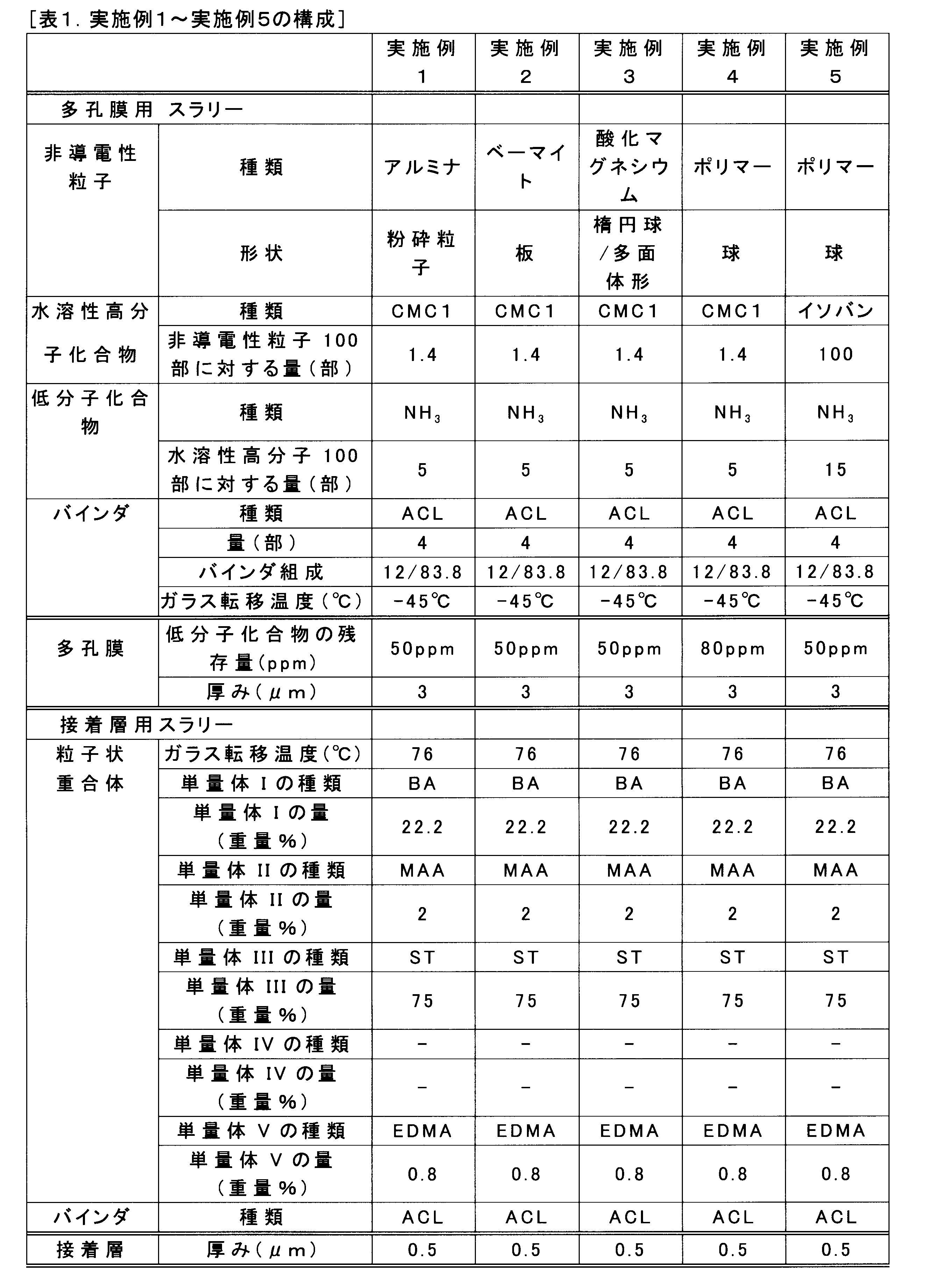
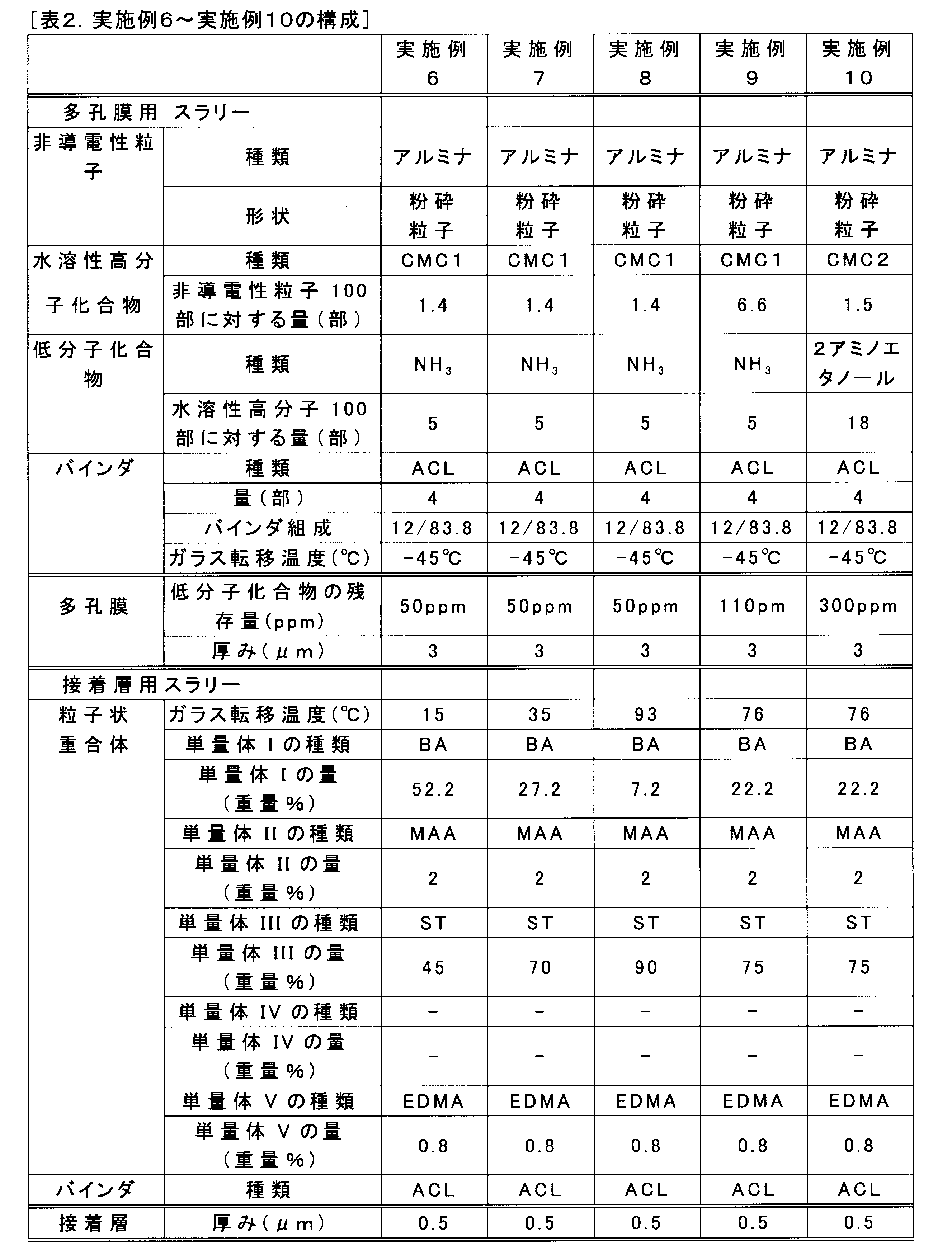
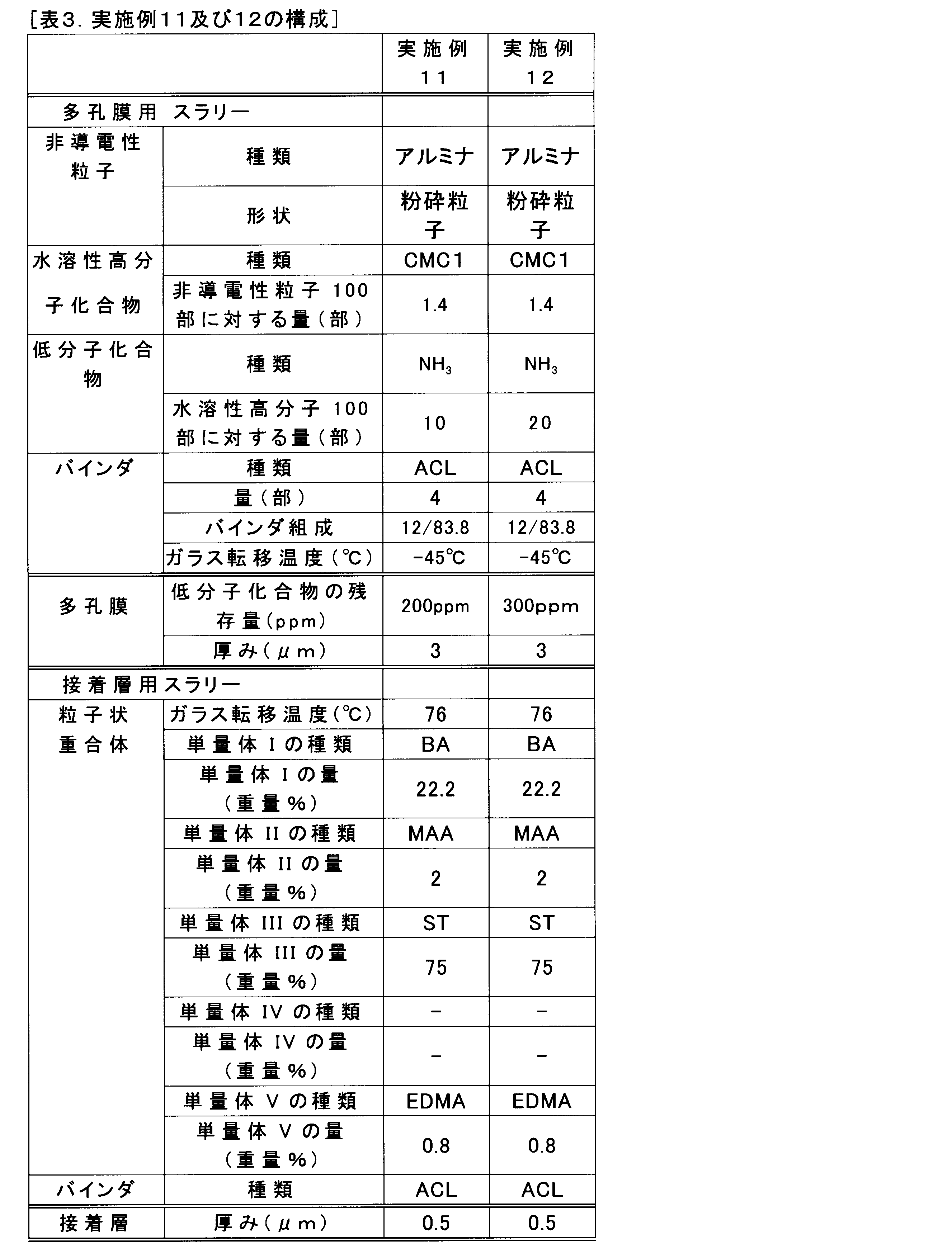

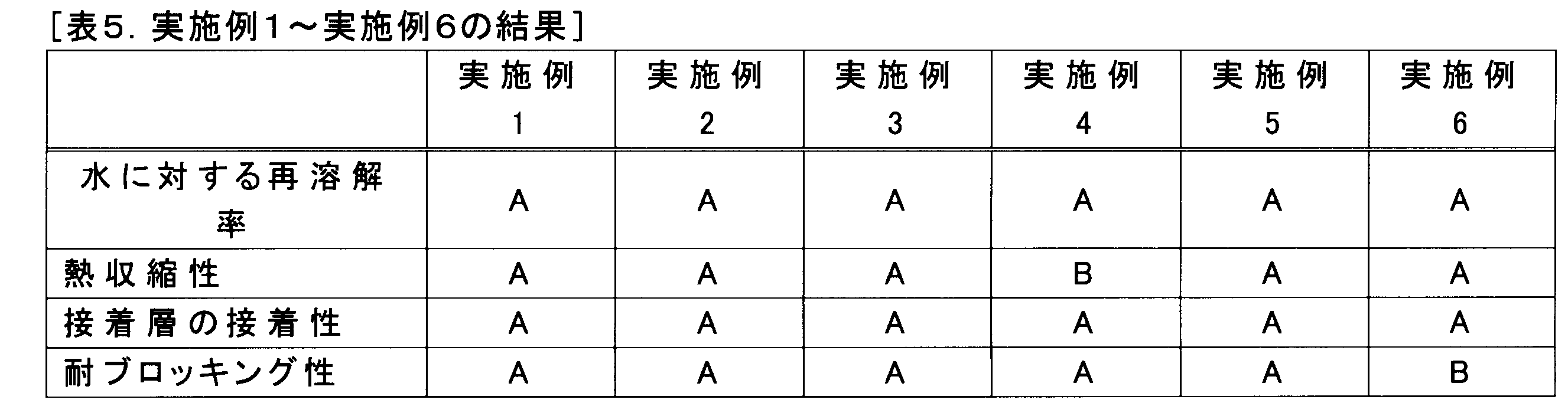
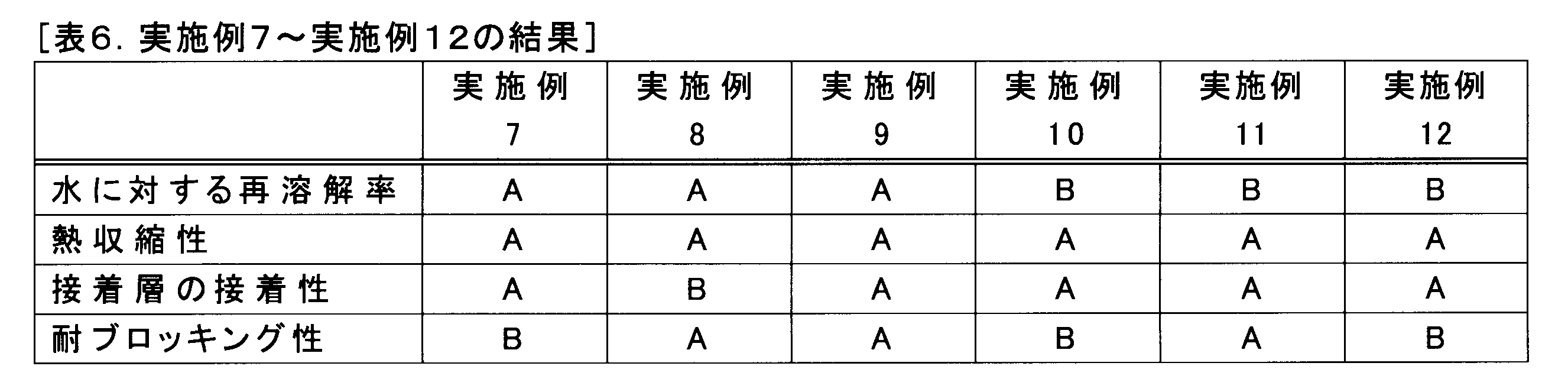
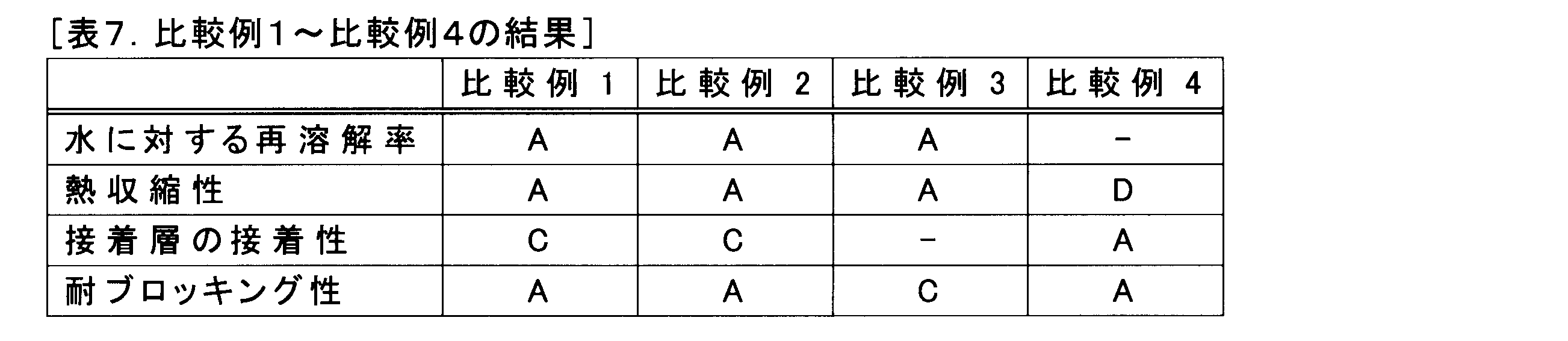
表から分かるように、本発明によれば、水を含むスラリー組成物を用いて、多孔膜が接着層用のスラリー組成物に溶かされ難く、且つ、電極に対する接着性及び耐ブロッキング性の両方に優れる多孔膜セパレータを製造することができる。
Claims (7)
- 非導電性粒子、水溶性高分子化合物、水、並びに、アンモニア及びアミン化合物からなる群より選ばれる少なくとも1種類の低分子化合物を含む多孔膜用スラリー組成物をセパレータ基材の少なくとも片面に塗布し、乾燥して多孔膜を得る工程、及び、
ガラス転移温度が10℃以上110℃以下である粒子状重合体及び水を含む接着層用スラリー組成物を前記多孔膜上に塗布し、乾燥して接着層を得る工程を含む、リチウムイオン二次電池用の多孔膜セパレータの製造方法。 - 前記水溶性高分子化合物が、酸性基を有する、請求項1記載の多孔膜セパレータの製造方法。
- 前記酸性基が、カルボキシル基である、請求項2記載の多孔膜セパレータの製造方法。
- 前記多孔膜における前記低分子化合物の濃度が、多孔膜の単位重量あたり1000ppm以下である、請求項1~3のいずれか一項に記載の多孔膜セパレータの製造方法。
- 前記低分子化合物が、アンモニアである、請求項1~4のいずれか一項に記載の多孔膜セパレータの製造方法。
- 前記水溶性高分子化合物が、カルボキシメチルセルロース、及び、下記式(I)で表される構造単位を含むマレイミド-マレイン酸共重合体からなる群より選ばれる少なくとも1種である、請求項1~5のいずれか一項に記載の多孔膜セパレータの製造方法。

- 電極と、請求項1~6のいずれか一項に記載の製造方法で製造された多孔膜セパレータとを加圧接着することを含む、リチウムイオン二次電池用積層体の製造方法。
Priority Applications (3)
| Application Number | Priority Date | Filing Date | Title |
|---|---|---|---|
| KR1020147035289A KR102090111B1 (ko) | 2012-09-28 | 2013-09-19 | 리튬 이온 2 차 전지용의 다공막 세퍼레이터의 제조 방법, 및 리튬 이온 2 차 전지용 적층체의 제조 방법 |
| CN201380031776.3A CN104364938B (zh) | 2012-09-28 | 2013-09-19 | 锂离子二次电池用的多孔膜隔板的制造方法、及锂离子二次电池用叠层体的制造方法 |
| JP2014538445A JP6119759B2 (ja) | 2012-09-28 | 2013-09-19 | リチウムイオン二次電池用の多孔膜セパレータの製造方法、及び、リチウムイオン二次電池用積層体の製造方法 |
Applications Claiming Priority (2)
| Application Number | Priority Date | Filing Date | Title |
|---|---|---|---|
| JP2012-218327 | 2012-09-28 | ||
| JP2012218327 | 2012-09-28 |
Publications (1)
| Publication Number | Publication Date |
|---|---|
| WO2014050707A1 true WO2014050707A1 (ja) | 2014-04-03 |
Family
ID=50388112
Family Applications (1)
| Application Number | Title | Priority Date | Filing Date |
|---|---|---|---|
| PCT/JP2013/075362 Ceased WO2014050707A1 (ja) | 2012-09-28 | 2013-09-19 | リチウムイオン二次電池用の多孔膜セパレータの製造方法、及び、リチウムイオン二次電池用積層体の製造方法 |
Country Status (4)
| Country | Link |
|---|---|
| JP (1) | JP6119759B2 (ja) |
| KR (1) | KR102090111B1 (ja) |
| CN (1) | CN104364938B (ja) |
| WO (1) | WO2014050707A1 (ja) |
Cited By (8)
| Publication number | Priority date | Publication date | Assignee | Title |
|---|---|---|---|---|
| JP2016009579A (ja) * | 2014-06-24 | 2016-01-18 | 三菱製紙株式会社 | リチウムイオン二次電池用セパレータ |
| CN108260363A (zh) * | 2015-08-25 | 2018-07-06 | 株式会社Lg化学 | 包括粘着层的用于电化学元件的复合隔板、和包括该复合隔板的电化学元件 |
| JPWO2017090242A1 (ja) * | 2015-11-27 | 2018-09-13 | 日本ゼオン株式会社 | 非水系二次電池接着層用組成物、非水系二次電池用接着層、及び非水系二次電池 |
| WO2019013218A1 (ja) * | 2017-07-12 | 2019-01-17 | 日本ゼオン株式会社 | 電気化学素子用部材の製造方法及び電気化学素子用積層体 |
| JP2020187958A (ja) * | 2019-05-16 | 2020-11-19 | Dic株式会社 | リチウムイオン二次電池セパレータ耐熱層バインダー用水性樹脂組成物 |
| WO2021039672A1 (ja) * | 2019-08-30 | 2021-03-04 | 日本ゼオン株式会社 | 非水系二次電池耐熱層用バインダー組成物、非水系二次電池耐熱層用スラリー組成物、非水系二次電池用耐熱層、及び非水系二次電池 |
| JP2023514223A (ja) * | 2020-02-13 | 2023-04-05 | セルガード エルエルシー | 多孔質膜におけるセラミック架橋コーティング |
| JP2025515027A (ja) * | 2023-01-20 | 2025-05-13 | エルジー エナジー ソリューション リミテッド | 電気化学素子用分離膜、その製造方法及びそれを含む電気化学素子 |
Families Citing this family (3)
| Publication number | Priority date | Publication date | Assignee | Title |
|---|---|---|---|---|
| KR102285978B1 (ko) * | 2017-04-14 | 2021-08-04 | 주식회사 엘지에너지솔루션 | 이차전지 및 그 이차전지의 제조방법 |
| US20220123433A1 (en) * | 2019-02-28 | 2022-04-21 | Zeon Corporation | Composition for electrochemical device functional layer, functional layer for electrochemical device, and electrochemical device |
| JP7281086B2 (ja) * | 2019-10-09 | 2023-05-25 | トヨタ自動車株式会社 | 多孔質体の製造方法 |
Citations (7)
| Publication number | Priority date | Publication date | Assignee | Title |
|---|---|---|---|---|
| JPH01167948A (ja) * | 1987-12-24 | 1989-07-03 | Matsushita Electric Ind Co Ltd | 非水電解液電池 |
| JP2005353584A (ja) * | 2004-05-14 | 2005-12-22 | Matsushita Electric Ind Co Ltd | リチウムイオン二次電池とその製造法 |
| JP2007059271A (ja) * | 2005-08-25 | 2007-03-08 | Nitto Denko Corp | 電池用セパレータのための接着剤担持多孔質フイルムとそれを用いる電池の製造方法 |
| JP2011008966A (ja) * | 2009-06-23 | 2011-01-13 | Asahi Kasei E-Materials Corp | 多層多孔膜 |
| JP2011005670A (ja) * | 2009-06-23 | 2011-01-13 | Asahi Kasei E-Materials Corp | 多層多孔膜 |
| JP2011077052A (ja) * | 2009-02-24 | 2011-04-14 | Teijin Ltd | 非水系二次電池用多孔膜、非水系二次電池用セパレータおよび非水系二次電池 |
| WO2013035795A1 (ja) * | 2011-09-08 | 2013-03-14 | 日本ゼオン株式会社 | 二次電池用スラリー |
Family Cites Families (12)
| Publication number | Priority date | Publication date | Assignee | Title |
|---|---|---|---|---|
| JPS486735Y1 (ja) | 1969-04-10 | 1973-02-21 | ||
| TW431001B (en) * | 1998-08-31 | 2001-04-21 | Toshiba Corp | Nonaqueous electrolytic secondary battery and manufacture method thereof |
| JP4060465B2 (ja) * | 1998-11-02 | 2008-03-12 | Tdk株式会社 | 高分子固体電解質およびこれを用いた電気化学デバイス |
| US7318984B2 (en) * | 2002-05-17 | 2008-01-15 | Nitto Denko Corporation | Adhesive composition-supporting separator for battery and electrode/separator laminate obtained by using the same |
| WO2005112150A1 (ja) * | 2004-05-14 | 2005-11-24 | Matsushita Electric Industrial Co., Ltd. | リチウムイオン二次電池とその製造法 |
| JP4657019B2 (ja) | 2005-06-15 | 2011-03-23 | 株式会社デンソー | 非水電解液二次電池 |
| CA2560044C (en) * | 2005-10-03 | 2010-11-23 | Rohm And Haas Company | Composite materials and methods of making the same |
| CN101932639B (zh) | 2008-01-30 | 2013-04-17 | 日本瑞翁株式会社 | 多孔膜与二次电池电极 |
| JP5390131B2 (ja) | 2008-06-26 | 2014-01-15 | 株式会社デンソー | 非水電解液二次電池電極用バインダー、並びに該バインダーを用いた非水電解液二次電池用電極及び非水電解液二次電池 |
| JP5328034B2 (ja) * | 2009-09-04 | 2013-10-30 | 日立マクセル株式会社 | 電気化学素子用セパレータ、電気化学素子およびその製造方法 |
| JP5804048B2 (ja) * | 2011-02-25 | 2015-11-04 | 日本ゼオン株式会社 | 二次電池用多孔膜、二次電池多孔膜用スラリー及び二次電池 |
| CN102244223A (zh) * | 2011-05-26 | 2011-11-16 | 东莞新能源科技有限公司 | 电化学装置及其无机/有机复合多孔性薄膜 |
-
2013
- 2013-09-19 JP JP2014538445A patent/JP6119759B2/ja active Active
- 2013-09-19 KR KR1020147035289A patent/KR102090111B1/ko not_active Expired - Fee Related
- 2013-09-19 CN CN201380031776.3A patent/CN104364938B/zh not_active Expired - Fee Related
- 2013-09-19 WO PCT/JP2013/075362 patent/WO2014050707A1/ja not_active Ceased
Patent Citations (7)
| Publication number | Priority date | Publication date | Assignee | Title |
|---|---|---|---|---|
| JPH01167948A (ja) * | 1987-12-24 | 1989-07-03 | Matsushita Electric Ind Co Ltd | 非水電解液電池 |
| JP2005353584A (ja) * | 2004-05-14 | 2005-12-22 | Matsushita Electric Ind Co Ltd | リチウムイオン二次電池とその製造法 |
| JP2007059271A (ja) * | 2005-08-25 | 2007-03-08 | Nitto Denko Corp | 電池用セパレータのための接着剤担持多孔質フイルムとそれを用いる電池の製造方法 |
| JP2011077052A (ja) * | 2009-02-24 | 2011-04-14 | Teijin Ltd | 非水系二次電池用多孔膜、非水系二次電池用セパレータおよび非水系二次電池 |
| JP2011008966A (ja) * | 2009-06-23 | 2011-01-13 | Asahi Kasei E-Materials Corp | 多層多孔膜 |
| JP2011005670A (ja) * | 2009-06-23 | 2011-01-13 | Asahi Kasei E-Materials Corp | 多層多孔膜 |
| WO2013035795A1 (ja) * | 2011-09-08 | 2013-03-14 | 日本ゼオン株式会社 | 二次電池用スラリー |
Cited By (15)
| Publication number | Priority date | Publication date | Assignee | Title |
|---|---|---|---|---|
| JP2016009579A (ja) * | 2014-06-24 | 2016-01-18 | 三菱製紙株式会社 | リチウムイオン二次電池用セパレータ |
| CN108260363B (zh) * | 2015-08-25 | 2022-02-01 | 株式会社Lg化学 | 包括粘着层的用于电化学元件的复合隔板、和包括该复合隔板的电化学元件 |
| CN108260363A (zh) * | 2015-08-25 | 2018-07-06 | 株式会社Lg化学 | 包括粘着层的用于电化学元件的复合隔板、和包括该复合隔板的电化学元件 |
| JPWO2017090242A1 (ja) * | 2015-11-27 | 2018-09-13 | 日本ゼオン株式会社 | 非水系二次電池接着層用組成物、非水系二次電池用接着層、及び非水系二次電池 |
| WO2019013218A1 (ja) * | 2017-07-12 | 2019-01-17 | 日本ゼオン株式会社 | 電気化学素子用部材の製造方法及び電気化学素子用積層体 |
| JPWO2019013218A1 (ja) * | 2017-07-12 | 2020-05-07 | 日本ゼオン株式会社 | 電気化学素子用部材の製造方法及び電気化学素子用積層体 |
| CN110832680A (zh) * | 2017-07-12 | 2020-02-21 | 日本瑞翁株式会社 | 电化学元件用构件的制造方法和电化学元件用层叠体 |
| JP7088189B2 (ja) | 2017-07-12 | 2022-06-21 | 日本ゼオン株式会社 | 電気化学素子用部材の製造方法及び電気化学素子用積層体 |
| CN110832680B (zh) * | 2017-07-12 | 2022-08-26 | 日本瑞翁株式会社 | 电化学元件用构件的制造方法和电化学元件用层叠体 |
| JP2020187958A (ja) * | 2019-05-16 | 2020-11-19 | Dic株式会社 | リチウムイオン二次電池セパレータ耐熱層バインダー用水性樹脂組成物 |
| WO2021039672A1 (ja) * | 2019-08-30 | 2021-03-04 | 日本ゼオン株式会社 | 非水系二次電池耐熱層用バインダー組成物、非水系二次電池耐熱層用スラリー組成物、非水系二次電池用耐熱層、及び非水系二次電池 |
| JPWO2021039672A1 (ja) * | 2019-08-30 | 2021-03-04 | ||
| JP7700675B2 (ja) | 2019-08-30 | 2025-07-01 | 日本ゼオン株式会社 | 非水系二次電池耐熱層用バインダー組成物、非水系二次電池耐熱層用スラリー組成物、非水系二次電池用耐熱層、及び非水系二次電池 |
| JP2023514223A (ja) * | 2020-02-13 | 2023-04-05 | セルガード エルエルシー | 多孔質膜におけるセラミック架橋コーティング |
| JP2025515027A (ja) * | 2023-01-20 | 2025-05-13 | エルジー エナジー ソリューション リミテッド | 電気化学素子用分離膜、その製造方法及びそれを含む電気化学素子 |
Also Published As
| Publication number | Publication date |
|---|---|
| JPWO2014050707A1 (ja) | 2016-08-22 |
| KR20150063020A (ko) | 2015-06-08 |
| CN104364938B (zh) | 2017-03-22 |
| CN104364938A (zh) | 2015-02-18 |
| JP6119759B2 (ja) | 2017-04-26 |
| KR102090111B1 (ko) | 2020-03-17 |
Similar Documents
| Publication | Publication Date | Title |
|---|---|---|
| JP6112115B2 (ja) | 二次電池用多孔膜セパレータ及びその製造方法、並びに二次電池 | |
| JP6119759B2 (ja) | リチウムイオン二次電池用の多孔膜セパレータの製造方法、及び、リチウムイオン二次電池用積層体の製造方法 | |
| JP6024663B2 (ja) | 二次電池用スラリー | |
| JP6673341B2 (ja) | 二次電池多孔膜用組成物 | |
| JP6233404B2 (ja) | 二次電池セパレーターの多孔膜用スラリー、二次電池セパレーター用多孔膜及びその製造方法、二次電池用セパレーター並びに二次電池 | |
| JP6760280B2 (ja) | 二次電池多孔膜用組成物、二次電池用多孔膜および二次電池 | |
| JP6601404B2 (ja) | リチウムイオン二次電池多孔膜用組成物、リチウムイオン二次電池用多孔膜およびリチウムイオン二次電池 | |
| KR102696128B1 (ko) | 비수계 이차 전지 기능층용 조성물, 비수계 이차 전지용 기능층, 비수계 이차 전지 부재, 및 비수계 이차 전지 | |
| KR102335861B1 (ko) | 비수계 2차 전지 기능층용 바인더 조성물, 비수계 2차 전지 기능층용 조성물, 비수계 2차 전지용 기능층, 비수계 2차 전지용 전지부재 및 비수계 2차 전지 | |
| JP2014032758A (ja) | リチウムイオン二次電池用電極の製造方法、及びリチウムイオン二次電池 | |
| JPWO2020090395A1 (ja) | 非水系二次電池機能層用組成物、非水系二次電池用機能層、非水系二次電池用セパレータ、および非水系二次電池 | |
| WO2019065416A1 (ja) | 非水系二次電池機能層用組成物、非水系二次電池用機能層および非水系二次電池 | |
| JP7388506B2 (ja) | 非水系二次電池 | |
| CN111108629B (zh) | 非水系二次电池功能层用组合物、非水系二次电池用功能层以及非水系二次电池 | |
| WO2018163761A1 (ja) | 非水系二次電池機能層用組成物、非水系二次電池用機能層および非水系二次電池 |
Legal Events
| Date | Code | Title | Description |
|---|---|---|---|
| 121 | Ep: the epo has been informed by wipo that ep was designated in this application |
Ref document number: 13842229 Country of ref document: EP Kind code of ref document: A1 |
|
| ENP | Entry into the national phase |
Ref document number: 2014538445 Country of ref document: JP Kind code of ref document: A |
|
| ENP | Entry into the national phase |
Ref document number: 20147035289 Country of ref document: KR Kind code of ref document: A |
|
| NENP | Non-entry into the national phase |
Ref country code: DE |
|
| 122 | Ep: pct application non-entry in european phase |
Ref document number: 13842229 Country of ref document: EP Kind code of ref document: A1 |