WO2014034541A1 - 感光性樹脂組成物およびそれを用いたパターン形成方法 - Google Patents
感光性樹脂組成物およびそれを用いたパターン形成方法 Download PDFInfo
- Publication number
- WO2014034541A1 WO2014034541A1 PCT/JP2013/072514 JP2013072514W WO2014034541A1 WO 2014034541 A1 WO2014034541 A1 WO 2014034541A1 JP 2013072514 W JP2013072514 W JP 2013072514W WO 2014034541 A1 WO2014034541 A1 WO 2014034541A1
- Authority
- WO
- WIPO (PCT)
- Prior art keywords
- group
- photosensitive resin
- resin composition
- fluorine
- atom
- Prior art date
- Legal status (The legal status is an assumption and is not a legal conclusion. Google has not performed a legal analysis and makes no representation as to the accuracy of the status listed.)
- Ceased
Links
- 0 Cc1c(C(*)(C(F)(F)F)C(F)(F)F)ccc2c1ccc(C(*)(C(F)(F)F)C(F)(F)F)c2C Chemical compound Cc1c(C(*)(C(F)(F)F)C(F)(F)F)ccc2c1ccc(C(*)(C(F)(F)F)C(F)(F)F)c2C 0.000 description 3
- UKMSALUGVCKANE-UHFFFAOYSA-N C1C=CC=C2C=CC=CC12 Chemical compound C1C=CC=C2C=CC=CC12 UKMSALUGVCKANE-UHFFFAOYSA-N 0.000 description 1
- BUHOQRZMLNLBBL-UHFFFAOYSA-N OC(C(F)(F)F)(C(F)(F)F)c1ccc2c(O)c(C(C(F)(F)F)(C(F)(F)F)O)ccc2c1O Chemical compound OC(C(F)(F)F)(C(F)(F)F)c1ccc2c(O)c(C(C(F)(F)F)(C(F)(F)F)O)ccc2c1O BUHOQRZMLNLBBL-UHFFFAOYSA-N 0.000 description 1
- VCCBEIPGXKNHFW-UHFFFAOYSA-N Oc(cc1)ccc1-c(cc1)ccc1O Chemical compound Oc(cc1)ccc1-c(cc1)ccc1O VCCBEIPGXKNHFW-UHFFFAOYSA-N 0.000 description 1
Classifications
-
- C—CHEMISTRY; METALLURGY
- C08—ORGANIC MACROMOLECULAR COMPOUNDS; THEIR PREPARATION OR CHEMICAL WORKING-UP; COMPOSITIONS BASED THEREON
- C08G—MACROMOLECULAR COMPOUNDS OBTAINED OTHERWISE THAN BY REACTIONS ONLY INVOLVING UNSATURATED CARBON-TO-CARBON BONDS
- C08G63/00—Macromolecular compounds obtained by reactions forming a carboxylic ester link in the main chain of the macromolecule
- C08G63/68—Polyesters containing atoms other than carbon, hydrogen and oxygen
- C08G63/682—Polyesters containing atoms other than carbon, hydrogen and oxygen containing halogens
- C08G63/6824—Polyesters containing atoms other than carbon, hydrogen and oxygen containing halogens derived from polycarboxylic acids and polyhydroxy compounds
- C08G63/6826—Dicarboxylic acids and dihydroxy compounds
-
- G—PHYSICS
- G03—PHOTOGRAPHY; CINEMATOGRAPHY; ANALOGOUS TECHNIQUES USING WAVES OTHER THAN OPTICAL WAVES; ELECTROGRAPHY; HOLOGRAPHY
- G03F—PHOTOMECHANICAL PRODUCTION OF TEXTURED OR PATTERNED SURFACES, e.g. FOR PRINTING, FOR PROCESSING OF SEMICONDUCTOR DEVICES; MATERIALS THEREFOR; ORIGINALS THEREFOR; APPARATUS SPECIALLY ADAPTED THEREFOR
- G03F7/00—Photomechanical, e.g. photolithographic, production of textured or patterned surfaces, e.g. printing surfaces; Materials therefor, e.g. comprising photoresists; Apparatus specially adapted therefor
- G03F7/004—Photosensitive materials
- G03F7/0046—Photosensitive materials with perfluoro compounds, e.g. for dry lithography
-
- G—PHYSICS
- G03—PHOTOGRAPHY; CINEMATOGRAPHY; ANALOGOUS TECHNIQUES USING WAVES OTHER THAN OPTICAL WAVES; ELECTROGRAPHY; HOLOGRAPHY
- G03F—PHOTOMECHANICAL PRODUCTION OF TEXTURED OR PATTERNED SURFACES, e.g. FOR PRINTING, FOR PROCESSING OF SEMICONDUCTOR DEVICES; MATERIALS THEREFOR; ORIGINALS THEREFOR; APPARATUS SPECIALLY ADAPTED THEREFOR
- G03F7/00—Photomechanical, e.g. photolithographic, production of textured or patterned surfaces, e.g. printing surfaces; Materials therefor, e.g. comprising photoresists; Apparatus specially adapted therefor
- G03F7/004—Photosensitive materials
- G03F7/0048—Photosensitive materials characterised by the solvents or agents facilitating spreading, e.g. tensio-active agents
-
- G—PHYSICS
- G03—PHOTOGRAPHY; CINEMATOGRAPHY; ANALOGOUS TECHNIQUES USING WAVES OTHER THAN OPTICAL WAVES; ELECTROGRAPHY; HOLOGRAPHY
- G03F—PHOTOMECHANICAL PRODUCTION OF TEXTURED OR PATTERNED SURFACES, e.g. FOR PRINTING, FOR PROCESSING OF SEMICONDUCTOR DEVICES; MATERIALS THEREFOR; ORIGINALS THEREFOR; APPARATUS SPECIALLY ADAPTED THEREFOR
- G03F7/00—Photomechanical, e.g. photolithographic, production of textured or patterned surfaces, e.g. printing surfaces; Materials therefor, e.g. comprising photoresists; Apparatus specially adapted therefor
- G03F7/004—Photosensitive materials
- G03F7/022—Quinonediazides
- G03F7/023—Macromolecular quinonediazides; Macromolecular additives, e.g. binders
- G03F7/0233—Macromolecular quinonediazides; Macromolecular additives, e.g. binders characterised by the polymeric binders or the macromolecular additives other than the macromolecular quinonediazides
-
- G—PHYSICS
- G03—PHOTOGRAPHY; CINEMATOGRAPHY; ANALOGOUS TECHNIQUES USING WAVES OTHER THAN OPTICAL WAVES; ELECTROGRAPHY; HOLOGRAPHY
- G03F—PHOTOMECHANICAL PRODUCTION OF TEXTURED OR PATTERNED SURFACES, e.g. FOR PRINTING, FOR PROCESSING OF SEMICONDUCTOR DEVICES; MATERIALS THEREFOR; ORIGINALS THEREFOR; APPARATUS SPECIALLY ADAPTED THEREFOR
- G03F7/00—Photomechanical, e.g. photolithographic, production of textured or patterned surfaces, e.g. printing surfaces; Materials therefor, e.g. comprising photoresists; Apparatus specially adapted therefor
- G03F7/004—Photosensitive materials
- G03F7/039—Macromolecular compounds which are photodegradable, e.g. positive electron resists
-
- G—PHYSICS
- G03—PHOTOGRAPHY; CINEMATOGRAPHY; ANALOGOUS TECHNIQUES USING WAVES OTHER THAN OPTICAL WAVES; ELECTROGRAPHY; HOLOGRAPHY
- G03F—PHOTOMECHANICAL PRODUCTION OF TEXTURED OR PATTERNED SURFACES, e.g. FOR PRINTING, FOR PROCESSING OF SEMICONDUCTOR DEVICES; MATERIALS THEREFOR; ORIGINALS THEREFOR; APPARATUS SPECIALLY ADAPTED THEREFOR
- G03F7/00—Photomechanical, e.g. photolithographic, production of textured or patterned surfaces, e.g. printing surfaces; Materials therefor, e.g. comprising photoresists; Apparatus specially adapted therefor
- G03F7/26—Processing photosensitive materials; Apparatus therefor
- G03F7/40—Treatment after imagewise removal, e.g. baking
Definitions
- the present invention relates to a photosensitive resin composition and a pattern forming method using the same.
- Polyimide or polybenzoxazole is known as a material for a semiconductor protective film, and these have excellent heat resistance and give a film having low water absorption and dielectric constant.
- polyamic acid and polyamide phenol are known, and these are converted into polyimide or polybenzoxazole by a dehydration reaction by heating.
- a carboxyl group or a phenolic hydroxyl group is contained in the chemical structure.
- the polyamic acid or polyamidephenol In lithography, when the polyamic acid or polyamidephenol is dissolved in a polar solvent, it can be applied to a substrate as a resist solution, a resist film is formed, and development is possible when polyimide or polybenzoxazole is dissolved in an alkaline developer. Further, by adding a photosensitizer to the polyamic acid or polyamidephenol, a positive type in which the irradiated portion of the resist film is dissolved in an alkali developer by light irradiation, or a negative type photosensitivity in which the irradiated portion is insoluble in the alkaline developer. It becomes a resin composition. The difference between the positive type and the negative type depends on the chemical structure of the polyamic acid or the polyamide phenol. However, since polyimide has a heterocyclic ring, it is not transparent and has a problem that it is difficult to use as a resist.
- bisphenol which is a compound having two phenolic hydroxyl groups, is known as a raw material monomer for polyester or polyimide.
- Polyester using bisphenol as a raw material monomer is used in protective films for electronic components such as semiconductor substrates, adhesives, water treatment membranes such as filtration, gas separation membranes, blood dialysis membranes, and the like. Since the polyester does not have a heterocyclic ring, it has higher visible light transparency than polyimide and polybenzoxazole having a heterocyclic ring, and is suitable for optical members such as a transparent protective film.
- polyarylate obtained by condensation polymerization of bisphenol A and terephthalic acid or isophthalic acid is known as a super engineering plastic excellent in transparency, weather resistance and flame retardancy.
- Patent Document 1 discloses a polyimide obtained from a dinitro compound containing bisphenol and an imide ring.
- polyesters and polyimides containing bisphenol as a raw material monomer are insoluble in solvents and difficult to mold.
- Patent Document 2 discloses a photosensitive image forming material that can be developed with an aqueous alkaline developer.
- the photosensitive image forming material contains a photosensitive polyester or a modified polyester resin having an unsaturated double bond adjacent to the aromatic nucleus in the molecular main chain and having a photosensitive unsaturated double bond and a carboxyl group in the photosensitive layer. It is described that the photosensitive polyester or modified polyester contains a carboxyl group and is soluble in an aqueous alkaline developer.
- Polyester containing a phenolic hydroxyl group protects a part of the phenolic hydroxyl group of the raw material monomer using a trimethylsilyl group, tertiary butoxycarbonyl group, etc. as a protective group, and performs condensation polymerization with an unprotected phenolic hydroxyl group. After obtaining the polyester, it is obtained through a multi-step reaction in which the protecting group is eliminated.
- a hexafluoroisopropanol group (—C (CF 3 ) 2 OH, hereinafter sometimes referred to as HFIP group) is known as a functional group that imparts appropriate hydrophilicity to the fluoropolymer.
- a resist containing a fluoropolymer containing a hexafluoroisopropanol group exhibits high transparency and adhesion to the substrate in addition to hydrophilicity when applied as a resist on the substrate. .
- the resist is generally high in exposure sensitivity in ultraviolet exposure using an argon fluoride laser having a wavelength of 193 nm as a light source, the exposed portion is soluble in an alkali developer, and can be patterned by a photolithography method. .
- Patent Document 3 in a wavelength region from vacuum ultraviolet light to an optical communication wavelength region, it has high transparency and low refractive index, and has adhesion to a substrate, high film forming property, etching resistance, and durability.
- a fluorine-containing compound containing a hexafluoroisopropanol group bonded to an aromatic ring is disclosed as an antireflection film material or a resist material.
- fluorinated fluorine-containing fluorinated hexidyl (—C (CF 3 ) 2 —) moiety instead of isopropylidene (—C (CH 3 ) 2 —) moiety included in bisphenol Fluoropolymers obtained by copolymerizing bisphenol as a raw material monomer are known.
- Patent Document 4 discloses a positive photosensitive resin composition comprising 100 parts by weight of hydroxypolyimide and 1 to 50 parts by weight of a diazonaphthoquinone compound, without isolating the hydroxypolyimide from the reaction solution for producing the hydroxypolyimide.
- a positive photosensitive resin composition using the obtained hydroxypolyimide is disclosed.
- Patent Document 5 discloses a photosensitive resin composition containing a polyamic acid-polyimide copolymer having a specific structure, that is, a poly (amide acid-imide) copolymer, and a diazonaphthoquinone photosensitizer.
- Examples of means for making the polyester soluble in the developer include a method of introducing a carboxyl group or a phenolic hydroxyl group into the chemical structure, as in the case of solubilization of the polyamic acid or polyhydroxyamide described above.
- a resin containing a carboxyl group swells in a developer, there is a problem that it is difficult to obtain a fine pattern when used as a resist.
- the raw material monomer has a reactive carboxyl group or hydroxyl group, usually a phenolic hydroxyl group, and the carboxyl group and hydroxyl group are subjected to a dehydration condensation reaction to form an ester bond. Is obtained.
- the present invention does not contain a carboxyl group and a phenolic hydroxyl group as a soluble group, can be dissolved in a polar solvent and applied to a substrate, and contains a photosensitive polyester containing an aromatic polyester capable of forming a positive or negative resist pattern.
- the object is to obtain a resin composition. Furthermore, an object of this invention is to obtain the photosensitive resin composition containing the aromatic polyester excellent in transparency.
- a fluorine-containing polymer compound (A) which is an aromatic polyester containing a hexafluoroisopropanol group protected with a protecting group or not protected with a protecting group is used.
- a fluorine-containing compound containing a phenolic hydroxyl group as a reactive group and a hexafluoroisopropanol group as a soluble group in the same molecule is used.
- the raw material monomer contains a phenolic hydroxyl group, it can undergo a polycondensation reaction with the dicarboxylic acid or a derivative thereof, and a polycondensation reaction with the raw material monomer and the dicarboxylic acid or a derivative thereof to obtain the fluorine-containing polymer compound (A).
- the fluorine-containing polymer compound (A) containing a hexafluoroisopropanol group which is a soluble group in the molecular structure is soluble in the polar solvent (C).
- the photosensitive resin composition of this invention contains the said fluorine-containing polymer compound (A), a photosensitive agent (B), and a polar solvent (C).
- a hexafluoroisopropanol group protected with a protecting group or not protected with a protecting group may be simply referred to as a “hexafluoroisopropanol group”.
- the present invention includes the following inventions 1 to 16.
- the photosensitive resin composition containing the fluorine-containing high molecular compound (A) containing the repeating unit represented by General formula (1), a photosensitive agent (B), and a polar solvent (C).
- R 1 is a divalent organic group containing 1 to 4 hexafluoroisopropanol groups protected with a protecting group or not protected with a protecting group
- R 2 is a divalent organic group.
- the photosensitive resin composition of the invention 1 whose R ⁇ 1 > is group represented by General formula (2).
- R 3 is independently a hydrogen atom or a protecting group
- R 4 is a single bond, oxygen atom, sulfur atom, SO 2 , CH 2 , CO, C (CH 3 ) 2 , C (CH 3 ) Hydrogen atoms from (CH 2 CH 3 ), C (CF 3 ) 2 , C (CH 3 ) (C 6 H 5 ), CH 2 —C 6 H 4 —CH 2 , or benzene, biphenyl, naphthalene, cyclohexene or fluorene Is a divalent organic group separated from two, a and b are each independently an integer of 0 to 2, and 1 ⁇ a + b ⁇ 4.
- each R 3 independently represents a hydrogen atom or a protecting group
- R 4 represents a single bond, an oxygen atom, a sulfur atom, SO 2 , CH 2 , CO, C (CH 3 ) 2 , C ( CH 3) (CH 2 CH 3 ), C (CF 3) 2, C (CH 3) (C 6 H 5), CH 2 -C 6 H 4 -CH 2 or benzene, biphenyl, naphthalene, cyclohexene or fluorene, This is a divalent organic group in which two hydrogen atoms have been removed from.
- invention 9 The photosensitive resin composition according to any one of inventions 1 to 8, further comprising an epoxy compound.
- the epoxy compound may contain a glycidyl group, and may contain a carbon-carbon double bond, a carbon-carbon triple bond, an aromatic ring or a heterocyclic ring in the chemical structure, and part or all of the hydrogen atoms in the epoxy compound Are each independently an epoxy compound which may be substituted with a fluorine atom, a chlorine atom, an alkyl group or a fluoroalkyl group.
- invention 12 The photosensitive resin composition of inventions 1 to 11, wherein the photosensitive agent (B) is a photoacid generator that generates an acid upon exposure.
- invention 13 The photosensitive resin composition according to any one of inventions 1 to 12, wherein the photosensitive agent (B) is a photoacid generator that generates sulfonic acid upon exposure.
- the photosensitive agent (B) is a photoacid generator that generates sulfonic acid upon exposure.
- invention 14 The photosensitive resin composition of inventions 1 to 13, wherein the photosensitive agent (B) is a diazonaphthoquinone compound that generates indenecarboxylic acid upon exposure.
- the polar solvent (C) is at least one selected from the group consisting of propylene glycol monomethyl ether acetate, propylene glycol monomethyl ether, cyclohexanone, ⁇ -butyrolactone, methyl ethyl ketone, methyl isobutyl ketone, N, N-dimethylformamide or N-methylpyrrolidone
- [Invention 16] A step of applying the photosensitive resin composition of the invention 1 to 15 on a substrate and volatilizing the solvent; a step of exposing the photosensitive resin film obtained after the drying step to a predetermined pattern shape through a photomask; A pattern forming method comprising a step of developing a photosensitive resin film after exposure to contact with a developer, and a step of heating the photosensitive resin film after development.
- a photosensitive material containing an aromatic polyester that can be applied to a substrate by dissolving in a polar solvent without containing a carboxyl group and a phenolic hydroxyl group as a soluble group, and capable of forming a positive or negative resist pattern.
- a resin composition can be obtained.
- the photosensitive resin composition containing aromatic polyester excellent in transparency can be obtained by this invention.
- the photosensitive resin composition of the present invention contains a fluorine-containing polymer compound (A), a photosensitive agent (B), and a polar solvent (C).
- the photosensitive resin composition of the present invention is a solution in which a fluorine-containing polymer compound (A) and a photosensitive agent (B) are dissolved in a polar solvent (C), and is applied to a substrate by lithography and then exposed. A positive or negative resist pattern is formed, and pattern formation is possible.
- the fluorine-containing polymer compound (A) is obtained by converting a fluorine-containing compound containing two phenolic hydroxyl groups and a hexafluoroisopropanol group protected with a protecting group or not protected with a protecting group into phenol in the fluorine-containing compound.
- the functional hydroxyl group is selectively obtained by a polycondensation reaction with a dicarboxylic acid or a derivative thereof.
- the fluorine-containing polymer compound (A) is soluble in the polar solvent (C) by containing a hexafluoroisopropanol group.
- the photosensitive resin composition of the present invention in which a photosensitive agent (B) and a polar solvent (C) are added to the fluorine-containing polymer compound (A), is a liquid at room temperature (5 ° C. to 35 ° C.), and is applied to a substrate or the like. When applied and cured as a coating film, a heterocyclic ring that causes a decrease in transparency is not formed.
- each of the compositions used in the photosensitive resin composition of the present invention the fluorine-containing polymer compound (A), the fluorine-containing compound and dicarboxylic acid as raw material monomers for obtaining the fluorine-containing polymer compound (A), or A pattern forming method using the derivative, the photosensitive agent (B), the polar solvent (C), and the photosensitive resin composition will be described in order.
- Fluorine-containing polymer compound (A) used for photosensitive resin composition The fluorine-containing polymer compound (A) includes a repeating unit represented by the general formula (1).
- R 1 is a divalent organic group containing 1 to 4 hexafluoroisopropanol groups protected with a protecting group or not protected with a protecting group
- R 2 is a divalent organic group. .
- R 1 is preferably any group represented by the following general formulas (2) to (8).
- each R 3 is independently a hydrogen atom or a protecting group, and R 4 is a single bond, oxygen atom, sulfur atom, SO 2 , CH 2 , CO, C (CH 3 ) 2 , C ( CH 3) (CH 2 CH 3 ), C (CF 3) 2, C (CH 3) (C 6 H 5), CH 2 -C 6 H 4 -CH 2 or benzene, biphenyl, naphthalene, cyclohexene or fluorene, 2 is a divalent organic group in which two hydrogen atoms are separated from each other, a and b are each independently an integer of 0 to 2, and 1 ⁇ a + b ⁇ 4.)
- each R 3 is independently a hydrogen atom or a protecting group, and R 4 is a single bond, an oxygen atom, a sulfur atom, SO 2 , CH 2 , CO, C (CH 3 ) 2.
- each R 3 is independently a hydrogen atom or a protecting group.
- each R 3 is independently a hydrogen atom or a protecting group.
- c and d are each independently an integer of 0 to 2
- c + d is 0 to 4.
- e is 0 to It is an integer of 3.
- f and g are each independently an integer of 0 to 2, and 1 ⁇ f + g ⁇ 4, and in formula (6), the following formula:
- the site represented by represents an aromatic ring, the carbon atom constituting the ring may be substituted with a heteroatom (nitrogen atom, oxygen atom or sulfur atom), and the hydrogen atom may be substituted with a substituent.
- the substituent may contain a nitrogen atom, an oxygen atom or a sulfur atom.
- the circle in a formula shows that the ring which wraps this forms the aromatic ring.
- R 3 is independently a hydrogen atom or a protecting group, f and g are each independently an integer of 0 to 2, and 1 ⁇ f + g ⁇ 4) (In the formula, each R 3 independently represents a hydrogen atom or a protecting group.)
- the photosensitive resin composition of the present invention can be suitably used for a semiconductor protective film such as a buffer coat film or a rewiring film. Furthermore, since the fluorine-containing polymer compound (A) used in the photosensitive resin composition of the present invention is a polyester, it is more transparent than conventional heterocyclic-containing resins such as photosensitive polyimide and photosensitive polybenzoxazole. It can be suitably used as a protective film for a touch panel display.
- the fluorine-containing polymer compound (A) has two phenolic hydroxyl groups and a fluorine-containing compound in which a hexafluoroisopropanol group is bonded to an aromatic ring, Using a dicarboxylic acid or a derivative thereof as a raw material monomer, the fluorine-containing compound and the dicarboxylic acid or a derivative thereof are obtained by a condensation polymerization reaction.
- the fluorine-containing compound represented by HO—R 1 —OH and the dicarboxylic acid represented by HOOC—R 2 —COOH or a derivative thereof undergo a condensation polymerization reaction to obtain a fluorine-containing resin compound represented by the general formula (1A). It is done.
- R 1 is a divalent organic group containing 1 to 4 hexafluoroisopropanol groups protected with a protecting group or not protected with a protecting group
- R 2 is a divalent organic group.
- the fluorine-containing polymer compound (A) contained in the photosensitive resin composition of the present invention is represented by the following general formulas (2A) to (9A) contained in HO—R 1 —OH (general formula (1A)). It is obtained by polycondensation of a fluorine-containing compound and a dicarboxylic acid represented by the following general formulas (10) to (11) contained in HOOC-R 2 —COOH or derivatives thereof.
- Fluorine-containing compound Examples of the fluorine-containing compound include compounds represented by general formulas (2A) to (8A) contained in HO—R 1 —OH.
- fluorine-containing compound represented by the general formula (2A) (In the formula (2A), each R 3 is independently a hydrogen atom or a protecting group, and R 4 is a single bond, oxygen atom, sulfur atom, SO 2 , CH 2 , CO, C (CH 3 ) 2 , C ( CH 3) (CH 2 CH 3 ), C (CF 3) 2, C (CH 3) (C 6 H 5), CH 2 -C 6 H 4 -CH 2 or benzene, biphenyl, naphthalene, cyclohexene or fluorene, 2 is a divalent organic group in which two hydrogen atoms are separated from each other, a and b are each independently an integer of 0 to 2, and 1 ⁇ a + b ⁇ 4.) [Fluorine-containing compound represented by the general formula (2A)]
- each R 3 is independently a hydrogen atom or a protecting group.
- [Fluorine-containing compound represented by the general formula (5A)] (In formula (5A), each R 3 is independently a hydrogen atom or a protecting group.)
- [Fluorine-containing compound represented by the general formula (6A)] (In Formula (6A), R 3 is each independently a hydrogen atom or a protecting group, c and d are each independently an integer of 0 to 2, and c + d is 0 to 4.
- e is 0 to It is an integer of 3.
- f and g are each independently an integer of 0 to 2, and 1 ⁇ f + g ⁇ 4, and in formula (6A), the following formula:
- the site represented by represents an aromatic ring, the carbon atom constituting the ring may be substituted with a heteroatom (nitrogen atom, oxygen atom or sulfur atom), and the hydrogen atom may be substituted with a substituent.
- the substituent may contain a nitrogen atom, an oxygen atom or a sulfur atom.
- the circle in a formula shows that the ring which wraps this forms the aromatic ring.
- Protecting group Protecting group R 3 is hydrolyzed and removed by the acid generated from the photoacid generator irradiated with light, and as a result, the protected hexafluoropropanol group is a hexafluoropropanol group having an OH group. Become.
- protecting group R 3 include groups represented by the following (L-1) to (L-4).
- R 3D SiR 3C
- R 3E- L-3
- R 3A -C ( O)-(L-4)
- (L-1) and (L-2) function as a chemically amplified type, and are particularly preferable for use in a resist composition applied to a pattern forming method in which exposure is performed with high energy rays.
- R 3A to R 3E are monovalent organic groups.
- Examples of the alkoxycarbonyl group (L-1) represented by R 3A —O—C ( ⁇ O) — include tert-butoxycarbonyl group, tert-amyloxycarbonyl group, methoxycarbonyl group, ethoxycarbonyl group, i-propoxy group. Examples thereof include a carbonyl group, a cyclohexyloxycarbonyl group, an isobornyloxycarbonyl group, an adamantaneoxycarbonyl group, and the like. Of these, a tert-butoxycarbonyl group, a methoxycarbonyl group, and an ethoxycarbonyl group are preferable, and a tert-butoxycarbonyl group is particularly preferable.
- a polymer compound containing a hexafluoroisopropanol group (a fluorine-containing polymer compound (A) in which R 3 is hydrogen in the group represented by formula (2) or formula (6)), pyridine, triethylamine, etc.
- the target polymer compound protected with a tert-butoxycarbonyl group can be obtained by reacting with tert-butoxycarboxylic anhydride in the presence of the above organic base.
- Examples of the acetal group (L-2) represented by R 3A —O—CHR 3B — include methoxymethyl group, ethoxymethyl group, 1-ethoxyethyl group, 1-butoxyethyl group, 1-isobutoxyethyl group, 1 -Cyclohexyloxyethyl group, 1-benzyloxyethyl group, 1-phenethyloxyethyl group, 1-ethoxypropyl group, 1-benzyloxypropyl group, 1-phenethyloxypropyl group, 1-ethoxybutyl group, 1-cyclohexyloxy Examples thereof include an ethyl group, 1-ethoxyisobutyl group, 1-methoxyethoxymethyl group, tetrahydropyranyl group, and tetrahydrofuranyl group.
- the acetal group obtained by adding vinyl ethers with respect to a hydroxyl group can be mentioned.
- a methoxymethyl group, an ethoxymethyl group, and a 1-ethoxyethyl group are preferable, and a methoxymethyl group is particularly preferable because of its availability.
- a polymer compound containing a hexafluoroisopropanol group (a polymer compound represented by the general formula (2) or (6), in which R 3 is hydrogen) was treated with sodium hydride or calcium hydride or the like. Then, the polymer compound protected by the target methoxymethyl group can be obtained by making it react with methoxymethyl chloride.
- Examples of the silyl group (L-3) represented by SiR 3C R 3D R 3E — include, for example, trimethylsilyl group, ethyldimethylsilyl group, methyldiethylsilyl group, triethylsilyl group, i-propyldimethylsilyl group, methyldi-i -Propylsilyl group, tri-i-propylsilyl group, tert-butyldimethylsilyl group, methyldi-tert-butylsilyl group, tri-tert-butylsilyl group, phenyldimethylsilyl group, methyldiphenylsilyl group or triphenylsilyl group Can be mentioned.
- a trimethylsilyl group, a triethylsilyl group, a tert-butyldimethylsilyl group, and a methyldi-tert-butylsilyl group are preferable, and a trimethylsilyl group is particularly preferable because of its availability.
- a polymer compound containing a hexafluoroisopropanol group (a polymer compound represented by general formula (2) or general formula (6), wherein R 3 is hydrogen) is trimethylsilylated in the presence of an organic base such as pyridine or triethylamine. By reacting with chloride, the target polymer compound protected with a trimethylsilyl group can be obtained.
- acyl group (L-4) represented by R 3A —C ( ⁇ O) — examples include acetyl group, propionyl group, butyryl group, heptanoyl group, hexanoyl group, valeryl group, pivaloyl group, isovaleryl group, laurylyl group, Myristoyl group, palmitoyl group, stearoyl group, oxalyl group, malonyl group, succinyl group, glutaryl group, adipoyl group, piperoyl group, suberoyl group, azelaoil group, sebacoyl group, acryloyl group, propioroyl group, methacryloyl group, crotonoyl group, oleoyl Group, maleoyl group, fumaroyl group, mesaconoyl group, camphoroyl group, benzoyl group, phthaloyl group, isophthaloyl group, ter
- acetyl group, a pivaloyl group, a benzoyl group, and a naphthoyl group are preferable, and an acetyl group and a benzoyl group are particularly preferable because of easy availability.
- a polymer compound containing a hexafluoroisopropanol group (a polymer compound represented by the general formula (2) or (6), wherein R 3 is hydrogen) is dehydrated in the presence of an organic base such as pyridine or triethylamine. By reacting with acetic acid and benzoic anhydride, the target polymer compound protected with an acetyl group or benzoyl group can be obtained.
- fluorine-containing compounds represented by the general formula (2A) include the following.
- fluorine-containing compound represented by the general formula (7A) include the following.
- the following fluorine-containing compounds give a fluorine-containing polymer compound (A) represented by the general formula (1) by performing a condensation polymerization reaction.
- the synthesis is easy, and that the hexafluoroisopropanol group is bifunctional as a raw material for the polymer, and the following structural formula is used as the raw material monomer for the fluorine-containing polymer compound (A).
- the fluorine-containing compounds (9A) to (11A) are preferably used.
- hexafluoroacetone When hexafluoroacetone is used, hexafluoroacetone is added to HO—R 1X —OH (excluding the hexafluoroisopropanol group, the same shall apply hereinafter). Since the boiling point of hexafluoroacetone is ⁇ 28 ° C., in order to keep hexafluoroacetone in the reaction system, it is preferable to use a cooling device or a sealed reactor, particularly preferably a sealed reactor.
- hexafluoroacetone trihydrate When hexafluoroacetone trihydrate is used, HO—R 1X —OH and hexafluoroacetone trihydrate are mixed and reacted. Since the boiling point of hexafluoroacetone trihydrate is 105 ° C., it is easier to handle than hexafluoroacetone. At this time, a sealed vessel may be used as the reaction apparatus, but hexafluoroacetone trihydrate can be retained in the reaction system by cooling with a reflux condenser.
- the amount of hexafluoroacetone or hexafluoroacetone trihydrate used in this reaction is preferably 2.0 molar equivalents or more and 8.0 molar equivalents or less with respect to HO—R 1X —OH, preferably 2. It is 2 molar equivalents or more and 3.0 molar equivalents or less. If the amount is less than 2.0 molar equivalents, the yield of the fluorine-containing compound is low, and the reaction proceeds even when used in excess of 8.0 molar equivalents, but it is not necessary to use more than 8.0 molar equivalents.
- This reaction can be carried out in the temperature range of 50 ° C. or more and 200 ° C. or less, but is preferably 120 ° C. or more and 130 ° C. or less.
- the reaction hardly proceeds at a temperature lower than 50 ° C., and the temperature of the fluorine-containing compound decreases at a temperature higher than 200 ° C., particularly 250 ° C. or higher.
- This reaction proceeds without using a catalyst, but the reaction can be promoted by using an acid catalyst.
- acid catalysts used include Lewis acid such as aluminum chloride, iron (III) chloride or boron fluoride, organic sulfonic acid such as benzenesulfonic acid, camphorsulfonic acid (CSA), methanesulfonic acid, and p-toluenesulfonic acid.
- PTsOH p-toluenesulfonic acid
- pTsOH p-toluenesulfonic acid
- PPTS pyridinium p-toluenesulfonic acid
- aluminum chloride, iron (III) chloride, methanesulfonic acid, p-toluenesulfone Acid (pTsOH) monohydrate is particularly preferred because it is readily available.
- the amount of the catalyst used is 1 mol% or more and 50 mol% or less with respect to 1 mol of 4,4′-biphenol, bis (4-hydroxyphenyl) ether or 1,5-dinaphthol, preferably It is 3 mol% or more and 40 mol% or less. If it is less than 1 mol%, the yield of the fluorine-containing compound (1A) is low, and the reaction proceeds even if it is used in an amount of more than 50 mol%, but it is not necessary to add much.
- This reaction may be solventless or use a solvent.
- the solvent used is not particularly limited as long as it does not participate in the reaction, but aromatic hydrocarbons such as xylene, toluene, benzene, anisole, diphenyl ether, nitrobenzene or benzonitrile, chlorinated solvents such as chloroform and methylene chloride. Dichloroethane or dichlorobenzene or water is preferred.
- the amount of the solvent to be used is not particularly limited, but it is not preferable to use a large amount because the yield of the fluorine-containing compound (1A) per unit volume of the reactor decreases.
- the mode differs depending on whether hexafluoroacetone or hexafluoroacetone trihydrate is used.
- hexafluoroacetone it is preferable to first add the catalyst or solvent into the reactor, and then add hexafluoroacetone while heating the reactor so that the pressure does not exceed 0.5 MPa.
- hexafluoroacetone trihydrate When hexafluoroacetone trihydrate is used, HO—R 1X —OH and hexafluoroacetone trihydrate are first put in a reactor, and a catalyst or a solvent can be added to carry out the reaction.
- the reaction time of this reaction is not particularly limited, but is appropriately selected depending on the temperature or the amount of catalyst used. Therefore, it is preferable to terminate the reaction after confirming that the raw material has been sufficiently consumed by general-purpose analysis means such as gas chromatography.
- the fluorine-containing compound can be obtained by means such as extraction, distillation, and crystallization. If necessary, the fluorine-containing compound (1A) can be purified by column chromatography or recrystallization.
- the fluorine-containing compound (9A) is obtained by reacting 4,4′-biphenol with hexafluoroacetone or hexafluoroacetone trihydrate
- the fluorine-containing compound (10A) is obtained by reacting bis (4-hydroxy Phenyl) ether is reacted with hexafluoroacetone or hexafluoroacetone trihydrate
- the fluorine-containing compound (11A) is 1,5-dinaphthol and hexafluoroacetone or hexafluoroacetone trihydrate. Is obtained by reacting.
- Dicarboxylic acids and derivatives thereof Dicarboxylic acid derivatives for obtaining a fluorine-containing polymer compound (A) by condensation polymerization with a fluorine-containing compound represented by HO—R 1 —OH include those represented by the general formulas (10), (11) It is preferable to use a dicarboxylic acid represented by Dehydration, dealcoholization or dehalogenation of the phenolic hydroxyl group of the fluorine-containing compound represented by HO—R 1 —OH and the carboxyl group obtained by removing the protecting group from the carboxyl group or dicarboxylic acid derivative of the dicarboxylic acid A fluorine-containing polymer compound (A) is obtained by a condensation polymerization reaction involving hydrogen fluoride.
- R 2 is a group containing at least one selected from the group consisting of an alkylene group, an arylene group and an alicyclic group, and may contain an oxygen atom, a sulfur atom or a nitrogen atom
- a part of the hydrogen atoms contained in the group, arylene group or alicyclic group may be substituted with an alkyl group, a fluorine atom, a chlorine atom or a fluoroalkyl group
- each R 5 independently represents a hydrogen atom, a carbon number of 1 to 10 alkyl groups or phenyl groups having 6 to 10 carbon atoms.
- R 2 is a group containing at least one selected from the group consisting of an alkylene group, an arylene group and an alicyclic group, and may contain an oxygen atom, a sulfur atom or a
- the dicarboxylic acid represented by the general formula (10) or a derivative thereof, or the dicarboxylic acid derivative represented by the general formula (11) is exemplified below in the form of a dicarboxylic acid.
- the carboxylic acid as a raw material for the dicarboxylic acid derivative represented by the general formula (10) or the general formula (11) either an aliphatic carboxylic acid or an aromatic carboxylic acid may be used.
- aliphatic dicarboxylic acid examples include oxalic acid, malonic acid, succinic acid, glutaric acid, adipic acid, pimelic acid, suberic acid, azelaic acid and sebacic acid.
- Aromatic dicarboxylic acids include phthalic acid, isophthalic acid, terephthalic acid, 4,4'-dicarboxybiphenyl, 3,3'-dicarboxyldiphenyl ether, 3,4'-dicarboxyldiphenyl ether, 4,4'-dicarboxyl Diphenyl ether, 3,3′-dicarboxyldiphenylmethane, 3,4′-dicarboxyldiphenylmethane, 4,4′-dicarboxyldiphenylmethane, 3,3′-dicarboxyldiphenyldifluoromethane, 3,4′-dicarboxyldiphenyldifluoromethane 4,4′-dicarboxyldiphenyldifluoromethane, 3,3′-dicarboxyldiphenylsulfone, 3,4′-dicarboxyldiphenylsulfone, 4,4′-dicarboxyldiphenylsulf
- 2- (perfluorononenyloxy) terephthalic acid or 4-methoxy-5- (perfluorononenyloxy) isophthalic acid can be mentioned.
- isophthalic acid, 4,4′-dicarboxybiphenyl, 2,2-bis (4-carboxyphenyl) hexafluoro are easily obtained because of easy availability, ease of condensation polymerization, and excellent transparency of the polymer. Propane is preferred.
- the fluorine-containing polymer compound (A) is obtained by polycondensation of the fluorine-containing compounds described in 2-1 to 2-4 and the dicarboxylic acid or derivatives thereof described in 2-5.
- the above fluorine-containing compound and dicarboxylic acid or a derivative thereof are subjected to a polycondensation reaction under predetermined reaction conditions. At that time, if necessary, the hydrogen atom of the hexafluoroisopropanol group is substituted and protected, and the inventions 1 to 8 are protected.
- the fluorine-containing polymer compound (A) contained in the photosensitive resin composition is obtained.
- the method and conditions for this condensation polymerization reaction are not particularly limited.
- a composition comprising the fluorine-containing compound described in 2-1 to 2-4 and a dicarboxylic acid represented by the general formula (10) or a derivative thereof or a dicarboxylic acid derivative represented by the general formula (11),
- a method of melting each other at 150 ° C or higher and performing a polycondensation reaction without a solvent a method of performing a polycondensation reaction in an organic solvent, preferably 150 ° C or higher, a polycondensation in an organic solvent at a temperature of -20 to 80 ° C
- the method of making it react is mentioned.
- the organic solvent which can be used is not particularly limited as long as both components of the raw material are dissolved, but N, N-dimethylformamide, N, N-dimethylacetamide, N, N-dimethylformamide or hexamethylphosphoric triamide which are amide solvents N-methyl-2-pyrrolidone as an aromatic solvent, benzene, anisole, diphenyl ether, nitrobenzene or benzonitrile, chloroform, dichloromethane, 1,2-dichloroethane or 1,1,2,2-tetra as halogen solvents Examples include chloroethane, lactone solvents ⁇ -butyrolactone, ⁇ -valerolactone, ⁇ -valerolactone, ⁇ -caprolactone, ⁇ -caprolactone, and ⁇ -methyl- ⁇ -butyrolactone. These organic solvents may be used alone or as a mixture of two or more. It is effective to carry out the reaction in the presence of an acid acceptor such as pyridine
- diol compound to be added examples include 1,4-cyclohexanediol, 1,3-adamantanediol, catechol, 1,3-benzenediol, 1,4-benzenediol, 2,2′-dihydroxybiphenyl, and 4,4′-dihydroxy.
- the photosensitive resin composition of the present invention includes a fluorine-containing polymer compound (A) containing a repeating unit represented by the general formula (1), a photosensitive agent (B), and a polarity.
- Solvent (C) In the formula, R 1 is a divalent organic group containing 1 to 4 hexafluoroisopropanol groups protected with a protecting group or not protected with a protecting group, and R 2 is a divalent organic group. .
- Polar solvent (C) The polar solvent (C) used in the photosensitive resin composition of the present invention is not limited as long as the fluorine-containing polymer compound (A) can be dissolved.
- propylene glycol monomethyl ether acetate, cyclohexanone or ⁇ -butyrolactone widely used as a coating solvent because of good solubility and coating property of the fluorine-containing polymer compound (A).
- the polar solvent (C) may be used alone or in combination of two or more.
- the polar solvent (C) is less than 1, if the concentration of the solution (photosensitive resin composition) is small with a small amount of the fluorine-containing polymer compound (A), the viscosity becomes high and film formation is difficult. The resin composition is too thin to form a pattern.
- Photosensitizer (B) In the present invention, the fluorine-containing polymer compound (A) is dissolved in the polar solvent (C), and the photosensitizer (B) is, for example, a photoacid generator that generates acid by the action of high energy rays, or by exposure.
- a photosensitive resin composition is obtained by adding a diazoquinone photosensitizer as a diazonaphthoquinone compound that generates indenecarboxylic acid.
- the photosensitizer (B) used in the photosensitive resin composition of the present invention includes a photoacid generator that generates acid by the action of high energy rays, or a diazonaphthoquinone compound having a diazonaphthoquinone structure that generates indenecarboxylic acid upon exposure.
- a photosensitive agent (B) can be used.
- the photoacid generator is not particularly limited, and any photoacid generator can be selected from those used as an acid generator for chemically amplified resists.
- Examples of such acid generators include onium sulfonates such as iodonium sulfonate and sulfonium sulfonate, sulfonate esters, N-imido sulfonate, N-oxime sulfonate, o-nitrobenzyl sulfonate, or pyrogallol trismethane sulfonate. it can.
- onium sulfonates such as iodonium sulfonate and sulfonium sulfonate, sulfonate esters, N-imido sulfonate, N-oxime sulfonate, o-nitrobenzyl sulfonate, or pyrogallol trismethane sulfonate. it can.
- triphenylsulfonium trifluoromethanesulfonate manufactured by BASF, USA, trade name, Irgacure® PAG121, Irgacure® PAG103, Irgacure® CGI1380, Irgacure® CGI725, manufactured by Midori Chemical Co., Ltd., product names, PAI-101, PAI-106, NAI-105, NAI-106, TAZ-110, TAZ-204, manufactured by San Apro Co., Ltd., trade name, CPI-200K, CPI-210S, CPI-101A, CPI-110A, CPI-100P, CPI-110P, CPI- 100TF, HS-1, HS-1A, HS-1P, HS-1N, HS-1TF, HS-1NF, HS-1MS, HS-1CS, LW-S1, LW-S1NF, manufactured by Sanwa Chemical Co., Ltd. , TFE-triazine, TME- trifluorome
- the acids generated by the action of light from these photoacid generators are alkane sulfonic acids, aryl sulfonic acids, partially or fully fluorinated aryl sulfonic acids, alkane sulfonic acids, and the like.
- Photoacid generators that generate partially or fully fluorinated alkane sulfonic acids are particularly preferred because they have sufficient acid strength for protecting groups that are difficult to deprotect. Specific examples include triphenylsulfonium trifluoromethanesulfonate or triphenylsulfonium perfluoro-n-octanesulfonate.
- photoacid generators may be used alone or in combination of two or more.
- the blending amount is preferably 0.1 to 20 parts by mass with respect to 100 parts by mass of the fluorine-containing polymer compound (A), and more preferably 0.000 to 100 parts by mass of the fluorine-containing polymer compound (A). 5 to 10 parts by mass. If it is less than 0.1, the generation of acid is too little and it is difficult to form a pattern at the time of development. If it is more than 20, the generation of acid is too much and it is difficult to form a pattern.
- a photosensitizer (B) as a diazonaphthoquinone photosensitizer, which is a diazonaphthoquinone compound having a diazonaphthoquinone structure can also be used.
- the photosensitizer (B) is a dissolution-inhibiting photosensitizer (B) and is generally applied to a photosensitive polyimide resin composition (see Patent Document 3 and Patent Document 4).
- a diazonaphthoquinone photosensitizer which is a diazonaphthoquinone compound having a diazonaphthoquinone structure is used as a naphthoquinone diazide sulfonate ester. This is obtained by a condensation reaction between a naphthoquinone diazide sulfonic acid chloride and a compound having a phenolic hydroxyl group.
- Examples of the naphthoquinone diazide sulfonic acid constituting the naphthoquinone diazide sulfonic acid chloride include 1,2-naphthoquinone-2-diazide-5-sulfonic acid and 1,2-naphthoquinone-2-diazide-4-sulfonic acid.
- diazonaphthoquinone photosensitizers include 1,3-bis ⁇ 3- [4- (1,2-naphthoquinone-2-diazido-4-sulfoxy) phenyl] ureidomethyl ⁇ benzene, 1- [4 -(1,2-naphthoquinone-2-diazido-4-sulfoxy) phenyl] -3-phenylurea, 1-benzyl-3- [4- (1,2-naphthoquinone-2-diazido-4-sulfoxy) phenyl] Urea compounds such as urea, 2-amino-4,6-bis (1,2-naphthoquinone-2-diazido-4-sulfoxy) pyrimidine, 4,4′-bis (1,2-naphthoquinone-2-diazide- 4-sulfonylamino) diaminodipheny
- diazonaphthoquinone photosensitizers may be used alone or in combination of two or more.
- the blending amount is preferably 5 to 40 parts by mass with respect to 100 parts by mass of the fluorine-containing polymer compound (A), more preferably 10 to 30 parts by mass with respect to 100 parts by mass of the fluorine-containing polymer compound (A). Part. If it is less than 5 or more than 40, it is difficult to form a pattern.
- Epoxy compound As a constituent of the photosensitive resin composition, an epoxy compound may be used for the purpose of improving transparency or heat resistance. It can be mixed with an epoxy compound and cured by heating or light irradiation to obtain a cured product.
- the epoxy compound contains a glycidyl group and may contain a carbon-carbon double bond, a carbon-carbon triple bond, an aromatic ring or a heterocyclic ring in the chemical structure, and part or all of the hydrogen atoms in the epoxy compound Each independently may be substituted with a fluorine atom, a chlorine atom, an alkyl group or a fluoroalkyl group.
- the epoxy compound may be a resin, and in that case, the number average molecular weight is preferably 10,000 or less.
- epoxy compounds include resin phenol novolak resin, cresol novolak resin, aromatic hydrocarbon formaldehyde resin modified phenol resin, dicyclopentadiene modified phenol resin, phenol aralkyl resin, cresol aralkyl resin, naphthol aralkyl resin, biphenyl modified phenol aralkyl.
- Resin phenol trimethylol methane resin, tetraphenylol ethane resin, naphthol novolak resin, naphthol-phenol co-condensed novolac resin, naphthol-cresol co-condensed novolac resin, biphenyl-modified phenol resin or aminotriazine-modified phenol resin compound, epichlorohydride
- An epoxy compound modified with epoxy by bringing it into contact with phosphorus is exemplified.
- An epoxy compound and a curing agent for epoxy resin may be used in combination.
- the curing agent include amine compounds, acid anhydride compounds, amide compounds, phenol compounds, mercaptan compounds, imidazole compounds, polysulfide resin compounds, and phosphorus compounds.
- UV curing agents such as diphenyliodonium hexafluorophosphate or triphenylsulfonium hexafluorophosphate.
- the content ratio of the epoxy compound and the curing agent for epoxy resin is 70:30 to 99: 1, preferably 90:10 to 99:30, more preferably 40:60 to 60:40, expressed by mass ratio. is there.
- the solution-like photosensitive resin composition is wet-formed on a substrate such as a glass substrate or a silicon substrate.
- a substrate such as a glass substrate or a silicon substrate.
- the polar solvent (C) is removed by pre-baking, that is, heating to include the fluorine-containing polymer compound (A).
- pre-baking that is, heating to include the fluorine-containing polymer compound (A).
- a coating film is obtained. This coating film is subjected to pattern exposure by lithography and then developed to obtain a positive type or negative type pattern.
- a positive type or negative type pattern is formed by changing the solubility of the coating film of the irradiated portion in the developer.
- the first method is achieved by using the epoxy resin curing agent.
- the photosensitive resin composition containing the epoxy resin curing agent is applied on a substrate and then pre-baked, whereby the hexafluoroisopropanol group and the epoxy compound react to insolubilize in the developer. Thereafter, high energy rays are irradiated, and the acid generated at the irradiated portion cleaves the ester bond of the main chain of the polymer compound, so that the carboxylic acid moiety and the phenol moiety are generated and solubilized in the developer. That is, a positive pattern is obtained.
- the hexafluoroisopropanol group of the fluorine-containing polymer compound (A) is protected with a protecting group such as a tert-butoxycarbonyl group or a methoxymethyl group, insolubilized in a developer, and then on the substrate. Form a coating film.
- the deprotection reaction occurs due to the action of the acid generated in the irradiated part, and the irradiated part is solubilized in the developer. That is, a positive pattern is obtained.
- a polymer compound containing a hexafluoroisopropanol group and the diazonaphthoquinone photosensitizer are mixed, and then a coating film is formed on the substrate.
- the irradiated portion is solubilized in the developer by the action of indenecarboxylic acid generated in the irradiated portion, and the unirradiated portion is insolubilized in the developer by the hydrogen bond between the diazo group and the hexafluoroisopropanol group. That is, a positive pattern is obtained.
- the epoxy resin curing agent is not used, or an epoxy resin curing agent that does not react with the hexafluoroisopropanol group at the pre-baking temperature is used.
- the photosensitive resin composition is used, the coating film remains soluble in the developer even after pre-baking, and the acid generated in the irradiated area serves as a catalyst to accelerate the reaction between the hexafluoroisopropanol group and the epoxy compound. Then, the irradiated part becomes insoluble in the developer. That is, a negative pattern is obtained.
- the positive pattern and the negative pattern are heated and fired to complete the reaction between the epoxy compound remaining in the pattern and the hexafluoroisopropanol group.
- a temperature at the time of thermal firing a general epoxy resin curing temperature of 180 ° C. or higher is preferable.
- a high temperature is preferable, but the upper limit of temperature depends on a display manufacturing process or a semiconductor manufacturing process.
- the upper limit of the heating temperature is 250 ° C. in the overcoat film forming process in a general liquid crystal display.
- the final pattern can be obtained by performing heat treatment at 250 ° C. after pattern formation to volatilize indenecarboxylic acid or the photosensitizer by thermal decomposition.
- Examples of the developer used in the method for forming a positive pattern or a negative pattern using the photosensitive resin composition of the present invention include quaternary ammonium hydroxide aqueous solutions such as tetramethylammonium hydroxide and tetraethylammonium hydroxide, ethanol There are amine-based aqueous solutions such as amine or propylamine. Among them, a 2.38% by mass aqueous solution of tetramethylammonium hydroxide is most common.
- the high energy rays used in the method for forming a positive pattern or a negative pattern using the photosensitive resin composition of the present invention include an ultraviolet ray having a wavelength of the ultraviolet region or less, specifically, a wavelength of 400 nm or less, or an electron beam.
- ultraviolet light ultraviolet light from a high pressure mercury lamp, g-line (wavelength 436 nm), h-line (wavelength 405 nm), i-line (wavelength 365 nm), KrF excimer laser (wavelength 248 nm), ArF excimer laser (wavelength 193 nm) or extreme ultraviolet
- An example is light (wavelength 13.5 nm).
- the substrate used in the present invention may be a metal or glass substrate in addition to a silicon wafer.
- An organic or inorganic film may be provided on the substrate.
- there may be an antireflection film, a lower layer of a multilayer resist, or a pattern may be formed.
- the photomask is a semiconductor circuit pattern or the like formed on a transparent substrate such as a glass substrate or a quartz substrate, and is developed by irradiating light through the photomask on which the semiconductor circuit pattern or the like is posted. It is a master used in a semiconductor manufacturing process by lithography, which is a transfer technique.
- the photosensitive resin is a resin that undergoes a chemical change by irradiation with high energy rays such as ultraviolet rays and changes the solubility or affinity for the solvent.
- the raw material monomer is a raw material compound used for polycondensation reaction to obtain a polymer compound, and the phenolic hydroxyl group is a hydroxyl group bonded to an aromatic ring.
- a fluorine-containing compound containing a phenolic hydroxyl group and a hexafluoroisopropanol group was synthesized and polycondensed with a dicarboxylic acid derivative to obtain a polyarylate resin as a fluorine-containing polymer compound (A) (Synthesis Examples 1 to 7). Subsequently, it melt
- reaction solution was gradually poured into 1.5 kg of a 50% by weight aqueous methanol solution in a large beaker, which was a poor solvent, to precipitate a polymer. After filtering this polymer, it was dried under reduced pressure at a temperature of 100 ° C. for 8 hours in a vacuum dryer.
- the polymer was a polyarylate resin as a fluorine-containing polymer compound (A) which is a polycondensate containing a repeating unit represented by the structural formula (D), and was obtained in 27.5 g and a yield of 85%. .
- reaction solution is added to a mixed solution of 100 mL of water and 100 mL of methanol, and the resulting precipitate is filtered off and dried at room temperature under vacuum, whereby a part of the hexafluoroisopropanol group is a tertiary butoxycarbonyl group.
- a polymer containing the substituted repeating unit of the structural formula (M) 3.04 g of a fluorine-containing polymer compound (A) was obtained with a yield of 90%.
- reaction solution is added to a mixed solution of 100 mL of water and 100 mL of methanol, and the resulting precipitate is filtered off and dried at room temperature under vacuum, whereby a part of the hexafluoroisopropanol group is replaced with a methoxymethyl group. 2.50 g (yield 82%) of a polymer containing the repeating unit of the structural formula (N) was obtained.
- the photosensitive resin compositions obtained in Examples 1 to 17 were applied to a silicon wafer having a diameter of 4 inches using a spin coater under the conditions of 1000 rpm and 50 sec. After coating, pre-baking at 80 ° C. for 3 minutes, and then using an exposure machine, contact exposure is performed for 1 minute through a 70 ⁇ m / 70 ⁇ m line and space mask, followed by heating at 110 ° C. for 3 minutes, and 2.38. Development was carried out by contact with a 1% by weight aqueous solution of tetramethylammonium hydride (TMAH) for 1 minute. After washing with water, heat treatment was performed at 180 ° C. for 3 minutes to obtain a pattern. The evaluation results of the pattern are shown in Table 2. In any case, the resist pattern collapse (pattern collapse) and the pattern shape change due to swelling were not observed, and a good pattern was obtained.
- TMAH tetramethylammonium hydride
- reaction solution is added to a mixed solution of 100 mL of water and 100 mL of methanol, and the resulting precipitate is filtered off and dried under reduced pressure at room temperature (20 ° C.) in a vacuum dryer to obtain a hexafluoroisopropanol group.
- 3.41 g of a polyarylate resin containing a repeating unit of the structural formula (P) in which a part was substituted with a tertiary butoxycarbonyl group was obtained in a yield of 85%.
- reaction solution was added to a mixed solution of 100 mL of water and 100 mL of methanol, and the resulting precipitate was filtered off and dried under reduced pressure in a vacuum dryer at room temperature (20 ° C.) to obtain a fluorine-containing polymer compound (A ), 3.34 g of a polymer containing a repeating unit of the structural formula (R) in which a part of the hexafluoroisopropanol group was substituted with a tertiary butoxycarbonyl group was obtained in a yield of 83%.
- Table 4 shows the results of evaluating the patterns obtained by performing exposure, development and heat treatment under the same conditions as in Examples 1 to 17. In any case, no pattern collapse was observed, but obvious swelling was visually observed and the pattern shape was poor.
Landscapes
- Physics & Mathematics (AREA)
- General Physics & Mathematics (AREA)
- Spectroscopy & Molecular Physics (AREA)
- Chemical & Material Sciences (AREA)
- Medicinal Chemistry (AREA)
- Chemical Kinetics & Catalysis (AREA)
- Health & Medical Sciences (AREA)
- Polymers & Plastics (AREA)
- Organic Chemistry (AREA)
- Materials For Photolithography (AREA)
- Photosensitive Polymer And Photoresist Processing (AREA)
- Compositions Of Macromolecular Compounds (AREA)
- Polyesters Or Polycarbonates (AREA)
Description
本発明は、感光性樹脂組成物およびそれを用いたパターン形成方法に関する。
半導体用保護膜の材料として、ポリイミドまたはポリベンゾオキサゾールが知られており、これらは耐熱性に優れ、低い吸水性および誘電率を有する膜を与える。
感光性樹脂組成物としては、ポリアミド酸およびポリアミドフェノールが知られており、これらは加熱による脱水反応によってポリイミドまたはポリベンゾオキサゾールに変換される。前記ポリアミド酸またはポリアミドフェノールを極性溶剤およびアルカリ現像液に可溶とするために、その化学構造中にカルボキシル基やフェノール性水酸基(ヒドロキシフェニル基)を含有させることが行われている。
リソグラフィにおいては、前記ポリアミド酸またはポリアミドフェノールが極性溶剤に溶けることでレジスト液として基板に塗布可能となりレジスト膜が形成され、ポリイミドまたはポリベンゾオキサゾールがアルカリ現像液に溶けることで現像可能となる。また、前記ポリアミド酸またはポリアミドフェノールに感光剤を加えることで、光照射によってレジスト膜の照射部がアルカリ現像液に溶解するポジ型、または照射部がアルカリ現像液に不溶となるネガ型の感光性樹脂組成物となる。ポジ型、ネガ型の違いは、ポリアミド酸または当該ポリアミドフェノールの化学構造による。しかしながら、ポリイミドは複素環を有するので透明ではなく、レジストとして使用し難いという問題があった。
一方、2個のフェノール性水酸基を有する化合物であるビスフェノールは、ポリエステルまたポリイミドの原料モノマーとして知られている。
ビスフェノールを原料モノマーとするポリエステルは、半導体基板等の電子部品の保護膜、接着剤、濾過等の水処理膜、ガス分離膜、または血液の透析膜等に使用されている。当該ポリエステルは、複素環を有しないことから、複素環を有するポリイミドおよびポリベンゾオキサゾールよりも可視光域の透明性が高く、透明性保護膜等の光学部材に適している。中でも、ビスフェノールAとテレフタル酸またはイソフタル酸を縮重合して得られるポリアリレートは、透明性、耐候性および難燃性に優れたスーパーエンジニアリングプラスチックとして知られている。例えば、特許文献1に、ビスフェノールとイミド環を含有したジニトロ化合物から得られるポリイミドが開示される。
しかしながら、ビスフェノールを原料モノマーとする、これらポリエステルおよびポリイミドは、溶剤に難溶である、また成型し難い等の特徴がある。
例えば、特許文献2に、水性アルカリ現像液で現像可能な感光性画像形成材料が開示されている。当該感光性画像形成材料は、芳香核に隣接する不飽和二重結合を分子主鎖に有し感光性不飽和二重結合とカルボキシル基を有する感光性ポリエステルまたは変性ポリエステル樹脂を感光層に含むことを特徴とし、前記感光性ポリエステルまたは変性ポリエステルがカルボキシル基を含むことで水性アルカリ現像液に可溶であると記載されている。
しかしながら、ポリイミドまたはポリベンゾオキサゾールの原料モノマーと同様に、アルカリ現像液に可溶とするために感光性ポリエステルにおいて、ビスフェノールにカルボキシル基を導入したとしても、リソグラフィにおいて、現像液に膨潤するため、微細なパターンを形成し難いという問題があった。また、アルカリ現像液に可溶とするために、化学構造中の芳香環に水酸基またはカルボキシル基を付加させようとしても、ビスフェノールには既に2個のフェノール性水酸基が含まれ、反応が多段階となるため合成が煩雑になるという問題があった。フェノール性水酸基を含有したポリエステルは、原料モノマーのフェノール性水酸基の一部を、保護基としてトリメチルシリル基、ターシャリーブトキシカルボニル基等を用いて保護し、保護していないフェノール性水酸基により縮重合させてポリエステルを得た後、当該保護基を脱離させる多段階の反応を経て得られる。
また、フッ素系ポリマーに適度な親水性を与える官能基として、ヘキサフルオロイソプロパノール基(-C(CF3)2OH、以下、HFIP基と呼ぶことがある)が知られている。特に、半導体製造時のリソグラフィによるパターニングにおいて、ヘキサフルオロイソプロパノール基を含むフッ素系ポリマーを含むレジストは、基板にレジストとして塗布した際、親水性に加え、高い透明性と基板との密着性を発現する。また、当該レジストは、波長193nmのフッ化アルゴンレーザー等を光源とする紫外線露光において、概ね、露光感度が高く、露光部がアルカリ現像液に対し可溶となり、フォトリソグラフィ法によりパターニングが可能である。
例えば、特許文献3に、真空紫外線から光通信波長域に至る波長領域で、高い透明性と低屈折率性を有し、かつ基板への密着性、高い成膜性、エッチング耐性、耐久性を併せ持つ反射防止膜材料またはレジスト材料として、芳香環に結合したヘキサフルオロイソプロパノール基を含む含フッ素化合物が開示されている。極性基であるヘキサフルオロイソプロパノール基がフェノールまたはヘキサノールに付加した含フッ素化合物を用い得られた高分子化合物は極性溶剤に可溶であり、また、親水性を有することよりアルカリ現像液に可溶である。
極性溶剤への溶解性を向上させるため、ビスフェノールが含むイソプロピリデン(-C(CH3)2-)部位にかえて、ヘキサフルオロイソプロピリデン(-C(CF3)2-)部位を含む含フッ素ビスフェノールを原料モノマーとし共重合させたフッ素系ポリマーが知られている。
また、特許文献4にヒドロキシポリイミド100重量部とジアゾナフトキノン化合物1~50重量部からなるポジ型感光性樹脂組成物であって、該ヒドロキシポリイミド製造の反応溶液から、ヒドロキシポリイミドを単離することなく得たヒドロキシポリイミドを用いるポジ型感光性樹脂組成物が開示されている。特許文献5に特定の構造を有するポリアミド酸とポリイミドからなる共重合体即ち、ポリ(アミド酸-イミド)共重合体、およびジアゾナフトキノン系感光剤を含有する感光性樹脂組成物が開示される。
ポリエステルを現像液に可溶とする手段には、前述のポリアミド酸やポリヒドロキシアミドの可溶化の場合と同様、化学構造中にカルボキシル基やフェノール性水酸基を導入する方法等が挙げられる。しかしながらリソグラフィにおいて、カルボキシル基を含む樹脂は現像液に膨潤するために、レジストとした際に微細なパターンを得にくいという問題があった。
また、ポリエステルの重合においては、原料モノマーが反応性基であるカルボキシル基または水酸基、通常、フェノール性水酸基を有し、当該カルボキシル基と水酸基が、脱水縮合反応してエステル結合を形成した結果、ポリエステルが得られる。
現像液に可溶とするために、脱水縮合反応後のポリエステルの化学構造中に、反応性基であるカルボキシル基に加え、溶解性基としてフェノール性水酸基を導入しようとするには、煩雑な有機合成操作が必要となる問題があった。
本発明は、溶解性基としてカルボキシル基およびフェノール性水酸基を含むことなく、極性溶剤に溶解し基板に塗布可能であり、ポジ型またはネガ型のレジストパターン形成が可能な芳香族ポリエステルを含む感光性樹脂組成物を得ることを目的とする。さらに、本発明は、透明性に優れた芳香族ポリエステルを含む感光性樹脂組成物を得ることを目的とする。
本発明の感光性樹脂組成物において、保護基で保護されたまたは保護基で保護されていないヘキサフルオロイソプロパノール基を含む芳香族ポリエステルである含フッ素高分子化合物(A)を用いる。含フッ素高分子化合物(A)の原料モノマーには、反応性基としてフェノール性水酸基、溶解性基としてヘキサフルオロイソプロパノール基を同一分子中に含む含フッ素化合物を用いる。原料モノマーはフェノール性水酸基を含むので、ジカルボン酸またはその誘導体と縮重合反応することができ、原料モノマーとジカルボン酸またはその誘導体と縮重合反応し、含フッ素高分子化合物(A)が得られる。溶解性基であるヘキサフルオロイソプロパノール基を分子構造中に含む含フッ素高分子化合物(A)は極性溶剤(C)に可溶である。本発明の感光性樹脂組成物は、当該含フッ素高分子化合物(A)、感光剤(B)および極性溶剤(C)を含む。尚、以後、特に断らない限り、保護基で保護されたまたは保護基で保護されていないヘキサフルオロイソプロパノール基を合わせて、単に「ヘキサフルオロイソプロパノール基」と呼ぶことがある。
即ち、本発明は以下の発明1~16を含む。
[発明1]
一般式(1)で表される繰り返し単位を含む含フッ素高分子化合物(A)と、感光剤(B)と、極性溶剤(C)と、を含む、感光性樹脂組成物。

(式中、R1は、保護基で保護されたまたは保護基で保護されていないヘキサフルオロイソプロパノール基を1~4個含む2価の有機基であり、R2は2価の有機基である。)
一般式(1)で表される繰り返し単位を含む含フッ素高分子化合物(A)と、感光剤(B)と、極性溶剤(C)と、を含む、感光性樹脂組成物。
[発明2]
R1が一般式(2)で表される基である、発明1の感光性樹脂組成物。
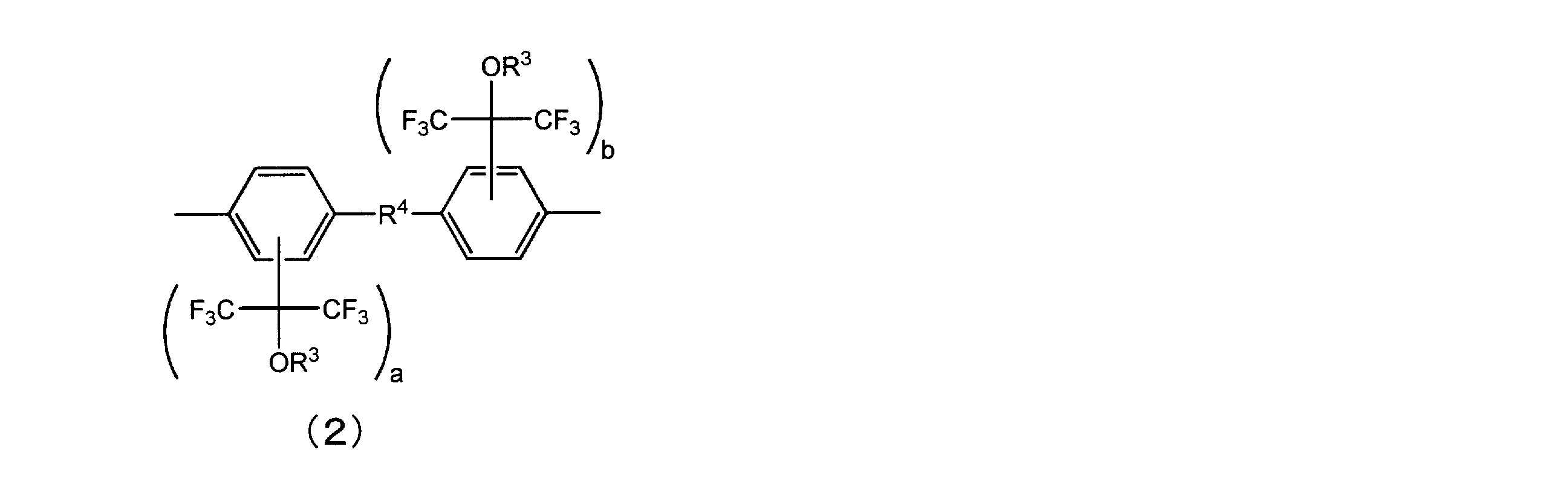
(式中、R3はそれぞれ独立に水素原子または保護基であり、R4は単結合、酸素原子、硫黄原子、SO2、CH2、CO、C(CH3)2、C(CH3)(CH2CH3)、C(CF3)2、C(CH3)(C6H5)、CH2-C6H4-CH2、またはベンゼン、ビフェニル、ナフタレン、シクロヘキセンもしくはフルオレンから水素原子が2個離脱した2価の有機基であり、aとbはそれぞれ独立に0~2の整数であり、1≦a+b≦4である。)
R1が一般式(2)で表される基である、発明1の感光性樹脂組成物。
[発明3]
R1が一般式(3)で表される基である、発明1または発明2の感光性樹脂組成物。

(式中、R3は、それぞれ独立に、水素原子または保護基であり、R4は、単結合、酸素原子、硫黄原子、SO2、CH2、CO、C(CH3)2、C(CH3)(CH2CH3)、C(CF3)2、C(CH3)(C6H5)、CH2-C6H4-CH2、またはベンゼン、ビフェニル、ナフタレン、シクロヘキセンもしくはフルオレンから水素原子が2個離脱した2価の有機基である。)
R1が一般式(3)で表される基である、発明1または発明2の感光性樹脂組成物。
[発明4]
R1が一般式(4)で表される基である、発明1~3の感光性樹脂組成物。
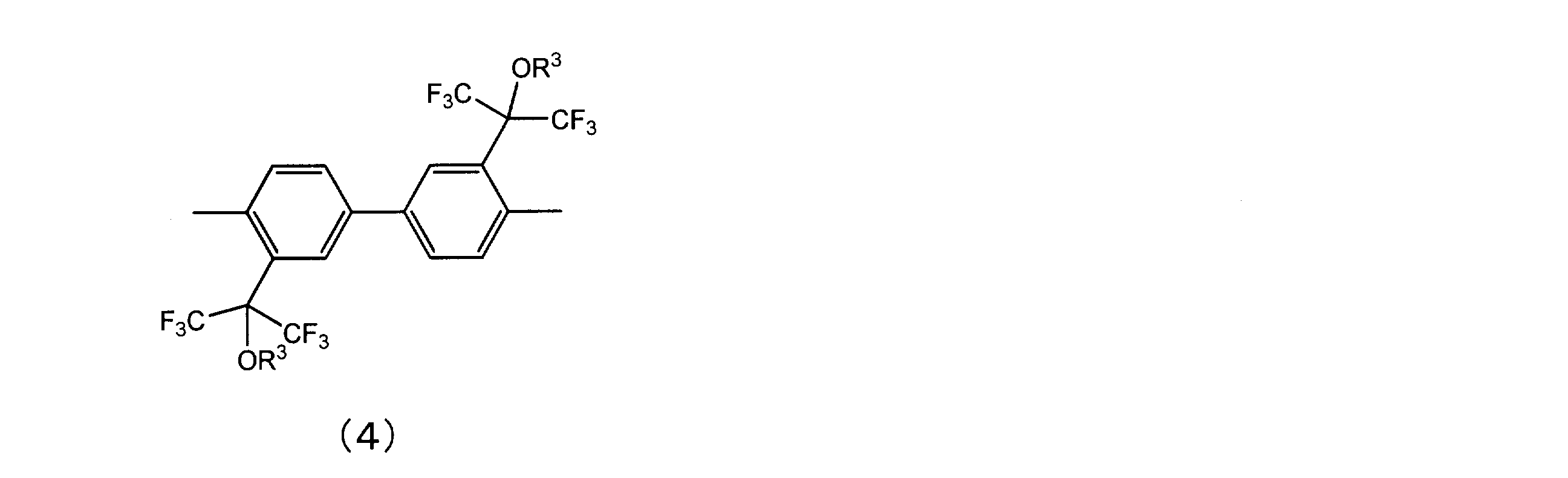
(式中、R3は、それぞれ独立に、水素原子または保護基である。)
R1が一般式(4)で表される基である、発明1~3の感光性樹脂組成物。
[発明5]
R1が一般式(5)で表される基である、発明1~3の感光性樹脂組成物。
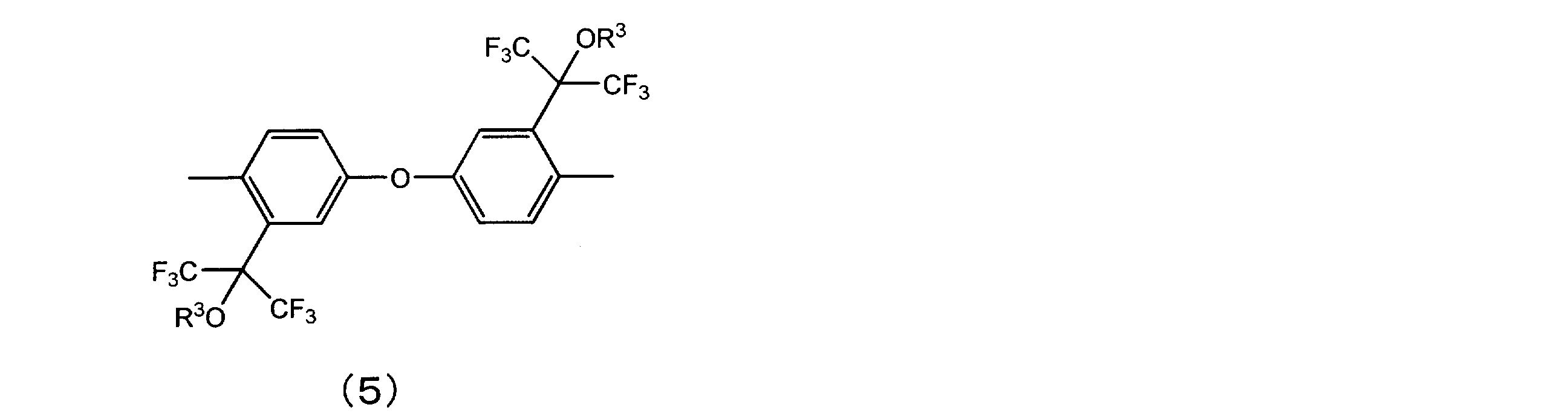
(式中、R3は、それぞれ独立に、水素原子または保護基である。)
R1が一般式(5)で表される基である、発明1~3の感光性樹脂組成物。
[発明6]
R1が一般式(6)で表される基である、発明1の感光性樹脂組成物。
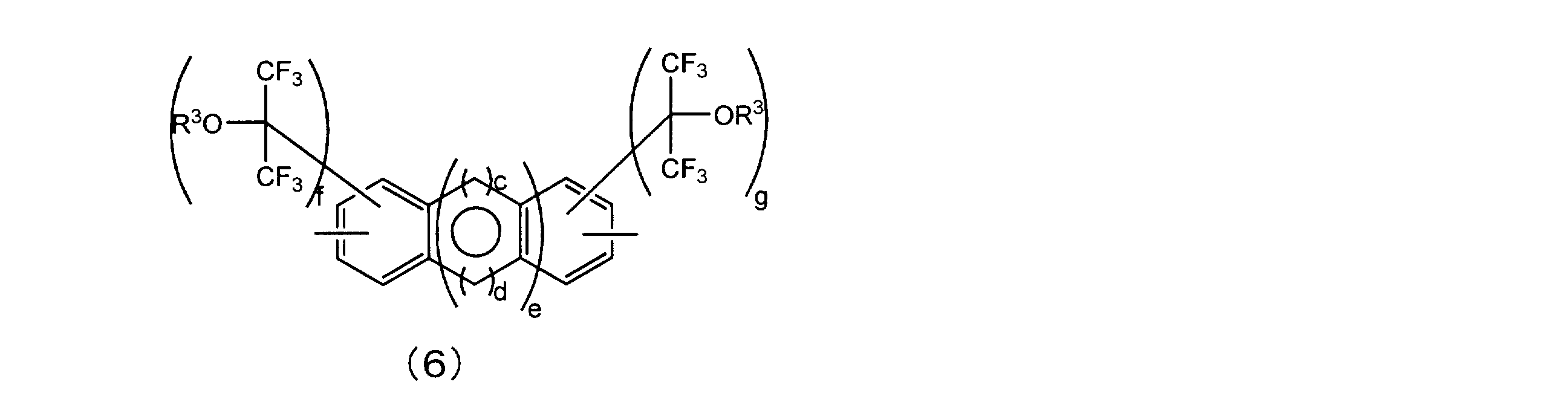
(式中、R3は、それぞれ独立に、水素原子または保護基であり、c、dはそれぞれ独立に0~2の整数であり、c+d=0~4である。eは0~3の整数である。fとgはそれぞれ独立に0~2の整数であり、1≦f+g≦4である。また、式(6)中、次式:

で表される部位は芳香環を表わし、環を構成する炭素原子がヘテロ原子(窒素原子、酸素原子または硫黄原子)で置換してもよく、水素原子は置換基で置換してもよく、この置換基は窒素原子、酸素原子または硫黄原子を含んでいてもよい。尚、式中の円は、これを包む環が芳香環を形成していることを示す。)
R1が一般式(6)で表される基である、発明1の感光性樹脂組成物。
[発明7]
R1が一般式(7)で表される基である、発明1または発明6の感光性樹脂組成物。

(式中、R3は、それぞれ独立に、水素原子または保護基であり、fとgはそれぞれ独立に0~2の整数であり、1≦f+g≦4である。)
R1が一般式(7)で表される基である、発明1または発明6の感光性樹脂組成物。
[発明8]
R1が一般式(8)で表される基である、発明1、発明6または発明7の感光性樹脂組成物。
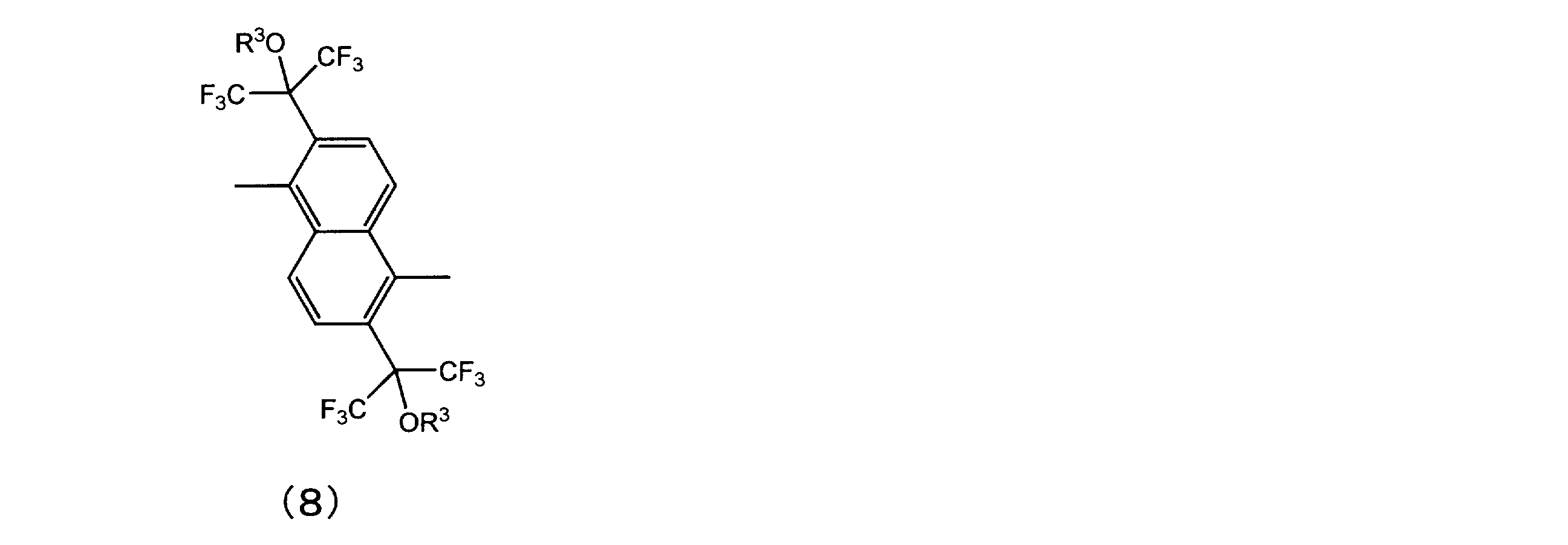
(式中、R3は、それぞれ独立に、水素原子または保護基である。)
R1が一般式(8)で表される基である、発明1、発明6または発明7の感光性樹脂組成物。
[発明9]
さらにエポキシ化合物を含む、発明1~8に記載の感光性樹脂組成物。
さらにエポキシ化合物を含む、発明1~8に記載の感光性樹脂組成物。
[発明10]
前記エポキシ化合物が、グリシジル基を含み、化学構造中に炭素-炭素二重結合、炭素-炭素三重結合、芳香環または複素環を含んでいてもよく、エポキシ化合物中の水素原子の一部または全部が、それぞれ独立に、フッ素原子、塩素原子、アルキル基またはフルオロアルキル基で置換されていてもよいエポキシ化合物である、発明9の感光性樹脂組成物。
前記エポキシ化合物が、グリシジル基を含み、化学構造中に炭素-炭素二重結合、炭素-炭素三重結合、芳香環または複素環を含んでいてもよく、エポキシ化合物中の水素原子の一部または全部が、それぞれ独立に、フッ素原子、塩素原子、アルキル基またはフルオロアルキル基で置換されていてもよいエポキシ化合物である、発明9の感光性樹脂組成物。
[発明11]
さらにエポキシ樹脂硬化剤を含む、発明9の感光性樹脂組成物。
さらにエポキシ樹脂硬化剤を含む、発明9の感光性樹脂組成物。
[発明12]
感光剤(B)が、露光により酸を発生する光酸発生剤である、発明1~11の感光性樹脂組成物。
感光剤(B)が、露光により酸を発生する光酸発生剤である、発明1~11の感光性樹脂組成物。
[発明13]
感光剤(B)が、露光によりスルホン酸を発生する光酸発生剤である、発明1~12に記載の感光性樹脂組成物。
感光剤(B)が、露光によりスルホン酸を発生する光酸発生剤である、発明1~12に記載の感光性樹脂組成物。
[発明14]
感光剤(B)が、露光によりインデンカルボン酸を発生するジアゾナフトキノン化合物である、発明1~13の感光性樹脂組成物。
感光剤(B)が、露光によりインデンカルボン酸を発生するジアゾナフトキノン化合物である、発明1~13の感光性樹脂組成物。
[発明15]
極性溶剤(C)が、プロピレングリコールモノメチルエーテルアセテート、プロピレングリコールモノメチルエーテル、シクロヘキサノン、γ-ブチロラクトン、メチルエチルケトン、メチルイソブチルケトン、N,N-ジメチルホルムアミドまたはN-メチルピロリドンからなる群から選ばれる少なくとも一つの極性溶剤である、発明1~14の感光性樹脂組成物。
極性溶剤(C)が、プロピレングリコールモノメチルエーテルアセテート、プロピレングリコールモノメチルエーテル、シクロヘキサノン、γ-ブチロラクトン、メチルエチルケトン、メチルイソブチルケトン、N,N-ジメチルホルムアミドまたはN-メチルピロリドンからなる群から選ばれる少なくとも一つの極性溶剤である、発明1~14の感光性樹脂組成物。
[発明16]
発明1~15の感光性樹脂組成物を基板上に塗布し溶剤を揮発させる工程と、前記乾燥工程後に得られる感光性樹脂膜を、フォトマスクを介し所定のパターン形状に露光する工程と、前記露光後の感光性樹脂膜を現像液に接触させて現像する工程と、前記現像後の感光性樹脂膜を加熱する工程を含む、パターン形成方法。
発明1~15の感光性樹脂組成物を基板上に塗布し溶剤を揮発させる工程と、前記乾燥工程後に得られる感光性樹脂膜を、フォトマスクを介し所定のパターン形状に露光する工程と、前記露光後の感光性樹脂膜を現像液に接触させて現像する工程と、前記現像後の感光性樹脂膜を加熱する工程を含む、パターン形成方法。
本発明により、溶解性基としてカルボキシル基およびフェノール性水酸基を含むことなく、極性溶剤に溶解し基板に塗布可能であり、ポジ型またはネガ型のレジストパターン形成が可能な芳香族ポリエステルを含む感光性樹脂組成物を得ることができる。さらに、本発明により、透明性に優れた芳香族ポリエステルを含む感光性樹脂組成物を得ることができる。
本発明の感光性樹脂組成物は、含フッ素高分子化合物(A)と、感光剤(B)および極性溶剤(C)を含む。
本発明の感光性樹脂組成物は、極性溶剤(C)に含フッ素高分子化合物(A)と感光剤(B)が溶解した溶液であり、リソグラフィにより、基板に塗布した後露光することで、ポジ型またはネガ型のレジストパターンとなり、パターン形成が可能である。
含フッ素高分子化合物(A)は、2個のフェノール性水酸基、および保護基で保護されたまたは保護基で保護されていないヘキサフルオロイソプロパノール基を含む含フッ素化合物を、当該含フッ素化合物中のフェノール性水酸基が選択的にジカルボン酸またはその誘導体と縮重合反応させることによって得られる。当該含フッ素高分子化合物(A)は、ヘキサフルオロイソプロパノール基を含むことで、極性溶剤(C)に可溶である。
当該含フッ素高分子化合物(A)に、感光剤(B)および極性溶剤(C)を加えた本発明の感光性樹脂組成物は常温(5℃~35℃)で液体であり、基板等に塗布し塗膜とし加熱硬化させた際、透明性低下の原因となる複素環を形成することがない。
以下、本発明の感光性樹脂組成物に用いる各組成物である、含フッ素高分子化合物(A)、含フッ素高分子化合物(A)を得るための原料モノマーである含フッ素化合物およびジカルボン酸またはその誘導体、感光剤(B)、極性溶剤(C)、および感光性樹脂組成物によるパターン形成方法について順を追って説明する。
1.感光性樹脂組成物に用いる含フッ素高分子化合物(A)
含フッ素高分子化合物(A)は、一般式(1)で表される繰り返し単位を含む。

(式中、R1は、保護基で保護されたまたは保護基で保護されていないヘキサフルオロイソプロパノール基を1~4個含む2価の有機基であり、R2は2価の有機基である。)
含フッ素高分子化合物(A)は、一般式(1)で表される繰り返し単位を含む。
R1は、以下の一般式(2)~(8)で表されるいずれかの基であることが好ましい。
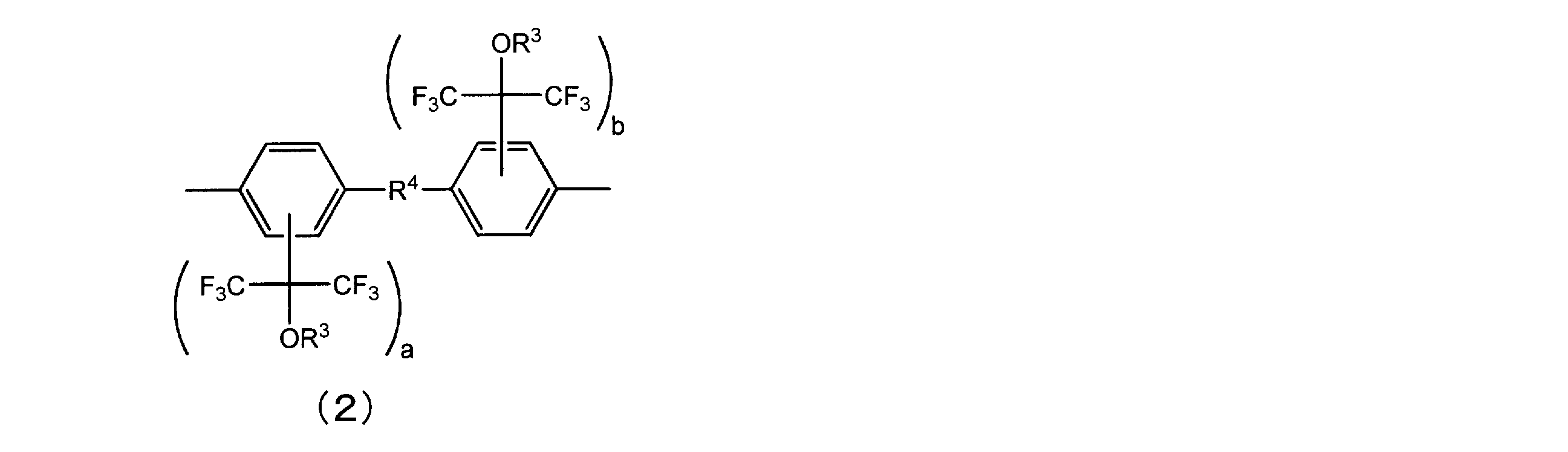
(式(2)中、R3はそれぞれ独立に水素原子または保護基であり、R4は単結合、酸素原子、硫黄原子、SO2、CH2、CO、C(CH3)2、C(CH3)(CH2CH3)、C(CF3)2、C(CH3)(C6H5)、CH2-C6H4-CH2、またはベンゼン、ビフェニル、ナフタレン、シクロヘキセンもしくはフルオレンから水素原子が2個離脱した2価の有機基であり、aとbはそれぞれ独立に0~2の整数であり、1≦a+b≦4である。)

(式(3)中、R3は、それぞれ独立に、水素原子または保護基であり、R4は、単結合、酸素原子、硫黄原子、SO2、CH2、CO、C(CH3)2、C(CH3)(CH2CH3)、C(CF3)2、C(CH3)(C6H5)、CH2-C6H4-CH2、またはベンゼン、ビフェニル、ナフタレン、シクロヘキセンもしくはフルオレンから水素原子が2個離脱した2価の有機基である。)

(式(4)中、R3は、それぞれ独立に、水素原子または保護基である。)
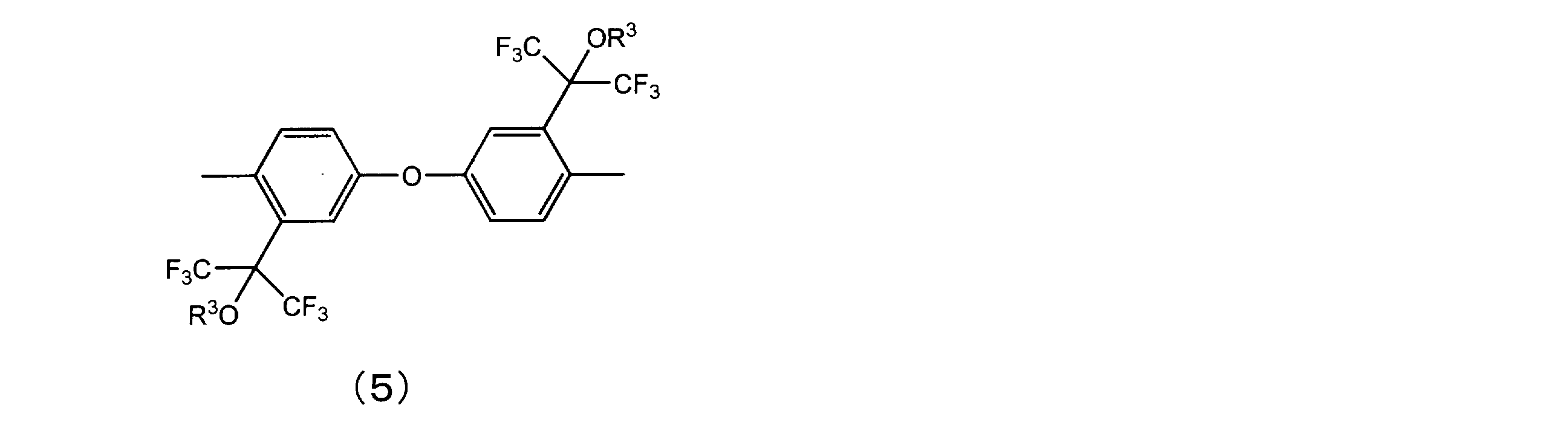
(式(5)中、R3は、それぞれ独立に、水素原子または保護基である。)

(式(6)中、R3は、それぞれ独立に、水素原子または保護基であり、c、dはそれぞれ独立に0~2の整数であり、c+d=0~4である。eは0~3の整数である。fとgはそれぞれ独立に0~2の整数であり、1≦f+g≦4である。また、式(6)中、次式:

で表される部位は芳香環を表わし、環を構成する炭素原子がヘテロ原子(窒素原子、酸素原子または硫黄原子)で置換してもよく、水素原子は置換基で置換してもよく、この置換基は窒素原子、酸素原子または硫黄原子を含んでいてもよい。尚、式中の円は、これを包む環が芳香環を形成していることを示す。)
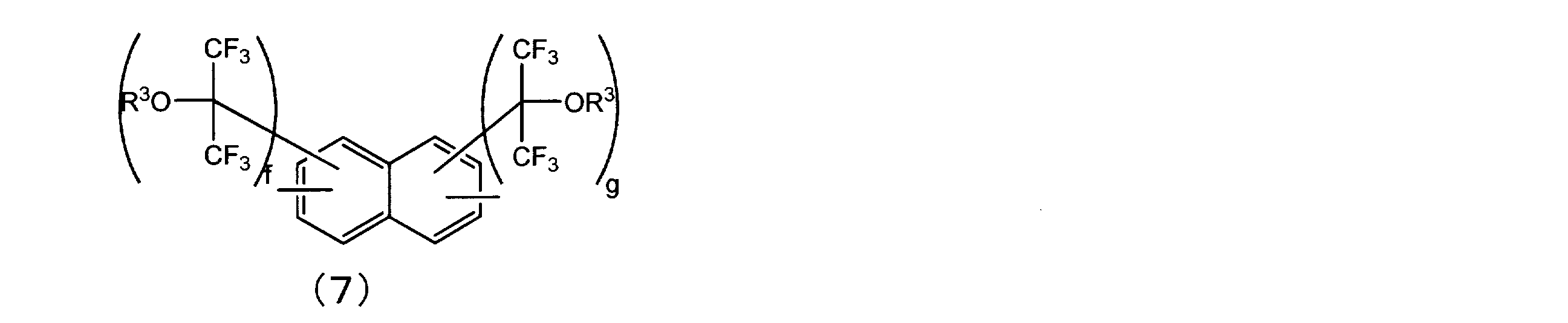
(式中、R3は、それぞれ独立に、水素原子または保護基であり、fとgはそれぞれ独立に0~2の整数であり、1≦f+g≦4である。)
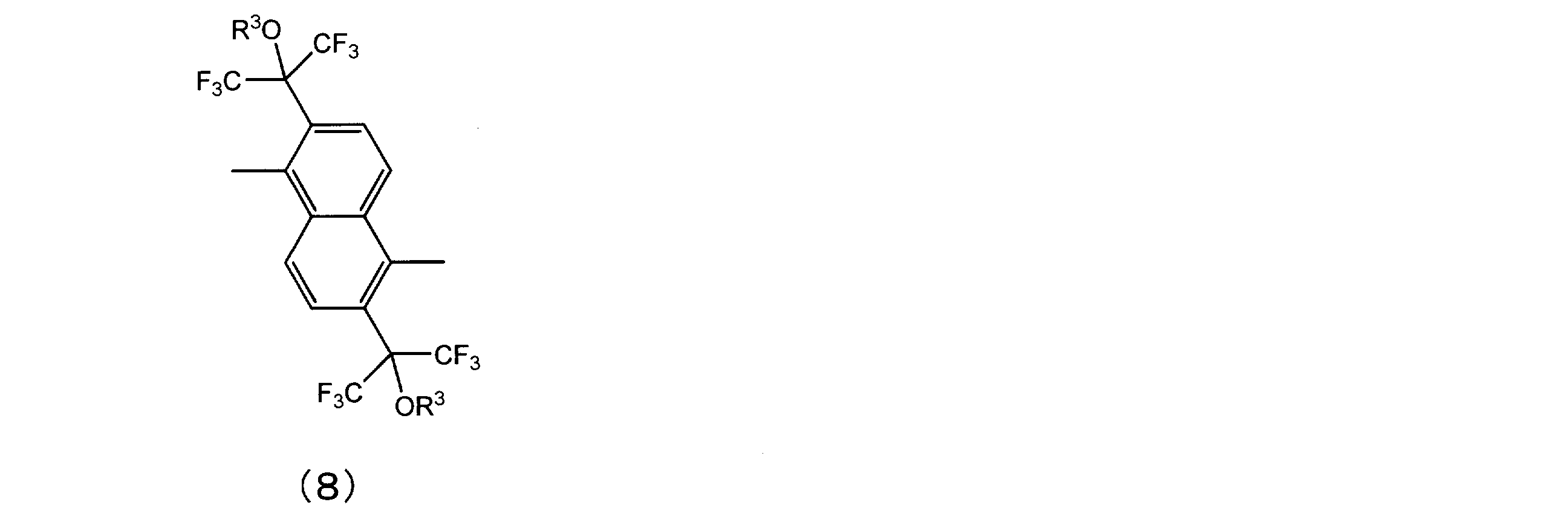
(式中、R3は、それぞれ独立に、水素原子または保護基である。)
本発明の感光性樹脂組成物は、バッファーコート膜または再配線膜等の半導体用保護膜に好適に採用できる。さらに、本発明の感光性樹脂組成物に用いる含フッ素高分子化合物(A)はポリエステルであることから、従来の感光性ポリイミドや感光性ポリベンズオキサゾール等の複素環含有樹脂に比べて透明性が高く、タッチパネル用ディスプレイの保護膜としても好適に採用できる。
含フッ素高分子化合物(A)において、R1が前述の式(4)、式(5)または式(8)で表わされる基であれば、基板に塗布し膜とした際の透明性が高く好ましい。
2.含フッ素高分子化合物(A)を重合するための原料モノマー
含フッ素高分子化合物(A)は、2個のフェノール性水酸基を有し且つ芳香環にヘキサフルオロイソプロパノール基が結合した含フッ素化合物と、ジカルボン酸またはその誘導体とを原料モノマーとして、当該含フッ素化合物とジカルボン酸またはその誘導体が縮重合反応することによって得られる。即ち、HO-R1-OHで表わされる含フッ素化合物と、HOOC-R2-COOHで表わされるジカルボン酸またはその誘導体が縮重合反応し、一般式(1A)で表わされる含フッ素樹脂化合物が得られる。
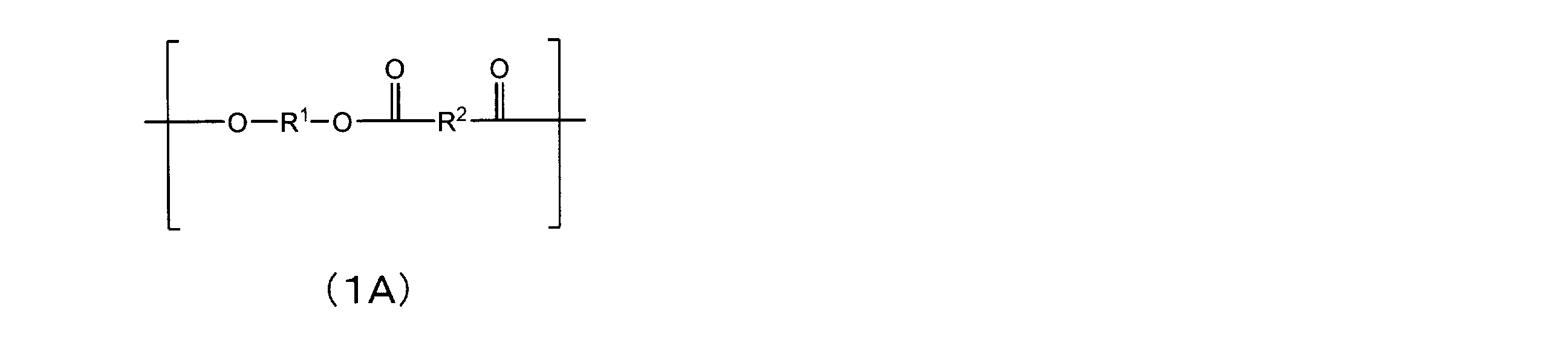
(式中、R1は、保護基で保護されたまたは保護基で保護されていないヘキサフルオロイソプロパノール基を1~4個含む2価の有機基であり、R2は2価の有機基である。)
本発明の感光性樹脂組成物に含まれる含フッ素高分子化合物(A)は、HO-R1-OH(一般式(1A)に含まれる以下の一般式(2A)~(9A)で表わされる含フッ素化合物と、HOOC-R2-COOHに含まれる以下の一般式(10)~(11)で表わされるジカルボン酸またはその誘導体を縮重合させて得られる。順を追って説明する。
含フッ素高分子化合物(A)は、2個のフェノール性水酸基を有し且つ芳香環にヘキサフルオロイソプロパノール基が結合した含フッ素化合物と、ジカルボン酸またはその誘導体とを原料モノマーとして、当該含フッ素化合物とジカルボン酸またはその誘導体が縮重合反応することによって得られる。即ち、HO-R1-OHで表わされる含フッ素化合物と、HOOC-R2-COOHで表わされるジカルボン酸またはその誘導体が縮重合反応し、一般式(1A)で表わされる含フッ素樹脂化合物が得られる。
本発明の感光性樹脂組成物に含まれる含フッ素高分子化合物(A)は、HO-R1-OH(一般式(1A)に含まれる以下の一般式(2A)~(9A)で表わされる含フッ素化合物と、HOOC-R2-COOHに含まれる以下の一般式(10)~(11)で表わされるジカルボン酸またはその誘導体を縮重合させて得られる。順を追って説明する。
2-1.含フッ素化合物
含フッ素化合物としては、HO-R1-OHに含まれる一般式(2A)~(8A)で表わされる化合物が挙げられる。
[一般式(2A)で表わされる含フッ素化合物]
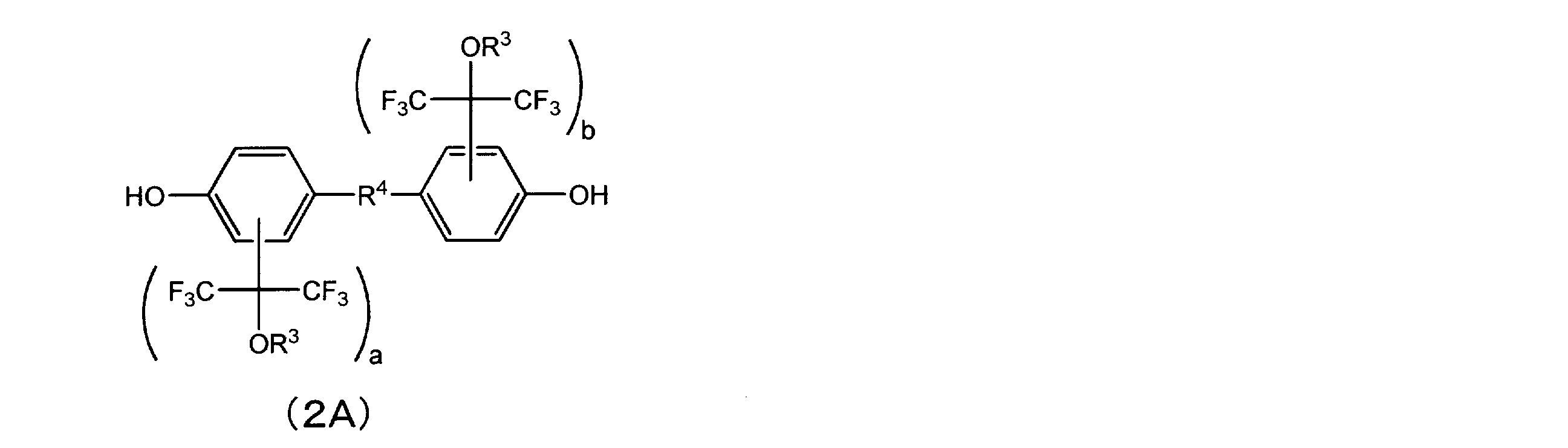
(式(2A)中、R3はそれぞれ独立に水素原子または保護基であり、R4は単結合、酸素原子、硫黄原子、SO2、CH2、CO、C(CH3)2、C(CH3)(CH2CH3)、C(CF3)2、C(CH3)(C6H5)、CH2-C6H4-CH2、またはベンゼン、ビフェニル、ナフタレン、シクロヘキセンもしくはフルオレンから水素原子が2個離脱した2価の有機基であり、aとbはそれぞれ独立に0~2の整数であり、1≦a+b≦4である。)
[一般式(3A)で表わされる含フッ素化合物]
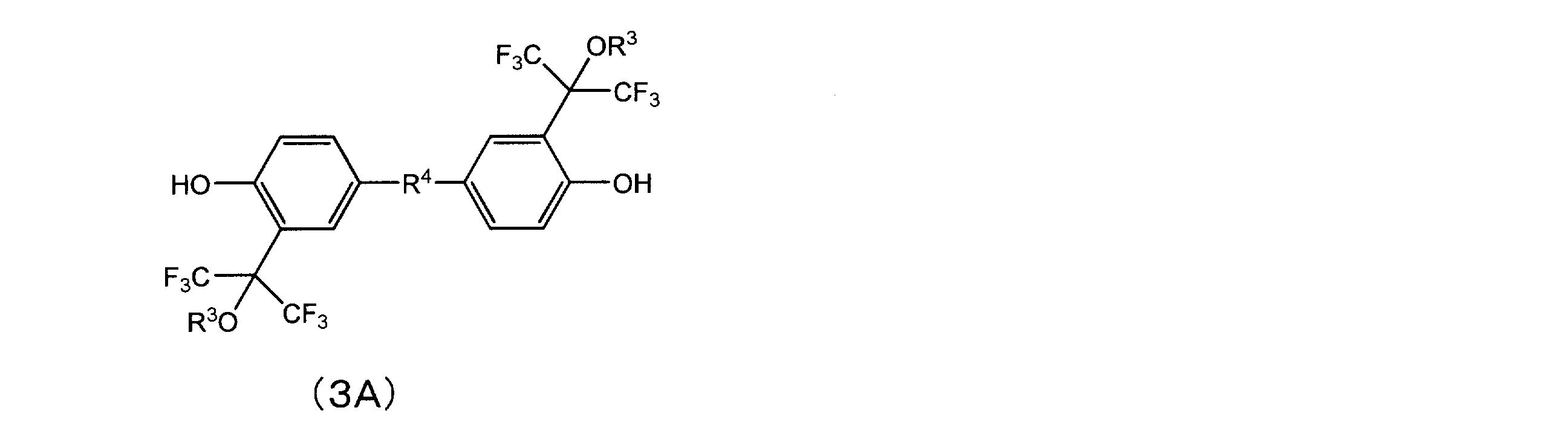
(式(3A)中、R3は、それぞれ独立に、水素原子または保護基であり、R4は、単結合、酸素原子、硫黄原子、SO2、CH2、CO、C(CH3)2、C(CH3)(CH2CH3)、C(CF3)2、C(CH3)(C6H5)、CH2-C6H4-CH2、またはベンゼン、ビフェニル、ナフタレン、シクロヘキセンもしくはフルオレンから水素原子が2個離脱した2価の有機基である。)
[一般式(4A)で表わされる含フッ素化合物]
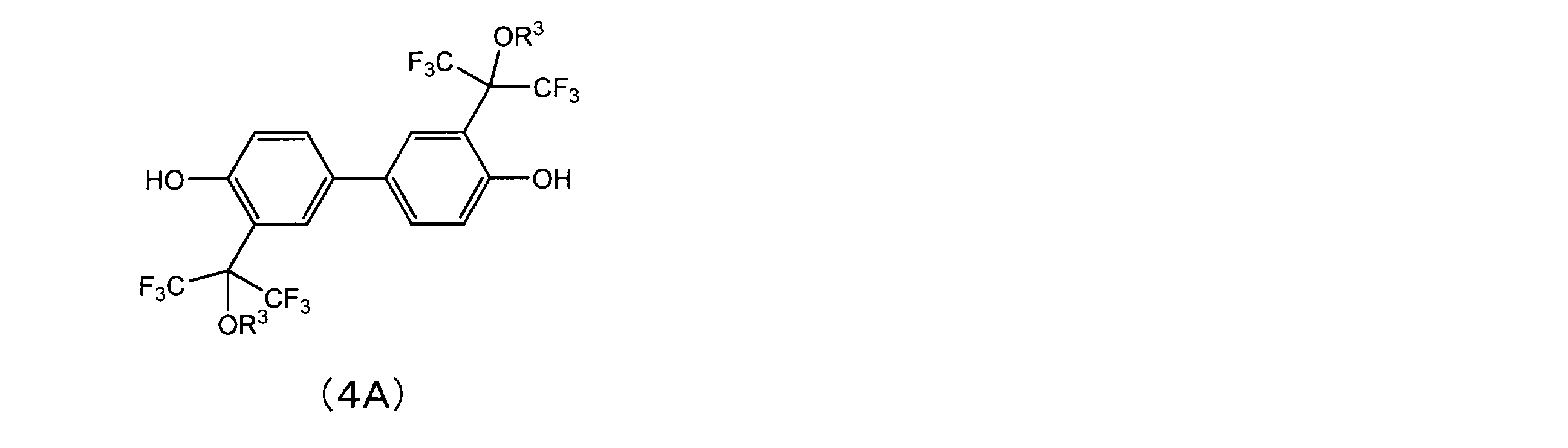
(式(4A)中、R3は、それぞれ独立に、水素原子または保護基である。)
[一般式(5A)で表わされる含フッ素化合物]
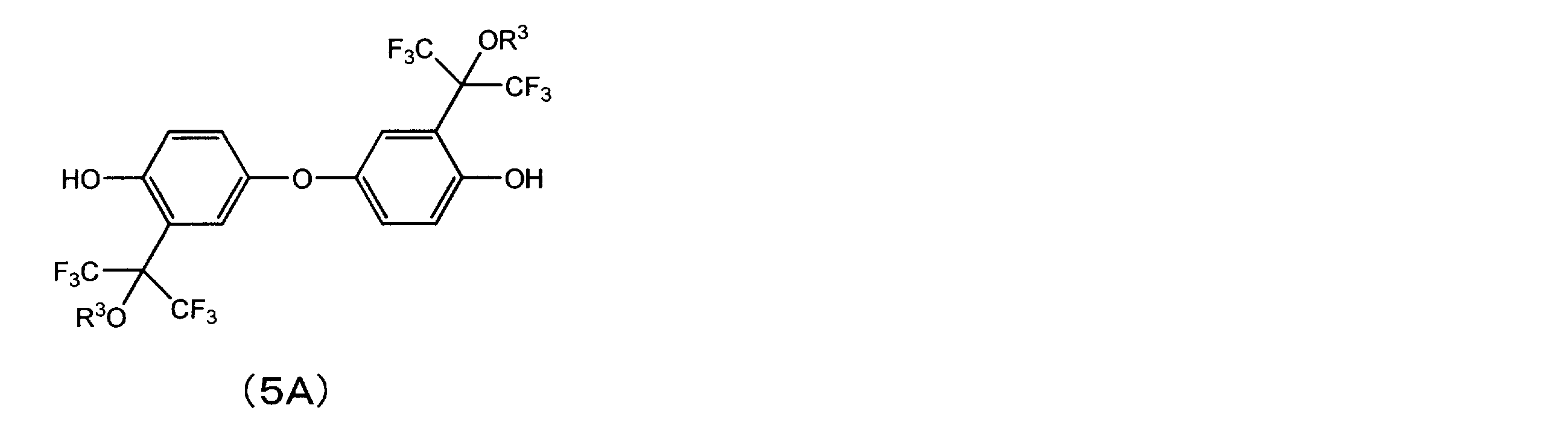
(式(5A)中、R3は、それぞれ独立に、水素原子または保護基である。)
[一般式(6A)で表わされる含フッ素化合物]

(式(6A)中、R3は、それぞれ独立に、水素原子または保護基であり、c、dはそれぞれ独立に0~2の整数であり、c+d=0~4である。eは0~3の整数である。fとgはそれぞれ独立に0~2の整数であり、1≦f+g≦4である。また、式(6A)中、次式:

で表される部位は芳香環を表わし、環を構成する炭素原子がヘテロ原子(窒素原子、酸素原子または硫黄原子)で置換してもよく、水素原子は置換基で置換してもよく、この置換基は窒素原子、酸素原子または硫黄原子を含んでいてもよい。尚、式中の円は、これを包む環が芳香環を形成していることを示す。)
[一般式(7A)で表わされる含フッ素化合物]

(式中、R3は、それぞれ独立に、水素原子または保護基であり、fとgはそれぞれ独立に0~2の整数であり、1≦f+g≦4である。)
[一般式(8A)で表わされる含フッ素化合物]
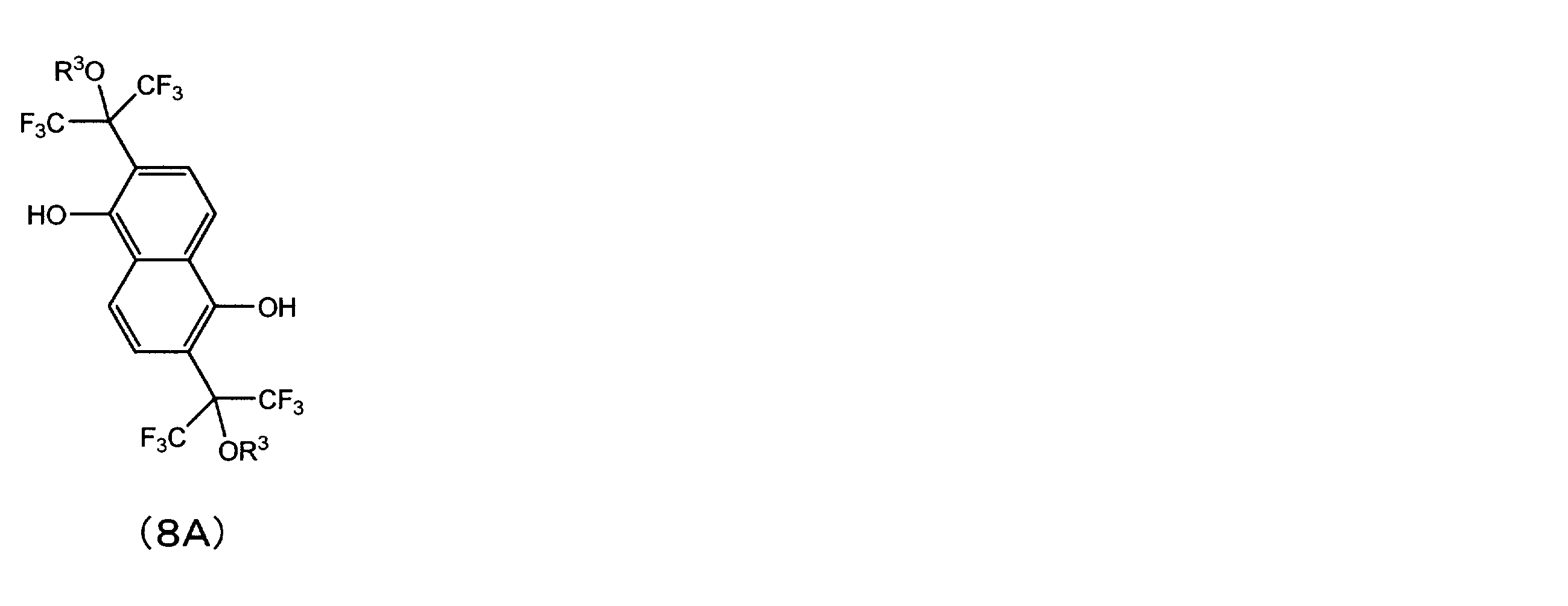
(式中、R3は、それぞれ独立に、水素原子または保護基である。)
含フッ素化合物としては、HO-R1-OHに含まれる一般式(2A)~(8A)で表わされる化合物が挙げられる。
[一般式(2A)で表わされる含フッ素化合物]
[一般式(3A)で表わされる含フッ素化合物]
[一般式(4A)で表わされる含フッ素化合物]
[一般式(5A)で表わされる含フッ素化合物]
[一般式(6A)で表わされる含フッ素化合物]
[一般式(7A)で表わされる含フッ素化合物]
[一般式(8A)で表わされる含フッ素化合物]
2-2.保護基
保護基R3は、光照射された光酸発生剤から発生した酸により加水分解して脱離し、その結果、保護されていたヘキサフルオロプロパノール基は、OH基を有するヘキサフルオロプロパノール基となる。
保護基R3は、光照射された光酸発生剤から発生した酸により加水分解して脱離し、その結果、保護されていたヘキサフルオロプロパノール基は、OH基を有するヘキサフルオロプロパノール基となる。
具体的には、保護基R3は、以下の(L-1)~(L-4)に表わされる基を挙げることができる。
R3A-O-C(=O)- (L-1)
R3A-O-CHR3B- (L-2)
SiR3CR3DR3E- (L-3)
R3A-C(=O)- (L-4)
R3A-O-C(=O)- (L-1)
R3A-O-CHR3B- (L-2)
SiR3CR3DR3E- (L-3)
R3A-C(=O)- (L-4)
これらのうち、(L-1)、(L-2)は化学増幅型として機能するので、高エネルギー線で露光するパターン形成方法に適用するレジスト組成物において使用するのに特に好ましい。尚、R3A~R3Eは1価の有機基である。
R3A-O-C(=O)-で表されるアルコキシカルボニル基(L-1)としては、tert-ブトキシカルボニル基、tert-アミルオキシカルボニル基、メトキシカルボニル基、エトキシカルボニル基、i-プロポキシカルボニル基、シクロヘキシルオキシカルボニル基、イソボルニルオキシカルボニル基またはアダマンタンオキシカルボニル基等を例示できる。中でもtert-ブトキシカルボニル基、メトキシカルボニル基、エトキシカルボニル基が好ましく、特にtert-ブトキシカルボニル基が好ましい。ヘキサフルオロイソプロパノール基を含有する高分子化合物(一般式(2)または一般式(6)で表される基において、R3が水素である含フッ素高分子化合物(A))を、ピリジンまたはトリエチルアミン等の有機塩基の存在下、tert-ブトキシカルボン酸無水物と反応させることで、目的とするtert-ブトキシカルボニル基で保護された高分子化合物を得ることができる。
R3A-O-CHR3B-で表されるアセタール基(L-2)としては、メトキシメチル基、エトキシメチル基、1-エトキシエチル基、1-ブトキシエチル基、1-イソブトキシエチル基、1-シクロヘキシルオキシエチル基、1-ベンジルオキシエチル基、1-フェネチルオキシエチル基、1-エトキシプロピル基、1-ベンジルオキシプロピル基、1-フェネチルオキシプロピル基、1-エトキシブチル基、1-シクロヘキシロキシエチル基、1-エトキシイソブチル基、1-メトキシエトキシメチル基、テトラヒドロピラニル基またはテトラヒドロフラニル基等を挙げることができる。また水酸基に対してビニルエーテル類を付加させて得られるアセタール基を挙げることができる。中でも、メトキシメチル基、エトキシメチル基、1-エトキシエチル基が好ましく、特に入手の容易さからメトキシメチル基が好ましい。ヘキサフルオロイソプロパノール基を含有する高分子化合物(一般式式(2)または一般式(6)で表され、R3が水素である高分子化合物)を、水素化ナトリウムまたは水素化カルシウム等で処理した後、メトキシメチルクロリドと反応させることで、目的とするメトキシメチル基で保護された高分子化合物を得ることができる。
SiR3CR3DR3E-で表されるシリル基(L-3)としては、例えば、トリメチルシリル基、エチルジメチルシリル基、メチルジエチルシリル基、トリエチルシリル基、i-プロピルジメチルシリル基、メチルジ-i-プロピルシリル基、トリ-i-プロピルシリル基、tert-ブチルジメチルシリル基、メチルジ-tert-ブチルシリル基、トリ-tert-ブチルシリル基、フェニルジメチルシリル基、メチルジフェニルシリル基またはトリフェニルシリル基等を挙げることができる。中でも、トリメチルシリル基、トリエチルシリル基、tert-ブチルジメチルシリル基、メチルジ-tert-ブチルシリル基が好ましく、特に、入手の容易さからトリメチルシリル基が好ましい。ヘキサフルオロイソプロパノール基を含有する高分子化合物(一般式(2)または一般式(6)で表され、R3が水素である高分子化合物)を、ピリジンまたはトリエチルアミン等の有機塩基の存在下、トリメチルシリルクロリドと反応させることで、目的とするトリメチルシリル基で保護された高分子化合物を得ることができる。
R3A-C(=O)-で表されるアシル基(L-4)としては、アセチル基、プロピオニル基、ブチリル基、ヘプタノイル基、ヘキサノイル基、バレリル基、ピバロイル基、イソバレリル基、ラウリロイル基、ミリストイル基、パルミトイル基、ステアロイル基、オキサリル基、マロニル基、スクシニル基、グルタリル基、アジポイル基、ピペロイル基、スベロイル基、アゼラオイル基、セバコイル基、アクリロイル基、プロピオロイル基、メタクリロイル基、クロトノイル基、オレオイル基、マレオイル基、フマロイル基、メサコノイル基、カンホロイル基、ベンゾイル基、フタロイル基、イソフタロイル基、テレフタロイル基、ナフトイル基、トルオイル基、ヒドロアトロポイル基、アトロポイル基、シンナモイル基、フロイル基、テノイル基、ニコチノイル基またはイソニコチノイル基等を挙げることができる。さらに、これらの熱不安定性保護基の水素原子の一部又は全部がフッ素原子で置換されたものを使用することもできる。中でも、アセチル基、ピバロイル基、ベンゾイル基、ナフトイル基が好ましく、特に、入手の容易さから、アセチル基、ベンゾイル基が好ましい。ヘキサフルオロイソプロパノール基を含有する高分子化合物(一般式(2)または一般式(6)で表され、R3が水素である高分子化合物)を、ピリジンまたはトリエチルアミン等の有機塩基の存在下、無水酢酸、安息香酸無水物と反応させることで、目的とするアセチル基、ベンゾイル基で保護された高分子化合物を得ることができる。
2-3.上記含フッ素化合物の例示
一般式(2A)で表わされる含フッ素化合物の具体例としては、以下のものが挙げられる。
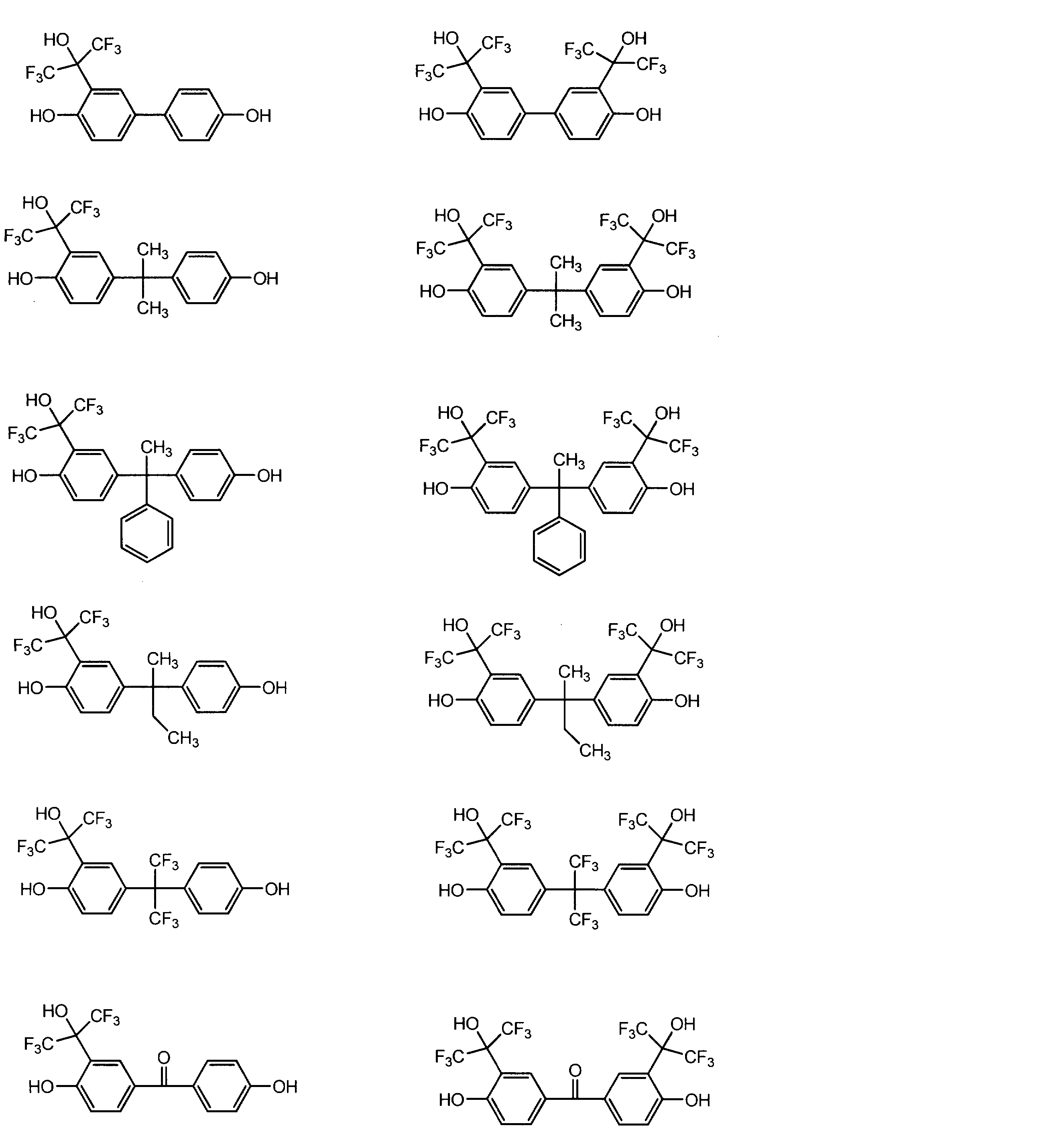
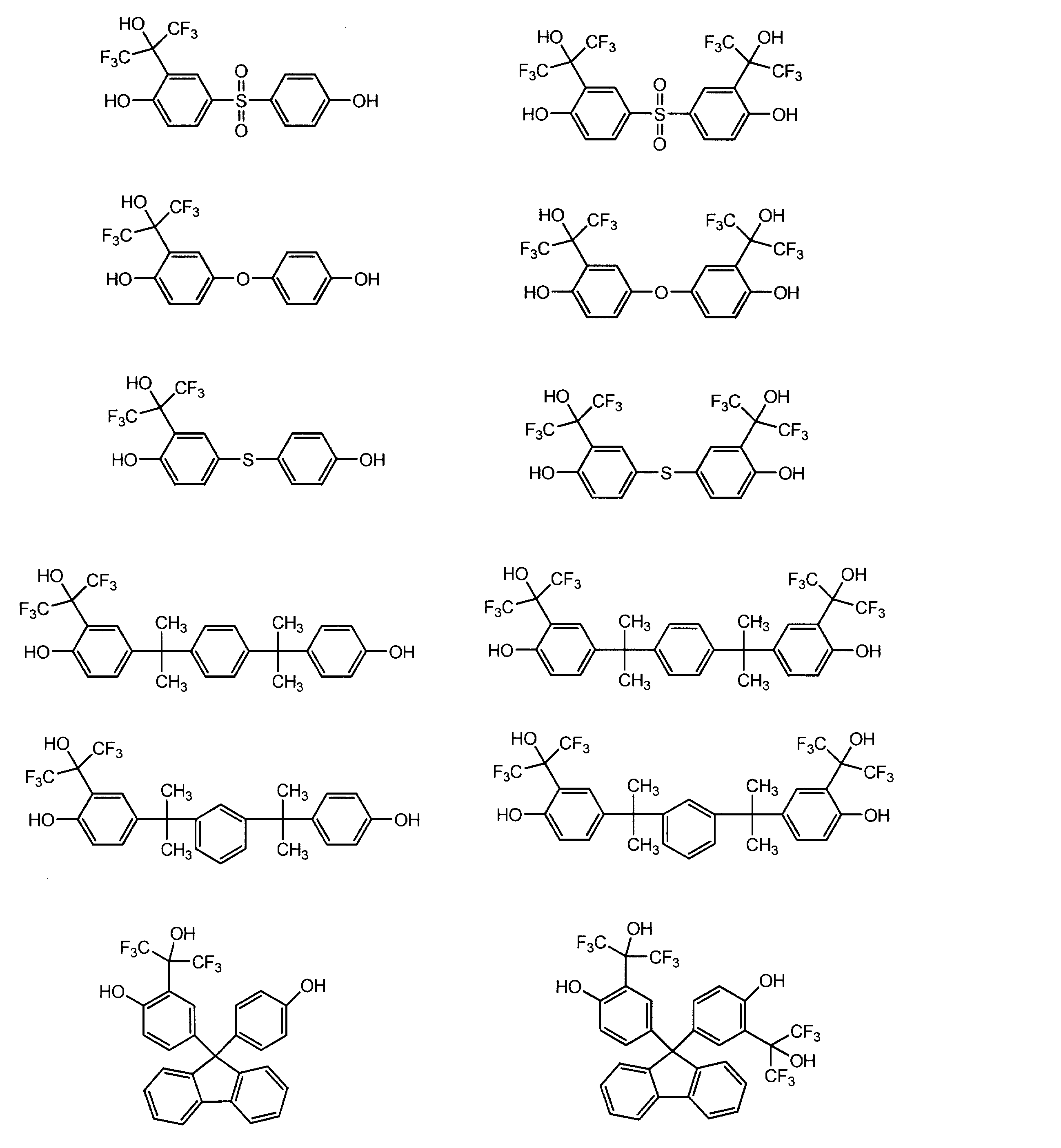
一般式(2A)で表わされる含フッ素化合物の具体例としては、以下のものが挙げられる。
一般式(7A)で表わされる含フッ素化合物の具体例としては、以下のものが挙げられる。

以下の含フッ素化合物は、縮重合反応をすることで一般式(1)で表わされる含フッ素高分子化合物(A)を与える。
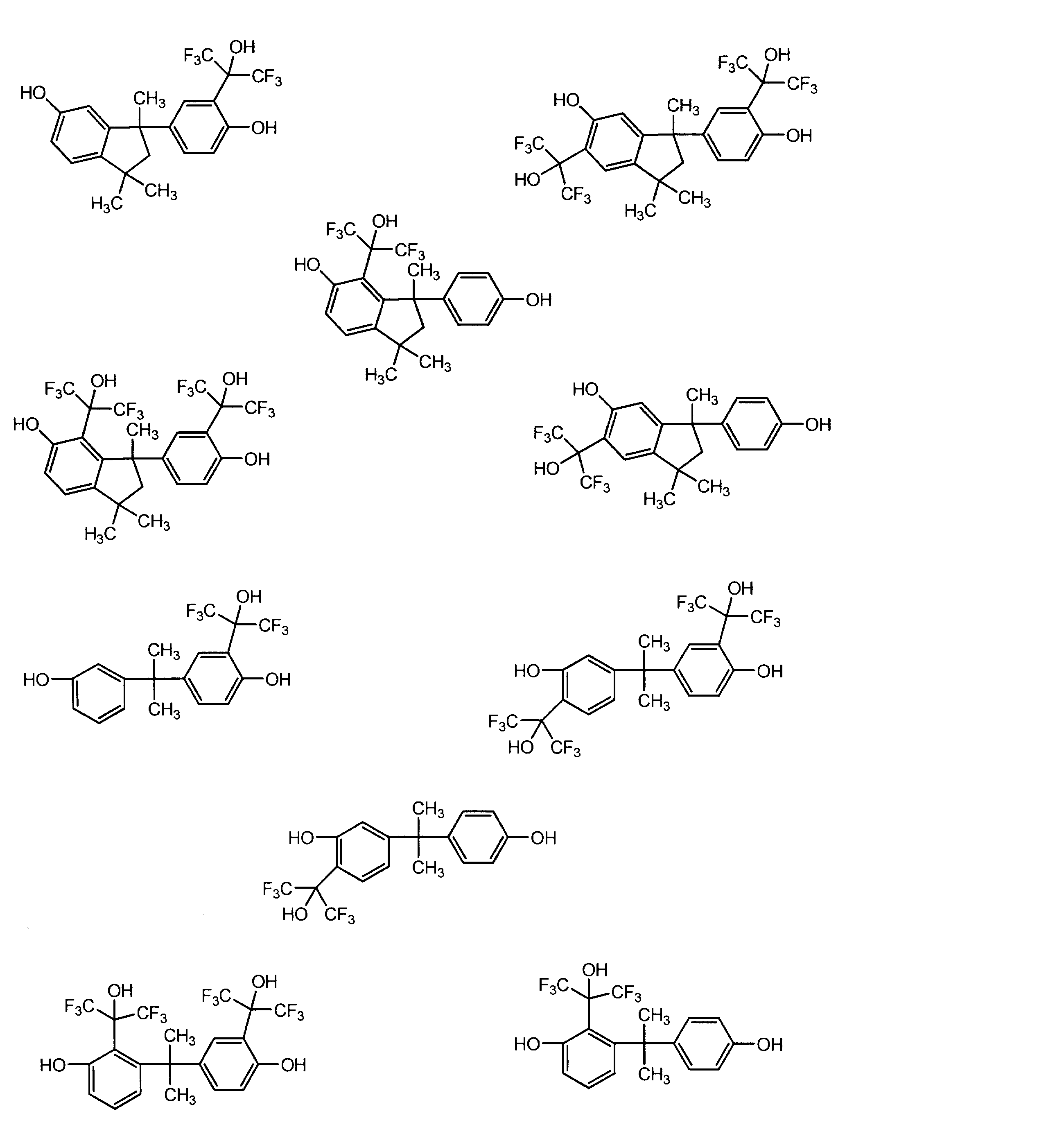
上記含フッ素化合物の中でも、合成が容易であること、および重合物の原料としてヘキサフルオロイソプロパノール基が2官能であることが好ましく、含フッ素高分子化合物(A)の原料モノマーとして、以下の構造式の含フッ素化合物(9A)~(11A)を用いることが好ましい。

2-4.含フッ素化合物の合成
一般式(1A)、HO-R1-OH(式中、R1は、ヘキサフルオロイソプロパノール基を1~4個含む2価の有機基である)で表わされる含フッ素化合物(1A)は、HO-R1X-OH(式中、R1Xは、ヘキサフルオロイソプロパノール基を含まない2価の有機基である)と、ヘキサフルオロアセトンまたはヘキサフルオロアセトン三水和物を反応させることによって得られる。
一般式(1A)、HO-R1-OH(式中、R1は、ヘキサフルオロイソプロパノール基を1~4個含む2価の有機基である)で表わされる含フッ素化合物(1A)は、HO-R1X-OH(式中、R1Xは、ヘキサフルオロイソプロパノール基を含まない2価の有機基である)と、ヘキサフルオロアセトンまたはヘキサフルオロアセトン三水和物を反応させることによって得られる。
ヘキサフルオロアセトンを使用する際は、HO-R1X-OH(ヘキサフルオロイソプロパノール基を含まない、以下同じ。)に、ヘキサフルオロアセトンを付加反応させる。ヘキサフルオロアセトンの沸点は-28℃であるので、ヘキサフルオロアセトンを反応系内に留めるためには、冷却装置または密封反応器を使用することが好ましく、特に密封反応器を使用することが好ましい。
また、ヘキサフルオロアセトン三水和物を使用する際は、HO-R1X-OHと、ヘキサフルオロアセトン三水和物を混合して反応させる。ヘキサフルオロアセトン三水和物の沸点は105℃であるので、ヘキサフルオロアセトンと比較して取り扱いが容易である。この際、反応装置としては、密封容器を使用してもよいが、還流冷却管を用い水冷することで、ヘキサフルオロアセトン三水和物を反応系内に留めることができる。
本反応に使用するヘキサフルオロアセトンまたはヘキサフルオロアセトン三水和物の量は、HO-R1X-OHに対して、2.0モル当量以上、8.0モル当量以下が好ましく、好ましくは2.2モル当量以上、3.0モル当量以下である。2.0モル当量未満では、当該含フッ素化合物の収率が低く、8.0モル当量を超えて使用しても反応は進行するが、8.0モル当量を超えて使う必要はない。
本反応は、50℃以上、200℃以下の温度範囲で行えるが、120℃以上、130℃以下が特に好ましい。50℃より低い温度では反応が進行し難く、200℃より高い温度、特に250℃以上では、含フッ素化合物の収率が低下する。
本反応は、触媒を使用しなくて進むが、酸触媒を使用することで反応を促進させることができる。使用される酸触媒としては、ルイス酸である塩化アルミニウム、塩化鉄(III)またはフッ化硼素、有機スルホン酸であるベンゼンスルホン酸、カンファースルホン酸(CSA)、メタンスルホン酸、p-トルエンスルホン酸(pTsOH)、p-トルエンスルホン酸(pTsOH)一水和物またはピリジニウムp-トルエンスルホン酸(PPTS)が好ましく、これらの中でも、塩化アルミニウム、塩化鉄(III)、メタンスルホン酸、p-トルエンスルホン酸(pTsOH)一水和物が入手し易く特に好ましい。使用される触媒の量は、4,4’-ビフェノール、ビス(4-ヒドロキシフェニル)エーテルまたは1,5-ジナフトール1モルに対して、1モル%以上、50モル%以下であり、好ましくは、3モル%以上、40モル%以下である。1モル%未満では、含フッ素化合物(1A)の収率が低く、50モル%より多く使用しても反応は進むが、多く加える必要はない。
本反応は無溶媒でも、溶剤を使用してもよい。使用される溶剤としては、反応に関与しないものなら特に制限は無いが、芳香族炭化水素類であるキシレン、トルエン、ベンゼン、アニソール、ジフェニルエーテル、ニトロベンゼンまたはベンゾニトリル、塩素系溶剤であるクロロホルム、塩化メチレン、ジクロロエタンまたはジクロロベンゼン、あるいは水が好ましい。使用する溶剤の量には特に制限が無いが、多量に使用することは反応器単位容積あたりの含フッ素化合物(1A)の収量が減少するので好ましくない。
本反応を、密封反応器(オートクレーブ)を使用して行うには、ヘキサフルオロアセトンまたはヘキサフルオロアセトン3水和物のいずれを用いるかによって態様が異なる。ヘキサフルオロアセトンを用いる場合は、最初に触媒または溶剤を反応器内に入れ、次いで、反応器内の圧力が0.5MPaを越えないように加温しつつ、ヘキサフルオロアセトンを加えることが好ましい。
ヘキサフルオロアセトン3水和物を用いる場合は、最初にHO-R1X-OHとヘキサフルオロアセトン3水和物を反応器内に入れ、触媒または溶剤を添加し反応を行うことができる。
本反応の反応時間に特別な制限はないが、温度または用いる触媒の量等により適宜選択される。従って、ガスクロマトグラフィー等、汎用の分析手段により、原料が十分消費されたことを確認した後、反応を終了することが好ましい。 反応終了後、抽出、蒸留、晶析等の手段により、含フッ素化合物を得ることができる。また、必要によりカラムクロマトグラフィーあるいは再結晶等により、含フッ素化合物(1A)を精製することができる。
例えば、含フッ素化合物(9A)は、4,4’-ビフェノールと、ヘキサフルオロアセトンまたはヘキサフルオロアセトン三水和物を反応させることによって得られ、含フッ素化合物(10A)は、ビス(4-ヒドロキシフェニル)エーテルと、ヘキサフルオロアセトンまたはヘキサフルオロアセトン三水和物を反応させることによって得られ、含フッ素化合物(11A)は、1,5-ジナフトールと、ヘキサフルオロアセトンまたはヘキサフルオロアセトン三水和物を反応させることによって得られる。
2-5.ジカルボン酸およびその誘導体
HO-R1-OHで表される含フッ素化合物と縮重合させて含フッ素高分子化合物(A)を得るためのジカルボン酸誘導体としては、一般式(10)、(11)で表わされるジカルボン酸またはその誘導体を用いることが好ましい。HO-R1-OHで表される含フッ素化合物の有するフェノール性水酸基と、ジカルボン酸の有するカルボキシル基またはジカルボン酸誘導体より保護基が離脱して得られるカルボキシル基との脱水、脱アルコールまたは脱ハロゲン化水素を伴う縮合重反応により含フッ素高分子化合物(A)が得られる。
[一般式(10)で表されるジカルボン酸またはその誘導体]

(式(10)中、R2はアルキレン基、アリ-レン基および脂環基からなる群から選ばれた少なくとも一種を含む基であり、酸素原子、硫黄原子または窒素原子を含んでよく、アルキレン基、アリーレン基または脂環基に含まれる水素原子の一部がアルキル基、フッ素原子、塩素原子またはフルオロアルキル基で置換されていてもよい。R5はそれぞれ独立に水素原子、炭素数1~10のアルキル基または炭素数6~10のフェニル基である。)
[一般式(11)で表されるジカルボン酸誘導体]

(式(5)中、R2はアルキレン基、アリーレン基および脂環基からなる群から選ばれた少なくとも一種を含む基であり、酸素原子、硫黄原子または窒素原子を含んでよく、アルキレン基、アリーレン基または脂環基に含まれる水素原子の一部がアルキル基、フッ素原子、塩素原子またはフルオロアルキル基で置換されていてもよい。Xはそれぞれ独立に塩素、フッ素、臭素またはヨウ素である。)
HO-R1-OHで表される含フッ素化合物と縮重合させて含フッ素高分子化合物(A)を得るためのジカルボン酸誘導体としては、一般式(10)、(11)で表わされるジカルボン酸またはその誘導体を用いることが好ましい。HO-R1-OHで表される含フッ素化合物の有するフェノール性水酸基と、ジカルボン酸の有するカルボキシル基またはジカルボン酸誘導体より保護基が離脱して得られるカルボキシル基との脱水、脱アルコールまたは脱ハロゲン化水素を伴う縮合重反応により含フッ素高分子化合物(A)が得られる。
[一般式(10)で表されるジカルボン酸またはその誘導体]
[一般式(11)で表されるジカルボン酸誘導体]
一般式(10)で表されるジカルボン酸またはその誘導体、または一般式(11)で表されるジカルボン酸誘導体を、以下に、ジカルボン酸の形で例示する。一般式(10)または一般式(11)で表されるジカルボン酸誘導体の原料としてのカルボン酸としては、脂肪族カルボン酸、芳香族カルボン酸のいずれを用いてもよい。
脂肪族ジカルボン酸としては、シュウ酸、マロン酸、コハク酸、グルタル酸、アジピン酸、ピメリン酸、スベリン酸、アゼライン酸またはセバシン酸が挙げられる。
芳香族ジカルボン酸としては、フタル酸、イソフタル酸、テレフタル酸、4,4’-ジカルボキシビフェニル、3,3’-ジカルボキシルジフェニルエーテル、3,4’-ジカルボキシルジフェニルエーテル、4,4’-ジカルボキシルジフェニルエーテル、3,3’-ジカルボキシルジフェニルメタン、3,4’-ジカルボキシルジフェニルメタン、4,4’-ジカルボキシルジフェニルメタン、3,3’-ジカルボキシルジフェニルジフルオロメタン、3,4’-ジカルボキシルジフェニルジフルオロメタン、4,4’-ジカルボキシルジフェニルジフルオロメタン、3,3’-ジカルボキシルジフェニルスルホン、3,4’-ジカルボキシルジフェニルスルホン、4,4’-ジカルボキシルジフェニルスルホン、3,3’-ジカルボキシルジフェニルスルフィド、3,4’-ジカルボキシルジフェニルスルフィド、4,4’-ジカルボキシルジフェニルスルフィド、3,3’-ジカルボキシルジフェニルケトン、3,4’-ジカルボキシルジフェニルケトン、4,4’-ジカルボキシルジフェニルケトン、2,2-ビス(3-カルボキシフェニル)プロパン、2,2-ビス(3,4’-ジカルボキシフェニル)プロパン、2,2-ビス(4-カルボキシフェニル)プロパン、2,2-ビス(3-カルボキシフェニル)ヘキサフルオロプロパン、2,2-ビス(3,4’-ジカルボキシフェニル)ヘキサフルオロプロパン、2,2-ビス(4-カルボキシフェニル)ヘキサフルオロプロパン、1,3-ビス(3-カルボキシフェノキシ)ベンゼン、1,4-ビス(3-カルボキシフェノキシ)ベンゼン、1,4-ビス(4-カルボキシフェノキシ)ベンゼン、3,3’-(1,4-フェニレンビス(1-メチルエチリデン))ビス安息香酸、3,4’-(1,4-フェニレンビス(1-メチルエチリデン))ビス安息香酸、4,4’-(1,4-フェニレンビス(1-メチルエチリデン))ビス安息香酸、2,2-ビス(4-(3-カルボキシフェノキシ)フェニル)プロパン、2,2-ビス(4-(4-カルボキシフェノキシ)フェニル)プロパン、2,2-ビス(4-(3-カルボキシフェノキシ)フェニル)ヘキサフルオロプロパン、2,2-ビス(4-(4-カルボキシフェノキシ)フェニル)ヘキサフルオロプロパン、ビス(4-(3-カルボキシフェノキシ)フェニル)スルフィド、ビス(4-(4-カルボキシフェノキシ)フェニル)スルフィド、ビス(4-(3-カルボキシフェノキシ)フェニル)スルホン、ビス(4-(4-カルボキシフェノキシ)フェニル)スルホン、5-(パーフルオロノネニルオキシ)イソフタル酸、パーフルオロノネニルオキシ基含有の4-(パーフルオロノネニルオキシ)フタル酸のカルボン酸が挙げられる。また、2-(パーフルオロノネニルオキシ)テレフタル酸または4-メトキシ-5-(パーフルオロノネニルオキシ)イソフタル酸が挙げられる。また、パーフルオロヘキセニルオキシ基含有の5-(パーフルオロヘキセニルオキシ)イソフタル酸、4-(パーフルオロヘキセニルオキシ)フタル酸、2-(パーフルオロヘキセニルオキシ)テレフタル酸、4-メトキシ-5-(パーフルオロヘキセニルオキシ)イソフタル酸が挙げられる。中でも入手の容易さ、縮重合反応のし易さ、および重合物が透明性に優れることより、イソフタル酸、4,4’-ジカルボキシビフェニル、2,2-ビス(4-カルボキシフェニル)ヘキサフルオロプロパンが好ましい。
3.含フッ素高分子化合物(A)の製法
前述の様に、HO-R1-OHで表わされる含フッ素化合物と、HOOC-R2-COOHで表わされるジカルボン酸またはその誘導体が縮重合反応し、一般式(1)で表わされる含フッ素高分子化合物(A)が得られる。
前述の様に、HO-R1-OHで表わされる含フッ素化合物と、HOOC-R2-COOHで表わされるジカルボン酸またはその誘導体が縮重合反応し、一般式(1)で表わされる含フッ素高分子化合物(A)が得られる。
例えば、2-1~2-4に記載の含フッ素化合物と2-5に記載のジカルボン酸またはその誘導体が縮重合することで、含フッ素高分子化合物(A)が得られる。上記の含フッ素化合物とジカルボン酸またはその誘導体を、所定の反応条件で縮重合反応させ、その際、必要であればヘキサフルオロイソプロパノール基の水素原子を置換反応することで保護し、発明1~8の感光性樹脂組成物が含む含フッ素高分子化合物(A)が得られる。
この縮重合反応の方法、条件については特に制限されない。例えば、2-1~2-4に記載の含フッ素化合物と、一般式(10)で表されるジカルボン酸もしくはその誘導体または一般式(11)で表されるジカルボン酸誘導体を含む組成物を、150℃以上で相互に溶融させて無溶媒で縮重合反応させる方法、また有機溶剤中、好ましくは150℃以上で縮重合反応させる方法、-20~80℃の温度で有機溶剤中にて縮重合反応させる方法が挙げられる。
使用できる有機溶剤としては原料の両成分が溶解すれば特に限定されないが、アミド系溶剤であるN,N-ジメチルホルムアミド、N,N-ジメチルアセトアミド、N,N-ジメチルホルムアミドまたはヘキサメチルリン酸トリアミド、芳香族系溶剤であるN-メチル-2-ピロリドン、ベンゼン、アニソール、ジフェニルエーテル、ニトロベンゼンまたはベンゾニトリル、ハロゲン系溶剤であるクロロホルム、ジクロロメタン、1,2-ジクロロエタンまたは1,1,2,2-テトラクロロエタン、ラクトン系溶剤であるγ-ブチロラクトン、γ-バレロラクトン、δ-バレロラクトン、γ-カプロラクトン、ε-カプロラクトンまたはα-メチル-γ-ブチロラクトン等を挙げることができる。これらの有機溶剤は、単独でも2種以上の混合液として使用されてもよい。このような有機溶剤とともに、酸受容体、例えば、ピリジン、トリエチルアミン等を共存させて反応を行うことが効果的である。
前記、含フッ素化合物およびジカルボン酸またはその誘導体以外に、所望の耐熱性または溶剤溶解性等を得るために、他のジオール化合物を加え、共重合成分としてもよい。
加えるジオール化合物としては、1,4-シクロヘキサンジオール、1,3-アダマンタンジオール、カテコール、1,3-ベンゼンジオール、1,4-ベンゼンジオール、2,2’-ジヒドロキシビフェニル、4,4’-ジヒドロキシビフェニル、2,2’-メチレンジフェノール、4,4’-メチレンジフェノール、エチレングリコール、プロピレングリコール、2,2-ビス(4-ヒドロキシフェニル)-プロパン、2,2-ビス(4-ヒドロキシフェニル)-3-メチルプロパン、2,2-ビス(4-ヒドロキシフェニル)-ブタン、3,3-ビス(4-ヒドロキシフェニル)-ペンタン、2,2-ビス(4-ヒドロキシフェニル)-4-メチルペンタン、3,3-ビス(4-ヒドロキシフェニル)-ヘキサン、2,2-ビス(3-クロロ-4-ヒドロキシフェニル)-プロパン、2,2-ビス(3,5-ジクロロ-4-ヒドロキシフェニル)-プロパン、2,2-ビス(3-ブロモ-4-ヒドロキシフェニル)-プロパン、2,2-ビス(3,5-ジブロモ-4-ヒドロキシフェニル)-プロパン、2,2-ビス(3-メチル-4-ヒドロキシフェニル)-プロパン、2,2-ビス(4-ヒドロキシフェニル)-1,1,1,3,3,3-ヘキサフルオロプロパン、2,6-ジヒドロキシナフタレン、2,3-ジヒドロキシナフタレン、2,7-ジヒドロキシナフタレン、1,4-ジヒドロキシナフタレン、1,5-ジヒドロキシナフタレン、2,3-ジヒドロキシピリジン、2,4-ジヒドロキシピリジン、4,4’-ジヒドロキシジフェニルエーテル、4,4’-ジヒドロキシジフェニルスルフィド、4,4’-ジヒドロキシジフェニルスルホキシド、4,4’-ジヒドロキシジフェニルスルホンまたは4,4’-ジヒドロキシベンゾフェノンを挙げることができる。
4.感光性樹脂組成物
上述の通り、本発明の感光性樹脂組成物は、一般式(1)で表される繰り返し単位を含む含フッ素高分子化合物(A)と、感光剤(B)と、極性溶剤(C)とを含む。
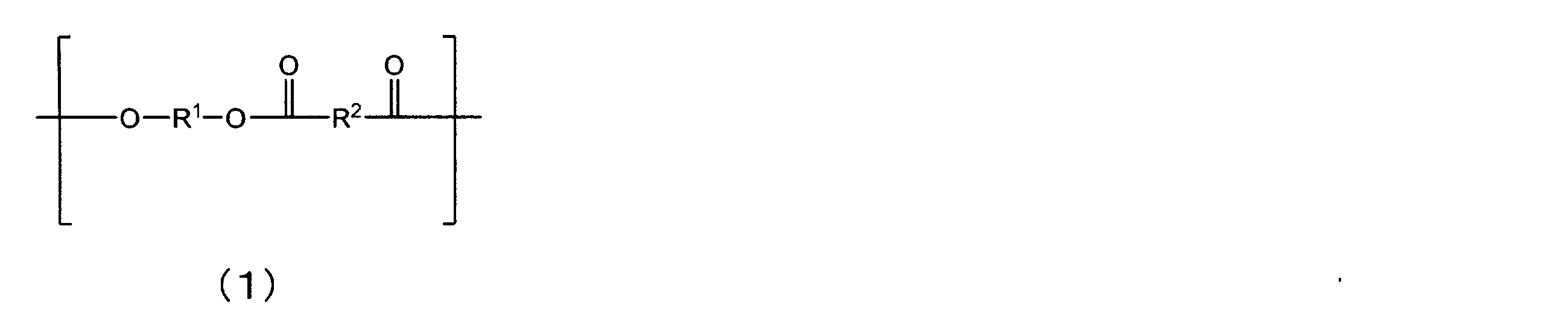
(式中、R1は、保護基で保護されたまたは保護基で保護されていないヘキサフルオロイソプロパノール基を1~4個含む2価の有機基であり、R2は2価の有機基である。)
上述の通り、本発明の感光性樹脂組成物は、一般式(1)で表される繰り返し単位を含む含フッ素高分子化合物(A)と、感光剤(B)と、極性溶剤(C)とを含む。
以下に極性溶剤(C)および感光剤(B)について説明する。
4-1.極性溶剤(C)
本発明の感光性樹脂組成物に用いる極性溶剤(C)としては、含フッ素高分子化合物(A)が溶解可能であれば良く、プロピレングリコールモノメチルエーテルアセテート、プロピレングリコールモノメチルエーテル、シクロヘキサノン、γ-ブチロラクトン、メチルエチルケトン、メチルイソブチルケトン、N,N-ジメチルホルムアミドまたはN-メチルピロリドンが挙げられる。中でも、コーティング溶剤として広範に利用されている、プロピレングリコールモノメチルエーテルアセテート、シクロヘキサノンまたはγ-ブチロラクトン用いることが含フッ素高分子化合物(A)の溶解性および塗布性よく好ましい。
本発明の感光性樹脂組成物に用いる極性溶剤(C)としては、含フッ素高分子化合物(A)が溶解可能であれば良く、プロピレングリコールモノメチルエーテルアセテート、プロピレングリコールモノメチルエーテル、シクロヘキサノン、γ-ブチロラクトン、メチルエチルケトン、メチルイソブチルケトン、N,N-ジメチルホルムアミドまたはN-メチルピロリドンが挙げられる。中でも、コーティング溶剤として広範に利用されている、プロピレングリコールモノメチルエーテルアセテート、シクロヘキサノンまたはγ-ブチロラクトン用いることが含フッ素高分子化合物(A)の溶解性および塗布性よく好ましい。
極性溶剤(C)は単独でも2種以上組み合わせてもよい。また、その配合量は、好ましくは含フッ素高分子化合物(A)100質量部に対して100~2000質量部、より好ましくは、200~900質量部である。即ち、質量比で表して:含フッ素高分子化合物(A):極性溶剤(C)=1:1~20、より好ましくは、1:2~9である。極性溶剤(C)が1未満では、含フッ素高分子化合物(A)が少なく溶液(感光性樹脂組成物)の濃度が濃いと粘度が高くなり成膜し難い、20より多いと、溶液(感光性樹脂組成物)が薄すぎてパターン形成し難い。
4-2.感光剤(B)
本発明において、含フッ素高分子化合物(A)を極性溶剤(C)に溶解させ、感光剤(B)として、例えば、高エネルギー線の作用で酸を発生する光酸発生剤、または、露光によりインデンカルボン酸を発生するジアゾナフトキノン化合物としてのジアゾキノン系感光剤を添加することで感光性樹脂組成物とする。
本発明において、含フッ素高分子化合物(A)を極性溶剤(C)に溶解させ、感光剤(B)として、例えば、高エネルギー線の作用で酸を発生する光酸発生剤、または、露光によりインデンカルボン酸を発生するジアゾナフトキノン化合物としてのジアゾキノン系感光剤を添加することで感光性樹脂組成物とする。
本発明の感光性樹脂組成物に用いる感光剤(B)としては、高エネルギー線の作用により酸を発生する光酸発生剤、または露光によりインデンカルボン酸を発生するジアゾナフトキノン構造を有するジアゾナフトキノン化合物である感光剤(B)を用いることができる。光酸発生剤は、特に制限なく化学増幅型レジストの酸発生剤として用いられるものの中から、任意のものを選択して使用することができる。このような酸発生剤の例としては、ヨードニウムスルホネート、スルホニウムスルホネート等のオニウムスルホネート、スルホン酸エステル、N-イミドスルホネート、N-オキシムスルホネート、o-ニトロベンジルスルホネートまたはピロガロールのトリスメタンスルホネートを挙げることができる。
具体的には、トリフェニルスルホニウムトルフルオロメタンスルホネート、米国BASF社製、商品名、Irgacure PAG121、Irgacure PAG103、Irgacure CGI1380、Irgacure CGI725、みどり化学株式会社製、商品名、PAI-101,PAI-106、NAI-105、NAI-106、TAZ-110、TAZ-204、サンアプロ株式会社製、商品名、CPI-200K、CPI-210S、CPI-101A、CPI-110A、CPI-100P、CPI-110P、CPI-100TF、HS-1、HS-1A、HS-1P、HS-1N、HS-1TF、HS-1NF、HS-1MS、HS-1CS、LW-S1、LW-S1NF、株式会社三和ケミカル製、商品名、TFE-トリアジン、TME-トリアジンまたはMP-トリアジンが挙げられる。
これらの光酸発生剤から光の作用で発生する酸は、アルカンスルホン酸、アリールスルホン酸、部分的にまたは完全にフッ素化されたアリールスルホン酸、アルカンスルホン酸等である。部分的にまたは完全にフッ素化されたアルカンスルホン酸を発生する光酸発生剤は、脱保護しにくい保護基に対しても十分な酸強度を有するので特に好ましい。具体的には、トリフェニルスルホニウムトリフルオロメタンスルホナートまたはトリフェニルスルホニウムパーフルオロ-n-オクタンスルホナートを挙げることができる。
これらの光酸発生剤は単独でも2種以上組み合わせてもよい。また、その配合量は、好ましくは含フッ素高分子化合物(A)100質量部に対して0.1~20質量部、より好ましくは含フッ素高分子化合物(A)100質量部に対して0.5~10質量部である。0.1未満では、酸の発生が少な過ぎて、現像時にパターン形成し難く、20より多いと、酸の発生が多過ぎてパターン形成し難い。
光酸発生剤以外に、ジアゾナフトキノン構造を有するジアゾナフトキノン化合物であるジアゾナフトキノン系感光剤としての感光剤(B)を用いることもできる。当該感光剤(B)を用いたパターン形成では、ヘキサフルオロイソプロパノール基を有する高分子化合物の水酸基と、当該感光剤(B)のジアゾ基(C=N2)が水素結合を形成することで、ヘキサフルオロイソプロパノール基を有する高分子化合物が現像液へ不溶となる。一方、当該感光剤(B)は高エネルギー線の照射による光反応にて、ジアゾナフトキノン構造が消失し、インデンカルボン酸構造が形成される。よって、現像液に対し、未露光部では不溶、露光部では可溶となり、パターン形成が可能となる。当該感光剤(B)は溶解抑止型の感光剤(B)であり、一般的に感光性ポリイミド樹脂組成物に応用されている(特許文献3、特許文献4参照)。
通常、ジアゾナフトキノン構造を有するジアゾナフトキノン化合物であるジアゾナフトキノン系感光剤はナフトキノンジアジドスルホン酸エステルとして用いられる。これはナフトキノンジアジドスルホン酸クロリドとフェノール性水酸基を有する化合物との縮合反応によって得られる。ナフトキノンジアジドスルホン酸クロリドを構成するナフトキノンジアジドスルホン酸としては1,2-ナフトキノン-2-ジアジド-5-スルホン酸または1,2-ナフトキノン-2-ジアジド-4-スルホン酸を挙げることができる。
ジアゾナフトキノン系感光剤を具体的に列挙すれば、1,3-ビス{3-〔4-(1,2-ナフトキノン-2-ジアジド-4-スルホキシ)フェニル〕ウレイドメチル}ベンゼン、1-〔4-(1,2-ナフトキノン-2-ジアジド-4-スルホキシ)フェニル〕-3-フェニル尿素、1-ベンジル-3-〔4-(1,2-ナフトキノン-2-ジアジド-4-スルホキシ)フェニル〕尿素、2-アミノ-4,6-ビス(1,2-ナフトキノン-2-ジアジド-4-スルホキシ)ピリミジン等の尿素系化合物、4,4’-ビス(1,2-ナフトキノン-2-ジアジド-4-スルホニルアミノ)ジアミノジフェニルエーテル、4-(1,2-ナフトキノン-2-ジアジド-4-スルホニルアミノ)-1-(1,2-ナフトキノン-2-ジアジド-4-スルホニルオキシ)ベンゼン、N-メチル-1,2-ビス(1,2-ナフトキノン-2-ジアジド-4-スルホニルアミノ)エタン、2-(1,2-ナフトキノン-2-ジアジド-4-スルホニルアミノ)-1-(1,2-ナフトキノン-2-ジアジド-4-スルホニルオキシ)エタン、1,3-ビス{3-〔4-(1,2-ナフトキノン-2-ジアジド-5-スルホキシ)フェニル〕ウレイドメチル}ベンゼン、1-〔4-(1,2-ナフトキノン-2-ジアジド-5-スルホキシ)フェニル〕-3-フェニル尿素、1-ベンジル-3-〔4-(1,2-ナフトキノン-2-ジアジド-5-スルホキシ)フェニル〕尿素、2-アミノ-4,6-ビス(1,2-ナフトキノン-2-ジアジド-5-スルホキシ)ピリミジン等の尿素系化合物、4,4’-ビス(1,2-ナフトキノン-2-ジアジド-5-スルホニルアミノ)ジアミノジフェニルエーテル、4-(1,2-ナフトキノン-2-ジアジド-5-スルホニルアミノ)-1-(1,2-ナフトキノン-2-ジアジド-5-スルホニルオキシ)ベンゼン、N-メチル-1,2-ビス(1,2-ナフトキノン-2-ジアジド-5-スルホニルアミノ)エタン、2-(1,2-ナフトキノン-2-ジアジド-5-スルホニルアミノ)-1-(1,2-ナフトキノン-2-ジアジド-5-スルホニルオキシ)エタンを挙げることができる。
これらのジアゾナフトキノン系感光剤は単独でも2種以上組み合わせてもよい。また、その配合量は、好ましくは含フッ素高分子化合物(A)100質量部に対して5~40質量部、より好ましくは含フッ素高分子化合物(A)100質量部に対して10~30質量部である。5未満または40より多いとパターン形成し難い。
4-3.エポキシ化合物
当該感光性樹脂組成物の構成成分として、透明性または耐熱性等を向上させる目的で、エポキシ化合物を用いても良い。エポキシ化合物と混合し、加熱または光照射等により硬化させて硬化物とすることができる。
当該感光性樹脂組成物の構成成分として、透明性または耐熱性等を向上させる目的で、エポキシ化合物を用いても良い。エポキシ化合物と混合し、加熱または光照射等により硬化させて硬化物とすることができる。
前記エポキシ化合物は、グリシジル基を含み、化学構造中に炭素-炭素二重結合、炭素-炭素三重結合、芳香環または複素環を含んでいてもよく、エポキシ化合物中の水素原子の一部または全部が、それぞれ独立に、フッ素原子、塩素原子、アルキル基またはフルオロアルキル基で置換されていてもよい。
また、エポキシ化合物は樹脂であってもよく、その場合、数平均分子量が10000以下であることが好ましい。
このようなエポキシ化合物としては、樹脂フェノールノボラック樹脂、クレゾールノボラック樹脂、芳香族炭化水素ホルムアルデヒド樹脂変性フェノール樹脂、ジシクロペンタジエン変性フェノール樹脂、フェノールアラルキル樹脂、クレゾールアラルキル樹脂、ナフトールアラルキル樹脂、ビフェニル変性フェノールアラルキル樹脂、フェノールトリメチロールメタン樹脂、テトラフェニロールエタン樹脂、ナフトールノボラック樹脂、ナフトール-フェノール共縮ノボラック樹脂、ナフトール-クレゾール共縮ノボラック樹脂、ビフェニル変性フェノール樹脂またはアミノトリアジン変性フェノール樹脂化合物を、エピクロロヒドリンと接触させることによりエポキシ変性させたエポキシ化合物が挙げられる。
これらは、市販されており、ビスフェノールA型の大日本インキ工業株式会社製、商品名、エピクロン840、ビスフェノールF型の旭電化工業株式会社製、商品名、アデカレジンEP-4901、クレゾールノボラック型の大日本インキ工業株式会社製、商品名、エピクロンN-600シリーズ、ジシクロペンタジエン型の大日本インキ工業株式会社製、商品名、エピクロンHP-7200シリーズ、トリアジン型の日産化学工業株式会社製、商品名、TEPICシリーズ等を挙げられる。
エポキシ化合物と、エポキシ樹脂用硬化剤を併用してもよい。当該硬化剤を例示するならば、アミン系化合物、酸無水物系化合物、アミド系化合物、フェノ-ル系化合物、メルカプタン系化合物、イミダゾール系化合物、ポリスルフィド樹脂系化合物またはリン系化合物が挙げられる。具体的には、ジアミノジフェニルメタン、ジアミノジフェニルスルホン、ジエチレントリアミン、トリエチレンテトラミン、ポリアルキレングリコールポリアミン、無水フタル酸、無水トリメリット酸、無水ピロメリット酸、無水マレイン酸、テトラヒドロ無水フタル酸、メチルテトラヒドロ無水フタル酸、無水メチルナジック酸、ヘキサヒドロ無水フタル酸、メチルヘキサヒドロ無水フタル酸、2-メチルイミダゾ-ル、トリフェニルフォスフィン、2-エチルー4-メチルイミダゾール、BF3-アミン錯体、グアニジン誘導体等の熱硬化剤、ジフェニルヨードニウムヘキサフロロフォスフェートまたはトリフェニルスルホニウムヘキサフロロホスフェート等紫外線硬化剤が挙げられる。
含フッ素高分子化合物(A)とエポキシ化合物の含有割合は、質量比で表して含フッ素高分子化合物(A)エポキシ化合物=10:90~90:10であり、好ましくは30:70~70:30、より好ましくは40:60~60:40である。
エポキシ化合物とエポキシ樹脂用硬化剤の含有割合は、質量比で表して、70:30~99:1であり、好ましくは90:10~99:30、より好ましくは40:60~60:40である。
5.パターン形成方法
前記溶液状の感光性樹脂組成物を、ガラス基板またはシリコン基板等の基体上に湿式成膜する。例えば、スピンコーター等を用いて、当該基体上に感光性樹脂組成物を塗布した後、プリベーク、即ち加熱して極性溶剤(C)を除去することで、含フッ素高分子化合物(A)を含む塗布膜を得る。この塗布膜を、リソグラフィによりパターン露光その後現像して、ポジ型またはネガ型パターンを得る。具体的には、パターンが成形されたフォトマスクを介して高エネルギー線を塗布膜に照射し、照射部の光酸発生剤より酸を発生させ、発生した酸が関与した化学反応を進めることで、照射部の塗膜の現像液に対する溶解性を変化させることでポジ型またはネガ型のパターンが形成される。
前記溶液状の感光性樹脂組成物を、ガラス基板またはシリコン基板等の基体上に湿式成膜する。例えば、スピンコーター等を用いて、当該基体上に感光性樹脂組成物を塗布した後、プリベーク、即ち加熱して極性溶剤(C)を除去することで、含フッ素高分子化合物(A)を含む塗布膜を得る。この塗布膜を、リソグラフィによりパターン露光その後現像して、ポジ型またはネガ型パターンを得る。具体的には、パターンが成形されたフォトマスクを介して高エネルギー線を塗布膜に照射し、照射部の光酸発生剤より酸を発生させ、発生した酸が関与した化学反応を進めることで、照射部の塗膜の現像液に対する溶解性を変化させることでポジ型またはネガ型のパターンが形成される。
ポジ型のパターンを形成する場合の3通りの手法を例示する。
第1の手法は、前記エポキシ樹脂用硬化剤を用いることで達成される。前記エポキシ樹脂用硬化剤を含有した感光性樹脂組成物を基体上に塗布した後、プリベークを行なうことで、ヘキサフルオロイソプロパノール基とエポキシ化合物が反応し、現像液に不溶化する。その後、高エネルギー線を照射し、照射部で発生した酸が高分子化合物の主鎖のエステル結合を切断し、カルボン酸部位、およびフェノール部位が発生することで現像液に可溶化する。即ち、ポジ型パターンとなる。
第2の手法においては、含フッ素高分子化合物(A)のヘキサフルオロイソプロパノール基を、tert-ブトキシカルボニル基、メトキシメチル基等の保護基で保護し、現像液に不溶化させた後、基体上に塗膜を形成する。照射部で発生した酸の作用で、脱保護反応が起こり、照射部は現像液に可溶化する。即ち、ポジ型パターンが得られる。
第3の手法においては、ヘキサフルオロイソプロパノール基を含有する高分子化合物と前記ジアゾナフトキノン系感光剤とを混合した後、基体上に塗膜を形成する。照射部で発生したインデンカルボン酸の作用で照射部は現像液に可溶化し、未照射部はジアゾ基とヘキサフルオロイソプロパノール基の水素結合により現像液に不溶化する。即ち、ポジ型パターンが得られる。
ネガ型のパターンを形成する場合、前記エポキシ樹脂用硬化剤を用いないか、またはプリベーク温度ではヘキサフルオロイソプロパノール基と反応しないエポキシ樹脂用硬化剤を用いる。当該感光性樹脂組成物を用いた場合は、プリベーク後も塗布膜は現像液に可溶のままであり、照射部で発生した酸が触媒となってヘキサフルオロイソプロパノール基とエポキシ化合物の反応を促進し、照射部は現像液に不溶化する。即ち、ネガ型パターンとなる。
この後、ポジ型パターン、ネガ型パターンを加熱焼成し、パターン中に残存するエポキシ化合物とヘキサフルオロイソプロパノール基の反応を完結させる。熱焼成時の温度としては、一般的なエポキシ樹脂硬化温度である180℃以上が好ましい。高硬度で高耐熱な薄膜を得るためには高温であることが好ましいが、温度上限がディスプレイの製造プロセスまたは半導体の製造プロセスに依存する。例えば、一般的な液晶ディスプレイにおけるオーバーコートの成膜工程において加熱温度の上限は250℃である。
ジアゾナフトキノン系感光剤を用いた場合も同様に、パターン形成後250℃で加熱処理を施すことで、インデンカルボン酸または当該感光剤を熱分解により揮散し、最終パターンを得ることができる。
本発明の感光性樹脂組成物を用いてポジ型パターン、ネガ型パターンを形成する方法において用いられる現像液としては、テトラメチルアンモニウムヒドロキサイド、テトラエチルアンモニウムヒドロキサイド等の水酸化四級アンモニウム水溶液、エタノールアミンまたはプロピルアミン等のアミン系水溶液等がある。中でもテトラメチルアンモニウムヒドロキサイドの2.38質量%水溶液が最も一般的である。
本発明の感光性樹脂組成物を用いてポジ型パターン、ネガ型パターンを形成する方法において用いられる高エネルギー線としては、波長が紫外領域以下、具体的には波長400nm以下の紫外線、または電子線が挙げられる。紫外光としては高圧水銀ランプによる紫外光、g線(波長436nm)、h線(波長405nm)、i線(波長365nm)、KrFエキシマレーザ(波長248nm)、ArFエキシマレーザ(波長193nm)または極端紫外光(波長13.5nm)が例示できる。
本発明で用いられる基板は、シリコンウェハーの他にも金属またはガラスの基板を用いることが可能である。また、基板上には有機系あるいは無機系の膜が設けられていてもよい。例えば、反射防止膜、多層レジストの下層があってもよく、パターンが形成されていても良い。
尚、本発明において、フォトマスクとは、半導体回路パターン等をガラス基板または石英基板等の透明基板に形成したものであり、半導体回路パターン等が掲載されたフォトマスクを介して光を照射し現像する転写技術であるリソグラフィによる半導体製造工程で使用される原版である。感光性樹脂とは、紫外線等の高エネルギー線の照射によって化学変化を起こし溶剤に対する溶解度または親和性に変化を生ずる樹脂である。原料モノマーとは、重縮合反応に供され高分子化合物を得るための原料化合物であり、フェノール性水酸基とは、芳香環に結合した水酸基である。
実施例を具体的に示すが、本発明は以下の実施例に限定されるものではない。
フェノール性水酸基およびヘキサフルオロイソプロパノール基を含む含フッ素化合物を合成し、ジカルボン酸誘導体と縮重合させて含フッ素高分子化合物(A)としてのポリアリレート樹脂を得た(合成例1~7)。次いで、極性溶剤(C)に溶かし、感光剤(B)を加え、感光性樹脂組成物とした。感光性樹脂組成物を基板に塗布後、パターン露光した後アルカリ現像液に浸漬させてパターニングし、パターンの評価を行った。(実施例1~17)
次いで、2個のフェノール性水酸基(カルボン酸)を含みヘキサフルオロイソプロパノール基を含まないポリアリレート樹脂を重合した(合成例8~11)。当該ポリアリレート樹脂に感光剤(B)および極性溶剤を加えて、感光性樹脂組成物とし、実施例1~17と同様の条件で露光、現像、加熱処理を行い、得られたパターンを評価した(比較例1~4)
[化合物の同定および物性評価手法]
合成した含フッ素化合物の同定手法、含フッ素高分子化合物(A)であるポリアリレート樹脂の物性評価方法を以下の(1)~(3)に示す。
(1)NMR(核磁気共鳴)測定
共鳴周波数400MHzの核磁気共鳴装置(日本電子株式会社製)を使用し、1H-NMR、19F-NMRの測定を行った。
(2)DI-MS(質量分析スペクトル)測定
質量分析計(日本電子株式会社製、型番、JMS-T100GC)を使用し、質量分析スペクトルを測定した。
(3)分子量測定
テトラヒドロフラン(THF)を溶剤としたゲル浸透クロマトグラフィー(GPC)測定を行い、ポリスチレン換算で分子量を算出した。
当該ポリアリレート樹脂から得られる感光性樹脂組成物を用いたパターン形成後の評価法を(4)に、使用した露光機を(5)に示す。
(4)パターニング評価
ニコン株式社製光学顕微鏡(型番MM-40)を使用した。
(5)露光機
ズ-スマイクロテック株式会社製マスクアライナー(型番MA6)を使用した。
合成した含フッ素化合物の同定手法、含フッ素高分子化合物(A)であるポリアリレート樹脂の物性評価方法を以下の(1)~(3)に示す。
(1)NMR(核磁気共鳴)測定
共鳴周波数400MHzの核磁気共鳴装置(日本電子株式会社製)を使用し、1H-NMR、19F-NMRの測定を行った。
(2)DI-MS(質量分析スペクトル)測定
質量分析計(日本電子株式会社製、型番、JMS-T100GC)を使用し、質量分析スペクトルを測定した。
(3)分子量測定
テトラヒドロフラン(THF)を溶剤としたゲル浸透クロマトグラフィー(GPC)測定を行い、ポリスチレン換算で分子量を算出した。
当該ポリアリレート樹脂から得られる感光性樹脂組成物を用いたパターン形成後の評価法を(4)に、使用した露光機を(5)に示す。
(4)パターニング評価
ニコン株式社製光学顕微鏡(型番MM-40)を使用した。
(5)露光機
ズ-スマイクロテック株式会社製マスクアライナー(型番MA6)を使用した。
[合成例1]
<含フッ素化合物(B)の合成>
以下の反応式に示すように4,4’-ビフェノール(A)にヘキサフルオロアセトンを反応させて、含フッ素化合物(B)、即ち、3,3’-ビス(1,1,1,3,3,3-ヘキサフルオロ-2-ヒドロキシプロパン-2-イル)-4,4’-ビフェノールを合成した。

室温(20℃)下で、ステンレス鋼製オートクレーブにキシレン250gを入れ、原料である4,4’-ビフェノール(A)100g(0.54mol)を加え、さらにCH3SO3H、1gを加えた。次いで、ヘキサフルオロアセトン196g(1.18mol)を加えた後、徐々に昇温し110℃に保持した状態で8時間攪拌しつつ反応させた。
未反応の原料を含む反応物を濾過し、濾過残渣をイソプロピルエーテルに溶解させた後に水で洗浄し、分離した有機層に無水硫酸マグネシウムを加え脱湿した。減圧蒸留によりイソプロピルエーテルを留去し、貧溶媒であるヘキサンを加え、含フッ素化合物(B)の沈殿を析出させた。このようにして、収率78%で含フッ素化合物(B)を得た。
得られた含フッ素化合物(B)の分析結果を、以下に示す。
1H-NMR(溶媒、d-DMSO, TMS): δ10.8(1H, s), 8.6(1H, s) , 7.7(1H,s),7.5(1H,dd,J=8.6 Hz), 7.0(1H,d,J=8.3Hz)
19F-NMR(溶媒、d-DMSO, CCl3F): δ -72.8 (12F,s)
DI-MS(FD+): m/z 518.06 (M+)
<含フッ素化合物(B)の合成>
以下の反応式に示すように4,4’-ビフェノール(A)にヘキサフルオロアセトンを反応させて、含フッ素化合物(B)、即ち、3,3’-ビス(1,1,1,3,3,3-ヘキサフルオロ-2-ヒドロキシプロパン-2-イル)-4,4’-ビフェノールを合成した。
未反応の原料を含む反応物を濾過し、濾過残渣をイソプロピルエーテルに溶解させた後に水で洗浄し、分離した有機層に無水硫酸マグネシウムを加え脱湿した。減圧蒸留によりイソプロピルエーテルを留去し、貧溶媒であるヘキサンを加え、含フッ素化合物(B)の沈殿を析出させた。このようにして、収率78%で含フッ素化合物(B)を得た。
得られた含フッ素化合物(B)の分析結果を、以下に示す。
1H-NMR(溶媒、d-DMSO, TMS): δ10.8(1H, s), 8.6(1H, s) , 7.7(1H,s),7.5(1H,dd,J=8.6 Hz), 7.0(1H,d,J=8.3Hz)
19F-NMR(溶媒、d-DMSO, CCl3F): δ -72.8 (12F,s)
DI-MS(FD+): m/z 518.06 (M+)
<構造式(D)で表される繰り返し単位を含む重縮合物である含フッ素高分子化合物(A)の合成>
次いで、攪拌装置を備えた反応容器中、含フッ素化合物(B)、即ち、3,3’-ビス(1,1,1,3,3,3-ヘキサフルオロ-2-ヒドロキシプロパン-2-イル)-4,4’-ビフェノール25.91g(0.05モル)を用意し、予め脱水精製したN-メチルピロリドン167gおよびピリジン8.7gの混合溶剤に溶解した。次いで、イソフタル酸クロライド10.15g(0.05モル)を加え、室温で5時間攪拌して、以下に示す重縮合反応を行い、反応液を得た。

反応終了後、貧溶媒である大型ビーカー内のメタノール50質量%水溶液1.5kg中に、上記反応液を徐々に注ぎ、重合物を析出させた。この重合物を濾過した後、減圧乾燥機内で、温度100℃で8時間減圧乾燥させた。重合物は、構造式(D)で表される繰り返し単位を含む重縮合物である含フッ素高分子化合物(A)としてのポリアリレート樹脂であり、27.5g、収率85%で得られた。当該樹脂の重量平均分子量(Mw)は15,000、多分散度、重量平均分子量/数平均分子量(Mw/Mn)=2.1であった。
次いで、攪拌装置を備えた反応容器中、含フッ素化合物(B)、即ち、3,3’-ビス(1,1,1,3,3,3-ヘキサフルオロ-2-ヒドロキシプロパン-2-イル)-4,4’-ビフェノール25.91g(0.05モル)を用意し、予め脱水精製したN-メチルピロリドン167gおよびピリジン8.7gの混合溶剤に溶解した。次いで、イソフタル酸クロライド10.15g(0.05モル)を加え、室温で5時間攪拌して、以下に示す重縮合反応を行い、反応液を得た。
[合成例2]
<構造式(D)と(E)で表される繰り返し単位を含む共重縮合物である含フッ素高分子化合物(A)の合成>
含フッ素化合物(B)、即ち、3,3’-ビス(1,1,1,3,3,3-ヘキサフルオロ-2-ヒドロキシプロパン-2-イル)-4,4’-ビフェノール12.96g(0.0250モル)に加え、2,2-ビス(4-ヒドロキシフェニル)-ヘキサフルオロプロパンを8.40g用いた以外は、合成例1と同様の手法で、イソフタル酸クロライド10.15g(0.0500モル)を用い、下記の反応式に示すように、構造式(D)と(E)で表される繰り返し単位を含む共重縮合物である含フッ素高分子化合物(A)としてのポリアリレート樹脂22.8gを収率82%で得た。当該樹脂の重量平均分子量(Mw)は13000、多分散度(Mw/Mn)=2.5であった。

<構造式(D)と(E)で表される繰り返し単位を含む共重縮合物である含フッ素高分子化合物(A)の合成>
含フッ素化合物(B)、即ち、3,3’-ビス(1,1,1,3,3,3-ヘキサフルオロ-2-ヒドロキシプロパン-2-イル)-4,4’-ビフェノール12.96g(0.0250モル)に加え、2,2-ビス(4-ヒドロキシフェニル)-ヘキサフルオロプロパンを8.40g用いた以外は、合成例1と同様の手法で、イソフタル酸クロライド10.15g(0.0500モル)を用い、下記の反応式に示すように、構造式(D)と(E)で表される繰り返し単位を含む共重縮合物である含フッ素高分子化合物(A)としてのポリアリレート樹脂22.8gを収率82%で得た。当該樹脂の重量平均分子量(Mw)は13000、多分散度(Mw/Mn)=2.5であった。
[合成例3]
<含フッ素化合物(F)および含フッ素化合物(G)の合成>
以下の反応式に示すように、ビス(4-ヒドロキシフェニル)エーテルとヘキサフルオロアセトンを反応させて、含フッ素化合物(F)および含フッ素化合物(G)を合成した。

室温(20℃)下で、ステンレス鋼製オートクレーブにキシレン150gを入れ、原料であるビス(4-ヒドロキシフェニル)エーテル25g(0.16mol)を加え、さらにCH3SO3H0.25gを加えた。次いで、ヘキサフルオロアセトン、57g(0.34mol)を加えた後、徐々に昇温し110℃に保持した状態で8時間攪拌しつつ反応させた。
反応系内の原料を含む反応物を濾過し、濾過残渣をイソプロピルエーテルに溶解させた後に水で洗浄し、分離した有機層に無水硫酸マグネシウムを加え脱湿した。減圧蒸留しイソプロピルエーテルを留去し、貧溶媒であるヘキサンを加え、含フッ素重合性単量体の沈殿を析出させた。DI-MS分析の結果から、得られた固体は、ヘキサフルオロイソプロパノール基の一置換体である含フッ素重合性単量体(G)と、ヘキサフルオロイソプロパノール基の二置換体式である含フッ素重合性単量体(F)の混合物であり、その存在比は、F:G=2:3であった。
分析結果を、以下に示す。
DI-MS(FD+):m/z 534.05 (M+), 368.51 (M+)
<含フッ素化合物(F)および含フッ素化合物(G)の合成>
以下の反応式に示すように、ビス(4-ヒドロキシフェニル)エーテルとヘキサフルオロアセトンを反応させて、含フッ素化合物(F)および含フッ素化合物(G)を合成した。
反応系内の原料を含む反応物を濾過し、濾過残渣をイソプロピルエーテルに溶解させた後に水で洗浄し、分離した有機層に無水硫酸マグネシウムを加え脱湿した。減圧蒸留しイソプロピルエーテルを留去し、貧溶媒であるヘキサンを加え、含フッ素重合性単量体の沈殿を析出させた。DI-MS分析の結果から、得られた固体は、ヘキサフルオロイソプロパノール基の一置換体である含フッ素重合性単量体(G)と、ヘキサフルオロイソプロパノール基の二置換体式である含フッ素重合性単量体(F)の混合物であり、その存在比は、F:G=2:3であった。
分析結果を、以下に示す。
DI-MS(FD+):m/z 534.05 (M+), 368.51 (M+)
<構造式(H)と(I)で表される繰り返し単位を含む共重縮合物である含フッ素高分子化合物(A)の合成>
次いで、攪拌装置を備えた反応容器中、含フッ素重合性単量体(F)と(G)の混合物(その存在比は、モル比で、F:G=2:3)2.26g(0.0052モル)を用意し、予め脱水精製したN-メチルピロリドン16gおよびピリジン、1.01gの混合溶剤に溶解した。次いで、4,4’-ビフェニルジカルボニルジクロリド、1.45g(0.0052モル)を加え、室温で5時間攪拌して、以下に示す重縮合反応を行い、反応液を得た。
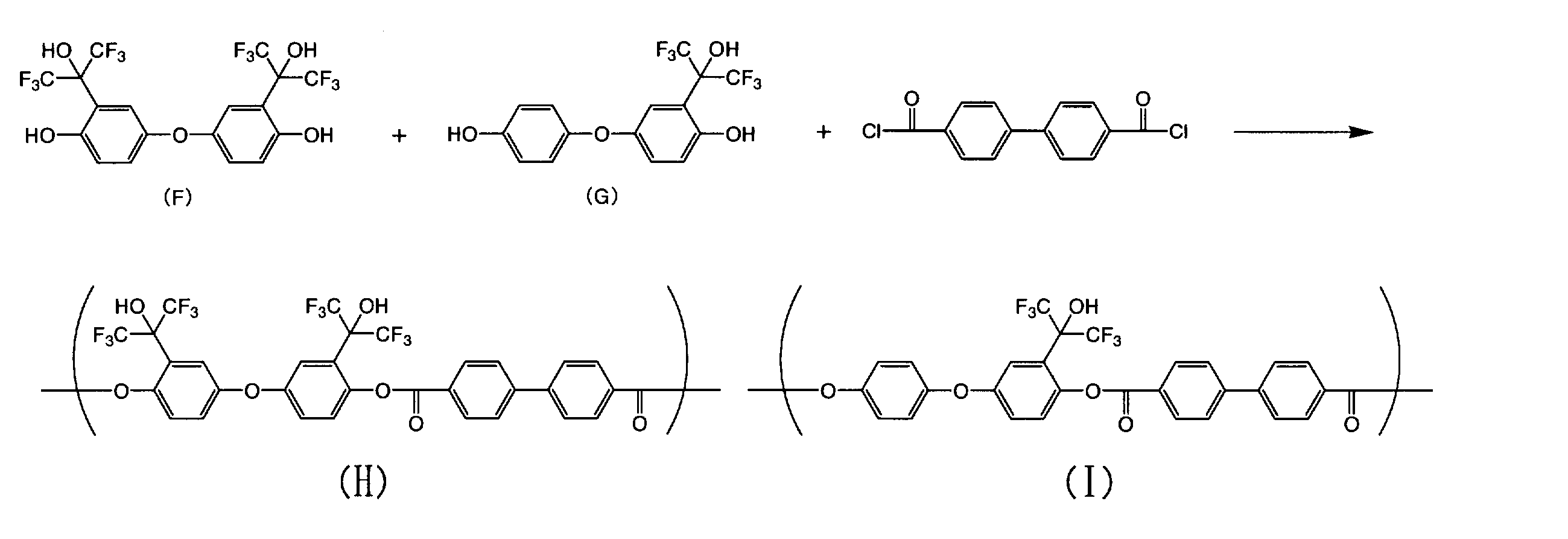
反応終了後、合成例1と同様の操作を行い、構造式(H)と(I)で表される繰り返し単位を含む共重縮合物であるフッ素高分子化合物(A)としてのポリアリレート樹脂、2.89gを、収率87%で得た。
次いで、攪拌装置を備えた反応容器中、含フッ素重合性単量体(F)と(G)の混合物(その存在比は、モル比で、F:G=2:3)2.26g(0.0052モル)を用意し、予め脱水精製したN-メチルピロリドン16gおよびピリジン、1.01gの混合溶剤に溶解した。次いで、4,4’-ビフェニルジカルボニルジクロリド、1.45g(0.0052モル)を加え、室温で5時間攪拌して、以下に示す重縮合反応を行い、反応液を得た。
[合成例4]
<含フッ素化合物(J)の合成>
以下の反応式に示すように、1,5-ナフトールにヘキサフルオロアセトンを反応させて、含フッ素化合物(J)として含フッ素多価フェノールを合成した。

室温(20℃)下で、ステンレス鋼製オートクレーブにトルエン150gを入れ、原料である1,5-ナフトール25g(0.54mol)を加え、さらにCH3SO3H、0.25gを加えた。次いで、ヘキサフルオロアセトン57g(0.34mol)を加えた後、徐々に昇温し100℃に保持した状態で8時間攪拌しつつ反応させた。
反応系内の原料を含む反応物を濾過し、濾過残渣をイソプロピルエーテルに溶解させた後に水で洗浄し、分離した有機層に無水硫酸マグネシウムを加え脱湿した。減圧蒸留しイソプロピルエーテルを留去し、貧溶媒であるヘキサンを加え、構造式(J)の含フッ素多フェノールの沈殿を析出させた。このようにして、収率76%で構造式の含フッ素化合物(J)を得た。
含フッ素化合物(J)生成物の分析結果を、以下に示す。
1H-NMR(溶媒、d-DMSO,TMS)δ10.4(2H, br),7.82(2H, d, J =9.2 Hz),7.52 (2H,d,J=8.3Hz)
19F-NMR(溶媒、d-DMSO, CCl3F)δ -73.7(12F,s)
<含フッ素化合物(J)の合成>
以下の反応式に示すように、1,5-ナフトールにヘキサフルオロアセトンを反応させて、含フッ素化合物(J)として含フッ素多価フェノールを合成した。
反応系内の原料を含む反応物を濾過し、濾過残渣をイソプロピルエーテルに溶解させた後に水で洗浄し、分離した有機層に無水硫酸マグネシウムを加え脱湿した。減圧蒸留しイソプロピルエーテルを留去し、貧溶媒であるヘキサンを加え、構造式(J)の含フッ素多フェノールの沈殿を析出させた。このようにして、収率76%で構造式の含フッ素化合物(J)を得た。
含フッ素化合物(J)生成物の分析結果を、以下に示す。
1H-NMR(溶媒、d-DMSO,TMS)δ10.4(2H, br),7.82(2H, d, J =9.2 Hz),7.52 (2H,d,J=8.3Hz)
19F-NMR(溶媒、d-DMSO, CCl3F)δ -73.7(12F,s)
<構造式(K)で表される繰り返し単位を含む重縮合物である含フッ素高分子化合物(A)の合成>
次いで、攪拌装置を備えた反応容器中、含フッ素化合物(J)、即ち、2,6-ビス(1,1,1,3,3,3-ヘキサフルオロ-2-ヒドロキシプロパン-2-イル)-1,5-ジナフトール、1.97g(0.004モル)を用意し、予め脱水精製したN-メチルピロリドン12.9gおよびピリジン0.70gの混合溶剤に溶解した。次いで、イソフタル酸クロライド0.81g(0.004モル)を加え、室温で5時間攪拌して、以下に示す重縮合反応を行い、反応液を得た。
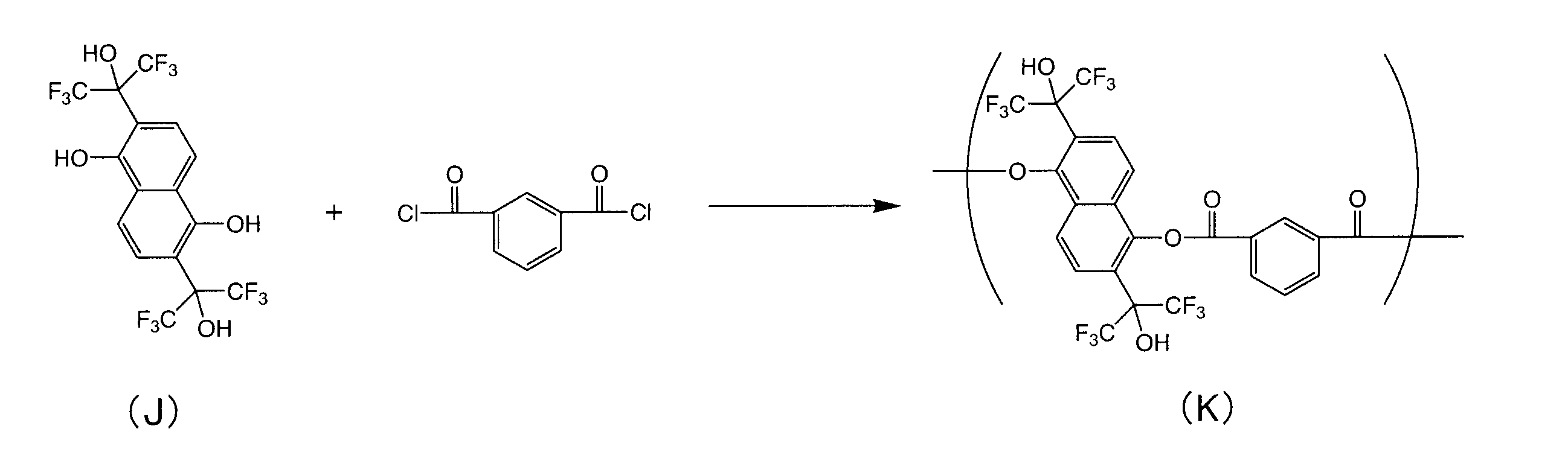
反応終了後、反応液を水100mLとメタノール100mLの混合液に加え、得られた沈殿を濾別後、真空下で室温(20℃)乾燥することで、構造式(K)で表わされる繰り返し単位を含む含フッ素高分子化合物(A)としての重縮合物、2.14gを収率86%で得た。当該樹脂の重量平均分子量(Mw)は12000、Mw/Mn=2.2であった。
次いで、攪拌装置を備えた反応容器中、含フッ素化合物(J)、即ち、2,6-ビス(1,1,1,3,3,3-ヘキサフルオロ-2-ヒドロキシプロパン-2-イル)-1,5-ジナフトール、1.97g(0.004モル)を用意し、予め脱水精製したN-メチルピロリドン12.9gおよびピリジン0.70gの混合溶剤に溶解した。次いで、イソフタル酸クロライド0.81g(0.004モル)を加え、室温で5時間攪拌して、以下に示す重縮合反応を行い、反応液を得た。
[合成例5]
<構造式(K)と(L)で表される繰り返し単位を含む共重縮合物である含フッ素高分子化合物(A)の合成>
合成例4で用いた含フッ素化合物(J)、即ち、2,6-ビス(1,1,1,3,3,3-ヘキサフルオロ-2-ヒドロキシプロパン-2-イル)-1,5-ジナフトールを0.99g(0.00200モル)に加え、ビスフェノールA0.459g(0.00200モル)を用いたこと以外は、合成例4と同様の手法で、イソフタル酸クロライド0.81g(0.004モル)構造式(K)と(L)で表される繰り返し単位を含む共重縮合物である含フッ素高分子化合物(A)としてのポリアリレート樹脂1.71gを率87%で得た。当該樹脂の重量平均分子量(Mw)は14000、Mw/Mn=2.7であった。

<構造式(K)と(L)で表される繰り返し単位を含む共重縮合物である含フッ素高分子化合物(A)の合成>
合成例4で用いた含フッ素化合物(J)、即ち、2,6-ビス(1,1,1,3,3,3-ヘキサフルオロ-2-ヒドロキシプロパン-2-イル)-1,5-ジナフトールを0.99g(0.00200モル)に加え、ビスフェノールA0.459g(0.00200モル)を用いたこと以外は、合成例4と同様の手法で、イソフタル酸クロライド0.81g(0.004モル)構造式(K)と(L)で表される繰り返し単位を含む共重縮合物である含フッ素高分子化合物(A)としてのポリアリレート樹脂1.71gを率87%で得た。当該樹脂の重量平均分子量(Mw)は14000、Mw/Mn=2.7であった。
[合成例6]
<構造式(M)で表される繰り返し単位を含む重縮合物である含フッ素高分子化合物(A)の合成>
攪拌装置を備えた反応容器中、合成例1で得られたポリアリレート樹脂3.00g、ターシャリーブトキシカルボン酸無水物1.01g(0.0046モル)、ピリジン0.39g(0.005モル)、N-メチルピロリドン6gを加え、室温で5時間攪拌して、以下に示す重縮合反応を行い、反応液を得た。

反応終了後、反応液を水100mLとメタノール100mLの混合液に加え、得られた沈殿を濾別後、真空下で室温乾燥することで、ヘキサフルオロイソプロパノール基の一部がターシャリーブトキシカルボニル基で置換された構造式(M)の繰り返し単位を含む重合物として含フッ素高分子化合物(A)3.04gを、収率90%で得た。当該樹脂のMwは18000、Mw/Mn=2.8であった。
<構造式(M)で表される繰り返し単位を含む重縮合物である含フッ素高分子化合物(A)の合成>
攪拌装置を備えた反応容器中、合成例1で得られたポリアリレート樹脂3.00g、ターシャリーブトキシカルボン酸無水物1.01g(0.0046モル)、ピリジン0.39g(0.005モル)、N-メチルピロリドン6gを加え、室温で5時間攪拌して、以下に示す重縮合反応を行い、反応液を得た。
[合成例7]
<構造式(N)で表される繰り返し単位を含む重縮合物である含フッ素高分子化合物(A)の合成>
攪拌装置を備えた反応容器中、合成例4で得られたポリアリレート樹脂2.89g、水素化ナトリウム(ミネラルオイル40質量%添加品)0.066g、メトキシメチルクロリド0.37g(0.0046モル)、ピリジン0.39g(0.005モル)、テトラヒドロフラン 6gを加え、氷浴下で5時間攪拌して、以下に示す重縮合反応を行い、反応液を得た。

反応終了後、反応液を水100mLとメタノール100mLの混合液に加え、得られた沈殿を濾別後、真空下で室温乾燥することで、ヘキサフルオロイソプロパノール基の一部がメトキシメチル基で置換された構造式(N)の繰り返し単位を含む重合物、2.50g(収率82%)を得た。当該樹脂のMwは14000、Mw/Mn=2.6であった。
<構造式(N)で表される繰り返し単位を含む重縮合物である含フッ素高分子化合物(A)の合成>
攪拌装置を備えた反応容器中、合成例4で得られたポリアリレート樹脂2.89g、水素化ナトリウム(ミネラルオイル40質量%添加品)0.066g、メトキシメチルクロリド0.37g(0.0046モル)、ピリジン0.39g(0.005モル)、テトラヒドロフラン 6gを加え、氷浴下で5時間攪拌して、以下に示す重縮合反応を行い、反応液を得た。
[実施例1~17]
次いで、表1に示すように、含フッ素高分子化合物(A)としての、合成例1~7で得られた各々ポリアリレート樹脂に、感光剤(B)、エポキシ化合物および極性溶剤(C)を加えて均一な溶液とし感光性樹脂組成物を得た。

次いで、表1に示すように、含フッ素高分子化合物(A)としての、合成例1~7で得られた各々ポリアリレート樹脂に、感光剤(B)、エポキシ化合物および極性溶剤(C)を加えて均一な溶液とし感光性樹脂組成物を得た。
実施例1~17で得られた感光性樹脂組成物を、スピンコーターを用いて、径4インチのシリコンウェハーに1000rpm、50secの条件で塗布した。塗布後、80℃で3分間プリベークした後、露光機を用いて、70μm/70μmのラインアンドスペースのマスクを介して、1分間密着露光し、露光後110℃で3分間加熱し、2.38質量%のテトラメチルアンモニウムハイドライド(TMAH)水溶液にて1分間、接触させて現像した。水洗後、180℃で3分間加熱処理し、パターンを得た。パターンの評価結果を表2に示した。いずれの場合においても、レジストパターンの倒れ(パターン倒れ)、膨潤によるパターンの形状変化は観測されず、良好なパターンが得られた。

次いで、以下合成例8~11に示すように、カルボン酸は含むがヘキサフルオロイソプロパノール基を含まない、含フッ素高分子化合物の合成を行った。
[合成例8]
<構造式(O)で表される繰り返し単位を含むアリレート樹脂の合成>
攪拌装置を備えた反応容器中に、4,4’-ビフェノール3.00g(0.016モル)、ピロメリット酸無水物3.514g(0.016モル)、ピリジン2.78g(0.035モル)、N-メチルピロリドン26gを加え、室温で5時間攪拌し、以下に示す重縮合反応を行い、反応液を得た。

反応終了後、反応液をメタノール200mLに加え、得られた沈殿を濾別後、減圧乾燥機内で、室温(20℃)にて減圧乾燥して、構造式(O)の繰り返し単位を含むポリアリレート樹脂6.30gを収率97%で得た。当該樹脂のMwは14000、Mw/Mn=2.6であった。
<構造式(O)で表される繰り返し単位を含むアリレート樹脂の合成>
攪拌装置を備えた反応容器中に、4,4’-ビフェノール3.00g(0.016モル)、ピロメリット酸無水物3.514g(0.016モル)、ピリジン2.78g(0.035モル)、N-メチルピロリドン26gを加え、室温で5時間攪拌し、以下に示す重縮合反応を行い、反応液を得た。
[合成例9]
<構造式(P)で表される繰り返し単位を含むアリレート樹脂の合成>
攪拌装置を備えた反応容器中、構造式(O)の繰り返し単位を含むポリアリレート樹脂3.00g、ターシャリーブトキシカルボン酸無水物2.26g(0.0103モル)、ピリジン0.88g(0.0113モル)、N-メチルピロリドン10gを加え、80℃で5時間攪拌し、以下に示す重縮合反応を行い、反応液を得た。

反応終了後、反応液を水100mLとメタノール100mLの混合液に加え、得られた沈殿を濾別後、減圧乾燥機内で、室温(20℃)にて減圧乾燥して、ヘキサフルオロイソプロパノール基の一部がターシャリーブトキシカルボニル基で置換された構造式(P)の繰り返し単位を含むポリアリレート樹脂3.41gを収率85%で得た。当該樹脂のMwは18000、Mw/Mn=2.7であった。
<構造式(P)で表される繰り返し単位を含むアリレート樹脂の合成>
攪拌装置を備えた反応容器中、構造式(O)の繰り返し単位を含むポリアリレート樹脂3.00g、ターシャリーブトキシカルボン酸無水物2.26g(0.0103モル)、ピリジン0.88g(0.0113モル)、N-メチルピロリドン10gを加え、80℃で5時間攪拌し、以下に示す重縮合反応を行い、反応液を得た。
[合成例10]
<構造式(Q)で表される繰り返し単位を含むアリレート樹脂の合成>
攪拌装置を備えた反応容器中、1,5-ジナフトール2.56g(0.016モル)、ピロメリット酸無水物3.514g(0.016モル)、ピリジン2.78g(0.035モル)、N-メチルピロリドン26gを加え、室温で5時間攪拌し、以下に示す重縮合反応を行い、反応液を得た。

反応終了後、反応液をメタノール200mLに加え、得られた沈殿を濾別後、減圧乾燥機内で、室温(20℃)にて減圧乾燥して、構造式(Q)の繰り返し単位を含むポリアリレート樹脂5.46gを収率90%で得た。当該樹脂のMwは13000、Mw/Mn=2.8であった。
<構造式(Q)で表される繰り返し単位を含むアリレート樹脂の合成>
攪拌装置を備えた反応容器中、1,5-ジナフトール2.56g(0.016モル)、ピロメリット酸無水物3.514g(0.016モル)、ピリジン2.78g(0.035モル)、N-メチルピロリドン26gを加え、室温で5時間攪拌し、以下に示す重縮合反応を行い、反応液を得た。
[合成例11]
<構造式(R)で表される繰り返し単位を含むアリレート樹脂の合成>
攪拌装置を備えた反応容器中、構造式(Q)の繰り返し単位を含むポリアリレート樹脂3.00g、ターシャリーブトキシカルボン酸無水物2.48g(0.011モル)、ピリジン0.96g(0.012モル)、N-メチルピロリドン10gを加え、80℃で5時間攪拌し、以下に示す重縮合反応を行い、反応液を得た。
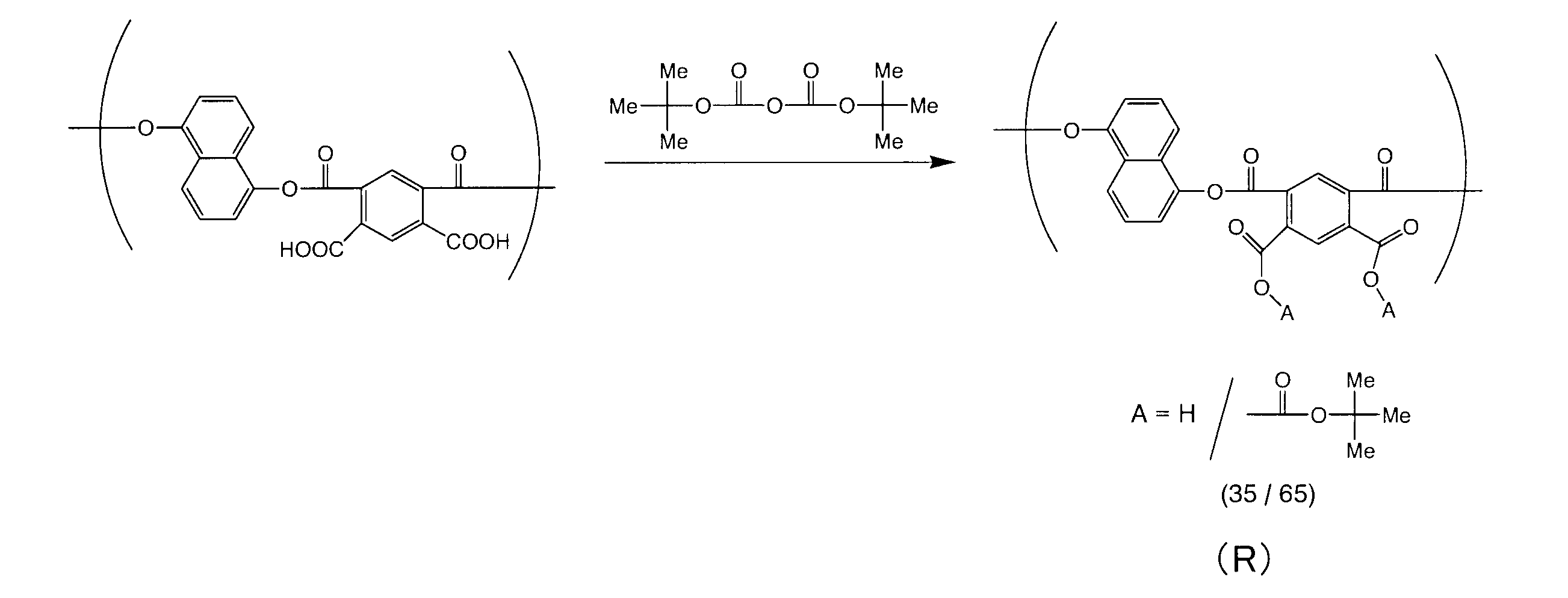
反応終了後、反応液を水100mLとメタノール100mLの混合液に加え、得られた沈殿を濾別後、減圧乾燥機内で室温(20℃)にて減圧乾燥して、含フッ素高分子化合物(A)としての、ヘキサフルオロイソプロパノール基の一部がターシャリーブトキシカルボニル基で置換された構造式(R)の繰り返し単位を含む重合物3.34gを収率83%で得た。当該樹脂のMwは17000、Mw/Mn=2.6であった。
<構造式(R)で表される繰り返し単位を含むアリレート樹脂の合成>
攪拌装置を備えた反応容器中、構造式(Q)の繰り返し単位を含むポリアリレート樹脂3.00g、ターシャリーブトキシカルボン酸無水物2.48g(0.011モル)、ピリジン0.96g(0.012モル)、N-メチルピロリドン10gを加え、80℃で5時間攪拌し、以下に示す重縮合反応を行い、反応液を得た。
比較例1~4
次いで、表3に示すように、合成例8~11で得られた、カルボン酸は含むがヘキサフルオロイソプロパノール基を含まない含フッ素高分子化合物である、各々のポリアリレート樹脂に、感光剤および極性溶剤を加えて均一な溶液とし、感光性樹脂組成物を得た。
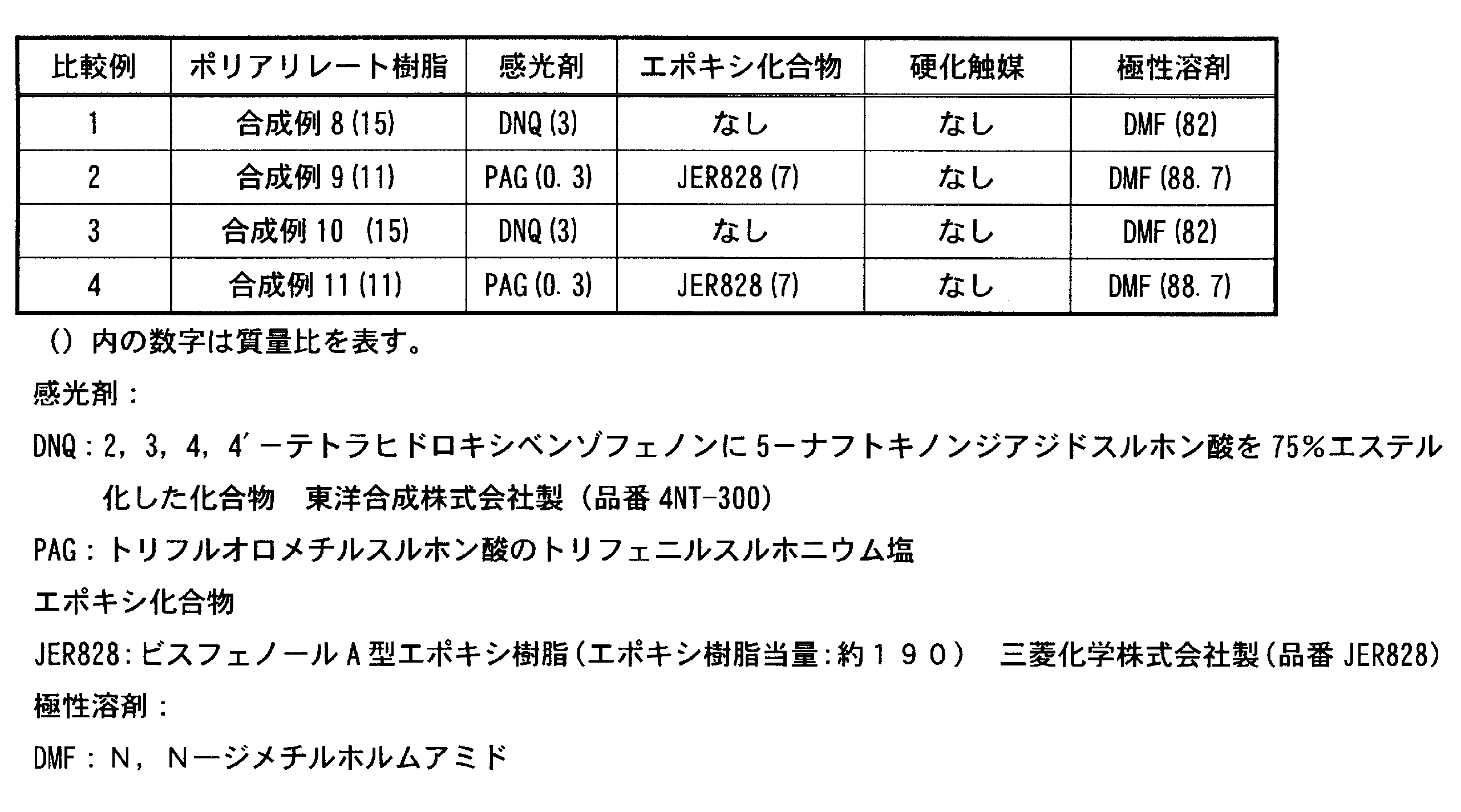
次いで、表3に示すように、合成例8~11で得られた、カルボン酸は含むがヘキサフルオロイソプロパノール基を含まない含フッ素高分子化合物である、各々のポリアリレート樹脂に、感光剤および極性溶剤を加えて均一な溶液とし、感光性樹脂組成物を得た。
実施例1~17と同様の条件で露光、現像、加熱処理を行い、得られたパターンを評価した結果を表4に示した。いずれの場合においても、パターン倒れは観測されなかったが、明らかな膨潤が目視にて観測され、パターン形状としては不良であった。
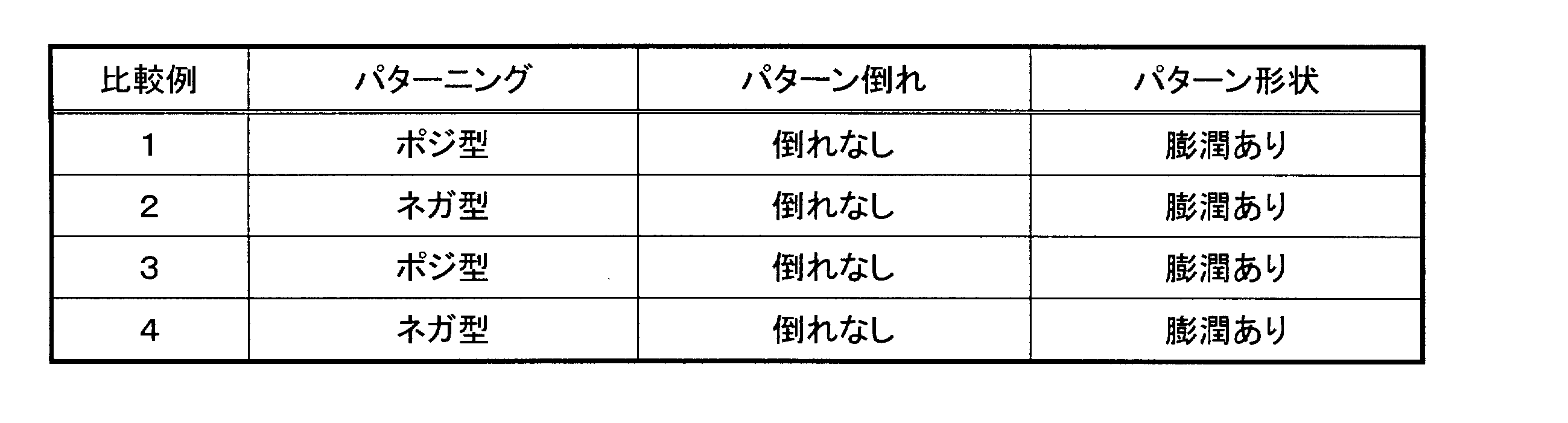
実施例1~17の結果と比較例1~4の結果を比較すると明らかなように、本発明のポリアリレート樹脂はカルボキシル基を含まないことから、パターンが膨潤することなく、良好なパターン形状を与えることが判った。
Claims (16)
- 一般式(1)で表される繰り返し単位を含む含フッ素高分子化合物(A)と、感光剤(B)と、極性溶剤(C)を含む、感光性樹脂組成物。
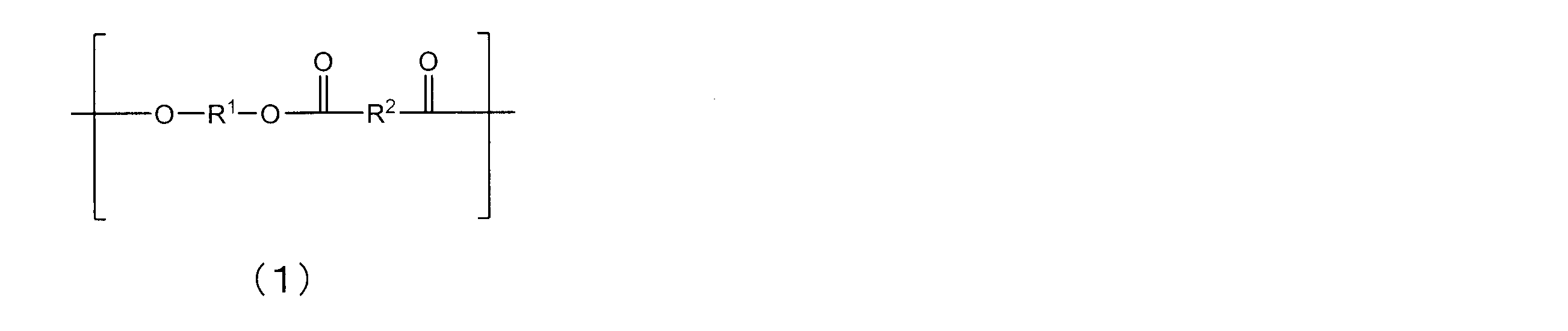
- R1が一般式(2)で表される基である、請求項1に記載の感光性樹脂組成物。

- R1が一般式(3)で表される基である、請求項1または請求項2に記載の感光性樹脂組成物。
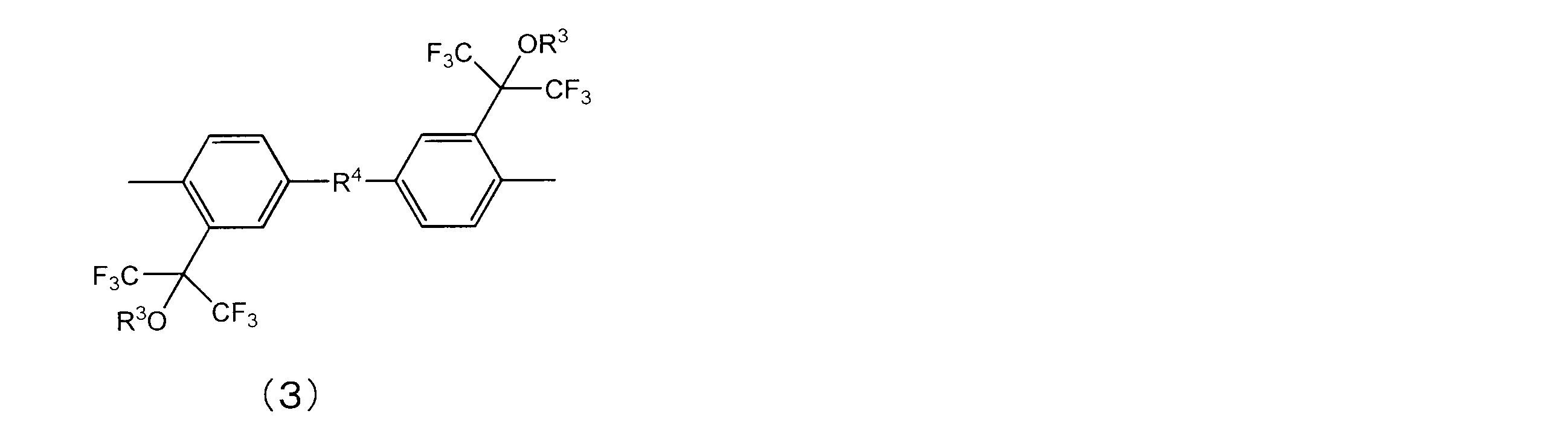
- R1が一般式(4)で表される基である、請求項1乃至請求項3のいずれか1項に記載の感光性樹脂組成物。
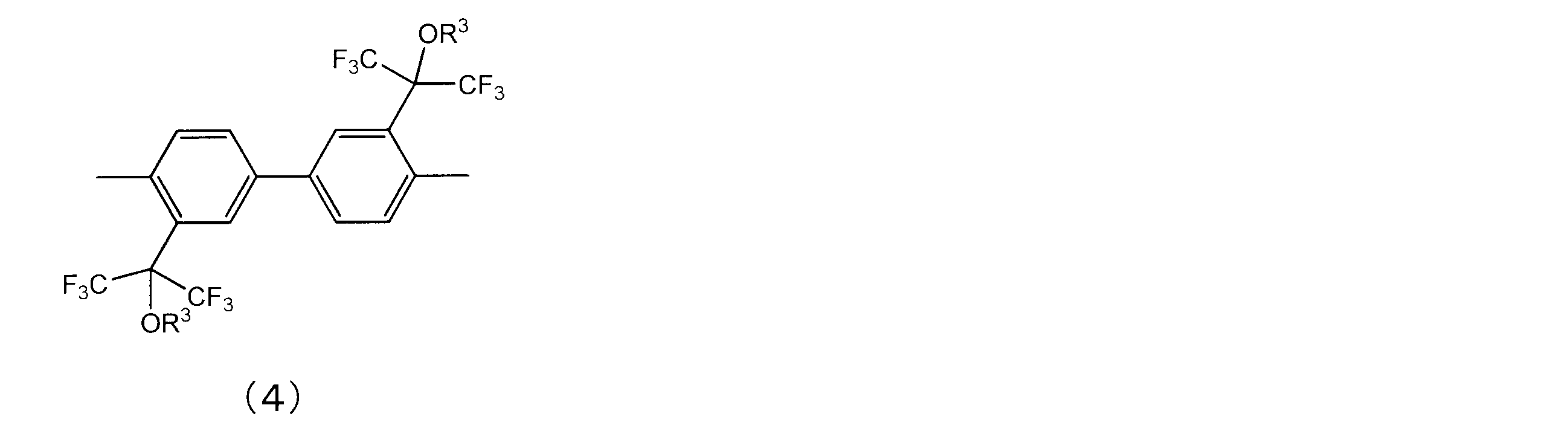
- R1が一般式(5)で表される基である、請求項1乃至請求項3のいずれか1項に記載の感光性樹脂組成物。

- R1が一般式(6)で表される基である、請求項1に記載の感光性樹脂組成物。


- R1が一般式(7)で表される基である、請求項1または請求項6に記載の感光性樹脂組成物。

- R1が一般式(8)で表される基である、請求項1、請求項6または請求項7に記載の感光性樹脂組成物。
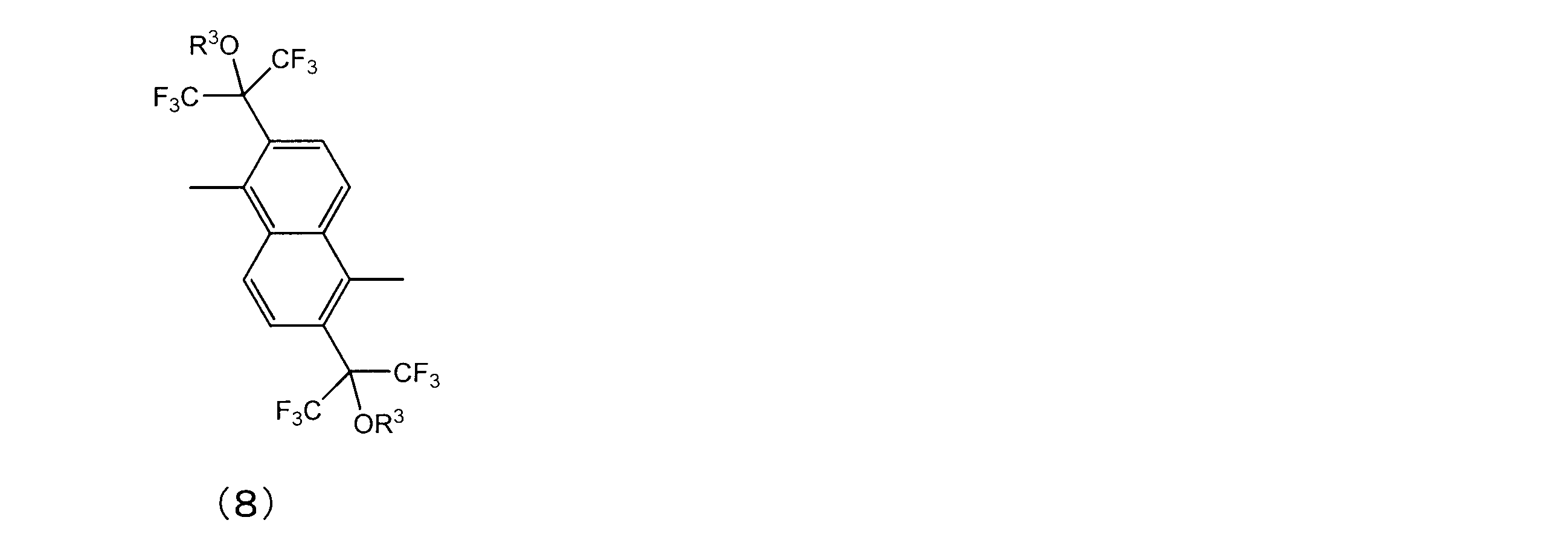
- さらにエポキシ化合物を含む、請求項1乃至請求項8のいずれか1項に記載の感光性樹脂組成物。
- 前記エポキシ化合物が、グリシジル基を含み、化学構造中に炭素-炭素二重結合、炭素-炭素三重結合、芳香環または複素環を含んでいてもよく、エポキシ化合物中の水素原子の一部または全部が、それぞれ独立に、フッ素原子、塩素原子、アルキル基またはフルオロアルキル基で置換されていてもよいエポキシ化合物である、請求項9に記載の感光性樹脂組成物。
- さらにエポキシ樹脂硬化剤を含む、請求項9に記載の感光性樹脂組成物。
- 感光剤(B)が、露光により酸を発生する光酸発生剤である、請求項1乃至請求項11のいずれか1項に記載の感光性樹脂組成物。
- 感光剤(B)が、露光によりスルホン酸を発生する光酸発生剤である、請求項1乃至請求項12のいずれか1項に記載の感光性樹脂組成物。
- 感光剤(B)が、露光によりインデンカルボン酸を発生するジアゾナフトキノン化合物である、請求項1乃至請求項13のいずれか1項に記載の感光性樹脂組成物。
- 極性溶剤(C)が、プロピレングリコールモノメチルエーテルアセテート、プロピレングリコールモノメチルエーテル、シクロヘキサノン、γ-ブチロラクトン、メチルエチルケトン、メチルイソブチルケトン、N,N-ジメチルホルムアミドまたはN-メチルピロリドンからなる群から選ばれる少なくとも一つの極性溶剤である、請求項1乃至請求項14のいずれか1項に記載の感光性樹脂組成物。
- 請求項1乃至請求項15のいずれか1項に記載の感光性樹脂組成物を支持基板上に塗布し溶剤を揮発させ乾燥する工程と、前記乾燥工程後に得られる感光性樹脂膜を、フォトマスクを介し所定のパターン形状に露光する工程と、前記露光後の感光性樹脂膜を現像液に接触させて現像する工程と、前記現像後の感光性樹脂膜を加熱する工程を含む、パターン形成方法。
Applications Claiming Priority (4)
| Application Number | Priority Date | Filing Date | Title |
|---|---|---|---|
| JP2012189737 | 2012-08-30 | ||
| JP2012-189737 | 2012-08-30 | ||
| JP2013171012A JP6330272B2 (ja) | 2012-08-30 | 2013-08-21 | 感光性樹脂組成物およびそれを用いたパターン形成方法 |
| JP2013-171012 | 2013-08-21 |
Publications (1)
| Publication Number | Publication Date |
|---|---|
| WO2014034541A1 true WO2014034541A1 (ja) | 2014-03-06 |
Family
ID=50183355
Family Applications (1)
| Application Number | Title | Priority Date | Filing Date |
|---|---|---|---|
| PCT/JP2013/072514 Ceased WO2014034541A1 (ja) | 2012-08-30 | 2013-08-23 | 感光性樹脂組成物およびそれを用いたパターン形成方法 |
Country Status (2)
| Country | Link |
|---|---|
| JP (1) | JP6330272B2 (ja) |
| WO (1) | WO2014034541A1 (ja) |
Cited By (2)
| Publication number | Priority date | Publication date | Assignee | Title |
|---|---|---|---|---|
| CN106967377A (zh) * | 2016-01-14 | 2017-07-21 | 东洋油墨Sc控股株式会社 | 增粘涂剂、太阳电池保护片用增粘涂剂及涂敷物 |
| US20220043346A1 (en) * | 2019-04-25 | 2022-02-10 | Jsr Corporation | Photosensitive resin composition |
Families Citing this family (5)
| Publication number | Priority date | Publication date | Assignee | Title |
|---|---|---|---|---|
| SG11201701691PA (en) * | 2014-09-02 | 2017-04-27 | Toray Industries | Resin and photosensitive resin composition |
| WO2019189877A1 (ja) * | 2018-03-29 | 2019-10-03 | Jsr株式会社 | 感放射線性樹脂組成物及びレジストパターン形成方法 |
| JP6979514B2 (ja) * | 2018-03-30 | 2021-12-15 | 富士フイルム株式会社 | 感活性光線性又は感放射線性樹脂組成物、感活性光線性又は感放射線性膜、パターン形成方法、及び電子デバイスの製造方法 |
| WO2019187804A1 (ja) * | 2018-03-30 | 2019-10-03 | 富士フイルム株式会社 | 感活性光線性又は感放射線性樹脂組成物、感活性光線性又は感放射線性膜、パターン形成方法、及び電子デバイスの製造方法、並びにポリエステル |
| JP7125476B2 (ja) * | 2018-03-30 | 2022-08-24 | 富士フイルム株式会社 | 感活性光線性又は感放射線性樹脂組成物、感活性光線性又は感放射線性膜、パターン形成方法、及び電子デバイスの製造方法 |
Citations (4)
| Publication number | Priority date | Publication date | Assignee | Title |
|---|---|---|---|---|
| JP2005091807A (ja) * | 2003-09-18 | 2005-04-07 | Nippon Soda Co Ltd | レジスト組成物 |
| JP2006293326A (ja) * | 2005-03-15 | 2006-10-26 | Canon Inc | 感光性組成物及び該組成物を用いた構造体の製造方法 |
| JP2007002045A (ja) * | 2005-06-22 | 2007-01-11 | Central Glass Co Ltd | ポリエステル化合物およびそれを用いたレジスト材料 |
| JP2011237550A (ja) * | 2010-05-10 | 2011-11-24 | Yokohama National Univ | 反応現像画像形成法 |
Family Cites Families (5)
| Publication number | Priority date | Publication date | Assignee | Title |
|---|---|---|---|---|
| US20100009290A1 (en) * | 2006-12-03 | 2010-01-14 | Central Glass Co., Ltd. | Photosensitive Polybenzoxazines and Methods of Making the Same |
| JP5114938B2 (ja) * | 2006-12-19 | 2013-01-09 | セントラル硝子株式会社 | 含フッ素ジアミンおよびそれを用いた高分子化合物 |
| JP5233457B2 (ja) * | 2007-07-17 | 2013-07-10 | セントラル硝子株式会社 | 新規な含フッ素ジカルボン酸およびそれを用いた新規な高分子化合物 |
| WO2010095678A1 (ja) * | 2009-02-20 | 2010-08-26 | セントラル硝子株式会社 | 含フッ素ジカルボン酸誘導体およびそれを用いた高分子化合物 |
| JP5661370B2 (ja) * | 2010-08-10 | 2015-01-28 | ユニチカ株式会社 | ポジ型感光性樹脂組成物 |
-
2013
- 2013-08-21 JP JP2013171012A patent/JP6330272B2/ja not_active Expired - Fee Related
- 2013-08-23 WO PCT/JP2013/072514 patent/WO2014034541A1/ja not_active Ceased
Patent Citations (4)
| Publication number | Priority date | Publication date | Assignee | Title |
|---|---|---|---|---|
| JP2005091807A (ja) * | 2003-09-18 | 2005-04-07 | Nippon Soda Co Ltd | レジスト組成物 |
| JP2006293326A (ja) * | 2005-03-15 | 2006-10-26 | Canon Inc | 感光性組成物及び該組成物を用いた構造体の製造方法 |
| JP2007002045A (ja) * | 2005-06-22 | 2007-01-11 | Central Glass Co Ltd | ポリエステル化合物およびそれを用いたレジスト材料 |
| JP2011237550A (ja) * | 2010-05-10 | 2011-11-24 | Yokohama National Univ | 反応現像画像形成法 |
Cited By (4)
| Publication number | Priority date | Publication date | Assignee | Title |
|---|---|---|---|---|
| CN106967377A (zh) * | 2016-01-14 | 2017-07-21 | 东洋油墨Sc控股株式会社 | 增粘涂剂、太阳电池保护片用增粘涂剂及涂敷物 |
| CN106967377B (zh) * | 2016-01-14 | 2020-10-27 | 东洋油墨Sc控股株式会社 | 增粘涂剂及涂敷物 |
| US20220043346A1 (en) * | 2019-04-25 | 2022-02-10 | Jsr Corporation | Photosensitive resin composition |
| US12282253B2 (en) * | 2019-04-25 | 2025-04-22 | Jsr Corporation | Photosensitive resin composition |
Also Published As
| Publication number | Publication date |
|---|---|
| JP6330272B2 (ja) | 2018-05-30 |
| JP2014063148A (ja) | 2014-04-10 |
Similar Documents
| Publication | Publication Date | Title |
|---|---|---|
| JP6330272B2 (ja) | 感光性樹脂組成物およびそれを用いたパターン形成方法 | |
| CN111217946A (zh) | 包含含有乙烯基的化合物的组合物 | |
| JP5862453B2 (ja) | 含フッ素重合性単量体およびそれを用いた高分子化合物 | |
| Cai et al. | Synthesis and characterization of novel fluorinated polycarbonate negative-type photoresist for optical waveguide | |
| WO2007142124A1 (ja) | 架橋性プレポリマーならびにその製造方法および用途 | |
| WO1999000704A1 (fr) | Composition de reserve sensible au rayonnement et a haute tenue a la chaleur | |
| KR101050619B1 (ko) | 포토레지스트용 노르보넨 중합체 및 그를 포함하는 포토레지스트 조성물 | |
| CN112521296B (zh) | 二胺化合物、使用其的耐热性树脂或耐热性树脂前体、感光树脂组合物、固化膜及显示装置 | |
| JPWO2020110793A1 (ja) | 感光性樹脂組成物、含フッ素樹脂硬化物の製造方法、含フッ素樹脂、含フッ素樹脂膜、バンク及び表示素子 | |
| KR100711691B1 (ko) | α 위치 메틸기에 산소 치환기를 갖는 지환 함유메타크릴레이트 화합물 | |
| JP4154953B2 (ja) | ポジ型感光性樹脂組成物、それを用いたパターンの製造方法および電子部品 | |
| JP5267415B2 (ja) | 樹脂組成物およびその用途 | |
| JP4337389B2 (ja) | 耐熱性樹脂前駆体組成物の製造方法 | |
| TW202402744A (zh) | 化合物、含有上述化合物之酸產生劑、光阻劑、及使用上述光阻劑之電子裝置之製造方法 | |
| CN101900941B (zh) | 高含氟负性光刻胶及其在聚合物光波导器件中的应用 | |
| Mizoguchi et al. | An alkaline-developable, chemically amplified, negative-type photosensitive poly (benzoxazole) resist based on poly (o-hydroxy amide), an active ester-type cross-linker, and a photobase generator | |
| CN115368286B (zh) | 一种高产酸的肟磺酸酯类光产酸剂 | |
| JPH05339474A (ja) | 感光性組成物 | |
| TW202402743A (zh) | 化合物、含上述化合物之酸產生劑、光阻劑、及使用上述光阻劑之電子裝置之製造方法 | |
| CN102323717B (zh) | 高含氟芳香-脂肪负性光刻胶及用于制备聚合物波导器件 | |
| CN115611874B (zh) | 肟磺酸酯光酸、含其的抗蚀剂组合物、电子器件及应用 | |
| JP7556419B2 (ja) | ネガ型感光性樹脂組成物 | |
| CN101812173B (zh) | N-羟基马来海松酸酰亚胺酯缩醛聚合物及其制备方法 | |
| KR20010060090A (ko) | 반응성 광산발생제와 이를 포함하는 폴리아미드 감광성내열절연체 조성물 | |
| KR101510781B1 (ko) | 함불소 중합성 단량체 및 그것을 이용한 고분자 화합물 |
Legal Events
| Date | Code | Title | Description |
|---|---|---|---|
| 121 | Ep: the epo has been informed by wipo that ep was designated in this application |
Ref document number: 13832688 Country of ref document: EP Kind code of ref document: A1 |
|
| NENP | Non-entry into the national phase |
Ref country code: DE |
|
| 122 | Ep: pct application non-entry in european phase |
Ref document number: 13832688 Country of ref document: EP Kind code of ref document: A1 |