WO2014024702A1 - 高分子化合物の製造方法、高分子化合物、及びフォトレジスト用樹脂組成物 - Google Patents
高分子化合物の製造方法、高分子化合物、及びフォトレジスト用樹脂組成物 Download PDFInfo
- Publication number
- WO2014024702A1 WO2014024702A1 PCT/JP2013/070289 JP2013070289W WO2014024702A1 WO 2014024702 A1 WO2014024702 A1 WO 2014024702A1 JP 2013070289 W JP2013070289 W JP 2013070289W WO 2014024702 A1 WO2014024702 A1 WO 2014024702A1
- Authority
- WO
- WIPO (PCT)
- Prior art keywords
- group
- polymer compound
- protected
- ring
- monomer unit
- Prior art date
- Legal status (The legal status is an assumption and is not a legal conclusion. Google has not performed a legal analysis and makes no representation as to the accuracy of the status listed.)
- Ceased
Links
- 0 CC(C)CC(C)(*)C(O*CC(C1CC(C)(*)C2C3*1)C3OS2(=O)=O)=O Chemical compound CC(C)CC(C)(*)C(O*CC(C1CC(C)(*)C2C3*1)C3OS2(=O)=O)=O 0.000 description 3
Classifications
-
- G—PHYSICS
- G03—PHOTOGRAPHY; CINEMATOGRAPHY; ANALOGOUS TECHNIQUES USING WAVES OTHER THAN OPTICAL WAVES; ELECTROGRAPHY; HOLOGRAPHY
- G03F—PHOTOMECHANICAL PRODUCTION OF TEXTURED OR PATTERNED SURFACES, e.g. FOR PRINTING, FOR PROCESSING OF SEMICONDUCTOR DEVICES; MATERIALS THEREFOR; ORIGINALS THEREFOR; APPARATUS SPECIALLY ADAPTED THEREFOR
- G03F7/00—Photomechanical, e.g. photolithographic, production of textured or patterned surfaces, e.g. printing surfaces; Materials therefor, e.g. comprising photoresists; Apparatus specially adapted therefor
- G03F7/004—Photosensitive materials
-
- C—CHEMISTRY; METALLURGY
- C08—ORGANIC MACROMOLECULAR COMPOUNDS; THEIR PREPARATION OR CHEMICAL WORKING-UP; COMPOSITIONS BASED THEREON
- C08F—MACROMOLECULAR COMPOUNDS OBTAINED BY REACTIONS ONLY INVOLVING CARBON-TO-CARBON UNSATURATED BONDS
- C08F220/00—Copolymers of compounds having one or more unsaturated aliphatic radicals, each having only one carbon-to-carbon double bond, and only one being terminated by only one carboxyl radical or a salt, anhydride ester, amide, imide or nitrile thereof
- C08F220/02—Monocarboxylic acids having less than ten carbon atoms; Derivatives thereof
- C08F220/10—Esters
-
- C—CHEMISTRY; METALLURGY
- C08—ORGANIC MACROMOLECULAR COMPOUNDS; THEIR PREPARATION OR CHEMICAL WORKING-UP; COMPOSITIONS BASED THEREON
- C08F—MACROMOLECULAR COMPOUNDS OBTAINED BY REACTIONS ONLY INVOLVING CARBON-TO-CARBON UNSATURATED BONDS
- C08F22/00—Homopolymers and copolymers of compounds having one or more unsaturated aliphatic radicals each having only one carbon-to-carbon double bond, and at least one being terminated by a carboxyl radical and containing at least one other carboxyl radical in the molecule; Salts, anhydrides, esters, amides, imides or nitriles thereof
- C08F22/04—Anhydrides, e.g. cyclic anhydrides
-
- C—CHEMISTRY; METALLURGY
- C08—ORGANIC MACROMOLECULAR COMPOUNDS; THEIR PREPARATION OR CHEMICAL WORKING-UP; COMPOSITIONS BASED THEREON
- C08F—MACROMOLECULAR COMPOUNDS OBTAINED BY REACTIONS ONLY INVOLVING CARBON-TO-CARBON UNSATURATED BONDS
- C08F24/00—Homopolymers and copolymers of compounds having one or more unsaturated aliphatic radicals, each having only one carbon-to-carbon double bond, and at least one being terminated by a heterocyclic ring containing oxygen
-
- C—CHEMISTRY; METALLURGY
- C08—ORGANIC MACROMOLECULAR COMPOUNDS; THEIR PREPARATION OR CHEMICAL WORKING-UP; COMPOSITIONS BASED THEREON
- C08F—MACROMOLECULAR COMPOUNDS OBTAINED BY REACTIONS ONLY INVOLVING CARBON-TO-CARBON UNSATURATED BONDS
- C08F28/00—Homopolymers and copolymers of compounds having one or more unsaturated aliphatic radicals, each having only one carbon-to-carbon double bond, and at least one being terminated by a bond to sulfur or by a heterocyclic ring containing sulfur
- C08F28/06—Homopolymers and copolymers of compounds having one or more unsaturated aliphatic radicals, each having only one carbon-to-carbon double bond, and at least one being terminated by a bond to sulfur or by a heterocyclic ring containing sulfur by a heterocyclic ring containing sulfur
-
- C—CHEMISTRY; METALLURGY
- C08—ORGANIC MACROMOLECULAR COMPOUNDS; THEIR PREPARATION OR CHEMICAL WORKING-UP; COMPOSITIONS BASED THEREON
- C08F—MACROMOLECULAR COMPOUNDS OBTAINED BY REACTIONS ONLY INVOLVING CARBON-TO-CARBON UNSATURATED BONDS
- C08F6/00—Post-polymerisation treatments
- C08F6/02—Neutralisation of the polymerisation mass, e.g. killing the catalyst also removal of catalyst residues
-
- C—CHEMISTRY; METALLURGY
- C08—ORGANIC MACROMOLECULAR COMPOUNDS; THEIR PREPARATION OR CHEMICAL WORKING-UP; COMPOSITIONS BASED THEREON
- C08F—MACROMOLECULAR COMPOUNDS OBTAINED BY REACTIONS ONLY INVOLVING CARBON-TO-CARBON UNSATURATED BONDS
- C08F6/00—Post-polymerisation treatments
- C08F6/06—Treatment of polymer solutions
-
- G—PHYSICS
- G03—PHOTOGRAPHY; CINEMATOGRAPHY; ANALOGOUS TECHNIQUES USING WAVES OTHER THAN OPTICAL WAVES; ELECTROGRAPHY; HOLOGRAPHY
- G03F—PHOTOMECHANICAL PRODUCTION OF TEXTURED OR PATTERNED SURFACES, e.g. FOR PRINTING, FOR PROCESSING OF SEMICONDUCTOR DEVICES; MATERIALS THEREFOR; ORIGINALS THEREFOR; APPARATUS SPECIALLY ADAPTED THEREFOR
- G03F7/00—Photomechanical, e.g. photolithographic, production of textured or patterned surfaces, e.g. printing surfaces; Materials therefor, e.g. comprising photoresists; Apparatus specially adapted therefor
- G03F7/004—Photosensitive materials
- G03F7/039—Macromolecular compounds which are photodegradable, e.g. positive electron resists
-
- G—PHYSICS
- G03—PHOTOGRAPHY; CINEMATOGRAPHY; ANALOGOUS TECHNIQUES USING WAVES OTHER THAN OPTICAL WAVES; ELECTROGRAPHY; HOLOGRAPHY
- G03F—PHOTOMECHANICAL PRODUCTION OF TEXTURED OR PATTERNED SURFACES, e.g. FOR PRINTING, FOR PROCESSING OF SEMICONDUCTOR DEVICES; MATERIALS THEREFOR; ORIGINALS THEREFOR; APPARATUS SPECIALLY ADAPTED THEREFOR
- G03F7/00—Photomechanical, e.g. photolithographic, production of textured or patterned surfaces, e.g. printing surfaces; Materials therefor, e.g. comprising photoresists; Apparatus specially adapted therefor
- G03F7/004—Photosensitive materials
- G03F7/039—Macromolecular compounds which are photodegradable, e.g. positive electron resists
- G03F7/0392—Macromolecular compounds which are photodegradable, e.g. positive electron resists the macromolecular compound being present in a chemically amplified positive photoresist composition
- G03F7/0397—Macromolecular compounds which are photodegradable, e.g. positive electron resists the macromolecular compound being present in a chemically amplified positive photoresist composition the macromolecular compound having an alicyclic moiety in a side chain
Definitions
- the present invention relates to a method for producing a polymer compound used when performing microfabrication of a semiconductor, the polymer compound obtained by the production method, and a resin composition for a photoresist containing the polymer compound.
- a positive photoresist used in the manufacture of semiconductors generally contains a resist polymer, a photoacid generator, an organic solvent, and several additives as necessary. It is required to have properties such as soluble properties, adhesion to a silicon wafer, and resistance to plasma etching.
- the exposure light source in photolithography has been shortened year by year, and is shifting from a KrF excimer laser with a wavelength of 248 nm to an ArF excimer laser with a wavelength of 193 nm.
- Various types of polymers for resists used in ArF excimer laser exposure are proposed, including repeating units containing a lactone skeleton with high adhesion to the substrate and repeating units containing an alicyclic hydrocarbon skeleton with excellent etching resistance. Has been.
- the resist polymer is usually obtained by polymerizing a monomer mixture and then isolating by a precipitation operation.
- the polymer obtained in this way contains metal components such as sodium and iron from raw materials, production equipment, environment, etc., there is a problem that the electrical properties of semiconductors and the like deteriorate when used in photoresists. .
- Patent Documents 1 to 3 As a method for removing the metal component, a method of filtering using a filter having a strongly acidic cation exchange group is known (Patent Documents 1 to 3). However, although the metal component can be removed by the filtration method, the resist polymer filtered using the filter has a problem of poor storage stability and cannot form a good resist film.
- an object of the present invention is to provide a method for producing a polymer compound having an extremely low content of impurities such as a metal component and having excellent storage stability, a polymer compound obtained by the production method, and the polymer compound
- An object of the present invention is to provide a photoresist resin composition.
- the present inventors have a lactone that is easily hydrolyzed (particularly, a lactone having an electron-withdrawing group such as a cyano group or a trifluoromethyl group), a sultone, or an acid anhydride.
- a lactone having an electron-withdrawing group such as a cyano group or a trifluoromethyl group
- the lactone particularly, a lactone having an electron-withdrawing group such as a cyano group or a trifluoromethyl group
- sultone, or an acid anhydride is partially hydrolyzed.
- it was found that the acid leaving group in the polymer compound was eliminated over time and the resist performance was lowered.
- a lactone particularly, a cyano group or a trifluoromethyl group
- a lactone having an electron-withdrawing group), sultone, or acid anhydride can be adsorbed / removed without hydrolysis, producing a semiconductor having excellent storage stability and excellent electrical characteristics. It was found that a polymer compound capable of producing The present invention has been completed based on these findings.
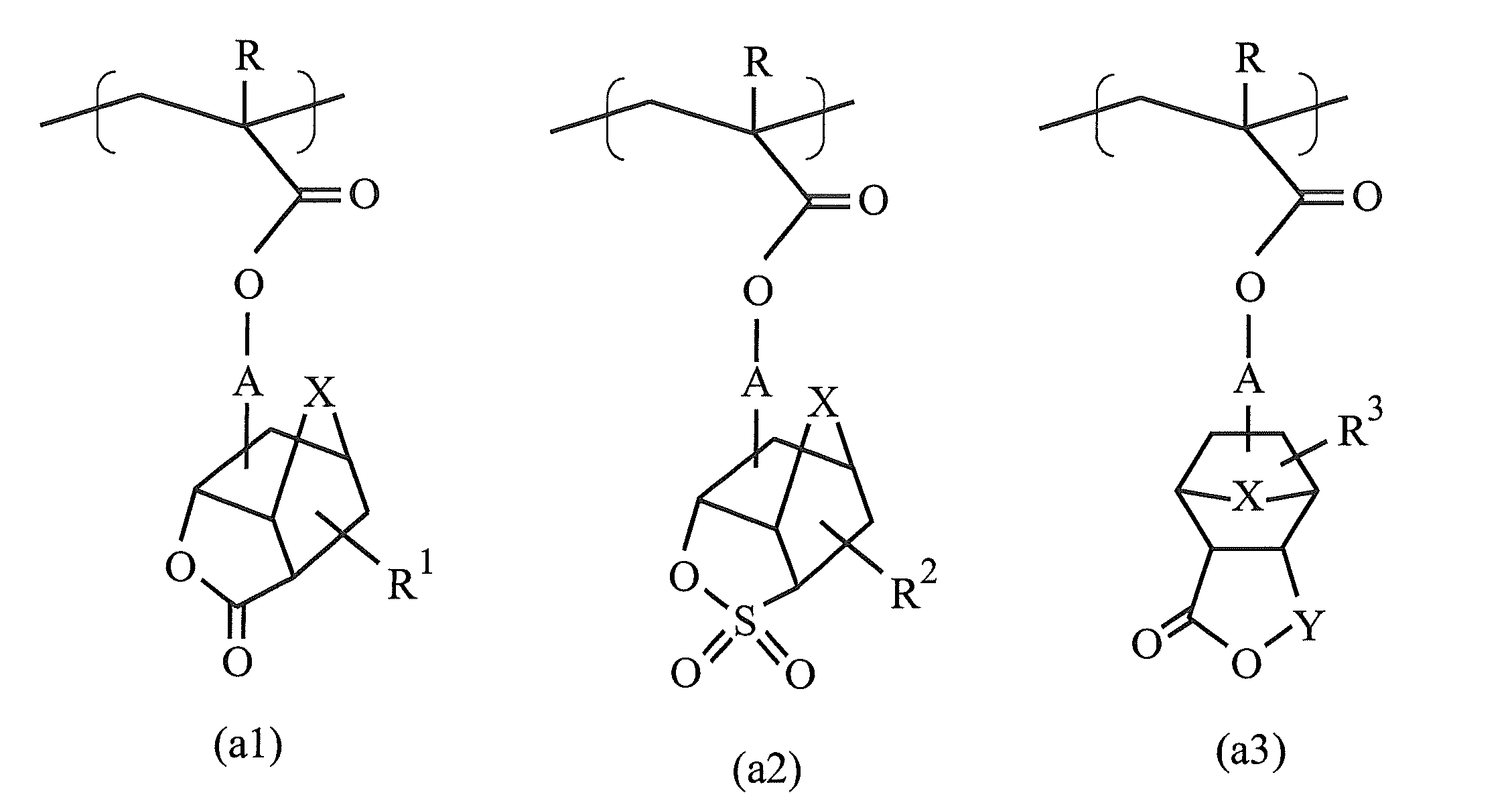
- the present invention provides the following formulas (a1) to (a3) (In the formula, R represents a hydrogen atom, a halogen atom, or an alkyl group having 1 to 6 carbon atoms which may have a halogen atom, A represents a single bond or a linking group, and X represents a non-bonded, methylene group. Represents an ethylene group, an oxygen atom, or a sulfur atom, Y represents a methylene group or a carbonyl group, and R 1 to R 3 may be the same or different and may have a hydrogen atom, a fluorine atom, or a fluorine atom.
- Filter A filter that does not contain strongly acidic cation exchange groups and exhibits a positive zeta potential
- the resin solution before being subjected to the filtration step is heated at 60 ° C. and the time required for the acid value to exceed 0.05 mmol / g (T 0 ), and the resin solution after being subjected to the filtration step is heated at 60 ° C.
- R represents a hydrogen atom, a halogen atom, or an alkyl group having 1 to 6 carbon atoms which may have a halogen atom
- A represents a single bond or a linking group
- R 4 to R 6 are the same.
- R 7 and R 8 are the same or different and have 1 carbon atom which may have a hydrogen atom or a substituent.
- R 9 represents a —COOR c group
- R c represents a tertiary hydrocarbon group, a tetrahydrofuranyl group, a tetrahydropyranyl group, or an oxepanyl group which may have a substituent.
- N represents an integer of 1 to 3.
- R a is a substituent bonded to ring Z 1 and is an oxo group, an alkyl group, a hydroxyl group which may be protected with a protecting group, or a protecting group Protected with a hydroxyalkyl group which may be protected with If .p showing an even better carboxyl group had a .p is 2 or 3 represents an integer of 0 to 3, two or three R a may be the same or different.
- Ring Z 1 represents an alicyclic hydrocarbon ring having 3 to 20 carbon atoms) At least one monomer unit selected from the monomer units represented by
- the polymer compound of the present invention has the following formula (c1) in addition to the monomer unit a and the monomer unit b.
- R represents a hydrogen atom, a halogen atom, or an alkyl group having 1 to 6 carbon atoms which may have a halogen atom
- A represents a single bond or a linking group
- R b represents a protecting group.
- q represents an integer of 1 to 5.
- Z 2 represents an alicyclic hydrocarbon ring having 6 to 20 carbon atoms
- the present invention also provides a polymer compound obtained by the method for producing the polymer compound.
- the polymer compound preferably has a weight average molecular weight of 1,000 to 50,000 and a molecular weight distribution (ratio of weight average molecular weight to number average molecular weight) of 1.0 to 3.0.
- the present invention further provides a resin composition for a photoresist comprising at least the polymer compound, a photoacid generator and an organic solvent.
- a polymer compound obtained by polymerizing a monomer mixture is filtered using a filter that does not contain a strongly acidic cation exchange group and exhibits a positive zeta potential.
- a polar group [lactone (particularly, a lactone having an electron-withdrawing group such as a cyano group or a trifluoromethyl group), a sultone (—S ( ⁇ O) 2 —O—), or an acid
- lactone particularly, a lactone having an electron-withdrawing group such as a cyano group or a trifluoromethyl group
- S ( ⁇ O) 2 —O— sultone
- an acid leaving group in the polymer compound is eliminated over time.
- the polymer compound of the present invention is excellent in storage stability and has an extremely low content of metal components such as sodium and iron, it can be suitably used as a polymer for ArF resist. And according to the high molecular compound of this invention, the semiconductor which has the outstanding electrical property can be manufactured.
- the polymer compound of the present invention has at least a monomer unit a and a monomer unit b including a group that is partially eliminated by an acid and becomes alkali-soluble.
- the polymer compound of the present invention may have a monomer unit c in addition to the monomer unit a and the monomer unit b.
- the monomer unit a has [—C ( ⁇ O) —O—], [—S ( ⁇ O) 2 —O—], or [—C ( ⁇ O) —O—C ( ⁇ O) —] as a polar group.
- the polymer compound is provided with base adhesion and etching resistance.
- the monomer unit a includes at least one monomer unit selected from monomer units represented by the following formulas (a1) to (a3).
- R represents a hydrogen atom, a halogen atom, or an alkyl group having 1 to 6 carbon atoms which may have a halogen atom
- A represents a single bond or a linking group.
- X represents a non-bond, a methylene group, an ethylene group, an oxygen atom, or a sulfur atom.
- Y represents a methylene group or a carbonyl group.
- R 1 to R 3 are the same or different and may be a hydrogen atom, a fluorine atom, an alkyl group which may have a fluorine atom, a hydroxyl group which may be protected with a protecting group, or a group which is protected with a protecting group.
- a good hydroxyalkyl group, a carboxyl group optionally protected by a protecting group, or a cyano group is shown.
- R represents a hydrogen atom, a halogen atom, or an alkyl group having 1 to 6 carbon atoms which may have a halogen atom.
- halogen atom a chlorine atom, a bromine atom, an iodine atom etc.
- alkyl group having 1 to 6 carbon atoms include methyl, ethyl, propyl, isopropyl, butyl, isobutyl, s-butyl, t-butyl, pentyl, isoamyl, s-amyl, t-amyl, hexyl group and the like. Can be mentioned.
- alkyl group having 1 to 6 carbon atoms having a halogen atom examples include one or more hydrogen atoms constituting the alkyl group such as trifluoromethyl, 2,2,2-trifluoroethyl group, etc.
- a substituted group (halo (C 1-6 ) alkyl group) and the like can be mentioned.
- A represents a single bond or a linking group.
- the alkylene group include linear or branched alkylene groups such as methylene, methylmethylene, dimethylmethylene, ethylene, propylene, and trimethylene groups, 1,2-cyclopentylene, and 1,3-cyclopentylene.
- Divalent alicyclic hydrocarbon groups such as len, cyclopentylidene, 1,2-cyclohexylene, 1,3-cyclohexylene, 1,4-cyclohexylene, cyclohexylidene groups (especially cycloalkylene groups) , A cycloalkylidene group) and the like.
- Examples of the alkyl group in R 1 to R 3 include methyl, ethyl, propyl, isopropyl, butyl, s-butyl, t-butyl, pentyl, isoamyl, s-amyl, t-amyl, and n-hexyl group. Examples thereof include an alkyl group having 1 to 6 carbon atoms.
- Examples of the alkyl group having a fluorine atom in R 1 to R 3 include one or more hydrogen atoms constituting the alkyl group such as trifluoromethyl and 2,2,2-trifluoroethyl group. And a group [fluoro (C 1-6 ) alkyl group] substituted with a fluorine atom.
- Examples of the hydroxyalkyl group in R 1 to R 3 include hydroxymethyl, 2-hydroxyethyl, 1-hydroxyethyl, 3-hydroxypropyl, 2-hydroxypropyl, 4-hydroxybutyl, and 6-hydroxyhexyl groups. Examples thereof include a hydroxy C 1-6 alkyl group.
- Examples of the protecting group that the hydroxyl group and the hydroxyalkyl group may have include, for example, a C 1-4 alkyl group such as methyl, ethyl, t-butyl group; an acetal bond together with an oxygen atom constituting the hydroxyl group.
- Forming group for example, C 1-4 alkyl-O—C 1-4 alkyl group such as methoxymethyl group
- Group forming an ester bond with oxygen atom constituting hydroxyl group for example, acetyl group, benzoyl group, etc.
- Examples of the protecting group for the carboxyl group in R 1 to R 3 include methyl, ethyl, propyl, isopropyl, butyl, s-butyl, t-butyl, pentyl, isoamyl, s-amyl, t-amyl, hexyl group and the like.
- a monomer unit represented by the formula (a1) and R 1 is an electron-withdrawing group of a cyano group or a fluoro (C 1-6 ) alkyl group
- the monomer unit represented by (a3) and Y is a carbonyl group can provide excellent substrate adhesion and etching resistance to the polymer compound, and can be dissolved in an alkali developer. It is preferable in that it is excellent and can form a fine pattern with high accuracy.
- the monomer unit a of the present invention include monomer units represented by the following formula.
- the monomer unit a can be introduced into the polymer compound by subjecting the corresponding unsaturated carboxylic acid ester to polymerization.
- the monomer unit b of the present invention contains a group that is partially eliminated by an acid and becomes alkali-soluble, and gives the polymer compound the property of becoming alkali-soluble by an acid and etching resistance.
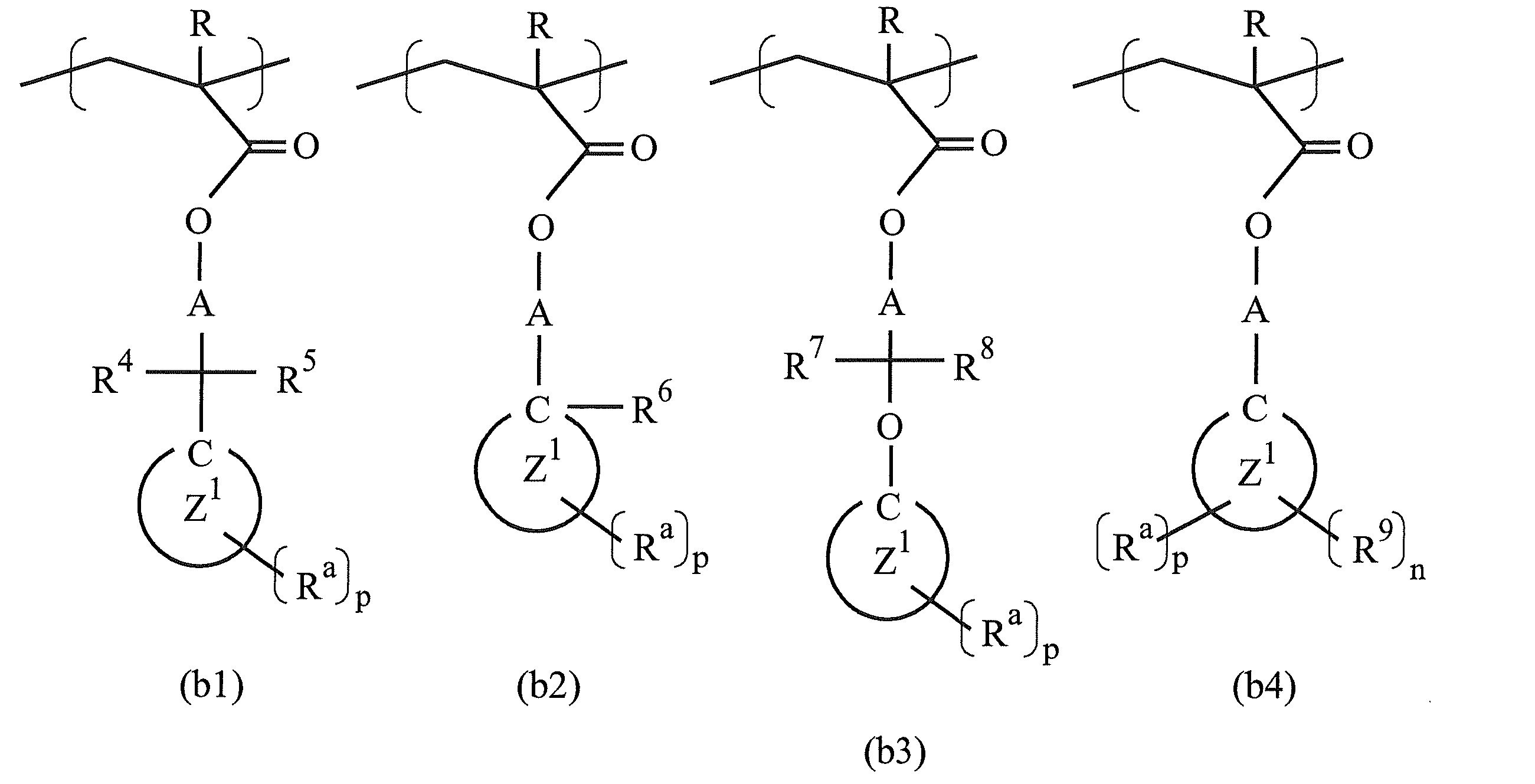
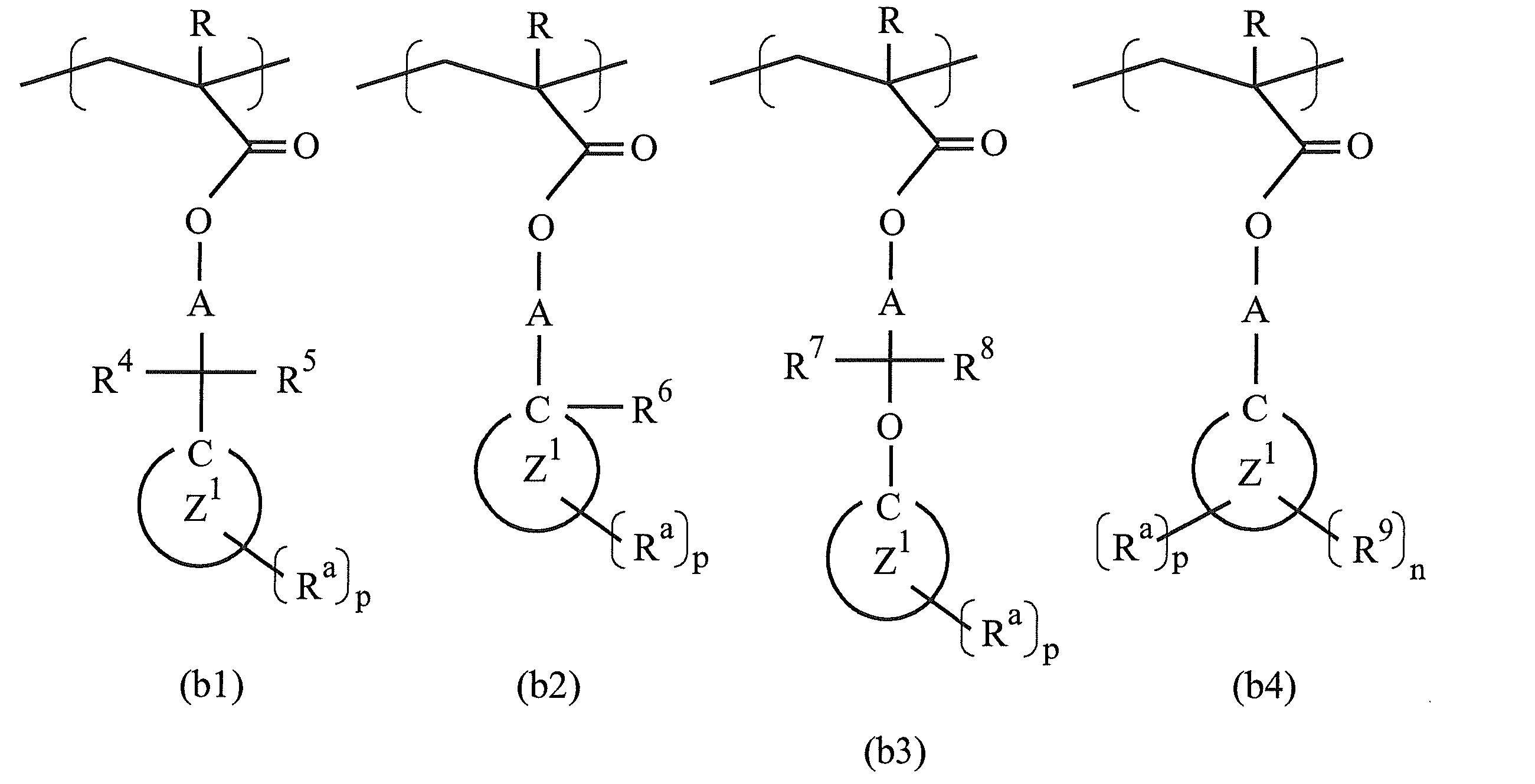
- the monomer unit b of the present invention preferably contains at least one monomer unit selected from the following formulas (b1) to (b4).
- R represents a hydrogen atom, a halogen atom, or an alkyl group having 1 to 6 carbon atoms which may have a halogen atom
- A represents a single bond or a linking group.
- R 4 to R 6 are the same or different and each represents an optionally substituted alkyl group having 1 to 6 carbon atoms.
- R 7 and R 8 are the same or different and each represents a hydrogen atom or an alkyl group having 1 to 6 carbon atoms which may have a substituent.
- R 9 represents a —COOR c group
- R c represents a tertiary hydrocarbon group, a tetrahydrofuranyl group, a tetrahydropyranyl group, or an oxepanyl group which may have a substituent.
- n represents an integer of 1 to 3.
- R a is a substituent bonded to ring Z 1 and is an oxo group, an alkyl group, a hydroxyl group which may be protected with a protecting group, a hydroxyalkyl group which may be protected with a protecting group, or a protected group The carboxyl group which may be protected by group is shown.
- p represents an integer of 0 to 3.
- Ring Z 1 represents an alicyclic hydrocarbon ring having 3 to 20 carbon atoms.
- R and A in formulas (b1) to (b4) include the same examples as R and A in formulas (a1) to (a3).
- the alkyl group in R a in formulas (b1) to (b4), a hydroxyl group that may be protected with a protecting group, a hydroxyalkyl group that may be protected with a protecting group, and a protecting group examples of the carboxyl group that may be used include the same examples as in R 1 to R 3 in formulas (a1) to (a3).
- p is 2 or 3
- two or three R a may be the same or different.
- alkyl group having 1 to 6 carbon atoms in R 4 to R 8 examples include methyl, ethyl, propyl, isopropyl, butyl, isobutyl, s-butyl, t-butyl, pentyl, isoamyl, s-amyl, t- Examples thereof include linear or branched alkyl groups such as amyl and hexyl groups.
- a C 1-4 alkyl group is preferable, a C 1-3 alkyl group is particularly preferable, and a C 1-2 alkyl group is most preferable.
- Examples of the substituent which the alkyl group having 1 to 6 carbon atoms in R 4 to R 8 may have include, for example, a halogen atom, a hydroxy group, a substituted hydroxy group (for example, a methoxy, ethoxy, propoxy group, etc.) 1-4 alkoxy group etc.), cyano group etc. can be mentioned.
- Specific examples of the alkyl group having 1 to 6 carbon atoms having a substituent include one or more hydrogen atoms constituting the alkyl group such as trifluoromethyl and 2,2,2-trifluoroethyl group.
- a halo (C 1-6 ) alkyl group substituted by a halogen atom and hydroxymethyl, 2-hydroxyethyl, methoxymethyl, 2-methoxyethyl, ethoxymethyl, 2-ethoxyethyl, cyanomethyl, 2-cyanoethyl groups, etc. Can do.
- Examples of the tertiary hydrocarbon group for R c include a t-butyl group and a t-pentyl group.
- Examples of the substituent that the tertiary hydrocarbon group in R c may have include, for example, a halogen atom, a hydroxy group, a substituted hydroxy group (for example, a C 1-4 alkoxy group such as a methoxy, ethoxy, propoxy group, etc.) Etc.), and a cyano group.
- a halogen atom for example, a hydroxy group, a substituted hydroxy group (for example, a C 1-4 alkoxy group such as a methoxy, ethoxy, propoxy group, etc.) Etc.), and a cyano group.
- Examples of the alicyclic hydrocarbon ring having 3 to 20 carbon atoms in the ring Z 1 include 3 to 20 members (preferably 3 to 20) such as a cyclopropane ring, a cyclobutane ring, a cyclopentane ring, a cyclohexane ring, and a cyclooctane ring.
- Monocyclic alicyclic carbocyclic ring such as cycloalkene ring; adamantane ring; norbornane ring, norbornene ring, bornane ring, isobornane ring, tricyclo [5.2.1.0 2,6 ] decane ring, tetracyclo [ 4.4.0.1 2,5 .
- the monomer unit b of the present invention include monomer units represented by the following formula.
- the monomer unit b can be introduced into the polymer compound by subjecting the corresponding unsaturated carboxylic acid ester to polymerization.
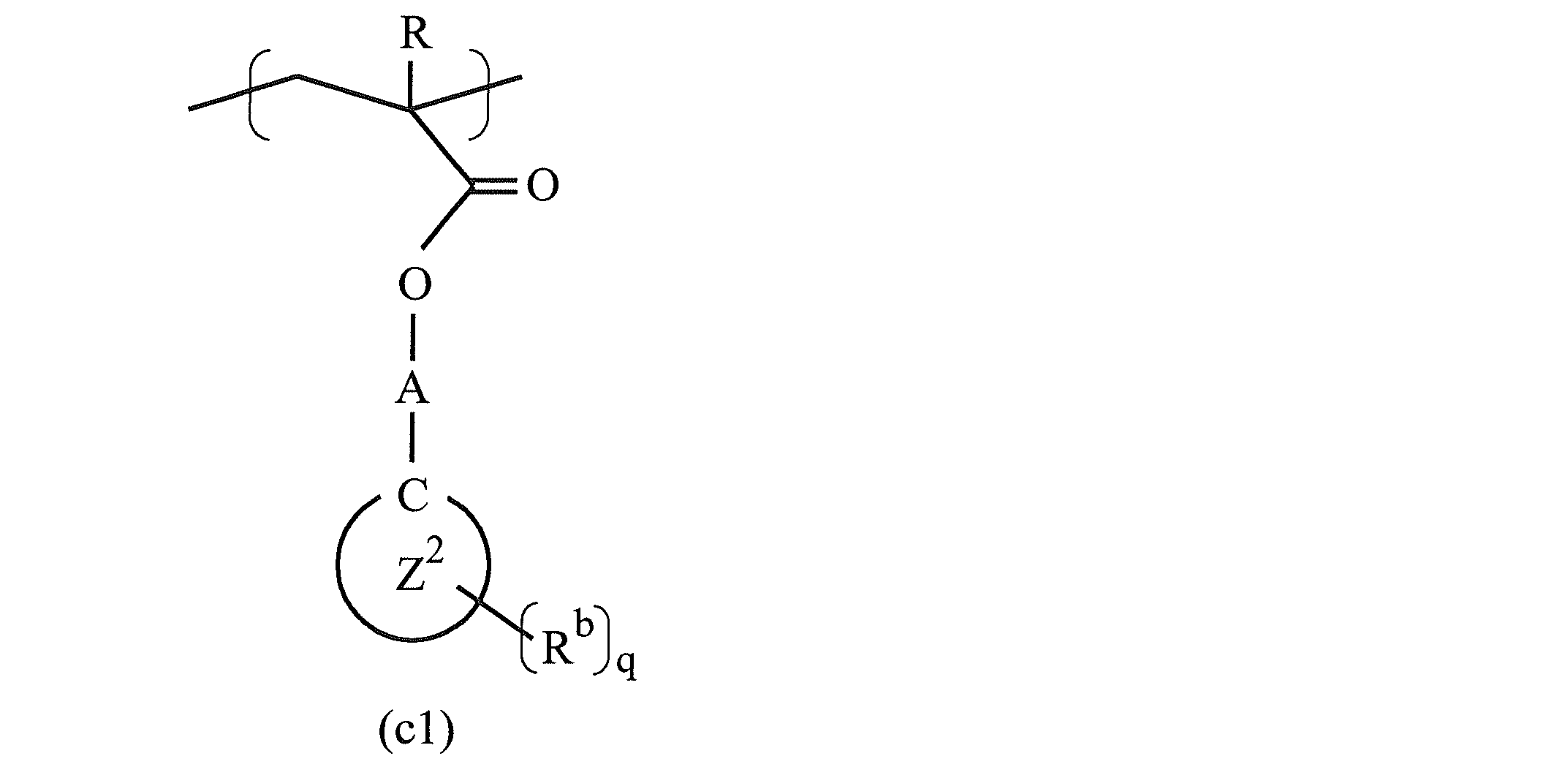
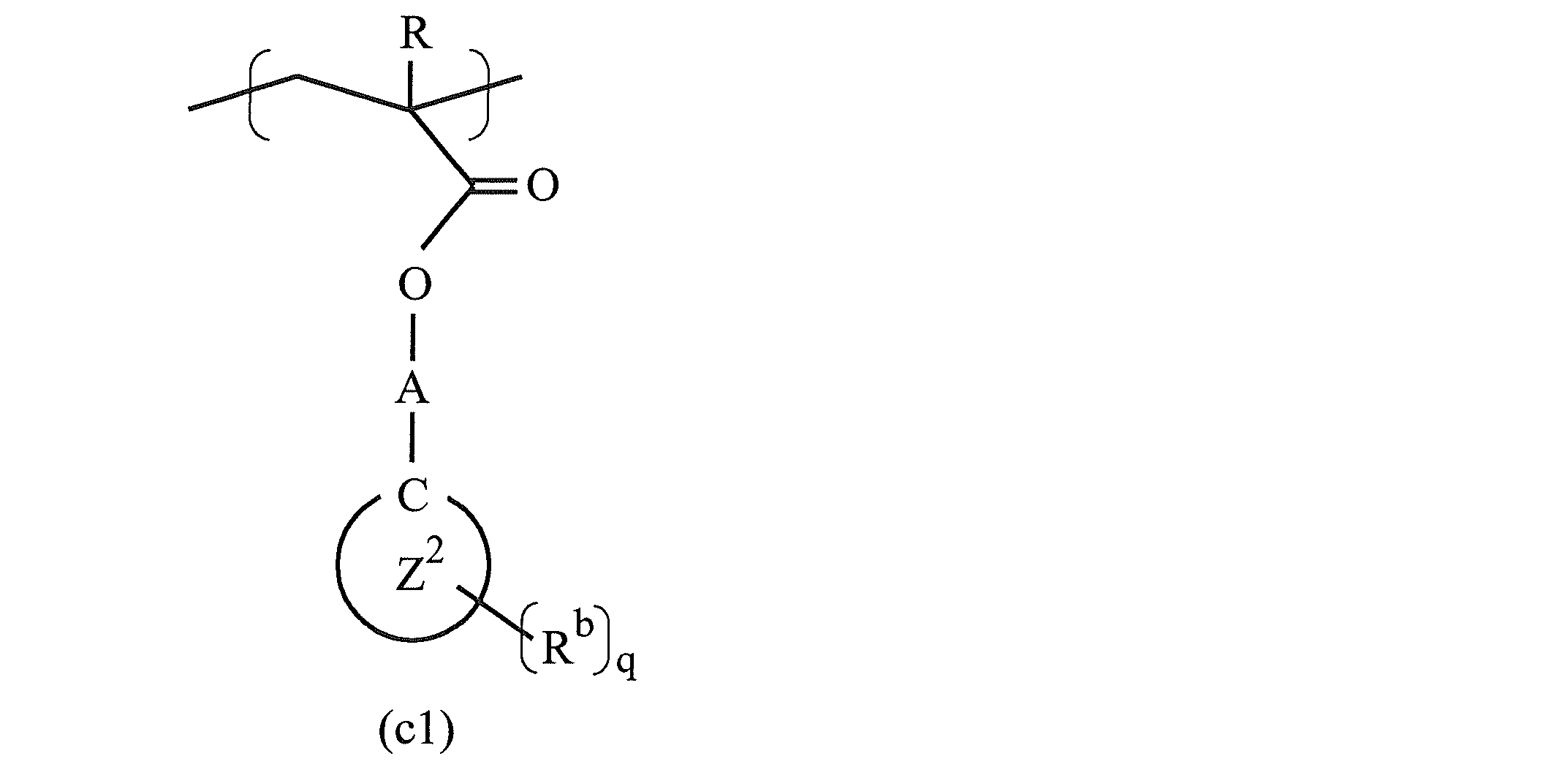
- the monomer unit c of the present invention is represented by the following formula (c1), and imparts high transparency and etching resistance to the polymer compound.
- R represents a hydrogen atom, a halogen atom, or an alkyl group having 1 to 6 carbon atoms which may have a halogen atom
- A represents a single bond or a linking group.
- R b represents a hydroxyl group which may be protected with a protecting group, a hydroxyalkyl group which may be protected with a protecting group, a carboxyl group which may be protected with a protecting group, or a cyano group
- q represents 1 to An integer of 5 is shown.
- Ring Z 2 represents an alicyclic hydrocarbon ring having 6 to 20 carbon atoms.
- R and A in formula (c1) include the same examples as R and A in formulas (a1) to (a3).
- the hydroxyl group that may be protected with a protecting group for R b in formula (c1) the hydroxyalkyl group that may be protected with a protecting group, and the carboxyl group that may be protected with a protecting group. Examples similar to those of R 1 to R 3 in formulas (a1) to (a3) can be given.
- q is an integer of 2 to 5, 2 to 5 R b may be the same or different.
- Ring Z 2 in formula (c1) represents an alicyclic hydrocarbon ring having 6 to 20 carbon atoms, such as 6 to 20 members (preferably 6 to 15 members, particularly preferably cyclohexane ring or cyclooctane ring).
- the monomer unit c of the present invention include monomer units represented by the following formula.
- the monomer unit c can be introduced into the polymer compound by subjecting the corresponding unsaturated carboxylic acid ester to polymerization.
- the content of the monomer unit a is, for example, about 5 to 95 mol%, preferably 10 to 90 mol%, particularly preferably 20 to the total monomer units constituting the polymer compound. It is ⁇ 80 mol%, most preferably 30 to 70 mol%.
- the content of the monomer unit b is, for example, about 5 to 95 mol%, preferably 10 to 90 mol%, particularly preferably 20 to 80 mol%, and most preferably based on all monomer units constituting the polymer compound. Is 30 to 70 mol%.
- the content of the monomer unit c is, for example, about 40 mol% or less, preferably 30 mol% or less, particularly preferably 20 mol% or less, based on all monomer units constituting the polymer compound.
- the weight average molecular weight (Mw) of the polymer compound of the present invention is, for example, about 1000 to 50000, preferably 3000 to 20000, particularly preferably 4000 to 15000, and the molecular weight distribution (the weight average molecular weight and the number average molecular weight are The ratio (Mw / Mn) is, for example, about 1.0 to 3.0, preferably 1.0 to 2.5. Note that Mn and Mw are both polystyrene equivalent values.
- the method for producing a polymer compound according to the present invention uses a resin solution containing a polymer compound having the monomer unit a and the monomer unit b, which does not contain a strongly acidic cation exchange group and exhibits a positive zeta potential. And filtering (hereinafter, sometimes referred to as “filtering step”).
- the polymer compound subjected to the filtration step includes at least an unsaturated carboxylic acid ester corresponding to the monomer unit a, an unsaturated carboxylic acid ester corresponding to the monomer unit b, and an unsaturated carboxylic acid ester corresponding to the monomer unit c as necessary.
- a conventional method used for producing an acrylic polymer or the like for example, solution polymerization, bulk polymerization, suspension polymerization, bulk-suspension polymerization, emulsion polymerization, etc. It can be produced through a polymerization step in which polymerization is preferred.
- a monomer solution obtained by dissolving a monomer in an organic solvent and a polymerization initiator solution obtained by dissolving a polymerization initiator in an organic solvent are prepared in advance.
- a method in which a monomer is dropped into an organic solvent maintained at a constant temperature, (iii) a monomer solution obtained by dissolving the monomer in the organic solvent, and a polymerization start obtained by dissolving the polymerization initiator in the organic solvent A method in which a polymerization initiator solution is dropped into the monomer solution prepared in advance and maintained at a constant temperature, and (iv) a monomer obtained by dissolving some monomers in an organic solvent Solution 1 and monomer solution 2 obtained by dissolving the remaining monomer in an organic solvent, polymerization initiator dissolved in an organic solvent
- the polymerization initiator solution thus obtained is prepared in advance, and the monomer solution 2 and the polymerization initiator solution are dropped into the monomer solution 1 kept at a constant temperature.
- a conventional solvent can be used.
- a chain ether containing an ether diethyl ether, propylene glycol monomethyl ether (hereinafter sometimes referred to as “PGME”) and the like, tetrahydrofuran, Glycol ether esters such as cyclic ethers such as dioxane), esters (chain esters such as methyl acetate, ethyl acetate, butyl acetate, and ethyl lactate; propylene glycol monomethyl ether acetate (hereinafter sometimes referred to as “PGMEA”) Etc.), ketones (acetone, methyl ethyl ketone, methyl isobutyl ketone, cyclohexanone, etc.), amides (N, N-dimethylacetamide, N, N-dimethylformamide, etc.), sulfoxides (dimethyl sulfoxide, etc.), alcohol (Methanol, ethanol, ethanol, ethanol,
- the polymer compound obtained by polymerization may be subjected to precipitation or reprecipitation treatment.
- the solvent used in precipitation or reprecipitation may be either an organic solvent or water, a mixed solvent of two or more organic solvents, or a mixed solvent of an organic solvent and water.
- the organic solvent used as the precipitation or reprecipitation solvent include hydrocarbons (aliphatic hydrocarbons such as pentane, hexane, heptane, and octane; alicyclic hydrocarbons such as cyclohexane and methylcyclohexane; benzene, toluene, xylene, and the like.
- Aromatic hydrocarbons halogenated hydrocarbons (halogenated aliphatic hydrocarbons such as methylene chloride, chloroform and carbon tetrachloride; halogenated aromatic hydrocarbons such as chlorobenzene and dichlorobenzene), nitro compounds (nitromethane, nitroethane, etc.) ), Nitrile (acetonitrile, benzonitrile, etc.), ether (chain ether such as diethyl ether, diisopropyl ether, dimethoxyethane; cyclic ether such as tetrahydrofuran, dioxane), ketone (acetone, methyl ethyl ketone, diisobutyl keto) Etc.), esters (ethyl acetate, butyl acetate, etc.), carbonates (dimethyl carbonate, diethyl carbonate, ethylene carbonate, propylene carbonate, etc.), alcohols (methanol, ethanol, propanol
- a solvent containing at least a hydrocarbon is preferable.
- a hydrocarbon for example, an aliphatic such as hexane or the like.
- the ratio of the hydrocarbon) to the other solvent is, for example, about 10/90 to 99/1, preferably 30/70 to 98/2, particularly preferably 50/50 to 97 /. 3.
- the polymer compound subjected to the precipitation or reprecipitation treatment may be further subjected to a repulping treatment and / or a rinsing treatment as necessary. Thereafter, for example, it is preferable to remove the solvent by decantation, filtration or the like, and perform a drying treatment.
- the drying temperature of the polymer compound is, for example, about 20 to 120 ° C., preferably 30 to 100 ° C. Drying is preferably performed under reduced pressure [for example, 200 mmHg (26.6 kPa) or less, particularly 100 mmHg (13.3 kPa) or less].
- the polymer compound subjected to the precipitation or reprecipitation treatment is re-dissolved in an organic solvent at a concentration such that the polymer compound concentration is about 10 to 40% by weight, and the resulting resin solution is filtered. It is preferable to attach to a process.
- organic solvent include ethers, esters, ketones, and mixed solvents exemplified as the polymerization solvent.
- PGMEA, PGMEA, ethyl lactate, methyl isobutyl ketone, methyl amyl ketone, cyclohexanone, and mixed solvents thereof are preferable, and in particular, PGMEA single solvent, mixed solvent of PGMEA and PGME, mixed solvent of PGMEA and ethyl lactate.
- a solvent containing at least PGMEA such as a mixed solvent of PGMEA and cyclohexanone is preferably used.
- the resin solution obtained by redissolving is subjected to concentration before the filtration treatment, and the low-boiling point solvent (for example, polymerization solvent, extraction solvent, precipitation solvent, repulp solvent, rinse solvent) contained in the resin solution is concentrated. Etc.) may be distilled off.
- the concentration step it is preferable to provide the concentration step. In the concentration step, it is preferable to concentrate until the polymer compound concentration is about 10 to 40% by weight. Concentration can be performed under normal pressure or reduced pressure.
- the polymer compound obtained through the polymerization step, precipitation or reprecipitation treatment is redissolved in an organic solvent and subjected to a filtration step in the state of a resin solution.
- filtration is performed using a filter that does not contain a strongly acidic cation exchange group and exhibits a positive zeta potential in the filtration step.
- the filter generates a positive zeta potential with a charged substance in a passing liquid, and can adsorb and remove metal components (for example, Fe, Na, etc.) in an object to be filtered. .
- the filter does not contain a strong acidic cation exchange group (for example, —SO 3 H).
- the material of the filter is, for example, resin, cellulose, pearlite, diatomaceous earth, glass fiber or the like.
- the pore size of the filter is, for example, about 0.02 to 5.0 ⁇ m, preferably 0.04 to 1.0 ⁇ m.
- the filtration temperature is, for example, about 0 to 80 ° C., preferably 10 to 60 ° C., particularly preferably 20 to 50 ° C.
- the filtration flow rate is, for example, about 0.01 to 100 kg / min / m 2 , preferably 0.1 to 30 kg / min / m 2 , particularly preferably 0.5 to 10 kg / min / m 2 .
- Examples of the filter of the present invention include commercial products such as trade names “Zeta Plus GN Grade”, “Electropore” (manufactured by Sumitomo 3M Limited), and trade names “Posodyne” (produced by Nippon Pole Co., Ltd.). Can be preferably used.
- the filtration is performed using the filter under the above-described conditions, so that polar groups in the polymer compound [lactone (especially, having an electron-withdrawing group such as a cyano group or a trifluoromethyl group). Lactone), sultone (—S ( ⁇ O) 2 —O—), or an acid anhydride (—C ( ⁇ O) —O—C ( ⁇ O) —)] triggered by hydrolysis
- lactone lactone
- S ( ⁇ O) 2 —O— sultone
- a polymer compound that can remove the metal component while suppressing the acid-eliminating group of the polymer compound from being removed with time has a very low metal component content, and has excellent storage stability. Can be manufactured.
- the sodium content (in terms of resin solid content) in the resin solution after filtration is 20 ppb or less (preferably 15 ppb or less, particularly preferably 10 ppb or less), and the iron content (resin solid content conversion) is 10 ppb or less (preferably 8 ppb or less, particularly preferably 5 ppb or less).
- T 1 the time required for the solid compound acid value to exceed 0.05 mmol / g is T 0.
- -T 1 is preferably 80 hours or less, particularly preferably 50 hours or less, and most preferably 30 hours or less.
- photoacid generator examples include conventional compounds that efficiently generate acid upon exposure, such as diazonium salts, iodonium salts (for example, diphenyliodohexafluorophosphate), sulfonium salts (for example, triphenylsulfonium hexafluoroantimonate).
- diazonium salts for example, diphenyliodohexafluorophosphate
- sulfonium salts for example, triphenylsulfonium hexafluoroantimonate
- the amount of the photoacid generator used can be appropriately selected according to the strength of the acid generated by light irradiation, the ratio of each monomer unit (repeating unit) in the polymer compound, and the like, with respect to 100 parts by weight of the polymer compound. For example, about 0.1 to 30 parts by weight, preferably 1 to 25 parts by weight, particularly preferably 2 to 20 parts by weight.
- organic solvent examples include ethers (chain ethers including glycol ethers such as PGME, cyclic ethers such as dioxane), esters (chain esters such as methyl acetate, ethyl acetate, butyl acetate, and ethyl lactate; ⁇ -butyrolactone) And cyclic esters such as glycol ether esters such as PGMEA) and ketones (such as methyl ethyl ketone, methyl isobutyl ketone, and cyclohexanone). These can be used alone or in combination of two or more. In the present invention, it is particularly preferable to include at least one solvent selected from PGMEA, PGME, ethyl lactate, ⁇ -butyrolactone, and cyclohexanone.
- ethers chain ethers including glycol ethers such as PGME, cyclic ethers such as dioxane
- esters chain esters such as
- the content of the organic solvent can be appropriately selected according to the thickness of the resist film to be formed, and the concentration of the polymer compound is, for example, about 1 to 20% by weight, preferably 2 to 15% by weight. The range is preferably 3 to 15% by weight.
- the photoresist resin composition of the present invention improves, for example, stability over time at the time of leaving between the exposure process and the post-exposure heating process.
- Basic compounds triethylamine, 1,8-diazabicyclo [5.4.0] -7-undecene (DBU), 1,5-diazabicyclo [4.3.0] -5-nonene (DBN), etc.
- Additive resins for improving resist performance surfactants for improving coatability during film formation, dissolution inhibitors, stabilizers, plasticizers, photosensitizers for controlling solubility during development, It may contain a light absorber or the like.
- the weight average molecular weight (Mw) and number average molecular weight (Mn) of the polymer compound were determined by GPC measurement (gel permeation chromatography) using a tetrahydrofuran solvent. Polystyrene was used as the standard sample, and a refractometer (Refractive Index Detector; RI detector) was used as the detector. In addition, GPC measurement uses a column “KF-806L” made by Showa Denko Co., Ltd.
- Preparation Example 1 (Production of resin solution 1) In a round bottom flask equipped with a reflux tube, a stirrer, a three-way cock, and a thermometer, 595.0 g of cyclohexanone was placed in a nitrogen atmosphere to maintain the temperature at 100 ° C., and 1-cyano-5-methacryloyloxy was stirred.
- the obtained reaction solution was filtered through a filter having a pore size of 0.1 ⁇ m, and then added dropwise with stirring to a 9: 1 (weight ratio) mixture of hexane and ethyl acetate in 7 times the reaction solution. did.
- the resulting precipitate was filtered and dried, whereby 247.5 g of a polymer compound having a monomer unit represented by the following formula (1) [weight average molecular weight (Mw): 8300, molecular weight distribution (Mw / Mn): 1.88] was obtained.
- the obtained polymer compound was dissolved in PGMEA so as to have a polymer concentration of 15% to obtain a resin solution 1.
- Preparation Example 7 (Production of resin solution 7)
- PGMEA 357.0 g and PGME 238.0 g were placed under a nitrogen atmosphere to maintain the temperature at 100 ° C., and stirring, 5-methacryloyloxynorbornane -2,3-dicarboxylic anhydride 119.0 g (0.476 mol), 1-hydroxy-3-methacryloyloxyadamantane 56.2 g (0.238 mol), 1- (1-methacryloyloxy-1-methylethyl) adamantane 124.8 g (0.476 mol), dimethyl 2,2′-azobisisobutyrate (trade name “V-601”, manufactured by Wako Pure Chemical Industries, Ltd.) 7.50 g, PGMEA 663.0 g, PGME 442.0 g
- the mixed monomer solution was added dropwise at a constant rate over 6
- Preparation Example 8 (Production of resin solution 8) As a monomer component, 19.9-methyl- 4 -methacryloyloxy-3-oxatricyclo [4.2.1.0 4,8 ] nonan-2-one 129.9 g (0.448 mol), 1-hydroxy- The same operation as in Example 1 was carried out except that 52.8 g (0.224 mol) of 3-methacryloyloxyadamantane and 117.3 g (0.448 mol) of 1- (1-methacryloyloxy-1-methylethyl) adamantane were used.
- Example 1 Using the resin solution 1 obtained in Preparation Example 1 as a filter [trade name “Zeta Plus 020GN”, manufactured by Sumitomo 3M Ltd., pore size: 0.2 ⁇ m], the filtration flow rate is 5 kg / min / m 2 , the filtration temperature. Filtration was performed at 23 ° C., and a resin solution was obtained after the filtration.
- Example 2 A filtration treatment was performed in the same manner as in Example 1 except that the resin solution 2 obtained in Preparation Example 2 was used instead of the resin solution 1 obtained in Preparation Example 1, and a resin solution was obtained after the filtration treatment.
- Example 3 A filtration treatment was performed in the same manner as in Example 1 except that the resin solution 3 obtained in Preparation Example 3 was used in place of the resin solution 1 obtained in Preparation Example 1, and a resin solution was obtained after the filtration treatment.
- Example 4 A filtration treatment was performed in the same manner as in Example 1 except that the resin solution 4 obtained in Preparation Example 4 was used instead of the resin solution 1 obtained in Preparation Example 1, and a resin solution was obtained after the filtration treatment.
- Example 5 A filtration treatment was performed in the same manner as in Example 1 except that the resin solution 5 obtained in Preparation Example 5 was used instead of the resin solution 1 obtained in Preparation Example 1, and a resin solution was obtained after the filtration treatment.
- Example 6 A filtration treatment was performed in the same manner as in Example 1 except that the resin solution 6 obtained in Preparation Example 6 was used in place of the resin solution 1 obtained in Preparation Example 1, and a resin solution was obtained after the filtration treatment.
- Example 7 A filtration treatment was performed in the same manner as in Example 1 except that the resin solution 7 obtained in Preparation Example 7 was used instead of the resin solution 1 obtained in Preparation Example 1, and a resin solution was obtained after the filtration treatment.
- Example 8 A filtration treatment was performed in the same manner as in Example 1 except that the resin solution 8 obtained in Preparation Example 8 was used instead of the resin solution 1 obtained in Preparation Example 1, and a resin solution was obtained after the filtration treatment.
- Example 9 The resin solution 1 obtained in Preparation Example 1 was filtered using a filter [trade name “Electropore”, manufactured by Sumitomo 3M Ltd., pore size: 0.04 ⁇ m], a filtration flow rate of 5 kg / min / m 2 , a filtration temperature of 23 Filtration was performed at 0 ° C., and a resin solution was obtained after filtration.
- a filter trade name “Electropore”, manufactured by Sumitomo 3M Ltd., pore size: 0.04 ⁇ m
- a filtration flow rate of 5 kg / min / m 2 a filtration temperature of 23 Filtration was performed at 0 ° C.
- Example 10 A filtration treatment was performed in the same manner as in Example 9 except that the resin solution 2 obtained in Preparation Example 2 was used instead of the resin solution 1 obtained in Preparation Example 1, and a resin solution was obtained after the filtration treatment.
- Comparative Example 1 The resin solution 1 obtained in Preparation Example 1 was filtered using a filter having a strongly acidic cation exchange group [trade name “Zeta Plus 40QSH”, manufactured by Sumitomo 3M Co., Ltd., pore size: 0.4 ⁇ m], and a filtration flow rate of 5 kg. Filtration was performed at a filtration temperature of 23 ° C./min/m 2 , and a resin solution was obtained after the filtration.
- a filter having a strongly acidic cation exchange group [trade name “Zeta Plus 40QSH”, manufactured by Sumitomo 3M Co., Ltd., pore size: 0.4 ⁇ m]
- Comparative Example 2 The resin solution 1 obtained in Preparation Example 1 was filtered using a filter having a strongly acidic cation exchange group [trade name “Protego”, manufactured by Nihon Entegris Co., Ltd., pore size: 0.05 ⁇ m], and a filtration flow rate of 5 kg / min. / M 2 , filtration was performed at a filtration temperature of 23 ° C., and a resin solution was obtained after filtration.
- a filter having a strongly acidic cation exchange group [trade name “Protego”, manufactured by Nihon Entegris Co., Ltd., pore size: 0.05 ⁇ m]
- Comparative Example 3 The resin solution 1 obtained in Preparation Example 1 was filtered using a filter having a strongly acidic cation exchange group [trade name “Ion Clean SL”, manufactured by Nippon Pole Co., Ltd.], and the filtration flow rate was 5 kg / min / m 2 . Filtration was performed at a filtration temperature of 23 ° C., and a resin solution was obtained after filtration.
- Comparative Example 4 The resin solution 2 obtained in Preparation Example 2 was filtered using a filter having a strongly acidic cation exchange group [trade name “Protego”, manufactured by Nihon Entegris Co., Ltd., pore size: 0.05 ⁇ m], and a filtration flow rate of 5 kg / min. / M 2 , filtration was performed at a filtration temperature of 23 ° C., and a resin solution was obtained after filtration.
- a filter having a strongly acidic cation exchange group [trade name “Protego”, manufactured by Nihon Entegris Co., Ltd., pore size: 0.05 ⁇ m]
- Comparative Example 5 The resin solution 4 obtained in Preparation Example 4 was filtered using a filter having a strongly acidic cation exchange group [trade name “Ion Clean SL”, manufactured by Nippon Pole Co., Ltd.], and the filtration flow rate was 5 kg / min / m 2 . Filtration was performed at a filtration temperature of 23 ° C., and a resin solution was obtained after filtration.
- Comparative Example 6 The resin solution 5 obtained in Preparation Example 5 was filtered using a filter having a strongly acidic cation exchange group [trade name “Ion Clean SL”, manufactured by Nippon Pole Co., Ltd.], and the filtration flow rate was 5 kg / min / m 2 . Filtration was performed at a filtration temperature of 23 ° C., and a resin solution was obtained after filtration.
- the metal concentration (resin solid content conversion) of the resin solutions obtained in the preparation examples and the post-filtration resin solutions obtained in the examples and comparative examples was measured using an inductively coupled plasma mass spectrometer. Moreover, in order to compare the storage stability of the resin solution before and after the filtration treatment, the resin solutions obtained in the preparation examples, and the resin solutions after filtration treatment obtained in the examples and comparative examples were heated at 60 ° C., respectively. The heating time required until the acid value exceeded 0.05 mmol / g was measured. The results are summarized in the following table. The acid value was measured by neutralization titration using NaOH.
- PGMEA solution having a resin concentration of 15% by weight was weighed, and 54 mL of tetrahydrofuran (THF) and 6 mL of water were added.
- THF tetrahydrofuran
- 0.05 g of an ethanol solution containing 1% by volume of phenolphthalein was added. The solution was titrated with a 0.1 mol / L NaOH aqueous solution while stirring, and the acid value was calculated from the following formula using the point at which the solution changed from colorless to pink as the end point.
- Acid value (mmol / g) [(B ⁇ 0.1) / (A ⁇ C)] ⁇ 100 (In the formula, A is the weight (g) of the measurement sample, B is the amount of 0.1 mol / L NaOH aqueous solution (mL) dropped until the end point, and C is the resin concentration (% by weight) of the measurement sample)
- a polymer compound obtained by polymerizing a monomer mixture is prevented from detaching an acid-eliminable group in the polymer compound over time, Metal components such as sodium and iron that cause deterioration of electrical characteristics of semiconductors and the like can be removed, and a polymer compound having excellent storage stability and a very low content of metal components such as sodium and iron can be produced.
- the polymer compound of the present invention is excellent in storage stability and has an extremely low content of metal components such as sodium and iron, it can be suitably used as an ArF resist polymer.
- the semiconductor which has the outstanding electrical property can be manufactured.
Landscapes
- Chemical & Material Sciences (AREA)
- Health & Medical Sciences (AREA)
- Chemical Kinetics & Catalysis (AREA)
- Medicinal Chemistry (AREA)
- Polymers & Plastics (AREA)
- Organic Chemistry (AREA)
- Physics & Mathematics (AREA)
- Spectroscopy & Molecular Physics (AREA)
- General Physics & Mathematics (AREA)
- Addition Polymer Or Copolymer, Post-Treatments, Or Chemical Modifications (AREA)
- Materials For Photolithography (AREA)
Description
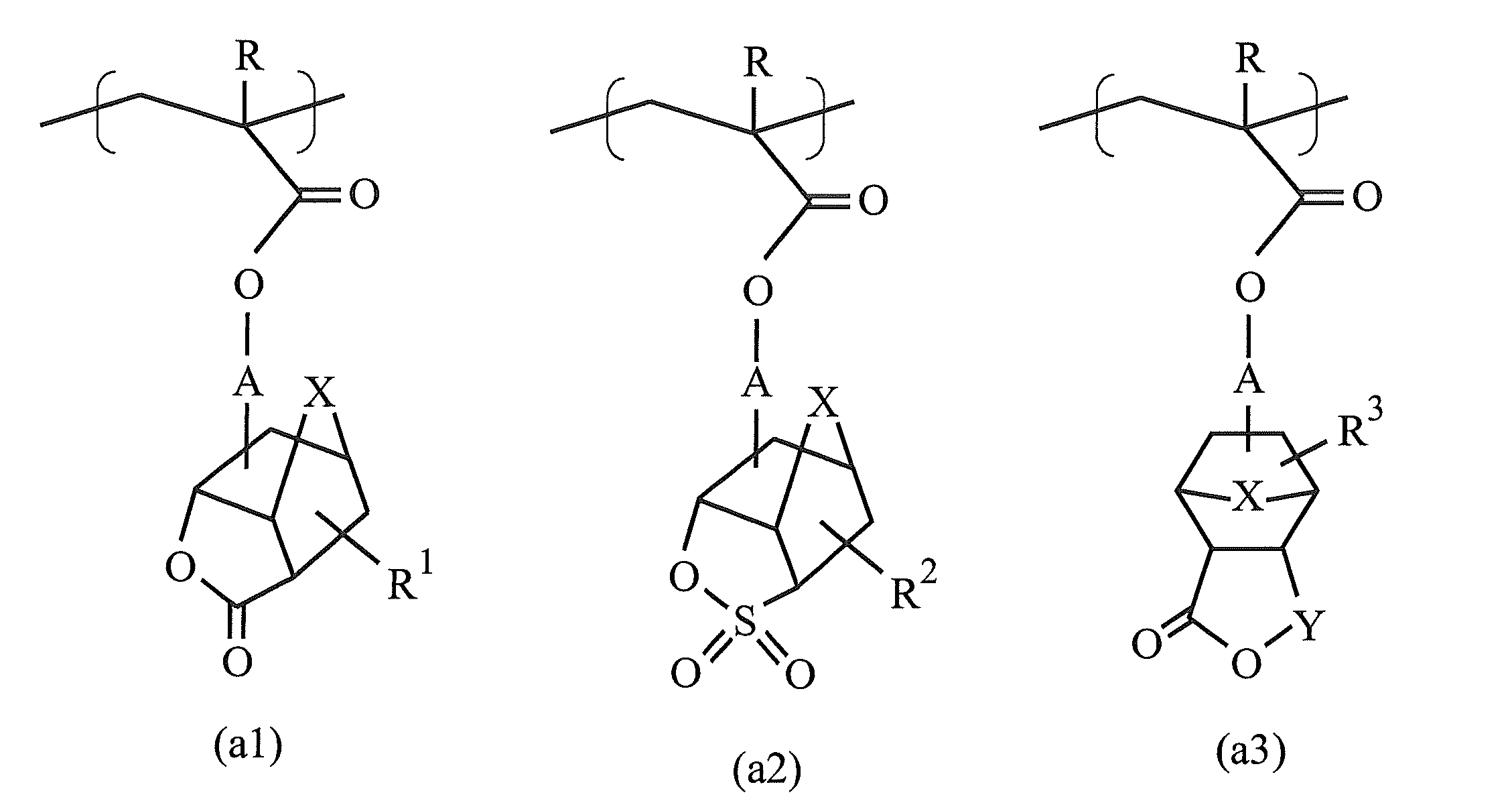
で表されるモノマー単位から選択される少なくとも1種のモノマー単位a、及び酸によりその一部が脱離してアルカリ可溶性となる基を含むモノマー単位bを有する高分子化合物を含有する樹脂溶液を、下記フィルターを使用して濾過する工程を有する高分子化合物の製造方法を提供する。
フィルター:強酸性陽イオン交換基を含まず、正のゼータ電位を示すフィルター
T0-T1≦80
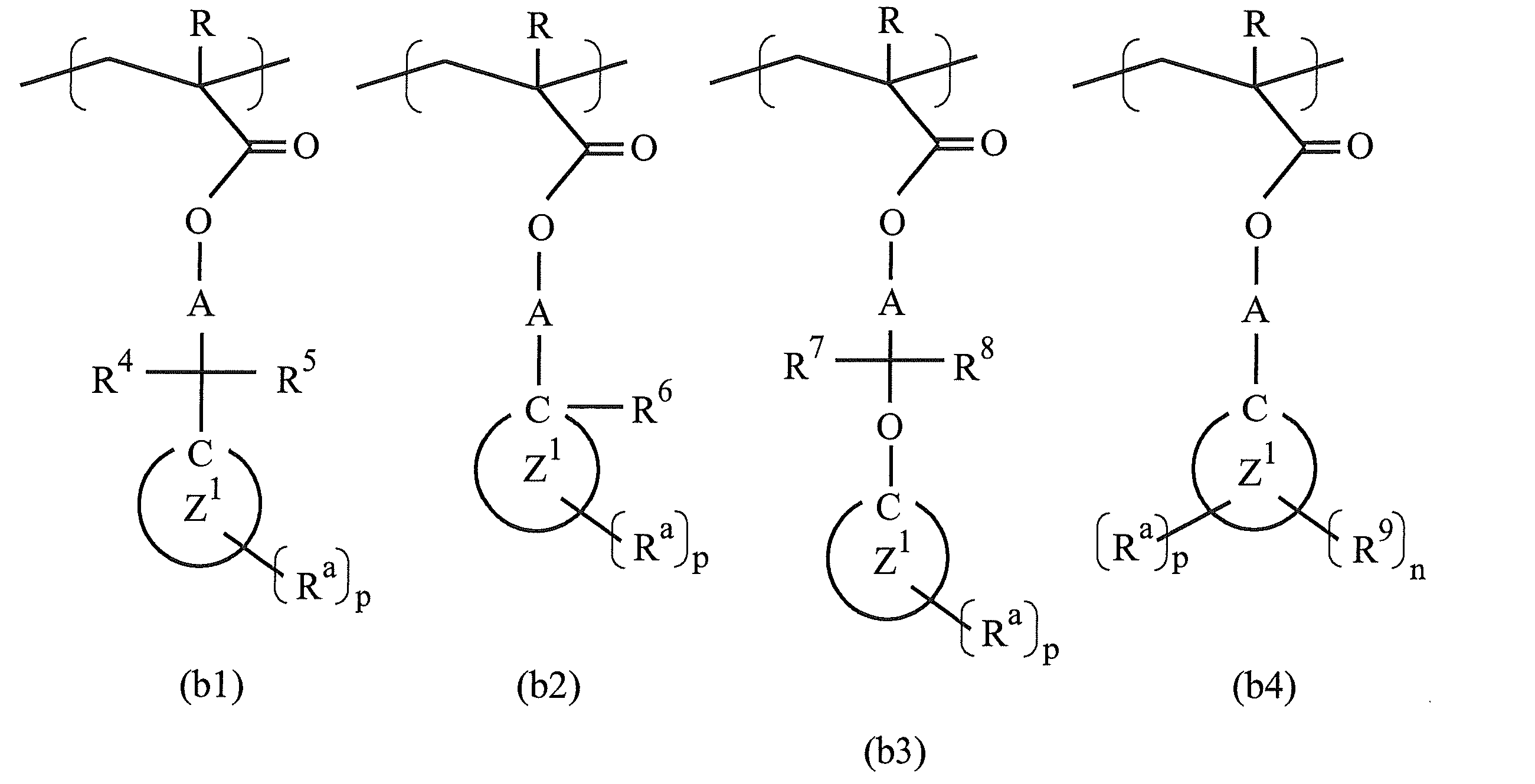
で表されるモノマー単位から選択される少なくとも1種のモノマー単位が好ましい。
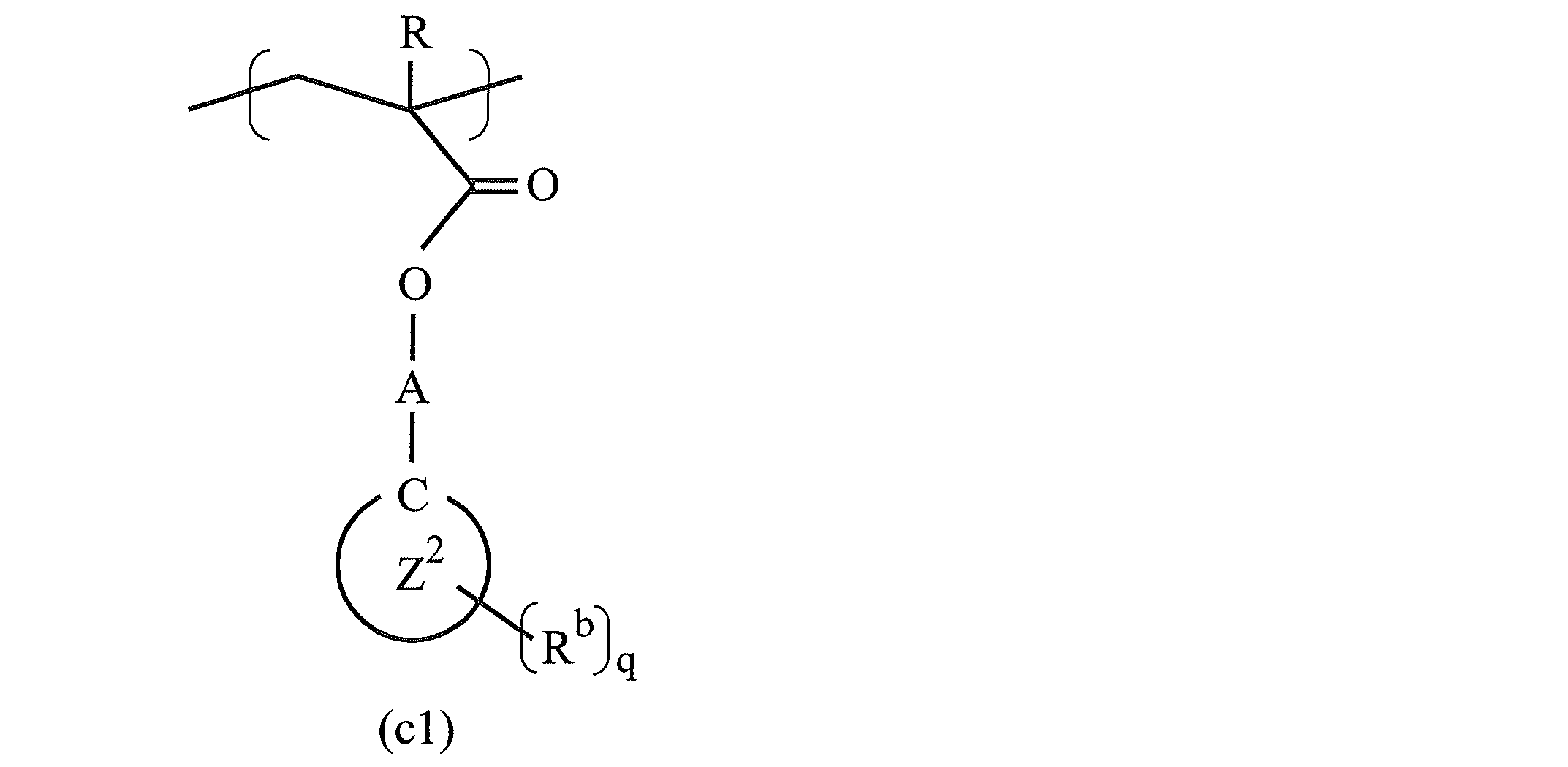
で表されるモノマー単位cを含むことが好ましい。
本発明の高分子化合物は保存安定性に優れ、ナトリウムや鉄等の金属成分含有量が極めて低いため、ArFレジスト用ポリマーとして好適に使用することができる。そして、本発明の高分子化合物によれば、優れた電気特性を有する半導体を製造することができる。
本発明の高分子化合物は、モノマー単位a、及び酸によりその一部が脱離してアルカリ可溶性となる基を含むモノマー単位bを少なくとも有する。本発明の高分子化合物は、モノマー単位a及びモノマー単位b以外に、モノマー単位cを有していてもよい。
モノマー単位aは極性基として[-C(=O)-O-]、[-S(=O)2-O-]、又は[-C(=O)-O-C(=O)-]を少なくとも有する脂環式骨格を含み、高分子化合物に基盤密着性及び耐エッチング性を付与する。
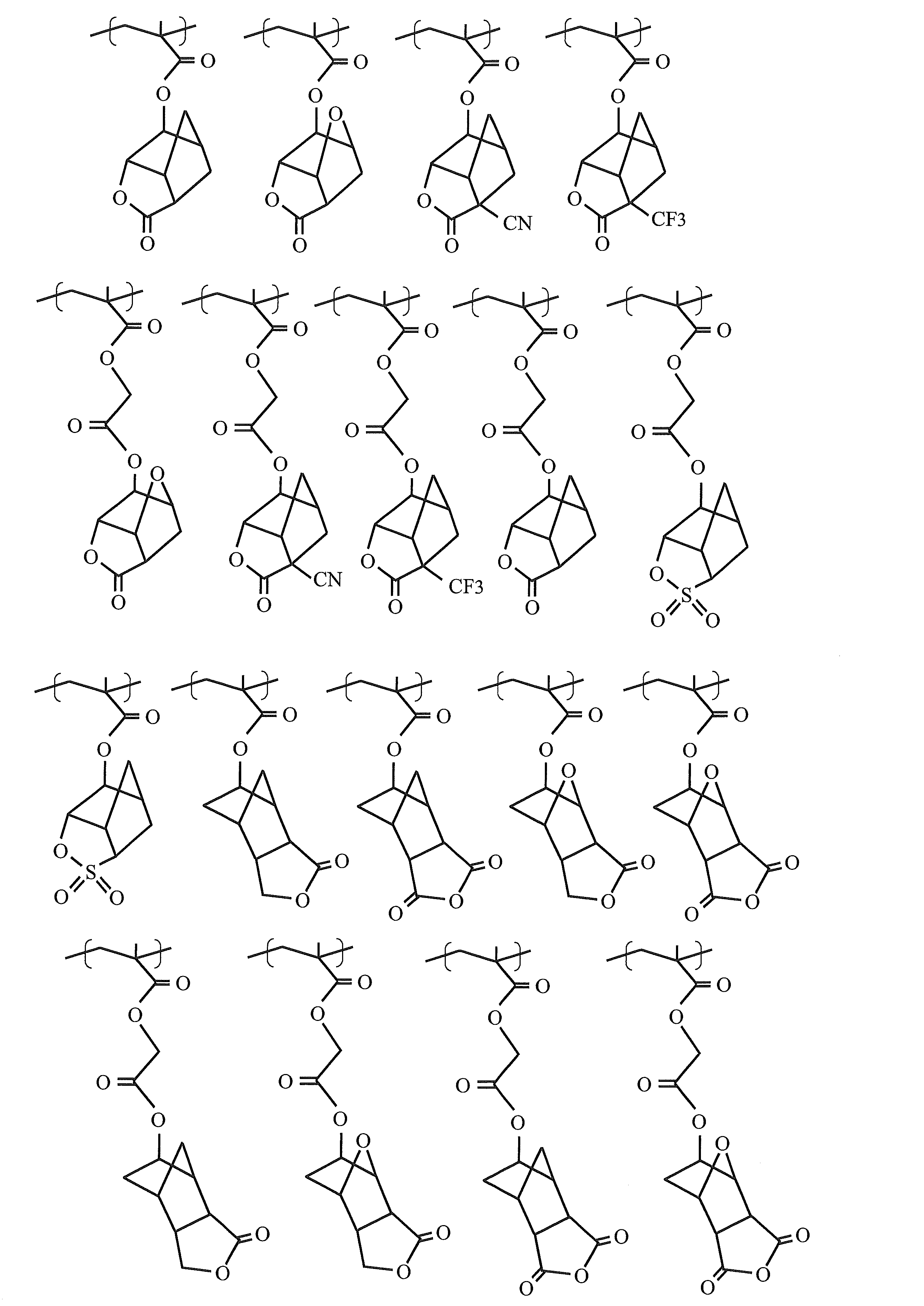
本発明のモノマー単位bは酸によりその一部が脱離してアルカリ可溶性となる基を含み、高分子化合物に酸によりアルカリ可溶性に変化する性質及び耐エッチング性を付与する。本発明のモノマー単位bとしては、下記式(b1)~(b4)から選択される少なくとも1種のモノマー単位を含むことが好ましい。
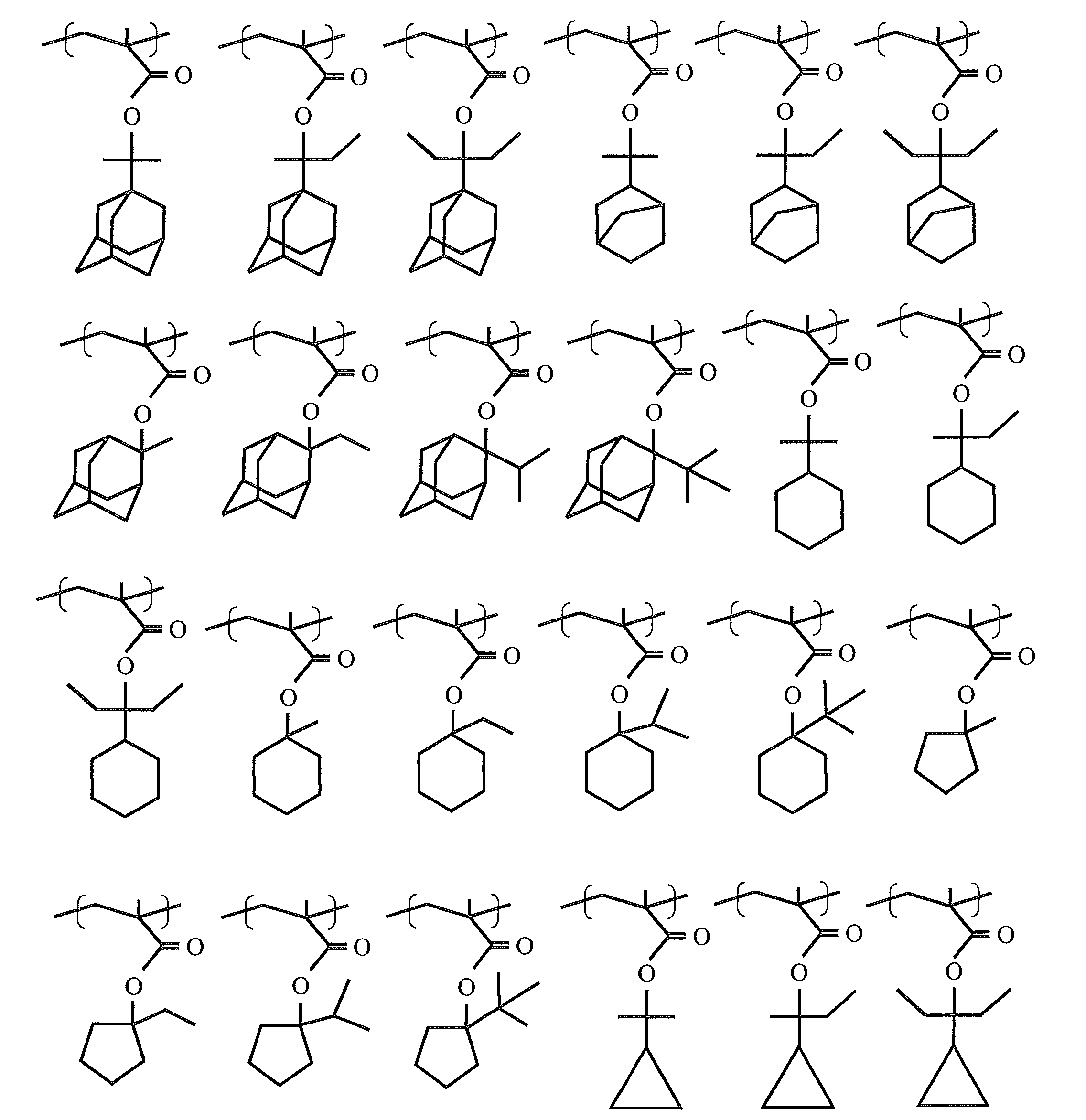
本発明のモノマー単位cは下記式(c1)で表され、高分子化合物に高い透明性及び耐エッチング性を付与する。式中、Rは水素原子、ハロゲン原子、又はハロゲン原子を有していてもよい炭素数1~6のアルキル基を示し、Aは単結合又は連結基を示す。Rbは保護基で保護されていてもよいヒドロキシル基、保護基で保護されていてもよいヒドロキシアルキル基、保護基で保護されていてもよいカルボキシル基、又はシアノ基を示し、qは1~5の整数を示す。環Z2は炭素数6~20の脂環式炭化水素環を示す。
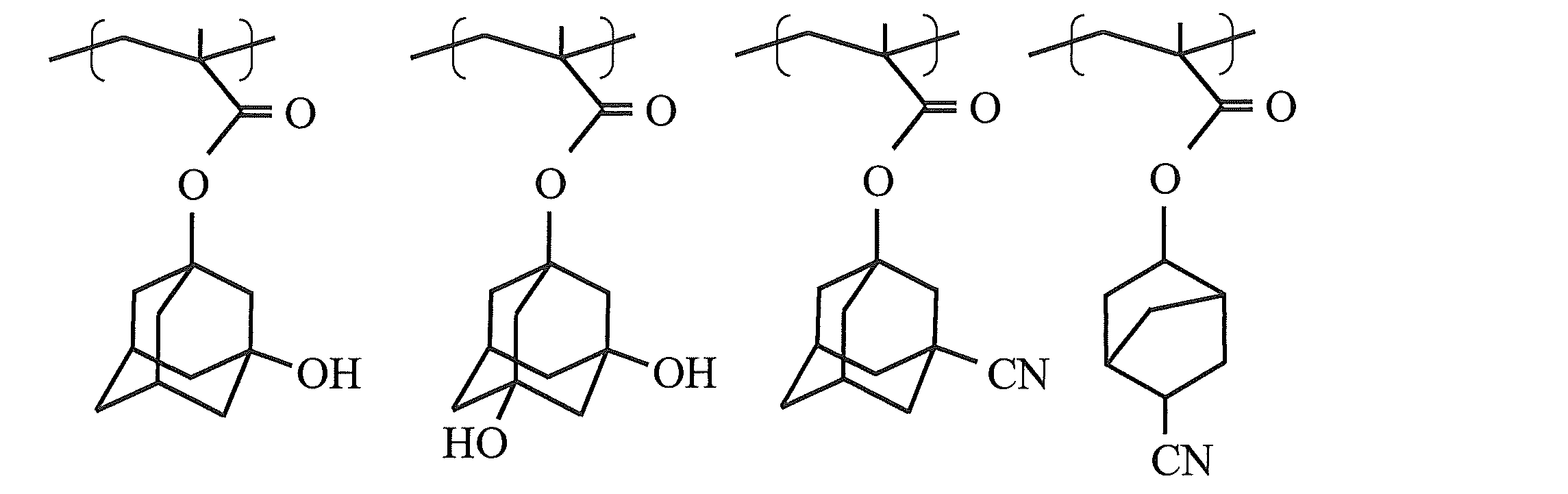
本発明の高分子化合物の製造方法は、上記モノマー単位a及びモノマー単位bを有する高分子化合物を含有する樹脂溶液を、強酸性陽イオン交換基を含まず、正のゼータ電位を示すフィルターを使用して濾過する工程(以後、「濾過工程」と称する場合がある)を有することを特徴とする。
本発明のフォトレジスト用樹脂組成物は、前記高分子化合物と光酸発生剤と有機溶剤(=フォトレジスト用溶剤)を少なくとも含む。
尚、高分子化合物の重量平均分子量(Mw)及び数平均分子量(Mn)は、テトラヒドロフラン溶媒を用いたGPC測定(ゲル浸透クロマトグラフ)により求めた。標準試料にはポリスチレンを使用し、検出器としては屈折率計(Refractive Index Detector;RI検出器)を用いた。また、GPC測定には、昭和電工(株)製カラム「KF-806L」を3本直列につないだものを使用し、カラム温度40℃、RI温度40℃、テトラヒドロフラン流速0.8mL/分の条件で行った。分子量分布(Mw/Mn)は前記測定値より算出した。
還流管、撹拌子、3方コック、温度計を備えた丸底フラスコに、窒素雰囲気下、シクロヘキサノン595.0gを入れて温度を100℃に保ち、撹拌しながら、1-シアノ-5-メタクリロイルオキシ-3-オキサトリシクロ[4.2.1.04,8]ノナン-2-オン118.2g(0.478mol)、1-ヒドロキシ-3-メタクリロイルオキシアダマンタン56.5g(0.239mol)、1-(1-メタクリロイルオキシ-1-メチルエチル)アダマンタン125.4g(0.478mol)、ジメチル2,2'-アゾビスイソブチレート(商品名「V-601」、和光純薬工業(株)製)7.50g、シクロヘキサノン1105.0gを混合したモノマー溶液を6時間かけて一定速度で滴下した。滴下終了後、さらに2時間撹拌を続けた。重合反応終了後、得られた反応溶液を孔径0.1μmのフィルターで濾過した後、該反応溶液の7倍量のヘキサンと酢酸エチルの9:1(重量比)混合液中に撹拌しながら滴下した。生じた沈殿物を濾別、乾燥することにより、下記式(1)で表されるモノマー単位を有する高分子化合物247.5g[重量平均分子量(Mw):8300、分子量分布(Mw/Mn):1.88]を得た。
得られた高分子化合物をポリマー濃度15%となるようにPGMEAに溶解し、樹脂溶液1を得た。
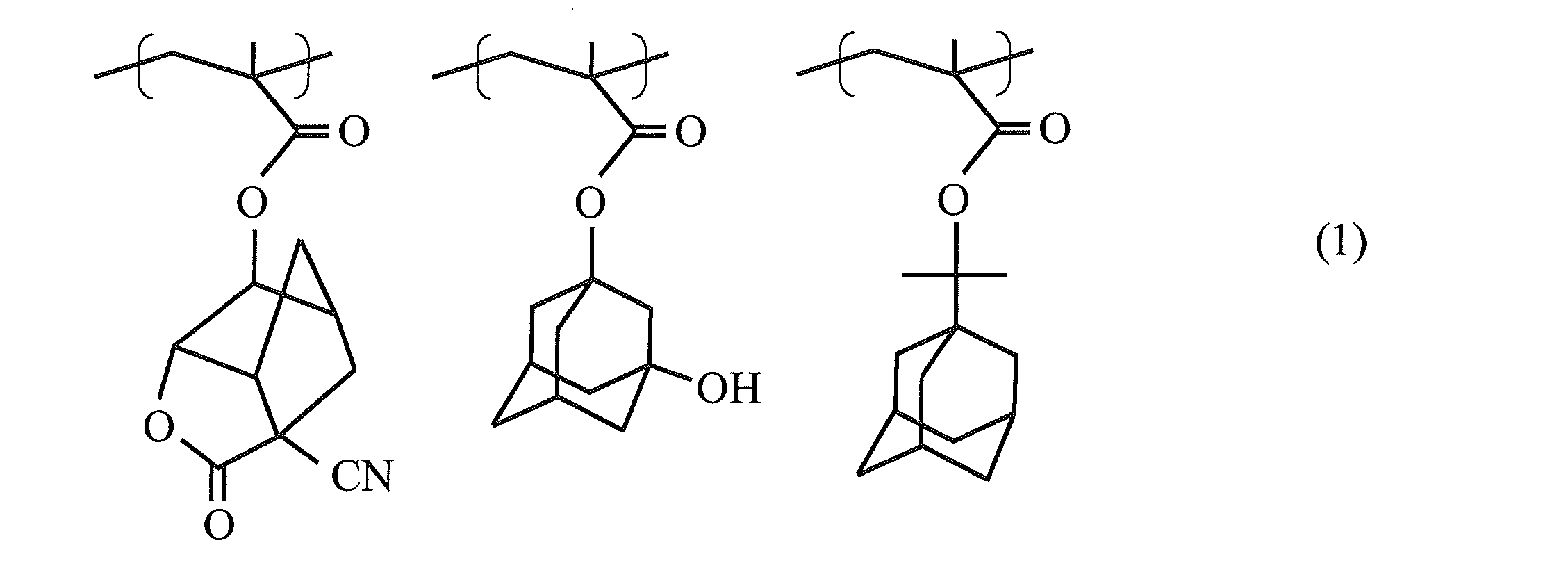
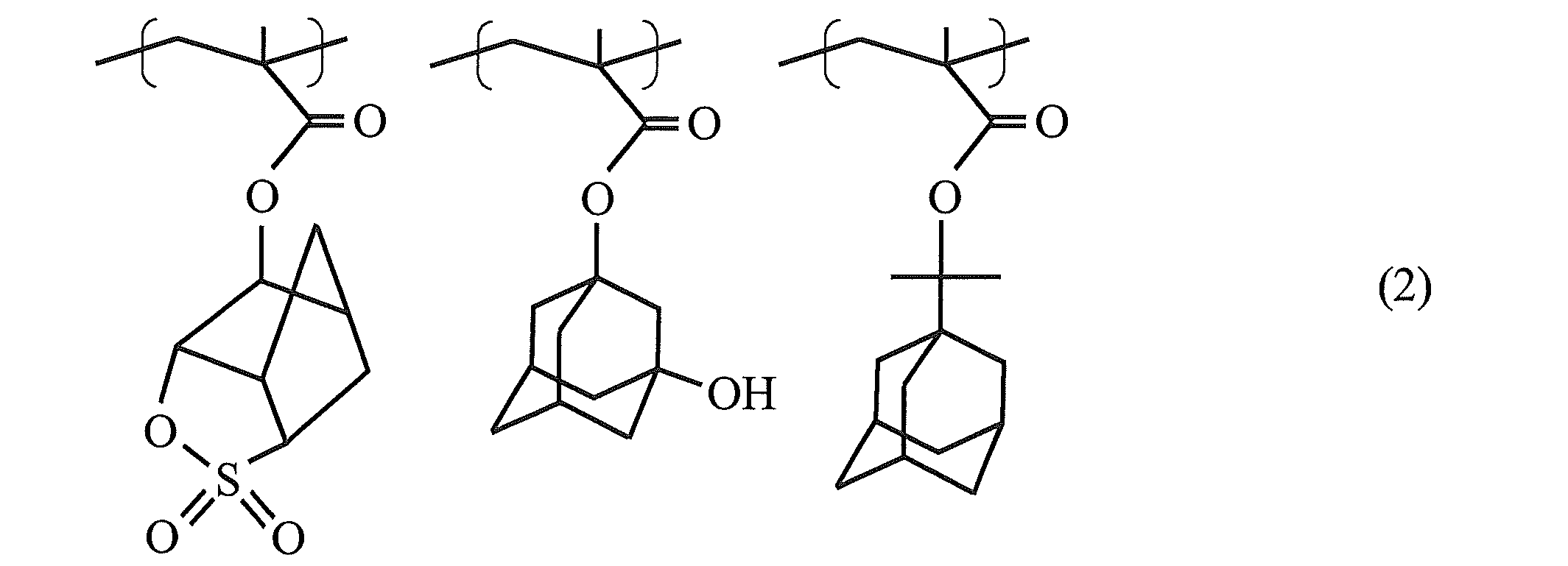
モノマー成分として、5-メタクリロイルオキシ-3-オキサ-2-チアトリシクロ[4.2.1.04,8]ノナン-2,2-ジオン121.3g(0.470mol)、1-ヒドロキシ-3-メタクリロイルオキシアダマンタン55.5g(0.235mol)、1-(1-メタクリロイルオキシ-1-メチルエチル)アダマンタン123.2g(0.470mol)を用いた以外は実施例1と同様の操作を行ったところ、下記式(2)で表されるモノマー単位を有する高分子化合物257.2g[重量平均分子量(Mw):8200、分子量分布(Mw/Mn):1.91]を得た。
得られた高分子化合物をポリマー濃度15%となるようにPGMEAに溶解し、樹脂溶液2を得た。
モノマー成分として、1-シアノ-5-(2-メタクリロイルオキシアセトキシ)-3-オキサトリシクロ[4.2.1.04,8]ノナン-2-オン133.6g(0.438mol)、1-ヒドロキシ-3-メタクリロイルオキシアダマンタン51.7g(0.219mol)、1-(1-メタクリロイルオキシ-1-メチルエチル)アダマンタン114.7g(0.438mol)を用いた以外は、実施例1と同様の操作を行ったところ、下記式(3)で表されるモノマー単位を有する高分子化合物254.4g[重量平均分子量(Mw):9000、分子量分布(Mw/Mn):1.83]を得た。
得られた高分子化合物をポリマー濃度15%となるようにPGMEAに溶解し、樹脂溶液3を得た。

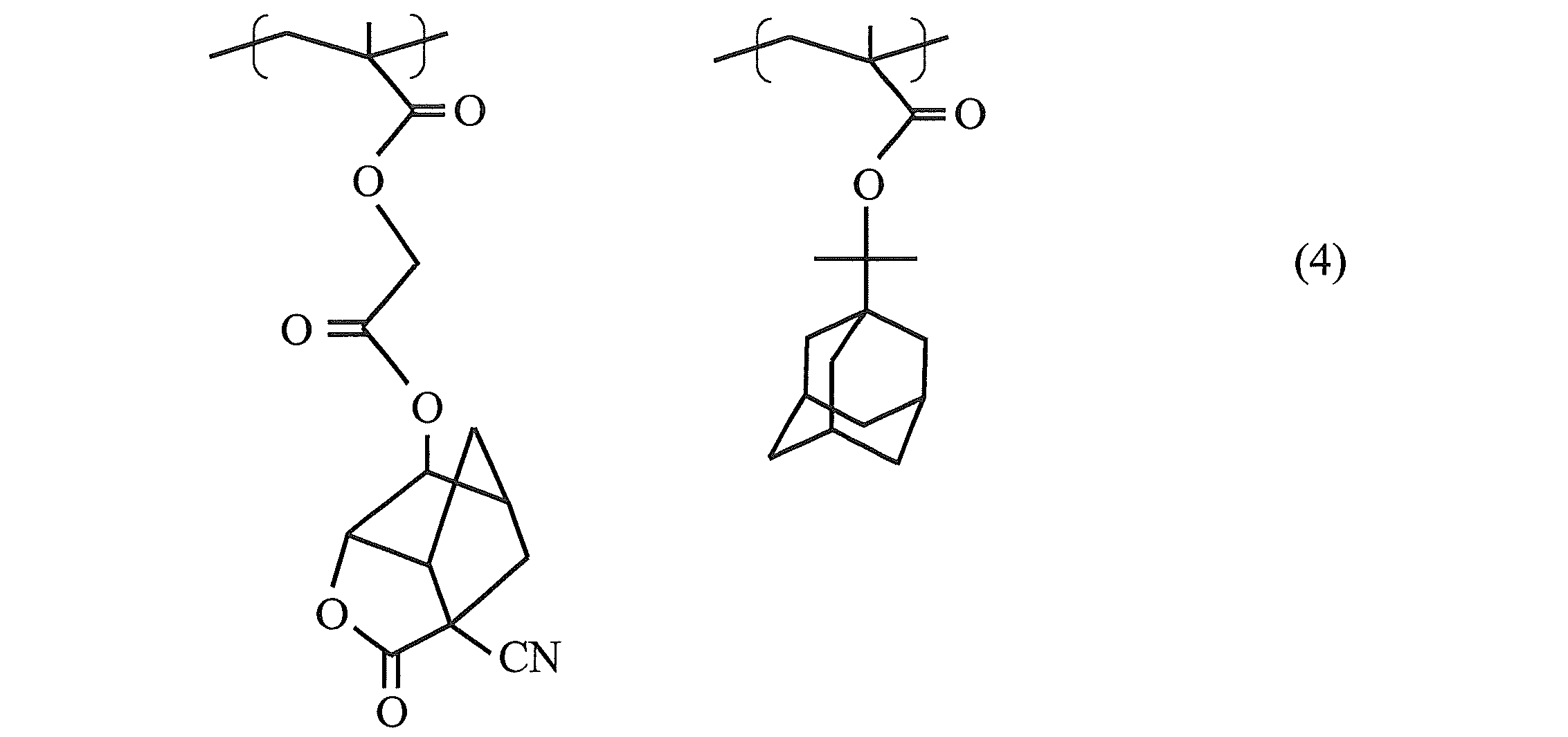
モノマー成分として、1-シアノ-5-(2-メタクリロイルオキシアセトキシ)-3-オキサトリシクロ[4.2.1.04,8]ノナン-2-オン131.1g(0.430mol)、1-(1-メタクリロイルオキシ-1-メチルエチル)アダマンタン168.9g(0.645mol)を用いた以外は、実施例1と同様の操作を行ったところ、下記式(4)で表されるモノマー単位を有する高分子化合物239.8g[重量平均分子量(Mw):7500、分子量分布(Mw/Mn):1.80]を得た。
得られた高分子化合物をポリマー濃度15%となるようにPGMEAに溶解し、樹脂溶液4を得た。
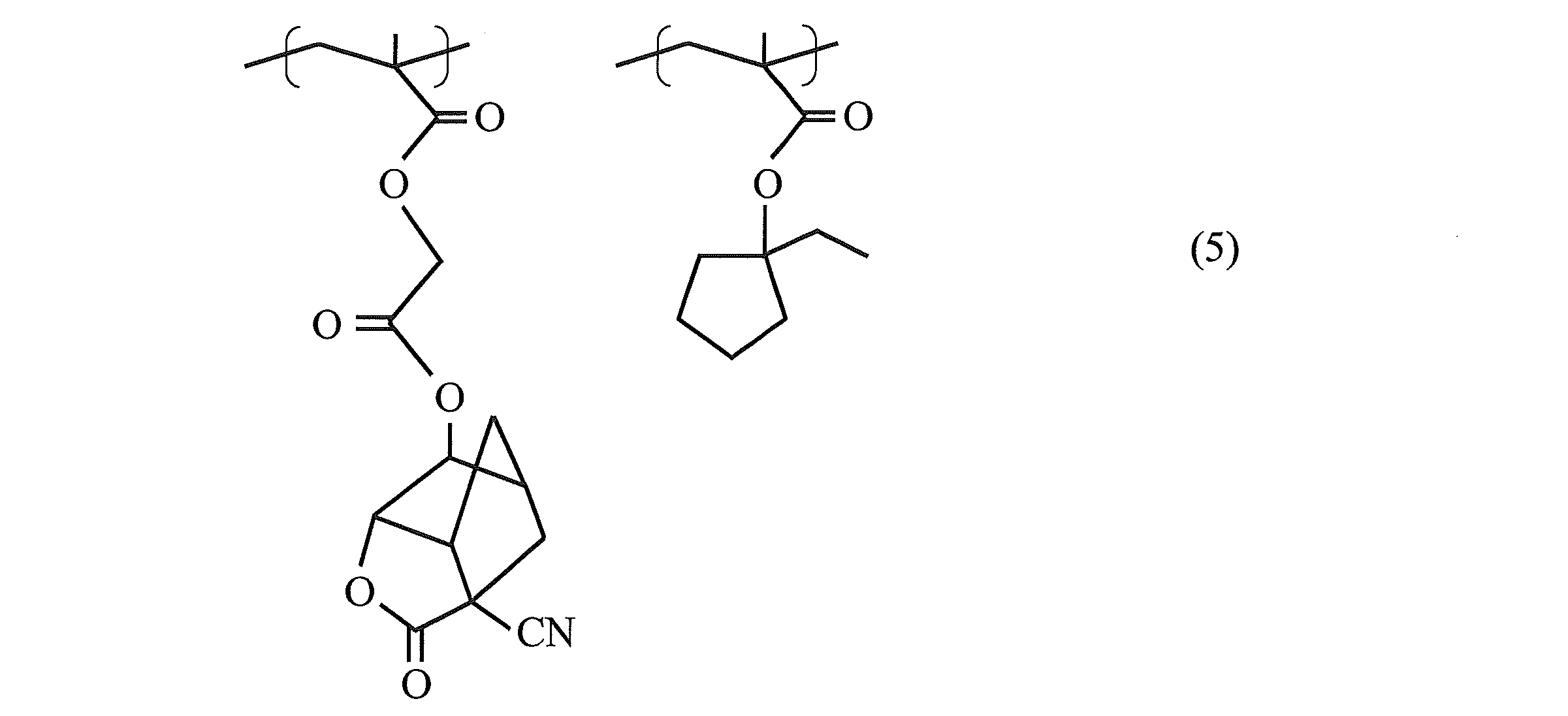
モノマー成分として、1-シアノ-5-(2-メタクリロイルオキシアセトキシ)-3-オキサトリシクロ[4.2.1.04,8]ノナン-2-オン158.3g(0.519mol)、2-エチル-2-メタクリロイルオキシシクロペンタン141.7g(0.779mol)を用いた以外は、実施例1と同様の操作を行ったところ、下記式(5)で表されるモノマー単位を有する高分子化合物227.4g[重量平均分子量(Mw):6800、分子量分布(Mw/Mn):1.75]を得た。
得られた高分子化合物をポリマー濃度15%となるようにPGMEAに溶解し、樹脂溶液5を得た。
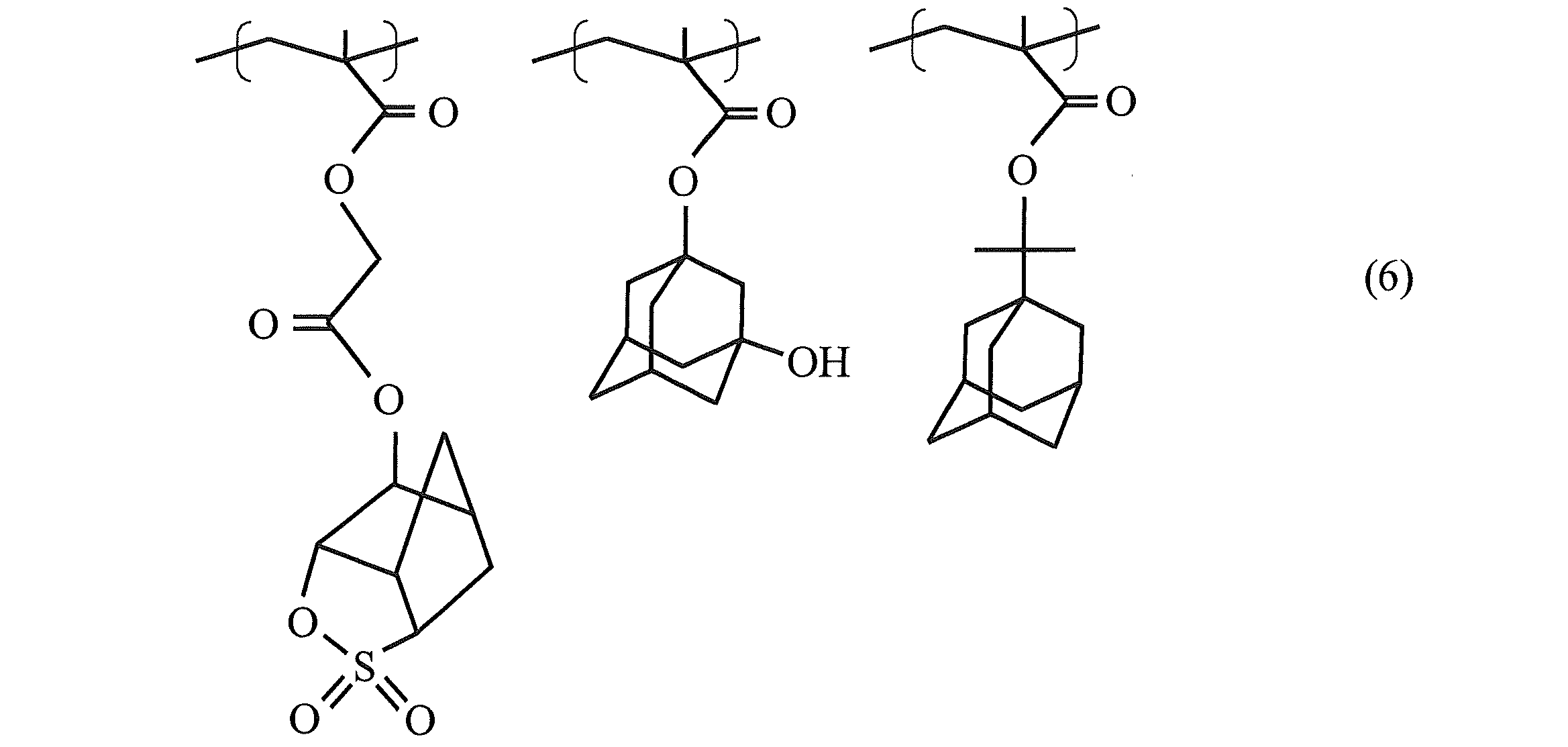
モノマー成分として、5-(2-メタクリロイルオキシアセトキシ)-3-オキサ-2-チアトリシクロ[4.2.1.04,8]ノナン-2,2-ジオン136.2g(0.431mol)、1-ヒドロキシ-3-メタクリロイルオキシアダマンタン50.9g(0.216mol)、1-(1-メタクリロイルオキシ-1-メチルエチル)アダマンタン112.9g(0.431mol)を用いた以外は、実施例1と同様の操作を行ったところ、下記式(6)で表されるモノマー単位を有する高分子化合物247.0g[重量平均分子量(Mw):8500、分子量分布(Mw/Mn):1.91]を得た。
得られた高分子化合物をポリマー濃度15%となるようにPGMEAに溶解し、樹脂溶液6を得た。
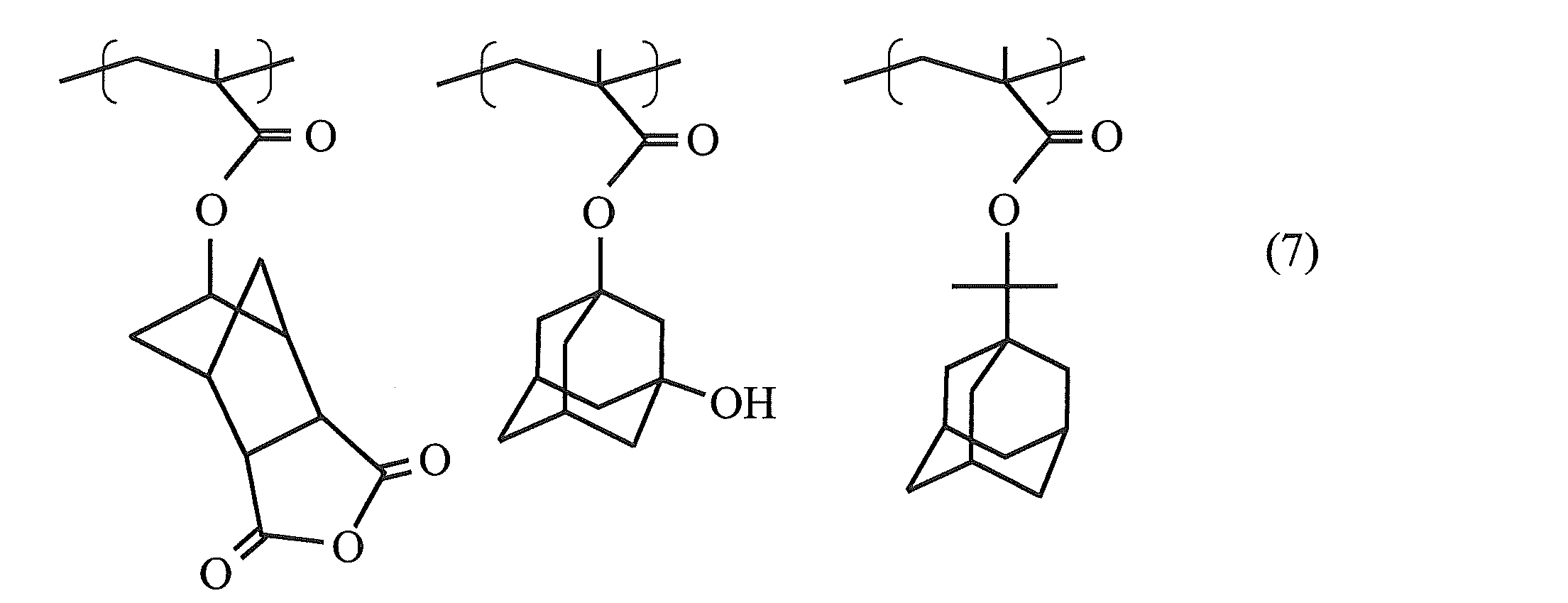
還流管、撹拌子、3方コック、温度計を備えた丸底フラスコに、窒素雰囲気下、PGMEA357.0g、PGME238.0gを入れて温度を100℃に保ち、撹拌しながら、5-メタクリロイルオキシノルボルナン-2,3-ジカルボン酸無水物119.0g(0.476mol)、1-ヒドロキシ-3-メタクリロイルオキシアダマンタン56.2g(0.238mol)、1-(1-メタクリロイルオキシ-1-メチルエチル)アダマンタン124.8g(0.476mol)、ジメチル2,2'-アゾビスイソブチレート(商品名「V-601」、和光純薬工業(株)製)7.50g、PGMEA663.0g、PGME442.0gを混合したモノマー溶液を6時間かけて一定速度で滴下した。滴下終了後、さらに2時間撹拌を続けた。重合反応終了後、得られた反応溶液を孔径0.1μmのフィルターで濾過した後、該反応溶液の7倍量のヘキサンと酢酸エチルの9:1(重量比)混合液中に撹拌しながら滴下した。生じた沈殿物を濾別、乾燥することにより、下記式(7)で表されるモノマー単位を有する高分子化合物243.5g[重量平均分子量(Mw):8800、分子量分布(Mw/Mn):1.90]を得た。
得られた高分子化合物をポリマー濃度15%となるようにPGMEAに溶解し、樹脂溶液7を得た。
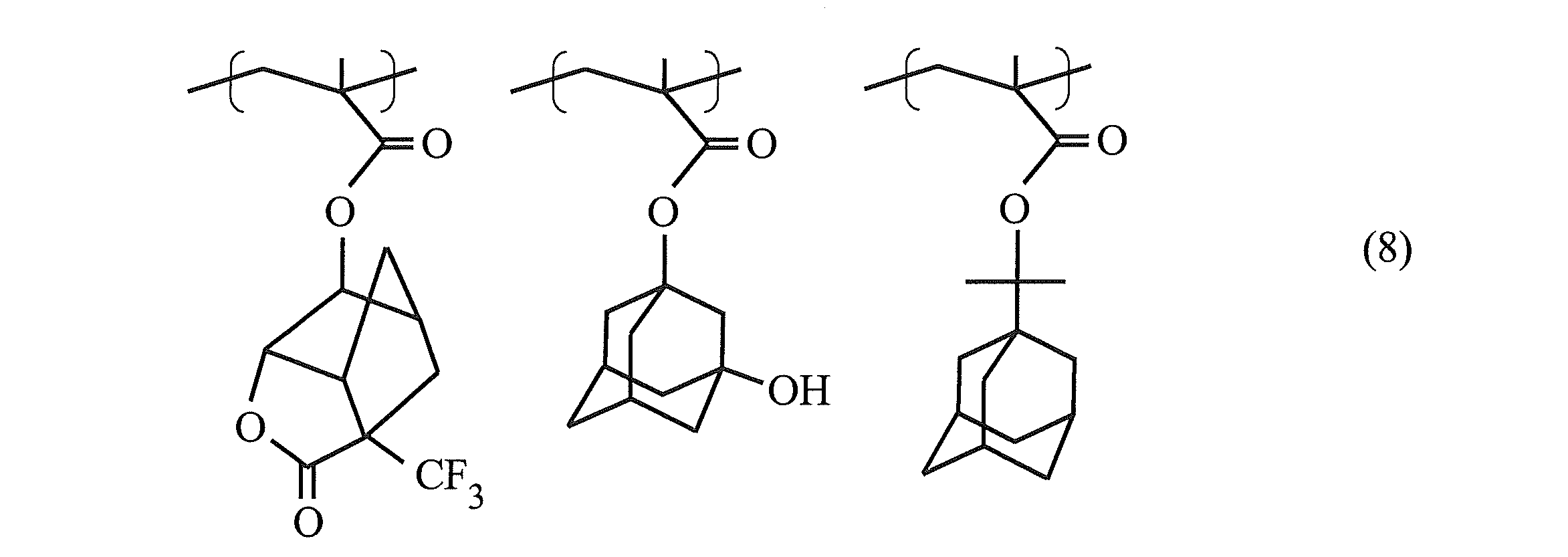
モノマー成分として、1-トリフロロメチル-5-メタクリロイルオキシ-3-オキサトリシクロ[4.2.1.04,8]ノナン-2-オン129.9g(0.448mol)、1-ヒドロキシ-3-メタクリロイルオキシアダマンタン52.8g(0.224mol)、1-(1-メタクリロイルオキシ-1-メチルエチル)アダマンタン117.3g(0.448mol)を用いた以外は、実施例1と同様の操作を行ったところ、下記式(8)で表されるモノマー単位を有する高分子化合物255.3g[重量平均分子量(Mw):8000、分子量分布(Mw/Mn):1.95]を得た。
得られた高分子化合物をポリマー濃度15%となるようにPGMEAに溶解し、樹脂溶液8を得た。
調製例1で得られた樹脂溶液1をフィルター[商品名「ゼータプラス020GN」、住友スリーエム(株)製、孔径:0.2μm]を使用して、濾過流量5kg/min/m2、濾過温度23℃で濾過処理を行い、濾過処理後樹脂溶液を得た。
調製例1で得られた樹脂溶液1に代えて調製例2で得られた樹脂溶液2を使用した以外は実施例1と同様に濾過処理を行い、濾過処理後樹脂溶液を得た。
調製例1で得られた樹脂溶液1に代えて調製例3で得られた樹脂溶液3を使用した以外は実施例1と同様に濾過処理を行い、濾過処理後樹脂溶液を得た。
調製例1で得られた樹脂溶液1に代えて調製例4で得られた樹脂溶液4を使用した以外は実施例1と同様に濾過処理を行い、濾過処理後樹脂溶液を得た。
調製例1で得られた樹脂溶液1に代えて調製例5で得られた樹脂溶液5を使用した以外は実施例1と同様に濾過処理を行い、濾過処理後樹脂溶液を得た。
調製例1で得られた樹脂溶液1に代えて調製例6で得られた樹脂溶液6を使用した以外は実施例1と同様に濾過処理を行い、濾過処理後樹脂溶液を得た。
調製例1で得られた樹脂溶液1に代えて調製例7で得られた樹脂溶液7を使用した以外は実施例1と同様に濾過処理を行い、濾過処理後樹脂溶液を得た。
調製例1で得られた樹脂溶液1に代えて調製例8で得られた樹脂溶液8を使用した以外は実施例1と同様に濾過処理を行い、濾過処理後樹脂溶液を得た。
調製例1で得られた樹脂溶液1をフィルター[商品名「エレクトロポア」、住友スリーエム(株)製、孔径:0.04μm]を使用して、濾過流量5kg/min/m2、濾過温度23℃で濾過処理を行い、濾過処理後樹脂溶液を得た。
調製例1で得られた樹脂溶液1に代えて調製例2で得られた樹脂溶液2を使用した以外は実施例9と同様に濾過処理を行い、濾過処理後樹脂溶液を得た。
調製例1で得られた樹脂溶液1を強酸性陽イオン交換基を有するフィルター[商品名「ゼータプラス40QSH」、住友スリーエム(株)製、孔径:0.4μm]を使用して、濾過流量5kg/min/m2、濾過温度23℃で濾過処理を行い、濾過処理後樹脂溶液を得た。
調製例1で得られた樹脂溶液1を強酸性陽イオン交換基を有するフィルター[商品名「プロテゴ」、日本インテグリス(株)製、孔径:0.05μm]を使用して、濾過流量5kg/min/m2、濾過温度23℃で濾過処理を行い、濾過処理後樹脂溶液を得た。
調製例1で得られた樹脂溶液1を強酸性陽イオン交換基を有するフィルター[商品名「イオンクリーンSL」、日本ポール(株)製]を使用して、濾過流量5kg/min/m2、濾過温度23℃で濾過処理を行い、濾過処理後樹脂溶液を得た。
調製例2で得られた樹脂溶液2を強酸性陽イオン交換基を有するフィルター[商品名「プロテゴ」、日本インテグリス(株)製、孔径:0.05μm]を使用して、濾過流量5kg/min/m2、濾過温度23℃で濾過処理を行い、濾過処理後樹脂溶液を得た。
調製例4で得られた樹脂溶液4を強酸性陽イオン交換基を有するフィルター[商品名「イオンクリーンSL」、日本ポール(株)製]を使用して、濾過流量5kg/min/m2、濾過温度23℃で濾過処理を行い、濾過処理後樹脂溶液を得た。
調製例5で得られた樹脂溶液5を強酸性陽イオン交換基を有するフィルター[商品名「イオンクリーンSL」、日本ポール(株)製]を使用して、濾過流量5kg/min/m2、濾過温度23℃で濾過処理を行い、濾過処理後樹脂溶液を得た。
尚、酸価は、NaOHを用いた中和滴定により測定した。樹脂濃度が15重量%のPGMEA溶液0.5gを秤量し、テトラヒドロフラン(THF)54mL、水6mLを加えた。指示薬としてフェノールフタレイン1体積%を含むエタノール溶液を0.05g加えた。この溶液を撹拌しながら0.1mol/LのNaOH水溶液で滴定し、溶液が無色からピンク色に変色した点を終点とし、下記式により酸価を算出した。
酸価(mmol/g)=[(B×0.1)/(A×C)]×100
(式中、Aは測定試料の重量(g)、Bは終点までに滴下した0.1mol/LのNaOH水溶液量(mL)、Cは測定試料の樹脂濃度(重量%)を示す)
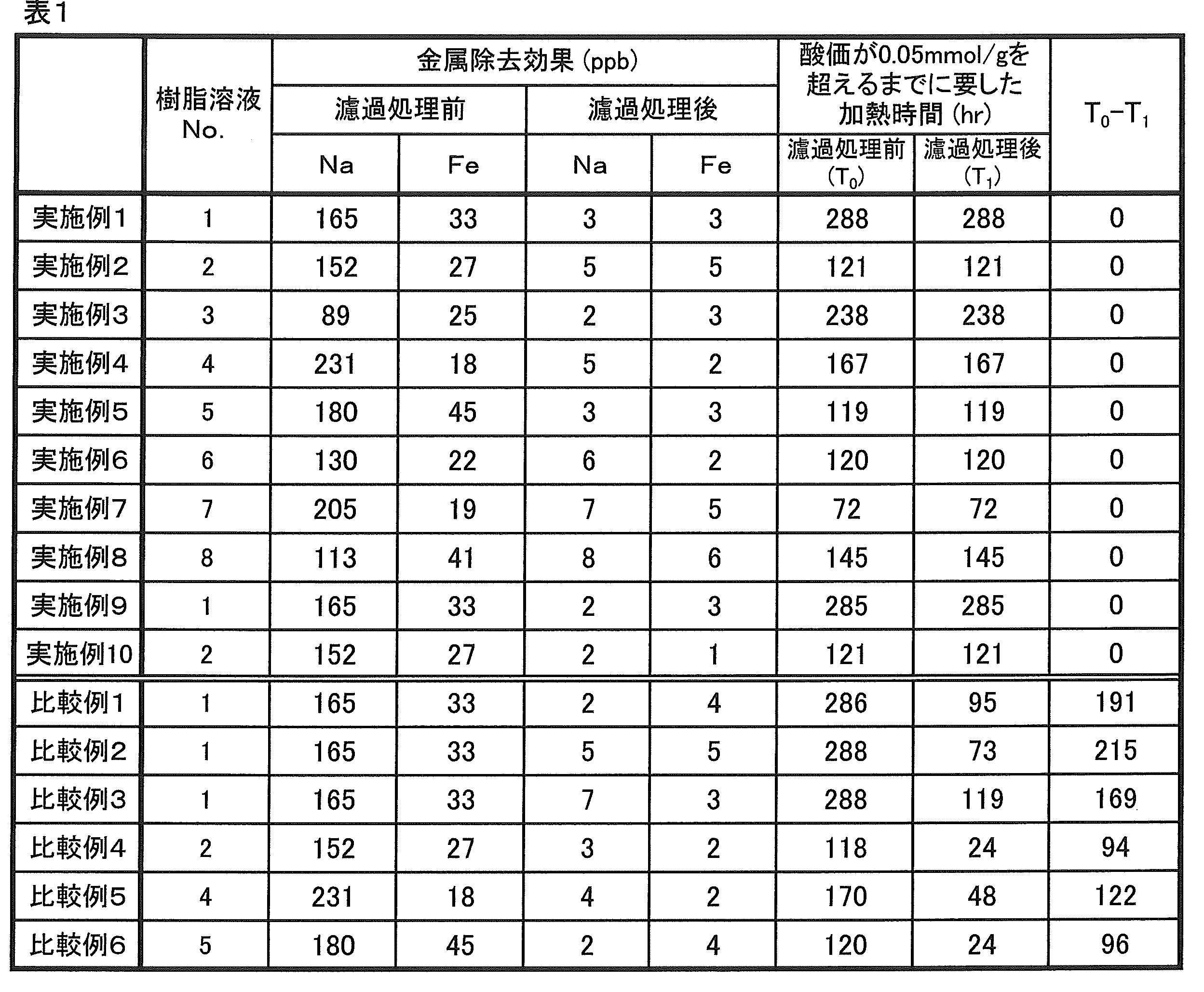
また、本発明の高分子化合物は保存安定性に優れ、ナトリウムや鉄等の金属成分含有量が極めて低いため、ArFレジスト用ポリマーとして好適に使用することができる。そして、本発明の高分子化合物によれば、優れた電気特性を有する半導体を製造することができる。
Claims (9)
- 下記式(a1)~(a3)

で表されるモノマー単位から選択される少なくとも1種のモノマー単位a、及び酸によりその一部が脱離してアルカリ可溶性となる基を含むモノマー単位bを有する高分子化合物を含有する樹脂溶液を、下記フィルターを使用して濾過する工程を有する高分子化合物の製造方法。
フィルター:強酸性陽イオン交換基を含まず、正のゼータ電位を示すフィルター - 濾過工程を経て、ナトリウム含有量(樹脂固形分換算)が20ppb以下、鉄含有量(樹脂固形分換算)が10ppb以下の樹脂溶液を得る請求項1に記載の高分子化合物の製造方法。
- 濾過工程に付す前の樹脂溶液を60℃で加熱して酸価が0.05mmol/gを超えるのに要する時間(T0)と、濾過工程に付した後の樹脂溶液を60℃で加熱して酸価が0.05mmol/gを超えるのに要する時間(T1)が下記式を満たす請求項1又は2に記載の高分子化合物の製造方法。
T0-T1≦80 - 前記モノマー単位bが下記式(b1)~(b4)
で表されるモノマー単位から選択される少なくとも1種のモノマー単位である請求項1~3の何れか1項に記載の高分子化合物の製造方法。 - 前記モノマー単位a、及び前記モノマー単位b以外に、下記式(c1)
で表されるモノマー単位cを含む請求項1~4の何れか1項に記載の高分子化合物の製造方法。 - 請求項1~5の何れか1項に記載の高分子化合物の製造方法により得られる高分子化合物。
- 重量平均分子量が1000~50000である請求項6に記載の高分子化合物。
- 分子量分布(重量平均分子量と数平均分子量との比)が1.0~3.0である請求項6又は7に記載の高分子化合物。
- 請求項6~8の何れか1項に記載の高分子化合物と光酸発生剤と有機溶剤を少なくとも含むフォトレジスト用樹脂組成物。
Priority Applications (2)
| Application Number | Priority Date | Filing Date | Title |
|---|---|---|---|
| US14/412,111 US20150147696A1 (en) | 2012-08-07 | 2013-07-26 | Method for producing polymer compound, polymer compound, and photoresist resin composition |
| KR20157002173A KR20150042186A (ko) | 2012-08-07 | 2013-07-26 | 고분자 화합물의 제조 방법, 고분자 화합물 및 포토레지스트용 수지 조성물 |
Applications Claiming Priority (2)
| Application Number | Priority Date | Filing Date | Title |
|---|---|---|---|
| JP2012175428A JP5914241B2 (ja) | 2012-08-07 | 2012-08-07 | 高分子化合物の製造方法、高分子化合物、及びフォトレジスト用樹脂組成物 |
| JP2012-175428 | 2012-08-07 |
Publications (1)
| Publication Number | Publication Date |
|---|---|
| WO2014024702A1 true WO2014024702A1 (ja) | 2014-02-13 |
Family
ID=50067935
Family Applications (1)
| Application Number | Title | Priority Date | Filing Date |
|---|---|---|---|
| PCT/JP2013/070289 Ceased WO2014024702A1 (ja) | 2012-08-07 | 2013-07-26 | 高分子化合物の製造方法、高分子化合物、及びフォトレジスト用樹脂組成物 |
Country Status (5)
| Country | Link |
|---|---|
| US (1) | US20150147696A1 (ja) |
| JP (1) | JP5914241B2 (ja) |
| KR (1) | KR20150042186A (ja) |
| TW (1) | TW201412794A (ja) |
| WO (1) | WO2014024702A1 (ja) |
Cited By (1)
| Publication number | Priority date | Publication date | Assignee | Title |
|---|---|---|---|---|
| JP2016089055A (ja) * | 2014-11-06 | 2016-05-23 | 三菱レイヨン株式会社 | 半導体リソグラフィー用重合体の精製方法および製造方法、レジスト組成物の製造方法、ならびにパターンが形成された基板の製造方法 |
Families Citing this family (5)
| Publication number | Priority date | Publication date | Assignee | Title |
|---|---|---|---|---|
| KR101892553B1 (ko) * | 2014-07-09 | 2018-08-28 | 후지필름 가부시키가이샤 | 감활성광선성 또는 감방사선성 수지 조성물, 패턴 형성 방법, 및 전자 디바이스의 제조 방법 |
| KR101853714B1 (ko) * | 2014-07-09 | 2018-05-02 | 후지필름 가부시키가이샤 | 감활성광선성 또는 감방사선성 수지 조성물, 패턴 형성 방법, 및 전자 디바이스의 제조 방법 |
| KR102632268B1 (ko) | 2016-01-11 | 2024-01-31 | 삼성전자주식회사 | 포토 레지스트 조성물 및 이를 이용한 반도체 장치의 제조 방법 |
| KR20200122354A (ko) * | 2018-03-26 | 2020-10-27 | 후지필름 가부시키가이샤 | 감광성 수지 조성물과 그 제조 방법, 레지스트막, 패턴 형성 방법, 및 전자 디바이스의 제조 방법 |
| JP7249904B2 (ja) | 2019-07-25 | 2023-03-31 | 丸善石油化学株式会社 | 酸分解性樹脂の製造方法 |
Citations (12)
| Publication number | Priority date | Publication date | Assignee | Title |
|---|---|---|---|---|
| JP2001350266A (ja) * | 2000-06-09 | 2001-12-21 | Sumitomo Chem Co Ltd | レジスト組成物の製造方法 |
| JP2002097219A (ja) * | 2000-09-21 | 2002-04-02 | Sumitomo Chem Co Ltd | 金属含量の低減されたポリ(メタ)アクリレート類の製造方法 |
| JP2006083214A (ja) * | 2004-09-14 | 2006-03-30 | Maruzen Petrochem Co Ltd | 半導体レジスト用共重合体におけるパーティクルの増加防止方法 |
| JP2006188575A (ja) * | 2005-01-05 | 2006-07-20 | Daicel Chem Ind Ltd | フォトレジスト用高分子化合物の製造方法 |
| JP2007154080A (ja) * | 2005-12-07 | 2007-06-21 | Daicel Chem Ind Ltd | フォトレジスト用樹脂の製造方法 |
| JP2007186713A (ja) * | 2007-03-29 | 2007-07-26 | Jsr Corp | 感放射線性樹脂組成物の製造方法 |
| JP2008170983A (ja) * | 2006-12-14 | 2008-07-24 | Sumitomo Chemical Co Ltd | 化学増幅型レジスト組成物 |
| JP2008260931A (ja) * | 2007-03-20 | 2008-10-30 | Fujifilm Corp | レジスト表面疎水化用樹脂、その製造方法及び該樹脂を含有するポジ型レジスト組成物 |
| JP2009062491A (ja) * | 2007-09-07 | 2009-03-26 | Tokyo Ohka Kogyo Co Ltd | 高分子化合物、ポジ型レジスト組成物およびレジストパターン形成方法 |
| JP2009282331A (ja) * | 2008-05-22 | 2009-12-03 | Jsr Corp | レジスト用樹脂含有溶液の製造方法及びレジスト用樹脂含有溶液 |
| JP2010189563A (ja) * | 2009-02-19 | 2010-09-02 | Mitsubishi Rayon Co Ltd | フォトリソグラフィ用高分子化合物の金属イオン不純物除去方法 |
| JP2012093706A (ja) * | 2010-09-30 | 2012-05-17 | Jsr Corp | 感放射線性樹脂組成物及びパターン形成方法 |
Family Cites Families (21)
| Publication number | Priority date | Publication date | Assignee | Title |
|---|---|---|---|---|
| JP3363051B2 (ja) * | 1997-02-21 | 2003-01-07 | 丸善石油化学株式会社 | ビニルフェノール系重合体の金属除去法 |
| JP4245596B2 (ja) * | 2002-04-01 | 2009-03-25 | ダイセル化学工業株式会社 | フォトレジスト用高分子化合物 |
| KR101129883B1 (ko) * | 2004-05-26 | 2012-03-28 | 제이에스알 가부시끼가이샤 | 미세 패턴 형성용 수지 조성물 및 미세 패턴 형성 방법 |
| JP4679990B2 (ja) * | 2005-07-22 | 2011-05-11 | 東京応化工業株式会社 | ポジ型レジスト組成物の製造方法、ポジ型レジスト組成物およびレジストパターン形成方法 |
| KR101084461B1 (ko) * | 2005-12-22 | 2011-11-21 | 듀퐁 일렉트로닉 폴리머스 엘피 | 안정한 포토레지스트 조성물의 제조방법 |
| EP1992651A4 (en) * | 2006-02-17 | 2009-11-04 | Kuraray Co | TERT.-ALCOHOL DERIVATIVE, POLYMER CONNECTION AND PHOTORESISTIC COMPOSITION |
| US20070248913A1 (en) * | 2006-04-24 | 2007-10-25 | Rahman M Dalil | Process for producing film forming resins for photoresist compositions |
| JP5030474B2 (ja) * | 2006-05-18 | 2012-09-19 | 丸善石油化学株式会社 | 半導体リソグラフィー用樹脂組成物 |
| JPWO2008143301A1 (ja) * | 2007-05-23 | 2010-08-12 | Jsr株式会社 | パターン形成方法及びそれに用いる樹脂組成物 |
| US8486606B2 (en) * | 2008-06-30 | 2013-07-16 | Kuraray Co., Ltd. | Acrylate derivative, haloester derivative, polymer compound and photoresist composition |
| JP5548406B2 (ja) * | 2008-08-22 | 2014-07-16 | 東京応化工業株式会社 | ポジ型レジスト組成物、レジストパターン形成方法、高分子化合物 |
| JP5232663B2 (ja) * | 2009-01-14 | 2013-07-10 | 東京応化工業株式会社 | レジスト組成物、レジストパターン形成方法、高分子化合物及び化合物 |
| JP5232675B2 (ja) * | 2009-01-26 | 2013-07-10 | 東京応化工業株式会社 | ポジ型レジスト組成物及びそれを用いたレジストパターン形成方法、並びに高分子化合物 |
| JP5689253B2 (ja) * | 2009-06-24 | 2015-03-25 | 住友化学株式会社 | 化学増幅型フォトレジスト組成物及びレジストパターンの製造方法 |
| JP5621735B2 (ja) * | 2010-09-03 | 2014-11-12 | 信越化学工業株式会社 | パターン形成方法及び化学増幅ポジ型レジスト材料 |
| WO2012036250A1 (ja) * | 2010-09-17 | 2012-03-22 | Jsr株式会社 | 感放射線性樹脂組成物、重合体及びレジストパターン形成方法 |
| WO2012043684A1 (ja) * | 2010-09-29 | 2012-04-05 | Jsr株式会社 | 感放射線性樹脂組成物及びパターン形成方法 |
| JP5618924B2 (ja) * | 2011-06-30 | 2014-11-05 | 富士フイルム株式会社 | 感活性光線性又は感放射線性樹脂組成物、該組成物を用いたレジスト膜及びパターン形成方法、並びに電子デバイスの製造方法及び電子デバイス |
| JP5675532B2 (ja) * | 2011-08-30 | 2015-02-25 | 富士フイルム株式会社 | パターン形成方法、感活性光線性又は感放射線性樹脂組成物、及び感活性光線性又は感放射線性膜 |
| JP6065786B2 (ja) * | 2012-09-14 | 2017-01-25 | 信越化学工業株式会社 | 化学増幅レジスト材料及びパターン形成方法 |
| JP6334876B2 (ja) * | 2012-12-26 | 2018-05-30 | 東京応化工業株式会社 | レジスト組成物、レジストパターン形成方法 |
-
2012
- 2012-08-07 JP JP2012175428A patent/JP5914241B2/ja active Active
-
2013
- 2013-07-26 WO PCT/JP2013/070289 patent/WO2014024702A1/ja not_active Ceased
- 2013-07-26 KR KR20157002173A patent/KR20150042186A/ko not_active Withdrawn
- 2013-07-26 US US14/412,111 patent/US20150147696A1/en not_active Abandoned
- 2013-08-05 TW TW102127908A patent/TW201412794A/zh unknown
Patent Citations (12)
| Publication number | Priority date | Publication date | Assignee | Title |
|---|---|---|---|---|
| JP2001350266A (ja) * | 2000-06-09 | 2001-12-21 | Sumitomo Chem Co Ltd | レジスト組成物の製造方法 |
| JP2002097219A (ja) * | 2000-09-21 | 2002-04-02 | Sumitomo Chem Co Ltd | 金属含量の低減されたポリ(メタ)アクリレート類の製造方法 |
| JP2006083214A (ja) * | 2004-09-14 | 2006-03-30 | Maruzen Petrochem Co Ltd | 半導体レジスト用共重合体におけるパーティクルの増加防止方法 |
| JP2006188575A (ja) * | 2005-01-05 | 2006-07-20 | Daicel Chem Ind Ltd | フォトレジスト用高分子化合物の製造方法 |
| JP2007154080A (ja) * | 2005-12-07 | 2007-06-21 | Daicel Chem Ind Ltd | フォトレジスト用樹脂の製造方法 |
| JP2008170983A (ja) * | 2006-12-14 | 2008-07-24 | Sumitomo Chemical Co Ltd | 化学増幅型レジスト組成物 |
| JP2008260931A (ja) * | 2007-03-20 | 2008-10-30 | Fujifilm Corp | レジスト表面疎水化用樹脂、その製造方法及び該樹脂を含有するポジ型レジスト組成物 |
| JP2007186713A (ja) * | 2007-03-29 | 2007-07-26 | Jsr Corp | 感放射線性樹脂組成物の製造方法 |
| JP2009062491A (ja) * | 2007-09-07 | 2009-03-26 | Tokyo Ohka Kogyo Co Ltd | 高分子化合物、ポジ型レジスト組成物およびレジストパターン形成方法 |
| JP2009282331A (ja) * | 2008-05-22 | 2009-12-03 | Jsr Corp | レジスト用樹脂含有溶液の製造方法及びレジスト用樹脂含有溶液 |
| JP2010189563A (ja) * | 2009-02-19 | 2010-09-02 | Mitsubishi Rayon Co Ltd | フォトリソグラフィ用高分子化合物の金属イオン不純物除去方法 |
| JP2012093706A (ja) * | 2010-09-30 | 2012-05-17 | Jsr Corp | 感放射線性樹脂組成物及びパターン形成方法 |
Cited By (1)
| Publication number | Priority date | Publication date | Assignee | Title |
|---|---|---|---|---|
| JP2016089055A (ja) * | 2014-11-06 | 2016-05-23 | 三菱レイヨン株式会社 | 半導体リソグラフィー用重合体の精製方法および製造方法、レジスト組成物の製造方法、ならびにパターンが形成された基板の製造方法 |
Also Published As
| Publication number | Publication date |
|---|---|
| KR20150042186A (ko) | 2015-04-20 |
| TW201412794A (zh) | 2014-04-01 |
| JP2014034601A (ja) | 2014-02-24 |
| US20150147696A1 (en) | 2015-05-28 |
| JP5914241B2 (ja) | 2016-05-11 |
Similar Documents
| Publication | Publication Date | Title |
|---|---|---|
| JP5914241B2 (ja) | 高分子化合物の製造方法、高分子化合物、及びフォトレジスト用樹脂組成物 | |
| KR20100124672A (ko) | 포토레지스트용 고분자 화합물의 제조 방법 | |
| KR101881624B1 (ko) | 중합체 및 그 제조 방법 | |
| US9261785B2 (en) | Polymer compound, resin composition for photoresists, and method for producing semiconductor | |
| TWI584063B (zh) | 微影用共聚合物的製造方法 | |
| KR102903526B1 (ko) | 포토레지스트용 수지, 포토레지스트용 수지의 제조 방법, 포토레지스트용 수지 조성물 및 패턴 형성 방법 | |
| JP5006054B2 (ja) | レジスト用重合体、レジスト組成物及びパターンが形成された基板の製造方法 | |
| JP5138199B2 (ja) | レジスト用重合体、レジスト組成物、パターンが形成された基板の製造方法 | |
| JP5318350B2 (ja) | 重合体、レジスト組成物及びパターンが形成された基板の製造方法 | |
| JP5339494B2 (ja) | 重合体、レジスト組成物及びパターンが形成された基板の製造方法 | |
| JP7110461B2 (ja) | フォトレジスト樹脂の製造方法 | |
| JP5059419B2 (ja) | 重合体、レジスト組成物及びパターンが形成された基板の製造方法 | |
| JP5384421B2 (ja) | 半導体リソグラフィー用共重合体の製造方法 | |
| US8753793B2 (en) | Method for producing resin solution for photoresist, photoresist composition, and pattern-forming method | |
| JP5986826B2 (ja) | 高分子化合物、フォトレジスト用樹脂組成物、及び半導体の製造方法 | |
| JP5986825B2 (ja) | 高分子化合物、フォトレジスト用樹脂組成物、及び半導体の製造方法 | |
| JP6299076B2 (ja) | リソグラフィー用重合体の製造方法、レジスト組成物の製造方法、およびパターンが形成された基板の製造方法 | |
| JP2013006888A (ja) | リソグラフィー用重合体の製造方法、レジスト組成物の製造方法、およびパターンが形成された基板の製造方法 | |
| WO2026004902A1 (ja) | 高分子化合物、フォトレジスト用樹脂組成物および半導体の製造方法 | |
| JP5659570B2 (ja) | 重合体の製造方法、半導体リソグラフィー用重合体、レジスト組成物、およびパターンが形成された基板の製造方法 | |
| JP2013023589A (ja) | 電子材料用重合体の製造方法、レジスト組成物の製造方法、およびパターンが形成された基板の製造方法 | |
| JP2015081323A (ja) | 電子材料用重合体を製造する反応容器の洗浄方法 |
Legal Events
| Date | Code | Title | Description |
|---|---|---|---|
| 121 | Ep: the epo has been informed by wipo that ep was designated in this application |
Ref document number: 13827646 Country of ref document: EP Kind code of ref document: A1 |
|
| WWE | Wipo information: entry into national phase |
Ref document number: 14412111 Country of ref document: US |
|
| ENP | Entry into the national phase |
Ref document number: 20157002173 Country of ref document: KR Kind code of ref document: A |
|
| NENP | Non-entry into the national phase |
Ref country code: DE |
|
| 122 | Ep: pct application non-entry in european phase |
Ref document number: 13827646 Country of ref document: EP Kind code of ref document: A1 |