WO2014017598A1 - 硬化性オルガノポリシロキサン組成物、その製造方法、オルガノポリシロキサン硬化物の製造方法、オルガノポリシロキサンの縮合方法、光半導体封止体、及びオルガノポリシロキサンの縮合触媒 - Google Patents
硬化性オルガノポリシロキサン組成物、その製造方法、オルガノポリシロキサン硬化物の製造方法、オルガノポリシロキサンの縮合方法、光半導体封止体、及びオルガノポリシロキサンの縮合触媒 Download PDFInfo
- Publication number
- WO2014017598A1 WO2014017598A1 PCT/JP2013/070218 JP2013070218W WO2014017598A1 WO 2014017598 A1 WO2014017598 A1 WO 2014017598A1 JP 2013070218 W JP2013070218 W JP 2013070218W WO 2014017598 A1 WO2014017598 A1 WO 2014017598A1
- Authority
- WO
- WIPO (PCT)
- Prior art keywords
- organopolysiloxane
- compound
- indium
- component
- molecule
- Prior art date
- Legal status (The legal status is an assumption and is not a legal conclusion. Google has not performed a legal analysis and makes no representation as to the accuracy of the status listed.)
- Ceased
Links
Images

Classifications
-
- C—CHEMISTRY; METALLURGY
- C08—ORGANIC MACROMOLECULAR COMPOUNDS; THEIR PREPARATION OR CHEMICAL WORKING-UP; COMPOSITIONS BASED THEREON
- C08L—COMPOSITIONS OF MACROMOLECULAR COMPOUNDS
- C08L83/00—Compositions of macromolecular compounds obtained by reactions forming in the main chain of the macromolecule a linkage containing silicon with or without sulfur, nitrogen, oxygen or carbon only; Compositions of derivatives of such polymers
- C08L83/04—Polysiloxanes
- C08L83/06—Polysiloxanes containing silicon bound to oxygen-containing groups
-
- C—CHEMISTRY; METALLURGY
- C08—ORGANIC MACROMOLECULAR COMPOUNDS; THEIR PREPARATION OR CHEMICAL WORKING-UP; COMPOSITIONS BASED THEREON
- C08G—MACROMOLECULAR COMPOUNDS OBTAINED OTHERWISE THAN BY REACTIONS ONLY INVOLVING UNSATURATED CARBON-TO-CARBON BONDS
- C08G77/00—Macromolecular compounds obtained by reactions forming a linkage containing silicon with or without sulfur, nitrogen, oxygen or carbon in the main chain of the macromolecule
- C08G77/04—Polysiloxanes
- C08G77/06—Preparatory processes
- C08G77/08—Preparatory processes characterised by the catalysts used
-
- C—CHEMISTRY; METALLURGY
- C08—ORGANIC MACROMOLECULAR COMPOUNDS; THEIR PREPARATION OR CHEMICAL WORKING-UP; COMPOSITIONS BASED THEREON
- C08K—Use of inorganic or non-macromolecular organic substances as compounding ingredients
- C08K5/00—Use of organic ingredients
- C08K5/0008—Organic ingredients according to more than one of the "one dot" groups of C08K5/01 - C08K5/59
- C08K5/0025—Crosslinking or vulcanising agents; including accelerators
-
- C—CHEMISTRY; METALLURGY
- C08—ORGANIC MACROMOLECULAR COMPOUNDS; THEIR PREPARATION OR CHEMICAL WORKING-UP; COMPOSITIONS BASED THEREON
- C08K—Use of inorganic or non-macromolecular organic substances as compounding ingredients
- C08K5/00—Use of organic ingredients
- C08K5/0091—Complexes with metal-heteroatom-bonds
-
- C—CHEMISTRY; METALLURGY
- C08—ORGANIC MACROMOLECULAR COMPOUNDS; THEIR PREPARATION OR CHEMICAL WORKING-UP; COMPOSITIONS BASED THEREON
- C08K—Use of inorganic or non-macromolecular organic substances as compounding ingredients
- C08K5/00—Use of organic ingredients
- C08K5/04—Oxygen-containing compounds
- C08K5/05—Alcohols; Metal alcoholates
- C08K5/057—Metal alcoholates
-
- C—CHEMISTRY; METALLURGY
- C08—ORGANIC MACROMOLECULAR COMPOUNDS; THEIR PREPARATION OR CHEMICAL WORKING-UP; COMPOSITIONS BASED THEREON
- C08K—Use of inorganic or non-macromolecular organic substances as compounding ingredients
- C08K5/00—Use of organic ingredients
- C08K5/04—Oxygen-containing compounds
- C08K5/07—Aldehydes; Ketones
-
- C—CHEMISTRY; METALLURGY
- C08—ORGANIC MACROMOLECULAR COMPOUNDS; THEIR PREPARATION OR CHEMICAL WORKING-UP; COMPOSITIONS BASED THEREON
- C08K—Use of inorganic or non-macromolecular organic substances as compounding ingredients
- C08K5/00—Use of organic ingredients
- C08K5/04—Oxygen-containing compounds
- C08K5/09—Carboxylic acids; Metal salts thereof; Anhydrides thereof
- C08K5/098—Metal salts of carboxylic acids
-
- C—CHEMISTRY; METALLURGY
- C08—ORGANIC MACROMOLECULAR COMPOUNDS; THEIR PREPARATION OR CHEMICAL WORKING-UP; COMPOSITIONS BASED THEREON
- C08G—MACROMOLECULAR COMPOUNDS OBTAINED OTHERWISE THAN BY REACTIONS ONLY INVOLVING UNSATURATED CARBON-TO-CARBON BONDS
- C08G77/00—Macromolecular compounds obtained by reactions forming a linkage containing silicon with or without sulfur, nitrogen, oxygen or carbon in the main chain of the macromolecule
- C08G77/04—Polysiloxanes
- C08G77/14—Polysiloxanes containing silicon bound to oxygen-containing groups
- C08G77/16—Polysiloxanes containing silicon bound to oxygen-containing groups to hydroxy groups
-
- C—CHEMISTRY; METALLURGY
- C08—ORGANIC MACROMOLECULAR COMPOUNDS; THEIR PREPARATION OR CHEMICAL WORKING-UP; COMPOSITIONS BASED THEREON
- C08G—MACROMOLECULAR COMPOUNDS OBTAINED OTHERWISE THAN BY REACTIONS ONLY INVOLVING UNSATURATED CARBON-TO-CARBON BONDS
- C08G77/00—Macromolecular compounds obtained by reactions forming a linkage containing silicon with or without sulfur, nitrogen, oxygen or carbon in the main chain of the macromolecule
- C08G77/04—Polysiloxanes
- C08G77/14—Polysiloxanes containing silicon bound to oxygen-containing groups
- C08G77/18—Polysiloxanes containing silicon bound to oxygen-containing groups to alkoxy or aryloxy groups
-
- C—CHEMISTRY; METALLURGY
- C08—ORGANIC MACROMOLECULAR COMPOUNDS; THEIR PREPARATION OR CHEMICAL WORKING-UP; COMPOSITIONS BASED THEREON
- C08G—MACROMOLECULAR COMPOUNDS OBTAINED OTHERWISE THAN BY REACTIONS ONLY INVOLVING UNSATURATED CARBON-TO-CARBON BONDS
- C08G77/00—Macromolecular compounds obtained by reactions forming a linkage containing silicon with or without sulfur, nitrogen, oxygen or carbon in the main chain of the macromolecule
- C08G77/48—Macromolecular compounds obtained by reactions forming a linkage containing silicon with or without sulfur, nitrogen, oxygen or carbon in the main chain of the macromolecule in which at least two but not all the silicon atoms are connected by linkages other than oxygen atoms
- C08G77/58—Metal-containing linkages
-
- H—ELECTRICITY
- H10—SEMICONDUCTOR DEVICES; ELECTRIC SOLID-STATE DEVICES NOT OTHERWISE PROVIDED FOR
- H10W—GENERIC PACKAGES, INTERCONNECTIONS, CONNECTORS OR OTHER CONSTRUCTIONAL DETAILS OF DEVICES COVERED BY CLASS H10
- H10W90/00—Package configurations
- H10W90/701—Package configurations characterised by the relative positions of pads or connectors relative to package parts
- H10W90/751—Package configurations characterised by the relative positions of pads or connectors relative to package parts of bond wires
- H10W90/756—Package configurations characterised by the relative positions of pads or connectors relative to package parts of bond wires between a chip and a stacked lead frame, conducting package substrate or heat sink
Definitions
- the present invention relates to a curable organopolysiloxane composition, a method for producing the same, a method for producing a cured organopolysiloxane, a method for condensing organopolysiloxane, a sealed optical semiconductor, and an organopolysiloxane condensation catalyst.
- a condensation-curable organopolysiloxane composition is used as a sealing material for white LED that requires heat resistance and light resistance.
- the condensation-curable organopolysiloxane composition typically has a polydiorganopolysiloxane having two or more silicon atoms bonded to a hydroxyl group in one molecule and three or more condensable functional groups in one molecule. It can be obtained by mixing organopolysiloxane or organosilane with a condensation catalyst.
- condensation catalyst As an example of a condensation catalyst that can be used in a condensation-curable polysiloxane composition, a compound containing a metal such as zirconium, hafnium, tin, zinc, or titanium is known. Tin compounds have been pointed out to corrode electrodes, and in recent years, their use tends to be refrained in consideration of environmental effects. It has also been proposed to use a gallium compound as a condensation catalyst (see Patent Document 1). There has also been proposed a coating composition capable of forming an organopolysiloxane coating film excellent in chemical durability such as water resistance and boiling water resistance that requires a free acid (see Patent Document 2).
- the main object of the present invention is to provide a curable organopolysiloxane composition using a novel condensation catalyst.
- the present inventors have found that a specific organic compound containing indium (In) has a high solubility in organopolysiloxane and acts as a condensation catalyst, thereby completing the present invention.
- Embodiments of the present invention include the following curable organopolysiloxane compositions.
- a curable organopolysiloxane composition comprising an organopolysiloxane having at least one hydroxyl group or hydrolyzable group bonded to a silicon atom in one molecule and an In compound.
- the In compound is at least one organic indium compound selected from an indium chelate complex, an alkoxide, and a fatty acid salt.
- the In compound is preferably soluble in the organopolysiloxane and can act as a condensation catalyst for the organopolysiloxane.
- an organopolysiloxane in which at least one organic indium compound selected from an indium chelate complex, an alkoxide, and a fatty acid salt has at least one of a hydroxyl group bonded to a silicon atom or a hydrolyzable group in one molecule. It is preferably dissolved in siloxane.
- the organopolysiloxane preferably contains a polydiorganosiloxane structure.
- the organopolysiloxane preferably has three or more hydroxyl groups or hydrolyzable groups bonded to silicon atoms in one molecule.
- this curable organopolysiloxane composition contains the silicon compound which has 3 or more of at least one of the hydroxyl group couple
- the silicon compound here is preferably polysiloxane or silane.
- the curable organopolysiloxane composition preferably further contains a polysiloxane having at least three hydrosilyl groups in one molecule.
- a curable organopolysiloxane composition comprising a step of preparing a mixture containing an organopolysiloxane having at least one of hydroxyl group or hydrolyzable group bonded to a silicon atom in one molecule and an In compound Manufacturing method.
- the In compound is an organic indium compound of at least one of an indium chelate complex, an alkoxide, and a fatty acid salt.
- the In compound is preferably soluble in the organopolysiloxane.
- the organopolysiloxane preferably contains a polydiorganosiloxane structure.
- the organopolysiloxane preferably has three or more hydroxyl groups or hydrolyzable groups bonded to silicon atoms in one molecule.
- the mixture preferably contains a silicon compound having three or more hydroxyl groups bonded to silicon atoms or hydrolyzable groups in one molecule.
- the silicon compound here is preferably polysiloxane or silane.
- the mixture preferably further contains polysiloxane having at least three hydrosilyl groups in one molecule.
- the manufacturing method further includes a step of thickening the mixture by heating.
- the embodiment of the present invention includes a method for producing a cured organopolysiloxane described below.
- a method for producing a cured organopolysiloxane comprising a step of condensing organopolysiloxanes having a hydroxyl group and / or a hydrolyzable group using an In compound as a catalyst.
- the In compound is at least one organic indium compound selected from an indium chelate complex, an alkoxide, and a fatty acid salt.
- the embodiments of the present invention include the following organopolysiloxane condensation methods.
- the In compound is at least one organic indium compound selected from an indium chelate complex, an alkoxide, and a fatty acid salt.
- the optical semiconductor sealing body mentioned below is contained in embodiment of this invention.
- An optical semiconductor encapsulant obtained by embedding an optical semiconductor chip with the above curable organopolysiloxane composition and then curing the curable organopolysiloxane composition by heating. Includes the following condensation catalysts for organopolysiloxanes. i) a condensation catalyst of an organopolysiloxane containing an organoindium compound soluble in an organopolysiloxane having at least one of a hydroxyl group bonded to a silicon atom or a hydrolyzable group in one molecule; Preferable examples of the organic indium compound are indium chelate complexes, alkoxides and fatty acid salts.
- the present invention has been found that the In compound can be suitably used for the production of curable organopolysiloxane and the production of cured organopolysiloxane as a catalyst for the condensation reaction.
- Curable organopolysiloxane composition includes the following components A and B.
- ⁇ Component A> Organopolysiloxane having two or more hydroxyl groups or hydrolyzable groups bonded to a silicon atom in one molecule
- ⁇ Component B> In compound
- suitable examples of the In compound include Indium chelate complexes, alkoxides and fatty acid salts.
- the In compound is preferably soluble in the organopolysiloxane and can act as a condensation catalyst for the organopolysiloxane.
- the preferable curable organopolysiloxane composition which concerns on embodiment of this invention contains the following component C and / or D.
- component C Silicon compound having at least three hydroxyl groups or hydrolyzable groups bonded to silicon atoms in one molecule
- Component D Polysiloxane having at least three hydrosilyl groups in one molecule
- Component A is an organopolysiloxane having at least one of a hydroxyl group bonded to a silicon atom or a hydrolyzable group in one molecule. Among these, at least two silicon atoms bonded to a hydroxyl group and / or a hydrolyzable group are included in one molecule in that the cured product of the organopolysiloxane of the present invention is likely to be a coating film having excellent physical and mechanical strength.
- the organopolysiloxane having is preferable.
- Component A is an organopolysiloxane having at least two silicon atoms bonded to the hydroxyl group and / or hydrolyzable group in one molecule. It is not limited.
- hydrolyzable groups include alkoxy groups such as methoxy, ethoxy and propoxy; alkoxyalkoxy groups such as methoxyethoxy, ethoxyethoxy and methoxypropoxy; acetoxy, octanoyloxy and benzoyloxy Acyloxy groups; alkenyloxy groups such as vinyloxy groups, isopropenyloxy groups, 1-ethyl-2-methylvinyloxy groups; ketoxime groups such as dimethyl ketoxime groups, methylethyl ketoxime groups, diethyl ketoxime groups; dimethylamino groups, diethylamino groups Group, amino group such as butylamino group and cyclohexylamino group; aminoxy group such as
- an alkoxy group is preferable.
- the component A contains a hydroxyl group bonded to a silicon atom
- addition of water for hydrolyzing the hydrolyzable group it is also possible not to add a solvent for compatibilizing the added water and component A.
- the total number of hydroxyl groups or hydrolyzable groups bonded to silicon atoms in the organopolysiloxane of component A is that the cured product of the organopolysiloxane of the present invention is likely to become a coating film having excellent physical and mechanical strength.
- the curable organopolysiloxane composition of the present invention has a low viscosity and is excellent in workability.
- the total number is preferably 3 or more, and more preferably 4 or more.
- examples of commercially available organopolysiloxanes having a total number of 3 or more include “KC89S” (methyltrimethoxysilane oligomer) manufactured by Shin-Etsu Chemical Co., Ltd.
- the weight average molecular weight of component A when converted to polystyrene by GPC (gel permeation chromatography) is preferably 400 to 100,000, and more preferably 500 to 100,000.
- the polysiloxane composition is preferably high in that the cured product of the organopolysiloxane of the present invention is likely to become a coating film excellent in physical and mechanical strength. It is preferable that the polysiloxane composition has a low viscosity and is excellent in workability. Therefore, specifically, for example, it is preferably 10 mPa ⁇ s or more, more preferably 20 mPa ⁇ s or more, particularly preferably 30 mPa ⁇ s or more, and 1,000 mPa ⁇ s or more.
- it is preferably 100,000 mPa ⁇ s or less, more preferably 50,000 mPa ⁇ s or less, still more preferably 10,000 mPa ⁇ s or less, and 8,000 mPa ⁇ s. It is particularly preferably s or less, and most preferably 5,000 mPa ⁇ s or less.
- the viscosity is usually measured using a rotational viscometer.
- Component A organopolysiloxane preferably contains a polydiorganosiloxane structure.
- component A an organopolysiloxane having a polydiorganosiloxane structure represented by the following general formula (1) can be given.
- each R is a monovalent hydrocarbon group (which may be different from each other)
- each U is an oxygen atom or a divalent hydrocarbon group having 1 to 8 carbon atoms (which may be different from each other).
- Each of Y is a hydroxyl group or a hydrolyzable group (which may be different from each other), m is an integer of 0 to 2, and n is a natural number.
- R is preferably a monovalent hydrocarbon group having 1 to 12 carbon atoms, specifically, for example, methyl group, ethyl group, propyl group, butyl group, pentyl group, hexyl group, heptyl group, octyl group, nonyl group, Alkyl groups such as decyl group and octadecyl group; cycloalkyl groups such as cyclopentyl group and cyclohexyl group; alkenyl groups such as vinyl group, allyl group, butenyl group, pentenyl group and hexenyl group; phenyl group, tolyl group, xylyl group, ⁇ Aryl groups such as —, ⁇ -naphthyl group; aralkyl groups such as benzyl group, 2-phenylethyl group, 3-phenylpropyl group; and some or all of hydrogen atoms of these groups are F, Cl, Br Group
- a methyl group, an ethyl group, and a phenyl group are preferable, and a methyl group and a phenyl group are particularly preferable.
- the divalent hydrocarbon group for U include — (CH 2 ) p — (p represents 1 to 8), a phenylene group, and the like.
- U is preferably an oxygen atom or —CH 2 CH 2 —.
- n is preferably set so that the viscosity of the organopolysiloxane at 25 ° C. falls within the above-mentioned preferable range.
- n is preferably large in that the cured product of the organopolysiloxane of the present invention is likely to be a coating film excellent in physical and mechanical strength, but the viscosity of the curable organopolysiloxane composition of the present invention is low, In terms of excellent workability, n is preferably small. Specifically, n is preferably 1 or more, more preferably 3 or more, and on the other hand, it is preferably 1000 or less, and more preferably 800 or less.
- organopolysiloxane represented by the general formula (1) include the following.
- organopolysiloxanes that can be used as the above formula (2) include, for example, Momentive Performance Materials Japan GK “XC96-723”, “YF3800”, “XF3905”, “YF3057”, “ YF3807 ”,“ YF3802 ”, Shin-Etsu Chemical Co., Ltd.“ X-21-5841 ”,“ KF-9701 ”, Gelest“ DMS-S12 ”,“ DMS-S14 ”,“ DMS-S15 ”,“ DMS-S21 ” ”,“ DMS-S27 ”,“ DMS-S31 ”,“ DMS-S32 ”,“ DMS-S33 ”,“ DMS-S35 ”,“ DMS-S42 ”,“ DMS-S45 ”and the like.
- the n repeating units (—Si (R) 2 —O) may be the same as or different from each other.
- Specific examples of the organopolysiloxane represented by the general formula (1) when n repeating units (—Si (R) 2 —O) are different include the following.
- m, m1, m2, n, M, and N are each an integer of 2 or more, preferably 5 or more.
- one or both of the terminal hydroxyl groups are replaced with hydrolyzable groups, or a part of the hydrocarbon groups bonded to silicon atoms are replaced with hydroxyl groups or hydrolyzable groups.
- Those can also be preferably used as component A.
- Component A is not limited to those exemplified above, but is an M unit represented by the formula R 3 SiO 1/2 (where each R is a hydrocarbon group), and a formula RSiO 3/2 (R is a hydrocarbon group). It may include a T unit represented or a Q unit represented by the formula SiO 4/2 .
- a vinyl group, a methacryl group, an amino group, an epoxy group, a mercapto group, or the like, which is a reactive group that can be bonded to an organic material may be introduced into a terminal or a side chain.
- Another example of component A is an organopolysiloxane represented by the following formula (12).
- m is an integer.
- the organopolysiloxane of the formula (12) has a linear structure and has silicon atoms at both ends to which two methoxy groups which are hydrolyzable groups are bonded. That is, it has four hydrolyzable groups in one molecule.
- component A is a polysiloxane compound obtained by condensing one or more silane compounds selected from silane compounds represented by the following formulas (13) and (14). . That is, it is possible to use the In compound as a catalyst for this condensation reaction.
- the condensation reaction catalyst used for obtaining Component A known acid catalysts, base catalysts, organometallic compound catalysts, and the like can be used.
- the curing property of the curable organopolysiloxane composition of the present invention becomes unstable or the curable organopolysiloxane composition of the present invention is applied by the acid catalyst or the base catalyst remaining in the component A. It is preferable to remove the remaining acid catalyst or base catalyst in advance so that the object is not corroded.
- X represents a hydrolyzable group
- Y represents a monovalent hydrocarbon group
- n is 3 or 4.
- the hydrocarbon group may contain a hetero atom such as an oxygen atom, a nitrogen atom, or a sulfur atom.
- X represents a hydrolyzable group
- Y represents a monovalent hydrocarbon group.
- the hydrocarbon group may contain a hetero atom such as an oxygen atom, a nitrogen atom, or a sulfur atom.
- the monovalent hydrocarbon group is preferably the same as the above monovalent hydrocarbon group.
- compound of formula (13) examples include vinyltrimethoxysilane, vinyltriethoxysilane, vinyltriacetoxysilane, ⁇ -aminopropyltrimethoxysilane, ⁇ -glycidoxypropyltrimethoxysilane, and ⁇ -glycidoxy.
- the compound of formula (14) include dimethyldimethoxysilane, dimethyldiethoxysilane, diphenyldimethoxysilane, diphenyldiethoxysilane, dimethyldichlorosilane, and methylphenyldimethoxysilane.
- a polydiorganosiloxane having a hydroxyl group and / or a hydrolyzable group at both ends is replaced with a silane compound represented by formula (13)
- a polysiloxane obtained by condensation with is also a suitable example of Component A.
- Examples of commercially available organopolysiloxanes that can be used as component A include the following. ⁇ Products of Shin-Etsu Chemical Co., Ltd.> “KC-89S”, “KR-500”, “X-40-9225”, “X-40-9246”, “X-40-9250”, etc. (above, methyl / methoxy type), “KR-217” Etc. (above phenyl / methoxy type), “KR-9218”, “KR-213”, “KR-510”, “X-40-9227”, “X-40-9247”, “KR-401N” (above , Methylphenyl / methoxy type) and the like. ⁇ Products of Toray Dow Corning Co., Ltd.> “DC-3074”, “DC-3037 Intermediate”, etc. ⁇ Products of Momentive Performance Materials Japan GK> “TSR-165”, “YR3204”, etc.
- the curable organopolysiloxane composition according to the embodiment of the present invention may contain, as Component A, a polysiloxane represented by a different general formula. Specifically, for example, it may contain a both-end silanol-modified dimethylsiloxane oligomer which is an organopolysiloxane represented by the above formula (2) and a methyltrimethoxysilane oligomer (Examples described later). 3). That is, the curable organopolysiloxane composition according to the embodiment of the present invention contains, for example, both the polysiloxane represented by the above formula (2) and the polysiloxane represented by the formula (3) as component A.
- the curable organopolysiloxane composition of the present invention contains a compound having at least three hydroxyl groups or hydrolyzable groups bonded to silicon atoms in one molecule for curing by crosslinking. .
- the organopolysiloxane of component A has at least three hydroxyl groups or hydrolyzable groups bonded to silicon atoms in one molecule. It may be.
- the curable organopolysiloxane composition of the present invention has at least one of a hydroxyl group or a hydrolyzable group bonded to a silicon atom (not corresponding to the organopolysiloxane of component A) separately from the organopolysiloxane of component A.
- Compound having 3 or more per molecule in a molecule (hereinafter not corresponding to the organopolysiloxane of component A, a compound having 3 or more hydroxyl groups or hydrolyzable groups bonded to silicon atoms in one molecule) May be referred to as a “silicon compound according to the present invention”).
- an organopolysiloxane obtained by reacting an organopolysiloxane having at least one of a hydroxyl group bonded to a silicon atom or a hydrolyzable group in one molecule with the silicon compound according to the present invention.
- examples include the case of using polysiloxane.
- the reaction for obtaining this organopolysiloxane can be carried out using a component B described later as a catalyst.
- the silicon compound according to the present invention will be described later as component C.
- Organopolysiloxane obtained by reacting silanol-modified dimethylsiloxane oligomer, which is an organopolysiloxane represented by the above formula (2), with methyltrimethoxysilane, which is a silicon compound (Example 1 described later) See ii) a both-end silanol-modified dimethylsiloxane oligomer that is an organopolysiloxane represented by the above formula (2), and a both-end silanol-modified methylphenylsiloxane oligomer that is an organopolysiloxane represented by the above formula (3); To obtain organopolysiloxane.
- Organopolysiloxane obtained by reacting the obtained organopolysiloxane with methyltrimethoxysilane which is a silicon compound examples include “XR31-B2733” manufactured by Momentive Performance Materials Japan GK.
- MQ resin “SR1000” manufactured by Momentive Performance Materials Japan GK which is a combination of the M unit and the Q unit, may be used.
- organopolysiloxane represented by the above formula (2) “XR31-B2733” manufactured by Momentive Performance Materials Japan GK, and “SR1000” manufactured by Momentive Performance Materials Japan GK
- organopolysiloxanes obtained by reacting ⁇ -glycidoxypropyltrimethoxysilane may be used.
- Component B is an In compound.
- the In compound is contained in the curable organopolysiloxane composition as a catalyst for the condensation reaction.
- Component B has catalytic performance with the In compound itself even if there is no acid acting as a catalyst in the system.
- the condensation reaction here means dehydration condensation reaction between silanol groups (Si—OH), condensation reaction between silanol groups and hydrolyzable groups, dehydration between silanol groups and hydrosilyl groups (Si—H).
- An elementary condensation reaction When the hydrolyzable group is an alkoxy group (Si—OR), the condensation reaction with the silanol group becomes a dealcoholization reaction accompanied by generation of R—OH.
- an organic indium compound selected from an indium chelate complex, an alkoxide, and a fatty acid salt can be used. That is, an embodiment of the present invention includes an organopolysiloxane condensation catalyst containing at least one organic indium compound selected from an indium chelate complex, an alkoxide, and a fatty acid salt.
- the In compound is preferably soluble in the organopolysiloxane because it easily acts effectively as a catalyst for the condensation reaction.
- the curable organopolysiloxane composition according to the embodiment of the present invention includes a hydroxyl group or a hydrolyzable group in which at least one organic indium compound selected from an indium chelate complex, an alkoxide, and a fatty acid salt is bonded to a silicon atom.
- at least one of them is dissolved in an organopolysiloxane having two or more in one molecule.
- dissolution may be performed when heated to condense the organopolysiloxane, but it is preferably dissolved in the organopolysiloxane at room temperature (about 25 ° C.).
- Examples of the ligand of the chelate complex include ⁇ -diketone type compounds and multidentate ligands such as O-ketophenol type compounds.
- Examples of ⁇ -diketone type compounds include those having structures represented by the following formulas (8) to (10).
- each R 1 independently represents an alkyl group, a phenyl group, or a halogen-substituted alkyl group.
- R 2 represents a hydrogen atom, an alkyl group, a phenyl group, or a halogen-substituted alkyl group.
- Specific examples of the compound of formula (8) include acetylacetone, trifluoroacetylacetone, pentafluoroacetylacetone, hexafluoroacetylacetone, 3-phenylacetylacetone and the like, and specific examples of the compound of formula (9) include ethylacetoacetate and the like.
- Specific examples of the compound of formula (10) include diethyl malonate.
- O-ketophenol type compound examples include a compound represented by the following formula (11).
- R ′ independently represents a hydrogen atom, an alkyl group, a halogen-substituted alkyl group or an alkoxy group.
- Specific examples of the compound of formula (11) include salicylaldehyde, ethyl-O-hydroxyphenyl ketone and the like.
- indium alkoxides examples include trimethoxy indium, triethoxy indium, tri-i-propoxy indium (also called indium triisopropoxide, etc.), tri-n-propoxy indium, tri-n-butoxy indium, tri-t-butoxy. Examples include indium and tris-1-methoxy-2-methyl-2-propoxyindium.
- the alkoxy groups bonded to indium may be the same as or different from each other.
- the indium alkoxide may be an oligomer such as a dimer or a trimer as long as it is dissolved in the curable organopolysiloxane composition of the present invention.
- indium fatty acid salts include indium acetate, indium oxalate, indium 2-ethylhexanoate, indium n-octylate, and indium naphthenate.
- in compounds preferable in terms of good catalytic activity include indium acetylacetonate [also called tris (acetylacetonato) indium (III)], indium 2-ethylhexanoate, indium n-octylate, indium naphthenate, and the like. It is. In the selection of the In compound, those having good solubility or dispersibility in Component A are preferable.
- the indium chelate complex those in which the ligand is a ⁇ -diketone type compound are preferred, those having the structure represented by the above formula (8) are more preferred, and indium acetylacetonate is particularly preferred.
- indium alkoxide indium triisopropoxide is preferable.
- the indium fatty acid salt is preferably indium 2-ethylhexanoate. Note that In compounds having different ligands may be used. Two or more types of In compounds can also be used in any combination.
- the In compound may be used after being dissolved in a solvent so as to be easily dissolved in the organopolysiloxane according to the present invention.
- Solvents include mineral spirits, hydrocarbons having 6 to 15 carbon atoms, kerosene, aromatic hydrocarbons such as benzene, toluene, xylene, ketones such as acetone, methyl ethyl ketone, methyl isobutyl ketone, acetyl acetone, ethyl acetate, butyl acetate And esters such as methyl acetoacetate and alcohols having 1 to 5 carbon atoms.
- the solvent can be arbitrarily selected as long as it does not affect the catalytic activity of the In compound. However, a hydrocarbon solvent that is difficult to chemically modify and excellent in solubility in organopolysiloxane is preferable.
- the solvent mineral spirits and hydrocarbons having 10 to 15 carbon atoms are preferable.
- the amount of the solvent is preferably small as long as the In compound according to the present invention can be dissolved.
- the solvent is usually removed by volatilization by reducing pressure or heating before and / or when the organopolysiloxane is cured.
- the amount of the In compound used may be appropriately determined according to its catalytic activity. In other words, any amount that effectively acts as a catalyst may be used.
- the amount of In compound used is preferably large in that it easily acts effectively as a catalyst in the condensation reaction, but is small in that the cured organopolysiloxane according to the present invention tends to be excellent in physical properties such as strength. It is preferable. Therefore, specifically, the minimum amount is preferably the amount that acts as a catalyst.
- the amount of the In compound is preferably 0.001 part by weight or more, more preferably 0.1 part by weight or more, based on 100 parts by weight of the organopolysiloxane of component A.
- the condensation reaction catalyst made of an organometallic compound that has been conventionally used promotes hydrolysis of the siloxane chain when added to organopolysiloxane at a high concentration. Even at the expense of its properties, it had to be used at a low concentration.
- the In compound according to the present invention hardly causes hydrolysis of the siloxane chain of the organopolysiloxane and has little dependence on heat-resistant catalyst concentration, so the concentration can be freely set from low to high depending on the purpose. There are advantages you can do.
- Component C is a compound having three or more hydroxyl groups or hydrolyzable groups bonded to silicon atoms in one molecule.
- the hydrolyzable group is the same as that exemplified in the description of Component A.
- the curable organopolysiloxane composition of the present invention preferably contains the silicon compound in that the cured product of the organopolysiloxane of the present invention is likely to be a coating film excellent in physical and mechanical strength.
- the silicon compound is preferably included.
- the silicon compound according to the present invention is preferably polysiloxane or silane.
- the total number of hydroxyl groups and / or hydrolyzable groups bonded to silicon atoms in the silicon compound according to the present invention is such that the cured product of the organopolysiloxane of the present invention is likely to be a coating film having excellent physical and mechanical strength. In terms of the point, it is preferable to be large, but it is preferable that the curable organopolysiloxane composition of the present invention has a low viscosity and is excellent in workability. Specifically, the total number is preferably 4 or more. On the other hand, when the silicon compound according to the present invention is silane, the total number is 4 or less than the valence of silicon.
- Examples of the silicon compound according to the present invention include a silane compound represented by the above formula (13).
- Examples of commercially available silane compounds represented by the above formula (13) include “KBM-13” (methyltrimethoxysilane) and “KBM403” ( ⁇ -glycidoxypropyltrimethoxysilane) manufactured by Shin-Etsu Chemical Co., Ltd.
- Examples thereof include silane coupling agents having 3 hydrolyzable groups in one molecule and tetraalkoxysilanes having 4 hydrolyzable groups, which are commercially available from companies selling silicones.
- Another example of the silicon compound according to the present invention is an oligomer of a silane compound represented by the above formula (13). The oligomer may further contain silicon of D unit or M unit.
- the silicon compound according to the present invention preferably has a lower molecular weight than the organopolysiloxane of Component A.
- the molecular weight of the silicon compound according to the present invention is preferably 100 to 2500 because it has high reactivity and easily contributes to crosslinking.
- the weight average molecular weight when converted to polystyrene by GPC gel permeation chromatography
- the weight average molecular weight when converted to polystyrene by GPC (gel permeation chromatography) of the silicon compound according to the present invention is preferably 100 or more, more preferably 200 or more, and on the other hand, 2500 or less. Preferably less than 500, more preferably less than 400.
- Component D is a polysiloxane having at least three hydrosilyl groups per molecule.
- Specific examples of component D include side chain Si—H modified dimethyl silicone resin and side chain Si—H modified dimethyl diphenyl silicone resin.
- Examples of commercially available polysiloxane materials that can be used as Component D include methyl hydrogen silicone oils “KF-99” and “KF-9901”, which are products of Shin-Etsu Chemical Co., Ltd.
- the component A may be a polysiloxane having at least three hydrosilyl groups in one molecule as in the above component C. Alternatively, it may contain component D polysiloxane.
- component A is a polysiloxane having at least three hydrosilyl groups in one molecule
- the polysiloxane has, for example, at least two silicon atoms bonded to a hydroxyl group and / or a hydrolyzable group in one molecule. It can be obtained by reacting an organopolysiloxane having at least three hydrosilyl groups in one molecule with each other. Specific examples of such components include the following compounds.
- organopolysiloxane is obtained by reacting a silanol-modified dimethylsiloxane oligomer having both ends, which is an organopolysiloxane represented by the above formula (2), with methyltrimethoxysilane, which is a silicon compound according to the present invention.
- Organopolysiloxane obtained by reacting the obtained organopolysiloxane with a side-chain Si—H-modified dimethyl silicone resin (see Example 4 described later)
- An organopolysiloxane is obtained by reacting a silanol-modified dimethylsiloxane oligomer having both ends, which is an organopolysiloxane represented by the above formula (2), with methyltrimethoxysilane, which is a silicon compound according to the present invention.
- Organopolysiloxane obtained by reacting the obtained organopolysiloxane, side-chain Si—H-modified dimethylsilicone resin, and both-end silanol-modified polydimethylsiloxane (see Example 6 described later)
- the curable organopolysiloxane composition according to the embodiment of the present invention can contain any component other than the components A to D as long as the object and effect of the invention are not impaired.
- the curable organopolysiloxane composition of the present invention may contain one or more other condensation reaction catalysts in addition to the component B (In compound).
- condensation reaction catalysts include metal compounds.
- the metal compound include zirconium, hafnium, yttrium, tin, zinc, titanium or gallium chelate complex, organic acid salt, inorganic salt or alkoxide.
- the total amount of component A and component B is preferably 50% by weight or more, and 60% by weight or more. More preferably, it is more preferably 70% by weight or more.
- the upper limit is 100% by weight.
- the total amount of components A to D in the curable organopolysiloxane composition of the present invention is preferably 60% by weight or more, and more preferably 70% by weight or more.
- the upper limit is 100% by weight.
- the In compound of Component B acts as a catalyst for the condensation reaction, it is necessary to further contain an acid in order to cause the In compound of Component B to act as a catalyst. No.
- a method for producing a curable organopolysiloxane composition according to an embodiment of the present invention comprises component A described in 1.1 above and component B described in 1.2 above. Preparing a mixture comprising. This mixture may further contain component C described in 1.3, component D described in 1.4, or other components.
- the method for producing a curable organopolysiloxane composition according to the embodiment may further include a step of thickening the prepared mixture by heating.
- Thickening is a phenomenon that occurs when the degree of polymerization of the polysiloxane compound contained in the mixture increases as a result of the occurrence of a polycondensation reaction in the mixture.
- the heating temperature for thickening is preferably 100 ° C. or higher and 130 ° C. or lower, and the heating time is preferably in the range of 1 hour or longer and 5 hours or shorter.
- a solvent may be used.
- the solvent for example, lower alcohols having 1 to 3 carbon atoms, dimethylformamide, dimethyl sulfoxide, acetone, tetrahydrofuran, methyl cellosolve, ethyl cellosolve, methyl ethyl ketone, toluene, water and the like can be arbitrarily used.
- one that does not show strong acidity or basicity is selected.
- the minimum amount of solvent it is preferable to use the minimum amount of solvent.
- the step of removing foreign matters, coloring components, metal impurities, halogens (chlorine compounds, etc.) and the like from the mixture after thickening can be optionally performed. Removal of low boiling point components can be accomplished by distillation. The water-soluble component can be removed by washing the composition with water. As a preferable method for removing unnecessary components, there is a method using an adsorbent. As the adsorbent, cation exchange resin, anion exchange resin, synthetic adsorbent, silica gel, alumina, activated carbon, activated clay, clay compound and the like can be used.
- the step of mixing the other components exemplified in 1.5 with the components A and B is preferably performed after the step of removing the unnecessary components.
- a condensation catalyst may be added after the step of removing unnecessary components.
- the condensation catalyst to be added may be an In compound according to the present invention, or may be a condensation catalyst other than the In compound according to the present invention, which can be selected from an Sn compound, a Zn compound, a Zr compound, a Ga compound, and the like. .
- a condensation catalyst other than the In compound is used in the step of thickening by heating, and the In compound of component B is added as a condensation catalyst for the curing reaction after the step of thickening by heating.
- the In compound of component B may be added after removing the condensation catalyst used for thickening.
- the material thickened by heating corresponds to the organopolysiloxane (component A) according to the present invention.
- the curable organopolysiloxane composition of the present invention may be a one-component composition in which an In compound is added to Component A, or Component A (first solution) and In Compound of Component B It may be a two-component composition in which a solution (second solution) in which is dissolved in a volatile or reactive solvent is mixed at the time of use.
- Method for producing cured organopolysiloxane condenses organopolysiloxanes having a hydroxyl group and / or a hydrolyzable group using an In compound as a catalyst. Having steps.
- an organopolysiloxane composition obtained by thickening a mixture containing Component A described in 1.1, Component B described in 1.2, and Component C described in 1.3 is The thermosetting property can be exhibited by leaving at least a part of component B (In compound) after thickening.
- the organopolysiloxane composition obtained by thickening a mixture containing the component A, the component B, and the component C has a crosslinked structure formed by a condensation reaction catalyzed by the In compound of the component B.
- a curable organopolysiloxane composition of the condensation curing type is obtained.
- the ligand of the In compound may be altered.
- Examples of the alteration include generation of a silanol adduct in which a silanol having an organopolysiloxane is bonded, oligomerization of an In compound, or the like, in which a ligand of the In compound is lost.
- the In compound is contained in the reaction system in the condensation reaction of the organopolysiloxane. As long as it is dissolved and at least a part of the ligand before the alteration remains and has a condensation catalyst activity, it is included in the component B according to the present invention.
- the embodiment of the present invention also includes a case where the mixture containing the component A and the component B is not thickened in advance, and the component B is used as a catalyst to crosslink and cure the components A by polycondensation reaction. It corresponds to the manufacturing method of the cured organopolysiloxane.
- the curing temperature is usually 100 ° C. or higher, preferably 120 ° C. or higher, more preferably 150 ° C. or higher, and the curing time is usually 0.1 hour or longer, preferably 0.5 hour or longer, more preferably 1 hour or longer.
- the organopolysiloxane cured product obtained by the method for producing a cured organopolysiloxane of the present invention is easily suitable for an optical semiconductor encapsulant and the like, it is colorless and transparent, and bubbles generated when the cured product is produced. It is preferable that the surface is smooth and the leveling property is excellent. Moreover, the hardness of the cured organopolysiloxane obtained by the method for producing a cured organopolysiloxane of the present invention can be appropriately selected according to the application.
- the hardness of the cured organopolysiloxane obtained by the method for producing a cured organopolysiloxane of the present invention is preferably 5 or more in Shore A (or JIS Type A), more preferably 10 or more, particularly preferably 20 or more, On the other hand, 90 or less is preferable, 80 or less is more preferable, and 70 or less is particularly preferable.
- the hardness is preferably high in terms of protection of the semiconductor light emitting device 1, but has a high function of relieving thermal stress, and the bonding wire 3 is cut and the resin molded body 2 and the sealing material 4 are peeled off. In terms of difficulty, it is preferably low.
- the cured organopolysiloxane obtained by the method for producing a cured organopolysiloxane of the present invention is likely to be excellent in heat resistance as supported in the examples described later.
- the organopolysiloxane cured product obtained by the method for producing a cured organopolysiloxane of the present invention has a high barrier property against the sulfur component and the like because the In compound captures the sulfur component as supported in the examples described later. It is easy to become a thing. Therefore, when the cured product is used for an optical semiconductor encapsulant or the like, it is difficult for the silver-plated electrode to be colored due to sulfur components such as hydrogen sulfide in the atmosphere, and the high reflectance by the silver-plated electrode is maintained. Seem.
- the indium sulfide produced by the reaction of the indium compound and the sulfur component according to the present invention is yellow, and it is not a dark color that absorbs light in a wide wavelength range, so that the transparency of the encapsulant is greatly impaired. There is no. Therefore, when the cured product of the present invention is used for a sealed optical semiconductor, high brightness can be maintained.
- a condensation catalyst or a decomposition product thereof remains in the cured organopolysiloxane obtained by the method for producing a cured organopolysiloxane of the present invention.
- the organopolysiloxane cured product is obtained by the method for producing a cured organopolysiloxane of the present invention.
- the analysis of In can be performed by an ICP (inductively coupled plasma) analysis method or the like.
- the curable organopolysiloxane composition and the method for producing the same, and the method for producing a cured organopolysiloxane according to the embodiment of the present invention can be used for sealing various inorganic semiconductor devices and organic semiconductor devices.
- Specific devices include semiconductor light emitting devices such as light emitting diodes (LEDs) and semiconductor lasers, photodetectors, electro-optical displays, organic light emitting diodes (OLEDs), electroluminescent displays, organic solar cell (OPV) devices, and lighting devices. Etc.
- the curable organopolysiloxane composition according to the embodiment of the present invention can also be used for the production of optical element materials such as lenses, light guide plates, and light diffusion plates, and the production of adhesives for optical elements.
- optical element materials such as lenses, light guide plates, and light diffusion plates
- adhesives for optical elements such as lenses, light guide plates, and light diffusion plates.
- the curable organopolysiloxane composition according to the embodiment of the present invention for a light emitting diode (LED), for example, after embedding the optical semiconductor chip with the curable organopolysiloxane composition according to the embodiment of the present invention, An optical semiconductor encapsulant obtained by curing the curable organopolysiloxane composition by heating is preferred.
- FIG. 1 is a cross-sectional view of a semiconductor light emitting device using a curable organopolysiloxane composition according to an embodiment.
- the semiconductor light emitting device shown in FIG. 1 includes a semiconductor light emitting element 1, a resin molded body 2, a bonding wire 3, a sealing material 4, and a lead frame 5.
- the semiconductor light emitting element 1 is any one of a near ultraviolet LED, a purple LED, and a blue LED.
- the resin molded body 2 is molded together with the lead frame 5.
- the lead frame 5 is made of a conductive metal and plays a role of supplying a current to the semiconductor light emitting element 1.
- the bonding wire 3 electrically connects the semiconductor light emitting element 1 and the lead frame 5.
- the semiconductor light emitting element 1 is installed in a recess provided in the resin molded body 2 and sealed with a sealing material 4.
- the sealing material 4 is obtained by curing the curable organopolysiloxane composition according to the embodiment of the present invention.
- a particulate phosphor is usually disposed.
- a blue phosphor such as (Ca, Sr, Ba) MgAl 10 O 17 : Eu, (Sr, Ca, Ba, Mg) 10 (PO 4 ) 6 (Cl, F) 2 : Eu, Y 3 (Al , Ga) 5 O 12 : Ce, (Sr, Ba) 2 SiO 4 : Eu, ⁇ -type sialon: Green phosphor such as Eu, Y 3 Al 5 O 12 : Ce, (Y, Gd) 3 Al 5 O 12 : Ce, (Sr, Ca, Ba, Mg) 2 SiO 4 : Yellow phosphor such as Eu, (Ca, Sr, Ba) 2 Si 5 (N, O) 8 : Eu, (Ca, Sr, Ba) ) AlSi (N, O) 3 : Eu, (La, Y) 2 O 2 S: Eu, K 2 SiF 6 : Mn is a red phosphor such as (Ca, Sr,
- the sealing material 4 may further contain inorganic oxide fine particles such as silica, barium titanate, titanium oxide, zirconium oxide, niobium oxide, aluminum oxide, cerium oxide, yttrium oxide, and diamond fine particles. These fine particles are added to the sealing material 4 for the purpose of a light scattering material, an aggregate, a thickener (thixotropic agent), a refractive index adjusting agent and the like.
- inorganic oxide fine particles such as silica, barium titanate, titanium oxide, zirconium oxide, niobium oxide, aluminum oxide, cerium oxide, yttrium oxide, and diamond fine particles.
- the hardness of the sealing material 4 is preferably 10 or more and 80 or less in Shore A (or JIS Type A). More preferably, it is 20 or more and 80 or less, More preferably, it is 30 or more and 70 or less.
- the hardness is preferably high in terms of protection of the semiconductor light emitting device 1, but has a high function of relieving thermal stress, and the bonding wire 3 is cut and the resin molded body 2 and the sealing material 4 are peeled off. In terms of difficulty, it is preferably low.
- the curable organopolysiloxane composition according to the embodiment of the present invention can also be used as a die bond agent for bonding the semiconductor light emitting element 1 to the resin molded body 2 or the lead frame 5.
- Organopolysiloxane Condensation Catalyst An organopolysiloxane condensation catalyst according to an embodiment of the present invention is an organopolysiloxane having at least one of a hydroxyl group bonded to a silicon atom or a hydrolyzable group in one molecule. Contains soluble organic indium compounds. Preferable examples of the organic indium compound are indium chelate complexes, alkoxides and fatty acid salts.
- Example 1 100 g of both-end silanol-modified dimethylsiloxane oligomer (component 1), 2.6 g of methyltrimethoxysilane (component 10) and 0.1 g of zirconium acetylacetonate (component 5) are mixed and heated at 130 ° C. The viscosity was increased to 200 mPa ⁇ s. Next, zirconium was removed using activated carbon. Specifically, activated carbon was added to the thickened mixture and stirred with a stirring rod made of PTFE (polytetrafluoroethylene), and then the activated carbon was removed by filtration to obtain a mixture A1.
- PTFE polytetrafluoroethylene
- This mixture A1 was a condensation reaction product of component 1 and component 10, and component 1 and component 10 were consumed in the condensation reaction and did not remain. Moreover, as a result of further increasing the viscosity by heating the mixture A1 at 150 ° C. for 3 hours, the rate of increase in viscosity was less than 10%, and the component 5 was removed to an amount that was not sufficient to cure. 3 mg of indium acetylacetonate (component 6) was added to 3 g of the mixture A1, and the mixture was heated in an oil bath at 120 ° C. while stirring with a stirring rod made of PTFE (polytetrafluoroethylene), and cured in 20 minutes. In addition, indium acetylacetonate (component 6) added to the mixture A1 was visually dissolved uniformly.
- the low boiling point component was removed by heating at 80 ° C. under reduced pressure.
- activated carbon is added to the thickened mixture, and the mixture is stirred with a stirring rod made of PTFE (polytetrafluoroethylene) while being heated to 80 ° C.
- the activated carbon is removed by filtration, and the mixture A2 Got.
- This mixture A2 was a condensation reaction product of component 1, component 2 and component 10, and component 1, component 2 and component 10 were consumed by the reaction and did not remain. Further, the mixture A2 was heated at 150 ° C. for 3 hours to further increase the viscosity.
- the increase in viscosity was less than 10%, and the component 8 was removed to an amount that was not sufficient to cure.
- 3 mg of indium acetylacetonate (component 6) was added to 3 g of the mixture A2, and the mixture was heated in an oil bath at 120 ° C. while stirring with a stirring rod made of PTFE (polytetrafluoroethylene), and cured in 20 minutes.
- indium acetylacetonate (component 6) added to the mixture A2 was visually dissolved uniformly.
- Example 4 3 g of the mixture A1 obtained in Example 1, 3 g of a side chain Si—H-modified dimethyl silicone resin (component 11), and 24 mg of indium acetylacetonate (component 6) were mixed to produce PTFE (polytetrafluoroethylene). The mixture was heated at 120 ° C. while stirring with a stir bar to increase the viscosity to about 2000 mPa ⁇ s to obtain a mixture A3. The mixture A3 was put into a PTFE (polytetrafluoroethylene) petri dish having a diameter of 5 cm, and cured at 150 ° C. for 1 hour in a dryer. In addition, in the said mixture A3, indium acetylacetonate (component 6) was melt
- PTFE polytetrafluoroethylene
- Example 5 A mixture A2 was obtained in the same manner as in Example 2. 3 g of the above mixture A2, 3 g of side chain Si—H-modified dimethyldiphenyl silicone resin (component 12), and 24 mg of indium acetylacetonate (component 6) were mixed and mixed with a stirring rod made of PTFE (polytetrafluoroethylene). It heated with the oil bath of 120 degreeC, stirring, and was made to thicken to about 20000 mPa * s, and mixture A4 was obtained. The mixture A4 was put into a PTFE (polytetrafluoroethylene) petri dish having a diameter of 5 cm, and cured at 150 ° C. for 1 hour in a dryer. In the above mixture A4, indium acetylacetonate (component 6) was uniformly dissolved visually.
- PTFE polytetrafluoroethylene
- Example 6 A mixture A1 was obtained in the same manner as in Example 1. 5 g of the above mixture A1, 3 g of side chain Si—H modified dimethyl silicone resin (component 11), 4 g of both-end silanol modified polydimethylsiloxane (component 3) and 3 mg of indium acetylacetonate (component 6) were mixed. The mixture was heated at 120 ° C. with stirring in an eggplant type flask, and the pressure was reduced until foaming disappeared when the viscosity reached about 2000 mPa ⁇ s. To 3 g of the above mixture, 0.3 g of zirconium 2-ethylhexanoate (component 9) was added and stirred until uniform.
- Example 7 Mixture A5 composed of mixture A1 and the following three components (mixture of 100 parts by weight of mixture A1, 200 parts by weight of component 13, 200 parts by weight of component 14, and 0.15 parts by weight of component 15) 100 2 g of a mixture obtained by adding 0.3 part by weight of component 6 as a metal amount with respect to parts by weight was placed in a petri dish made of PTFE (polytetrafluoroethylene) having a diameter of 5 cm. This was heated in a dryer at 110 ° C. for 3 hours and then heated at 150 ° C. for 3 hours to be cured.
- PTFE polytetrafluoroethylene
- Example 8 In Example 7, except that indium 2-ethylhexanoate (manufactured by Shinsei Chemical Industry Co., Ltd.) was used instead of Component 6, the experiment was performed in the same manner as in Example 7, and the mixture A5 was cured by heating. I let you. The indium 2-ethylhexanoate was uniformly dissolved visually in the mixture A5 at room temperature (about 25 ° C.). Further, the result of visual observation of the cured composition was colorless and transparent, free from foaming and surface wrinkles, formed into a uniform thickness film, and had good leveling properties. The Shore A hardness of the composition after curing was 57, which was an appropriate hardness.
- Example 9 In Example 7, except that indium triisopropoxide (Alfa Aesar) was used instead of Component 6, the experiment was performed in the same manner as in Example 7, and the mixture A5 was cured by heating. Indium triisopropoxide was uniformly dissolved visually in the mixture A5 at room temperature (about 25 ° C.). Further, the result of visual observation of the cured composition was colorless and transparent, free from foaming and surface wrinkles, formed into a uniform thickness film, and had good leveling properties. The Shore A hardness of the composition after curing was 47, which was an appropriate hardness.
- Example 7 Comparative Example 1
- indium trifluoromethanesulfonate manufactured by Aldrich
- the experiment was performed in the same manner as in Example 7, and the mixture A5 was cured by heating.
- indium trifluoromethanesulfonate was visually dissolved at room temperature (about 25 ° C.) with respect to the mixture A5. Further, the result of visual observation of the cured composition was yellow, had many foams, and the surface was not smooth.
- the composition before curing thickened in a gel-like state when mixed with indium trifluoromethanesulfonate at room temperature (about 25 ° C.), and the viscosity of the liquid was high, so that it could not be poured into a petri dish flatly.
- the composition after curing was not a film having a uniform thickness but a dumpling state, and the leveling properties were better in Examples 7 to 9 than in Comparative Example 1.
- the cured composition had a Shore A hardness of 47 and an appropriate hardness.
- indium trifluoromethanesulfonate which is a salt of a strong acid
- indium trifluoromethanesulfonate which is a salt of a strong acid
- the catalytic activity of trifluoromethanesulfonic acid released from indium trifluoromethanesulfonate was not controlled, the viscosity of the reaction solution was increased at room temperature, which is considered to be a cause of uneven curing.
- indium strong acid salts that are water-soluble such as indium nitrate and are not soluble in organic solvents such as diethyl ether and acetone, and silicone (organopolysiloxane) are also similar to the indium trifluoromethanesulfonate. It is expected that it is not suitable as a condensation catalyst for siloxane.
- Example 7 except that indium hydroxide was used in place of Component 6, an experiment was conducted in the same manner as in Example 7 to try to cure the mixture A5 by heating. However, indium hydroxide was visually insoluble in the mixture A5 at room temperature (about 25 ° C.), and the mixture A was not cured.
- Table 2 The results of Examples 7 to 9 and Comparative Examples 1 and 2 are summarized in Table 2.
- Example 10 2 g of a mixture obtained by adding 0.06 part by weight of indium 2-ethylhexanoate (manufactured by Shinsei Chemical Industry Co., Ltd.) as a metal amount to 100 parts by weight of the mixture A1 obtained in Example 1 was added to PTFE (diameter 5 cm). It was placed in a petri dish made of polytetrafluoroethylene. This was heated in a dryer at 110 ° C. for 3 hours and then heated at 150 ° C. for 3 hours to be cured. The indium 2-ethylhexanoate was visually dissolved in the mixture A1 at room temperature (about 25 ° C.).
- indium 2-ethylhexanoate manufactured by Shinsei Chemical Industry Co., Ltd.
- the composition As a result of visually observing the cured composition, the composition was colorless and transparent, had no foam or surface wrinkles, had a uniform thickness, and had good leveling properties.
- the composition after curing was self-supporting and had an appropriate hardness.
- the weight maintenance factor after a heating is 90.1%, and the composition after hardening becomes heat resistance. I found it excellent.
- the ability of the cured composition to prevent sulfidation of the silver-plated electrode was evaluated according to the following method.
- indium 2-ethylhexanoate manufactured by Shinsei Chemical Industry Co., Ltd.
- 10 microliters of this mixture was applied to a 50 ⁇ 50 mm package made of polyphthalamide resin having a silver plated copper electrode on the bottom of the recess. After heating this at 110 degreeC for 3 hours, the composition was hardened by heating at 150 degreeC for 3 hours, and the silver plating electrode in a recessed part was sealed.
- This package is fixed with double-sided tape inside the upper lid of a petri dish with a glass lid with a diameter of 6 cm, 1 g of sulfur powder is laid flat on the lower lid, the upper and lower lids are combined, and the lid is covered with piping tape manufactured by ThreeBond Co., Ltd. The joint was sealed.
- This sealed petri dish is further put into a petri dish with a glass lid having a diameter of 15 cm, and the joint part of the lid is sealed with piping tape manufactured by ThreeBond Co., Ltd., and then put into a dryer at 80 ° C. and heated for 6 hours, whereby the package is obtained. Exposed to sulfur atmosphere.
- the reflectance at a wavelength of 450 nm of the package sealing portion before and after exposure to a sulfur atmosphere was measured using “CM-2600d” manufactured by Konica Minolta.
- the maintenance ratio of the light reflectance (the value obtained by dividing the reflectance after exposure to the sulfur atmosphere by the reflectance before exposure to the sulfur atmosphere) is as high as 93%, and the silver electrode is not easily discolored by sulfur, and the composition after curing was confirmed to be excellent in the ability to prevent sulfidation.
- Example 11 In Example 10 described above, the amount of indium 2-ethylhexanoate (manufactured by Shinsei Chemical Industry Co., Ltd.) was changed from 0.06 parts by weight to 0.3 parts by weight as the metal amount with respect to 100 parts by weight of the mixture A1. Except having increased, it experimented similarly to the said Example 10, and hardened
- the composition after curing had a Shore A hardness of 21 and an appropriate hardness. Moreover, about the heat resistance of the composition after hardening, as a result of heating the composition after hardening for 1032 hours at 200 degreeC, the weight maintenance factor after a heating is 87.5%, and the composition after hardening becomes heat resistance. I found it excellent. Further, the ability to prevent sulfidation of the cured composition was also evaluated in the same manner as in Example 9. As a result, the light reflectance maintenance factor was as high as 92%, and it was confirmed that the cured composition was excellent in sulfur prevention ability.
- Example 12 In Example 11, instead of only the mixture A1, an experiment was performed in the same manner as in Example 11 except that the mixture A6, which is an equal weight mixture of the mixture A1 and the component 13, was used to obtain a cured product. . Also in Example 12, indium 2-ethylhexanoate was visually dissolved in the mixture A6 at room temperature (about 25 ° C.). Further, the result of visual observation of the cured composition was colorless and transparent, free from foaming and surface wrinkles, formed into a uniform thickness film, and had good leveling properties. The composition after curing had a Shore A hardness of 21 and an appropriate hardness.
- the weight maintenance factor after a heating is 83.4%, and the composition after hardening becomes heat resistance. I found it excellent.
- Example 10 except that 0.02 part by weight of zirconyl 2-ethylhexanoate (Nippon Chemical Industry Co., Ltd.) was used instead of 0.06 part by weight of indium 2-ethylhexanoate in Example 10 above.
- An experiment was conducted in the same manner as above to obtain a cured product.
- the composition after curing had a Shore A hardness of 21.
- the weight maintenance factor after a heating was 86.1%.
- Example 10 except that 0.3 part by weight of zirconyl 2-ethylhexanoate (Nippon Chemical Industry Co., Ltd.) was used instead of 0.06 part by weight of indium 2-ethylhexanoate.
- An experiment was conducted in the same manner as above to obtain a cured product.
- As a result of visual observation of the cured composition there was no foaming, the film had a uniform thickness, and the leveling property was good. However, wrinkles were generated on the surface when the air volume in the oven was large during heating.
- the composition after curing had a Shore A hardness of 27.
- Example 10 About the heat resistance of the composition after hardening, as a result of heating the composition after hardening for 1032 hours at 200 degreeC, the weight maintenance factor after a heating was 34.3% and was low compared with Example 10. FIG. Further, the ability to prevent sulfidation of the composition after curing was also evaluated in the same manner as in Example 10. As a result, the light reflectance maintenance factor was 75%, which was lower than that of Example 10.
- Example 10 Comparative Example 5 In Example 10, an experiment was performed in the same manner as in Example 10 except that zinc 2-ethylhexanoate (Wako Pure Chemical Industries, Ltd.) was used instead of indium 2-ethylhexanoate. However, the mixture A1 remained liquid.
- Example 10 except that 0.3% by weight of zinc 2-ethylhexanoate (Wako Pure Chemical Industries, Ltd.) was used instead of 0.06% by weight of indium 2-ethylhexanoate in Example 10 above.
- the mixture A1 was tried to be cured by heating, but the viscosity of the mixture A1 increased but remained liquid.
- Example 12 except that zinc 2-ethylhexanoate (Wako Pure Chemical Industries, Ltd.) was used instead of indium 2-ethylhexanoate, an experiment was conducted in the same manner as in Example 12 to obtain a cured product. Obtained. As a result of visual observation of the cured composition, there was no foaming or surface wrinkling, and the film had a uniform thickness, and the leveling property was also good. The composition after curing was self-supporting and had an appropriate hardness. However, regarding the heat resistance of the cured composition, the cured composition was heated at 200 ° C. for 1032 hours, and as a result, the weight retention after heating was 72.8%, which was lower than Example 12. The results of Examples 10 to 12 and Comparative Examples 3 to 7 are summarized in Table 3.
- Example 13 In Example 10 above, instead of the mixture A1, using the mixture A2 obtained in Example 2 above, indium 2-ethylhexanoate was increased from 0.06 wt% to 0.3 wt% as a metal amount, An experiment was performed in the same manner as in Example 10 except that the weight of the pre-curing composition placed in a PTFE (polytetrafluoroethylene) petri dish was increased from 2 g to 2.3 g to obtain a cured product. As a result of visual observation of the cured composition, there was no foaming or surface wrinkling, and the film had a uniform thickness, and the leveling property was also good. The composition after curing had a Shore A hardness of 24 and an appropriate hardness.
- PTFE polytetrafluoroethylene
- the weight maintenance factor after a heating is 92.1%, and the composition after hardening is heat resistant. I found it excellent.
- the light reflectance maintenance rate was as high as 93%, and the cured composition was excellent in sulfidation preventing ability. confirmed.
- Example 13 except that zirconyl 2-ethylhexanoate (Nippon Chemical Industry Co., Ltd.) was used instead of indium 2-ethylhexanoate, an experiment was performed in the same manner as in Example 13 to obtain a cured product. It was. As a result of visual observation of the cured composition, there was no foaming or surface wrinkling, and the film had a uniform thickness, and the leveling property was also good. The composition after curing had a Shore A hardness of 36 and an appropriate hardness. However, as for the heat resistance of the cured composition, the cured composition was heated at 200 ° C. for 1032 hours.
- Example 13 the weight retention after heating was 89.7%, which was lower than Example 13. Moreover, as a result of evaluating the sulfidation preventing ability of the cured composition in the same manner as in Example 13, the retention rate of light reflectance was 86%, which was lower than that in Example 13.
- Example 9 A cured product was obtained in the same manner as in Example 13 except that gallium triacetylacetonate (manufactured by STREM CHEMICALS) was used in place of indium 2-ethylhexanoate in Example 13.
- gallium triacetylacetonate manufactured by STREM CHEMICALS
- the Shore A hardness of the composition after curing was 37, which was an appropriate hardness.
- the heat resistance of the cured composition the cured composition was heated at 200 ° C. for 1032 hours.
- the weight retention after heating was 90.0%, which was lower than Example 13.
- the retention rate of the light reflectance was 90%, which was lower than that in Example 13.
- Example 13 Comparative Example 10 In Example 13, an experiment was performed in the same manner as in Example 13 except that zinc 2-ethylhexanoate (Wako Pure Chemical Industries, Ltd.) was used instead of indium 2-ethylhexanoate. Got. As a result of visual observation of the cured composition, there was no foaming or surface wrinkling, and the film had a uniform thickness, and the leveling property was also good. The composition after curing had a Shore A hardness of 28 and an appropriate hardness. However, as for the heat resistance of the cured composition, the cured composition was heated at 200 ° C. for 1032 hours. As a result, the weight retention after heating was 79.8%, which was lower than that of Example 13.
- Example 13 the antisulfurization ability of the composition after thickening was evaluated in the same manner as in Example 13. As a result, the light reflectance maintenance factor was 95%, and it was found that Example 13 had the same level of sulfidation prevention capability as when zinc 2-ethylhexanoate was used.
- Example 14 In Example 13, the amount of indium 2-ethylhexanoate (manufactured by Shinsei Chemical Industry Co., Ltd.) was changed from 0.3 parts by weight to 1.0 parts by weight as the amount of metal with respect to 100 parts by weight of the mixture A2. Except having increased, it experimented similarly to the said Example 13 and obtained hardened
- Example 15 In Example 13, instead of indium 2-ethylhexanoate, 100 parts by weight of the mixture A2, 0.3 parts by weight of indium 2-ethylhexanoate as a metal amount and gallium triacetylacetonate (STREM CHEMICALS Except for adding 0.1 part by weight of the product as a metal amount, an experiment was conducted in the same manner as in Example 13 to obtain a cured product. As a result of visual observation of the cured composition, there was no foaming or surface wrinkling, and the film had a uniform thickness, and the leveling property was also good. The composition after curing had a Shore A hardness of 45 and an appropriate hardness.
- the In compound according to the present invention is superior in the heat resistance of the composition after curing compared to the zirconium-based catalyst and the zinc-based catalyst, and the change depending on the concentration of the heat-resistant catalyst is low. It has been found. That is, it was found that heat resistance and curability can be ensured by increasing the catalyst concentration from the zirconium-based catalyst.
- the In compound according to the present invention is also useful in the production of phenyl-based condensation-type silicones, and is superior in heat resistance of the cured composition compared to zirconium-based catalysts and gallium-based catalysts. It was found that wrinkles and foaming were less likely to occur on the catalyst.
- the In compound catalyst according to the present invention is also excellent in sulfidation prevention ability, and since the change depending on the catalyst concentration of this sulfidation prevention ability is small, it is expected to be suitable for a sealed optical semiconductor.
- the composition according to the present invention has an excellent balance of properties such as curability, heat resistance, and antisulfurization properties by supplementing curability with a small amount of zirconium-based catalyst or gallium-based catalyst as appropriate. It can be considered as a product.
- curable organopolysiloxane composition of the present invention may be used for any application, it can be suitably used particularly for sealing semiconductor devices.
Landscapes
- Chemical & Material Sciences (AREA)
- Health & Medical Sciences (AREA)
- Chemical Kinetics & Catalysis (AREA)
- Medicinal Chemistry (AREA)
- Polymers & Plastics (AREA)
- Organic Chemistry (AREA)
- Compositions Of Macromolecular Compounds (AREA)
- Silicon Polymers (AREA)
- Paints Or Removers (AREA)
Abstract
Description
ケイ素原子に結合した水酸基または加水分解性基のうちの少なくとも一方を1分子中に2個以上有するオルガノポリシロキサンと、In化合物と、を含む硬化性オルガノポリシロキサン組成物。ここで、該In化合物は、インジウムのキレート錯体、アルコキシド及び脂肪酸塩から選ばれる少なくとも1種の有機インジウム化合物である。また、該In化合物は、オルガノポリシロキサンに可溶であることが好ましく、オルガノポリシロキサンの縮合触媒として作用し得る。すなわち、インジウムのキレート錯体、アルコキシド及び脂肪酸塩から選ばれる少なくとも1種の有機インジウム化合物が、ケイ素原子に結合した水酸基または加水分解性基のうちの少なくとも一方を1分子中に2個以上有するオルガノポリシロキサンに溶解していることが好ましい。
該硬化性オルガノポリシロキサン組成物において、該オルガノポリシロキサンは、ポリジオルガノシロキサン構造を含んでいることが好ましい。また、該オルガノポリシロキサンは、ケイ素原子に結合した水酸基または加水分解性基のうちの少なくとも一方を1分子中に3個以上有することが好ましい。
また、該硬化性オルガノポリシロキサン組成物は、更に、ヒドロシリル基を1分子中に少なくとも3個有するポリシロキサンを含んでいることが好ましい。
ケイ素原子に結合した水酸基または加水分解性基のうちの少なくとも一方を1分子中に2個以上有するオルガノポリシロキサンと、In化合物と、を含む混合物を調製するステップを有する、硬化性オルガノポリシロキサン組成物の製造方法。ここで、該In化合物は、インジウムのキレート錯体、アルコキシド及び脂肪酸塩のうちの少なくとも1種の有機インジウム化合物である。また、該In化合物は、オルガノポリシロキサンに可溶であることが好ましい。
該製造方法において、オルガノポリシロキサンは、ポリジオルガノシロキサン構造を含んでいることが好ましい。また、該オルガノポリシロキサンは、ケイ素原子に結合した水酸基または加水分解性基のうちの少なくとも一方を1分子中に3個以上有することが好ましい。
また、該製造方法において、該混合物は、更に、ヒドロシリル基を1分子中に少なくとも3個有するポリシロキサンを含んでいることが好ましい。
水酸基および/または加水分解性基を有するオルガノポリシロキサン同士を、In化合物を触媒に用いて縮合させるステップを有する、オルガノポリシロキサン硬化物の製造方法。ここで、該In化合物は、インジウムのキレート錯体、アルコキシド及び脂肪酸塩から選ばれる少なくとも1種の有機インジウム化合物である。
水酸基および/または加水分解性基を有するオルガノポリシロキサン同士を、In化合物を触媒に用いて縮合させる、オルガノポリシロキサンの縮合方法。ここで、該In化合物は、インジウムのキレート錯体、アルコキシド及び脂肪酸塩から選ばれる少なくとも1種の有機インジウム化合物である。
また、本発明の実施形態には、以下に挙げる光半導体封止体が含まれる。
i)上記の硬化性オルガノポリシロキサン組成物で光半導体チップを埋め込んだ後、該硬化性オルガノポリシロキサン組成物を加熱することにより硬化させて得られる光半導体封止体
また、本発明の実施形態には、以下に挙げるオルガノポリシロキサンの縮合触媒が含まれる。
i)ケイ素原子に結合した水酸基または加水分解性基のうちの少なくとも一方を1分子中に2個以上有するオルガノポリシロキサンに可溶な有機インジウム化合物を含有する、オルガノポリシロキサンの縮合触媒
ここで、該有機インジウム化合物の好適例としては、インジウムのキレート錯体、アルコキシド及び脂肪酸塩である。
本発明の実施形態に係る硬化性オルガノポリシロキサン組成物は、下記の成分AおよびBを含む。
<成分A>ケイ素原子に結合した水酸基または加水分解性基のうちの少なくとも一方を1分子中に2個以上有するオルガノポリシロキサン
<成分B>In化合物
ここで、該In化合物の好適例としては、インジウムのキレート錯体、アルコキシド及び脂肪酸塩である。また、該In化合物は、オルガノポリシロキサンに可溶であることが好ましく、オルガノポリシロキサンの縮合触媒として作用することができる。
また、本発明の実施形態に係る好ましい硬化性オルガノポリシロキサン組成物は、下記の成分C及び/またはDを含むものである。
<成分C>ケイ素原子に結合した水酸基または加水分解性基のうちの少なくとも一方を1分子中に3個以上有するケイ素化合物
<成分D>ヒドロシリル基を1分子中に少なくとも3個有するポリシロキサン
成分Aは、ケイ素原子に結合した水酸基または加水分解性基のうちの少なくとも一方を1分子中に2個以上有するオルガノポリシロキサンである。このうち、本発明のオルガノポリシロキサンの硬化物が物理的・機械的強度に優れた塗膜となりやすい点で、水酸基および/または加水分解性基が結合したケイ素原子を1分子中に少なくとも2個有するオルガノポリシロキサンが好ましい。そこで、以下、成分Aが、この水酸基および/または加水分解性基が結合したケイ素原子を1分子中に少なくとも2個有するオルガノポリシロキサンである場合について説明するが、本発明における成分Aはこれに限定されない。
加水分解性基としては、メトキシ基、エトキシ基、プロポキシ基等のアルコキシ基;メトキシエトキシ基、エトキシエトキシ基、メトキシプロポキシ基等のアルコキシアルコキシ基; アセトキシ基、オクタノイルオキシ基、ベンゾイルオキシ基等のアシロキシ基; ビニロキシ基、イソプロペニルオキシ基、1-エチル-2-メチルビニルオキシ基等のアルケニルオキシ基;ジメチルケトオキシム基、メチルエチルケトオキシム基、ジエチルケトオキシム基等のケトオキシム基;ジメチルアミノ基、ジエチルアミノ基、ブチルアミノ基、シクロヘキシルアミノ基等のアミノ基; ジメチルアミノキシ基、ジエチルアミノキシ基等のアミノキシ基;N-メチルアセトアミド基、N-エチルアセトアミド基、N-メチルベンズアミド基等のアミド基;等が挙げられる。これらの中でも、アルコキシ基が好ましい。
成分Aに、ケイ素原子に結合した水酸基が含まれている場合には、当該硬化性オルガノポリシロキサン組成物を硬化ないし増粘させるに際して、加水分解性基を加水分解させるための水の添加や、添加した水と成分Aを相溶化させるための溶媒の添加を行わないことも可能となる。
成分Aのオルガノポリシロキサンが有する、ケイ素原子に結合した水酸基または加水分解性基の合計数は、本発明のオルガノポリシロキサンの硬化物が物理的・機械的強度に優れた塗膜となりやすい点では、多いことが好ましいが、本発明の硬化性オルガノポリシロキサン組成物の粘度が低く、作業性に優れる点では少ないことが好ましい。具体的には、該合計数は、3個以上であることが好ましく、4個以上であることが更に好ましい。該合計数が3個以上であるオルガノポリシロキサンの市販品としては、例えば、信越化学工業製「KC89S」(メチルトリメトキシシランオリゴマー)などが挙げられる。
成分Aの、GPC(ゲル浸透クロマトグラフィー)によるポリスチレン換算したときの重量平均分子量は、400~100,000であることが好ましく、500~100,000であることが更に好ましい。
成分Aのオルガノポリシロキサンの25℃における粘度は、本発明のオルガノポリシロキサンの硬化物が物理的・機械的強度に優れた塗膜となりやすい点では高いことが好ましいが、本発明の硬化性オルガノポリシロキサン組成物の粘度が低く、作業性に優れる点では低いことが好ましい。そこで、具体的には、例えば、10mPa・s以上であることが好ましく、20mPa・s以上であることが更に好ましく、30mPa・s以上であることが特に好ましく、1,000mPa・s以上であることが最も好ましく、また、一方で、100,000mPa・s以下であることが好ましく、50,000mPa・s以下であることがより好ましく、10,000mPa・s以下であることが更に好ましく、8,000mPa・s以下であることが特に好ましく、5,000mPa・s以下であることが最も好ましい。なお、粘度は、通常、回転粘度計を用いて測定される。

Rは炭素数1~12の一価炭化水素基が好ましく、具体的には、例えば、メチル基、エチル基、プロピル基、ブチル基、ペンチル基、ヘキシル基、ヘプチル基、オクチル基、ノニル基、デシル基、オクタデシル基等のアルキル基;シクロペンチル基、シクロヘキシル基等のシクロアルキル基;ビニル基、アリル基、ブテニル基、ペンテニル基、ヘキセニル基等のアルケニル基;フェニル基、トリル基、キシリル基、α-,β-ナフチル基等のアリール基;ベンジル基、2-フェニルエチル基、3-フェニルプロピル基等のアラルキル基;また、これらの基の水素原子の一部又は全部が、F、Cl、Br等のハロゲン原子やシアノ基等で置換された基、例えば、3-クロロプロピル基、3,3,3-トリフルオロプロピル基、2-シアノエチル基等を例示することができる。これらの中でも、メチル基、エチル基、フェニル基が好ましく、メチル基、フェニル基が特に好ましい。
Uの2価炭化水素基としては、例えば、-(CH2)p-(pは1~8を表す)、フェニレン基などが挙げられる。Uとしては、これらの中でも酸素原子及び-CH2CH2-が好ましい。
nは、当該オルガノポリシロキサンの25℃における粘度が上述の好ましい範囲となるように設定されることが好ましい。すなわち、本発明のオルガノポリシロキサンの硬化物が物理的・機械的強度に優れた塗膜となりやすい点ではnは大きいことが好ましいが、本発明の硬化性オルガノポリシロキサン組成物の粘度が低く、作業性に優れる点ではnが小さいことが好ましい。具体的には、nは1以上であることが好ましく、3以上であることが更に好ましく、また、一方で、1000以下であることが好ましく、800以下であることが更に好ましい。


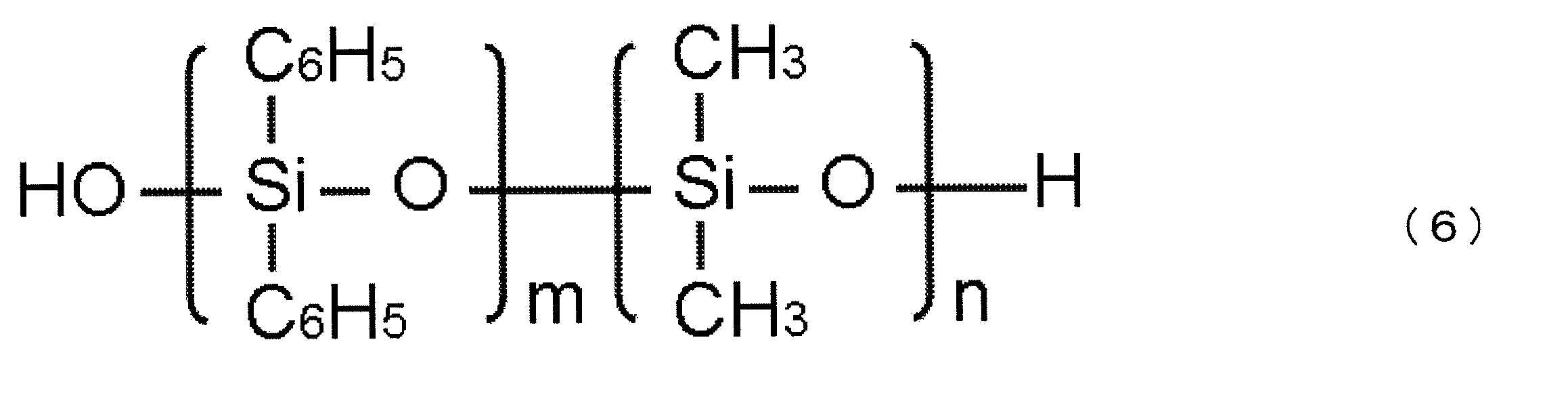

上記式(2)~(7)において、末端の水酸基の一方または両方を加水分解性基に置き換えたものや、ケイ素原子に結合した炭化水素基の一部を水酸基または加水分解性基に置き換えたものも、成分Aとして好ましく用いることができる。
成分Aの他の一例として、下記式(12)で表されるオルガノポリシロキサンが挙げられる。
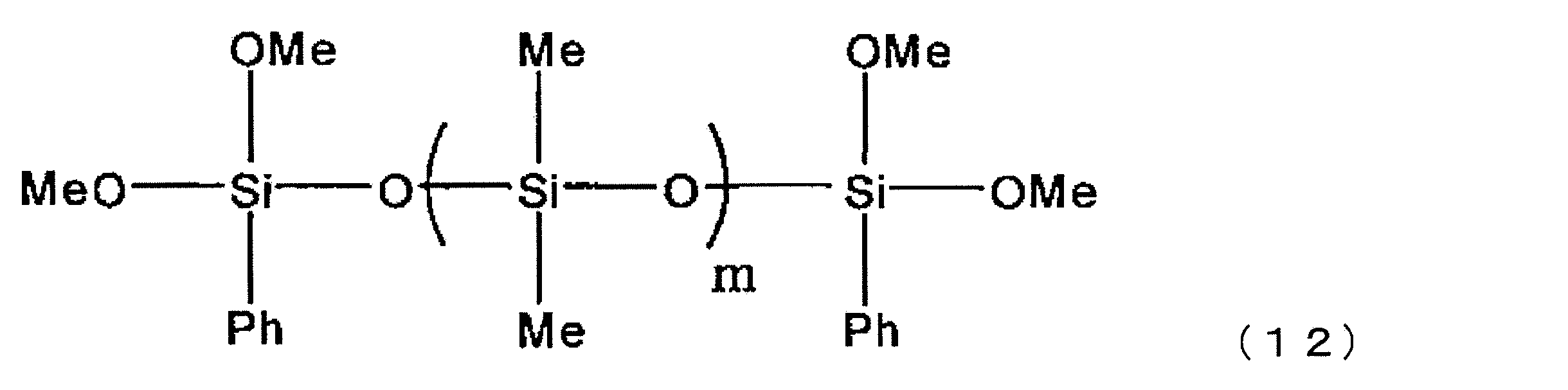
式(13)において、Xは加水分解性基を表し、Yは一価の炭化水素基を表し、nは3または4である。炭化水素基は、酸素原子、窒素原子、硫黄原子等のヘテロ原子を含んでいてもよい。
SiX2Y2 ・・・(14)
式(14)において、Xは加水分解性基を表し、Yは一価の炭化水素基を表す。炭化水素基は、酸素原子、窒素原子、硫黄原子等のヘテロ原子を含んでいてもよい。
ここで、一価の炭化水素基は、上記の一価の炭化水素基と同じものが好ましい。
式(14)の化合物の代わりに、あるいは、式(14)の化合物に加えて、両末端に水酸基および/または加水分解性基を有するポリジオルガノシロキサンを、式(13)で表されるシラン化合物と縮合させて得られるポリシロキサンも、成分Aの好適例のひとつである。なお、式(13)及び(14)の化合物として、クロロシラン化合物を用いる場合には、加水分解重縮合時に塩酸が遊離するので、成分Aとして使用する前に塩酸を除去することが好ましい。
<信越化学工業(株)の製品>
「KC-89S」、「KR-500」、「X-40-9225」、「X-40-9246」、「X-40-9250」など(以上、メチル/メトキシ型)、「KR-217」など(以上フェニル/メトキシ型)、「KR-9218」、「KR-213」、「KR-510」、「X-40-9227」、「X-40-9247」、「KR-401N」(以上、メチルフェニル/メトキシ型)など。
<東レ・ダウコーニング(株)の製品>
「DC-3074」、「DC-3037Intermediate」など。
<モメンティブ・パフォーマンス・マテリアルズ・ジャパン合同会社の製品>
「TSR-165」、「YR3204」など。
本発明の硬化性オルガノポリシロキサン組成物は、架橋により硬化させるために、通常ケイ素原子に結合した水酸基または加水分解性基のうちの少なくとも一方を1分子中に3個以上有する化合物を含んでいる。ここで、本発明の硬化性オルガノポリシロキサン組成物は、上記成分Aのオルガノポリシロキサンが、ケイ素原子に結合した水酸基または加水分解性基のうちの少なくとも一方を1分子中に3個以上有していてもよい。また、本発明の硬化性オルガノポリシロキサン組成物は、成分Aのオルガノポリシロキサンと別に、(成分Aのオルガノポリシロキサンに該当しない)ケイ素原子に結合した水酸基または加水分解性基のうちの少なくとも一方を1分子中に3個以上有するケイ素化合物(以下、成分Aのオルガノポリシロキサンに該当しない、ケイ素原子に結合した水酸基または加水分解性基のうちの少なくとも一方を1分子中に3個以上有する化合物を「本発明に係るケイ素化合物」と言う場合がある。)を含んでいてもよい。前者の場合、例えば、ケイ素原子に結合した水酸基または加水分解性基のうちの少なくとも一方を1分子中に2個以上有するオルガノポリシロキサンと、本発明に係るケイ素化合物とを反応させて得られるオルガノポリシロキサンを用いる場合などが挙げられる。このオルガノポリシロキサンを得るための反応は、後述の成分Bなどを触媒として用いて行うことができる。なお、本発明に係るケイ素化合物については、成分Cとして後述する。
ケイ素原子に結合した水酸基または加水分解性基のうちの少なくとも一方を1分子中に2個以上有するオルガノポリシロキサンと、本発明に係るケイ素化合物とを反応させて得られるオルガノポリシロキサンとしては、具体的には、例えば、以下のオルガノポリシロキサンが挙げられる。
i)上記の式(2)で表されるオルガノポリシロキサンである両末端シラノール変性ジメチルシロキサンオリゴマーと、ケイ素化合物であるメチルトリメトキシシランとを反応させて得られるオルガノポリシロキサン(後述の実施例1を参照)
ii)上記の式(2)で表されるオルガノポリシロキサンである両末端シラノール変性ジメチルシロキサンオリゴマーと、上記の式(3)で表されるオルガノポリシロキサンである両末端シラノール変性メチルフェニルシロキサンオリゴマーとを反応させてオルガノポリシロキサンを得る。この得られたオルガノポリシロキサンと、ケイ素化合物であるメチルトリメトキシシランとを反応させて得られるオルガノポリシロキサン(後述の実施例2を参照)
このような成分Aの市販品としては、例えば、モメンティブ・パフォーマンス・マテリアルズ・ジャパン合同会社製「XR31-B2733」などが挙げられる。
成分Aとしては、上記MユニットとQユニットの組み合わせであるモメンティブ・パフォーマンス・マテリアルズ・ジャパン合同会社製MQレジン「SR1000」などを用いてもよい。また、上記の式(2)で表されるオルガノポリシロキサンと、モメンティブ・パフォーマンス・マテリアルズ・ジャパン合同会社製「XR31-B2733」と、モメンティブ・パフォーマンス・マテリアルズ・ジャパン合同会社製「SR1000」と、γ―グリシドキシプロピルトリメトキシシランとを反応させて得られるオルガノポリシロキサン(後述の実施例7~12を参照)などを用いてもよい。
成分BはIn化合物である。In化合物は、縮合反応の触媒として硬化性オルガノポリシロキサン組成物に含まれる。成分Bは、系内に更に触媒として働く酸が無くても、In化合物自体で触媒性能を有する。
ここでいう縮合反応とは、シラノール基(Si-OH)間の脱水縮合反応、シラノール基と加水分解性基との間の縮合反応、シラノール基とヒドロシリル基(Si-H)との間の脱水素縮合反応などをいう。加水分解性基がアルコキシ基(Si-OR)の場合には、シラノール基との間の縮合反応はR-OHの発生を伴う脱アルコール反応となる。
In化合物としては、インジウムのキレート錯体、アルコキシド及び脂肪酸塩から選ばれる少なくとも1種の有機インジウム化合物を使用することができる。すなわち、本発明における実施形態としては、インジウムのキレート錯体、アルコキシド及び脂肪酸塩から選ばれる少なくとも1種の有機インジウム化合物を含有する、オルガノポリシロキサンの縮合触媒が挙げられる。ここで、該In化合物は、縮合反応の触媒として有効に作用しやすいことからオルガノポリシロキサンに可溶であることが好ましい。すなわち、本発明の実施形態に係る硬化性オルガノポリシロキサン組成物は、インジウムのキレート錯体、アルコキシド及び脂肪酸塩から選ばれる少なくとも1種の有機インジウム化合物が、ケイ素原子に結合した水酸基または加水分解性基のうちの少なくとも一方を1分子中に2個以上有するオルガノポリシロキサンに溶解していることが好ましい。ここで、溶解は、オルガノポリシロキサンを縮合させるために加熱したときに溶解していればよいが、常温(約25℃)でオルガノポリシロキサンに溶解していることが好ましい。
β-ジケトン型化合物としては、例えば、次の式(8)~(10)に示す構造を有するものが挙げられる。


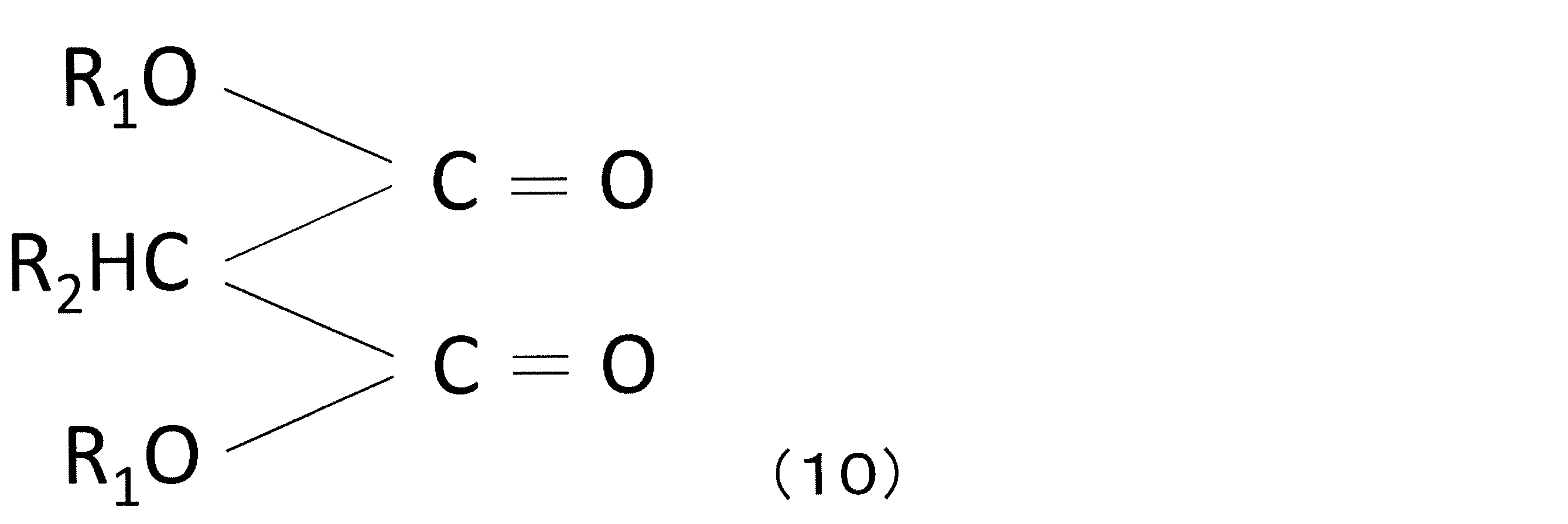
式(8)の化合物の具体例としては、アセチルアセトン、トリフルオロアセチルアセトン、ペンタフルオロアセチルアセトン、ヘキサフルオロアセチルアセトン、3-フェニルアセチルアセトン等が、式(9)の化合物の具体例としてはエチルアセトアセテート等が、式(10)の化合物の具体例としてはジエチルマロネート等が挙げられる。

式(11)の化合物の具体例としては、サリチルアルデヒド、エチル-O-ヒドロキシフェニルケトン等が挙げられる。
インジウムの脂肪酸塩としては、酢酸インジウム、シュウ酸インジウム、2-エチルヘキサン酸インジウム、n-オクチル酸インジウム、ナフテン酸インジウム等が例示される。
触媒活性が良好である点で好ましいIn化合物は、インジウムアセチルアセトナート[トリス(アセチルアセトナト)インジウム(III)などとも呼ばれる]、2-エチルヘキサン酸インジウム、n-オクチル酸インジウム、ナフテン酸インジウムなどである。
In化合物の選択においては、成分Aへの溶解性または分散性が良好であるものが好ましい。インジウムのキレート錯体としては、配位子がβ-ジケトン型化合物であるものが好ましく、上記式(8)に示す構造を有するものが更に好ましく、インジウムアセチルアセトナートが特に好ましい。また、インジウムのアルコキシドとしては、インジウムトリイソプロポキシドが好ましい。そして、インジウムの脂肪酸塩としては、2-エチルヘキサン酸インジウムが好ましい。なお、互いに異なる配位子を有するIn化合物を使用してもよい。また、2種類以上のIn化合物を任意に組み合わせて用いることもできる。
In化合物は、本発明に係るオルガノポリシロキサンに溶解しやすいように、溶媒に溶解させて用いてもよい。溶媒としては、ミネラルスピリット、炭素数6~15の炭化水素類、灯油、ベンゼン、トルエン、キシレン等の芳香族炭化水素、アセトン、メチルエチルケトン、メチルイソブチルケトン、アセチルアセトンなどのケトン類、酢酸エチル、酢酸ブチル、メチルアセトアセテート等のエステル類、炭素数1~5のアルコール等が挙げられる。溶媒は、In化合物の触媒活性に影響しない限り、任意に選択できるが、溶媒自身が化学変性しにくくオルガノポリシロキサンへの溶解性に優れる炭化水素系の溶剤が好ましい。溶媒としては、ミネラルスピリット、炭素数10~15の炭化水素が好ましい。溶媒の量は、本発明に係るIn化合物を溶解させることができる範囲で少ないことが好ましい。溶媒は、通常オルガノポリシロキサンを硬化させる前及び/又は硬化させる時に、減圧や加熱などにより揮発除去させる。
成分Cは、ケイ素原子に結合した水酸基または加水分解性基のうちの少なくとも一方を1分子中に3個以上有する化合物である。ここで、加水分解性基は、成分Aの説明で例示したものと同じである。
本発明のオルガノポリシロキサンの硬化物が物理的・機械的強度に優れた塗膜となりやすい点では、本発明の硬化性オルガノポリシロキサン組成物には該ケイ素化合物が含まれていることが好ましい。特に、成分Aがケイ素原子に結合した水酸基または加水分解性基のうちの少なくとも一方を1分子中に3個以上有していない場合は、該ケイ素化合物を含んでいることが好ましい。
本発明に係るケイ素化合物は、好ましくは、ポリシロキサンまたはシランである。
本発明に係るケイ素化合物が有する、ケイ素原子に結合した水酸基および/または加水分解性基の合計数は、本発明のオルガノポリシロキサンの硬化物が物理的・機械的強度に優れた塗膜となりやすい点では、多いことが好ましいが、本発明の硬化性オルガノポリシロキサン組成物の粘度が低く、作業性に優れる点では少ないことが好ましい。具体的には、該合計数は、4個以上であることが好ましい。一方で、本発明に係るケイ素化合物がシランである場合における該合計数は、ケイ素の価数より4個以下である。
また、本発明に係るケイ素化合物の他の例としては、上記式(13)で表されるシラン化合物のオリゴマーが挙げられる。該オリゴマーは、更にDユニットやMユニットのケイ素を含んでいてもよい。
本発明に係るケイ素化合物は、上記成分Aのオルガノポリシロキサンより、低分子量であることが好ましい。具体的には、本発明に係るケイ素化合物の分子量は、反応性が高く架橋に寄与しやすいことから100~2500であることが好ましい。また、本発明に係るケイ素化合物が上記オリゴマーである場合、GPC(ゲル浸透クロマトグラフィー)によるポリスチレン換算したときの重量平均分子量が200~2500であることが好ましい。そして、本発明に係るケイ素化合物のGPC(ゲル浸透クロマトグラフィー)によるポリスチレン換算したときの重量平均分子量は、100以上であることが好ましく、200以上であることが好ましく、また、一方で、2500以下であることが好ましく、500未満であることが更に好ましく、400未満であることが特に好ましい。
成分Dは、ヒドロシリル基を1分子中に少なくとも3個有するポリシロキサンである。
成分Dとしては、具体的には、例えば、側鎖Si-H変性ジメチルシリコーン樹脂、側鎖Si-H変性ジメチルジフェニルシリコーン樹脂が挙げられる。
成分Dとして使用することのできる市販のポリシロキサン材料として、信越化学工業(株)の製品であるメチルハイドロジェンシリコーンオイル「KF-99」、「KF-9901」、などがある。
ヒドロシリル基を1分子中に少なくとも3個有するポリシロキサンについても、上記成分Cと同様に、成分Aがヒドロシリル基を1分子中に少なくとも3個有するポリシロキサンであってもよいし、成分Aとは別に成分Dのポリシロキサンを含んでいてもよい。成分Aがヒドロシリル基を1分子中に少なくとも3個有するポリシロキサンである場合については、該ポリシロキサンは、例えば、水酸基および/または加水分解性基が結合したケイ素原子を1分子中に少なくとも2個有するオルガノポリシロキサンと、ヒドロシリル基を1分子中に少なくとも3個有するポリシロキサンとを反応させて得ることができる。
このような成分としては、具体的には、例えば、以下の化合物が挙げられる。
i)上記の式(2)で表されるオルガノポリシロキサンである両末端シラノール変性ジメチルシロキサンオリゴマーと、本発明に係るケイ素化合物であるメチルトリメトキシシランとを反応させてオルガノポリシロキサンを得る。この得られたオルガノポリシロキサンと、側鎖Si-H変性ジメチルシリコーン樹脂とを反応させて得られるオルガノポリシロキサン(後述の実施例4を参照)
ii)上記の式(2)で表されるオルガノポリシロキサンである両末端シラノール変性ジメチルシロキサンオリゴマーと、本発明に係るケイ素化合物であるメチルトリメトキシシランとを反応させてオルガノポリシロキサンを得る。この得られたオルガノポリシロキサンと、側鎖Si-H変性ジメチルシリコーン樹脂と、両末端シラノール変性ポリジメチルシロキサンとを反応させて得られるオルガノポリシロキサン(後述の実施例6を参照)
本発明の実施形態に係る硬化性オルガノポリシロキサン組成物は、発明の目的や効果を損なわない範囲で、上記成分A~D以外の任意の成分を含有することができる。
例えば、無機フィラー、酸化防止剤、滑剤、紫外線吸収剤、熱光安定剤、分散剤、帯電防止剤、重合禁止剤、消泡剤、硬化促進剤、溶剤、無機蛍光体、老化防止剤、ラジカル禁止剤、接着性改良剤、難燃剤、界面活性剤、保存安定性改良剤、オゾン老化防止剤、増粘剤、可塑剤、放射線遮断剤、核剤、カップリング剤、導電性付与剤、リン系過酸化物分解剤、顔料、金属不活性化剤、物性調整剤などである。
本発明の硬化性オルガノポリシロキサン組成物に、成分AおよびB以外の成分が含まれる場合、本発明の優れた効果が発現しやすい点では、本発明の硬化性オルガノポリシロキサン組成物における必須成分である成分Aと成分Bとの合計量は多いことが好ましい。そこで、本発明の硬化性オルガノポリシロキサン組成物に、成分AおよびB以外の成分が含まれる場合における成分Aと成分Bの合計量は、50重量%以上であることが好ましく、60重量%以上であることが更に好ましく、70重量%以上であることが更に好ましい。また、同上限は100重量%である。
また、本発明の硬化性オルガノポリシロキサン組成物における成分A~Dの合計量は、60重量%以上であることが好ましく、70重量%以上であることが更に好ましい。また、同上限は100重量%である。
なお、本発明の硬化性オルガノポリシロキサン組成物は、成分BのIn化合物が縮合反応の触媒として作用することから、成分BのIn化合物を触媒として作用させるために更に酸を含んでいる必要が無い。
本発明の実施形態に係る硬化性オルガノポリシロキサン組成物の製造方法は、上記1.1で説明した成分Aと上記1.2で説明した成分Bとを含む混合物を調製するステップを有する。
この混合物は、更に上記1.3で説明した成分C、上記1.4で説明した成分D、あるいはその他の成分などを含んでもよい。
増粘させる場合の加熱温度は、好ましくは100℃以上、130℃以下、加熱時間は、好ましくは1時間以上、5時間以下の範囲である。
溶媒の留去を行うことで、組成物の硬化時に脱溶媒収縮によりクラックが発生するのを防止することができる。
不要成分の好ましい除去方法として、吸着剤を用いる方法がある。吸着剤としては、カチオン交換樹脂、アニオン交換樹脂、合成吸着剤、シリカゲル、アルミナ、活性炭、活性白土、粘土化合物等を使用することができる。
本発明の変形実施形態では、加熱によって増粘するステップでIn化合物以外の縮合触媒を使用し、加熱によって増粘するステップの後で、硬化反応用の縮合触媒として上記成分BのIn化合物を添加することもできる。また、ここで、加熱によって増粘するステップの後で、増粘に用いた縮合触媒を取り除いてから上記成分BのIn化合物を添加してもよい。なお、この変形実施形態においては、加熱により増粘されたものが上記本発明に係るオルガノポリシロキサン(成分A)に相当する。
また、本発明の硬化性オルガノポリシロキサン組成物は、成分AにIn化合物が添加された1液型の組成物であってもよいし、成分A(1液目)と、成分BのIn化合物を揮発性又は反応性の溶媒に溶解させた液(2液目)とを使用時に混合する2液型の組成物であってもよい。
本発明の実施形態に係るオルガノポリシロキサン硬化物の製造方法は、水酸基および/または加水分解性基を有するオルガノポリシロキサン同士を、In化合物を触媒に用いて縮合させるステップを有する。例えば、上記1.1で説明した成分Aと、上記1.2で説明した成分Bと、上記1.3で説明した成分Cとを含む混合物を増粘させて得られるオルガノポリシロキサン組成物は、増粘後も成分B(In化合物)の少なくとも一部を残留させておくことによって熱硬化性を示すものとすることができる。すなわち、上記成分Aと、上記成分Bと、上記成分Cとを含む混合物を増粘させて得られるオルガノポリシロキサン組成物は、上記成分BのIn化合物が触媒する縮合反応により架橋構造が形成されて硬化する、縮合硬化タイプの硬化性オルガノポリシロキサン組成物となる。
但し、本発明の実施形態に係るオルガノポリシロキサン硬化物の製造方法においては、オルガノポリシロキサンを増粘させるときに、In化合物の配位子が変質する場合がある。変質は、In化合物が有する配位子などが失われて、オルガノポリシロキサンが有していたシラノールが結合したシラノール付加体の生成やIn化合物のオリゴマー化などが挙げられる。本発明の実施形態に係るオルガノポリシロキサン硬化物の製造方法においては、このようなIn化合物がこのように変質した形態であっても、In化合物がオルガノポリシロキサンの縮合反応において、反応系内に溶解しており、変質前の配位子などの少なくとも一部が残っていて、縮合触媒活性を有する限りは、上記本発明に係る成分Bに含まれる。ここで、変質前の配位子などが残っていることは、例えば、1H-NMR(核磁気共鳴スペクトル)分析法やIR(赤外線吸収スペクトル)分析法により確認することができる。また、配位子が特性吸収波長帯を有する場合は、紫外-可視吸収スペクトル分析法などでも確認することができる。なお、オルガノポリシロキサンがシラノール付加したIn化合物は、オルガノシロキサンに対する溶解度が高くなる点で好ましい。
また、上記成分Aと上記成分Bとを含む混合物を予め増粘させずに、成分Bを触媒として、成分A同士を重縮合反応させることにより架橋させ、硬化する場合も本発明の実施形態に係るオルガノポリシロキサン硬化物の製造方法に該当する。
その他、低温で予備硬化させた後、高温で追硬化する方法を用いると、得られるオルガノポリシロキサン硬化物中の内部応力が低減されるので、クラックの発生や他の材料との界面における剥離を防止することができる。
本発明のオルガノポリシロキサン硬化物の製造方法により得られるオルガノポリシロキサン硬化物は、光半導体封止体などに好適となりやすいことから、無色透明で、硬化物を製造するときに発生した泡などを含まず、表面が平滑でレベリング性に優れていることが好ましい。また、本発明のオルガノポリシロキサン硬化物の製造方法により得られるオルガノポリシロキサン硬化物の硬度は、用途に応じて適宜選択することができる。本発明のオルガノポリシロキサン硬化物の製造方法により得られるオルガノポリシロキサン硬化物の硬度は、Shore A(もしくはJIS Type A)で5以上が好ましく、10以上が更に好ましく、20以上が特に好ましく、また、一方で、90以下が好ましく、80以下が更に好ましく、70以下が特に好ましい。硬度は、半導体発光素子1の保護の点では高いことが好ましいが、熱応力を緩和する機能が高く、ボンディングワイヤ3の切断、樹脂成形体2と封止材4の間の剥離などが発生し難い点では低いことが好ましい。
本発明のオルガノポリシロキサン硬化物の製造方法により得られるオルガノポリシロキサン硬化物は、後述する実施例において裏付けられているとおり、耐熱性に優れたものとなりやすい。
本発明のオルガノポリシロキサン硬化物の製造方法により得られるオルガノポリシロキサン硬化物は、後述する実施例において裏付けられているとおり、In化合物が硫黄成分を捕捉するため、硫黄成分等に対するバリア性が高いものとなりやすい。そこで、該硬化物を光半導体封止体などに用いる場合、大気中の硫化水素などの硫黄成分等に起因する銀メッキ電極の着色が起こり難く、銀メッキ電極による高い反射率が維持されると思われる。また、本発明に係るインジウム化合物と硫黄成分とが反応して生成する硫化インジウムは黄色であり、広い波長範囲の光を吸収する濃色ではないことから封止体の透明性が大きく損ねられることが無い。従って、本発明の硬化物を光半導体封止体に用いた場合、高輝度を保つことができる。
本発明のオルガノポリシロキサン硬化物の製造方法により得られるオルガノポリシロキサン硬化物には、通常、縮合触媒又はその分解物が残留している。従って、オルガノポリシロキサン硬化物中のInの存在により、本発明のオルガノポリシロキサン硬化物の製造方法により得られたオルガノポリシロキサン硬化物であるか否か推定することができる。ここで、Inの分析は、ICP(誘導結合プラズマ)分析法などより行うことができる。
本発明の上記実施形態に係る硬化性オルガノポリシロキサン組成物とその製造方法、およびオルガノポリシロキサン硬化物の製造方法は、様々な無機半導体デバイスおよび有機半導体デバイスの封止に用いることができる。具体的なデバイスとして、発光ダイオード(LED)や半導体レーザー等の半導体発光デバイス、光検出器、電気光学的ディスプレイ、有機発光ダイオード(OLED)、電子発光ディスプレイ、有機太陽電池(OPV)装置、照明装置などが挙げられる。
その他、本発明の実施形態に係る硬化性オルガノポリシロキサン組成物は、レンズ、導光板、光拡散板のような光学素子の材料の製造や、光学素子用の接着剤の製造に用いることもできる。
本発明の実施形態に係る硬化性オルガノポリシロキサン組成物を発光ダイオード(LED)に用いる場合は、例えば、本発明の実施形態に係る硬化性オルガノポリシロキサン組成物で光半導体チップを埋め込んだ後、該硬化性オルガノポリシロキサン組成物を加熱することにより硬化させて得られる光半導体封止体などが好ましい。
半導体発光素子1は、近紫外LED、紫色LEDまたは青色LEDのいずれかである。
樹脂成形体2は、リードフレーム5と共に成形されている。
リードフレーム5は導電性の金属からなり、半導体発光素子1に電流を供給する役割を果たす。
半導体発光素子1は樹脂成形体2に設けられた凹所内に設置され、封止材4により封止されている。
封止材4は、本発明実施形態に係る硬化性オルガノポリシロキサン組成物を硬化させたものである。
これらの微粒子は、光散乱材、骨材、増粘剤(チキソ剤)、屈折率調整剤などの目的で封止材4に添加される。
本発明の実施形態に係るオルガノポリシロキサンの縮合触媒は、ケイ素原子に結合した水酸基または加水分解性基のうちの少なくとも一方を1分子中に2個以上有するオルガノポリシロキサンに可溶な有機インジウム化合物を含有する。該有機インジウム化合物の好適例は、インジウムのキレート錯体、アルコキシド及び脂肪酸塩である。
以下に、本発明者等が行った実験の結果を記す。実験に用いた材料は以下に示す通りである。当業者であれば、これらの結果がインジウム化合物の縮合触媒としての作用を示すものであることを理解できるであろう。
<成分1>両末端シラノール変性ジメチルシロキサンオリゴマー(モメンティブ・パフォーマンス・マテリアルズ・ジャパン合同会社「XC96-723」)
構造式:上記式(2)でnが5~7
<成分2>両末端シラノール変性メチルフェニルシロキサンオリゴマー(市販品)
構造式:上記式(3)でnが5~7
25℃における粘度:1000mPa・s
重量平均分子量:800
<成分3>両末端シラノール変性ポリジメチルシロキサン
構造式:上記式(2)でnが650(平均値)
粘度:3000mPa・s
重量平均分子量:約48000
<成分4>メチルトリメトキシシランオリゴマー(信越化学工業製「KC89S」)
25℃における粘度:3mPa・s
重量平均分子量:400
メトキシ基含有量:45重量%
(メチルトリメトキシシランの4量体を主成分とするオリゴマー混合物。)
<成分5>ジルコニウムアセチルアセトネート[テトラキス(2,4-ペンタンジオナト)インジウム(IV)](マツモトファインケミカル(株)「ZC-150」)
<成分6>インジウムアセチルアセトネート[トリス(2,4-ペンタンジオナト)インジウム(III)](東京化成工業(株)製)
<成分7>ハフニウムアセチルアセトネート[テトラキス(2,4-ペンタンジオナト)インジウム(IV)](三津和化学薬品(株))
<成分8>ガリウムアセチルアセトネート[トリス(2,4-ペンタンジオナト)インジウム(III)](Strem Chemicals,Inc)
<成分9>2-エチルヘキサン酸ジルコニウム(日本化学産業(株)「ニッカオクチックスジルコニウム」)
<成分10>メチルトリメトキシシラン(信越化学工業製「KBM-13」)
20℃における粘度:0.5mPa・s
分子量:136
<成分11>側鎖Si-H変性ジメチルシリコーン(市販品)
粘度:約200mPa・s
重量平均分子量:20000
Si-H:5mmol/g
<成分12>両末端Si-H変性ジメチルジフェニルシリコーンオイル(市販品)
粘度:約5000mPa・s
重量平均分子量:1800
Si-H:5mmol/g
<その他>活性炭(日本エンバイロケミカルズ(株)「精製白鷺」)
両末端シラノール変性ジメチルシロキサンオリゴマー(成分1)100gと、メチルトリメトキシシラン(成分10)2.6gと、ジルコニウムアセチルアセトネート(成分5)0.1gとを混合し、130℃で加熱して約200mPa・sに増粘させた。
次いで、活性炭を用いてジルコニウムを除去した。具体的には、増粘させた混合物に活性炭を加えPTFE(ポリテトラフルオロエチレン)製の撹拌棒で撹拌し、その後、活性炭を濾過して取り除き、混合物A1を得た。
この混合物A1は成分1及び成分10の縮合反応生成物であり、成分1及び成分10は縮合反応にて消費され残存していなかった。また、混合物A1を150℃で3時間加熱して更に増粘させた結果、粘度の増加率は10%未満であり、成分5は硬化させるのに十分でない量にまで除去されていた。
3gの上記混合物A1にインジウムアセチルアセトネート(成分6)3mgを加え、PTFE(ポリテトラフルオロエチレン)製の撹拌棒でかき混ぜながら120℃のオイルバスで加熱したところ、20分で硬化した。なお、上記混合物A1に加えたインジウムアセチルアセトネート(成分6)は、目視で均一に溶解していた。
両末端シラノール変性ジメチルシロキサンオリゴマー(成分1)30gと、両末端シラノール変性メチルフェニルシロキサンオリゴマー(成分2)70gと、ガリウムアセチルアセトネート(成分8)0.1gとを混合し、減圧下、120℃で加熱することにより約700mPa・sに増粘させた。
次いで、この増粘させた混合物にメチルトリメトキシシラン(成分10)1.6gを加え、100℃で加熱し、約1400mPa・sまで増粘させた。その後、減圧下、80℃で加熱することにより低沸点成分を除去した。
次いで、ガリウムを除去するために、増粘させた混合物に活性炭を加え、80℃に加熱しながらPTFE(ポリテトラフルオロエチレン)製の撹拌棒で攪拌した後、濾過して活性炭を取り除き、混合物A2を得た。
この混合物A2は成分1、成分2及び成分10の縮合反応生成物であり、成分1、成分2及び成分10は反応にて消費され残存していなかった。また、混合物A2を150℃で3時間加熱して更に増粘させた結果、粘度の増加率は10%未満であり、成分8は硬化させるのに十分でない量にまで除去されていた。
3gの上記混合物A2にインジウムアセチルアセトネート(成分6)3mgを加え、PTFE(ポリテトラフルオロエチレン)製の撹拌棒でかき混ぜながら120℃のオイルバスで加熱したところ、20分で硬化した。なお、上記混合物A2に加えたインジウムアセチルアセトネート(成分6)は、目視で均一に溶解していた。
両末端シラノール変性ジメチルシロキサンオリゴマー(成分1)3gと、メチルトリメトキシシランオリゴマー(成分4)30mgと、インジウムアセチルアセトネート(成分6)3mgと、ハフニウムアセチルアセトネート(成分7)3mgとを混合したものを、直径5cmのPTFE(ポリテトラフルオロエチレン)製シャーレに入れ、乾燥機中、150℃で6時間加熱したところ硬化した。
3gの実施例1で得た混合物A1と、側鎖Si-H変性ジメチルシリコーン樹脂(成分11)3gと、インジウムアセチルアセトネート(成分6)24mgとを混合し、PTFE(ポリテトラフルオロエチレン)製の撹拌棒でかき混ぜながら120℃で加熱し、約2000mPa・sに増粘させ、混合物A3を得た。混合物A3を直径5cmのPTFE(ポリテトラフルオロエチレン)製シャーレに入れ、乾燥機中、150℃で1時間加熱したところ硬化した。なお、上記混合物A3において、インジウムアセチルアセトネート(成分6)は、目視で均一に溶解していた。
実施例2と同様の方法により混合物A2を得た。
3gの上記混合物A2と、側鎖Si-H変性ジメチルジフェニルシリコーン樹脂(成分12)3gと、インジウムアセチルアセトネート(成分6)24mgとを混合し、PTFE(ポリテトラフルオロエチレン)製の撹拌棒でかき混ぜながら120℃のオイルバスで加熱し、約20000mPa・sに増粘させ、混合物A4を得た。混合物A4を直径5cmのPTFE(ポリテトラフルオロエチレン)製シャーレに入れ、乾燥機中、150℃で1時間加熱したところ硬化した。なお、上記混合物A4において、インジウムアセチルアセトネート(成分6)は、目視で均一に溶解していた。
実施例1と同様の方法により混合物A1を得た。
5gの上記混合物A1と、側鎖Si-H変性ジメチルシリコーン樹脂(成分11)3gと、両末端シラノール変性ポリジメチルシロキサン(成分3)4gと、インジウムアセチルアセトネート(成分6)3mgとを混合し、ナス型フラスコ中で攪拌しながら120℃で加熱し、粘度が約2000mPa・sとなったところで発泡がなくなるまで減圧した。
上記混合物3gに2-エチルヘキサン酸ジルコニウム(成分9)0.3gを添加し、均一になるまで攪拌した。
この2-エチルヘキサン酸ジルコニウムを添加した混合物を直径5cmのPTFE(ポリテトラフルオロエチレン)製シャーレに入れ、乾燥機中、150℃で1時間加熱したところ硬化した。
実施例1~6の結果について、表1に纏める。
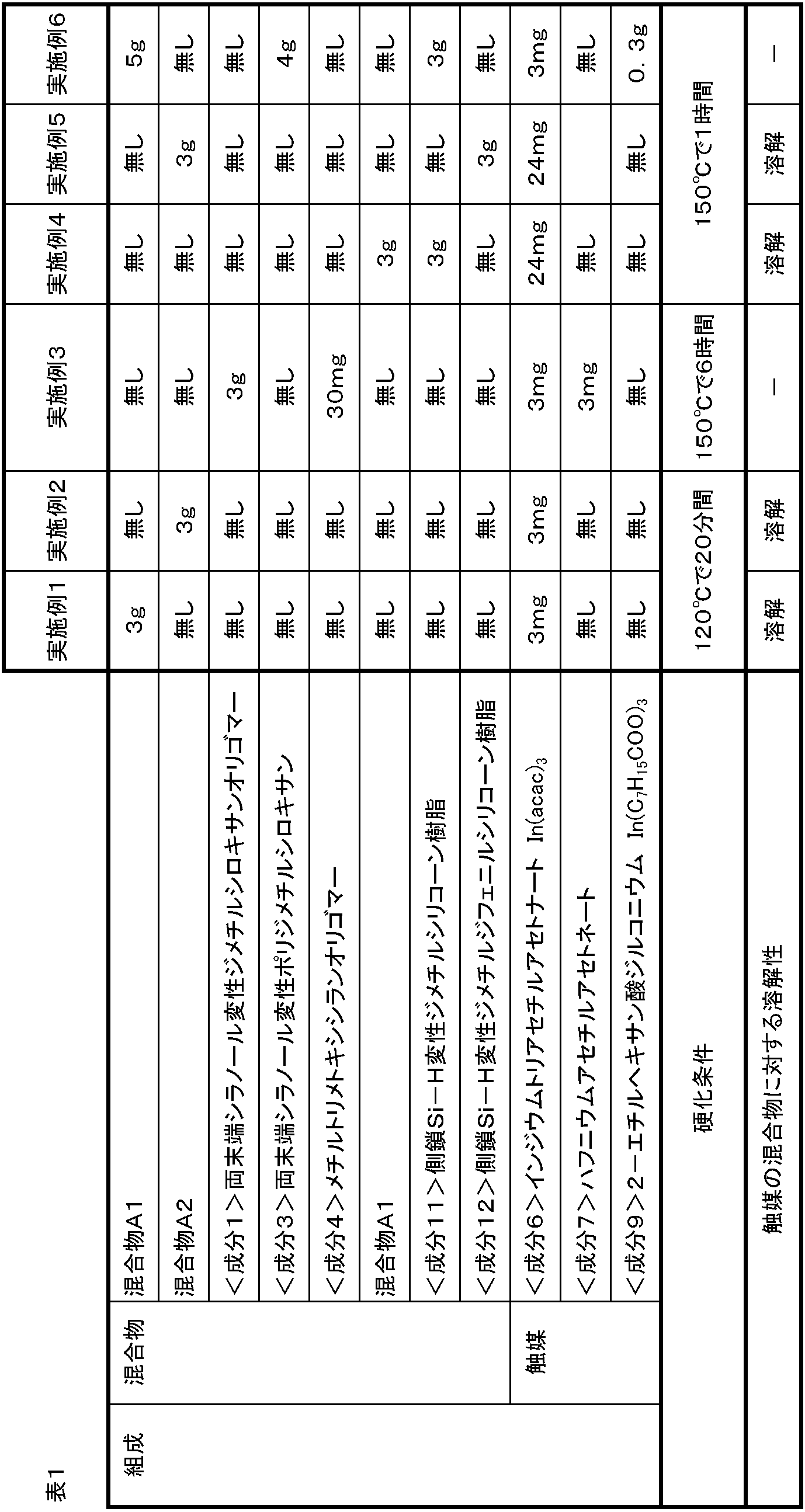
混合物A1と以下の3成分とからなる混合物A5(混合物A1を100重量部と、成分13を200重量部と、成分14を200重量部と、成分15を0.15重量部との混合物)100重量部に対し、成分6を金属量として0.3重量部添加した混合物の2gを直径5cmのPTFE(ポリテトラフルオロエチレン)製シャーレに入れた。これを乾燥機中で、110℃で3時間加熱した後、150℃で3時間加熱したところ硬化した。
<成分13>モメンティブ・パフォーマンス・マテリアルズ・ジャパン合同会社製シリコーンレジン「SR1000」
<成分14>モメンティブ・パフォーマンス・マテリアルズ・ジャパン合同会社製オルガノポリシロキサン「XR31-B2733」
<成分15>信越化学工業社製γ―グリシドキシプロピルトリメトキシシラン「KBM403」
なお、成分6のインジウムアセチルアセトネートは、上記混合物A5に対し、室温(約25℃)において、目視で均一に溶解していた。また、硬化後の組成物を目視で観察した結果は、無色透明で、発泡や表面のしわは無く、均一な厚さの膜になっており、レベリング性も良好であった。硬化後の組成物のショアA硬度は65であり、適度な硬度であった。
上記実施例7において、成分6の代わりに2-エチルヘキサン酸インジウム(新興化学工業(株)製)を用いた以外は、上記実施例7と同様に実験を行い、上記混合物A5を加熱により硬化させた。
なお、2-エチルヘキサン酸インジウムは、上記混合物A5に対し、室温(約25℃)において、目視で均一に溶解していた。また、硬化後の組成物を目視で観察した結果は、無色透明で、発泡や表面のしわは無く、均一な厚さの膜になっており、レベリング性も良好であった。硬化後の組成物のショアA硬度は57であり、適度な硬度であった。
上記実施例7において、成分6の代わりにインジウムトリイソプロポキシド(Alfa Aesar社製)を用いた以外は、上記実施例7と同様に実験を行い、上記混合物A5を加熱により硬化させた。
なお、インジウムトリイソプロポキシドは、混合物A5に対し、室温(約25℃)において、目視で均一に溶解していた。また、硬化後の組成物を目視で観察した結果は、無色透明で、発泡や表面のしわは無く、均一な厚さの膜になっており、レベリング性も良好であった。硬化後の組成物のショアA硬度は47であり、適度な硬度であった。
上記実施例7において、成分6の代わりにトリフルオロメタンスルホン酸インジウム(Aldrich社製)を用いた以外は、上記実施例7と同様に実験を行い、上記混合物A5を加熱により硬化させた。
なお、トリフルオロメタンスルホン酸インジウムは、上記混合物A5に対し、室温(約25℃)において、目視で、その一部は溶解していたが多くの溶け残りが見えた。また、硬化後の組成物を目視で観察した結果は、黄色で、発泡が多数あり、表面は平滑で無かった。また、硬化前の組成物は、室温(約25℃)でトリフルオロメタンスルホン酸インジウムと混合した時点でゲル状に増粘し、液の粘性が高く、シャーレに平らに流し込むことが出来なかった。このため硬化後の組成物形状は均一な厚さの膜ではなく団子状態であり、レベリング性は、上記実施例7~9の方が比較例1より良好であった。硬化後の組成物のショアA硬度は47で硬度は適当であった。
この結果より、強酸の塩であるトリフルオロメタンスルホン酸インジウムは、本発明に係るオルガノポリシロキサンに対する溶解性が低いために均一に分散されず、触媒能力を十分に発揮できなかったと思われる。また、トリフルオロメタンスルホン酸インジウムから遊離するトリフルオロメタンスルホン酸の触媒活性が制御されなかったために、反応液の粘度が常温で高くなったことも不均一に硬化してしまった一因と考えられる。そこで、硝酸インジウムなどの水溶性でジエチルエーテル、アセトンなどの有機溶媒やシリコーン(オルガノポリシロキサン)に溶解しない他のインジウム強酸塩についても、トリフルオロメタンスルホン酸インジウムと同様に、本発明に係るオルガノポリシロキサンの縮合触媒としては、適していないことが予想される。
上記実施例7において、成分6の代わりに水酸化インジウムを用いた以外は、上記実施例7と同様に実験を行い、上記混合物A5を加熱により硬化させようとした。
しかしながら、水酸化インジウムは、混合物A5に対し、室温(約25℃)において、目視で不溶であり、混合物Aは硬化しなかった。
実施例7~9及び比較例1~2の結果について、表2に纏める。

実施例1で得た混合物A1の100重量部に対し、2-エチルヘキサン酸インジウム(新興化学工業(株)製)を金属量として0.06重量部添加した混合物の2gを直径5cmのPTFE(ポリテトラフルオロエチレン)製シャーレに入れた。これを乾燥機中で、110℃で3時間加熱した後、150℃で3時間加熱したところ硬化した。
なお、2-エチルヘキサン酸インジウムは、混合物A1に対し、室温(約25℃)において、目視で溶解していた。
硬化後の組成物を目視で観察した結果は、無色透明で、発泡や表面のしわは無く、均一な厚さの膜になっており、レベリング性も良好であった。硬化後の組成物は、自立可能であり、適度な硬度であった。また、硬化後の組成物の耐熱性については、硬化後の組成物を200℃で1032時間加熱した結果、加熱後の重量維持率は90.1%あり、硬化後の組成物が耐熱性に優れていることがわかった。
また、硬化後の組成物の銀メッキ電極に対する硫化防止能を以下の方法に従って評価した。具体的には、上記混合物A1の100重量部に対し、2-エチルヘキサン酸インジウム(新興化学工業(株)製)を金属量として0.06重量部添加した。この混合物を、凹部底面に銀メッキ銅製電極を有するポリフタルアミド樹脂製の50×50mmパッケージに10マイクロリットル塗布した。これを110℃で3時間加熱した後、150℃で3時間加熱することにより組成物を硬化させ、凹部内の銀メッキ電極を封止した。このパッケージを、直径6cmのガラス製蓋付シャーレの上蓋の内側に両面テープで固定し、下蓋に1gの硫黄粉末を平らに敷き、上下の蓋を合わせ、スリーボンド(株)製配管テープで蓋の接合部を密封した。この密封したシャーレをさらに直径15cmのガラス製蓋付シャーレに入れ、スリーボンド(株)製配管テープで蓋の接合部を密封後、80℃の乾燥機に入れ、6時間加熱することにより、パッケージを硫黄雰囲気に曝露させた。ここで、硫黄雰囲気に曝露する前後におけるパッケージ封止部の波長450nmにおける反射率を、コニカミノルタ(株)製「CM-2600d」を用いて測定した。この結果、光反射率の維持率(硫黄雰囲気曝露後の反射率を硫黄雰囲気曝露前の反射率で除した値)は93%と高く、銀電極が硫黄により変色しにくく、硬化後の組成物が硫化防止能に優れていることが確認された。
上記実施例10において、2-エチルヘキサン酸インジウム(新興化学工業(株)製)の添加量を、混合物A1の100重量部に対し、金属量として0.06重量部から0.3重量部に増やした以外は、上記実施例10と同様に実験を行い、硬化物を得た。
実施例11の高濃度においても、2-エチルヘキサン酸インジウムは、混合物A1に対し、室温(約25℃)において目視で溶解していた。
また、硬化後の組成物を目視で観察した結果は、無色透明で、発泡や表面のしわは無く、均一な厚さの膜になっており、レベリング性も良好であった。硬化後の組成物は、ショアA硬度21であり、適度な硬度であった。また、硬化後の組成物の耐熱性については、硬化後の組成物を200℃で1032時間加熱した結果、加熱後の重量維持率は87.5%あり、硬化後の組成物が耐熱性に優れていることがわかった。
また、硬化後の組成物の硫化防止能についても実施例9と同様に評価した。この結果、光反射率の維持率は92%と高く、硬化後の組成物が硫黄防止能に優れていることが確認された。
上記実施例11において、混合物A1のみの代わりに、混合物A1と成分13との等重量の混合物である混合物A6を用いた以外は、上記実施例11と同様に実験を行い、硬化物を得た。
実施例12においても、2-エチルヘキサン酸インジウムは、混合物A6に対し、室温(約25℃)において目視で溶解していた。
また、硬化後の組成物を目視で観察した結果は、無色透明で、発泡や表面のしわは無く、均一な厚さの膜になっており、レベリング性も良好であった。硬化後の組成物は、ショアA硬度21であり、適度な硬度であった。また、硬化後の組成物の耐熱性については、硬化後の組成物を200℃で1032時間加熱した結果、加熱後の重量維持率は83.4%あり、硬化後の組成物が耐熱性に優れていることがわかった。
上記実施例10において、2-エチルヘキサン酸インジウム0.06重量部の代わりに、2-エチルヘキサン酸ジルコニル(日本化学産業(株))0.02重量部を用いた以外は、上記実施例10と同様に実験を行い、硬化物を得た。
硬化後の組成物を目視で観察した結果は、発泡や表面のしわは無く、均一な厚さの膜になっており、レベリング性も良好であった。硬化後の組成物は、ショアA硬度21であった。また、硬化後の組成物の耐熱性については、硬化後の組成物を200℃で1008時間加熱した結果、加熱後の重量維持率は86.1%あった。
上記実施例10において、2-エチルヘキサン酸インジウム0.06重量部の代わりに、2-エチルヘキサン酸ジルコニル(日本化学産業(株))0.3重量部を用いた以外は、上記実施例10と同様に実験を行い、硬化物を得た。
硬化後の組成物を目視で観察した結果は、発泡は無く、均一な厚さの膜になっており、レベリング性も良好であった。しかしながら、加熱時にオーブン内の風量が多いと表面にしわが発生していた。硬化後の組成物は、ショアA硬度27であった。硬化後の組成物の耐熱性については、硬化後の組成物を200℃で1032時間加熱した結果、加熱後の重量維持率は34.3%と実施例10に比べ低かった。また、硬化後の組成物の硫化防止能についても実施例10と同様に評価した。この結果、光反射率の維持率は75%と実施例10に比べ低かった。
上記実施例10において、2-エチルヘキサン酸インジウムの代わりに、2-エチルヘキサン酸亜鉛(和光純薬工業(株))を用いた以外は、上記実施例10と同様に実験を行い、混合物A1を加熱により硬化させようとしたが、混合物A1は、液状のままであった。
上記実施例10において、2-エチルヘキサン酸インジウム0.06重量%の代わりに、2-エチルヘキサン酸亜鉛(和光純薬工業(株))0.3重量%を用いた以外は、上記実施例10と同様に実験を行い、混合物A1を加熱により硬化させようとしたが、混合物A1の粘度は増したが液状のままであった。なお、増粘後の組成物の硫化防止能について、実施例10と同様に評価した。この結果、光反射率の維持率は95%であり、実施例10及び11が2-エチルヘキサン酸亜鉛を用いた場合と同等レベルの硫化防止能を有することがわかった。
上記実施例12において、2-エチルヘキサン酸インジウムの代わりに2-エチルヘキサン酸亜鉛(和光純薬工業(株))を用いた以外は、上記実施例12と同様に実験を行い、硬化物を得た。
硬化後の組成物を目視で観察した結果は、発泡や表面のしわは無く、均一な厚さの膜になっており、レベリング性も良好であった。硬化後の組成物は、自立可能であり、適度な硬度であった。しかしながら、硬化後の組成物の耐熱性については、硬化後の組成物を200℃で1032時間加熱した結果、加熱後の重量維持率は72.8%あり、実施例12より低かった。
実施例10~12及び比較例3~7の結果について、表3に纏める。
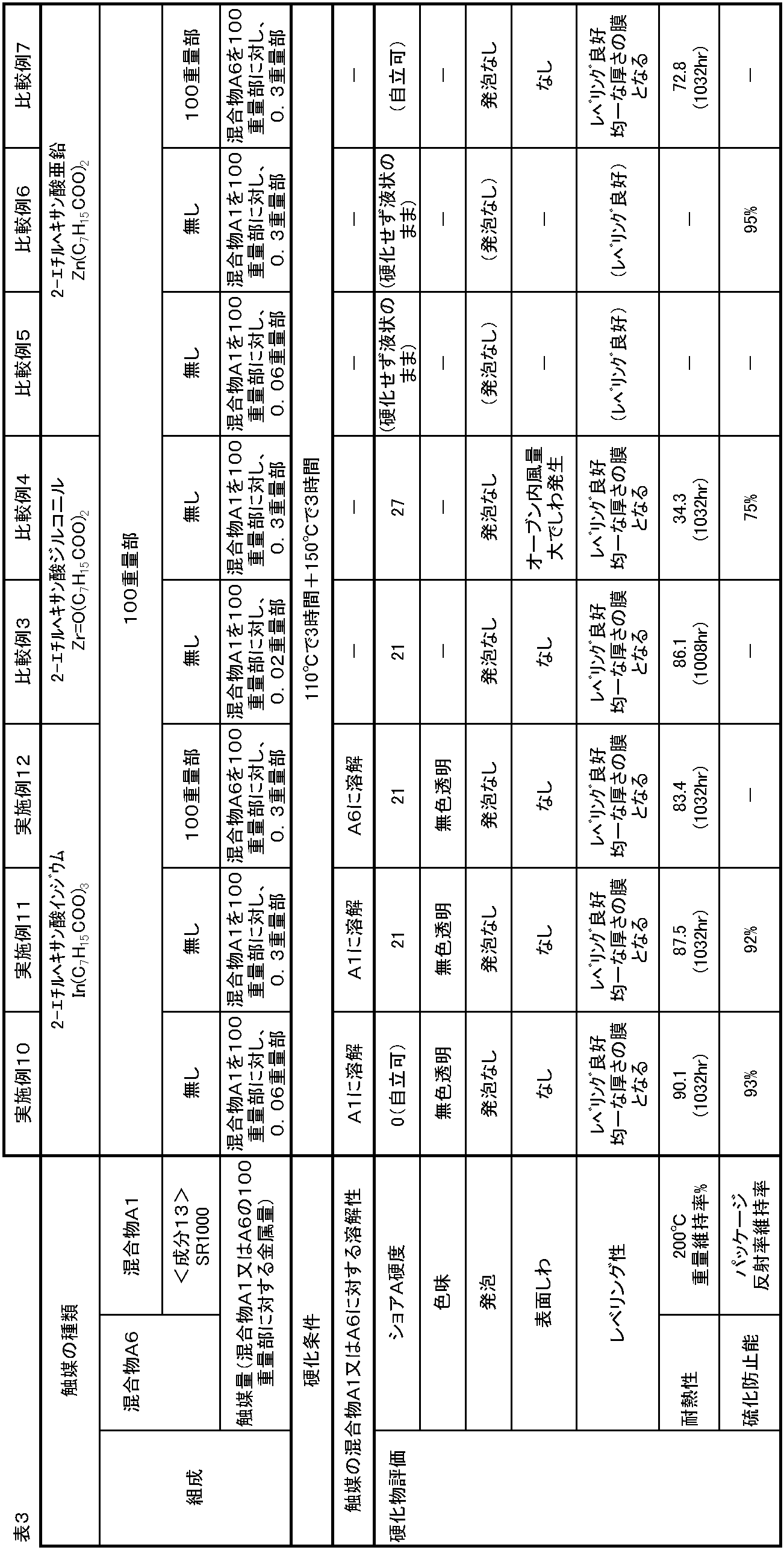
上記実施例10において、混合物A1の代わりに、上記実施例2で得た混合物A2を用いて、2-エチルヘキサン酸インジウムを金属量として0.06重量%から0.3重量%に増量し、PTFE(ポリテトラフルオロエチレン)製シャーレに入れる硬化前組成物の重量を2gから2.3gに増量した以外は、上記実施例10と同様に実験を行い、硬化物を得た。
硬化後の組成物を目視で観察した結果は、発泡や表面のしわは無く、均一な厚さの膜になっており、レベリング性も良好であった。硬化後の組成物は、ショアA硬度24であり、適度な硬度であった。また、硬化後の組成物の耐熱性については、硬化後の組成物を200℃で1032時間加熱した結果、加熱後の重量維持率は92.1%あり、硬化後の組成物が耐熱性に優れていることがわかった。また、硬化後の組成物の硫化防止能についても実施例10と同様に評価した結果、光反射率の維持率は93%と高く、硬化後の組成物が硫化防止能に優れていることが確認された。
上記実施例13において、2-エチルヘキサン酸インジウムの代わりに2-エチルヘキサン酸ジルコニル(日本化学産業(株))を用いた以外は、上記実施例13と同様に実験を行い、硬化物を得た。
硬化後の組成物を目視で観察した結果は、発泡や表面のしわは無く、均一な厚さの膜になっており、レベリング性も良好であった。硬化後の組成物は、ショアA硬度36であり、適度な硬度であった。しかしながら、硬化後の組成物の耐熱性については、硬化後の組成物を200℃で1032時間加熱した結果、加熱後の重量維持率は89.7%であり、実施例13より低かった。また、硬化後の組成物の硫化防止能についても実施例13と同様に評価した結果、光反射率の維持率は86%であり、実施例13に比べ低かった。
上記実施例13において、2-エチルヘキサン酸インジウムの代わりにガリウムトリアセチルアセトナート(STREM CHEMICALS社製)を用いた以外は、上記実施例13と同様に実験を行い、硬化物を得た。
硬化後の組成物を目視で観察した結果は、均一な厚さの膜になっており、レベリング性は良好であったが、発泡が多く、表面に縞模様状のしわが発生していた。硬化後の組成物のショアA硬度は37であり、適度な硬度であった。しかしながら、硬化後の組成物の耐熱性については、硬化後の組成物を200℃で1032時間加熱した結果、加熱後の重量維持率は90.0%であり、実施例13より低かった。また、硬化後の組成物の硫化防止能についても実施例13と同様に評価した結果、光反射率の維持率は90%であり、実施例13に比べ低かった。
上記実施例13において、2-エチルヘキサン酸インジウムの代わりに、2-エチルヘキサン酸亜鉛(和光純薬工業(株))を用いた以外は、上記実施例13と同様に実験を行い、硬化物を得た。
硬化後の組成物を目視で観察した結果は、発泡や表面のしわは無く、均一な厚さの膜になっており、レベリング性も良好であった。硬化後の組成物は、ショアA硬度28であり、適度な硬度であった。しかしながら、硬化後の組成物の耐熱性については、硬化後の組成物を200℃で1032時間加熱した結果、加熱後の重量維持率は79.8%であり、実施例13に比べ低かった。また、増粘後の組成物の硫化防止能について、実施例13と同様に評価した。この結果、光反射率の維持率は95%であり、実施例13が2-エチルヘキサン酸亜鉛を用いた場合と同等レベルの硫化防止能を有することがわかった。
上記実施例13において、2-エチルヘキサン酸インジウム(新興化学工業(株)製)の添加量を、混合物A2の100重量部に対し、金属量として0.3重量部から1.0重量部に増やした以外は、上記実施例13と同様に実験を行い、硬化物を得た。2-エチルヘキサン酸インジウムは、混合物A2に対し、室温(約25℃)において目視で溶解していた。
硬化後の組成物を目視で観察した結果は、発泡や表面のしわは無く、均一な厚さの膜になっており、レベリング性も良好であった。硬化後の組成物は、ショアA硬度33であり、適度な硬度であった。すなわち、2-エチルヘキサン酸インジウムを増量することにより、より高硬度な組成物を得ることができることが確認された。
上記実施例13において、2-エチルヘキサン酸インジウムの代わりに、混合物A2の100重量部に対し、2-エチルヘキサン酸インジウムを金属量として0.3重量部とガリウムトリアセチルアセトナート(STREM CHEMICALS社製)を金属量として0.1重量部添加した以外は、上記実施例13と同様に実験を行い、硬化物を得た。
硬化後の組成物を目視で観察した結果は、発泡や表面のしわは無く、均一な厚さの膜になっており、レベリング性も良好であった。硬化後の組成物は、ショアA硬度45であり、適度な硬度であった。すなわち、2-エチルヘキサン酸インジウムとガリウムトリアセチルアセトナートを併用することにより、高硬度で膜の外観に優れる組成物を得ることができることが確認された。
実施例13~15及び比較例8~10の結果について、表4に纏める。
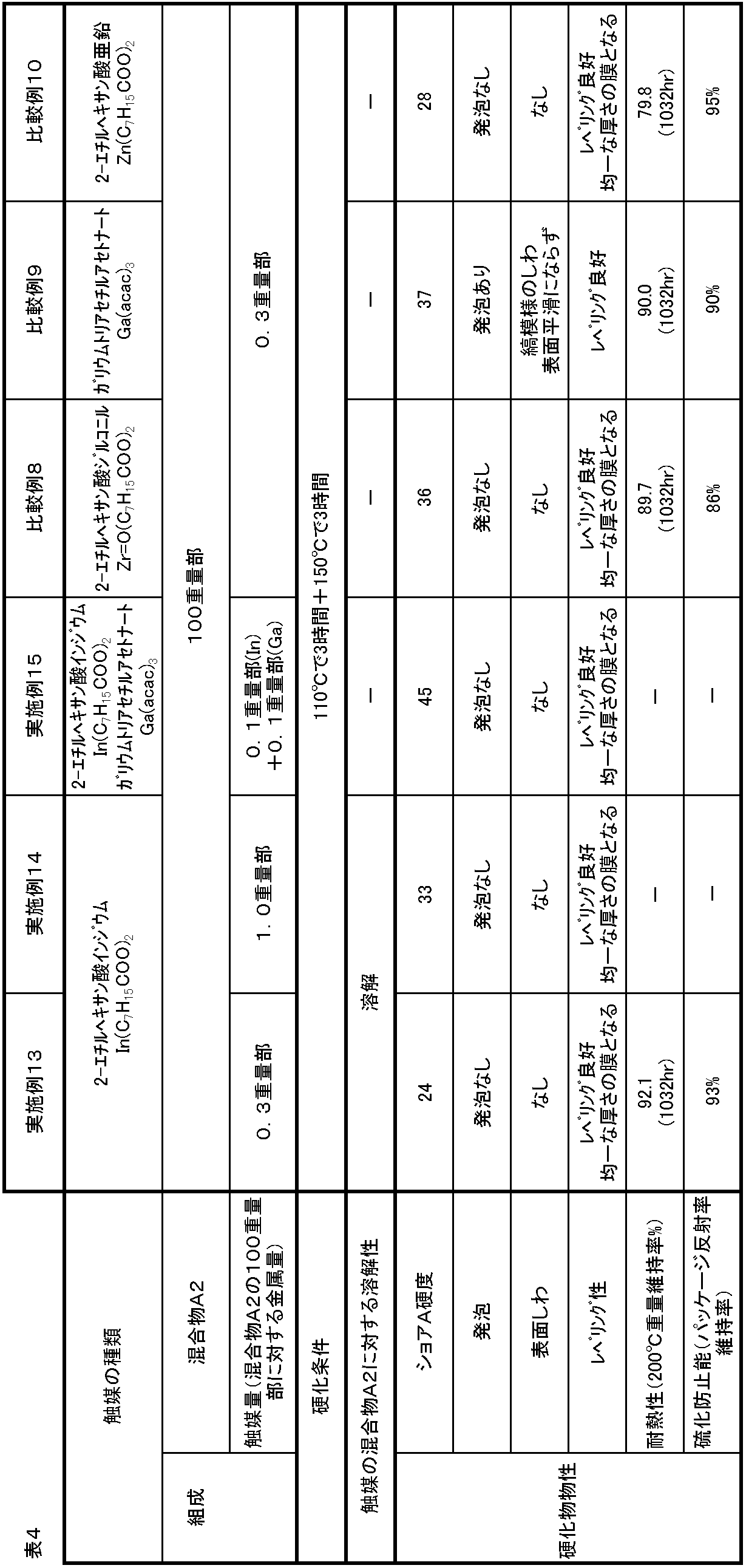
2 樹脂成形体
3 ボンディングワイヤ
4 封止材
5 リードフレーム
Claims (20)
- ケイ素原子に結合した水酸基または加水分解性基のうちの少なくとも一方を1分子中に2個以上有するオルガノポリシロキサンと、インジウムのキレート錯体、アルコキシド及び脂肪酸塩から選ばれる少なくとも1種の有機インジウム化合物とを含有する、硬化性オルガノポリシロキサン組成物。
- 前記有機インジウム化合物が縮合触媒である、請求項1に記載の硬化性オルガノポリシロキサン組成物。
- 前記有機インジウム化合物が、前記オルガノポリシロキサンに可溶である、請求項1または2に記載の硬化性オルガノポリシロキサン組成物。
- 前記オルガノポリシロキサンがポリジオルガノシロキサン構造を有する、請求項1乃至3の何れか1項に記載の硬化性オルガノポリシロキサン組成物。
- 前記オルガノポリシロキサンがケイ素原子に結合した水酸基または加水分解性基のうちの少なくとも一方を1分子中に3個以上有する、請求項1乃至4の何れか1項に記載の硬化性オルガノポリシロキサン組成物。
- 前記オルガノポリシロキサンと、前記有機インジウム化合物と、ケイ素原子に結合した水酸基または加水分解性基のうちの少なくとも一方を1分子中に3個以上有するケイ素化合物とを含有する、請求項1乃至5の何れか1項に記載の硬化性オルガノポリシロキサン組成物。
- 更に、ヒドロシリル基を1分子中に少なくとも3個有するポリシロキサンを含有する、請求項1乃至6の何れか1項に記載の硬化性オルガノポリシロキサン組成物。
- 硬化性オルガノポリシロキサン組成物の製造方法であって、ケイ素原子に結合した水酸基または加水分解性基のうちの少なくとも一方を1分子中に2個以上有するオルガノポリシロキサンと、インジウムのキレート錯体、アルコキシド及び脂肪酸塩から選ばれる少なくとも1種の有機インジウム化合物とを含む混合物を調製するステップを有する、硬化性オルガノポリシロキサン組成物の製造方法。
- 前記有機インジウム化合物が、前記オルガノポリシロキサンに可溶である、請求項8に記載の硬化性オルガノポリシロキサン組成物の製造方法。
- 前記オルガノポリシロキサンがポリジオルガノシロキサン構造を有する、請求項8または9に記載の硬化性オルガノポリシロキサン組成物の製造方法。
- 前記オルガノポリシロキサンがケイ素原子に結合した水酸基または加水分解性基のうちの少なくとも一方を1分子中に3個以上有する、請求項8乃至10の何れか1項に記載の硬化性オルガノポリシロキサン組成物の製造方法。
- 前記オルガノポリシロキサンと、前記有機インジウム化合物と、ケイ素原子に結合した水酸基または加水分解性基のうちの少なくとも一方を1分子中に3個以上有するケイ素化合物とを含む混合物を調製するステップを有する、請求項8乃至11の何れか1項に記載の硬化性オルガノポリシロキサン組成物の製造方法。
- 前記混合物が、更に、ヒドロシリル基を1分子中に少なくとも3個有するポリシロキサンを含む、請求項8乃至12の何れか1項に記載の硬化性オルガノポリシロキサン組成物の製造方法。
- 更に、前記混合物を加熱により増粘させるステップを有する、請求項8乃至13の何れか1項に記載の硬化性オルガノポリシロキサン組成物の製造方法。
- ケイ素原子に結合した水酸基または加水分解性基のうちの少なくとも一方を1分子中に2個以上有するオルガノポリシロキサンを、インジウムのキレート錯体、アルコキシド及び脂肪酸塩から選ばれる少なくとも1種の有機インジウム化合物を触媒として用いて縮合させるステップを有する、オルガノポリシロキサン硬化物の製造方法。
- ケイ素原子に結合した水酸基または加水分解性基のうちの少なくとも一方を1分子中に2個以上有するオルガノポリシロキサンを、インジウムのキレート錯体、アルコキシド及び脂肪酸塩から選ばれる少なくとも1種の有機インジウム化合物を触媒として用いて縮合させるステップを有する、オルガノポリシロキサンの縮合方法。
- 光半導体チップを、請求項1乃至7の何れか1項に記載の硬化性オルガノポリシロキサン組成物で埋め込んだ後、該硬化性オルガノポリシロキサン組成物を加熱することにより硬化させて得られる光半導体封止体。
- ケイ素原子に結合した水酸基または加水分解性基のうちの少なくとも一方を1分子中に2個以上有するオルガノポリシロキサンに可溶な有機インジウム化合物を含有する、オルガノポリシロキサンの縮合触媒。
- 前記有機インジウム化合物がインジウムのキレート錯体、アルコキシド及び脂肪酸塩から選ばれる少なくとも1種である請求項18に記載のオルガノポリシロキサンの縮合触媒。
- インジウムのキレート錯体、アルコキシド及び脂肪酸塩から選ばれる少なくとも1種の有機インジウム化合物が、ケイ素原子に結合した水酸基または加水分解性基のうちの少なくとも一方を1分子中に2個以上有するオルガノポリシロキサンに溶解している、硬化性オルガノポリシロキサン組成物。
Priority Applications (3)
| Application Number | Priority Date | Filing Date | Title |
|---|---|---|---|
| CN201380038094.5A CN104487520B (zh) | 2012-07-27 | 2013-07-25 | 固化性有机聚硅氧烷组合物、其制造方法、有机聚硅氧烷固化物的制造方法、有机聚硅氧烷的缩合方法、光半导体密封体以及有机聚硅氧烷的缩合催化剂 |
| KR1020157001008A KR20150037830A (ko) | 2012-07-27 | 2013-07-25 | 경화성 오르가노폴리실록산 조성물, 그 제조 방법, 오르가노폴리실록산 경화물의 제조 방법, 오르가노폴리실록산의 축합 방법, 광 반도체 밀봉체, 및 오르가노폴리실록산의 축합 촉매 |
| JP2014527007A JP6277956B2 (ja) | 2012-07-27 | 2013-07-25 | 硬化性オルガノポリシロキサン組成物、その製造方法、オルガノポリシロキサン硬化物の製造方法、オルガノポリシロキサンの縮合方法、光半導体封止体、及びオルガノポリシロキサンの縮合触媒 |
Applications Claiming Priority (2)
| Application Number | Priority Date | Filing Date | Title |
|---|---|---|---|
| JP2012-167532 | 2012-07-27 | ||
| JP2012167532 | 2012-07-27 |
Publications (1)
| Publication Number | Publication Date |
|---|---|
| WO2014017598A1 true WO2014017598A1 (ja) | 2014-01-30 |
Family
ID=49997405
Family Applications (1)
| Application Number | Title | Priority Date | Filing Date |
|---|---|---|---|
| PCT/JP2013/070218 Ceased WO2014017598A1 (ja) | 2012-07-27 | 2013-07-25 | 硬化性オルガノポリシロキサン組成物、その製造方法、オルガノポリシロキサン硬化物の製造方法、オルガノポリシロキサンの縮合方法、光半導体封止体、及びオルガノポリシロキサンの縮合触媒 |
Country Status (5)
| Country | Link |
|---|---|
| JP (1) | JP6277956B2 (ja) |
| KR (1) | KR20150037830A (ja) |
| CN (1) | CN104487520B (ja) |
| TW (1) | TW201410742A (ja) |
| WO (1) | WO2014017598A1 (ja) |
Cited By (3)
| Publication number | Priority date | Publication date | Assignee | Title |
|---|---|---|---|---|
| WO2019188831A1 (ja) * | 2018-03-29 | 2019-10-03 | Agc株式会社 | 波長変換部材及びその製造方法 |
| JP2021534264A (ja) * | 2018-08-24 | 2021-12-09 | ダウ シリコーンズ コーポレーション | ヒドロキシル末端ポリジオルガノシロキサンの縮合重合のため方法 |
| TWI805569B (zh) * | 2017-02-02 | 2023-06-21 | 日商力森諾科股份有限公司 | 撥水結構體及其製造方法 |
Families Citing this family (6)
| Publication number | Priority date | Publication date | Assignee | Title |
|---|---|---|---|---|
| US9224955B1 (en) * | 2014-10-31 | 2015-12-29 | Feng-wen Yen | Purifying method for organic optoelectronic material |
| CN104576901B (zh) * | 2015-01-16 | 2017-12-12 | 中国科学院化学研究所 | 一种具有提高的防硫化性能的led元件及其制备方法 |
| CN106008979A (zh) * | 2015-03-27 | 2016-10-12 | 豪雅冠得股份有限公司 | 固化性树脂组合物及光半导体装置 |
| CN108368342B (zh) * | 2016-01-08 | 2021-07-02 | 日亚化学工业株式会社 | 固化性有机硅树脂组合物及其固化物、以及光半导体装置 |
| TWI648878B (zh) * | 2018-05-15 | 2019-01-21 | 東貝光電科技股份有限公司 | Led發光源、led發光源之製造方法及其直下式顯示器 |
| CN111234229B (zh) * | 2020-02-26 | 2021-12-21 | 华南理工大学 | 一种led封装胶用乙烯基苯基硅树脂及其制备方法与应用 |
Citations (7)
| Publication number | Priority date | Publication date | Assignee | Title |
|---|---|---|---|---|
| JPS63309901A (ja) * | 1987-06-11 | 1988-12-19 | Nikon Corp | プラスチック製眼鏡レンズ |
| JPH10168389A (ja) * | 1996-12-16 | 1998-06-23 | Ito Kogaku Kogyo Kk | ハードコーティング組成物 |
| JPH10227901A (ja) * | 1996-12-09 | 1998-08-25 | Asahi Optical Co Ltd | 光学プラスチックレンズ用ハードコート液 |
| JP2010083964A (ja) * | 2008-09-30 | 2010-04-15 | Shin-Etsu Chemical Co Ltd | 皮膜形成性オルガノポリシロキサン、エマルジョン組成物及びオルガノポリシロキサンエマルジョンの製造方法 |
| JP2011037954A (ja) * | 2009-08-07 | 2011-02-24 | Konishi Co Ltd | 硬化性シリコーン系樹脂組成物 |
| JP2011046906A (ja) * | 2009-08-29 | 2011-03-10 | Konishi Co Ltd | 硬化性樹脂組成物 |
| JP2012119423A (ja) * | 2010-11-30 | 2012-06-21 | Toray Ind Inc | ゲート絶縁材料、ゲート絶縁膜、および電界効果型トランジスタ。 |
Family Cites Families (3)
| Publication number | Priority date | Publication date | Assignee | Title |
|---|---|---|---|---|
| FR2756933A1 (fr) * | 1996-12-09 | 1998-06-12 | Asahi Optical Co Ltd | Solution de revetement dur pour lentilles optiques en matiere plastique |
| JP3960307B2 (ja) * | 2003-05-15 | 2007-08-15 | Jsr株式会社 | 液状樹脂組成物、硬化膜及び積層体 |
| CN101343428B (zh) * | 2008-09-01 | 2012-02-15 | 杭州华冠建材有限公司 | 基于硅氧烷的瓷膜组合物及制备方法 |
-
2013
- 2013-07-25 WO PCT/JP2013/070218 patent/WO2014017598A1/ja not_active Ceased
- 2013-07-25 JP JP2014527007A patent/JP6277956B2/ja not_active Expired - Fee Related
- 2013-07-25 CN CN201380038094.5A patent/CN104487520B/zh not_active Expired - Fee Related
- 2013-07-25 KR KR1020157001008A patent/KR20150037830A/ko not_active Withdrawn
- 2013-07-26 TW TW102126854A patent/TW201410742A/zh unknown
Patent Citations (7)
| Publication number | Priority date | Publication date | Assignee | Title |
|---|---|---|---|---|
| JPS63309901A (ja) * | 1987-06-11 | 1988-12-19 | Nikon Corp | プラスチック製眼鏡レンズ |
| JPH10227901A (ja) * | 1996-12-09 | 1998-08-25 | Asahi Optical Co Ltd | 光学プラスチックレンズ用ハードコート液 |
| JPH10168389A (ja) * | 1996-12-16 | 1998-06-23 | Ito Kogaku Kogyo Kk | ハードコーティング組成物 |
| JP2010083964A (ja) * | 2008-09-30 | 2010-04-15 | Shin-Etsu Chemical Co Ltd | 皮膜形成性オルガノポリシロキサン、エマルジョン組成物及びオルガノポリシロキサンエマルジョンの製造方法 |
| JP2011037954A (ja) * | 2009-08-07 | 2011-02-24 | Konishi Co Ltd | 硬化性シリコーン系樹脂組成物 |
| JP2011046906A (ja) * | 2009-08-29 | 2011-03-10 | Konishi Co Ltd | 硬化性樹脂組成物 |
| JP2012119423A (ja) * | 2010-11-30 | 2012-06-21 | Toray Ind Inc | ゲート絶縁材料、ゲート絶縁膜、および電界効果型トランジスタ。 |
Cited By (4)
| Publication number | Priority date | Publication date | Assignee | Title |
|---|---|---|---|---|
| TWI805569B (zh) * | 2017-02-02 | 2023-06-21 | 日商力森諾科股份有限公司 | 撥水結構體及其製造方法 |
| WO2019188831A1 (ja) * | 2018-03-29 | 2019-10-03 | Agc株式会社 | 波長変換部材及びその製造方法 |
| JP2021534264A (ja) * | 2018-08-24 | 2021-12-09 | ダウ シリコーンズ コーポレーション | ヒドロキシル末端ポリジオルガノシロキサンの縮合重合のため方法 |
| JP7389061B2 (ja) | 2018-08-24 | 2023-11-29 | ダウ シリコーンズ コーポレーション | ヒドロキシル末端ポリジオルガノシロキサンの縮合重合のため方法 |
Also Published As
| Publication number | Publication date |
|---|---|
| TW201410742A (zh) | 2014-03-16 |
| CN104487520A (zh) | 2015-04-01 |
| CN104487520B (zh) | 2017-03-15 |
| JPWO2014017598A1 (ja) | 2016-07-11 |
| KR20150037830A (ko) | 2015-04-08 |
| JP6277956B2 (ja) | 2018-02-14 |
Similar Documents
| Publication | Publication Date | Title |
|---|---|---|
| JP6277956B2 (ja) | 硬化性オルガノポリシロキサン組成物、その製造方法、オルガノポリシロキサン硬化物の製造方法、オルガノポリシロキサンの縮合方法、光半導体封止体、及びオルガノポリシロキサンの縮合触媒 | |
| JP4636242B2 (ja) | 光半導体素子封止材及び光半導体素子 | |
| TWI504683B (zh) | A hardened silicon oxide composition, a hardened product thereof, and an optical semiconductor device | |
| JP6389145B2 (ja) | 付加硬化型シリコーン樹脂組成物、及び半導体装置 | |
| JP6417878B2 (ja) | 半導体発光装置封止材用硬化性オルガノポリシロキサン組成物、該組成物を硬化させてなるオルガノポリシロキサン硬化物及びこれを用いて封止されてなる半導体発光装置 | |
| CN1798810A (zh) | Led密封组合物 | |
| CN105209549B (zh) | 固化性树脂组合物及使用其的半导体装置 | |
| KR20170057330A (ko) | 경화성 실리콘 수지 조성물 및 그의 경화물 | |
| JP2016211003A (ja) | 半導体発光デバイス部材用2液型硬化性ポリオルガノシロキサン組成物、該組成物を硬化させてなるポリオルガノシロキサン硬化物及びその製造方法 | |
| KR101251553B1 (ko) | 엘이디 봉지재용 실록산 수지 조성물 | |
| CN108795053A (zh) | 加成固化型硅酮组合物、该组合物的制造方法、硅酮固化物、以及光学元件 | |
| JP2013124324A (ja) | 硬化性ポリオルガノシロキサン組成物および該組成物を硬化させてなるポリオルガノシロキサン硬化物 | |
| CN111344369A (zh) | 氢化硅烷化-可固化硅酮组合物 | |
| JP6038824B2 (ja) | 硬化性組成物、半導体装置、及びエステル結合含有有機ケイ素化合物 | |
| KR20120067945A (ko) | 경화성 오르가노폴리실록산 조성물, 광학 소자 밀봉재 및 광학 소자 | |
| FI126130B (en) | Siloxane monomers with high refractive index, polymerization thereof and their use | |
| US20220049121A1 (en) | Curable silicone composition, encapsulant and optical semiconductor device | |
| JP2015115494A (ja) | 半導体発光装置 | |
| JP6329423B2 (ja) | 多面体構造ポリシロキサン骨格を有する変性体、その変性体を添加した硬化性組成物、硬化物および半導体発光装置 | |
| TWI634160B (zh) | 有機矽金屬複合物、包括其之可固化有機聚矽氧烷組合物及包括此組合物的光學材料 | |
| JP6239948B2 (ja) | 多面体構造ポリシロキサンを添加した硬化性組成物、硬化物および半導体発光装置、半導体発光装置の製造方法 | |
| JP5811036B2 (ja) | 縮合硬化性ポリシロキサン組成物 | |
| JP2012131985A (ja) | 硬化物製造用キット及び硬化物製造用組成物、並びにその使用 | |
| JP6327679B2 (ja) | アルカリ土類金属を含むアリール基含有シロキサン組成物 | |
| JP7360911B2 (ja) | 硬化性組成物及び該組成物を封止剤として用いた半導体装置。 |
Legal Events
| Date | Code | Title | Description |
|---|---|---|---|
| 121 | Ep: the epo has been informed by wipo that ep was designated in this application |
Ref document number: 13823872 Country of ref document: EP Kind code of ref document: A1 |
|
| ENP | Entry into the national phase |
Ref document number: 20157001008 Country of ref document: KR Kind code of ref document: A |
|
| ENP | Entry into the national phase |
Ref document number: 2014527007 Country of ref document: JP Kind code of ref document: A |
|
| NENP | Non-entry into the national phase |
Ref country code: DE |
|
| 122 | Ep: pct application non-entry in european phase |
Ref document number: 13823872 Country of ref document: EP Kind code of ref document: A1 |