WO2014003102A1 - アルコール系印刷インキ組成物 - Google Patents
アルコール系印刷インキ組成物 Download PDFInfo
- Publication number
- WO2014003102A1 WO2014003102A1 PCT/JP2013/067616 JP2013067616W WO2014003102A1 WO 2014003102 A1 WO2014003102 A1 WO 2014003102A1 JP 2013067616 W JP2013067616 W JP 2013067616W WO 2014003102 A1 WO2014003102 A1 WO 2014003102A1
- Authority
- WO
- WIPO (PCT)
- Prior art keywords
- weight
- alcohol
- printing ink
- polyol
- parts
- Prior art date
- Legal status (The legal status is an assumption and is not a legal conclusion. Google has not performed a legal analysis and makes no representation as to the accuracy of the status listed.)
- Ceased
Links
Classifications
-
- C—CHEMISTRY; METALLURGY
- C09—DYES; PAINTS; POLISHES; NATURAL RESINS; ADHESIVES; COMPOSITIONS NOT OTHERWISE PROVIDED FOR; APPLICATIONS OF MATERIALS NOT OTHERWISE PROVIDED FOR
- C09D—COATING COMPOSITIONS, e.g. PAINTS, VARNISHES OR LACQUERS; FILLING PASTES; CHEMICAL PAINT OR INK REMOVERS; INKS; CORRECTING FLUIDS; WOODSTAINS; PASTES OR SOLIDS FOR COLOURING OR PRINTING; USE OF MATERIALS THEREFOR
- C09D11/00—Inks
- C09D11/02—Printing inks
- C09D11/10—Printing inks based on artificial resins
- C09D11/102—Printing inks based on artificial resins containing macromolecular compounds obtained by reactions other than those only involving unsaturated carbon-to-carbon bonds
-
- C—CHEMISTRY; METALLURGY
- C09—DYES; PAINTS; POLISHES; NATURAL RESINS; ADHESIVES; COMPOSITIONS NOT OTHERWISE PROVIDED FOR; APPLICATIONS OF MATERIALS NOT OTHERWISE PROVIDED FOR
- C09D—COATING COMPOSITIONS, e.g. PAINTS, VARNISHES OR LACQUERS; FILLING PASTES; CHEMICAL PAINT OR INK REMOVERS; INKS; CORRECTING FLUIDS; WOODSTAINS; PASTES OR SOLIDS FOR COLOURING OR PRINTING; USE OF MATERIALS THEREFOR
- C09D11/00—Inks
- C09D11/02—Printing inks
- C09D11/03—Printing inks characterised by features other than the chemical nature of the binder
- C09D11/033—Printing inks characterised by features other than the chemical nature of the binder characterised by the solvent
-
- D—TEXTILES; PAPER
- D21—PAPER-MAKING; PRODUCTION OF CELLULOSE
- D21H—PULP COMPOSITIONS; PREPARATION THEREOF NOT COVERED BY SUBCLASSES D21C OR D21D; IMPREGNATING OR COATING OF PAPER; TREATMENT OF FINISHED PAPER NOT COVERED BY CLASS B31 OR SUBCLASS D21G; PAPER NOT OTHERWISE PROVIDED FOR
- D21H19/00—Coated paper; Coating material
- D21H19/36—Coatings with pigments
- D21H19/38—Coatings with pigments characterised by the pigments
- D21H19/42—Coatings with pigments characterised by the pigments at least partly organic
-
- Y—GENERAL TAGGING OF NEW TECHNOLOGICAL DEVELOPMENTS; GENERAL TAGGING OF CROSS-SECTIONAL TECHNOLOGIES SPANNING OVER SEVERAL SECTIONS OF THE IPC; TECHNICAL SUBJECTS COVERED BY FORMER USPC CROSS-REFERENCE ART COLLECTIONS [XRACs] AND DIGESTS
- Y10—TECHNICAL SUBJECTS COVERED BY FORMER USPC
- Y10T—TECHNICAL SUBJECTS COVERED BY FORMER US CLASSIFICATION
- Y10T428/00—Stock material or miscellaneous articles
- Y10T428/24—Structurally defined web or sheet [e.g., overall dimension, etc.]
- Y10T428/24802—Discontinuous or differential coating, impregnation or bond [e.g., artwork, printing, retouched photograph, etc.]
Definitions
- the present invention relates to an alcohol printing ink composition.
- Patent Document 1 discloses a titanium white dispersion mainly composed of ethanol as a solvent.
- a dispersant when it is difficult to disperse the pigment with the binder resin alone, generally a dispersant can be used in combination.
- chlorinated resins such as vinyl chloride-vinyl acetate copolymers that have been widely used as dispersants in solvent-based inks are insoluble in alcohol.
- none of the known non-chlorine-based dispersants can satisfy pigment dispersibility and printability.
- Patent Document 2 discloses a method of using an ester solvent as a printing ink medium.
- the vinyl chloride-vinyl acetate copolymer that is insoluble in alcohol dissolves, so that good pigment dispersion stability can be ensured.
- a solvent with a significantly different volatilization rate such as ethanol and ethyl acetate
- the ratio of the ethanol component with a slow volatilization rate temporarily increases on the plate copper in the solvent composition in the ink in the printing process.
- vinyl chloride-vinyl acetate copolymer was precipitated, and the re-solubility during the long run was insufficient.
- An object of the present invention is to provide a printing ink containing an alcohol having a low environmental load as a main component, excellent in colorant dispersibility and storage stability, and excellent in re-dissolvability during a long run.
- the present invention is an alcohol system comprising (1) a polyurethane urea resin (D) obtained by reacting a polyol (A), a diisocyanate (B), and a chain extender (C), a colorant (E), and a medium.
- a printing ink composition comprising:
- the polyol (A) includes a polyester polyol (A0) having a repeating unit derived from a saturated hydroxycarboxylic acid having a side chain,
- the medium includes an alcohol (F), and the proportion of the alcohol (F) is 50% by weight or more in a total of 100% by weight of the medium.
- the present invention relates to (2) the alcohol-based printing ink composition as described in (1) above, wherein the polyester polyol (A0) is a hydrogenated castor oil polyol (A1).
- the present invention also relates to (3) the alcohol-based printing ink composition according to (1) or (2) above, wherein the polyol (A) further contains a polyether polyol (A2).
- the present invention is also characterized in that (4) the ratio of the polyester polyol (A0) in the total of 100% by weight of the polyol (A) is 20 to 85% by weight.
- the present invention relates to any alcohol-based printing ink composition.
- the present invention is also characterized in that (5) the alcohol (F) contains ethanol, and the proportion of ethanol is 70% by weight or more in a total of 100% by weight of the alcohol (F).
- the alcohol-based printing ink composition according to any one of (4) to (4).
- a printing ink that contains alcohol as a main component as a medium, is excellent in dispersibility and storage stability of a colorant, and is excellent in re-dissolvability during a long run.
- Embodiments of the present invention will be described in detail below, but the description of the constituent elements described below is an example (representative example) of an embodiment of the present invention, and the present invention does not exceed the gist thereof. Not specific to the content.
- the alcohol-based printing ink composition of the present invention is an alcohol-based printing ink composition comprising a polyurethane urea resin (D), a colorant (E), and a medium
- the polyurethane urea resin (D) is obtained by reacting a polyol (A), a diisocyanate (B), and a chain extender (C)
- the polyol (A) includes a polyester polyol (A0) having a repeating unit derived from a saturated hydroxycarboxylic acid having a side chain
- the medium contains alcohol (F), and the ratio of alcohol (F) is 50% by weight or more in a total of 100% by weight of the medium.
- the polyol (A) of the present invention contains a polyester polyol having a repeating unit derived from a saturated hydroxycarboxylic acid having a side chain (hereinafter also referred to as a polyester polyol) (A0).
- the polyester polyol (A0) having a repeating unit derived from a saturated hydroxycarboxylic acid having a side chain has two or more structures represented by the following general formula (1) in one molecule, and It is a polyol having an ester bond.
- R 1 to R 3 are each independently a hydrogen atom or an alkyl group having 1 or more carbon atoms, all of which may be different or two or more may be the same, and at least one of R 1 to R 3 is a carbon number.
- It is an alkyl group of 1 or more.
- L, m and n are each independently an integer of 1 to 20.
- the manufacturing method for obtaining the said polyester polyol (A0) is not limited to the following examples, For example, the method of esterifying the saturated hydroxycarboxylic acid which has a side chain, using diol or diamine as an initiator, It is obtained by a method of ring-opening polymerization of a lactone having diol or diamine as an initiator.
- the length of the side chain of the polyester polyol (A0) is preferably 3 to 20 carbon atoms, more preferably 4 to 10 carbon atoms. When the number of carbon atoms is 3 or more, sufficient pigment dispersibility is obtained, and when the number of carbon atoms is 20 or less, re-solubility is good.
- the saturated hydroxycarboxylic acid having a side chain is not limited to the following examples, but includes 11-hydroxypentadecanoic acid, 11-hydroxyhexadecanoic acid, hydrogenated castor oil fatty acid, hydrolyzate of a lactone having a side chain, and the like. Can be mentioned.
- the lactone having a side chain is not limited to the following examples, but ⁇ -heptanolactone, ⁇ -octanolactone, ⁇ -nanolactone, ⁇ -methyl- ⁇ -decanolactone, ⁇ -methyl- ⁇ -butyrolactone, ⁇ - Decanolactone, ⁇ -heptyl- ⁇ -butyrolactone, ⁇ -undecanolactone, ⁇ -dodecanolactone, ⁇ -octanolactone, ⁇ -nanolactone, ⁇ -decanolactone, ⁇ -undecanolactone, ⁇ -dodecanolactone, ⁇ - Examples include tridecanolactone and ⁇ -tetradecanolactone.
- polyester polyol (A0) hydrogenated castor oil polyol (A1) is particularly preferable from the viewpoints of pigment dispersibility and re-solubility. These may be used alone or in admixture of two or more.
- the method for producing the hydrogenated castor oil polyol (A1) is not limited to the following examples.
- castor oil fatty acid ricinoleic acid
- castor oil weight by esterification using diol as an initiator.
- a condensate castor oil polyol
- it can be obtained by hydrogenating unsaturated groups by a known hydrogenation reaction. It can also be obtained by hydrogenating castor oil fatty acid to form hydrogenated castor oil fatty acid and then esterifying it with diol as an initiator.
- diol examples include, but are not limited to, ethylene glycol, diethylene glycol, triethylene glycol, propylene glycol, 1,3-propanediol, 1,4-butanediol, 1,3-butanediol, 1,6- Hexanediol, 1,8-octanediol, 1,9-nonanediol, neopentyl glycol, 3-methyl-1,5-pentanediol, 2-methyl-1,3-propanediol, 3,3,5-trimethyl Pentanediol, 2,4-diethyl-1,5-pentanediol, 1,12-octadecanediol, 1,2-alkanediol, 1,3-alkanediol, 1-monoglyceride, 2-monoglyceride, 1-monoglycerin ether , 2-monoglycerin ether, dimergio
- polyester polyols (A0) can be used alone or in admixture of two or more.
- the polyester polyol (A0) is used for the purpose of imparting pigment dispersibility to the polyurethane urea resin (D) in a medium mainly composed of alcohol.
- the amount of the polyester polyol (A0) used is preferably in the range of 20 to 85% by weight, more preferably in the range of 30 to 75% by weight, out of the total 100% by weight of the polyol (A). If the amount of the polyester polyol (A0) used is 85% by weight or less of the total 100% by weight of the polyol (A), the re-dissolvability is good, and if it is 20% by weight or more, the pigment dispersibility is good. .
- the molecular weight of the polyester polyol (A0) is preferably a weight average molecular weight of 500 to 4000, more preferably 1000 to 3500. If the weight average molecular weight is 4000 or less, the solubility of the polyurethane urea resin (D) in the alcohol (F) is good, and if it is 500 or more, the substrate adhesion in the printed matter is good.
- the polyol (A) of the present invention preferably further contains a polyether polyol (A2).
- the polyether polyol (A2) is not limited to the following examples, but examples thereof include polyethylene glycol, polypropylene glycol, polytrimethylene glycol, polyoxytetramethylene glycol, and copolymerized polyether diols thereof. . These may be used alone or in admixture of two or more.
- the polyether polyol (A2) is used for the purpose of improving the alcohol solubility of the polyurethane urea resin (D).
- the amount of the polyether polyol (A2) used is preferably in the range of 15 to 80% by weight, more preferably in the range of 25 to 70% by weight, out of the total 100% by weight of the polyol (A). If the amount of the polyether polyol (A2) used is 80% by weight or less of the total 100% by weight of the polyol (A), the pigment dispersibility is good, and if it is 15% by weight or more, the re-solubility is good. is there.
- the molecular weight of the polyether polyol (A2) is preferably 500 to 4000 in terms of weight average molecular weight, more preferably 1000 to 3000. If the weight average molecular weight is 4000 or less, the pigment dispersion stability is good, and if it is 500 or more, the substrate adhesion in the printed matter is good.
- polyol (A) of the present invention a known polyol can be used in combination with the polyester polyol (A0) and the polyether polyol (A2).
- Such polyols are not limited to the following examples.
- polyester polyols (A3) other than the polyester polyol (A0) polymer diols such as polycarbonate diols, ethylene glycol, diethylene glycol, triethylene glycol, etc.
- a low molecular diol (A4) such as can be used.
- the low molecular diol means a diol having no repeating unit in its structure.
- the amount of the low molecular diol (A4) used is preferably 20% by weight or less, more preferably 10% by weight or less, out of the total 100% by weight of the polyol (A). If the usage-amount of low molecular diol is 20 weight% or less, the base-material adhesiveness in printed matter will be favorable.
- the polyester polyol (A3) other than the polyester polyol (A0) is not limited to the following examples.
- a condensate obtained by an esterification reaction between a dibasic acid and a diol examples thereof include polyester polyols such as caprolactone polymer, valerolactone polymer, methyl valerolactone polymer, lactic acid polymer, castor oil fatty acid polymer and the like obtained by using the diol as an initiator.
- the dibasic acid is not limited to the following examples.
- dibasic acids such as sebacic acid, suberic acid, glutaric acid, 1,4-cyclohexyl dicarboxylic acid, dimer acid, and hydrogenated dimer acid.
- diol examples include, but are not limited to, the diol exemplified in the hydrogenated castor oil polyol (A1).
- polyester polyol (A3) other than polyester polyol (A0) castor oil polyol such as castor oil fatty acid polymer is particularly preferable in terms of pigment dispersion stability, storage stability of the obtained ink, and transparency in printed matter. preferable.
- polyester polyols can be used alone or in admixture of two or more.
- the amount of the polyester polyol (A3) other than the polyester polyol (A0) is 35% by weight or less, more preferably 25% by weight or less, out of the total 100% by weight of the polyol (A) in terms of pigment dispersion stability. Is preferred.
- diisocyanate (B) Aromatic diisocyanate, aliphatic diisocyanate, alicyclic diisocyanate, etc. are mentioned.
- 1,5-naphthylene diisocyanate, 4,4′-diphenylmethane diisocyanate (also known as MDI) 4,4′-diphenyldimethylmethane diisocyanate, 4,4′-dibenzyl isocyanate, dialkyldiphenylmethane diisocyanate, tetraalkyldiphenylmethane diisocyanate 1,3-phenylene diisocyanate, 1,4-phenylene diisocyanate, tolylene diisocyanate, butane-1,4-diisocyanate, hexamethylene diisocyanate, isopropylene diisocyanate, methylene diisocyanate, 2,2,4-trimethylhexamethylene diisocyanate,
- diisocyanate compounds can be used alone or in admixture of two or more.
- alicyclic isocyanates such as isophorone diisocyanate are preferable from the viewpoint of alcohol solubility of the polyurethane urea resin (D).
- Diol shown with diamine and the said hydrogenated castor oil polyol (A1) can be mentioned.
- Examples of the diamines are not limited to the following examples.
- Other than dimer diamine converted to amino group N- (2-hydroxyethyl) ethylenediamine, N- (2-hydroxyethyl) propylenediamine, N- (2-hydroxypropyl) ethylenediamine, N- (2-hydroxypropyl) propylenediamine, N, N′-bis (2 -Hydroxyethyl) ethylenediamine, N, N'-bis (2-hydroxyethyl) propylenediamine, N, N'-bis (2-hydroxypropyl) ethylenediamine, N, N'-bis (2-hydroxypropyl) propylenediamine, etc.
- Amines having a hydroxyl group in the molecule of Amines having a tertiary amino group in the molecule such as methyliminobispropyl
- chain extenders can be used alone or in admixture of two or more.
- the method for producing the polyurethane urea resin (D) is not particularly limited, and can be produced by a general method for producing a polyurethane urea resin.
- a polyol (A) and a diisocyanate (B) are reacted in an equivalent ratio in which an isocyanate group is excessive with respect to a hydroxyl group in the absence of a solvent to produce an isocyanate group-containing prepolymer.
- this is dissolved in ethyl acetate or an alcohol having a tertiary hydroxyl group to obtain a prepolymer solution.
- the isocyanate group-containing prepolymer solution is added to a solution obtained by dissolving the chain extender (C) in a mixed solvent of the alcohol (F) and ethyl acetate to cause a chain extension reaction.
- the ratio of the polyol (A) to the diisocyanate (B) is the NCO / OH ratio, which is the ratio of the number of moles of isocyanate groups in the diisocyanate (B) to the number of moles of hydroxyl groups in the polyol (A).
- the range is preferably from 1.1 to 3.0, more preferably from 1.5 to 2.5. If this ratio is 1.1 or more, since the urea group concentration in the obtained polyurethane urea resin is high, the elastic modulus is high and sufficient blocking resistance in the printed matter is obtained. Moreover, if NCO / OH ratio is 3.0 or less, the base-material adhesiveness in printed matter will be favorable.
- the polyurethane urea resin (D) preferably has a weight average molecular weight in the range of 10,000 to 100,000. More preferably, it is 15,000 to 50,000. If it is 10,000 or more, the blocking resistance in the printed matter can be sufficiently ensured, and if it is 100,000 or less, the solubility in the alcohol (F) in the present invention is good, so that sufficient pigment dispersibility is obtained. It is done.
- the polyurethane urea resin (D) preferably has an amino group in the terminal and / or main chain in order to ensure adhesion to the base material.
- the amount of amino group possessed is preferably such that the amine value is 0.5 to 40.0 mgKOH / g of resin, more preferably the amine value is 3.0 to 20.0 mgKOH / g of resin. If the amine value is 0.5 mgKOH / resin 1 g or more, the adhesion to the polyolefin film in the printed matter is good, and if it is 40.0 mgKOH / resin 1 g or less, the storage stability of the ink is good.
- the polyurethane urea resin (D) is preferably contained in a proportion of 1 to 30% by weight, more preferably 3 to 15% by weight, based on the total weight of the printing ink composition.
- colorant (E) for example, various types used in ordinary inks such as organic pigments, inorganic pigments and dyes can be used.
- the alcohol-based printing ink composition of the present invention has excellent pigment dispersibility not only with inorganic pigments but also with organic pigments, despite the use of alcohol as the main component of the medium.
- organic pigments include, but are not limited to, carmine 6B, lake red C, permanent red 2B, disazo yellow, pyrazolone orange, carmine FB, chromophthal yellow, chromophthal red, phthalocyanine blue, phthalocyanine green. , Dioxazine violet, quinacridone magenta, quinacridone red, indanthrone blue, pyrimidine yellow, thioindigo bordeaux, thioindigo magenta, perylene red, perinone orange, isoindolinone yellow, aniline black, diketopyrrolopyrrole red, daylight Examples thereof include fluorescent pigments.
- Organic pigments that can still be used are C.I. I. Enumeration by pigment number is not limited to the following example, but C.I. I. Pigment Blue 15: 3, C.I. I. Pigment Yellow 14, C.I. I. Pigment Yellow 17, C.I. I. Pigment Yellow 83, C.I. I. Pigment Yellow 155, C.I. I. Pigment Red 48: 1, C.I. I. Pigment Red 48: 2, C.I. I. Pigment Red 48: 3, C.I. I. Pigment Red 57: 1, C.I. I. Pigment Red 144, C.I. I. Pigment Red 146, C.I. I. Pigment Red 166, C.I. I. Pigment Red 185, C.I. I. Pigment Red 220, C.I. I. Pigment Red 221, C.I. I. Pigment Red 242, C.I. I. Pigment Black 7 and the like.
- inorganic pigments include, but are not limited to, for example, carbon black, aluminum powder, bronze powder, chrome vermillion, chrome lead, cadmium yellow, cadmium red, ultramarine, bitumen, red, yellow iron oxide, iron Examples include black, titanium oxide, and zinc oxide.
- the dye examples include, but are not limited to, for example, tartrazine lake, rhodan 6G lake, Victoria pure blue lake, alkali blue G toner, brilliant green lake, and the like. You can also.
- organic pigments or inorganic pigments are preferably used from the viewpoint of water resistance.
- extender pigments can be used in the alcohol-based printing ink composition of the present invention as necessary from the viewpoint of blocking resistance.
- extender pigments include titanium oxide, talc, calcium carbonate, kaolin, barium sulfate, minerals and various metal oxides, carbonates, sulfates, and organic pigments or inorganic pigments. Can be used.
- an extender When an extender is used, it is preferably used in an amount of 1 to 10% by weight based on the total weight of the printing ink composition, and if it is 1% by weight or more, a sufficient effect on blocking resistance can be obtained. If it is 10 weight% or less, generation
- the colorant (E) is preferably contained in an amount sufficient to ensure the concentration and coloring power of the printing ink, that is, 1 to 50% by weight relative to the total weight of the printing ink composition, more preferably Is from 5 to 40% by weight. These colorants can be used alone or in combination of two or more.
- the alcohol-based printing ink composition of the present invention contains 50% by weight or more of alcohol (F) in a total of 100% by weight of the medium, and the ratio of alcohol (F) is good in the range of 50% to 100% by weight. Has pigment dispersibility and re-dissolvability.
- the alcohol (F) is not limited to the following examples, but examples thereof include aliphatic alcohols having 1 to 7 carbon atoms such as methanol, ethanol, normal propanol, isopropanol, normal butanol, isobutanol, and tertiary butanol.
- ethanol and / or isopropanol are preferred from the viewpoint of low environmental burden and high volatilization rate. Furthermore, it is more preferable that the proportion of ethanol and / or isopropanol is 70% by weight or more in the total 100% by weight of alcohol (F), and the proportion of ethanol is 70% by weight in the total 100% by weight of alcohol (F). The above is particularly preferable.
- These alcohols (F) can be used alone or in admixture of two or more.
- glycol monoethers when used for flexographic printing, it is necessary to prevent ink from drying on the plate. For this reason, it is preferable to use glycol monoethers together from the viewpoint of printability.
- the alcohol-based printing ink composition of the present invention can contain water as a medium for the purpose of improving the dispersion stability of the pigment.
- the amount of water contained in the medium is preferably in the range of 2 to 20% by weight, more preferably in the range of 2 to 10% by weight, in the total 100% by weight of the medium. If the amount of water in the medium is 20% by weight or less, the drying speed of the medium is high, and the production efficiency is high in the printing ink drying process. When the amount of water in the medium is 2% by weight or more, the pigment dispersion stability and storage stability are good.
- the alcohol-based printing ink composition of the present invention may contain a solvent other than alcohol (F) in the medium, if necessary.
- solvents include, but are not limited to, ketones such as acetone and methyl ethyl ketone, esters such as ethyl acetate and propyl acetate, and carbonates such as dimethyl carbonate. From the viewpoint of the volatilization rate, ethyl acetate is preferred.
- the medium is preferably contained in a proportion of 20 to 98% by weight, more preferably 45 to 92% by weight, based on the total weight of the printing ink composition, from the viewpoint of dispersion stability of the pigment.
- the method for producing the alcohol-based printing ink composition of the present invention is not particularly limited.
- the polyurethane urea resin (D), the medium, and the colorant (E) are mixed, and the pigment is obtained using a disperser such as a sand mill.
- a pigment dispersion obtained by carrying out the dispersion treatment can be used as a precursor, and this precursor can be diluted to prepare an alcohol printing ink composition.
- the pigment dispersion treatment may be performed at a printable concentration as it is, but from the viewpoint of pigment dispersibility, color developability, and production efficiency, the colorant (E) concentration in 100 wt% of the pigment dispersion is 10 to 70 wt%. %, And more preferably the colorant (E) concentration is 20 to 50% by weight.
- the pigment dispersion treatment it is diluted with a resin, a medium, or the like to a concentration that can be stored for a long time.
- additives such as pigment derivatives, wetting agents, leveling agents, antifoaming agents, antistatic agents, antiblocking agents, vinyl chloride-vinyl acetate are used as necessary.
- a dispersing agent such as a copolymer can be used.
- the alcohol-based printing ink composition of the present invention can be used alone or in combination of two or more kinds of cellulose acetate alkinate resin and polyvinyl butyral resin as necessary.
- CAP cellulose acetate propionate
- CAB cellulose acetate butyrate
- CAP propionate
- Cellulose acetate propionate is obtained by triesterifying cellulose with acetic acid and propionic acid and then hydrolyzing it.
- a resin having an acetylation of 0.6 to 2.5% by weight, a propionation of 42 to 46% by weight, and a hydroxyl group of 1.8 to 5.0% is commercially available.
- the propionyl group content is 40 to 50% by weight (center value 45%)
- the acetyl group content is 0.5 to 3.0% by weight (center value 2.5%)
- Cellulose acetate propionate resin having a hydroxyl group content of 2 to 6% by weight (center value 2.5%) and a viscosity of 0.05 to 0.2 Pa ⁇ s (according to ASTM Method D1343 standard viscosity measurement method) is used. It is preferable.
- polyvinyl butyral resin a polyvinyl butyral resin obtained by reacting polyvinyl alcohol with butyraldehyde or formaldehyde and then acetalizing can be used.
- a preferred polyvinyl butyral resin used in the alcohol-based printing ink composition of the present invention has an acetyl group of 3 mol% or less, a butyral degree of 60 to 80, a hydroxyl group of about 36% by weight, The average molecular weight is in the range of 10,000 to 50,000, more preferably about 10,000 to 20,000.
- a cellulose acetate alkinate resin or a polyvinyl butyral resin it is preferable to use about 0.5 to 10% by weight in terms of resin solid content with respect to the total weight of the printing ink composition. If it is 0.5% by weight or more, the effect on the blocking resistance is sufficient, and if it is 10% by weight or less, the coating film itself does not become hard and the adhesion to the film is good. More preferably, it is 1 to 5% by weight.
- the alcohol-based printing ink composition of the present invention can be used as a printing ink by a known printing method such as gravure printing or flexographic printing.
- Resin solid content concentration Residue on heating measured at a heating temperature of 150 ° C. and a heating time of 20 minutes in accordance with JIS K5601-1-2 was defined as a resin solid content concentration (%).
- Viscosity Measured at 25 ° C. using a B-type viscometer (manufactured by Tokyo Keiki Co., Ltd., model BL).
- Amine value About 3 g of a polyurethane urea resin solution was weighed into a flask, dissolved by adding 50 ml of methanol, and titrated by a potentiometric titration method using a 0.1 mol / liter hydrochloric acid standard solution. It was calculated by the formula (1).
- Amine value a ⁇ f ⁇ 5.61 / (s ⁇ w) (1)
- a Amount of 0.1 mol / liter hydrochloric acid solution used (milliliter)
- f Potency of 0.1 mol / liter hydrochloric acid solution
- s Polyurethane urea resin solution
- g Polyurethane urea resin solution
- w Resin solid content concentration (%)
- Weight average molecular weight As a pretreatment, all amino groups at both ends of the polyurethane urea resin were reacted with ⁇ , ⁇ -dimethyl-3-isopropenylbenzyl isocyanate, and then Shodex GPC LF-604 (manufactured by Shodex) was used as a column. The polystyrene-equivalent molecular weight when THF was used as a developing solvent was used on a GPC (manufactured by Shodex, GPC-104) equipped with an RI detector.
- the obtained polyurethane urea resin (D-1) solution had a resin solid content concentration of 25% by weight and a viscosity of 110 mPa ⁇ s (25 ° C.).
- the amine value of the resin solid content was 6.5 mgKOH / resin 1 g, weight average.
- the molecular weight was 35,000.
- the obtained polyurethane urea resin (D-2) solution had a resin solid content concentration of 25% by weight and a viscosity of 115 mPa ⁇ s (25 ° C.), and the amine value of the resin solid content was 6.5 mgKOH / resin 1 g, weight average.
- the molecular weight was 38,000.
- the resulting polyurethane urea resin (D-3) solution had a resin solid content concentration of 25% by weight and a viscosity of 118 mPa ⁇ s (25 ° C.).
- the amine value of the resin solid content was 6.6 mg KOH / resin 1 g, weight average.
- the molecular weight was 33,000.
- the resulting polyurethane urea resin (D-4) solution had a resin solid content concentration of 25% by weight and a viscosity of 125 mPa ⁇ s (25 ° C.).
- the amine value of the resin solid content was 6.5 mg KOH / g of resin, weight average.
- the molecular weight was 34,000.
- the resulting polyurethane urea resin (D-5) solution had a resin solid content concentration of 25% by weight and a viscosity of 100 mPa ⁇ s (25 ° C.).
- the amine value of the resin solid content was 6.5 mgKOH / resin 1 g, weight average.
- the molecular weight was 30,000.
- the obtained polyurethane urea resin (D-6) solution had a resin solid content concentration of 25% by weight and a viscosity of 89 mPa ⁇ s (25 ° C.).
- the amine value of the resin solid content was 5.1 mg KOH / g of resin, weight average.
- the molecular weight was 26,000.
- a urethane prepolymer was produced by reacting at 100 ° C. for 6 hours under a nitrogen stream.
- the obtained polyurethane urea resin (K-3) solution had a resin solid content concentration of 25% by weight and a viscosity of 150 mPa ⁇ s (25 ° C.).
- the amine value of the resin solid content was 6.5 mg KOH / g of resin, weight average.
- the molecular weight was 39,000.
- polyurethane urea resins (D) (hereinafter referred to as “polyurethane urea resins (D)”) , Solution (D)).
- a solution of vinyl chloride-vinyl acetate copolymer ethyl acetate solution of registered trademark “Solvine A” manufactured by Nissin Chemical Industry Co., Ltd., nonvolatile content 24%), Water, ethanol, and ethyl acetate were prepared as media.
- Comparative Example 5 using a vinyl chloride-vinyl acetate copolymer 7.9 parts by weight of the solution (D), 4.7 parts by weight of the dispersant, 5.6 parts by weight of water are each 10 parts by weight of the colorant (E). It mixed so that it might become a weight part, 8.9 weight part of ethanol, and 7.6 weight part of ethyl acetate.
- this mixture was dispersed using a horizontal sand mill, and further 41.7 parts by weight of the same solution (D) used for dispersion and 7.5 parts by weight of ethanol were blended to prepare a printing ink precursor.
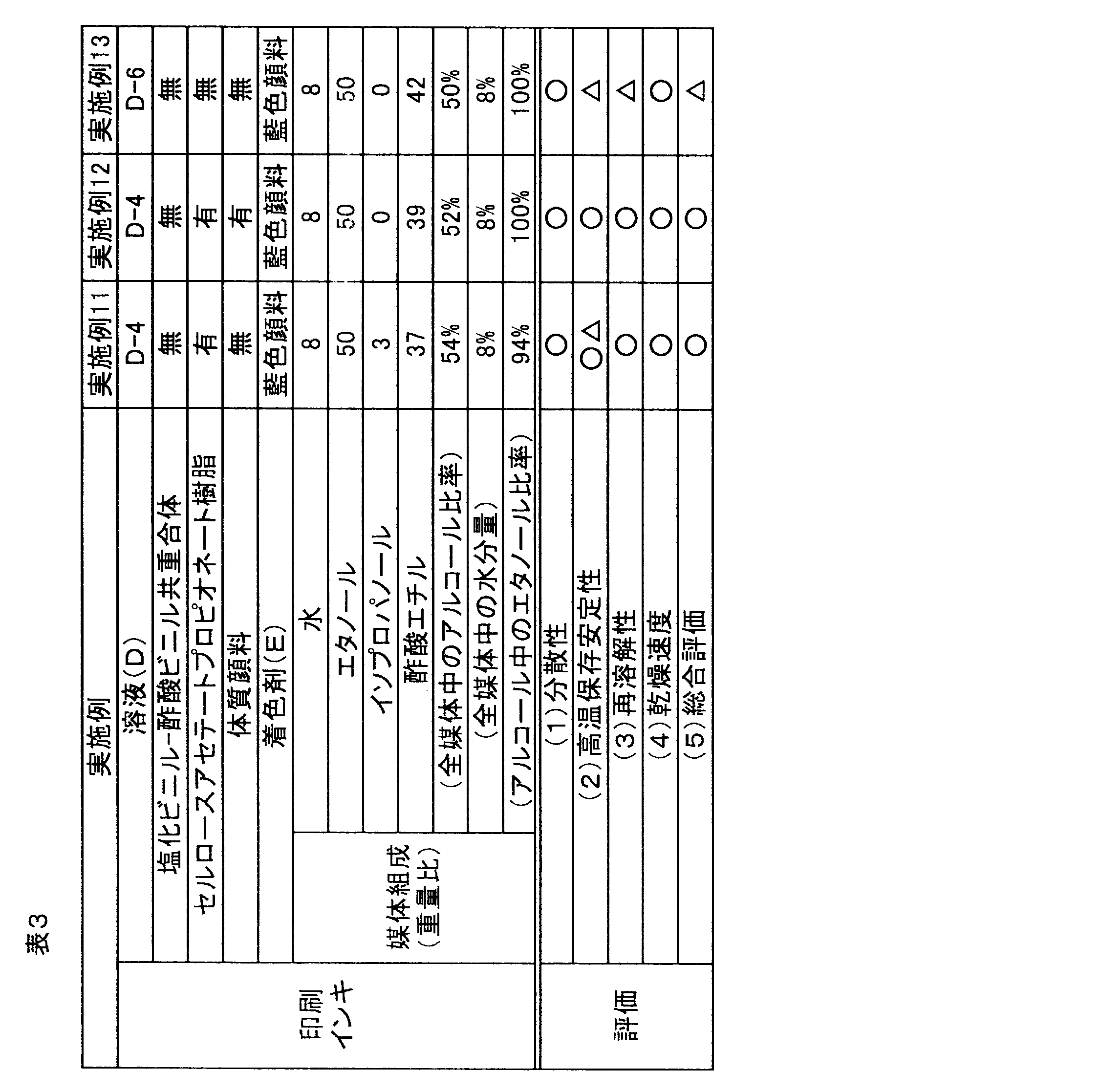
- Table 3 shows the composition of the printing ink composition.
- a solution of the polyurethane urea resin (D-4) obtained in Synthesis Example 4 with respect to 10 parts by weight of the colorant (E), a cellulose acetate propionate resin solution as an antiblocking agent, water, ethanol, and acetic acid Ethyl was mixed so as to be 7.9 parts by weight, 4.7 parts by weight, 5.6 parts by weight, 8.9 parts by weight, and 7.6 parts by weight, respectively.
- This mixture was dispersed using a horizontal sand mill, and then 41.7 parts by weight of a polyurethane urea resin (D-4) solution and 7.5 parts by weight of ethanol were blended to prepare a printing ink precursor.
- CAP-482-0.5 an equivalent mixed solution of 20% non-volatile content and isopropyl alcohol / ethyl acetate manufactured by Eastman Chemical Co., Ltd. was used.
- Example 12 Table 3 shows the composition of the printing ink composition.
- the solution of the polyurethane urea resin (D-4) obtained in Synthesis Example 4 precipitated barium sulfate (extreme pigment), water, and ethanol are each 7. 9 parts by weight, 3.0 parts by weight, 5.6 parts by weight, 8.9 parts by weight, and 7.6 parts by weight were mixed.
- a printing ink precursor was prepared by further blending 43.4 parts by weight of the polyurethane urea resin (D-4) solution and 7.5 parts by weight of ethanol.
- the precipitated barium sulfate a registered trademark “Variace B-30” manufactured by Sakai Chemical Industry Co., Ltd. was used.
- Table 3 shows the composition of the printing ink composition.
- the alcohol-based printing ink composition of the present invention was prepared by diluting 100 parts by weight of the printing ink precursors obtained in Examples 1 to 13 and Comparative Examples 1 to 5 with 50 parts by weight of a dilution medium. In that case, the medium for dilution was mix
- the weight ratio of “medium composition” in Tables 2 and 3 is a weight ratio including the medium contained in the solution (D) and the medium at the time of preparing the ink precursor.
- Viscosity change rate is less than 5%.
- Viscosity change rate is 5% or more and less than 15%.
- ⁇ Slight decrease in density is recognized at the end of printing compared to the start of printing.
- Residual solvent is less than 1.0 mg / m 2 ⁇ : Residual solvent is 1.0 mg / m 2 or more and less than 3.0 mg / m 2 ⁇ : Residual solvent is 3.0 mg / m 2 or more, 5.0 mg / m 2 Less than m 2 (5)
- Comprehensive evaluation Judging from the results of the evaluation items (1) to (4), the following evaluation criteria were used.
- the performance is particularly excellent.
- a printing ink composition that contains alcohol as a main component as a medium, is excellent in dispersibility and storage stability of a colorant, and is excellent in re-solubility during a long run.
Landscapes
- Chemical & Material Sciences (AREA)
- Chemical Kinetics & Catalysis (AREA)
- Life Sciences & Earth Sciences (AREA)
- Engineering & Computer Science (AREA)
- Materials Engineering (AREA)
- Wood Science & Technology (AREA)
- Organic Chemistry (AREA)
- General Chemical & Material Sciences (AREA)
- Inks, Pencil-Leads, Or Crayons (AREA)
Abstract
Description
前記ポリオール(A)は、側鎖を有する飽和ヒドロキシカルボン酸に由来する繰返し単位を有するポリエステルポリオール(A0)を含み、
前記媒体はアルコール(F)を含み、前記媒体の合計100重量%中、前記アルコール(F)の割合が50重量%以上であることを特徴とするアルコール系印刷インキ組成物に関する。
前記ポリウレタンウレア樹脂(D)は、ポリオール(A)、ジイソシアネート(B)、および鎖延長剤(C)を反応させてなり、
前記ポリオール(A)は、側鎖を有する飽和ヒドロキシカルボン酸に由来する繰返し単位を有するポリエステルポリオール(A0)を含み、
前記媒体はアルコール(F)を含み、前記媒体の合計100重量%中、アルコール(F)の割合が50重量%以上である。

前記ポリエステルポリオール(A0)を得るための製造方法は、以下の例には限定されないが、例えば側鎖を有する飽和ヒドロキシカルボン酸を、ジオールまたはジアミンを開始剤としてエステル化する方法や、側鎖を有するラクトンをジオールまたはジアミンを開始剤として開環重合する方法で得られる。
前記ジオールを開始剤として得られるカプロラクトン重合物、バレロラクトン重合物、メチルバレロラクトン重合物、乳酸重合物、ひまし油脂肪酸重合物等の、ポリエステルポリオールなどが挙げられる。
ダイマー酸のカルボキシル基をイソシアネート基に転化したダイマージイソシアネート等が挙げられる。これらのジイソシアネート化合物は単独で、または2種以上を混合して用いることができる。中でも、ポリウレタンウレア樹脂(D)のアルコール溶解性の観点から、イソホロンジイソシアネート等の脂環族イソシアネートが好ましい。
N-(2-ヒドロキシエチル)エチレンジアミン、N-(2-ヒドロキシエチル)プロピレンジアミン、N-(2-ヒドロキシプロピル)エチレンジアミン、N-(2-ヒドロキシプロピル)プロピレンジアミン、N,N´-ビス(2-ヒドロキシエチル)エチレンジアミン、N,N´-ビス(2-ヒドロキシエチル)プロピレンジアミン、N,N´-ビス(2-ヒドロキシプロピル)エチレンジアミン、N,N´-ビス(2-ヒドロキシプロピル)プロピレンジアミン等の分子内に水酸基を有するアミン類、
メチルイミノビスプロピルアミン、ラウリルイミノビスプロピルアミン等の分子内に3級アミノ基を有するアミン類なども用いることができる。
プロピレングリコールモノメチルエーテル、プロピレングリコールモノエチルエーテル、プロピレングリコールモノプロピルエーテル、プロピレングリコールモノイソプロピルエーテル、プロピレングリコールモノブチルエーテル、ジプロピレングリコールモノメチルエーテル、ジプロピレングリコールモノエチルエーテル、ジプロピレングリコールモノプロピルエーテル、ジプロピレングリコールモノブチルエーテル、トリプロピレングリコールモノメチルエーテル、トリプロピレングリコールモノエチルエーテル、トリプロピレングリコールモノプロピルエーテル、トリプロピレングリコールモノブチルエーテル等のグリコールモノエーテル類などが挙げられる。
a:0.1モル/リットル塩酸溶液の使用量(ミリリットル)
f:0.1モル/リットル塩酸溶液の力価
s:ポリウレタンウレア樹脂溶液(g)
w:樹脂固形分濃度(%)
重量平均分子量:前処理としてポリウレタンウレア樹脂の両末端のアミノ基をすべてα,α-ジメチル-3-イソプロペニルベンジルイソシアナートと反応させた後、カラムとしてShodex GPC LF-604(Shodex社製)を用い、RI検出器を装備したGPC(Shodex社製、GPC-104)で展開溶媒にTHFを用いた時のポリスチレン換算分子量を用いた。
攪拌機、温度計、還流冷却器および窒素ガス導入管を備えたフラスコに、水添ひまし油ポリオール(製品名:「URIC PH-100」伊藤製油株式会社製、水酸基価41.6mgKOH/g、数平均分子量2697)18部と、ポリプロピレングリコール(水酸基価57.3mgKOH/g、数平均分子量1958)72部と、1,3-プロパンジオール3.5部と、イソホロンジイソシアネート39.8部とを仕込み、窒素気流下、100℃で6時間反応させウレタンプレポリマーを製造した。
攪拌機、温度計、還流冷却器および窒素ガス導入管を備えたフラスコに、合成例1と同じ水添ひまし油ポリオール(製品名:「URIC PH-100」)28.2部と、ポリプロピレングリコール(水酸基価57.3mgKOH/g、数平均分子量1958)61.4部と、1,3-プロパンジオール3.7部と、イソホロンジイソシアネート39.9部とを仕込み、窒素気流下、100℃で6時間反応させウレタンプレポリマーを製造した。
攪拌機、温度計、還流冷却器および窒素ガス導入管を備えたフラスコに、合成例1と同じ水添ひまし油ポリオール(製品名:「URIC PH-100」)46.7部と、ポリプロピレングリコール(水酸基価57.3mgKOH/g、数平均分子量1958)42.8部と、1,3-プロパンジオール3.8部と、イソホロンジイソシアネート39.5部とを仕込み、窒素気流下、100℃で6時間反応させウレタンプレポリマーを製造した。
攪拌機、温度計、還流冷却器および窒素ガス導入管を備えたフラスコに、合成例1と同じ水添ひまし油ポリオール(製品名:「URIC PH-100」)46.7部と、ポリトリメチレングリコール(製品名:「Cerenol H2000」Dupont社製、水酸基価57.3mgKOH/g、数平均分子量1958)42.8部と、1,3-プロパンジオール3.8部と、イソホロンジイソシアネート39.9部とを仕込み、窒素気流下、100℃で6時間反応させウレタンプレポリマーを製造した。
攪拌機、温度計、還流冷却器および窒素ガス導入管を備えたフラスコに、合成例1と同じ水添ひまし油ポリオール(製品名:「URIC PH-100」)28部と、ひまし油ポリオール(製品名:「URIC HF-2009」伊藤製油株式会社製、水酸基価41.6mgKOH/g、数平均分子量2697)18.6部と、ポリトリメチレングリコール(製品名:「Cerenol H2000」Dupont社製、水酸基価57.3mgKOH/g、数平均分子量1958)42.8部と、1,3-プロパンジオール3.8部と、イソホロンジイソシアネート39.9部とを仕込み、窒素気流下、100℃で6時間反応させウレタンプレポリマーを製造した。
攪拌機、温度計、還流冷却器および窒素ガス導入管を備えたフラスコに、γ-ナノラクトン26.6部と、1,4-ブタンジオール0.93部と、テトラブチルチタネート0.006部とを仕込み、200℃で24時間反応させγ-ナノラクトンの重合体を得た(水酸基価43mgKOH/g、数平均分子量2609)。
合成例2における水添ひまし油ポリオール28.2部を、ひまし油ポリオール(製品名:「URIC HF-2009」伊藤製油株式会社製、水酸基価41.6mgKOH/g、数平均分子量2697)28.2部に変更した以外は、合成例2と同様の操作を行った。得られたポリウレタンウレア樹脂(K-1)の溶液は、樹脂固形分濃度25重量%、粘度120mPa・s(25℃)であり、樹脂固形分のアミン価は6.4mgKOH/樹脂1g、重量平均分子量34,000であった。
合成例3における水添ひまし油ポリオール46.7部を、ひまし油ポリオール(製品名:「URIC HF-2009」伊藤製油株式会社製、水酸基価41.6mgKOH/g、数平均分子量2697)46.7部に変更した以外は、合成例3と同様の操作を行った。得られたポリウレタンウレア樹脂(K-2)の溶液は、樹脂固形分濃度25重量%、粘度110mPa・s(25℃)であり、樹脂固形分のアミン価は6.4mgKOH/樹脂1g、重量平均分子量37,000であった。
攪拌機、温度計、還流冷却器および窒素ガス導入管を備えたフラスコに、アジピン酸と3‐メチル‐1,5‐ペンタンジオールとの重縮合物(水酸基価56.1mgKOH/g、数平均分子量2000)46.6部、ポリプロピレングリコール(水酸基価57.3mgKOH/g、数平均分子量2000)43.4部と、1,3-プロパンジオール3.4部と、イソホロンジイソシアネート39.9部とを仕込み、窒素気流下、100℃で6時間反応させウレタンプレポリマーを製造した。
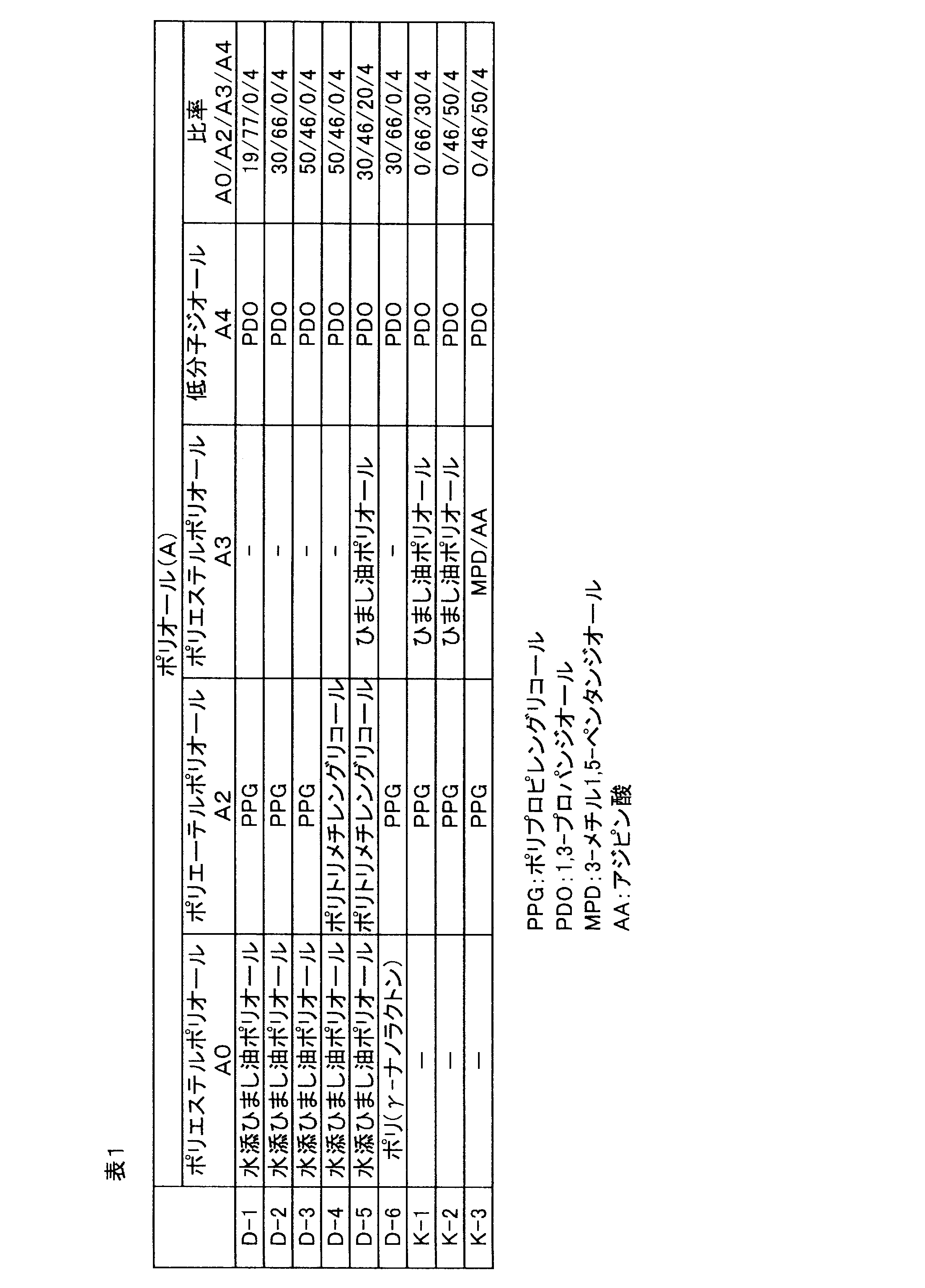
(実施例1~10および比較例1~5)
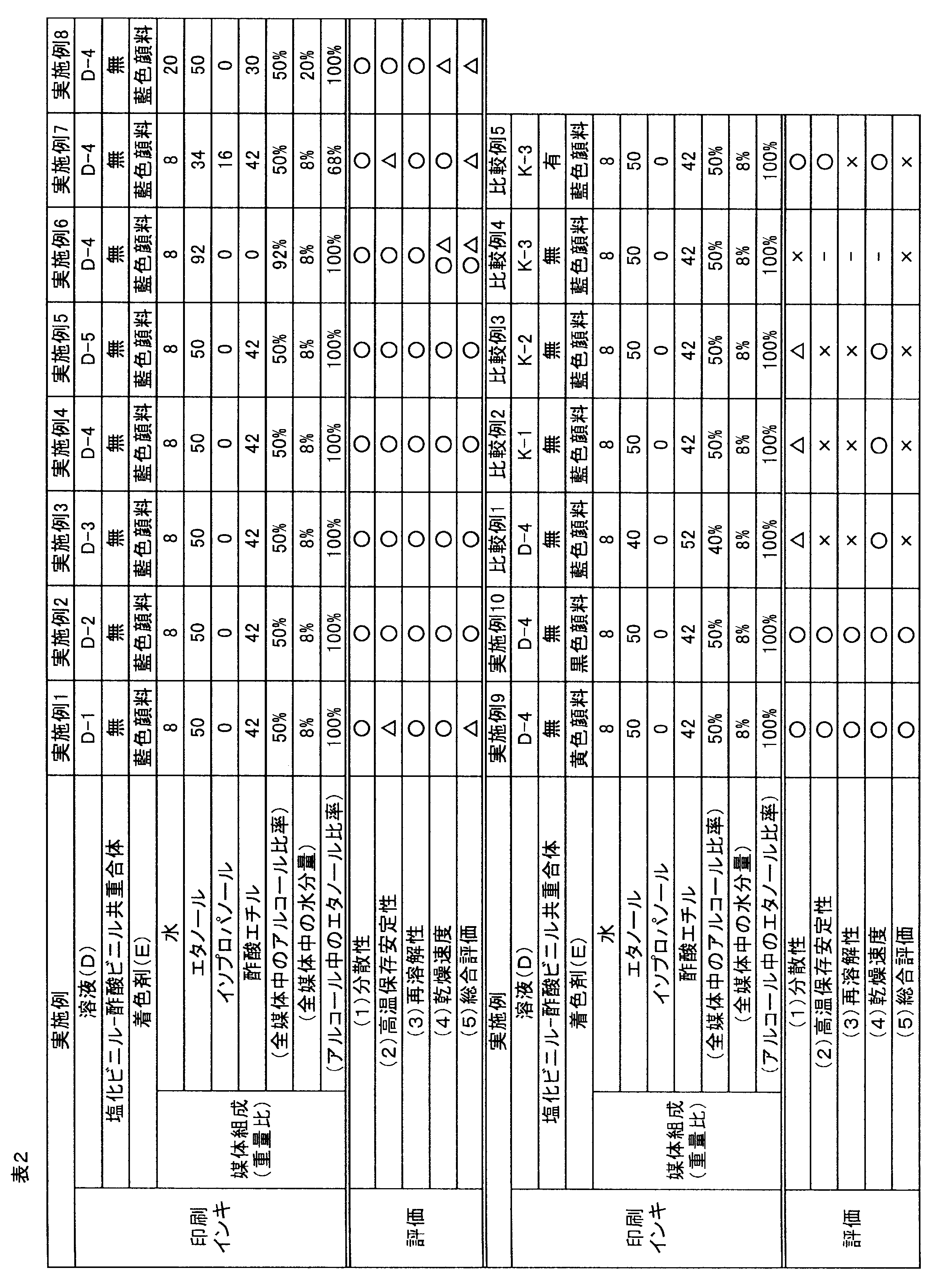
表2に各印刷インキ組成物の組成を示す。
ポリウレタンウレア樹脂(D)として合成例1~5、7~9で得られたポリウレタンウレア樹脂(D-1)~(D-5)、(K-1)~(K-3)の溶液(以下、溶液(D)と言う。)、
分散剤として塩化ビニル-酢酸ビニル共重合体の溶液(日信化学工業株式会社製登録商標「ソルバインA」の酢酸エチル溶液、不揮発分24%)、
媒体として水、エタノール、および酢酸エチルを用意した。
表3に印刷インキ組成物の組成を示す。
表3に印刷インキ組成物の組成を示す。
表3に印刷インキ組成物の組成を示す。
実施例1~13および比較例1~5で得られた印刷インキ前駆体100重量部を、希釈用の媒体50重量部で希釈して本発明のアルコール系印刷インキ組成物を調製した。その際、希釈用の媒体は、印刷インキ組成物の媒体組成が表2または表3の媒体組成(重量部)となるようにそれぞれ配合した。
NBR(ニトリルブタジエンゴム)製のゴム硬度80Hsの圧胴、
刃先の厚みが60μm(母材の厚み40μm、片側セラミック層の厚み10μm)のセラミックメッキドクターブレード、
東洋プリプレス株式会社製のクロム硬度1050Hvの電子彫刻版(スタイラス角度120度、250線/インチ)、
および得られた印刷インキを
富士機械工業株式会社製グラビア印刷機にセットした。
印刷インキ、および得られた印刷物について次のような試験を行った。結果を表2に示す。
調製直後の印刷インキについて、分離および沈殿・凝集物の有無を以下の評価基準で判定した。
印刷インキを40℃で1週間保存し、保存前後の粘度の変化率より以下の評価基準で判定した。粘度の測定は、B型回転粘度計を用い25℃で行った。
印刷開始と印刷終了時の印刷パターンの状態、すなわち印刷物の低版深部(5μm)において画像部に転移したインキの量を以下の評価基準で目視評価した。
前記再溶解性試験と同条件で、グラビア版の版深度が25μmを有するグラビア版で印刷を行い、印刷物に残された溶剤量をガスクロマトグラフを用いて定量し、以下の評価基準で判定した。
○△:残留溶剤が1.0mg/m2以上、3.0mg/m2未満
△:残留溶剤が3.0mg/m2以上、5.0mg/m2未満
(5)総合評価
評価項目(1)~(4)の結果から、以下の評価基準で判定した。
Claims (6)
- ポリオール(A)、ジイソシアネート(B)、および鎖延長剤(C)を反応させてなるポリウレタンウレア樹脂(D)と、着色剤(E)と、媒体とを含むアルコール系印刷インキ組成物であって、
前記ポリオール(A)は、側鎖を有する飽和ヒドロキシカルボン酸に由来する繰返し単位を有するポリエステルポリオール(A0)を含み、
前記媒体はアルコール(F)を含み、前記媒体の合計100重量%中、前記アルコール(F)の割合が50重量%以上であることを特徴とするアルコール系印刷インキ組成物。 - 前記ポリエステルポリオール(A0)が、水添ひまし油ポリオール(A1)であることを特徴とする請求項1記載のアルコール系印刷インキ組成物。
- 前記ポリオール(A)がさらにポリエーテルポリオール(A2)を含むことを特徴とする請求項1または2記載のアルコール系印刷インキ組成物。
- 前記ポリオール(A)の合計100重量%中、前記ポリエステルポリオール(A0)の割合が20~85重量%であることを特徴とする請求項1~3いずれか記載のアルコール系印刷インキ組成物。
- 前記アルコール(F)はエタノールを含み、前記アルコール(F)の合計100重量%中、エタノールの割合が70重量%以上であることを特徴とする請求項1~4いずれか記載のアルコール系印刷インキ組成物。
- 前記媒体は水を含み、前記媒体の合計100重量%中、水の割合が2~20重量%であることを特徴とする請求項1~5いずれか記載のアルコール系印刷インキ組成物。
Priority Applications (5)
| Application Number | Priority Date | Filing Date | Title |
|---|---|---|---|
| CA2877846A CA2877846C (en) | 2012-06-27 | 2013-06-27 | Alcohol-based printing ink composition |
| BR112014032778A BR112014032778A2 (pt) | 2012-06-27 | 2013-06-27 | composição de tinta de impressão à base de álcool |
| CN201380033811.5A CN104411782B (zh) | 2012-06-27 | 2013-06-27 | 醇系印刷油墨组合物 |
| MX2015000047A MX369573B (es) | 2012-06-27 | 2013-06-27 | Composicion de tinta para impresion a base de alcohol. |
| US14/411,337 US10457820B2 (en) | 2012-06-27 | 2013-06-27 | Alcohol-based printing ink composition |
Applications Claiming Priority (2)
| Application Number | Priority Date | Filing Date | Title |
|---|---|---|---|
| JP2012-143658 | 2012-06-27 | ||
| JP2012143658A JP5273280B1 (ja) | 2012-06-27 | 2012-06-27 | アルコール系印刷インキ組成物 |
Publications (1)
| Publication Number | Publication Date |
|---|---|
| WO2014003102A1 true WO2014003102A1 (ja) | 2014-01-03 |
Family
ID=49179206
Family Applications (1)
| Application Number | Title | Priority Date | Filing Date |
|---|---|---|---|
| PCT/JP2013/067616 Ceased WO2014003102A1 (ja) | 2012-06-27 | 2013-06-27 | アルコール系印刷インキ組成物 |
Country Status (7)
| Country | Link |
|---|---|
| US (1) | US10457820B2 (ja) |
| JP (1) | JP5273280B1 (ja) |
| CN (1) | CN104411782B (ja) |
| BR (1) | BR112014032778A2 (ja) |
| CA (1) | CA2877846C (ja) |
| MX (1) | MX369573B (ja) |
| WO (1) | WO2014003102A1 (ja) |
Cited By (2)
| Publication number | Priority date | Publication date | Assignee | Title |
|---|---|---|---|---|
| JP2023058118A (ja) * | 2021-10-13 | 2023-04-25 | 東洋インキScホールディングス株式会社 | 水性フレキソインキおよびその利用 |
| JP7368674B1 (ja) | 2022-11-16 | 2023-10-25 | 東洋インキScホールディングス株式会社 | 凸版印刷用インキ組成物、及び基材の被覆方法並びに印刷塗装物 |
Families Citing this family (14)
| Publication number | Priority date | Publication date | Assignee | Title |
|---|---|---|---|---|
| JP6424717B2 (ja) * | 2015-04-03 | 2018-11-21 | 東洋インキScホールディングス株式会社 | アルコール系インキ組成物およびそれを用いた印刷物、積層体 |
| US20180362782A1 (en) * | 2015-12-11 | 2018-12-20 | Sakata Inx Corp. | Organic-solvent-based-high-solid ink composition for gravure printing, and gravure printing method |
| JP6090522B1 (ja) * | 2016-03-29 | 2017-03-08 | 東洋インキScホールディングス株式会社 | 積層体とその製造方法 |
| US10800935B2 (en) * | 2016-05-23 | 2020-10-13 | Sun Chemical Corporation | Non-sparking metallic inks and articles printed with me |
| JP6090521B1 (ja) * | 2016-07-27 | 2017-03-08 | 東洋インキScホールディングス株式会社 | 溶剤型ラミネート用グラビアインキ、印刷物、および積層体 |
| EP3556818A4 (en) * | 2016-12-15 | 2020-08-19 | Sakata INX Corporation | COMPOSITION OF PRINTING INK FOR SOFT PACKAGING LAMINATE |
| KR101779572B1 (ko) | 2016-12-20 | 2017-09-19 | 주식회사 삼성잉크 | 알코올 용해성 우레탄 수지를 포함하는 그라비어 인쇄용 잉크 조성물 |
| US11591482B2 (en) | 2017-07-20 | 2023-02-28 | Sun Chemical Corporation | High speed water-based inks containing alcohol tolerant latexes |
| EP3784741B1 (en) * | 2018-04-24 | 2024-11-06 | Eastman Chemical (China) Co., Ltd. | Alcohol soluble printing ink compositions |
| JP7252062B2 (ja) * | 2019-05-31 | 2023-04-04 | サカタインクス株式会社 | ラミネート用黒色グラビア印刷インキ組成物 |
| JP7204216B2 (ja) * | 2020-03-30 | 2023-01-16 | 大成ファインケミカル株式会社 | バイオマス(メタ)アクリル共重合体、それを含むコーティング剤及びインク組成物、並びにこれらの製造方法 |
| CN114057980B (zh) * | 2020-07-30 | 2023-07-14 | 万华化学(北京)有限公司 | 一种可自分散酯溶聚氨酯油墨树脂、制备方法及油墨 |
| CN119968347A (zh) * | 2022-09-07 | 2025-05-09 | 花王株式会社 | 用于外掺料添加剂的稳定的基于胺的消泡剂 |
| CN120842900B (zh) * | 2025-09-19 | 2025-12-23 | 上海紫华薄膜科技有限公司 | 一种高烘干效率的环保水性油墨溶剂及其制备方法 |
Citations (4)
| Publication number | Priority date | Publication date | Assignee | Title |
|---|---|---|---|---|
| JPH06100817A (ja) * | 1992-09-21 | 1994-04-12 | Arakawa Chem Ind Co Ltd | フレキソ印刷インキ用バインダー |
| JPH09328646A (ja) * | 1996-04-08 | 1997-12-22 | Toyo Ink Mfg Co Ltd | 印刷インキ組成物 |
| JP2002293860A (ja) * | 2001-03-29 | 2002-10-09 | Dainippon Ink & Chem Inc | アルコール可溶性ウレタン樹脂の製造方法 |
| JP2010144075A (ja) * | 2008-12-19 | 2010-07-01 | Dic Corp | 印刷インキ、印刷システム及び該印刷インキの製造方法 |
Family Cites Families (19)
| Publication number | Priority date | Publication date | Assignee | Title |
|---|---|---|---|---|
| JPS4928255B1 (ja) * | 1969-04-30 | 1974-07-25 | ||
| JPH06100817B2 (ja) | 1987-03-28 | 1994-12-12 | 大日本印刷株式会社 | 無地網用フイルム原版作成方法 |
| JPH08311384A (ja) * | 1995-05-22 | 1996-11-26 | Dainippon Ink & Chem Inc | 孔版インキ用ポリマー微粒子 |
| JP3861948B2 (ja) * | 1997-06-09 | 2006-12-27 | 荒川化学工業株式会社 | 印刷インキ用樹脂 |
| JP3779487B2 (ja) * | 1999-04-07 | 2006-05-31 | 大日精化工業株式会社 | 印刷インキ用ビヒクル |
| US6406143B1 (en) | 2000-04-26 | 2002-06-18 | Eastman Kodak Company | Ink jet printing method |
| JP2002121250A (ja) | 2000-10-18 | 2002-04-23 | Dainippon Ink & Chem Inc | アルコール可溶性ウレタン樹脂の製造方法および印刷インキ |
| US20090246484A1 (en) * | 2005-09-30 | 2009-10-01 | Dainippon Ink And Chemicals, Inc. | Ink for jet printer |
| JP2007254556A (ja) * | 2006-03-22 | 2007-10-04 | Toyo Ink Mfg Co Ltd | 顔料組成物および顔料分散体 |
| DE102006062441A1 (de) | 2006-12-27 | 2008-07-03 | Byk-Chemie Gmbh | Modifizierte Kammcopolymere |
| US20100255317A1 (en) * | 2007-11-01 | 2010-10-07 | Kuraray Co., Ltd. | Polyurethane composition |
| JP5429680B2 (ja) | 2007-11-02 | 2014-02-26 | 日本ポリウレタン工業株式会社 | 反応硬化型ポリウレタン樹脂組成物、及び該組成物を用いた二液反応硬化型ポリウレタン接着剤 |
| JP2009173862A (ja) * | 2007-12-27 | 2009-08-06 | Toyo Ink Mfg Co Ltd | 印刷インキ用樹脂組成物 |
| JP2010053194A (ja) | 2008-08-27 | 2010-03-11 | Toyo Ink Mfg Co Ltd | 印刷インキバインダーおよび該バインダーを用いた印刷インキ組成物ならびに該印刷インキを用いた被覆物 |
| US7969923B2 (en) | 2008-11-14 | 2011-06-28 | Dbsd Satellite Services G.P. | Asymmetric TDD in flexible use spectrum |
| US8110031B2 (en) | 2009-03-12 | 2012-02-07 | Videojet Technologies Inc. | Ethanol-based ink composition |
| JP2010241924A (ja) | 2009-04-03 | 2010-10-28 | Dic Corp | グラビアインキ、印刷システム及び該インキの製造方法 |
| JPWO2012008339A1 (ja) | 2010-07-15 | 2013-09-09 | Dicグラフィックス株式会社 | 印刷インキ |
| CN103282449B (zh) | 2010-12-27 | 2015-03-04 | 东洋油墨Sc控股株式会社 | 醇系印刷油墨组合物 |
-
2012
- 2012-06-27 JP JP2012143658A patent/JP5273280B1/ja not_active Expired - Fee Related
-
2013
- 2013-06-27 CN CN201380033811.5A patent/CN104411782B/zh not_active Expired - Fee Related
- 2013-06-27 WO PCT/JP2013/067616 patent/WO2014003102A1/ja not_active Ceased
- 2013-06-27 CA CA2877846A patent/CA2877846C/en not_active Expired - Fee Related
- 2013-06-27 MX MX2015000047A patent/MX369573B/es active IP Right Grant
- 2013-06-27 BR BR112014032778A patent/BR112014032778A2/pt not_active Application Discontinuation
- 2013-06-27 US US14/411,337 patent/US10457820B2/en not_active Expired - Fee Related
Patent Citations (4)
| Publication number | Priority date | Publication date | Assignee | Title |
|---|---|---|---|---|
| JPH06100817A (ja) * | 1992-09-21 | 1994-04-12 | Arakawa Chem Ind Co Ltd | フレキソ印刷インキ用バインダー |
| JPH09328646A (ja) * | 1996-04-08 | 1997-12-22 | Toyo Ink Mfg Co Ltd | 印刷インキ組成物 |
| JP2002293860A (ja) * | 2001-03-29 | 2002-10-09 | Dainippon Ink & Chem Inc | アルコール可溶性ウレタン樹脂の製造方法 |
| JP2010144075A (ja) * | 2008-12-19 | 2010-07-01 | Dic Corp | 印刷インキ、印刷システム及び該印刷インキの製造方法 |
Cited By (4)
| Publication number | Priority date | Publication date | Assignee | Title |
|---|---|---|---|---|
| JP2023058118A (ja) * | 2021-10-13 | 2023-04-25 | 東洋インキScホールディングス株式会社 | 水性フレキソインキおよびその利用 |
| JP7368674B1 (ja) | 2022-11-16 | 2023-10-25 | 東洋インキScホールディングス株式会社 | 凸版印刷用インキ組成物、及び基材の被覆方法並びに印刷塗装物 |
| WO2024106065A1 (ja) * | 2022-11-16 | 2024-05-23 | 東洋インキScホールディングス株式会社 | 凸版印刷用インキ組成物、基材の被覆方法、印刷塗装物 |
| JP2024072454A (ja) * | 2022-11-16 | 2024-05-28 | artience株式会社 | 凸版印刷用インキ組成物、及び基材の被覆方法並びに印刷塗装物 |
Also Published As
| Publication number | Publication date |
|---|---|
| JP5273280B1 (ja) | 2013-08-28 |
| US10457820B2 (en) | 2019-10-29 |
| MX369573B (es) | 2019-11-13 |
| JP2014005414A (ja) | 2014-01-16 |
| MX2015000047A (es) | 2015-06-04 |
| CN104411782A (zh) | 2015-03-11 |
| BR112014032778A2 (pt) | 2017-06-27 |
| CA2877846C (en) | 2017-03-07 |
| US20150197649A1 (en) | 2015-07-16 |
| CN104411782B (zh) | 2016-08-24 |
| CA2877846A1 (en) | 2014-01-03 |
Similar Documents
| Publication | Publication Date | Title |
|---|---|---|
| JP5273280B1 (ja) | アルコール系印刷インキ組成物 | |
| JP5108992B2 (ja) | アルコール系印刷インキ組成物 | |
| CN104919013B (zh) | 印刷油墨用清漆及使用该清漆的印刷油墨组合物 | |
| JP2020196855A (ja) | 脱離能を有する有機溶剤系印刷インキ、印刷物および積層体 | |
| CN109476938B (zh) | 用于叠层体的凹印油墨、印刷品和叠层产品 | |
| JP5824726B2 (ja) | 印刷インキバインダー樹脂およびそれを用いたラミネートインキ | |
| JP6996418B2 (ja) | 水性フレキソインキ、および印刷物の製造方法 | |
| JP5493798B2 (ja) | 溶剤型グラビアインキ | |
| JP6424717B2 (ja) | アルコール系インキ組成物およびそれを用いた印刷物、積層体 | |
| JP5949212B2 (ja) | アルコール系印刷インキ組成物 | |
| JP2018016708A (ja) | 溶剤型ラミネート用グラビアインキ、印刷物、および積層体 | |
| JP6380775B1 (ja) | 輪転印刷インキ及びその利用 | |
| JP5130553B1 (ja) | 印刷インキバインダー用ポリウレタン樹脂組成物 | |
| CN109476941B (zh) | 用于叠层体的溶剂型凹印油墨、印刷品和叠层产品 | |
| JP2009073936A (ja) | 印刷インキ組成物 | |
| JP2010053194A (ja) | 印刷インキバインダーおよび該バインダーを用いた印刷インキ組成物ならびに該印刷インキを用いた被覆物 | |
| JP5577951B2 (ja) | 溶剤型グラビアインキ | |
| JP2021031572A (ja) | 水性グラビアまたはフレキソインキ | |
| JP6969349B2 (ja) | 印刷インキ組成物 | |
| JP5906732B2 (ja) | アルコール溶剤系ウレタンウレア樹脂の製造方法および印刷インキ組成物 | |
| JP2003221539A (ja) | 印刷インキ用バインダー | |
| JP2021169547A (ja) | 水性グラビアまたはフレキソインキ、およびその利用 |
Legal Events
| Date | Code | Title | Description |
|---|---|---|---|
| 121 | Ep: the epo has been informed by wipo that ep was designated in this application |
Ref document number: 13810385 Country of ref document: EP Kind code of ref document: A1 |
|
| ENP | Entry into the national phase |
Ref document number: 2877846 Country of ref document: CA |
|
| WWE | Wipo information: entry into national phase |
Ref document number: 14411337 Country of ref document: US |
|
| NENP | Non-entry into the national phase |
Ref country code: DE |
|
| WWE | Wipo information: entry into national phase |
Ref document number: MX/A/2015/000047 Country of ref document: MX |
|
| REG | Reference to national code |
Ref country code: BR Ref legal event code: B01A Ref document number: 112014032778 Country of ref document: BR |
|
| 122 | Ep: pct application non-entry in european phase |
Ref document number: 13810385 Country of ref document: EP Kind code of ref document: A1 |
|
| ENP | Entry into the national phase |
Ref document number: 112014032778 Country of ref document: BR Kind code of ref document: A2 Effective date: 20141229 |