WO2014002292A1 - 色素、それを用いたマイクロカプセル顔料及び筆記具用インク組成物 - Google Patents
色素、それを用いたマイクロカプセル顔料及び筆記具用インク組成物 Download PDFInfo
- Publication number
- WO2014002292A1 WO2014002292A1 PCT/JP2012/069579 JP2012069579W WO2014002292A1 WO 2014002292 A1 WO2014002292 A1 WO 2014002292A1 JP 2012069579 W JP2012069579 W JP 2012069579W WO 2014002292 A1 WO2014002292 A1 WO 2014002292A1
- Authority
- WO
- WIPO (PCT)
- Prior art keywords
- dye
- microcapsule pigment
- methyl
- ink composition
- bisphenol
- Prior art date
- Legal status (The legal status is an assumption and is not a legal conclusion. Google has not performed a legal analysis and makes no representation as to the accuracy of the status listed.)
- Ceased
Links
Classifications
-
- C—CHEMISTRY; METALLURGY
- C09—DYES; PAINTS; POLISHES; NATURAL RESINS; ADHESIVES; COMPOSITIONS NOT OTHERWISE PROVIDED FOR; APPLICATIONS OF MATERIALS NOT OTHERWISE PROVIDED FOR
- C09D—COATING COMPOSITIONS, e.g. PAINTS, VARNISHES OR LACQUERS; FILLING PASTES; CHEMICAL PAINT OR INK REMOVERS; INKS; CORRECTING FLUIDS; WOODSTAINS; PASTES OR SOLIDS FOR COLOURING OR PRINTING; USE OF MATERIALS THEREFOR
- C09D11/00—Inks
- C09D11/16—Writing inks
- C09D11/18—Writing inks specially adapted for ball-point writing instruments
-
- C—CHEMISTRY; METALLURGY
- C09—DYES; PAINTS; POLISHES; NATURAL RESINS; ADHESIVES; COMPOSITIONS NOT OTHERWISE PROVIDED FOR; APPLICATIONS OF MATERIALS NOT OTHERWISE PROVIDED FOR
- C09B—ORGANIC DYES OR CLOSELY-RELATED COMPOUNDS FOR PRODUCING DYES, e.g. PIGMENTS; MORDANTS; LAKES
- C09B11/00—Diaryl- or thriarylmethane dyes
- C09B11/04—Diaryl- or thriarylmethane dyes derived from triarylmethanes, i.e. central C-atom is substituted by amino, cyano, alkyl
- C09B11/10—Amino derivatives of triarylmethanes
- C09B11/12—Amino derivatives of triarylmethanes without any OH group bound to an aryl nucleus
-
- C—CHEMISTRY; METALLURGY
- C09—DYES; PAINTS; POLISHES; NATURAL RESINS; ADHESIVES; COMPOSITIONS NOT OTHERWISE PROVIDED FOR; APPLICATIONS OF MATERIALS NOT OTHERWISE PROVIDED FOR
- C09B—ORGANIC DYES OR CLOSELY-RELATED COMPOUNDS FOR PRODUCING DYES, e.g. PIGMENTS; MORDANTS; LAKES
- C09B67/00—Influencing the physical, e.g. the dyeing or printing properties of dyestuffs without chemical reactions, e.g. by treating with solvents grinding or grinding assistants, coating of pigments or dyes; Process features in the making of dyestuff preparations; Dyestuff preparations of a special physical nature, e.g. tablets, films
- C09B67/0097—Dye preparations of special physical nature; Tablets, films, extrusion, microcapsules, sheets, pads, bags with dyes
-
- C—CHEMISTRY; METALLURGY
- C09—DYES; PAINTS; POLISHES; NATURAL RESINS; ADHESIVES; COMPOSITIONS NOT OTHERWISE PROVIDED FOR; APPLICATIONS OF MATERIALS NOT OTHERWISE PROVIDED FOR
- C09D—COATING COMPOSITIONS, e.g. PAINTS, VARNISHES OR LACQUERS; FILLING PASTES; CHEMICAL PAINT OR INK REMOVERS; INKS; CORRECTING FLUIDS; WOODSTAINS; PASTES OR SOLIDS FOR COLOURING OR PRINTING; USE OF MATERIALS THEREFOR
- C09D11/00—Inks
- C09D11/16—Writing inks
- C09D11/17—Writing inks characterised by colouring agents
-
- C—CHEMISTRY; METALLURGY
- C09—DYES; PAINTS; POLISHES; NATURAL RESINS; ADHESIVES; COMPOSITIONS NOT OTHERWISE PROVIDED FOR; APPLICATIONS OF MATERIALS NOT OTHERWISE PROVIDED FOR
- C09D—COATING COMPOSITIONS, e.g. PAINTS, VARNISHES OR LACQUERS; FILLING PASTES; CHEMICAL PAINT OR INK REMOVERS; INKS; CORRECTING FLUIDS; WOODSTAINS; PASTES OR SOLIDS FOR COLOURING OR PRINTING; USE OF MATERIALS THEREFOR
- C09D11/00—Inks
- C09D11/50—Sympathetic, colour changing or similar inks
Definitions
- the present invention relates to a dye, a microcapsule pigment using the same, and an ink composition for a writing instrument, and more specifically, a dye comprising a leuco dye excellent in color density and light resistance, utilizing a color development mechanism and a decoloring mechanism of this dye
- the present invention relates to a thermochromic microcapsule pigment and an ink composition for a writing instrument containing the microcapsule face.
- an ink composition for a writing instrument using a thermochromic coloring agent that utilizes a color development or decoloring mechanism of a leuco pigment usually uses a pigment in which the above-described pigment is microencapsulated.
- thermochromic microcapsule pigment see, for example, Patent Document 1 in which a reaction medium to be generated is encapsulated in microcapsules is known, and a paragraph [0005] of the document 1 describes a specific dye (compound). A number of fluorans are mentioned.
- the present invention intends to solve the problem, and a dye comprising a leuco dye excellent in color density and light resistance, utilizing the color development and decoloring mechanism of this dye It is an object of the present invention to provide a thermochromic microcapsule pigment excellent in coloration / decoloring property and an ink composition for a writing instrument containing the microcapsule pigment.
- [X and Y in the above-mentioned formula (I) represent a hydrogen atom, an alkyl group having 1 to 4 carbon atoms, or a halogen atom, and they may be the same as or different from each other. However, the case where both X and Y are hydrogen atoms is excluded. And Z represents an ethyl group or a butyl group.
- a microcapsule pigment comprising at least the pigment of the above (1) or (2), a developer and a color change temperature control agent.
- An ink composition for a writing instrument comprising the microcapsule pigment according to (3) above.
- a dye comprising a leuco dye excellent in color density and light resistance, a developed color of this dye, a thermochromic microcapsule pigment excellent in color development / decoloring property utilizing the decoloring mechanism, and this
- An ink composition for a writing instrument containing a microcapsule pigment is provided.
- the dye of the present invention is characterized by comprising a leuco dye represented by the following formula (I).
- X and Y in the above-mentioned formula (I) represent a hydrogen atom, an alkyl group having 1 to 4 carbon atoms, or a halogen atom, and they may be the same as or different from each other. However, the case where both X and Y are hydrogen atoms is excluded.
- Z represents an ethyl group or a butyl group.
- the dye represented by the above-mentioned formula (I) used in the present invention is a black leuco dye which is excellent in color density and light resistance, and is a dye having a high density and a black color tone.
- the black leuco dye fluoran compounds exemplified in Patent Document 1 are known, but in the present invention, by using the dye represented by the above formula (I), the color density and the light resistance are further excellent. , The concentration is high black.
- X and Y each have a carbon number of 1 to 2 consisting of methyl, ethyl, n-propyl, isopropyl, n-butyl, sec-butyl, isobutyl, tert-butyl and the like And an alkyl group of 4 or a fluorine atom (-F), a chlorine atom (-Cl), a bromine atom (-Br), an iodine atom (-I) and the like.
- X and Y each represents a hydrogen atom, or a methyl group, an ethyl group, an n-propyl group, an isopropyl group, an n-butyl group, a sec-butyl group, an isobutyl group, a tert-butyl group, etc.
- Z represents an ethyl group or a butyl group.
- leuco dyes represented by the above formula (I) include, for example, 6-methyl-2′-anilino-3′-methyl-6′-N, N-diethylaminofluoran, 7-methyl-2′- Anilino-3'-methyl-6'-N, N-diethylaminofluoran, 6-ethyl-2'-anilino-3'-methyl-6'-N, N-diethylaminofluoran, 7-ethyl-2'- Anilino-3'-methyl-6'-N, N-diethylaminofluoran, 6-chloro-2'-anilino-3'-methyl-6'-N, N-diethylaminofluoran, 7-chloro-2'- Anilino-3'-methyl-6'-N, N-diethylaminofluoran, 6-fluoro-2'-anilino-3'-methyl-6'-N, N-diethylaminofluoran, 7-fluoro-2'-anilin
- Z is an ethyl group or a butyl group from the viewpoint of color density, light resistance, manufacturability, etc. and at least one of X and Y is a methyl group (-CH 3 ) or a chlorine atom (-Cl) What is is preferable.
- X and Y are halogen atoms, particularly chlorine atom (-Cl).
- each leuco dye represented by the above formula (I) is carried out by heating and reacting a triarylamine derivative obtained by a commercially available or general synthetic means with a phthalic anhydride derivative in the presence of an acid catalyst.
- a leuco dye excellent in color density and light resistance represented by the above formula (I) can be easily obtained.
- the microcapsule pigment of the present invention is one in which a thermochromic composition comprising at least a dye represented by the above formula (I), a developer and a color change temperature regulator is contained.
- the developer to be used is a component having the ability to cause the dye represented by the above formula (I) to develop color.
- the developer to be used conventionally known ones can be used, and examples thereof include inorganic acids, aromatic carboxylic acids and their anhydrides or metal salts, organic sulfonic acids, other organic acids and phenolic compounds, etc. .
- it is a bisphenol derivative, and what is shown by the compound of the following formula (II) is mentioned.
- R 1 represents a hydrogen atom or an alkyl group having 1 to 2 carbon atoms
- R 2 represents a linear or branched alkyl group having 4 to 10 carbon atoms.
- sulfonylurea compounds can also be preferably used.
- the compound of the formula (II) include 4,4 ′-(2-ethylhexylidene) bisphenol, 4,4 ′-(2-ethylpentylidene) bisphenol, 4,4′-octic Phenylidene bisphenol, 4,4'-hexylidene bisphenol, 4,4 '-(4-methyloctylidene) bisphenol, 4,4'-decylidene bisphenol, 4,4'-(1,3-dimethylbutylidene) Bisphenol, 4,4 '-(3-methylbutylidene) bisphenol, 4,4'-(1-methylheptylidene) bisphenol, 4,4 '-(1,2-dimethylbutylidene) bisphenol, 4,4 -(1,5-Dimethylhexylidene) bisphenol, 4,4 '-(1-ethyl-3-methyl pentylidene) bisphenol, 4,4'-(1-methyl-4-) Methylh
- one or more of these developers may be used in combination, or a conventionally known developer may be used in combination as long as the properties of the developer of the present invention are not impaired.
- the color density at the time of color development can be freely adjusted. Therefore, the amount thereof used may be optionally selected according to the desired color density, and is not particularly limited, but usually 1 part by mass of the dye represented by the above-mentioned formula (I) It is preferable to select in the range of about 0.1 to 100 parts by mass.
- the color change temperature control agent used in the present invention is a substance that controls the color change temperature in the coloration of the dye represented by the formula (I) and the color developer.
- the discoloration temperature regulator which can be used, those known in the prior art can be used. Specifically, alcohols, esters, ketones, ethers, acid amides, azomethines, fatty acids, hydrocarbons and the like can be mentioned.
- ester compound composed of a compound having a hydroxyl group in the chemical structure and a saturated fatty acid having 8 to 22 carbon atoms, and is composed of, for example, a bisphenol derivative and a saturated fatty acid having 8 to 22 carbon atoms It is an ester compound, and what is shown by following formula (III) is mentioned.
- R 3 and R 4 each represent a linear or branched alkyl group having 7 to 21 carbon atoms
- R 5 and R 6 each represent a hydrogen atom, an alkyl group having 1 to 2 carbon atoms, or CF 3 .
- the compound of the formula (III) include 4,4 ′-(hexafluoroisopropylidene) bisphenol dicaprate, 4,4 ′-(hexafluoroisopropylidene) bisphenol dilaurate, 4,4′- Hexafluoroisopropylidene) bisphenol dimyristate, 4,4 ′-(hexafluoroisopropylidene) bisphenol dipalmiate, 4,4 ′-(hexafluoroisopropylidene) bisphenol diundecanoate, 4,4 ′-(hexa) Fluoroisopropylidene) bisphenol ditridecanoate, 4,4 ′-(isopropylidene) bisphenol dicaprate, 4,4 ′-(isopropylidene) bisphenol dilaurate, 4,4 ′-(isopropylidene) bisphenol dimyristate, 4 , -(Isopropylidene) bisphenol dip
- the use amount of the color change temperature regulator may be appropriately selected according to the desired hysteresis width, color density at the time of color development, etc., and is not particularly limited. It is preferable to use in the range of about 1 to 1000 parts by mass. In addition, if it is in the range which does not impair the various characteristics of the composition of this invention, it can also be used combining a conventionally well-known discoloration temperature control agent.
- the microcapsule pigment used in the present invention is preferably a thermochromic composition comprising at least a dye represented by the above formula (I), a developer, and a color change temperature regulator, and preferably has an average particle diameter of 0.3 to 1. It can be manufactured by microencapsulation so as to be 0 ⁇ m.
- the microencapsulation method for example, interfacial polymerization method, interfacial polycondensation method, in situ polymerization method, in-liquid curing coating method, phase separation method from aqueous solution, phase separation method from organic solvent, melt dispersion cooling method, air
- the medium suspension coating method, the spray lining method, etc. can be mentioned, and it can select suitably according to a use.
- thermochromic microcapsule pigment can be produced by filtering this dispersion.
- the content of the dye, the developer and the color-change temperature regulator varies depending on the dye represented by the above formula (I) used, the color-developer, the type of the color-change temperature regulator, the microcapsulation method, etc.
- the ratio by weight of the color developer is 0.1 to 100
- the color change temperature adjuster is 1 to 100 with respect to 1.
- the capsule membrane agent is 0.1 to 1 by mass ratio to the capsule contents.
- the color developer and the color change temperature control agent by suitably combining the kind, the amount, and the like of the dye represented by the above formula (I), the color developer and the color change temperature control agent, the black coloration temperature and the decolorization temperature are suitable temperatures. It can be set to
- the wall film is preferably formed of a urethane resin, an epoxy resin, or an amino resin, from the viewpoint of further improving the drawing density, storage stability, and writability.
- a urethane resin the compound of an isocyanate and a polyol is mentioned, for example.
- an epoxy resin the compound of an epoxy resin and an amine is mentioned, for example.
- the amino resin is preferably made of, for example, melamine resin, urea resin, benzoguanamine resin or the like, and more preferably melamine resin from the viewpoint of manufacturability, storage stability and writability.
- the thickness of the wall film of the microcapsule pigment is appropriately determined in accordance with the required strength of the wall film and the line density.
- suitable amino resin raw materials melamine resin, urea resin, benzoguanamine resin, etc.
- dispersants, protective colloids, etc. are used when using each microencapsulation method. select.
- the average particle size of the microcapsule pigment used in the present invention is preferably 0.3 to 1 from the viewpoints of colorability, color developability, easy decoloring ability, stability, and adverse effect on writing performance. .0 ⁇ m is desirable.
- the "average particle diameter" defined in the present invention is a value obtained by measuring the average particle diameter with a particle size distribution measuring apparatus [particle size measuring device N4 Plus (manufactured by COULTER)]. When the average particle size is less than 0.3 ⁇ m, sufficient drawing density can not be obtained. On the other hand, when it exceeds 1.0 ⁇ m, deterioration of writability and decrease in dispersion stability of the microcapsule pigment occur, which is preferable. Absent.
- microcapsule pigment used as the range (0.3-1.0 micrometer) of the said average particle diameter is fluctuate
- the microcapsule pigment of the present invention configured as described above is excellent in color density and light resistance, is easy to decolorize and is stable, and can be suitably used as a thermochromic pigment for a writing instrument, which will be described later.
- a thermochromic pigment for a writing instrument which will be described later.
- the solvent type is used as a pigment of an aqueous or oil-based ink composition for a writing instrument, the above effect can be exhibited without being affected by the solvent type and the like.
- the ink composition for writing instruments of the present invention is characterized by containing the microcapsule pigment of the above constitution, and is used as an ink composition for aqueous or oil based ballpoint pens, marking pens, etc. Can.
- the content of the microcapsule pigment of the present invention is preferably 5 to 30% by mass (hereinafter simply referred to as "%"), more preferably 10 to 25%, based on the total amount of each aqueous or oily ink composition. It is desirable to When the content of the microcapsule pigment is less than 5%, coloring power and color developability become insufficient. On the other hand, when it is more than 30%, it is not preferable because it tends to cause blur.
- the remaining portion is water as a solvent (tap water, purified water, distilled water, ion-exchanged water, pure water, etc.)
- a water-soluble organic solvent a thickener, a lubricant, an antirust agent, an antiseptic agent or an antifungal agent, etc. may be suitably used within the range not impairing the effects of the present invention. It can be contained.
- glycols such as ethylene glycol, diethylene glycol, triethylene glycol, propylene glycol, polyethylene glycol, 3-butylene glycol, thiodiethylene glycol and glycerin, ethylene glycol monomethyl ether, diethylene glycol monomethyl Ethers can be used alone or in combination.
- a thickener which can be used, for example, at least one selected from the group consisting of synthetic polymers, cellulose and polysaccharides is desirable.
- fatty acid esters of polyhydric alcohols which are also used as surface treatment agents for pigments, higher fatty acid esters of sugars, polyoxyalkylene higher fatty acid esters, nonionics such as alkyl phosphate esters, and alkyl sulfonic acids of higher fatty acid amides
- nonionics such as alkyl phosphate esters
- Examples thereof include salts, anions such as alkyl allyl sulfonates, derivatives of polyalkylene glycols, fluoro surfactants, and polyether-modified silicones.
- Antirust agents include benzotriazole, tolyltriazole, dicyclohexylammonium nitrite, saponins, etc.
- Antiseptic agents or fungicides include phenol, sodium omazine, sodium benzoate, benzimidazole compounds, etc. It can be mentioned.
- this aqueous ink composition for writing instruments, conventionally known methods can be adopted.
- a homomixer for example, predetermined amounts of each component in the above-mentioned aqueous are blended, a homomixer, or It is obtained by stirring and mixing with a stirrer such as Disper.
- coarse particles in the ink composition may be removed by filtration or centrifugation.
- the ink composition for writing instruments of the present invention in oil, it contains the microcapsule pigment of the above-mentioned constitution, and contains at least one selected from polypropylene glycol, polybutylene glycol and polyoxypropylene diglyceryl ether as main solvent Is preferred. By selecting and using these solvents as main solvents, it acts so as not to cause aggregation of the above-mentioned microcapsule pigment with time.
- the polypropylene glycol and the polybutylene glycol to be used may be those of each degree of polymerization, but from the viewpoint of further exhibiting the effects of the present invention, the use of a degree of polymerization (weight average) of 400 to 700 is preferable for polypropylene glycol, For butylene glycol, the use of a polymerization degree (weight average) in the range of 500 to 700 is preferred.
- the polyoxypropylene diglyceryl ether [POP (n) diglyceryl ether] used in the present invention is obtained by addition polymerization of polyoxypropylene to the hydroxyl group of diglycerin.
- the addition mole number (n) of oxypropylene in the polyoxypropylene diglyceryl ether [POP (n) diglyceryl ether] is preferably 4 to 25 and more preferably 4 from the viewpoint of further exhibiting the effects of the present invention. It is 4-14.
- the content of these main solvents is preferably 50 to 100%, more preferably 80 to 100%, with respect to the total amount of solvents in the ink composition. By setting the content of the main solvent to 50% or more, it is possible to suppress the occurrence of aggregation with time as much as possible.
- solvents having properties compatible with the main solvents for example, solvents such as glycerin, diglycerin and propylene glycol can be appropriately contained within the range not impairing the effects of the present invention.
- This oil-based ink composition for writing instruments has an adverse effect on the oil-based ink according to the application for each writing instrument (for ballpoint pens, marking pens, etc.) in addition to the above-mentioned microcapsule pigment and main solvent. It may contain a compatible resin, a dispersant, a rust inhibitor, an antiseptic, a lubricant and the like.
- ketone resin for example, ketone resin, styrene resin, styrene-acrylic resin, terpene phenol resin, rosin modified maleic resin, rosin phenol resin, alkylphenol resin, phenolic resin, styrene-maleic resin, rosin resin Resins represented by resins, acrylic resins, urea aldehyde resins, maleic acid resins, cyclohexanone resins, polyvinyl butyral, polyvinyl pyrrolidone and the like can be mentioned.
- dispersant which can be used, those which can disperse the microcapsule pigment can be selected and used from among the above-mentioned resins, and any surfactant or oligomer can be used if it is in accordance with the purpose. can do.
- Specific dispersants include, for example, synthetic resins such as polyvinyl alcohol, polyvinyl pyrrolidone, polyvinyl butyral, polyvinyl ether, styrene-maleic acid copolymer, ketone resin, hydroxyethyl cellulose and derivatives thereof, and styrene-acrylic acid copolymer. And PO-EO adducts and amine-based oligomers of polyester.
- antirust agent, antiseptic agent, and lubricant various antirust agents, antiseptic agents, and lubricants used in the above aqueous solution can be used.
- this oil-based ink composition for writing instruments, conventionally known methods can be adopted.
- predetermined amounts of each component in the above-mentioned oil are blended, homomixer, or It is obtained by stirring and mixing with a stirrer such as Disper.
- coarse particles in the ink composition may be removed by filtration or centrifugation.
- the ink composition for a writing instrument of the present invention configured as described above contains a microcapsule pigment containing at least a dye excellent in color density and light resistance represented by the above formula (I), a color developer and a color change temperature regulator. Even if a water-based or oil-based ink is prescribed and written on a paper surface with a writing instrument such as a ballpoint pen or marking pen with this ink, aggregation or discoloration of the microcapsule pigment does not occur with time. Thus, an ink composition for a writing tool capable of satisfactorily discoloring the handwriting can be obtained.
- a protective colloid agent 27 parts of the composition obtained above was mixed with 40 parts of methyl vinyl ether / maleic anhydride copolymer resin [Gunzlets AN-179: ISP Co., Ltd.] to pH 4 with NaOH. While being gradually added to 100 parts of a dissolved 90 ° C. aqueous solution, the mixture is heated and stirred to be dispersed as oil droplets having a diameter of about 0.5 to 1.0 ⁇ m, and then as a capsule film agent, melamine resin (Sumitex resin 20 parts of M-3 (Sumitomo Chemical Co., Ltd.) is gradually added, and microcapsulation is performed by heating at 90 ° C.
- melamine resin Suditex resin 20 parts of M-3 (Sumitomo Chemical Co., Ltd.
- microcapsules of a reversible temperature-sensitive color changing composition in which the film agent is a melamine resin A dispersion was obtained.
- the hue was a deep black in the colored state, and was completely colorless without residual color in the decolored state.
- thermochromic pigment A-5
- 4'-isopropylidene bisphenol dimyristate is used as the leuco pigment in place of the color change temperature control agent used in the above A-2.
- a microcapsule dispersion of a reversible temperature-sensing thermochromic composition was obtained in the same manner as in the formulation of The hue was dark black in the colored state and colorless in the decolored state.
- thermochromic composition (Microcapsule pigment: A-6)
- 2- (2-chloroanilino) -6-dibutylaminofluoran is used as the leuco pigment in place of the pigment used in the above A-1
- others are the above A-1
- a microcapsule dispersion of a reversible temperature-sensing thermochromic composition was obtained in the same manner as in the formulation of The hue was black in the colored state and colorless in the decolored state.
- Example 1 to 10 and Comparative Examples 1 to 2 Formulations shown in Table 2 below (microcapsule pigments: A-1 to A-6, each component of aqueous ink in Examples 1 to 5 and Comparative Example 1, each of oil ink in Examples 6 to 10 and Comparative Example 2
- each water-based, each oil-based water-based ink composition for ball point pen was prepared by a conventional method.
- the microcapsule pigments A-1 to A-6 were taken out as microcapsule pigments by filtering the microcapsule dispersion and drying.
- aqueous ballpoint pen and an oil-based ballpoint pen were produced using each of the ink compositions obtained above. Specifically, using an axis of a ballpoint pen [Mitsubishi Pencil Co., Ltd., trade name: SIGNO UM-100], inner diameter 3.8 mm, length 113 mm polypropylene ink storage tube and stainless steel tip (cemented carbide ball, A refill consisting of a ball diameter of 0.5 mm) and a joint for connecting the storage tube and the tip is filled with the above aqueous or oil-based ink, and an ink follower mainly composed of mineral oil is loaded at the back end of the ink. An oily ballpoint pen was produced. Using the ballpoint pens of Examples 1 to 8 and Comparative Examples 1 and 2 thus obtained, the light resistance and the drawn density were evaluated by the following evaluation methods. These results are shown in Table 2 below.
- the concentration of the pigment was adjusted to 15% by mass while adding the melamine-formaldehyde condensate to the dispersion of the microcapsule pigment.
- the obtained dispersion was spread on a pea-ketin paper using an eccentric applicator (manufactured by 10MIL / UESHIMA SEISAKUSHO).
- the light resistance was evaluated based on the following criteria. About this, it irradiates with Xenon fade meter X25F (FLR40SW / M / 36, Suga Test Instruments Co., Ltd.
- the ink compositions for writing instruments of Examples 1 to 10 according to the present invention correspond to the ink compositions for writing instruments according to Comparative Examples 1 and 2 falling outside the scope of the present invention.
- the light resistance is excellent, and a satisfactory line density can be obtained.
- the ink composition containing the microcapsule pigment using 2- (2-chloroanilino) -6-dibutylaminofluoran as the leuco pigment of Comparative Examples 1 and 2
- a sufficient sufficient light resistance is satisfied.
- the line density could not be obtained.
- dye suitable for writing instruments such as water-based or oil-based ballpoint pens and marking pens, microcapsule pigments using the same, and ink composition for writing instruments can be obtained.
Landscapes
- Chemical & Material Sciences (AREA)
- Organic Chemistry (AREA)
- Life Sciences & Earth Sciences (AREA)
- Engineering & Computer Science (AREA)
- Materials Engineering (AREA)
- Wood Science & Technology (AREA)
- Chemical Kinetics & Catalysis (AREA)
- Inks, Pencil-Leads, Or Crayons (AREA)
Abstract
発色濃度と耐光性に優れた色素、並びに、この色素を用いたマイクロカプセル顔料及び筆記具用インク組成物を提供する。 〔上記式(I)中のX,Yは、水素原子又は炭素数1~4のアルキル基、若しくはハロゲン原子を表し、これらは互いに同一であっても異なっていてもよい。ただし、X,Yがともに水素原子である場合を除く。また、Zはエチル基又はブチル基を表す。〕 上記(I)で示されるロイコ染料からなることを特徴とする色素、顕色剤及び変色温度調整剤を少なくとも含むマイクロカプセル顔料、並びに、このマイクロカプセル顔料を含有してなることを特徴とする筆記具用インク組成物。
Description
本発明は、色素、それを用いたマイクロカプセル顔料及び筆記具用インク組成物に関し、更に詳しくは、発色濃度と耐光性に優れたロイコ色素からなる色素、この色素の顕色、消色機構を利用した熱変色性のマイクロカプセル顔料及びこのマイクロカプセル顔を含有した筆記具用インク組成物に関する。
従来より、ロイコ色素の顕色、消色機構を利用した熱変色性の色剤を用いた筆記具用インク組成物は、通常、上記色素をマイクロカプセル化した顔料を使用している。
例えば、(イ)電子供与性呈色性有機化合物として特定のフルオラン類、(ロ)顕色剤である電子受容性化合物、(ハ)前記両成分による電子授受反応を特定温度域において可逆的に生起させる反応媒体を微小カプセルに内包した可逆熱変色性マイクロカプセル顔料(例えば、特許文献1参照)が知られており、該文献1の段落〔0005〕には、具体的な色素(化合物)として数多くのフルオラン類が挙げられている。
しかしながら、上記文献1に記載のフルオラン類は、発色濃度と耐光性が未だ十分でなく、これを用いたマイクロカプセル顔料及び筆記具インクは、描線濃度が不足したり、描線が経時的に退色する場合があるなどの課題がある。
本発明は、上記従来技術の課題及び現状に鑑み、これを解消しようとするものであり、発色濃度と耐光性に優れたロイコ色素からなる色素、この色素の顕色、消色機構を利用した発色/消色性に優れた熱変色性のマイクロカプセル顔料及びこのマイクロカプセル顔料を含有した筆記具用インク組成物を提供することを目的とする。
本発明者は、上記従来の課題等に鑑み、鋭意研究を行った結果、特定のロイコ色素、この色素を用いたマイクロカプセル顔料を用いることにより、上記目的の色素、それを用いたマイクロカプセル顔料及び筆記具用インク組成物が得られることを見出し、本発明を完成するに至ったのである。
すなわち、本発明は、次の(1)~(4)に存する。
(1) 下記式(I)で示されるロイコ色素からなることを特徴とする色素。
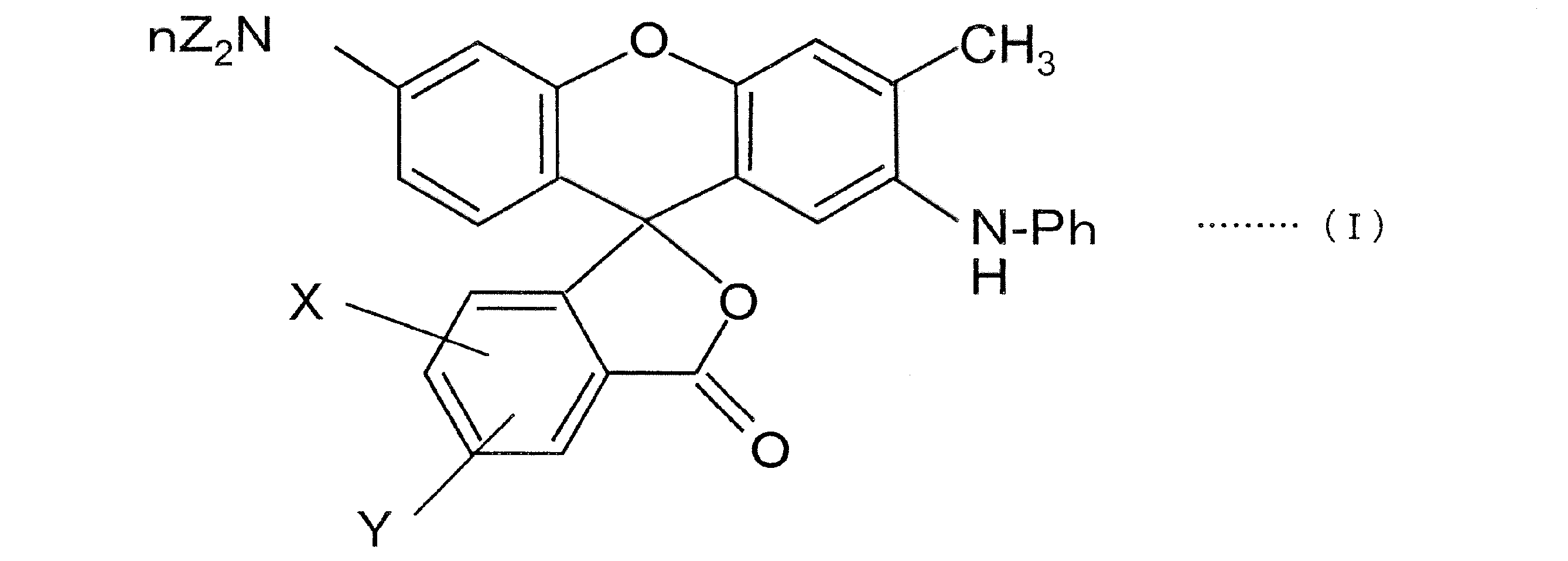
〔上記式(I)中のX,Yは、水素原子又は炭素数1~4のアルキル基、若しくはハロゲン原子を表し、これらは互いに同一であっても異なっていてもよい。ただし、X,Yがともに水素原子である場合を除く。また、Zはエチル基又はブチル基を表す。〕
(2) 上記式(I)中のX,Yのうち少なくとも一方がメチル基又は塩素原子であることを特徴とする上記(1)記載の色素。
(3) 上記(1)又は(2)の色素、顕色剤及び変色温度調整剤を少なくとも含むことを特徴とするマイクロカプセル顔料。
(4) 上記(3)に記載のマイクロカプセル顔料を含有することを特徴とする筆記具用インク組成物。
(1) 下記式(I)で示されるロイコ色素からなることを特徴とする色素。
(2) 上記式(I)中のX,Yのうち少なくとも一方がメチル基又は塩素原子であることを特徴とする上記(1)記載の色素。
(3) 上記(1)又は(2)の色素、顕色剤及び変色温度調整剤を少なくとも含むことを特徴とするマイクロカプセル顔料。
(4) 上記(3)に記載のマイクロカプセル顔料を含有することを特徴とする筆記具用インク組成物。
本発明によれば、発色濃度と耐光性に優れたロイコ色素からなる色素、この色素の顕色、消色機構を利用した発色/消色性に優れた熱変色性のマイクロカプセル顔料、及びこのマイクロカプセル顔料を含有した筆記具用インク組成物が提供される。
以下に、本発明の実施形態を詳しく説明する。
〔色素〕
本発明の色素は、下記式(I)で示されるロイコ色素からなることを特徴とするものである。
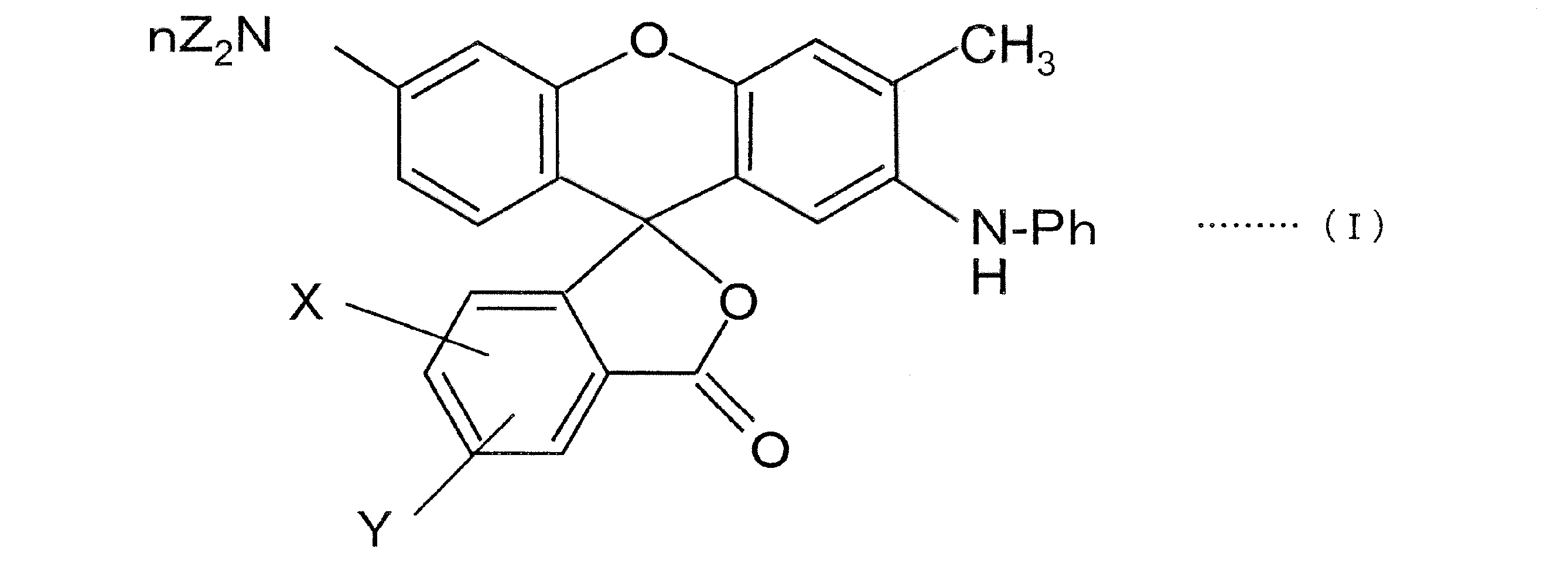
〔上記式(I)中のX,Yは、水素原子又は炭素数1~4のアルキル基、若しくはハロゲン原子を表し、これらは互いに同一であっても異なっていてもよい。ただし、X,Yがともに水素原子である場合を除く。また、Zはエチル基又はブチル基を表す。〕
〔色素〕
本発明の色素は、下記式(I)で示されるロイコ色素からなることを特徴とするものである。
本発明に用いる上記式(I)で示される色素は、黒色のロイコ色素として発色濃度及び耐光性に優れ、濃度が高い黒色の色調となる色素である。
黒色のロイコ色素としては、特許文献1で例示したフルオラン類などが知られているが、本発明では、上記式(I)で示される色素を用いることで、更に、発色濃度及び耐光性に優れ、濃度が高い黒色となるものである。
上記式(I)中において、X、Yはメチル基、エチル基、n-プロピル基、イソプロピル基、n-ブチル基、sec-ブチル基、イソブチル基、tert-ブチル基などからなる炭素数1~4のアルキル基、または、フッ素原子(-F)、塩素原子(-Cl)、臭素原子(-Br)、ヨウ素原子(-I)などが挙げられる。
上記式(I)中において、X、Yは、水素原子、または、メチル基、エチル基、n-プロピル基、イソプロピル基、n-ブチル基、sec-ブチル基、イソブチル基、tert-ブチル基などからなる炭素数1~4のアルキル基、若しくは、フッ素原子(-F)、塩素原子(-Cl)、臭素原子(-Br)、ヨウ素原子(-I)などが挙げられ、これらは互いに同一であっても異なっていてもよい。ただし、X,Yがともに水素原子である場合を除くものである。また、また、Zはエチル基又はブチル基を表す。
黒色のロイコ色素としては、特許文献1で例示したフルオラン類などが知られているが、本発明では、上記式(I)で示される色素を用いることで、更に、発色濃度及び耐光性に優れ、濃度が高い黒色となるものである。
上記式(I)中において、X、Yはメチル基、エチル基、n-プロピル基、イソプロピル基、n-ブチル基、sec-ブチル基、イソブチル基、tert-ブチル基などからなる炭素数1~4のアルキル基、または、フッ素原子(-F)、塩素原子(-Cl)、臭素原子(-Br)、ヨウ素原子(-I)などが挙げられる。
上記式(I)中において、X、Yは、水素原子、または、メチル基、エチル基、n-プロピル基、イソプロピル基、n-ブチル基、sec-ブチル基、イソブチル基、tert-ブチル基などからなる炭素数1~4のアルキル基、若しくは、フッ素原子(-F)、塩素原子(-Cl)、臭素原子(-Br)、ヨウ素原子(-I)などが挙げられ、これらは互いに同一であっても異なっていてもよい。ただし、X,Yがともに水素原子である場合を除くものである。また、また、Zはエチル基又はブチル基を表す。
上記式(I)で示される具体的なロイコ色素としては、例えば、6-メチル-2’-アニリノ-3’-メチル-6’-N,N-ジエチルアミノフルオラン、7-メチル-2’- アニリノ-3’-メチル-6’-N,N-ジエチルアミノフルオラン、6-エチル-2’-アニリノ-3’-メチル-6’-N,N-ジエチルアミノフルオラン、7-エチル-2’-アニリノ-3’-メチル-6’-N,N-ジエチルアミノフルオラン、6-クロロ-2’-アニリノ-3’-メチル-6’-N,N-ジエチルアミノフルオラン、7-クロロ-2’-アニリノ-3’-メチル-6’-N,N-ジエチルアミノフルオラン、6-フルオロ-2’-アニリノ-3’-メチル-6’-N,N-ジエチルアミノフルオラン、7-フルオロ-2’-アニリノ-3’-メチル-6’-N,N-ジエチルアミノフルオラン、6-ブロモ-2’-アニリノ-3’-メチル-6’-N,N-ジエチルアミノフルオラン、7-ブロモ-2’-アニリノ-3’-メチル-6’-N,N-ジエチルアミノフルオラン、6-ヨード-2’-アニリノ-3’-メチル-6’-N,N-ジエチルアミノフルオラン、7-ヨード-2’-アニリノ-3’-メチル-6’-N,N-ジエチルアミノフルオラン、6-メチル-2’-アニリノ-3’-メチル-6’-N,N-ジブチルアミノフルオラン、7-メチル-2’-アニリノ-3’-メチル-6’-N,N-ジブチルアミノフルオラン、6-エチル-2’-アニリノ-3’-メチル-6’-N,N-ジブチルアミノフルオラン、7-エチル-2’-アニリノ-3’-メチル-6’-N,N-ジブチルアミノフルオラン、6-クロロ-2’-アニリノ-3’-メチル-6’-N,N-ジブチルアミノフルオラン、7-クロロ-2’-アニリノ-3’-メチル-6’-N,N-ジブチルアミノフルオラン、6-フルオロ-2’-アニリノ-3’-メチル-6’-N,N-ジブチルアミノフルオラン、7-フルオロ-2’-アニリノ-3’-メチル-6’-N,N-ジブチルアミノフルオラン、6-ブロモ-2’-アニリノ-3’-メチル-6’-N,N-ジブチルアミノフルオラン、7-ブロモ-2’-アニリノ-3’-メチル-6’-N,N-ジブチルアミノフルオラン、6-ヨード-2’-アニリノ-3’-メチル-6’-N,N-ジブチルアミノフルオラン、7-ヨード-2’-アニリノ-3’-メチル-6’-N,N-ジブチルアミノフルオラン、6,7-ジクロロ-2’-アニリノ-3’-メチル-6’-N,N-ジエチルアミノフルオラン、6,7-ジフルオロ-2’-アニリノ-3’-メチル-6’-N,N-ジエチルアミノフルオラン、6,7-ジブロモ-2’-アニリノ-3’-メチル-6’-N,N-ジエチルアミノフルオラン、6,7-ジヨード-2’-アニリノ-3’-メチル-6’-N,N-ジエチルアミノフルオラン、6,7-ジクロロ-2’-アニリノ-3’-メチル-6’-N,N-ジブチルアミノフルオラン、6,7-ジフルオロ-2’-アニリノ-3’-メチル-6’-N,N-ジブチルアミノフルオラン、6,7-ジブロモ-2’-アニリノ-3’-メチル-6’-N,N-ジブチルアミノフルオラン、6,7-ジヨード-2’-アニリノ-3’-メチル-6’-N,N-ジブチルアミノフルオランなどを挙げることができ、これらは1種または2種以上を混合して用いることができる。好ましくは、発色濃度、耐光性、製造性等の点から、Zはエチル基又はブチル基であって、X,Yのうち少なくとも一方がメチル基(-CH3)、または、塩素原子(-Cl)であるものが好ましい。上記の基を導入することにより、高い濃度と優れた耐光性を実現することが可能となる。更に好ましくは、X,Yがともにハロゲン原子、特に、塩素原子(-Cl)であると耐光性が更に向上する。
上記式(I)で示される各ロイコ色素の製造は、市販の又は汎用の合成手段により得られたトリアリールアミン誘導体と、無水フタル酸誘導体とを酸触媒の存在下で加熱反応させることにより、容易に上記式(I)で示される発色濃度及び耐光性に優れたロイコ色素を得ることができる。
〔マイクロカプセル顔料〕
次に、本発明のマイクロカプセル顔料は、上記式(I)で示される色素、顕色剤、変色温度調整剤から少なくとも構成される熱変色性組成物を内包させたものである。
次に、本発明のマイクロカプセル顔料は、上記式(I)で示される色素、顕色剤、変色温度調整剤から少なくとも構成される熱変色性組成物を内包させたものである。
<顕色剤>
用いる顕色剤は、上記式(I)で示される色素を発色させる能力を有する成分となるものである。用いられる顕色剤は、従来公知のものが使用可能であり、例えば、無機酸、芳香族カルボン酸及びその無水物又は金属塩類、有機スルホン酸、その他の有機酸及びフェノール性化合物等が挙げられる。
好ましくは、ビスフェノール誘導体であり、下記式(II)の化合物で示されるものが挙げられる。

〔上記式(II)中のR1は水素原子又は炭素数1~2のアルキル基を示し、R2は炭素数4~10の直鎖又は分岐のアルキル基を示す。〕
上記以外にも、スルホニルウレア化合物も好ましく用いることができる。
用いる顕色剤は、上記式(I)で示される色素を発色させる能力を有する成分となるものである。用いられる顕色剤は、従来公知のものが使用可能であり、例えば、無機酸、芳香族カルボン酸及びその無水物又は金属塩類、有機スルホン酸、その他の有機酸及びフェノール性化合物等が挙げられる。
好ましくは、ビスフェノール誘導体であり、下記式(II)の化合物で示されるものが挙げられる。
上記以外にも、スルホニルウレア化合物も好ましく用いることができる。
前記式(II)の化合物としては、具体的には、4,4´-(2-エチルヘキシリデン)ビスフェノール、4,4´-(2-エチルペンチリデン)ビスフェノール、4,4´-オクチリデンビスフェノール、4,4´-ヘキシリデンビスフェノール、4,4´-(4-メチルオクチリデン)ビスフェノール、4,4´-デシリデンビスフェノール、4,4´-(1,3-ジメチルブチリデン)ビスフェノール、4,4´-(3-メチルブチリデン)ビスフェノール、4,4´-(1-メチルヘプチリデン)ビスフェノール、4,4´-(1,2-ジメチルブチリデン)ビスフェノール、4,4´-(1,5-ジメチルヘキシリデン)ビスフェノール、4,4´-(1-エチル-3-メチルペンチリデン)ビスフェノール、4,4´-(1-メチル-4-メチルヘプチリデン)ビスフェノール、4,4´-(1-エチル-ヘキシリデン)ビスフェノール、4,4´-(1-エチル-ペンチリデン)ビスフェノール、4,4´-(1-エチル-オクチリデン)ビスフェノール等の少なくとも1種(各単独又は2種以上の混合物、以下同様)を挙げることができるが、勿論これらに限定されるものではない。
本発明においては、これらの顕色剤を1種又は2種以上組み合わせて用いること、または、従来公知の顕色剤を本発明の顕色剤の諸特性を損なわない範囲内で組み合わせて用いることにより、発色時の色彩濃度を自由に調節することができる。従って、その使用量は、所望される色彩濃度に応じて任意に選択すればよく、特に限定されるものではないが、通常、前記した式(I)で示される色素1質量部に対して、0.1~100質量部程度の範囲内で選択するのが好適である。
<変色温度調整剤>
本発明に用いる変色温度調整剤は、前記式(I)で示される色素と顕色剤の呈色において変色温度をコントロールする物質である。
用いることができる変色温度調整剤は、従来公知のものが使用可能である。具体的には、アルコール類、エステル類、ケトン類、エーテル類、酸アミド類、アゾメチン類、脂肪酸類、炭化水素類などが挙げられる。
好ましくは、化学構造中に水酸基を有する化合物と、炭素数8~22の飽和脂肪酸とから構成されるエステル化合物であり、例えば、ビスフェノール誘導体と、炭素数8~22の飽和脂肪酸とから構成されるエステル化合物であり、下記式(III)示されるものが挙げられる。

〔上記式(III)中のR3及びR4は、直鎖又は分岐の炭素数7~21のアルキル基を示し、R5及びR6は、水素原子、炭素数1~2のアルキル基、又はCF3を示す。〕
本発明に用いる変色温度調整剤は、前記式(I)で示される色素と顕色剤の呈色において変色温度をコントロールする物質である。
用いることができる変色温度調整剤は、従来公知のものが使用可能である。具体的には、アルコール類、エステル類、ケトン類、エーテル類、酸アミド類、アゾメチン類、脂肪酸類、炭化水素類などが挙げられる。
好ましくは、化学構造中に水酸基を有する化合物と、炭素数8~22の飽和脂肪酸とから構成されるエステル化合物であり、例えば、ビスフェノール誘導体と、炭素数8~22の飽和脂肪酸とから構成されるエステル化合物であり、下記式(III)示されるものが挙げられる。
前記式(III)の化合物としては、具体的には、4,4´-(ヘキサフルオロイソプロピリデン)ビスフェノールジカプレート、4,4´-(ヘキサフルオロイソプロピリデン)ビスフェノールジラウレート、4,4´-(ヘキサフルオロイソプロピリデン)ビスフェノールジミリステート、4,4´-(ヘキサフルオロイソプロピリデン)ビスフェノールジパルミエート、4,4´-(ヘキサフルオロイソプロピリデン)ビスフェノールジウンデカノエート、4,4´-(ヘキサフルオロイソプロピリデン)ビスフェノールジトリデカノエート、4,4´-(イソプロピリデン)ビスフェノールジカプレート、4,4´-(イソプロピリデン)ビスフェノールジラウレート、4,4´-(イソプロピリデン)ビスフェノールジミリステート、4,4´-(イソプロピリデン)ビスフェノールジパルミエート、4,4´-(イソプロピリデン)ビスフェノールジウンデカノエート、4,4´-(イソプロピリデン)ビスフェノールジトリデカエート、4,4´-メチレンビスフェノールジカプレート、4,4´-メチレンビスフェノールジラウレート、4,4´-メチレンビスフェノールジミリステート、4,4´-メチレンビスフェノールジパルミエート、4,4´-メチレンビスフェノールジウンデカノエート、4,4´-メチレンビスフェノールジトリデカノエート等の少なくとも1種が挙げられる。
この変色温度調整剤の使用量は、所望されるヒステリシス幅及び発色時の色彩濃度等に応じて適宜選択すればよく、特に限定されるものではないが、通常、色素1質量部に対して、1~1000質量部程度の範囲内で使用するのが好ましい。
なお、本発明の組成物の諸特性を損なわない範囲内であれば、従来公知の変色温度調整剤を組み合わせて用いることもできる。
なお、本発明の組成物の諸特性を損なわない範囲内であれば、従来公知の変色温度調整剤を組み合わせて用いることもできる。
<マイクロカプセル顔料>
本発明に用いるマイクロカプセル顔料は、少なくとも上記式(I)で示される色素、顕色剤、変色温度調整剤からなる熱変色性組成物を、好ましくは、平均粒子径が0.3~1.0μmとなるように、マイクロカプセル化することにより製造することができる。
マイクロカプセル化法としては、例えば、界面重合法、界面重縮合法、in situ重合法、液中硬化被覆法、水溶液からの相分離法、有機溶媒からの相分離法、融解分散冷却法、気中懸濁被覆法、スプレードライニング法などを挙げることができ、用途に応じて適宜選択することができる。
本発明に用いるマイクロカプセル顔料は、少なくとも上記式(I)で示される色素、顕色剤、変色温度調整剤からなる熱変色性組成物を、好ましくは、平均粒子径が0.3~1.0μmとなるように、マイクロカプセル化することにより製造することができる。
マイクロカプセル化法としては、例えば、界面重合法、界面重縮合法、in situ重合法、液中硬化被覆法、水溶液からの相分離法、有機溶媒からの相分離法、融解分散冷却法、気中懸濁被覆法、スプレードライニング法などを挙げることができ、用途に応じて適宜選択することができる。
例えば、水溶液からの相分離法では、上記式(I)で示される色素、顕色剤、変色温度調整剤を加熱溶融後、乳化剤溶液に投入し、加熱攪拌して油滴状に分散させ、次いで、カプセル膜剤として、樹脂原料などを使用、例えば、アミノ樹脂溶液、具体的には、メチロールメラミン水溶液、尿素溶液、ベンゾグアナミン溶液などの各液を徐々に投入し、引き続き反応させて調製後、この分散液を濾過することにより目的の熱変色性のマイクロカプセル顔料を製造することができる。
これら色素、顕色剤、変色温度調整剤の含有量は、用いる上記式(I)で示される色素、顕色剤、変色温度調整剤の種類、マイクロカプセル化法などにより変動するが、当該色素1に対して、質量比で顕色剤0.1~100、変色温度調整剤1~100である。また、カプセル膜剤は、カプセル内容物に対して、質量比で0.1~1である。
本発明のマイクロカプセル顔料では、上記式(I)で示される色素、顕色剤及び変色温度調整剤の種類、量などを好適に組み合わせることにより、黒色の発色温度、消色温度を好適な温度に設定することができる。
本発明のマイクロカプセル顔料では、上記式(I)で示される色素、顕色剤及び変色温度調整剤の種類、量などを好適に組み合わせることにより、黒色の発色温度、消色温度を好適な温度に設定することができる。
本発明のマイクロカプセル顔料では、描線濃度、保存安定性、筆記性の更なる向上の点から、壁膜がウレタン樹脂、エポキシ樹脂、あるいはアミノ樹脂で形成されることが好ましい。ウレタン樹脂としては、例えば、イソシアネートとポリオールとの化合物が挙げられる。エポキシ樹脂としては、例えば、エポキシ樹脂とアミンの化合物が挙げられる。アミノ樹脂としては、例えば、メラミン樹脂、尿素樹脂、ベンゾグアナミン樹脂などで形成されること、更に好ましくは、製造性、保存安定性、筆記性の点から、メラミン樹脂で形成されることが望ましい。
マイクロカプセル顔料の壁膜の厚さは、必要とする壁膜の強度や描線濃度に応じて適宜決められる。
なお、壁膜がアミノ樹脂で形成するためには、各マイクロカプセル化法を用いる際に、好適なアミノ樹脂原料(メラミン樹脂、尿素樹脂、ベンゾグアナミン樹脂等)、並びに、分散剤、保護コロイドなどを選択する。
マイクロカプセル顔料の壁膜の厚さは、必要とする壁膜の強度や描線濃度に応じて適宜決められる。
なお、壁膜がアミノ樹脂で形成するためには、各マイクロカプセル化法を用いる際に、好適なアミノ樹脂原料(メラミン樹脂、尿素樹脂、ベンゾグアナミン樹脂等)、並びに、分散剤、保護コロイドなどを選択する。
本発明に用いるマイクロカプセル顔料の平均粒子径は、着色性、発色性、易消色性、安定性の点、並びに、筆記性への悪影響を抑制する点から、好ましくは、0.3~1.0μmであるものが望ましい。なお、本発明(実施例等含む)で規定する「平均粒子径」は、粒度分布測定装置〔粒子径測定器N4Plus(COULTER社製)〕にて、平均粒子径を測定した値である。
この平均粒子径が0.3μm未満であると、十分な描線濃度が得られず、一方、1.0μmを越えると、筆記性の劣化やマイクロカプセル顔料の分散安定性の低下が発生し、好ましくない。
なお、上記平均粒子径の範囲(0.3~1.0μm)となるマイクロカプセル顔料は、マイクロカプセル化法により変動するが、水溶液からの相分離法などでは、マイクロカプセル顔料を製造する際の攪拌条件を好適に組み合わせることにより調製することができる。
この平均粒子径が0.3μm未満であると、十分な描線濃度が得られず、一方、1.0μmを越えると、筆記性の劣化やマイクロカプセル顔料の分散安定性の低下が発生し、好ましくない。
なお、上記平均粒子径の範囲(0.3~1.0μm)となるマイクロカプセル顔料は、マイクロカプセル化法により変動するが、水溶液からの相分離法などでは、マイクロカプセル顔料を製造する際の攪拌条件を好適に組み合わせることにより調製することができる。
このように構成される本発明のマイクロカプセル顔料は、発色濃度及び耐光性に優れると共に、易消色性、安定性に優れ、筆記具用の熱変色性の顔料として好適に用いることができ、後述するように、溶媒種が水性、または、油性の筆記具用インク組成物の顔料として用いても、その溶媒種等に影響を受けずに、上記効果を発揮することができるものである。
<筆記具用インク組成物>
本発明の筆記具用インク組成物は、上記構成のマイクロカプセル顔料を含有することを特徴とするものであり、水性、または、油性のボールペン用、マーキングペン用等の筆記具用インク組成物として用いることをできる。
本発明のマイクロカプセル顔料の含有量は、各水性又は油性のインク組成物全量に対して、好ましくは、5~30質量%(以下、単に「%」という)、更に好ましくは、10~25%とすることが望ましい。
このマイクロカプセル顔料の含有量が5%未満であると、着色力、発色性が不十分となり、一方、30%を超えると、カスレが生じやすくなり、好ましくない。
本発明の筆記具用インク組成物は、上記構成のマイクロカプセル顔料を含有することを特徴とするものであり、水性、または、油性のボールペン用、マーキングペン用等の筆記具用インク組成物として用いることをできる。
本発明のマイクロカプセル顔料の含有量は、各水性又は油性のインク組成物全量に対して、好ましくは、5~30質量%(以下、単に「%」という)、更に好ましくは、10~25%とすることが望ましい。
このマイクロカプセル顔料の含有量が5%未満であると、着色力、発色性が不十分となり、一方、30%を超えると、カスレが生じやすくなり、好ましくない。
<筆記具用水性インク組成物>
本発明の筆記具用インク組成物において、水性では、上記マイクロカプセル顔料の他、残部として溶媒である水(水道水、精製水、蒸留水、イオン交換水、純水等)の他、各筆記具用(ボールペン用、マーキングペン用等)の用途に応じて、本発明の効果を損なわない範囲で、水溶性有機溶剤、増粘剤、潤滑剤、防錆剤、防腐剤もしくは防菌剤などを適宜含有することができる。
本発明の筆記具用インク組成物において、水性では、上記マイクロカプセル顔料の他、残部として溶媒である水(水道水、精製水、蒸留水、イオン交換水、純水等)の他、各筆記具用(ボールペン用、マーキングペン用等)の用途に応じて、本発明の効果を損なわない範囲で、水溶性有機溶剤、増粘剤、潤滑剤、防錆剤、防腐剤もしくは防菌剤などを適宜含有することができる。
用いることができる水溶性有機溶剤としては、例えば、エチレングリコール、ジエチレングリコール、トリエチレングリコール、プロピレングリコール、ポリエチレングリコール、3-ブチレングリコール、チオジエチレングリコール、グリセリン等のグリコール類や、エチレングリコールモノメチルエーテル、ジエチレングリコールモノメチルエーテル、単独或いは混合して使用することができる。
用いることができる増粘剤としては、例えば、合成高分子、セルロースおよび多糖類からなる群から選ばれた少なくとも一種が望ましい。具体的には、アラビアガム、トラガカントガム、グアーガム、ローカストビーンガム、アルギン酸、カラギーナン、ゼラチン、キサンタンガム、ウェランガム、サクシノグリカン、ダイユータンガム、デキストラン、メチルセルロース、エチルセルロース、ヒドロキシエチルセルロース、カルボキシメチルセルロース、デンプングリコール酸及びその塩、アルギン酸プロピレングリコールエステル、ポリビニルアルコール、ポリビニルピロリドン、ポリビニルメチルエーテル、ポリアクリル酸及びその塩、カルボキシビニルポリマー、ポリエチレオキサイド、酢酸ビニルとポリビニルピロリドンの共重合体、架橋型アクリル酸重合体及びその塩、非架橋型アクリル酸重合体及びその塩、スチレン-アクリル酸共重合体及びその塩などが挙げられる。
潤滑剤としては、顔料の表面処理剤にも用いられる多価アルコールの脂肪酸エステル、糖の高級脂肪酸エステル、ポリオキシアルキレン高級脂肪酸エステル、アルキル燐酸エステルなどのノニオン系や、高級脂肪酸アミドのアルキルスルホン酸塩、アルキルアリルスルホン酸塩などのアニオン系、ポリアルキレングリコールの誘導体やフッ素系界面活性剤、ポリエーテル変性シリコーンなどが挙げられる。また、防錆剤としては、ベンゾトリアゾール、トリルトリアゾール、ジシクロへキシルアンモニウムナイトライト、サポニン類など、防腐剤もしくは防菌剤としては、フェノール、ナトリウムオマジン、安息香酸ナトリウム、ベンズイミダゾール系化合物などが挙げられる。
この筆記具用水性インク組成物を製造するには、従来から知られている方法が採用可能であり、例えば、上記マイクロカプセル顔料の他、上記水性における各成分を所定量配合し、ホモミキサー、もしくはディスパー等の攪拌機により攪拌混合することによって得られる。更に必要に応じて、ろ過や遠心分離によってインク組成物中の粗大粒子を除去してもよい。
<筆記具用油性インク組成物>
本発明の筆記具用インク組成物において、油性では、上記構成のマイクロカプセル顔料を含有すると共に、主溶剤として、ポリプロピレングリコール、ポリブチレングリコール、ポリオキシプロピレンジグリセリルエーテルから選ばれる少なくとも一つとを含有することが好ましい。これらの溶剤を主溶剤として選択、使用することで、上記マイクロカプセル顔料の経時的な凝集を発生しないように作用するものである。
本発明の筆記具用インク組成物において、油性では、上記構成のマイクロカプセル顔料を含有すると共に、主溶剤として、ポリプロピレングリコール、ポリブチレングリコール、ポリオキシプロピレンジグリセリルエーテルから選ばれる少なくとも一つとを含有することが好ましい。これらの溶剤を主溶剤として選択、使用することで、上記マイクロカプセル顔料の経時的な凝集を発生しないように作用するものである。
用いるポリプロピレングリコール、ポリブチレングリコールは、各重合度のものが使用できるが、本発明の効果を更に発揮せしめる点から、ポリプロピレングリコールでは重合度(重量平均)400~700の範囲の使用が好ましく、ポリブチレングリコールでは重合度(重量平均)500~700の範囲の使用が好ましい。
また、本発明で用いるポリオキシプロピレンジグリセリルエーテル〔POP(n)ジグリセリルエーテル〕はジグリセリンの水酸基にポリオキシプロピレンが付加重合したものである。本発明においてポリオキシプロピレンジグリセリルエーテル〔POP(n)ジグリセリルエーテル〕におけるオキシプロピレンの付加モル数(n)は、本発明の効果を更に発揮せしめる点から、4~25が好ましく、更に好ましくは4~14である。
また、本発明で用いるポリオキシプロピレンジグリセリルエーテル〔POP(n)ジグリセリルエーテル〕はジグリセリンの水酸基にポリオキシプロピレンが付加重合したものである。本発明においてポリオキシプロピレンジグリセリルエーテル〔POP(n)ジグリセリルエーテル〕におけるオキシプロピレンの付加モル数(n)は、本発明の効果を更に発揮せしめる点から、4~25が好ましく、更に好ましくは4~14である。
これらの主溶剤の含有量は、インク組成物中の全溶剤量に対して、50~100%とすることが好ましく、更に好ましくは、80~100%とすることが望ましい。この主溶剤の含有量が、50%以上とすることにより、経時的な凝集の発生を極力抑制することができる。なお、本発明の効果を損なわない範囲で、上記主溶剤の他、主溶剤と相溶する性質を有する溶剤、例えば、グリセリン、ジグリセリン、プロピレングリコールなどの溶剤を適宜含有することができる。
この筆記具用油性インク組成物では、上記マイクロカプセル顔料、主溶剤の他、各筆記具用(ボールペン用、マーキングペン用等)の用途に応じて、また、必要に応じて、油性インクに悪影響を及ぼさず相溶することができる樹脂や分散剤、防錆剤、防腐剤、潤滑剤等を含有することができる。
用いることができる樹脂としては、例えば、ケトン樹脂、スチレン樹脂、スチレン-アクリル樹脂、テルペンフェノール樹脂、ロジン変性マレイン酸樹脂、ロジンフェノール樹脂、アルキルフェノール樹脂、フェノール系樹脂、スチレン-マレイン酸樹脂、ロジン系樹脂、アクリル系樹脂、尿素アルデヒド系樹脂、マレイン酸系樹脂、シクロヘキサノン系樹脂、ポリビニルブチラール、ポリビニルピロリドン等に代表される樹脂が挙げられる。
用いることができる樹脂としては、例えば、ケトン樹脂、スチレン樹脂、スチレン-アクリル樹脂、テルペンフェノール樹脂、ロジン変性マレイン酸樹脂、ロジンフェノール樹脂、アルキルフェノール樹脂、フェノール系樹脂、スチレン-マレイン酸樹脂、ロジン系樹脂、アクリル系樹脂、尿素アルデヒド系樹脂、マレイン酸系樹脂、シクロヘキサノン系樹脂、ポリビニルブチラール、ポリビニルピロリドン等に代表される樹脂が挙げられる。
用いることができる分散剤として、上記に挙げたような樹脂の中からマイクロカプセル顔料を分散できるものを選択して使用することができ、界面活性剤やオリゴマーでも目的に沿うものであれば、含有することができる。
具体的な分散剤としては、例えば、ポリビニルアルコール、ポリビニルピロリドン、ポリビニルブチラール、ポリビニルエーテル、スチレン-マレイン酸共重合体、ケトン樹脂、ヒドロキシエチルセルロースやその誘導体、スチレン-アクリル酸共重合体等の合成樹脂やPO・EO付加物やポリエステルのアミン系オリゴマー等が挙げることができる。
また、防錆剤、防腐剤、潤滑剤としては、上述の水性で用いた各種の防錆剤、防腐剤、潤滑剤を用いることができる。
具体的な分散剤としては、例えば、ポリビニルアルコール、ポリビニルピロリドン、ポリビニルブチラール、ポリビニルエーテル、スチレン-マレイン酸共重合体、ケトン樹脂、ヒドロキシエチルセルロースやその誘導体、スチレン-アクリル酸共重合体等の合成樹脂やPO・EO付加物やポリエステルのアミン系オリゴマー等が挙げることができる。
また、防錆剤、防腐剤、潤滑剤としては、上述の水性で用いた各種の防錆剤、防腐剤、潤滑剤を用いることができる。
この筆記具用油性インク組成物を製造するには、従来から知られている方法が採用可能であり、例えば、上記マイクロカプセル顔料の他、上記油性における各成分を所定量配合し、ホモミキサー、もしくはディスパー等の攪拌機により攪拌混合することによって得られる。更に必要に応じて、ろ過や遠心分離によってインク組成物中の粗大粒子を除去してもよい。
このように構成される本発明の筆記具用インク組成物では、上記式(I)で示される発色濃度及び耐光性に優れる色素、顕色剤及び変色温度調整剤を少なくとも含むマイクロカプセル顔料を含有する水性、または、油性のインクを処方し、このインクを搭載したボールペン体、マーキングペン体などの筆記具にて紙面等に筆記しても、経時的なマイクロカプセル顔料の凝集や変色が発生せず、筆跡を良好に変色させることができる筆記具用インク組成物が得られるものとなる。
次に、実施例及び比較例により本発明を更に詳細に説明するが、本発明は下記実施例等に限定されるものではない。なお、以下において、配合単位である「部」は質量部を意味する。
(製造例1:上記式(I)で示される色素の製造)
3-ジエチルアミノフェノール45.0g(0.272モル)および4-メチル無水フタル酸46.4g(0.286モル)をトルエンに加え、102~103℃で5時間過熱攪拌した。得られた反応液の濃縮を行い、4-N,N-ジエチルアミノ-2-ヒドロキシ-4’-メチル-2’-カルボキシベンゾフェノンおよび4-N,N-ジエチルアミノ-2-ヒドロキシ-5’-メチル-2’-カルボキシベンゾフェノンの混合物15.4g(0.047モル)を得た。これと3-メチル-4-アニリノフェノール9.8g(0.046モル)、濃硫酸100gの混合物を10℃で12時間攪拌した。その後、過剰の水酸化ナトリウムとトルエンを加えて60℃で加熱した。トルエン層を分離した後、活性炭2.5gを加えて、さらに60℃まで加熱・熱時ろ過した。ろ液を減圧濃縮し、晶析した結晶をろ過後、乾燥して6-メチル-2’-アニリノ-3’-メチル-6’-N,N-ジエチルアミノフルオランと7-メチル-2’-アニリノ-3’-メチル-6’-N,N-ジエチルアミノフルオランの混合物13.9gを得た。
3-ジエチルアミノフェノール45.0g(0.272モル)および4-メチル無水フタル酸46.4g(0.286モル)をトルエンに加え、102~103℃で5時間過熱攪拌した。得られた反応液の濃縮を行い、4-N,N-ジエチルアミノ-2-ヒドロキシ-4’-メチル-2’-カルボキシベンゾフェノンおよび4-N,N-ジエチルアミノ-2-ヒドロキシ-5’-メチル-2’-カルボキシベンゾフェノンの混合物15.4g(0.047モル)を得た。これと3-メチル-4-アニリノフェノール9.8g(0.046モル)、濃硫酸100gの混合物を10℃で12時間攪拌した。その後、過剰の水酸化ナトリウムとトルエンを加えて60℃で加熱した。トルエン層を分離した後、活性炭2.5gを加えて、さらに60℃まで加熱・熱時ろ過した。ろ液を減圧濃縮し、晶析した結晶をろ過後、乾燥して6-メチル-2’-アニリノ-3’-メチル-6’-N,N-ジエチルアミノフルオランと7-メチル-2’-アニリノ-3’-メチル-6’-N,N-ジエチルアミノフルオランの混合物13.9gを得た。
(製造例2:上記式(I)で示される色素の製造)
3-ジエチルアミノフェノール51.2g(0.310モル)および4-クロロ無水フタル酸60g(0.32モル)をトルエンに加え、102~103℃で2時間過熱攪拌した。得られた反応液の濃縮を行い、4-N,N-ジエチルアミノ-2-ヒドロキシ-4’-クロロ-2’-カルボキシベンゾフェノンおよび4-N,N-ジエチルアミノ-2-ヒドロキシ-5’-クロロ-2’-カルボキシベンゾフェノンの混合物16.3g(0.047モル)を得た。これと3-メチル-4-アニリノフェノール10.0g(0.046モル)、濃硫酸100gの混合物を10℃で12時間攪拌した。その後、過剰の水酸化ナトリウムとトルエンを加えて60℃で加熱した。トルエン層を分離した後、活性炭3gを加えて、さらに60℃まで加熱・熱時ろ過した。ろ液を減圧濃縮し、晶析した結晶をろ過後、乾燥して6-クロロ-2’-アニリノ-3’-メチル-6’-N,N-ジエチルアミノフルオランと7-クロロ-2’-アニリノ-3’-メチル-6’-N,N-ジエチルアミノフルオランの混合物15.8gを得た。
3-ジエチルアミノフェノール51.2g(0.310モル)および4-クロロ無水フタル酸60g(0.32モル)をトルエンに加え、102~103℃で2時間過熱攪拌した。得られた反応液の濃縮を行い、4-N,N-ジエチルアミノ-2-ヒドロキシ-4’-クロロ-2’-カルボキシベンゾフェノンおよび4-N,N-ジエチルアミノ-2-ヒドロキシ-5’-クロロ-2’-カルボキシベンゾフェノンの混合物16.3g(0.047モル)を得た。これと3-メチル-4-アニリノフェノール10.0g(0.046モル)、濃硫酸100gの混合物を10℃で12時間攪拌した。その後、過剰の水酸化ナトリウムとトルエンを加えて60℃で加熱した。トルエン層を分離した後、活性炭3gを加えて、さらに60℃まで加熱・熱時ろ過した。ろ液を減圧濃縮し、晶析した結晶をろ過後、乾燥して6-クロロ-2’-アニリノ-3’-メチル-6’-N,N-ジエチルアミノフルオランと7-クロロ-2’-アニリノ-3’-メチル-6’-N,N-ジエチルアミノフルオランの混合物15.8gを得た。
(製造例3:上記式(I)で示される色素の製造)
3-ジエチルアミノフェノール51.2g(0.310モル)および3,4-ジクロロ無水フタル酸80g(0.369モル)をトルエンに加え、102~103℃で2時間過熱攪拌した。得られた反応液の濃縮を行い、4-N,N-ジエチルアミノ-2-ヒドロキシ-4’5’-ジクロロ-2’-カルボキシベンゾフェノン18g(0.047モル)を得た。これと3-メチル-4-アニリノフェノール10.0g(0.046モル)、濃硫酸100gの混合物を10℃で12時間攪拌した。その後、過剰の水酸化ナトリウムとトルエンを加えて60℃で加熱した。トルエン層を分離した後、活性炭3gを加えて、さらに60℃まで加熱・熱時ろ過した。ろ液を減圧濃縮し、晶析した結晶をろ過後、乾燥して6,7-ジクロロ-2’-アニリノ-3’-メチル-6’-N,N-ジエチルアミノフルオラン16.6gを得た。
3-ジエチルアミノフェノール51.2g(0.310モル)および3,4-ジクロロ無水フタル酸80g(0.369モル)をトルエンに加え、102~103℃で2時間過熱攪拌した。得られた反応液の濃縮を行い、4-N,N-ジエチルアミノ-2-ヒドロキシ-4’5’-ジクロロ-2’-カルボキシベンゾフェノン18g(0.047モル)を得た。これと3-メチル-4-アニリノフェノール10.0g(0.046モル)、濃硫酸100gの混合物を10℃で12時間攪拌した。その後、過剰の水酸化ナトリウムとトルエンを加えて60℃で加熱した。トルエン層を分離した後、活性炭3gを加えて、さらに60℃まで加熱・熱時ろ過した。ろ液を減圧濃縮し、晶析した結晶をろ過後、乾燥して6,7-ジクロロ-2’-アニリノ-3’-メチル-6’-N,N-ジエチルアミノフルオラン16.6gを得た。
(マイクロカプセル顔料:A-1~A-6の処方)
(マイクロカプセル顔料:A-1~A-3)
ロイコ色素として、製造例1~3で得た各色素(下記表1)にそれぞれ示される色素1部、顕色剤として、4,4′-(2-エチルヘキシリデン)ビスフェノール2部、及び変色性温度調整剤として、4,4′-(ヘキサフルオロイソプロピリデン)ビスフェノールジミリステート24部を100℃に加熱溶融して、均質な組成物27部を得た。
上記で得た組成物27部の均一な熱溶液を、保護コロイド剤として、メチルビニルエーテル・無水マレイン酸共重合樹脂〔ガンツレッツAN-179:ISP(株)社製〕40部をNaOHにてpH4に溶解させた90℃の水溶液100部中に徐々に添加しながら、加熱攪拌して直径約0.5~1.0μmの油滴状に分散させ、次いでカプセル膜剤として、メラミン樹脂(スミテックスレジンM-3、(株)住友化学製)20部を徐々に添加し、90℃で30分間加熱してマイクロカプセル化を行い、膜剤がメラミン樹脂からなる可逆感温変色性組成物のマイクロカプセル分散液を得た。色相は、発色状態においては濃厚な黒色を呈し、消色状態においては残色がなく完全に無色となるものであった。
(マイクロカプセル顔料:A-1~A-3)
ロイコ色素として、製造例1~3で得た各色素(下記表1)にそれぞれ示される色素1部、顕色剤として、4,4′-(2-エチルヘキシリデン)ビスフェノール2部、及び変色性温度調整剤として、4,4′-(ヘキサフルオロイソプロピリデン)ビスフェノールジミリステート24部を100℃に加熱溶融して、均質な組成物27部を得た。
上記で得た組成物27部の均一な熱溶液を、保護コロイド剤として、メチルビニルエーテル・無水マレイン酸共重合樹脂〔ガンツレッツAN-179:ISP(株)社製〕40部をNaOHにてpH4に溶解させた90℃の水溶液100部中に徐々に添加しながら、加熱攪拌して直径約0.5~1.0μmの油滴状に分散させ、次いでカプセル膜剤として、メラミン樹脂(スミテックスレジンM-3、(株)住友化学製)20部を徐々に添加し、90℃で30分間加熱してマイクロカプセル化を行い、膜剤がメラミン樹脂からなる可逆感温変色性組成物のマイクロカプセル分散液を得た。色相は、発色状態においては濃厚な黒色を呈し、消色状態においては残色がなく完全に無色となるものであった。
(マイクロカプセル顔料:A-4)
上記A-1の処方において、顕色剤として、4,4′-(2-エチルヘキシリデン)ビスフェノールに代えて、4,4′-(1,3-ジメチルブチリデン)ビスフェノールを用い、変色温度調整剤として、4,4′-(ヘキサフルオロイソプロピリデン)ビスフェノールジミリステートに代えて、4,4′-エチリデンビスフェノールジラウレートを用いることを除き、他は上記A-1の処方と同様にして、可逆感温変色性組成物のマイクロカプセル分散液を得た。色相は、発色状態においては濃厚な黒色を呈し、消色状態においては残色がなく完全に無色となるものであった。
上記A-1の処方において、顕色剤として、4,4′-(2-エチルヘキシリデン)ビスフェノールに代えて、4,4′-(1,3-ジメチルブチリデン)ビスフェノールを用い、変色温度調整剤として、4,4′-(ヘキサフルオロイソプロピリデン)ビスフェノールジミリステートに代えて、4,4′-エチリデンビスフェノールジラウレートを用いることを除き、他は上記A-1の処方と同様にして、可逆感温変色性組成物のマイクロカプセル分散液を得た。色相は、発色状態においては濃厚な黒色を呈し、消色状態においては残色がなく完全に無色となるものであった。
(マイクロカプセル顔料:A-5)
上記A-2の処方において、ロイコ色素として、上記A-2で用いた変色温度調整剤に代えて、4,4´-イソプロピリデンビスフェノールジミリステートを用いることを除き、他は上記A-2の処方と同様にして、可逆感温変色性組成物のマイクロカプセル分散液を得た。色相は、発色状態においては濃厚な黒色を呈し、消色状態においては無色となるものであった。
上記A-2の処方において、ロイコ色素として、上記A-2で用いた変色温度調整剤に代えて、4,4´-イソプロピリデンビスフェノールジミリステートを用いることを除き、他は上記A-2の処方と同様にして、可逆感温変色性組成物のマイクロカプセル分散液を得た。色相は、発色状態においては濃厚な黒色を呈し、消色状態においては無色となるものであった。
(マイクロカプセル顔料:A-6)
上記A-1の処方において、ロイコ色素として、上記A-1で用いた色素に代えて、2-(2-クロロアニリノ)-6-ジブチルアミノフルオランを用いることを除き、他は上記A-1の処方と同様にして、可逆感温変色性組成物のマイクロカプセル分散液を得た。色相は、発色状態においては黒色を呈し、消色状態においては無色となるものであった。
上記A-1の処方において、ロイコ色素として、上記A-1で用いた色素に代えて、2-(2-クロロアニリノ)-6-ジブチルアミノフルオランを用いることを除き、他は上記A-1の処方と同様にして、可逆感温変色性組成物のマイクロカプセル分散液を得た。色相は、発色状態においては黒色を呈し、消色状態においては無色となるものであった。
(実施例1~10及び比較例1~2)
(インクの処方)
下記表2に示す配合処方(マイクロカプセル顔料:A-1~A-6、実施例1~5及び比較例1では水性インクの各成分、実施例6~10及び比較例2では油性インクの各成分)にしたがって、常法により各水性、各油性のボールペン用水性インク組成物を調製した。なお、各マイクロカプセル顔料A-1~A-6は、各マイクロカプセル分散液を濾過し、乾燥することによりマイクロカプセル顔料として取り出し使用した。
(インクの処方)
下記表2に示す配合処方(マイクロカプセル顔料:A-1~A-6、実施例1~5及び比較例1では水性インクの各成分、実施例6~10及び比較例2では油性インクの各成分)にしたがって、常法により各水性、各油性のボールペン用水性インク組成物を調製した。なお、各マイクロカプセル顔料A-1~A-6は、各マイクロカプセル分散液を濾過し、乾燥することによりマイクロカプセル顔料として取り出し使用した。
(水性ボールペン、油性ボールペンの作製)
上記で得られた各インク組成物を用いて水性ボールペン、油性ボールペンを作製した。具体的には、ボールペン〔三菱鉛筆株式会社製、商品名:シグノUM-100〕の軸を使用し、内径3.8mm、長さ113mmポリプロピレン製インク収容管とステンレス製チップ(超硬合金ボール、ボール径0.5mm)及び該収容管と該チップを連結する継手からなるリフィールに上記各水性、油性インクを充填し、インク後端に鉱油を主成分とするインク追従体を装填し、水性ボールペン、油性ボールペンを作製した。
得られた実施例1~8及び比較例1~2の各ボールペンを用いて、下記評価方法で耐光性、描線濃度の評価を行った。
これらの結果を下記表2に示す。
上記で得られた各インク組成物を用いて水性ボールペン、油性ボールペンを作製した。具体的には、ボールペン〔三菱鉛筆株式会社製、商品名:シグノUM-100〕の軸を使用し、内径3.8mm、長さ113mmポリプロピレン製インク収容管とステンレス製チップ(超硬合金ボール、ボール径0.5mm)及び該収容管と該チップを連結する継手からなるリフィールに上記各水性、油性インクを充填し、インク後端に鉱油を主成分とするインク追従体を装填し、水性ボールペン、油性ボールペンを作製した。
得られた実施例1~8及び比較例1~2の各ボールペンを用いて、下記評価方法で耐光性、描線濃度の評価を行った。
これらの結果を下記表2に示す。
(耐光性の評価方法)
上記マイクロカプセル顔料の分散液にメラミン・ホルムアルデヒド縮合物を添加しながら顔料濃度15質量%に調整した。得られた分散液について、偏心アプリケーター(10MIL/UESHIMA SEISAKUSHO社製)を用いてピーチケント紙に展色した。下記の基準で耐光性を評価した。これについて、キセノンフェードメーターX25F(FLR40SW/M/36、スガ試験機株式会社製)にて30および50時間照射し、照射前後のL値(明度)についてカラーコンピューター(スガ試験機株式会社SC-P)にて測定し、照射後のL値/照射前のL値にて評価を行った。なお、測定条件は、正反射光:除く、光源視野:D65/10、にて行った。
評価基準:
○:1.0~1.1
△:1.1超~1.2未満
×:1.2超
上記マイクロカプセル顔料の分散液にメラミン・ホルムアルデヒド縮合物を添加しながら顔料濃度15質量%に調整した。得られた分散液について、偏心アプリケーター(10MIL/UESHIMA SEISAKUSHO社製)を用いてピーチケント紙に展色した。下記の基準で耐光性を評価した。これについて、キセノンフェードメーターX25F(FLR40SW/M/36、スガ試験機株式会社製)にて30および50時間照射し、照射前後のL値(明度)についてカラーコンピューター(スガ試験機株式会社SC-P)にて測定し、照射後のL値/照射前のL値にて評価を行った。なお、測定条件は、正反射光:除く、光源視野:D65/10、にて行った。
評価基準:
○:1.0~1.1
△:1.1超~1.2未満
×:1.2超
(描線濃度の評価方法)
各ペン体をISO規格に準拠した筆記用紙に、フリーハンドで螺旋筆記後、目視により描線濃度を下記の基準で評価した。
評価基準:
○:発色状態は濃い黒色。
△:発色状態で若干濃度が薄い。
×:発色状態で濃度が薄い。
各ペン体をISO規格に準拠した筆記用紙に、フリーハンドで螺旋筆記後、目視により描線濃度を下記の基準で評価した。
評価基準:
○:発色状態は濃い黒色。
△:発色状態で若干濃度が薄い。
×:発色状態で濃度が薄い。
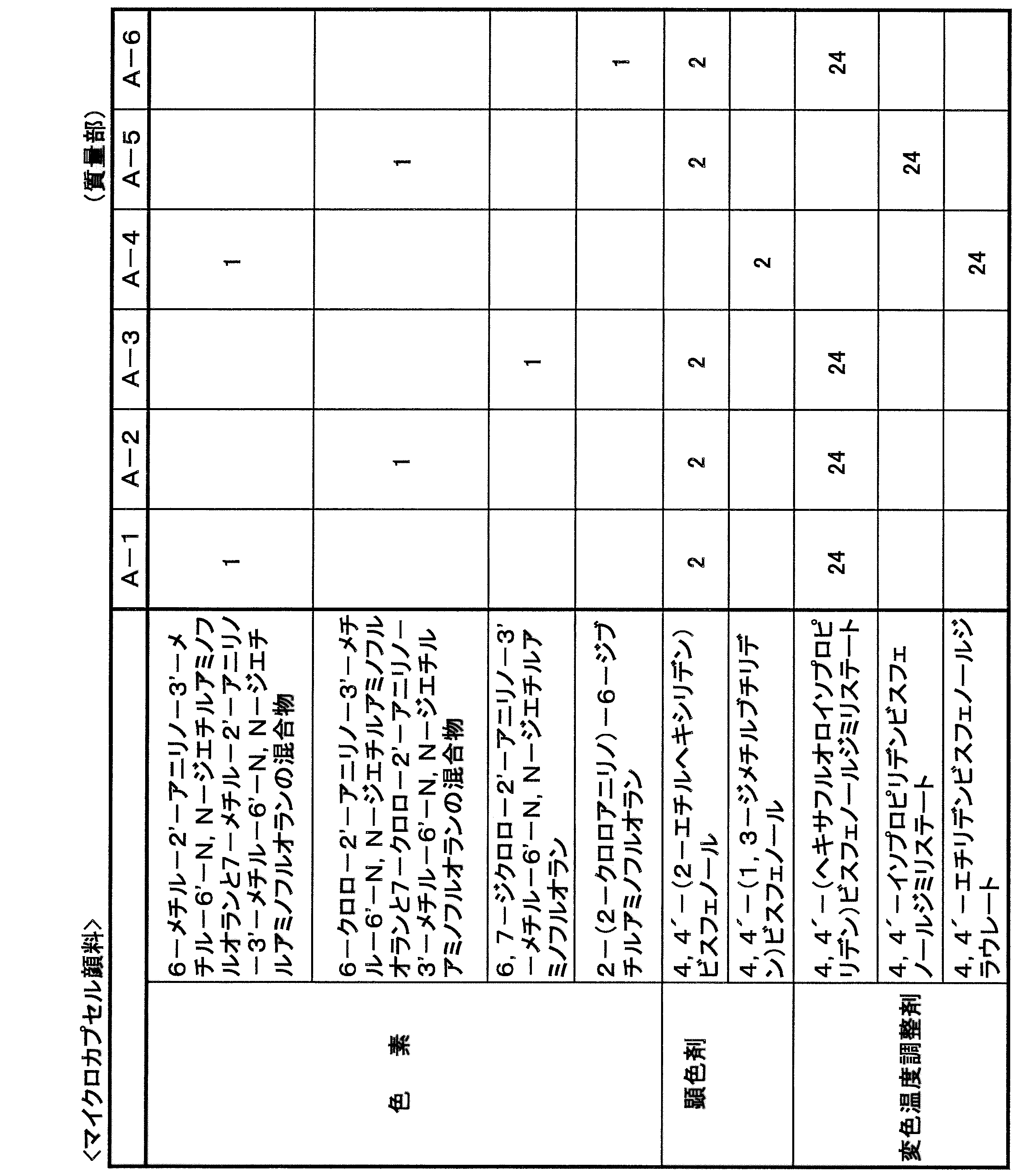

上記表1及び表2の結果から明らかなように、本発明となる実施例1~10の筆記具用インク組成物は、本発明の範囲外となる比較例1~2の筆記具用インク組成物に較べて、耐光性に優れ、満足のいく十分な描線濃度となることが判明した。
これに対して、比較例1及び2のロイコ色素として2-(2-クロロアニリノ)-6-ジブチルアミノフルオランを用いたマイクロカプセル顔料を含有する各インク組成物では、満足のいく十分な耐光性、描線濃度が得られないものであった。
これに対して、比較例1及び2のロイコ色素として2-(2-クロロアニリノ)-6-ジブチルアミノフルオランを用いたマイクロカプセル顔料を含有する各インク組成物では、満足のいく十分な耐光性、描線濃度が得られないものであった。
水性、または、油性のボールペン、マーキングペンなどの筆記具に好適な色素、それを用いたマイクロカプセル顔料及び筆記具用インク組成物が得られる。
Claims (4)
- 下記式(I)で示されるロイコ色素からなることを特徴とする色素。

- 上記式(I)中のX,Yのうち少なくとも一方がメチル基又は塩素原子であることを特徴とする請求項1記載の色素。
- 請求項1又は2の色素、顕色剤及び変色温度調整剤を少なくとも含むことを特徴とするマイクロカプセル顔料。
- 請求項3に記載のマイクロカプセル顔料を含有することを特徴とする筆記具用インク組成物。
Applications Claiming Priority (2)
| Application Number | Priority Date | Filing Date | Title |
|---|---|---|---|
| JP2012-143893 | 2012-06-27 | ||
| JP2012143893A JP6000686B2 (ja) | 2012-06-27 | 2012-06-27 | 色素、それを用いたマイクロカプセル顔料及び筆記具用インク組成物 |
Publications (1)
| Publication Number | Publication Date |
|---|---|
| WO2014002292A1 true WO2014002292A1 (ja) | 2014-01-03 |
Family
ID=49782514
Family Applications (1)
| Application Number | Title | Priority Date | Filing Date |
|---|---|---|---|
| PCT/JP2012/069579 Ceased WO2014002292A1 (ja) | 2012-06-27 | 2012-08-01 | 色素、それを用いたマイクロカプセル顔料及び筆記具用インク組成物 |
Country Status (3)
| Country | Link |
|---|---|
| JP (1) | JP6000686B2 (ja) |
| TW (1) | TW201400560A (ja) |
| WO (1) | WO2014002292A1 (ja) |
Cited By (4)
| Publication number | Priority date | Publication date | Assignee | Title |
|---|---|---|---|---|
| JP2015229708A (ja) * | 2014-06-04 | 2015-12-21 | 三菱鉛筆株式会社 | 筆記具用水性インク組成物 |
| US20180244923A1 (en) * | 2015-09-03 | 2018-08-30 | Riken | Rhodamine-based colorant compound and process for producing same |
| WO2021008346A1 (zh) * | 2019-07-18 | 2021-01-21 | 江南大学 | 一种电、温双控型双稳态变色染料及微胶囊的制备方法 |
| JPWO2021085457A1 (ja) * | 2019-10-30 | 2021-05-06 |
Families Citing this family (4)
| Publication number | Priority date | Publication date | Assignee | Title |
|---|---|---|---|---|
| JP6439097B2 (ja) * | 2014-12-09 | 2018-12-19 | 協立化学産業株式会社 | 光硬化性樹脂組成物及び遮光性樹脂層の製造方法 |
| JP7088814B2 (ja) * | 2018-11-14 | 2022-06-21 | 株式会社パイロットコーポレーション | スタンプ用熱変色性インキ組成物及びそれを用いたスタンプ |
| WO2020203603A1 (ja) | 2019-03-29 | 2020-10-08 | パイロットインキ株式会社 | 可逆熱変色性組成物、それを内包してなる可逆熱変色性マイクロカプセル顔料、及びそれを用いた筆記具 |
| JP2019155928A (ja) * | 2019-07-01 | 2019-09-19 | 三菱鉛筆株式会社 | 熱変色性筆記具 |
Citations (5)
| Publication number | Priority date | Publication date | Assignee | Title |
|---|---|---|---|---|
| JPS60219261A (ja) * | 1984-04-16 | 1985-11-01 | Hodogaya Chem Co Ltd | 感熱記録紙 |
| JPS6264592A (ja) * | 1985-09-17 | 1987-03-23 | Fuji Photo Film Co Ltd | 記録材料 |
| JPH05294071A (ja) * | 1992-04-17 | 1993-11-09 | Ricoh Co Ltd | 感熱記録材料 |
| JP2002294096A (ja) * | 2001-03-30 | 2002-10-09 | Pilot Ink Co Ltd | 可逆熱変色性組成物 |
| JP2010132822A (ja) * | 2008-12-05 | 2010-06-17 | Matsui Shikiso Chem Co Ltd | 可逆感温変色性ヒステリシス組成物 |
Family Cites Families (3)
| Publication number | Priority date | Publication date | Assignee | Title |
|---|---|---|---|---|
| JPS5865754A (ja) * | 1981-10-16 | 1983-04-19 | Nippon Kayaku Co Ltd | フルオラン化合物及びそれを用いる発色性感熱又は感圧記録シ−ト |
| JP3331614B2 (ja) * | 1991-03-13 | 2002-10-07 | 大日本インキ化学工業株式会社 | 感熱発色体、感熱発色体用塗料及び感熱発色方法 |
| JP3230538B2 (ja) * | 1992-08-11 | 2001-11-19 | 株式会社リコー | 感熱記録材料 |
-
2012
- 2012-06-27 JP JP2012143893A patent/JP6000686B2/ja active Active
- 2012-08-01 WO PCT/JP2012/069579 patent/WO2014002292A1/ja not_active Ceased
- 2012-08-28 TW TW101131156A patent/TW201400560A/zh unknown
Patent Citations (5)
| Publication number | Priority date | Publication date | Assignee | Title |
|---|---|---|---|---|
| JPS60219261A (ja) * | 1984-04-16 | 1985-11-01 | Hodogaya Chem Co Ltd | 感熱記録紙 |
| JPS6264592A (ja) * | 1985-09-17 | 1987-03-23 | Fuji Photo Film Co Ltd | 記録材料 |
| JPH05294071A (ja) * | 1992-04-17 | 1993-11-09 | Ricoh Co Ltd | 感熱記録材料 |
| JP2002294096A (ja) * | 2001-03-30 | 2002-10-09 | Pilot Ink Co Ltd | 可逆熱変色性組成物 |
| JP2010132822A (ja) * | 2008-12-05 | 2010-06-17 | Matsui Shikiso Chem Co Ltd | 可逆感温変色性ヒステリシス組成物 |
Cited By (10)
| Publication number | Priority date | Publication date | Assignee | Title |
|---|---|---|---|---|
| JP2015229708A (ja) * | 2014-06-04 | 2015-12-21 | 三菱鉛筆株式会社 | 筆記具用水性インク組成物 |
| US20180244923A1 (en) * | 2015-09-03 | 2018-08-30 | Riken | Rhodamine-based colorant compound and process for producing same |
| US10435564B2 (en) | 2015-09-03 | 2019-10-08 | Riken | Rhodamine-based colorant compound and process for producing same |
| WO2021008346A1 (zh) * | 2019-07-18 | 2021-01-21 | 江南大学 | 一种电、温双控型双稳态变色染料及微胶囊的制备方法 |
| US11655373B2 (en) | 2019-07-18 | 2023-05-23 | Jiangnan University | Method of preparing electric and temperature dual-control bi-stable color-changing dyes and microcapsules |
| JPWO2021085457A1 (ja) * | 2019-10-30 | 2021-05-06 | ||
| WO2021085457A1 (ja) * | 2019-10-30 | 2021-05-06 | 株式会社パイロットコーポレーション | 油性ボールペン用インキ組成物およびそれを用いた油性ボールペン |
| CN114616295A (zh) * | 2019-10-30 | 2022-06-10 | 株式会社百乐 | 油性圆珠笔用墨液组合物及使用它的油性圆珠笔 |
| CN114616295B (zh) * | 2019-10-30 | 2023-10-27 | 株式会社百乐 | 油性圆珠笔用墨液组合物及使用它的油性圆珠笔 |
| US12600875B2 (en) | 2019-10-30 | 2026-04-14 | Kabushiki Kaisha Pilot Corporation | Oil-based ink composition for ballpoint pens and ballpoint pen employing the same |
Also Published As
| Publication number | Publication date |
|---|---|
| JP2014005422A (ja) | 2014-01-16 |
| TW201400560A (zh) | 2014-01-01 |
| JP6000686B2 (ja) | 2016-10-05 |
Similar Documents
| Publication | Publication Date | Title |
|---|---|---|
| JP5595449B2 (ja) | 色素、それを用いたマイクロカプセル顔料及び筆記具用インク組成物 | |
| JP6000686B2 (ja) | 色素、それを用いたマイクロカプセル顔料及び筆記具用インク組成物 | |
| KR102284625B1 (ko) | 마이크로 캡슐 색재 및 필기구용 잉크 조성물 | |
| JP7170087B2 (ja) | 色素、マイクロカプセル顔料 | |
| WO2011070966A1 (ja) | 水性ボールペン用インキ組成物及び水性ボールペン | |
| JP5713800B2 (ja) | 筆記具用油性インク組成物 | |
| JP5754966B2 (ja) | 筆記具用水性インク組成物 | |
| JP2022138651A (ja) | 熱変色性マイクロカプセル及び熱変色性インク組成物 | |
| JP6245511B2 (ja) | マイクロカプセル色材及び筆記具用インク組成物 | |
| JP6239933B2 (ja) | マイクロカプセル色材及び筆記具用インク組成物 | |
| JP2012219160A (ja) | 筆記具用水性インク組成物 | |
| JP5921087B2 (ja) | 筆記具用水性インク組成物 | |
| JP7674088B2 (ja) | マイクロカプセル顔料及び筆記具用インク組成物 | |
| JP2022175433A (ja) | マイクロカプセル顔料、これを含有した筆記具用インク組成物 |
Legal Events
| Date | Code | Title | Description |
|---|---|---|---|
| 121 | Ep: the epo has been informed by wipo that ep was designated in this application |
Ref document number: 12879983 Country of ref document: EP Kind code of ref document: A1 |
|
| NENP | Non-entry into the national phase |
Ref country code: DE |
|
| 122 | Ep: pct application non-entry in european phase |
Ref document number: 12879983 Country of ref document: EP Kind code of ref document: A1 |