WO2013176207A1 - スプレッド及びその製造方法 - Google Patents
スプレッド及びその製造方法 Download PDFInfo
- Publication number
- WO2013176207A1 WO2013176207A1 PCT/JP2013/064310 JP2013064310W WO2013176207A1 WO 2013176207 A1 WO2013176207 A1 WO 2013176207A1 JP 2013064310 W JP2013064310 W JP 2013064310W WO 2013176207 A1 WO2013176207 A1 WO 2013176207A1
- Authority
- WO
- WIPO (PCT)
- Prior art keywords
- starch
- spread
- mass
- oil
- aqueous phase
- Prior art date
- Legal status (The legal status is an assumption and is not a legal conclusion. Google has not performed a legal analysis and makes no representation as to the accuracy of the status listed.)
- Ceased
Links
Images



Classifications
-
- A—HUMAN NECESSITIES
- A23—FOODS OR FOODSTUFFS; TREATMENT THEREOF, NOT COVERED BY OTHER CLASSES
- A23D—EDIBLE OILS OR FATS, e.g. MARGARINES, SHORTENINGS OR COOKING OILS
- A23D7/00—Edible oil or fat compositions containing an aqueous phase, e.g. margarines
- A23D7/015—Reducing calorie content; Reducing fat content, e.g. "halvarines"
-
- A—HUMAN NECESSITIES
- A23—FOODS OR FOODSTUFFS; TREATMENT THEREOF, NOT COVERED BY OTHER CLASSES
- A23D—EDIBLE OILS OR FATS, e.g. MARGARINES, SHORTENINGS OR COOKING OILS
- A23D7/00—Edible oil or fat compositions containing an aqueous phase, e.g. margarines
- A23D7/005—Edible oil or fat compositions containing an aqueous phase, e.g. margarines characterised by ingredients other than fatty acid triglycerides
- A23D7/0056—Spread compositions
Definitions
- the present invention relates to a spread and a manufacturing method thereof.
- a water-in-oil type fat / oil composition such as spread
- the raw material is dispersed or dissolved in the oil phase and the water phase, and the oil phase and the water phase are separately mixed and then mixed, and (preliminary) emulsification step It is manufactured through a heating (sterilization) step, a cooling step, a kneading step and the like.
- Patent Document 1 discloses a low fat spread prepared using an emulsifier composed of monoglycerin fatty acid ester, polyglycerin condensed ricinoleic acid ester, sucrose fatty acid ester and lecithin. Is described.
- Patent Document 2 describes a low-fat spread prepared using an emulsifier and a stabilizer composed of polyglycerin condensed ricinoleic acid ester, glycerin fatty acid ester and gelatin. .
- Patent Document 3 describes a low-fat spread prepared using a milk protein concentrate without using a modified starch.
- Patent Document 4 describes a low fat spread using milk protein derived from milk and starch.
- Patent Document 5 describes a weakly acidic low fat spread using a mixture of tapioca-derived hydroxypropyl starch and wheat fiber as a substitute for gelatin.
- the oil phase part is reduced, so that the water phase part is relatively increased.
- the spread is a water-in-oil type emulsion, and an increase in the water phase part causes the emulsion to become unstable.
- a stabilizer such as gelatin is added to the aqueous phase to improve the emulsion stability.
- adjusting the pH to acidic causes acidity and greatly affects the flavor.
- the present invention has been made as an object to provide a low fat spread having good emulsification stability and microbiological storage stability and a good flavor and a method for producing the same. is there.
- the present inventors have prepared an oil phase having a good emulsification stability, microbiological storage stability, a good flavor and an unprecedented low fat spread.
- the invention described in claim 1 of the present invention includes fats and oils in a proportion of 22% by mass or more and 42% by mass or less, starch in a proportion of 1.8% by mass or more and 12% by mass or less, and pH of the aqueous phase. Is a spread in the range of 6.0 to 8.5.
- the invention according to claim 2 is the spread according to claim 1, wherein the starch is selected from one or more of hydroxypropyl starch, hydroxypropylated phosphoric acid cross-linked starch, and phosphoric acid cross-linked starch.
- the invention according to claim 3 is the spread according to claim 2, wherein the hydroxypropyl starch, hydroxypropylated phosphate-crosslinked starch, and phosphate-crosslinked starch are derived from tapioca or waxy corn.
- the invention according to claim 4 is the spread according to any one of claims 1 to 3, wherein the raw material does not contain citric acid and a salt thereof.
- the invention according to claim 5 is prepared by emulsifying a composition containing starch in a proportion of 1.8% by mass or more and 12% by mass or less, and a composition containing oils and emulsifiers in a proportion of 22% by mass or more and 42% by mass or less. This is a method for producing a spread having a pH in the range of 6.0 or more and 8.5 or less by sterilizing, cooling and kneading the emulsion.
- the invention according to claim 6 is the method according to claim 5, wherein the starch is selected from one or more of hydroxypropyl starch, hydroxypropylated phosphoric acid cross-linked starch, and phosphoric acid cross-linked starch.
- the invention according to claim 7 is the method according to claim 6, wherein the hydroxypropyl starch, hydroxypropylated phosphate-crosslinked starch, and phosphate-crosslinked starch are derived from tapioca or waxy corn.
- the invention according to claim 8 is the method according to any one of claims 5 to 7, wherein the raw material does not contain citric acid and a salt thereof.
- the present invention it is possible to provide a low fat spread having good emulsification stability and microbiological storage stability and having a good flavor and a method for producing the same. That is, it is possible to provide a low fat spread and a method for producing the same that are free from any problems in emulsion stability, microbiological storage stability, and flavor.
- a low-fat spread having a relatively large amount of water phase part is excellent in emulsification stability and does not cause production failure factors such as phase inversion during production, and has a good production suitability. Can be provided.
- starch significantly improves the microbiological storage stability, so that it is possible to provide a low-fat spread with good storage stability that can be used for a long time even after opening.
- the microbiological storage stability is sufficiently secured, so that the acidity produced by adjusting the pH to acid as in the conventional case is not felt at all. For this reason, it becomes possible to perform a seasoning with a high degree of freedom, and it is possible to provide low-fat spreads with various flavors that have not been conventionally available.
- an oil phase and an aqueous phase are first emulsified and / or dispersed (preliminarily emulsified) to prepare a water-in-oil mixture or an oil-in-water mixture.
- starch is blended at a predetermined concentration in the aqueous phase at this time.
- a spread of the present invention is produced by sterilizing, cooling, and kneading an emulsified liquid prepared by emulsifying a composition containing a predetermined amount of starch, fats and oils and an emulsifier.
- a flavor material, a physical property improving agent, etc. may be mixed as an auxiliary material simultaneously with the oil phase or the aqueous phase, You may mix
- the mixture is heated (sterilized) and then cooled. If necessary, the mixture is filtered, heated (sterilized) and then cooled. If necessary, it can be filtered.
- This heating process and cooling process are not particularly limited as long as they are processed by equipment and equipment used in the food industry, but plate type heat exchangers, tube type heat exchangers, energizing (joule) type heaters, tanks, etc. are applied. it can.
- the heating conditions and cooling conditions are not particularly limited. For example, heating conditions for holding the mixture at 95 ° C. for 20 seconds or more can be mentioned, and the mixture is lowered to 30 to 60 ° C. and held. Cooling conditions to be mentioned.
- the filtration process is not particularly limited, but a ceramic filter or the like can be applied.
- a general margarine production machine such as a blender, perfector, combinator, botter, onlator, etc., rapidly cool and knead.
- the rapid cooling and kneading conditions at this time are not particularly limited, and can be freely set according to the desired physical properties.
- starch is added to the aqueous phase.
- Starch is not particularly limited as long as the desired effect can be obtained.
- the starch is modified or improved by enzymatic, physical, or chemical modification treatment to impart or enhance functionality.
- Starch is preferred.
- acetylated adipic acid cross-linked starch As modified starch, acetylated adipic acid cross-linked starch, acetylated phosphoric acid cross-linked starch, acetylated oxidized starch, octenyl succinate sodium starch, acetic acid starch, oxidized starch, hydroxypropyl starch, hydroxypropylated phosphate cross-linked starch, phosphate monoester
- Illustrative examples include phosphorylated cross-linked starch, phosphorylated starch, and phosphoric acid cross-linked starch. In this invention, it is preferable to select from 1 type, or 2 or more types of hydroxypropyl starch.
- Starch is not particularly limited as long as the desired effect is obtained, and is derived from rice, beans, potato, sweet potato, wheat, corn, tapioca and the like. Starch can be used. In the present invention, it is preferable to use starch derived from tapioca or waxy corn.
- hydroxypropyl starch derived from tapioca or waxy corn
- hydroxypropylated phosphate-crosslinked starch hydroxypropylated phosphate-crosslinked starch
- phosphate-crosslinked starch hydroxypropyl starch derived from tapioca or waxy corn
- the spread of the present invention manufactured by the above-described manufacturing method of the present invention contains fats and oils in a proportion of 22% by mass or more and 42% by mass or less, and starch in a proportion of 1.8% by mass or more and 12% by mass or less.
- the blending ratio of fats and oils is less than 22% by mass, the aqueous phase part becomes excessive, the stability of emulsification cannot be obtained, the commercial production is difficult, and the stability of the product over time cannot be obtained.
- the spread of the present invention preferably contains fats and oils in a proportion of 22% by mass or more and 42% by mass or less. Moreover, it is more preferable to contain fats and oils in the ratio of 25 mass% or more and 42 mass% or less from this viewpoint, It is more preferable to contain fats and oils in the ratio of 27 mass% or more and 41 mass% or less, and fats and oils are 30 mass% or more. It is particularly preferable to include it in a proportion of 40% by mass or less.
- the spread of the present invention preferably contains starch in a proportion of 1.8% by mass to 12% by mass. From this viewpoint, it is more preferable that starch is contained in a proportion of 2% by mass or more and 10% by mass or less, starch is more preferably contained in a proportion of 3% by mass or more and 9% by mass or less, and starch is contained by 3% by mass or more. It is particularly preferable to include it at a ratio of 7% by mass or less. Moreover, it is more preferable that starch is included in the ratio of 3 mass% or more and 5 mass% or less among the ratio of 3 mass% or more and 7 mass% or less.
- the pH of the aqueous phase is in the range of 6.0 or more and 8.5 or less when the spread is prepared at the above blending ratio.
- a composition containing starch in a proportion of 1.8% by mass or more and 12% by mass or less, and a fat and oil and an emulsifier in a proportion of 22% by mass or more and 42% by mass or less is prepared.
- the emulsified emulsified liquid is sterilized, cooled, and kneaded to produce the spread of the present invention having a pH in the range of 6.0 to 8.5.
- the pH of the aqueous phase was adjusted to be acidic or weakly acidic in order to ensure microbiological preservation. This is effective for preventing the growth of microorganisms, but it has been unavoidable that sourness is produced as a flavor by the blending of various pH adjusting agents.
- the pH of the aqueous phase is in the range of 6.0 to 8.5, and the pH of the aqueous phase is acidic. It is not necessary to adjust to the side.
- the pH of the aqueous phase is more preferably 6.2 or more and 8.4 or less, and the pH of the aqueous phase is 6.4 or more and 8.3 or less. More preferably, the pH of the aqueous phase is particularly preferably from 6.6 to 8.2. Even in the pH range of 6.6 to 8.2, the pH of the aqueous phase is more preferably 7.0 to 8.0.
- citric acid and its salts are not contained or added (blended) in the raw material.
- adding citric acid and its salt to the raw material or adding (compounding) it to the extent that it does not affect the flavor and physical properties of the spread substantially adds citric acid and its salt to the raw material. It shall correspond to not including or not adding (compounding).
- the effect of improving the emulsion stability can be obtained by adding starch.
- the emulsified state is stabilized by the effect of adding starch at a predetermined ratio, water separation hardly occurs during and after the production, and a stable emulsified state is obtained.
- the effect of improving microbiological preservation is obtained by blending starch at a predetermined ratio.
- the low fat spread has a problem that the pH of the aqueous phase is adjusted and the microbiological preservation is ensured, resulting in an obstacle to flavoring.
- the present invention by adding starch at a predetermined ratio, the growth of mold, bacteria, yeast, etc. is sufficiently suppressed while the pH of the aqueous phase is in the range of 6.0 to 8.5, It has been confirmed that the microbiological preservation is improved.
- Example 1 In a tank for preparation, 5540 g of vegetable oil (Ota Oil Co., Ltd.) and 2320 g of edible refined processed oil (Ueda Oil Co., Ltd.) 2320 g were mixed (stirred) and heated to 60 ° C. to give an emulsifier (Taiyo Chemical Co., Ltd.). 80 g was added and mixed (stirred).
- the water phase prepared as described above was added to and mixed with the oil phase prepared as described above, and then 52 g of fragrance was added and mixed.
- this mixture was sent to a plate heat exchanger (sterilizer), heated (sterilized) at 95 ° C. for 20 seconds, and then cooled to about 40 ° C.
- this mixture was sent to a scraper type heat exchanger (cooler), rapidly cooled to about 7 to 18 ° C., and then sent to a kneader to knead.
- this mixture was sent to a filling machine and filled into a container to produce a low fat spread.
- Example 1 In the production method of Example 1 described above, it was confirmed that water separation was not observed during and after the production, and the emulsified state was stable.
- Example 2 A low-fat spread of the present invention was produced in the same manner as in Example 1 except that the amount of hydroxypropyl starch added was changed from 400 g to 680 g and the water used for preparing the aqueous phase was changed from 11319 g to 11039 g.
- Example 2 In the production method of Example 2, generation of water separation was not observed during and after production, and it was confirmed that the emulsified state was stable.
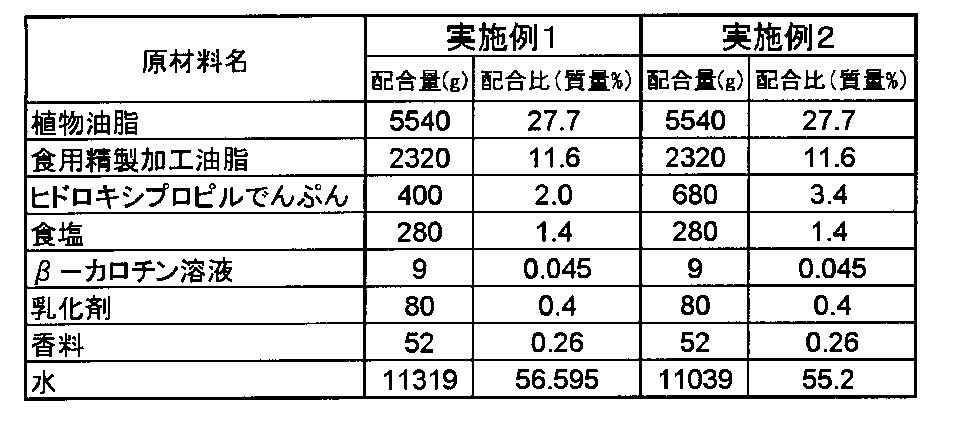
- Example 1 The blending amounts and blending ratios of Example 1 and Example 2 are shown in Table 1.
- Example 1 A low-fat spread serving as a comparative example was produced in the same manner as in Example 1 except that the hydroxypropyl starch was not blended and the water used for preparing the aqueous phase was changed from 11319 g to 11719 g.
- Comparative Example 2 A low-fat spread of a comparative example was produced in the same manner as in Example 1 except that the amount of hydroxypropyl starch added was reduced from 400 g to 200 g and the water used to prepare the aqueous phase was changed from 11519 g to 11039 g.
- Example 3 In a tank for blending, 6648 g of vegetable oil (made by Ota Oil Co., Ltd.) and 2784 g of edible refined processed oil (made by Ueda Oil Co., Ltd.) were mixed (stirred) and heated to 60 ° C., and an emulsifier (made by Taiyo Chemical Co., Ltd.) 96 g was added and mixed (stirred).
- the water phase prepared as described above was added to and mixed with the oil phase prepared as described above, and further 67.2 g of fragrance was added and mixed.
- this mixture was sent to a plate heat exchanger (sterilizer), heated (sterilized) at 95 ° C. for 20 seconds, and then cooled to about 40 ° C.
- this mixture was sent to a scraper type heat exchanger (cooler), rapidly cooled to about 7 to 18 ° C., and then sent to a kneader to knead.
- Example 3 In the production method of Example 3 described above, the generation of water separation was not observed during and after the production, and it was confirmed that the emulsified state was stable.
- Example 3 yielded a water-in-oil type oil and fat composition spread in which the emulsified state was stable.
- Example 4 The same procedure as in Example 3 was conducted except that hydroxypropyl starch (Nlite CL, manufactured by NSC Japan) used in Example 3 was changed to hydroxypropyl starch (Textura, manufactured by NSC Japan, tapioca). The low fat spread of the present invention was manufactured.
- Example 4 provided a spread of a water-in-oil type oil / fat composition having a stable emulsified state.
- Table 3 shows the blending amounts and blending ratios of Example 3 and Example 4.
- Example 5 The same procedure as in Example 3 was conducted except that hydroxypropyl starch (Nlite CL, manufactured by NSC Japan) used in Example 3 was changed to hydroxypropyl starch (Unipure GA, manufactured by NSC Japan, corn). The low fat spread of the present invention was manufactured.
- Example 5 yielded a water-in-oil type oil / fat spread with a stable emulsified state.
- Example 5 The blending amounts and blending ratios of Example 5 and Comparative Example 3 are shown in Table 4.
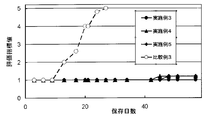
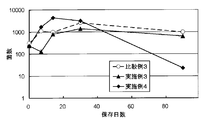
- Example 1 The spread obtained in Example 3, Example 4, Example 5, and Comparative Example 3 was subjected to a mold growth test. That is, a mold was kneaded into each and a preservation test was conducted.
- Aspergillus niger was used as a mold for the test.
- a sample was prepared by inoculating 1 g of each spread so that the number of mold spores was 50. This sample was put into a sterile petri dish, sealed with a vinyl tape, and stored at 20 ° C. and 25 ° C., respectively.
- FIG. 1 shows changes in evaluation index values when stored at 20 ° C.
- FIG. 2 shows changes in evaluation index values when stored at 25 ° C.
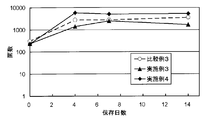
- Example 2 The spread obtained in Example 3, Example 4, and Comparative Example 3 was subjected to a bacterial growth test. That is, a preservation test was conducted by kneading bacteria in each of them.
- test bacteria As test bacteria, a mixture of heat-resistant gram-positive bacterium Bacillus cereus, psychrophilic gram-negative bacterium Pseudomonas sp., Escherichia coli gram-negative bacterium Enterobacter acacloacae, and Gram-positive cocci Staphylococcus epidermidis (4 types) .
- a sample was prepared by inoculating 1 g of each spread so that the total number of mixed bacteria was 500.
- the sample was placed in a sterile petri dish, sealed with vinyl tape, and stored at 10 ° C, 15 ° C, 20 ° C, and 25 ° C, respectively.
- the number of bacteria was measured after 7, 14, 30, 90, 180, and 270 days.
- the number of bacteria was measured after 4 days, 7 days, and 14 days.
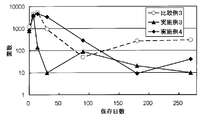
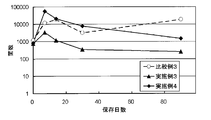
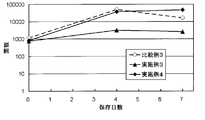
- Fig. 3 shows the increase or decrease in the number of bacteria when stored at 10 ° C. Similarly, the increase and decrease in the number of bacteria when stored at 15 ° C., 20 ° C., and 25 ° C. are shown in FIGS. 4, 5, and 6, respectively.
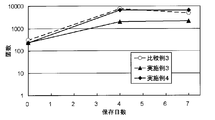
- Example 3 The spread obtained in Example 3, Example 4, and Comparative Example 3 was subjected to a yeast growth test. That is, a storage test was conducted by kneading yeast into each.
- Candida krusei was used as a test yeast.
- a sample was prepared by inoculating 1 g of each spread so that the number of yeast cells was 500.
- the sample was placed in a sterile petri dish, sealed with vinyl tape, and stored at 10 ° C, 15 ° C, 20 ° C, and 25 ° C, respectively.
- the number of bacteria was measured after 7, 14, 30, 90, 180, and 270 days.
- the number of bacteria was measured after 4 days, 7 days, and 14 days.
- Fig. 7 shows changes in the number of yeasts when stored at 10 ° C. Similarly, the increase and decrease in the number of yeasts when stored at 15 ° C., 20 ° C., and 25 ° C. are shown in FIG. 8, FIG. 9, and FIG. 10, respectively.
- an aqueous phase was prepared by blending A to F in Table 6.
- Salt is manufactured by Salt Kansai
- gelatin is manufactured by Nitta Gelatin (MU-200)
- citric acid and trisodium citrate are manufactured by Saneigen FFI
- hydroxypropyl starch is manufactured by NSC Japan (Nlite) CL) and starch were manufactured by NSC Japan (derived from tapioca)
- sugar was manufactured by Nippon Sugar Sugar Co., Ltd.
- dextrin was manufactured by Matsutani Chemical Industry Co., Ltd. (paindex).
- Aspergillus niger was used as a mold for the test.
- each aqueous phase part was measured, and a sample was prepared by inoculating 1 g of the aqueous phase part so that the number of mold spores was 50.
- Test Example 5 As a mold growth test in the aqueous phase, a plurality of hydroxypropyl starches shown in Table 9 were used, and samples of 5.7% aqueous solutions were prepared and examined.
- hydroxypropyl starch, hydroxypropylated phosphate-crosslinked starch, and phosphate-crosslinked starch can be used as the starch blended in the aqueous phase from the viewpoint of ensuring sufficient microbiological storage stability.
- starch-derived plant is preferably tapioca or waxy corn from the viewpoint of ensuring sufficient microbiological preservation.
- Example 6 A low-fat spread of the present invention was produced in the same manner as in Example 1 except that the blending of Example 1 and the blending amount / blending ratio were changed to the blending shown in Table 9 and the blending amount / blending ratio.
- Example 6 yielded a water-in-oil type oil / fat spread with a stable emulsified state.
- Example 6 The blending amounts and blending ratios of Example 6 are shown in Table 10.
- Example 7 A low-fat spread of the present invention was produced in the same manner as in Example 1 except that the blending of Example 1 and the blending amount / blending ratio were changed to the blending shown in Table 11 and the blending amount / blending ratio.
- Table 11 shows the blending amount and blending ratio of Example 7.
- a low fat spread having a relatively large amount of aqueous phase has excellent emulsification stability, does not cause production defects such as phase inversion during the production, and has good production suitability. Can provide a wide spread.
Landscapes
- Chemical & Material Sciences (AREA)
- Oil, Petroleum & Natural Gas (AREA)
- Life Sciences & Earth Sciences (AREA)
- Engineering & Computer Science (AREA)
- Food Science & Technology (AREA)
- Polymers & Plastics (AREA)
- Edible Oils And Fats (AREA)
- Seasonings (AREA)
- Grain Derivatives (AREA)
Description
本発明は、スプレッド及びその製造方法に関する。
スプレッド等の油中水型油脂組成物では、一般的に、油相と水相に原料を分散や溶解させて、油相と水相を別々に調合してから混合し、(予備)乳化工程、加熱(殺菌)工程、冷却工程、混練工程等を経て製造される。近年、消費者の低カロリー指向を意識した製品の開発が検討されており、次のような低脂肪のスプレッドが提案されている。
例えば、特開平05-049398号公報(特許文献1)には、モノグリセリン脂肪酸エステル、ポリグリセリン縮合リシノレイン酸エステル、ショ糖脂肪酸エステル、レシチンで構成された乳化剤を使用して調製された低脂肪スプレッドが記載されている。
特開平06-237690号公報(特許文献2)には、ポリグリセリン縮合リシノレイン酸エステル、グリセリン脂肪酸エステル、ゼラチンで構成された乳化剤や安定剤を使用して調製された低脂肪スプレッドが記載されている。
特開平11-243856号公報(特許文献3)には、化工澱粉を使用せず、乳タンパク質濃縮物を使用して調製された低脂肪スプレッドが記載されている。
特開平02-005823号公報(特許文献4)には、牛乳由来の乳タンパク質とでんぷんを使用した低脂肪スプレッドが記載されている。
特開平11318359号公報(特許文献5)には、タピオカ由来のヒドロキシプロピルデンプンと小麦ファイバーとの調合物をゼラチンの代用物として使用した弱酸性の低脂肪スプレッドが記載されている。
低脂肪スプレッドの調製では、油相部を減らすため、相対的に水相部が多くなる。スプレッドは油中水型の乳化物であり、水相部の増大は、乳化を不安定化させる要因となる。
そこで、水相部にゼラチン等の安定化剤を配合し、乳化安定性を向上させる方策が採られることもある。
しかし、水相部へゼラチン等を配合すると、微生物学的な保存性の悪化を招くため、pHを酸性に調整し、微生物学的な保存性を担保する必要がある。
この場合、pHを酸性に調整することで、酸味が生じ、風味に大きな悪影響を及ぼす。
したがって、良好な乳化安定性、微生物学的保存性を有しており、風味の良好な低脂肪スプレッドは、まだ知られていない。
本発明は、このような状況に鑑み、良好な乳化安定性、微生物学的保存性を有しており、風味の良好な低脂肪スプレッド及びその製造方法を提供することを課題としてなされたものである。
上記課題を解決するために、本発明者らは、良好な乳化安定性、微生物学的保存性を有し、風味の良好な、従来にはなかった低脂肪スプレッドを製造するにあたり、その油相と水相の原料と物性や、その製造方法の全体などを見直して検討した。
その結果、所定の原料と配合で油相と水相を調製する際に、水相にでんぷんを配合することにより、良好な乳化安定性、微生物学的保存性を有し、風味の良好な、従来にはなかった低脂肪スプレッドを製造できることを見出し、本発明を完成させた。
すなわち、本発明の請求項1に記載の発明は、油脂を22質量%以上42質量%以下の割合で含み、でんぷんを1.8質量%以上12質量%以下の割合で含み、水相のpHが6.0以上8.5以下の範囲にある、スプレッド、である。
請求項2に記載の発明は、でんぷんが、ヒドロキシプロピルでんぷん、ヒドロキシプロピル化リン酸架橋でんぷん、リン酸架橋でんぷんの1種又は2種以上から選ばれる、請求項1記載のスプレッド、である。
請求項3に記載の発明は、ヒドロキシプロピルでんぷん、ヒドロキシプロピル化リン酸架橋でんぷん、リン酸架橋でんぷんが、タピオカあるいはワキシーコーンに由来するものである、請求項2記載のスプレッド、である。
請求項4に記載の発明は、原材料中にクエン酸及びその塩を含まないことを特徴とする、請求項1から3のいずれか一項に記載のスプレッド、である。
請求項5に記載の発明は、1.8質量%以上12質量%以下の割合のでんぷんと、22質量%以上42質量%以下の割合の油脂及び乳化剤を含んだ組成物を調合して乳化した乳化液を、殺菌、冷却、混練して、pHが6.0以上8.5以下の範囲にあるスプレッドを製造する方法、である。
請求項6に記載の発明は、でんぷんが、ヒドロキシプロピルでんぷん、ヒドロキシプロピル化リン酸架橋でんぷん、リン酸架橋でんぷんの1種又は2種以上から選ばれる、請求項5記載の方法、である。
請求項7に記載の発明は、ヒドロキシプロピルでんぷん、ヒドロキシプロピル化リン酸架橋でんぷん、リン酸架橋でんぷんが、タピオカあるいはワキシーコーンに由来するものである、請求項6に記載の方法、である。
請求項8に記載の発明は、原材料中にクエン酸及びその塩を含まないことを特徴とする、請求項5から7のいずれか一項に記載の方法、である。
本発明により、良好な乳化安定性、微生物学的保存性を有しており、風味の良好な低脂肪スプレッド及びその製造方法を提供することができる。すなわち、乳化安定性、微生物学的保存性、風味のいずれにおいても問題の無い、低脂肪スプレッド及びその製造方法を提供することができる。
本発明によれば、相対的に水相部の多い低脂肪スプレッドであっても、乳化安定性に優れており、製造途中で転相等の製造不良要因が生じない、製造適性の良好なスプレッドを提供できる。
また、後述するように、でんぷんの添加により、微生物学的な保存性が格段に向上することから、開封後でも長期にわたって使用することができる、保存性の良好な低脂肪スプレッドを提供できる。
さらに、本発明によれば、pHが中性でも微生物学的な保存性が十分に担保されているため、従来のようにpHを酸性に調整することによって生じる酸味を全く感じることがない。このため、自由度の大きい風味付けをすることが可能となり、従来にはない様々な風味の低脂肪スプレッドを提供できる。
従来のスプレッドの製造方法では、最初に油相と水相とを乳化及び/又は分散(予備乳化)させて、油中水型混合物や水中油型混合物を調製する。
本発明のスプレッドの製造方法では、このとき、水相部に所定の濃度ででんぷんを配合する。
すなわち、本発明では、所定量のでんぷんと、油脂及び乳化剤を含んだ組成物を調合して乳化した乳化液を、殺菌、冷却、混練して本発明のスプレッドを製造している。
なお、前記の混合物を調製する際には、でんぷんの他に、必要に応じて、副原料として、風味素材や物性改良剤等を、油相や水相と同時に混合しても良いし、油相や水相に配合しても良い。
本発明のスプレッドの製造方法では、例えば、前記の混合物を加熱(殺菌)してから冷却するが、必要に応じて、前記の混合物を濾過し、加熱(殺菌)してから冷却して、さらに必要に応じて、濾過することができる。
この加熱工程や冷却工程は、食品工業上で用いられる装置や機器で処理されれば、特に限定されないが、プレート式熱交換機、チューブ式熱交換機、通電(ジュール)式加熱機、タンク等を適用できる。
そして、この加熱条件や冷却条件は、特に限定されないが、例えば、前記の混合物を95℃にて20秒間以上で保持する加熱条件を挙げられ、前記の混合物を30~60℃に低下させて保持する冷却条件を挙げられる。
濾過工程は、特に限定されないが、セラミック製フィルター等を適用できる。
その後、一般的なマーガリン製造機、例えばブレンダー、パーフェクター、コンビネーター、ボテーター、オンレーター等を使用し、急冷し、混練する。
このときの急冷・混練条件は特に限定されることはなく、求める物性に応じて自由に設定することができる。
本発明のスプレッドの製造方法では、上述したように、水相にでんぷんを配合する。でんぷんは、所望の効果が得られるものであれば、特に限定されないが、酵素的、物理的、化学的な化工処理を施して、特性の改質あるいは改善し、機能性を付与・増強した化工でんぷんが好ましい。
化工でんぷんとして、アセチル化アジピン酸架橋でんぷん、アセチル化リン酸架橋でんぷん、アセチル化酸化でんぷん、オクテニルコハク酸でんぷんナトリウム、酢酸でんぷん、酸化でんぷん、ヒドロキシプロピルでんぷん、ヒドロキシプロピル化リン酸架橋でんぷん、リン酸モノエステル化リン酸架橋でんぷん、リン酸化でんぷん、リン酸架橋でんぷん等が例示される。本発明では、ヒドロキシプロピルでんぷんの1種又は2種以上から選択することが好ましい。
また、でんぷんは、所望の効果が得られるものであれば、特に由来植物は限定されず、米、豆類、馬鈴薯(じゃがいも)、甘藷(さつまいも)、小麦、玉蜀黍(とうもろこし)、タピオカ等に由来するでんぷんを使用することができる。本発明では、タピオカあるいはワキシーコーン由来のでんぷんを使用することが好ましい。
また、タピオカあるいはワキシーコーン由来のヒドロキシプロピルでんぷん、ヒドロキシプロピル化リン酸架橋でんぷん、リン酸架橋でんぷんの1種又は2種以上を使用することがより好ましい。
上述した本発明の製造方法で製造する本発明のスプレッドは、油脂を22質量%以上42質量%以下の割合で含み、でんぷんを1.8質量%以上12質量%以下の割合で含んでいる。
油脂の配合割合が22質量%より少ないと、水相部が過剰になり、乳化の安定性が得られず、商業的な製造が困難であり、製品の経時的な安定性も得られない。
一方、油脂の配合割合が42質量%より多いと、本発明の課題である低脂肪のスプレッドとは言えなくなる。
そこで、本発明のスプレッドは、油脂を22質量%以上42質量%以下の割合で含むことが好ましい。また、かかる観点から、油脂を25質量%以上42質量%以下の割合で含むことがより好ましく、油脂を27質量%以上41質量%以下の割合で含むことがさらに好ましく、油脂を30質量%以上40質量%以下の割合で含むことが特に好ましい。
また、でんぷんの配合割合が1.8質量%より少ないと、本発明の顕著な効果である乳化安定性や微生物学的保存性の良好な効果が十分に得られない。一方、でんぷんの配合割合が12質量%より多いと、粘度が上昇しすぎて、製造が困難になり、食感の良好な製品が得られない。
そこで、本発明のスプレッドは、でんぷんを1.8質量%以上12質量%以下の割合で含むことが好ましい。また、かかる観点から、でんぷんを2質量%以上10質量%以下の割合で含むことがより好ましく、でんぷんを3質量%以上9質量%以下の割合で含むことが更に好ましく、でんぷんを3質量%以上7質量%以下の割合で含むことが特に好ましい。また、3質量%以上7質量%以下の割合の中でも、でんぷんを3質量%以上5質量%以下の割合で含むことがより好ましい。
本発明では、上記の配合割合でスプレッドを調製したとき、水相のpHは6.0以上8.5以下の範囲にある。
すなわち、本発明の製造方法によれば、1.8質量%以上12質量%以下の割合のでんぷんと、22質量%以上42質量%以下の割合の油脂及び乳化剤を含んだ組成物を調合して乳化した乳化液を、殺菌、冷却、混練して、pHが6.0以上8.5以下の範囲にある本発明のスプレッドを製造するものとなる。
一般的に低脂肪スプレッドでは、微生物学的保存性を担保するために、水相のpHを酸性あるいは弱酸性に調整していた。これは、微生物の増殖を防ぐには有効であるが、各種のpH調整剤の配合により、風味として酸味が生じることが避けられなかった。
一般的にスプレッドやマーガリンでは、バター様の風味に調整することが多いが、バター様の風味に酸味は不要であるので、水相のpHを酸性側へ調整することは、これらの風味の調整において大きな障害となっていた。
しかし、本発明では、でんぷんの配合により、十分な微生物学的保存性が担保されていることから、水相のpHは6.0以上8.5以下の範囲にあり、水相のpHを酸性側へ調整することは不要である。
なお、バター様の風味に調整することを考慮して、本発明では、水相のpHは6.2以上8.4以下がより好ましく、水相のpHは6.4以上8.3以下が更に好ましく、水相のpHは6.6以上8.2以下が特に好ましい。そして、6.6以上8.2以下のpHの範囲内でも、水相のpHは7.0以上8.0以下であることがより好ましい。
このように本発明によれば、でんぷんの配合により、十分な微生物学的保存性が担保されていることから、水相のpHを酸性側へ調整することは不要であり、風味の調整(風味付け)の自由度を上げるために、原材料中にクエン酸及びその塩を含まないことや添加(配合)しないことが好ましい。
ただし、本発明において、スプレッドの風味や物性に影響しない程度で、原材料中にクエン酸及びその塩を含ませることや添加(配合)することは、実質的に原材料中にクエン酸及びその塩を含まないことや添加(配合)しないことに相当するものとする。
本発明のスプレッドでは、でんぷんを配合することにより、乳化安定性の向上効果が得られる。
本発明のスプレッドでは、でんぷんを配合することにより、乳化安定性の向上効果が得られる。
低脂肪スプレッドの製造において、でんぷんの配合量が少ない、もしくは、でんぷんを全く配合しないと、乳化の安定性が悪いため、油中水型の乳化状態が崩れやすい。その結果、離水が増加し、製造適性や製品の品質に悪影響を及ぼす。
本発明のスプレッドでは、所定の割合ででんぷんを配合する効果により、乳化状態が安定化するため、製造中や製造後において、離水がほとんど生じず、安定した乳化状態が得られる。
また、本発明のスプレッドでは、所定の割合ででんぷんを配合することにより、微生物学的保存性の向上効果が得られる。
前述したように、一般的に低脂肪スプレッドでは、水相のpHを調整し、微生物学的保存性を担保していたため、風味付けの障害になるという問題があった。しかし、本発明では、所定の割合ででんぷんを配合することにより、水相のpHが6.0以上8.5以下の範囲にありながら、カビ・細菌・酵母等の増殖は十分に抑制され、微生物学的保存性が向上することが確認されている。
以下、実施例に基づいて、本発明をより具体的に説明する。なお、この実施例は、本発明を限定するものではない。
[実施例1]
調合用のタンクにおいて、植物油脂(太田油脂社製)5540g、食用精製加工油脂(植田製油社製)2320gを混合(撹拌)し、60℃に加温したところに、乳化剤(太陽化学社製)80gを添加して混合(撹拌)した。
調合用のタンクにおいて、植物油脂(太田油脂社製)5540g、食用精製加工油脂(植田製油社製)2320gを混合(撹拌)し、60℃に加温したところに、乳化剤(太陽化学社製)80gを添加して混合(撹拌)した。
さらに、着色料(β-カロチン溶液、DSMニュートリションジャパン社製)9gを添加して混合(撹拌)し、油相を調製(調合)した。
一方、別の調合用のタンクにおいて、水11319gに、食塩(ソルト関西社製)280gを添加して混合(撹拌)し、ヒドロキシプロプルでんぷん(エヌライトCL、日本エヌエスシー社製)400gを添加して混合(撹拌)し、70℃に加温して、水相を調製(調合)した。なお、日本エヌエスシー株式会社は、2013年4月1日よりイングレディオン・ジャパン株式会社に改名している。
そして、調合用のタンクにおいて、前記のように調製した油相の入ったところに、前記のように調製した水相を添加して混合し、さらに香料52gを添加して混合した。
その後に、この混合物を50~60℃程度に加温・保持しながら、10分間撹拌し、乳化(予備乳化)させた。
次に、この混合物をプレート式熱交換機(殺菌機)に送って、95℃にて20秒間で加熱(殺菌)した後に、40℃程度に冷却した。
さらに、この混合物をかきとり式熱交換機(冷却機)に送って、7~18℃程度に急冷した後に、混練機に送って混練した。
その後、この混合物を充填機に送って、容器へ充填し、低脂肪スプレッドを製造した。
以上の実施例1の製造方法では、製造の途中及び製造の後において、離水の発生が認められず、乳化状態が安定していることが確認された。
また、この実施例1の配合により、乳化状態が安定している油中水型油脂組成物のスプレッドが得られることが確認された。
[実施例2]
ヒドロキシプロプルでんぷんの添加量を400gから680gに、水相を調製する際の水を11319gから11039gに変更した以外は、実施例1と同様にして本発明の低脂肪スプレッドを製造した。
ヒドロキシプロプルでんぷんの添加量を400gから680gに、水相を調製する際の水を11319gから11039gに変更した以外は、実施例1と同様にして本発明の低脂肪スプレッドを製造した。
実施例2の製造方法では、製造の途中及び製造の後において、離水の発生が認められず、乳化状態が安定していることが確認された。
また、実施例2の配合により、乳化状態が安定している油中水型油脂組成物のスプレッドが得られることが確認された。
実施例1及び実施例2の配合量及び配合比を、表1に示した。
[比較例1]
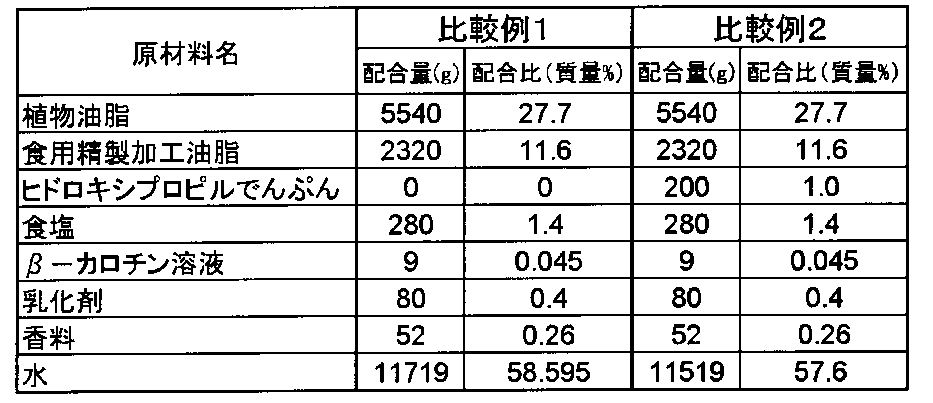
ヒドロキシプロプルでんぷんを配合せず、水相を調製する際の水を11319gから11719gに変更した以外は、実施例1と同様にして比較例となる低脂肪スプレッドを製造した。
この比較例1のヒドロキシプロピルでんぷんを含まない製造方法では、製造の途中において、離水の発生が認められ、水相と油相が分離していることが確認された。
また、製造の後においても、離水の発生が認められたことから、得られた油中水型油脂組成物の乳化状態は不安定であることが確認された。
[比較例2]
ヒドロキシプロプルでんぷんの添加量を400gから200gに減少させ、水相を調製する際の水を11519gから11039gに変更した以外は、実施例1と同様にして比較例の低脂肪スプレッドを製造した。
ヒドロキシプロプルでんぷんの添加量を400gから200gに減少させ、水相を調製する際の水を11519gから11039gに変更した以外は、実施例1と同様にして比較例の低脂肪スプレッドを製造した。
実施例1に比較してヒドロキシプロピルでんぷんの配合比が少ない比較例2の製造方法では、製造の途中において、離水の発生が認められ、水相と油相が分離していることが確認された。
また、製造の後においても、離水の発生が認められたことから、得られた油中水型油脂組成物の乳化状態は不安定であることが確認された。
比較例1及び比較例2の配合量及び配合比を、表2に示した。
[実施例3]
調合用のタンクにおいて、植物油脂(太田油脂社製)6648g、食用精製加工油脂(植田製油社製)2784gを混合(撹拌)し、60℃に加温したところに、乳化剤(太陽化学社製)96gを添加して混合(撹拌)した。
さらに、着色料(β-カロチン溶液、DSMニュートリションジャパン社製)10.8gを添加して混合(撹拌)し、油相を調製(調合)した。
一方、別の調合用のタンクにおいて、水13170gに、食塩(ソルト関西社製)336g、クエン酸(三栄源エフ・エフ・アイ社製)7.2g、クエン酸三ナトリウム(三栄源エフ・エフ・アイ社製)64.8gを添加して混合(撹拌)し、ヒドロキシプロプルでんぷん(エヌライトCL、日本エヌエスシー社製)816gを添加して混合(撹拌)し、70℃に加温して、水相を調製(調合)した。
そして、調合用のタンクにおいて、前記のように調製した油相の入ったところに、前記のように調製した水相を添加して混合し、さらに香料67.2gを添加して混合した。
その後に、この混合物を50~60℃程度に加温・保持しながら、10分間撹拌し、乳化(予備乳化)させた。
次に、この混合物をプレート式熱交換機(殺菌機)に送って、95℃にて20秒間で加熱(殺菌)した後に、40℃程度に冷却した。
さらに、この混合物をかきとり式熱交換機(冷却機)に送って、7~18℃程度に急冷した後に、混練機に送って混練した。
その後、この混合物を充填機に送って、容器へ充填し、本発明の低脂肪スプレッドを製造した。
以上の実施例3の製造方法では、製造の途中及び製造の後において、離水の発生が認められず、乳化状態が安定していることが確認された。
また、実施例3の配合により、乳化状態が安定している油中水型油脂組成物のスプレッドが得られることが確認された。
[実施例4]
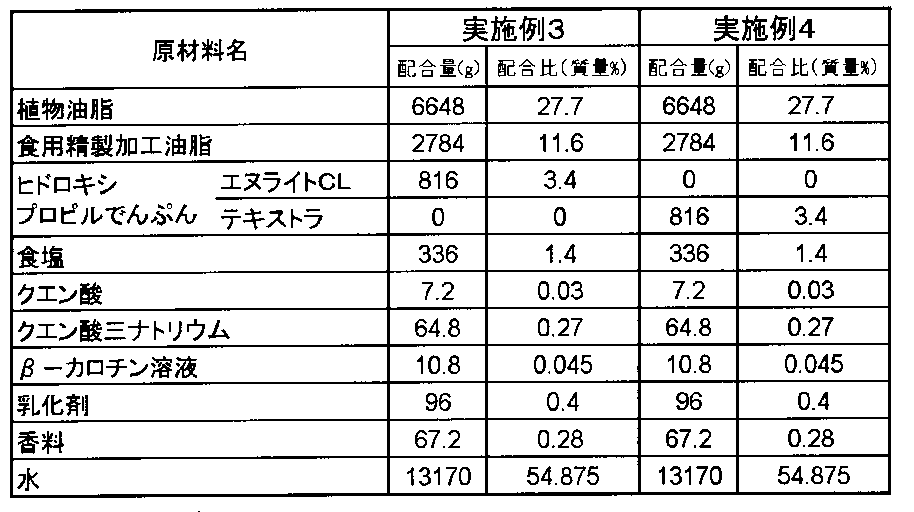
実施例3で使用したヒドロキシプロプルでんぷん(エヌライトCL、日本エヌエスシー社製)を、ヒドロキシプロプルでんぷん(テキストラ、日本エヌエスシー社製、タピオカ由来)に変更した以外は実施例3と同様にして本発明の低脂肪スプレッドを製造した。
実施例3で使用したヒドロキシプロプルでんぷん(エヌライトCL、日本エヌエスシー社製)を、ヒドロキシプロプルでんぷん(テキストラ、日本エヌエスシー社製、タピオカ由来)に変更した以外は実施例3と同様にして本発明の低脂肪スプレッドを製造した。
実施例4の製造方法では、製造の途中及び製造の後において、離水の発生が認められず、乳化状態が安定していることが確認された。
また、実施例4の配合により、乳化状態が安定している油中水型油脂組成物のスプレッドが得られることが確認された。
実施例3及び実施例4の配合量及び配合比を、表3に示した。
[実施例5]
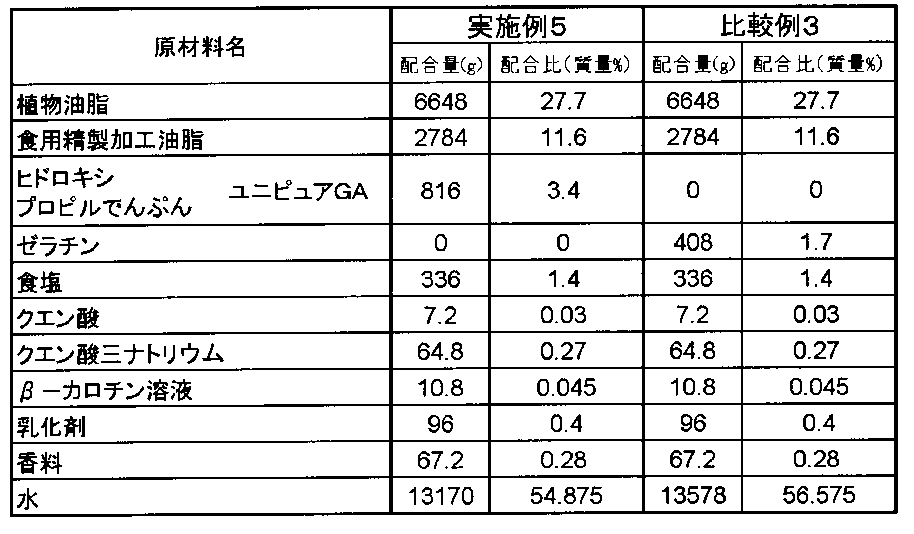
実施例3で使用したヒドロキシプロプルでんぷん(エヌライトCL、日本エヌエスシー社製)を、ヒドロキシプロプルでんぷん(ユニピュアGA、日本エヌエスシー社製、とうもろこし由来)に変更した以外は実施例3と同様にして本発明の低脂肪スプレッドを製造した。
実施例5の製造方法では、製造の途中及び製造の後において、離水の発生が認められず、乳化状態が安定していることが確認された。
また、実施例5の配合により、乳化状態が安定している油中水型油脂組成物のスプレッドが得られることが確認された。
[比較例3]
ヒドロキシプロプルでんぷん(ユニピュアGA、日本エヌエスシー社製、とうもろこし由来)を添加せず、水相を調製する際の水の配合を13170gから13578gに変更し、更に、水相を調製する際に、実施例5の配合に追加して、ゼラチン(MU-200、新田ゼラチン社製)408gを添加して混合(撹拌)した以外は実施例5と同様にして、比較例の低脂肪スプレッドを製造した。
ヒドロキシプロプルでんぷん(ユニピュアGA、日本エヌエスシー社製、とうもろこし由来)を添加せず、水相を調製する際の水の配合を13170gから13578gに変更し、更に、水相を調製する際に、実施例5の配合に追加して、ゼラチン(MU-200、新田ゼラチン社製)408gを添加して混合(撹拌)した以外は実施例5と同様にして、比較例の低脂肪スプレッドを製造した。
比較例3の製造方法では、製造の途中において、離水の発生が認められ、水相と油相が分離していることが確認された。
また、製造の後においても、離水の発生が認められたことから、得られた油中水型油脂組成物の乳化状態は不安定であることが確認された。
実施例5及び比較例3の配合量及び配合比を、表4に示した。
[試験例1]
実施例3、実施例4、実施例5、比較例3で得られたスプレッドについて、カビの増殖試験を実施した。すなわち、それぞれにカビを練り込み保存試験を実施した。
試験用のカビとして、Aspergillus nigerを用いた。
それぞれのスプレッドの1gに対して、カビの胞子数が50個になるように接種して、試料を調製した。この試料を滅菌シャーレに入れて、ビニールテープで密封し、それぞれ20℃、25℃で保存した。
保存中、目視で観察し、評価した。評価基準は表5に示した。

図1に、20℃で保存した場合の評価指標値の変化を示した。
図2に、25℃で保存した場合の評価指標値の変化を示した。
本試験の結果より、実施例3、実施例4、実施例5のスプレッドでは、比較例3のスプレッドと比べて、保存期間中において、カビがほとんど増殖しないことが確認できた。
つまり、カビについて、本発明品の微生物学的な保存性は従来品より優れていることを確認できた。
また、本試験の結果より、実施例3、実施例4、実施例5では、でんぷんの種類が異なっているが、どれもカビがほとんど増殖しないことが確認できた。つまり、でんぷんの種類によらず、本発明品の微生物学的な保存性は良好であることが確認できた。
[試験例2]
実施例3、実施例4、比較例3で得られたスプレッドについて、細菌の増殖試験を実施した。すなわち、それぞれに細菌を練り込み保存試験を実施した。
実施例3、実施例4、比較例3で得られたスプレッドについて、細菌の増殖試験を実施した。すなわち、それぞれに細菌を練り込み保存試験を実施した。
試験用の細菌として、耐熱性グラム陽性桿菌の Bacillus cereus、低温菌グラム陰性桿菌の Pseudomonas sp.、大腸菌群グラム陰性桿菌の Enterobacter cloacae、グラム陽性球菌の Staphylococcus epidermidis(4種類)の混合菌を用いた。
それぞれのスプレッドの1gに対して、混合菌の総菌数が500個になるように接種して、試料を調製した。
この試料を滅菌シャーレに入れて、ビニールテープで密封し、それぞれ10℃、15℃、20℃、25℃で保存した。
10℃の保存では、7日後、14日後、30日後、90日後、180日後、270日後に菌数を測定した。
15℃の保存では、7日後、14日後、30日後、90日後に菌数を測定した。
20℃の保存では、4日後、7日後、14日後に菌数を測定した。
25℃の保存では、4日後、7日後に菌数を測定した。
これらの菌数は常法に従い、標準寒天培地(SMA)を用いて測定した。
図3に、10℃で保存した場合の細菌数の増減を示した。同様に、15℃、20℃、25℃で保存した場合の細菌数の増減を、それぞれ、図4、図5、図6に示した。
本試験の結果より、実施例3及び実施例4のスプレッドでは、比較例3のスプレッドと比べて、保存期間中において、細菌数が特段に増加することはなかった。つまり、細菌について、本発明品の微生物学的な保存性は従来品と同等以上であることを確認できた。
[試験例3]
実施例3、実施例4、比較例3で得られたスプレッドについて、酵母の増殖試験を実施した。すなわち、それぞれに酵母を練り込み保存試験を実施した。
実施例3、実施例4、比較例3で得られたスプレッドについて、酵母の増殖試験を実施した。すなわち、それぞれに酵母を練り込み保存試験を実施した。
試験用の酵母として、Candida kruseiを用いた。
それぞれのスプレッドの1gに対して、酵母の菌数が500個になるように接種して、試料を調製した。
この試料を滅菌シャーレに入れて、ビニールテープで密封し、それぞれ10℃、15℃、20℃、25℃で保存した。
10℃の保存では、7日後、14日後、30日後、90日後、180日後、270日後に菌数を測定した。
15℃の保存では、7日後、14日後、30日後、90日後に菌数を測定した。
20℃の保存では、4日後、7日後、14日後に菌数を測定した。
25℃の保存では、4日後、7日後に菌数を測定した。
これらの菌数は常法に従い、標準寒天培地(SMA)を用いて測定した。
図7に、10℃で保存した場合の酵母数の増減を示した。同様に、15℃、20℃、25℃で保存した場合の酵母数の増減を、それぞれ、図8、図9、図10に示した。
本試験の結果より、実施例3及び実施例4のスプレッドでは、比較例3のスプレッドと比べて、保存期間中において、酵母数が特段に増加することはなかった。つまり、酵母について、本発明品の微生物学的な保存性は従来品と同等であることを確認できた。
[試験例4]
水相部におけるカビの増殖試験を実施した。
水相部におけるカビの増殖試験を実施した。
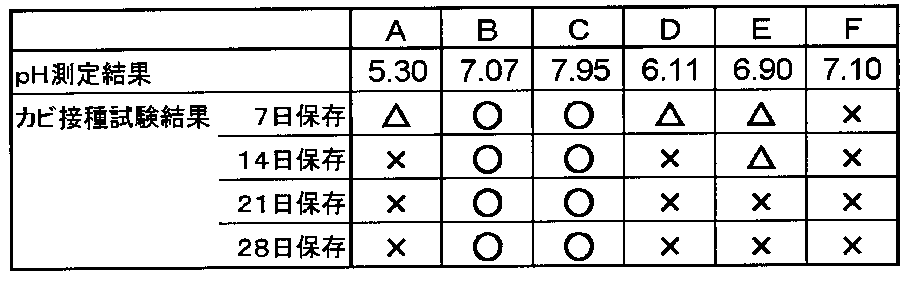
試験試料として、表6のA~Fの配合で水相を調製した。
食塩はソルト関西社製、ゼラチンは新田ゼラチン社製(MU-200)、クエン酸、及びクエン酸三ナトリウムは三栄源エフ・エフ・アイ社製、ヒドロキシプロピルでんぷんは日本エヌエスシー社製(エヌライトCL)、でんぷんは日本エヌエスシー社製(タピオカ由来)、砂糖は日本甜菜製糖社製、デキストリンは松谷化学工業社製(パインデックス)を用いた。
試験用のカビとして、Aspergillus nigerを用いた。
それぞれの水相部のpHを測定し、水相部1gに対し、カビの胞子数が50個になるように接種して、試料を調製した。
この試料10gを滅菌シャーレに入れて、ビニールテープで密封し、25℃で保存した。
保存中、目視で観察し、評価した。評価基準は表7に示した。
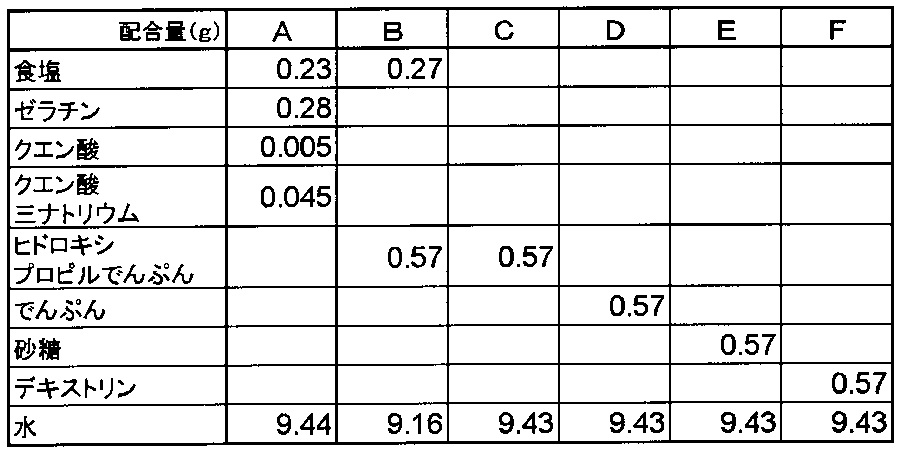
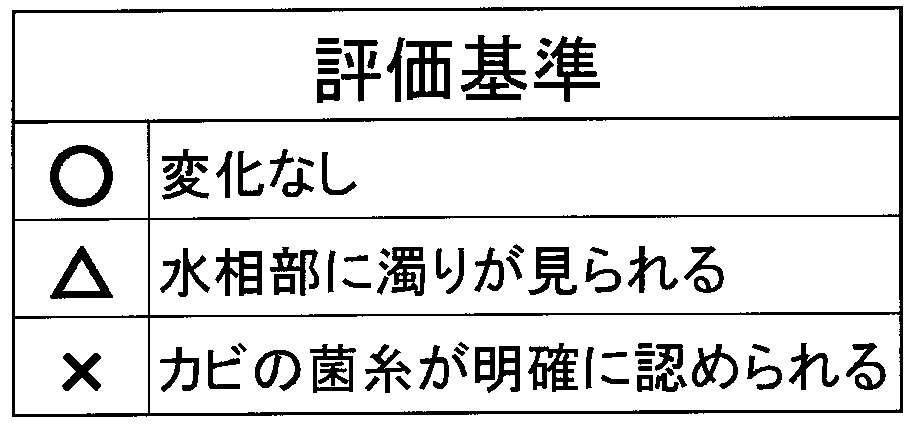
表8に結果を示した。
本試験の結果より、ヒドロキシプロピルでんぷんを用いた「配合B」及び「配合C」では、カビの増殖が全く認められないことが確認できた。
一方、その他の配合では、カビの菌糸の生成が明確に認められ、保存性に劣ることが確認できた。
特に、「配合A」では、pHを弱酸性に調整しているにもかかわらず、カビの菌糸の生成が認められたのに対し、ヒドロキシプロピルでんぷんを用いた「配合B」及び「配合C」では、pHが中性であるにもかかわらず、カビの菌糸の生成が全く認められないことから、ヒドロキシプロピルでんぷんを用いた本発明の優位性が確認できた。
[試験例5]
水相部におけるカビの増殖試験として、表9に示した複数のヒドロキシプロピルでんぷんを用い、それぞれ、5.7%水溶液の試料を調製して検討を行った。
試験用のカビには試験例4と同じくAspergillus nigerを用いた。
試験例4と同じく、それぞれの水相部のpHを測定し、水相部1gに対し、カビの胞子数が50個になるように接種して、試料を調製した。
この試料10gを滅菌シャーレに入れて、ビニールテープで密封し、25℃で保存した。
保存中、目視で観察し、評価した。評価基準は試験例4の表7に示したものと同一にした。
表9に結果を示した。
リン酸架橋でんぷんである試料No.9については、カビ胞子接種後28日の時点で、カビ菌糸生成の兆候と思われるアメーバ様の形に変色した部分が存在していたものの、21日までは変化はなく、カビ菌糸生成を抑制していた。その他の試料では、いずれも、カビ胞子接種後28日まで変化は見られなかった。しかも、pHが7を越えているにもかかわらず、カビ胞子接種後28日まで変化は見られなかった。
本試験の結果より、水相に配合されるでんぷんとしては、十分な微生物学的保存性を担保する、という観点から、ヒドロキシプロピルでんぷん、ヒドロキシプロピル化リン酸架橋でんぷん、リン酸架橋でんぷんを採用できることを確認できた。
また、でんぷんの由来植物については、十分な微生物学的保存性を担保する、という観点から、タピオカあるいはワキシーコーンであることが望ましいことが確認できた。

[実施例6]
実施例1の配合及び、配合量・配合比を、表9に示した配合及び、配合量・配合比に変更した以外は実施例1と同様にして本発明の低脂肪スプレッドを製造した。
実施例6の製造方法では、製造の途中及び製造の後において、離水の発生が認められず、乳化状態が安定していることが確認された。
また、実施例6の配合により、乳化状態が安定している油中水型油脂組成物のスプレッドが得られることが確認された。
実施例6の配合量及び配合比を、表10に示した。

[実施例7]
実施例1の配合及び、配合量・配合比を、表11に示した配合及び、配合量・配合比に変更した以外は実施例1と同様にして本発明の低脂肪スプレッドを製造した。
実施例7の製造方法では、製造の途中及び製造の後において、離水の発生が認められず、乳化状態が安定していることが確認された。
また、実施例7の配合により、乳化状態が安定している油中水型油脂組成物のスプレッドが、工業的規模の製造においても得られることが確認された。
実施例7の配合量及び配合比を、表11に示した。

本発明によれば、相対的に水相部の多い低脂肪スプレッドであっても、乳化安定性に優れており、製造の途中において、転相等の製造不良の要因が生じない、製造適性の良好なスプレッドを提供できる。
その結果、安定性に優れたスプレッドを、商業的な規模で製造することが可能になる。
また、pHが中性でも微生物学的な保存性が十分に担保されているため、従来のようにpHを酸性に調整することによって生じる酸味を全く感じることがない。
このため、自由度の大きい風味の調整が可能となり、従来にはない様々な風味の低脂肪スプレッドを提供できる。
しかも、微生物学的な保存性が優れていることから、開封後でも長期にわたって使用することができ、特に大容量タイプの製品に好適である。
Claims (8)
- 油脂を22質量%以上42質量%以下の割合で含み、でんぷんを1.8質量%以上12質量%以下の割合で含み、水相のpHが6.0以上8.5以下の範囲にある、スプレッド。
- でんぷんが、ヒドロキシプロピルでんぷん、ヒドロキシプロピル化リン酸架橋でんぷん、リン酸架橋でんぷんの1種又は2種以上から選ばれる、請求項1記載のスプレッド。
- ヒドロキシプロピルでんぷん、ヒドロキシプロピル化リン酸架橋でんぷん、リン酸架橋でんぷんが、タピオカあるいはワキシーコーンに由来するものである、請求項2記載のスプレッド。
- 原材料中にクエン酸及びその塩を含まないことを特徴とする、請求項1から3のいずれか一項に記載のスプレッド。
- 1.8質量%以上12質量%以下の割合のでんぷんと、22質量%以上42質量%以下の割合の油脂及び乳化剤を含んだ組成物を調合して乳化した乳化液を、殺菌、冷却、混練して、pHが6.0以上8.5以下の範囲にあるスプレッドを製造する方法。
- でんぷんが、ヒドロキシプロピルでんぷん、ヒドロキシプロピル化リン酸架橋でんぷん、リン酸架橋でんぷんの1種又は2種以上から選ばれる、請求項5記載の方法
- ヒドロキシプロピルでんぷん、ヒドロキシプロピル化リン酸架橋でんぷん、リン酸架橋でんぷんが、タピオカあるいはワキシーコーンに由来するものである、請求項6に記載の方法。
- 原材料中にクエン酸及びその塩を含まないことを特徴とする、請求項5から7のいずれか一項に記載の方法。
Priority Applications (3)
| Application Number | Priority Date | Filing Date | Title |
|---|---|---|---|
| CN201380026534.5A CN104320975B (zh) | 2012-05-23 | 2013-05-23 | 涂抹酱及其制造方法 |
| JP2014516844A JPWO2013176207A1 (ja) | 2012-05-23 | 2013-05-23 | スプレッド及びその製造方法 |
| HK15106395.1A HK1205644B (en) | 2012-05-23 | 2013-05-23 | Spread and method for manufacturing same |
Applications Claiming Priority (2)
| Application Number | Priority Date | Filing Date | Title |
|---|---|---|---|
| JP2012-117366 | 2012-05-23 | ||
| JP2012117366 | 2012-05-23 |
Publications (1)
| Publication Number | Publication Date |
|---|---|
| WO2013176207A1 true WO2013176207A1 (ja) | 2013-11-28 |
Family
ID=49623888
Family Applications (1)
| Application Number | Title | Priority Date | Filing Date |
|---|---|---|---|
| PCT/JP2013/064310 Ceased WO2013176207A1 (ja) | 2012-05-23 | 2013-05-23 | スプレッド及びその製造方法 |
Country Status (3)
| Country | Link |
|---|---|
| JP (2) | JPWO2013176207A1 (ja) |
| CN (1) | CN104320975B (ja) |
| WO (1) | WO2013176207A1 (ja) |
Cited By (1)
| Publication number | Priority date | Publication date | Assignee | Title |
|---|---|---|---|---|
| WO2017017945A1 (ja) * | 2015-07-24 | 2017-02-02 | 株式会社明治 | 低脂肪スプレッドの製造方法 |
Families Citing this family (1)
| Publication number | Priority date | Publication date | Assignee | Title |
|---|---|---|---|---|
| CN107467579A (zh) * | 2017-08-04 | 2017-12-15 | 武汉轻工大学 | 裱花奶油的替代物及制作方法 |
Citations (6)
| Publication number | Priority date | Publication date | Assignee | Title |
|---|---|---|---|---|
| JPS62220147A (ja) * | 1986-02-19 | 1987-09-28 | ユニリ−バ− ナ−ムロ−ゼ ベンノ−トシヤ−プ | 食用スプレツド |
| JPS62232335A (ja) * | 1986-03-06 | 1987-10-12 | ユニリ−バ− ナ−ムロ−ゼ ベンノ−トシヤ−プ | 低脂肪スプレツド |
| JPH01128744A (ja) * | 1987-10-13 | 1989-05-22 | L & L Internatl Sweden Ab | 低脂肪含有のマーガリン及びその製造方法 |
| JPH025823A (ja) * | 1988-02-02 | 1990-01-10 | St Ivel Ltd | 低脂肪スプレッドおよびその製造方法 |
| JPH04258242A (ja) * | 1991-02-07 | 1992-09-14 | Kanegafuchi Chem Ind Co Ltd | 低脂肪油中水型乳化油脂組成物 |
| JPH11318359A (ja) * | 1998-04-07 | 1999-11-24 | Cerestar Holding Bv | 小麦ファイバ―ゲル及びでんぷんによるゼラチン代用物 |
Family Cites Families (6)
| Publication number | Priority date | Publication date | Assignee | Title |
|---|---|---|---|---|
| US1990355A (en) * | 1933-06-26 | 1935-02-05 | William J Tierney | Concealed drinking fountain |
| IL24762A (en) * | 1965-01-09 | 1969-06-25 | Bratland A | Process for the production of reconstituted milk or cream |
| SE508785C2 (sv) * | 1991-10-07 | 1998-11-02 | L & L Int Sweden Ab | Förfarande för framställning av margarin med extra låg fetthalt |
| KR101169506B1 (ko) * | 2009-08-17 | 2012-07-27 | 씨제이제일제당 (주) | 유화력이 강화된 식이섬유전분의 제조방법 및 이를 이용한 저지방 마요네즈 및 마가린 조성물 |
| CN101642236B (zh) * | 2009-08-26 | 2012-02-08 | 天津实发冠华生物科技有限公司 | 含有大豆蛋白的涂抹酱及其制备方法 |
| JP6182743B2 (ja) * | 2013-03-29 | 2017-08-23 | 雪印メグミルク株式会社 | 油中水型乳化組成物 |
-
2013
- 2013-05-23 CN CN201380026534.5A patent/CN104320975B/zh active Active
- 2013-05-23 JP JP2014516844A patent/JPWO2013176207A1/ja active Pending
- 2013-05-23 WO PCT/JP2013/064310 patent/WO2013176207A1/ja not_active Ceased
-
2017
- 2017-12-18 JP JP2017241281A patent/JP6691905B2/ja active Active
Patent Citations (6)
| Publication number | Priority date | Publication date | Assignee | Title |
|---|---|---|---|---|
| JPS62220147A (ja) * | 1986-02-19 | 1987-09-28 | ユニリ−バ− ナ−ムロ−ゼ ベンノ−トシヤ−プ | 食用スプレツド |
| JPS62232335A (ja) * | 1986-03-06 | 1987-10-12 | ユニリ−バ− ナ−ムロ−ゼ ベンノ−トシヤ−プ | 低脂肪スプレツド |
| JPH01128744A (ja) * | 1987-10-13 | 1989-05-22 | L & L Internatl Sweden Ab | 低脂肪含有のマーガリン及びその製造方法 |
| JPH025823A (ja) * | 1988-02-02 | 1990-01-10 | St Ivel Ltd | 低脂肪スプレッドおよびその製造方法 |
| JPH04258242A (ja) * | 1991-02-07 | 1992-09-14 | Kanegafuchi Chem Ind Co Ltd | 低脂肪油中水型乳化油脂組成物 |
| JPH11318359A (ja) * | 1998-04-07 | 1999-11-24 | Cerestar Holding Bv | 小麦ファイバ―ゲル及びでんぷんによるゼラチン代用物 |
Cited By (2)
| Publication number | Priority date | Publication date | Assignee | Title |
|---|---|---|---|---|
| WO2017017945A1 (ja) * | 2015-07-24 | 2017-02-02 | 株式会社明治 | 低脂肪スプレッドの製造方法 |
| JPWO2017017945A1 (ja) * | 2015-07-24 | 2018-05-10 | 株式会社明治 | 低脂肪スプレッドの製造方法 |
Also Published As
| Publication number | Publication date |
|---|---|
| HK1205644A1 (en) | 2015-12-24 |
| JP2018038435A (ja) | 2018-03-15 |
| CN104320975A (zh) | 2015-01-28 |
| JPWO2013176207A1 (ja) | 2016-01-14 |
| CN104320975B (zh) | 2018-06-08 |
| JP6691905B2 (ja) | 2020-05-13 |
Similar Documents
| Publication | Publication Date | Title |
|---|---|---|
| US5922391A (en) | Composition like mayonnaise but having less or no edible oil | |
| KR102035274B1 (ko) | 온도변화에 안정한 마요네즈풍 소스 및 이의 제조방법 | |
| DE69616513T2 (de) | Verfahren zur herstellung von lagerstabilen milchprodukten | |
| JP6514110B2 (ja) | 酸性水中油型乳化調味料 | |
| JP6691905B2 (ja) | スプレッド及びその製造方法 | |
| JP2005530498A (ja) | 生微生物を含む食用エマルション | |
| JP4242359B2 (ja) | レアチーズケーキ及びその製造方法 | |
| JP6053420B2 (ja) | 容器入り液状又はペースト状食品組成物 | |
| EP3250041B1 (en) | Edible emulsion substantially free of trans fatty acids | |
| JPWO2014129230A1 (ja) | チーズ様食品 | |
| JP2005529593A (ja) | 生微生物を含む食用エマルション | |
| JP7649799B2 (ja) | 水中油型乳化組成物、および該水中油型乳化組成物が用いられた食品 | |
| JP5822564B2 (ja) | 乳化状油脂ベース食品及びその製造方法 | |
| JP4527005B2 (ja) | 発酵乳食品とその製造方法 | |
| JPH11276069A (ja) | 油中水型乳化油脂組成物 | |
| CN104661540B (zh) | 容器装液态或糊状或者速冻食品组合物及其制造方法 | |
| HK1205644B (en) | Spread and method for manufacturing same | |
| JPH0970256A (ja) | チーズ含有流動性組成物 | |
| JP6302834B2 (ja) | 油中水型油脂組成物の製造方法 | |
| JP6533079B2 (ja) | スプレッド用油中水中油型乳化油脂組成物 | |
| JP4920075B2 (ja) | カカオプリンの製造方法およびカカオプリン | |
| JP4562704B2 (ja) | チーズ入り液状又はペースト状酸性食品の製造方法 | |
| JP4920076B2 (ja) | カカオプリンの製造方法およびカカオプリン | |
| JP4961463B2 (ja) | チョコレートプリンの製造方法およびチョコレートプリン | |
| JP4562705B2 (ja) | チーズ入り液状又はペースト状酸性食品の製造方法 |
Legal Events
| Date | Code | Title | Description |
|---|---|---|---|
| 121 | Ep: the epo has been informed by wipo that ep was designated in this application |
Ref document number: 13793112 Country of ref document: EP Kind code of ref document: A1 |
|
| ENP | Entry into the national phase |
Ref document number: 2014516844 Country of ref document: JP Kind code of ref document: A |
|
| NENP | Non-entry into the national phase |
Ref country code: DE |
|
| 122 | Ep: pct application non-entry in european phase |
Ref document number: 13793112 Country of ref document: EP Kind code of ref document: A1 |