WO2013146512A1 - 非水電解質二次電池 - Google Patents
非水電解質二次電池 Download PDFInfo
- Publication number
- WO2013146512A1 WO2013146512A1 PCT/JP2013/058013 JP2013058013W WO2013146512A1 WO 2013146512 A1 WO2013146512 A1 WO 2013146512A1 JP 2013058013 W JP2013058013 W JP 2013058013W WO 2013146512 A1 WO2013146512 A1 WO 2013146512A1
- Authority
- WO
- WIPO (PCT)
- Prior art keywords
- lithium
- secondary battery
- added
- electrolyte secondary
- positive electrode
- Prior art date
- Legal status (The legal status is an assumption and is not a legal conclusion. Google has not performed a legal analysis and makes no representation as to the accuracy of the status listed.)
- Ceased
Links
Images

Classifications
-
- H—ELECTRICITY
- H01—ELECTRIC ELEMENTS
- H01M—PROCESSES OR MEANS, e.g. BATTERIES, FOR THE DIRECT CONVERSION OF CHEMICAL ENERGY INTO ELECTRICAL ENERGY
- H01M4/00—Electrodes
- H01M4/02—Electrodes composed of, or comprising, active material
- H01M4/36—Selection of substances as active materials, active masses, active liquids
- H01M4/48—Selection of substances as active materials, active masses, active liquids of inorganic oxides or hydroxides
- H01M4/50—Selection of substances as active materials, active masses, active liquids of inorganic oxides or hydroxides of manganese
- H01M4/505—Selection of substances as active materials, active masses, active liquids of inorganic oxides or hydroxides of manganese of mixed oxides or hydroxides containing manganese for inserting or intercalating light metals, e.g. LiMn2O4 or LiMn2OxFy
-
- H—ELECTRICITY
- H01—ELECTRIC ELEMENTS
- H01M—PROCESSES OR MEANS, e.g. BATTERIES, FOR THE DIRECT CONVERSION OF CHEMICAL ENERGY INTO ELECTRICAL ENERGY
- H01M10/00—Secondary cells; Manufacture thereof
- H01M10/05—Accumulators with non-aqueous electrolyte
- H01M10/052—Li-accumulators
-
- H—ELECTRICITY
- H01—ELECTRIC ELEMENTS
- H01M—PROCESSES OR MEANS, e.g. BATTERIES, FOR THE DIRECT CONVERSION OF CHEMICAL ENERGY INTO ELECTRICAL ENERGY
- H01M10/00—Secondary cells; Manufacture thereof
- H01M10/05—Accumulators with non-aqueous electrolyte
- H01M10/056—Accumulators with non-aqueous electrolyte characterised by the materials used as electrolytes, e.g. mixed inorganic/organic electrolytes
- H01M10/0564—Accumulators with non-aqueous electrolyte characterised by the materials used as electrolytes, e.g. mixed inorganic/organic electrolytes the electrolyte being constituted of organic materials only
- H01M10/0566—Liquid materials
- H01M10/0567—Liquid materials characterised by the additives
-
- H—ELECTRICITY
- H01—ELECTRIC ELEMENTS
- H01M—PROCESSES OR MEANS, e.g. BATTERIES, FOR THE DIRECT CONVERSION OF CHEMICAL ENERGY INTO ELECTRICAL ENERGY
- H01M4/00—Electrodes
- H01M4/02—Electrodes composed of, or comprising, active material
- H01M4/36—Selection of substances as active materials, active masses, active liquids
- H01M4/48—Selection of substances as active materials, active masses, active liquids of inorganic oxides or hydroxides
- H01M4/52—Selection of substances as active materials, active masses, active liquids of inorganic oxides or hydroxides of nickel, cobalt or iron
- H01M4/525—Selection of substances as active materials, active masses, active liquids of inorganic oxides or hydroxides of nickel, cobalt or iron of mixed oxides or hydroxides containing iron, cobalt or nickel for inserting or intercalating light metals, e.g. LiNiO2, LiCoO2 or LiCoOxFy
-
- Y—GENERAL TAGGING OF NEW TECHNOLOGICAL DEVELOPMENTS; GENERAL TAGGING OF CROSS-SECTIONAL TECHNOLOGIES SPANNING OVER SEVERAL SECTIONS OF THE IPC; TECHNICAL SUBJECTS COVERED BY FORMER USPC CROSS-REFERENCE ART COLLECTIONS [XRACs] AND DIGESTS
- Y02—TECHNOLOGIES OR APPLICATIONS FOR MITIGATION OR ADAPTATION AGAINST CLIMATE CHANGE
- Y02E—REDUCTION OF GREENHOUSE GAS [GHG] EMISSIONS, RELATED TO ENERGY GENERATION, TRANSMISSION OR DISTRIBUTION
- Y02E60/00—Enabling technologies; Technologies with a potential or indirect contribution to GHG emissions mitigation
- Y02E60/10—Energy storage using batteries
Definitions
- the present invention relates to a non-aqueous electrolyte secondary battery with little deterioration of cycle characteristics and a high capacity maintenance rate even when a high rate charging process is included.
- High energy density as a driving power source for portable electronic devices such as today's mobile phones, portable personal computers, portable music players, as well as power sources for hybrid electric vehicles (HEV, PHEV) and electric vehicles (EV)
- HEV hybrid electric vehicles
- PHEV PHEV
- EV electric vehicles
- Non-aqueous electrolyte secondary batteries represented by lithium ion secondary batteries having a high capacity are widely used.
- lithium cobaltate with different elements added with lithium cobaltate (LiCoO 2 ) or Al, Mg, Ti, Zr, etc. is often used. Yes.
- cobalt is expensive and has a small abundance as a resource. For this reason, in order to continue to use these lithium cobalt oxide and different element-added lithium cobalt oxide as the positive electrode active material of the non-aqueous electrolyte secondary battery, further enhancement of the performance of the non-aqueous electrolyte secondary battery is desired.
- a non-aqueous electrolyte secondary battery using lithium cobalt oxide or lithium cobalt oxide containing different elements as a positive electrode active material is charged and discharged in a charging process at a normal rate (1 It or less) when charging and discharging including a high rate charging process are repeated. Degradation of the capacity is larger than when repeating the above. This is considered to be because the higher the rate during charging, the higher the average charging voltage, and thus the decomposition of the nonaqueous electrolyte is promoted.
- the high rate charging process is often performed when it is necessary to finish charging in a short time, such as for HEV, PHEV or EV.
- Patent Document 1 in a non-aqueous electrolyte secondary battery using a lithium cobalt oxide added with a different element as a positive electrode active material, for the purpose of improving high-temperature storage characteristics and overcharge safety when performing high-rate charging.
- a tertiary carboxylic acid ester represented by the following chemical formula 1 is contained in the nonaqueous electrolyte is shown.
- Specific examples of the tertiary carboxylic acid ester represented by the following chemical formula 1 include methyl trimethyl acetate or ethyl trimethyl acetate.
- R1 to R4 each independently represents an alkyl group having 4 or less carbon atoms (which may be branched).
- Patent Document 2 in a nonaqueous electrolyte secondary battery using a lithium cobalt oxide containing a different element as a positive electrode active material, safety during overcharge is improved, and an increase in thickness during continuous charge is reduced.
- 1,3-dioxane, adiponitrile, a compound having a cycloalkylbenzene and / or a quaternary carbon adjacent to the benzene ring in the nonaqueous electrolyte An example in which is contained is shown.
- Patent Document 1 a non-aqueous electrolyte secondary battery having a good capacity retention rate at a high temperature of 80 ° C. and ensuring safety even at the time of overcharging during high-rate charging is provided. Has been obtained.
- Patent Document 1 does not suggest anything about the cycle characteristics when high-rate charging is performed on the non-aqueous electrolyte secondary battery.
- Patent Document 2 a non-aqueous electrolyte secondary battery is obtained that has excellent overcharge characteristics and cycle characteristics when charging with a charging current of 1 It or less, and has a small increase in battery thickness. It has been.
- Patent Document 1 does not show anything about performing a high-rate charge of 2 It on a non-aqueous electrolyte secondary battery, and the cycle characteristics when such a high-rate charge is performed are completely unknown. It is.
- the inventors examined the cycle characteristics when a high-rate charge of 2 It or more was performed on the nonaqueous electrolyte secondary battery having the configuration disclosed in Patent Documents 1 and 2 above. In FIG. 5, it was found that the cycle characteristics were significantly deteriorated as compared with the case of charging with a charging current of 1 It or less. Accordingly, the inventors have made various studies to improve cycle characteristics when performing high-rate charging in a nonaqueous electrolyte secondary battery containing lithium cobalt oxide or lithium cobalt oxide containing a different element as a positive electrode active material. .
- An object of the present invention is to provide a non-aqueous electrolyte secondary battery having a high value.
- the nonaqueous electrolyte secondary battery of the present invention comprises: In a nonaqueous electrolyte secondary battery comprising a positive electrode plate having a positive electrode active material, a negative electrode plate having a negative electrode active material, a nonaqueous electrolyte having a nonaqueous solvent and an electrolyte salt, and a separator,
- the positive electrode active material includes lithium cobalt oxide (LiCoO 2 ) or different element-added lithium cobalt oxide, and nickel cobalt lithium manganate (LiNi x Co y Mn 1-xy O 2 , 0.3 ⁇ x ⁇ 0.6 0.2 ⁇ y ⁇ 0.4), and
- the non-aqueous electrolyte is Adiponitrile (CN— (CH 2 ) 4 —CN), glutaronitrile (CN— (CH 2 ) 3 —CN), succinonitrile (CN— (CH 2 ) 2 —CN), malononitrile (CN—CH 2 —) CN
- nonaqueous electrolyte secondary battery of the present invention a positive electrode active material containing both lithium cobaltate or different element-added lithium cobaltate and lithium nickel cobalt manganate is used, and the nonaqueous electrolyte contains a nitrile compound and By using those containing dioxane compounds in a predetermined concentration range, even when a high rate charging process is included, deterioration of cycle characteristics is reduced as compared with the conventional non-aqueous electrolyte secondary battery.
- non-aqueous electrolyte secondary battery of the present invention a non-aqueous electrolyte secondary battery optimal for HEV, PHEV, EV, etc., in which a high-rate charging process is often employed can be obtained.
- the cycle characteristics when the high-rate charging process is included include the high-rate charging process. It is not included, that is, it is greatly deteriorated from the cycle characteristics when the charging process is 1 It or less.
- the positive electrode active material is made of a mixture of lithium cobaltate or different element-added lithium cobaltate and another lithium transition metal composite oxide (for example, lithium manganate or nickel nickelate).
- a high rate charging process is also included. In this case, the cycle characteristics are significantly lower than the cycle characteristics when the charging process is 1 It or less.
- the cycle characteristics when a high-rate charging process is included are significantly lower than the cycle characteristics when the charging process is 1 It or less. To do.
- the nitrile compound content exceeds 0.3% by mass with respect to the entire nonaqueous electrolyte not only the cycle characteristics when the high-rate charging process is included, but also the cycle characteristics when the charging process is 1 It or less. It will decline.
- the cycle characteristics when a high-rate charging process is included are more than the cycle characteristics when the charging process is 1 It or less. Decrease significantly.
- the dioxane compound application flow rate exceeds 3.0% by mass with respect to the entire nonaqueous electrolyte, not only the cycle characteristics when the high-rate charging process is included, but also the cycle characteristics when the charging process is 1 It or less. It will decline.
- carbon raw materials such as graphite, non-graphitizable carbon and graphitizable carbon, titanium oxides such as LiTiO 2 and TiO 2
- metalloid elements such as silicon and tin, silicon oxide (SiOx, 0.5 ⁇ x ⁇ 1.6), Sn—Co alloy, and the like.
- Nonaqueous solvents that can be used in the nonaqueous electrolyte secondary battery of the present invention include cyclic carbonates such as ethylene carbonate (EC), propylene carbonate (PC), and butylene carbonate (BC), and fluorinated cyclic carbonates.
- cyclic carbonates such as ethylene carbonate (EC), propylene carbonate (PC), and butylene carbonate (BC), and fluorinated cyclic carbonates.
- Esters cyclic carboxylic acid esters such as ⁇ -butyllactone ( ⁇ -BL) and ⁇ -valerolactone ( ⁇ -VL), dimethyl carbonate (DMC), ethyl methyl carbonate (EMC), diethyl carbonate (DEC), methyl propyl carbonate (MPC), chain carbonates such as dibutyl carbonate (DBC), fluorinated chain carbonates, chain carboxylates such as methyl pivalate, ethyl pivalate, methyl isobutyrate, methyl propionate, N, N'-dimethylformamide Amide compounds such as N- methyl-oxazolidinone, sulfur compounds such as sulfolane, etc.
- DMC dimethyl carbonate
- EMC ethyl methyl carbonate
- EEC diethyl carbonate
- MPC methyl propyl carbonate
- chain carbonates such as dibutyl carbonate (DBC)
- fluorinated chain carbonates chain carboxylate
- ambient temperature molten salt such as tetrafluoroboric acid 1-ethyl-3-methylimidazolium
- tetrafluoroboric acid 1-ethyl-3-methylimidazolium can be exemplified. It is desirable to use a mixture of two or more of these.
- cyclic carbonates and chain carbonates having a particularly high dielectric constant and a high ionic conductivity of the nonaqueous electrolyte are preferable.
- nonaqueous electrolyte used in the nonaqueous electrolyte secondary battery of the present invention as a compound for stabilizing the electrode, vinylene carbonate (VC), vinylethyl carbonate (VEC), and succinic anhydride (SUCAH) , Maleic anhydride (MAAH), glycolic anhydride, ethylene sulfite (ES), divinyl sulfone (VS), vinyl acetate (VA), vinyl pivalate (VP), catechol carbonate, biphenyl (BP), etc. Good. Two or more of these compounds can be appropriately mixed and used.
- a lithium salt generally used as an electrolyte salt in the non-aqueous electrolyte secondary battery can be used.
- Such lithium salts include LiPF 6 , LiBF 4 , LiCF 3 SO 3 , LiN (CF 3 SO 2 ) 2 , LiN (C 2 F 5 SO 2 ) 2 , LiN (CF 3 SO 2 ) (C 4 F 9 SO 2 ), LiC (CF 3 SO 2 ) 3 , LiC (C 2 F 5 SO 2 ) 3 , LiAsF 6 , LiClO 4 , Li 2 B 10 Cl 10 , Li 2 B 12 Cl 12 , and mixtures thereof Illustrated.
- LiPF 6 lithium hexafluorophosphate
- the amount of electrolyte salt dissolved in the non-aqueous solvent is preferably 0.5 to 2.0 mol / L.
- the non-aqueous electrolyte secondary battery of the present invention may be not only liquid but also gelled.
- the nonaqueous electrolyte secondary battery of the present invention it is preferable that at least one selected from Mg and Zr is added to the different element-added lithium cobalt oxide.
- Al, Mg, Ti, Zr, and the like are known as the different elements added to lithium cobaltate.
- the above-described effect of the present invention is excellent when at least one selected from Mg and Zr is used. Played.
- FIG. 1A is a plan view of a laminated nonaqueous electrolyte secondary battery used for measuring various battery characteristics in each Example and Comparative Example
- FIG. 1B is a bottom view of FIG. 1A
- FIG. It is a bottom view of a laminate type nonaqueous electrolyte secondary battery.
- the positive electrode active material a material composed of a mixture of different element-added lithium cobalt oxide and nickel cobalt lithium manganate was used.
- the different element-added lithium cobalt oxide was prepared as follows.
- lithium carbonate (Li 2 CO 3 ) was used as a lithium source.
- Cobalt (Co) source is coprecipitated with zirconium (Zr) 0.15 mol% and magnesium (Mg) 0.5 mol% with respect to cobalt during the synthesis of cobalt carbonate, and then pyrolysis reaction Zirconium and magnesium-added tricobalt tetroxide (Co 3 O 4 ) obtained by the above method were used.
- lithium carbonate, zirconium, and magnesium-added tricobalt tetraoxide were weighed and mixed, and then calcined in an air atmosphere at 850 ° C. for 24 hours and then pulverized to obtain zirconium and magnesium-added lithium cobalt oxide particles. .
- this zirconium and magnesium-added lithium cobalt oxide is simply referred to as “different-element-added lithium cobalt oxide”.
- nickel cobalt lithium manganate was prepared as follows. As a starting material, lithium carbonate is used as a lithium source, and a mixed aqueous solution of nickel sulfate (NiSO 4 ), cobalt sulfate (CoSO 4 ), and manganese sulfate (MnSO 4 ) is reacted with an alkaline solution as a nickel cobalt manganese source. And nickel cobalt manganese composite hydroxide obtained by coprecipitation. Then, after lithium carbonate prepared as a starting material for the lithium source and nickel cobalt manganese composite hydroxide were weighed to a predetermined ratio and mixed in a mortar, the resulting mixture was heated at 900 ° C. in an air atmosphere. and baked for 15 hours to obtain a lithium nickel cobalt manganese oxide represented by LiNi 0.33 Co 0.33 Mn 0.34 O 2 .
- the different element-added lithium cobalt oxide and nickel cobalt lithium manganate thus obtained were pulverized in a mortar, respectively, so that the compositions corresponding to each of Examples 1 to 13 and Comparative Examples 1 to 11 were obtained. Single or both were weighed and mixed to obtain a positive electrode active material.
- the composition of the positive electrode active material corresponding to each of Examples 1 to 13 and Comparative Examples 1 to 11 is summarized in Tables 1 to 3 below.
- the positive electrode active material thus obtained was mixed such that 94% by mass, carbon powder as a conductive agent was 3% by mass, and polyvinylidene fluoride (PVdF) powder as a binder was 3% by mass.
- NMP N-methyl-2-pyrrolidone
- This positive electrode mixture slurry was applied on both surfaces of a positive electrode core made of aluminum foil having a thickness of 15 ⁇ m by the doctor blade method and then dried to form a positive electrode mixture layer on both surfaces of the positive electrode core. Then, it compressed using the compression roller and cut out into the strip shape of predetermined width, and produced the positive electrode plate.
- a negative electrode mixture slurry was prepared by dispersing 95% by mass of graphite powder, 3% by mass of carboxymethylcellulose (CMC), and 2% by mass of styrene-butadiene rubber (SBR) as a binder in water. Subsequently, after apply
- coating to both surfaces of the negative electrode core made from copper of 8 micrometers in thickness by the doctor blade method, it dried and formed the negative mix layer on both surfaces of the negative electrode core. Then, it compressed using the compression roller and cut out into the strip shape of predetermined width, and produced the negative electrode plate.
- the active material filling amount of the positive electrode plate and the negative electrode plate is the charge capacity ratio between the positive electrode plate and the negative electrode plate (negative electrode charge capacity) at the potential of the positive electrode active material (4.3 V based on lithium) as a design standard. / Positive electrode charge capacity) was adjusted to 1.1.
- Non-aqueous electrolyte After mixing ethylene carbonate (EC), dimethyl carbonate (DMC) and diethyl carbonate (DEC) as a non-aqueous solvent in a volume ratio of 30:60:10, lithium hexafluorophosphate (LiPF 6 ) as an electrolyte salt was added.
- a non-aqueous electrolyte was prepared by dissolving to 1 M (mol / liter).
- a predetermined amount of a nitrile compound or a dioxane compound was appropriately added so as to have a composition corresponding to each of Examples 1 to 13 and Comparative Examples 1 to 11.
- the compositions of the nonaqueous electrolytes corresponding to Examples 1 to 13 and Comparative Examples 1 to 11 are summarized in Tables 1 to 3.
- the structure of the battery is to attach a lead terminal to each of the positive electrode plate and the negative electrode plate, press what is wound up in a spiral shape through a separator, and produce a wound electrode body that is crushed into a flat shape,
- the battery outer package was poured into an aluminum laminate, poured, sealed, and used as a laminated non-aqueous electrolyte secondary battery for testing.
- the size of the laminated non-aqueous electrolyte secondary battery is 3.6 mm thick ⁇ 35 mm wide ⁇ 62 mm long, and the design capacity is 650 mAh with a final charge voltage of 4.2V.
- a laminated nonaqueous electrolyte secondary battery 10 has a cup-shaped winding electrode body 13 having a positive lead terminal 11 and a negative lead terminal 12 made of a laminate material. It arrange
- both side seal portions 15a and 15b on both sides are usually used by being bent along the cup-shaped molded body 14 side.
- Table 1 summarizes the measurement results when various concentrations of the components of the positive electrode active material and the adiponitrile or 1,3-dioxane in the nonaqueous electrolyte are changed. From the results shown in Table 1, the following can be understood.
- the positive electrode active material is a heterogeneous element-added lithium cobaltate alone, even when adiponitrile and 1,3-dioxane are not contained in the nonaqueous electrolyte (Comparative Example 1) or (Comparative Example 4), The capacity maintenance rate after 200 cycles at the time of 2 It charge is lower than that at the time of 1 It charge.
- the positive electrode active material is lithium nickel cobalt manganate alone
- the non-aqueous electrolyte does not contain adiponitrile and 1,3-dioxane (Comparative Example 2) or both (Comparative Example 5)
- the capacity maintenance rate after 200 cycles at the time of 2 It charging is lower than that at the time of 1 It charging.
- the positive electrode active material is a mixture of lithium cobalt oxide and lithium nickel cobalt manganate added with different elements
- adiponitrile and 1,3-dioxane are not contained in the nonaqueous electrolyte (Comparative Example 3)
- 2 It The capacity retention rate after 200 cycles during charging is lower than that during 1 It charging, but when adiponitrile and 1,3-dioxane are contained in the nonaqueous electrolyte (Example 1), 1 It There was no difference in capacity retention after 200 cycles between charging and 2It charging.
- the component of the positive electrode active material other than the different element-added lithium cobalt oxide is lithium manganate (LiMn 2 O 4 ) (Comparative Example) In the case of 6) and lithium nickelate (LiNiO 2 ) (Comparative Example 7), the capacity retention rate after 200 cycles at 2 It charge is lower than that at 1 It charge. Therefore, in order to obtain a non-aqueous electrolyte secondary battery having a good capacity retention rate after 200 cycles at 2 It charge, the positive electrode active material is composed of a mixture of lithium cobalt oxide and lithium nickel cobalt manganate added with different elements. It is necessary to be.
- the positive electrode active material is a mixture of different element-added lithium cobalt oxide and nickel cobalt lithium manganate, and 0.1 mass% of 1,3-dioxane is added to the nonaqueous electrolyte
- adiponitrile is not contained in the non-aqueous electrolyte (Comparative Example 9)
- the capacity retention rate after 200 cycles at the time of 2 It charge is lower than that at the time of 1 It charge
- the positive electrode active material is composed of a mixture of different element-added lithium cobalt oxide and nickel cobalt lithium manganate, and 0.1 mass% of 1,3-dioxane is added to the non-aqueous electrolyte
- the content of adiponitrile in the nonaqueous electrolyte is preferably 0.05 to 0.3% by mass.
- the positive electrode active material is a mixture of different element-added lithium cobalt oxide and nickel cobalt lithium manganate, and 0.1 wt% of adiponitrile is added to the nonaqueous electrolyte
- 1,3-dioxane is not included in the non-aqueous electrolyte (Comparative Example 11)
- the capacity retention rate after 200 cycles at the time of 2 It charge is lower than that at the time of 1 It charge
- Example 1 when the positive electrode active material is composed of a mixture of different element-added lithium cobalt oxide and nickel cobalt lithium manganate and 0.1 mass% of adiponitrile is added to the nonaqueous electrolyte, Example 1 In view of the above results, it is understood that the content of 1,3-dioxane is preferably 0.1 to 3.0% by mass.
- the positive electrode active material is composed of a mixture of different element-added lithium cobalt oxide and nickel cobalt lithium manganate, and 0.1% by mass of adiponitrile and 0.1% by mass of 1,3-dioxane in the nonaqueous electrolyte. If added, (1) The capacity after 200 cycles between 1 It charge and 2 It charge when the different element-added lithium cobalt oxide is 80 mass% and the nickel cobalt lithium manganate is 20 mass% (Example 2). There is no difference in the maintenance rate, (2) The capacity after 200 cycles between 1 It charge and 2 It charge when different element-added lithium cobalt oxide is 20 mass% and nickel cobalt lithium manganate is 80 mass% (Example 3). There is no difference in the maintenance rate.
- the positive electrode active material is composed of a mixture of lithium cobalt oxide with different elements added and lithium nickel cobalt manganate, and 0.1% by mass of adiponitrile and 0.13 of 1,3-dioxane in the nonaqueous electrolyte.
- the positive electrode active material is a mixture of different elements-added lithium cobalt oxide and nickel cobalt lithium manganate in a mass ratio of 50:50, and 0.1 mass of 1,3-dioxane is contained in the nonaqueous electrolyte.
- % Nitrile compound (Example 8), succinonitrile (Example 9), malononitrile (Example 10) and oxalonitrile (Example 11) as 0.1% by mass, respectively. The measurement result when added is shown.
- the nitrile compound is at least one selected from adiponitrile, glutaronitrile, succinonitrile, malononitrile, and oxalonitrile, it has a predetermined effect. Can understand.
- Table 3 shows that the positive electrode active material is a mixture of different elements added lithium cobalt oxide and nickel cobalt lithium manganate in a mass ratio of 50:50, and 0.1 mass% of adiponitrile is added to the nonaqueous electrolyte.
- the measurement results when 0.1 mass% of 1,2-dioxane (Example 12) and 1,4-dioxane (Example 13) are added as dioxane compounds are shown.
- Table 3 also shows the results of Comparative Example 3 in which neither a nitrile compound nor 1,3-dioxane was added, and Comparative Example 11 in which only 1,3-dioxane was not added.
- the dioxane compound is 1,2-dioxane, 1, 3 It can be understood that at least one selected from -dioxane and 1,4-dioxane has a predetermined effect.
- the present invention does not depend on the shape of the electrode body of the nonaqueous electrolyte secondary battery, and thus has a cylindrical shape.
- a cylindrical non-aqueous electrolyte secondary battery using a wound electrode body, a square or elliptic cylindrical non-aqueous electrolyte secondary battery using a flat wound electrode body, and a positive electrode plate and a negative electrode plate through a separator The present invention can be similarly applied to stacked nonaqueous electrolyte secondary batteries stacked on each other.
Landscapes
- Chemical & Material Sciences (AREA)
- Chemical Kinetics & Catalysis (AREA)
- Electrochemistry (AREA)
- General Chemical & Material Sciences (AREA)
- Inorganic Chemistry (AREA)
- Engineering & Computer Science (AREA)
- Manufacturing & Machinery (AREA)
- Physics & Mathematics (AREA)
- Condensed Matter Physics & Semiconductors (AREA)
- General Physics & Mathematics (AREA)
- Secondary Cells (AREA)
- Battery Electrode And Active Subsutance (AREA)
Description
本発明は、ハイレート充電過程を含む場合であっても、サイクル特性の劣化が少なく、容量維持率が高い非水電解質二次電池に関する。
今日の携帯電話機、携帯型パーソナルコンピューター、携帯型音楽プレイヤー等の携帯型電子機器の駆動電源として、さらには、ハイブリッド電気自動車(HEV、PHEV)や電気自動車(EV)用の電源として、高エネルギー密度を有し、高容量であるリチウムイオン二次電池に代表される非水電解質二次電池が広く利用されている。
これらの非水電解質二次電池の正極活物質としては、リチウムイオンを可逆的に吸蔵・放出することが可能なLiCoO2、LiNiO2、LiNixCo1-xO2(x=0.01~0.99)、LiMnO2、LiMn2O4、LiCoxMnyNizO2(x+y+z=1)又はLiFePO4などが一種単独もしくは複数種を混合して用いられている。
このうち、特に各種電池特性が他のものに対して優れていることから、コバルト酸リチウム(LiCoO2)やAl、Mg、Ti、Zr等を添加した異種元素添加コバルト酸リチウムが多く使用されている。しかしながら、コバルトは高価であるとともに資源としての存在量が少ない。そのため、これらのコバルト酸リチウムや異種元素添加コバルト酸リチウムを非水電解質二次電池の正極活物質として使用し続けるには非水電解質二次電池の更なる高性能化が望まれている。
コバルト酸リチウムや異種元素添加コバルト酸リチウムを正極活物質として用いた非水電解質二次電池は、ハイレート充電過程を含む充放電を繰り返すと、通常レート(1Itないしそれ以下)の充電過程で充放電を繰り返した場合よりも容量の劣化が大きい。これは、充電時にハイレートにすればするほど平均充電電圧が高くなるため、非水電解質の分解が促進されるためであると考えられている。なお、ハイレート充電過程は、例えばHEV、PHEVないしEV用等のように、短時間で充電を終える必要がある場合に多く行われる。
一方、下記特許文献1には、異種元素添加コバルト酸リチウムを正極活物質として用いた非水電解質二次電池において、高温保存特性及びハイレート充電を行った場合の過充電安全性を改良する目的で、非水電解質中に下記化1で示される3級カルボン酸エステルを含有させた例が示されている。なお、下記化1で示される3級カルボン酸エステルの具体例としては、メチルトリメチルアセテートないしエチルトリメチルアセテートが含まれる。

また、下記特許文献2には、異種元素添加コバルト酸リチウムを正極活物質として用いた非水電解質二次電池において、過充電時の安全性を向上させ、連続充電時の厚み増加が小さくなるようにする目的で、セパレータの孔径を所定数値範囲に限定するとともに、非水電解質中に1,3-ジオキサンと、アジポニトリルと、シクロアルキルベンゼン及び/又はベンゼン環に隣接する第4級炭素を有する化合物とを含有させた例が示されている。
上記特許文献1に開示されている発明によれば、80℃もの高温における容量維持率が良好であり、ハイレート充電に際する過充電時においても安全性が確保された非水電解質二次電池が得られている。しかしながら、上記特許文献1には、非水電解質二次電池に対してハイレート充電を行った際のサイクル特性については何も示唆されていない。
また、上記特許文献2に開示されている発明によれば、1Itないしそれ以下の充電電流による充電に際して、過充電特性及びサイクル特性に優れ、電池厚みの増加が少ない非水電解質二次電池が得られている。しかしながら、上記特許文献1には、非水電解質二次電池に対して2Itものハイレート充電を行うことについては何も示されておらず、このようなハイレート充電を行った際のサイクル特性ついては全く不明である。
発明者等は、上記特許文献1及び2に開示されている構成を備える非水電解質二次電池に対して2Itないしそれ以上のハイレート充電を行った際のサイクル特性について検討したところ、いずれの場合においても、1Itないしそれ以下の充電電流で充電を行った場合よりもサイクル特性の劣化が著しいことを知見した。そこで、発明者等は、コバルト酸リチウムや異種元素添加コバルト酸リチウムを正極活物質として含む非水電解質二次電池において、ハイレート充電を行った際のサイクル特性を改善すべく種々検討を重ねてきた。
その結果、正極活物質として、コバルト酸リチウムや異種元素添加コバルト酸リチウムだけでなく、ニッケルコバルトマンガン酸リチウムを共存させたものを用いるとともに、非水電解質として所定の組成のものを用いると、2Itないしそれ以上のハイレート充電過程を含んでいてもサイクル特性が劣化し難くなり、容量維持率も高い非水電解質二次電池が得られることを見出し、本発明を完成するに至ったのである。
すなわち、本発明は、正極活物質としてコバルト酸リチウムや異種元素添加コバルト酸リチウムを含むものを用いた場合において、ハイレート充電過程を含む場合であっても、サイクル特性の劣化が少なく、容量維持率が高い非水電解質二次電池を提供することを目的とする。
上記目的を達成するため、本発明の非水電解質二次電池は、
正極活物質を有する正極極板と、負極活物質を有する負極極板と、非水溶媒と電解質塩とを有する非水電解質と、セパレータとを備える非水電解質二次電池において、
前記正極活物質は、コバルト酸リチウム(LiCoO2)又は異種元素添加コバルト酸リチウムと、ニッケルコバルトマンガン酸リチウム(LiNixCoyMn1-x-yO2、0.3<x<0.6、0.2<y<0.4)とを含み、
前記非水電解質は、
アジポニトリル(CN-(CH2)4-CN)、グルタロニトリル(CN-(CH2)3-CN)、スクシノニトリル(CN-(CH2)2-CN)、マロノニトリル(CN-CH2-CN)及びオキサロニトリル(CN-CN)からなる群より選択された少なくとも1種の化合物(以下、これらの化合物を総称して「ニトリル化合物」ということがある。)の含有量が0.05~0.3質量%であり、かつ、
1,2-ジオキサン、1,3-ジオキサン、1,4-ジオキサンからなる群より選択された少なくとも1種の化合物(以下、これらの化合物を総称して「ジオキサン化合物」ということがある。)の含有量が0.1~3.0質量%であることを特徴とする。
本発明の非水電解質二次電池においては、正極活物質としてコバルト酸リチウム又は異種元素添加コバルト酸リチウムと、ニッケルコバルトマンガン酸リチウムとの両者を含むものを用い、非水電解質中にニトリル化合物及びジオキサン化合物をそれぞれ所定の濃度範囲で含むものを用いることにより、ハイレートの充電過程を含む場合であっても、従来例の非水電解質二次電池に比してサイクル特性の劣化が少なくなる。そのため、本発明の非水電解質二次電池によれば、ハイレートの充電過程が多く採用されるHEV、PHEVないしEV等に最適な非水電解質二次電池が得られる。
なお、正極活物質がコバルト酸リチウム又は異種元素添加コバルト酸リチウムのみからなるもの、もしくはニッケルコバルトマンガン酸リチウムのみからなるものでは、ハイレートの充電過程を含む場合のサイクル特性は、ハイレートの充電過程を含まない、すなわち、充電過程が1Itもしくはそれ以下の場合のサイクル特性よりも大きく低下する。また、正極活物質が、コバルト酸リチウム又は異種元素添加コバルト酸リチウムと他のリチウム遷移金属複合酸化物(例えばマンガン酸リチウムやニッケル酸リチウム)との混合物からなる場合も、ハイレートの充電過程を含む場合のサイクル特性は、充電過程が1Itもしくはそれ以下の場合のサイクル特性よりも大きく低下する。
なお、ニトリル化合物含有量が非水電解質全体に対して0.05質量%未満では、ハイレートの充電過程を含む場合のサイクル特性は、充電過程が1Itもしくはそれ以下の場合のサイクル特性よりも大きく低下する。また、ニトリル化合物含有量が非水電解質全体に対して0.3質量%を超える場合は、ハイレート充電過程を含む場合のサイクル特性だけでなく、充電過程が1Itもしくはそれ以下の場合のサイクル特性も低下してしまう。
さらに、ジオキサン化合物含有量が非水電解質全体に対して0.1質量%未満の場合は、ハイレートの充電過程を含む場合のサイクル特性は、充電過程が1Itもしくはそれ以下の場合のサイクル特性よりも大きく低下する。また、ジオキサン化合物願流量が非水電解質全体に対して3.0質量%を超える場合は、ハイレート充電過程を含む場合のサイクル特性だけでなく、充電過程が1Itもしくはそれ以下の場合のサイクル特性も低下してしまう。
なお、本発明の非水電解質二次電池で使用し得る負極活物質としては、黒鉛、難黒鉛化性炭素及び易黒鉛化性炭素などの炭素原料、LiTiO2及びTiO2などのチタン酸化物、ケイ素及びスズなどの半金属元素、酸化ケイ素(SiOx,0.5≦x<1.6)、又はSn-Co合金等が挙げられる。
また、本発明の非水電解質二次電池において使用し得る非水溶媒としては、エチレンカーボネート(EC)、プロピレンカーボネート(PC)、ブチレンカーボネート(BC)などの環状炭酸エステル、フッ素化された環状炭酸エステル、γ-ブチルラクトン(γ-BL)、γ-バレロラクトン(γ-VL)などの環状カルボン酸エステル、ジメチルカーボネート(DMC)、エチルメチルカーボネート(EMC)、ジエチルカーボネート(DEC)、メチルプロピルカーボネート(MPC)、ジブチルカーボネート(DBC)などの鎖状炭酸エステル、フッ素化された鎖状炭酸エステル、ピバリン酸メチル、ピバリン酸エチル、メチルイソブチレート、メチルプロピオネートなどの鎖状カルボン酸エステル、N、N'-ジメチルホルムアミド、N-メチルオキサゾリジノンなどのアミド化合物、スルホランなどの硫黄化合物、テトラフルオロ硼酸1-エチル-3-メチルイミダゾリウムなどの常温溶融塩などが例示できる。これらは2種以上混合して用いることが望ましい。これらの中では、特に誘電率が大きく、非水電解質のイオン伝導度が大きい環状状炭酸エステル及び鎖状炭酸エステルが好ましい。
なお、本発明の非水電解質二次電池で使用する非水電解質中には、電極の安定化用化合物として、さらに、ビニレンカーボネート(VC)、ビニルエチルカーボネート(VEC)、無水コハク酸(SUCAH)、無水マイレン酸(MAAH)、グリコール酸無水物、エチレンサルファイト(ES)、ジビニルスルホン(VS)、ビニルアセテート(VA)、ビニルピバレート(VP)、カテコールカーボネート、ビフェニル(BP)などを添加してもよい。これらの化合物は、2種以上を適宜に混合して用いることもできる。
また、本発明の非水電解質二次電池で使用する非水溶媒中に溶解させる電解質塩としては、非水電解質二次電池において一般に電解質塩として用いられるリチウム塩を用いることができる。このようなリチウム塩としては、LiPF6、LiBF4、LiCF3SO3、LiN(CF3SO2)2、LiN(C2F5SO2)2、LiN(CF3SO2)(C4F9SO2)、LiC(CF3SO2)3、LiC(C2F5SO2)3、LiAsF6、LiClO4、Li2B10Cl10、Li2B12Cl12など及びそれらの混合物が例示される。これらの中でも、LiPF6(ヘキサフルオロリン酸リチウム)が特に好ましい。前記非水溶媒に対する電解質塩の溶解量は、0.5~2.0mol/Lとするのが好ましい。
さらに、本発明の非水電解質二次電池においては、非水電解質は液状のものだけでなく、ゲル化されているものであってもよい。
本発明の非水電解質二次電池においてはコバルト酸リチウム又は異種元素添加コバルト酸リチウムの含有割合は、質量比で、コバルト酸リチウム又は異種元素添加コバルト酸リチウム:ニッケルコバルトマンガン酸リチウム=2:8~8:2であることが好ましい。
正極活物質中のコバルト酸リチウム又は異種元素添加コバルト酸リチウムの含有割合は、少なくなるとニッケルコバルトマンガン酸リチウムの特性が大きく現れるようになり、多くなると逆に正極活物質中のコバルト酸リチウム又は異種元素添加コバルト酸リチウムの特性が大きく現れるようになり、いずれの場合においてもハイレートの充電過程を含む場合には、充放電サイクル特性の劣化割合が大きくなる。
また、本発明の非水電解質二次電池においては、前記異種元素添加コバルト酸リチウムは、Mg、Zrから選択された少なくとも1種が添加されていることが好ましい。
コバルト酸リチウムに添加される異種元素としては、Al、Mg、Ti、Zr等が知られているが、特にMg、Zrから選択された少なくとも1種を用いれば、本発明の上記効果が良好に奏される。
以下、本発明を実施するための形態を各種実施例及び比較例を用いて詳細に説明する。ただし、以下に示す実施例は、本発明の技術思想を具体化するための非水電解質二次電池を例示するものであって、本発明をこの実施例に特定することを意図するものではなく、本発明は特許請求の範囲に示した技術思想を逸脱することなく種々の変更を行ったものにも均しく適用し得るものである。
[正極活物質の調製]
正極活物質は、異種元素添加コバルト酸リチウムとニッケルコバルトマンガン酸リチウムの混合物からなるものを用いた。異種元素添加コバルト酸リチウムは次のようにして調製した。出発原料としては、リチウム源には炭酸リチウム(Li2CO3)を用いた。コバルト(Co)源には、炭酸コバルト合成時にジルコニウム(Zr)をコバルトに対して0.15mol%と、マグネシウム(Mg)を0.5mol%となるようにして共沈させ、その後、熱分解反応によって得られたジルコニウム、マグネシウム添加四酸化三コバルト(Co3O4)を用いた。次いで、炭酸リチウム及びジルコニウム、マグネシウム添加四酸化三コバルトを所定量秤量して混合した後、空気雰囲気下において850℃で24時間焼成した後粉砕することによりジルコニウム、マグネシウム添加コバルト酸リチウム粒子を得た。なお、以下においては、このジルコニウム、マグネシウム添加コバルト酸リチウムを単に「異種元素添加コバルト酸リチウム」という。
正極活物質は、異種元素添加コバルト酸リチウムとニッケルコバルトマンガン酸リチウムの混合物からなるものを用いた。異種元素添加コバルト酸リチウムは次のようにして調製した。出発原料としては、リチウム源には炭酸リチウム(Li2CO3)を用いた。コバルト(Co)源には、炭酸コバルト合成時にジルコニウム(Zr)をコバルトに対して0.15mol%と、マグネシウム(Mg)を0.5mol%となるようにして共沈させ、その後、熱分解反応によって得られたジルコニウム、マグネシウム添加四酸化三コバルト(Co3O4)を用いた。次いで、炭酸リチウム及びジルコニウム、マグネシウム添加四酸化三コバルトを所定量秤量して混合した後、空気雰囲気下において850℃で24時間焼成した後粉砕することによりジルコニウム、マグネシウム添加コバルト酸リチウム粒子を得た。なお、以下においては、このジルコニウム、マグネシウム添加コバルト酸リチウムを単に「異種元素添加コバルト酸リチウム」という。
また、ニッケルコバルトマンガン酸リチウムは、次のようにして調製した。出発原料としては、リチウム源には炭酸リチウムを用い、ニッケルコバルトマンガン源には、硫酸ニッケル(NiSO4)と硫酸コバルト(CoSO4)と硫酸マンガン(MnSO4)との混合水溶液をアルカリ溶液と反応させ、共沈することによって得たニッケルコバルトマンガン複合水酸化物を用いた。そして、リチウム源の出発原料として用意した炭酸リチウムとニッケルコバルトマンガン複合水酸化物とを所定の割合となるように秤量して乳鉢で混合した後、得られた混合物を空気雰囲気下において900℃で15時間焼成し、LiNi0.33Co0.33Mn0.34O2で表されるニッケルコバルトマンガン酸リチウムを得た。
このようにして得られた異種元素添加コバルト酸リチウムとニッケルコバルトマンガン酸リチウムとをそれぞれ乳鉢で粉砕し、実施例1~13及び比較例1~11のそれぞれに対応する組成となるように、それぞれ単独ないしは両者を秤量して、混合し、正極活物質とした。なお、実施例1~13及び比較例1~11のそれぞれに対応する正極活物質の組成は、下記表1~表3に纏めて示してある。
[正極極板の作製]
このようにして得られた正極活物質が94質量%、導電剤としての炭素粉末が3質量%、結着剤としてのポリフッ化ビニリデン(PVdF)粉末が3質量%となるように混合し、これをN-メチル-2ピロリドン(NMP)溶液に投入、混練して正極合剤スラリーを調製した。この正極合剤スラリーを厚さ15μmのアルミニウム箔製の正極芯体の両面にドクターブレード法により塗布した後、乾燥させて、正極芯体の両面に正極合剤層を形成した。その後、圧縮ローラを用いて圧縮し、所定幅の短冊状に切り出して正極極板を作製した。
このようにして得られた正極活物質が94質量%、導電剤としての炭素粉末が3質量%、結着剤としてのポリフッ化ビニリデン(PVdF)粉末が3質量%となるように混合し、これをN-メチル-2ピロリドン(NMP)溶液に投入、混練して正極合剤スラリーを調製した。この正極合剤スラリーを厚さ15μmのアルミニウム箔製の正極芯体の両面にドクターブレード法により塗布した後、乾燥させて、正極芯体の両面に正極合剤層を形成した。その後、圧縮ローラを用いて圧縮し、所定幅の短冊状に切り出して正極極板を作製した。
[負極極板の作成]
黒鉛粉末95質量%、カルボキシメチルセルロース(CMC)3質量%、結着剤としてのスチレン-ブタジエンゴム(SBR)2質量%を水に分散させて負極合剤スラリーを調製した。次いで、厚さ8μmの銅製の負極芯体の両面にドクターブレード法により塗布後、乾燥して負極芯体の両面に負極合剤層を形成した。この後、圧縮ローラーを用いて圧縮し、所定幅の短冊状に切り出して負極極板を作製した。
黒鉛粉末95質量%、カルボキシメチルセルロース(CMC)3質量%、結着剤としてのスチレン-ブタジエンゴム(SBR)2質量%を水に分散させて負極合剤スラリーを調製した。次いで、厚さ8μmの銅製の負極芯体の両面にドクターブレード法により塗布後、乾燥して負極芯体の両面に負極合剤層を形成した。この後、圧縮ローラーを用いて圧縮し、所定幅の短冊状に切り出して負極極板を作製した。
なお、黒鉛の電位はリチウム基準で0.1Vである。また、正極極板及び負極極板の活物質充填量は、設計基準となる正極活物質の電位(リチウム基準で4.3V)において、正極極板と負極極板の充電容量比(負極充電容量/正極充電容量)が1.1となるように調整した。
[セパレータの作製]
ポリエチレン混合物と、無機粉体及び可塑剤を混練・加熱溶融しながらシート状に成形した後、無機粉体及び可塑剤をそれぞれ抽出除去及び乾燥し、膜厚16μm、空孔率47%となるように延伸し、実施例1~13及び比較例1~11のそれぞれに共通して使用する微多孔質膜セパレータを作製した。
ポリエチレン混合物と、無機粉体及び可塑剤を混練・加熱溶融しながらシート状に成形した後、無機粉体及び可塑剤をそれぞれ抽出除去及び乾燥し、膜厚16μm、空孔率47%となるように延伸し、実施例1~13及び比較例1~11のそれぞれに共通して使用する微多孔質膜セパレータを作製した。
[非水電解質の調製]
非水溶媒としてエチレンカーボネート(EC)とジメチルカーボネート(DMC)とジエチルカーボネート(DEC)を体積比30:60:10の割合で混合した後、電解質塩としての六フッ化燐酸リチウム(LiPF6)を1M(モル/リットル)となるように溶解して非水電解質を調製した。この非水電解質に対し、実施例1~13及び比較例1~11のそれぞれに対応する組成となるように、適宜所定量のニトリル化合物ないしジオキサン化合物を添加して使用した。実施例1~13及び比較例1~11に対応するそれぞれの非水電解質の組成は、表1~表3にまとめて示してある。
非水溶媒としてエチレンカーボネート(EC)とジメチルカーボネート(DMC)とジエチルカーボネート(DEC)を体積比30:60:10の割合で混合した後、電解質塩としての六フッ化燐酸リチウム(LiPF6)を1M(モル/リットル)となるように溶解して非水電解質を調製した。この非水電解質に対し、実施例1~13及び比較例1~11のそれぞれに対応する組成となるように、適宜所定量のニトリル化合物ないしジオキサン化合物を添加して使用した。実施例1~13及び比較例1~11に対応するそれぞれの非水電解質の組成は、表1~表3にまとめて示してある。
[電池の作製]
電池の構成は、正極極板及び負極極板のそれぞれにリード端子を取り付け、セパレータを介して渦巻状に巻き取ったものをプレスして、偏平状に押し潰した巻回電極体を作製し、電池外装体としてアルミニウムラミネートを用いたものに入れて注液を行い、封止して試験用のラミネート形非水電解質二次電池とした。なお、このラミネート形非水電解質二次電池のサイズは厚み3.6mm×幅35mm×長さ62mmであり、設計容量は充電終止電圧を4.2Vとして650mAhである。
電池の構成は、正極極板及び負極極板のそれぞれにリード端子を取り付け、セパレータを介して渦巻状に巻き取ったものをプレスして、偏平状に押し潰した巻回電極体を作製し、電池外装体としてアルミニウムラミネートを用いたものに入れて注液を行い、封止して試験用のラミネート形非水電解質二次電池とした。なお、このラミネート形非水電解質二次電池のサイズは厚み3.6mm×幅35mm×長さ62mmであり、設計容量は充電終止電圧を4.2Vとして650mAhである。
このラミネート形非水電解質二次電池の構成を図1に示す。ラミネート形非水電解質二次電池10は、図1A及び図1Bに示すように、正極用リード端子11及び負極用リード端子12を有する偏平状の巻回電極体13がラミネート材からなるカップ状の成形体14内に配置されており、両側端に第1及び第2のサイドシール部15a及び15bが、上端側にトップシール部16がそれぞれ形成されている。なお、両サイド側のサイドシール部15a及び15bは、通常は図1Cに示すようには、両方ともにカップ状の成形体14側に沿うように折り曲げられて使用される。
[充放電サイクル特性の測定]
上述のようにして作製された実施例1~13及び比較例1~11に対応するそれぞれの電池に対して以下のようにして充放電サイクル試験を行った。まず、各電池に対して、25℃において、1It=650mAの定電流で電池電圧が4.2Vとなるまで充電し、電池電圧が4.2Vに達した後は4.2Vの定電圧で充電電流が1/50It=13mAとなるまで充電し、満充電状態の電池を得た。その後、1Itの定電流で電池電圧が2.75Vとなるまで放電したときの放電容量を測定して1It充電時の初期放電容量として求めた。
上述のようにして作製された実施例1~13及び比較例1~11に対応するそれぞれの電池に対して以下のようにして充放電サイクル試験を行った。まず、各電池に対して、25℃において、1It=650mAの定電流で電池電圧が4.2Vとなるまで充電し、電池電圧が4.2Vに達した後は4.2Vの定電圧で充電電流が1/50It=13mAとなるまで充電し、満充電状態の電池を得た。その後、1Itの定電流で電池電圧が2.75Vとなるまで放電したときの放電容量を測定して1It充電時の初期放電容量として求めた。
次いで、It充電時の初期放電容量を測定した各電池について、25℃において、再度1Itの定電流で電池電圧が4.2Vとなるまで充電し、電池電圧が4.2Vに達した後は4.2Vの定電圧で充電電流が1/50Itとなるまで充電し、満充電状態の電池を得た。この満充電状態の各電池を1Itの定電流で電池電圧が2.75Vとなるまで放電させて1サイクルの充放電過程とし、この充放電を繰り返して200サイクル目の放電容量を測定した。そして、以下の計算式により1It充電による容量維持率を求めた。結果を表1~表3にまとめて示した。
1It充電による容量維持率(%)
=(1It充電時の初期放電容量/200サイクル目の放電容量)×100
1It充電による容量維持率(%)
=(1It充電時の初期放電容量/200サイクル目の放電容量)×100
同様に、各電池に対して、25℃において、2It=1300mAの定電流で電池電圧が4.2Vとなるまで充電し、電池電圧が4.2Vに達した後は4.2Vの定電圧で充電電流が1/50It=13mAとなるまで充電し、満充電状態の電池を得た。その後、1Itの定電流で電池電圧が2.75Vとなるまで放電したときの放電容量を測定して2It充電時の初期放電容量として求めた。
次いで、初期放電容量を測定した各電池について、25℃において、2It=1300mAの定電流で電池電圧が4.2Vとなるまで充電し、電池電圧が4.2Vに達した後は4.2Vの定電圧で充電電流が1/50It=13mAとなるまで充電し、満充電状態の電池を得た。この満充電状態の各電池を1It=650mAの定電流で電池電圧が2.75Vとなるまで放電させ、この充放電を繰り返して200サイクル目の放電容量を測定した。そして,以下の計算式により2It充電による容量維持率を求めた。結果を表1~表3にまとめて示した。
2It充電による容量維持率(%)
=(2It充電時の初期放電容量/200サイクル目の放電容量)×100
2It充電による容量維持率(%)
=(2It充電時の初期放電容量/200サイクル目の放電容量)×100
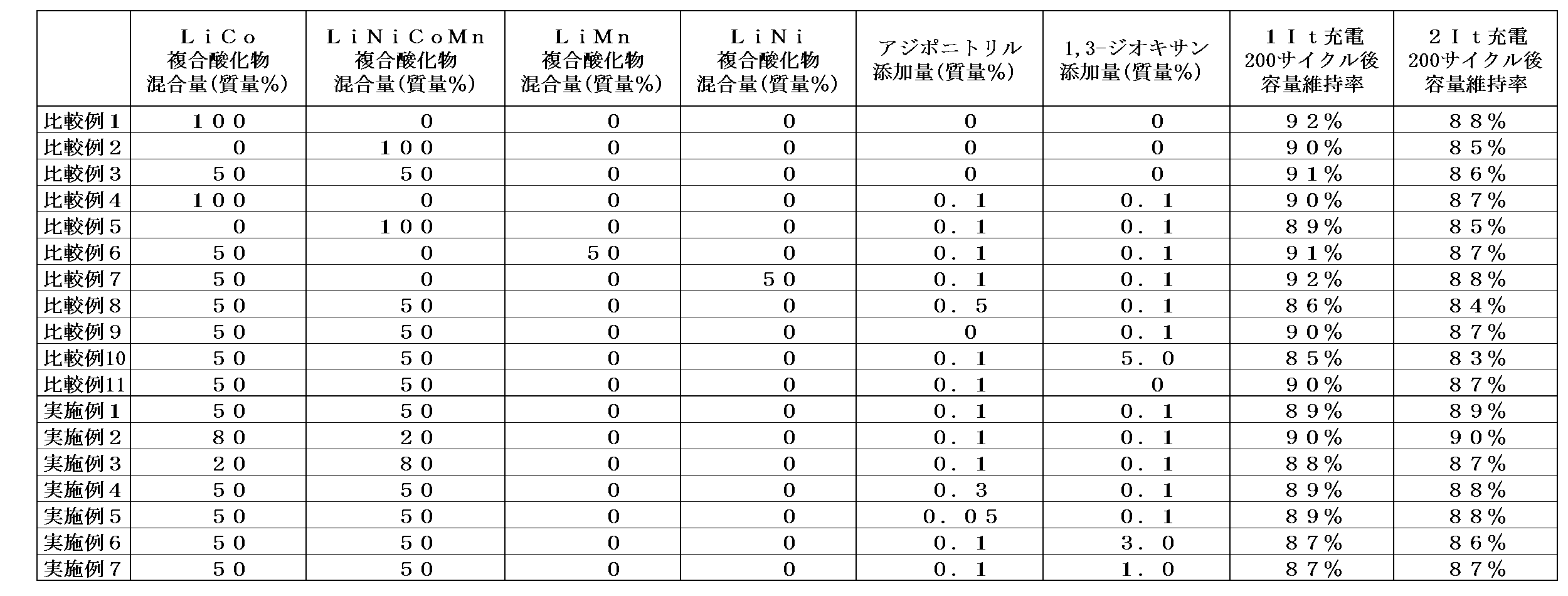
表1は、正極活物質の含有成分及び非水電解質中のアジポニトリルないし1,3-ジオキサン濃度を種々変更した場合の測定結果を纏めて表したものである。表1に示した結果から、以下のことが分かる。正極活物質が異種元素添加コバルト酸リチウム単独の場合、非水電解質中にアジポニトリル及び1,3-ジオキサンが含まれていない場合(比較例1)でも含まれている場合(比較例4)でも、2It充電時の200サイクル後の容量維持率は1It充電時の場合よりも低下している。また、正極活物質がニッケルコバルトマンガン酸リチウム単独の場合、非水電解質中にアジポニトリル及び1,3-ジオキサンが含まれていない場合(比較例2)でも含まれている場合(比較例5)でも、2It充電時の200サイクル後の容量維持率は1It充電時の場合よりも低下している。
さらに、正極活物質が異種元素添加コバルト酸リチウム及びニッケルコバルトマンガン酸リチウムの混合物である場合、非水電解質中にアジポニトリル及び1,3-ジオキサンが含まれていない場合(比較例3)では、2It充電時の200サイクル後の容量維持率は1It充電時の場合よりも低下しているが、非水電解質中にアジポニトリル及び1,3-ジオキサンが含まれている場合(実施例1)では、1It充電時と2It充電時との間で200サイクル後の容量維持率に差はなかった。以上の結果から、正極活物質として異種元素添加コバルト酸リチウム及びニッケルコバルトマンガン酸リチウムの混合物を用い、かつ非水電解質中にアジポニトリル及び1,3-ジオキサンが含まれていると、2It充電時の200サイクル後の容量維持率が良好な非水電解質二次電池が得られることがわかる。
また、非水電解質中にアジポニトリル及びジオキサンが添加されている場合であっても、異種元素添加コバルト酸リチウム以外の正極活物質の成分がマンガン酸リチウム(LiMn2O4)である場合(比較例6)及びニッケル酸リチウム(LiNiO2)である場合(比較例7)には、2It充電時の200サイクル後の容量維持率は、1It充電時の場合よりも低下している。そのため、2It充電時の200サイクル後の容量維持率が良好な非水電解質二次電池を得るには、正極活物質としては異種元素添加コバルト酸リチウム及びニッケルコバルトマンガン酸リチウムの混合物からなるものであることが必要である。
また、正極活物質が異種元素添加コバルト酸リチウム及びニッケルコバルトマンガン酸リチウムの混合物からなるものであり、非水電解質中に1,3-ジオキサンが0.1質量%添加されている場合、
(1)非水電解質中のアジポニトリルの含有量が0.5質量%(比較例8)と多いと、1It充電時及び2It充電時ともに実施例1と比較して200サイクル後の容量維持率が大きく低下しており、
(2)非水電解質中にアジポニトリルを含んでいない(比較例9)と、2It充電時の200サイクル後の容量維持率は1It充電時の場合よりも低下しており、
(3)非水電解質中のアジポニトリルの含有量が0.3質量%(実施例4)であると、1It充電時と2It充電時との間で200サイクル後の容量維持率に差はなく、しかも、(4)非水電解質中のアジポニトリルの含有量が0.05質量%(実施例5)であると、1It充電時と2It充電時との間で実質的に200サイクル後の容量維持率に差はなかった。
以上の結果から、正極活物質が異種元素添加コバルト酸リチウム及びニッケルコバルトマンガン酸リチウムの混合物からなるものであり、非水電解質中に1,3-ジオキサンが0.1質量%添加されている場合、実施例1の結果をも含めて考察すると、非水電解質中のアジポニトリルの含有量は0.05~0.3質量%が好ましいことが分かる。
また、正極活物質が異種元素添加コバルト酸リチウム及びニッケルコバルトマンガン酸リチウムの混合物からなるものであり、非水電解質中にアジポニトリルが0.1質量%添加されている場合、
(1)非水電解質中の1,3-ジオキサンの含有量が5.0質量%(比較例10)と多いと、1It充電時及び2It充電時ともに実施例1と比較して200サイクル後の容量維持率が大きく低下しており、
(2)非水電解質中に1,3-ジオキサンを含んでいない(比較例11)と、2It充電時の200サイクル後の容量維持率は1It充電時の場合よりも低下しており、
(3)非水電解質中の1,3-ジオキサンの含有量が3.0質量%(実施例6)であると、1It充電時と2It充電時との間で200サイクル後の容量維持率に実質的に差はなく、しかも、
(4)非水電解質中の1,3-ジオキサンの含有量が1.0質量%(実施例7)であると、1It充電時と2It充電時との間で200サイクル後の容量維持率に差はなかった。
以上の結果から、正極活物質が異種元素添加コバルト酸リチウム及びニッケルコバルトマンガン酸リチウムの混合物からなるものであり、非水電解質中にアジポニトリルが0.1質量%添加されている場合、実施例1の結果をも含めて考察すると、1,3-ジオキサンの含有量は0.1~3.0質量%が好ましいことが分かる。
さらに、正極活物質が異種元素添加コバルト酸リチウム及びニッケルコバルトマンガン酸リチウムの混合物からなるものであり、非水電解質中にアジポニトリルが0.1質量%、1,3-ジオキサンが0.1質量%添加されている場合、
(1)異種元素添加コバルト酸リチウムが80質量%であり、ニッケルコバルトマンガン酸リチウムが20質量%(実施例2)であると、1It充電時と2It充電時との間で200サイクル後の容量維持率に差はなく、しかも、
(2)異種元素添加コバルト酸リチウムが20質量%であり、ニッケルコバルトマンガン酸リチウムが80質量%(実施例3)であると、1It充電時と2It充電時との間で200サイクル後の容量維持率に差はない。
(1)異種元素添加コバルト酸リチウムが80質量%であり、ニッケルコバルトマンガン酸リチウムが20質量%(実施例2)であると、1It充電時と2It充電時との間で200サイクル後の容量維持率に差はなく、しかも、
(2)異種元素添加コバルト酸リチウムが20質量%であり、ニッケルコバルトマンガン酸リチウムが80質量%(実施例3)であると、1It充電時と2It充電時との間で200サイクル後の容量維持率に差はない。
以上の結果から、正極活物質が異種元素添加コバルト酸リチウム及びニッケルコバルトマンガン酸リチウムの混合物からなるものであり、非水電解質中にアジポニトリルが0.1質量%、1,3-ジオキサンが0.1質量%添加されている場合、実施例1の結果をも含めて考察すると、正極活物質中の異種元素添加コバルト酸リチウムとニッケルコバルトマンガン酸リチウムとの含有割合は、質量比で、異種元素添加コバルト酸リチウム:ニッケルコバルトマンガン酸リチウム=2:8~8:2が好ましいことが分かる。

さらに、表2は、正極活物質が異種元素添加コバルト酸リチウムとニッケルコバルトマンガン酸リチウムとが質量比で50:50の混合物からなり、非水電解質中に1,3-ジオキサンが0.1質量%添加されている場合において、ニトリル化合物としてグルタロニトリル(実施例8)、スクシノニトリル(実施例9)、マロノニトリル(実施例10)及びオキサロニトリル(実施例11)をそれぞれ0.1質量%添加した場合の測定結果を示している。なお、表2には、ニトリル化合物及び1,3-ジオキサンともに無添加である比較例3、1,3-ジオキサンのみ無添加である比較例11及びアジポニトリル及び1,3-ジオキサンともに添加した実施例1の測定結果も纏めて示した。
表2に示した結果によれば、以下のことが分かる。すなわち、比較例3及び比較例11に示した結果から、ニトリル化合物及び1,3-ジオキサンの少なくとも一方が存在していない場合には、2It充電時の200サイクル後の容量維持率は1It充電時の場合よりも低下している。それに対し、1,3ジオキサンが0.1質量%添加されている場合、ニトリル化合物がグルタロニトリル、スクシノニトリル、マロノニトリル及びオキサロニトリルの何れであっても、アジポニトリル(実施例1)を用いた場合と同様に、1It充電時と2It充電時との間で200サイクル後の容量維持率に実質的に差がないことが確認される。
したがって、本願発明の非水電解質二次電池においては、少なくともニトリル化合物がアジポニトリル、グルタロニトリル、スクシノニトリル、マロノニトリル及びオキサロニトリルから選択された少なくとも1種であれば、所定の作用効果を奏することが理解できる。

さらに、表3は、正極活物質が異種元素添加コバルト酸リチウムとニッケルコバルトマンガン酸リチウムとが質量比で50:50の混合物からなり、非水電解質中にアジポニトリルが0.1質量%添加されている場合において、ジオキサン化合物として1,2-ジオキサン(実施例12)及び1,4-ジオキサン(実施例13)をそれぞれ0.1質量%添加した場合の測定結果を示している。なお、表3には、ニトリル化合物及び1,3-ジオキサンともに無添加である比較例3、1,3-ジオキサンのみ無添加である比較例11の結果も纏めて示した。
表3に示した結果によれば、以下のことが分かる。すなわち、比較例3及び比較例11に示した結果から、ニトリル化合物及び1,3-ジオキサンの少なくとも一方が存在していない場合には、2It充電時の200サイクル後の容量維持率は1It充電時の場合よりも低下している。それに対し、アジポニトリルが0.1質量%添加されている場合、ジオキサン化合物が1,2-ジオキサン又は1,4-ジオキサンの何れであっても、1,3-ジオキサン(実施例1)を用いた場合と同様に、1It充電時と2It充電時との間で200サイクル後の容量維持率に実質的に差がないことが確認される。
したがって、本願発明の非水電解質二次電値においては、非水電解質中に少なくともニトリル化合物が非水電解溶液中に添加されている場合には、ジオキサン化合物が1,2-ジオキサン、1,3-ジオキサン、1,4-ジオキサンから選択された少なくとも1種であれば、所定の作用効果を奏することが理解できる。
なお、上記各実施例においては、正極活物質として、異種元素添加コバルト酸リチウムとニッケルコバルトマンガン酸リチウムとを含むものを用いた例を示したが、異種元素が添加されていないコバルト酸リチウムとニッケルコバルトマンガン酸リチウムとの混合物からなるものを用いても同様の作用効果を奏する。また、上記各実施例では、ハイレート充電過程として2It充電を採用した例を示したが、2Itを超えるハイレート充電を採用しても同様の傾向の作用効果を奏することは明白である。
また、上記各実施例及び比較例ではラミネート形非水電解質二次電池の例を示したが、本発明は、非水電解質二次電池の電極体の形状に依存するものではないので、円筒状巻回電極体を用いた円筒形非水電解質二次電池、偏平状巻回電極体を用いた角形ないし楕円筒形非水電解質二次電池や、正極極板及び負極極板をセパレータを介して互いに積層した積層型非水電解質二次電池に対しても同様に適用可能である。
10…ラミネート電池 11…正極用リード端子 12…負極用リード端子 13…巻回電極体 13…電極体 14…カップ状の成形体 15a…第1のサイドシール部、15b…第2のサイドシール部 16…トップシール部
Claims (3)
- 正極活物質を有する正極極板と、負極活物質を有する負極極板と、非水溶媒と電解質塩とを有する非水電解質と、セパレータとを備える非水電解質二次電池において、
前記正極活物質は、コバルト酸リチウム(LiCoO2)又は異種元素添加コバルト酸リチウムと、ニッケルコバルトマンガン酸リチウム(LiNixCoyMn1-x-yO2、0.3<x<0.6、0.2<y<0.4)とを含み、
前記非水電解質は、
アジポニトリル(CN-(CH2)4-CN)、グルタロニトリル(CN-(CH2)3-CN)、スクシノニトリル(CN-(CH2)2-CN)、マロノニトリル(CN-CH2-CN)及びオキサロニトリル(CN-CN)からなる群より選択された少なくとも1種の化合物を0.05~0.3質量%含有し、かつ、
1,2-ジオキサン、1,3-ジオキサン、1,4-ジオキサンからなる群より選択された少なくとも1種の化合物を0.1~3.0質量%で含有していることを特徴とする非水電解質二次電池。 - 前記コバルト酸リチウム又は異種元素添加コバルト酸リチウムとニッケルコバルトマンガン酸リチウムの含有割合は、
コバルト酸リチウ・BR> 又は異種元素添加コバルト酸リチウム:ニッケルコバルトマンガン酸リチウム=2:8~8:2
であることを特徴とする請求項1に記載の非水電解質二次電池。 - 前記異種元素添加コバルト酸リチウムは、異種元素としてMg、Zrから選択された少なくとも1種が添加されていることを特徴とする請求項1又は2に記載の非水電解質二次電池。
Applications Claiming Priority (2)
| Application Number | Priority Date | Filing Date | Title |
|---|---|---|---|
| JP2012076995A JP2015111495A (ja) | 2012-03-29 | 2012-03-29 | 非水電解質二次電池 |
| JP2012-076995 | 2012-03-29 |
Publications (1)
| Publication Number | Publication Date |
|---|---|
| WO2013146512A1 true WO2013146512A1 (ja) | 2013-10-03 |
Family
ID=49259769
Family Applications (1)
| Application Number | Title | Priority Date | Filing Date |
|---|---|---|---|
| PCT/JP2013/058013 Ceased WO2013146512A1 (ja) | 2012-03-29 | 2013-03-21 | 非水電解質二次電池 |
Country Status (2)
| Country | Link |
|---|---|
| JP (1) | JP2015111495A (ja) |
| WO (1) | WO2013146512A1 (ja) |
Cited By (5)
| Publication number | Priority date | Publication date | Assignee | Title |
|---|---|---|---|---|
| CN110366793A (zh) * | 2017-03-23 | 2019-10-22 | 株式会社东芝 | 非水电解质电池、电池包及电池系统 |
| JP2022504254A (ja) * | 2018-10-04 | 2022-01-13 | ブロードビット バッテリーズ オーイー | 改良された再充電可能な電池およびその製造 |
| CN114068910A (zh) * | 2021-11-18 | 2022-02-18 | 宁德新能源科技有限公司 | 一种电化学装置及电子装置 |
| CN114503332A (zh) * | 2019-10-09 | 2022-05-13 | 墨西哥氟石股份公司 | 非水性电解组合物和其用途 |
| CN117712459A (zh) * | 2023-12-08 | 2024-03-15 | 广东佳成新能源有限公司 | 一种高安全性半固态电芯及其制备方法和在电子烟电池领域中的应用 |
Families Citing this family (6)
| Publication number | Priority date | Publication date | Assignee | Title |
|---|---|---|---|---|
| WO2016148128A1 (ja) | 2015-03-16 | 2016-09-22 | 三菱化学株式会社 | 非水系電解液、及びそれを用いた非水系電解液二次電池 |
| CN112909318B (zh) * | 2018-08-31 | 2022-06-03 | 宁德时代新能源科技股份有限公司 | 锂离子二次电池及其制备方法与包含锂离子二次电池的电子产品和电动产品 |
| CN113661589B (zh) | 2019-04-10 | 2024-07-26 | 株式会社村田制作所 | 锂离子二次电池 |
| WO2022244808A1 (ja) * | 2021-05-19 | 2022-11-24 | 古河電池株式会社 | リチウムイオン二次電池 |
| JP7743983B2 (ja) * | 2021-05-19 | 2025-09-25 | 古河電池株式会社 | リチウムイオン二次電池 |
| KR20240149970A (ko) * | 2022-03-28 | 2024-10-15 | 닝더 엠프렉스 테크놀로지 리미티드 | 전기화학 디바이스 및 이를 포함하는 전자 디바이스 |
Citations (3)
| Publication number | Priority date | Publication date | Assignee | Title |
|---|---|---|---|---|
| JP2006302757A (ja) * | 2005-04-22 | 2006-11-02 | Sony Corp | 電池 |
| JP2011023241A (ja) * | 2009-07-16 | 2011-02-03 | Sony Corp | 二次電池、負極、正極および電解質 |
| JP2011198747A (ja) * | 2010-02-26 | 2011-10-06 | Sanyo Electric Co Ltd | 非水電解質二次電池 |
-
2012
- 2012-03-29 JP JP2012076995A patent/JP2015111495A/ja active Pending
-
2013
- 2013-03-21 WO PCT/JP2013/058013 patent/WO2013146512A1/ja not_active Ceased
Patent Citations (3)
| Publication number | Priority date | Publication date | Assignee | Title |
|---|---|---|---|---|
| JP2006302757A (ja) * | 2005-04-22 | 2006-11-02 | Sony Corp | 電池 |
| JP2011023241A (ja) * | 2009-07-16 | 2011-02-03 | Sony Corp | 二次電池、負極、正極および電解質 |
| JP2011198747A (ja) * | 2010-02-26 | 2011-10-06 | Sanyo Electric Co Ltd | 非水電解質二次電池 |
Cited By (6)
| Publication number | Priority date | Publication date | Assignee | Title |
|---|---|---|---|---|
| CN110366793A (zh) * | 2017-03-23 | 2019-10-22 | 株式会社东芝 | 非水电解质电池、电池包及电池系统 |
| CN110366793B (zh) * | 2017-03-23 | 2022-08-02 | 株式会社东芝 | 非水电解质电池、电池包及电池系统 |
| JP2022504254A (ja) * | 2018-10-04 | 2022-01-13 | ブロードビット バッテリーズ オーイー | 改良された再充電可能な電池およびその製造 |
| CN114503332A (zh) * | 2019-10-09 | 2022-05-13 | 墨西哥氟石股份公司 | 非水性电解组合物和其用途 |
| CN114068910A (zh) * | 2021-11-18 | 2022-02-18 | 宁德新能源科技有限公司 | 一种电化学装置及电子装置 |
| CN117712459A (zh) * | 2023-12-08 | 2024-03-15 | 广东佳成新能源有限公司 | 一种高安全性半固态电芯及其制备方法和在电子烟电池领域中的应用 |
Also Published As
| Publication number | Publication date |
|---|---|
| JP2015111495A (ja) | 2015-06-18 |
Similar Documents
| Publication | Publication Date | Title |
|---|---|---|
| JP5431218B2 (ja) | 非水電解液二次電池 | |
| JP2015111495A (ja) | 非水電解質二次電池 | |
| JP2009140919A (ja) | 非水電解質二次電池 | |
| WO2010067549A1 (ja) | 非水電解液二次電池 | |
| JP5989634B2 (ja) | 非水電解液二次電池 | |
| JP5999090B2 (ja) | 二次電池用活物質 | |
| JP7231712B2 (ja) | フッ素化電解質を備えるNi系リチウムイオン二次電池 | |
| JP2011138621A (ja) | 非水電解質二次電池の正極の製造方法 | |
| JPWO2012133027A1 (ja) | 非水電解液二次電池システム | |
| JPWO2014156011A1 (ja) | 非水電解質二次電池 | |
| JP2009129721A (ja) | 非水電解質二次電池 | |
| JP2014067629A (ja) | 非水電解質二次電池 | |
| JPWO2014068931A1 (ja) | 非水電解質二次電池 | |
| JP2014135154A (ja) | 非水電解質二次電池 | |
| JP2011181386A (ja) | 非水電解質二次電池 | |
| KR20110088372A (ko) | 비수계 이차 전지 | |
| JP6072689B2 (ja) | 非水電解質二次電池 | |
| CN100424925C (zh) | 非水电解质二次电池 | |
| JP2010140737A (ja) | 非水電解質二次電池 | |
| WO2013031712A1 (ja) | 非水電解質二次電池及びその製造方法 | |
| JP6092096B2 (ja) | 非水電解液二次電池 | |
| CN104704669A (zh) | 非水电解质二次电池 | |
| WO2013141243A1 (ja) | 非水電解質二次電池 | |
| WO2012147783A1 (ja) | 非水電解質二次電池 | |
| JP2010176973A (ja) | 非水電解質二次電池 |
Legal Events
| Date | Code | Title | Description |
|---|---|---|---|
| 121 | Ep: the epo has been informed by wipo that ep was designated in this application |
Ref document number: 13768701 Country of ref document: EP Kind code of ref document: A1 |
|
| NENP | Non-entry into the national phase |
Ref country code: DE |
|
| 122 | Ep: pct application non-entry in european phase |
Ref document number: 13768701 Country of ref document: EP Kind code of ref document: A1 |
|
| NENP | Non-entry into the national phase |
Ref country code: JP |