WO2013118552A1 - ホルムアルデヒドガス製造方法、及びホルムアルデヒドガス製造装置 - Google Patents
ホルムアルデヒドガス製造方法、及びホルムアルデヒドガス製造装置 Download PDFInfo
- Publication number
- WO2013118552A1 WO2013118552A1 PCT/JP2013/050834 JP2013050834W WO2013118552A1 WO 2013118552 A1 WO2013118552 A1 WO 2013118552A1 JP 2013050834 W JP2013050834 W JP 2013050834W WO 2013118552 A1 WO2013118552 A1 WO 2013118552A1
- Authority
- WO
- WIPO (PCT)
- Prior art keywords
- hemi
- formal
- concentrate
- water
- formaldehyde gas
- Prior art date
- Legal status (The legal status is an assumption and is not a legal conclusion. Google has not performed a legal analysis and makes no representation as to the accuracy of the status listed.)
- Ceased
Links
Images


Classifications
-
- B—PERFORMING OPERATIONS; TRANSPORTING
- B01—PHYSICAL OR CHEMICAL PROCESSES OR APPARATUS IN GENERAL
- B01J—CHEMICAL OR PHYSICAL PROCESSES, e.g. CATALYSIS OR COLLOID CHEMISTRY; THEIR RELEVANT APPARATUS
- B01J20/00—Solid sorbent compositions or filter aid compositions; Sorbents for chromatography; Processes for preparing, regenerating or reactivating thereof
- B01J20/02—Solid sorbent compositions or filter aid compositions; Sorbents for chromatography; Processes for preparing, regenerating or reactivating thereof comprising inorganic material
- B01J20/10—Solid sorbent compositions or filter aid compositions; Sorbents for chromatography; Processes for preparing, regenerating or reactivating thereof comprising inorganic material comprising silica or silicate
- B01J20/16—Alumino-silicates
- B01J20/18—Synthetic zeolitic molecular sieves
-
- B—PERFORMING OPERATIONS; TRANSPORTING
- B01—PHYSICAL OR CHEMICAL PROCESSES OR APPARATUS IN GENERAL
- B01J—CHEMICAL OR PHYSICAL PROCESSES, e.g. CATALYSIS OR COLLOID CHEMISTRY; THEIR RELEVANT APPARATUS
- B01J20/00—Solid sorbent compositions or filter aid compositions; Sorbents for chromatography; Processes for preparing, regenerating or reactivating thereof
- B01J20/02—Solid sorbent compositions or filter aid compositions; Sorbents for chromatography; Processes for preparing, regenerating or reactivating thereof comprising inorganic material
- B01J20/10—Solid sorbent compositions or filter aid compositions; Sorbents for chromatography; Processes for preparing, regenerating or reactivating thereof comprising inorganic material comprising silica or silicate
- B01J20/103—Solid sorbent compositions or filter aid compositions; Sorbents for chromatography; Processes for preparing, regenerating or reactivating thereof comprising inorganic material comprising silica or silicate comprising silica
-
- B—PERFORMING OPERATIONS; TRANSPORTING
- B01—PHYSICAL OR CHEMICAL PROCESSES OR APPARATUS IN GENERAL
- B01J—CHEMICAL OR PHYSICAL PROCESSES, e.g. CATALYSIS OR COLLOID CHEMISTRY; THEIR RELEVANT APPARATUS
- B01J20/00—Solid sorbent compositions or filter aid compositions; Sorbents for chromatography; Processes for preparing, regenerating or reactivating thereof
- B01J20/02—Solid sorbent compositions or filter aid compositions; Sorbents for chromatography; Processes for preparing, regenerating or reactivating thereof comprising inorganic material
- B01J20/20—Solid sorbent compositions or filter aid compositions; Sorbents for chromatography; Processes for preparing, regenerating or reactivating thereof comprising inorganic material comprising free carbon; comprising carbon obtained by carbonising processes
-
- C—CHEMISTRY; METALLURGY
- C07—ORGANIC CHEMISTRY
- C07C—ACYCLIC OR CARBOCYCLIC COMPOUNDS
- C07C41/00—Preparation of ethers; Preparation of compounds having groups, groups or groups
- C07C41/48—Preparation of compounds having groups
- C07C41/50—Preparation of compounds having groups by reactions producing groups
- C07C41/56—Preparation of compounds having groups by reactions producing groups by condensation of aldehydes, paraformaldehyde, or ketones
-
- C—CHEMISTRY; METALLURGY
- C07—ORGANIC CHEMISTRY
- C07C—ACYCLIC OR CARBOCYCLIC COMPOUNDS
- C07C45/00—Preparation of compounds having >C = O groups bound only to carbon or hydrogen atoms; Preparation of chelates of such compounds
- C07C45/51—Preparation of compounds having >C = O groups bound only to carbon or hydrogen atoms; Preparation of chelates of such compounds by pyrolysis, rearrangement or decomposition
-
- C—CHEMISTRY; METALLURGY
- C07—ORGANIC CHEMISTRY
- C07C—ACYCLIC OR CARBOCYCLIC COMPOUNDS
- C07C45/00—Preparation of compounds having >C = O groups bound only to carbon or hydrogen atoms; Preparation of chelates of such compounds
- C07C45/78—Separation; Purification; Stabilisation; Use of additives
- C07C45/85—Separation; Purification; Stabilisation; Use of additives by treatment giving rise to a chemical modification
Definitions
- the present invention relates to a formaldehyde gas production method and a formaldehyde gas production apparatus.
- a hemi-formalization method is known as a method for producing formaldehyde gas.
- This hemi-formalization method is performed according to the following procedure. First, an aqueous formaldehyde solution is reacted with an alcohol to obtain an aqueous hemi-formal solution. Next, the hemi-formal concentrate is obtained by evaporating and dewatering water from the aqueous hemi-formal solution. Finally, the hemi-formal concentrate is pyrolyzed to obtain formaldehyde gas (see, for example, Patent Document 1).
- the above hemi-formal concentrate contains water.
- water is also contained in the formaldehyde gas obtained by pyrolyzing the hemi-formal concentrate.
- formaldehyde gas contains water, even if the amount of water contained is small, depending on the use of formaldehyde gas, it is often a problem to contain water. Therefore, it is required to suppress the amount of water contained in the hemi-formal concentrate.
- Patent Documents 2 and 3 methods for directly removing moisture contained in formaldehyde gas are disclosed in Patent Documents 2 and 3.
- by-products such as paraform may be generated, or formaldehyde may be rehemiformalized.
- Generation of by-products and rehemiformalization of formaldehyde are not preferable because they reduce the purity and productivity of formaldehyde gas.
- the present invention has been made to solve the above-mentioned problems, and its purpose is to prevent the formaldehyde gas from degrading the purity and productivity of the final formaldehyde gas, and to suppress a significant increase in production cost. It is in providing the technique of reducing the moisture content contained in.
- the inventors of the present invention have made extensive studies to solve the above problems. As a result, by contacting the hemi-formal concentrate with the porous adsorbent, the amount of moisture contained in the formaldehyde gas is maintained without reducing the final formaldehyde gas purity and productivity and suppressing a significant increase in production cost.
- the present invention has been completed. More specifically, the present invention provides the following.
- a method for producing formaldehyde gas comprising: a third step of fractionating a hemi-formal concentrate; and (F) a fourth step of pyrolyzing the high-purity hemi-formal concentrate to generate formaldehyde gas.
- the amount of water contained in the formaldehyde gas can be reduced without reducing the purity and productivity of the final formaldehyde gas and suppressing a significant increase in production cost.
- FIG. 1 It is a figure which shows the apparatus of this invention typically. It is a figure which shows typically the apparatus 2 used by the comparative example 1.
- FIG. 1 shows the apparatus of this invention typically. It is a figure which shows typically the apparatus 2 used by the comparative example 1.
- FIG. 1 shows a formaldehyde gas production apparatus 1 according to this embodiment.
- the formaldehyde gas production apparatus 1 includes a reactor 10, an evaporator 11 connected to the reactor 10, an adsorber 12 connected to the evaporator 11, and a decomposer 13 connected to the adsorber 12.
- the formaldehyde gas production method of the present embodiment will be described using the formaldehyde gas production apparatus 1 shown in FIG.
- the first step is a step of reacting (A) alcohol with (B) an aqueous formaldehyde solution to produce an aqueous hemi-formal solution.
- the first step is performed in the reactor 10.
- the reactor 10 is for reacting (A) alcohol with (B) aqueous formaldehyde solution, and (A) supply port (not shown) for supplying the alcohol and (B) aqueous formaldehyde solution to the reactor 10. ).
- the supplied (A) alcohol and (B) formaldehyde aqueous solution react to produce (C) a hemi-formal aqueous solution.
- the above reaction is a conventionally known reaction, and the reactor 10 includes general equipment necessary for the above reaction (equipment for adjusting reaction conditions such as reaction temperature).
- the reactor 10 is connected to a hemi-formal aqueous solution supply pipe 2 for supplying the produced (C) hemi-formal aqueous solution to the evaporator 11, and the reactor 10 is connected to the evaporator 11 by the hemi-formal aqueous solution supply pipe 2. It is connected with.
- the kind of alcohol is not specifically limited, Both a hydrophobic alcohol and hydrophilic alcohol can be used.
- the hydrophobic alcohol refers to an alcohol having a solubility of alcohol in 100 g of water of 3.0 g or less under the conditions of 20 ° C. and 760 mmHg
- the hydrophilic alcohol is the solubility of alcohol in 100 g of water. Refers to an alcohol exceeding 3.0 g under the conditions of 20 ° C. and 760 mmHg.
- the alcohol is preferably a monool, diol, or triol represented by the following general formula (I).
- X is a hydrogen atom or a hydroxyl group.
- the alkyl group having 1 to 10 carbon atoms may be either a linear alkyl group or a branched alkyl group.
- Examples of the linear alkyl group include a methyl group, an ethyl group, a propyl group, and a butyl group.
- Examples of the branched alkyl group include isopropyl group, isobutyl group, sec-butyl group, tertbutyl group and the like.
- hydroxyalkyl group having 1 to 10 carbon atoms examples include hydroxymethyl group, 1-hydroxyethyl group, 2-hydroxyethyl group, 1-hydroxy-n-propyl group, 2-hydroxy-n-propyl group, 3-hydroxy -N-propyl group, 1-hydroxy-n-butyl group, 2-hydroxy-n-butyl group, 3-hydroxy-n-butyl group, 4-hydroxy-n-butyl group, 5-hydroxy-n-pentyl group , 6-hydroxy-n-hexyl group and the like.
- hydrophobic alcohol represented by the general formula (I) examples include 2,4-diethyl-1,5-pentanediol, 2,3-diethyl-1,5-pentanediol, 1,4-diethyl-1, 5-pentanediol, 1,5-diethyl-1,5-pentanediol, 2-ethyl-1,3-hexanediol, 3-ethyl-1,3-hexanediol, 4-ethyl-1,3-hexanediol And octanol.
- hydrophilic alcohol represented by the above general formula
- examples of the hydrophilic alcohol represented by the above general formula include 3-methyl-1,5-pentanediol, 3-methyl-1,3-butanediol, 1,5-pentanediol, and 1,2,6-hexanetriol. Etc.
- hydrophilic alcohol when used, it is thought that it is hard to remove water from (C) hemi-formal aqueous solution at the 2nd process mentioned later.
- hydrophilic alcohol since the amount of water contained in the formaldehyde gas can be suppressed by providing the third step, hydrophilic alcohol can also be preferably employed.
- the boiling point of (A) alcohol is not particularly limited, but is preferably 150 ° C. or higher. More preferably, it is 190 ° C. or higher. It is preferable that the boiling point of the alcohol is high because unreacted alcohol is unlikely to be mixed into the water removed from the (C) hemi-formal aqueous solution in the second step.
- formaldehyde aqueous solution (B) Although formaldehyde content in formaldehyde aqueous solution is not specifically limited, It is preferable that they are 1 mass% or more and 80 mass% or less.
- (C) Hemiformal aqueous solution (C) A hemi-formal aqueous solution is produced by reacting (A) an alcohol and (B) an aqueous formaldehyde solution in the reactor 10. In the above reaction, not all alcohol and aldehyde may react, and in this case, alcohol and aldehyde may be contained in the (C) hemi-formal aqueous solution.
- the mixing ratio of (A) alcohol and (B) formaldehyde aqueous solution charged into the reactor 10 is not particularly limited, but the molar ratio of hydroxyl group in (A) alcohol to formaldehyde It is preferable that it is 0.3 or more and 5.0 or less. If it is 0.3 or more, it is preferable because the amount of formaldehyde contained in (E) water described later can be reduced, and if it is 5.0 or less, (A) the amount of formaldehyde that reacts per unit weight of alcohol is Many are preferable because of cost advantages. More preferably, it is 0.5 or more and 2.0 or less.
- the reaction conditions are not particularly limited, and the same reaction conditions as those for the alcohol and formaldehyde aqueous solution in the conventionally known hemi-formalization method can be employed.
- the reaction temperature is preferably from room temperature (about 20 ° C.) to 90 ° C.
- the reaction time is appropriately set according to the progress of the reaction.
- the (C) hemi-formal aqueous solution obtained as described above is supplied from the reactor 10 to the evaporator 11 through the hemi-formal aqueous solution supply pipe 2.
- the second step is a step of evaporating water contained in the (C) hemi-formal aqueous solution and separating it into (D) hemi-formal concentrate and (E) water.
- the second step is performed in the evaporator 11.
- the evaporator 11 is for evaporating water contained in the (C) hemi-formal aqueous solution supplied from the reactor 10 and separating it into (D) hemi-formal concentrate and (E) water.
- the evaporator 11 a conventionally known evaporator or distillation tower can be used. Further, the evaporator 11 may be a multistage evaporator in which a plurality of evaporators are connected, or a multistage distillation tower in which a plurality of distillation towers are connected. When equipped with a plurality of evaporators, when equipped with a plurality of distillation towers, the evaporation conditions may be changed for each evaporator and each distillation tower.
- the evaporator 11 is connected to a hemi-formal concentrate supply pipe 3 for supplying the produced (D) hemi-formal concentrate to the adsorber 12, and the evaporator 11 is connected to the adsorber by the hemi-formal concentrate supply pipe 3. 12 is connected.
- the evaporator 11 is also connected with a water discharge pipe 4 for discharging (E) water evaporated from the (C) hemi-formal aqueous solution.
- the hemi-formal concentrate is obtained by evaporating water from the (C) hemi-formal aqueous solution.
- C Conditions for evaporating water from the hemi-formal aqueous solution are not particularly limited, but temperature conditions and pressure conditions affect (D) the amount of water contained in the hemi-formal concentrate and (E) the amount of formaldehyde contained in the water. Therefore, the conditions for the evaporation are appropriately adjusted in consideration of these.
- the temperature condition is preferably selected from the range of 60 ° C. or higher and 80 ° C. or lower. If it is 60 ° C. or higher, it is preferable because (D) hemi-formal concentrate and (E) water can be easily separated, and if it is 80 ° C. or lower, it is contained in (E) water distilled by evaporation. This is preferable because the amount of formaldehyde produced can be reduced.
- a more preferable temperature condition is 60 ° C. or higher and 70 ° C. or lower.
- (D) hemi-formal concentration is performed under a temperature condition of 40 ° C. or more and less than 60 ° C. and then performed under a temperature condition of 60 ° C. or more and 95 ° C. or less. It is preferable because the water content of the product can be 2% by mass or less, and (E) the amount of formaldehyde contained in the water can be 5% by mass or less.
- the pressure condition is preferably selected from a range of 100 mmHg or less. If it is 100 mmHg or less, a 2nd process can be implemented in the said preferable temperature range.
- a particularly preferable pressure condition is a condition of 50 mmHg or less.
- the average residence time in which the aqueous hemi-formal solution stays in the evaporator 11 is not particularly limited.
- the (D) hemi-formal concentrate obtained as described above contains a trace amount of water. If this water content is 2 mass% or less, it is preferable because water can be effectively removed from the (D) hemi-formal concentrate in the third step described later.
- the (D) hemi-formal concentrate also contains a small amount of alcohol and formaldehyde.
- the separated (E) water contains formaldehyde.
- (E) Water may contain unreacted alcohol.
- (E) an operation of removing alcohol from water is required, and the operation of removing this alcohol from (E) water is very expensive.
- content of the alcohol in water is 0.5 mass% or less.
- the third step is (D) removing the water in the hemi-formal concentrate by contacting the hemi-formal concentrate with the porous adsorbent, and (F) separating the high-purity hemi-formal concentrate. .
- the third step is performed by the adsorber 12.
- the adsorber 12 has a porous adsorbent inside the hollow container, and the lower part of the adsorber 12 and the hemi-formal concentrate supply pipe 3 are connected to each other.
- a purity hemi-formal supply pipe 5 (a pipe for supplying (F) high-purity hemi-formal concentrate from the adsorber 12 to the decomposer 12) is connected.
- the adsorber 12 is brought into contact with the porous adsorbent in the process of moving the (D) hemi-formal concentrate supplied from the hemi-formal concentrate supply pipe 3 to the lower part of the adsorber 12 to the upper part of the adsorber 12 (D )
- the water contained in the hemi-formal concentrate can be removed.
- the hemi-formal concentrate is brought into contact with the porous adsorbent inside the adsorber 12 to remove moisture, and (F) becomes a high-purity hemi-formal concentrate.
- the high-purity hemi-formal concentrate is The high-purity hemi-formal supply pipe 5 connected to the upper part of 12 is sent to the decomposer 13.
- the average residence time during which the (D) hemi-formal concentrate stays in the adsorber 12 is not particularly limited, but is preferably 60 minutes or more.
- porous adsorbent examples include zeolite, silica gel, alumina, activated carbon, sepiolite and the like.
- water in (D) hemi-formal concentrate can be selectively removed. This is because even if a small amount of other components such as hemi-formal or aldehyde other than water is adsorbed in the pores of the porous adsorbent, the most easily adsorbed water is eventually replaced and adsorbed. It is done. It is preferable to use a synthetic zeolite as the porous adsorbent because water can be sufficiently removed.
- the pore size of the porous adsorbent is not particularly limited, but is preferably 4 mm or less. If it is 4% or more, there is a high possibility that a large amount of useful components such as hemiformal and formaldehyde are adsorbed.
- the usage-amount of a porous adsorbent is not specifically limited, It is preferable from a viewpoint of improving said effect to use 10 volume% or more of porous adsorbent with respect to the (D) hemi-formal concentrate processed.
- the conditions for the use temperature of the porous adsorbent are preferably selected from a temperature range of 100 ° C. or lower. If it is 100 degrees C or less, since a water
- a particularly preferable temperature condition is a condition of 80 ° C. or lower.
- the (F) high-purity hemi-formal concentrate obtained in the third step has almost no moisture.
- the (F) high-purity hemi-formal concentrate contains only 100 ppm by mass or less of water. In a particularly preferable case, it is 50 mass ppm or less.
- the high-purity hemi-formal concentrate is obtained after the final dehydration step (after the final dehydration step in the case of having a plurality of dehydration steps by evaporating water in the aqueous solution or the like).
- (F) high-purity hemi-formal concentrate containing approximately the same amount of HCHO as the amount of fed HCHO is obtained.
- the HCHO retention amount (% by mass) after the final dehydration step described below can be 95% by mass or more.
- HCHO retention amount (mass%) after the final dehydration step (HCHO amount contained in high-purity hemi-formal concentrate (g)) / (Feed HCHO amount (g)) ⁇ 100
- the fourth step is a step (F) in which formaldehyde gas is generated by thermally decomposing the high-purity hemi-formal concentrate.
- the fourth step is performed by the decomposer 13.
- the decomposer 13 decomposes the (F) high-purity hemi-formal concentrate with heat to generate (G) formaldehyde gas. Therefore, in general, the decomposer is for controlling (F) a heating unit for applying heat to the high-purity hemi-formal concentrate, heating conditions (pressure, heating atmosphere (inert gas atmosphere, etc.), heating time). A control unit (not shown) is provided. Moreover, in order to supply the (F) high-purity hemi-formal concentrate to the cracker 13, the cracker 13 is connected to the high-purity hemi-formal supply pipe 5.
- the heating temperature is usually 140 ° C. or higher. Preferably it is 150 degreeC or more. Moreover, heating conditions such as pressure and atmosphere are appropriately set.
- (G) formaldehyde gas is obtained by decomposing (F) high-purity hemi-formal concentrate at a high temperature greatly exceeding 100 ° C. For this reason, if water is contained in (F) high-purity hemi-formal concentrate, water will be mixed in (G) formaldehyde gas. However, in the present invention, since the amount of water contained in the (F) high-purity hemi-formal concentrate is very small, the amount of water contained in the (G) formaldehyde gas is very small.
- (G) formaldehyde gas produced using the production method and production apparatus of the present invention has a very low water content. Therefore, the (G) formaldehyde gas can be suitably used for applications in which a small amount of moisture contained in the formaldehyde gas is a problem. Examples of applications in which a small amount of water contained in formaldehyde gas causes a problem include formaldehyde gas for obtaining trioxane for producing a polyacetal resin.
- Alcohol 1 2,4-diethyl-1,5-pentanediol (DEPD), solubility in 100 g of water (20 ° C., 760 mmHg) 1.9 g, boiling point 264 ° C. (under 760 mmHg)
- Alcohol 2 3-methyl-1,5-pentanediol (MPD), solubility in 100 g of water (20 ° C., 760 mmHg) infinite, boiling point 250 ° C.
- DEPD 2,4-diethyl-1,5-pentanediol
- MPD 3-methyl-1,5-pentanediol
- Formaldehyde aqueous solution Formaldehyde aqueous solution containing 50% by mass of formaldehyde
- Porous adsorbent Synthetic zeolite (manufactured by Wako Pure Chemical Industries, Ltd., trade name: Molecular sieve 3A, average pore diameter: 4 mm or less)
- Dehydrating agent 1 Magnesium sulfate
- Comparative Example 1 as an apparatus for producing formaldehyde gas, an apparatus in which an adsorber was not provided and an evaporator and a decomposer were connected via a pipe was used (apparatus 2 (see FIG. 2)). The apparatus is the same as that used in the examples except that the adsorber is not provided.
- Comparative Example 2 an apparatus similar to the apparatus used in Examples was used (apparatus 3) except that the porous adsorbent was changed to dehydrating agent 1 (magnesium sulfate) as the formaldehyde gas production apparatus.
- apparatus 3 an apparatus similar to the apparatus used in Examples was used (apparatus 3) except that the porous adsorbent was changed to dehydrating agent 1 (magnesium sulfate) as the formaldehyde gas production apparatus.
- the (C) hemi-formal aqueous solution which is the reaction product, is continuously fed to the evaporator at 1000 g / hr, and the second stage of the evaporator (the first stage temperature condition is 48 ° C., the second stage temperature condition is 6 conditions between 47 ° C. and 89 ° C.), the operating pressure was 35 mmHg, and the average residence time was 70 minutes.
- the water content (% by mass) in the hemi-formal concentrate was measured using a Karl Fischer moisture meter. The measurement results are shown in Table 1. The moisture content decreased as the temperature of the second stage was higher (the same tendency was found in Example 2 and Comparative Example 1 described later).
- the high-purity hemi-formal concentrate obtained in the third step is fed from the upper part of the adsorber to the cracker at a rate of 300 g / hr, under an inert gas atmosphere at a temperature of 170 ° C., normal pressure, and an average residence time of 70 minutes.
- the fourth step was performed under conditions. Formaldehyde gas was obtained.
- Example 2 The same method as in Example 1 except that 3-methyl-1,5-pentanediol (MPD) was used instead of DEPD (however, (C) evaporation of water in the hemi-formal aqueous solution was performed in two stages of the evaporator.
- D temperature condition of the first stage is 48 ° C.
- temperature condition of the second stage is 3 conditions between 70 ° C. and 80 ° C.
- (D) amount of water (mass%) in hemi-formal concentrate The amount of HCHO (% by mass), the amount of water (% by mass) in the pure hemi-formal concentrate, and the amount of HCHO retained (% by mass) after the final dehydration step were calculated.
- the calculation results are shown in Table 1.
Landscapes
- Chemical & Material Sciences (AREA)
- Organic Chemistry (AREA)
- Chemical Kinetics & Catalysis (AREA)
- Inorganic Chemistry (AREA)
- Analytical Chemistry (AREA)
- General Chemical & Material Sciences (AREA)
- Organic Low-Molecular-Weight Compounds And Preparation Thereof (AREA)
- Solid-Sorbent Or Filter-Aiding Compositions (AREA)
- Silicates, Zeolites, And Molecular Sieves (AREA)
Description
本発明は、ホルムアルデヒドガス製造方法、及びホルムアルデヒドガス製造装置に関する。
ホルムアルデヒドガスを製造する方法として、ヘミホルマール化法が知られている。このヘミホルマール化法は以下の手順で行われる。先ず、ホルムアルデヒド水溶液とアルコールとを反応させて、ヘミホルマール水溶液を得る。次いで、ヘミホルマール水溶液から、水を蒸発脱水してヘミホルマール濃縮物を得る。最後に、ヘミホルマール濃縮物を熱分解して、ホルムアルデヒドガスを得る(例えば、特許文献1参照)。
上記ヘミホルマール濃縮物に水が含まれることが知られている。ヘミホルマール濃縮物に水が含まれると、ヘミホルマール濃縮物を熱分解することで得られるホルムアルデヒドガスにも水が含まれることになる。ホルムアルデヒドガスに水が含まれると、含まれる水の量が少量であっても、ホルムアルデヒドガスの用途によっては、水を含有することが問題になる場合も多い。したがって、ヘミホルマール濃縮物に含まれる水分量を抑えることが求められる。
ヘミホルマール濃縮物に含まれる水の量を抑える方法として、例えば、ヘミホルマール水溶液から水を蒸発脱水する際に設定する温度を高くする方法が考えられる。しかし、この方法では、蒸発により分離した水に多くのホルムアルデヒドが含まれることになる。この水に含まれるホルムアルデヒド量が多い場合、ホルムアルデヒドの回収に多大なコストが必要になる。
一方、ホルムアルデヒドガスに含まれる水分を直接取り除く方法が、特許文献2、3に開示されている。しかし、特許文献2、3に記載の方法を実施した場合、パラホルム等の副生成物が発生したり、ホルムアルデヒドが再ヘミホルマール化したりする可能性がある。副生成物の発生やホルムアルデヒドの再ヘミホルマール化は、ホルムアルデヒドガスの純度や生産性を低下させるため好ましくない。
このように、最終的なホルムアルデヒドガスの純度や生産性を低下させず、また、生産コストの大幅な上昇を抑えつつ、ホルムアルデヒドガスに含まれる水分量を低下させることは困難である。
本発明は、以上の課題を解決するためになされたものであり、その目的は、最終的なホルムアルデヒドガスの純度や生産性を低下させず、且つ生産コストの大幅な上昇を抑えつつ、ホルムアルデヒドガスに含まれる水分量を低下させる技術を提供することにある。
本発明者らは、上記課題を解決するために鋭意研究を重ねた。その結果、ヘミホルマール濃縮物を多孔質吸着剤に接触させることで、最終的なホルムアルデヒドガスの純度や生産性を低下させず、且つ生産コストの大幅な上昇を抑えつつ、ホルムアルデヒドガスに含まれる水分量を低下させることを見出し、本発明を完成するに至った。より具体的には本発明は以下のものを提供する。
(1) (A)アルコールと(B)ホルムアルデヒド水溶液とを反応させて、(C)ヘミホルマール水溶液を生成させる第一工程と、前記ヘミホルマール水溶液に含まれる水分を蒸発させて(D)ヘミホルマール濃縮物と(E)水とに分離する第二工程と、前記(D)ヘミホルマール濃縮物を多孔質吸着剤に接触させることで、前記(D)ヘミホルマール濃縮物中の水分を除去して(F)高純度ヘミホルマール濃縮物を分取する第三工程と、前記(F)高純度ヘミホルマール濃縮物を熱分解させて、(G)ホルムアルデヒドガスを発生させる第四工程と、を有するホルムアルデヒドガス製造方法。
(2) 前記多孔質吸着剤は、合成ゼオライトである(1)に記載のホルムアルデヒドガス製造方法。
(3) (F)高純度ヘミホルマール濃縮物に含まれる水分量が、100ppm以下である(1)又は(2)に記載のホルムアルデヒドガス製造方法。
(4) (A)アルコールと(B)ホルムアルデヒド水溶液とを反応させて、(C)ヘミホルマール水溶液を生成させる反応器と、前記反応器と連結され、前記反応器から供給された前記(C)ヘミホルマール水溶液を蒸発させて(D)ヘミホルマール濃縮物と(E)水とに分離する蒸発器と、前記蒸発器と連結され、内部に多孔質吸着剤を有し、前記蒸発器から供給された前記(D)ヘミホルマール濃縮物を前記多孔質吸着剤に接触させることで、前記(D)ヘミホルマール濃縮物中の水分を除去して(F)高純度ヘミホルマール濃縮物を分取する吸着器と、前記吸着器と連結され、前記吸着器から供給される前記(F)高純度ヘミホルマール濃縮物を熱分解させて、(G)ホルムアルデヒドガスを発生させる分解器と、を有するホルムアルデヒドガス製造装置。
(5) 前記多孔質吸着剤は、合成ゼオライトである(4)に記載のホルムアルデヒドガス製造装置。
本発明によれば、最終的なホルムアルデヒドガスの純度や生産性を低下させず、且つ生産コストの大幅な上昇を抑えつつ、ホルムアルデヒドガスに含まれる水分量を低下させることができる。
以下、本発明の実施形態について説明する。なお、本発明は以下の実施形態に限定されない。
図1には、本実施形態のホルムアルデヒドガス製造装置1を示す。ホルムアルデヒドガス製造装置1は、反応器10と、反応器10と連結された蒸発器11と、蒸発器11と連結された吸着器12と、吸着器12と連結された分解器13とを備える。
図1に記載のホルムアルデヒドガス製造装置1を用いて、本実施形態のホルムアルデヒドガス製造方法について説明する。
<第一工程>
第一工程は、(A)アルコールと(B)ホルムアルデヒド水溶液とを反応させて、ヘミホルマール水溶液を生成させる工程である。第一工程は、反応器10で行われる。
第一工程は、(A)アルコールと(B)ホルムアルデヒド水溶液とを反応させて、ヘミホルマール水溶液を生成させる工程である。第一工程は、反応器10で行われる。
反応器10は、(A)アルコールと(B)ホルムアルデヒド水溶液とを反応させるためのものであり、(A)アルコールと(B)ホルムアルデヒド水溶液を反応器10に供給するための供給口(図示せず)を有する。
反応器10内では、供給された(A)アルコールと(B)ホルムアルデヒド水溶液とが反応して、(C)ヘミホルマール水溶液が生成する。上記の反応は従来公知の反応であり、反応器10は上記反応に必要な一般的な設備(反応温度等の反応条件を調整する設備等)を備える。
また、反応器10には、生成した(C)ヘミホルマール水溶液を蒸発器11に供給するためのヘミホルマール水溶液供給用配管2が接続され、このヘミホルマール水溶液供給用配管2によって、反応器10は蒸発器11と連結されている。
[(A)アルコール]
(A)アルコールの種類は特に限定されず、疎水性アルコール、親水性アルコールのいずれも使用可能である。本明細書において、疎水性アルコールとは、アルコールの水100gへの溶解度が、20℃、760mmHgの条件下で3.0g以下のアルコールを指し、親水性アルコールとは、アルコールの水100gへの溶解度が、20℃、760mmHgの条件下で3.0gを超えるアルコールを指す。
(A)アルコールの種類は特に限定されず、疎水性アルコール、親水性アルコールのいずれも使用可能である。本明細書において、疎水性アルコールとは、アルコールの水100gへの溶解度が、20℃、760mmHgの条件下で3.0g以下のアルコールを指し、親水性アルコールとは、アルコールの水100gへの溶解度が、20℃、760mmHgの条件下で3.0gを超えるアルコールを指す。
本発明において、アルコールは下記の一般式(I)で表されるモノオール、ジオール、又はトリオールの使用が好ましい。

(一般式(I)中の、Xは水素原子または水酸基である。また、R1、R2及びR3は、水素原子、水酸基、炭素数1以上10以下のアルキル基、又は炭素数1以上10以下のヒドロキシアルキル基であり、R1、R2及びR3は同一であっても、異なってもよい。また、p、q、rは、0以上10以下の整数であり、かつp+q+r=2以上20以下である。)
(一般式(I)中の、Xは水素原子または水酸基である。また、R1、R2及びR3は、水素原子、水酸基、炭素数1以上10以下のアルキル基、又は炭素数1以上10以下のヒドロキシアルキル基であり、R1、R2及びR3は同一であっても、異なってもよい。また、p、q、rは、0以上10以下の整数であり、かつp+q+r=2以上20以下である。)
炭素数1以上10以下のアルキル基としては、直鎖状のアルキル基、分岐状のアルキル基のいずれであってもよい。直鎖状のアルキル基としては、メチル基、エチル基、プロピル基、ブチル基等を例示することができる。分岐状のアルキル基としては、イソプロピル基、イソブチル基、sec-ブチル基、tertブチル基等を例示することができる。
炭素数1以上10以下のヒドロキシアルキル基としては、ヒドロキシメチル基、1-ヒドロキシエチル基、2-ヒドロキシエチル基、1-ヒドロキシ-n-プロピル基、2-ヒドロキシ-n-プロピル基、3-ヒドロキシ-n-プロピル基、1-ヒドロキシ-n-ブチル基、2-ヒドロキシ-n-ブチル基、3-ヒドロキシ-n-ブチル基、4-ヒドロキシ-n-ブチル基、5-ヒドロキシ-n-ペンチル基、6-ヒドロキシ-n-ヘキシル基等を例示することができる。
上記一般式(I)で表される疎水性アルコールとしては、2,4-ジエチル-1,5-ペンタンジオール、2,3-ジエチル-1,5-ペンタンジオール、1,4-ジエチル-1,5-ペンタンジオール、1,5-ジエチル-1,5-ペンタンジオール、2-エチル-1,3-ヘキサンジオール、3-エチル-1,3-ヘキサンジオール、4-エチル-1,3-ヘキサンジオール、オクタノール等を挙げることができる。
上記一般式で表される親水性アルコールとしては、3-メチル-1,5-ペンタンジオール、3-メチル-1,3-ブタンジオール、1,5-ペンタンジオール、1,2,6-ヘキサントリオール等を挙げることができる。なお、親水性アルコールを用いると、後述する第二工程で(C)ヘミホルマール水溶液から水を除きにくいと考えられる。本発明では、第三工程を設けることで、ホルムアルデヒドガスに含まれる水分量を抑えることができるため、親水性アルコールも好ましく採用することができる。
また、(A)アルコールの沸点は特に限定されないが、150℃以上であることが好ましい。より好ましくは190℃以上である。アルコールの沸点が高ければ、第二工程で(C)ヘミホルマール水溶液から除かれた水に未反応のアルコールが混入しにくいため好ましい。
[(B)ホルムアルデヒド水溶液]
(B)ホルムアルデヒド水溶液におけるホルムアルデヒドの含有量は特に限定されないが、1質量%以上80質量%以下であることが好ましい。
(B)ホルムアルデヒド水溶液におけるホルムアルデヒドの含有量は特に限定されないが、1質量%以上80質量%以下であることが好ましい。
[(C)ヘミホルマール水溶液]
(C)ヘミホルマール水溶液は、(A)アルコールと(B)ホルムアルデヒド水溶液とを、反応器10内で反応させることで製造される。上記の反応において、全てのアルコールとアルデヒドとが反応しない場合もあり、この場合には、アルコール、アルデヒドが(C)ヘミホルマール水溶液に含まれる場合もある。
(C)ヘミホルマール水溶液は、(A)アルコールと(B)ホルムアルデヒド水溶液とを、反応器10内で反応させることで製造される。上記の反応において、全てのアルコールとアルデヒドとが反応しない場合もあり、この場合には、アルコール、アルデヒドが(C)ヘミホルマール水溶液に含まれる場合もある。
(C)ヘミホルマール水溶液を得るために、反応器10内に投入される(A)アルコールと(B)ホルムアルデヒド水溶液との混合比率は特に限定されないが、ホルムアルデヒドに対する(A)アルコール中の水酸基のモル比で、0.3以上5.0以下であることが好ましい。0.3以上であれば、後述する(E)水に含まれるホルムアルデヒド量を低減することができるという理由で好ましく、5.0以下であれば(A)アルコール単位重量当りに反応するホルムアルデヒド量が多く、コスト的にメリットがあるという理由で好ましい。より好ましくは0.5以上2.0以下である。
反応条件は特に限定されず、従来公知のヘミホルマール化法における、アルコールとホルムアルデヒド水溶液との反応条件と同様のものを採用することができる。例えば、反応温度は室温(約20℃)以上90℃以下が好ましい。また、反応時間については、反応の進み具合等に応じて適宜設定する。
上記のようにして得られた(C)ヘミホルマール水溶液は、ヘミホルマール水溶液供給用配管2を通って、反応器10から蒸発器11に供給される。
<第二工程>
第二工程は、(C)ヘミホルマール水溶液に含まれる水分を蒸発させて(D)ヘミホルマール濃縮物と(E)水とに分離する工程である。第二工程は蒸発器11で行われる。
第二工程は、(C)ヘミホルマール水溶液に含まれる水分を蒸発させて(D)ヘミホルマール濃縮物と(E)水とに分離する工程である。第二工程は蒸発器11で行われる。
蒸発器11は、反応器10から供給された(C)ヘミホルマール水溶液に含まれる水を蒸発させて(D)ヘミホルマール濃縮物と(E)水とに分離するためのものである。
蒸発器11としては、従来公知の蒸発缶や蒸留塔を用いることができる。また、蒸発器11は、複数の蒸発缶を繋げた多段の蒸発缶、複数の蒸留塔を繋げた多段の蒸留塔であってもよい。複数の蒸発缶を備える場合、複数の蒸留塔を備える場合には、蒸発缶毎、蒸留塔毎に蒸発させる条件を変えてもよい。
蒸発器11には、生成した(D)ヘミホルマール濃縮物を吸着器12に供給するためのヘミホルマール濃縮物供給用配管3が接続され、このヘミホルマール濃縮物供給用配管3によって、蒸発器11は吸着器12と連結されている。また、蒸発器11には、(C)ヘミホルマール水溶液から蒸発した(E)水を排出するための水排出用配管4も接続されている。
[(D)ヘミホルマール濃縮物]
(D)ヘミホルマール濃縮物は、(C)ヘミホルマール水溶液から水を蒸発させることで得られる。(C)ヘミホルマール水溶液から水を蒸発させる際の条件は特に限定されないが、温度条件や圧力条件は(D)ヘミホルマール濃縮物に含まれる水の量、(E)水に含まれるホルムアルデヒド量に影響を与えるため、これらを考慮しながら、上記蒸発させる際の条件を適宜調整する。
(D)ヘミホルマール濃縮物は、(C)ヘミホルマール水溶液から水を蒸発させることで得られる。(C)ヘミホルマール水溶液から水を蒸発させる際の条件は特に限定されないが、温度条件や圧力条件は(D)ヘミホルマール濃縮物に含まれる水の量、(E)水に含まれるホルムアルデヒド量に影響を与えるため、これらを考慮しながら、上記蒸発させる際の条件を適宜調整する。
温度条件は60℃以上80℃以下の範囲から選択されることが好ましい。60℃以上であれば、容易に(D)ヘミホルマール濃縮物と(E)水とを分離することができるという理由で好ましく、80℃以下であれば、蒸発により留出する(E)水に含まれるホルムアルデヒドの量を低減することができるという理由で好ましい。より好ましい温度条件は60℃以上70℃以下である。
また、多段の蒸発缶、多段の蒸留塔を用いる場合には、40℃以上60℃未満の温度条件で行った後、60℃以上95℃以下の温度条件で行うことが、(D)ヘミホルマール濃縮物の水分量を2質量%以下にすることができ、且つ、(E)水に含まれるホルムアルデヒドの量を5質量%以下にすることができるという理由で好ましい。
圧力条件は、100mmHg以下の範囲から選択されることが好ましい。100mmHg以下であれば、上記好ましい温度範囲で第二工程を実施することができる。特に好ましい圧力条件は50mmHg以下の条件である。
(C)ヘミホルマール水溶液が蒸発器11に滞留する平均滞留時間は特に限定されない。
上記のようにして得られた(D)ヘミホルマール濃縮物には微量の水が含まれる。この水の含有量が2質量%以下であれば、後述する第三工程で効果的に(D)ヘミホルマール濃縮物から水を除去できるため好ましい。また、(D)ヘミホルマール濃縮物中には少量のアルコールやホルムアルデヒドも含まれる。
[(E)水]
分離された(E)水は、ホルムアルデヒドが含まれる。(E)水からのホルムアルデヒドの回収コスト等を考慮すると(E)水に含まれるホルムアルデヒドの量は少ない方が好ましい。具体的には、(E)水に含まれるホルムアルデヒドの含有量は、5質量%以下であることが好ましい。
分離された(E)水は、ホルムアルデヒドが含まれる。(E)水からのホルムアルデヒドの回収コスト等を考慮すると(E)水に含まれるホルムアルデヒドの量は少ない方が好ましい。具体的には、(E)水に含まれるホルムアルデヒドの含有量は、5質量%以下であることが好ましい。
また、(E)水には、未反応のアルコールが含まれる可能性がある。未反応のアルコールの含有量が多い場合、(E)水からアルコールを除く操作が必要になり、このアルコールを(E)水から取り除く操作に多大なコストがかかる。このコストを抑えるために、(E)水中のアルコールの含有量は0.5質量%以下であることが好ましい。
<第三工程>
第三工程は、(D)ヘミホルマール濃縮物を多孔質吸着剤に接触させることで、(D)ヘミホルマール濃縮物中の水分を除去して(F)高純度ヘミホルマール濃縮物を分取する工程である。第三工程は、吸着器12で行われる。
第三工程は、(D)ヘミホルマール濃縮物を多孔質吸着剤に接触させることで、(D)ヘミホルマール濃縮物中の水分を除去して(F)高純度ヘミホルマール濃縮物を分取する工程である。第三工程は、吸着器12で行われる。
吸着器12は、本実施形態では、中空容器の内部に多孔質吸着剤を有し、吸着器12の下部とヘミホルマール濃縮物供給用配管3とが接続されており、吸着器12の上部と高純度ヘミホルマール供給用配管5(吸着器12から分解器12に(F)高純度ヘミホルマール濃縮物を供給するための配管)とが接続されている。
吸着器12は、ヘミホルマール濃縮物供給配管3から吸着器12の下部に供給された(D)ヘミホルマール濃縮物を、吸着器12の上部に移動させる過程で多孔質吸着剤と接触させて、(D)ヘミホルマール濃縮物に含まれる水分を除去できるようになっている。
(D)ヘミホルマール濃縮物は、吸着器12の内部で多孔質吸着剤と接触して水分が取り除かれることで(F)高純度ヘミホルマール濃縮物となり、(F)高純度ヘミホルマール濃縮物は、吸着器12の上部に連結された高純度ヘミホルマール供給用配管5から分解器13へ送られる。
第三工程において、 (D)ヘミホルマール濃縮物が吸着器12に滞留する平均滞留時間は特に限定されないが、60分以上が好ましい。
[多孔質吸着剤]
多孔質吸着剤としては、ゼオライト、シリカゲル、アルミナ、活性炭、セピオライト等を例示することができる。
多孔質吸着剤としては、ゼオライト、シリカゲル、アルミナ、活性炭、セピオライト等を例示することができる。
多孔質吸着剤を用いることで、(D)ヘミホルマール濃縮物中の水分を選択的に除去することができる。これは、多孔質吸着剤が有する細孔内に水以外のヘミホルマールやアルデヒド等の他の成分が少量吸着されても、最終的には、最も吸着されやすい水が置き換わって吸着されるためと考えられる。多孔質吸着剤として合成ゼオライトを使用すれば、充分に水分を除去できるため好ましい。
多孔質吸着剤の細孔径は特に限定されないが、4Å以下であることが好ましい。4Å以上の場合、有用成分であるヘミホルマールやホルムアルデヒドが多量に吸着される可能性が高いため、好ましくない。
多孔質吸着剤の使用量は特に限定されないが、処理される(D)ヘミホルマール濃縮物に対して10体積%以上の多孔質吸着剤を使用することが、上記の効果を高める観点から好ましい。
多孔質吸着剤の使用温度の条件は、100℃以下の温度範囲から選択されることが好ましい。100℃以下であれば、充分に水分を除去できるため好ましい。特に好ましい温度条件は、80℃以下の条件である。
[(F)高純度ヘミホルマール濃縮物]
第三工程で得られる(F)高純度ヘミホルマール濃縮物は、ほとんど水分を有さない。具体的には、(F)高純度ヘミホルマール濃縮物には、100質量ppm以下の水分しか含有しない。特に好ましい場合には50質量ppm以下である。
第三工程で得られる(F)高純度ヘミホルマール濃縮物は、ほとんど水分を有さない。具体的には、(F)高純度ヘミホルマール濃縮物には、100質量ppm以下の水分しか含有しない。特に好ましい場合には50質量ppm以下である。
(F)高純度ヘミホルマール濃縮物は、最終脱水工程後(水溶液等の中の水分を蒸発等させて脱水する工程を複数有する場合の最後の脱水工程後)に得られる。本発明においては、フィードしたHCHO量とほぼ同量のHCHOを含む(F)高純度ヘミホルマール濃縮物が得られる。本発明によれば、例えば、下記最終脱水工程後のHCHO保持量(質量%)を95質量%以上にすることも可能である。
最終脱水工程後のHCHO保持量(質量%)=(高純度ヘミホルマール濃縮物に含まれるHCHO量(g))/(フィードしたHCHO量(g))×100
最終脱水工程後のHCHO保持量(質量%)=(高純度ヘミホルマール濃縮物に含まれるHCHO量(g))/(フィードしたHCHO量(g))×100
<第四工程>
第四工程は、(F)高純度ヘミホルマール濃縮物を熱分解させて、(G)ホルムアルデヒドガスを発生させる工程である。第四工程は分解器13で行われる。
第四工程は、(F)高純度ヘミホルマール濃縮物を熱分解させて、(G)ホルムアルデヒドガスを発生させる工程である。第四工程は分解器13で行われる。
分解器13では、熱により(F)高純度ヘミホルマール濃縮物を分解して、(G)ホルムアルデヒドガスを発生させる。このため、一般的に分解器は、(F)高純度ヘミホルマール濃縮物に熱を加えるための加熱部、加熱条件(圧力、加熱雰囲気(不活性ガス雰囲気等)、加熱時間)を制御するための制御部(図示せず)を備える。また、分解器13に(F)高純度ヘミホルマール濃縮物を供給するために、分解器13は高純度ヘミホルマール供給用配管5と接続する。
加熱温度は、通常140℃以上である。好ましくは150℃以上であることが好ましい。また、圧力、雰囲気等の加熱条件は適宜設定される。
[(G)ホルムアルデヒドガス]
上記の通り、(G)ホルムアルデヒドガスは、(F)高純度ヘミホルマール濃縮物を、100℃を大きく超える高温で分解させることで得られる。このため、(F)高純度ヘミホルマール濃縮物に水分が含まれていると(G)ホルムアルデヒドガスに水分が混入してしまうことになる。しかし、本発明では、(F)高純度ヘミホルマール濃縮物に含まれる水分の量が非常に少ないため、(G)ホルムアルデヒドガスに含まれる水分も非常に少ないものとなる。
上記の通り、(G)ホルムアルデヒドガスは、(F)高純度ヘミホルマール濃縮物を、100℃を大きく超える高温で分解させることで得られる。このため、(F)高純度ヘミホルマール濃縮物に水分が含まれていると(G)ホルムアルデヒドガスに水分が混入してしまうことになる。しかし、本発明では、(F)高純度ヘミホルマール濃縮物に含まれる水分の量が非常に少ないため、(G)ホルムアルデヒドガスに含まれる水分も非常に少ないものとなる。
また、第三工程では、ヘミホルマールや未反応のホルムアルデヒドが多孔質吸着剤に吸着することが無いため、(G)ホルムアルデヒドガスの収率が低下する問題も生じない。
上記の通り、本発明の製造方法、製造装置を用いて製造された(G)ホルムアルデヒドガスは、水分の含有量が非常に少ない。したがって、ホルムアルデヒドガスに含まれる少量の水分が問題となる用途に、上記(G)ホルムアルデヒドガスを好適に用いることができる。ホルムアルデヒドガスに含まれる少量の水分が問題となる用途とは、ポリアセタール樹脂を製造するためのトリオキサンを得るためのホルムアルデヒドガスが挙げられる。
以下、実施例及び比較例を示し、本発明を具体的に説明するが、本発明はこれら実施例に限定されるものではない。
<材料>
アルコール1:2,4-ジエチル-1,5-ペンタンジオール(DEPD)、100gの水への溶解度(20℃、760mmHg)1.9g、沸点264℃(760mmHg下)
アルコール2:3-メチル-1,5-ペンタンジオール(MPD)、100gの水への溶解度(20℃、760mmHg)無限大、沸点250℃(760mmHg下)
ホルムアルデヒド水溶液:ホルムアルデヒドを50質量%含むホルムアルデヒド水溶液
多孔質吸着剤:合成ゼオライト(和光純薬社製、商品名:モレキュラーシーブ3A、細孔径:平均4Å以下)
脱水剤1:硫酸マグネシウム
アルコール1:2,4-ジエチル-1,5-ペンタンジオール(DEPD)、100gの水への溶解度(20℃、760mmHg)1.9g、沸点264℃(760mmHg下)
アルコール2:3-メチル-1,5-ペンタンジオール(MPD)、100gの水への溶解度(20℃、760mmHg)無限大、沸点250℃(760mmHg下)
ホルムアルデヒド水溶液:ホルムアルデヒドを50質量%含むホルムアルデヒド水溶液
多孔質吸着剤:合成ゼオライト(和光純薬社製、商品名:モレキュラーシーブ3A、細孔径:平均4Å以下)
脱水剤1:硫酸マグネシウム
<装置>
実施例では、ホルムアルデヒドガス製造装置として、模式的には図1に示され、2つの蒸発缶を繋げた2段の蒸発缶を有するような装置を用いた(装置1)。また、吸着器の内部には、多孔質吸着剤を充填するための空間(1100cm3)があり、ここに多孔質吸着剤が800~1000g充填されている。
実施例では、ホルムアルデヒドガス製造装置として、模式的には図1に示され、2つの蒸発缶を繋げた2段の蒸発缶を有するような装置を用いた(装置1)。また、吸着器の内部には、多孔質吸着剤を充填するための空間(1100cm3)があり、ここに多孔質吸着剤が800~1000g充填されている。
比較例1では、ホルムアルデヒドガス製造装置として、吸着器を備えず、蒸発器と分解器とが配管を介して連結された装置を用いた(装置2(図2参照))。吸着器を備えない以外は実施例で使用した装置と同様である。
比較例2では、ホルムアルデヒドガス製造装置として、多孔質吸着剤を脱水剤1(硫酸マグネシウム)に変更した以外は、実施例で使用した装置と同様の装置を用いた(装置3)。
<実施例1>
ホルムアルデヒドを50質量%含む(B)ホルムアルデヒド水溶液と、2,4-ジエチル-1,5-ペンタンジオール(DEPD)とを、ホルムアルデヒドのモル数とDEPDの水酸基のモル数の比(DEPDの水酸基のモル数/ホルムアルデヒド基のモル数)が、1.3になるように混合し、室温、反応時間12時間の条件で、第一工程を行った。
ホルムアルデヒドを50質量%含む(B)ホルムアルデヒド水溶液と、2,4-ジエチル-1,5-ペンタンジオール(DEPD)とを、ホルムアルデヒドのモル数とDEPDの水酸基のモル数の比(DEPDの水酸基のモル数/ホルムアルデヒド基のモル数)が、1.3になるように混合し、室温、反応時間12時間の条件で、第一工程を行った。
反応終了後、反応物である(C)ヘミホルマール水溶液を、1000g/hrで連続的に蒸発缶へフィードし、蒸発缶2段(1段目の温度条件が48℃、2段目の温度条件が47℃~89℃の間の6条件)、操作圧力35mmHg、平均滞留時間70分の条件で第二工程を行った。(D)ヘミホルマール濃縮物中の水分量(質量%)を、カールフィッシャー水分計を用いて測定した。測定結果を表1に示した。なお、この水分量は2段目の温度が高いほど少なくなった(後述する実施例2、比較例1でも同様の傾向があった)。
上記(D)ヘミホルマール濃縮物の一部を、300g/hrで連続的に吸着器の下部にフィードし、温度60℃、常圧、平均滞留時間180分の条件で第三工程を行った。第三工程で得られた(F)高純度ヘミホルマール濃縮物に含まれるHCHO量(質量%)を、亜硫酸ナトリウムを用いた滴定法にて測定した。また、水分量(質量%)をカールフィッシャー水分計を用いて測定した。最終脱水工程後のHCHO保持量(質量%)は、分析値より以下の式に従って算出された。測定結果を表1に示した。
最終脱水工程後のHCHO保持量(質量%)=(高純度ヘミホルマール濃縮物に含まれるHCHO量(g))/(フィードしたHCHO量(g))×100
最終脱水工程後のHCHO保持量(質量%)=(高純度ヘミホルマール濃縮物に含まれるHCHO量(g))/(フィードしたHCHO量(g))×100
第三工程で得られた高純度ヘミホルマール濃縮物を、吸着器の上部から分解器に300g/hrの条件でフィードし、不活性ガス雰囲気下、温度170℃、常圧、平均滞留時間70分の条件で第四工程を行った。ホルムアルデヒドガスが得られた。
<実施例2>
DEPDに代えて3-メチル-1,5-ペンタンジオール(MPD)を使用した以外は、実施例1と同様の方法(ただし、(C)ヘミホルマール水溶液中の水分の蒸発は蒸発缶2段で行い、1段目の温度条件が48℃、2段目の温度条件が70℃~80℃の間の3条件)で、(D)ヘミホルマール濃縮物中の水分量(質量%)、(F)高純度ヘミホルマール濃縮物中のHCHO量(質量%)、水分量(質量%)及び最終脱水工程後のHCHO保持量(質量%)を算出した。算出結果を表1に示した。
DEPDに代えて3-メチル-1,5-ペンタンジオール(MPD)を使用した以外は、実施例1と同様の方法(ただし、(C)ヘミホルマール水溶液中の水分の蒸発は蒸発缶2段で行い、1段目の温度条件が48℃、2段目の温度条件が70℃~80℃の間の3条件)で、(D)ヘミホルマール濃縮物中の水分量(質量%)、(F)高純度ヘミホルマール濃縮物中のHCHO量(質量%)、水分量(質量%)及び最終脱水工程後のHCHO保持量(質量%)を算出した。算出結果を表1に示した。
<比較例1>
装置2を用いた以外は、実施例1と同様の方法(ただし、(C)ヘミホルマール水溶液中の水分の蒸発は蒸発缶2段で行い、1段目の温度条件が48℃、2段目の温度条件が95℃~105℃の間の3条件)で、(D)ヘミホルマール濃縮物中のHCHO量(質量%)、水分量(質量%)及び最終脱水工程後のHCHO保持量(質量%)を算出した。最終脱水工程後のHCHO保持量(質量%)は、分析値より以下の式に従って算出された。算出結果を表1に示した。
・最終脱水工程後のHCHO保持量(質量%)=(ヘミホルマール濃縮物に含まれるHCHO量(g))/(フィードしたHCHO量(g))×100
装置2を用いた以外は、実施例1と同様の方法(ただし、(C)ヘミホルマール水溶液中の水分の蒸発は蒸発缶2段で行い、1段目の温度条件が48℃、2段目の温度条件が95℃~105℃の間の3条件)で、(D)ヘミホルマール濃縮物中のHCHO量(質量%)、水分量(質量%)及び最終脱水工程後のHCHO保持量(質量%)を算出した。最終脱水工程後のHCHO保持量(質量%)は、分析値より以下の式に従って算出された。算出結果を表1に示した。
・最終脱水工程後のHCHO保持量(質量%)=(ヘミホルマール濃縮物に含まれるHCHO量(g))/(フィードしたHCHO量(g))×100
<比較例2>
装置3を用いた以外は、実施例1と同様の方法で、(D)ヘミホルマール濃縮物中の水分量(質量%)、(F)高純度ヘミホルマール濃縮物中のHCHO量(質量%)、水分量(質量%)及び最終脱水工程後のHCHO保持量(質量%)を算出した。算出結果を表1に示した。
装置3を用いた以外は、実施例1と同様の方法で、(D)ヘミホルマール濃縮物中の水分量(質量%)、(F)高純度ヘミホルマール濃縮物中のHCHO量(質量%)、水分量(質量%)及び最終脱水工程後のHCHO保持量(質量%)を算出した。算出結果を表1に示した。
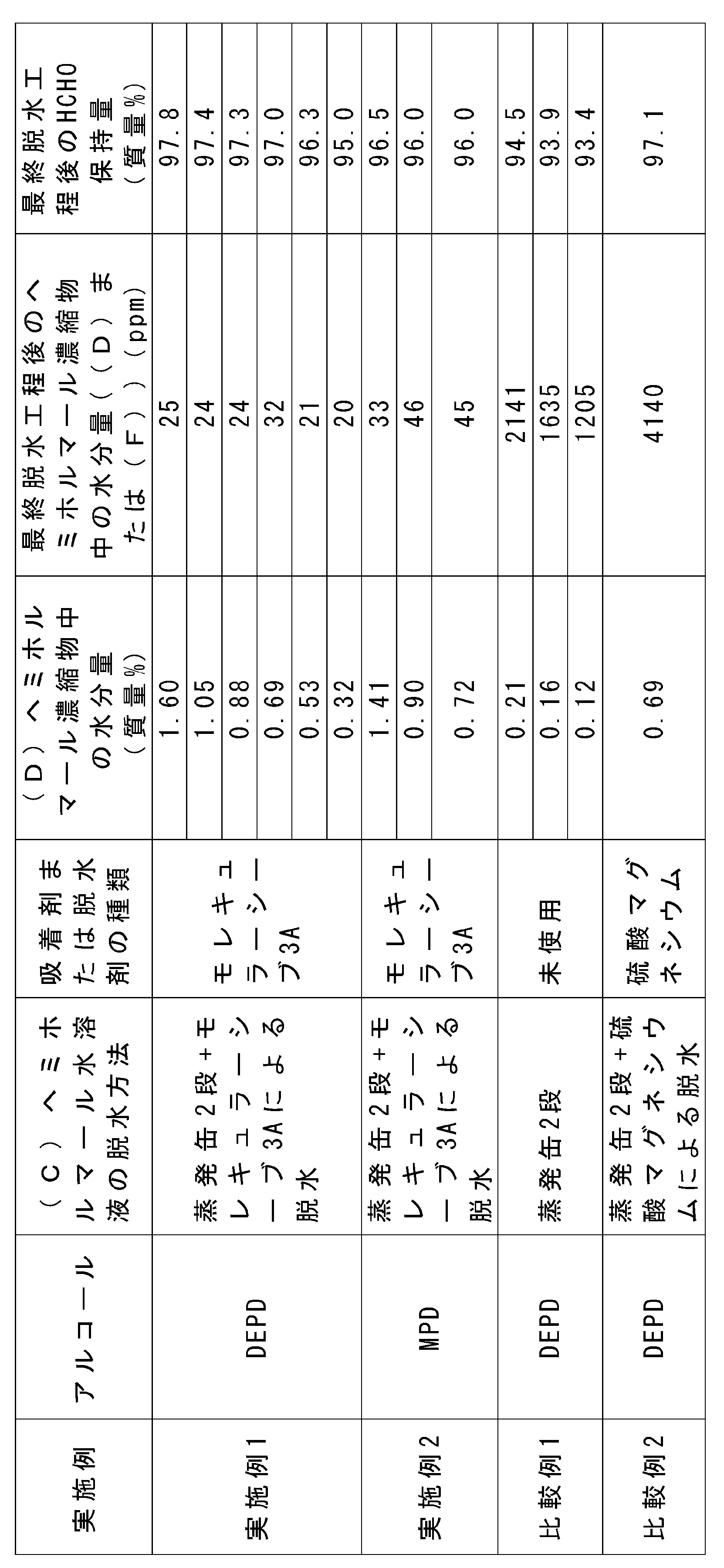
表1から、ヘミホルマール濃縮物を多孔質吸着剤に接触させることで、ヘミホルマール濃縮物中の水分を大幅に除去できることが確認された。したがって、ホルムアルデヒドガスに含まれる水分量も大幅に低下させられる。
1 ホルムアルデヒドガス製造装置
10 反応器
11 蒸発器
12 吸着器
13 分解器
2 ヘミホルマール水溶液供給用配管
3 ヘミホルマール濃縮物供給用配管
4 水排出用配管
5 高純度ヘミホルマール供給用配管
10 反応器
11 蒸発器
12 吸着器
13 分解器
2 ヘミホルマール水溶液供給用配管
3 ヘミホルマール濃縮物供給用配管
4 水排出用配管
5 高純度ヘミホルマール供給用配管
Claims (5)
- (A)アルコールと(B)ホルムアルデヒド水溶液とを反応させて、(C)ヘミホルマール水溶液を生成させる第一工程と、
前記(C)ヘミホルマール水溶液に含まれる水分を蒸発させて(D)ヘミホルマール濃縮物と(E)水とに分離する第二工程と、
前記(D)ヘミホルマール濃縮物を多孔質吸着剤に接触させることで、前記(D)ヘミホルマール濃縮物中の水分を除去して(F)高純度ヘミホルマール濃縮物を分取する第三工程と、
前記(F)高純度ヘミホルマール濃縮物を熱分解させて、(G)ホルムアルデヒドガスを発生させる第四工程と、を有するホルムアルデヒドガスの製造方法。 - 前記多孔質吸着剤は、合成ゼオライトである請求項1に記載のホルムアルデヒドガスの製造方法。
- (F)高純度ヘミホルマール濃縮物に含まれる水分量が、100ppm以下である請求項1又は2に記載のホルムアルデヒドガス製造方法。
- (A)アルコールと(B)ホルムアルデヒド水溶液とを反応させて、(C)ヘミホルマール水溶液を生成させる反応器と、
前記反応器と連結され、前記反応器から供給された前記(C)ヘミホルマール水溶液を蒸発させて(D)ヘミホルマール濃縮物と(E)水とに分離する蒸発器と、
前記蒸発器と連結され、内部に多孔質吸着剤を有し、前記蒸発器から供給された前記(D)ヘミホルマール濃縮物を前記多孔質吸着剤に接触させることで、前記(D)ヘミホルマール濃縮物中の水分を除去して(F)高純度ヘミホルマール濃縮物を分取する吸着器と、
前記吸着器と連結され、前記吸着器から供給される前記(F)高純度ヘミホルマール濃縮物を熱分解させて、(G)ホルムアルデヒドガスを発生させる分解器と、を有するホルムアルデヒドガス製造装置。 - 前記多孔質吸着剤は、合成ゼオライトである請求項4に記載のホルムアルデヒドガス製造装置。
Applications Claiming Priority (2)
| Application Number | Priority Date | Filing Date | Title |
|---|---|---|---|
| JP2012-025841 | 2012-02-09 | ||
| JP2012025841A JP2013159606A (ja) | 2012-02-09 | 2012-02-09 | ホルムアルデヒドガス製造方法、及びホルムアルデヒドガス製造装置 |
Publications (1)
| Publication Number | Publication Date |
|---|---|
| WO2013118552A1 true WO2013118552A1 (ja) | 2013-08-15 |
Family
ID=48947321
Family Applications (1)
| Application Number | Title | Priority Date | Filing Date |
|---|---|---|---|
| PCT/JP2013/050834 Ceased WO2013118552A1 (ja) | 2012-02-09 | 2013-01-17 | ホルムアルデヒドガス製造方法、及びホルムアルデヒドガス製造装置 |
Country Status (3)
| Country | Link |
|---|---|
| JP (1) | JP2013159606A (ja) |
| TW (1) | TW201343618A (ja) |
| WO (1) | WO2013118552A1 (ja) |
Cited By (1)
| Publication number | Priority date | Publication date | Assignee | Title |
|---|---|---|---|---|
| CN112898145A (zh) * | 2021-03-22 | 2021-06-04 | 邢台旭阳科技有限公司 | 气相甲醛提取系统 |
Families Citing this family (3)
| Publication number | Priority date | Publication date | Assignee | Title |
|---|---|---|---|---|
| WO2021052328A1 (zh) * | 2019-09-19 | 2021-03-25 | 山东辰信新能源有限公司 | 一种聚甲氧基二甲醚及其混合物的制备方法 |
| CN114057543B (zh) * | 2020-07-29 | 2023-09-15 | 山东辰信新能源有限公司 | 一种DMMn合成工序中失效载体的回收方法 |
| KR102879563B1 (ko) | 2021-02-03 | 2025-10-30 | 삼성전자주식회사 | 가스 공급부를 포함하는 공정 장치 및 가스 공급부를 포함하는 공정 장치의 작동 방법 |
Citations (5)
| Publication number | Priority date | Publication date | Assignee | Title |
|---|---|---|---|---|
| JPS5340707A (en) * | 1976-09-27 | 1978-04-13 | Mitsubishi Chem Ind Ltd | Purification of formaldehyde |
| JPS5781430A (en) * | 1980-11-11 | 1982-05-21 | Ube Ind Ltd | Purification of formaldehyde |
| JPH01216950A (ja) * | 1988-02-26 | 1989-08-30 | Ube Ind Ltd | ホルムアルデヒドの精製法 |
| JPH02138145A (ja) * | 1988-11-21 | 1990-05-28 | Central Glass Co Ltd | ヘミアセタール化合物の製造方法 |
| JPH03184933A (ja) * | 1989-12-13 | 1991-08-12 | Central Glass Co Ltd | ヘミアセタール化合物の製造方法 |
-
2012
- 2012-02-09 JP JP2012025841A patent/JP2013159606A/ja active Pending
-
2013
- 2013-01-17 WO PCT/JP2013/050834 patent/WO2013118552A1/ja not_active Ceased
- 2013-01-21 TW TW102102163A patent/TW201343618A/zh unknown
Patent Citations (5)
| Publication number | Priority date | Publication date | Assignee | Title |
|---|---|---|---|---|
| JPS5340707A (en) * | 1976-09-27 | 1978-04-13 | Mitsubishi Chem Ind Ltd | Purification of formaldehyde |
| JPS5781430A (en) * | 1980-11-11 | 1982-05-21 | Ube Ind Ltd | Purification of formaldehyde |
| JPH01216950A (ja) * | 1988-02-26 | 1989-08-30 | Ube Ind Ltd | ホルムアルデヒドの精製法 |
| JPH02138145A (ja) * | 1988-11-21 | 1990-05-28 | Central Glass Co Ltd | ヘミアセタール化合物の製造方法 |
| JPH03184933A (ja) * | 1989-12-13 | 1991-08-12 | Central Glass Co Ltd | ヘミアセタール化合物の製造方法 |
Cited By (1)
| Publication number | Priority date | Publication date | Assignee | Title |
|---|---|---|---|---|
| CN112898145A (zh) * | 2021-03-22 | 2021-06-04 | 邢台旭阳科技有限公司 | 气相甲醛提取系统 |
Also Published As
| Publication number | Publication date |
|---|---|
| TW201343618A (zh) | 2013-11-01 |
| JP2013159606A (ja) | 2013-08-19 |
Similar Documents
| Publication | Publication Date | Title |
|---|---|---|
| JP6935399B2 (ja) | イソプロピルアルコールの製造方法 | |
| KR100979372B1 (ko) | 조 글리세롤계 생성물, 그 정제방법 및 디클로로프로판올의제조에의 그 용도 | |
| CN109071475B (zh) | 一种制备环氧丙烷的方法 | |
| EP3398930B1 (en) | Method for producing acetic acid | |
| JP5698548B2 (ja) | ヘミホルマール濃縮物の製造方法及びホルムアルデヒドガスの製造方法 | |
| CN104507897A (zh) | 用于制备异丙醇的方法和设备 | |
| CN112771016A (zh) | 高纯度异丙醇及其制造方法 | |
| WO2013118552A1 (ja) | ホルムアルデヒドガス製造方法、及びホルムアルデヒドガス製造装置 | |
| CN105358536B (zh) | 部分料流蒸馏 | |
| KR20230153332A (ko) | 무수당 알코올의 연속적인 생산방법 | |
| CN110121490A (zh) | 乙酸的制备方法 | |
| KR102164914B1 (ko) | 올리고실란의 제조 방법 | |
| JP7024060B2 (ja) | 廃溶媒の精製方法 | |
| JP6391389B2 (ja) | オクタクロロトリシランの製造方法並びに該方法により製造されるオクタクロロトリシラン | |
| JP2018093233A (ja) | ドライエッチング方法 | |
| CN110191874A (zh) | 乙酸的制备方法 | |
| CN105531266B (zh) | 用于制造四氢呋喃的改进型方法 | |
| CN110785398B (zh) | 乙酸的制备方法 | |
| KR20160077000A (ko) | 무수당 알코올의 효과적인 생산 및 정제 방법 | |
| JP5373265B2 (ja) | N−アルキルボラジンの製造方法 | |
| JP5373259B2 (ja) | N−アルキルボラジンの製造方法 | |
| JP6118589B2 (ja) | 3−メチル−1,3−ブタンジオールの製造方法 | |
| WO2013111462A1 (ja) | ヘミホルマール濃縮物の製造方法、及びホルムアルデヒドガスの製造方法 | |
| JP5215600B2 (ja) | N−アルキルボラジンの製造方法 | |
| JP4795318B2 (ja) | N−アルキルボラジンの製造法 |
Legal Events
| Date | Code | Title | Description |
|---|---|---|---|
| 121 | Ep: the epo has been informed by wipo that ep was designated in this application |
Ref document number: 13746206 Country of ref document: EP Kind code of ref document: A1 |
|
| NENP | Non-entry into the national phase |
Ref country code: DE |
|
| 122 | Ep: pct application non-entry in european phase |
Ref document number: 13746206 Country of ref document: EP Kind code of ref document: A1 |