WO2013015377A1 - 加工玄米の製造方法 - Google Patents
加工玄米の製造方法 Download PDFInfo
- Publication number
- WO2013015377A1 WO2013015377A1 PCT/JP2012/069012 JP2012069012W WO2013015377A1 WO 2013015377 A1 WO2013015377 A1 WO 2013015377A1 JP 2012069012 W JP2012069012 W JP 2012069012W WO 2013015377 A1 WO2013015377 A1 WO 2013015377A1
- Authority
- WO
- WIPO (PCT)
- Prior art keywords
- brown rice
- methylenecycloartanol
- cycloartenol
- heat treatment
- processed
- Prior art date
- Legal status (The legal status is an assumption and is not a legal conclusion. Google has not performed a legal analysis and makes no representation as to the accuracy of the status listed.)
- Ceased
Links
Classifications
-
- A—HUMAN NECESSITIES
- A23—FOODS OR FOODSTUFFS; TREATMENT THEREOF, NOT COVERED BY OTHER CLASSES
- A23L—FOODS, FOODSTUFFS OR NON-ALCOHOLIC BEVERAGES, NOT OTHERWISE PROVIDED FOR; PREPARATION OR TREATMENT THEREOF
- A23L33/00—Modifying nutritive qualities of foods; Dietetic products; Preparation or treatment thereof
- A23L33/10—Modifying nutritive qualities of foods; Dietetic products; Preparation or treatment thereof using additives
-
- A—HUMAN NECESSITIES
- A23—FOODS OR FOODSTUFFS; TREATMENT THEREOF, NOT COVERED BY OTHER CLASSES
- A23L—FOODS, FOODSTUFFS OR NON-ALCOHOLIC BEVERAGES, NOT OTHERWISE PROVIDED FOR; PREPARATION OR TREATMENT THEREOF
- A23L33/00—Modifying nutritive qualities of foods; Dietetic products; Preparation or treatment thereof
- A23L33/30—Dietetic or nutritional methods, e.g. for losing weight
-
- A—HUMAN NECESSITIES
- A23—FOODS OR FOODSTUFFS; TREATMENT THEREOF, NOT COVERED BY OTHER CLASSES
- A23L—FOODS, FOODSTUFFS OR NON-ALCOHOLIC BEVERAGES, NOT OTHERWISE PROVIDED FOR; PREPARATION OR TREATMENT THEREOF
- A23L7/00—Cereal-derived products; Malt products; Preparation or treatment thereof
- A23L7/10—Cereal-derived products
- A23L7/101—Addition of antibiotics, vitamins, amino-acids, or minerals
-
- A—HUMAN NECESSITIES
- A23—FOODS OR FOODSTUFFS; TREATMENT THEREOF, NOT COVERED BY OTHER CLASSES
- A23L—FOODS, FOODSTUFFS OR NON-ALCOHOLIC BEVERAGES, NOT OTHERWISE PROVIDED FOR; PREPARATION OR TREATMENT THEREOF
- A23L7/00—Cereal-derived products; Malt products; Preparation or treatment thereof
- A23L7/10—Cereal-derived products
- A23L7/196—Products in which the original granular shape is maintained, e.g. parboiled rice
- A23L7/1963—Products in which the original granular shape is maintained, e.g. parboiled rice coated with a layer
-
- A—HUMAN NECESSITIES
- A23—FOODS OR FOODSTUFFS; TREATMENT THEREOF, NOT COVERED BY OTHER CLASSES
- A23L—FOODS, FOODSTUFFS OR NON-ALCOHOLIC BEVERAGES, NOT OTHERWISE PROVIDED FOR; PREPARATION OR TREATMENT THEREOF
- A23L7/00—Cereal-derived products; Malt products; Preparation or treatment thereof
- A23L7/10—Cereal-derived products
- A23L7/196—Products in which the original granular shape is maintained, e.g. parboiled rice
- A23L7/1965—Cooked; Precooked; Fried or pre-fried in a non-aqueous liquid frying medium, e.g. oil
-
- A—HUMAN NECESSITIES
- A23—FOODS OR FOODSTUFFS; TREATMENT THEREOF, NOT COVERED BY OTHER CLASSES
- A23L—FOODS, FOODSTUFFS OR NON-ALCOHOLIC BEVERAGES, NOT OTHERWISE PROVIDED FOR; PREPARATION OR TREATMENT THEREOF
- A23L7/00—Cereal-derived products; Malt products; Preparation or treatment thereof
- A23L7/10—Cereal-derived products
- A23L7/198—Dry unshaped finely divided cereal products, not provided for in groups A23L7/117 - A23L7/196 and A23L29/00, e.g. meal, flour, powder, dried cereal creams or extracts
Definitions
- the present invention relates to a method for producing processed brown rice.
- 4,4-Dimethylsterols are plant sterols present in rice and have been reported to prevent and improve various lifestyle-related diseases.
- cycloartol has an adiponectin secretion promoting action and can be used as an anti-arteriosclerotic agent, anti-obesity agent, anti-diabetic agent, etc.
- 24- Methylenecycloartanol has been reported to have a hyperglycemic improving action and an insulin sensitivity enhancing action (see, for example, Patent Documents 2 and 3).
- brown rice subjected to germination treatment is wet-heat treated with water vapor and dried to improve the texture and taste of brown rice (see, for example, Patent Document 4).
- the present invention Provided is a method for producing processed brown rice, comprising at least a step of wet heat treating raw brown rice with water vapor at 110 to 150 ° C. for 5 to 90 minutes, and a step of heat treating the heat treated brown rice at 80 to 100 ° C. for 5 to 90 minutes. Is.
- the present invention also provides a processed brown rice containing 6.4 mg or more of cycloartol in 100 g of dry matter.
- the present invention also provides processed brown rice containing 4.5 mg or more of 24-methylenecycloartanol in 100 g of dry matter.
- the present invention also provides processed brown rice containing 11.0 mg or more of cycloartol and 24-methylenecycloartanol in a total amount of 100 g of dry matter.
- the present invention relates to provision of a method for producing processed brown rice having an increased content of cycloartol or 24-methylenecycloartanol.
- the present inventors have thought that if the content of cycloartol or 24-methylenecycloartanol in brown rice can be increased, brown rice useful for preventing or improving lifestyle-related diseases can be provided. , Earnestly examined. As a result, it was found that the content of cycloartol and 24-methylenecycloartanol was increased when raw brown rice was subjected to wet heat treatment and heat treatment at a specific temperature. Moreover, the cooked rice obtained by cooking the treated brown rice had good flavor and texture. The present invention has been completed based on these findings.
- the method for producing processed brown rice of the present invention (hereinafter referred to as the production method of the present invention) produces processed brown rice having an increased content of cycloartol or 24-methylenecycloartanol compared to raw brown rice used as a raw material. It is a method to do.
- the processed brown rice obtained by the production method of the present invention is suitable for cooking and eating. The production method of the present invention will be described in detail below.
- the production method of the present invention uses raw brown rice as a starting material.
- 1 type, or 2 or more types chosen from sticky rice and sticky rice can be used.
- species are mentioned.
- the raw brown rice varieties used as a raw material and for example, one or more selected from the common varieties Koshihikari, Hinohikari, Milky Queen, Sally Queen, Hitomebore, Akita Komachi, and Yumekoshi are used. be able to.
- Raw raw rice is subjected to wet heat treatment with steam at a specific temperature.
- the wet heat treatment in the present invention is a heat treatment in the presence of water vapor, and is performed by bringing water vapor at a specific temperature into contact with the target brown rice.
- the raw brown rice is preferably washed by a conventional method before wet heat treatment. Moreover, you may make it soak in water after washing rice.
- it is preferable to set it as less than 15 degreeC from a viewpoint which can suppress propagation of a microbe.
- the temperature of water vapor in the wet heat treatment is 110 to 150 ° C., preferably 110 to 145 ° C., more preferably 115 to 140 ° C., still more preferably 120 to 135 ° C., and 125 to 135 More preferably, the temperature is C. If the temperature of the water vapor in the wet heat treatment exceeds 150 ° C., the brown rice surface is likely to be burnt and the appearance may be impaired.
- the time for subjecting the raw brown rice to the wet heat treatment is in the range of 5 to 90 minutes, preferably 20 to 90 minutes, more preferably 30 to 70 minutes, and further preferably 40 to 60 minutes. preferable. Usually, the treatment time can be shortened as the temperature of the wet heat treatment increases.
- the temperature of the water vapor may be constant during the wet heat treatment or may be varied.
- the wet heat treatment pressure is preferably saturated vapor pressure.
- Brown rice is preferably wet-heat treated so that the moisture content is 20 to 70% by weight immediately after the wet heat treatment, more preferably wet-heat treated so as to be 25 to 50% by weight, and 30 to 45% by weight. It is more preferable that the heat treatment is performed so as to be.
- the moisture content can be calculated by subtracting the mass of the brown rice immediately after the wet heat treatment after the brown rice has been completely dried.
- Brown rice can be completely dried by freeze drying ( ⁇ 80 ° C., 5 Pa, 48 hours) after freezing in liquid nitrogen. By performing the heat-moisture treatment, the fragrance of brown rice increases, while the rice bran odor can be reduced.
- the wet heat treatment can be performed by a commercially available wet heat treatment apparatus, and examples of the wet heat treatment apparatus include an autoclave and a short-time cooking sterilization apparatus.
- Brown rice after wet heat treatment is further subjected to heat treatment.
- the brown rice after the wet heat treatment may be subjected to the heat treatment as it is without being cooled, or may be subjected to the heat treatment after being cooled to a desired temperature.
- the heating temperature of the heat treatment is 80 to 100 ° C., more preferably 85 to 100 ° C., and further preferably 90 to 100 ° C.
- the time for performing the heat treatment is in the range of 5 to 90 minutes. Normally, the higher the temperature, the shorter the treatment time. For example, when the temperature is about 90 to 100 ° C., the treatment time is 5 to 60 minutes. It is preferably 10 to 60 minutes, more preferably 15 to 45 minutes, and further preferably 20 to 40 minutes.
- the temperature may be constant during the heat treatment or may be varied.
- the brown rice immediately after the heat treatment preferably has a moisture content of 25 to 60% by mass, preferably 30 to 55% by mass, more preferably 30 to 50% by mass, and further preferably 35 to 50% by mass.
- the heat treatment method there is no particular limitation on the heat treatment method, but a heat treatment method is preferable, and the humidity is preferably 80 to 100% relative humidity (hereinafter referred to as RH), and preferably 90 to 100% RH. Is more preferable, and saturated steam is further preferable.
- RH relative humidity
- saturated steam is further preferable.
- a method for heat treatment under moisture it is preferable to use one of a method of putting brown rice in an open container soaked in warm water, a method of immersing brown rice in warm water, and a method of wet heat treatment with water vapor. More preferably, a heat treatment method is used.
- Brown rice that has been subjected to heat treatment after heat treatment after heat treatment can be eaten as it is, but in the same way as normal brown rice, it is subsequently subjected to drying treatment in order to make it suitable for cooking and eating. It is preferred that Drying is a treatment for reducing the moisture content in the brown rice. From the viewpoint of the storage stability of the processed brown rice to be produced, the moisture content in the brown rice is preferably 15% by mass or less, more preferably 5 to 15% by mass, by drying treatment. Further, the water activity of the brown rice is preferably 0.6 or less, more preferably 0.2 to 0.6 by drying treatment. Water activity can be measured using a water activity measuring device (trade name: IC-500, manufactured by Novasina).
- the temperature is 40 to 60 ° C., preferably 45 to 55 ° C.
- the humidity is 30 to 70% RH, preferably 50 to 60% RH, for 1 to 5 hours, preferably 2 to It is preferable to dry for 3 hours.
- the content of cycloartol in the brown rice can be increased. Therefore, the content of cycloartol in the processed brown rice produced by the production method of the present invention is higher than the content of cycloartol in raw brown rice as a raw material when compared per 100 g of dry matter.
- the processed brown rice manufactured by the above-described manufacturing method is the cycloartol contained in 100 g of dried raw brown rice (raw brown rice before processing) in which the mass of cycloartol contained in 100 g of dried dry rice is processed. The mass is preferably 1.4 times or more, more preferably 1.5 times or more, and more preferably 1.6 times or more.
- the “dry matter” of raw brown rice or processed brown rice means that raw brown rice or processed brown rice is frozen in liquid nitrogen and then freeze-dried ( ⁇ 80 ° C., 5 Pa, 48 hours).
- the mass of cycloartol contained in 100 g of dry matter of the processed brown rice is usually 3.5 times or less of the mass of cycloartol contained in 100 g of dry matter of raw brown rice before processing, and 3 times or less. It may be 2 times or less, or 1.8 times or less.
- the content of cycloartol in 100 g of dried brown rice produced by the above-described production method is preferably 6.4 mg or more, more preferably 6.7 mg or more, and 7.0 mg or more. Is more preferable.
- it is 16 mg or less in the dry matter 100g of the said processed brown rice, and even if it is 14 mg or less It may be 11 mg or less, 9 mg or less, or 8 mg or less.
- the content of 24-methylenecycloartanol in brown rice can be increased by subjecting raw brown rice to the above-mentioned production steps. Therefore, the content of 24-methylenecycloartanol in the processed brown rice produced by the production method of the present invention is the content of 24-methylenecycloartanol in raw brown rice as a raw material when compared per 100 g of dry matter. Higher than the amount.
- the mass of 24-methylenecycloartanol contained in 100 g of dry matter of the processed brown rice is equal to that of 24-methylenecycloartanol contained in 100 g of dry matter of raw brown rice before processing.
- the mass is preferably 1.5 times or more, and more preferably 1.6 times or more.
- the mass of 24-methylenecycloartanol contained in 100 g of dry matter of the processed brown rice is usually not more than 3 times the mass of 24-methylenecycloartanol contained in 100 g of dry matter of raw brown rice before processing. It may be 2 times or less, or 1.9 times or less.
- the content of 24-methylenecycloartanol in 100 g of the dry matter of processed brown rice produced by the above-described production method is preferably 4.5 mg or more, and more preferably 4.8 mg or more.
- the upper limit of the content of 24-methylenecycloartanol in the processed brown rice produced by the above-described production method is not particularly limited, but is usually 14 mg or less in 100 g of dry matter of the processed brown rice and 10 mg or less. It may be 7 mg or less, or 6 mg or less.
- the total content of cycloartol and 24-methylenecycloartanol in brown rice can be increased by subjecting raw brown rice to the above-described production steps. Therefore, the total content of cycloartol and 24-methylenecycloartanol in the processed brown rice produced by the production method of the present invention is compared with that per 100 g of dry matter. And higher than the total content of 24-methylenecycloartanol.
- the processed brown rice manufactured by the above-described manufacturing method is the same as the total amount of cycloartol and 24-methylenecycloartanol contained in 100 g of dry matter of the processed brown rice.
- the total mass of tenol and 24-methylenecycloartanol is preferably 1.4 times or more, preferably 1.5 times or more, and more preferably 1.6 times or more.
- the total mass of cycloartol and 24-methylenecycloartanol contained in 100 g of the dried brown rice product is usually equal to the amount of cycloartol and 24-methylenecycloalter contained in 100 g of raw brown rice before processing. It may be 4.5 times or less, 3 times or less, 2 times or less, or 1.8 times or less of the total mass of tanol.
- the total content of cycloartol and 24-methylenecycloartanol in 100 g of dry matter of processed brown rice produced by the production method described above is preferably 11 mg or more, and more preferably 12 mg or more.
- the upper limit of the total content of cycloartol and 24-methylenecycloartanol in the processed brown rice produced by the above-described production method is not particularly limited, but is usually 30 mg or less per 100 g of dry matter of the processed brown rice. , 20 mg or less, 16 mg or less, or 14 mg or less.
- Cycloartenol and 24-methylenecycloartanol are compounds represented by the following formulas (1) and (2), respectively, and both are plant sterols belonging to 4,4-dimethylsterols.
- Cycloartenol and 24-methylenecycloartanol are known to exist mainly in rice bran.
- many of cycloartol and 24-methylenecycloartanol exist as ferulic acid ester bodies esterified with ferulic acid or fatty acid ester bodies esterified with fatty acids, and exist as free forms.
- free forms mainly have physiological effects such as prevention and improvement of lifestyle-related diseases, and the above ester forms are known to have poor physiological activity compared to free forms.
- cycloartol and 24-methylenecycloartanol both mean free forms and do not include conjugates such as ester forms.
- the ester bond of the ester of cycloartol or the ester of 24-methylenecycloartanol is considered to be difficult to cleave.
- the content of cycloartol or 24-methylenecycloartanol in brown rice is greatly increased by the production method of the present invention. This is probably because the brown rice-specific component promotes the thermal cleavage of the ester bond of the cycloartol ester or 24-methylenecycloartanol ester.
- processed brown rice having a higher content of cycloartol or 24-methylenecycloartanol than raw brown rice can be obtained using raw brown rice as a raw material.
- the processed brown rice of the present invention has a higher content of cycloartol or 24-methylenecycloartanol than raw brown rice before processing.
- the production method of the present invention is processed brown rice using raw brown rice as a raw material and increasing the content of cycloartanol in the raw brown rice, which is suitable for cooking and eating. Can be used to produce brown rice.
- the processed brown rice produced by the production method of the present invention can be suitably used as a food suitable for prevention and improvement of lifestyle-related diseases.
- the present invention discloses the following processed brown rice production method or processed brown rice.
- the raw brown rice is one or more kinds selected from glutinous rice and glutinous rice, and preferably one or more kinds of glutinous rice.
- the raw brown rice is japonica, indica, and one or two or more selected from a combination of japonica and indica, preferably one or more of japonica ⁇ 1> or the production method according to ⁇ 2>.
- the raw brown rice is one or more varieties selected from Koshihikari, Hinohikari, Milky Queen, Sally Queen, Hitomebore, Akita Komachi, and Yumeyoku The manufacturing method as described.
- the water vapor temperature is 110 to 145 ° C., preferably 115 to 140 ° C., more preferably 120 to 135 ° C., and further preferably 125 to 135 ° C.
- ⁇ 1> The production method according to any one of ⁇ 4>.
- ⁇ 6> The production method according to any one of ⁇ 1> to ⁇ 5>, wherein the wet heat treatment time is 20 to 90 minutes, preferably 30 to 70 minutes, and more preferably 40 to 60 minutes.
- ⁇ 7> The production method according to any one of ⁇ 1> to ⁇ 6>, wherein the wet heat treatment is performed at a saturated vapor pressure.
- ⁇ 8> ⁇ 1> to ⁇ 7> described above, wherein the moisture content is 20 to 70% by mass, preferably 25 to 50% by mass, more preferably 30 to 45% by mass immediately after the wet heat treatment.
- ⁇ 9> The production method according to any one of ⁇ 1> to ⁇ 8>, wherein the temperature of the heat treatment is 85 to 100 ° C, preferably 90 to 100 ° C. ⁇ 10>
- the time for the heat treatment is 5 to 60 minutes, preferably 10 to 60 minutes, more preferably 15 to 45 minutes, and further preferably 20 to 40 minutes, ⁇ 1> to ⁇ 9>
- the manufacturing method as described in any one. ⁇ 11> ⁇ 1> to ⁇ 10>, wherein the heat treatment is performed under conditions of humidity 80 to 100% RH, preferably humidity 90 to 100% RH, more preferably saturated steam. Manufacturing method.
- ⁇ 12> The production method according to any one of ⁇ 1> to ⁇ 11>, wherein the heat treatment step is a wet heat treatment step with water vapor.
- the moisture content of the brown rice immediately after the heat treatment is 25 to 60% by mass, preferably 30 to 55% by mass, more preferably 30 to 50% by mass, and further preferably 35 to 50% by mass.
- ⁇ 14> The production method according to any one of ⁇ 1> to ⁇ 13>, further comprising a step of drying the heat-treated brown rice.
- ⁇ 15> The production method according to ⁇ 14>, wherein the drying step is performed under a condition of a temperature of 40 to 60 ° C., preferably 45 to 55 ° C.
- ⁇ 16> The production method according to ⁇ 14> or ⁇ 15>, wherein the drying step is performed under a condition of a humidity of 30 to 70% RH, preferably 50 to 60% RH.
- ⁇ 17> The production method according to any one of ⁇ 14> to ⁇ 16>, wherein the drying time is 1 to 5 hours, preferably 2 to 3 hours.
- the mass of cycloartol contained in 100 g of dry matter of processed brown rice is 1.4 times or more, preferably 1.5 times or more of the mass of cycloartol contained in 100 g of dry matter of raw brown rice before processing.
- the mass of cycloartol contained in 100 g of dry matter of processed brown rice is not more than 3.5 times the mass of cycloartol contained in 100 g of dry matter of raw brown rice before processing, and may be 3 times or less
- the production method according to any one of ⁇ 1> to ⁇ 20> which may be 2 times or less and may be 1.8 times or less.
- the mass of 24-methylenecycloartanol contained in 100 g of the dried brown rice product is 1.5 times or more of the mass of 24-methylenecycloartanol contained in 100 g of the dried raw rice rice, preferably The production method according to any one of ⁇ 1> to ⁇ 21>, which is 1.6 times or more.
- the mass of 24-methylenecycloartanol contained in 100 g of dry matter of processed brown rice is not more than 3 times the mass of 24-methylenecycloartanol contained in 100 g of dry matter of raw unpolished rice before processing.
- the production method according to any one of ⁇ 1> to ⁇ 22> which may be 1.9 times or less.
- ⁇ 24> The total mass of cycloartol and 24-methylenecycloartanol contained in 100 g of dry matter of processed brown rice is the total mass of cycloartol and 24-methylenecycloartanol contained in 100 g of dry matter of raw brown rice before processing.
- ⁇ 25> The total mass of cycloartol and 24-methylenecycloartanol contained in 100 g of dry matter of processed brown rice is the total mass of cycloartol and 24-methylenecycloartanol contained in 100 g of dry matter of raw brown rice before processing. Any one of the above ⁇ 1> to ⁇ 24>, which may be 4.5 times or less, 3 times or less, 2 times or less, or 1.8 times or less.
- ⁇ 26> Processed brown rice containing 6.4 mg or more, preferably 6.7 mg or more, more preferably 7.0 mg or more of cycloartol in 100 g of dry matter.
- the content of cycloartol in 100 g of dry matter is 16 mg or less, 14 mg or less, 11 mg or less, 9 mg or less, or 8 mg or less.
- ⁇ 28> Processed brown rice containing 4.5 mg or more, preferably 4.8 mg or more of 24-methylenecycloartanol in 100 g of dry matter.
- the content of 24-methylenecycloartanol in 100 g of dry matter is 14 mg or less, may be 10 mg or less, may be 7 mg or less, and may be 6 mg or less, as described in ⁇ 28> above Processed brown rice.
- the total content of cycloartol and 24-methylenecycloartanol in 100 g of dry matter is 30 mg or less, 20 mg or less, 16 mg or less, or 14 mg or less. 30> processed brown rice.
- ⁇ 36> Processed as described in any one of ⁇ 26> to ⁇ 35>, wherein the processed brown rice is one or more kinds selected from glutinous rice and glutinous rice, preferably one or more kinds of glutinous rice brown rice.
- the processed brown rice is japonica, indica, and one or two or more selected from a combination of japonica and indica, preferably one or more of japonica, Processed brown rice according to any one of ⁇ 26> to ⁇ 36>.
- ⁇ 38> The processed brown rice according to any one of the above items ⁇ 26> to ⁇ 37>, wherein the processed brown rice is a variety selected from Koshihikari, Hinohikari, Milky Queen, Sally Queen, Hitomebore, Akita Komachi, and Yumeyokuiro.
- the processed brown rice according to any one of ⁇ 26> to ⁇ 38> wherein the moisture content is 15% by mass or less, preferably 5 to 15% by mass.
- ⁇ 40> The processed brown rice according to any one of ⁇ 26> to ⁇ 39>, wherein the water activity is 0.6 or less, preferably 0.2 to 0.6.
- the obtained eluate was saponified and decomposed with alkali, and cycloartenol and 24-methylenecycloartanol were quantified by gas chromatography using cholesterol as an internal standard substance.
- Example 1 Production of processed brown rice by the production method of the present invention-1 Using 150 g of commercially available raw brown rice (Hinohikari produced in 2009) as a raw material, the rice was washed with water and drained, and immersed in cold water at 5 ° C. for 12 hours. The brown rice taken out from the cold water was subjected to wet heat treatment with steam at 125 ° C. for 60 minutes using a short-time cooking sterilizer (manufactured by Nisaka Seisakusho). Then, the open container containing the brown rice which performed the wet heat processing was installed in the upper part of the water in the container which boiled water, and the heat processing for 30 minutes by 100 degreeC water vapor
- a short-time cooking sterilizer manufactured by Nisaka Seisakusho
- the brown rice subjected to the heat treatment was dried at 50 ° C. for 3 hours using a high coater lab (manufactured by Freund Sangyo Co., Ltd.) to obtain processed brown rice (hereinafter referred to as the present invention product 1).
- Example 2 Production of processed brown rice by the production method of the present invention-2 Using 150 g of commercially available raw brown rice (Hinohikari produced in 2009) as a raw material, the rice was washed with water and drained, and immersed in cold water at 5 ° C. for 12 hours. The brown rice taken out from the cold water was subjected to a wet heat treatment with steam at 135 ° C. for 60 minutes using a short-time cooking sterilizer (manufactured by Nisaka Seisakusho). Then, the open container containing the brown rice which performed the wet heat processing was installed in the upper part of the water in the container which boiled water, and the heat processing for 30 minutes by 100 degreeC water vapor
- a short-time cooking sterilizer manufactured by Nisaka Seisakusho
- the brown rice subjected to the heat treatment was dried at 50 ° C. for 3 hours using a high coater lab (manufactured by Freund Sangyo Co., Ltd.) to obtain processed brown rice (hereinafter referred to as the present invention product 2).
- Example 3 Production of processed brown rice by the production method of the present invention-3 Using 150 g of commercially available raw brown rice (Hinohikari produced in 2009) as a raw material, the rice was washed with water and drained, and immersed in cold water at 5 ° C. for 12 hours. The brown rice taken out from the cold water was subjected to a moist heat treatment with steam at 145 ° C. for 40 minutes using a short-time cooking sterilizer (manufactured by Nisaka Seisakusho). Then, the open container containing the brown rice which performed the wet heat processing was installed in the upper part of the water in the container which boiled water, and the heat processing for 30 minutes by 100 degreeC water vapor
- a short-time cooking sterilizer manufactured by Nisaka Seisakusho
- the brown rice subjected to the heat treatment was dried at 50 ° C. for 3 hours using a high coater lab (manufactured by Freund Sangyo Co., Ltd.) to obtain processed brown rice (hereinafter referred to as the present invention product 3).
- Example 4 Production of processed brown rice by the production method of the present invention-4 Using 150 g of commercially available raw brown rice (Hinohikari produced in 2010) as a raw material, this was washed with water and drained with water, and immersed in cold water at 5 ° C. for 12 hours. The brown rice taken out from the cold water was subjected to a wet heat treatment with steam at 135 ° C. for 60 minutes using a short-time cooking sterilizer (manufactured by Nisaka Seisakusho). The water content immediately after the wet heat treatment was 37.3% by mass.
- a short-time cooking sterilizer manufactured by Nisaka Seisakusho
- the open container containing the brown rice which performed the wet heat treatment was installed in the upper part of the hot water in the container which put the hot water of 85 degreeC, and the heat processing for 30 minutes by 85 degreeC water vapor
- the water content immediately after the heat treatment was 34.9% by mass.
- the brown rice subjected to the heat treatment was dried at 50 ° C. for 3 hours using a high coater lab (manufactured by Freund Sangyo Co., Ltd.) to obtain processed brown rice (hereinafter referred to as the present invention product 4).
- the moisture content of the processed brown rice was 11.2% by mass.
- Example 5 Production of processed brown rice by the production method of the present invention-5 Using 150 g of commercially available raw brown rice (Hinohikari produced in 2010) as a raw material, this was washed with water and drained with water, and immersed in cold water at 5 ° C. for 12 hours. The brown rice taken out from the cold water was subjected to a wet heat treatment with steam at 135 ° C. for 60 minutes using a short-time cooking sterilizer (manufactured by Nisaka Seisakusho). The moisture content immediately after the wet heat treatment was 35.2% by mass.
- a short-time cooking sterilizer manufactured by Nisaka Seisakusho
- the open container containing the brown rice which performed the wet heat treatment was installed in the upper part of the hot water in the container which put the hot water of 85 degreeC, and the heat processing for 60 minutes with 85 degreeC water vapor
- the water content immediately after the heat treatment was 33.0% by mass.
- the brown rice subjected to the heat treatment was dried at 50 ° C. for 3 hours using a high coater lab (manufactured by Freund Sangyo Co., Ltd.) to obtain processed brown rice (hereinafter referred to as “invention product 5”).
- the moisture content of the processed brown rice was 10.9% by mass.
- Example 6 Production of processed brown rice by the production method of the present invention -6 Using 150 g of commercially available raw brown rice (Hinohikari produced in 2010) as a raw material, this was washed with water and drained with water, and immersed in cold water at 5 ° C. for 12 hours. The brown rice taken out from the cold water was subjected to a wet heat treatment with steam at 135 ° C. for 60 minutes using a short-time cooking sterilizer (manufactured by Nisaka Seisakusho). The moisture content immediately after the wet heat treatment was 36.0% by mass.
- a short-time cooking sterilizer manufactured by Nisaka Seisakusho
- the open container containing the brown rice which performed the wet heat processing was installed in the upper part of the water in the container which boiled water, and the heat processing for 6 minutes by 100 degreeC water vapor
- the water content immediately after the heat treatment was 35.0% by mass.
- the brown rice subjected to the heat treatment was dried at 50 ° C. for 3 hours using a high coater lab (manufactured by Freund Sangyo Co., Ltd.) to obtain processed brown rice (hereinafter referred to as product 6 of the present invention).
- the moisture content of the processed brown rice was 11.5% by mass.
- Example 7 Production of processed brown rice by the production method of the present invention -7 Using 150 g of commercially available raw brown rice (Hinohikari produced in 2010) as a raw material, this was washed with water and drained with water, and immersed in cold water at 5 ° C. for 12 hours. The brown rice taken out from the cold water was subjected to a wet heat treatment with steam at 135 ° C. for 60 minutes using a short-time cooking sterilizer (manufactured by Nisaka Seisakusho). The moisture content immediately after the wet heat treatment was 36.7% by mass.
- a short-time cooking sterilizer manufactured by Nisaka Seisakusho
- the open container containing the brown rice which performed the wet heat processing was installed in the upper part of the water in the container which boiled water, and the heat processing for 15 minutes by 100 degreeC water vapor
- the water content immediately after the heat treatment was 34.5% by mass.
- the brown rice subjected to the heat treatment was dried at 50 ° C. for 3 hours using a high coater lab (manufactured by Freund Sangyo Co., Ltd.) to obtain processed brown rice (hereinafter referred to as product 7 of the present invention).
- the moisture content of the processed brown rice was 11.7% by mass.
- the content of cycloartol in 100 g of dry matter is 1.4 times or more compared to the comparative product 3 which is raw brown rice.
- the content of methylenecycloartanol was increased 1.5 times or more, and the total content of cycloartol and 24-methylenecycloartanol was also increased 1.5 times or more. From these results, it was found that the raw brown rice was used as a raw material, and the processed brown rice having a higher cycloartol content or 24-methylenecycloartanol content than the raw brown rice could be produced by the production method of the present invention.
- comparative product 3 which was untreated raw brown rice, was cooked with inferior flavor and elasticity compared to ordinary brown rice.
- the cooked rice obtained by cooking the products 1 to 7 of the present invention produced in the production method of the present invention in the white rice mode had almost no rice bran odor felt in ordinary brown rice, and the fragrance increased remarkably. In addition, it was cooked softer than ordinary brown rice and had a moderate elasticity.
- the content of cycloartol and 24-methylenecycloartanol in brown rice can be increased by the production method of the present invention, and the processed brown rice produced by the production method of the present invention. Found that even when cooked in the white rice mode of the rice cooker, it was cooked into cooked rice with excellent flavor and texture.
Landscapes
- Life Sciences & Earth Sciences (AREA)
- Health & Medical Sciences (AREA)
- Nutrition Science (AREA)
- Chemical & Material Sciences (AREA)
- Engineering & Computer Science (AREA)
- Food Science & Technology (AREA)
- Polymers & Plastics (AREA)
- Mycology (AREA)
- Cereal-Derived Products (AREA)
- Coloring Foods And Improving Nutritive Qualities (AREA)
Abstract
生玄米を110~150℃の水蒸気で5~90分間湿熱処理する工程、及び湿熱処理した玄米を80~100℃で5~90分間加熱処理する工程、を少なくとも含む、加工玄米の製造方法。
Description
本発明は、加工玄米の製造方法に関する。
近年、先進社会では豊かな食生活により肥満人口が急増しており、肥満と関係の深い糖尿病、動脈硬化症及び心臓病等の生活習慣病の罹患率は増加の一途をたどっている。
4,4-ジメチルステロール類は米に存在する植物ステロールであり、様々な生活習慣病の予防・改善作用が報告されてきている。例えば、シクロアルテノールはアディポネクチン分泌促進作用を有し、抗動脈硬化剤、抗肥満剤、抗糖尿病剤等として利用しうることが報告されており(例えば、特許文献1参照)、また、24-メチレンシクロアルタノールは、高血糖改善作用やインスリン感受性の亢進作用を有することが報告されている(例えば、特許文献2、3参照)。
一方、発芽処理した玄米を水蒸気で湿熱処理し乾燥させることで、玄米の食感や食味を改善することが報告されている(例えば、特許文献4参照)。
一方、発芽処理した玄米を水蒸気で湿熱処理し乾燥させることで、玄米の食感や食味を改善することが報告されている(例えば、特許文献4参照)。
本発明は、
生玄米を110~150℃の水蒸気で5~90分間湿熱処理する工程、及び
湿熱処理した玄米を80~100℃で5~90分間加熱処理する工程
を少なくとも含む、加工玄米の製造方法を提供するものである。
生玄米を110~150℃の水蒸気で5~90分間湿熱処理する工程、及び
湿熱処理した玄米を80~100℃で5~90分間加熱処理する工程
を少なくとも含む、加工玄米の製造方法を提供するものである。
また、本発明は、乾物100g中にシクロアルテノールを6.4mg以上含有する加工玄米を提供するものである。
また、本発明は、乾物100g中に24-メチレンシクロアルタノールを4.5mg以上含有する加工玄米を提供するものである。
また、本発明は、乾物100g中に、シクロアルテノール及び24-メチレンシクロアルタノールを総量で11.0mg以上含有する加工玄米を提供するものである。
本発明の上記及び他の特徴及び利点は、下記の記載からより明らかになるであろう。
本発明は、シクロアルテノール又は24-メチレンシクロアルタノールの含有量を高めた加工玄米の製造方法の提供に関する。
本発明者らは、玄米中のシクロアルテノールや24-メチレンシクロアルタノールの含有量を高めることができれば、生活習慣病の予防・改善に有用な玄米を提供することができるとの考えの下、鋭意検討を行った。その結果、生玄米を特定の温度の湿熱処理及び加熱処理に付すると、シクロアルテノール及び24-メチレンシクロアルタノールの含有量が高まることを見い出した。また、処理後の玄米を炊飯して得た米飯は良好な風味と食感とを有していた。本発明はこれらの知見に基づいて完成させるに至ったものである。
本発明の加工玄米の製造方法(以下、本発明の製造方法という。)は、原料として用いる生玄米に比べてシクロアルテノール又は24-メチレンシクロアルタノールの含有量が高められた加工玄米を製造する方法である。本発明の製造方法により得られる加工玄米は炊飯して食するのに適している。
本発明の製造方法について以下に詳細に説明する。
本発明の製造方法について以下に詳細に説明する。
本発明の製造方法は、出発原料として生玄米を用いる。原料とする生玄米に特に制限はなく、うるち米及びもち米から選ばれる1種又は2種以上を用いることができる。また、うるち米としては、ジャポニカ種、インディカ種、及び、ジャポニカ種とインディカ種とをかけあわせたものから選ばれる1種又は2種以上が挙げられる。原料とする生玄米の品種に特に制限はなく、例えば、一般的な品種であるコシヒカリ、ヒノヒカリ、ミルキークイーン、サリークイーン、ヒトメボレ、アキタコマチ、及び夢十色から選ばれる1種又は2種以上を用いることができる。
原料の生玄米は、特定の温度の水蒸気で湿熱処理が施される。本発明における湿熱処理とは、水蒸気の存在下に加熱処理することであり、特定の温度の水蒸気を対象の玄米に接触させることで行われる。
生玄米は、湿熱処理の前に通常の方法で洗米しておくことが好ましい。また、洗米後に水に浸漬させておいてもよい。生玄米を浸漬させる水の温度に特に制限はないが、菌の繁殖を抑えることができる観点から15℃未満とすることが好ましい。
生玄米は、湿熱処理の前に通常の方法で洗米しておくことが好ましい。また、洗米後に水に浸漬させておいてもよい。生玄米を浸漬させる水の温度に特に制限はないが、菌の繁殖を抑えることができる観点から15℃未満とすることが好ましい。
湿熱処理における水蒸気の温度は110~150℃であるが、110~145℃であることが好ましく、115~140℃であることがより好ましく、120~135℃であることがさらに好ましく、125~135℃であることがさらに好ましい。湿熱処理における水蒸気の温度が150℃を超えると玄米表面に焦げが生じやすく、外観が損なわれるおそれがある。
生玄米を湿熱処理に付する時間は5~90分の範囲内であり、20~90分とすることが好ましく、30~70分とすることがより好ましく、40~60分とすることがさらに好ましい。通常は、湿熱処理の温度が高いほど処理時間を短くすることができる。水蒸気の温度は湿熱処理の間一定であってもよいし、変動させてもよい。
湿熱処理の圧力は飽和蒸気圧とすることが好ましい。
生玄米を湿熱処理に付する時間は5~90分の範囲内であり、20~90分とすることが好ましく、30~70分とすることがより好ましく、40~60分とすることがさらに好ましい。通常は、湿熱処理の温度が高いほど処理時間を短くすることができる。水蒸気の温度は湿熱処理の間一定であってもよいし、変動させてもよい。
湿熱処理の圧力は飽和蒸気圧とすることが好ましい。
玄米は、湿熱処理直後において、含水率が20~70質量%となるように湿熱処理することが好ましく、25~50質量%となるように湿熱処理することがより好ましく、30~45質量%となるように湿熱処理することがさらに好ましい。含水率は湿熱処理直後の玄米の質量から当該玄米を絶乾した後の質量を差し引くことで算出することができる。玄米は、液体窒素にて凍結後、凍結乾燥(-80℃、5Pa、48時間)により絶乾させることができる。
湿熱処理を行うことで玄米の香ばしさが増す一方、米糠臭が低減しうる。湿熱処理は市販の湿熱処理装置により行うことができ、当該湿熱処理装置としてオートクレーブや短時間調理殺菌装置などが挙げられる。
湿熱処理を行うことで玄米の香ばしさが増す一方、米糠臭が低減しうる。湿熱処理は市販の湿熱処理装置により行うことができ、当該湿熱処理装置としてオートクレーブや短時間調理殺菌装置などが挙げられる。
湿熱処理後の玄米は、さらに加熱処理に付する。湿熱処理後の玄米を冷ますことなくそのまま加熱処理に付してもよいし、所望の温度まで冷ましてから加熱処理に付してもよい。
当該加熱処理の加熱温度は80~100℃であるが、85~100℃であることがより好ましく、90~100℃であることがさらに好ましい。
加熱処理を施す時間は5~90分の範囲内であるが、通常には温度が高いほど処理時間が短くて済むため、例えば温度が90~100℃程度のときには、処理時間を5~60分とすることができ、10~60分とすることが好ましく、15~45分とすることがより好ましく、20~40分とすることがさらに好ましい。温度は加熱処理の間一定であってもよいし、変動させてもよい。加熱処理直後の玄米は、含水率が25~60質量%、好ましくは30~55質量%、より好ましくは30~50質量%、さらに好ましくは35~50質量%となっていることが好ましい。
加熱処理の方法としては特に制限はないが、湿潤下で加熱処理する方法が好ましく、湿度80~100%相対湿度(以下、RHという。)であることが好ましく、90~100%RHであることがより好ましく、飽和蒸気であることがさらに好ましい。
湿潤下で加熱処理する方法としては、温水に浸した開放容器に玄米を入れる方法、温水中に玄米を浸漬する方法、水蒸気で湿熱処理する方法のいずれかを使用することが好ましく、水蒸気で湿熱処理する方法を使用することがさらに好ましい。
加熱処理を施す時間は5~90分の範囲内であるが、通常には温度が高いほど処理時間が短くて済むため、例えば温度が90~100℃程度のときには、処理時間を5~60分とすることができ、10~60分とすることが好ましく、15~45分とすることがより好ましく、20~40分とすることがさらに好ましい。温度は加熱処理の間一定であってもよいし、変動させてもよい。加熱処理直後の玄米は、含水率が25~60質量%、好ましくは30~55質量%、より好ましくは30~50質量%、さらに好ましくは35~50質量%となっていることが好ましい。
加熱処理の方法としては特に制限はないが、湿潤下で加熱処理する方法が好ましく、湿度80~100%相対湿度(以下、RHという。)であることが好ましく、90~100%RHであることがより好ましく、飽和蒸気であることがさらに好ましい。
湿潤下で加熱処理する方法としては、温水に浸した開放容器に玄米を入れる方法、温水中に玄米を浸漬する方法、水蒸気で湿熱処理する方法のいずれかを使用することが好ましく、水蒸気で湿熱処理する方法を使用することがさらに好ましい。
湿熱処理及び湿熱処理後に加熱処理に付した玄米はそのまま食することも可能であるが、通常の玄米と同様に、炊飯して食するのに適するようにするために、続いて乾燥処理に付されることが好ましい。乾燥は、玄米中の含水率を低下させるための処理である。製造される加工玄米の保存性の観点から、乾燥処理により玄米中の含水率を15質量%以下、より好ましくは5~15質量%とすることが好ましい。また、乾燥処理により玄米の水分活性を0.6以下、より好ましくは0.2~0.6とすることが好ましい。水分活性は水分活性測定装置(商品名:IC-500、Novasina社製)を用いて測定することができる。乾燥方法に特に制限はないが、温度40~60℃、好ましくは45~55℃、湿度30~70%RH、好ましくは50~60%RHの条件下で、1~5時間、好ましくは2~3時間乾燥させることが好ましい。
生玄米を上述の製造工程に付することにより、玄米中のシクロアルテノールの含有量を高めることができる。したがって、本発明の製造方法により製造される加工玄米中のシクロアルテノールの含有量は、乾物100g当たりで比較したときに、原料とした生玄米中のシクロアルテノールの含有量よりも高い。上述した製造方法により製造した加工玄米は、当該加工玄米の乾物100g中に含まれるシクロアルテノールの質量が、原料とした生玄米(加工前の生玄米)の乾物100g中に含まれるシクロアルテノールの質量の1.4倍以上であることが好ましく、1.5倍以上であることが好ましく、1.6倍以上であることがより好ましい。ここで、本発明において、生玄米や加工玄米の「乾物」とは、生玄米や加工玄米を液体窒素にて凍結後、凍結乾燥(-80℃、5Pa、48時間)したものを意味する。当該加工玄米の乾物100g中に含まれるシクロアルテノールの質量は、通常には、加工前の生玄米の乾物100g中に含まれるシクロアルテノールの質量の3.5倍以下であり、3倍以下であってもよく、2倍以下であってもよく、1.8倍以下であってもよい。
上述した製造方法により製造した加工玄米の乾物100g中のシクロアルテノールの含有量は、6.4mg以上であることが好ましく、6.7mg以上であることがより好ましく、7.0mg以上であることがさらに好ましい。また、上述した製造方法により製造した加工玄米中のシクロアルテノールの含有量の上限に特に制限はないが、通常には、当該加工玄米の乾物100g中16mg以下であり、14mg以下であってもよく、11mg以下であってもよく、9mg以下であってもよく、8mg以下であってもよい。
また、生玄米を上述の各製造工程に付することにより、玄米中の24-メチレンシクロアルタノールの含有量を高めることができる。したがって、本発明の製造方法により製造される加工玄米中の24-メチレンシクロアルタノールの含有量は、乾物100g当たりで比較したときに、原料とした生玄米中の24-メチレンシクロアルタノールの含有量よりも高い。上述した製造方法により製造した加工玄米では、当該加工玄米の乾物100g中に含まれる24-メチレンシクロアルタノールの質量が、加工前の生玄米の乾物100g中に含まれる24-メチレンシクロアルタノールの質量の1.5倍以上であることが好ましく、1.6倍以上であることがより好ましい。当該加工玄米の乾物100g中に含まれる24-メチレンシクロアルタノールの質量は、通常には、加工前の生玄米の乾物100g中に含まれる24-メチレンシクロアルタノールの質量の3倍以下であり、2倍以下であってもよく、1.9倍以下であってもよい。
上述した製造方法により製造した加工玄米の乾物100g中の24-メチレンシクロアルタノールの含有量は、4.5mg以上であることが好ましく、4.8mg以上であることがより好ましい。また、上述した製造方法により製造した加工玄米中の24-メチレンシクロアルタノールの含有量の上限に特に制限はないが、通常には当該加工玄米の乾物100g中14mg以下であり、10mg以下であってもよく、7mg以下であってもよく6mg以下であってもよい。
また、生玄米を上述の各製造工程に付することにより、玄米中のシクロアルテノール及び24-メチレンシクロアルタノールの総含有量を高めることができる。したがって、本発明の製造方法により製造される加工玄米中のシクロアルテノール及び24-メチレンシクロアルタノールの総含有量は、乾物100g当たりで比較したときに、原料とした生玄米中のシクロアルテノール及び24-メチレンシクロアルタノールの総含有量よりも高い。上述した製造方法により製造した加工玄米は、当該加工玄米の乾物100g中に含まれるシクロアルテノール及び24-メチレンシクロアルタノールの総質量が、加工前の生玄米の乾物100g中に含まれるシクロアルテノール及び24-メチレンシクロアルタノールの総質量の1.4倍以上であることが好ましく、1.5倍以上であることが好ましく、1.6倍以上であることがより好ましい。当該加工玄米の乾物100g中に含まれるシクロアルテノール及び24-メチレンシクロアルタノールの総質量は、通常には、加工前の生玄米の乾物100g中に含まれるシクロアルテノール及び24-メチレンシクロアルタノールの総質量の4.5倍以下であり、3倍以下であってもよく、2倍以下であってもよく、1.8倍以下であってもよい。
上述した製造方法により製造した加工玄米の乾物100g中のシクロアルテノール及び24-メチレンシクロアルタノールの総含有量は、11mg以上であることが好ましく、12mg以上であることがより好ましい。また、上述した製造方法により製造した加工玄米中のシクロアルテノール及び24-メチレンシクロアルタノールの総含有量の上限に特に制限はないが、通常には当該加工玄米の乾物100g中30mg以下であり、20mg以下であってもよく、16mg以下であってもよく、14mg以下であってもよい。
シクロアルテノール及び24-メチレンシクロアルタノールはそれぞれ下記式(1)及び(2)で表わされる化合物であり、いずれも4,4-ジメチルステロール類に属する植物ステロールである。

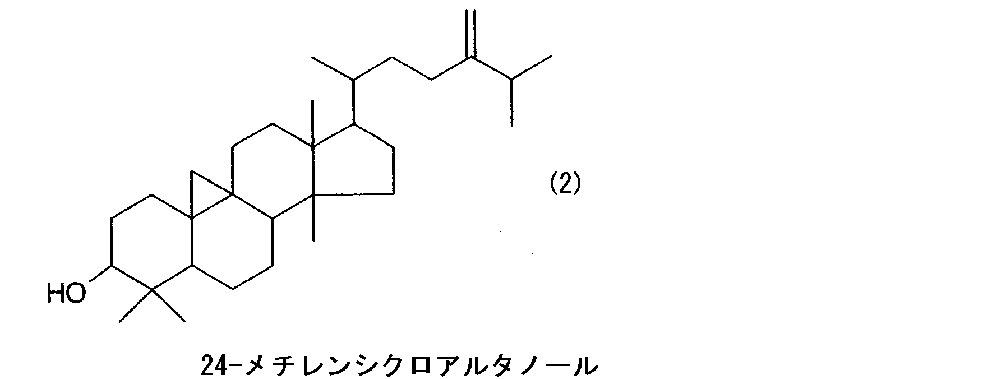
シクロアルテノール及び24-メチレンシクロアルタノールは主に米糠に存在することが知られている。生の玄米において、シクロアルテノール及び24-メチレンシクロアルタノールの多くがフェルラ酸とエステル結合したフェルラ酸エステル体や、脂肪酸とエステル結合した脂肪酸エステル体として存在しており、遊離体として存在している割合は少ない。一方、生活習慣病の予防・改善効果をはじめとする生理効果を有するのは主に遊離体であり、上記のエステル体は遊離体に比べて生理活性に乏しいことが知られている。本発明において、シクロアルテノール及び24-メチレンシクロアルタノールは、いずれも遊離体を意味し、エステル体等の結合体を包含しない。
玄米中の遊離のシクロアルテノール及び24-メチレンシクロアルタノールは、上記のエステル体のエステル結合が切断されることで増加しうると考えられるが、シクロアルテノール及び24-メチレンシクロアルタノールの上記のエステル体は、通常、100~200℃程度の熱処理によってはエステル結合が切断されにくいことが知られている。
本発明の製造方法では、湿熱工程において110~150℃の熱処理が施され、加熱処理工程を施す場合もその温度は80~100℃に過ぎず、この程度の熱処理条件では、玄米中に存在するシクロアルテノールのエステル体又は24-メチレンシクロアルタノールのエステル体のエステル結合は切断されにくいと考えられる。しかし、意外にも、本発明の製造方法により、玄米中のシクロアルテノール又は24-メチレンシクロアルタノールの含有量は大幅に増加する。この理由として、玄米特有の成分が、シクロアルテノールのエステル体又は24-メチレンシクロアルタノールのエステル体のエステル結合の熱切断を促進していることが考えられる。
本発明の製造方法では、湿熱工程において110~150℃の熱処理が施され、加熱処理工程を施す場合もその温度は80~100℃に過ぎず、この程度の熱処理条件では、玄米中に存在するシクロアルテノールのエステル体又は24-メチレンシクロアルタノールのエステル体のエステル結合は切断されにくいと考えられる。しかし、意外にも、本発明の製造方法により、玄米中のシクロアルテノール又は24-メチレンシクロアルタノールの含有量は大幅に増加する。この理由として、玄米特有の成分が、シクロアルテノールのエステル体又は24-メチレンシクロアルタノールのエステル体のエステル結合の熱切断を促進していることが考えられる。
本発明の製造方法で製造された加工玄米中のシクロアルテノール及び24-メチレンシクロアルタノールの含有量は、後述する実施例に記載の方法により測定することができる。
本発明の製造方法により、生玄米を原料として、当該生玄米よりもシクロアルテノール又は24-メチレンシクロアルタノールの含有量が高められた加工玄米を得ることができる。
また、本発明の加工玄米は、加工前の生玄米に比べてシクロアルテノール又は24-メチレンシクロアルタノールの含有量が高められている。
また、本発明の加工玄米は、加工前の生玄米に比べてシクロアルテノール又は24-メチレンシクロアルタノールの含有量が高められている。
本発明の製造方法は、生玄米を原料として、該生玄米中のシクロアルテノール又は24-メチレンシクロアルタノールの含有量を高めた加工玄米であって、炊飯して食するのに適した加工玄米を製造するために利用することができる。
本発明の製造方法で製造した加工玄米は、生活習慣病の予防・改善に適した食材として好適に使用することができる。
上述した実施形態に関し、本発明は以下の加工玄米の製造方法ないし加工玄米を開示する。
<1>
生玄米を110~150℃の水蒸気で5~90分間湿熱処理する工程、及び
湿熱処理した玄米を80~100℃で5~90分間加熱処理する工程、
を少なくとも含む、加工玄米の製造方法。
生玄米を110~150℃の水蒸気で5~90分間湿熱処理する工程、及び
湿熱処理した玄米を80~100℃で5~90分間加熱処理する工程、
を少なくとも含む、加工玄米の製造方法。
<2>
生玄米が、うるち米及びもち米から選ばれる1種又は2種以上であり、好ましくはうるち米の1種又は2種以上である、前記<1>に記載の製造方法。
<3>
生玄米が、ジャポニカ種、インディカ種、及び、ジャポニカ種とインディカ種とをかけあわせたものから選ばれる1種又は2種以上であり、好ましくはジャポニカ種の1種又は2種以上である、前記<1>又は<2>に記載の製造方法。
<4>
生玄米が、コシヒカリ、ヒノヒカリ、ミルキークイーン、サリークイーン、ヒトメボレ、アキタコマチ、及び夢十色から選ばれる1種又は2種以上の品種である、前記<1>~<3>のいずれか1つに記載の製造方法。
生玄米が、うるち米及びもち米から選ばれる1種又は2種以上であり、好ましくはうるち米の1種又は2種以上である、前記<1>に記載の製造方法。
<3>
生玄米が、ジャポニカ種、インディカ種、及び、ジャポニカ種とインディカ種とをかけあわせたものから選ばれる1種又は2種以上であり、好ましくはジャポニカ種の1種又は2種以上である、前記<1>又は<2>に記載の製造方法。
<4>
生玄米が、コシヒカリ、ヒノヒカリ、ミルキークイーン、サリークイーン、ヒトメボレ、アキタコマチ、及び夢十色から選ばれる1種又は2種以上の品種である、前記<1>~<3>のいずれか1つに記載の製造方法。
<5>
湿熱処理する工程において、水蒸気の温度が110~145℃であり、好ましくは115~140℃であり、より好ましくは120~135℃であり、さらに好ましくは125~135℃である、前記<1>~<4>のいずれか1つに記載の製造方法。
<6>
湿熱処理する時間が20~90分間であり、好ましくは30~70分間であり、より好ましくは40~60分間である、前記<1>~<5>のいずれか1つに記載の製造方法。
<7>
飽和蒸気圧で湿熱処理を行う、前記<1>~<6>のいずれか1つに記載の製造方法。
<8>
湿熱処理直後において、含水率が20~70質量%、好ましくは25~50質量%、より好ましくは30~45質量%となるように湿熱処理するものである、前記<1>~<7>のいずれか1つに記載の製造方法。
湿熱処理する工程において、水蒸気の温度が110~145℃であり、好ましくは115~140℃であり、より好ましくは120~135℃であり、さらに好ましくは125~135℃である、前記<1>~<4>のいずれか1つに記載の製造方法。
<6>
湿熱処理する時間が20~90分間であり、好ましくは30~70分間であり、より好ましくは40~60分間である、前記<1>~<5>のいずれか1つに記載の製造方法。
<7>
飽和蒸気圧で湿熱処理を行う、前記<1>~<6>のいずれか1つに記載の製造方法。
<8>
湿熱処理直後において、含水率が20~70質量%、好ましくは25~50質量%、より好ましくは30~45質量%となるように湿熱処理するものである、前記<1>~<7>のいずれか1つに記載の製造方法。
<9>
加熱処理の温度が85~100℃であり、好ましくは90~100℃である、前記<1>~<8>のいずれか1つに記載の製造方法。
<10>
加熱処理する時間が、5~60分間であり、好ましくは10~60分間であり、より好ましくは15~45分間であり、さらに好ましくは20~40分間である、<1>~<9>のいずれか1つに記載の製造方法。
<11>
湿度80~100%RHの条件下で、好ましくは湿度90~100%RHの条件下で、より好ましくは飽和蒸気で加熱処理を行う、前記<1>~<10>のいずれか1つに記載の製造方法。
<12>
加熱処理する工程が、水蒸気で湿熱処理する工程である、前記<1>~<11>のいずれか1つに記載の製造方法。
<13>
加熱処理直後の玄米の含水率が25~60質量%、好ましくは30~55質量%、より好ましくは30~50質量%、さらに好ましくは35~50質量%となるように処理するものである、前記<1>~<12>のいずれか1つに記載の製造方法。
加熱処理の温度が85~100℃であり、好ましくは90~100℃である、前記<1>~<8>のいずれか1つに記載の製造方法。
<10>
加熱処理する時間が、5~60分間であり、好ましくは10~60分間であり、より好ましくは15~45分間であり、さらに好ましくは20~40分間である、<1>~<9>のいずれか1つに記載の製造方法。
<11>
湿度80~100%RHの条件下で、好ましくは湿度90~100%RHの条件下で、より好ましくは飽和蒸気で加熱処理を行う、前記<1>~<10>のいずれか1つに記載の製造方法。
<12>
加熱処理する工程が、水蒸気で湿熱処理する工程である、前記<1>~<11>のいずれか1つに記載の製造方法。
<13>
加熱処理直後の玄米の含水率が25~60質量%、好ましくは30~55質量%、より好ましくは30~50質量%、さらに好ましくは35~50質量%となるように処理するものである、前記<1>~<12>のいずれか1つに記載の製造方法。
<14>
加熱処理した玄米を乾燥させる工程を含む、前記<1>~<13>のいずれか1つに記載の製造方法。
<15>
乾燥させる工程が、温度40~60℃の条件下、好ましくは45~55℃の条件下で行われる、前記<14>に記載の製造方法。
<16>
乾燥させる工程が、湿度30~70%RHの条件下、好ましくは50~60%RHの条件下で行われる、前記<14>又は<15>に記載の製造方法。
<17>
乾燥させる時間が1~5時間、好ましくは2~3時間である、前記<14>~<16>のいずれか1つに記載の製造方法。
<18>
製造された加工玄米の含水率が15質量%以下、好ましくは5~15質量%である、前記<14>~<17>のいずれか1つに記載の製造方法。
<19>
製造された加工玄米の水分活性が0.6以下、好ましくは0.2~0.6である、前記<14>~<18>のいずれか1つに記載の製造方法。
加熱処理した玄米を乾燥させる工程を含む、前記<1>~<13>のいずれか1つに記載の製造方法。
<15>
乾燥させる工程が、温度40~60℃の条件下、好ましくは45~55℃の条件下で行われる、前記<14>に記載の製造方法。
<16>
乾燥させる工程が、湿度30~70%RHの条件下、好ましくは50~60%RHの条件下で行われる、前記<14>又は<15>に記載の製造方法。
<17>
乾燥させる時間が1~5時間、好ましくは2~3時間である、前記<14>~<16>のいずれか1つに記載の製造方法。
<18>
製造された加工玄米の含水率が15質量%以下、好ましくは5~15質量%である、前記<14>~<17>のいずれか1つに記載の製造方法。
<19>
製造された加工玄米の水分活性が0.6以下、好ましくは0.2~0.6である、前記<14>~<18>のいずれか1つに記載の製造方法。
<20>
加工玄米の乾物100g中に含まれるシクロアルテノールの質量が、加工前の生玄米の乾物100g中に含まれるシクロアルテノールの質量の1.4倍以上であり、好ましくは1.5倍以上であり、より好ましくは1.6倍以上である、前記<1>~<19>のいずれか1つに記載の製造方法。
<21>
加工玄米の乾物100g中に含まれるシクロアルテノールの質量が、加工前の生玄米の乾物100g中に含まれるシクロアルテノールの質量の3.5倍以下であり、3倍以下であってもよく、2倍以下であってもよく、1.8倍以下であってもよい、前記<1>~<20>のいずれか1つに記載の製造方法。
<22>
加工玄米の乾物100g中に含まれる24-メチレンシクロアルタノールの質量が、加工前の生玄米の乾物100g中に含まれる24-メチレンシクロアルタノールの質量の1.5倍以上であり、好ましくは1.6倍以上である、前記<1>~<21>のいずれか1つに記載の製造方法。
<23>
加工玄米の乾物100g中に含まれる24-メチレンシクロアルタノールの質量が、加工前の生玄米の乾物100g中に含まれる24-メチレンシクロアルタノールの質量の3倍以下であり、2倍以下であってもよく、1.9倍以下であってもよい、前記<1>~<22>のいずれか1つに記載の製造方法。
<24>
加工玄米の乾物100g中に含まれるシクロアルテノール及び24-メチレンシクロアルタノールの総質量が、加工前の生玄米の乾物100g中に含まれるシクロアルテノール及び24-メチレンシクロアルタノールの総質量の1.4倍以上であり、好ましくは1.5倍以上であり、より好ましくは1.6倍以上である、前記<1>~<23>のいずれか1つに記載の製造方法。
<25>
加工玄米の乾物100g中に含まれるシクロアルテノール及び24-メチレンシクロアルタノールの総質量が、加工前の生玄米の乾物100g中に含まれるシクロアルテノール及び24-メチレンシクロアルタノールの総質量の4.5倍以下であり、3倍以下であってもよく、2倍以下であってもよく、1.8倍以下であってもよい、前記<1>~<24>のいずれか1つに記載の製造方法。
加工玄米の乾物100g中に含まれるシクロアルテノールの質量が、加工前の生玄米の乾物100g中に含まれるシクロアルテノールの質量の1.4倍以上であり、好ましくは1.5倍以上であり、より好ましくは1.6倍以上である、前記<1>~<19>のいずれか1つに記載の製造方法。
<21>
加工玄米の乾物100g中に含まれるシクロアルテノールの質量が、加工前の生玄米の乾物100g中に含まれるシクロアルテノールの質量の3.5倍以下であり、3倍以下であってもよく、2倍以下であってもよく、1.8倍以下であってもよい、前記<1>~<20>のいずれか1つに記載の製造方法。
<22>
加工玄米の乾物100g中に含まれる24-メチレンシクロアルタノールの質量が、加工前の生玄米の乾物100g中に含まれる24-メチレンシクロアルタノールの質量の1.5倍以上であり、好ましくは1.6倍以上である、前記<1>~<21>のいずれか1つに記載の製造方法。
<23>
加工玄米の乾物100g中に含まれる24-メチレンシクロアルタノールの質量が、加工前の生玄米の乾物100g中に含まれる24-メチレンシクロアルタノールの質量の3倍以下であり、2倍以下であってもよく、1.9倍以下であってもよい、前記<1>~<22>のいずれか1つに記載の製造方法。
<24>
加工玄米の乾物100g中に含まれるシクロアルテノール及び24-メチレンシクロアルタノールの総質量が、加工前の生玄米の乾物100g中に含まれるシクロアルテノール及び24-メチレンシクロアルタノールの総質量の1.4倍以上であり、好ましくは1.5倍以上であり、より好ましくは1.6倍以上である、前記<1>~<23>のいずれか1つに記載の製造方法。
<25>
加工玄米の乾物100g中に含まれるシクロアルテノール及び24-メチレンシクロアルタノールの総質量が、加工前の生玄米の乾物100g中に含まれるシクロアルテノール及び24-メチレンシクロアルタノールの総質量の4.5倍以下であり、3倍以下であってもよく、2倍以下であってもよく、1.8倍以下であってもよい、前記<1>~<24>のいずれか1つに記載の製造方法。
<26>
乾物100g中にシクロアルテノールを6.4mg以上、好ましくは6.7mg以上、より好ましくは7.0mg以上含有する加工玄米。
<27>
乾物100g中のシクロアルテノールの含有量が16mg以下であり、14mg以下であってもよく、11mg以下であってもよく、9mg以下であってもよく、8mg以下であってもよい、前記<26>に記載の加工玄米。
<28>
乾物100g中に24-メチレンシクロアルタノールを4.5mg以上、好ましくは4.8mg以上含有する加工玄米。
<29>
乾物100g中の24-メチレンシクロアルタノールの含有量が14mg以下であり、10mg以下であってもよく、7mg以下であってもよく、6mg以下であってもよい、前記<28>に記載の加工玄米。
<30>
乾物100g中に、シクロアルテノール及び24-メチレンシクロアルタノールを総量で11.0mg以上、好ましくは12mg以上含有する加工玄米。
<31>
乾物100g中のシクロアルテノール及び24-メチレンシクロアルタノールの総含有量が30mg以下であり、20mg以下であってもよく、16mg以下であってもよく、14mg以下であってもよい、前記<30>に記載の加工玄米。
<32>
乾物100g中に24-メチレンシクロアルタノールを4.5mg以上、好ましくは4.8mg以上含有する、前記<26>又は<27>に記載の加工玄米。
<33>
乾物100g中の24-メチレンシクロアルタノールの含有量が14mg以下であり、10mg以下であってもよく、7mg以下であってもよく、6mg以下であってもよい、前記<32>に記載の加工玄米。
<34>
乾物100g中に、シクロアルテノール及び24-メチレンシクロアルタノールを総量で11.0mg以上、好ましくは12mg以上含有する前記<26>~<29>、<31>~<33>のいずれか1つに記載の加工玄米。
<35>
乾物100g中のシクロアルテノール及び24-メチレンシクロアルタノールの総含有量が30mg以下であり、20mg以下であってもよく、16mg以下であってもよく、14mg以下であってもよい、前記<34>に記載の加工玄米。
乾物100g中にシクロアルテノールを6.4mg以上、好ましくは6.7mg以上、より好ましくは7.0mg以上含有する加工玄米。
<27>
乾物100g中のシクロアルテノールの含有量が16mg以下であり、14mg以下であってもよく、11mg以下であってもよく、9mg以下であってもよく、8mg以下であってもよい、前記<26>に記載の加工玄米。
<28>
乾物100g中に24-メチレンシクロアルタノールを4.5mg以上、好ましくは4.8mg以上含有する加工玄米。
<29>
乾物100g中の24-メチレンシクロアルタノールの含有量が14mg以下であり、10mg以下であってもよく、7mg以下であってもよく、6mg以下であってもよい、前記<28>に記載の加工玄米。
<30>
乾物100g中に、シクロアルテノール及び24-メチレンシクロアルタノールを総量で11.0mg以上、好ましくは12mg以上含有する加工玄米。
<31>
乾物100g中のシクロアルテノール及び24-メチレンシクロアルタノールの総含有量が30mg以下であり、20mg以下であってもよく、16mg以下であってもよく、14mg以下であってもよい、前記<30>に記載の加工玄米。
<32>
乾物100g中に24-メチレンシクロアルタノールを4.5mg以上、好ましくは4.8mg以上含有する、前記<26>又は<27>に記載の加工玄米。
<33>
乾物100g中の24-メチレンシクロアルタノールの含有量が14mg以下であり、10mg以下であってもよく、7mg以下であってもよく、6mg以下であってもよい、前記<32>に記載の加工玄米。
<34>
乾物100g中に、シクロアルテノール及び24-メチレンシクロアルタノールを総量で11.0mg以上、好ましくは12mg以上含有する前記<26>~<29>、<31>~<33>のいずれか1つに記載の加工玄米。
<35>
乾物100g中のシクロアルテノール及び24-メチレンシクロアルタノールの総含有量が30mg以下であり、20mg以下であってもよく、16mg以下であってもよく、14mg以下であってもよい、前記<34>に記載の加工玄米。
<36>
加工玄米が、うるち米及びもち米から選ばれる1種又は2種以上であり、好ましくはうるち米の1種又は2種以上である、前記<26>~<35>のいずれか1つに記載の加工玄米。
<37>
加工玄米が、ジャポニカ種、インディカ種、及び、ジャポニカ種とインディカ種とをかけあわせたものから選ばれる1種又は2種以上であり、好ましくはジャポニカ種の1種又は2種以上である、前記<26>~<36>のいずれか1つに記載の加工玄米。
<38>
加工玄米が、コシヒカリ、ヒノヒカリ、ミルキークイーン、サリークイーン、ヒトメボレ、アキタコマチ、及び夢十色から選ばれる品種である、前記<26>~<37>のいずれか1つに記載の加工玄米。
<39>
含水率が15質量%以下、好ましくは5~15質量%である、前記<26>~<38>のいずれか1つに記載の加工玄米。
<40>
水分活性が0.6以下、好ましくは0.2~0.6である、前記<26>~<39>のいずれか1つに記載の加工玄米。
加工玄米が、うるち米及びもち米から選ばれる1種又は2種以上であり、好ましくはうるち米の1種又は2種以上である、前記<26>~<35>のいずれか1つに記載の加工玄米。
<37>
加工玄米が、ジャポニカ種、インディカ種、及び、ジャポニカ種とインディカ種とをかけあわせたものから選ばれる1種又は2種以上であり、好ましくはジャポニカ種の1種又は2種以上である、前記<26>~<36>のいずれか1つに記載の加工玄米。
<38>
加工玄米が、コシヒカリ、ヒノヒカリ、ミルキークイーン、サリークイーン、ヒトメボレ、アキタコマチ、及び夢十色から選ばれる品種である、前記<26>~<37>のいずれか1つに記載の加工玄米。
<39>
含水率が15質量%以下、好ましくは5~15質量%である、前記<26>~<38>のいずれか1つに記載の加工玄米。
<40>
水分活性が0.6以下、好ましくは0.2~0.6である、前記<26>~<39>のいずれか1つに記載の加工玄米。
以下、本発明を実施例に基づきさらに詳細に説明するが、本発明はこれに限定されるものではない。
[分析方法]
玄米中のシクロアルテノールの測定と24-メチレンシクロアルタノールの測定:
シクロアルテノールおよび24-メチレンシクロアルタノールは、凍結乾燥玄米粉砕物(液体窒素にて凍結後、-80℃、5Pa、48時間凍結乾燥し、粉砕したもの)100gをクロロホルム/メタノール=3/1の組成からなる溶媒300gを用いて3回抽出操作を繰返して抽出した。ロータリーエバポレーターで溶媒を留去後、ヘキサンに再溶解し、遠心分離によって不溶物を除去した。その後溶媒を留去し、抽出油500mgをヘキサン5mLに溶解し、固相処理(Sep-Pak Silica)に供し、ヘキサン/エーテル=95/5の組成からなる溶媒で洗浄後、エタノール/エーテル/ヘキサン=50/25/25の組成からなる溶媒で溶出した。その後、HPTLC(Merk#1.13895 Sil60)に供し、ヘキサン/エーテル/酢酸=90/10/2の組成からなる溶媒、クロロホルム/エーテル=95/5の組成からなる溶媒で展開し、遊離ステロール部分を掻き取り、掻き取った担体からエタノール/エーテル/ヘキサン=50/25/25の組成からなる溶媒を用いて遊離ステロールを溶出した。得られた溶出物をアルカリでケン化分解し、コレステロールを内部標準物質として、ガスクロマトグラフィーによりシクロアルテノール及び24-メチレンシクロアルタノールを定量した。
玄米中のシクロアルテノールの測定と24-メチレンシクロアルタノールの測定:
シクロアルテノールおよび24-メチレンシクロアルタノールは、凍結乾燥玄米粉砕物(液体窒素にて凍結後、-80℃、5Pa、48時間凍結乾燥し、粉砕したもの)100gをクロロホルム/メタノール=3/1の組成からなる溶媒300gを用いて3回抽出操作を繰返して抽出した。ロータリーエバポレーターで溶媒を留去後、ヘキサンに再溶解し、遠心分離によって不溶物を除去した。その後溶媒を留去し、抽出油500mgをヘキサン5mLに溶解し、固相処理(Sep-Pak Silica)に供し、ヘキサン/エーテル=95/5の組成からなる溶媒で洗浄後、エタノール/エーテル/ヘキサン=50/25/25の組成からなる溶媒で溶出した。その後、HPTLC(Merk#1.13895 Sil60)に供し、ヘキサン/エーテル/酢酸=90/10/2の組成からなる溶媒、クロロホルム/エーテル=95/5の組成からなる溶媒で展開し、遊離ステロール部分を掻き取り、掻き取った担体からエタノール/エーテル/ヘキサン=50/25/25の組成からなる溶媒を用いて遊離ステロールを溶出した。得られた溶出物をアルカリでケン化分解し、コレステロールを内部標準物質として、ガスクロマトグラフィーによりシクロアルテノール及び24-メチレンシクロアルタノールを定量した。
[実施例1] 本発明の製造方法による加工玄米の製造-1
市販の生玄米(平成21年度産のヒノヒカリ)150gを原料として、これを水で洗米後にざるで水切りし、5℃の冷水に12時間浸積した。冷水から取り出した玄米を、短時間調理殺菌機(日阪製作所社製)を用いて125℃の水蒸気による60分間の湿熱処理に付した。続いて、水を沸騰させた容器内の水の上部に湿熱処理を施した玄米入りの開放容器を設置し、100℃の水蒸気による30分間の加熱処理を施した。
加熱処理を施した玄米を、ハイコーターラボ(フロイント産業社製)を用いて50℃で3時間乾燥し、加工玄米を得た(以下、本発明品1と呼ぶ。)。
市販の生玄米(平成21年度産のヒノヒカリ)150gを原料として、これを水で洗米後にざるで水切りし、5℃の冷水に12時間浸積した。冷水から取り出した玄米を、短時間調理殺菌機(日阪製作所社製)を用いて125℃の水蒸気による60分間の湿熱処理に付した。続いて、水を沸騰させた容器内の水の上部に湿熱処理を施した玄米入りの開放容器を設置し、100℃の水蒸気による30分間の加熱処理を施した。
加熱処理を施した玄米を、ハイコーターラボ(フロイント産業社製)を用いて50℃で3時間乾燥し、加工玄米を得た(以下、本発明品1と呼ぶ。)。
[実施例2] 本発明の製造方法による加工玄米の製造-2
市販の生玄米(平成21年度産のヒノヒカリ)150gを原料として、これを水で洗米後にざるで水切りし、5℃の冷水に12時間浸積した。冷水から取り出した玄米を、短時間調理殺菌機(日阪製作所社製)を用いて135℃の水蒸気による60分間の湿熱処理に付した。続いて、水を沸騰させた容器内の水の上部に湿熱処理を施した玄米入りの開放容器を設置し、100℃の水蒸気による30分間の加熱処理を施した。
加熱処理を施した玄米を、ハイコーターラボ(フロイント産業社製)を用いて50℃で3時間乾燥し、加工玄米を得た(以下、本発明品2と呼ぶ。)。
市販の生玄米(平成21年度産のヒノヒカリ)150gを原料として、これを水で洗米後にざるで水切りし、5℃の冷水に12時間浸積した。冷水から取り出した玄米を、短時間調理殺菌機(日阪製作所社製)を用いて135℃の水蒸気による60分間の湿熱処理に付した。続いて、水を沸騰させた容器内の水の上部に湿熱処理を施した玄米入りの開放容器を設置し、100℃の水蒸気による30分間の加熱処理を施した。
加熱処理を施した玄米を、ハイコーターラボ(フロイント産業社製)を用いて50℃で3時間乾燥し、加工玄米を得た(以下、本発明品2と呼ぶ。)。
[実施例3] 本発明の製造方法による加工玄米の製造-3
市販の生玄米(平成21年度産のヒノヒカリ)150gを原料として、これを水で洗米後にざるで水切りし、5℃の冷水に12時間浸積した。冷水から取り出した玄米を、短時間調理殺菌機(日阪製作所社製)を用いて145℃の水蒸気による40分間の湿熱処理に付した。続いて、水を沸騰させた容器内の水の上部に湿熱処理を施した玄米入りの開放容器を設置し、100℃の水蒸気による30分間の加熱処理を施した。
加熱処理を施した玄米をハイコーターラボ(フロイント産業社製)を用いて50℃で3時間乾燥し、加工玄米を得た(以下、本発明品3と呼ぶ。)。
市販の生玄米(平成21年度産のヒノヒカリ)150gを原料として、これを水で洗米後にざるで水切りし、5℃の冷水に12時間浸積した。冷水から取り出した玄米を、短時間調理殺菌機(日阪製作所社製)を用いて145℃の水蒸気による40分間の湿熱処理に付した。続いて、水を沸騰させた容器内の水の上部に湿熱処理を施した玄米入りの開放容器を設置し、100℃の水蒸気による30分間の加熱処理を施した。
加熱処理を施した玄米をハイコーターラボ(フロイント産業社製)を用いて50℃で3時間乾燥し、加工玄米を得た(以下、本発明品3と呼ぶ。)。
[実施例4] 本発明の製造方法による加工玄米の製造-4
市販の生玄米(平成22年度産のヒノヒカリ)150gを原料として、これを水で洗米後にざるで水切りし、5℃の冷水に12時間浸積した。冷水から取り出した玄米を、短時間調理殺菌機(日阪製作所社製)を用いて135℃の水蒸気による60分間の湿熱処理に付した。湿熱処理直後の含水率は37.3質量%であった。続いて、85℃の温水を入れた容器内の温水の上部に湿熱処理を施した玄米入りの開放容器を設置し、85℃の水蒸気による30分間の加熱処理を施した。加熱処理直後の含水率は34.9質量%であった。
加熱処理を施した玄米を、ハイコーターラボ(フロイント産業社製)を用いて50℃で3時間乾燥し、加工玄米を得た(以下、本発明品4と呼ぶ。)。加工玄米の含水率は11.2質量%であった。
市販の生玄米(平成22年度産のヒノヒカリ)150gを原料として、これを水で洗米後にざるで水切りし、5℃の冷水に12時間浸積した。冷水から取り出した玄米を、短時間調理殺菌機(日阪製作所社製)を用いて135℃の水蒸気による60分間の湿熱処理に付した。湿熱処理直後の含水率は37.3質量%であった。続いて、85℃の温水を入れた容器内の温水の上部に湿熱処理を施した玄米入りの開放容器を設置し、85℃の水蒸気による30分間の加熱処理を施した。加熱処理直後の含水率は34.9質量%であった。
加熱処理を施した玄米を、ハイコーターラボ(フロイント産業社製)を用いて50℃で3時間乾燥し、加工玄米を得た(以下、本発明品4と呼ぶ。)。加工玄米の含水率は11.2質量%であった。
[実施例5] 本発明の製造方法による加工玄米の製造-5
市販の生玄米(平成22年度産のヒノヒカリ)150gを原料として、これを水で洗米後にざるで水切りし、5℃の冷水に12時間浸積した。冷水から取り出した玄米を、短時間調理殺菌機(日阪製作所社製)を用いて135℃の水蒸気による60分間の湿熱処理に付した。湿熱処理直後の含水率は35.2質量%であった。続いて、85℃の温水を入れた容器内の温水の上部に湿熱処理を施した玄米入りの開放容器を設置し、85℃の水蒸気による60分間の加熱処理を施した。加熱処理直後の含水率は33.0質量%であった。
加熱処理を施した玄米を、ハイコーターラボ(フロイント産業社製)を用いて50℃で3時間乾燥し、加工玄米を得た(以下、本発明品5と呼ぶ。)。加工玄米の含水率は10.9質量%であった。
市販の生玄米(平成22年度産のヒノヒカリ)150gを原料として、これを水で洗米後にざるで水切りし、5℃の冷水に12時間浸積した。冷水から取り出した玄米を、短時間調理殺菌機(日阪製作所社製)を用いて135℃の水蒸気による60分間の湿熱処理に付した。湿熱処理直後の含水率は35.2質量%であった。続いて、85℃の温水を入れた容器内の温水の上部に湿熱処理を施した玄米入りの開放容器を設置し、85℃の水蒸気による60分間の加熱処理を施した。加熱処理直後の含水率は33.0質量%であった。
加熱処理を施した玄米を、ハイコーターラボ(フロイント産業社製)を用いて50℃で3時間乾燥し、加工玄米を得た(以下、本発明品5と呼ぶ。)。加工玄米の含水率は10.9質量%であった。
[実施例6] 本発明の製造方法による加工玄米の製造-6
市販の生玄米(平成22年度産のヒノヒカリ)150gを原料として、これを水で洗米後にざるで水切りし、5℃の冷水に12時間浸積した。冷水から取り出した玄米を、短時間調理殺菌機(日阪製作所社製)を用いて135℃の水蒸気による60分間の湿熱処理に付した。湿熱処理直後の含水率は36.0質量%であった。続いて、水を沸騰させた容器内の水の上部に湿熱処理を施した玄米入りの開放容器を設置し、100℃の水蒸気による6分間の加熱処理を施した。加熱処理直後の含水率は35.0質量%であった。
加熱処理を施した玄米を、ハイコーターラボ(フロイント産業社製)を用いて50℃で3時間乾燥し、加工玄米を得た(以下、本発明品6と呼ぶ。)。加工玄米の含水率は11.5質量%であった。
市販の生玄米(平成22年度産のヒノヒカリ)150gを原料として、これを水で洗米後にざるで水切りし、5℃の冷水に12時間浸積した。冷水から取り出した玄米を、短時間調理殺菌機(日阪製作所社製)を用いて135℃の水蒸気による60分間の湿熱処理に付した。湿熱処理直後の含水率は36.0質量%であった。続いて、水を沸騰させた容器内の水の上部に湿熱処理を施した玄米入りの開放容器を設置し、100℃の水蒸気による6分間の加熱処理を施した。加熱処理直後の含水率は35.0質量%であった。
加熱処理を施した玄米を、ハイコーターラボ(フロイント産業社製)を用いて50℃で3時間乾燥し、加工玄米を得た(以下、本発明品6と呼ぶ。)。加工玄米の含水率は11.5質量%であった。
[実施例7] 本発明の製造方法による加工玄米の製造-7
市販の生玄米(平成22年度産のヒノヒカリ)150gを原料として、これを水で洗米後にざるで水切りし、5℃の冷水に12時間浸積した。冷水から取り出した玄米を、短時間調理殺菌機(日阪製作所社製)を用いて135℃の水蒸気による60分間の湿熱処理に付した。湿熱処理直後の含水率は36.7質量%であった。続いて、水を沸騰させた容器内の水の上部に湿熱処理を施した玄米入りの開放容器を設置し、100℃の水蒸気による15分間の加熱処理を施した。加熱処理直後の含水率は34.5質量%であった。
加熱処理を施した玄米を、ハイコーターラボ(フロイント産業社製)を用いて50℃で3時間乾燥し、加工玄米を得た(以下、本発明品7と呼ぶ。)。加工玄米の含水率は11.7質量%であった。
市販の生玄米(平成22年度産のヒノヒカリ)150gを原料として、これを水で洗米後にざるで水切りし、5℃の冷水に12時間浸積した。冷水から取り出した玄米を、短時間調理殺菌機(日阪製作所社製)を用いて135℃の水蒸気による60分間の湿熱処理に付した。湿熱処理直後の含水率は36.7質量%であった。続いて、水を沸騰させた容器内の水の上部に湿熱処理を施した玄米入りの開放容器を設置し、100℃の水蒸気による15分間の加熱処理を施した。加熱処理直後の含水率は34.5質量%であった。
加熱処理を施した玄米を、ハイコーターラボ(フロイント産業社製)を用いて50℃で3時間乾燥し、加工玄米を得た(以下、本発明品7と呼ぶ。)。加工玄米の含水率は11.7質量%であった。
[比較例] 本発明の製造方法によらない加工玄米の製造
市販の生玄米(平成21年度産のヒノヒカリ)150gを原料として、これを水で洗米後にざるで水切りし、5℃の冷水に12時間浸積した。冷水から取り出した玄米を、短時間調理殺菌機(日阪製作所社製)を用いて125℃の水蒸気による60分間の湿熱処理に付した。
湿熱処理を施した玄米をハイコーターラボ(フロイント産業社製)を用いて50℃で3時間乾燥し、加工玄米を得た(以下、比較品1と呼ぶ。)。
市販の生玄米(平成21年度産のヒノヒカリ)150gを原料として、これを水で洗米後にざるで水切りし、5℃の冷水に12時間浸積した。冷水から取り出した玄米を、短時間調理殺菌機(日阪製作所社製)を用いて125℃の水蒸気による60分間の湿熱処理に付した。
湿熱処理を施した玄米をハイコーターラボ(フロイント産業社製)を用いて50℃で3時間乾燥し、加工玄米を得た(以下、比較品1と呼ぶ。)。
また、市販の生玄米(平成21年度産のヒノヒカリ)150gを原料として、これを水で洗米後にざるで水切りし、5℃の冷水に12時間浸積した。水を沸騰させた容器内の水の上部に冷水に浸漬した玄米入りの開放容器を設置し、100℃の水蒸気による30分間の加熱処理を施した。
加熱処理を施した玄米をハイコーターラボ(フロイント産業社製)を用いて50℃で3時間乾燥し、加工玄米を得た(以下、比較品2と呼ぶ。)。
さらに、原料である生玄米そのものを比較品3とした。
加熱処理を施した玄米をハイコーターラボ(フロイント産業社製)を用いて50℃で3時間乾燥し、加工玄米を得た(以下、比較品2と呼ぶ。)。
さらに、原料である生玄米そのものを比較品3とした。
[試験例1] シクロアルテノール及び24-メチレンシクロアルタノールの測定
上記の本発明品1~7並びに比較品1~3について、それらの乾物を調製し、各乾物100g中のシクロアルテノールの含有量(mg)と24-メチレンシクロアルタノールの含有量(mg)をそれぞれ測定した。
また、各乾物100g中のシクロアルテノールの含有量(mg)、24-メチレンシクロアルタノールの含有量(mg)及び両者の合計量(mg)を、それぞれ、比較品3の乾物100g中に存在するシクロアルテノールの含有量(mg)、24-メチレンシクロアルタノールの含有量(mg)及び両者の合計量(mg)で割ることで、加工前の生玄米と比較した各成分の増加率を算出した。
結果を下記表1に示す。
上記の本発明品1~7並びに比較品1~3について、それらの乾物を調製し、各乾物100g中のシクロアルテノールの含有量(mg)と24-メチレンシクロアルタノールの含有量(mg)をそれぞれ測定した。
また、各乾物100g中のシクロアルテノールの含有量(mg)、24-メチレンシクロアルタノールの含有量(mg)及び両者の合計量(mg)を、それぞれ、比較品3の乾物100g中に存在するシクロアルテノールの含有量(mg)、24-メチレンシクロアルタノールの含有量(mg)及び両者の合計量(mg)で割ることで、加工前の生玄米と比較した各成分の増加率を算出した。
結果を下記表1に示す。

表1の結果から、125℃の湿熱処理を60分間施しただけの比較品1では、生玄米である比較品3と比べて、乾物100g中のシクロアルテノールの含有量及び24-メチレンシクロアルタノールの含有量のいずれも増加するものの、本発明品のレベルには達しなかった。100℃の加熱処理を30分だけ施した比較品2では、生玄米である比較品3と比べて、乾物100g中のシクロアルテノールの含有量及び24-メチレンシクロアルタノールの含有量のいずれも増加していなかった。
これに対し、本発明の製造方法で製造した本発明品1~7では、生玄米である比較品3と比べて、乾物100g中のシクロアルテノールの含有量が1.4倍以上、24-メチレンシクロアルタノールの含有量が1.5倍以上にも増加しており、シクロアルテノールと24-メチレンシクロアルタノールの総含量も1.5倍以上に上昇していた。
これらの結果から、本発明の製造方法により、生玄米を原料として、該生玄米よりもシクロアルテノールの含有量又は24-メチレンシクロアルタノールの含有量の高い加工玄米を製造できることがわかった。
これに対し、本発明の製造方法で製造した本発明品1~7では、生玄米である比較品3と比べて、乾物100g中のシクロアルテノールの含有量が1.4倍以上、24-メチレンシクロアルタノールの含有量が1.5倍以上にも増加しており、シクロアルテノールと24-メチレンシクロアルタノールの総含量も1.5倍以上に上昇していた。
これらの結果から、本発明の製造方法により、生玄米を原料として、該生玄米よりもシクロアルテノールの含有量又は24-メチレンシクロアルタノールの含有量の高い加工玄米を製造できることがわかった。
[試験例2] 米飯の風味及び食感の評価
本発明品1~3並びに比較品1~7を、それらの乾物質量の1.5倍の質量の水を加えて室温で1時間浸漬させた後、炊飯器(商品名:JKH-A、タイガー社製)の白米モードで炊飯した。こうして得られた米飯について、その風味及び食感を専門パネル6名にて、下記評価基準により協議により評価値を決定した。通常の玄米米飯は、玄米を炊飯器の玄米モードで炊飯した一般的な玄米の米飯を意味する。
[風味]
4:通常の玄米米飯に感じる米糠臭がほとんど感じられず、より香ばしさが増している。
3:通常の玄米米飯よりも米糠臭が抑えられ、香ばしさが増している。
2:通常の玄米米飯と同じような米糠臭と香ばしさを有する。
1:通常の玄米米飯よりも米糠臭と香ばしさに劣る。
本発明品1~3並びに比較品1~7を、それらの乾物質量の1.5倍の質量の水を加えて室温で1時間浸漬させた後、炊飯器(商品名:JKH-A、タイガー社製)の白米モードで炊飯した。こうして得られた米飯について、その風味及び食感を専門パネル6名にて、下記評価基準により協議により評価値を決定した。通常の玄米米飯は、玄米を炊飯器の玄米モードで炊飯した一般的な玄米の米飯を意味する。
[風味]
4:通常の玄米米飯に感じる米糠臭がほとんど感じられず、より香ばしさが増している。
3:通常の玄米米飯よりも米糠臭が抑えられ、香ばしさが増している。
2:通常の玄米米飯と同じような米糠臭と香ばしさを有する。
1:通常の玄米米飯よりも米糠臭と香ばしさに劣る。
[食感]
4:通常の玄米米飯よりもやわらかく、より弾力がある。
3:通常の玄米米飯よりもやややわらかく、弾力がある。
2:通常の玄米米飯と同じような硬さと弾力である。
1:通常の玄米米飯よりも硬く芯を感じる。
結果を下記表2に示す。
4:通常の玄米米飯よりもやわらかく、より弾力がある。
3:通常の玄米米飯よりもやややわらかく、弾力がある。
2:通常の玄米米飯と同じような硬さと弾力である。
1:通常の玄米米飯よりも硬く芯を感じる。
結果を下記表2に示す。

未処理の生玄米である比較品3は、白米モードで炊飯すると、通常の玄米米飯に比べても風味と弾力とに劣る米飯となった。
本発明の製造方法で製造した本発明品1~7を白米モードで炊飯した米飯は、通常の玄米米飯に感じる米糠臭がほとんどなく、香ばしさも顕著に増していた。また、通常の玄米米飯よりもやわらかく炊き上がっており、しかもほどよい弾力を有していた。
本発明の製造方法で製造した本発明品1~7を白米モードで炊飯した米飯は、通常の玄米米飯に感じる米糠臭がほとんどなく、香ばしさも顕著に増していた。また、通常の玄米米飯よりもやわらかく炊き上がっており、しかもほどよい弾力を有していた。
上記試験例1及び2の結果から、本発明の製造方法により、玄米中のシクロアルテノール及び24-メチレンシクロアルタノールの含有量を高めることができ、しかも本発明の製造方法により製造した加工玄米は、炊飯器の白米モードで炊飯しても、風味と食感の双方に優れた米飯に炊き上がることがわかった。
本発明をその実施態様とともに説明したが、我々は特に指定しない限り我々の発明を説明のどの細部においても限定しようとするものではなく、添付の請求の範囲に示した発明の精神と範囲に反することなく幅広く解釈されるべきであると考える。
本願は、2011年7月28日に日本国で特許出願された特願2011-165987に基づく優先権を主張するものであり、これらはここに参照してその内容を本明細書の記載の一部として取り込む。
Claims (8)
- 生玄米を110~150℃の水蒸気で5~90分間湿熱処理する工程、及び
湿熱処理した玄米を80~100℃で5~90分間加熱処理する工程、
を少なくとも含む、加工玄米の製造方法。 - 加工玄米の乾物100g中に含まれるシクロアルテノールの質量が、加工前の生玄米の乾物100g中に含まれるシクロアルテノールの質量の1.4倍以上である、請求項1に記載の製造方法。
- 加工玄米の乾物100g中に含まれる24-メチレンシクロアルタノールの質量が、加工前の生玄米の乾物100g中に含まれる24-メチレンシクロアルタノールの質量の1.5倍以上である、請求項1又は2に記載の製造方法。
- 加工玄米の乾物100g中に含まれるシクロアルテノール及び24-メチレンシクロアルタノールの総質量が、加工前の生玄米の乾物100g中に含まれるシクロアルテノール及び24-メチレンシクロアルタノールの総質量の1.4倍以上である、請求項1~3のいずれか1項に記載の製造方法。
- 加熱処理した玄米を乾燥させる工程を含む、請求項1~4のいずれか1項に記載の製造方法。
- 乾物100g中にシクロアルテノールを6.4mg以上含有する加工玄米。
- 乾物100g中に24-メチレンシクロアルタノールを4.5mg以上含有する加工玄米。
- 乾物100g中に、シクロアルテノール及び24-メチレンシクロアルタノールを総量で11.0mg以上含有する加工玄米。
Priority Applications (2)
| Application Number | Priority Date | Filing Date | Title |
|---|---|---|---|
| CN201280037393.2A CN103717089A (zh) | 2011-07-28 | 2012-07-26 | 加工糙米的制造方法 |
| US14/235,535 US20140193557A1 (en) | 2011-07-28 | 2012-07-26 | Method of Producing Processed Brown Rice |
Applications Claiming Priority (2)
| Application Number | Priority Date | Filing Date | Title |
|---|---|---|---|
| JP2011165987 | 2011-07-28 | ||
| JP2011-165987 | 2011-07-28 |
Publications (1)
| Publication Number | Publication Date |
|---|---|
| WO2013015377A1 true WO2013015377A1 (ja) | 2013-01-31 |
Family
ID=47601214
Family Applications (1)
| Application Number | Title | Priority Date | Filing Date |
|---|---|---|---|
| PCT/JP2012/069012 Ceased WO2013015377A1 (ja) | 2011-07-28 | 2012-07-26 | 加工玄米の製造方法 |
Country Status (4)
| Country | Link |
|---|---|
| US (1) | US20140193557A1 (ja) |
| JP (1) | JP6039955B2 (ja) |
| CN (1) | CN103717089A (ja) |
| WO (1) | WO2013015377A1 (ja) |
Cited By (1)
| Publication number | Priority date | Publication date | Assignee | Title |
|---|---|---|---|---|
| JP2014034547A (ja) * | 2012-08-09 | 2014-02-24 | Kao Corp | トリテルペンアルコール遊離体高含有米糠の製造方法 |
Families Citing this family (5)
| Publication number | Priority date | Publication date | Assignee | Title |
|---|---|---|---|---|
| MX2015014207A (es) | 2013-04-12 | 2016-06-02 | Process Partners Inc | Metodo de procesamiento de un producto de grano. |
| JP6460684B2 (ja) * | 2014-09-01 | 2019-01-30 | 花王株式会社 | 白米 |
| CN104403008B (zh) * | 2014-11-05 | 2016-11-16 | 上海交通大学 | 稻壳内湿热处理条件下抗老化大米淀粉的制备方法及用途 |
| CN105961554A (zh) * | 2016-07-21 | 2016-09-28 | 四川大农和农业开发有限公司 | 一种发芽糙米饼干及其制备方法 |
| JP6847457B2 (ja) * | 2017-08-09 | 2021-03-24 | 国立大学法人信州大学 | 高圧加工米および該高圧加工米を含む食品用または医薬用組成物 |
Citations (6)
| Publication number | Priority date | Publication date | Assignee | Title |
|---|---|---|---|---|
| JPS59120063A (ja) * | 1982-12-27 | 1984-07-11 | Zenkoku Nogyo Kyodo Kumiai Rengokai | 加工玄米の製造方法 |
| JPH08173133A (ja) * | 1994-12-26 | 1996-07-09 | Nakano Vinegar Co Ltd | 米麹用の玄米または精白米およびそれを用いた米麹とみりん |
| JP2004049010A (ja) * | 2002-07-16 | 2004-02-19 | Fancl Corp | 粳玄米 |
| JP2004194546A (ja) * | 2002-12-17 | 2004-07-15 | Joji Nakagawa | 改良玄米の製造方法 |
| JP2005068132A (ja) * | 2003-08-06 | 2005-03-17 | Enkaku Iryo Kenkyusho:Kk | アディポネクチン分泌促進剤、並びに該アディポネクチン分泌促進剤を含有する抗動脈硬化剤、抗肥満剤、抗糖尿病剤、食品添加剤、機能性食品及び飼料添加剤 |
| WO2006035525A1 (ja) * | 2004-09-29 | 2006-04-06 | Morinaga Milk Industry Co., Ltd. | 高血糖改善のための医薬及び飲食品 |
Family Cites Families (9)
| Publication number | Priority date | Publication date | Assignee | Title |
|---|---|---|---|---|
| JP2632612B2 (ja) * | 1991-09-02 | 1997-07-23 | 株式会社 アサヒ産業 | α化加工米の製造方法及びその装置 |
| US5316783A (en) * | 1992-11-20 | 1994-05-31 | Uncle Ben's, Inc. | Parboiled rice product and method of making same |
| ES2331716T3 (es) * | 1996-06-27 | 2010-01-13 | Mars, Incorporated | Arroz de coccion rapida y procedimientos de fabricacion del mismo. |
| JP2001299246A (ja) * | 2000-04-25 | 2001-10-30 | Shinnakano Industry Co Ltd | α化加工玄米の製造方法 |
| JP2003259823A (ja) * | 2002-03-11 | 2003-09-16 | Ide Hiroyuki | 予備処理米の製法 |
| EP1930014B1 (en) * | 2005-09-30 | 2017-03-01 | Morinaga Milk Industry Co., Ltd. | Agent for amelioration of insulin resistance |
| CN101305808A (zh) * | 2008-05-30 | 2008-11-19 | 北京世纪博康医药科技有限公司 | 一种组合物的功能食品添加剂用途 |
| JP2011000056A (ja) * | 2009-06-18 | 2011-01-06 | Satake Corp | パーボイル米の製造方法及びその製造方法によって製造されたパーボイル米 |
| CN102489356A (zh) * | 2011-11-28 | 2012-06-13 | 江苏虹腾食品有限公司 | 一种发芽糙米白米的制备方法 |
-
2012
- 2012-07-26 US US14/235,535 patent/US20140193557A1/en not_active Abandoned
- 2012-07-26 JP JP2012166194A patent/JP6039955B2/ja active Active
- 2012-07-26 CN CN201280037393.2A patent/CN103717089A/zh active Pending
- 2012-07-26 WO PCT/JP2012/069012 patent/WO2013015377A1/ja not_active Ceased
Patent Citations (6)
| Publication number | Priority date | Publication date | Assignee | Title |
|---|---|---|---|---|
| JPS59120063A (ja) * | 1982-12-27 | 1984-07-11 | Zenkoku Nogyo Kyodo Kumiai Rengokai | 加工玄米の製造方法 |
| JPH08173133A (ja) * | 1994-12-26 | 1996-07-09 | Nakano Vinegar Co Ltd | 米麹用の玄米または精白米およびそれを用いた米麹とみりん |
| JP2004049010A (ja) * | 2002-07-16 | 2004-02-19 | Fancl Corp | 粳玄米 |
| JP2004194546A (ja) * | 2002-12-17 | 2004-07-15 | Joji Nakagawa | 改良玄米の製造方法 |
| JP2005068132A (ja) * | 2003-08-06 | 2005-03-17 | Enkaku Iryo Kenkyusho:Kk | アディポネクチン分泌促進剤、並びに該アディポネクチン分泌促進剤を含有する抗動脈硬化剤、抗肥満剤、抗糖尿病剤、食品添加剤、機能性食品及び飼料添加剤 |
| WO2006035525A1 (ja) * | 2004-09-29 | 2006-04-06 | Morinaga Milk Industry Co., Ltd. | 高血糖改善のための医薬及び飲食品 |
Cited By (1)
| Publication number | Priority date | Publication date | Assignee | Title |
|---|---|---|---|---|
| JP2014034547A (ja) * | 2012-08-09 | 2014-02-24 | Kao Corp | トリテルペンアルコール遊離体高含有米糠の製造方法 |
Also Published As
| Publication number | Publication date |
|---|---|
| JP6039955B2 (ja) | 2016-12-07 |
| US20140193557A1 (en) | 2014-07-10 |
| JP2013046611A (ja) | 2013-03-07 |
| CN103717089A (zh) | 2014-04-09 |
Similar Documents
| Publication | Publication Date | Title |
|---|---|---|
| JP6039955B2 (ja) | 加工玄米の製造方法 | |
| Wu et al. | Improvement in nutritional attributes of rice using superheated steam processing | |
| TW201108943A (en) | Glyceride compositions and manufacturing method thereof | |
| KR101613692B1 (ko) | 감소된 혈당지수를 갖는 현미의 제조방법 | |
| Fu et al. | Effects of tea products on in vitro starch digestibility and eating quality of cooked rice using domestic cooking method | |
| JP4888744B2 (ja) | 穀物のポリフェノール富化加工方法、それらの穀物が含まれた食品 | |
| KR100773809B1 (ko) | 백삼분말과 홍삼추출액을 이용한 홍삼한과의 제조방법 | |
| JP2013000008A (ja) | 加工玄米の製造方法 | |
| KR101180193B1 (ko) | 발아현미 | |
| KR102143198B1 (ko) | 과열수증기를 이용한 발아통곡물 제조방법, 이를 포함하는 체중조절용 식품조성물 및 이의 제조방법 | |
| CN101569340B (zh) | 一种生物酶发酵雪莲果叶制茶方法 | |
| KR102397969B1 (ko) | 귀리국수와 이의 제조방법 | |
| KR101524846B1 (ko) | 현미의 전처리 방법 | |
| KR102777064B1 (ko) | 불쾌취가 제거된 청국장의 제조방법 | |
| KR101195737B1 (ko) | 관능성 및 항산화 활성을 향상시킨 한과의 제조방법 및 이를 통해 제조된 한과 | |
| KR101201528B1 (ko) | 천마를 함유한 라면 및 그 제조방법 | |
| KR20200012200A (ko) | 당가수분해효소 처리된 흑마늘을 이용한 조청의 제조방법 | |
| CN102948538A (zh) | 一种苦荞花茶生产技术 | |
| KR101413111B1 (ko) | 홍삼순액의 제조방법 | |
| JP2018153151A (ja) | 保水性を向上させたサイリウム種皮 | |
| JP6460684B2 (ja) | 白米 | |
| JP4407329B2 (ja) | 品質改良米飯 | |
| JPH0584045A (ja) | 抗肥満性乾燥米の製造方法 | |
| JP2640121B2 (ja) | 米飯食品およびその製造方法 | |
| CN115191548B (zh) | 常压蒸制预处理高膳食纤维挤压方便米饭的加工方法 |
Legal Events
| Date | Code | Title | Description |
|---|---|---|---|
| 121 | Ep: the epo has been informed by wipo that ep was designated in this application |
Ref document number: 12818362 Country of ref document: EP Kind code of ref document: A1 |
|
| NENP | Non-entry into the national phase |
Ref country code: DE |
|
| WWE | Wipo information: entry into national phase |
Ref document number: 14235535 Country of ref document: US |
|
| 122 | Ep: pct application non-entry in european phase |
Ref document number: 12818362 Country of ref document: EP Kind code of ref document: A1 |