WO2012165084A1 - 水性金属表面処理剤 - Google Patents
水性金属表面処理剤 Download PDFInfo
- Publication number
- WO2012165084A1 WO2012165084A1 PCT/JP2012/060881 JP2012060881W WO2012165084A1 WO 2012165084 A1 WO2012165084 A1 WO 2012165084A1 JP 2012060881 W JP2012060881 W JP 2012060881W WO 2012165084 A1 WO2012165084 A1 WO 2012165084A1
- Authority
- WO
- WIPO (PCT)
- Prior art keywords
- surface treatment
- mass
- parts
- treatment agent
- compound
- Prior art date
- Legal status (The legal status is an assumption and is not a legal conclusion. Google has not performed a legal analysis and makes no representation as to the accuracy of the status listed.)
- Ceased
Links
Classifications
-
- C—CHEMISTRY; METALLURGY
- C23—COATING METALLIC MATERIAL; COATING MATERIAL WITH METALLIC MATERIAL; CHEMICAL SURFACE TREATMENT; DIFFUSION TREATMENT OF METALLIC MATERIAL; COATING BY VACUUM EVAPORATION, BY SPUTTERING, BY ION IMPLANTATION OR BY CHEMICAL VAPOUR DEPOSITION, IN GENERAL; INHIBITING CORROSION OF METALLIC MATERIAL OR INCRUSTATION IN GENERAL
- C23C—COATING METALLIC MATERIAL; COATING MATERIAL WITH METALLIC MATERIAL; SURFACE TREATMENT OF METALLIC MATERIAL BY DIFFUSION INTO THE SURFACE, BY CHEMICAL CONVERSION OR SUBSTITUTION; COATING BY VACUUM EVAPORATION, BY SPUTTERING, BY ION IMPLANTATION OR BY CHEMICAL VAPOUR DEPOSITION, IN GENERAL
- C23C22/00—Chemical surface treatment of metallic material by reaction of the surface with a reactive liquid, leaving reaction products of surface material in the coating, e.g. conversion coatings, passivation of metals
- C23C22/05—Chemical surface treatment of metallic material by reaction of the surface with a reactive liquid, leaving reaction products of surface material in the coating, e.g. conversion coatings, passivation of metals using aqueous solutions
- C23C22/60—Chemical surface treatment of metallic material by reaction of the surface with a reactive liquid, leaving reaction products of surface material in the coating, e.g. conversion coatings, passivation of metals using aqueous solutions using alkaline aqueous solutions with pH greater than 8
-
- C—CHEMISTRY; METALLURGY
- C09—DYES; PAINTS; POLISHES; NATURAL RESINS; ADHESIVES; COMPOSITIONS NOT OTHERWISE PROVIDED FOR; APPLICATIONS OF MATERIALS NOT OTHERWISE PROVIDED FOR
- C09D—COATING COMPOSITIONS, e.g. PAINTS, VARNISHES OR LACQUERS; FILLING PASTES; CHEMICAL PAINT OR INK REMOVERS; INKS; CORRECTING FLUIDS; WOODSTAINS; PASTES OR SOLIDS FOR COLOURING OR PRINTING; USE OF MATERIALS THEREFOR
- C09D1/00—Coating compositions, e.g. paints, varnishes or lacquers, based on inorganic substances
-
- C—CHEMISTRY; METALLURGY
- C09—DYES; PAINTS; POLISHES; NATURAL RESINS; ADHESIVES; COMPOSITIONS NOT OTHERWISE PROVIDED FOR; APPLICATIONS OF MATERIALS NOT OTHERWISE PROVIDED FOR
- C09D—COATING COMPOSITIONS, e.g. PAINTS, VARNISHES OR LACQUERS; FILLING PASTES; CHEMICAL PAINT OR INK REMOVERS; INKS; CORRECTING FLUIDS; WOODSTAINS; PASTES OR SOLIDS FOR COLOURING OR PRINTING; USE OF MATERIALS THEREFOR
- C09D183/00—Coating compositions based on macromolecular compounds obtained by reactions forming in the main chain of the macromolecule a linkage containing silicon, with or without sulfur, nitrogen, oxygen, or carbon only; Coating compositions based on derivatives of such polymers
- C09D183/04—Polysiloxanes
- C09D183/06—Polysiloxanes containing silicon bound to oxygen-containing groups
-
- C—CHEMISTRY; METALLURGY
- C09—DYES; PAINTS; POLISHES; NATURAL RESINS; ADHESIVES; COMPOSITIONS NOT OTHERWISE PROVIDED FOR; APPLICATIONS OF MATERIALS NOT OTHERWISE PROVIDED FOR
- C09D—COATING COMPOSITIONS, e.g. PAINTS, VARNISHES OR LACQUERS; FILLING PASTES; CHEMICAL PAINT OR INK REMOVERS; INKS; CORRECTING FLUIDS; WOODSTAINS; PASTES OR SOLIDS FOR COLOURING OR PRINTING; USE OF MATERIALS THEREFOR
- C09D183/00—Coating compositions based on macromolecular compounds obtained by reactions forming in the main chain of the macromolecule a linkage containing silicon, with or without sulfur, nitrogen, oxygen, or carbon only; Coating compositions based on derivatives of such polymers
- C09D183/04—Polysiloxanes
- C09D183/08—Polysiloxanes containing silicon bound to organic groups containing atoms other than carbon, hydrogen, and oxygen
-
- C—CHEMISTRY; METALLURGY
- C09—DYES; PAINTS; POLISHES; NATURAL RESINS; ADHESIVES; COMPOSITIONS NOT OTHERWISE PROVIDED FOR; APPLICATIONS OF MATERIALS NOT OTHERWISE PROVIDED FOR
- C09D—COATING COMPOSITIONS, e.g. PAINTS, VARNISHES OR LACQUERS; FILLING PASTES; CHEMICAL PAINT OR INK REMOVERS; INKS; CORRECTING FLUIDS; WOODSTAINS; PASTES OR SOLIDS FOR COLOURING OR PRINTING; USE OF MATERIALS THEREFOR
- C09D5/00—Coating compositions, e.g. paints, varnishes or lacquers, characterised by their physical nature or the effects produced; Filling pastes
- C09D5/08—Anti-corrosive paints
- C09D5/082—Anti-corrosive paints characterised by the anti-corrosive pigment
- C09D5/084—Inorganic compounds
-
- C—CHEMISTRY; METALLURGY
- C08—ORGANIC MACROMOLECULAR COMPOUNDS; THEIR PREPARATION OR CHEMICAL WORKING-UP; COMPOSITIONS BASED THEREON
- C08G—MACROMOLECULAR COMPOUNDS OBTAINED OTHERWISE THAN BY REACTIONS ONLY INVOLVING UNSATURATED CARBON-TO-CARBON BONDS
- C08G77/00—Macromolecular compounds obtained by reactions forming a linkage containing silicon with or without sulfur, nitrogen, oxygen or carbon in the main chain of the macromolecule
- C08G77/04—Polysiloxanes
- C08G77/14—Polysiloxanes containing silicon bound to oxygen-containing groups
-
- C—CHEMISTRY; METALLURGY
- C08—ORGANIC MACROMOLECULAR COMPOUNDS; THEIR PREPARATION OR CHEMICAL WORKING-UP; COMPOSITIONS BASED THEREON
- C08G—MACROMOLECULAR COMPOUNDS OBTAINED OTHERWISE THAN BY REACTIONS ONLY INVOLVING UNSATURATED CARBON-TO-CARBON BONDS
- C08G77/00—Macromolecular compounds obtained by reactions forming a linkage containing silicon with or without sulfur, nitrogen, oxygen or carbon in the main chain of the macromolecule
- C08G77/04—Polysiloxanes
- C08G77/22—Polysiloxanes containing silicon bound to organic groups containing atoms other than carbon, hydrogen and oxygen
- C08G77/26—Polysiloxanes containing silicon bound to organic groups containing atoms other than carbon, hydrogen and oxygen nitrogen-containing groups
-
- C—CHEMISTRY; METALLURGY
- C23—COATING METALLIC MATERIAL; COATING MATERIAL WITH METALLIC MATERIAL; CHEMICAL SURFACE TREATMENT; DIFFUSION TREATMENT OF METALLIC MATERIAL; COATING BY VACUUM EVAPORATION, BY SPUTTERING, BY ION IMPLANTATION OR BY CHEMICAL VAPOUR DEPOSITION, IN GENERAL; INHIBITING CORROSION OF METALLIC MATERIAL OR INCRUSTATION IN GENERAL
- C23C—COATING METALLIC MATERIAL; COATING MATERIAL WITH METALLIC MATERIAL; SURFACE TREATMENT OF METALLIC MATERIAL BY DIFFUSION INTO THE SURFACE, BY CHEMICAL CONVERSION OR SUBSTITUTION; COATING BY VACUUM EVAPORATION, BY SPUTTERING, BY ION IMPLANTATION OR BY CHEMICAL VAPOUR DEPOSITION, IN GENERAL
- C23C2222/00—Aspects relating to chemical surface treatment of metallic material by reaction of the surface with a reactive medium
- C23C2222/20—Use of solutions containing silanes
Definitions
- the present invention is excellent in paintability and storage stability, and has excellent corrosion resistance, adhesion and conductivity, and does not contain a pollution control substance such as hexavalent chromium in the film, that is, forms a chromate-free surface treatment agent film.
- the present invention relates to an aqueous metal surface treatment agent that can be used, a surface treatment method of a metal material using the surface treatment agent, and a surface treatment metal material on which a film is formed by the surface treatment agent.
- chromate treatment is performed on the metal material surface with a treatment liquid containing chromic acid, dichromic acid or a salt thereof as a main component.
- a method of performing a phosphate treatment, a method of performing a treatment with a specific inorganic component, a method of performing a treatment with a silane coupling agent, a method of performing an organic resin film treatment, etc. are already known and are already in practical use. Has been.
- Japanese Patent Application Laid-Open No. 2002-30460 discloses a metal compound containing a vanadium compound and at least one metal selected from zirconium, titanium, molybdenum, tungsten, manganese, and cerium. The method of performing the process by the metal surface treating agent containing these is disclosed.
- a surface treatment agent containing an organofunctional silane and polysiloxane is used to form a siloxane film with improved adhesion to a substrate.
- a method of caulking is disclosed.
- Japanese Patent Application Laid-Open No. 2003-105562 discloses a specific resin compound, at least one cation selected from a primary, secondary, or tertiary amino group and a quaternary ammonium base.
- a non-chromium surface-treated steel sheet that is treated with a surface treating agent having a content within a predetermined range and has excellent corrosion resistance, fingerprint resistance, blackening resistance, and paint adhesion is disclosed.
- Japanese Patent Application Laid-Open No. 2010-255105 includes a water-soluble zirconium compound, a compound having an epoxy group, a chelating agent, a vanadic acid compound, and a metal compound containing a metal such as Ti. It is disclosed that a galvanized steel sheet having a surface treatment agent film formed from a surface treatment agent having a mass ratio of Zr equivalent weight / tetraalkoxysilane of a compound of 1.0 to 6.0 is excellent in corrosion resistance and electromagnetic shielding properties. Has been.
- the object of the present invention is to overcome the problems of the prior art as described above, and to control pollution of hexavalent chromium in the film, which is excellent in paintability and storage stability, and excellent in corrosion resistance, adhesion and conductivity.
- An object of the present invention is to provide an aqueous metal surface treatment agent capable of forming a chromate-free surface treatment agent film containing no substance.
- An object of the present invention is also to provide a surface treatment method for a metal material such as a zinc-based plated steel sheet using the surface treatment agent and a surface treatment metal material on which a film is formed by the surface treatment agent.
- the present inventors have now obtained a binder component prepared from a tetraalkoxysilane (low condensate) and an epoxy group-containing silane coupling agent, and a phosphate compound, It has been found that the above problems can be solved by an aqueous surface treatment agent containing a specific amount of a vanadic acid compound and a zirconium compound or a titanium compound, and the present invention has been completed.
- the present invention (A) 30 to 70 parts by mass of at least one tetraalkoxysilane and tetraalkoxysilane low condensate; (B) 30 to 70 parts by mass of at least one silane coupling agent selected from an epoxy group-containing silane coupling agent and an amino group-containing silane coupling agent; (C) at least one mono-, di- or tri-alkoxysilane and / or at least one low-condensate mono-, di- or tri-alkoxysilane 0 to 40 parts by weight of mixture (I) or mixture A binder component (A) comprising a hydrolysis condensate (II) obtained by subjecting (I) to a hydrolysis condensation reaction, (D) a phosphoric acid compound, An aqueous metal surface treatment agent comprising (e) a vanadium compound, and (f) a zirconium compound or (f ′) a titanium compound, Per 100 parts by weight of the total of the components (a), (b)
- the present invention also includes coating the aqueous metal surface treatment agent on the surface of the metal material so that the dry film mass is in the range of 0.05 to 1.5 g / m 2 and drying.
- a metal material surface treatment method is provided.
- the present invention provides a surface treatment comprising a coating of the aqueous metal surface treatment agent on the surface of a metal material in an amount in the range of 0.05 to 1.5 g / m 2 in terms of dry coating mass.
- a metal material is provided.
- the aqueous metal surface treatment agent of the present invention is a chromate-free surface treatment agent that does not contain pollution control substances such as hexavalent chromium, and is excellent in paintability and storage stability. Moreover, the film formed from the metal surface treatment agent of the present invention satisfies all of the corrosion resistance, adhesion and conductivity at the same time, such as a zinc-based plated steel sheet on which the surface treatment agent film is formed. Since the metal material is excellent in conductivity and excellent in corrosion resistance even when the surface treatment agent film is thin, a surface treatment metal material having a thin surface treatment agent film and excellent in conductivity can be obtained.
- the aqueous metal surface treatment agent of the present invention comprises a binder component (A), a phosphoric acid compound (d), a vanadium compound (e), and a zirconium compound (f) or a titanium compound (f ′), which are aqueous. It is dissolved or dispersed stably in the medium.
- the “aqueous medium” includes water and a mixture of water and an organic solvent, which have a water content of at least 80% by mass and form a uniform liquid at 20 ° C., or water.
- the organic solvent species that can constitute the “aqueous medium” is not particularly limited as long as it is a water-miscible solvent having water solubility or water dispersibility.
- methanol, ethanol, isopropyl alcohol, t-butyl alcohol Water-soluble organic solvents such as alcohols such as propylene glycol; glycol ethers such as ethylene glycol monobutyl ether and ethylene glycol monoethyl ether; esters such as ethyl acetate and butyl acetate; and ketones such as acetone are preferably used. it can.
- Binder component (A) The binder component (A) in the aqueous metal surface treatment agent of the present invention is at least one of tetraalkoxysilane and tetraalkoxysilane low-condensate (a), an epoxy group-containing silane coupling agent, and an amino group-containing silane.
- the tetraalkoxysilane in component (a) as one component of binder component (A) has one silicon atom and four alkoxy groups directly bonded to the silicon atom in one molecule.
- the alkoxy group is not particularly limited, but usually an alkoxy group having 1 to 4 carbon atoms is preferable, particularly an alkoxy group having 1 to 3 carbon atoms, more particularly 1 or 2 carbon atoms is preferable.
- alkoxysilanes include tetramethoxysilane, tetraethoxysilane, tetrapropoxysilane, tetrabutoxysilane, dimethoxydiethoxysilane, and the like, and these can be used alone or in combination of two or more.
- tetraethoxysilane and tetramethoxysilane are preferred from the viewpoint of better corrosion resistance of metal materials, particularly zinc-based plated steel sheets.
- the low-condensation product of tetraalkoxysilane that can be used as the component (a) includes the low-condensation product of tetraalkoxysilane as exemplified above, and may be a low-condensation product of one kind of tetraalkoxysilane alone. Alternatively, it may be a low condensate of at least two tetraalkoxysilanes.
- the low-condensation product of tetraalkoxysilane generally has a degree of polymerization of generally 10 or less, particularly 2 to 8, more particularly 2 to 6.
- the silane coupling agent (b) used as one component of the component binder component (A) is at least one silane coupling agent selected from an epoxy group-containing silane coupling agent and an amino group-containing silane coupling agent. It is.
- the epoxy group-containing silane coupling agent has at least one, preferably only one epoxy group and 1 to 3 alkoxy groups (usually 1 to 4 carbon atoms, particularly 1 to 4 carbon atoms) per molecule. 3 and more particularly silane compounds containing 1 or 2 carbon atoms), specifically, for example, ⁇ -glycidoxypropyltrimethoxysilane, ⁇ -glycidoxypropylmethyldiethoxysilane ⁇ -glycidoxypropyltriethoxysilane, 2- (3,4-epoxycyclohexyl) ethyltrimethoxysilane, 2- (3,4-epoxycyclohexyl) ethyltriethoxysilane, and the like.
- the amino group-containing silane coupling agent has at least 1, preferably 1 or 2 amino groups and 1 to 3 alkoxy groups (usually 1 to 4 carbon atoms, particularly 1 carbon atom) in one molecule. -3, and more particularly silane compounds containing 1 or 2 carbon atoms), specifically, for example, 3-aminopropyltriethoxysilane, 3-aminopropyltrimethoxysilane, N- ( 2-aminoethyl) 3-aminopropylmethyldimethoxysilane, N- (aminoethyl) 3-aminopropyltrimethoxysilane and the like.
- the component (c) is an optional component used as necessary, and is at least one of mono-, di- or tri-alkoxysilane and / or mono-, di- Alternatively, it includes at least one low-condensate of tri-alkoxysilane, and the alkoxy group is not particularly limited, but usually an alkoxy group having 1 to 4 carbon atoms is preferable, particularly 1 to 3 carbon atoms, An alkoxy group having 1 or 2 carbon atoms is particularly preferable.
- Examples of the monoalkoxysilane include alkoxytrialkylsilanes such as methoxytrimethylsilane, methoxytriethylsilane, methoxymethyldiethylsilane, ethoxytrimethylsilane, ethoxytriethylsilane, propoxytrimethylsilane, propoxytripropylsilane, and butoxytributylsilane; ethoxy Examples thereof include alkoxytriphenylsilane such as triphenylsilane.
- dialkoxysilane examples include dimethoxydimethylsilane, dimethoxydiethylsilane, diethoxydimethylsilane, diethoxydiethylsilane, diethoxydiphenylsilane, dipropoxydimethylsilane, dipropoxydiethylsilane, dipropoxydipropylsilane, dibutoxy.
- dialkoxydialkylsilanes such as dimethylsilane, dibutoxydiethylsilane, and dibutoxydibutylsilane
- dialkoxydiphenylsilanes such as dimethoxydiphenylsilane, dipropoxydiphenylsilane, and dibutoxydiphenylsilane.
- trialkoxysilane examples include trimethoxymethylsilane, trimethoxyethylsilane, trimethoxypropylsilane, trimethoxybutylsilane, triethoxymethylsilane, triethoxyethylsilane, triethoxybutylsilane, tripropoxymethylsilane, And trialkoxyalkylsilanes such as propoxypropylsilane; trialkoxyphenylsilanes such as trimethoxyphenylsilane, triethoxyphenylsilane, tripropoxyphenylsilane, and tributoxyphenylsilane.
- At least one low-condensate of mono-, di- or tri-alkoxysilane that can be used as component (c) is a single low-condensate of mono-, di- or tri-alkoxysilane. Alternatively, it may be a low condensate of at least two mono-, di- or tri-alkoxysilanes.
- the low condensate preferably has a degree of polymerization of generally 10 or less, particularly 2 to 8, more particularly 2 to 6.
- the blending ratio of each component constituting the binder component (A) is in the following range per 100 parts by mass in total of the components (a), (b) and (c) from the viewpoint of the corrosion resistance and adhesion of the resulting film. It is preferable to be within.
- Component (a) 30 to 70 parts by weight, particularly 35 to 65 parts by weight, more particularly 40 to 60 parts by weight
- Component (b) 30 to 70 parts by weight, particularly 35 to 65 parts by weight, more particularly 40 to 60 parts by weight
- Component (c) 0 to 40 parts by mass, particularly 0 to 30 parts by mass, more particularly 0 to 20 parts by mass.
- the binder component (A) in the aqueous metal surface treatment agent of the present invention is a mixture of the component (a) and the component (b) or a mixture of the component (a), the component (b), and the component (c). It can be the mixture (I) or, preferably, the hydrolysis condensate (II) obtained by subjecting the mixture (I) to a hydrolysis condensation reaction.
- the hydrolysis-condensation product (II) usually has a weight average molecular weight in the range of 200 to 20,000, preferably 300 to 10,000. The weight average molecular weight can be measured by GPC (gel permeation chromatograph) measurement or by confirming the number of siloxane bonds by condensation by 29 Si NMR (nuclear magnetic resonance spectrum) measurement. .
- the hydrolysis condensation reaction of the above mixture (I) can be carried out according to a method known per se, for example, in the presence of water and an acid catalyst.
- the acid catalyst is not particularly limited as long as it is an acid usually used as a catalyst for the hydrolysis reaction of alkoxysilane.
- inorganic acids such as hydrochloric acid, sulfuric acid, nitric acid, phosphoric acid; formic acid, acetic acid, Examples thereof include organic acids such as lactic acid and tartaric acid.
- inorganic acids, particularly hydrochloric acid can be preferably used.
- an organic solvent particularly a water-miscible organic solvent that dissolves the mixture (I)
- an alcohol solvent or a glycol ether solvent for example, an alcohol solvent or a glycol ether solvent
- alcohol solvents such as methanol, ethanol and propanol are suitable.
- the hydrolysis reaction can usually be carried out by stirring at a temperature of about 20 ° C. to 100 ° C. for about 30 minutes to 20 hours at a pH of 7 or less, preferably at a pH of 1.5 to 6.0.
- a condensation reaction proceeds with the hydrolysis reaction.
- the composition of the hydrolysis-condensation product (II) obtained by this reaction can be appropriately adjusted depending on the amount of water used, the type and amount of the catalyst, the reaction temperature, the reaction time, and the like.
- Phosphoric acid compound (d) The phosphoric acid compound which is the component (d) in the metal surface treatment agent of the present invention contributes to the improvement of the storage stability of the metal surface treatment agent, and the alkoxysilyl group in the binder component (A) reacts. It is presumed that it acts to suppress the increase in molecular weight.
- the type of the phosphoric acid compound (d) is not particularly limited, and may be an organic phosphoric acid compound or an inorganic phosphoric acid compound.
- the organic phosphate compound include 1-hydroxymethane-1,1-diphosphonic acid, 1-hydroxyethane-1,1-diphosphonic acid, 1-hydroxypropane-1,1-diphosphonic acid, and the like.
- Suitable examples include hydroxyl group-containing organic phosphorous acid; carboxyl group-containing organic phosphorous acid such as 2-hydroxyphosphonoacetic acid and 2-phosphonobutane-1,2,4-tricarboxylic acid, and salts thereof. .
- the inorganic phosphoric acid compound include orthophosphoric acid, metaphosphoric acid, phosphorous acid, metaphosphorous acid, hypophosphoric acid, hypophosphorous acid, pyrophosphoric acid, tripolyphosphoric acid, tetraphosphoric acid, hexaphosphoric acid, Examples include trimetaphosphoric acid, pyrophosphorous acid, and phosphoric acid derivatives; alkali metal salts or ammonium salts of these phosphoric acid compounds.
- 1-hydroxyethane-1,1 is particularly preferable because it has a great effect of suppressing the reaction of alkoxysilyl groups in the binder component (A) and improving the storage stability of the metal surface treatment agent.
- Diphosphonic acid is particularly preferred.
- Vanadium compound (e) The vanadium compound as the component (e) in the metal surface treatment agent of the present invention is useful as a component that exhibits an inhibitory effect on corrosion of a metal material such as a zinc-based plated steel sheet on which a film of the metal surface treatment composition is formed.
- vanadium compound (e) examples include lithium metavanadate, potassium metavanadate, sodium metavanadate, ammonium metavanadate, anhydrous vanadic acid, vanadium pentoxide, vanadium trioxide, vanadium dioxide, vanadium oxysulfate, vanadium sulfate, oxytrimethyl
- vanadium chloride, vanadium trichloride, vanadium oxyacetylacetonate, vanadium acetylacetonate, and phosphovanadomolybdic acid examples include vanadium chloride, vanadium trichloride, vanadium oxyacetylacetonate, vanadium acetylacetonate, and phosphovanadomolybdic acid, and these can be used alone or in combination of two or more.
- ammonium metavanadate is particularly preferable from the viewpoints of water adhesion of the film and corrosion resistance of the metal material after the film is alkali degreased.
- the zirconium compound which is the component (f) in the metal surface treatment composition of the present invention is a metal without practically reducing the conductivity of a metal material such as a zinc-based plated steel sheet on which a film of the metal surface treatment agent is formed. It contributes to improving various performances such as corrosion resistance of the material, adhesion of the formed film, and corrosion resistance of the metal material after alkali degreasing the film.
- the type of the zirconium compound (f) is not particularly limited, but is preferably water-soluble. Specifically, for example, zirconium nitrate, zirconium oxynitrate, zirconyl acetate, zirconyl sulfate, zirconium carbonate, carbonic acid Zirconyl ammonium, potassium zirconyl carbonate, sodium zirconyl carbonate, lithium zirconyl carbonate, zirconium hydrofluoric acid (H 2 ZrF 6 ); sodium hydrofluoric acid (H 2 ZrF 6 ) sodium salt, potassium salt, lithium salt and ammonium salt [(NH 4) 2 ZrF 6], and the like. these may be used alone or in combination of two or more.
- zirconium compound (f) from the viewpoint that the corrosion resistance of the metal material such as the surface-treated galvanized steel sheet, conductivity, and the corrosion resistance of the metal material after alkali degreasing the film is more excellent, among them, zirconyl ammonium carbonate [(NH 4 ) 2 ZrO (CO 3 ) 2 ] and sodium zirconyl carbonate [Na 2 ZrO (CO 3 ) 2 ] are preferred.
- Titanium compound (f ') The titanium compound that is the component (f ′) in the metal surface treatment composition of the present invention can be used without practically reducing the conductivity of a metal material such as a zinc-based plated steel sheet on which a film of the metal surface treatment composition is formed. It contributes to improving various properties such as the corrosion resistance of the metal material, the adhesion of the formed film, and the corrosion resistance of the metal material after alkali degreasing the film.
- the type of the titanium compound (f ′) is not particularly limited, but is preferably water-soluble.
- the corrosion resistance of the metal material such as the surface-treated galvanized steel sheet, the conductivity, and the corrosion resistance of the metal material after alkali degreasing the film are particularly preferable.
- Hydroxy acid (H 2 TiF 6 ) and ammonium titanium fluoride [(NH 4 ) 2 TiF 6 ] are preferred.
- the blending amounts of the components (d) and (e) in the aqueous metal surface treatment agent of the present invention are as follows per 100 parts by mass in total of the components (a), (b) and (c) constituting the binder (A). Can be within the range.
- Phosphoric acid compound (d) 2 to 60 parts by mass, preferably 5 to 45 parts by mass, more preferably 10 to 35 parts by mass
- Vanadium compound (e) 1 to 50 parts by mass, preferably 2 to 30 parts by mass, More preferably 5 to 20 parts by mass.
- the blending amount of the above components (d) and (e) is within the above range.
- Corrosion resistance of the resulting treatment agent film in particular, corrosion resistance after alkaline degreasing treatment, conductivity, and surface treatment agent paintability and storage stability. From the viewpoint of sex.
- the aqueous metal surface treatment agent of the present invention contains a zirconium compound (f) or a titanium compound (f ′).
- the blending amount thereof is the Zr equivalent mass of the zirconium compound (f) and the component (a) constituting a part of the binder component (A).
- the mass ratio (f) / (a) is 0.02 or more and less than 1.0, preferably 0.04 to 0.70, more preferably 0.10 to 0.50. be able to.
- the corrosion resistance of the resulting treatment agent film particularly the corrosion resistance after the alkaline degreasing treatment, is inferior, while the mass ratio (f) / (a) is 1.0.
- the blending amount is a total of 100 components (a), (b) and (c) constituting the binder (A).
- the amount may be 0.1 to 100 parts by weight, preferably 2 to 40 parts by weight, and more preferably 5 to 30 parts by weight per part by weight.
- the corrosion resistance of the resulting coating film particularly the corrosion resistance after alkaline degreasing treatment, conductivity, and the coating properties and storage stability of the surface treatment agent From the aspect, it is preferable.
- the aqueous metal surface treatment agent of the present invention comprises the binder component (A), phosphate compound (d), vanadium compound (e), zirconium compound (f) or titanium compound (f ′) and an aqueous medium.
- the chelating agent is considered to have a function of stably dissolving the vanadium compound (e), the zirconium compound (f), and the titanium compound (f ′) in the surface treatment agent.
- examples of the metal compound containing Al include aluminum oxide, aluminum hydroxide, aluminum sulfate, aluminum nitrate, aluminum phosphate, aluminum chloride and the like.
- examples of the metal compound containing Zn include zinc carbonate, zinc oxide, zinc hydroxide, zinc sulfate, zinc nitrate, zinc chloride, zinc phosphate, sodium zincate, and potassium zincate. .
- the aqueous organic resin that can be appropriately blended in the aqueous metal surface treatment agent of the present invention includes an organic resin that can be stably dissolved or dispersed in the aqueous metal surface treatment agent of the present invention.
- a nonionic or anionic organic resin containing a functional group for example, an acid group such as a hydroxyl group, a polyoxyalkylene group, or a carboxyl group
- Examples of the resin type of the aqueous organic resin include epoxy resins, phenol resins, acrylic resins, urethane resins, olefin-carboxylic acid resins, polyamide resins, resins having a polyoxyalkylene chain, polyvinyl alcohol, Examples include polyglycerin and cellulose resins (for example, carboxymethyl cellulose, hydroxymethyl cellulose, hydroxyethyl cellulose). These aqueous organic resins can be used alone or in combination of two or more. Among these, an acrylic resin emulsion or a urethane resin emulsion is preferable from the viewpoint of the balance between the storage stability of the metal surface treatment agent and the surface treatment agent film performance.
- the wettability to the substrate and the corrosion resistance may be improved.
- the blending amount of the aqueous organic resin is usually 20% by mass or less, preferably 0.5%, based on the total solid content of the surface treating agent, from the viewpoint of the conductivity and corrosion resistance of the surface treating agent film to be obtained. It is preferable to be in the range of ⁇ 10% by mass.
- the aqueous metal surface treatment agent of the present invention preferably has a pH generally in the range of 2 to 11, particularly 7 to 10, and more particularly 8.0 to 9.5. If the pH of the treatment liquid is less than 2, the storage stability of the surface treatment agent tends to be reduced, and the metal material that is the material is significantly dissolved, and the surface treatment is formed on the surface of the metal material such as a zinc-based plated steel sheet. The corrosion resistance of the agent film and the adhesion to the metal material surface are likely to be lowered. On the other hand, when pH exceeds 11, etching of metal materials, such as a galvanized steel plate, becomes remarkable, and corrosion resistance and electroconductivity of metal materials, such as a galvanized steel plate, fall.
- the pH can be adjusted by adding an alkali or an acid to the aqueous metal surface treatment agent.
- alkali used include ammonia, amines, amine derivatives and aminopolycarboxylic acids, hydroxylation.
- acid include organic acids such as formic acid, acetic acid, lactic acid and tartaric acid; inorganic acids such as hydrochloric acid, nitric acid, sulfuric acid and phosphoric acid; and the phosphoric acid compound (d) And the like.
- the solid content concentration of the aqueous metal surface treatment agent of the present invention is not particularly limited and can be changed according to the application, etc., but the viscosity of the metal surface treatment agent, the surface treatment agent film obtained by coating, From the viewpoint of adhesion amount, flowability, paintability, etc., it is usually preferably in the range of 3 to 35% by mass, particularly 4 to 30% by mass, and more particularly 5 to 25% by mass.
- the coating amount of the aqueous metal surface treatment agent of the present invention is preferably within the range of 0.05 to 1.5 g / m 2 in terms of the dry surface treatment agent film mass adhering to the metal material surface. .
- the aqueous metal surface treatment agent of the present invention is coated on the surface of a metal material where it is desired to impart corrosion resistance, etc., and then dried, so that the surface of the metal material is treated with an aqueous metal surface treatment agent.
- An agent film can be formed.
- the metal material to which the aqueous metal surface treatment agent of the present invention can be applied is not particularly limited.
- a zinc-plated steel sheet can be most suitably applied as the metal material.
- galvanized steel sheets include galvanized steel sheets; zinc-nickel plated steel sheets, zinc-iron plated steel sheets, zinc-chromium plated steel sheets, zinc-aluminum plated steel sheets, zinc-titanium plated steel sheets, zinc-magnesium plated steel sheets, zinc -Manganese-plated steel sheets, zinc-aluminum-magnesium-plated steel sheets, zinc-aluminum-magnesium-silicon-plated steel sheets, etc .; and zinc-plated steel sheets such as zinc-aluminum-magnesium-silicon-plated steel sheets; Examples include those containing nickel, titanium, chromium, aluminum, manganese, iron, magnesium, lead, bismuth, antimony, tin, copper, cadmium, arsenic, etc., and those dispersed with inorganic substances such as silica, alumina, titania, etc.
- the plating method is not particularly limited, and any known plating method such as electroplating method, hot dipping method, vapor deposition plating method, dispersion plating method, vacuum plating method, etc. may be used. Good.
- the coating of the aqueous metal surface treatment agent of the present invention on the surface of a metal material can be carried out by a coating method known per se, for example, a method such as dip coating, spray coating or roll coating.
- a coating method known per se, for example, a method such as dip coating, spray coating or roll coating.
- the surface of the metal material is subjected to pretreatment such as hot water washing, solvent washing, alkaline degreasing washing, etc. for the purpose of removing oil and dirt on the metal material surface, if necessary. Can be applied.
- the drying of the surface treatment agent film can be performed by drying for about 2 seconds to about 30 seconds at a material arrival temperature of usually about 50 to about 250 ° C., particularly about 80 to about 200 ° C.
- the adhesion amount of the surface treatment agent film on the surface of the metal material is generally from 0.05 to 5 in terms of dry film mass from the viewpoint of the corrosion resistance, adhesion, conductivity, etc. of the film on the metal material surface on which the surface treatment agent film is formed. It is preferable to be within the range of 1.5 g / m 2 , particularly 0.1 to 1.0 g / m 2 , more particularly 0.2 to 0.7 g / m 2 .
- the surface-treated metal material according to the present invention can be obtained by the above-mentioned metal material surface treatment method.
- the surface treatment agent film adhered to the surface of the metal material according to the present invention can be excellent in corrosion resistance, adhesion, and conductivity, and can have a good film appearance.
- the film formed using the aqueous metal surface treatment agent used in the present invention has a binder component mainly composed of an organosilicon compound, and when the organosilicon compound is concentrated by drying or the like, the organosilicon
- the alkoxysilyl group of the compound reacts with a hydrolyzed silanol group and the like to form a continuous film; the silanol group crosslinks with a zirconium compound or a titanium compound, and is a silane which is one component of the organosilicon compound
- the coupling agent has an epoxy group or an amino group, and the epoxy group undergoes a crosslinking reaction with a silanol group, a zirconium compound or a titanium compound, or the amino group is a zirconium compound or a titanium compound, a base metal surface or an epoxy group.
- the silanol groups produced by hydrolysis are bonded to the metal surface. Forming a, etc. is considered, by these interactions, it is presumed that remarkable barrier effect.
- a dense surface treatment agent film can be formed, the film can be thinned, and a surface-treated metal material having good conductivity can be obtained.
- the vanadium compound exists uniformly dispersed in the film, and exhibits an inhibitory effect on metal corrosion. That is, it is presumed that the vanadium compound is partially ionized and passivated in a corrosive environment to suppress corrosion of metals such as zinc. Moreover, it is estimated that a phosphoric acid compound has the effect which suppresses that a tetraalkoxysilane and its low condensate polymerize in a surface treating agent, and dissolves a vanadium compound etc. stably.
- the surface-treated metal material of the present invention includes a binder component containing a tetraalkoxysilane (low condensate) and a specific silane coupling agent, a vanadium compound, a corrosion inhibitor such as a zirconium compound or a titanium compound, and a phosphate compound.
- a binder component containing a tetraalkoxysilane (low condensate) and a specific silane coupling agent, a vanadium compound, a corrosion inhibitor such as a zirconium compound or a titanium compound, and a phosphate compound As a result, due to the interaction of these components, even if the formed film is a thin film, it can have high corrosion resistance and can maintain excellent electrical conductivity. Conceivable.
- the surface-treated metal material such as a zinc-based plated steel sheet having excellent corrosion resistance, adhesion, and various performances, in particular, without lowering the corrosion resistance.
- Surface-treated metal materials such as galvanized steel sheets coated with the aqueous metal surface treatment agent of the present invention can be applied to various applications, for example, used in various fields such as architecture, electricity, and automobiles. It can be suitably used as a metal material.
- Production Examples 1 to 20 Production of Binder Component (A) In deionized water, component (a), component (b) and component (c) were mixed in the composition shown in Table 1 below, and in the presence of an acid catalyst. A hydrolysis reaction was performed to obtain a uniform aqueous solution of binders A1 to A20 having an active ingredient content of 20% excluding the solvent. Production Examples 18 to 20 (A18 to A20) are for comparison. Table 1 below also shows the weight average molecular weight of the obtained binder component. The weight average molecular weight was determined by the following GPC measurement method based on polystyrene. Moreover, the following 29 Si NMR confirmed the reduction
- HPC-8120GPC (trade name, manufactured by Tosoh Corporation) is used as a gel permeation chromatograph, and “TSKgel G4000HXL”, “TSKgel G3000HXL”, “TSKgel G2500HXL” and “TSKgel G2000HXL” are used as columns.
- TSKgel G4000HXL “TSKgel G3000HXL”
- TSKgel G2500HXL” and TSKgel G2000HXL” are used as columns.
- mobile phase tetrahydrofuran
- measurement temperature 40 ° C.
- flow rate 1 mL / min
- the retention time (retention capacity) is obtained by measuring at.
- the obtained retention time (retention capacity) is compared with the retention time (retention capacity) of standard polystyrene having a known molecular weight measured under the same conditions, and converted to the molecular weight of polystyrene to determine the weight average molecular weight.
- 29 Si NMR measurement method FT-NMR EX-400 (trade name, manufactured by JEOL) is used, and measurement is performed using heavy water as a solvent and tetramethylsilane as an internal standard substance.
- silane coupling agent a signal around ⁇ 55 to ⁇ 35 ppm, and for a tetraalkoxysilane, a signal around ⁇ 100 to ⁇ 80 ppm, respectively, the reduction of the alkoxy group derived from the raw material and the formation of hydrolysis condensate, respectively. It was confirmed.
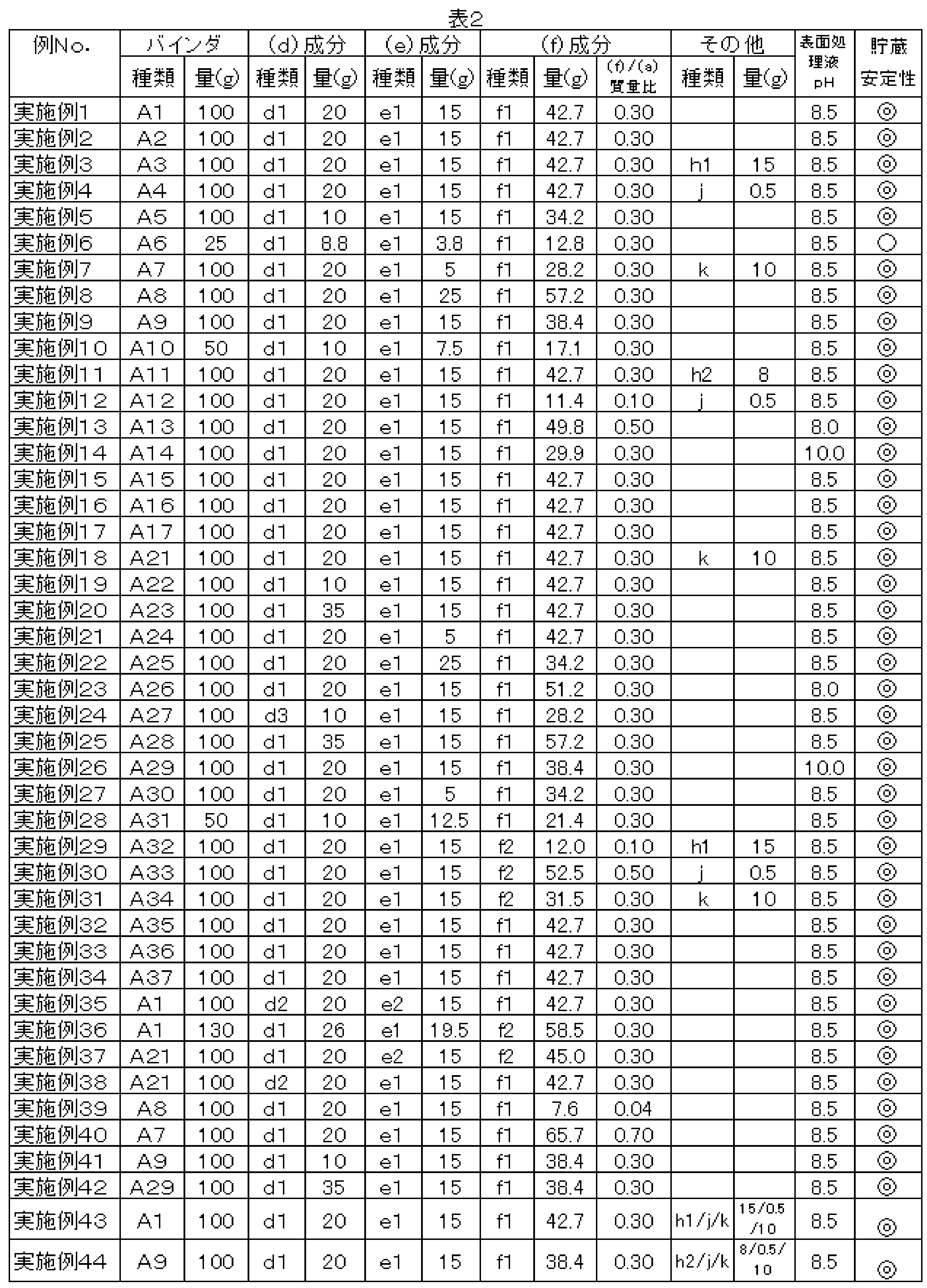
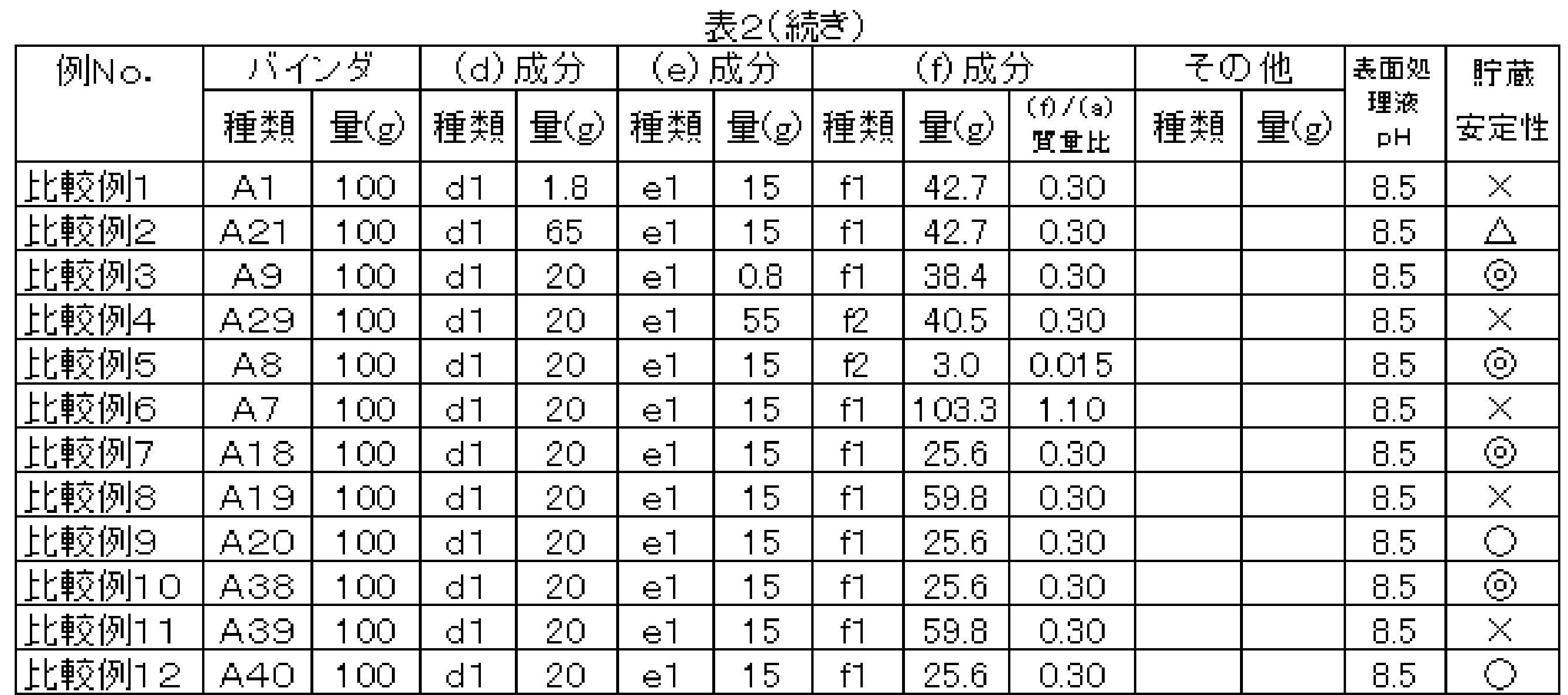
- Examples 1 to 44 and Comparative Examples 1 to 12 Production of aqueous metal surface treatment agent
- the binder and the components (d), (e) and (f) and other additive components are shown in Table 2 below. And the pH was adjusted to obtain 1 kg of a metal surface treatment agent.
- the amount of each component in Table 2 is the amount of the binder and the components (d), (e) and (f) below and other additive components blended to obtain 1 kg of the metal surface treatment agent (g) Indicates.
- the binders A1 to A20 obtained in Production Examples 1 to 20 have an active ingredient content of 20% and are indicated by the active ingredient amount. About the said components other than a binder, it displays by solid content.
- composition of the binders A21 to A40 described in Table 2 above (mixing ratios per 100 parts by mass of components (a), (b), and (c)) is as shown in Table 3 below.
- each symbol in the column of the type of the component (d), the component (e) and the component (f) in Table 2 and the column of the type of the other additive component have the following meanings.
- component d1 1-hydroxyethane-1,1-diphosphonic acid
- d2 1-hydroxymethane-1,1-diphosphonic acid
- d3 orthophosphoric acid
- component e1 ammonium metavanadate [NH 4 VO 3 ]
- e2 sodium metavanadate [NaVO 3 ]
- Component f1 Zirconyl ammonium carbonate [(NH 4 ) 2 ZrO (CO 3 ) 2 ]
- f2 sodium zirconyl carbonate [Na 2 ZrO (CO 3 ) 2 ]
- Other additive component h1 Titanium ammonium fluoride [(NH 4 ) 2 TiF 6 ]
- h2 aluminum nitrate Kyumizushio [Al (NO 3) 3 ⁇
- Example 45 To an electrogalvanized steel sheet (hereinafter sometimes abbreviated as “EG”) having a plate thickness of 0.8 mm and a weight per unit area of 20/20 (g / m 2 ), an alkaline degreasing agent (trade name “Nippon CB Chemical Co., Ltd. A 2% concentration aqueous solution in which Chemicleaner 561B ”) was dissolved was degreased by spraying it at 60 ° C for 2 minutes, washed with water, dried, and then obtained on the surface of this steel plate in Example 1 above. The metal surface treatment agent was applied with a roll coater, and baked for 20 seconds so that the material arrival temperature was 100 ° C., to obtain a surface treatment plate having a surface treatment agent film adhesion amount of 0.4 g / m 2 .
- EG electrogalvanized steel sheet having a plate thickness of 0.8 mm and a weight per unit area of 20/20 (g / m 2 )
- Example 46 to 98 and Comparative Examples 13 to 24 In the above Example 45, according to the specifications shown in Table 4 below, the same operation as in Example 45 was performed except that each metal surface treatment agent was coated and baked on each degreased steel plate to obtain each surface-treated plate. It was.
- the plating weight per unit area displays the amount per unit area of the front surface and the back surface.
- EG plate thickness 0.8mm and electro-galvanized steel sheet
- GI plating unit weight 20/20 (g / m 2): sheet thickness 0.8mm and galvanized steel sheet plated basis weight 60/60 (g / m 2)
- GA iron-zinc alloyed hot-dip galvanized steel sheet
- GL plate thickness 0.8 mm and plating weight 40/40 (g / m 2 ): plate thickness 0.8 mm and plating weight 60/60 (g / m 2 )
- Aluminum-zinc alloy-plated steel sheet containing about 55% aluminum in the alloy.
- Paintability (appearance of coating film): Each surface-treated plate is visually observed and evaluated according to the following criteria. a: No unevenness is observed at all, and the entire surface has a uniform hue. b: A slight iridescent unevenness is observed, but there is no practical problem. c: A considerable amount of iridescent unevenness is observed. There are practical problems.
- Corrosion resistance test (initial corrosion resistance and corrosion resistance after degreasing): Initial corrosion resistance is evaluated by the following salt spray test about each obtained surface treatment board.
- Corrosion resistance after degreasing is determined by adding an aqueous solution having a concentration of 2% in which an alkaline degreasing agent (trade name “Palclean CL-N364S”, manufactured by Nihon Parkerizing Co., Ltd.) is dissolved to each surface-treated plate at a temperature of 60 ° C. for 2 minutes.
- an alkaline degreasing agent trade name “Palclean CL-N364S”, manufactured by Nihon Parkerizing Co., Ltd.
- Adhesion test The surface treatment agent film surface of each surface treatment plate was cut with a grid so that 100 squares of 1 mm ⁇ 1 mm were formed in 10 mm square so as to reach the substrate with a cutter knife. After performing the Erichsen test (7 mm extrusion) so that the grid part is pushed outward, the cellophane adhesive tape is brought into close contact with the extruded processed part, and instantly peeled off to remove the surface treatment agent film. The degree is evaluated according to the following criteria. A: No peeling of the surface treatment agent film is observed. X: Peeling of the surface treatment agent film is observed.
- Conductivity test Using a conductivity measuring device (Mitsubishi Chemical Analytech Co., Ltd., Loresta GP, ASP terminal), measure the surface resistance value at any 10 locations on the surface-treated plate and measure 10 ⁇ 4 ⁇ or less. Evaluate by the number of times indicated. a: All 10 times b: 6-9 times c: 1-5 times d: 0 times.
- the aqueous metal surface treatment agent of the present invention is excellent in paintability and storage stability, and the treatment agent film formed from the aqueous metal surface treatment agent of the present invention has a coating film appearance, Satisfies all of corrosion resistance, adhesion and conductivity.
- Examples 99 to 142 and Comparative Examples 25 to 36 Production of aqueous metal surface treatment agent
- binders, components (d), (e) and (f ′) and other additive components are shown in Table 5 below.
- the composition was mixed and the pH was adjusted to obtain 1 kg of a metal surface treatment agent.
- the amount of each component in Table 5 is the amount of the binder and the following components (d), (e) and (f ′) and other additive components blended to obtain 1 kg of the metal surface treatment agent (g ).
- the binders A1 to A20 obtained in Production Examples 1 to 20 have an active ingredient content of 20% and are indicated by the active ingredient amount. About the said components other than a binder, it displays by solid content.
- the pH of the metal surface treatment agent was adjusted using acetic acid or N, N-dimethylaminoethanol.
- Table 5 also shows the storage stability test results for each metal surface treatment agent. The storage stability was evaluated according to the same method as in Table 2 above.
- compositions of the binders A21 to A40 described in Table 5 above are as shown in Table 3 above.
- each symbol in the column of (d) component, (e) component, and other additive components in Table 5 has the same meaning as in Table 2, and (f ′) in the column of component types.
- Each symbol represents the following meaning.
- Example 143 Concentration 2 in which an alkaline degreasing agent (trade name “Chem Cleaner 561B” manufactured by Nippon CB Chemical Co., Ltd.) was dissolved in an electrogalvanized steel sheet (EG) having a thickness of 0.8 mm and a basis weight of 20/20 (g / m 2 ). % Of the aqueous solution was degreased by spraying at 60 ° C. for 2 minutes, washed with water, and dried, and then the metal surface treatment agent obtained in Example 99 was applied to the surface of the steel sheet using a roll coater. It was coated and baked for 20 seconds so that the material arrival temperature was 100 ° C., to obtain a surface-treated plate having a surface treatment agent film adhesion amount of 0.4 g / m 2 .
- an alkaline degreasing agent trade name “Chem Cleaner 561B” manufactured by Nippon CB Chemical Co., Ltd.
- Example 143 in accordance with the specifications shown in Table 6 below, each metal surface treatment agent was applied to each degreased steel plate and baked except that the surface treatment plate was obtained. It was.
- the aqueous metal surface treatment agent of the present invention is excellent in paintability and storage stability, and the treatment agent film formed from the aqueous metal surface treatment agent of the present invention has a coating film appearance, Satisfies all of corrosion resistance, adhesion and conductivity.
Landscapes
- Chemical & Material Sciences (AREA)
- Engineering & Computer Science (AREA)
- Materials Engineering (AREA)
- Organic Chemistry (AREA)
- Life Sciences & Earth Sciences (AREA)
- Wood Science & Technology (AREA)
- Chemical Kinetics & Catalysis (AREA)
- Inorganic Chemistry (AREA)
- General Chemical & Material Sciences (AREA)
- Mechanical Engineering (AREA)
- Metallurgy (AREA)
- Chemical Treatment Of Metals (AREA)
Abstract
テトラアルコキシシラン又はその低縮合物 30~70質量部と、エポキシ基又はアミノ基を含有するシランカップリング剤 70~30質量部と、モノ-、ジ-もしくはトリ-アルコキシシラン又はその低縮合体 0~40質量部との混合物又はその加水分解縮合物からなるバインダ成分、リン酸化合物、バナジウム化合物、及びジルコニウム化合物又はチタニウム化合物を所定量で含有する水性金属表面処理剤を提供する。該金属表面処理剤は、塗装性および貯蔵安定性に優れ、かつ耐食性、密着性及び導電性に優れた、クロメートフリーの表面処理剤皮膜を形成する。
Description
本発明は、塗装性及び貯蔵安定性に優れ、かつ耐食性、密着性及び導電性に優れた、皮膜中に6価クロム等の公害規制物質を含まない、すなわちクロメートフリーの表面処理剤皮膜を形成し得る水性金属表面処理剤、該表面処理剤を用いる金属材の表面処理方法、ならびに該表面処理剤による皮膜が形成されてなる表面処理金属材に関する。
金属材料表面への密着性に優れ、金属材料表面に耐食性等を付与する技術として、一般に、金属材料表面に、クロム酸、重クロム酸又はそれらの塩を主成分として含有する処理液によりクロメート処理を施す方法、リン酸塩処理を施す方法、特定の無機成分による処理を施す方法、シランカップリング剤による処理を施す方法、有機樹脂皮膜処理を施す方法等が知られており、既に実用に供されている。
特定の無機成分による処理を施す方法として、例えば、特開2002-30460号公報には、バナジウム化合物と、ジルコニウム、チタニウム、モリブデン、タングステン、マンガン及びセリウムから選ばれる少なくとも1種の金属を含む金属化合物とを含有する金属表面処理剤による処理を施す方法が開示されている。
シランカップリング剤を用いる処理として、例えば、特開平11-43647号公報には、有機官能シラン及びポリシロキサンを含有する表面処理剤を用いて、基材に対する密着性が改善されたシロキサンフィルムを形成せしめる方法が開示されている。
有機樹脂皮膜処理を施す方法として、例えば、特開2003-105562号公報には、特定の樹脂化合物と、第1、2もしくは3級アミノ基及び第4級アンモニウム塩基から選ばれる少なくとも1種のカチオン性官能基を有するカチオン性ウレタン樹脂と、特定の反応性官能基を有する少なくとも1種のシランカップリング剤と、特定の酸化合物とを含有し、且つ上記カチオン性ウレタン樹脂及びシランカップリング剤の含有量が所定の範囲内である表面処理剤を用いて処理された、耐食性に優れ、耐指紋性、耐黒変性及び塗装密着性に優れたノンクロム系表面処理鋼板が開示されている。
また、特開2010-255105号公報には、水溶性ジルコニウム化合物と、エポキシ基を有する化合物と、キレート剤と、バナジン酸化合物と、Ti等の金属を含有する金属化合物を含有し、水溶性ジルコニウム化合物のZr換算重量/テトラアルコキシシランの質量比が1.0~6.0である表面処理剤から形成された表面処理剤皮膜を有する亜鉛めっき鋼板が、耐食性、電磁波シールド性に優れることが開示されている。
しかしながら、これら従来の金属表面処理剤は、塗装性及び貯蔵安定性に優れていること、耐食性、密着性及び導電性に優れた皮膜を形成すること、クロメートフリーであることの全ての要件を同時に満たすものではなく、実用化に至って依然として問題を抱えている。
本発明の目的は、上記の如き従来技術が有する課題を克服して、塗装性及び貯蔵安定性に優れ、かつ耐食性、密着性及び導電性に優れた、皮膜中に6価クロム等の公害規制物質を含まないクロメートフリーの表面処理剤皮膜を形成し得る水性金属表面処理剤を提供することである。
本発明の目的は、また、上記表面処理剤を用いる亜鉛系めっき鋼板等の金属材の表面処理方法、及び上記表面処理剤による皮膜が形成されてなる表面処理金属材を提供することである。
本発明者らは、上記の目的を達成すべく鋭意検討を行った結果、今回、テトラアルコキシシラン(低縮合物)及びエポキシ基含有シランカップリング剤から調製されるバインダ成分、ならびにリン酸化合物、バナジン酸化合物、及びジルコニウム化合物又はチタニウム化合物を特定量含有する水性表面処理剤によって、上記の課題を解決することができることを見出し、本発明を完成するに至った。
かくして、本発明は、
(a) テトラアルコキシシラン及びテトラアルコキシシランの低縮合物の少なくとも1種 30~70質量部と、
(b) エポキシ基含有シランカップリング剤及びアミノ基含有シランカップリング剤から選ばれる少なくとも1種のシランカップリング剤 30~70質量部と、
(c) モノ-、ジ-もしくはトリ-アルコキシシランの少なくとも1種及び/又はモノ-、ジ-もしくはトリ-アルコキシシランの少なくとも1種の低縮合体 0~40質量部
の混合物(I)又は混合物(I)を加水分解縮合反応させることにより得られる加水分解縮合物(II)からなるバインダ成分(A)、
(d) リン酸化合物、
(e) バナジウム化合物、及び
(f) ジルコニウム化合物又は(f’) チタニウム化合物
を含有する水性金属表面処理剤であって、
上記(a)、(b)及び(c)成分の合計100質量部あたり、
リン酸化合物(d)を2~60質量部、及び
バナジウム化合物(e)を1~50質量部含有し、且つ
ジルコニウム化合物(f)を、該(f)成分のZr換算質量と上記(a)成分との質量比(f)/(a)が0.02以上で且つ1.0未満となる量で含有するか、又はチタニウム化合物(f’)を、上記(a)、(b)及び(c)成分の合計100質量部あたり、0.1~100質量部含有する
ことを特徴とする水性金属表面処理剤を提供するものである。
(a) テトラアルコキシシラン及びテトラアルコキシシランの低縮合物の少なくとも1種 30~70質量部と、
(b) エポキシ基含有シランカップリング剤及びアミノ基含有シランカップリング剤から選ばれる少なくとも1種のシランカップリング剤 30~70質量部と、
(c) モノ-、ジ-もしくはトリ-アルコキシシランの少なくとも1種及び/又はモノ-、ジ-もしくはトリ-アルコキシシランの少なくとも1種の低縮合体 0~40質量部
の混合物(I)又は混合物(I)を加水分解縮合反応させることにより得られる加水分解縮合物(II)からなるバインダ成分(A)、
(d) リン酸化合物、
(e) バナジウム化合物、及び
(f) ジルコニウム化合物又は(f’) チタニウム化合物
を含有する水性金属表面処理剤であって、
上記(a)、(b)及び(c)成分の合計100質量部あたり、
リン酸化合物(d)を2~60質量部、及び
バナジウム化合物(e)を1~50質量部含有し、且つ
ジルコニウム化合物(f)を、該(f)成分のZr換算質量と上記(a)成分との質量比(f)/(a)が0.02以上で且つ1.0未満となる量で含有するか、又はチタニウム化合物(f’)を、上記(a)、(b)及び(c)成分の合計100質量部あたり、0.1~100質量部含有する
ことを特徴とする水性金属表面処理剤を提供するものである。
また、本発明は、金属材の表面上に、上記の水性金属表面処理剤を、乾燥皮膜質量で0.05~1.5g/m2の範囲内となるように塗装し、乾燥させることを特徴とする金属材の表面処理方法を提供するものである。
さらに、本発明は、金属材の表面上に、上記の水性金属表面処理剤による皮膜が、乾燥皮膜質量で0.05~1.5g/m2の範囲内の量で付着してなる表面処理金属材を提供するものである。
本発明の水性金属表面処理剤は、6価クロム等の公害規制物質を含まないクロメートフリーの表面処理剤であって、塗装性及び貯蔵安定性に優れている。また、本発明の金属表面処理剤から形成される皮膜は、耐食性、密着性及び導電性のすべてを同時に満足するものであって、該表面処理剤皮膜が形成されてなる亜鉛系めっき鋼板等の金属材は、導電性に優れ、表面処理剤皮膜が薄い場合であっても耐食性に優れているため、薄い表面処理剤皮膜を有する導電性に優れた表面処理金属材を得ることができる。
水性金属表面処理剤
本発明の水性金属表面処理剤は、バインダ成分(A)、リン酸化合物(d)、バナジウム化合物(e)、及びジルコニウム化合物(f)又はチタニウム化合物(f’)が、水性媒体中に安定に溶解ないしは分散されてなるものである。本発明において、「水性媒体」は、水の含有率が少なくとも80質量%である、20℃において均一な液状をなす水と有機溶剤との混合物、又は水を包含する。「水性媒体」を構成し得る有機溶剤種は、水溶性又は水分散性を有する水混和性溶剤であれば特に限定されるものではなく、例えば、メタノール、エタノール、イソプロピルアルコール、t-ブチルアルコール、プロピレングリコール等のアルコール類;エチレングリコールモノブチルエーテル、エチレングリコールモノエチルエーテル等のグリコールエーテル類;酢酸エチル、酢酸ブチル等のエステル類;アセトン等のケトン類等の水溶性有機溶剤を好適に用いることができる。
本発明の水性金属表面処理剤は、バインダ成分(A)、リン酸化合物(d)、バナジウム化合物(e)、及びジルコニウム化合物(f)又はチタニウム化合物(f’)が、水性媒体中に安定に溶解ないしは分散されてなるものである。本発明において、「水性媒体」は、水の含有率が少なくとも80質量%である、20℃において均一な液状をなす水と有機溶剤との混合物、又は水を包含する。「水性媒体」を構成し得る有機溶剤種は、水溶性又は水分散性を有する水混和性溶剤であれば特に限定されるものではなく、例えば、メタノール、エタノール、イソプロピルアルコール、t-ブチルアルコール、プロピレングリコール等のアルコール類;エチレングリコールモノブチルエーテル、エチレングリコールモノエチルエーテル等のグリコールエーテル類;酢酸エチル、酢酸ブチル等のエステル類;アセトン等のケトン類等の水溶性有機溶剤を好適に用いることができる。
バインダ成分(A)
本発明の水性金属表面処理剤におけるバインダ成分(A)は、テトラアルコキシシラン及びテトラアルコキシシランの低縮合物のうちの少なくとも1種(a)と、エポキシ基含有シランカップリング剤及びアミノ基含有シランカップリング剤から選ばれる少なくとも1種のシランカップリング剤(b)と、さらに場合により、(c)モノ-、ジ-もしくはトリ-アルコキシシランのうちの少なくとも1種及び/又はモノ-、ジ-もしくはトリ-アルコキシシランのうちの少なくとも1種の低縮合体との混合物(I)又は混合物(I)を加水分解縮合反応させることにより得られる加水分解縮合物(II)からなるものである。
本発明の水性金属表面処理剤におけるバインダ成分(A)は、テトラアルコキシシラン及びテトラアルコキシシランの低縮合物のうちの少なくとも1種(a)と、エポキシ基含有シランカップリング剤及びアミノ基含有シランカップリング剤から選ばれる少なくとも1種のシランカップリング剤(b)と、さらに場合により、(c)モノ-、ジ-もしくはトリ-アルコキシシランのうちの少なくとも1種及び/又はモノ-、ジ-もしくはトリ-アルコキシシランのうちの少なくとも1種の低縮合体との混合物(I)又は混合物(I)を加水分解縮合反応させることにより得られる加水分解縮合物(II)からなるものである。
(a)成分
バインダ成分(A)の1成分としての(a)成分におけるテトラアルコキシシランは、1分子中に、1個の珪素原子と該珪素原子に直接結合する4個のアルコキシ基とを有するものであり、該アルコキシ基としては、特に限定されないが、通常、炭素数が1~4のアルコキシ基が好ましく、特に炭素数1~3、さらに特に炭素数1もしくは2のアルコキシ基が好ましい。かかるアルコキシシランの具体例としては、テトラメトキシシラン、テトラエトキシシラン、テトラプロポキシシラン、テトラブトキシシラン、ジメトキシジエトキシシラン等が挙げられ、これらはそれぞれ単独で又は2種以上組み合わせて用いることができる。なかでも、金属材、特に、亜鉛系めっき鋼板の耐食性がより優れるという観点から、テトラエトキシシラン及びテトラメトキシシランが好ましい。
バインダ成分(A)の1成分としての(a)成分におけるテトラアルコキシシランは、1分子中に、1個の珪素原子と該珪素原子に直接結合する4個のアルコキシ基とを有するものであり、該アルコキシ基としては、特に限定されないが、通常、炭素数が1~4のアルコキシ基が好ましく、特に炭素数1~3、さらに特に炭素数1もしくは2のアルコキシ基が好ましい。かかるアルコキシシランの具体例としては、テトラメトキシシラン、テトラエトキシシラン、テトラプロポキシシラン、テトラブトキシシラン、ジメトキシジエトキシシラン等が挙げられ、これらはそれぞれ単独で又は2種以上組み合わせて用いることができる。なかでも、金属材、特に、亜鉛系めっき鋼板の耐食性がより優れるという観点から、テトラエトキシシラン及びテトラメトキシシランが好ましい。
(a)成分として使用することができるテトラアルコキシシランの低縮合物は、上記で例示した如きテトラアルコキシシランの低縮合物を包含し、1種のテトラアルコキシシラン単独の低縮合物であってもよく、又は少なくとも2種のテトラアルコキシシラン相互の低縮合物であってもよい。テトラアルコキシシランの低縮合物は、一般に10以下、特に2~8、さらに特に2~6の範囲内の重合度を有することが好適である。
(b)成分
バインダ成分(A)の1成分として用いられるシランカップリング剤(b)は、エポキシ基含有シランカップリング剤及びアミノ基含有シランカップリング剤から選ばれる少なくとも1種のシランカップリング剤である。
バインダ成分(A)の1成分として用いられるシランカップリング剤(b)は、エポキシ基含有シランカップリング剤及びアミノ基含有シランカップリング剤から選ばれる少なくとも1種のシランカップリング剤である。
上記エポキシ基含有シランカップリング剤は、1分子中に、少なくとも1個、好ましくは1個のみのエポキシ基と1~3個のアルコキシ基(通常、炭素数が1~4、特に炭素数1~3、さらに特に炭素数1もしくは2のアルコキシ基)とを含有するシラン化合物を包含し、具体的には、例えば、γ-グリシドキシプロピルトリメトキシシラン、γ-グリシドキシプロピルメチルジエトキシシラン、γ-グリシドキシプロピルトリエトキシシラン、2-(3,4-エポキシシクロヘキシル)エチルトリメトキシシラン、2-(3,4-エポキシシクロヘキシル)エチルトリエトキシシラン等が挙げられる。
上記アミノ基含有シランカップリング剤は、1分子中に、少なくとも1個、好ましくは1もしくは2個のアミノ基と1~3個のアルコキシ基(通常、炭素数が1~4、特に炭素数1~3、さらに特に炭素数1もしくは2のアルコキシ基)とを含有するシラン化合物を包含し、具体的には、例えば、3-アミノプロピルトリエトキシシラン、3-アミノプロピルトリメトキシシラン、N-(2-アミノエチル)3-アミノプロピルメチルジメトキシシラン、N-(アミノエチル)3-アミノプロピルトリメトキシシラン等が挙げられる。
(c)成分
バインダ成分(A)において、(c)成分は、必要に応じて用いられる任意成分であり、モノ-、ジ-もしくはトリ-アルコキシシランの少なくとも1種及び/又はモノ-、ジ-もしくはトリ-アルコキシシランの少なくとも1種の低縮合体を包含し、該アルコキシ基としては、特に限定されないが、通常、炭素数が1~4のアルコキシ基が好ましく、特に炭素数1~3、さらに特に炭素数1もしくは2のアルコキシ基が好ましい。
バインダ成分(A)において、(c)成分は、必要に応じて用いられる任意成分であり、モノ-、ジ-もしくはトリ-アルコキシシランの少なくとも1種及び/又はモノ-、ジ-もしくはトリ-アルコキシシランの少なくとも1種の低縮合体を包含し、該アルコキシ基としては、特に限定されないが、通常、炭素数が1~4のアルコキシ基が好ましく、特に炭素数1~3、さらに特に炭素数1もしくは2のアルコキシ基が好ましい。
上記モノアルコキシシランとしては、例えば、メトキシトリメチルシラン、メトキシトリエチルシラン、メトキシメチルジエチルシラン、エトキシトリメチルシラン、エトキシトリエチルシラン、プロポキシトリメチルシラン、プロポキシトリプロピルシラン、ブトキシトリブチルシラン等のアルコキシトリアルキルシラン;エトキシトリフェニルシラン等のアルコキシトリフェニルシラン等が挙げられる。
上記ジアルコキシシランとしては、例えば、ジメトキシジメチルシラン、ジメトキシジエチルシラン、ジエトキシジメチルシラン、ジエトキシジエチルシラン、ジエトキシジフェニルシラン、ジプロポキシジメチルシラン、ジプロポキシジエチルシラン、ジプロポキシジプロピルシラン、ジブトキシジメチルシラン、ジブトキシジエチルシラン、ジブトキシジブチルシラン等のジアルコキシジアルキルシラン;ジメトキシジフェニルシラン、ジプロポキシジフェニルシラン、ジブトキシジフェニルシラン等のジアルコキシジフェニルシラン等が挙げられる。
上記トリアルコキシシランとしては、例えば、トリメトキシメチルシラン、トリメトキシエチルシラン、トリメトキシプロピルシラン、トリメトキシブチルシラン、トリエトキシメチルシラン、トリエトキシエチルシラン、トリエトキシブチルシラン、トリプロポキシメチルシラン、トリプロポキシプロピルシラン等のトリアルコキシアルキルシラン;トリメトキシフェニルシラン、トリエトキシフェニルシラン、トリプロポキシフェニルシラン、トリブトキシフェニルシラン等のトリアルコキシフェニルシラン等が挙げられる。
(c)成分として用いることができるモノ-、ジ-もしくはトリ-アルコキシシランの少なくとも1種の低縮合体は、1種のモノ-、ジ-もしくはトリ-アルコキシシラン単独の低縮合体であってもよく、又は少なくとも2種のモノ-、ジ-もしくはトリ-アルコキシシラン相互の低縮合体であってもよい。上記低縮合体は、一般に10以下、特に2~8、さらに特に2~6の範囲内の重合度を有することが好適である。
バインダ成分(A)を構成する各成分の配合比率は、得られる皮膜の耐食性、密着性等の観点から、(a)、(b)及び(c)成分の合計100質量部あたり、下記の範囲内であることが好適である。
(a)成分:30~70質量部、特に35~65質量部、さらに特に40~60質量部、
(b)成分:30~70質量部、特に35~65質量部、さらに特に40~60質量部、
(c)成分:0~40質量部、特に0~30質量部、さらに特に0~20質量部。
(a)成分:30~70質量部、特に35~65質量部、さらに特に40~60質量部、
(b)成分:30~70質量部、特に35~65質量部、さらに特に40~60質量部、
(c)成分:0~40質量部、特に0~30質量部、さらに特に0~20質量部。
本発明の水性金属表面処理剤におけるバインダ成分(A)は、上記(a)成分と(b)成分との混合物又は上記(a)成分と(b)成分と(c)成分との混合物である混合物(I)、あるいは好ましくは、混合物(I)を加水分解縮合反応することにより得られる加水分解縮合物(II)であることができる。該加水分解縮合物(II)は、通常200~20000、好ましくは300~10000の範囲内の重量平均分子量を有することが好適である。重量平均分子量の測定は、GPC(ゲルパーミュエーションクロマトグラフ)測定により行うことができ、又は29Si NMR(核磁気共鳴スペクトル)測定により縮合によるシロキサン結合の数を確認することにより行うことができる。
上記混合物(I)の加水分解縮合反応は、それ自体既知の方法に従い、例えば、水及び酸触媒の存在下で行うことができる。該酸触媒としては、アルコキシシランの加水分解反応の触媒として通常用いられる酸であれば、その種類に特に制限はなく、例えば、塩酸、硫酸、硝酸、リン酸等の無機酸;蟻酸、酢酸、乳酸、酒石酸等の有機酸が挙げられ、なかでも無機酸、特に、塩酸を好適に使用することができる。また、上記加水分解縮合反応の際には、適宜、有機溶媒、特に、上記混合物(I)を溶解する水混和性有機溶剤(例えば、アルコール系溶剤、グリコールエーテル系溶剤等)を使用することができ、なかでも、例えば、メタノ-ル、エタノ-ル、プロパノ-ル等アルコール系溶剤が好適である。上記加水分解反応は、通常、pH7以下、好ましくはpH1.5~6.0にて、20℃~100℃程度の温度で30分~20時間程度撹拌することにより行うことができ、それにより、加水分解反応とともに、縮合反応も進行する。この反応により得られる加水分解縮合物(II)の組成は、使用する水の量、触媒の種類及び量、反応温度及び反応時間等によって適宜調整することができる。
リン酸化合物(d)
本発明の金属表面処理剤における(d)成分であるリン酸化合物は、金属表面処理剤の貯蔵安定性の向上に貢献するものであり、バインダ成分(A)中のアルコキシシリル基が反応して高分子量化するのを抑制するように作用するものと推測される。
本発明の金属表面処理剤における(d)成分であるリン酸化合物は、金属表面処理剤の貯蔵安定性の向上に貢献するものであり、バインダ成分(A)中のアルコキシシリル基が反応して高分子量化するのを抑制するように作用するものと推測される。
リン酸化合物(d)の種類は、特に限定されるものではなく、有機リン酸化合物、無機リン酸化合物のいずれであってもよい。有機リン酸化合物としては、具体的には、例えば、1-ヒドロキシメタン-1,1-ジホスホン酸、1-ヒドロキシエタン-1,1-ジホスホン酸、1-ヒドロキシプロパン-1,1-ジホスホン酸等のヒドロキシル基含有有機亜リン酸;2-ヒドロキシホスホノ酢酸、2-ホスホノブタン-1,2,4-トリカルボン酸等のカルボキシル基含有有機亜リン酸、及びこれらの塩等が好適なものとして挙げられる。無機リン酸化合物としては、具体的には、例えば、オルトリン酸、メタリン酸、亜リン酸、メタ亜リン酸、次リン酸、次亜リン酸、ピロリン酸、トリポリリン酸、テトラリン酸、ヘキサリン酸、トリメタリン酸、ピロ亜リン酸、及びリン酸誘導体;これらのリン酸化合物のアルカリ金属塩又はアンモニウム塩等が挙げられる。
上記リン酸化合物のうち、バインダ成分(A)中のアルコキシシリル基の反応を抑制し、金属表面処理剤の貯蔵安定性を向上させる効果が大きいことから、中でも、1-ヒドロキシエタン-1,1-ジホスホン酸が特に好適である。
バナジウム化合物(e)
本発明の金属表面処理剤における(e)成分であるバナジウム化合物は、金属表面処理組成物の皮膜が形成される亜鉛系めっき鋼板等の金属材の腐食に対するインヒビター効果を発揮する成分として役立つ。
本発明の金属表面処理剤における(e)成分であるバナジウム化合物は、金属表面処理組成物の皮膜が形成される亜鉛系めっき鋼板等の金属材の腐食に対するインヒビター効果を発揮する成分として役立つ。
バナジウム化合物(e)としては、例えば、メタバナジン酸リチウム、メタバナジン酸カリウム、メタバナジン酸ナトリウム、メタバナジン酸アンモニウム、無水バナジン酸、五酸化バナジウム、三酸化バナジウム、二酸化バナジウム、オキシ硫酸バナジウム、硫酸バナジウム、オキシ三塩化バナジウム、三塩化バナジウム、バナジウムオキシアセチルアセトネート、バナジウムアセチルアセトネート、リンバナドモリブデン酸等を挙げることができ、これらはそれぞれ単独で又は2種以上を組合せて用いることができる。
バナジウム化合物(e)としては、皮膜の耐水付着性、皮膜をアルカリ脱脂した後における金属材の耐食性等の観点から、中でも、メタバナジン酸アンモニウムが特に好ましい。
ジルコニウム化合物(f)
本発明の金属表面処理組成物における(f)成分であるジルコニウム化合物は、金属表面処理剤の皮膜が形成された亜鉛系めっき系鋼板等の金属材の導電性を実用上低下させることなく、金属材の耐食性、形成される皮膜の密着性、皮膜をアルカリ脱脂した後における該金属材の耐食性等の諸性能を向上させるのに寄与する。
本発明の金属表面処理組成物における(f)成分であるジルコニウム化合物は、金属表面処理剤の皮膜が形成された亜鉛系めっき系鋼板等の金属材の導電性を実用上低下させることなく、金属材の耐食性、形成される皮膜の密着性、皮膜をアルカリ脱脂した後における該金属材の耐食性等の諸性能を向上させるのに寄与する。
ジルコニウム化合物(f)の種類は、特に制限されるものではないが、水溶性であることが好ましく、具体的には、例えば、硝酸ジルコニウム、オキシ硝酸ジルコニウム、酢酸ジルコニル、硫酸ジルコニル、炭酸ジルコニウム、炭酸ジルコニルアンモニウム、炭酸ジルコニルカリウム、炭酸ジルコニルナトリウム、炭酸ジルコニルリチウム、ジルコニウムフッ化水素酸(H2ZrF6);ジルコニウムフッ化水素酸(H2ZrF6)のナトリウム塩、カリウム塩、リチウム塩及びアンモニウム塩〔(NH4)2ZrF6〕等が挙げられ、これらはそれぞれ単独で又は2種以上を組み合わせて用いることができる。
ジルコニウム化合物(f)としては、表面処理された亜鉛めっき系鋼板等の金属材の耐食性、導電性及び皮膜をアルカリ脱脂した後における該金属材の耐食性がより優れるという観点から、中でも、炭酸ジルコニルアンモニウム〔(NH4)2ZrO(CO3)2〕及び炭酸ジルコニルナトリウム〔Na2ZrO(CO3)2〕が好ましい。
チタニウム化合物(f’)
本発明の金属表面処理組成物における(f’)成分であるチタニウム化合物は、金属表面処理組成物の皮膜が形成された亜鉛系めっき系鋼板等の金属材の導電性を実用上低下させることなく、金属材の耐食性、形成される皮膜の密着性、皮膜をアルカリ脱脂した後における該金属材の耐食性等の諸性能を向上させるのに寄与する。
本発明の金属表面処理組成物における(f’)成分であるチタニウム化合物は、金属表面処理組成物の皮膜が形成された亜鉛系めっき系鋼板等の金属材の導電性を実用上低下させることなく、金属材の耐食性、形成される皮膜の密着性、皮膜をアルカリ脱脂した後における該金属材の耐食性等の諸性能を向上させるのに寄与する。
チタニウム化合物(f’)の種類は、特に制限されるものではないが、水溶性であることが好ましく、具体的には、例えば、硫酸チタニル、硝酸チタニル、硝酸チタン、塩化チタニル、塩化チタン、チタニアゾル、酸化チタン、シュウ酸チタン酸カリウム、チタンフッ化水素酸(H2TiF6)、チタンフッ化アンモニウム〔(NH4)2TiF6〕、チタンラクテート、チタンテトライソプロポキシド、チタンアセチルアセトネート、ジイソプロピルチタニウムビスアセチルアセトン、メタチタン酸、メタチタン酸塩、オルソチタン酸、オルソチタン酸塩等が挙げられ、これらはそれぞれ単独で又は2種以上を組み合わせて用いることができる。
チタニウム化合物(f’)としては、表面処理された亜鉛めっき系鋼板等の金属材の耐食性、導電性および皮膜をアルカリ脱脂した後における該金属材の耐食性がより優れるという観点から、中でも、チタンフッ化水素酸(H2TiF6)及びチタンフッ化アンモニウム〔(NH4)2TiF6〕が好ましい。
本発明の水性金属表面処理剤における前記(d)及び(e)成分の配合量は、バインダ(A)を構成する(a)、(b)及び(c)成分の合計100質量部あたり、下記の範囲内とすることができる。
リン酸化合物(d):2~60質量部、好ましくは5~45質量部、さら
に好ましくは10~35質量部、
バナジウム化合物(e):1~50質量部、好ましくは2~30質量部、
さらに好ましくは5~20質量部。
リン酸化合物(d):2~60質量部、好ましくは5~45質量部、さら
に好ましくは10~35質量部、
バナジウム化合物(e):1~50質量部、好ましくは2~30質量部、
さらに好ましくは5~20質量部。
上記(d)及び(e)成分の配合量が上記範囲内にあることが、得られる処理剤皮膜の耐食性、特にアルカリ脱脂処理後の耐食性、導電性、ならびに表面処理剤の塗装性及び貯蔵安定性の面から好適である。
また、本発明の水性金属表面処理剤は、ジルコニウム化合物(f)又はチタニウム化合物(f’)を含有する。
本発明の水性金属表面処理剤において、(f)成分を配合する場合、その配合量は、ジルコニウム化合物(f)のZr換算質量とバインダ成分(A)の一部を構成する(a)成分との質量比(f)/(a)が0.02以上で且つ1.0未満、好ましくは0.04~0.70、さらに好ましくは0.10~0.50の範囲内となる量とすることができる。質量比(f)/(a)が0.02未満となると、得られる処理剤皮膜の耐食性、特にアルカリ脱脂処理後の耐食性が劣り、一方、質量比(f)/(a)が1.0以上となると、表面処理剤の塗装性および貯蔵安定性が低下し、得られる処理剤皮膜の導電性が低下する傾向がある。
さらに、本発明の水性金属表面処理剤において、前記(f’)成分を配合する場合、その配合量は、バインダ(A)を構成する(a)、(b)及び(c)成分の合計100質量部あたり、0.1~100質量部、好ましくは2~40質量部、さらに好ましくは5~30質量部とすることができる。上記(f’)成分の配合量が、上記範囲内にあることが、得られる処理剤皮膜の耐食性、特にアルカリ脱脂処理後の耐食性、導電性、ならびに表面処理剤の塗装性及び貯蔵安定性の面から好適である。
その他の添加成分
本発明の水性金属表面処理剤は、上記バインダ成分(A)、リン酸化合物(d)、バナジウム化合物(e)、ジルコニウム化合物(f)又はチタニウム化合物(f’)及び水性媒体のほかに、レベリング剤、消泡剤、界面活性剤、着色剤、防菌防カビ剤;エチレンジアミン、トリエチレンペンタミン、グアニジン、ピリミジン等のアミン化合物であるエッチング抑制剤;酢酸、乳酸、アンモニウム塩、アミン類等のpH調整剤;ポリエチレンワックス、酸化ポリエチレンワックス、酸化ポリプロピレンワックス、カルナウバワックス、パラフィンワックス、モンタンワックス、テトラフルオロエチレンワックス等のワックス;二硫化炭素、二硫化モリブデン、グラファイト等の潤滑剤;酒石酸、リンゴ酸等のヒドロキシカルボン酸、シュウ酸、マロン酸、コハク酸、クエン酸、アジピン酸等のジカルボン酸、及びグリシン等のアミノカルボン酸、EDTA、DTPA等のキレート剤;Al、Zn等の金属を含む金属化合物;水溶性又は水分散性を有する水性有機樹脂等を適宜含有することができ、中でも、水性有機樹脂及び/又はワックスが好適である。
本発明の水性金属表面処理剤は、上記バインダ成分(A)、リン酸化合物(d)、バナジウム化合物(e)、ジルコニウム化合物(f)又はチタニウム化合物(f’)及び水性媒体のほかに、レベリング剤、消泡剤、界面活性剤、着色剤、防菌防カビ剤;エチレンジアミン、トリエチレンペンタミン、グアニジン、ピリミジン等のアミン化合物であるエッチング抑制剤;酢酸、乳酸、アンモニウム塩、アミン類等のpH調整剤;ポリエチレンワックス、酸化ポリエチレンワックス、酸化ポリプロピレンワックス、カルナウバワックス、パラフィンワックス、モンタンワックス、テトラフルオロエチレンワックス等のワックス;二硫化炭素、二硫化モリブデン、グラファイト等の潤滑剤;酒石酸、リンゴ酸等のヒドロキシカルボン酸、シュウ酸、マロン酸、コハク酸、クエン酸、アジピン酸等のジカルボン酸、及びグリシン等のアミノカルボン酸、EDTA、DTPA等のキレート剤;Al、Zn等の金属を含む金属化合物;水溶性又は水分散性を有する水性有機樹脂等を適宜含有することができ、中でも、水性有機樹脂及び/又はワックスが好適である。
上記キレート剤は、バナジウム化合物(e)やジルコニウム化合物(f)やチタニウム化合物(f’)を表面処理剤中に安定に溶解させる働きを有するものと考えられる。
本発明の水性金属表面処理剤中に適宜配合することができる金属化合物において、Alを含む金属化合物としては、例えば、酸化アルミニウム、水酸化アルミニウム、硫酸アルミニウム、硝酸アルミニウム、リン酸アルミニウム、塩化アルミニウム等が挙げられ、また、Znを含む金属化合物としては、例えば、炭酸亜鉛、酸化亜鉛、水酸化亜鉛、硫酸亜鉛、硝酸亜鉛、塩化亜鉛、リン酸亜鉛、亜鉛酸ナトリウム、亜鉛酸カリウム等が挙げられる。
本発明の水性金属表面処理剤中に適宜配合することができる水性有機樹脂は、本発明の水性金属表面処理剤中に安定に溶解又は分散することのできる有機樹脂を包含し、具体的には、単独で又は塩基性化合物で中和して水溶化や水分散化できる官能基(例えば、水酸基、ポリオキシアルキレン基、カルボキシル基等の酸基等)を含有するノニオン性又はアニオン性の有機樹脂;ノニオン系界面活性剤(乳化剤)で乳化された有機樹脂エマルション等を挙げることができる。上記水性有機樹脂の樹脂種としては、例えば、エポキシ系樹脂、フェノール系樹脂、アクリル系樹脂、ウレタン系樹脂、オレフィン-カルボン酸系樹脂、ポリアミド系樹脂、ポリオキシアルキレン鎖を有する樹脂、ポリビニルアルコール、ポリグリセリン、セルロース系樹脂(例えば、カルボキシメチルセルロース、ヒドロキシメチルセルロース、ヒドロキシエチルセルロース)等が挙げられる。これらの水性有機樹脂はそれぞれ単独で又は2種類以上を組み合わせて使用することができる。金属表面処理剤の貯蔵安定性と表面処理剤皮膜性能とのバランスの面から、これらの中でも特に、アクリル系樹脂エマルション又はウレタン系樹脂エマルションが好ましい。本発明の水性金属表面処理剤に水性有機樹脂を配合することによって、基材への濡れ性や耐食性を向上させることができる場合がある。配合する場合の水性有機樹脂の配合量は、得られる表面処理剤皮膜の導電性、耐食性等の観点から、表面処理剤の全固形分に基いて、通常20質量%以下、好ましくは0.5~10質量%の範囲内であることが好適である。
本発明の水性金属表面処理剤は、一般に2~11、特に7~10、さらに特に8.0~9.5の範囲内のpHを有することが好適である。処理液のpHが2未満であると表面処理剤の貯蔵安定性が低下しやすく、また、素材である金属材の溶解が著しくなり、亜鉛系めっき鋼板等の金属材表面に形成される表面処理剤皮膜の耐食性及び金属材表面への密着性が低下しやすくなる。他方、pHが11を超える場合には、亜鉛系めっき鋼板等の金属材のエッチングが著しくなり、亜鉛系めっき鋼板等の金属材の耐食性及び導電性が低下する。本発明において、pHの調整は水性金属表面処理剤にアルカリ又は酸を添加することにより行うことができ、用いられるアルカリとしては、例えば、アンモニア、アミン、アミンの誘導体およびアミノポリカルボン酸、水酸化ナトリウム、水酸化カリウム等を挙げることができ、酸としては、例えば、蟻酸、酢酸、乳酸、酒石酸等の有機酸;塩酸、硝酸、硫酸、リン酸等の無機酸;前記リン酸化合物(d)として例示した化合物等を挙げることができる。
本発明の水性金属表面処理剤の固形分濃度は、特に限定されるものではなく、用途等に応じて変えることができるが、金属表面処理剤の粘性、塗装して得られる表面処理剤皮膜の付着量、流展性、塗装性等の観点から、通常3~35質量%、特に4~30質量%、さらに特に5~25質量%の範囲内であることが好適である。
また、本発明の水性金属表面処理剤の塗布量は、金属材表面に付着した乾燥表面処理剤皮膜質量で、通常0.05~1.5g/m2の範囲内であることが好適である。
金属材の表面処理方法
本発明の水性金属表面処理剤は、耐食性の付与等が望まれる金属材の表面上に塗装し、乾燥させることにより、金属材の表面に水性金属表面処理剤による表面処理剤皮膜を形成せしめることができる。
本発明の水性金属表面処理剤は、耐食性の付与等が望まれる金属材の表面上に塗装し、乾燥させることにより、金属材の表面に水性金属表面処理剤による表面処理剤皮膜を形成せしめることができる。
本発明の水性金属表面処理剤を適用することができる金属材としては、特に制限されるものではなく、例えば、鉄、鉄基合金、アルミニウム、アルミニウム基合金、銅、銅基合金、金属材上にめっきしためっき金属材等を挙げることができ、中でも、亜鉛系めっき鋼板が金属材として最も好適に適用できる。亜鉛系めっき鋼板としては、例えば、亜鉛めっき鋼板;亜鉛-ニッケルめっき鋼板、亜鉛-鉄めっき鋼板、亜鉛-クロムめっき鋼板、亜鉛-アルミニウムめっき鋼板、亜鉛-チタンめっき鋼板、亜鉛-マグネシウムめっき鋼板、亜鉛-マンガンめっき鋼板、亜鉛-アルミニウム-マグネシウムめっき鋼板、亜鉛-アルミニウム-マグネシウム-シリコンめっき鋼板等の亜鉛合金めっき鋼板;さらにはこれらのめっき層に少量の異種金属元素又は不純物としてコバルト、モリブデン、タングステン、ニッケル、チタン、クロム、アルミニウム、マンガン、鉄、マグネシウム、鉛、ビスマス、アンチモン、錫、銅、カドミウム、ヒ素等を含有したもの、シリカ、アルミナ、チタニア等の無機物を分散させたものを挙げることができる。さらには、以上のめっきを2種以上組み合わせた複層めっきを施したものも使用することができる。めっき方法は、特に制限されるものではなく、それ自体既知のめっき方法、例えば、電気めっき法、溶融めっき法、蒸着めっき法、分散めっき法、真空めっき法等のいずれの方法を使用してもよい。
金属材の表面上への本発明の水性金属表面処理剤の塗装は、それ自体既知の塗装法、例えば、浸漬塗装、スプレー塗装、ロール塗装等の方法により行うことができる。上記金属材の表面は、金属表面処理剤を塗布する前に、必要に応じて、金属材表面上の油分や汚れの除去を目的として、湯洗、溶剤洗浄、アルカリ脱脂洗浄等の前処理を施すことができる。
表面処理剤皮膜の乾燥は、素材到達温度が通常約50~約250℃、特に約80~約200℃の範囲内で、約2秒~約30秒間乾燥させることにより行うことができる。
金属材表面上への表面処理剤皮膜の付着量は、表面処理剤皮膜を形成した金属材表面の皮膜の耐食性、密着性、導電性等の観点から、乾燥皮膜質量で、一般に0.05~1.5g/m2、特に0.1~1.0g/m2、さらに特に0.2~0.7g/m2の範囲内であることが好適である。
表面処理金属材
上記金属材の表面処理方法によって、本発明に従う表面処理金属材を得ることができる。
本発明に従い金属材の表面に付着せしめられた表面処理剤皮膜は、耐食性、密着性及び導電性に優れ、皮膜外観も良好であることができる。
上記金属材の表面処理方法によって、本発明に従う表面処理金属材を得ることができる。
本発明に従い金属材の表面に付着せしめられた表面処理剤皮膜は、耐食性、密着性及び導電性に優れ、皮膜外観も良好であることができる。
その理由は以下のように推測されるが、本発明はこの推測に何ら拘束されるものではない。本発明に用いる水性金属表面処理剤を用いて形成される皮膜は、バインダ成分が、有機ケイ素化合物を主体とするものであり、該有機ケイ素化合物が乾燥等により濃縮されたときに、該有機ケイ素化合物のアルコキシシリル基が加水分解されたシラノール基等と互いに反応して連続皮膜を形成すること;シラノール基がジルコニウム化合物又はチタニウム化合物と架橋反応し、また、前記有機ケイ素化合物の1成分であるシランカップリング剤がエポキシ基又はアミノ基を有しており、該エポキシ基がシラノール基やジルコニウム化合物又はチタニウム化合物と架橋反応し、又は該アミノ基がジルコニウム化合物又はチタニウム化合物や基材金属表面やエポキシ基と反応すること;さらに、加水分解して生成するシラノール基が金属表面と結合を形成すること、等が考えられ、これらの相互作用により、顕著なバリアー効果が生じるものと推定される。また、緻密な表面処理剤皮膜を形成せしめることができ、皮膜の薄膜化が可能となり、導電性が良好な表面処理金属材を得ることができる。
また、バナジウム化合物は、皮膜中に均一に分散して存在し、金属腐食に対するインヒビター効果を発現する。すなわち、バナジウム化合物は、腐食環境下で一部がイオン化し、不動態化することにより、亜鉛等の金属の腐食を抑制するものと推測される。また、リン酸化合物は、表面処理剤中で、テトラアルコキシシランやその低縮合物が高分子化することを抑制し、そしてバナジウム化合物等を安定に溶解する効果を有するものと推測される。
すなわち、本発明の表面処理金属材は、テトラアルコキシシラン(低縮合物)及び特定のシランカップリング剤を含有するバインダ成分、バナジウム化合物、及びジルコニウム化合物又はチタニウム化合物等の腐食インヒビター、ならびにリン酸化合物を含有するものであり、その結果、これら構成成分の相互作用により、形成される皮膜が薄膜であっても高い耐食性を有することができ、優れた導通性を維持することが可能になるものと考えられる。
本発明の水性金属表面処理剤を用いることによって、耐食性、密着性及び導電性の諸性能を有し、特に耐食性を低下させることなく、導電性に優れた亜鉛系めっき鋼板等の表面処理金属材を提供することができる。本発明の水性金属表面処理剤により皮膜が付着せしめられた亜鉛系めっき鋼板等の表面処理金属材は、種々の用途に適用することができ、例えば、建築、電気、自動車等の各種分野で使用される金属材として好適に用いることができる。
以下に、実施例及び比較例を挙げて本発明をさらに具体的に説明するが、本発明の範囲はこれら実施例により限定されるものではない。なお、以下、「部」及び「%」は特に断りのない限り、「質量部」及び「質量%」を示すものとする。
製造例1~20:バインダ成分(A)の製造
脱イオン水中で、成分(a)、成分(b)及び成分(c)を下記表1に示す配合組成で混合し、酸触媒の存在下で加水分解反応を行い、溶媒を除く有効成分が20%の均一なバインダA1~A20の水性液を得た。なお、製造例18~20(A18~A20)は比較用である。下記表1には、得られたバインダ成分の重量平均分子量も併せて示す。重量平均分子量は、ポリスチレンを基準として下記GPC測定法により求めた。また、下記29Si NMRにより各原材料の減少と加水分解縮合物の生成を確認した。
脱イオン水中で、成分(a)、成分(b)及び成分(c)を下記表1に示す配合組成で混合し、酸触媒の存在下で加水分解反応を行い、溶媒を除く有効成分が20%の均一なバインダA1~A20の水性液を得た。なお、製造例18~20(A18~A20)は比較用である。下記表1には、得られたバインダ成分の重量平均分子量も併せて示す。重量平均分子量は、ポリスチレンを基準として下記GPC測定法により求めた。また、下記29Si NMRにより各原材料の減少と加水分解縮合物の生成を確認した。
GPC測定法:ゲルパーミエーションクロマトグラフ装置として、「HLC-8120GPC」(商品名、東ソー社製)を使用し、カラムとして、「TSKgel G4000HXL」、「TSKgel G3000HXL」、「TSKgel G2500HXL」及び「TSKgel G2000HXL」(商品名、いずれも東ソー社製)の計4本を使用し、検出器として、示差屈折率計を使用し、移動相:テトラヒドロフラン、測定温度:40℃、流速:1mL/minの条件下で測定して保持時間(保持容量)を求める。得られる保持時間(保持容量)を、同一条件で測定した分子量既知の標準ポリスチレンの保持時間(保持容量)と対比し、ポリスチレンの分子量に換算して重量平均分子量を求める。
29Si NMR測定方法:FT-NMR EX-400(商品名、JEOL社製)を使用し、溶媒に重水、内部標準物質にテトラメチルシランを用いて測定する。シランカップリング剤については、-55~-35ppm付近のシグナルにより、そしてテトラアルコキシシランについては、-100~-80ppm付近のシグナルにより、それぞれ、原材料由来のアルコキシ基の減少と加水分解縮合物の生成を確認した。
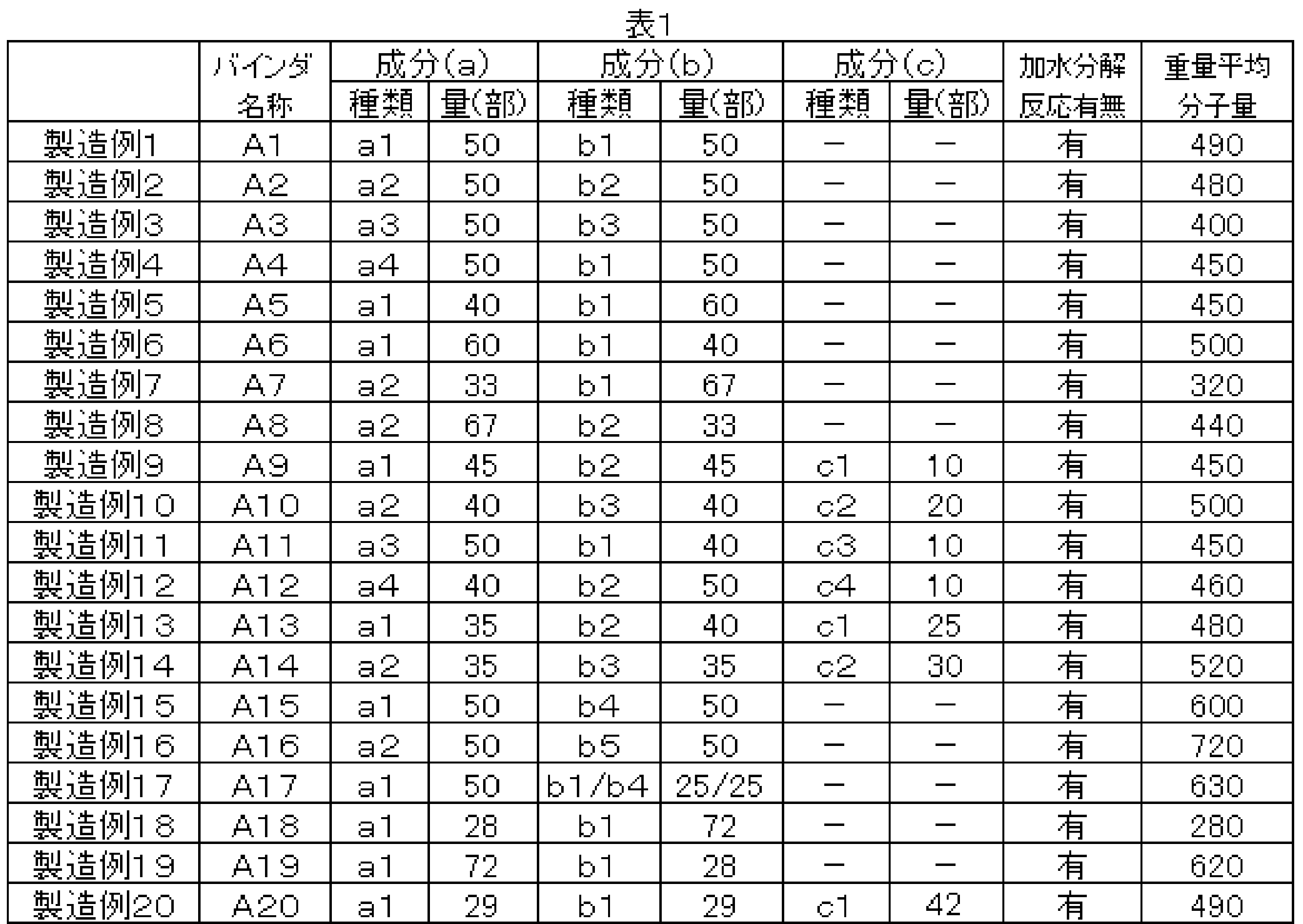
表1における成分(a)、成分(b)及び成分(c)の種類の欄の各記号は下記の意味を表す。
成分(a)
a1:テトラエトキシシラン
a2:テトラメトキシシラン
a3:テトラエトキシシラン低縮合物(平均縮合度2)
a4:テトラエトキシシラン低縮合物(平均縮合度5)
成分(b)
b1:γ-グリシドキシプロピルトリメトキシシラン
b2:γ-グリシドキシプロピルトリエトキシシラン
b3:γ-グリシドキシプロピルメチルジエトキシシラン
b4:3-アミノプロピルトリエトキシシラン
b5:N-(アミノエチル)3-アミノプロピルトリメトキシシラン
成分(c)
c1:トリエトキシエチルシラン
c2:トリメトキシプロピルシラン
c3:ジメトキシジエチルシラン
c4:トリメトキシプロピルシラン低縮合物(平均縮合度2)。
成分(a)
a1:テトラエトキシシラン
a2:テトラメトキシシラン
a3:テトラエトキシシラン低縮合物(平均縮合度2)
a4:テトラエトキシシラン低縮合物(平均縮合度5)
成分(b)
b1:γ-グリシドキシプロピルトリメトキシシラン
b2:γ-グリシドキシプロピルトリエトキシシラン
b3:γ-グリシドキシプロピルメチルジエトキシシラン
b4:3-アミノプロピルトリエトキシシラン
b5:N-(アミノエチル)3-アミノプロピルトリメトキシシラン
成分(c)
c1:トリエトキシエチルシラン
c2:トリメトキシプロピルシラン
c3:ジメトキシジエチルシラン
c4:トリメトキシプロピルシラン低縮合物(平均縮合度2)。
実施例1~44及び比較例1~12:水性金属表面処理剤の製造
脱イオン水中で、バインダならびに(d)、(e)及び(f)成分及びその他の添加成分を下記表2に示す組成にて混合し、pH調整して金属表面処理剤1kgを得た。表2中の各成分の量は、金属表面処理剤1kgを得るために配合した、バインダならびに下記(d)、(e)及び(f)成分の各成分及びその他の添加成分の量(g)を示す。製造例1~20で得たバインダA1~A20は、有効成分含量が20%であり、有効成分量にて表示する。バインダ以外の上記成分については、固形分量にて表示する。(f)成分の配合量については、(f)成分のZr換算質量と、バインダの一部を構成する(a)成分との質量比(f)/(a)も表示する。なお、金属表面処理剤のpH調整は、酢酸又はN,N-ジメチルアミノエタノールを使用して行った。また、各金属表面処理剤の貯蔵安定性の試験結果も表2に示す。貯蔵安定性の評価は、下記の方法に従って行った。
脱イオン水中で、バインダならびに(d)、(e)及び(f)成分及びその他の添加成分を下記表2に示す組成にて混合し、pH調整して金属表面処理剤1kgを得た。表2中の各成分の量は、金属表面処理剤1kgを得るために配合した、バインダならびに下記(d)、(e)及び(f)成分の各成分及びその他の添加成分の量(g)を示す。製造例1~20で得たバインダA1~A20は、有効成分含量が20%であり、有効成分量にて表示する。バインダ以外の上記成分については、固形分量にて表示する。(f)成分の配合量については、(f)成分のZr換算質量と、バインダの一部を構成する(a)成分との質量比(f)/(a)も表示する。なお、金属表面処理剤のpH調整は、酢酸又はN,N-ジメチルアミノエタノールを使用して行った。また、各金属表面処理剤の貯蔵安定性の試験結果も表2に示す。貯蔵安定性の評価は、下記の方法に従って行った。
貯蔵安定性:各表面処理剤を40℃の恒温槽に30日間保管した後、表面処理剤の外観を目視により観察し、次の基準で評価する。
◎ :変化なし
○ :わずかな沈殿が見られる
△ :かなりの沈殿が見られる、又はかなりの粘度上昇がみられる
× :大量の沈殿が見られる、又はゲル化している。
◎ :変化なし
○ :わずかな沈殿が見られる
△ :かなりの沈殿が見られる、又はかなりの粘度上昇がみられる
× :大量の沈殿が見られる、又はゲル化している。
上記表2に記載のバインダA21~A40の組成(成分(a)、(b)及び(c)の合計100質量部あたりの配合割合)は下記表3に示すとおりである。

また、前記表2における(d)成分、(e)成分及び(f)成分の種類の欄の各記号ならびにその他の添加成分の種類の欄の各記号は下記の意味を有する。
(d)成分
d1:1-ヒドロキシエタン-1,1-ジホスホン酸、
d2:1-ヒドロキシメタン-1,1-ジホスホン酸、
d3:オルトリン酸、
(e)成分
e1:メタバナジン酸アンモニウム 〔NH4VO3〕、
e2:メタバナジン酸ナトリウム 〔NaVO3〕、
(f)成分
f1:炭酸ジルコニルアンモニウム 〔(NH4)2ZrO(CO3)2〕、
f2:炭酸ジルコニルナトリウム 〔Na2ZrO(CO3)2〕、
その他の添加成分
h1:チタン弗化アンモニウム 〔(NH4)2TiF6〕
h2:硝酸アルミニウム・九水塩 〔Al(NO3)3・9(H2O)〕
j:ポリエチレンワックス(三井化学(株)製、商品名「ケミパールW-700」)、
k:アクリル樹脂エマルション(ヘンケルジャパン(株)製、商品名「ヨドゾールAD123」)。
(d)成分
d1:1-ヒドロキシエタン-1,1-ジホスホン酸、
d2:1-ヒドロキシメタン-1,1-ジホスホン酸、
d3:オルトリン酸、
(e)成分
e1:メタバナジン酸アンモニウム 〔NH4VO3〕、
e2:メタバナジン酸ナトリウム 〔NaVO3〕、
(f)成分
f1:炭酸ジルコニルアンモニウム 〔(NH4)2ZrO(CO3)2〕、
f2:炭酸ジルコニルナトリウム 〔Na2ZrO(CO3)2〕、
その他の添加成分
h1:チタン弗化アンモニウム 〔(NH4)2TiF6〕
h2:硝酸アルミニウム・九水塩 〔Al(NO3)3・9(H2O)〕
j:ポリエチレンワックス(三井化学(株)製、商品名「ケミパールW-700」)、
k:アクリル樹脂エマルション(ヘンケルジャパン(株)製、商品名「ヨドゾールAD123」)。
実施例45
板厚0.8mm及び目付量20/20(g/m2)の電気亜鉛めっき鋼板(以下、「EG」と略称することがある)に、アルカリ脱脂剤(日本シービーケミカル社製、商品名「ケミクリーナー561B」)を溶解した濃度2%の水溶液を、60℃の温度条件で2分間スプレー処理することにより脱脂し、水洗し、乾燥した後、この鋼板の表面に、上記実施例1で得た金属表面処理剤をロールコータにて塗装し、素材到達温度が100℃になるようにして20秒間焼付けて表面処理剤皮膜の付着量が0.4g/m2の表面処理板を得た。
板厚0.8mm及び目付量20/20(g/m2)の電気亜鉛めっき鋼板(以下、「EG」と略称することがある)に、アルカリ脱脂剤(日本シービーケミカル社製、商品名「ケミクリーナー561B」)を溶解した濃度2%の水溶液を、60℃の温度条件で2分間スプレー処理することにより脱脂し、水洗し、乾燥した後、この鋼板の表面に、上記実施例1で得た金属表面処理剤をロールコータにて塗装し、素材到達温度が100℃になるようにして20秒間焼付けて表面処理剤皮膜の付着量が0.4g/m2の表面処理板を得た。
実施例46~98及び比較例13~24
上記実施例45において、下記表4に示す仕様に従い、脱脂された各鋼板上に各金属表面処理剤を塗装し、焼付けする以外は実施例45と同様の操作を行い、各表面処理板を得た。
上記実施例45において、下記表4に示す仕様に従い、脱脂された各鋼板上に各金属表面処理剤を塗装し、焼付けする以外は実施例45と同様の操作を行い、各表面処理板を得た。
表4において、金属基材の種類の欄に記載の各略号は下記の意味を有する。なお、めっき目付量は表面と裏面のそれぞれの目付量を表示する。
EG:板厚0.8mm及びめっき目付量20/20(g/m2)の電気亜鉛めっき鋼板
GI:板厚0.8mm及びめっき目付量60/60(g/m2)の溶融亜鉛めっき鋼板
GA:板厚0.8mm及びめっき目付量40/40(g/m2)の鉄-亜鉛合金化溶融亜鉛めっき鋼板
GL:板厚0.8mm及びめっき目付量60/60(g/m2)のアルミニウム-亜鉛合金メッキ鋼板、合金中アルミニウムを約55%含有。
EG:板厚0.8mm及びめっき目付量20/20(g/m2)の電気亜鉛めっき鋼板
GI:板厚0.8mm及びめっき目付量60/60(g/m2)の溶融亜鉛めっき鋼板
GA:板厚0.8mm及びめっき目付量40/40(g/m2)の鉄-亜鉛合金化溶融亜鉛めっき鋼板
GL:板厚0.8mm及びめっき目付量60/60(g/m2)のアルミニウム-亜鉛合金メッキ鋼板、合金中アルミニウムを約55%含有。
得られた各表面処理板について、下記試験方法に従い性能試験を行った。その試験結果も後記表4に示す。
〔試験方法〕
塗装性(塗膜外観):各表面処理板を目視により観察し、下記の基準により評価する。
a:ムラが全く認められず、全面が均一な色相である
b:虹色状のムラがわずかに認められるが、実用上問題の無い程度である
c:虹色状のムラがかなり認められ、実用上問題がある。
塗装性(塗膜外観):各表面処理板を目視により観察し、下記の基準により評価する。
a:ムラが全く認められず、全面が均一な色相である
b:虹色状のムラがわずかに認められるが、実用上問題の無い程度である
c:虹色状のムラがかなり認められ、実用上問題がある。
耐食性試験(初期耐食性及び脱脂後耐食性):
初期耐食性は、得られた各表面処理板について、下記の塩水噴霧試験により評価する。
初期耐食性は、得られた各表面処理板について、下記の塩水噴霧試験により評価する。
脱脂後耐食性は、得られた各表面処理板に、アルカリ脱脂剤(日本パーカライジング社製、商品名「パルクリーンCL-N364S」)を溶解した濃度2%の水溶液を、60℃の温度で2分間スプレー処理することにより脱脂し、水洗し、乾燥した後の表面処理板について、下記の塩水噴霧試験により評価する。
(塩水噴霧試験)各表面処理板の端面部及び裏面部をシールし、JIS Z 2371による塩水噴霧試験(SST)により、試験時間120時間及び240時間での錆の発生程度を目視により観察し、下記の基準により評価する。
a:錆発生が認められない
b:錆発生が全面積の5%未満
c:錆発生が全面積の5%以上でかつ10%未満
d:錆発生が全面積の10%以上でかつ50%未満
e:錆発生が全面積の50%以上。
a:錆発生が認められない
b:錆発生が全面積の5%未満
c:錆発生が全面積の5%以上でかつ10%未満
d:錆発生が全面積の10%以上でかつ50%未満
e:錆発生が全面積の50%以上。
密着性試験:各表面処理板の表面処理剤皮膜面に、カッターナイフにて素地に達するように、10mm四方に1mm×1mmの正方形が100個となるよう碁盤目の切込みを入れた。この碁盤目部が外側に押出されるように、エリクセン試験(7mm押し出し)を行った後、押出された加工部にセロハン粘着テープを密着させ、瞬時に剥離して、表面処理剤皮膜の剥離の程度を次の基準で評価する。
◎:表面処理剤皮膜の剥離が認められない
×:表面処理剤皮膜の剥離が認められる。
◎:表面処理剤皮膜の剥離が認められない
×:表面処理剤皮膜の剥離が認められる。
導電性試験:導電性測定装置(三菱化学アナリテック(株)製、ロレスタGP、ASP端子)を用いて、表面処理板の任意の10箇所の表面抵抗値を測定し、10-4Ω以下を示す回数で評価する。
a :10回すべて
b :6~9回
c :1~5回
d :0回。
a :10回すべて
b :6~9回
c :1~5回
d :0回。
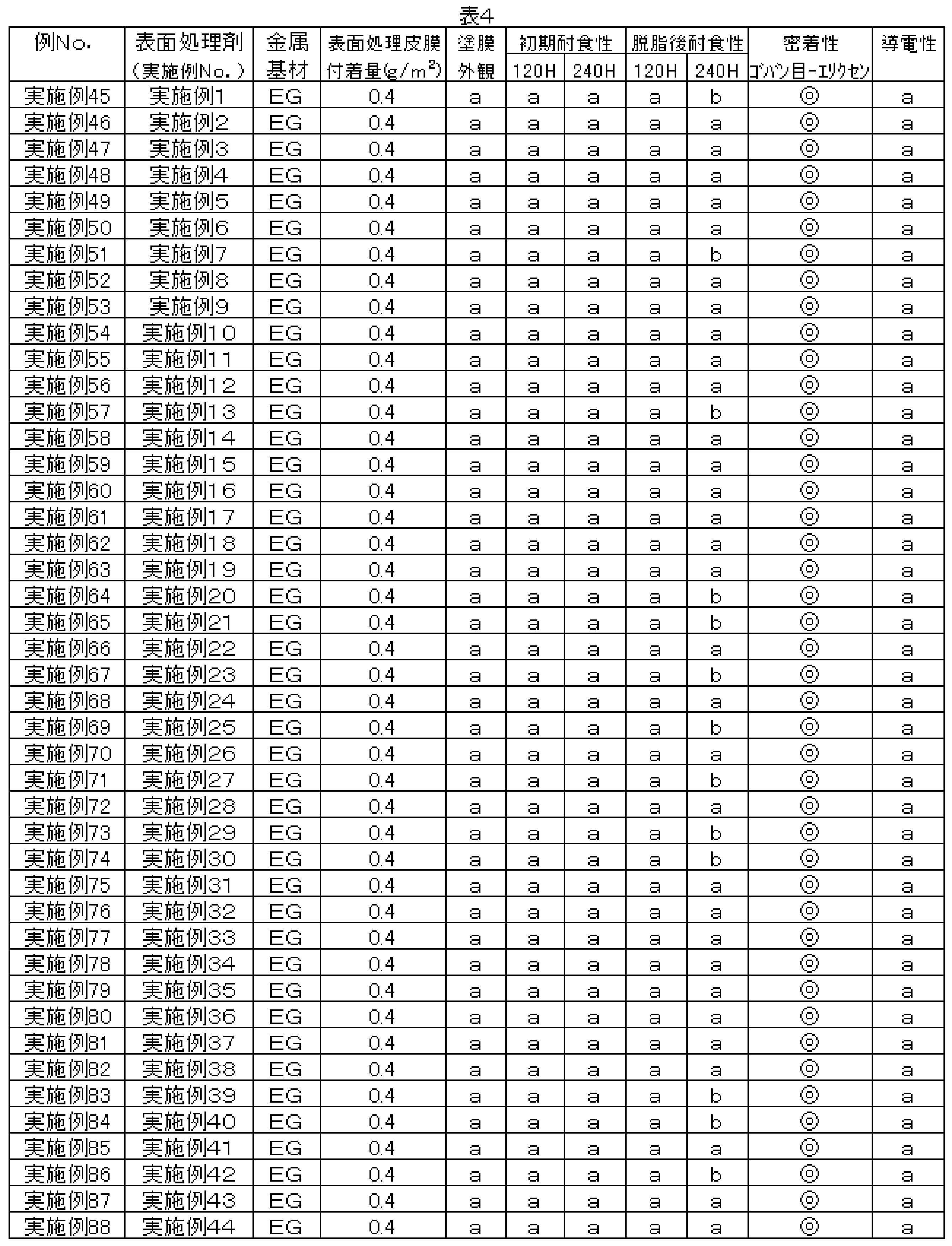

上記の試験結果から明らかなように、本発明の水性金属表面処理剤は、塗装性及び貯蔵安定性に優れ、本発明の水性金属表面処理剤から形成される処理剤皮膜は、塗膜外観、耐食性、密着性及び導電性のすべてを満足するものである。
実施例99~142及び比較例25~36:水性金属表面処理剤の製造
脱イオン水中で、バインダならびに(d)、(e)及び(f’)成分及びその他の添加成分を下記表5に示す組成にて混合し、pH調整して金属表面処理剤1kgを得た。表5中の各成分の量は、金属表面処理剤1kgを得るために配合した、バインダならびに下記(d)、(e)及び(f’)成分の各成分及びその他の添加成分の量(g)を示す。製造例1~20で得たバインダA1~A20は、有効成分含量が20%であり、有効成分量にて表示する。バインダ以外の上記成分については、固形分量にて表示する。なお、金属表面処理剤のpH調整は、酢酸又はN,N-ジメチルアミノエタノールを使用して行った。また、各金属表面処理剤の貯蔵安定性の試験結果も表5に示す。貯蔵安定性の評価は、前記表2におけると同じ方法に従って行った。
脱イオン水中で、バインダならびに(d)、(e)及び(f’)成分及びその他の添加成分を下記表5に示す組成にて混合し、pH調整して金属表面処理剤1kgを得た。表5中の各成分の量は、金属表面処理剤1kgを得るために配合した、バインダならびに下記(d)、(e)及び(f’)成分の各成分及びその他の添加成分の量(g)を示す。製造例1~20で得たバインダA1~A20は、有効成分含量が20%であり、有効成分量にて表示する。バインダ以外の上記成分については、固形分量にて表示する。なお、金属表面処理剤のpH調整は、酢酸又はN,N-ジメチルアミノエタノールを使用して行った。また、各金属表面処理剤の貯蔵安定性の試験結果も表5に示す。貯蔵安定性の評価は、前記表2におけると同じ方法に従って行った。

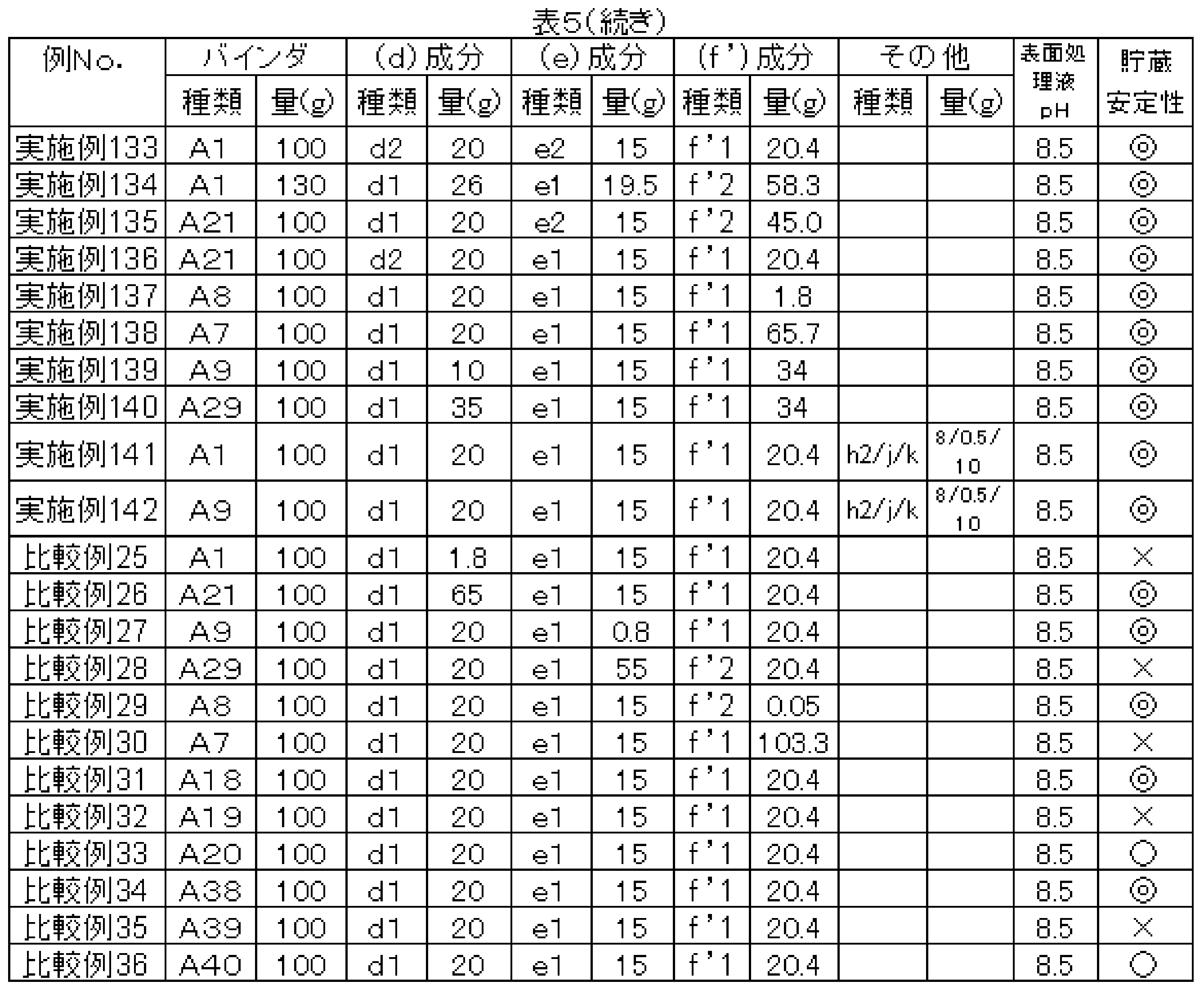
上記表5に記載のバインダA21~A40の組成(成分(a)、(b)及び(c)の合計100質量部あたりの配合割合)は前記表3に示すとおりである。
また、上記表5における(d)成分及び(e)成分ならびにその他の添加成分の種類の欄の各記号は前記表2におけると同じ意味を有し、そして(f’)成分の種類の欄の各記号は下記の意味を表す。
(f’)成分
f’1:チタン弗化アンモニウム 〔(NH4)2TiF6〕、
f’2:弗化チタン酸 〔H2TiF6〕。
また、上記表5における(d)成分及び(e)成分ならびにその他の添加成分の種類の欄の各記号は前記表2におけると同じ意味を有し、そして(f’)成分の種類の欄の各記号は下記の意味を表す。
(f’)成分
f’1:チタン弗化アンモニウム 〔(NH4)2TiF6〕、
f’2:弗化チタン酸 〔H2TiF6〕。
実施例143
板厚0.8mm及び目付量20/20(g/m2)の電気亜鉛めっき鋼板(EG)に、アルカリ脱脂剤(日本シービーケミカル社製、商品名「ケミクリーナー561B」)を溶解した濃度2%の水溶液を、60℃の温度条件で2分間スプレー処理することにより脱脂し、水洗し、乾燥した後、この鋼板の表面に、上記実施例99で得た金属表面処理剤をロールコータにて塗装し、素材到達温度が100℃になるようにして20秒間焼付けて表面処理剤皮膜の付着量が0.4g/m2の表面処理板を得た。
板厚0.8mm及び目付量20/20(g/m2)の電気亜鉛めっき鋼板(EG)に、アルカリ脱脂剤(日本シービーケミカル社製、商品名「ケミクリーナー561B」)を溶解した濃度2%の水溶液を、60℃の温度条件で2分間スプレー処理することにより脱脂し、水洗し、乾燥した後、この鋼板の表面に、上記実施例99で得た金属表面処理剤をロールコータにて塗装し、素材到達温度が100℃になるようにして20秒間焼付けて表面処理剤皮膜の付着量が0.4g/m2の表面処理板を得た。
実施例144~196及び比較例37~48
上記実施例143において、下記表6に示す仕様に従い、脱脂された各鋼板上に各金属表面処理剤を塗装し、焼付けする以外は実施例143と同様の操作を行い、各表面処理板を得た。
上記実施例143において、下記表6に示す仕様に従い、脱脂された各鋼板上に各金属表面処理剤を塗装し、焼付けする以外は実施例143と同様の操作を行い、各表面処理板を得た。
表6において、金属基材の種類の欄に記載の各略号は前記表4におけると同じ意味を有する。
得られた各表面処理板について、前記表4におけると同じ試験方法に基づき性能試験を行った。その試験結果を下記表6に示す。
得られた各表面処理板について、前記表4におけると同じ試験方法に基づき性能試験を行った。その試験結果を下記表6に示す。

上記の試験結果から明らかなように、本発明の水性金属表面処理剤は、塗装性及び貯蔵安定性に優れ、本発明の水性金属表面処理剤から形成される処理剤皮膜は、塗膜外観、耐食性、密着性及び導電性のすべてを満足するものである。
Claims (15)
- (a) テトラアルコキシシラン及びテトラアルコキシシランの低縮合物の少なくとも1種 30~70質量部と、
(b) エポキシ基含有シランカップリング剤及びアミノ基含有シランカップリング剤から選ばれる少なくとも1種のシランカップリング剤 30~70質量部と、
(c) モノ-、ジ-もしくはトリ-アルコキシシランの少なくとも1種及び/又はモノ-、ジ-もしくはトリ-アルコキシシランの少なくとも1種の低縮合体 0~40質量部
の混合物(I)又は混合物(I)を加水分解縮合反応させることにより得られる加水分解縮合物(II)からなるバインダ成分(A)、
(d) リン酸化合物、
(e) バナジウム化合物、及び
(f) ジルコニウム化合物又は(f’) チタニウム化合物
を含有する水性金属表面処理剤であって、
上記(a)、(b)及び(c)成分の合計100質量部あたり、
リン酸化合物(d)を2~60質量部、及び
バナジウム化合物(e)を1~50質量部含有し、且つ
ジルコニウム化合物(f)を、該(f)成分のZr換算質量と上記(a)成分との質量比(f)/(a)が0.02以上で且つ1.0未満となる量で含有するか、又はチタニウム化合物(f’)を、上記(a)、(b)及び(c)成分の合計100質量部あたり、0.1~100質量部含有する
ことを特徴とする水性金属表面処理剤。 - バインダ成分(A)が、(a)、(b)及び(c)成分の合計100質量部あたり、(a)成分 40~60質量部と、(b)成分 40~60質量部と、(c)成分 0~20質量部の混合物又は該混合物を加水分解縮合反応させることにより得られる加水分解縮合物からなる請求項1に記載の水性金属表面処理剤。
- バインダ成分(A)が加水分解縮合物(II)である請求項1又は2に記載の水性金属表面処理剤。
- リン酸化合物(d)が1-ヒドロキシエタン-1,1-ジホスホン酸である請求項1~3のいずれか1項に記載の水性金属表面処理剤。
- バナジウム化合物(e)がメタバナジン酸アンモニウムである請求項1~4のいずれか1項に記載の水性金属表面処理剤。
- ジルコニウム化合物(f)が炭酸ジルコニルアンモニウム〔(NH4)2ZrO(CO3)2〕又は炭酸ジルコニルナトリウム〔Na2ZrO(CO3)2〕である請求項1~5のいずれか1項に記載の水性金属表面処理剤。
- チタニウム化合物(f’)がチタンフッ化水素酸(H2TiF6)又はチタンフッ化アンモニウム〔(NH4)2TiF6〕である請求項1~6のいずれか1項に記載の水性金属表面処理剤。
- (a)、(b)及び(c)成分の合計100質量部あたり、リン酸化合物(d)を10~35質量部及びバナジウム化合物(e)を5~20質量部含有する請求項1~7のいずれか1項に記載の水性金属表面処理剤。
- ジルコニウム化合物(f)を、該(f)成分のZr換算質量と上記(a)成分との質量比(f)/(a)が0.10~0.50の範囲内となる量で含有する請求項1~8のいずれか1項に記載の水性金属表面処理剤。
- チタニウム化合物(f’)を、上記(a)、(b)及び(c)成分の合計100質量部あたり、5~30質量部含有する請求項1~9のいずれか1項に記載の水性金属表面処理剤。
- 水性有機樹脂及び/又はワックスをさらに含有する請求項1~10のいずれか1項に記載の水性金属表面処理剤。
- 2~11の範囲内のpHを有する請求項1~11のいずれか1項に記載の水性金属表面処理剤。
- 金属材の表面上に、請求項1~12のいずれか1項に記載の水性金属表面処理剤を乾燥皮膜質量で0.05~1.5g/m2となるように塗装し、乾燥させることを特徴とする金属材の表面処理方法。
- 金属材が亜鉛系めっき鋼板である請求項13に記載の表面処理方法。
- 金属材の表面上に、請求項1~12のいずれか1項に記載の水性金属表面処理剤による皮膜が乾燥皮膜質量で0.05~1.5g/m2の量で付着せしめられた表面処理金属材。
Applications Claiming Priority (4)
| Application Number | Priority Date | Filing Date | Title |
|---|---|---|---|
| JP2011118593A JP2014156615A (ja) | 2011-05-27 | 2011-05-27 | 水性金属表面処理剤 |
| JP2011-118593 | 2011-05-27 | ||
| JP2011130269A JP2014156616A (ja) | 2011-06-10 | 2011-06-10 | 水性金属表面処理剤 |
| JP2011-130269 | 2011-06-10 |
Publications (1)
| Publication Number | Publication Date |
|---|---|
| WO2012165084A1 true WO2012165084A1 (ja) | 2012-12-06 |
Family
ID=47258948
Family Applications (1)
| Application Number | Title | Priority Date | Filing Date |
|---|---|---|---|
| PCT/JP2012/060881 Ceased WO2012165084A1 (ja) | 2011-05-27 | 2012-04-23 | 水性金属表面処理剤 |
Country Status (1)
| Country | Link |
|---|---|
| WO (1) | WO2012165084A1 (ja) |
Cited By (13)
| Publication number | Priority date | Publication date | Assignee | Title |
|---|---|---|---|---|
| WO2014122900A1 (ja) * | 2013-02-08 | 2014-08-14 | Jfeスチール株式会社 | 亜鉛系めっき鋼板用表面処理液ならびに表面処理皮膜付き亜鉛系めっき鋼板およびその製造方法 |
| WO2015018875A1 (en) * | 2013-08-06 | 2015-02-12 | Henkel Ag & Co. Kgaa | Metal pretreatment compositions comprising silanes and organophosporus acids |
| JP5773107B1 (ja) * | 2013-11-29 | 2015-09-02 | Jfeスチール株式会社 | 表面処理皮膜付き亜鉛系めっき鋼板およびその製造方法 |
| JP2015175003A (ja) * | 2014-03-13 | 2015-10-05 | Jfeスチール株式会社 | 亜鉛系めっき鋼板用の表面処理液ならびに表面処理亜鉛系めっき鋼板およびその製造方法 |
| US10053583B2 (en) | 2013-08-06 | 2018-08-21 | Henkel Ag & Co. Kgaa | Metal pretreatment with acidic aqueous compositions comprising silanes |
| CN109486315A (zh) * | 2018-09-17 | 2019-03-19 | 上海威驭新材料科技有限公司 | 预处理底漆及采用该预处理底漆的卷钢彩涂方法 |
| JP2019526705A (ja) * | 2016-09-01 | 2019-09-19 | サン−ゴバン パフォーマンス プラスティックス コーポレイション | 化成皮膜および製造方法 |
| EP3845610A1 (en) * | 2019-12-31 | 2021-07-07 | Industrial Technology Research Institute | Water-based coating material and method for manufacturing the same |
| CN113122131A (zh) * | 2019-12-31 | 2021-07-16 | 财团法人工业技术研究院 | 水性涂料与其形成的方法 |
| WO2024052071A1 (en) * | 2022-09-06 | 2024-03-14 | Sika Technology Ag | Process for producing a storage-stable activator for glass and ceramic substrates |
| JP2025528260A (ja) * | 2022-08-25 | 2025-08-26 | バオシャン アイアン アンド スティール カンパニー リミテッド | 亜鉛メッキ鋼板用クロムフリー無機表面処理剤、完成亜鉛メッキ鋼板およびその製造方法 |
| WO2025211238A1 (ja) * | 2024-04-01 | 2025-10-09 | 東洋製罐グループホールディングス株式会社 | ガスバリア性塗膜形成用塗料組成物及びガスバリア性積層体 |
| JP2026116857A (ja) * | 2025-01-02 | 2026-07-14 | シャイニー ケミカル インダストリアル カンパニー リミテッド | 防食塗料及び防食塗料の製造方法 |
Citations (2)
| Publication number | Priority date | Publication date | Assignee | Title |
|---|---|---|---|---|
| JP2007177314A (ja) * | 2005-12-28 | 2007-07-12 | Nippon Paint Co Ltd | 金属表面処理用組成物、金属表面処理方法及び表面処理された亜鉛めっき鋼板 |
| WO2011052701A1 (ja) * | 2009-10-27 | 2011-05-05 | Jfeスチール株式会社 | 亜鉛系めっき鋼板 |
-
2012
- 2012-04-23 WO PCT/JP2012/060881 patent/WO2012165084A1/ja not_active Ceased
Patent Citations (2)
| Publication number | Priority date | Publication date | Assignee | Title |
|---|---|---|---|---|
| JP2007177314A (ja) * | 2005-12-28 | 2007-07-12 | Nippon Paint Co Ltd | 金属表面処理用組成物、金属表面処理方法及び表面処理された亜鉛めっき鋼板 |
| WO2011052701A1 (ja) * | 2009-10-27 | 2011-05-05 | Jfeスチール株式会社 | 亜鉛系めっき鋼板 |
Cited By (22)
| Publication number | Priority date | Publication date | Assignee | Title |
|---|---|---|---|---|
| CN105143514A (zh) * | 2013-02-08 | 2015-12-09 | 杰富意钢铁株式会社 | 镀锌钢板用表面处理液、带有表面处理被膜的镀锌钢板及其制造方法 |
| WO2014122900A1 (ja) * | 2013-02-08 | 2014-08-14 | Jfeスチール株式会社 | 亜鉛系めっき鋼板用表面処理液ならびに表面処理皮膜付き亜鉛系めっき鋼板およびその製造方法 |
| CN105143514B (zh) * | 2013-02-08 | 2017-05-10 | 杰富意钢铁株式会社 | 镀锌钢板用表面处理液、带有表面处理被膜的镀锌钢板及其制造方法 |
| JPWO2014122900A1 (ja) * | 2013-02-08 | 2017-01-26 | Jfeスチール株式会社 | 亜鉛系めっき鋼板用表面処理液ならびに表面処理皮膜付き亜鉛系めっき鋼板およびその製造方法 |
| US10106689B2 (en) | 2013-08-06 | 2018-10-23 | Henkel Ag & Co. Kgaa | Metal pretreatment compositions comprising silanes and organophosporus acids |
| CN106029947A (zh) * | 2013-08-06 | 2016-10-12 | 汉高股份有限及两合公司 | 包含硅烷和有机磷酸的金属预处理组合物 |
| US10053583B2 (en) | 2013-08-06 | 2018-08-21 | Henkel Ag & Co. Kgaa | Metal pretreatment with acidic aqueous compositions comprising silanes |
| WO2015018875A1 (en) * | 2013-08-06 | 2015-02-12 | Henkel Ag & Co. Kgaa | Metal pretreatment compositions comprising silanes and organophosporus acids |
| JP5773107B1 (ja) * | 2013-11-29 | 2015-09-02 | Jfeスチール株式会社 | 表面処理皮膜付き亜鉛系めっき鋼板およびその製造方法 |
| JP2015175003A (ja) * | 2014-03-13 | 2015-10-05 | Jfeスチール株式会社 | 亜鉛系めっき鋼板用の表面処理液ならびに表面処理亜鉛系めっき鋼板およびその製造方法 |
| JP2023100650A (ja) * | 2016-09-01 | 2023-07-19 | サン-ゴバン パフォーマンス プラスティックス コーポレイション | 化成皮膜および製造方法 |
| JP2019526705A (ja) * | 2016-09-01 | 2019-09-19 | サン−ゴバン パフォーマンス プラスティックス コーポレイション | 化成皮膜および製造方法 |
| JP7542107B2 (ja) | 2016-09-01 | 2024-08-29 | サン-ゴバン パフォーマンス プラスティックス コーポレイション | 化成皮膜および製造方法 |
| CN109486315A (zh) * | 2018-09-17 | 2019-03-19 | 上海威驭新材料科技有限公司 | 预处理底漆及采用该预处理底漆的卷钢彩涂方法 |
| CN113122131A (zh) * | 2019-12-31 | 2021-07-16 | 财团法人工业技术研究院 | 水性涂料与其形成的方法 |
| EP3845610A1 (en) * | 2019-12-31 | 2021-07-07 | Industrial Technology Research Institute | Water-based coating material and method for manufacturing the same |
| JP2025528260A (ja) * | 2022-08-25 | 2025-08-26 | バオシャン アイアン アンド スティール カンパニー リミテッド | 亜鉛メッキ鋼板用クロムフリー無機表面処理剤、完成亜鉛メッキ鋼板およびその製造方法 |
| JP7827934B2 (ja) | 2022-08-25 | 2026-03-10 | バオシャン アイアン アンド スティール カンパニー リミテッド | 亜鉛メッキ鋼板用クロムフリー無機表面処理剤、完成亜鉛メッキ鋼板およびその製造方法 |
| WO2024052071A1 (en) * | 2022-09-06 | 2024-03-14 | Sika Technology Ag | Process for producing a storage-stable activator for glass and ceramic substrates |
| WO2025211238A1 (ja) * | 2024-04-01 | 2025-10-09 | 東洋製罐グループホールディングス株式会社 | ガスバリア性塗膜形成用塗料組成物及びガスバリア性積層体 |
| JP2025155262A (ja) * | 2024-04-01 | 2025-10-14 | 東洋製罐グループホールディングス株式会社 | ガスバリア性塗膜形成用塗料組成物及びガスバリア性積層体 |
| JP2026116857A (ja) * | 2025-01-02 | 2026-07-14 | シャイニー ケミカル インダストリアル カンパニー リミテッド | 防食塗料及び防食塗料の製造方法 |
Similar Documents
| Publication | Publication Date | Title |
|---|---|---|
| US9200165B2 (en) | Surface treatment liquid for zinc or zinc alloy coated steel sheet, zinc or zinc alloy-coated steel sheet, and method for manufacturing the same | |
| CN103140605B (zh) | 镀锌系钢板 | |
| CN101573472B (zh) | 表面处理金属材料及其制造方法 | |
| JP6242010B2 (ja) | 水性金属表面処理組成物 | |
| JP4683582B2 (ja) | 水系金属材料表面処理剤、表面処理方法及び表面処理金属材料 | |
| KR101492485B1 (ko) | 아연계 도금 강판의 제조 방법 및 아연계 도금 강판 | |
| EP2495351B1 (en) | Zinc-coated steel plate | |
| KR101599167B1 (ko) | 아연계 도금 강판용의 표면 처리액과 아연계 도금 강판 및 그 제조 방법 | |
| JP5554531B2 (ja) | 金属材料の塗装方法 | |
| JP2014156615A (ja) | 水性金属表面処理剤 | |
| CN102245807A (zh) | 镀锌钢板用表面处理剂 | |
| WO2010114170A1 (ja) | 亜鉛系めっき鋼板 | |
| JP6569194B2 (ja) | 耐食性に優れた表面処理溶融亜鉛めっき鋼板 | |
| JP2008184659A (ja) | 表面処理金属材 | |
| JP6056792B2 (ja) | 亜鉛系めっき鋼板用の表面処理液ならびに表面処理亜鉛系めっき鋼板およびその製造方法 | |
| JP2014144456A (ja) | 金属材料の塗装方法 | |
| JP2014156616A (ja) | 水性金属表面処理剤 | |
| JP5528924B2 (ja) | 金属表面処理剤、表面処理金属材料、および金属表面処理方法 | |
| JP5438536B2 (ja) | 金属表面処理剤、表面処理金属材料、および金属表面処理方法 | |
| JP5489961B2 (ja) | 金属表面処理用組成物、及び表面処理皮膜を有する金属基材 | |
| JP5528925B2 (ja) | 金属表面処理剤、表面処理金属材料、および金属表面処理方法 | |
| JP2020084285A (ja) | 水性防錆表面処理組成物および表面被覆金属部材 | |
| CN116472362A (zh) | 有机树脂被覆用表面处理钢板及其制造方法和有机树脂被覆钢板及其制造方法 | |
| HK1134943B (en) | Surface-treated metal material and producing method thereof |
Legal Events
| Date | Code | Title | Description |
|---|---|---|---|
| 121 | Ep: the epo has been informed by wipo that ep was designated in this application |
Ref document number: 12792980 Country of ref document: EP Kind code of ref document: A1 |
|
| DPE1 | Request for preliminary examination filed after expiration of 19th month from priority date (pct application filed from 20040101) | ||
| NENP | Non-entry into the national phase |
Ref country code: DE |
|
| 122 | Ep: pct application non-entry in european phase |
Ref document number: 12792980 Country of ref document: EP Kind code of ref document: A1 |
|
| NENP | Non-entry into the national phase |
Ref country code: JP |