WO2012157658A1 - 硫黄変性クロロプレンゴム、成形体及び硫黄変性クロロプレンゴムの製造方法 - Google Patents
硫黄変性クロロプレンゴム、成形体及び硫黄変性クロロプレンゴムの製造方法 Download PDFInfo
- Publication number
- WO2012157658A1 WO2012157658A1 PCT/JP2012/062457 JP2012062457W WO2012157658A1 WO 2012157658 A1 WO2012157658 A1 WO 2012157658A1 JP 2012062457 W JP2012062457 W JP 2012062457W WO 2012157658 A1 WO2012157658 A1 WO 2012157658A1
- Authority
- WO
- WIPO (PCT)
- Prior art keywords
- sulfur
- modified chloroprene
- rubber
- chloroprene rubber
- amount
- Prior art date
- Legal status (The legal status is an assumption and is not a legal conclusion. Google has not performed a legal analysis and makes no representation as to the accuracy of the status listed.)
- Ceased
Links
Classifications
-
- C—CHEMISTRY; METALLURGY
- C08—ORGANIC MACROMOLECULAR COMPOUNDS; THEIR PREPARATION OR CHEMICAL WORKING-UP; COMPOSITIONS BASED THEREON
- C08G—MACROMOLECULAR COMPOUNDS OBTAINED OTHERWISE THAN BY REACTIONS ONLY INVOLVING UNSATURATED CARBON-TO-CARBON BONDS
- C08G75/00—Macromolecular compounds obtained by reactions forming a linkage containing sulfur with or without nitrogen, oxygen, or carbon in the main chain of the macromolecule
- C08G75/14—Polysulfides
-
- C—CHEMISTRY; METALLURGY
- C08—ORGANIC MACROMOLECULAR COMPOUNDS; THEIR PREPARATION OR CHEMICAL WORKING-UP; COMPOSITIONS BASED THEREON
- C08F—MACROMOLECULAR COMPOUNDS OBTAINED BY REACTIONS ONLY INVOLVING CARBON-TO-CARBON UNSATURATED BONDS
- C08F36/00—Homopolymers and copolymers of compounds having one or more unsaturated aliphatic radicals, at least one having two or more carbon-to-carbon double bonds
- C08F36/02—Homopolymers and copolymers of compounds having one or more unsaturated aliphatic radicals, at least one having two or more carbon-to-carbon double bonds the radical having only two carbon-to-carbon double bonds
- C08F36/04—Homopolymers and copolymers of compounds having one or more unsaturated aliphatic radicals, at least one having two or more carbon-to-carbon double bonds the radical having only two carbon-to-carbon double bonds conjugated
- C08F36/14—Homopolymers and copolymers of compounds having one or more unsaturated aliphatic radicals, at least one having two or more carbon-to-carbon double bonds the radical having only two carbon-to-carbon double bonds conjugated containing elements other than carbon and hydrogen
- C08F36/16—Homopolymers and copolymers of compounds having one or more unsaturated aliphatic radicals, at least one having two or more carbon-to-carbon double bonds the radical having only two carbon-to-carbon double bonds conjugated containing elements other than carbon and hydrogen containing halogen
- C08F36/18—Homopolymers and copolymers of compounds having one or more unsaturated aliphatic radicals, at least one having two or more carbon-to-carbon double bonds the radical having only two carbon-to-carbon double bonds conjugated containing elements other than carbon and hydrogen containing halogen containing chlorine
-
- F—MECHANICAL ENGINEERING; LIGHTING; HEATING; WEAPONS; BLASTING
- F16—ENGINEERING ELEMENTS AND UNITS; GENERAL MEASURES FOR PRODUCING AND MAINTAINING EFFECTIVE FUNCTIONING OF MACHINES OR INSTALLATIONS; THERMAL INSULATION IN GENERAL
- F16G—BELTS, CABLES, OR ROPES, PREDOMINANTLY USED FOR DRIVING PURPOSES; CHAINS; FITTINGS PREDOMINANTLY USED THEREFOR
- F16G1/00—Driving-belts
- F16G1/06—Driving-belts made of rubber
-
- F—MECHANICAL ENGINEERING; LIGHTING; HEATING; WEAPONS; BLASTING
- F16—ENGINEERING ELEMENTS AND UNITS; GENERAL MEASURES FOR PRODUCING AND MAINTAINING EFFECTIVE FUNCTIONING OF MACHINES OR INSTALLATIONS; THERMAL INSULATION IN GENERAL
- F16G—BELTS, CABLES, OR ROPES, PREDOMINANTLY USED FOR DRIVING PURPOSES; CHAINS; FITTINGS PREDOMINANTLY USED THEREFOR
- F16G5/00—V-belts, i.e. belts of tapered cross-section
- F16G5/04—V-belts, i.e. belts of tapered cross-section made of rubber
-
- F—MECHANICAL ENGINEERING; LIGHTING; HEATING; WEAPONS; BLASTING
- F16—ENGINEERING ELEMENTS AND UNITS; GENERAL MEASURES FOR PRODUCING AND MAINTAINING EFFECTIVE FUNCTIONING OF MACHINES OR INSTALLATIONS; THERMAL INSULATION IN GENERAL
- F16L—PIPES; JOINTS OR FITTINGS FOR PIPES; SUPPORTS FOR PIPES, CABLES OR PROTECTIVE TUBING; MEANS FOR THERMAL INSULATION IN GENERAL
- F16L11/00—Hoses, i.e. flexible pipes
- F16L11/04—Hoses, i.e. flexible pipes made of rubber or flexible plastics
-
- C—CHEMISTRY; METALLURGY
- C08—ORGANIC MACROMOLECULAR COMPOUNDS; THEIR PREPARATION OR CHEMICAL WORKING-UP; COMPOSITIONS BASED THEREON
- C08C—TREATMENT OR CHEMICAL MODIFICATION OF RUBBERS
- C08C19/00—Chemical modification of rubber
- C08C19/20—Incorporating sulfur atoms into the molecule
Definitions
- the present invention relates to a sulfur-modified chloroprene rubber, a molded body, and a method for producing a sulfur-modified chloroprene rubber.
- sulfur-modified chloroprene rubber, molded products, and sulfur-modified chloroprene rubber which are suitable as materials for rubber products used in dynamic environments such as transmission belts and conveyor belts for general industries, air springs for automobiles, and vibration-proof rubber. It relates to a manufacturing method.
- Sulfur-modified chloroprene rubber is used as a material for power transmission belts and conveyor belts for general industries, air springs for automobiles, anti-vibration rubber, etc., taking advantage of its excellent dynamic characteristics. These products have a problem that the product life is shortened due to deterioration as the use environment temperature rises. For this reason, the development of sulfur-modified chloroprene rubber with improved heat resistance has been demanded.
- Patent Documents 1 and 2 alone is not sufficient to improve heat resistance, and it cannot be said that heat resistance is still sufficient particularly under severe use conditions. Therefore, there has been a demand for the development of sulfur-modified chloroprene rubber having dramatically improved heat resistance in order to cope with increasingly severe usage environments.
- the main object of the present invention is to provide a sulfur-modified chloroprene rubber having improved heat resistance, a molded body using the sulfur-modified chloroprene rubber, and a method for producing the sulfur-modified chloroprene rubber.
- the sulfur-modified chloroprene rubber of the present invention is mainly composed of a sulfur-modified chloroprene polymer having sulfur in the molecule obtained by emulsion polymerization of chloroprene alone or chloroprene and another monomer in the presence of sulfur.
- the polymerization rate of the sulfur-modified chloroprene polymer may be 60 to 95%.
- the sulfur-modified chloroprene rubber may be obtained by emulsion polymerization of a raw material monomer containing 10% by mass or less of a monomer copolymerizable with chloroprene.
- the molded object of this invention is obtained using the sulfur-modified chloroprene rubber mentioned above. Examples of the molded body include transmission belts and conveyor belts for general industries, vibration proof rubber, automobile air springs, hoses and sponges.
- the method for producing a sulfur-modified chloroprene rubber provides a sulfur-modified chloroprene polymer having sulfur in the molecule by emulsion polymerization of chloroprene alone or chloroprene and another monomer in the presence of sulfur. And a step of isolating the sulfur-modified chloroprene rubber from the polymerization solution obtained in the polymerization step by a freeze-coagulation method, and the amount of bound sulfur bound to the sulfur-modified chloroprene polymer is a rubber.
- the ratio (bound sulfur amount / total sulfur amount) between the amount of bound sulfur (mass%) and the total amount of sulfur (mass%) contained in the entire rubber is 0.2 to 0.6% by mass per total amount.
- the method for producing the sulfur-modified chloroprene rubber includes the step of isolating the sulfur-modified chloroprene rubber before isolating the sulfur-modified chloroprene rubber by the freeze-coagulation method before isolating the sulfur-modified chloroprene rubber.
- the polymerization may be performed until the polymerization rate of the sulfur-modified chloroprene polymer becomes 60 to 95%.
- a raw material monomer containing 10% by mass or less of the other monomer may be subjected to emulsion polymerization.
- a sulfur-modified chloroprene rubber having improved heat resistance a molded body using the sulfur-modified chloroprene rubber, and a method for producing the sulfur-modified chloroprene rubber are provided.
- the sulfur-modified chloroprene rubber of this embodiment is a monomer 1 that can be copolymerized with 2-chloro-1,3-butadiene (hereinafter referred to as chloroprene) alone or with chloroprene in the presence of sulfur (S 8 ).
- the main component is a sulfur-modified chloroprene polymer obtained by emulsion polymerization of at least seeds.
- the amount of bound sulfur bonded to the sulfur-modified chloroprene polymer is 0.2 to 0.6% by mass with respect to the total amount of rubber, and the amount of bound sulfur (% by mass)
- the ratio (bound sulfur amount / total sulfur amount) to the total amount (mass%) of sulfur contained in the entire rubber is set to 0.28 to 0.5.
- Examples of monomers that can be copolymerized with chloroprene include 2,3-dichloro-1,3-butadiene, 1-chloro-1,3-butadiene, styrene, acrylonitrile, methacrylonitrile, isoprene, butadiene, and methacrylic acid. And esters thereof.
- the content thereof is adjusted to a range that does not impair the properties of the resulting sulfur-modified chloroprene rubber, preferably within a range of 10% by mass or less of the raw material monomer.
- the crystallization rate of the resulting sulfur-modified chloroprene rubber can be slowed.
- Sulfur-modified chloroprene rubber having a slow crystallization rate can maintain rubber elasticity even in a low temperature environment.
- the amount of bound sulfur is 0.2 to 0.6% by mass with respect to the total amount of rubber.
- the bonded sulfur refers to a sulfur atom that is chemically bonded to the main chain of the sulfur-modified chloroprene polymer or its terminal site.
- S 8 Sulfur (S 8 ) and sulfur-containing compounds such as polymerization catalyst, anti-aging agent, polymerization inhibitor, plasticizer, etc. are removed and then freeze-dried to obtain a sample, which is described in JIS K 6233-1. It can be measured by the oxygen combustion flask method.
- the sulfur-modified chloroprene polymer contained in the sulfur-modified chloroprene rubber of the present embodiment has a scorch time of the resulting sulfur-modified chloroprene rubber that is extremely short if the amount of bound sulfur is less than 0.2% by mass, and is molded. It will harden in the middle. On the other hand, if the amount of bound sulfur exceeds 0.6% by mass, the resulting sulfur-modified chloroprene rubber becomes too sticky to the metal and cannot be processed. It is more preferable that the amount of bound sulfur is in the range of 0.25 to 0.5% by mass because the effect of improving the heat resistance of the resulting sulfur-modified chloroprene rubber is great.
- sulfur (S 8 ) added at the time of polymerization or a sulfur-containing compound such as a polymerization catalyst, an antioxidant, a polymerization inhibitor, or a plasticizer containing a sulfur atom in the molecule. It is only necessary to adjust the addition amount, adjust the pH of the polymerization solution (finishing pH), or adjust the polymerization rate of the polymer before isolating the sulfur-modified chloroprene rubber by the conventional freeze-coagulation method. .
- the ratio (bound sulfur amount / total sulfur amount) between the amount (% by mass) of bound sulfur of the sulfur-modified chloroprene polymer and the total amount (% by mass) of sulfur contained in the entire rubber is adjusted to 0.28 to 0.5.
- the total amount of sulfur represents the total content of all sulfur contained in the entire sulfur-modified chloroprene rubber. That is, sulfur such as the above-mentioned bound sulfur, sulfur not bound to the sulfur-modified chloroprene polymer (S 8 ), a polymerization catalyst contained in the sulfur-modified chloroprene rubber, an antioxidant, a polymerization inhibitor, and a plasticizer. It is the total measurement (mass%) of the sulfur content contained in the contained compound.
- the total amount of sulfur in the sulfur-modified chloroprene rubber can be directly measured by the oxygen combustion flask method described in JIS K 6233-1 without purifying the obtained sulfur-modified chloroprene rubber.
- the method for producing a sulfur-modified chloroprene rubber according to this embodiment includes a sulfur-modified chloroprene having sulfur in the molecule by emulsion polymerization of a chloroprene monomer alone or a chloroprene monomer and another monomer in the presence of sulfur.
- This is a production method for obtaining a sulfur-modified chloroprene rubber of 0.5 to 0.5.
- a polymer is obtained by emulsion polymerization of chloroprene and, if necessary, one or more other monomers in the presence of sulfur.
- the amount of sulfur (S 8 ) to be added is preferably 0.1 to 0.9 parts by mass, more preferably 0. 3 to 0.7 parts by mass.
- a sulfur-modified chloroprene rubber excellent in mechanical properties, dynamic properties and processability can be obtained. If the amount of sulfur (S 8 ) is too small, the mechanical properties and dynamic properties of the resulting sulfur-modified chloroprene rubber may not be obtained. On the other hand, if the amount of sulfur (S 8 ) is too large, the resulting sulfur-modified chloroprene rubber may become too sticky to the metal and cannot be processed.
- rosin acids are suitable.
- the emulsifier may be used in combination with other commonly used emulsifiers and fatty acids described below.
- Other emulsifiers include, for example, metal salts of aromatic sulfonic acid formalin condensate, sodium dodecylbenzene sulfonate, potassium dodecylbenzene sulfonate, sodium alkyldiphenyl ether sulfonate, potassium alkyldiphenyl ether sulfonate, polyoxyethylene alkyl ether sulfonate Examples include sodium, sodium polyoxypropylene alkyl ether sulfonate, potassium polyoxyethylene alkyl ether sulfonate, potassium polyoxypropylene alkyl ether sulfonate, and the like.
- rosin acid means rosin acid, disproportionated rosin acid, alkali metal salt of disproportionated rosin
- aqueous alkaline soap solution composed of a mixture of an alkali metal salt of disproportionated rosin acid and a saturated or unsaturated fatty acid having 6 to 22 carbon atoms.
- constituent components of disproportionated rosin acid include sesquiterpene, 8,5-isopimalic acid, dihydropimalic acid, secodehydroabietic acid, dihydroabietic acid, deisopropyldehydroabietic acid, demethyldehydroabietic acid, and the like.
- the pH of the aqueous emulsion at the start of the emulsion polymerization is desirably 10.5 to 13.0, which allows stable polymerization.
- the aqueous emulsion refers to a mixed solution of a chloroprene monomer, a monomer copolymerizable with chloroprene, an emulsifier, sulfur (S 8 ) and the like immediately before the start of emulsion polymerization.
- S 8 sulfur
- the pH of the aqueous emulsion can be appropriately adjusted according to the amount of alkali components such as sodium hydroxide and potassium hydroxide present during emulsion polymerization.
- the polymerization temperature of emulsion polymerization is 0 to 55 ° C, preferably 30 to 55 ° C.
- potassium persulfate As the polymerization initiator, potassium persulfate, benzoyl peroxide, ammonium persulfate, hydrogen peroxide and the like used in normal radical polymerization are used.
- the polymerization is carried out at a polymerization rate of 60 to 95%, preferably 70 to 95%, and then stopped by adding a polymerization inhibitor.
- a polymerization rate of 60 to 95%, preferably 70 to 95%
- the chloroprene rubber excellent in heat resistance and workability is obtained. If the polymerization rate is too low, the amount of copolymerization with sulfur (S 8 ) is extremely small, and the heat resistance of the resulting sulfur-modified chloroprene rubber may not be improved. On the other hand, if the polymerization rate is too high, the processability of the resulting sulfur-modified chloroprene rubber may deteriorate due to the development of a branched structure or the formation of a gel.
- Examples of the polymerization inhibitor for the polymer of the sulfur-modified chloroprene rubber of the present embodiment include thiodiphenylamine, 4-tert-butylcatechol, 2,2'-methylenebis-4-methyl-6-tert-butylphenol, and the like.
- the unreacted monomer can be removed from the polymerization solution by a conventional method such as vacuum distillation.
- Sulfur-modified chloroprene rubber can be used with its Mooney viscosity lowered depending on the purpose.
- the method for reducing the Mooney viscosity of the sulfur-modified chloroprene rubber is not particularly limited.
- tetraalkylthiuram disulfide having an alkyl group having 1 to 7 carbon atoms dialkyl having an alkyl group having 1 to 7 carbon atoms.
- a method of cutting the molecular chain of the sulfur-modified chloroprene polymer by adding at least one plasticizer selected from dithiocarbamates can be applied.
- timing of adding these compounds may be added to the aqueous emulsion after emulsion polymerization before removing the unreacted monomer, or may be added to the aqueous emulsion after removing the unreacted monomer. . Further, although depending on the amount of plasticizer added, it is also possible to carry out a combination before and after removing the unreacted monomer.
- the sulfur-modified chloroprene rubber of the present embodiment can contain a small amount of stabilizer in the polymer in order to prevent Mooney viscosity change during storage.
- stabilizers include phenyl- ⁇ -naphthylamine, octylated diphenylamine, 2,6-di-tert-butyl-4-phenylphenol, 2,2′-methylenebis (4-methyl-6-tert- Butylphenol), 4,4′-thiobis- (6-tert-butyl-3-methylphenol), and the like.
- 4,4'-thiobis- (6-tert-butyl-3-methylphenol) is used.
- an isolation step is performed in which the sulfur-modified chloroprene rubber is isolated by a conventional freeze-coagulation method.
- a pH adjustment step of adjusting the pH of the polymerization solution to 5.5 to 7.5 with an acid such as acetic acid may be performed before the isolation step.
- the sulfur-modified chloroprene rubber of the present embodiment has an amount of bound sulfur of 0.2 to 0.6% by mass based on the total amount of rubber, and an amount (% by mass) of bound sulfur. Since the ratio of the total amount of sulfur contained (bound sulfur amount / sulfur total amount) is 0.28 to 0.5, the heat resistance is improved.
- the molded body of the present embodiment is formed by molding the sulfur-modified chloroprene rubber of the first embodiment described above, and is suitable as a molded body of a transmission belt, a conveyor belt, a vibration proof rubber, an air spring, a hose, a sponge, and the like. Can be used.
- examples of the molding method for producing the molded body of the present embodiment include extrusion molding, injection molding, compression molding, and calendar molding, but are not limited thereto.
- the heat-resistant sulfur-modified chloroprene rubber is used as a material, even if it is stimulated by heat, the rubber itself may be deteriorated by heat or the product life may be shortened. Can be suppressed.
- Example 1 [Production of sulfur-modified chloroprene rubber]
- 100 parts by mass of chloroprene monomer 100 parts by mass of chloroprene monomer, 0.7 parts by mass of sulfur, 105 parts by mass of pure water, 3.80 parts by mass of disproportionated potassium rosinate (manufactured by Harima Chemicals), hydroxylation 0.55 parts by mass of sodium and 0.5 parts by mass of a sodium salt of ⁇ -naphthalenesulfonic acid formalin condensate (trade name Demol N: manufactured by Kao Corporation) were added.
- 0.1 parts by mass of potassium persulfate was added as a polymerization initiator, and polymerization was performed at a polymerization temperature of 40 ° C.
- this polymerization-terminated latex is abbreviated as “latex”).
- the latex was cooled, acetic acid was added to adjust the pH of the latex to 6.0, and the polymer was isolated by a conventional freeze-coagulation method to obtain a sulfur-modified chloroprene rubber.
- the ratio of the amount of bound sulfur of the obtained sulfur-modified chloroprene polymer to the total amount of sulfur contained in the entire rubber was 0.36.
- the residual elongation at break of the obtained sample was 55%.
- ⁇ Compression set> Moreover, the compression set of the sample for evaluation was measured.
- the compression set at low temperature was measured in accordance with JIS K 6262 under test conditions of 0 ° C. and 70 hours.
- the compression set at low temperature of the obtained sample was 95%.
- the sulfur-modified chloroprene rubbers of Examples 1 to 8 are not inferior in compression set at a low temperature as compared with the sulfur-modified chloroprene rubbers of Comparative Examples 3 and 4, and are indicative of heat resistance. It was excellent in the residual elongation at break.
- Comparative Example 1 the combined sulfur of the sulfur-modified chloroprene polymer exceeded 0.6% by mass, and the sample could not be prepared because the sulfur-modified chloroprene rubber was stuck to the roll and could not be evaluated. Further, in Comparative Example 2, the amount of bound sulfur in the sulfur-modified chloroprene polymer was less than 0.2% by mass, and the sample could not be evaluated by scorching during kneading.
- Comparative Example 3 the ratio of the amount of bound sulfur of the sulfur-modified chloroprene polymer to the total amount of sulfur contained in the whole rubber (bound sulfur amount / total sulfur amount) is less than 0.28, that is, bound to the polymer. The residual elongation at break was inferior because there was an excess of sulfur that was not done.
- Comparative Example 4 the ratio of the amount of bound sulfur in the sulfur-modified chloroprene polymer to the total amount of sulfur contained in the entire rubber (bound sulfur amount / total sulfur amount) exceeds 0.5, and the polymer Since there was too little sulfur which did not couple
- Example 7 although the residual elongation at break was superior to those of Comparative Examples 1 to 4, the results were lower than those of other Examples, particularly Examples 1 to 6. This is considered to be due to the effect that the pH of the polymerization solution before isolation by the freeze-coagulation method exceeded 7.5 and the coagulation was insufficient when frozen.
- Example 8 the residual elongation at break was superior to those of Comparative Examples 1 to 4, but the results were lower than those of other Examples, particularly Examples 1 to 6. This is due to the fact that the pH of the polymerization solution before isolation by the freeze-coagulation method exceeds 5.5, and therefore aggregates are generated, and the aggregates are mixed into the isolated sulfur-modified chloroprene rubber. it is conceivable that.
- the compound used in the preparation of the heat resistance evaluation sample was mixed with the sulfur-modified chloroprene rubber prepared in Examples 1 to 8 using an 8-inch roll, and molded and vulcanized to obtain a transmission belt.
- the obtained transmission belt was excellent in heat resistance as in the heat resistance evaluation sample.
- the compounds used in the preparation of heat resistance evaluation samples were mixed with the sulfur-modified chloroprene rubber prepared in Examples 1 to 8 using an 8-inch roll, and molded and vulcanized to obtain a conveyor belt.
- the obtained conveyor belt was excellent in heat resistance similarly to the heat resistance evaluation sample.
- the compound used in the preparation of the heat resistance evaluation sample was mixed with the sulfur-modified chloroprene rubber prepared in Examples 1 to 8 using an 8-inch roll, and molded and vulcanized to obtain a vibration-proof rubber.
- the obtained anti-vibration rubber was excellent in heat resistance like the heat resistance evaluation sample.
- the sulfur-modified chloroprene rubber prepared in Examples 1 to 8 was mixed with the compound used in the preparation of the heat resistance evaluation sample using an 8-inch roll, and molded and vulcanized to obtain an automotive air spring.
- the obtained automobile air spring was excellent in heat resistance as in the heat resistance evaluation sample.
- the compound used in the preparation of the heat resistance evaluation sample was mixed with the sulfur-modified chloroprene rubber prepared in Examples 1 to 8 using an 8-inch roll, and molded and vulcanized to obtain a hose.
- the obtained hose was excellent in heat resistance similarly to the heat resistance evaluation sample.
- the sulfur-modified chloroprene rubber prepared in Examples 1 to 8 was mixed with the compound used in the preparation of the heat resistance evaluation sample using an 8-inch roll, and molded and vulcanized to obtain a sponge.
- the obtained sponge was excellent in heat resistance like the heat resistance evaluation sample.
Landscapes
- Engineering & Computer Science (AREA)
- General Engineering & Computer Science (AREA)
- Chemical & Material Sciences (AREA)
- Mechanical Engineering (AREA)
- Health & Medical Sciences (AREA)
- Chemical Kinetics & Catalysis (AREA)
- Medicinal Chemistry (AREA)
- Polymers & Plastics (AREA)
- Organic Chemistry (AREA)
- Addition Polymer Or Copolymer, Post-Treatments, Or Chemical Modifications (AREA)
- Polymerisation Methods In General (AREA)
Abstract
Description
硫黄変性クロロプレンゴムは、前記硫黄変性クロロプレン重合体の重合率が60~95%であってもよい。
また、硫黄変性クロロプレンゴムは、クロロプレンと共重合可能な単量体を10質量%以下含有する原料単量体を乳化重合したものであってもよい。
また、本発明の成形体は、上述した硫黄変性クロロプレンゴム用いて得られる。
成形体としては、一般産業用の伝動ベルトやコンベヤベルト、防振ゴム、自動車用空気バネ、ホース及びスポンジ等が挙げられる。
また、前記硫黄変性クロロプレンゴムの製造方法は、前記硫黄変性クロロプレンゴムを単離する工程の前に、前記凍結-凝固法で前記硫黄変性クロロプレンゴムを単離する前に、前記硫黄変性クロロプレン重合体を含有する重合液のpHを5.5~7.5に調整するpH調整工程を行ってもよい。
また、前記重合工程は、前記硫黄変性クロロプレン重合体の重合率が60~95%になるまで重合を行ってもよい。
また、前記重合工程では、前記他の単量体を10質量%以下含有する原料単量体を乳化重合してもよい。
<硫黄変性クロロプレンゴム>
まず、本発明の第1の実施形態の硫黄変性クロロプレンゴムについて説明する。本実施形態の硫黄変性クロロプレンゴムは、硫黄(S8)の存在下で、2-クロロ-1,3-ブタジエン(以下、クロロプレンという)単独または、クロロプレン及びこれと共重合可能な単量体1種以上を乳化重合させて得られた硫黄変性クロロプレン重合体を主成分とする。本実施形態の硫黄変性クロロプレン重合体は、硫黄変性クロロプレン重合体に結合している結合硫黄の量がゴム全量あたり0.2~0.6質量%であり、結合硫黄の量(質量%)と、ゴム全体に含まれる硫黄の総量(質量%)との比(結合硫黄量/硫黄総量)を0.28~0.5にしている。
本実施形態の硫黄変性クロロプレンゴムに含まれる硫黄変性クロロプレン重合体は、その結合硫黄の量をゴム全量あたり0.2~0.6質量%にしている。ここで、結合硫黄とは、硫黄変性クロロプレン重合体の主鎖やその末端部位に化学的に結合している硫黄原子をいう。硫黄変性クロロプレン重合体の結合硫黄の量は、硫黄変性クロロプレンゴムを、ベンゼン:メタノール=3:5の混合溶液で精製して、硫黄変性クロロプレンゴム重合体の主鎖やその末端部位に結合しなかった硫黄(S8)や、重合触媒、老化防止剤、重合禁止剤、可塑化剤等の硫黄含有化合物を除去した後、再度凍結乾燥して試料を得て、JIS K 6233-1に記載された酸素燃焼フラスコ法によって測定することができる。
本実施形態の硫黄変性クロロプレンゴムでは、硫黄変性クロロプレン重合体の結合硫黄の量(質量%)と、ゴム全体に含まれる硫黄の総量(質量%)との比(結合硫黄量/硫黄総量)を0.28~0.5の範囲に調節している。
次に、本発明の第1の実施形態に係る硫黄変性クロロプレンゴムの製造方法について説明する。本実施形態の硫黄変性クロロプレンゴムの製造方法は、硫黄の存在下で、クロロプレン単量体単独又はクロロプレン単量体と他の単量体とを乳化重合して分子中に硫黄を有する硫黄変性クロロプレン重合体を得る重合工程と、重合液から凍結-凝固法で硫黄変性クロロプレンゴムを単離する工程と、を有し、硫黄変性クロロプレン重合体に結合している結合硫黄の量がゴム全量あたり0.2~0.6質量%であり、結合硫黄の量(質量%)と、ゴム全体に含まれる硫黄の総量(質量%)との比(結合硫黄の量/硫黄の総量)が0.28~0.5である硫黄変性クロロプレンゴムを得る製造方法である。
次に、本発明の第2の実施形態に係る成形体について説明する。本実施形態の成形体は、前述した第1の実施形態の硫黄変性クロロプレンゴムを成形したものであり、伝動ベルトやコンベヤベルト、防振ゴム、空気バネ、ホース、スポンジ等の成形体として好適に用いることができる。
[硫黄変性クロロプレンゴムの作製]
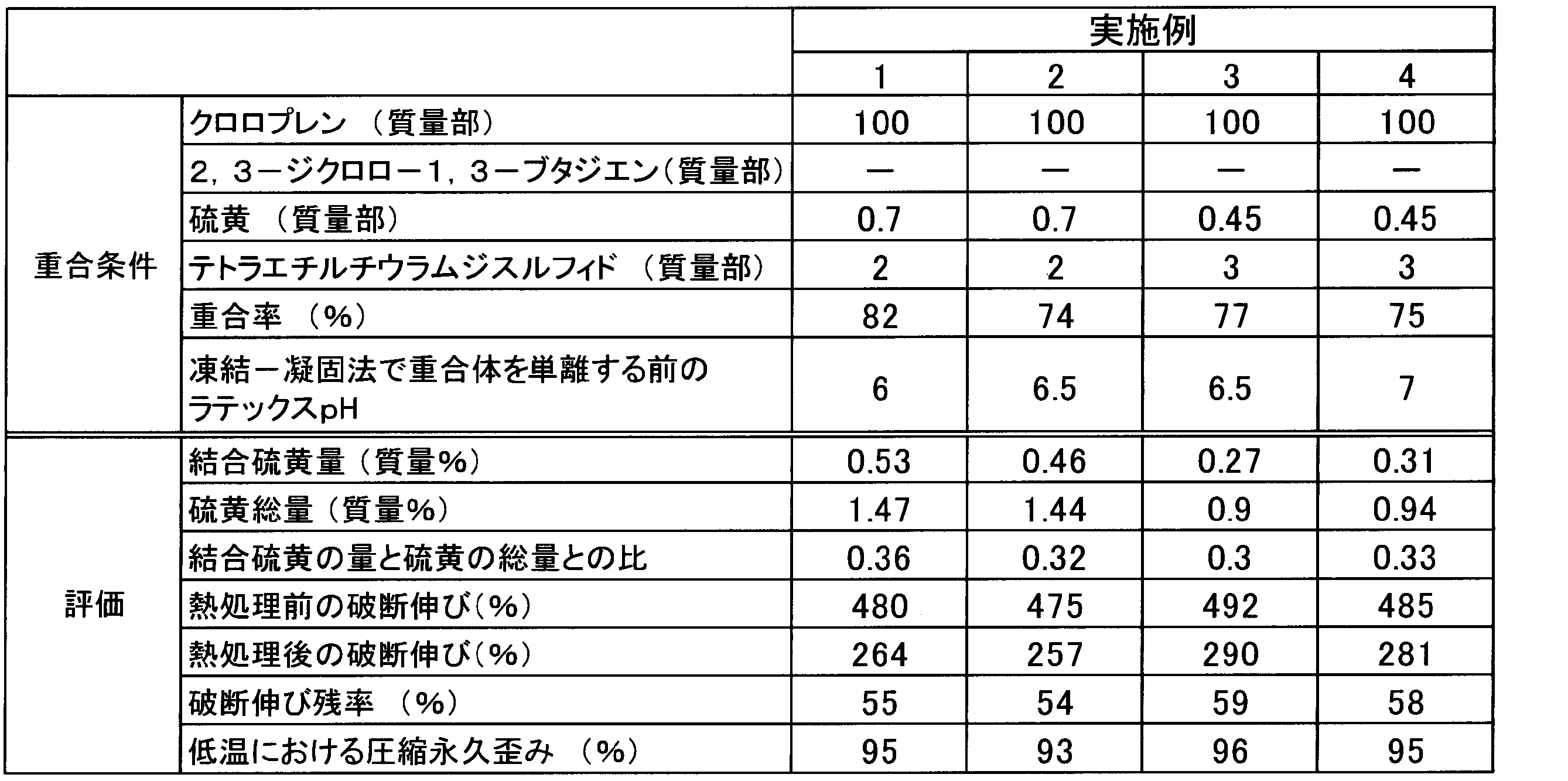
内容積30リットルの重合缶に、クロロプレン単量体100質量部、硫黄0.7質量部、純水105質量部、不均化ロジン酸カリウム(ハリマ化成社製)3.80質量部、水酸化ナトリウム0.55質量部、β-ナフタレンスルホン酸ホルマリン縮合物のナトリウム塩(商品名デモールN:花王社製)0.5質量部を添加した。重合開始剤として過硫酸カリウム0.1質量部を添加し、重合温度40℃にて窒素気流下で重合を行った。重合率82%となった時点で重合停止剤であるジエチルヒドロキシアミンを加えて重合を停止させた。重合終了後の重合液を減圧蒸留して未反応の単量体を除去して、可塑化前の重合終了ラテックスを得た(以下、この重合終了ラテックスを「ラテックス」と略称する。)。
結合硫黄の量は、得られた硫黄変性クロロプレンゴムをベンゼンとメタノールベンゼン:メタノール=3:5の混合溶液で精製して、再度凍結乾燥して試料を得て、JIS K 6233-1に定義された酸素燃焼フラスコ法によって測定した。得られた硫黄変性クロロプレンゴムの結合硫黄の量(質量%)は、0.53質量%であった。
得られた硫黄変性クロロプレンゴムを精製せずに、そのままJIS K 6233-1に記載された酸素燃焼フラスコ法によって硫黄の総量(質量%)を測定した。
得られた硫黄の総量と上述の結合硫黄の量から以下の式1により算出した。

硫黄変性クロロプレンゴム100質量部に、ステアリン酸1質量部、オクチル化ジフェニルアミン2質量部、酸化マグネシウム4質量部、カーボンブラック(SRF)40質量部、酸化亜鉛5.0質量部を、8インチロールを用いて混合し、160℃で20分間プレス架橋して評価用のサンプルを作製した。
作製した評価用のサンプルにつき、耐熱性の評価として、JIS K6257に準拠し、100℃×500時間の熱処理を行う前後の試験片の切断時伸び(%)を測定し、以下の式2を用いて破断伸び残率(%)を求めた。破断伸び残率(%)は、その値が大きいほど耐熱性が良いことを示す。

また、評価用のサンプルの圧縮永久歪みを測定した。低温における圧縮永久歪みは、JIS K 6262に準拠し、0℃、70時間の試験条件で測定した。
実施例1の重合条件のうち、表1~3に示したものを変更し、実施例1と同様にサンプルを作製して評価をした。


Claims (9)
- 硫黄の存在下で、クロロプレン単独又はクロロプレンと他の単量体とを乳化重合して得られた分子中に硫黄を有する硫黄変性クロロプレン重合体を主成分とする硫黄変性クロロプレンゴムであって、
前記硫黄変性クロロプレン重合体に結合している結合硫黄の量がゴム全量あたり0.2~0.6質量%であり、
前記結合硫黄の量(質量%)と、ゴム全体に含まれる硫黄の総量(質量%)との比(結合硫黄量/硫黄総量)が0.28~0.5である硫黄変性クロロプレンゴム。 - 前記硫黄変性クロロプレン重合体の重合率が60~95%であることを特徴とする請求項1に記載の硫黄変性クロロプレンゴム。
- 前記他の単量体を10質量%以下含有する原料単量体を乳化重合したものであることを特徴とする請求項1又は2に記載の硫黄変性クロロプレンゴム。
- 請求項1~3のいずれか一項に記載した硫黄変性クロロプレンゴムを用いた成形体。
- 伝動ベルト、コンベヤベルト、防振ゴム、自動車用空気バネ、ホース又はスポンジである請求項4に記載の成形体。
- 硫黄の存在下で、クロロプレン単独又はクロロプレンと他の単量体とを乳化重合して、分子中に硫黄を有する硫黄変性クロロプレン重合体を得る重合工程と、
前記重合工程で得られる重合液から凍結-凝固法で硫黄変性クロロプレンゴムを単離する工程と、
を有し、
前記硫黄変性クロロプレン重合体に結合している結合硫黄の量がゴム全量あたり0.2~0.6質量%であり、かつ前記結合硫黄の量(質量%)と、ゴム全体に含まれる硫黄の総量(質量%)との比(結合硫黄量/硫黄総量)が0.28~0.5である硫黄変性クロロプレンゴムを得る硫黄変性クロロプレンゴムの製造方法。 - 前記硫黄変性クロロプレンゴムを単離する工程の前に、前記硫黄変性クロロプレン重合体を含有する重合液のpHを5.5~7.5に調整するpH調整工程を行うことを特徴とする請求項6に記載の硫黄変性クロロプレンゴムの製造方法。
- 前記重合工程は、前記硫黄変性クロロプレン重合体の重合率が60~95%になるまで重合を行うことを特徴とする請求項6又は7に記載の硫黄変性クロロプレンゴムの製造方法。
- 前記重合工程では、前記他の単量体を10質量%以下含有する原料単量体を乳化重合することを特徴とする請求項6~8の何れか1項に記載の硫黄変性クロロプレンゴムの製造方法。
Priority Applications (4)
| Application Number | Priority Date | Filing Date | Title |
|---|---|---|---|
| DE112012002119.3T DE112012002119B4 (de) | 2011-05-17 | 2012-05-16 | Schwefel-modifizierter Chloropren-Kautschuk, geformter Gegenstand und Verfahren zur Herstellung von Schwefel-modifiziertem Chloropren-Kautschuk |
| JP2013515174A JPWO2012157658A1 (ja) | 2011-05-17 | 2012-05-16 | 硫黄変性クロロプレンゴム、成形体及び硫黄変性クロロプレンゴムの製造方法 |
| CN201280017599.9A CN103562231B (zh) | 2011-05-17 | 2012-05-16 | 硫改质氯丁二烯橡胶、成型体和硫改质氯丁二烯橡胶的制备方法 |
| US14/004,478 US9080019B2 (en) | 2011-05-17 | 2012-05-16 | Sulfur-modified chloroprene rubber, molded article, and method for producing sulfur-modified chloroprene rubber |
Applications Claiming Priority (2)
| Application Number | Priority Date | Filing Date | Title |
|---|---|---|---|
| JP2011110307 | 2011-05-17 | ||
| JP2011-110307 | 2011-05-17 |
Publications (1)
| Publication Number | Publication Date |
|---|---|
| WO2012157658A1 true WO2012157658A1 (ja) | 2012-11-22 |
Family
ID=47176975
Family Applications (1)
| Application Number | Title | Priority Date | Filing Date |
|---|---|---|---|
| PCT/JP2012/062457 Ceased WO2012157658A1 (ja) | 2011-05-17 | 2012-05-16 | 硫黄変性クロロプレンゴム、成形体及び硫黄変性クロロプレンゴムの製造方法 |
Country Status (5)
| Country | Link |
|---|---|
| US (1) | US9080019B2 (ja) |
| JP (1) | JPWO2012157658A1 (ja) |
| CN (1) | CN103562231B (ja) |
| DE (1) | DE112012002119B4 (ja) |
| WO (1) | WO2012157658A1 (ja) |
Cited By (3)
| Publication number | Priority date | Publication date | Assignee | Title |
|---|---|---|---|---|
| WO2014054388A1 (ja) * | 2012-10-02 | 2014-04-10 | 電気化学工業株式会社 | 硫黄変性クロロプレンゴム組成物および成形体 |
| WO2020137297A1 (ja) * | 2018-12-27 | 2020-07-02 | 昭和電工株式会社 | クロロプレン重合体ラテックス及びその製造方法 |
| WO2024143515A1 (ja) * | 2022-12-28 | 2024-07-04 | 株式会社レゾナック | 硫黄共重合クロロプレンラテックス組成物およびその製造方法、並びに、硫黄共重合クロロプレンラテックス組成物を含む改質アスファルトエマルション組成物およびその製造方法 |
Families Citing this family (2)
| Publication number | Priority date | Publication date | Assignee | Title |
|---|---|---|---|---|
| EP4227325B1 (en) * | 2020-12-14 | 2024-11-13 | Denka Company Limited | Rubber material, rubber composition, vulcanized object, foamed object, and wet suit |
| CN116819055B (zh) * | 2023-06-28 | 2025-08-08 | 赛轮集团股份有限公司 | 一种轮胎欠硫损坏或热降解损坏的判定方法 |
Citations (6)
| Publication number | Priority date | Publication date | Assignee | Title |
|---|---|---|---|---|
| JPS55106210A (en) * | 1978-11-07 | 1980-08-14 | Distugil | Manufacture of sulfur denatured polychloroprene |
| JPS56122812A (en) * | 1980-02-01 | 1981-09-26 | Du Pont | Manufacture of sulfurrdenatured chloroprene polymer |
| JPS6460603A (en) * | 1987-07-29 | 1989-03-07 | Bayer Ag | Polychloroprene mixture |
| JPH01185309A (ja) * | 1988-01-18 | 1989-07-24 | Denki Kagaku Kogyo Kk | クロロプレン共重合体の製造方法 |
| JP2001131234A (ja) * | 1999-11-01 | 2001-05-15 | Tosoh Corp | 高弾性硫黄変性クロロプレンゴム |
| JP2009275124A (ja) * | 2008-05-15 | 2009-11-26 | Denki Kagaku Kogyo Kk | 硫黄変性クロロプレン重合体の製造方法 |
Family Cites Families (4)
| Publication number | Priority date | Publication date | Assignee | Title |
|---|---|---|---|---|
| US3766121A (en) | 1971-03-19 | 1973-10-16 | Du Pont | Viscosity stable chloroprene sulfur polymer and its preparation |
| US4678848A (en) | 1980-02-01 | 1987-07-07 | E. I. Du Pont De Nemours And Company | Process for preparing sulfur-modified chloroprene polymers |
| DE3210285A1 (de) * | 1982-03-20 | 1983-09-29 | Bayer Ag, 5090 Leverkusen | Herstellung schwefelmodifizierter chloroprenfestkautschuke |
| JP2002060550A (ja) | 2000-08-16 | 2002-02-26 | Denki Kagaku Kogyo Kk | ハロゲン含有ゴム組成物 |
-
2012
- 2012-05-16 CN CN201280017599.9A patent/CN103562231B/zh not_active Expired - Fee Related
- 2012-05-16 WO PCT/JP2012/062457 patent/WO2012157658A1/ja not_active Ceased
- 2012-05-16 DE DE112012002119.3T patent/DE112012002119B4/de not_active Expired - Fee Related
- 2012-05-16 JP JP2013515174A patent/JPWO2012157658A1/ja active Pending
- 2012-05-16 US US14/004,478 patent/US9080019B2/en active Active
Patent Citations (6)
| Publication number | Priority date | Publication date | Assignee | Title |
|---|---|---|---|---|
| JPS55106210A (en) * | 1978-11-07 | 1980-08-14 | Distugil | Manufacture of sulfur denatured polychloroprene |
| JPS56122812A (en) * | 1980-02-01 | 1981-09-26 | Du Pont | Manufacture of sulfurrdenatured chloroprene polymer |
| JPS6460603A (en) * | 1987-07-29 | 1989-03-07 | Bayer Ag | Polychloroprene mixture |
| JPH01185309A (ja) * | 1988-01-18 | 1989-07-24 | Denki Kagaku Kogyo Kk | クロロプレン共重合体の製造方法 |
| JP2001131234A (ja) * | 1999-11-01 | 2001-05-15 | Tosoh Corp | 高弾性硫黄変性クロロプレンゴム |
| JP2009275124A (ja) * | 2008-05-15 | 2009-11-26 | Denki Kagaku Kogyo Kk | 硫黄変性クロロプレン重合体の製造方法 |
Cited By (7)
| Publication number | Priority date | Publication date | Assignee | Title |
|---|---|---|---|---|
| WO2014054388A1 (ja) * | 2012-10-02 | 2014-04-10 | 電気化学工業株式会社 | 硫黄変性クロロプレンゴム組成物および成形体 |
| US9475895B2 (en) | 2012-10-02 | 2016-10-25 | Denka Company Limited | Sulfur-modified chloroprene rubber composition and molded body |
| WO2020137297A1 (ja) * | 2018-12-27 | 2020-07-02 | 昭和電工株式会社 | クロロプレン重合体ラテックス及びその製造方法 |
| JPWO2020137297A1 (ja) * | 2018-12-27 | 2021-11-11 | 昭和電工株式会社 | クロロプレン重合体ラテックス及びその製造方法 |
| EP3904441A4 (en) * | 2018-12-27 | 2022-09-28 | Showa Denko K.K. | CLOROPRENE POLYMER LATEX AND PROCESS FOR THE PRODUCTION THEREOF |
| JP7367702B2 (ja) | 2018-12-27 | 2023-10-24 | 株式会社レゾナック | クロロプレン重合体ラテックス及びその製造方法 |
| WO2024143515A1 (ja) * | 2022-12-28 | 2024-07-04 | 株式会社レゾナック | 硫黄共重合クロロプレンラテックス組成物およびその製造方法、並びに、硫黄共重合クロロプレンラテックス組成物を含む改質アスファルトエマルション組成物およびその製造方法 |
Also Published As
| Publication number | Publication date |
|---|---|
| US9080019B2 (en) | 2015-07-14 |
| JPWO2012157658A1 (ja) | 2014-07-31 |
| DE112012002119T5 (de) | 2014-02-13 |
| DE112012002119B4 (de) | 2023-12-14 |
| US20140005354A1 (en) | 2014-01-02 |
| CN103562231B (zh) | 2016-02-24 |
| CN103562231A (zh) | 2014-02-05 |
Similar Documents
| Publication | Publication Date | Title |
|---|---|---|
| CN104662079B (zh) | 硫改性氯丁二烯橡胶组合物以及成型体 | |
| JP7289266B2 (ja) | 硫黄変性クロロプレンゴム組成物及び加硫物、並びに該加硫物を用いた成形品及び硫黄変性クロロプレンゴム組成物の製造方法 | |
| CN103228679B (zh) | 硫改质氯丁二烯橡胶及其成型体和其制备方法 | |
| WO2012124442A1 (ja) | クロロプレンゴム組成物およびその加硫ゴム、並びに該加硫ゴムを用いたゴム型物、防振ゴム部材、エンジンマウントおよびホース | |
| JP7366999B2 (ja) | 硫黄変性クロロプレンゴム及びその製造方法、硫黄変性クロロプレンゴム組成物、加硫物、並びに、成形品 | |
| JPWO2012157658A1 (ja) | 硫黄変性クロロプレンゴム、成形体及び硫黄変性クロロプレンゴムの製造方法 | |
| JP7366998B2 (ja) | 硫黄変性クロロプレンゴムの製造方法 | |
| CN104053678A (zh) | 硫改性氯丁二烯橡胶及其制备方法和成型体 | |
| JP7336221B2 (ja) | 硫黄変性クロロプレンゴム、加硫物及び該加硫物を用いた成形品並びに硫黄変性クロロプレンゴムの製造方法 | |
| WO2020189518A1 (ja) | 硫黄変性クロロプレンゴム及びその製造方法、硫黄変性クロロプレンゴム組成物、加硫物、並びに、成形品 | |
| JP2014070214A (ja) | 硫黄変性クロロプレンゴム組成物、これを用いたスポンジ及びウェットスーツ | |
| JP4428209B2 (ja) | クロロプレンゴム及びその製造方法、並びにクロロプレンゴム組成物 | |
| CN104797606A (zh) | 黄原改性氯丁二烯橡胶及其制造方法 | |
| JP5250659B2 (ja) | クロロプレンゴム、クロロプレンゴム組成物及びその加硫物並びに成形体 | |
| JP7461204B2 (ja) | ゴム組成物、該ゴム組成物の加硫物及び成形品 | |
| JP7421998B2 (ja) | ゴム組成物、該ゴム組成物の加硫物及び成形品 | |
| JP6092707B2 (ja) | クロロプレンゴム組成物、クロロプレンゴム及びその製造方法 | |
| JP5813043B2 (ja) | クロロプレンゴムの製造方法 | |
| JP2021169544A (ja) | ゴム組成物、該ゴム組成物の加硫物及び加硫成形体 | |
| JP2017149872A (ja) | キサントゲン変性クロロプレンゴム組成物 |
Legal Events
| Date | Code | Title | Description |
|---|---|---|---|
| WWE | Wipo information: entry into national phase |
Ref document number: 201280017599.9 Country of ref document: CN |
|
| 121 | Ep: the epo has been informed by wipo that ep was designated in this application |
Ref document number: 12785520 Country of ref document: EP Kind code of ref document: A1 |
|
| ENP | Entry into the national phase |
Ref document number: 2013515174 Country of ref document: JP Kind code of ref document: A |
|
| WWE | Wipo information: entry into national phase |
Ref document number: 14004478 Country of ref document: US |
|
| WWE | Wipo information: entry into national phase |
Ref document number: 1120120021193 Country of ref document: DE Ref document number: 112012002119 Country of ref document: DE |
|
| 122 | Ep: pct application non-entry in european phase |
Ref document number: 12785520 Country of ref document: EP Kind code of ref document: A1 |