WO2012157299A1 - ガラスセラミック組成物 - Google Patents
ガラスセラミック組成物 Download PDFInfo
- Publication number
- WO2012157299A1 WO2012157299A1 PCT/JP2012/053259 JP2012053259W WO2012157299A1 WO 2012157299 A1 WO2012157299 A1 WO 2012157299A1 JP 2012053259 W JP2012053259 W JP 2012053259W WO 2012157299 A1 WO2012157299 A1 WO 2012157299A1
- Authority
- WO
- WIPO (PCT)
- Prior art keywords
- ceramic
- glass
- weight
- content
- less
- Prior art date
- Legal status (The legal status is an assumption and is not a legal conclusion. Google has not performed a legal analysis and makes no representation as to the accuracy of the status listed.)
- Ceased
Links
Images


Classifications
-
- C—CHEMISTRY; METALLURGY
- C03—GLASS; MINERAL OR SLAG WOOL
- C03C—CHEMICAL COMPOSITION OF GLASSES, GLAZES OR VITREOUS ENAMELS; SURFACE TREATMENT OF GLASS; SURFACE TREATMENT OF FIBRES OR FILAMENTS MADE FROM GLASS, MINERALS OR SLAGS; JOINING GLASS TO GLASS OR OTHER MATERIALS
- C03C14/00—Glass compositions containing a non-glass component, e.g. compositions containing fibres, filaments, whiskers, platelets, or the like, dispersed in a glass matrix
- C03C14/008—Glass compositions containing a non-glass component, e.g. compositions containing fibres, filaments, whiskers, platelets, or the like, dispersed in a glass matrix the non-glass component being in molecular form
-
- B—PERFORMING OPERATIONS; TRANSPORTING
- B32—LAYERED PRODUCTS
- B32B—LAYERED PRODUCTS, i.e. PRODUCTS BUILT-UP OF STRATA OF FLAT OR NON-FLAT, e.g. CELLULAR OR HONEYCOMB, FORM
- B32B18/00—Layered products essentially comprising ceramics, e.g. refractory products
-
- C—CHEMISTRY; METALLURGY
- C03—GLASS; MINERAL OR SLAG WOOL
- C03C—CHEMICAL COMPOSITION OF GLASSES, GLAZES OR VITREOUS ENAMELS; SURFACE TREATMENT OF GLASS; SURFACE TREATMENT OF FIBRES OR FILAMENTS MADE FROM GLASS, MINERALS OR SLAGS; JOINING GLASS TO GLASS OR OTHER MATERIALS
- C03C14/00—Glass compositions containing a non-glass component, e.g. compositions containing fibres, filaments, whiskers, platelets, or the like, dispersed in a glass matrix
-
- C—CHEMISTRY; METALLURGY
- C03—GLASS; MINERAL OR SLAG WOOL
- C03C—CHEMICAL COMPOSITION OF GLASSES, GLAZES OR VITREOUS ENAMELS; SURFACE TREATMENT OF GLASS; SURFACE TREATMENT OF FIBRES OR FILAMENTS MADE FROM GLASS, MINERALS OR SLAGS; JOINING GLASS TO GLASS OR OTHER MATERIALS
- C03C3/00—Glass compositions
- C03C3/04—Glass compositions containing silica
- C03C3/062—Glass compositions containing silica with less than 40% silica by weight
- C03C3/064—Glass compositions containing silica with less than 40% silica by weight containing boron
-
- C—CHEMISTRY; METALLURGY
- C03—GLASS; MINERAL OR SLAG WOOL
- C03C—CHEMICAL COMPOSITION OF GLASSES, GLAZES OR VITREOUS ENAMELS; SURFACE TREATMENT OF GLASS; SURFACE TREATMENT OF FIBRES OR FILAMENTS MADE FROM GLASS, MINERALS OR SLAGS; JOINING GLASS TO GLASS OR OTHER MATERIALS
- C03C8/00—Enamels; Glazes; Fusion seal compositions being frit compositions having non-frit additions
- C03C8/02—Frit compositions, i.e. in a powdered or comminuted form
-
- C—CHEMISTRY; METALLURGY
- C04—CEMENTS; CONCRETE; ARTIFICIAL STONE; CERAMICS; REFRACTORIES
- C04B—LIME, MAGNESIA; SLAG; CEMENTS; COMPOSITIONS THEREOF, e.g. MORTARS, CONCRETE OR LIKE BUILDING MATERIALS; ARTIFICIAL STONE; CERAMICS; REFRACTORIES; TREATMENT OF NATURAL STONE
- C04B35/00—Shaped ceramic products characterised by their composition; Ceramics compositions; Processing powders of inorganic compounds preparatory to the manufacturing of ceramic products
- C04B35/01—Shaped ceramic products characterised by their composition; Ceramics compositions; Processing powders of inorganic compounds preparatory to the manufacturing of ceramic products based on oxide ceramics
- C04B35/16—Shaped ceramic products characterised by their composition; Ceramics compositions; Processing powders of inorganic compounds preparatory to the manufacturing of ceramic products based on oxide ceramics based on silicates other than clay
- C04B35/20—Shaped ceramic products characterised by their composition; Ceramics compositions; Processing powders of inorganic compounds preparatory to the manufacturing of ceramic products based on oxide ceramics based on silicates other than clay rich in magnesium oxide, e.g. forsterite
-
- C—CHEMISTRY; METALLURGY
- C04—CEMENTS; CONCRETE; ARTIFICIAL STONE; CERAMICS; REFRACTORIES
- C04B—LIME, MAGNESIA; SLAG; CEMENTS; COMPOSITIONS THEREOF, e.g. MORTARS, CONCRETE OR LIKE BUILDING MATERIALS; ARTIFICIAL STONE; CERAMICS; REFRACTORIES; TREATMENT OF NATURAL STONE
- C04B35/00—Shaped ceramic products characterised by their composition; Ceramics compositions; Processing powders of inorganic compounds preparatory to the manufacturing of ceramic products
- C04B35/01—Shaped ceramic products characterised by their composition; Ceramics compositions; Processing powders of inorganic compounds preparatory to the manufacturing of ceramic products based on oxide ceramics
- C04B35/44—Shaped ceramic products characterised by their composition; Ceramics compositions; Processing powders of inorganic compounds preparatory to the manufacturing of ceramic products based on oxide ceramics based on aluminates
- C04B35/443—Magnesium aluminate spinel
-
- C—CHEMISTRY; METALLURGY
- C04—CEMENTS; CONCRETE; ARTIFICIAL STONE; CERAMICS; REFRACTORIES
- C04B—LIME, MAGNESIA; SLAG; CEMENTS; COMPOSITIONS THEREOF, e.g. MORTARS, CONCRETE OR LIKE BUILDING MATERIALS; ARTIFICIAL STONE; CERAMICS; REFRACTORIES; TREATMENT OF NATURAL STONE
- C04B35/00—Shaped ceramic products characterised by their composition; Ceramics compositions; Processing powders of inorganic compounds preparatory to the manufacturing of ceramic products
- C04B35/01—Shaped ceramic products characterised by their composition; Ceramics compositions; Processing powders of inorganic compounds preparatory to the manufacturing of ceramic products based on oxide ceramics
- C04B35/46—Shaped ceramic products characterised by their composition; Ceramics compositions; Processing powders of inorganic compounds preparatory to the manufacturing of ceramic products based on oxide ceramics based on titanium oxides or titanates
- C04B35/462—Shaped ceramic products characterised by their composition; Ceramics compositions; Processing powders of inorganic compounds preparatory to the manufacturing of ceramic products based on oxide ceramics based on titanium oxides or titanates based on titanates
-
- H—ELECTRICITY
- H01—ELECTRIC ELEMENTS
- H01B—CABLES; CONDUCTORS; INSULATORS; SELECTION OF MATERIALS FOR THEIR CONDUCTIVE, INSULATING OR DIELECTRIC PROPERTIES
- H01B3/00—Insulators or insulating bodies characterised by the insulating materials; Selection of materials for their insulating or dielectric properties
- H01B3/02—Insulators or insulating bodies characterised by the insulating materials; Selection of materials for their insulating or dielectric properties mainly consisting of inorganic substances
- H01B3/12—Insulators or insulating bodies characterised by the insulating materials; Selection of materials for their insulating or dielectric properties mainly consisting of inorganic substances ceramics
-
- H—ELECTRICITY
- H05—ELECTRIC TECHNIQUES NOT OTHERWISE PROVIDED FOR
- H05K—PRINTED CIRCUITS; CASINGS OR CONSTRUCTIONAL DETAILS OF ELECTRIC APPARATUS; MANUFACTURE OF ASSEMBLAGES OF ELECTRICAL COMPONENTS
- H05K1/00—Printed circuits
- H05K1/02—Details
- H05K1/03—Use of materials for the substrate
- H05K1/0306—Inorganic insulating substrates, e.g. ceramic, glass
-
- C—CHEMISTRY; METALLURGY
- C03—GLASS; MINERAL OR SLAG WOOL
- C03C—CHEMICAL COMPOSITION OF GLASSES, GLAZES OR VITREOUS ENAMELS; SURFACE TREATMENT OF GLASS; SURFACE TREATMENT OF FIBRES OR FILAMENTS MADE FROM GLASS, MINERALS OR SLAGS; JOINING GLASS TO GLASS OR OTHER MATERIALS
- C03C2214/00—Nature of the non-vitreous component
- C03C2214/20—Glass-ceramics matrix
-
- C—CHEMISTRY; METALLURGY
- C04—CEMENTS; CONCRETE; ARTIFICIAL STONE; CERAMICS; REFRACTORIES
- C04B—LIME, MAGNESIA; SLAG; CEMENTS; COMPOSITIONS THEREOF, e.g. MORTARS, CONCRETE OR LIKE BUILDING MATERIALS; ARTIFICIAL STONE; CERAMICS; REFRACTORIES; TREATMENT OF NATURAL STONE
- C04B2235/00—Aspects relating to ceramic starting mixtures or sintered ceramic products
- C04B2235/02—Composition of constituents of the starting material or of secondary phases of the final product
- C04B2235/30—Constituents and secondary phases not being of a fibrous nature
- C04B2235/32—Metal oxides, mixed metal oxides, or oxide-forming salts thereof, e.g. carbonates, nitrates, (oxy)hydroxides, chlorides
- C04B2235/3205—Alkaline earth oxides or oxide forming salts thereof, e.g. beryllium oxide
- C04B2235/3206—Magnesium oxides or oxide-forming salts thereof
-
- C—CHEMISTRY; METALLURGY
- C04—CEMENTS; CONCRETE; ARTIFICIAL STONE; CERAMICS; REFRACTORIES
- C04B—LIME, MAGNESIA; SLAG; CEMENTS; COMPOSITIONS THEREOF, e.g. MORTARS, CONCRETE OR LIKE BUILDING MATERIALS; ARTIFICIAL STONE; CERAMICS; REFRACTORIES; TREATMENT OF NATURAL STONE
- C04B2235/00—Aspects relating to ceramic starting mixtures or sintered ceramic products
- C04B2235/02—Composition of constituents of the starting material or of secondary phases of the final product
- C04B2235/30—Constituents and secondary phases not being of a fibrous nature
- C04B2235/32—Metal oxides, mixed metal oxides, or oxide-forming salts thereof, e.g. carbonates, nitrates, (oxy)hydroxides, chlorides
- C04B2235/3205—Alkaline earth oxides or oxide forming salts thereof, e.g. beryllium oxide
- C04B2235/3215—Barium oxides or oxide-forming salts thereof
-
- C—CHEMISTRY; METALLURGY
- C04—CEMENTS; CONCRETE; ARTIFICIAL STONE; CERAMICS; REFRACTORIES
- C04B—LIME, MAGNESIA; SLAG; CEMENTS; COMPOSITIONS THEREOF, e.g. MORTARS, CONCRETE OR LIKE BUILDING MATERIALS; ARTIFICIAL STONE; CERAMICS; REFRACTORIES; TREATMENT OF NATURAL STONE
- C04B2235/00—Aspects relating to ceramic starting mixtures or sintered ceramic products
- C04B2235/02—Composition of constituents of the starting material or of secondary phases of the final product
- C04B2235/30—Constituents and secondary phases not being of a fibrous nature
- C04B2235/32—Metal oxides, mixed metal oxides, or oxide-forming salts thereof, e.g. carbonates, nitrates, (oxy)hydroxides, chlorides
- C04B2235/3217—Aluminum oxide or oxide forming salts thereof, e.g. bauxite, alpha-alumina
- C04B2235/3222—Aluminates other than alumino-silicates, e.g. spinel (MgAl2O4)
-
- C—CHEMISTRY; METALLURGY
- C04—CEMENTS; CONCRETE; ARTIFICIAL STONE; CERAMICS; REFRACTORIES
- C04B—LIME, MAGNESIA; SLAG; CEMENTS; COMPOSITIONS THEREOF, e.g. MORTARS, CONCRETE OR LIKE BUILDING MATERIALS; ARTIFICIAL STONE; CERAMICS; REFRACTORIES; TREATMENT OF NATURAL STONE
- C04B2235/00—Aspects relating to ceramic starting mixtures or sintered ceramic products
- C04B2235/02—Composition of constituents of the starting material or of secondary phases of the final product
- C04B2235/30—Constituents and secondary phases not being of a fibrous nature
- C04B2235/32—Metal oxides, mixed metal oxides, or oxide-forming salts thereof, e.g. carbonates, nitrates, (oxy)hydroxides, chlorides
- C04B2235/3224—Rare earth oxide or oxide forming salts thereof, e.g. scandium oxide
-
- C—CHEMISTRY; METALLURGY
- C04—CEMENTS; CONCRETE; ARTIFICIAL STONE; CERAMICS; REFRACTORIES
- C04B—LIME, MAGNESIA; SLAG; CEMENTS; COMPOSITIONS THEREOF, e.g. MORTARS, CONCRETE OR LIKE BUILDING MATERIALS; ARTIFICIAL STONE; CERAMICS; REFRACTORIES; TREATMENT OF NATURAL STONE
- C04B2235/00—Aspects relating to ceramic starting mixtures or sintered ceramic products
- C04B2235/02—Composition of constituents of the starting material or of secondary phases of the final product
- C04B2235/30—Constituents and secondary phases not being of a fibrous nature
- C04B2235/32—Metal oxides, mixed metal oxides, or oxide-forming salts thereof, e.g. carbonates, nitrates, (oxy)hydroxides, chlorides
- C04B2235/3231—Refractory metal oxides, their mixed metal oxides, or oxide-forming salts thereof
- C04B2235/3232—Titanium oxides or titanates, e.g. rutile or anatase
-
- C—CHEMISTRY; METALLURGY
- C04—CEMENTS; CONCRETE; ARTIFICIAL STONE; CERAMICS; REFRACTORIES
- C04B—LIME, MAGNESIA; SLAG; CEMENTS; COMPOSITIONS THEREOF, e.g. MORTARS, CONCRETE OR LIKE BUILDING MATERIALS; ARTIFICIAL STONE; CERAMICS; REFRACTORIES; TREATMENT OF NATURAL STONE
- C04B2235/00—Aspects relating to ceramic starting mixtures or sintered ceramic products
- C04B2235/02—Composition of constituents of the starting material or of secondary phases of the final product
- C04B2235/30—Constituents and secondary phases not being of a fibrous nature
- C04B2235/32—Metal oxides, mixed metal oxides, or oxide-forming salts thereof, e.g. carbonates, nitrates, (oxy)hydroxides, chlorides
- C04B2235/3262—Manganese oxides, manganates, rhenium oxides or oxide-forming salts thereof, e.g. MnO
-
- C—CHEMISTRY; METALLURGY
- C04—CEMENTS; CONCRETE; ARTIFICIAL STONE; CERAMICS; REFRACTORIES
- C04B—LIME, MAGNESIA; SLAG; CEMENTS; COMPOSITIONS THEREOF, e.g. MORTARS, CONCRETE OR LIKE BUILDING MATERIALS; ARTIFICIAL STONE; CERAMICS; REFRACTORIES; TREATMENT OF NATURAL STONE
- C04B2235/00—Aspects relating to ceramic starting mixtures or sintered ceramic products
- C04B2235/02—Composition of constituents of the starting material or of secondary phases of the final product
- C04B2235/30—Constituents and secondary phases not being of a fibrous nature
- C04B2235/32—Metal oxides, mixed metal oxides, or oxide-forming salts thereof, e.g. carbonates, nitrates, (oxy)hydroxides, chlorides
- C04B2235/3281—Copper oxides, cuprates or oxide-forming salts thereof, e.g. CuO or Cu2O
-
- C—CHEMISTRY; METALLURGY
- C04—CEMENTS; CONCRETE; ARTIFICIAL STONE; CERAMICS; REFRACTORIES
- C04B—LIME, MAGNESIA; SLAG; CEMENTS; COMPOSITIONS THEREOF, e.g. MORTARS, CONCRETE OR LIKE BUILDING MATERIALS; ARTIFICIAL STONE; CERAMICS; REFRACTORIES; TREATMENT OF NATURAL STONE
- C04B2235/00—Aspects relating to ceramic starting mixtures or sintered ceramic products
- C04B2235/02—Composition of constituents of the starting material or of secondary phases of the final product
- C04B2235/30—Constituents and secondary phases not being of a fibrous nature
- C04B2235/34—Non-metal oxides, non-metal mixed oxides, or salts thereof that form the non-metal oxides upon heating, e.g. carbonates, nitrates, (oxy)hydroxides, chlorides
- C04B2235/3418—Silicon oxide, silicic acids or oxide forming salts thereof, e.g. silica sol, fused silica, silica fume, cristobalite, quartz or flint
-
- C—CHEMISTRY; METALLURGY
- C04—CEMENTS; CONCRETE; ARTIFICIAL STONE; CERAMICS; REFRACTORIES
- C04B—LIME, MAGNESIA; SLAG; CEMENTS; COMPOSITIONS THEREOF, e.g. MORTARS, CONCRETE OR LIKE BUILDING MATERIALS; ARTIFICIAL STONE; CERAMICS; REFRACTORIES; TREATMENT OF NATURAL STONE
- C04B2235/00—Aspects relating to ceramic starting mixtures or sintered ceramic products
- C04B2235/02—Composition of constituents of the starting material or of secondary phases of the final product
- C04B2235/30—Constituents and secondary phases not being of a fibrous nature
- C04B2235/34—Non-metal oxides, non-metal mixed oxides, or salts thereof that form the non-metal oxides upon heating, e.g. carbonates, nitrates, (oxy)hydroxides, chlorides
- C04B2235/3427—Silicates other than clay, e.g. water glass
- C04B2235/3436—Alkaline earth metal silicates, e.g. barium silicate
- C04B2235/3445—Magnesium silicates, e.g. forsterite
-
- C—CHEMISTRY; METALLURGY
- C04—CEMENTS; CONCRETE; ARTIFICIAL STONE; CERAMICS; REFRACTORIES
- C04B—LIME, MAGNESIA; SLAG; CEMENTS; COMPOSITIONS THEREOF, e.g. MORTARS, CONCRETE OR LIKE BUILDING MATERIALS; ARTIFICIAL STONE; CERAMICS; REFRACTORIES; TREATMENT OF NATURAL STONE
- C04B2235/00—Aspects relating to ceramic starting mixtures or sintered ceramic products
- C04B2235/02—Composition of constituents of the starting material or of secondary phases of the final product
- C04B2235/30—Constituents and secondary phases not being of a fibrous nature
- C04B2235/34—Non-metal oxides, non-metal mixed oxides, or salts thereof that form the non-metal oxides upon heating, e.g. carbonates, nitrates, (oxy)hydroxides, chlorides
- C04B2235/3427—Silicates other than clay, e.g. water glass
- C04B2235/3463—Alumino-silicates other than clay, e.g. mullite
- C04B2235/3481—Alkaline earth metal alumino-silicates other than clay, e.g. cordierite, beryl, micas such as margarite, plagioclase feldspars such as anorthite, zeolites such as chabazite
-
- C—CHEMISTRY; METALLURGY
- C04—CEMENTS; CONCRETE; ARTIFICIAL STONE; CERAMICS; REFRACTORIES
- C04B—LIME, MAGNESIA; SLAG; CEMENTS; COMPOSITIONS THEREOF, e.g. MORTARS, CONCRETE OR LIKE BUILDING MATERIALS; ARTIFICIAL STONE; CERAMICS; REFRACTORIES; TREATMENT OF NATURAL STONE
- C04B2235/00—Aspects relating to ceramic starting mixtures or sintered ceramic products
- C04B2235/02—Composition of constituents of the starting material or of secondary phases of the final product
- C04B2235/30—Constituents and secondary phases not being of a fibrous nature
- C04B2235/36—Glass starting materials for making ceramics, e.g. silica glass
- C04B2235/365—Borosilicate glass
-
- C—CHEMISTRY; METALLURGY
- C04—CEMENTS; CONCRETE; ARTIFICIAL STONE; CERAMICS; REFRACTORIES
- C04B—LIME, MAGNESIA; SLAG; CEMENTS; COMPOSITIONS THEREOF, e.g. MORTARS, CONCRETE OR LIKE BUILDING MATERIALS; ARTIFICIAL STONE; CERAMICS; REFRACTORIES; TREATMENT OF NATURAL STONE
- C04B2235/00—Aspects relating to ceramic starting mixtures or sintered ceramic products
- C04B2235/60—Aspects relating to the preparation, properties or mechanical treatment of green bodies or pre-forms
- C04B2235/602—Making the green bodies or pre-forms by moulding
- C04B2235/6025—Tape casting, e.g. with a doctor blade
-
- C—CHEMISTRY; METALLURGY
- C04—CEMENTS; CONCRETE; ARTIFICIAL STONE; CERAMICS; REFRACTORIES
- C04B—LIME, MAGNESIA; SLAG; CEMENTS; COMPOSITIONS THEREOF, e.g. MORTARS, CONCRETE OR LIKE BUILDING MATERIALS; ARTIFICIAL STONE; CERAMICS; REFRACTORIES; TREATMENT OF NATURAL STONE
- C04B2235/00—Aspects relating to ceramic starting mixtures or sintered ceramic products
- C04B2235/70—Aspects relating to sintered or melt-casted ceramic products
- C04B2235/80—Phases present in the sintered or melt-cast ceramic products other than the main phase
-
- C—CHEMISTRY; METALLURGY
- C04—CEMENTS; CONCRETE; ARTIFICIAL STONE; CERAMICS; REFRACTORIES
- C04B—LIME, MAGNESIA; SLAG; CEMENTS; COMPOSITIONS THEREOF, e.g. MORTARS, CONCRETE OR LIKE BUILDING MATERIALS; ARTIFICIAL STONE; CERAMICS; REFRACTORIES; TREATMENT OF NATURAL STONE
- C04B2237/00—Aspects relating to ceramic laminates or to joining of ceramic articles with other articles by heating
- C04B2237/30—Composition of layers of ceramic laminates or of ceramic or metallic articles to be joined by heating, e.g. Si substrates
- C04B2237/32—Ceramic
- C04B2237/34—Oxidic
- C04B2237/341—Silica or silicates
-
- C—CHEMISTRY; METALLURGY
- C04—CEMENTS; CONCRETE; ARTIFICIAL STONE; CERAMICS; REFRACTORIES
- C04B—LIME, MAGNESIA; SLAG; CEMENTS; COMPOSITIONS THEREOF, e.g. MORTARS, CONCRETE OR LIKE BUILDING MATERIALS; ARTIFICIAL STONE; CERAMICS; REFRACTORIES; TREATMENT OF NATURAL STONE
- C04B2237/00—Aspects relating to ceramic laminates or to joining of ceramic articles with other articles by heating
- C04B2237/30—Composition of layers of ceramic laminates or of ceramic or metallic articles to be joined by heating, e.g. Si substrates
- C04B2237/32—Ceramic
- C04B2237/34—Oxidic
- C04B2237/343—Alumina or aluminates
-
- C—CHEMISTRY; METALLURGY
- C04—CEMENTS; CONCRETE; ARTIFICIAL STONE; CERAMICS; REFRACTORIES
- C04B—LIME, MAGNESIA; SLAG; CEMENTS; COMPOSITIONS THEREOF, e.g. MORTARS, CONCRETE OR LIKE BUILDING MATERIALS; ARTIFICIAL STONE; CERAMICS; REFRACTORIES; TREATMENT OF NATURAL STONE
- C04B2237/00—Aspects relating to ceramic laminates or to joining of ceramic articles with other articles by heating
- C04B2237/50—Processing aspects relating to ceramic laminates or to the joining of ceramic articles with other articles by heating
- C04B2237/62—Forming laminates or joined articles comprising holes, channels or other types of openings
-
- C—CHEMISTRY; METALLURGY
- C04—CEMENTS; CONCRETE; ARTIFICIAL STONE; CERAMICS; REFRACTORIES
- C04B—LIME, MAGNESIA; SLAG; CEMENTS; COMPOSITIONS THEREOF, e.g. MORTARS, CONCRETE OR LIKE BUILDING MATERIALS; ARTIFICIAL STONE; CERAMICS; REFRACTORIES; TREATMENT OF NATURAL STONE
- C04B2237/00—Aspects relating to ceramic laminates or to joining of ceramic articles with other articles by heating
- C04B2237/50—Processing aspects relating to ceramic laminates or to the joining of ceramic articles with other articles by heating
- C04B2237/70—Forming laminates or joined articles comprising layers of a specific, unusual thickness
- C04B2237/704—Forming laminates or joined articles comprising layers of a specific, unusual thickness of one or more of the ceramic layers or articles
-
- H—ELECTRICITY
- H05—ELECTRIC TECHNIQUES NOT OTHERWISE PROVIDED FOR
- H05K—PRINTED CIRCUITS; CASINGS OR CONSTRUCTIONAL DETAILS OF ELECTRIC APPARATUS; MANUFACTURE OF ASSEMBLAGES OF ELECTRICAL COMPONENTS
- H05K1/00—Printed circuits
- H05K1/18—Printed circuits structurally associated with non-printed electric components
- H05K1/181—Printed circuits structurally associated with non-printed electric components associated with surface mounted components
-
- H—ELECTRICITY
- H05—ELECTRIC TECHNIQUES NOT OTHERWISE PROVIDED FOR
- H05K—PRINTED CIRCUITS; CASINGS OR CONSTRUCTIONAL DETAILS OF ELECTRIC APPARATUS; MANUFACTURE OF ASSEMBLAGES OF ELECTRICAL COMPONENTS
- H05K2201/00—Indexing scheme relating to printed circuits covered by H05K1/00
- H05K2201/10—Details of components or other objects attached to or integrated in a printed circuit board
- H05K2201/10227—Other objects, e.g. metallic pieces
- H05K2201/10371—Shields or metal cases
-
- H—ELECTRICITY
- H05—ELECTRIC TECHNIQUES NOT OTHERWISE PROVIDED FOR
- H05K—PRINTED CIRCUITS; CASINGS OR CONSTRUCTIONAL DETAILS OF ELECTRIC APPARATUS; MANUFACTURE OF ASSEMBLAGES OF ELECTRICAL COMPONENTS
- H05K3/00—Apparatus or processes for manufacturing printed circuits
- H05K3/46—Manufacturing multilayer circuits
- H05K3/4611—Manufacturing multilayer circuits by laminating two or more circuit boards
- H05K3/4626—Manufacturing multilayer circuits by laminating two or more circuit boards characterised by the insulating layers or materials
- H05K3/4629—Manufacturing multilayer circuits by laminating two or more circuit boards characterised by the insulating layers or materials laminating inorganic sheets comprising printed circuits, e.g. green ceramic sheets
-
- H—ELECTRICITY
- H10—SEMICONDUCTOR DEVICES; ELECTRIC SOLID-STATE DEVICES NOT OTHERWISE PROVIDED FOR
- H10W—GENERIC PACKAGES, INTERCONNECTIONS, CONNECTORS OR OTHER CONSTRUCTIONAL DETAILS OF DEVICES COVERED BY CLASS H10
- H10W70/00—Package substrates; Interposers; Redistribution layers [RDL]
- H10W70/60—Insulating or insulated package substrates; Interposers; Redistribution layers
- H10W70/62—Insulating or insulated package substrates; Interposers; Redistribution layers characterised by their interconnections
- H10W70/63—Vias, e.g. via plugs
-
- H—ELECTRICITY
- H10—SEMICONDUCTOR DEVICES; ELECTRIC SOLID-STATE DEVICES NOT OTHERWISE PROVIDED FOR
- H10W—GENERIC PACKAGES, INTERCONNECTIONS, CONNECTORS OR OTHER CONSTRUCTIONAL DETAILS OF DEVICES COVERED BY CLASS H10
- H10W90/00—Package configurations
- H10W90/701—Package configurations characterised by the relative positions of pads or connectors relative to package parts
- H10W90/721—Package configurations characterised by the relative positions of pads or connectors relative to package parts of bump connectors
- H10W90/724—Package configurations characterised by the relative positions of pads or connectors relative to package parts of bump connectors between a chip and a stacked insulating package substrate, interposer or RDL
Definitions
- the present invention relates to a glass-ceramic composition, and is particularly suitable for constituting a glass-ceramic substrate for a ceramic electronic component that can be fired at a temperature of 1000 ° C. or less and is intended for high-frequency applications such as an LC filter.
- the present invention relates to a glass ceramic composition.
- Patent Document 1 describes a composite multilayer ceramic electronic component in which a high dielectric constant ceramic layer having a relatively high relative dielectric constant and a low dielectric constant ceramic layer having a relatively low relative dielectric constant are laminated.
- a glass ceramic composition for forming a low dielectric constant ceramic layer a glass ceramic composition containing MgAl 2 O 4 ceramic and glass is described. More specifically, MgAl 2 O 4 ceramic powder, silicon oxide 13 to 50% by weight in terms of SiO 2 , boron oxide 8 to 60% by weight in terms of B 2 O 3 , and aluminum oxide in terms of Al 2 O 3 And a glass powder containing 10 to 55% by weight of magnesium oxide in terms of MgO.
- Patent Document 1 describes that in claim 2, it may further contain an alkaline earth metal oxide in a proportion of 20% by weight or less.
- the glass content is 20% of the total. It is described that the content is preferably ⁇ 80% by weight.
- a relatively low relative dielectric constant can be obtained in the sintered body such that the relative dielectric constant is, for example, 8 or less, and it is suitable for high frequency applications. Can do.
- Patent Document 2 describes a composite multilayer ceramic electronic component in which a high dielectric constant ceramic layer having a relatively high relative dielectric constant and a low dielectric constant ceramic layer having a relatively low relative dielectric constant are laminated. Yes.
- the high dielectric constant material constituting the high dielectric constant ceramic layer includes a BaO—TiO 2 —RE 2 O 3 (RE is a rare earth element) -based dielectric and glass.
- the glass is 10 to 25 wt% SiO 2 , 10 to 40 wt% B 2 O 3 , 25 to 55 wt% MgO, and 0 to 20 wt%.
- the glass content is preferably 15 to 35% by weight.
- Patent Document 2 describes a material similar to Patent Document 1.
- the glass contained in the glass-ceramic composition described in each of Patent Documents 1 and 2 is for enabling firing at a temperature of 1000 ° C. or less, but has a composition that is easily crystallized.
- the glass component and the ceramic component react with each other during the firing process to precipitate crystals, so that the amount of crystals and the amount of glass components at the time of firing completion are stabilized. It is difficult to do. And it is estimated that the instability of the amount of crystals and the amount of the glass component at the time of completion of baking lowers the insulation reliability.
- the glass contained in the glass ceramic compositions described in Patent Documents 1 and 2 contains a relatively large amount of MgO.
- the glass component causes MgAl 2 O 4 and / or or believed crystal Mg 2 SiO 4 is deposited, this is estimated that led to decrease in insulation reliability.
- the high dielectric constant material described in Patent Document 2 requires the addition of glass in order to enable firing at a temperature of 1000 ° C. or lower.
- BaO—TiO it is necessary to include a 2- RE 2 O 3 based dielectric.
- Ti ions released from the BaO—TiO 2 —RE 2 O 3 dielectric material cause oxygen defects. Such oxygen vacancies can cause a decrease in insulation reliability, particularly under high temperature, high voltage, and long time use.
- each glass ceramic composition described in Patent Documents 1 and 2 has a desired dielectric constant in a wide range from low to high relative dielectric constant. It has come to recognize the problem that it is difficult to obtain things stably.
- the glass contained in the glass ceramic composition described in Patent Documents 1 and 2 is easily crystallized by reacting with the ceramic component in the firing process as described above. If crystals are deposited, the relative permittivity changes, and it is difficult to obtain a desired relative permittivity.
- the glass contained in the glass ceramic compositions described in Patent Documents 1 and 2 does not have good wettability with respect to MgAl 2 O 4 ceramics or BaO—TiO 2 —RE 2 O 3 dielectrics. Therefore, the glass ceramic composition cannot be sintered unless a relatively large amount of glass is added. However, when the amount of glass added is large, the relative dielectric constant is lowered. For this reason, it is particularly difficult to produce a high dielectric constant material.
- an object of the present invention is to solve the above-mentioned problem, that is, to obtain a composition having a desired dielectric constant in a wide range from a high insulation reliability and a low relative dielectric constant to a high one.
- the object is to provide a glass-ceramic composition that can be easily obtained by simply adjusting.
- the glass-ceramic composition according to the present invention (1) a first ceramic composed of at least one of MgAl 2 O 4 and Mg 2 SiO 4 ; (2) a second ceramic composed of BaO, RE 2 O 3 (RE is a rare earth element, the same applies hereinafter) and TiO 2 ; (3) RO (R is at least one alkaline earth metal selected from Ba, Ca and Sr.
- the first ceramic is contained at 47.55 to 69.32% by weight, the glass is contained at 6 to 20% by weight, and the MnO is contained. 7.5 to 18.5 wt%, and as the second ceramic, 0.38 to 1.43 wt% BaO, 1.33 to 9.5 wt% RE 2 O 3 , and TiO 2
- the composition contains 0.95 to 6.75% by weight. It is noted that in this first preferred embodiment, the glass content is relatively low.
- the dielectric constant is 15 or less, the insulation reliability is high, the Qf value is high, and the capacitance temperature coefficient.
- a sintered body having an absolute value (TCC) of 150 ppm / K or less can be obtained.
- the glass ceramic composition according to the first preferred embodiment may further contain 0.23% by weight or less of CuO.
- the glass ceramic composition according to the first preferred embodiment further comprises 3 to 20% by weight of a third ceramic composed of at least one of Mg 2 Al 4 Si 5 O 18 and BaAl 2 Si 2 O 8.
- a third ceramic composed of at least one of Mg 2 Al 4 Si 5 O 18 and BaAl 2 Si 2 O 8.
- the relative permittivity of the sintered body can be further reduced, for example, 8 or less, and the TCC can be 100 ppm / K or less in absolute value. it can.
- the glass ceramic composition including the third ceramic composed of at least one of Mg 2 Al 4 Si 5 O 18 and BaAl 2 Si 2 O 8 may further include 0.3% by weight or less of CuO. .
- the composition of the glass ceramic composition according to the second preferred embodiment of the present invention is selected so as to realize a high dielectric constant material.
- a glass ceramic composition according to a second preferred embodiment comprises 1 to 15% by weight of the first ceramic, 3 to 15% by weight of the glass, 2.3 to 10% by weight of MnO,
- As the second ceramic a composition containing 2.5 to 15.7% by weight of BaO, 24.6 to 65.3% by weight of RE 2 O 3 and 11.2 to 36.4% by weight of TiO 2 respectively. Is done. It is noted that the second preferred embodiment also has a relatively low glass content.
- the relative dielectric constant is 30 or more, the insulation reliability is high, the Qf value is high, and the capacitance temperature coefficient.
- a sintered body having an absolute value (TCC) of 150 ppm / K or less can be obtained.
- the composition of the glass ceramic composition according to the third preferred embodiment of the present invention is selected so as to realize a material having a relative dielectric constant intermediate between the above-described low dielectric constant material and high dielectric constant material.
- a glass ceramic composition according to a third preferred embodiment includes 15.5 to 47% by weight of the first ceramic, 7 to 20% by weight of the glass, and 5.5 to 20.5% by weight of the MnO.
- As the second ceramic BaO is 2.1 to 5.2% by weight, RE 2 O 3 is 13.2 to 34.75% by weight, and TiO 2 is 9.5 to 24.75% by weight. It is set as the composition containing each. It is noted that the third preferred embodiment also has a relatively low glass content.
- the dielectric constant is high
- the Qf value is high
- a sintered body having an absolute value of capacity temperature coefficient (TCC) of 60 ppm / K or less can be obtained.
- a third ceramic composed of at least one of Mg 2 Al 4 Si 5 O 18 and BaAl 2 Si 2 O 8 may be further included.
- the glass ceramic composition according to the present invention has the following effects.
- FIG. 4 is an equivalent circuit diagram given by the LC filter 21 shown in FIG. 3. It is a perspective view which decomposes
- the glass ceramic composition according to the present invention includes (1) a first ceramic, (2) a second ceramic, (3) glass, and (4) MnO.
- the first ceramic is made of at least one of MgAl 2 O 4 and Mg 2 SiO 4
- the second ceramic is made of BaO, RE 2 O 3 and TiO 2
- the glass is RO (R is at least one alkaline earth metal selected from Ba, Ca and Sr. The same shall apply hereinafter) 44.0 to 69.0 wt%, SiO 2 14.2 to 30.0 wt%, B 2 O 3 10.0-20.0 wt%, Al 2 O 3 0.5-4.0 wt%, Li 2 O 0.3-7.5 wt%, And 0.1 to 5.5% by weight of MgO.
- the glass-ceramic composition according to the present invention has the following effects as will be apparent from the experimental examples described later.
- the glass has a composition that is difficult to crystallize. Therefore, the amount of crystals and the amount of glass components at the time of completion of firing are stabilized, so that the insulation reliability can be improved. Since this glass has a lower MgO content than the glass contained in those described in Patent Documents 1 and 2, precipitation of crystals such as MgAl 2 O 4 and Mg 2 SiO 4 can be suppressed, and RO It is because it can be set as the composition which does not crystallize by increasing content.
- the glass ceramic composition contains MnO.
- the thing of patent document 1 and 2 does not contain MnO.
- Ti ions generated by the reduction of the Ti oxide cause oxygen defects and can cause a decrease in insulation reliability under high temperature, high voltage, and long-time use.
- the occurrence of oxygen defects due to substitution of Mn by Ti sites is suppressed. This is also presumed to contribute to the improvement of insulation reliability.
- the glasses described in Patent Documents 1 and 2 are easily crystallized by reacting with a ceramic component, and therefore the relative permittivity is likely to change.
- the glass contained in the glass ceramic composition according to the present invention is difficult to crystallize, it is easy to produce a product having a desired dielectric constant.
- the glass contained in the glass ceramic composition according to the present invention is a glass having high wettability and low reactivity with respect to the first ceramic and the second ceramic. Therefore, the glass-ceramic composition can be sintered even if the glass component is decreased, and conversely, even if the glass component is increased, the glass-ceramic composition is not easily reacted and is stable. Therefore, in the glass ceramic composition, it is possible to widely adjust the content of each of the ceramic component and the glass component. Therefore, by adjusting the content of each of the ceramic component and the glass component, the low dielectric constant product can be used. A wide range of products up to high dielectric constant products can be easily provided.
- composition of the glass ceramic composition according to the present invention does not vary greatly before and after firing.
- B 2 O 3 and Li 2 O in the glass may volatilize during firing, but even in that case, the ratio of other components after firing is almost the same as that before firing.
- the ceramic multilayer module 1 as an example of the use of the glass-ceramic composition which concerns on this invention is demonstrated.
- the ceramic multilayer module 1 includes a multilayer ceramic substrate 2.
- the multilayer ceramic substrate 2 has a laminated structure composed of a plurality of laminated ceramic layers 3.
- the ceramic layer 3 is comprised from the glass ceramic sintered compact obtained by baking the glass ceramic composition which concerns on this invention.
- the multilayer ceramic substrate 2 includes various wiring conductors.
- As the wiring conductor typically, an internal conductor film 6 formed along a specific interface between the ceramic layers 3, a via-hole conductor 7 extending so as to penetrate a specific one of the ceramic layers 3, and a multilayer ceramic substrate 2 is an outer conductor film 8 formed on the outer surface.
- a plurality of electronic components 9 to 17 are mounted on the upper surface of the multilayer ceramic substrate 2.
- the electronic component 9 is a diode
- the electronic component 11 is a multilayer ceramic capacitor
- the electronic component 16 is a semiconductor IC.
- These electronic components 9 to 17 are connected to a specific one of the outer conductor films 8 formed on the upper surface of the multilayer ceramic substrate 2 and, together with the wiring conductors formed inside the multilayer ceramic substrate 2, the ceramic multilayer A circuit necessary for the module 1 is configured.
- a conductive cap 18 for shielding the electronic components 9 to 17 is fixed on the upper surface of the multilayer ceramic substrate 2.
- the conductive cap 18 is electrically connected to a specific one of the via hole conductors 7 described above.
- the ceramic multilayer module 1 is mounted on a mother board (not shown) using a specific one of the external conductor films 8 formed on the lower surface of the multilayer ceramic substrate 2 as a connection terminal.
- the multilayer ceramic substrate 2 can be manufactured using a well-known ceramic laminated integrated firing technique.
- a ceramic green sheet for the ceramic layer 3 is produced. More specifically, an organic vehicle composed of a binder resin and a solvent is added to the glass ceramic composition according to the present invention to obtain a ceramic slurry. This ceramic slurry is formed into a sheet by, for example, a doctor blade method, dried, and then punched to a predetermined size to obtain a ceramic green sheet. And in order to form a wiring conductor in this ceramic green sheet, the conductive paste which has copper or silver as a main component, for example is provided with a desired pattern.
- the multilayer ceramic substrate 2 can be obtained by firing the raw laminated body obtained as described above at a temperature of 1000 ° C. or lower, for example, 800 to 1000 ° C.
- the firing is performed in a non-oxidizing atmosphere such as a nitrogen atmosphere when the wiring conductor is mainly composed of copper, and is performed in an oxidizing atmosphere such as the air when the wiring conductor is mainly composed of silver.
- the electronic components 9 to 17 are mounted, and the conductive cap 18 is attached, whereby the ceramic multilayer module 1 is completed.
- the LC filter 21 includes a component main body 23 as a laminated structure including a plurality of laminated ceramic layers, and is on the outer surface of the component main body 23 at each end.
- a component main body 23 as a laminated structure including a plurality of laminated ceramic layers, and is on the outer surface of the component main body 23 at each end.
- terminal electrodes 24 and 25 are provided in the middle of each side surface.
- the LC filter 21 includes two inductances L1 and L2 connected in series between the terminal electrodes 24 and 25, and between the connection point of the inductances L1 and L2 and the terminal electrodes 26 and 27.
- a capacitance C is formed.
- the raw laminate 22 shown in FIG. 5 is to become the component main body 23 by being fired, and includes a plurality of laminated ceramic green sheets 28 to 40.
- the number of laminated ceramic green sheets is not limited to that shown in the figure.
- Each of the ceramic green sheets 28 to 40 is a sheet-like ceramic slurry obtained by adding an organic vehicle composed of a binder resin and a solvent to the glass ceramic composition according to the present invention and mixing them with a doctor blade method. It is obtained by molding into a predetermined size, punching out to a predetermined size.
- a wiring conductor is provided in the following manner in relation to a specific one of the ceramic green sheets 28 to 40.
- the ceramic green sheet 30 is formed with a coil pattern 41 constituting a part of the inductance L1 and a lead pattern 42 extending from one end of the coil pattern 41.
- a via hole is formed at the other end of the coil pattern 41.
- a conductor 43 is provided.
- the lead pattern 42 is connected to the terminal electrode 24.
- the ceramic green sheet 31 is provided with a coil pattern 44 constituting a part of the inductance L1, and a via-hole conductor 45 is provided at one end thereof. The other end of the coil pattern 44 is connected to the via hole conductor 43 described above.
- the ceramic green sheet 32 is provided with a via-hole conductor 46 connected to the above-described via-hole conductor 45.
- a capacitor pattern 47 constituting a part of the capacitance C is formed, and lead patterns 48 and 49 extending from the capacitor pattern 47 are formed.
- the lead patterns 48 and 49 are connected to the terminal electrodes 26 and 27.
- the ceramic green sheet 33 is provided with a via-hole conductor 50 connected to the aforementioned via-hole conductor 46.
- the ceramic green sheet 34 is provided with a capacitor pattern 51 that constitutes a part of the capacitance C and a via-hole conductor 52 connected to the capacitor pattern 51.
- the capacitor pattern 51 is connected to the aforementioned via hole conductor 50.
- a capacitor pattern 53 constituting a part of the capacitance C is formed, and lead patterns 54 and 55 extending from the capacitor pattern 53 are formed.
- the lead patterns 54 and 55 are connected to the terminal electrodes 26 and 27.
- the ceramic green sheet 35 is provided with a via hole conductor 56 connected to the via hole conductor 52 described above.
- the ceramic green sheet 36 is provided with a via-hole conductor 57 connected to the above-described via-hole conductor 56.
- the ceramic green sheet 37 is formed with a coil pattern 58 constituting a part of the inductance L2, and a via hole conductor 59 is provided at one end thereof. The other end of the coil pattern 58 is connected to the via hole conductor 57 described above.
- a coil pattern 60 constituting a part of the inductance L2 is formed, and a lead pattern 61 extending from one end of the coil pattern 60 is formed.
- the lead pattern 61 is connected to the terminal electrode 25.
- the other end of the coil pattern 60 is connected to the via hole conductor 59 described above.
- a conductive paste mainly composed of copper or silver is used, and for example, screen printing is applied for applying the conductive paste.
- ceramic green sheets 28 to 40 are laminated in the order shown in FIG. 5 and pressed in the thickness direction.
- the raw laminate 22 is fired at a temperature of 1000 ° C. or lower, for example, 800 to 1000 ° C., so that the component main body 23 shown in FIG. 3 can be obtained.
- the firing is performed in a non-oxidizing atmosphere such as a nitrogen atmosphere when the wiring conductor is mainly composed of copper, and when the silver is mainly composed of silver. Is carried out in an oxidizing atmosphere such as air.
- terminal electrodes 24 to 27 are formed on the outer surface of the component body 23.
- a conductive paste mainly composed of copper or silver is applied and baked, or a thin film forming method such as vapor deposition, plating or sputtering is applied.
- the LC filter 21 can be obtained as described above.
- the electronic component used for the glass ceramic composition according to the present invention is not limited to the ceramic multilayer module 1 and the LC filter 21 as shown in the figure.
- various multilayer ceramic substrates such as multilayer ceramic substrates for multichip modules and multilayer ceramic substrates for hybrid ICs, or various composite electronic components having electronic components mounted on these multilayer ceramic substrates, as well as chip-type multilayer capacitors and chips
- the glass ceramic composition according to the present invention can also be applied to various chip-type laminated electronic components such as a laminated dielectric antenna.
- the glass-ceramic composition according to the present invention it is possible to widely adjust the contents of the ceramic component and the glass component, and thus change the contents of the ceramic component and the glass component.
- the relative permittivity of the sintered body can be easily adjusted according to the application.
- the relative dielectric constant of the ceramic layer 3 in the multilayer ceramic substrate 2 shown in FIGS. 1 and 2 and the relative dielectric constant of the ceramic layer provided in the component main body 23 of the LC filter 21 shown in FIG. 3 can be easily adjusted. Can do.
- the first ceramic is contained in an amount of 47.55 to 69.32% by weight, and the glass is added in an amount of 6 to 6%. 20% by weight, 7.5 to 18.5% by weight of MnO, and 0.38 to 1.43% by weight of BaO and 1.33 to 9.5 RE 2 O 3 as the second ceramic. And a composition containing 0.95 to 6.75% by weight of TiO 2 respectively.
- the relative dielectric constant is 15 or less
- the insulation reliability is high
- the Qf value is high
- the capacitance temperature coefficient (TCC) is an absolute value.
- a sintered body of 150 ppm / K or less can be obtained.
- CuO may further be contained in an amount of 0.23% by weight or less.
- the glass ceramic composition according to the first embodiment further containing 3 to 20 wt% of a third ceramic composed of at least one of Mg 2 Al 4 Si 5 O 18 and BaAl 2 Si 2 O 8 ,
- the relative permittivity of the sintered body can be further reduced, for example, 8 or less, and the TCC can be 100 ppm / K or less in absolute value.
- the glass ceramic composition including the third ceramic composed of at least one of Mg 2 Al 4 Si 5 O 18 and BaAl 2 Si 2 O 8 may further include 0.3% by weight or less of CuO. .
- the first ceramic in order to realize a high dielectric constant material having a relatively high relative dielectric constant, it preferably contains 1 to 15% by weight of the first ceramic and 3 to 15% by weight of the glass.
- the second ceramic is 2.5 to 15.7% by weight BaO, 24.6 to 65.3% by weight RE 2 O 3 , and
- the composition contains 11.2 to 36.4% by weight of TiO 2 .
- the relative dielectric constant is 30 or more, the insulation reliability is high, the Qf value is high, and the capacitance temperature coefficient (TCC) is an absolute value.
- TTC capacitance temperature coefficient
- the composition ratio is changed. Only by this, the relative dielectric constant of the sintered body can be easily adjusted. Therefore, for example, in the case of the multilayer ceramic substrate 2 shown in FIGS. 1 and 2, not all of the plurality of ceramic layers 3 provided therein are made of a sintered body of the same glass ceramic composition.
- the ceramic layer 4 and the ceramic layer 5 included in the ceramic multilayer module 1a may be formed of sintered ceramics of glass ceramic compositions having different relative dielectric constants.
- FIG. 6 elements corresponding to those shown in FIG. 1 are denoted by the same reference numerals, and redundant description is omitted.
- the multilayer ceramic substrate 2 a includes a low dielectric constant ceramic layer 4 and a high dielectric constant ceramic layer 5, and the plurality of low dielectric constant ceramic layers 4 sandwich the plurality of high dielectric constant ceramic layers 5. Is located.
- the low dielectric constant ceramic layer 4 is made of a low dielectric constant material having a relatively low relative dielectric constant according to the above-described first embodiment, and the high dielectric constant ceramic layer 5 is a ratio according to the above-described second embodiment. It is composed of a high dielectric constant material having a relatively high dielectric constant. Some of the plurality of inner conductor films 6 provided in association with the high dielectric constant ceramic layer 5 are arranged so as to form a capacitance, thereby constituting a capacitor element.
- the high dielectric constant ceramic layer 5 has a relatively high relative dielectric constant, a large capacitance can be obtained in the capacitor element.
- excellent high frequency characteristics can be obtained.
- the glass ceramic composition according to the first embodiment to be the low dielectric constant ceramic layer 4 and the glass ceramic composition according to the second embodiment to be the high dielectric constant ceramic layer 5 are different only in their composition ratios. Since both are glass ceramic compositions according to the present invention containing a common element, the low dielectric constant ceramic layer 4 and the high dielectric constant ceramic layer 5 can be sintered without problems by simultaneous firing.
- each of the ceramic green sheets 28 to 40 is not made using the same glass ceramic composition, but directly to the configuration of the capacitance C of the ceramic green sheets 28 to 40.
- the glass ceramic composition according to the second embodiment is used, and for the other ceramic green sheets 28 to 32 and 35 to 40, the glass ceramic composition according to the first embodiment is used. You may make it produce using. Thus, a large capacitance can be obtained at the capacitance C. Further, excellent high frequency characteristics can be obtained in the inductances L1 and L2.
- a material having a relative dielectric constant intermediate between the low dielectric constant material according to the first embodiment and the high dielectric constant material according to the second embodiment includes 15.5 to 47% by weight of the first ceramic, 7 to 20% by weight of the glass, 5.5 to 20.5% by weight of MnO, and BaO as the second ceramic.
- the composition contains 2.1 to 5.2 wt%, RE 2 O 3 13.2 to 34.75 wt%, and TiO 2 9.5 to 24.75 wt%.
- the dielectric constant is high, the Qf value is high, and the capacitance temperature coefficient (TCC) is high.
- TTC capacitance temperature coefficient
- a third ceramic composed of at least one of Mg 2 Al 4 Si 5 O 18 and BaAl 2 Si 2 O 8 may be further included.
- MgCO 3 and Al 2 O 3 are prepared in a predetermined ratio, calcined, and wet pulverized to produce a spinel compound: MgAl 2 O 4 , and MgCO 3 and Forsterite compound: Mg 2 SiO 4 was prepared by preparing SiO 2 at a predetermined ratio, calcining, and wet pulverizing.
- MgAl 2 O 4 , Mg 2 SiO 4 , BaO, TiO 2 , RE 2 O 3 shown in Table 1 so as to have the compositions shown in Table 2 and Table 3.
- Each powder of 2 O 3 , MnO, and CuO was prepared and mixed, and then an organic solvent and a binder were added to prepare a slurry.
- the slurry was formed into a sheet by the doctor blade method and dried to obtain a ceramic green sheet.
- Samples were appropriately prepared using this ceramic green sheet, and as shown in Tables 4 and 5, the relative dielectric constant ( ⁇ r ), Qf, capacitance temperature coefficient ( ⁇ ), and insulation reliability were evaluated.
- a conductive paste containing Cu is printed on the ceramic green sheet in order to form internal electrodes, and thereafter, lamination, pressure bonding, and firing are performed.
- a multilayer ceramic capacitor serving as a sample was obtained through each step of external electrode formation.
- the distance between adjacent internal electrodes was 10 ⁇ m, and the overlapping electrode area was 4 mm ⁇ .
- the capacitance of the multilayer ceramic capacitor was measured in the range of ⁇ 40 ° C. to 85 ° C., and the capacitance temperature coefficient ⁇ based on 20 ° C. was obtained. About ⁇ , an absolute value exceeding 150 ppm / K was determined to be unacceptable.
- Table 1 to Table 5 show the following.
- samples 1 to 48 shown in Table 2 and Table 4 will be considered.
- any one of the glasses G1 to G36 shown in Table 1 was used. Note that the content of “glass” was constant at “13 wt%” in all samples 1 to 48.
- Samples 1 and 2 were not sufficiently sintered. This is presumed to be because the glass G1 having a Li 2 O content of less than 0.3% by weight was used.
- Sample 18 was not sufficiently sintered. This is presumably because glass G13 having an alkaline earth metal content of more than 69.0% by weight was used.
- Sample 20 was not fully sintered. This is presumed to be because glass G15 having a B 2 O 3 content of less than 10.0% by weight was used.
- Sample 22 was not fully sintered. This is presumably because glass G17 having a SiO 2 content of more than 30.0% by weight was used.
- Samples 43 and 44 were not vitrified. This is presumed to be because glass G34 having a SiO 2 content of less than 14.2% by weight was used.
- the alkaline earth metal content is 44.0 to 69.0% by weight
- the SiO 2 content is 14.2 to 30.0% by weight
- the B 2 O 3 content is 10.0 to 20.0% by weight.
- Al 2 O 3 content of 0.5-4.0 wt%
- MgO content of 0.1-5.5 wt% Glasses G2, G3, G4, G6, G7, G9, G10, G11, G12, G14, G16, G18, G20, G21, G22, G23, G24, G25, G26, G27, G28, G29, which satisfy certain conditions This is presumed to be because one of G30 and G31 was used.
- ⁇ r a value of 15 or less was obtained in all samples other than the samples shown in Tables 2 and 4 and the evaluation results of “unsintered” or “not vitrified” were obtained. Obtained.
- Samples 49 to 87 shown in Table 3 and Table 5 will be considered.
- Samples 49 to 87 contain glass G22 shown in Table 1 as “glass”, and contain “glass”, “first ceramic”, “second ceramic”, “MnO”, and “CuO”. Changed the amount.
- Sample 50 did not sinter sufficiently. This is presumed to be because the MnO content was less than 7.5% by weight.
- Sample 54 did not sinter sufficiently. This is presumed to be because the glass content was less than 6% by weight.
- the first ceramic content is 47.55 to 69.32 wt%
- the glass content is 6 to 20 wt%
- the MnO content is 7.5 to 18.5 wt%
- the BaO content is 0.00. 38 to 1.43 wt%
- RE 2 O 3 content 1.33 to 9.5 wt%
- TiO 2 content 0.95 to 6.75 wt%
- CuO content 0.23 wt% It is estimated that this is because the condition of% or less was satisfied.
- ⁇ r a value of 15 or less was obtained in all the samples shown in Tables 3 and 5 except for the sample for which the evaluation result of “unsintered” was obtained.
- Example 2 In Experimental Example 2, a dielectric material having a low dielectric constant was produced as in Experimental Example 1. In particular, Mg 2 Al 4 Si 5 O 18 and BaAl 2 Si 2 O 8 for this low dielectric constant dielectric material were used. The effect of the addition of the third ceramic comprising at least one of the above was investigated.
- the above-described cordierite compound Mg 2 Al 4 Si 5 O 18 and celsian compound: BaAl 2 Si 2 O 8 are oxides that give elements, and the above-described oxides are sufficient. Not available were BaO, MgO, Al 2 O 3 and SiO 2 powders.
- Each powder of 2 O 3 , MnO, and CuO was prepared.
- in the samples shown in Table 6 was formulated powders of Mg 2 Al 4 Si 5 O 18 and BaAl 2 Si 2 O 8 as the third ceramic.
- Sample 112 shown in Table 7 MgO, and further compounding the powders of Al 2 O 3 and SiO 2.
- each powder of MgO, Al 2 O 3 and SiO 2 was further prepared, and the amount of BaO powder was increased. And after mixing these powders, the organic solvent and the binder were added and the slurry was produced.
- the composite oxides such as Mg 2 Al 4 Si 5 O 18 and BaAl 2 Si 2 O 8 have the same effect even when a single oxide as the material is added. Obtained.
- the spinel compound: MgAl 2 O 4 and the forsterite compound: Mg 2 SiO 4 as the first ceramic, BaO, TiO 2 , and RE 2 O 3 as the second ceramic Nd 2 O 3 , MnO, and CuO powders were prepared.
- an organic solvent and a binder were added to prepare a slurry.
- any one of the glasses G1 to G36 shown in Table 1 was used. Note that the content of “glass” was fixed to “9 wt%” in all of the samples 201 to 236.
- Sample 201 was not fully sintered. This is presumed to be because the glass G1 having a Li 2 O content of less than 0.3% by weight was used.
- Sample 213 was not sufficiently sintered. This is presumably because glass G13 having an alkaline earth metal content of more than 69.0% by weight was used.
- Sample 215 was not fully sintered. This is presumed to be because glass G15 having a B 2 O 3 content of less than 10.0% by weight was used.
- Sample 217 was not fully sintered. This is presumably because glass G17 having a SiO 2 content of more than 30.0% by weight was used.
- Sample 234 was not vitrified. This is presumed to be because glass G34 having a SiO 2 content of less than 14.2% by weight was used.
- the alkaline earth metal content is 44.0 to 69.0% by weight
- the SiO 2 content is 14.2 to 30.0% by weight
- the B 2 O 3 content is 10.0 to 20.0% by weight.
- Al 2 O 3 content of 0.5-4.0 wt%
- MgO content of 0.1-5.5 wt% Glasses G2, G3, G4, G6, G7, G9, G10, G11, G12, G14, G16, G18, G20, G21, G22, G23, G24, G25, G26, G27, G28, G29, which satisfy certain conditions This is presumed to be because one of G30 and G31 was used.
- Samples 237 to 270 shown in Table 10 and Table 12 will be considered.
- Samples 237 to 270 each contain “glass”, “first ceramic”, “second ceramic”, “MnO”, and “CuO” while using glass G22 shown in Table 1 as “glass”. Changed the amount.
- ⁇ r is less than 30. This is presumed to be because the BaO content in the second ceramic was less than 2.5% by weight.
- ⁇ r is less than 30. This is presumed to be because the TiO 2 content in the second ceramic was more than 36.4% by weight.
- Sample 245 was not fully sintered. This, Nd 2 O 3 content of the RE 2 O 3 in the second ceramic is presumed to be due was more than 65.3% by weight.
- ⁇ r is less than 30. This, Nd 2 O 3 content of the RE 2 O 3 in the second ceramic is presumed to be due was less than 24.6 wt%.
- Specimen 250 did not sinter sufficiently. This is presumed to be because the glass content was less than 3% by weight.
- Qf is 5000 GHz or more
- ⁇ is 150 ppm / K or less in absolute value
- the insulation reliability is log (IR [ ⁇ ]) The result was as good as 11 or more.
- the first ceramic content is 1 to 15% by weight
- the glass content is 3 to 15% by weight
- the MnO content is 2.3 to 10% by weight
- the BaO content is 2.5 to 15.7% by weight.
- RE 2 O 3 content is 24.6 to 65.3% by weight
- TiO 2 content is 11.2 to 36.4% by weight
- CuO content is 1.2% by weight or less. This is presumed to be because
- the spinel compound: MgAl 2 O 4 and the forsterite compound: Mg 2 SiO 4 as the first ceramic, BaO, TiO 2 , and RE 2 O 3 as the second ceramic Nd 2 O 3 and Sm 2 O 3 , MnO, and CuO powders were prepared.
- a cordierite compound: Mg 2 Al 4 Si 5 O 18 powder and a celsian compound: BaAl 2 Si 2 O 8 powder were prepared as the third ceramic.
- Each powder of 2 O 3 , MnO, CuO, Mg 2 Al 4 Si 5 O 18 and BaAl 2 Si 2 O 8 was prepared and mixed, and then an organic solvent and a binder were added to prepare a slurry.
- any one of the glasses G1 to G36 shown in Table 1 was used.
- the content of “glass” in Samples 301 to 348 was either “11.1 wt%” or “11.5 wt%”.
- Samples 301 and 302 were not fully sintered. This is presumed to be because the glass G1 having a Li 2 O content of less than 0.3% by weight was used.
- Sample 318 did not sinter sufficiently. This is presumably because glass G13 having an alkaline earth metal content of more than 69.0% by weight was used.
- Sample 320 was not fully sintered. This is presumed to be because glass G15 having a B 2 O 3 content of less than 10.0% by weight was used.
- Sample 322 was not fully sintered. This is presumably because glass G17 having a SiO 2 content of more than 30.0% by weight was used.
- the insulation reliability was lowered. This is presumed to be because glass G19 having a B 2 O 3 content of more than 20.0% by weight was used.
- Samples 343 and 344 did not vitrify. This is presumed to be because glass G34 having a SiO 2 content of less than 14.2% by weight was used.
- the alkaline earth metal content is 44.0 to 69.0% by weight
- the SiO 2 content is 14.2 to 30.0% by weight
- the B 2 O 3 content is 10.0 to 20.0% by weight.
- Al 2 O 3 content of 0.5-4.0 wt%
- MgO content of 0.1-5.5 wt% Glasses G2, G3, G4, G6, G7, G9, G10, G11, G12, G14, G16, G18, G20, G21, G22, G23, G24, G25, G26, G27, G28, G29, which satisfy certain conditions This is presumed to be because one of G30 and G31 was used.
- Sample 349 did not sinter sufficiently. This is presumably because the glass content was less than 7% by weight.
- ⁇ r is less than 20. This is presumably because the BaO content in the second ceramic was less than 2.1% by weight.
- ⁇ r is less than 20. This is presumed to be because the TiO 2 content in the second ceramic was less than 9.5% by weight.
- the insulation reliability was lowered. This is presumed to be because the TiO 2 content in the second ceramic was higher than 24.75% by weight.
- ⁇ r is less than 20. It is speculated that Nd 2 O 3 content of the RE 2 O 3 in the second ceramic is because there was less than 13.2 wt%.
- Sample 382 did not sinter sufficiently. This is presumed to be because the MnO content was less than 5.5% by weight.
- the capacitance temperature coefficient ⁇ deteriorated. This is presumably because the content of the third ceramic composed of at least one of Mg 2 Al 4 Si 5 O 18 and BaAl 2 Si 2 O 8 was more than 7.5% by weight.
- the first ceramic content is 15.5 to 47% by weight
- the glass content is 7 to 20% by weight
- the MnO content is 5.5 to 20.5% by weight
- the BaO content is 2.1 to 5.2 wt%
- RE 2 O 3 content is 13.2 to 34.75 wt%
- TiO 2 content is 9.5 to 24.75 wt%
- CuO content is 1.2 wt% or less
Landscapes
- Chemical & Material Sciences (AREA)
- Engineering & Computer Science (AREA)
- Ceramic Engineering (AREA)
- Organic Chemistry (AREA)
- Materials Engineering (AREA)
- Chemical Kinetics & Catalysis (AREA)
- Life Sciences & Earth Sciences (AREA)
- General Chemical & Material Sciences (AREA)
- Geochemistry & Mineralogy (AREA)
- Structural Engineering (AREA)
- Manufacturing & Machinery (AREA)
- Inorganic Chemistry (AREA)
- Dispersion Chemistry (AREA)
- Microelectronics & Electronic Packaging (AREA)
- Compositions Of Oxide Ceramics (AREA)
- Inorganic Insulating Materials (AREA)
- Glass Compositions (AREA)
Abstract
絶縁信頼性が高く、かつ比誘電率の低いものから高いものまで、幅広い範囲で所望の比誘電率のものを組成を調整するだけで容易に得ることができる、ガラスセラミック組成物を提供する。 たとえばセラミック多層モジュール(1)に備える多層セラミック基板(2)のセラミック層(3)のためのガラスセラミック組成物であって、MgAl2O4およびMg2SiO4の少なくとも一方からなる第1のセラミックと;BaO、RE2O3(REは希土類元素)およびTiO2からなる第2のセラミックと;RO(Rはアルカリ土類金属)を44.0~69.0重量%、SiO2を14.2~30.0重量%、B2O3を10.0~20.0重量%、Al2O3を0.5~4.0重量%、Li2Oを0.3~7.5重量%、およびMgOを0.1~5.5重量%それぞれ含むガラスと;MnOと;を含む。
Description
この発明は、ガラスセラミック組成物に関するもので、特に、1000℃以下の温度で焼成可能であり、たとえばLCフィルタ等の高周波用途に向けられるセラミック電子部品のためのガラスセラミック基板を構成するのに適したガラスセラミック組成物に関するものである。
この発明にとって興味あるガラスセラミック組成物として、たとえば、特開2002-29827号公報(特許文献1)および特開2003-63861号公報(特許文献2)に記載されたものがある。
まず、特許文献1では、比較的高い比誘電率を有する高誘電率セラミック層と比較的低い比誘電率を有する低誘電率セラミック層とが積層されてなる複合積層セラミック電子部品が記載されているが、特に低誘電率セラミック層を形成するためのガラスセラミック組成物として、その請求項1において、MgAl2O4系セラミックとガラスとを含む、ガラスセラミック組成物が記載されている。より詳細には、MgAl2O4系セラミック粉末と、酸化ケイ素をSiO2換算で13~50重量%、酸化ホウ素をB2O3換算で8~60重量%、酸化アルミニウムをAl2O3換算で0~20重量%、酸化マグネシウムをMgO換算で10~55重量%含むガラス粉末とを含む、ガラスセラミック組成物が記載されている。
また、特許文献1では、その請求項2において、アルカリ土類金属酸化物を20重量%以下の割合でさらに含んでもよいことが記載され、その請求項6において、ガラスの含有量は全体の20~80重量%であることが好ましい旨記載されている。
特許文献1に記載のガラスセラミック組成物によれば、その焼結体において、比誘電率がたとえば8以下というように、比較的低い比誘電率が得られ、高周波用途に適したものとすることができる。
次に、特許文献2では、比較的高い比誘電率を有する高誘電率セラミック層と比較的低い比誘電率を有する低誘電率セラミック層とが積層されてなる複合積層セラミック電子部品が記載されている。
特に、上記高誘電率セラミック層を構成する高誘電率材料は、BaO-TiO2-RE2O3(REは希土類元素)系誘電体およびガラスを含む。ガラスは、特許文献2の請求項2によれば、10~25重量%のSiO2と、10~40重量%のB2O3と、25~55重量%のMgOと、0~20重量%のZnOと、0~15重量%のAl2O3と、0.5~10重量%のLi2Oと、0~10重量%のRO(RはBa、SrおよびCaの少なくとも1種)とを含む。また、特許文献2の請求項4に記載されるように、ガラスの含有量は、15~35重量%であることが好ましい。
他方、上記低誘電率セラミック層を構成する低誘電率材料として、特許文献2には、特許文献1と類似の材料が記載されている。
本件発明者は、上記のような特許文献1および2に記載の各ガラスセラミック組成物について実験を重ねた結果、まず、絶縁信頼性について、なお改善されるべき点を見出した。その原因は以下のように推測される。
特許文献1および2の各々に記載のガラスセラミック組成物に含まれるガラスは、1000℃以下の温度での焼成を可能にするためのものであるが、結晶化しやすい組成になっている。特許文献1および2に記載のガラスセラミック組成物では、焼成過程でガラス成分とセラミック成分とが反応して結晶が析出されるため、焼成完了時点での結晶の量とガラス成分の量を安定化させることが困難である。そして、このような焼成完了時点での結晶の量とガラス成分の量の不安定さが、絶縁信頼性を低下させていると推測される。
たとえば、特許文献1および2の各々に記載のガラスセラミック組成物に含まれるガラスはMgOを比較的多く含むが、このように、ガラス中のMgOが多いと、ガラス成分からMgAl2O4および/またはMg2SiO4の結晶が析出されると考えられ、このことが絶縁信頼性の低下を招いていると推測される。
また、特に特許文献2に記載の高誘電率材料は、1000℃以下の温度での焼成を可能とするため、ガラスの添加が必要であり、他方、比誘電率を高くするため、BaO-TiO2-RE2O3系誘電体を含む必要がある。しかし、このBaO-TiO2-RE2O3系誘電体から遊離したTiイオンは、酸素欠陥を引き起こす。そして、このような酸素欠陥は、特に、高温・高電圧・長時間等の使用下での絶縁信頼性を低下させる原因となり得る。
また、本件発明者は、実験を重ねた結果、特許文献1および2に記載の各ガラスセラミック組成物が有する組成では、比誘電率の低いものから高いものまで、幅広い範囲で所望の比誘電率のものを安定して得ることが困難であるといった問題を認識するに至った。
すなわち、特許文献1および2に記載のガラスセラミック組成物に含まれるガラスは、前述のとおり、焼成過程において、セラミック成分と反応して結晶化しやすい。結晶が析出されてしまうと、比誘電率が変化するため、所望の比誘電率を得ることが困難である。
また、特許文献1および2に記載のガラスセラミック組成物に含まれるガラスは、MgAl2O4系セラミックやBaO-TiO2-RE2O3系誘電体に対する濡れ性が良好ではない。そのため、ガラスを比較的多く添加しなければ、ガラスセラミック組成物を焼結させることができない。しかし、ガラスの添加量が多いと、比誘電率が低下してしまう。このことから、特に高誘電率材料を作製することが困難である。
そこで、この発明の目的は、上述した問題を解決し得る、すなわち、絶縁信頼性が高く、かつ比誘電率の低いものから高いものまで、幅広い範囲で所望の比誘電率のものを、組成を調整するだけで容易に得ることができる、ガラスセラミック組成物を提供しようとすることである。
この発明に係るガラスセラミック組成物は、上述した技術的課題を解決するため、
(1)MgAl2O4およびMg2SiO4の少なくとも一方からなる第1のセラミックと、
(2)BaO、RE2O3(REは希土類元素。以下、同様。)およびTiO2からなる第2のセラミックと、
(3)RO(RはBa、CaおよびSrから選ばれる少なくとも1種のアルカリ土類金属。以下、同様。)を44.0~69.0重量%、SiO2を14.2~30.0重量%、B2O3を10.0~20.0重量%、Al2O3を0.5~4.0重量%、Li2Oを0.3~7.5重量%、およびMgOを0.1~5.5重量%それぞれ含むガラスと、
(4)MnOと
を含むことを特徴としている。
(1)MgAl2O4およびMg2SiO4の少なくとも一方からなる第1のセラミックと、
(2)BaO、RE2O3(REは希土類元素。以下、同様。)およびTiO2からなる第2のセラミックと、
(3)RO(RはBa、CaおよびSrから選ばれる少なくとも1種のアルカリ土類金属。以下、同様。)を44.0~69.0重量%、SiO2を14.2~30.0重量%、B2O3を10.0~20.0重量%、Al2O3を0.5~4.0重量%、Li2Oを0.3~7.5重量%、およびMgOを0.1~5.5重量%それぞれ含むガラスと、
(4)MnOと
を含むことを特徴としている。
この発明に係るガラスセラミック組成物において、低誘電率材料を実現するためには、上記第1のセラミックを47.55~69.32重量%含み、上記ガラスを6~20重量%含み、上記MnOを7.5~18.5重量%含み、上記第2のセラミックとして、BaOを0.38~1.43重量%、RE2O3を1.33~9.5重量%、およびTiO2を0.95~6.75重量%それぞれ含む組成とされる。この第1の好ましい実施態様において、ガラスの含有量が比較的少ないことに注目される。
上記第1の好ましい実施態様に係るガラスセラミック組成物によれば、後述する実験例からわかるように、比誘電率が15以下で、絶縁信頼性が高く、Qf値が高く、静電容量温度係数(TCC)が絶対値で150ppm/K以下である、焼結体を得ることができる。
第1の好ましい実施態様に係るガラスセラミック組成物において、さらに、CuOを0.23重量%以下含んでいてもよい。
また、第1の好ましい実施態様に係るガラスセラミック組成物において、さらに、Mg2Al4Si5O18およびBaAl2Si2O8の少なくとも一方からなる第3のセラミックを3~20重量%含むと、後述する実験例からわかるように、その焼結体について、比誘電率を、たとえば8以下というように、さらに低くすることができ、また、TCCを絶対値で100ppm/K以下とすることができる。
上記のように、Mg2Al4Si5O18およびBaAl2Si2O8の少なくとも一方からなる第3のセラミックを含むガラスセラミック組成物は、さらに、CuOを0.3重量%以下含んでもよい。
この発明の第2の好ましい実施態様に係るガラスセラミック組成物は、高誘電率材料を実現するように、その組成が選ばれる。第2の好ましい実施態様に係るガラスセラミック組成物は、上記第1のセラミックを1~15重量%含み、上記ガラスを3~15重量%含み、上記MnOを2.3~10重量%含み、上記第2のセラミックとして、BaOを2.5~15.7重量%、RE2O3を24.6~65.3重量%、およびTiO2を11.2~36.4重量%それぞれ含む組成とされる。この第2の好ましい実施態様においても、ガラスの含有量が比較的少ないことに注目される。
上記第2の好ましい実施態様に係るガラスセラミック組成物によれば、後述する実験例からわかるように、比誘電率が30以上で、絶縁信頼性が高く、Qf値が高く、静電容量温度係数(TCC)が絶対値で150ppm/K以下である、焼結体を得ることができる。
第2の好ましい実施態様において、さらに、CuOを1.2重量%以下含んでもよい。
この発明の第3の好ましい実施態様に係るガラスセラミック組成物は、上述した低誘電率材料と高誘電率材料との中間の比誘電率を有する材料を実現するように、その組成が選ばれる。第3の好ましい実施態様に係るガラスセラミック組成物は、上記第1のセラミックを15.5~47重量%含み、上記ガラスを7~20重量%含み、上記MnOを5.5~20.5重量%含み、上記第2のセラミックとして、BaOを2.1~5.2重量%、RE2O3を13.2~34.75重量%、およびTiO2を9.5~24.75重量%それぞれ含む組成とされる。この第3の好ましい実施態様においても、ガラスの含有量が比較的少ないことに注目される。
上記第3の好ましい実施態様に係るガラスセラミック組成物によれば、後述する実験例からわかるように、比誘電率が20~25の範囲で、絶縁信頼性が高く、Qf値が高く、静電容量温度係数(TCC)が絶対値で60ppm/K以下である、焼結体を得ることができる。
第3の好ましい実施態様において、さらに、CuOを1.2重量%以下含んでもよい。
また、第3の好ましい実施態様において、さらに、Mg2Al4Si5O18およびBaAl2Si2O8の少なくとも一方からなる第3のセラミックを7.5重量%以下含んでもよい。
この発明に係るガラスセラミック組成物によれば、次のような効果が奏される。
(A)そこに含まれるガラスが結晶化しにくく、また、MnOを含んでいるため、焼結体の絶縁信頼性が高い。
(B)ガラスの濡れ性が高く、かつ反応性が低いため、ガラス成分を少なくしても焼結させることができ、逆に、ガラス成分を多くしても反応しにくく安定であることから、セラミック成分およびガラス成分の各々の含有量を幅広く調整することが可能であり、低誘電率品から高誘電率品まで幅広い製品を容易に提供することができる。
この発明に係るガラスセラミック組成物は、(1)第1のセラミックと、(2)第2のセラミックと、(3)ガラスと、(4)MnOとを含み、
(1)第1のセラミックは、MgAl2O4およびMg2SiO4の少なくとも一方からなり、
(2)第2のセラミックは、BaO、RE2O3およびTiO2からなり、
(3)ガラスは、RO(RはBa、CaおよびSrから選ばれる少なくとも1種のアルカリ土類金属。以下、同様。)を44.0~69.0重量%、SiO2を14.2~30.0重量%、B2O3を10.0~20.0重量%、Al2O3を0.5~4.0重量%、Li2Oを0.3~7.5重量%、およびMgOを0.1~5.5重量%それぞれ含む
ことを特徴としている。
(1)第1のセラミックは、MgAl2O4およびMg2SiO4の少なくとも一方からなり、
(2)第2のセラミックは、BaO、RE2O3およびTiO2からなり、
(3)ガラスは、RO(RはBa、CaおよびSrから選ばれる少なくとも1種のアルカリ土類金属。以下、同様。)を44.0~69.0重量%、SiO2を14.2~30.0重量%、B2O3を10.0~20.0重量%、Al2O3を0.5~4.0重量%、Li2Oを0.3~7.5重量%、およびMgOを0.1~5.5重量%それぞれ含む
ことを特徴としている。
この発明に係るガラスセラミック組成物によれば、後述する実験例から明らかになるように、次のような効果が奏される。
(A)焼結体の絶縁信頼性が高い。
上記ガラスは、結晶化しにくい組成となっている。そのため、焼成完了時点での結晶量とガラス成分量が安定し、よって絶縁信頼性を向上させることができる。このガラスは、特許文献1および2に記載のものに含まれるガラスに比べて、MgO含有量が少ないため、MgAl2O4やMg2SiO4といった結晶の析出を抑えることができ、しかも、RO含有量を多くすることで、結晶化しない組成になるようにすることができるからである。
また、上記ガラスセラミック組成物は、MnOを含んでいる。特許文献1および2に記載のものは、MnOを含まない。Ti酸化物の還元により生じるTiイオンは、酸素欠陥を引き起こし、高温・高電圧・長時間等の使用下での絶縁信頼性を低下させる原因となり得る。この発明では、MnがTiサイトに置換することによって酸素欠陥が生じるのを抑制する。このことも、絶縁信頼性の向上に寄与しているものと推測される。
(B)比誘電率の低いものから高いものまで、幅広い範囲で所望の比誘電率の製品を容易に得ることができる。
前述したように、特許文献1および2に記載のガラスは、セラミック成分と反応して結晶化しやすく、そのため、比誘電率が変化しやすい。これに対し、この発明に係るガラスセラミック組成物に含まれるガラスは、結晶化しにくいため、所望の比誘電率を有する製品を作製することが容易である。
また、この発明に係るガラスセラミック組成物に含まれるガラスは、上記第1のセラミックおよび上記第2のセラミックに対する濡れ性が高く、かつ反応性が低いガラスである。したがって、当該ガラスセラミック組成物は、ガラス成分を少なくしても焼結させることができ、逆に、ガラス成分を多くしても反応しにくく安定である。そのため、ガラスセラミック組成物において、セラミック成分およびガラス成分の各々の含有量を幅広く調整することが可能であり、よって、セラミック成分およびガラス成分の各含有量を調整するだけで、低誘電率品から高誘電率品まで幅広い製品を容易に提供することができる。
なお、この発明に係るガラスセラミック組成物は、焼成前後で大きく組成が変動しない。ガラス中のB2O3やLi2Oは焼成時に揮発する場合があるが、その場合であっても、焼成後におけるその他の成分の比率は焼成前とほぼ変わらない。
図1および図2を参照して、この発明に係るガラスセラミック組成物の用途の一例としてのセラミック多層モジュール1について説明する。
セラミック多層モジュール1は、多層セラミック基板2を備えている。多層セラミック基板2は、積層された複数のセラミック層3からなる積層構造を有している。セラミック層3は、この発明に係るガラスセラミック組成物を焼成して得られるガラスセラミック焼結体から構成されるものである。
多層セラミック基板2は、種々の配線導体を備えている。配線導体としては、典型的には、セラミック層3間の特定の界面に沿って形成される内部導体膜6、セラミック層3の特定のものを貫通するように延びるビアホール導体7、および多層セラミック基板2の外表面上に形成される外部導体膜8がある。
多層セラミック基板2の上面には、複数の電子部品9~17が搭載されている。図示された電子部品9~17のうち、たとえば、電子部品9はダイオードであり、電子部品11は積層セラミックコンデンサであり、電子部品16は半導体ICである。これら電子部品9~17は、多層セラミック基板2の上面に形成された外部導体膜8の特定のものに電気的に接続されながら、多層セラミック基板2の内部に形成された配線導体とともに、セラミック多層モジュール1にとって必要な回路を構成している。
多層セラミック基板2の上面には、電子部品9~17をシールドするための導電性キャップ18が固定されている。導電性キャップ18は、前述したビアホール導体7の特定のものに電気的に接続されている。
また、セラミック多層モジュール1は、多層セラミック基板2の下面上に形成された外部導体膜8の特定のものを接続用端子として、図示しないマザーボード上に実装される。
多層セラミック基板2は、周知のセラミック積層一体焼成技術を用いて製造することができる。
すなわち、まず、セラミック層3のためのセラミックグリーンシートが作製される。より具体的には、この発明に係るガラスセラミック組成物に、バインダ樹脂および溶剤からなる有機ビヒクルを添加し、セラミックスラリーを得る。このセラミックスラリーを、たとえばドクターブレード法によってシート状に成形し、乾燥した後、所定の寸法に打ち抜くことによって、セラミックグリーンシートを得る。そして、このセラミックグリーンシートに、配線導体を形成するため、たとえば銅または銀を主成分とする導電性ペーストを、所望のパターンをもって付与する。
次に、上述のようにして得られたセラミックグリーンシートを、所定の順序で所定の枚数積層し、次いで、厚み方向に加圧する。
次に、上述のようにして得られた生の積層体を1000℃以下、たとえば800~1000℃の温度で焼成することにより、多層セラミック基板2を得ることができる。ここで、焼成は、配線導体が銅を主成分とする場合、窒素雰囲気等の非酸化性雰囲気中で実施され、銀を主成分とする場合には、大気等の酸化性雰囲気中で実施される。
次に、多層セラミック基板2の表面に、半田付け等を適用して、電子部品9~17を搭載し、導電性キャップ18を取り付けることによって、セラミック多層モジュール1が完成される。
図3ないし図5を参照して、この発明に係るガラスセラミック組成物の用途の他の例としてのLCフィルタ21を説明する。
LCフィルタ21は、図3に示すように、複数の積層されたセラミック層をもって構成される積層構造物としての部品本体23を備え、この部品本体23の外表面上であって、各端部には、端子電極24および25が設けられ、各側面の中間部には、端子電極26および27が設けられている。
LCフィルタ21は、図4に示すように、端子電極24および25の間に直列接続された2つのインダクタンスL1およびL2を構成し、インダクタンスL1およびL2の接続点と端子電極26および27との間にキャパシタンスCを構成するものである。
図5に示す生の積層体22は、焼成されることによって部品本体23となるべきもので、複数の積層されたセラミックグリーンシート28~40を備えている。なお、セラミックグリーンシートの積層数は図示したものに限定されない。
セラミックグリーンシート28~40の各々は、この発明に係るガラスセラミック組成物に、バインダ樹脂および溶剤からなる有機ビヒクルを添加し、これらを混合して得られたセラミックスラリーを、ドクターブレード法によってシート状に成形し、乾燥した後、所定の大きさに打ち抜くことによって得られたものである。
また、図4に示すようなインダクタンスL1およびL2ならびにキャパシタンスCを与えるため、セラミックグリーンシート28~40の特定のものに関連して、以下のような態様で配線導体が設けられる。
セラミックグリーンシート30には、インダクタンスL1の一部を構成するコイルパターン41が形成されるとともに、このコイルパターン41の一方端から延びる引出しパターン42が形成され、コイルパターン41の他方端には、ビアホール導体43が設けられる。引出しパターン42は端子電極24に接続される。
セラミックグリーンシート31には、インダクタンスL1の一部を構成するコイルパターン44が形成されるとともに、その一方端には、ビアホール導体45が設けられる。コイルパターン44の他方端は、前述したビアホール導体43に接続される。
セラミックグリーンシート32には、上述のビアホール導体45に接続されるビアホール導体46が設けられる。
セラミックグリーンシート33には、キャパシタンスCの一部を構成するコンデンサパターン47が形成されるとともに、コンデンサパターン47から延びる引出しパターン48および49が形成される。引出しパターン48および49は端子電極26および27に接続される。また、セラミックグリーンシート33には、前述したビアホール導体46に接続されるビアホール導体50が設けられる。
セラミックグリーンシート34には、キャパシタンスCの一部を構成するコンデンサパターン51が形成されるとともに、コンデンサパターン51に接続されるビアホール導体52が設けられる。コンデンサパターン51は、前述したビアホール導体50に接続される。
セラミックグリーンシート35には、キャパシタンスCの一部を構成するコンデンサパターン53が形成されるとともに、このコンデンサパターン53から延びる引出しパターン54および55が形成される。引出しパターン54および55は端子電極26および27に接続される。また、このセラミックグリーンシート35には、前述したビアホール導体52に接続されるビアホール導体56が設けられる。
セラミックグリーンシート36には、上述のビアホール導体56に接続されるビアホール導体57が設けられる。
セラミックグリーンシート37には、インダクタンスL2の一部を構成するコイルパターン58が形成されるとともに、その一方端には、ビアホール導体59が設けられる。コイルパターン58の他方端は、前述したビアホール導体57に接続される。
セラミックグリーンシート38には、インダクタンスL2の一部を構成するコイルパターン60が形成されるとともに、このコイルパターン60の一方端から延びる引出しパターン61が形成される。引出しパターン61は端子電極25に接続される。コイルパターン60の他方端は、前述したビアホール導体59に接続される。
以上のような配線導体としての、コイルパターン41、44、58および60、引出しパターン42、48、49、54、55および61、ビアホール導体43、45、46、50、52、56、57および59、ならびにコンデンサパターン47、51および53を形成するにあたっては、たとえば銅または銀を主成分とする導電性ペーストが用いられ、この導電性ペーストの付与のため、たとえばスクリーン印刷が適用される。
生の積層体22を得るため、セラミックグリーンシート28~40を、図5に示した順序で積層し、厚み方向に加圧することが行なわれる。
その後、生の積層体22を1000℃以下、たとえば800~1000℃の温度で焼成することにより、図3に示した部品本体23を得ることができる。ここで、焼成は、前述したセラミック多層モジュール1の場合と同様、配線導体が銅を主成分とする場合には、窒素雰囲気等の非酸化性雰囲気で実施され、銀を主成分とする場合には、大気等の酸化性雰囲気中で実施される。
次に、部品本体23の外表面上に、端子電極24~27が形成される。これら端子電極24~27の形成のため、たとえば、銅または銀を主成分とする導電性ペーストの塗布および焼付け、または、蒸着、めっきもしくはスパッタリングなどの薄膜形成法等が適用される。
以上のようにして、LCフィルタ21を得ることができる。
この発明に係るガラスセラミック組成物の用途となる電子部品は、図示したようなセラミック多層モジュール1やLCフィルタ21に限定されるものではない。たとえば、マルチチップモジュール用多層セラミック基板、ハイブリッドIC用多層セラミック基板などの各種多層セラミック基板、あるいはこれらの多層セラミック基板に電子部品を搭載した様々な複合電子部品、さらには、チップ型積層コンデンサやチップ型積層誘電体アンテナなどの様々なチップ型積層電子部品に対しても、この発明に係るガラスセラミック組成物を適用することができる。
前述したように、この発明に係るガラスセラミック組成物によれば、セラミック成分およびガラス成分の各々の含有量を幅広く調整することが可能であり、よって、セラミック成分およびガラス成分の各含有量を変えるだけで、用途に応じて、その焼結体の比誘電率を容易に調整することができる。たとえば、図1および図2に示した多層セラミック基板2におけるセラミック層3の比誘電率や、図3に示したLCフィルタ21の部品本体23に備えるセラミック層の比誘電率を容易に調整することができる。
第1の実施態様として、比誘電率の比較的低い低誘電率材料を実現するためには、好ましくは、上記第1のセラミックを47.55~69.32重量%含み、上記ガラスを6~20重量%含み、上記MnOを7.5~18.5重量%含み、上記第2のセラミックとして、BaOを0.38~1.43重量%、RE2O3を1.33~9.5重量%、およびTiO2を0.95~6.75重量%それぞれ含む組成とされる。
上記第1の実施態様によれば、後述する実験例からわかるように、比誘電率が15以下で、絶縁信頼性が高く、Qf値が高く、静電容量温度係数(TCC)が絶対値で150ppm/K以下である、焼結体を得ることができる。
第1の実施態様において、さらに、CuOを0.23重量%以下含んでいてもよい。
また、第1の実施態様に係るガラスセラミック組成物において、さらに、Mg2Al4Si5O18およびBaAl2Si2O8の少なくとも一方からなる第3のセラミックを3~20重量%含むと、後述する実験例からわかるように、その焼結体について、比誘電率を、たとえば8以下というように、さらに低くすることができ、また、TCCを絶対値で100ppm/K以下とすることができる。
上記のように、Mg2Al4Si5O18およびBaAl2Si2O8の少なくとも一方からなる第3のセラミックを含むガラスセラミック組成物は、さらに、CuOを0.3重量%以下含んでもよい。
他方、第2の実施態様として、比誘電率の比較的高い高誘電率材料を実現するためには、好ましくは、上記第1のセラミックを1~15重量%含み、上記ガラスを3~15重量%含み、上記MnOを2.3~10重量%含み、上記第2のセラミックとして、BaOを2.5~15.7重量%、RE2O3を24.6~65.3重量%、およびTiO2を11.2~36.4重量%それぞれ含む組成とされる。
上記第2の実施態様によれば、後述する実験例からわかるように、比誘電率が30以上で、絶縁信頼性が高く、Qf値が高く、静電容量温度係数(TCC)が絶対値で150ppm/K以下である、焼結体を得ることができる。
第2の実施態様において、さらに、CuOを1.2重量%以下含んでもよい。
上述した第1の実施態様に係るガラスセラミック組成物および第2の実施態様に係るガラスセラミック組成物の各特性からわかるように、この発明に係るガラスセラミック組成物によれば、その組成比率を変えるだけで、焼結体の比誘電率を容易に調整することができる。したがって、たとえば、図1および図2に示した多層セラミック基板2について言えば、そこに備える複数のセラミック層3のすべてを同じガラスセラミック組成物の焼結体から構成するのではなく、図6に示すセラミック多層モジュール1aに備える多層セラミック基板2aのように、そこに備えるセラミック層4とセラミック層5とで比誘電率の異なるガラスセラミック組成物の焼結体から構成してもよい。
図6において、図1に示した要素に相当する要素には同様の参照符号を付し、重複する説明は省略する。
図6を参照して、多層セラミック基板2aは、低誘電率セラミック層4と高誘電率セラミック層5とを備え、複数の低誘電率セラミック層4は、複数の高誘電率セラミック層5を挟むように位置している。
低誘電率セラミック層4は、前述した第1の実施態様に係る比誘電率の比較的低い低誘電率材料から構成され、高誘電率セラミック層5は、前述した第2の実施態様に係る比誘電率の比較的高い高誘電率材料から構成される。複数の内部導体膜6のうち、高誘電率セラミック層5に関連して設けられるもののいくつかは、静電容量を形成するように配置され、それによってコンデンサ素子を構成している。ここで、高誘電率セラミック層5が比較的高い比誘電率を有するため、上記コンデンサ素子において、大きい静電容量を取得することができる。また、低誘電率セラミック層4に関連して設けられる内部導体膜6においては、優れた高周波特性を得ることができる。
また、低誘電率セラミック層4となる第1の実施態様によるガラスセラミック組成物と高誘電率セラミック層5となる第2の実施態様によるガラスセラミック組成物とは、その組成比率が異なるだけで、いずれも、共通の元素を含む、この発明に係るガラスセラミック組成物であるので、低誘電率セラミック層4と高誘電率セラミック層5とは、同時焼成によって、問題なく焼結させることができる。
同様のことが図3に示したLCフィルタ21の部品本体23に備えるセラミック層についても言える。図5を参照して説明すると、セラミックグリーンシート28~40の各々が、同じガラスセラミック組成物を用いて作製されるのではなく、セラミックグリーンシート28~40のうち、特にキャパシタンスCの構成に直接寄与するセラミックグリーンシート33および34については、第2の実施態様によるガラスセラミック組成物を用い、他のセラミックグリーンシート28~32および35~40については、第1の実施態様によるガラスセラミック組成物を用いて作製するようにしてもよい。これによって、キャパシタンスCにおいて、大きい静電容量を取得することができる。また、インダクタンスL1およびL2において、優れた高周波特性を得ることができる。
さらに、第3の実施態様として、上述した第1の実施態様による低誘電率材料と第2の実施態様による高誘電率材料との中間の比誘電率を有する材料を実現するためには、好ましくは、上記第1のセラミックを15.5~47重量%含み、上記ガラスを7~20重量%含み、上記MnOを5.5~20.5重量%含み、上記第2のセラミックとして、BaOを2.1~5.2重量%、RE2O3を13.2~34.75重量%、およびTiO2を9.5~24.75重量%それぞれ含む組成とされる。
上記第3の実施態様によれば、後述する実験例からわかるように、比誘電率が20~25の範囲で、絶縁信頼性が高く、Qf値が高く、静電容量温度係数(TCC)が絶対値で60ppm/K以下である、焼結体を得ることができる。
第3の実施態様において、さらに、CuOを1.2重量%以下含んでもよい。
また、第3の実施態様において、さらに、Mg2Al4Si5O18およびBaAl2Si2O8の少なくとも一方からなる第3のセラミックを7.5重量%以下含んでもよい。
次に、この発明に係るガラスセラミック組成物によって得られる特性を確認するため、ならびに、ガラスセラミック組成物について、この発明の範囲、あるいはより好ましい範囲を求めるために実施した実験例について説明する。
[ガラスの準備]
まず、ガラスセラミック組成物に含まれるガラスであって、以下の実験例において共通して用いられるガラスとして、表1に示すような組成をもって調合したものを1100~1400℃の温度で溶融し、急冷してガラス化した後、湿式粉砕することによって、種々の組成のガラス粉末を用意した。
まず、ガラスセラミック組成物に含まれるガラスであって、以下の実験例において共通して用いられるガラスとして、表1に示すような組成をもって調合したものを1100~1400℃の温度で溶融し、急冷してガラス化した後、湿式粉砕することによって、種々の組成のガラス粉末を用意した。

[実験例1]
実験例1では、比較的低誘電率の誘電体材料を作製した。
実験例1では、比較的低誘電率の誘電体材料を作製した。
まず、第1のセラミックとして、MgCO3とAl2O3とを所定の比率で調合して、仮焼し、湿式粉砕することによって、スピネル化合物:MgAl2O4を作製するとともに、MgCO3とSiO2とを所定の比率で調合して、仮焼し、湿式粉砕することによって、フォルステライト化合物:Mg2SiO4を作製した。
次に、表2および表3に示す組成となるように、表1に示したガラス、MgAl2O4、Mg2SiO4、BaO、TiO2、RE2O3としてのNd2O3およびSm2O3、MnO、ならびにCuOの各粉末を調合し、混合した後、有機溶剤およびバインダを加えて、スラリーを作製した。

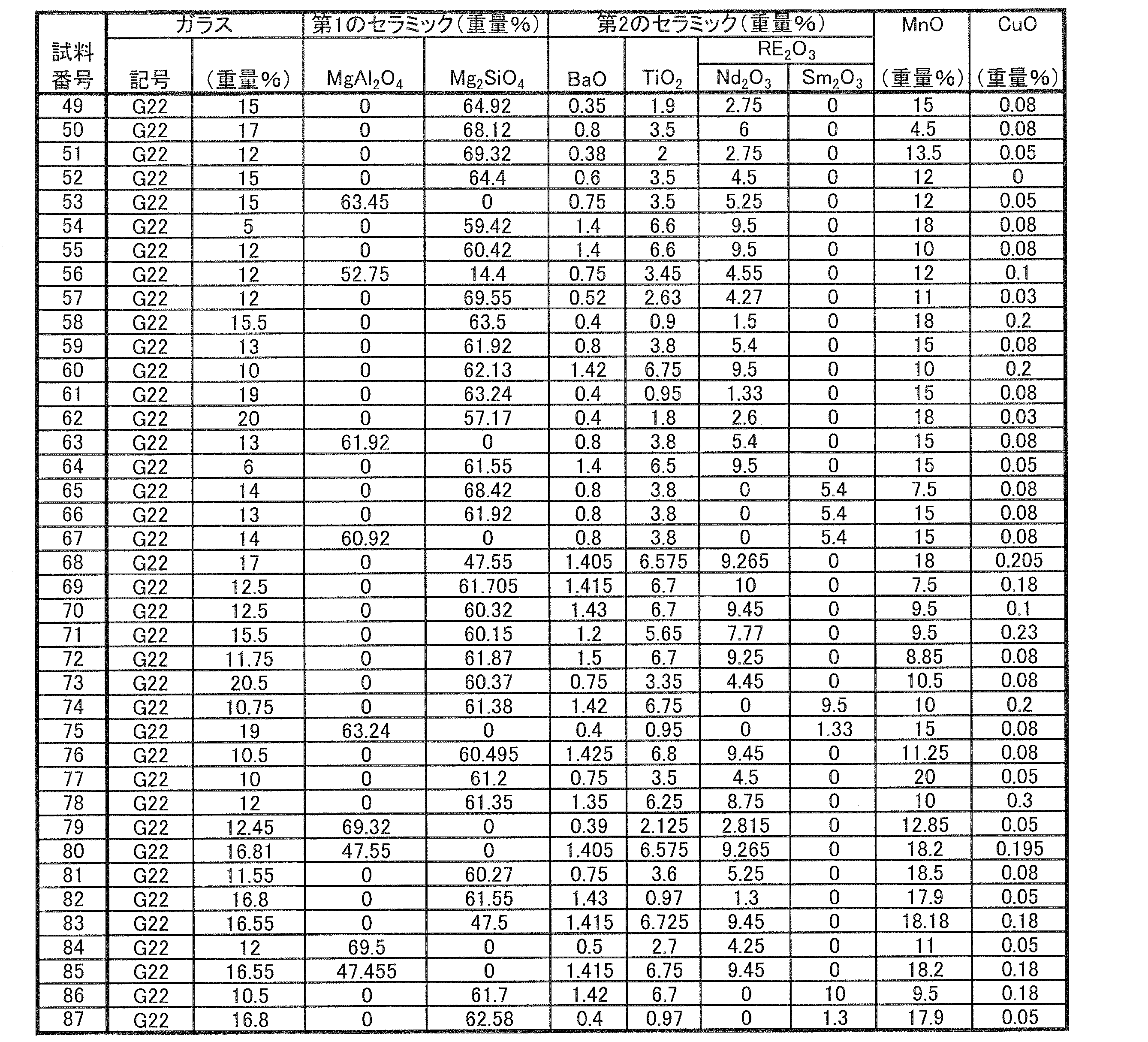
次に、上記スラリーをドクターブレード法によってシート状に成形し、乾燥することによって、セラミックグリーンシートを得た。このセラミックグリーンシートを用いて適宜試料を作製し、表4および表5に示すように、比誘電率(εr)、Qf、静電容量温度係数(β)および絶縁信頼性を評価した。
より具体的は、εrおよびQfの測定にあたっては、上記セラミックグリーンシートをカットし、積層し、圧着することによって、0.6mm×50mm×50mmの寸法を有する圧着体を作製した。これを990℃の温度で焼成することによって、試料となるセラミック基板を得た。このセラミック基板を用いて、空洞共振器法により、εrおよびQfを測定した。このとき、測定周波数を約25GHzとした。
この実験例では、εrが15以下の誘電体材料を得ることを目的とした。Qfについては、5000未満のものを不合格と判定した。
βの測定および絶縁信頼性の評価にあたっては、上記セラミックグリーンシートをカットした後、内部電極を形成するため、Cuを含む導電性ペーストをセラミックグリーンシート上に印刷し、その後、積層、圧着、焼成、外部電極形成の各工程を経て、試料となる積層セラミックコンデンサを得た。この積層セラミックコンデンサにおける隣り合う内部電極間距離は10μm、重なり合う電極面積は4mm□であった。
そして、上記積層セラミックコンデンサ静電容量を-40℃~85℃の範囲で測定し、20℃を基準とする静電容量温度係数βを求めた。βについては、絶対値で150ppm/Kを超えるものを不合格と判定した。
また、上記積層セラミックコンデンサについて、150℃の温度下で、DC200Vを100時間印加する試験後において絶縁抵抗を測定し、この試験後のlog (IR[Ω])が11未満となった場合は、不合格と判定し、表4および表5の「絶縁信頼性」の欄において「×」で表示し、他方、log (IR[Ω])が11以上となった場合は、合格と判定し、表4および表5の「絶縁信頼性」の欄において「○」で表示した。
なお、十分に焼結しなかった試料については、表4および表5の「備考」欄に「未焼結」と表示し、また、ガラスがガラス化しなかった試料については、「備考」欄に「ガラス化しない」と表示し、これらの試料では、εr、Qf、βおよび絶縁信頼性の各評価を行なわなかった。また、「備考」欄には、この実験例において不合格となった試料についての不合格理由が簡潔に記載されている。


表4および表5において、この実験例で不合格と判定された試料については、その試料番号に*が付されている。
表1ないし表5から、以下のことがわかる。
まず、表2および表4に示した試料1~48について考察する。試料1~48では、表1に示したガラスG1~G36のすべてについて、そのいずれかが用いられた。なお、「ガラス」の含有量については、試料1~48のすべてにおいて、「13重量%」と一定とした。
試料1および試料2では、十分に焼結しなかった。これは、Li2O含有量が0.3重量%より少ないガラスG1を用いたためであると推測される。
試料6および試料7では、絶縁信頼性が低下した。これは、Li2O含有量が7.5重量%より多いガラスG5を用いたためであると推測される。
試料11および試料12では、静電容量温度係数βが悪化した。これは、アルカリ土類金属含有量が44.0重量%より少ないガラスG8を用いたためであると推測される。
試料18では、十分に焼結しなかった。これは、アルカリ土類金属含有量が69.0重量%より多いガラスG13を用いたためであると推測される。
試料20では、十分に焼結しなかった。これは、B2O3含有量が10.0重量%より少ないガラスG15を用いたためであると推測される。
試料22では、十分に焼結しなかった。これは、SiO2含有量が30.0重量%より多いガラスG17を用いたためであると推測される。
試料24では、絶縁信頼性が低下した。これは、B2O3含有量が20.0重量%より多いガラスG19を用いたためであると推測される。
試料39および試料40では、静電容量温度係数βが悪化した。これは、MgO含有量が0.1重量%より少ないガラスG32を用いたためであると推測される。
試料41および試料42では、絶縁信頼性が低下した。これは、MgO含有量が5.5重量%より多いガラスG33を用いたためであると推測される。
試料43および試料44では、ガラス化しなかった。これは、SiO2含有量が14.2重量%より少ないガラスG34を用いたためであると推測される。
試料45および試料46では、絶縁信頼性が低下した。これは、Al2O3含有量が0.5重量%より少ないガラスG35を用いたためであると推測される。
試料47および試料48では、絶縁信頼性が低下した。これは、Al2O3含有量が4.0重量%より多いガラスG36を用いたためであると推測される。
上記試料1、2、6、7、11、12、18、20、22、24、および39~48以外の表2および表4に示した試料3~5、8~10、13~17、19、21、23、および25~38では、Qfが5000GHz以上、βが絶対値で150ppm/K以下、および絶縁信頼性がlog (IR[Ω])で11以上というように良好な結果を示した。
これは、アルカリ土類金属含有量が44.0~69.0重量%、SiO2含有量が14.2~30.0重量%、B2O3含有量が10.0~20.0重量%、Al2O3含有量が0.5~4.0重量%、Li2O含有量が0.3~7.5重量%、およびMgO含有量が0.1~5.5重量%であるという条件を満たすガラスG2、G3、G4、G6、G7、G9、G10、G11、G12、G14、G16、G18、G20、G21、G22、G23、G24、G25、G26、G27、G28、G29、G30、およびG31のいずれかを用いたためであると推測される。
εrについては、表2および表4に示した試料であって、「未焼結」または「ガラス化しない」との評価結果が得られた試料以外のすべての試料において、15以下の値が得られた。
次に、表3および表5に示した試料49~87について考察する。試料49~87では、「ガラス」として表1に示したガラスG22を用いながら、「ガラス」、「第1のセラミック」、「第2のセラミック」、「MnO」、および「CuO」の各含有量を変更した。
試料49では、静電容量温度係数βが悪化した。これは、第2のセラミックにおけるBaO含有量が0.38重量%より少なかったためであると推測される。
試料50では、十分に焼結しなかった。これは、MnO含有量が7.5重量%より少なかったためであると推測される。
試料54では、十分に焼結しなかった。これは、ガラス含有量が6重量%より少なかったためであると推測される。
試料57では、静電容量温度係数βが悪化した。これは、第1のセラミックとしてのMg2SiO4含有量が69.32重量%より多かったためであると推測される。
試料58では、静電容量温度係数βが悪化した。これは、第2のセラミックにおけるTiO2含有量が0.95重量%より少なかったためであると推測される。
試料69では、絶縁信頼性が低下した。これは、第2のセラミックにおけるRE2O3としてのNd2O3含有量が9.5重量%より多かったためであると推測される。
試料72では、絶縁信頼性が低下した。これは、第2のセラミックにおけるBaO含有量が1.43重量%より多かったためであると推測される。
試料73では、絶縁信頼性が低下した。これは、ガラス含有量が20重量%より多かったためであると推測される。
試料76では、絶縁信頼性が低下した。これは、第2のセラミックにおけるTiO2含有量が6.75重量%より多かったためであると推測される。
試料77では、静電容量温度係数βが悪化した。これは、MnO含有量が18.5重量%より多かったためであると推測される。
試料78では、絶縁信頼性が低下した。これは、CuO含有量が0.23重量%より多かったためであると推測される。
試料82では、静電容量温度係数βが悪化した。これは、第2のセラミックにおけるRE2O3としてのNd2O3含有量が1.33重量%より少なかったためであると推測される。
試料83では、Qfが低下した。これは、第1のセラミックとしてのMg2SiO4含有量が47.55重量%より少なかったためであると推測される。
試料84では、静電容量温度係数βが悪化した。これは、第1のセラミックとしてのMgAl2O4含有量が69.32重量%より多かったためであると推測される。
試料85では、Qfが低下した。これは、第1のセラミックとしてのMgAl2O4含有量が47.55重量%より少なかったためであると推測される。
試料86では、絶縁信頼性が低下した。これは、第2のセラミックにおけるRE2O3としてのSm2O3含有量が9.5重量%より多かったためであると推測される。
試料87では、静電容量温度係数βが悪化した。これは、第2のセラミックにおけるRE2O3としてのSm2O3含有量が1.33重量%より少なかったためであると推測される。
上記試料49、50、54、57、58、69、72、73、76~78、および82~87以外の表3および表5に示した試料51~53、55、56、59~68、70、71、74、75、および79~81では、Qfが5000GHz以上、βが絶対値で150ppm/K以下、および絶縁信頼性がlog (IR[Ω])で11以上というように良好な結果を示した。
これは、第1のセラミック含有量が47.55~69.32重量%、ガラス含有量が6~20重量%、MnO含有量が7.5~18.5重量%、BaO含有量が0.38~1.43重量%、RE2O3含有量が1.33~9.5重量%、TiO2含有量が0.95~6.75重量%、および、CuO含有量が0.23重量%以下であるという条件を満たしたためであると推測される。
εrについては、表3および表5に示した試料であって、「未焼結」との評価結果が得られた試料以外のすべての試料において、15以下の値が得られた。
なお、実験例1では、第2のセラミックにおけるRE2O3として、Nd2O3およびSm2O3を用いたが、他の希土類元素を用いた場合も同様の傾向を示すことが確認されている。
[実験例2]
実験例2では、実験例1と同様、低誘電率の誘電体材料を作製したが、特に、この低誘電率の誘電体材料に対する、Mg2Al4Si5O18およびBaAl2Si2O8の少なくとも一方からなる第3のセラミックの添加による影響を調査した。
実験例2では、実験例1と同様、低誘電率の誘電体材料を作製したが、特に、この低誘電率の誘電体材料に対する、Mg2Al4Si5O18およびBaAl2Si2O8の少なくとも一方からなる第3のセラミックの添加による影響を調査した。
実験例1の場合と同様にして、スピネル化合物:MgAl2O4およびフォルステライト化合物:Mg2SiO4、BaO、TiO2、RE2O3としてのNd2O3およびSm2O3、MnO、ならびにCuOの各粉末を用意した。
また、この実験例2では、第3のセラミックとして、表6に示すように、MgCO3とAl2O3とSiO2とを所定の比率で調合して仮焼し、湿式粉砕することによって、コージェライト化合物:Mg2Al4Si5O18の粉末を作製した。また、第3のセラミックとして、同じく表6に示すように、BaCO3とAl2O3とSiO2とを所定の比率で調合して仮焼し、湿式粉砕することによって、セルシアン化合物:BaAl2Si2O8の粉末を作製した。
さらに、表7に示すように、上記コージェライト化合物:Mg2Al4Si5O18およびセルシアン化合物:BaAl2Si2O8を構成する元素を与える酸化物であって、上述した酸化物では足りない、BaO、MgO、Al2O3およびSiO2の各粉末を用意した。
次に、表6および表7に示す組成となるように、表1に示したガラス、MgAl2O4、Mg2SiO4、BaO、TiO2、RE2O3としてのNd2O3およびSm2O3、MnO、ならびにCuOの各粉末を調合した。さらに、表6に示した試料では、第3のセラミックとしてのMg2Al4Si5O18およびBaAl2Si2O8の各粉末を調合した。また、表7に示した試料112では、MgO、Al2O3およびSiO2の各粉末をさらに調合した。表7に示した試料113では、MgO、Al2O3およびSiO2の各粉末をさらに調合するとともに、BaO粉末を増量した。そして、これら粉末を混合した後、有機溶剤およびバインダを加えて、スラリーを作製した。
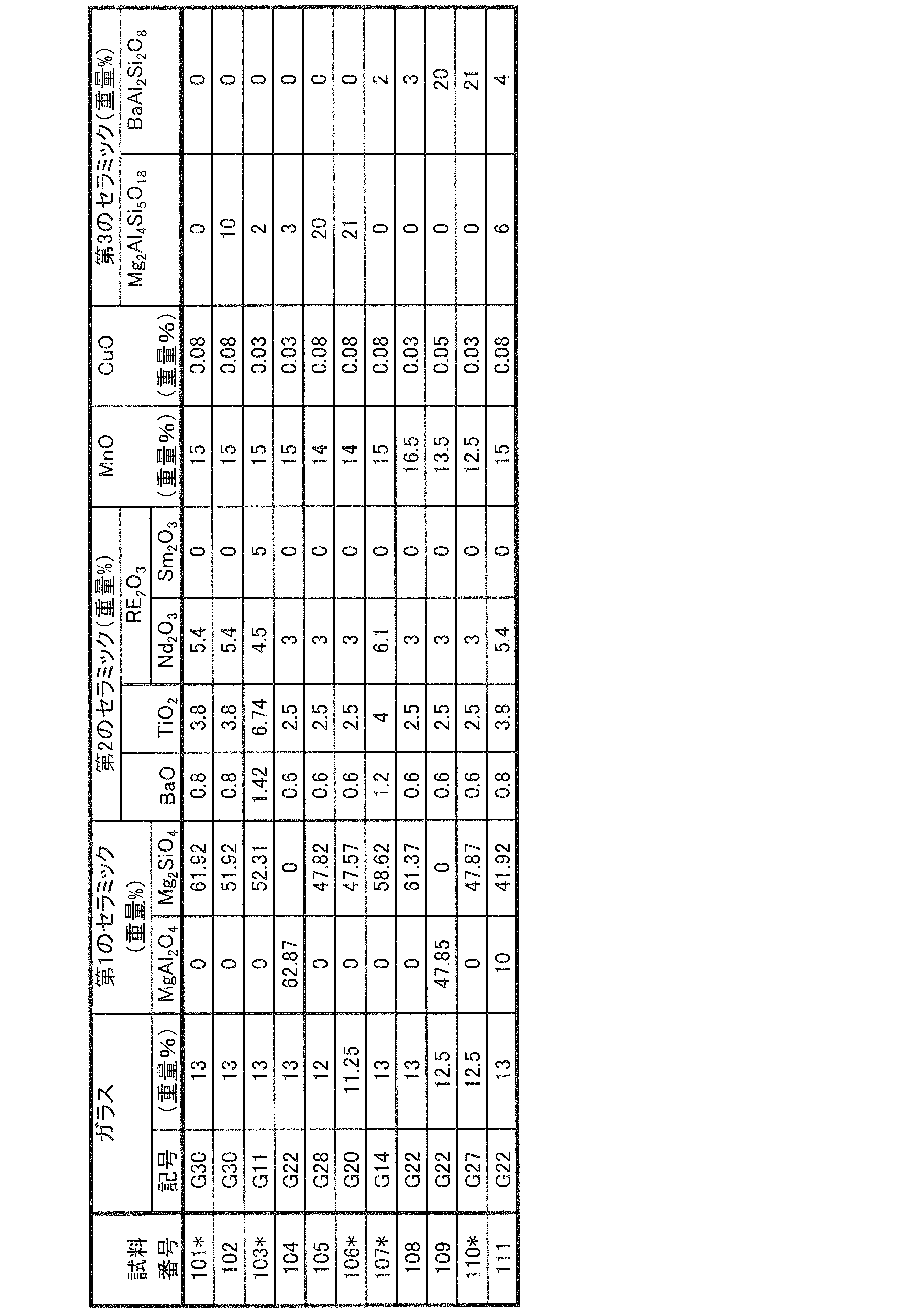

以後、実験例1の場合と同様の要領で、試料を作製し、表8に示すように、比誘電率(εr)、Qf、静電容量温度係数(β)および絶縁信頼性を評価した。この実験例では、εrが8以下というように、εrがより低い誘電体材料を得ることを目的とした。なお、βについては、より厳しく、絶対値で100ppm/Kを超えるものを不合格と判定した。表8の「絶縁信頼性」の欄には、実験例1の場合と同様の試験を実施し、試験後のlog (IR[Ω])が11未満となった場合は、「×」と表示し、他方、log (IR[Ω])が11以上となった場合は、「○」と表示した。
なお、表8の「備考」欄には、この実験例において不合格となった試料についての不合格理由が簡潔に記載されている。
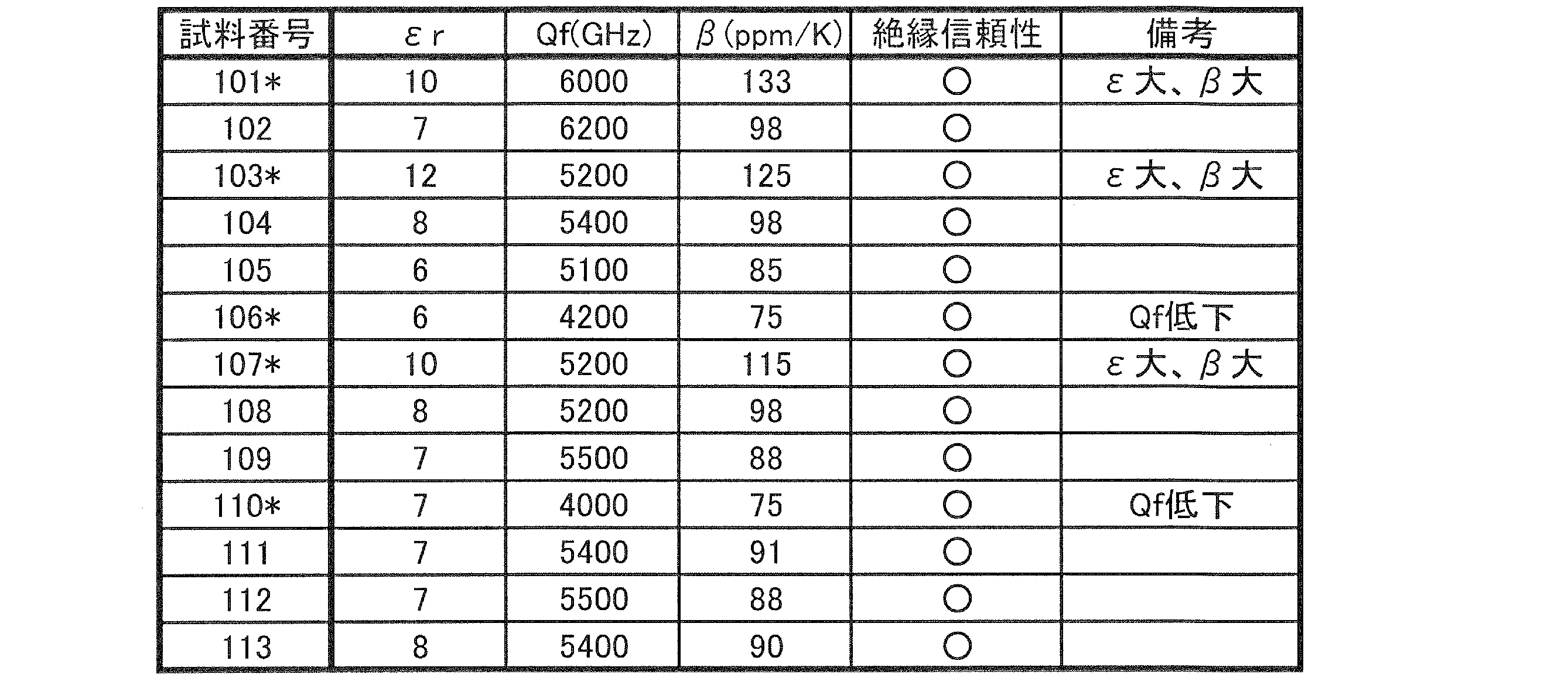
表8において、この実験例で不合格と判定された試料については、その試料番号に*が付されている。
表6ないし表8から、以下のことがわかる。
Mg2Al4Si5O18およびBaAl2Si2O8の少なくとも一方からなる第3のセラミックを3重量%以上含む試料102、104~106、および108~113と、そうではない試料101、103および107との比較から、前者によれば、8以下といった、より低いεrが得られ、また、静電容量温度係数βが絶対値で100ppm/K以下となった。
また、試料112および113からわかるように、Mg2Al4Si5O18およびBaAl2Si2O8のような複合酸化物は、その素材となる単体酸化物を添加しても同様の効果が得られた。
他方、Mg2Al4Si5O18およびBaAl2Si2O8の少なくとも一方からなる第3のセラミックを20重量%より多く含む試料106および110では、Qfの低下が見られた。
[実験例3]
実験例3では、比較的高誘電率の誘電体材料を作製した。
実験例3では、比較的高誘電率の誘電体材料を作製した。
実験例1の場合と同様にして、第1のセラミックとしてのスピネル化合物:MgAl2O4およびフォルステライト化合物:Mg2SiO4、第2のセラミックとなるBaO、TiO2、およびRE2O3としてのNd2O3、MnO、ならびにCuOの各粉末を用意した。
次に、表9および表10に示す組成となるように、表1に示したガラス、MgAl2O4、Mg2SiO4、BaO、TiO2、Nd2O3、MnO、およびCuOの各粉末を調合し、混合した後、有機溶剤およびバインダを加えて、スラリーを作製した。


以後、実験例1の場合と同様の要領で、試料を作製し、表11および表12に示すように、比誘電率(εr)、Qf、静電容量温度係数(β)および絶縁信頼性を評価した。この実験例では、εrが30以上の誘電体材料を得ることを目的とした。Qfについては、5000GHz未満のものを不合格と判定し、βについては、絶対値で150ppm/Kを超えるものを不合格と判定した。また、表11および表12の「絶縁信頼性」の欄には、実験例1の場合と同様の試験を実施し、試験後のlog (IR[Ω])が11未満となった場合は、「×」と表示し、他方、log (IR[Ω])が11以上となった場合は、「○」と表示した。
なお、十分に焼結しなかった試料については、表11および表12の「備考」欄に「未焼結」と表示し、また、ガラスがガラス化しなかった試料については、「備考」欄に「ガラス化しない」と表示し、これらの試料では、εr、Qf、βおよび絶縁信頼性の各評価を行なわなかった。また、「備考」欄には、この実験例において不合格となった試料についての不合格理由が簡潔に記載されている。


表11おい表12において、この実験例で不合格と判定された試料については、その試料番号に*が付されている。
表9ないし表12から、以下のことがわかる。
まず、表9および表11に示した試料201~236について考察する。試料201~236では、表1に示したガラスG1~G36のすべてについて、そのいずれかが用いられた。なお、「ガラス」の含有量については、試料201~236のすべてにおいて、「9重量%」と一定とした。
試料201では、十分に焼結しなかった。これは、Li2O含有量が0.3重量%より少ないガラスG1を用いたためであると推測される。
試料205では、絶縁信頼性が低下した。これは、Li2O含有量が7.5重量%より多いガラスG5を用いたためであると推測される。
試料208では、εrが低く、絶縁信頼性が低下した。これは、アルカリ土類金属含有量が44.0重量%より少ないガラスG8を用いたためであると推測される。
試料213では、十分に焼結しなかった。これは、アルカリ土類金属含有量が69.0重量%より多いガラスG13を用いたためであると推測される。
試料215では、十分に焼結しなかった。これは、B2O3含有量が10.0重量%より少ないガラスG15を用いたためであると推測される。
試料217では、十分に焼結しなかった。これは、SiO2含有量が30.0重量%より多いガラスG17を用いたためであると推測される。
試料219では、絶縁信頼性が低下した。これは、B2O3含有量が20.0重量%より多いガラスG19を用いたためであると推測される。
試料232では、Qfが低下した。これは、MgO含有量が0.1重量%より少ないガラスG32を用いたためであると推測される。
試料233では、絶縁信頼性が低下した。これは、MgO含有量が5.5重量%より多いガラスG33を用いたためであると推測される。
試料234では、ガラス化しなかった。これは、SiO2含有量が14.2重量%より少ないガラスG34を用いたためであると推測される。
試料235では、絶縁信頼性が低下した。これは、Al2O3含有量が0.5重量%より少ないガラスG35を用いたためであると推測される。
試料236では、絶縁信頼性が低下した。これは、Al2O3含有量が4.0重量%より多いガラスG36を用いたためであると推測される。
上記試料201、205、208、213、215、217、219、および232~236以外の表9および表11に示した試料202~204、206、207、209~212、214、216、218、および220~231では、εrが30以上であり、また、Qfが5000GHz以上、βが絶対値で150ppm/K以下、および絶縁信頼性がlog (IR[Ω])で11以上というように良好な結果を示した。
これは、アルカリ土類金属含有量が44.0~69.0重量%、SiO2含有量が14.2~30.0重量%、B2O3含有量が10.0~20.0重量%、Al2O3含有量が0.5~4.0重量%、Li2O含有量が0.3~7.5重量%、およびMgO含有量が0.1~5.5重量%であるという条件を満たすガラスG2、G3、G4、G6、G7、G9、G10、G11、G12、G14、G16、G18、G20、G21、G22、G23、G24、G25、G26、G27、G28、G29、G30、およびG31のいずれかを用いたためであると推測される。
次に、表10および表12に示した試料237~270について考察する。試料237~270では、「ガラス」として表1に示したガラスG22を用いながら、「ガラス」、「第1のセラミック」、「第2のセラミック」、「MnO」、および「CuO」の各含有量を変更した。
試料237では、絶縁信頼性が低下した。これは、第2のセラミックにおけるBaO含有量が15.7重量%より多かったためであると推測される。
試料238では、εrが30未満となった。これは、第2のセラミックにおけるBaO含有量が2.5重量%より少なかったためであると推測される。
試料240では、絶縁信頼性が低下した。これは、第2のセラミックにおけるTiO2含有量が11.2重量%より少なかったためであると推測される。
試料243では、εrが30未満となった。これは、第2のセラミックにおけるTiO2含有量が36.4重量%より多かったためであると推測される。
試料245では、十分に焼結しなかった。これは、第2のセラミックにおけるRE2O3としてのNd2O3含有量が65.3重量%より多かったためであると推測される。
試料249では、εrが30未満となった。これは、第2のセラミックにおけるRE2O3としてのNd2O3含有量が24.6重量%より少なかったためであると推測される。
試料250では、十分に焼結しなかった。これは、ガラス含有量が3重量%より少なかったためであると推測される。
試料255では、絶縁信頼性が低下した。これは、ガラス含有量が15重量%より多かったためであると推測される。
試料256および試料260では、静電容量温度係数βが悪化した。これは、第1のセラミックとしてのMgAl2O4またはMg2SiO4の含有量が15重量%より多かったためであると推測される。
試料259および試料263では、静電容量温度係数βが悪化した。これは、第1のセラミックとしてのMgAl2O4またはMg2SiO4の含有量が1重量%より少なかったためであると推測される。
試料264では、絶縁信頼性が低下した。これは、MnO含有量が2.3重量%より少なかったためであると推測される。
試料266では、Qfが低下した。これは、MnO含有量が10重量%より多かったためであると推測される。
試料270では、絶縁信頼性が低下した。これは、CuO含有量が1.2重量%より多かったためであると推測される。
上記試料237、238、240、243、245、249、250、255、256、259、260、263、264、266および270以外の表10および表12に示した試料239、241、242、244、246~248、251~254、257、258、261、262、265および267~269では、Qfが5000GHz以上、βが絶対値で150ppm/K以下、および絶縁信頼性がlog (IR[Ω])で11以上というように良好な結果を示した。
これは、第1のセラミック含有量が1~15重量%、ガラス含有量が3~15重量%、MnO含有量が2.3~10重量%、BaO含有量が2.5~15.7重量%、RE2O3含有量が24.6~65.3重量%、TiO2含有量が11.2~36.4重量%、および、CuO含有量が1.2重量%以下であるという条件を満たしたためであると推測される。
なお、実験例3では、第2のセラミックにおけるRE2O3として、Nd2O3を用いたが、Sm2O3をはじめ、他の希土類元素を用いた場合も同様の傾向を示すことが確認されている。
[実験例4]
実験例4では、実験例1および2において作製された低誘電率の誘電体材料と実験例3において作製された高誘電率の誘電体材料との中間の誘電率を有する誘電体材料を作製した。
実験例4では、実験例1および2において作製された低誘電率の誘電体材料と実験例3において作製された高誘電率の誘電体材料との中間の誘電率を有する誘電体材料を作製した。
実験例1の場合と同様にして、第1のセラミックとしてのスピネル化合物:MgAl2O4およびフォルステライト化合物:Mg2SiO4、第2のセラミックとなるBaO、TiO2、RE2O3としてのNd2O3およびSm2O3、MnO、ならびにCuOの各粉末を用意した。さらに、実験例2の場合と同様にして、第3のセラミックとして、コージェライト化合物:Mg2Al4Si5O18の粉末、およびセルシアン化合物:BaAl2Si2O8の粉末を用意した。
次に、表13ないし表15に示す組成となるように、表1に示したガラス、MgAl2O4、Mg2SiO4、BaO、TiO2、RE2O3としてのNd2O3およびSm2O3、MnO、CuO、Mg2Al4Si5O18およびBaAl2Si2O8の各粉末を調合し、混合した後、有機溶剤およびバインダを加えて、スラリーを作製した。
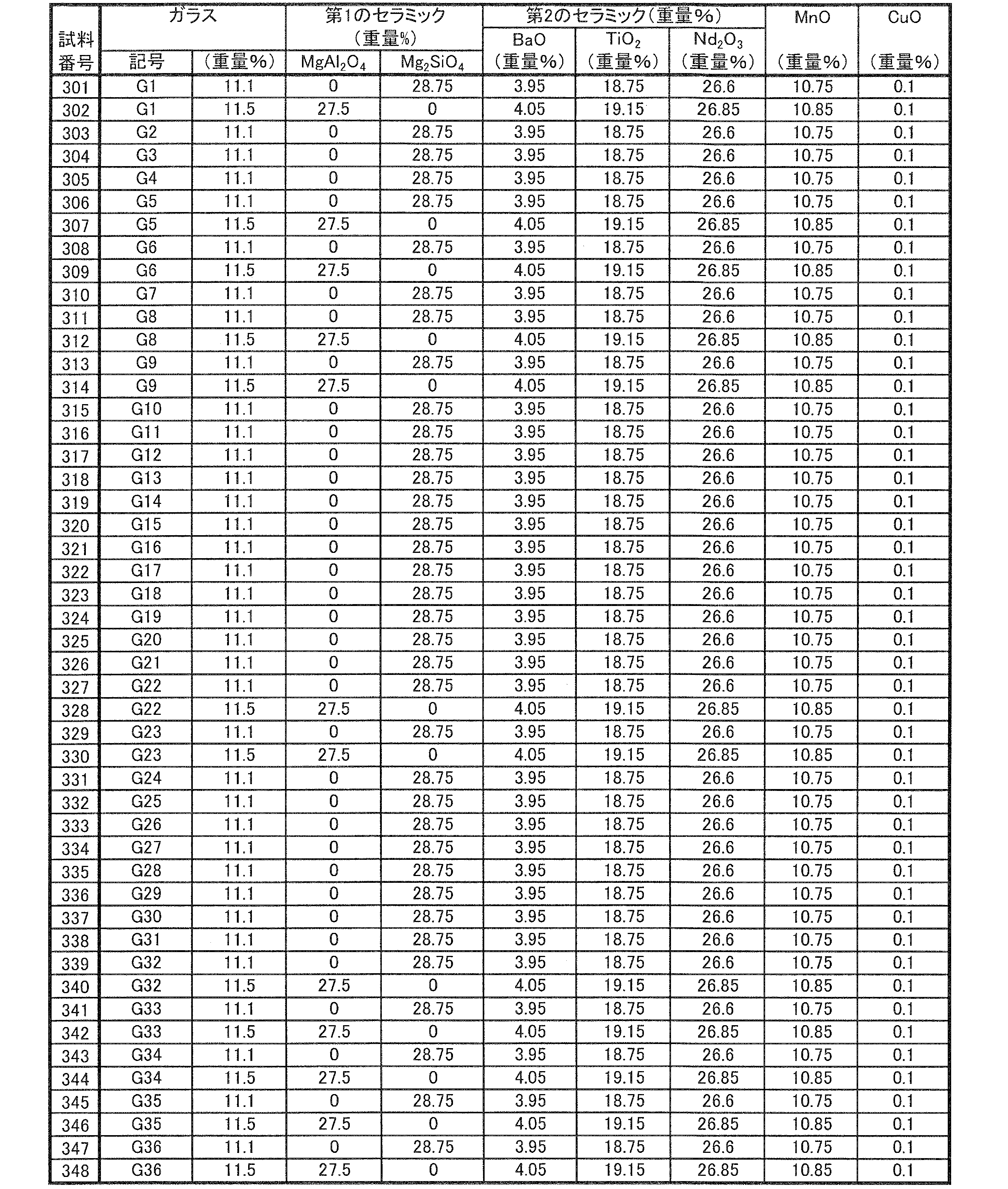


以後、実験例1の場合と同様の要領で、試料を作製し、表16および表17に示すように、比誘電率(εr)、Qf、静電容量温度係数(β)および絶縁信頼性を評価した。この実験例では、εrが20~25の範囲というように、中間的なεrを有する誘電体材料を得ることを目的とした。なお、βについては、最も厳しく、絶対値で60ppm/Kを超えるものを不合格と判定した。表16および表17の「絶縁信頼性」の欄には、実験例1の場合と同様の試験を実施し、試験後のlog (IR[Ω])が11未満となった場合は、「×」と表示し、他方、log (IR[Ω])が11以上となった場合は、「○」と表示した。
なお、表16および表17の「備考」欄には、この実験例において不合格となった試料についての不合格理由が簡潔に記載されている。
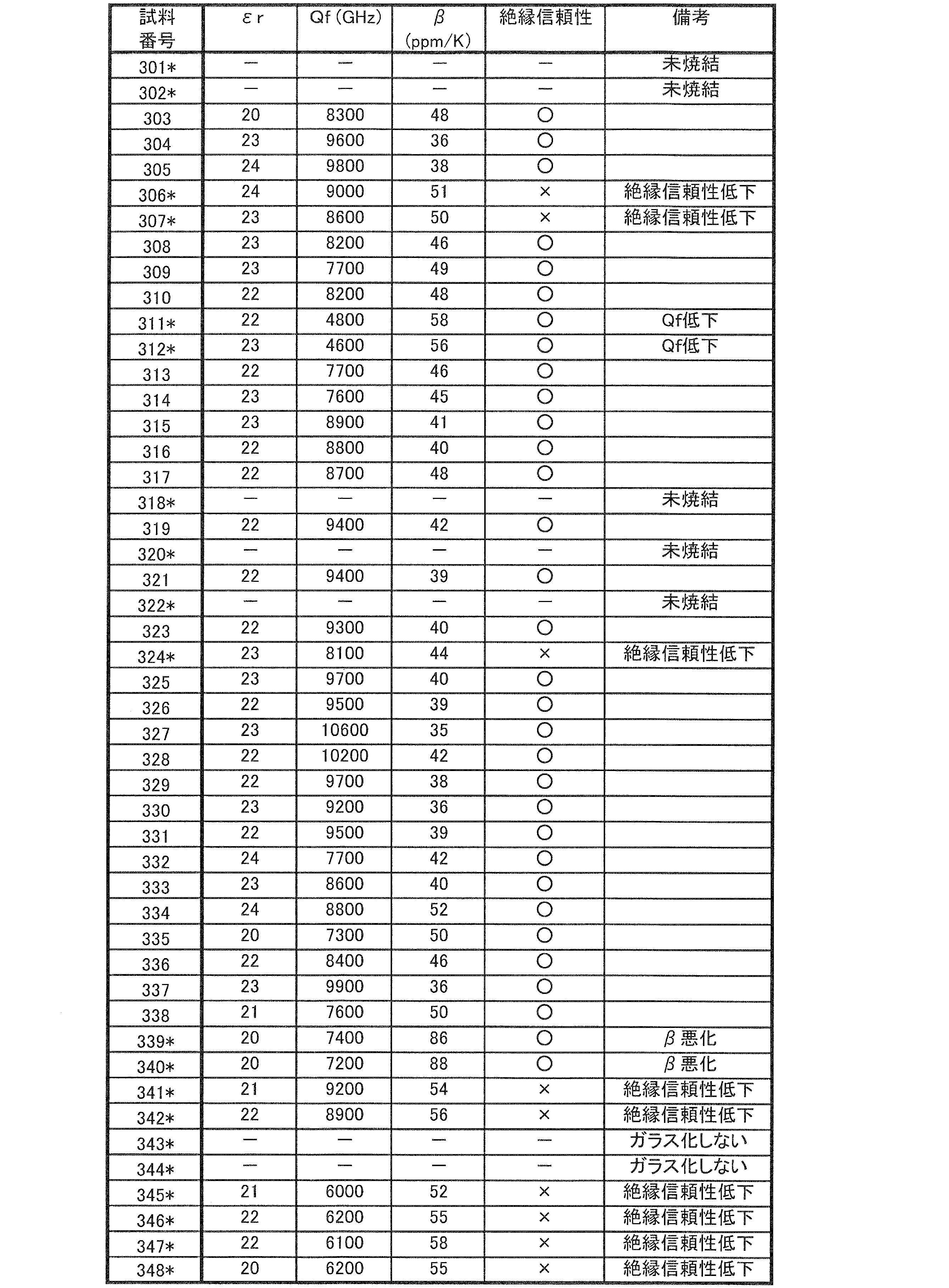

表16および表17において、この実験例で不合格と判定された試料については、その試料番号に*が付されている。
表13ないし表17から、以下のことがわかる。
まず、表13および表16に示した試料301~348について考察する。試料301~348では、表1に示したガラスG1~G36のすべてについて、そのいずれかが用いられた。なお、「ガラス」の含有量については、試料301~348では、「11.1重量%」および「11.5重量%」のいずれかとした。
試料301および302では、十分に焼結しなかった。これは、Li2O含有量が0.3重量%より少ないガラスG1を用いたためであると推測される。
試料306および307では、絶縁信頼性が低下した。これは、Li2O含有量が7.5重量%より多いガラスG5を用いたためであると推測される。
試料311および312では、Qfが低下した。これは、アルカリ土類金属含有量が44.0重量%より少ないガラスG8を用いたためであると推測される。
試料318では、十分に焼結しなかった。これは、アルカリ土類金属含有量が69.0重量%より多いガラスG13を用いたためであると推測される。
試料320では、十分に焼結しなかった。これは、B2O3含有量が10.0重量%より少ないガラスG15を用いたためであると推測される。
試料322では、十分に焼結しなかった。これは、SiO2含有量が30.0重量%より多いガラスG17を用いたためであると推測される。
試料324では、絶縁信頼性が低下した。これは、B2O3含有量が20.0重量%より多いガラスG19を用いたためであると推測される。
試料339および340では、静電容量温度係数βが悪化した。これは、MgO含有量が0.1重量%より少ないガラスG32を用いたためであると推測される。
試料341および342では、絶縁信頼性が低下した。これは、MgO含有量が5.5重量%より多いガラスG33を用いたためであると推測される。
試料343および344では、ガラス化しなかった。これは、SiO2含有量が14.2重量%より少ないガラスG34を用いたためであると推測される。
試料345および346では、絶縁信頼性が低下した。これは、Al2O3含有量が0.5重量%より少ないガラスG35を用いたためであると推測される。
試料347および348では、絶縁信頼性が低下した。これは、Al2O3含有量が4.0重量%より多いガラスG36を用いたためであると推測される。
上記試料301、302、306、307、311、312、318、320、322、324、および339~348以外の表13および表16に示した試料303~305、308~310、313~317、319、321、323、および325~338では、εrが20~25の範囲にありながら、Qfが7000GHz以上、βが絶対値で60ppm/K以下、および絶縁信頼性がlog (IR[Ω])で11以上というように良好な結果を示した。
これは、アルカリ土類金属含有量が44.0~69.0重量%、SiO2含有量が14.2~30.0重量%、B2O3含有量が10.0~20.0重量%、Al2O3含有量が0.5~4.0重量%、Li2O含有量が0.3~7.5重量%、およびMgO含有量が0.1~5.5重量%であるという条件を満たすガラスG2、G3、G4、G6、G7、G9、G10、G11、G12、G14、G16、G18、G20、G21、G22、G23、G24、G25、G26、G27、G28、G29、G30、およびG31のいずれかを用いたためであると推測される。
次に、表14および表15ならびに表17に示した試料349~395について考察する。試料349~395では、「ガラス」として表1に示したガラスG22を用いながら、「ガラス」、「第1のセラミック」、「第2のセラミック」、「MnO」、「CuO」、「Mg2Al4Si5O18」および「BaAl2Si2O8」の各含有量を変更した。
試料349では、十分に焼結しなかった。これは、ガラス含有量が7重量%より少なかったためであると推測される。
試料352では、絶縁信頼性が低下した。これは、ガラス含有量が20重量%より多かったためであると推測される。
試料353では、Qfが低下した。これは、第1のセラミックとしてのMgAl2O4またはMg2SiO4の含有量が15.5重量%より少なかったためであると推測される。
試料356では、静電容量温度係数βが悪化した。これは、第1のセラミックとしてのMgAl2O4またはMg2SiO4の含有量が47重量%より多かったためであると推測される。
試料363では、εrが20未満となった。これは、第2のセラミックにおけるBaO含有量が2.1重量%より少なかったためであると推測される。
試料367では、絶縁信頼性が低下した。これは、第2のセラミックにおけるBaO含有量が5.2重量%より多かったためであると推測される。
試料368では、εrが20未満となった。これは、第2のセラミックにおけるTiO2含有量が9.5重量%より少なかったためであると推測される。
試料374では、絶縁信頼性が低下した。これは、第2のセラミックにおけるTiO2含有量が24.75重量%より多かったためであると推測される。
試料375では、εrが20未満となった。これは、第2のセラミックにおけるRE2O3としてのNd2O3含有量が13.2重量%より少なかったためであると推測される。
試料381では、絶縁信頼性が低下した。これは、第2のセラミックにおけるRE2O3としてのNd2O3含有量が34.75重量%より多かったためであると推測される。
試料382では、十分に焼結しなかった。これは、MnO含有量が5.5重量%より少なかったためであると推測される。
試料385では、Qfが低下した。これは、MnO含有量が20.5重量%より多かったためであると推測される。
試料392では、静電容量温度係数βが悪化した。これは、Mg2Al4Si5O18およびBaAl2Si2O8の少なくとも一方からなる第3のセラミックの含有量が7.5重量%より多かったためであると推測される。
試料395では、Qfが低下した。これは、CuO含有量が1.2重量%より多かったためであると推測される。
上記試料349、352、353、356、363、367、368、374、375、381、382、385、392および395以外の表14および表15ならびに表17に示した試料350、351、354、355、357~362、364~366、369~373、376~380、383、384、386~391、393および394では、εrが20~25の範囲にありながら、Qfが7000GHz以上、βが絶対値で60ppm/K以下、および絶縁信頼性がlog (IR[Ω])で11以上というように良好な結果を示した。
これは、第1のセラミック含有量が15.5~47重量%、ガラス含有量が7~20重量%、MnO含有量が5.5~20.5重量%、BaO含有量が2.1~5.2重量%、RE2O3含有量が13.2~34.75重量%、TiO2含有量が9.5~24.75重量%、CuO含有量が1.2重量%以下、ならびに、Mg2Al4Si5O18およびBaAl2Si2O8の少なくとも一方からなる第3のセラミックの含有量が7.5重量%以下であるという条件を満たしたためであると推測される。
なお、実験例4では、第2のセラミックにおけるRE2O3として、Nd2O3およびSm2O3を用いたが、他の希土類元素を用いた場合も同様の傾向を示すことが確認されている。
1,1a セラミック多層モジュール
2,2a 多層セラミック基板
3 セラミック層
4 低誘電率セラミック層
5 高誘電率セラミック層
21 LCフィルタ
23 部品本体
28~40 セラミックグリーンシート
2,2a 多層セラミック基板
3 セラミック層
4 低誘電率セラミック層
5 高誘電率セラミック層
21 LCフィルタ
23 部品本体
28~40 セラミックグリーンシート
Claims (10)
- (1)MgAl2O4およびMg2SiO4の少なくとも一方からなる第1のセラミックと、
(2)BaO、RE2O3(REは希土類元素)およびTiO2からなる第2のセラミックと、
(3)RO(RはBa、CaおよびSrから選ばれる少なくとも1種のアルカリ土類金属)を44.0~69.0重量%、SiO2を14.2~30.0重量%、B2O3を10.0~20.0重量%、Al2O3を0.5~4.0重量%、Li2Oを0.3~7.5重量%、およびMgOを0.1~5.5重量%それぞれ含むガラスと、
(4)MnOと
を含む、ガラスセラミック組成物。 - 前記第1のセラミックを47.55~69.32重量%含み、
前記ガラスを6~20重量%含み、
前記MnOを7.5~18.5重量%含み、
前記第2のセラミックとして、BaOを0.38~1.43重量%、RE2O3を1.33~9.5重量%、およびTiO2を0.95~6.75重量%それぞれ含む、
請求項1に記載のガラスセラミック組成物。 - さらに、CuOを0.23重量%以下含む、請求項2に記載のガラスセラミック組成物。
- さらに、Mg2Al4Si5O18およびBaAl2Si2O8の少なくとも一方からなる第3のセラミックを3~20重量%含む、請求項2に記載のガラスセラミック組成物。
- さらに、CuOを0.3重量%以下含む、請求項4に記載のガラスセラミック組成物。
- 前記第1のセラミックを1~15重量%含み、
前記ガラスを3~15重量%含み、
前記MnOを2.3~10重量%含み、
前記第2のセラミックとして、BaOを2.5~15.7重量%、RE2O3を24.6~65.3重量%、およびTiO2を11.2~36.4重量%それぞれ含む、
請求項1に記載のガラスセラミック組成物。 - さらに、CuOを1.2重量%以下含む、請求項6に記載のガラスセラミック組成物。
- 前記第1のセラミックを15.5~47重量%含み、
前記ガラスを7~20重量%含み、
前記MnOを5.5~20.5重量%含み、
前記第2のセラミックとして、BaOを2.1~5.2重量%、RE2O3を13.2~34.75重量%、およびTiO2を9.5~24.75重量%それぞれ含む、
請求項1に記載のガラスセラミック組成物。 - さらに、CuOを1.2重量%以下含む、請求項8に記載のガラスセラミック組成物。
- さらに、Mg2Al4Si5O18およびBaAl2Si2O8の少なくとも一方からなる第3のセラミックを7.5重量%以下含む、請求項8または9に記載のガラスセラミック組成物。
Priority Applications (3)
| Application Number | Priority Date | Filing Date | Title |
|---|---|---|---|
| JP2013515014A JP5761341B2 (ja) | 2011-05-19 | 2012-02-13 | ガラスセラミック組成物 |
| CN201280024387.3A CN103547544B (zh) | 2011-05-19 | 2012-02-13 | 玻璃陶瓷组合物 |
| US14/076,353 US9162922B2 (en) | 2011-05-19 | 2013-11-11 | Glass ceramic composition |
Applications Claiming Priority (2)
| Application Number | Priority Date | Filing Date | Title |
|---|---|---|---|
| JP2011112126 | 2011-05-19 | ||
| JP2011-112126 | 2011-05-19 |
Related Child Applications (1)
| Application Number | Title | Priority Date | Filing Date |
|---|---|---|---|
| US14/076,353 Continuation US9162922B2 (en) | 2011-05-19 | 2013-11-11 | Glass ceramic composition |
Publications (1)
| Publication Number | Publication Date |
|---|---|
| WO2012157299A1 true WO2012157299A1 (ja) | 2012-11-22 |
Family
ID=47176641
Family Applications (1)
| Application Number | Title | Priority Date | Filing Date |
|---|---|---|---|
| PCT/JP2012/053259 Ceased WO2012157299A1 (ja) | 2011-05-19 | 2012-02-13 | ガラスセラミック組成物 |
Country Status (4)
| Country | Link |
|---|---|
| US (1) | US9162922B2 (ja) |
| JP (1) | JP5761341B2 (ja) |
| CN (1) | CN103547544B (ja) |
| WO (1) | WO2012157299A1 (ja) |
Cited By (6)
| Publication number | Priority date | Publication date | Assignee | Title |
|---|---|---|---|---|
| JPWO2012157300A1 (ja) * | 2011-05-19 | 2014-07-31 | 株式会社村田製作所 | 複合積層セラミック電子部品 |
| US20150030830A1 (en) * | 2012-02-13 | 2015-01-29 | Murata Manufacturing Co., Ltd. | Composite Laminated Ceramic Electronic Component |
| WO2017122382A1 (ja) * | 2016-01-13 | 2017-07-20 | 株式会社村田製作所 | ガラスセラミック焼結体、ガラスセラミック組成物、積層セラミックコンデンサ及び積層セラミックコンデンサの製造方法 |
| WO2017217490A1 (ja) * | 2016-06-16 | 2017-12-21 | 日本碍子株式会社 | セラミック素地及びその製造方法 |
| JP2019059660A (ja) * | 2017-09-26 | 2019-04-18 | Tdk株式会社 | 誘電体磁器組成物および電子部品 |
| WO2024043071A1 (ja) * | 2022-08-25 | 2024-02-29 | 株式会社村田製作所 | ガラスセラミックス組成物、ガラスセラミックス焼結体及び電子部品 |
Families Citing this family (5)
| Publication number | Priority date | Publication date | Assignee | Title |
|---|---|---|---|---|
| JP5888524B2 (ja) * | 2012-02-13 | 2016-03-22 | 株式会社村田製作所 | 複合積層セラミック電子部品 |
| US9655231B2 (en) | 2014-05-12 | 2017-05-16 | Fujitsu Limited | Compensating for intra-pair skew in differential signaling |
| JP6468054B2 (ja) * | 2015-04-28 | 2019-02-13 | 富士通株式会社 | プリント基板及びシールド板金固定方法 |
| JP6451655B2 (ja) * | 2016-01-15 | 2019-01-16 | 株式会社村田製作所 | 複合電子部品 |
| CN113860743A (zh) * | 2021-09-18 | 2021-12-31 | 杨洁 | 一种多层玻璃陶瓷坯料及其制备方法与应用 |
Citations (5)
| Publication number | Priority date | Publication date | Assignee | Title |
|---|---|---|---|---|
| WO2003040057A1 (en) * | 2001-11-05 | 2003-05-15 | Asahi Glass Company, Limited | Glass ceramic composition |
| JP2007031177A (ja) * | 2005-07-22 | 2007-02-08 | Ngk Spark Plug Co Ltd | 積層セラミック部品及びその製造方法 |
| WO2007086184A1 (ja) * | 2006-01-30 | 2007-08-02 | Murata Manufacturing Co., Ltd. | 多層セラミック基板の内蔵コンデンサの容量値調整方法、ならびに多層セラミック基板およびその製造方法 |
| JP2007254213A (ja) * | 2006-03-23 | 2007-10-04 | Asahi Techno Glass Corp | 基板用ガラスセラミックス組成物 |
| JP2010235327A (ja) * | 2009-03-30 | 2010-10-21 | Tdk Corp | 誘電体磁器組成物 |
Family Cites Families (6)
| Publication number | Priority date | Publication date | Assignee | Title |
|---|---|---|---|---|
| JP3680715B2 (ja) | 2000-07-21 | 2005-08-10 | 株式会社村田製作所 | 絶縁体磁器組成物 |
| JP3903781B2 (ja) | 2000-12-19 | 2007-04-11 | 株式会社村田製作所 | 複合積層セラミック電子部品及びその製造方法 |
| EP2363384A4 (en) * | 2008-10-30 | 2012-08-15 | Kyocera Corp | DIELECTRIC CERAMIC AND RESONATOR USING THIS DIELECTRIC CERAMIC |
| WO2012157300A1 (ja) * | 2011-05-19 | 2012-11-22 | 株式会社村田製作所 | 複合積層セラミック電子部品 |
| JP5983265B2 (ja) * | 2011-12-12 | 2016-08-31 | Tdk株式会社 | 誘電体磁器組成物 |
| JP5888524B2 (ja) * | 2012-02-13 | 2016-03-22 | 株式会社村田製作所 | 複合積層セラミック電子部品 |
-
2012
- 2012-02-13 JP JP2013515014A patent/JP5761341B2/ja active Active
- 2012-02-13 WO PCT/JP2012/053259 patent/WO2012157299A1/ja not_active Ceased
- 2012-02-13 CN CN201280024387.3A patent/CN103547544B/zh active Active
-
2013
- 2013-11-11 US US14/076,353 patent/US9162922B2/en active Active
Patent Citations (5)
| Publication number | Priority date | Publication date | Assignee | Title |
|---|---|---|---|---|
| WO2003040057A1 (en) * | 2001-11-05 | 2003-05-15 | Asahi Glass Company, Limited | Glass ceramic composition |
| JP2007031177A (ja) * | 2005-07-22 | 2007-02-08 | Ngk Spark Plug Co Ltd | 積層セラミック部品及びその製造方法 |
| WO2007086184A1 (ja) * | 2006-01-30 | 2007-08-02 | Murata Manufacturing Co., Ltd. | 多層セラミック基板の内蔵コンデンサの容量値調整方法、ならびに多層セラミック基板およびその製造方法 |
| JP2007254213A (ja) * | 2006-03-23 | 2007-10-04 | Asahi Techno Glass Corp | 基板用ガラスセラミックス組成物 |
| JP2010235327A (ja) * | 2009-03-30 | 2010-10-21 | Tdk Corp | 誘電体磁器組成物 |
Cited By (12)
| Publication number | Priority date | Publication date | Assignee | Title |
|---|---|---|---|---|
| JPWO2012157300A1 (ja) * | 2011-05-19 | 2014-07-31 | 株式会社村田製作所 | 複合積層セラミック電子部品 |
| US20150030830A1 (en) * | 2012-02-13 | 2015-01-29 | Murata Manufacturing Co., Ltd. | Composite Laminated Ceramic Electronic Component |
| US9214259B2 (en) * | 2012-02-13 | 2015-12-15 | Murata Manufacturing Co., Ltd. | Composite laminated ceramic electronic component |
| WO2017122382A1 (ja) * | 2016-01-13 | 2017-07-20 | 株式会社村田製作所 | ガラスセラミック焼結体、ガラスセラミック組成物、積層セラミックコンデンサ及び積層セラミックコンデンサの製造方法 |
| JPWO2017122382A1 (ja) * | 2016-01-13 | 2018-09-27 | 株式会社村田製作所 | ガラスセラミック焼結体、ガラスセラミック組成物、積層セラミックコンデンサ及び積層セラミックコンデンサの製造方法 |
| WO2017217490A1 (ja) * | 2016-06-16 | 2017-12-21 | 日本碍子株式会社 | セラミック素地及びその製造方法 |
| JP6314292B1 (ja) * | 2016-06-16 | 2018-04-18 | 日本碍子株式会社 | セラミック素地及びその製造方法 |
| CN108025982A (zh) * | 2016-06-16 | 2018-05-11 | 日本碍子株式会社 | 陶瓷基体及其制造方法 |
| CN108025982B (zh) * | 2016-06-16 | 2020-11-17 | 日本碍子株式会社 | 陶瓷基体及其制造方法 |
| JP2019059660A (ja) * | 2017-09-26 | 2019-04-18 | Tdk株式会社 | 誘電体磁器組成物および電子部品 |
| WO2024043071A1 (ja) * | 2022-08-25 | 2024-02-29 | 株式会社村田製作所 | ガラスセラミックス組成物、ガラスセラミックス焼結体及び電子部品 |
| JPWO2024043071A1 (ja) * | 2022-08-25 | 2024-02-29 |
Also Published As
| Publication number | Publication date |
|---|---|
| US9162922B2 (en) | 2015-10-20 |
| US20140066283A1 (en) | 2014-03-06 |
| CN103547544A (zh) | 2014-01-29 |
| CN103547544B (zh) | 2015-02-18 |
| JP5761341B2 (ja) | 2015-08-12 |
| JPWO2012157299A1 (ja) | 2014-07-31 |
Similar Documents
| Publication | Publication Date | Title |
|---|---|---|
| JP5821975B2 (ja) | 複合積層セラミック電子部品 | |
| JP5761341B2 (ja) | ガラスセラミック組成物 | |
| JP5435176B2 (ja) | 複合積層セラミック電子部品 | |
| JP4371141B2 (ja) | 絶縁体セラミック組成物、絶縁性セラミック焼結体および積層型セラミック電子部品 | |
| JP5343853B2 (ja) | ガラスセラミック組成物、ガラスセラミック焼結体および積層型セラミック電子部品 | |
| US7439202B2 (en) | Glass ceramic composition, glass-ceramic sintered body, and monolithic ceramic electronic component | |
| JP5316545B2 (ja) | ガラスセラミック組成物およびガラスセラミック基板 | |
| JP6458863B2 (ja) | 低温焼結セラミック材料、セラミック焼結体およびセラミック電子部品 | |
| JP5888524B2 (ja) | 複合積層セラミック電子部品 | |
| US7368408B2 (en) | Glass-ceramic composition, glass-ceramic sintered body, and monolithic ceramic electronic component | |
| JP2001114554A (ja) | 低温焼成セラミック組成物及びセラミック多層基板 | |
| JP4984850B2 (ja) | ガラスセラミック組成物 | |
| CN119768382A (zh) | 玻璃陶瓷组合物、玻璃陶瓷烧结体和电子部件 |
Legal Events
| Date | Code | Title | Description |
|---|---|---|---|
| 121 | Ep: the epo has been informed by wipo that ep was designated in this application |
Ref document number: 12785221 Country of ref document: EP Kind code of ref document: A1 |
|
| ENP | Entry into the national phase |
Ref document number: 2013515014 Country of ref document: JP Kind code of ref document: A |
|
| NENP | Non-entry into the national phase |
Ref country code: DE |
|
| 122 | Ep: pct application non-entry in european phase |
Ref document number: 12785221 Country of ref document: EP Kind code of ref document: A1 |