WO2012147709A1 - 硬化性組成物および光学用接着剤 - Google Patents
硬化性組成物および光学用接着剤 Download PDFInfo
- Publication number
- WO2012147709A1 WO2012147709A1 PCT/JP2012/060900 JP2012060900W WO2012147709A1 WO 2012147709 A1 WO2012147709 A1 WO 2012147709A1 JP 2012060900 W JP2012060900 W JP 2012060900W WO 2012147709 A1 WO2012147709 A1 WO 2012147709A1
- Authority
- WO
- WIPO (PCT)
- Prior art keywords
- curable composition
- component
- alkyl
- general formula
- group
- Prior art date
- Legal status (The legal status is an assumption and is not a legal conclusion. Google has not performed a legal analysis and makes no representation as to the accuracy of the status listed.)
- Ceased
Links
- 0 *C(*[Al])N1C(CCC2)N2CCC1 Chemical compound *C(*[Al])N1C(CCC2)N2CCC1 0.000 description 1
- SGUVLZREKBPKCE-UHFFFAOYSA-N C(C1)CN2C1=NCCC2 Chemical compound C(C1)CN2C1=NCCC2 SGUVLZREKBPKCE-UHFFFAOYSA-N 0.000 description 1
Classifications
-
- C—CHEMISTRY; METALLURGY
- C08—ORGANIC MACROMOLECULAR COMPOUNDS; THEIR PREPARATION OR CHEMICAL WORKING-UP; COMPOSITIONS BASED THEREON
- C08G—MACROMOLECULAR COMPOUNDS OBTAINED OTHERWISE THAN BY REACTIONS ONLY INVOLVING UNSATURATED CARBON-TO-CARBON BONDS
- C08G18/00—Polymeric products of isocyanates or isothiocyanates
- C08G18/06—Polymeric products of isocyanates or isothiocyanates with compounds having active hydrogen
- C08G18/28—Polymeric products of isocyanates or isothiocyanates with compounds having active hydrogen characterised by the compounds used containing active hydrogen
- C08G18/30—Low-molecular-weight compounds
- C08G18/38—Low-molecular-weight compounds having heteroatoms other than oxygen
- C08G18/3855—Low-molecular-weight compounds having heteroatoms other than oxygen having sulfur
- C08G18/3876—Low-molecular-weight compounds having heteroatoms other than oxygen having sulfur containing mercapto groups
-
- C—CHEMISTRY; METALLURGY
- C08—ORGANIC MACROMOLECULAR COMPOUNDS; THEIR PREPARATION OR CHEMICAL WORKING-UP; COMPOSITIONS BASED THEREON
- C08G—MACROMOLECULAR COMPOUNDS OBTAINED OTHERWISE THAN BY REACTIONS ONLY INVOLVING UNSATURATED CARBON-TO-CARBON BONDS
- C08G18/00—Polymeric products of isocyanates or isothiocyanates
- C08G18/06—Polymeric products of isocyanates or isothiocyanates with compounds having active hydrogen
- C08G18/08—Processes
- C08G18/16—Catalysts
- C08G18/22—Catalysts containing metal compounds
- C08G18/24—Catalysts containing metal compounds of tin
- C08G18/244—Catalysts containing metal compounds of tin tin salts of carboxylic acids
- C08G18/246—Catalysts containing metal compounds of tin tin salts of carboxylic acids containing also tin-carbon bonds
-
- C—CHEMISTRY; METALLURGY
- C08—ORGANIC MACROMOLECULAR COMPOUNDS; THEIR PREPARATION OR CHEMICAL WORKING-UP; COMPOSITIONS BASED THEREON
- C08G—MACROMOLECULAR COMPOUNDS OBTAINED OTHERWISE THAN BY REACTIONS ONLY INVOLVING UNSATURATED CARBON-TO-CARBON BONDS
- C08G18/00—Polymeric products of isocyanates or isothiocyanates
- C08G18/06—Polymeric products of isocyanates or isothiocyanates with compounds having active hydrogen
- C08G18/70—Polymeric products of isocyanates or isothiocyanates with compounds having active hydrogen characterised by the isocyanates or isothiocyanates used
- C08G18/72—Polyisocyanates or polyisothiocyanates
- C08G18/74—Polyisocyanates or polyisothiocyanates cyclic
- C08G18/76—Polyisocyanates or polyisothiocyanates cyclic aromatic
- C08G18/7614—Polyisocyanates or polyisothiocyanates cyclic aromatic containing only one aromatic ring
- C08G18/7628—Polyisocyanates or polyisothiocyanates cyclic aromatic containing only one aromatic ring containing at least one isocyanate or isothiocyanate group linked to the aromatic ring by means of an aliphatic group
- C08G18/7642—Polyisocyanates or polyisothiocyanates cyclic aromatic containing only one aromatic ring containing at least one isocyanate or isothiocyanate group linked to the aromatic ring by means of an aliphatic group containing at least two isocyanate or isothiocyanate groups linked to the aromatic ring by means of an aliphatic group having a primary carbon atom next to the isocyanate or isothiocyanate groups, e.g. xylylene diisocyanate or homologues substituted on the aromatic ring
-
- C—CHEMISTRY; METALLURGY
- C09—DYES; PAINTS; POLISHES; NATURAL RESINS; ADHESIVES; COMPOSITIONS NOT OTHERWISE PROVIDED FOR; APPLICATIONS OF MATERIALS NOT OTHERWISE PROVIDED FOR
- C09J—ADHESIVES; NON-MECHANICAL ASPECTS OF ADHESIVE PROCESSES IN GENERAL; ADHESIVE PROCESSES NOT PROVIDED FOR ELSEWHERE; USE OF MATERIALS AS ADHESIVES
- C09J175/00—Adhesives based on polyureas or polyurethanes; Adhesives based on derivatives of such polymers
- C09J175/04—Polyurethanes
Definitions
- the present invention relates to a curable composition suitable as an optical adhesive used for producing a composite optical element.
- Photocurable compositions such as acrylate compounds are widely used as adhesives when producing optical elements.
- Adhesives, photocurability, mechanical strength, durability, and optical properties are basic performances for adhesives, but in recent years, the refractive index has become an important performance as optical elements become more sophisticated. . In particular, increasing the refractive index of the adhesive is highly desired because the degree of freedom in optical design is expanded.
- Examples of applications in which an adhesive having a high refractive index is used include an achromatic lens (achromatic lens) composed of two lenses bonded together, a hybrid aspherical lens composed of a composite of glass and resin, and dichroic Examples include prisms having complicated shapes such as prisms.
- Adhesives used for these applications naturally require not only a high refractive index but also performance such as adhesion, photocurability, colorless transparency, and viscosity suitable for work.
- the refractive index of a cured product of bis (2,3-epithiopropyl) sulfide is 1.70. Since the episulfide compound has a low viscosity and can be easily injected into a mold, it is suitable for producing a molded article such as a spectacle lens. However, assuming use as an adhesive, if the viscosity is too low, the adhesive may sag or flow, and the adherend may be displaced during pasting, which causes problems in workability. Moreover, since the episulfide compound generally has a large shrinkage due to curing, when used as an adhesive, it causes a decrease in adhesion.
- Japanese Patent Laid-Open No. 9-71580 Japanese Patent Laid-Open No. 9-110979 Japanese Patent Laid-Open No. 9-255781 JP 2001-163874 A
- an object of the present invention is to provide a curable composition having a high refractive index and also having performances required as an optical adhesive such as photocurability, low shrinkage, colorless transparency, and viscosity suitable for work. Is to provide.
- the present inventors have found that a polythiourethane oligomer (component A), an episulfide compound (component B) and a photobase generator (C) obtained by reacting polythiol and polyisocyanate. It has been found that the curable composition containing the component) is suitable as an optical adhesive because it has a viscosity suitable for workability as an adhesive and has little shrinkage due to curing. Based on the above findings, the present invention has been achieved.
- a curable composition having a high refractive index and also having performance as an optical adhesive such as photocurability, low shrinkage, colorless transparency and viscosity suitable for work. be able to.
- the curable composition of the present invention comprises a polythiourethane oligomer (A component) obtained by reacting polythiol and polyisocyanate, an episulfide compound (B component), and a photobase generator (C component). .
- a component polythiourethane oligomer obtained by reacting polythiol and polyisocyanate, an episulfide compound (B component), and a photobase generator (C component).
- the polythiol used as a raw material for the polythiourethane oligomer is a compound having two or more thiol groups in one molecule, and may be any of linear, branched, and cyclic.
- compounds represented by the following general formulas (1) to (3) are preferable.
- p1 and p2 each independently represents an integer of 0 to 1
- X 1 to X 8 each independently represents a hydrogen atom or a methylthiol group.
- q represents an integer of 0 to 3
- R 1 represents a simple bond or an alkylene group having 1 to 3 carbon atoms.
- r represents an integer of 0 to 3
- R 2 represents an alkylene group having 1 to 3 carbon atoms.
- Examples of the compound represented by the general formula (1) include 1,5-dimercapto-3-thiapentane, 2-mercaptomethyl-1,5-dimercapto-3-thiapentane, 2,4-bis (mercaptomethyl) -1 , 5-dimercapto-3-thiapentane, 4-mercaptomethyl-1,8-dimercapto-3,6-dithiaoctane, 4,8-bis (mercaptomethyl) -1,11-dimercapto-3,6,9-trithia Undecane, 4,7-bis (mercaptomethyl) -1,11-dimercapto-3,6,9-trithiaundecane, 5,7-bis (mercaptomethyl) -1,11-dimercapto-3,6,9- Examples of the compound represented by the general formula (2) include 2,5-dimercapto-1,4-dithiane and 2,5-dithiane.
- polythiol compounds other than the compounds represented by the general formulas (1) to (3) include ethylene glycol bis (3-mercaptopropionate), trimethiolpropane tris (3-mercaptopropionate), pentaerythritol tetrakis (3 -Mercaptopropionate), benzenedithiol, tolylenedithiol and the like.
- the polyisocyanate used as a raw material for the polythiourethane oligomer is a compound having two or more isocyanate groups in one molecule, and may be any of linear, branched, and cyclic.
- polyisocyanates include m-xylylene diisocyanate, 1,3-bis (2-isocyanato-2-propyl) benzene, tolylene diisocyanate, diphenylmethane-4,4′-diisocyanate, 1,3-bis (2-isocyanato-2-propyl) cyclohexane, isophorone diisocyanate, dicyclohexylmethane-4,4′-diisocyanate, hexamethylene diisocyanate, trimethylhexamethylene diisocyanate, tris (6-isocyanatohexyl) isocyanurate and the like.
- preferred polyisocyanates are m-xylylene diisocyanate, 1,3-bis (2-isocyanato-2-propyl) benzene, 1,3 -Bis (2-isocyanato-2-propyl) cyclohexane, isophorone diisocyanate.
- the reaction of polythiol and polyisocyanate is, for example, when the product is a dimer, the following reaction formula (In the formula, R and R ′ represent an organic group, and a and b represent an integer of 1 or more.) Proceed according to. Since the thiol group and the isocyanate group react with each other at a ratio of 1: 1, a polythiourethane oligomer having a larger molecular weight is generated as the molar ratio of the thiol group to the isocyanate group is closer to 1.
- the mixing ratio of polythiol and polyisocyanate is preferably in the range of 0.2 to 0.95 mol of isocyanate group, more preferably in the range of 0.4 to 0.95 mol with respect to 1 mol of thiol group. If it is less than 0.2 mol, the conversion rate of the thiol group is too low to be practical, and if it exceeds 0.95 mol, an unreacted isocyanate group remains, which is not preferable.
- the reaction between polythiol and polyisocyanate proceeds by heating in the presence or absence of a catalyst, but a method using a catalyst is preferred.
- a catalyst include tin compounds such as dibutyltin dilaurate and dibutyldichlorotin, and basic compounds such as amine and phosphine.
- the amount of the catalyst used is preferably in the range of 0.01 to 10 parts by weight and more preferably in the range of 0.1 to 1.0 parts by weight with respect to 100 parts by weight of the raw polythiol.
- the reaction between polythiol and polyisocyanate may be performed in the presence of an episulfide compound (component B).
- a solvent may be used as necessary.
- a post-process for distilling off the solvent is required.
- the reaction temperature is not particularly limited, but it is preferably in the range of 0 to 100 ° C. The temperature may be gradually raised while checking the progress of the reaction.
- the reaction time depends on various conditions such as the type of raw material, the mixing ratio of polythiol and polyisocyanate, and the reaction temperature, but cannot be defined unconditionally, but the reaction is continued until no unreacted polyisocyanate remains.
- the curable composition of the present invention includes the polythiourethane oligomer (A component), the episulfide compound (B component), and the photobase generator (C component) described above.
- An episulfide compound (component B) is a compound having one or more episulfide groups in one molecule.
- the following general formula (4) (Wherein, m is an integer from 0 to 6, n is an integer from 0 to 4, each R 3 and R 4 are independently hydrogen atom or an alkyl group having 1 to 10 carbon atoms, R 5 and R 6 is each independently an alkylene group having 1 to 10 carbon atoms.)
- the compound represented by these is preferable.
- Examples of the episulfide compound represented by the general formula (4) include bis (2,3-epithiopropyl) sulfide.
- the episulfide compound represented by the general formula (4) has a large shrinkage due to curing, the shrinkage due to the curing can be suppressed by copolymerizing with the polythiourethane oligomer.
- the episulfide compound represented by the general formula (4) generally has a low viscosity, but is adjusted to a viscosity excellent in workability by mixing with the polythiourethane oligomer.
- the curable composition is used as an adhesive with respect to the viscosity of the curable composition
- the adhesive may sag or flow, or the substrate may be displaced during bonding.
- the viscosity is too high, it is not preferable because it becomes difficult to discharge or apply the adhesive, or bubbles are bitten during the bonding.
- the viscosity suitable for workability as referred to in the present invention depends on the use form of the adhesive such as the coating method and the laminating method, and cannot be defined unconditionally, but is preferably in the range of 500 to 20,000 mPa ⁇ s, more The range is preferably 500 to 10,000 mPa ⁇ s.
- the content of the polythiourethane oligomer is preferably in the range of 10 to 70 parts by weight, more preferably in the range of 20 to 60 parts by weight with respect to 100 parts by weight of the curable composition. If the content of the polythiourethane oligomer is less than 10 parts by weight, the effect of increasing the viscosity or reducing the shrinkage is reduced, and if it exceeds 70 parts by weight, the toughness of the cured product is lowered, which is not preferable.
- the photobase generator (component C) is a compound that generates a base by photolysis with actinic rays.
- amidine such as DBN (diazabicyclononene) and DBU (diazabicycloundecene)
- photobase generators that generate these bases are preferred.
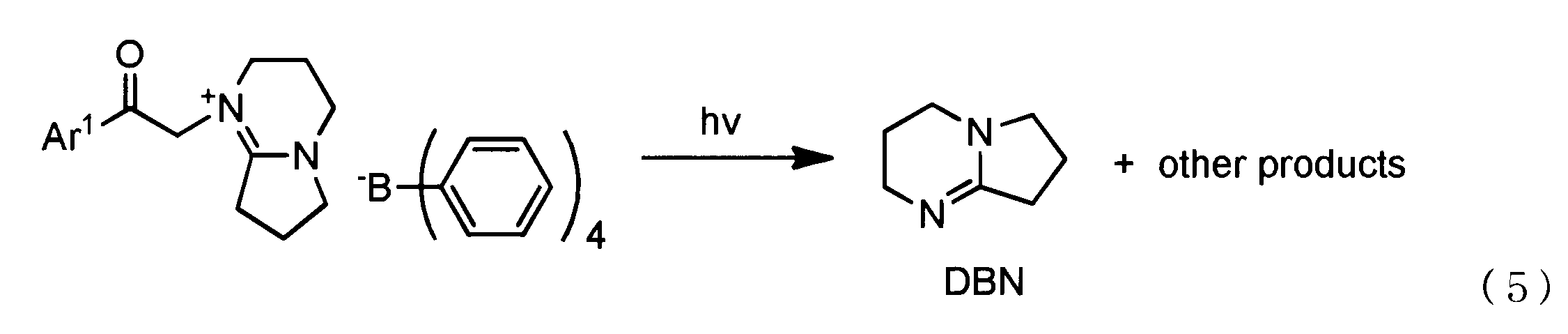
- the amidinium ketone (the left side of the following formula (5)) forming the tetraarylborate salt described in JP-T-2001-513765 and the aryl described in JP-T-2005-511536 1,3-diamine substituted with an alkyl group left side of the following formula (6)
- the addition amount of the photobase generator is preferably in the range of 0.01 to 10 parts by weight, more preferably in the range of 0.1 to 5 parts by weight with respect to 100 parts by weight of the curable composition.
- Ar 1 is phenyl, biphenyl, naphthyl, phenanthryl, anthracyl, pyrenyl, 5,6,7,8-tetrahydro-2-naphthyl, 5,6,7,8-tetrahydro-1-naphthyl, thienyl, Benzo [b] thienyl, naphtho [2,3-b] thienyl, thiatrenyl, dibenzofuryl, chromenyl, xanthenyl, thioxanthyl, phenoxathiinyl, terphenyl, stilbenyl or fluorenyl, these groups being unsubstituted Or C1-C18
- a photosensitizer may be included. By adding the photosensitizer, the photodecomposition of the photobase generator is accelerated, and the curing time of the photocurable composition can be shortened.
- Specific examples of the photosensitizer include benzophenones, thioxanthones, anthraquinones, camphorquinones, benzyls, Michler ketones, and anthracenes. These may be used alone or in combination of two or more.
- the addition amount of the photosensitizer is preferably in the range of 0.01 to 10 parts by weight and more preferably in the range of 0.1 to 5 parts by weight with respect to 100 parts by weight of the curable composition.
- a polymerization inhibitor a polymerization inhibitor, an antioxidant, an ultraviolet absorber, a silane coupling agent, a release agent, a pigment, a dye, and the like can be added to the curable composition. . Moreover, you may perform filtration, defoaming, etc. as needed.
- the cure shrinkage rate in an Example was computed from the refractive index before and behind hardening according to the following formula.
- X (1 ⁇ d1 / d2) ⁇ 100 [%]
- the refractive index of M and M represents the molecular weight.
- the viscosity of the curable composition was measured at a temperature of 25 ° C. using a cone / plate viscometer DV-II + (manufactured by Brookfield).
- the refractive indexes of the curable composition and the cured film were measured using an Abbe refractometer NAR-3T (manufactured by Atago Co., Ltd.).
- the transmittance of the cured film was measured using a spectrophotometer U-3500 (manufactured by Hitachi High-Tech) at a thickness of 0.25 mm and a wavelength of 400 nm.
- Example 1 In a 300 ml flask, 25 g of 2,5-dimercaptomethyl-1,4-dithiane, 15 g of m-xylylene diisocyanate and 0.1 g of dibutyltin dilaurate were placed, and stirring was continued at 60 ° C. for 24 hours.
- the curable composition was sandwiched between two release-treated glass plates, irradiated with light from a metal halide lamp (120 W / cm) for 3 minutes from a distance of 30 cm, and then the cured film was peeled from the glass plate.
- a cured film having a thickness of 0.25 mm was produced by the above procedure.
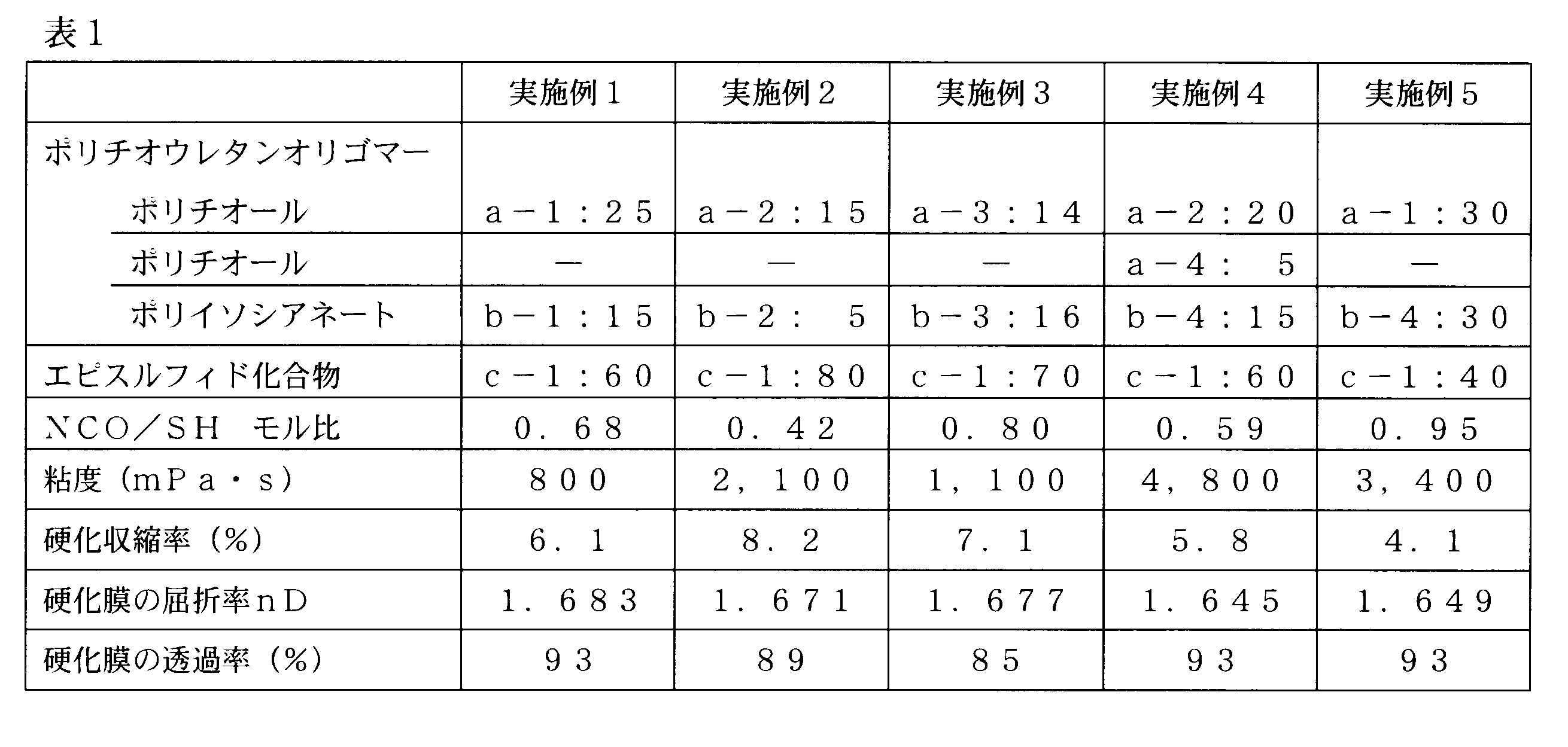
- the physical properties of the curable composition and the cured film were as shown in Table 1.
- Examples 2-5 A curable composition and a cured film were prepared in the same manner as in Example 1 except that the types and amounts of polythiol, polyisocyanate, and episulfide compound were changed to those shown in Table 1.
- the physical properties of the curable composition and the cured film were as shown in Table 1.
- Comparative Example 1 100 g of bis (2,3-epithiopropyl) sulfide, 0.5 g of photobase generator represented by the structural formula (7) (C component), and 4-benzoyl-4′-methyldiphenyl sulfide as a sensitizer 1 g was added and stirred until uniform.
- the curable composition was produced in the above procedure.
- a cured film was produced in the same manner as in Example 1.
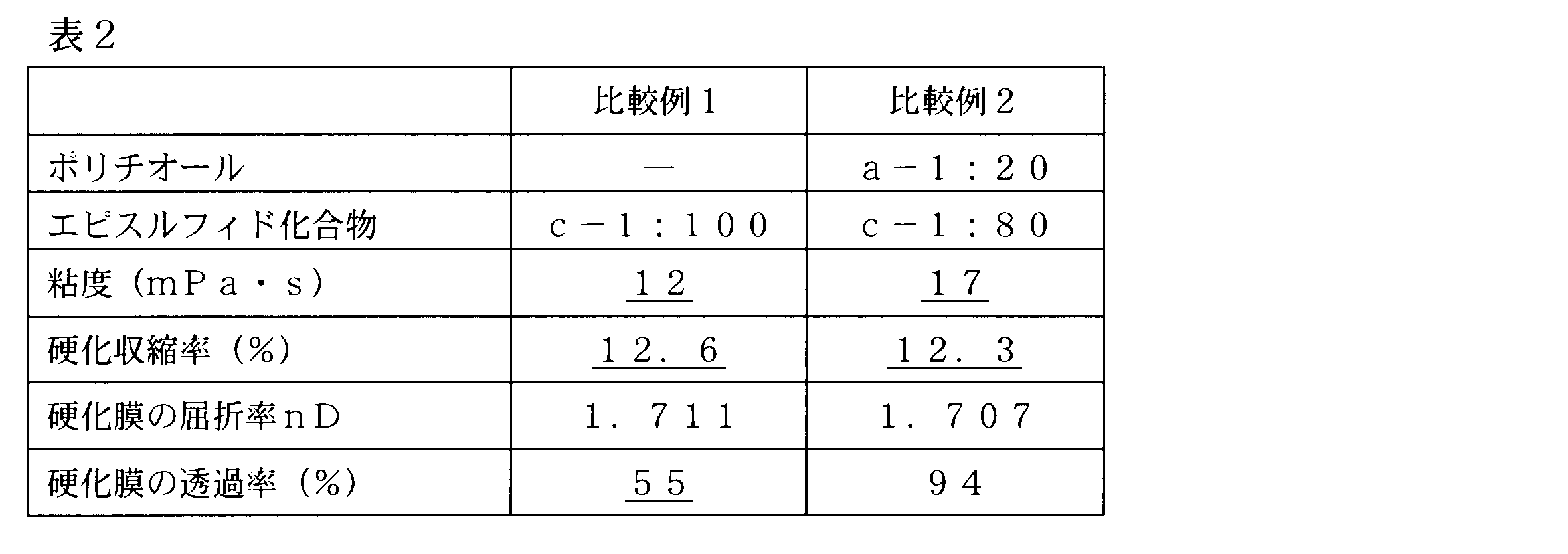
- the physical properties of the curable composition and the cured film were as shown in Table 2. In addition, physical properties that are inferior to those of the examples are underlined.
Landscapes
- Chemical & Material Sciences (AREA)
- Organic Chemistry (AREA)
- Health & Medical Sciences (AREA)
- Chemical Kinetics & Catalysis (AREA)
- Medicinal Chemistry (AREA)
- Polymers & Plastics (AREA)
- Adhesives Or Adhesive Processes (AREA)
- Polyurethanes Or Polyureas (AREA)
- Polymers With Sulfur, Phosphorus Or Metals In The Main Chain (AREA)
Abstract
Description
ポリチオウレタンオリゴマーの原料となるポリチオールとは、1分子中に2個以上のチオール基を有する化合物であり、直鎖状、分岐鎖状、環状のいずれであってもよい。特に、硬化性組成物の高屈折率化と作業性に適した粘度を追求した場合、下記一般式(1)から(3)で表わされる化合物が好ましい。




に従って進行する。チオール基とイソシアネート基が1対1モルで反応するため、チオール基とイソシアネート基のモル比が1に近いほど分子量が大きなポリチオウレタンオリゴマーが生成する。ポリチオールとポリイソシアネートの混合比は、チオール基1モルに対してイソシアネート基が0.2~0.95モルの範囲が好ましく、0.4~0.95モルの範囲がより好ましい。0.2モル未満ではチオール基の転化率が低すぎて実用的でないし、0.95モルを超えると未反応のイソシアネート基が残存して好ましくない。
本発明の硬化性組成物とは、前述したポリチオウレタンオリゴマー(A成分)、エピスルフィド化合物(B成分)、および光塩基発生剤(C成分)を含有して構成される。
エピスルフィド化合物(B成分)とは、1分子中に1個以上のエピスルフィド基を有する化合物である。特に、硬化性組成物の高屈折率化を追求した場合、下記の一般式(4)
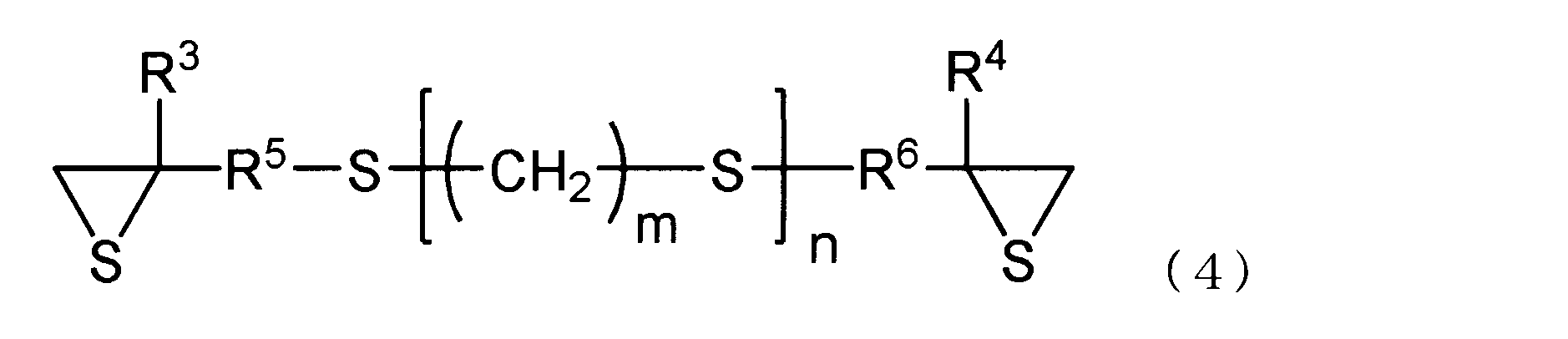
で表わされる化合物が好ましい。一般式(4)で表わされるエピスルフィド化合物の例としては、ビス(2,3-エピチオプロピル)スルフィド等が挙げられる。

X=(1-d1/d2)×100[%]
R=(n2-1)/(n2+2)×M/d
硬化前後でR/Mは一定なので、上の2式より、
X=[1-{(n12-1)/(n12+2)}/{(n22-1)/(n22+2)}]×100[%]
(式中、Xは硬化収縮率、dは比重、d1は硬化前の比重、d2は硬化後の比重、Rは分子屈折、nは屈折率、n1は硬化前の屈折率、n2は硬化後の屈折率、Mは分子量を表す。)
また、硬化性組成物の粘度は、コーン/プレート型粘度計DV-II+(ブルックフィールド社製)を用いて、温度25℃にて測定した。硬化性組成物および硬化膜の屈折率は、アッベ屈折計NAR-3T(アタゴ社製)を用いて測定した。硬化膜の透過率は、分光光度計U-3500(日立ハイテク社製)を用いて、硬化膜の厚み0.25mm、波長400nmにて測定した。
300mlフラスコに、2,5-ジメルカプトメチル-1,4-ジチアン25g、m-キシリレンジイソシアネート15g、およびジラウリン酸ジブチルスズ0.1gをとり、60℃にて24時間撹拌を続けた。赤外分光光度計にてイソシアネート基のIR吸収(2280cm-1)が無くなったことを確認した後、ビス(2,3-エピチオプロピル)スルフィド60g、下記構造式(7)

硬化性組成物および硬化膜の物性は表1に示す通りであった。
ポリチオール、ポリイソシアネート、およびエピスルフィド化合物の種類と仕込み量を表1に示す内容に変える以外は実施例1と同様にして硬化性組成物および硬化膜の作製を行った。硬化性組成物および硬化膜の物性は表1に示す通りであった。
ビス(2,3-エピチオプロピル)スルフィド100g、前記の構造式(7)で表わされる光塩基発生剤0.5g(C成分)、および増感剤として4-ベンゾイル-4’-メチルジフェニルスルフィド1gを加えて、均一になるまで撹拌した。以上の手順で硬化性組成物を作製した。
実施例1と同様にして硬化膜を作製した。硬化性組成物および硬化膜の物性は表2に示す通りであった。なお、実施例と比較して劣る物性には下線を引いた。
2,5-ジメルカプトメチル-1,4-ジチアン20g、ビス(2,3-エピチオプロピル)スルフィド80g、前記の構造式(7)で表わされる光塩基発生剤0.5g(C成分)、および増感剤として4-ベンゾイル-4’-メチルジフェニルスルフィド1gを加えて、均一になるまで撹拌した。以上の手順で硬化性組成物を作製した。
実施例1と同様にして硬化膜を作製した。硬化性組成物および硬化膜の物性は表2に示す通りであった。なお、実施例と比較して劣る物性には下線を引いた。
(a-1)2,5-ジメルカプトメチル-1,4-ジチアン
(a-2)ペンタエリスリトールテトラキス(3-メルカプトプロピオネート)
(a-3)m-キシリレンジチオール
(a-4)1,5-ジメルカプト-3-チアペンタン
(b-1)m-キシリレンジイソシアネート
(b-2)1,3-ビス(2-イソシアナト-2-プロピル)シクロヘキサン
(b-3)1,3-ビス(2-イソシアナト-2-プロピル)ベンゼン
(b-4)イソホロンジイソシアネート
(c-1)ビス(2,3-エピチオプロピル)スルフィド
Claims (7)
- ポリチオールとポリイソシアネートを反応させて得られるポリチオウレタンオリゴマー(A成分)、エピスルフィド化合物(B成分)および光塩基発生剤(C成分)を含有する硬化性組成物。
- ポリチオールが、下記一般式(1)、下記一般式(2)および下記一般式(3)から成る群から選択される一種以上である請求項1に記載の硬化性組成物。



- ポリチオールとポリイソシアネートを反応させる際のポリチオールとポリイソシアネートの比率が、チオール基1モルに対して、イソシアネート基が0.2~0.95モルの範囲である、請求項1または2に記載の硬化性組成物。
- エピスルフィド化合物(B成分)が、下記一般式(4)で表わされる化合物である請求項1から3のいずれかに記載の硬化性組成物。

- 一般式(4)で表わされる化合物がビス(2,3-エピチオプロピル)スルフィドである請求項4に記載の硬化性組成物。
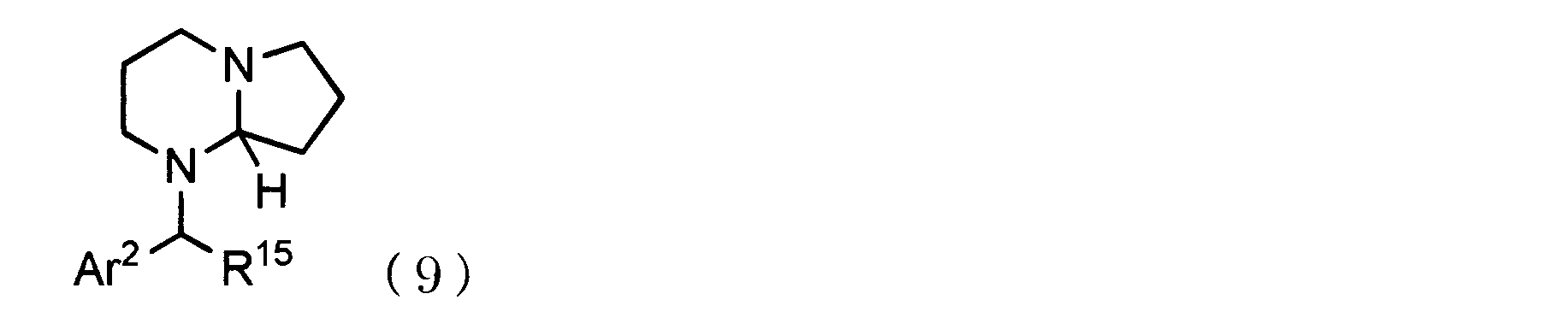
- 光塩基発生剤(C成分)が、下記一般式(8)または(9)で表される化合物である請求項1から5のいずれかに記載の硬化性組成物。

- 請求項1から6のいずれかに記載の硬化性組成物を含有する光学用接着剤。
Priority Applications (2)
| Application Number | Priority Date | Filing Date | Title |
|---|---|---|---|
| JP2013512361A JP6230419B2 (ja) | 2011-04-28 | 2012-04-24 | 硬化性組成物および光学用接着剤 |
| CN201280019915.6A CN103562272B (zh) | 2011-04-28 | 2012-04-24 | 固化性组合物及光学用粘接剂 |
Applications Claiming Priority (2)
| Application Number | Priority Date | Filing Date | Title |
|---|---|---|---|
| JP2011-101441 | 2011-04-28 | ||
| JP2011101441 | 2011-04-28 |
Publications (1)
| Publication Number | Publication Date |
|---|---|
| WO2012147709A1 true WO2012147709A1 (ja) | 2012-11-01 |
Family
ID=47072228
Family Applications (1)
| Application Number | Title | Priority Date | Filing Date |
|---|---|---|---|
| PCT/JP2012/060900 Ceased WO2012147709A1 (ja) | 2011-04-28 | 2012-04-24 | 硬化性組成物および光学用接着剤 |
Country Status (4)
| Country | Link |
|---|---|
| JP (1) | JP6230419B2 (ja) |
| CN (1) | CN103562272B (ja) |
| TW (1) | TWI526475B (ja) |
| WO (1) | WO2012147709A1 (ja) |
Cited By (4)
| Publication number | Priority date | Publication date | Assignee | Title |
|---|---|---|---|---|
| WO2013129460A1 (ja) * | 2012-03-01 | 2013-09-06 | 三菱瓦斯化学株式会社 | 光学材料用重合性組成物 |
| JPWO2023063398A1 (ja) * | 2021-10-15 | 2023-04-20 | ||
| WO2024260512A1 (de) * | 2023-06-20 | 2024-12-26 | Rodenstock Gmbh | Verfahren zur herstellung eines glaskörpers, glaskörper und polymerisierbare mischung |
| WO2025197516A1 (ja) * | 2024-03-18 | 2025-09-25 | 三井化学株式会社 | 組成物、硬化物、硬化物の製造方法、化合物及び塩基発生剤 |
Citations (7)
| Publication number | Priority date | Publication date | Assignee | Title |
|---|---|---|---|---|
| JPH11349658A (ja) * | 1998-06-11 | 1999-12-21 | Sumitomo Seika Chem Co Ltd | 硬化性組成物及びそれを用いて得られる光学材料 |
| JP2004059901A (ja) * | 2002-06-04 | 2004-02-26 | Hoya Corp | プラスチックレンズの製造方法及びプラスチックレンズ |
| WO2005014696A1 (ja) * | 2003-08-06 | 2005-02-17 | Mitsubishi Gas Chemical Company, Inc. | 光硬化性組成物及びコーティング剤組成物 |
| JP2005264156A (ja) * | 2004-02-16 | 2005-09-29 | Mitsubishi Gas Chem Co Inc | 光塩基発生剤 |
| JP2005272785A (ja) * | 2004-03-26 | 2005-10-06 | Mitsui Chemicals Inc | 高屈折率・高耐候性樹脂及びその製造方法 |
| JP2007197615A (ja) * | 2006-01-27 | 2007-08-09 | Mitsubishi Gas Chem Co Inc | 樹脂用組成物 |
| JP2011038050A (ja) * | 2009-08-18 | 2011-02-24 | Mitsubishi Gas Chemical Co Inc | 光硬化性組成物、硬化方法及び硬化物 |
Family Cites Families (1)
| Publication number | Priority date | Publication date | Assignee | Title |
|---|---|---|---|---|
| EP1564255B1 (en) * | 2004-02-16 | 2007-09-26 | Mitsubishi Gas Chemical Company, Inc. | Photobase generator and curable composition |
-
2012
- 2012-04-24 JP JP2013512361A patent/JP6230419B2/ja active Active
- 2012-04-24 WO PCT/JP2012/060900 patent/WO2012147709A1/ja not_active Ceased
- 2012-04-24 CN CN201280019915.6A patent/CN103562272B/zh active Active
- 2012-04-25 TW TW101114701A patent/TWI526475B/zh active
Patent Citations (7)
| Publication number | Priority date | Publication date | Assignee | Title |
|---|---|---|---|---|
| JPH11349658A (ja) * | 1998-06-11 | 1999-12-21 | Sumitomo Seika Chem Co Ltd | 硬化性組成物及びそれを用いて得られる光学材料 |
| JP2004059901A (ja) * | 2002-06-04 | 2004-02-26 | Hoya Corp | プラスチックレンズの製造方法及びプラスチックレンズ |
| WO2005014696A1 (ja) * | 2003-08-06 | 2005-02-17 | Mitsubishi Gas Chemical Company, Inc. | 光硬化性組成物及びコーティング剤組成物 |
| JP2005264156A (ja) * | 2004-02-16 | 2005-09-29 | Mitsubishi Gas Chem Co Inc | 光塩基発生剤 |
| JP2005272785A (ja) * | 2004-03-26 | 2005-10-06 | Mitsui Chemicals Inc | 高屈折率・高耐候性樹脂及びその製造方法 |
| JP2007197615A (ja) * | 2006-01-27 | 2007-08-09 | Mitsubishi Gas Chem Co Inc | 樹脂用組成物 |
| JP2011038050A (ja) * | 2009-08-18 | 2011-02-24 | Mitsubishi Gas Chemical Co Inc | 光硬化性組成物、硬化方法及び硬化物 |
Cited By (6)
| Publication number | Priority date | Publication date | Assignee | Title |
|---|---|---|---|---|
| WO2013129460A1 (ja) * | 2012-03-01 | 2013-09-06 | 三菱瓦斯化学株式会社 | 光学材料用重合性組成物 |
| US9518153B2 (en) | 2012-03-01 | 2016-12-13 | Mitsubishi Gas Chemical Company, Inc. | Polymerizable composition for optical materials |
| JPWO2023063398A1 (ja) * | 2021-10-15 | 2023-04-20 | ||
| WO2023063398A1 (ja) * | 2021-10-15 | 2023-04-20 | 三井化学株式会社 | 光硬化性組成物、硬化物、積層体、硬化物の製造方法、及び、レンズの製造方法 |
| WO2024260512A1 (de) * | 2023-06-20 | 2024-12-26 | Rodenstock Gmbh | Verfahren zur herstellung eines glaskörpers, glaskörper und polymerisierbare mischung |
| WO2025197516A1 (ja) * | 2024-03-18 | 2025-09-25 | 三井化学株式会社 | 組成物、硬化物、硬化物の製造方法、化合物及び塩基発生剤 |
Also Published As
| Publication number | Publication date |
|---|---|
| JP6230419B2 (ja) | 2017-11-15 |
| TWI526475B (zh) | 2016-03-21 |
| TW201305249A (zh) | 2013-02-01 |
| JPWO2012147709A1 (ja) | 2014-07-28 |
| CN103562272B (zh) | 2015-07-08 |
| CN103562272A (zh) | 2014-02-05 |
Similar Documents
| Publication | Publication Date | Title |
|---|---|---|
| KR101349273B1 (ko) | 티오에폭시계 광학재료의 제조방법과 그 중합성 조성물 | |
| JP5834474B2 (ja) | 硬化性組成物および光学接着剤 | |
| CN105143300B (zh) | 光学材料用聚合性组合物、光学材料及光学材料的制造方法 | |
| KR101802479B1 (ko) | 고리개환을 통해 사슬연장된 폴리티올화합물과 그 제조 방법 및 이를 이용한 우레탄계 광학재료용 수지 조성물 | |
| EP1369709B1 (en) | process for producing plastic lens and plastic lens | |
| TWI521035B (zh) | A hardening composition and an optical follower | |
| JP2019524725A (ja) | 光学材料のための芳香族ポリチオール化合物 | |
| JP6230419B2 (ja) | 硬化性組成物および光学用接着剤 | |
| KR20130081257A (ko) | 티오에폭시계 광학재료용 중합성 조성물과 티오에폭시계 광학재료의 제조방법 | |
| JP5991315B2 (ja) | 硬化性組成物および光学用接着剤 | |
| JP4268516B2 (ja) | 速重合性/硬化性エピスルフィド系組成物、重合/硬化方法、およびそれから得られた光学製品 | |
| CN106458876A (zh) | 新的硫醇化合物和包含其的聚合性组合物 | |
| CN106061960A (zh) | 新型硫醇化合物和使用了其的光学材料用组合物 | |
| WO2025197516A1 (ja) | 組成物、硬化物、硬化物の製造方法、化合物及び塩基発生剤 | |
| KR101464943B1 (ko) | 티오에폭시계 광학재료용 폴리티올화합물의 제조방법과 이를 포함하는 티오에폭시계 광학재료용 공중합체 조성물 | |
| JP2019026755A (ja) | 光学材料用組成物 | |
| US10669367B2 (en) | Polythiol composition for plastic lens | |
| WO2016178522A2 (ko) | 티오에폭시계 광학재료의 제조방법과 티오에폭시계 광학재료용 중합성 조성물 | |
| JP5742443B2 (ja) | 硬化性組成物および光学接着剤 | |
| KR20150039184A (ko) | 티오에폭시 화합물을 포함하는 광학재료용 중합성 조성물과 광학재료의 제조방법 | |
| CN103562273B9 (zh) | 固化性组合物及光学用粘接剂 | |
| KR20160100422A (ko) | 광학재료용 티오에폭시 화합물의 제조방법과 이 화합물을 포함하는 티오에폭시계 광학재료용 중합성 조성물 |
Legal Events
| Date | Code | Title | Description |
|---|---|---|---|
| 121 | Ep: the epo has been informed by wipo that ep was designated in this application |
Ref document number: 12776527 Country of ref document: EP Kind code of ref document: A1 |
|
| ENP | Entry into the national phase |
Ref document number: 2013512361 Country of ref document: JP Kind code of ref document: A |
|
| NENP | Non-entry into the national phase |
Ref country code: DE |
|
| WWE | Wipo information: entry into national phase |
Ref document number: IDW00201305483 Country of ref document: ID |
|
| 122 | Ep: pct application non-entry in european phase |
Ref document number: 12776527 Country of ref document: EP Kind code of ref document: A1 |