WO2012128086A1 - 医療用接着剤 - Google Patents
医療用接着剤 Download PDFInfo
- Publication number
- WO2012128086A1 WO2012128086A1 PCT/JP2012/056179 JP2012056179W WO2012128086A1 WO 2012128086 A1 WO2012128086 A1 WO 2012128086A1 JP 2012056179 W JP2012056179 W JP 2012056179W WO 2012128086 A1 WO2012128086 A1 WO 2012128086A1
- Authority
- WO
- WIPO (PCT)
- Prior art keywords
- compound
- general formula
- chlorine
- following general
- compound represented
- Prior art date
- Legal status (The legal status is an assumption and is not a legal conclusion. Google has not performed a legal analysis and makes no representation as to the accuracy of the status listed.)
- Ceased
Links
Classifications
-
- A—HUMAN NECESSITIES
- A61—MEDICAL OR VETERINARY SCIENCE; HYGIENE
- A61L—METHODS OR APPARATUS FOR STERILISING MATERIALS OR OBJECTS IN GENERAL; DISINFECTION, STERILISATION OR DEODORISATION OF AIR; CHEMICAL ASPECTS OF BANDAGES, DRESSINGS, ABSORBENT PADS OR SURGICAL ARTICLES; MATERIALS FOR BANDAGES, DRESSINGS, ABSORBENT PADS OR SURGICAL ARTICLES
- A61L24/00—Surgical adhesives or cements; Adhesives for colostomy devices
- A61L24/04—Surgical adhesives or cements; Adhesives for colostomy devices containing macromolecular materials
- A61L24/046—Surgical adhesives or cements; Adhesives for colostomy devices containing macromolecular materials obtained otherwise than by reactions only involving carbon-to-carbon unsaturated bonds
-
- A—HUMAN NECESSITIES
- A61—MEDICAL OR VETERINARY SCIENCE; HYGIENE
- A61L—METHODS OR APPARATUS FOR STERILISING MATERIALS OR OBJECTS IN GENERAL; DISINFECTION, STERILISATION OR DEODORISATION OF AIR; CHEMICAL ASPECTS OF BANDAGES, DRESSINGS, ABSORBENT PADS OR SURGICAL ARTICLES; MATERIALS FOR BANDAGES, DRESSINGS, ABSORBENT PADS OR SURGICAL ARTICLES
- A61L24/00—Surgical adhesives or cements; Adhesives for colostomy devices
- A61L24/04—Surgical adhesives or cements; Adhesives for colostomy devices containing macromolecular materials
-
- A—HUMAN NECESSITIES
- A61—MEDICAL OR VETERINARY SCIENCE; HYGIENE
- A61L—METHODS OR APPARATUS FOR STERILISING MATERIALS OR OBJECTS IN GENERAL; DISINFECTION, STERILISATION OR DEODORISATION OF AIR; CHEMICAL ASPECTS OF BANDAGES, DRESSINGS, ABSORBENT PADS OR SURGICAL ARTICLES; MATERIALS FOR BANDAGES, DRESSINGS, ABSORBENT PADS OR SURGICAL ARTICLES
- A61L24/00—Surgical adhesives or cements; Adhesives for colostomy devices
- A61L24/02—Surgical adhesives or cements; Adhesives for colostomy devices containing inorganic materials
-
- C—CHEMISTRY; METALLURGY
- C08—ORGANIC MACROMOLECULAR COMPOUNDS; THEIR PREPARATION OR CHEMICAL WORKING-UP; COMPOSITIONS BASED THEREON
- C08G—MACROMOLECULAR COMPOUNDS OBTAINED OTHERWISE THAN BY REACTIONS ONLY INVOLVING UNSATURATED CARBON-TO-CARBON BONDS
- C08G18/00—Polymeric products of isocyanates or isothiocyanates
- C08G18/06—Polymeric products of isocyanates or isothiocyanates with compounds having active hydrogen
- C08G18/28—Polymeric products of isocyanates or isothiocyanates with compounds having active hydrogen characterised by the compounds used containing active hydrogen
- C08G18/40—High-molecular-weight compounds
- C08G18/48—Polyethers
- C08G18/4833—Polyethers containing oxyethylene units
- C08G18/4837—Polyethers containing oxyethylene units and other oxyalkylene units
-
- C—CHEMISTRY; METALLURGY
- C08—ORGANIC MACROMOLECULAR COMPOUNDS; THEIR PREPARATION OR CHEMICAL WORKING-UP; COMPOSITIONS BASED THEREON
- C08G—MACROMOLECULAR COMPOUNDS OBTAINED OTHERWISE THAN BY REACTIONS ONLY INVOLVING UNSATURATED CARBON-TO-CARBON BONDS
- C08G18/00—Polymeric products of isocyanates or isothiocyanates
- C08G18/06—Polymeric products of isocyanates or isothiocyanates with compounds having active hydrogen
- C08G18/28—Polymeric products of isocyanates or isothiocyanates with compounds having active hydrogen characterised by the compounds used containing active hydrogen
- C08G18/40—High-molecular-weight compounds
- C08G18/48—Polyethers
- C08G18/4833—Polyethers containing oxyethylene units
- C08G18/4837—Polyethers containing oxyethylene units and other oxyalkylene units
- C08G18/4845—Polyethers containing oxyethylene units and other oxyalkylene units containing oxypropylene or higher oxyalkylene end groups
-
- C—CHEMISTRY; METALLURGY
- C08—ORGANIC MACROMOLECULAR COMPOUNDS; THEIR PREPARATION OR CHEMICAL WORKING-UP; COMPOSITIONS BASED THEREON
- C08G—MACROMOLECULAR COMPOUNDS OBTAINED OTHERWISE THAN BY REACTIONS ONLY INVOLVING UNSATURATED CARBON-TO-CARBON BONDS
- C08G18/00—Polymeric products of isocyanates or isothiocyanates
- C08G18/06—Polymeric products of isocyanates or isothiocyanates with compounds having active hydrogen
- C08G18/70—Polymeric products of isocyanates or isothiocyanates with compounds having active hydrogen characterised by the isocyanates or isothiocyanates used
- C08G18/72—Polyisocyanates or polyisothiocyanates
- C08G18/77—Polyisocyanates or polyisothiocyanates having heteroatoms in addition to the isocyanate or isothiocyanate nitrogen and oxygen or sulfur
- C08G18/773—Polyisocyanates or polyisothiocyanates having heteroatoms in addition to the isocyanate or isothiocyanate nitrogen and oxygen or sulfur halogens
-
- C—CHEMISTRY; METALLURGY
- C09—DYES; PAINTS; POLISHES; NATURAL RESINS; ADHESIVES; COMPOSITIONS NOT OTHERWISE PROVIDED FOR; APPLICATIONS OF MATERIALS NOT OTHERWISE PROVIDED FOR
- C09J—ADHESIVES; NON-MECHANICAL ASPECTS OF ADHESIVE PROCESSES IN GENERAL; ADHESIVE PROCESSES NOT PROVIDED FOR ELSEWHERE; USE OF MATERIALS AS ADHESIVES
- C09J175/00—Adhesives based on polyureas or polyurethanes; Adhesives based on derivatives of such polymers
- C09J175/04—Polyurethanes
-
- C—CHEMISTRY; METALLURGY
- C09—DYES; PAINTS; POLISHES; NATURAL RESINS; ADHESIVES; COMPOSITIONS NOT OTHERWISE PROVIDED FOR; APPLICATIONS OF MATERIALS NOT OTHERWISE PROVIDED FOR
- C09J—ADHESIVES; NON-MECHANICAL ASPECTS OF ADHESIVE PROCESSES IN GENERAL; ADHESIVE PROCESSES NOT PROVIDED FOR ELSEWHERE; USE OF MATERIALS AS ADHESIVES
- C09J175/00—Adhesives based on polyureas or polyurethanes; Adhesives based on derivatives of such polymers
- C09J175/04—Polyurethanes
- C09J175/08—Polyurethanes from polyethers
Definitions
- the present invention relates to a medical adhesive.
- An object of the present invention is to provide a medical adhesive that is hard to be degraded and decomposed and is stable and has a low generation of carboxylic acid and aldehyde due to degradation and is safe.
- the medical adhesive of the present invention comprises a polyisocyanate component (A) having a fluorine-containing non-aromatic polyisocyanate compound (A1) as an essential component and a polyol component (B) having a hydrophilic polyol (B1) as an essential component. ), And the chlorine content of the chlorine-containing organic compound is 0.005 weight based on the weight of the hydrophilic urethane prepolymer (UP).
- the chlorine content of the chlorine-containing organic compound includes the following compounds (1) to (14), reaction products of compounds (1) and (B), reaction products of compounds (2) and (B), The gist is the total content of chlorine contained in the reaction product of the compounds (7) and (B) and the reaction product of the compounds (8) and (B).
- Compound (1) A compound represented by the following general formula (I). In general formula (I), n represents an integer of 1 to 20. OCNCH 2 (CF 2 ) n CH 2 OCOCl (I)
- Compound (2) A compound represented by the following general formula (II). In the general formula (II), n represents an integer of 1 to 20.
- n represents an integer of 1 to 22.
- Cl (CF 2 ) n Cl (X) Compound (11): A compound represented by the following general formula (XI). O (CH 2 CH 2 OCOCl) 2 (XI)
- Compound (14) A compound represented by the following general formula (XIV). ClCH 2 CH 2 OCH 2 CH 2 OCH 3 (XIV)
- the medical adhesive of the present invention is excellent in stability because a cured product obtained by curing the medical adhesive is not easily degraded and decomposed over time. Furthermore, the medical adhesive of the present invention is highly safe because carboxylic acid and aldehyde are not generated.
- the polyisocyanate component (A) contains the fluorine-containing non-aromatic polyisocyanate compound (A1) as an essential component, but the polyisocyanate compound (A2) does not contain a fluorine atom and the fluorine-containing aromatic polyisocyanate compound ( A3) or the like may be used in combination.
- the fluorine-containing non-aromatic polyisocyanate compound (A1) include a fluorine-containing aliphatic diisocyanate (A11) having 3 to 24 carbon atoms, a fluorine-containing alicyclic diisocyanate (A12) having 8 to 21 carbon atoms, and 9 to 72 carbon atoms.
- Fluorine-containing poly (3- to 6-valent) isocyanate (A13) and the like can be used.
- Examples of the fluorine-containing aliphatic diisocyanate (A11) having 3 to 24 carbon atoms are those represented by OCN—Rf—NCO (Rf represents a perfluoroalkylene group having 1 to 22 carbon atoms) and OCN—CH 2 —. And those represented by Rf—CH 2 —NCO (Rf represents a perfluoroalkylene group having 1 to 20 carbon atoms) and the like.
- Examples of OCN—Rf—NCO include difluoromethylene diisocyanate, perfluorodimethylene diisocyanate, perfluorotrimethylene diisocyanate, perfluorooctyl diisocyanate, and perfluoroeicosylene diisocyanate.
- OCN—CH 2 —Rf—CH 2 —NCO bis (isocyanatomethyl) difluoromethane, bis (isocyanatomethyl) perfluoroethane, bis (isocyanatomethyl) perfluoropropane, bis ( Examples include isocyanatomethyl) perfluorobutane, bis (isocyanatomethyl) perfluoropentane, bis (isocyanatomethyl) perfluorohexane, and bis (isocyanatomethyl) perfluoroeicosane.
- fluorine-containing alicyclic diisocyanate (A12) having 8 to 21 carbon atoms examples include diisocyanatoperfluorocyclohexane, bis (isocyanatomethyl) perfluorocyclohexane, bis (isocyanatomethyl) perfluorodimethylcyclohexane, and bis (isocyanato).
- fluorine-containing poly (3- to 6-valent) isocyanate (A13) having 9 to 72 carbon atoms examples include the diisocyanate nurate, the diisocyanate adduct and tris (isocyanatotetrafluorocyclohexyl) methane.
- the position of the isocyanate group in the fluorine-containing non-aromatic polyisocyanate compound (A1) is a position with less steric hindrance from the viewpoint of reactivity with the polyol component (B) and reactivity with blood, body fluids, and the like. It is preferably a terminal position with less steric hindrance.
- the fluorine-containing non-aromatic polyisocyanate compound (A1) may be one type or a mixture of two or more types. Further, among the fluorine-containing non-aromatic polyisocyanate compound (A1), those having two isocyanate groups are preferable from the viewpoint that side reactions such as a crosslinking reaction hardly occur.
- fluorine-containing non-aromatic polyisocyanate compound (A1) fluorine-containing non-aromatic polyisocyanate compound (A1) is preferable from the viewpoint of safety such as mutagenicity, and more preferably OCN—CH 2 —Rf—CH 2.
- Examples of the polyisocyanate compound (A2) containing no fluorine atom include aliphatic polyisocyanates (A21) containing no fluorine atoms having 1 to 24 carbon atoms, and alicyclic polyisocyanates containing no fluorine atoms having 8 to 21 carbon atoms ( A22), an araliphatic polyisocyanate (A23) not containing a fluorine atom having 8 to 21 carbon atoms, an aromatic polyisocyanate (A24) not containing a fluorine atom having 8 to 21 carbon atoms, and a modified product thereof (A25) Is used.
- Examples of the aliphatic polyisocyanate containing no fluorine atom (A21) include tetramethylene diisocyanate, hexamethylene diisocyanate (HDI), 2,2,4-trimethylhexamethylene diisocyanate, and lysine diisocyanate.
- Examples of the alicyclic polyisocyanate (A22) containing no fluorine atom include isophorone diisocyanate (IPDI), dicyclohexylmethane-4,4′-diisocyanate (hydrogenated MDI), cyclohexylene diisocyanate and methylcyclohexylene diisocyanate (hydrogenated TDI). Etc.
- IPDI isophorone diisocyanate
- MDI dicyclohexylmethane-4,4′-diisocyanate
- TDI methylcyclohexylene diisocyanate
- Examples of the araliphatic polyisocyanate containing no fluorine atom include m- or p-xylylene diisocyanate (XDI) and ⁇ , ⁇ , ⁇ ′, ⁇ ′-tetramethylxylylene diisocyanate (TMXDI). .
- aromatic polyisocyanate (A24) containing no fluorine atom examples include 1,3- or 1,4-phenylene diisocyanate (PDI), 2,4- or 2,6-tolylene diisocyanate (TDI), 2,4 ′. -Or 4,4'-diphenylmethane diisocyanate (MDI) and crude MDI.
- PDI 1,4-phenylene diisocyanate
- TDI 2,4- or 2,6-tolylene diisocyanate
- MDI 4,4'-diphenylmethane diisocyanate
- crude MDI crude MDI.
- modified products (A25) include urethane modified products, isocyanurate modified products, allophanate modified products, biuret modified products, uretdione modified products, uretonimine modified products, and uretdione isocyanurate modified products.
- Modified forms of HDI include urethane-modified HDI, carbodiimide-modified HDI, and trihydrocarbyl phosphate-modified HDI.
- Modified forms of MDI include urethane-modified MDI, carbodiimide-modified MDI, modified forms of TDI, urethane-modified TDI, and carbodiimide-modified TDI. Is mentioned.
- polyisocyanate compound (A2) which does not contain a fluorine atom may be one type or a mixture of two or more types.
- polyisocyanate compounds (A2) from the reaction of the viewpoints such as aromatic polyisocyanates (A24) is preferably free of fluorine atom, more preferably a MDI and TDI.
- aromatic polyisocyanates (A24) is preferably free of fluorine atom, more preferably a MDI and TDI.
- aliphatic polyisocyanate (A21) containing no fluorine atom is preferred, and HDI is more preferred.
- the content (% by weight) of (A2) is the fluorine-containing non-aromatic polyisocyanate compound (A1). Is preferably from 0.1 to 20, more preferably from 0.2 to 10, and particularly preferably from 0.3 to 5.
- fluorine-containing aromatic polyisocyanate compound (A3) a fluorine-containing aromatic polyisocyanate in which part or all of the hydrogen atoms of the aromatic ring are substituted with fluorine atoms in the aromatic polyisocyanate (A24) not containing fluorine atoms. Isocyanate or the like is used.
- the fluorine-containing aromatic polyisocyanate (A31) is obtained by substituting all hydrogens of the aromatic ring with fluorine, specifically 1,3- or 1,4-perfluorophenylene diisocyanate, 3, 5, Examples thereof include 6- or 3,4,5-trifluoro-2,4- or 2,6-tolylene diisocyanate, tetrafluoro-2,4′- or 4,4′-diphenylmethane diisocyanate.
- the fluorine-containing aromatic polyisocyanate (A32) is obtained by substituting a part of hydrogen of an aromatic ring with fluorine.
- trifluoromethyl-monofluoro-phenylene-1,3 or 1,4- Examples thereof include diisocyanate and 2,4′- or 4,4′-diphenyldifluoromethane diisocyanate.
- the fluorine-containing aromatic polyisocyanate (A33) is obtained by substituting all hydrogens with fluorine, specifically, 2,4- or 2,6-perfluorotolylene diisocyanate and 2,4′- or 4 4,4'-perfluorodiphenylmethane diisocyanate and the like.
- 1 type or 2 or more types of mixtures may be sufficient as a fluorine-containing aromatic polyisocyanate compound (A3).
- fluorine-containing aromatic polyisocyanate compounds (A3) from the viewpoint of reactivity, etc., the fluorine-containing aromatic polyisocyanate (A31) in which at least part or all of the hydrogen atoms of the aromatic ring are substituted with fluorine atoms, and Fluorine-containing aromatic polyisocyanate (A33) is preferable, and fluorine-containing aromatic polyisocyanate (A33) is more preferable.
- the content (% by weight) of (A3) is the same as that of the fluorine-containing non-aromatic polyisocyanate compound (A1). Based on the weight, it is preferably from 0.1 to 5, more preferably from 0.2 to 3, particularly preferably from 0.3 to 2.
- the content (% by weight) of hydrolyzable chlorine in the polyisocyanate component (A) is preferably 0.05 or less, more preferably 0.04 or less, and still more preferably based on the weight of (A). 0.03 or less. If the content of hydrolyzable chlorine is within this range, even when irradiated with ⁇ -rays of around 25 kGy, which are indispensable as medical adhesives, for sterilization, it is difficult to color and the wet adhesive strength does not change easily. An agent can be provided.
- the content (% by weight) of hydrolyzable chlorine in the medical adhesive is preferably 0.015 or less based on the weight of the hydrophilic urethane prepolymer (UP) from the viewpoint of colorability and wet adhesion. More preferably, it is 0.010 or less.
- Hydrolyzable chlorine is a raw material (unreacted material) for producing polyisocyanates, intermediates and impurities, such as hydrogen chloride, phosgene, triphosgene, carbamyl chloride, chloroformate, benzyl chloride, carbodiimide and carbamoyl chloride. It is thought to be caused by The content of hydrolyzable chlorine is measured in accordance with JISK1603-3: 2007.
- the polyol component (B) contains the hydrophilic polyol (B1) as an essential component, but may contain another polyol (B2) having low hydrophilicity.
- the hydrophilic polyol (B1) contains an oxyethylene group, a polyol having an oxyethylene group content of 30 to 100% by weight based on the weight of (B1), and contains an oxyethylene group.
- Polyester polyol (B1-2) obtained using polyether polyols (B1-1) and (B1-1) as essential components can be used.
- the solubility parameter (SP value) of the hydrophilic polyol (B1) is preferably in the range of 7 to 17, more preferably 8 to 16, from the viewpoint of reactivity and adhesive strength.
- the HLB of the hydrophilic polyol (B1) is preferably 4 to 20, more preferably 4.5 to 20, from the viewpoint of reactivity and adhesive strength.
- HLB is an index indicating the balance between hydrophilicity and lipophilicity, and is described, for example, in “Introduction to Surfactants” (published by Sanyo Chemical Industries, Ltd., 2007, Takehiko Fujimoto), page 212. By the Oda method, it can be calculated from the ratio between the organic value and the inorganic value of the organic compound. HLB ⁇ 10 ⁇ inorganic / organic The organic value and the inorganic value for deriving HLB can be calculated by using the values in the table described in “Introduction of Surfactant” on page 213.
- Examples of the polyether polyol (B1-1) containing an oxyethylene group include an ethylene oxide adduct to a compound having at least two active hydrogens, or ethylene oxide and an alkylene oxide having 1 to 8 carbon atoms (1,2- or 1). , 3-propylene oxide, 1,2-, 1,3-, 2,3- or 1,4-butylene oxide, styrene oxide, and the like).
- the addition form may be random, block, or a combination thereof, but is preferably random from the viewpoint of adhesive strength.
- the alkylene oxide having 3 to 8 carbon atoms is preferably 1,2-propylene oxide from the viewpoint of adhesive strength.
- water, diol, 3 to 8 valent polyol, dicarboxylic acid, 3 to 4 polycarboxylic acid, monoamine, polyamine, polythiol and the like can be used as the compound having at least two active hydrogens.
- a divalent hydrophilic polyol is obtained when a compound having two active hydrogens is used, and a trivalent or higher hydrophilic polyol is obtained when a compound having three or more active hydrogens is used.
- diol examples include alkylene glycols having 2 to 30 carbon atoms (ethylene glycol, 1,2-propylene glycol, 1,3-propylene glycol, 1,4-butanediol, 1,6-hexanediol, octanediol, decanediol, Dodecanediol, tetradecanediol, neopentyl glycol, 2,2-diethyl-1,3-propanediol, etc.); alicyclic diols having 6 to 24 carbon atoms (1,4-cyclohexanedimethanol, hydrogenated bisphenol A, etc.) Bisphenols having 15 to 30 carbon atoms (such as bisphenol A, bisphenol F and bisphenol S); dihydroxybenzenes (such as catechol and hydroquinone) are used.
- alkylene glycols having 2 to 30 carbon atoms ethylene glycol, 1,2-propylene glycol, 1,3-propylene
- aliphatic polyhydric alcohols having 3 to 8 carbon atoms such as glycerin, trimethylolethane, trimethylolpropane, pentaerythritol, sorbitan, diglycerin, and sorbitol are used.
- dicarboxylic acid examples include alkane dicarboxylic acids having 4 to 32 carbon atoms (such as succinic acid, adipic acid, sebacic acid, azelaic acid, sebacic acid, dodecanedicarboxylic acid, octadecanedicarboxylic acid, dodecyl succinic acid and octadecyl succinic acid); Alkene dicarboxylic acids having 4 to 32 (maleic acid, fumaric acid, citraconic acid, mesaconic acid, dimer acid, dodecenyl succinic acid and pentadecenyl succinic acid); aromatic dicarboxylic acids having 8 to 20 carbon atoms (phthalic acid, isophthalic acid) Acid, terephthalic acid, naphthalenedicarboxylic acid and the like).
- alkane dicarboxylic acids having 4 to 32 carbon atoms such as succinic acid, adipic acid, sebacic
- dicarboxylic acid anhydrides such as maleic anhydride and phthalic anhydride
- lower alkyl (1 to 4 carbon atoms) esters such as methyl ester, ethyl ester, isopropyl ester and t-butyl ester
- aromatic polycarboxylic acids having 9 to 20 carbon atoms are used as the tri- to tetravalent polycarboxylic acid.
- polycarboxylic acid anhydrides such as trimellitic anhydride and pyromellitic anhydride
- lower alkyl having 1 to 4 carbon atoms
- esters such as methyl ester, ethyl ester, and isopropyl ester
- Monoamines include ammonia and aliphatic primary amines having 1 to 20 carbon atoms ⁇ alkylamines having 1 to 20 carbon atoms (such as methylamine, ethylamine, propylamine, hexylamine, dodecylamine and eicosylamine) ⁇ , carbon C 4-15 alicyclic amines (piperidine, aminocyclohexane, isophorone monoamine, 4-methylenedicyclohexane monoamine, etc.); C6-C15 aromatic ring-containing aliphatic amines (benzylamine, etc.), etc. are used.
- polyamines examples include aliphatic polyamines having 2 to 18 carbon atoms (alkylene diamines having 2 to 12 carbon atoms (such as ethylenediamine, propylenediamine, trimethylenediamine, hexamethylenediamine, N, N′-diethylethylenediamine and undecylenediamine)) and polyamines.
- Alkylene (2-6 carbon atoms) polyamines (diethylenetriamine, dipropylenetriamine, triethylenetetramine, pentaethylenehexamine, etc.), etc .; alicyclic polyamines having 4-15 carbon atoms (1,3-diaminocyclohexane, isophoronediamine and 4) , 4′-methylenedicyclohexanediamine, etc.]; heterocyclic polyamines having 4 to 15 carbon atoms (piperazine, N-aminoethylpiperazine, 1,4-diaminoethylpiperazine, N-aminoethylpyridine, etc.) It is used.
- polythiol examples include dithiols having 2 to 24 carbon atoms (such as ethanedithiol, 1,4-butanedithiol, and 1,6-hexanedithiol), tri- to hexavalent polythiols having 5 to 3000 carbon atoms [trade name: Capcure 3800 ( Japan Epoxy Resin Co., Ltd.) and polyvinyl thiol etc.] are used.
- the compound having at least two active hydrogens in addition to the above, amino acids, oxycarboxylic acids, amino alcohols, and the like can also be used.
- the compound having at least two active hydrogens may be one kind or a mixture of two or more kinds.
- the compound having at least two active hydrogens is preferably water and diol, more preferably water and alkylene glycol, particularly preferably water and having 2 to 4 carbon atoms, from the viewpoint of safety to the living body and adhesive strength. Alkylene glycol.
- Suitable examples of polyether polyols (B1-1) containing oxyethylene groups include ethylene oxide adducts to diols (such as ethylene oxide adducts to ethylene glycol and ethylene oxide adducts to propylene glycol), and diols Co-adducts of ethylene oxide and alkylene oxides having 3 to 8 carbon atoms (random or block co-adducts of ethylene oxide and propylene oxide to ethylene glycol, and random or block co-addition of ethylene oxide and butylene oxide to ethylene glycol Body etc.).
- diols such as ethylene oxide adducts to ethylene glycol and ethylene oxide adducts to propylene glycol
- Co-adducts of ethylene oxide and alkylene oxides having 3 to 8 carbon atoms random or block co-adducts of ethylene oxide and propylene oxide to ethylene glycol, and random or block co-addition of ethylene oxide and butylene oxide to
- the polyether polyol (B1-1) includes an ethylene oxide adduct to the diol and a copolymer of ethylene oxide and propylene oxide to the diol from the viewpoint of faster reactivity with water and better adhesion strength. Adducts are preferred, and particularly preferred are co-adducts of ethylene oxide and propylene oxide to diols.
- the polyether polyol (B1-1) may be a single type or a mixture of two or more types.
- the hydroxyl group equivalent (number average molecular weight per hydroxyl group) of the polyether polyol (B1-1) is preferably 50 to 5000, more preferably 100 to 4000, and particularly preferably 200 to 3000. Within this range, the adhesive strength and the like are further improved.
- the hydroxyl group equivalent is measured according to JIS K1557-1: 2007.
- the polyester polyol (B1-2) obtained by using the polyether polyol (B1-1) as an essential component includes the polyether polyol (B1-1) and a compound having at least two active hydrogens and the dicarboxylic acid and dicarboxylic acid described above.
- a polyester with an acid anhydride of an acid and / or a lower alkyl ester of a dicarboxylic acid is used. The end of these polyesters is a hydroxyl group.
- dicarboxylic acid dicarboxylic acid anhydride and / or dicarboxylic acid lower alkyl ester
- polycarboxylic acid, polycarboxylic acid anhydride, polycarboxylic acid lower alkyl ether, and the like can be used as a part of dicarboxylic acid, dicarboxylic acid anhydride and / or dicarboxylic acid lower alkyl ester.
- the amount used (mol%) is preferably 0.1 to 10, more preferably 0, based on the total number of moles of all carboxylic acids, acid anhydrides of carboxylic acids and carboxylic acid lower alkyl esters. .1 to 5, particularly preferably 0.1 to 2. Within this range, the adhesive strength and the like are further improved.
- polyester polyol (B1-2) include ethylene oxide adducts to diol (ethylene oxide adducts to ethylene glycol, ethylene oxide adducts to propylene glycol, etc.) and dicarboxylic acids (adipic acid, sebacic acid, maleic acid) And phthalic acid, etc.), polyester diols with dicarboxylic acid anhydrides and / or dicarboxylic acid lower alkyl esters (such as methyl or ethyl esters of dicarboxylic acids), and ethylene oxide and alkylene oxides having 3 to 8 carbon atoms into the diol.
- diol ethylene oxide adducts to diol
- dicarboxylic acids adipic acid, sebacic acid, maleic acid
- phthalic acid etc.
- Coadducts random or block coadducts of ethylene oxide and 1,2- or 1,3-propylene oxide to ethylene glycol, random or block of ethylene oxide and 1,4-butylene oxide to propylene glycol Block co-adduct
- a dicarboxylic acid acid anhydrides of dicarboxylic acids and / or polyester diol of dicarboxylic acid lower alkyl esters.
- an ethylene oxide adduct to a diol and a dicarboxylic acid a polyester diol of a dicarboxylic acid anhydride and / or a dicarboxylic acid lower alkyl ester, and a copolymer of ethylene oxide and propylene oxide to the diol.
- Polyester diols of adducts with dicarboxylic acids, dicarboxylic acid anhydrides and / or dicarboxylic acid lower alkyl esters are preferred, more preferably ethylene oxide adducts with dicarboxylic acids and dicarboxylic acids, dicarboxylic acid anhydrides and / or dicarboxylic acids. It is a polyester diol with an acid lower alkyl ester.
- These polyester polyols (B1-2) may be one kind or a mixture of two or more kinds.
- the hydroxyl group equivalent of the polyester polyol (B1-2) is preferably 50 to 5000, more preferably 100 to 4000, and particularly preferably 200 to 3000. Within this range, the adhesive strength and the like are further improved.
- the hydrophilic polyol (B1) may be a single type or a mixture of two or more types.
- the hydrophilic polyol (B1) is preferably a polyether polyol (B1-1), more preferably an ethylene oxide adduct to a diol, from the viewpoint of faster reaction with water and better adhesion strength and the like.
- a co-adduct of ethylene oxide and propylene oxide to a diol particularly preferably a co-adduct of ethylene oxide and propylene oxide to a diol.
- the content (% by weight) of oxyethylene groups in the hydrophilic polyol (B1) is preferably 30 to 100, more preferably 40 to 95, and still more preferably 50 to 90, based on the weight of (B1). It is. Within this range, the adhesive strength and the like are further improved.
- Examples of other polyols (B2) having low hydrophilicity include the above-described diols and trivalent to hexavalent polyols which are compounds having at least two active hydrogens.
- a polyol containing an oxyalkylene group and having an oxyethylene group content of less than 30% by weight based on the weight of the polyol (B2) is included, polyether polyol (B2-1), A polyester polyol (B2-2) obtained using the polyether polyol (B2-1) as an essential component, a polyester polyol (B2-3) not containing an oxyethylene group and an oxyalkylene group having 3 to 8 carbon atoms can be used.
- polyether polyol (B2-1) a (co) adduct of an alkylene oxide having 3 to 8 carbon atoms to a compound having at least two active hydrogens, and an ethylene oxide and an alkylene oxide having 3 to 8 carbon atoms. Coadducts and the like can be used. However, the content of oxyethylene groups is less than 30% by weight based on the weight of the polyol (B2-1).
- Suitable examples of the polyether polyol (B2-1) include polypropylene glycol (1,2- or 1,3-propylene oxide adduct of propylene glycol), ethylene oxide adduct to polyalkylene glycol (ethylene glycol or propylene glycol) Block adducts of ethylene oxide and propylene oxide with a content of ethylene oxide of 5 to 30% by weight), random copolymers of propylene oxide and ethylene oxide (ethylene oxide and propylene oxide into ethylene glycol or propylene glycol) Random adducts having an ethylene oxide content of 10 to 25% by weight), polytetramethylene glycol (1,4-butylene glycol 1,2-, 1,3-, 2, -Or 1,4-butylene oxide adduct), and a copolymer of 1,4-butylene oxide and ethylene oxide (ethylene glycol or ethylene oxide to butylene glycol 10 to 25 wt.
- polypropylene glycol (1,2- or 1,3-propylene oxide adduct
- an ethylene oxide adduct to polypropylene glycol ethylene oxide content 5 to 30% by weight
- an ethylene oxide adduct to polypropylene glycol ethylene oxide content 15 to 30% is more preferable.
- % By weight The polyether polyols (B2-1) may be one kind or a mixture of two or more kinds.
- the preferred range of the hydroxyl group equivalent of the polyether polyol (B2-1) is the same as that of the polyether polyol (B1-1).
- the polyester polyol (B2-2) obtained by using the polyether polyol (B2-1) as an essential component includes the polyether polyol (B2-1) and the above-mentioned dicarboxylic acid, acid anhydride of dicarboxylic acid or lower alkyl dicarboxylic acid. Polyester polyols that can be derived from esters can be used.
- polyester polyol (B2-2) include polypropylene glycol (1,2- or 1,3-propylene oxide adduct to propylene glycol), ethylene oxide adduct to polyalkylene glycol (ethylene glycol or propylene glycol) Block adducts of ethylene oxide and propylene oxide with a content of ethylene oxide of 5 to 30% by weight), random copolymers of propylene oxide and ethylene oxide (ethylene oxide and propylene oxide into ethylene glycol or propylene glycol) Random adducts having an ethylene oxide content of 10 to 25% by weight, polytetramethylene glycol (1,4-butylene glycol 1,2-, 1,3-2, 3- or 1,4-butylene oxide adduct) and / or a copolymer of 1,4-butylene oxide and ethylene oxide (ethylene glycol or ethylene oxide to butylene glycol 10 to 25 weight and 1,4-butylene oxide 75 to 90% by weight block or random adduct having an ethylene oxide content of
- polyester polyol (B2-3) not containing an oxyethylene group and an oxyalkylene group having 3 to 8 carbon atoms include the above diol and / or trivalent to hexavalent polyol, the above dicarboxylic acid, and an acid anhydride of the dicarboxylic acid.
- Polyesters derived from products and / or lower alkyl esters of dicarboxylic acids, polyesters derived from ring-opening polymerization of caprolactone, and the like can be used.
- polyester polyol (B2-3) include polyester diols derived from butanediol and adipic acid; polyester diols derived from ethylene glycol and adipic acid; polyester diols derived from hexamethylene glycol and adipic acid A polyester diol derived from ethylene glycol, butanediol and adipic acid; a polyester diol derived from ethylene glycol and sebacic acid; a polyester diol derived from cyclohexanediol and phthalic acid; and a ring-opening polymerization of caprolactone Examples include polycaprolactone. These polyester polyols (B2-3) may be one kind or a mixture of two or more kinds.
- polyether polyols (B2-1) having an oxyethylene group content of less than 30% by weight are preferred from the viewpoint of adhesive strength, and more preferably polypropylene glycol.
- the content (% by weight) of oxyethylene groups in the entire polyol component (B) is preferably 30 to 100, more preferably 35 to 98, particularly preferably 40 to 95, most preferably based on the weight of (B). Is 50-90. Within this range, the adhesive strength and the like are further improved.
- the average hydroxyl group equivalent of the entire polyol component (B) is preferably from 50 to 5000, more preferably from 100 to 4000, and particularly preferably from 200 to 3000. Within this range, the adhesive strength and the like are further improved.
- the polyether polyol (B1-1) is preferable as the hydrophilic polyol (B1), and more preferably ethylene oxide to diol.
- Adducts such as ethylene oxide adducts to ethylene glycol and ethylene oxide adducts to propylene glycol
- co-adducts of ethylene oxide and alkylene oxides having 3 to 8 carbon atoms to diol ethylene oxide and propylene oxide to ethylene glycol
- the other polyol (B2) having low hydrophilicity includes, in addition to the diol and the tri- to hexavalent polyol, the content of the oxyethylene group is the weight of (B2)
- a polyether polyol that is less than 30% by weight is preferred, more preferably a polyether polyol that contains oxypropylene groups and the content of oxyethylene groups is less than 30% by weight based on the weight of (B2).
- Particularly preferred is polypropylene glycol.
- the polyether polyol (B1-1) and the content of oxyethylene groups are in the weight of (B2).
- the content (% by weight) of (B1) in the polyol component (B) is 20 to 99 based on the weight of (B) from the viewpoint of adhesiveness. And more preferably 30 to 95.
- the content (% by weight) of (B2) in the polyol component (B) is preferably 1 to 80, more preferably 5 to 70, based on the weight of (B), from the viewpoint of adhesiveness.
- the content (% by weight) of oxyethylene groups in the medical adhesive is preferably 30 to 90, more preferably 40 to 80, based on the weight of the hydrophilic urethane prepolymer (UP), from the viewpoint of reactivity. It is.
- the hydrophilic urethane prepolymer (UP) is obtained by reacting the polyisocyanate component (A) with the polyol component (B).
- the ratio of the amount of the polyisocyanate component (A) to the polyol component (B) used is 1.5 to 0.5 equivalent ratio (NCO group / OH group) of the isocyanate group of (A) and the hydroxyl group of (B). 3, more preferably 1.8 to 2.3, and particularly preferably 1.9 to 2.1.
- the viscosity is relatively low, it becomes easier to handle as an adhesive, and the wet adhesive strength is further improved.
- this hydrophilic urethane prepolymer As a method for producing this hydrophilic urethane prepolymer (UP), a conventionally known method (International Publication WO03 / 051952 pamphlet or the like) may be used.
- a polyisocyanate component (A) and a polyol component (B) may be mixed with 50 to 50%. Examples include a method of reacting at 100 ° C. for 1 to 10 hours.
- the method of adding the polyisocyanate component (A) and the polyol component (B) may be a method of adding from the beginning or a method of gradually lowering.
- the hydrophilic urethane prepolymer (UP) has a structure having at least two (preferably two) isocyanate groups in the molecule and no active hydrogen.
- the position of the isocyanate group in the hydrophilic urethane prepolymer (UP) is preferably a position with less steric hindrance, more preferably a terminal position with less steric hindrance, from the viewpoint of reactivity with blood or body fluids. .
- the isocyanate group content (% by weight) in the hydrophilic urethane prepolymer (UP) ⁇ weight ratio of isocyanate groups in the total weight of (UP) ⁇ is preferably 1 to 10, more preferably 1.2 to 8, particularly preferably 1.5 to 6. Within this range, the wet adhesive strength is further improved.
- the isocyanate group content can be measured by a method in which an excess di-n-butylamine solution is added to the sample and reacted, and unreacted di-n-butylamine is back titrated with a hydrochloric acid standard solution. For example, JISK7301 -Measured according to 1995, 6.3 isocyanate group content.
- the number average molecular weight (Mn) of the hydrophilic urethane prepolymer (UP) is preferably 500 to 30,000, more preferably 800 to 20,000, particularly preferably 1,000 to 10,000, most preferably 1, 200 to 8,000. Within this range, the wet adhesive strength is further improved.
- Mn The number average molecular weight (Mn) is measured by gel permeation chromatography (GPC) using polyoxyethylene glycol as a standard substance.
- Equipment Gel permeation chromatography
- Solvent THF Reference material: Polystyrene Sample concentration: 0.25 wt%
- Column stationary phase TSKgelSuperH4000 Column temperature: 40 ° C
- the chlorine content of the chlorine-containing organic compound in the medical adhesive of the present invention is 0.005% by weight or less, preferably 0.004% by weight, based on the weight of the hydrophilic urethane prepolymer (UP). Hereinafter, it is more preferably 0.003% by weight or less.
- the lower limit of the chlorine content of the chlorine-containing organic compound in the medical adhesive is not particularly limited, but may be 0.0001% by weight based on the weight of the hydrophilic urethane prepolymer (UP).
- the chlorine contained in the chlorine-containing organic compound may not be contained in the medical adhesive. When the chlorine content of the chlorine-containing organic compound is within this range, the cured product is stable and resistant to degradation and is free of carboxylic acids and aldehydes due to degradation and safety. Can be provided.
- Chlorine-containing organic compounds are intermediates and by-products produced in the production of the fluorine-containing non-aromatic polyisocyanate compound (A1), those having organic chlorine in the molecule, and these and the polyol component (B). Reaction products, the following compounds (1) to (14), reaction products of compounds (1) and (B), reaction products of compounds (2) and (B), compounds (7) and (B) ) And a reaction product of compounds (8) and (B).
- the mixing time of the chlorine-containing organic compound is not limited to the production of the isocyanate, and if mixed into the final product, the stability of the cured product is impaired.
- n represents an integer of 1 to 20.
- Compound (2) A compound represented by the following general formula (II).
- n represents an integer of 1 to 20.
- Compound (3) A compound represented by the following general formula (III).
- n represents an integer of 1 to 20.
- n represents an integer of 1 to 22. ClCH 2 (CF 2 ) n CH 2 Cl (IV)
- Compound (6) A compound represented by the following general formula (VI). ClOCO (CH 2 CH 2 OCH 2 ) 2 OCH 3 (VI)
- Compound (7) A compound represented by the following general formula (VII).
- n represents an integer of 1 to 22.
- Compound (8) A compound represented by the following general formula (VIII).
- n represents an integer of 1 to 22.
- Compound (9) A compound represented by the following general formula (IX).
- n represents an integer of 1 to 22.
- Compound (10) A compound represented by the following general formula (X).
- n represents an integer of 1 to 22.
- Compound (11) A compound represented by the following general formula (XI). O (CH 2 CH 2 OCOCl) 2 (XI)
- Compound (12) A compound represented by the following general formula (XII). ClOCOCH 2 CH 2 OCH 2 CH 2 OCOCl (XII)
- Compound (14) A compound represented by the following general formula (XIV). ClCH 2 CH 2 OCH 2 CH 2 OCH 3 (XIV)
- the compounds (1) to (14) are intermediates for producing the fluorine-containing non-aromatic polyisocyanate compound (A1) and It is a by-product (C1).
- the compounds (5), (6) and the compounds (11) to (14) are chlorinated by-products (C2) used in the synthesis of the fluorine-containing non-aromatic polyisocyanate compound (A1). .
- the reaction product of compounds (1) and (B), the reaction product of compounds (2) and (B), the reaction product of compounds (7) and (B), and the compounds (8) and (B ) Is a reaction product (C3) with the polyol component (B).
- n is basically the same as the number of perfluoroalkylene groups in the fluorine-containing non-aromatic polyisocyanate compound (A1) as the main product.
- chlorine-containing organic compounds derived therefrom may also be generated.
- a chlorine-containing organic compound having the same n as the number of perfluoroalkylene groups in (A1), which is the main product, and chlorine having a number n different from the number of perfluoroalkylene groups in (A1) It may contain a contained organic compound.
- the chlorine content of the chlorine-containing organic compound in the adhesive may be 0.005% by weight or less based on the weight of the hydrophilic urethane prepolymer (UP), From the viewpoint of reducing degradation and degradation of the cured product and reducing generation of carboxylic acid and aldehyde due to degradation and decomposition, it is preferably 0.004% by weight or less, and more preferably 0.003% by weight or less. It is to be.
- UP hydrophilic urethane prepolymer
- the chlorine content of the chlorine-containing organic compound can be adjusted to the above range by reducing the content of the chlorine-containing organic compound.
- the reduction method include distillation purification of the fluorine-containing non-aromatic polyisocyanate compound (A1) and a method of synthesizing the fluorine-containing non-aromatic polyisocyanate compound (A1) by a synthesis method not using phosgene, diphosgene and triphosgene. It is done.
- GC conditions are shown below.
- ⁇ GC conditions> Apparatus: Gas chromatograph GC-2014 manufactured by Shimadzu Corporation Column: DB-5 (length: 30 m, inner diameter: 0.32 mm, film thickness: 0.25 ⁇ m) Vaporization chamber temperature manufactured by Agilent Technologies: 200 ° C. Detector temperature: 200 ° C Column initial temperature: 50 ° C Column heating rate: 10 ° C / min Column final temperature: 250 ° C Sample concentration: The stock solution is used as a measurement sample.
- the weight of the measurement sample means the weight of the hydrophilic urethane prepolymer (UP) in the medical adhesive.
- UP hydrophilic urethane prepolymer
- Chlorine content (% by weight) of the chlorine-containing organic compound in the medical adhesive [ ⁇ (quantitative value (g) of each chlorine-containing organic compound ⁇ chlorine content of each chlorine-containing organic compound ) ⁇ ⁇ Measured sample weight (g)] ⁇ 100
- the chlorine content of each chlorine-containing organic compound is calculated from the following formula.
- Chlorine content of chlorine-containing organic compound number of chlorine in chlorine-containing organic compound ⁇ atomic weight of chlorine (35.5 [g / mol]) / molecular weight of chlorine-containing organic compound [g / mol]
- the medical adhesive of the present invention may further contain a phenol radical scavenger (PRS).
- PRS phenol radical scavenger
- phenol-based radical scavenger examples include monophenol-based, bisphenol-based, or polymer-type phenol-based radical scavengers.
- Examples of the monophenol-based radical scavenger include 2,6-di-t-butyl-p-cresol ⁇ for example, Antage BHT manufactured by Kawaguchi Chemical Co., Ltd.), butylated hydroxyanisole ⁇ for example, Orient BHT manufactured by Orient Chemical Co., Ltd.), 2, 6-di-t-butyl-4-ethylphenol ⁇ for example Nouchira M-17 manufactured by Ouchi Shinsei Chemical Co., Ltd.) and stearyl- ⁇ - (3,5-di-t-butyl-4-hydroxyphenyl) propionate ⁇ for example Asahi Denka Co., Ltd. ADK STAB AO-50 ⁇ and the like.
- Examples of the bisphenol radical scavenger include 2,2′-methylenebis (4-methyl-6-tert-butylphenol) ⁇ for example, Antage W-400 manufactured by Kawaguchi Chemical Co., Ltd.), 2,2′-methylenebis (4-ethyl-6) -T-butylphenol) ⁇ for example, Antage W-500 manufactured by Kawaguchi Chemical Co., Ltd.), 4,4'-butylidenebis (3-methyl-6-t-butylphenol) ⁇ for example, Antage Crystal manufactured by Kawaguchi Chemical Industry Co., Ltd.), 4,4 '-Thiobis (3-methyl-6-tert-butylphenol) ⁇ for example, ANTE W-300 ⁇ manufactured by Kawaguchi Chemical Industry Co., Ltd., 1,6-hexanediol-bis [3- (3,5-di-tert-butyl-4 -Hydroxyphenyl) propionate] ⁇ eg Irganox s259 from Ci
- polymer type phenol radical scavenger tetrakis- [methylene-3- (3 ′, 5′-di-t-butyl-4′-hydroxyphenyl) propionate] methane ⁇ for example, Irganox 1010 manufactured by Ciba Specialty Chemicals Co., Ltd.
- the phenolic radical scavenger (PRS) preferably has a molecular weight of 500 to 1200, more preferably 600 to 1100, particularly preferably 700 to 1000. When it is in this range, the cured product is less likely to deteriorate and decompose over time.
- the phenol-based radical scavenger (PRS) preferably has at least two hydroxyl groups, more preferably 2 to 5, and particularly preferably 3 to 4. When it is in this range, the cured product is less likely to deteriorate and decompose over time.
- phenol-based radical scavengers bisphenol-based radical scavengers and polymer-type phenol-based radical scavengers are preferred, and tetrakis- [methylene-3- (3 ′, 5′-di-t-butyl 4′-hydroxyphenyl) propionate] methane, 1,1,3-tris (2-methyl-4-hydroxy-5-tert-butylphenyl) butane, 1,3 , 5-trimethyl-2,4,6-tris (3,5-di-t-butyl-4-hydroxybenzyl) benzene, 1,3,5-tris (3 ′, 5′-di-t-butyl- 4'-hydroxybenzyl) -sec-triazine-2,4,6- (1H, 3H, 5H) trione and 1,6-hexanediol-bis [3- (3,5-di-t-butyl) It is a 4-hydroxyphenyl) propionate].
- radical scavengers other than phenol-based for example, aromatic amine-based radical scavenger ⁇ octylated diphenylamine, Nn-butyl-p-aminophenol, phenothiazine, etc. ⁇ , sulfur-based radical scavenger ⁇ Dilauryl-3,3′-thiodipropionate, distearyl-3,3′-thiodipropionate, pentaerythritol tetrakis (3-laurylthiopropionate), etc. ⁇ , and phosphorus radical scavenger ⁇ trisnonyl Phenolic radical scavengers (PRS) are preferred over phenyl phosphite, tris (2,4-di-t-butylphenyl) phosphite, distearyl pentaerythritol diphosphite, etc. ⁇ ].
- aromatic amine-based radical scavenger ⁇ oc
- a phenol-based radical scavenger PRS
- PRS phenol-based radical scavenger
- UP hydrophilic urethane prepolymer
- PRS radical scavenger
- the content (% by weight) of these phenolic radical scavengers (PRS) is preferably 0.01 to 3, more preferably 0.02 to 1, based on the weight of the hydrophilic urethane prepolymer (UP). Particularly preferred is 0.05 to 0.5. Within this range, deterioration of the cured body over time can be suppressed, and the human body is not adversely affected.
- the phenol-based radical scavenger (PRS) may be added to the hydrophilic urethane prepolymer (UP), or added to the polyisocyanate component (A) and / or the polyol component (B) in advance before the hydrophilic urethane prepolymer (UP). A prepolymer (UP) may be obtained.
- the medical adhesive of the present invention can contain other components as necessary.
- Other components include physiologically active drugs (central nervous system drugs, allergy drugs, cardiovascular drugs, respiratory system drugs, gastrointestinal drugs, hormone drugs, metabolic drugs, antineoplastic agents, antibiotics Preparations and chemotherapeutic agents), fillers (carbon black, bengara, calcium silicate, sodium silicate, titanium oxide, acrylic resin powders and various ceramic powders, etc.), and plasticizers (DBP, DOP, TCP, tributoxy) Ethyl phosphate and other various esters).
- physiologically active drugs central nervous system drugs, allergy drugs, cardiovascular drugs, respiratory system drugs, gastrointestinal drugs, hormone drugs, metabolic drugs, antineoplastic agents, antibiotics Preparations and chemotherapeutic agents
- fillers carbon black, bengara, calcium silicate, sodium silicate, titanium oxide, acrylic resin powders and various ceramic powders, etc.
- plasticizers DBP, DOP, TCP, tributoxy Ethyl phosphate and other various esters
- the other components may be mixed in advance with the polyisocyanate component (A), the polyol component (B) and / or the phenol radical scavenger (PRS) to carry out the prepolymer reaction, or the hydrophilicity after the reaction. It may be mixed with a functional urethane prepolymer (UP) and / or a phenol radical scavenger (PRS).
- UP functional urethane prepolymer
- PRS phenol radical scavenger
- the hydrophilic urethane prepolymer (UP) contained in the adhesive of the present invention reacts with isocyanate groups and water (water in body fluids such as blood and lymph) to produce amino groups and carbon dioxide, This amino group further reacts with an isocyanate group to increase the molecular weight (polymerization).
- the carbon dioxide generated at this time becomes foamed (sponge-like), and a film containing a foam having wet adhesive strength and flexibility is generated. Therefore, when the adhesive of the present invention is brought into contact with a body fluid such as blood in a medical practice such as surgery, the water is rapidly polymerized and the adhesive strength is expressed.
- the initial adhesive strength can be increased by replenishing moisture by spraying, for example, physiological saline as necessary.
- the bonding method when bonding the living tissue with the adhesive of the present invention is a direct bonding method in which the adhesive of the present invention is directly applied to the incision; a highly peelable film such as a silicone film and a fluorine film.
- a transfer adhesion method in which the incision is covered with the film after the adhesive is applied, and the film is removed after the reaction.
- the medical adhesive of the present invention is preferably used for adhesion of living tissue from the viewpoint of safety to the living body and adhesive strength to the living body, and more preferably as a living tissue, lung, artery, heart, vein, The trachea, esophagus, stomach, duodenum, small intestine, large intestine, rectum, liver, spleen, kidney, pancreas and nerves, more preferably lung, artery and heart, particularly preferably artery.
- a part shows a weight part and% shows weight%.
- Fluorine-containing non-aromatic polyisocyanate ⁇ bis (isocyanatomethyl) perfluorobutane [OCN-CH 2- (CF 2 ) 4 -CH 2-] according to Reference 1 (Japanese Patent Application Laid-Open No. 57-108055) NCO] ⁇ (a1-1) was synthesized, the chlorine content of the chlorine-containing organic compound in (a1-1) was 0.027%, and the hydrolyzable chlorine content was 0.120%. there were.
- Fluorine-containing non-aromatic polyisocyanate (a1-1) obtained in Production Example 1 was subjected to vacuum distillation (75 to 80 ° C./3 to 5 mmHg), and the distillate was further subjected to vacuum distillation under the same conditions three times. (A1-2) was obtained.
- the chlorine content of the chlorine-containing organic compound in the fluorine-containing non-aromatic polyisocyanate (a1-2) was 0.012%, and the hydrolyzable chlorine content was 0.025%.
- Methylene chloride was distilled off from this organic layer under reduced pressure at 30 to 50 ° C., and then further distilled under reduced pressure (72 to 83 ° C./3 to 5 mmHg) to obtain a fluorinated non-aromatic polyisocyanate (a1-3).
- the chlorine content of the chlorine-containing organic compound in the fluorine-containing non-aromatic polyisocyanate (a1-3) was 0.020%, and the hydrolyzable chlorine content was 0.025%.
- Fluorine-containing non-aromatic polyisocyanate ⁇ perfluorooctyl diisocyanate [OCN- (CF 2 ) 8 -NCO] ⁇ (a4-1) was synthesized according to the description in Reference Document 2.
- the chlorine content of the chlorine-containing organic compound was 0.019%, and the hydrolyzable chlorine content was 0.072%.
- the medical adhesive (P1) of the present invention Hydrolyzable chlorine content (%) in polyisocyanate component (A), oxyethylene group content (%) in polyol component (B), isocyanate group content (%) in hydrophilic urethane prepolymer , Number average molecular weight (Mn) of hydrophilic urethane prepolymer, oxyethylene group content (%) in hydrophilic urethane prepolymer, chlorine content (%) of chlorine-containing organic compound in medical adhesive
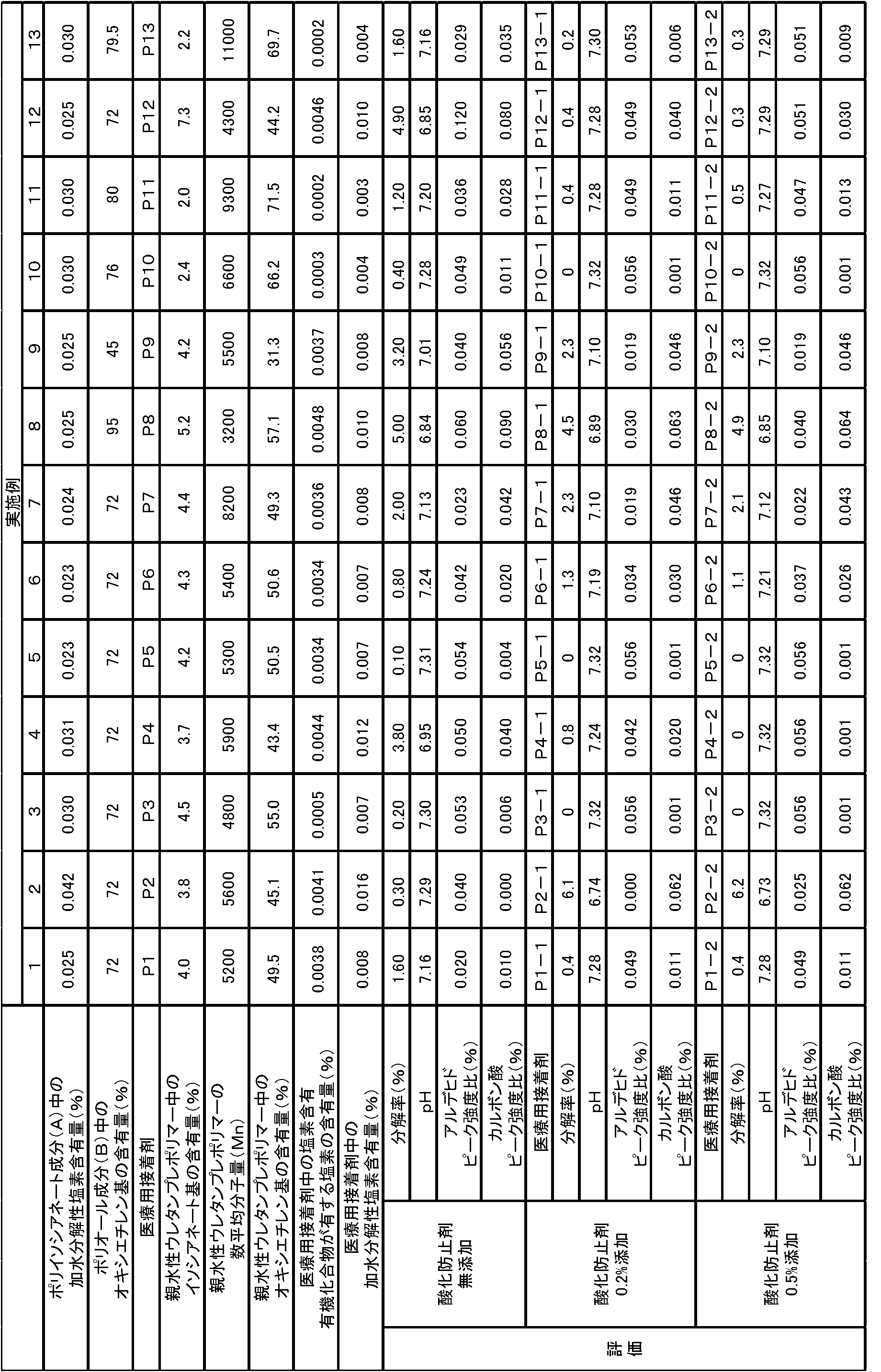
- the hydrolyzable chlorine content (%) in the medical adhesive is shown in Table 1-2.
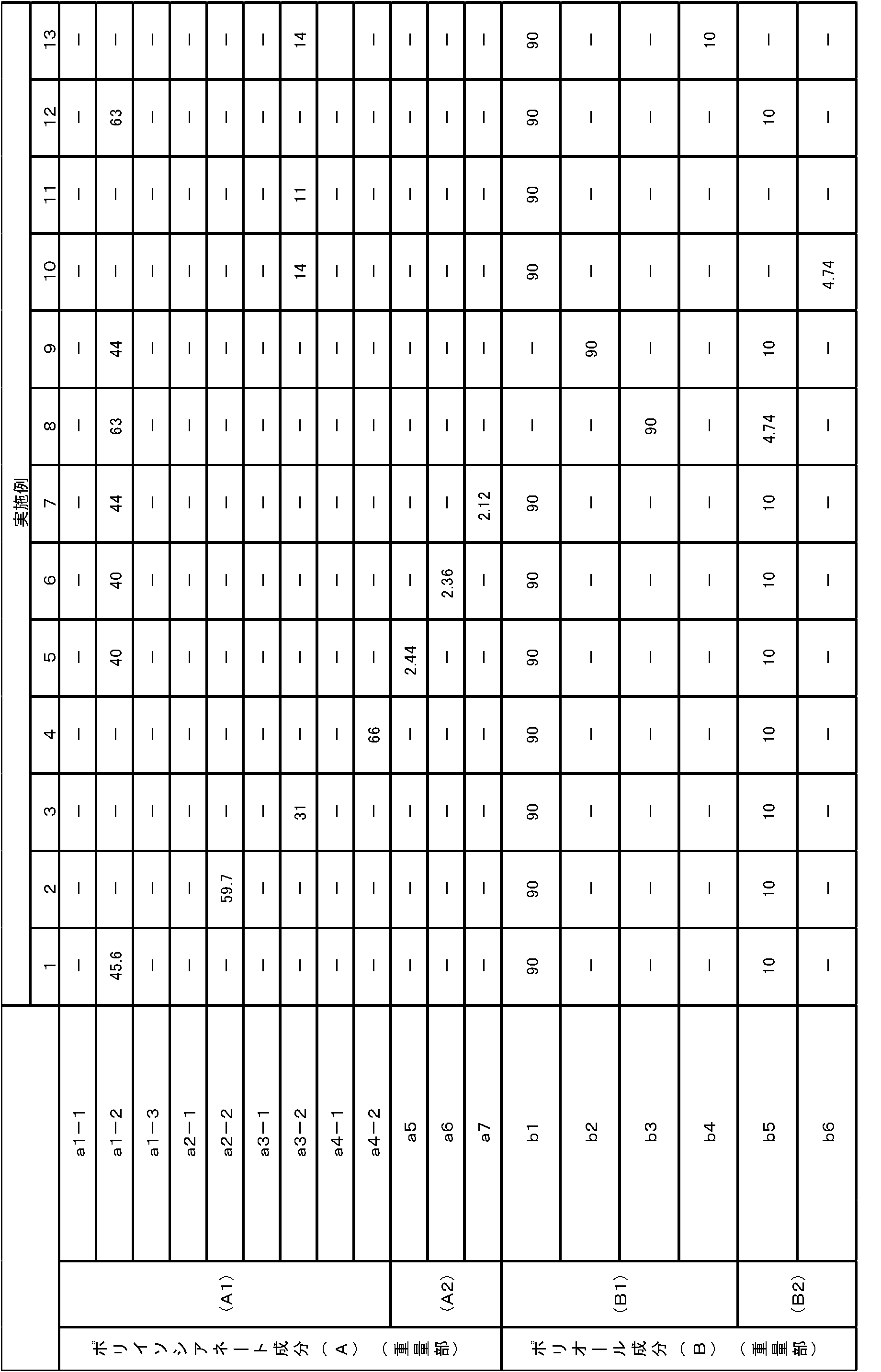
- Example 2 a hydrophilic urethane prepolymer was produced using each of the polyisocyanate component (A) and the polyol component (B) described in Table 1-1, and the medical adhesives (P2) to ( P13).
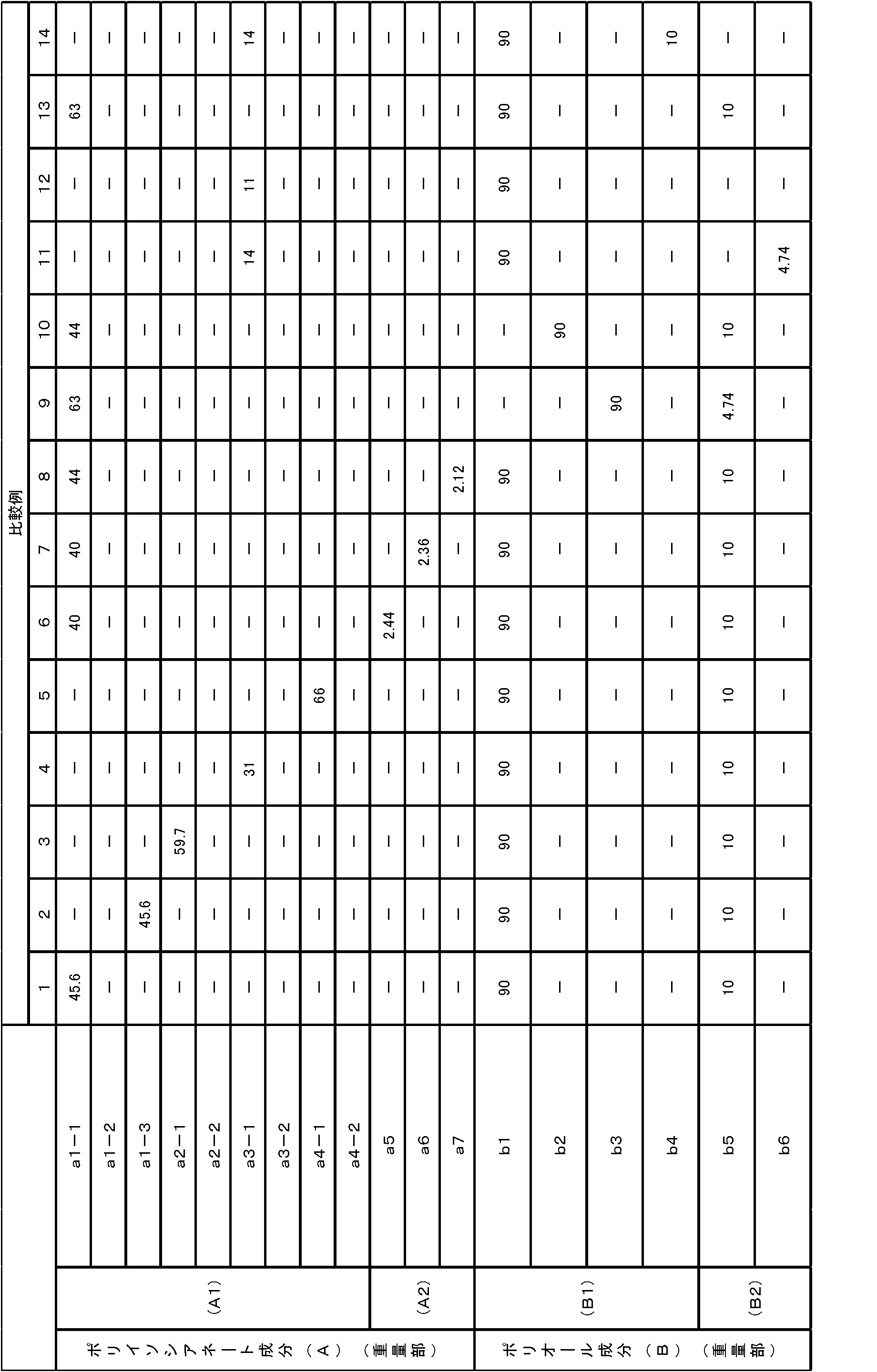
- Example 1 a hydrophilic urethane prepolymer was produced using each of the polyisocyanate component (A) and the polyol component (B) described in Table 2-1, and a medical adhesive (P′1) To (P′14).
- a6 2,4-tolylene diisocyanate, chlorine content of chlorine-containing organic compound is 0.000%, hydrolyzable chlorine content is 0.004%, manufactured by Nippon Polyurethane Industry Co., Ltd., product name “Coronate T- 100 " a7: Isocyanurate type hexamethylene diisocyanate, chlorine content of the chlorine-containing organic compound is 0.000%, hydrolyzable chlorine content is 0.004%, manufactured by Asahi Kasei Co., Ltd., product name “Duranate TPA-100” ⁇ Polyol component b6: polytetramethylene ether glycol 650, number average molecular weight is 650, content of oxyethylene group is 0%, manufactured by Mitsubishi Chemical Corporation, product name “PTMG650”
- the chlorine-containing organic compound content in each of (a1-1) to (a7) was measured by GC (conditions are the same as described above) and calculated by the following formula 3.
- Chlorine content (% by weight) of the chlorine-containing organic compound in the polyisocyanate component (A) [ ⁇ (quantitative value of each chlorine-containing organic compound (g) ⁇ chlorine of each chlorine-containing organic compound Content) ⁇ ⁇ Weight of measurement sample (g)] ⁇ 100
- the chlorine content of each chlorine-containing organic compound was calculated from the above formula 2.
- ⁇ Evaluation 1 Stability of cured film> Apply 0.2-0.3g each of medical adhesives (P1)-(P13) and (P'1)-(P'14) to slide glass and apply to 100mL beaker containing ultrapure water. Each part was placed so that the part was completely used, and each medical adhesive was cured to prepare a cured film. The cured film was removed after about 2 hours. The cured film was placed on a release paper and freeze-dried for 12 to 36 hours. The weight (w1) after lyophilization was measured, put into a container, immersed in 30 mL of ultrapure water and sealed. This was put into a dryer at 60 ° C. and taken out after 4 weeks.
- Medical adhesives (P1-1) to (P13-1), (P1-2) to (P13-2), (P'1-1) to (P'14-1) and (P'1-2) ) To (P′14-2) are filled in polypropylene 2 ml syringes in a nitrogen atmosphere and irradiated with 25 kGy of ⁇ -rays to give medical adhesives (P1-1) to (P13-) after irradiation. 1), (P1-2) to (P13-2), (P′1-1) to (P′14-1) and (P′1-2) to (P′14-2) were obtained.
- the chlorine content of the chlorine-containing organic compound in the medical adhesive is greater than 0.005% (0.0057 to 0.0123%) Comparative Examples 1 to It can be seen that the No. 14 adhesive promotes the decomposition of the cured film and produces aldehyde and carboxylic acid. When the cured coating is decomposed, the adhesive strength is lowered, and further, it is impossible to seal body fluids such as blood, gas from the lungs, contents such as digestive organs, and the like. Furthermore, in the medical adhesives of Comparative Examples 1 to 14 in which the chlorine content of the chlorine-containing organic compound is high, deterioration and degradation due to sterilization treatment by ⁇ -ray irradiation can be prevented even when an antioxidant is added. There wasn't.
- the adhesives of Examples 1 to 13 in which the chlorine content of the chlorine-containing organic compound is 0.005% or less (0.0005 to 0.0048%) are decomposed. I find it difficult. Therefore, the tissue can be sealed over a long period of time. Moreover, since it is hard to produce
- the medical adhesive of the present invention is extremely excellent in wet adhesive strength even after sterilization treatment by ⁇ -ray irradiation, it can be used particularly effectively for the adhesion of moving living tissue, for example, lung, artery, heart, vein, trachea
- moving living tissue for example, lung, artery, heart, vein, trachea
- esophagus for example, lung, artery, heart, vein, trachea
- esophagus for adhesion of the esophagus, stomach, duodenum, small intestine, large intestine, rectum, liver, spleen, kidney, pancreas and nerves, prevention of bleeding, prevention of enzyme leakage from digestive organs, temporary fixation prior to suturing, reinforcement of affected area, etc.
- it also exhibits high reliability and high performance for bonding of wound surfaces, wounds, etc., and for adhesive treatment in dentistry.
- it exhibits extremely high reliability and high performance for adhesion of tissues accompanied by movements of lungs,
Landscapes
- Health & Medical Sciences (AREA)
- Chemical & Material Sciences (AREA)
- Organic Chemistry (AREA)
- Chemical Kinetics & Catalysis (AREA)
- Medicinal Chemistry (AREA)
- Polymers & Plastics (AREA)
- Epidemiology (AREA)
- Surgery (AREA)
- Life Sciences & Earth Sciences (AREA)
- Animal Behavior & Ethology (AREA)
- General Health & Medical Sciences (AREA)
- Public Health (AREA)
- Veterinary Medicine (AREA)
- Inorganic Chemistry (AREA)
- Adhesives Or Adhesive Processes (AREA)
- Polyurethanes Or Polyureas (AREA)
- Materials For Medical Uses (AREA)
Abstract
Description
本発明は、医療用接着剤の硬化体が劣化分解しにくく安定であり、且つ、劣化分解によるカルボン酸及びアルデヒド等の発生が少なく安全な医療用接着剤を提供することを目的とする。
すなわち、本発明の医療用接着剤は、含フッ素非芳香族ポリイソシアネート化合物(A1)を必須成分とするポリイソシアネート成分(A)と、親水性ポリオール(B1)を必須成分とするポリオール成分(B)とを反応させて得られる親水性ウレタンプレポリマー(UP)を含んでなり、塩素含有有機化合物が有する塩素の含有量が上記親水性ウレタンプレポリマー(UP)の重量に基づいて0.005重量%以下であり、
上記塩素含有有機化合物が有する塩素の含有量は、下記化合物(1)~(14)、化合物(1)と(B)との反応生成物、化合物(2)と(B)の反応生成物、化合物(7)と(B)との反応生成物及び化合物(8)と(B)との反応生成物が有する塩素の含有量の合計量であることを要旨とする。
化合物(1):下記一般式(I)で表される化合物。一般式(I)中、nは1~20の整数を表す。
OCNCH2(CF2)nCH2OCOCl (I)
化合物(2):下記一般式(II)で表される化合物。一般式(II)中、nは1~20の整数を表す。
OCNCH2(CF2)nCH2Cl (II)
化合物(3):下記一般式(III)で表される化合物。一般式(III)中、nは1~20の整数を表す。
ClOCOCH2(CF2)nCH2OCOCl (III)
化合物(4):下記一般式(IV)で表される化合物。一般式(IV)中、nは1~20の整数を表す。
ClCH2(CF2)nCH2Cl (IV)
化合物(5):下記一般式(V)で表される化合物。
O(CH2CH2Cl)2 (V)
化合物(6):下記一般式(VI)で表される化合物。
ClOCO(CH2CH2OCH2)2OCH3 (VI)
化合物(7):下記一般式(VII)で表される化合物。一般式(VII)中、nは1~22の整数を表す。
OCN(CF2)nOCOCl (VII)
化合物(8):下記一般式(VIII)で表される化合物。一般式(VIII)中、nは1~22の整数を表す。
OCN(CF2)nCl (VIII)
化合物(9):下記一般式(IX)で表される化合物。一般式(IX)中、nは1~22の整数を表す。
ClOCO(CF2)nOCOCl (IX)
化合物(10):下記一般式(X)で表される化合物。一般式(X)中、nは1~22の整数を表す。
Cl(CF2)nCl (X)
化合物(11):下記一般式(XI)で表される化合物。
O(CH2CH2OCOCl)2 (XI)
化合物(12):下記一般式(XII)で表される化合物。
ClOCOCH2CH2OCH2CH2OCOCl (XII)
化合物(13):下記一般式(XIII)で表される化合物。
ClCH2CH2OCH2CH2OCOCl (XIII)
化合物(14):下記一般式(XIV)で表される化合物。
ClCH2CH2OCH2CH2OCH3 (XIV)
含フッ素非芳香族ポリイソシアネート化合物(A1)としては、炭素数3~24の含フッ素脂肪族ジイソシアネート(A11)、炭素数8~21の含フッ素脂環式ジイソシアネート(A12)及び炭素数9~72の含フッ素ポリ(3~6価)イソシアネート(A13)等が使用できる。
OCN-Rf-NCOで表されるものとしては、ジフルオロメチレンジイソシアネート、パーフルオロジメチレンジイソシアネート、パーフルオロトリメチレンジイソシアネート、パーフルオロオクチルジイソシアネート及びパーフルオロエイコシレンジイソシアネート等が挙げられる。
また、含フッ素非芳香族ポリイソシアネート化合物(A1)は、1種でも、2種以上の混合物でもよい。
また、含フッ素非芳香族ポリイソシアネート化合物(A1)のうち、架橋反応等の副反応が起こりにくい観点等から、イソシアネート基を2個持つものが好ましい。
これらのポリイソシアネート化合物(A2)のうち、反応性の観点等から、フッ素原子を含まない芳香族ポリイソシアネート(A24)が好ましく、さらに好ましくはMDI及びTDIである。
また、安全性の観点から、フッ素原子を含まない脂肪族ポリイソシアネート(A21)が好ましく、さらに好ましくはHDIである。
これらの含フッ素芳香族ポリイソシアネート化合物(A3)のうち、反応性の観点等から、少なくとも芳香環の水素原子の一部又は全部がフッ素原子で置換された含フッ素芳香族ポリイソシアネート(A31)及び含フッ素芳香族ポリイソシアネート(A33)が好ましく、さらに好ましくは含フッ素芳香族ポリイソシアネート(A33)である。
また、医療用接着剤中の加水分解性塩素の含有量(重量%)は、着色性及び湿潤接着性の観点から、親水性ウレタンプレポリマー(UP)の重量に基づいて0.015以下が好ましく、さらに好ましくは0.010以下である。
なお、加水分解性塩素の含有量は、JISK1603-3:2007に準拠して測定される。
親水性ポリオール(B1)の溶解度パラメーター(SP値)は、反応性及び接着強度の観点から、7~17の範囲であることが好ましく、さらに好ましくは8~16である。
また、親水性ポリオール(B1)のHLBは、反応性及び接着強度の観点から、4~20が好ましく、さらに好ましくは4.5~20である。
ここで「HLB」とは、親水性と親油性のバランスを示す指標であって、例えば「界面活性剤入門」〔2007年三洋化成工業株式会社発行、藤本武彦著〕212頁に記載されている小田法によって、有機化合物の有機性の値と無機性の値との比率から計算することができる。
HLB≒10×無機性/有機性
HLBを導き出すための有機性の値及び無機性の値については前記「界面活性剤入門」213頁に記載の表の値を用いて算出できる。
また、炭素数3~8のアルキレンオキシドとしては、接着強度の観点から、1,2-プロピレンオキシドが好ましい。
なお、活性水素を2個有する化合物を用いた場合には2価の親水性ポリオールが得られ、活性水素を3個以上有する化合物を用いた場合には3価以上の親水性ポリオールが得られる。
少なくとも2個の活性水素を有する化合物は、1種でも2種以上の混合物でもよい。
少なくとも2個の活性水素を有する化合物としては、生体への安全性及び接着性強度の観点から、水及びジオールが好ましく、さらに好ましくは水及びアルキレングリコール、特に好ましくは水及び炭素数2~4のアルキレングリコールである。
ポリエーテルポリオール(B1-1)は、1種でも2種以上の混合物でもよい。
なお、ヒドロキシル基当量は、JIS K1557-1:2007に準拠して測定される。
なお、ジカルボン酸、ジカルボン酸の酸無水物及び/又はジカルボン酸低級アルキルエステルの一部として、ポリカルボン酸、ポリカルボン酸の酸無水物及びポリカルボン酸低級アルキルエーテル等も使用でき、これらを使用する場合、これらの使用量(モル%)は、全てのカルボン酸、カルボン酸の酸無水物及びカルボン酸低級アルキルエステルの合計モル数に基づいて、0.1~10が好ましく、さらに好ましくは0.1~5、特に好ましくは0.1~2である。この範囲であると、接着強度等がさらに良好となる。
これらのうち、接着強度の観点等から、ジオールへのエチレンオキシド付加体とジカルボン酸、ジカルボン酸の酸無水物及び/又はジカルボン酸低級アルキルエステルとのポリエステルジオール、並びにジオールへのエチレンオキシド及びプロピレンオキシドの共付加体とジカルボン酸、ジカルボン酸の酸無水物及び/又はジカルボン酸低級アルキルエステルとのポリエステルジオールが好ましく、さらに好ましくはジオールへのエチレンオキシド付加体とジカルボン酸、ジカルボン酸の酸無水物及び/又はジカルボン酸低級アルキルエステルとのポリエステルジオールである。
これらのポリエステルポリオール(B1-2)は、1種でも2種以上の混合物でもよい。
親水性ポリオール(B1)としては、水との反応が速くなり接着強度等がさらに良好となるという観点等から、ポリエーテルポリオール(B1-1)が好ましく、さらに好ましくはジオールへのエチレンオキシド付加体、及びジオールへのエチレンオキシドとプロピレンオキシドとの共付加体であり、特に好ましくはジオールへのエチレンオキシドとプロピレンオキシドとの共付加体である。
親水性ポリオール(B1)中のオキシエチレン基の含有量(重量%)は、(B1)の重量に基づいて、30~100が好ましく、さらに好ましくは40~95、次にさらに好ましくは50~90である。この範囲であると、接着強度等がさらに良好となる。
ポリエーテルポリオール(B2-1)の好適な例としては、ポリプロピレングリコール(プロピレングリコールの1,2-又は1,3-プロピレンオキシド付加物)、ポリアルキレングリコールへのエチレンオキシド付加体(エチレングリコール又はプロピレングリコールへのエチレンオキシド及びプロピレンオキシドのブロック付加体であって、エチレンオキシドの含有量が5~30重量%のもの等)、プロピレンオキシドとエチレンオキシドのランダム共重合体(エチレングリコール又はプロピレングリコールへのエチレンオキシド及びプロピレンオキシドのランダム付加体であって、エチレンオキシドの含有量が10~25重量%のもの等)、ポリテトラメチレングリコール(1,4-ブチレングリコールの1,2-、1,3-、2,3-又は1,4-ブチレンオキシド付加物)、及び1,4-ブチレンオキシドとエチレンオキシドの共重合体(エチレングリコール又はブチレングリコールへのエチレンオキシド10~25重量と1,4-ブチレンオキシド75~90重量%のブロック又はランダム付加物であって、エチレンオキシド含有量が10~25重量%のもの等)等が挙げられる。
これらのうち、接着性の観点等から、ポリプロピレングリコールへのエチレンオキシド付加体(エチレンオキシドの含有量5~30重量%)が好ましく、さらに好ましくはポリプロピレングリコールへのエチレンオキシド付加体(エチレンオキシドの含有量15~30重量%)である。
これらのポリエーテルポリオール(B2-1)は、1種でも2種以上の混合物でもよい。
これらのポリエステルポリオール(B2-2)は、1種でも2種以上の混合物でもよい。
ポリエステルポリオール(B2-3)の好適な例としては、ブタンジオール及びアジピン酸から誘導されるポリエステルジオール;エチレングリコール及びアジピン酸から誘導されるポリエステルジオール;ヘキサメチレングリコール及びアジピン酸から誘導されるポリエステルジオール;エチレングリコール、ブタンジオール及びアジピン酸から誘導されるポリエステルジオール;エチレングリコール及びセバシン酸から誘導されるポリエステルジオール;シクロヘキサンジオール及びフタル酸から誘導されるポリエステルジオール;並びにカプロラクトンの開環重合により誘導されるポリカプロラクトン等が挙げられる。
これらのポリエステルポリオール(B2-3)は、1種でも2種以上の混合物でもよい。
また、ポリオール成分(B)全体の平均のヒドロキシル基当量は、50~5000が好ましく、さらに好ましくは100~4000、特に好ましくは200~3000である。この範囲であると、接着強度等がさらに良好となる。
(B1)と(B2)とを併用する場合、ポリオール成分(B)としては、接着性の観点から、ポリエーテルポリオール(B1-1)と、オキシエチレン基の含有量が(B2)の重量に基づいて30重量%未満であるポリエーテルポリオールとの混合物であることが好ましく、さらに好ましくはジオールへのエチレンオキシドとプロピレンオキシドとの共付加体と、オキシプロピレン基を含有しオキシエチレン基の含有量が(B2)の重量に基づいて30重量%未満であるポリエーテルポリオールとの混合物であり、次にさらに好ましくはジオールへのエチレンオキシドとプロピレンオキシドとのランダム共付加体と、ポリプロピレングリコールとの混合物である。
ポリオール成分(B)中の(B2)の含有量(重量%)は、接着性の観点から、(B)の重量に基づいて、1~80が好ましく、さらに好ましくは5~70である。
ポリイソシアネート成分(A)とポリオール成分(B)との使用量比としては、(A)のイソシアネート基と(B)のヒドロキシル基との当量比(NCO基/OH基)として、1.5~3が好ましく、さらに好ましくは1.8~2.3、特に好ましくは1.9~2.1である。この範囲であると、粘度が比較的低く、接着剤としてさらに取り扱いやすくなり、また湿潤接着強度もさらに良好となる。
親水性ウレタンプレポリマー(UP)は、分子内に、少なくとも2個(好ましくは2個)のイソシアネート基を持ち、活性水素を持たない構造を有する。
なお、親水性ウレタンプレポリマー(UP)中のイソシアネート基の位置は、血液や体液等との反応性の観点等から、立体障害の少ない位置が好ましく、さらに好ましくは立体障害の少ない末端位置である。
装置 : ゲルパーミエイションクロマトグラフィー
溶媒 : THF
基準物質 : ポリスチレン
サンプル濃度 : 0.25wt%
カラム固定相 : TSKgelSuperH4000
カラム温度 : 40℃
塩素含有有機化合物が有する塩素の含有量がこの範囲内であると、硬化体が劣化分解しにくく安定であり、且つ、劣化分解によるカルボン酸及びアルデヒド等の発生が少なく安全な医療用接着剤を提供することができる。
OCNCH2(CF2)nCH2OCOCl (I)
OCNCH2(CF2)nCH2Cl (II)
ClOCOCH2(CF2)nCH2OCOCl (III)
ClCH2(CF2)nCH2Cl (IV)
O(CH2CH2Cl)2 (V)
ClOCO(CH2CH2OCH2)2OCH3 (VI)
OCN(CF2)nOCOCl (VII)
OCN(CF2)nCl (VIII)
ClOCO(CF2)nOCOCl (IX)
Cl(CF2)nCl (X)
O(CH2CH2OCOCl)2 (XI)
ClOCOCH2CH2OCH2CH2OCOCl (XII)
ClCH2CH2OCH2CH2OCOCl (XIII)
ClCH2CH2OCH2CH2OCH3 (XIV)
しかし、パーフルオロアルキレン基数が異なる原料、中間体が混入する場合は、それに由来する塩素含有有機化合物も生成する可能性がある。この場合は、医療用接着剤中に、主生成物である(A1)のパーフルオロアルキレン基数と同じnである塩素含有有機化合物と、(A1)のパーフルオロアルキレン基数とは異なるnである塩素含有有機化合物とを含んでいる可能性がある。
<GC条件>
装置:島津製作所社製ガスクロマトグラフGC-2014
カラム:DB-5(長さ:30m、内径:0.32mm、膜厚:0.25μm)アジレントテクノロジー社製
気化室温度:200℃
ディテクタ温度:200℃
カラム初期温度:50℃
カラム昇温速度:10℃/分
カラム最終温度:250℃
試料濃度:原液を測定試料とする。
<GCMS条件>
装置:島津製作所社製四重極型質量分析計(GCMSQP-5000)
<GC条件>:上記GC条件と同じ
<MS条件>
測定開始質量範囲:EI35~600
走査間隔(I):1.0sec
しきい値(T):500
溶媒溶出時間:0.05min
測定開始時間:0.1min
測定終了時間:30min
スキャンゲイン:0.8KV
下記式1の通り、各塩素含有有機化合物の定量値(g)に、各塩素含有有機化合物の塩素含有率を乗じて、それらの合計を測定試料の重量(g)で除することにより、医療用接着剤中の塩素含有有機化合物が有する塩素の含有量(重量%)として算出する。
測定試料の重量は、医療用接着剤中の親水性ウレタンプレポリマー(UP)の重量を意味する。測定試料として医療用接着剤100gを用いた場合、医療用接着剤100g中に親水性ウレタンプレポリマー(UP)を90g含む場合は、測定試料の重量は90gとする。
(式1)医療用接着剤中の塩素含有有機化合物が有する塩素の含有量(重量%)=[{Σ(各塩素含有有機化合物の定量値(g)×各塩素含有有機化合物の塩素含有率)}÷測定試料の重量(g)]×100
なお、各塩素含有有機化合物の塩素含有率は、以下の式から計算する。
(式2)塩素含有有機化合物の塩素含有率=塩素含有有機化合物内の塩素数×塩素の原子量(35.5[g/mol])/塩素含有有機化合物の分子量[g/mol]
なお、フェノール系ラジカル捕捉剤(PRS)と、(PRS)以外のラジカル捕捉剤とを併用していてもよい。
フェノール系ラジカル捕捉剤(PRS)は、親水性ウレタンプレポリマー(UP)に添加してもよいし、予め、ポリイソシアネート成分(A)及び/又はポリオール成分(B)に添加してから親水性ウレタンプレポリマー(UP)を得てもよい。
その他の成分としては、生理活性を有する薬物(中枢神経用薬、アレルギー用薬、循環器官用薬、呼吸器官用薬、消化器官用薬、ホルモン剤、代謝性医薬品、抗悪性腫瘍剤、抗生物質製剤及び化学療法剤等)、充填剤(カーボンブラック、ベンガラ、ケイ酸カルシウム、ケイ酸ナトリウム、酸化チタン、アクリル系樹脂粉末及び各種セラミック粉末等)、及び可塑剤(DBP、DOP、TCP、トリブトキシエチルホスフェート及びその他各種エステル等)等が含まれる。その他の成分を含む場合、これらの含有量は用途等によって適宜決定される。また、その他の成分は、予めポリイソシアネート成分(A)、ポリオール成分(B)及び/又はフェノール系ラジカル捕捉剤(PRS)に混合してプレポリマー反応を行ってもよく、また、反応後の親水性ウレタンプレポリマー(UP)及び/又はフェノール系ラジカル捕捉剤(PRS)に混合してもよい。
従って、本発明の接着剤は、手術などの医療行為において、血液などの体液と接触すると、その水分により急速に重合が進行し、接着強度が発現する。また、必要に応じて、例えば生理食塩水などを噴霧して水分を補給することにより、初期接着強度を高めることができる。
参考文献1(特開昭57-108055号公報)の記載に準じて含フッ素非芳香族ポリイソシアネート{ビス(イソシアナトメチル)パーフルオロブタン[OCN-CH2-(CF2)4-CH2-NCO]}(a1-1)を合成したところ、(a1-1)中の塩素含有有機化合物が有する塩素の含有量は0.027%であり、加水分解性塩素含有量は0.120%であった。
製造例1で得た(a1-1)を、減圧蒸留(75~80℃/3~5mmHg)し、蒸留物をさらに同じ条件で減圧蒸留することを3回繰り返し、含フッ素非芳香族ポリイソシアネート(a1-2)を得た。
含フッ素非芳香族ポリイソシアネート(a1-2)中の塩素含有有機化合物が有する塩素の含有量は、0.012%であり、加水分解性塩素含有量は0.025%であった。
製造例1の(a1-1)を、(a1-1)/塩化メチレン/イオン交換水=10部/10部/10部の比率で混合し、分液ロートを使って30秒×5回振盪して水洗抽出操作を行い、(a1-1)を含む塩化メチレン(有機)層と水層とに分液した。さらに、この(a1-1)を含む有機層を、10部のイオン交換水で水洗抽出操作を5回繰り返すことにより水洗した。
この有機層に0.2部の無水硫酸マグネシウムを加えて静置し、濾過して脱水(乾燥)した。
この有機層から30~50℃で塩化メチレンを減圧留去した後、さらに減圧蒸留(72~83℃/3~5mmHg)して含フッ素非芳香族ポリイソシアネート(a1-3)を得た。
含フッ素非芳香族ポリイソシアネート(a1-3)中の塩素含有有機化合物が有する塩素の含有量は0.020%、加水分解性塩素含有量は0.025%であった。
参考文献1の記載に準じて含フッ素非芳香族ポリイソシアネート{ビス(イソシアナトメチル)パーフルオロヘキサン[OCN-CH2-(CF2)6-CH2-NCO]}(a2-1)を合成したところ、(a2-1)中の塩素含有有機化合物が有する塩素の含有量は0.018%、加水分解性塩素含有量は0.08%であった。
製造例2と同様の条件で、(a2-1)を減圧蒸留を3度繰り返して含フッ素非芳香族ポリイソシアネート(a2-2)を得た。含フッ素非芳香族ポリイソシアネート(a2-2)中の塩素含有有機化合物が有する塩素の含有量を測定したところ0.011%、加水分解性塩素含有量は0.042%であった。
参考文献2(J.Macromol.Sci.Phys.B1,831 1967)の記載に準じて含フッ素非芳香族ポリイソシアネート{パーフルオロトリメチレンジイソシアネート[OCN-(CF2)3-NCO]}(a3-1)を合成したところ、(a3-1)中の塩素含有有機化合物が有する塩素の含有量は0.052%、加水分解性塩素含有量は0.140%であった。
製造例6で得た(a3-1)を、減圧蒸留(55~60℃/300~360mmHg)し、さらに減圧蒸留を3度繰り返して含フッ素非芳香族ポリイソシアネート(a3-2)を得た。含フッ素非芳香族ポリイソシアネート(a3-2)中の塩素含有有機化合物が有する塩素の含有量を測定したところ0.002%、加水分解性塩素含有量は0.030%であった。
参考文献2の記載に準じて含フッ素非芳香族ポリイソシアネート{{パーフルオロオクチルジイソシアネート[OCN-(CF2)8-NCO]}(a4-1)を合成したところ、(a4-1)中の塩素含有有機化合物が有する塩素の含有量は0.019%、加水分解性塩素含有量は0.072%であった。
製造例8で得た(a4-1)を、減圧蒸留(110~115℃/220~260mmHg)し、さらに減圧蒸留を3度繰り返して含フッ素非芳香族ポリイソシアネート(a4-2)を得た。含フッ素非芳香族ポリイソシアネート(a4-2)中の塩素含有有機化合物が有する塩素の含有量を測定したところ0.011%、加水分解性塩素含有量は0.031%であった。
オートクレーブにエチレングリコール15.5部、水酸化カリウム3.8部を仕込み、窒素置換後(気相部の酸素濃度450ppm)120℃にて60分間真空脱水した。ついで、100~130℃でエチレンオキシド784.5部とプロピレンオキシド200部との混合物を約10時間で圧入した後、130℃で3時間反応を続け、オキシエチレン基の含有量が80%である液状粗ポリエーテルを得た。
この液状粗ポリエーテル1000部をオートクレーブに入れ、窒素置換(気相部の酸素濃度450ppm)を行い、30部のイオン交換水を加え、その後、合成ケイ酸マグネシウム(ナトリウム含有量0.2%)を10部加え、再度窒素置換した後、90℃にて45分間、攪拌速度300rpmで攪拌した。次いで、ガラスフィルタ-(GF-75:東洋濾紙製)を用い、窒素下で濾過を行い、エチレンオキシド/プロピレンオキシドランダム共付加体(b1)を得た。この(b1)の数平均分子量は4000、オキシエチレン基の含有量は80%であった。官能基数は2であった。
オートクレーブにエチレングリコール15.5部、水酸化カリウム3.8部を仕込み、窒素置換後(気相部の酸素濃度450ppm)120℃にて60分間真空脱水した。ついで、100~130℃でエチレンオキシド484.5部とプロピレンオキシド500部との混合物を約10時間で圧入した後、130℃で3時間反応を続け、オキシエチレン基の含有量が50%である液状粗ポリエーテルを得た。
この液状粗ポリエーテルを前記の製造例10と同様の方法で合成ケイ酸マグネシウムで処理し、プロピレンオキシド付加体(b2)を得た。この(b2)の数平均分子量は4000、オキシエチレン基の含有量は50%であった。官能基数は2であった。
オートクレーブにエチレングリコール60.0部、水酸化カリウム3.8部を仕込み、窒素置換後(気相部の酸素濃度450ppm)120℃にて60分間真空脱水した。ついで、100~130℃でエチレンオキシド940.0部を約10時間で圧入した後、130℃で3時間反応を続け、オキシエチレン基の含有量が100%である液状粗ポリエーテルを得た。
この液状粗ポリエーテルを前記の製造例10と同様の方法で合成ケイ酸マグネシウムで処理し、プロピレンオキシド付加体(b3)を得た。この(b3)の数平均分子量は1000、オキシエチレン基の含有量は100%であった。官能基数は2であった。
オートクレーブにエチレングリコール30.8部、水酸化カリウム3.8部を仕込み、窒素置換後(気相部の酸素濃度450ppm)120℃にて60分間真空脱水した。ついで、100~130℃でエチレンオキシド754.6部とプロピレンオキシド218.8部との混合物を約10時間で圧入した後、130℃で3時間反応を続け、オキシエチレン基の含有量が100%である液状粗ポリエーテルを得た。
この液状粗ポリエーテルを前記の製造例10と同様の方法で合成ケイ酸マグネシウムで処理し、プロピレンオキシド付加体(b4)を得た。この(b4)の数平均分子量は3000、オキシエチレン基の含有量は75%、官能基数は3であった。
オートクレーブにプロピレングリコール362部、水酸化カリウム3.8部を仕込み、窒素置換後(気相部の酸素濃度450ppm)120℃にて60分間真空脱水した。ついで、100~130℃でプロピレンオキシド632部を約10時間で圧入した後、揮発分0.1%以下になるまで130℃で反応を続け、液状粗ポリエーテルを得た。
この液状粗ポリエーテルを前記の製造例10と同様の方法で合成ケイ酸マグネシウムで処理し、プロピレンオキシド付加体(b5)を得た。この(b5)の数平均分子量は210、オキシエチレン基の含有量は0%であった。官能基数は2であった。
ポリオール成分(B)として製造例10で得たエチレンオキシド/プロピレンオキシドランダム共付加体(b1)90部と製造例14で得たプロピレンオキシド付加体(b5)10部の混合物を使用し、これを窒素雰囲気下、100℃にて2時間減圧下脱水した後、40℃に冷却した後、ポリイソシアネート成分(A)として製造例2で得られた(a1-2)を45.6部(NCO基/OH基比=2/1)加え、均一に撹拌した後、80℃に昇温し、80℃で6時間反応させて、親水性ウレタンプレポリマーを製造し、本発明の医療用接着剤(P1)とした。ポリイソシアネート成分(A)中の加水分解性塩素含有量(%)、ポリオール成分(B)中のオキシエチレン基の含有量(%)、親水性ウレタンプレポリマー中のイソシアネート基の含有量(%)、親水性ウレタンプレポリマーの数平均分子量(Mn)、親水性ウレタンプレポリマー中のオキシエチレン基の含有量(%)、医療用接着剤中の塩素含有有機化合物が有する塩素の含有量(%)及び医療用接着剤中の加水分解性塩素含有量(%)を表1-2に示す。
また、(P1)100部に、フェノール系ラジカル捕捉剤(PRS)としてテトラキス-[メチレン-3-(3’,5’-ジ-t-ブチル4’-ヒドロキシフェニル)プロピオネート]メタン(イルガノックス1010、チバスペシャリティケミカルズ社製)を0.2部添加して、(P1-1)を得た。
また、(P1)100部に、テトラキス-[メチレン-3-(3’,5’-ジ-t-ブチル4’-ヒドロキシフェニル)プロピオネート]メタンを0.5部添加して(P1-2)を得た。
実施例1において、ポリイソシアネート成分(A)及びポリオール成分(B)として表1-1に記載のものをそれぞれ使用して、親水性ウレタンプレポリマーを製造し、医療用接着剤(P2)~(P13)とした。それぞれのポリイソシアネート成分(A)中の加水分解性塩素含有量(%)、ポリオール成分(B)中のオキシエチレン基の含有量(%)、親水性ウレタンプレポリマー中のイソシアネート基の含有量(%)、親水性ウレタンプレポリマーの数平均分子量(Mn)、親水性ウレタンプレポリマー中のオキシエチレン基の含有量(%)、医療用接着剤中の塩素含有有機化合物が有する塩素の含有量(%)及び医療用接着剤中の加水分解性塩素含有量(%)を表1-2に示す。
また、実施例1において、(P1)に変えて(P2)~(P13)をそれぞれ用いる以外は同様にして、(P2-1)~(P13-1)及び(P2-2)~(P13-2)を得た。
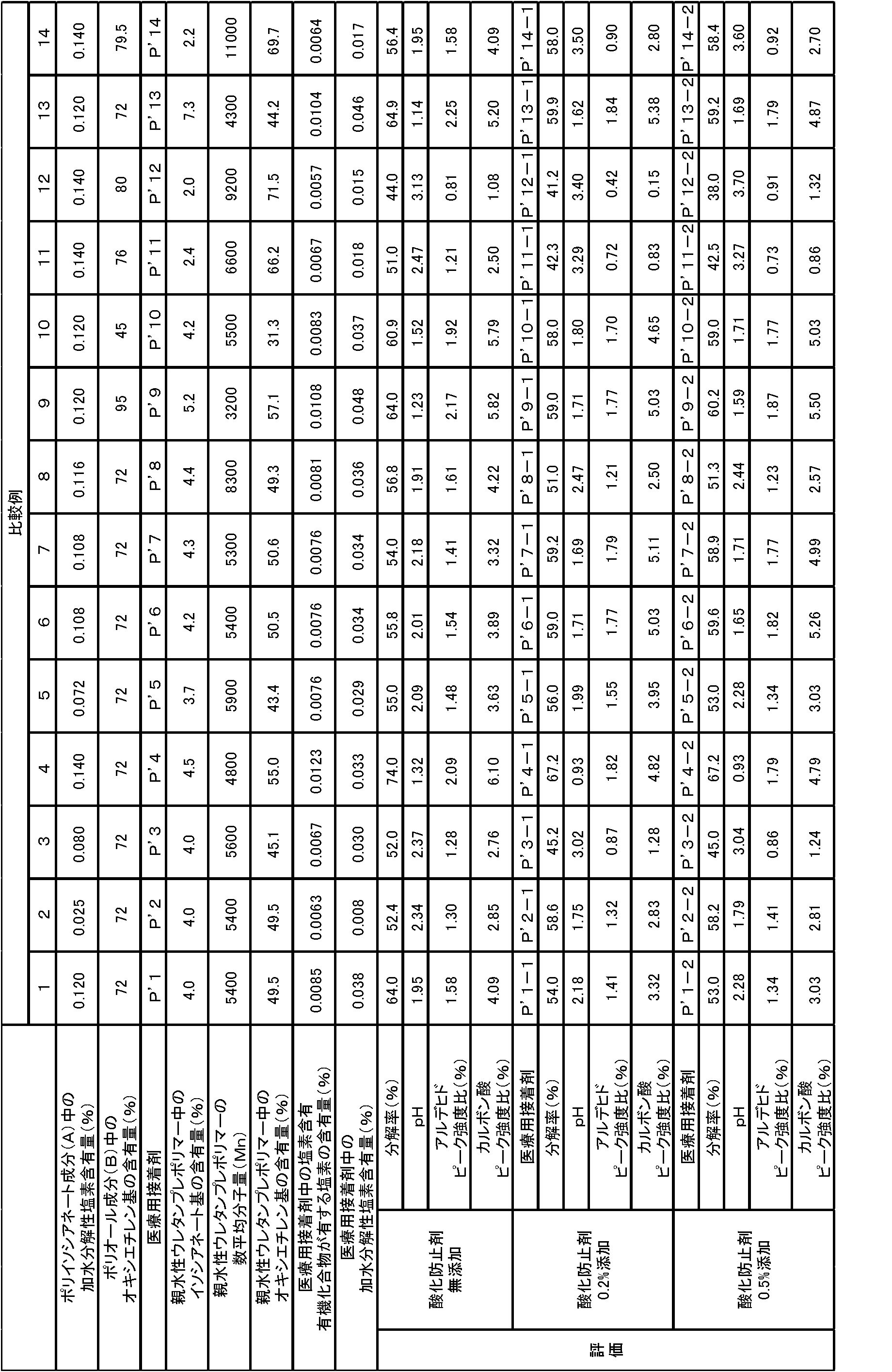
実施例1において、ポリイソシアネート成分(A)及びポリオール成分(B)として表2-1に記載のものをそれぞれ使用して、親水性ウレタンプレポリマーを製造し、医療用接着剤(P’1)~(P’14)とした。それぞれのポリイソシアネート成分(A)中の加水分解性塩素含有量(%)、ポリオール成分(B)中のオキシエチレン基の含有量(%)、親水性ウレタンプレポリマー中のイソシアネート基の含有量(%)、親水性ウレタンプレポリマーの数平均分子量(Mn)、親水性ウレタンプレポリマー中のオキシエチレン基の含有量(%)、医療用接着剤中の塩素含有有機化合物が有する塩素の含有量(%)及び医療用接着剤中の加水分解性塩素含有量(%)を表2-2に示す。
また、実施例1において、(P1)に変えて(P’1)~(P’14)を用いる以外は同様にして、(P’1-1)~(P’14-1)及び(P’1-2)~(P’14-2)を得た。
○ポリイソシアネート成分
a5:ヘキサメチレンジイソシアネート[OCN-(CH2)6-NCO]、塩素含有有機化合物が有する塩素の含有量は0.000%、加水分解性塩素含有量は0.005%、旭化成ケミカル株式会社製、品名「デュラネート 50M-HDI」
a6:2,4-トリレンジイソシアネート、塩素含有有機化合物が有する塩素の含有量は0.000%、加水分解性塩素含有量は0.004%、日本ポリウレタン工業株式会社製、品名「コロネートT-100」
a7:イソシアヌレート型ヘキサメチレンジイソシアネート、塩素含有有機化合物が有する塩素の含有量は0.000%、加水分解性塩素含有量は0.004%、旭化成(株)製、品名「デュラネート TPA-100」
○ポリオール成分
b6:ポリテトラメチレンエーテルグリコール650、数平均分子量は650、オキシエチレン基の含有量は0%、三菱化学株式会社製、品名「PTMG650」
それぞれのポリイソシアネート(a1-1)~(a7)中の塩素含有有機化合物が有する塩素の含有量(重量%)は、測定試料としてそれぞれのポリイソシアネート(a1-1)~(a7)を用いて、それぞれ(a1-1)~(a7)中の塩素含有有機化合物含有量をGC(条件は前述と同様)により測定し、下記式3により算出した。
(式3)ポリイソシアネート成分(A)中の塩素含有有機化合物が有する塩素の含有量(重量%)=[{Σ(各塩素含有有機化合物の定量値(g)×各塩素含有有機化合物の塩素含有率)}÷測定試料の重量(g)]×100
なお、各塩素含有有機化合物の塩素含有率は、上記式2から計算した。
スライドガラスに医療用接着剤(P1)~(P13)及び(P’1)~(P’14)をそれぞれ0.2~0.3g塗布し、超純水を入れた100mLのビーカーに塗付部分が完全につかるように入れ、各医療用接着剤を硬化させ硬化被膜を作製した。約2時間後に硬化被膜を取り出した。
硬化被膜を離型紙にのせ、12~36時間凍結乾燥を行った。凍結乾燥後の重量(w1)を測定し、容器に入れ、超純水30mLに浸漬させ密閉した。
これを60℃の乾燥機にいれ、4週間後に取り出した。デカンテーションにより、不溶解物と上澄み液とに分離し、不溶解物を離型紙にのせ、24~48時間凍結乾燥を行った。上澄み液についてもシャーレ上で、24~48時間凍結乾燥を行った。
不溶解物の凍結乾燥物の重量(w2)を測定し、下記式により分解率を算出した。
分解率=(w1-w2)/w1×100
医療用接着剤(P1)~(P13)及び(P’1)~(P’14)の分解率(%)の測定結果を表1-2及び表2-2に示す。
評価1の上澄み液について、JIS Z 8802に従ってpHを測定した。さらに、上澄み液を凍結乾燥したもの10mgを、重DMSO 0.5mLに溶解したサンプルを用いて、1H NMR測定を行い、アルデヒド(9.6ppm付近のピーク)、カルボン酸(12.4ppm付近のピーク)のそれぞれのピーク強度と、メチル・メチン基等(1.4~0.6ppmのピーク)ピーク強度との比(%)を求めた。その比をもとに、アルデヒド、カルボン酸が生成しているかどうかを評価した。測定結果を表1-2及び表2-2に示す。
医療用接着剤(P1-1)~(P13-1)、(P1-2)~(P13-2)、(P’1-1)~(P’14-1)及び(P’1-2)~(P’14-2)をそれぞれポリプロピレン製の2mlシリンジに、窒素雰囲気下で充填し、25kGyのγ線を照射して、照射後の医療用接着剤(P1-1)~(P13-1)、(P1-2)~(P13-2)、(P’1-1)~(P’14-1)及び(P’1-2)~(P’14-2)を得た。
評価1及び2において、「医療用接着剤(P1)~(P13)及び(P’1)~(P’14)」に変えて、この「照射後の医療用接着剤(P1-1)~(P13-1)、(P1-2)~(P13-2)、(P’1-1)~(P’14-1)及び(P’1-2)~(P’14-2)」を用いる以外は同様にして、<評価1>及び<評価2>と同じ方法で、分解率測定を行った。結果を表1-2及び表2-2に示す。
さらに、塩素含有有機化合物が有する塩素の含有量が多い比較例1~14の医療用接着剤においては、酸化防止剤を添加しても、γ線照射による滅菌処理による劣化分解を防ぐことができなかった。また、酸化防止剤の添加量を増やしても、劣化分解をおさえることができなかった。
一方、表1-2の結果から、塩素含有有機化合物が有する塩素の含有量が0.005%以下(0.0005~0.0048%)である実施例1~13の接着剤は、分解しにくいことが分かる。したがって、長期にわたって組織をシールすることができる。また、有毒であるアルデヒドやカルボン酸が生成しにくいため、安全であることも分かる。
さらに、塩素含有有機化合物が有する塩素の含有量が少ない本発明の実施例1~13の医療用接着剤と、酸化防止剤とを組み合わせることで、医療用接着剤として必要なγ線照射による滅菌処理後でも、硬化体が劣化分解しにくく、安定性の高い医療用接着剤を提供することができることがわかる。
Claims (7)
- 含フッ素非芳香族ポリイソシアネート化合物(A1)を必須成分とするポリイソシアネート成分(A)と、親水性ポリオール(B1)を必須成分とするポリオール成分(B)とを反応させて得られる親水性ウレタンプレポリマー(UP)を含んでなり、塩素含有有機化合物が有する塩素の含有量が前記親水性ウレタンプレポリマー(UP)の重量に基づいて0.005重量%以下であり、
前記塩素含有有機化合物が有する塩素の含有量は、下記化合物(1)~(14)、化合物(1)と(B)との反応生成物、化合物(2)と(B)の反応生成物、化合物(7)と(B)との反応生成物及び化合物(8)と(B)との反応生成物が有する塩素の含有量の合計値である医療用接着剤。
化合物(1):下記一般式(I)で表される化合物。一般式(I)中、nは1~20の整数を表す。
OCNCH2(CF2)nCH2OCOCl (I)
化合物(2):下記一般式(II)で表される化合物。一般式(II)中、nは1~20の整数を表す。
OCNCH2(CF2)nCH2Cl (II)
化合物(3):下記一般式(III)で表される化合物。一般式(III)中、nは1~20の整数を表す。
ClOCOCH2(CF2)nCH2OCOCl (III)
化合物(4):下記一般式(IV)で表される化合物。一般式(IV)中、nは1~20の整数を表す。
ClCH2(CF2)nCH2Cl (IV)
化合物(5):下記一般式(V)で表される化合物。
O(CH2CH2Cl)2 (V)
化合物(6):下記一般式(VI)で表される化合物。
ClOCO(CH2CH2OCH2)2OCH3 (VI)
化合物(7):下記一般式(VII)で表される化合物。一般式(VII)中、nは1~22の整数を表す。
OCN(CF2)nOCOCl (VII)
化合物(8):下記一般式(VIII)で表される化合物。一般式(VIII)中、nは1~22の整数を表す。
OCN(CF2)nCl (VIII)
化合物(9):下記一般式(IX)で表される化合物。一般式(IX)中、nは1~22の整数を表す。
ClOCO(CF2)nOCOCl (IX)
化合物(10):下記一般式(X)で表される化合物。一般式(X)中、nは1~22の整数を表す。
Cl(CF2)nCl (X)
化合物(11):下記一般式(XI)で表される化合物。
O(CH2CH2OCOCl)2 (XI)
化合物(12):下記一般式(XII)で表される化合物。
ClOCOCH2CH2OCH2CH2OCOCl (XII)
化合物(13):下記一般式(XIII)で表される化合物。
ClCH2CH2OCH2CH2OCOCl (XIII)
化合物(14):下記一般式(XIV)で表される化合物。
ClCH2CH2OCH2CH2OCH3 (XIV) - 前記親水性ウレタンプレポリマー(UP)のイソシアネート基含有量が前記親水性ウレタンプレポリマー(UP)の重量に基づいて1~10重量%である請求項1に記載の医療用接着剤。
- 前記ポリオール成分(B)が、ポリエーテルポリオールを含むポリオールである請求項1又は2に記載の医療用接着剤。
- 前記親水性ポリオール(B1)が、オキシエチレン基の含有量が30~100重量%のポリエーテルポリオールである請求項1~3のいずれかに記載の医療用接着剤。
- 前記ポリオール成分(B)が、ジオールへのエチレンオキシドとプロピレンオキシドとのランダム共付加体と、ポリプロピレングリコールとの混合物である請求項1~4のいずれかに記載の医療用接着剤。
- 生体組織の接着に使用される請求項1~5のいずれかに記載の医療用接着剤。
- 前記生体組織が、血管、心臓、呼吸器及び消化器からなる群より選ばれる少なくとも1種の組織である請求項6に記載の医療用接着剤。
Priority Applications (3)
| Application Number | Priority Date | Filing Date | Title |
|---|---|---|---|
| KR1020137027519A KR20130135359A (ko) | 2011-03-22 | 2012-03-09 | 의료용 접착제 |
| JP2013505895A JP6040149B2 (ja) | 2011-03-22 | 2012-03-09 | 医療用接着剤 |
| US14/005,906 US9421299B2 (en) | 2011-03-22 | 2012-03-09 | Medical adhesive |
Applications Claiming Priority (2)
| Application Number | Priority Date | Filing Date | Title |
|---|---|---|---|
| JP2011-062892 | 2011-03-22 | ||
| JP2011062892 | 2011-03-22 |
Publications (1)
| Publication Number | Publication Date |
|---|---|
| WO2012128086A1 true WO2012128086A1 (ja) | 2012-09-27 |
Family
ID=46879239
Family Applications (1)
| Application Number | Title | Priority Date | Filing Date |
|---|---|---|---|
| PCT/JP2012/056179 Ceased WO2012128086A1 (ja) | 2011-03-22 | 2012-03-09 | 医療用接着剤 |
Country Status (4)
| Country | Link |
|---|---|
| US (1) | US9421299B2 (ja) |
| JP (1) | JP6040149B2 (ja) |
| KR (1) | KR20130135359A (ja) |
| WO (1) | WO2012128086A1 (ja) |
Cited By (1)
| Publication number | Priority date | Publication date | Assignee | Title |
|---|---|---|---|---|
| JP2014076291A (ja) * | 2012-09-20 | 2014-05-01 | Sanyo Chem Ind Ltd | 外科用止血材基材及び外科用止血材 |
Families Citing this family (2)
| Publication number | Priority date | Publication date | Assignee | Title |
|---|---|---|---|---|
| CN110573193A (zh) * | 2017-04-28 | 2019-12-13 | 三洋化成工业株式会社 | 生殖器用密封剂 |
| CN119350596B (zh) * | 2024-11-20 | 2025-11-04 | 万华化学集团股份有限公司 | 一种聚氨酯组合料、聚氨酯及其制备方法 |
Citations (7)
| Publication number | Priority date | Publication date | Assignee | Title |
|---|---|---|---|---|
| JPS57108055A (en) * | 1980-12-26 | 1982-07-05 | Asahi Glass Co Ltd | Preparation of diisocyanate containing fluorine |
| JP2000005296A (ja) * | 1998-04-24 | 2000-01-11 | Kuraray Co Ltd | 医療用接着材 |
| JP2002201443A (ja) * | 2001-01-09 | 2002-07-19 | Big Technos Kk | 耐電子線性接着テープ及びその製造方法 |
| JP2004261590A (ja) * | 2003-02-12 | 2004-09-24 | Sanyo Chem Ind Ltd | 医療用接着剤 |
| JP2005015537A (ja) * | 2003-06-24 | 2005-01-20 | Saitama Daiichi Seiyaku Kk | 感圧性粘着テープ |
| JP2005124808A (ja) * | 2003-10-23 | 2005-05-19 | Sanyo Chem Ind Ltd | 医療用接着剤 |
| JP2009006140A (ja) * | 2007-06-27 | 2009-01-15 | Tyco Healthcare Group Lp | 合成接着剤/封止剤の発泡制御 |
Family Cites Families (8)
| Publication number | Priority date | Publication date | Assignee | Title |
|---|---|---|---|---|
| JP2691722B2 (ja) | 1988-03-07 | 1997-12-17 | 旭硝子株式会社 | 外科用接着剤 |
| JP3036975B2 (ja) | 1992-07-23 | 2000-04-24 | 三井化学株式会社 | メチレン架橋ポリフェニレンポリイソシアネートの脱色方法 |
| US20050131192A1 (en) | 2001-12-18 | 2005-06-16 | Takehisa Matsuda | Polymer and process for producing polymer |
| AU2002343788A1 (en) | 2001-12-18 | 2003-06-30 | Sanyo Chemical Industries, Ltd. | Polymer and process for producing polymer |
| EP1741454B1 (en) * | 2004-03-29 | 2011-06-29 | Sanyo Chemical Industries, Ltd. | Medical adhesive |
| JP5479675B2 (ja) | 2007-11-14 | 2014-04-23 | 三井化学株式会社 | トルエンジイソシアネートの製造方法 |
| JP5258327B2 (ja) * | 2008-02-28 | 2013-08-07 | 東ソー株式会社 | ポリイソシアネートの製造方法 |
| JP5254121B2 (ja) | 2009-04-22 | 2013-08-07 | 三井化学株式会社 | ポリイソシアヌレート組成物およびその製造方法、および、ポリウレタン樹脂 |
-
2012
- 2012-03-09 KR KR1020137027519A patent/KR20130135359A/ko not_active Ceased
- 2012-03-09 JP JP2013505895A patent/JP6040149B2/ja active Active
- 2012-03-09 US US14/005,906 patent/US9421299B2/en active Active
- 2012-03-09 WO PCT/JP2012/056179 patent/WO2012128086A1/ja not_active Ceased
Patent Citations (7)
| Publication number | Priority date | Publication date | Assignee | Title |
|---|---|---|---|---|
| JPS57108055A (en) * | 1980-12-26 | 1982-07-05 | Asahi Glass Co Ltd | Preparation of diisocyanate containing fluorine |
| JP2000005296A (ja) * | 1998-04-24 | 2000-01-11 | Kuraray Co Ltd | 医療用接着材 |
| JP2002201443A (ja) * | 2001-01-09 | 2002-07-19 | Big Technos Kk | 耐電子線性接着テープ及びその製造方法 |
| JP2004261590A (ja) * | 2003-02-12 | 2004-09-24 | Sanyo Chem Ind Ltd | 医療用接着剤 |
| JP2005015537A (ja) * | 2003-06-24 | 2005-01-20 | Saitama Daiichi Seiyaku Kk | 感圧性粘着テープ |
| JP2005124808A (ja) * | 2003-10-23 | 2005-05-19 | Sanyo Chem Ind Ltd | 医療用接着剤 |
| JP2009006140A (ja) * | 2007-06-27 | 2009-01-15 | Tyco Healthcare Group Lp | 合成接着剤/封止剤の発泡制御 |
Non-Patent Citations (1)
| Title |
|---|
| GOSNELL, R. ET AL.: "Synthesis of fluorinated polyurethanes.", JOURNAL OF MACROMOLECULAR SCIENCE, PHYSICS B, vol. 1, no. 4, 1967, pages 831 - 850 * |
Cited By (1)
| Publication number | Priority date | Publication date | Assignee | Title |
|---|---|---|---|---|
| JP2014076291A (ja) * | 2012-09-20 | 2014-05-01 | Sanyo Chem Ind Ltd | 外科用止血材基材及び外科用止血材 |
Also Published As
| Publication number | Publication date |
|---|---|
| JPWO2012128086A1 (ja) | 2014-07-24 |
| US9421299B2 (en) | 2016-08-23 |
| US20140018510A1 (en) | 2014-01-16 |
| KR20130135359A (ko) | 2013-12-10 |
| JP6040149B2 (ja) | 2016-12-07 |
Similar Documents
| Publication | Publication Date | Title |
|---|---|---|
| EP0332405B1 (en) | Surgical adhesive | |
| US7754782B2 (en) | Medical adhesives for surgery | |
| DK2259808T3 (en) | POLYURINE INGREDIENT SYSTEMS AND THEIR USE AS POSTOPERATIVE ADHESION BARRIERS | |
| JP2006512427A (ja) | 迅速に硬化する組成物 | |
| JP6040149B2 (ja) | 医療用接着剤 | |
| US20050131192A1 (en) | Polymer and process for producing polymer | |
| DK2673310T3 (en) | Tissue adhesives based on nitrogen-modified aspartates | |
| JP2015004052A (ja) | 2液硬化型接着性皮膜形成用組成物 | |
| DK2928427T3 (en) | SILAN-CONTAINABLE MOISTURIZED TISSUE SEALANT | |
| JP6788736B2 (ja) | ポリイソシアネート組成物 | |
| JPWO2003051952A1 (ja) | ポリマーとポリマーの製造法 | |
| JP7269786B2 (ja) | 医療用接着剤 | |
| CN100448488C (zh) | 医疗用粘接剂和止血用密封剂 | |
| JP2005124808A (ja) | 医療用接着剤 | |
| JP2004261590A (ja) | 医療用接着剤 | |
| JP4256855B2 (ja) | 医療用接着剤 | |
| JP2005124809A (ja) | 医療用接着剤 | |
| US12109336B2 (en) | Sealing agent for genitals | |
| JP2021006140A (ja) | 医療用接着剤 | |
| JP2005118381A (ja) | 医療用接着剤 | |
| WO2020185080A1 (en) | Tissue-adhesive hydrogels | |
| JP2005132934A (ja) | 硬化性ポリウレタン樹脂組成物及び該組成物から成る成型品 | |
| Leitsch | Polyurethane and polyurethane-like materials synthesized with a reduced reliance on isocyanate compounds | |
| JPH0723420B2 (ja) | ポリエステル系ポリイソシアネート組成物 | |
| JP2015117294A (ja) | ポリウレタン塗膜材用硬化剤、及びポリウレタン塗膜材用二液型キット |
Legal Events
| Date | Code | Title | Description |
|---|---|---|---|
| 121 | Ep: the epo has been informed by wipo that ep was designated in this application |
Ref document number: 12761427 Country of ref document: EP Kind code of ref document: A1 |
|
| ENP | Entry into the national phase |
Ref document number: 2013505895 Country of ref document: JP Kind code of ref document: A |
|
| NENP | Non-entry into the national phase |
Ref country code: DE |
|
| WWE | Wipo information: entry into national phase |
Ref document number: 14005906 Country of ref document: US |
|
| ENP | Entry into the national phase |
Ref document number: 20137027519 Country of ref document: KR Kind code of ref document: A |
|
| 122 | Ep: pct application non-entry in european phase |
Ref document number: 12761427 Country of ref document: EP Kind code of ref document: A1 |