WO2012105073A1 - パーム分別軟質油およびそれを使用した加工乳化食品 - Google Patents
パーム分別軟質油およびそれを使用した加工乳化食品 Download PDFInfo
- Publication number
- WO2012105073A1 WO2012105073A1 PCT/JP2011/067974 JP2011067974W WO2012105073A1 WO 2012105073 A1 WO2012105073 A1 WO 2012105073A1 JP 2011067974 W JP2011067974 W JP 2011067974W WO 2012105073 A1 WO2012105073 A1 WO 2012105073A1
- Authority
- WO
- WIPO (PCT)
- Prior art keywords
- oil
- palm
- mass
- fractionation
- processed
- Prior art date
- Legal status (The legal status is an assumption and is not a legal conclusion. Google has not performed a legal analysis and makes no representation as to the accuracy of the status listed.)
- Ceased
Links
Classifications
-
- A—HUMAN NECESSITIES
- A23—FOODS OR FOODSTUFFS; TREATMENT THEREOF, NOT COVERED BY OTHER CLASSES
- A23C—DAIRY PRODUCTS, e.g. MILK, BUTTER OR CHEESE; MILK OR CHEESE SUBSTITUTES; PREPARATION THEREOF
- A23C11/00—Milk substitutes, e.g. coffee whitener compositions
-
- A—HUMAN NECESSITIES
- A23—FOODS OR FOODSTUFFS; TREATMENT THEREOF, NOT COVERED BY OTHER CLASSES
- A23D—EDIBLE OILS OR FATS, e.g. MARGARINES, SHORTENINGS OR COOKING OILS
- A23D7/00—Edible oil or fat compositions containing an aqueous phase, e.g. margarines
- A23D7/003—Compositions other than spreads
-
- A—HUMAN NECESSITIES
- A23—FOODS OR FOODSTUFFS; TREATMENT THEREOF, NOT COVERED BY OTHER CLASSES
- A23D—EDIBLE OILS OR FATS, e.g. MARGARINES, SHORTENINGS OR COOKING OILS
- A23D9/00—Other edible oils or fats, e.g. shortenings or cooking oils
- A23D9/007—Other edible oils or fats, e.g. shortenings or cooking oils characterised by ingredients other than fatty acid triglycerides
-
- C—CHEMISTRY; METALLURGY
- C11—ANIMAL OR VEGETABLE OILS, FATS, FATTY SUBSTANCES OR WAXES; FATTY ACIDS THEREFROM; DETERGENTS; CANDLES
- C11B—PRODUCING, e.g. BY PRESSING RAW MATERIALS OR BY EXTRACTION FROM WASTE MATERIALS, REFINING OR PRESERVING FATS, FATTY SUBSTANCES, e.g. LANOLIN, FATTY OILS OR WAXES; ESSENTIAL OILS; PERFUMES
- C11B7/00—Separation of mixtures of fats or fatty oils into their constituents, e.g. saturated oils from unsaturated oils
-
- C—CHEMISTRY; METALLURGY
- C11—ANIMAL OR VEGETABLE OILS, FATS, FATTY SUBSTANCES OR WAXES; FATTY ACIDS THEREFROM; DETERGENTS; CANDLES
- C11C—FATTY ACIDS FROM FATS, OILS OR WAXES; CANDLES; FATS, OILS OR FATTY ACIDS BY CHEMICAL MODIFICATION OF FATS, OILS, OR FATTY ACIDS OBTAINED THEREFROM
- C11C3/00—Fats, oils, or fatty acids by chemical modification of fats, oils, or fatty acids obtained therefrom
- C11C3/04—Fats, oils, or fatty acids by chemical modification of fats, oils, or fatty acids obtained therefrom by esterification of fats or fatty oils
- C11C3/10—Ester interchange
Definitions
- the present invention relates to a palm fractionated soft oil and a processed emulsified food using the same.
- Palm oil has a background that it was cheap oil and fat due to mass production by large-scale plantations. Moreover, although it is a solid fat from the first, the oil and fat of various characteristics can be obtained by the fractionation process from the low melting point near liquid oil to very hard fat. Furthermore, it has the property of good oxidation stability, and is now used all over the world as an oil resource similar to soybean oil. However, the low melting point part (palm olein) obtained by fractionating palm oil has a tendency to exhibit solids even in the summer except in the summer, so that it can be said to be a semi-liquid oil at best. Even in a low melting point portion called so-called palm super olein obtained by further separating the low melting point portion, it has been difficult to obtain a liquid oil having cooling resistance similar to that of salad oil.
- palm fraction soft oils represented by palm olein and palm super olein are mixed with salad oils such as rapeseed oil, soybean oil, corn oil, safflower oil, and sunflower oil, so that some fat crystals are precipitated in winter.
- salad oils such as rapeseed oil, soybean oil, corn oil, safflower oil, and sunflower oil
- fluidity can be secured, so it is widely used mainly as commercial frying oil.
- cooling resistance is extremely important compared to frying oil because the emulsion may be destroyed by crystallization of fats and oils. This is a factor that limits the use of soft oil.
- An object of the present invention is to develop a processed emulsified food having good cooling resistance even when palm fractionated soft oil is used, and to provide a palm fractionated soft oil used therein and a method for producing the same.
- the inventors of the present invention are palm fractionated soft oils having an iodine number within a specific range, and are located at two positions of all triglycerides contained in the palm fractionated soft oil.
- a palm fractionated soft oil in which the content of saturated fatty acids in fatty acids bonded to the 2-positions of all triglycerides contained in the palm fractionated soft oil is 6 to 30% by mass.
- a processed and emulsified food comprising fats and oils containing 2 to 100% by mass of the above palm fractionated soft oil.
- an acid oil-in-water emulsion or a food cream is provided as the processed emulsion food.
- It is a manufacturing method of said palm fractionation soft oil After subjecting palm oil to a fractionation treatment, further subjecting it to a transesterification treatment to obtain a first palm fractionation oil; After subjecting palm oil to a fractionation treatment, a step of obtaining a second palm fractionation oil without undergoing a transesterification treatment; Mixing the first palm fractionated oil 10 to 90% by mass and the second palm fractionated oil 10 to 90% by mass to obtain a third palm fractionated oil; Subjecting the third palm fractionated oil to a fractionation treatment to obtain a fourth palm fractionated oil,
- the manufacturing method in which the said palm fractionation soft oil contains 10 mass% or more of 4th palm fractionation oil is provided.
- triglycerides in fats and oils have a structure in which three molecules of fatty acid are ester-bonded to one molecule of glycerol.
- the 1, 2, and 3 positions of triglyceride represent the positions where fatty acids are bonded.
- the following is used as an abbreviation for the constituent fatty acid of triglyceride.
- X saturated fatty acid having 16 or more carbon atoms
- U unsaturated fatty acid having 16 or more carbon atoms.
- the triglyceride composition was analyzed by gas chromatography (JAOCS, vol 70, 11, 1111-1114 (1993)) and silver ion column-HPLC (J. High Resol.
- the analysis of the constituent fatty acids of the fats and oils can be performed using a gas chromatographic method (AOCS Ce1f-96 compliant).
- the iodine value is a value measured by the Wiis method according to the standard oil analysis test method (2.3.4.1-1996).
- Palm fractionated soft oil is an oil obtained by subjecting palm-derived fat to fat fractionation.
- a low melting point portion and / or a medium melting point portion obtained by fractionating palm oil is used.
- a low melting point portion obtained by being subjected to a plurality of fractionation treatments may be used.
- the palm fractionated soft oil may be subjected to a transesterification process. The transesterification process may be performed at any stage before or after the fractionation process or between a plurality of fractionation processes.
- the palm fractionated soft oil of the present invention has an iodine value of 60 to 80, preferably 62 to 78, more preferably 64 to 74.
- the palm fractionated soft oil is 55 to 70% by mass, preferably 57 to 68% by mass, and more preferably 57 to 68% by mass of XU2-type triglyceride in which a saturated fatty acid X having 16 or more carbon atoms and an unsaturated fatty acid U having 16 or more carbon atoms are combined. Contains 59 to 66% by mass.
- the content of the X3 type triglyceride in the palm fractionated soft oil is less than 2% by mass, preferably 0% by mass or more and less than 1% by mass, more preferably 0% by mass or more and less than 0.5% by mass, and further preferably 0%. % By mass.
- the content of the X3 type triglyceride should be small and may not be contained at all.
- the palm fractionated soft oil is preferably 10 to 40% by mass, more preferably 10 to 33% by mass, more preferably 10 to 27% by mass of X2U type triglyceride, and preferably 5 to U3 type triglyceride. To 20% by mass, more preferably 8 to 20% by mass, more preferably 10 to 18% by mass.
- the saturated fatty acid X having 16 or more carbon atoms bonded to triglyceride preferably has 16 to 24 carbon atoms, more preferably 16 to 22 carbon atoms, and still more preferably 16 to 20 carbon atoms. Further, when two or three saturated fatty acids X are bonded to the triglyceride molecule, the saturated fatty acids X may be the same saturated fatty acids or different saturated fatty acids. Examples of the saturated fatty acid X include palmitic acid (16: 0), stearic acid (18: 0), arachidic acid (20: 0), behenic acid (22: 0), and lignoceric acid (24: 0). Can be mentioned.
- the unsaturated fatty acid U having 16 or more carbon atoms bonded to triglyceride preferably has 16 to 24 carbon atoms, more preferably 16 to 22 carbon atoms, and still more preferably 16 to 20 carbon atoms. Further, when two or three unsaturated fatty acids U are bonded to the triglyceride molecule, the unsaturated fatty acids U may be the same unsaturated fatty acids or different unsaturated fatty acids. Examples of the unsaturated fatty acid U include palmitoleic acid (16: 1), oleic acid (18: 1), linoleic acid (18: 2), linolenic acid (18: 3), and the like. In addition, said numerical description is a combination of carbon number and double bond number of a fatty acid.
- the content of the saturated fatty acid in the fatty acid bonded to the 2-position of all triglycerides contained in the palm fractionated soft oil is 6 to 30% by mass, preferably 8 to 25% by mass, more preferably 9 to 9%. It is 20% by mass, more preferably 12 to 18% by mass. Since the content of saturated fatty acids in the fatty acids bonded to the two positions of all triglycerides is within the above range, the solid fat content (SFC) at low temperature is kept low and fine crystals are produced. The cooling resistance of the processed emulsified food containing oil can be improved.
- 5% by mass or more of diglyceride may be contained in the palm fractionated soft oil, but the content of diglyceride can be suppressed to less than 5% by mass, and further to less than 3% by mass.
- the palm fractionated soft oil of the present invention even when the diglyceride content is as low as less than 5% by mass, it can have sufficient cooling resistance when used in processed emulsified foods. Since it is not necessary to adjust or add diglyceride, the cost can be reduced.
- the content of trans fatty acid contained in the palm fractionated soft oil is 5% by mass or less, preferably 5% by mass or less, based on the total amount of fatty acids constituting all triglycerides contained in the palm fractionated soft oil. It should be 3% by mass or less, more preferably 2% by mass or less. If the trans fatty acid content is in the above range, it is nutritionally preferable. *
- the production method is not particularly limited and may be obtained by any production method. Street.
- the manufacturing method of the palm fractionation soft oil mixes the 1st palm fractionation oil which used for the transesterification process, and the 2nd palm fractionation oil which has not passed transesterification process by a specific amount, and also fractionates this mixed oil and fat. This is a method using palm fractionated oil obtained by treatment.
- the method for producing the above-mentioned palm fractionated soft oil is: After subjecting palm oil to a fractionation treatment, further subjecting it to a transesterification treatment to obtain a first palm fractionation oil; After subjecting palm oil to a fractionation treatment, a step of obtaining a second palm fractionation oil without undergoing a transesterification treatment; The first palm fractionated oil 10 to 90% by mass, preferably 20 to 80% by mass, and the second palm fractionated oil 10 to 90% by mass, preferably 20 to 80% by mass, are mixed to obtain the third palm Obtaining a fractionated oil; Subjecting the third palm fractionated oil to a fractionation treatment to obtain a fourth palm fractionated oil, You may further include the process of mixing 4th palm fractionation oil and other palm fractionation oil, and obtaining said palm fractionation soft oil.
- the palm fractionated soft oil contains 10% by mass or more, preferably 15 to 100% by mass of the fourth palm fractionated oil, and may further contain other palm fractionated oil.
- Other palm fractionation oil should just be other than the 4th palm fractionation oil, and is obtained by using palm oil for a fractionation process.
- the iodine value of the fractionated palm oil obtained in each step is preferably 50 to 80, and in particular, the fourth fractionated palm oil is preferably 60 to 80.
- the content of the saturated fatty acid in the fatty acid bonded to the 2-position of all the triglycerides contained in the fourth palm fractionated oil is preferably 8 to 30% by mass, and more preferably Is 10 to 26% by mass, more preferably 12 to 22% by mass.
- Saturated fatty acid content in fatty acids bound to two positions of all triglycerides of the obtained palm fractionated soft oil by mixing such fourth fractionated palm oil alone or with other palm fractionated oils The amount can be adjusted to 6-30% by weight.
- the separation process performed in each of the above steps is at least once, and may be performed a plurality of times. Details of the fractionation and transesterification methods are described below.
- the method for the fractionation treatment is not particularly limited, but can be carried out by dry fractionation, emulsification fractionation, solvent fractionation, etc., and particularly economically by dry fractionation.
- Dry fractionation is generally performed by cooling the fractionated raw oil and fat while stirring in a tank to precipitate crystals, and then squeezing and / or filtering the hard part (crystal fraction) and the soft part (liquid fraction). It can be done by obtaining.
- the fractionation temperature is suitably adjusted according to the required properties of the fractionated fat and oil, and can be performed at 10 to 40 ° C., for example.
- the method of transesterification treatment is not particularly limited, but can be carried out by a known method.
- a synthetic catalyst such as sodium methoxide or enzymatic transesterification using lipase as a catalyst
- the chemical transesterification is performed, for example, by sufficiently drying the raw oil and fat, adding 0.1 to 1% by mass of sodium methoxide to the raw oil and fat, and then reducing the pressure at 80 to 120 ° C. for 0.5 to 1 hour.
- the reaction can be carried out with stirring.
- lipase powder or immobilized lipase is added in an amount of 0.02 to 10% by mass, preferably 0.04 to 5% by mass, with respect to the raw material oil and fat, and then 40 to 80 ° C., preferably 40 to The reaction can be carried out with stirring at 70 ° C. for 0.5 to 48 hours, preferably 0.5 to 24 hours.
- the processed and emulsified food contains fat and oil containing 2 to 100% by weight, preferably 5 to 100% by weight, more preferably 10 to 90% by weight, of a palm fractionated soft oil.
- rapeseed oil, soybean oil, corn oil, safflower oil, sunflower oil, palm oil, palm kernel oil, fractionated oils and transesterified oils, and the like may be mixed in addition to the palm fractionated soft oil.
- processed emulsified foods contain the above fats and oils, water, and other components.
- Other components include, for example, emulsifiers, fragrances, flavoring materials (milk solids, eggs, vinegar, saccharides, etc.) commonly used in processed emulsion foods, thickening polysaccharides, antioxidants, and pigments. Is mentioned.
- the amount of fats and oils in the processed and emulsified food is preferably 5% by mass or more and 90% by mass or less, more preferably 20% by mass or more and 80% by mass or less, and the amount of water is preferably 5% by mass or more and 70% by mass or less. % Or less.
- the blending amount of other components is preferably 0.1% by mass or more and 30% by mass or less, more preferably 0.1% by mass or more and 20% by mass or less.
- Examples of the processed emulsified food of the present invention include acidic oil-in-water emulsions such as mayonnaise and dressing, food creams such as coffee whitener and whipped cream, and food fillings such as flower paste, custard cream and ganache cream. It is done. If the processed emulsified food is required to have cooling resistance at the stage before use, such as during storage or transportation, the effect of using the above-mentioned palm fractionated soft oil is more exhibited.
- the palm fractionated soft oil of the present invention is preferably 1 to 80% by mass, more preferably 2 to 70% by mass, and further preferably 5 to 50% in the processed emulsion food.
- the palm fractionated soft oil of the present invention is preferably 1 to 50% by mass, more preferably 3 to 40% by mass, and further preferably 5 to 30% in the processed emulsified food. Mass% is included.
- the palm fractionated soft oil of the present invention is preferably contained in the processed emulsified food in an amount of 1 to 50% by mass, more preferably 3 to 40% by mass, and even more preferably 5 to 30% by mass. .
- a known method can be used for the method of producing the processed emulsion food of the present invention.
- the above-mentioned palm fractionated soft oil and the above-mentioned other fats and oils are mixed, and other oil-soluble other components are dissolved or dispersed to prepare an oil phase.
- an aqueous phase prepared by dissolving or dispersing other water-soluble components in water is also prepared. It can manufacture by mixing the oil phase and water phase which were each prepared, and homogenizing the emulsion emulsified preliminarily. Moreover, it can also sterilize as needed.
- the homogenization treatment may be pre-homogeneous performed before the sterilization treatment or post-homogeneity performed after the sterilization treatment, or two-stage homogenization combining both pre-homogeneity and post-homogeneity may be performed. . After the homogenization treatment, it may be subjected to cooling and aging processes.
- Palm oil was subjected to a fractionation treatment to obtain a palm fractionated oil.
- the iodine value of the fractionated palm oil was 56.6.
- This palm fractionated oil was cooled for 17 hours under an air cooling condition of 12 ° C., and then subjected to squeezing filtration to obtain a raw material oil A of palm fractionated soft oil.
- the iodine value of the raw material oil A was 66.7.
- Preparation of raw material oil B for palm fractionated soft oil After subjecting palm oil to a fractionation treatment, it was further subjected to a random transesterification treatment using sodium methylate as a catalyst to obtain a first palm fractionation oil.
- the iodine value of the 1st palm fractionation oil was 56.6.
- the palm oil was used for the fractionation process and the 2nd palm fractionation oil was obtained.
- the iodine value of the 2nd palm fractionation oil was 64.1.
- 50 mass% of the 1st palm fractionation oil and 50 mass% of the 2nd palm fractionation oil were mixed, and the 3rd palm fractionation oil was obtained.
- the third palm fractionated oil was cooled at 16 ° C. for 3 hours, further cooled at 12 ° C. for 3 hours, and then subjected to squeeze filtration to obtain a fourth palm fractionated oil (raw oil B).
- the iodine value of the raw material oil B was 67.0.
- the palm fraction soft oils A and B obtained above were mixed at the mixing ratio shown in Table 1 to obtain the palm fraction soft oils of Examples 1 to 5. Further, X3 type triglyceride was added to the palm fractionated soft oil of Example 5 to obtain the palm fractionated soft oil of Example 6.
- iodine value, X3 type, X2U type, XU2 type, and U3 type triglyceride ratio in the fatty acid bonded to the 2-position of all triglycerides contained in the palm fractionated soft oil
- the saturated fatty acid content (TG-2-X) was as shown in Table 1.
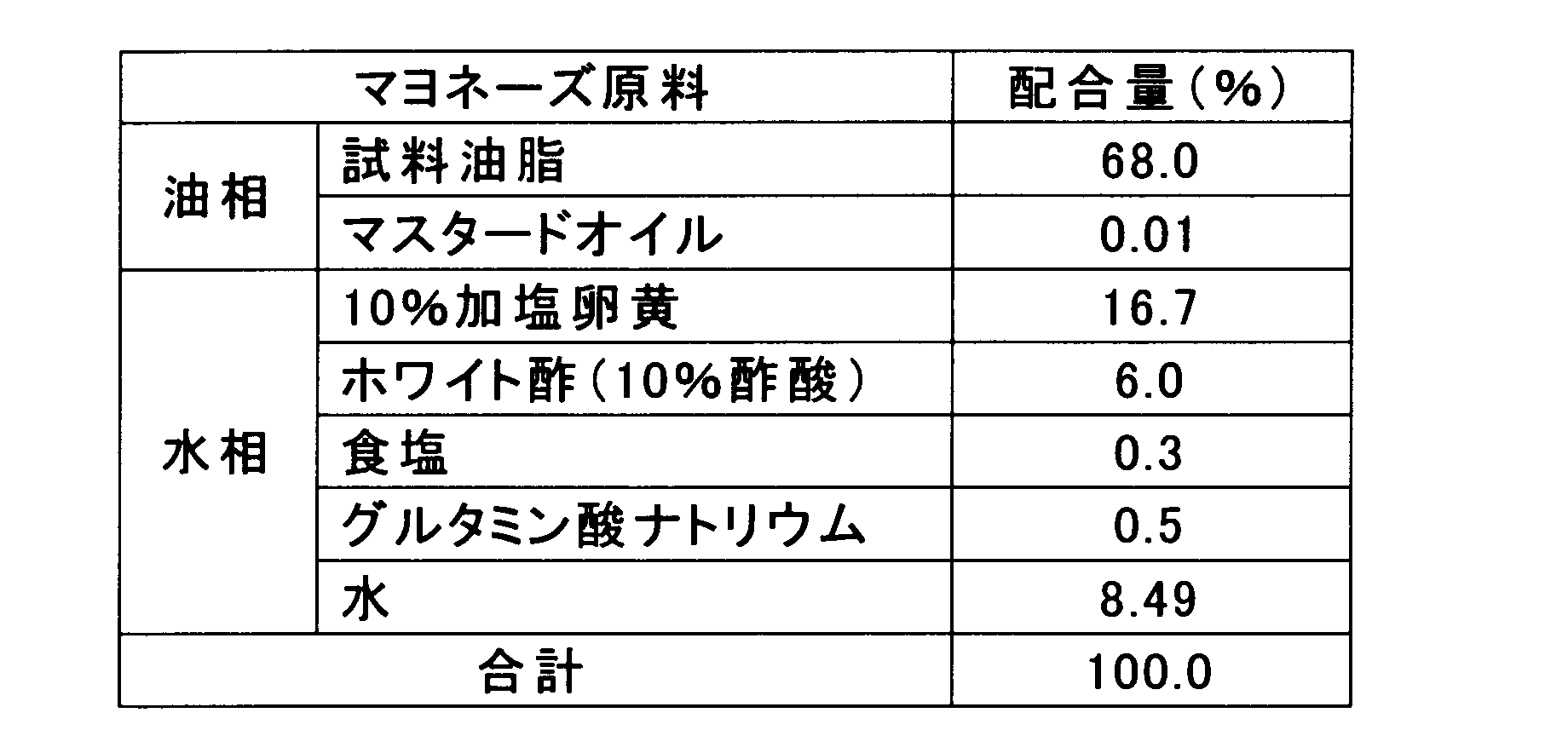
- the mayonnaise of Examples 7 to 12 having the blending amounts (%) shown in Table 2 was produced by the following production procedures 1 to 4.
- the mayonnaise of Examples 7-12 used the palm fractionated soft oils of Examples 1-6, respectively.
- the sample fat contains 20% by mass of palm fractionated soft oil and 80% by mass of Nissin Salad Oil (S) (manufactured by Nisshin Oillio Group Co., Ltd.). Manufacturing procedure Sample oil and fat and mustard oil were mixed to obtain an oil phase raw material. 2.
- Example 13 having the blending ratio (%) shown in Table 4 was produced by the following production procedures 1 to 6.
- sample fats and oils contain 50 mass% of palm fraction soft oil of Example 3, and 50 mass% of high oleic sunflower oil (Nisshin Oilio Group Co., Ltd. prototype).
- Example 14 the coffee whitener which used 50 mass% of palm fraction soft oil of Example 1 and 50 mass% of high oleic sunflower oil (Nisshin Oilio Group Co., Ltd. prototype) for sample fats and oils was manufactured. Manufacturing procedure The aqueous phase raw material and the oil phase raw material were heated and mixed and dissolved at 70 ° C. using separate containers. 2.
- Emulsification stability The coffee whitener was frozen at ⁇ 15 ° C. for 24 hours and then thawed at room temperature. Visual evaluation was performed according to the following criteria. -Evaluation criteria (double-circle): It was not solidified at all and was very favorable. ⁇ : Although slightly solidified, there was no practical problem. ⁇ : Some solidified. X: Completely solidified.
- Evaluation criteria A There was no oil-off or feathering at all, and it was in a uniform state. ⁇ : Slight oil-off and feathering occurred, but there were no practical problems. ⁇ : Some oil-off or feathering occurred. X: Oil-off and feathering clearly occurred.
- the flour pastes of Examples 15, 16, and 17 having the blending ratio (%) shown in Table 6 were produced by the following production procedures 1 to 6.
- the palm fraction soft oil of Examples 4, 1, and 6 was used for the sample fats and oils, respectively.
- Manufacturing procedure The aqueous phase material was homogenized with a homomixer to obtain an aqueous phase. 2.
- the temperature of the aqueous phase was adjusted to 50 ° C., an oil phase heated to 60 ° C. was added thereto, and the mixture was further homogenized with a homomixer to obtain an emulsion. 3.
- the emulsion was heated to 90 ° C. with propeller stirring. 4).
- the emulsion was gelatinized and sterilized to obtain a flour paste. 5.
- the flower paste was water cooled to 50 ° C. 6).
- the flower paste was filled into a container and stored in a refrigerator.
- the evaluation results of the flour paste of Example 15 are as shown in Table 7. It can be seen that the flour paste of Example 15 satisfying the composition of the present invention has a finer and smoother texture than the flour pastes of Examples 16 and 17.
Landscapes
- Chemical & Material Sciences (AREA)
- Life Sciences & Earth Sciences (AREA)
- Engineering & Computer Science (AREA)
- Oil, Petroleum & Natural Gas (AREA)
- Food Science & Technology (AREA)
- Polymers & Plastics (AREA)
- Chemical Kinetics & Catalysis (AREA)
- Wood Science & Technology (AREA)
- Organic Chemistry (AREA)
- General Chemical & Material Sciences (AREA)
- Edible Oils And Fats (AREA)
- Fats And Perfumes (AREA)
Abstract
Description
ヨウ素価が60~80であるパーム分別軟質油であって、
炭素数16以上の飽和脂肪酸Xと炭素数16以上の不飽和脂肪酸Uとが結合したXU2型トリグリセリド55~70質量%と、
X3型トリグリセリド2質量%未満と
を含んでなり、
前記パーム分別軟質油に含まれる全てのトリグリセリドの2位置に結合した脂肪酸中の飽和脂肪酸の含有量が、6~30質量%である、パーム分別軟質油が提供される。
X2U型トリグリセリド10~40質量%と、
U3型トリグリセリド5~20質量%と、
をさらに含んでなる、上記のパーム分別軟質油が提供される。
上記のパーム分別軟質油の製造方法であって、
パーム油を分別処理に供した後、エステル交換処理にさらに供して、第1のパーム分別油を得る工程と、
パーム油を分別処理に供した後、エステル交換処理を経ずに、第2のパーム分別油を得る工程と、
第1のパーム分別油10~90質量%と、第2のパーム分別油10~90質量%とを混合して、第3のパーム分別油を得る工程と、
第3のパーム分別油を分別処理に供して、第4のパーム分別油を得る工程と
を含んでなり、
前記パーム分別軟質油が、第4のパーム分別油を10質量%以上含んでなる、製造方法が提供される。
本発明において、油脂中のトリグリセリドとは、1分子のグリセロールに、3分子の脂肪酸がエステル結合した構造を有するものである。トリグリセリドの1、2、3位とは、脂肪酸が結合した位置を表す。なお、トリグリセリドの構成脂肪酸の略称として、以下を用いる。X:炭素数16以上の飽和脂肪酸、U:炭素数16以上の不飽和脂肪酸。トリグリセリド組成の分析は、ガスクロマトグラフ法(JAOCS,vol70,11,1111-1114(1993)準拠)及び銀イオンカラム-HPLC法(J.High Resol.Chromatogr.,18,105-107(1995)準拠)を用いて行うことができる。油脂の構成脂肪酸の分析は、ガスクロマトグラフ法(AOCS Ce1f-96準拠)を用いて行うことができる。ヨウ素価は、基準油脂分析試験法(2.3.4.1-1996)に従い、ウィイス法により測定した値である。
本発明において、「パーム分別軟質油」とは、パーム由来の油脂を分別処理に供して得られる油脂である。パーム分別軟質油として、パーム油を分別して得られる、低融点部および/または中融点部が用いられる。好ましい態様によれば、複数回の分別処理に供して得られる低融点部を用いてもよい。また、パーム分別軟質油は、エステル交換処理を経たものであってもよい。エステル交換処理は、分別処理の前後あるいは複数回の分別処理の間のいずれの段階で行われてもよい。
本発明において、パーム分別軟質油は本発明の構成を満たす限り、製造方法は特に限定されず、いかなる製造方法により得られてもよいが、製造方法を例示すると以下の通りである。パーム分別軟質油の製造方法は、エステル交換処理に供した第1のパーム分別油と、エステル交換処理を経ていない第2のパーム分別油とを特定量で混合した後、この混合油脂をさらに分別処理に供して得られたパーム分別油を用いる方法である。より詳細には、上記のパーム分別軟質油の製造方法は、
パーム油を分別処理に供した後、エステル交換処理にさらに供して、第1のパーム分別油を得る工程と、
パーム油を分別処理に供した後、エステル交換処理を経ずに、第2のパーム分別油を得る工程と、
第1のパーム分別油10~90質量%、好ましくは20~80質量%と、第2のパーム分別油10~90質量%、好ましくは20~80質量%とを混合して、第3のパーム分別油を得る工程と、
第3のパーム分別油を分別処理に供して、第4のパーム分別油を得る工程と
を含んでなるものであり、
第4のパーム分別油と、その他のパーム分別油とを混合して、上記のパーム分別軟質油を得る工程をさらに含んでもよい。上記のパーム分別軟質油は、第4のパーム分別油を10質量%以上、好ましくは15~100質量%含むものであり、他のパーム分別油をさらに含んでもよい。他のパーム分別油とは、第4のパーム分別油以外であればよく、パーム油を分別処理に供して得られたものである。
本発明において、分別処理の方法は、特に限定されないが、ドライ分別、乳化分別、および溶剤分別等により行なうことができ、特に、ドライ分別により経済的に行なうことができる。ドライ分別は、一般的には槽内で攪拌しながら分別原料油脂を冷却し、結晶を析出させた後、圧搾および/または濾過によって硬質部(結晶画分)と軟質部(液状画分)を得ることにより行なうことができる。分別温度は、求められる分別油脂の性状に応じて適宜調節するのが良く、例えば10~40℃で行なうことができる。
本発明において、エステル交換処理の方法は、特に限定されないが、公知の方法により行うことができる。例えば、ナトリウムメトキシド等の合成触媒を使用した化学的エステル交換や、リパーゼを触媒とした酵素的エステル交換のどちらの方法でも行うことができる。いずれの方法においても、ランダムエステル交換もしくは位置特異性の乏しいエステル交換により、パーム分別油に含まれる全てのトリグリセリドの2位置に結合した脂肪酸中の飽和脂肪酸の含有量を調整することが好ましい。
本発明の好ましい態様によれば、加工乳化食品は、パーム分別軟質油を2~100質量%、好ましくは5~100質量%、より好ましくは10~90質量%含有する油脂を含むものである。油脂としては、パーム分別軟質油以外に、菜種油、大豆油、コーン油、紅花油、ひまわり油、やし油、パーム核油、ならびにそれらの分別油およびエステル交換油等を混合してもよい。さらに、加工乳化食品は、上記の油脂と、水と、さらにその他の成分とを含むものである。その他の成分としては、例えば、加工乳化食品に一般的に使用される乳化剤、香料、呈味材(乳固形分、卵、酢、糖類など)、増粘多糖類、抗酸化剤、および色素等が挙げられる。加工乳化食品中の油脂の配合量は、好ましくは5質量%以上90質量%以下、より好ましくは20質量%以上80質量%以下であり、水の配合量は、好ましくは5質量%以上70質量%以下である。その他の成分の配合量は、好ましくは0.1質量%以上30質量%以下、より好ましくは0.1質量%以上20質量%以下である。
本発明の加工乳化食品の製造方法には、公知の方法を用いることができる。一例としては、上記のパーム分別軟質油と、上記のその他の油脂とを混合し、さらに油溶性のその他の成分を溶解または分散させて油相を調製する。一方、水に水溶性のその他の成分を溶解または分散させて調製した水相も調製する。それぞれ調製した油相と水相を混合し、予備的に乳化させた乳化物を均質化処理することにより製造することができる。また、必要に応じて殺菌処理することもできる。均質化処理は、殺菌処理の前に行う前均質であっても、殺菌処理の後に行う後均質であってもよく、また前均質および後均質の両者を組み合わせた二段均質を行うこともできる。均質化処理の後は、冷却、エージングの工程に供してもよい。
パーム分別軟質油の原料油Aの調製
パーム油を分別処理に供して、パーム分別油を得た。パーム分別油のヨウ素価は、56.6であった。このパーム分別油を12℃の空冷条件で17時間冷却した後、圧搾濾過を行い、パーム分別軟質油の原料油Aを得た。原料油Aのヨウ素価は、66.7であった。
パーム油を分別処理に供した後、ナトリウムメチラートを触媒としてランダムエステル交換処理にさらに供して、第1のパーム分別油を得た。第1のパーム分別油のヨウ素価は、56.6であった。また、パーム油を分別処理に供して、第2のパーム分別油を得た。第2のパーム分別油のヨウ素価は、64.1であった。次に、第1のパーム分別油50質量%と、第2のパーム分別油50質量%とを混合して、第3のパーム分別油を得た。第3のパーム分別油を16℃で3時間冷却し、12℃で3時間さらに冷却した後、圧搾濾過を行い、第4のパーム分別油(原料油B)を得た。原料油Bのヨウ素価は、67.0であった。

以下の製造手順1~4により、表2に示す配合量(%)の例7~12のマヨネーズを製造した。例7~12のマヨネーズは、それぞれ例1~6のパーム分別軟質油を用いた。なお、試料油脂は、パーム分別軟質油20質量%と、日清サラダ油(S)(日清オイリオグループ株式会社製)80質量%とを含むものである。
製造手順
1.試料油脂とマスタードオイルを混合して、油相原料を得た。
2.10%加塩卵黄と、ホワイト酢(10%酢酸)と、食塩と、グルタミン酸ナトリウムと、水とを、ビーカー内で軽く混合した後に、真空乳化機で混合して、水相原料を得た。
3.該水相原料に該油相原料を少しずつ添加し、真空乳化機の高速撹拌機を用いて、5500rpmの速度で乳化した。
4.コロイドミルを用いて、3500rpmの速度で仕上げ乳化を行って、マヨネーズを得た。
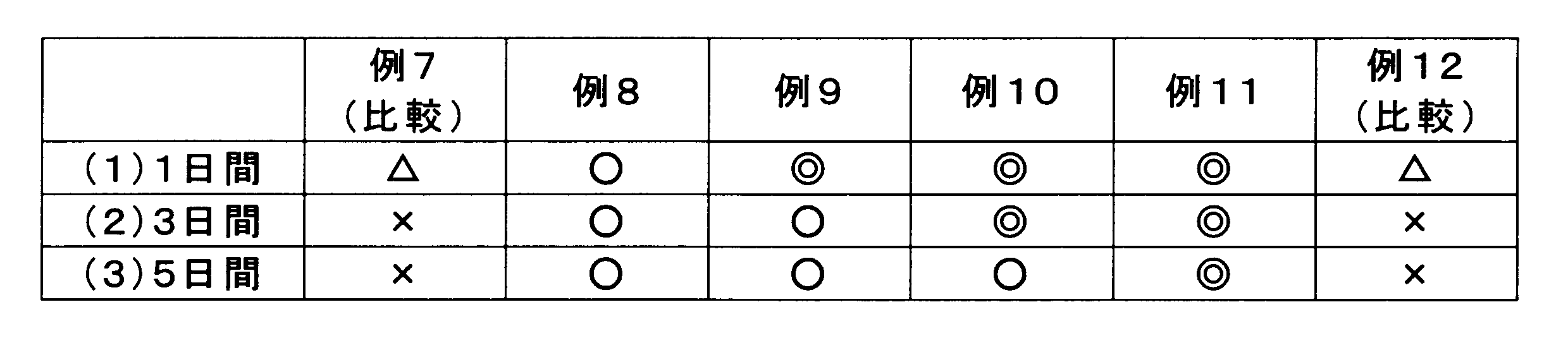
上記で製造した例7~12のマヨネーズをそれぞれ透明容器に取り分け、-10℃で一定期間保存した後に、室温(20℃)で解凍して、マヨネーズの外観を下記の基準で目視評価した。なお、保存期間は、(1)1日間、(2)3日間、(3)5日間で評価した。
・評価基準
◎:乳化破壊がなく、極めて良好であった。
○:わずかに乳化破壊していたが、実用上問題がなかった。
△:部分的に明らかに乳化破壊していた。
×:全体的に乳化破壊していた。
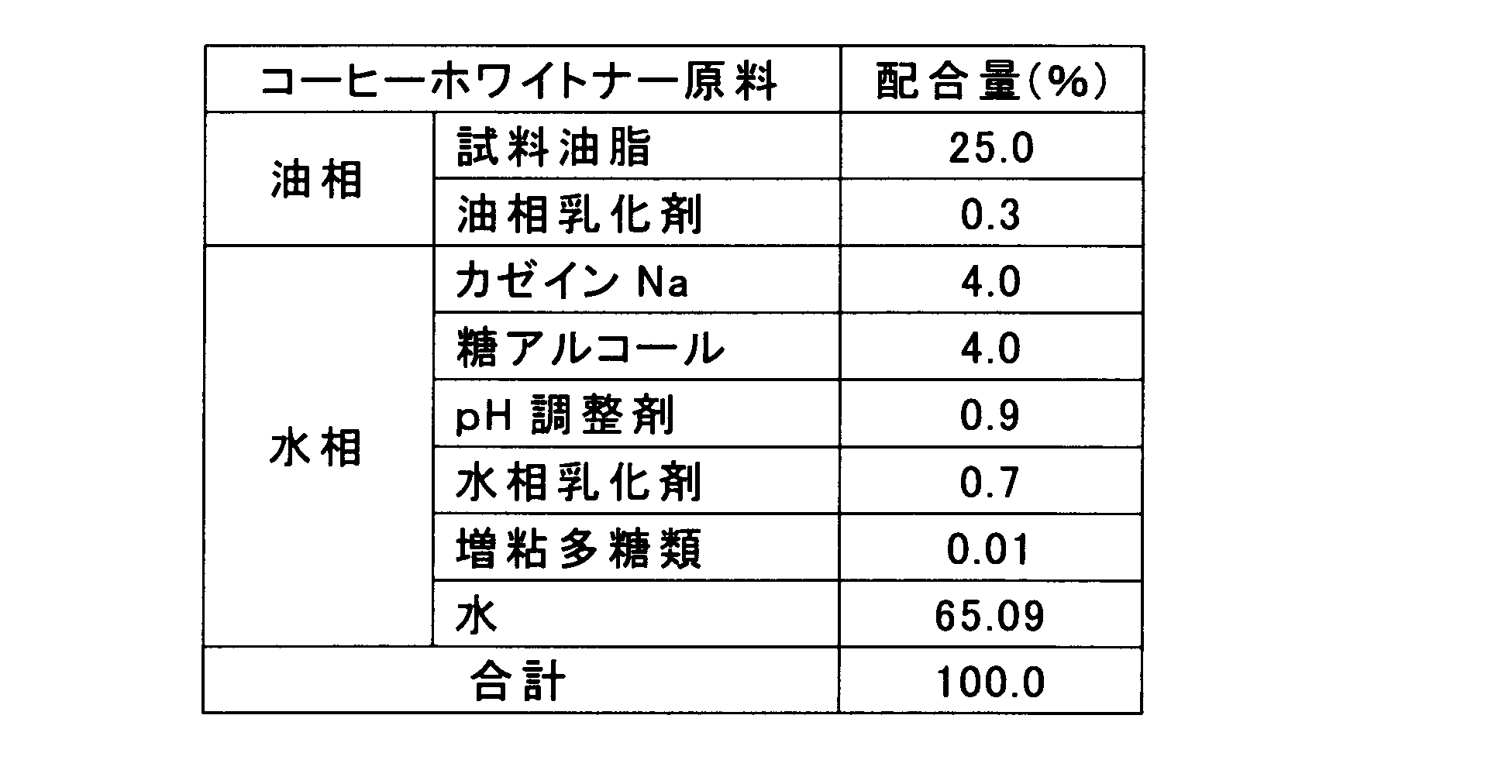
以下の製造手順1~6により、表4に示す配合割合(%)の例13のコーヒーホワイトナーを製造した。なお、試料油脂は、例3のパーム分別軟質油50質量%と、ハイオレイックひまわり油(日清オイリオグループ株式会社試作品)50質量%とを含むものである。また、例14として、例1のパーム分別軟質油50%と、ハイオレイックひまわり油(日清オイリオグループ株式会社試作品)50質量%を試料油脂に使用したコーヒーホワイトナーを製造した。
製造手順
1.水相原料および油相原料をそれぞれ別々の容器を用いて、70℃で加熱混合溶解した。
2.該水相原料を撹拌しながら、そこに油相原料を徐々に加え予備乳化した。
3.ホモジナイザーを用いてホモジナイズした(1段目200kg/cm3、2段目50kg/cm3)。
4.湯浴を用いて、85℃で10分間殺菌した。
5.ホモジナイザーを用いてホモジナイズした(1段目150kg/cm3、2段目50kg/cm3)。
6.氷水浴を用いて30℃まで冷却して、コーヒーホワイトナーを得た。
上記で製造した例13および14のコーヒーホワイトナーついて、以下の評価を行った。
コーヒーホワイトナーを-15℃で24時間凍結した後、室温で解凍した。下記の基準で目視評価した。
・評価基準
◎:全く凝固しておらず、極めて良好であった。
○:わずかに凝固していたが、実用上問題なかった。
△:多少凝固していた。
×:完全に凝固していた。
インスタントコーヒー2gに熱湯100gを注ぎ、コーヒーホワイトナーを5g添加して撹拌した後、外観を下記の基準で目視評価した。
・評価基準
◎:オイルオフやフェザリングが全くなく、均一な状態であった。
○:わずかにオイルオフやフェザリングが生じたが、実用上問題なかった。
△:オイルオフやフェザリングが多少生じた。
×:オイルオフやフェザリングが明らかに生じた。

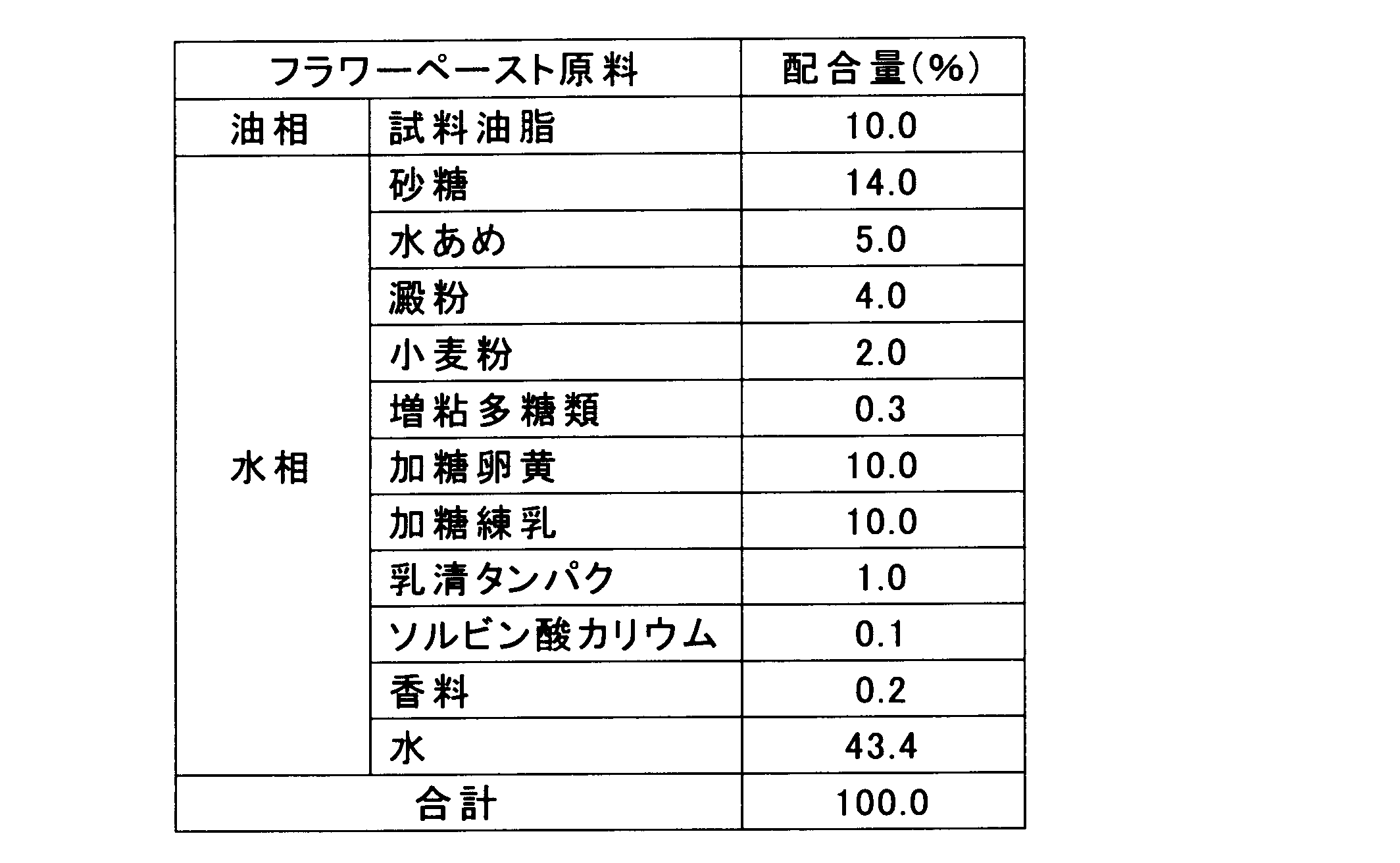
以下の製造手順1~6により、表6に示す配合割合(%)の例15、16、および17のフラワーペーストを製造した。なお、試料油脂はそれぞれ例4、1、および6のパーム分別軟質油を使用した。
製造手順
1.水相原料をホモミキサーにて均質化し水相を得た。
2.該水相の温度を50℃にし、そこへ60℃に加熱した油相を加えて、ホモミキサーでさらに均質化して乳化物を得た。
3.該乳化物をプロペラ撹拌しながら90℃まで加熱した。
4.該乳化物を糊化、殺菌してフラワーペーストを得た。
5.フラワーペーストを50℃まで水冷した。
6.フラワーペーストを容器に充填し、冷蔵庫で保存した。
上記で製造した例15、16、および17のフラワーペーストについて、以下の評価を行った。
フラワーペーストを5℃で1週間保存した後、室温に戻した。下記の基準で目視評価した。
・評価基準
◎:きめが細かく、極めて良好であった。
○:ややざらつきが生じていたが、実用上問題なかった。
△:ざらついていた。
×:完全にざらついていた。

Claims (7)
- ヨウ素価が60~80であるパーム分別軟質油であって、
炭素数16以上の飽和脂肪酸Xと炭素数16以上の不飽和脂肪酸Uとが結合したXU2型トリグリセリド55~70質量%と、
X3型トリグリセリド2質量%未満と
を含んでなり、
前記パーム分別軟質油に含まれる全てのトリグリセリドの2位置に結合した脂肪酸中の飽和脂肪酸の含有量が、6~30質量%である、パーム分別軟質油。 - X2U型トリグリセリド10~40質量%と、
U3型トリグリセリド5~20質量%と、
をさらに含んでなる、請求項1に記載のパーム分別軟質油。 - 請求項1または2に記載のパーム分別軟質油を2~100質量%含有する油脂を含んでなる、加工乳化食品。
- 酸性水中油型乳化物である、請求項3に記載の加工乳化食品。
- 食品用クリームである、請求項3に記載の加工乳化食品。
- 食品用フィリングである、請求項3に記載の加工乳化食品。
- 請求項1または2に記載のパーム分別軟質油の製造方法であって、
パーム油を分別処理に供した後、エステル交換処理にさらに供して、第1のパーム分別油を得る工程と、
パーム油を分別処理に供した後、エステル交換処理を経ずに、第2のパーム分別油を得る工程と、
第1のパーム分別油10~90質量%と、第2のパーム分別油10~90質量%とを混合して、第3のパーム分別油を得る工程と、
第3のパーム分別油を分別処理に供して、第4のパーム分別油を得る工程と
を含んでなり、
前記パーム分別軟質油が、第4のパーム分別油を10質量%以上含んでなる、製造方法。
Priority Applications (2)
| Application Number | Priority Date | Filing Date | Title |
|---|---|---|---|
| JP2012524805A JP5101754B2 (ja) | 2011-01-31 | 2011-08-05 | パーム分別軟質油およびそれを使用した加工乳化食品 |
| CN201180026668.8A CN102958374B (zh) | 2011-01-31 | 2011-08-05 | 棕榈分提软质油及使用该棕榈分提软质油的加工乳化食品 |
Applications Claiming Priority (2)
| Application Number | Priority Date | Filing Date | Title |
|---|---|---|---|
| JP2011-018591 | 2011-01-31 | ||
| JP2011018591 | 2011-01-31 |
Publications (1)
| Publication Number | Publication Date |
|---|---|
| WO2012105073A1 true WO2012105073A1 (ja) | 2012-08-09 |
Family
ID=46602310
Family Applications (1)
| Application Number | Title | Priority Date | Filing Date |
|---|---|---|---|
| PCT/JP2011/067974 Ceased WO2012105073A1 (ja) | 2011-01-31 | 2011-08-05 | パーム分別軟質油およびそれを使用した加工乳化食品 |
Country Status (3)
| Country | Link |
|---|---|
| JP (1) | JP5101754B2 (ja) |
| CN (1) | CN102958374B (ja) |
| WO (1) | WO2012105073A1 (ja) |
Cited By (2)
| Publication number | Priority date | Publication date | Assignee | Title |
|---|---|---|---|---|
| JP2023118597A (ja) * | 2022-02-15 | 2023-08-25 | 日清オイリオグループ株式会社 | ケーキおよびケーキ生地 |
| WO2023162797A1 (ja) * | 2022-02-22 | 2023-08-31 | 不二製油グループ本社株式会社 | 水中油型乳化物及び水中油型乳化物の製造方法 |
Families Citing this family (2)
| Publication number | Priority date | Publication date | Assignee | Title |
|---|---|---|---|---|
| CN108570355A (zh) * | 2017-07-21 | 2018-09-25 | 天津南侨食品有限公司 | 一种耐高温低反式低饱和结构硬脂组合物及其制备方法 |
| US20220117248A1 (en) * | 2019-01-07 | 2022-04-21 | Wisteria Co., Ltd. | Method for manufacturing butter-like food derived from vegetable milk and butter-like food derived from vegetable milk |
Citations (4)
| Publication number | Priority date | Publication date | Assignee | Title |
|---|---|---|---|---|
| JPS6481899A (en) * | 1987-09-22 | 1989-03-28 | Kao Corp | Production of liquid oil |
| JP2002338992A (ja) * | 2001-05-15 | 2002-11-27 | Kanegafuchi Chem Ind Co Ltd | 可塑性油脂組成物 |
| JP2008194011A (ja) * | 2007-02-15 | 2008-08-28 | J-Oil Mills Inc | 高液状性パーム油の製造方法および高液状性パーム油 |
| JP2011092059A (ja) * | 2009-10-28 | 2011-05-12 | J-Oil Mills Inc | 高液状性パーム系油脂の製造方法 |
Family Cites Families (8)
| Publication number | Priority date | Publication date | Assignee | Title |
|---|---|---|---|---|
| US4861612A (en) * | 1987-02-06 | 1989-08-29 | Kao Corporation | Method of separating oleaginous matter into components having various melting points |
| JP4497561B2 (ja) * | 1996-12-24 | 2010-07-07 | 昭和産業株式会社 | マーガリン・ショートニング用油脂およびそれでできた製品 |
| JPH11289979A (ja) * | 1998-02-13 | 1999-10-26 | Asahi Denka Kogyo Kk | 水中油型乳化物 |
| CN1310598C (zh) * | 2002-05-16 | 2007-04-18 | 弗门尼舍有限公司 | 食品用的调味的水包油乳液 |
| US7927647B2 (en) * | 2007-07-10 | 2011-04-19 | The Nisshin Oillio Group, Ltd. | Plastic fat composition |
| TWI441915B (zh) * | 2007-09-07 | 2014-06-21 | Nisshin Oillio Group Ltd | 1,3-二飽和-2-不飽和三酸甘油酯的區分方法 |
| CN101773167A (zh) * | 2010-02-08 | 2010-07-14 | 天津龙威粮油工业有限公司 | 一种棕榈和橄榄调和油 |
| CN101779706B (zh) * | 2010-02-08 | 2012-10-31 | 天津龙威粮油工业有限公司 | 一种特级棕榈液油及其工业化生产方法 |
-
2011
- 2011-08-05 CN CN201180026668.8A patent/CN102958374B/zh active Active
- 2011-08-05 JP JP2012524805A patent/JP5101754B2/ja active Active
- 2011-08-05 WO PCT/JP2011/067974 patent/WO2012105073A1/ja not_active Ceased
Patent Citations (4)
| Publication number | Priority date | Publication date | Assignee | Title |
|---|---|---|---|---|
| JPS6481899A (en) * | 1987-09-22 | 1989-03-28 | Kao Corp | Production of liquid oil |
| JP2002338992A (ja) * | 2001-05-15 | 2002-11-27 | Kanegafuchi Chem Ind Co Ltd | 可塑性油脂組成物 |
| JP2008194011A (ja) * | 2007-02-15 | 2008-08-28 | J-Oil Mills Inc | 高液状性パーム油の製造方法および高液状性パーム油 |
| JP2011092059A (ja) * | 2009-10-28 | 2011-05-12 | J-Oil Mills Inc | 高液状性パーム系油脂の製造方法 |
Cited By (3)
| Publication number | Priority date | Publication date | Assignee | Title |
|---|---|---|---|---|
| JP2023118597A (ja) * | 2022-02-15 | 2023-08-25 | 日清オイリオグループ株式会社 | ケーキおよびケーキ生地 |
| WO2023162797A1 (ja) * | 2022-02-22 | 2023-08-31 | 不二製油グループ本社株式会社 | 水中油型乳化物及び水中油型乳化物の製造方法 |
| JP7365534B1 (ja) * | 2022-02-22 | 2023-10-19 | 不二製油株式会社 | 水中油型乳化物及び水中油型乳化物の製造方法 |
Also Published As
| Publication number | Publication date |
|---|---|
| CN102958374B (zh) | 2014-05-28 |
| CN102958374A (zh) | 2013-03-06 |
| JP5101754B2 (ja) | 2012-12-19 |
| JPWO2012105073A1 (ja) | 2014-07-03 |
Similar Documents
| Publication | Publication Date | Title |
|---|---|---|
| CN102811625B (zh) | 油脂组合物及含有该油脂组合物的水包油型乳化物 | |
| RU2631683C2 (ru) | Новая композиция жировой смеси | |
| JP4925458B2 (ja) | クリーム用油脂組成物及び該油脂組成物を含有するクリーム | |
| JP5444972B2 (ja) | ホイップクリーム用油脂組成物 | |
| CN102098925A (zh) | 油脂组合物和含有该油脂组合物的水包油型乳化物 | |
| CN102014646A (zh) | 油脂组合物及含有该油脂组合物的水包油型乳化物 | |
| TWI548347B (zh) | An oil-in-oil composition for a foamed oil-in-water emulsion, and a foamed oil-in-water type emulsion containing the fat and oil composition | |
| MXPA05001630A (es) | Grasa de trigliceridos. | |
| JP5341283B1 (ja) | 起泡性水中油型乳化物用油脂および該油脂を含んでなる起泡性水中油型乳化物 | |
| JP6959037B2 (ja) | ホイップクリーム用油脂組成物 | |
| JP5101754B2 (ja) | パーム分別軟質油およびそれを使用した加工乳化食品 | |
| JP2007236348A (ja) | 油脂組成物とその製造方法、水中油型乳化物、およびコンパウンドクリーム | |
| TWI569728B (zh) | 裹油用乳化油脂組成物 | |
| TWI733864B (zh) | 油脂組成物 | |
| JP6851867B2 (ja) | 冷凍菓子用ミックスおよびそれを使用した冷凍菓子 | |
| JP7454813B2 (ja) | 起泡性水中油型乳化物 | |
| JP4768839B2 (ja) | クリーム用油脂組成物 | |
| JP4506711B2 (ja) | 食用油脂組成物 | |
| JP2005343799A (ja) | 水分散性植物ステロース製剤と油脂含有水分散性植物ステロール製剤 | |
| JP5907806B2 (ja) | 液状クリーム用油脂およびそれを使用した液状クリーム | |
| JP6509443B2 (ja) | 冷凍菓子用ミックスおよびそれを使用した冷凍菓子 | |
| JP6971541B2 (ja) | マヨネーズ様食品 | |
| CN113115828B (zh) | 一种含椰浆的油脂组合物及其制备方法 | |
| CN116210770A (zh) | 一种含有酯交换油脂的动植物混合搅打奶油及其制备方法 | |
| JPWO2013125385A1 (ja) | 起泡性水中油型乳化物用油脂組成物及び起泡性水中油型乳化物 |
Legal Events
| Date | Code | Title | Description |
|---|---|---|---|
| WWE | Wipo information: entry into national phase |
Ref document number: 201180026668.8 Country of ref document: CN |
|
| WWE | Wipo information: entry into national phase |
Ref document number: 2012524805 Country of ref document: JP |
|
| 121 | Ep: the epo has been informed by wipo that ep was designated in this application |
Ref document number: 11857630 Country of ref document: EP Kind code of ref document: A1 |
|
| NENP | Non-entry into the national phase |
Ref country code: DE |
|
| 122 | Ep: pct application non-entry in european phase |
Ref document number: 11857630 Country of ref document: EP Kind code of ref document: A1 |