WO2012093589A1 - 硬化性エポキシ樹脂組成物 - Google Patents
硬化性エポキシ樹脂組成物 Download PDFInfo
- Publication number
- WO2012093589A1 WO2012093589A1 PCT/JP2011/079686 JP2011079686W WO2012093589A1 WO 2012093589 A1 WO2012093589 A1 WO 2012093589A1 JP 2011079686 W JP2011079686 W JP 2011079686W WO 2012093589 A1 WO2012093589 A1 WO 2012093589A1
- Authority
- WO
- WIPO (PCT)
- Prior art keywords
- resin composition
- epoxy resin
- compound
- optical semiconductor
- curable epoxy
- Prior art date
- Legal status (The legal status is an assumption and is not a legal conclusion. Google has not performed a legal analysis and makes no representation as to the accuracy of the status listed.)
- Ceased
Links
- 0 *C1(CN(C(N(CC2(*)OC2)C(N2CC(*)=C)=O)=O)C2=O)OC1 Chemical compound *C1(CN(C(N(CC2(*)OC2)C(N2CC(*)=C)=O)=O)C2=O)OC1 0.000 description 1
Images
Classifications
-
- C—CHEMISTRY; METALLURGY
- C08—ORGANIC MACROMOLECULAR COMPOUNDS; THEIR PREPARATION OR CHEMICAL WORKING-UP; COMPOSITIONS BASED THEREON
- C08G—MACROMOLECULAR COMPOUNDS OBTAINED OTHERWISE THAN BY REACTIONS ONLY INVOLVING UNSATURATED CARBON-TO-CARBON BONDS
- C08G59/00—Polycondensates containing more than one epoxy group per molecule; Macromolecules obtained by polymerising compounds containing more than one epoxy group per molecule using curing agents or catalysts which react with the epoxy groups
- C08G59/18—Macromolecules obtained by polymerising compounds containing more than one epoxy group per molecule using curing agents or catalysts which react with the epoxy groups ; e.g. general methods of curing
- C08G59/20—Macromolecules obtained by polymerising compounds containing more than one epoxy group per molecule using curing agents or catalysts which react with the epoxy groups ; e.g. general methods of curing characterised by the epoxy compounds used
- C08G59/22—Di-epoxy compounds
- C08G59/226—Mixtures of di-epoxy compounds
-
- H—ELECTRICITY
- H10—SEMICONDUCTOR DEVICES; ELECTRIC SOLID-STATE DEVICES NOT OTHERWISE PROVIDED FOR
- H10W—GENERIC PACKAGES, INTERCONNECTIONS, CONNECTORS OR OTHER CONSTRUCTIONAL DETAILS OF DEVICES COVERED BY CLASS H10
- H10W74/00—Encapsulations, e.g. protective coatings
- H10W74/40—Encapsulations, e.g. protective coatings characterised by their materials
- H10W74/47—Encapsulations, e.g. protective coatings characterised by their materials comprising organic materials, e.g. plastics or resins
-
- C—CHEMISTRY; METALLURGY
- C08—ORGANIC MACROMOLECULAR COMPOUNDS; THEIR PREPARATION OR CHEMICAL WORKING-UP; COMPOSITIONS BASED THEREON
- C08G—MACROMOLECULAR COMPOUNDS OBTAINED OTHERWISE THAN BY REACTIONS ONLY INVOLVING UNSATURATED CARBON-TO-CARBON BONDS
- C08G59/00—Polycondensates containing more than one epoxy group per molecule; Macromolecules obtained by polymerising compounds containing more than one epoxy group per molecule using curing agents or catalysts which react with the epoxy groups
- C08G59/18—Macromolecules obtained by polymerising compounds containing more than one epoxy group per molecule using curing agents or catalysts which react with the epoxy groups ; e.g. general methods of curing
- C08G59/20—Macromolecules obtained by polymerising compounds containing more than one epoxy group per molecule using curing agents or catalysts which react with the epoxy groups ; e.g. general methods of curing characterised by the epoxy compounds used
- C08G59/22—Di-epoxy compounds
- C08G59/26—Di-epoxy compounds heterocyclic
-
- C—CHEMISTRY; METALLURGY
- C08—ORGANIC MACROMOLECULAR COMPOUNDS; THEIR PREPARATION OR CHEMICAL WORKING-UP; COMPOSITIONS BASED THEREON
- C08G—MACROMOLECULAR COMPOUNDS OBTAINED OTHERWISE THAN BY REACTIONS ONLY INVOLVING UNSATURATED CARBON-TO-CARBON BONDS
- C08G59/00—Polycondensates containing more than one epoxy group per molecule; Macromolecules obtained by polymerising compounds containing more than one epoxy group per molecule using curing agents or catalysts which react with the epoxy groups
- C08G59/18—Macromolecules obtained by polymerising compounds containing more than one epoxy group per molecule using curing agents or catalysts which react with the epoxy groups ; e.g. general methods of curing
- C08G59/20—Macromolecules obtained by polymerising compounds containing more than one epoxy group per molecule using curing agents or catalysts which react with the epoxy groups ; e.g. general methods of curing characterised by the epoxy compounds used
- C08G59/32—Epoxy compounds containing three or more epoxy groups
- C08G59/3254—Epoxy compounds containing three or more epoxy groups containing atoms other than carbon, hydrogen, oxygen or nitrogen
- C08G59/3281—Epoxy compounds containing three or more epoxy groups containing atoms other than carbon, hydrogen, oxygen or nitrogen containing silicon
-
- C—CHEMISTRY; METALLURGY
- C08—ORGANIC MACROMOLECULAR COMPOUNDS; THEIR PREPARATION OR CHEMICAL WORKING-UP; COMPOSITIONS BASED THEREON
- C08G—MACROMOLECULAR COMPOUNDS OBTAINED OTHERWISE THAN BY REACTIONS ONLY INVOLVING UNSATURATED CARBON-TO-CARBON BONDS
- C08G59/00—Polycondensates containing more than one epoxy group per molecule; Macromolecules obtained by polymerising compounds containing more than one epoxy group per molecule using curing agents or catalysts which react with the epoxy groups
- C08G59/18—Macromolecules obtained by polymerising compounds containing more than one epoxy group per molecule using curing agents or catalysts which react with the epoxy groups ; e.g. general methods of curing
- C08G59/20—Macromolecules obtained by polymerising compounds containing more than one epoxy group per molecule using curing agents or catalysts which react with the epoxy groups ; e.g. general methods of curing characterised by the epoxy compounds used
- C08G59/32—Epoxy compounds containing three or more epoxy groups
- C08G59/38—Epoxy compounds containing three or more epoxy groups together with di-epoxy compounds
-
- C—CHEMISTRY; METALLURGY
- C08—ORGANIC MACROMOLECULAR COMPOUNDS; THEIR PREPARATION OR CHEMICAL WORKING-UP; COMPOSITIONS BASED THEREON
- C08L—COMPOSITIONS OF MACROMOLECULAR COMPOUNDS
- C08L63/00—Compositions of epoxy resins; Compositions of derivatives of epoxy resins
-
- H—ELECTRICITY
- H10—SEMICONDUCTOR DEVICES; ELECTRIC SOLID-STATE DEVICES NOT OTHERWISE PROVIDED FOR
- H10H—INORGANIC LIGHT-EMITTING SEMICONDUCTOR DEVICES HAVING POTENTIAL BARRIERS
- H10H20/00—Individual inorganic light-emitting semiconductor devices having potential barriers, e.g. light-emitting diodes [LED]
- H10H20/80—Constructional details
- H10H20/85—Packages
- H10H20/852—Encapsulations
- H10H20/854—Encapsulations characterised by their material, e.g. epoxy or silicone resins
-
- H—ELECTRICITY
- H10—SEMICONDUCTOR DEVICES; ELECTRIC SOLID-STATE DEVICES NOT OTHERWISE PROVIDED FOR
- H10W—GENERIC PACKAGES, INTERCONNECTIONS, CONNECTORS OR OTHER CONSTRUCTIONAL DETAILS OF DEVICES COVERED BY CLASS H10
- H10W72/00—Interconnections or connectors in packages
- H10W72/071—Connecting or disconnecting
- H10W72/075—Connecting or disconnecting of bond wires
- H10W72/07551—Connecting or disconnecting of bond wires characterised by changes in properties of the bond wires during the connecting
- H10W72/07553—Connecting or disconnecting of bond wires characterised by changes in properties of the bond wires during the connecting changes in shapes
-
- H—ELECTRICITY
- H10—SEMICONDUCTOR DEVICES; ELECTRIC SOLID-STATE DEVICES NOT OTHERWISE PROVIDED FOR
- H10W—GENERIC PACKAGES, INTERCONNECTIONS, CONNECTORS OR OTHER CONSTRUCTIONAL DETAILS OF DEVICES COVERED BY CLASS H10
- H10W90/00—Package configurations
- H10W90/701—Package configurations characterised by the relative positions of pads or connectors relative to package parts
- H10W90/751—Package configurations characterised by the relative positions of pads or connectors relative to package parts of bond wires
- H10W90/756—Package configurations characterised by the relative positions of pads or connectors relative to package parts of bond wires between a chip and a stacked lead frame, conducting package substrate or heat sink
Definitions
- the present invention relates to a curable epoxy resin composition, a cured product obtained by curing the curable epoxy resin composition, an optical semiconductor sealing resin composition comprising the curable epoxy resin composition, and the curable epoxy resin.
- the present invention relates to an optical semiconductor device in which an optical semiconductor element is sealed using a composition.
- a cured product of a composition containing monoallyl diglycidyl isocyanurate and bisphenol A type epoxy resin is known as a sealing resin having high heat resistance (see Patent Document 1).
- a sealing resin having high heat resistance see Patent Document 1.
- coloring proceeds due to light and heat emitted from the optical semiconductor element, and light that should be output is absorbed, As a result, there has been a problem that the luminous intensity of the light output from the optical semiconductor device decreases with time.
- a liquid alicyclic epoxy resin having an alicyclic skeleton such as an adduct of cyclohexanecarboxylate and ⁇ -caprolactone and 1,2,8,9-diepoxylimonene is known.
- an object of the present invention is to provide a curable epoxy resin composition that provides a cured product having high transparency, heat resistance, light resistance, and crack resistance. Another object of the present invention is to provide a cured product having high transparency, heat resistance, light resistance, and crack resistance obtained by curing the curable epoxy resin composition. Another object of the present invention is to provide a resin composition for encapsulating an optical semiconductor comprising the above curable epoxy resin composition, from which an optical semiconductor device in which a decrease in light intensity over time is suppressed can be obtained. Another object of the present invention is to provide high heat resistance, light resistance, transparency, and crack resistance obtained by sealing an optical semiconductor element using the above resin composition for optical semiconductor sealing. Another object of the present invention is to provide an optical semiconductor device in which an optical semiconductor element is sealed with a cured product and a decrease in luminous intensity with time is suppressed.
- the present inventor includes an alicyclic epoxy compound, a monoallyl diglycidyl isocyanurate compound, and a siloxane derivative having two or more epoxy groups in the molecule, and further includes a curing agent and A curable epoxy resin composition containing a curing accelerator or a curing catalyst gives a cured product having excellent heat resistance, light resistance, transparency and crack resistance, and encapsulates an optical semiconductor element with the cured product.
- the present inventors have found that the optical semiconductor device is less likely to decrease in light intensity over time.
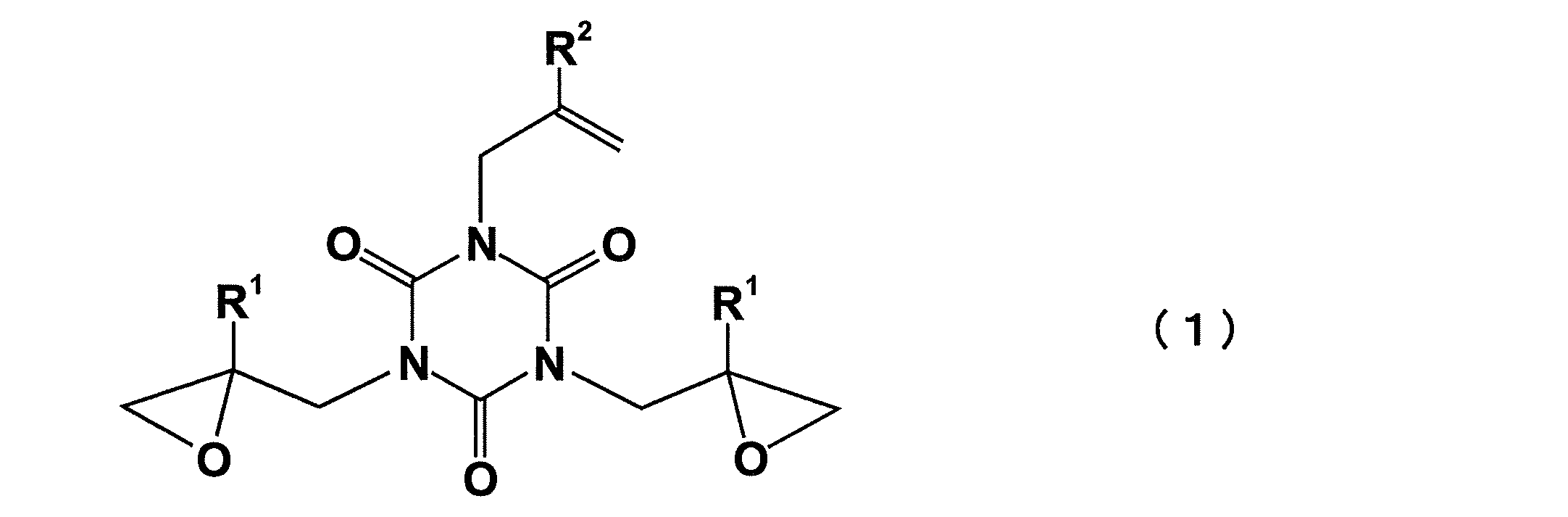
- the present invention relates to an alicyclic epoxy compound (A) and the following formula (1).
- R 1 and R 2 represent a hydrogen atom or an alkyl group having 1 to 8 carbon atoms
- a curable epoxy resin composition is provided.
- the present invention provides an alicyclic epoxy compound (A) and the following formula (1): [Wherein R 1 and R 2 represent a hydrogen atom or an alkyl group having 1 to 8 carbon atoms]
- a curable epoxy resin comprising a monoallyl diglycidyl isocyanurate compound (B) represented by the formula: a siloxane derivative (C) having two or more epoxy groups in the molecule; and a curing catalyst (F).
- a composition is provided.
- the content of the siloxane derivative (C) having two or more epoxy groups in the molecule is based on the total amount (100% by weight) of the component (A), the component (B), and the component (C).
- the curable epoxy resin composition is provided in an amount of 5 to 60% by weight.
- the curable epoxy resin composition is provided wherein the alicyclic epoxy group of the alicyclic epoxy compound (A) is a cyclohexene oxide group.
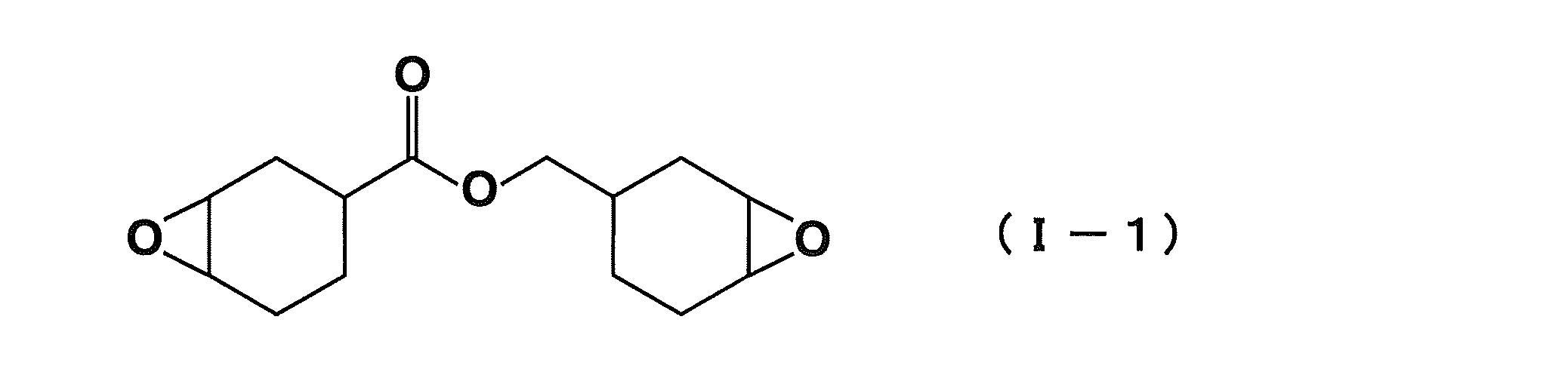
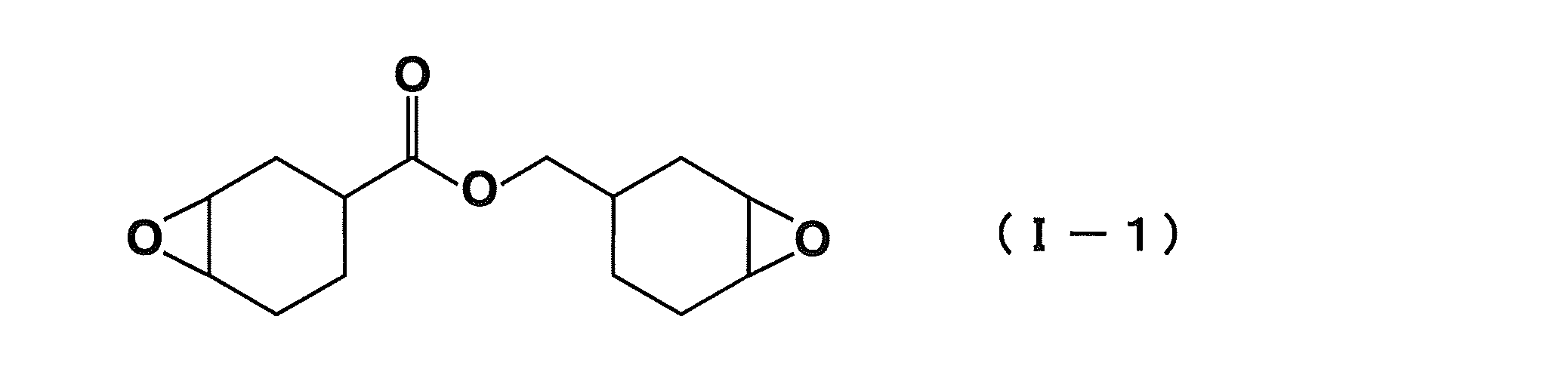
- the alicyclic epoxy compound (A) is represented by the following formula (I-1)
- the said curable epoxy resin composition which is a compound represented by these is provided.
- the present invention also provides a cured product obtained by curing the curable epoxy resin composition.
- the present invention also provides a resin composition for sealing an optical semiconductor comprising the curable epoxy resin composition.
- the present invention also provides an optical semiconductor device in which an optical semiconductor element is sealed with the above-described resin composition for sealing an optical semiconductor.
- the curable epoxy resin composition of the present invention has the above-described configuration, a cured product having high transparency, heat resistance, light resistance, and crack resistance can be obtained by curing the resin composition. .
- an optical semiconductor device in which an optical semiconductor element is encapsulated with the curable epoxy resin composition (an optical semiconductor encapsulating resin composition) of the present invention is less likely to have a decrease in light intensity over time, and has excellent quality and durability. Can be demonstrated.
- the curable epoxy resin composition of the present invention is used as a sealing resin for an optical semiconductor device provided with a high-output, high-brightness optical semiconductor element, A decrease in luminous intensity can be suppressed.
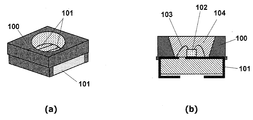
- FIG. 1 It is the schematic which shows one Embodiment of the optical semiconductor device which sealed the element (optical semiconductor element) with the curable epoxy resin composition of this invention.
- the left figure (a) is a perspective view
- the right figure (b) is a sectional view.
- the curable epoxy resin composition of the present invention comprises an alicyclic epoxy compound (A) and the following formula (1).
- R 1 and R 2 represent a hydrogen atom or an alkyl group having 1 to 8 carbon atoms
- the curable epoxy resin composition of the present invention comprises an alicyclic epoxy compound (A), a monoallyl diglycidyl isocyanurate compound (B) represented by the above formula (1), and two or more in the molecule. It contains at least a siloxane derivative (C) having an epoxy group and a curing catalyst (F).
- the alicyclic epoxy compound (A) constituting the curable epoxy resin composition of the present invention is a compound having at least an alicyclic (aliphatic ring) structure and an epoxy group in the molecule (in one molecule). More specifically, the alicyclic epoxy compound (A) includes (i) a compound having an epoxy group composed of two adjacent carbon atoms and oxygen atoms constituting the alicyclic ring, and (ii) a fatty acid. A compound in which an epoxy group is directly bonded to the ring by a single bond is included. However, the alicyclic epoxy compound (A) does not include a siloxane derivative (C) having two or more epoxy groups in the molecule described later.
- a compound having an epoxy group (alicyclic epoxy group) composed of two adjacent carbon atoms and oxygen atoms constituting an alicyclic ring is arbitrarily selected from known or commonly used compounds. be able to.
- the alicyclic epoxy group is preferably a cyclohexene oxide group.
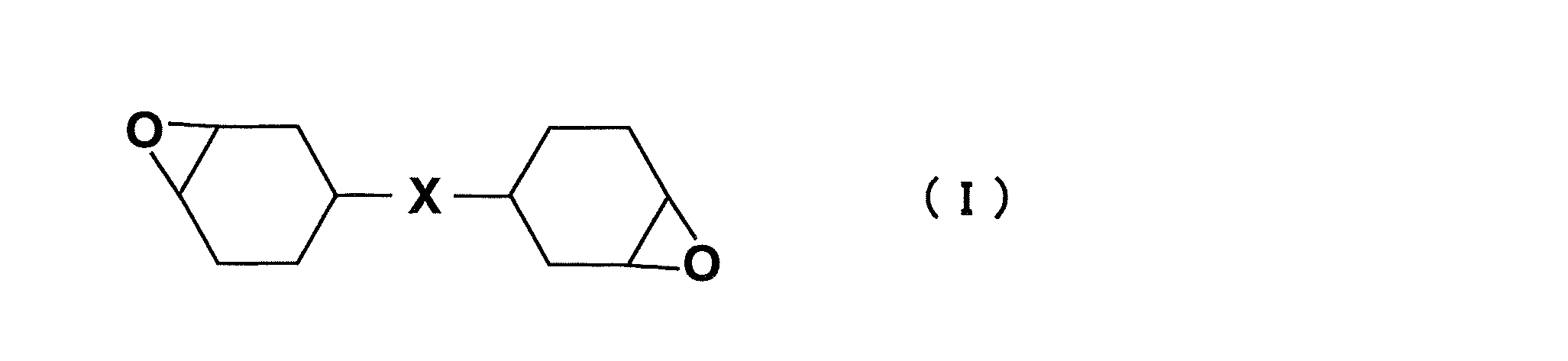
- X represents a single bond or a linking group (a divalent group having one or more atoms).
- the linking group include a divalent hydrocarbon group, a carbonyl group, an ether bond, an ester bond, a carbonate group, an amide group, and a group in which a plurality of these are linked.
- Examples of the alicyclic epoxy compound in which X in the formula (I) is a single bond include compounds represented by the following formula.
- an alicyclic epoxy compound for example, a commercially available product such as Celoxide 8000 (manufactured by Daicel Corporation) can be used.
- Examples of the divalent hydrocarbon group include a linear or branched alkylene group having 1 to 18 carbon atoms, a divalent alicyclic hydrocarbon group, and the like.
- Examples of the linear or branched alkylene group having 1 to 18 carbon atoms include methylene, methylmethylene, dimethylmethylene, ethylene, propylene, and trimethylene groups.
- divalent alicyclic hydrocarbon group examples include 1,2-cyclopentylene, 1,3-cyclopentylene, cyclopentylidene, 1,2-cyclohexylene, 1,3-cyclohexylene, 1, And divalent cycloalkylene groups (including cycloalkylidene groups) such as 4-cyclohexylene and cyclohexylidene groups.
- the linking group X is preferably a linking group containing an oxygen atom, specifically, —CO—, —O—CO—O—, —COO—, —O—, —CONH—; A group in which one or more of these groups are linked to one or more of divalent hydrocarbon groups, and the like.
- divalent hydrocarbon group include those exemplified above.
- Representative examples of the alicyclic epoxy compound represented by the above formula (I) include compounds represented by the following formulas (I-1) to (I-8).
- commercially available products such as Celoxide 2021P and Celoxide 2081 (manufactured by Daicel Corporation) can also be used.
- l and m each represents an integer of 1 to 30.
- R is an alkylene group having 1 to 8 carbon atoms, and is a linear or branched alkylene group such as methylene, ethylene, propylene, isopropylene, butylene, isobutylene, s-butylene, pentylene, hexylene, heptylene, octylene group or the like. Can be mentioned. Among these, linear or branched alkylene groups having 1 to 3 carbon atoms such as methylene, ethylene, propylene, and isopropylene groups are preferable.
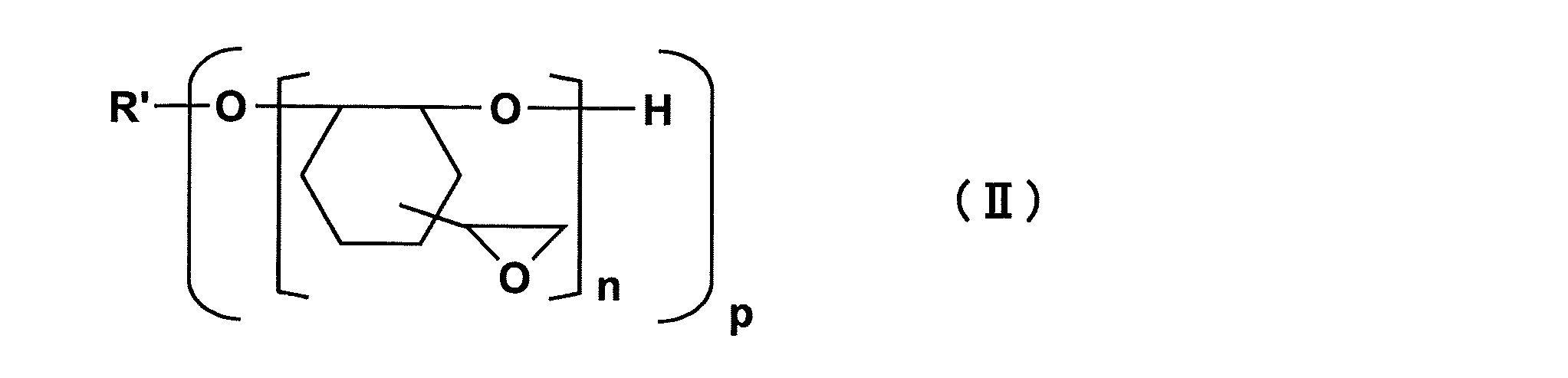
- Examples of the compound in which the epoxy group is directly bonded to the alicyclic ring with a single bond include a compound represented by the following formula (II).
- R ′ is a group obtained by removing p —OH from a p-valent alcohol, and p and n represent natural numbers.
- the p-valent alcohol [R ′-(OH) p ] include polyhydric alcohols such as 2,2-bis (hydroxymethyl) -1-butanol (alcohols having 1 to 15 carbon atoms, etc.).
- p is preferably 1 to 6
- n is preferably 1 to 30.
- n in each () (in parentheses) may be the same or different.
- the compound examples include 1,2-epoxy-4- (2-oxiranyl) cyclohexane adduct of 2,2-bis (hydroxymethyl) -1-butanol, EHPE 3150 (manufactured by Daicel Corporation). Etc.
- alicyclic epoxy compounds (A) can be used alone or in combination of two or more.
- alicyclic epoxy compound (A) 3,4-epoxycyclohexylmethyl (3,4-epoxy) cyclohexanecarboxylate represented by the above formula (I-1) and ceroxide 2021P are particularly preferable.
- the amount of use (content) of the alicyclic epoxy compound (A) is not particularly limited, but the total amount (100% by weight) of the alicyclic epoxy compound (A) and the monoallyl diglycidyl isocyanurate compound (B). On the other hand, it is preferably 50 to 90% by weight, more preferably 60 to 90% by weight, still more preferably 70 to 90% by weight. When the amount of the alicyclic epoxy compound (A) used is less than 50% by weight, the solubility of the monoallyl diglycidyl isocyanurate compound (B) is not sufficient, and it may be easily precipitated when placed at room temperature.
- sum of contents of alicyclic epoxy compound (A) and monoallyl diglycidyl isocyanurate compound (B) in the total amount (100% by weight) of component (A), component (B), and component (C) (total amount) ) Is not particularly limited, but is preferably 40 to 95% by weight.
- the content of the alicyclic epoxy compound (A) with respect to the total amount (100% by weight) of the curable epoxy resin composition is particularly limited. However, it is preferably 10 to 90% by weight, more preferably 15 to 80% by weight, and still more preferably 17 to 70% by weight.
- the content of the alicyclic epoxy compound (A) with respect to the total amount of the curable epoxy resin composition (100% by weight) is: Although not particularly limited, it is preferably 25 to 90% by weight, more preferably 30 to 85% by weight, and still more preferably 35 to 80% by weight.
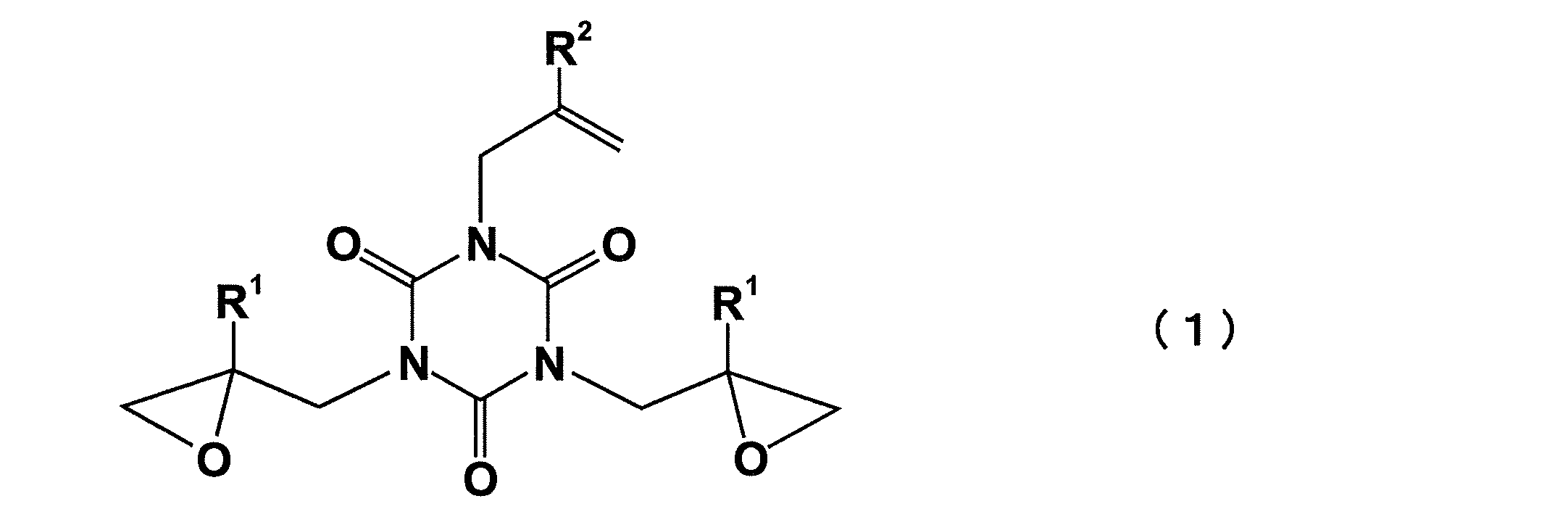
- the monoallyl diglycidyl isocyanurate compound (B) used in the present invention can be represented by the following general formula (1).
- R 1 and R 2 represent a hydrogen atom or an alkyl group having 1 to 8 carbon atoms.
- alkyl group having 1 to 8 carbon atoms examples include linear or branched alkyl groups such as methyl, ethyl, propyl, isopropyl, butyl, isobutyl, sec-butyl, pentyl, hexyl, heptyl, and octyl groups. It is done. Of these, a linear or branched alkyl group having 1 to 3 carbon atoms such as methyl, ethyl, propyl and isopropyl groups is preferred.
- R 1 and R 2 in the above formula (1) are particularly preferably hydrogen atoms.
- monoallyl diglycidyl isocyanurate compound (B) examples include monoallyl diglycidyl isocyanurate, 1-allyl-3,5-bis (2-methylepoxypropyl) isocyanurate, 1- (2-methyl And propenyl) -3,5-diglycidyl isocyanurate, 1- (2-methylpropenyl) -3,5-bis (2-methylepoxypropyl) isocyanurate, and the like.
- a monoallyl diglycidyl isocyanurate compound (B) can be used individually or in combination of 2 or more types.
- the monoallyl diglycidyl isocyanurate compound (B) can be arbitrarily mixed as long as it dissolves in the alicyclic epoxy compound (A), and the alicyclic epoxy compound (A) and the monoallyl diglycidyl isocyanurate compound (B).
- the ratio of the alicyclic epoxy compound (A): monoallyl diglycidyl isocyanurate compound (B) is preferably 50:50 to 90:10 (weight ratio). Outside this range, it becomes difficult to obtain the solubility of the monoallyl diglycidyl isocyanurate compound (B).
- the monoallyl diglycidyl isocyanurate compound (B) may be modified in advance by adding a compound that reacts with an epoxy group such as alcohol or acid anhydride.
- the total amount of the alicyclic epoxy compound (A) and the monoallyl diglycidyl isocyanurate compound (B) with respect to the total amount (100% by weight) of the epoxy resin (compound having an epoxy group) is not particularly limited, From the viewpoint of improving light resistance and crack resistance, it is preferably 40% by weight or more, more preferably 50% by weight or more, and still more preferably 70% by weight or more.
- siloxane derivative (C) having two or more epoxy groups in the molecule improves the heat resistance and light resistance of the cured product, and is an optical semiconductor. It plays a role of suppressing a decrease in luminous intensity of the device.
- the siloxane skeleton in the siloxane derivative (C) having two or more epoxy groups in the molecule is not particularly limited.
- a cyclic siloxane skeleton; a linear silicone, a cage-type or ladder-type polysilsesquioxane And a polysiloxane skeleton are preferable from the viewpoint of improving the heat resistance and light resistance of the cured product and suppressing the decrease in luminous intensity.
- the siloxane derivative (C) having two or more epoxy groups in the molecule is preferably a cyclic siloxane having two or more epoxy groups in the molecule or a linear silicone having two or more epoxy groups in the molecule.
- numerator can be used individually or in combination of 2 or more types.
- the siloxane derivative (C) having two or more epoxy groups in the molecule is a cyclic siloxane having two or more epoxy groups
- the number of Si—O units forming the siloxane ring (the number of silicon atoms forming the siloxane ring)
- it is not particularly limited, it is preferably 2 to 12 and more preferably 4 to 8 from the viewpoint of improving the heat resistance and light resistance of the cured product.
- the weight average molecular weight of the siloxane derivative (C) having two or more epoxy groups in the molecule is not particularly limited, but is preferably 100 to 3000, more preferably 180 from the viewpoint of improving the heat resistance and light resistance of the cured product. ⁇ 2000.
- the number of epoxy groups in one molecule of the siloxane derivative (C) having two or more epoxy groups in the molecule is not particularly limited as long as it is two or more, but the viewpoint of improving the heat resistance and light resistance of the cured product 2 to 4 (2, 3, or 4) is preferable.
- the epoxy equivalent (based on JIS K7236) of the siloxane derivative (C) having two or more epoxy groups in the molecule is not particularly limited, but from the viewpoint of improving the heat resistance and light resistance of the cured product, 180 to 400 It is preferably 240 to 400, more preferably 240 to 350.
- the epoxy group in the siloxane derivative (C) having two or more epoxy groups in the molecule is not particularly limited, but from the viewpoint of improving the heat resistance and light resistance of the cured product, adjacent two carbons constituting the aliphatic ring.
- An epoxy group composed of an atom and an oxygen atom (alicyclic epoxy group) is preferable, and among them, a cyclohexene oxide group is particularly preferable.
- siloxane derivative (C) having two or more epoxy groups in the molecule examples include 2,4-di [2- (3- ⁇ oxabicyclo [4.1.0] heptyl ⁇ ) ethyl. ] -2,4,6,6,8,8-hexamethyl-cyclotetrasiloxane, 4,8-di [2- (3- ⁇ oxabicyclo [4.1.0] heptyl ⁇ ) ethyl] -2,2 , 4,6,6,8-hexamethyl-cyclotetrasiloxane, 2,4-di [2- (3- ⁇ oxabicyclo [4.1.0] heptyl ⁇ ) ethyl] -6,8-dipropyl-2, 4,6,8-tetramethyl-cyclotetrasiloxane, 4,8-di [2- (3- ⁇ oxabicyclo [4.1.0] heptyl ⁇ ) ethyl] -2,6-dipropyl-2,4 6,8-tty
- siloxane derivative (C) having two or more epoxy groups in the molecule examples include alicyclic epoxy group-containing silicone resins described in JP-A-2008-248169 and JP-A-2008-19422.
- An organopolysilsesquioxane resin having at least two epoxy functional groups in one molecule can also be used.
- siloxane derivative (C) having two or more epoxy groups in the molecule examples include a trade name “X-40-2678” (Shin-Etsu Chemical Co., Ltd.), which is a cyclic siloxane having two or more epoxy groups in the molecule. )), Trade name “X-40-2670” (manufactured by Shin-Etsu Chemical Co., Ltd.), and trade name “X-40-2720” can also be used.
- the amount (content) of the siloxane derivative (C) having two or more epoxy groups in the molecule is not particularly limited, the total amount (100 weight) of the component (A), the component (B), and the component (C). %) To 5 to 60% by weight, more preferably 8 to 55% by weight, still more preferably 10 to 50% by weight, and particularly preferably 15 to 40% by weight.
- the amount of the siloxane derivative (C) having two or more epoxy groups in the molecule is less than 5% by weight, the heat resistance and light resistance of the cured product may be lowered.
- numerator exceeds 60 weight%, the crack resistance of hardened
- the curing agent (D) has a function of curing the compound having an epoxy group.
- curing agent (D) in this invention a well-known thru
- curing agent can be used as a hardening
- an acid anhydride which is liquid at 25 ° C. is preferable, for example, methyltetrahydrophthalic anhydride, methylhexahydrophthalic anhydride, dodecenyl succinic anhydride, methylendomethylenetetrahydrophthalic anhydride. An acid etc. can be mentioned.
- solid acid anhydrides at room temperature such as phthalic anhydride, tetrahydrophthalic anhydride, hexahydrophthalic anhydride, methylcyclohexene dicarboxylic acid anhydride are liquid at room temperature (about 25 ° C.). It can be used as the curing agent (D) in the present invention by dissolving in an acid anhydride to form a liquid mixture.
- curing agent (D) can be used individually or in combination of 2 or more types.
- an anhydride of a saturated monocyclic hydrocarbon dicarboxylic acid (a substituent such as an alkyl group is bonded to the ring) are also preferable).
- the curing agent (D) commercially available products such as Jamaicacid MH-700 (manufactured by Shin Nippon Rika Co., Ltd.) and HN-5500 (manufactured by Hitachi Chemical Co., Ltd.) can be used. .
- curing agent (D) It is 50 with respect to the whole quantity (100 weight part) of the compound which has an epoxy group contained in the curable epoxy resin composition of this invention.
- the amount is preferably -200 parts by weight, more preferably 100-145 parts by weight. More specifically, it is preferably used in a ratio of 0.5 to 1.5 equivalents per 1 equivalent of epoxy groups in all compounds having an epoxy group contained in the curable epoxy resin composition of the present invention. .
- curing agent (D) is less than 50 weight part, hardening will become inadequate and there exists a tendency for the toughness of hardened
- curing agent (D) exceeds 200 weight part, hardened
- the curable epoxy resin composition of the present invention further contains a curing accelerator (E).
- a hardening accelerator (E) is a compound which has a function which accelerates
- the curing accelerator (E) known or conventional curing accelerators can be used.
- DBU 1,8-diazabicyclo [5.4.0] undecene-7
- salts thereof for example, Phenol salts, octylates, p-toluenesulfonates, formates, tetraphenylborate salts
- 1,5-diazabicyclo [4.3.0] nonene-5 (DBN) and salts thereof (eg, phosphonium salts) , Sulfonium salts, quaternary ammonium salts, iodonium salts)
- tertiary amines such as benzyldimethylamine, 2,4,6-tris (dimethylaminomethyl) phenol, N, N-dimethylcyclohexylamine
- 2-ethyl-4- Imidazoles such as methylimidazole and 1-cyanoethyl-2-ethyl-4-methylimidazole
- phosphate ester triphenyl Phosphines such as phosphin
- U-CAT SA 506, U-CAT SA 102, U-CAT 5003, U-CAT 18X, 12XD developed products
- TPP-K, TPP-MK both manufactured by Hokuko Chemical Co., Ltd.
- PX-4ET manufactured by Nippon Chemical Industry Co., Ltd.
- the amount of use (content) of the curing accelerator (E) is not particularly limited, but is 0.05 to 0.004 based on the total amount (100 parts by weight) of the compound having an epoxy group contained in the curable epoxy resin composition.
- the amount is preferably 5 parts by weight, more preferably 0.1 to 3 parts by weight, still more preferably 0.2 to 3 parts by weight, and particularly preferably 0.25 to 2.5 parts by weight.
- the usage-amount of a hardening accelerator (E) is less than 0.05 weight part, the hardening promotion effect may become inadequate.
- a curing catalyst (F) may be used instead of the above-described curing agent (D) and curing accelerator (E).
- the curing reaction of the compound having an epoxy group can be advanced by using the curing catalyst (F) to obtain a cured product.
- the cationic catalyst cationic polymerization initiator which generate
- Examples of the cation catalyst that generates cation species by ultraviolet irradiation include hexafluoroantimonate salt, pentafluorohydroxyantimonate salt, hexafluorophosphate salt, and hexafluoroarsenate salt. These cationic catalysts can be used alone or in combination of two or more.
- cationic catalyst examples include trade names “UVACURE1590” (manufactured by Daicel Cytec Co., Ltd.), trade names “CD-1010”, “CD-1011”, “CD-1012” (above, manufactured by Sartomer, USA), Commercial products such as trade name “Irgacure 264” (manufactured by Ciba Japan Co., Ltd.) and trade name “CIT-1682” (manufactured by Nippon Soda Co., Ltd.) can also be preferably used.
- Examples of the cation catalyst that generates cation species by heat treatment include aryldiazonium salts, aryliodonium salts, arylsulfonium salts, allene-ion complexes, and the like.
- PP-33, CP-66, CP -77 manufactured by ADEKA), FC-509 (manufactured by 3M), UVE1014 (manufactured by GE), Sun-Aid SI-60L, Sun-Aid SI-80L, Sun-Aid SI-100L, Sun-Aid SI-110L (Sanshin Chemical) Kogyo Co., Ltd.), CG-24-61 (Ciba Japan) and other commercial products can be preferably used.
- a chelate compound of a metal such as aluminum or titanium and a acetoacetate or diketone compound and a silanol such as triphenylsilanol or a chelate compound of a metal such as aluminum or titanium and acetoacetate or diketone and bisphenol S
- a chelate compound of a metal such as aluminum or titanium and acetoacetate or diketone and bisphenol S
- the compound with phenols, such as these may be sufficient.
- These cationic catalysts can be used alone or in combination of two or more.
- the use amount (content) of the curing catalyst (F) is not particularly limited, but is 0.01 to 15 with respect to the total amount (100 parts by weight) of the compound having an epoxy group contained in the curable epoxy resin composition. Part by weight is preferable, more preferably 0.01 to 12 parts by weight, still more preferably 0.05 to 10 parts by weight, and particularly preferably 0.1 to 10 parts by weight.
- the curable epoxy resin composition of the present invention may contain rubber particles.
- rubber particles include particulate NBR (acrylonitrile-butadiene rubber), reactive terminal carboxyl group NBR (CTBN), metal-free NBR, particulate SBR (styrene-butadiene rubber), and the like.
- the rubber particle has a multilayer structure (core-shell structure) composed of a core portion having rubber elasticity and at least one shell layer covering the core portion, and a functional group capable of reacting with an alicyclic epoxy compound on the surface.
- the blending amount of the rubber particles can be appropriately adjusted as necessary and is not particularly limited, but with respect to the total amount of the compound having an epoxy group contained in the curable epoxy resin composition (100 parts by weight), The amount is preferably 0.5 to 30 parts by weight, more preferably 1 to 20 parts by weight.
- the amount of rubber particles used is less than 0.5 parts by weight, the crack resistance of the cured product tends to be reduced. On the other hand, if the amount of rubber particles used exceeds 30 parts by weight, the heat resistance and transparency of the cured product are reduced. Tend to decrease.
- additives can be used in the curable epoxy resin composition of the present invention as long as the effects of the present invention are not impaired.
- a compound having a hydroxyl group such as ethylene glycol, diethylene glycol, propylene glycol, or glycerin
- the reaction can be allowed to proceed slowly.
- silicone and fluorine antifoaming agents, leveling agents, silane coupling agents such as ⁇ -glycidoxypropyltrimethoxysilane, surfactants, silica, alumina, as long as viscosity and transparency are not impaired.
- Conventional additives such as inorganic fillers, flame retardants, colorants, antioxidants, ultraviolet absorbers, ion adsorbents, pigments, phosphors, mold release agents and the like can be used.
- a cured product having excellent physical properties such as transparency, heat resistance, light resistance, and crack resistance
- the heating temperature (curing temperature) during curing is not particularly limited, but is preferably 45 to 200 ° C, more preferably 100 to 190 ° C, and still more preferably 100 to 180 ° C.
- the heating time (curing time) for curing is not particularly limited, but is preferably 30 to 600 minutes, more preferably 45 to 540 minutes, and further preferably 60 to 480 minutes. When the curing temperature and the curing time are lower than the lower limit value in the above range, curing is insufficient.
- the resin component may be decomposed.
- the curing conditions depend on various conditions, for example, when the curing temperature is increased, the curing time can be shortened, and when the curing temperature is decreased, the curing time can be appropriately increased.
- the resin composition for optical semiconductor encapsulation of the present invention comprises the curable epoxy resin composition of the present invention.
- the resin composition for encapsulating an optical semiconductor of the present invention the optical semiconductor element was sealed over time with a cured product excellent in various properties such as transparency, heat resistance, light resistance, and crack resistance.
- An optical semiconductor device in which the luminous intensity is unlikely to decrease can be obtained. Even if the optical semiconductor device includes an optical semiconductor element with high output and high brightness, the light intensity is unlikely to decrease with time.
- the optical semiconductor device of the present invention is obtained by sealing an optical semiconductor element with the curable epoxy resin composition (resin composition for optical semiconductor sealing) of the present invention.
- the optical semiconductor element is sealed by injecting the curable epoxy resin composition prepared by the above-described method into a predetermined mold and heating and curing under predetermined conditions. Thereby, an optical semiconductor device in which the optical semiconductor element is sealed with the curable epoxy resin composition is obtained.
- the curing temperature and the curing time can be set in the same range as described above.
- the curable epoxy resin composition of the present invention is not limited to the optical semiconductor (optical semiconductor element) sealing application described above, and includes, for example, an adhesive, an electrical insulating material, a laminate, a coating, an ink, a paint, a sealant, and a resist.
- Examples 1 to 12 and Comparative Examples 1 to 4 In Examples 1 to 12, the epoxy resin obtained in Production Example 2 and the K agent obtained in Production Example 1 were subjected to self-revolving stirring according to the formulation (unit: parts by weight) shown in Table 1. Using a device (manufactured by Shinky Co., Ltd., Awatori Nertaro AR-250), the mixture was uniformly mixed and defoamed to obtain a curable epoxy resin composition. Further, as shown in Table 1, in Comparative Example 1, only an alicyclic epoxy compound (Dacel Chemical Industries, Ltd., Celoxide 2021P) was used as an epoxy resin, and in Comparative Examples 2 to 4, an epoxy resin containing 2 in the molecule.
- Table 1 in Comparative Example 1, only an alicyclic epoxy compound (Dacel Chemical Industries, Ltd., Celoxide 2021P) was used as an epoxy resin, and in Comparative Examples 2 to 4, an epoxy resin containing 2 in the molecule.
- Siloxane derivatives having the above epoxy groups (Shin-Etsu Chemical Co., Ltd., X-40-2678; Shin-Etsu Chemical Co., Ltd., X-40-2720; Shin-Etsu Chemical Co., Ltd., X-40-2670) ) was used in the same manner as above to obtain a curable epoxy resin composition.
- the curable epoxy resin composition is cast on an optical semiconductor lead frame (InGaN element, 3.5 mm ⁇ 2.8 mm) shown in FIG. 1 and then heated in an oven (resin curing oven) at 120 ° C. for 5 hours.
- an optical semiconductor device in which the LED element was sealed with the cured resin was obtained.
- 100 is a reflector (a resin composition for reflecting light)
- 101 is a metal wiring
- 102 is an LED element
- 103 is a bonding wire
- 104 is a transparent sealing resin (cured product).
- the epoxy resin obtained in Production Example 2 and a curing catalyst (manufactured by Sanshin Chemical Industry Co., Ltd., Sun-Aid SI-100L) were added according to the formulation (unit: parts by weight) shown in Table 2.
- Each component was uniformly mixed using a self-revolving stirrer (manufactured by Shinky Co., Ltd., Awatori Nertaro AR-250) and defoamed to obtain a curable epoxy resin composition.
- Thermal shock test The optical semiconductor devices obtained in Examples and Comparative Examples (two used for each curable epoxy resin composition) were exposed in an atmosphere of ⁇ 40 ° C. for 30 minutes, and then in an atmosphere of 100 ° C. A thermal shock with one cycle of exposure for 30 minutes was applied for 200 cycles using a thermal shock tester. Thereafter, the length of cracks generated in the sealing resin of the optical semiconductor device (cured product of the curable epoxy resin composition) was observed using a digital microscope (VHX-900, manufactured by Keyence Corporation), Of the two optical semiconductor devices, the number of optical semiconductor devices having cracks having a length of 90 ⁇ m or more was measured. The results are shown in Tables 1 and 2.
- Example and the comparative example is as follows.
- MA-DGIC monoallyl diglycidyl isocyanurate, manufactured by Shikoku Kasei Kogyo Co., Ltd.
- X-40 -2678 Siloxane derivative having two epoxy groups in the molecule, manufactured by Shin-Etsu Chemical Co., Ltd.
- X-40-2720 Siloxane derivative having three epoxy groups in the molecule, manufactured by Shin-Etsu Chemical Co., Ltd.
- X -40-2670 Siloxane derivative having 4 epoxy groups in the molecule, manufactured by Shin-Etsu Chemical Co., Ltd.
- U-CAT 18X curing accelerator, manufactured by San Apro Co., Ltd.
- Ethylene glycol Wako Pure Chemicals Industrial Co., Ltd.
- Test equipment Resin curing oven Espec Co., Ltd. GPHH-201 -Thermostatic chamber ESPEC Co., Ltd. Small high temperature chamber ST-120B1 ⁇ Total luminous flux measuring machine Optronic Laboratories Multi-spectral Radiation Measurement System OL771 ⁇ Thermal shock tester Espec Co., Ltd. Small thermal shock device TSE-11-A ⁇ Reflow furnace manufactured by Nippon Antom Co., Ltd., UNI-5016F
- the curable epoxy resin composition of the present invention can be preferably used for sealing an optical semiconductor element.
- the curable epoxy resin composition of the present invention includes an adhesive, an electrical insulating material, a laminate, a coating, an ink, a paint, a sealant, a resist, a composite material, a transparent substrate, a transparent sheet, a transparent film, an optical element, and an optical element. It can also be used for lenses, optical members, stereolithography, electronic paper, touch panels, solar cell substrates, optical waveguides, light guide plates, holographic memories, and the like.
Landscapes
- Chemical & Material Sciences (AREA)
- Health & Medical Sciences (AREA)
- Chemical Kinetics & Catalysis (AREA)
- Medicinal Chemistry (AREA)
- Polymers & Plastics (AREA)
- Organic Chemistry (AREA)
- Epoxy Resins (AREA)
- Structures Or Materials For Encapsulating Or Coating Semiconductor Devices Or Solid State Devices (AREA)
- Led Device Packages (AREA)
Abstract
Description
また、本発明の他の目的は、上記硬化性エポキシ樹脂組成物を硬化してなる、高い透明性、耐熱性、耐光性、及び耐クラック性を兼ね備えた硬化物を提供することにある。
また、本発明の他の目的は、経時での光度低下が抑制された光半導体装置が得られる、上記硬化性エポキシ樹脂組成物からなる光半導体封止用樹脂組成物を提供することにある。
また、本発明の他の目的は、上記光半導体封止用樹脂組成物を用いて光半導体素子を封止することにより得られる、高い耐熱性、耐光性、透明性、及び耐クラック性を兼ね備えた硬化物により光半導体素子が封止され、経時での光度低下が抑制された光半導体装置を提供することにある。

で表されるモノアリルジグリシジルイソシアヌレート化合物(B)と、分子内に2以上のエポキシ基を有するシロキサン誘導体(C)と、硬化剤(D)と、硬化促進剤(E)とを含むことを特徴とする硬化性エポキシ樹脂組成物を提供する。

で表されるモノアリルジグリシジルイソシアヌレート化合物(B)と、分子内に2以上のエポキシ基を有するシロキサン誘導体(C)と、硬化触媒(F)とを含むことを特徴とする硬化性エポキシ樹脂組成物を提供する。
本発明の硬化性エポキシ樹脂組成物は、脂環式エポキシ化合物(A)と、下記式(1)
で表されるモノアリルジグリシジルイソシアヌレート化合物(B)と、分子内に2以上のエポキシ基を有するシロキサン誘導体(C)と、硬化剤(D)と、硬化促進剤(E)とを少なくとも含む。また、本発明の硬化性エポキシ樹脂組成物は、脂環式エポキシ化合物(A)と、上記式(1)で表されるモノアリルジグリシジルイソシアヌレート化合物(B)と、分子内に2以上のエポキシ基を有するシロキサン誘導体(C)と、硬化触媒(F)とを少なくとも含む。
本発明の硬化性エポキシ樹脂組成物を構成する脂環式エポキシ化合物(A)は、分子内(1分子内)に脂環(脂肪族環)構造とエポキシ基とを少なくとも有する化合物である。より具体的には、脂環式エポキシ化合物(A)には、(i)脂環を構成する隣接する2つの炭素原子と酸素原子とで構成されるエポキシ基を有する化合物、及び(ii)脂環にエポキシ基が直接単結合で結合している化合物が含まれる。但し、脂環式エポキシ化合物(A)には、後述の分子内に2以上のエポキシ基を有するシロキサン誘導体(C)は含まれないものとする。


本発明で用いられるモノアリルジグリシジルイソシアヌレート化合物(B)は、下記の一般式(1)で表すことができる。
本発明の硬化性エポキシ樹脂組成物の成分(C)である、分子内(一分子中)に2以上のエポキシ基を有するシロキサン誘導体は、硬化物の耐熱性、耐光性を向上させ、光半導体装置の光度低下を抑制する役割を担う。

硬化剤(D)は、エポキシ基を有する化合物を硬化させる働きを有する。本発明における硬化剤(D)としては、エポキシ樹脂用硬化剤として公知乃至慣用の硬化剤を使用することができる。本発明における硬化剤(D)としては、中でも、25℃で液状の酸無水物が好ましく、例えば、メチルテトラヒドロ無水フタル酸、メチルヘキサヒドロ無水フタル酸、ドデセニル無水コハク酸、メチルエンドメチレンテトラヒドロ無水フタル酸などを挙げることができる。また、例えば、無水フタル酸、テトラヒドロ無水フタル酸、ヘキサヒドロ無水フタル酸、メチルシクロヘキセンジカルボン酸無水物などの常温(約25℃)で固体状の酸無水物は、常温(約25℃)で液状の酸無水物に溶解させて液状の混合物とすることで、本発明における硬化剤(D)として使用することができる。なお、硬化剤(D)は単独で、又は2種以上を組み合わせて使用することができる。上述のように、硬化剤(D)としては、硬化物の耐熱性、耐光性、耐クラック性の観点で、飽和単環炭化水素ジカルボン酸の無水物(環にアルキル基等の置換基が結合したものも含む)が好ましい。
本発明の硬化性エポキシ樹脂組成物は、さらに、硬化促進剤(E)を含む。硬化促進剤(E)は、エポキシ基を有する化合物が硬化剤により硬化する際に、硬化速度を促進する機能を有する化合物である。硬化促進剤(E)としては、公知乃至慣用の硬化促進剤を使用することができ、例えば、1,8-ジアザビシクロ[5.4.0]ウンデセン-7(DBU)、及びその塩(例えば、フェノール塩、オクチル酸塩、p-トルエンスルホン酸塩、ギ酸塩、テトラフェニルボレート塩);1,5-ジアザビシクロ[4.3.0]ノネン-5(DBN)、及びその塩(例えば、ホスホニウム塩、スルホニウム塩、4級アンモニウム塩、ヨードニウム塩);ベンジルジメチルアミン、2,4,6-トリス(ジメチルアミノメチル)フェノール、N,N-ジメチルシクロヘキシルアミンなどの3級アミン;2-エチル-4-メチルイミダゾール、1-シアノエチル-2-エチル-4-メチルイミダゾールなどのイミダゾール;リン酸エステル、トリフェニルホスフィンなどのホスフィン類;テトラフェニルホスホニウムテトラ(p-トリル)ボレートなどのホスホニウム化合物;オクチル酸スズ、オクチル酸亜鉛などの有機金属塩;金属キレートなどが挙げられる。硬化促進剤(E)は単独で、又は2種以上を混合して使用することができる。
本発明の硬化性エポキシ樹脂組成物においては、上述の硬化剤(D)及び硬化促進剤(E)の代わりに、硬化触媒(F)を用いてもよい。硬化剤(D)及び硬化促進剤(E)を用いた場合と同様に、硬化触媒(F)を用いることによってエポキシ基を有する化合物の硬化反応を進行させ、硬化物を得ることができる。上記硬化触媒(F)としては、特に限定されないが、紫外線照射又は加熱処理を施すことによりカチオン種を発生して、重合を開始させるカチオン触媒(カチオン重合開始剤)を用いることができる。
本発明の硬化性エポキシ樹脂組成物は、ゴム粒子を含んでいてもよい。ゴム粒子としては、例えば、粒子状NBR(アクリロニトリル-ブタジエンゴム)、反応性末端カルボキシル基NBR(CTBN)、メタルフリーNBR、粒子状SBR(スチレン-ブタジエンゴム)等が挙げられる。ゴム粒子は、ゴム弾性を有するコア部分と、該コア部分を被覆する少なくとも1層のシェル層とから成る多層構造(コアシェル構造)を有し、表面に脂環式エポキシ化合物と反応し得る官能基としてヒドロキシル基及び/又はカルボキシル基を有し、平均粒子径が10nm~500nm、最大粒子径が50nm~1000nmであるゴム粒子であって、該ゴム粒子の屈折率と当該硬化性エポキシ樹脂組成物の硬化物の屈折率との差が±0.02以内であるゴム粒子であっても良い。上記ゴム粒子の配合量は、必要に応じて適宜調整することができ、特に限定されないが、硬化性エポキシ樹脂組成物中に含まれるエポキシ基を有する化合物の全量(100重量部)に対して、0.5~30重量部が好ましく、より好ましくは1~20重量部である。ゴム粒子の使用量が0.5重量部を下回ると、硬化物の耐クラック性が低下する傾向があり、一方、ゴム粒子の使用量が30重量部を上回ると、硬化物の耐熱性及び透明性が低下する傾向がある。
本発明の硬化性エポキシ樹脂組成物には、上記以外にも、本発明の効果を損なわない範囲内で各種添加剤を使用することができる。上記添加剤として、例えば、エチレングリコール、ジエチレングリコール、プロピレングリコール、グリセリンなどの水酸基を有する化合物を使用すると、反応を緩やかに進行させることができる。その他にも、粘度や透明性を損なわない範囲内で、シリコーン系やフッ素系消泡剤、レベリング剤、γ-グリシドキシプロピルトリメトキシシランなどのシランカップリング剤、界面活性剤、シリカ、アルミナなどの無機充填剤、難燃剤、着色剤、酸化防止剤、紫外線吸収剤、イオン吸着体、顔料、蛍光体、離型剤などの慣用の添加剤を使用することができる。
本発明の硬化性エポキシ樹脂組成物を硬化させることにより、透明性、耐熱性、耐光性、及び耐クラック性などの諸物性に優れた硬化物を得ることができる。硬化の際の加熱温度(硬化温度)は、特に限定されないが、45~200℃が好ましく、より好ましくは100~190℃、さらに好ましくは100~180℃である。また、硬化の際に加熱する時間(硬化時間)は、特に限定されないが、30~600分が好ましく、より好ましくは45~540分、さらに好ましくは60~480分である。硬化温度と硬化時間が上記範囲の下限値より低い場合は、硬化が不十分となり、逆に上記範囲の上限値より高い場合は、樹脂成分の分解が起きる場合があるので、いずれも好ましくない。硬化条件は種々の条件に依存するが、例えば、硬化温度を高くした場合は硬化時間を短く、硬化温度を低くした場合は硬化時間を長くする等により、適宜調整することができる。
本発明の光半導体封止用樹脂組成物は、本発明の硬化性エポキシ樹脂組成物からなる。本発明の光半導体封止用樹脂組成物を用いることにより、透明性、耐熱性、耐光性、及び耐クラック性などの諸物性に優れた硬化物により光半導体素子が封止された、経時で光度が低下しにくい光半導体装置が得られる。上記光半導体装置は、高出力、高輝度の光半導体素子を備える場合であっても、経時で光度が低下しにくい。
本発明の光半導体装置は、本発明の硬化性エポキシ樹脂組成物(光半導体封止用樹脂組成物)で光半導体素子を封止することにより得られる。光半導体素子の封止は、上述の方法で調製された硬化性エポキシ樹脂組成物を所定の成形型内に注入し、所定の条件で加熱硬化して行う。これにより、硬化性エポキシ樹脂組成物によって光半導体素子が封止されてなる光半導体装置が得られる。硬化温度と硬化時間は、上記と同様の範囲で設定することができる。
(硬化剤と硬化促進剤と添加剤の混合物、以下K剤と記載する)
硬化剤(新日本理化(株)製、リカシッド MH-700):100重量部、硬化促進剤(サンアプロ(株)製、U-CAT 18X):0.5重量部、添加剤(和光純薬工業(株)製、エチレングリコール):1重量部を、自公転式攪拌装置((株)シンキー製、あわとり練太郎AR-250)を使用して均一に混合し、脱泡してK剤を得た。
(エポキシ樹脂)
モノアリルジグリシジルイソシアヌレート(四国化成工業(株)、MA-DGIC)、脂環式エポキシ化合物((株)ダイセル製、セロキサイド2021P)、及び分子内に2以上のエポキシ基を有するシロキサン誘導体(信越化学工業(株)製、X-40-2678;信越化学工業(株)製、X-40-2720;信越化学工業(株)製、X-40-2670)を、表1、表2に示す配合処方(単位:重量部)に従って混合し、80℃で1時間攪拌することでモノアリルジグリシジルイソシアヌレートを溶解させ、エポキシ樹脂(混合物)を得た。
実施例1~12では、製造例2にて得たエポキシ樹脂と製造例1にて得たK剤とを、表1に示す配合処方(単位:重量部)に従って、各成分を自公転式攪拌装置((株)シンキー製、あわとり練太郎AR-250)を使用して均一に混合し、脱泡して硬化性エポキシ樹脂組成物を得た。また、表1に示すように、比較例1ではエポキシ樹脂として脂環式エポキシ化合物(ダイセル化学工業(株)製、セロキサイド2021P)のみを、比較例2~4では、エポキシ樹脂として分子内に2以上のエポキシ基を有するシロキサン誘導体(信越化学工業(株)製、X-40-2678;信越化学工業(株)製、X-40-2720;信越化学工業(株)製、X-40-2670)のみを用いて、上記と同様にして硬化性エポキシ樹脂組成物を得た。
上記硬化性エポキシ樹脂組成物を図1に示す光半導体のリードフレーム(InGaN素子、3.5mm×2.8mm)に注型した後、120℃のオーブン(樹脂硬化オーブン)で5時間加熱することで、硬化した樹脂でLED素子を封止した光半導体装置を得た。図1において、100はリフレクター(光反射用樹脂組成物)、101は金属配線、102はLED素子、103はボンディングワイヤ、104は透明封止樹脂(硬化物)を示す。
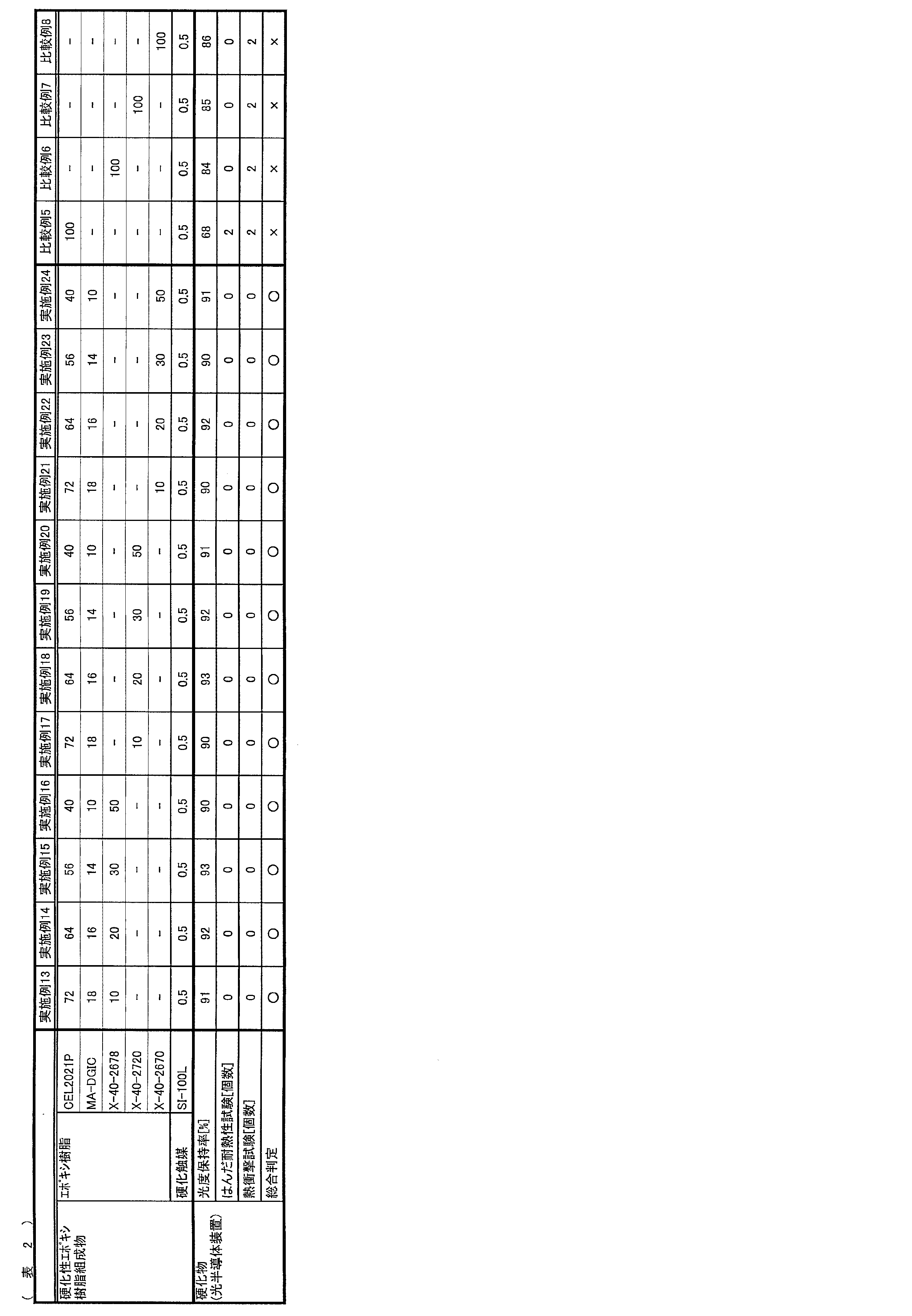
実施例13~24では、製造例2にて得たエポキシ樹脂と硬化触媒(三新化学工業(株)製、サンエイド SI-100L)を、表2に示す配合処方(単位:重量部)に従って、各成分を自公転式攪拌装置((株)シンキー製、あわとり練太郎AR-250)を使用して均一に混合し、脱泡して硬化性エポキシ樹脂組成物を得た。また、表2に示すように、比較例5ではエポキシ樹脂として脂環式エポキシ化合物(ダイセル化学工業(株)製、セロキサイド2021P)のみを、比較例6~8では、エポキシ樹脂として分子内に2以上のエポキシ基を有するシロキサン誘導体(信越化学工業(株)製、X-40-2678;信越化学工業(株)製、X-40-2720;信越化学工業(株)製、X-40-2670)のみを用いて、上記と同様にして硬化性エポキシ樹脂組成物を得た。
上記硬化性エポキシ樹脂組成物を図1に示す光半導体のリードフレーム(InGaN素子、3.5mm×2.8mm)に注型した後、オーブン(樹脂硬化オーブン)を用いて、110℃で3時間、続いて、140℃で4時間加熱することで、硬化した樹脂でLED素子を封止した光半導体装置を得た。
実施例及び比較例で得られた硬化性エポキシ樹脂組成物ならびに光半導体装置について、以下の方法で評価試験を行った。
実施例及び比較例で得られた光半導体装置の全光束を全光束測定機を用いて測定した(「0時間の全光束」とした)。さらに、85℃の恒温槽内で100時間、光半導体装置に60mAの電流を流した後の全光束を測定した(「100時間後の全光束」とした)。そして、次式から光度保持率を算出した。結果を表1、表2に示す。
{光度保持率(%)}
={100時間後の全光束(lm)}/{0時間の全光束(lm)}×100
実施例及び比較例で得られた光半導体装置(各硬化性エポキシ樹脂組成物につき2個用いた)を、30℃、70%RHの条件下で168時間吸湿させた後、リフロー炉を用いて260℃で10秒間の加熱処理を2回施した。その後、光半導体装置の封止樹脂(硬化性エポキシ樹脂組成物の硬化物)に生じたクラックの長さを、デジタルマイクロスコープ(VHX-900、(株)キーエンス製)を使用して観察し、光半導体装置2個のうち長さが90μm以上のクラックを有する光半導体装置の個数を計測した。結果を表1、表2に示す。
実施例及び比較例で得られた光半導体装置(各硬化性エポキシ樹脂組成物につき2個用いた)に対し、-40℃の雰囲気下に30分曝露し、続いて、100℃の雰囲気下に30分曝露することを1サイクルとした熱衝撃を、熱衝撃試験機を用いて200サイクル分与えた。その後、光半導体装置の封止樹脂(硬化性エポキシ樹脂組成物の硬化物)に生じたクラックの長さを、デジタルマイクロスコープ(VHX-900、(株)キーエンス製)を使用して観察し、光半導体装置2個のうち長さが90μm以上のクラックを有する光半導体装置の個数を計測した。結果を表1、表2に示す。
通電試験において光度保持率が90%以上であり、なおかつ、はんだ耐熱性試験と熱衝撃試験において共に、長さ90μm以上のクラックが生じた光半導体装置の個数が0個となったものを、総合判定○(良好)とした。これ以外のものを総合判定×(不良)とした。結果を表1、表2に示す。

(エポキシ樹脂)
CEL2021P(セロキサイド2021P):3,4-エポキシシクロヘキシルメチル(3,4-エポキシ)シクロヘキサンカルボキシレート、(株)ダイセル製
MA-DGIC:モノアリルジグリシジルイソシアヌレート、四国化成工業(株)製
X-40-2678:分子内に2個のエポキシ基を有するシロキサン誘導体、信越化学工業(株)製
X-40-2720:分子内に3個のエポキシ基を有するシロキサン誘導体、信越化学工業(株)製
X-40-2670:分子内に4個のエポキシ基を有するシロキサン誘導体、信越化学工業(株)製
(K剤)
リカシッド MH-700:4-メチルヘキサヒドロ無水フタル酸/ヘキサヒドロ無水フタル酸=70/30、新日本理化(株)製
U-CAT 18X:硬化促進剤、サンアプロ(株)製
エチレングリコール:和光純薬工業(株)製
(硬化触媒)
SI-100L(サンエイド SI-100L):アリールスルホニウム塩、三新化学工業(株)製
・樹脂硬化オーブン
エスペック(株)製 GPHH-201
・恒温槽
エスペック(株)製 小型高温チャンバー ST-120B1
・全光束測定機
オプトロニックラボラトリーズ社製 マルチ分光放射測定システム OL771
・熱衝撃試験機
エスペック(株)製 小型冷熱衝撃装置 TSE-11-A
・リフロー炉
日本アントム(株)製、UNI-5016F
101:金属配線
102:LED素子
103:ボンディングワイヤ
104:透明封止樹脂
Claims (8)
- 脂環式エポキシ化合物(A)と、下記式(1)

で表されるモノアリルジグリシジルイソシアヌレート化合物(B)と、分子内に2以上のエポキシ基を有するシロキサン誘導体(C)と、硬化剤(D)と、硬化促進剤(E)とを含むことを特徴とする硬化性エポキシ樹脂組成物。 - 脂環式エポキシ化合物(A)と、下記式(1)

で表されるモノアリルジグリシジルイソシアヌレート化合物(B)と、分子内に2以上のエポキシ基を有するシロキサン誘導体(C)と、硬化触媒(F)とを含むことを特徴とする硬化性エポキシ樹脂組成物。 - 前記分子内に2以上のエポキシ基を有するシロキサン誘導体(C)の含有量が、成分(A)、成分(B)、及び成分(C)の合計量(100重量%)に対して、5~60重量%である請求項1又は2に記載の硬化性エポキシ樹脂組成物。
- 前記脂環式エポキシ化合物(A)の脂環エポキシ基がシクロヘキセンオキシド基である請求項1~3のいずれか1項に記載の硬化性エポキシ樹脂組成物。
- 前記脂環式エポキシ化合物(A)が下記式(I-1)
- 請求項1~5のいずれか1項に記載の硬化性エポキシ樹脂組成物を硬化してなる硬化物。
- 請求項1~5のいずれか1項に記載の硬化性エポキシ樹脂組成物からなる光半導体封止用樹脂組成物。
- 請求項7に記載の光半導体封止用樹脂組成物で光半導体素子を封止した光半導体装置。
Priority Applications (2)
| Application Number | Priority Date | Filing Date | Title |
|---|---|---|---|
| CN201180048619.4A CN103154073B (zh) | 2011-01-07 | 2011-12-21 | 固化性环氧树脂组合物 |
| KR1020137013075A KR101864462B1 (ko) | 2011-01-07 | 2011-12-21 | 경화성 에폭시 수지 조성물 |
Applications Claiming Priority (6)
| Application Number | Priority Date | Filing Date | Title |
|---|---|---|---|
| JP2011001871 | 2011-01-07 | ||
| JP2011-001871 | 2011-01-07 | ||
| JP2011-030576 | 2011-02-16 | ||
| JP2011030576 | 2011-02-16 | ||
| JP2011182599A JP5764432B2 (ja) | 2011-01-07 | 2011-08-24 | 硬化性エポキシ樹脂組成物 |
| JP2011-182599 | 2011-08-24 |
Publications (1)
| Publication Number | Publication Date |
|---|---|
| WO2012093589A1 true WO2012093589A1 (ja) | 2012-07-12 |
Family
ID=46457449
Family Applications (1)
| Application Number | Title | Priority Date | Filing Date |
|---|---|---|---|
| PCT/JP2011/079686 Ceased WO2012093589A1 (ja) | 2011-01-07 | 2011-12-21 | 硬化性エポキシ樹脂組成物 |
Country Status (6)
| Country | Link |
|---|---|
| JP (1) | JP5764432B2 (ja) |
| KR (1) | KR101864462B1 (ja) |
| CN (1) | CN103154073B (ja) |
| MY (1) | MY161464A (ja) |
| TW (1) | TWI535748B (ja) |
| WO (1) | WO2012093589A1 (ja) |
Cited By (9)
| Publication number | Priority date | Publication date | Assignee | Title |
|---|---|---|---|---|
| WO2014034507A1 (ja) * | 2012-08-31 | 2014-03-06 | 株式会社ダイセル | 硬化性組成物及びその硬化物、光学部材、並びに光学装置 |
| WO2014033937A1 (ja) * | 2012-08-31 | 2014-03-06 | 新日鉄住金化学株式会社 | エポキシシリコーン樹脂及びそれを用いた硬化性樹脂組成物 |
| WO2014038446A1 (ja) * | 2012-09-07 | 2014-03-13 | 株式会社ダイセル | 硬化性エポキシ樹脂組成物及びその硬化物、並びに光半導体装置 |
| JP2014055220A (ja) * | 2012-09-12 | 2014-03-27 | Daicel Corp | 硬化性エポキシ樹脂組成物 |
| WO2014083845A1 (ja) * | 2012-11-28 | 2014-06-05 | 日本化薬株式会社 | 樹脂組成物及びその硬化物(3) |
| WO2014157552A1 (ja) * | 2013-03-28 | 2014-10-02 | 日本化薬株式会社 | 光半導体封止用エポキシ樹脂組成物、その硬化物および光半導体装置 |
| WO2015129503A1 (ja) * | 2014-02-28 | 2015-09-03 | 株式会社ダイセル | 硬化性組成物及びその硬化物、並びにウェハレベルレンズ |
| CN105143345A (zh) * | 2013-02-14 | 2015-12-09 | Lg伊诺特有限公司 | 环氧树脂组合物和使用该组合物的发光装置 |
| JP2022131691A (ja) * | 2021-02-26 | 2022-09-07 | サカタインクス株式会社 | 接着剤組成物 |
Families Citing this family (12)
| Publication number | Priority date | Publication date | Assignee | Title |
|---|---|---|---|---|
| JP5875269B2 (ja) * | 2011-07-13 | 2016-03-02 | 株式会社ダイセル | 硬化性エポキシ樹脂組成物 |
| JP5577539B2 (ja) * | 2011-07-14 | 2014-08-27 | Jnc株式会社 | 樹脂組成物およびそれを用いた薄膜 |
| CN104245847B (zh) * | 2011-12-22 | 2016-07-27 | 株式会社大赛璐 | 固化性树脂组合物及其固化物 |
| WO2014109317A1 (ja) * | 2013-01-09 | 2014-07-17 | 株式会社ダイセル | 硬化性エポキシ樹脂組成物 |
| JP6059538B2 (ja) * | 2013-01-09 | 2017-01-11 | 株式会社ダイセル | 硬化性エポキシ樹脂組成物 |
| KR102188989B1 (ko) * | 2013-10-16 | 2020-12-09 | 닛뽄 가야쿠 가부시키가이샤 | 경화성 수지 조성물 및 그 경화물 |
| CN105900211A (zh) * | 2014-01-29 | 2016-08-24 | 株式会社大赛璐 | 纳米压印用光固化性组合物、以及使用了该组合物的微细图案的形成方法 |
| JP2019065175A (ja) * | 2017-09-29 | 2019-04-25 | 東京応化工業株式会社 | 硬化性組成物、硬化膜、及び硬化物の製造方法 |
| JP7215300B2 (ja) * | 2019-03-29 | 2023-01-31 | 味の素株式会社 | 硬化性樹脂組成物 |
| JP7668090B2 (ja) * | 2020-05-15 | 2025-04-24 | 株式会社ダイセル | 新規エポキシ樹脂及びエポキシ樹脂組成物 |
| CN116004149B (zh) * | 2021-10-22 | 2026-04-28 | 韩国太阳油墨股份公司 | 固化性透明树脂组合物及由此衍生的各种物品 |
| CN118006268B (zh) * | 2024-02-02 | 2024-10-29 | 广东弘擎电子材料科技有限公司 | 一种蓝光波段光固化环氧密封胶及其制备方法 |
Citations (4)
| Publication number | Priority date | Publication date | Assignee | Title |
|---|---|---|---|---|
| JP2000344867A (ja) * | 1999-06-01 | 2000-12-12 | Shikoku Chem Corp | 熱硬化性エポキシ樹脂組成物 |
| JP2002003582A (ja) * | 2000-04-17 | 2002-01-09 | Mitsubishi Electric Corp | 液状熱硬化性樹脂組成物およびこれを用いた絶縁コイルの製造方法 |
| JP2003277591A (ja) * | 2002-03-26 | 2003-10-02 | Sumitomo Bakelite Co Ltd | エポキシ樹脂組成物、プリプレグ及び積層板 |
| WO2011093219A1 (ja) * | 2010-02-01 | 2011-08-04 | ダイセル化学工業株式会社 | 硬化性エポキシ樹脂組成物 |
Family Cites Families (3)
| Publication number | Priority date | Publication date | Assignee | Title |
|---|---|---|---|---|
| JP2002180012A (ja) * | 2000-12-18 | 2002-06-26 | Sumitomo Bakelite Co Ltd | 異方導電性接着剤 |
| CN101538367B (zh) * | 2008-01-28 | 2013-09-04 | 信越化学工业株式会社 | 二缩水甘油基异氰尿酸基改性有机聚硅氧烷以及含有该有机聚硅氧烷的组成物 |
| JP5037385B2 (ja) * | 2008-02-26 | 2012-09-26 | 新日鐵化学株式会社 | エポキシシリコーン樹脂を含む硬化性樹脂組成物 |
-
2011
- 2011-08-24 JP JP2011182599A patent/JP5764432B2/ja active Active
- 2011-12-21 CN CN201180048619.4A patent/CN103154073B/zh active Active
- 2011-12-21 KR KR1020137013075A patent/KR101864462B1/ko active Active
- 2011-12-21 WO PCT/JP2011/079686 patent/WO2012093589A1/ja not_active Ceased
- 2011-12-21 MY MYPI2013001262A patent/MY161464A/en unknown
-
2012
- 2012-01-06 TW TW101100543A patent/TWI535748B/zh active
Patent Citations (4)
| Publication number | Priority date | Publication date | Assignee | Title |
|---|---|---|---|---|
| JP2000344867A (ja) * | 1999-06-01 | 2000-12-12 | Shikoku Chem Corp | 熱硬化性エポキシ樹脂組成物 |
| JP2002003582A (ja) * | 2000-04-17 | 2002-01-09 | Mitsubishi Electric Corp | 液状熱硬化性樹脂組成物およびこれを用いた絶縁コイルの製造方法 |
| JP2003277591A (ja) * | 2002-03-26 | 2003-10-02 | Sumitomo Bakelite Co Ltd | エポキシ樹脂組成物、プリプレグ及び積層板 |
| WO2011093219A1 (ja) * | 2010-02-01 | 2011-08-04 | ダイセル化学工業株式会社 | 硬化性エポキシ樹脂組成物 |
Cited By (24)
| Publication number | Priority date | Publication date | Assignee | Title |
|---|---|---|---|---|
| US10018810B2 (en) | 2012-08-31 | 2018-07-10 | Daicel Corporation | Curable composition, cured product thereof, optical member and optical device |
| CN104540868A (zh) * | 2012-08-31 | 2015-04-22 | 株式会社大赛璐 | 固化性组合物及其固化物、光学构件以及光学装置 |
| US11029497B2 (en) | 2012-08-31 | 2021-06-08 | Daicel Corporation | Curable composition, cured product thereof, optical member and optical device |
| CN107674206B (zh) * | 2012-08-31 | 2021-05-25 | 株式会社大赛璐 | 固化性组合物及其固化物、光学构件以及光学装置 |
| EP3572447A1 (en) * | 2012-08-31 | 2019-11-27 | Daicel Corporation | Use of curable composition, cured product thereof, optical member and optical device |
| WO2014034507A1 (ja) * | 2012-08-31 | 2014-03-06 | 株式会社ダイセル | 硬化性組成物及びその硬化物、光学部材、並びに光学装置 |
| JPWO2014034507A1 (ja) * | 2012-08-31 | 2016-08-08 | 株式会社ダイセル | 硬化性組成物及びその硬化物、光学部材、並びに光学装置 |
| CN107674206A (zh) * | 2012-08-31 | 2018-02-09 | 株式会社大赛璐 | 固化性组合物及其固化物、光学构件以及光学装置 |
| TWI572634B (zh) * | 2012-08-31 | 2017-03-01 | Daicel Corp | Hardening composition and its hardened material, optical member and optical device, and wafer-level lens manufacturing method |
| EP2891673A4 (en) * | 2012-08-31 | 2016-05-18 | Daicel Corp | HARDENING COMPOSITION, HARDENED PRODUCT, OPTICAL ITEM AND OPTICAL DEVICE |
| WO2014033937A1 (ja) * | 2012-08-31 | 2014-03-06 | 新日鉄住金化学株式会社 | エポキシシリコーン樹脂及びそれを用いた硬化性樹脂組成物 |
| WO2014038446A1 (ja) * | 2012-09-07 | 2014-03-13 | 株式会社ダイセル | 硬化性エポキシ樹脂組成物及びその硬化物、並びに光半導体装置 |
| JPWO2014038446A1 (ja) * | 2012-09-07 | 2016-08-08 | 株式会社ダイセル | 硬化性エポキシ樹脂組成物及びその硬化物、並びに光半導体装置 |
| JP2014055220A (ja) * | 2012-09-12 | 2014-03-27 | Daicel Corp | 硬化性エポキシ樹脂組成物 |
| WO2014083845A1 (ja) * | 2012-11-28 | 2014-06-05 | 日本化薬株式会社 | 樹脂組成物及びその硬化物(3) |
| US9812618B2 (en) | 2013-02-14 | 2017-11-07 | Lg Innotek Co., Ltd. | Epoxy resin composition and light-emitting apparatus using the same |
| US20160005937A1 (en) * | 2013-02-14 | 2016-01-07 | Lg Innotek Co., Ltd. | Epoxy Resin Composition and Light-Emitting Apparatus Using the Same |
| CN105143345B (zh) * | 2013-02-14 | 2017-11-24 | Lg伊诺特有限公司 | 环氧树脂组合物和使用该组合物的发光装置 |
| CN105143345A (zh) * | 2013-02-14 | 2015-12-09 | Lg伊诺特有限公司 | 环氧树脂组合物和使用该组合物的发光装置 |
| WO2014157552A1 (ja) * | 2013-03-28 | 2014-10-02 | 日本化薬株式会社 | 光半導体封止用エポキシ樹脂組成物、その硬化物および光半導体装置 |
| US9856347B2 (en) | 2014-02-28 | 2018-01-02 | Daicel Corporation | Curable composition, cured product thereof, and wafer level lens |
| WO2015129503A1 (ja) * | 2014-02-28 | 2015-09-03 | 株式会社ダイセル | 硬化性組成物及びその硬化物、並びにウェハレベルレンズ |
| JP2022131691A (ja) * | 2021-02-26 | 2022-09-07 | サカタインクス株式会社 | 接着剤組成物 |
| JP7631026B2 (ja) | 2021-02-26 | 2025-02-18 | サカタインクス株式会社 | 接着剤組成物 |
Also Published As
| Publication number | Publication date |
|---|---|
| CN103154073B (zh) | 2016-04-27 |
| CN103154073A (zh) | 2013-06-12 |
| TWI535748B (zh) | 2016-06-01 |
| JP2012184394A (ja) | 2012-09-27 |
| MY161464A (en) | 2017-04-14 |
| KR20140009200A (ko) | 2014-01-22 |
| KR101864462B1 (ko) | 2018-06-04 |
| JP5764432B2 (ja) | 2015-08-19 |
| TW201237059A (en) | 2012-09-16 |
Similar Documents
| Publication | Publication Date | Title |
|---|---|---|
| JP5764432B2 (ja) | 硬化性エポキシ樹脂組成物 | |
| JP5638812B2 (ja) | 硬化性エポキシ樹脂組成物 | |
| JP6460985B2 (ja) | 硬化性エポキシ樹脂組成物 | |
| JP5852014B2 (ja) | 硬化性エポキシ樹脂組成物 | |
| JP5703153B2 (ja) | 硬化性エポキシ樹脂組成物 | |
| JP6430787B2 (ja) | 光半導体装置 | |
| JP5988791B2 (ja) | 硬化性エポキシ樹脂組成物 | |
| JP2015110772A (ja) | 硬化性エポキシ樹脂組成物 | |
| JP2016224338A (ja) | 反射防止材及びその製造方法 | |
| JP2015096602A (ja) | 硬化性エポキシ樹脂組成物 | |
| JP2015214646A (ja) | 硬化性エポキシ樹脂組成物 | |
| JP6571923B2 (ja) | レーザー光照射による硬化物の製造方法 | |
| JP5977794B2 (ja) | 硬化性エポキシ樹脂組成物 | |
| JP2015098586A (ja) | 硬化性エポキシ樹脂組成物 | |
| JP2017115006A (ja) | 硬化性エポキシ樹脂組成物 | |
| JP6306483B2 (ja) | 硬化性エポキシ樹脂組成物 | |
| JP6118313B2 (ja) | 硬化性エポキシ樹脂組成物 | |
| JP6472754B2 (ja) | 硬化性エポキシ樹脂組成物 | |
| JP2015086376A (ja) | 硬化性エポキシ樹脂組成物 |
Legal Events
| Date | Code | Title | Description |
|---|---|---|---|
| WWE | Wipo information: entry into national phase |
Ref document number: 201180048619.4 Country of ref document: CN |
|
| 121 | Ep: the epo has been informed by wipo that ep was designated in this application |
Ref document number: 11854746 Country of ref document: EP Kind code of ref document: A1 |
|
| ENP | Entry into the national phase |
Ref document number: 20137013075 Country of ref document: KR Kind code of ref document: A |
|
| NENP | Non-entry into the national phase |
Ref country code: DE |
|
| 122 | Ep: pct application non-entry in european phase |
Ref document number: 11854746 Country of ref document: EP Kind code of ref document: A1 |