WO2012086696A1 - 構造体及び環状オレフィン系樹脂成形体 - Google Patents
構造体及び環状オレフィン系樹脂成形体 Download PDFInfo
- Publication number
- WO2012086696A1 WO2012086696A1 PCT/JP2011/079663 JP2011079663W WO2012086696A1 WO 2012086696 A1 WO2012086696 A1 WO 2012086696A1 JP 2011079663 W JP2011079663 W JP 2011079663W WO 2012086696 A1 WO2012086696 A1 WO 2012086696A1
- Authority
- WO
- WIPO (PCT)
- Prior art keywords
- cyclic olefin
- solvent
- mass
- test piece
- resin molded
- Prior art date
- Legal status (The legal status is an assumption and is not a legal conclusion. Google has not performed a legal analysis and makes no representation as to the accuracy of the status listed.)
- Ceased
Links
Classifications
-
- C—CHEMISTRY; METALLURGY
- C08—ORGANIC MACROMOLECULAR COMPOUNDS; THEIR PREPARATION OR CHEMICAL WORKING-UP; COMPOSITIONS BASED THEREON
- C08J—WORKING-UP; GENERAL PROCESSES OF COMPOUNDING; AFTER-TREATMENT NOT COVERED BY SUBCLASSES C08B, C08C, C08F, C08G or C08H
- C08J7/00—Chemical treatment or coating of shaped articles made of macromolecular substances
- C08J7/02—Chemical treatment or coating of shaped articles made of macromolecular substances with solvents, e.g. swelling agents
-
- C—CHEMISTRY; METALLURGY
- C08—ORGANIC MACROMOLECULAR COMPOUNDS; THEIR PREPARATION OR CHEMICAL WORKING-UP; COMPOSITIONS BASED THEREON
- C08J—WORKING-UP; GENERAL PROCESSES OF COMPOUNDING; AFTER-TREATMENT NOT COVERED BY SUBCLASSES C08B, C08C, C08F, C08G or C08H
- C08J2323/00—Characterised by the use of homopolymers or copolymers of unsaturated aliphatic hydrocarbons having only one carbon-to-carbon double bond; Derivatives of such polymers
- C08J2323/02—Characterised by the use of homopolymers or copolymers of unsaturated aliphatic hydrocarbons having only one carbon-to-carbon double bond; Derivatives of such polymers not modified by chemical after treatment
- C08J2323/04—Homopolymers or copolymers of ethene
- C08J2323/08—Copolymers of ethene
Definitions
- the present invention relates to a structure and a cyclic olefin-based resin molded body.
- Cyclic olefin resin is a resin having a cyclic olefin skeleton in the main chain, and has high transparency, low birefringence, high heat distortion temperature, light weight, dimensional stability, low water absorption, hydrolysis resistance, chemical resistance This resin has many characteristics such as high performance, low dielectric constant, low dielectric loss, and no environmental load substances.
- the cyclic olefin-based resin is a very excellent resin, and a molded body formed by molding this resin is used in various fields.
- a printed layer may be formed on the surface of the resin molded body.
- the resin molding is a container
- a case where a printed layer on which information of contents is printed is formed.
- a surface treatment it is necessary to perform a surface treatment in order to improve the printability of the surface of the molding before forming the printing layer.
- Known surface treatment methods include corona discharge treatment, primer treatment, solvent treatment, flame treatment and the like.
- Patent Document 1 discloses a method for improving the printability of the surface of a cyclic olefin-based resin molding by performing a frame treatment.
- Patent Document 1 performs a frame treatment on the surface of the cyclic olefin-based resin molded body.
- the frame treatment is likely to cause deformation and discoloration of the molded product, and in particular, the cyclic olefin resin molded product is used for applications that require transparency. Further, a technique for easily performing a desired surface treatment is required.
- the present invention has been made in order to solve the above-described problems, and the purpose thereof is to improve the printability of the surface of the cyclic olefin-based resin molded body and to hardly cause problems such as discoloration and transparency.
- An object of the present invention is to provide a surface treatment technique for a cyclic olefin-based resin molded article.
- the inventors of the present invention have made extensive studies to solve the above problems.
- a structure comprising a cyclic olefin-based resin molded body at least partially surface-treated and a printed layer formed on the treated surface of the molded body, wherein the surface treatment is a cyclic olefin-based
- the present invention has been completed by finding that the above-mentioned problems can be solved by using a solvent that swells the molded resin. More specifically, the present invention provides the following.
- (1) comprising a cyclic olefin-based resin composition, comprising at least a part of the surface-treated cyclic olefin-based resin molded body, and a printed layer formed on the treated surface of the cyclic olefin-based resin molded body,
- the said surface treatment is a structure which is a process using the solvent which swells the said cyclic olefin resin molded object.
- the solvent includes at least one solvent selected from the group consisting of butyl acetate, methyl isobutyl ketone, and liquid paraffin.
- the printing layer is formed by a pad printing method, an offset printing method, a screen printing method, a flexographic printing method, a dry offset printing method, or a gravure printing method. body.
- a cyclic olefin-based resin molded body comprising a cyclic olefin-based resin composition, wherein the cyclic olefin-based resin molded body is surface-treated with a solvent that swells the cyclic olefin-based resin molded body.
- a cyclic olefin-based resin molded body which is a solvent derived from the swelling test, in which the mass after immersion exceeds the mass before immersion and the mass after drying is equal to or greater than the mass before immersion.
- ⁇ Swelling test> Measure the mass before immersion, which is the mass of a swelling test piece of 4 mm ⁇ 10 mm ⁇ 80 mm (ISO bending test piece) formed by molding the cyclic olefin-based resin composition, After the swelling test piece is immersed in the solvent for 24 hours, the solvent attached to the surface after being pulled up is washed away with acetone, and further, the acetone attached to the surface is wiped off, and the mass after immersion of the swelling test piece is measured, The swelling test piece after the mass measurement after immersion is dried at 100 ° C. for 100 hours under a drying condition of 1000 Pa, and then the mass of the swelling test piece after drying is measured.
- the printability of the surface of the cyclic olefin-based resin molded product can be sufficiently improved, and problems such as discoloration that inhibits transparency hardly occur.
- the printed layer is sufficiently adhered to the surface of the molded body, and the treated surface to which no ink is attached is transparent.
- the nature is also high.
- the structure of this invention is equipped with the cyclic olefin resin molded object by which at least one part was surface-treated, and the printing layer formed on the process surface of the said molded object.
- the present invention will be described in the order of a cyclic olefin-based resin molded body and a printed layer.
- the cyclic olefin-based resin molded body is composed of a cyclic olefin-based resin composition.
- the cyclic olefin resin composition is a resin composition containing a cyclic olefin resin.
- the cyclic olefin resin is not particularly limited as long as it contains a cyclic olefin component as a copolymerization component and is a polyolefin resin containing a cyclic olefin component in the main chain.
- a polyolefin resin containing a cyclic olefin component in the main chain for example, an addition polymer of cyclic olefin or a hydrogenated product thereof, an addition copolymer of cyclic olefin and ⁇ -olefin, or a hydrogenated product thereof can be used.
- the cyclic olefin-based resin includes those obtained by grafting and / or copolymerizing an unsaturated compound having a polar group to the above polymer.
- Examples of the polar group include a carboxyl group, an acid anhydride group, an epoxy group, an amide group, an ester group, and a hydroxyl group.
- Examples of the unsaturated compound having a polar group include (meth) acrylic acid and maleic acid. Acid, maleic anhydride, itaconic anhydride, glycidyl (meth) acrylate, alkyl (meth) acrylate (carbon number 1-10) ester, alkyl maleate (carbon number 1-10) ester, (meth) acrylamide, (meta And 2-hydroxyethyl acrylate.
- cyclic olefin resin an addition copolymer of a cyclic olefin and an ⁇ -olefin or a hydrogenated product thereof is preferable.
- cyclic olefin resin including the cyclic olefin component used in the present invention as a copolymerization component a commercially available resin can be used.
- commercially available cyclic olefin-based resins include TOPAS (registered trademark) (Topas Advanced Polymers), Apel (registered trademark) (Mitsui Chemicals), Zeonex (registered trademark) (manufactured by Nippon Zeon), Examples include ZEONOR (registered trademark) (manufactured by ZEON Corporation), ARTON (registered trademark) (manufactured by JSR Corporation), and the like.
- Particularly preferable examples of the addition copolymer of cyclic olefin and ⁇ -olefin include: [1] an ⁇ -olefin component having 2 to 20 carbon atoms; and [2] a cyclic olefin component represented by the following general formula (I): Can be mentioned.
- R 1 to R 12 may be the same as or different from each other, and are selected from the group consisting of a hydrogen atom, a halogen atom, and a hydrocarbon group; R 9 and R 10 , R 11 and R 12 may be integrated to form a divalent hydrocarbon group, R 9 or R 10 and R 11 or R 12 may form a ring with each other.
- N represents 0 or a positive integer; When n is 2 or more, R 5 to R 8 may be the same or different in each repeating unit.
- ⁇ -olefin component having 2 to 20 carbon atoms The ⁇ -olefin having 2 to 20 carbon atoms is not particularly limited. For example, the same ones as in JP2007-302722 can be mentioned. These ⁇ -olefin components may be used alone or in combination of two or more. Of these, ethylene is most preferably used alone.
- R 1 to R 12 in the general formula (I) may be the same or different and are selected from the group consisting of a hydrogen atom, a halogen atom, and a hydrocarbon group.
- R 1 to R 8 include, for example, a hydrogen atom; a halogen atom such as fluorine, chlorine and bromine; a lower alkyl group such as a methyl group, an ethyl group, a propyl group and a butyl group. May be different from each other, may be partially different, or all may be the same.
- R 9 to R 12 include, for example, hydrogen atom; halogen atom such as fluorine, chlorine, bromine; methyl group, ethyl group, propyl group, isopropyl group, butyl group, isobutyl group, hexyl group, stearyl.
- Alkyl group such as cyclohexyl group; cycloalkyl group such as cyclohexyl group; substituted or unsubstituted aromatic hydrocarbon group such as phenyl group, tolyl group, ethylphenyl group, isopropylphenyl group, naphthyl group, anthryl group; benzyl group, phenethyl And an aralkyl group in which an aryl group is substituted with an alkyl group, and the like. These may be different from each other, may be partially different, or all may be the same.
- R 9 and R 10 or R 11 and R 12 are integrated to form a divalent hydrocarbon group
- alkylidene groups such as an ethylidene group, a propylidene group, and an isopropylidene group. Can be mentioned.
- the formed ring may be monocyclic or polycyclic, or may be a polycyclic ring having a bridge.
- a ring having a double bond, or a ring composed of a combination of these rings may be used.
- these rings may have a substituent such as a methyl group.
- cyclic olefin component represented by the general formula (I) include those similar to those described in JP-A-2007-302722.
- cyclic olefin components may be used singly or in combination of two or more.
- bicyclo [2.2.1] hept-2-ene common name: norbornene
- norbornene common name: norbornene
- a method for polymerizing an ⁇ -olefin component having 2 to 20 carbon atoms and a [2] cyclic olefin component represented by formula (I) and a method for hydrogenating the obtained polymer are particularly limited. Instead, it can be carried out according to known methods. Random copolymerization or block copolymerization may be used, but random copolymerization is preferred.
- the polymerization catalyst used is not particularly limited, and a cyclic olefin resin (B) is obtained by a known method using a conventionally known catalyst such as a Ziegler-Natta, metathesis, or metallocene catalyst. Can do.
- the cyclic olefin-based resin (A) does not impair the object of the present invention other than [1] the ⁇ -olefin component having 2 to 20 carbon atoms and [2] the cyclic olefin component represented by the general formula (I). In the range, other copolymerizable unsaturated monomer components may be contained as required.
- the unsaturated monomer that may be optionally copolymerized is not particularly limited, and examples thereof include hydrocarbon monomers containing two or more carbon-carbon double bonds in one molecule. Can be mentioned. Specific examples of the hydrocarbon monomer having two or more carbon-carbon double bonds in one molecule include those similar to those described in JP-A-2007-302722.
- the cyclic olefin-based resin composition is conventionally known as other resins, nucleating agents, coloring agents, antioxidants, stabilizers, plasticizers, lubricants, mold release agents, flame retardants and the like as long as the effects of the present invention are not impaired.
- the additive may be contained.
- the above-mentioned cyclic olefin resin composition is molded to produce a molded body.
- the method for producing the molded body is not particularly limited, and a conventionally known method can be employed. For example, methods such as an injection molding method, a blow molding method, and an extrusion molding method can be exemplified.
- the surface treatment of the present invention is easy for surface treatment of a molded body having a curved surface as compared with other treatment methods. If the case where a molded object has a curved surface is demonstrated, the curvature radius of the curve which comprises a curved surface will not be specifically limited. In addition, when the curved surface is composed of a curve having a curvature radius of 5 mm or more and 100 mm or less, it is particularly difficult to perform uniform processing by frame processing or the like, but if surface processing is performed by a processing method described later, Such problems such as processing unevenness do not occur.
- At least a part of the molded body is subjected to a surface treatment.
- the surface treatment is performed using a solvent that swells the cyclic olefin-based resin molded body.
- the solvent that swells the cyclic olefin resin molded body is not particularly limited as long as it can be absorbed by the cyclic olefin resin molded body and increase the volume of the cyclic olefin resin molded body.
- the case where the volume hardly increases is also included.
- the solvent is removed, and ink or the like is applied to form a printed layer. It is presumed that the printability is improved because ink or the like enters the part from which the solvent has been removed.
- the swelling hardly unravels the molecular chains of the polymer and is considered to occur when the solvent enters between the entangled molecular chains. As described above, since the swelling hardly affects the interaction between the molecular chains of the polymer, the transparency is hardly impaired by the surface treatment.
- the degree of swelling is not particularly limited, but the solvent is preferably a solvent derived in the following swelling test, in which the mass after immersion exceeds the mass before immersion and the mass after drying is equal to or greater than the mass before immersion.
- the cyclic olefin-based resin molded body that has been subjected to the surface treatment described later using a solvent having a degree of swelling in the above range corresponds to the cyclic olefin-based resin molded body of the present invention. More preferably, the mass after immersion exceeds the mass before immersion and is the mass before immersion x 3.0 times or less, and the mass after drying is the mass before immersion and is the mass before immersion x 1.2 times or less.
- the printability can be sufficiently improved.
- a good appearance such as transparency can be maintained.
- the specific type of the solvent is not particularly limited, but a solvent having an alkyl group having 4 or more carbon atoms is preferable, and examples thereof include butyl acetate and methyl isobutyl ketone. Also, hydrocarbon compounds such as liquid paraffin can be used. Even if these solvents are used alone, the surface of the cyclic olefin-based resin molding can be swollen. Depending on the type of solvent used, depending on the temperature of the solvent, the solvent may dissolve the cyclic olefin resin, or the solvent may not dissolve the cyclic olefin resin.
- the solvent that swells the cyclic olefin resin refers to a solvent that does not dissolve the cyclic olefin resin and swells the cyclic olefin resin molded article.
- a mixed solvent in which two or more kinds of solvents are combined may be used. Any solvent may be combined as long as the mixed solvent can swell the cyclic olefin-based resin molded product.
- a hydrocarbon solvent is generally used. More specifically, aliphatic hydrocarbons such as pentane, hexane, heptane, octane, decane, dodecane, kerosene and their halogen derivatives, alicyclic hydrocarbons such as cyclohexane, methylcyclopentane, methylcyclohexane, decalin and their halogens. Derivatives, aromatic hydrocarbons such as benzene, toluene, xylene, and halogen derivatives such as chlorobenzene.
- dissolves cyclic olefin resin points out that the mass after drying derived
- the mixed solvent composition when two or more solvents are combined, and the composition of the cyclic olefin resin the solvent that dissolves the cyclic olefin resin may be a solvent that does not dissolve the cyclic olefin resin. There is a case.
- Examples of the solvent that does not dissolve the cyclic olefin-based resin include alcohols having 4 or less carbon atoms such as methanol, ethanol, propanol, and butanol, and ketones having 4 or less carbon atoms such as acetone and methyl ethyl ketone.
- the solvent that does not dissolve the cyclic olefin-based resin means that the mass after immersion and the mass after drying, which are derived in the swelling test, are equal to or more than the mass before immersion.
- the solvent is a solvent that does not dissolve the cyclic olefin resin.
- the degree of swelling can be adjusted by adjusting the mixing ratio of the solvent that dissolves the cyclic olefin resin and the solvent that does not dissolve the cyclic olefin resin.
- cyclohexane is used as a solvent that dissolves the cyclic olefin-based resin and acetone is used as a solvent that does not dissolve the cyclic olefin-based resin
- 20 to 60 parts by mass of cyclohexane with respect to 100 parts by mass of acetone 20 to 60 parts by mass of cyclohexane with respect to 100 parts by mass of acetone.
- the following is preferable. If it is 20 mass parts or more, it will swell so that the improvement of printability is sufficient. Moreover, if it is 60 mass parts or less, transparency will hardly be deteriorated. More preferably, it is 20 to 40 parts by mass. A more preferable range is preferable because transparency can be sufficiently maintained.
- the solvent can be selected based on the solubility parameter.
- the solubility parameter is 14 J l / 2 / cm 3/2 or more and 20 J l / 2 / cm 3/2 or less, there is a possibility that the cyclic olefin-based resin molded body can be swollen alone.
- the cyclic olefin resin When the selected solvent dissolves without swelling the cyclic olefin resin molded product, the cyclic olefin resin is swollen by using a solvent in which the solvent is mixed with a solvent that does not dissolve the cyclic olefin resin. Solvent. Specifically, the solvent can be made to swell the cyclic olefin-based resin molded article by adjusting the mixing ratio.
- the selected solvent melt dissolves without swelling a cyclic olefin resin molded object, you may make it a solvent which swells a cyclic olefin resin molded object by methods other than said method.
- the selected solvent does not swell and dissolve the cyclic olefin resin molded article, it should be a solvent that swells the cyclic olefin resin molded article by increasing the temperature of the solvent during the surface treatment. Can do.
- the solvent may be made to swell the cyclic olefin-based resin molded body by a method other than the above method.
- the boiling point of the solvent is not particularly limited, but is preferably 70 ° C or higher and 150 ° C or lower. If it is 70 ° C. or higher, it is preferable because the solvent is difficult to volatilize when surface-treating at least a part of the cyclic olefin resin molded product. If it is 150 ° C. or lower, at least a part of the cyclic olefin resin molded product is used. After the surface treatment, it is preferable because the solvent hardly remains when the solvent is removed by drying or the like.
- the boiling point refers to the boiling point at 1 atm.
- the surface treatment method is not particularly limited, and examples thereof include a method in which a solvent is applied to a desired portion and left for a predetermined time, and a method in which part or all of the cyclic olefin resin molded product is immersed in a solvent.
- the treatment temperature (solvent temperature) at the time of the surface treatment is not particularly limited, and a preferable treatment temperature can be appropriately set from the degree of swelling of the cyclic olefin resin molded article.
- the temperature of the solvent is 10 ° C. or higher and 60 ° C. or lower.
- the treatment time for performing the surface treatment is not particularly limited, and can be appropriately adjusted according to the type of solvent, the temperature of the solvent, the transparency of the molded product, the printability, and the like.
- the cyclic olefin-based resin molded body that has been subjected to the surface treatment can be produced by performing the surface treatment as described above.
- a printed layer is formed on at least a part of the surface-treated portion.
- the method for forming the printing layer is not particularly limited.
- the printing layer can be formed by a pad printing method, an offset printing method, a screen printing method, a flexographic printing method, a dry offset printing method, or a gravure printing method.
- the structure of the present invention is formed by forming the printing layer.
- the printed layer is sufficiently adhered, and transparency or the like is not deteriorated by the surface treatment.
- the cyclic olefin-based resin molded body has a curved surface
- the surface treatment is performed on the curved surface to form a printed layer
- the printed layer can be sufficiently adhered, and the cyclic olefin can be obtained by the surface treatment.
- the transparency of the resin-based molded product is hardly reduced.
- Cyclic olefin resin 1 Copolymer of ethylene and norbornene (Topas Advanced Polymers, “TOPAS6013S-04”, glass transition point: 138 ° C.)
- Cyclic olefin resin 2 copolymer of ethylene and norbornene (Topas Advanced Polymers, “TOPAS6015S-04”, glass transition point: 158 ° C.)
- the swelling test piece was immersed in a solvent maintained at the temperature shown in Table 1 and left for 24 hours. After standing for 24 hours, the solvent on the surface of the swelling test piece was washed away with acetone, and then lightly wiped off, and the mass was measured after immersion.
- the swelling test piece after being immersed in the solvent was vacuum-dried under the conditions of 100 Pa, 100 hours and 1000 Pa, and then the mass after drying was measured.
- the temperature of the solvent is the conditions of Table 1, butyl acetate, methyl isobutyl ketone, a mixed solvent of 100 parts by mass of acetone and 30 parts by mass of cyclohexane, 100 parts by mass of acetone and 50 parts by mass of cyclohexane
- the mixed solvent corresponds to a solvent that swells the cyclic olefin resin 1.
- test piece with a curvature radius of 90 mm was manufactured by the method similar to manufacture of a swelling test piece.
- the solvent shown in Table 1 was applied onto the test piece with a cloth and allowed to stand for 5 minutes. Then, the solvent was wiped off with a dry cloth, and the surface condition before and after the surface treatment was evaluated. The surface condition was evaluated in the following five stages. The evaluation results are shown in Table 1. 5: No change 4: White turbidity between “5” and “3” 3: Slightly cloudy 2: Slightly cloudy 1: Cloudy
- 16 dots of 5 mm ⁇ were printed at 10 mm intervals on the surface-treated test piece by pad (tampo) printing.
- the ink used was an OP22 manufactured by Seiko Advance diluted with a dilution solvent of T-900 manufactured by Seiko Advance. After printing, the ink was dried at 60 ° C. for 10 minutes.
- the cyclic olefin resin 1 is changed to the cyclic olefin resin 2, the molding conditions are changed to a cylinder temperature of 310 ° C., a mold temperature of 130 ° C., an injection speed of 150 mm / s, and a holding pressure of 40 MPa, and the solvents are listed in Table 2.
- a swelling test, surface condition evaluation, and printability evaluation were performed in the same manner as in Evaluation 1 except that the solvent was changed to the above solvent. The results are shown in Table 2. From the results in Table 2, if the temperature of the solvent is the conditions in Table 2, toluene, xylene and heptane are solvents that swell the cyclic olefin resin 2.
- Example 2 From the results of Example 2 and Comparative Example 7, it was confirmed that even if the solvent does not dissolve the cyclic olefin resin, it becomes a solvent that swells the cyclic olefin resin by adjusting the temperature of the solvent.
Landscapes
- Chemical & Material Sciences (AREA)
- Health & Medical Sciences (AREA)
- Chemical Kinetics & Catalysis (AREA)
- Medicinal Chemistry (AREA)
- Polymers & Plastics (AREA)
- Organic Chemistry (AREA)
- Treatments Of Macromolecular Shaped Articles (AREA)
- Coating Of Shaped Articles Made Of Macromolecular Substances (AREA)
- Compositions Of Macromolecular Compounds (AREA)
Abstract
環状オレフィン系樹脂成形体の表面の印刷性を向上させ、且つ変色等の透明性を阻害する問題がほとんど起こらない、環状オレフィン系樹脂成形体の表面処理技術を提供する。 少なくとも一部が表面処理された環状オレフィン系樹脂成形体と、上記成形体の処理面上に形成される印刷層と、を備える構造体であって、上記表面処理が、環状オレフィン系樹脂成形体を膨潤させる溶媒を用いて行なわれる。溶媒は、酢酸ブチル、メチルイソブチルケトン、及び流動パラフィンからなる群より選択される少なくとも一種を含むことが好ましい。
Description
本発明は、構造体及び環状オレフィン系樹脂成形体に関する。
環状オレフィン系樹脂は、主鎖に環状オレフィンの骨格を有する樹脂であり、高透明性、低複屈折性、高熱変形温度、軽量性、寸法安定性、低吸水性、耐加水分解性、耐薬品性、低誘電率、低誘電損失、環境負荷物質を含まない等、多くの特徴をもつ樹脂である。
上記の通り、環状オレフィン系樹脂は非常に優れた樹脂であり、この樹脂を成形してなる成形体は、様々な分野に利用されている。
ところで、樹脂成形体の表面に印刷層が形成される場合がある。例えば、樹脂成形体が容器の場合に、内容物の情報が印刷された印刷層が形成される場合等が挙げられる。このような、樹脂成形体に印刷層を形成する場合には、印刷層を形成する前に、成形体表面の印刷性を向上させるために表面処理を行なう必要がある。表面処理の方法としては、コロナ放電処理、プライマー処理、溶媒処理、フレーム処理等の方法が知られている。
環状オレフィン系樹脂成形体に印刷層を形成する場合にも、通常の樹脂成形体に印刷層を形成する場合と同様に、印刷層形成前に表面処理等を行い、成形体表面の印刷性を向上させる必要がある。
例えば、特許文献1にはフレーム処理を施し、環状オレフィン系樹脂成形体の表面の印刷性を向上させる方法が開示されている。
上記の通り、特許文献1に記載の方法は、環状オレフィン系樹脂成形体の表面にフレーム処理を施す。しかし、フレーム処理は、成形品の変形、変色を起こしやすいことが知られており、特に環状オレフィン系樹脂成形体は、透明性が必要な用途に使用されることから、フレーム処理以外の方法で、且つ容易に所望の表面処理を行なう技術が求められる。
本発明は、以上の課題を解決するためになされたものであり、その目的は、環状オレフィン系樹脂成形体の表面の印刷性を向上させ、且つ変色等の透明性を阻害する問題がほとんど起こらない、環状オレフィン系樹脂成形体の表面処理技術を提供することにある。
本発明者らは、上記課題を解決するために鋭意研究を重ねた。その結果、少なくとも一部が表面処理された環状オレフィン系樹脂成形体と、上記成形体の処理面上に形成される印刷層と、を備える構造体であって、上記表面処理が、環状オレフィン系樹脂成形体を膨潤させる溶媒を用いて行なわれることで、上記課題が解決されることを見出し、本発明を完成するに至った。より具体的には、本発明は以下のものを提供する。
(1) 環状オレフィン系樹脂組成物からなり、少なくとも一部が表面処理された環状オレフィン系樹脂成形体と、前記環状オレフィン系樹脂成形体の処理面上に形成される印刷層と、を備え、前記表面処理は、前記環状オレフィン系樹脂成形体を膨潤させる溶媒を用いた処理である構造体。
(2) 下記膨潤試験において導出される、浸漬後質量が浸漬前質量を超え、乾燥後質量が浸漬前質量以上である(1)に記載の構造体。
<膨潤試験>
前記環状オレフィン系樹脂組成物を成形してなる、4mm×10mm×80mm(ISO178曲げ試験片)の膨潤試験片の質量である浸漬前質量を測定し、前記膨潤試験片を、前記溶媒に24時間浸漬した後、引き上げて表面に付着した前記溶媒をアセトンで洗い流し、さらに表面に付着したアセトンを拭き取り、前記膨潤試験片の浸漬後質量を測定し、浸漬後質量測定後の膨潤試験片を、100℃、100時間、1000Paの乾燥条件で乾燥させた後、前記膨潤試験片の乾燥後質量を測定する。
<膨潤試験>
前記環状オレフィン系樹脂組成物を成形してなる、4mm×10mm×80mm(ISO178曲げ試験片)の膨潤試験片の質量である浸漬前質量を測定し、前記膨潤試験片を、前記溶媒に24時間浸漬した後、引き上げて表面に付着した前記溶媒をアセトンで洗い流し、さらに表面に付着したアセトンを拭き取り、前記膨潤試験片の浸漬後質量を測定し、浸漬後質量測定後の膨潤試験片を、100℃、100時間、1000Paの乾燥条件で乾燥させた後、前記膨潤試験片の乾燥後質量を測定する。
(3) 前記溶媒は、溶解度パラメーターが20Jl/2/cm3/2以下の溶媒を含む(1)又は(2)に記載の構造体。
(4) 前記溶媒は、酢酸ブチル、メチルイソブチルケトン、及び流動パラフィンからなる群より選択される少なくとも一種の溶媒を含む(1)から(3)のいずれかに記載の構造体。
(5) 前記溶媒が2種以上の溶媒を混合した混合溶媒である(1)から(4)のいずれかに記載の構造体。
(6) 前記混合溶媒は、アセトンと、シクロヘキサンとを含み、アセトン100質量部に対して、シクロヘキサンを20質量部以上60質量部以下含む(5)に記載の構造体。
(7) 前記印刷層は、パッド印刷方式、オフセット印刷方式、スクリーン印刷方式、フレキソ印刷方式、ドライオフセット印刷方式又はグラビア印刷方式により形成される(1)から(6)のいずれかに記載の構造体。
(8) 前記構造体が曲面を有し、前記曲面の少なくとも一部が前記表面処理された曲面構造体である(1)から(7)のいずれかに記載の構造体。
(9) 環状オレフィン系樹脂組成物からなる環状オレフィン系樹脂成形体であって、前記環状オレフィン系樹脂成形体は前記環状オレフィン系樹脂成形体を膨潤させる溶媒で表面処理され、前記溶媒は、下記膨潤試験において導出される、浸漬後質量が浸漬前質量を超え、乾燥後質量が浸漬前質量以上になる溶媒である環状オレフィン系樹脂成形体。
<膨潤試験>
前記環状オレフィン系樹脂組成物を成形してなる、4mm×10mm×80mm(ISO曲げ試験片)の膨潤試験片の質量である浸漬前質量を測定し、
前記膨潤試験片を、前記溶媒に24時間浸漬した後、引き上げて表面に付着した前記溶媒をアセトンで洗い流し、さらに表面に付着したアセトンを拭き取り、前記膨潤試験片の浸漬後質量を測定し、
浸漬後質量測定後の膨潤試験片を、100℃、100時間、1000Paの乾燥条件で乾燥させた後、前記膨潤試験片の乾燥後質量を測定する。
<膨潤試験>
前記環状オレフィン系樹脂組成物を成形してなる、4mm×10mm×80mm(ISO曲げ試験片)の膨潤試験片の質量である浸漬前質量を測定し、
前記膨潤試験片を、前記溶媒に24時間浸漬した後、引き上げて表面に付着した前記溶媒をアセトンで洗い流し、さらに表面に付着したアセトンを拭き取り、前記膨潤試験片の浸漬後質量を測定し、
浸漬後質量測定後の膨潤試験片を、100℃、100時間、1000Paの乾燥条件で乾燥させた後、前記膨潤試験片の乾燥後質量を測定する。
本発明によれば、環状オレフィン系樹脂成形体の表面の印刷性を充分に向上させることができ、且つ透明性を阻害する変色等の問題がほとんど生じない。
特に、環状オレフィン系樹脂成形体が曲面を有し、曲面に印刷層を形成する場合であっても、印刷層が充分に成形体表面に密着し、且つインクが付着していない処理面の透明性も高い。
以下、本発明の実施形態について詳細に説明する、なお、本発明は以下の実施形態に限定されない。
<構造体>
本発明の構造体は、少なくとも一部が表面処理された環状オレフィン系樹脂成形体と、前記成形体の処理面上に形成される印刷層と、を備える。以下、環状オレフィン系樹脂成形体、印刷層の順で本発明について説明する。
本発明の構造体は、少なくとも一部が表面処理された環状オレフィン系樹脂成形体と、前記成形体の処理面上に形成される印刷層と、を備える。以下、環状オレフィン系樹脂成形体、印刷層の順で本発明について説明する。
[環状オレフィン系樹脂成形体]
環状オレフィン系樹脂成形体は、環状オレフィン系樹脂組成物からなる。環状オレフィン系樹脂組成物とは、環状オレフィン系樹脂を含む樹脂組成物である。
環状オレフィン系樹脂成形体は、環状オレフィン系樹脂組成物からなる。環状オレフィン系樹脂組成物とは、環状オレフィン系樹脂を含む樹脂組成物である。
環状オレフィン系樹脂は、環状オレフィン成分を共重合成分として含むものであり、環状オレフィン成分を主鎖に含むポリオレフィン系樹脂であれば、特に限定されるものではない。例えば、環状オレフィンの付加重合体又はその水素添加物、環状オレフィンとα-オレフィンの付加共重合体又はその水素添加物等を挙げることができる。
また、環状オレフィン系樹脂としては、上記重合体に、さらに極性基を有する不飽和化合物をグラフト及び/又は共重合したものも含む。
極性基としては、例えば、カルボキシル基、酸無水物基、エポキシ基、アミド基、エステル基、ヒドロキシル基等を挙げることができ、極性基を有する不飽和化合物としては、(メタ)アクリル酸、マレイン酸、無水マレイン酸、無水イタコン酸、グリシジル(メタ)アクリレート、(メタ)アクリル酸アルキル(炭素数1~10)エステル、マレイン酸アルキル(炭素数1~10)エステル、(メタ)アクリルアミド、(メタ)アクリル酸-2-ヒドロキシエチル等を挙げることができる。
環状オレフィン系樹脂としては、環状オレフィンとα-オレフィンの付加共重合体又はその水素添加物が好ましい。
また、本発明に用いられる環状オレフィン成分を共重合成分として含む環状オレフィン系樹脂としては、市販の樹脂を用いることも可能である。市販されている環状オレフィン系樹脂としては、例えば、TOPAS(登録商標)(Topas Advanced Polymers社製)、アペル(登録商標)(三井化学社製)、ゼオネックス(登録商標)(日本ゼオン社製)、ゼオノア(登録商標)(日本ゼオン社製)、アートン(登録商標)(JSR社製)等を挙げることができる。
環状オレフィンとα-オレフィンの付加共重合体として、特に好ましい例としては、〔1〕炭素数2~20のα-オレフィン成分と、〔2〕下記一般式(I)で示される環状オレフィン成分と、を含む共重合体を挙げることができる。

(式中、R1~R12は、それぞれ同一でも異なっていてもよく、水素原子、ハロゲン原子、及び、炭化水素基からなる群より選ばれるものであり、
R9とR10、R11とR12は、一体化して2価の炭化水素基を形成してもよく、
R9又はR10と、R11又はR12とは、互いに環を形成していてもよい。
また、nは、0又は正の整数を示し、
nが2以上の場合には、R5~R8は、それぞれの繰り返し単位の中で、それぞれ同一でも異なっていてもよい。)
R9とR10、R11とR12は、一体化して2価の炭化水素基を形成してもよく、
R9又はR10と、R11又はR12とは、互いに環を形成していてもよい。
また、nは、0又は正の整数を示し、
nが2以上の場合には、R5~R8は、それぞれの繰り返し単位の中で、それぞれ同一でも異なっていてもよい。)
〔〔1〕炭素数2~20のα-オレフィン成分〕
炭素数2~20のα-オレフィンは、特に限定されるものではない。例えば、特開2007-302722と同様のものを挙げることができる。また、これらのα-オレフィン成分は、1種単独でも2種以上を同時に使用してもよい。これらの中では、エチレンの単独使用が最も好ましい。
炭素数2~20のα-オレフィンは、特に限定されるものではない。例えば、特開2007-302722と同様のものを挙げることができる。また、これらのα-オレフィン成分は、1種単独でも2種以上を同時に使用してもよい。これらの中では、エチレンの単独使用が最も好ましい。
〔〔2〕一般式(I)で示される環状オレフィン成分〕
一般式(I)で示される環状オレフィン成分について説明する。
一般式(I)で示される環状オレフィン成分について説明する。
一般式(I)におけるR1~R12は、それぞれ同一でも異なっていてもよく、水素原子、ハロゲン原子、及び、炭化水素基からなる群より選ばれるものである。
R1~R8の具体例としては、例えば、水素原子;フッ素、塩素、臭素等のハロゲン原子;メチル基、エチル基、プロピル基、ブチル基等の低級アルキル基等を挙げることができ、これらはそれぞれ異なっていてもよく、部分的に異なっていてもよく、また、全部が同一であってもよい。
また、R9~R12の具体例としては、例えば、水素原子;フッ素、塩素、臭素等のハロゲン原子;メチル基、エチル基、プロピル基、イソプロピル基、ブチル基、イソブチル基、ヘキシル基、ステアリル基等のアルキル基;シクロヘキシル基等のシクロアルキル基;フェニル基、トリル基、エチルフェニル基、イソプロピルフェニル基、ナフチル基、アントリル基等の置換又は無置換の芳香族炭化水素基;ベンジル基、フェネチル基、その他アルキル基にアリール基が置換したアラルキル基等を挙げることができ、これらはそれぞれ異なっていてもよく、部分的に異なっていてもよく、また、全部が同一であってもよい。
R9とR10、又はR11とR12とが一体化して2価の炭化水素基を形成する場合の具体例としては、例えば、エチリデン基、プロピリデン基、イソプロピリデン基等のアルキリデン基等を挙げることができる。
R9又はR10と、R11又はR12とが、互いに環を形成する場合には、形成される環は単環でも多環であってもよく、架橋を有する多環であってもよく、二重結合を有する環であってもよく、またこれらの環の組み合わせからなる環であってもよい。また、これらの環はメチル基等の置換基を有していてもよい。
一般式(I)で示される環状オレフィン成分の具体例としては、特開2007-302722と同様のものを挙げることができる。
これらの環状オレフィン成分は、1種単独でも、また2種以上を組み合わせて使用してもよい。これらの中では、ビシクロ[2.2.1]ヘプタ-2-エン(慣用名:ノルボルネン)を単独使用することが好ましい。特に、環状オレフィン系樹脂として、ノルボルネンとエチレンとの共重合体を使用すれば、腰砕けの問題が起こり難くなるため好ましい。
〔1〕炭素数2~20のα-オレフィン成分と〔2〕一般式(I)で表される環状オレフィン成分との重合方法及び得られた重合体の水素添加方法は、特に限定されるものではなく、公知の方法に従って行うことができる。ランダム共重合であっても、ブロック共重合であってもよいが、ランダム共重合であることが好ましい。
また、用いられる重合触媒についても特に限定されるものではなく、チーグラー・ナッタ系、メタセシス系、メタロセン系触媒等の従来周知の触媒を用いて周知の方法により環状オレフィン系樹脂(B)を得ることができる。
〔その他共重合成分〕
環状オレフィン系樹脂(A)は、上記の〔1〕炭素数2~20のα-オレフィン成分と、〔2〕一般式(I)で示される環状オレフィン成分以外に、本発明の目的を損なわない範囲で、必要に応じて他の共重合可能な不飽和単量体成分を含有していてもよい。
環状オレフィン系樹脂(A)は、上記の〔1〕炭素数2~20のα-オレフィン成分と、〔2〕一般式(I)で示される環状オレフィン成分以外に、本発明の目的を損なわない範囲で、必要に応じて他の共重合可能な不飽和単量体成分を含有していてもよい。
任意に共重合されていてもよい不飽和単量体としては、特に限定されるものではないが、例えば、炭素-炭素二重結合を1分子内に2個以上含む炭化水素系単量体等を挙げることができる。炭素-炭素二重結合を1分子内に2個以上含む炭化水素系単量体の具体例としては、特開2007-302722と同様のものを挙げることができる。
環状オレフィン系樹脂組成物は、本発明の効果を害さない範囲で、その他の樹脂、核剤、着色剤、酸化防止剤、安定剤、可塑剤、滑剤、離型剤及び難燃剤等の従来公知の添加剤を含有してもよい。
上記の環状オレフィン系樹脂組成物を成形して、成形体を製造する。成形体を製造する方法は、特に限定されず、従来公知の手法を採用することができる。例えば、射出成形法、ブロー成形法、押出成形法等の方法を挙げることができる。
特に、本発明の表面処理は他の処理法に比較し曲面を有する成形体の表面処理も容易である。成形体が曲面を有する場合について説明すると、曲面を構成する曲線の曲率半径は特に限定されない。なお、曲面が曲率半径5mm以上100mm以下の曲線から構成される場合には、特に、フレーム処理等で均一に処理することは困難であるが、後述する処理方法で表面処理を行えば、従来のような処理ムラ等の問題は生じない。
成形体の少なくとも一部には、表面処理が施されている。表面処理は、環状オレフィン系樹脂成形体を膨潤させる溶媒を用いて行なう。
環状オレフィン系樹脂成形体を膨潤させる溶媒とは、環状オレフィン系樹脂成形体に吸収され、環状オレフィン系樹脂成形体の体積を増加させることができるものであれば、特に限定されない。なお、本発明においては、成形体の表面付近における微小な体積増加も含まれるため、ほとんど体積が増加しない場合も含まれる。
本発明では、上記成形体の少なくとも一部を溶媒で膨潤させた後、溶媒を除去して、インキ等を塗工して印刷層を形成することになる。溶媒の除去された部分にインキ等が入り込むため、印刷性が向上すると推測される。また、膨潤は溶解とは異なり、高分子の分子鎖の絡みを解くことがほとんど無く、絡み合う分子鎖間に溶媒が入り込むことで起こると考えられる。このように、膨潤は高分子の分子鎖間の相互作用にほとんど影響を与えないため、表面処理により透明性を損なうことはほとんど無い。
膨潤の程度は特に限定されないが、溶媒は下記膨潤試験において導出される、浸漬後質量が浸漬前質量を超え、乾燥後質量が浸漬前質量以上になる溶媒であることが好ましい。膨潤の程度が上記の範囲になる溶媒を使用して、後述する表面処理を施した環状オレフィン系樹脂成形体が、本発明の環状オレフィン系樹脂成形体にあたる。より好ましくは、浸漬後質量が浸漬前質量を超え且つ浸漬前質量×3.0倍以下であり、乾燥後質量が浸漬前質量以上であり且つ浸漬前質量×1.2倍以下である。
(膨潤試験)
環状オレフィン系樹脂組成物を成形してなる、4mm×10mm×80mm(ISO曲げ試験片)の膨潤試験片の質量である浸漬前質量を測定し、
上記膨潤試験片を、上記溶媒に24時間浸漬した後、引き上げて表面に付着した上記溶媒をアセトンで洗い流し、さらに表面に付着したアセトンを拭き取り、上記膨潤試験片の浸漬後質量を測定し、
浸漬後質量測定後の膨潤試験片を、100℃、100時間、1000Paの真空乾燥条件で乾燥させた後、上記膨潤試験片の乾燥後質量を測定する。
環状オレフィン系樹脂組成物を成形してなる、4mm×10mm×80mm(ISO曲げ試験片)の膨潤試験片の質量である浸漬前質量を測定し、
上記膨潤試験片を、上記溶媒に24時間浸漬した後、引き上げて表面に付着した上記溶媒をアセトンで洗い流し、さらに表面に付着したアセトンを拭き取り、上記膨潤試験片の浸漬後質量を測定し、
浸漬後質量測定後の膨潤試験片を、100℃、100時間、1000Paの真空乾燥条件で乾燥させた後、上記膨潤試験片の乾燥後質量を測定する。
膨潤の程度が、上記の範囲にあれば、印刷性を充分に向上させることができる。また、透明性等の良好な外観も維持することができる。
溶媒の具体的な種類は、特に限定されないが、炭素数が4以上のアルキル基を有する溶媒が好ましく、例えば、酢酸ブチル、メチルイソブチルケトン等が挙げられる。また、流動パラフィン等の炭化水素化合物も使用可能である。これらの溶媒は単独で使用しても、環状オレフィン系樹脂成形体の表面を膨潤させることができる。なお、使用する溶媒の種類によっては、溶媒の温度に依存して、環状オレフィン系樹脂を溶解する溶媒になる場合、環状オレフィン系樹脂を溶解しない溶媒になる場合がある。なお、環状オレフィン系樹脂を膨潤させる溶媒とは、環状オレフィン系樹脂を溶解しない溶媒であり、且つ環状オレフィン系樹脂成形体を膨潤させる溶媒を指す。
溶媒としては、2種以上の溶媒を組み合わせた混合溶媒を使用してもよい。混合溶媒が環状オレフィン系樹脂成形体を膨潤させることができるものであれば、どのような溶媒を組み合わせてもよい。本発明においては、例えば、環状オレフィン系樹脂を溶解する溶媒と、環状オレフィン系樹脂を溶解しない溶媒とを含む混合溶媒を使用することが好ましい。
環状オレフィン系樹脂を溶解する溶媒としては、一般に炭化水素溶媒が挙げられる。より具体的には、ペンタン、ヘキサン、ヘプタン、オクタン、デカン、ドデカン、灯油等の脂肪族炭化水素及びそのハロゲン誘導体、シクロヘキサン、メチルシクロペンタン、メチルシクロヘキサン、デカリン等の脂環族炭化水素及びそのハロゲン誘導体、ベンゼン、トルエン、キシレン等の芳香族炭化水素及びクロロベンゼン等のハロゲン誘導体等が挙げられる。また、環状オレフィン樹脂を溶解する溶媒とは、上記膨潤試験において導出される、乾燥後質量が浸漬前質量未満であることを指す。なお、溶媒の温度、2種以上の溶媒を組み合わせた場合の混合溶媒組成、環状オレフィン系樹脂の組成によっては、環状オレフィン系樹脂を溶解する溶媒になる場合、環状オレフィン系樹脂を溶解しない溶媒になる場合がある。
環状オレフィン系樹脂を溶解しない溶媒としては、例えば、メタノール、エタノール、プロパノール、ブタノール等の炭素数が4以下のアルコール、アセトン、メチルエチルケトン等の炭素数が4以下のケトン等を挙げることができる。なお、環状オレフィン系樹脂を溶解しない溶媒とは、上記膨潤試験において導出される、浸漬後質量と乾燥後質量が、浸漬前質量と同等以上であることを指す。なお、溶媒の温度、2種以上の溶媒を組み合わせた場合の混合溶媒組成、環状オレフィン系樹脂の組成によっては、環状オレフィン系樹脂を溶解する溶媒になる場合、環状オレフィン系樹脂を溶解しない溶媒になる場合がある。
環状オレフィン系樹脂を溶解する溶媒と、環状オレフィン系樹脂を溶解しない溶媒との混合比を調整することで、膨潤の程度を調整することができる。例えば、環状オレフィン系樹脂を溶解する溶媒としてシクロヘキサンを使用し、環状オレフィン系樹脂を溶解しない溶媒としてアセトンを使用する場合には、アセトン100質量部に対して、シクロヘキサンを20質量部以上60質量部以下にすることが好ましい。20質量部以上であれば印刷性の向上が充分になる程度の膨潤になる。また、60質量部以下であれば、透明性をほとんど悪化させることがない。より好ましくは、20質量部以上40質量部以下である。上記より好ましい範囲であれば、透明性を充分に維持することができるため好ましい。
なお、環状オレフィン系樹脂を溶解する溶媒と、環状オレフィン系樹脂を溶解しない溶媒とを混合させる場合に、環状オレフィン系樹脂を溶解する溶媒を2種以上、環状オレフィン系樹脂を溶解しない溶媒を2種以上使用してもよい。
次いで、環状オレフィン系樹脂成形体を膨潤させる溶媒の選定方法について説明する。溶媒の選定は、溶解度パラメーターを基準に行なうことができる。溶解度パラメーターが14Jl/2/cm3/2以上20Jl/2/cm3/2以下のものは、単独で環状オレフィン系樹脂成形体を膨潤させることができる可能性がある。
ここで、溶解度パラメーター(δ)としては、モル蒸発熱ΔH(J/mol)とモル体積V(cm3)、R(=8.314J/mol・K、気体定数)、T(K)により、下記式で定義される値を採用する。

溶解度パラメーターが上記の数値範囲にある溶媒を使用しても、環状オレフィン系樹脂成形体を膨潤させずに溶解する場合、環状オレフィン系樹脂を膨潤させず溶解もさせない場合がある。
選定した溶媒が、環状オレフィン系樹脂成形体を膨潤させずに溶解する場合には、その溶媒と環状オレフィン系樹脂を溶解しない溶媒とを混合した溶媒を使用することで、環状オレフィン系樹脂を膨潤させる溶媒にすることができる。具体的には、混合比を調整することで、環状オレフィン系樹脂成形体を膨潤させる溶媒にすることができる。なお、選定した溶媒が、環状オレフィン系樹脂成形体を膨潤させずに溶解する場合に、上記の方法以外の方法で、環状オレフィン系樹脂成形体を膨潤させる溶媒にしてもよい。
選定した溶媒が、環状オレフィン系樹脂成形体を膨潤させず且つ溶解もしない場合には、表面処理を行なう際の溶媒の温度を高めることで、環状オレフィン系樹脂成形体を膨潤させる溶媒にすることができる。なお、選定した溶媒が環状オレフィン系樹脂成形体を膨潤させず且つ溶解もしない場合に、上記の方法以外の方法で、環状オレフィン系樹脂成形体を膨潤させる溶媒にしてもよい。
溶媒の沸点は特に限定されないが、70℃以上150℃以下であることが好ましい。70℃以上であれば環状オレフィン系樹脂成形体の少なくとも一部を表面処理する際に、溶媒が揮発しにくいという理由で好ましく、150℃以下であれば環状オレフィン系樹脂成形体の少なくとも一部を表面処理した後、乾燥等で溶媒を除去する際に溶媒が残存しにくいという理由で好ましい。なお、沸点とは1atmでの沸点を指す。
上述の溶媒を使用して、環状オレフィン系樹脂成形体の表面の少なくとも一部を表面処理する。表面処理の方法は特に限定されないが、溶媒を所望の部分に塗布して所定の時間放置する方法、環状オレフィン系樹脂成形体の一部又は全部を溶媒に浸漬する方法等が挙げられる。
表面処理を行なう際の処理温度(溶媒の温度)は特に限定されず、環状オレフィン系樹脂成形体の膨潤の程度等から適宜好ましい処理温度を設定することができる。例えば、溶媒の温度は10℃以上60℃以下である。
表面処理を行なう際の処理時間は特に限定されず、溶媒の種類、溶媒の温度、成形体の透明性、印刷性等に応じて、適宜調整することができる。
[印刷層]
表面処理が施された環状オレフィン系樹脂成形体は、上記のような表面処理を施すことで製造することができる。表面処理がされた部分の少なくとも一部に印刷層が形成される。印刷層の形成方法は特に限定されず、例えば、パッド印刷方式、オフセット印刷方式、スクリーン印刷方式、フレキソ印刷方式、ドライオフセット印刷方式又はグラビア印刷方式により形成することができる。
表面処理が施された環状オレフィン系樹脂成形体は、上記のような表面処理を施すことで製造することができる。表面処理がされた部分の少なくとも一部に印刷層が形成される。印刷層の形成方法は特に限定されず、例えば、パッド印刷方式、オフセット印刷方式、スクリーン印刷方式、フレキソ印刷方式、ドライオフセット印刷方式又はグラビア印刷方式により形成することができる。
印刷層の形成により本発明の構造体になる。構造体は、印刷層が充分に密着しており、且つ表面処理により透明性等が低下することはない。
特に、環状オレフィン系樹脂成形体が曲面を有し、その曲面に表面処理を施して印刷層を形成する場合であっても、印刷層を充分に密着させることができるとともに、表面処理により環状オレフィン系樹脂成形体の透明性を低下させることもほとんどない。
以下に、実施例を挙げて本発明をさらに詳細に説明するが、本発明はこれらの実施例により限定されるものではない。
<環状オレフィン系樹脂>
環状オレフィン系樹脂1:エチレンとノルボルネンとの共重合体(Topas Advanced Polymers社製、「TOPAS6013S-04」、ガラス転移点:138℃)
環状オレフィン系樹脂2:エチレンとノルボルネンとの共重合体(Topas Advanced Polymers社製、「TOPAS6015S-04」、ガラス転移点:158℃)
環状オレフィン系樹脂1:エチレンとノルボルネンとの共重合体(Topas Advanced Polymers社製、「TOPAS6013S-04」、ガラス転移点:138℃)
環状オレフィン系樹脂2:エチレンとノルボルネンとの共重合体(Topas Advanced Polymers社製、「TOPAS6015S-04」、ガラス転移点:158℃)
<評価1>
環状オレフィン系樹脂1を原料として、射出成形機を用い、シリンダー温度280℃、金型温度110℃、射出速度100mm/s、保圧50MPaの条件で、ISO178曲げ試験片を製造した。この試験片を膨潤試験片とし、浸漬前質量を測定した。なお、この浸漬前質量を100%として、後述する浸漬後質量、乾燥後質量を算出した。
環状オレフィン系樹脂1を原料として、射出成形機を用い、シリンダー温度280℃、金型温度110℃、射出速度100mm/s、保圧50MPaの条件で、ISO178曲げ試験片を製造した。この試験片を膨潤試験片とし、浸漬前質量を測定した。なお、この浸漬前質量を100%として、後述する浸漬後質量、乾燥後質量を算出した。
次いで、表1に示す温度に保持した溶媒中に、膨潤試験片を浸漬させ、24時間放置した。24時間放置後アセトンで膨潤試験片の表面の溶媒を洗い流した後、軽くふき取り、浸漬後質量を測定した。
次いで、溶媒に浸漬後の膨潤試験片を100℃、100時間、1000Paの条件で真空乾燥した後、乾燥後質量を測定した。
表1の結果から、溶媒の温度が表1の条件であれば、酢酸ブチル、メチルイソブチルケトン、アセトン100質量部とシクロヘキサン30質量部との混合溶媒、アセトン100質量部とシクロヘキサン50質量部との混合溶媒は、環状オレフィン系樹脂1を膨潤させる溶媒にあたる。
続いて、膨潤試験片の製造と同様の方法で、曲率半径が90mmの試験片を製造した。表1に示す溶媒を試験片上に布で塗布し、5分間放置した。その後、乾いた布で溶媒を拭き取り、表面処理前後の表面状態を評価した。表面状態の評価は、以下の5段階で行なった。評価の結果は表1に示した。
5:変化無し
4:「5」と「3」の中間程度の白濁
3:僅かに白濁
2:やや白濁
1:白濁
5:変化無し
4:「5」と「3」の中間程度の白濁
3:僅かに白濁
2:やや白濁
1:白濁
表面処理した試験片上にパッド(タンポ)印刷で5mmφのドットを10mm間隔に16個印刷した。インキはセイコーアドバンス製OP22を、セイコーアドバンス製T-900の希釈溶剤で希釈して使用した。印刷後60℃、10分の条件でインキを乾燥させた。
乾燥後24時間、室温で放置した後、市販のセロハンテープを、ドット模様部分に貼り付け、その上から指で良くこすって試験片表面に密着させた。その後、セロハンテープの一端を指でつまんで一挙にテープを剥がし、成形品表面の剥離状況を観察した。成形品表層のテープ剥離状況から印刷性を評価した。具体的には以下の3段階で評価した。評価結果は表1に示した。
「◎」:ドットが1個も剥離せず
「○」:ドットの剥離個数が1個以上4個以下
「×」:ドットの剥離個数が5個以上
「◎」:ドットが1個も剥離せず
「○」:ドットの剥離個数が1個以上4個以下
「×」:ドットの剥離個数が5個以上
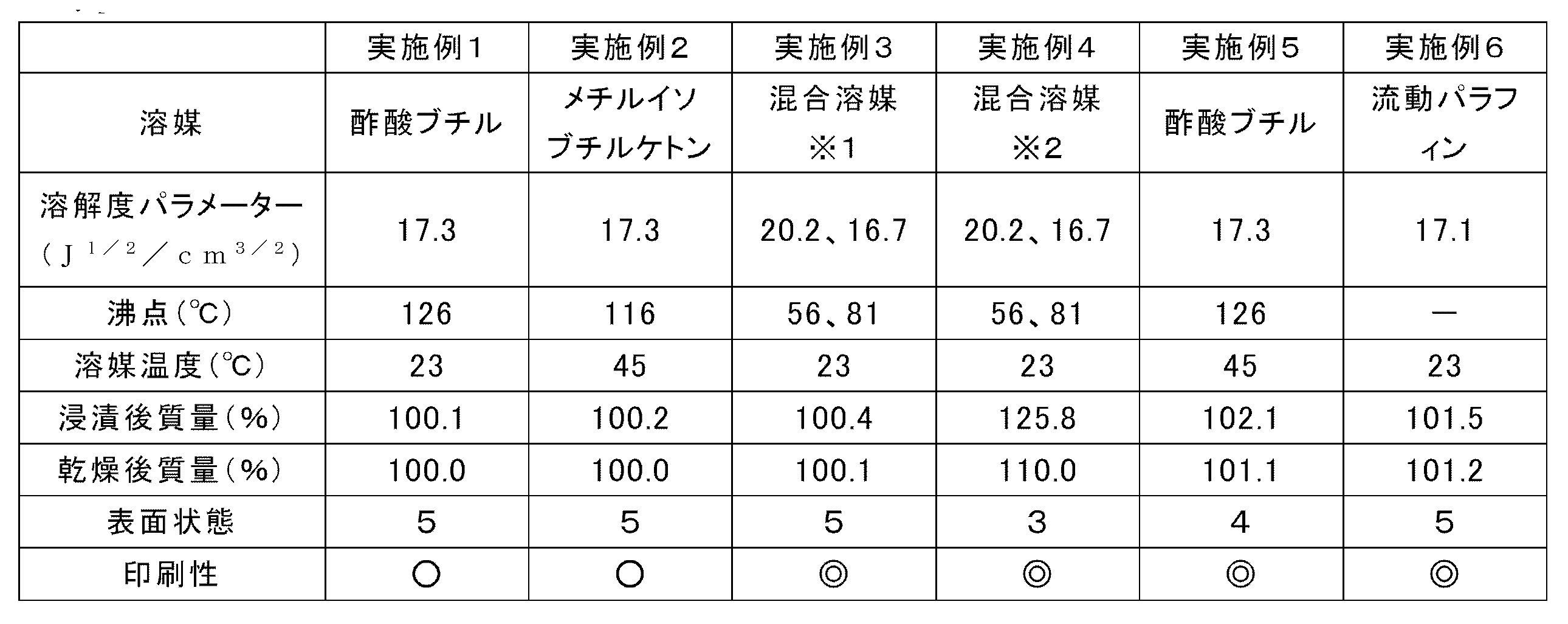
※2:アセトン100質量部とシクロヘキサン50質量部との混合溶媒
<評価2>
環状オレフィン系樹脂1を環状オレフィン系樹脂2に変更し、成形条件をシリンダー温度310℃、金型温度130℃、射出速度150mm/s、保圧40MPaの条件に変更し、溶媒を表2に記載の溶媒に変更した以外は、評価1と同様にして、膨潤試験、表面状態の評価、印刷性の評価を行なった。結果を表2に示した。表2の結果から、溶媒の温度が表2の条件であれば、トルエン、キシレン、ヘプタンは、環状オレフィン系樹脂2を膨潤させる溶媒である。
環状オレフィン系樹脂1を環状オレフィン系樹脂2に変更し、成形条件をシリンダー温度310℃、金型温度130℃、射出速度150mm/s、保圧40MPaの条件に変更し、溶媒を表2に記載の溶媒に変更した以外は、評価1と同様にして、膨潤試験、表面状態の評価、印刷性の評価を行なった。結果を表2に示した。表2の結果から、溶媒の温度が表2の条件であれば、トルエン、キシレン、ヘプタンは、環状オレフィン系樹脂2を膨潤させる溶媒である。

<評価3>
使用する溶媒の種類を表3に示すものに変更した以外は、評価1と同様にして、膨潤試験、表面状態の評価、印刷性の評価を行なった。結果を表3に示した。表3の結果から、溶媒の温度が表3の条件であれば、エタノール、アセトン、アセトン100質量部とエタノール100質量部との混合溶媒、アセトン100質量部とシクロヘキサン5質量部との混合溶媒、アセトン100質量部とシクロヘキサン10質量部との混合溶媒、メチルイソブチルケトンは環状オレフィン系樹脂1を溶解、且つ膨潤しない溶媒であり、シクロヘキサンは環状オレフィン系樹脂1を溶解する溶媒である。
使用する溶媒の種類を表3に示すものに変更した以外は、評価1と同様にして、膨潤試験、表面状態の評価、印刷性の評価を行なった。結果を表3に示した。表3の結果から、溶媒の温度が表3の条件であれば、エタノール、アセトン、アセトン100質量部とエタノール100質量部との混合溶媒、アセトン100質量部とシクロヘキサン5質量部との混合溶媒、アセトン100質量部とシクロヘキサン10質量部との混合溶媒、メチルイソブチルケトンは環状オレフィン系樹脂1を溶解、且つ膨潤しない溶媒であり、シクロヘキサンは環状オレフィン系樹脂1を溶解する溶媒である。
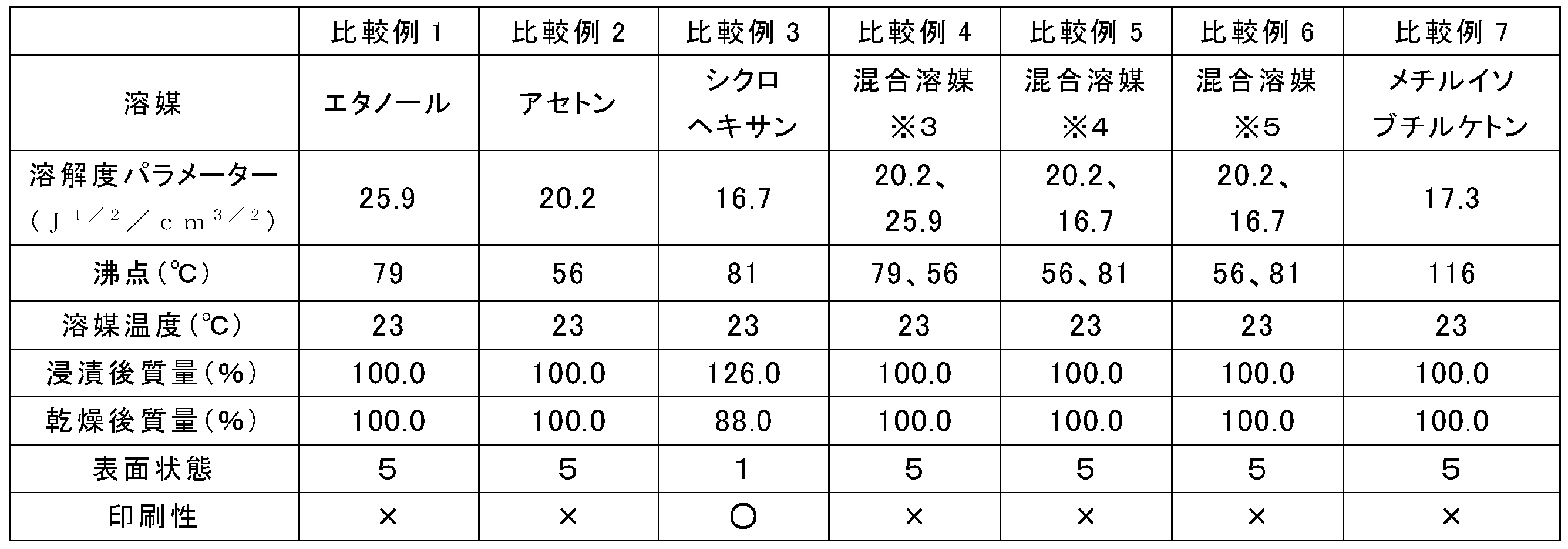
※4:アセトン100質量部とシクロヘキサン5質量部との混合溶媒
※5:アセトン100質量部とシクロヘキサン10質量部との混合溶媒
表1~3の結果から、環状オレフィン系樹脂成形体を膨潤させる溶媒を使用すれば、印刷性に優れ、且つ表面処理後の表面状態も、表面処理前とほぼ同等であることが確認された。
表1、2の結果から、環状オレフィン系樹脂の種類によらず、本発明の効果を奏することが確認された。
実施例2、比較例7の結果から、環状オレフィン系樹脂を溶解しない溶媒であっても、溶媒の温度を調整することで、環状オレフィン系樹脂を膨潤させる溶媒になることが確認された。
実施例3、4及び比較例5、6の結果から環状オレフィン系樹脂を溶解する溶媒と、環状オレフィン系樹脂を溶解しない溶媒との混合比を調整することで、混合溶媒が環状オレフィン系樹脂を膨潤させる溶媒になることが確認された。
Claims (9)
- 環状オレフィン系樹脂組成物からなり、少なくとも一部が表面処理された環状オレフィン系樹脂成形体と、
前記環状オレフィン系樹脂成形体の処理面上に形成される印刷層と、を備え、
前記表面処理は、前記環状オレフィン系樹脂成形体を膨潤させる溶媒を用いた処理である構造体。 - 下記膨潤試験において導出される、浸漬後質量が浸漬前質量を超え、乾燥後質量が浸漬前質量以上である請求項1に記載の構造体。
<膨潤試験>
前記環状オレフィン系樹脂組成物を成形してなる、4mm×10mm×80mm(ISO178曲げ試験片)の膨潤試験片の質量である浸漬前質量を測定し、
前記膨潤試験片を、前記溶媒に24時間浸漬した後、引き上げて表面に付着した前記溶媒をアセトンで洗い流し、さらに表面に付着したアセトンを拭き取り、前記膨潤試験片の浸漬後質量を測定し、
浸漬後質量測定後の膨潤試験片を、100℃、100時間、1000Paの真空乾燥条件で乾燥させた後、前記膨潤試験片の乾燥後質量を測定する。 - 前記溶媒は、溶解度パラメーターが20Jl/2/cm3/2以下の溶媒を含む請求項1又は2に記載の構造体。
- 前記溶媒は、酢酸ブチル、メチルイソブチルケトン、及び流動パラフィンからなる群より選択される少なくとも一種の溶媒を含む請求項1から3のいずれかに記載の構造体。
- 前記溶媒が2種以上の溶媒を混合した混合溶媒である請求項1から4のいずれかに記載の構造体。
- 前記混合溶媒は、アセトンと、シクロヘキサンとを含み、
アセトン100質量部に対して、シクロヘキサンを20質量部以上60質量部以下含む請求項5に記載の構造体。 - 前記印刷層は、パッド印刷方式、オフセット印刷方式、スクリーン印刷方式、フレキソ印刷方式、ドライオフセット印刷方式又はグラビア印刷方式により形成される請求項1から6のいずれかに記載の構造体。
- 前記構造体が曲面を有し、前記曲面の少なくとも一部が前記表面処理された曲面構造体である請求項1から7のいずれかに記載の構造体。
- 環状オレフィン系樹脂組成物からなる環状オレフィン系樹脂成形体であって、
前記環状オレフィン系樹脂成形体は、前記環状オレフィン系樹脂成形体を膨潤させる溶媒で表面処理され、
前記溶媒は、下記膨潤試験において導出される、浸漬後質量が浸漬前質量を超え、乾燥後質量が浸漬前質量以上になる溶媒である環状オレフィン系樹脂成形体。
<膨潤試験>
前記環状オレフィン系樹脂組成物を成形してなる、4mm×10mm×80mm(ISO曲げ試験片)の膨潤試験片の質量である浸漬前質量を測定し、
前記膨潤試験片を、前記溶媒に24時間浸漬した後、引き上げて表面に付着した前記溶媒をアセトンで洗い流し、さらに表面に付着したアセトンを拭き取り、前記膨潤試験片の浸漬後質量を測定し、
浸漬後質量測定後の膨潤試験片を、100℃、100時間、1000Paの乾燥条件で乾燥させた後、前記膨潤試験片の乾燥後質量を測定する。
Priority Applications (2)
| Application Number | Priority Date | Filing Date | Title |
|---|---|---|---|
| CN201180061362.6A CN103270091B (zh) | 2010-12-22 | 2011-12-21 | 结构体及环状烯烃系树脂成形体 |
| JP2012549849A JP5988876B2 (ja) | 2010-12-22 | 2011-12-21 | 構造体及び環状オレフィン系樹脂成形体 |
Applications Claiming Priority (2)
| Application Number | Priority Date | Filing Date | Title |
|---|---|---|---|
| JP2010285683 | 2010-12-22 | ||
| JP2010-285683 | 2010-12-22 |
Publications (1)
| Publication Number | Publication Date |
|---|---|
| WO2012086696A1 true WO2012086696A1 (ja) | 2012-06-28 |
Family
ID=46313964
Family Applications (1)
| Application Number | Title | Priority Date | Filing Date |
|---|---|---|---|
| PCT/JP2011/079663 Ceased WO2012086696A1 (ja) | 2010-12-22 | 2011-12-21 | 構造体及び環状オレフィン系樹脂成形体 |
Country Status (3)
| Country | Link |
|---|---|
| JP (1) | JP5988876B2 (ja) |
| CN (1) | CN103270091B (ja) |
| WO (1) | WO2012086696A1 (ja) |
Cited By (1)
| Publication number | Priority date | Publication date | Assignee | Title |
|---|---|---|---|---|
| AT528244A1 (de) * | 2024-04-25 | 2025-11-15 | Univ Wien Tech | Verfahren zur bearbeitung eines kunststoffteils |
Citations (5)
| Publication number | Priority date | Publication date | Assignee | Title |
|---|---|---|---|---|
| JPH04110330A (ja) * | 1990-08-31 | 1992-04-10 | Dainippon Printing Co Ltd | プラスチックフィルムへの印刷または塗布の方法 |
| JPH08156200A (ja) * | 1994-12-12 | 1996-06-18 | Nippon Zeon Co Ltd | 熱可塑性ノルボルネン系樹脂成形品 |
| JPH1171554A (ja) * | 1997-08-29 | 1999-03-16 | Yokohama Rubber Co Ltd:The | ノルボルネン系樹脂成形品の接着方法 |
| JP2007276142A (ja) * | 2006-04-03 | 2007-10-25 | Jsr Corp | 積層フィルムの製造方法および積層フィルム |
| JP2009155508A (ja) * | 2007-12-27 | 2009-07-16 | Polyplastics Co | 環状オレフィン系樹脂成形品の表面処理方法 |
Family Cites Families (5)
| Publication number | Priority date | Publication date | Assignee | Title |
|---|---|---|---|---|
| JPS5959726A (ja) * | 1982-09-30 | 1984-04-05 | Mitsui Petrochem Ind Ltd | ポリオレフイン類の被覆方法 |
| JPH0593079A (ja) * | 1991-09-30 | 1993-04-16 | Nippon Zeon Co Ltd | 熱硬化性ノルボルネンポリマー成形品の前処理方法及び前処理剤 |
| JP2002328202A (ja) * | 2001-04-27 | 2002-11-15 | Nippon Sheet Glass Co Ltd | 低反射樹脂基材及びその製造方法 |
| JP4468850B2 (ja) * | 2005-03-29 | 2010-05-26 | 三菱樹脂株式会社 | 熱収縮性ポリオレフィン系積層フィルム、熱収縮性ラベル及び該ラベルを装着した容器 |
| JP4651982B2 (ja) * | 2004-07-15 | 2011-03-16 | グンゼ株式会社 | 熱収縮性積層フイルム及び包装軽量ペットボトル |
-
2011
- 2011-12-21 JP JP2012549849A patent/JP5988876B2/ja not_active Expired - Fee Related
- 2011-12-21 WO PCT/JP2011/079663 patent/WO2012086696A1/ja not_active Ceased
- 2011-12-21 CN CN201180061362.6A patent/CN103270091B/zh not_active Expired - Fee Related
Patent Citations (5)
| Publication number | Priority date | Publication date | Assignee | Title |
|---|---|---|---|---|
| JPH04110330A (ja) * | 1990-08-31 | 1992-04-10 | Dainippon Printing Co Ltd | プラスチックフィルムへの印刷または塗布の方法 |
| JPH08156200A (ja) * | 1994-12-12 | 1996-06-18 | Nippon Zeon Co Ltd | 熱可塑性ノルボルネン系樹脂成形品 |
| JPH1171554A (ja) * | 1997-08-29 | 1999-03-16 | Yokohama Rubber Co Ltd:The | ノルボルネン系樹脂成形品の接着方法 |
| JP2007276142A (ja) * | 2006-04-03 | 2007-10-25 | Jsr Corp | 積層フィルムの製造方法および積層フィルム |
| JP2009155508A (ja) * | 2007-12-27 | 2009-07-16 | Polyplastics Co | 環状オレフィン系樹脂成形品の表面処理方法 |
Cited By (1)
| Publication number | Priority date | Publication date | Assignee | Title |
|---|---|---|---|---|
| AT528244A1 (de) * | 2024-04-25 | 2025-11-15 | Univ Wien Tech | Verfahren zur bearbeitung eines kunststoffteils |
Also Published As
| Publication number | Publication date |
|---|---|
| CN103270091B (zh) | 2015-02-18 |
| JPWO2012086696A1 (ja) | 2014-05-22 |
| CN103270091A (zh) | 2013-08-28 |
| JP5988876B2 (ja) | 2016-09-07 |
Similar Documents
| Publication | Publication Date | Title |
|---|---|---|
| EP2226357B1 (en) | Propylene polymer composition | |
| KR101279612B1 (ko) | 편광판 및 이를 포함하는 액정 표시 장치 | |
| JP2023106053A (ja) | 4-メチル-1-ペンテン共重合体樹脂組成物、並びに、これからなる成形体、シート、粘着剤および日用雑貨 | |
| JP5770374B2 (ja) | 樹脂組成物、これを用いて形成された光学フィルム、これを含む偏光板及び液晶表示装置 | |
| CN102667547A (zh) | 光学膜和复合偏振板 | |
| KR20090037942A (ko) | 광학 필름, 그의 용도 및 제조 방법 | |
| JP5988876B2 (ja) | 構造体及び環状オレフィン系樹脂成形体 | |
| CN115144936A (zh) | 光学膜及其制造方法、以及具备该光学膜的偏振片和显示装置 | |
| JP7044521B2 (ja) | 離型フィルム | |
| JP2001221915A (ja) | 光学フィルム並びにそれよりなる偏光子保護フィルムおよび偏光板 | |
| JP2009258571A (ja) | 位相差フィルム | |
| JP2014005335A (ja) | 透明樹脂組成物 | |
| JP6020167B2 (ja) | 積層フィルムおよびそれを用いた成型転写箔 | |
| JP6458377B2 (ja) | 位相差フィルム積層体及び偏光板 | |
| JP2007154074A (ja) | フィルムまたはシート用環状オレフィン系樹脂組成物およびその用途 | |
| JP5794038B2 (ja) | 成型用フィルムおよびそれを用いた成型転写箔 | |
| JP2005272711A (ja) | 熱可塑性飽和ノルボルネン系樹脂フィルム、光学フィルム及び偏光子保護フィルム | |
| WO2007066712A1 (ja) | 熱インプリント用樹脂 | |
| KR102074547B1 (ko) | 광학 필름, 편광판 및 액정 디스플레이 장치 및 이들의 제조방법 | |
| JP2019151023A (ja) | 剥離性フィルム | |
| TW201000582A (en) | Adhesive compositions and optical films using the same | |
| JP2007009010A (ja) | 光学用フィルム | |
| JP2006309266A (ja) | 偏光板用保護膜及びそれを用いてなる偏光板 | |
| JP2012000795A (ja) | 樹脂被覆成形体及び樹脂被覆成形体の製造方法 | |
| WO2010032560A1 (ja) | ペレット混合物、成形体、及び成形体の製造方法 |
Legal Events
| Date | Code | Title | Description |
|---|---|---|---|
| 121 | Ep: the epo has been informed by wipo that ep was designated in this application |
Ref document number: 11851957 Country of ref document: EP Kind code of ref document: A1 |
|
| ENP | Entry into the national phase |
Ref document number: 2012549849 Country of ref document: JP Kind code of ref document: A |
|
| NENP | Non-entry into the national phase |
Ref country code: DE |
|
| 122 | Ep: pct application non-entry in european phase |
Ref document number: 11851957 Country of ref document: EP Kind code of ref document: A1 |