WO2012086672A1 - 炭素クラスター構造を有する高分子化合物及びそれを用いた有機デバイス - Google Patents
炭素クラスター構造を有する高分子化合物及びそれを用いた有機デバイス Download PDFInfo
- Publication number
- WO2012086672A1 WO2012086672A1 PCT/JP2011/079599 JP2011079599W WO2012086672A1 WO 2012086672 A1 WO2012086672 A1 WO 2012086672A1 JP 2011079599 W JP2011079599 W JP 2011079599W WO 2012086672 A1 WO2012086672 A1 WO 2012086672A1
- Authority
- WO
- WIPO (PCT)
- Prior art keywords
- group
- unsubstituted
- substituted
- polymer compound
- general formula
- Prior art date
- Legal status (The legal status is an assumption and is not a legal conclusion. Google has not performed a legal analysis and makes no representation as to the accuracy of the status listed.)
- Ceased
Links
- 0 CC(*)[Al](N(*)[Al]*N(*)C(C)(C)[Am]C)I Chemical compound CC(*)[Al](N(*)[Al]*N(*)C(C)(C)[Am]C)I 0.000 description 11
- YYVSLRFSTLJGAQ-UHFFFAOYSA-N CC(C)(C)c(cc1)cc(C2)c1-c1c2cc(C)cc1 Chemical compound CC(C)(C)c(cc1)cc(C2)c1-c1c2cc(C)cc1 YYVSLRFSTLJGAQ-UHFFFAOYSA-N 0.000 description 2
- MTVVDRNSXXIJIM-UHFFFAOYSA-N CCCCCCCC(c1ccccc1C1(CCCCCCc2cc(CC(C(C3)C4C(C5)C(C6)C7=C(C8)C9C%10C8=C8C%11=C6C7)C6=C7C%12=C9C%10=C9C8=C8C%11=C5C4=C6C8C7=C%129)c3cc2)c(cc(C(C)(C)C)cc2)c2-c2ccc(C)cc12)N Chemical compound CCCCCCCC(c1ccccc1C1(CCCCCCc2cc(CC(C(C3)C4C(C5)C(C6)C7=C(C8)C9C%10C8=C8C%11=C6C7)C6=C7C%12=C9C%10=C9C8=C8C%11=C5C4=C6C8C7=C%129)c3cc2)c(cc(C(C)(C)C)cc2)c2-c2ccc(C)cc12)N MTVVDRNSXXIJIM-UHFFFAOYSA-N 0.000 description 1
- DMNATNRMKLPRDV-UHFFFAOYSA-N CCCCc(cc1)ccc1N(c1ccc(CCCC)cc1)c(cc1)ccc1N(c(cc1)ccc1Br)c(cc1)ccc1Br Chemical compound CCCCc(cc1)ccc1N(c1ccc(CCCC)cc1)c(cc1)ccc1N(c(cc1)ccc1Br)c(cc1)ccc1Br DMNATNRMKLPRDV-UHFFFAOYSA-N 0.000 description 1
Images


Classifications
-
- B—PERFORMING OPERATIONS; TRANSPORTING
- B82—NANOTECHNOLOGY
- B82Y—SPECIFIC USES OR APPLICATIONS OF NANOSTRUCTURES; MEASUREMENT OR ANALYSIS OF NANOSTRUCTURES; MANUFACTURE OR TREATMENT OF NANOSTRUCTURES
- B82Y10/00—Nanotechnology for information processing, storage or transmission, e.g. quantum computing or single electron logic
-
- C—CHEMISTRY; METALLURGY
- C08—ORGANIC MACROMOLECULAR COMPOUNDS; THEIR PREPARATION OR CHEMICAL WORKING-UP; COMPOSITIONS BASED THEREON
- C08G—MACROMOLECULAR COMPOUNDS OBTAINED OTHERWISE THAN BY REACTIONS ONLY INVOLVING UNSATURATED CARBON-TO-CARBON BONDS
- C08G61/00—Macromolecular compounds obtained by reactions forming a carbon-to-carbon link in the main chain of the macromolecule
- C08G61/02—Macromolecular compounds containing only carbon atoms in the main chain of the macromolecule, e.g. polyxylylenes
-
- C—CHEMISTRY; METALLURGY
- C08—ORGANIC MACROMOLECULAR COMPOUNDS; THEIR PREPARATION OR CHEMICAL WORKING-UP; COMPOSITIONS BASED THEREON
- C08G—MACROMOLECULAR COMPOUNDS OBTAINED OTHERWISE THAN BY REACTIONS ONLY INVOLVING UNSATURATED CARBON-TO-CARBON BONDS
- C08G61/00—Macromolecular compounds obtained by reactions forming a carbon-to-carbon link in the main chain of the macromolecule
- C08G61/12—Macromolecular compounds containing atoms other than carbon in the main chain of the macromolecule
-
- C—CHEMISTRY; METALLURGY
- C08—ORGANIC MACROMOLECULAR COMPOUNDS; THEIR PREPARATION OR CHEMICAL WORKING-UP; COMPOSITIONS BASED THEREON
- C08G—MACROMOLECULAR COMPOUNDS OBTAINED OTHERWISE THAN BY REACTIONS ONLY INVOLVING UNSATURATED CARBON-TO-CARBON BONDS
- C08G61/00—Macromolecular compounds obtained by reactions forming a carbon-to-carbon link in the main chain of the macromolecule
- C08G61/12—Macromolecular compounds containing atoms other than carbon in the main chain of the macromolecule
- C08G61/122—Macromolecular compounds containing atoms other than carbon in the main chain of the macromolecule derived from five- or six-membered heterocyclic compounds, other than imides
-
- C—CHEMISTRY; METALLURGY
- C08—ORGANIC MACROMOLECULAR COMPOUNDS; THEIR PREPARATION OR CHEMICAL WORKING-UP; COMPOSITIONS BASED THEREON
- C08G—MACROMOLECULAR COMPOUNDS OBTAINED OTHERWISE THAN BY REACTIONS ONLY INVOLVING UNSATURATED CARBON-TO-CARBON BONDS
- C08G61/00—Macromolecular compounds obtained by reactions forming a carbon-to-carbon link in the main chain of the macromolecule
- C08G61/12—Macromolecular compounds containing atoms other than carbon in the main chain of the macromolecule
- C08G61/122—Macromolecular compounds containing atoms other than carbon in the main chain of the macromolecule derived from five- or six-membered heterocyclic compounds, other than imides
- C08G61/123—Macromolecular compounds containing atoms other than carbon in the main chain of the macromolecule derived from five- or six-membered heterocyclic compounds, other than imides derived from five-membered heterocyclic compounds
-
- C—CHEMISTRY; METALLURGY
- C08—ORGANIC MACROMOLECULAR COMPOUNDS; THEIR PREPARATION OR CHEMICAL WORKING-UP; COMPOSITIONS BASED THEREON
- C08G—MACROMOLECULAR COMPOUNDS OBTAINED OTHERWISE THAN BY REACTIONS ONLY INVOLVING UNSATURATED CARBON-TO-CARBON BONDS
- C08G61/00—Macromolecular compounds obtained by reactions forming a carbon-to-carbon link in the main chain of the macromolecule
- C08G61/12—Macromolecular compounds containing atoms other than carbon in the main chain of the macromolecule
- C08G61/122—Macromolecular compounds containing atoms other than carbon in the main chain of the macromolecule derived from five- or six-membered heterocyclic compounds, other than imides
- C08G61/123—Macromolecular compounds containing atoms other than carbon in the main chain of the macromolecule derived from five- or six-membered heterocyclic compounds, other than imides derived from five-membered heterocyclic compounds
- C08G61/126—Macromolecular compounds containing atoms other than carbon in the main chain of the macromolecule derived from five- or six-membered heterocyclic compounds, other than imides derived from five-membered heterocyclic compounds with a five-membered ring containing one sulfur atom in the ring
-
- C—CHEMISTRY; METALLURGY
- C08—ORGANIC MACROMOLECULAR COMPOUNDS; THEIR PREPARATION OR CHEMICAL WORKING-UP; COMPOSITIONS BASED THEREON
- C08K—Use of inorganic or non-macromolecular organic substances as compounding ingredients
- C08K3/00—Use of inorganic substances as compounding ingredients
- C08K3/02—Elements
- C08K3/04—Carbon
-
- C—CHEMISTRY; METALLURGY
- C08—ORGANIC MACROMOLECULAR COMPOUNDS; THEIR PREPARATION OR CHEMICAL WORKING-UP; COMPOSITIONS BASED THEREON
- C08K—Use of inorganic or non-macromolecular organic substances as compounding ingredients
- C08K3/00—Use of inorganic substances as compounding ingredients
- C08K3/02—Elements
- C08K3/04—Carbon
- C08K3/045—Fullerenes
-
- C—CHEMISTRY; METALLURGY
- C08—ORGANIC MACROMOLECULAR COMPOUNDS; THEIR PREPARATION OR CHEMICAL WORKING-UP; COMPOSITIONS BASED THEREON
- C08L—COMPOSITIONS OF MACROMOLECULAR COMPOUNDS
- C08L65/00—Compositions of macromolecular compounds obtained by reactions forming a carbon-to-carbon link in the main chain; Compositions of derivatives of such polymers
-
- C—CHEMISTRY; METALLURGY
- C09—DYES; PAINTS; POLISHES; NATURAL RESINS; ADHESIVES; COMPOSITIONS NOT OTHERWISE PROVIDED FOR; APPLICATIONS OF MATERIALS NOT OTHERWISE PROVIDED FOR
- C09K—MATERIALS FOR MISCELLANEOUS APPLICATIONS, NOT PROVIDED FOR ELSEWHERE
- C09K11/00—Luminescent materials, e.g. electroluminescent or chemiluminescent
- C09K11/06—Luminescent materials, e.g. electroluminescent or chemiluminescent containing organic luminescent materials
-
- H—ELECTRICITY
- H10—SEMICONDUCTOR DEVICES; ELECTRIC SOLID-STATE DEVICES NOT OTHERWISE PROVIDED FOR
- H10K—ORGANIC ELECTRIC SOLID-STATE DEVICES
- H10K30/00—Organic devices sensitive to infrared radiation, light, electromagnetic radiation of shorter wavelength or corpuscular radiation
-
- H—ELECTRICITY
- H10—SEMICONDUCTOR DEVICES; ELECTRIC SOLID-STATE DEVICES NOT OTHERWISE PROVIDED FOR
- H10K—ORGANIC ELECTRIC SOLID-STATE DEVICES
- H10K85/00—Organic materials used in the body or electrodes of devices covered by this subclass
- H10K85/10—Organic polymers or oligomers
- H10K85/111—Organic polymers or oligomers comprising aromatic, heteroaromatic, or aryl chains, e.g. polyaniline, polyphenylene or polyphenylene vinylene
- H10K85/115—Polyfluorene; Derivatives thereof
-
- H—ELECTRICITY
- H10—SEMICONDUCTOR DEVICES; ELECTRIC SOLID-STATE DEVICES NOT OTHERWISE PROVIDED FOR
- H10K—ORGANIC ELECTRIC SOLID-STATE DEVICES
- H10K85/00—Organic materials used in the body or electrodes of devices covered by this subclass
- H10K85/20—Carbon compounds, e.g. carbon nanotubes or fullerenes
- H10K85/211—Fullerenes, e.g. C60
- H10K85/215—Fullerenes, e.g. C60 comprising substituents, e.g. PCBM
-
- C—CHEMISTRY; METALLURGY
- C08—ORGANIC MACROMOLECULAR COMPOUNDS; THEIR PREPARATION OR CHEMICAL WORKING-UP; COMPOSITIONS BASED THEREON
- C08G—MACROMOLECULAR COMPOUNDS OBTAINED OTHERWISE THAN BY REACTIONS ONLY INVOLVING UNSATURATED CARBON-TO-CARBON BONDS
- C08G2261/00—Macromolecular compounds obtained by reactions forming a carbon-to-carbon link in the main chain of the macromolecule
- C08G2261/10—Definition of the polymer structure
- C08G2261/12—Copolymers
- C08G2261/124—Copolymers alternating
-
- C—CHEMISTRY; METALLURGY
- C08—ORGANIC MACROMOLECULAR COMPOUNDS; THEIR PREPARATION OR CHEMICAL WORKING-UP; COMPOSITIONS BASED THEREON
- C08G—MACROMOLECULAR COMPOUNDS OBTAINED OTHERWISE THAN BY REACTIONS ONLY INVOLVING UNSATURATED CARBON-TO-CARBON BONDS
- C08G2261/00—Macromolecular compounds obtained by reactions forming a carbon-to-carbon link in the main chain of the macromolecule
- C08G2261/10—Definition of the polymer structure
- C08G2261/13—Morphological aspects
- C08G2261/135—Cross-linked structures
-
- C—CHEMISTRY; METALLURGY
- C08—ORGANIC MACROMOLECULAR COMPOUNDS; THEIR PREPARATION OR CHEMICAL WORKING-UP; COMPOSITIONS BASED THEREON
- C08G—MACROMOLECULAR COMPOUNDS OBTAINED OTHERWISE THAN BY REACTIONS ONLY INVOLVING UNSATURATED CARBON-TO-CARBON BONDS
- C08G2261/00—Macromolecular compounds obtained by reactions forming a carbon-to-carbon link in the main chain of the macromolecule
- C08G2261/10—Definition of the polymer structure
- C08G2261/14—Side-groups
- C08G2261/141—Side-chains having aliphatic units
- C08G2261/1414—Unsaturated aliphatic units
-
- C—CHEMISTRY; METALLURGY
- C08—ORGANIC MACROMOLECULAR COMPOUNDS; THEIR PREPARATION OR CHEMICAL WORKING-UP; COMPOSITIONS BASED THEREON
- C08G—MACROMOLECULAR COMPOUNDS OBTAINED OTHERWISE THAN BY REACTIONS ONLY INVOLVING UNSATURATED CARBON-TO-CARBON BONDS
- C08G2261/00—Macromolecular compounds obtained by reactions forming a carbon-to-carbon link in the main chain of the macromolecule
- C08G2261/10—Definition of the polymer structure
- C08G2261/14—Side-groups
- C08G2261/148—Side-chains having aromatic units
-
- C—CHEMISTRY; METALLURGY
- C08—ORGANIC MACROMOLECULAR COMPOUNDS; THEIR PREPARATION OR CHEMICAL WORKING-UP; COMPOSITIONS BASED THEREON
- C08G—MACROMOLECULAR COMPOUNDS OBTAINED OTHERWISE THAN BY REACTIONS ONLY INVOLVING UNSATURATED CARBON-TO-CARBON BONDS
- C08G2261/00—Macromolecular compounds obtained by reactions forming a carbon-to-carbon link in the main chain of the macromolecule
- C08G2261/30—Monomer units or repeat units incorporating structural elements in the main chain
- C08G2261/31—Monomer units or repeat units incorporating structural elements in the main chain incorporating aromatic structural elements in the main chain
- C08G2261/314—Condensed aromatic systems, e.g. perylene, anthracene or pyrene
- C08G2261/3142—Condensed aromatic systems, e.g. perylene, anthracene or pyrene fluorene-based, e.g. fluorene, indenofluorene, or spirobifluorene
-
- C—CHEMISTRY; METALLURGY
- C08—ORGANIC MACROMOLECULAR COMPOUNDS; THEIR PREPARATION OR CHEMICAL WORKING-UP; COMPOSITIONS BASED THEREON
- C08G—MACROMOLECULAR COMPOUNDS OBTAINED OTHERWISE THAN BY REACTIONS ONLY INVOLVING UNSATURATED CARBON-TO-CARBON BONDS
- C08G2261/00—Macromolecular compounds obtained by reactions forming a carbon-to-carbon link in the main chain of the macromolecule
- C08G2261/30—Monomer units or repeat units incorporating structural elements in the main chain
- C08G2261/31—Monomer units or repeat units incorporating structural elements in the main chain incorporating aromatic structural elements in the main chain
- C08G2261/316—Monomer units or repeat units incorporating structural elements in the main chain incorporating aromatic structural elements in the main chain bridged by heteroatoms, e.g. N, P, Si or B
- C08G2261/3162—Arylamines
-
- C—CHEMISTRY; METALLURGY
- C08—ORGANIC MACROMOLECULAR COMPOUNDS; THEIR PREPARATION OR CHEMICAL WORKING-UP; COMPOSITIONS BASED THEREON
- C08G—MACROMOLECULAR COMPOUNDS OBTAINED OTHERWISE THAN BY REACTIONS ONLY INVOLVING UNSATURATED CARBON-TO-CARBON BONDS
- C08G2261/00—Macromolecular compounds obtained by reactions forming a carbon-to-carbon link in the main chain of the macromolecule
- C08G2261/30—Monomer units or repeat units incorporating structural elements in the main chain
- C08G2261/32—Monomer units or repeat units incorporating structural elements in the main chain incorporating heteroaromatic structural elements in the main chain
- C08G2261/324—Monomer units or repeat units incorporating structural elements in the main chain incorporating heteroaromatic structural elements in the main chain condensed
- C08G2261/3245—Monomer units or repeat units incorporating structural elements in the main chain incorporating heteroaromatic structural elements in the main chain condensed containing nitrogen and oxygen as heteroatoms
-
- C—CHEMISTRY; METALLURGY
- C08—ORGANIC MACROMOLECULAR COMPOUNDS; THEIR PREPARATION OR CHEMICAL WORKING-UP; COMPOSITIONS BASED THEREON
- C08G—MACROMOLECULAR COMPOUNDS OBTAINED OTHERWISE THAN BY REACTIONS ONLY INVOLVING UNSATURATED CARBON-TO-CARBON BONDS
- C08G2261/00—Macromolecular compounds obtained by reactions forming a carbon-to-carbon link in the main chain of the macromolecule
- C08G2261/30—Monomer units or repeat units incorporating structural elements in the main chain
- C08G2261/32—Monomer units or repeat units incorporating structural elements in the main chain incorporating heteroaromatic structural elements in the main chain
- C08G2261/324—Monomer units or repeat units incorporating structural elements in the main chain incorporating heteroaromatic structural elements in the main chain condensed
- C08G2261/3246—Monomer units or repeat units incorporating structural elements in the main chain incorporating heteroaromatic structural elements in the main chain condensed containing nitrogen and sulfur as heteroatoms
-
- C—CHEMISTRY; METALLURGY
- C08—ORGANIC MACROMOLECULAR COMPOUNDS; THEIR PREPARATION OR CHEMICAL WORKING-UP; COMPOSITIONS BASED THEREON
- C08G—MACROMOLECULAR COMPOUNDS OBTAINED OTHERWISE THAN BY REACTIONS ONLY INVOLVING UNSATURATED CARBON-TO-CARBON BONDS
- C08G2261/00—Macromolecular compounds obtained by reactions forming a carbon-to-carbon link in the main chain of the macromolecule
- C08G2261/30—Monomer units or repeat units incorporating structural elements in the main chain
- C08G2261/34—Monomer units or repeat units incorporating structural elements in the main chain incorporating partially-aromatic structural elements in the main chain
- C08G2261/344—Monomer units or repeat units incorporating structural elements in the main chain incorporating partially-aromatic structural elements in the main chain containing heteroatoms
-
- C—CHEMISTRY; METALLURGY
- C08—ORGANIC MACROMOLECULAR COMPOUNDS; THEIR PREPARATION OR CHEMICAL WORKING-UP; COMPOSITIONS BASED THEREON
- C08G—MACROMOLECULAR COMPOUNDS OBTAINED OTHERWISE THAN BY REACTIONS ONLY INVOLVING UNSATURATED CARBON-TO-CARBON BONDS
- C08G2261/00—Macromolecular compounds obtained by reactions forming a carbon-to-carbon link in the main chain of the macromolecule
- C08G2261/40—Polymerisation processes
- C08G2261/41—Organometallic coupling reactions
- C08G2261/411—Suzuki reactions
-
- C—CHEMISTRY; METALLURGY
- C08—ORGANIC MACROMOLECULAR COMPOUNDS; THEIR PREPARATION OR CHEMICAL WORKING-UP; COMPOSITIONS BASED THEREON
- C08G—MACROMOLECULAR COMPOUNDS OBTAINED OTHERWISE THAN BY REACTIONS ONLY INVOLVING UNSATURATED CARBON-TO-CARBON BONDS
- C08G2261/00—Macromolecular compounds obtained by reactions forming a carbon-to-carbon link in the main chain of the macromolecule
- C08G2261/50—Physical properties
- C08G2261/51—Charge transport
- C08G2261/512—Hole transport
-
- C—CHEMISTRY; METALLURGY
- C08—ORGANIC MACROMOLECULAR COMPOUNDS; THEIR PREPARATION OR CHEMICAL WORKING-UP; COMPOSITIONS BASED THEREON
- C08G—MACROMOLECULAR COMPOUNDS OBTAINED OTHERWISE THAN BY REACTIONS ONLY INVOLVING UNSATURATED CARBON-TO-CARBON BONDS
- C08G2261/00—Macromolecular compounds obtained by reactions forming a carbon-to-carbon link in the main chain of the macromolecule
- C08G2261/70—Post-treatment
- C08G2261/76—Post-treatment crosslinking
-
- C—CHEMISTRY; METALLURGY
- C08—ORGANIC MACROMOLECULAR COMPOUNDS; THEIR PREPARATION OR CHEMICAL WORKING-UP; COMPOSITIONS BASED THEREON
- C08G—MACROMOLECULAR COMPOUNDS OBTAINED OTHERWISE THAN BY REACTIONS ONLY INVOLVING UNSATURATED CARBON-TO-CARBON BONDS
- C08G2261/00—Macromolecular compounds obtained by reactions forming a carbon-to-carbon link in the main chain of the macromolecule
- C08G2261/90—Applications
- C08G2261/91—Photovoltaic applications
-
- C—CHEMISTRY; METALLURGY
- C08—ORGANIC MACROMOLECULAR COMPOUNDS; THEIR PREPARATION OR CHEMICAL WORKING-UP; COMPOSITIONS BASED THEREON
- C08G—MACROMOLECULAR COMPOUNDS OBTAINED OTHERWISE THAN BY REACTIONS ONLY INVOLVING UNSATURATED CARBON-TO-CARBON BONDS
- C08G2261/00—Macromolecular compounds obtained by reactions forming a carbon-to-carbon link in the main chain of the macromolecule
- C08G2261/90—Applications
- C08G2261/92—TFT applications
-
- C—CHEMISTRY; METALLURGY
- C08—ORGANIC MACROMOLECULAR COMPOUNDS; THEIR PREPARATION OR CHEMICAL WORKING-UP; COMPOSITIONS BASED THEREON
- C08G—MACROMOLECULAR COMPOUNDS OBTAINED OTHERWISE THAN BY REACTIONS ONLY INVOLVING UNSATURATED CARBON-TO-CARBON BONDS
- C08G2261/00—Macromolecular compounds obtained by reactions forming a carbon-to-carbon link in the main chain of the macromolecule
- C08G2261/90—Applications
- C08G2261/95—Use in organic luminescent diodes
-
- C—CHEMISTRY; METALLURGY
- C09—DYES; PAINTS; POLISHES; NATURAL RESINS; ADHESIVES; COMPOSITIONS NOT OTHERWISE PROVIDED FOR; APPLICATIONS OF MATERIALS NOT OTHERWISE PROVIDED FOR
- C09K—MATERIALS FOR MISCELLANEOUS APPLICATIONS, NOT PROVIDED FOR ELSEWHERE
- C09K2211/00—Chemical nature of organic luminescent or tenebrescent compounds
- C09K2211/14—Macromolecular compounds
- C09K2211/1408—Carbocyclic compounds
- C09K2211/1416—Condensed systems
-
- C—CHEMISTRY; METALLURGY
- C09—DYES; PAINTS; POLISHES; NATURAL RESINS; ADHESIVES; COMPOSITIONS NOT OTHERWISE PROVIDED FOR; APPLICATIONS OF MATERIALS NOT OTHERWISE PROVIDED FOR
- C09K—MATERIALS FOR MISCELLANEOUS APPLICATIONS, NOT PROVIDED FOR ELSEWHERE
- C09K2211/00—Chemical nature of organic luminescent or tenebrescent compounds
- C09K2211/14—Macromolecular compounds
- C09K2211/1408—Carbocyclic compounds
- C09K2211/1425—Non-condensed systems
-
- C—CHEMISTRY; METALLURGY
- C09—DYES; PAINTS; POLISHES; NATURAL RESINS; ADHESIVES; COMPOSITIONS NOT OTHERWISE PROVIDED FOR; APPLICATIONS OF MATERIALS NOT OTHERWISE PROVIDED FOR
- C09K—MATERIALS FOR MISCELLANEOUS APPLICATIONS, NOT PROVIDED FOR ELSEWHERE
- C09K2211/00—Chemical nature of organic luminescent or tenebrescent compounds
- C09K2211/14—Macromolecular compounds
- C09K2211/1408—Carbocyclic compounds
- C09K2211/1433—Carbocyclic compounds bridged by heteroatoms, e.g. N, P, Si or B
-
- C—CHEMISTRY; METALLURGY
- C09—DYES; PAINTS; POLISHES; NATURAL RESINS; ADHESIVES; COMPOSITIONS NOT OTHERWISE PROVIDED FOR; APPLICATIONS OF MATERIALS NOT OTHERWISE PROVIDED FOR
- C09K—MATERIALS FOR MISCELLANEOUS APPLICATIONS, NOT PROVIDED FOR ELSEWHERE
- C09K2211/00—Chemical nature of organic luminescent or tenebrescent compounds
- C09K2211/14—Macromolecular compounds
- C09K2211/1441—Heterocyclic
- C09K2211/1458—Heterocyclic containing sulfur as the only heteroatom
-
- C—CHEMISTRY; METALLURGY
- C09—DYES; PAINTS; POLISHES; NATURAL RESINS; ADHESIVES; COMPOSITIONS NOT OTHERWISE PROVIDED FOR; APPLICATIONS OF MATERIALS NOT OTHERWISE PROVIDED FOR
- C09K—MATERIALS FOR MISCELLANEOUS APPLICATIONS, NOT PROVIDED FOR ELSEWHERE
- C09K2211/00—Chemical nature of organic luminescent or tenebrescent compounds
- C09K2211/14—Macromolecular compounds
- C09K2211/1441—Heterocyclic
- C09K2211/1483—Heterocyclic containing nitrogen and sulfur as heteroatoms
-
- C—CHEMISTRY; METALLURGY
- C09—DYES; PAINTS; POLISHES; NATURAL RESINS; ADHESIVES; COMPOSITIONS NOT OTHERWISE PROVIDED FOR; APPLICATIONS OF MATERIALS NOT OTHERWISE PROVIDED FOR
- C09K—MATERIALS FOR MISCELLANEOUS APPLICATIONS, NOT PROVIDED FOR ELSEWHERE
- C09K2211/00—Chemical nature of organic luminescent or tenebrescent compounds
- C09K2211/14—Macromolecular compounds
- C09K2211/1441—Heterocyclic
- C09K2211/1491—Heterocyclic containing other combinations of heteroatoms
-
- H—ELECTRICITY
- H10—SEMICONDUCTOR DEVICES; ELECTRIC SOLID-STATE DEVICES NOT OTHERWISE PROVIDED FOR
- H10K—ORGANIC ELECTRIC SOLID-STATE DEVICES
- H10K30/00—Organic devices sensitive to infrared radiation, light, electromagnetic radiation of shorter wavelength or corpuscular radiation
- H10K30/50—Photovoltaic [PV] devices
-
- H—ELECTRICITY
- H10—SEMICONDUCTOR DEVICES; ELECTRIC SOLID-STATE DEVICES NOT OTHERWISE PROVIDED FOR
- H10K—ORGANIC ELECTRIC SOLID-STATE DEVICES
- H10K50/00—Organic light-emitting devices
- H10K50/80—Constructional details
- H10K50/84—Passivation; Containers; Encapsulations
- H10K50/844—Encapsulations
-
- Y—GENERAL TAGGING OF NEW TECHNOLOGICAL DEVELOPMENTS; GENERAL TAGGING OF CROSS-SECTIONAL TECHNOLOGIES SPANNING OVER SEVERAL SECTIONS OF THE IPC; TECHNICAL SUBJECTS COVERED BY FORMER USPC CROSS-REFERENCE ART COLLECTIONS [XRACs] AND DIGESTS
- Y02—TECHNOLOGIES OR APPLICATIONS FOR MITIGATION OR ADAPTATION AGAINST CLIMATE CHANGE
- Y02E—REDUCTION OF GREENHOUSE GAS [GHG] EMISSIONS, RELATED TO ENERGY GENERATION, TRANSMISSION OR DISTRIBUTION
- Y02E10/00—Energy generation through renewable energy sources
- Y02E10/50—Photovoltaic [PV] energy
- Y02E10/549—Organic PV cells
Definitions
- the present invention relates to a polymer compound having a carbon cluster structure and an organic device using the same. More specifically, a polymer compound having a carbon cluster structure, and a light emitting device such as an organic electroluminescence device (hereinafter simply referred to as “organic EL device”), a photoelectric conversion device such as a solar cell, and an organic thin film transistor. About.
- organic EL device organic electroluminescence device
- photoelectric conversion device such as a solar cell
- organic thin film transistor an organic thin film transistor
- the organic EL element is a self-luminous element in which the material itself shines, and therefore has a superior contrast ratio, viewing angle, response speed, and the like compared to the liquid crystal display element.
- organic EL elements can be easily thinned, they have recently attracted attention as elements for next-generation displays that replace liquid crystal display elements.
- the materials used for organic EL elements are roughly classified into two types: low molecular materials and high molecular materials.
- a polymer material When a polymer material is used, an organic EL element can be manufactured using a coating method. Therefore, there is an advantage that an organic EL element is relatively easy to manufacture than when a low molecular material is used. .
- various polymer compounds have recently been proposed as polymer materials, for example, polymer compounds having a phenylene group and a fluorenediyl group as structural units (for example, Non-Patent Document 1).
- an organic thin film solar cell containing a polymer material containing a polymer compound composed of a repeating unit (A) and a repeating unit (B) and a fullerene derivative as an electron transporting material in an organic layer.
- Patent Document 1 Japanese Patent Document 1
- the above-described polymer material has sufficient characteristics when used in an organic device, such as the luminance life of the obtained organic EL element, or the short-circuit current density and photoelectric conversion efficiency of the obtained photoelectric conversion element are not sufficient. It was hard to say.
- an object of the present invention is to provide a polymer compound that can be suitably applied to an organic device. More specifically, an object of the present invention is to provide a polymer compound having an excellent luminance life of the organic EL element obtained when used as a polymer material in the production of an organic EL element. Another object of the present invention is to provide a polymer compound that is excellent in the short-circuit current density and photoelectric conversion efficiency of the obtained photoelectric conversion element when used as a polymer material in the production of a photoelectric conversion element.
- the polymer compound of the present invention has a group in which at least a part of the repeating unit contains a carbon cluster structure, and can be suitably used for applications such as an organic EL device and a photoelectric conversion device.
- an organic EL device and a photoelectric conversion device.
- each of the aspect suitably used for the use of the organic EL element and the aspect suitably used for the use of the photoelectric conversion element will be described in order.
- the present invention has two or more types selected from the group consisting of an arylene unit, a heteroarylene unit, a heterocyclic unit and an aromatic amine unit as a repeating unit, and a group in which at least a part of the repeating unit includes a carbon cluster structure.
- a polymer compound is provided.
- the resulting organic EL device has excellent luminance life when used as a polymer material in the production of an organic EL device.
- the polymer compound preferably has one or more units selected from the group consisting of an arylene unit, a heteroarylene unit, and a heterocyclic unit, and an aromatic amine unit as a repeating unit. Thereby, the luminance life of the organic EL element is further improved.
- the aromatic amine unit is preferably at least one selected from the group consisting of a unit represented by the following general formula (2) and a unit represented by the general formula (3).
- Ar 1 , Ar 2 and Ar 3 are each independently an unsubstituted or substituted arylene group, an unsubstituted or substituted heteroarylene group, or an unsubstituted or substituted divalent heterocyclic ring. Indicates a group.
- R 5 and R 6 each independently represent a hydrogen atom, an unsubstituted or substituted alkyl group, an unsubstituted or substituted aryl group, or an unsubstituted or substituted monovalent heterocyclic group.
- R 7 represents a hydrogen atom, an unsubstituted or substituted alkyl group, an unsubstituted or substituted aryl group, or an unsubstituted or substituted monovalent heterocyclic group.
- the arylene unit is preferably a unit having a phenylene structure or a fluorene structure, and more preferably a unit having a fluorene structure.
- the polymer compound is preferably a conjugated polymer.
- the repeating unit having a group containing the carbon cluster structure is preferably a repeating unit represented by the following general formula (5A).
- Ar 5 represents an unsubstituted or substituted arylene group, an unsubstituted or substituted heteroarylene group, an unsubstituted or substituted divalent heterocyclic group, or an unsubstituted or substituted divalent group.
- Aromatic amine residues are shown.
- X represents a single bond, an oxygen atom, a sulfur atom, an unsubstituted or substituted alkylene group, or an unsubstituted or substituted phenylene group.
- R w and R x each independently represent a single bond, a C 1 to C 20 unsubstituted or substituted alkylene group, a C 6 to C 20 unsubstituted or substituted arylene group, or a divalent combination thereof. Indicates a group.
- Ring F shows a carbon cluster structure.
- m represents an integer of 1 to 4.
- W represents a divalent group containing a carbon atom or a silicon atom.
- Z represents a hetero atom selected from a nitrogen atom, an oxygen atom and a sulfur atom, or a carbon atom.
- p represents an integer of 0 to 12, and q represents 0 or 1. Here, when p is 0, q is 1 and W is a silicon atom.
- Z is a carbon atom.
- p is 2 or more, at least one of a plurality of Zs may be a hetero atom, and the bond between adjacent carbon atoms is a single bond or an unsaturated bond, and includes 2 carbon atoms as W.
- the valent group may form a ring together with the ring containing Z.
- R w , R x , X, W, Z, p, q, and ring F they may be the same or different.
- the carbon cluster structure is preferably a structure containing fullerene.
- fullerene examples include fullerene C60, fullerene C70, and fullerene 84. Fullerene C60 and fullerene C70 are preferable, and fullerene 60 is more preferable.
- the repeating unit having a group containing a carbon cluster structure is preferably a repeating unit represented by the following general formula (6).
- Y represents a single bond, an oxygen atom, a sulfur atom, an unsubstituted or substituted alkylene group, or an unsubstituted or substituted phenylene group.
- R y and R z are each independently a single bond, a C 1 -C 20 unsubstituted or substituted alkylene group, a C 6 -C 20 unsubstituted or substituted arylene group, or a divalent combination thereof. Indicates a group.
- R 10 represents a hydrogen atom, an unsubstituted or substituted alkyl group, an unsubstituted or substituted alkoxy group, an unsubstituted or substituted aryl group, an unsubstituted or substituted monovalent heterocyclic group, or a crosslinkable group.
- t represents 1 or 2.
- the present invention also has as a repeating unit two or more selected from the group consisting of an arylene unit, a heteroarylene unit, a heterocyclic unit, and an aromatic amine unit, and at least a part of the repeating unit contains a crosslinkable group
- a polymer compound that can be obtained by reacting a precursor polymer compound with a carbon cluster.
- the repeating unit containing the crosslinkable group is preferably a unit represented by the following general formula (7).
- R 11 represents a crosslinkable group.
- R 12 represents a hydrogen atom, a crosslinkable group, an unsubstituted or substituted alkyl group, or an unsubstituted or substituted aryl group.
- the present invention also includes a composition (containing at least one material selected from the group consisting of a hole transport material, an electron transport material, and a light-emitting material (usually a solid content) and the polymer compound ( Usually solids). Since the composition contains the polymer compound suitable as a polymer material for an organic EL device, it can be used, for example, in the production of a light emitting layer, a charge transport layer, or a charge injection layer of an organic EL device. Can be improved.
- the present invention also provides a solution containing the polymer compound and a solvent.
- a thin film containing the above polymer compound suitable as a polymer material of the organic EL element can be laminated and formed, which is very advantageous in production. Therefore, the present invention further provides a thin film obtained using the above polymer compound or composition suitable as a polymer material for an organic EL device.
- the present invention also provides an organic EL device having the above thin film.
- the organic EL device of the present invention is excellent in luminance life because it uses the polymer compound or the composition suitable as a polymer material of the organic EL device.
- the thin film is preferably used as a hole transport layer. As a result, the luminance life is further improved.
- the present invention further provides a planar light source and a display device having the organic EL element.
- the present invention provides a polymer compound having at least one selected from the group consisting of an arylene unit and a heteroarylene unit as a repeating unit, wherein at least a part of the repeating unit has a group containing a carbon cluster structure.
- the polymer compound of the present invention has such a configuration, when it is used as a polymer material for the production of a photoelectric conversion element, the obtained photoelectric conversion element has excellent short-circuit current density and photoelectric conversion efficiency. .
- the group containing the carbon cluster structure is a group obtained by removing one hydrogen atom from a fullerene C60 derivative, a group obtained by removing one hydrogen atom from a fullerene C70 derivative, or a hydrogen atom removed from a fullerene C84 derivative. It is preferably a group. Thereby, the short circuit current density and photoelectric conversion efficiency of a photoelectric conversion element become still more excellent.
- the repeating unit having a group containing a carbon cluster structure is preferably 5 mol% or more and 100 mol% or less with respect to the total of all repeating units contained in the polymer compound.
- the present invention also includes a first compound and a second compound different from the first compound, wherein the first compound is the polymer compound, and the second compound is fullerene.
- a conversion composition (usually solids) is provided. Since the said photoelectric conversion composition contains the said high molecular compound suitable as a polymeric material of a photoelectric conversion element, it can be used suitably for manufacture of a photoelectric conversion element.
- the present invention also provides a photoelectric conversion element having a pair of electrodes and at least one active layer between the electrodes, and containing the polymer compound or the photoelectric conversion composition in the active layer. . Since the said photoelectric conversion element contains the said high molecular compound suitable as a polymeric material of a photoelectric conversion element, it is excellent in a short circuit current density and photoelectric conversion efficiency.
- the present invention also provides a solar cell having the photoelectric conversion element, a solar cell module including the solar cell, and an image sensor having the photoelectric conversion element.
- the present invention also provides an organic thin film transistor having a gate electrode, a source electrode, a drain electrode, and an active layer, and containing the polymer compound in the active layer.
- the polymer compound of the present invention is a polymer compound that has an excellent luminance life of the organic EL device obtained when used in the production of an organic EL device.
- organic compounds such as light-emitting materials and charge transport materials are used. It is useful as a material for EL elements. Therefore, the polymer compound and the organic EL element of the present invention are used for display devices such as backlights for liquid crystal displays, curved or flat light sources (planar light sources) for illumination, segment type display devices, dot matrix display devices, and the like. Etc. are useful.
- the polymer compound of the present invention is also a polymer compound that is excellent in the short-circuit current density and photoelectric conversion efficiency of the obtained photoelectric conversion element when used in the manufacture of a photoelectric conversion element. Therefore, it is useful as a material for solar cells (particularly organic thin film solar cells), solar cell modules, organic image sensors, organic transistors (particularly organic thin film transistors), and the like.
- Unit means a group derived from a compound subjected to condensation polymerization when a polymer compound is synthesized by condensation polymerization.
- “Arylene unit” means a unit in which a group derived from a compound subjected to condensation polymerization is an unsubstituted or substituted arylene group. It may have a group containing a carbon cluster structure or a crosslinkable group.
- Heterocyclic unit means a unit in which a group derived from a compound subjected to condensation polymerization is an unsubstituted or substituted divalent heterocyclic group. It may have a group containing a carbon cluster structure or a crosslinkable group.
- Heteroarylene unit means a unit in which a group derived from a compound subjected to condensation polymerization is an unsubstituted or substituted heteroarylene group. It may have a group containing a carbon cluster structure or a crosslinkable group.
- “Aromatic amine unit” means a unit in which a group derived from a compound subjected to condensation polymerization is an unsubstituted or substituted divalent aromatic amine residue. It may have a group containing a carbon cluster structure or a crosslinkable group.
- “Structural unit” means one or more units present in a polymer compound.
- “Repeating unit” means a unit present in two or more in a polymer compound.
- “Divalent heterocyclic group” means that two hydrogen atoms are removed from a heterocyclic compound having no aromaticity (that is, a heterocyclic compound other than the heterocyclic compound having aromaticity described later). Means an atomic group. Here, the divalent heterocyclic group may have a substituent.
- the “heterocyclic compound” in the “divalent heterocyclic group” is an organic compound having a cyclic structure, in addition to carbon atoms, oxygen atoms, nitrogen atoms, phosphorus atoms, boron atoms as elements constituting the ring A compound containing a hetero atom such as
- Heteroarylene group means an atomic group formed by removing two hydrogen atoms from an aromatic heterocyclic compound.
- the heteroarylene group may have a substituent.
- “Heterocyclic compound” in the “heteroarylene group” is a heterostructure such as an oxygen atom, a nitrogen atom, a phosphorus atom, or a boron atom in addition to a carbon atom as an element constituting a ring among organic compounds having a cyclic structure. A compound containing an atom is meant.
- “Arylene group” means an atomic group formed by removing two hydrogen atoms bonded to a carbon atom constituting an aromatic ring from an aromatic hydrocarbon.
- the arylene group may have a substituent.
- the divalent aromatic amine residue means an atomic group formed by removing two hydrogen atoms from an aromatic amine compound.
- the divalent aromatic amine residue may have a substituent.
- Heteroary lysine group means an atomic group formed by removing three hydrogen atoms from an aromatic heterocyclic compound.
- “Arylysine group” means an atomic group formed by removing three hydrogen atoms bonded to a carbon atom constituting an aromatic ring from an aromatic hydrocarbon.
- Carbon cluster means a molecule whose minimum structure is composed of several to thousands of carbon atoms.
- fullerene molecules having a spherical shell structure, cylindrical carbon nanotubes, and carbon nanohorns may be mentioned.
- Carbon cluster structure means a structure derived from a carbon cluster.
- Crosslinkable group means a group containing a functional group capable of bonding to a carbon cluster by Diels-Alder reaction, Bingel-Hirsh reaction, or the like.
- C x -C y indicates that the number of carbon atoms in the partial structure corresponding to the functional group name described immediately after this term is It means x to y. That is, when the organic group described immediately after “C x -C y ” is an organic group named by combining a plurality of functional group names (for example, C x -C y alkoxyphenyl group), This means that the number of carbon atoms in the partial structure corresponding to the functional group name (for example, alkoxy) described immediately after “C x -C y ” among the functional group names is x to y.
- C 1 -C 12 alkyl group means an alkyl group having 1 to 12 carbon atoms
- C 1 -C 12 alkoxyphenyl group means “1 to 12 carbon atoms”. It means a phenyl group having an “alkoxy group”.
- Unsubstituted or substituted means that the group described immediately after that may have a substituent.
- an unsubstituted or substituted arylene group means “an arylene group having no substituent or an arylene group having a substituent”.
- substituents examples include alkyl group, alkoxy group, alkylthio group, aryl group, aryloxy group, arylthio group, alkenyl group, alkynyl group, amino group, silyl group, halogen atom, acyl group, acyloxy group, monovalent heterocyclic ring Group, monovalent heterocyclic thio group, imine residue, amide compound residue, acid imide residue, alkoxycarbonyl group, carboxyl group, nitro group, cyano group and the like.
- substituents when referring to “substituents”, the same ones can be exemplified unless otherwise specified.
- these substituents may further have a “substituent”.
- the alkyl group may be any of a linear alkyl group, a branched alkyl group, and a cyclic alkyl group (cycloalkyl group).
- the hydrogen atom in the alkyl group may be substituted with a fluorine atom.
- Alkyl groups include methyl, ethyl, propyl, isopropyl, butyl, isobutyl, sec-butyl, tert-butyl, pentyl, isoamyl, hexyl, cyclohexyl, heptyl, octyl 2-ethylhexyl group, nonyl group, decyl group, 3,7-dimethyloctyl group, dodecyl group, trifluoromethyl group, pentafluoroethyl group, perfluorobutyl group, perfluorohexyl group, perfluorooctyl group, etc. It is done.
- Examples of the C 1 to C 12 alkyl group include methyl group, ethyl group, propyl group, isopropyl group, butyl group, isobutyl group, sec-butyl group, tert-butyl group, pentyl group, isoamyl group, hexyl group, cyclohexyl group, Examples include heptyl group, octyl group, nonyl group, decyl group, dodecyl group and the like.
- the alkoxy group may be any of a linear alkoxy group, a branched alkoxy group, and a cyclic alkoxy group (cycloalkoxy group).
- the hydrogen atom in the alkoxy group may be substituted with a fluorine atom.
- Alkoxy groups include methoxy, ethoxy, propyloxy, isopropyloxy, butoxy, isobutoxy, sec-butoxy, tert-butoxy, pentyloxy, hexyloxy, cyclohexyloxy, heptyloxy Octyloxy group, 2-ethylhexyloxy group, nonyloxy group, decyloxy group, 3,7-dimethyloctyloxy group, dodecyloxy group, trifluoromethoxy group, pentafluoroethoxy group, perfluorobutoxy group, perfluorohexyloxy group Perfluorooctyloxy group, methoxymethyloxy group, 2-methoxyethyloxy group and the like.
- C 1 -C 12 alkoxy groups include methoxy, ethoxy, propyloxy, isopropyloxy, butoxy, isobutoxy, sec-butoxy, tert-butoxy, pentyloxy, hexyloxy, cyclohexyloxy Group, heptyloxy group, octyloxy group, 2-ethylhexyloxy group, nonyloxy group, decyloxy group, 3,7-dimethyloctyloxy group, dodecyloxy group and the like.
- the alkylthio group may be any of a linear alkylthio group, a molecular chain alkylthio group, and a cyclic alkylthio group (cycloalkylthio group).
- the hydrogen atom in the alkylthio group may be substituted with a fluorine atom.
- alkylthio group examples include methylthio group, ethylthio group, propylthio group, isopropylthio group, butylthio group, isobutylthio group, sec-butylthio group, tert-butylthio group, pentylthio group, hexylthio group, cyclohexylthio group, heptylthio group, octylthio group 2-ethylhexylthio group, nonylthio group, decylthio group, 3,7-dimethyloctylthio group, dodecylthio group, trifluoromethylthio group and the like.
- Examples of the C 1 -C 12 alkylthio group include methylthio group, ethylthio group, propylthio group, isopropylthio group, butylthio group, isobutylthio group, sec-butylthio group, tert-butylthio group, pentylthio group, hexylthio group, cyclohexylthio group, Examples include heptylthio group, octylthio group, 2-ethylhexylthio group, nonylthio group, decylthio group, 3,7-dimethyloctylthio group, dodecylthio group and the like.
- An aryl group means an atomic group formed by removing one hydrogen atom bonded to a carbon atom constituting an aromatic ring from an aromatic hydrocarbon.
- the aryl group includes a group having a condensed ring, a group in which two or more independent benzene rings or condensed rings are single-bonded.
- the hydrogen atom in the aryl group may be further substituted with the above alkyl group, aryl group or the like.
- the aryl group includes a phenyl group, a C 1 -C 12 alkoxyphenyl group, a C 1 -C 12 alkylphenyl group, a 1-naphthyl group, a 2-naphthyl group, a 1-anthracenyl group, a 2-anthracenyl group, and a 9-anthracenyl group.
- Examples of the aryl moiety in the aryloxy group include the same groups as those exemplified as the aryl group.
- Examples of the aryloxy group include a phenoxy group, a C 1 to C 12 alkoxyphenoxy group, a C 1 to C 12 alkylphenoxy group, a 1-naphthyloxy group, a 2-naphthyloxy group, and a pentafluorophenyloxy group.
- Examples of the aryl moiety in the arylthio group include the same groups as those exemplified as the aryl group.
- Examples of the arylthio group include a phenylthio group, a C 1 to C 12 alkoxyphenylthio group, a C 1 to C 12 alkylphenylthio group, a 1-naphthylthio group, a 2-naphthylthio group, and a pentafluorophenylthio group.
- the alkenyl group may be any of a linear alkenyl group, a branched alkenyl group, and a cyclic alkenyl group.
- Examples of the alkenyl group include vinyl, 1-propenyl, 2-propenyl, 1-butenyl, 2-butenyl, 1-pentenyl, 2-pentenyl, 1-hexenyl, 2-hexenyl, An octenyl group etc. are mentioned.
- the alkynyl group may be any of a linear alkynyl group, a branched alkynyl group and a cyclic alkynyl group.
- Examples of the alkynyl group include ethynyl group, 1-propynyl group, 2-propynyl group, 1-butynyl group, 2-butynyl group, 1-pentynyl group, 2-pentynyl group, 1-hexynyl group, 2-hexynyl group, 1- An octynyl group etc. are mentioned.
- the amino group includes, in addition to the group represented by —NH 2 , an amino group in which one or two hydrogen atoms are substituted with a substituent (hereinafter also referred to as “substituted amino group”).
- substituted amino groups include methylamino, dimethylamino, ethylamino, diethylamino, propylamino, dipropylamino, isopropylamino, diisopropylamino, butylamino, isobutylamino, sec-butylamino Group, tert-butylamino group, pentylamino group, hexylamino group, heptylamino group, octylamino group, 2-ethylhexylamino group, nonylamino group, decylamino group, 3,7-dimethyloctylamino group, dodecylamino group, cyclopentyl amino group, dicyclopen
- the silyl group includes a group represented by —SiH 3 and a silyl group in which 1 to 3 hydrogen atoms are substituted with a substituent (hereinafter also referred to as “substituted silyl group”).
- substituted silyl groups include trimethylsilyl, triethylsilyl, tripropylsilyl, tri-isopropylsilyl, dimethyl-isopropylsilyl, diethyl-isopropylsilyl, tert-butyldimethylsilyl, pentyldimethylsilyl, hexyldimethyl Silyl group, heptyldimethylsilyl group, octyldimethylsilyl group, 2-ethylhexyl-dimethylsilyl group, nonyldimethylsilyl group, decyldimethylsilyl group, 3,7-dimethyloctyl-dimethylsilyl
- halogen atom examples include a fluorine atom, a chlorine atom, a bromine atom, and an iodine atom.
- acyl group examples include an acetyl group, a propionyl group, a butyryl group, an isobutyryl group, a pivaloyl group, a benzoyl group, a trifluoroacetyl group, and a pentafluorobenzoyl group.
- acyloxy group examples include an acetoxy group, propionyloxy group, butyryloxy group, isobutyryloxy group, pivaloyloxy group, benzoyloxy group, trifluoroacetyloxy group, pentafluorobenzoyloxy group and the like.
- the monovalent heterocyclic group means an atomic group formed by removing one hydrogen atom from a heterocyclic compound (particularly, a heterocyclic compound having aromaticity).
- the “heterocyclic compound” in the “monovalent heterocyclic group” is an organic compound having a cyclic structure, an oxygen atom, a sulfur atom, a nitrogen atom, a phosphorus atom in addition to a carbon atom as an element constituting a ring. And a compound containing a hetero atom such as a boron atom.
- Examples of the monovalent heterocyclic group include thienyl group, C 1 -C 12 alkylthienyl group, pyrrolyl group, furyl group, pyridyl group, C 1 -C 12 alkylpyridyl group, pyridazinyl group, pyrimidinyl group, pyrazinyl group, triazinyl group Pyrrolidyl group, piperidyl group, quinolyl group, isoquinolyl group and the like.
- the hydrogen atom in these monovalent heterocyclic groups may be further substituted with the above alkyl group, alkoxy group or the like.
- the monovalent heterocyclic thio group means a group in which a hydrogen atom of a mercapto group is substituted with a monovalent heterocyclic group.
- Examples of the monovalent heterocyclic thio group include a heteroarylthio group such as a pyridylthio group, a pyridazinylthio group, a pyrimidinylthio group, a pyrazinylthio group, and a triazinylthio group.
- the imine residue is represented by the general formula: H— N ⁇ C (R Y1 ) 2 or the imine compound having a structure represented by at least one of the general formula: H—CR X1 ⁇ N—R Y1 in the above general formula. It means a residue excluding a hydrogen atom.
- R X1 represents a hydrogen atom, alkyl group, aryl group, arylalkyl group, arylalkenyl group or arylalkynyl group
- R Y1 represents a hydrogen atom, alkyl group, aryl group, arylalkyl group, arylalkenyl group. Or an arylalkynyl group is shown.
- a ring may be formed as an alkylene group having 2 to 18 carbon atoms such as a trimethylene group, a tetramethylene group, a pentamethylene group, or a hexamethylene group.
- imine compounds include compounds in which a hydrogen atom bonded to a nitrogen atom in aldimine, ketimine, or aldimine is substituted with an alkyl group, aryl group, arylalkyl group, arylalkenyl group, arylalkynyl group, or the like.
- Specific examples of the imine residue include groups represented by the following structural formulas.
- the amide compound residue is derived from an amide compound having a structure represented by at least one of the general formula: H—NR X2 —COR Y2 or the general formula: H—CO—N (R Y2 ) 2 in the above general formula. It means a residue without an atom.
- R X2 represents a hydrogen atom, alkyl group, aryl group, arylalkyl group, arylalkenyl group or arylalkynyl group
- R Y2 represents a hydrogen atom, alkyl group, aryl group, arylalkyl group, arylalkenyl group. Or an arylalkynyl group is shown.
- Amide compound residues include formamide residue, acetamide residue, propioamide residue, butyroamide residue, benzamide residue, trifluoroacetamide residue, pentafluorobenzamide residue, diformamide residue, diacetamide residue, dipropioamide Residues, dibutyroamide residues, dibenzamide residues, ditrifluoroacetamide residues, dipentafluorobenzamide residues and the like.
- the acid imide residue means a residue obtained by removing one hydrogen atom bonded to the nitrogen atom from the acid imide.
- Examples of the acid imide residue include the following groups.
- the alkoxycarbonyl group is a group represented by the general formula: R X3 OCO—.
- R X3 represents a hydrogen atom, an alkyl group, an aryl group, an arylalkyl group, an arylalkenyl group or an arylalkynyl group.
- Examples of the alkoxycarbonyl group include a methoxycarbonyl group, an ethoxycarbonyl group, and an n-propoxycarbonyl group.
- the polymer compound according to the present light emitting device form has two or more kinds selected from the group consisting of an arylene unit, a heteroarylene unit, a heterocyclic unit and an aromatic amine unit as a repeating unit, and at least a part of the repeating unit is It has a group containing a carbon cluster structure.
- the polymer compound according to the present light emitting device form has a further excellent luminance life of the obtained organic EL device, one or more units selected from the group consisting of an arylene unit, a heteroarylene unit and a heterocyclic unit, It is preferable to have an aromatic amine unit as a repeating unit.
- Heteroarylene unit The heteroarylene group in the heteroarylene unit is as described above.
- heteroarylene group in the heteroarylene unit examples include a pyridylene group, a thiazolen group, an oxazolen group, a pyrimidylene group, a pyrrolene group, a pyrazolen group, an imidazolene group, a freelen group, a thienylene group, and a thiophene group. Further, a pyridylene group, a thiazolen group, an oxazolen group, a pyrimidylene group, a pyrrolene group, a pyrazolen group, an imidazolene group, and a freelen group are preferable.
- Heterocyclic unit The divalent heterocyclic group in the heterocyclic unit is as described above.
- the aromatic amine unit is preferably at least one selected from the group consisting of a unit represented by the following general formula (2) and a unit represented by the general formula (3).
- the divalent aromatic amine residue in the aromatic amine unit is preferably a group represented by the following general formula (2) or general formula (3).
- Ar 1 , Ar 2 and Ar 3 are each independently an unsubstituted or substituted arylene group, an unsubstituted or substituted heteroarylene group, or an unsubstituted or substituted divalent heterocyclic group. Indicates.
- R 5 and R 6 each independently represent a hydrogen atom, an unsubstituted or substituted alkyl group, an unsubstituted or substituted aryl group, or an unsubstituted or substituted monovalent heterocyclic group, Aryl groups are preferred.
- c is 0 or 1.
- R 7 represents a hydrogen atom, an unsubstituted or substituted alkyl group, an unsubstituted or substituted aryl group, or an unsubstituted or substituted monovalent heterocyclic group.
- Aryl groups are preferred.
- the number of carbon atoms of the unsubstituted or substituted arylene group represented by Ar 1 , Ar 2 or Ar 3 does not include the number of carbon atoms of the substituent, and is usually 6 to 60, preferably 6 to 30. More preferably, it is 6 to 18, more preferably 6 to 10, and particularly preferably 6.
- Examples of the unsubstituted arylene group represented by Ar 1 , Ar 2 or Ar 3 include phenylene groups such as 1,3-phenylene group and 1,4-phenylene group; 1,4-naphthalenediyl group and 2,6-naphthalene Naphthalenediyl group such as diyl group; anthracene diyl group such as 9,10-anthracenediyl group; phenanthrene diyl group such as 2,7-phenanthrenediyl group; naphthacene diyl group such as 5,12-naphthacenediyl group; 2,7-full Examples thereof include fluorenediyl groups such as orangeyl group; perylenediyl groups such as 3,8-perylenediyl group, chrysenediyl groups such as 2,8-chrysenediyl group, and 6,12-chrysenediyl group.
- Examples of the substituted arylene group represented by Ar 1 , Ar 2 and Ar 3 include
- the number of carbon atoms of the unsubstituted or substituted heteroarylene group represented by Ar 1 , Ar 2 or Ar 3 does not include the number of carbon atoms of the substituent, and is usually 4 to 60, preferably 4 to 20 More preferably, it is 4 to 9, more preferably 4 or 5.
- the unsubstituted heteroarylene group represented by Ar 1 , Ar 2 or Ar 3 includes a pyrrole diyl group such as an N-methyl-2,5-pyrrolediyl group; a furanyl group such as a 2,5-furandiyl group; Pyridinediyl groups such as 5-pyridinediyl group and 2,6-pyridinediyl group; Quinolinediyl groups such as 2,4-quinolinediyl group and 2,6-quinolinediyl group; 1,4-isoquinolinediyl group and 1,5-isoquinoline An isoquinoline diyl group such as a diyl group; and a carbazole diyl group such as a 3,6-carbazole diyl group.
- Examples of the substituted heteroarylene group represented by Ar 1 , Ar 2 and Ar 3 include the above-described groups having a substituent.
- the number of carbon atoms of the unsubstituted or substituted divalent heterocyclic group represented by Ar 1 , Ar 2 or Ar 3 does not include the number of carbon atoms of the substituent, and is usually 4 to 60, preferably 4 to 20, more preferably 4 to 9, and even more preferably 4 or 5.
- Examples of the unsubstituted divalent heterocyclic group represented by Ar 1 , Ar 2 or Ar 3 include a phenoxazine diyl group such as a 3,7-phenoxazinediyl group.
- Examples of the substituted divalent heterocyclic group represented by Ar 1 , Ar 2 and Ar 3 include the above-described groups having a substituent.
- Ar 1 and Ar 3 each independently represent an unsubstituted or substituted arylene group, an unsubstituted or substituted heteroarylene group, or an unsubstituted or substituted divalent heterocyclic group, preferably, unsubstituted or substituted A substituted arylene group, more preferably an unsubstituted or substituted 1,3-phenylene group, an unsubstituted or substituted 1,4-phenylene group, an unsubstituted or substituted 1,4-naphthalenediyl group, an unsubstituted group Or a substituted 2,6-naphthalenediyl group, more preferably an unsubstituted or substituted 1,4-phenylene group or an unsubstituted or substituted 1,4-naphthalenediyl group, and particularly preferably an unsubstituted group.
- it is a substituted 1,4-phenylene group.
- Ar 2 represents an unsubstituted or substituted arylene group, an unsubstituted or substituted heteroarylene group, or an unsubstituted or substituted divalent heterocyclic group, preferably an unsubstituted or substituted arylene group, or non-substituted A substituted or substituted divalent heterocyclic group, more preferably an unsubstituted or substituted 1,3-phenylene group, an unsubstituted or substituted 1,4-phenylene group, an unsubstituted or substituted 1,4-phenylene group; A naphthalenediyl group, an unsubstituted or substituted 2,7-fluorenediyl group, or a 9,10-anthracenediyl group, and more preferably an unsubstituted or substituted 1,4-phenylene group, an unsubstituted or substituted 1 , 4-naphthalenediyl group, unsubstituted or substituted 2,7-fluorenedi
- substituent which the group represented by Ar 1 , Ar 2 or Ar 3 may have, an unsubstituted or substituted alkyl group, an unsubstituted or substituted alkoxy group, an unsubstituted or substituted aryl group, an unsubstituted group is preferable.
- a substituted aryloxy group an unsubstituted or substituted monovalent heterocyclic group, an unsubstituted or substituted silyl group, a halogen atom, an alkoxycarbonyl group, a carboxyl group, or a cyano group, and more preferably an unsubstituted alkyl A group, an unsubstituted alkoxy group, an unsubstituted or substituted aryl group, and more preferably an unsubstituted alkyl group.
- the unsubstituted alkyl group represented by R 5 and R 6 may be linear, branched or cyclic, and usually has 1 to 20 carbon atoms, preferably 1 to 15 carbon atoms. More preferably, it is 1 to 10, more preferably 1 to 8, and particularly preferably 1 to 6.
- Examples of the unsubstituted alkyl group represented by R 5 and R 6 include a methyl group, an ethyl group, an n-propyl group, an isopropyl group, an n-butyl group, an isobutyl group, a tert-butyl group, an n-pentyl group, and an isoamyl group.
- the substituted alkyl group represented by R 5 and R 6 may be linear, branched or cyclic, and the number of carbon atoms does not include the number of carbon atoms of the substituent, and is usually 1 to 20, preferably Is from 1 to 15, more preferably from 1 to 10.
- Examples of the substituted alkyl group represented by R 5 and R 6 include an alkyl group substituted with a halogen atom such as a trifluoromethyl group, a pentafluoroethyl group, a perfluorobutyl group, a perfluorohexyl group, a perfluorooctyl group, Examples thereof include an alkyl group substituted with an aryl group such as a phenylmethyl group and a 4- (4-hexylphenyl) butyl group, and an alkyl group substituted with an alkoxy group such as an ethyloxymethyl group and an ethyloxyethyl group.
- a halogen atom such as a trifluoromethyl group, a pentafluoroethyl group, a perfluorobutyl group, a perfluorohexyl group, a perfluorooctyl group
- Examples thereof include an alky
- the number of carbon atoms of the unsubstituted or substituted aryl group represented by R 5 and R 6 does not include the number of carbon atoms of the substituent, and is usually 6 to 60, preferably 6 to 48, more preferably 6 to 20, more preferably 6 to 10.
- the unsubstituted aryl group represented by R 5 and R 6 includes a phenyl group, a 1-naphthyl group, a 2-naphthyl group, a 1-anthracenyl group, a 2-anthracenyl group, a 9-anthracenyl group, a 1-pyrenyl group, 2 -Pyrenyl group, 4-pyrenyl group, 2-perenyl group, 3-perenyl group, 2-fluorenyl group, 3-fluorenyl group, 4-fluorenyl group, 1-biphenylenyl group, 2-biphenylenyl group, 2-phenanthrenyl group, 9 -Phenanthrenyl group, 2-phenylphenyl group, 3-phenylphenyl group, 4-phenylphenyl group and the like, and since the balance between the solubility of the polymer compound in the organic solvent and the heat resistance is good, the phenyl group Is preferred
- a hydrogen atom in each of the above groups is an alkyl group, an alkoxy group, an alkyloxycarbonyl group, an acyl group, an N, N-dialkylamino group, an N, N-diarylamino group, a cyano group, or a nitro group.
- phenyl group substituted with an alkyl group examples include 2-methylphenyl group, 3-methylphenyl group, 4-methylphenyl group, 3-n-butylphenyl group, 4-n-butylphenyl group, 4-tert-butyl. Phenyl group, 3-n-hexylphenyl group, 4-n-hexylphenyl group, 4-n-octylphenyl group, 3,5-dimethylphenyl group, 3-n-hexyl-5-methylphenyl group, 3,5 -Dihexylphenyl group and the like.
- the number of carbon atoms of the unsubstituted or substituted monovalent heterocyclic group represented by R 5 and R 6 does not include the number of carbon atoms of the substituent, and is usually 4 to 60, preferably 4 to 20. .
- Examples of the unsubstituted monovalent heterocyclic group represented by R 5 and R 6 include thienyl group, pyrrolyl group, furyl group, pyridyl group, piperidyl group, quinolyl group, isoquinolyl group, pyrimidyl group, triazinyl group, Thienyl group, pyridyl group, quinolyl group, isoquinolyl group, pyrimidyl group and triazinyl group are preferable, and pyridyl group, pyrimidyl group and triazinyl group are more preferable.
- Examples of the substituted monovalent heterocyclic group include groups in which the hydrogen atom in each of the above groups is substituted with an alkyl group, an alkoxy group, or the like.
- a group in which the hydrogen atom in the triazinyl group is substituted with an alkyl group or an alkoxy group is preferred, and a group in which the hydrogen atom in the pyridyl group, pyrimidyl group or triazinyl group is substituted with an alkyl group or an alkoxy group is more preferred.
- c is 0 or 1, preferably 1.
- the divalent aromatic amine residue represented by the general formula (2) is preferably a group represented by the following general formula (2A) because the luminance life of the obtained organic EL device is further excellent.
- Ar 4 represents an unsubstituted or substituted arylene group, an unsubstituted or substituted heteroarylene group, or an unsubstituted or substituted divalent heterocyclic group. These groups also include unsubstituted or substituted divalent groups in which two aromatic rings are linked by a single bond.
- it is an unsubstituted or substituted arylene group, or an unsubstituted or substituted divalent heterocyclic group, more preferably an unsubstituted or substituted 1,3-phenylene group, an unsubstituted or substituted 1,4 -Phenylene group, unsubstituted or substituted 1,4-naphthalenediyl group, unsubstituted or substituted 2,7-fluorenediyl group, unsubstituted or substituted 9,10-anthracenediyl group, unsubstituted or substituted 2 , 6-anthracenediyl group, unsubstituted or substituted 2,8-chrysenediyl group, unsubstituted or substituted 3,6-chrysenediyl group, more preferably unsubstituted or substituted 1,4-phenylene group, non-substituted, Substituted or substituted 1,4-naphthalenediyl group, un
- R 5A and R 5B each independently represent a hydrogen atom, an unsubstituted or substituted alkyl group, an unsubstituted or substituted alkoxy group, an unsubstituted or substituted aryl group, an unsubstituted or substituted An aryloxy group, an unsubstituted or substituted monovalent heterocyclic group, an unsubstituted or substituted silyl group, a halogen atom, an alkoxycarbonyl group, a carboxyl group, or a cyano group.
- each may be the same or different.
- Preferred is an unsubstituted or substituted alkyl group, an unsubstituted or substituted alkoxy group, an unsubstituted or substituted aryl group, and more preferred is an unsubstituted or substituted alkyl group or an unsubstituted or substituted aryl group.
- Unsubstituted or substituted alkyl group represented by R 5A and R 5B unsubstituted or substituted aryl group, unsubstituted or substituted aryloxy group, unsubstituted or substituted monovalent heterocyclic group, unsubstituted or substituted
- Examples of the silyl group, halogen atom, and alkoxycarbonyl group include an unsubstituted or substituted alkyl group represented by R 5 and R 6 , an unsubstituted or substituted aryl group, an unsubstituted or substituted aryloxy group, an unsubstituted or Those described as the substituted monovalent heterocyclic group, unsubstituted or substituted silyl group, halogen atom, and alkoxycarbonyl group can be used.
- Examples of the unsubstituted alkoxy group represented by R 5A and R 5B include methoxy group, ethoxy group, n-propyloxy group, isopropyloxy group, n-butyloxy group, isobutyloxy group, tert-butyloxy group, n-pentyloxy Group, n-hexyloxy group, cyclohexyloxy group, n-heptyloxy group, n-octyloxy group, 2-ethylhexyloxy group, n-nonyloxy group, n-decyloxy group, 3,7-dimethyloctyloxy group, lauryl Oxy group and the like, and since the balance between the solubility of the polymer compound in the organic solvent and the heat resistance is good, n-butyloxy group, n-pentyloxy group, n-hexyloxy group, n-octyloxy Group, 2-ethy
- d is 0 or 1, preferably 1.
- e and f each independently represent an integer of 0 to 5, preferably an integer of 1 to 3, more preferably 1 or 3.
- Examples of the divalent aromatic amine residue represented by the general formula (2A) include the following formulas (2B-1), (2B-2), (2B-3), (2B-4), (2B-5), (2B-6), (2B-7), (2B-8), (2B-9), (2B-10), (2B-11), (2B-12), (2B -13), (2B-14), (2B-15), (2B-16), (2B-17), (2B-18), (2B-19), (2B-20), (2B-21) ), (2B-22), (2B-23), (2B-24), (2B-25), (2B-26), (2B-27), (2B-28), (2B-29), And a group represented by (2B-30).
- R 7 represents a hydrogen atom, an unsubstituted or substituted alkyl group, an unsubstituted or substituted aryl group, or an unsubstituted or substituted monovalent heterocyclic group, A substituted or substituted aryl group.
- Examples of the divalent aromatic amine residue represented by the general formula (3) include the following formulas (3A-1), (3A-2), (3A-3), (3A-4), And groups represented by (3A-5), (3A-6), (3A-7), (3A-8), and (3A-9).
- ⁇ Arylene unit> The arylene group in the arylene unit is as described above.
- the number of carbon atoms of the arylene group in the arylene unit is usually 6 to 60, preferably 6 to 30, more preferably 6 to 18, more preferably not including the number of carbon atoms of the substituent. 6-14.
- the arylene group in the arylene unit is an unsubstituted or substituted 1,4-phenylene group, an unsubstituted or substituted 1,3-phenylene group, an unsubstituted or substituted 1,2-phenylene group, or the like.
- Diyl group unsubstituted or substituted 1,4-anthracenediyl group, unsubstituted or substituted 1,5-anthracenediyl group, unsubstituted or substituted 2,6-anthracenediyl group, unsubstituted or substituted 9,10 -An unsubstituted or substituted anthracenediyl group such as an anthracenediyl group; an unsubstituted or substituted 2,7-fluoro Unsubstituted or substituted phenanthrene diyl groups such as a nanthrene diyl group; an unsubstituted or substituted 1,7-naphthacenediyl group, an unsubstituted or substituted 2,8-naphthacenediyl group, an unsubstituted or substituted 5,12-naphthacenediyl group Unsubstituted or substituted naphthacenediyl group such as
- an unsubstituted or substituted phenylene group non-substituted Or a substituted naphthalene diyl group or an unsubstituted or substituted pyrenediyl group, more preferably an unsubstituted or substituted phenylene group.
- the arylene unit is a unit having a fluorene structure, that is,
- the arylene group in the arylene unit is preferably a group having a fluorene structure, and the arylene group in the arylene unit is more preferably a group having a fluorene structure represented by the following general formula (1).
- R M1 , R M2 , R M3 and R M4 each independently represent an unsubstituted or substituted alkyl group, an unsubstituted or substituted alkoxy group, an unsubstituted or substituted aryl group, or non- A substituted or substituted monovalent heterocyclic group is shown.
- a and b each independently represents an integer of 0 to 3. When a plurality of R M1 and R M2 are present, they may be the same or different.
- R M1 and R M2 are each independently preferably an unsubstituted or substituted alkyl group, an unsubstituted or substituted alkoxy group, an unsubstituted or substituted aryl group, and unsubstituted or substituted
- An alkyl group and an unsubstituted or substituted alkoxy group are more preferred, an unsubstituted or substituted alkyl group is more preferred, and an unsubstituted alkyl group is particularly preferred.
- unsubstituted or substituted alkyl group unsubstituted or substituted aryl group, unsubstituted or substituted monovalent heterocyclic group, or unsubstituted or substituted alkoxy group represented by R M1 and R M2 , respectively,
- R M1 and R M2 unsubstituted or substituted alkoxy group represented by R M1 and R M2 , respectively,
- R 5 and R 6 an unsubstituted or substituted aryl group, or an unsubstituted or substituted monovalent heterocyclic group, or represented by R 5A and R 5B
- R 5A and R 5B What was demonstrated as an unsubstituted or substituted alkoxy group can be used.
- a and b each independently represent an integer of 0 to 3, preferably an integer of 0 to 2, more preferably 0 or 1, and particularly preferably 0.
- R M3 and R M4 are each independently preferably an unsubstituted or substituted alkyl group, an unsubstituted or substituted alkoxy group, an unsubstituted or substituted aryl group, and unsubstituted or substituted
- An alkyl group and an unsubstituted or substituted aryl group are more preferred, an unsubstituted alkyl group and a substituted aryl group are still more preferred, and a substituted aryl group is particularly preferred.
- R M3 and R M4 are unsubstituted or substituted alkyl group
- both R M3 and R M4 is an unsubstituted or substituted aryl group
- R M3 is unsubstituted or It is preferred that R M4 is a substituted alkyl group and R M4 is an unsubstituted or substituted aryl group
- both R M3 and R M4 are unsubstituted alkyl groups
- both R M3 and R M4 are substituted aryl groups
- R M4 is a substituted aryl group
- R M3 is an unsubstituted alkyl group
- both R M3 and R M4 is substituted aryl group
- R M3 is R M4 unsubstituted alkyl group substituted
- R M3 is R M4 unsubstituted alkyl group substituted
- both R M3 and R M4 are particularly preferably substituted aryl groups.
- an unsubstituted or substituted alkyl group an unsubstituted or substituted alkoxy group, an unsubstituted or substituted aryl group, or an unsubstituted or substituted monovalent heterocyclic group represented by R M3 and R M4 , respectively, R 5 or R 6 and those described as an unsubstituted or substituted alkyl group, an unsubstituted or substituted alkoxy group, an unsubstituted or substituted aryl group, or an unsubstituted or substituted monovalent heterocyclic group are used. be able to.
- the group represented by the general formula (1) is preferably a group represented by the following general formula (1A) and general formula (1A ′).
- R 1A , R 1B , R 2A , R 2B and R C are each independently a hydrogen atom, an unsubstituted or substituted alkyl group, an unsubstituted or substituted An alkoxy group, an unsubstituted or substituted aryl group, or an unsubstituted or substituted monovalent heterocyclic group is represented by an unsubstituted or substituted alkyl group, an unsubstituted or substituted alkoxy group, or an unsubstituted or substituted aryl group.
- an unsubstituted or substituted alkyl group an unsubstituted or substituted alkoxy group is more preferred, an unsubstituted or substituted alkyl group is more preferred, and an unsubstituted alkyl group is particularly preferred.
- the group represented by the general formula (1) is more preferably the following general formula (1B) and general formula (1B ′): [In General Formula (1B) and General Formula (1B ′), R 1A , R 1B , R 2A , R 2B and R C are the same as those in General Formula (1A) and General Formula (1A ′). . ] A group represented by the following general formula (1C) and general formula (1C ′): [In General Formula (1C) and General Formula (1C ′), R 1A , R 1B , R 2A , R 2B and R C are the same as those in General Formula (1A) and General Formula (1A ′). .
- Examples of the group represented by the general formula (1) include the following formulas (1E-1), (1E-2), (1E-3), (1E-4), (1E-5), (1E- 6), (1F-1), (1F-2), (1F-3), (1F-4), (1G-1), (1G-2), (1G-3), (1G-4) , (1G-5), (1G-6), (1G-7), (1G-8), (1H-1), (1H-2), (1H-3), (1H-4), ( 1H-5), (1H-6), (1H-7), (1H-8), (1H-9), (1H-10), (1H-11), (1H-12), (1H- 13) and (1H-14) are preferred, and the following formulas (1H-1), (1H-2), (1H-3), (1H-4), (1H-5), ( 1H-6), (1H-7), (1H-8), (1H-9), (1 -10), (1H-11), (1H-12), (1H- 13) and (1H-14) are preferred, and the following formulas (1H-1), (1H-2), (1H-3), (1H-4), (1H-5), ( 1H-6), (1H-7), (1
- the repeating unit having a group containing a carbon cluster structure is preferably a repeating unit represented by the following general formula (5A).
- Ar 5 represents an unsubstituted or substituted arylene group, an unsubstituted or substituted heteroarylene group, an unsubstituted or substituted divalent heterocyclic group, or an unsubstituted or substituted divalent group.
- Aromatic amine residues are shown.
- X represents a single bond, an oxygen atom, a sulfur atom, an unsubstituted or substituted alkylene group, or an unsubstituted or substituted phenylene group.
- R w and R x are each independently a single bond, an unsubstituted or substituted alkylene group having 1 to 20 carbon atoms, an unsubstituted or substituted arylene group having 6 to 20 carbon atoms, or a combination thereof.
- Ring F shows a carbon cluster structure.
- m represents an integer of 1 to 4.
- W represents a divalent group containing a carbon atom or a silicon atom.
- Z represents a hetero atom selected from a nitrogen atom, an oxygen atom and a sulfur atom, or a carbon atom.
- p represents an integer of 0 to 12, and q represents 0 or 1. Here, when p is 0, q is 1 and W is a silicon atom.
- Z is a carbon atom.
- p is 2 or more, at least one of a plurality of Zs may be a hetero atom, and the bond between adjacent carbon atoms is a single bond or an unsaturated bond, and includes 2 carbon atoms as W.
- the valent group may form a ring together with the ring containing Z.
- R w , R x , X, W, Z, p, q, and ring F they may be the same or different.
- Ar 5 is preferably an unsubstituted or substituted arylene group, an unsubstituted or substituted divalent aromatic amine residue, more preferably an unsubstituted or substituted arylene group, and an unsubstituted or substituted arylene group.
- a fluorenediyl group is particularly preferred.
- an unsubstituted or substituted arylene group, an unsubstituted or substituted heteroarylene group, an unsubstituted or substituted divalent heterocyclic group, an unsubstituted or substituted divalent aromatic amine residue is an arylene unit, This is the same as described in the description of the heteroarylene unit, heterocyclic unit, and aromatic amine unit.
- the number of carbon atoms of the unsubstituted or substituted fluorenediyl group represented by Ar 5 does not include the number of carbon atoms of the substituent, and is usually 13 to 60, preferably 13 to 30, and more preferably 13 -18, particularly preferably 13.
- X represents a single bond, an oxygen atom, a sulfur atom, or an unsubstituted or substituted phenylene group, preferably a single bond or an oxygen atom, and more preferably a single bond.
- W represents a divalent group containing a carbon atom or a silicon atom.
- the divalent group containing a carbon atom include an unsubstituted or substituted alkylene group having 1 to 20 carbon atoms, an arylene group having 6 to 20 carbon atoms, or a divalent group obtained by combining these. .
- R w and R x each independently represent a single bond, an unsubstituted or substituted alkylene group having 1 to 20 carbon atoms, or an unsubstituted or substituted arylene having 6 to 20 carbon atoms.
- a divalent group or a combination thereof preferably a single bond or an unsubstituted alkylene group, more preferably a single bond or an unsubstituted alkylene group having 1 to 20 carbon atoms.
- ring F represents a carbon cluster structure, and examples thereof include carbon nanotubes, carbon nanohorns, and fullerenes, preferably fullerene C60, fullerene C70, and fullerene C84, and more preferably fullerene C60.
- the fullerene may have an alkyl group or a cyano group on its surface.
- m represents an integer of 1 to 4, preferably an integer of 1 to 3, and more preferably 1 or 2.
- p represents an integer of 0 to 12, preferably an integer of 1 to 8, more preferably an integer of 1 to 4, and further preferably 1 or 4.
- the bond between adjacent Zs may be a single bond or a double bond.
- the repeating unit having a group containing a carbon cluster structure includes a repeating unit represented by the following general formula (5 ′), a repeating unit represented by the following general formula (5B), and a repeating unit represented by the following general formula (5C). It is preferably at least one selected from the group consisting of a unit and a repeating unit represented by the following general formula (5D).
- Ar 5 represents an unsubstituted or substituted arylene group, an unsubstituted or substituted heteroarylene group, an unsubstituted or substituted divalent heterocyclic group, or an unsubstituted or substituted divalent group.
- An aromatic amine residue of Ar 11 represents an unsubstituted or substituted aryl lysine group or an unsubstituted or substituted hetero aryl lysine group.
- X represents a single bond, an oxygen atom, a sulfur atom, an unsubstituted or substituted alkylene group, or an unsubstituted or substituted phenylene group.
- R w and R x are each independently a single bond, an unsubstituted or substituted alkylene group having 1 to 20 carbon atoms, an unsubstituted or substituted arylene group having 6 to 20 carbon atoms, or a combination thereof. Indicates a valent group.
- R 1 and R 2 each independently represent a hydrogen atom, an unsubstituted or substituted alkyl group having 1 to 20 carbon atoms, or an unsubstituted or substituted alkoxy group having 1 to 20 carbon atoms. When a plurality of R 1 and R 2 are present, they may be the same or different.
- Ring F shows a carbon cluster structure.
- m represents an integer of 1 to 4, and n represents 0 or 1.
- R w When there are a plurality of R w , R x , X, Ar 11 , R 1 , R 2 , n and ring F, they may be the same or different.
- n When n is 0, the carbon atom to which R 1 is bonded and the carbon atom to which R 2 is bonded are not directly bonded.
- the number of carbon atoms of the unsubstituted or substituted arylidine group represented by Ar 11 is usually 6 to 30, preferably 6 to 16, not including the carbon atoms of the substituent.
- the number of carbon atoms of the unsubstituted or substituted heteroarylysine group represented by Ar 11 is usually 6 to 30, preferably 6 to 16, not including the number of carbon atoms of the substituent.
- the heteroarylidine group may contain a nitrogen atom, an oxygen atom, a sulfur atom, etc. in addition to a carbon atom as an atom forming an aromatic ring.
- Examples of the unsubstituted arylidyne group include a phenylidyne group, a naphthalenetriyl group, an anthracentriyl group, a phenanthrenetriyl group, a naphthacentriyl group, a fluorenetriyl group, a perylenetriyl group, and a chrysantylyl group.
- Examples of the substituted arylidine group include the above-described groups having a substituent.
- Examples of the unsubstituted heteroarylidine group include a pyrrole triyl group, a furan triyl group, a pyridine triyl group, a quinoline triyl group, and an isoquinoline triyl group.
- Examples of the substituted heteroarylidine group include the above-described groups having a substituent.
- R 1 and R 2 are each independently a hydrogen atom, an unsubstituted or substituted alkyl group having 1 to 20 carbon atoms, or an unsubstituted or substituted group having 1 to 20 carbon atoms.
- An alkoxy group preferably a hydrogen atom.
- Ar 5 represents an unsubstituted or substituted arylene group, an unsubstituted or substituted heteroarylene group, an unsubstituted or substituted divalent heterocyclic group, or an unsubstituted or substituted divalent group.
- Aromatic amine residues are shown.
- X represents a single bond, an oxygen atom, a sulfur atom, an unsubstituted or substituted alkylene group, or an unsubstituted or substituted phenylene group.
- R w and R x are each independently a single bond, an unsubstituted or substituted alkylene group having 1 to 20 carbon atoms, an unsubstituted or substituted arylene group having 6 to 20 carbon atoms, or a combination thereof. Indicates a valent group.
- R 3 represents a hydrogen atom, an unsubstituted or substituted alkyl group having 1 to 20 carbon atoms, an unsubstituted or substituted alkoxy group having 1 to 20 carbon atoms, or a direct bond with R x .
- a plurality of R 3 may be the same or different.
- Ring F shows a carbon cluster structure.
- m represents an integer of 1 to 4. When there are a plurality of R w , R x , X and ring F, they may be the same or different.
- R 3 represents a hydrogen atom, an unsubstituted or substituted alkyl group having 1 to 20 carbon atoms, an unsubstituted or substituted alkoxy group having 1 to 20 carbon atoms, or R x .
- Direct bond is shown, preferably a hydrogen atom.
- a plurality of R 3 may be the same or different.
- Ar 5 represents an unsubstituted or substituted arylene group, an unsubstituted or substituted heteroarylene group, an unsubstituted or substituted divalent heterocyclic group, or an unsubstituted or substituted divalent group.
- Aromatic amine residues are shown.
- X represents a single bond, an oxygen atom, a sulfur atom, an unsubstituted or substituted alkylene group, or an unsubstituted or substituted phenylene group.
- R w and R x are each independently a single bond, an unsubstituted or substituted alkylene group having 1 to 20 carbon atoms, an unsubstituted or substituted arylene group having 6 to 20 carbon atoms, or a combination thereof. Indicates a valent group.
- Ring F shows a carbon cluster structure.
- m represents an integer of 1 to 4.
- Z represents a heteroatom selected from a nitrogen atom, an oxygen atom, and a sulfur atom, or a carbon atom.
- the nitrogen atom and carbon atom which are Z may have a substituent.
- p represents an integer of 1 to 12. Here, when p is 1, Z is a carbon atom.
- At least one of a plurality of Zs may be a hetero atom, and the bond between adjacent carbon atoms may be a single bond or an unsaturated bond.
- R w , R x , X, Z, p and ring F they may be the same or different.
- Ar 5 , X, Z, R w , R x , ring F, p, and m have the same meanings as those in the general formula (5A).
- Ar 5 represents an unsubstituted or substituted arylene group, an unsubstituted or substituted heteroarylene group, an unsubstituted or substituted divalent heterocyclic group, or an unsubstituted or substituted divalent group.
- Aromatic amine residues are shown.
- X represents a single bond, an oxygen atom, a sulfur atom, an unsubstituted or substituted alkylene group, or an unsubstituted or substituted phenylene group.
- R w and R x are each independently a single bond, an unsubstituted or substituted alkylene group having 1 to 20 carbon atoms, an unsubstituted or substituted arylene group having 6 to 20 carbon atoms, or a combination thereof. Indicates a valent group.
- Ring F shows a carbon cluster structure. m represents an integer of 1 to 4.
- R w , R x , X, and ring F may be the same or different.
- the repeating unit having a group containing a carbon cluster structure is more preferably a repeating unit represented by the following general formula (5).
- Ar 5 , X, R w , R x , R 1 , R 2 , ring F, m, and n have the same meanings as those in the general formula (5 ′).
- R w , R x , X, R 1 , R 2 , n and ring F they may be the same or different.
- n is 0, the carbon atom to which R 1 is bonded and the carbon atom to which R 2 is bonded are not directly bonded.
- the repeating unit represented by the general formula (5) is preferably represented by the following general formula (6).
- Y represents a single bond, an oxygen atom, a sulfur atom, an unsubstituted or substituted alkylene group, or an unsubstituted or substituted phenylene group.
- R y and R z are each independently a single bond, an unsubstituted or substituted alkylene group having 1 to 20 carbon atoms, an unsubstituted or substituted arylene group having 6 to 20 carbon atoms, or a combination thereof. Indicates a valent group.
- R 10 represents a hydrogen atom, an unsubstituted or substituted alkyl group, an unsubstituted or substituted alkoxy group, an unsubstituted or substituted aryl group, or an unsubstituted or substituted monovalent heterocyclic group.
- t is 1 or 2.
- Y is preferably a single bond, an oxygen atom or a sulfur atom, and more preferably a single bond.
- R y and R z are each independently preferably a single bond or an unsubstituted alkylene group, more preferably a single bond or an unsubstituted alkylene group having 1 to 6 carbon atoms. is there.
- R 10 is preferably an unsubstituted or substituted alkyl group or an unsubstituted or substituted aryl group, and more preferably an unsubstituted alkyl group or a substituted aryl group.
- R 10 examples of an unsubstituted or substituted alkyl group, an unsubstituted or substituted aryl group, an unsubstituted or substituted monovalent heterocyclic group, or an unsubstituted or substituted alkoxy group, respectively, R 5 and Those described as an unsubstituted or substituted alkyl group represented by R 6 , an unsubstituted or substituted aryl group, or an unsubstituted or substituted monovalent heterocyclic group, or an unsubstituted or substituted group represented by R 5A and R 5B What was demonstrated as a substituted alkoxy group can be used.
- repeating unit represented by the general formula (6) examples include the following formulas (6A-1), (6A-2), (6A-3), (6A-4), (6A-5), (6A -6), (6A-7), (6A-8), (6A-9), (6A-10), and repeating units represented by (6A-11).
- the polymer compound according to the present light emitting device form is preferably a conjugated polymer having a conjugated main chain because the resulting device has excellent light emission characteristics.
- the main chain refers to a chain along a bond between units of the polymer compound.
- the conjugated system of the main chain may be partially interrupted.
- the polymer compound according to the present light emitting device form is a repeating unit of two or more selected from the group consisting of an arylene unit, a heteroarylene unit, a heterocyclic unit and an aromatic amine unit, and has a group containing a carbon cluster structure the number of repeating units, and the number of other units of the polymer compound when the N C and N NC respectively, it is preferable that N C and N NC satisfy the following formula (0). 5 ⁇ N C ⁇ 100 / (N C + N NC ) ⁇ 100 (0) Further, it is more preferable that the N C and N NC satisfy the following formula (I), it is more preferable that the following formula (II) is satisfied, and it is particularly preferable that the following formula (III) is satisfied.
- the number average molecular weight (Mn) in terms of polystyrene by gel permeation chromatography (hereinafter referred to as “GPC”) of the polymer compound according to the present light emitting device form is usually 5 ⁇ 10 3 to 1 ⁇ 10 8 , It is preferably 1 ⁇ 10 4 to 1 ⁇ 10 6 .
- the weight average molecular weight (Mw) in terms of polystyrene of the polymer compound according to the present light emitting device form is usually 5 ⁇ 10 3 to 1 ⁇ 10 8 and is excellent in film formability, and is preferably 1 ⁇ 10 4. Is 5 ⁇ 10 6 , more preferably 3 ⁇ 10 4 to 1 ⁇ 10 6 , and still more preferably 5 ⁇ 10 4 to 5 ⁇ 10 5 .
- the polymer compound according to the present light emitting device form when it is a copolymer, it may be a block copolymer, a random copolymer, an alternating copolymer, or a graft copolymer. May be.
- the polymer compound according to the present light emitting device form is preferably a block copolymer, a random copolymer, an alternating copolymer, or a graft copolymer, more preferably a block copolymer or a random copolymer.
- it is a random copolymer.
- the polymer compound according to the present light emitting device form can be obtained by condensation polymerization of a compound (monomer) corresponding to a unit contained in the polymer compound.
- a compound (monomer) corresponding to a unit contained in the polymer compound.
- the monomer one synthesized and isolated in advance may be used, or it may be synthesized in a reaction system and used as it is.
- these monomers are preferably purified by methods such as distillation, sublimation purification, and recrystallization.
- the polymer compound according to the present light-emitting element form is a compound having a group containing a carbon cluster structure, and becomes an arylene unit, heteroarylene unit, heterocyclic unit or aromatic amine unit when synthesized by condensation polymerization It can manufacture by carrying out condensation polymerization using.
- Other compounds used for the condensation polymerization can be selected so that two or more selected from the group consisting of an arylene unit, a heteroarylene unit, a heterocyclic unit and an aromatic amine unit are repeating units.
- the polymer compound having a repeating unit represented by the general formula (5A) can be produced, for example, by subjecting a compound represented by the following general formula (5A-a) to condensation polymerization.
- a compound represented by the following general formula (5A-a) Ar 5 , R w , X, W, Z, R x , ring F, p, q, and m are as defined in general formula (5A).
- Z 1 represents a halogen atom, a methoxy group, a boric acid ester residue, a boric acid residue (—B (OH) 2 ), a group represented by the following formula (a-1), or a formula (a-2) A group represented by the following formula (a-3), or a group represented by the following formula (a-4).
- Two Z 1 may be the same or different.
- R w , R x , X, W, Z, p, q and ring F they may be the same or different.
- the boric acid ester residue is the same as that described for Z 1 in general formula (a-0) described later.
- R T represents an unsubstituted or substituted alkyl group or an unsubstituted or substituted aryl group.
- X A represents a halogen atom.
- X A has the same meaning as described above.
- R T has the same meaning as described above.
- the compound represented by the general formula (5A-a) is a compound represented by the following general formula (5′-a), a compound represented by the following general formula (5B-a), or a compound represented by the following general formula (5C— It is preferably at least one selected from the group consisting of a compound represented by a) and a compound represented by the following general formula (5D-a).
- Ar 5 , Ar 11 , R w , X, R x , ring F, R 1 , R 2 , n, and m are as defined in general formula (5 ′).
- Z 1 has the same meaning as in general formula (5A-a). Two Z 1 may be the same or different. When there are a plurality of R w , R x , X, Ar 11 , R 1 , R 2 , n and ring F, they may be the same or different. When n is 0, the carbon atom to which R 1 is bonded and the carbon atom to which R 2 is bonded are not directly bonded.
- Ar 5 , R w , X, R x , ring F, R 3 and m have the same meanings as in general formula (5B).
- Z 1 has the same meaning as in general formula (5A-a). Two Z 1 may be the same or different.
- a plurality of R 3 may be the same or different. When there are a plurality of R w , R x , X and ring F, they may be the same or different.
- Ar 5 , R w , X, Z, R x , ring F, p, and m are as defined in general formula (5C).
- Z 1 has the same meaning as in general formula (5A-a). Two Z 1 may be the same or different. When there are a plurality of R w , R x , X, Z, p and ring F, they may be the same or different.
- Ar 5 , R w , X, R x , ring F, and m have the same meanings as in general formula (5D).
- Z 1 has the same meaning as in general formula (5A-a). Two Z 1 may be the same or different. When there are a plurality of R w , R x , X and ring F, they may be the same or different.
- the high molecular compound which has a repeating unit represented by the said General formula (5) can be manufactured by condensation-polymerizing the compound represented by the following general formula (a), for example.
- general formula (a) Ar 5 , R w , X, R x , ring F, R 1 , R 2 , n, and m are as defined in general formula (5 ′).
- Z 1 has the same meaning as in general formula (5A-a). Two Z 1 may be the same or different. When there are a plurality of R w , R x , X, R 1 , R 2 , n and ring F, they may be the same or different.
- the polymer compound according to the present light emitting device form can also be obtained by reacting a precursor polymer compound synthesized in advance by condensation polymerization with a carbon cluster.
- the precursor polymer compound has two or more kinds selected from the group consisting of an arylene unit, a heteroarylene unit, a heterocyclic unit and an aromatic amine unit as a repeating unit, and at least a part of the repeating unit contains a crosslinkable group To do.
- the repeating unit containing the crosslinkable group is preferably a unit represented by the following general formula (7).
- the high molecular compound which concerns on this light emitting element form can be manufactured by making the precursor high molecular compound which has a repeating unit represented by following General formula (7), and a carbon cluster react, for example.
- R 11 represents a crosslinkable group.
- R 12 represents a hydrogen atom, a crosslinkable group, an unsubstituted or substituted alkyl group, or an unsubstituted or substituted aryl group.
- crosslinkable group examples include the following formulas (7A-6), (7A-7), (7A-8), (7A-9), (7A-10), (7A-11), (7A- 15), (7A-16), (7A-17), (7A-18), (7A-19), (7A-20), (7A-21), (7A-22), (7A-23) , (7A-24), (7A-25), (7A-26), (7A-27), (7A-28), (7A-29), and (7A-30). . Since the reactivity with the carbon cluster is excellent, it is represented by the formulas (7A-6), (7A-7), (7A-8), (7A-9), (7A-10), (7A-11). Groups are preferred, and groups represented by formulas (7A-6), (7A-7), (7A-8), and (7A-9) are more preferred.
- R 12 represents a hydrogen atom, a crosslinkable group, an unsubstituted or substituted alkyl group, or an unsubstituted or substituted aryl group.
- R 12 preferably represents a crosslinkable group or an unsubstituted or substituted aryl group, more preferably a crosslinkable group.
- crosslinkable group represented by R 11 those described as the crosslinkable group represented by R 12 can be used.
- R 1 , R 2 and R x have the same meanings as those in the general formula (5 ′).
- R x has the same meaning as that of the general formula (5 ′).
- R x has the same meaning as that of the general formula (5 ′).
- the reaction between the precursor polymer compound and fullerene is usually performed in the presence or absence of a solvent such as an organic solvent, preferably in the presence of a solvent such as an organic solvent.
- the organic solvent is, for example, toluene, xylene, chlorobenzene, dichlorobenzene or trichlorobenzene, preferably chlorobenzene, dichlorobenzene or trichlorobenzene, particularly preferably dichlorobenzene or trichlorobenzene.
- the amount of the organic solvent used is such that the total concentration of the precursor polymer compound is usually 0.1% by mass to 90% by mass, preferably 0.1% by mass to 10% by mass, more preferably 0.5% by mass to The amount is 5% by mass.
- the reaction temperature of the precursor polymer compound and fullerene is preferably 60 ° C. to 250 ° C., more preferably 100 ° C. to 220 ° C., and further preferably 180 ° C. to 220 ° C.
- the above reaction time depends on the reaction temperature and other conditions, but is usually 1 hour or longer, preferably 10 hours to 500 hours.
- the amount of fullerene used in the reaction is preferably 0.5 mole equivalent to 5 mole equivalent, and 1.0 mole equivalent to 4 mole equivalent based on the number of moles of all crosslinkable groups contained in the precursor polymer compound. More preferred is 1.5 to 3 molar equivalents.
- the purity of the fullerene used in the reaction is preferably 98% or more and more preferably 99% or more because the characteristics of the organic EL element are excellent.
- the post-reaction treatment can be carried out by a known method such as a method of adding a reaction solution obtained by the above reaction to a lower alcohol such as methanol and filtering and drying the deposited precipitate.
- the polymer compound obtained by reacting (condensation polymerization) a precursor polymer compound having a repeating unit represented by the general formula (7) with a fullerene comprises a repeating unit represented by the general formula (7) and the unit.
- the number of moles of the repeating unit represented by the general formula (7), the number of moles of the optional additional unit, and the fullerene not supported by the polymer compound When the number of moles of N 7 , N M and N NS is N 7 , N M and N NS satisfy the following formula (IV), the characteristics of the organic EL element are further improved and the characteristics This is preferable because the stability is improved.
- the fullerene not supported on the polymer compound means that the unreacted fullerene that has not reacted with the (precursor) polymer compound is liberated in the polymer compound.
- Fullerene supported on the polymer compound (fixed fullerene) and unsupported fullerene (free fullerene) can be quantified by GPC-UV. That is, it can be quantified by separating fixed fullerene and free fullerene using the difference in elution time with GPC and measuring UV absorption (335 nm) of fullerene.
- free fullerene can be quantified according to the following procedures (1) to (4).
- a plurality of toluene solutions of fullerene C60 are prepared at different concentrations, and GPC-UV (detected at 335 nm) is measured for each.
- a calibration curve (fullerene elution peak area value with respect to fullerene concentration) is prepared using the chromatogram obtained by the measurement in (1).
- GPC-UV measurement is performed on the actual sample.
- (4) Using the fullerene elution peak area value of the chromatogram obtained by the measurement of (3) and the calibration curve of (2), the amount of free fullerene in the actual sample is calculated.
- fullerene C60 fixed fullerene can be quantified according to the following procedures (1) to (5).
- a plurality of standard samples in which fullerene C60 is mixed with the precursor polymer compound at different concentrations are prepared, and each UV absorption spectrum is measured.
- the relative intensity of absorption at 335 nm is determined from the UV absorption spectrum obtained in (1), and a calibration curve (the amount of mixed fullerene with respect to the relative intensity of absorption at 335 nm) is prepared.
- the polymer compound elution fraction (including fixed fullerene) in the actual sample is collected by GPC to obtain the polymer compound elution fraction.
- the UV absorption spectrum of the polymer compound elution fraction obtained in (3) is measured.
- the relative intensity of absorption at 335 nm is determined from the UV absorption spectrum obtained in (4), and the amount of fixed fullerene in the actual sample is calculated using the calibration curve in (2).
- Examples of the purification method for removing fullerene liberated in the polymer compound include usual methods such as recrystallization, continuous extraction with a Soxhlet extractor, column chromatography and the like.
- the purification method is purification by column chromatography
- a compound represented by the following general formula (a-0) can be used as a monomer used in the condensation polymerization reaction.
- Ar 5 has the same meaning as Ar 5 in the general formula (5 ').
- Z 1 represents a halogen atom, a methoxy group, a boric acid ester residue, a boric acid residue (—B (OH) 2 ), a group represented by the above formula (a-1), or the above formula (a-2).
- Two Z 1 may be the same or different.
- examples of the halogen atom represented by Z 1 or X A include a chlorine atom, a bromine atom and an iodine atom.
- examples of the boric acid ester residue represented by Z 1 include groups represented by the following formulae.
- Examples of the group represented by the above formula (a-1) include a methanesulfonate group, a trifluoromethanesulfonate group, a phenylsulfonate group, and a 4-methylphenylsulfonate group.
- Examples of the group represented by the above formula (a-4) include a trimethylstannanyl group, a triethylstannanyl group, and a tributylstannanyl group.
- the compound represented by the general formula (a-0) can be synthesized and isolated in advance, or can be prepared in a reaction system and used as it is.
- Z 1 represents a halogen atom, a boric acid ester residue, a boron atom because the synthesis of the compound represented by the above general formula (a-0) becomes simple and easy to handle. It is preferably an acid residue.
- condensation polymerization method examples include a method in which the compound represented by the general formula (a-0) is reacted using an appropriate catalyst or an appropriate base.
- Catalysts include palladium [tetrakis (triphenylphosphine)], [tris (dibenzylideneacetone)] dipalladium, palladium complexes such as palladium acetate, nickel [tetrakis (triphenylphosphine)], [1,3-bis (diphenyl).
- Transition metal complexes such as nickel complexes such as phosphino) propane] dichloronickel and [bis (1,4-cyclooctadiene)] nickel, among which palladium [tetrakis (triphenylphosphine)], palladium acetate, [1,3-bis (diphenylphosphino) propane] dichloronickel and [bis (1,4-cyclooctadiene)] nickel are preferred, [1,3-bis (diphenylphosphino) propane] dichloronickel, [bis (1,4-cyclooct Diene)] nickel is preferable.
- nickel complexes such as phosphino) propane] dichloronickel and [bis (1,4-cyclooctadiene)] nickel, among which palladium [tetrakis (triphenylphosphine)], palladium acetate, [1,3-bis (diphenylphosphino) propane] dichloronickel and [bis (1,4-
- the transition metal complex may further have a ligand such as triphenylphosphine, tri (tert-butylphosphine), tricyclohexylphosphine, diphenylphosphinopropane, or bipyridyl.
- a ligand such as triphenylphosphine, tri (tert-butylphosphine), tricyclohexylphosphine, diphenylphosphinopropane, or bipyridyl.
- the catalyst one synthesized in advance can be used, or one prepared in a reaction system can be used as it is. These catalysts may be used alone or in combination of two or more.
- the amount used is usually from 0.00001 molar equivalent to 3 mol of the transition metal relative to the total number of moles of all monomers including the compound represented by the general formula (a-0).
- the molar equivalent is preferably 0.00005 molar equivalent to 3 molar equivalent, more preferably 0.0001 molar equivalent to 2.5 molar equivalent.
- Bases for using palladium complexes as catalysts include inorganic bases such as sodium carbonate, potassium carbonate, cesium carbonate, potassium fluoride, cesium fluoride, tripotassium phosphate, tetrabutylammonium fluoride, tetrabutylammonium chloride, odor And organic bases such as tetrabutylammonium bromide and tetrabutylammonium hydroxide. These bases may be used alone or in combination of two or more.
- the amount used is usually 0.5 to 20 molar equivalents relative to the total number of moles of all monomers including the compound represented by the general formula (a-0). There is preferably 1 to 10 molar equivalents.
- the condensation polymerization is usually performed in the presence of a solvent such as an organic solvent.
- organic solvent examples include toluene, xylene, mesitylene, tetrahydrofuran (THF), 1,4-dioxane, dimethoxyethane, N, N-dimethylacetamide, and N, N-dimethylformamide. In order to suppress side reactions, it is desirable to perform deoxygenation treatment on these solvents. These organic solvents may be used alone or in combination of two or more.
- the amount of the organic solvent used is such that the total concentration of all monomers including the compound represented by the general formula (a-0) is usually 0.1% by mass to 90% by mass, preferably 1% by mass to 50% by mass. More preferably, the amount is 2% by mass to 30% by mass.
- the reaction temperature of the condensation polymerization is usually ⁇ 100 ° C. to 200 ° C., preferably ⁇ 80 ° C. to 150 ° C., more preferably 0 ° C. to 120 ° C.
- reaction time depends on conditions such as reaction temperature, it is usually 1 hour or longer, preferably 2 to 500 hours.
- the condensation polymerization is desirably performed under anhydrous conditions when, for example, Z 1 in the general formula (a-0) is a group represented by the above formula (a-2).
- the post-treatment of the condensation polymerization can be performed by a known method such as a method of adding a reaction solution obtained by condensation polymerization to a lower alcohol such as methanol and filtering and drying the deposited precipitate.
- a polymer compound according to the present light emitting device form can be obtained.
- the polymer compound is purified by usual methods such as recrystallization, continuous extraction with a Soxhlet extractor, column chromatography, etc. can do.
- the first composition according to the present light emitting device form includes at least one material selected from the group consisting of a hole transport material, an electron transport material and a light emitting material (usually a solid content), and the present light emitting device form. And a polymer compound (generally a solid content).
- Examples of the hole transport material, the electron transport material, and the light emitting material include a hole transport material, an electron transport material, and a light emitting material that can be included in an organic layer of an organic EL element described later.
- compositions which concerns on this light emitting element form the composition containing the high molecular compound obtained by making a precursor high molecular compound and a carbon cluster react, and a precursor high molecular compound (compound before reaction). Things are also exemplified.
- the content ratio of at least one material selected from the group consisting of the hole transport material, the electron transport material, and the light emitting material and the polymer compound according to the present light emitting element form may be determined according to the application.
- the content of the polymer compound according to the present light emitting device form is usually 1% by mass to 99% by mass, preferably 1% by mass to 30% by mass with respect to the entire composition. % By mass.
- the number average molecular weight in terms of polystyrene of the first composition according to the present light emitting device form is usually 5 ⁇ 10 3 to 1 ⁇ 10 8 , and preferably 1 ⁇ 10 4 to 1 ⁇ 10 6 .
- the polystyrene-equivalent weight average molecular weight of the composition according to the present light emitting device form is usually 5 ⁇ 10 3 to 1 ⁇ 10 8 , excellent film formability, and the light emitting efficiency of the obtained organic EL device is high. Since it is excellent, it is preferably 1 ⁇ 10 4 to 5 ⁇ 10 6 .
- the average molecular weight of the composition according to the present light emitting device form refers to a value obtained by analyzing the composition by GPC.
- the second composition according to the present light emitting device form is a composition containing the polymer compound according to the present light emitting device form and a solvent.
- This composition may be referred to as a solution, an ink, or an ink composition, and is hereinafter referred to as “solution according to the present light-emitting element configuration”.
- the solution according to the present light emitting device form is useful for device preparation by coating such as an ink jet printing method or a printing method.
- the solvent according to the present light-emitting element form includes a hole transport material, an electron transport material, a light-emitting material, a stabilizer, a thickener (high viscosity increasing agent A molecular weight compound and a poor solvent), a low molecular weight compound for lowering viscosity, a surfactant (for lowering surface tension), and an antioxidant.
- the ratio of the polymer compound according to the present light emitting element form in the solution according to the present light emitting element form is usually 0.1% by mass to 99.9% by mass, preferably 0.1% by mass with respect to the total amount of the solution. Is 10% by mass, more preferably 0.2% by mass to 7% by mass, and still more preferably 0.5% by mass to 2% by mass.
- the viscosity of the solution according to the present light emitting device form varies depending on the printing method, it is preferably 0.5 mPa ⁇ s to 1000 mPa ⁇ s, more preferably 0.5 mPa ⁇ s to 500 mPa ⁇ s at 25 ° C.
- the viscosity at 25 ° C. is preferably 0.5 mPa ⁇ s to 50 mPa ⁇ s in order to prevent clogging during discharge and flight bending. More preferably, it is 0.5 mPa ⁇ s to 20 mPa ⁇ s.
- the high molecular weight compound used as the thickener is not particularly limited as long as it is soluble in the same solvent as the high molecular compound according to the present light emitting device form and does not inhibit light emission and charge transport.
- High molecular weight polymethylmethacrylate can be used.
- These high molecular weight compounds preferably have a polystyrene equivalent weight average molecular weight of 5.0 ⁇ 10 5 or more, and more preferably 1.0 ⁇ 10 6 or more.
- a poor solvent can also be used as the thickener. Viscosity can be increased by adding a poor solvent in a small amount as compared with the solid content in the solution.
- the type and addition amount of the solvent may be selected as long as the solid content in the solution does not precipitate.
- the amount of the poor solvent is preferably 50% by mass or less, and more preferably 30% by mass or less, with respect to the entire solution.
- the antioxidant is for improving the storage stability of the solution according to the present light emitting device form.
- the antioxidant is not particularly limited as long as it is soluble in the same solvent as the polymer compound according to the present light emitting device form and does not inhibit light emission and charge transport. Illustrated.
- the solvent of the solution according to the present light emitting device form may be any solvent that dissolves or disperses the polymer compound, and examples thereof include the following organic solvents.
- Aromatic hydrocarbon solvents toluene, xylene (each isomer or a mixture thereof), 1,2,3-trimethylbenzene, 1,2,4-trimethylbenzene, mesitylene (1,3,5-trimethylbenzene), Ethylbenzene, propylbenzene, isopropylbenzene, butylbenzene, isobutylbenzene, 2-phenylbutane, tert-butylbenzene, pentylbenzene, neopentylbenzene, isoamylbenzene, hexylbenzene, cyclohexylbenzene, heptylbenzene, octylbenzene, 3-propyltoluene 4-propyltoluene, 1-methyl-4
- Aliphatic hydrocarbon solvents n-pentane, n-hexane, cyclohexane, methylcyclohexane, n-heptane, n-octane, n-nonane, n-decane, decalin and the like.
- Aromatic ether solvents anisole, ethoxybenzene, propoxybenzene, butoxyoxybenzene, pentyloxybenzene, cyclopentyloxybenzene, hexyloxybenzene, cyclohexyloxybenzene, heptyloxybenzene, octyloxybenzene, 2-methylanisole, 3- Methylanisole, 4-methylanisole, 4-ethylanisole, 4-propylanisole, 4-butylanisole, 4-pentylanisole, 4-hexylanisole, diphenylether, 4-methylphenoxybenzene, 4-ethylphenoxybenzene, 4-propyl Phenoxybenzene, 4-butylphenoxybenzene, 4-pentylphenoxybenzene, 4-hexylphenoxybenzene, 4-phenoxytoluene, 3- Enokishitoruen, 1,3-dimethoxybenzene, 2,6-dimethyl anisole
- Aliphatic ether solvents tetrahydrofuran, dioxane, dioxolane and the like.
- Ketone solvents acetone, methyl ethyl ketone, methyl isobutyl ketone, cyclohexanone, acetophenone, and the like.
- Ester solvent ethyl acetate, butyl acetate, methyl benzoate, ethyl cellosolve acetate and the like.
- Chlorinated solvent methylene chloride, chloroform, 1,2-dichloroethane, 1,1,2-trichloroethane, chlorobenzene, o-dichlorobenzene and the like.
- Alcohol solvents methanol, ethanol, propanol, isopropanol, cyclohexanol, phenol and the like.
- Polyhydric alcohol and its derivatives ethylene glycol, ethylene glycol monobutyl ether, ethylene glycol monoethyl ether, ethylene glycol monomethyl ether, dimethoxyethane, propylene glycol, diethoxymethane, triethylene glycol monoethyl ether, glycerin, 1,2-hexane Diol etc.
- Aprotic polar solvents dimethyl sulfoxide, N-methyl-2-pyrrolidone, N, N-dimethylformamide, N, N-dimethylacetamide and the like.
- organic solvents may be used alone or in combination of two or more.
- a mixed solvent it is preferable to combine two or more of the above solvent groups. However, even if a plurality of the same solvent groups illustrated above are combined, one or more of the solvent groups of different systems may be combined. You may combine.
- the composition ratio can be determined in consideration of the physical properties of each solvent and the solubility of a polymer compound or the like.
- Preferred examples in the case of selecting and combining multiple types from the same solvent group include multiple types from aromatic hydrocarbon solvents, multiple types from aromatic ether solvents, and the like.
- Aromatic hydrocarbon solvents and aliphatic hydrocarbon solvents include the following combinations. Aromatic hydrocarbon solvents and aliphatic hydrocarbon solvents, aromatic hydrocarbon solvents and aromatic ether solvents, aromatic hydrocarbon solvents and aliphatic ether solvents, aromatic hydrocarbon solvents and aprotic Polar solvents, aromatic ether solvents and aprotic polar solvents.
- water can be added to a single or mixed organic solvent.
- organic solvents a single solvent or a mixed solvent containing one or more organic solvents having a structure containing a benzene ring, a melting point of 0 ° C. or less, and a boiling point of 100 ° C. or more has viscosity and film-forming properties.
- solvents may be used after being purified by a method such as washing, distillation, or contact with an adsorbent.
- the above-mentioned solvents are excellent in film formability and device characteristics, they are preferably used in combination of two or more, more preferably in combination of two to three, and particularly preferably in combination of two.
- one of the solvents may be in a solid state at 25 ° C.
- the one kind of solvent is preferably a solvent having a boiling point of 180 ° C. or higher, and more preferably 200 ° C. or higher.
- the polymer compound is dissolved at a concentration of 1% by mass or more at 60 ° C. in either of the two solvents, and one of the two solvents includes The polymer compound is preferably dissolved at a concentration of 1% by mass or more at 25 ° C.
- the viscosity and film forming property are excellent, and therefore the solvent having the highest boiling point is 40% by mass to 90% by mass with respect to the mass of all the solvents in the solution. It is preferably 50% by mass to 90% by mass, and more preferably 65% by mass to 85% by mass.
- the polymer compound according to the present light-emitting element form contained in the solution according to the present light-emitting element form may be one type or two or more types, and may be a polymer compound other than the polymer compound according to the present light-emitting element form as long as the device characteristics are not impaired. It may contain a molecular weight compound.
- the solution according to the embodiment of the light emitting device may contain water, metal, and a salt thereof in a range of 1 ppm to 1000 ppm on a mass basis.
- the metal include lithium, sodium, calcium, potassium, iron, copper, nickel, aluminum, zinc, chromium, manganese, cobalt, platinum, and iridium.
- the solution according to the present light-emitting element embodiment may contain silicon, phosphorus, fluorine, chlorine, bromine and the like in a range of 1 ppm to 1000 ppm on a mass basis.
- the thin film according to the present light-emitting element form is obtained using the polymer compound according to the present light-emitting element form.
- the thin film according to the present light-emitting element form directly contains the polymer compound according to the present light-emitting element form.
- the polymer compound contains a compound that is crosslinked within a molecule or between molecules.
- the thin film which concerns on this light emitting element form is a light emitting thin film and a conductive thin film, for example.
- the thin film according to the present light emitting device form is, for example, spin coating method, casting method, micro gravure coating method, gravure coating method, bar coating method, roll coating method, wire bar coating method, dip coating method, spray coating method, screen printing.
- the polymer compound according to the present light emitting element form contained in the solution has a high glass transition temperature, and thus can be heated at a temperature of 100 ° C. or higher. .
- the light emission quantum yield is preferably 30% or more, more preferably 50% or more, and 60% or more. Is more preferable, and 70% or more is particularly preferable.
- the conductive thin film preferably has a surface resistance of 1 K ⁇ / ⁇ or less, more preferably 100 ⁇ / ⁇ or less, and further preferably 10 ⁇ / ⁇ or less.
- the electrical conductivity can be increased by doping the conductive thin film with a Lewis acid, an ionic compound or the like.
- Organic EL device Next, an organic EL element according to the present light emitting element form will be described.
- the organic EL device according to the present light emitting device form includes an anode, a cathode, and an organic layer existing between the anode and the cathode, and the organic layer contains the polymer compound according to the present light emitting device form. . Furthermore, there is an aspect in which the polymer compound according to the present light-emitting element form is contained as it is, and an aspect in which the polymer compound according to the present light-emitting element form contains a compound that is crosslinked in the molecule or between molecules.
- the organic layer examples include a light emitting layer, a hole transport layer (generally referred to as an “interlayer layer”), a hole injection layer, an electron transport layer, and an electron injection layer.
- the light emitting layer means a layer having a function of emitting light.
- the hole transport layer means a layer having a function of transporting holes.
- the electron transport layer means a layer having a function of transporting electrons.
- the electron transport layer and the hole transport layer are collectively referred to as a charge transport layer, and the electron injection layer and the hole injection layer are collectively referred to as a charge injection layer.
- the organic layer may be composed of only one layer of a light emitting layer, a hole transport layer, a hole injection layer, an electron transport layer and an electron injection layer (that is, the function of each layer is included in one layer) It may consist of two or more layers.
- the organic layer containing the polymer compound according to the present light emitting device form is at least one layer selected from the group consisting of a light emitting layer, a hole transport layer, a hole injection layer, an electron transport layer and an electron injection layer. It is preferable that the organic layer is a light emitting layer or a hole transport layer.
- the organic layer containing the polymer compound according to the present light emitting device form is a light emitting layer
- the light emitting layer further increases the luminance life of the hole transport material, the electron transport material, the light emitting material, and the organic EL device. Etc. may be included.
- the light emitting material means a material that emits fluorescence or phosphorescence (excluding a polymer compound according to the present light emitting element form).
- the organic layer containing the polymer compound according to the present light emitting device form contains the polymer compound according to the present light emitting device form and a hole transport material
- the polymer compound and the hole according to the present light emitting device form The ratio of the hole transport material to the total amount with the transport material is usually 1% by mass to 80% by mass, preferably 5% by mass to 60% by mass.
- the organic layer containing the polymer compound according to the present light emitting device form contains the polymer compound according to the present light emitting device form and the electron transport material, the polymer compound and the electron transport material according to the present light emitting device form
- the ratio of the electron transport material to the total amount is usually 1% by mass to 80% by mass, and preferably 5% by mass to 60% by mass.
- the organic layer containing the polymer compound according to the present light emitting element form contains the polymer compound according to the present light emitting element form and the light emitting material
- the ratio of the light emitting material to the total amount is usually 1% by mass to 80% by mass, preferably 5% by mass to 60% by mass.
- the organic layer containing the polymer compound according to the present light emitting device form contains the polymer compound according to the present light emitting device form and two or more selected from the group consisting of a hole transport material, an electron transport material and a light emitting material.
- the ratio of the light emitting material to the total amount thereof is usually 1% by mass to 50% by mass, preferably 5% by mass to 40% by mass.
- the total proportion of the electron transport material is usually 1% by mass to 50% by mass, preferably 5% by mass to 40% by mass.
- hole transport material electron transport material, and light emitting material
- known low molecular weight compounds triplet light emitting complexes, and high molecular weight compounds can be used.
- High molecular weight compounds include WO99 / 13692, WO99 / 48160, GB2340304A, WO00 / 53656, WO01 / 19834, WO00 / 55927, GB2348316, WO00 / 46321, WO00 / 06665, WO99 / 54943, WO99 / 54385, US5777070, WO98.
- JP, 2000-136379, JP 2000-104057, JP 2000-80167, JP 10-324870, JP 10-114891, JP 9-111233, JP-A-9-45478 discloses polymers and copolymers having a fluorenediyl group as a structural unit (hereinafter referred to as “(co) polymer”), and arylene groups as a structural unit (a common unit). ) Polymer, (co) polymer having an arylene vinylene group as a structural unit, divalent aromatic amine residue Position to (co) polymers, and the like.
- Low molecular weight compounds include naphthalene derivatives, anthracene and derivatives thereof, perylene and derivatives thereof, polymethine, xanthene, coumarin, and cyanine dyes, metal complexes of 8-hydroxyquinoline and derivatives thereof, aromatic amines And tetraphenylcyclopentadiene and derivatives thereof, and tetraphenylbutadiene and derivatives thereof.
- Specific examples include compounds described in JP-A-57-51781 and JP-A-59-194393. .
- Ir (ppy) 3 having iridium as a central metal
- Btp 2 Ir (acac) having iridium as a central metal
- ADS066GE commercially available from American Dye Source, Inc.
- platinum as a central metal PtOEP
- specific examples are Nature, (1998), 395, 151, Appl. Phys. Lett. (1999), 75 (1), 4, Proc. SPIE-Int. Soc. Opt. Eng. (2001), 4105 (Organic Light-Emitting Materials and Devices IV), 119, J. MoI. Am. Chem. Soc. , (2001), 123, 4304, Appl. Phys. Lett.
- Additives include bipyridyl such as 2,2′-bipyridyl, 3,3′-bipyridyl, 4,4′-bipyridyl, 4-methyl-2,2′-bipyridyl, 5-methyl-2,2′-bipyridyl And bipyridyl derivatives such as 5,5′-dimethyl-2,2′-bipyridyl.
- the thickness of the light-emitting layer varies depending on the material used, and may be selected so that the driving voltage and the light emission efficiency are appropriate values. Usually, the thickness is 1 nm to 1 ⁇ m, preferably 2 nm to 500 nm. More preferably, it is 5 nm to 200 nm, and still more preferably 50 nm to 150 nm.
- a method for forming the light emitting layer there is a method by film formation from a solution.
- Printing methods, offset printing methods, ink jet printing methods, capillary coating methods, nozzle coating methods, and other coating methods can be used.
- screen printing methods and flexographic printing methods can be used.
- a printing method such as a printing method, an offset printing method, and an inkjet printing method is preferable.
- an organic EL device in which an electron transport layer is provided between the cathode and the light emitting layer, an organic EL device in which a hole transport layer is provided between the anode and the light emitting layer, a cathode And an organic EL device in which an electron transport layer is provided between the luminescent layer and the light emitting layer, and a hole transport layer is provided between the anode and the luminescent layer.
- the polymer compound according to the present light emitting element form is preferably contained in the hole transport layer.
- Examples of the structure of such an organic EL element include the following structures a) to d). Note that “/” indicates that the layers before and after that are stacked adjacent to each other (for example, “anode / light emitting layer” indicates that the anode and the light emitting layer are stacked adjacent to each other). .same as below.).
- a) Anode / light emitting layer / cathode b) Anode / hole transport layer / light emitting layer / cathode c) Anode / light emitting layer / electron transport layer / cathode d) Anode / hole transport layer / light emitting layer / electron transport layer / cathode
- a hole transport layer may be provided adjacent to the light emitting layer between the light emitting layer and the anode.
- Examples of the structure of such an organic EL element include the following structures a ′) to d ′). a ′) anode / hole transport layer / light emitting layer / cathode b ′) anode / hole transport layer / hole transport layer / light emitting layer / cathode c ′) anode / hole transport layer / light emitting layer / electron transport layer / Cathode d ') Anode / hole transport layer / hole transport layer / light emitting layer / electron transport layer / cathode
- the hole transport layer usually contains a polymer compound according to the present light emitting device form.
- Other hole transport materials include polyvinyl carbazole and derivatives thereof, polysilane and derivatives thereof, polysiloxane derivatives having an aromatic amine structure in the side chain or main chain, pyrazoline derivatives, Arylamine derivatives, stilbene derivatives, triphenyldiamine derivatives, polyaniline and derivatives thereof, polythiophene and derivatives thereof, polypyrrole and derivatives thereof, poly (p-phenylene vinylene) and derivatives thereof, poly (2,5-thienylene vinylene) and derivatives thereof Derivatives, etc., as well as JP-A-63-70257, JP-A-63-175860, JP-A-2-135359, JP-A-2-135361, JP-A-2-209998, JP-A
- high molecular weight compounds include polyvinylcarbazole and derivatives thereof, polysilane and derivatives thereof, polysiloxane derivatives having an aromatic amine structure in the side chain or main chain, polyaniline and derivatives thereof, polythiophene and derivatives thereof, poly ( p-phenylene vinylene) and derivatives thereof, poly (2,5-thienylene vinylene) and derivatives thereof are preferable, polyvinyl carbazole and derivatives thereof, polysilane and derivatives thereof, polysiloxane having an aromatic amine structure in the side chain or main chain Derivatives are more preferred.
- low molecular weight compounds are preferred as the low molecular weight compounds.
- These low molecular weight compounds are preferably used by being dispersed in a polymer binder.
- the polymer binder is preferably a compound that does not extremely inhibit charge transport and does not strongly absorb visible light.
- Polyvinylcarbazole and its derivatives can be obtained, for example, from a vinyl monomer by cation polymerization or radical polymerization.
- polysilane and derivatives thereof examples include compounds described in Chem. Rev., 89, 1359 (1989), and GB 2300196 published specification. As the synthesis method, the methods described in these can be used, but the Kipping method is particularly preferably used.
- a compound having the structure of the low molecular weight hole transporting material in the side chain or main chain is preferable, and the hole transporting aromatic compound is preferable.
- a compound having an amine structure in the side chain or main chain is more preferred.
- a method for forming a hole transport layer when a low molecular weight compound is used, a method of forming a film from a mixed solution with a polymer binder is exemplified, and a high molecular weight compound (according to the present light emitting device form) is exemplified.
- a method by film formation from a solution is exemplified.
- Solvents include chloroform, methylene chloride, 1,2-dichloroethane, 1,1,2-trichloroethane, chlorinated solvents such as chlorobenzene and o-dichlorobenzene, ether solvents such as tetrahydrofuran and dioxane, and aromatics such as toluene and xylene.
- Aliphatic hydrocarbon solvents cyclohexane, methylcyclohexane, n-pentane, n-hexane, n-heptane, n-octane, n-nonane, n-decane and other aliphatic hydrocarbon solvents, acetone, methyl ethyl ketone, cyclohexanone, etc.
- Ketone solvents such as ethyl acetate, butyl acetate, ethyl cellosolve acetate, ethylene glycol, ethylene glycol monobutyl ether, ethylene glycol monoethyl ether, ethylene glycol monomethyl ether, dimethoxyethane
- Polyhydric alcohols such as propylene glycol, diethoxymethane, triethylene glycol monoethyl ether, glycerin, 1,2-hexanediol and their derivatives, alcohol solvents such as methanol, ethanol, propanol, isopropanol, cyclohexanol, dimethyl sulfoxide
- amide solvents such as N-methyl-2-pyrrolidone and N, N-dimethylformamide.
- a coating method such as a printing method, an offset printing method, an ink jet printing method, a capillary-coating method, or a nozzle coating method can be used.
- the thickness of the hole transport layer varies depending on the material used, and may be selected so that the drive voltage and the light emission efficiency are appropriate. Usually, the thickness is 1 nm to 1 ⁇ m, preferably 2 nm to 500 nm. More preferably, the thickness is 5 nm to 200 nm.
- the electron transport layer usually contains the electron transport material (high molecular weight compound, low molecular weight compound).
- electron transport material high molecular weight compound, low molecular weight compound.
- Known electron transport materials can be used, including oxadiazole derivatives, anthraquinodimethane and derivatives thereof, benzoquinone and derivatives thereof, naphthoquinone and derivatives thereof, anthraquinones and derivatives thereof, tetracyanoanthraquinodimethane and derivatives thereof.
- oxadiazole derivatives benzoquinones and derivatives thereof, anthraquinones and derivatives thereof, metal complexes of 8-hydroxyquinoline and derivatives thereof, polyquinolines and derivatives thereof, polyquinoxalines and derivatives thereof, Polyfluorene and its derivatives are preferred, 2- (4-biphenylyl) -5- (4-tert-butylphenyl) -1,3,4-oxadiazole, benzoquinone, anthraquinone, tris (8-quinolinol) aluminum, polyquinoline Is more preferable.
- a vacuum deposition method from powder or a method by film formation from a solution or a molten state is exemplified, and when a high molecular weight compound is used.
- the method include film formation from a solution or a molten state.
- the above polymer binder may be used in combination.
- the solvent used for film formation from a solution is preferably a solvent capable of dissolving or uniformly dispersing the electron transport material and / or polymer binder.
- the solvent include chloroform, methylene chloride, 1,2-dichloroethane, 1,1,2-trichloroethane, chlorinated solvents such as chlorobenzene and o-dichlorobenzene, ether solvents such as tetrahydrofuran and dioxane, toluene, xylene and the like.
- Aromatic hydrocarbon solvents such as ketone solvents, ester solvents such as ethyl acetate, butyl acetate and ethyl cellosolve acetate, ethylene glycol, ethylene glycol monobutyl ether, ethylene glycol monoethyl ether, ethylene glycol monomethyl ether, dimethoxy ether
- ketone solvents such as ketone solvents, ester solvents such as ethyl acetate, butyl acetate and ethyl cellosolve acetate
- ethylene glycol ethylene glycol monobutyl ether
- ethylene glycol monoethyl ether ethylene glycol monomethyl ether
- dimethoxy ether Polyhydric alcohols and derivatives thereof such as ethylene, propylene glycol, diethoxymethane, triethylene glycol monoethyl ether, glycerin, 1,2-hexanediol, alcohol solvents such as methanol,
- spin coating method For film formation from solution or molten state, spin coating method, casting method, micro gravure coating method, gravure coating method, bar coating method, roll coating method, wire bar coating method, dip coating method, spray coating method, screen printing
- a coating method such as a method, a flexographic printing method, an offset printing method, an ink jet printing method, a capillary coating method, or a nozzle coating method can be used.
- the thickness of the electron transport layer varies depending on the material used, and may be selected so that the drive voltage and the light emission efficiency are appropriate values. Usually, the thickness is 1 nm to 1 ⁇ m, preferably 2 nm to 500 nm. More preferably, it is 5 nm to 200 nm.
- the hole injection layer and the electron injection layer have the function of improving the charge injection efficiency from the electrode among the charge transport layers provided adjacent to the electrode, and have the effect of lowering the driving voltage of the organic EL element. is there.
- a charge injection layer or an insulating layer (usually 0.5 nm to 4.0 nm in average thickness adjacent to the electrode, The same may be provided, and a thin buffer layer may be inserted at the interface of the charge transport layer or the light-emitting layer in order to improve adhesion at the interface and prevent mixing.
- the order and number of layers to be stacked, and the thickness of each layer may be adjusted in consideration of light emission efficiency and element lifetime.
- an organic EL device provided with a charge injection layer (electron injection layer, hole injection layer)
- An organic EL element provided with a layer may be mentioned. Examples of the structure of such an organic EL element include the following structures e) to p).
- the charge injection layer is a layer containing a conductive polymer, provided between the anode and the hole transport layer, and has an ionization potential of an intermediate value between the anode material and the hole transport material contained in the hole transport layer.
- Examples thereof include a layer including a material having a material, a layer including a material provided between the cathode and the electron transport layer, and having a material having an intermediate electron affinity between the cathode material and the electron transport material included in the electron transport layer.
- the electrical conductivity of the conductive polymer is preferably 1 ⁇ 10 ⁇ 5 S / cm to 1 ⁇ 10 3 S / cm.
- 1 ⁇ 10 ⁇ 5 S / cm to 1 ⁇ 10 2 S / cm is more preferable, and 1 ⁇ 10 ⁇ 5 S / cm to 1 ⁇ 10 1 S / cm is further preferable.
- the conductive polymer is doped with an appropriate amount of ions.
- the kind of ions to be doped is an anion for the hole injection layer and a cation for the electron injection layer.
- the anion include polystyrene sulfonate ion, alkylbenzene sulfonate ion, camphor sulfonate ion, and the like.
- the cation include lithium ion, sodium ion, potassium ion, and tetrabutylammonium ion.
- the material used for the charge injection layer may be selected in relation to the material of the electrode and the adjacent layer.
- Examples of the material for the insulating layer include metal fluorides, metal oxides, and organic insulating materials.
- Examples of the organic EL element provided with an insulating layer include an organic EL element provided with an insulating layer adjacent to the cathode and an organic EL element provided with an insulating layer adjacent to the anode.
- Examples of the structure of such an organic EL device include the following structures q) to ab). q) anode / insulating layer / light emitting layer / cathode r) anode / light emitting layer / insulating layer / cathode s) anode / insulating layer / light emitting layer / insulating layer / cathode t) anode / insulating layer / hole transport layer / light emitting layer / Cathode u) anode / hole transport layer / light emitting layer / insulating layer / cathode v) anode / insulating layer / hole transport layer / light emitting layer / insulating layer / cathode w) anode / insulating layer / light emitting layer / electron transport layer / Cathode x) anode / light emitting layer / electron transport layer / cathode y) anode / insul
- the substrate for forming the organic EL element according to the present light emitting element form may be any material that does not change chemically when the electrode is formed and the organic layer is formed, such as glass, plastic, polymer film, silicon, etc. The thing which consists of is illustrated. In the case of an opaque substrate, the opposite electrode is preferably transparent or translucent.
- At least one of the anode and the cathode included in the organic EL device according to the present light emitting device form is usually transparent or translucent, but the anode side is preferably transparent or translucent.
- Examples of the material of the anode include a conductive metal oxide film, a translucent metal thin film, and the like. Specifically, indium oxide, zinc oxide, tin oxide, and a composite thereof such as indium / tin / tin / Films made using conductive compounds composed of oxide (ITO), indium, zinc, oxide, etc., NESA, gold, platinum, silver, copper, etc. are used, and ITO, indium, zinc, oxide, tin oxide are preferred .
- Examples of the production method include a vacuum deposition method, a sputtering method, an ion plating method, a plating method, and the like.
- As the anode an organic transparent conductive film such as polyaniline and a derivative thereof, polythiophene and a derivative thereof may be used.
- the anode may have a laminated structure of two or more layers.
- the thickness of the anode can be selected in consideration of light transmittance and electrical conductivity, and is, for example, 10 nm to 10 ⁇ m, preferably 20 nm to 1 ⁇ m, more preferably 40 nm to 500 nm. .
- a layer made of a phthalocyanine derivative, a conductive polymer, carbon or the like; an insulating layer made of a metal oxide, a metal fluoride, an organic insulating material or the like may be provided.
- a material having a small work function is preferable, lithium, sodium, potassium, rubidium, cesium, beryllium, magnesium, calcium, strontium, barium, aluminum, scandium, vanadium, zinc, yttrium, indium, cerium, samarium, Europium, terbium, ytterbium and other metals, or two or more of them, or one or more of them, and one of gold, silver, platinum, copper, manganese, titanium, cobalt, nickel, tungsten, tin Alloys with more than seeds, graphite and graphite intercalation compounds, etc. are used.
- the cathode may have a laminated structure of two or more layers.
- the thickness of the cathode may be adjusted in consideration of electric conductivity and durability, and is usually 10 nm to 10 ⁇ m, preferably 20 nm to 1 ⁇ m, more preferably 50 nm to 500 nm.
- a vacuum deposition method, a sputtering method, a laminating method in which a metal thin film is thermocompression bonded, or the like is used.
- a layer made of a conductive polymer, or a metal oxide, a metal fluoride, or an organic insulating material between the cathode and the organic layer that is, any layer containing the polymer compound according to the present light emitting device form
- a layer having an average thickness of 2 nm or less may be provided, and a protective layer for protecting the organic EL element may be attached after the cathode is manufactured.
- a protective layer and / or a protective cover in order to protect the element from the outside.
- the protective layer high molecular weight compounds, metal oxides, metal fluorides, metal borides and the like can be used.
- a metal plate, a glass plate, a plastic plate having a low water permeability treatment on the surface, or the like can be used, and a method in which the protective cover is bonded to the element substrate with a thermosetting resin or a photocurable resin and sealed. Preferably used. If a space is maintained using a spacer, it is easy to prevent damage to the element.
- an inert gas such as nitrogen or argon
- oxidation of the cathode can be prevented, and further, moisture or hardening adsorbed in the manufacturing process can be obtained by installing a desiccant such as barium oxide in the space. It is easy to suppress a minute amount of moisture entering through the resin from damaging the device. Among these, it is preferable to take one or more measures.
- FIG. 1 is a schematic cross-sectional view of an organic EL element (organic EL element having the above-described configuration (p)) according to the present light-emitting element form.
- An organic EL element 200 shown in FIG. 1 includes a substrate 20, an anode 22 formed on the substrate 20, a charge injection layer 23, a hole transport layer 24, a light emitting layer 25, an electron transport layer 26, a charge injection layer 27, and A cathode 28.
- the anode 22 is provided on the substrate 20 so as to be in contact with the substrate 20.
- a charge injection layer 23, a hole transport layer 24, a light emitting layer 25, and an electron transport layer 26 are provided on the opposite side of the anode 22 from the substrate 20, a charge injection layer 23, a hole transport layer 24, a light emitting layer 25, and an electron transport layer 26 are provided.
- the charge injection layer 27 and the cathode 28 are laminated in this order.
- the hole transport layer 24 includes a polymer compound according to the present light emitting device form.
- FIG. 2 is a schematic cross-sectional view of an organic EL element (organic EL element having the configuration of (h) above) according to the present light emitting element form.
- An organic light emitting device 220 shown in FIG. 2 includes a substrate 20, and an anode 22, a charge injection layer 23, a hole transport layer 24, a light emitting layer 25, and a cathode 28 formed on the substrate 20.
- the anode 22 is provided on the substrate 20 so as to be in contact with the substrate.
- a charge injection layer 23, a hole transport layer 24, a light emitting layer 25, and a cathode 28 are arranged in this order. Are stacked.
- the hole transport layer 24 includes a polymer compound according to the present light emitting device form.
- the organic EL device according to the present light emitting device form is useful for a planar light source, a segment display device, a dot matrix display device, a backlight of a liquid crystal display device, and the like.
- the planar anode and cathode may be arranged so as to overlap each other.
- a method of installing a mask provided with a pattern-like window on the surface of a planar organic EL element a layer that is desired to be a non-light-emitting portion is formed extremely thick and substantially non-light-emitting.
- a method of emitting light a method of forming an anode or a cathode, or both electrodes in a pattern.
- both the anode and the cathode may be formed in stripes and arranged so as to be orthogonal to each other. Partial color display and multicolor display are possible by a method of separately coating a plurality of types of polymeric fluorescent substances having different emission colors or a method using a color filter or a fluorescence conversion filter.
- the dot matrix element can be driven passively, or may be actively driven in combination with a TFT or the like.
- These display devices can be used in display devices such as computers, televisions, mobile terminals, mobile phones, car navigation systems, and video camera viewfinders.
- planar organic EL element is self-luminous and thin, and can be suitably used as a planar light source for a backlight of a liquid crystal display device or a planar illumination light source. Further, if a flexible substrate is used, it can be used as a curved light source or display device.
- FIG. 3 is a schematic cross-sectional view of a planar light source according to the present light-emitting element configuration.
- a planar light source 300 shown in FIG. 3 includes a substrate 30, an anode 31, a hole transport layer 32, a light emitting layer 33, a cathode 34, and a protective layer 35.
- the anode 31 is provided on the substrate 30 so as to be in contact with the substrate 30, and a hole transport layer 32, a light emitting layer 33, and a cathode 34 are laminated in this order on the opposite side of the anode 31 from the substrate 30. .
- the protective layer 35 is formed so as to cover all of the anode 31, the hole transport layer 32, the light emitting layer 33, and the cathode 34 formed on the substrate 30 and in contact with the substrate 30 at the end. Yes.
- the hole transport layer 32 includes a polymer compound according to the present light emitting device form.
- the planar light source 300 shown in FIG. 3 is provided with a plurality of light emitting layers other than the light emitting layer 33, and a red light emitting material, a blue light emitting material, and a green light emitting material are used for each light emitting layer, and each light emitting layer is adjusted. By doing so, a color display device can be obtained.
- photoelectric conversion element form an embodiment of a photoelectric conversion element using the polymer compound of the present invention (hereinafter also referred to as “photoelectric conversion element form”) will be described in detail.
- Unit means a group derived from a compound subjected to condensation polymerization when a polymer compound is synthesized by condensation polymerization.
- “Structural unit” means one or more units present in a polymer compound.
- “Repeating unit” means a unit present in two or more in a polymer compound.
- “Arylene unit” means a unit in which a group derived from a compound subjected to condensation polymerization is an unsubstituted or substituted arylene group. It may have a group containing a carbon cluster structure or a crosslinkable group.
- Heteroarylene unit means a unit in which a group derived from a compound subjected to condensation polymerization is an unsubstituted or substituted heteroarylene group. It may have a group containing a carbon cluster structure or a crosslinkable group.
- “Arylene group” means an atomic group formed by removing two hydrogen atoms bonded to a carbon atom constituting an aromatic ring from an aromatic hydrocarbon.
- the arylene group may have a substituent.
- Heteroarylene group means an atomic group formed by removing two hydrogen atoms from an aromatic heterocyclic compound.
- the heteroarylene group may have a substituent.
- the “heterocyclic compound” refers to an organic compound having a cyclic structure, an oxygen atom, a nitrogen atom, a phosphorus atom, a sulfur atom, a boron atom in addition to a carbon atom as an element constituting a ring.
- a compound containing a hetero atom such as
- Carbon cluster means a molecule whose minimum structure is composed of several to several thousand carbon atoms.
- fullerene molecules having a spherical shell structure, cylindrical carbon nanotubes, and carbon nanohorns may be mentioned.
- Carbon cluster structure means a structure derived from a carbon cluster.
- Crosslinkable group means a group containing a functional group capable of bonding to a carbon cluster by Diels-Alder reaction, Bingel-Hirsh reaction, or the like.
- C x -C y indicates that the number of carbon atoms in the partial structure corresponding to the functional group name described immediately after this term is It means x to y. That is, when the organic group described immediately after “C x -C y ” is an organic group named by combining a plurality of functional group names (for example, C x -C y alkoxyphenyl group), This means that the number of carbon atoms in the partial structure corresponding to the functional group name (for example, alkoxy) described immediately after “C x -C y ” among the functional group names is x to y.
- C 1 -C 12 alkyl group means an alkyl group having 1 to 12 carbon atoms
- C 1 -C 12 alkoxyphenyl group means “1 to 12 carbon atoms”. It means a phenyl group having an “alkoxy group”.
- Unsubstituted or substituted means that the group described immediately after that may have a substituent.
- an unsubstituted or substituted arylene group means “an arylene group having no substituent or an arylene group having a substituent”.
- substituents examples include alkyl group, alkoxy group, alkylthio group, aryl group, aryloxy group, arylthio group, alkenyl group, alkynyl group, amino group, silyl group, halogen atom, acyl group, acyloxy group, monovalent heterocyclic ring Group, monovalent heterocyclic thio group, imine residue, amide compound residue, acid imide residue, alkoxycarbonyl group, carboxyl group, nitro group, cyano group and the like.
- substituents when referring to “substituents”, the same ones can be exemplified unless otherwise specified.
- these substituents may further have a “substituent”.
- the alkyl group as a substituent may be any of a linear alkyl group, a branched alkyl group, and a cyclic alkyl group (cycloalkyl group).
- the hydrogen atom in the alkyl group may be substituted with a fluorine atom.
- Alkyl groups include methyl, ethyl, propyl, isopropyl, butyl, isobutyl, sec-butyl, tert-butyl, pentyl, isoamyl, hexyl, cyclohexyl, heptyl, octyl 2-ethylhexyl group, nonyl group, decyl group, 3,7-dimethyloctyl group, dodecyl group, trifluoromethyl group, pentafluoroethyl group, perfluorobutyl group, perfluorohexyl group, perfluorooctyl group, etc. It is done.
- Examples of the C 1 to C 12 alkyl group include methyl group, ethyl group, propyl group, isopropyl group, butyl group, isobutyl group, sec-butyl group, tert-butyl group, pentyl group, isoamyl group, hexyl group, cyclohexyl group, Examples include heptyl group, octyl group, nonyl group, decyl group, dodecyl group and the like.
- the alkoxy group as a substituent may be any of a linear alkoxy group, a branched alkoxy group, and a cyclic alkoxy group (cycloalkoxy group).
- the hydrogen atom in the alkoxy group may be substituted with a fluorine atom.
- Alkoxy groups include methoxy, ethoxy, propyloxy, isopropyloxy, butoxy, isobutoxy, sec-butoxy, tert-butoxy, pentyloxy, hexyloxy, cyclohexyloxy, heptyloxy Octyloxy group, 2-ethylhexyloxy group, nonyloxy group, decyloxy group, 3,7-dimethyloctyloxy group, dodecyloxy group, trifluoromethoxy group, pentafluoroethoxy group, perfluorobutoxy group, perfluorohexyloxy group Perfluorooctyloxy group, methoxymethyloxy group, 2-methoxyethyloxy group and the like.
- C 1 -C 12 alkoxy groups include methoxy, ethoxy, propyloxy, isopropyloxy, butoxy, isobutoxy, sec-butoxy, tert-butoxy, pentyloxy, hexyloxy, cyclohexyloxy Group, heptyloxy group, octyloxy group, 2-ethylhexyloxy group, nonyloxy group, decyloxy group, 3,7-dimethyloctyloxy group, dodecyloxy group and the like.
- the alkylthio group as a substituent may be any of a linear alkylthio group, a molecular chain alkylthio group, and a cyclic alkylthio group (cycloalkylthio group).
- the hydrogen atom in the alkylthio group may be substituted with a fluorine atom.
- alkylthio group examples include methylthio group, ethylthio group, propylthio group, isopropylthio group, butylthio group, isobutylthio group, sec-butylthio group, tert-butylthio group, pentylthio group, hexylthio group, cyclohexylthio group, heptylthio group, octylthio group 2-ethylhexylthio group, nonylthio group, decylthio group, 3,7-dimethyloctylthio group, dodecylthio group, trifluoromethylthio group and the like.
- Examples of the C 1 -C 12 alkylthio group include methylthio group, ethylthio group, propylthio group, isopropylthio group, butylthio group, isobutylthio group, sec-butylthio group, tert-butylthio group, pentylthio group, hexylthio group, cyclohexylthio group, Examples include heptylthio group, octylthio group, 2-ethylhexylthio group, nonylthio group, decylthio group, 3,7-dimethyloctylthio group, dodecylthio group and the like.
- the aryl group as a substituent means an atomic group obtained by removing one hydrogen atom bonded to a carbon atom constituting an aromatic ring from an aromatic hydrocarbon.
- the aryl group includes a group having a condensed ring, a group in which two or more independent benzene rings or condensed rings are single-bonded.
- the hydrogen atom in the aryl group may be further substituted with the above alkyl group, aryl group or the like.
- the aryl group includes a phenyl group, a C 1 -C 12 alkoxyphenyl group, a C 1 -C 12 alkylphenyl group, a 1-naphthyl group, a 2-naphthyl group, a 1-anthracenyl group, a 2-anthracenyl group, and a 9-anthracenyl group.
- aryl moiety in the aryloxy group examples include the same groups as those exemplified as the aryl group.
- the aryloxy group as a substituent includes a phenoxy group, a C 1 -C 12 alkoxyphenoxy group, a C 1 -C 12 alkylphenoxy group, a 1-naphthyloxy group, a 2-naphthyloxy group, a pentafluorophenyloxy group, and the like. Can be mentioned.
- Examples of the aryl moiety in the arylthio group include the same groups as those exemplified as the aryl group.
- Examples of the arylthio group as a substituent include a phenylthio group, a C 1 -C 12 alkoxyphenylthio group, a C 1 -C 12 alkylphenylthio group, a 1-naphthylthio group, a 2-naphthylthio group, and a pentafluorophenylthio group. It is done.
- the alkenyl group as a substituent may be any of a linear alkenyl group, a branched alkenyl group and a cyclic alkenyl group.
- Examples of the alkenyl group include vinyl, 1-propenyl, 2-propenyl, 1-butenyl, 2-butenyl, 1-pentenyl, 2-pentenyl, 1-hexenyl, 2-hexenyl, An octenyl group etc. are mentioned.
- the alkynyl group as a substituent may be any of a linear alkynyl group, a branched alkynyl group and a cyclic alkynyl group.
- Examples of the alkynyl group include ethynyl group, 1-propynyl group, 2-propynyl group, 1-butynyl group, 2-butynyl group, 1-pentynyl group, 2-pentynyl group, 1-hexynyl group, 2-hexynyl group, 1- An octynyl group etc. are mentioned.
- the amino group as a substituent includes, in addition to the group represented by —NH 2 , an amino group in which one or two hydrogen atoms are substituted with a substituent (that is, a substituted amino group).
- substituted amino groups include methylamino, dimethylamino, ethylamino, diethylamino, propylamino, dipropylamino, isopropylamino, diisopropylamino, butylamino, isobutylamino, sec-butylamino Group, tert-butylamino group, pentylamino group, hexylamino group, heptylamino group, octylamino group, 2-ethylhexylamino group, nonylamino group, decylamino group, 3,7-dimethyloctylamino group, dodecylamino group, cyclopentyl amino group, dicyclopenty
- the silyl group as a substituent includes, in addition to the group represented by —SiH 3 , a silyl group in which 1 to 3 hydrogen atoms are substituted with a substituent (hereinafter also referred to as “substituted silyl group”).
- substituted silyl groups include trimethylsilyl, triethylsilyl, tripropylsilyl, tri-isopropylsilyl, dimethyl-isopropylsilyl, diethyl-isopropylsilyl, tert-butyldimethylsilyl, pentyldimethylsilyl, hexyldimethyl Silyl group, heptyldimethylsilyl group, octyldimethylsilyl group, 2-ethylhexyl-dimethylsilyl group, nonyldimethylsilyl group, decyldimethylsilyl group, 3,7-dimethyloctyl-dimethylsilyl group, dodecyldimethylsilyl group, phenyl-C 1 ⁇ C 12 alkylsilyl group, C 1 ⁇ C 12 alkoxyphenyl -C 1 ⁇ C 12 alkylsilyl group,
- halogen atom examples include a fluorine atom, a chlorine atom, a bromine atom, and an iodine atom.
- acyl group examples include acetyl group, propionyl group, butyryl group, isobutyryl group, pivaloyl group, benzoyl group, trifluoroacetyl group, pentafluorobenzoyl group and the like.
- acyloxy group examples include an acetoxy group, a propionyloxy group, a butyryloxy group, an isobutyryloxy group, a pivaloyloxy group, a benzoyloxy group, a trifluoroacetyloxy group, and a pentafluorobenzoyloxy group.
- the monovalent heterocyclic group as a substituent means an atomic group formed by removing one hydrogen atom from a heterocyclic compound (particularly, a heterocyclic compound having aromaticity).
- the “heterocyclic compound” in the “monovalent heterocyclic group” is an organic compound having a cyclic structure, an oxygen atom, a sulfur atom, a nitrogen atom, a phosphorus atom in addition to a carbon atom as an element constituting a ring. And a compound containing a hetero atom such as a boron atom.
- Examples of the monovalent heterocyclic group include thienyl group, C 1 -C 12 alkylthienyl group, pyrrolyl group, furyl group, pyridyl group, C 1 -C 12 alkylpyridyl group, pyridazinyl group, pyrimidinyl group, pyrazinyl group, triazinyl group Pyrrolidyl group, piperidyl group, quinolyl group, isoquinolyl group and the like.
- the hydrogen atom in these monovalent heterocyclic groups may be further substituted with the above alkyl group, alkoxy group or the like.
- the monovalent heterocyclic thio group as a substituent means a group in which a hydrogen atom of a mercapto group is substituted with a monovalent heterocyclic group.
- Examples of the monovalent heterocyclic thio group include a heteroarylthio group such as a pyridylthio group, a pyridazinylthio group, a pyrimidinylthio group, a pyrazinylthio group, and a triazinylthio group.
- the imine residue as a substituent is the above-mentioned imine compound having a structure represented by at least one of the general formula: HN ⁇ C (R Y1 ) 2 or the general formula: H—CR X1 ⁇ N—R Y1. It means a residue from which a hydrogen atom is removed in the general formula.
- R X1 represents a hydrogen atom, alkyl group, aryl group, arylalkyl group, arylalkenyl group or arylalkynyl group
- R Y1 represents a hydrogen atom, alkyl group, aryl group, arylalkyl group, arylalkenyl group. Or an arylalkynyl group is shown.
- a ring may be formed as an alkylene group having 2 to 18 carbon atoms such as a trimethylene group, a tetramethylene group, a pentamethylene group, or a hexamethylene group.
- imine compounds include compounds in which a hydrogen atom bonded to a nitrogen atom in aldimine, ketimine, or aldimine is substituted with an alkyl group, aryl group, arylalkyl group, arylalkenyl group, arylalkynyl group, or the like.
- Specific examples of the imine residue include groups represented by the following structural formulas.
- the amide compound residue as a substituent is selected from the amide compounds having a structure represented by at least one of the general formula: H—NR X2 —COR Y2 or the general formula: H—CO—N (R Y2 ) 2 above. It means a residue from which a hydrogen atom in the formula is removed.
- R X2 represents a hydrogen atom, alkyl group, aryl group, arylalkyl group, arylalkenyl group or arylalkynyl group
- R Y2 represents a hydrogen atom, alkyl group, aryl group, arylalkyl group, arylalkenyl group. Or an arylalkynyl group is shown.
- Amide compound residues include formamide residue, acetamide residue, propioamide residue, butyroamide residue, benzamide residue, trifluoroacetamide residue, pentafluorobenzamide residue, diformamide residue, diacetamide residue, dipropioamide Residues, dibutyroamide residues, dibenzamide residues, ditrifluoroacetamide residues, dipentafluorobenzamide residues and the like.
- the acid imide residue as a substituent means a residue obtained by removing one hydrogen atom bonded to the nitrogen atom from the acid imide.
- Examples of the acid imide residue include the following groups.
- the alkoxycarbonyl group as a substituent is a group represented by the general formula: R X3 OCO—.
- R X3 represents a hydrogen atom, an alkyl group, an aryl group, an arylalkyl group, an arylalkenyl group or an arylalkynyl group.
- Examples of the alkoxycarbonyl group include a methoxycarbonyl group, an ethoxycarbonyl group, and an n-propoxycarbonyl group.
- the high molecular compound which concerns on this photoelectric conversion element form has at least 1 sort (s) chosen from the group which consists of an arylene unit and heteroarylene units as a repeating unit, and at least one part of a repeating unit has group containing a carbon cluster structure.
- the polymer compound according to the present photoelectric conversion device form can also be referred to as a polymer compound having a group containing a carbon cluster structure in the side chain and the main chain having the following repeating units.
- Ar represents an unsubstituted or substituted arylene group or an unsubstituted or substituted heteroarylene group.
- Examples of the group containing a carbon cluster structure include a group having a structure represented by the following general formula (110).
- Z 11 and Z 12 are each independently a single bond, an unsubstituted or substituted alkylene group having 1 to 20 carbon atoms, or an unsubstituted or substituted arylene group having 6 to 20 carbon atoms. And an unsubstituted or substituted heteroarylene group having 4 to 20 carbon atoms, a vinylene group, and a divalent group obtained by combining them.
- V represents a single bond, an oxygen atom or a sulfur atom.
- s and u each independently represent an integer of 0 to 10.
- a ′ represents a group obtained by removing one hydrogen atom from a fullerene derivative.
- Examples of the unsubstituted or substituted alkylene group having 1 to 20 carbon atoms include methylene group, ethylene group, propylene group, butylene group, pentylene group, hexylene group, heptylene group, octylene group, nonylene group, decalene group, dodecalene group, Examples thereof include a pentadodecalene group and a group having a monovalent substituent.
- Examples of the unsubstituted or substituted arylene group having 6 to 20 carbon atoms include a phenylene group, a biphenylene group, a naphthylene group, a triphenylene group, and a group having a substituent thereon.
- Examples of the unsubstituted or substituted heteroarylene group having 4 to 20 carbon atoms include a thienylidene group, a pyridinylene group, a furanylidene group, and a group having a substituent thereon.
- Z 11 and Z 12 are preferably an alkylene group or an arylene group, more preferably an alkylene group, and particularly preferably a methylene group, an ethylene group, a butylene group, or a hexylene group.
- V represents a direct bond, an oxygen atom or a sulfur atom, preferably a direct bond or an oxygen atom, particularly preferably a direct bond.
- S is preferably an integer of 0 to 4, more preferably an integer of 0 to 2, and particularly preferably 0.
- u is preferably an integer of 0 to 4, more preferably an integer of 0 to 2, and particularly preferably 1.
- Examples of the group obtained by removing one hydrogen atom from a fullerene derivative include a group obtained by removing one hydrogen atom from a fullerene C60 derivative, a group obtained by removing one hydrogen atom from a fullerene C70 derivative, and a hydrogen atom derived from a fullerene C76 derivative. Examples include a group in which one atom is removed, a group in which one hydrogen atom is removed from a derivative of fullerene C78, or a group in which one hydrogen atom is removed from a derivative of fullerene C84.
- Preferred is a group obtained by removing one hydrogen atom from a fullerene C60 derivative, a group obtained by removing one hydrogen atom from a fullerene C70 derivative, or a group obtained by removing one hydrogen atom from a fullerene C84 derivative, more preferably It is a group obtained by removing one hydrogen atom from a fullerene C60 derivative, or a group obtained by removing one hydrogen atom from a fullerene C70 derivative.
- the fullerene derivative means one obtained by cleaving a carbon-carbon bond of a skeleton constituting fullerene and replacing each bond with two monovalent groups or one divalent group.
- the number of carbon-carbon bonds to be cut may be one, or two or more.
- Examples of such fullerene derivatives are the following A-1, A-2, A-3, A-4, A-5, A-6, A-7, A-8, A-9, A-10, A-11, A-12, A-13, A-14, A-15, A-16, A-17, A-18, A-19, A-20, A-21, A-22, A- And a compound having a structure represented by Formula 23.
- ring A represents a fullerene ring of fullerene C60, fullerene C70, fullerene C76, fullerene C78, fullerene C84.
- R represents a hydrogen atom, a halogen atom or a monovalent organic group.
- nn represents an integer of 0 to 10.
- Ring A is preferably a fullerene ring of fullerene C60, fullerene C70, and fullerene C84, and more preferably a fullerene ring of fullerene C60 and fullerene C70.
- compounds having a structure represented by A-1, A-2, A-3, A-4, A-5, A-6 are preferred, and A-1, A are more preferred.
- -2 and A-3, and particularly preferred are compounds having the structures A-1 and A-2.
- the alkyl group as the monovalent organic group may be linear or branched, and may be a cycloalkyloxy group.
- the alkyl group usually has 1 to 30 carbon atoms.
- Examples of alkyl groups include methyl, ethyl, n-propyl, isopropyl, n-butyl, isobutyl, sec-butyl, tert-butyl, n-pentyl, isopentyl, 2-methylbutyl Group, 1-methylbutyl group, n-hexyl group, isohexyl group, 3-methylpentyl group, 2-methylpentyl group, 1-methylpentyl group, heptyl group, octyl group, isooctyl group, 2-ethylhexyl group, 3,7 -Chain alkyl groups such as dimethyloctyl group, nonyl group, decyl group, undecyl group, dodec
- the alkyloxy group as the monovalent organic group may be linear or branched, and may be a cycloalkyloxy group.
- the alkyloxy group may have a substituent.
- the alkyloxy group usually has 1 to 20 carbon atoms. Examples of the alkyloxy group include methoxy group, ethoxy group, propyloxy group, isopropyloxy group, butoxy group, isobutoxy group, tert-butoxy group, pentyl group.
- Examples thereof include a fluoroethoxy group, a perfluorobutoxy group, a perfluorohexyl group, a perfluorooctyl group, a methoxymethyloxy group, and a 2-methoxyethyloxy group.
- the alkylthio group as the monovalent organic group may be linear or branched, and may be a cycloalkylthio group.
- the alkylthio group may have a substituent.
- the alkylthio group usually has 1 to 20 carbon atoms.
- alkylthio group examples include methylthio group, ethylthio group, propylthio group, isopropylthio group, butylthio group, isobutylthio group, tert-butylthio group, pentylthio group, Examples include a hexylthio group, a cyclohexylthio group, a heptylthio group, an octylthio group, a 2-ethylhexylthio group, a nonylthio group, a decylthio group, a 3,7-dimethyloctylthio group, a laurylthio group, and a trifluoromethylthio group.
- the aryl group as the monovalent organic group usually has 3 to 60 carbon atoms and may have a substituent.
- Examples of the aryl group include a phenyl group, a C 1 to C 12 alkyloxyphenyl group, a C 1 to C 12 alkylphenyl group, a 1-naphthyl group, a 2-naphthyl group, and a pentafluorophenyl group.
- the aryloxy group as a monovalent organic group usually has 3 to 60 carbon atoms and may have a substituent on the aromatic ring.
- Examples of the aryloxy group include a phenoxy group, a C 1 -C 12 alkyloxyphenoxy group, a C 1 -C 12 alkylphenoxy group, a 1-naphthyloxy group, a 2-naphthyloxy group, and a pentafluorophenyloxy group. .
- the arylthio group as a monovalent organic group usually has 3 to 60 carbon atoms and may have a substituent on the aromatic ring.
- Examples of the arylthio group include a phenylthio group, a C 1 -C 12 alkyloxyphenylthio group, a C 1 -C 12 alkylphenylthio group, a 1-naphthylthio group, a 2-naphthylthio group, and a pentafluorophenylthio group.
- the arylalkyl group as a monovalent organic group usually has 7 to 60 carbon atoms and may have a substituent.
- Examples of the arylalkyl group include phenyl-C 1 -C 12 alkyl group, C 1 -C 12 alkyloxyphenyl-C 1 -C 12 alkyl group, C 1 -C 12 alkylphenyl-C 1 -C 12 alkyl group 1-naphthyl-C 1 -C 12 alkyl group and 2-naphthyl-C 1 -C 12 alkyl group.
- the arylalkyloxy group as a monovalent organic group usually has 7 to 60 carbon atoms and may have a substituent.
- arylalkyloxy groups include phenyl-C 1 -C 12 alkyloxy groups, C 1 -C 12 alkyloxyphenyl-C 1 -C 12 alkyloxy groups, C 1 -C 12 alkylphenyl-C 1 -C Examples thereof include a 12 alkyloxy group, a 1-naphthyl-C 1 -C 12 alkyloxy group, and a 2-naphthyl-C 1 -C 12 alkyloxy group.
- the arylalkylthio group as the monovalent organic group usually has 7 to 60 carbon atoms and may have a substituent.
- Examples of the arylalkylthio group include phenyl-C 1 -C 12 alkylthio group, C 1 -C 12 alkyloxyphenyl-C 1 -C 12 alkylthio group, C 1 -C 12 alkylphenyl-C 1 -C 12 alkylthio group 1-naphthyl-C 1 -C 12 alkylthio group, and 2-naphthyl-C 1 -C 12 alkylthio group.
- the acyl group as a monovalent organic group usually has 2 to 20 carbon atoms.
- Examples of the acyl group include an acetyl group, a propionyl group, a butyryl group, an isobutyryl group, a pivaloyl group, a benzoyl group, a trifluoroacetyl group, and a pentafluorobenzoyl group.
- the acyloxy group as a monovalent organic group usually has 2 to 20 carbon atoms.
- Examples of the acyloxy group include an acetoxy group, a propionyloxy group, a butyryloxy group, an isobutyryloxy group, a pivaloyloxy group, a benzoyloxy group, a trifluoroacetyloxy group, and a pentafluorobenzoyloxy group.
- the amide compound residue as a monovalent organic group is derived from an amide compound having a structure represented by at least one of the general formula: H—NR X2 —COR Y2 or the general formula: H—CO—N (R Y2 ) 2. These are residues obtained by removing a hydrogen atom in the above general formula.
- R X2 represents a hydrogen atom, an alkyl group, an aryl group, an arylalkyl group, an arylalkenyl group or an arylalkynyl group
- R Y2 represents a hydrogen atom, an alkyl group, an aryl group, an arylalkyl group, an arylalkenyl group A group or an arylalkynyl group.
- the amide compound residue usually has 2 to 20 carbon atoms.
- amide compound residues include formamide group, acetamide group, propioamide group, butyroamide group, benzamide group, trifluoroacetamide group, pentafluorobenzamide group, diformamide group, diacetamide group, dipropioamide group, dibutyroamide group, dibenzamide Group, ditrifluoroacetamide group, dipentafluorobenzamide group.
- the acid imide residue as the monovalent organic group is a residue obtained by removing one hydrogen atom bonded to the nitrogen atom from the acid imide.
- Examples of the acid imide residue include succinimide groups, phthalates An acid imide group is mentioned.
- the substituted amino group as a monovalent organic group usually has 1 to 40 carbon atoms.
- substituted amino groups include methylamino, dimethylamino, ethylamino, diethylamino, propylamino, dipropylamino, isopropylamino, diisopropylamino, butylamino, isobutylamino, tert- Butylamino group, pentylamino group, hexylamino group, cyclohexylamino group, heptylamino group, octylamino group, 2-ethylhexylamino group, nonylamino group, decylamino group, 3,7-dimethyloctylamino group, laurylamino group, cyclopentyl amino group, dicyclopentylamino group, cyclohexylamino group, dicyclohexylamino group, pyrroli
- Substituted silyl group serving as a monovalent organic group those represented by -SiH 3, a silyl group 1 to 3 of the hydrogen atoms in the -SiH 3 is substituted with a substituent.
- substituted silyl groups include trimethylsilyl, triethylsilyl, tri-n-propylsilyl, triisopropylsilyl, tert-butyldimethylsilyl, triphenylsilyl, tri-p-xylylsilyl, tribenzylsilyl Group, diphenylmethylsilyl group, tert-butyldiphenylsilyl group, and dimethylphenylsilyl group.
- substituted silyloxy groups as monovalent organic groups include trimethylsilyloxy, triethylsilyloxy, tri-n-propylsilyloxy, triisopropylsilyloxy, tert-butyldimethylsilyloxy, triphenylsilyl
- Examples thereof include an oxy group, a tri-p-xylylsilyloxy group, a tribenzylsilyloxy group, a diphenylmethylsilyloxy group, a tert-butyldiphenylsilyloxy group, and a dimethylphenylsilyloxy group.
- substituted silylthio groups as monovalent organic groups include trimethylsilylthio group, triethylsilylthio group, tri-n-propylsilylthio group, triisopropylsilylthio group, tert-butyldimethylsilylthio group, triphenylsilyl group.
- Examples include a ruthio group, a tri-p-xylylsilylthio group, a tribenzylsilylthio group, a diphenylmethylsilylthio group, a tert-butyldiphenylsilylthio group, and a dimethylphenylsilylthio group.
- substituted silylamino groups as monovalent organic groups include trimethylsilylamino group, triethylsilylamino group, tri-n-propylsilylamino group, triisopropylsilylamino group, tert-butyldimethylsilylamino group, triphenylsilyl group Amino group, tri-p-xylylsilylamino group, tribenzylsilylamino group, diphenylmethylsilylamino group, tert-butyldiphenylsilylamino group, dimethylphenylsilylamino group, di (trimethylsilyl) amino group, di (triethylsilyl) ) Amino group, di (tri-n-propylsilyl) amino group, di (triisopropylsilyl) amino group, di (tert-butyldimethylsilyl) amino group, di (triphenylsilyl) amino group, di (
- Examples of monovalent heterocyclic groups as monovalent organic groups include furan, thiophene, pyrrole, pyrroline, pyrrolidine, oxazole, isoxazole, thiazole, isothiazole, imidazole, imidazoline, imidazolidine, pyrazole, pyrazoline, prazolidine , Furazane, triazole, thiadiazole, oxadiazole, tetrazole, pyran, pyridine, piperidine, thiopyran, pyridazine, pyrimidine, pyrazine, piperazine, morpholine, triazine, benzofuran, isobenzofuran, benzothiophene, indole, isoindole, indolizine, indoline , Isoindoline, chromene, chroman, isochroman, benzopyran, quinoline, isoquinoline, quinol
- heterocyclic oxy group and heterocyclic thio group as the monovalent organic group include groups in which an oxygen atom or a nitrogen atom is bonded to the monovalent heterocyclic group.
- the heterocyclic oxy group as a monovalent organic group usually has 4 to 60 carbon atoms.
- Examples of the heterocyclic oxy group include thienyloxy group, C 1 -C 12 alkylthienyloxy group, pyrrolyloxy group, furyloxy group, pyridyloxy group, C 1 -C 12 alkylpyridyloxy group, imidazolyloxy group, pyrazolyloxy group , Triazolyloxy group, oxazolyloxy group, thiazoleoxy group, thiadiazoleoxy group.
- the heterocyclic thio group as a monovalent organic group usually has 4 to 60 carbon atoms.
- Examples of the heterocyclic thio group include thienyl mercapto group, C 1 -C 12 alkyl thienyl mercapto group, pyrrolyl mercapto group, furyl mercapto group, pyridyl mercapto group, C 1 -C 12 alkyl pyridyl mercapto group, imidazolyl mercapto group, Examples include a pyrazolyl mercapto group, a triazolyl mercapto group, an oxazolyl mercapto group, a thiazole mercapto group, and a thiadiazole mercapto group.
- An arylalkenyl group as a monovalent organic group usually has 7 to 20 carbon atoms, and examples of the arylalkenyl group include a styryl group.
- the arylalkynyl group as a monovalent organic group usually has 7 to 20 carbon atoms, and examples of the arylalkynyl group include a phenylacetylenyl group.
- halogen atom examples include a fluorine atom, a chlorine atom, a bromine atom, and an iodine atom.
- Examples of the group containing such a carbon cluster structure include A′-1, A′-2, A′-3, A′-4, A′-5, A′-6, A′-7, and A ′ described below. And groups represented by ⁇ 8, A′-9, A′-10, A′-11, and A′-12.
- R represents a hydrogen atom, a halogen atom, or a monovalent organic group.
- examples of the halogen atom and monovalent organic group are the same as those described above.
- Ring A represents the same meaning as described above. * Represents a bond.
- the arylene group in the arylene unit which is a repeating unit is as described above.
- the number of carbon atoms of the arylene group in the arylene unit is usually 6 to 60, preferably 6 to 30, more preferably 6 to 18, more preferably not including the number of carbon atoms of the substituent. 6-14.
- arylene group for example, two hydrogen atoms are removed from a benzene ring, naphthalene ring, anthracene ring, phenanthrene ring, tetracene ring, chrysene ring, triphenylene ring, tetraphen ring, pyrene ring, pentacene ring, picene ring, and perylene ring.
- the arylene group may have a halogen atom or a monovalent organic group. Examples of the halogen atom and the monovalent organic group include the same ones as described above. Examples of the arylene group include groups having a structure represented by the following formulas 1 to 38.
- R represents a hydrogen atom, a halogen atom, or a monovalent organic group.
- halogen atom and the monovalent organic group include the same ones as described above.
- the heteroarylene group in the heteroarylene unit which is a repeating unit is as described above.
- the heterocyclic compound having aromaticity is preferably a heteropolycyclic compound having aromaticity.
- a heteropolycyclic compound having aromaticity is a compound in which an organic compound having two or more cyclic structures is condensed, and in addition to a carbon atom as an element constituting the ring, an oxygen atom, a sulfur atom,
- a compound containing a hetero atom such as a nitrogen atom, phosphorus atom, boron atom or arsenic atom and further condensed is aromatic.
- heteroarylene group obtained by removing two hydrogen atoms from the aromatic polycyclic compound having aromaticity examples include the following formulas 49 to 72, 76 to 84, 91 to 93, 99 to 104, and 106 to 108. Or the group which has a structure represented by 110 is mentioned.
- R represents a hydrogen atom, a halogen atom or a monovalent organic group.
- halogen atom and the monovalent organic group include the same ones as described above. * Indicates a bond.
- the polymer compound according to the present photoelectric conversion device form preferably has a heteroarylene unit, and more preferably has a heteroarylene unit as a repeating unit.
- the heteroarylene group in the heteroarylene unit is a group obtained by removing two hydrogen atoms from a compound containing a sulfur ring having aromaticity (hereinafter also referred to as “aromatic sulfur-containing ring group”). Is more preferable.
- aromatic sulfur-containing ring group include a thiophene ring, a thiazole ring, a polycyclic compound having a thiophene ring, and a group obtained by removing two hydrogen atoms from a polycyclic compound having a thiazole ring.
- These rings may have a halogen atom or a monovalent organic group. Examples of the halogen atom and monovalent organic group are the same as those described above.
- Examples of the group in which two hydrogen atoms are removed from the thiophene ring include groups having a structure represented by the following formulas (1-1), (1-2), and (1-3).
- R represents a hydrogen atom, a halogen atom or a monovalent organic group.
- Examples of the halogen atom and monovalent organic group are the same as those described above. * Indicates a bond.
- Examples of the group in which two hydrogen atoms have been removed from the thiazole ring include groups having structures represented by the following formulas (1-4) and (1-5).
- R represents a hydrogen atom, a halogen atom or a monovalent organic group.
- Examples of the halogen atom and monovalent organic group are the same as those described above. * Indicates a bond.
- Examples of the polycyclic compound having a thiophene ring include compounds having the following structures (2-1), (2-2) and (2-3), and examples of the polycyclic compound having a thiazole ring: The compound having the structure represented by (2-4) is exemplified.
- ring B, ring C, ring D, ring E and ring G are each independently an unsubstituted or substituted aromatic ring, an unsubstituted or substituted heteroaromatic ring.
- the compounds represented by the formulas (2-1), (2-2), (2-3), and (2-4) may have a halogen atom or a monovalent organic group. Have two or more hydrogen atoms. Examples of the halogen atom and monovalent organic group are the same as those described above.
- the aromatic ring here is a ring in which the elements constituting the ring are composed of only carbon atoms. Examples thereof include a benzene ring, a naphthalene ring, an anthracene ring, a phenanthrene ring, a tetracene ring, a chrysene ring, and a triphenylene ring. , Tetraphen ring, pyrene ring, pentacene ring, picene ring, and perylene ring.
- the heteroaromatic ring referred to here includes, in addition to carbon atoms, organic atoms having a cyclic structure, in addition to carbon atoms, hetero atoms such as oxygen atoms, sulfur atoms, nitrogen atoms, phosphorus atoms, and boron atoms.
- Examples include organic compounds such as furan, pyrrole, imidazole, thiophene, phosphole, borol, pyrazole, oxazole, isoxazole, thiazole, pyridine, pyrazine, pyrimidine, pyridazine, triazinebenzofuran, isobenzofuran, indole, isoindole, Examples include benzothiophene, benzophosphole, benzimidazole, purine, indazole, benzoxazole, benzisoxazole, benzothiazole, quinoline, isoquinoline, quinoxaline, quinazoline, and cinnoline. These heteroaromatic rings may be further condensed with other aromatic rings or heteroaromatic rings.
- Examples of the group obtained by removing two hydrogen atoms from a polycyclic compound having a thiophene ring include groups having a structure represented by the following formula.
- R represents a hydrogen atom, a halogen atom, or a monovalent organic group.
- halogen atom and monovalent organic group are the same as those described above. * Indicates a bond.
- Examples of the group obtained by removing two hydrogen atoms from a polycyclic compound having a thiazole ring include groups having a structure represented by the following formula.
- R represents a hydrogen atom, a halogen atom, or a monovalent organic group.
- halogen atom and monovalent organic group are the same as those described above. * Indicates a bond.
- the polymer compound according to the present photoelectric conversion device form preferably includes a heteroarylene unit as a repeating unit.
- the heteroarylene unit is contained as a repeating unit, it is more preferable that the heteroarylene group in the heteroarylene unit contains an aromatic sulfur-containing ring group, and all the heteroarylene groups are aromatic sulfur-containing rings. Particularly preferred is a group.
- the aromatic sulfur-containing cyclic group is contained, the number of consecutive aromatic sulfur-containing cyclic groups in the main chain is preferably 1-20, more preferably 1-10. More preferably, it is .about.5.
- the polymer compound according to the present photoelectric conversion element form also includes a first repeating unit and a second repeating unit different from the first repeating unit, and the first repeating unit and the second repeating unit. At least one of them preferably has a group containing a carbon cluster structure.
- a heteroarylene unit can be used as the first repeating unit, and an arylene unit can be used as the second repeating unit.
- the repeating unit having a group containing a carbon cluster structure is preferably a repeating unit represented by the following general formula (T5A).
- Ar 500 represents an unsubstituted or substituted arylene group or an unsubstituted or substituted heteroarylene group.
- TX represents a single bond, an oxygen atom, a sulfur atom, an unsubstituted or substituted alkylene group, or an unsubstituted or substituted phenylene group.
- R TW and R TX are each independently a single bond, an unsubstituted or substituted alkylene group having 1 to 20 carbon atoms, an unsubstituted or substituted arylene group having 6 to 20 carbon atoms, or a combination thereof.
- Ring A ′′ represents a carbon cluster structure.
- I represents an integer of 1 to 4.
- TW represents a divalent group containing a carbon atom or a silicon atom.
- TZ represents a nitrogen atom, an oxygen atom or a sulfur atom.
- h represents an integer of 0 to 12
- g represents 0 or 1.
- TW is a silicon atom.
- TZ is a carbon atom when h is 1.
- at least one of a plurality of TZs may be a heteroatom, and a bond between adjacent carbon atoms is a single bond or unsaturated.
- a divalent group containing a carbon atom as a TW may form a ring together with a ring containing TZ, such as R TW , R TX , TX, TW, TZ, g, when there are multiple h and ring A ′′, they are each the same or different Also good.
- TX represents a single bond, an oxygen atom, a sulfur atom, or an unsubstituted or substituted phenylene group, preferably a single bond or an oxygen atom, and more preferably a single bond.
- TW represents a divalent group containing a carbon atom or a silicon atom.
- the divalent group containing carbon include an unsubstituted or substituted alkylene group having 1 to 20 carbon atoms, an arylene group having 6 to 20 carbon atoms, or a divalent group obtained by combining these.
- R TW and R TX are each independently a single bond, an unsubstituted or substituted alkylene group having 1 to 20 carbon atoms, an unsubstituted or substituted arylene having 6 to 20 carbon atoms.
- a divalent group or a combination thereof preferably a single bond or an unsubstituted alkylene group, more preferably a single bond or an unsubstituted alkylene group having 1 to 20 carbon atoms.
- ring A ′′ represents a carbon cluster structure, for example, a fullerene ring of fullerene C60, fullerene C70, fullerene C76, fullerene C78, fullerene C84, preferably fullerene C60, fullerene C70, fullerene.
- a fullerene ring of C84 more preferably a fullerene ring of fullerene C60 and fullerene C70.
- i represents an integer of 1 to 4, preferably an integer of 1 to 3, and more preferably 1 or 2.
- h represents an integer of 0 to 12, preferably an integer of 1 to 8, more preferably an integer of 1 to 4, and still more preferably 1 or 4.
- the bond between adjacent TZs may be a single bond or a double bond.
- the repeating unit having a group containing a carbon cluster structure includes a repeating unit represented by the following general formula (T5 ′), a repeating unit represented by the following general formula (T5B), and a repeating unit represented by the following general formula (T5C). More preferably, it is at least one selected from the group consisting of a unit and a repeating unit represented by the following general formula (T5D).
- Ar 500 represents an unsubstituted or substituted arylene group or an unsubstituted or substituted heteroarylene group.
- Ar 110 represents an unsubstituted or substituted aryl lysine group or an unsubstituted or substituted hetero aryl lysine group.
- TX represents a single bond, an oxygen atom, a sulfur atom, an unsubstituted or substituted alkylene group, or an unsubstituted or substituted phenylene group.
- R TW and R TX are each independently a single bond, an unsubstituted or substituted alkylene group having 1 to 20 carbon atoms, an unsubstituted or substituted arylene group having 6 to 20 carbon atoms, or a combination thereof. Indicates a valent group.
- R 100 and R 200 each independently represent a hydrogen atom, an unsubstituted or substituted alkyl group having 1 to 20 carbon atoms, or an unsubstituted or substituted alkoxy group having 1 to 20 carbon atoms. When a plurality of R 100 and R 200 are present, each may be the same or different.
- Ring A ′′ represents a carbon cluster structure. I represents an integer of 1 to 4, j represents 0 or 1.
- j When j is 0, the carbon atom to which R 100 is bonded and the carbon atom to which R 200 are bonded are not directly bonded.
- the number of carbon atoms of the unsubstituted or substituted arylidine group represented by Ar 110 does not include the number of carbon atoms of the substituent and is usually 6 to 30, more preferably 6 to 16.
- the number of carbon atoms of the unsubstituted or substituted heteroarylidine group represented by Ar 110 does not include the number of carbon atoms of the substituent and is usually 6 to 30, more preferably 6 to 16.
- the heteroarylidine group may contain a nitrogen atom, an oxygen atom, a sulfur atom, etc. in addition to a carbon atom as an atom forming an aromatic ring.
- Examples of the unsubstituted arylidyne group include a phenylidyne group, a naphthalenetriyl group, an anthracentriyl group, a phenanthrenetriyl group, a naphthacentriyl group, a fluorenetriyl group, a perylenetriyl group, and a chrysantylyl group.
- Examples of the substituted arylidine group include the above-described groups having a substituent.
- Examples of the unsubstituted heteroarylidine group include a pyrrole triyl group, a furan triyl group, a pyridine triyl group, a quinoline triyl group, and an isoquinoline triyl group.
- Examples of the substituted heteroarylidine group include the above-described groups having a substituent.
- R 100 and R 200 each independently represent a hydrogen atom, an unsubstituted or substituted alkyl group having 1 to 20 carbon atoms, or an unsubstituted or substituted group having 1 to 20 carbon atoms.
- An alkoxy group preferably a hydrogen atom.
- Ar 500 represents an unsubstituted or substituted arylene group or an unsubstituted or substituted heteroarylene group.
- TX represents a single bond, an oxygen atom, a sulfur atom, an unsubstituted or substituted alkylene group, or an unsubstituted or substituted phenylene group.
- R TW and R TX are each independently a single bond, an unsubstituted or substituted alkylene group having 1 to 20 carbon atoms, an unsubstituted or substituted arylene group having 6 to 20 carbon atoms, or a combination thereof. Indicates a valent group.
- R 30 represents a hydrogen atom, an unsubstituted or substituted alkyl group having 1 to 20 carbon atoms, an unsubstituted or substituted alkoxy group having 1 to 20 carbon atoms, or a direct bond with R TX .
- a plurality of R 30 may be the same or different.
- Ring A ′′ represents a carbon cluster structure. I represents an integer of 1 to 4. When there are a plurality of R TW , R TX , TX and ring A ′′, they may be the same or different. Good.
- R 30 is a hydrogen atom, an unsubstituted or substituted alkyl group having 1 to 20 carbon atoms, an unsubstituted or substituted alkoxy group having 1 to 20 carbon atoms, or R x Direct bond is shown, preferably a hydrogen atom.
- a plurality of R 30 may be the same or different.
- Ar 500 represents an unsubstituted or substituted arylene group or an unsubstituted or substituted heteroarylene group.
- TX represents a single bond, an oxygen atom, a sulfur atom, an unsubstituted or substituted alkylene group, or an unsubstituted or substituted phenylene group.
- R TW and R TX are each independently a single bond, an unsubstituted or substituted alkylene group having 1 to 20 carbon atoms, an unsubstituted or substituted arylene group having 6 to 20 carbon atoms, or a combination thereof. Indicates a valent group.
- Ring A ′′ represents a carbon cluster structure. I represents an integer of 1 to 4.
- TZ represents a heteroatom selected from a nitrogen atom, an oxygen atom and a sulfur atom, or a carbon atom.
- the atom may have a substituent, h is an integer of 1 to 12.
- h is 1, TZ is a carbon atom, and when h is 2 or more, a plurality of TZs are present. At least one of them may be a heteroatom, and the bond between adjacent carbon atoms may be a single bond or an unsaturated bond.
- R TW , R TX , TX, TZ, h and ring A ′′ When there are a plurality of them, they may be the same or different.
- Ar 500 represents an unsubstituted or substituted arylene group or an unsubstituted or substituted heteroarylene group.
- TX represents a single bond, an oxygen atom, a sulfur atom, an unsubstituted or substituted alkylene group, or an unsubstituted or substituted phenylene group.
- R TW and R TX are each independently a single bond, an unsubstituted or substituted alkylene group having 1 to 20 carbon atoms, an unsubstituted or substituted arylene group having 6 to 20 carbon atoms, or a combination thereof. Indicates a valent group.
- Ring A ′′ represents a carbon cluster structure. I represents an integer of 1 to 4.
- R TW , R TX , TX, and Ring A ′′ they may be the same or different. May be.
- examples of the structure include structures represented by the following formulae.
- examples of the structure include structures represented by the following formula.
- the polymer compound according to the present photoelectric conversion device has a weight average molecular weight of usually 1.0 ⁇ 10 3 or more, preferably 3.0 ⁇ 10 3 to 1.0 ⁇ 10 7 , more preferably It is 8.0 ⁇ 10 3 to 5.0 ⁇ 10 6 , more preferably 1.0 ⁇ 10 4 to 1.0 ⁇ 10 6 .
- the weight average molecular weight in this photoelectric conversion element form is the weight average molecular weight of polystyrene conversion calculated using the standard sample of polystyrene using gel permeation chromatography (GPC).
- the polystyrene-equivalent number average molecular weight of the polymer compound according to the present photoelectric conversion element form is usually 1 ⁇ 10 3 to 1 ⁇ 10 8 .
- the number average molecular weight in terms of polystyrene satisfies such a range, a tough thin film tends to be obtained, and the solubility of the polymer compound is higher, and the thin film tends to be easily produced.
- the content of the carbon cluster structure in the polymer compound according to the present photoelectric conversion element form is usually 0.001% by mass to 80% by mass, preferably 0.01% by mass to 70% by mass, and particularly preferably. Is 0.1% by mass to 60% by mass.
- the repeating unit having a group containing a carbon cluster structure in the polymer compound according to the present photoelectric conversion device form is the sum of all repeating units in the polymer compound (the repeating unit having a group containing the carbon cluster structure and the carbon cluster). 5 mol% or more and 100 mol% or less, more preferably 15 mol% or more and 80 mol% or less, and more preferably 30 mol% or more with respect to the total of repeating units having no group containing a structure) More preferably, it is 60 mol% or less.
- the terminal group of the polymer compound according to the present photoelectric conversion device form is stable because the property or life of the device obtained when the polymerization active group remains as it is may be reduced when used for device preparation. It may be protected with any group.
- Those having a conjugated bond continuous with the conjugated structure of the main chain are preferable, and for example, a structure bonded to an aryl group or a monovalent heterocyclic group via a vinylene group may be used.
- the polymer compound according to the present photoelectric conversion element form is a copolymer
- it may be any of a block copolymer, a random copolymer, an alternating copolymer, and a graft copolymer. It may be.
- the light absorption terminal wavelength is preferably a long wavelength.
- the light absorption terminal wavelength can be determined by the following method using a polymer compound thin film.
- a spectrophotometer for example, JASCO-V670, made by JASCO Corporation
- the measurable wavelength range is 200 nm to 1500 nm. Therefore, measurement is performed in the wavelength range.
- the absorption spectrum of the substrate used for measurement is measured.
- a quartz substrate, a glass substrate, or the like is used.
- a thin film containing the polymer compound is formed on the substrate from a solution containing the polymer compound or a melt containing the polymer compound.
- film formation from a solution drying is performed after film formation.
- an absorption spectrum of the laminate of the thin film and the substrate is obtained.
- the difference between the absorption spectrum of the laminate of the thin film and the substrate and the absorption spectrum of the substrate is obtained as the absorption spectrum of the polymer compound.
- the vertical axis represents the absorbance of the polymer compound
- the horizontal axis represents the wavelength. It is desirable to adjust the thickness of the thin film so that the absorbance of the absorption peak with the highest absorbance is 0.5-2.
- the absorbance of the absorption peak on the longest wavelength side (hereinafter referred to as the “longest wavelength absorption peak”) among the absorption peaks (plural) is defined as 100%.
- a straight line parallel to the horizontal axis (wavelength axis) is drawn at the position where the absorbance is 50%, and among the intersections between the straight line and the longest wavelength absorption peak, the intersection on the longer wavelength side of the peak wavelength of the longest wavelength absorption peak is selected. Let it be the first point.
- a straight line parallel to the horizontal axis (wavelength axis) is drawn at the absorbance position at 25%, and among the intersections between the straight line and the longest wavelength absorption peak, the intersection on the longer wavelength side of the peak wavelength of the longest wavelength absorption peak is taken. The second point.
- the wavelength value at the intersection of the horizontal axis (wavelength axis) and the perpendicular when a vertical line is drawn on the horizontal axis (wavelength axis) from the intersection of the straight line connecting the first point and the second point and the reference line Is defined as the light absorption terminal wavelength.
- the reference line refers to a straight line determined as follows. The absorbance of the longest wavelength absorption peak is assumed to be 100%, a straight line parallel to the horizontal axis (wavelength axis) is drawn at the 10% absorbance, and the longest wavelength absorption peak at the intersection of the straight line and the longest wavelength absorption peak.
- a straight line perpendicular to the horizontal axis (wavelength axis) is drawn at a position 100 nm longer than the reference wavelength, and the third point is the intersection of the straight line and the absorption spectrum of the polymer compound.
- a straight line perpendicular to the horizontal axis (wavelength axis) is drawn, and the intersection of the straight line and the absorption spectrum of the polymer compound is defined as the fourth point.
- a straight line connecting the third point and the fourth point is referred to as a reference line.
- the polymer compound according to the present photoelectric conversion element form can be obtained by condensation polymerization of a compound (monomer) corresponding to a unit contained in the polymer compound.
- a compound (monomer) corresponding to a unit contained in the polymer compound.
- the monomer one synthesized and isolated in advance may be used, or it may be synthesized in a reaction system and used as it is.
- the polymer compound according to the present photoelectric conversion element form is a compound having a group containing a carbon cluster structure, which is produced by condensation polymerization using a compound that becomes an arylene unit or a heteroarylene unit when synthesized by condensation polymerization. can do.
- Other compounds used for condensation polymerization can be selected so that the repeating unit is an arylene unit or a heteroarylene unit.
- T5A-a a compound represented by the following general formula (T5A-a).
- Ar 500 , TX, R TW , R TX , TW, TZ, h, g, and ring A ′′ are the same as those in the general formula (T5A).
- Z 100 A halogen atom, a methoxy group, a boric acid ester residue (details as described later), a boric acid residue (—B (OH) 2 ), a group represented by the following formula (Ta-1), Z 100 present .2 pieces of a group represented by the formula (Ta-2), a group represented by the group represented by the following formula (Ta-3), or the following formula (Ta-4) are the same
- R TW , R TX , TX, TW, TZ, g, h and ring A ′′ they may be the same or different.
- R TT represents an unsubstituted or substituted alkyl group or an unsubstituted or substituted aryl group.
- XTA represents a halogen atom.
- XTA has the same meaning as described above.
- R TT has the same meaning as described above.
- a compound represented by the following general formula (T5′-a), a compound represented by the following general formula (T5B-a), a compound represented by the following general formula (T5C-a), and the following general formula It can also be produced by condensation polymerization of at least one selected from the group consisting of compounds represented by the formula (T5D-a).
- Ar 500 , Ar 110 , TX, R TW , R TX , R 100 , R 200 , ring A ′′, i and j are those in the general formula (T5 ′).
- synonymous .Z 100 is represented by the general formula (T5A-a) Z 100 existing .2 pieces have the same meaning as in the optionally be the same or different .
- R TW, R TX, TX , Ar 110 , R 100 , R 200 , j, and a plurality of rings A ′′ may be the same or different.
- j is 0, the carbon atom bonded to R 100 and the carbon atom bonded to R 200 are not directly bonded.
- Ar 500 , TX, R TW, R TX, R 30, Ring A "and i are the general formula (T5B) .Z 100 as the same meaning in the general The same as those in formula (T5A-a).
- the two Z 100 may be the same or different.
- R TW , R TX , TX and ring A ′′ Each may be the same or different.
- Ar 500 , TX, R TW , R TX , ring A ′′ and i have the same meanings as those in the general formula (T5D).
- Z 100 represents the general formula (T5A). The same as those in -a). The two Z 100 may be the same or different. When there are a plurality of R TW , R TX , TX and ring A ′′, , May be the same or different.
- the polymer compound according to the present photoelectric conversion device form can also be obtained by reacting a precursor polymer compound synthesized in advance by condensation polymerization with a carbon cluster.
- the precursor polymer compound has at least one unit selected from the group consisting of an arylene unit and a heteroarylene unit as a repeating unit, and at least a part of the repeating unit contains a crosslinkable group.
- crosslinkable group examples include a divinyl group, a group obtained by removing one hydrogen atom on the vinyl group from isobutene, a group obtained by removing one hydrogen atom on the benzene ring from benzocyclobutene, and an azide group.
- examples of the crosslinkable group include the following formulas B-1, B-2, B-3, B-4, B-5, B-6, B-7, B-8, B-9, B-10, B-11, B-12, B-13, B-14, B-15, B-16, B-17, B-18, B-19, B-20, B-21, B-22 Group.
- a polymer compound having a group represented by the above formula A′-1 is a bridge represented by the above formula B-6, B-7, B-8, or B-9. It can be obtained by reacting a precursor polymer compound having a functional group with fullerene.
- the polymer compound having a group represented by the above formula A′-2 as a group containing a carbon cluster structure is a bridge represented by the above formula B-16, B-17, B-18, or B-19. It can be obtained by reacting a precursor polymer compound having a functional group with fullerene.
- Examples of the precursor polymer compound having a crosslinkable group represented by the above formulas B-6, B-7, B-8, and B-9 include a precursor polymer having a structure represented by the following formula as a repeating unit. Compounds.
- precursor polymer compounds having a crosslinkable group represented by the above formulas B-16, B-17, B-18, B-19 include precursor polymers having a structure represented by the following formula as a repeating unit: Compounds.
- reaction of a precursor polymer compound having a crosslinkable group represented by the above formulas B-6, B-7, B-8, B-9 with fullerene, and the above formulas B-16, B-17, B-18 The reaction between the precursor polymer compound having a crosslinkable group represented by B-19 and fullerene is usually performed in the presence of a solvent such as an organic solvent or in the absence of a solvent, preferably a solvent such as an organic solvent. Done in the presence of
- the organic solvent is, for example, toluene, xylene, chlorobenzene, dichlorobenzene or trichlorobenzene, preferably chlorobenzene, dichlorobenzene or trichlorobenzene, particularly preferably dichlorobenzene or trichlorobenzene.
- the amount of the organic solvent used is a precursor polymer compound having a crosslinkable group represented by the above formulas B-6, B-7, B-8, B-9, or the above formulas B-16, B-17,
- the total concentration of the precursor polymer compounds having a crosslinkable group represented by B-18 and B-19 is usually 0.1% by mass to 90% by mass, preferably 0.1% by mass to 10% by mass, The amount is preferably 0.5% by mass to 5% by mass.
- the reaction temperature of the precursor polymer compound having a crosslinkable group and the fullerene is preferably 60 ° C. to 250 ° C., more preferably 100 ° C. to 220 ° C., and further preferably 180 ° C. to 220 ° C. It is.
- the above reaction time depends on the reaction temperature and other conditions, but is usually 1 hour or longer, preferably 10 hours to 500 hours.
- the amount of fullerene used in the reaction is a precursor polymer compound having a crosslinkable group represented by the above formulas B-6, B-7, B-8, B-9, or the above formulas B-16, B-17.
- 0.5 to 5 molar equivalents are preferred with respect to the number of moles of all crosslinkable groups contained in the precursor polymer compound having a crosslinkable group represented by B-18 or B-19. 0 to 4 molar equivalents are more preferred, and 1.5 to 3 molar equivalents are particularly preferred.
- the post-reaction treatment can be carried out by a known method such as a method of adding a reaction solution obtained by the above reaction to a lower alcohol such as methanol and filtering and drying the deposited precipitate.
- the ratio of the fullerene not supported by the polymer compound contained in the polymer compound obtained by reacting the precursor polymer compound having a crosslinkable group with fullerene is included in the polymer compound.
- the number of moles of the repeating units, and the number of moles of the fullerene which is not supported when the N M 'and N NS' respectively in the polymer compound, N M 'and N NS' satisfies the following formula (IV ') It is preferable from the viewpoint of improving the characteristics of the photoelectric conversion element and from the viewpoint of stability of characteristics. 0 ⁇ N NS ′ ⁇ 100 / N M ′ ⁇ 50 (IV ′)
- the fullerene not supported on the polymer compound means that the unreacted fullerene that has not reacted with the (precursor) polymer compound is liberated in the polymer compound.
- Fullerene supported on the polymer compound (fixed fullerene) and unsupported fullerene (free fullerene) can be quantified by GPC-UV. That is, it can be quantified by separating fixed fullerene and free fullerene using the difference in elution time with GPC and measuring UV absorption (335 nm) of fullerene.
- free fullerene can be quantified according to the following procedures (1) to (4).
- a plurality of toluene solutions of fullerene C60 are prepared at different concentrations, and GPC-UV (detected at 335 nm) is measured for each.
- a calibration curve (fullerene elution peak area value with respect to fullerene concentration) is prepared using the chromatogram obtained by the measurement in (1).
- GPC-UV measurement is performed on the actual sample.
- (4) Using the fullerene elution peak area value of the chromatogram obtained by the measurement of (3) and the calibration curve of (2), the amount of free fullerene in the actual sample is calculated.
- fullerene C60 fixed fullerene can be quantified according to the following procedures (1) to (5).
- a plurality of standard samples in which fullerene C60 is mixed with the precursor polymer compound at different concentrations are prepared, and each UV absorption spectrum is measured.
- the relative intensity of absorption at 335 nm is determined from the UV absorption spectrum obtained in (1), and a calibration curve (the amount of mixed fullerene with respect to the relative intensity of absorption at 335 nm) is prepared.
- the polymer compound elution fraction (including fixed fullerene) in the actual sample is collected by GPC to obtain the polymer compound elution fraction.
- the UV absorption spectrum of the polymer compound elution fraction obtained in (3) is measured.
- the relative intensity of absorption at 335 nm is determined from the UV absorption spectrum obtained in (4), and the amount of fixed fullerene in the actual sample is calculated using the calibration curve in (2).
- Examples of the purification method for removing fullerene released in the polymer compound include ordinary purification methods such as reprecipitation, continuous extraction with a Soxhlet extractor, and column chromatography.
- the purification method is purification by column chromatography
- the method for the condensation polymerization reaction of the polymer compound or precursor polymer compound according to the present photoelectric conversion element form is not particularly limited, but Suzuki is not particularly limited because of the ease of synthesis of the polymer compound or precursor polymer compound.
- a method using a coupling reaction or a Stille coupling reaction is preferred.
- a method for producing a polymer compound or a precursor polymer compound according to the present photoelectric conversion element form by condensation polymerization will be described using the precursor polymer compound as an example.
- E 1 represents a divalent group containing an aromatic ring.
- E 1 may have a group containing a carbon cluster structure in the side chain, or may have a crosslinkable group in the side chain.
- Q 100 and Q 200 each independently represent a boric acid residue (—B (OH) 2 ) or a boric acid ester residue.
- T 1 and T 2 each independently represent a halogen atom, an alkyl sulfonate group, an aryl sulfonate group, or an arylalkyl sulfonate group.
- E 1 is preferably a divalent aromatic group, and more preferably represented by the aforementioned formulas 1 to 38, 49 to 72, 76 to 84, 91 to 93, 99 to 104, 106 to 108 or 110. Examples include groups having a structure. Further, at least one of E 1 and E 2 has a group containing a carbon cluster structure or a crosslinkable group.
- the total number of moles of the one or more compounds represented by the formula (200) used in the reaction is excessive with respect to the total number of moles of the one or more compounds represented by the formula (120). Preferably there is.
- the total number of moles of one or more compounds represented by formula (200) used in the reaction is 1 mole
- the total number of moles of one or more compounds represented by formula (120) is 0.6 moles. It is preferably 0.99 mol, more preferably 0.7 mol to 0.95 mol.
- boric acid ester residue examples include groups represented by the following formula. [Wherein, Me represents a methyl group, and Et represents an ethyl group. ]
- Examples of the halogen atom represented by T 1 and T 2 in Formula (200) include a fluorine atom, a chlorine atom, a bromine atom, and an iodine atom.
- a bromine atom and an iodine atom are preferable, and a bromine atom is more preferable.
- Examples of the alkyl sulfonate group represented by T 1 and T 2 in Formula (200) include a methane sulfonate group, an ethane sulfonate group, and a trifluoromethane sulfonate group.
- Examples of the aryl sulfonate group include a benzene sulfonate group and a p-toluene sulfonate group.
- a benzyl sulfonate group is illustrated as an arylalkyl sulfonate group.
- the method for carrying out the Suzuki coupling reaction includes a method in which a palladium catalyst is used as a catalyst in an arbitrary solvent and the reaction is carried out in the presence of a base.
- Examples of the palladium catalyst used in the Suzuki coupling reaction include a Pd (0) catalyst and a Pd (II) catalyst.
- Palladium [tetrakis (triphenylphosphine)] palladium acetate, dichlorobis (triphenylphosphine) palladium, Palladium acetate, tris (dibenzylideneacetone) dipalladium, bis (dibenzylideneacetone) palladium are preferred, and dichlorobis (triphenylphosphine) palladium, palladium from the viewpoint of ease of reaction (polymerization) operation and reaction (polymerization) rate.
- Acetate and tris (dibenzylideneacetone) dipalladium are particularly preferred.
- the addition amount of the palladium catalyst may be an effective amount as a catalyst, but is usually 0.0001 mol to 0.5 mol, preferably 0.0003, relative to 1 mol of the compound represented by the formula (120). Mol to 0.1
- a phosphorus compound such as triphenylphosphine, tri (o-tolyl) phosphine, tri (o-methoxyphenyl) phosphine is added as a ligand.
- the addition amount of the ligand is usually 0.5 mol to 100 mol, preferably 0.9 mol to 20 mol, more preferably 1 mol to 10 mol, relative to 1 mol of the palladium catalyst. Is a mole.
- Examples of the base used for the Suzuki coupling reaction include inorganic bases, organic bases, inorganic salts and the like.
- examples of the inorganic base include potassium carbonate, sodium carbonate, and barium hydroxide.
- examples of the organic base include triethylamine and tributylamine.
- An example of the inorganic salt is cesium fluoride.
- the addition amount of the base is usually 0.5 mol to 100 mol, preferably 0.9 mol to 20 mol, more preferably 1 mol, relative to 1 mol of the compound represented by the formula (120). ⁇ 10 moles.
- the Suzuki coupling reaction is usually performed in a solvent.
- the solvent include N, N-dimethylformamide, toluene, dimethoxyethane, tetrahydrofuran and the like. From the viewpoint of solubility of the polymer compound or precursor polymer compound according to the present photoelectric conversion element form, toluene and tetrahydrofuran are preferable.
- the base may be added as an aqueous solution and reacted in a two-phase system.
- an inorganic salt is used as the base, it is usually added as an aqueous solution and reacted from the viewpoint of solubility of the inorganic salt.
- phase transfer catalysts such as a quaternary ammonium salt
- the temperature at which the Suzuki coupling reaction is carried out depends on the solvent, but is usually 50 ° C. to 160 ° C., and preferably 60 ° C. to 120 ° C. from the viewpoint of increasing the molecular weight of the polymer compound. Alternatively, the temperature may be raised to near the boiling point of the solvent and refluxed.
- the reaction time may be the end point when the desired degree of polymerization is reached, but is usually 0.1 to 200 hours. 1 hour to 30 hours is efficient and preferable.
- the Suzuki coupling reaction is performed in a reaction system in which the Pd (0) catalyst is not deactivated under an inert atmosphere such as argon gas or nitrogen gas.
- an inert atmosphere such as argon gas or nitrogen gas.
- it is performed in a system sufficiently deaerated with argon gas or nitrogen gas.
- the compound represented by the formula (120), the compound represented by the formula (200), Dichlorobis (triphenylphosphine) palladium (II) was charged, and the polymerization vessel was sufficiently replaced with nitrogen gas and degassed, and then degassed by adding a degassed solvent such as toluene by bubbling with nitrogen gas in advance.
- a base degassed by bubbling with nitrogen gas in advance for example, an aqueous sodium carbonate solution
- nitrogen gas in advance for example, an aqueous sodium carbonate solution
- E 3 is preferably an arylene group or a heteroarylene group, and more preferably represented by the above formulas 1 to 38, 49 to 72, 76 to 84, 91 to 93, 99 to 104, 106 to 108 or 110. Examples include an arylene group and a heteroarylene group having a structure. Further, at least one of E 2 and E 3 has a crosslinkable group.
- organotin residue examples include a group represented by —SnR 110 3 .
- R 110 represents a monovalent organic group.
- the monovalent organic group include an alkyl group and an aryl group.
- Alkyl groups include methyl, ethyl, n-propyl, isopropyl, n-butyl, isobutyl, sec-butyl, tert-butyl, n-pentyl, isopentyl, 2-methylbutyl, 1 -Methylbutyl group, n-hexyl group, isohexyl group, 3-methylpentyl group, 21-methylpentyl group, 1-methylpentyl group, heptyl group, octyl group, isooctyl group, 2-ethylhexyl group, nonyl group, decyl group, Examples include chain alkyl groups such as undecyl group, dodecyl group, te
- aryl group examples include a phenyl group and a naphthyl group.
- -SnMe 3 as organotin residue, -SnEt 3, -SnBu 3, an -SnPh 3, more preferably -SnMe 3, -SnEt 3, is -SnBu 3.
- Me represents a methyl group
- Et represents an ethyl group
- Bu represents a butyl group
- Ph represents a phenyl group.
- Examples of the halogen atom represented by T 1 and T 2 in Formula (200) include a fluorine atom, a chlorine atom, a bromine atom, and an iodine atom. In view of ease of synthesis of the polymer compound, a bromine atom and an iodine atom are preferable.
- Examples of the alkyl sulfonate group represented by T 1 and T 2 in Formula (200) include a methane sulfonate group, an ethane sulfonate group, and a trifluoromethane sulfonate group.
- Examples of the aryl sulfonate group include a benzene sulfonate group and a p-toluene sulfonate group.
- a benzyl sulfonate group is illustrated as an aryl sulfonate group.
- examples of the catalyst include a method of reacting in an arbitrary solvent under a palladium catalyst.
- examples of the palladium catalyst used in the Stille coupling reaction include a Pd (0) catalyst and a Pd (II) catalyst.
- Specific examples include palladium [tetrakis (triphenylphosphine)], palladium acetates, dichlorobis (triphenylphosphine) palladium, palladium acetate, tris (dibenzylideneacetone) dipalladium, bis (dibenzylideneacetone) palladium, Palladium [tetrakis (triphenylphosphine)] and tris (dibenzylideneacetone) dipalladium are preferable from the viewpoints of easy reaction (polymerization) operation and reaction (polymerization) rate.
- the addition amount of the palladium catalyst used in the Stille coupling reaction may be an effective amount as a catalyst, but is usually 0.0001 mol to 0.5 mol with respect to 1 mol of the compound represented by the formula (300). Mol, preferably 0.0003 mol to 0.2 mol.
- a ligand and a cocatalyst can be used as necessary.
- the ligand include phosphorus compounds such as triphenylphosphine, tri (o-tolyl) phosphine, tri (o-methoxyphenyl) phosphine, and tris (2-furyl) phosphine, and triphenylarsine and triphenoxyarsine. These arsenic compounds are listed.
- the cocatalyst include copper iodide, copper bromide, copper chloride, and copper (I) 2-thenoylate.
- the amount of the ligand or cocatalyst added is usually 0.5 mol to 100 mol, preferably 0.9 mol to 20 mol, relative to 1 mol of the palladium catalyst. More preferably, it is 1 mol to 10 mol.
- the Stille coupling reaction is usually performed in a solvent.
- the solvent include N, N-dimethylformamide, N, N-dimethylacetamide, toluene, dimethoxyethane, tetrahydrofuran and the like. From the viewpoint of solubility of the polymer compound or precursor polymer compound according to the present photoelectric conversion element form, toluene and tetrahydrofuran are preferable.
- the temperature at which the Stille coupling reaction is carried out depends on the solvent, it is usually 50 ° C. to 160 ° C., and preferably 60 ° C. to 120 ° C. from the viewpoint that the high molecular weight of the polymer compound is easy. Alternatively, the temperature may be raised to near the boiling point of the solvent and refluxed.
- reaction time may be the end point when the target degree of polymerization is reached, but is usually 0.1 to 200 hours. 1 hour to 30 hours is efficient and preferable.
- the Stille coupling reaction is performed in a reaction system in which the Pd catalyst is not deactivated under an inert atmosphere such as argon gas or nitrogen gas.
- an inert atmosphere such as argon gas or nitrogen gas.
- the polymerization vessel is represented by the compound represented by the formula (300) and the formula (200).
- a compound and a palladium catalyst are charged, and the polymerization vessel is sufficiently replaced with nitrogen gas, deaerated, and then bubbled with nitrogen gas in advance to add a degassed solvent, for example, toluene.
- a ligand and a co-catalyst are added, and then heated and heated.
- polymerization is performed while maintaining an inert atmosphere at a reflux temperature for 8 hours.
- the polymer compound according to the present photoelectric conversion device form can exhibit high charge (electron, hole) transportability, when an organic thin film containing the polymer compound is used in the device, the charge injected from the electrode Or charge generated by light absorption can be transported.
- the high molecular compound which concerns on this photoelectric conversion element form can be used suitably for a photoelectric conversion element (especially organic solar cell) by these characteristics.
- the photoelectric conversion composition which concerns on this photoelectric conversion element form contains a 1st compound and the 2nd compound different from a 1st compound.
- the first compound is a polymer compound according to the present photoelectric conversion element form.
- the 1st aspect of a 2nd compound is a high molecular compound whose above-mentioned light absorption terminal wavelength is 500 nm or more and 1500 nm or less.
- a polymer compound having a light absorption terminal wavelength of 500 nm or more and 1500 nm or less By using a polymer compound having a light absorption terminal wavelength of 500 nm or more and 1500 nm or less, the amount of light absorption can be increased, and the short-circuit current density can be improved.
- a polymer compound having a light absorption terminal wavelength of 550 nm or more and 1200 nm or less is preferable, and a polymer compound having a light absorption terminal wavelength of 600 nm or more and 1000 nm or less is more preferable.
- Examples of such a polymer compound include a polymer compound having a structural unit represented by the following formula. [Wherein, R represents a hydrogen atom, a halogen atom, or a monovalent organic group. Examples of the
- the second aspect of the second compound is fullerene or a fullerene derivative.
- Use of fullerene or a fullerene derivative is preferable because charge separation is promoted and photoelectric conversion efficiency is improved.
- fullerene and fullerene derivatives include fullerene C60, fullerene C70, fullerene C76, fullerene C78, fullerene C84, and derivatives thereof.
- Examples of the fullerene derivative include a compound represented by the formula (T-13), a compound represented by the formula (T-14), a compound represented by the formula (T-15), and a formula (T-16). And the compounds represented.
- R a is an alkyl group, an aryl group, a heteroaryl group, or a group having an ester structure. A plurality of R a may be the same or different.
- R b represents an alkyl group or an aryl group. A plurality of R b may be the same or different.
- R a and R b are the same as the definitions and specific examples of the alkyl group and aryl group in the monovalent organic group represented by R described above.
- the heteroaryl group represented by Ra usually has 3 to 60 carbon atoms, and examples thereof include a thienyl group, a pyrrolyl group, a furyl group, a pyridyl group, a quinolyl group, and an isoquinolyl group.
- Examples of the group having an ester structure represented by R a include a group represented by the formula (T-17).
- T-17 a group represented by the formula (T-17).
- u1 represents an integer of 1 to 6
- u2 represents an integer of 0 to 6
- R c represents an alkyl group, an aryl group, or a heteroaryl group.
- alkyl group, aryl group and heteroaryl group represented by R c are the same as the definitions and specific examples of the alkyl group, aryl group and heteroaryl group represented by R a .
- fullerene C60 derivatives include the following compounds.
- fullerene C70 derivatives include the following compounds.
- fullerene derivatives include [6,6] phenyl-C61 butyric acid methyl ester (C60PCBM, [6,6] -phenyl C61 butyric acid methyl ester), [6,6] phenyl-C71 butyric acid methyl ester (C70PCBM, [ 6,6] -Phenyl C71 butyric acid methyl ester, [6,6] Phenyl-C85 butyric acid methyl ester (C84PCBM, [6,6] -Phenyl C85 butyric acid methyl ester), [6,6] thienyl-C61 butyric acid And methyl ester ([6,6] -Thienyl C61 butyric acid methyl ester).
- the content of the second compound is 0.1% by mass to 99% by mass based on the total amount of the photoelectric conversion composition.
- the amount is preferably 1% by mass to 80% by mass, and more preferably 5% by mass to 60% by mass.
- the photoelectric conversion element according to the present photoelectric conversion element form has one or more active layers including the polymer compound or the photoelectric conversion composition according to the present photoelectric conversion element form between a pair of electrodes.
- a preferable form of the photoelectric conversion element according to the present photoelectric conversion element form is formed from an organic composition of a pair of electrodes, at least one of which is transparent or translucent, and a p-type organic semiconductor and an n-type organic semiconductor. Has an active layer. Since the polymer compound according to the present photoelectric conversion element form has characteristics of a p-type semiconductor and an n-type semiconductor in the molecule, it is preferably used as an active layer of the photoelectric conversion element.
- the photoelectric conversion element according to the present photoelectric conversion element form is usually formed on a substrate.
- the substrate may be any substrate that does not chemically change when the electrodes are formed and the organic layer is formed.
- Examples of the material for the substrate include glass, plastic, polymer film, and silicon.
- the opposite electrode that is, the electrode far from the substrate
- a photoelectric conversion element is a pair of electrodes, at least one of which is transparent or translucent, and a polymer compound or a photoelectric conversion composition according to the present photoelectric conversion element form between the electrodes.
- a photoelectric conversion element comprising: a first active layer including: and a second active layer including an electron-accepting compound such as a fullerene derivative adjacent to the first active layer.
- the first active layer has any electron donating compound or electron accepting compound as long as the object of the present invention is not hindered. It may be.
- the transparent or translucent electrode material examples include a conductive metal oxide film and a translucent metal thin film. Specifically, a film formed using a conductive material made of indium oxide, zinc oxide, tin oxide, and indium tin oxide (ITO), indium zinc oxide, etc., which is a composite thereof, NESA Alternatively, gold, platinum, silver, copper, or the like is used, and ITO, indium / zinc / oxide, and tin oxide are preferable.
- the method for producing the electrode include a vacuum deposition method, a sputtering method, an ion plating method, a plating method, and the like.
- an organic transparent conductive film such as polyaniline and derivatives thereof, polythiophene and derivatives thereof may be used.
- One electrode may not be transparent, and as the electrode material of the electrode, a metal, a conductive polymer, or the like can be used.
- the electrode material include metals such as lithium, sodium, potassium, rubidium, cesium, magnesium, calcium, strontium, barium, aluminum, scandium, vanadium, zinc, yttrium, indium, cerium, samarium, europium, terbium, ytterbium, and the like.
- one or more alloys selected from the group consisting of gold, silver, platinum, copper, manganese, titanium, cobalt, nickel, tungsten, and tin.
- Examples include alloys with metals, graphite, graphite intercalation compounds, polyaniline and derivatives thereof, and polythiophene and derivatives thereof.
- Examples of the alloy include magnesium-silver alloy, magnesium-indium alloy, magnesium-aluminum alloy, indium-silver alloy, lithium-aluminum alloy, lithium-magnesium alloy, lithium-indium alloy, and calcium-aluminum alloy.
- An additional intermediate layer other than the active layer may be used as a means for improving the photoelectric conversion efficiency.
- the material used for the intermediate layer include alkali metals such as lithium fluoride, halides of alkaline earth metals, oxides such as titanium oxide, and PEDOT (poly-3,4-ethylenedioxythiophene).
- the active layer may contain one kind of polymer compound according to the present photoelectric conversion element form alone, or may contain two or more kinds in combination.
- compounds other than the polymer compound according to the present photoelectric conversion element form can be mixed and used as the electron donating compound and / or the electron accepting compound in the active layer.
- the electron-donating compound and the electron-accepting compound are relatively determined from the energy levels of these compounds.
- the electron donating compound in addition to the polymer compound according to the present photoelectric conversion device form, for example, pyrazoline derivative, arylamine derivative, stilbene derivative, triphenyldiamine derivative, oligothiophene and its derivative, polyvinylcarbazole and its derivative, polysilane And derivatives thereof, polysiloxane derivatives having an aromatic amine residue in the side chain or main chain, polyaniline and derivatives thereof, polythiophene and derivatives thereof, polypyrrole and derivatives thereof, polyphenylene vinylene and derivatives thereof, polythienylene vinylene and derivatives thereof Can be mentioned.
- the electron-accepting compound in addition to the polymer compound according to the present photoelectric conversion device form, for example, carbon materials, metal oxides such as titanium oxide, oxadiazole derivatives, anthraquinodimethane and its derivatives, benzoquinone and its derivatives Naphthoquinone and derivatives thereof, anthraquinone and derivatives thereof, tetracyanoanthraquinodimethane and derivatives thereof, fluorenone derivatives, diphenyldicyanoethylene and derivatives thereof, diphenoquinone derivatives, metal complexes of 8-hydroxyquinoline and derivatives thereof, polyquinoline and derivatives thereof, Polyquinoxaline and derivatives thereof, polyfluorene and derivatives thereof, phenanthroline derivatives such as 2,9-dimethyl-4,7-diphenyl-1,10-phenanthroline (basocproin), fullerene, fullerene derivatives Body and the like, preferably, titanium oxide, carbon nanotubes, fuller
- fullerene and fullerene derivative are the same as the definition and specific examples of fullerene or fullerene derivative described as one of the embodiments of the second compound described above.
- the ratio of the fullerene derivative is usually 0.1% by mass to 99% by mass based on the total amount of the photoelectric conversion composition. Preferably, it is 1% by mass to 80% by mass, and more preferably 5% by mass to 60% by mass.
- the thickness of the active layer is usually 1 nm to 100 ⁇ m, preferably 2 nm to 1000 nm, more preferably 5 nm to 500 nm, and still more preferably 20 nm to 200 nm.
- the active layer may be produced by any method, and examples thereof include a method of forming a film from a solution containing a polymer compound, and a method of forming a film by vacuum deposition.
- a preferred method for producing a photoelectric conversion element is a method for producing a photoelectric conversion element having a first electrode and a second electrode, and having an active layer between the first electrode and the second electrode. Applying a solution (generally also referred to as ink) containing a polymer compound according to the present photoelectric conversion element form and a solvent on the first electrode by a coating method to form an active layer; And a step of forming a second electrode on the active layer.
- a solution containing the polymer compound according to the present photoelectric conversion element form and a solvent an organic thin film containing the polymer compound according to the present photoelectric conversion element form can be formed.
- the solvent used in the solution may be any solvent that dissolves the polymer compound according to the present photoelectric conversion element form.
- the solvent include unsaturated hydrocarbon solvents such as toluene, xylene, mesitylene, tetralin, decalin, bicyclohexyl, n-butylbenzene, sec-butylbenzene, tert-butylbenzene, carbon tetrachloride, chloroform, dichloromethane.
- Halogenated saturated hydrocarbon solvents such as dichloroethane, chlorobutane, bromobutane, chloropentane, bromopentane, chlorohexane, bromohexane, chlorocyclohexane, bromocyclohexane, and halogenated unsaturated hydrocarbons such as chlorobenzene, dichlorobenzene, and trichlorobenzene
- the solvent include ether solvents such as tetrahydrofuran and tetrahydropyran.
- the polymer compound according to the present photoelectric conversion element form can be usually dissolved in the solvent in an amount of 0.1% by mass or more.
- slit coating, knife coating, spin coating, casting micro gravure coating, gravure coating, bar coating, roll coating, wire bar coating Coating methods such as dip coating, dip coating, spray coating, screen printing, gravure printing, flexographic printing, offset printing, ink jet printing, dispenser printing, nozzle coating, capillary coating, etc.
- the slit coating method, the capillary coating method, the gravure coating method, the micro gravure coating method, the bar coating method, the knife coating method, the nozzle coating method, the ink jet printing method, and the spin coating method are preferable.
- the surface tension of the solvent at 25 ° C. is preferably larger than 15 mN / m, more preferably larger than 15 mN / m and smaller than 100 mN / m, larger than 25 mN / m and larger than 60 mN / m. It is more preferable that the value is small.
- a photovoltaic power is generated between the electrodes by irradiating light such as sunlight from a transparent or translucent electrode, and the organic thin film solar cell Can be operated as Moreover, it can also be used as an organic thin film solar cell module by integrating a plurality of organic thin film solar cells.
- FIG. 4 is a schematic cross-sectional view of an organic thin-film solar cell according to the present photoelectric conversion element form.
- An organic thin-film solar cell 100 shown in FIG. 4 includes a substrate 1, a first electrode 7a formed on the substrate 1, and a polymer compound according to the present photoelectric conversion element formed on the first electrode 7a.
- An active layer 2 made of an organic thin film is included, and a second electrode 7b formed on the active layer 2 is provided.
- a transparent or translucent electrode is used as one of the first electrode 7a and the second electrode 7b.
- the electrode material those described above can be used.
- each electrode is preferably selected so that the difference in work function is large.
- a charge generating agent, a sensitizer and the like can be added in order to increase photosensitivity.
- the substrate 1 a silicon substrate, a glass substrate, a plastic substrate, or the like can be used.
- the organic thin film solar cell can basically have the same module structure as a conventional solar cell module.
- the solar cell module generally has a structure in which cells are formed on a support substrate such as metal or ceramic, and the cell is covered with a filling resin or protective glass, and light is taken in from the opposite side of the support substrate. It is also possible to use a transparent material such as tempered glass for the support substrate, configure a cell thereon, and take in light from the transparent support substrate side.
- a module structure called a super straight type, a substrate type, or a potting type, a substrate integrated module structure used in an amorphous silicon solar cell, and the like are known.
- the organic thin-film solar cell manufactured using the polymer compound according to the present photoelectric conversion device form can also be appropriately selected from these module structures depending on the purpose of use, the place of use, and the environment.
- a typical super straight type or substrate type module cells are arranged at regular intervals between support substrates that are transparent on one or both sides and subjected to antireflection treatment, and adjacent cells are connected by metal leads or flexible wiring.
- the current collector electrode is connected to the outer edge portion, and the generated power is taken out to the outside.
- plastic materials such as ethylene vinyl acetate (EVA) may be used between the substrate and the cell in the form of a film or a filling resin depending on the purpose in order to protect the cell and improve the current collection efficiency.
- EVA ethylene vinyl acetate
- the surface protection layer is made of a transparent plastic film, or the protective function is achieved by curing the filling resin. It is possible to eliminate the supporting substrate on one side.
- the periphery of the support substrate is fixed in a sandwich shape with a metal frame in order to ensure internal sealing and module rigidity, and the support substrate and the frame are hermetically sealed with a sealing material.
- a flexible material is used for the cell itself, the support substrate, the filling material, and the sealing material, a solar cell can be formed on the curved surface.
- a solar cell using a flexible support such as a polymer film
- cells are sequentially formed while feeding out a roll-shaped support, cut to a desired size, and then the periphery is sealed with a flexible and moisture-proof material.
- the battery body can be produced.
- a module structure called “SCAF” described in Solar Energy Materials and Solar Cells, 48, p383-391 may be used.
- a solar cell using a flexible support can be used by being bonded and fixed to a curved glass or the like.
- the photoelectric conversion element using the polymer compound according to the present photoelectric conversion element form is also capable of emitting light by irradiating light from a transparent or translucent electrode in a state where a voltage is applied between the electrodes or in a state where no voltage is applied.
- An electric current flows and can be operated as an organic light sensor. It can also be used as an organic image sensor by integrating a plurality of organic photosensors.
- Organic transistor Since the high molecular compound which concerns on this photoelectric conversion element form can exhibit high charge transportability, it is used suitably also for an organic thin-film transistor.
- an organic thin film transistor a source electrode and a drain electrode, an organic semiconductor layer serving as a current path between these electrodes (that is, an active layer, the same shall apply hereinafter), and an amount of current passing through the current path are controlled.
- the organic semiconductor layer includes an organic thin film containing the polymer compound according to the above-described photoelectric conversion element configuration described above. Examples of such an organic thin film transistor include a field effect type and an electrostatic induction type.
- a field-effect organic thin film transistor includes a source electrode and a drain electrode, an organic semiconductor layer serving as a current path between them, a gate electrode that controls the amount of current passing through the current path, and a gap between the organic semiconductor layer and the gate electrode. It is preferable to provide an insulating layer to be disposed.
- the source electrode and the drain electrode are preferably provided in contact with the organic semiconductor layer, and the gate electrode is preferably provided with an insulating layer in contact with the organic semiconductor layer interposed therebetween.
- the organic semiconductor layer is constituted by an organic thin film containing the polymer compound according to the present photoelectric conversion element form.
- the electrostatic induction type organic thin film transistor has a source electrode and a drain electrode, an organic semiconductor layer serving as a current path between them, and a gate electrode for controlling an amount of current passing through the current path, and the gate electrode is in the organic semiconductor layer.
- the source electrode, the drain electrode, and the gate electrode provided in the organic semiconductor layer are preferably provided in contact with the organic semiconductor layer.
- the structure of the gate electrode may be a structure in which a current path flowing from the source electrode to the drain electrode is formed and the amount of current flowing through the current path can be controlled by a voltage applied to the gate electrode.
- An electrode is mentioned.
- the organic semiconductor layer is constituted by an organic thin film containing the polymer compound according to the present photoelectric conversion element form.
- FIG. 5 is a schematic cross-sectional view of an organic thin film transistor (field effect type organic thin film transistor) according to the present photoelectric conversion element form.
- An organic thin film transistor 400 shown in FIG. 5 is formed on the substrate 10 so as to cover the substrate 10, the source electrode 15 and the drain electrode 16 formed on the substrate 10 with a predetermined interval, and the source electrode 15 and the drain electrode 16.
- a gate electrode 14 is a schematic cross-sectional view of an organic thin film transistor (field effect type organic thin film transistor) according to the present photoelectric conversion element form.
- An organic thin film transistor 400 shown in FIG. 5 is formed on the substrate 10 so as to cover the substrate 10, the source electrode 15 and the drain electrode 16 formed on the substrate 10 with a predetermined interval, and the source electrode 15 and the drain electrode 16.
- the organic semiconductor layer 12 is composed of an organic thin film containing the polymer compound according to the present photoelectric conversion element form, and between the source electrode 15 and the drain electrode 16. It becomes a current passage (channel).
- the gate electrode 14 controls the amount of current passing through the current path (channel) in the organic semiconductor layer 12 by applying a voltage.
- the field effect type organic thin film transistor can be manufactured by a known method, for example, a method described in JP-A-5-110069.
- the electrostatic induction organic thin film transistor can be produced by a known method, for example, a method described in JP-A-2004-006476.
- the above-mentioned organic thin film transistor can be used as a pixel driving element used for controlling the pixel of an electrophoretic display, a liquid crystal display, an organic electroluminescence display, etc., and controlling the uniformity of screen luminance and the screen rewriting speed. .
- the number average molecular weight and the weight average molecular weight in terms of polystyrene were determined by gel permeation chromatography (GPC) (manufactured by Shimadzu Corporation, trade name: LC-10Avp).
- GPC gel permeation chromatography
- the polymer compound to be measured was dissolved in tetrahydrofuran to a concentration of about 0.5% by mass, and 30 ⁇ L was injected into GPC. Tetrahydrofuran was used as the mobile phase of GPC, and flowed at a flow rate of 0.6 mL / min.
- TSKgel SuperHM-H manufactured by Tosoh
- TSKgel SuperH2000 manufactured by Tosoh
- a differential refractive index detector manufactured by Shimadzu Corporation, trade name: RID-10A was used as the detector.
- LC-MS measurement was performed by the following method.
- the measurement sample was dissolved in chloroform or tetrahydrofuran to a concentration of about 2 mg / mL, and 1 ⁇ L was injected into LC-MS (manufactured by Agilent Technologies, trade name: 1100LCMSD).
- LC-MS ion-exchanged water, acetonitrile, tetrahydrofuran or a mixed solution thereof was used, and acetic acid was added as necessary.
- L-column 2 ODS 3 ⁇ m
- a 20% by mass aqueous tetraethylammonium hydroxide solution (6.6 mL) was added dropwise to the reaction solution, and the mixture was refluxed for 8 hours.
- phenylboronic acid (24.4 mg) and dichlorobis (triphenylphosphine) palladium (1.4 mg) were added thereto, and the mixture was further refluxed for 23 hours.
- an aqueous sodium diethyldithiocarbamate solution was added thereto, and the mixture was stirred at 80 ° C. for 2 hours.
- the reaction solution was cooled, washed twice with water, twice with a 3% by mass acetic acid aqueous solution and twice with water, and the resulting solution was dropped into methanol and collected by filtration to obtain a precipitate.
- This precipitate was dissolved in toluene and purified by passing through an alumina column and a silica gel column in this order.
- the obtained solution was added dropwise to methanol and stirred, and then the resulting precipitate was collected by filtration and dried to obtain 1.76 g of polymer compound 1.
- the number average molecular weight of polystyrene conversion of the high molecular compound 1 was 6.5 * 10 ⁇ 4 >, and the weight average molecular weight of polystyrene conversion was 2.3 * 10 ⁇ 5 >.
- the polymer compound 1 has the following formula: And a repeating unit represented by the following formula: And a repeating unit represented by the following formula: And a repeating unit represented by the following formula: And a repeating unit represented by the following formula: Is a random copolymer composed of a molar ratio of 50: 12.5: 30: 7.5.
- the obtained solution was added dropwise to methanol and stirred, and then the resulting precipitate was collected by filtration and dried to obtain 3.31 g of polymer compound 2.
- the number average molecular weight in terms of polystyrene of the polymer compound 2 was 7.6 ⁇ 10 4
- weight average molecular weight in terms of polystyrene was found to be 1.8 ⁇ 10 5.
- the polymer compound 2 has the following formula: And a repeating unit represented by the following formula: And a repeating unit represented by the following formula: Is a random copolymer formed by a molar ratio of 62.5: 30: 7.5.
- the obtained solution was added dropwise to methanol and stirred, and then the resulting precipitate was collected by filtration and dried to obtain 1.88 g of polymer compound 3.
- the polymer compound 3 had a polystyrene-equivalent number average molecular weight of 5.6 ⁇ 10 4 and a polystyrene-equivalent weight average molecular weight of 2.4 ⁇ 10 5 .
- the polymer compound 3 has the following formula: And a repeating unit represented by the following formula: And a repeating unit represented by the following formula: Is a random copolymer composed of a molar ratio of 50: 42.5: 7.5.
- the polymer compound 4 had a polystyrene-equivalent number average molecular weight of 1.4 ⁇ 10 5 and a polystyrene-equivalent weight average molecular weight of 4.3 ⁇ 10 5 . Further, the amount of fullerene supported relative to all repeating units of the obtained polymer compound 4 was 6.4 mol%, and the amount of unsupported fullerene was 0.0 mol%.
- the number average molecular weight in terms of polystyrene of the polymer compound 5 was 1.6 ⁇ 10 5
- the weight average molecular weight in terms of polystyrene was 4.8 ⁇ 10 5
- the amount of fullerene supported relative to all repeating units of the obtained polymer compound 5 was 6.3 mol%
- the amount of fullerene not supported was 0.0 mol%.
- the reaction solution was cooled, washed twice with water, twice with a 3% by mass acetic acid aqueous solution and twice with water, and the resulting solution was dropped into methanol and collected by filtration to obtain a precipitate.
- This precipitate was dissolved in toluene and purified by passing through an alumina column and a silica gel column in this order.
- the obtained solution was added dropwise to methanol and stirred, and then the resulting precipitate was collected by filtration and dried to obtain 7.56 g of polymer compound 6.
- the polymer compound 6 had a polystyrene-equivalent number average molecular weight of 1.0 ⁇ 10 5 and a polystyrene-equivalent weight average molecular weight of 2.4 ⁇ 10 5 .
- the polymer compound 6 has the following formula: And a repeating unit represented by the following formula: And a repeating unit represented by the following formula: And a repeating unit represented by the following formula: And a repeating unit represented by the following formula: And a repeating unit represented by the following formula: And a repeating unit represented by the following formula: Is a random copolymer composed of a molar ratio of 36: 14: 45: 4: 1.
- the obtained solution was added dropwise to methanol and stirred, and then the resulting precipitate was collected by filtration and dried to obtain 3.13 g of polymer compound 7.
- the polymer compound 7 had a polystyrene-equivalent number average molecular weight of 2.6 ⁇ 10 5 and a polystyrene-equivalent weight average molecular weight of 6.7 ⁇ 10 5 .
- the polymer compound 7 has the following formula: And a repeating unit represented by the following formula: And a repeating unit represented by the following formula: Is a random copolymer composed of a molar ratio of 50:40:10.
- the reaction solution was cooled, washed twice with water, twice with a 3% by mass acetic acid aqueous solution and twice with water, and the resulting solution was dropped into methanol and collected by filtration to obtain a precipitate.
- This precipitate was dissolved in toluene and purified by passing through an alumina column and a silica gel column in this order.
- the obtained solution was added dropwise to methanol and stirred, and then the resulting precipitate was collected by filtration and dried to obtain 12.48 g of polymer compound 8.
- the polymer compound 8 had a polystyrene-equivalent number average molecular weight of 9.7 ⁇ 10 4 and a polystyrene-equivalent weight average molecular weight of 2.8 ⁇ 10 5 .
- the polymer compound 8 has the following formula: And a repeating unit represented by the following formula: And a repeating unit represented by the following formula: And a repeating unit represented by the following formula: And a repeating unit represented by the following formula: And a repeating unit represented by the following formula: And a repeating unit represented by the following formula: And a repeating unit represented by the following formula: Is a random copolymer having a molar ratio of 36: 14: 41: 5: 1: 3.
- the obtained solution was added dropwise to methanol and stirred, and then the resulting precipitate was collected by filtration and dried to obtain 2.00 g of polymer compound 9.
- the polymer compound 9 had a polystyrene-equivalent number average molecular weight of 1.1 ⁇ 10 5 and a polystyrene-equivalent weight average molecular weight of 2.8 ⁇ 10 5 .
- the polymer compound 9 has the following formula: And a repeating unit represented by the following formula: And a repeating unit represented by the following formula: Is a random copolymer composed of a molar ratio of 50: 45: 5.
- the polymer compound 10 had a polystyrene-equivalent number average molecular weight of 1.1 ⁇ 10 5 and a polystyrene-equivalent weight average molecular weight of 3.7 ⁇ 10 5 . Further, the amount of fullerene supported relative to all repeating units of the obtained polymer compound 10 was 2.2 mol%, and the amount of fullerene not supported was 0.0 mol%.
- reaction solution was cooled to 0 ° C., hexane and hydrogen peroxide solution were slowly added, and the mixture was stirred while being kept warm for 30 minutes.
- the organic layer was washed with water, the obtained organic layer was concentrated, and the crude product was purified using a silica gel column (developing solvent: hexane / ethyl acetate mixed solution) to obtain 25.2 g of Compound B as a colorless transparent oil. Obtained.
- the reaction solution was returned to room temperature, water and dichloromethane were added, and the organic layer and the aqueous layer were separated.
- the organic layer was washed with water, and the obtained organic layer was concentrated to obtain a crude product.
- the crude product was recrystallized with a mixed liquid of isopropanol and toluene to obtain 15.2 g of Compound 1 as a white solid.
- a 20% by mass aqueous tetraethylammonium hydroxide solution (7 ml) was added dropwise to the reaction solution and refluxed for 4 hours.
- phenylboronic acid (24.4 mg) and dichlorobis (triphenylphosphine) palladium (1.8 mg) were added thereto, and the mixture was further refluxed for 16.5.
- an aqueous sodium diethyldithiocarbamate solution was added thereto, and the mixture was stirred at 80 ° C. for 2 hours.
- the reaction solution was cooled, washed twice with water, twice with a 3% by mass aqueous acetic acid solution and twice with water, and the resulting solution was added dropwise to methanol and collected by filtration to obtain a precipitate.
- This precipitate was dissolved in toluene and purified by passing through an alumina column and a silica gel column in this order. The obtained solution was added dropwise to methanol and stirred, and then the precipitate was collected by filtration and dried to obtain 1.98 g of polymer compound 11.
- the polymer compound 11 had a polystyrene-equivalent number average molecular weight of 5.2 ⁇ 10 4 and a polystyrene-equivalent weight average molecular weight of 2.2 ⁇ 10 5 .
- the polymer compound 11 has the following formula: And a repeating unit represented by the following formula: And a repeating unit represented by the following formula: And a repeating unit represented by the following formula: And a repeating unit represented by the following formula: Is a random copolymer composed of a molar ratio of 50: 5: 30: 15.
- ⁇ Synthesis Example 12 Synthesis of Polymer Compound 12> (Synthesis Example 4) Under an inert atmosphere, polymer compound 11 (1.5426 g, 2.38 mmol), fullerene C60 (manufactured by Sigma-Aldrich) (0.5163 g, 0.72 mmol), and 120 mL of orthodichlorobenzene were mixed. The obtained mixture was bubbled with argon gas for 30 minutes, then heated to 190 ° C. and stirred for 24 hours. Thereafter, the reaction solution was reprecipitated in methanol, filtered and dried under reduced pressure.
- the polymer compound 12 had a polystyrene-equivalent number average molecular weight of 1.5 ⁇ 10 5 and a polystyrene-equivalent weight average molecular weight of 5.3 ⁇ 10 5 . Further, the amount of fullerene supported relative to all repeating units of the obtained polymer compound 12 was 4.5 mol%, and the amount of fullerene not supported was 0.0 mol%.
- Example 1 A glass substrate with an ITO film having a thickness of 45 nm formed by sputtering is spin-coated with a poly (ethylenedioxythiophene) / polystyrene sulfonic acid solution (HC Starck, trade name: AI4083) by spin coating. A film was formed at a thickness of 10 mm and dried by heating on a hot plate at 200 ° C. for 10 minutes.
- a poly (ethylenedioxythiophene) / polystyrene sulfonic acid solution HC Starck, trade name: AI4083
- polymer compound 1 and polymer compound 5 were each dissolved in xylene to prepare a 0.7 mass% xylene solution.
- the xylene solution of the polymer compound 1 and the xylene solution of the polymer compound 5 were mixed so that the mass ratio of the solid content of the polymer compound 1 and the polymer compound 5 was 80:20.
- a thin film having a thickness of 20 nm was formed by spin coating using this xylene solution. This was heated on a hot plate at 180 ° C. for 60 minutes in a nitrogen gas atmosphere.
- the polymer compound 6 was dissolved in xylene to prepare a 1.3% by mass xylene solution.
- a 65 nm thick thin film is formed by spin coating using this xylene solution, dried by heating at 130 ° C. for 10 minutes in a nitrogen atmosphere, and then deposited as barium with about 5 nm and then with aluminum with about 80 nm.
- an organic EL element was produced. Note that metal deposition was started after the degree of vacuum reached 1 ⁇ 10 ⁇ 4 Pa or less.
- the organic EL element obtained above was driven with a constant current after setting the current value so that the initial luminance was 1000 cd / m 2, and the change in luminance with time was measured. As a result, the luminance was reduced by half after 2420 hours.
- Example 2 An organic EL device was produced in the same manner as in Example 1 except that the polymer compound 2 was used instead of the polymer compound 1 in Example 1.
- the organic EL element obtained above was driven with a constant current after setting the current value so that the initial luminance was 1000 cd / m 2, and the change in luminance with time was measured. As a result, the luminance was reduced by half after 2030 hours.
- Example 3 An organic EL device was produced in the same manner as in Example 1 except that a xylene solution consisting only of the polymer compound 5 was used instead of the xylene solution obtained by mixing the polymer compound 1 and the polymer compound 5 in Example 1. .
- the organic EL element obtained above was driven with a constant current after setting the current value so that the initial luminance was 1000 cd / m 2, and the change in luminance with time was measured. As a result, the luminance was halved after 2325 hours.
- Example 4 An organic EL device was produced in the same manner as in Example 1 except that the polymer compound 3 and the polymer compound 4 were used in place of the polymer compound 1 and the polymer compound 5 in Example 1.
- the organic EL element obtained above was driven with a constant current after setting the current value so that the initial luminance was 1000 cd / m 2, and the change in luminance with time was measured. As a result, the luminance was reduced by half after 2310 hours.
- Example 5 Instead of the xylene solution of the polymer compound 6 in Example 1, the polymer compound 7 and the iridium complex represented by the following formula (L-1) were mixed so that the solid mass ratio was 80:20.
- An organic EL device was produced in the same manner as in Example 1 except that a thin film having a thickness of 80 nm was formed by spin coating using a xylene solution.
- the organic EL element obtained above was driven with a constant current after setting the current value so that the initial luminance was 1000 cd / m 2, and the change in luminance with time was measured. As a result, the luminance was reduced by half after 380 hours.
- Example 6 An organic EL device was produced in the same manner as in Example 1 except that the polymer compound 8 was used instead of the polymer compound 6 in Example 1.
- the organic EL element obtained above was driven with a constant current after setting the current value so that the initial luminance was 1000 cd / m 2, and the change in luminance with time was measured. As a result, the luminance was reduced by half after 61740 hours.
- Example 7 Instead of the xylene solution of the polymer compound 6 in Example 1, the mass ratio of the solid content of the polymer compound 9 and the iridium complex represented by the following formula (L-2) is 92.5: 7.5.
- An organic EL device was produced in the same manner as in Example 1 except that a thin film having a thickness of 80 nm was formed by spin coating using the mixed xylene solution.
- a current value was set so that the organic EL device obtained as described above had an initial luminance of 1000 cd / m 2, driven at a constant current, a change in luminance with time was measured. As a result, the luminance was reduced by half after 20320 hours.
- Example 8 An organic EL device was produced in the same manner as in Example 1 except that the polymer compound 10 was used instead of the polymer compound 5 in Example 1.
- the organic EL element obtained above was driven with a constant current after setting the current value so that the initial luminance was 1000 cd / m 2, and the change in luminance with time was measured. As a result, the luminance was reduced by half after 2290 hours.
- Example 9 An organic EL device was produced in the same manner as in Example 1 except that the polymer compound 2 and the polymer compound 10 were used in place of the polymer compound 1 and the polymer compound 5 in Example 1.
- a current value was set so that the organic EL device obtained as described above had an initial luminance of 1000 cd / m 2, driven at a constant current, a change in luminance with time was measured. As a result, the luminance was reduced by half after 2460 hours.
- Example 10 An organic EL device was produced in the same manner as in Example 1 except that the polymer compound 3 and the polymer compound 12 were used in place of the polymer compound 1 and the polymer compound 5 in Example 1.
- the organic EL element obtained above was driven with a constant current after setting the current value so that the initial luminance was 1000 cd / m 2, and the change in luminance with time was measured. As a result, the luminance was reduced by half after 2920 hours.
- Example 11 An organic EL device was produced in the same manner as in Example 6 except that the polymer compound 2 and the polymer compound 10 were used in place of the polymer compound 1 and the polymer compound 5 in Example 6.
- the organic EL element obtained above was driven with a constant current after setting the current value so that the initial luminance was 1000 cd / m 2, and the change in luminance with time was measured. As a result, the luminance was reduced by half after 50890 hours.
- Example 12 An organic EL device was produced in the same manner as in Example 6 except that the polymer compound 3 and the polymer compound 12 were used in place of the polymer compound 1 and the polymer compound 5 in Example 6.
- a current value was set so that the organic EL device obtained as described above had an initial luminance of 1000 cd / m 2, driven at a constant current, a change in luminance with time was measured. As a result, the luminance was reduced by half after 67110 hours.
- Example 13 An organic EL device was produced in the same manner as in Example 7 except that the polymer compound 2 and the polymer compound 10 were used in place of the polymer compound 1 and the polymer compound 5 in Example 7.
- the organic EL element obtained above was driven with a constant current after setting the current value so that the initial luminance was 1000 cd / m 2, and the change in luminance with time was measured. As a result, the luminance was reduced by half after 22310 hours.
- Example 14 An organic EL device was produced in the same manner as in Example 7 except that the polymer compound 3 and the polymer compound 12 were used in place of the polymer compound 1 and the polymer compound 5 in Example 7.
- the organic EL element obtained above was driven with a constant current after setting the current value so that the initial luminance was 1000 cd / m 2, and the change in luminance with time was measured. As a result, the luminance was reduced by half after 24520 hours.
- the organic EL element obtained above was driven with a constant current after setting the current value so that the initial luminance was 1000 cd / m 2, and the change in luminance with time was measured. As a result, the luminance was reduced by half after 860 hours.
- Example 2 An organic EL device was produced in the same manner as in Example 2 except that the xylene solution containing only the polymer compound 2 was used instead of the xylene solution obtained by mixing the polymer compound 2 and the polymer compound 5 in Example 2. .
- the organic EL element obtained above was driven with a constant current after setting the current value so that the initial luminance was 1000 cd / m 2, and the change in luminance with time was measured. As a result, the luminance was reduced by half after 1041 hours.
- the organic EL element obtained above was driven with a constant current after setting the current value so that the initial luminance was 1000 cd / m 2, and the change in luminance with time was measured. As a result, the luminance was reduced by half after 1001 hours.
- the organic EL element obtained above was driven with a constant current after setting the current value so that the initial luminance was 1000 cd / m 2, and the change in luminance with time was measured. As a result, the luminance was reduced by half after 280 hours.
- Example 5 An organic EL device was produced in the same manner as in Example 6 except that a xylene solution containing only polymer compound 1 was used instead of the xylene solution in which polymer compound 1 and polymer compound 5 were mixed in Example 6. .
- the organic EL element obtained above was driven with a constant current after setting the current value so that the initial luminance was 1000 cd / m 2, and the change in luminance with time was measured. As a result, the luminance was reduced by half after 32970 hours.
- the organic EL element obtained above was driven with a constant current after setting the current value so that the initial luminance was 1000 cd / m 2, and the change in luminance with time was measured. As a result, the luminance was reduced by half after 16800 hours.
- Polymer compounds 4, 5, 10 and 12 correspond to the polymer compounds according to the light emitting device form.
- the organic EL device containing the polymer compound 4, 5, 10 or 12 in the hole transport layer showed an excellent luminance life.
- NMR measurement The NMR measurement was performed by dissolving the compound in deuterated chloroform and using an NMR apparatus (Varian, INOVA300).
- the number average molecular weight and the weight average molecular weight in terms of polystyrene were determined by gel permeation chromatography (GPC) (manufactured by Shimadzu Corporation, trade name: LC-10Avp).
- GPC gel permeation chromatography
- the polymer compound to be measured was dissolved in tetrahydrofuran to a concentration of about 0.5% by mass, and 30 ⁇ L was injected into GPC. Tetrahydrofuran was used as the mobile phase of GPC, and flowed at a flow rate of 0.6 mL / min.
- TSKgel SuperHM-H manufactured by Tosoh
- TSKgel SuperH2000 manufactured by Tosoh
- a differential refractive index detector manufactured by Shimadzu Corporation, trade name: RID-10A was used as the detector.
- reaction solution was cooled to ⁇ 25 ° C., and a solution in which 60 g (236 mmol) of iodine was dissolved in 1000 mL of diethyl ether was added dropwise over 30 minutes. After the dropwise addition, the mixture was stirred at room temperature (25 ° C.) for 2 hours, and 50 mL of a 1N aqueous sodium thiosulfate solution was added thereto to stop the reaction. After extracting the reaction product with diethyl ether, the reaction product was dried with magnesium sulfate, filtered, and the filtrate was concentrated to obtain 35 g of a crude product. The crude product was purified by recrystallization using chloroform to obtain 28 g of Compound G-1.
- the organic layer as a chloroform solution was dried over magnesium sulfate, the organic layer was filtered, and the filtrate was concentrated to obtain a crude product.
- the crude product was purified with a silica gel column (developing solvent: chloroform) to obtain 3.26 g of Compound G-3. The operation so far was performed several times.
- silica gel of the silica gel column silica gel previously immersed in hexane containing 5% by mass of triethylamine for 5 minutes and then rinsed with hexane was used. After purification, 3.52 g (3.34 mmol) of compound G-7 was obtained.
- the yellow oil (32 g), lithium bromide (36 g), and tetrahydrofuran (400 mL) were mixed and refluxed for 7 hours.
- the obtained reaction liquid was cooled, ion exchange water and toluene were added, liquid separation was performed, and the organic layer was washed 5 times with ion exchange water and dried over sodium sulfate.
- the obtained organic layer was concentrated, hexane was added, and the mixture was passed through an alumina flash column and concentrated.
- the obtained oil was fractionally distilled (3 mmHg, 27 ° C.) to obtain 15.1 g of Compound G-12.
- the precipitated polymer was collected by filtration, and the obtained polymer was put into a cylindrical filter paper and extracted with methanol, acetone and hexane for 5 hours each using a Soxhlet extractor.
- the polymer remaining in the cylindrical filter paper was dissolved in 100 mL of toluene, 2 g of sodium diethyldithiocarbamate and 40 mL of water were added, and the mixture was stirred under reflux for 8 hours. After removing the aqueous layer, the organic layer is washed twice with water, then twice with 3% by weight aqueous acetic acid, then twice with water and then with 2% 5% by weight aqueous potassium fluoride.
- polymer A had a polystyrene equivalent weight average molecular weight of 3.8 ⁇ 10 4 and a polystyrene equivalent number average molecular weight of 2.4 ⁇ 10 4 .
- Example 101 Production of photoelectric conversion composition A> Into a flask in which the gas in the flask was replaced with argon, 100 mg of the polymer A obtained in Synthesis Example 114, 250 mg of fullerene C60 (nanom purple ST, manufactured by Frontier Carbon Co.) and 50 mL of orthodichlorobenzene were added. The reaction was performed at 100 ° C. for 6 hours as a homogeneous solution. After the reaction, the reaction solution was cooled to room temperature and passed through a silica gel column. The obtained solution was poured into methanol, and the precipitated solid was filtered and washed with methanol to obtain 277 mg of a black solid. This black solid is called photoelectric conversion composition A.
- Example 102 Preparation and evaluation of ink and organic thin-film solar cell>
- a glass substrate provided with an ITO film with a thickness of 150 nm by a sputtering method was subjected to surface treatment by ozone UV treatment.
- the photoelectric conversion composition A (10 mg) was dissolved in orthodichlorobenzene (2 mL) to produce ink 1.
- the ink 1 was applied onto a substrate by spin coating to produce an organic film containing the photoelectric conversion composition A (thickness: about 100 nm).
- the thus prepared organic film had a light absorption terminal wavelength of 890 nm.
- the obtained organic thin film solar cell was a regular square of 2 mm ⁇ 2 mm.
- the obtained organic thin film solar cell is irradiated with a certain amount of light using a solar simulator (trade name OTENTO-SUNII: AM1.5G filter, irradiance 100 mW / cm 2 , manufactured by Spectrometer Co., Ltd.), and the generated current and voltage are measured.
- the photoelectric conversion efficiency, short-circuit current density, open-circuit voltage, and fill factor were determined. Jsc (short circuit current density) is 3.04 mA / cm 2 , Voc (open end voltage) is 0.71 V, ff (fill factor) is 0.50, and photoelectric conversion efficiency ( ⁇ ) Was 1.07%.
- the thus prepared organic film had a light absorption terminal wavelength of 890 nm. Then, lithium fluoride was vapor-deposited with a thickness of 2 nm on the organic film by a vacuum vapor deposition machine, and then Al was vapor-deposited with a thickness of 100 nm.
- the shape of the obtained organic thin film solar cell was a regular square of 2 mm ⁇ 2 mm.
- the obtained organic thin film solar cell is irradiated with a certain amount of light using a solar simulator (trade name OTENTO-SUNII: AM1.5G filter, irradiance 100 mW / cm 2 , manufactured by Spectrometer Co., Ltd.), and the generated current and voltage are measured.
- Jsc short circuit current density
- Voc open end voltage
- ff fill factor
- photoelectric conversion efficiency ( ⁇ ) was 0.76%.
- the toluene layer was washed twice with water, twice with 3% by mass acetic acid aqueous solution and twice with water.
- the obtained toluene layer was poured into methanol, and the deposited precipitate was recovered. This precipitate was dried under reduced pressure and then dissolved in toluene.
- the obtained toluene solution was passed through a silica gel / alumina column for purification.
- the obtained toluene solution was concentrated under reduced pressure, poured into methanol and precipitated, and the generated precipitate was collected. This precipitate was washed with methanol and then dried under reduced pressure to obtain 203 mg of a polymer.
- this polymer is referred to as polymer C.
- the polymer C had a polystyrene equivalent weight average molecular weight of 8.2 ⁇ 10 4 and a polystyrene equivalent number average molecular weight of 3.5 ⁇ 10 4 .
- Example 103 Production of photoelectric conversion composition B> Into a flask in which the gas in the flask was replaced with argon, 100 mg of the polymer C obtained in Synthesis Example 115, 132 mg of fullerene C60 (nanom purple ST, manufactured by Frontier Carbon Co.), and 50 mL of orthodichlorobenzene were placed in a uniform solution. The reaction was performed at 100 ° C. for 2 hours. After the reaction, the reaction solution was cooled to room temperature and passed through a silica gel column. The obtained solution was poured into methanol, and the precipitated solid was filtered and washed with methanol to obtain 191 mg of a black solid. This black solid is called photoelectric conversion composition B.
- the toluene layer was washed twice with water, twice with 3% by mass acetic acid aqueous solution and twice with water.
- the obtained toluene layer was poured into methanol, and the deposited precipitate was recovered. This precipitate was dried under reduced pressure and then dissolved in toluene.
- the obtained toluene solution was passed through a silica gel / alumina column for purification.
- the obtained toluene solution was concentrated under reduced pressure, poured into methanol and precipitated, and the generated precipitate was collected. This precipitate was washed with methanol and then dried under reduced pressure to obtain 8120 mg of a polymer.
- this polymer is referred to as polymer E.
- the polymer E had a polystyrene-equivalent weight average molecular weight of 1.43 ⁇ 10 4 and a polystyrene-equivalent number average molecular weight of 2.52 ⁇ 10 4 . Further, the light absorption terminal wavelength of the polymer E was 650 nm.
- the organic thin film solar cell produced using the photoelectric conversion composition B and the polymer E is expected to exhibit high short-circuit current density and high photoelectric conversion efficiency.
- Crystallization was performed by adding methanol while heating under reflux, and the resulting crystals were filtered. The crystals were added to chloroform and heated, methanol was added, and the mixture was stirred at room temperature for 2 hours. The resulting crystals were filtered and dried. 2.0 g (yield 35.0%, LC purity 99.5%) of the target compound G-19 was obtained as a white solid.
- the toluene layer was washed twice with water, twice with 3% by mass acetic acid aqueous solution and twice with water.
- the obtained toluene layer was poured into methanol, and the deposited precipitate was recovered. This precipitate was dried under reduced pressure and then dissolved in toluene.
- the obtained toluene solution was passed through a silica gel / alumina column for purification.
- the obtained toluene solution was concentrated under reduced pressure, poured into methanol and precipitated, and the generated precipitate was collected. This precipitate was washed with methanol and then dried under reduced pressure to obtain 219 mg of a polymer.
- this polymer is referred to as polymer F.
- the polymer F had a polystyrene-equivalent weight average molecular weight of 1.01 ⁇ 10 5 and a polystyrene-equivalent number average molecular weight of 4.2 ⁇ 10 4 .
- ⁇ Example 104 Production of photoelectric conversion composition C> Into a flask in which the gas in the flask was replaced with argon, 100 mg of the polymer F obtained in Synthesis Example 119, 130 mg of fullerene C60 (nanom purple ST, manufactured by Frontier Carbon Co.), and 50 mL of orthodichlorobenzene were placed in a uniform solution. The reaction was performed at 100 ° C. for 2 hours. After the reaction, the reaction solution was cooled to room temperature and passed through a silica gel column. The obtained solution was poured into methanol, and the precipitated solid was filtered and washed with methanol to obtain 121 mg of a black solid. This black solid is referred to as a photoelectric conversion composition C. Photoelectric conversion composition C is presumed to be a mixture of polymer G having the following structural formula and free fullerene C60. (In the formula, a, b and c represent the number of repeating units.)
- the organic thin-film solar cell produced using the photoelectric conversion composition C is expected to exhibit a high short-circuit current density and a high photoelectric conversion efficiency.
Landscapes
- Chemical & Material Sciences (AREA)
- Organic Chemistry (AREA)
- Health & Medical Sciences (AREA)
- Chemical Kinetics & Catalysis (AREA)
- Medicinal Chemistry (AREA)
- Polymers & Plastics (AREA)
- Engineering & Computer Science (AREA)
- Materials Engineering (AREA)
- Nanotechnology (AREA)
- Physics & Mathematics (AREA)
- Mathematical Physics (AREA)
- Theoretical Computer Science (AREA)
- Crystallography & Structural Chemistry (AREA)
- Electromagnetism (AREA)
- Electroluminescent Light Sources (AREA)
- Photovoltaic Devices (AREA)
- Polyoxymethylene Polymers And Polymers With Carbon-To-Carbon Bonds (AREA)
- Thin Film Transistor (AREA)
- Compositions Of Macromolecular Compounds (AREA)
Abstract
Description
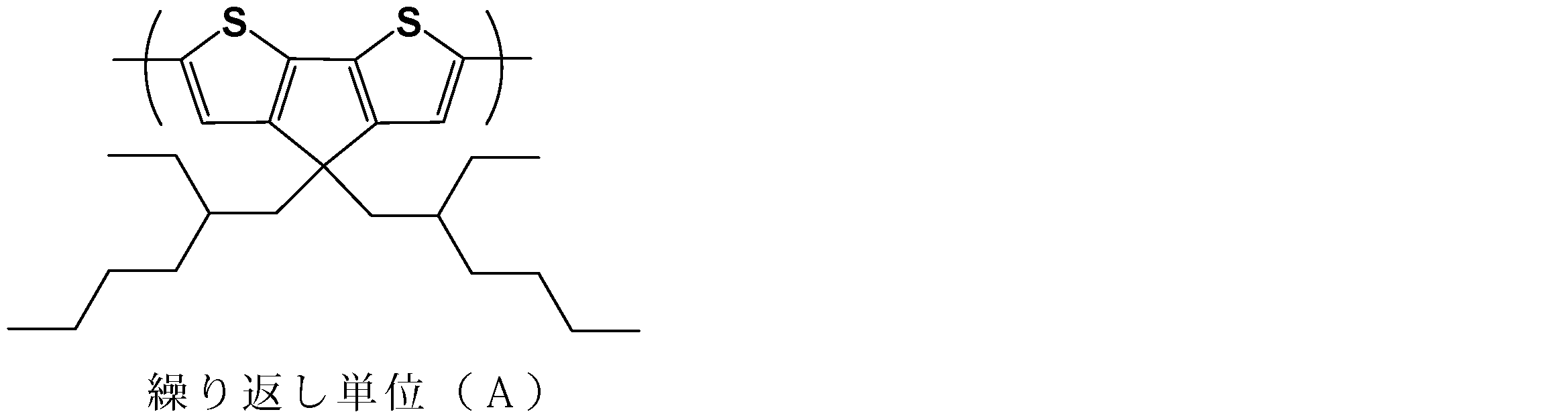

本発明は、アリーレン単位、ヘテロアリーレン単位、複素環単位及び芳香族アミン単位からなる群より選ばれる2種以上を繰り返し単位として有し、前記繰り返し単位の少なくとも一部が炭素クラスター構造を含む基を有する高分子化合物を提供する。


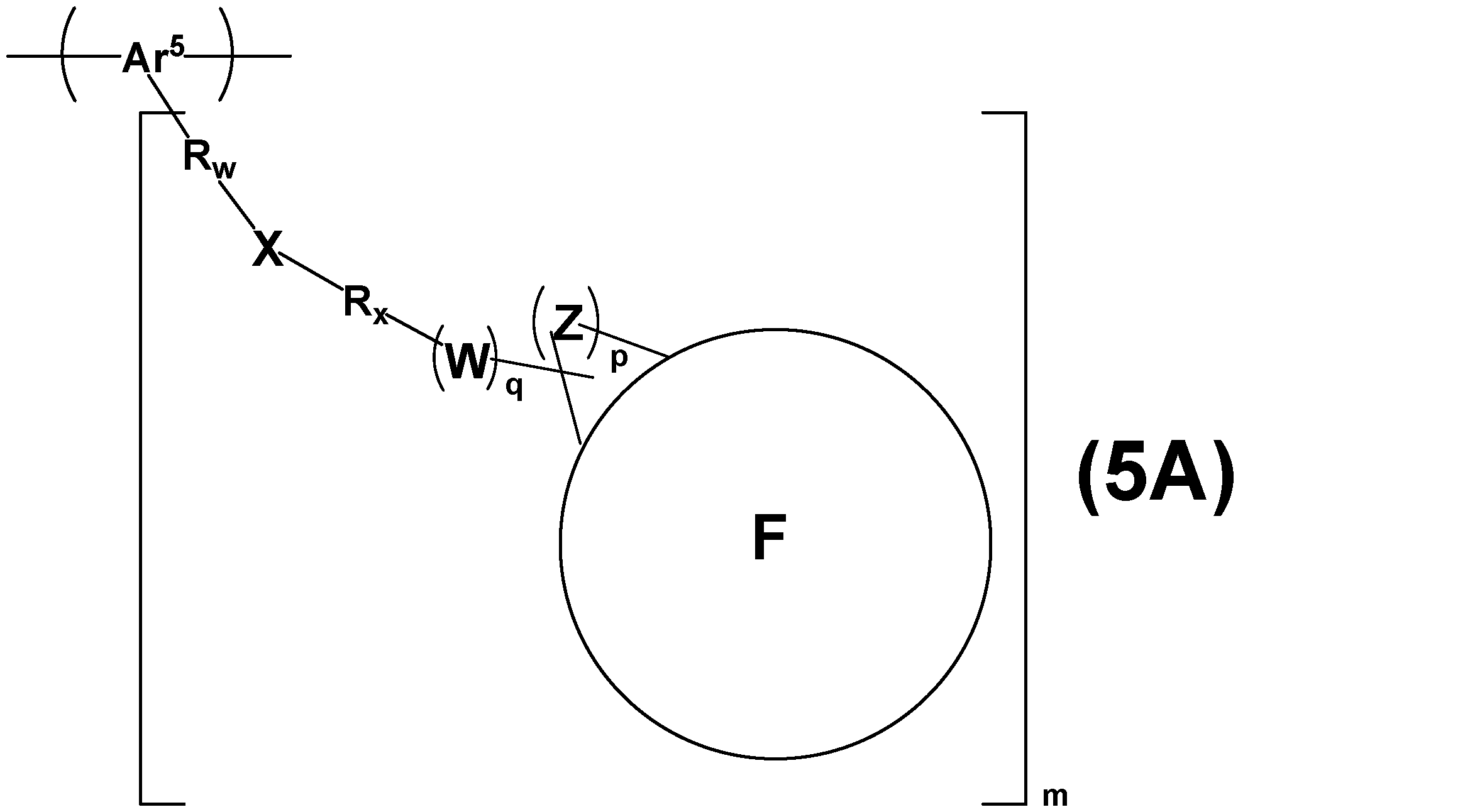

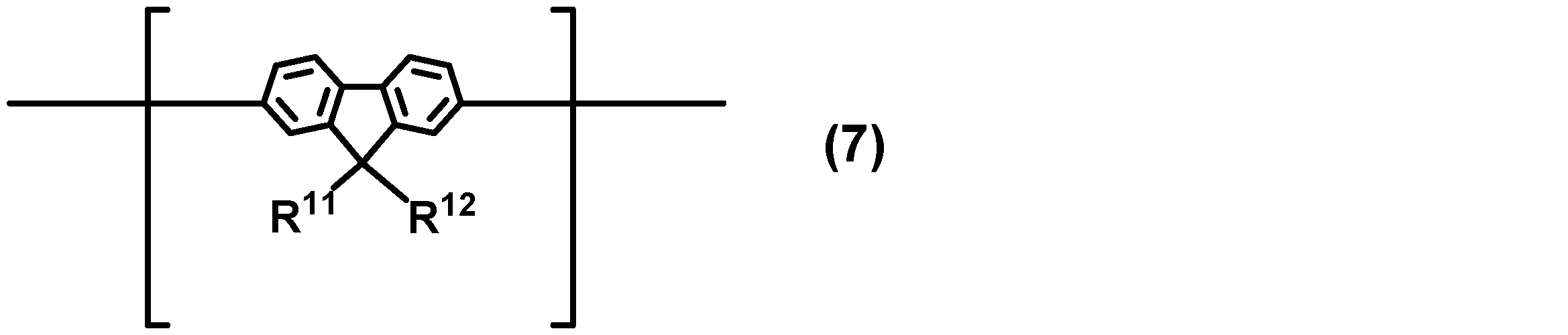
以下、本発光素子形態において共通して用いられる用語について、必要に応じて具体例を挙げて説明する。


本発光素子形態に係る高分子化合物は、アリーレン単位、ヘテロアリーレン単位、複素環単位及び芳香族アミン単位からなる群より選ばれる2種以上を繰り返し単位として有し、前記繰り返し単位の少なくとも一部が炭素クラスター構造を含む基を有する。
ヘテロアリーレン単位中のヘテロアリーレン基は、前述のとおりである。
複素環単位中の2価の複素環基は、前述のとおりである。
芳香族アミン単位中の2価の芳香族アミン残基は、前述のとおりである。


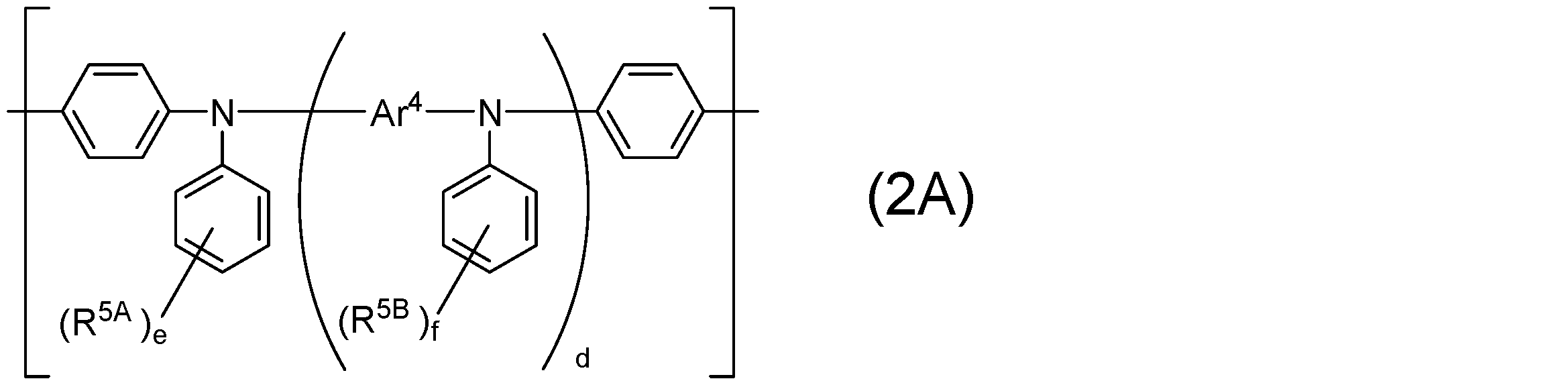


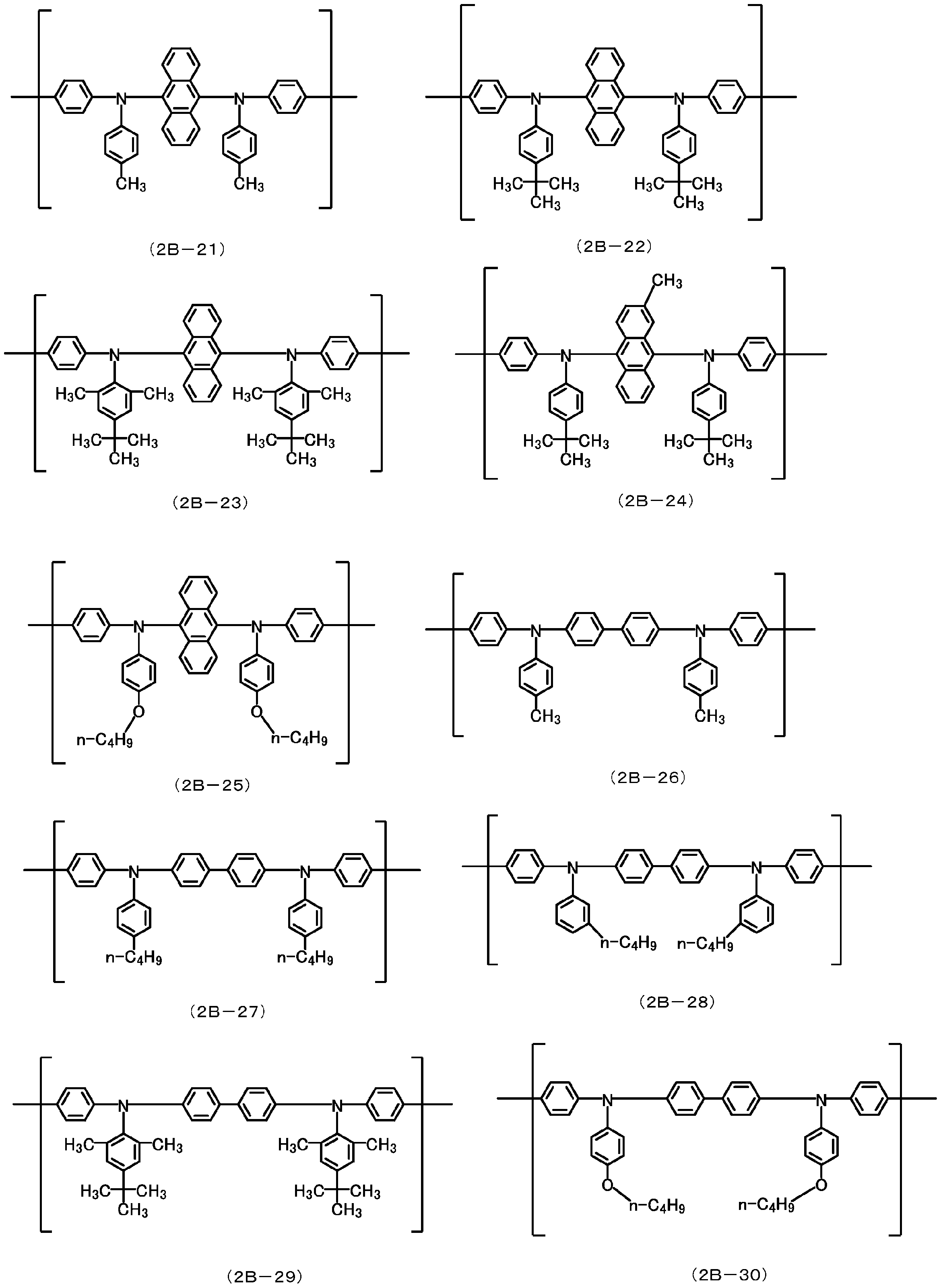
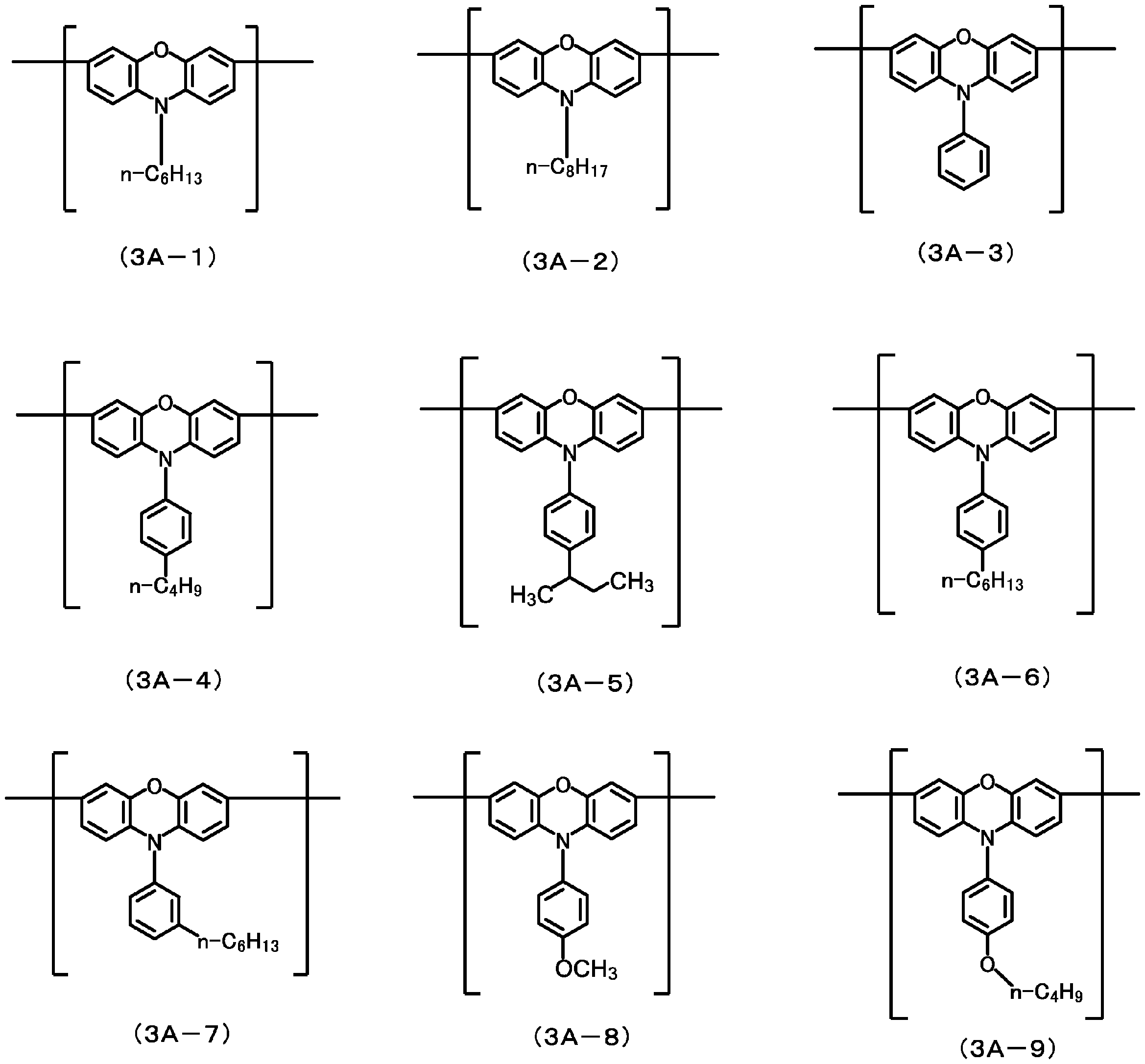
アリーレン単位中のアリーレン基は、前述のとおりである。
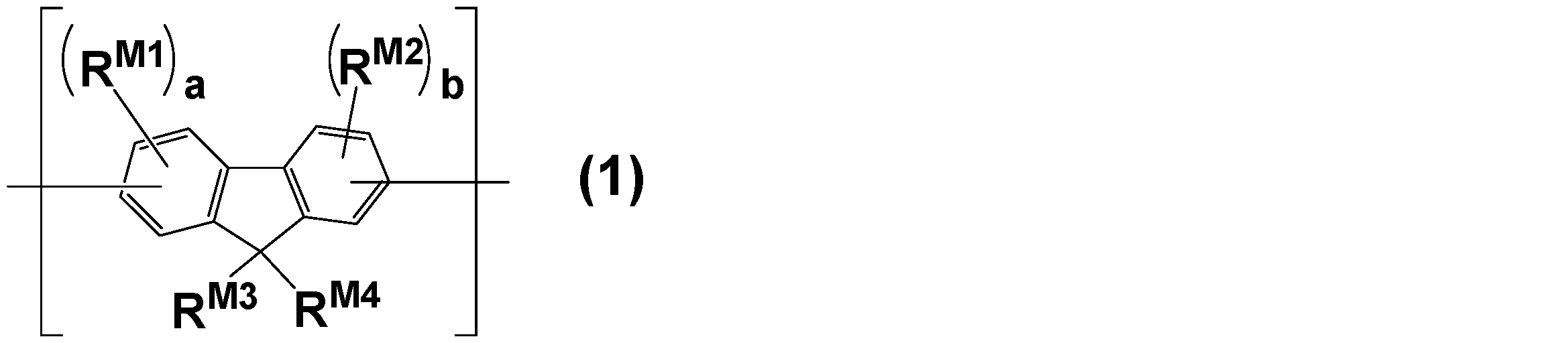
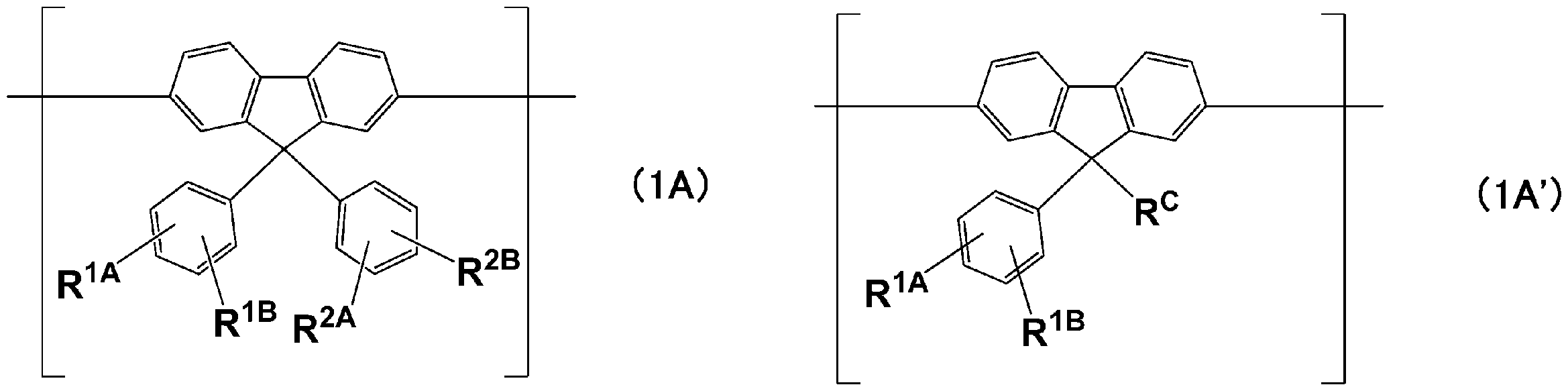
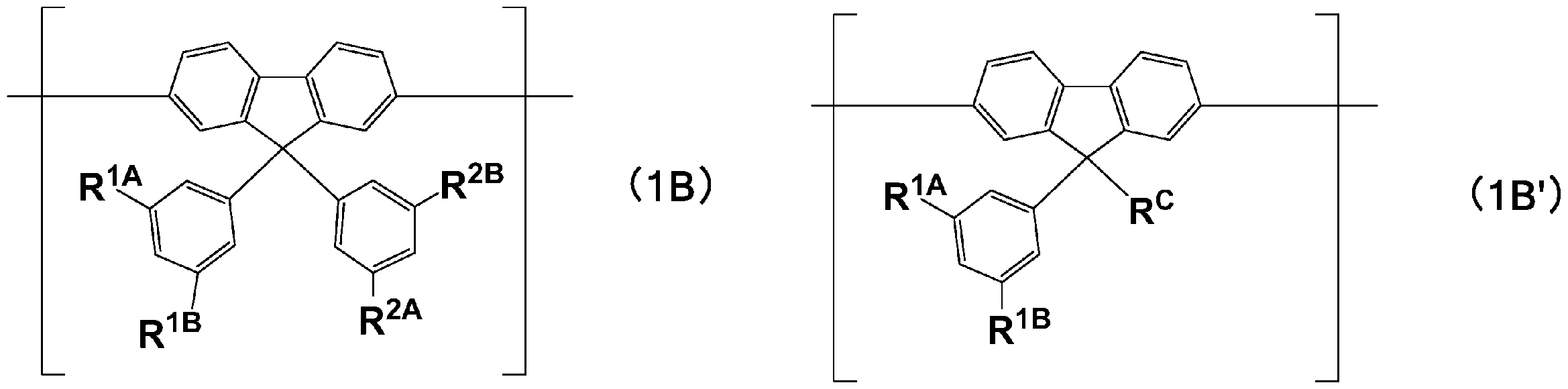
で表される基、下記一般式(1C)及び一般式(1C’):
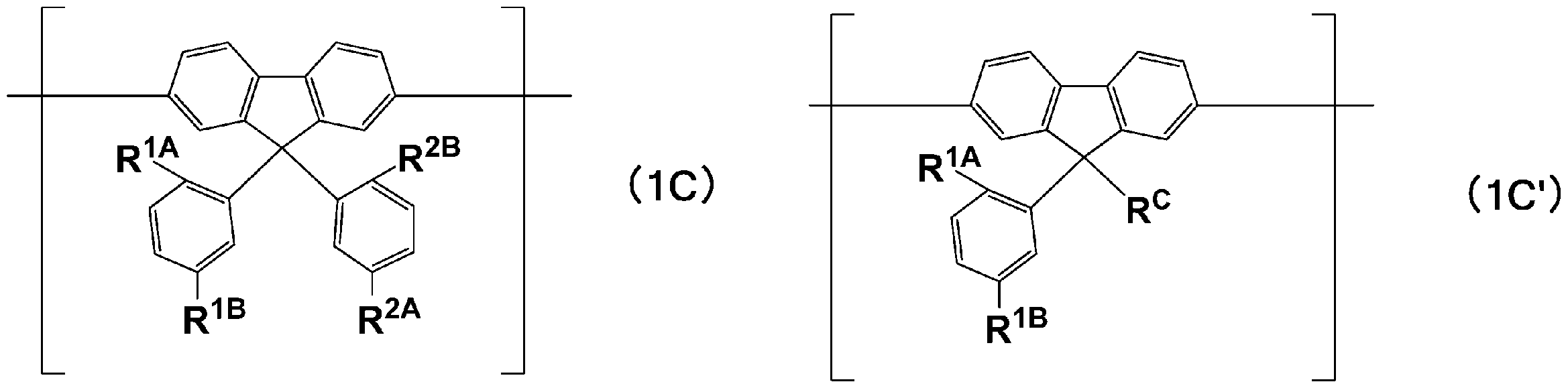
で表される基、又は下記一般式(1D)及び一般式(1D’):

で表される基であり、更に好ましくは、上記一般式(1B)及び一般式(1B’)で表される基、又は上記一般式(1D)及び一般式(1D’)で表される基であり、特に好ましくは、上記一般式(1B)及び一般式(1B’)で表される基である。
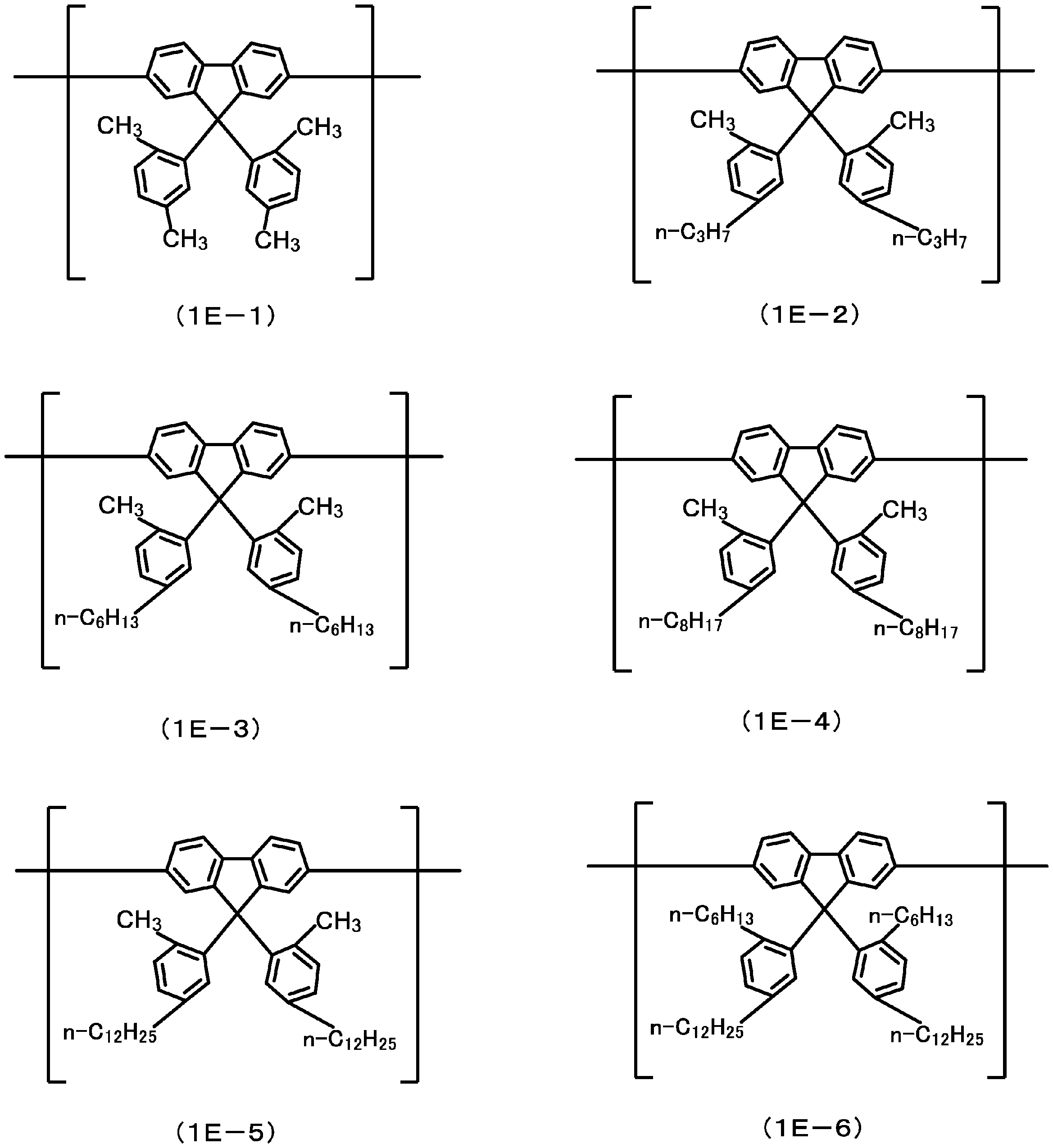
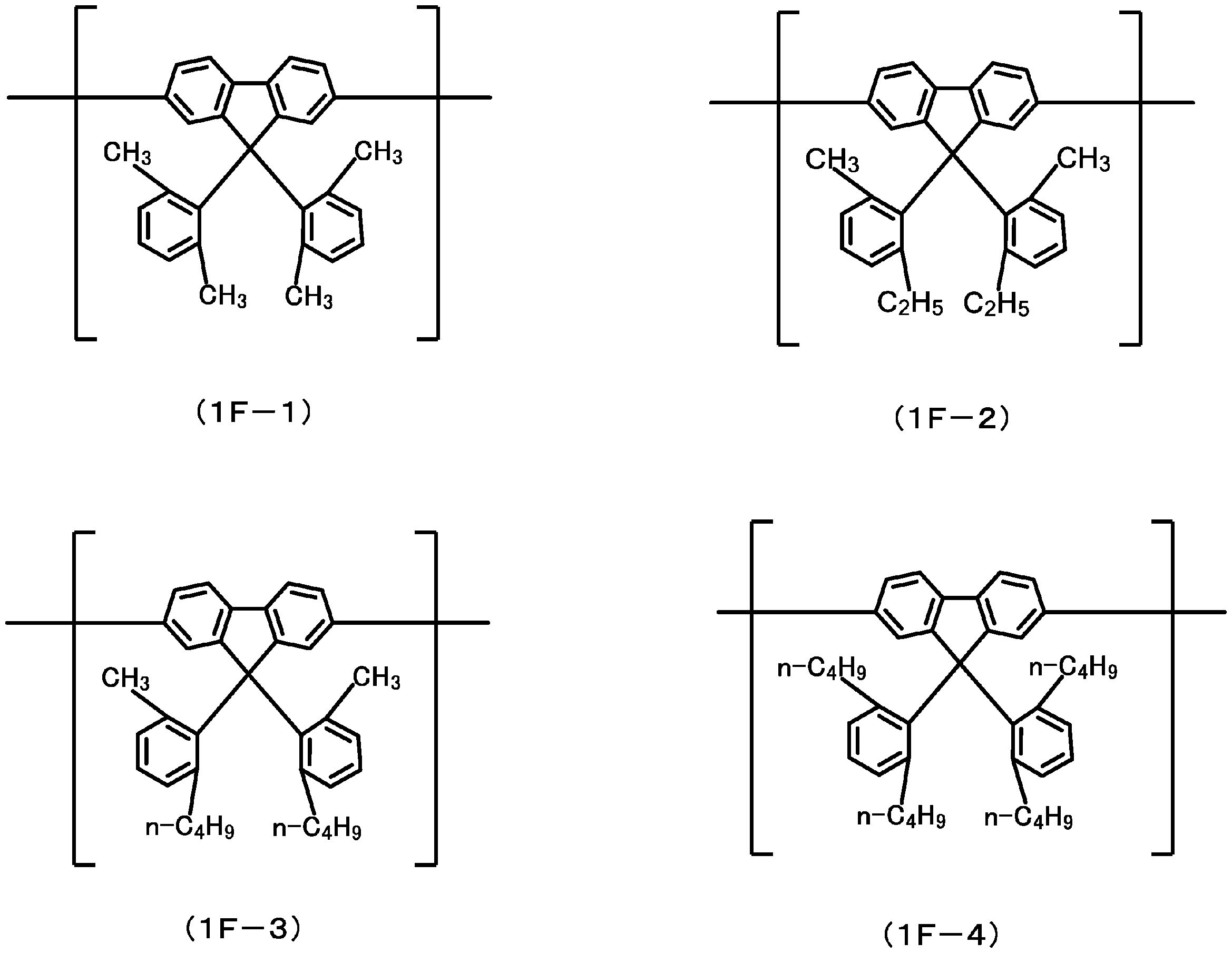
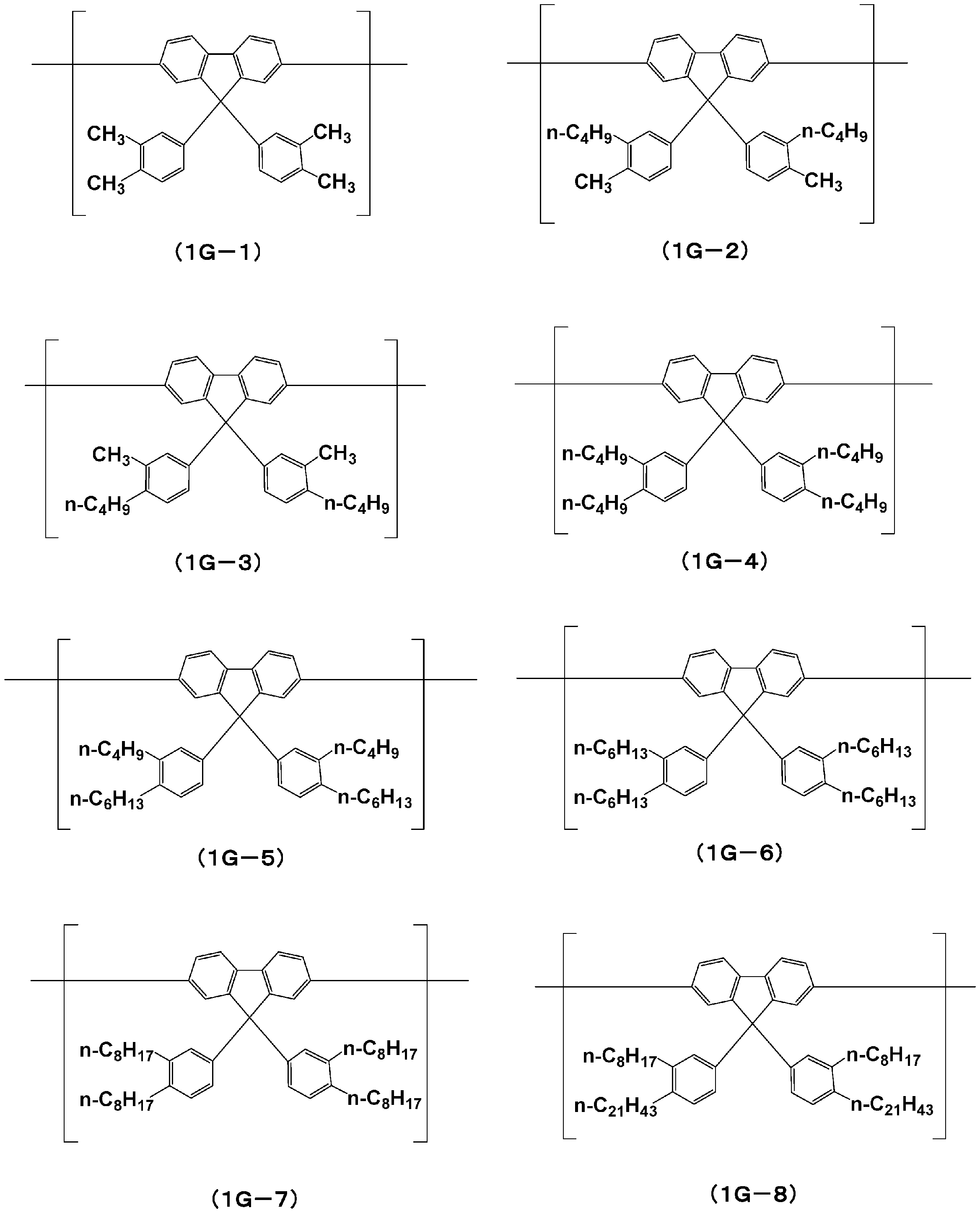
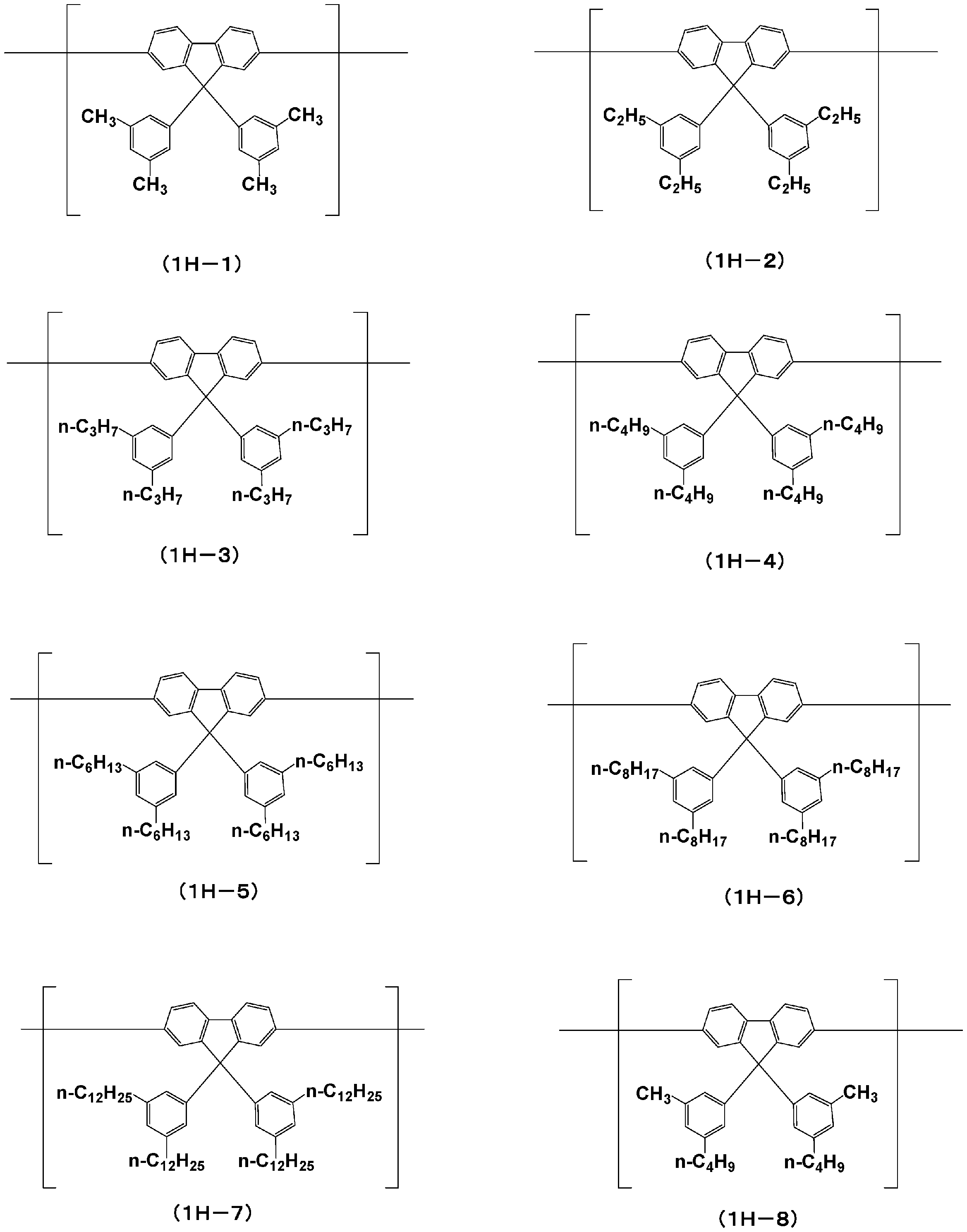

炭素クラスター構造を含む基を有する繰り返し単位は、下記一般式(5A)で表される繰り返し単位であることが好ましい。


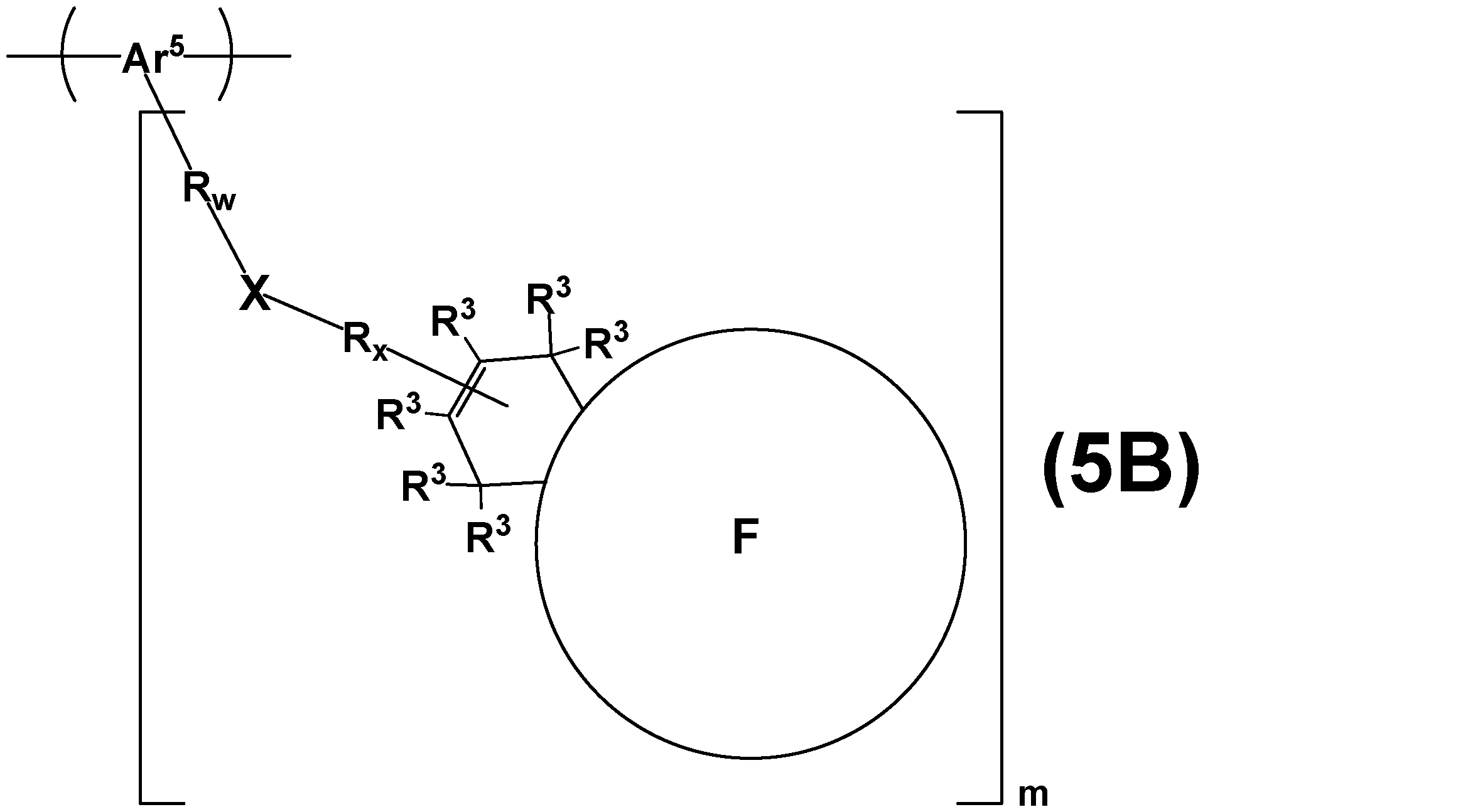


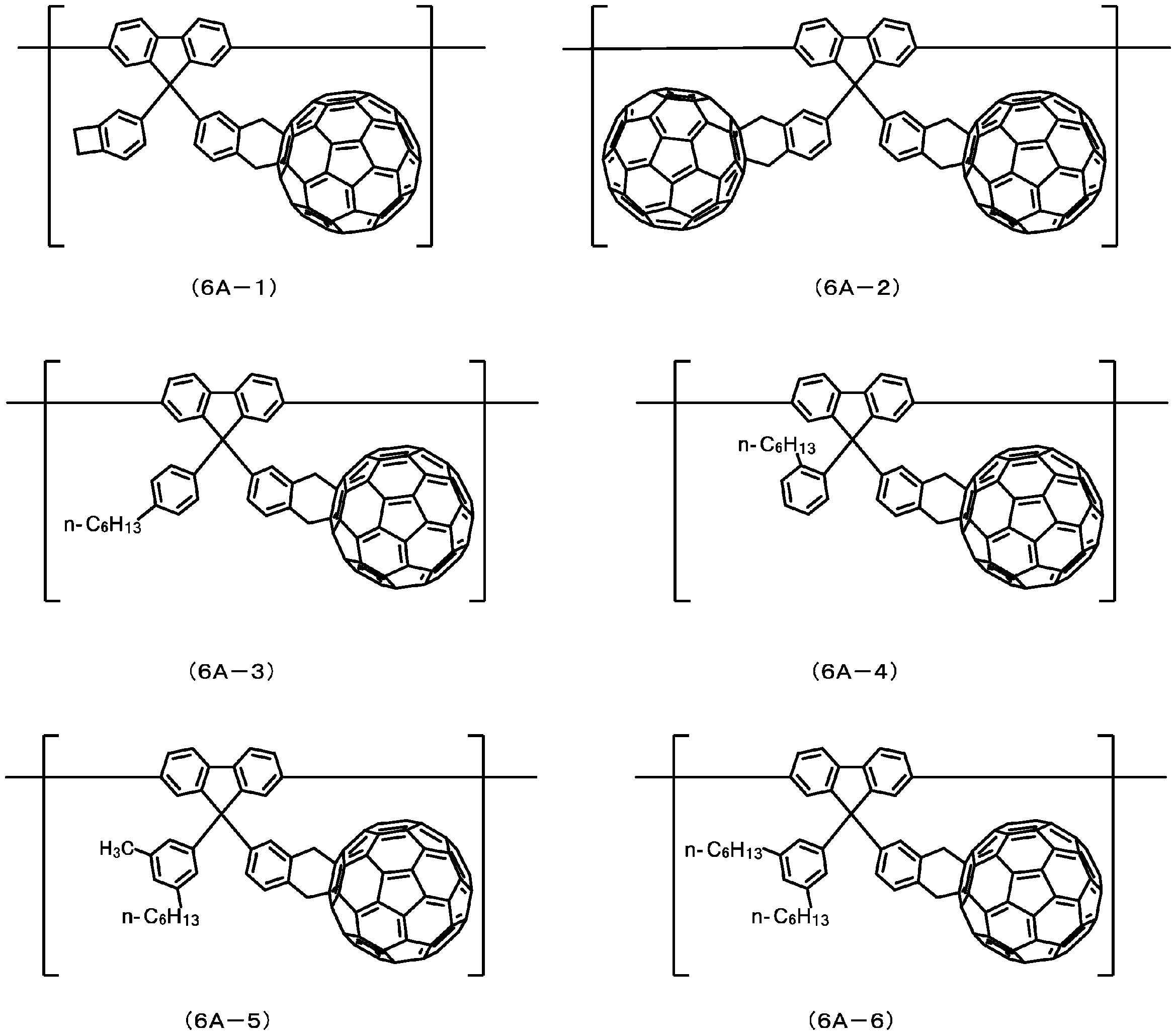

5≦NC×100/(NC+NNC)≦100 (0)
また、上記NC及びNNCが下記式(I)を満たすことがより好ましく、下記式(II)を満たすことが更に好ましく、下記式(III)を満たすことが特に好ましい。
0.001≦NC×100/(NC+NNC)≦90 (I)
0.001≦NC×100/(NC+NNC)≦50 (II)
0.001≦NC×100/(NC+NNC)≦10 (III)
本発光素子形態に係る高分子化合物は、当該高分子化合物に含まれる単位に対応する化合物(モノマー)を縮合重合して得ることができる。モノマーは、予め合成し単離したものを用いてもよく、反応系中で合成してそのまま用いてもよい。得られる高分子化合物を有機EL素子に用いる場合、モノマーの純度が有機EL素子の性能に影響を与える傾向がある。そのため、これらのモノマーは蒸留、昇華精製、再結晶等の方法で精製されていることが好ましい。
本発光素子形態に係る高分子化合物は、炭素クラスター構造を含む基を有する化合物であって、縮合重合により合成したときに、アリーレン単位、ヘテロアリーレン単位、複素環単位又は芳香族アミン単位となる化合物を用いて縮合重合することにより製造することができる。その他の縮合重合に用いる化合物は、アリーレン単位、ヘテロアリーレン単位、複素環単位及び芳香族アミン単位からなる群より選ばれる2種以上が繰り返し単位となるように選択することができる。





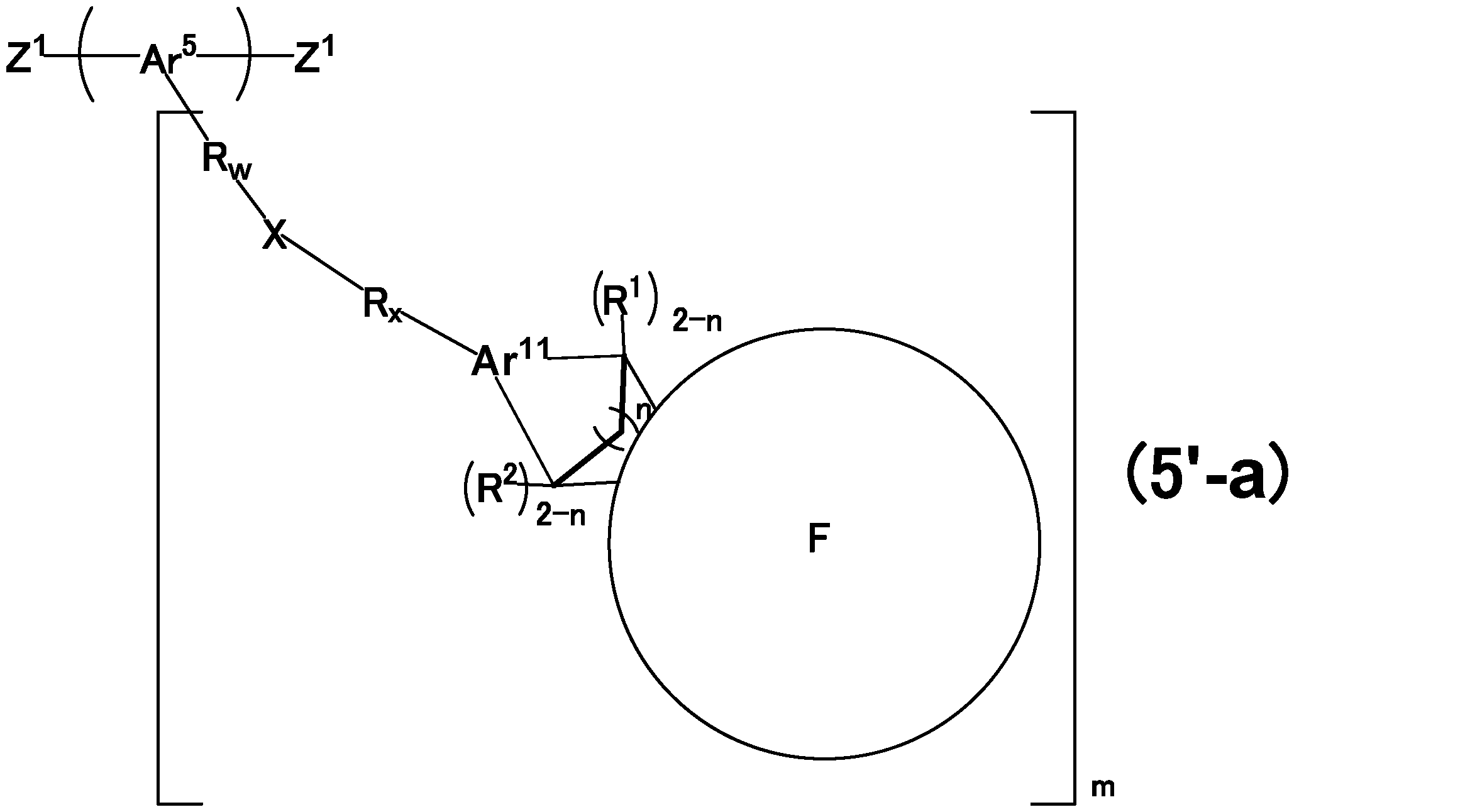


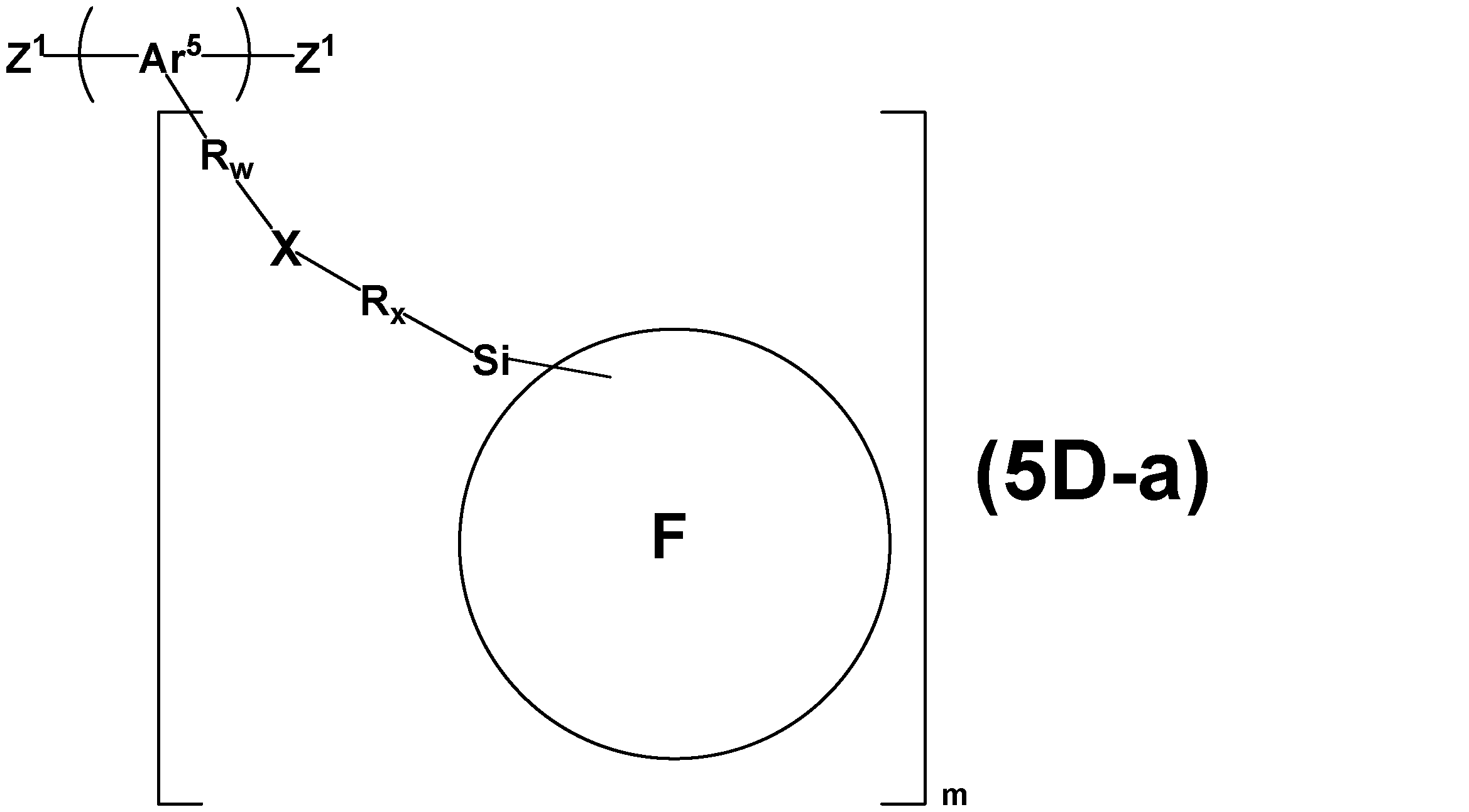

本発光素子形態に係る高分子化合物はまた、予め縮合重合によって合成した前駆体高分子化合物と、炭素クラスターとを反応させることにより得ることもできる。前駆体高分子化合物は、アリーレン単位、ヘテロアリーレン単位、複素環単位及び芳香族アミン単位からなる群より選ばれる2種以上を繰り返し単位として有し、かつ繰り返し単位の少なくとも一部が架橋性基を含有するものである。前記架橋性基を含有する繰り返し単位は、下記一般式(7)で表される単位であることが好ましい。

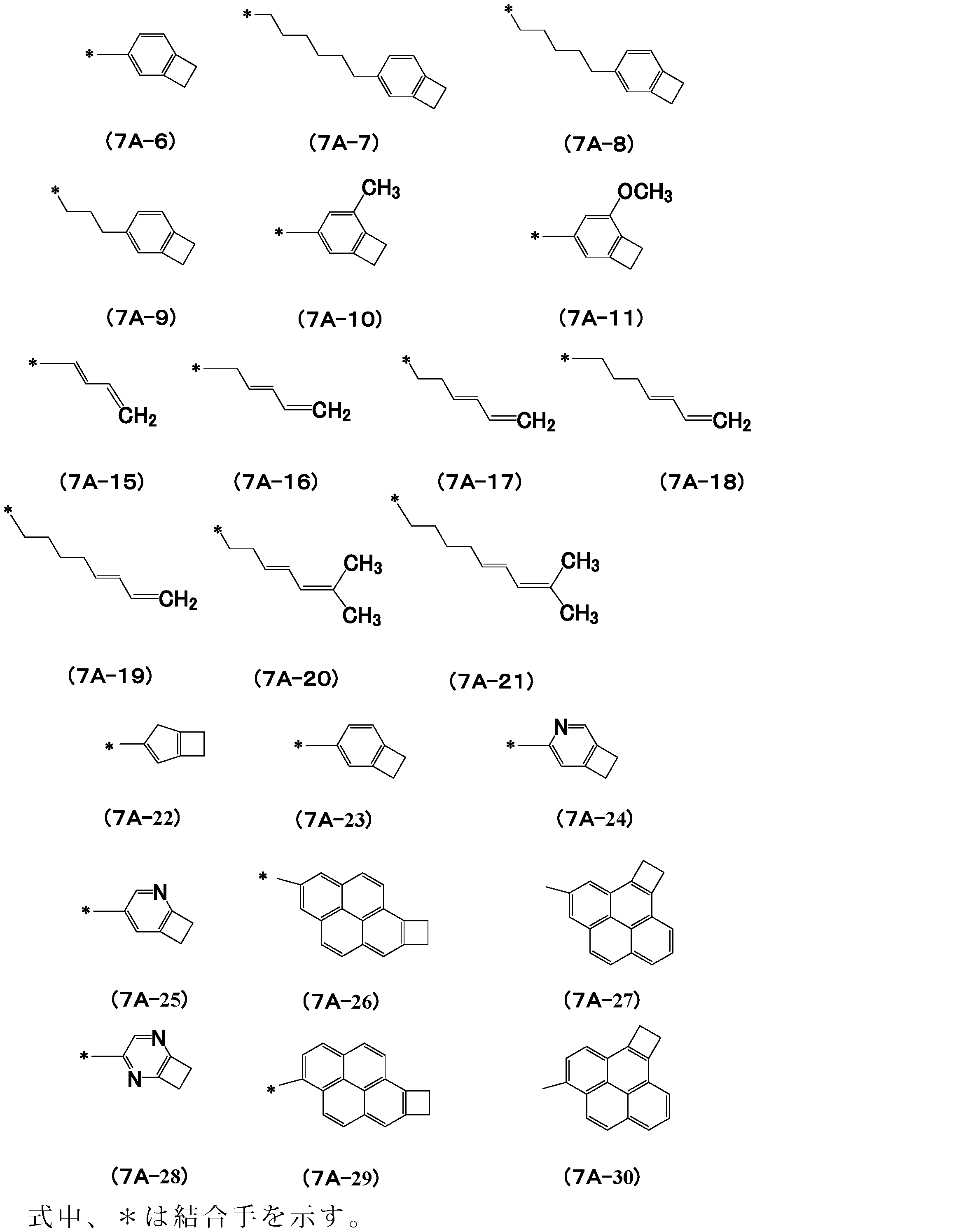
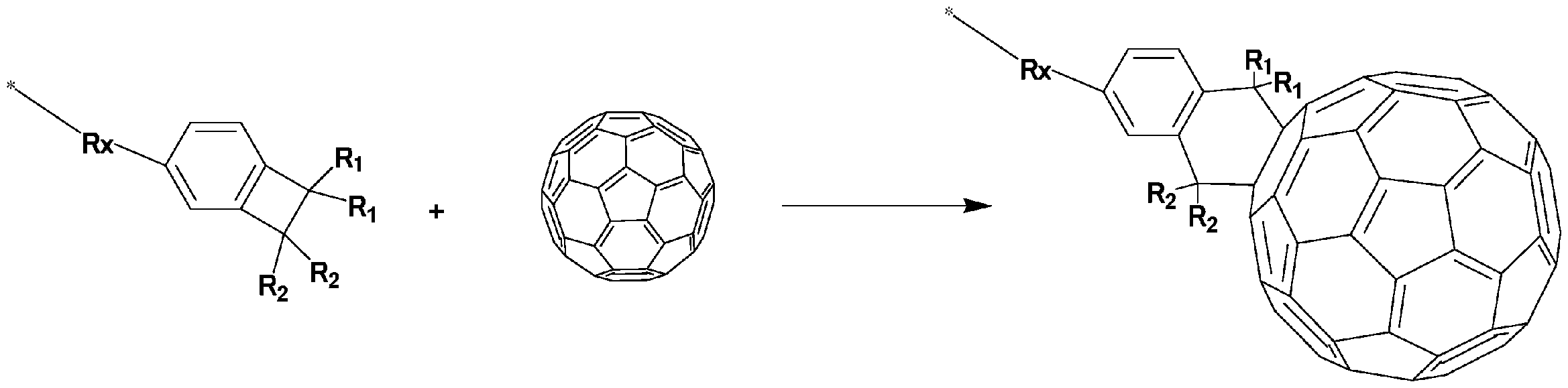


NNS×100/(N7+NM)≦0.1 (IV)
また、上記N7、NM及びNNSが下記式(V)を満たすことが、より好ましい。
NNS×100/(N7+NM)≦0.05 (V)
(1)フラーレンC60のトルエン溶液を、異なる濃度で複数調製し、それぞれGPC-UV(335nmで検出)測定を行う。
(2)(1)の測定で得たクロマトグラムを用い、検量線(フラーレン濃度に対するフラーレン溶出ピーク面積値)を作成する。
(3)実試料のGPC-UV測定を行う。
(4)(3)の測定で得たクロマトグラムのフラーレン溶出ピーク面積値及び(2)の検量線を用いて、実試料中の遊離フラーレン量を算出する。
(1)前駆体高分子化合物に、フラーレンC60を異なる濃度で混合した標準サンプルを複数調製し、それぞれUV吸収スペクトルを測定する。
(2)(1)で得たUV吸収スペクトルから335nmにおける吸収の相対強度を求め、検量線(335nmにおける吸収の相対強度に対する混合したフラーレン量)を作成する。
(3)実試料中の高分子化合物溶出画分(固定フラーレンを含む)をGPCで分取し、高分子化合物溶出画分を得る。
(4)(3)で得た高分子化合物溶出画分のUV吸収スペクトルを測定する。
(5)(4)で得たUV吸収スペクトルから335nmにおける吸収の相対強度を求め、(2)の検量線を用いて、実試料中の固定フラーレン量を算出する。
次に本発光素子形態に係る高分子化合物、又は前駆体高分子化合物を縮合重合により製造する方法を、前駆体高分子化合物を例として説明する。


本発光素子形態に係る第一の組成物は、正孔輸送材料、電子輸送材料及び発光材料からなる群より選ばれる1種以上の材料(通常、固形分である。)と、本発光素子形態に係る高分子化合物とを含有する組成物(通常、固形分である。)である。
芳香族炭化水素系溶媒:トルエン、キシレン(各異性体又はそれらの混合物)、1,2,3-トリメチルベンゼン、1,2,4-トリメチルベンゼン、メシチレン(1,3,5-トリメチルベンゼン)、エチルベンゼン、プロピルベンゼン、イソプロピルベンゼン、ブチルベンゼン、イソブチルベンゼン、2-フェニルブタン、tert-ブチルベンゼン、ペンチルベンゼン、ネオペンチルベンゼン、イソアミルベンゼン、ヘキシルベンゼン、シクロヘキシルベンゼン、ヘプチルベンゼン、オクチルベンゼン、3-プロピルトルエン、4-プロピルトルエン、1-メチル-4-プロピルベンゼン、1,4-ジエチルベンゼン、1,4-ジプロピルベンゼン、1,4-ジ-tert-ブチルベンゼン、インダン、テトラリン(1,2,3,4-テトラヒドロナフタレン)等。
脂肪族炭化水素系溶媒:n-ペンタン、n-ヘキサン、シクロヘキサン、メチルシクロヘキサン、n-へプタン、n-オクタン、n-ノナン、n-デカン、デカリン等。
芳香族系エーテル系溶媒:アニソール、エトキシベンゼン、プロポキシベンゼン、ブチロキシベンゼン、ペンチルオキシベンゼン、シクロペンチルオキシベンゼン、ヘキシルオキシベンゼン、シクロヘキシルオキシベンゼン、ヘプチルオキシベンゼン、オクチルオキシベンゼン、2-メチルアニソール、3-メチルアニソール、4-メチルアニソール、4-エチルアニソール、4-プロピルアニソール、4-ブチルアニソール、4-ペンチルアニソール、4-ヘキシルアニソール、ジフェニルエーテル、4-メチルフェノキシベンゼン、4-エチルフェノキシベンゼン、4-プロピルフェノキシベンゼン、4-ブチルフェノキシベンゼン、4-ペンチルフェノキシベンゼン、4-ヘキシルフェノキシベンゼン、4-フェノキシトルエン、3-フェノキシトルエン、1,3-ジメトキシベンゼン、2,6-ジメチルアニソール、2,5-ジメチルアニソール、2,3-ジメチルアニソール、3,5-ジメチルアニソール等。
脂肪族エーテル系溶媒:テトラヒドロフラン、ジオキサン、ジオキソラン等。
ケトン系溶媒:アセトン、メチルエチルケトン、メチルイソブチルケトン、シクロヘキサノン、アセトフェノン等。
エステル系溶媒:酢酸エチル、酢酸ブチル、安息香酸メチル、エチルセルソルブアセテート等。
塩素化溶媒:塩化メチレン、クロロホルム、1,2-ジクロロエタン、1,1,2-トリクロロエタン、クロロベンゼン、o-ジクロロベンゼン等。
アルコール系溶媒:メタノール、エタノール、プロパノール、イソプロパノール、シクロヘキサノール、フェノール等。
多価アルコール及びその誘導体:エチレングリコール、エチレングリコールモノブチルエーテル、エチレングリコールモノエチルエーテル、エチレングリコールモノメチルエーテル、ジメトキシエタン、プロピレングリコール、ジエトキシメタン、トリエチレングリコールモノエチルエーテル、グリセリン、1,2-ヘキサンジオール等。
非プロトン性極性溶媒:ジメチルスルホキシド、N-メチル-2-ピロリドン、N,N-ジメチルホルムアミド、N,N-ジメチルアセトアミド等。
芳香族炭化水素系溶媒と脂肪族炭化水素系溶媒、芳香族炭化水素系溶媒と芳香族エーテル系溶媒、芳香族炭化水素系溶媒と脂肪族エーテル系溶媒、芳香族炭化水素系溶媒と非プロトン性極性溶媒、芳香族エーテル系溶媒と非プロトン性極性溶媒等。
本発光素子形態に係る薄膜は、本発光素子形態に係る高分子化合物を用いて得られるものであり、本発光素子形態に係る高分子化合物をそのまま含有している態様、本発光素子形態に係る高分子化合物が分子内又は分子間で架橋した化合物を含有している態様がある。本発光素子形態に係る薄膜は、例えば、発光性薄膜、導電性薄膜である。
次に、本発光素子形態に係る有機EL素子について説明する。
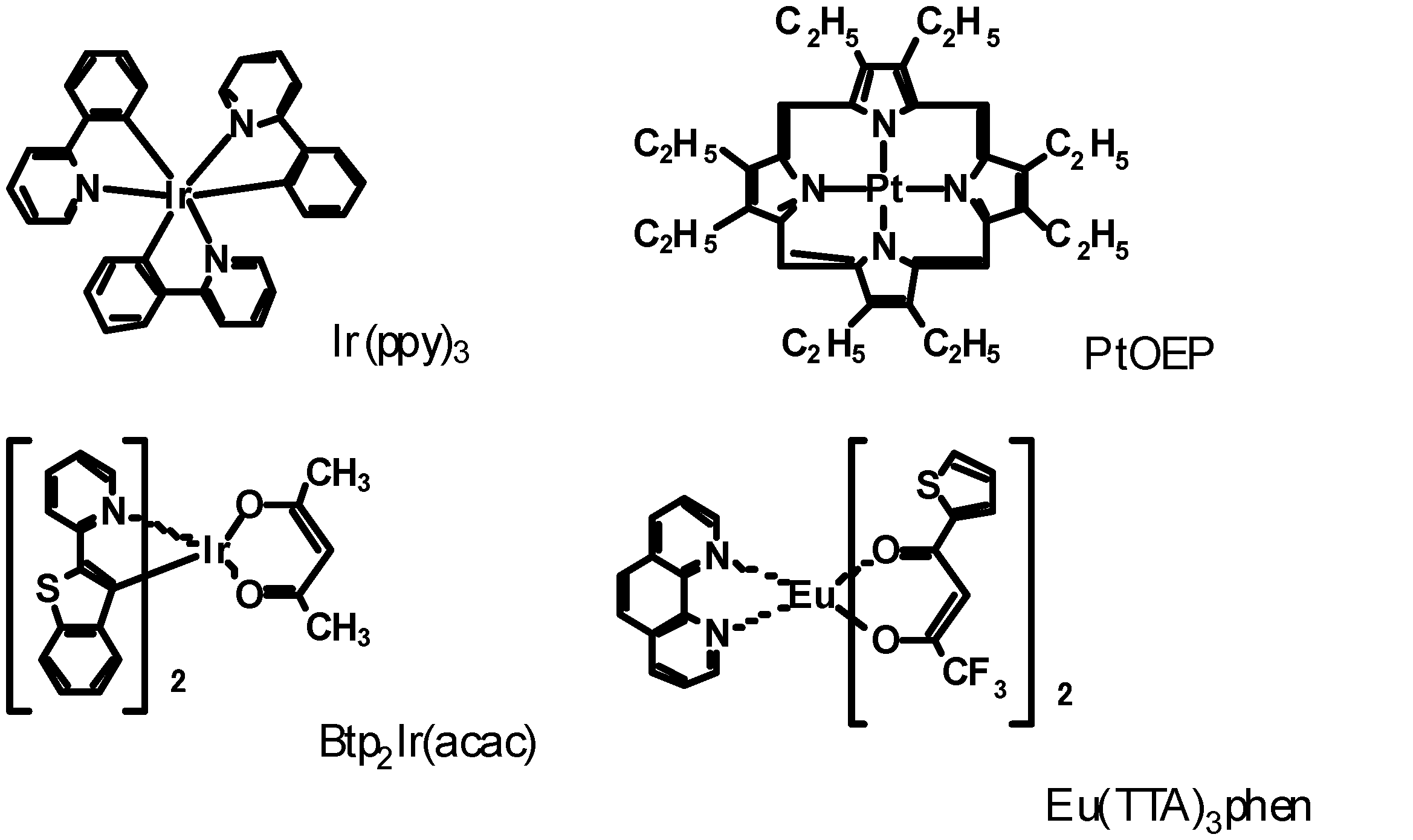
a)陽極/発光層/陰極
b)陽極/正孔輸送層/発光層/陰極
c)陽極/発光層/電子輸送層/陰極
d)陽極/正孔輸送層/発光層/電子輸送層/陰極
a’)陽極/正孔輸送層/発光層/陰極
b’)陽極/正孔輸送層/正孔輸送層/発光層/陰極
c’)陽極/正孔輸送層/発光層/電子輸送層/陰極
d’)陽極/正孔輸送層/正孔輸送層/発光層/電子輸送層/陰極
e)陽極/電荷注入層/発光層/陰極
f)陽極/発光層/電荷注入層/陰極
g)陽極/電荷注入層/発光層/電荷注入層/陰極
h)陽極/電荷注入層/正孔輸送層/発光層/陰極
i)陽極/正孔輸送層/発光層/電荷注入層/陰極
j)陽極/電荷注入層/正孔輸送層/発光層/電荷注入層/陰極
k)陽極/電荷注入層/発光層/電子輸送層/陰極
l)陽極/発光層/電子輸送層/電荷注入層/陰極
m)陽極/電荷注入層/発光層/電子輸送層/電荷注入層/陰極
n)陽極/電荷注入層/正孔輸送層/発光層/電子輸送層/陰極
o)陽極/正孔輸送層/発光層/電子輸送層/電荷注入層/陰極
p)陽極/電荷注入層/正孔輸送層/発光層/電子輸送層/電荷注入層/陰極
q)陽極/絶縁層/発光層/陰極
r)陽極/発光層/絶縁層/陰極
s)陽極/絶縁層/発光層/絶縁層/陰極
t)陽極/絶縁層/正孔輸送層/発光層/陰極
u)陽極/正孔輸送層/発光層/絶縁層/陰極
v)陽極/絶縁層/正孔輸送層/発光層/絶縁層/陰極
w)陽極/絶縁層/発光層/電子輸送層/陰極
x)陽極/発光層/電子輸送層/絶縁層/陰極
y)陽極/絶縁層/発光層/電子輸送層/絶縁層/陰極
z)陽極/絶縁層/正孔輸送層/発光層/電子輸送層/陰極
aa)陽極/正孔輸送層/発光層/電子輸送層/絶縁層/陰極
ab)陽極/絶縁層/正孔輸送層/発光層/電子輸送層/絶縁層/陰極
本発光素子形態に係る有機EL素子は、面状光源、セグメント表示装置、ドットマトリックス表示装置、液晶表示装置のバックライト等に有用である。
以下、本光電変換素子形態において共通して用いられる用語について、必要に応じて具体例を挙げて説明する。

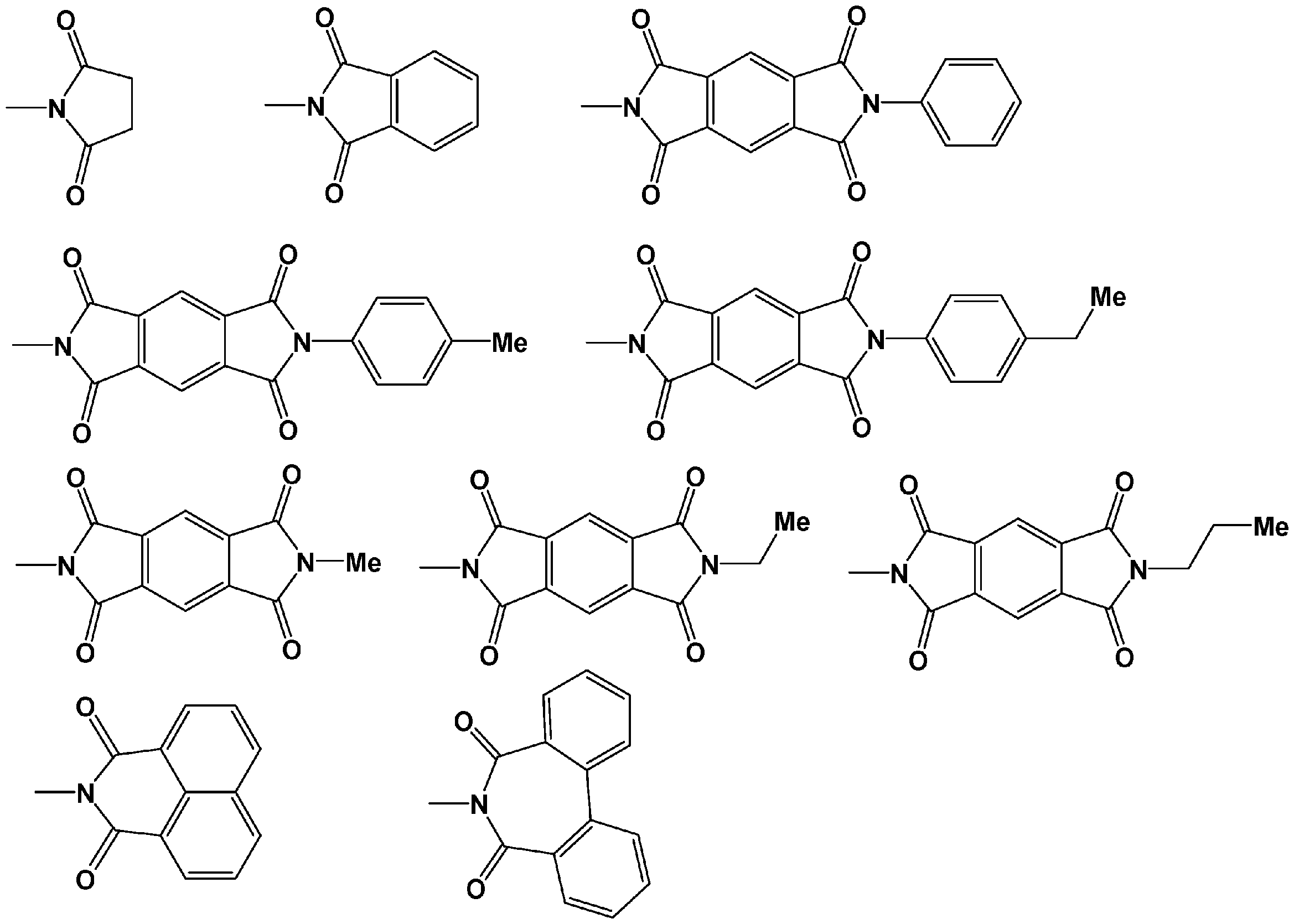
本光電変換素子形態に係る高分子化合物は、アリーレン単位及びヘテロアリーレン単位からなる群より選ばれる少なくとも1種を繰り返し単位として有し、繰り返し単位の少なくとも一部が炭素クラスター構造を含む基を有する。


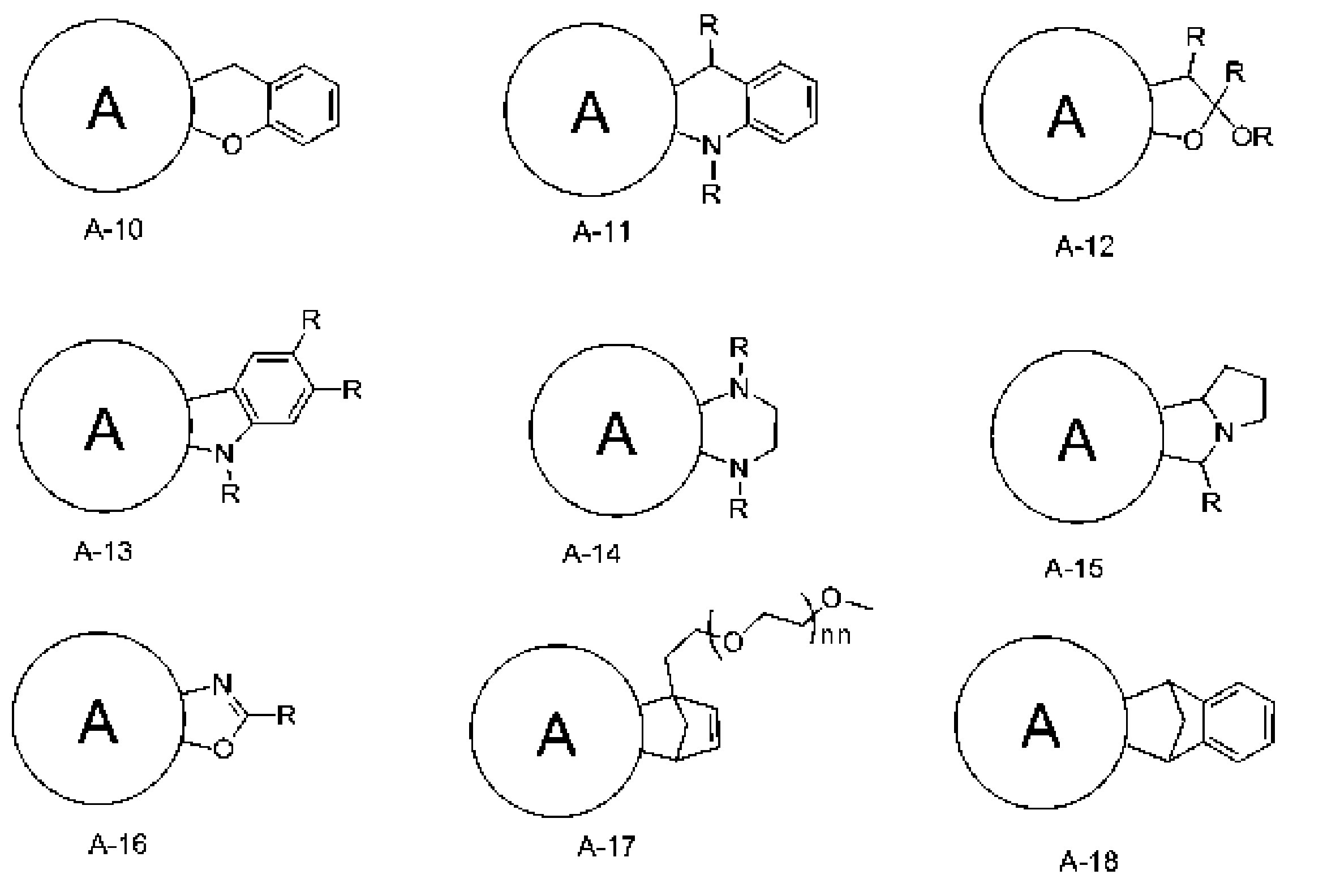


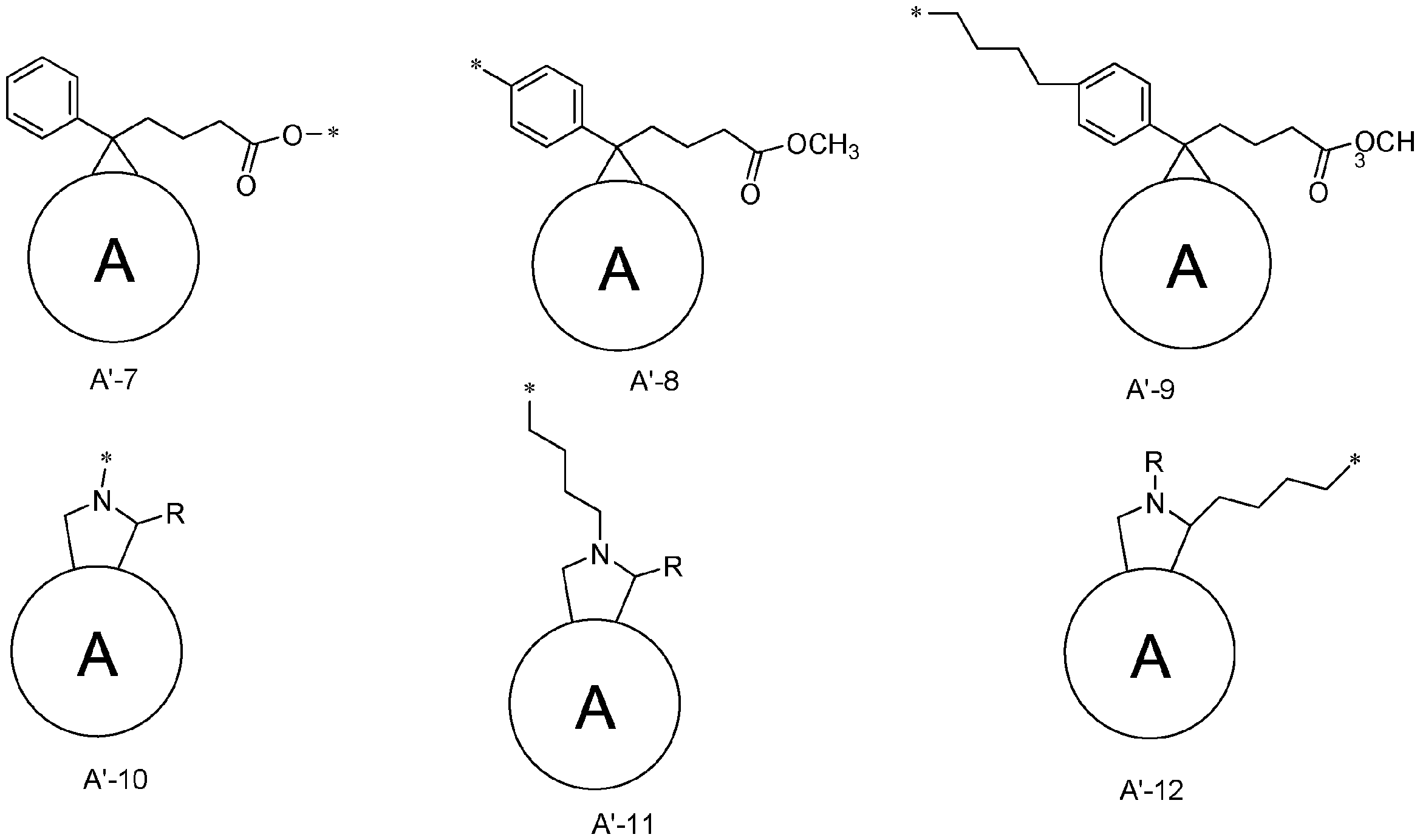
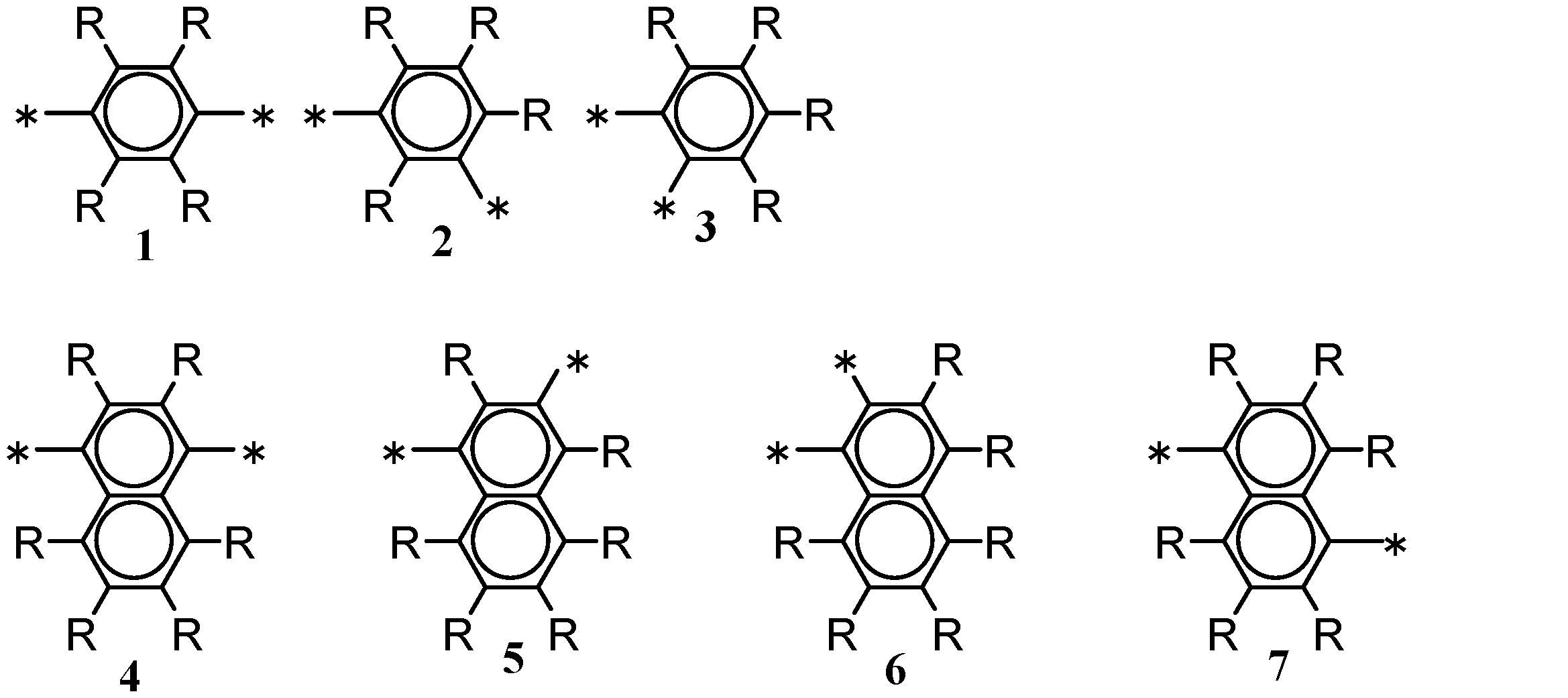

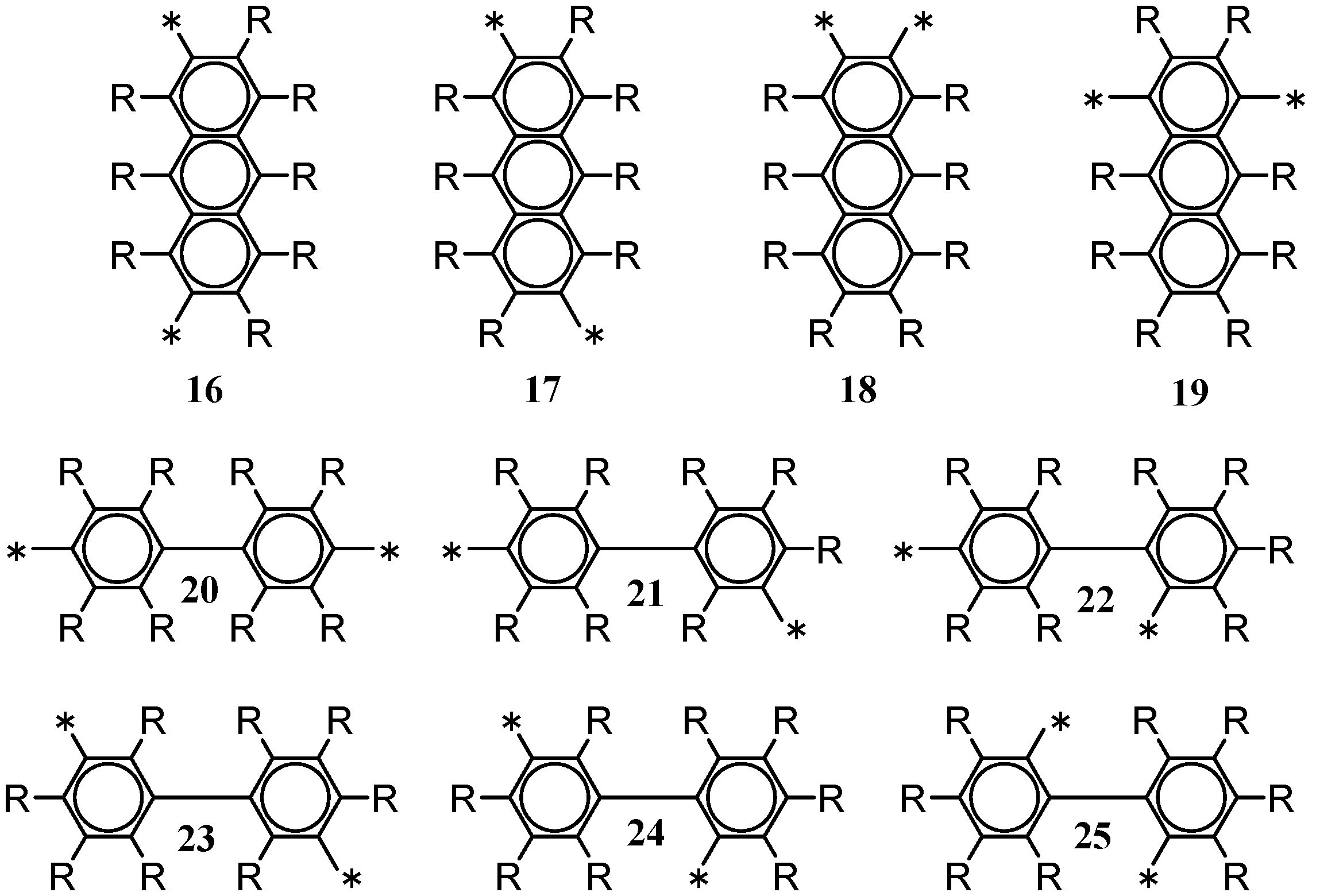
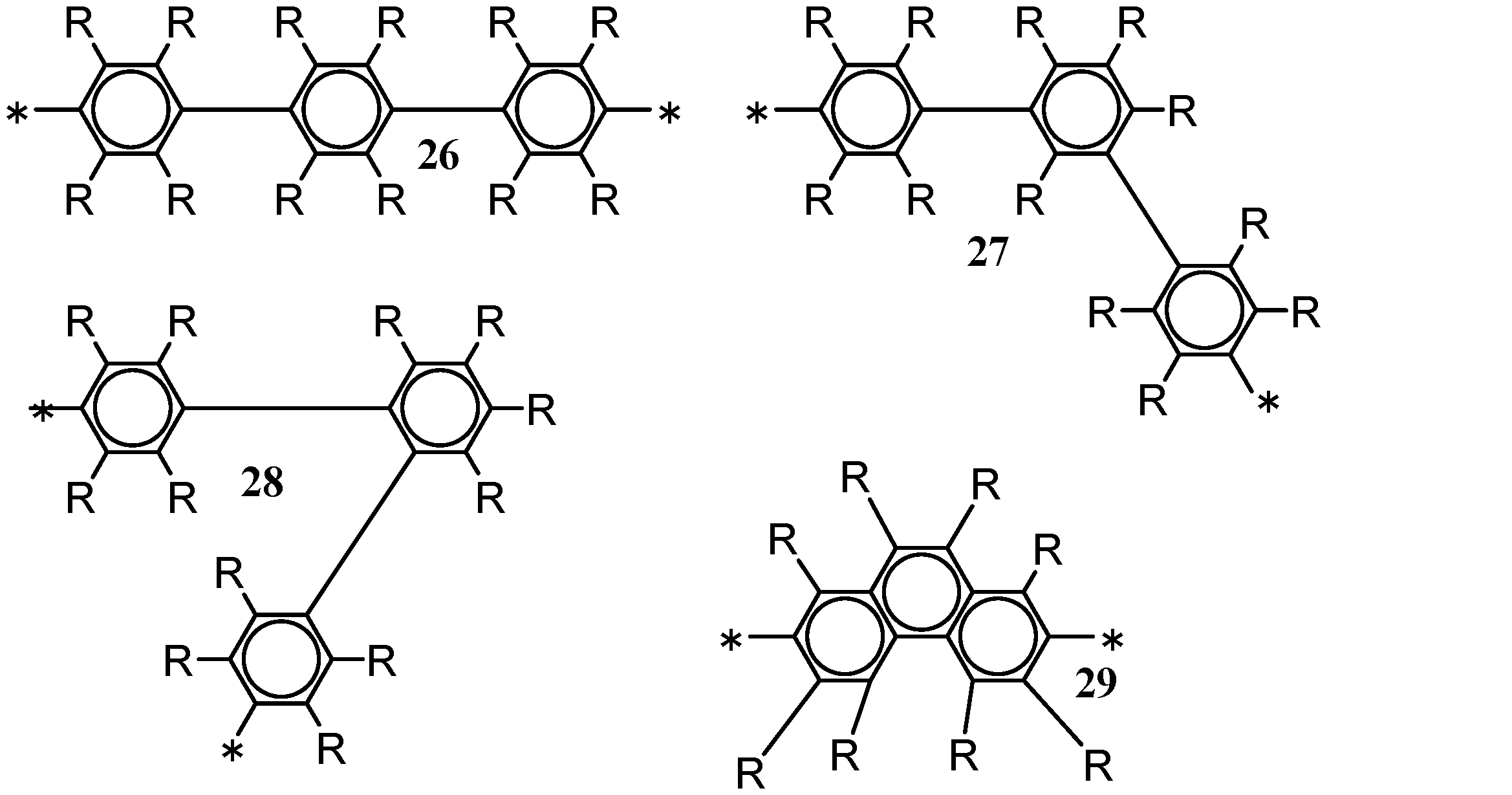
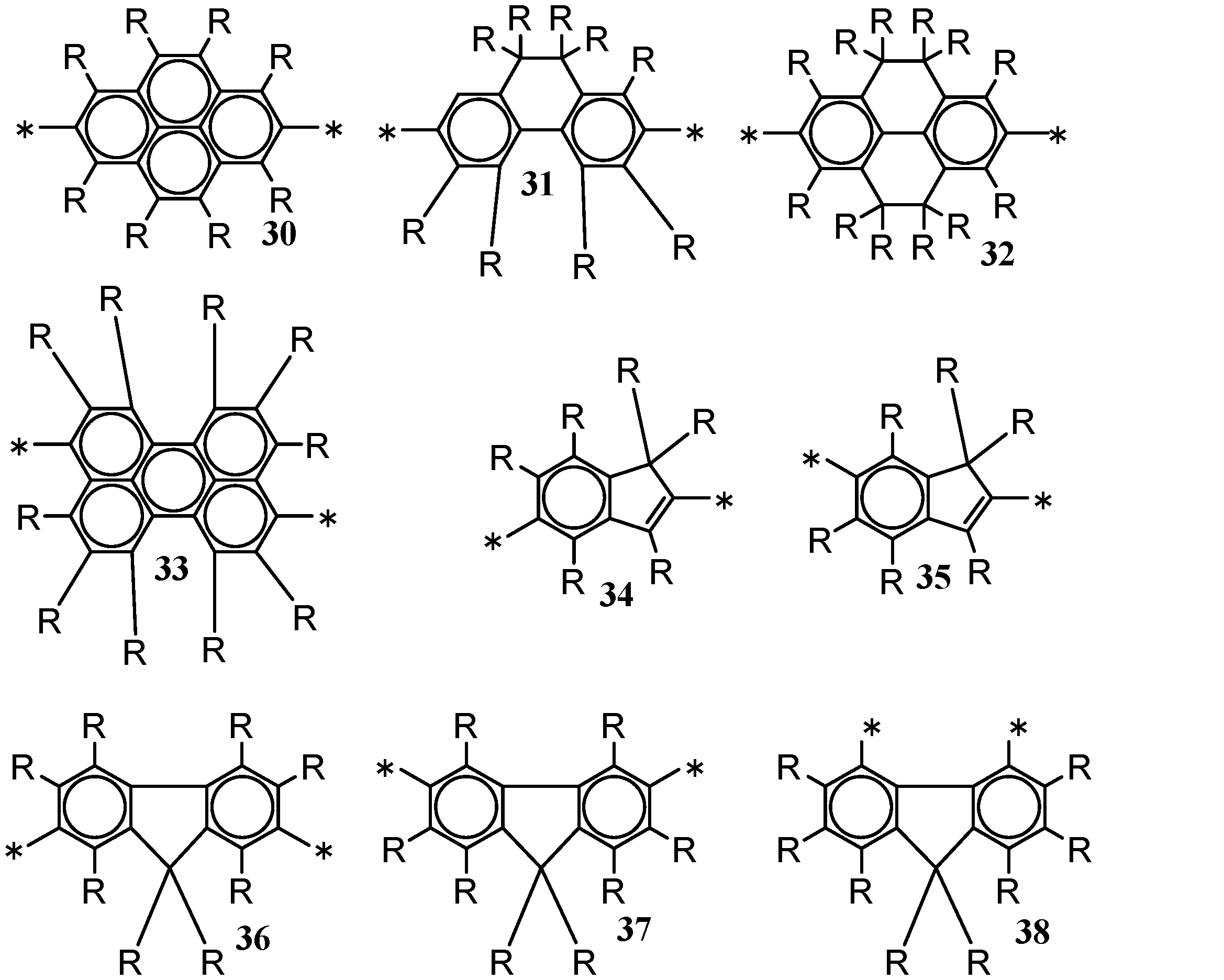

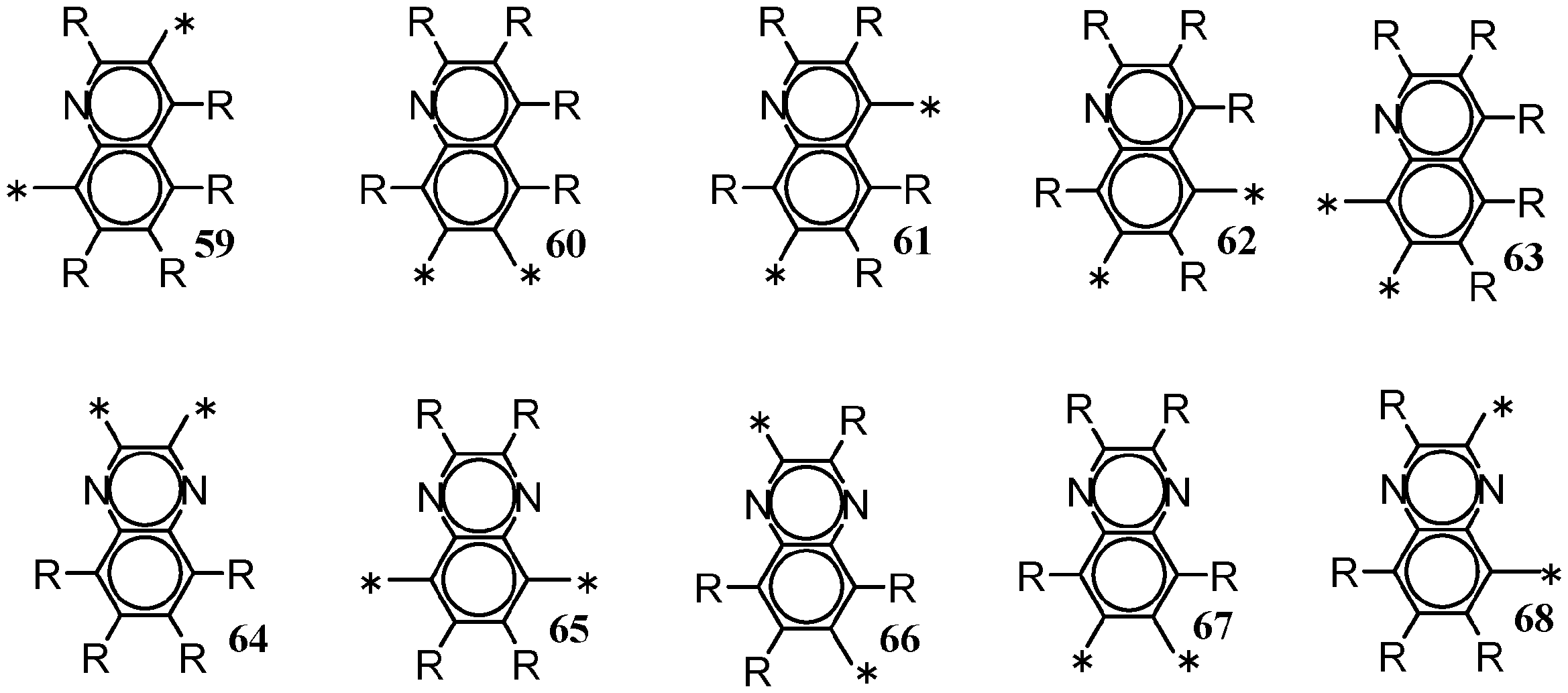


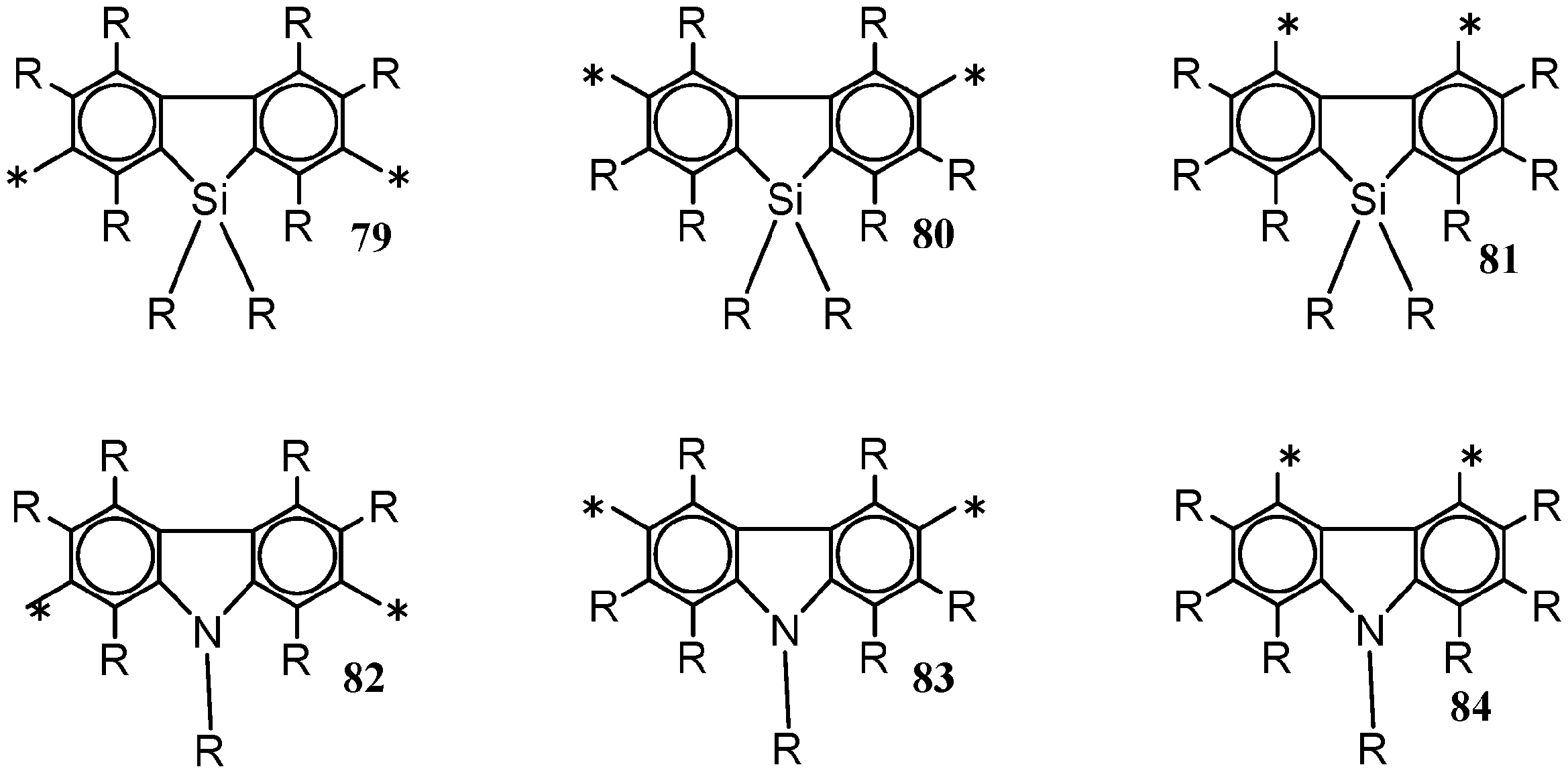

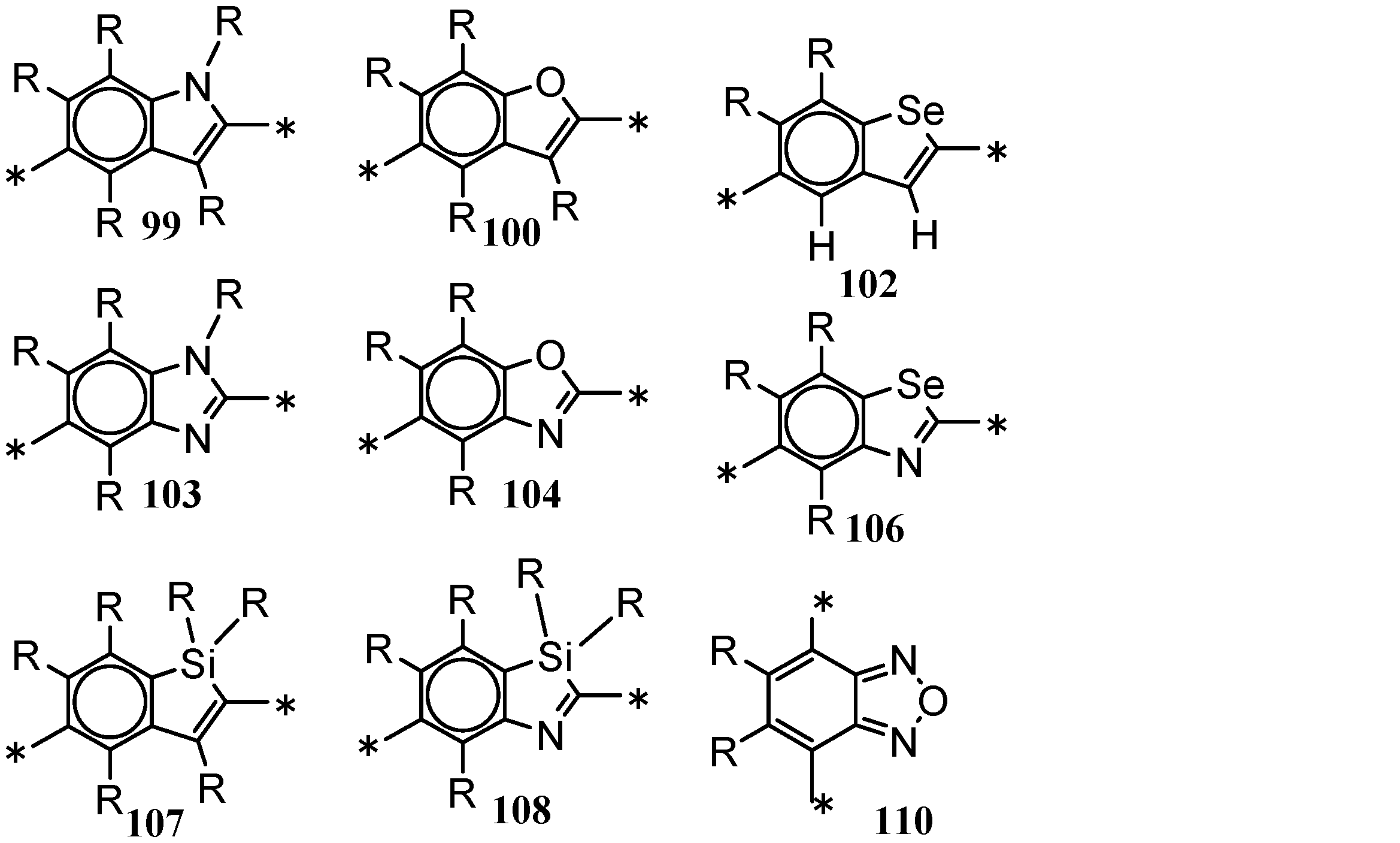






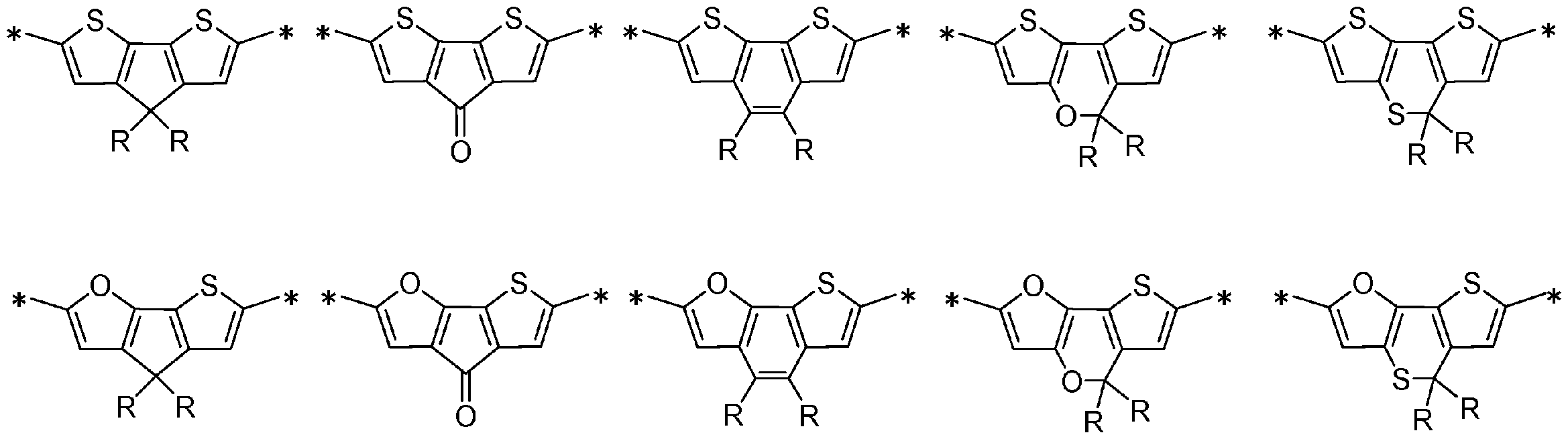




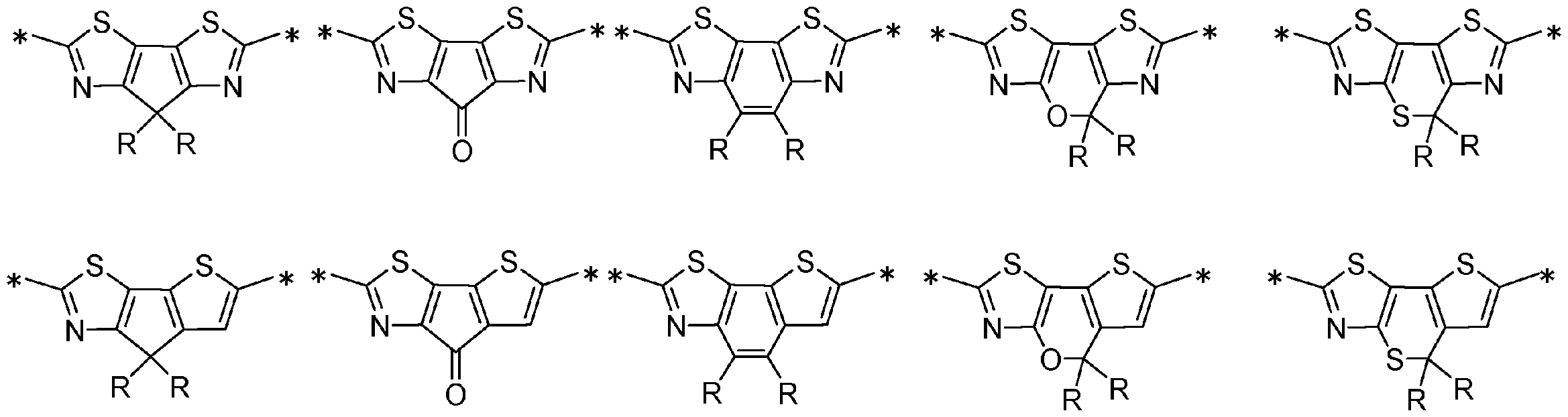

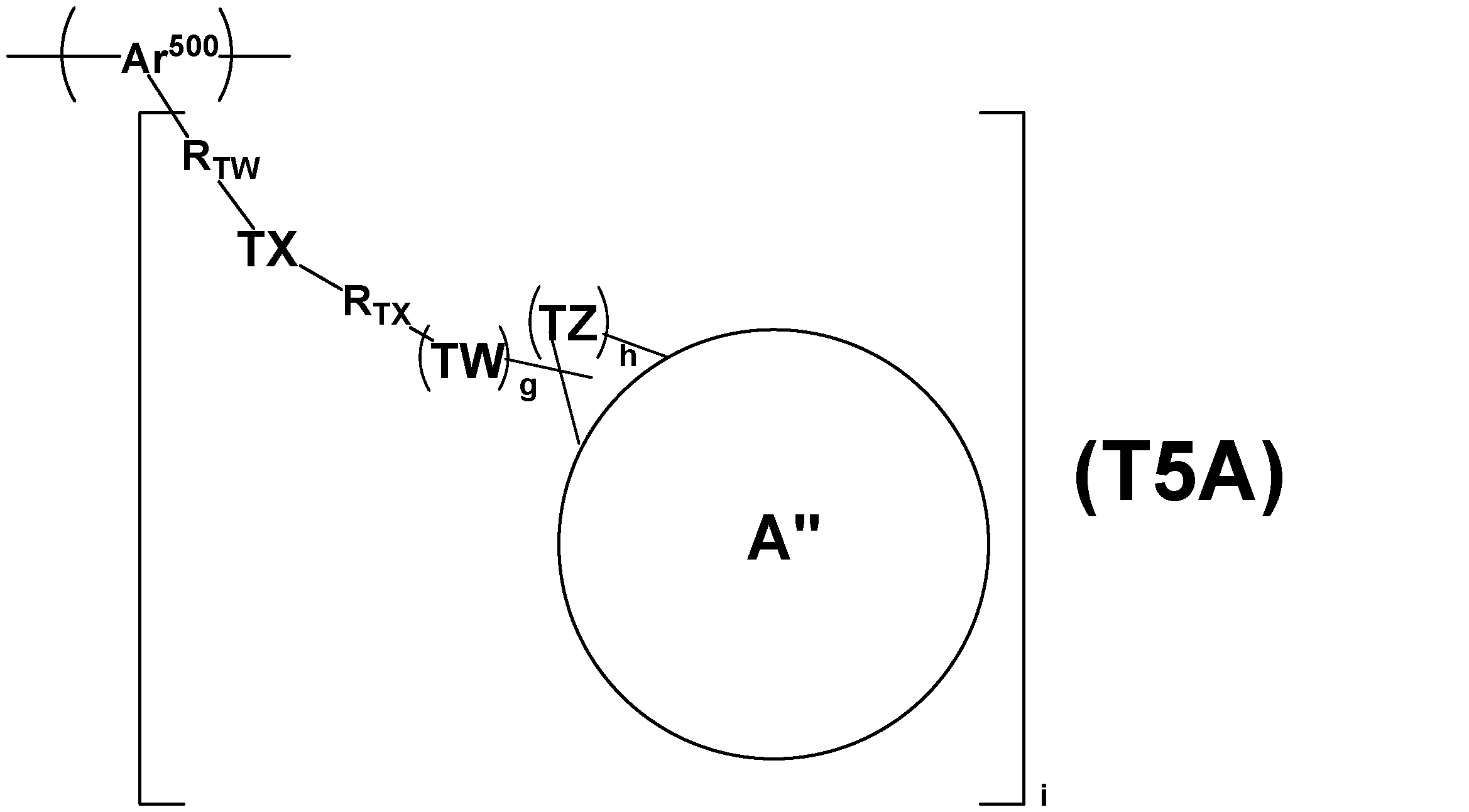
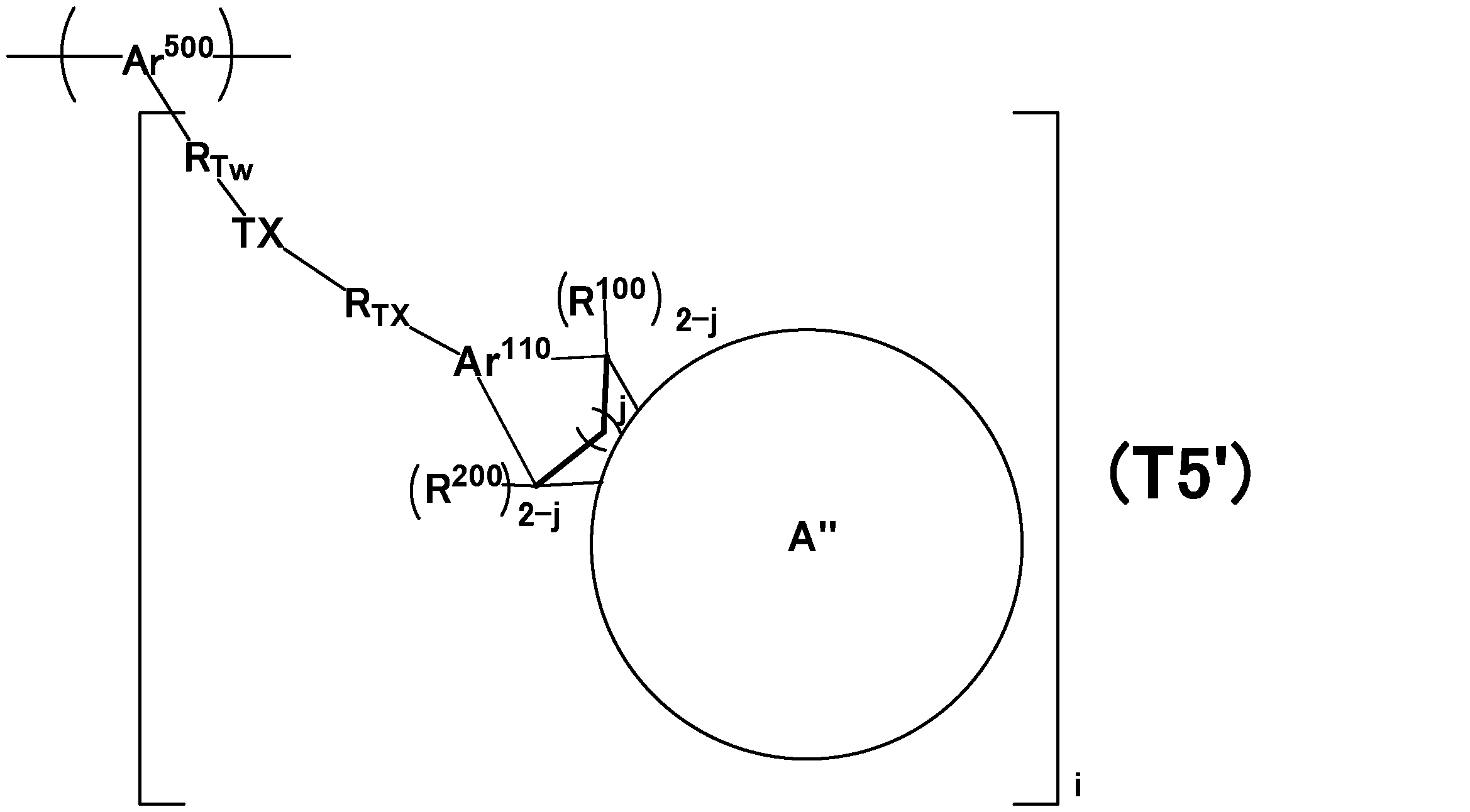
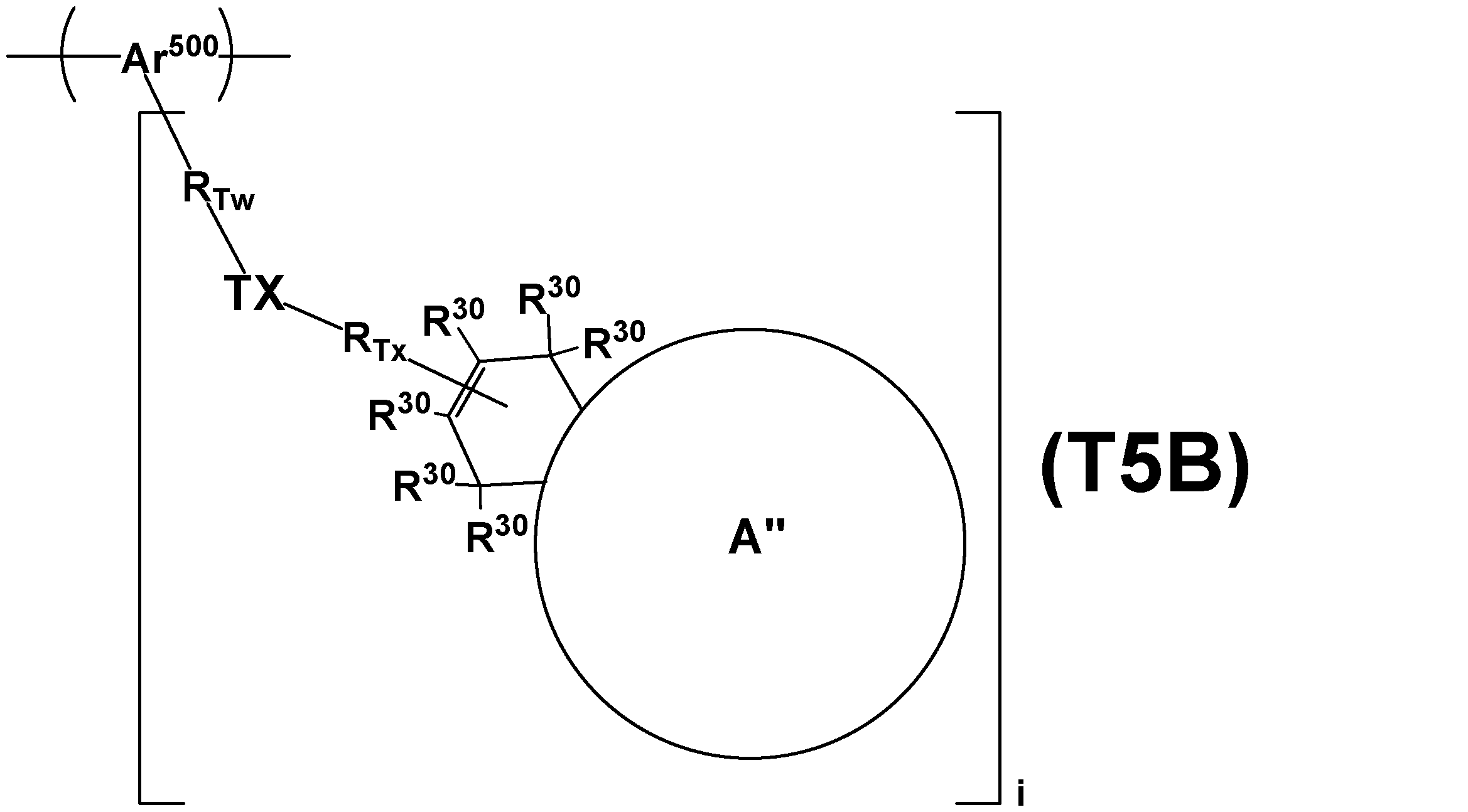

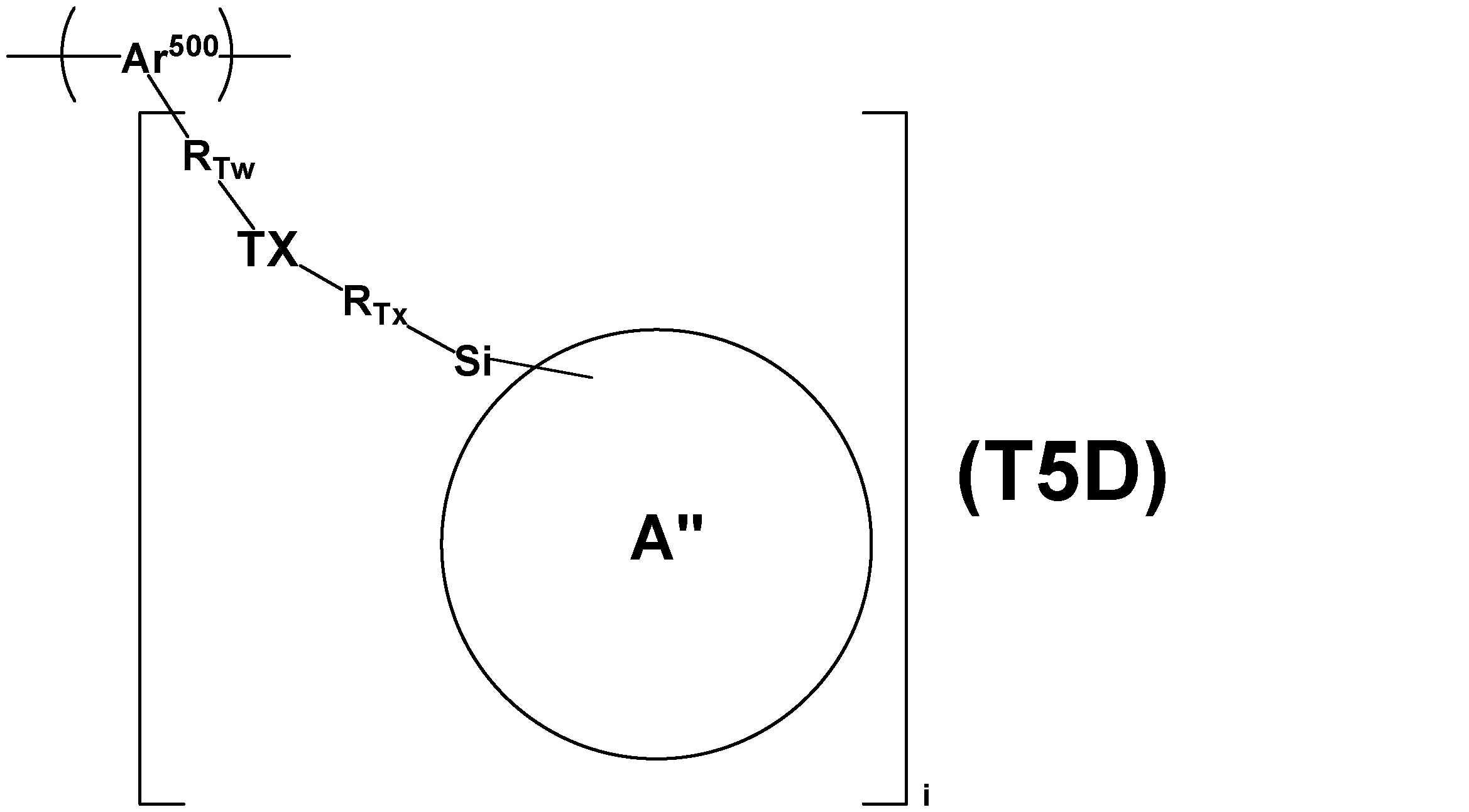


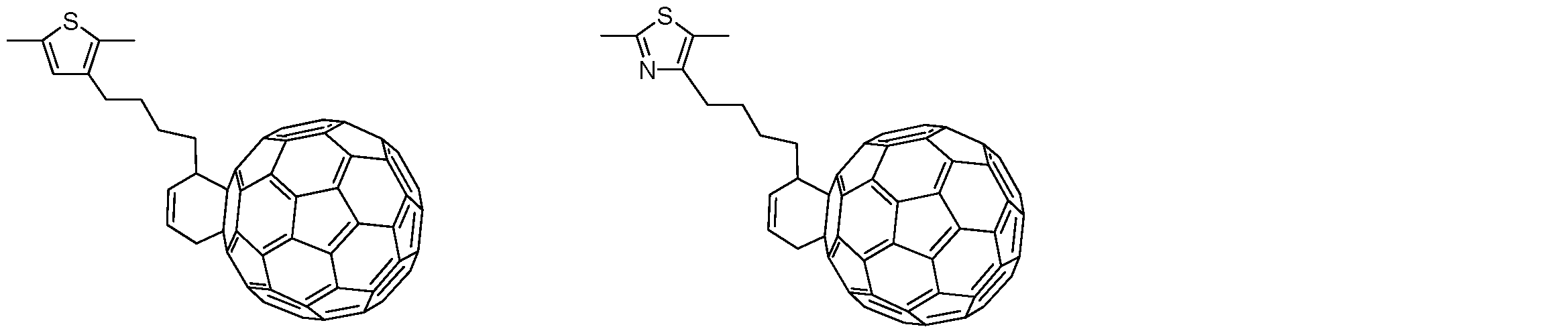
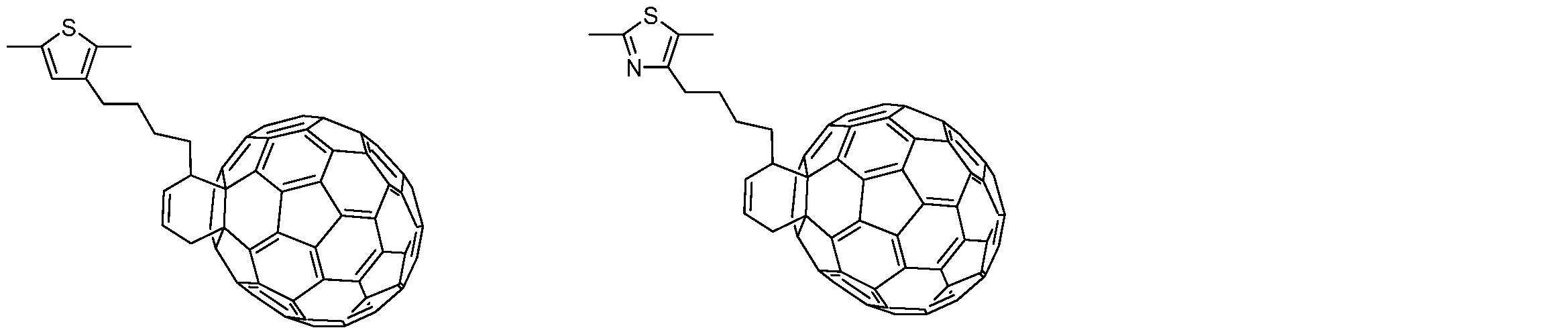
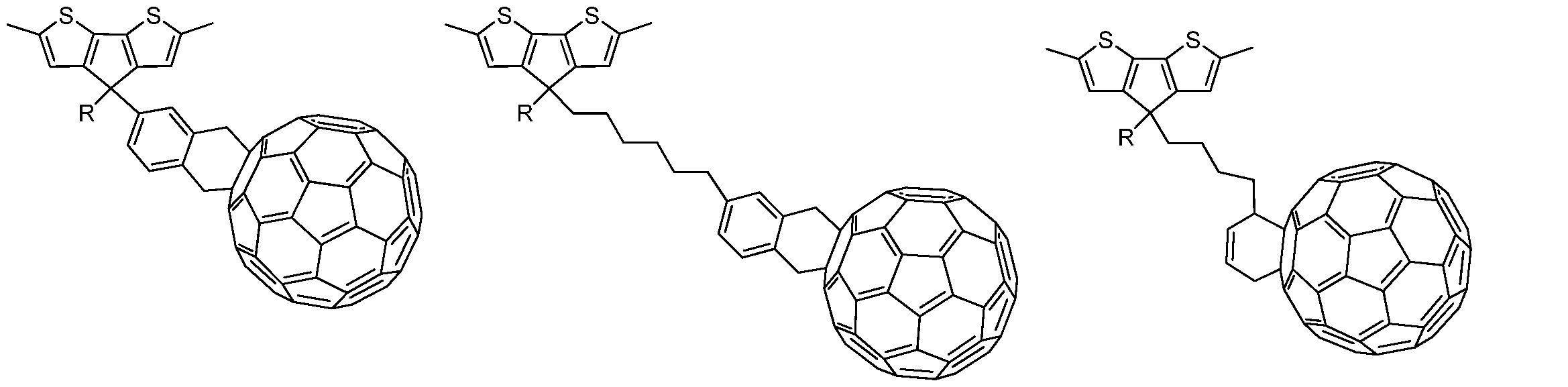

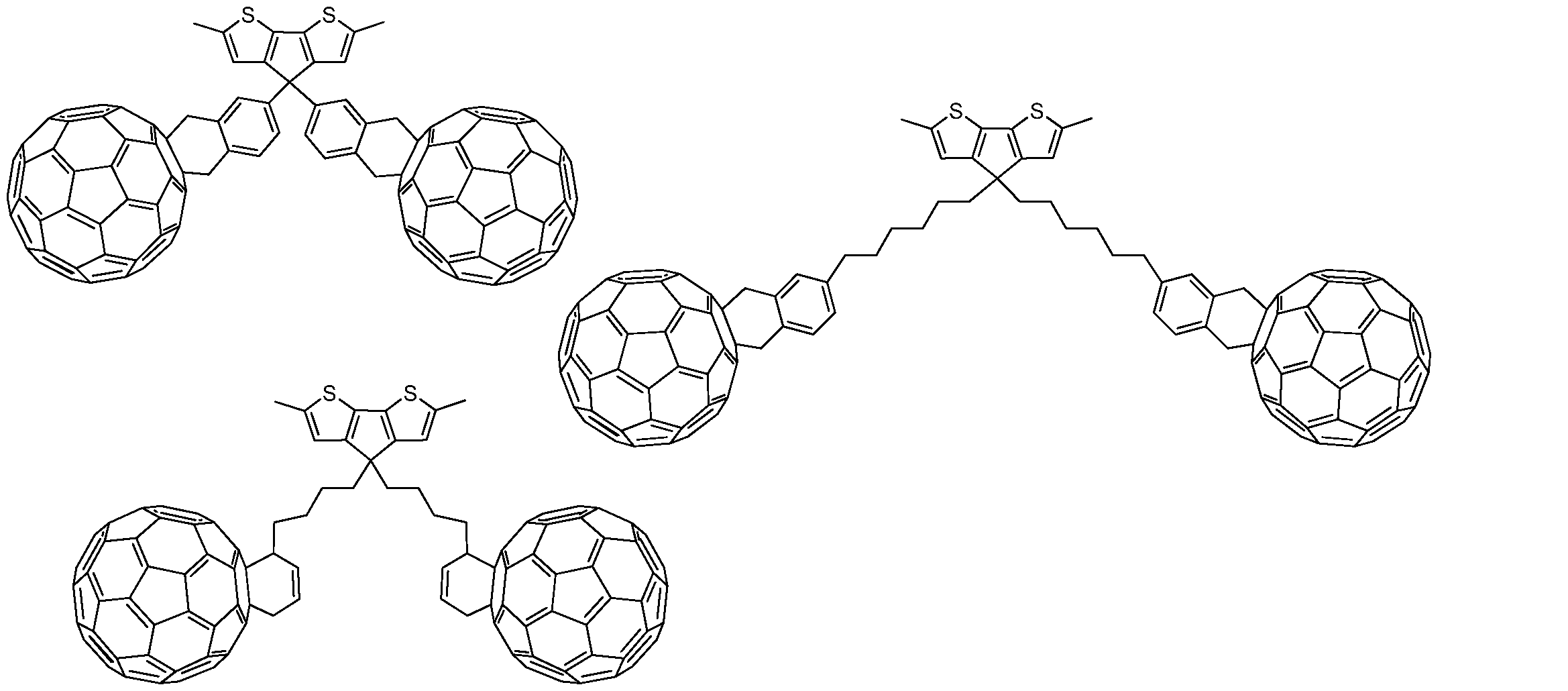

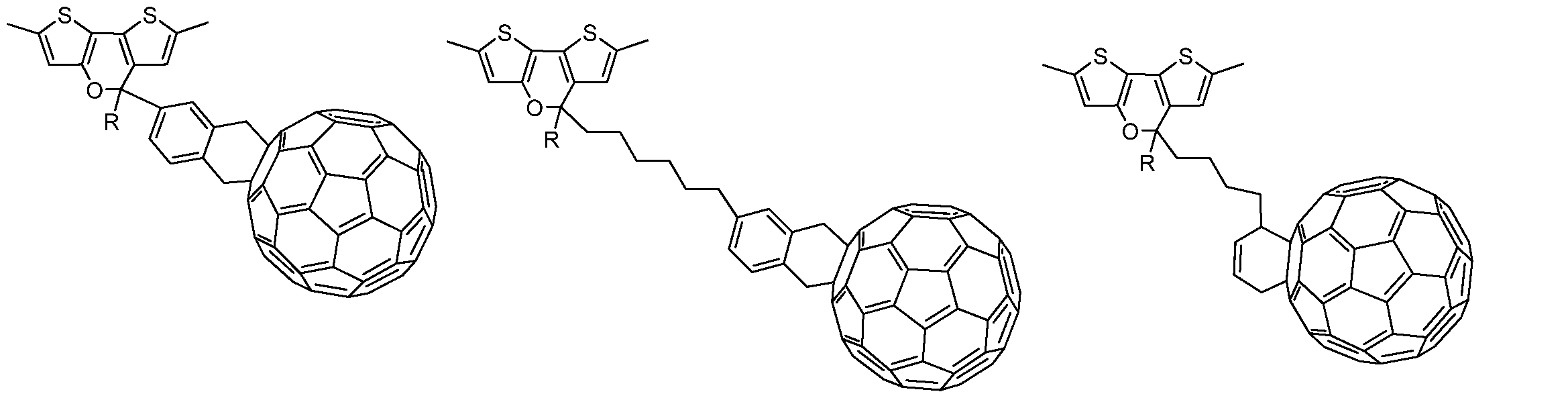
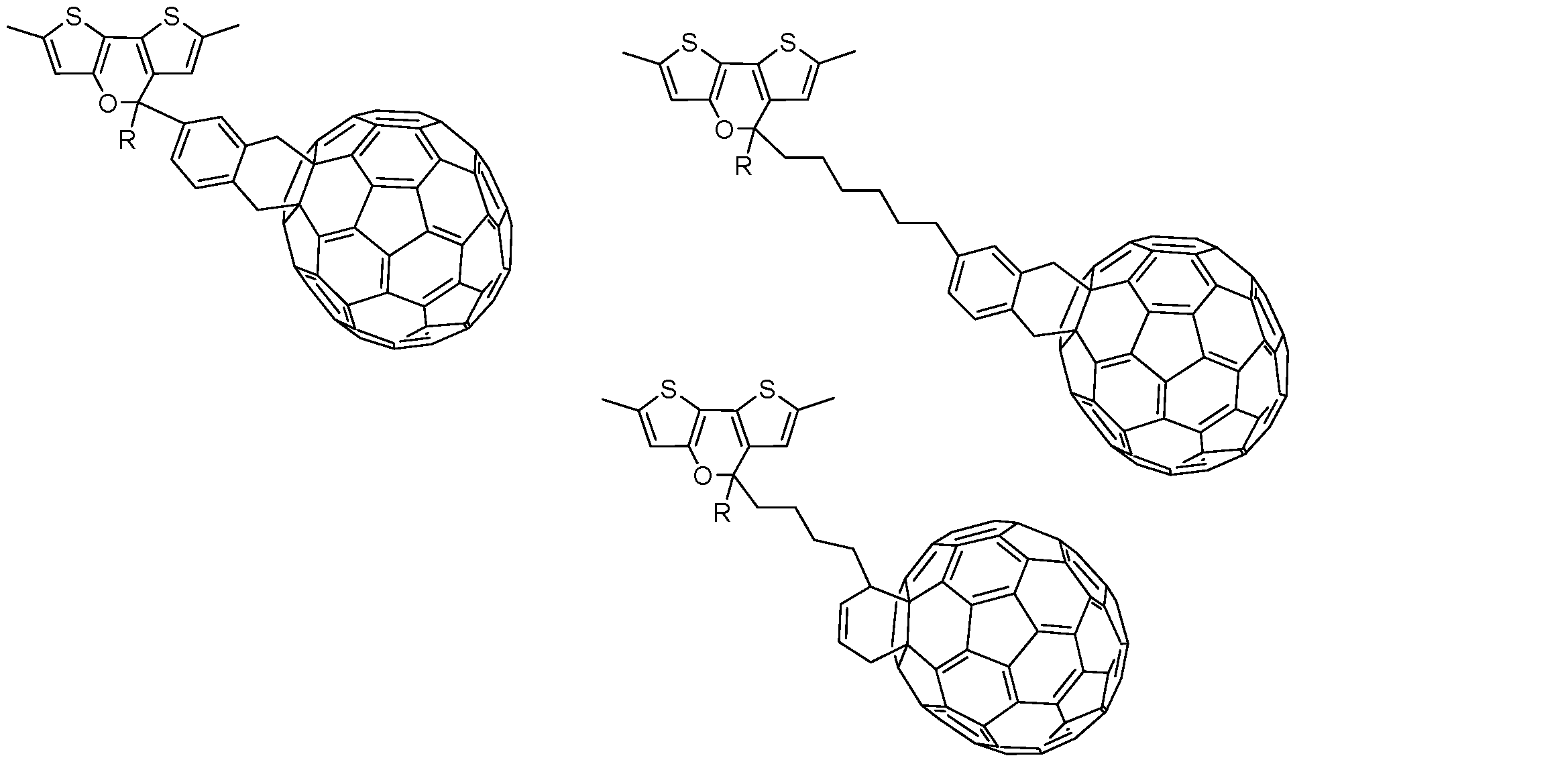
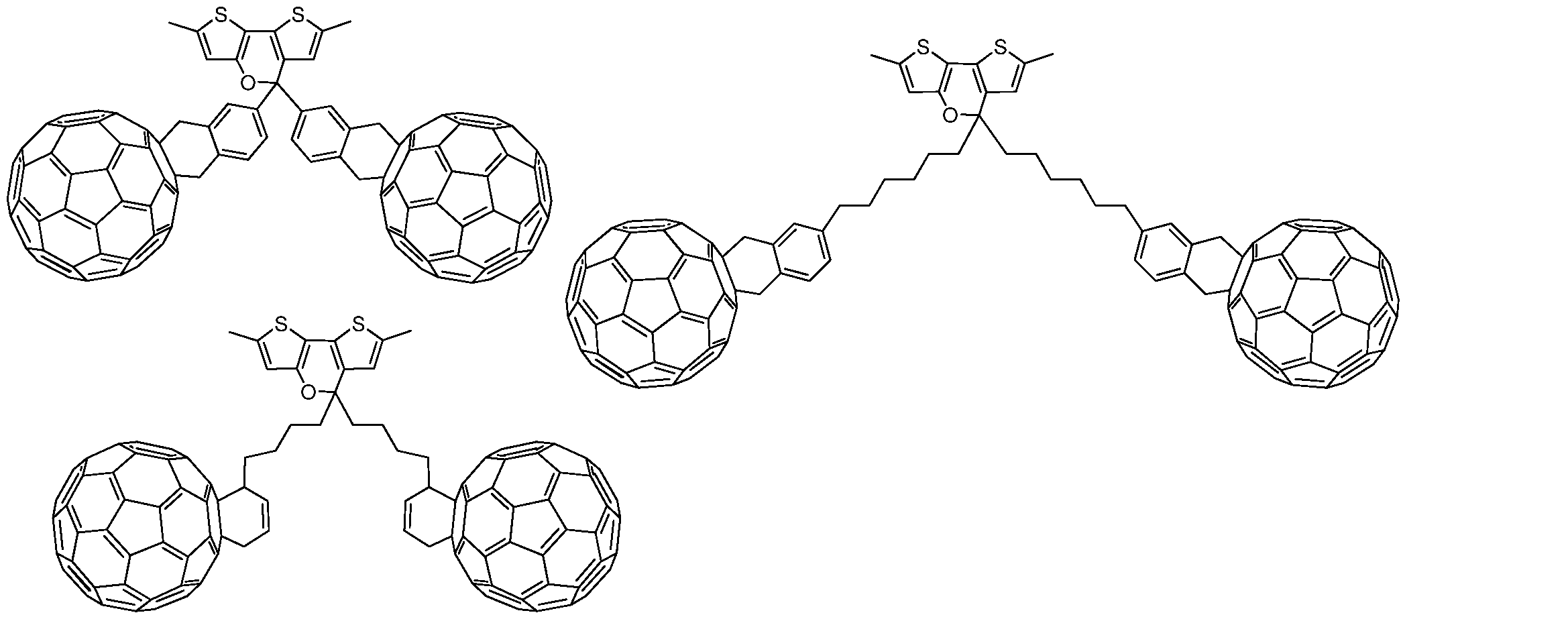
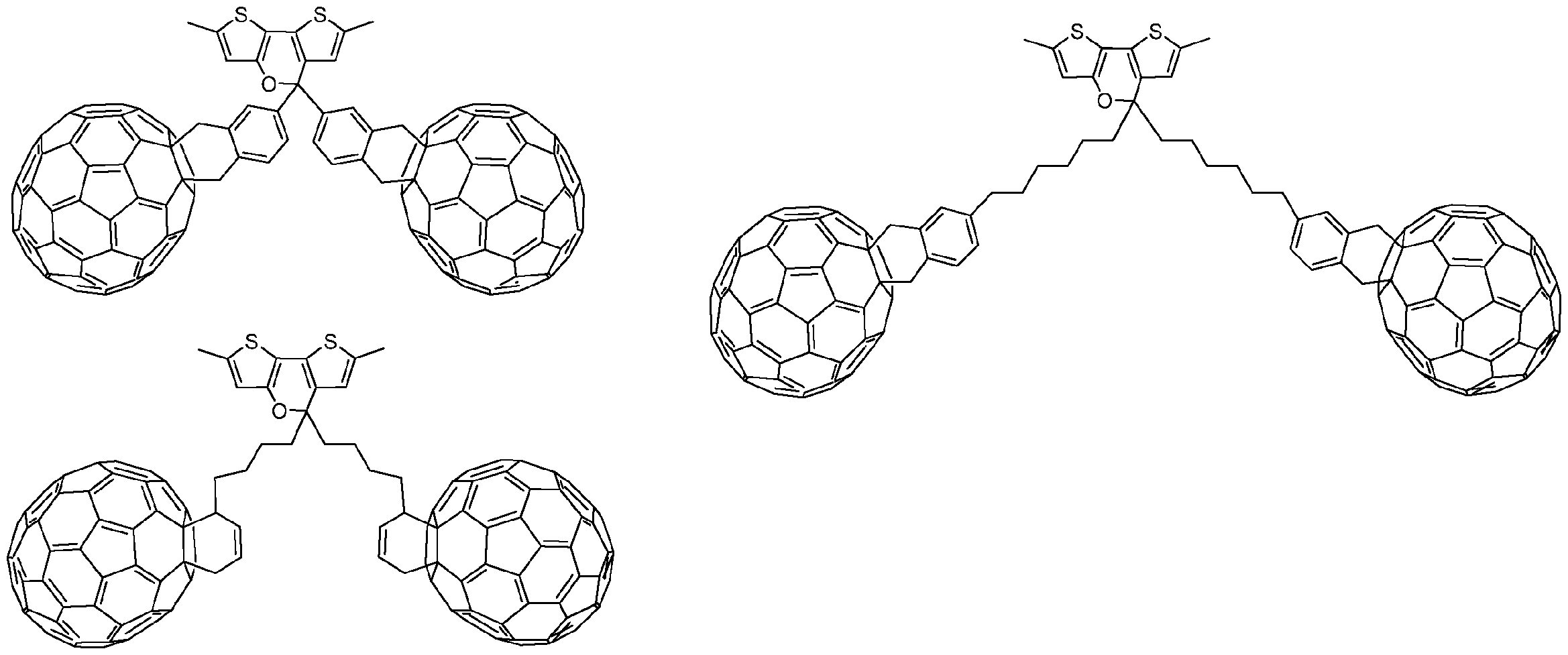
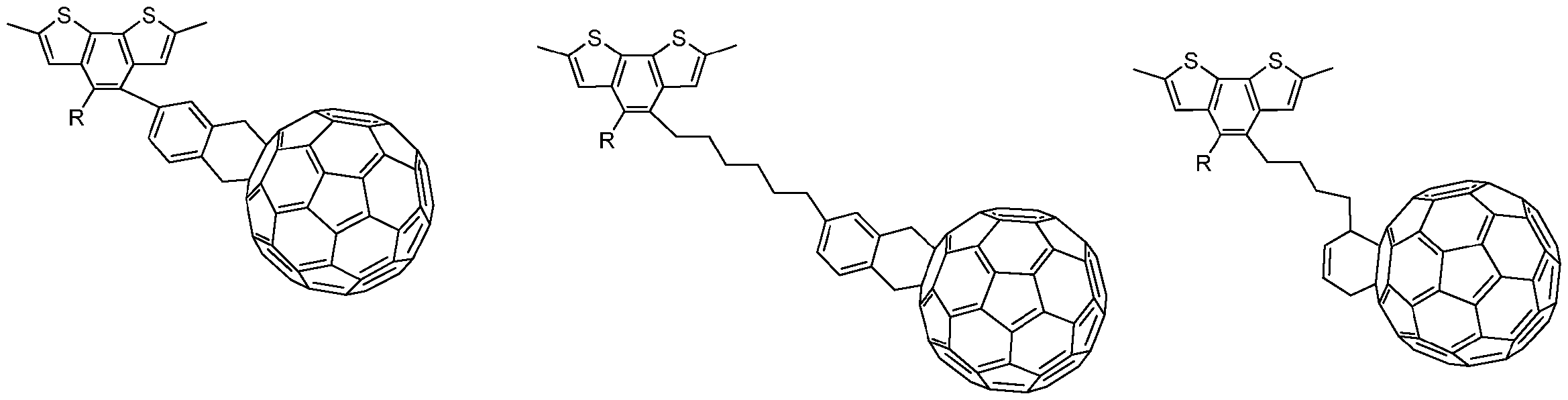


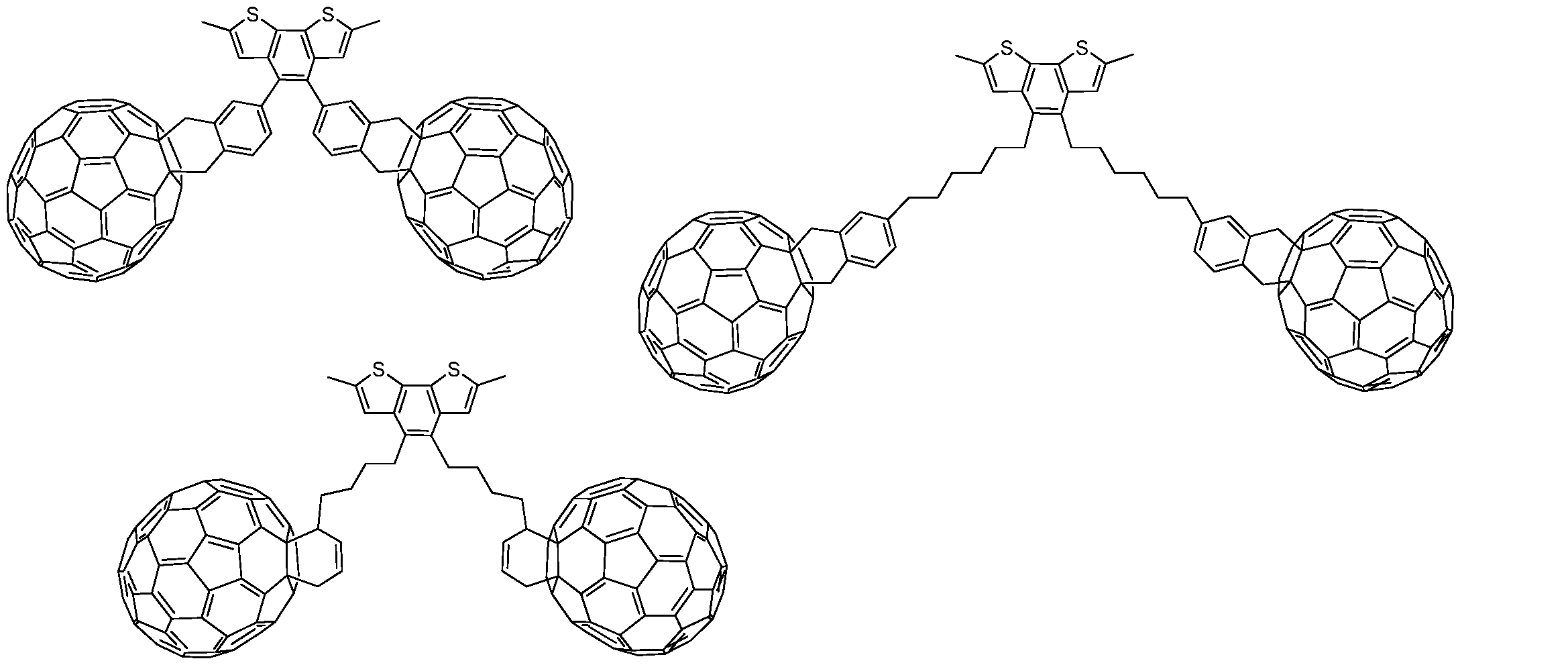


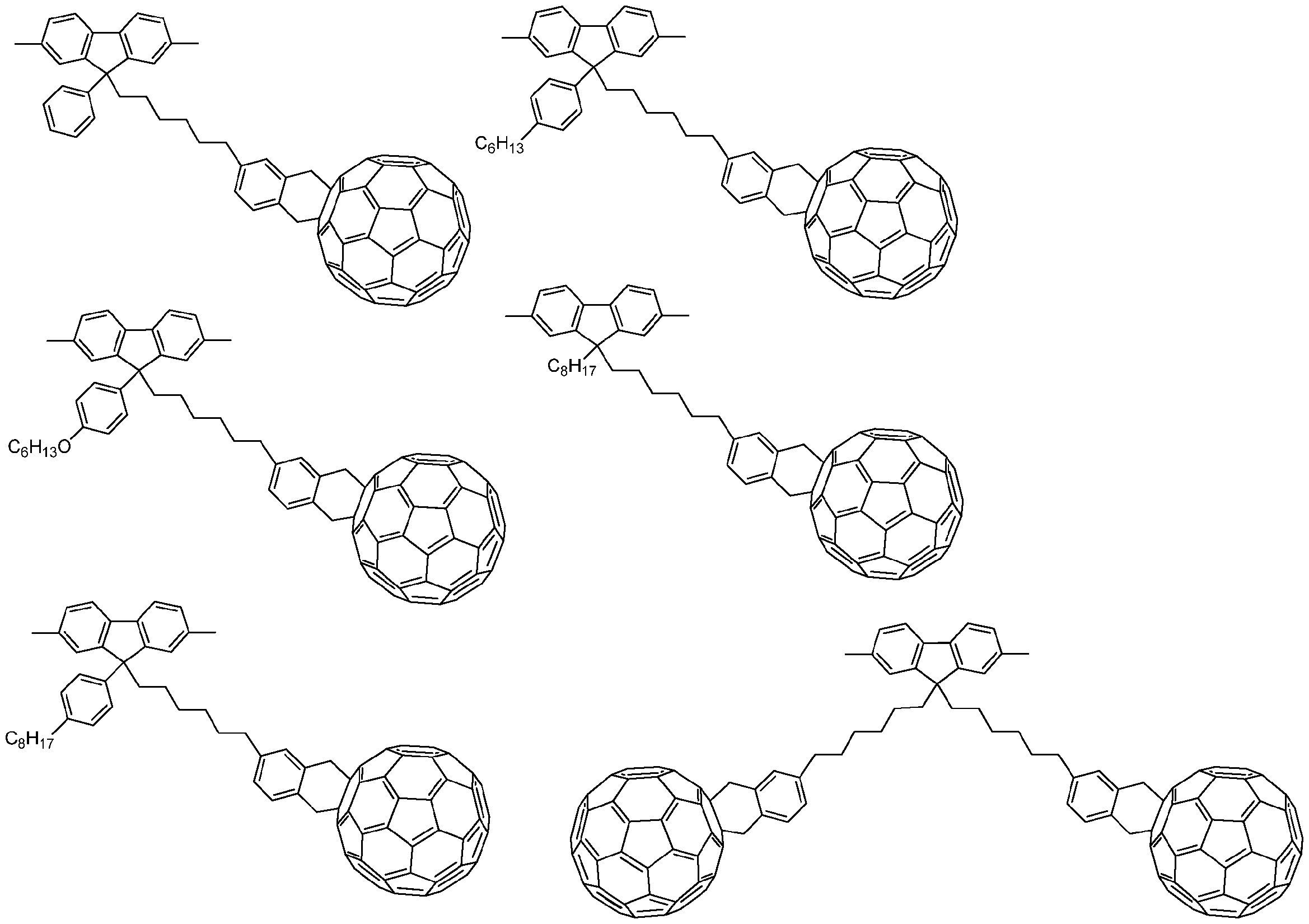

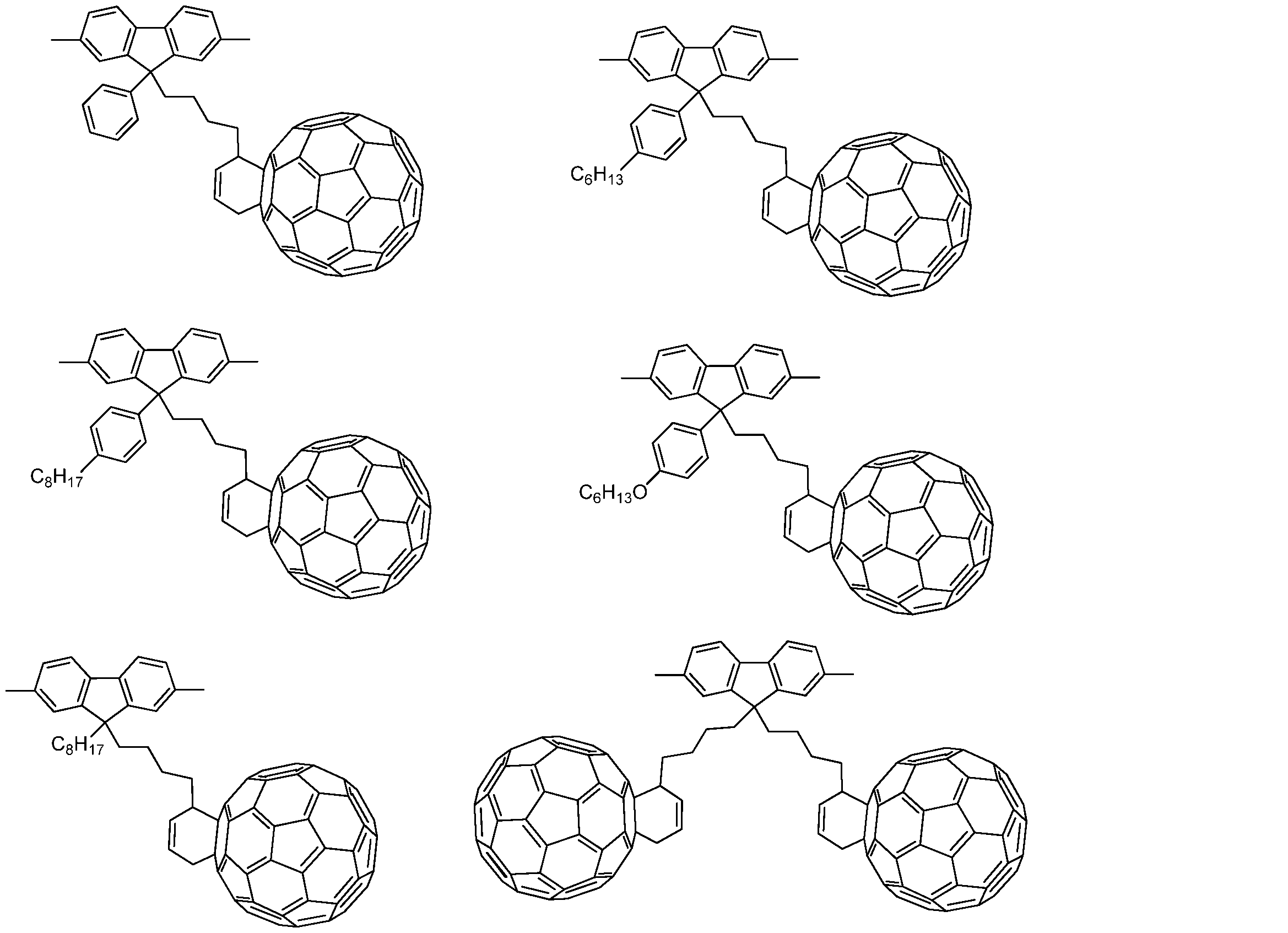

なお、本光電変換素子形態における重量平均分子量とは、ゲルパーミエーションクロマトグラフィ(GPC)を用い、ポリスチレンの標準試料を用いて算出したポリスチレン換算の重量平均分子量である。
上記薄膜の吸収スペクトル測定には、紫外、可視、近赤外の波長領域で動作する分光光度計(例えば、日本分光製、紫外可視近赤外分光光度計JASCO-V670)を用いる。JASCO-V670を用いる場合、測定可能な波長範囲が200nm~1500nmであるため、該波長範囲で測定を行う。
まず、測定に用いる基板の吸収スペクトルを測定する。基板としては、石英基板、ガラス基板等を用いる。次いで、高分子化合物を含む溶液、又は高分子化合物を含む溶融体から、その基板の上に高分子化合物を含む薄膜を形成する。溶液からの製膜では、製膜後乾燥を行う。その後、薄膜と基板との積層体の吸収スペクトルを得る。薄膜と基板との積層体の吸収スペクトルと基板の吸収スペクトルとの差を、高分子化合物の吸収スペクトルとして得る。
該薄膜の吸収スペクトルは、縦軸が高分子化合物の吸光度を、横軸が波長を示す。最も吸光度の高い吸収ピークの吸光度が0.5~2になるよう、薄膜の厚さを調整することが望ましい。
(複数ある)吸収ピークのうち、一番長波長側にある吸収ピーク(以下、「最長波長吸収ピーク」という。)の吸光度を100%とする。その50%となる吸光度の位置に横軸(波長軸)と平行な直線を引き、該直線と最長波長吸収ピークとの交点のうち、最長波長吸収ピークのピーク波長よりも長波長側の交点を第1の点とする。その25%となる吸光度の位置に横軸(波長軸)と平行な直線を引き、該直線と最長波長吸収ピークとの交点のうち、最長波長吸収ピークのピーク波長よりも長波長側の交点を第2の点とする。
この第1の点と第2の点とを結ぶ直線と基準線との交点から横軸(波長軸)に垂線を引いたときの、横軸(波長軸)と垂線との交点にある波長値を光吸収末端波長と定義する。
ここで、基準線とは、以下のようにして定められる直線をいう。最長波長吸収ピークの吸光度を100%とし、その10%となる吸光度の位置に横軸(波長軸)と平行な直線を引き、該直線と最長波長吸収ピークとの交点のうち、最長波長吸収ピークのピーク波長よりも長波長側の交点から横軸(波長軸)に垂線を引いたときの、横軸(波長軸)と垂線との交点にある波長値を基準波長とする。基準波長より100nm長波長の位置に横軸(波長軸)と垂直な直線を引き、該直線と高分子化合物の吸収スペクトルとの交点を第3の点とし、基準波長より150nm長波長の位置に横軸(波長軸)と垂直な直線を引き、該直線と高分子化合物の吸収スペクトルとの交点を第4の点とする。この第3の点と第4の点を結んだ直線を基準線という。
本光電変換素子形態に係る高分子化合物は、炭素クラスター構造を含む基を有する化合物であって、縮合重合により合成したときにアリーレン単位又はヘテロアリーレン単位となる化合物を用いて縮合重合することにより製造することができる。その他の縮合重合に用いる化合物は、繰り返し単位がアリーレン単位又はヘテロアリーレン単位となるように選択することができる。





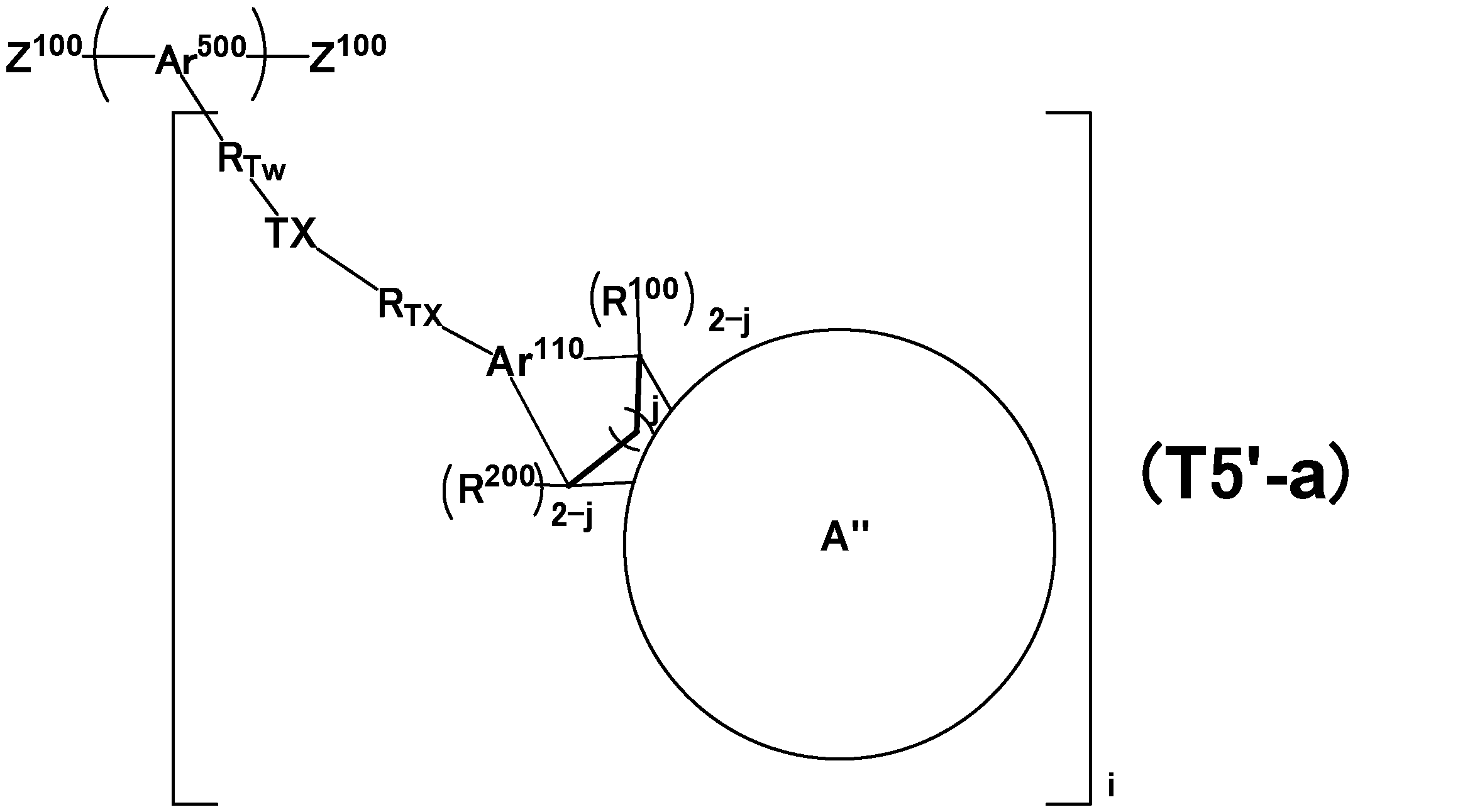
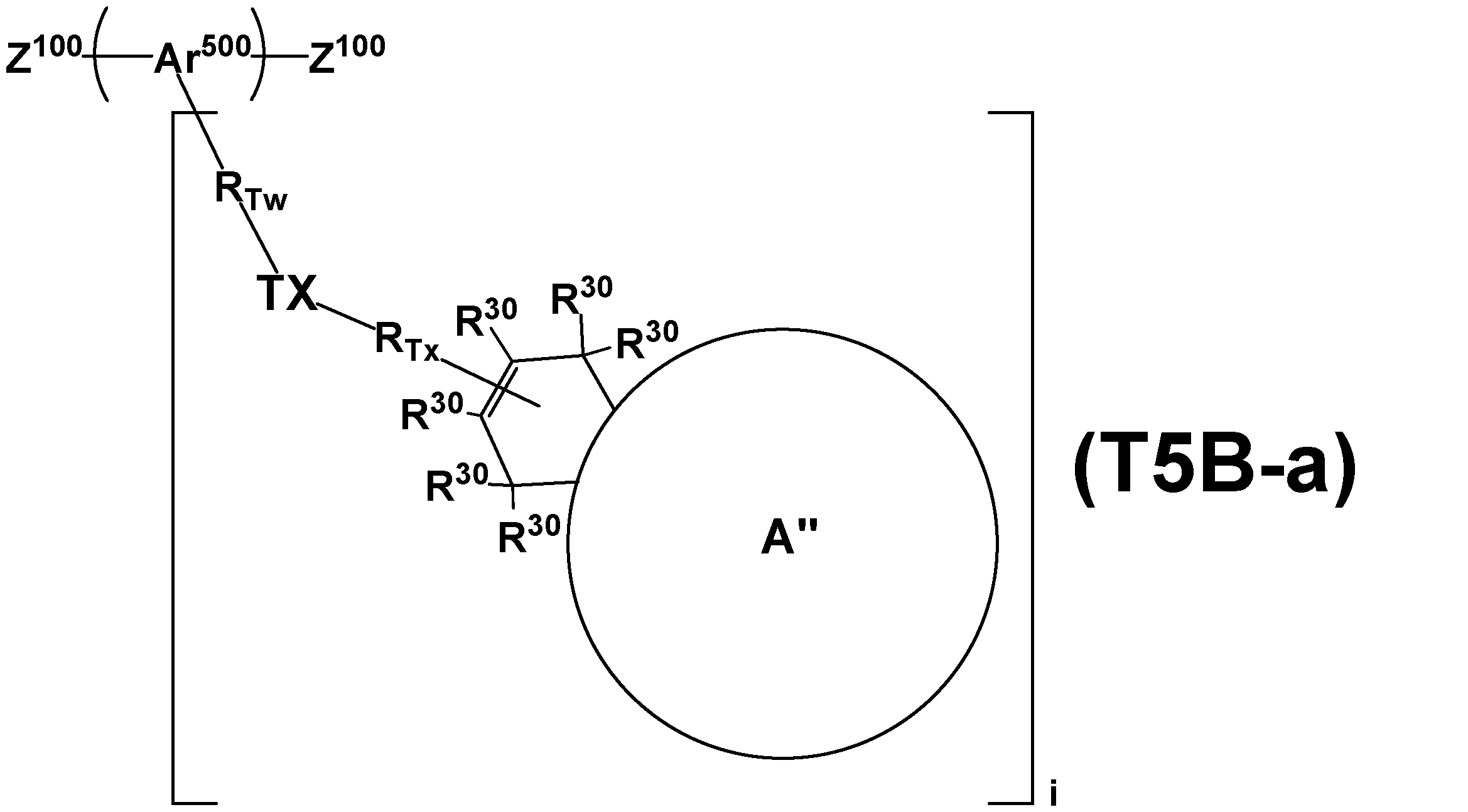

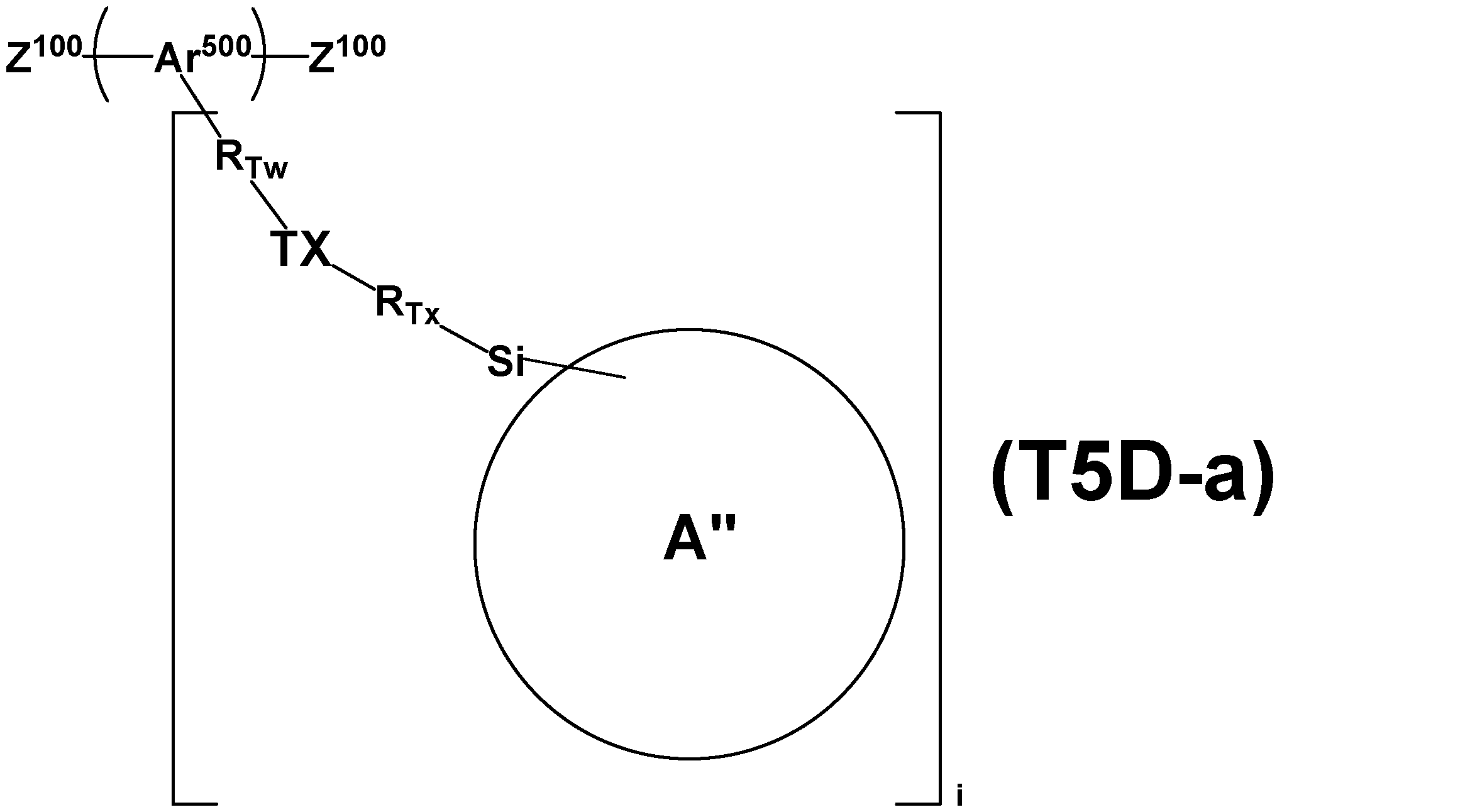
本光電変換素子形態に係る高分子化合物はまた、予め縮合重合によって合成した前駆体高分子化合物と、炭素クラスターとを反応させることにより得ることもできる。前駆体高分子化合物は、アリーレン単位及びヘテロアリーレン単位からなる群より選ばれる少なくとも1種の単位を繰り返し単位として有し、かつ繰り返し単位の少なくとも一部が架橋性基を含有するものである。

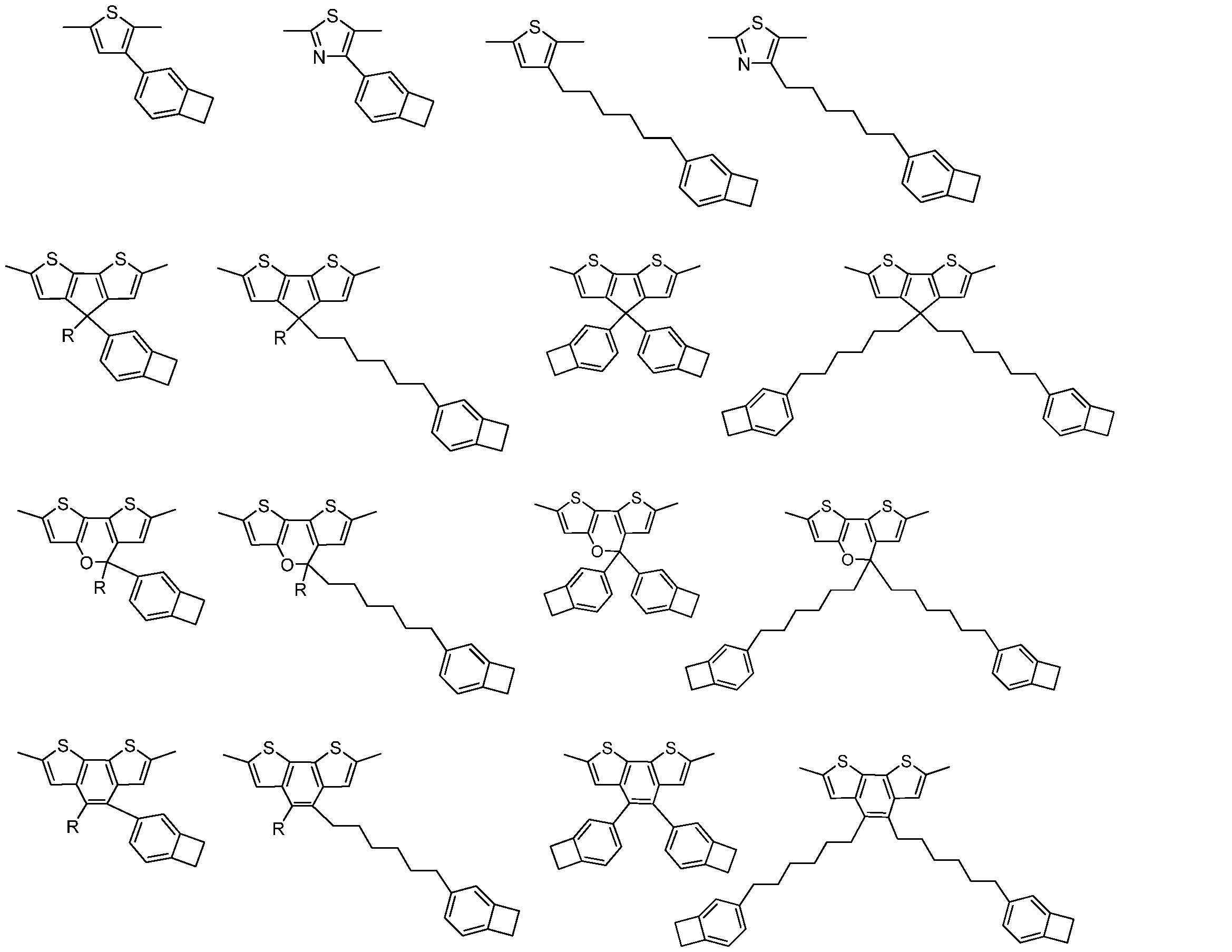


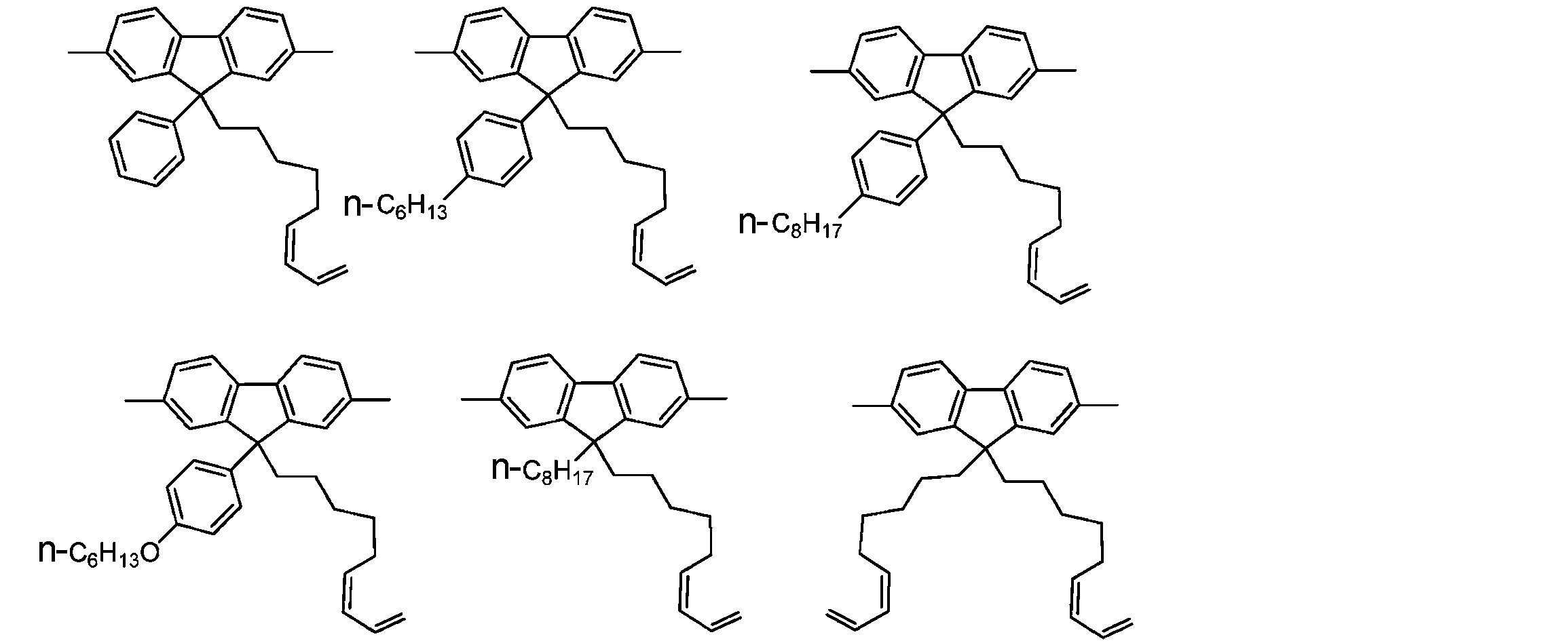
0≦NNS’×100/NM’≦50 (IV’)
(1)フラーレンC60のトルエン溶液を、異なる濃度で複数調製し、それぞれGPC-UV(335nmで検出)測定を行う。
(2)(1)の測定で得たクロマトグラムを用い、検量線(フラーレン濃度に対するフラーレン溶出ピーク面積値)を作成する。
(3)実試料のGPC-UV測定を行う。
(4)(3)の測定で得たクロマトグラムのフラーレン溶出ピーク面積値及び(2)の検量線を用いて、実試料中の遊離フラーレン量を算出する。
(1)前駆体高分子化合物に、フラーレンC60を異なる濃度で混合した標準サンプルを複数調製し、それぞれUV吸収スペクトルを測定する。
(2)(1)で得たUV吸収スペクトルから335nmにおける吸収の相対強度を求め、検量線(335nmにおける吸収の相対強度に対する混合したフラーレン量)を作成する。
(3)実試料中の高分子化合物溶出画分(固定フラーレンを含む)をGPCで分取し、高分子化合物溶出画分を得る。
(4)(3)で得た高分子化合物溶出画分のUV吸収スペクトルを測定する。
(5)(4)で得たUV吸収スペクトルから335nmにおける吸収の相対強度を求め、(2)の検量線を用いて、実試料中の固定フラーレン量を算出する。

で表される1種以上の化合物と、式(200):

で表される1種以上の化合物とを、パラジウム触媒及び塩基の存在下で反応させる工程を有する方法が挙げられる。E1として好ましくは2価の芳香族基であり、更に好ましくは、前述した式1~38、49~72、76~84、91~93、99~104、106~108又は110で表される構造を有する基が挙げられる。また、E1及びE2の少なくとも1種は炭素クラスター構造を含む基、又は架橋性基を有する。

パラジウム触媒の添加量は、触媒としての有効量であればよいが、式(120)で表される化合物1モルに対して、通常、0.0001モル~0.5モル、好ましくは0.0003モル~0.1モルである。
塩基の添加量は、式(120)で表される化合物1モルに対して、通常、0.5モル~100モルであり、好ましくは0.9モル~20モルであり、更に好ましくは1モル~10モルである。
Q300-E3-Q400 (300)
[式中、E3は、芳香環を含む2価の基を示す。Q300及びQ400は、同一であっても異なっていてもよく、有機スズ残基を表す。]
で表される1種以上の化合物と、上記式(200)で表される1種以上の化合物とを、パラジウム触媒の存在下で反応させる工程を有する製造方法が挙げられる。E3として好ましくはアリーレン基及びヘテロアリーレン基であり、更に好ましくは、前述した式1~38、49~72、76~84、91~93、99~104、106~108又は110で表される構造を有するアリーレン基及びヘテロアリーレン基が挙げられる。また、E2及びE3の少なくとも1種は、架橋性基を有する。
Stilleカップリング反応に使用するパラジウム触媒としては、例えば、Pd(0)触媒、Pd(II)触媒が挙げられる。具体的には、パラジウム[テトラキス(トリフェニルホスフィン)]、パラジウムアセテート類、ジクロロビス(トリフェニルホスフィン)パラジウム、パラジウムアセテート、トリス(ジベンジリデンアセトン)ジパラジウム、ビス(ジベンジリデンアセトン)パラジウムが挙げられ、反応(重合)操作の容易さ、反応(重合)速度の観点からは、パラジウム[テトラキス(トリフェニルホスフィン)]、トリス(ジベンジリデンアセトン)ジパラジウムが好ましい。
Stilleカップリング反応に使用するパラジウム触媒の添加量は、触媒としての有効量であればよいが、式(300)で表される化合物1モルに対して、通常、0.0001モル~0.5モル、好ましくは0.0003モル~0.2モルである。
配位子又は助触媒を用いる場合、配位子又は助触媒の添加量は、パラジウム触媒1モルに対して、通常、0.5モル~100モルであり、好ましくは0.9モル~20モル、更に好ましくは1モル~10モルである。
本光電変換素子形態に係る光電変換組成物は、第1の化合物と、第1の化合物とは異なる第2の化合物とを含有する。ここで、第1の化合物は、本光電変換素子形態に係る高分子化合物である。




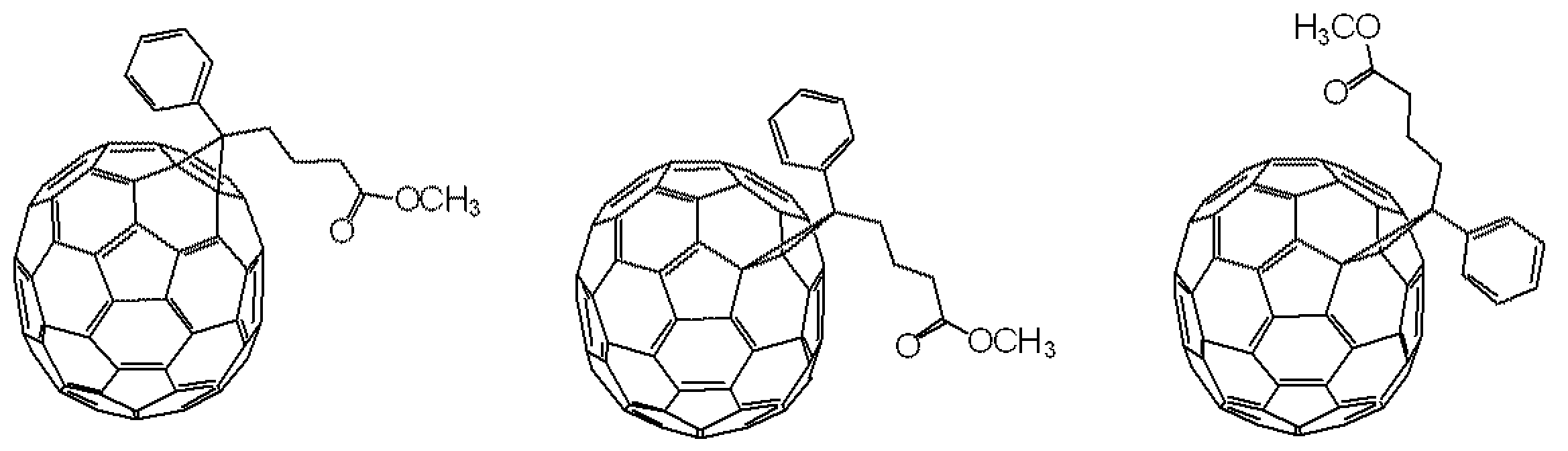
本光電変換素子形態に係る光電変換素子は、一対の電極間に、本光電変換素子形態に係る高分子化合物又は光電変換組成物を含む1層以上の活性層を有する。
電極材料として、ポリアニリン及びその誘導体、ポリチオフェン及びその誘導体等の有機の透明導電膜を用いてもよい。
本光電変換素子形態に係る高分子化合物を用いた光電変換素子は、透明又は半透明の電極から太陽光等の光を照射することにより、電極間に光起電力が発生し、有機薄膜太陽電池として動作させることができる。また、有機薄膜太陽電池を複数集積することにより有機薄膜太陽電池モジュールとして用いることもできる。
有機薄膜太陽電池は、従来の太陽電池モジュールと基本的には同様のモジュール構造をとりうる。太陽電池モジュールは、一般的には金属、セラミック等の支持基板の上にセルが構成され、その上を充填樹脂や保護ガラス等で覆い、支持基板の反対側から光を取り込む構造をとるが、支持基板に強化ガラス等の透明材料を用い、その上にセルを構成してその透明の支持基板側から光を取り込む構造とすることも可能である。具体的には、スーパーストレートタイプ、サブストレートタイプ、ポッティングタイプとよばれるモジュール構造、アモルファスシリコン太陽電池などで用いられる基板一体型モジュール構造等が知られている。本光電変換素子形態に係る高分子化合物を用いて製造される有機薄膜太陽電池も使用目的や使用場所及び環境により、適宜これらのモジュール構造を選択できる。
本光電変換素子形態に係る高分子化合物を用いた光電変換素子はまた、電極間に電圧を印加した状態、あるいは無印加の状態で、透明又は半透明の電極から光を照射することにより、光電流が流れ、有機光センサーとして動作させることができる。有機光センサーを複数集積することにより有機イメージセンサーとして用いることもできる。
本光電変換素子形態に係る高分子化合物は、高い電荷輸送性を発揮し得ることから、有機薄膜トランジスタにも好適に用いられる。有機薄膜トランジスタとしては、ソース電極及びドレイン電極と、これらの電極間の電流経路となる有機半導体層(即ち、活性層であり、以下同様である。)と、この電流経路を通る電流量を制御するゲート電極とを備えた構成を有するものが挙げられ、有機半導体層が上述した本光電変換素子形態に係る高分子化合物を含む有機薄膜によって構成されるものである。このような有機薄膜トランジスタとしては、電界効果型、静電誘導型等が挙げられる。
まず、発光素子形態に係る高分子化合物及びそれを用いた有機EL素子についての実施例及び比較例について説明する。
数平均分子量及び重量平均分子量については、ゲルパーミエーションクロマトグラフィー(GPC)(島津製作所製、商品名:LC-10Avp)によりポリスチレン換算の数平均分子量及び重量平均分子量を求めた。測定する高分子化合物は、約0.5質量%の濃度になるようにテトラヒドロフランに溶解させ、GPCに30μL注入した。GPCの移動相はテトラヒドロフランを用い、0.6mL/分の流速で流した。カラムは、TSKgel SuperHM-H(東ソー製)2本とTSKgel SuperH2000(東ソー製)1本を直列に繋げた。検出器には示差屈折率検出器(島津製作所製、商品名:RID-10A)を用いた。
不活性雰囲気下、下記式:
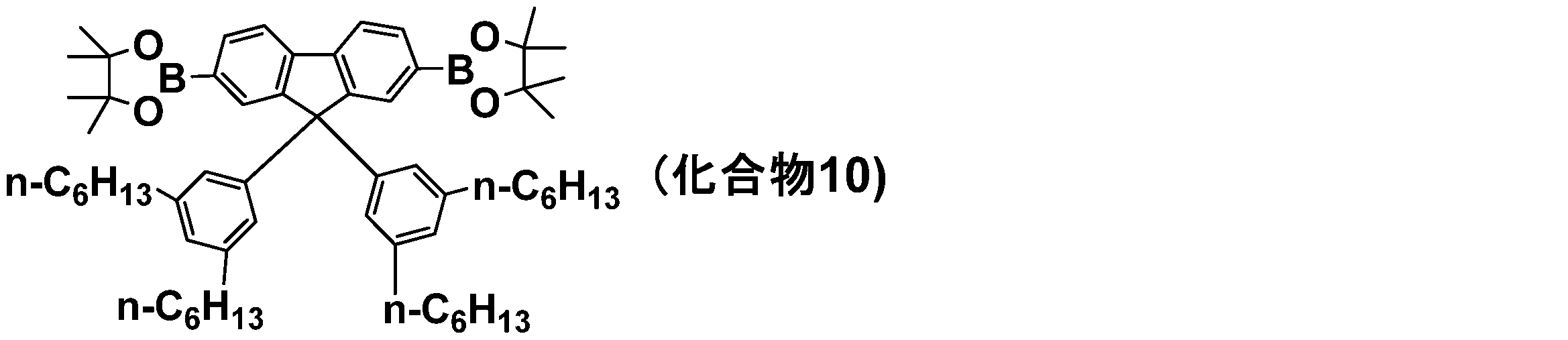



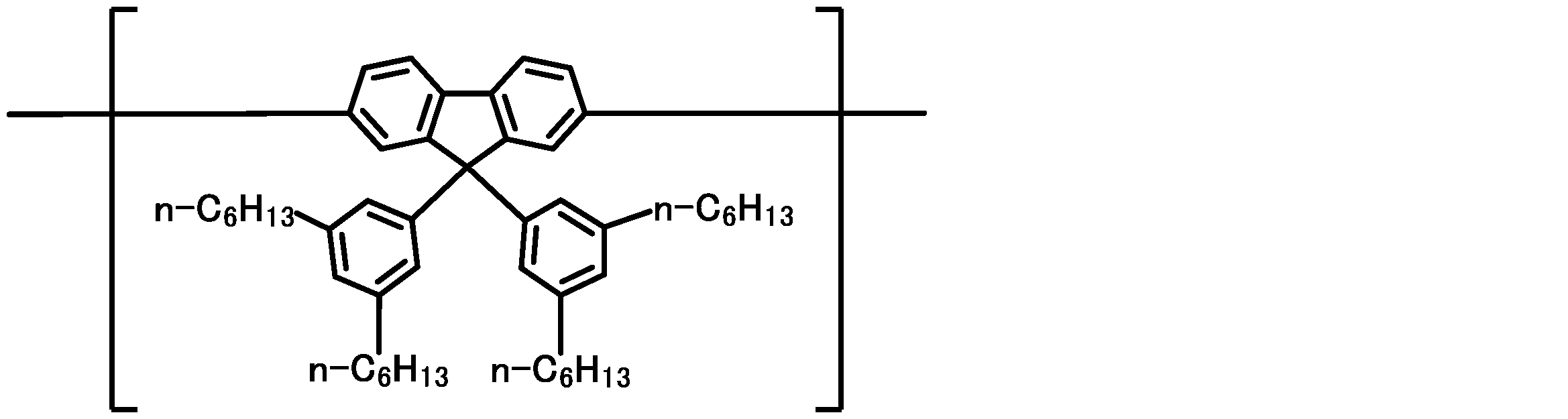
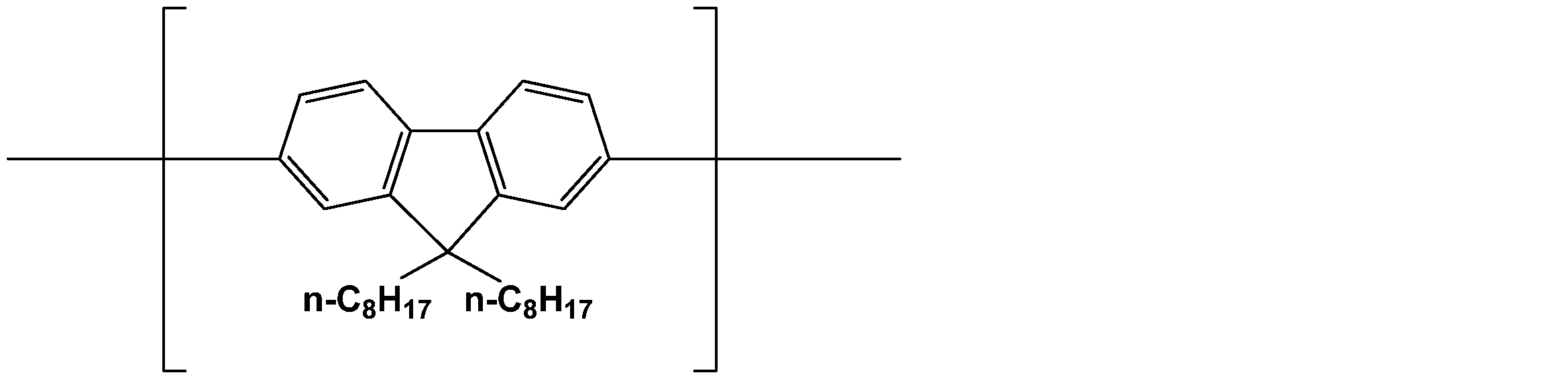
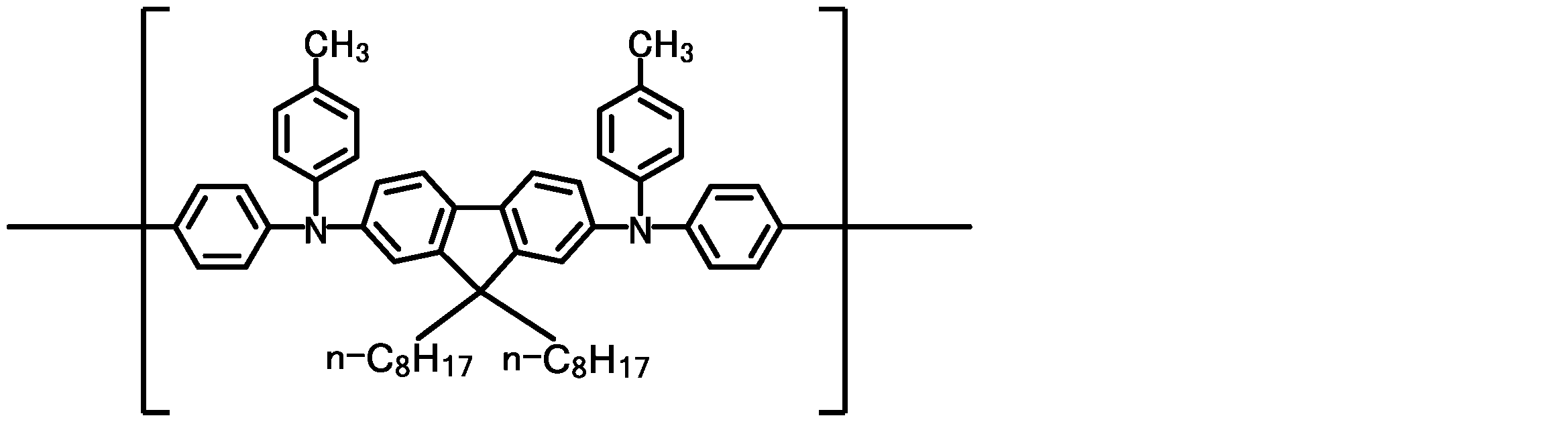

不活性雰囲気下、下記式:



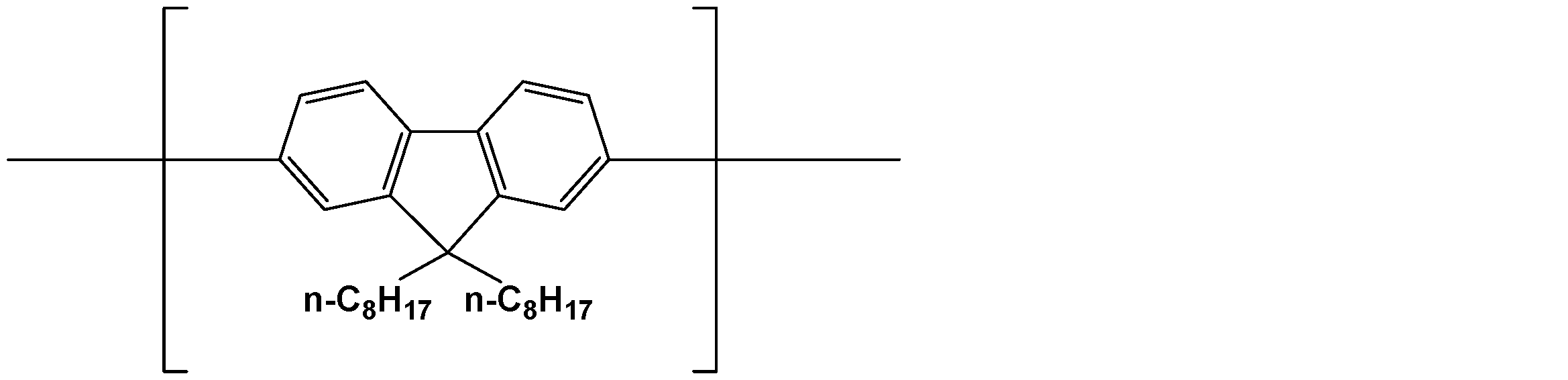


不活性雰囲気下、化合物10(1.8163g、1.99mmol)、化合物11(1.5586g、1.70mmol)、化合物12(0.1587g、0.30mmol)、ジクロロビス(トリフェニルホスフィン)パラジウム(1.4mg)、及びトルエン(47mL)を混合し、105℃に加熱した。反応液に20質量%水酸化テトラエチルアンモニウム水溶液(6.6mL)を滴下し、8時間還流させた。反応後、そこに、フェニルボロン酸(24.4mg)、及び、ジクロロビス(トリフェニルホスフィン)パラジウム(1.4mg)を加え、更に23時間還流させた。次いで、そこに、ジエチルジチオカルバミン酸ナトリウム水溶液を加え、80℃で2時間撹拌した。反応液を冷却後、水で2回、3質量%酢酸水溶液で2回、水で2回洗浄し、得られた溶液をメタノールに滴下、濾取することで沈殿物を得た。この沈殿物をトルエンに溶解させ、アルミナカラム、シリカゲルカラムに順番に通すことにより精製した。得られた溶液をメタノールに滴下し、撹拌した後、得られた沈殿物を濾取し、乾燥させることにより、高分子化合物3を1.88g得た。高分子化合物3のポリスチレン換算の数平均分子量は5.6×104であり、ポリスチレン換算の重量平均分子量は2.4×105であった。
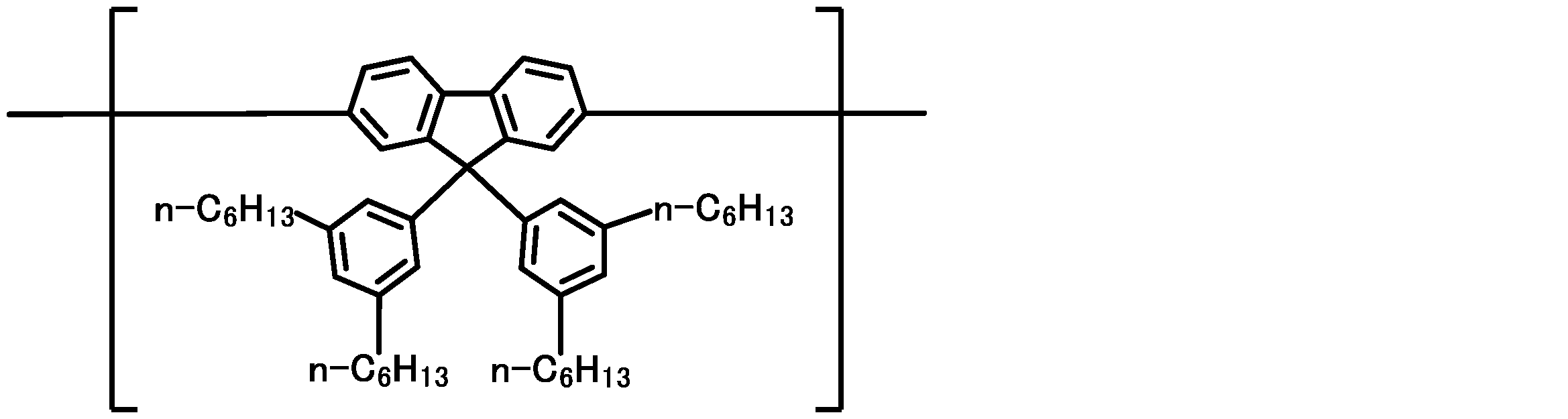
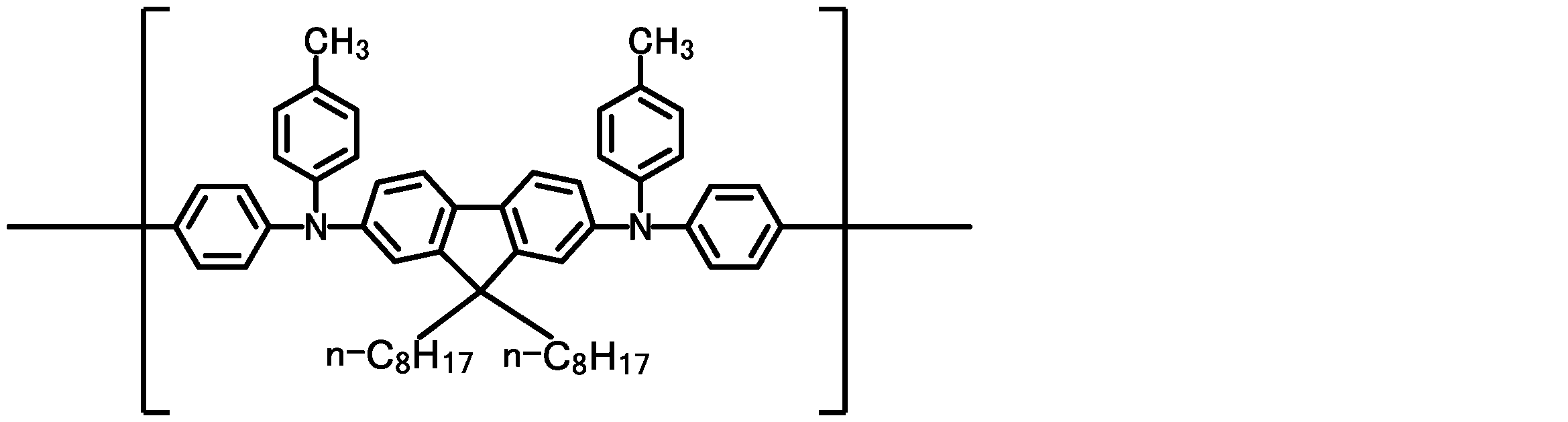
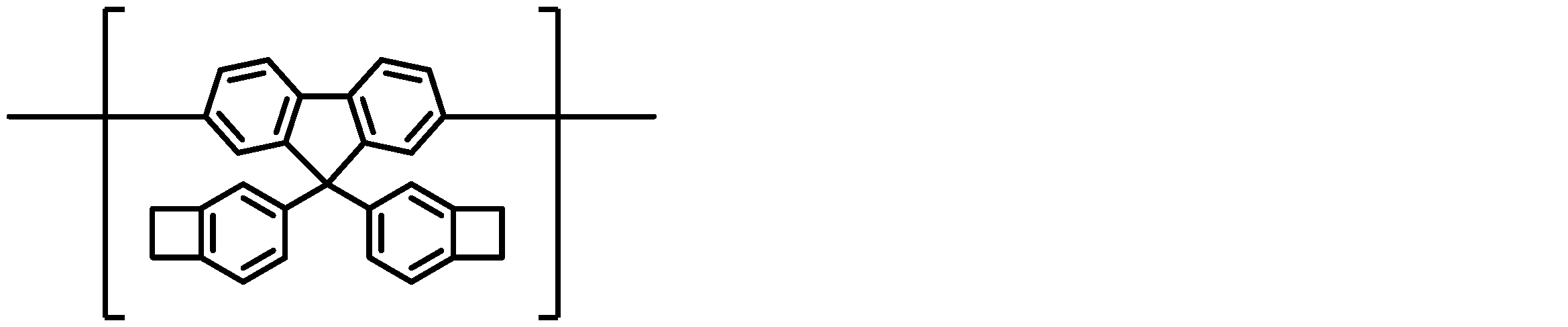
不活性雰囲気下、高分子化合物3(1.5000g,2.38mmol)、フラーレンC60(シグマアルドリッチ社製)(0.5160g,0.72mmol)、及びオルトジクロロベンゼン120mLを混合させた。得られた混合液にアルゴンガスを30分間バブリングした後、190℃に加熱し、24時間撹拌した。その後、反応液をメタノールに再沈殿し、濾過、減圧乾燥を行った。
乾燥後、得られた粗ポリマーにテトラヒドロフラン80mLを加え溶解させ、セライト濾過を行い、ポリマー溶液を得た。その後、桐山ロートの下層にセライト、上層に活性炭とシリカゲルの混合物を積層させ、ポリマー溶液を通液させた。この操作を2回繰り返した後、テトラヒドロフランを留去し、トルエンに再溶解させた。ポリマー溶液をメタノールに滴下し、撹拌した後、得られた沈殿物を濾取し、乾燥させることにより、高分子化合物4を1.01g得た。高分子化合物4のポリスチレン換算の数平均分子量は1.4×10⁵であり、ポリスチレン換算の重量平均分子量は4.3×10⁵であった。
また、得られた高分子化合物4の全繰り返し単位に対するフラーレン担持量は6.4モル%、担持されていないフラーレンは0.0モル%であった。
不活性雰囲気下、高分子化合物1(1.5000g,2.24mmol)、フラーレンC60(シグマアルドリッチ社製)(0.4848g,0.67mmol)、及びオルトジクロロベンゼン110mLを混合させた。得られた混合液にアルゴンガスを30分間バブリングした後、190℃に加熱し、24時間撹拌した。その後、反応液をメタノールに再沈殿し、濾過、減圧乾燥を行った。
乾燥後、得られた粗ポリマーにテトラヒドロフラン80mLを加え溶解させ、セライト濾過を行い、ポリマー溶液を得た。その後、桐山ロートの下層にセライト、上層に活性炭とシリカゲルの混合物を積層させ、ポリマー溶液を通液させた。この操作を2回繰り返した後、テトラヒドロフランを留去し、トルエンに再溶解させた。ポリマー溶液をメタノールに滴下し、撹拌した後、得られた沈殿物を濾取し、乾燥させることにより、高分子化合物5を0.86g得た。高分子化合物5のポリスチレン換算の数平均分子量は1.6×10⁵であり、ポリスチレン換算の重量平均分子量は4.8×10⁵であった。
また、得られた高分子化合物5の全繰り返し単位に対するフラーレン担持量は6.3モル%、担持されていないフラーレンは0.0モル%であった。
不活性雰囲気下、下記式:




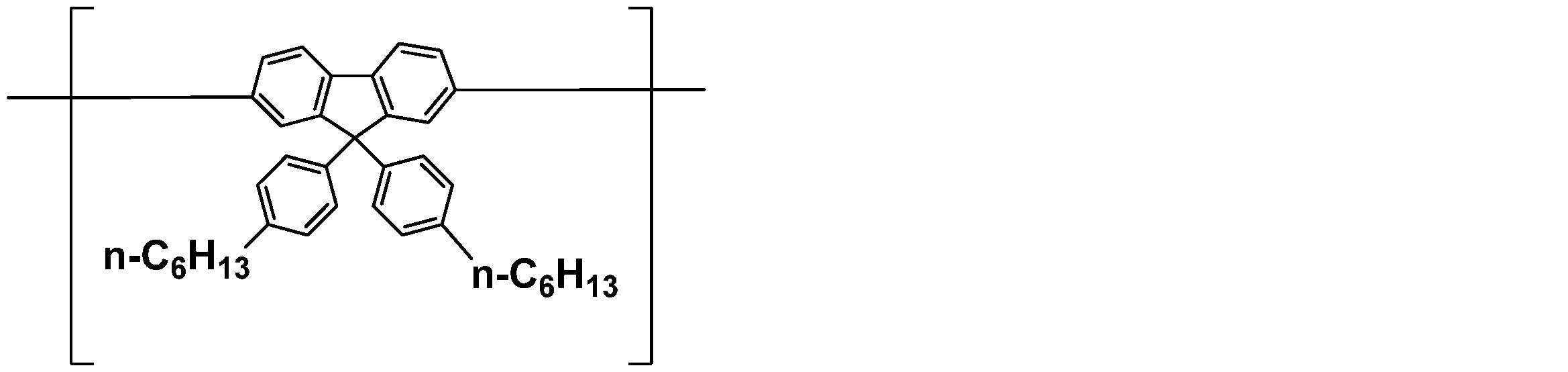


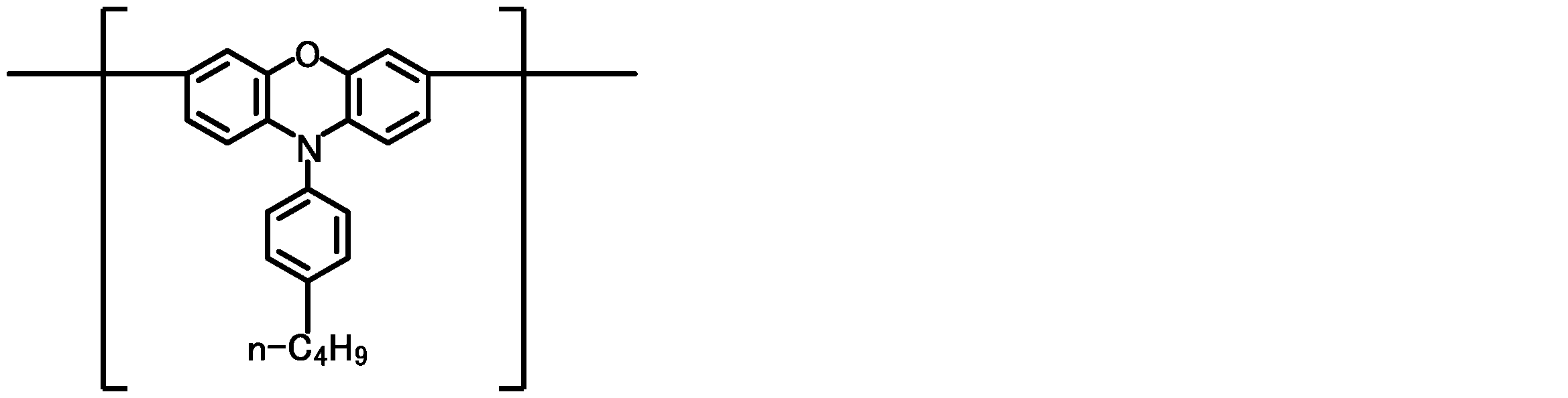
不活性雰囲気下、下記式:


不活性雰囲気下、化合物6(7.5733g、10.23mmol)、化合物7(2.1494g、4.03mmol)、化合物3(7.635g、11.82mmol)、化合物9(0.1369g、0.29mmol)、化合物4(1.0707g、1.44mmol)、下記式:

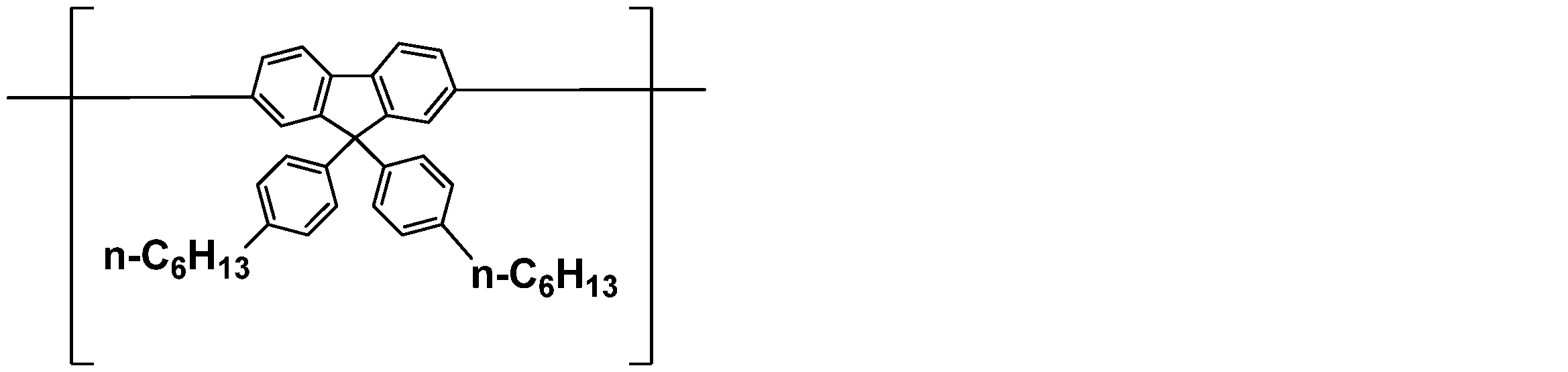
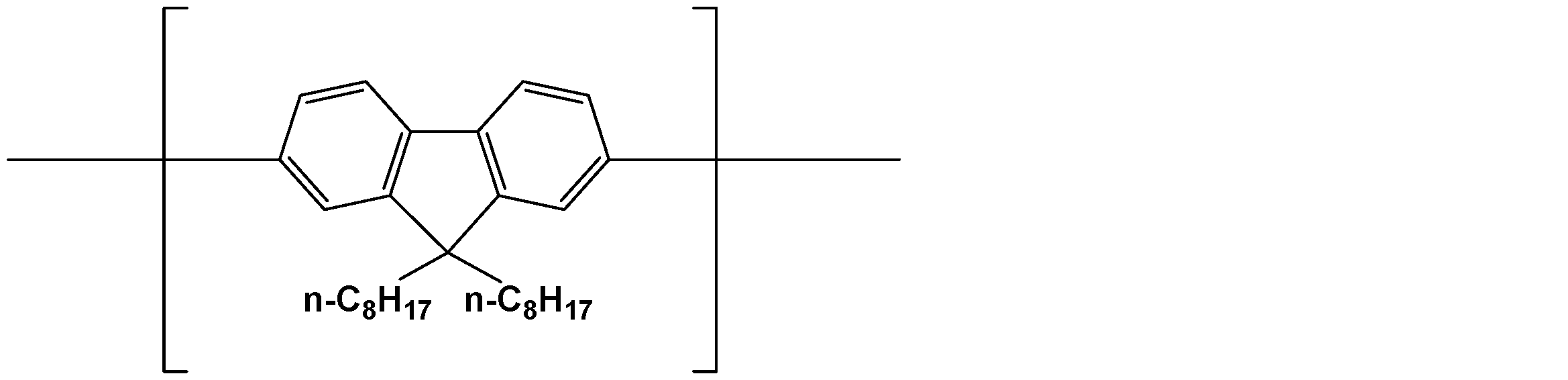


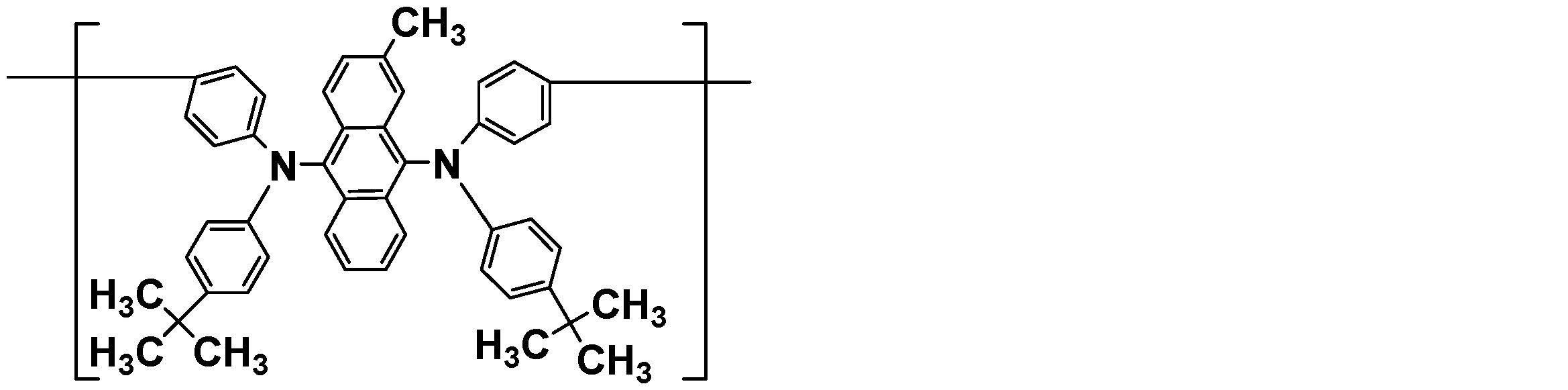
不活性雰囲気下、化合物6(2.8964g、3.92mmol)、化合物2(1.9744g、3.60mmol)、化合物4(0.2963g、0.40mmol)、ジクロロビス(トリフェニルホスフィン)パラジウム(2.8mg)、及びトルエン(80mL)を混合し、105℃に加熱した。反応液に17.5質量%炭酸ナトリウム水溶液(10.9mL)を滴下し、8時間還流させた。反応後、そこにフェニルボロン酸(50.0mg)、及びジクロロビス(トリフェニルホスフィン)パラジウム(2.8mg)を加え、更に23時間還流させた。次いで、そこに、ジエチルジチオカルバミン酸ナトリウム水溶液を加え、80℃で2時間撹拌した。反応液を冷却後、水で2回、3質量%酢酸水溶液で2回、水で2回洗浄し、得られた溶液をメタノールに滴下、濾取することで沈殿物を得た。この沈殿物をトルエンに溶解させ、アルミナカラム、シリカゲルカラムに順番に通すことにより精製した。得られた溶液をメタノールに滴下し、撹拌した後、得られた沈殿物を濾取し、乾燥させることにより、高分子化合物9を2.00g得た。高分子化合物9のポリスチレン換算の数平均分子量は1.1×10⁵であり、ポリスチレン換算の重量平均分子量は2.8×105であった。


不活性雰囲気下、高分子化合物2(1.200g,2.90mmol)、フラーレンC60(シグマアルドリッチ社製)(0.6219g,0.90mmol)、及びオルトジクロロベンゼン140mLを混合させた。得られた混合液にアルゴンガスを30分間バブリングした後、190℃に加熱し、24時間撹拌した。その後、反応液をメタノールに再沈殿し、濾過、減圧乾燥を行った。
乾燥後、得られた粗ポリマーにテトラヒドロフランを加え溶解させ、セライト濾過を行い、ポリマー溶液を得た。その後、桐山ロートの下層にセライト、上層に活性炭とシリカゲルの混合物を積層させ、ポリマー溶液を通液させた。この操作を2回繰り返した後、テトラヒドロフランを留去し、トルエンに再溶解させた。ポリマー溶液をメタノールに滴下し、撹拌した後、得られた沈殿物を濾取し、乾燥させることにより、高分子化合物10を0.43g得た。高分子化合物10のポリスチレン換算の数平均分子量は1.1×10⁵であり、ポリスチレン換算の重量平均分子量は3.7×10⁵であった。
また、得られた高分子化合物10の全繰り返し単位に対するフラーレン担持量は2.2モル%、担持されていないフラーレンは0.0モル%であった。
(化合物Bの合成)
下記式で表される反応により、化合物Aから化合物Bを合成した。

下記式で表される反応により、化合物Bから化合物1を合成した。

不活性雰囲気下、化合物10(1.8090g、1.99mmol)、化合物2(0.1132g、0.20mmol)、化合物11(1.1002g、1.20mmol)、化合物1(0.4032g、0.60mmol)、ジクロロビス(トリフェニルホスフィン)パラジウム(1.8mg)、及びトルエン(50ml)を混合し、105℃に加熱した。
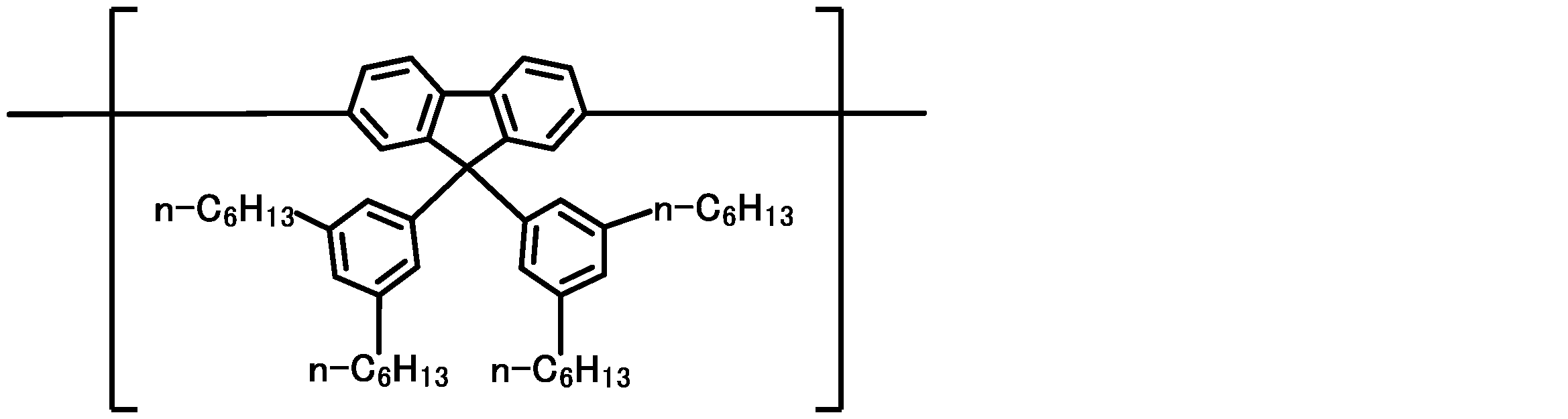


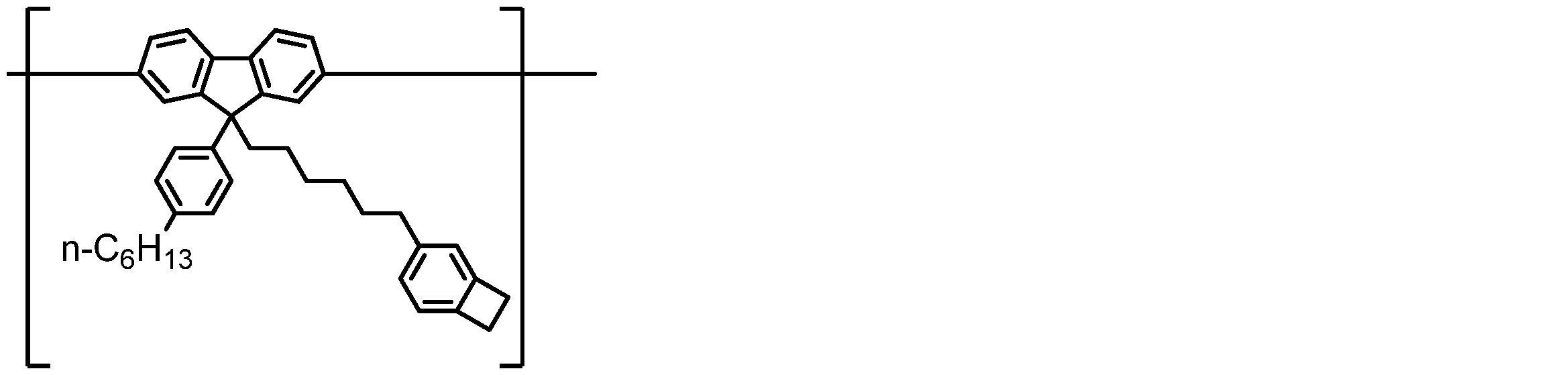
不活性雰囲気下、高分子化合物11(1.5426g,2.38mmol)、フラーレンC60(シグマアルドリッチ社製)(0.5163g,0.72mmol)、及びオルトジクロロベンゼン120mLを混合させた。得られた混合液にアルゴンガスを30分間バブリングした後、190℃に加熱し、24時間撹拌した。その後、反応液をメタノールに再沈殿し、濾過、減圧乾燥を行った。
乾燥後、得られた粗ポリマーにテトラヒドロフラン80mLを加え溶解させ、セライト濾過を行い、ポリマー溶液を得た。その後、桐山ロートの下層にセライト、上層に活性炭とシリカゲルの混合物を積層させ、ポリマー溶液を通液させた。この操作を2回繰り返した後、テトラヒドロフランを留去し、トルエンに再溶解させた。ポリマー溶液をメタノールに滴下し、撹拌した後、得られた沈殿物を濾取し、乾燥させることにより、高分子化合物12を1.11g得た。高分子化合物12のポリスチレン換算の数平均分子量は1.5×10⁵であり、ポリスチレン換算の重量平均分子量は5.3×10⁵であった。
また、得られた高分子化合物12の全繰り返し単位に対するフラーレン担持量は4.5モル%、担持されていないフラーレンは0.0モル%であった。
(実施例1)
スパッタ法により45nmの厚さでITO膜を付けたガラス基板に、ポリ(エチレンジオキシチオフェン)/ポリスチレンスルホン酸の溶液(H.C.Starck社、商品名:AI4083)を用いてスピンコートにより65nmの厚さで成膜し、ホットプレート上で200℃で10分間加熱して乾燥させた。
実施例1における高分子化合物1に代えて、高分子化合物2を用いた以外は実施例1と同様にして、有機EL素子を作製した。
実施例1における高分子化合物1と高分子化合物5を混合したキシレン溶液に代えて、高分子化合物5のみからなるキシレン溶液を用いた以外は実施例1と同様にして、有機EL素子を作製した。
実施例1における高分子化合物1及び高分子化合物5に代えて、高分子化合物3及び高分子化合物4を用いた以外は実施例1と同様にして、有機EL素子を作製した。
実施例1における高分子化合物6のキシレン溶液に代えて、高分子化合物7と下記式(L-1)で表されるイリジウム錯体との固形分の質量比が80:20となるように混合したキシレン溶液を用いてスピンコートすることにより、厚さ80nmの薄膜を形成した以外は実施例1と同様にして、有機EL素子を作製した。
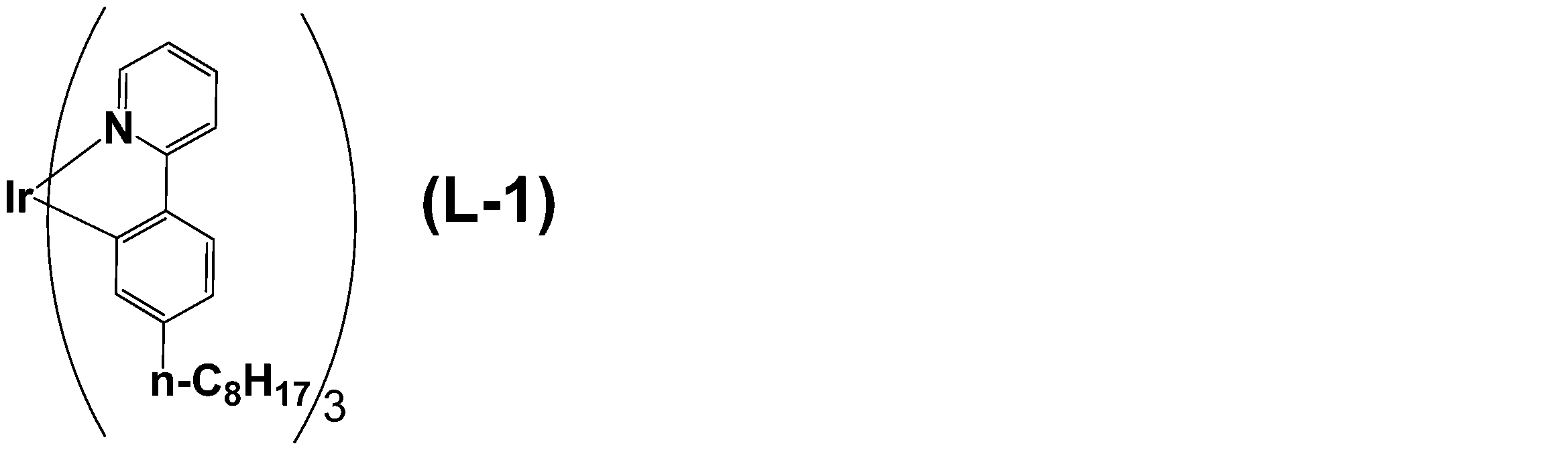
実施例1における高分子化合物6に代えて、高分子化合物8を用いた以外は実施例1と同様にして、有機EL素子を作製した。
実施例1における高分子化合物6のキシレン溶液に代えて、高分子化合物9と下記式(L-2)で表されるイリジウム錯体との固形分の質量比が92.5:7.5となるように混合したキシレン溶液を用いてスピンコートすることにより、厚さ80nmの薄膜を形成した以外は実施例1と同様にして、有機EL素子を作製した。
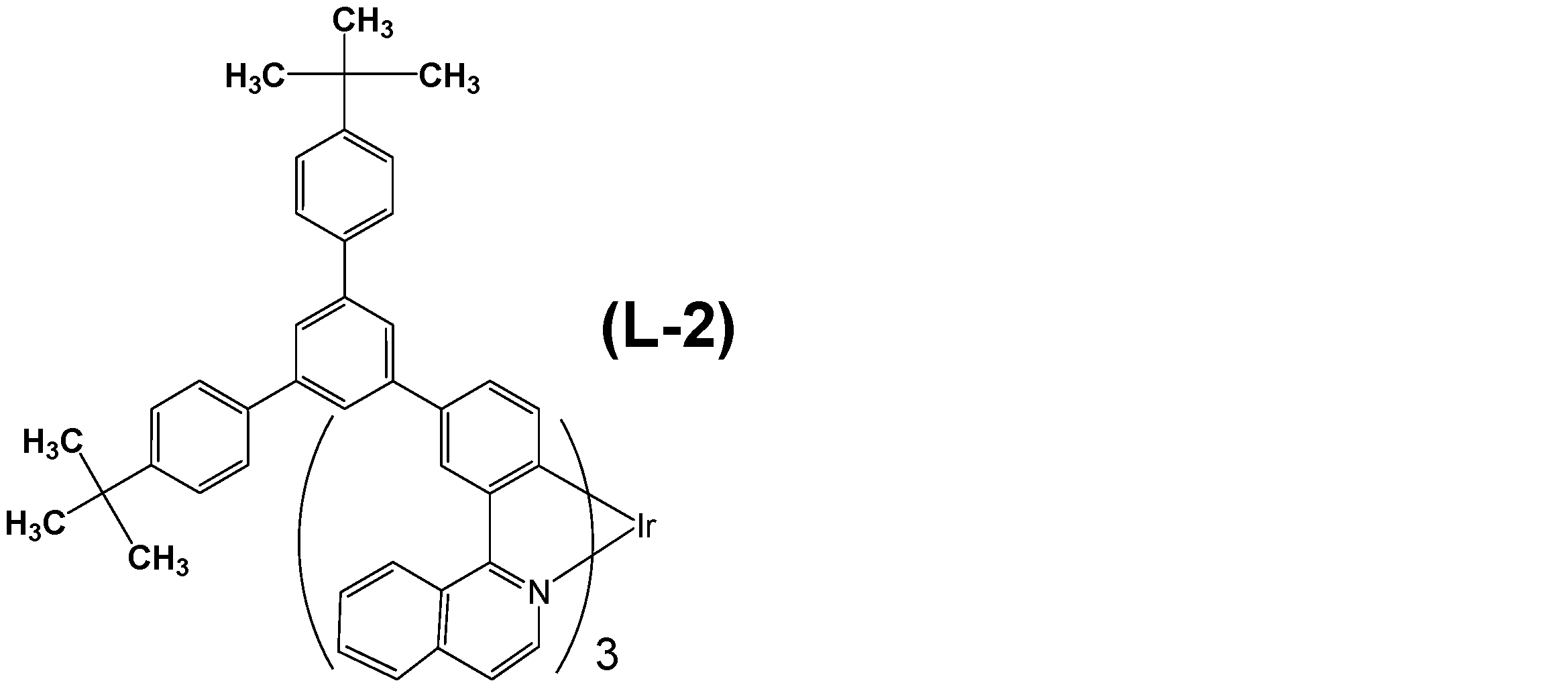
実施例1における高分子化合物5に代えて、高分子化合物10を用いた以外は実施例1と同様にして、有機EL素子を作製した。
実施例1における高分子化合物1及び高分子化合物5に代えて、高分子化合物2及び高分子化合物10を用いた以外は実施例1と同様にして、有機EL素子を作製した。
実施例1における高分子化合物1及び高分子化合物5に代えて、高分子化合物3及び高分子化合物12を用いた以外は実施例1と同様にして、有機EL素子を作製した。
実施例6における高分子化合物1及び高分子化合物5に代えて、高分子化合物2及び高分子化合物10を用いた以外は実施例6と同様にして、有機EL素子を作製した。
実施例6における高分子化合物1及び高分子化合物5に代えて、高分子化合物3及び高分子化合物12を用いた以外は実施例6と同様にして、有機EL素子を作製した。
実施例7における高分子化合物1及び高分子化合物5に代えて、高分子化合物2及び高分子化合物10を用いた以外は実施例7と同様にして、有機EL素子を作製した。
実施例7における高分子化合物1及び高分子化合物5に代えて、高分子化合物3及び高分子化合物12を用いた以外は実施例7と同様にして、有機EL素子を作製した。
実施例1における高分子化合物1と高分子化合物5を混合したキシレン溶液に代えて、高分子化合物1のみのキシレン溶液を用いた以外は、実施例1と同様にして、有機EL素子を作製した。
実施例2における高分子化合物2と高分子化合物5を混合したキシレン溶液に代えて、高分子化合物2のみのキシレン溶液を用いた以外は、実施例2と同様にして、有機EL素子を作製した。
実施例4における高分子化合物3と高分子化合物4を混合したキシレン溶液に代えて、高分子化合物3のみのキシレン溶液を用いた以外は、実施例4と同様にして、有機EL素子を作製した。
実施例5における高分子化合物1と高分子化合物5を混合したキシレン溶液に代えて、高分子化合物1のみのキシレン溶液を用いた以外は、実施例5と同様にして、有機EL素子を作製した。
実施例6における高分子化合物1と高分子化合物5を混合したキシレン溶液に代えて、高分子化合物1のみのキシレン溶液を用いた以外は、実施例6と同様にして、有機EL素子を作製した。
実施例7における高分子化合物1と高分子化合物5を混合したキシレン溶液に代えて、高分子化合物1のみのキシレン溶液を用いた以外は、実施例7と同様にして、有機EL素子を作製した。
実施例1における高分子化合物1と高分子化合物5を混合したキシレン溶液に代えて、高分子化合物1とフラーレンC60との固形分の質量比が92.5:7.5となるように調製したキシレン溶液を用いた以外は、実施例1と同様にして、有機EL素子を作製した。
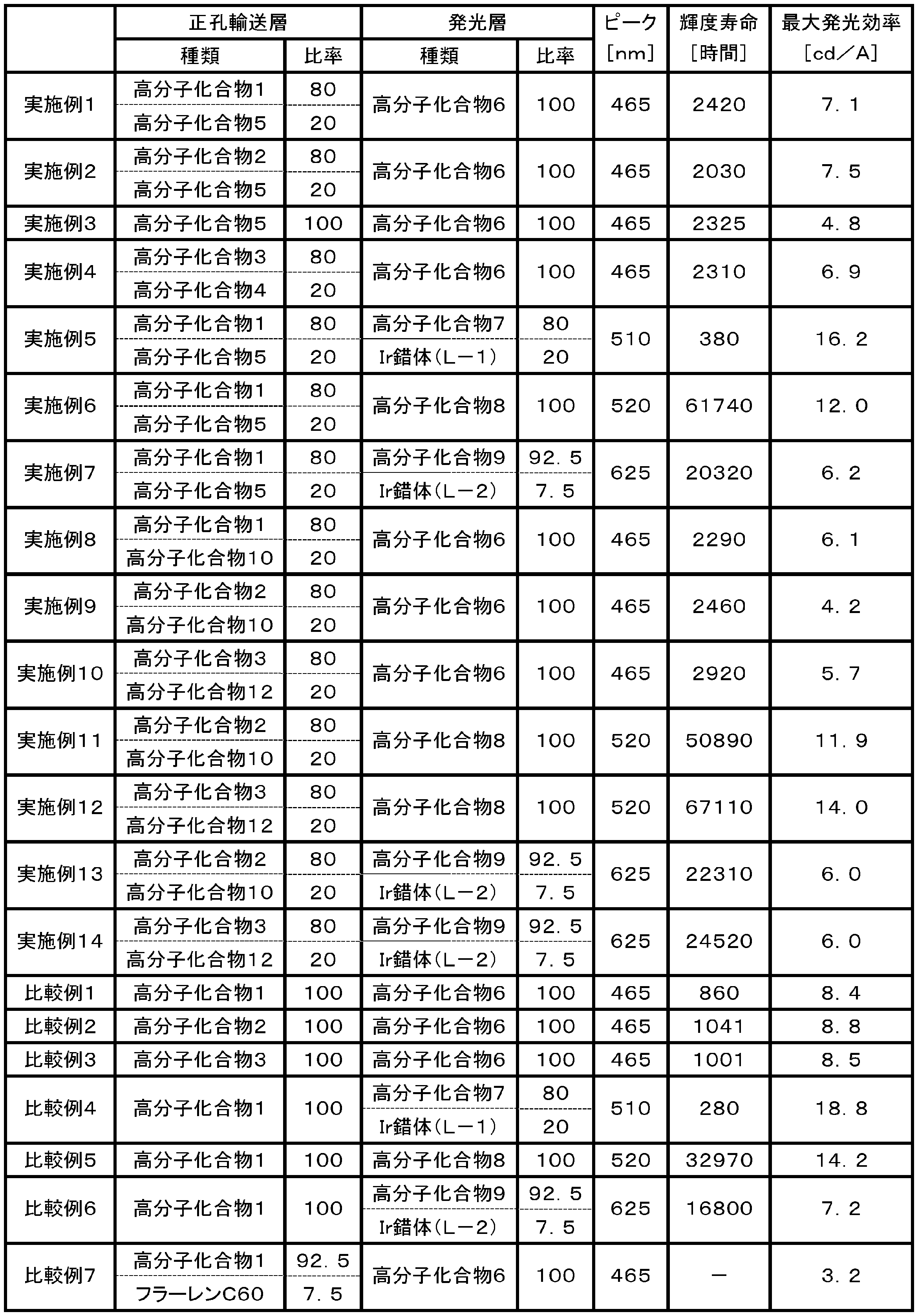
次に、光電変換素子形態に係る高分子化合物及びそれを用いた光電変換素子についての実施例及び比較例について説明する。
NMR測定は、化合物を重クロロホルムに溶解させ、NMR装置(Varian社製、INOVA300)を用いて行った。
数平均分子量及び重量平均分子量については、ゲルパーミエーションクロマトグラフィー(GPC)(島津製作所製、商品名:LC-10Avp)によりポリスチレン換算の数平均分子量及び重量平均分子量を求めた。測定する高分子化合物は、約0.5質量%の濃度になるようにテトラヒドロフランに溶解させ、GPCに30μL注入した。GPCの移動相はテトラヒドロフランを用い、0.6mL/分の流速で流した。カラムは、TSKgel SuperHM-H(東ソー製)2本とTSKgel SuperH2000(東ソー製)1本を直列に繋げた。検出器には示差屈折率検出器(島津製作所製、商品名:RID-10A)を用いた。
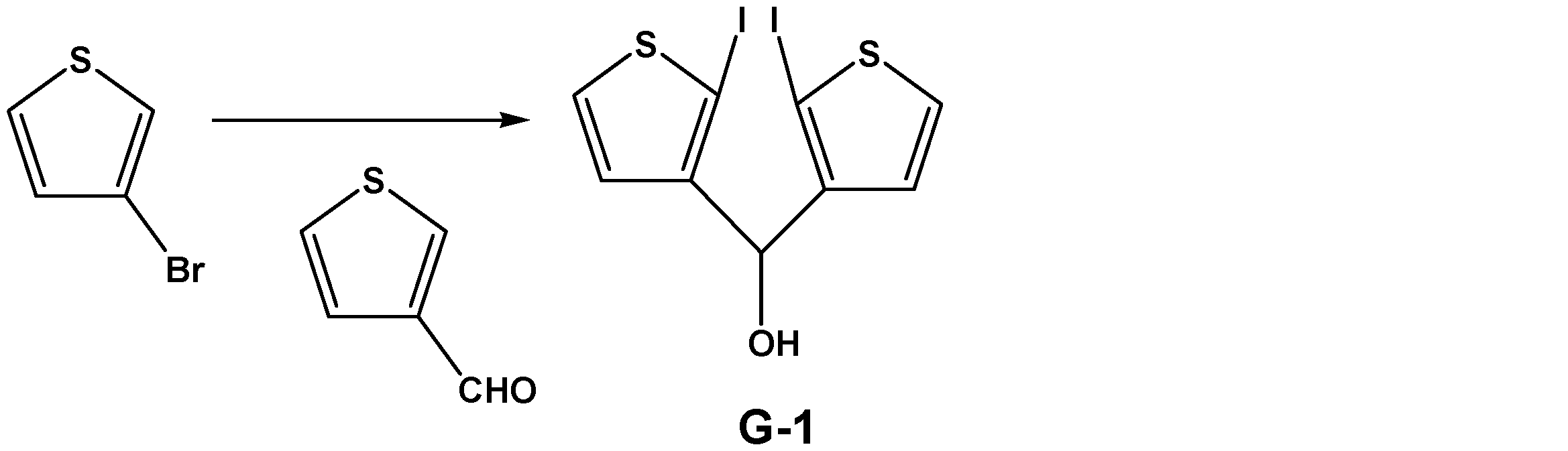
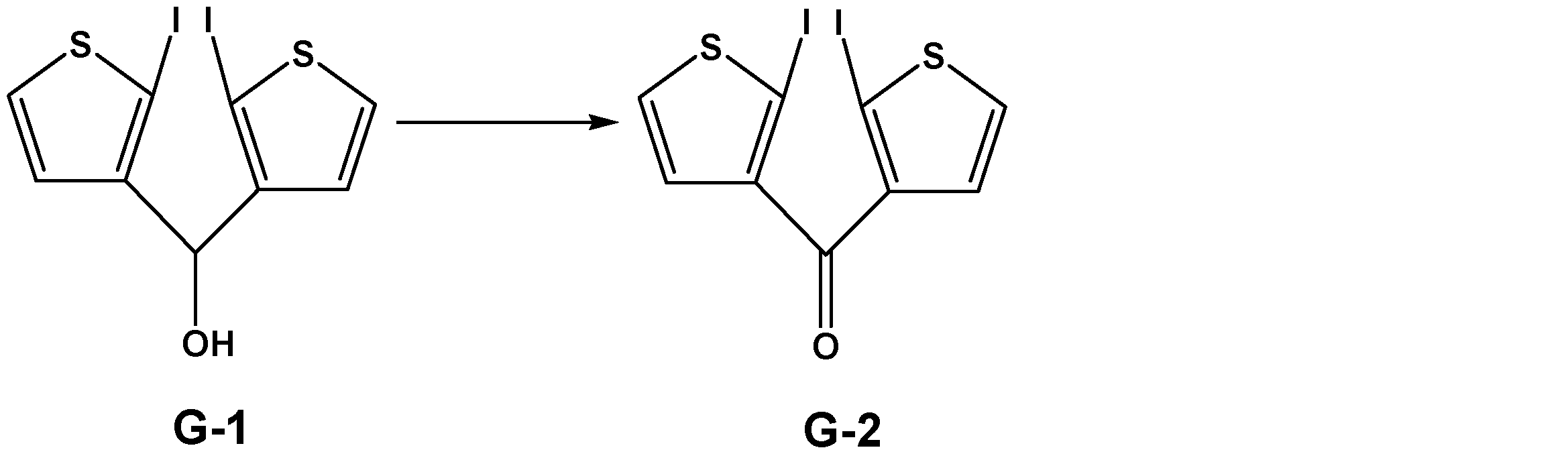
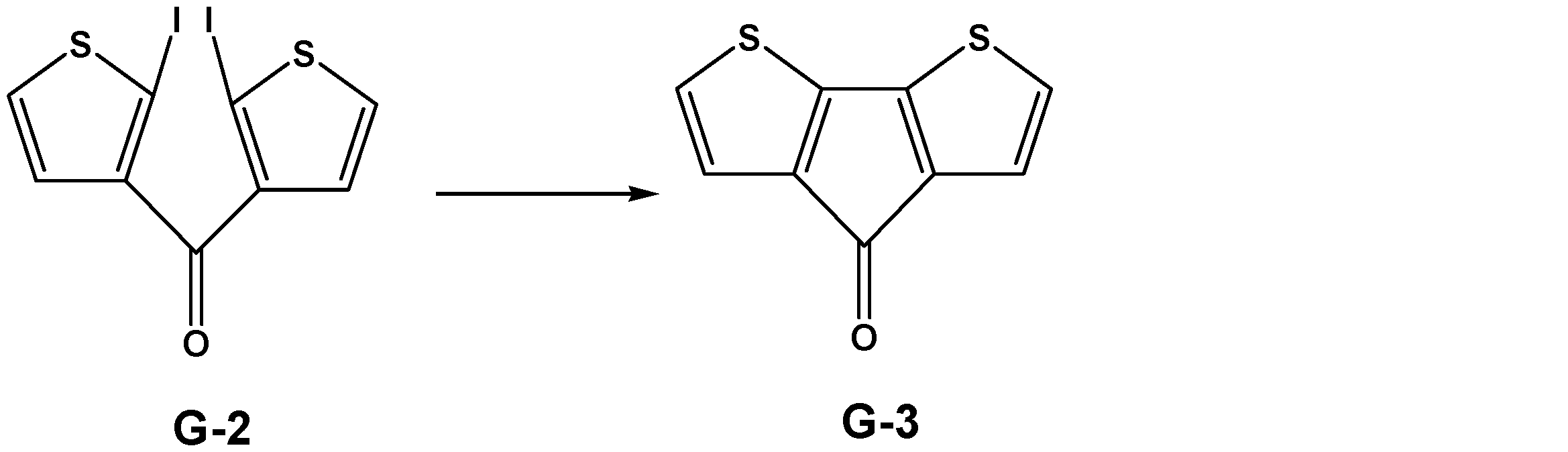
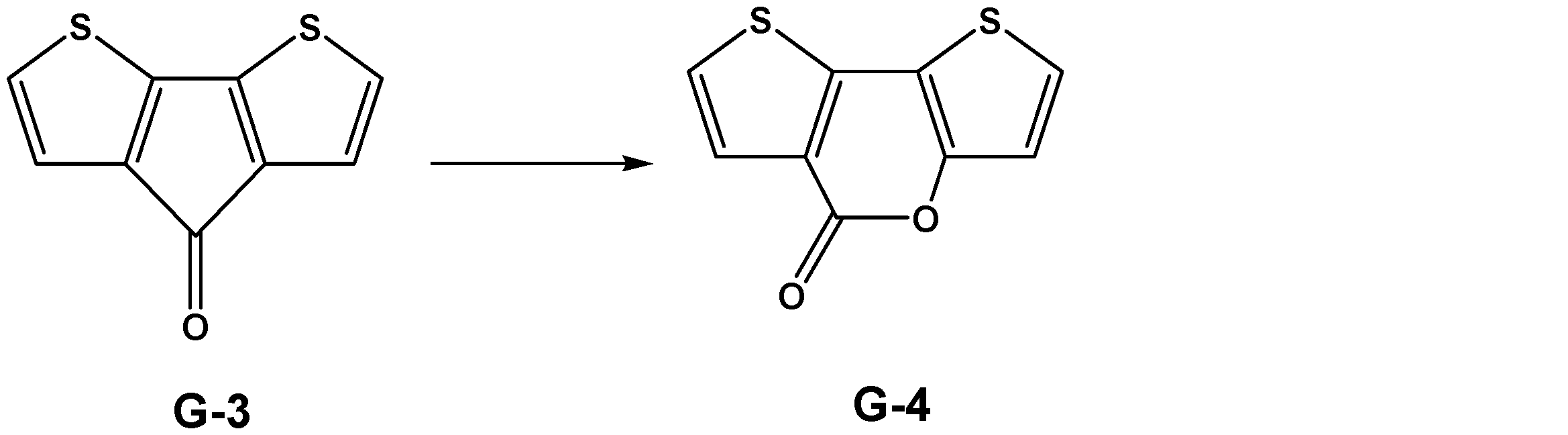
1H NMR(CDCl3、ppm):δ 7.64(d、1H)、7.43(d、1H)、7.27(d、1H)、7.10(d、1H)。
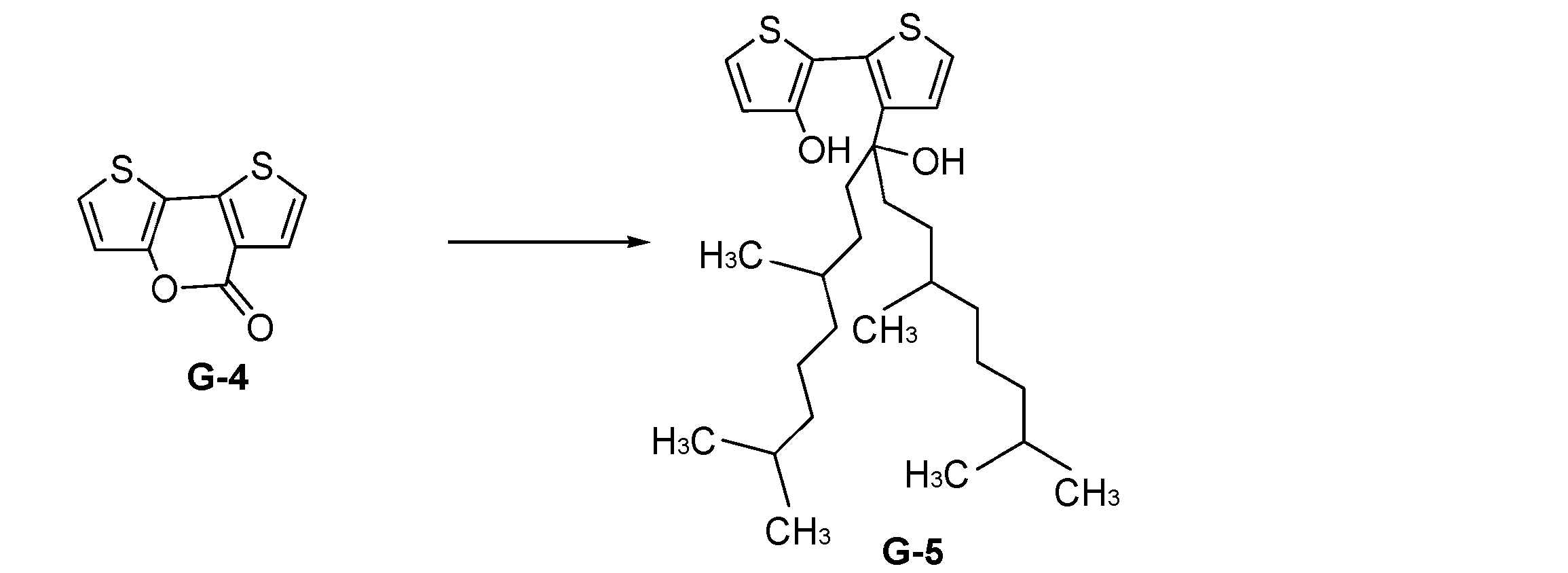
1H NMR(CDCl3、ppm):δ 8.42(b、1H)、7.25(d、1H)、7.20(d、1H)、6.99(d、1H)、6.76(d、1H)、2.73(b、1H)、1.90(m、4H)、1.58‐1.02(b、20H)、0.92(s、6H)、0.88(s、12H)。
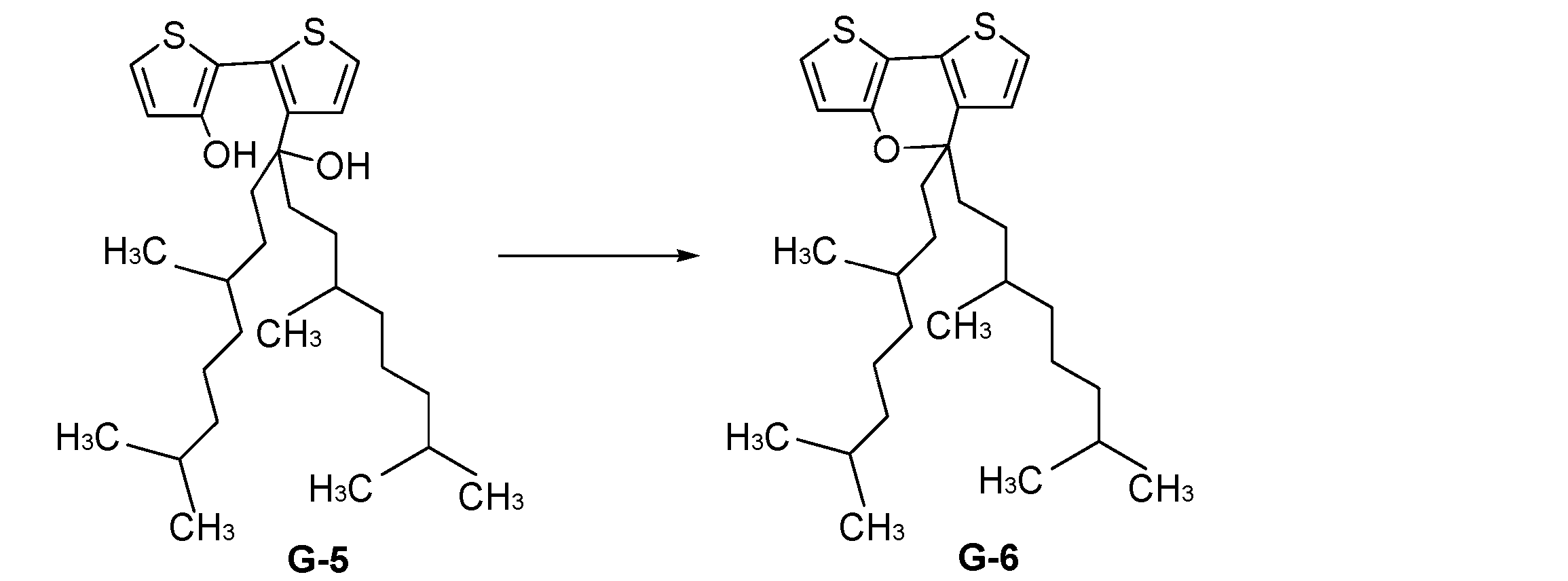
1H NMR(CDCl3、ppm):δ 6.98(d、1H)、6.93(d、1H)、6.68(d、1H)、6.59(d、1H)、1.89(m、4H)、1.58‐1.00(b、20H)、0.87(s、6H)、0.86(s、12H)。


1H NMR(CDCl3、ppm):δ 7.75(t、2H)。
19F NMR(CDCl3、ppm):δ -128.3(s、2F)。

19F NMR(CDCl3、ppm):δ -118.9(s、2F)。
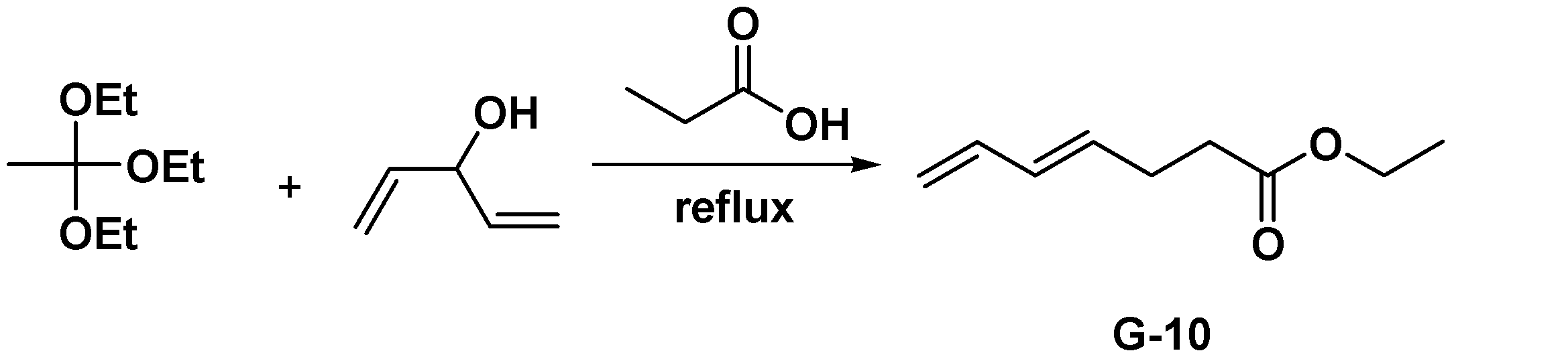
1H-NMR(270MHz,CDCl3、ppm):δ 1.25(t,3H),2.07(q,2H),2.41(m,4H),5.05(dd,2H),5.70(m,1H),6.09(dd,1H),6.29(m,1H)。

1H-NMR(270MHz,CDCl3、ppm):δ 1.67(tt,2H),2.13-2.28(m,3H),3.63(q,2H),5.04(dd,2H),5.72(dd,1H),6.07(dd,1H),6.30(m,1H)。
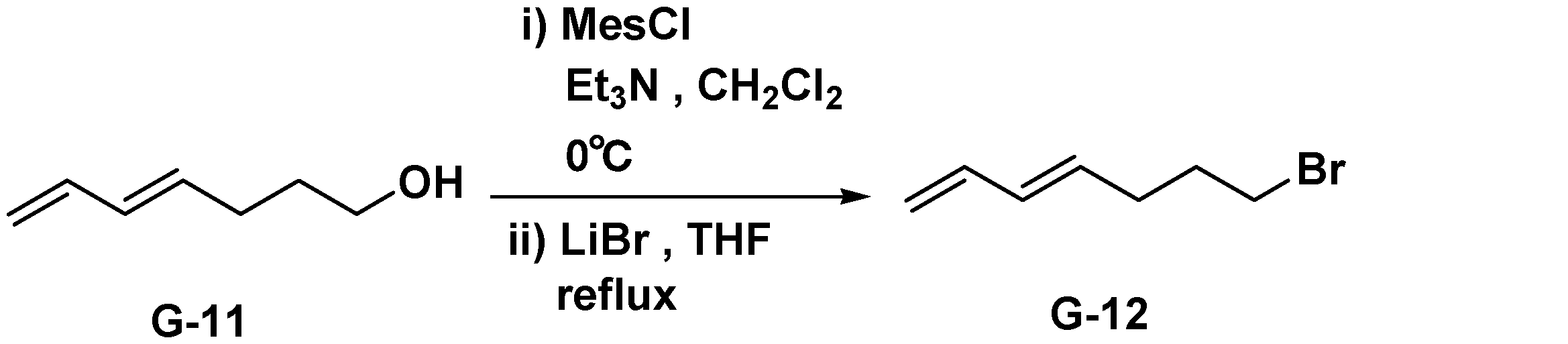
アルゴン雰囲気下、上記黄色オイル(32g)、臭化リチウム(36g)、及び、テトラヒドロフラン(400mL)を混合し、7時間還流した。得られた反応液を冷却し、イオン交換水とトルエンを加え、分液を行い、有機層をイオン交換水で5回洗浄し、硫酸ナトリウムで乾燥させた。得られた有機層を濃縮し、ヘキサンを加えた後、アルミナフラッシュカラムに通し、濃縮した。得られたオイルを分留(3mmHg、27℃)することにより化合物G-12を15.1g得た。
1H-NMR(270MHz,CDCl3、ppm):δ 1.96(tt,2H),2.22-2.29(m,2H),3.41(t,2H),5.05(dd,2H),5.65(m,1H),6.10(dd,1H),6.30(m,1H)。

1H-NMR(270MHz,CDCl3、ppm):δ 0.68(m,4H),1.81-1.96(m,8H),4.99(dd,4H),5.44(m,2H),5.89(dd,2H),6.22(td,2H),7.47(m,6H)。
MS(APCI-MS:Positive)m/z:512(〔M〕+)。
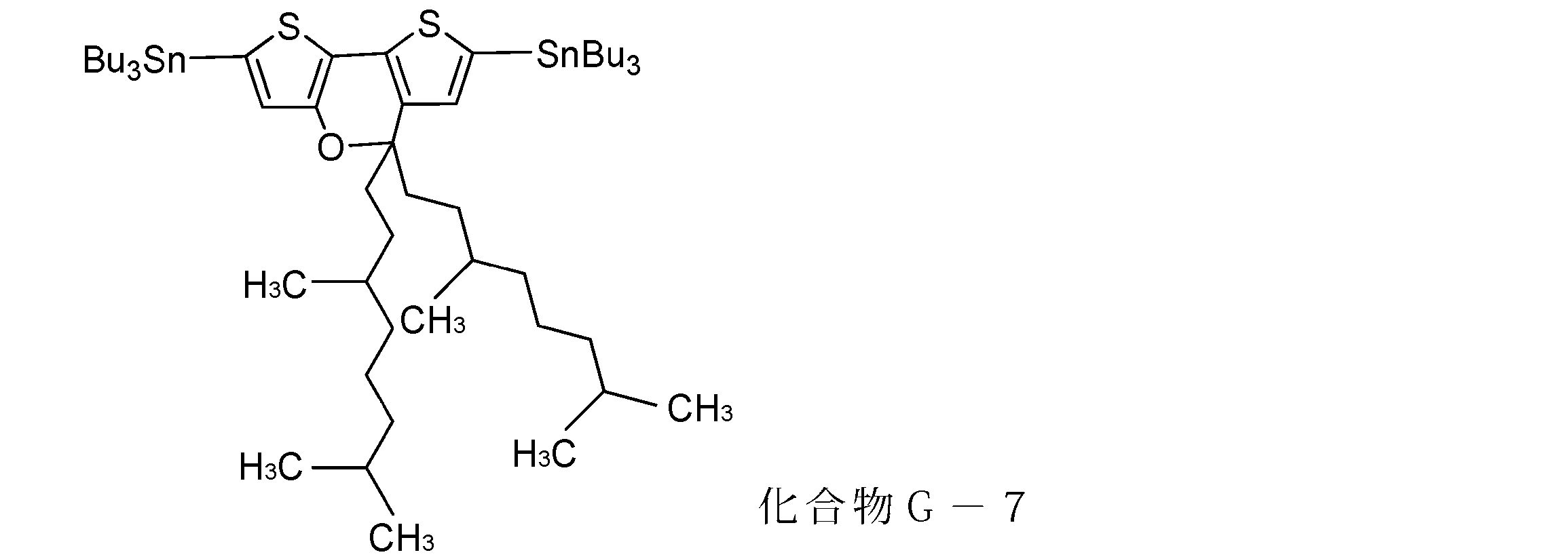

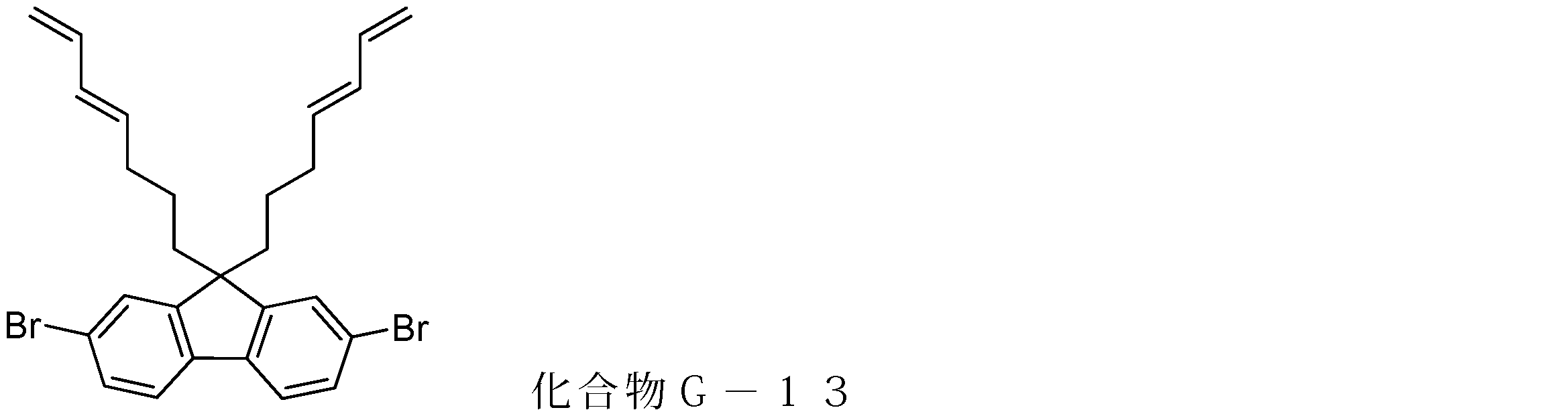
フラスコ内の気体をアルゴンで置換したフラスコに、上記合成例114で得られた重合体Aを100mg、フラーレンC60(nanom purple ST、フロンティアカーボン社製)を250mg、及び、オルトジクロロベンゼンを50mL入れて均一溶液として、100℃で6時間反応させた。反応後、反応液を室温に冷却し、シリカゲルカラムに通した。得られた溶液をメタノールに注ぎこみ、析出した固体を濾過し、メタノールで洗浄して黒色固体277mgを得た。この黒色固体を光電変換組成物Aと呼称する。光電変換組成物Aは、下記の構造式を有する重合体Bと遊離のフラーレンC60の混合物(重合体B:フラーレンC60=5:95(質量比))であると推定される。
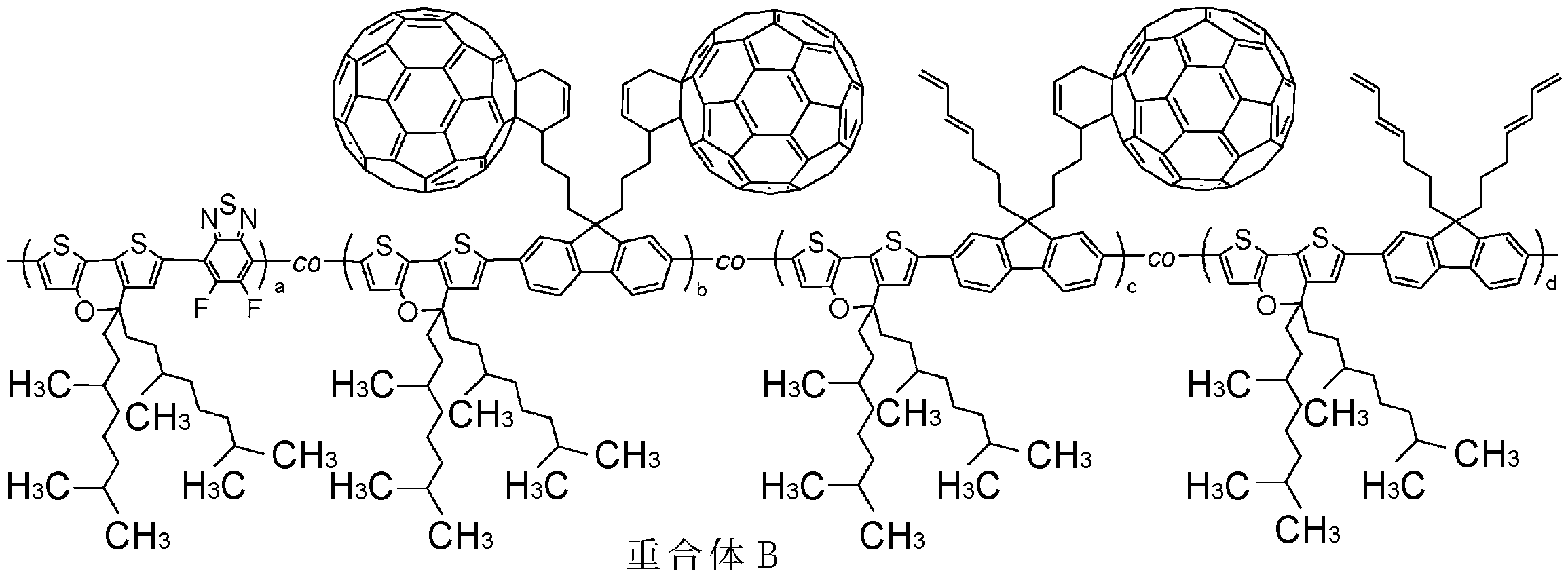
スパッタ法により150nmの厚みでITO膜を付けたガラス基板を、オゾンUV処理して表面処理を行った。次に、光電変換組成物A(10mg)をオルトジクロロベンゼン(2mL)に溶解し、インク1を製造した。該インク1を用い、スピンコートにより基板上に塗布して、光電変換組成物Aを含む有機膜を作製した(厚さ約100nm)。このようにして作製した有機膜の光吸収末端波長は890nmであった。その後、有機膜上に真空蒸着機によりフッ化リチウムを厚さ2nmで蒸着し、次いでAlを厚さ100nmで蒸着した。得られた有機薄膜太陽電池の形状は、2mm×2mmの正四角形であった。得られた有機薄膜太陽電池にソーラシミュレーター(分光計器製、商品名OTENTO-SUNII:AM1.5Gフィルター、放射照度100mW/cm2)を用いて一定の光を照射し、発生する電流と電圧を測定して光電変換効率、短絡電流密度、開放電圧、フィルファクターを求めた。Jsc(短絡電流密度)は3.04mA/cm2であり、Voc(開放端電圧)は0.71Vであり、ff(フィルファクター(曲線因子))は0.50であり、光電変換効率(η)は、1.07%であった。
スパッタ法により150nmの厚みでITO膜を付けたガラス基板を、オゾンUV処理して表面処理を行った。次に、重合体A及びフラーレンC60(nanom purple ST、フロンティアカーボン社製)(重合体A/フラーレンC60の質量比=1/2)をオルトジクロロベンゼンに溶解し(重合体AとフラーレンC60との質量の合計は、インク2の全量に対して2.0質量%)、インク2を製造した。該インク2を用い、スピンコートにより基板上に塗布して、重合体AとフラーレンC60を含む有機膜を作製した(厚さ約100nm)。このようにして作製した有機膜の光吸収末端波長は890nmであった。その後、有機膜上に真空蒸着機によりフッ化リチウムを厚さ2nmで蒸着し、次いでAlを厚さ100nmで蒸着した。得られた有機薄膜太陽電池の形状は、2mm×2mmの正四角形であった。得られた有機薄膜太陽電池にソーラシミュレーター(分光計器製、商品名OTENTO-SUNII:AM1.5Gフィルター、放射照度100mW/cm2)を用いて一定の光を照射し、発生する電流と電圧を測定して光電変換効率、短絡電流密度、開放電圧、フィルファクターを求めた。Jsc(短絡電流密度)は2.54mA/cm2であり、Voc(開放端電圧)は0.70Vであり、ff(フィルファクター(曲線因子))は0.43であり、光電変換効率(η)は、0.76%であった。

フラスコ内の気体をアルゴンで置換したフラスコに、上記合成例115で得られた重合体Cを100mg、フラーレンC60(nanom purple ST、フロンティアカーボン社製)を132mg、オルトジクロロベンゼンを50mL入れて均一溶液として、100℃で2時間反応させた。反応後、反応液を室温に冷却し、シリカゲルカラムに通した。得られた溶液をメタノールに注ぎこみ、析出した固体を濾過し、メタノールで洗浄して黒色固体191mgを得た。この黒色固体を光電変換組成物Bと呼称する。光電変換組成物Bは下記の構造式を有する重合体Dと遊離のフラーレンC60の混合物(重合体D:フラーレンC60=50:50(質量比))であると推定される。
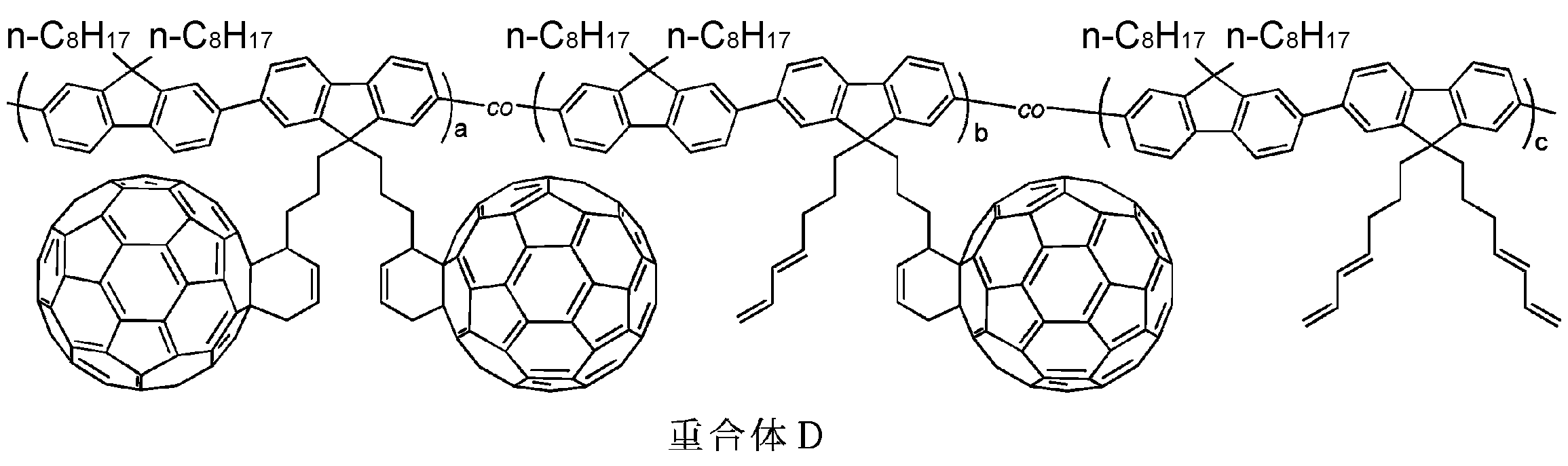
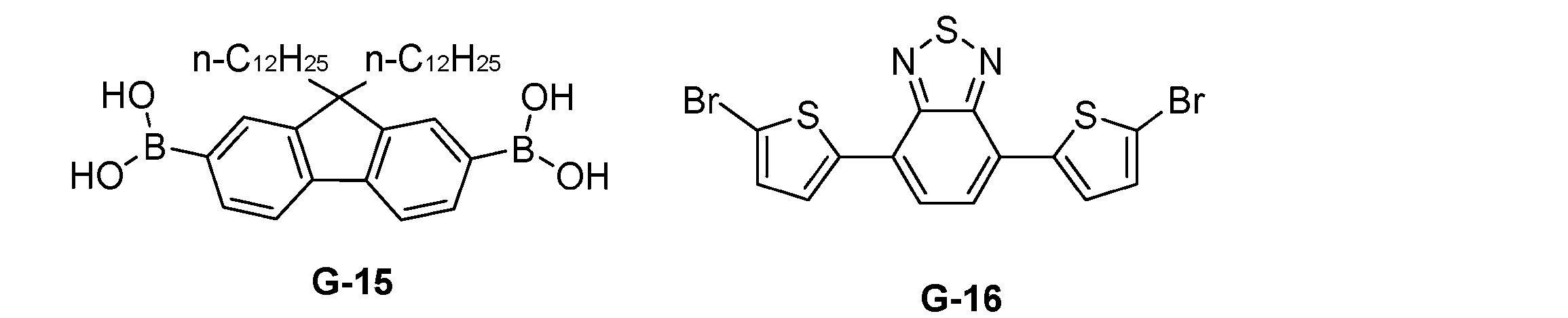
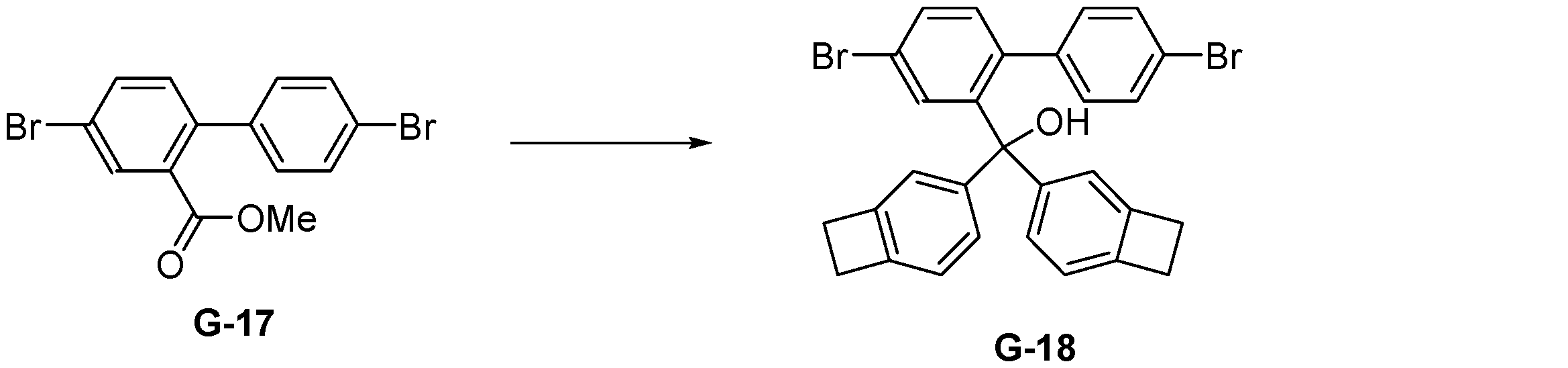
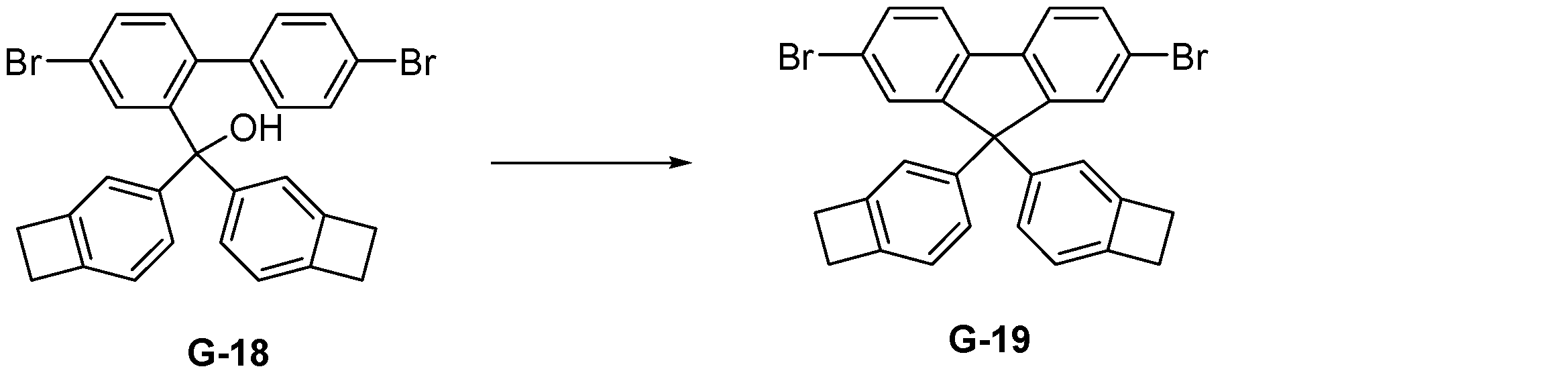
1HNMR(300MHz,CDCl3、ppm):δ 7.56(d,8.1Hz,2H),7.49(d,1.2Hz,2H),7.45(dd,8.1,1.2Hz,2H),7.01(d,7.8Hz,2H),6.92(d,7.8Hz,2H), 6.81(s,2H),3.11(s,4H)


フラスコ内の気体をアルゴンで置換したフラスコに、上記合成例119で得られた重合体Fを100mg、フラーレンC60(nanom purple ST、フロンティアカーボン社製)を130mg、オルトジクロロベンゼンを50mL入れて均一溶液として、100℃で2時間反応させた。反応後、反応液を室温に冷却し、シリカゲルカラムに通した。得られた溶液をメタノールに注ぎこみ、析出した固体を濾過し、メタノールで洗浄して黒色固体121mgを得た。この黒色固体を光電変換組成物Cと呼称する。光電変換組成物Cは下記の構造式を有する重合体Gと遊離のフラーレンC60の混合物であると推定される。
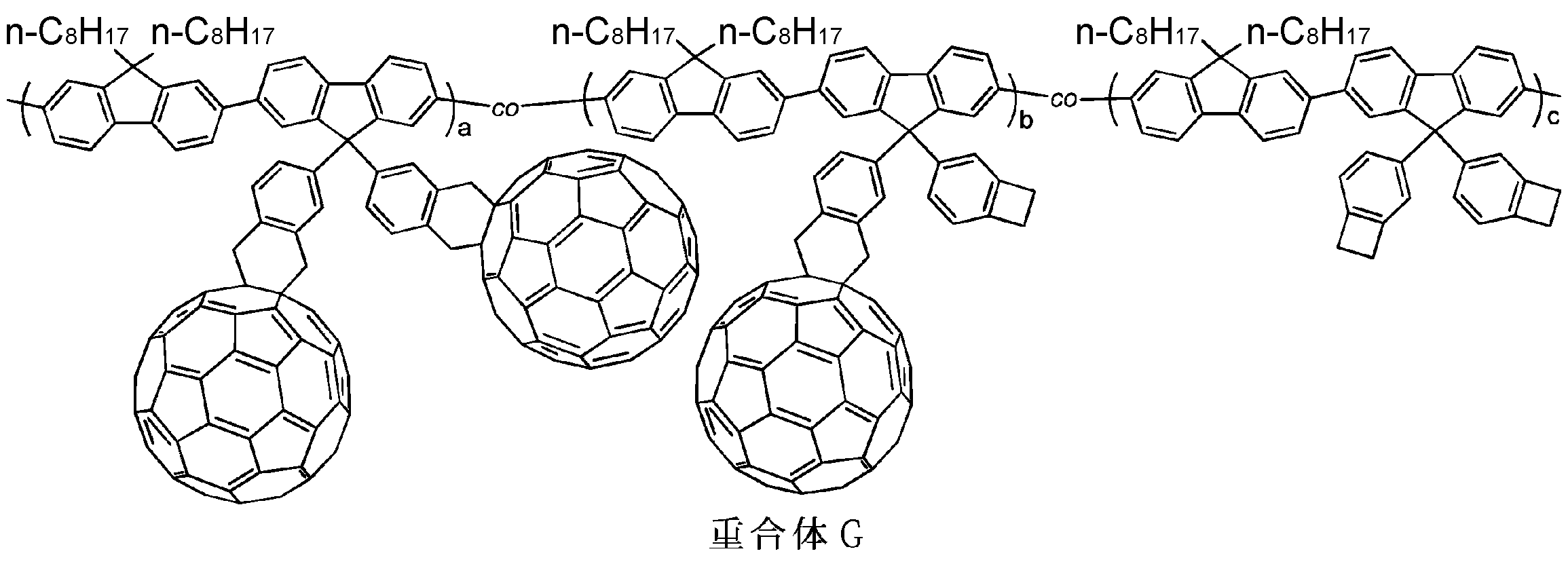
Claims (28)
- 繰り返し単位の少なくとも一部が炭素クラスター構造を含む基を有する高分子化合物。
- アリーレン単位、ヘテロアリーレン単位、複素環単位及び芳香族アミン単位からなる群より選ばれる2種以上を繰り返し単位として有する、請求項1に記載の高分子化合物。
- アリーレン単位、ヘテロアリーレン単位及び複素環単位からなる群より選ばれる1種以上の単位と、芳香族アミン単位と、を繰り返し単位として有する、請求項1又は2に記載の高分子化合物。
- 芳香族アミン単位が、下記一般式(2)で表される単位及び一般式(3)で表される単位からなる群より選ばれる1種以上である、請求項2又は3に記載の高分子化合物。


- アリーレン単位が、フルオレン構造を有する単位である、請求項2~4のいずれか一項に記載の高分子化合物。
- 共役系高分子である、請求項1~5のいずれか一項に記載の高分子化合物。
- 前記炭素クラスター構造を含む基を有する繰り返し単位が、下記一般式(5A)で表される、請求項1~6のいずれか一項に記載の高分子化合物。
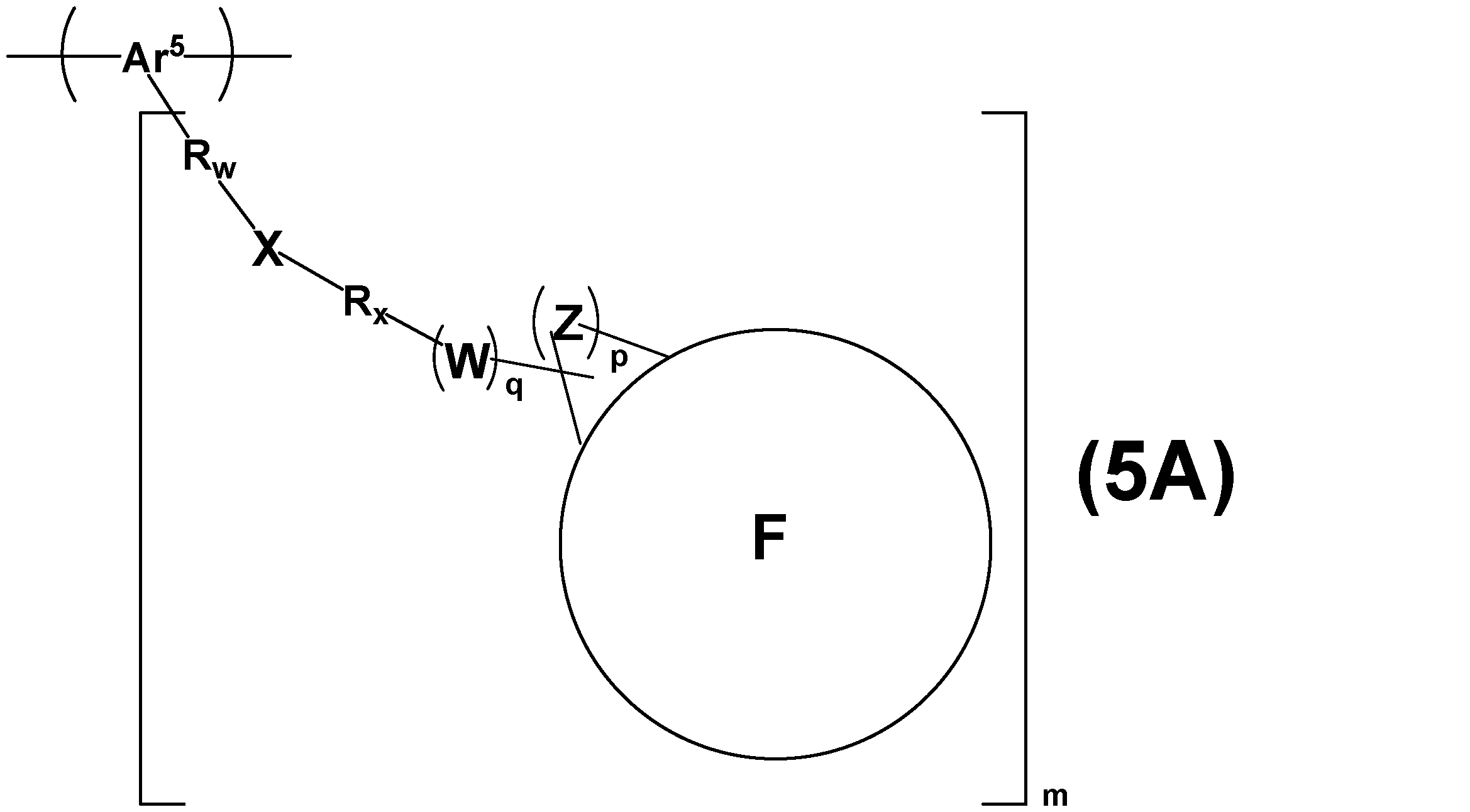
- 前記炭素クラスター構造が、フラーレンを含む構造である、請求項7に記載の高分子化合物。
- 前記フラーレンがフラーレンC60である、請求項8に記載の高分子化合物。
- 前記炭素クラスター構造を含む基を有する繰り返し単位が、下記一般式(6)で表される、請求項8又は9に記載の高分子化合物。
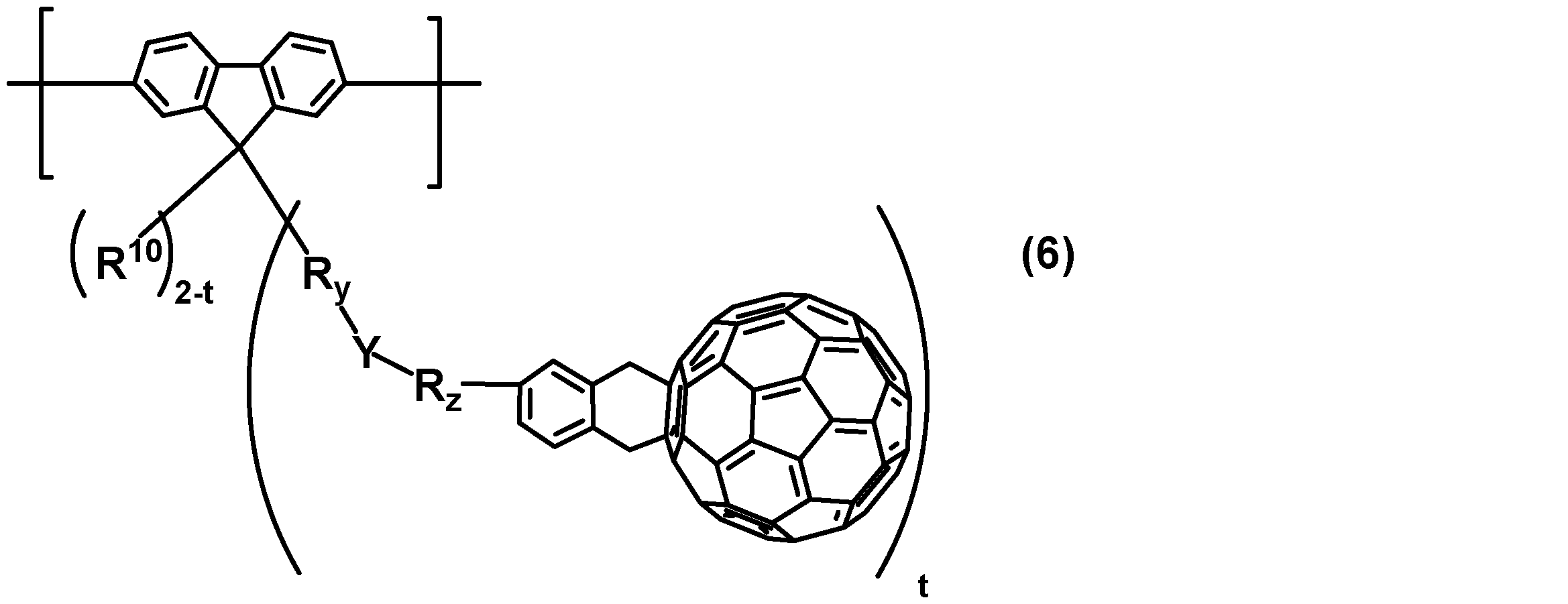
- アリーレン単位、ヘテロアリーレン単位、複素環単位、及び芳香族アミン単位からなる群より選ばれる2種以上を繰り返し単位として有し、前記繰り返し単位の少なくとも一部が架橋性基を含有する前駆体高分子化合物と、炭素クラスターと、を反応させることにより得ることのできる高分子化合物。
- 前記架橋性基を含有する繰り返し単位が、下記一般式(7)で表される単位である、請求項11に記載の高分子化合物。

- 正孔輸送材料、電子輸送材料及び発光材料からなる群より選ばれる1種以上の材料と、請求項1~12のいずれか一項に記載の高分子化合物と、を含有する組成物。
- 請求項1~12のいずれか一項に記載の高分子化合物と、溶媒とを含有する溶液。
- 請求項1~12のいずれか一項に記載の高分子化合物、又は請求項13に記載の組成物を用いて得られる薄膜。
- 請求項15に記載の薄膜を有する有機エレクトロルミネッセンス素子。
- 請求項15に記載の薄膜を正孔輸送層として用いた有機エレクトロルミネッセンス素子。
- 請求項16又は17に記載の有機エレクトロルミネッセンス素子を有する面状光源。
- 請求項16又は17に記載の有機エレクトロルミネッセンス素子を有する表示装置。
- アリーレン単位及びヘテロアリーレン単位からなる群より選ばれる少なくとも1種を繰り返し単位として有する、請求項1に記載の高分子化合物。
- 前記炭素クラスター構造を含む基が、フラーレンC60の誘導体から水素原子を1個除いた基、フラーレンC70の誘導体から水素原子を1個除いた基、又はフラーレンC84の誘導体から水素原子を1個除いた基である、請求項1又は20に記載の高分子化合物。
- 前記炭素クラスター構造を含む基を有する繰り返し単位が、全繰り返し単位の合計に対して、5モル%以上100モル%以下である、請求項1~12、20及び21のいずれか一項に記載の高分子化合物。
- 第1の化合物と、該第1の化合物とは異なる第2の化合物とを含有し、
前記第1の化合物が、請求項20~22のいずれか一項に記載の高分子化合物であり、
前記第2の化合物が、フラーレン若しくはフラーレン誘導体、又は、光吸収末端波長が500nm以上1500nm以下である高分子化合物であり、
前記第2の化合物の含有量が、全量を基準として、0.1質量%~99質量%である光電変換組成物。 - 一対の電極と、該電極間に少なくとも1層の活性層とを有し、
前記活性層に、請求項20~22のいずれか一項に記載の高分子化合物、又は請求項23に記載の光電変換組成物を含有する光電変換素子。 - 請求項24に記載の光電変換素子を有する太陽電池。
- 請求項24に記載の光電変換素子を有するイメージセンサー。
- 請求項25に記載の太陽電池を含む太陽電池モジュール。
- ゲート電極と、ソース電極と、ドレイン電極と、活性層とを有し、該活性層中に請求項20~22のいずれか一項に記載の高分子化合物を含有する有機薄膜トランジスタ。
Priority Applications (3)
| Application Number | Priority Date | Filing Date | Title |
|---|---|---|---|
| KR1020137018216A KR101815339B1 (ko) | 2010-12-21 | 2011-12-21 | 탄소 클러스터 구조를 갖는 고분자 화합물 및 그것을 이용한 유기 디바이스 |
| CN201180061963.7A CN103270076B (zh) | 2010-12-21 | 2011-12-21 | 具有碳团簇结构的高分子化合物及使用其的有机装置 |
| US13/995,823 US9269905B2 (en) | 2010-12-21 | 2011-12-21 | Polymer compound having carbon cluster structure and organic device using same |
Applications Claiming Priority (4)
| Application Number | Priority Date | Filing Date | Title |
|---|---|---|---|
| JP2010285025 | 2010-12-21 | ||
| JP2010-285025 | 2010-12-21 | ||
| JP2011-161285 | 2011-07-22 | ||
| JP2011161285 | 2011-07-22 |
Publications (1)
| Publication Number | Publication Date |
|---|---|
| WO2012086672A1 true WO2012086672A1 (ja) | 2012-06-28 |
Family
ID=46313940
Family Applications (1)
| Application Number | Title | Priority Date | Filing Date |
|---|---|---|---|
| PCT/JP2011/079599 Ceased WO2012086672A1 (ja) | 2010-12-21 | 2011-12-21 | 炭素クラスター構造を有する高分子化合物及びそれを用いた有機デバイス |
Country Status (6)
| Country | Link |
|---|---|
| US (1) | US9269905B2 (ja) |
| JP (1) | JP5883639B2 (ja) |
| KR (1) | KR101815339B1 (ja) |
| CN (1) | CN103270076B (ja) |
| TW (1) | TWI518106B (ja) |
| WO (1) | WO2012086672A1 (ja) |
Families Citing this family (9)
| Publication number | Priority date | Publication date | Assignee | Title |
|---|---|---|---|---|
| GB201200619D0 (en) | 2012-01-16 | 2012-02-29 | Cambridge Display Tech Ltd | Polymer |
| JP5955660B2 (ja) * | 2012-06-20 | 2016-07-20 | 住友化学株式会社 | 組成物、高分子化合物およびそれらを用いた発光素子 |
| WO2014181986A1 (ko) * | 2013-05-07 | 2014-11-13 | 주식회사 엘지화학 | 플러렌 유도체를 포함하는 유기 전자 소자 |
| JP2015103735A (ja) * | 2013-11-27 | 2015-06-04 | ソニー株式会社 | 固体撮像素子および電子機器 |
| US10672988B2 (en) * | 2014-04-18 | 2020-06-02 | Massachusetts Institute Of Technology | Functionalized nanostructures and devices including photovoltaic devices |
| KR102314129B1 (ko) * | 2014-07-21 | 2021-10-18 | 삼성전자주식회사 | 유기 광전 소자 및 이미지 센서 |
| CN107004690B (zh) * | 2015-11-12 | 2021-05-14 | 松下知识产权经营株式会社 | 光传感器 |
| CN108431985B (zh) * | 2016-01-08 | 2020-06-23 | 日立化成株式会社 | 有机电子材料、有机电子元件及有机电致发光元件 |
| US11046886B2 (en) | 2017-09-14 | 2021-06-29 | Sumitomo Chemical Company, Limited | Method for producing liquid composition |
Citations (9)
| Publication number | Priority date | Publication date | Assignee | Title |
|---|---|---|---|---|
| JPH09188726A (ja) * | 1996-01-08 | 1997-07-22 | Rikagaku Kenkyusho | フラーレン含有高分子材料及びその製造方法 |
| JP2004231958A (ja) * | 2003-01-31 | 2004-08-19 | Clemson Univ | エレクトロルミネセンス素子用のナノ構造ドープ混合物 |
| JP2004277736A (ja) * | 2003-02-28 | 2004-10-07 | Kyoto Univ | 導電性重合体及びその製造方法並びにそれを用いた有機太陽電池 |
| JP2005179480A (ja) * | 2003-12-18 | 2005-07-07 | Sumitomo Bakelite Co Ltd | 絶縁材用樹脂組成物及びこれを用いた絶縁材 |
| JP2007191645A (ja) * | 2006-01-20 | 2007-08-02 | Sanyo Chem Ind Ltd | 熱可塑性樹脂用改質剤 |
| JP2008095080A (ja) * | 2006-09-13 | 2008-04-24 | Sumitomo Chemical Co Ltd | 高分子化合物および高分子発光素子 |
| WO2010013723A1 (ja) * | 2008-07-29 | 2010-02-04 | 住友化学株式会社 | 高分子化合物及びそれを用いた発光素子 |
| JP2010053349A (ja) * | 2008-07-29 | 2010-03-11 | Sumitomo Chemical Co Ltd | 1,3−ジエンを含む化合物及びその製造方法 |
| JP2010195918A (ja) * | 2009-02-25 | 2010-09-09 | National Institute For Materials Science | 新規なジブロック共重合体、及びそのジブロック共重合体の自己集合で形成される高移動度・光伝導性異方性ナノワイヤ |
Family Cites Families (12)
| Publication number | Priority date | Publication date | Assignee | Title |
|---|---|---|---|---|
| JP3227784B2 (ja) | 1992-06-04 | 2001-11-12 | 三菱化学株式会社 | 有機電界発光素子 |
| DE4301458A1 (de) | 1993-01-20 | 1994-07-21 | Hoechst Ag | Thermisch stabile Fullerenderivate und Verfahren zu Ihrer Herstellung |
| JP3985277B2 (ja) | 1996-05-28 | 2007-10-03 | 住友電気工業株式会社 | ケイ素系高分子およびその製造方法 |
| TWI312353B (en) * | 2002-12-26 | 2009-07-21 | Ind Tech Res Inst | Polymer chain grafted carbon nanocapsule |
| US7358538B2 (en) | 2004-10-28 | 2008-04-15 | Zheng-Hong Lu | Organic light-emitting devices with multiple hole injection layers containing fullerene |
| WO2006108272A2 (en) | 2005-04-12 | 2006-10-19 | Zheng-Hong Lu | Metal/fullerene anode structure and application of same |
| KR100712290B1 (ko) | 2005-04-12 | 2007-04-27 | 삼성에스디아이 주식회사 | 유기전계발광소자 |
| US7781673B2 (en) | 2005-07-14 | 2010-08-24 | Konarka Technologies, Inc. | Polymers with low band gaps and high charge mobility |
| EP2070965A4 (en) | 2006-09-13 | 2010-11-10 | Sumitomo Chemical Co | Polymer compound and light-emitting polymer device |
| US8729387B2 (en) | 2008-08-22 | 2014-05-20 | Konica Minolta Holdings, Inc. | Organic photoelectric conversion element, solar cell and optical sensor array |
| US8211996B2 (en) * | 2008-12-01 | 2012-07-03 | The Regents Of The University Of California | Well-defined donor-acceptor rod-coil diblock copolymer based on P3HT containing C60 |
| US20100187500A1 (en) | 2008-12-23 | 2010-07-29 | E.I.Du Pont De Nemours And Company | Carbon structures bonded to layers within an electronic device |
-
2011
- 2011-12-21 TW TW100147657A patent/TWI518106B/zh not_active IP Right Cessation
- 2011-12-21 JP JP2011280111A patent/JP5883639B2/ja active Active
- 2011-12-21 WO PCT/JP2011/079599 patent/WO2012086672A1/ja not_active Ceased
- 2011-12-21 CN CN201180061963.7A patent/CN103270076B/zh not_active Expired - Fee Related
- 2011-12-21 US US13/995,823 patent/US9269905B2/en not_active Expired - Fee Related
- 2011-12-21 KR KR1020137018216A patent/KR101815339B1/ko not_active Expired - Fee Related
Patent Citations (9)
| Publication number | Priority date | Publication date | Assignee | Title |
|---|---|---|---|---|
| JPH09188726A (ja) * | 1996-01-08 | 1997-07-22 | Rikagaku Kenkyusho | フラーレン含有高分子材料及びその製造方法 |
| JP2004231958A (ja) * | 2003-01-31 | 2004-08-19 | Clemson Univ | エレクトロルミネセンス素子用のナノ構造ドープ混合物 |
| JP2004277736A (ja) * | 2003-02-28 | 2004-10-07 | Kyoto Univ | 導電性重合体及びその製造方法並びにそれを用いた有機太陽電池 |
| JP2005179480A (ja) * | 2003-12-18 | 2005-07-07 | Sumitomo Bakelite Co Ltd | 絶縁材用樹脂組成物及びこれを用いた絶縁材 |
| JP2007191645A (ja) * | 2006-01-20 | 2007-08-02 | Sanyo Chem Ind Ltd | 熱可塑性樹脂用改質剤 |
| JP2008095080A (ja) * | 2006-09-13 | 2008-04-24 | Sumitomo Chemical Co Ltd | 高分子化合物および高分子発光素子 |
| WO2010013723A1 (ja) * | 2008-07-29 | 2010-02-04 | 住友化学株式会社 | 高分子化合物及びそれを用いた発光素子 |
| JP2010053349A (ja) * | 2008-07-29 | 2010-03-11 | Sumitomo Chemical Co Ltd | 1,3−ジエンを含む化合物及びその製造方法 |
| JP2010195918A (ja) * | 2009-02-25 | 2010-09-09 | National Institute For Materials Science | 新規なジブロック共重合体、及びそのジブロック共重合体の自己集合で形成される高移動度・光伝導性異方性ナノワイヤ |
Non-Patent Citations (1)
| Title |
|---|
| SYNTHETIC METALS, 2003, pages 135 - 136, 767 - 768 * |
Also Published As
| Publication number | Publication date |
|---|---|
| KR101815339B1 (ko) | 2018-01-04 |
| KR20140000301A (ko) | 2014-01-02 |
| CN103270076A (zh) | 2013-08-28 |
| US20130270545A1 (en) | 2013-10-17 |
| JP5883639B2 (ja) | 2016-03-15 |
| CN103270076B (zh) | 2016-11-23 |
| TW201241035A (en) | 2012-10-16 |
| US9269905B2 (en) | 2016-02-23 |
| TWI518106B (zh) | 2016-01-21 |
| JP2013047315A (ja) | 2013-03-07 |
Similar Documents
| Publication | Publication Date | Title |
|---|---|---|
| JP5620255B2 (ja) | 高分子化合物、これを含む薄膜及びインク組成物 | |
| JP5728797B2 (ja) | 高分子化合物及びそれを用いた高分子発光素子 | |
| JP5883639B2 (ja) | 炭素クラスター構造を有する高分子化合物及びそれを用いた有機デバイス | |
| US9267003B2 (en) | Polymer compound, composition, and light-emitting device using the same | |
| JP5742422B2 (ja) | 高分子化合物、化合物およびその用途 | |
| JP5620256B2 (ja) | 高分子化合物、これを含む薄膜及びインク組成物 | |
| US20160152639A1 (en) | Polymeric compound and electronic element | |
| EP2202257A1 (en) | Polymer compound and polymer light-emitting device using the same | |
| KR20120098603A (ko) | 광전 변환 소자 | |
| JP2011116961A (ja) | 高分子化合物 | |
| JP5782703B2 (ja) | 高分子化合物及びそれを用いた電子素子 | |
| JP2013095813A (ja) | 高分子化合物及びそれを用いた光電変換素子 | |
| JP5807497B2 (ja) | 高分子化合物及びそれを用いた電子素子 | |
| JP5893846B2 (ja) | 化合物の製造方法 | |
| JP2013004722A (ja) | 光電変換素子 | |
| JP2013185047A (ja) | 化合物の製造方法 | |
| WO2011052727A1 (ja) | 化合物及びそれを用いた素子 |
Legal Events
| Date | Code | Title | Description |
|---|---|---|---|
| 121 | Ep: the epo has been informed by wipo that ep was designated in this application |
Ref document number: 11850830 Country of ref document: EP Kind code of ref document: A1 |
|
| WWE | Wipo information: entry into national phase |
Ref document number: 13995823 Country of ref document: US |
|
| NENP | Non-entry into the national phase |
Ref country code: DE |
|
| ENP | Entry into the national phase |
Ref document number: 20137018216 Country of ref document: KR Kind code of ref document: A |
|
| 122 | Ep: pct application non-entry in european phase |
Ref document number: 11850830 Country of ref document: EP Kind code of ref document: A1 |