WO2012073833A1 - 透光性硬質基板積層体の加工方法及びこれを使用した板状製品の製造方法 - Google Patents
透光性硬質基板積層体の加工方法及びこれを使用した板状製品の製造方法 Download PDFInfo
- Publication number
- WO2012073833A1 WO2012073833A1 PCT/JP2011/077237 JP2011077237W WO2012073833A1 WO 2012073833 A1 WO2012073833 A1 WO 2012073833A1 JP 2011077237 W JP2011077237 W JP 2011077237W WO 2012073833 A1 WO2012073833 A1 WO 2012073833A1
- Authority
- WO
- WIPO (PCT)
- Prior art keywords
- meth
- acrylate
- light
- hard substrate
- substrate laminate
- Prior art date
- Legal status (The legal status is an assumption and is not a legal conclusion. Google has not performed a legal analysis and makes no representation as to the accuracy of the status listed.)
- Ceased
Links
Classifications
-
- B—PERFORMING OPERATIONS; TRANSPORTING
- B32—LAYERED PRODUCTS
- B32B—LAYERED PRODUCTS, i.e. PRODUCTS BUILT-UP OF STRATA OF FLAT OR NON-FLAT, e.g. CELLULAR OR HONEYCOMB, FORM
- B32B37/00—Methods or apparatus for laminating, e.g. by curing or by ultrasonic bonding
- B32B37/12—Methods or apparatus for laminating, e.g. by curing or by ultrasonic bonding characterised by using adhesives
-
- B—PERFORMING OPERATIONS; TRANSPORTING
- B32—LAYERED PRODUCTS
- B32B—LAYERED PRODUCTS, i.e. PRODUCTS BUILT-UP OF STRATA OF FLAT OR NON-FLAT, e.g. CELLULAR OR HONEYCOMB, FORM
- B32B7/00—Layered products characterised by the relation between layers; Layered products characterised by the relative orientation of features between layers, or by the relative values of a measurable parameter between layers, i.e. products comprising layers having different physical, chemical or physicochemical properties; Layered products characterised by the interconnection of layers
- B32B7/04—Interconnection of layers
- B32B7/12—Interconnection of layers using interposed adhesives or interposed materials with bonding properties
-
- B—PERFORMING OPERATIONS; TRANSPORTING
- B32—LAYERED PRODUCTS
- B32B—LAYERED PRODUCTS, i.e. PRODUCTS BUILT-UP OF STRATA OF FLAT OR NON-FLAT, e.g. CELLULAR OR HONEYCOMB, FORM
- B32B17/00—Layered products essentially comprising sheet glass, or glass, slag, or like fibres
- B32B17/06—Layered products essentially comprising sheet glass, or glass, slag, or like fibres comprising glass as the main or only constituent of a layer, next to another layer of a specific material
- B32B17/10—Layered products essentially comprising sheet glass, or glass, slag, or like fibres comprising glass as the main or only constituent of a layer, next to another layer of a specific material of synthetic resin
- B32B17/10005—Layered products essentially comprising sheet glass, or glass, slag, or like fibres comprising glass as the main or only constituent of a layer, next to another layer of a specific material of synthetic resin laminated safety glass or glazing
- B32B17/10009—Layered products essentially comprising sheet glass, or glass, slag, or like fibres comprising glass as the main or only constituent of a layer, next to another layer of a specific material of synthetic resin laminated safety glass or glazing characterized by the number, the constitution or treatment of glass sheets
- B32B17/10036—Layered products essentially comprising sheet glass, or glass, slag, or like fibres comprising glass as the main or only constituent of a layer, next to another layer of a specific material of synthetic resin laminated safety glass or glazing characterized by the number, the constitution or treatment of glass sheets comprising two outer glass sheets
-
- B—PERFORMING OPERATIONS; TRANSPORTING
- B32—LAYERED PRODUCTS
- B32B—LAYERED PRODUCTS, i.e. PRODUCTS BUILT-UP OF STRATA OF FLAT OR NON-FLAT, e.g. CELLULAR OR HONEYCOMB, FORM
- B32B17/00—Layered products essentially comprising sheet glass, or glass, slag, or like fibres
- B32B17/06—Layered products essentially comprising sheet glass, or glass, slag, or like fibres comprising glass as the main or only constituent of a layer, next to another layer of a specific material
- B32B17/10—Layered products essentially comprising sheet glass, or glass, slag, or like fibres comprising glass as the main or only constituent of a layer, next to another layer of a specific material of synthetic resin
- B32B17/10005—Layered products essentially comprising sheet glass, or glass, slag, or like fibres comprising glass as the main or only constituent of a layer, next to another layer of a specific material of synthetic resin laminated safety glass or glazing
- B32B17/1055—Layered products essentially comprising sheet glass, or glass, slag, or like fibres comprising glass as the main or only constituent of a layer, next to another layer of a specific material of synthetic resin laminated safety glass or glazing characterized by the resin layer, i.e. interlayer
- B32B17/10706—Layered products essentially comprising sheet glass, or glass, slag, or like fibres comprising glass as the main or only constituent of a layer, next to another layer of a specific material of synthetic resin laminated safety glass or glazing characterized by the resin layer, i.e. interlayer being photo-polymerized
-
- C—CHEMISTRY; METALLURGY
- C08—ORGANIC MACROMOLECULAR COMPOUNDS; THEIR PREPARATION OR CHEMICAL WORKING-UP; COMPOSITIONS BASED THEREON
- C08G—MACROMOLECULAR COMPOUNDS OBTAINED OTHERWISE THAN BY REACTIONS ONLY INVOLVING UNSATURATED CARBON-TO-CARBON BONDS
- C08G18/00—Polymeric products of isocyanates or isothiocyanates
- C08G18/06—Polymeric products of isocyanates or isothiocyanates with compounds having active hydrogen
- C08G18/28—Polymeric products of isocyanates or isothiocyanates with compounds having active hydrogen characterised by the compounds used containing active hydrogen
- C08G18/67—Unsaturated compounds having active hydrogen
- C08G18/671—Unsaturated compounds having only one group containing active hydrogen
- C08G18/672—Esters of acrylic or alkyl acrylic acid having only one group containing active hydrogen
-
- C—CHEMISTRY; METALLURGY
- C08—ORGANIC MACROMOLECULAR COMPOUNDS; THEIR PREPARATION OR CHEMICAL WORKING-UP; COMPOSITIONS BASED THEREON
- C08G—MACROMOLECULAR COMPOUNDS OBTAINED OTHERWISE THAN BY REACTIONS ONLY INVOLVING UNSATURATED CARBON-TO-CARBON BONDS
- C08G18/00—Polymeric products of isocyanates or isothiocyanates
- C08G18/06—Polymeric products of isocyanates or isothiocyanates with compounds having active hydrogen
- C08G18/70—Polymeric products of isocyanates or isothiocyanates with compounds having active hydrogen characterised by the isocyanates or isothiocyanates used
- C08G18/72—Polyisocyanates or polyisothiocyanates
- C08G18/74—Polyisocyanates or polyisothiocyanates cyclic
- C08G18/75—Polyisocyanates or polyisothiocyanates cyclic cycloaliphatic
- C08G18/751—Polyisocyanates or polyisothiocyanates cyclic cycloaliphatic containing only one cycloaliphatic ring
- C08G18/752—Polyisocyanates or polyisothiocyanates cyclic cycloaliphatic containing only one cycloaliphatic ring containing at least one isocyanate or isothiocyanate group linked to the cycloaliphatic ring by means of an aliphatic group
- C08G18/753—Polyisocyanates or polyisothiocyanates cyclic cycloaliphatic containing only one cycloaliphatic ring containing at least one isocyanate or isothiocyanate group linked to the cycloaliphatic ring by means of an aliphatic group containing one isocyanate or isothiocyanate group linked to the cycloaliphatic ring by means of an aliphatic group having a primary carbon atom next to the isocyanate or isothiocyanate group
- C08G18/755—Polyisocyanates or polyisothiocyanates cyclic cycloaliphatic containing only one cycloaliphatic ring containing at least one isocyanate or isothiocyanate group linked to the cycloaliphatic ring by means of an aliphatic group containing one isocyanate or isothiocyanate group linked to the cycloaliphatic ring by means of an aliphatic group having a primary carbon atom next to the isocyanate or isothiocyanate group and at least one isocyanate or isothiocyanate group linked to a secondary carbon atom of the cycloaliphatic ring, e.g. isophorone diisocyanate
-
- C—CHEMISTRY; METALLURGY
- C08—ORGANIC MACROMOLECULAR COMPOUNDS; THEIR PREPARATION OR CHEMICAL WORKING-UP; COMPOSITIONS BASED THEREON
- C08L—COMPOSITIONS OF MACROMOLECULAR COMPOUNDS
- C08L75/00—Compositions of polyureas or polyurethanes; Compositions of derivatives of such polymers
- C08L75/04—Polyurethanes
- C08L75/14—Polyurethanes having carbon-to-carbon unsaturated bonds
- C08L75/16—Polyurethanes having carbon-to-carbon unsaturated bonds having terminal carbon-to-carbon unsaturated bonds
-
- B—PERFORMING OPERATIONS; TRANSPORTING
- B32—LAYERED PRODUCTS
- B32B—LAYERED PRODUCTS, i.e. PRODUCTS BUILT-UP OF STRATA OF FLAT OR NON-FLAT, e.g. CELLULAR OR HONEYCOMB, FORM
- B32B2307/00—Properties of the layers or laminate
- B32B2307/40—Properties of the layers or laminate having particular optical properties
- B32B2307/414—Translucent
-
- B—PERFORMING OPERATIONS; TRANSPORTING
- B32—LAYERED PRODUCTS
- B32B—LAYERED PRODUCTS, i.e. PRODUCTS BUILT-UP OF STRATA OF FLAT OR NON-FLAT, e.g. CELLULAR OR HONEYCOMB, FORM
- B32B2309/00—Parameters for the laminating or treatment process; Apparatus details
- B32B2309/02—Temperature
-
- B—PERFORMING OPERATIONS; TRANSPORTING
- B32—LAYERED PRODUCTS
- B32B—LAYERED PRODUCTS, i.e. PRODUCTS BUILT-UP OF STRATA OF FLAT OR NON-FLAT, e.g. CELLULAR OR HONEYCOMB, FORM
- B32B2309/00—Parameters for the laminating or treatment process; Apparatus details
- B32B2309/04—Time
-
- B—PERFORMING OPERATIONS; TRANSPORTING
- B32—LAYERED PRODUCTS
- B32B—LAYERED PRODUCTS, i.e. PRODUCTS BUILT-UP OF STRATA OF FLAT OR NON-FLAT, e.g. CELLULAR OR HONEYCOMB, FORM
- B32B2310/00—Treatment by energy or chemical effects
- B32B2310/08—Treatment by energy or chemical effects by wave energy or particle radiation
- B32B2310/0806—Treatment by energy or chemical effects by wave energy or particle radiation using electromagnetic radiation
-
- B—PERFORMING OPERATIONS; TRANSPORTING
- B32—LAYERED PRODUCTS
- B32B—LAYERED PRODUCTS, i.e. PRODUCTS BUILT-UP OF STRATA OF FLAT OR NON-FLAT, e.g. CELLULAR OR HONEYCOMB, FORM
- B32B2315/00—Other materials containing non-metallic inorganic compounds not provided for in groups B32B2311/00 - B32B2313/04
- B32B2315/08—Glass
-
- B—PERFORMING OPERATIONS; TRANSPORTING
- B32—LAYERED PRODUCTS
- B32B—LAYERED PRODUCTS, i.e. PRODUCTS BUILT-UP OF STRATA OF FLAT OR NON-FLAT, e.g. CELLULAR OR HONEYCOMB, FORM
- B32B2333/00—Polymers of unsaturated acids or derivatives thereof
- B32B2333/04—Polymers of esters
-
- B—PERFORMING OPERATIONS; TRANSPORTING
- B32—LAYERED PRODUCTS
- B32B—LAYERED PRODUCTS, i.e. PRODUCTS BUILT-UP OF STRATA OF FLAT OR NON-FLAT, e.g. CELLULAR OR HONEYCOMB, FORM
- B32B2457/00—Electrical equipment
- B32B2457/20—Displays, e.g. liquid crystal displays, plasma displays
-
- B—PERFORMING OPERATIONS; TRANSPORTING
- B32—LAYERED PRODUCTS
- B32B—LAYERED PRODUCTS, i.e. PRODUCTS BUILT-UP OF STRATA OF FLAT OR NON-FLAT, e.g. CELLULAR OR HONEYCOMB, FORM
- B32B2457/00—Electrical equipment
- B32B2457/20—Displays, e.g. liquid crystal displays, plasma displays
- B32B2457/208—Touch screens
Definitions
- the present invention relates to a processing method of a translucent hard substrate laminate, and more particularly to a processing method including a transport and / or storage step of the translucent hard substrate laminate. Moreover, this invention relates to the manufacturing method of the plate-shaped product which uses the said processing method.
- Display devices of various electronic devices such as TVs, notebook computers, car navigation systems, calculators, mobile phones, electronic notebooks, and PDAs (Personal Digital Assistants) include liquid crystal displays (LCD), organic EL displays (OELD), electroluminescent displays ( Display elements such as ELD), field emission displays (FED), and plasma displays (PDP) are used. And in order to protect a display element, it is common to install the plate glass product for protection facing a display element.
- LCD liquid crystal displays
- OELD organic EL displays
- ELD electroluminescent displays
- FED field emission displays
- PDP plasma displays
- This flat glass product is obtained by processing a flat glass into a size and shape suitable for each display device. In order to meet the price level required in the market, it is possible to process a large amount of flat glass products with high production efficiency. Desired.
- Patent Document 1 proposes a method for increasing the production efficiency of a sheet glass product. Specifically, “a large number of material glass sheets (1) are stacked, and each material glass sheet (1) is integrally fixed by a peelable fixing material (2) interposed between each material glass sheet (1). Forming the material glass block (A), dividing the material glass block (A) in the plane direction to form a small-area divided glass block (B), and processing at least the outer periphery of the divided glass block (B) A product glass block (C) having a product shape in plan view is formed, and after the end face processing of the product glass block (C), the product glass block (C) is individually separated. “Processing method” is proposed (claim 1).
- Patent Document 1 states that “the fixing material (2) interposed between the respective material glass plates (1) is cured when irradiated with ultraviolet rays, and is cured by softening the cured state when heated. It is described that “the material is used” (claim 4). As a result, "When a photocurable liquid sticking agent is interposed between the upper and lower material plate glasses and pressed in the vertical direction, the liquid sticking agent spreads in the form of a film with a uniform thickness over the entire surface between the upper and lower material plate glasses.
- JP 2010-95627 A (Patent Document 2) describes a photocurable temporary fixing adhesive composition suitable for protecting a processed member from scratches and contamination during transportation. ing.
- the composition contains (A) a polyfunctional (meth) acrylate, (B) a monofunctional (meth) acrylate, and (C) a photopolymerization initiator, and the cured product has a glass transition temperature of ⁇ 50 ° C. to 40 ° C. It is described.
- Example 14 of patent document 2 after processing the plate glass laminated body adhere
- Patent Document 2 The adhesive composition described in Patent Document 2 is suitable for transporting and storing the laminate. However, according to the present invention, there is no description that the laminate peels off or is easily peeled off even if it is immersed in warm water after transportation or storage. Further, according to the present invention, the cured adhesive composition is not discolored during transportation or storage, and no trace of re-adhesion is generated.
- the present invention provides a translucent hard substrate laminate capable of maintaining peelability and aesthetics even when a process such as transportation or storage is performed during the processing of the translucent hard substrate laminate such as a glass block. It is an object to provide a processing method.
- the present inventor has intensively studied to solve the above problems, and finds that the environment at the time of transportation or storage affects the peelability and appearance change, and by carrying and storing in a certain environment. It was found that the peelability and appearance can be maintained.
- Step 1 of producing a light-transmitting hard substrate laminate in which two or more light-transmitting hard substrates are bonded together with a photocurable adhesive;
- Step 2 The translucent hard substrate laminate obtained by step 1 or subjected to shape processing after step 1 is held under the following temperature control conditions, during which the translucent hard substrate laminate is transported and / or stored.
- Step 2 1) When the control temperature is 0 ° C. or more and less than 5 ° C. lower than the glass transition temperature of the cured product of the photocurable fixing agent, 10 hours to 4 weeks 2) More than the glass transition temperature of the cured product of the photocurable fixing agent 10 hours to 6 weeks when the management temperature is 5 ° C.
- the amount of light irradiated to cure the fixing agent every time the light-transmitting hard substrate is bonded in Step 1 is 100 to 100. 10,000 mJ / cm 2 .
- the processing method of the translucent hard substrate laminate according to the present invention is to cure the fixing agent to the translucent hard substrate laminate after the step 2 and before peeling in the step 3. Irradiate with light.
- the light-transmitting hard substrate is a plate glass.
- substrate laminated body which concerns on this invention is another one Embodiment.
- the said fixing agent is (A) polyfunctional (meth) acrylate, (B) monofunctional (meth) acrylate, and (C ) Contains a photopolymerization initiator.
- substrate laminated body which concerns on this invention is another one Embodiment.
- WHEREIN The said fixing agent contains (D) granular material.
- the fixing agent contains (E) a polymerization inhibitor.
- the present invention is a method for manufacturing a plate-like product using the method for processing a light-transmitting hard substrate laminate according to the present invention.
- the processing of the translucent hard substrate laminate can be carried out at different places depending on the process, or can be stored until time comes.
- the effect that the degree of freedom of the production method in mass production is increased can be obtained.
- by transporting and storing the translucent hard substrate in the state of a laminated body it contributes to space saving and also provides an effect that the bonded surface is protected from scratches, dust, dust, and the like.
- translucent hard substrate laminate is formed by laminating two or more translucent hard substrates. From the viewpoint of production efficiency, preferably 5 or more, more preferably about 10 to 30 translucent hard substrates are used as light. Laminated via a curable adhesive.
- each translucent hard substrate can be provided with a predetermined printing pattern or plating pattern for performing one of the functions of the plate-like product.
- the print pattern include a mobile phone display screen design
- the plating pattern include a metal wiring pattern such as Al or AlNd, and a rotary encoder provided with a chromium plating pattern.
- the photo-curable adhesive is cured by irradiating light such as ultraviolet rays and softens when heated to a high temperature.
- the irradiation light is generally ultraviolet rays, but is not limited thereto, and may be appropriately changed according to the characteristics of the fixing agent used. For example, microwaves, infrared rays, visible light, ultraviolet rays, X-rays, ⁇ rays, electron beams and the like can be irradiated.
- light refers to not only visible light but also electromagnetic waves (energy rays) including a wide wavelength region.
- Lamination of the translucent hard substrate is performed by, for example, sandwiching each translucent hard substrate having a photocurable adhesive applied to one or both bonded surfaces, and then sandwiching the translucent hard substrate. It can be carried out by irradiating light for curing the spreading adhesive. By repeating this a desired number of times, a translucent hard substrate laminate in which a desired number of translucent hard substrates are laminated can be produced.
- the amount of light irradiated for curing the fixing agent every time the optical hard substrate is bonded is preferably 1000 to 10000 mJ / cm 2 , more preferably 1200 to 6000 mJ / cm 2. Even more preferably, it is 3000 mJ / cm 2 .
- the irradiation time is preferably 10 to 200 seconds, more preferably 20 to 100 seconds.
- Any known photocurable fixing agent can be used and is not particularly limited.
- (A) polyfunctional (meth) acrylate and (B) monofunctional as described in JP-A No. 10-95627 can be used.
- An adhesive composition containing (meth) acrylate and (C) a photopolymerization initiator is preferred.
- (A) As a polyfunctional (meth) acrylate two or more (meth) acryloylated polyfunctional (meth) acrylate oligomer / polymer or two or more (meth) acryloyl groups at the oligomer / polymer terminal or side chain Polyfunctional (meth) acrylate monomers having can be used.
- 1,2-polybutadiene terminated urethane (meth) acrylate for example, “TE-2000”, “TEA-1000” manufactured by Nippon Soda Co., Ltd.
- hydrogenated product thereof for example, “TEAI-1000” manufactured by Nippon Soda Co., Ltd.
- 1,4-polybutadiene terminated urethane (meth) acrylate eg “BAC-45” manufactured by Osaka Organic Chemical Co., Ltd.
- polyisoprene terminated (meth) acrylate for example, “UV-2000B”, “UV-3000B”, “UV-7000B” manufactured by Nippon Synthetic Chemical Co., Ltd.
- polyester-based urethane (meth) acrylate and / or polyether-based urethane (meth) acrylate are preferable, and polyester-based urethane (meth) acrylate is more preferable because of its great effect.
- the urethane (meth) acrylate is a reaction between a polyol compound (hereinafter represented by X), an organic polyisocyanate compound (hereinafter represented by Y), and a hydroxy (meth) acrylate (hereinafter represented by Z).
- X polyol compound
- Y organic polyisocyanate compound
- Z hydroxy (meth) acrylate
- polyol compound (X) examples include ethylene glycol, diethylene glycol, triethylene glycol, tetraethylene glycol, polyethylene glycol, propylene glycol, dipropylene glycol, polypropylene glycol, butylene glycol, 1,4-butanediol, polybutylene glycol, 1, 5-pentanediol, 1,6-hexanediol, 1,8-octanediol, 1,9-nonanediol, 3-methyl-1,5-pentanediol, 2,4-diethyl-1,5-pentanediol, 2,2-butylethyl-1,3-propanediol, neopentyl glycol, cyclohexanedimethanol, hydrogenated bisphenol A, polycaprolactone, trimethylolethane, trimethylolpropane, poly At least polyhydric alcohols such as limethylolpropane, pen
- the organic polyisocyanate compound (Y) is not particularly limited.
- aromatic, aliphatic, cycloaliphatic, and alicyclic polyisocyanates can be used.
- hydroxy (meth) acrylate (Z) examples include 2-hydroxyethyl (meth) acrylate, 2-hydroxypropyl (meth) acrylate, 2-hydroxybutyl (meth) acrylate, 2-hydroxyethyl acryloyl phosphate, and 4-butyl.
- the weight average molecular weight of the polyfunctional (meth) acrylate oligomer / polymer is preferably 7000 to 60000, more preferably 13000 to 40000.
- the weight average molecular weight is obtained by preparing a calibration curve with commercially available standard polystyrene using GPC system (SC-8010 manufactured by Tosoh Corporation) using tetrahydrofuran as a solvent under the following conditions. It was.
- bifunctional (meth) acrylate monomer examples include 1,3-butylene glycol di (meth) acrylate, 1,4-butanediol di (meth) acrylate, 1,6-hexanediol di (meth) acrylate, 1,9- Nonanediol di (meth) acrylate, neopentyl glycol di (meth) acrylate, dicyclopentanyl di (meth) acrylate, 2-ethyl-2-butyl-propanediol di (meth) acrylate, neopentyl glycol modified trimethylolpropane Di (meth) acrylate, stearic acid-modified pentaerythritol di (meth) acrylate, polypropylene glycol di (meth) acrylate, 2,2-bis (4- (meth) acryloxydiethoxyphenyl) propane, 2,2-bis (4- (meth) acryl Propoxy phenyl
- 1,6-hexadiol di (meth) acrylate and / or dicyclopentanyl di (meth) acrylate is preferable, and dicyclopentanyl di (meth) acrylate is more preferable from the viewpoint of great effect.
- trifunctional (meth) acrylate monomer examples include trimethylolpropane tri (meth) acrylate, tris [(meth) acryloxyethyl] isocyanurate, and the like. Among these, trimethylolpropane tri (meth) acrylate is more preferable because of its great effect.
- Examples of the tetrafunctional or higher (meth) acrylate monomer include dimethylolpropane tetra (meth) acrylate, pentaerythritol tetra (meth) acrylate, pentaerythritol ethoxytetra (meth) acrylate, dipentaerythritol penta (meth) acrylate, or dipenta Examples include erythritol hexa (meth) acrylate.
- polyfunctional (meth) acrylates one or more members selected from the group consisting of polyfunctional (meth) acrylate oligomers / polymers, bifunctional (meth) acrylate monomers, and trifunctional (meth) acrylate monomers are effective. Is preferred. It is more preferable to use a polyfunctional (meth) acrylate oligomer / polymer in combination with a bifunctional (meth) acrylate monomer and / or a trifunctional (meth) acrylate monomer.
- the polyfunctional (meth) acrylate is preferably hydrophobic.
- Hydrophobic polyfunctional (meth) acrylate refers to (meth) acrylate having no hydroxyl group.
- the cured product of the composition swells at the time of cutting, which causes positional displacement, which may be inferior in processing accuracy. Even if it is hydrophilic, it can be used as long as the cured product of the composition does not swell or partially dissolve in water.
- Monofunctional (meth) acrylate monomers include methyl (meth) acrylate, ethyl (meth) acrylate, propyl (meth) acrylate, butyl (meth) acrylate, 2-ethylhexyl (meth) acrylate, isooctyl (meth) acrylate , Isodecyl (meth) acrylate, lauryl (meth) acrylate, stearyl (meth) acrylate, phenyl (meth) acrylate, cyclohexyl (meth) acrylate, dicyclopentanyl (meth) acrylate, dicyclopentenyl (meth) acrylate, dicyclo Pentenyloxyethyl (meth) acrylate, isobornyl (meth) acrylate, methoxylated cyclodecatriene (meth) acrylate, 2-hydroxyethyl (meth) acrylate, 2-hydr
- phenolethylene oxide 2 mol-modified (meth) acrylate, 2- (1,2-cyclohexacarboximido) ethyl (meth) acrylate and 2-hydroxy-3 are more effective.
- -One or more of the group consisting of phenoxypropyl (meth) acrylate is preferred.
- Phenol ethylene oxide 2 mol modified (meth) acrylate may be used in combination with 2- (1,2-cyclohexacarboximido) ethyl (meth) acrylate and / or 2-hydroxy-3-phenoxypropyl (meth) acrylate More preferred.
- Monofunctional (meth) acrylate is more preferably hydrophobic as in (A).
- Hydrophobic polyfunctional (meth) acrylate refers to (meth) acrylate having no hydroxyl group.
- the cured product of the composition swells at the time of cutting, which causes positional displacement, which may be inferior in processing accuracy. Even if it is hydrophilic, it can be used if the cured product of the composition does not swell or partially dissolve with water.
- the amount of the polyfunctional (meth) acrylate used is preferably 5 to 95 parts by weight, more preferably 15 to 60 parts by weight, and more preferably 20 to 50 parts by weight in 100 parts by weight of the total amount of (A) and (B). Part is most preferred. If it is 5 parts by mass or more, the property that the cured body will peel from the adherend when the cured body of the composition is immersed in warm water (hereinafter simply referred to as “peelability”) is sufficiently promoted. The cured product can be peeled into a film. If it is 95 mass parts or less, there is no possibility that initial adhesiveness will fall.
- the photopolymerization initiator is blended for sensitization with visible light or ultraviolet active light to promote photocuring of the resin composition, and various known photopolymerization initiators can be used. . Specifically, benzophenone or a derivative thereof; benzyl or a derivative thereof; anthraquinone or a derivative thereof; benzoin; a benzoin derivative such as benzoin methyl ether, benzoin ethyl ether, benzoin propyl ether, benzoin isobutyl ether, or benzyl dimethyl ketal; diethoxyacetophenone, 4 Acetophenone derivatives such as t-butyltrichloroacetophenone; 2-dimethylaminoethyl benzoate; p-dimethylaminoethyl benzoate; diphenyl disulfide; thioxanthone or derivatives thereof; camphorquinone; 7,7-dimethyl-2,3-dioxobicycl
- a photoinitiator can be used 1 type or in combination of 2 or more types.
- One or more of the group consisting of [2-hydroxy-ethoxy] -ethyl ester are preferred.
- the content of the photopolymerization initiator is preferably 0.1 to 20 parts by mass, and more preferably 0.5 to 10 parts by mass with respect to 100 parts by mass in total of (A) and (B). If it is 0.1 mass part or more, the effect of hardening acceleration
- the total mass of the components (A), (B) and (C) preferably accounts for 90% by mass or more of the adhesive composition from the viewpoint of releasability, and can typically account for 95% by mass or more. 98 mass% or more.
- the photocurable sticking agent preferably contains a particulate substance (D) that does not dissolve in the sticking agent components (A), (B), and (C).
- the material of the particulate material (D) may be either generally used organic particles or inorganic particles.
- the organic particles include polyethylene particles, polypropylene particles, crosslinked polymethyl methacrylate particles, and crosslinked polystyrene particles.
- Inorganic particles include ceramic particles such as glass, silica, alumina, and titanium.
- the granular material (D) is preferably spherical from the viewpoint of improving processing accuracy, that is, controlling the thickness of the adhesive.
- the average particle diameter of the particulate material (D) by laser method is preferably in the range of 20 to 200 ⁇ m. When the average particle size of the granular material is less than 20 ⁇ m, the peelability is poor, and when it is 200 ⁇ m or more, the temporarily fixed member is likely to be displaced during processing, and the dimensional accuracy is poor.
- the average particle diameter (D50) is more preferably 35 ⁇ m to 150 ⁇ m, more preferably 50 ⁇ m to 120 ⁇ m, from the viewpoint of peelability and dimensional accuracy.
- the particle size distribution is measured by a laser diffraction type particle size distribution measuring device.
- the amount of the granular material (D) used is preferably 0.01 to 20 parts by mass with respect to 100 parts by mass of the total amount of (A) and (B), from the viewpoint of adhesiveness, processing accuracy, and peelability. 0.05 to 10 parts by mass is more preferable, and 0.1 to 6 parts by mass is most preferable.
- a polymerization inhibitor (E) can be added to the photocurable sticker to improve storage stability.
- Polymerization inhibitors include methyl hydroquinone, hydroquinone, 2,2-methylene-bis (4-methyl-6-tertiary butylphenol), catechol, hydroquinone monomethyl ether, monotertiary butyl hydroquinone, 2,5-ditertiary butyl hydroquinone.
- P-benzoquinone 2,5-diphenyl-p-benzoquinone, 2,5-ditertiarybutyl-p-benzoquinone, picric acid, citric acid, phenothiazine, tertiary butylcatechol, 2-butyl-4-hydroxyanisole and 2 , 6-ditertiary butyl-p-cresol and the like.
- the amount of the polymerization inhibitor (E) used is preferably 0.001 to 3 parts by mass, more preferably 0.01 to 2 parts by mass with respect to 100 parts by mass of the total amount of (A) and (B). If it is 0.001 mass part or more, storage stability will be ensured, and if it is 3 mass parts or less, favorable adhesiveness will be obtained and it will not become uncured.
- various elastomers such as acrylic rubber, urethane rubber, acrylonitrile-butadiene-styrene rubber, inorganic fillers, solvents, fillers, reinforcements, etc., which are generally used within the scope of the present invention are not impaired.
- Additives such as materials, plasticizers, thickeners, dyes, pigments, flame retardants, silane coupling agents, polar organic solvents and surfactants may be added.
- the glass transition temperature of the cured product after photocuring the fixing agent is preferably ⁇ 50 ° C. to 50 ° C. From the viewpoint of peelability and dimensional accuracy, -20 ° C to 45 ° C is preferable, 0 ° C to 40 ° C is more preferable, and 10 ° C to 35 ° C is most preferable.
- the glass transition temperature of the cured product is within this range, when the transparent rigid substrate laminate is immersed in warm water to peel off, the cured product of the fixing agent itself undergoes a large thermal expansion, resulting in a bonding area. Decreases and the adhesive strength decreases. Therefore, the hardened body of the fixing agent is easily peeled off from the translucent hard substrate laminate in the form of a film. If the glass transition temperature of the hardened body of the fixing agent is ⁇ 50 ° C. or higher, the temporarily fixed member is not easily displaced during processing, and the dimensional accuracy is excellent. If it is 50 degrees C or less, peelability will improve.
- the glass transition temperature of the cured product can be adjusted, for example, by the following method.
- the glass transition temperature refers to a value measured by the DMA method (dynamic viscoelasticity measurement method).
- Step 2 Transport and / or storage of translucent hard substrate laminate>
- the translucent hard substrate laminate obtained in step 1 is then subjected to shape processing as necessary, and then transported and / or stored. It is important to manage under a predetermined temperature condition so that the peelability and appearance of the fixing agent do not change during transportation and storage. The deterioration of the peelability and the appearance is particularly remarkable when exposed to a temperature higher than the glass transition temperature of the cured product of the photocurable fixing agent, so that it is less than the glass transition temperature of the cured product of the photocurable fixing agent. It is preferable to hold at a management temperature lower by at least 5 ° C., and it is desirable to maintain at a management temperature lower by at least 5 ° C.
- the glass transition temperature of the cured product of the photocurable fixing agent It is more desirable to maintain at a control temperature that is 10 ° C. or more lower than the temperature.
- a control temperature that is 10 ° C. or more lower than the temperature.
- the lower the management temperature the more advantageous for long-term transport and storage. Therefore, there is no restriction on the lower limit of the management temperature.
- substrate laminated body at the time of conveyance and / or storage are the following. 1) When the control temperature is 0 ° C. or more and less than 5 ° C. lower than the glass transition temperature of the cured product of the photocurable fixing agent, 10 hours to 4 weeks 2) More than the glass transition temperature of the cured product of the photocurable fixing agent 10 hours to 6 weeks when the management temperature is 5 ° C. or more and less than 10 ° C., or 3) 10 hours to 8 hours when the management temperature is 10 ° C. or more lower than the glass transition temperature of the cured product of the photocurable fixing agent. weekly
- a shape process in which a light-transmitting hard substrate laminate is divided in the thickness direction to form a desired number of divided light-transmitting hard substrate laminates.
- the dividing method is not particularly limited, but a disk cutter (diamond disc, cemented carbide disc), fixed abrasive type or loose abrasive type wire saw, laser beam, etching (eg, chemical etching using hydrofluoric acid, sulfuric acid, etc.) And electrolytic etching), water jet, and red tropics (nichrome wire), each of which is used alone or in combination, and is divided into rectangular parallelepiped shapes of the same size. Etching can also be used for surface treatment of the cut surfaces after division.
- the shape processing here may be performed by any known means. For example, grinding with a rotating grindstone, drilling with an ultrasonic vibration drill, end surface processing with a rotating brush, drilling by etching, end surface processing by etching, outer shape by etching Processing, flame processing using a burner, etc. are mentioned.
- the processing methods can be used alone or in combination. Etching can also be used for surface treatment after shape processing.
- the various shape processing described above can be appropriately performed before and after transportation and / or storage, and is not particularly limited.
- a pattern for performing shape processing and a peeling process after transporting this to another factory producing a translucent hard substrate laminate
- shape processing is carried out immediately or after storage for a certain period of time, and then transferred to another factory after storage for a certain period of time to produce a pattern for performing a peeling step, a translucent hard substrate laminate
- a pattern for performing shape processing and peeling step after storage for a certain period of time
- step 1 for producing a translucent hard substrate laminate shape processing after storage immediately or after a certain period of storage After that, the pattern which carries out shape processing after conveying to another factory, and performs a peeling process is mentioned.
- Step 3 Peeling of translucent hard substrate laminate> After the step 2, a plurality of plate-like products are obtained by peeling the translucent hard substrates that have been bonded together by heating the translucent hard substrate laminate after the shape processing.
- a heating method In order for a sticking agent to soften in a film form and to isolate
- a suitable temperature of the hot water varies depending on the fixing agent employed, but is preferably 40 to 90 ° C, more preferably 60 to 90 ° C, and still more preferably 80 to 90 ° C.
- the temperature should be equal to or higher than the glass transition temperature of the cured product of the fixing agent, preferably 20 ° C. higher than the glass transition temperature, more preferably 40 ° C. higher than the glass transition temperature, even more.
- the temperature is preferably 60 ° C. or higher.
- the residual strain stress is released if it is exposed to a high temperature before the peeling step, and then the residual strain is released in a released state. An adhesion phenomenon occurs. Therefore, even if it is heated for peeling, the motive force necessary for peeling the adhesive can no longer be obtained, and peeling becomes difficult.
- step 3 light irradiation may be performed on the translucent hard substrate laminate to cure the fixing agent for the purpose of restoring the internal stress before the peeling operation. Thereby, the reduced peelability is recovered. At this time, if the light irradiation amount is too weak, the internal stress will not be restored, and the peelability will not be recovered. On the other hand, if the light irradiation amount is too strong, the translucent hard substrate may be deteriorated. preferably to the irradiation amount of 2000 ⁇ 12000mJ / cm 2, more preferably to 2500 ⁇ 10000mJ / cm 2, even more preferably to 3000 ⁇ 9000mJ / cm 2, and 5000 ⁇ 8500mJ / cm 2 Most preferably.
- UV-3000B As a polyfunctional (meth) acrylate, “UV-3000B” (abbreviated as “UV-3000B” hereinafter referred to as urethane acrylate) manufactured by Nippon Gosei Co., Ltd., a weight average molecular weight of 18000, a polyol compound is a polyester polyol, and an organic polyisocyanate compound is isophorone diisocyanate.
- hydroxy (meth) acrylate is 2-hydroxyethyl acrylate
- 15 parts by mass of dicyclopentanyl diacrylate (“KAYARAD R-684” manufactured by Nippon Kayaku Co., Ltd., hereinafter abbreviated as “R-684”)
- B As a monofunctional (meth) acrylate, 50 parts by mass of 2- (1,2-cyclohexacarboxyimide) ethyl acrylate (“Aronix M-140” manufactured by Toagosei Co., Ltd., hereinafter abbreviated as “M-140”); 15 parts by mass of phenol ethylene oxide 2 mol modified acrylate (“Aronix M-101A” manufactured by Toa Gosei Co., Ltd.)
- C 10 parts by mass of benzyldimethyl ketal (“IRGACURE651” manufactured by BASF), hereinafter abbreviated as “BDK”) as a photopolymerization initiator
- D 1 part by weight
- Two plate glasses (width 530 mm ⁇ length 420 mm ⁇ thickness 0.7 mm) were prepared as light-transmitting hard substrates, and bonded together via the photocurable adhesive agent to produce a sheet glass laminate. Specifically, after 40 g of the above-mentioned photocurable fixing agent is applied on the first sheet glass, the second sheet glass is pasted on the first sheet glass, and the surface of the second sheet glass is started. The photocurable fixing agent was cured by UV irradiation.
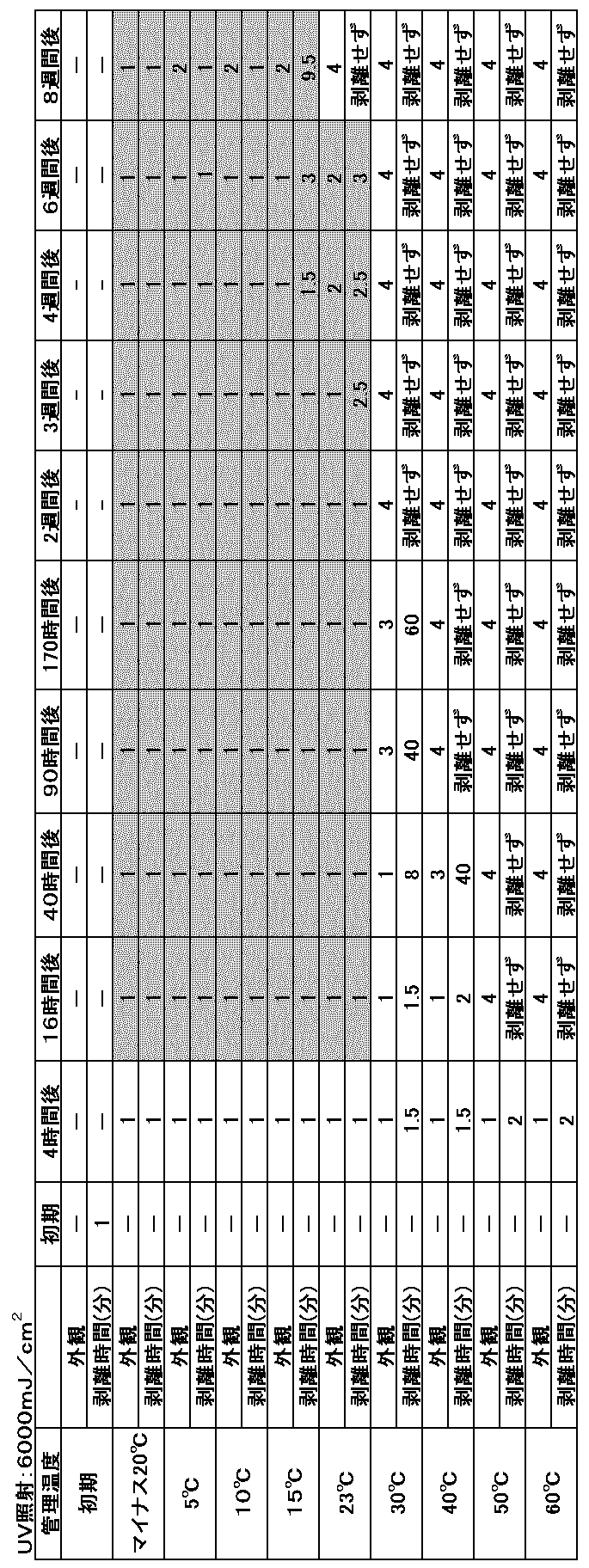
- UV irradiation dose is 6000 mJ / cm 2 (measured by integrating luminometer by 365nm of the light receiver, UV irradiation time 80 seconds), 3000mJ / cm 2 (measured by integrating luminometer by 365nm of the light receiver, UV irradiation time 40 seconds) or UV dose was 1500 mJ / cm 2 (measured by integrating luminometer by 365nm of the light receiver, UV irradiation time 20 seconds).
- Table 1-1 Results of UV irradiation amount 1500 mJ / cm 2
- Table 1-2 Result of UV irradiation amount 3000 mJ / cm 2
- Table 1-3 indicates the results of the UV irradiation amount 6000 mJ / cm 2.
- a sticking agent is sandwiched between PET films using a 1 mm thick silicon sheet as a mold, and a fusion device using an electrodeless discharge lamp is used under the condition of an integrated light quantity of 2000 mJ / cm 2 at a wavelength of 365 nm. After being cured from the upper surface, it was further cured from the bottom under the condition of an integrated light quantity of 2000 mJ / cm 2 with a wavelength of 365 nm to produce a 1 mm-thick adhesive cured body. The produced cured body was cut into a length of 50 mm and a width of 5 mm with a cutter to obtain a cured body for measuring a glass transition temperature.
- the obtained cured body was subjected to stress and strain in a tensile direction of 1 Hz to the cured body in a nitrogen atmosphere by a dynamic viscoelasticity measuring device “DMS210” manufactured by Seiko Electronics Industry Co., Ltd. Tan ⁇ was measured while the temperature was raised at a rate of, and the temperature at the peak top of the tan ⁇ was taken as the glass transition temperature. As a result, the glass transition temperature was 26 ° C.
- UV irradiation test the laminate was held 2 weeks at 30 ° C. as a UV irradiation dose 3000 mJ / cm 2 at the time of curing was not peeled at a peeling test, UV irradiation amount: 7500mJ / cm 2 (365nm photodetectors
- the peel test was performed again after performing UV irradiation again with the measurement with an integrating illuminometer, the UV irradiation time was 94 seconds, the film was naturally peeled in 1 minute.
- Example 2 Except for the use of a photocurable sticking agent having the following components, the production of a sheet glass laminate, the appearance and peelability evaluation after temperature control of the sheet glass laminate, and the measurement of the glass transition temperature were carried out in the same manner as in Example 1. did.
- the glass transition temperature of this fixing agent was 16 ° C.
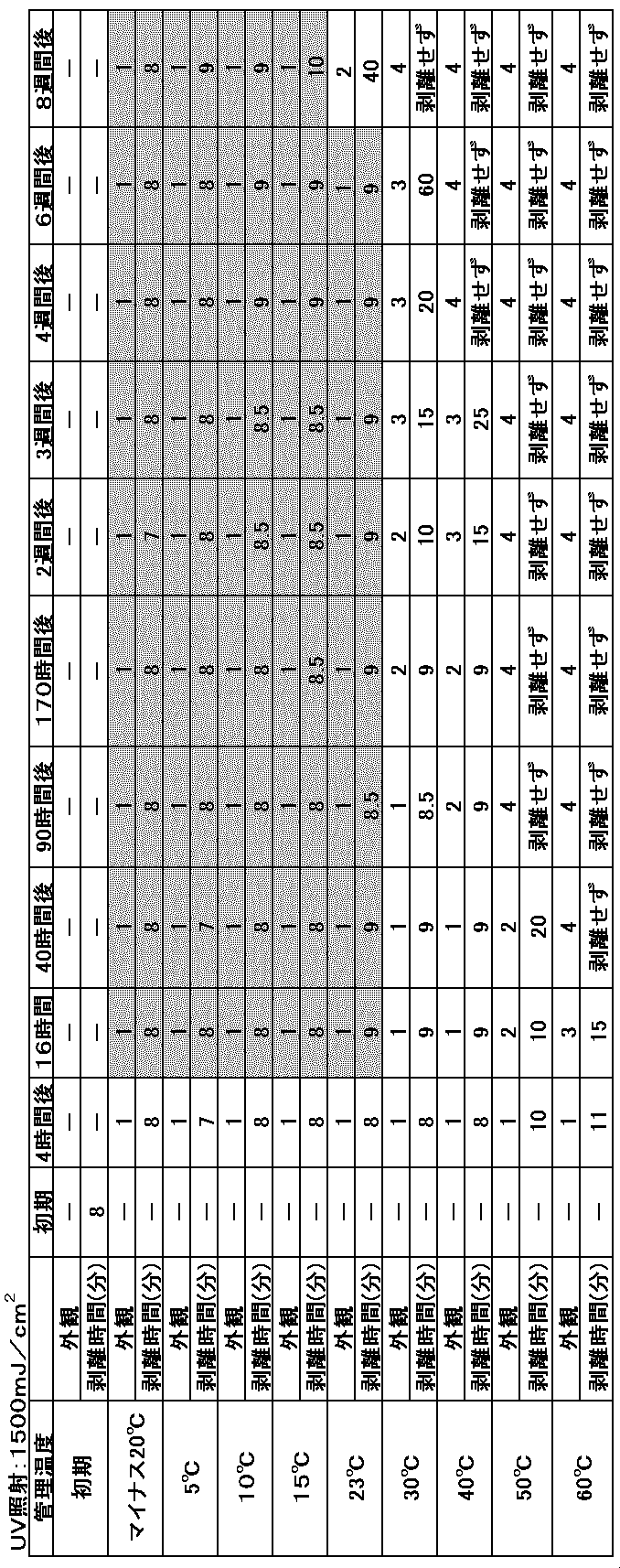
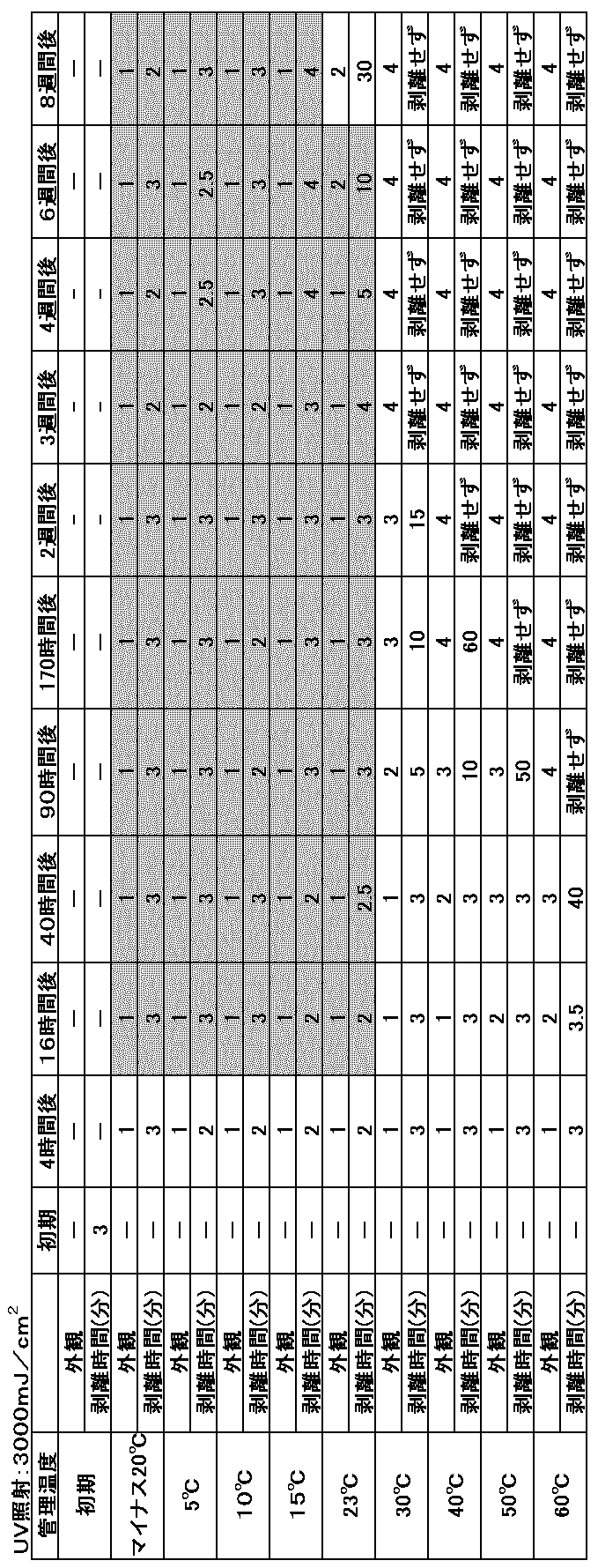
- Table 2-1 Results of UV irradiation amount 1500 mJ / cm 2
- Table 2-2 Result of UV irradiation amount 3000 mJ / cm 2
- Table 2-3 indicates the results of the UV irradiation amount 6000 mJ / cm 2.
- composition of the photocurable sticker of Example 2 (A) As a polyfunctional (meth) acrylate, 20 parts by mass of “UV-3000B” (hereinafter abbreviated as “UV-3000B”) manufactured by Nippon Gosei Co., Ltd., 1,6-hexanediol diacrylate (manufactured by Kyoeisha Chemical Co., Ltd.) Light acrylate 1,6-HX-A ”, hereinafter abbreviated as“ 1,6-HX-A ”), 10 parts by mass, (B) As monofunctional (meth) acrylate, 40 parts by mass of 2- (1,2-cyclohexacarboximide) ethyl acrylate (“Aronix M-140” manufactured by Toa Gosei Co., Ltd., hereinafter abbreviated as “M-140”); 30 parts by mass of phenol ethylene oxide 2 mol modified acrylate (“Aronix M-101A” manufactured by Toa Gosei Co., Ltd.
- Example 3 Except for the use of a photocurable sticking agent having the following components, the production of a sheet glass laminate, the appearance and peelability evaluation after temperature control of the sheet glass laminate, and the measurement of the glass transition temperature were carried out in the same manner as in Example 1. did.
- the glass transition temperature of this fixing agent was 34 ° C.
- Table 3-1 Results of UV irradiation amount 1500 mJ / cm 2, Table 3-2 Result of UV irradiation amount 3000 mJ / cm 2, Table 3-3 indicates the results of the UV irradiation amount 6000 mJ / cm 2.
- UV-3000B As a polyfunctional (meth) acrylate, 10 parts by mass of “UV-3000B” (hereinafter abbreviated as “UV-3000B”) manufactured by Nippon Gosei Co., Ltd., trimethylolpropane triacrylate (“Light Acrylate TMP” manufactured by Kyoeisha Chemical Co., Ltd.) -A ", hereinafter abbreviated as” TMP-A ") 20 parts by mass
- B As monofunctional (meth) acrylate, 40 parts by mass of 2- (1,2-cyclohexacarboximide) ethyl acrylate (“Aronix M-140” manufactured by Toa Gosei Co., Ltd., hereinafter abbreviated as “M-140”); 30 parts by mass of phenol ethylene oxide 2 mol modified acrylate (“Aronix M-101A” manufactured by Toa Gosei Co., Ltd.) (C) 5 parts by mass of benzy
- Example 4 Except for the use of a photocurable sticking agent having the following components, the production of a sheet glass laminate, the appearance and peelability evaluation after temperature control of the sheet glass laminate, and the measurement of the glass transition temperature were carried out in the same manner as in Example 1. did.
- the glass transition temperature of this fixing agent was 29 ° C.
- Tables 4-1 to 4-3 TABLE 4-1 as a result of UV irradiation amount 1500 mJ / cm 2, Table 4-2 Result of UV irradiation amount 3000 mJ / cm 2, Table 4-3 indicates the results of the UV irradiation amount 6000 mJ / cm 2.
- UV-3000B 20 parts by mass of “UV-3000B” manufactured by Nippon Gosei Co., Ltd.
- UV-3000B dicyclopentanyl diacrylate
- KYARADR dicyclopentanyl diacrylate manufactured by Nippon Kayaku Co., Ltd.
- R-684 25 parts by mass
- B As monofunctional (meth) acrylate, 35 parts by mass of 2-hydroxy-3-phenoxypropyl (meth) acrylate (“Aronix M-5700” manufactured by Toa Gosei Co., Ltd., hereinafter abbreviated as “M-5700”), phenolethylene 20 parts by mass of oxide 2 mol modified acrylate (“Aronix M-101A” manufactured by Toa Gosei Co., Ltd.)
- C 10 parts by mass of benzyldimethyl ketal (“IRGACURE651” manufactured by BASF), hereinafter abbreviations
Landscapes
- Chemical & Material Sciences (AREA)
- Health & Medical Sciences (AREA)
- Chemical Kinetics & Catalysis (AREA)
- Medicinal Chemistry (AREA)
- Polymers & Plastics (AREA)
- Organic Chemistry (AREA)
- Laminated Bodies (AREA)
- Adhesives Or Adhesive Processes (AREA)
- Polymerisation Methods In General (AREA)
- Liquid Crystal (AREA)
- Joining Of Glass To Other Materials (AREA)
- Macromonomer-Based Addition Polymer (AREA)
Abstract
Description
- 2枚以上の透光性硬質基板同士が光硬化性固着剤で貼り合わせられた透光性硬質基板積層体を作製する工程1と、
- 工程1によって得られた又は工程1の後に形状加工を受けた透光性硬質基板積層体を下記の温度管理条件に保持し、この間に透光性硬質基板積層体を搬送及び/又は保管する工程2と:
1)光硬化性固着剤の硬化体のガラス転移温度よりも0℃以上5℃未満低い管理温度のときは、10時間~4週間
2)光硬化性固着剤の硬化体のガラス転移温度よりも5℃以上10℃未満低い管理温度のときは、10時間~6週間、又は
3)光硬化性固着剤の硬化体のガラス転移温度よりも10℃以上低い管理温度のときは、10時間~8週間
- 工程2の後に透光性硬質基板積層体に対して形状加工を施してから又は形状加工を施すことなく、剥離する工程3
を含む透光性硬質基板積層体の加工方法である。
透光性硬質基板積層体を構成する透光性硬質基板としては、特に制限はないが、板ガラス(強化板ガラス、素材板ガラス、透明導電膜付きガラス基板、電極や回路が形成されたガラス基板等)、サファイア基板、石英基板、プラスチック基板、フッ化マグネシウム基板などが挙げられる。一枚の透光性硬質基板の大きさに特に制限はないが、典型的には10000~250000mm2程度の面積を有し、0.1~2mm程度の厚みを有する。積層される一枚ごとの透光性硬質基板は同じサイズであるのが一般的である。透光性硬質基板積層体は2枚以上の透光性硬質基板が積層されており、生産効率の観点から好ましくは5枚以上、より好ましくは10~30枚程度の透光性硬質基板が光硬化性固着剤を介して積層される。
ポリオール化合物(X)としては、エチレングリコール、ジエチレングリコール、トリエチレングリコール、テトラエチレングリコール、ポリエチレングリコール、プロピレングリコール、ジプロピレングリコール、ポリプロピレングリコール、ブチレングリコール、1,4-ブタンジオール、ポリブチレングリコール、1,5-ペンタンジオール、1,6-ヘキサンジオール、1,8-オクタンジオール、1,9-ノナンジオール、3-メチル-1,5-ペンタンジオール、2,4-ジエチル-1,5-ペンタンジオール、2,2-ブチルエチル-1,3-プロパンジオール、ネオペンチルグリコール、シクロヘキサンジメタノール、水素化ビスフェノールA、ポリカプロラクトン、トリメチロールエタン、トリメチロールプロパン、ポリトリメチロールプロパン、ペンタエリスリトール、ポリペンタエリスリトール、ソルビトール、マンニトール、グリセリン、ポリグリセリン、ポリテトラメチレングリコール等の多価アルコールや、ポリエチレンオキサイド、ポリプロピレンオキサイド、エチレンオキサイド/プロピレンオキサイドのブロック又はランダム共重合の少なくとも1種の構造を有するポリエーテルポリオール、該多価アルコール又はポリエーテルポリオールと無水マレイン酸、マレイン酸、フマル酸、無水イタコン酸、イタコン酸、アジピン酸、イソフタル酸等の多塩基酸との縮合物であるポリエステルポリオール、カプロラクトン変性ポリテトラメチレンポリオール等のカプロラクトン変性ポリオール、ポリオレフィン系ポリオール、ポリカーボネート系ポリオール、ポリブタジエンポリオール、ポリイソプレンポリオール、水素化ポリブタジエンポリオール、水素化ポリイソプレンポリオール等のポリジエン系ポリオール、ポリジメチルシロキサンポリオール等のシリコーンポリオール等が挙げられる。これらの中では、ポリエーテルポリオール及び/又はポリエステルポリオールがより好ましい。
流速:1.0ml/min
設定温度:40℃
カラム構成:東ソー社製「TSK guardcolumn MP(×L)」6.0mmID×4.0cm1本、および東ソー社製「TSK-GEL MULTIPOREHXL-M」 7.8mmID×30.0cm(理論段数16,000段)2本、計3本(全体として理論段数32,000段)、
サンプル注入量:100μl(試料液濃度1mg/ml)
送液圧力:39kg/cm2
検出器:RI検出器
多官能(メタ)アクリレートオリゴマー/ポリマーと、2官能(メタ)アクリレートモノマー及び/又は3官能(メタ)アクリレートモノマーとを併用する場合の含有割合は、多官能(メタ)アクリレートオリゴマー/ポリマー、2官能(メタ)アクリレートモノマー及び3官能(メタ)アクリレートモノマーの合計100質量部中、質量比で、多官能(メタ)アクリレートオリゴマー/ポリマー:2官能(メタ)アクリレートモノマー及び/又は3官能(メタ)アクリレートモノマー=10~90:90~10が好ましく、25~75:75~25がより好ましく、30~70:70~30が最も好ましい。
粒状物質(D)の使用量は、接着性、加工精度、剥離性の観点から、(A)及び(B)の合計量100質量部に対して、0.01~20質量部が好ましく、0.05~10質量部がより好ましく、0.1~6質量部が最も好ましい。
工程1によって得られた透光性硬質基板積層体は、次いで必要に応じて形状加工を受けた後、搬送及び/又は保管する。搬送及び保管時には固着剤の剥離性及び外観が変化しないように所定の温度条件下で管理することが重要である。剥離性及び外観の劣化は特に光硬化性固着剤の硬化体のガラス転移温度よりも高い温度に曝されたときに顕著であるため、光硬化性固着剤の硬化体のガラス転移温度よりも0℃以上低い管理温度で保持することが好ましく、光硬化性固着剤の硬化体のガラス転移温度よりも5℃以上低い管理温度で保持することが望ましく、光硬化性固着剤の硬化体のガラス転移温度よりも10℃以上低い管理温度で保持することが一層望ましい。ガラス転移温度よりも低い温度で管理することで内部応力の解放が起きにくいため、後述する再付着現象が生じにくくなる。管理温度が低温になるほど、長期間での搬送や保管に有利になる。従って、管理温度の下限に制限はない。しかしながら、短期間の搬送及び保管しか行わないにもかかわらず必要以上に低温で管理するのはコスト高であり、保存効果も飽和することから、典型的には光硬化性固着剤の硬化体のガラス転移温度よりも10℃以上20℃以下低い管理温度で保持し、より典型的には光硬化性固着剤の硬化体のガラス転移温度よりも15℃以上20℃以下低い管理温度で保持する。
1)光硬化性固着剤の硬化体のガラス転移温度よりも0℃以上5℃未満低い管理温度のときは、10時間~4週間
2)光硬化性固着剤の硬化体のガラス転移温度よりも5℃以上10℃未満低い管理温度のときは、10時間~6週間、又は
3)光硬化性固着剤の硬化体のガラス転移温度よりも10℃以上低い管理温度のときは、10時間~8週間
まず、透光性硬質基板積層体を厚み方向に分割し、所望の数の分割された透光性硬質基板積層体を形成する形状加工がある。分割方法は特に制限はないが、円板カッター(ダイヤモンドディスク、超硬合金ディスク)、固定砥粒式又は遊離砥粒式ワイヤソー、レーザービーム、エッチング(例:フッ酸や硫酸等を用いた化学エッチングや電解エッチング)、ウォータージェット、及び赤熱帯(ニクロム線)をそれぞれ単独で又は組み合わせて使用して、同サイズの直方体形状に分割する方法が挙げられる。エッチングは分割後の切断面の表面処理に用いることもできる。
工程2の後は、形状加工後の透光性硬質基板積層体を加熱することで貼り合わせられていた透光性硬質基板同士を剥離することで、複数の板状製品が得られる。加熱方法としては特に制限はないが、固着剤がフィルム状に軟化して各板状製品に上手く分離するため、温水に形状加工後の透光性硬質基板積層体を浸漬する方法が好ましい。好適な温水の温度は採用する固着剤によって異なるが、40~90℃が好ましく、より好ましくは60~90℃であり、更により好ましくは80~90℃である。理論的には、固着剤の硬化体のガラス転移温度以上の温度とするべきであり、好ましくはガラス転移温度よりも20℃以上高い温度、より好ましくはガラス転移温度よりも40℃以上、更により好ましくは60℃以上高い温度にする。所定の温度を有する温水を用いると、短時間で固着剤の硬化体が熱膨張するとともに、固着剤が硬化した際に生じる内部応力が解放される。このときに、透光性硬質基板と固着剤の界面にうねり状の又は三次元的な変形が生じ、接着面積の減少が達成されて接着強度が低下し、フィルム状に組成物の硬化体を取り外すことができる。
理論により本発明が限定されることを意図しないが、ここで、剥離工程前に高温に曝されていると、残留歪み応力が解放されてしまい、その後は残留歪みの開放された状態での再付着現象が生じる。そのため、剥離のために加熱しても接着剤を剥離するのに必要な原動力がもはや得られないこととなり、剥離が困難となる。
1.光硬化性固着剤の作製
以下の(A)~(E)の成分を混合して光硬化性固着剤を作製した。
(A)多官能(メタ)アクリレートとして、日本合成社製「UV-3000B」(ウレタンアクリレート以下「UV-3000B」と略す、重量平均分子量18000、ポリオール化合物はポリエステルポリオール、有機ポリイソシアネート化合物はイソホロンジイソシアネート、ヒドロキシ(メタ)アクリレートは2-ヒドロキシエチルアクリレート)20質量部、ジシクロペンタニルジアクリレート(日本化薬社製「KAYARAD R-684」、以下「R-684」と略す)15質量部、
(B)単官能(メタ)アクリレートとして、2-(1,2-シクロヘキサカルボキシイミド)エチルアクリレート(東亜合成社製「アロニックスM-140」、以下「M-140」と略す)50質量部、フェノールエチレンオキサイド2モル変性アクリレート(東亜合成社製「アロニックスM-101A」)15質量部、
(C)光重合開始剤としてベンジルジメチルケタール(BASF社製「IRGACURE651」)、以下「BDK」と略す)10質量部、
(D)粒状物質として平均粒径100μmの球状架橋ポリスチレン粒子(ガンツ化成社製「GS-100S」)1質量部、
(E)重合禁止剤として2,2-メチレン-ビス(4-メチル-6-ターシャリーブチルフェノール)(住友化学社製「スミライザーMDP-S」、以下「MDP」と略す)0.1質量部
透光性硬質基板として板ガラス(横530mm×縦420mm×厚み0.7mm)を2枚用意し、上記光硬化性固着剤を介して貼り合わせ、板ガラスの積層体を作製した。具体的には、1枚目の板ガラス上に上記光硬化性固着剤を40g塗布した後、1枚目の板ガラスの上に2枚目の板ガラスを貼り合わせて2枚目の板ガラスの表面側からUV照射し、上記光硬化性固着剤を硬化させた。UV照射量は6000mJ/cm2(365nmの受光器による積算照度計による測定、UV照射時間80秒)、3000mJ/cm2(365nmの受光器による積算照度計による測定、UV照射時間40秒)又はUV照射量は1500mJ/cm2(365nmの受光器による積算照度計による測定、UV照射時間20秒)とした。
得られた板ガラス積層体を表1に示す温度条件で種々の時間だけ暗室で保持した後に、外観及び剥離性の評価を行った。表中にて、保持時間(管理時間)と保持温度(管理温度)の項目に「初期」の記載がある。その「初期」とは、板ガラスの積層体を作製し、UV照射し、光硬化性固着剤を硬化させた直後の状態をいう。
外観は目視により実施し、積層直後の板ガラス積層板の色合い、及び再付着の痕跡の有無で評価した。再付着の痕跡は白色に観察される。外観は次の4段階で評価した。
外観がほとんど変化しなかった場合:1
変色はしたが再付着の痕跡はほとんど見られなかった場合:2
変色し、再付着の痕跡が一部に見られた場合:3
変色し、再付着の痕跡が多く見られた場合:4
剥離性は得られた積層体を、温水(80℃)に浸漬した。温水(80℃)に浸漬してから板ガラスが自然に剥離するまでの時間を測定した(80℃温水剥離時間)。60分間剥離しなかった場合は剥離せずと評価した。結果を表1-1~1-3に示す。表1-1は、UV照射量1500mJ/cm2の結果、表1-2はUV照射量3000mJ/cm2の結果、表1-3はUV照射量6000mJ/cm2の結果をそれぞれ示す。
固着剤を、1mm厚のシリコンシートを型枠としてPETフィルムに挟み込み、無電極放電ランプを使用したフュージョン社製硬化装置により、365nmの波長の積算光量2000mJ/cm2の条件にて上面から硬化させた後、さらに下から365nmの波長の積算光量2000mJ/cm2の条件にて硬化させ、厚さ1mmの固着剤の硬化体を作製した。作製した硬化体をカッターにて長さ50mm×幅5mmに切断し、ガラス転移温度測定用硬化体とした。得られた硬化体をセイコー電子産業社製、動的粘弾性測定装置「DMS210」により、窒素雰囲気中にて前記硬化体に1Hzの引張方向の応力及び歪みを加え、昇温速度毎分2℃の割合で昇温しながらtanδを測定し、該tanδのピークトップの温度をガラス転移温度とした。
その結果、ガラス転移温度は26℃であった。

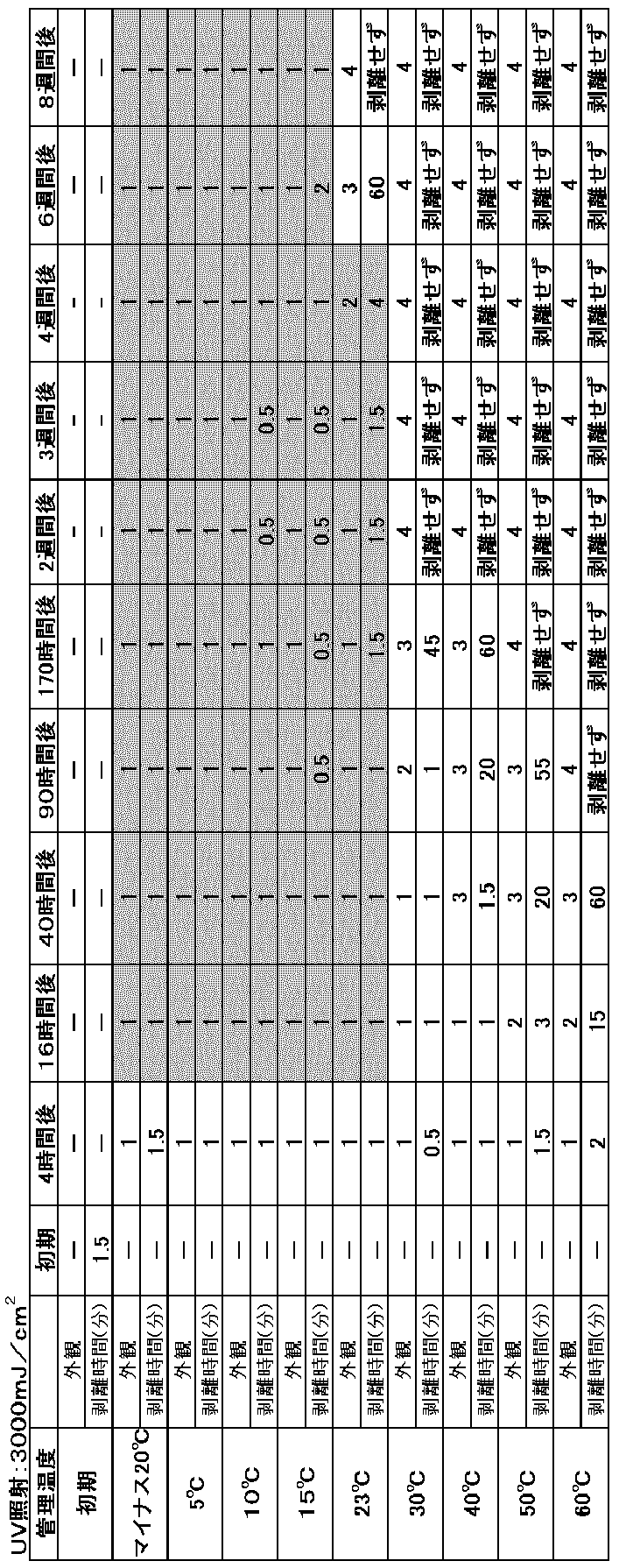
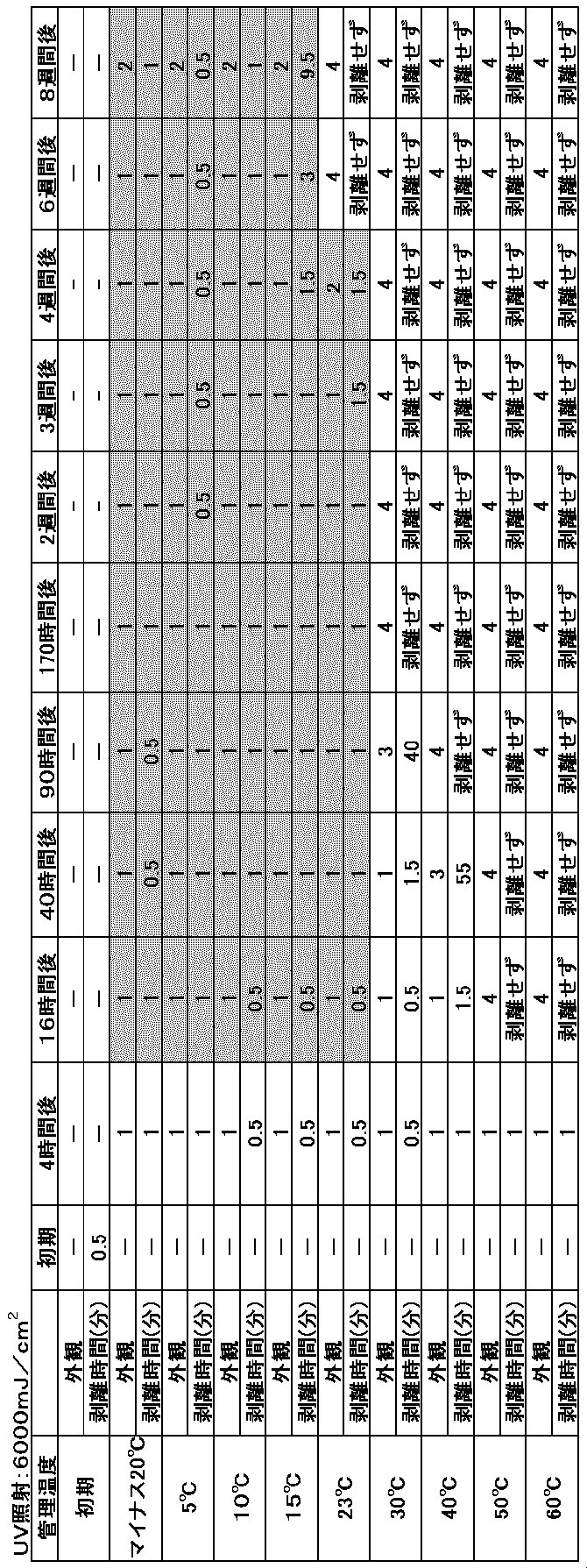
ここで、硬化時のUV照射量3000mJ/cm2として30℃で2週間保持した積層体は剥離試験で剥離しなかったが、UV照射量:7500mJ/cm2(365nmの受光器による積算照度計による測定、UV照射時間94秒)でUV照射を再度行った後に再度剥離試験を行った場合には、1分で自然剥離した。
以下の成分を有する光硬化性固着剤を使用した他は例1と同様に、板ガラス積層体の作製、板ガラス積層体の温度管理後の外観及び剥離性評価、更にはガラス転移温度の測定を実施した。この固着剤のガラス転移温度は16℃であった。結果を表2-1~表2-3に示す。表2-1は、UV照射量1500mJ/cm2の結果、表2-2はUV照射量3000mJ/cm2の結果、表2-3はUV照射量6000mJ/cm2の結果をそれぞれ示す。
(A)多官能(メタ)アクリレートとして、日本合成社製「UV-3000B」(ウレタンアクリレート以下「UV-3000B」と略す)20質量部、1,6-ヘキサンジオールジアクリレート(共栄社化学社製「ライトアクリレート 1,6-HX-A」、以下「1,6-HX-A」と略す)10質量部、
(B)単官能(メタ)アクリレートとして、2-(1,2-シクロヘキサカルボキシイミド)エチルアクリレート(東亜合成社製「アロニックスM-140」、以下「M-140」と略す)40質量部、フェノールエチレンオキサイド2モル変性アクリレート(東亜合成社製「アロニックスM-101A」)30質量部、
(C)光重合開始剤としてベンジルジメチルケタール(BASF社製「IRGACURE651」)、以下「BDK」と略す)10質量部、
(D)粒状物質として平均粒径100μmの球状架橋ポリスチレン粒子(ガンツ化成社製「GS-100S」)1質量部、
(E)重合禁止剤として2,2-メチレン-ビス(4-メチル-6-ターシャリーブチルフェノール)(住友化学社製「スミライザーMDP-S」、以下「MDP」と略す)0.1質量部


以下の成分を有する光硬化性固着剤を使用した他は例1と同様に、板ガラス積層体の作製、板ガラス積層体の温度管理後の外観及び剥離性評価、更にはガラス転移温度の測定を実施した。この固着剤のガラス転移温度は34℃であった。結果を表3-1~表3-3に示す。表3-1は、UV照射量1500mJ/cm2の結果、表3-2はUV照射量3000mJ/cm2の結果、表3-3はUV照射量6000mJ/cm2の結果をそれぞれ示す。
(A)多官能(メタ)アクリレートとして、日本合成社製「UV-3000B」(ウレタンアクリレート以下「UV-3000B」と略す)10質量部、トリメチロールプロパントリアクリレート(共栄社化学社製「ライトアクリレート TMP-A」、以下「TMP-A」と略す)20質量部、
(B)単官能(メタ)アクリレートとして、2-(1,2-シクロヘキサカルボキシイミド)エチルアクリレート(東亜合成社製「アロニックスM-140」、以下「M-140」と略す)40質量部、フェノールエチレンオキサイド2モル変性アクリレート(東亜合成社製「アロニックスM-101A」)30質量部、
(C)光重合開始剤としてベンジルジメチルケタール(BASF社製「IRGACURE651」)、以下「BDK」と略す)5質量部、
(D)粒状物質として平均粒径100μmの球状架橋ポリスチレン粒子(ガンツ化成社製「GS-100S」)1質量部、
(E)重合禁止剤として2,2-メチレン-ビス(4-メチル-6-ターシャリーブチルフェノール)(住友化学社製「スミライザーMDP-S」、以下「MDP」と略す)0.1質量部


以下の成分を有する光硬化性固着剤を使用した他は例1と同様に、板ガラス積層体の作製、板ガラス積層体の温度管理後の外観及び剥離性評価、更にはガラス転移温度の測定を実施した。この固着剤のガラス転移温度は29℃であった。結果を表4-1~表4-3に示す。表4-1は、UV照射量1500mJ/cm2の結果、表4-2はUV照射量3000mJ/cm2の結果、表4-3はUV照射量6000mJ/cm2の結果をそれぞれ示す。
(A)多官能(メタ)アクリレートとして、日本合成社製「UV-3000B」(ウレタ
ンアクリレート以下「UV-3000B」と略す)20質量部、ジシクロペンタニルジアクリレート(日本化薬社製「KAYARADR-684」、
以下「R-684」と略す)25質量部、
(B)単官能(メタ)アクリレートとして、2-ヒドロキシ-3-フェノキシプロピル(メタ)アクリレート(東亜合成社製「アロニックスM-5700」、以下「M-5700」と略す)35質量部、フェノールエチレンオキサイド2モル変性アクリレート(東亜合成社製「アロニックスM-101A」)20質量部、
(C)光重合開始剤としてベンジルジメチルケタール(BASF社製「IRGACURE651」)、以下「BDK」と略す)10質量部、
(D)粒状物質として平均粒径100μmの球状架橋ポリスチレン粒子(ガンツ化成社製「GS-100S」)1質量部、
(E)重合禁止剤として2,2-メチレン-ビス(4-メチル-6-ターシャリーブチルフェノール)(住友化学社製「スミライザーMDP-S」、以下「MDP」と略す)0.1質量部
Claims (8)
- - 2枚以上の透光性硬質基板同士が光硬化性固着剤で貼り合わせられた透光性硬質基板積層体を作製する工程1と、
- 工程1によって得られた又は工程1の後に形状加工を受けた透光性硬質基板積層体を下記の温度管理条件に保持し、この間に透光性硬質基板積層体を搬送及び/又は保管する工程2と:
1)光硬化性固着剤の硬化体のガラス転移温度よりも0℃以上5℃未満低い管理温度のときは、10時間~4週間
2)光硬化性固着剤の硬化体のガラス転移温度よりも5℃以上10℃未満低い管理温度のときは、10時間~6週間、又は
3)光硬化性固着剤の硬化体のガラス転移温度よりも10℃以上低い管理温度のときは、10時間~8週間
- 工程2の後に透光性硬質基板積層体に対して形状加工を施してから又は形状加工を施すことなく、剥離する工程3
を含む透光性硬質基板積層体の加工方法。 - 工程1において、透光性硬質基板を貼り合わせる毎に固着剤を硬化するために照射する光の照射量が100~10000mJ/cm2である請求項1に記載の透光性硬質基板積層体の加工方法。
- 工程2の後、工程3における剥離前に透光性硬質基板積層体に対して固着剤を硬化するために光照射する請求項1又は2に記載の透光性硬質基板積層体の加工方法。
- 透光性硬質基板が板ガラスである請求項1~3の何れか一項に記載の透光性硬質基板積層体の加工方法。
- 前記固着剤が(A)多官能(メタ)アクリレート、(B)単官能(メタ)アクリレート、及び(C)光重合開始剤を含有する請求項1~4の何れか一項に記載の透光性硬質基板積層体の加工方法。
- 前記固着剤が(D)粒状物質を含有する請求項5に記載の透光性硬質基板積層体の加工方法。
- 前記固着剤が(E)重合禁止剤を含有する請求項5又は6に記載の透光性硬質基板積層体の加工方法。
- 請求項1~7の何れか一項に記載の透光性硬質基板積層体の加工方法を使用した板状製品の製造方法。
Priority Applications (5)
| Application Number | Priority Date | Filing Date | Title |
|---|---|---|---|
| US13/990,212 US9023173B2 (en) | 2010-11-30 | 2011-11-25 | Method of processing translucent rigid substrate laminate, and process of manufacturing plate-shaped product employing the method |
| JP2012546835A JP5831887B2 (ja) | 2010-11-30 | 2011-11-25 | 透光性硬質基板積層体の加工方法及びこれを使用した板状製品の製造方法 |
| CN201180057145.XA CN103228450B (zh) | 2010-11-30 | 2011-11-25 | 透光性硬质基板层叠体的加工方法及使用它的板状制品的制造方法 |
| HK13113809.9A HK1186438B (en) | 2010-11-30 | 2011-11-25 | Method for processing light-transmissive hard substrate laminate, and process for manufacturing plate-like product employing the method |
| KR1020137015615A KR20130121870A (ko) | 2010-11-30 | 2011-11-25 | 투광성 경질 기판 적층체의 가공 방법 및 이를 사용한 판상 제품의 제조 방법 |
Applications Claiming Priority (2)
| Application Number | Priority Date | Filing Date | Title |
|---|---|---|---|
| JP2010266781 | 2010-11-30 | ||
| JP2010-266781 | 2010-11-30 |
Publications (1)
| Publication Number | Publication Date |
|---|---|
| WO2012073833A1 true WO2012073833A1 (ja) | 2012-06-07 |
Family
ID=46171769
Family Applications (1)
| Application Number | Title | Priority Date | Filing Date |
|---|---|---|---|
| PCT/JP2011/077237 Ceased WO2012073833A1 (ja) | 2010-11-30 | 2011-11-25 | 透光性硬質基板積層体の加工方法及びこれを使用した板状製品の製造方法 |
Country Status (6)
| Country | Link |
|---|---|
| US (1) | US9023173B2 (ja) |
| JP (1) | JP5831887B2 (ja) |
| KR (1) | KR20130121870A (ja) |
| CN (1) | CN103228450B (ja) |
| TW (1) | TWI515116B (ja) |
| WO (1) | WO2012073833A1 (ja) |
Families Citing this family (2)
| Publication number | Priority date | Publication date | Assignee | Title |
|---|---|---|---|---|
| WO2015041334A1 (ja) * | 2013-09-20 | 2015-03-26 | 大日本印刷株式会社 | 有機ガラス積層体 |
| JP2022038213A (ja) * | 2020-08-26 | 2022-03-10 | 日東電工株式会社 | 部材加工方法 |
Citations (7)
| Publication number | Priority date | Publication date | Assignee | Title |
|---|---|---|---|---|
| JPH1171553A (ja) * | 1997-08-28 | 1999-03-16 | Toagosei Co Ltd | 仮固定用光硬化性組成物及び物品の製造方法 |
| JP2000169166A (ja) * | 1998-11-30 | 2000-06-20 | Hoya Optics Kk | 板ガラス製品の製造方法 |
| JP2001226641A (ja) * | 2000-02-17 | 2001-08-21 | Aader:Kk | 仮固定用接着剤組成物及びその使用方法 |
| JP2004186201A (ja) * | 2002-11-29 | 2004-07-02 | Sekisui Chem Co Ltd | 薄層ガラスパネルの取扱い方法 |
| JP2006341564A (ja) * | 2005-06-10 | 2006-12-21 | Fujiwara Kogyo Kk | 多層接着性フィルムの貼着方法及びこの方法により製作された多層接着性フィルム貼着板ガラス |
| JP2010018505A (ja) * | 2008-07-14 | 2010-01-28 | Asahi Glass Co Ltd | ガラス積層体、支持体付き表示装置用パネル、表示装置用パネル、表示装置およびこれらの製造方法 |
| WO2010010900A1 (ja) * | 2008-07-22 | 2010-01-28 | 電気化学工業株式会社 | 部材の仮固定・剥離方法及びそれに好適な仮固定用接着剤 |
Family Cites Families (4)
| Publication number | Priority date | Publication date | Assignee | Title |
|---|---|---|---|---|
| WO2007004620A1 (ja) * | 2005-07-04 | 2007-01-11 | Denki Kagaku Kogyo Kabushiki Kaisha | 硬化性組成物及びそれを用いる部材の仮固定方法 |
| EP2050799B1 (en) * | 2006-08-10 | 2014-06-18 | Denki Kagaku Kogyo Kabushiki Kaisha | Adhesive composition and method for temporarily fixing member by using the same |
| JP2009256125A (ja) * | 2008-04-15 | 2009-11-05 | Shoda Techtron Corp | 板ガラスの加工方法 |
| JP2010095627A (ja) | 2008-10-16 | 2010-04-30 | Denki Kagaku Kogyo Kk | 搬送用組成物及び部材の搬送方法 |
-
2011
- 2011-11-25 CN CN201180057145.XA patent/CN103228450B/zh not_active Expired - Fee Related
- 2011-11-25 WO PCT/JP2011/077237 patent/WO2012073833A1/ja not_active Ceased
- 2011-11-25 US US13/990,212 patent/US9023173B2/en not_active Expired - Fee Related
- 2011-11-25 JP JP2012546835A patent/JP5831887B2/ja not_active Expired - Fee Related
- 2011-11-25 KR KR1020137015615A patent/KR20130121870A/ko not_active Ceased
- 2011-11-30 TW TW100143924A patent/TWI515116B/zh not_active IP Right Cessation
Patent Citations (7)
| Publication number | Priority date | Publication date | Assignee | Title |
|---|---|---|---|---|
| JPH1171553A (ja) * | 1997-08-28 | 1999-03-16 | Toagosei Co Ltd | 仮固定用光硬化性組成物及び物品の製造方法 |
| JP2000169166A (ja) * | 1998-11-30 | 2000-06-20 | Hoya Optics Kk | 板ガラス製品の製造方法 |
| JP2001226641A (ja) * | 2000-02-17 | 2001-08-21 | Aader:Kk | 仮固定用接着剤組成物及びその使用方法 |
| JP2004186201A (ja) * | 2002-11-29 | 2004-07-02 | Sekisui Chem Co Ltd | 薄層ガラスパネルの取扱い方法 |
| JP2006341564A (ja) * | 2005-06-10 | 2006-12-21 | Fujiwara Kogyo Kk | 多層接着性フィルムの貼着方法及びこの方法により製作された多層接着性フィルム貼着板ガラス |
| JP2010018505A (ja) * | 2008-07-14 | 2010-01-28 | Asahi Glass Co Ltd | ガラス積層体、支持体付き表示装置用パネル、表示装置用パネル、表示装置およびこれらの製造方法 |
| WO2010010900A1 (ja) * | 2008-07-22 | 2010-01-28 | 電気化学工業株式会社 | 部材の仮固定・剥離方法及びそれに好適な仮固定用接着剤 |
Also Published As
| Publication number | Publication date |
|---|---|
| KR20130121870A (ko) | 2013-11-06 |
| TW201236878A (en) | 2012-09-16 |
| JPWO2012073833A1 (ja) | 2014-05-19 |
| US9023173B2 (en) | 2015-05-05 |
| TWI515116B (zh) | 2016-01-01 |
| US20130248104A1 (en) | 2013-09-26 |
| HK1186438A1 (zh) | 2014-03-14 |
| CN103228450A (zh) | 2013-07-31 |
| JP5831887B2 (ja) | 2015-12-09 |
| CN103228450B (zh) | 2016-02-03 |
Similar Documents
| Publication | Publication Date | Title |
|---|---|---|
| JP6030560B2 (ja) | 組成物及びそれを用いた部材の仮固定方法 | |
| JP5813004B2 (ja) | 透光性硬質基板積層体の加工方法及び板状製品の製造方法 | |
| JP6097509B2 (ja) | 組成物及びそれを用いた部材の仮固定方法 | |
| WO2013172353A1 (ja) | 積層体の加工装置及び加工方法 | |
| JP6081363B2 (ja) | ガラス基板積層体の加工方法 | |
| WO2012077645A1 (ja) | 硬質基板積層体の加工方法及び板状製品の製造方法 | |
| WO2013084953A1 (ja) | 透光性硬質基板積層体の製造方法 | |
| JP5831887B2 (ja) | 透光性硬質基板積層体の加工方法及びこれを使用した板状製品の製造方法 | |
| JPWO2015046471A1 (ja) | 積層体およびその製造方法 | |
| JP5916620B2 (ja) | 透光性硬質基板積層体の剥離方法及びこれを使用した板状製品の製造方法 | |
| JPWO2014192941A1 (ja) | 硬質基板積層体および硬質基板積層体の製造方法 | |
| TWI546188B (zh) | Processing method of hard substrate laminated body | |
| JPWO2014192942A1 (ja) | 積層体およびその製造方法 | |
| HK1186438B (en) | Method for processing light-transmissive hard substrate laminate, and process for manufacturing plate-like product employing the method |
Legal Events
| Date | Code | Title | Description |
|---|---|---|---|
| 121 | Ep: the epo has been informed by wipo that ep was designated in this application |
Ref document number: 11844926 Country of ref document: EP Kind code of ref document: A1 |
|
| ENP | Entry into the national phase |
Ref document number: 2012546835 Country of ref document: JP Kind code of ref document: A |
|
| WWE | Wipo information: entry into national phase |
Ref document number: 13990212 Country of ref document: US |
|
| NENP | Non-entry into the national phase |
Ref country code: DE |
|
| ENP | Entry into the national phase |
Ref document number: 20137015615 Country of ref document: KR Kind code of ref document: A |
|
| 122 | Ep: pct application non-entry in european phase |
Ref document number: 11844926 Country of ref document: EP Kind code of ref document: A1 |