WO2012046552A1 - 硬化物の製造方法及び硬化物 - Google Patents
硬化物の製造方法及び硬化物 Download PDFInfo
- Publication number
- WO2012046552A1 WO2012046552A1 PCT/JP2011/070989 JP2011070989W WO2012046552A1 WO 2012046552 A1 WO2012046552 A1 WO 2012046552A1 JP 2011070989 W JP2011070989 W JP 2011070989W WO 2012046552 A1 WO2012046552 A1 WO 2012046552A1
- Authority
- WO
- WIPO (PCT)
- Prior art keywords
- curing
- cured product
- epoxy resin
- resin composition
- curable
- Prior art date
- Legal status (The legal status is an assumption and is not a legal conclusion. Google has not performed a legal analysis and makes no representation as to the accuracy of the status listed.)
- Ceased
Links
- KKDZMSWHDHBHEU-UHFFFAOYSA-N CC1C(C)C=CCC1 Chemical compound CC1C(C)C=CCC1 KKDZMSWHDHBHEU-UHFFFAOYSA-N 0.000 description 1
Classifications
-
- C—CHEMISTRY; METALLURGY
- C08—ORGANIC MACROMOLECULAR COMPOUNDS; THEIR PREPARATION OR CHEMICAL WORKING-UP; COMPOSITIONS BASED THEREON
- C08G—MACROMOLECULAR COMPOUNDS OBTAINED OTHERWISE THAN BY REACTIONS ONLY INVOLVING UNSATURATED CARBON-TO-CARBON BONDS
- C08G59/00—Polycondensates containing more than one epoxy group per molecule; Macromolecules obtained by polymerising compounds containing more than one epoxy group per molecule using curing agents or catalysts which react with the epoxy groups
- C08G59/18—Macromolecules obtained by polymerising compounds containing more than one epoxy group per molecule using curing agents or catalysts which react with the epoxy groups ; e.g. general methods of curing
-
- H—ELECTRICITY
- H10—SEMICONDUCTOR DEVICES; ELECTRIC SOLID-STATE DEVICES NOT OTHERWISE PROVIDED FOR
- H10W—GENERIC PACKAGES, INTERCONNECTIONS, CONNECTORS OR OTHER CONSTRUCTIONAL DETAILS OF DEVICES COVERED BY CLASS H10
- H10W74/00—Encapsulations, e.g. protective coatings
- H10W74/40—Encapsulations, e.g. protective coatings characterised by their materials
- H10W74/47—Encapsulations, e.g. protective coatings characterised by their materials comprising organic materials, e.g. plastics or resins
-
- C—CHEMISTRY; METALLURGY
- C08—ORGANIC MACROMOLECULAR COMPOUNDS; THEIR PREPARATION OR CHEMICAL WORKING-UP; COMPOSITIONS BASED THEREON
- C08G—MACROMOLECULAR COMPOUNDS OBTAINED OTHERWISE THAN BY REACTIONS ONLY INVOLVING UNSATURATED CARBON-TO-CARBON BONDS
- C08G59/00—Polycondensates containing more than one epoxy group per molecule; Macromolecules obtained by polymerising compounds containing more than one epoxy group per molecule using curing agents or catalysts which react with the epoxy groups
- C08G59/18—Macromolecules obtained by polymerising compounds containing more than one epoxy group per molecule using curing agents or catalysts which react with the epoxy groups ; e.g. general methods of curing
- C08G59/20—Macromolecules obtained by polymerising compounds containing more than one epoxy group per molecule using curing agents or catalysts which react with the epoxy groups ; e.g. general methods of curing characterised by the epoxy compounds used
- C08G59/22—Di-epoxy compounds
- C08G59/24—Di-epoxy compounds carbocyclic
-
- C—CHEMISTRY; METALLURGY
- C08—ORGANIC MACROMOLECULAR COMPOUNDS; THEIR PREPARATION OR CHEMICAL WORKING-UP; COMPOSITIONS BASED THEREON
- C08L—COMPOSITIONS OF MACROMOLECULAR COMPOUNDS
- C08L63/00—Compositions of epoxy resins; Compositions of derivatives of epoxy resins
-
- H—ELECTRICITY
- H10—SEMICONDUCTOR DEVICES; ELECTRIC SOLID-STATE DEVICES NOT OTHERWISE PROVIDED FOR
- H10W—GENERIC PACKAGES, INTERCONNECTIONS, CONNECTORS OR OTHER CONSTRUCTIONAL DETAILS OF DEVICES COVERED BY CLASS H10
- H10W74/00—Encapsulations, e.g. protective coatings
- H10W74/10—Encapsulations, e.g. protective coatings characterised by their shape or disposition
-
- H—ELECTRICITY
- H10—SEMICONDUCTOR DEVICES; ELECTRIC SOLID-STATE DEVICES NOT OTHERWISE PROVIDED FOR
- H10W—GENERIC PACKAGES, INTERCONNECTIONS, CONNECTORS OR OTHER CONSTRUCTIONAL DETAILS OF DEVICES COVERED BY CLASS H10
- H10W74/00—Encapsulations, e.g. protective coatings
- H10W74/40—Encapsulations, e.g. protective coatings characterised by their materials
Definitions
- the present invention relates to a method for producing a cured product, a cured product, a sealing material including the cured product, and an optical semiconductor device including the sealing material.
- a resin used for an optical semiconductor device is required to have high light transmittance, luminous intensity retention, and excellent crack resistance in a heat cycle test.
- a curing catalyst is used to divide the curing temperature into several stages and the curing proceeds in stages, or an alicyclic epoxy resin and a bisphenol A type epoxy resin having an aromatic ring are mixed. The method is taken.
- workability is poor and sufficient crack resistance cannot be obtained
- the latter method there is a drawback in that the luminous intensity retention is reduced due to the aromatic ring.
- Patent Document 1 includes an alicyclic epoxy resin containing 2,4-bis (hydroxymethyl) and a curing catalyst, which comprises 3,4-epoxycyclohexenylmethyl-3 ′, 4′-epoxycyclohexenecarboxylate as an epoxy resin.
- a curing catalyst which comprises 3,4-epoxycyclohexenylmethyl-3 ′, 4′-epoxycyclohexenecarboxylate as an epoxy resin.
- Including both cycloaliphatic epoxy resins composed of 1,2-epoxy-4- (2-oxiranyl) cyclohexane adduct of 1-butanol and at least one of the compounds represented by the following formula (A) or (B) Is a cured product obtained by curing a composition containing 0.01% by mass to 1% by mass with respect to the total mass of the translucent sealing material. This cured product is cured at 120 ° C. for 1 hour and then at 150 ° C. for 1 hour, and has poor crack resistance
- Patent Document 2 describes an epoxy resin obtained by thermosetting bisphenol A diglycidyl ether as an epoxy resin using an acid anhydride curing agent and a curing accelerator.
- Patent Document 2 when it is desired to reduce the internal stress of the cured product, it is precured at about 80 ° C. to 130 ° C. for about 0.5 hours to 5 hours, and then at about 130 ° C. to 180 ° C. for about 0.1 hour.
- post-curing under conditions of about 1 to 15 hours.
- a cured product is prepared by pre-curing at 120 ° C. for 1 hour and then post-curing at 150 ° C. for 3 hours.
- the obtained cured product has poor crack resistance.
- the yellow index after heat treatment at 150 ° C. for 5 days is increased by 15.2, and thermal yellowing is observed.
- An object of the present invention is a cured product that is excellent in transparency, light resistance (lightness retention, etc.) and excellent in crack resistance in a heat cycle test, and is suitable for, for example, a sealing material for an optical semiconductor device. It is to provide a method for curing an object. Another object of the present invention is to provide a cured product which is cured by the curing method and has excellent transparency and light resistance and excellent crack resistance in a heat cycle test. Another object of the present invention is to provide a sealing material and an optical semiconductor device, which contain the cured product, which are excellent in transparency and light resistance and excellent in crack resistance in a heat cycle test.
- the present inventors have determined that the alicyclic epoxy compound is 60% by weight or more based on the total amount of the curable component, a curing agent such as an acid anhydride, and a curing accelerator.
- a curing agent such as an acid anhydride
- a curing accelerator such as an acid anhydride
- this invention contains an alicyclic epoxy compound (A), a hardening
- a method for producing a cured product comprising curing a curable epoxy resin composition that is 60% by weight or more based on the total amount of the curable component under a curing condition of a temperature of 95 ° C. or higher and 135 ° C. or lower and 4.5 hours or longer. I will provide a.
- this invention provides the hardened
- this invention provides the sealing material containing the said hardened
- the transparency is excellent, for example, when used as a sealing material for an optical semiconductor device, light resistance, heat cycle test A cured product, a sealing material, and a semiconductor device excellent in crack resistance can be obtained.
- cured material of this invention contains an alicyclic epoxy compound (A), a hardening
- a curable epoxy resin composition having a content of 60% by weight or more based on the total amount of the curable component is cured under curing conditions of a temperature of 95 ° C. or more and 135 ° C. or less and 4.5 hours or more.
- the curable epoxy resin composition is cured under curing conditions of a temperature of 95 ° C. or more and 135 ° C. or less and 4.5 hours or more.
- curing can be performed by placing the curable epoxy resin composition at a predetermined temperature for a predetermined time, for example, without putting it in a predetermined mold. Curing may be performed continuously for a predetermined time without an interval, or may be taken in the middle. When taking an interval, the curing time indicates a total time of curing times processed at a predetermined temperature before and after the interval.
- the curing temperature is 95 ° C or higher and 135 ° C or lower, preferably 100 ° C or higher and lower than 130 ° C, and more preferably 100 ° C or higher and 120 ° C or lower.
- the curing temperature may be in the above temperature range, and may be constant or several different temperatures.
- the interval refers to the time when the temperature is lower than 95 ° C., and may be near room temperature (for example, about 25 ° C.). In this interval, the curable epoxy resin composition may be removed from the mold, and the curable epoxy resin composition removed from the mold may be further cured at the curing temperature.
- the curing temperature may be constant or may vary within a temperature range of 95 ° C to 135 ° C. In particular, the curing temperature is preferably constant regardless of the presence or absence of an interval.
- Curing time is 4.5 hours or more (for example, 4.5 hours or more and 24 hours or less), preferably 5 hours or more and 20 hours or less, more preferably 5 hours or more and 16 hours or less.
- the interval can be 30 minutes or longer (for example, 30 minutes to 30 days).
- the interval is preferably 30 minutes to 10 days, more preferably 30 minutes to 3 days.
- the curable epoxy resin composition is put into a predetermined mold, cured at a predetermined temperature for 1 to 2 hours, and then the curable epoxy resin composition is allowed to cool to near room temperature, and then is removed from the mold. Removal and subsequent curing at the predetermined temperature for the remaining time.
- cured material excellent in the crack resistance in a heat cycle test is obtained by hardening
- the curable epoxy resin composition used in the method for producing a cured product of the present invention includes an alicyclic epoxy compound (A), a curing agent (B), and a curing accelerator (C) as a curable component, Content of this alicyclic epoxy compound (A) is 60 weight% or more with respect to curable component whole quantity.
- the alicyclic epoxy compound (A) used in the present invention is not particularly limited as long as it is a compound having an aliphatic ring.
- the compound having an epoxy group and (ii) a compound in which the epoxy group is directly bonded to the alicyclic ring by a single bond are preferable.
- the compound having an epoxy group composed of two adjacent carbon atoms and oxygen atoms constituting the alicyclic ring can be arbitrarily selected from known ones.
- As the alicyclic epoxy group a cyclohexene oxide group is preferable.
- X represents a linking group (a divalent group having one or more atoms), for example, a single bond, a divalent hydrocarbon group, a carbonyl group, an ether bond, an ester bond, a carbonate group, an amide. A group and a group in which a plurality of these groups are linked.
- Examples of the divalent hydrocarbon group include a linear or branched alkylene group having 1 to 18 carbon atoms and a divalent alicyclic hydrocarbon group.
- Examples of the linear or branched alkylene group having 1 to 18 carbon atoms include methylene, methylmethylene, dimethylmethylene, ethylene, propylene, and trimethylene groups.
- Examples of the divalent alicyclic hydrocarbon group include 1,2-cyclopentylene, 1,3-cyclopentylene, cyclopentylidene, 1,2-cyclohexylene, 1,3-cyclohexylene, 1, And divalent cycloalkylene groups (including cycloalkylidene groups) such as 4-cyclohexylene and cyclohexylidene groups.
- the linking group X is preferably a linking group containing an oxygen atom, specifically, —CO—, —O—CO—O—, —COO—, —O—, —CONH—; A group in which one or two of these groups are linked to one or more of divalent hydrocarbon groups, and the like. Examples of the divalent hydrocarbon group include the aforementioned groups.
- Typical examples of the alicyclic epoxy compound represented by the formula (I) include compounds represented by the following formulas (I-1) to (I-8).
- commercially available products such as Celoxide 2021P and Celoxide 2081 (manufactured by Daicel Chemical Industries) can also be used.
- l and m represent an integer of 1 to 30.
- R is an alkylene group having 1 to 8 carbon atoms, and is a linear or branched alkylene group such as methylene, ethylene, propylene, isopropylene, butylene, isobutylene, s-butylene, pentylene, hexylene, heptylene, octylene group or the like.
- linear or branched alkylene groups having 1 to 3 carbon atoms such as methylene, ethylene, propylene and isopropylene groups are preferred.
- Examples of the compound in which the epoxy group is directly bonded to the alicyclic ring with a single bond include compounds represented by the following formula (II).
- R ′ is a group obtained by removing p —OH from a p-valent alcohol; p and n represent natural numbers.
- the p-valent alcohol [R ′-(OH) p ] include polyhydric alcohols such as 2,2-bis (hydroxymethyl) -1-butanol (alcohols having 1 to 15 carbon atoms, etc.).
- p is preferably 1 to 6
- n is preferably 1 to 30.
- n in each () group may be the same or different.
- the compound examples include 1,2-epoxy-4- (2-oxiranyl) cyclohexane adduct of 2,2-bis (hydroxymethyl) -1-butanol, EHPE 3150 (manufactured by Daicel Chemical Industries), and the like. Is mentioned.
- the above-exemplified compounds can be used singly or in combination of two or more kinds, for example, Celoxide 2021P, Celoxide 2081, EHPE 3150 (manufactured by Daicel Chemical Industries), etc. Commercial products can be preferably used.
- the content of the alicyclic epoxy compound (A) is 60% by weight or more (for example, 60 to 100% by weight) with respect to the total amount of the curable component contained in the curable epoxy resin composition.
- the curable component is a curable compound that is cured by heat or radiation.
- the content of the alicyclic epoxy compound (A) is preferably 70% by weight (70 to 100% by weight), more preferably 80% by weight or more (80 to 100% by weight) with respect to the total amount of the curable component. can do.
- the said content is content of the sum total, when using 2 or more types of alicyclic epoxy compounds (A).
- the total content of curable components in the curable epoxy resin composition used in the method for producing a cured product of the present invention is, for example, 30 to 90% by weight, preferably 40 to 80% by weight, more preferably 40 to 70% by weight. It is. By setting the content of the curable component in the curable epoxy resin composition within the above range, a resin composition having excellent curability can be obtained.
- the curable epoxy resin composition used in the present invention may contain an epoxy compound other than the alicyclic epoxy compound (A).
- the epoxy compound other than the alicyclic epoxy compound (A) include dioctyl epoxyhexahydrophthalate, bis (2-ethylhexyl) epoxyhexahydrophthalate, 1,4-butanediol diglycidyl ether, and 1,6-hexanediol.
- an oligomer type radiation curable resin having an epoxy group inside can also be used.
- examples thereof include epoxidized polybutadiene (product names: Epolide PB3600, PB4700, Daicel Chemical Industries, Ltd.), epoxidized styrene butadiene teleblock copolymer (product names: Epofriend AT501, Daicel Chemical Industries, Ltd.), and the like.
- novolak-type epoxy resins such as phenols, cresols, halogenated phenols and alkylphenols
- novolaks obtained by reacting formaldehyde with an acidic catalyst and epichlorohydrin and / or methyl epichlorohydrin.
- a bisphenol type epoxy resin obtained by reacting bisphenols such as bisphenol A, bisphenol F, bisphenol S and tetrabromobisphenol A with epichlorohydrin, or a condensate of diglycidyl ether of bisphenol A with the bisphenols and epichlorohydrin And bisphenol type epoxy resins (product names: Epicoat 1004, Epicoat 1002, Yuka Shell Co., Ltd., product names: DER-330, DER-337, Dow Chemical Co.).
- an epoxy compound other than the alicyclic epoxy compound (A) the above-exemplified compounds can be used alone or in combination of two or more.
- an epoxy compound other than the alicyclic epoxy compound (A) an epoxy compound having an aromatic ring such as a bisphenol A type epoxy resin can be preferably used. Epoxy compounds other than the alicyclic epoxy compound (A) may not be used.
- the curable epoxy resin composition used in the method for producing a cured product of the present invention contains a curing agent (B).
- the curing agent (B) has a function of curing the compound having an epoxy group.
- a conventionally known curing agent can be used as a curing agent for epoxy resin.
- the curing agent (B) in the present invention is preferably an acid anhydride that is liquid at 25 ° C., and examples thereof include methyltetrahydrophthalic anhydride, methylhexahydrophthalic anhydride, dodecenyl succinic anhydride, and methyl endo. And methylenetetrahydrophthalic anhydride.
- acid anhydrides that are solid at room temperature (25 ° C.) such as phthalic anhydride, tetrahydrophthalic anhydride, hexahydrophthalic anhydride, methylcyclohexene dicarboxylic acid anhydride, are liquid acid anhydrides at room temperature (25 ° C.)
- the curing agent (B) can be used as the curing agent (B) in the present invention by dissolving in a product to form a liquid mixture.
- commercially available products such as Colombiacid MH-700 (manufactured by Nippon Nippon Chemical Co., Ltd.) and HN-5500 (manufactured by Hitachi Chemical Co., Ltd.) can also be used.
- the curing agent (B) may be used singly or as a mixture of two or more kinds in an arbitrary ratio.
- the amount used thereof is, for example, 50 to 150 parts by weight, preferably 100 to 145 parts by weight, more specifically with respect to 100 parts by weight of the total amount of compounds having an epoxy group contained in the curable epoxy resin composition. Is preferably used in a ratio of 0.5 to 1.5 equivalents per 1 equivalent of epoxy groups in all the compounds having an epoxy group contained in the curable epoxy resin composition.
- the amount of the curing agent (B) used is less than 50 parts by weight, the effect becomes insufficient and the toughness of the cured product tends to be reduced, while the amount of the curing agent (B) used exceeds 150 parts by weight.
- the said usage-amount is the usage-amount of the sum total, when using 2 or more types of hardening
- the curing agent (B) is preferably used at a ratio of 0.5 to 1.5 equivalents per equivalent of epoxy group in the compound having all epoxy groups contained in the curable epoxy resin composition. Because it is used, there are many reaction points at the time of curing, and since the curable epoxy resin composition is cured at a low temperature of 95 ° C. or more and 135 ° C. or less, the curing proceeds gently and uniformly, and the heat cycle test It is considered that a cured product having excellent crack resistance is produced.
- the curable epoxy resin composition used in the method for producing a cured product of the present invention contains a curing accelerator (C).
- a hardening accelerator (C) is a compound which has a function which accelerates
- a well-known and commonly used curing accelerator can be used as the curing accelerator (C) which may be contained in the curable epoxy resin composition of the present invention. For example, 1,8-diazabicyclo [5.4.
- DBU undecene-7
- DBN Nonene-5
- salts for example, phosphonium salt, sulfonium salt, quaternary ammonium salt, iodonium salt
- benzyldimethylamine, 2,4,6-tris dimethylaminomethyl
- phenol octylate
- p-toluenesulfonate formate
- tetraphenylborate salt 1,5-diazabicyclo [4.3.0]
- Nonene-5 (DBN) and its salts for example, phosphonium salt, sulfonium salt, quaternary ammonium salt, iodonium salt
- benzyldimethylamine, 2,4,6-tris dimethylaminomethyl
- benzyldimethylamine 2,4,6-tris (dimethylaminomethyl) phenol, N, N— Tertiary amines such as dimethylcyclohexylamine
- U-CAT SA 506, U-CAT SA 102, U-CAT 5003, U-CAT 18X, 12XD are used as the curing accelerator (C).
- Commercial products such as -K, TPP-MK (all manufactured by Hokuko Chemical Co., Ltd.) and PX-4ET (manufactured by Nippon Chemical Industry Co., Ltd.) can also be used.
- the curing accelerator (C) may be used singly or in combination of two or more in any ratio.
- the amount used thereof is, for example, 0.05 to 5 parts by weight, preferably 0.1 to 3 parts by weight, with respect to 100 parts by weight of the total amount of compounds having an epoxy group contained in the curable epoxy resin composition.
- the amount is particularly preferably 0.2 to 3 parts by weight, and most preferably about 0.25 to 2.5 parts by weight.
- the amount of the curing accelerator (C) used is less than 0.05 parts by weight, the curing acceleration effect may be insufficient.
- the amount of the curing accelerator (C) used exceeds 5 parts by weight, The cured product may be colored to deteriorate the hue.
- the said usage-amount is the usage-amount of the sum total, when using 2 or more types of hardening accelerators (C).
- the curable epoxy resin composition used in the method for producing a cured product of the present invention may further contain an inorganic filler.
- the inorganic filler is not particularly limited, but silica, alumina, mica, synthetic mica, talc, calcium oxide, calcium carbonate, zirconium oxide, titanium oxide, barium titanate, kaolin, bentonite, diatomaceous earth, boron nitride, nitriding
- One or more kinds of aluminum, silicon carbide, zinc oxide, cerium oxide, cesium oxide, magnesium oxide, glass beads, glass fiber, graphite, calcium hydroxide, magnesium hydroxide, aluminum hydroxide, cellulose and the like can be used.
- Examples of the inorganic filler include nano silica, nano titania, nano zirconia, and carbon nanotube.
- inorganic fillers can be produced by a known method such as a flame hydrolysis method, a flame pyrolysis method, or a plasma method described in, for example, International Publication No. 96/31572.
- a flame hydrolysis method a flame pyrolysis method
- a plasma method described in, for example, International Publication No. 96/31572.
- stabilized colloidal inorganic particle nano-dispersed sols and the like can be used, and commercially available products include BAYER silica sol, Goldschmidt SnO 2 sol, MERCK
- Commercially available products such as TiO 2 sols, SiO 2 , ZrO 2 , A1 2 O 3 and Sb 2 O 3 sols from Nissan Chemicals or Aerosil dispersions from DEGUSSA are available.
- Inorganic fillers can change their viscosity behavior by surface modification.
- the surface modification of the particles can be performed using a known surface modifier.
- a surface modifier for example, a compound capable of interacting with a functional group present on the surface of the inorganic filler such as a covalent bond or complex formation, or a compound capable of interacting with a polymer matrix may be used. it can.
- Examples of such surface modifiers include carboxyl groups, (primary, secondary, and tertiary) amino groups, quaternary ammonium groups, carbonyl groups, glycidyl groups, vinyl groups, )
- a compound having a functional group such as acryloxy group or mercapto group can be used.
- Such a surface modifier is usually a liquid under standard temperature and pressure conditions, and is composed of a low molecular organic compound having a carbon number in the molecule of, for example, 15 or less, preferably 10 or less, particularly preferably 8 or less. Is done.
- the molecular weight of the low molecular weight organic compound is, for example, 500 or less, preferably 350 or less, particularly 200 or less.
- Preferred surface modifiers include, for example, formic acid, acetic acid, propionic acid, butyric acid, pentanoic acid, hexanoic acid, acrylic acid, methacrylic acid, crotonic acid, citric acid, adipic acid, succinic acid, glutaric acid, oxalic acid, malein C1-C12 saturated or unsaturated mono- and polycarboxylic acids (preferably monocarboxylic acids) such as acids and fumaric acids; and their esters (preferably C 1 -C 4 alkyl esters such as methyl methacrylate) Amides; ⁇ -dicarbonyl compounds such as acetylacetone, 2,4-hexanedione, 3,5-heptanedione, acetoacetic acid and C 1 -C 4 alkylacetoacetic acids.
- a well-known and usual silane coupling agent can also be used as a surface modifier.
- the particle size of the inorganic filler is usually about 0.01 nm to 200 ⁇ m, preferably about 0.1 nm to 100 ⁇ m, particularly about 0.1 nm to 50 ⁇ m.
- the content of the inorganic filler is preferably 1 to 2000 parts by weight, more preferably 10 to 1000 parts by weight, where the total content of the curable components is 100 parts by weight. Further, the content of the inorganic filler with respect to the total amount of the curable epoxy resin composition is, for example, 5 to 95 wt%, preferably 10 to 90 wt%. In addition, the said content is content of the sum total, when using 2 or more types of inorganic fillers.
- the curable epoxy resin composition used in the present invention may contain rubber particles.
- rubber particles include particulate NBR (acrylonitrile-butadiene rubber), reactive terminal carboxyl group NBR (CTBN), metal-free NBR, particulate SBR (styrene-butadiene rubber), and the like.
- the rubber particle has a multilayer structure (core-shell structure) composed of a core portion having rubber elasticity and at least one shell layer covering the core portion, and a functional group capable of reacting with an alicyclic epoxy resin on the surface.
- the rubber particles may be used singly or in combination of two or more in any ratio.
- the content of the rubber particles is, for example, 0.5 to 30 parts by weight, preferably 1 to 20 parts by weight, and more preferably 1 to 10 parts by weight with respect to 100 parts by weight as the total of the curable components.
- the blending amount is less than 0.5 parts by weight, the crack resistance tends to decrease, and if it exceeds 30 parts by weight, the heat resistance and transparency tend to decrease.
- the said content is content of the sum total, when using 2 or more types of rubber particles.
- the curable epoxy resin composition according to the present invention can use various additives within a range not impairing the effects of the present invention.
- a compound having a hydroxyl group such as ethylene glycol, diethylene glycol, propylene glycol, or glycerin
- the reaction can be allowed to proceed slowly.
- silicone and fluorine antifoaming agents, leveling agents, silane coupling agents such as ⁇ -glycidoxypropyltrimethoxysilane, surfactants, flame retardants, as long as the viscosity and transparency are not impaired.
- Conventional additives such as a colorant, an antioxidant, an ultraviolet absorber, an ion adsorbent, a pigment, a phosphor, and a release agent can be used.
- the curable epoxy resin composition used in the method for producing a cured product of the present invention can be obtained by uniformly mixing the above components.
- each component is made as uniform as possible by using generally known mixing equipment such as a revolving type stirring and defoaming device, a homogenizer, a planetary mixer, a three-roll mill, and a bead mill. It is desirable to perform stirring, dissolution, mixing, dispersion, etc.
- ⁇ Hardened product> by curing the curable epoxy resin composition under the above-mentioned curing conditions, it is excellent in transparency and light resistance (such as light intensity retention) and various physical properties such as crack resistance in a heat cycle test. Cured product is obtained.
- the encapsulant of the present invention uses the curable epoxy resin composition as an encapsulant and is cured under the above-mentioned curing conditions, so that it has excellent transparency and light resistance (such as light intensity retention) and a heat cycle. Excellent physical properties such as crack resistance in the test.
- the optical semiconductor device of the present invention is obtained by sealing an optical semiconductor element with the curable epoxy resin composition and curing it under the curing conditions described above.
- the optical semiconductor element is sealed by injecting the curable epoxy resin composition prepared by the above-described method into a predetermined mold and heat-curing under the above-described curing conditions.
- the optical semiconductor device of the present invention is excellent in transparency and light resistance (such as light intensity retention), and is excellent in various physical properties such as crack resistance in a heat cycle test.
- an optical semiconductor encapsulant an adhesive, excellent in transparency, light resistance (such as light intensity retention), and various physical properties such as crack resistance in a heat cycle test, Electrical insulating material, laminated board, coating, ink, paint, sealant, resist, composite material, transparent substrate, transparent sheet, transparent film, optical element, optical lens, optical member, stereolithography, electronic paper, touch panel, solar cell base
- An optical waveguide, a light guide plate, a holographic memory, and the like can be obtained.
- Curing conditions (1) The resin composition obtained in Examples 1 and 3 was poured into a mold (shape: lamp shape, size: ⁇ 3), a lead frame mounted with a blue light emitting diode element was inserted, and then an oven (GPH- manufactured by ESPEC CORP. 201) was cured by heating at 100 ° C. for 15 hours to obtain an optical semiconductor device in which the element was sealed with resin.
- Curing conditions (2) The resin compositions obtained in Examples 2 and 4 to 7 were poured into a mold (shape: lamp shape, size: ⁇ 3), a lead frame mounted with a blue light emitting diode element was inserted, and then an oven (manufactured by Espec Corp.) GPHH-201) was cured by heating at 120 ° C. for 7 hours to obtain an optical semiconductor device in which the element was sealed with resin.
- Curing conditions (3) The resin composition obtained in Comparative Examples 1 and 4 was poured into a mold (shape: lamp shape, size: ⁇ 3), a lead frame mounted with a blue light emitting diode element was inserted, and then an oven (GPH- manufactured by ESPEC CORP. 201) was cured by heating at 120 ° C. for 4 hours to obtain an optical semiconductor device in which the element was sealed with resin.
- Curing conditions (4) The resin compositions obtained in Comparative Examples 2 and 5 to 7 were poured into a mold (shape: lamp shape, size: ⁇ 3), a lead frame mounted with a blue light-emitting diode element was inserted, and then an oven (manufactured by Espec) GPHH-201) was heat-cured at 100 ° C. for 2 hours and then heat-cured at 140 ° C. for 3 hours to obtain an optical semiconductor device in which the element was sealed with the cured resin.
- a mold shape: lamp shape, size: ⁇ 3
- an oven manufactured by Espec
- Curing conditions (5) The resin composition obtained in Comparative Example 3 was poured into a mold (shape: lamp shape, size: ⁇ 3), a lead frame on which a blue light-emitting diode element was mounted was inserted, and then an oven (GPHH-201 manufactured by Espec Corp.) The optical semiconductor device in which the element was sealed with a cured resin was obtained by heat curing at 150 ° C. for 7 hours.
- the transparency is excellent.
- the light resistance and the heat resistance in a heat cycle test are excellent.
- a cured product having excellent cracking properties can be formed.
Landscapes
- Chemical & Material Sciences (AREA)
- Health & Medical Sciences (AREA)
- Chemical Kinetics & Catalysis (AREA)
- Medicinal Chemistry (AREA)
- Polymers & Plastics (AREA)
- Organic Chemistry (AREA)
- Epoxy Resins (AREA)
- Structures Or Materials For Encapsulating Or Coating Semiconductor Devices Or Solid State Devices (AREA)
Abstract
Description
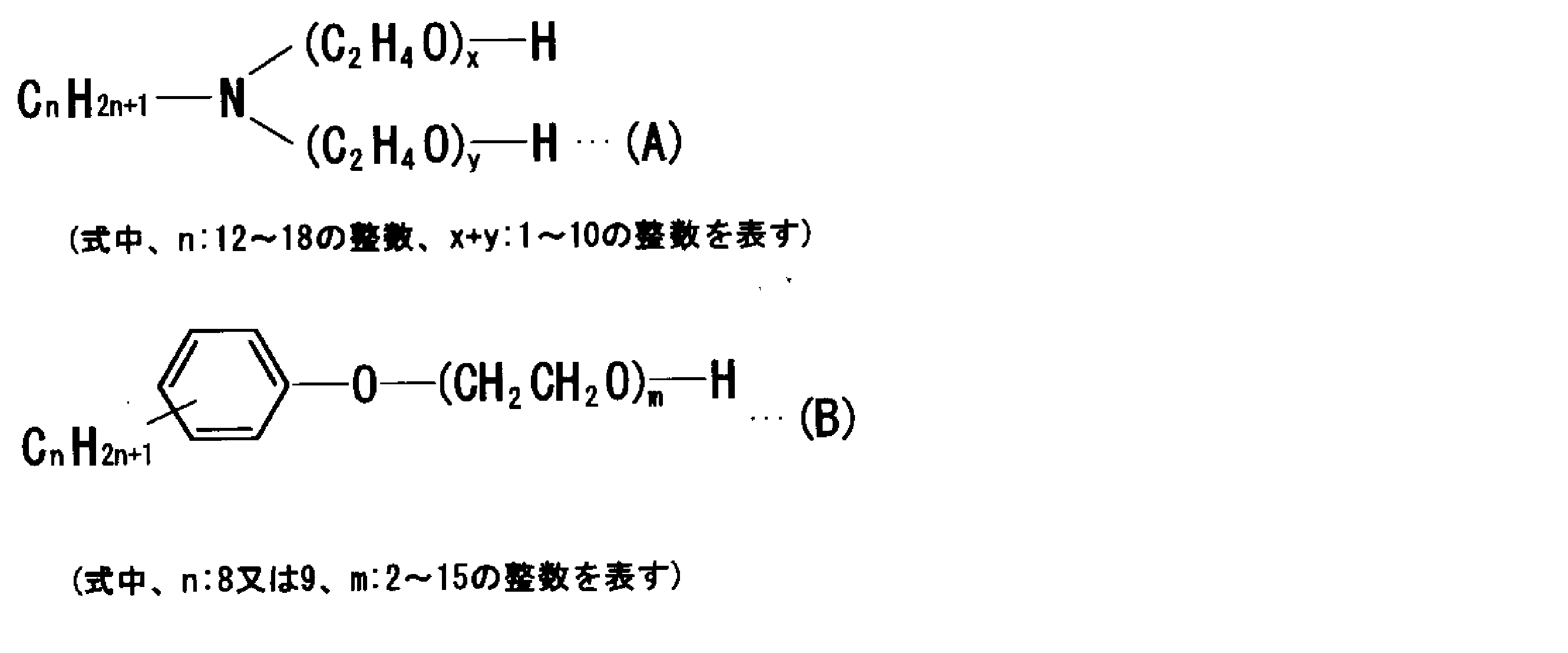
本発明の他の目的は、該硬化方法により硬化した、透明性、耐光性に優れ、かつヒートサイクル試験における耐クラック性に優れた硬化物を提供することにある。
また、本発明の他の目的は、該硬化物を含む、透明性、耐光性に優れ、かつヒートサイクル試験における耐クラック性に優れた封止材、及び光半導体装置を提供することにある。
また、本発明は、上記硬化物の製造方法で製造された硬化物を提供する。
また、本発明は、上記硬化物を含む封止材を提供する。
さらに、本発明は、上記封止材を含む光半導体装置を提供する。
本発明の硬化物の製造方法は、硬化性成分として脂環式エポキシ化合物(A)と、硬化剤(B)と、硬化促進剤(C)とを含み、該脂環式エポキシ化合物(A)の含有量が硬化性成分全量に対して60重量%以上である硬化性エポキシ樹脂組成物を、温度95℃以上135℃以下かつ4.5時間以上の硬化条件で硬化することを特徴とする。
本発明の硬化物の製造方法では、上記硬化性エポキシ樹脂組成物を、温度95℃以上135℃以下かつ4.5時間以上の硬化条件で硬化する。本明細書において硬化は、硬化性エポキシ樹脂組成物を、例えば、所定の型に入れ、又は入れずに、所定温度で所定時間載置することにより行うことができる。硬化は、インターバルを置かずに続けて所定時間行ってもよいし、途中でインターバルを取ってもよい。インターバルを取る場合、硬化時間としては、インターバル前後で所定温度で処理した硬化時間の総合計の時間を指す。
本発明の硬化物の製造方法に使用する硬化性エポキシ樹脂組成物は、硬化性成分として脂環式エポキシ化合物(A)と、硬化剤(B)と、硬化促進剤(C)とを含み、該脂環式エポキシ化合物(A)の含有量が硬化性成分全量に対して60重量%以上である。
本発明で用いられる脂環式エポキシ化合物(A)としては、脂肪族環を有する化合物であれば特に限定されないが、(i)脂環を構成する隣接する2つの炭素原子と酸素原子とで構成されるエポキシ基を有する化合物、及び(ii)脂環にエポキシ基が直接単結合で結合している化合物であることが好ましい。



本発明で用いられる硬化性エポキシ樹脂組成物は、脂環式エポキシ化合物(A)以外のエポキシ化合物を含んでいても良い。脂環式エポキシ化合物(A)以外のエポキシ化合物としては、エポキシヘキサヒドロフタル酸ジオクチル、エポキシヘキサヒドロフタル酸ビス(2-エチルヘキシル)、1,4-ブタンジオールジグリシジルエーテル、1,6-ヘキサンジオールジグリシジルエーテル、グリセリンのトリグリシジルエーテル、トリメチロールプロパンのトリグリシジルエーテル、ソルビトールのテトラグリシジルエーテル、ジペンタエリスリトールのヘキサグリシジルエーテル、ポリエチレングリコールのジグリシジルエーテル、ポリプロピレングリコールのジグリシジルエーテル、プロピレングリコール、グリセリン等の脂肪族多価アルコールに1種または2種以上のアルキレンオキサイドを付加することによって得られるポリエーテルポリオールのポリグリシジルエーテル、脂肪族長鎖二塩基酸脂肪族高級アルコールのモノグリシジルエーテルやフェノール、クレゾール、ブチルフェノール、またこれらにアルキレンオキサイドを付加することによって得られるポリエーテルアルコールのモノグリシジルエーテル、高級脂肪酸のグリシジルエステル、エポキシ化大豆油、エポキシステアリン酸オクチル、エポキシステアリン酸ブチル、エポキシ化アマニ油、エポキシ化ポリブタジエン、エチレンオキサイド、プロピレンオキサイド、スチレンオキサイド、メチルグリシジルエーテル、ブチルグリシジルエーテル、アリルグリシジルエーテル、フェニルグリシジルエーテル、エチレングリコールグリシジルフェニルエーテル、エチレングリコールベンジルグリシジルエーテル、ジエチレングリコールグリシジルテトラヒドロピラニルエーテル、グリシジルメタクリレート、グリシジルアセテート等、または、これらのエポキシ化合物の水素原子の一部又は全てがフッ素で置換されたものも使用できる。
本発明の硬化物の製造方法で使用される硬化性エポキシ樹脂組成物は、硬化剤(B)を含有する。硬化剤(B)は、エポキシ基を有する化合物を硬化させる働きを有する。本発明における硬化剤(B)としては、エポキシ樹脂用硬化剤として周知慣用の硬化剤を使用することができる。本発明における硬化剤(B)としては、なかでも、25℃で液状の酸無水物であることが好ましく、例えば、メチルテトラヒドロ無水フタル酸、メチルヘキサヒドロ無水フタル酸、ドデセニル無水コハク酸、メチルエンドメチレンテトラヒドロ無水フタル酸などを挙げることができる。また、例えば、無水フタル酸、テトラヒドロ無水フタル酸、ヘキサヒドロ無水フタル酸、メチルシクロヘキセンジカルボン酸無水物などの常温(25℃)で固体状の酸無水物は、常温(25℃)で液状の酸無水物に溶解させて液状の混合物とすることで、本発明における硬化剤(B)として使用することができる。また、本発明においては、硬化剤(B)として、リカシッド MH-700(新日本理化製)、HN-5500(日立化成製)等の市販品を使用することもできる。
本発明の硬化物の製造方法で使用される硬化性エポキシ樹脂組成物は硬化促進剤(C)を含有する。硬化促進剤(C)は、エポキシ基を有する化合物が硬化剤により硬化する際に、硬化速度を促進する機能を有する化合物である。本発明の硬化性エポキシ樹脂組成物に含まれていてもよい硬化促進剤(C)としては、周知慣用の硬化促進剤を使用することができ、例えば、1,8-ジアザビシクロ[5.4.0]ウンデセン-7(DBU)、及びその塩(例えば、フェノール塩、オクチル酸塩、p-トルエンスルホン酸塩、ギ酸塩、テトラフェニルボレート塩);1,5-ジアザビシクロ[4.3.0]ノネン-5(DBN)、及びその塩(例えば、ホスホニウム塩、スルホニウム塩、4級アンモニウム塩、ヨードニウム塩);ベンジルジメチルアミン、2,4,6-トリス(ジメチルアミノメチル)フェノール、N,N-ジメチルシクロヘキシルアミンなどの3級アミン;2-エチル-4-メチルイミダゾール、1-シアノエチル-2-エチル-4-メチルイミダゾールなどのイミダゾール;リン酸エステル、トリフェニルホスフィンなどのホスフィン類;テトラフェニルホスホニウムテトラ(p-トリル)ボレートなどのホスホニウム化合物;オクチル酸スズ、オクチル酸亜鉛などの有機金属塩;金属キレートなどが挙げられる。これらは、単独で又は2種以上を混合して使用することができる。
本発明の硬化物の製造方法で使用される硬化性エポキシ樹脂組成物は、さらに、無機フィラーを含んでいてもよい。無機フィラーとしては、特に限定するものではないが、シリカ、アルミナ、マイカ、合成マイカ、タルク、酸化カルシウム、炭酸カルシウム、酸化ジルコニウム、酸化チタン、チタン酸バリウム、カオリン、ベントナイト、珪藻土、窒化ホウ素、窒化アルミ、炭化ケイ素、酸化亜鉛、酸化セリウム、酸化セシウム、酸化マグネシウム、ガラスビーズ、ガラス繊維、グラファイト、水酸化カルシウム、水酸化マグネシウム、水酸化アルミニウム、セルロースなどを1種類以上使用することができる。また、無機フィラーとしては、ナノシリカ、ナノチタニア、ナノジルコニア、カーボンナノチューブ等を挙げることができる。
本発明で使用する硬化性エポキシ樹脂組成物にはゴム粒子が含まれていても良い。ゴム粒子としては、例えば、粒子状NBR(アクリロニトリル-ブタジエンゴム)、反応性末端カルボキシル基NBR(CTBN)、メタルフリーNBR、粒子状SBR(スチレン-ブタジエンゴム)等が挙げられる。ゴム粒子は、ゴム弾性を有するコア部分と、該コア部分を被覆する少なくとも1層のシェル層とから成る多層構造(コアシェル構造)を有し、表面に脂環式エポキシ樹脂と反応し得る官能基としてヒドロキシル基及び/又はカルボキシル基を有し、平均粒子径が10nm~500nm、最大粒子径が50nm~1000nmであるゴム粒子であって、該ゴム粒子の屈折率と当該硬化性エポキシ樹脂組成物の硬化物の屈折率との差が±0.02以内であるゴム粒子で有っても良い。ゴム粒子は、一種でも、二種以上任意の割合で混合使用してもかまわない。ゴム粒子の含有量は、硬化性成分の合計100重量部に対して、例えば、0.5~30重量部であり、好ましくは1~20重量部、さらに好ましくは1~10重量部である。配合量が0.5重量部を下回ると、耐クラック性が低下する傾向があり、30重量部を上回ると、耐熱性及び透明性が低下する傾向がある。なお、上記含有量は、ゴム粒子を2種以上使用する場合には、その合計の含有量である。
本発明にかかる硬化性エポキシ樹脂組成物は、上記以外にも、本発明の効果を損なわない範囲内で各種添加剤を使用することができる。添加剤として、例えば、エチレングリコール、ジエチレングリコール、プロピレングリコール、グリセリンなどの水酸基を有する化合物を使用すると、反応を緩やかに進行させることができる。その他にも、粘度や透明性を損なわない範囲内で、シリコーン系やフッ素系消泡剤、レベリング剤、γ-グリシドキシプロピルトリメトキシシランなどのシランカップリング剤、界面活性剤、難燃剤、着色剤、酸化防止剤、紫外線吸収剤、イオン吸着体、顔料、蛍光体、離型剤などの慣用の添加剤を使用することができる。
本発明では、上記硬化性エポキシ樹脂組成物を上記の硬化条件で硬化させることにより、透明性、耐光性(光度保持性など)に優れ、かつヒートサイクル試験における耐クラック性などの諸物性に優れた硬化物が得られる。
本発明の封止材は、上記硬化性エポキシ樹脂組成物を封止剤として使用し、上記の硬化条件で硬化させることにより、透明性、耐光性(光度保持性など)に優れ、かつヒートサイクル試験における耐クラック性などの諸物性に優れる。
本発明の光半導体装置は、上記硬化性エポキシ樹脂組成物で光半導体素子を封止し、上記の硬化条件で硬化させることにより得られる。光半導体素子の封止は、前述の方法で調製された硬化性エポキシ樹脂組成物を所定の成形型内に注入し、上記の硬化条件で加熱硬化して行う。本発明の光半導体装置は、透明性、耐光性(光度保持性など)に優れ、かつヒートサイクル試験における耐クラック性などの諸物性に優れている。
(エポキシ樹脂A剤)
2,2-ビス(ヒドロキシメチル)-1-ブタノールの1,2-エポキシ-4-(2-オキシラル)シクロヘキサン付加物(ダイセル化学工業製 EHPE3150)と3,4-エポキシシクロヘキシルメチル-3’,4’-エポキシシクロヘキサンカルボキシレート(ダイセル化学工業製 セロキサイド2021P)もしくはビスフェノールA型エポキシ樹脂(新日鐵化学製 YD-128)を表1に示す配合処方(単位:重量部)に従って混合し、80℃、1時間攪拌することで2,2-ビス(ヒドロキシメチル)-1-ブタノールの1,2-エポキシ-4-(2-オキシラニル)シクロヘキサン付加物を溶解させ、エポキシ樹脂(混合物)を得た。
(硬化剤と硬化促進剤と添加剤、可とう性付与剤の混合物、以下B剤と記載する)
B剤として、硬化剤(新日本理化製 リカシッド MH-700;4-メチルヘキサヒドロ無水フタル酸/ヘキサヒドロ無水フタル酸=70/30):100重量部、硬化促進剤(サンアプロ製 18X):0.5重量部、添加剤(和光純薬工業製 エチレングリコール):1重量部、可とう性付与剤(新日本理化製 リカシッド HF-08):3重量部を、自公転式攪拌装置(あわとり練太郎AR-250 シンキー製)を使用して均一に混合し、脱泡してB剤を得た。
製造例1にて得たエポキシ樹脂A剤と製造例2にて得たB剤を表1に示す配合処方(単位:重量部)に従って、各成分を自公転式攪拌装置(あわとり練太郎AR-250 シンキー製)を使用して均一に混合し、脱泡して硬化性エポキシ樹脂組成物を得た。
実施例1、3で得た樹脂組成物を型(形状:ランプ形状、大きさ:φ3)に注入し、青色の発光ダイオード素子を実装したリードフレームを挿した後、オーブン(エスペック社製 GPHH-201)で100℃で15時間加熱硬化させ、樹脂で素子を封止した光半導体装置を得た。
実施例2、4~7で得た樹脂組成物を型(形状:ランプ形状、大きさ:φ3)に注入し、青色の発光ダイオード素子を実装したリードフレームを挿した後、オーブン(エスペック社製 GPHH-201)で120℃で7時間加熱硬化させ、樹脂で素子を封止した光半導体装置を得た。
比較例1、4で得た樹脂組成物を型(形状:ランプ形状、大きさ:φ3)に注入し、青色の発光ダイオード素子を実装したリードフレームを挿した後、オーブン(エスペック社製 GPHH-201)で120℃で4時間加熱硬化させ、樹脂で素子を封止した光半導体装置を得た。
比較例2、5~7で得た樹脂組成物を型(形状:ランプ形状、大きさ:φ3)に注入し、青色の発光ダイオード素子を実装したリードフレームを挿した後、オーブン(エスペック社製 GPHH-201)で100℃で2時間加熱硬化した後、140℃で3時間加熱硬化することで、硬化した樹脂で素子を封止した光半導体装置を得た。
比較例3で得た樹脂組成物を型(形状:ランプ形状、大きさ:φ3)に注入し、青色の発光ダイオード素子を実装したリードフレームを挿した後、オーブン(エスペック社製 GPHH-201)で150℃で7時間加熱硬化することで、硬化した樹脂で素子を封止した光半導体装置を得た。
実施例及び比較例の配合処方による硬化前の硬化性エポキシ樹脂組成物を所定の型に注型し、上記硬化条件にて熱硬化して、厚さ3mmのプレートを作製した。分光光度計(島津製作所製 分光光度計 UV-2450)を用いて450nmの光線透過率を測定した。結果を表1に示す。
実施例及び比較例から得られた光半導体装置の全光束を全光束測定機(米国オプトロニックラボラトリーズ社製 マルチ分光放射測定システム OL771)を用いて測定した。さらに、23℃、60%RHの恒温恒湿槽内で300時間、光半導体装置に100mAの電流を流した後の全光束を測定した。次式から、光度保持率を算出した。結果を表1に示す。
{光度保持率(%)}={300時間後の全光束(lm)}/{0時間の全光束(lm)}×100
実施例及び比較例から得た光半導体装置に、-40℃・15分及び120℃・15分を1サイクルとした熱衝撃を、熱衝撃試験機(小型冷熱衝撃装置 TSE-11-A エスペック社製)を用いて400サイクルの試験を行った。その後、クラックの長さをデジタルマイクロスコープ(VHX-900 キーエンス製)を使用して観察し、光半導体装置5個のうち、発生したクラックの長さが90μm以上のものを有する光半導体装置の個数を計測した。結果を表1に示す。

Claims (4)
- 硬化性成分として脂環式エポキシ化合物(A)と、硬化剤(B)と、硬化促進剤(C)とを含み、該脂環式エポキシ化合物(A)の含有量が硬化性成分全量に対して60重量%以上である硬化性エポキシ樹脂組成物を、温度95℃以上135℃以下かつ4.5時間以上の硬化条件で硬化することを特徴とする硬化物の製造方法。
- 請求項1記載の製造方法で製造された硬化物。
- 請求項2記載の硬化物を含む封止材。
- 請求項3記載の封止材を含む光半導体装置。
Priority Applications (2)
| Application Number | Priority Date | Filing Date | Title |
|---|---|---|---|
| CN2011800336021A CN102985458A (zh) | 2010-10-06 | 2011-09-14 | 固化物的制造方法及固化物 |
| KR1020137001868A KR20130118298A (ko) | 2010-10-06 | 2011-09-14 | 경화물의 제조 방법 및 경화물 |
Applications Claiming Priority (2)
| Application Number | Priority Date | Filing Date | Title |
|---|---|---|---|
| JP2010226221A JP2012077257A (ja) | 2010-10-06 | 2010-10-06 | 硬化物の製造方法及び硬化物 |
| JP2010-226221 | 2010-10-06 |
Publications (1)
| Publication Number | Publication Date |
|---|---|
| WO2012046552A1 true WO2012046552A1 (ja) | 2012-04-12 |
Family
ID=45927549
Family Applications (1)
| Application Number | Title | Priority Date | Filing Date |
|---|---|---|---|
| PCT/JP2011/070989 Ceased WO2012046552A1 (ja) | 2010-10-06 | 2011-09-14 | 硬化物の製造方法及び硬化物 |
Country Status (5)
| Country | Link |
|---|---|
| JP (1) | JP2012077257A (ja) |
| KR (1) | KR20130118298A (ja) |
| CN (1) | CN102985458A (ja) |
| TW (1) | TW201217421A (ja) |
| WO (1) | WO2012046552A1 (ja) |
Cited By (1)
| Publication number | Priority date | Publication date | Assignee | Title |
|---|---|---|---|---|
| JP2025505598A (ja) * | 2022-08-18 | 2025-02-28 | 北京玻鋼院複合材料有限公司 | 二相海島構造を有するエポキシ樹脂組成物、複合材料及びその製造方法 |
Families Citing this family (9)
| Publication number | Priority date | Publication date | Assignee | Title |
|---|---|---|---|---|
| JP6119376B2 (ja) * | 2013-03-29 | 2017-04-26 | 三菱化学株式会社 | エポキシ樹脂、エポキシ樹脂組成物及び硬化物 |
| WO2014196515A1 (ja) * | 2013-06-03 | 2014-12-11 | 株式会社ダイセル | 硬化性エポキシ樹脂組成物 |
| CN104497486A (zh) * | 2014-12-16 | 2015-04-08 | 浙江华正新材料股份有限公司 | 一种耐黄变性无卤白色树脂组合物、层压板及其制备方法 |
| JP6401041B2 (ja) * | 2014-12-19 | 2018-10-03 | 株式会社ダイセル | 硬化性エポキシ樹脂組成物 |
| CN107216613A (zh) * | 2017-07-07 | 2017-09-29 | 东莞市德聚胶接技术有限公司 | 光固化树脂组合物及其制备方法 |
| KR102140259B1 (ko) | 2018-01-11 | 2020-07-31 | 주식회사 엘지화학 | 반도체 몰딩용 에폭시 수지 조성물, 이를 이용한 몰딩필름 및 반도체 패키지 |
| WO2019139354A1 (ko) * | 2018-01-11 | 2019-07-18 | 주식회사 엘지화학 | 반도체 몰딩용 에폭시 수지 조성물, 이를 이용한 몰딩 필름 및 반도체 패키지 |
| CN111684011B (zh) * | 2018-02-08 | 2023-09-01 | 关西涂料株式会社 | 抗蚀剂组合物和抗蚀膜 |
| CN115124748A (zh) * | 2022-07-28 | 2022-09-30 | 海南联塑科技实业有限公司 | 一种抑制塑料降解及析出微塑料的方法及应用 |
Citations (4)
| Publication number | Priority date | Publication date | Assignee | Title |
|---|---|---|---|---|
| JP2003026763A (ja) * | 2001-07-13 | 2003-01-29 | New Japan Chem Co Ltd | エポキシ樹脂組成物 |
| JP2007016063A (ja) * | 2005-07-05 | 2007-01-25 | San Apro Kk | 光半導体封止用エポキシ樹脂組成物 |
| JP2010053199A (ja) * | 2008-08-27 | 2010-03-11 | Daicel Chem Ind Ltd | 光半導体封止用樹脂組成物 |
| JP2011174023A (ja) * | 2010-02-25 | 2011-09-08 | Daicel Chemical Industries Ltd | 光半導体封止用樹脂組成物とこれを使用した光半導体装置 |
Family Cites Families (3)
| Publication number | Priority date | Publication date | Assignee | Title |
|---|---|---|---|---|
| JP3283606B2 (ja) * | 1993-02-17 | 2002-05-20 | 日本化薬株式会社 | オルガノポリシロキサン及びこれを含有するエポキシ樹脂組成物 |
| JP3623530B2 (ja) * | 1994-04-18 | 2005-02-23 | 日東電工株式会社 | 光半導体装置 |
| JP4398500B2 (ja) * | 2007-04-06 | 2010-01-13 | 株式会社日本触媒 | 樹脂組成物及び光学部材 |
-
2010
- 2010-10-06 JP JP2010226221A patent/JP2012077257A/ja active Pending
-
2011
- 2011-09-14 CN CN2011800336021A patent/CN102985458A/zh active Pending
- 2011-09-14 KR KR1020137001868A patent/KR20130118298A/ko not_active Withdrawn
- 2011-09-14 WO PCT/JP2011/070989 patent/WO2012046552A1/ja not_active Ceased
- 2011-09-29 TW TW100135136A patent/TW201217421A/zh unknown
Patent Citations (4)
| Publication number | Priority date | Publication date | Assignee | Title |
|---|---|---|---|---|
| JP2003026763A (ja) * | 2001-07-13 | 2003-01-29 | New Japan Chem Co Ltd | エポキシ樹脂組成物 |
| JP2007016063A (ja) * | 2005-07-05 | 2007-01-25 | San Apro Kk | 光半導体封止用エポキシ樹脂組成物 |
| JP2010053199A (ja) * | 2008-08-27 | 2010-03-11 | Daicel Chem Ind Ltd | 光半導体封止用樹脂組成物 |
| JP2011174023A (ja) * | 2010-02-25 | 2011-09-08 | Daicel Chemical Industries Ltd | 光半導体封止用樹脂組成物とこれを使用した光半導体装置 |
Cited By (1)
| Publication number | Priority date | Publication date | Assignee | Title |
|---|---|---|---|---|
| JP2025505598A (ja) * | 2022-08-18 | 2025-02-28 | 北京玻鋼院複合材料有限公司 | 二相海島構造を有するエポキシ樹脂組成物、複合材料及びその製造方法 |
Also Published As
| Publication number | Publication date |
|---|---|
| CN102985458A (zh) | 2013-03-20 |
| JP2012077257A (ja) | 2012-04-19 |
| TW201217421A (en) | 2012-05-01 |
| KR20130118298A (ko) | 2013-10-29 |
Similar Documents
| Publication | Publication Date | Title |
|---|---|---|
| WO2012046552A1 (ja) | 硬化物の製造方法及び硬化物 | |
| TWI511996B (zh) | 硬化性環氧樹脂組成物 | |
| CN103154073B (zh) | 固化性环氧树脂组合物 | |
| TWI538959B (zh) | Hardened resin composition and hardened product thereof | |
| EP2647667B1 (en) | Curable epoxy resin composition | |
| JP5918699B2 (ja) | 硬化性エポキシ樹脂組成物及びこれを使用した光半導体装置 | |
| JP5433705B2 (ja) | 硬化性樹脂組成物およびその硬化物 | |
| JP5852014B2 (ja) | 硬化性エポキシ樹脂組成物 | |
| KR20120115221A (ko) | 에폭시 수지 조성물 | |
| JPWO2018135557A1 (ja) | 硬化性エポキシ樹脂組成物 | |
| JP5808599B2 (ja) | プライマー組成物および該プライマー組成物を用いた光半導体装置 | |
| JP5523816B2 (ja) | 変性樹脂組成物、その製造方法、及びそれを含む硬化性樹脂組成物 | |
| JP2016212269A (ja) | 反射防止材 | |
| JP2016224338A (ja) | 反射防止材及びその製造方法 | |
| JP6072138B2 (ja) | 硬化物の製造方法及び硬化物 | |
| JP2020070392A (ja) | 硬化性エポキシ樹脂組成物 | |
| CN117425696A (zh) | 光反射用热固性树脂组合物、光半导体元件搭载用基板及光半导体装置 | |
| JP7329319B2 (ja) | 硬化性エポキシ樹脂組成物 | |
| JP5977794B2 (ja) | 硬化性エポキシ樹脂組成物 | |
| CN114127184A (zh) | 光反射用热固性树脂组合物、光半导体元件搭载用基板及光半导体装置 | |
| CN114174372A (zh) | 光反射用热固性树脂组合物、光半导体元件搭载用基板及光半导体装置 |
Legal Events
| Date | Code | Title | Description |
|---|---|---|---|
| WWE | Wipo information: entry into national phase |
Ref document number: 201180033602.1 Country of ref document: CN |
|
| 121 | Ep: the epo has been informed by wipo that ep was designated in this application |
Ref document number: 11830485 Country of ref document: EP Kind code of ref document: A1 |
|
| ENP | Entry into the national phase |
Ref document number: 20137001868 Country of ref document: KR Kind code of ref document: A |
|
| NENP | Non-entry into the national phase |
Ref country code: DE |
|
| 122 | Ep: pct application non-entry in european phase |
Ref document number: 11830485 Country of ref document: EP Kind code of ref document: A1 |