WO2012018026A1 - 近赤外線カットフィルタガラスおよびその製造方法 - Google Patents
近赤外線カットフィルタガラスおよびその製造方法 Download PDFInfo
- Publication number
- WO2012018026A1 WO2012018026A1 PCT/JP2011/067702 JP2011067702W WO2012018026A1 WO 2012018026 A1 WO2012018026 A1 WO 2012018026A1 JP 2011067702 W JP2011067702 W JP 2011067702W WO 2012018026 A1 WO2012018026 A1 WO 2012018026A1
- Authority
- WO
- WIPO (PCT)
- Prior art keywords
- glass
- cut filter
- infrared cut
- transmittance
- raw material
- Prior art date
- Legal status (The legal status is an assumption and is not a legal conclusion. Google has not performed a legal analysis and makes no representation as to the accuracy of the status listed.)
- Ceased
Links
Classifications
-
- C—CHEMISTRY; METALLURGY
- C03—GLASS; MINERAL OR SLAG WOOL
- C03C—CHEMICAL COMPOSITION OF GLASSES, GLAZES OR VITREOUS ENAMELS; SURFACE TREATMENT OF GLASS; SURFACE TREATMENT OF FIBRES OR FILAMENTS MADE FROM GLASS, MINERALS OR SLAGS; JOINING GLASS TO GLASS OR OTHER MATERIALS
- C03C4/00—Compositions for glass with special properties
- C03C4/08—Compositions for glass with special properties for glass selectively absorbing radiation of specified wave lengths
- C03C4/082—Compositions for glass with special properties for glass selectively absorbing radiation of specified wave lengths for infrared absorbing glass
-
- C—CHEMISTRY; METALLURGY
- C03—GLASS; MINERAL OR SLAG WOOL
- C03C—CHEMICAL COMPOSITION OF GLASSES, GLAZES OR VITREOUS ENAMELS; SURFACE TREATMENT OF GLASS; SURFACE TREATMENT OF FIBRES OR FILAMENTS MADE FROM GLASS, MINERALS OR SLAGS; JOINING GLASS TO GLASS OR OTHER MATERIALS
- C03C3/00—Glass compositions
- C03C3/12—Silica-free oxide glass compositions
- C03C3/23—Silica-free oxide glass compositions containing halogen and at least one oxide, e.g. oxide of boron
- C03C3/247—Silica-free oxide glass compositions containing halogen and at least one oxide, e.g. oxide of boron containing fluorine and phosphorus
-
- C—CHEMISTRY; METALLURGY
- C03—GLASS; MINERAL OR SLAG WOOL
- C03C—CHEMICAL COMPOSITION OF GLASSES, GLAZES OR VITREOUS ENAMELS; SURFACE TREATMENT OF GLASS; SURFACE TREATMENT OF FIBRES OR FILAMENTS MADE FROM GLASS, MINERALS OR SLAGS; JOINING GLASS TO GLASS OR OTHER MATERIALS
- C03C4/00—Compositions for glass with special properties
- C03C4/20—Compositions for glass with special properties for chemical resistant glass
-
- G—PHYSICS
- G02—OPTICS
- G02B—OPTICAL ELEMENTS, SYSTEMS OR APPARATUS
- G02B5/00—Optical elements other than lenses
- G02B5/20—Filters
-
- G—PHYSICS
- G02—OPTICS
- G02B—OPTICAL ELEMENTS, SYSTEMS OR APPARATUS
- G02B5/00—Optical elements other than lenses
- G02B5/20—Filters
- G02B5/208—Filters for use with infrared or ultraviolet radiation, e.g. for separating visible light from infrared and/or ultraviolet radiation
Definitions
- the present invention relates to a near-infrared cut filter glass that is used in a color correction filter for a digital still camera, a color video camera, etc., has less bubbles in the glass, and has excellent weather resistance.
- Solid-state imaging devices such as CCDs and CMOSs used for digital still cameras have spectral sensitivity ranging from the visible region to the near infrared region around 1200 nm. Therefore, since excellent color reproducibility cannot be obtained as it is, the visibility is corrected using a near-infrared cut filter glass to which a specific substance that absorbs infrared rays is added.
- a near-infrared cut filter glass an optical glass in which CuO is added to a fluorophosphate glass has been developed and used so that it selectively absorbs wavelengths in the near-infrared region and has high weather resistance.
- Patent Document 1 discloses a glass composition.
- H 3 PO 4 normal phosphoric acid
- orthophosphoric acid has a stable property in a liquid state reacted with a certain amount of water, it can be accurately formulated.
- a phosphoric acid raw material containing a certain amount of water it has been proposed to use a phosphate powder raw material having crystal water such as tripolyphosphate powder (Patent Document 2).
- this phosphoric acid raw material is a powder raw material, it can supply water at the time of glass manufacture, and can prepare a glass raw material easily.
- the pixel density tends to increase and the pixel size tends to decrease. Therefore, as the quality required for the near-infrared cut filter glass, for example, demands on the size and frequency of occurrence of bubble defects are stricter than ever.
- fluorophosphate glass containing a large amount of moisture When the fluorophosphate glass containing a large amount of moisture is dissolved, hydrogen in the moisture and fluorine in the glass raw material are combined to form HF, and the fluorine remaining in the glass is reduced by volatilization from the glass. Fluorine contributes to improving the weather resistance by replacing the P ⁇ O bond or P—OH bond in the glass with a PF bond. Therefore, if the fluorine remaining in the glass decreases, the weather resistance of the glass deteriorates. .
- the present invention has been made in view of the above circumstances, and an object thereof is to provide a near-infrared cut filter glass having high weather resistance with few bubble defects of glass by paying attention to the amount of water contained in the glass.
- the present inventor has found that a near-infrared cut filter glass having few bubble defects and high weather resistance can be obtained when ⁇ -OH indicating the amount of water contained in the fluorophosphate glass is in a specific range. . That is, the near-infrared cut filter glass of the present invention is expressed in terms of cation%, P 5+ : 25 to 55%, Al 3+ : 1 to 25%, R + : 1 to 50% (where R + is Li + , Na + and represents the total amount of K +), R 2+: 1 ⁇ 50% ( provided that R 2+ is, Mg 2+, Ca 2+, Sr 2+, represents the total amount of Ba 2+ and Zn 2+), Cu 2+: 1 ⁇ 10% and Sb 3+ : 0 to 3%, O 2 : 35 to 95% and F ⁇ : 5 to 65% in terms of anion%, and ⁇ -OH value of 0.001 It is characterized by being made of a fluorophosphate glass having a thickness of ⁇ 0.1
- the near-infrared cut filter glass of the present invention has a transmittance of 75 to 92% at a wavelength of 400 nm when converted so that a wavelength showing a transmittance of 50% at a spectral transmittance of a wavelength of 600 to 700 nm is 615 nm.
- a transmittance of 5 to 10% at a wavelength of 700 nm a transmittance of 10 to 20% at a wavelength of 1200 nm, and a long wavelength side showing a transmittance of 50% when converted to a thickness of 0.3 mm.
- the wavelength is in the range of 575 to 700 nm.
- the near infrared cut filter glass of the present invention is characterized in that the liquidus temperature is 700 to 850 ° C.
- the near-infrared cut filter glass of the present invention is characterized in that neither PbO nor As 2 O 3 is substantially contained.
- the manufacturing method of the near-infrared cut filter glass of the present invention adjusts the moisture content of the glass between the heating of the glass raw material and the solidification of the molten glass in the manufacturing method of the fluorophosphate glass used as the near-infrared cut filter.
- the water content in the glass is 0.001 to 0.1 mm ⁇ 1 in terms of ⁇ -OH value.
- the near infrared cut filter glass manufacturing method of the present invention is characterized in that the moisture content is adjusted by setting the time from heating of the glass raw material to solidification of the molten glass to 2 to 80 hours.
- the dew point of the atmosphere is adjusted by supplying a dry gas into the atmosphere from the heating of the glass raw material to the solidification of the molten glass. It is characterized in that it is carried out by controlling it to be ⁇ 100 ° C. to 50 ° C.
- the manufacturing method of the near-infrared cut filter glass of this invention uses the phosphate powder raw material or orthophosphoric acid which has crystal water as the said glass raw material.
- the method for producing a near-infrared cut filter glass of the present invention is characterized in that the fluorophosphate glass is a fluorophosphate glass having the above composition.
- the near-infrared cut filter glass having few bubble defects and high weather resistance can be provided by setting the amount of water contained in the glass within a specific range.
- a ⁇ -OH value of 0.001 to 0.1 mm ⁇ 1 provides a glass having few glass defects and high weather resistance.
- the moisture contained in the glass exists in the form of P—OH and can be quantified in the form of ⁇ -OH by measuring the O—H vibration by Fourier transform infrared spectroscopy or the like.
- the ⁇ -OH value of a glass having a high water content is high, and conversely, the ⁇ -OH value of a glass having a low water content is low.
- the ⁇ -OH value of the glass is too low, there arises a problem that the stability against devitrification of the glass is lowered and Cu 2+ ions are reduced.
- the ⁇ -OH value of the glass is too high, oxygen bubbles derived from moisture are generated when the glass is melted, or the amount of residual fluorine is reduced to deteriorate the weather resistance of the glass.
- moisture is an essential component that improves the stability of the glass against devitrification, oxidizes Cu 2+ ions, and improves the visible transmittance. If the value is less than 0.001 mm ⁇ 1 , the effect is not sufficiently exhibited. On the other hand, if the ⁇ -OH value of the glass exceeds 0.1 mm ⁇ 1 , oxygen bubbles are generated when the glass is melted, or the residual fluorine content is reduced to lower the weather resistance of the glass, which is not preferable.
- the thickness is preferably 0.002 to 0.08 mm ⁇ 1 , more preferably 0.005 to 0.06 mm ⁇ 1 .
- the ⁇ -OH value is an index indicating the moisture contained in the glass and is defined as follows.
- ⁇ -OH Log (100 / T) / t (mm ⁇ 1 )
- T is the transmittance (%) of the absorption peak due to the O—H vibration observed in the range of 2500 to 3500 mm ⁇ 1 and can be measured by Fourier transform infrared spectroscopy or the like.
- t is the thickness (mm) of the sample.
- P 5+ is a main component (glass-forming oxide) that forms glass, and is an essential component for enhancing the cutability in the near infrared region.
- glass-forming oxide glass-forming oxide
- it is 30 to 50%, more preferably 35 to 45%.
- Al 3+ is a main component (glass-forming oxide) that forms glass, and is an essential component for enhancing the weather resistance. However, if it is less than 1%, the effect cannot be sufficiently obtained. It becomes unstable and the infrared cut property is lowered, which is not preferable. Preferably it is 3 to 20%, more preferably 5 to 18%. More preferably, it is 7 to 16%.
- R + (where R + represents the total amount of Li + , Na + and K + ) lowers the melting temperature of the glass, lowers the liquidus temperature of the glass, softens the glass, stabilizes the glass However, if it is less than 1%, the effect cannot be sufficiently obtained, and if it exceeds 50%, the glass becomes unstable. Preferably it is 5 to 40%, more preferably 10 to 35%. More preferably, it is 15 to 30%.
- Li + has an effect of lowering the melting temperature of the glass, lowering the liquidus temperature of the glass, softening the glass, and stabilizing the glass. However, exceeding 40% is not preferable because the glass becomes unstable. Preferably, it is 1 to 35%, more preferably 5 to 32%. More preferably, it is 10 to 29%.
- Na + has an effect of lowering the melting temperature of the glass, lowering the liquidus temperature of the glass, softening the glass, and stabilizing the glass, but exceeding 40% is not preferable because the glass becomes unstable.
- it is 1 to 35%, more preferably 5 to 32%. More preferably, it is 10 to 29%.
- K + has an effect of lowering the melting temperature of the glass, lowering the liquidus temperature of the glass, softening the glass, and stabilizing the glass. However, if K + exceeds 40%, the glass becomes unstable. Preferably, it is 1 to 35%, more preferably 5 to 32%. More preferably, it is 10 to 29%.
- R 2+ (where R 2+ represents the total amount of Mg 2+ , Ca 2+ , Sr 2+ , Ba 2+ and Zn 2+ ) lowers the melting temperature of the glass, lowers the liquidus temperature of the glass, It is an essential component for softening and stabilizing the glass, but if it is less than 1%, the effect cannot be sufficiently obtained, and if it exceeds 50%, the glass becomes unstable, which is not preferable.
- it is 5 to 40%, more preferably 10 to 35%. More preferably, it is 15 to 30%.
- Mg 2+ lowers the melting temperature of the glass, lowers the liquidus temperature of the glass, softens the glass, and stabilizes the glass. However, if it exceeds 20%, the glass becomes unstable, which is not preferable. . Preferably, it is 1 to 15%, more preferably 2 to 10%. More preferably, it is 3 to 5%.
- Ca 2+ lowers the melting temperature of the glass, lowers the liquidus temperature of the glass, softens the glass, and stabilizes the glass. However, if it exceeds 40%, the glass becomes unstable, which is not preferable. .
- it is 1 to 30%, more preferably 2 to 20%. More preferably, it is 3 to 10%.
- Sr 2+ has an effect of lowering the melting temperature of the glass, lowering the liquidus temperature of the glass, softening the glass, and stabilizing the glass, but if it exceeds 40%, the glass becomes unstable, which is not preferable. .
- it is 1 to 30%, more preferably 2 to 20%. More preferably, it is 3 to 10%.
- Ba 2+ lowers the melting temperature of the glass, lowers the liquidus temperature of the glass, softens the glass, and stabilizes the glass. However, exceeding 40% is not preferable because the glass becomes unstable. .
- it is 1 to 30%, more preferably 2 to 20%. More preferably, it is 3 to 10%.
- Zn 2+ has an effect of lowering the melting temperature of the glass, lowering the liquidus temperature of the glass, softening the glass, and stabilizing the glass, but if it exceeds 40%, the glass becomes unstable, which is not preferable. .
- it is 1 to 30%, more preferably 2 to 20%. More preferably, it is 3 to 10%.
- Cu 2+ is an essential component for cutting near infrared rays, but if it is less than 1%, the effect cannot be sufficiently obtained, and if it exceeds 10%, the visible region transmittance is lowered, which is not preferable. Preferably it is 2 to 8%, more preferably 3 to 7%.
- Sb 3+ is not an essential component, it has the effect of lowering the redox of copper and increasing the visible region transmittance. However, if it exceeds 3%, the stability of the glass is lowered, which is not preferable. Preferably it is 0 to 2%, more preferably 0.01 to 1%. More preferably, it is 0.05 to 0.5%.
- O 2 ⁇ is an essential component for stabilizing the glass, but if it is less than 35%, the effect cannot be sufficiently obtained, and if it exceeds 95%, the glass becomes unstable, which is not preferable.
- it is 55 to 90%, more preferably 60 to 85%.
- F ⁇ is an essential component for improving the weather resistance in order to stabilize the glass, but if it is less than 5%, the effect cannot be sufficiently obtained, and if it exceeds 65%, the visible region transmittance is lowered. This is not preferable because of fear.
- it is 10 to 45%, more preferably 15 to 40%.
- the near-infrared cut filter glass of the present invention preferably contains substantially no PbO or As 2 O 3 .
- PbO is a component that lowers the viscosity of the glass and improves manufacturing workability.
- As 2 O 3 is a component that acts as a clarifier and an oxidant.
- PbO and As 2 O 3 are environmentally hazardous substances, it is desirable not to contain them as much as possible.
- substantially not containing means not intentionally using as a raw material, and it is considered that the raw material components and inevitable impurities mixed in from the manufacturing process are not substantially contained.
- the fact that each component is not substantially contained means that the content is 0.1% or less in consideration of inevitable impurities.
- a nitrate compound or a sulfate compound having a cation forming glass can be added as an oxidizing agent or a clarifying agent.
- the oxidizing agent has an effect of improving the transmittance in the vicinity of a wavelength of 400 to 600 nm.
- the addition amount of the nitrate compound or sulfate compound is preferably 0.5 to 10% by mass based on the external addition to the raw material mixture. If the addition amount is less than 0.5% by mass, there is no effect of improving the transmittance, and if it exceeds 10% by mass, it becomes difficult to form glass. More preferably, it is 1 to 8% by mass, and still more preferably 3 to 6% by mass.
- Al (NO 3 ) 3 LiNO 3 , NaNO 3 , KNO 3 , Mg (NO 3 ) 2 , Ca (NO 3 ) 2 , Sr (NO 3 ) 2 , Ba (NO 3 ) 2 , Zn (NO 3 ) 2 , Cu (NO 3 ) 2 and the like.
- the near-infrared cut filter glass of the present invention may have a transmittance at a wavelength of 400 nm of 75% or more when converted so that a wavelength showing a transmittance of 50% at a spectral transmittance of a wavelength of 600 to 700 nm is 615 nm.
- a wavelength showing a transmittance of 50% at a spectral transmittance of a wavelength of 600 to 700 nm is 615 nm.
- it is 82% or more. More preferably, it is 85% or more, and most preferably 87% or more.
- the upper limit of the transmittance at a wavelength of 400 nm is preferably 92%.
- the near-infrared cut filter for a solid-state imaging device is required to have as high a transmittance in the visible region as possible. This is because the visible light introduced into the solid-state image sensor is efficiently taken in, and thereby the sensitivity of the solid-state image sensor can be increased.
- the near-infrared cut filter glass of the present invention has a transmittance of 700 nm as an infrared cut property when converted so that the wavelength showing a transmittance of 50% in the spectral transmittance of 600 to 700 nm is 615 nm. Is preferably 10% or less, more preferably 9% or less, and most preferably 8% or less.
- the lower limit of the transmittance at a wavelength of 700 nm is preferably 5%.
- the transmittance at a wavelength of 1200 nm when converted as described above is preferably 20% or less, more preferably 18% or less, and most preferably 16% or less.
- the lower limit of the transmittance at a wavelength of 1200 nm is preferably 10%.
- the near-infrared cut filter glass of the present invention preferably has a wavelength on the long wavelength side exhibiting a transmittance of 50% at 700 nm or less and more preferably at 650 nm or less when converted to a thickness of 0.3 mm. Preferably, it is most preferably 625 nm or less.
- the wavelength on the long wavelength side showing a transmittance of 50% is preferably 575 nm or more. Note that the wavelength on the short wavelength side showing the transmittance of 50% usually exists between 300 nm and 400 nm.
- the near-infrared cut filter glass of the present invention preferably has the above-described transmittance characteristics.
- the transmittance characteristic in the visible region of the near-infrared cut filter glass of the present invention is a transmittance characteristic converted so that the wavelength at which the transmittance is 50% is 615 nm.
- the transmittance of the glass varies depending on the thickness, but if it is a homogeneous glass, the transmittance of a predetermined thickness can be obtained by calculation if the thickness and transmittance of the glass in the direction of light transmission are known. This is because it can.
- the near-infrared cut filter glass of the present invention is also characterized in that the glass is stable.
- the stability of the glass includes two things: stability in the temperature range near the liquidus temperature TL and stability in the temperature range near the glass transition point Tg.
- the stability in the temperature range near the liquidus temperature TL is that the liquidus temperature TL is low, and the growth of devitrification is slow near the liquidus temperature TL, and the vicinity of the glass transition point Tg.
- the stability in the temperature range is that the crystallization temperature Tc and the crystallization start temperature Tx are high, and the devitrification growth is slow in the vicinity of Tc and Tx.
- the liquid phase temperature of the near infrared cut filter glass of the present invention is preferably 850 ° C. or lower. If the liquidus temperature of the glass exceeds 850 ° C., the melting temperature and the molding temperature are increased, and striae due to the volatilization of fluorine at the time of melting the glass occurs, resulting in a decrease in yield. Preferably it is 825 degrees C or less, More preferably, it is 800 degrees C or less. Most preferably, it is 775 degrees C or less. In general, when the liquidus temperature is too low, the crystallization start temperature is lowered. Therefore, the lower limit of the liquidus temperature is preferably 700 ° C. or higher, and more preferably 725 ° C. or higher.
- the manufacturing process of near-infrared cut filter glass includes a melting step for melting the glass raw material, a clarification step for removing bubbles in the glass, a stirring step for homogenizing the glass, and a molding step for outflowing and forming the molten glass.
- the ⁇ -OH value of the glass finally obtained is 0.001 to 0.1 mm ⁇ by adjusting the moisture content of the glass between the heating of the glass raw material and the solidification of the molten glass. 1 is obtained.
- the apparatus for manufacturing the near-infrared cut filter glass of the present invention uses one crucible furnace for a melting step for melting glass raw materials, a clarification step for removing bubbles in the glass, and a stirring step for homogenizing the glass.
- a continuous furnace in which different tanks for carrying out each step are connected by a transport pipe may be used.
- the moisture content is preferably adjusted by setting the time from heating of the glass raw material to solidification of the molten glass (hereinafter referred to as melting time) from 2 to 80 hours.
- melting time the time from heating of the glass raw material to solidification of the molten glass
- the melting time is less than 2 hours, it is difficult to adjust the ⁇ -OH value of the glass to a range of 0.001 to 0.1 mm ⁇ 1 .
- the fluorine in glass will volatilize and devitrification will generate
- the preferred range of dissolution time is 6 to 65 hours, more preferably 10 to 55 hours, and most preferably 20 to 50 hours.
- the melting time in the present invention refers to the glass state (supercooled) after the glass raw material is charged into the melting furnace in the melting step, through the clarification step and the stirring step, and the molten glass is solidified in the molding step. The time until the liquid state is reached.
- the moisture content is adjusted by supplying a dry gas into an atmosphere (in-furnace atmosphere such as a melting furnace) from the heating of the glass raw material to the solidification of the molten glass. May be controlled to be -100 ° C to 50 ° C. By doing in this way, it becomes possible to control the water
- the dew point of the atmosphere is less than ⁇ 100 ° C., control is difficult. If it exceeds 50 ° C., it is difficult to adjust the ⁇ -OH value of the glass to a range of 0.001 to 0.1 mm ⁇ 1 .
- a preferable range of the dew point of the atmosphere is ⁇ 50 ° C.
- a gas having an appropriate component such as oxygen, nitrogen, or air can be used as long as the dew point of the atmosphere can be controlled within an appropriate range.
- a phosphoric acid raw material containing moisture in the raw material as the glass raw material.
- the phosphoric acid raw material containing moisture in the raw material include a phosphoric acid powder raw material having crystal water such as tripolyphosphate powder and normal phosphoric acid.
- the reason for using a phosphoric acid raw material containing moisture as the glass raw material is that, in the initial stage of making the molten glass from the glass raw material, devitrification is suppressed by actively introducing moisture into the glass, or Cu 2+ ions This is to utilize the effect of moisture to suppress the reduction.
- the ⁇ -OH value of the glass finally obtained is within the above-mentioned range by appropriately adjusting the moisture while the glass is in a molten state.
- the water content in the glass raw material is excessive, it is preferable to mix each glass raw material and then heat to about 200 to 300 ° C. to adjust to a predetermined water content and then use it as the glass raw material. .
- the near-infrared cut filter glass and the manufacturing method of the present invention since the ⁇ -OH value, which is the amount of water contained in the glass, is low, it is difficult for bubble defects consisting of oxygen bubbles to occur, and the volatilization of fluorine is suppressed. High weather resistance, low liquidus temperature, excellent manufacturing characteristics, and excellent near-infrared cutability. For this reason, it can be suitably used as a near-infrared cut filter glass used for color correction of a solid-state imaging device.
- the near-infrared cut filter glass of the present invention is produced as follows. First, the raw materials are weighed and mixed so that the obtained glass has the above composition range. This raw material mixture is placed in a platinum crucible and heated and melted at a temperature of 700 to 1000 ° C. in an electric furnace. Then, after the molten glass is sufficiently stirred and clarified, it is cast into a mold and slowly cooled, and then cut and polished to form a flat plate having a predetermined inner thickness. The dissolution time is 2 to 80 hours.
- the highest temperature of the glass in the molten state is usually the temperature at the stage of melting the glass raw material to form molten glass, and the temperature (hereinafter referred to as melting temperature) should be 950 ° C. or lower. preferable. If the temperature of the glass in the molten state exceeds 950 ° C., the equilibrium state of Cu ion oxidation-reduction is biased toward the Cu + side, and the transmittance characteristics deteriorate, and the volatilization of fluorine is promoted and the glass becomes unstable. It is.
- the melting temperature is more preferably 900 ° C. or lower, and most preferably 850 ° C. or lower. Moreover, when the said melting temperature is too low, since devitrification will arise during melt
- Examples and Comparative Examples of the present invention are shown in Tables 1 and 2.
- Examples 1 to 17 are examples of the present application
- Examples 18 to 20 are comparative examples of the present application.
- Example 19 is the glass of Example 2 described in JP-A-2004-83290.
- Example 20 is the glass of Example 1 described in JP-A-2004-137100.
- the raw materials are weighed and mixed so as to have the composition shown in each table (cation%, anion%), put into a platinum crucible with an internal volume of about 300 cc, and the glass raw materials are melted at 850 ° C. for 2 to 80 hours. did.
- the glass of the comparative example was melted at 850 ° C. for 1 hour.
- the mixture was cast into a rectangular mold having a length of 50 mm, a width of 50 mm, and a height of 20 mm preheated from about 300 ° C. to 500 ° C., and then slowly cooled at about 1 ° C./min to obtain a sample.
- the solubility of the glass and the like were visually observed at the time of preparing the sample, and it was confirmed that the obtained glass sample had no bubbles or striae.
- the ⁇ -OH value, bubble density, weather resistance, liquidus temperature, and transmittance of the glass produced as described above were evaluated by the following methods.
- ⁇ -OH (mm ⁇ 1 ) was evaluated using a Fourier transform infrared spectrometer (manufactured by Thermo Electron, trade name: NICOLET6700). Specifically, a glass sample in which both sides of 20 mm long ⁇ 20 mm wide ⁇ 0.3 mm thick were optically polished was prepared and measured. Further, it was confirmed that the foam composition was oxygen using a micro Raman spectroscope (manufactured by Thermo Electron, trade name: Nikolet Almega).
- the bubble density is obtained by processing glass into a plate shape, measuring the number of bubbles in an area of 0.05 cm 3 under a high-intensity light source (LA-100T, manufactured by Hayashi Watch Industry Co., Ltd.), and averaging the measured values. Was multiplied by 20 to indicate a value converted per unit volume.
- the liquidus temperature was measured using a thermal analyzer (trade name: Tg / DTA6300, manufactured by Seiko Instruments Inc.). After preparing about 1g of glass and crushing it with a mortar and pestle, using the sample remaining between the 105 ⁇ m and 44 ⁇ m sieves, measurement was performed at a measurement range of 200 to 1000 ° C and a temperature measurement of 10 ° C / min. Based on the obtained DTA curve, the liquidus temperature was determined from the temperature at which the last crystal melts.
- the transmittance was evaluated using an ultraviolet-visible-near-infrared spectrophotometer (manufactured by PerkineLmer, trade name: LAMBDA 950). Specifically, a glass sample in which both sides of 20 mm long ⁇ 20 mm wide ⁇ 0.3 mm thick were optically polished was prepared and measured. In addition, the transmittance
- the weather resistance was measured by holding an optically polished glass sample in a high-temperature and high-humidity tank at 65 ° C. and a relative humidity of 90% for 1000 hours using a high-temperature and high-humidity tank (manufactured by Espec Corp., trade name: SH-221). The burnt state on the glass surface was visually observed, and no burn was observed (no weathering problem).
- the glass of the comparative example had a higher bubble density and lower weather resistance than the glasses of the examples.
- each glass of the Example which concerns on this invention has low bubble density and high weather resistance, it can produce near-infrared cut filter glass with few faults by this.
- the liquidus temperature of glass is low and it is excellent in manufacturing characteristics, it can be suitably used as a near-infrared cut filter glass for a solid-state imaging device. Moreover, it is excellent in the cut property of a near infrared region.
- the present invention since the amount of water contained in the glass is small, bubble defects are less likely to occur in the glass melting step. In addition, since the weather resistance is high, there is no fear of occurrence of defects even in long-term use, which is useful. Moreover, since the liquidus temperature is low, the production characteristics are excellent, and the near-infrared cut property is excellent, so that it is extremely useful for the near-infrared cut filter application of an imaging device.
- the entire contents of the specification, claims and abstract of Japanese Patent Application No. 2010-174447 filed on August 3, 2010 are incorporated herein as the disclosure of the specification of the present invention. It is.
Landscapes
- Chemical & Material Sciences (AREA)
- General Chemical & Material Sciences (AREA)
- Physics & Mathematics (AREA)
- Materials Engineering (AREA)
- Chemical Kinetics & Catalysis (AREA)
- Geochemistry & Mineralogy (AREA)
- Engineering & Computer Science (AREA)
- Organic Chemistry (AREA)
- Life Sciences & Earth Sciences (AREA)
- General Physics & Mathematics (AREA)
- Optics & Photonics (AREA)
- Health & Medical Sciences (AREA)
- Toxicology (AREA)
- Glass Compositions (AREA)
- Optical Filters (AREA)
Abstract
ガラスの泡欠点が少なく、耐候性が高い近赤外線カットフィルタガラスを提供すること。 カチオン%表示で、P5+:25~55%、Al3+:1~25%、R+:1~50%(ただしR+は、Li+、Na+およびK+の合量を表す)、R2+:1~50%(ただしR2+は、Mg2+、Ca2+、Sr2+、Ba2+およびZn2+の合量を表す)、Cu2+:1~10%、および、Sb3+:0~3%を含有すると共に、アニオン%表示で、O2-:35~95%およびF-:5~65%を含有し、β-OH値が0.001~0.1mm-1の、フツリン酸塩系ガラスからなる近赤外線カットフィルタガラスである。
Description
本発明は、デジタルスチルカメラやカラービデオカメラなどの色補正フィルタに使用され、ガラス中の泡が少なく、耐候性に優れた近赤外線カットフィルタガラスに関する。
デジタルスチルカメラ等に使用されるCCDやCMOSなどの固体撮像素子は、可視領域から1200nm付近の近赤外領域にわたる分光感度を有している。したがって、そのままでは良好な色再現性を得ることができないので、赤外線を吸収する特定の物質が添加された近赤外線カットフィルタガラスを用いて視感度を補正している。この近赤外線カットフィルタガラスは、近赤外域の波長を選択的に吸収し、かつ高い耐候性を有するように、フツリン酸塩系ガラスにCuOを添加した光学ガラスが開発され使用されている。このようなガラスとしては、特許文献1にガラス組成が開示されている。
従来、リン酸を含むガラスを製造する場合、リン酸を含む原料として一般にH3PO4(正リン酸)が広く用いられている。正リン酸は、一定量の水と反応した液体状態で性状が安定しているため正確な調合が可能である。
また、一定量の水を含むリン酸原料として、例えばトリポリリン酸塩粉末のような結晶水を有するリン酸塩粉末原料を用いることが提案されている(特許文献2)。このリン酸原料は、粉末原料でありながら、ガラス製造時に水を供給することができ、またガラス原料の調合を容易に行うことができる。
また、一定量の水を含むリン酸原料として、例えばトリポリリン酸塩粉末のような結晶水を有するリン酸塩粉末原料を用いることが提案されている(特許文献2)。このリン酸原料は、粉末原料でありながら、ガラス製造時に水を供給することができ、またガラス原料の調合を容易に行うことができる。
ところで、近年の固体撮像素子の高画素化に伴い、画素密度が高く、ピクセルサイズが小さくなる傾向にある。そのため、近赤外線カットフィルタガラスに求められる品質として、例えば、泡欠点に対する大きさや発生頻度への要求は従来以上に厳しくなっている。
しかしながら、リン酸を原料として用いるフツリン酸塩系ガラスにおいて、ガラス中の水分が多いと以下の問題が生じる。
(1)ガラスの泡が多くなる。ガラス原料の溶解工程において、白金系材料からなるるつぼもしくは溶解槽を用いると特に顕著に見られる現象である。白金系材料の水素透過性と酸素透過性とを比較すると、水素透過性の方が高い。そのため、ガラスに含まれる水分のうち水素が白金を選択的に透過してガラス融液から離脱することで、残された酸素がガラス融液と白金との界面に酸素泡となって発生する。
(2)耐候性が悪化する。水分を多く含むフツリン酸ガラスを溶解すると、水分中の水素とガラス原料中のフッ素が結合することでHFとなり、ガラスから揮散することでガラス中に残存するフッ素が減少する。フッ素はガラス中におけるP=O結合やP-OH結合を、P-F結合に置き換えることで耐候性の向上に寄与するため、ガラス中に残存するフッ素が減少すると、ガラスの耐候性が悪化する。
(1)ガラスの泡が多くなる。ガラス原料の溶解工程において、白金系材料からなるるつぼもしくは溶解槽を用いると特に顕著に見られる現象である。白金系材料の水素透過性と酸素透過性とを比較すると、水素透過性の方が高い。そのため、ガラスに含まれる水分のうち水素が白金を選択的に透過してガラス融液から離脱することで、残された酸素がガラス融液と白金との界面に酸素泡となって発生する。
(2)耐候性が悪化する。水分を多く含むフツリン酸ガラスを溶解すると、水分中の水素とガラス原料中のフッ素が結合することでHFとなり、ガラスから揮散することでガラス中に残存するフッ素が減少する。フッ素はガラス中におけるP=O結合やP-OH結合を、P-F結合に置き換えることで耐候性の向上に寄与するため、ガラス中に残存するフッ素が減少すると、ガラスの耐候性が悪化する。
本発明は、上記事情に鑑みてなされたもので、ガラスに含まれる水分量に着目し、ガラスの泡欠点が少なく、耐候性が高い近赤外線カットフィルタガラスを提供することを目的とする。
本発明者は、フツリン酸塩系ガラスに含まれる水分量を示すβ-OHが特定範囲の場合に、ガラスの泡欠点が少なく、耐候性が高い近赤外線カットフィルタガラスが得られることを見出した。
すなわち、本発明の近赤外線カットフィルタガラスは、カチオン%表示で、P5+:25~55%、Al3+:1~25%、R+:1~50%(ただしR+は、Li+、Na+およびK+の合量を表す)、R2+:1~50%(ただしR2+は、Mg2+、Ca2+、Sr2+、Ba2+およびZn2+の合量を表す)、Cu2+:1~10%、および、Sb3+:0~3%を含有すると共に、アニオン%表示で、O2-:35~95%およびF-:5~65%を含有し、β-OH値が0.001~0.1mm-1である、フツリン酸塩系ガラスからなることを特徴とする。
また、本発明の近赤外線カットフィルタガラスは、波長600~700nmの分光透過率において透過率50%を示す波長が615nmとなるように換算した場合に、波長400nmの透過率が75~92%であり、波長700nmの透過率が5~10%であり、波長1200nmの透過率が10~20%であり、かつ厚さ0.3mmに換算した場合に、透過率50%を示す長波長側の波長が575~700nmの範囲にあることを特徴とする。
また、本発明の近赤外線カットフィルタガラスは、液相温度が700~850℃であることを特徴とする。
また、本発明の近赤外線カットフィルタガラスは、PbO、As2O3のいずれも実質的に含まないことを特徴とする。
すなわち、本発明の近赤外線カットフィルタガラスは、カチオン%表示で、P5+:25~55%、Al3+:1~25%、R+:1~50%(ただしR+は、Li+、Na+およびK+の合量を表す)、R2+:1~50%(ただしR2+は、Mg2+、Ca2+、Sr2+、Ba2+およびZn2+の合量を表す)、Cu2+:1~10%、および、Sb3+:0~3%を含有すると共に、アニオン%表示で、O2-:35~95%およびF-:5~65%を含有し、β-OH値が0.001~0.1mm-1である、フツリン酸塩系ガラスからなることを特徴とする。
また、本発明の近赤外線カットフィルタガラスは、波長600~700nmの分光透過率において透過率50%を示す波長が615nmとなるように換算した場合に、波長400nmの透過率が75~92%であり、波長700nmの透過率が5~10%であり、波長1200nmの透過率が10~20%であり、かつ厚さ0.3mmに換算した場合に、透過率50%を示す長波長側の波長が575~700nmの範囲にあることを特徴とする。
また、本発明の近赤外線カットフィルタガラスは、液相温度が700~850℃であることを特徴とする。
また、本発明の近赤外線カットフィルタガラスは、PbO、As2O3のいずれも実質的に含まないことを特徴とする。
本発明の近赤外線カットフィルタガラスの製造方法は、近赤外線カットフィルタとして使用されるフツリン酸塩系ガラスの製造方法において、ガラス原料の加熱から溶融ガラスの固化までの間でガラスの水分量を調整して、ガラス中の水分量をβ-OH値で0.001~0.1mm-1とすることを特徴とする。
また、本発明の近赤外線カットフィルタガラスの製造方法は、前記水分量の調整を、ガラス原料の加熱から溶融ガラスの固化までの時間を2~80時間とすることによって行うことを特徴とする。
また、本発明の近赤外線カットフィルタガラスの製造方法は、前記水分量の調整を、ガラス原料の加熱から溶融ガラスの固化までの間の雰囲気中に乾燥ガスを供給することで該雰囲気の露点が-100℃~50℃となるように制御することによって行うことを特徴とする。
また、本発明の近赤外線カットフィルタガラスの製造方法は、前記ガラス原料として結晶水を有するリン酸塩粉末原料もしくは正リン酸を用いることを特徴とする。
さらに、本発明の近赤外線カットフィルタガラスの製造方法は、フツリン酸塩系ガラスが前記組成のフツリン酸塩系ガラスであることを特徴とする。
また、本発明の近赤外線カットフィルタガラスの製造方法は、前記水分量の調整を、ガラス原料の加熱から溶融ガラスの固化までの時間を2~80時間とすることによって行うことを特徴とする。
また、本発明の近赤外線カットフィルタガラスの製造方法は、前記水分量の調整を、ガラス原料の加熱から溶融ガラスの固化までの間の雰囲気中に乾燥ガスを供給することで該雰囲気の露点が-100℃~50℃となるように制御することによって行うことを特徴とする。
また、本発明の近赤外線カットフィルタガラスの製造方法は、前記ガラス原料として結晶水を有するリン酸塩粉末原料もしくは正リン酸を用いることを特徴とする。
さらに、本発明の近赤外線カットフィルタガラスの製造方法は、フツリン酸塩系ガラスが前記組成のフツリン酸塩系ガラスであることを特徴とする。
本発明によれば、ガラスに含まれる水分量を特定範囲とすることで、ガラスの泡欠点が少なく、耐候性が高い近赤外線カットフィルタガラスを提供できる。
本発明者は、ガラスに含まれる水分量に注目し、種々のガラスについて近赤外線カットフィルタガラスの泡密度とガラスの耐候性を確認した。その結果、フツリン酸塩系ガラスにおいて、β-OH値を0.001~0.1mm-1とすることより、ガラスの泡欠点が少なく、耐候性が高いガラスが得られることを見出した。
ガラスに含まれる水分は、P-OHなどの形で存在し、O-Hの振動をフーリエ変換赤外分光法などによって測定することにより、β-OHという形で定量化できる。水分の含有量が多いガラスのβ-OH値は高くなり、逆に水分の含有量の少ないガラスのβ-OH値は低くなる。ガラスのβ-OH値が低すぎると、ガラスの失透に対する安定性が低下するおよびCu2+イオンが還元されるという問題が発生する。一方、ガラスのβ-OH値が高すぎると、ガラスの溶解時に水分に由来する酸素泡が発生する、あるいは残存フッ素量が低下してガラスの耐候性が低下するという問題が発生する。
ガラスに含まれる水分は、P-OHなどの形で存在し、O-Hの振動をフーリエ変換赤外分光法などによって測定することにより、β-OHという形で定量化できる。水分の含有量が多いガラスのβ-OH値は高くなり、逆に水分の含有量の少ないガラスのβ-OH値は低くなる。ガラスのβ-OH値が低すぎると、ガラスの失透に対する安定性が低下するおよびCu2+イオンが還元されるという問題が発生する。一方、ガラスのβ-OH値が高すぎると、ガラスの溶解時に水分に由来する酸素泡が発生する、あるいは残存フッ素量が低下してガラスの耐候性が低下するという問題が発生する。
本発明の近赤外線カットフィルタガラスに関して、水分(β-OH)はガラスの失透に対する安定性を向上させる、Cu2+イオンを酸化し可視透過率を向上させる必須成分であり、ガラスのβ-OH値が0.001mm-1未満であるとその効果が十分発揮されない。また、ガラスのβ-OH値が0.1mm-1を超えると、ガラスの溶解時に酸素泡が発生する、あるいは残存フッ素量が低下してガラスの耐候性が低下するため好ましくない。好ましくは0.002~0.08mm-1であり、より好ましくは0.005~0.06mm-1である。さらに好ましくは、0.01~0.05mm-1である。
β-OH値は、ガラスに含まれる水分を示す指標であり次のように定義される。
β-OH=Log(100/T)/t (mm-1)
ここで、Tは2500~3500mm-1の範囲でみられる、O-Hの振動に起因する吸収ピークの透過率(%)でありフーリエ変換赤外分光法などによって測定できる。tはサンプルの厚み(mm)である。
β-OH値は、ガラスに含まれる水分を示す指標であり次のように定義される。
β-OH=Log(100/T)/t (mm-1)
ここで、Tは2500~3500mm-1の範囲でみられる、O-Hの振動に起因する吸収ピークの透過率(%)でありフーリエ変換赤外分光法などによって測定できる。tはサンプルの厚み(mm)である。
次に、本発明の近赤外線カットフィルタガラスを構成する各成分の含有量(カチオン%表示、アニオン%表示)を上記のように限定した理由を以下に説明する。
P5+は、ガラスを形成する主成分(ガラス形成酸化物)であり、近赤外領域のカット性を高めるための必須成分であるが、25%未満ではその効果が十分得られず、55%を超えるとガラスの粘性が高くなる、ガラスの液相温度が高くなる、耐候性が低下するため好ましくない。好ましくは30~50%であり、より好ましくは35~45%である。
Al3+は、ガラスを形成する主成分(ガラス形成酸化物)であり、耐候性を高めるための必須成分であるが、1%未満ではその効果が十分得られず、25%を超えるとガラスが不安定になる、赤外カット性が低下するため好ましくない。好ましくは3~20%であり、より好ましくは5~18%である。さらに好ましくは7~16%である。
R+(ただし、R+はLi+、Na+およびK+の合量を表す)は、ガラスの溶融温度を低くする、ガラスの液相温度を低くする、ガラスを軟化させる、ガラスを安定化させるための必須成分であるが、1%未満ではその効果が十分得られず、50%を超えるとガラスが不安定になるため好ましくない。好ましくは5~40%であり、より好ましくは10~35%である。さらに好ましくは15~30%である。
Li+は、ガラスの溶融温度を低くする、ガラスの液相温度を低くする、ガラスを軟化させる、ガラスを安定化させる効果あるが、40%を超えるとガラスが不安定になるため好ましくない。好ましくは、1~35%であり、より好ましくは、5~32%である。さらに好ましくは、10~29%である。
Na+は、ガラスの溶融温度を低くする、ガラスの液相温度を低くする、ガラスを軟化させる、ガラスを安定化させる効果あるが、40%を超えるとガラスが不安定になるため好ましくない。好ましくは、1~35%であり、より好ましくは、5~32%である。さらに好ましくは、10~29%である。
K+は、ガラスの溶融温度を低くする、ガラスの液相温度を低くする、ガラスを軟化させる、ガラスを安定化させる効果あるが、40%を超えるとガラスが不安定になるため好ましくない。好ましくは、1~35%であり、より好ましくは、5~32%である。さらに好ましくは、10~29%である。
R2+(ただし、R2+は、Mg2+、Ca2+、Sr2+、Ba2+およびZn2+の合量を表す)は、ガラスの溶融温度を低くする、ガラスの液相温度を低くする、ガラスを軟化させる、ガラスを安定化させるための必須成分であるが、1%未満ではその効果が十分得られず、50%を超えるとガラスが不安定になるため好ましくない。好ましくは5~40%であり、より好ましくは10~35%である。さらに好ましくは15~30%である。
Mg2+は、ガラスの溶融温度を低くする、ガラスの液相温度を低くする、ガラスを軟化させる、ガラスを安定化させる効果があるが、20%を超えるとガラスが不安定になるため好ましくない。好ましくは、1~15%であり、より好ましくは、2~10%である。さらに好ましくは、3~5%である。
Ca2+は、ガラスの溶融温度を低くする、ガラスの液相温度を低くする、ガラスを軟化させる、ガラスを安定化させる効果があるが、40%を超えるとガラスが不安定になるため好ましくない。好ましくは、1~30%であり、より好ましくは、2~20%である。さらに好ましくは、3~10%である。
Sr2+は、ガラスの溶融温度を低くする、ガラスの液相温度を低くする、ガラスを軟化させる、ガラスを安定化させる効果があるが、40%を超えるとガラスが不安定になるため好ましくない。好ましくは、1~30%であり、より好ましくは、2~20%である。さらに好ましくは、3~10%である。
Ba2+は、ガラスの溶融温度を低くする、ガラスの液相温度を低くする、ガラスを軟化させる、ガラスを安定化させる効果があるが、40%を超えるとガラスが不安定になるため好ましくない。好ましくは、1~30%であり、より好ましくは、2~20%である。さらに好ましくは、3~10%である。
Zn2+は、ガラスの溶融温度を低くする、ガラスの液相温度を低くする、ガラスを軟化させる、ガラスを安定化させる効果があるが、40%を超えるとガラスが不安定になるため好ましくない。好ましくは、1~30%であり、より好ましくは、2~20%である。さらに好ましくは、3~10%である。
Cu2+は、近赤外線カットための必須成分であるが、1%未満であるとその効果が十分に得られず、10%を超えると可視域透過率が低下するため好ましくない。好ましくは2~8%であり、より好ましくは3~7%である。
Sb3+は、必須成分ではないものの、銅のレドックスを下げて可視域透過率を高める効果があるが、3%を超えるとガラスの安定性が低下するため好ましくない。好ましくは0~2%であり、より好ましくは0.01~1%である。さらに好ましくは0.05~0.5%である。
O2-は、ガラスを安定化させるための必須成分であるが、35%未満であるとその効果が十分得られず、95%を超えるとガラスが不安定となるため好ましくない。好ましくは55~90%であり、より好ましくは60~85%である。
F-は、ガラスを安定化させるため、耐候性を向上させるための必須成分であるが、5%未満であるとその効果が十分得られず、65%を超えると可視域透過率が低下するおそれがあるため好ましくない。好ましくは10~45%であり、より好ましくは15~40%である。
本発明の近赤外線カットフィルタガラスは、PbO、As2O3のいずれも実質的に含有しないことが好ましい。PbOは、ガラスの粘度を下げ、製造作業性を向上させる成分である。また、As2O3は清澄剤や酸化剤として作用する成分である。しかし、PbOおよびAs2O3は、環境負荷物質であるため、できるだけ含有しないことが望ましい。ここで、実質的に含有しないとは、原料として意図して用いないことを意味しており、原料成分や製造工程から混入する不可避不純物については実質的に含有していないとみなす。また、前記各成分を実質的に含有しないこととは、不可避不純物を考慮し、含有量は0.1%以下であることを意味する。
本発明の近赤外線カットフィルタガラスは、ガラスを形成する陽イオンをもった硝酸塩化合物や硫酸塩化合物を、酸化剤あるいは清澄剤として添加することができる。酸化剤は、波長400~600nm付近における透過率を改善する効果がある。硝酸塩化合物や硫酸塩化合物の添加量は、原料混合物に対し外割添加で0.5~10質量%であることが好ましい。添加量が0.5質量%未満では透過率改善の効果がなく、10質量%を超えるとガラスの形成が困難になる。より好ましくは1~8質量%であり、一層好ましくは3~6質量%である。
硝酸塩化合物としては、Al(NO3)3、LiNO3、NaNO3、KNO3、Mg(NO3)2、Ca(NO3)2 、Sr(NO3)2、Ba(NO3)2、Zn(NO3)2、Cu(NO3)2等がある。硫酸塩化合物としては、Al2(SO4)3・16H2O、Li2SO4、Na2SO4、K2SO4、MgSO4、CaSO4、SrSO4、BaSO4、ZnSO4、CuSO4等がある。
硝酸塩化合物としては、Al(NO3)3、LiNO3、NaNO3、KNO3、Mg(NO3)2、Ca(NO3)2 、Sr(NO3)2、Ba(NO3)2、Zn(NO3)2、Cu(NO3)2等がある。硫酸塩化合物としては、Al2(SO4)3・16H2O、Li2SO4、Na2SO4、K2SO4、MgSO4、CaSO4、SrSO4、BaSO4、ZnSO4、CuSO4等がある。
本発明の近赤外線カットフィルタガラスは、波長600~700nmの分光透過率において透過率50%を示す波長が615nmとなるように換算した場合に、波長400nmの透過率が75%以上であることが好ましく、82%以上であることがより好ましい。85%以上であることがさらに好ましく、87%以上であることがもっとも好ましい。ガラスと空気の界面での表面反射による損失を考慮すると、波長400nmの透過率の上限は92%であることが好ましい。固体撮像素子用近赤外線カットフィルタは、可視領域の透過率が可及的に高いことが求められる。これは、固体撮像素子に導入する可視光を効率的に取り込むためであり、これにより固体撮像素子の感度を高めることができるためである。
また、本発明の近赤外線カットフィルタガラスは、波長600~700nmの分光透過率において透過率50%を示す波長が615nmとなるように換算した場合に、赤外カット性として、波長700nmの透過率が、10%以下であることが好ましく、9%以下であることがより好ましく、8%以下であることがもっとも好ましい。ガラスに安定して添加できるCu2+を考慮すると、波長700nmの透過率の下限は5%であることが好ましい。また、上記換算した場合の波長1200nmの透過率が、20%以下であることが好ましく、18%以下であることがより好ましく、16%以下であることがもっとも好ましい。ガラス中のCu2+の吸収を考慮すると、波長1200nmの透過率の下限は10%であることが好ましい。
また、本発明の近赤外線カットフィルタガラスは、厚さ0.3mmに換算した場合に、透過率50%を示す長波長側の波長が700nm以下にあることが好ましく、650nm以下にあることがより好ましく、625nm以下にあることがもっとも好ましい。ガラス中に安定に添加できるCu2+の量を考慮すると、透過率50%を示す長波長側の波長は575nm以上にあることが好ましい。なお、透過率50%を示す短波長側の波長は、通常300nmと400nmの間に存在する。
近赤外線カットフィルタガラスを用いる光学機器では、一般的に画像処理(デジタル処理)を行うが、固体撮像素子が反応する赤外光の影響に対してはソフトウェア的に除去することが難しいとされている。そのため、近赤外線カットフィルタにて赤外光をできる限り吸収することが望ましく、本発明の近赤外線カットフィルタガラスにおいては、前述の透過率特性を備えていることが好ましい。
なお上記において、本発明の近赤外線カットフィルタガラスの可視領域の透過率特性は、透過率50%を示す波長が615nmとなるように換算した透過率特性を用いている。これは、ガラスの透過率は厚みによって変化するが、均質なガラスであれば、光の透過する方向におけるガラスの厚さと透過率がわかれば、所定の厚さの透過率を計算によって求めることができるためである。
近赤外線カットフィルタガラスを用いる光学機器では、一般的に画像処理(デジタル処理)を行うが、固体撮像素子が反応する赤外光の影響に対してはソフトウェア的に除去することが難しいとされている。そのため、近赤外線カットフィルタにて赤外光をできる限り吸収することが望ましく、本発明の近赤外線カットフィルタガラスにおいては、前述の透過率特性を備えていることが好ましい。
なお上記において、本発明の近赤外線カットフィルタガラスの可視領域の透過率特性は、透過率50%を示す波長が615nmとなるように換算した透過率特性を用いている。これは、ガラスの透過率は厚みによって変化するが、均質なガラスであれば、光の透過する方向におけるガラスの厚さと透過率がわかれば、所定の厚さの透過率を計算によって求めることができるためである。
本発明の近赤外線カットフィルタガラスは、ガラスが安定であることも特徴である。ガラスが安定であることとは、液相温度TL付近の温度域での安定性とガラス転移点Tg付近の温度域での安定性の2つが挙げられる。具体的には、液相温度TL付近の温度域での安定性は、液相温度TLが低いこと、また、液相温度TL付近で失透の成長が遅いことであり、ガラス転移点Tg付近の温度域での安定性は、結晶化温度Tcや結晶化開始温度Txが高いこと、Tc、Tx付近で失透の成長が遅いことである。これにより、ガラスの溶融成形工程において失透が発生しにくく、歩留まりが高い製造し易いガラスとすることが可能である。
本発明の近赤外線カットフィルタガラスの液相温度は、850℃以下であることが好ましい。ガラスの液相温度が850℃を超えると、溶解温度や成形温度が高くなりガラス溶融時のフッ素揮散による脈理が発生するため、歩留まりが低下する。好ましくは825℃以下であり、より好ましくは800℃以下である。もっとも好ましくは775℃以下である。また、一般的に液相温度が低くなりすぎると、結晶化開始温度が低くなるため、液相温度の下限としては、700℃以上が好ましく、725℃以上がより好ましい。
本発明の近赤外線カットフィルタガラスの液相温度は、850℃以下であることが好ましい。ガラスの液相温度が850℃を超えると、溶解温度や成形温度が高くなりガラス溶融時のフッ素揮散による脈理が発生するため、歩留まりが低下する。好ましくは825℃以下であり、より好ましくは800℃以下である。もっとも好ましくは775℃以下である。また、一般的に液相温度が低くなりすぎると、結晶化開始温度が低くなるため、液相温度の下限としては、700℃以上が好ましく、725℃以上がより好ましい。
次に、本発明の近赤外線カットフィルタガラスの製造方法について説明する。
近赤外線カットフィルタガラスの製造工程は、ガラス原料を溶解する溶解工程、ガラス中の泡を除去する清澄工程、ガラスを均質化する撹拌工程、溶融ガラスを流出して成形する成形工程とを備える。
本発明の製造方法は、ガラス原料の加熱から溶融ガラスの固化までの間でガラスの水分量を調整することで、最終的に得られるガラスのβ-OH値が0.001~0.1mm-1であるフツリン酸塩ガラスを得るものである。ここで、ガラスに含まれる水分量の制御をガラス原料の加熱時点から溶融ガラスの固化までの間に行う理由は、ガラス原料を加熱して溶融ガラスとする間およびガラスが溶融状態を保持している間はガラス原料中に含まれる水分を適切な範囲に制御しやすく、ガラスがガラス状態であるとガラス中の水分を制御し難いためである。
なお、本発明の近赤外線カットフィルタガラスを製造するための装置は、ガラス原料を溶解する溶解工程、ガラス中の泡を除去する清澄工程、ガラスを均質化する撹拌工程を1つのるつぼ炉を用いてもよいし、各工程を実施するそれぞれ異なる槽が輸送管にて接続された連続炉を用いてもよい。
近赤外線カットフィルタガラスの製造工程は、ガラス原料を溶解する溶解工程、ガラス中の泡を除去する清澄工程、ガラスを均質化する撹拌工程、溶融ガラスを流出して成形する成形工程とを備える。
本発明の製造方法は、ガラス原料の加熱から溶融ガラスの固化までの間でガラスの水分量を調整することで、最終的に得られるガラスのβ-OH値が0.001~0.1mm-1であるフツリン酸塩ガラスを得るものである。ここで、ガラスに含まれる水分量の制御をガラス原料の加熱時点から溶融ガラスの固化までの間に行う理由は、ガラス原料を加熱して溶融ガラスとする間およびガラスが溶融状態を保持している間はガラス原料中に含まれる水分を適切な範囲に制御しやすく、ガラスがガラス状態であるとガラス中の水分を制御し難いためである。
なお、本発明の近赤外線カットフィルタガラスを製造するための装置は、ガラス原料を溶解する溶解工程、ガラス中の泡を除去する清澄工程、ガラスを均質化する撹拌工程を1つのるつぼ炉を用いてもよいし、各工程を実施するそれぞれ異なる槽が輸送管にて接続された連続炉を用いてもよい。
本発明の製造方法は、上記水分量の調整を、ガラス原料の加熱から溶融ガラスの固化までの時間(以下、溶解時間という。)を2~80時間とすることによって行うことが好ましい。このようにすることで、ガラス原料中の水分を適切な範囲に制御することが可能となる。溶解時間が2時間未満であると、ガラスのβ-OH値を0.001~0.1mm-1の範囲に調整することが困難である。また、80時間を超えると、ガラス中のフッ素が揮散し、ガラスに失透が発生したり、耐候性が低下する。溶解時間の好ましい範囲は、6~65時間であり、より好ましくは10~55時間であり、もっとも好ましくは20~50時間である。
なお、本発明における溶解時間とは、前記溶解工程においてガラス原料を溶解炉に投入した時点から、前記清澄工程および前記撹拌工程を経て、前記成形工程において溶融ガラスが固化してガラス状態(過冷却液体状態)になるまでの時間をいう。
なお、本発明における溶解時間とは、前記溶解工程においてガラス原料を溶解炉に投入した時点から、前記清澄工程および前記撹拌工程を経て、前記成形工程において溶融ガラスが固化してガラス状態(過冷却液体状態)になるまでの時間をいう。
本発明の製造方法は、前記水分量の調整を、ガラス原料の加熱から溶融ガラスの固化までの間の雰囲気(溶解炉等の炉内雰囲気)中に乾燥ガスを供給することで該雰囲気の露点が-100℃~50℃となるように制御してもよい。このようにすることで、ガラス中の水分を適切な範囲に制御することが可能となる。該雰囲気の露点が-100℃未満であると、制御が困難である。また、50℃を超えると、ガラスのβ-OH値を0.001~0.1mm-1の範囲に調整することが困難である。該雰囲気の露点の好ましい範囲は、-50℃~30℃であり、より好ましくは-25℃~20℃であり、もっとも好ましくは-15℃~0℃である。
また、上記雰囲気中に供給する乾燥ガスは、該雰囲気の露点を適切な範囲に制御することができれば、酸素や窒素、空気等適宜の成分のガスを用いることが可能である。
また、上記雰囲気中に供給する乾燥ガスは、該雰囲気の露点を適切な範囲に制御することができれば、酸素や窒素、空気等適宜の成分のガスを用いることが可能である。
本発明の製造方法は、ガラス原料として原料中に水分を含むリン酸原料を用いることが好ましい。原料中に水分を含むリン酸原料としては、トリポリリン酸塩粉末のような結晶水を有するリン酸粉末原料や正リン酸が挙げられる。
ガラス原料として水分を含むリン酸原料を使用する理由は、ガラス原料から溶融ガラスとした初期段階においては、ガラスに水分を積極的に導入することで、失透を抑制したり、Cu2+イオンの還元を抑制するという水分の効果を利用するためである。これら水分を含むリン酸原料を用いたとしても、ガラスが溶融状態にある間に水分を適切に調整することで、最終的に得られるガラスのβ-OH値を前述の範囲とする。
なお、ガラス原料中の水分量が過剰である場合は、各ガラス原料を混合した後、200~300℃程度に加熱して所定の水分量に調整し、その後にガラス原料として使用することが好ましい。
ガラス原料として水分を含むリン酸原料を使用する理由は、ガラス原料から溶融ガラスとした初期段階においては、ガラスに水分を積極的に導入することで、失透を抑制したり、Cu2+イオンの還元を抑制するという水分の効果を利用するためである。これら水分を含むリン酸原料を用いたとしても、ガラスが溶融状態にある間に水分を適切に調整することで、最終的に得られるガラスのβ-OH値を前述の範囲とする。
なお、ガラス原料中の水分量が過剰である場合は、各ガラス原料を混合した後、200~300℃程度に加熱して所定の水分量に調整し、その後にガラス原料として使用することが好ましい。
本発明の近赤外線カットフィルタガラスおよび製造方法によれば、ガラスに含まれる水分量であるβ-OH値が低いため特に酸素泡からなる泡欠点が発生しにくく、フッ素の揮散が抑えられるために耐候性が高く、液相温度が低いため製造特性に優れ、近赤外域のカット性に優れる。このため、固体撮像素子の色補正に用いられる近赤外線カットフィルタガラスとして好適に用いることができる。
本発明の近赤外線カットフィルタガラスは、次のようにして作製する。まず得られるガラスが上記組成範囲になるように原料を秤量、混合する。この原料混合物を白金ルツボに収容し、電気炉内において700~1000℃の温度で加熱溶解する。そして、溶融したガラスを十分に撹拌・清澄した後、金型内に鋳込み、徐冷した後、切断・研磨して所定の内厚の平板状に成形する。なお、溶解時間は、2~80時間である。
上記製造方法において、溶融状態にあるガラスの最も高い温度は通常ガラス原料を溶解して溶融ガラスとする段階の温度であり、その温度(以下、溶解温度という。)は950℃以下にすることが好ましい。溶融状態にあるガラスの温度が950℃を超えると、Cuイオンの酸化還元の平衡状態がCu+側に偏って透過率特性が悪化することおよびフッ素の揮散が促進されガラスが不安定になるためである。上記溶解温度は、900℃以下がより好ましく、850℃以下がもっとも好ましい。また、上記溶解温度は低すぎると、溶解中に失透が生じたり、溶け落ちに時間がかかるため、700℃以上が好ましく、750℃以上がより好ましい。
上記製造方法において、溶融状態にあるガラスの最も高い温度は通常ガラス原料を溶解して溶融ガラスとする段階の温度であり、その温度(以下、溶解温度という。)は950℃以下にすることが好ましい。溶融状態にあるガラスの温度が950℃を超えると、Cuイオンの酸化還元の平衡状態がCu+側に偏って透過率特性が悪化することおよびフッ素の揮散が促進されガラスが不安定になるためである。上記溶解温度は、900℃以下がより好ましく、850℃以下がもっとも好ましい。また、上記溶解温度は低すぎると、溶解中に失透が生じたり、溶け落ちに時間がかかるため、700℃以上が好ましく、750℃以上がより好ましい。
本発明の実施例および比較例を表1および表2に示す。なお、本明細書において、例1~例17は本願の実施例であり、例18~例20は本願の比較例である。例19は、特開2004-83290号に記載の実施例2のガラスである。例20は、特開2004-137100号に記載の実施例1のガラスである。これらガラスは、各表に示す組成(カチオン%、アニオン%)となるよう原料を秤量・混合し、内容積約300ccの白金ルツボ内に入れて、850℃で2~80時間でガラス原料を溶解した。なお、比較例のガラスの溶解は、850℃で1時間で行った。次いで、清澄、撹拌した後、およそ300℃から500℃に予熱した縦50mm×横50mm×高さ20mmの長方形のモールドに鋳込み後、約1℃/分で徐冷してサンプルとした。
ガラスの溶解性等については、上記サンプル作製時に目視で観察し、得られたガラスサンプルには泡や脈理のないことを確認した。なお、各ガラスの原料は、P5+の場合はH3PO4またはトリポリリン酸塩粉末を、Al3+の場合はAlF3またはトリポリリン酸アルミニウムまたはA2O3を、R+(R=Li,Na,K)の場合はRFまたはRNO3を、R2+(R=Mg,Ca,Sr,Ba,Zn)の場合はRF2またはROまたはRCO3を、Cu2+の場合はCuOを、Sb3+の場合はSb2O3をそれぞれ使用した。
以上のようにして作製したガラスのβ-OH値、泡密度、耐候性、液相温度、透過率について、以下の方法により評価を行った。
ガラスの溶解性等については、上記サンプル作製時に目視で観察し、得られたガラスサンプルには泡や脈理のないことを確認した。なお、各ガラスの原料は、P5+の場合はH3PO4またはトリポリリン酸塩粉末を、Al3+の場合はAlF3またはトリポリリン酸アルミニウムまたはA2O3を、R+(R=Li,Na,K)の場合はRFまたはRNO3を、R2+(R=Mg,Ca,Sr,Ba,Zn)の場合はRF2またはROまたはRCO3を、Cu2+の場合はCuOを、Sb3+の場合はSb2O3をそれぞれ使用した。
以上のようにして作製したガラスのβ-OH値、泡密度、耐候性、液相温度、透過率について、以下の方法により評価を行った。

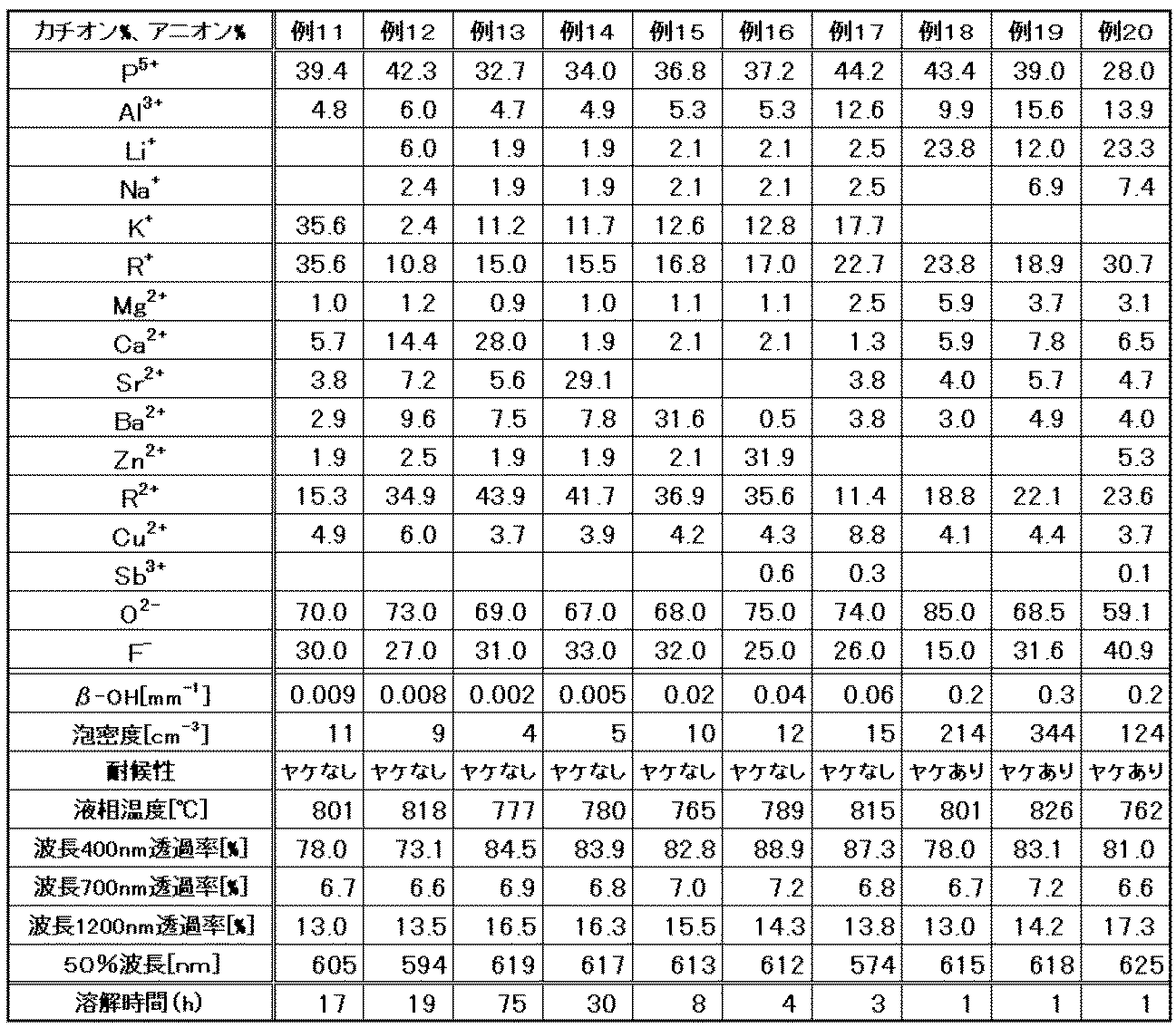
β-OH(mm-1)は、フーリエ変換赤外分光計(サーモエレクトロン社製、商品名:NICOLET6700)を用いて評価した。具体的には、縦20mm×横20mm×厚さ0.3mmの両面を光学研磨したガラスサンプルを準備し測定を行った。また、泡組成が酸素であることを、顕微ラマン分光装置(サーモエレクトロン社製、商品名:Nikolet Almega)を用いて確認した。
泡密度は、ガラスを板状に加工し、高輝度光源(林時計工業社製、LA-100T)下で、0.05cm3の領域の泡個数を5箇所測定し、その測定値の平均値を20倍して単位体積当たりに換算した値を示した。
液相温度は、熱分析装置(セイコーインスツル社製、商品名:Tg/DTA6300)を用いて測定した。ガラスを約1g準備し、乳鉢、乳棒で粉砕した後、105μmと44μmのふるいの間に残ったサンプルを用いて、測定範囲200~1000℃、昇温測度10℃/minで測定を行い、得られたDTAカーブをもとに、最後の結晶が融解する温度より液相温度を求めた。
泡密度は、ガラスを板状に加工し、高輝度光源(林時計工業社製、LA-100T)下で、0.05cm3の領域の泡個数を5箇所測定し、その測定値の平均値を20倍して単位体積当たりに換算した値を示した。
液相温度は、熱分析装置(セイコーインスツル社製、商品名:Tg/DTA6300)を用いて測定した。ガラスを約1g準備し、乳鉢、乳棒で粉砕した後、105μmと44μmのふるいの間に残ったサンプルを用いて、測定範囲200~1000℃、昇温測度10℃/minで測定を行い、得られたDTAカーブをもとに、最後の結晶が融解する温度より液相温度を求めた。
透過率は、紫外可視近赤外分光光度計(PerkineLmer社製、商品名:LAMBDA 950)を用いて評価した。具体的には、縦20mm×横20mm×厚さ0.3mmの両面を光学研磨したガラスサンプルを準備し、測定を行った。なお、各波長の透過率は、上記分光光度計にて得られた分光透過率を、透過率50%を示す波長が615nmとなるように換算した上で求めたものである。
耐候性は、高温高湿槽(エスペック社製、商品名:SH-221)を用いて、光学研磨したガラスサンプルを65℃、相対湿度90%の高温高湿槽中に1000時間保持した後のガラス表面のヤケ状態を目視観察し、ヤケが認められないものをヤケなし(耐候性問題なし)とした。
評価結果より、比較例のガラスは実施例の各ガラスと比較し、泡密度が高いこと、耐候性が低いことが確認された。これに対し、本発明に係る実施例の各ガラスは、泡密度が低く、耐候性が高いため、これにより欠点の少ない近赤外カットフィルタガラスが作製できる。また、ガラスの液相温度が低く、製造特性に優れるため、固体撮像素子用の近赤外線カットフィルタガラスとして好適に用いることができる。また、近赤外域のカット性に優れるものである。
本発明によれば、ガラスに含まれる水分量が少ないので、ガラスの溶解工程において泡欠点が発生しにくくなる。加えて、耐候性が高いため長期の使用においても欠点発生のおそれがなく有用である。また、液相温度も低いため製造特性に優れ、近赤外域のカット性に優れるため撮像デバイスの近赤外線カットフィルタ用途に極めて有用である。
なお、2010年8月3日に出願された日本特許出願2010-174447号の明細書、特許請求の範囲および要約書の全内容をここに引用し、本発明の明細書の開示として、取り入れるものである。
なお、2010年8月3日に出願された日本特許出願2010-174447号の明細書、特許請求の範囲および要約書の全内容をここに引用し、本発明の明細書の開示として、取り入れるものである。
Claims (9)
- カチオン%表示で、
P5+:25~55%、
Al3+:1~25%、
R+:1~50%(ただしR+は、Li+、Na+およびK+の合量を表す)、
R2+:1~50%(ただしR2+は、Mg2+、Ca2+、Sr2+、Ba2+およびZn2+の合量を表す)、
Cu2+:1~10%、および、
Sb3+:0~3%
を含有すると共に、
アニオン%表示で、
O2-:35~95%および
F-:5~65%
を含有し、
β-OH値が0.001~0.1mm-1である、フツリン酸塩系ガラスからなることを特徴とする近赤外線カットフィルタガラス。 - 波長600~700nmの分光透過率において透過率50%を示す波長が615nmとなるように換算した場合に、波長400nmの透過率が75~92%であり、波長700nmの透過率が5~10%であり、波長1200nmの透過率が10~20%であり、
かつ厚さ0.3mmに換算した場合に、透過率50%を示す長波長側の波長が575~700nmの範囲にあることを特徴とする請求項1記載の近赤外線カットフィルタガラス。 - 液相温度が700~850℃であることを特徴とする請求項1または請求項2記載の近赤外線カットフィルタガラス。
- PbO、As2O3のいずれも実質的に含まないことを特徴とする請求項1ないし請求項3のいずれか1項記載の近赤外線カットフィルタガラス。
- 近赤外線カットフィルタとして使用されるフツリン酸塩系ガラスの製造方法において、ガラス原料の加熱から溶融ガラスの固化までの間でガラスの水分量を調整して、ガラス中の水分量をβ-OH値で0.001~0.1mm-1とすることを特徴とする近赤外線カットフィルタガラスの製造方法。
- 前記水分量の調整を、ガラス原料の加熱から溶融ガラスの固化までの時間を2~80時間とすることによって行うことを特徴とする請求項5記載の近赤外線カットフィルタガラスの製造方法。
- 前記水分量の調整を、ガラス原料の加熱から溶融ガラスの固化までの間の雰囲気中に乾燥ガスを供給することで該雰囲気の露点が-100℃~50℃となるように制御することによって行うことを特徴とする請求項5または請求項6記載の近赤外線カットフィルタガラスの製造方法。
- 前記ガラス原料として結晶水を有するリン酸塩粉末原料もしくは正リン酸を用いることを特徴とする請求項5ないし請求項7のいずれか1項記載の近赤外線カットフィルタガラスの製造方法。
- フツリン酸塩系ガラスが請求項1ないし請求項4のいずれか1項に記載の組成のフツリン酸塩系ガラスであることを特徴とする請求項5ないし請求項8のいずれか1項記載の近赤外線カットフィルタガラスの製造方法。
Priority Applications (2)
| Application Number | Priority Date | Filing Date | Title |
|---|---|---|---|
| JP2012527743A JP5862566B2 (ja) | 2010-08-03 | 2011-08-02 | 近赤外線カットフィルタガラスおよびその製造方法 |
| US13/747,893 US20130135714A1 (en) | 2010-08-03 | 2013-01-23 | Near infrared cut filter glass and process for producing the same |
Applications Claiming Priority (2)
| Application Number | Priority Date | Filing Date | Title |
|---|---|---|---|
| JP2010-174447 | 2010-08-03 | ||
| JP2010174447 | 2010-08-03 |
Related Child Applications (1)
| Application Number | Title | Priority Date | Filing Date |
|---|---|---|---|
| US13/747,893 Continuation US20130135714A1 (en) | 2010-08-03 | 2013-01-23 | Near infrared cut filter glass and process for producing the same |
Publications (1)
| Publication Number | Publication Date |
|---|---|
| WO2012018026A1 true WO2012018026A1 (ja) | 2012-02-09 |
Family
ID=45559523
Family Applications (1)
| Application Number | Title | Priority Date | Filing Date |
|---|---|---|---|
| PCT/JP2011/067702 Ceased WO2012018026A1 (ja) | 2010-08-03 | 2011-08-02 | 近赤外線カットフィルタガラスおよびその製造方法 |
Country Status (3)
| Country | Link |
|---|---|
| US (1) | US20130135714A1 (ja) |
| JP (1) | JP5862566B2 (ja) |
| WO (1) | WO2012018026A1 (ja) |
Cited By (19)
| Publication number | Priority date | Publication date | Assignee | Title |
|---|---|---|---|---|
| CN102603188A (zh) * | 2012-02-17 | 2012-07-25 | 成都光明光电股份有限公司 | 近红外光吸收玻璃、元件及滤光器 |
| CN102603187A (zh) * | 2012-02-17 | 2012-07-25 | 成都光明光电股份有限公司 | 近红外光吸收玻璃、元件及滤光器 |
| CN102603189A (zh) * | 2012-02-17 | 2012-07-25 | 成都光明光电股份有限公司 | 近红外光吸收玻璃、元件及滤光器 |
| US20130214218A1 (en) * | 2012-02-17 | 2013-08-22 | Cdgm Glass Co., Ltd. | Near-infrared absorption glass, element and filter |
| JP2013216568A (ja) * | 2012-04-10 | 2013-10-24 | Schott Ag | 赤外吸収ガラスウェハ及びそれを作製する方法 |
| WO2014065225A1 (ja) * | 2012-10-23 | 2014-05-01 | 旭硝子株式会社 | フツリン酸ガラス、プレス成形用プリフォーム、および光学素子 |
| JP2015030665A (ja) * | 2013-08-05 | 2015-02-16 | 成都光明光▲電▼股▲分▼有限公司 | 近赤外光吸収ガラス、近赤外光吸収素子、及び近赤外光吸収光学フィルタ |
| WO2015046428A1 (ja) * | 2013-09-30 | 2015-04-02 | Hoya株式会社 | 光学ガラスおよびその製造方法 |
| JP2015117169A (ja) * | 2013-12-19 | 2015-06-25 | Hoya株式会社 | ガラスの製造方法および光学素子の製造方法 |
| JP2015522500A (ja) * | 2012-04-11 | 2015-08-06 | 成都光明光▲電▼股▲分▼有限公司 | 近赤外光吸収ガラス、近赤外光吸収素子、及び近赤外光吸収光学フィルタ |
| US20150329411A1 (en) * | 2012-02-17 | 2015-11-19 | Cdgm Glass Co., Ltd | Near-infrared light absorbing glass, element and filter |
| JP2016153784A (ja) * | 2015-01-30 | 2016-08-25 | Agcテクノグラス株式会社 | 蛍光ガラス線量計用ガラス |
| JP2017014044A (ja) * | 2015-06-30 | 2017-01-19 | Hoya株式会社 | 近赤外線吸収ガラスおよびフィルター |
| JPWO2015166897A1 (ja) * | 2014-04-30 | 2017-04-20 | 旭硝子株式会社 | カバーガラス、および、その製造方法 |
| US9656905B2 (en) | 2011-08-11 | 2017-05-23 | Hoya Corporation | Fluorophosphate glass and method for producing the same and near-infrared absorbing filter |
| WO2017183453A1 (ja) * | 2016-04-18 | 2017-10-26 | 日本電気硝子株式会社 | 波長変換部材 |
| CN106707379B (zh) * | 2012-12-28 | 2018-10-26 | Agc株式会社 | 近红外线截止滤光片 |
| JPWO2021132645A1 (ja) * | 2019-12-27 | 2021-07-01 | ||
| WO2022009558A1 (ja) * | 2020-07-10 | 2022-01-13 | Hoya株式会社 | 近赤外線吸収ガラスおよび近赤外線カットフィルタ |
Families Citing this family (9)
| Publication number | Priority date | Publication date | Assignee | Title |
|---|---|---|---|---|
| JP6270350B2 (ja) * | 2012-06-22 | 2018-01-31 | Hoya株式会社 | ガラスおよび光学素子の製造方法 |
| IN2013CH05761A (ja) | 2013-12-12 | 2015-08-07 | Pandian Bio Medical Res Ct | |
| CN108751696B (zh) * | 2015-04-10 | 2021-09-07 | 成都光明光电股份有限公司 | 光学玻璃 |
| JP6687027B2 (ja) * | 2015-07-24 | 2020-04-22 | Agc株式会社 | 近赤外線カットフィルタガラス |
| CN109608040B (zh) * | 2019-01-25 | 2021-11-16 | 成都光明光电股份有限公司 | 氟磷酸盐玻璃、玻璃预制件、光学元件及具有其的光学仪器 |
| CN109626820B (zh) * | 2019-01-25 | 2021-11-16 | 成都光明光电股份有限公司 | 氟磷酸盐玻璃、玻璃预制件、光学元件及具有其的光学仪器 |
| CN109626819B (zh) * | 2019-01-25 | 2021-11-16 | 成都光明光电股份有限公司 | 氟磷酸盐玻璃、玻璃预制件、光学元件及具有其的光学仪器 |
| US20230202917A1 (en) * | 2021-12-28 | 2023-06-29 | Hoya Corporation | Glass |
| CN114538772B (zh) * | 2022-03-24 | 2022-12-02 | 成都光明光电股份有限公司 | 玻璃、玻璃元件及滤光器 |
Citations (4)
| Publication number | Priority date | Publication date | Assignee | Title |
|---|---|---|---|---|
| JPH10114529A (ja) * | 1996-06-12 | 1998-05-06 | Praxair Technol Inc | ガラス溶融炉からの毒性放出物を減少させるための水富化式清澄法 |
| JP2001048583A (ja) * | 1999-08-02 | 2001-02-20 | Nippon Electric Glass Co Ltd | Li2O−Al2O3−SiO2系結晶化ガラス及び結晶性ガラス |
| JP2001080933A (ja) * | 1999-08-04 | 2001-03-27 | F X Nachtmann Bleikristallwerke Gmbh | 鉛及びバリウムを含まないクリスタルガラス |
| JP2004083290A (ja) * | 2002-07-05 | 2004-03-18 | Hoya Corp | 近赤外光吸収ガラス、近赤外光吸収素子、近赤外光吸収フィルターおよび近赤外光吸収ガラス成形体の製造方法 |
Family Cites Families (7)
| Publication number | Priority date | Publication date | Assignee | Title |
|---|---|---|---|---|
| JP4553250B2 (ja) * | 2005-02-02 | 2010-09-29 | Hoya株式会社 | ガラスの製造方法および赤外カットフィルター |
| JP2007099604A (ja) * | 2005-09-06 | 2007-04-19 | Hoya Corp | 近赤外線吸収ガラス、それを備えた近赤外線吸収素子および撮像装置 |
| JP5004202B2 (ja) * | 2005-09-14 | 2012-08-22 | Hoya株式会社 | 光学ガラス、精密プレス成形用プリフォームおよび光学素子 |
| JP2008201617A (ja) * | 2007-02-20 | 2008-09-04 | Nippon Electric Glass Co Ltd | ガラスの製造方法 |
| JP2008273791A (ja) * | 2007-04-27 | 2008-11-13 | Ohara Inc | リン酸塩系ガラス、リン酸塩系ガラスからなるガラスセラミックス、およびそれらの製造方法 |
| JP5115984B2 (ja) * | 2008-03-28 | 2013-01-09 | Hoya株式会社 | フツリン酸ガラス、プレス成形用ガラス素材、光学素子ブランク、光学素子とそれぞれの製造方法 |
| JP5476692B2 (ja) * | 2008-09-04 | 2014-04-23 | 旭硝子株式会社 | リン酸塩系ガラス体、および該ガラス体を用いた近赤外カットフィルタ |
-
2011
- 2011-08-02 WO PCT/JP2011/067702 patent/WO2012018026A1/ja not_active Ceased
- 2011-08-02 JP JP2012527743A patent/JP5862566B2/ja active Active
-
2013
- 2013-01-23 US US13/747,893 patent/US20130135714A1/en not_active Abandoned
Patent Citations (4)
| Publication number | Priority date | Publication date | Assignee | Title |
|---|---|---|---|---|
| JPH10114529A (ja) * | 1996-06-12 | 1998-05-06 | Praxair Technol Inc | ガラス溶融炉からの毒性放出物を減少させるための水富化式清澄法 |
| JP2001048583A (ja) * | 1999-08-02 | 2001-02-20 | Nippon Electric Glass Co Ltd | Li2O−Al2O3−SiO2系結晶化ガラス及び結晶性ガラス |
| JP2001080933A (ja) * | 1999-08-04 | 2001-03-27 | F X Nachtmann Bleikristallwerke Gmbh | 鉛及びバリウムを含まないクリスタルガラス |
| JP2004083290A (ja) * | 2002-07-05 | 2004-03-18 | Hoya Corp | 近赤外光吸収ガラス、近赤外光吸収素子、近赤外光吸収フィルターおよび近赤外光吸収ガラス成形体の製造方法 |
Cited By (26)
| Publication number | Priority date | Publication date | Assignee | Title |
|---|---|---|---|---|
| US9656905B2 (en) | 2011-08-11 | 2017-05-23 | Hoya Corporation | Fluorophosphate glass and method for producing the same and near-infrared absorbing filter |
| US9546105B2 (en) * | 2012-02-17 | 2017-01-17 | Cdgm Glass Co., Ltd | Near-infrared light absorbing glass, element and filter |
| CN102603187A (zh) * | 2012-02-17 | 2012-07-25 | 成都光明光电股份有限公司 | 近红外光吸收玻璃、元件及滤光器 |
| CN102603189A (zh) * | 2012-02-17 | 2012-07-25 | 成都光明光电股份有限公司 | 近红外光吸收玻璃、元件及滤光器 |
| US20130214218A1 (en) * | 2012-02-17 | 2013-08-22 | Cdgm Glass Co., Ltd. | Near-infrared absorption glass, element and filter |
| US9321673B2 (en) * | 2012-02-17 | 2016-04-26 | Cdgm Glass Co., Ltd. | Near-infrared absorption glass, element and filter |
| US20150329411A1 (en) * | 2012-02-17 | 2015-11-19 | Cdgm Glass Co., Ltd | Near-infrared light absorbing glass, element and filter |
| CN102603188A (zh) * | 2012-02-17 | 2012-07-25 | 成都光明光电股份有限公司 | 近红外光吸收玻璃、元件及滤光器 |
| JP2013216568A (ja) * | 2012-04-10 | 2013-10-24 | Schott Ag | 赤外吸収ガラスウェハ及びそれを作製する方法 |
| JP2015522500A (ja) * | 2012-04-11 | 2015-08-06 | 成都光明光▲電▼股▲分▼有限公司 | 近赤外光吸収ガラス、近赤外光吸収素子、及び近赤外光吸収光学フィルタ |
| WO2014065225A1 (ja) * | 2012-10-23 | 2014-05-01 | 旭硝子株式会社 | フツリン酸ガラス、プレス成形用プリフォーム、および光学素子 |
| CN106707379B (zh) * | 2012-12-28 | 2018-10-26 | Agc株式会社 | 近红外线截止滤光片 |
| JP2015030665A (ja) * | 2013-08-05 | 2015-02-16 | 成都光明光▲電▼股▲分▼有限公司 | 近赤外光吸収ガラス、近赤外光吸収素子、及び近赤外光吸収光学フィルタ |
| US9834465B2 (en) | 2013-09-30 | 2017-12-05 | Hoya Corporation | Optical glass and method for producing the same |
| WO2015046428A1 (ja) * | 2013-09-30 | 2015-04-02 | Hoya株式会社 | 光学ガラスおよびその製造方法 |
| JP2015117169A (ja) * | 2013-12-19 | 2015-06-25 | Hoya株式会社 | ガラスの製造方法および光学素子の製造方法 |
| JPWO2015166897A1 (ja) * | 2014-04-30 | 2017-04-20 | 旭硝子株式会社 | カバーガラス、および、その製造方法 |
| JP2016153784A (ja) * | 2015-01-30 | 2016-08-25 | Agcテクノグラス株式会社 | 蛍光ガラス線量計用ガラス |
| JP2017014044A (ja) * | 2015-06-30 | 2017-01-19 | Hoya株式会社 | 近赤外線吸収ガラスおよびフィルター |
| WO2017183453A1 (ja) * | 2016-04-18 | 2017-10-26 | 日本電気硝子株式会社 | 波長変換部材 |
| JPWO2021132645A1 (ja) * | 2019-12-27 | 2021-07-01 | ||
| WO2021132645A1 (ja) * | 2019-12-27 | 2021-07-01 | Hoya株式会社 | 近赤外線吸収ガラスおよび近赤外線カットフィルタ |
| JP7662535B2 (ja) | 2019-12-27 | 2025-04-15 | Hoya株式会社 | 近赤外線吸収ガラスおよび近赤外線カットフィルタ |
| US12297146B2 (en) | 2019-12-27 | 2025-05-13 | Hoya Corporation | Near-infrared absorbing glass and near-infrared cutoff filter |
| WO2022009558A1 (ja) * | 2020-07-10 | 2022-01-13 | Hoya株式会社 | 近赤外線吸収ガラスおよび近赤外線カットフィルタ |
| JPWO2022009558A1 (ja) * | 2020-07-10 | 2022-01-13 |
Also Published As
| Publication number | Publication date |
|---|---|
| JPWO2012018026A1 (ja) | 2013-10-03 |
| JP5862566B2 (ja) | 2016-02-16 |
| US20130135714A1 (en) | 2013-05-30 |
Similar Documents
| Publication | Publication Date | Title |
|---|---|---|
| JP5862566B2 (ja) | 近赤外線カットフィルタガラスおよびその製造方法 | |
| JP5605400B2 (ja) | 近赤外線カットフィルタガラス | |
| WO2015046428A1 (ja) | 光学ガラスおよびその製造方法 | |
| JP2011132077A (ja) | 近赤外光吸収ガラス、近赤外光吸収フィルターおよび撮像装置 | |
| JP2012148964A (ja) | フッ化リン酸ガラス | |
| CN107531557A (zh) | 近红外线截止滤波器玻璃 | |
| JP4597937B2 (ja) | 光学ガラス | |
| JP6124961B2 (ja) | フツリン酸ガラス及びその製造方法並びに近赤外光吸収フィルター | |
| JP6428767B2 (ja) | 近赤外線カットフィルタガラス | |
| TWI756245B (zh) | 近紅外線截止濾波器玻璃 | |
| JP2009073674A (ja) | ガラスの製造方法 | |
| JP2008088047A (ja) | ガラス | |
| JP6687027B2 (ja) | 近赤外線カットフィルタガラス | |
| JP2017014044A (ja) | 近赤外線吸収ガラスおよびフィルター | |
| TW202104112A (zh) | 光學玻璃、預形體以及光學元件 | |
| US10150693B2 (en) | Near infrared cutoff filter glass | |
| WO2019044324A1 (ja) | 近赤外線吸収ガラス | |
| JP6577284B2 (ja) | 光学ガラス、光学ガラスを用いた光学素子、光学装置 | |
| JP6001094B2 (ja) | 近赤外光吸収ガラス、近赤外光吸収素子、及び近赤外光吸収光学フィルタ | |
| JP6346552B2 (ja) | 近赤外吸収フィルタ用ガラス | |
| JP5270973B2 (ja) | 近赤外吸収フィルタ用ガラス | |
| JP2006248850A (ja) | 近赤外吸収フィルタ用ガラス | |
| JP2011093721A (ja) | 光学ガラスの製造方法 | |
| WO2023026877A1 (ja) | フツリン酸塩系光学ガラス、光学素子及びレンズ |
Legal Events
| Date | Code | Title | Description |
|---|---|---|---|
| 121 | Ep: the epo has been informed by wipo that ep was designated in this application |
Ref document number: 11814651 Country of ref document: EP Kind code of ref document: A1 |
|
| WWE | Wipo information: entry into national phase |
Ref document number: 2012527743 Country of ref document: JP |
|
| NENP | Non-entry into the national phase |
Ref country code: DE |
|
| 122 | Ep: pct application non-entry in european phase |
Ref document number: 11814651 Country of ref document: EP Kind code of ref document: A1 |