WO2012014886A1 - 無アルカリカバーガラス組成物及びそれを用いた光取り出し部材 - Google Patents
無アルカリカバーガラス組成物及びそれを用いた光取り出し部材 Download PDFInfo
- Publication number
- WO2012014886A1 WO2012014886A1 PCT/JP2011/066951 JP2011066951W WO2012014886A1 WO 2012014886 A1 WO2012014886 A1 WO 2012014886A1 JP 2011066951 W JP2011066951 W JP 2011066951W WO 2012014886 A1 WO2012014886 A1 WO 2012014886A1
- Authority
- WO
- WIPO (PCT)
- Prior art keywords
- glass
- mol
- less
- content
- alkali
- Prior art date
- Legal status (The legal status is an assumption and is not a legal conclusion. Google has not performed a legal analysis and makes no representation as to the accuracy of the status listed.)
- Ceased
Links
Images

Classifications
-
- C—CHEMISTRY; METALLURGY
- C03—GLASS; MINERAL OR SLAG WOOL
- C03C—CHEMICAL COMPOSITION OF GLASSES, GLAZES OR VITREOUS ENAMELS; SURFACE TREATMENT OF GLASS; SURFACE TREATMENT OF FIBRES OR FILAMENTS MADE FROM GLASS, MINERALS OR SLAGS; JOINING GLASS TO GLASS OR OTHER MATERIALS
- C03C3/00—Glass compositions
- C03C3/12—Silica-free oxide glass compositions
- C03C3/16—Silica-free oxide glass compositions containing phosphorus
- C03C3/21—Silica-free oxide glass compositions containing phosphorus containing titanium, zirconium, vanadium, tungsten or molybdenum
-
- C—CHEMISTRY; METALLURGY
- C03—GLASS; MINERAL OR SLAG WOOL
- C03C—CHEMICAL COMPOSITION OF GLASSES, GLAZES OR VITREOUS ENAMELS; SURFACE TREATMENT OF GLASS; SURFACE TREATMENT OF FIBRES OR FILAMENTS MADE FROM GLASS, MINERALS OR SLAGS; JOINING GLASS TO GLASS OR OTHER MATERIALS
- C03C3/00—Glass compositions
- C03C3/12—Silica-free oxide glass compositions
- C03C3/16—Silica-free oxide glass compositions containing phosphorus
- C03C3/19—Silica-free oxide glass compositions containing phosphorus containing boron
-
- G—PHYSICS
- G02—OPTICS
- G02B—OPTICAL ELEMENTS, SYSTEMS OR APPARATUS
- G02B5/00—Optical elements other than lenses
- G02B5/02—Diffusing elements; Afocal elements
- G02B5/0268—Diffusing elements; Afocal elements characterized by the fabrication or manufacturing method
-
- H—ELECTRICITY
- H10—SEMICONDUCTOR DEVICES; ELECTRIC SOLID-STATE DEVICES NOT OTHERWISE PROVIDED FOR
- H10K—ORGANIC ELECTRIC SOLID-STATE DEVICES
- H10K50/00—Organic light-emitting devices
- H10K50/80—Constructional details
- H10K50/85—Arrangements for extracting light from the devices
- H10K50/854—Arrangements for extracting light from the devices comprising scattering means
Definitions
- the present invention relates to a glass composition that does not contain lead oxide and alkali metal oxide, has a high refractive index, a glass transition temperature of 530 ° C. or less, and has acid resistance, and a light extraction member using the same. .
- the glass composition described in Patent Document 1 requires 13 to 21% of GeO 2 based on the weight of the oxide.
- the glass composition described in Patent Document 2 requires an alkali metal oxide.
- the glasses of Patent Documents 1 and 2 contain an alkali metal, there is a problem of causing alkali migration.
- the glass composition described in Patent Document 1 requires GeO 2 , but GeO 2 is a rare material and has a problem of resource depletion and cost.
- the glass material described in Patent Document 2 contains an alkali metal oxide.
- the present invention does not contain lead oxide and alkali metal oxide, has a glass transition temperature point of 530 ° C. or less, has acid resistance, and has a refractive index (n d ) of 1.7 or more and 2.3 or less.
- a glass composition and a light extraction member using the same are provided.
- the present invention provides the following alkali-free cover glass composition and a light extraction member using the same.
- Lead oxide and alkali metal oxide are not substantially contained, the refractive index (n d ) is 1.7 or more and 2.3 or less, the glass transition temperature is 530 ° C. or less, and the acid immersion weight is reduced.
- a non-alkali cover glass having a dissolution depth measured and calculated by a measurement method of less than 1.3 ⁇ m and containing 8 to 25% of Nb 2 O 5 in terms of mol% of oxide. Composition.
- a substrate having light scattering properties and provided on the substrate; Provided on the light scattering layer, substantially free of lead oxide and alkali metal oxide, having a refractive index (n d ) of 1.7 or more and 2.3 or less, and having a glass transition temperature point of 530 ° C. or less.
- a glass composition having a dissolution depth of less than 1.3 ⁇ m measured by an acid immersion weight loss measurement method and containing Nb 2 O 5 in an amount of 8 to 25% in terms of mol% based on an oxide
- a light extraction member comprising: an alkali-free cover glass layer constituted by:
- a glass composition having a specific composition does not contain lead oxide and alkali metal oxide, has a high refractive index, a glass transition temperature point of 530 ° C. or less, and has acid resistance.
- a glass composition provided and a light extraction member using the same can be provided.
- the glass of the present invention has sufficiently high acid resistance, and an ITO thin film formed on the glass can be patterned by etching with an acid.
- the glass frit of the present invention is advantageous in that it does not cause deformation or unacceptable warpage and does not generate cracks after being fired and softened on a glass substrate (for example, PD200 substrate manufactured by Asahi Glass Co., Ltd.).
- the alkali-free cover glass composition of the present invention (hereinafter referred to as a glass composition) is substantially free of lead oxide and alkali metal oxide, and has a refractive index (n d ) of 1.7 or more and 2.3 or less.
- a so-called ITO etchant solution having a glass transition temperature of 530 ° C. or less and composed of a mixed solution of 45 ° Baume ferric chloride (42 wt% or more of FeCl 3 ) and hydrochloric acid (35 wt% HCl)
- acid immersion weight loss measurement method calculated from the weight loss measured before and after immersion at 40 ° C. for 10 minutes and the specific gravity and surface area of the measurement sample. Is less than 1.3 ⁇ m, and the content of Nb 2 O 5 is 8 to 25% in terms of mol% based on oxide.
- the glass composition of the present invention is substantially free of lead oxide and alkali metal oxide.
- substantially not containing does not mean that it does not contain actively, and does not mean that impurities derived from other components are not contained.
- the refractive index (n d ) of the glass composition of the present invention is 1.7 or more and 2.3 or less. Within this range, when used on the scattering layer of the organic LED element, the effect of extracting emitted light is great.
- the refractive index (n d ) of the glass composition of the present invention is more preferably from 1.88 to 2.2, and particularly preferably from 1.95 to 2.1.
- the refractive index (n d ) represents the refractive index at the d-line (587.56 nm), and is obtained by polishing the glass and then measuring by a V-block method using a precision refractometer KPR-2000 manufactured by Kalnew. be able to.
- the glass transition temperature of the glass composition of this invention is 530 degrees C or less.
- the glass softening temperature is 620 ° C. or lower
- the firing temperature at which an alkali-free cover glass can be formed is 620 ° C. or lower
- the high strain point glass substrate (strain point is 570) of the base material during firing It is possible to suppress thermal deformation at a temperature higher than or equal to ° C.
- the glass transition temperature of the glass composition of the present invention is more preferably 520 ° C. or less, and particularly preferably 515 ° C. or less.
- the glass transition temperature of the glass composition of this invention is 400 degreeC or more. Glass below 400 ° C.
- a glass transition temperature is obtained by calculating
- the glass softening temperature can be obtained by obtaining the fourth bending point of the DTA chart obtained by measurement using the same apparatus.
- the dissolution depth of the glass composition of the present invention is less than 1.3 ⁇ m in the measurement using the acid immersion weight loss measurement method described above.
- the dissolution depth is less than 1.3 ⁇ m, it is preferable when the ITO film formed on the non-alkali cover glass fired film is patterned by etching. More specifically, when the ITO is patterned, the unmasked fired film is simultaneously dissolved.
- the dissolution depth of less than 1.3 ⁇ m means less than half of the depth of erosion of ITO. Inconveniences in handling are avoided.
- the dissolution depth of the glass composition of the present invention is more preferably 1.0 ⁇ m or less, and particularly preferably 0.5 ⁇ m or less.
- the dissolution depth is 0 or more, and it is preferable that the dissolution depth is not.
- the time required for patterning an ITO having a thickness of about 130 nm is about 30 seconds. 1.3 ⁇ m in 10 minutes is calculated as 65 nm in 30 seconds. That is, it is considered that the melting depth is less than half the rate at which ITO is eroded.
- the average thermal expansion coefficient of the glass composition of the present invention is preferably from 60 ⁇ 10 ⁇ 7 / K to 90 ⁇ 10 ⁇ 7 / K in the range from 50 ° C. to 300 ° C. When this is satisfied, even if the glass frit of the present invention is baked and softened on a soda lime glass substrate or a high strain point glass substrate (strain point of 570 ° C. or higher), it will not break or warp greatly. .
- the average thermal expansion coefficient from 50 ° C. to 300 ° C. is more preferably 65 ⁇ 10 ⁇ 7 / K or more.
- the average coefficient of thermal expansion from 50 ° C. to 300 ° C. is more preferably 85 ⁇ 10 ⁇ 7 / K or less, and particularly preferably 80 ⁇ 10 ⁇ 7 / K or less.
- the average thermal expansion coefficient is a numerical value measured by a thermomechanical analyzer (TMA).
- the glass composition of the present invention contains ZnO, Bi 2 O 3 , P 2 O 5 and Nb 2 O 5 as essential components, and contains ZrO 2 , BaO, B 2 O 3 , MgO, CaO, SrO, Al 2 O 3. may include TiO 2, V 2 O 5, Y 2 O 3, La 2 O 3, Gd 2 O 3, SnO 2, MoO 3 and WO 3 as an optional component.
- the glass composition of the present invention will be specifically described.
- the glass composition of the present invention has a ZnO content of 4-32%, a Bi 2 O 3 content of 5-35%, and a P 2 O 5 content of 10- 30%, Nb 2 O 5 content 8-25%, BaO content 0-5%, B 2 O 3 content 0-17%, MgO content 0-5%, CaO 0-5%, SrO content 0-5%, Al 2 O 3 content 0-5%, TiO 2 content 0-5%, V 2 O 5 content 0-5%, Y 2 O 3 content 0-5%, La 2 O 3 content 0-5%, Gd 2 O 3 content 0-5%, SnO 2 content Is 0-5%, the content of MoO 3 is 0-5%, the content of WO 3 is 0-20%, and the content of Bi 2 O 3 is 30 mol% or more, ZrO 2 is added.
- mol% display based on oxide is simply expressed as mol%.
- Alkali metal oxides (Li 2 O, Na 2 O, K 2 O, etc.) may cause alkali migration and are not substantially contained.
- Lead oxide can cause environmental pollution and is substantially free.
- ZnO is an essential component that has the effect of greatly lowering the glass transition temperature and softening temperature and imparting a high refractive index while suppressing an excessive increase in the average thermal expansion coefficient. If the ZnO content is less than 4 mol%, the effect is insufficient. On the other hand, when the content of ZnO exceeds 32 mol%, the tendency of the glass to devitrify increases.
- the content of ZnO is 4 mol% or more, more preferably 10 mol% or more, and particularly preferably 12 mol% or more.
- the ZnO content is 32 mol% or less, more preferably 30 mol% or less, and particularly preferably 28 mol% or less.
- Bi 2 O 3 is an essential component that lowers the transition temperature and softening temperature of the glass, imparts a high refractive index, and increases the stability of the glass. If the content of Bi 2 O 3 is less than 5 mol%, the effect is insufficient. On the other hand, when Bi 2 O 3 is contained in a large amount, the stability of the glass is impaired, the average thermal expansion coefficient is increased, and the acid resistance of the glass is deteriorated. Therefore, the content of Bi 2 O 3 is 35 mol% or less, and more preferably 30 mol% or less. Further, the content of Bi 2 O 3 is more preferably 10 mol% or more, and particularly preferably 15 mol% or more.
- P 2 O 5 is an essential component that forms a network structure as a glass skeleton and imparts stability of the glass.
- content of P 2 O 5 is less than 10 mol%, devitrification is likely to occur.
- content of P 2 O 5 exceeds 30 mol%, the glass is easily crystallized.
- Nb 2 O 5 is an essential component that imparts a high refractive index, lowers the average thermal expansion coefficient, and improves acid resistance.
- the content of Nb 2 O 5 is less than 8 mol%, the acid resistance is insufficient.
- Nb 2 O 5 tends to devitrify while increasing the glass transition temperature and the softening temperature. Therefore, the content of Nb 2 O 5 is 25 mol% or less, more preferably 20 mol% or less, and particularly preferably 18 mol% or less.
- the content of Nb 2 O 5 is at 8 mol% or more, more preferably at least 10 mol%, particularly preferably at least 12 mol%.
- BaO is an optional component that improves the stability of the glass. However, if the content of BaO exceeds 5 mol%, the refractive index is lowered and the average thermal expansion coefficient, glass transition temperature and softening temperature are increased. Therefore, the BaO content is preferably 0 to 5 mol%.
- the value obtained by dividing the total content of Bi 2 O 3 and the content of BaO by the content of Nb 2 O 5 is 0.3 to 2.5.
- BaO has a great effect of reducing acid resistance together with Bi 2 O 3 when contained in glass among alkaline earths.
- Nb 2 O 5 is a main component that improves acid resistance.
- the inventor has found that the value obtained by dividing the total content of Bi 2 O 3 and BaO by the content of Nb 2 O 5 is an index indicating the acid resistance of the glass. If this value exceeds 2.5, the acid resistance is impaired, so that it is preferably 2.5 or less. Moreover, this value is 0.3 or more.
- Nb 2 O 5 is indispensable in order to obtain a glass composition that can withstand acid when ITO is patterned.
- the glass containing Nb 2 O 5 has a high transition point and softening point, and the fired film is hardly seized on the glass substrate. Therefore, it is necessary to make the composition reduce the transition point and softening point. Therefore, Bi 2 O 3 or BaO has an effect of reducing the transition point and the softening point. Therefore, by containing any element at a ratio of 0.3 to Nb 2 O 5 , the acid resistance is excellent. In addition, the effect of low transition point and softening point can be obtained.
- ZrO 2 is an optional component that improves the stability of the glass. If the ZrO 2 content exceeds 5 mol%, the glass stability is adversely affected and the glass transition temperature and the softening temperature may be increased. Therefore, the ZrO 2 content is preferably 0 to 5 mol%. When the content of Bi 2 O 3 exceeds 30 mol%, crystallization of the glass proceeds. Therefore, in order to suppress crystallization of glass, ZrO 2 must be contained in an amount of 1 to 5 mol% only when the content of Bi 2 O 3 exceeds 30 mol%.
- B 2 O 3 is an optional component having an effect of improving the solubility of glass.
- the content of B 2 O 3 exceeds 17 mol%, devitrification and phase separation are likely to occur, and it may be difficult to obtain a high refractive index. Therefore, the content of B 2 O 3 is preferably 0 to 17 mol%.
- MgO, CaO and SrO are optional components that improve the stability of the glass.
- the content of each of them increases, the refractive index may be lowered and the average thermal expansion coefficient, glass transition temperature, and softening temperature may be increased. Therefore, the content of each of them is preferably 0 to 5 mol%.
- Al 2 O 3 has the effect of rather deteriorating the stability of the glass, and its content is preferably less than 5 mol%, more preferably less than 3 mol%, and substantially no content. More preferably.
- TiO 2 is an optional component having the effect of imparting a high refractive index. Since TiO 2 tends to devitrify as the glass transition temperature and softening temperature rise, the content of TiO 2 is preferably 0 to 5 mol%.
- V 2 O 5 is an optional component that has the effect of improving the stability of the glass and lowering the glass softening point. However, since it is also a component that colors the glass, when it is not desirable to color the glass, it is desirable to keep its content within an allowable range (0 to 5 mol%).
- the content is preferably less than 5 mol%, more preferably less than 3 mol%, and substantially no content. More preferably.
- La 2 O 3 may rather impair the stability of the glass, its content is preferably less than 5 mol%, more preferably less than 3 mol%, and substantially no content. More preferably.
- Gd 2 O 3 may rather impair the stability of the glass, so its content is preferably less than 5 mol%, more preferably less than 3 mol%, and substantially no content. More preferably.
- SnO 2 may rather impair the stability of the glass, its content is preferably kept at less than 5 mol%, more preferably less than 3 mol%, and not substantially contained. Even more preferred.
- MoO 3 is an optional component that has the effect of improving the stability of the glass and lowering the glass softening point. However, since it is also a component that colors the glass, when it is not desirable to color the glass, it is desirable to keep its content within an allowable range (0 to 5 mol%).
- WO 3 is an optional component having the effect of imparting a high refractive index without greatly changing the average thermal expansion coefficient, glass transition temperature, and softening temperature. Moreover, it is a useful component for stabilizing glass. However, when the content of WO 3 is increased, coloring is increased and devitrification is likely to occur. Therefore, the content of WO 3 is preferably 0 to 20 mol%, more preferably 0 to 15 mol%, and particularly preferably 0 to 13 mol%.
- the glass composition of the present invention may also contain TeO 2 , GeO 2 , Sb 2 O 3 , SiO 2 , Ta 2 O 3 , Cs 2 O, transition metal oxides and the like as long as the effects of the invention are not lost. it can.
- the total content is preferably less than 5 mol%, more preferably less than 3 mol%, and still more preferably substantially not contained.
- the glass composition of the present invention uses raw materials such as oxides, phosphates, metaphosphates, carbonates, nitrates and hydroxides, weighs them so as to have a predetermined composition, mixes them, It can be obtained by melting at a temperature of 950 to 1500 ° C. using a crucible such as platinum and casting it into a mold or pouring it into a gap between twin rolls and quenching. Also, it may be gradually cooled to remove the distortion.
- the glass frit of the present invention can be obtained by pulverizing the glass composition prepared by the above method with a mortar, ball mill, planetary mill, jet mill or the like, and classifying as necessary.
- the mass average particle size of the glass frit is typically 0.5 to 10 ⁇ m.
- the surface of the glass frit may be modified with a surfactant or a silane coupling agent.
- the mass average particle diameter is a particle diameter measured by a laser diffraction particle size distribution measuring method.
- the light extraction member of the present invention has a structure in which a light scattering layer made of glass is formed on a substrate and an alkali-free cover glass is provided on the light scattering layer.
- the thickness of the light scattering layer is typically 5 to 50 ⁇ m.
- the substrate used here preferably has an average coefficient of thermal expansion ( ⁇ 50-300 ) from 50 ° C. to 300 ° C. of 75 ⁇ 10 ⁇ 7 / K to 90 ⁇ 10 ⁇ 7 / K, for example, soda lime glass Or PD200 manufactured by Asahi Glass Co., Ltd., and a silica film or the like may be coated on the surface thereof.
- this member is obtained by kneading a glass frit with a solvent or a binder, if necessary, and then applying the glass frit on a substrate and firing it at a temperature near the glass softening temperature of the glass frit to soften the glass frit. Obtained by cooling to.
- the solvent include ⁇ -terpineol, butyl carbitol acetate, phthalate ester, 2,2,4-trimethyl-1,3-pentanediol monoisobutyrate
- the binder includes ethyl cellulose, acrylic resin, styrene resin, Examples thereof include phenol resin and butyral resin.
- the light scattering layer of the present invention can contain a scattering material in the fired glass frit layer.
- a scattering material in the fired layer decreases from the inside of the fired layer toward the surface. With such a distribution, the probability that the scattering material is present in the surface layer of the glass frit firing layer is lower than that in the scattering layer, so that a smooth surface can be obtained. For this reason, for example, when forming an organic LED element, a translucent electrode layer and an organic layer can be formed uniformly, and the distance between electrodes between the reflective electrode layer formed on the organic layer is also uniform. Become. As a result, the lifetime of the element can be extended.
- the scattering material may be a bubble, a material particle having a composition different from that of the glass frit, or a precipitated crystal from the glass frit, and may be a single substance or a mixed state.
- the light extraction member of the present invention it is also possible to form a translucent electrode layer on a non-alkali cover glass layer by a film forming method such as sputtering.
- the refractive index of the translucent electrode layer is preferably equal to or lower than the refractive index of the glass frit. By satisfying this requirement, light emitted from the organic layer can be efficiently extracted. it can.
- the translucent electrode layer is typically ITO (Indium Tin Oxide), and SnO 2 , ZnO, IZO (Indium Zinc Oxide), or the like can also be used.
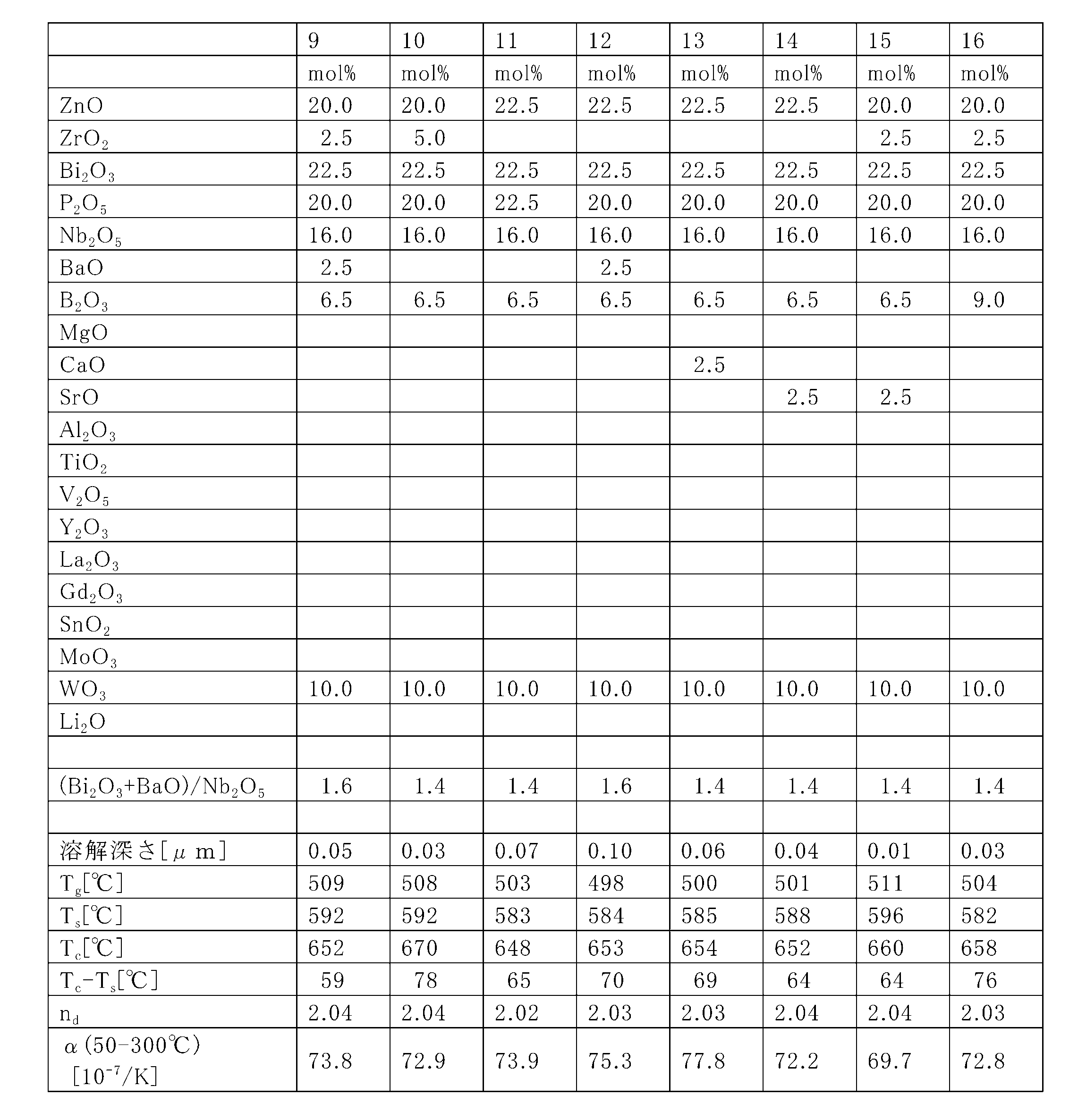
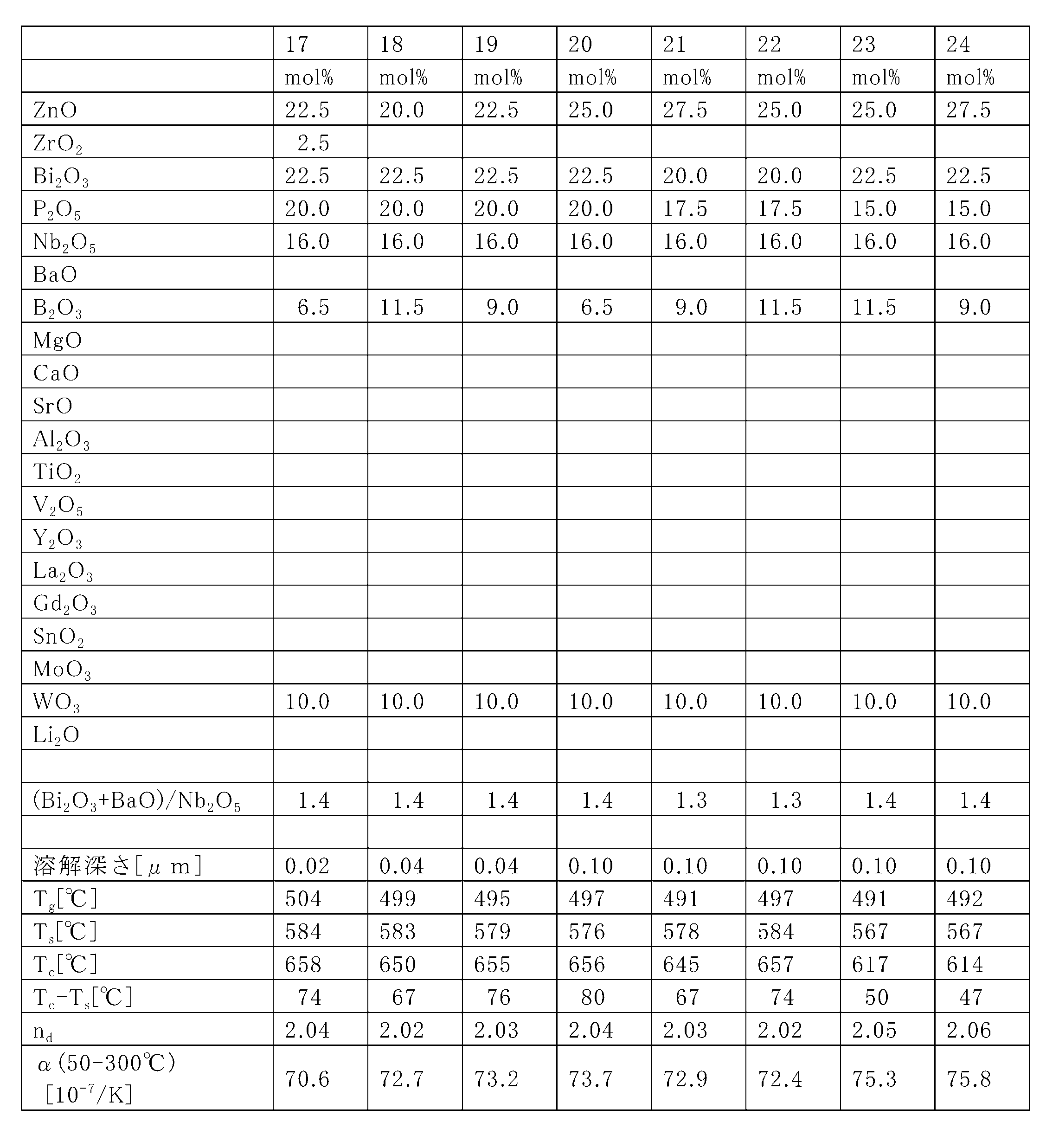
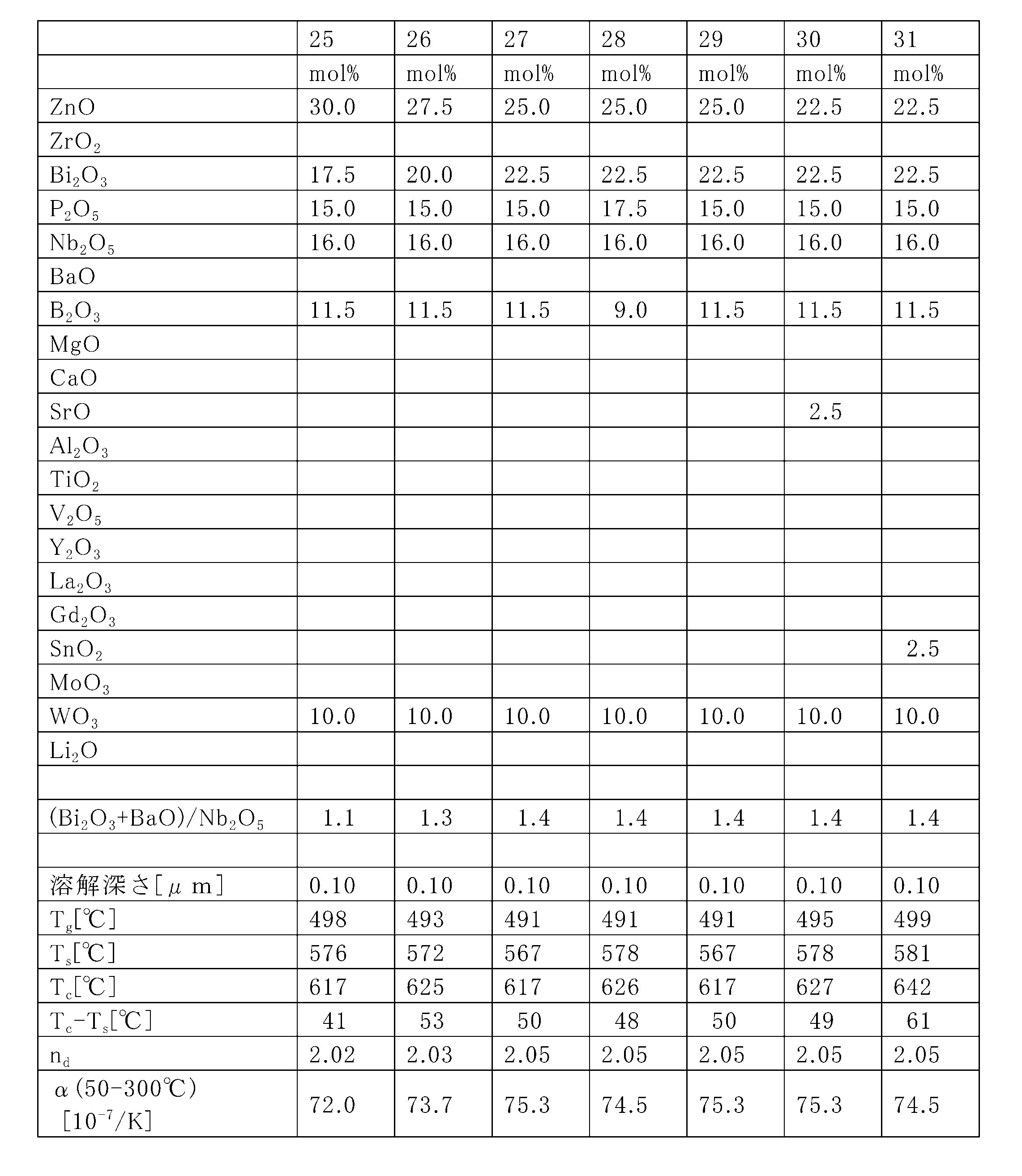
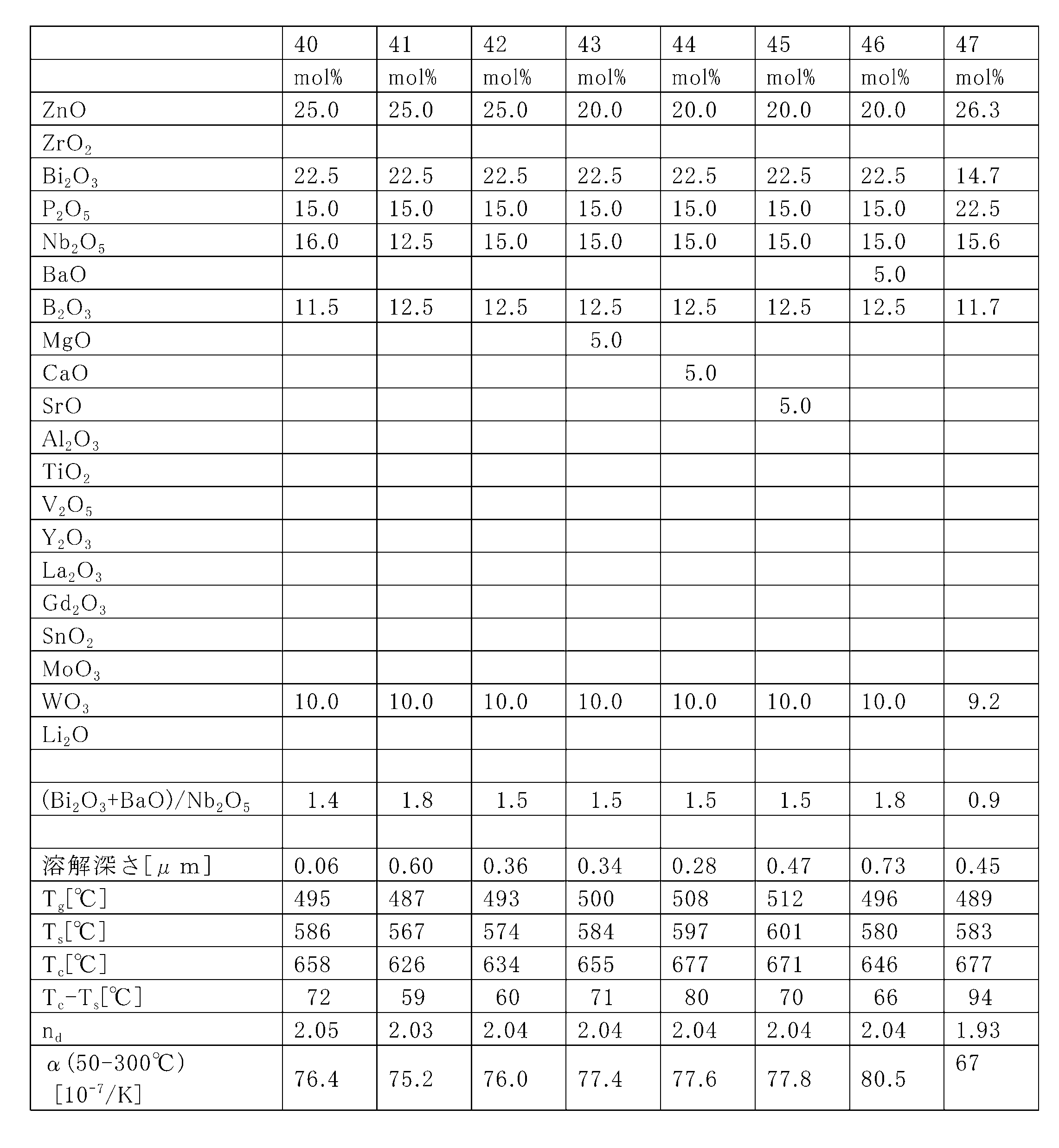
- Tables 1 to 8 show the glass composition in mol% of each example, the dissolution depth, the refractive index (n d ), the glass transition temperature (T g ), the glass softening temperature (T c ), from 50 ° C. to 300 ° C.
- the average thermal expansion coefficient ( ⁇ 50-300 ) of Examples 1 to 53 are examples of the present invention, and examples 54 to 62 are comparative examples.
- any glass composition oxides, phosphates, metaphosphates, and carbonates were used as raw materials for the respective components. After vitrification, the raw materials were weighed so as to have the composition shown in Table 1 and thoroughly mixed. After that, it is melted in a temperature range of 950 to 1350 ° C. using a platinum crucible, cast into a carbon mold, the cast glass is cooled to a transition temperature, immediately put into an annealing furnace, and gradually cooled to room temperature. Thus, each glass composition was obtained. The molten glass was passed through a gap between stainless steel water-cooled twin rollers to obtain a flaky glass composition. This was pulverized and classified to obtain a powdery glass composition.
- Dissolution depth A glass formed into a flaky shape or a round bar shape is a so-called mixed solution of 45 ° Baume ferric chloride (42 wt% or more of FeCl 3 ) and hydrochloric acid (35 wt% HCl). The depth calculated from the weight loss measured before and after the immersion in the ITO etchant solution at 40 ° C. for 10 minutes, the specific gravity of the measurement sample, and the surface area was calculated as the dissolution depth.
- the fourth bending point of the DTA chart obtained by the measurement was taken as the glass softening temperature.
- Glass crystallization temperature (T c ) The powdery glass composition was packed in a platinum pan and measured with a differential thermal analyzer TG8110 manufactured by Rigaku Corporation at a heating rate of 10 ° C./min. The peak point appearing after the fourth bending point of the DTA chart obtained by the measurement was taken as the crystallization temperature.
- Glass crystallization temperature-softening temperature (T c -T s ) The difference between the crystallization temperature and the softening temperature was calculated. As this value is larger, the temperature range that flows during firing is wider, so that it is easier to obtain a sufficiently fired good fired film.
- Average coefficient of thermal expansion from 50 ° C to 300 ° C ( ⁇ 50-300 )
- the glass was processed into a round bar shape having a diameter of 5 mm and a length of 200 mm, and then measured with a thermomechanical analyzer TMA8310 manufactured by Rigaku Corporation at a heating rate of 10 ° C./min.
- a glass composition that does not contain lead oxide and alkali metal oxide, has high acid resistance, and has a high refractive index and low-temperature softening property can be applied to an optical member.
- the glass of the present invention has sufficiently high acid resistance, and an ITO thin film formed on the glass can be patterned by etching with an acid. Further, the glass frit of the present invention does not cause deformation or unacceptable warp, and does not generate cracks after being fired and softened on a glass substrate (for example, PD200 substrate manufactured by Asahi Glass Co., Ltd.).
Landscapes
- Chemical & Material Sciences (AREA)
- Engineering & Computer Science (AREA)
- Geochemistry & Mineralogy (AREA)
- Life Sciences & Earth Sciences (AREA)
- Chemical Kinetics & Catalysis (AREA)
- General Chemical & Material Sciences (AREA)
- Materials Engineering (AREA)
- Organic Chemistry (AREA)
- Physics & Mathematics (AREA)
- General Physics & Mathematics (AREA)
- Optics & Photonics (AREA)
- Manufacturing & Machinery (AREA)
- Glass Compositions (AREA)
- Electroluminescent Light Sources (AREA)
Abstract
Description
しかしながら、特許文献1に記載のガラス組成は、GeO2を必要としているが、GeO2は希少材料であり、資源枯渇の問題およびコストの問題がある。一方、特許文献2に記載のガラス材料は、アルカリ金属酸化物を含有している。このような材料をガラス板に焼き付ける工法で焼成膜を作製した場合、焼き付ける過程で、焼成膜ガラスは軟化するため、ガラス基板に含まれるアルカリ金属と焼成膜ガラスに含まれるアルカリ金属同士が相互拡散しやすくなり、いわゆるイオン交換反応が引き起こされる。このイオン交換反応が起きると、アルカリ金属元素の原子半径の違いから、冷却過程で焼成膜およびガラス基板に残留応力が発生する、また、焼成膜ガラスおよび基板ガラスの反応した部分は熱膨張の異なるガラスに変質し、冷却過程で、反応していない部分と反応した部分との間で残留応力が発生する。このことにより基板反りが起こり、平坦な基板面を得る事が出来なくなるという問題が起こる可能性がある。つまり、酸化鉛及びアルカリ金属酸化物を含まず、高屈折率(d線の屈折率が1.7以上2.3以下)で、ガラス転移温度が530℃以下であり、かつ耐酸性の特性を備えたガラス組成物及びそれを用いた光取り出し部材(以下、ガラス組成物等と称する)は存在していなかった。
(1)酸化鉛及びアルカリ金属酸化物を実質的に含まず、屈折率(nd)が1.7以上2.3以下であり、ガラス転移温度が530℃以下であり、かつ酸浸漬重量減測定法により測定され算出された溶解深さが1.3μm未満であって、Nb2O5を、酸化物基準のモル%表示で、8~25%含有することを特徴とする無アルカリカバーガラス組成物。
ZnO 4~32%、
Bi2O3 5~35%、
P2O5 10~30%、
Nb2O5 8~25%、
BaO 0~5%を含有し、
Bi2O3の含有量が30モル%以上の場合にはZrO2を1~5%含有し、
Bi2O3の含有量とBaOの含有量の合計をNb2O5の含有量で割った値が0.3~2.5であり、
かつ酸化鉛及びアルカリ金属酸化物を実質的に含有しないことを特徴とする無アルカリカバーガラス組成物。
(3)酸化物基準のモル%表示で、
B2O3 0~17%、
ZrO2 0~5%
MgO 0~5%、
CaO 0~5%、
BaO 0~5%、
SrO 0~5%、
TiO2 0~5%、
V2O5 0~5%、
MoO3 0~5%、
WO3 0~20%
を含むことを特徴とする(2)に記載の無アルカリカバーガラス組成物。
光散乱性を有し、前記基板上に設けられる光散乱層と、
前記光散乱層上に設けられ、酸化鉛及びアルカリ金属酸化物を実質的に含まず、屈折率(nd)が1.7以上2.3以下であり、ガラス転移温度点が530℃以下であり、かつ酸浸漬重量減測定法により測定された溶解深さが1.3μm未満であって、Nb2O5を、酸化物基準のモル%表示で、8~25%で含有するガラス組成物により構成される無アルカリカバーガラス層とを備えたことを特徴とする光取り出し部材。
なお、屈折率(nd)は、d線(587.56nm)での屈折率を表し、ガラスを研磨した後、カルニュー社製精密屈折計KPR-2000によって、Vブロック法で測定することにより求めることができる。
また、本発明のガラス組成物のガラス転移温度は400℃以上である。400℃を下回るガラスでは、ガラス組成にBi2O3を多量に必要とし、その結果熱膨張係数が大きくなり、焼成膜を形成した時に残留応力を発生し、基板に反りを生じる。またガラス転移点が400℃を下回ると、塗工性を確保するのに必要な樹脂を焼成で焼失させるときに、ガラスの軟化が低温で開始され、焼失が不充分になりやすい。
なお、ガラス転移温度は、リガク社製示差熱分析装置TG8110にて測定して得られたDTAチャートの第1屈曲点を求めることにより得られる。また、ガラス軟化温度は、同装置を用いて測定して得られたDTAチャートの第4屈曲点を求めることにより得られる。
なお、実際に、厚み約130nmのITOをパターニングする時に要する時間は30秒程度である。10分間に1.3μmとは、30秒で65nmと計算される。つまり、ITOの浸食される速度の半分以下であることを溶解深さの要件と考えている。
酸化鉛は、環境汚染を引き起こす可能性があり、実質的に含まない。
(1)溶解深さ
薄片状もしくは丸棒状に成形したガラスを45°ボーメ塩化第二鉄(42重量%以上のFeCl3)と塩酸(35重量%HCl)の等量混合液で構成されるいわゆるITOエッチャント液に40℃において10分間浸漬したときに浸漬前後で測定される重量減と測定サンプルの比重および表面積から計算される深さを溶解深さとして算出した。
(2)屈折率(nd)
ガラスを研磨した後、カルニュー社製精密屈折計KPR-2000によって、Vブロック法で測定した。
(3)ガラス転移温度(Tg)
粉末状のガラス組成物を白金製のパンにつめ、リガク社製示差熱分析装置TG8110にて昇温速度を10℃/minにして測定した。測定で得られたDTAチャートの第1屈曲点をガラス転移温度とした。
(4)ガラス軟化温度(Ts)
粉末状のガラス組成物を白金製のパンにつめ、リガク社製示差熱分析装置TG8110にて昇温速度を10℃/minにして測定した。測定で得られたDTAチャートの第4屈曲点をガラス軟化温度とした。
(5)ガラス結晶化温度(Tc)
粉末状のガラス組成物を白金製のパンにつめ、リガク社製示差熱分析装置TG8110にて昇温速度を10℃/minにして測定した。測定で得られたDTAチャートの第4屈曲点以降に現れるピークの点を結晶化温度とした。
(6)ガラス結晶化温度-軟化温度(Tc-Ts)
結晶化温度と軟化温度との差分を算出した。この値が大きいほど、焼成時に流動する温度範囲が広いため、充分に焼結した良好な焼成膜を得やすい。
(7)50℃から300℃までの平均熱膨張係数(α50-300)
ガラスを直径5mm長さ200mmの丸棒状に加工した後、リガク社製熱機械分析装置TMA8310によって、昇温速度を10℃/minにして測定した。50℃におけるガラス棒の長さをL50とし、300℃におけるガラス棒の長さをL300としたとき、50℃から300℃までの平均熱膨張係数(α50-300)は、α50-300={(L300/L50)―1}/(300-50)によって求められる。




本出願は、2010年7月26日出願の日本特許出願2010-167092に基づくものであり、その内容はここに参照として取り込まれる。
110 光散乱層
120 無アルカリカバーガラス
Claims (4)
- 酸化鉛及びアルカリ金属酸化物を実質的に含まず、屈折率(nd)が1.7以上2.3以下であり、ガラス転移温度が530℃以下であり、かつ酸浸漬重量減測定法により測定され算出された溶解深さが1.3μm未満であって、Nb2O5を、酸化物基準のモル%表示で、8~25%含有することを特徴とする無アルカリカバーガラス組成物。
- 酸化物基準のモル%表示で、
ZnO 4~32%、
Bi2O3 5~35%、
P2O5 10~30%、
Nb2O5 8~25%、
BaO 0~5%を含有し、
Bi2O3の含有量が30モル%以上の場合にはZrO2を1~5%含有し、
Bi2O3の含有量とBaOの含有量の合計をNb2O5の含有量で割った値が0.3~2.5であり、
かつ酸化鉛及びアルカリ金属酸化物を実質的に含有しないことを特徴とする無アルカリカバーガラス組成物。 - 酸化物基準のモル%表示で、
B2O3 0~17%、
ZrO2 0~5%
MgO 0~5%、
CaO 0~5%、
BaO 0~5%、
SrO 0~5%、
TiO2 0~5%、
V2O5 0~5%、
MoO3 0~5%、
WO3 0~20%
を含むことを特徴とする請求項2に記載の無アルカリカバーガラス組成物。 - 基板と、
光散乱性を有し、前記基板上に設けられる光散乱層と、
前記光散乱層上に設けられ、酸化鉛及びアルカリ金属酸化物を実質的に含まず、屈折率(nd)が1.7以上2.3以下であり、ガラス転移温度点が530℃以下であり、かつ酸浸漬重量減測定法により測定された溶解深さが1.3μm未満であって、Nb2O5を、酸化物基準のモル%表示で、8~25%で含有するガラス組成物により構成される無アルカリカバーガラス層とを備えたことを特徴とする光取り出し部材。
Priority Applications (3)
| Application Number | Priority Date | Filing Date | Title |
|---|---|---|---|
| JP2012526512A JP5857961B2 (ja) | 2010-07-26 | 2011-07-26 | 無アルカリカバーガラス組成物及びそれを用いた光取り出し部材 |
| CN201180036618.8A CN103025675B (zh) | 2010-07-26 | 2011-07-26 | 无碱保护玻璃组合物及使用该玻璃组合物的光提取构件 |
| US13/750,841 US8670182B2 (en) | 2010-07-26 | 2013-01-25 | Alkali-free cover glass composition, and light extracting member using same |
Applications Claiming Priority (2)
| Application Number | Priority Date | Filing Date | Title |
|---|---|---|---|
| JP2010167092 | 2010-07-26 | ||
| JP2010-167092 | 2010-07-26 |
Related Child Applications (1)
| Application Number | Title | Priority Date | Filing Date |
|---|---|---|---|
| US13/750,841 Continuation US8670182B2 (en) | 2010-07-26 | 2013-01-25 | Alkali-free cover glass composition, and light extracting member using same |
Publications (1)
| Publication Number | Publication Date |
|---|---|
| WO2012014886A1 true WO2012014886A1 (ja) | 2012-02-02 |
Family
ID=45530093
Family Applications (1)
| Application Number | Title | Priority Date | Filing Date |
|---|---|---|---|
| PCT/JP2011/066951 Ceased WO2012014886A1 (ja) | 2010-07-26 | 2011-07-26 | 無アルカリカバーガラス組成物及びそれを用いた光取り出し部材 |
Country Status (5)
| Country | Link |
|---|---|
| US (1) | US8670182B2 (ja) |
| JP (1) | JP5857961B2 (ja) |
| CN (1) | CN103025675B (ja) |
| TW (1) | TW201210975A (ja) |
| WO (1) | WO2012014886A1 (ja) |
Cited By (5)
| Publication number | Priority date | Publication date | Assignee | Title |
|---|---|---|---|---|
| JP2014170733A (ja) * | 2013-02-07 | 2014-09-18 | Nippon Electric Glass Co Ltd | 有機el素子用ガラス基板及びその製造方法 |
| WO2014188913A1 (ja) * | 2013-05-22 | 2014-11-27 | コニカミノルタ株式会社 | 透明電極、及び、電子デバイス |
| JP2014229839A (ja) * | 2013-05-24 | 2014-12-08 | 株式会社タムラ製作所 | 圧粉磁心とその製造方法 |
| JPWO2013054820A1 (ja) * | 2011-10-14 | 2015-03-30 | 旭硝子株式会社 | 有機led素子の散乱層用ガラス、有機led素子用の積層基板及びその製造方法、並びに有機led素子及びその製造方法 |
| JP2019073398A (ja) * | 2017-10-12 | 2019-05-16 | 株式会社オハラ | 誘電体組成物および誘電体セラミックス |
Families Citing this family (15)
| Publication number | Priority date | Publication date | Assignee | Title |
|---|---|---|---|---|
| KR101615525B1 (ko) * | 2013-05-08 | 2016-04-26 | 코닝정밀소재 주식회사 | 유기발광소자용 광추출 기판, 그 제조방법 및 이를 포함하는 유기발광소자 |
| KR20170139680A (ko) | 2015-04-28 | 2017-12-19 | 코닝 인코포레이티드 | 출구 희생 커버 층을 사용하여 기판에 쓰루 홀을 레이저 드릴링하는 방법 및 이에 상응하는 피가공재 |
| JP6955509B2 (ja) | 2015-12-21 | 2021-10-27 | コーニング インコーポレイテッド | アルカリ含有量が低いホウケイ酸ガラス |
| US10410883B2 (en) | 2016-06-01 | 2019-09-10 | Corning Incorporated | Articles and methods of forming vias in substrates |
| US10794679B2 (en) | 2016-06-29 | 2020-10-06 | Corning Incorporated | Method and system for measuring geometric parameters of through holes |
| US10134657B2 (en) | 2016-06-29 | 2018-11-20 | Corning Incorporated | Inorganic wafer having through-holes attached to semiconductor wafer |
| US10580725B2 (en) | 2017-05-25 | 2020-03-03 | Corning Incorporated | Articles having vias with geometry attributes and methods for fabricating the same |
| US11078112B2 (en) | 2017-05-25 | 2021-08-03 | Corning Incorporated | Silica-containing substrates with vias having an axially variable sidewall taper and methods for forming the same |
| US12180108B2 (en) | 2017-12-19 | 2024-12-31 | Corning Incorporated | Methods for etching vias in glass-based articles employing positive charge organic molecules |
| US11554984B2 (en) | 2018-02-22 | 2023-01-17 | Corning Incorporated | Alkali-free borosilicate glasses with low post-HF etch roughness |
| CA3117986A1 (en) | 2018-11-26 | 2020-06-04 | Owens Corning Intellectual Capital, Llc | High performance fiberglass composition with improved specific modulus |
| ES2980180T3 (es) | 2018-11-26 | 2024-09-30 | Owens Corning Intellectual Capital Llc | Composición de fibra de vidrio de alto rendimiento con módulo de elasticidad mejorado |
| JP2024505204A (ja) | 2021-01-22 | 2024-02-05 | コーニング インコーポレイテッド | カルシウム含有高屈折率リン酸塩ガラス |
| EP4281420A1 (en) | 2021-01-22 | 2023-11-29 | Corning Incorporated | Phosphate glasses with high refractive index and low density |
| JP2024504373A (ja) | 2021-01-22 | 2024-01-31 | コーニング インコーポレイテッド | 屈折率が高い低分散のリン酸塩ガラス |
Citations (2)
| Publication number | Priority date | Publication date | Assignee | Title |
|---|---|---|---|---|
| JP2008044837A (ja) * | 2006-08-12 | 2008-02-28 | Schott Ag | 硬質フリント及びランタン硬質フリント位置の無鉛光学ガラス |
| JP2008273751A (ja) * | 2007-04-25 | 2008-11-13 | Ohara Inc | 光学ガラス |
Family Cites Families (12)
| Publication number | Priority date | Publication date | Assignee | Title |
|---|---|---|---|---|
| US6255239B1 (en) * | 1998-12-04 | 2001-07-03 | Cerdec Corporation | Lead-free alkali metal-free glass compositions |
| US6786064B2 (en) * | 2000-10-23 | 2004-09-07 | Hoya Corporation | Process for the production of glass molded article |
| US7670973B2 (en) | 2005-10-28 | 2010-03-02 | Schott Ag | Lead and arsenic free optical glass with high refractive index |
| DE102005052090B4 (de) * | 2005-10-28 | 2014-06-26 | Schott Ag | Blei- und arsenfreies hochbrechendes optisches Glas, dessen Verwendung und Verfahren zur Herstellung eines optischen Elements |
| CN101130448A (zh) * | 2006-08-12 | 2008-02-27 | 史考特公司 | 用于生产玻璃的避免成分被化学还原的方法和系统 |
| WO2008050591A1 (en) * | 2006-10-24 | 2008-05-02 | Ohara Inc. | Optical glass |
| FR2913146B1 (fr) * | 2007-02-23 | 2009-05-01 | Saint Gobain | Electrode discontinue, dispositif electroluminescent organique l'incorporant, et leurs fabrications |
| JP5174368B2 (ja) * | 2007-04-03 | 2013-04-03 | 株式会社オハラ | 光学ガラス |
| US7560747B2 (en) * | 2007-05-01 | 2009-07-14 | Eastman Kodak Company | Light-emitting device having improved light output |
| US7902748B2 (en) * | 2007-05-31 | 2011-03-08 | Global Oled Technology Llc | Electroluminescent device having improved light output |
| WO2009017035A1 (ja) * | 2007-07-27 | 2009-02-05 | Asahi Glass Co., Ltd. | 透光性基板、その製造方法、有機led素子及びその製造方法 |
| WO2010084922A1 (ja) * | 2009-01-26 | 2010-07-29 | 旭硝子株式会社 | 有機led素子の散乱層用ガラス及び有機led素子 |
-
2011
- 2011-07-26 JP JP2012526512A patent/JP5857961B2/ja not_active Expired - Fee Related
- 2011-07-26 TW TW100126446A patent/TW201210975A/zh unknown
- 2011-07-26 CN CN201180036618.8A patent/CN103025675B/zh not_active Expired - Fee Related
- 2011-07-26 WO PCT/JP2011/066951 patent/WO2012014886A1/ja not_active Ceased
-
2013
- 2013-01-25 US US13/750,841 patent/US8670182B2/en not_active Expired - Fee Related
Patent Citations (2)
| Publication number | Priority date | Publication date | Assignee | Title |
|---|---|---|---|---|
| JP2008044837A (ja) * | 2006-08-12 | 2008-02-28 | Schott Ag | 硬質フリント及びランタン硬質フリント位置の無鉛光学ガラス |
| JP2008273751A (ja) * | 2007-04-25 | 2008-11-13 | Ohara Inc | 光学ガラス |
Cited By (6)
| Publication number | Priority date | Publication date | Assignee | Title |
|---|---|---|---|---|
| JPWO2013054820A1 (ja) * | 2011-10-14 | 2015-03-30 | 旭硝子株式会社 | 有機led素子の散乱層用ガラス、有機led素子用の積層基板及びその製造方法、並びに有機led素子及びその製造方法 |
| JP2014170733A (ja) * | 2013-02-07 | 2014-09-18 | Nippon Electric Glass Co Ltd | 有機el素子用ガラス基板及びその製造方法 |
| WO2014188913A1 (ja) * | 2013-05-22 | 2014-11-27 | コニカミノルタ株式会社 | 透明電極、及び、電子デバイス |
| JP2014229839A (ja) * | 2013-05-24 | 2014-12-08 | 株式会社タムラ製作所 | 圧粉磁心とその製造方法 |
| JP2019073398A (ja) * | 2017-10-12 | 2019-05-16 | 株式会社オハラ | 誘電体組成物および誘電体セラミックス |
| JP7021897B2 (ja) | 2017-10-12 | 2022-02-17 | 株式会社オハラ | 誘電体組成物および誘電体セラミックス |
Also Published As
| Publication number | Publication date |
|---|---|
| US20130135745A1 (en) | 2013-05-30 |
| US8670182B2 (en) | 2014-03-11 |
| TW201210975A (en) | 2012-03-16 |
| JPWO2012014886A1 (ja) | 2013-09-12 |
| JP5857961B2 (ja) | 2016-02-10 |
| CN103025675B (zh) | 2015-10-14 |
| CN103025675A (zh) | 2013-04-03 |
Similar Documents
| Publication | Publication Date | Title |
|---|---|---|
| JP5857961B2 (ja) | 無アルカリカバーガラス組成物及びそれを用いた光取り出し部材 | |
| JP5510337B2 (ja) | ガラス組成物、ガラスフリット、および基板上にガラス層を具備する部材 | |
| CN104058589B (zh) | 高度折射的薄玻璃 | |
| JP2012214356A (ja) | カバーガラス及びその製造方法 | |
| JP2012072054A (ja) | カバーガラスおよびその製造方法 | |
| CN106068245A (zh) | 可化学回火的玻璃板 | |
| JP5668477B2 (ja) | ガラス基板及びその製造方法 | |
| WO2012157695A1 (ja) | 高屈折率ガラス | |
| WO2009096611A1 (ja) | 基板用ガラス組成物 | |
| JP2013063892A (ja) | 高屈折率ガラス | |
| US20130011607A1 (en) | High refractive index glass | |
| TW202419415A (zh) | 蓋玻璃 | |
| CN102417295A (zh) | 基板用玻璃组合物 | |
| JP2012025634A (ja) | ガラス組成物および基板上にそれを具備する部材 | |
| TWI392660B (zh) | 用於基材之高應變點玻璃組成物 | |
| US8153540B2 (en) | Soda-lime-silica glass composition for a display screen | |
| JP5013304B2 (ja) | ディスプレイ用ガラス基板 | |
| JPWO2011158366A1 (ja) | ガラス基板及びその製造方法 | |
| JP2011102228A (ja) | 光学ガラス、ガラスフリット及びガラス層付き透光性基板 | |
| WO2022130831A1 (ja) | 無アルカリガラス基板の製造方法 | |
| JP2008308375A (ja) | ディスプレイ装置用基板ガラス | |
| JP5061613B2 (ja) | プラズマディスプレイ用ガラスセラミックス材料 | |
| JP2011105595A (ja) | ガラス組成物およびその製造方法 | |
| JP2017227752A (ja) | スクリーン基板 | |
| JP2005041704A (ja) | 無アルカリガラス基板 |
Legal Events
| Date | Code | Title | Description |
|---|---|---|---|
| WWE | Wipo information: entry into national phase |
Ref document number: 201180036618.8 Country of ref document: CN |
|
| 121 | Ep: the epo has been informed by wipo that ep was designated in this application |
Ref document number: 11812475 Country of ref document: EP Kind code of ref document: A1 |
|
| WWE | Wipo information: entry into national phase |
Ref document number: 2012526512 Country of ref document: JP |
|
| NENP | Non-entry into the national phase |
Ref country code: DE |
|
| 122 | Ep: pct application non-entry in european phase |
Ref document number: 11812475 Country of ref document: EP Kind code of ref document: A1 |