WO2012005357A1 - 太陽光集電ケーブル - Google Patents
太陽光集電ケーブル Download PDFInfo
- Publication number
- WO2012005357A1 WO2012005357A1 PCT/JP2011/065709 JP2011065709W WO2012005357A1 WO 2012005357 A1 WO2012005357 A1 WO 2012005357A1 JP 2011065709 W JP2011065709 W JP 2011065709W WO 2012005357 A1 WO2012005357 A1 WO 2012005357A1
- Authority
- WO
- WIPO (PCT)
- Prior art keywords
- insulating layer
- cable
- mass ratio
- resin
- tensile strength
- Prior art date
- Legal status (The legal status is an assumption and is not a legal conclusion. Google has not performed a legal analysis and makes no representation as to the accuracy of the status listed.)
- Ceased
Links
Images
Classifications
-
- H—ELECTRICITY
- H01—ELECTRIC ELEMENTS
- H01B—CABLES; CONDUCTORS; INSULATORS; SELECTION OF MATERIALS FOR THEIR CONDUCTIVE, INSULATING OR DIELECTRIC PROPERTIES
- H01B7/00—Insulated conductors or cables characterised by their form
- H01B7/17—Protection against damage caused by external factors, e.g. sheaths or armouring
- H01B7/29—Protection against damage caused by extremes of temperature or by flame
- H01B7/295—Protection against damage caused by extremes of temperature or by flame using material resistant to flame
-
- H—ELECTRICITY
- H01—ELECTRIC ELEMENTS
- H01B—CABLES; CONDUCTORS; INSULATORS; SELECTION OF MATERIALS FOR THEIR CONDUCTIVE, INSULATING OR DIELECTRIC PROPERTIES
- H01B3/00—Insulators or insulating bodies characterised by the insulating materials; Selection of materials for their insulating or dielectric properties
- H01B3/18—Insulators or insulating bodies characterised by the insulating materials; Selection of materials for their insulating or dielectric properties mainly consisting of organic substances
- H01B3/30—Insulators or insulating bodies characterised by the insulating materials; Selection of materials for their insulating or dielectric properties mainly consisting of organic substances plastics; resins; waxes
- H01B3/44—Insulators or insulating bodies characterised by the insulating materials; Selection of materials for their insulating or dielectric properties mainly consisting of organic substances plastics; resins; waxes vinyl resins; acrylic resins
- H01B3/441—Insulators or insulating bodies characterised by the insulating materials; Selection of materials for their insulating or dielectric properties mainly consisting of organic substances plastics; resins; waxes vinyl resins; acrylic resins from alkenes
Definitions
- the present invention relates to a solar current collecting cable, and more particularly to a solar current collecting cable covered with an insulating layer having a two-layer structure.
- the PSE standard In addition to the requirements for conductors and insulators, the PSE standard requires physical properties (elongation, tensile strength, residual elongation ratio after aging and residual tensile strength ratio) and heat deformation in addition to the requirements for the sheath (sheath). There are items to prescribe. Furthermore, in order to prevent the fire from spreading through the cable in the event of a fire accident, the PSE standard requires flame retardancy. As a flame-retardant electric wire, there is a non-halogen flame-retardant electric wire described in Patent Document 1.
- the present invention has been made by paying attention to the above-mentioned problems in conventional solar current collecting cables, and its purpose is to provide physical properties (elongation, tensile strength, aging after aging) required for the jacket according to the PSE standard.
- An object of the present invention is to provide a solar power collecting cable that has a good appearance that does not cause so-called whitening due to rubbing or the like while satisfying elongation residual ratio and tensile strength residual ratio), heat deformability, and flame retardancy.
- the inventors of the present invention incorporated a synthetic magnesium hydroxide into a resin constituting the outer insulating layer at a certain ratio in a cable in which a conductor is double-coated with an insulating layer. And it discovered that the said objective can be achieved by making the composition of resin which comprises an outer side insulating layer into a specific thing, and came to complete this invention.
- the solar collector cable of the present invention is a solar collector cable in which a conductor is coated with an insulating layer having a two-layer structure including an outer insulating layer and an inner insulating layer made of polyethylene,
- the styrenic thermoplastic elastomer is SEBS (styrene-ethylenebutylene-styrene copolymer).
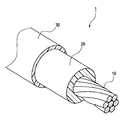
- FIG. 1 is a schematic cross-sectional perspective view showing an example of the solar current collecting cable of the present invention.
- the solar collector cable 1 has a shape in which the conductor 10 is covered with a double-structured insulating layer including an inner insulating layer 20 and an outer insulating layer 30 laminated on the outer periphery thereof.
- a double-structured insulating layer including an inner insulating layer 20 and an outer insulating layer 30 laminated on the outer periphery thereof.
- one having a length of about 1.5 m is usually used as a set of two.
- the size of the conductor 10 is preferably a cross-sectional area of 2.0 to 6.0 mm 2 , and considering the PSE standard, the nominal cross-sectional area is 2.0 mm 2 and 3.5 mm 2 , and the configuration is 7 strands. / The strand diameter is preferably 0.6 mm, 7 strands / strand diameter is preferably 0.8 mm.
- the material can be, for example, annealed copper.
- the inner insulating layer 20 preferably has a thickness of 0.7 to 1.2 mm and an outer diameter of 3.4 to 5.1 mm.
- the material of the inner insulating layer 20 is polyethylene. By making the inner insulating layer 20 pure polyethylene, good electrical characteristics can be realized.
- the outer insulating layer 30 preferably has a thickness of 1.5 mm and a finished outer diameter of 6.4 to 8.1 mm.
- the outer insulating layer 30 contains synthetic magnesium hydroxide as a flame retardant.
- synthetic magnesium hydroxide examples include Kisuma (trademark) manufactured by Kyowa Chemical Industry Co., Ltd.
- Kisuma trademark
- the synthetic magnesium hydroxide may be surface-treated.
- normally used metal oxides such as aluminum hydroxide and natural magnesium hydroxide are effective for obtaining flame retardancy, but when an amount capable of obtaining flame retardancy is added, the abrasion point of the cable Since it becomes white, it is impossible to achieve both flame retardancy and good appearance.
- the synthetic magnesium hydroxide is contained at a mass ratio of 1 to 1.6 with respect to the base resin of the outer insulating layer 30. If it is less than 1, the desired flame retardancy cannot be obtained, and if it exceeds 1.6, the extrudability during molding deteriorates.
- the base resin of the outer insulating layer 30 contains a polyolefin resin (C) and a styrene thermoplastic elastomer (D).
- the content ratio of the polyolefin resin exceeds 90% by mass of the total amount of the polyolefin resin and the styrene thermoplastic elastomer, the flame retardancy tends to be inferior and a desired tensile strength cannot be obtained.
- the content is less than 70% by mass, the outer insulating layer 30 is whitened.
- the polypropylene-based resin is not particularly limited, but an ethylene-propylene copolymer or polypropylene obtained by melt-kneading ethylene-propylene rubber (EPDM, EPR) is preferable.
- ethylene propylene copolymer obtained by melt-kneading EPDM or EPR. This is because flexibility that facilitates work during wiring can be provided while having sufficient heat resistance and strength.
- a reactor TPO type can be used in addition to the compound TPO type (TPO: olefinic thermoplastic elastomer) synthesized by melt-kneading the resin component and the rubber component as described above.
- Reactor TPO is an olefinic thermoplastic elastomer in which a rubber component, which is a soft part, is dispersed in a matrix resin, which is a hard part, during polymer polymerization, and a compound TPO that is synthesized by melting and kneading the above resin component and rubber component.
- the resin component and the rubber component are polymerized in the same polymerization field to obtain TPO.
- a matrix part having polypropylene can be used.
- the styrene-based thermoplastic elastomer is not particularly limited, but is preferably SEBS (styrene-ethylenebutylene-styrene copolymer) or SEBC (styrene-ethylenebutylene-olefin crystal block copolymer).
- SEBS styrene-ethylenebutylene-styrene copolymer
- SEBC styrene-ethylenebutylene-olefin crystal block copolymer
- the ethylene-ethyl acrylate copolymer is not particularly limited, but preferably has an ethyl acrylate content of 10 to 25% by mass, and an ethyl acrylate content of about 15% by mass. Is particularly preferred. This is because the dispersibility of magnesium hydroxide is improved. When the content of ethyl acrylate is small, magnesium hydroxide cannot be sufficiently dispersed, and elongation cannot be obtained, and aggregation of magnesium hydroxide occurs.
- the base resin of the outer insulating layer 30 may further include a plasticizer, an ultraviolet absorber, a light stabilizer, an anti-aging agent, a lubricant, a colorant, a filler, a processability improver, and other modifiers as necessary. It can also be used individually or in combination of 2 or more types.
- the solar collector cable 1 is obtained by covering the conductor 10 in the order of the inner insulating layer 20 and the outer insulating layer 30 by extrusion coating.
- the polyethylene used for the inner insulating layer 20 is preferably crosslinked by a method such as electron beam or ultraviolet irradiation.
- the extrusion coating the respective compositions are kneaded with a roll, a banbury, an extruder, etc., and the obtained pellet compound and conductor are subjected to wire coating extrusion molding with a conventionally known wire extruder provided with a crosshead die. It can be done by things.
- Flame retardancy was evaluated by 60 ° tilted flame retardancy. About 60 degree inclination flame-retardant, the flame was applied to the cable for 30 seconds, the flame was removed immediately after ignition, and the case where it disappeared within 60 seconds was set as the pass.
- the outer insulating layer portion was taken out from the cable and measured according to JIS C3005: 2000 4.16.
- the test machine specified in JIS B 7721 was used.
- a tubular test piece was attached to the chuck of the testing machine, and the pulling speed was 200 mm / min.
- the length between the marked lines at the time of cutting and cutting was measured, and the elongation was calculated by the following formula.
- ⁇ (l 1 ⁇ l 0 / l 0 ) ⁇ 100
- ⁇ is elongation (%)
- l 1 is the length between marked lines (mm) at the time of cutting
- l 0 is the length (mm) between marked lines.
- Examples 1 to 4 are physical properties (elongation, tensile strength, residual elongation rate after tensile aging and residual tensile strength rate) required for the jacket according to the PSE standard, heat distortion, flame retardancy, and good appearance characteristics that do not cause whitening. Good results excellent in any of the above can be obtained.
- Comparative Examples 1 and 2 since natural magnesium hydroxide was used, whitening occurred. Furthermore, about Comparative Example 2, since homopolypropylene was used as the polypropylene-based resin, the result was that the elongation was inferior together with flame retardancy compared to Comparative Example 1 using the ethylene-propylene block copolymer. Since Comparative Example 3 does not contain SEBS, which is a styrenic thermoplastic elastomer, no tensile strength can be obtained. On the other hand, if SEBS, which is a styrenic thermoplastic elastomer, is added too much as in Comparative Example 4, whitening occurs.
- SEBS which is a styrenic thermoplastic elastomer
- Comparative Example 3 does not contain SEBS, which is a styrene thermoplastic elastomer, flame retardant is a problem because the blending ratio of the polypropylene resin and the ethylene-ethyl acrylate copolymer in the polyolefin resin is good. There is no level. Comparative Examples 5 and 6 are experimental examples in which the blending ratio of the polypropylene resin and the ethylene-ethyl acrylate copolymer in the polyolefin resin was changed.
- Comparative Example 5 containing a polypropylene resin exceeding a specific ratio, While the flame retardancy is inferior and the elongation is poor, Comparative Example 6 containing an ethylene-ethyl acrylate copolymer in excess of the specific ratio results in inferior tensile strength.
- SYMBOLS 1 Solar collector cable, 10 ... Conductor, 20 ... Inner insulating layer, 30 ... Outer insulating layer.
Landscapes
- Physics & Mathematics (AREA)
- Spectroscopy & Molecular Physics (AREA)
- Insulated Conductors (AREA)
- Organic Insulating Materials (AREA)
- Compositions Of Macromolecular Compounds (AREA)
- Inorganic Insulating Materials (AREA)
- Photovoltaic Devices (AREA)
Abstract
Description
このような太陽光発電システムに用いられる太陽光集電ケーブルは、屋外環境での使用が前提となるため、使用可能温度の広さ、耐紫外線性、フレキシブル性に加え、機械的強度や、二重絶縁又は強化絶縁であることが要求されており、また該太陽光集電ケーブルは、電気用品安全法(PSE規格)に適合したケーブルであることも求められている。
難燃性電線としては、特許文献1に記載のノンハロゲン難燃電線がある。
図1は、本発明の太陽光集電ケーブルの一例を示す概略断面斜視図である。
太陽光集電ケーブル1は、内側絶縁層20と、その外周に積層された外側絶縁層30とを備えた二重構造の絶縁層によって、導体10が被覆された形状を有する。太陽光発電システムにおいては、通常、1.5m程度の長さのものが、二本一組で用いられる。
合成水酸化マグネシウムは、外側絶縁層30のベース樹脂に対して1~1.6の質量比、で含有される。1未満では所望の難燃性を得ることができず、1.6を超えると成形時の押出性が悪くなる。
ポリプロピレン系樹脂としては、特に限定はされないが、エチレンプロピレン共重合体またはポリプロピレンにエチレン-プロピレンゴム(EPDM、EPR)を溶融混練したものが好ましい。エチレンプロピレン共重合体にEPDM、EPRを溶融混練したものが特に好ましい。十分な耐熱性や強度を有しながら、配線時に作業しやすい柔軟性を付与できるためである。ポリプロピレン系樹脂としては上記のような樹脂成分とゴム成分を溶融混練して合成するコンパウンドTPOタイプ(TPO:オレフィン系熱可塑性エラストマー)の他に、リアクターTPOタイプも用いることができる。リアクターTPOは、ポリマー重合時にハード部であるマトリックス樹脂にソフト部であるゴム成分を分散させたオレフィン系熱可塑性エラストマーであり、上記の樹脂成分とゴム成分を溶融混練して合成するコンパウンドTPOに対して、樹脂成分とゴム成分を同一の重合場で重合させてTPOとするものである。本発明においてはマトリックス部分がポリプロピレンのものを使用することができる。
なお、押出被覆は、それぞれの組成物をロール、バンバリー、押出機などで混練し、得られたペレットコンパウンドと導体とをクロスヘッドダイを付設した従来公知の電線用押出機で電線被覆押出成形することなどにより行うことができる。
表1に示す組成による外被をそれぞれ外側絶縁層として用いた実施例1~5及び比較例1~6の太陽光集電ケーブルを作製した。各ケーブルにつき、表2に示す仕上がり外径の異なる2種のケーブル(ケーブル1、2)をそれぞれ作製した。
得られた各ケーブルおよび評価を表1に示す。尚、実施例1~5及び比較例1~6のいずれについても、仕上がり外径の異なるケーブル(ケーブル1、2)であっても同じ結果となるため、纏めて表1に示す。


難燃性は、60°傾斜難燃により評価した。
60°傾斜難燃については、ケーブルに炎を30秒間当て、着火したら直ぐに炎を取り去り、60秒以内に消えた場合を合格とした。
ケーブルから外側絶縁層部分を取出し、JIS C3005:2000の4.16に従って測定した。試験機はJIS B 7721に規定された試験機を用いた。管状試験片を試験機のチャックに取り付け、引っ張り速さ200mm/min.で引張り、切断時の標線間の長さを測定し、以下の式により伸びを算出し、350%を超えたものを合格とした。試験は室温で行い、n=3で判定した。
(式)ε=(l1-l0/l0)×100
上記式中、εは伸び(%)、l1は切断時の標線間の長さ(mm)、l0は標線間の長さ(mm)である。
ケーブルから取出した外側絶縁層について、老化(90℃×4日)後、伸びを測定、算出し、老化前の伸びと比して残率が65%を超えたものを合格とした。なお残率は以下の式により算出し、n=3で行い判定した。
(式)X=(C1/C0)×100
上記式中、Xは残率(%)、C1は老化後の値、C0は老化前の平均値である。
ケーブルから外側絶縁層部分を取出し、JIS C3005:2000の4.16に従って測定した。試験機はJIS B 7721に規定された試験機を用いた。管状試験片を試験機のチャックに取り付け、引っ張り速さ200mm/min.で引張り、最大引張荷重を測定し、以下の式により抗張力を算出し、10MPaを超えたものを合格とした。試験は室温で行い、n=3で判定した。
(式)δ=F/A
上記式中、δは抗張力(MPa)、Fは最大引張荷重(N)、Aは試験片の断面積(mm2)である。
ケーブルから取出した外側絶縁層について、老化(90℃×4日)後、抗張力を測定、算出し、老化前の抗張力と比して残率が80%を超えたものを合格とした。なお抗張力の算出にあたって、試験片の断面積は老化前の値を用いた。また残率は以下の式により算出し、n=3で行い判定した。
(式)X=(C1/C0)×100
上記式中、Xは残率(%)、C1は老化後の値、C0は老化前の平均値である。
ケーブルを30mmの長さに切断し、導線及び内側絶縁層を取り除いて、外側絶縁層の管状試験片を得た。該管状試験片を、JISC3005:2000 4.23に従って加熱温度75℃、荷重1kgとして加熱変形を測定した。残率が90%を超えたものを合格とした。n=3で行い判定した。
ケーブルを製造してボビンに巻き取った。ボビンの胴を抜いて束として10mを目視観察して白化箇所を探した。1mあたり白化箇所が1カ所または観察されないものを白化無し(OK)とした。それを超える白化箇所が観察されたものは白化有り(NG)とした。
実施例1~4は、PSE規格で外被に求められる物理特性(伸び、抗張力、老化後の伸び残率と抗張力残率)、加熱変形性、難燃性、白化が生じない良好な外観特性のいずれにも優れる良好な結果が得られる。
比較例3はスチレン系熱可塑性エラストマーであるSEBSを含まないことから抗張力が得られず、一方、比較例4のようにスチレン系熱可塑性エラストマーであるSEBSを入れすぎると白化が生じる結果となる。尚、比較例3はスチレン系熱可塑性エラストマーであるSEBSは含まないものの、ポリオレフィン系樹脂中におけるポリプロピレン系樹脂とエチレン-アクリル酸エチル共重合体の配合比率が良好であるため、難燃性は問題ないレベルである。
比較例5および6は、ポリオレフィン系樹脂中におけるポリプロピレン系樹脂とエチレン-アクリル酸エチル共重合体の配合比率を変えた実験例であり、ポリプロピレン系樹脂を特定比率を超えて含有する比較例5では難燃性に劣るとともに伸びが悪く、一方、エチレン-アクリル酸エチル共重合体を特定比率を超えて含有する比較例6では抗張力に劣る結果となる。
なお、本出願は、2010年7月8日付で出願された日本特許出願(特願2010-155766)に基づいており、その全体が引用により援用される。また、ここに引用されるすべての参照は全体として取り込まれる。
Claims (2)
- 外側絶縁層と、ポリエチレンからなる内側絶縁層とを備えた二層構造の絶縁層で導体が被覆された太陽光集電ケーブルであって、
前記外側絶縁層が、合成水酸化マグネシウム(A)とベース樹脂(B)とを(A)/(B)=1~1.6の質量比で含有し、
該ベース樹脂が、ポリオレフィン系樹脂(C)とスチレン系熱可塑性エラストマー(D)とを(C)/(D)=70/30~90/10の質量比で含有し、
該ポリオレフィン系樹脂が、ポリプロピレン系樹脂(E)とエチレン‐アクリル酸エチル共重合体(F)とを(E)/(F)=2/6~3/5の質量比で含有する太陽光集電ケーブル。 - 前記スチレン系熱可塑性エラストマーが、SEBS(スチレン‐エチレンブチレン‐スチレン共重合体)である請求項1に記載の太陽光集電ケーブル。
Priority Applications (1)
| Application Number | Priority Date | Filing Date | Title |
|---|---|---|---|
| CN2011800036012A CN102483974B (zh) | 2010-07-08 | 2011-07-08 | 太阳能发电系统用集电电缆 |
Applications Claiming Priority (2)
| Application Number | Priority Date | Filing Date | Title |
|---|---|---|---|
| JP2010-155766 | 2010-07-08 | ||
| JP2010155766A JP2012018830A (ja) | 2010-07-08 | 2010-07-08 | 太陽光集電ケーブル |
Publications (1)
| Publication Number | Publication Date |
|---|---|
| WO2012005357A1 true WO2012005357A1 (ja) | 2012-01-12 |
Family
ID=45441333
Family Applications (1)
| Application Number | Title | Priority Date | Filing Date |
|---|---|---|---|
| PCT/JP2011/065709 Ceased WO2012005357A1 (ja) | 2010-07-08 | 2011-07-08 | 太陽光集電ケーブル |
Country Status (3)
| Country | Link |
|---|---|
| JP (1) | JP2012018830A (ja) |
| CN (1) | CN102483974B (ja) |
| WO (1) | WO2012005357A1 (ja) |
Families Citing this family (3)
| Publication number | Priority date | Publication date | Assignee | Title |
|---|---|---|---|---|
| JP5659970B2 (ja) * | 2011-07-06 | 2015-01-28 | 三菱電機株式会社 | 太陽電池パネル |
| CN103694548B (zh) * | 2013-12-06 | 2016-03-02 | 上海至正道化高分子材料股份有限公司 | 150℃辐照交联抗粘连无卤阻燃绝缘料及其制备方法 |
| CN104900307A (zh) * | 2015-06-09 | 2015-09-09 | 上海宝宇电线电缆制造有限公司 | 一种太阳能光伏电缆 |
Citations (8)
| Publication number | Priority date | Publication date | Assignee | Title |
|---|---|---|---|---|
| JP2004186011A (ja) * | 2002-12-04 | 2004-07-02 | Yazaki Corp | 難燃電線・ケーブル |
| JP2004335263A (ja) * | 2003-05-07 | 2004-11-25 | Hitachi Cable Ltd | ノンハロゲン難燃絶縁電線 |
| JP2007052983A (ja) * | 2005-08-17 | 2007-03-01 | Fujikura Ltd | 絶縁電線 |
| JP2007246726A (ja) * | 2006-03-16 | 2007-09-27 | Furukawa Electric Co Ltd:The | 難燃性樹脂組成物、当該樹脂組成物の製造方法、及び当該樹脂組成物を被覆した絶縁電線 |
| JP2007277530A (ja) * | 2006-03-16 | 2007-10-25 | Furukawa Electric Co Ltd:The | 難燃性樹脂組成物及び当該樹脂組成物を被覆した絶縁電線 |
| JP2009054388A (ja) * | 2007-08-25 | 2009-03-12 | Furukawa Electric Co Ltd:The | 耐候性に優れた絶縁電線 |
| JP2009176475A (ja) * | 2008-01-22 | 2009-08-06 | Autonetworks Technologies Ltd | 絶縁電線 |
| JP2009199783A (ja) * | 2008-02-19 | 2009-09-03 | Furukawa Electric Co Ltd:The | 耐熱性に優れた絶縁電線 |
Family Cites Families (1)
| Publication number | Priority date | Publication date | Assignee | Title |
|---|---|---|---|---|
| JP2001160324A (ja) * | 1999-12-03 | 2001-06-12 | Hitachi Cable Ltd | ノンハロゲン難燃電線 |
-
2010
- 2010-07-08 JP JP2010155766A patent/JP2012018830A/ja active Pending
-
2011
- 2011-07-08 WO PCT/JP2011/065709 patent/WO2012005357A1/ja not_active Ceased
- 2011-07-08 CN CN2011800036012A patent/CN102483974B/zh not_active Expired - Fee Related
Patent Citations (8)
| Publication number | Priority date | Publication date | Assignee | Title |
|---|---|---|---|---|
| JP2004186011A (ja) * | 2002-12-04 | 2004-07-02 | Yazaki Corp | 難燃電線・ケーブル |
| JP2004335263A (ja) * | 2003-05-07 | 2004-11-25 | Hitachi Cable Ltd | ノンハロゲン難燃絶縁電線 |
| JP2007052983A (ja) * | 2005-08-17 | 2007-03-01 | Fujikura Ltd | 絶縁電線 |
| JP2007246726A (ja) * | 2006-03-16 | 2007-09-27 | Furukawa Electric Co Ltd:The | 難燃性樹脂組成物、当該樹脂組成物の製造方法、及び当該樹脂組成物を被覆した絶縁電線 |
| JP2007277530A (ja) * | 2006-03-16 | 2007-10-25 | Furukawa Electric Co Ltd:The | 難燃性樹脂組成物及び当該樹脂組成物を被覆した絶縁電線 |
| JP2009054388A (ja) * | 2007-08-25 | 2009-03-12 | Furukawa Electric Co Ltd:The | 耐候性に優れた絶縁電線 |
| JP2009176475A (ja) * | 2008-01-22 | 2009-08-06 | Autonetworks Technologies Ltd | 絶縁電線 |
| JP2009199783A (ja) * | 2008-02-19 | 2009-09-03 | Furukawa Electric Co Ltd:The | 耐熱性に優れた絶縁電線 |
Also Published As
| Publication number | Publication date |
|---|---|
| CN102483974A (zh) | 2012-05-30 |
| JP2012018830A (ja) | 2012-01-26 |
| CN102483974B (zh) | 2013-10-23 |
Similar Documents
| Publication | Publication Date | Title |
|---|---|---|
| JP5659450B2 (ja) | ノンハロゲン難燃電線・ケーブル | |
| JP5780477B2 (ja) | 無リン系ノンハロゲン難燃絶縁電線および無リン系ノンハロゲン難燃ケーブル | |
| US7586043B2 (en) | Non-halogenous insulated wire and a wiring harness | |
| JP4255368B2 (ja) | 架橋型難燃性樹脂組成物ならびにこれを用いた絶縁電線およびワイヤーハーネス | |
| JP6902205B2 (ja) | ケーブル | |
| CN104893078A (zh) | 无卤阻燃性树脂组合物以及使用其的绝缘电线和电缆 | |
| US10703889B2 (en) | Insulated electric wire and insulating resin composition | |
| JP2018092889A (ja) | ノンハロゲン難燃性樹脂組成物を用いた絶縁電線及びケーブル | |
| WO2015159788A1 (ja) | 絶縁性樹脂組成物及び絶縁電線 | |
| JP5889252B2 (ja) | 難燃性樹脂組成物、およびそれを成形してなる難燃性樹脂成形体を含む難燃性物品 | |
| JP2012124061A (ja) | 難燃性電線・ケーブル | |
| JP2006179452A (ja) | ノンハロゲン電線、電線束及び自動車用ワイヤーハーネス | |
| EP3675140B1 (en) | Resin composition, sheated cable, and wire harness | |
| JP2017066345A (ja) | ノンハロゲン難燃性樹脂組成物及びこれを用いた絶縁電線・ケーブル | |
| WO2012005357A1 (ja) | 太陽光集電ケーブル | |
| JP6756692B2 (ja) | 絶縁電線 | |
| JP2014194893A (ja) | 無リン系ノンハロゲン難燃絶縁電線および無リン系ノンハロゲン難燃絶縁ケーブル | |
| JP2013194214A (ja) | ノンハロゲン難燃性樹脂組成物およびそれを用いた電線・ケーブル | |
| JP2017171889A (ja) | 難燃性架橋樹脂組成物及び配線材 | |
| JP2024164812A (ja) | ハロゲンフリー樹脂組成物、電線およびケーブル | |
| JP2004256748A (ja) | ノンハロゲン難燃性組成物および難燃性電源コード | |
| JP2014227447A (ja) | 難燃性樹脂組成物、およびそれを成形してなる難燃性樹脂成形体を含む難燃性物品 | |
| JP6631157B2 (ja) | 無リン系ノンハロゲン難燃性樹脂組成物を用いた鉄道車両用電線及び鉄道車両用ケーブル | |
| JP2019087389A (ja) | 絶縁電線 | |
| JP7813769B2 (ja) | 樹脂組成物、樹脂被覆材、絶縁電線、自動車用ワイヤーハーネス及び自動車用ワイヤーハーネスに用いる絶縁電線の製造方法 |
Legal Events
| Date | Code | Title | Description |
|---|---|---|---|
| WWE | Wipo information: entry into national phase |
Ref document number: 201180003601.2 Country of ref document: CN |
|
| WWE | Wipo information: entry into national phase |
Ref document number: 1201000803 Country of ref document: TH |
|
| 121 | Ep: the epo has been informed by wipo that ep was designated in this application |
Ref document number: 11803691 Country of ref document: EP Kind code of ref document: A1 |
|
| NENP | Non-entry into the national phase |
Ref country code: DE |
|
| 122 | Ep: pct application non-entry in european phase |
Ref document number: 11803691 Country of ref document: EP Kind code of ref document: A1 |