WO2011145702A1 - 感放射線性樹脂組成物、レジストパターン形成方法、重合体及び化合物 - Google Patents
感放射線性樹脂組成物、レジストパターン形成方法、重合体及び化合物 Download PDFInfo
- Publication number
- WO2011145702A1 WO2011145702A1 PCT/JP2011/061587 JP2011061587W WO2011145702A1 WO 2011145702 A1 WO2011145702 A1 WO 2011145702A1 JP 2011061587 W JP2011061587 W JP 2011061587W WO 2011145702 A1 WO2011145702 A1 WO 2011145702A1
- Authority
- WO
- WIPO (PCT)
- Prior art keywords
- group
- hydrocarbon group
- polymer
- structural unit
- carbon atoms
- Prior art date
- Legal status (The legal status is an assumption and is not a legal conclusion. Google has not performed a legal analysis and makes no representation as to the accuracy of the status listed.)
- Ceased
Links
- 0 CCCC1(C)C(C)=*CCC1 Chemical compound CCCC1(C)C(C)=*CCC1 0.000 description 9
- MFENLINPGHVFBL-UHFFFAOYSA-N CCC(C(C(O)=O)F)OC(C(C)=C)=O Chemical compound CCC(C(C(O)=O)F)OC(C(C)=C)=O MFENLINPGHVFBL-UHFFFAOYSA-N 0.000 description 1
- ZSCDRSWJZRRPGN-UHFFFAOYSA-N O=C1OC2CC(C3)CC1CC3C2 Chemical compound O=C1OC2CC(C3)CC1CC3C2 ZSCDRSWJZRRPGN-UHFFFAOYSA-N 0.000 description 1
- WLYUMBPDHPMKHM-UHFFFAOYSA-N O=C1OCC2C1CCCC2 Chemical compound O=C1OCC2C1CCCC2 WLYUMBPDHPMKHM-UHFFFAOYSA-N 0.000 description 1
Classifications
-
- G—PHYSICS
- G03—PHOTOGRAPHY; CINEMATOGRAPHY; ANALOGOUS TECHNIQUES USING WAVES OTHER THAN OPTICAL WAVES; ELECTROGRAPHY; HOLOGRAPHY
- G03F—PHOTOMECHANICAL PRODUCTION OF TEXTURED OR PATTERNED SURFACES, e.g. FOR PRINTING, FOR PROCESSING OF SEMICONDUCTOR DEVICES; MATERIALS THEREFOR; ORIGINALS THEREFOR; APPARATUS SPECIALLY ADAPTED THEREFOR
- G03F7/00—Photomechanical, e.g. photolithographic, production of textured or patterned surfaces, e.g. printing surfaces; Materials therefor, e.g. comprising photoresists; Apparatus specially adapted therefor
- G03F7/004—Photosensitive materials
-
- C—CHEMISTRY; METALLURGY
- C07—ORGANIC CHEMISTRY
- C07C—ACYCLIC OR CARBOCYCLIC COMPOUNDS
- C07C69/00—Esters of carboxylic acids; Esters of carbonic or haloformic acids
- C07C69/62—Halogen-containing esters
- C07C69/65—Halogen-containing esters of unsaturated acids
- C07C69/653—Acrylic acid esters; Methacrylic acid esters; Haloacrylic acid esters; Halomethacrylic acid esters
-
- C—CHEMISTRY; METALLURGY
- C07—ORGANIC CHEMISTRY
- C07C—ACYCLIC OR CARBOCYCLIC COMPOUNDS
- C07C69/00—Esters of carboxylic acids; Esters of carbonic or haloformic acids
- C07C69/74—Esters of carboxylic acids having an esterified carboxyl group bound to a carbon atom of a ring other than a six-membered aromatic ring
- C07C69/753—Esters of carboxylic acids having an esterified carboxyl group bound to a carbon atom of a ring other than a six-membered aromatic ring of polycyclic acids
-
- C—CHEMISTRY; METALLURGY
- C07—ORGANIC CHEMISTRY
- C07D—HETEROCYCLIC COMPOUNDS
- C07D307/00—Heterocyclic compounds containing five-membered rings having one oxygen atom as the only ring hetero atom
- C07D307/77—Heterocyclic compounds containing five-membered rings having one oxygen atom as the only ring hetero atom ortho- or peri-condensed with carbocyclic rings or ring systems
- C07D307/93—Heterocyclic compounds containing five-membered rings having one oxygen atom as the only ring hetero atom ortho- or peri-condensed with carbocyclic rings or ring systems condensed with a ring other than six-membered
-
- C—CHEMISTRY; METALLURGY
- C08—ORGANIC MACROMOLECULAR COMPOUNDS; THEIR PREPARATION OR CHEMICAL WORKING-UP; COMPOSITIONS BASED THEREON
- C08F—MACROMOLECULAR COMPOUNDS OBTAINED BY REACTIONS ONLY INVOLVING CARBON-TO-CARBON UNSATURATED BONDS
- C08F22/00—Homopolymers and copolymers of compounds having one or more unsaturated aliphatic radicals each having only one carbon-to-carbon double bond, and at least one being terminated by a carboxyl radical and containing at least one other carboxyl radical in the molecule; Salts, anhydrides, esters, amides, imides or nitriles thereof
- C08F22/10—Esters
- C08F22/12—Esters of phenols or saturated alcohols
- C08F22/18—Esters containing halogen
-
- C—CHEMISTRY; METALLURGY
- C08—ORGANIC MACROMOLECULAR COMPOUNDS; THEIR PREPARATION OR CHEMICAL WORKING-UP; COMPOSITIONS BASED THEREON
- C08F—MACROMOLECULAR COMPOUNDS OBTAINED BY REACTIONS ONLY INVOLVING CARBON-TO-CARBON UNSATURATED BONDS
- C08F220/00—Copolymers of compounds having one or more unsaturated aliphatic radicals, each having only one carbon-to-carbon double bond, and only one being terminated by only one carboxyl radical or a salt, anhydride ester, amide, imide or nitrile thereof
- C08F220/02—Monocarboxylic acids having less than ten carbon atoms; Derivatives thereof
- C08F220/10—Esters
- C08F220/26—Esters containing oxygen in addition to the carboxy oxygen
-
- C—CHEMISTRY; METALLURGY
- C08—ORGANIC MACROMOLECULAR COMPOUNDS; THEIR PREPARATION OR CHEMICAL WORKING-UP; COMPOSITIONS BASED THEREON
- C08F—MACROMOLECULAR COMPOUNDS OBTAINED BY REACTIONS ONLY INVOLVING CARBON-TO-CARBON UNSATURATED BONDS
- C08F24/00—Homopolymers and copolymers of compounds having one or more unsaturated aliphatic radicals, each having only one carbon-to-carbon double bond, and at least one being terminated by a heterocyclic ring containing oxygen
-
- G—PHYSICS
- G03—PHOTOGRAPHY; CINEMATOGRAPHY; ANALOGOUS TECHNIQUES USING WAVES OTHER THAN OPTICAL WAVES; ELECTROGRAPHY; HOLOGRAPHY
- G03F—PHOTOMECHANICAL PRODUCTION OF TEXTURED OR PATTERNED SURFACES, e.g. FOR PRINTING, FOR PROCESSING OF SEMICONDUCTOR DEVICES; MATERIALS THEREFOR; ORIGINALS THEREFOR; APPARATUS SPECIALLY ADAPTED THEREFOR
- G03F7/00—Photomechanical, e.g. photolithographic, production of textured or patterned surfaces, e.g. printing surfaces; Materials therefor, e.g. comprising photoresists; Apparatus specially adapted therefor
- G03F7/004—Photosensitive materials
- G03F7/0046—Photosensitive materials with perfluoro compounds, e.g. for dry lithography
-
- G—PHYSICS
- G03—PHOTOGRAPHY; CINEMATOGRAPHY; ANALOGOUS TECHNIQUES USING WAVES OTHER THAN OPTICAL WAVES; ELECTROGRAPHY; HOLOGRAPHY
- G03F—PHOTOMECHANICAL PRODUCTION OF TEXTURED OR PATTERNED SURFACES, e.g. FOR PRINTING, FOR PROCESSING OF SEMICONDUCTOR DEVICES; MATERIALS THEREFOR; ORIGINALS THEREFOR; APPARATUS SPECIALLY ADAPTED THEREFOR
- G03F7/00—Photomechanical, e.g. photolithographic, production of textured or patterned surfaces, e.g. printing surfaces; Materials therefor, e.g. comprising photoresists; Apparatus specially adapted therefor
- G03F7/004—Photosensitive materials
- G03F7/038—Macromolecular compounds which are rendered insoluble or differentially wettable
- G03F7/0382—Macromolecular compounds which are rendered insoluble or differentially wettable the macromolecular compound being present in a chemically amplified negative photoresist composition
-
- G—PHYSICS
- G03—PHOTOGRAPHY; CINEMATOGRAPHY; ANALOGOUS TECHNIQUES USING WAVES OTHER THAN OPTICAL WAVES; ELECTROGRAPHY; HOLOGRAPHY
- G03F—PHOTOMECHANICAL PRODUCTION OF TEXTURED OR PATTERNED SURFACES, e.g. FOR PRINTING, FOR PROCESSING OF SEMICONDUCTOR DEVICES; MATERIALS THEREFOR; ORIGINALS THEREFOR; APPARATUS SPECIALLY ADAPTED THEREFOR
- G03F7/00—Photomechanical, e.g. photolithographic, production of textured or patterned surfaces, e.g. printing surfaces; Materials therefor, e.g. comprising photoresists; Apparatus specially adapted therefor
- G03F7/004—Photosensitive materials
- G03F7/039—Macromolecular compounds which are photodegradable, e.g. positive electron resists
- G03F7/0392—Macromolecular compounds which are photodegradable, e.g. positive electron resists the macromolecular compound being present in a chemically amplified positive photoresist composition
-
- G—PHYSICS
- G03—PHOTOGRAPHY; CINEMATOGRAPHY; ANALOGOUS TECHNIQUES USING WAVES OTHER THAN OPTICAL WAVES; ELECTROGRAPHY; HOLOGRAPHY
- G03F—PHOTOMECHANICAL PRODUCTION OF TEXTURED OR PATTERNED SURFACES, e.g. FOR PRINTING, FOR PROCESSING OF SEMICONDUCTOR DEVICES; MATERIALS THEREFOR; ORIGINALS THEREFOR; APPARATUS SPECIALLY ADAPTED THEREFOR
- G03F7/00—Photomechanical, e.g. photolithographic, production of textured or patterned surfaces, e.g. printing surfaces; Materials therefor, e.g. comprising photoresists; Apparatus specially adapted therefor
- G03F7/20—Exposure; Apparatus therefor
- G03F7/2041—Exposure; Apparatus therefor in the presence of a fluid, e.g. immersion; using fluid cooling means
-
- H—ELECTRICITY
- H10—SEMICONDUCTOR DEVICES; ELECTRIC SOLID-STATE DEVICES NOT OTHERWISE PROVIDED FOR
- H10P—GENERIC PROCESSES OR APPARATUS FOR THE MANUFACTURE OR TREATMENT OF DEVICES COVERED BY CLASS H10
- H10P76/00—Manufacture or treatment of masks on semiconductor bodies, e.g. by lithography or photolithography
- H10P76/20—Manufacture or treatment of masks on semiconductor bodies, e.g. by lithography or photolithography of masks comprising organic materials
-
- C—CHEMISTRY; METALLURGY
- C08—ORGANIC MACROMOLECULAR COMPOUNDS; THEIR PREPARATION OR CHEMICAL WORKING-UP; COMPOSITIONS BASED THEREON
- C08F—MACROMOLECULAR COMPOUNDS OBTAINED BY REACTIONS ONLY INVOLVING CARBON-TO-CARBON UNSATURATED BONDS
- C08F220/00—Copolymers of compounds having one or more unsaturated aliphatic radicals, each having only one carbon-to-carbon double bond, and only one being terminated by only one carboxyl radical or a salt, anhydride ester, amide, imide or nitrile thereof
- C08F220/02—Monocarboxylic acids having less than ten carbon atoms; Derivatives thereof
- C08F220/10—Esters
- C08F220/22—Esters containing halogen
- C08F220/24—Esters containing halogen containing perhaloalkyl radicals
Definitions
- the present invention is a chemically amplified resist composition, particularly a radiation-sensitive resin composition suitably used as a resist composition for immersion exposure, a resist pattern forming method using the composition, and suitable as a component of the composition. And a compound suitable as a monomer for the polymer.
- a resist film is formed on a substrate with a resin composition containing a polymer having an acid dissociable group, and the resist film is formed on the resist film via a mask pattern.
- a fine resist pattern is formed by irradiating a short-wavelength radiation such as an excimer laser for exposure, and removing an exposed portion with an alkaline developer.
- the chemical amplification type resist which contained the radiation sensitive acid generator which generate
- liquid immersion lithography liquid immersion lithography
- the exposure optical path space (between the lens and the resist film) is filled with an immersion medium having a refractive index (n) larger than that of air or an inert gas, such as pure water or a fluorine-based inert liquid.
- NA numerical aperture
- the resin composition used in the immersion exposure method suppresses elution of an acid generator or the like from the formed resist film to the immersion medium to prevent deterioration of the film performance and contamination of the lens and other devices. Therefore, it is required that the resist film surface has improved water drainage, prevents the watermark from remaining, and enables high-speed scanning exposure.
- Japanese Patent Application Laid-Open No. 2005-352384 proposes a technique for forming an upper layer film (protective film) on a resist film, but requires a separate film formation step, which is complicated. . Therefore, a method for increasing the hydrophobicity of the resist coating surface has been studied.
- International Publication No. 2007/116664 proposes a resin composition containing a fluorine-containing polymer having high hydrophobicity.
- JP 2010-032994 A discloses a fluorine-containing polymer that is hydrophobic during immersion exposure but decreases in hydrophobicity during alkali development, specifically, A fluorine-containing polymer in which a fluoroalkyl group is introduced into a carboxylic acid has been proposed.
- the present invention has been made based on the circumstances as described above, and its purpose is to exhibit excellent water drainage on the resist coating surface by showing a high dynamic contact angle during exposure in the immersion exposure process.
- the present invention provides a radiation-sensitive resin composition capable of providing a resist film in which development defects are suppressed by greatly reducing the dynamic contact angle during development, and further reducing the time required for changing the dynamic contact angle. is there.
- R is a hydrogen atom, a methyl group or a trifluoromethyl group.
- R L1 is a divalent linking group.
- Rf 3 is a monovalent aromatic which may have a substituent.
- the radiation-sensitive resin composition is a polymer having the structural unit (I) represented by the above formula (1) as the [A] component (hereinafter sometimes referred to as “[A] polymer”). And [B] component contains a radiation sensitive acid generator (hereinafter sometimes referred to as “[B] acid generator”).
- the resist film surface exhibits a high dynamic contact angle without requiring the formation of a separate upper layer film for the purpose of blocking the resist film and the immersion medium. Therefore, according to the said radiation sensitive resin composition, while being able to suppress elution of the acid generator etc. from a film, a high water drainage characteristic can be provided to the film surface. Further, the fluorine-containing group is dissociated by hydrolysis in alkali development to generate a hydrophilic group, so that the hydrophobicity of the resist coating surface is lowered.
- the structural unit (I) is preferably a structural unit (I-1) represented by the following formula (1-1).
- R L11 is a single bond or a divalent linking group.
- R, Rf 3 and X are the same as those in the above formula (1).
- the structural unit (I) has the specific structure, the structural unit (I) is excellent in polymerizability, the content of the structural unit (I) is increased, and as a result, the effect of the present invention is further improved.
- the structural unit (I-1) is preferably at least one selected from the group consisting of structural units represented by the following formulas (1-1a) to (1-1e). (In formulas (1-1a) to (1-1e), R, R L11 , and Rf 3 have the same definitions as in formula (1-1) above.)
- the reaction rate of hydrolysis in alkali development is further improved due to its high electron withdrawing property, and the dynamic contact angle of the coating surface is increased. Is further reduced.
- Rf 3 is preferably at least one selected from the group consisting of groups represented by the following formulas (Rf 3 -a) to (Rf 3 -d).
- Rf 31 is each independently a monovalent organic group having a fluorine atom.
- R S11 is independently a substituent.
- N f1 Each independently represents 0 or 1.
- n f11 is an integer of 1 to (5 + 2n f1 )
- n f12 is an integer of 0 to (5 + 2n f1 )
- N f13 is an integer of 0 to (5 + 2n f1 ).
- the Rf 3 is at least one selected from the group consisting of groups represented by the formulas (Rf 3 -a) to (Rf 3 -d), so that the dynamic contact angle on the coating surface is further reduced. .
- the content of the structural unit (I) in the [A] polymer is preferably 30 mol% or more and 100 mol% or less. By setting it as such a content rate, sufficient reduction of the dynamic contact angle by development can be achieved with the high dynamic contact angle at the time of immersion exposure.
- the [A] polymer is selected from the group consisting of the structural unit (II) represented by the following formula (2) and the structural unit (III) represented by the following formula (3). It is preferable to further have at least one structural unit.
- R represents a hydrogen atom, a methyl group or a trifluoromethyl group.
- G is a single bond, an oxygen atom, a sulfur atom, —CO—O—, —SO 2 —O—NH—, —CO—NH—, or —O—CO—NH—.
- R 1 is a monovalent chain hydrocarbon group having 1 to 6 carbon atoms having at least one fluorine atom or a monovalent alicyclic hydrocarbon group having 4 to 20 carbon atoms having at least one fluorine atom. is there.
- R 2 is a hydrocarbon group of (m + 1) -valent C 1-20 carbon, oxygen atoms at the ends of R 3 side of the R 2, a sulfur atom, -NR '- (where, R' Is a hydrogen atom or a monovalent organic group.), A carbonyl group, a structure in which —CO—O— or —CO—NH— is bonded.
- R 3 is a single bond, a divalent chain hydrocarbon group having 1 to 10 carbon atoms or a divalent alicyclic hydrocarbon group having 4 to 20 carbon atoms.
- X 2 is a single bond or a divalent chain hydrocarbon group having 1 to 20 carbon atoms having at least one fluorine atom.
- A represents an oxygen atom, —NR ′′ — (where R ′′ represents a hydrogen atom or a monovalent organic group), —CO—O— * or —SO 2 —O— * (“*” represents R 4 shows the site
- R 4 is a hydrogen atom or a monovalent organic group.
- m is an integer of 1 to 3. However, when m is 2 or 3, a plurality of R 3 , X 2 , A and R 4 are independent of each other. )
- the degree of change in dynamic contact angle in the coating development process can be further increased.
- the radiation-sensitive resin composition further contains [C] a polymer having a smaller fluorine atom content than the above-mentioned [A] polymer (hereinafter sometimes referred to as “[C] polymer”).
- the [C] polymer preferably has an acid dissociable group.
- the content of [A] polymer is preferably 0.1 parts by mass or more and 10 parts by mass or less with respect to 100 parts by mass of [C] polymer.
- [A] By making the content of the polymer within the above range, segregation of [A] polymer on the surface of the resist film occurs effectively, so that elution from the resist film is further suppressed, and the resist film Since the dynamic contact angle of the surface is further increased, water drainage can be further improved.
- the resist pattern forming method of the present invention comprises: (1) forming a photoresist film on a substrate using the radiation sensitive resin composition; (2) immersion exposure of the photoresist film, and (3) A step of developing the immersion-exposed photoresist film to form a resist pattern.
- the film surface has high water drainage, and the process time is shortened by high-speed scanning exposure, and the occurrence of development defects is suppressed. A good resist pattern can be formed efficiently.
- the polymer of the present invention has a structural unit (I) represented by the following formula (1).
- R is a hydrogen atom, a methyl group or a trifluoromethyl group.
- R L1 is a divalent linking group.
- Rf 3 is a monovalent aromatic which may have a substituent.
- the polymer further comprises at least one structural unit selected from the group consisting of the structural unit (II) represented by the following formula (2) and the structural unit (III) represented by the following formula (3). It is preferable to have.
- R represents a hydrogen atom, a methyl group or a trifluoromethyl group.
- G is a single bond, an oxygen atom, a sulfur atom, —CO—O—, —SO 2 —O—NH—, —CO—NH—, or —O—CO—NH—.
- R 1 is a monovalent chain hydrocarbon group having 1 to 6 carbon atoms having at least one fluorine atom or a monovalent alicyclic hydrocarbon group having 4 to 20 carbon atoms having at least one fluorine atom. is there.
- R 2 is a hydrocarbon group of (m + 1) -valent C 1-20 carbon, oxygen atoms at the ends of R 3 side of the R 2, a sulfur atom, -NR '- (where, R' Is a hydrogen atom or a monovalent organic group.), A carbonyl group, a structure in which —CO—O— or —CO—NH— is bonded.
- R 3 is a single bond, a divalent chain hydrocarbon group having 1 to 10 carbon atoms or a divalent alicyclic hydrocarbon group having 4 to 20 carbon atoms.
- X 2 is a single bond or a divalent chain hydrocarbon group having 1 to 20 carbon atoms having at least one fluorine atom.
- A represents an oxygen atom, —NR ′′ — (where R ′′ represents a hydrogen atom or a monovalent organic group), —CO—O— * or —SO 2 —O— * (“*” represents R 4 shows the site
- R 4 is a hydrogen atom or a monovalent organic group.
- m is an integer of 1 to 3. However, when m is 2 or 3, a plurality of R 3 , X 2 , A and R 4 are independent of each other. )
- the polymer has the structural unit (I), and may further have at least one structural unit selected from the group consisting of the structural unit (II) and the structural unit (III).
- a polymer has a high hydrophobicity, but has a characteristic that the hydrophobicity is lowered by hydrolysis.
- the dynamic contact angle of the resist film surface is high at the time of exposure and after alkali development. Can be controlled low. Therefore, the said polymer is suitable for the radiation sensitive resin composition etc. which are used for lithography technique, for example.
- R is a hydrogen atom, a methyl group or a trifluoromethyl group.
- R L1 is a divalent linking group.
- Rf 3 is a monovalent aromatic which may have a substituent.
- the compound of the present invention has a structure represented by the above formula (i), it can be suitably used as a monomer for incorporating the structural unit (I) into the polymer.
- chain hydrocarbon group means a hydrocarbon group that does not include a cyclic structure in the main chain and is composed only of a chain structure, and includes both a linear hydrocarbon group and a branched hydrocarbon group. Shall be included.
- the “alicyclic hydrocarbon group” means a hydrocarbon group that includes only an alicyclic hydrocarbon structure as a ring structure and does not include an aromatic ring structure. However, it is not necessary to be constituted only by the structure of the alicyclic hydrocarbon, and a part thereof may include a chain structure.
- aromatic hydrocarbon group means a hydrocarbon group containing an aromatic ring structure as a ring structure. However, it is not necessary to be composed only of an aromatic ring structure, and a part thereof may include a chain structure or an alicyclic hydrocarbon structure.
- the radiation-sensitive resin composition of the present invention contains a polymer having a specific structural unit and a radiation-sensitive acid generator, the resist film formed in the immersion exposure process. While exhibiting a moderately high dynamic contact angle during exposure, it exhibits a characteristic that the dynamic contact angle greatly decreases after alkali development, and the time required for changing the dynamic contact angle can also be shortened. As a result, in addition to suppressing the elution of the acid generator and the like from the resist film, the surface of the film has excellent water drainage, enabling high-speed scan exposure and having an affinity for a developer during development. The occurrence of development defects can be suppressed and a good resist pattern can be formed.
- the radiation-sensitive resin composition of the present invention contains a [A] polymer and a [B] acid generator, and preferably further contains a [C] polymer. Moreover, as long as the effect of this invention is not impaired, you may contain an arbitrary component. Hereinafter, each component will be described in detail.
- the [A] polymer in the present invention is a polymer having the structural unit (I) represented by the above formula (1).
- the polymer Since the polymer has the specific structural unit (I) containing a fluorine-containing group, the resist film surface exhibits a high dynamic contact angle due to its high hydrophobicity. Therefore, according to the radiation sensitive resin composition, the [A] polymer is unevenly distributed on the surface of the coating, and elution of the acid generator and the like from the coating can be suppressed, and a high water drainage characteristic can be imparted to the coating surface.
- the fluorine-containing group is dissociated by hydrolysis in alkali development to generate a hydrophilic group, so that the hydrophobicity of the resist coating surface is lowered.
- the wettability of the coating surface with respect to the developer and the rinsing liquid is greatly improved in the alkali developing step, so that it is possible to suppress development defects of the resist film caused by the low cleaning efficiency with the rinsing liquid.
- R is a hydrogen atom, a methyl group or a trifluoromethyl group.
- R L1 is a divalent linking group.
- Rf 3 is a monovalent aromatic hydrocarbon group which may have a substituent, a monovalent chain hydrocarbon group having a fluorine atom, or a monovalent alicyclic hydrocarbon group having a fluorine atom.
- X is a single bond or a divalent chain hydrocarbon group having 1 to 20 carbon atoms having at least one fluorine atom.
- Examples of the divalent linking group represented by R L1 in the above formula (1) include a divalent chain hydrocarbon group having 1 to 30 carbon atoms and a divalent alicyclic hydrocarbon group having 3 to 30 carbon atoms.
- the divalent linking group may have a substituent.
- Examples of the divalent chain hydrocarbon group having 1 to 30 carbon atoms include methanediyl group, ethanediyl group, propanediyl group, butanediyl group, pentanediyl group, hexanediyl group, octanediyl group, decandiyl group, undecanediyl group, hexadecane Alkanediyl groups such as diyl and icosanediyl groups; Alkenediyl groups such as ethenediyl group, propenediyl group, butenediyl group, pentenediyl group, hexenediyl group, octenediyl group, decenediyl group, undecenediyl group, hexadecenediyl group, icosendiyl group; Examples include ethynediyl groups, propynediyl groups,
- Examples of the divalent alicyclic hydrocarbon group having 3 to 30 carbon atoms include cyclopropanediyl group, cyclobutanediyl group, cyclopentanediyl group, cyclohexanediyl group, cycloheptanediyl group, cyclooctanediyl group, and cyclodecanediyl group.
- Groups monocyclic saturated hydrocarbon groups such as methylcyclohexanediyl group, ethylcyclohexanediyl group; Cyclobutenediyl group, cyclopentenediyl group, cyclohexenediyl group, cycloheptenediyl group, cyclooctenediyl group, cyclodecenediyl group, cyclopentadienediyl group, cyclohexadienediyl group, cyclooctadienediyl group, cyclodecadienediyl group Monocyclic unsaturated hydrocarbon groups such as Bicyclo [2.2.1] heptanediyl group, bicyclo [2.2.2] octanediyl group, tricyclo [5.2.1.0 2,6 ] decanediyl group, tricyclo [3.3.1.1 3, 7 ] decandiyl group, tetracyclo [
- a polycyclic saturated hydrocarbon group such as a dodecanediyl group or an adamantanediyl group
- a polycyclic unsaturated hydrocarbon group such as 0 2,7 ] dodecenediyl group.
- Examples of the divalent aromatic hydrocarbon group having 6 to 30 carbon atoms include a phenylene group, a biphenylene group, a terphenylene group, a benzylene group, a phenyleneethylene group, a phenylenecyclohexylene group, and a naphthylene group.
- divalent linking groups include groups represented by the following formulas (X-1) to (X-6).
- R x1 each independently represents a divalent chain hydrocarbon group having 1 to 30 carbon atoms, or a divalent alicyclic carbon group having 3 to 30 carbon atoms.
- “*” Represents a site that binds to X in the above formula (1). Examples of the divalent chain hydrocarbon group having 1 to 30 carbon atoms, the divalent alicyclic hydrocarbon group having 3 to 30 carbon atoms, and the divalent aromatic hydrocarbon group having 6 to 30 carbon atoms are as described above. Examples include the same groups as described.
- Examples of the divalent hydrocarbon group having 1 to 20 carbon atoms and having at least one fluorine atom represented by X in the above formula (1) include, for example, a divalent chain hydrocarbon group having 1 to 20 carbon atoms.
- As the divalent chain hydrocarbon group having 1 to 20 carbon atoms a divalent hydrocarbon group having 1 to 10 carbon atoms is preferable, and a divalent hydrocarbon group having 1 to 5 carbon atoms is more preferable.
- the divalent alicyclic hydrocarbon group having 3 to 20 carbon atoms is preferably a monocyclic saturated hydrocarbon group, particularly preferably a cyclopentanediyl group, a cyclohexanediyl group, or a cyclohexylmethanediyl group.
- a divalent aromatic hydrocarbon group having 6 to 20 carbon atoms a phenylene group, a benzylene group, and a phenethylene group are more preferable.
- a divalent hydrocarbon group having 1 to 5 carbon atoms is particularly preferable.
- X preferably has a fluorine atom or a structure having a carbon atom having a fluorine atom at the ⁇ -position of the carboxylic acid ester (that is, the carbon atom to which COORf 3 in formula (1) is bonded). It is more preferable to take a structure having a fluorine atom or a perfluoroalkyl group at the ⁇ -position of the ester. X having such a structure is preferable in that the reactivity of the polymer (A) to the developer is improved.
- Examples of X include groups represented by the following formulas (X2-1) to (X2-6).
- Rf 3 in the above formula (1) examples include a monovalent aromatic hydrocarbon group which may have a substituent.
- Examples of such a monovalent aromatic hydrocarbon group include a monovalent hydrocarbon group having benzene or naphthalene.
- Examples of such hydrocarbon groups include aryl groups such as phenyl, naphthyl and tolyl groups; and aralkyl groups such as benzyl and phenethyl groups.
- Examples of the substituent that the monovalent aromatic hydrocarbon group represented by Rf 3 may have include a halogen atom, —R S1 , —R S2 —O—R S1 , —R S2 —CO—R S1 , -R S2 -CO-OR S 1 , -R S2 -O-CO-R S1 , -R S2 -CN, and the like.
- R S1 is an alkyl group having 1 to 10 carbon atoms, a cycloalkyl group having 3 to 20 carbon atoms, or an aryl group having 6 to 30 carbon atoms, and part or all of hydrogen atoms of these groups are fluorine atoms. May be substituted.
- R S2 is a single bond, an alkanediyl group having 1 to 10 carbon atoms, a cycloalkanediyl group having 3 to 20 carbon atoms, or an arylene group having 6 to 30 carbon atoms, and a part of hydrogen atoms of these groups or All may be substituted with fluorine atoms.
- a halogen atom or R S1 is preferable, a fluorine atom or an alkyl group having 1 to 10 carbon atoms in which part or all of hydrogen atoms may be substituted is more preferable, and a fluorine atom or trifluoromethyl group is particularly preferable.
- Rf 3 is a monovalent aromatic hydrocarbon group, it preferably has 1 to 5 substituents, more preferably 1 to 3 substituents, and preferably 1 to 2 substituents. It is particularly preferable.
- Examples of the monovalent chain hydrocarbon group having a fluorine atom represented by Rf 3 in the above formula (1) include a C 1-30 monovalent chain hydrocarbon group having a fluorine atom.
- Examples of the monovalent chain hydrocarbon group having 1 to 30 carbon atoms having a fluorine atom include a trifluoromethyl group, 2,2,2-trifluoroethyl group, perfluoroethyl group, 2,2,3,3, 3-pentafluoropropyl group, 1,1,1,3,3,3-hexafluoropropyl group, perfluoro n-propyl group, perfluoro i-propyl group, perfluoro n-butyl group, perfluoro i-butyl Group, perfluoro t-butyl group, 2,2,3,3,4,4,5,5-octafluoropentyl group, perfluorohexyl group and the like are preferable.
- Examples of the monovalent alicyclic hydrocarbon group having a fluorine atom represented by Rf 3 in the above formula (1) include a C 3-30 monovalent alicyclic hydrocarbon group having a fluorine atom. .
- Examples of the monovalent alicyclic hydrocarbon group having 3 to 30 carbon atoms having a fluorine atom include hydrogen having a monocyclic saturated hydrocarbon group, a polycyclic saturated hydrocarbon group, a polycyclic unsaturated hydrocarbon group, etc. The thing which substituted at least 1 of the atom by the fluorine atom is mentioned.
- Rf 3 The group represented among these Rf 3, at least one selected from the group consisting of groups respectively represented by the above formulas (Rf 3 -a) (Rf 3 -d) . More preferred are the formula (Rf More preferred is at least one selected from the group consisting of groups represented by 3- a) to (Rf 3 -c).
- Rf 31 is independently a monovalent organic group having a fluorine atom.
- R S11 is independently a substituent.
- n f1 is independently 0 or 1.
- n f11 is an integer of 1 to (5 + 2n f1 ).
- n f12 is an integer of 0 to (5 + 2n f1 ).
- n f13 is an integer of 0 to (5 + 2n f1 ).
- Examples of the monovalent organic group having a fluorine atom represented by Rf 31 include those similar to Rf 3 described above. Of these, trifluoromethyl group, 2,2,2-trifluoroethyl group, perfluoroethyl group, 2,2,3,3,3-pentafluoropropyl group, 1,1,1,3,3, 3-hexafluoropropyl group, perfluoro n-propyl group, perfluoro i-propyl group, perfluoro n-butyl group, perfluoro i-butyl group, perfluoro t-butyl group, 2,2,3,3 A 4,4,5,5-octafluoropentyl group and a perfluorohexyl group are preferred.
- R S11 examples include —R S1 ′ , —R S2 ′ —O—R S1 ′ , —R S2 ′ —CO—R S1 ′ and —R S2 ′ —CO—.
- OR S1 ′ , —R S2 ′ —O—CO—R S1 ′ , —R S2 ′ —CN and the like can be mentioned.
- R S1 ′ is an alkyl group having 1 to 10 carbon atoms, a cycloalkyl group having 3 to 20 carbon atoms, or an aryl group having 6 to 30 carbon atoms.
- R S2 ′ is a single bond, an alkanediyl group having 1 to 10 carbon atoms, a cycloalkanediyl group having 3 to 20 carbon atoms, or an arylene group having 6 to 30 carbon atoms.
- —R S1 ′ , —R S2 ′ —O—R S1 ′ , —R S2 ′ —CO—R S1 ′ , —R S2 ′ —CO—OR S1 ′ , —R S2 ′ —O—CO— R S1 ′ is preferred, and —R S1 ′ is more preferred.
- the structural unit (I) is preferably a structural unit (I-1) represented by the above formula (1-1).
- the structural unit (I) is a specific structure represented by the formula (1-1)
- the structural unit (I) is excellent in polymerizability, and the content of the structural unit (I) is increased. This is more improved than the effect of the invention.
- R L11 is a single bond or a divalent linking group.
- R, Rf 3 and the definition of X are as defined in the above formula (1).
- Examples of the divalent linking group include the same groups as described above.
- R L11 is preferably a single bond or a divalent linking group listed below.
- the divalent chain hydrocarbon group having 1 to 30 carbon atoms is preferably a divalent hydrocarbon group having 1 to 10 carbon atoms, more preferably a divalent hydrocarbon group having 1 to 5 carbon atoms, and an ethanediyl group.
- a propanediyl group is particularly preferred;
- the divalent alicyclic hydrocarbon group having 3 to 30 carbon atoms is preferably a monocyclic saturated hydrocarbon group, particularly preferably a cyclopentanediyl group, a cyclohexanediyl group, or a cyclohexylmethanediyl group;
- the divalent aromatic hydrocarbon group having 6 to 30 carbon atoms may have a phenylene group that may have a fluorine atom, a benzylene group that may have a fluorine atom, or a fluorine atom.
- a phenethylene group is more preferred;
- a divalent group obtained by combining these preferred examples with an ether group, an ester group, a carbonyl group, an imino group, or an amide group can be used, and a divalent hydrocarbon group having 1 to 10 carbon atoms can be used. And a divalent group in which an ester group is combined is more preferable.
- the structural unit (I-1) is preferably at least one selected from the group consisting of structural units represented by the formulas (1-1a) to (1-1e).
- Examples of the structural units represented by the above formulas (1-1a) to (1-1e) include those represented by the following formulae.
- R and Rf 3 are the same as those in the above formula (1).
- structural unit (I) include, for example, those represented by the following formula.
- the content of the structural unit (I) with respect to all the structural units in the [A] polymer is 30 mol% or more and 100 mol% or less. By setting it as such a content rate, sufficient reduction of the dynamic contact angle by development can be achieved with the high dynamic contact angle at the time of immersion exposure.
- the [A] polymer further has at least one structural unit selected from the group consisting of the structural unit (II) and the structural unit (III).
- R is a hydrogen atom, a methyl group, or a trifluoromethyl group.
- G is a single bond, an oxygen atom, a sulfur atom, —CO—O—, —SO 2 —O—NH—, —CO—NH—, or —O—CO—NH—.
- R 1 is a monovalent chain hydrocarbon group having 1 to 6 carbon atoms having at least one fluorine atom or a monovalent alicyclic hydrocarbon group having 4 to 20 carbon atoms having at least one fluorine atom. is there.
- Examples of the C 1-6 chain hydrocarbon group having at least one fluorine atom represented by R 1 include a trifluoromethyl group, a 2,2,2-trifluoroethyl group, and a perfluoroethyl group.
- 2,2,3,3,3-pentafluoropropyl group 1,1,1,3,3,3-hexafluoropropyl group, perfluoro n-propyl group, perfluoro i-propyl group, perfluoro n -Butyl group, perfluoro i-butyl group, perfluoro t-butyl group, 2,2,3,3,4,4,5,5-octafluoropentyl group, perfluorohexyl group and the like.
- Examples of the alicyclic hydrocarbon group having 4 to 20 carbon atoms and having at least one fluorine atom represented by R 1 include a monofluorocyclopentyl group, a difluorocyclopentyl group, a perfluorocyclopentyl group, a monofluorocyclohexyl group, Examples thereof include a difluorocyclopentyl group, a perfluorocyclohexylmethyl group, a fluoronorbornyl group, a fluoroadamantyl group, a fluorobornyl group, a fluoroisobornyl group, a fluorotricyclodecyl group, and a fluorotetracyclodecyl group.
- Examples of the monomer that gives the structural unit (II) include trifluoromethyl (meth) acrylate, 2,2,2-trifluoroethyl (meth) acrylate, and perfluoroethyl (meth) acrylate.
- the content of the structural unit (II) is preferably such that the total amount of the structural unit (II) with respect to all the structural units constituting the [A] polymer is 0 mol% to 50 mol%, 30 mol% is more preferable, and 5 mol% to 30 mol% is particularly preferable.
- the [A] polymer may have structural unit (II) individually by 1 type or in combination of 2 or more types.
- R is a hydrogen atom, a methyl group, or a trifluoromethyl group.
- R 2 is an (m + 1) -valent hydrocarbon group having 1 to 20 carbon atoms, and an oxygen atom, a sulfur atom, —NR′— (where R ′ is a hydrogen atom or a monovalent group) at the R 3 end of R 2 And a structure in which a carbonyl group, —CO—O— or —CO—NH— is bonded.
- R 3 is a single bond, a divalent chain hydrocarbon group having 1 to 10 carbon atoms or a divalent alicyclic hydrocarbon group having 4 to 20 carbon atoms.
- X 2 is a single bond or a divalent chain hydrocarbon group having 1 to 20 carbon atoms having at least one fluorine atom.
- A represents an oxygen atom, —NR ′′ — (where R ′′ represents a hydrogen atom or a monovalent organic group), —CO—O— * or —SO 2 —O— * (“*” represents R 4 shows the site
- R 4 is a hydrogen atom or a monovalent organic group.
- m is an integer of 1 to 3. However, when m is 2 or 3, the plurality of R 3 , X 2 , A and R 4 are independent of each other.
- R 4 is a hydrogen atom, it is preferable in that the solubility of [A] polymer in an alkaline developer can be improved.
- Examples of the monovalent organic group represented by R 4 include an acid dissociable group, an alkali dissociable group, or a hydrocarbon group having 1 to 30 carbon atoms which may have a substituent.
- the “acid-dissociable group” refers to a group that substitutes a hydrogen atom in a polar functional group such as a hydroxyl group or a carboxyl group and dissociates in the presence of an acid.
- a polar functional group such as a hydroxyl group or a carboxyl group
- the structural unit (III) generates a polar group by the action of an acid. Therefore, in the above formula (3), when R 4 is an acid-dissociable group, the solubility in the alkali developer of the exposed portion in the exposure step in the resist pattern forming method described later can be increased. preferable.
- the “alkali dissociable group” is a group that substitutes a hydrogen atom in a polar functional group such as a hydroxyl group or a carboxyl group, and is in the presence of an alkali (for example, tetramethylammonium hydroxyside 2.38 at 23 ° C. A group that dissociates in a mass% aqueous solution).
- an alkali for example, tetramethylammonium hydroxyside 2.38 at 23 ° C.
- the structural unit (III) generates a polar group by the action of alkali. Therefore, in the above formula (3), when R 4 is an alkali dissociable group, it is preferable in that the solubility in an alkali developer can be improved and the hydrophobicity of the resist film surface after development can be further reduced. .
- Examples of the acid dissociable group include a t-butoxycarbonyl group, a tetrahydropyranyl group, a tetrahydrofuranyl group, a (thiotetrahydropyranylsulfanyl) methyl group, a (thiotetrahydrofuranylsulfanyl) methyl group, an alkoxy-substituted methyl group, and an alkylsulfanyl group.
- Examples include substituted methyl groups.
- the alkoxyl group (substituent) in the alkoxy-substituted methyl group includes, for example, an alkoxyl group having 1 to 4 carbon atoms.
- the alkyl group (substituent) in the alkylsulfanyl-substituted methyl group includes, for example, an alkyl group having 1 to 4 carbon atoms.
- the acid dissociable group may be a group represented by the formula (Y-1) described in the section of the structural unit (IV) described later.
- Y-1 the formula represented by the formula (Y-1) described in the section of the structural unit (IV) described later.
- A when A is an oxygen atom or —NR ′′ —, a t-butoxycarbonyl group or an alkoxy-substituted methyl group is preferable.
- A when A is —CO—O—, it is preferably a group represented by the formula (Y-1) described in the section of the structural unit (IV) described later.
- alkali dissociable group examples include groups represented by the following formulas (W-1) to (W-4).
- W-1) when A is an oxygen atom or —NR ′′ —, a group represented by the following formula (W-1) is preferable.
- A when A is —CO—O—, it is preferably any one of groups represented by the following formulas (W-2) to (W-4).
- Rf is a monovalent chain hydrocarbon group having 1 to 30 carbon atoms having at least one fluorine atom, or 1 having 3 to 30 carbon atoms having at least one fluorine atom. Is a valent alicyclic hydrocarbon group.
- R 41 is a substituent, and when a plurality of R 41 are present, they may be the same or different.
- m 1 is an integer of 0 to 5.
- m 2 is an integer of 0-4.
- R 42 and R 43 each independently represent a hydrogen atom or an alkyl group having 1 to 10 carbon atoms, and R 42 and R 43 are bonded to each other to form an aliphatic group having 4 to 20 carbon atoms.
- a cyclic hydrocarbon structure may be formed.
- examples of the substituent represented by R 41 include —R P1 , —R P2 —O—R P1 , —R P2 —CO—R P1 , —R P2 —CO—OR P1 , —R P2 —O—CO—R P1 , —R P2 —OH, —R P2 —CN, —R P2 —COOH (R P1 is a monovalent chain having 1 to 10 carbon atoms)
- a saturated hydrocarbon group, a monovalent aliphatic cyclic saturated hydrocarbon group having 3 to 20 carbon atoms, or a monovalent aromatic hydrocarbon group having 6 to 30 carbon atoms, a part of hydrogen atoms of these groups or R P2 may be a single bond, a divalent chain saturated hydrocarbon group having 1 to 10 carbon atoms, or a divalent aliphatic cyclic saturated hydrocarbon group having 3 to 20 carbon atoms.
- a divalent aromatic hydrocarbon group having 1 to 10 carbon atoms,
- Examples of the compound represented by the formula (W-4) include a methyl group, an ethyl group, a 1-propyl group, a 2-propyl group, a 1-butyl group, a 2-butyl group, a 1-pentyl group, and a 2-pentyl group.
- 3-pentyl group 1- (2-methylbutyl) group, 1- (3-methylbutyl) group, 2- (3-methylbutyl) group, neopentyl group, 1-hexyl group, 2-hexyl group, 3-hexyl group 1- (2-methylpentyl) group, 1- (3-methylpentyl) group, 1- (4-methylpentyl) group, 2- (3-methylpentyl) group, 2- (4-methylpentyl) group , 3- (2-methylpentyl) group and the like.
- a methyl group, an ethyl group, a 1-propyl group, a 2-propyl group, a 1-butyl group, and a 2-butyl group are preferable.
- X 2 is a C 1-20 divalent chain hydrocarbon group having at least one fluorine atom.
- Examples of X 2 include groups represented by the above formulas (X2-1) to (X2-6).
- X 2 is preferably a group represented by the above formula (X2-1) when A is an oxygen atom in the above formula (3).
- A when A is —CO—O—, it is preferably any one of the groups represented by the above formulas (X2-2) to (X2-6). And more preferably a group represented by the above formula (X2-1).
- m is an integer of 1 to 3. Accordingly, 1 to 3 R 4 are introduced into the structural unit (III).
- R 3 , R 4 , X 2 and A are each independent. That is, when m is 2 or 3, the plurality of R 4 may have the same structure or different structures.
- a plurality of R 3 may be bonded to the same carbon atom of R 2 or may be bonded to different carbon atoms.
- Examples of the structural unit (III) include structural units represented by the following formulas (3-1a) to (3-1c).
- R 5 is a divalent linear, branched or cyclic saturated or unsaturated hydrocarbon group having 1 to 20 carbon atoms.
- the definitions of X 2 , R 4 and m are the same as in the above formula (3). When m is 2 or 3, the plurality of X 2 and R 4 are each independent.
- Examples of the monomer that gives the structural unit (III) include compounds represented by the following formulas (3m-1) to (3m-6).
- R is independently a hydrogen atom or a monovalent organic group.
- the content of the structural unit (III) is such that the total amount of the structural unit (III) with respect to all the structural units constituting the [A] polymer is preferably 50 mol% or less, more preferably 40 mol% or less. Preferably, 30 mol% or less is particularly preferable.
- the resist film surface formed from the said radiation sensitive resin composition can improve the fall degree of a dynamic contact angle in alkali image development.
- the [A] polymer may have structural unit (III) individually by 1 type or in combination of 2 or more types.
- the above [A] polymer may have a structural unit (IV) represented by the following formula (4). [A] When the polymer contains the structural unit (IV), the shape of the resist pattern after development can be further improved.
- R is a hydrogen atom, a methyl group or a trifluoromethyl group.
- Y is an acid dissociable group.
- the acid dissociable group is preferably a group represented by the following formula (Y-1).
- R 6 to R 8 are each independently an alkyl group having 1 to 4 carbon atoms or an alicyclic hydrocarbon group having 4 to 20 carbon atoms.
- R 7 and R 8 may be bonded to each other to form a divalent alicyclic hydrocarbon group having 4 to 20 carbon atoms together with the carbon atoms to which R 7 and R 8 are bonded.
- examples of the alkyl group having 1 to 4 carbon atoms include a methyl group, an ethyl group, an n-propyl group, and an i-propyl group. N-butyl group, 2-methylpropyl group, 1-methylpropyl group, t-butyl group and the like.
- the cyclic hydrocarbon group include a bridged skeleton such as an adamantane skeleton and a norbornane skeleton, and a group having a cycloalkane skeleton such as cyclopentane and cyclohexane; these groups include, for example, a methyl group, an ethyl group, n
- a group having a cycloalkane skeleton is preferable in that the shape of the resist pattern after development can be further
- Examples of the structural unit (IV) include compounds represented by the following formulas (4-1) to (4-4).
- R 6 to R 8 are each independently synonymous with the formula (Y-1).
- R 7 and R 8 may be bonded to each other to form a divalent alicyclic hydrocarbon group having 4 to 20 carbon atoms together with the carbon atoms to which they are bonded.
- r is an integer of 1 to 3.
- the content of the structural unit (IV) is preferably 70 mol% or less, and preferably 5 mol% to 60 mol% of the total amount of the structural unit (IV) with respect to all structural units constituting the [A] polymer. Is more preferable. By setting such a content, the resist pattern shape after development can be further improved.
- the [A] polymer may have structural unit (IV) individually or in combination of 2 or more types.
- the polymer [A] may have a structural unit having an alkali-soluble group (hereinafter sometimes referred to as “structural unit (V)”). [A] When the polymer contains the structural unit (V), the affinity for the developer can be improved.
- the alkali-soluble group in the structural unit (V) is preferably a functional group having a hydrogen atom having a pKa of 4 to 11 from the viewpoint of improving solubility in a developer.
- Examples of such functional groups include functional groups represented by the following formulas (5s-1) and (5s-2).
- R 9 is a hydrocarbon group having 1 to 10 carbon atoms having at least one fluorine atom.
- the hydrocarbon group having 1 to 10 carbon atoms having at least one fluorine atom represented by R 9 is a part or all of hydrogen in the hydrocarbon group having 1 to 10 carbon atoms.
- the atom is substituted with a fluorine atom.
- a trifluoromethyl group is preferable.
- the structure for incorporating the structural unit (V) into the [A] polymer is not particularly limited, but may be a methacrylic acid ester, an acrylic acid ester, an ⁇ -trifluoroacrylic acid ester, or the like. preferable.
- Examples of the structural unit (V) include compounds represented by the following formulas (5-1) and (5-2).
- R is a hydrogen atom, a methyl group or a trifluoromethyl group.
- R 9 is the same as in the above formula (5s-1).
- R 10 is a single bond or a divalent linear, branched or cyclic, saturated or unsaturated hydrocarbon group having 1 to 20 carbon atoms.
- R 11 is a divalent linking group.
- k is 0 or 1.
- Examples of the divalent linking group R 11 in the above formula (5-2) include examples of the divalent linking group in the structural unit (I).
- Examples of the structural unit (V) include structural units represented by the following formulas (5-1a), (5-1b), (5-2a) to (5-2e).
- each R is independently a hydrogen atom, a methyl group or a trifluoromethyl group.
- the content of the structural unit (V) is such that the total amount of the structural unit (V) with respect to all the structural units constituting the [A] polymer is usually 50 mol% or less, and 5 mol% to 30 mol. % Is preferable, and 5 mol% to 20 mol% is more preferable.
- the content of the structural unit (V) is such that the total amount of the structural unit (V) with respect to all the structural units constituting the [A] polymer is usually 50 mol% or less, and 5 mol% to 30 mol. % Is preferable, and 5 mol% to 20 mol% is more preferable.
- the above [A] polymer may have a structural unit (VI) represented by the following formula (6). [A] When the polymer contains the structural unit (VI), the affinity for the developer can be improved.
- R is a hydrogen atom, a methyl group or a trifluoromethyl group.
- R L21 is a single bond or a divalent linking group.
- R Lc is a monovalent organic group having a lactone structure or a monovalent organic group having a cyclic carbonate structure.
- Examples of the divalent linking group R L21 in the above formula (6) include examples of the divalent linking group in the structural unit (I).
- examples of the monovalent organic group having a lactone structure represented by R Lc include groups represented by the following formulas (Lc-1) to (Lc-6).
- R Lc1 is independently an oxygen atom or a methylene group.
- R Lc2 is a hydrogen atom or an alkyl group having 1 to 4 carbon atoms.
- n Lc1 is each independently 0 or 1.
- n Lc2 is an integer of 0 to 3.
- “*” Represents a site that binds to R L21 in the above formula (6).
- the groups represented by formulas (Lc-1) to (Lc-6) may have a substituent.
- Examples of the structural unit (VI) include those described in paragraphs [0054] to [0057] of JP-A-2007-304537, those described in paragraphs [0086] to [0088] of JP-A-08-088343, and Examples thereof include compounds represented by formulas (6-1a) to (6-1j).
- R is a hydrogen atom, a methyl group or a trifluoromethyl group.
- the structural unit (VI) may be contained alone or in combination of two or more.
- Preferable monomers that give the structural unit (VI) include those described in paragraph [0043] of International Publication No. 2007/116664.
- examples of the structural unit having a cyclic carbonate structure include a structural unit represented by the following formula (6-2a).
- R has the same meaning as the above formula (6).
- D is a trivalent chain hydrocarbon group having 1 to 30 carbon atoms, a trivalent alicyclic hydrocarbon group having 3 to 30 carbon atoms, or a trivalent aromatic hydrocarbon group having 6 to 30 carbon atoms.
- D may have an oxygen atom, a carbonyl group, or —NH— in its skeleton.
- D may have a substituent.
- Monomers that give the structural unit represented by the above formula (6-2a) are, for example, Tetrahedron Letters, Vol. 27, no. 32 p. 3741 (1986), Organic Letters, Vol. 4, no. 15 p. 2561 (2002) and the like, and can be synthesized by a conventionally known method.
- Preferred examples of the structural unit represented by the above formula (6-2a) include the structural units represented by the above formulas (6-2a-1) to (6-2a-22).
- R has the same meaning as the above formula (6).
- the content of the structural unit (VI) is such that the total amount of the structural unit (VI) with respect to all the structural units constituting the [A] polymer is usually 50 mol% or less, and 5 mol% to 40 mol%. 5 mol% to 30 mol% is more preferable.
- the sufficient fall of the dynamic contact angle by image development can be achieved with the high dynamic contact angle at the time of immersion exposure.
- the above [A] polymer may have a structural unit (VII) represented by the following formula (7). [A] When the polymer contains the structural unit (VII), the affinity for the developer can be improved.
- R is a hydrogen atom, a methyl group, or a trifluoromethyl group.
- R 71 is a divalent linking group having no fluorine atom.
- R 72 is an alkali dissociable group.
- examples of the divalent linking group R 71 having no fluorine atom include a divalent linking group in the structural unit (I) having no fluorine atom.
- examples of R 72 include groups represented by the above formulas (W-2) to (W-4).
- Examples of the structural unit (VII) include compounds represented by the following formulas (7-1) to (7-6).
- R is a hydrogen atom, a methyl group or a trifluoromethyl group.
- the content of the structural unit (VII) is such that the total amount of the structural unit (VI) with respect to all the structural units constituting the [A] polymer is usually 50 mol% or less, and 5 mol% to 40 mol. % Is preferable, and 5 mol% to 20 mol% is more preferable.
- the sufficient fall of the dynamic contact angle by image development can be achieved with the high dynamic contact angle at the time of immersion exposure.
- the content of the polymer is 0.1 mass with respect to the total polymer of the radiation sensitive resin composition in which the [A] polymer and other polymers to be included as necessary are combined. % To 20% by mass is preferable, 0.3% to 10% by mass is more preferable, and 0.5% to 8% by mass is particularly preferable. [A] If the content of the polymer is less than 0.1% by mass, the dynamic contact angle of the resist film obtained from the composition may vary depending on the location. On the other hand, if this content exceeds 20% by mass, the difference in dissolution of the resist film between the exposed part and the unexposed part becomes small, which may deteriorate the pattern shape.
- the above [A] polymer can be synthesized according to a conventional method such as radical polymerization.
- a method in which a solution containing a monomer and a radical initiator is dropped into a reaction solvent or a solution containing a monomer to cause a polymerization reaction (2) a solution containing the monomer and radical initiation A method in which a solution containing an agent is separately dropped into a reaction solvent or a solution containing a monomer to cause a polymerization reaction; (3) a plurality of types of solutions containing each monomer, and a radical initiator It is preferable to synthesize
- the amount of the monomer in the dropped monomer solution is 30 mol% with respect to the total amount of monomers used for polymerization.
- the amount is 50 mol% or more, more preferably 70 mol% or more.
- the reaction temperature in these methods may be appropriately determined depending on the initiator type. Usually, it is 30 ° C to 150 ° C, preferably 40 ° C to 150 ° C, more preferably 50 ° C to 140 ° C.
- the dropping time varies depending on the reaction temperature, the type of initiator, the monomer to be reacted, etc., but is usually 30 minutes to 8 hours, preferably 45 minutes to 6 hours, more preferably 1 hour to 5 hours. .
- the total reaction time including the dropping time varies depending on the conditions as in the dropping time, but is usually 30 minutes to 12 hours, preferably 45 minutes to 12 hours, and more preferably 1 hour to 10 hours.
- radical initiator used in the polymerization examples include dimethyl 2,2′-azobis (2-isobutyronitrile), azobisisobutyronitrile (AIBN), 2,2′-azobis (4-methoxy-2). , 4-dimethylvaleronitrile), 2,2′-azobis (2-cyclopropylpropionitrile), 2,2′-azobis (2,4-dimethylvaleronitrile), dimethyl 2,2′-azobis (2- Azo radical initiators such as methyl propionate); peroxide radical initiators such as benzoyl peroxide, t-butyl hydroperoxide, cumene hydroperoxide, and the like. Of these, dimethyl 2,2'-azobis (2-isobutyronitrile) is preferred. These can be used alone or in combination of two or more.
- any solvent other than a solvent that inhibits polymerization (nitrobenzene having a polymerization inhibiting effect, mercapto compound having a chain transfer effect, etc.) and capable of dissolving the monomer may be used. It can. Examples thereof include alcohols, ethers, ketones, amides, esters / lactones, nitriles, and mixed solvents thereof. These can be used alone or in combination of two or more.
- the polymer obtained by the polymerization reaction is preferably recovered by a reprecipitation method. That is, after the polymerization reaction is completed, the polymer is recovered as a powder by introducing the polymerization solution into a reprecipitation solvent.
- a reprecipitation solvent alcohols or alkanes can be used alone or in admixture of two or more.
- the polymer can be recovered by removing low molecular components such as monomers and oligomers by a liquid separation operation, a column operation, an ultrafiltration operation, or the like.
- the polystyrene-reduced weight average molecular weight (Mw) of the above [A] polymer by gel permeation chromatography (GPC) is not particularly limited, but is preferably 1,000 to 50,000, and preferably 1,000 to 40,000. Is more preferable, and 1,000 to 30,000 is particularly preferable. [A] If the Mw of the polymer is less than 1,000, a resist film having a sufficient dynamic contact angle may not be obtained. On the other hand, if the Mw of the [A] polymer exceeds 50,000, the developability of the resist film may be lowered.
- the ratio (Mw / Mn) of Mw to the number average molecular weight (hereinafter also referred to as “Mn”) in terms of polystyrene by GPC of the [A] polymer is usually 1.0 to 5.0. It is preferably from 0.0 to 4.0, more preferably from 1.0 to 2.0.
- the weight average molecular weight (Mw) and number average molecular weight (Mn) were measured using a Tosoh Corporation GPC column (2 G2000HXL, 1 G3000HXL, 1 G4000HXL) at a flow rate of 1.0 mL / min, tetrahydrofuran as the elution solvent, and column temperature. Measurement was performed by gel permeation chromatography using monodisperse polystyrene as a standard under analysis conditions of 40 ° C.
- [B] Acid generator constituting the radiation sensitive resin composition of the present invention include onium salt compounds such as sulfonium salts and iodonium salts, sulfone compounds such as organic halogen compounds, disulfones and diazomethane sulfones.
- the content form of the acid generator in the radiation-sensitive resin composition is the form of an acid generator which is a compound as described later, and other forms such as a [A] polymer and a [C] polymer described later. It may be in the form of acid generating groups incorporated as part of the polymer, or in both forms.
- suitable [B] acid generators include compounds described in paragraphs [0080] to [0113] of JP-A-2009-134088, for example.
- the acid generator include diphenyliodonium trifluoromethanesulfonate, diphenyliodonium nonafluoro-n-butanesulfonate, diphenyliodonium perfluoro-n-octanesulfonate, and bis (4-t-butylphenyl) iodonium.
- Trifluoromethanesulfonate bis (4-t-butylphenyl) iodonium nonafluoro-n-butanesulfonate, bis (4-t-butylphenyl) iodonium perfluoro-n-octanesulfonate, triphenylsulfonium trifluoromethanesulfonate, triphenylsulfonium Nonafluoro-n-butanesulfonate, triphenylsulfonium perfluoro-n-octanesulfonate, cyclohexyl 2-oxocyclohexane Sil-methylsulfonium trifluoromethanesulfonate, dicyclohexyl-2-oxocyclohexylsulfonium trifluoromethanesulfonate, 2-oxocyclohexyldimethylsulfonium trifluoromethanesulfonate, 4-hydroxy
- a blending amount of the acid generator from the viewpoint of ensuring sensitivity and developability as a resist, 0.1 mass is used with respect to 100 mass parts of the total amount of the polymer contained in the radiation-sensitive resin composition. Part to 30 parts by weight, preferably 0.1 part to 20 parts by weight. If the blending amount of the acid generator is less than 0.1 parts by mass, the sensitivity and developability tend to decrease, and if it exceeds 30 parts by mass, the transparency to radiation decreases and it is difficult to obtain a rectangular resist pattern. Tend to be.
- the radiation-sensitive resin composition preferably contains a polymer having an acid-dissociable group separately from the [A] polymer.
- a polymer having an acid-dissociable group is insoluble or hardly soluble in alkali before the action of an acid, and [B] is soluble in alkali when the acid-dissociable group is eliminated by the action of an acid generated from an acid generator or the like.
- the polymer is “alkali-insoluble or hardly alkali-soluble” means that the resist film is formed under the alkali development conditions employed when forming a resist pattern from the resist film formed using the radiation-sensitive resin composition. Instead, when a film having a thickness of 100 nm using only such a polymer is developed, 50% or more of the initial film thickness of the film remains after development.
- the radiation sensitive resin composition further includes [C] a polymer having a smaller fluorine atom content than the above [A] polymer, and the [C] polymer preferably has an acid dissociable group.
- the [C] polymer is unevenly distributed on the resist film surface. The degree of conversion becomes higher. As a result, the hydrophobicity of the above-mentioned [A] polymer and the characteristics resulting from the reduction thereof are more efficiently expressed.
- the fluorine atom content can be measured by 13 C-NMR.
- the specific structure of the [C] polymer is not particularly limited as long as it is a polymer having the above-described properties, but the [A] polymer is represented by the above formula (3). It is preferable to have the structural unit (III) and the structural unit (VI) represented by the above formula (6).
- the content of the structural unit (III) in the [C] polymer is such that the total amount of the structural unit (III) with respect to all the structural units constituting the [C] polymer is preferably 0 to 30 mol%, and 0 to 15 mol. % Is more preferable. If the content exceeds 30 mol%, the adhesion with the substrate is insufficient and the pattern may be peeled off.
- the content of the structural unit (VI) is preferably such that the total amount of the structural unit (VI) with respect to all the structural units constituting the [C] polymer is 5 mol to 75 mol%, preferably 15 mol to 65 mol. % Is more preferable, and 25 mol to 55 mol% is particularly preferable. If the content is less than 5 mol%, the adhesiveness to the substrate as a resist becomes insufficient and the pattern may be peeled off. On the other hand, if the content exceeds 75 mol%, the contrast after dissolution is impaired, and the pattern shape may be lowered.
- the polymer may have other structural units other than the structural unit (III) and the structural unit (VI) as long as it has the fluorine atom content.
- Examples of the polymerizable unsaturated monomer constituting the other structural unit include monomers disclosed in International Publication No. 2007 / 116664A [0065] to [0085].
- Examples of other structural units include 2-hydroxyethyl (meth) acrylate, 2-hydroxypropyl (meth) acrylate, or 3-hydroxypropyl (meth) acrylate, the above structural unit (V), etc. Is preferred.
- the Mw of the [C] polymer is usually 3,000 to 300,000, preferably 4,000 to 200,000, more preferably 4,000 to 100,000. If Mw is less than 3,000, the heat resistance as a resist may be reduced. On the other hand, if Mw exceeds 300,000, the developability as a resist may be lowered.
- the content of [A] polymer is preferably 0.1 parts by mass or more and 10 parts by mass or less with respect to 100 parts by mass of [C] polymer.
- [A] By making the content of the polymer within the above range, segregation of [A] polymer on the surface of the resist film occurs effectively, so that elution from the resist film is further suppressed, and the resist film Since the dynamic contact angle of the surface is further increased, water drainage can be further improved.
- ⁇ Optional component> examples include an acid diffusion inhibitor, a solvent, an uneven distribution accelerator, a surfactant, an alicyclic compound, a sensitizer, and a crosslinking agent.
- Examples of the acid diffusion controller include a compound represented by the following formula (8) (hereinafter sometimes referred to as “nitrogen-containing compound (I)”), a compound having two nitrogen atoms in the same molecule (hereinafter referred to as “nitrogen-containing compound (I)”). , “Nitrogen-containing compound (II)”), compounds having 3 or more nitrogen atoms (hereinafter sometimes referred to as “nitrogen-containing compound (III)”), amide group-containing compounds, urea Compounds, nitrogen-containing heterocyclic compounds, and the like.
- nitrogen-containing compound (I) a compound represented by the following formula (8)
- nitrogen-containing compound (I) a compound having two nitrogen atoms in the same molecule
- nitrogen-containing compound (I) a compound having two nitrogen atoms in the same molecule
- nitrogen-containing compound (I) a compound having two nitrogen atoms in the same molecule
- nitrogen-containing compound (I) a compound having two nitrogen atoms in the same molecule
- an acid diffusion controller which is a compound as described later, may be used in other polymers such as the [A] polymer and the [C] polymer. It may be in the form of an acid diffusion control group incorporated as part or in both forms.
- the acid diffusion controller can be used alone or in combination of two or more.
- R 12 to R 14 are each independently a hydrogen atom, an optionally substituted linear, branched or cyclic alkyl group, aryl group, or aralkyl group.
- nitrogen-containing compound (I) examples include monoalkylamines such as n-hexylamine; Dialkylamines such as di-n-butylamine; Trialkylamines such as triethylamine; And aromatic amines such as aniline.
- nitrogen-containing compound (II) examples include ethylenediamine, N, N, N ′, N′-tetramethylethylenediamine, and the like.
- nitrogen-containing compound (III) examples include polymers of polyethyleneimine, polyallylamine, dimethylaminoethylacrylamide, and the like.
- amide group-containing compound examples include formamide, N-methylformamide, N, N-dimethylformamide, acetamide, N-methylacetamide, N, N-dimethylacetamide, propionamide, benzamide, pyrrolidone, N-methylpyrrolidone and the like. It is done.
- urea compound examples include urea, methylurea, 1,1-dimethylurea, 1,3-dimethylurea, 1,1,3,3-tetramethylurea, 1,3-diphenylurea, tributylthiourea and the like.
- nitrogen-containing heterocyclic compound examples include pyridines such as pyridine and 2-methylpyridine, pyrazine and pyrazole.
- a compound having an acid dissociable group can also be used as the nitrogen-containing organic compound.
- the nitrogen-containing organic compound having such an acid dissociable group include N- (t-butoxycarbonyl) piperidine, N- (t-amyloxycarbonyl) piperidine, N- (t-butoxycarbonyl) imidazole, N— (T-butoxycarbonyl) benzimidazole, N- (t-butoxycarbonyl) -2-phenylbenzimidazole, N- (t-butoxycarbonyl) di-n-octylamine, N- (t-butoxycarbonyl) diethanolamine, N -(T-butoxycarbonyl) dicyclohexylamine, N- (t-butoxycarbonyl) diphenylamine, N- (t-butoxycarbonyl) -4-hydroxypiperidine and the like.
- X + is a cation represented by the following formula (9-1-1) or (9-1-2).
- Z ⁇ is an anion represented by OH ⁇ , R D1 —COO — , an anion represented by R D1 —SO 3 — , or an anion represented by R D1 —N ⁇ —SO 2 —R D2 .
- R D1 represents an optionally substituted alkyl group, a monovalent alicyclic hydrocarbon group, or an aryl group.
- R D2 is an alkyl group or a monovalent alicyclic hydrocarbon group in which some or all of the hydrogen atoms are substituted with fluorine atoms.
- R D3 to R D5 are each independently a hydrogen atom, an alkyl group, an alkoxyl group, a hydroxyl group, or a halogen atom.
- R D6 and R D7 each independently represent a hydrogen atom, an alkyl group, an alkoxyl group, a hydroxyl group, or a halogen atom.
- the above-mentioned compound is used as an acid diffusion controller (hereinafter, sometimes referred to as “photodegradable acid diffusion controller”) that loses acid diffusion controllability by being decomposed by exposure.
- an acid diffusion controller (hereinafter, sometimes referred to as “photodegradable acid diffusion controller”) that loses acid diffusion controllability by being decomposed by exposure.
- the acid diffuses in the exposed area and the acid diffusion is controlled in the unexposed area, so that the contrast between the exposed area and the unexposed area is excellent, that is, the boundary between the exposed area and the unexposed area. Since the part becomes clear, it is particularly effective for improving the LWR (Line Width Roughness) and MEEF (Mask Error Enhancement Factor) of the radiation-sensitive resin composition of the present invention.
- LWR Line Width Roughness
- MEEF Mesk Error Enhancement Factor
- X + in the above formula (9) is a cation represented by the general formula (9-1-1) or (9-1-2) as described above.
- R D3 to R D5 in the above formula (9-1-1) are each independently a hydrogen atom, an alkyl group, an alkoxyl group, a hydroxyl group, or a halogen atom, and among these, A hydrogen atom, an alkyl group, an alkoxy group, and a halogen atom are preferred because of the effect of lowering the solubility in a developer.
- R D6 and R D7 each independently represent a hydrogen atom, an alkyl group, an alkoxyl group, a hydroxyl group, or a halogen atom, and among these, a hydrogen atom, an alkyl group A halogen atom is preferred.
- Z ⁇ represents an anion represented by OH ⁇ , R D1 —COO — , and an anion represented by R D1 —SO 3 — represents a formula R D1 —N — —SO 2 —R D2
- R D1 in these formulas is an optionally substituted alkyl group, alicyclic hydrocarbon group or aryl group, and among these, the effect of lowering the solubility of the above compound in the developer is effective. Therefore, an alicyclic hydrocarbon group or an aryl group is preferable.
- Examples of the optionally substituted alkyl group in the above formula (9) include a hydroxyalkyl group having 1 to 4 carbon atoms such as a hydroxymethyl group; An alkoxyl group having 1 to 4 carbon atoms such as a methoxy group; A cyano group; And groups having at least one substituent such as a cyanoalkyl group having 2 to 5 carbon atoms such as a cyanomethyl group.
- a hydroxymethyl group, a cyano group, and a cyanomethyl group are preferable.
- Examples of the alicyclic hydrocarbon group which may be substituted in the formula (9) include cycloalkane skeletons such as hydroxycyclopentane, hydroxycyclohexane, cyclohexanone, and the like; 1,7,7-trimethylbicyclo [2.2.1] And a monovalent group derived from an aliphatic cyclic hydrocarbon such as a bridged aliphatic cyclic hydrocarbon skeleton such as heptan-2-one (camphor). Among these, a group derived from 1,7,7-trimethylbicyclo [2.2.1] heptan-2-one is preferable.
- Examples of the aryl group which may be substituted in the above formula (9) include a phenyl group, a benzyl group, a phenylethyl group, a phenylpropyl group, a phenylcyclohexyl group, and the like. And the like substituted with, and the like. Among these, a phenyl group, a benzyl group, and a phenylcyclohexyl group are preferable.
- Z ⁇ in the above formula (9) is an anion represented by the following formula (9-2-1) (that is, an anion represented by R D1 —COO — in which R D1 is a phenyl group), 9-2-2) (ie, R D1 is a group derived from 1,7,7-trimethylbicyclo [2.2.1] heptan-2-one, represented by R D1 —SO 3 —) .
- R D1 is a group derived from 1,7,7-trimethylbicyclo [2.2.1] heptan-2-one, represented by R D1 —SO 3 —
- an anion represented by the following formula (9-2-3) that is, R D1 is a butyl group and R D2 is a trifluoromethyl group, R D1 —N — —SO 2 —R D2
- Anion represented by the following formula (9-2-1) that is, an anion represented by R D1 —COO — in which R D1 is a phenyl
- the photodegradable acid diffusion controller is represented by the general formula (9), and specifically, is a sulfonium salt compound or an iodonium salt compound that satisfies the above conditions.
- sulfonium salt compounds include triphenylsulfonium hydroxide, triphenylsulfonium salicylate, triphenylsulfonium 4-trifluoromethyl salicylate, diphenyl-4-hydroxyphenylsulfonium salicylate, triphenylsulfonium 10-camphor sulfone. Nert, 4-t-butoxyphenyl diphenylsulfonium 10-camphorsulfonate and the like.
- iodonium salt compound examples include bis (4-t-butylphenyl) iodonium hydroxide, bis (4-t-butylphenyl) iodonium salicylate, bis (4-t-butylphenyl) iodonium 4-trifluoromethyl salicylate. Examples thereof include tilate and bis (4-tert-butylphenyl) iodonium 10-camphorsulfonate.
- the content of the acid diffusion controller is preferably 10 parts by mass or less, and more preferably 5 parts by mass or less with respect to 100 parts by mass of the total amount of the polymer contained in the radiation-sensitive resin composition. If the acid diffusion controller is contained excessively, the sensitivity of the formed resist film may be significantly reduced.
- the radiation sensitive resin composition usually contains a solvent.
- the solvent is not particularly limited as long as it is a solvent capable of dissolving at least the [A] polymer, the [B] acid generator, and the optionally contained [C] polymer.
- Such solvents include, for example, linear or branched ketones; Cyclic ketones; Propylene glycol monoalkyl ether acetates; Alkyl 2-hydroxypropionates; And alkyl 3-alkoxypropionates. Of these, propylene glycol monomethyl ether acetate and cyclohexanone are more preferred. These can be used alone or in combination of two or more.
- the uneven distribution promoter has an effect of segregating the [A] polymer on the resist film surface more efficiently.
- the amount of the [A] polymer added can be reduced as compared with the conventional case. Therefore, it is possible to further suppress the elution of components from the resist film to the immersion liquid without damaging the basic resist characteristics such as LWR, development defects, and pattern collapse resistance, and to perform immersion exposure at a higher speed by high-speed scanning. As a result, it is possible to improve the hydrophobicity of the resist film surface which suppresses immersion-derived defects such as watermark defects.
- Examples of such an uneven distribution promoter include low molecular compounds having a relative dielectric constant of 30 or more and 200 or less and a boiling point of 100 ° C. or more at 1 atm.
- Examples of such compounds include lactone compounds, carbonate compounds, nitrile compounds, and polyhydric alcohols. These can be used alone or in combination of two or more.
- lactone compound examples include ⁇ -butyrolactone, valerolactone, mevalonic lactone, norbornane lactone, and the like.
- Examples of the carbonate compound include propylene carbonate, ethylene carbonate, butylene carbonate, vinylene carbonate, and the like.
- Examples of the nitrile compound include succinonitrile.
- Examples of the polyhydric alcohol include glycerin.
- the content of the uneven distribution promoter is preferably 10 parts by mass to 500 parts by mass, more preferably 30 parts by mass to 300 parts by mass when the total amount of the polymer is 100 parts by mass.
- a surfactant is a component that exhibits an effect of improving coatability, developability, and the like.
- the surfactant include polyoxyethylene lauryl ether, polyoxyethylene stearyl ether, polyoxyethylene oleyl ether, polyoxyethylene n-octylphenyl ether, polyoxyethylene n-nonylphenyl ether, polyethylene glycol dilaurate, polyethylene glycol diacrylate.
- nonionic surfactants such as stearate, KP341 (Shin-Etsu Chemical Co., Ltd.), Polyflow No. 75, no.
- the content of the surfactant is usually 2 parts by mass or less with respect to 100 parts by mass of the total amount of the polymer contained in the radiation-sensitive resin composition.
- the alicyclic skeleton-containing compound is a component having an action of further improving dry etching resistance, pattern shape, adhesion to a substrate, and the like.
- Examples of the alicyclic skeleton-containing compound include adamantane derivatives such as 1-adamantanecarboxylic acid, 2-adamantanone, and 1-adamantanecarboxylic acid t-butyl; Deoxycholic acid esters such as t-butyl deoxycholic acid, t-butoxycarbonylmethyl deoxycholic acid, 2-ethoxyethyl deoxycholic acid; Lithocholic acid esters such as tert-butyl lithocholic acid, tert-butoxycarbonylmethyl lithocholic acid, 2-ethoxyethyl lithocholic acid; 3- [2-hydroxy-2,2-bis (trifluoromethyl) ethyl] tetracyclo [4.4.0.1 2,5 . 1 7,10 ] dodecane, 2-hydroxy-9-methoxycarbonyl-5-oxo-4-oxa-tricyclo [4.2.1.0 3,7 ] nonane, and the like. These can be used alone or in combination of
- skeleton compound it is 50 mass parts or less normally with respect to 100 mass parts of total amounts of the polymer contained in the said radiation sensitive resin composition, and 30 mass parts or less are preferable.
- the sensitizer absorbs energy other than the energy of the radiation absorbed by the [B] acid generator, and transmits the energy to the [B] acid generator in the form of, for example, electrons or radicals, thereby It has the effect of increasing the amount of acid produced, and has the effect of improving the “apparent sensitivity” of the radiation-sensitive resin composition.
- sensitizer examples include carbazoles, acetophenones, benzophenones, naphthalenes, phenols, biacetyl, eosin, rose bengal, pyrenes, anthracenes, phenothiazines, and the like. These can be used alone or in combination of two or more.
- Crosslinking agent When the radiation-sensitive resin composition of the present invention is used as a negative-type radiation-sensitive resin composition, a compound capable of crosslinking a polymer soluble in an alkali developer in the presence of an acid (hereinafter referred to as “crosslinking agent”). May be blended).
- the crosslinking agent include compounds having at least one functional group having a crosslinking reactivity with a polymer soluble in an alkali developer (hereinafter, sometimes referred to as “crosslinkable functional group”). .
- crosslinkable functional group examples include glycidyl ether group, glycidyl ester group, glycidyl amino group, methoxymethyl group, ethoxymethyl group, benzyloxymethyl group, acetoxymethyl group, benzoyloxymethyl group, formyl group, acetyl group, vinyl Group, isopropenyl group, (dimethylamino) methyl group, (diethylamino) methyl group, (dimethylolamino) methyl group, (diethylolamino) methyl group, morpholinomethyl group and the like.
- crosslinking agent examples include those described in paragraphs [0169] to [0172] of WO2009 / 51088.
- crosslinking agent a methoxymethyl group-containing compound is preferable, and dimethoxymethylurea, tetramethoxymethylglycoluril and the like are more preferable. These can be used alone or in combination of two or more.
- the amount of the crosslinking agent used is preferably 5 to 95 parts by weight, more preferably 15 to 85 parts by weight, and more preferably 20 to 75 parts by weight with respect to 100 parts by weight of the polymer soluble in the alkali developer. Part by mass is particularly preferred. If the amount of the crosslinking agent used is less than 5 parts by mass, the remaining film ratio tends to decrease, the pattern meanders or swells easily, and if it exceeds 95 parts by mass, the alkali developability tends to decrease. .
- Other optional ingredients include dyes, pigments, adhesion aids and the like in addition to those described above.
- a dye or a pigment by using a dye or a pigment, the latent image of the exposed area can be visualized, and the influence of halation during exposure can be reduced.
- substrate can be improved by mix
- other additives include alkali-soluble resins, low-molecular alkali-solubility control agents having an acid-dissociable protecting group, antihalation agents, storage stabilizers, antifoaming agents, and the like. These can be used alone or in combination of two or more.
- the radiation-sensitive resin composition is usually dissolved in the above-mentioned solvent so that the total solid content concentration is 1% by mass to 50% by mass, preferably 3% by mass to 25% by mass. It is prepared as a composition solution by filtering with a filter of about 0.02 ⁇ m.
- the said radiation sensitive resin composition is so preferable that there is little content of impurities, such as a halogen ion and a metal.
- impurities such as a halogen ion and a metal.
- the polymer such as the above-mentioned [A] polymer and [C] polymer to be contained in the radiation-sensitive resin composition is, for example, a chemical purification method such as washing with water or liquid-liquid extraction, or a chemical purification method thereof. It is preferable to purify by a combination of physical purification methods such as ultrafiltration and centrifugation.
- the method for forming a resist pattern of the present invention includes (1) a step of forming a photoresist film on a substrate using a radiation-sensitive resin composition (hereinafter sometimes referred to as “step (1)”), ( 2) A step of placing an immersion exposure liquid on the photoresist film and subjecting the photoresist film to immersion exposure via the immersion exposure liquid (hereinafter, referred to as “step (2)”). And (3) a step of developing the photoresist film subjected to immersion exposure to form a resist pattern (hereinafter sometimes referred to as “step (3)”).
- the film surface has high water drainage, and the process time is shortened by high-speed scanning exposure, and the occurrence of development defects is suppressed. A good resist pattern can be formed efficiently.
- the solution of the radiation-sensitive resin composition of the present invention is applied to a substrate such as a silicon wafer or a wafer coated with aluminum by an appropriate application means such as spin coating, cast coating or roll coating.
- a photoresist film is formed by applying on top. Specifically, after applying the radiation-sensitive resin composition solution so that the resulting resist film has a predetermined thickness, the solvent in the coating film is volatilized by pre-baking to form a resist film.
- the thickness of the resist film is preferably 10 nm to 5,000 nm, more preferably 10 nm to 2000 nm.
- the prebaking heating condition varies depending on the composition of the radiation sensitive resin composition, it is preferably about 30 ° C to 200 ° C, more preferably 50 ° C to 150 ° C.
- an immersion exposure liquid is disposed on the photoresist film formed in the step (1), and the photoresist film is immersed by irradiation with radiation through the immersion exposure liquid.
- immersion exposure liquid examples include pure water, long-chain or cyclic aliphatic compounds, and fluorine-based inert liquids.
- the radiation is appropriately selected from visible rays, ultraviolet rays, far ultraviolet rays, X-rays, charged particle beams, etc., depending on the type of acid generator used.
- ArF excimer laser (wavelength 193 nm) or Far ultraviolet rays typified by a KrF excimer laser (wavelength 248 nm) are preferable, and an ArF excimer laser (wavelength 193 nm) is more preferable.
- the exposure conditions such as the exposure amount can be appropriately selected according to the blending composition of the radiation-sensitive resin composition, the kind of additive, and the like.
- PEB heat treatment
- the heating conditions for PEB are appropriately adjusted depending on the composition of the radiation sensitive resin composition, but are usually 30 ° C. to 200 ° C., preferably 50 ° C. to 170 ° C.
- the radiation-sensitive resin composition in order to maximize the potential of the radiation-sensitive resin composition, it is used as disclosed in, for example, Japanese Patent Publication No. 6-12452 (Japanese Patent Laid-Open No. 59-93448).
- An organic or inorganic antireflection film may be formed on the substrate.
- a protective film can be provided on the photoresist film as disclosed in, for example, JP-A-5-188598.
- an immersion protective film is formed on the photoresist film as disclosed in, for example, Japanese Patent Application Laid-Open No. 2005-352384. It can also be provided. Moreover, these techniques can be used together.
- a predetermined resist pattern is formed by developing the exposed resist film.
- Developers used in the development process include sodium hydroxide, potassium hydroxide, sodium carbonate, sodium silicate, sodium metasilicate, aqueous ammonia, ethylamine, n-propylamine, diethylamine, di-n-propylamine, Triethylamine, methyldiethylamine, ethyldimethylamine, triethanolamine, tetramethylammonium hydroxide, pyrrole, piperidine, choline, 1,8-diazabicyclo- [5.4.0] -7-undecene, 1,5-diazabicyclo- [ 4.3.0]
- An alkaline aqueous solution in which at least one alkaline compound such as 5-nonene is dissolved is preferable.
- the concentration of the alkaline aqueous solution is preferably 10% by mass or less. When the concentration of the alkaline aqueous solution exceeds 10% by mass, the unexposed area may be dissolved in the developer.
- An organic solvent may be added to the developer composed of the alkaline aqueous solution.
- the organic solvent include ketones such as acetone, methyl ethyl ketone, methyl i-butyl ketone, cyclopentanone, cyclohexanone, 3-methylcyclopentanone, and 2,6-dimethylcyclohexanone; Alcohols such as methyl alcohol, ethyl alcohol, n-propyl alcohol, i-propyl alcohol, n-butyl alcohol, t-butyl alcohol, cyclopentanol, cyclohexanol, 1,4-hexanediol, 1,4-hexanedimethylol Kind; Ethers such as tetrahydrofuran and dioxane; Esters such as ethyl acetate, n-butyl acetate, i-amyl acetate; Aromatic hydrocarbons such as toluene and xy
- the amount of the organic solvent used is preferably 100 parts by volume or less with respect to 100 parts by volume of the alkaline aqueous solution.
- the amount of the organic solvent used exceeds 100 parts by volume, the developability is lowered, and there is a possibility that the development residue in the exposed part increases.
- An appropriate amount of a surfactant or the like can be added to the developer composed of the alkaline aqueous solution.
- the polymer of the present invention has the structural unit (I) represented by the above formula (1).
- R is a hydrogen atom, a methyl group, or a trifluoromethyl group.
- R L1 is a divalent linking group.
- Rf 3 is a monovalent aromatic hydrocarbon group which may have a substituent, a monovalent chain hydrocarbon group having a fluorine atom, or a monovalent alicyclic hydrocarbon group having a fluorine atom.
- X is a single bond or a divalent chain hydrocarbon group having 1 to 20 carbon atoms having at least one fluorine atom.
- the polymer further comprises at least one structural unit selected from the group consisting of the structural unit (II) represented by the above formula (2) and the structural unit (III) represented by the above formula (3). It is preferable to have.
- R is a hydrogen atom, a methyl group, or a trifluoromethyl group.
- G represents a single bond, an oxygen atom, a sulfur atom, —CO—O—, —SO 2 —O—NH—, —CO—NH—, or —O—CO—NH—.
- R 1 is a monovalent chain hydrocarbon group having 1 to 6 carbon atoms having at least one fluorine atom or a monovalent alicyclic hydrocarbon group having 4 to 20 carbon atoms having at least one fluorine atom. is there.
- R 2 is an (m + 1) -valent hydrocarbon group having 1 to 20 carbon atoms, and an oxygen atom, a sulfur atom, —NR′— (provided that R 2 is at the terminal of R 2 on the R 3 side) 'Is a hydrogen atom or a monovalent organic group.), Including a structure in which a carbonyl group, —CO—O— or —CO—NH— is bonded.
- R 3 is a single bond, a divalent chain hydrocarbon group having 1 to 10 carbon atoms or a divalent alicyclic hydrocarbon group having 4 to 20 carbon atoms.
- X 2 is a single bond or a divalent chain hydrocarbon group having 1 to 20 carbon atoms having at least one fluorine atom.
- A represents an oxygen atom, —NR ′′ — (where R ′′ represents a hydrogen atom or a monovalent organic group), —CO—O— * or —SO 2 —O— * (“*” represents R 4 shows the site
- R 4 is a hydrogen atom or a monovalent organic group.
- m is an integer of 1 to 3. However, when m is 2 or 3, a plurality of R 3 , X 2 , A and R 4 are independent of each other.
- the polymer has the structural unit (I), and may further have at least one structural unit selected from the group consisting of the structural unit (II) and the structural unit (III).
- a polymer has a high hydrophobicity, but has a characteristic that the hydrophobicity is lowered by hydrolysis.
- the dynamic contact angle of the resist film surface is high at the time of exposure and after alkali development. Can be controlled low. Therefore, the said polymer is suitable for the radiation sensitive resin composition etc. which are used for lithography technique, for example.
- the compound of the present invention is represented by the above formula (i).
- R is a hydrogen atom, a methyl group, or a trifluoromethyl group.
- R L1 is a divalent linking group.
- Rf 3 is a monovalent aromatic hydrocarbon group which may have a substituent, a monovalent chain hydrocarbon group having a fluorine atom, or a monovalent alicyclic hydrocarbon group having a fluorine atom.
- X is a single bond or a divalent chain hydrocarbon group having 1 to 20 carbon atoms having at least one fluorine atom.
- the compound represented by the above formula (i) can be synthesized, for example, according to the following scheme.
- a compound represented by the above formula (i) is obtained by stirring an alcohol having a fluorine atom and a fluorine-containing carboxylic acid in a solvent such as dichloromethane. After the reaction, the reaction mixture can be isolated by neutralizing it by adding hydrochloric acid or the like, and then performing appropriate treatment such as liquid separation washing, distillation or recrystallization.
- Example 2 Synthesis of 3- (trifluoromethyl) phenyl-2,2-difluoro-3- (methacryloyloxy) pentanoate (M-2) A reactor whose interior was sufficiently dried by vacuum heating was replaced with dry nitrogen Thereafter, a solution of 22.22 g (0.1 mol) of 2,2-difluoro-3- (methacryloyloxy) pentanoic acid and 100 mL of dichloromethane was added to the reactor and cooled to ice temperature, and dicyclohexylcarbodiimide (DCC) 22 was added thereto.
- DCC dicyclohexylcarbodiimide
- the reaction solution was cooled to 0 ° C., and 1N hydrochloric acid was added to stop the reaction. Thereafter, ethyl acetate was added to the reaction solution to perform extraction three times, and the obtained organic layer was washed twice with water. Thereafter, the residue was purified by column chromatography, and 2.20 g (yield 51) of the target phenyl-3-oxo-3- (2,2,2-trifluoroethoxy) propan-2-yl methacrylate (M-17). %)Obtained.
- Example 9 1.23 g (6.24 mmol) of the compound (M-7) and 18.78 g (56.17 mmol) of the compound (M-1) are dissolved in 40 g of 2-butanone, and further dimethyl 2,2′-azobis (2-iso Butylonitrile) 0.51 g was put into a 200 mL three-necked flask and purged with nitrogen for 30 minutes, and then the reaction kettle was heated to 80 ° C. with stirring. The start of heating was set as the polymerization start time, and the polymerization reaction was performed for 5 hours. After completion of the polymerization, the polymerization solution was cooled to 30 ° C. or lower by water cooling.
- the polymerization solution was concentrated under reduced pressure using an evaporator until the weight of the polymerization solution reached 40 g. Thereafter, 40 g of methanol was added, and the mixed solution was transferred to a 500 mL separatory funnel containing 200 g of hexane. The lower layer was recovered by performing a liquid separation operation, and the solvent was distilled off with an evaporator. The obtained solid was crushed and dried in a vacuum at 40 ° C. for 15 hours. 12.0 g (yield 60%) of white powder (A-1) was obtained.
- Mw of this polymer is 6,600, Mw / Mn is 1.45, and as a result of 13 C-NMR analysis, the repeating unit derived from compound (M-7), derived from compound (M-1) The content of the repeating unit was 11.2 mol% and 88.8 mol%, respectively.
- Example 10 to 25 and Comparative Example 1 Using the compounds described in Table 1, (A-2) to (A-17) and (A′-1) were synthesized in the same manner as in Example 9, and Examples 10 to 25 and Comparative Example 1 were did. In addition, Table 1 shows each physical property value.
- the compound (M-13), compound (M-8), compound (M-9) ) And the content (mol%) of the repeating unit derived from the compound (M-15) were 51.7: 8.3: 30.8: 9.2, respectively.
- the fluorine content was 3.56% by mass.
- Example 26 Polymer (A-1) 5.0 parts by mass, acid generator (B-1) 9.0 parts by mass, polymer (C-1) 100 parts by mass, acid diffusion controller (D-2) 5.6
- a composition solution of a radiation sensitive resin composition was prepared by mixing 100 parts by mass of ⁇ -butyrolactone as an additive, 1,500 parts by mass of propylene glycol monomethyl ether acetate as a solvent, and 650 parts by mass of cyclohexanone.
- Example 27 to 47, Comparative Example 2 A composition solution of each radiation-sensitive resin composition was prepared in the same manner as in Example 26 except that the formulation shown in Table 2 was used, and Examples 27 to 47 and Comparative Example 2 were prepared, respectively.
- a film was formed on the substrate using the radiation-sensitive resin composition. Thereafter, the receding contact angle of the formed film was measured in the following procedure using DSA-10 manufactured by KRUS under the environment of room temperature 23 ° C., humidity 45%, and normal pressure.
- a substrate having a film thickness of 110 nm was formed on an 8-inch silicon wafer with a radiation-sensitive resin composition, and the substrate was subjected to soft baking (SB) at 120 degrees for 50 seconds.
- a film with a thickness of 110 nm was formed on an 8-inch silicon wafer with a radiation-sensitive resin composition, and SB was performed at 120 degrees for 50 seconds. Thereafter, development was performed with a 2.38 mass% tetramethylammonium hydroxide aqueous solution for 10 seconds with a GP nozzle of a developing device of Clean Electron “ACT8” manufactured by Tokyo Electron Ltd., rinsed with pure water for 15 seconds, and liquid at 2,000 rpm. The receding contact angle of the substrate dried off was defined as “after 10 seconds development”.
- a film with a thickness of 110 nm was formed on an 8-inch silicon wafer with a radiation-sensitive resin composition, and SB was performed at 120 degrees for 50 seconds. Thereafter, development was performed with a 2.38% by mass tetramethylammonium hydroxide aqueous solution for 30 seconds using a GP nozzle of a developing device of Clean Electron “ACT8” manufactured by Tokyo Electron Ltd., rinsed with pure water for 30 seconds, and liquid at 2,000 rpm. The receding contact angle of the substrate dried off by shaking was defined as “after 30 seconds development”.
- a coating having a film thickness of 110 nm was formed from a radiation-sensitive resin composition on a 12-inch silicon wafer on which a lower antireflection film (Nissan Chemical Co., ARC66) was formed, and SB was performed at 120 degrees for 50 seconds.
- a lower antireflection film Nisan Chemical Co., ARC66
- an ArF excimer laser immersion exposure apparatus NIKON, NSR S610C
- PEB was performed at 95 ° C. for 50 seconds.
- a scanning electron microscope (Hitachi High-Technologies Corporation, CC-4000) was used. Thereafter, the number of defects on the defect inspection wafer was measured using KLA-Tencor KLA2810. Furthermore, the defects measured by the company KLA2810 were classified into those judged to be resist-derived and foreign matters derived from the outside. After classification, when the total number of defects determined to be derived from the resist film is less than 100 / wafer, it is “A (good)”, and when it is 100 to 500 / wafer, “B (slightly good)” ”, And“ C (defect) ”when exceeding 500 pieces / wafer.
- the radiation-sensitive resin composition of the present invention contains a polymer having a specific structural unit and a radiation-sensitive acid generator, the resist film formed in the immersion exposure process is moderately suitable for exposure. While exhibiting a high dynamic contact angle, it exhibits a characteristic that the dynamic contact angle is greatly reduced after alkali development, and the time required for changing the dynamic contact angle can be shortened. As a result, in addition to suppressing the elution of the acid generator and the like from the resist film, the surface of the film has excellent water drainage, enabling high-speed scan exposure and having an affinity for a developer during development. The occurrence of development defects can be suppressed and a good resist pattern can be formed. Therefore, the radiation-sensitive resin composition can be suitably used as a chemically amplified resist for manufacturing semiconductor devices, particularly a resist for immersion exposure.
Landscapes
- Chemical & Material Sciences (AREA)
- Organic Chemistry (AREA)
- Physics & Mathematics (AREA)
- General Physics & Mathematics (AREA)
- Spectroscopy & Molecular Physics (AREA)
- Health & Medical Sciences (AREA)
- Chemical Kinetics & Catalysis (AREA)
- Medicinal Chemistry (AREA)
- Polymers & Plastics (AREA)
- Addition Polymer Or Copolymer, Post-Treatments, Or Chemical Modifications (AREA)
- Materials For Photolithography (AREA)
Abstract
Description
[A]下記式(1)で表される構造単位(I)を有する重合体、及び
[B]感放射線性酸発生体
を含有する感放射線性樹脂組成物である。
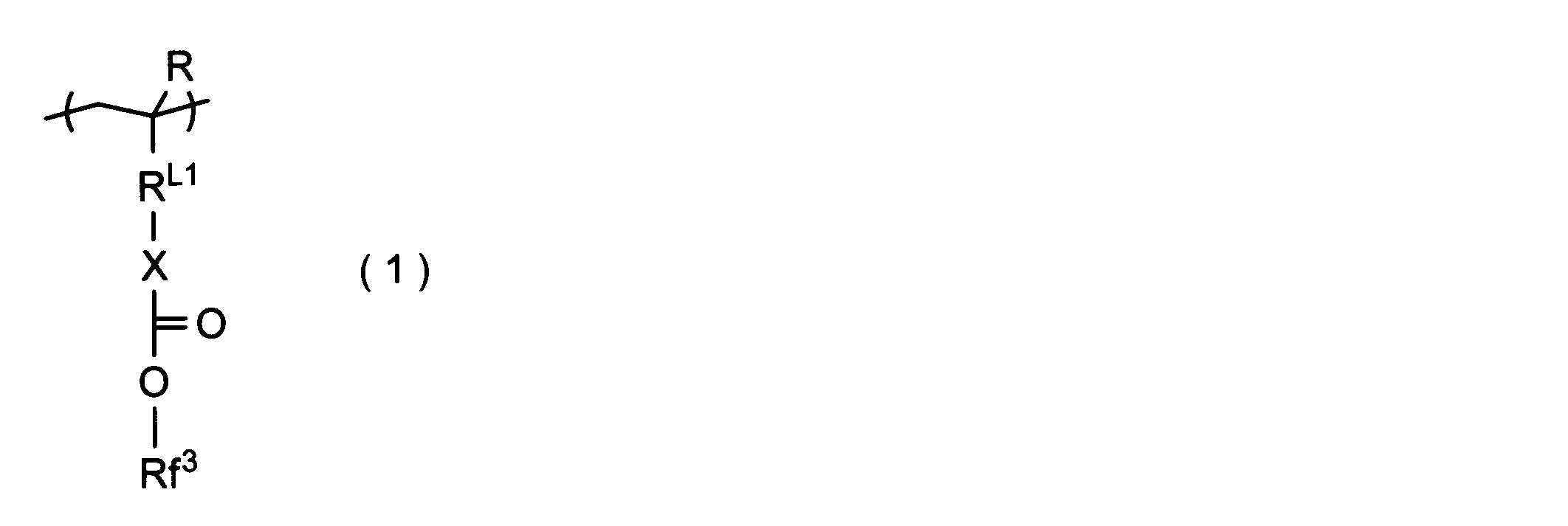

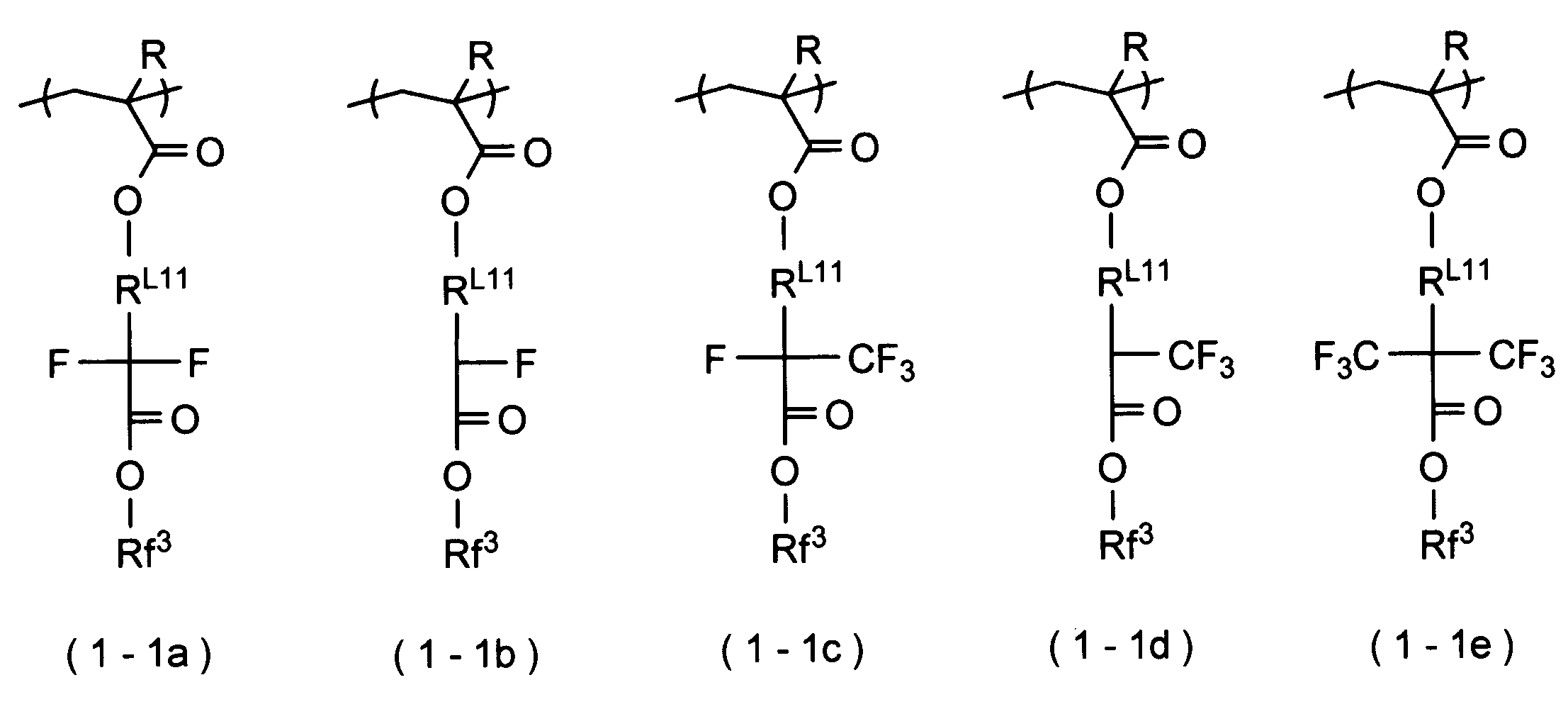
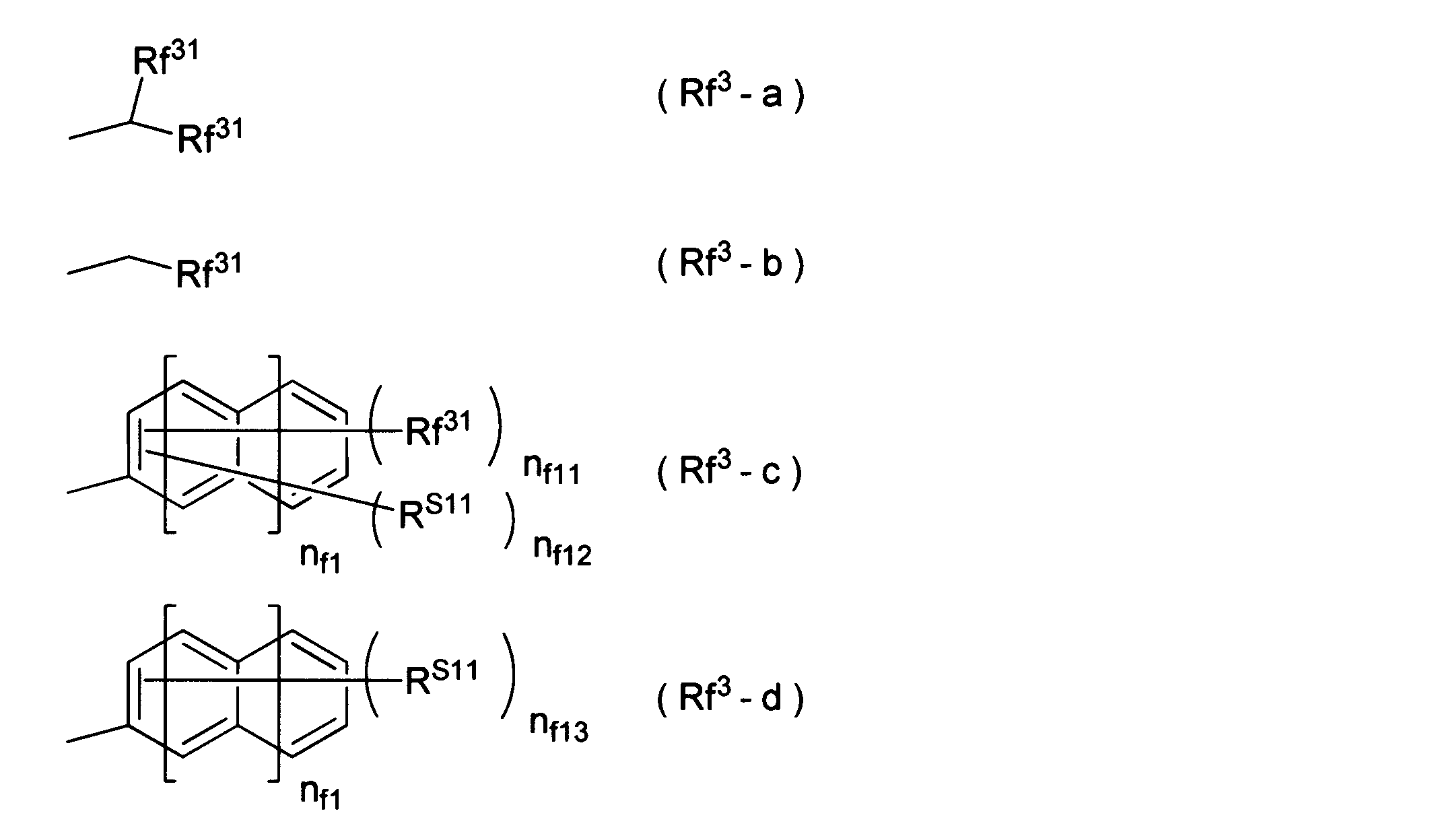


式(2)中、Gは単結合、酸素原子、硫黄原子、-CO-O-、-SO2-O-NH-、-CO-NH-、又は-O-CO-NH-である。R1は少なくとも1個のフッ素原子を有する炭素数1~6の1価の鎖状炭化水素基又は少なくとも1個のフッ素原子を有する炭素数4~20の1価の脂環式炭化水素基である。
式(3)中、R2は炭素数1~20の(m+1)価の炭化水素基であり、R2のR3側の末端に酸素原子、硫黄原子、-NR’-(但し、R’は水素原子又は1価の有機基である。)、カルボニル基、-CO-O-又は-CO-NH-が結合された構造のものも含む。R3は単結合、炭素数1~10の2価の鎖状炭化水素基又は炭素数4~20の2価の脂環式炭化水素基である。X2は単結合、又は少なくとも1個のフッ素原子を有する炭素数1~20の2価の鎖状炭化水素基である。Aは酸素原子、-NR’’-(但し、R’’は水素原子又は1価の有機基である。)、-CO-O-*又は-SO2-O-*(「*」はR4に結合する部位を示す。)である。R4は水素原子又は1価の有機基である。mは1~3の整数である。但し、mが2又は3の場合、複数のR3、X2、A及びR4はそれぞれ独立している。)
(1)当該感放射線性樹脂組成物を用いて基板上にフォトレジスト膜を形成する工程、
(2)上記フォトレジスト膜を液浸露光する工程、及び、
(3)上記液浸露光されたフォトレジスト膜を現像してレジストパターンを形成する工程を有する。

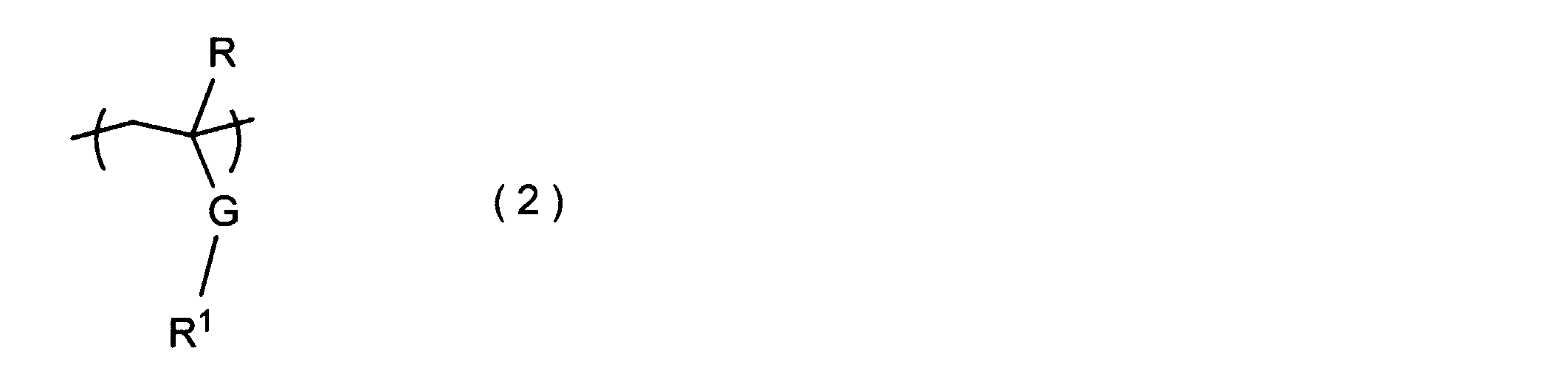

式(2)中、Gは単結合、酸素原子、硫黄原子、-CO-O-、-SO2-O-NH-、-CO-NH-、又は-O-CO-NH-である。R1は少なくとも1個のフッ素原子を有する炭素数1~6の1価の鎖状炭化水素基又は少なくとも1個のフッ素原子を有する炭素数4~20の1価の脂環式炭化水素基である。
式(3)中、R2は炭素数1~20の(m+1)価の炭化水素基であり、R2のR3側の末端に酸素原子、硫黄原子、-NR’-(但し、R’は水素原子又は1価の有機基である。)、カルボニル基、-CO-O-又は-CO-NH-が結合された構造のものも含む。R3は単結合、炭素数1~10の2価の鎖状炭化水素基又は炭素数4~20の2価の脂環式炭化水素基である。X2は単結合、又は少なくとも1個のフッ素原子を有する炭素数1~20の2価の鎖状炭化水素基である。Aは酸素原子、-NR’’-(但し、R’’は水素原子又は1価の有機基である。)、-CO-O-*又は-SO2-O-*(「*」はR4に結合する部位を示す。)である。R4は水素原子又は1価の有機基である。mは1~3の整数である。但し、mが2又は3の場合、複数のR3、X2、A及びR4はそれぞれ独立している。)

本発明における[A]重合体は、上記式(1)で表される構造単位(I)を有する重合体である。[A]重合体はフッ素含有基を含む上記特定の構造単位(I)を有しているため、その疎水性の高さに起因して、レジスト被膜表面は高い動的接触角を示す。従って、当該感放射線性樹脂組成物によれば、[A]重合体が被膜表面に偏在して被膜からの酸発生剤等の溶出を抑制すると共に、被膜表面に高い水切れ特性を付与できる。また、上記フッ素含有基は、アルカリ現像において加水分解により解離して親水基を生じるので、レジスト被膜表面の疎水性が低下する。その結果、アルカリ現像工程において被膜表面の現像液やリンス液に対する濡れ性が大きく向上するので、リンス液による洗浄効率が低いことに起因して起こるレジスト膜の現像欠陥の発生を抑制ができる。
式(1)中、Rは水素原子、メチル基又はトリフルオロメチル基である。RL1は2価の連結基である。Rf3は置換基を有していてもよい1価の芳香族炭化水素基、フッ素原子を有する1価の鎖状炭化水素基、又はフッ素原子を有する1価の脂環式炭化水素基である。Xは単結合、又は少なくとも1個のフッ素原子を有する炭素数1~20の2価の鎖状炭化水素基である。
メタンジイル基、エタンジイル基、プロパンジイル基、ブタンジイル基、ペンタンジイル基、ヘキサンジイル基、オクタンジイル基、デカンジイル基、ウンデカンジイル基、ヘキサデカンジイル基、イコサンジイル基等のアルカンジイル基;
エテンジイル基、プロペンジイル基、ブテンジイル基、ペンテンジイル基、ヘキセンジイル基、オクテンジイル基、デセンジイル基、ウンデセンジイル基、ヘキサデセンジイル基、イコセンジイル基等のアルケンジイル基;
エチンジイル基、プロピンジイル基、ブチンジイル基、オクチンジイル基、ブタジエンジイル基、ヘキサジエンジイル基、オクタトリエンジイル基等のアルキンジイル基等が挙げられる。
シクロプロパンジイル基、シクロブタンジイル基、シクロペンタンジイル基、シクロヘキサンジイル基、シクロヘプタンジイル基、シクロオクタンジイル基、シクロデカンジイル基、メチルシクロヘキサンジイル基、エチルシクロヘキサンジイル基等の単環式飽和炭化水素基;
シクロブテンジイル基、シクロペンテンジイル基、シクロヘキセンジイル基、シクロヘプテンジイル基、シクロオクテンジイル基、シクロデセンジイル基、シクロペンタジエンジイル基、シクロヘキサジエンジイル基、シクロオクタジエンジイル基、シクロデカジエンジイル基等の単環式不飽和炭化水素基;
ビシクロ[2.2.1]ヘプタンジイル基、ビシクロ[2.2.2]オクタンジイル基、トリシクロ[5.2.1.02,6]デカンジイル基、トリシクロ[3.3.1.13,7]デカンジイル基、テトラシクロ[6.2.1.13,6.02,7]ドデカンジイル基、アダマンタンジイル基等の多環式飽和炭化水素基;
ビシクロ[2.2.1]ヘプテンジイル基、ビシクロ[2.2.2]オクテンジイル基、トリシクロ[5.2.1.02,6]デセンジイル基、トリシクロ[3.3.1.13,7]デセンジイル基、テトラシクロ[6.2.1.13,6.02,7]ドデセンジイル基等の多環式不飽和炭化水素基等が挙げられる。

炭素数1~20の2価の鎖状炭化水素基としては、炭素数1~10の2価の炭化水素基が好ましく、炭素数1~5の2価の炭化水素基がより好ましい。
炭素数3~20の2価の脂環式炭化水素基としては、単環式飽和炭化水素基が好ましく、シクロペンタンジイル基、シクロヘキサンジイル基、シクロヘキシルメタンジイル基が特に好ましい。
炭素数6~20の2価の芳香族炭化水素基としては、フェニレン基、ベンジレン基、フフェネチレン基がより好ましい。これらの中でも、炭素数1~5の2価の炭化水素基が特に好ましい。

炭素数1~30の2価の鎖状炭化水素基としては、炭素数1~10の2価の炭化水素基が好ましく、炭素数1~5の2価の炭化水素基がより好ましく、エタンジイル基、プロパンジイル基が特に好ましく;
炭素数3~30の2価の脂環式炭化水素基としては、単環式飽和炭化水素基が好ましく、シクロペンタンジイル基、シクロヘキサンジイル基、シクロヘキシルメタンジイル基が特に好ましく;
炭素数6~30の2価の芳香族炭化水素基としては、フッ素原子を有していてもよいフェニレン基、フッ素原子を有していてもよいベンジレン基、フッ素原子を有していてもよいフェネチレン基がより好ましく;
また、これらの好ましいものとして挙げた例とエーテル基、エステル基、カルボニル基、イミノ基、アミド基を組み合わせた2価の基を用いることもでき、炭素数1~10の2価の炭化水素基とエステル基を組み合わせた2価の基がより好ましい。
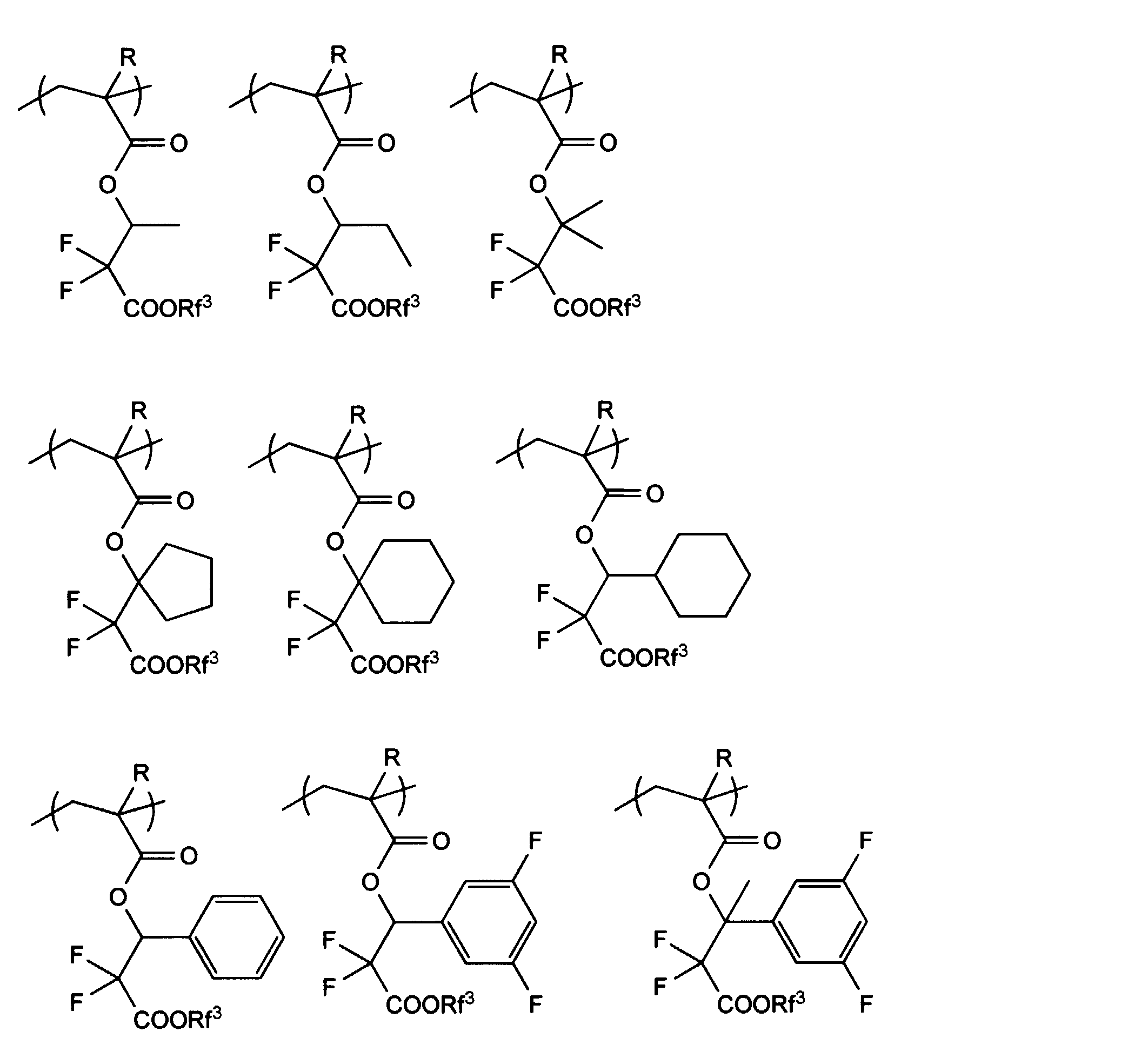
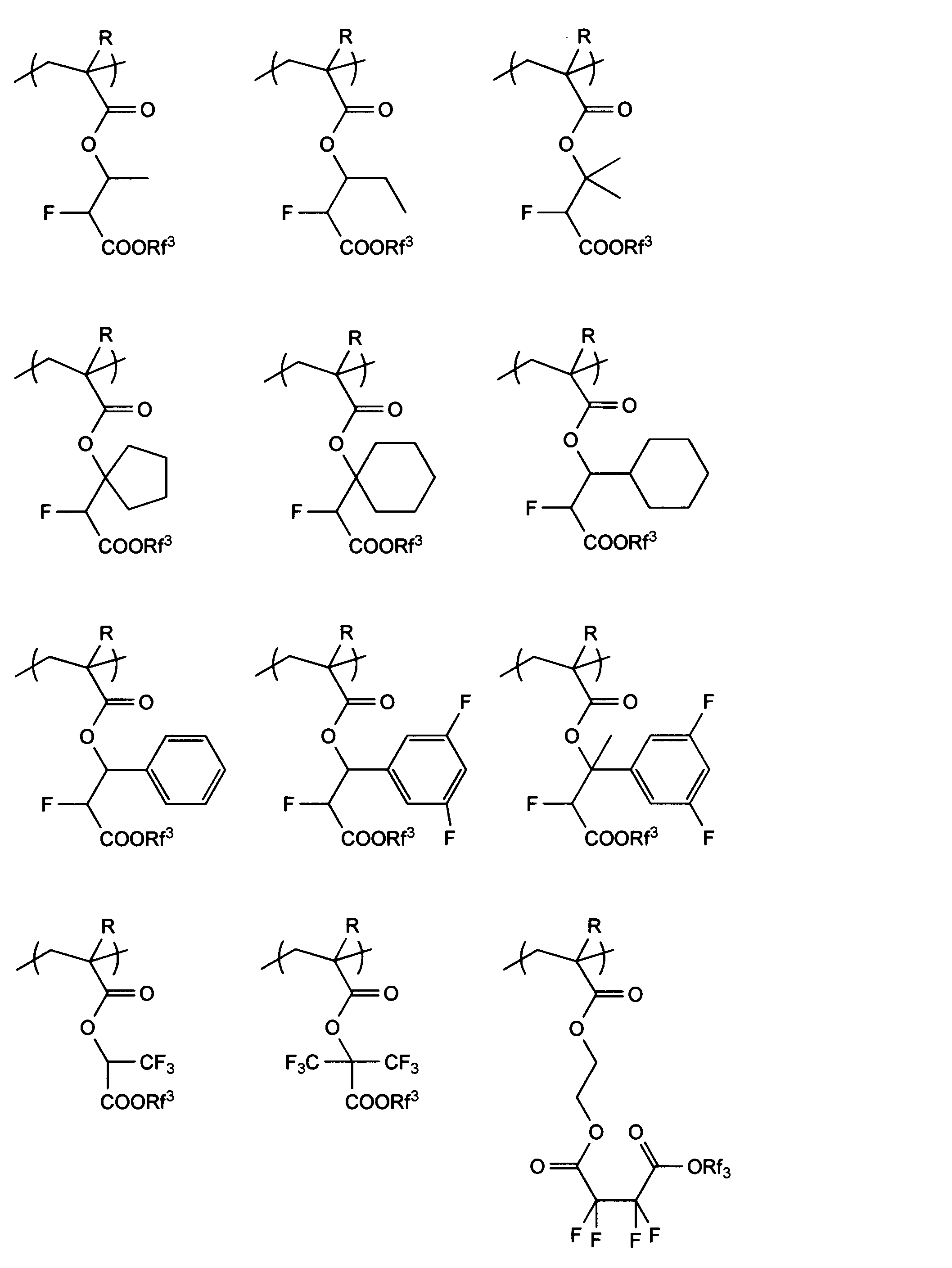

構造単位(II)は、上記式(2)で表される。
構造単位(III)は、上記式(3)で表される。
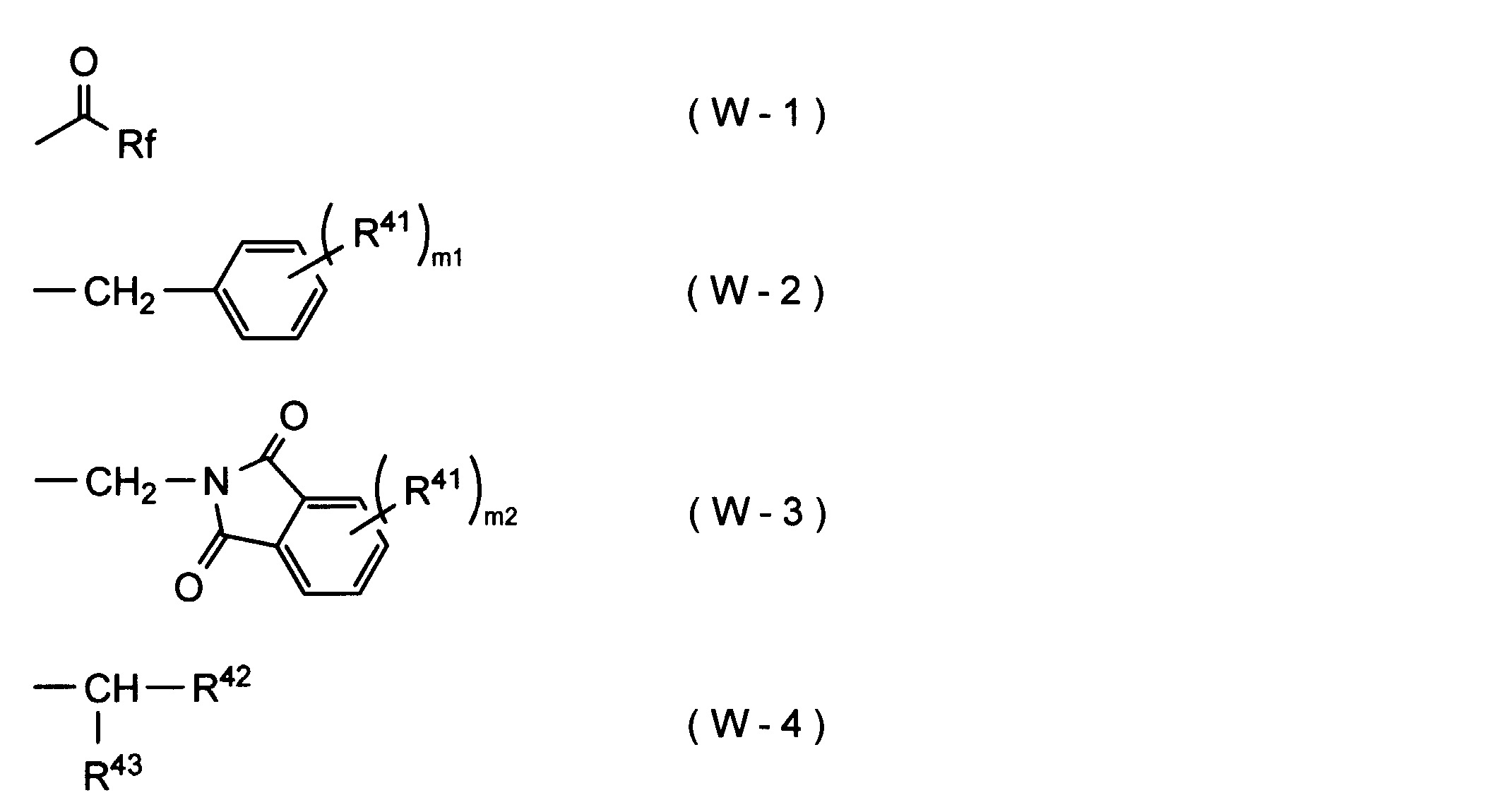

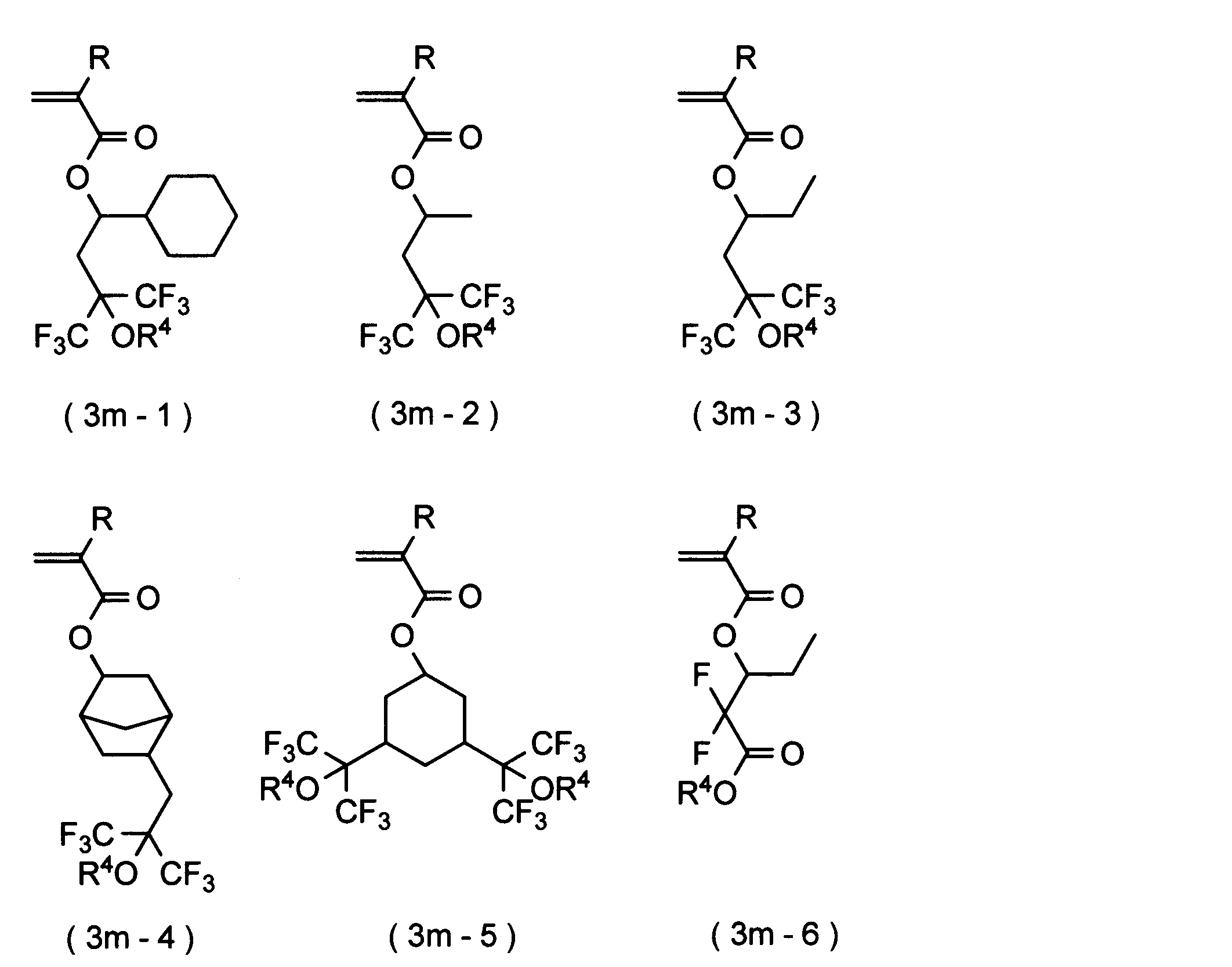
上記[A]重合体は、下記式(4)で表される構造単位(IV)を有していてもよい。[A]重合体が構造単位(IV)を含むことにより、現像後のレジストパターンの形状をより改善できる。
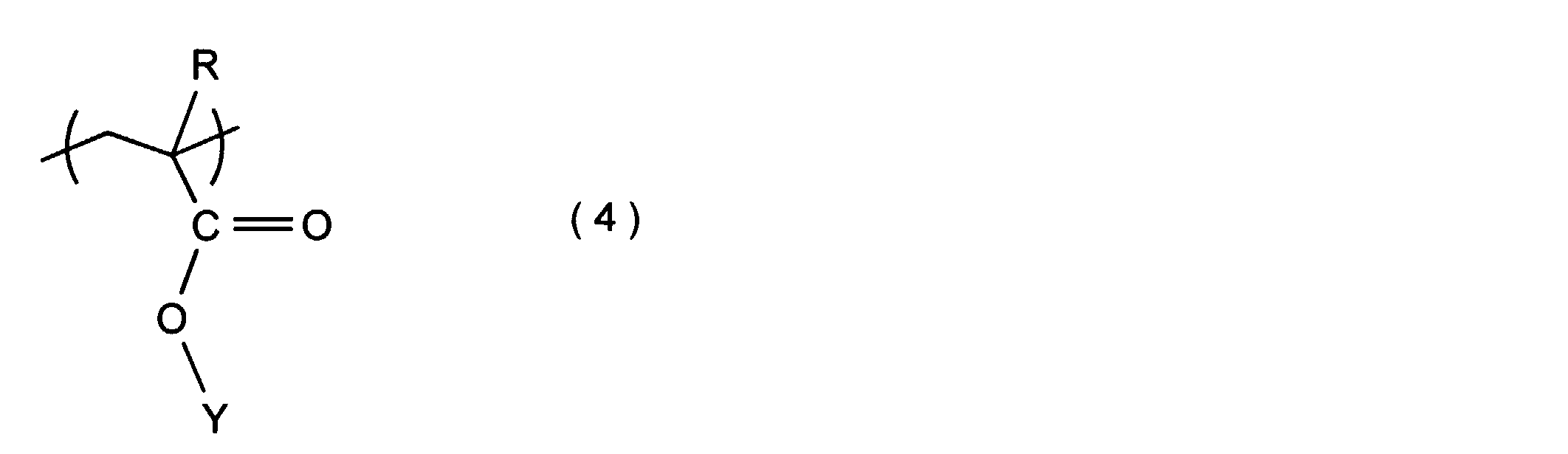


上記[A]重合体は、アルカリ可溶性基を有する構造単位(以下、「構造単位(V)」と称することがある。)を有していてもよい。[A]重合体が構造単位(V)を含むことにより、現像液に対する親和性を向上できる。
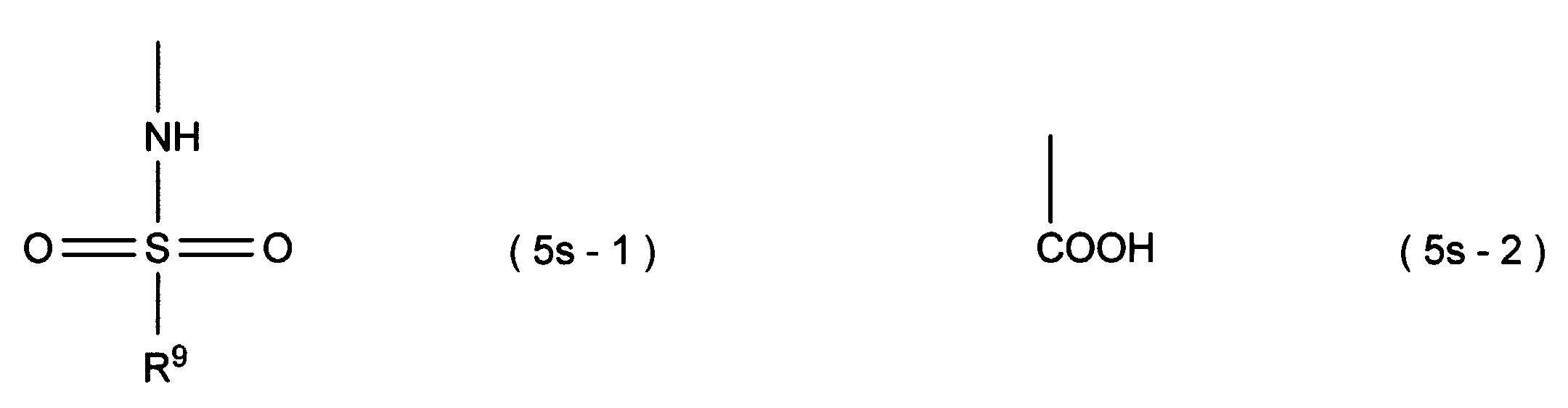


上記[A]重合体は、下記式(6)で表される構造単位(VI)を有していてもよい。[A]重合体が構造単位(VI)を含むことにより、現像液に対する親和性を向上させることができる。


上記[A]重合体は下記式(7)で表される構造単位(VII)を有していてもよい。[A]重合体が構造単位(VII)を含むことにより、現像液に対する親和性を向上させることができる。

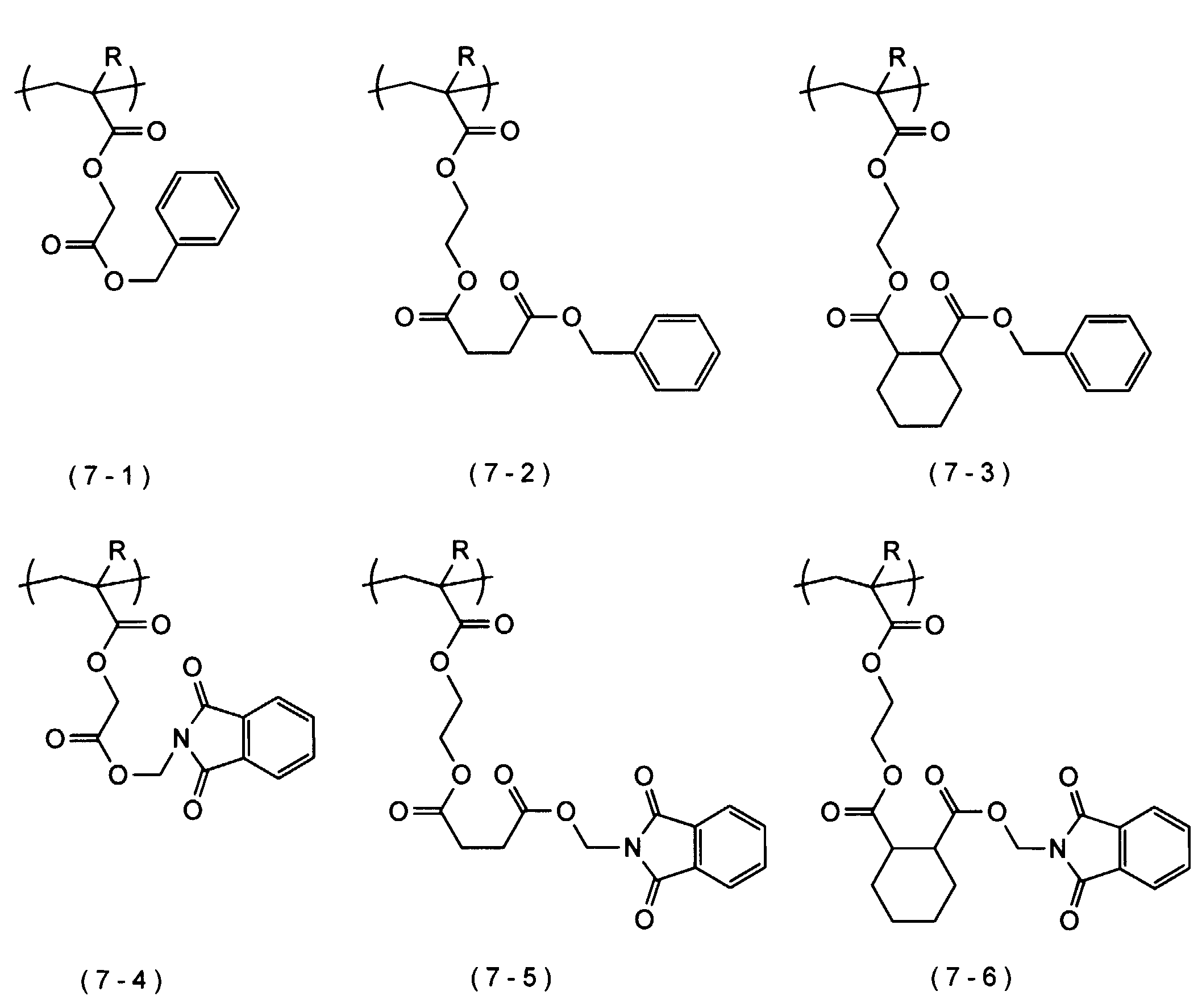
上記[A]重合体は、ラジカル重合等の常法に従って合成することができる。例えば、(1)単量体及びラジカル開始剤を含有する溶液を、反応溶媒又は単量体を含有する溶液に滴下して重合反応させる方法;(2)単量体を含有する溶液とラジカル開始剤を含有する溶液とを各別に、反応溶媒又は単量体を含有する溶液に滴下して重合反応させる方法;(3)各々の単量体を含有する、複数種の溶液と、ラジカル開始剤を含有する溶液とを各別に、反応溶媒又は単量体を含有する溶液に滴下して重合反応させる方法;等の方法で合成することが好ましい。
本発明の感放射線性樹脂組成物を構成する[B]酸発生体としては、例えばスルホニウム塩やヨードニウム塩等のオニウム塩化合物、有機ハロゲン化合物、ジスルホン類やジアゾメタンスルホン類等のスルホン化合物が挙げられる。[B]酸発生体の当該感放射線性樹脂組成物における含有形態としては、後述するような化合物である酸発生剤の形態でも、[A]重合体や後述する[C]重合体等他の重合体の一部として組み込まれた酸発生基の形態でも、これらの両方の形態でもよい。
当該感放射線性樹脂組成物では、[C]上記[A]重合体よりもフッ素原子含有率の小さい重合体をさらに含有し、この[C]重合体が酸解離性基を有することが好ましい。このような[C]重合体をさらに含有することにより、[A]重合体及び[C]重合体を含む組成物からレジスト被膜を形成した際に、[A]重合体がレジスト被膜表面に偏在化する度合いが高くなる。その結果、上述の[A]重合体の疎水性及びその低下に起因する特性がより効率的に発現される。なお、このフッ素原子含有率は13C-NMRにより測定することができる。
任意成分としては、例えば酸拡散抑制体、溶媒、偏在化促進剤、界面活性剤、脂環族化合物、増感剤、架橋剤等が挙げられる。以下、これらの成分について詳述する。
酸拡散制御体としては、例えば下記式(8)で表される化合物(以下、「含窒素化合物(I)」と称することがある。)、同一分子内に窒素原子を2個有する化合物(以下、「含窒素化合物(II)」と称することがある。)、窒素原子を3個以上有する化合物(以下、「含窒素化合物(III)」と称することがある。)、アミド基含有化合物、ウレア化合物、含窒素複素環化合物等が挙げられる。酸拡散制御体を含有すると、レジストとしてのパターン形状や寸法忠実度を向上させることができる。酸拡散制御体の当該感放射線性樹脂組成物における含有形態としては、後述するような化合物である酸拡散制御剤の形態でも、[A]重合体や[C]重合体等他の重合体の一部として組み込まれた酸拡散制御基の形態でも、これらの両方の形態でもよい。酸拡散制御体は、単独又は2種以上を組み合わせて使用することができる。

n-ヘキシルアミン等のモノアルキルアミン類;
ジ-n-ブチルアミン等のジアルキルアミン類;
トリエチルアミン等のトリアルキルアミン類;
アニリン等の芳香族アミン類等が挙げられる。
X+Z- (9)
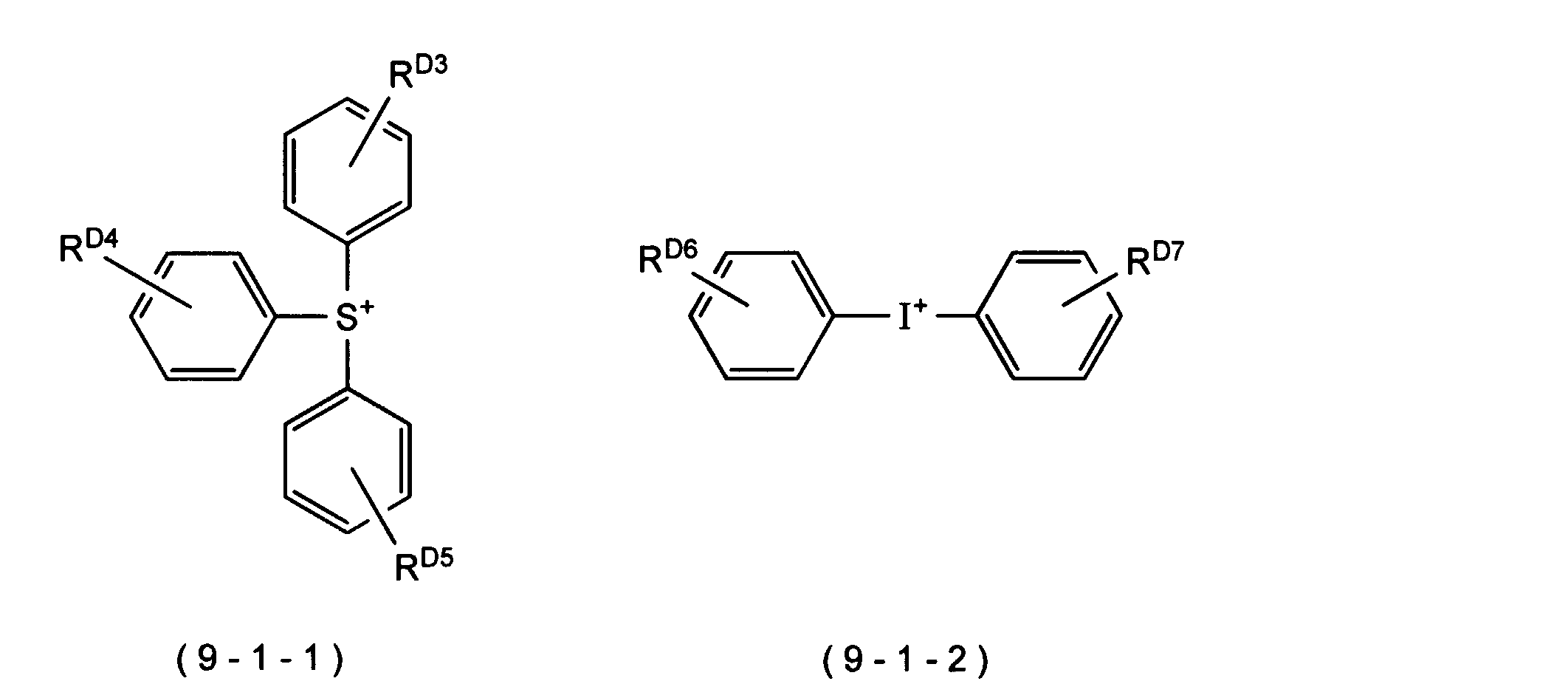
ヒドロキシメチル基等の炭素数1~4のヒドロキシアルキル基;
メトキシ基等の炭素数1~4のアルコキシル基;
シアノ基;
シアノメチル基等の炭素数2~5のシアノアルキル基等の置換基を1種以上有する基等が挙げられる。これらの中でも、ヒドロキシメチル基、シアノ基、シアノメチル基が好ましい。
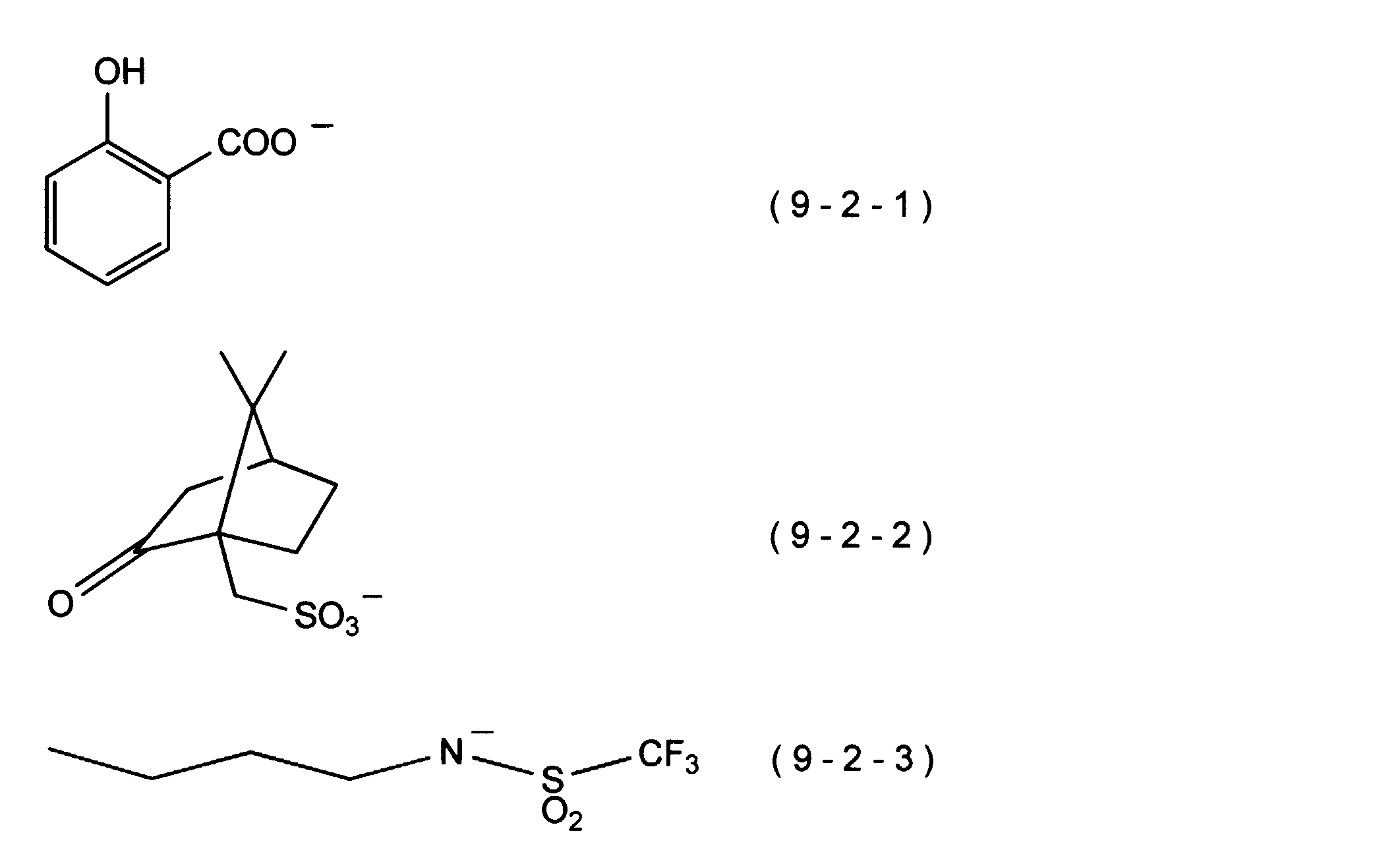
当該感放射線性樹脂組成物は通常、溶媒を含有する。溶媒は少なくとも[A]重合体、[B]酸発生体、及び所望により含有される[C]重合体等を溶解可能な溶媒であれば、特に限定されない。このような溶媒としては、例えば
直鎖状又は分岐状のケトン類;
環状のケトン類;
プロピレングリコールモノアルキルエーテルアセタート類;
2-ヒドロキシプロピオン酸アルキル類;
3-アルコキシプロピオン酸アルキル類等が挙げられる。これらのうち、プロピレングリコールモノメチルエーテルアセタート、シクロヘキサノンがより好ましい。これらは単独で又は2種以上を組み合わせて使用できる。
偏在化促進剤は、[A]重合体をより効率的にレジスト膜表面に偏析させる効果を有する。当該感放射線性樹脂組成物にこの偏在化促進剤を含有させることで、[A]重合体の添加量を従来よりも少なくすることができる。従って、LWR、現像欠陥、パターン倒れ耐性等のレジスト基本特性を損なうことなく、レジスト膜から液浸液への成分の溶出をさらに抑制したり、高速スキャンにより液浸露光をより高速に行うことが可能になり、結果としてウォーターマーク欠陥等の液浸由来欠陥を抑制するレジスト膜表面の疎水性を向上できる。このような偏在化促進剤として用いることができるものとしては、比誘電率が30以上200以下で、1気圧における沸点が100℃以上の低分子化合物が挙げられる。このような化合物としては、例えばラクトン化合物、カーボネート化合物、ニトリル化合物、多価アルコール等が挙げられる。これらは単独で又は2種以上を組み合わせて使用できる。
界面活性剤は、塗布性、現像性等を改良する作用を示す成分である。界面活性剤としては、例えばポリオキシエチレンラウリルエーテル、ポリオキシエチレンステアリルエーテル、ポリオキシエチレンオレイルエーテル、ポリオキシエチレンn-オクチルフェニルエーテル、ポリオキシエチレンn-ノニルフェニルエーテル、ポリエチレングリコールジラウレート、ポリエチレングリコールジステアレート等のノニオン系界面活性剤の他、以下商品名で、KP341(信越化学工業社)、ポリフローNo.75、同No.95(共栄社化学社)、エフトップEF301、同EF303、同EF352(トーケムプロダクツ社)、メガファックF171、同F173(大日本インキ化学工業社)、フロラードFC430、同FC431(住友スリーエム社)、アサヒガードAG710、サーフロンS-382、同SC-101、同SC-102、同SC-103、同SC-104、同SC-105、同SC-106(旭硝子社)等が挙げられる。これらは単独で又は2種以上を組み合わせて使用できる。
脂環式骨格含有化合物は、ドライエッチング耐性、パターン形状、基板との接着性等をさらに改善する作用を示す成分である。
1-アダマンタンカルボン酸、2-アダマンタノン、1-アダマンタンカルボン酸t-ブチル等のアダマンタン誘導体類;
デオキシコール酸t-ブチル、デオキシコール酸t-ブトキシカルボニルメチル、デオキシコール酸2-エトキシエチル等のデオキシコール酸エステル類;
リトコール酸t-ブチル、リトコール酸t-ブトキシカルボニルメチル、リトコール酸2-エトキシエチル等のリトコール酸エステル類;
3-〔2-ヒドロキシ-2,2-ビス(トリフルオロメチル)エチル〕テトラシクロ[4.4.0.12,5.17,10]ドデカン、2-ヒドロキシ-9-メトキシカルボニル-5-オキソ-4-オキサ-トリシクロ[4.2.1.03,7]ノナン等が挙げられる。これらは単独で又は2種以上を組み合わせて使用できる。
増感剤は、[B]酸発生体に吸収される放射線のエネルギー以外のエネルギーを吸収して、そのエネルギーを例えば電子やラジカルのような形で[B]酸発生体に伝達し、それにより酸の生成量を増加する作用を示すものであり、当該感放射線性樹脂組成物の「みかけの感度」を向上させる効果を有する。
本発明の感放射線性樹脂組成物をネガ型感放射性樹脂組成物として用いる場合においては、アルカリ現像液に可溶な重合体を、酸の存在下で架橋しうる化合物(以下、「架橋剤」と称することがある。)を配合しても良い。架橋剤としては、例えば、アルカリ現像液に可溶な重合体との架橋反応性を有する官能基(以下、「架橋性官能基」と称することがある。)を1種以上有する化合物が挙げられる。
その他の任意成分としては、上記のもの以外に、染料、顔料、接着助剤等が挙げられる。例えば、染料或いは顔料を用いることによって、露光部の潜像を可視化させて、露光時のハレーションの影響を緩和できる。また、接着助剤を配合することによって、基板との接着性を改善することができる。他の添加剤としてはアルカリ可溶性樹脂、酸解離性の保護基を有する低分子のアルカリ溶解性制御剤、ハレーション防止剤、保存安定化剤、消泡剤等が挙げられる。これらは単独で又は2種以上を組み合わせて使用できる。
当該感放射線性樹脂組成物は、通常、その使用に際して全固形分濃度が1質量%~50質量%、好ましくは3質量%~25質量%となるように上記溶媒に溶解した後、例えば孔径0.02μm程度のフィルターでろ過することによって組成物溶液として調製される。
本発明のレジストパターンの形成方法は、(1)感放射線性樹脂組成物を用いて基板上にフォトレジスト膜を形成する工程(以下、「工程(1)」と称することがある。)、(2)上記フォトレジスト膜上に液浸露光用液体を配置し、上記液浸露光用液体を介して上記フォトレジスト膜を液浸露光する工程(以下、「工程(2)」と称することがある。)と、(3)液浸露光された上記フォトレジスト膜を現像してレジストパターンを形成する工程(以下、「工程(3)と称することがある。」)とを備える。当該形成方法では、フォトレジスト組成物として当該感放射線性樹脂組成物を用いているので、被膜表面の水切れ性が高く、高速スキャン露光によりプロセスタイムを短縮させると共に、現像欠陥の発生を抑制して、良好なレジストパターンを効率良く形成できる。
アセトン、メチルエチルケトン、メチルi-ブチルケトン、シクロペンタノン、シクロヘキサノン、3-メチルシクロペンタノン、2,6-ジメチルシクロヘキサノン等のケトン類;
メチルアルコール、エチルアルコール、n-プロピルアルコール、i-プロピルアルコール、n-ブチルアルコール、t-ブチルアルコール、シクロペンタノール、シクロヘキサノール、1,4-ヘキサンジオール、1,4-ヘキサンジメチロール等のアルコール類;
テトラヒドロフラン、ジオキサン等のエーテル類;
酢酸エチル、酢酸n-ブチル、酢酸i-アミル等のエステル類;
トルエン、キシレン等の芳香族炭化水素類、フェノール、アセトニルアセトン、ジメチルホルムアミド等が挙げられる。これらは単独で又は2種以上を組み合わせて使用できる。
本発明の重合体は、上記式(1)で表される構造単位(I)を有する。
本発明の化合物は上記式(i)で表される構造を有するので、当該重合体中に構造単位(I)を組み込むモノマーとして好適に用いることができる。
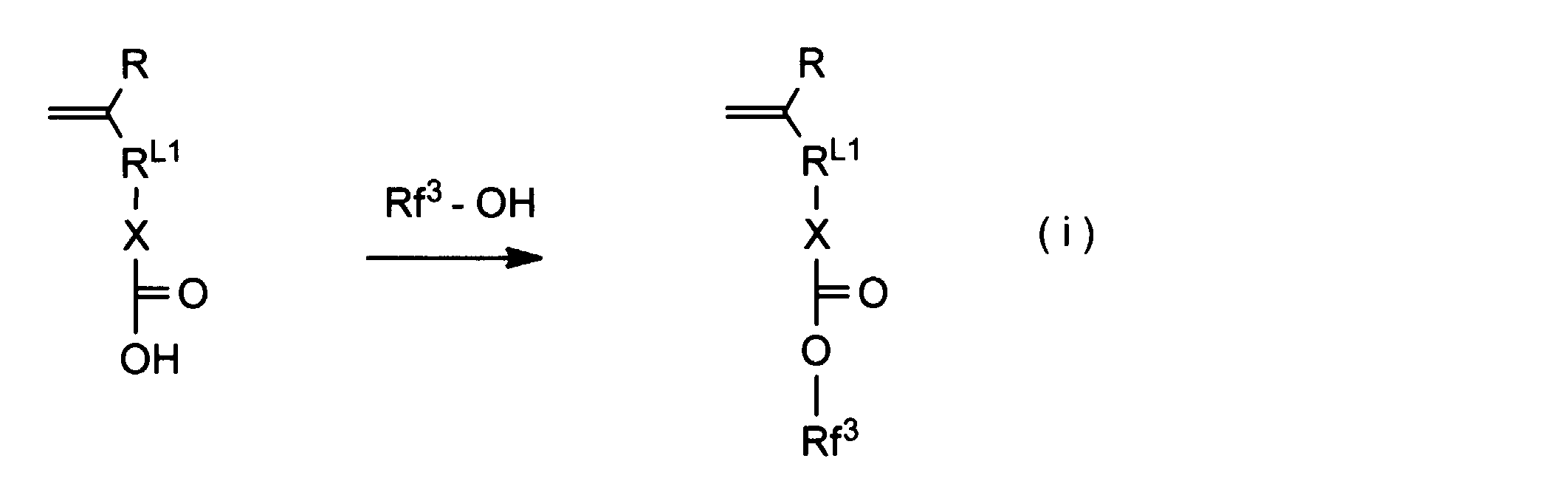
[実施例1]
2,4-ジフルオロフェニル-2,2-ジフルオロ-3-(メタクリロイルオキシ)ペンタノアート(M-1)の合成
真空加熱により内部を十分に乾燥させた反応器を、乾燥窒素で置換した後、上記反応器内に、2,2-ジフルオロ-3-(メタクリロイルオキシ)ペンタン酸22.22g(0.1mol)、ジクロロメタン100mL溶液を加え氷温まで冷却し、そこへジシクロヘキシルカルボジイミド22.70g(0.11mol)のジクロロメタン100ml溶液を10分かけて加え、さらにN,N-ジメチル-4-アミノピリジン(DMAP)0.61g(5mmol)、2,4-ジフルオロフェノールを13.66g(0.105mol)加えた。その後、反応器を室温まで昇温し、2時間攪拌した後、よく攪拌しながら1規定塩酸水300gを加えた。その後、分液ロートにてジクロロメタンを分離し、水層を再びジクロロメタンで抽出して抽出液を得た。この抽出液を、上記ジクロロメタン層と合わせて1規定塩酸水で洗浄した後、ジクロロメタン層をエバポレーターにて溶剤留去し、カラムクロマトグラフィーで精製し、2,4-ジフルオロフェニル-2,2-ジフルオロ-3-(メタクリロイルオキシ)ペンタノアート(M-1)を21.73g(収率65%)得た。

3-(トリフルオロメチル)フェニル-2,2-ジフルオロ-3-(メタクリロイルオキシ)ペンタノアート(M-2)の合成
真空加熱により内部を十分に乾燥させた反応器を、乾燥窒素で置換した後、上記反応器内に、2,2-ジフルオロ-3-(メタクリロイルオキシ)ペンタン酸22.22g(0.1mol)、ジクロロメタン100mL溶液を加え氷温まで冷却し、そこへジシクロヘキシルカルボジイミド(DCC)22.70g(0.11mol)のジクロロメタン100mL溶液を10分かけて加え、さらにDMAP0.61g(5mmol)、3-(トリフルオロメチル)フェノールを17.02g(0.105mol)加えた。その後、反応器を室温まで昇温し、2時間攪拌した後、よく攪拌しながら1規定塩酸水300g加えた。その後、分液ロートにてジクロロメタンを分離し、水層を再びジクロロメタンで抽出して抽出液を得た。この抽出液を、上記ジクロロメタン層と合わせて1規定塩酸水で洗浄した後、ジクロロメタン層をエバポレーターにて溶剤留去し、カラムクロマトグラフィーで精製し、3-(トリフルオロメチル)フェニル-2,2-ジフルオロ-3-(メタクリロイルオキシ)ペンタノアート(M-2)を22.71g(収率62%)得た。

3-(トリフルオロメチル)フェニル-2-フルオロ-3-(メタクリロイルオキシ)ペンタノアート(M-3)の合成
真空加熱により内部を十分に乾燥させた500mLの反応器を、乾燥窒素で置換した後氷浴に浸し、上記反応器内に活性化した金属亜鉛24.2g(370mmol/1.5等量)とTHF(脱水)300mLを加え、ブロモフルオロ酢酸エチル/THF溶液(ブロモフルオロ酢酸エチル46.91g(253.6mmol/1.0等量)及びTHF(脱水)80mL)を5分かけて滴下した。滴下後、室温まで昇温して20分間攪拌し、プロピオンアルデヒド/THF溶液(プロピオンアルデヒド17.76g(305.8mmol/1.2等量)及びTHF(脱水)80mL)を加え、室温で60分間攪拌した。その後、水、ジイソプロピルエーテルを加え、二層分離を行った。得られた有機層を希塩酸、水で洗浄し、硫酸マグネシウムで水分を除去、ろ過を行った後、ジイソプロピルエーテルを留去して、下記式で表わされるエチル2-フルオロ-3-ヒドロキシ-ペンタノアートを35.4g(収率85%)得た。




4-(トリフルオロメチル)ベンジル-2,2-ジフルオロ-3-(メタクリロイルオキシ)ペンタノアート(M-4)の合成
真空加熱により内部を十分に乾燥させた反応器を、乾燥窒素で置換した後、上記反応器内に、2,2-ジフルオロ-3-(メタクリロイルオキシ)ペンタン酸22.22g(0.1mol)、ジクロロメタン100mL溶液を加え氷温まで冷却し、そこへDCC22.70g(0.11mol)のジクロロメタン100mL溶液を10分かけて加え、さらにDMAP0.61g(5mmol)、4-(トリフルオロメチル)ベンジルアルコールを18.49g(0.105mol)加えた。その後、反応器を室温まで昇温し、2時間攪拌した後、よく攪拌しながら1規定塩酸水300g加えた。その後、分液ロートにてジクロロメタンを分離し、水層を再びジクロロメタンで抽出して抽出液を得た。この抽出液を、上記ジクロロメタン層と合わせて1規定塩酸水で洗浄した後、ジクロロメタン層をエバポレーターにて溶剤留去し、カラムクロマトグラフィーで精製し、4-(トリフルオロメチル)ベンジル-2,2-ジフルオロ-3-(メタクリロイルオキシ)ペンタノアート(M-4)を24.72g(収率65%)得た。
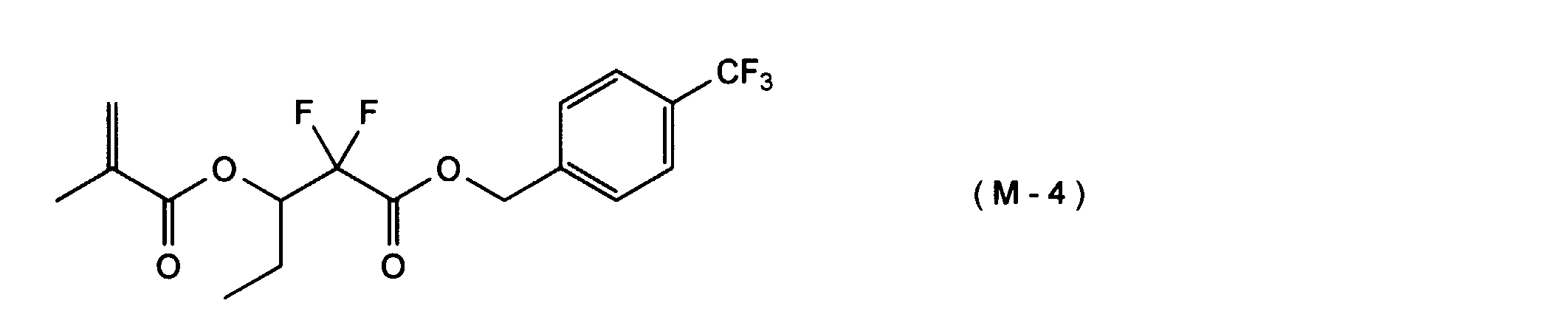
2,2,2-トリフルオロエチル-2,2-ジフルオロ-3-(メタクリロイルオキシ)ペンタノアート(M-5)の合成
真空加熱により内部を十分に乾燥させた反応器を、乾燥窒素で置換した後、上記反応器内に、2,2-ジフルオロ-3-(メタクリロイルオキシ)ペンタン酸22.22g(0.1mol)、ジクロロメタン100mL溶液を加え氷温まで冷却し、そこへDCC22.70g(0.11mol)のジクロロメタン100mL溶液を10分かけて加え、さらにDMAP0.61g(5mmol)、2,2,2-トリフルオロエタノールを10.40g(0.105mol)加えた。その後、反応器を室温まで昇温し、2時間攪拌した後、よく攪拌しながら1規定塩酸水300g加えた。その後、分液ロートにてジクロロメタンを分離し、水層を再びジクロロメタンで抽出して抽出液を得た。この抽出液を、上記ジクロロメタン層と合わせて1規定塩酸水で洗浄した後、ジクロロメタン層をエバポレーターにて溶剤留去し、カラムクロマトグラフィーで精製し、2,2,2-トリフルオロエチル-2,2-ジフルオロ-3-(メタクリロイルオキシ)ペンタノアート(M-5)を21.60g(収率71%)得た。

1,1,1-トリフルオロ-3-オキソ-3-(2,2,2-トリフルオロエトキシ)プロパン-2-イルメタクリレート(M-6)の合成
窒素雰囲気下、室温にて3,3,3-トリフルオロ乳酸7.20g(50.0mmol)に脱水THF50mL、トリエチルアミン5.56g(55.0mmol)、ジメチルアミノピリジン305mg(2.5mmol)を加えた。その後メタクリル酸クロリド5.75g(55.0mmol)を10分かけて滴下した。その後2時間攪拌した。TLCにて原料の消失を確認した後、炭酸水素ナトリウム水溶液を加えて反応を停止した。その後、反応液に酢酸エチルを加えて抽出を3回行い、得られた有機層を水、飽和食塩水でそれぞれ1回ずつ洗浄し、無水硫酸ナトリウムを加えて乾燥した。その後、減圧下で溶媒留去し、得られた生成物をカラムクロマトグラフィーで精製し、下記式で表わされる3,3,3-トリフルオロ-2-(メタクリロイルオキシ)プロピオン酸を淡黄色オイル状として3.71g(収率35%)得た。


フェニル-2,2-ジフルオロ-3-(メタクリロイルオキシ)ペンタノアート(M-16)の合成
真空加熱により内部を十分に乾燥させた反応器を、乾燥窒素で置換した後、上記反応器内に、2,2-ジフルオロ-3-(メタクリロイルオキシ)ペンタン酸22.22g(0.1mol)、ジクロロメタン100mL溶液を加え氷温まで冷却し、そこへジシクロヘキシルカルボジイミド(DCC)22.70g(0.11mol)のジクロロメタン100mL溶液を10分かけて加え、さらにDMAP0.61g(5mmol)、フェノールを9.88g(0.105mol)加えた。その後、反応器を室温まで昇温し、2時間攪拌した後、よく攪拌しながら1規定塩酸水300g加えた。その後、分液ロートにてジクロロメタンを分離し、水層を再びジクロロメタンで抽出して抽出液を得た。この抽出液を、上記ジクロロメタン層と合わせて1規定塩酸水で洗浄した後、ジクロロメタン層をエバポレーターにて溶剤留去し、カラムクロマトグラフィーで精製し、フェニル-2,2-ジフルオロ-3-(メタクリロイルオキシ)ペンタノアート(M-16)を17.3g(収率58%)得た。

フェニル-3-オキソ-3-(2,2,2-トリフルオロエトキシ)プロパン-2-イルメタクリレート(M-17)の合成
窒素雰囲気下、0℃にて、3,3,3-トリフルオロ-2-(メタクリロイルオキシ)プロピオン酸を3.18g(15mmol)、DCC6.8g(16.5mmol)、DMAP0.37g(0.003mol)のジクロロメタン溶液60mLに、フェノールを1.69g(18mmol)加え、室温まで戻し、3時間撹拌した。TLCにて原料の消失を確認した後、反応液を0℃に冷却し、1規定塩酸を加えて反応を停止した。その後、反応液に酢酸エチルを加えて抽出を3回行い、得られた有機層を水で2回洗浄した。その後、カラムクロマトグラフィーにて精製し、目的のフェニル-3-オキソ-3-(2,2,2-トリフルオロエトキシ)プロパン-2-イルメタクリレート(M-17)を2.20g(収率51%)得た。

上記式(M-1)~(M-6)、(M-16)、(M-17)及び下記式(M-7)~(M-12)で表される化合物を用い、下記方法により(A-1)~(A-17)及び(A’-1)を合成した。

化合物(M-7)1.23g(6.24mmol)、化合物(M-1)18.78g(56.17mmol)を2-ブタノン40gに溶解し、更にジメチル2,2’-アゾビス(2-イソブチロニトリル)0.51gを200mLの三口フラスコに投入し、30分窒素パージした後、反応釜を攪拌しながら80℃に加熱した。加温開始を重合開始時間とし、重合反応を5時間実施した。重合終了後、重合溶液を水冷することにより30℃以下に冷却した。その重合溶液をエバポレーターにて重合溶液の重量が40gになるまで減圧濃縮した。その後、40gのメタノールを投入し、その混合溶液をヘキサン200gが入った500mL分液漏斗へ移した。分液操作をして下層を回収し、それをエバポレーターにて溶媒留去し、得られた個体を砕いて粉体として40度15時間真空乾燥した。白色の粉体(A-1)を12.0g(収率60%)得た。この重合体のMwは6,600であり、Mw/Mnは1.45であり、13C-NMR分析の結果、化合物(M-7)に由来する繰り返し単位、化合物(M-1)に由来する繰り返し単位の含有率がそれぞれ11.2mol%、88.8mol%であった。
表1に記載した化合物を用い、実施例9と同様にして、(A-2)~(A-17)及び(A’-1)を合成し、それぞれ実施例10~25及び比較例1とした。また、それぞれの物性値についても表1に示す。

下記式(M-13)~(M-15)で表される化合物及び上述の(M-8)及び(M-9)から選択される化合物を用い下記方法により(C-1)及び(C-2)を合成した。

化合物(M-13)86.61g(0.515mol)及び化合物(M-9)68.65g(0.309mol)及び化合物(M-14)19.17g(0.103mol)を、2-ブタノン400gに溶解し、更にジメチル2,2’-アゾビス(2-イソブチロニトリル)8.45gを投入した単量体溶液を準備した。化合物(M-8)25.57g(0.103mol)を2,000mLの三口フラスコに投入し、200gの2-ブタノンを投入して溶解させ、30分窒素パージした後、反応釜を攪拌しながら80℃に加熱し、事前に準備した単量体溶液を滴下漏斗を用いて3時間かけて滴下した。滴下開始を重合開始時間とし、重合反応を6時間実施した。重合終了後、重合溶液を水冷することにより30℃以下に冷却し、4,000gのメタノールへ投入して析出した白色粉末をろ別した。ろ別した白色粉末をメタノールに分散させてスラリー状にして洗浄した後にろ別する操作を2回行い、60℃にて15時間乾燥し、白色粉末の共重合体(C-1)を得た(収量150.6g、収率75.3%)。この共重合体は、Mwが6,700であり、Mw/Mn=1.40であり、13C-NMR分析の結果、化合物(M-13)、化合物(M-8)、化合物(M-9)、化合物(M-14)に由来する繰り返し単位の含有率(mol%)はそれぞれ49.0:9.2:31.6:10.1であった。
化合物(M-13)86.61g(0.515mol)及び化合物(M-9)68.65g(0.309mol)及び化合物(M-15)30.39g(0.103mol)を、2-ブタノン400gに溶解し、更にジメチル2,2’-アゾビス(2-イソブチロニトリル)8.45gを投入した単量体溶液を準備した。化合物(M-8)25.57g(0.103mol)を2,000mLの三口フラスコに投入し、200gの2-ブタノンを投入して溶解させ、30分窒素パージした後、反応釜を攪拌しながら80℃に加熱し、事前に準備した単量体溶液を滴下漏斗を用いて3時間かけて滴下した。滴下開始を重合開始時間とし、重合反応を6時間実施した。重合終了後、重合溶液を水冷することにより30℃以下に冷却し、4,000gのメタノールへ投入して析出した白色粉末をろ別した。ろ別した白色粉末をメタノールに分散させてスラリー状にして洗浄した後にろ別する操作を2回行い、60℃にて15時間乾燥し、白色粉末の共重合体(C-2)を得た(収量131g、収率65.5%)。この共重合体は、Mwが5,500であり、Mw/Mn=1.401あり、13C-NMR分析の結果、化合物(M-13)、化合物(M-8)、化合物(M-9)、化合物(M-15)に由来する繰り返し単位の含有率(mol%)はそれぞれ51.7:8.3:30.8:9.2であった。なお、フッ素含有割合は、3.56質量%であった。
感放射線性樹脂組成物を構成する[B]酸発生体、酸拡散制御剤及び溶媒について以下に示す。
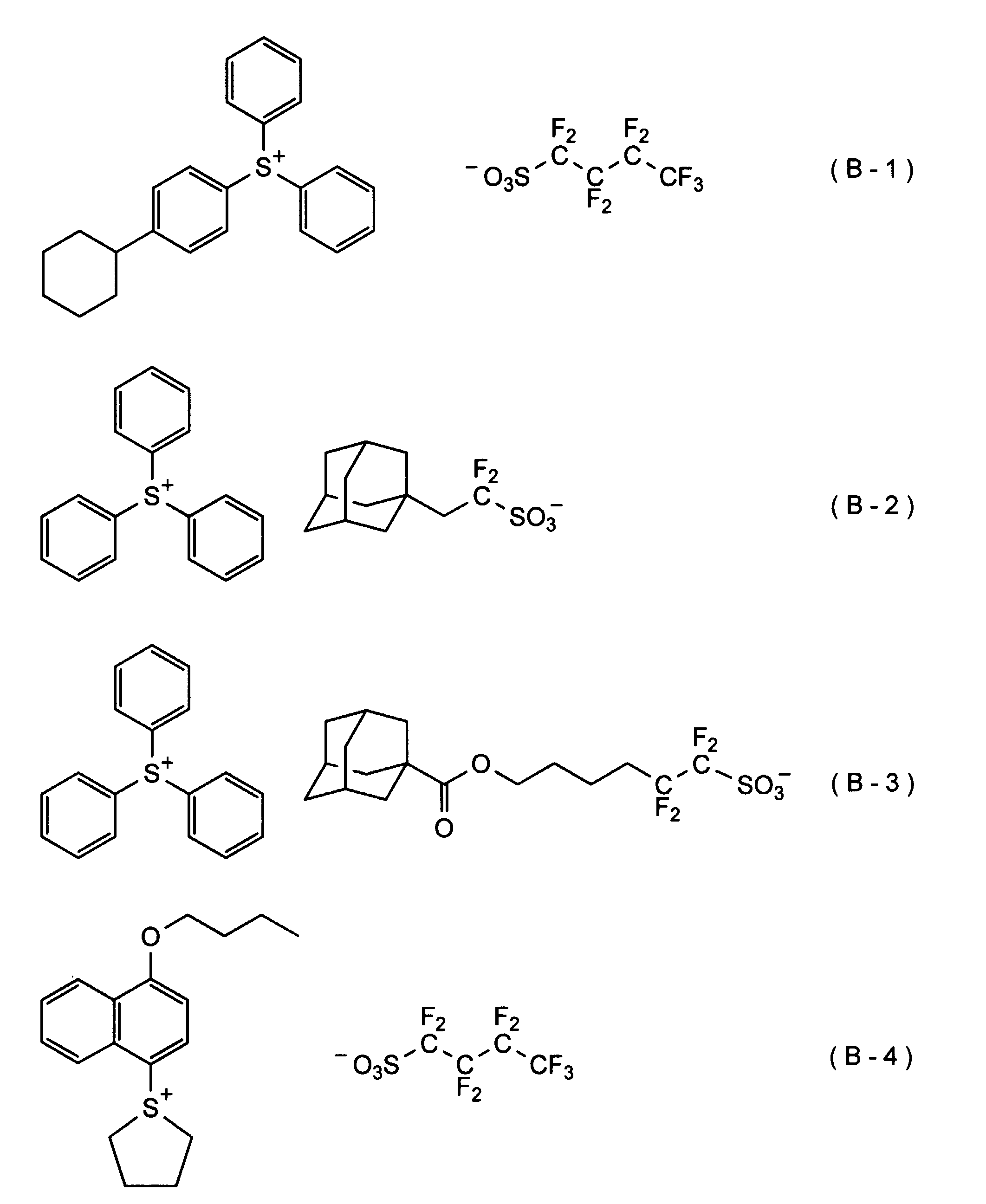

重合体(A-1)5.0質量部、酸発生剤(B-1)9.0質量部、重合体(C-1)100質量部、酸拡散制御剤(D-2)5.6質量部、添加剤としてγ-ブチロラクトン100質量部、及び溶媒としてプロピレングリコールモノメチルエーテルアセテート1,500質量部、シクロヘキサノン650質量部を混合して感放射線性樹脂組成物の組成物溶液を調製した。
表2に示す配合としたこと以外は実施例26と同様にして各感放射線性樹脂組成物の組成物溶液を調製し、それぞれ実施例27~47、比較例2とした。

実施例26~47及び比較例2の感放射線性樹脂組成物について以下のようにレジスト被膜を形成し、後退接触角及び現像欠陥についてそれぞれ下記方法により評価した。評価結果を表3に示す。
感放射線性樹脂組成物を用いて基板上に被膜を形成した。その後、形成した被膜について、室温23℃、湿度45%、常圧の環境下で、KRUS社のDSA-10を用いて以下の手順で後退接触角を測定した。
調製したレジストを23℃にて3ヶ月間保存し、上記の「SB後の後退接触角」の測定と同一の方法で後退接触角を測定し、その値を「3カ月保存接触角」とした。
下層反射防止膜(日産化学社、ARC66)を形成した12インチシリコンウェハ上に、感放射線性樹脂組成物によって膜厚110nmの被膜を形成し、120度で50秒間SBを行った。次に、この被膜についてArFエキシマレーザー液浸露光装置(NIKON社、NSR S610C)を用い、NA=1.3、ratio=0.800、Dipoleの条件により、ターゲットサイズが幅45nmのラインアンドスペース(1L/1S)のマスクパターンを介して露光した。露光後、95℃で50秒間PEBを行った。その後、東京エレクトロン株式会社製、クリーントラック「ACT8」の現像装置のGPノズルによって2.38質量%のテトラメチルアンモニウムヒドロキシド水溶液により10秒間現像し、15秒間純水によりリンスし、2,000rpmで液振り切り乾燥して、ポジ型のレジストパターンを形成した。このとき、幅45nmの1L/1Sを形成する露光量を最適露光量とした。この最適露光量にてウェハ全面に線幅45nmの1L/1Sを形成し、欠陥検査用ウェハとした。なお、測長には走査型電子顕微鏡(日立ハイテクノロジーズ社、CC-4000)を用いた。その後、欠陥検査用ウェハ上の欠陥数を、KLA-Tencor社、KLA2810を用いて測定した。更に、同社KLA2810にて測定された欠陥を、レジスト由来と判断されるものと外部由来の異物とに分類した。分類後、レジスト被膜由来と判断される欠陥数の合計が100個/wafer未満であった場合「A(良好)」とし、100個から500個/waferであった場合は「B(やや良好)」、500個/waferを超える場合は「C(不良)」とした。
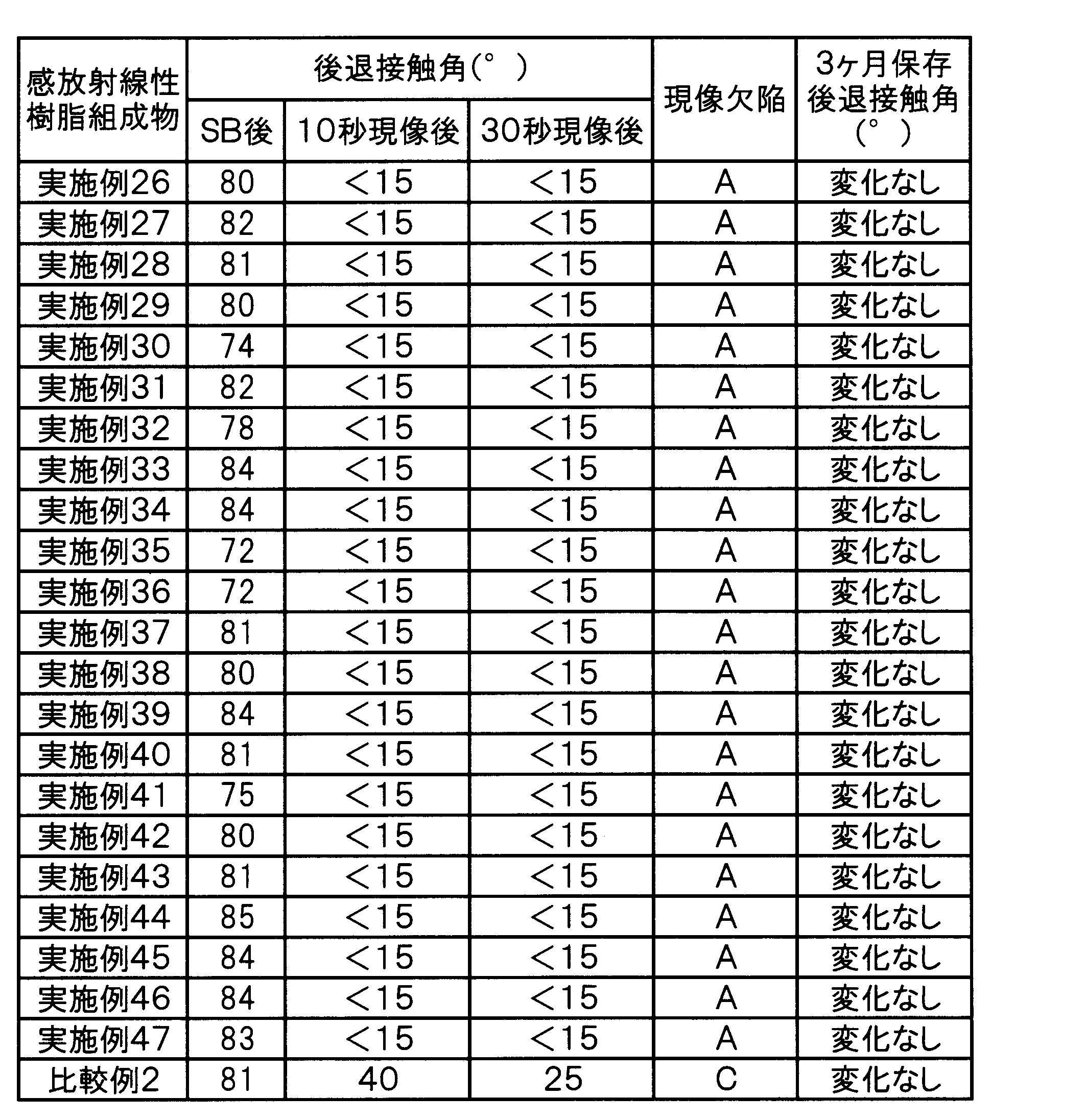
Claims (12)
- [A]下記式(1)で表される構造単位(I)を有する重合体、及び
[B]感放射線性酸発生体
を含有する感放射線性樹脂組成物。

- 上記構造単位(I)が、下記式(1-1)で表される構造単位(I-1)である請求項1に記載の感放射線性樹脂組成物。
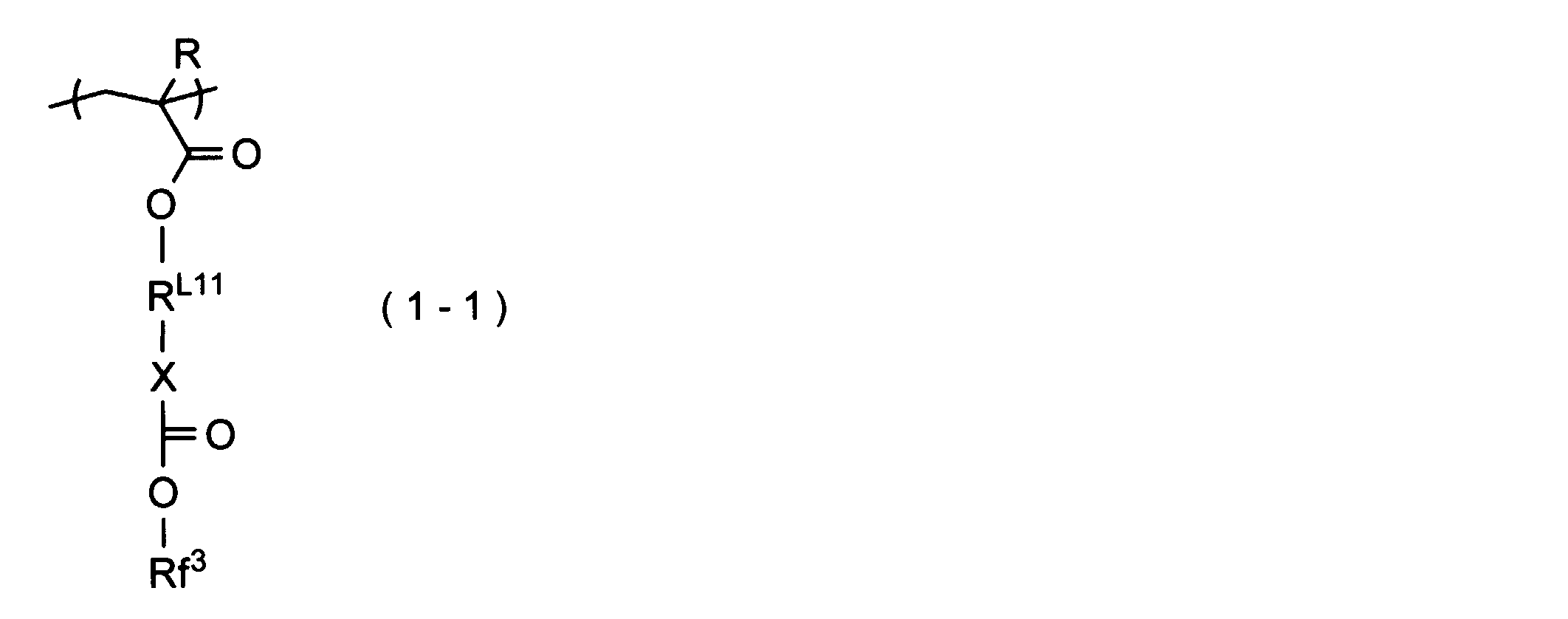
- 上記構造単位(I-1)が、下記式(1-1a)から(1-1e)でそれぞれ表される構造単位からなる群より選ばれる少なくとも1種である請求項2に記載の感放射線性樹脂組成物。
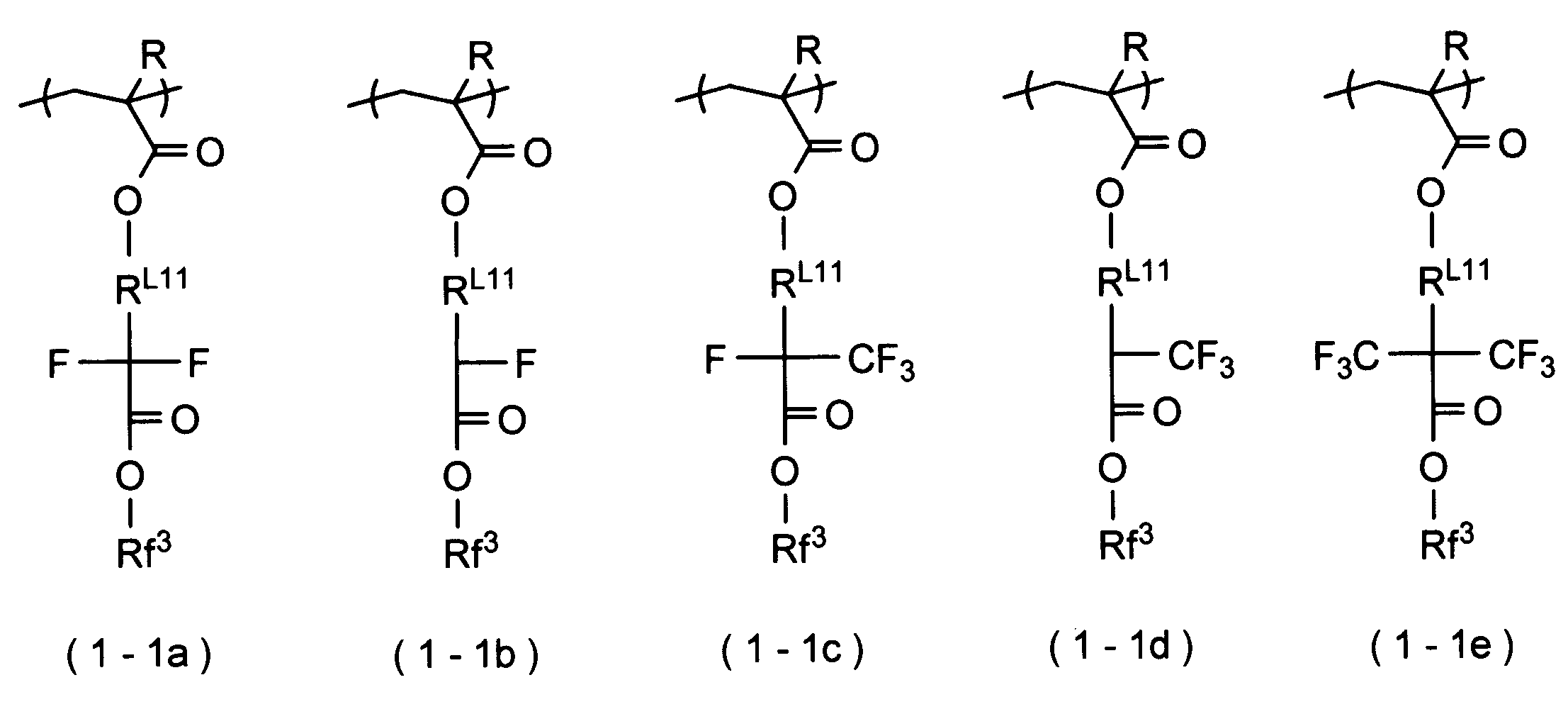
- 上記Rf3が、下記式(Rf3-a)から(Rf3-d)でそれぞれ表される基からなる群より選ばれる少なくとも1種である請求項1に記載の感放射線性樹脂組成物。

- 上記[A]重合体における構造単位(I)の含有率が30mol%以上100mol%以下である請求項1に記載の感放射線性樹脂組成物。
- 上記[A]重合体が、下記式(2)で表される構造単位(II)及び下記式(3)で表される構造単位(III)からなる群より選ばれる少なくとも1種の構造単位をさらに有する請求項1に記載の感放射線性樹脂組成物。

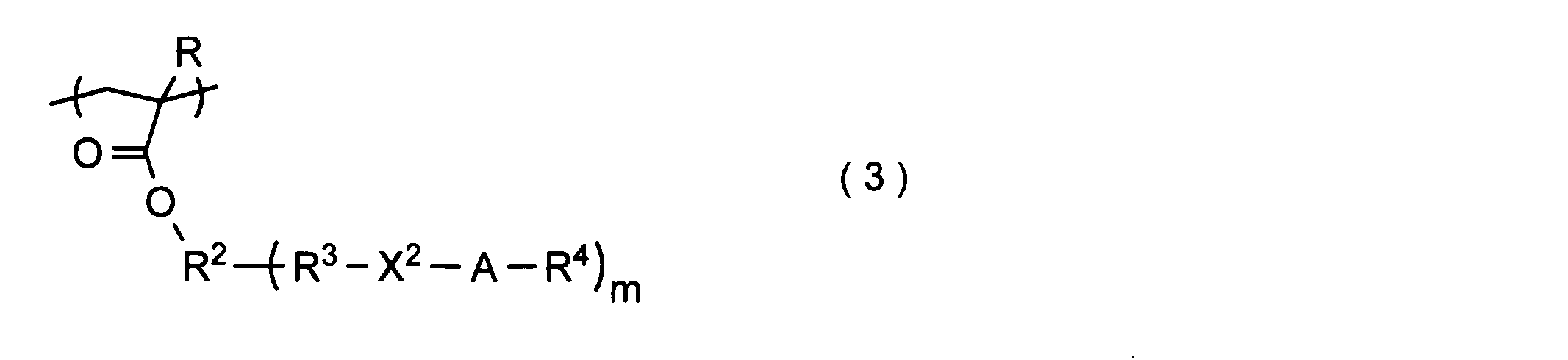
式(2)中、Gは単結合、酸素原子、硫黄原子、-CO-O-、-SO2-O-NH-、-CO-NH-、又は-O-CO-NH-である。R1は少なくとも1個のフッ素原子を有する炭素数1~6の1価の鎖状炭化水素基又は少なくとも1個のフッ素原子を有する炭素数4~20の1価の脂環式炭化水素基である。
式(3)中、R2は炭素数1~20の(m+1)価の炭化水素基であり、R2のR3側の末端に酸素原子、硫黄原子、-NR’-(但し、R’は水素原子又は1価の有機基である。)、カルボニル基、-CO-O-又は-CO-NH-が結合された構造のものも含む。R3は単結合、炭素数1~10の2価の鎖状炭化水素基又は炭素数4~20の2価の脂環式炭化水素基である。X2は単結合、又は少なくとも1個のフッ素原子を有する炭素数1~20の2価の鎖状炭化水素基である。Aは酸素原子、-NR’’-(但し、R’’は水素原子又は1価の有機基である。)、-CO-O-*又は-SO2-O-*(「*」はR4に結合する部位を示す。)である。R4は水素原子又は1価の有機基である。mは1~3の整数である。但し、mが2又は3の場合、複数のR3、X2、A及びR4は、それぞれ独立している。) - [C]上記[A]重合体よりもフッ素原子含有率の小さい重合体をさらに含有し、
この[C]重合体が酸解離性基を有する請求項1に記載の感放射線性樹脂組成物。 - 上記[A]重合体の含有量が、[C]重合体100質量部に対して0.1質量部以上10質量部以下である請求項7に記載の感放射線性樹脂組成物。
- (1)請求項1に記載の感放射線性樹脂組成物を用いて基板上にフォトレジスト膜を形成する工程、
(2)上記フォトレジスト膜を液浸露光する工程、及び
(3)上記液浸露光されたフォトレジスト膜を現像してレジストパターンを形成する工程
を有するレジストパターン形成方法。 - 下記式(1)で表される構造単位(I)を有する重合体。

- 下記式(2)で表される構造単位(II)及び下記式(3)で表される構造単位(III)からなる群より選ばれる少なくとも1種の構造単位をさらに有する請求項10に記載の重合体。


式(2)中、Gは単結合、酸素原子、硫黄原子、-CO-O-、-SO2-O-NH-、-CO-NH-、又は-O-CO-NH-である。R1は少なくとも1個のフッ素原子を有する炭素数1~6の1価の鎖状炭化水素基又は少なくとも1個のフッ素原子を有する炭素数4~20の1価の脂環式炭化水素基である。
式(3)中、R2は炭素数1~20の(m+1)価の炭化水素基であり、R2のR3側の末端に酸素原子、硫黄原子、-NR’-(但し、R’は水素原子又は1価の有機基である。)、カルボニル基、-CO-O-又は-CO-NH-が結合された構造のものも含む。R3は単結合、炭素数1~10の2価の鎖状炭化水素基又は炭素数4~20の2価の脂環式炭化水素基である。X2は単結合、又は少なくとも1個のフッ素原子を有する炭素数1~20の2価の鎖状炭化水素基である。Aは酸素原子、-NR’’-(但し、R’’は水素原子又は1価の有機基である。)、-CO-O-*又は-SO2-O-*(「*」はR4に結合する部位を示す。)である。R4は水素原子又は1価の有機基である。mは1~3の整数である。但し、mが2又は3の場合、複数のR3、X2、A及びR4はそれぞれ独立している。) - 下記式(i)で表される化合物。

Priority Applications (3)
| Application Number | Priority Date | Filing Date | Title |
|---|---|---|---|
| US13/699,003 US9261780B2 (en) | 2010-05-20 | 2011-05-19 | Radiation-sensitive resin composition, method for forming resist pattern, and polymer and compound |
| JP2012515932A JP5713011B2 (ja) | 2010-05-20 | 2011-05-19 | 感放射線性樹脂組成物、レジストパターン形成方法、重合体及び化合物 |
| KR1020127030188A KR101800043B1 (ko) | 2010-05-20 | 2011-05-19 | 감방사선성 수지 조성물, 레지스트 패턴 형성 방법, 중합체 및 화합물 |
Applications Claiming Priority (4)
| Application Number | Priority Date | Filing Date | Title |
|---|---|---|---|
| JP2010116771 | 2010-05-20 | ||
| JP2010-116771 | 2010-05-20 | ||
| JP2010184494 | 2010-08-19 | ||
| JP2010-184494 | 2010-08-19 |
Publications (1)
| Publication Number | Publication Date |
|---|---|
| WO2011145702A1 true WO2011145702A1 (ja) | 2011-11-24 |
Family
ID=44991793
Family Applications (2)
| Application Number | Title | Priority Date | Filing Date |
|---|---|---|---|
| PCT/JP2011/061587 Ceased WO2011145702A1 (ja) | 2010-05-20 | 2011-05-19 | 感放射線性樹脂組成物、レジストパターン形成方法、重合体及び化合物 |
| PCT/JP2011/061588 Ceased WO2011145703A1 (ja) | 2010-05-20 | 2011-05-19 | 感放射線性樹脂組成物、レジストパターン形成方法、重合体及び化合物 |
Family Applications After (1)
| Application Number | Title | Priority Date | Filing Date |
|---|---|---|---|
| PCT/JP2011/061588 Ceased WO2011145703A1 (ja) | 2010-05-20 | 2011-05-19 | 感放射線性樹脂組成物、レジストパターン形成方法、重合体及び化合物 |
Country Status (5)
| Country | Link |
|---|---|
| US (2) | US9040221B2 (ja) |
| JP (2) | JP5713011B2 (ja) |
| KR (2) | KR101786145B1 (ja) |
| TW (2) | TWI525389B (ja) |
| WO (2) | WO2011145702A1 (ja) |
Cited By (5)
| Publication number | Priority date | Publication date | Assignee | Title |
|---|---|---|---|---|
| JP2012078510A (ja) * | 2010-09-30 | 2012-04-19 | Jsr Corp | 感放射線性樹脂組成物及びその製造方法 |
| JP2012113302A (ja) * | 2010-11-15 | 2012-06-14 | Rohm & Haas Electronic Materials Llc | 塩基反応性成分を含む組成物およびフォトリソグラフィーのための方法 |
| US20120276482A1 (en) * | 2010-08-19 | 2012-11-01 | Jsr Corporation | Radiation sensitive resin composition, method for forming a pattern, polymer and compound |
| US9040221B2 (en) | 2010-05-20 | 2015-05-26 | Jsr Corporation | Radiation-sensitive resin composition, method for forming resist pattern, and polymer and compound |
| JP2015106089A (ja) * | 2013-11-29 | 2015-06-08 | 東京応化工業株式会社 | レジスト組成物、レジストパターン形成方法、高分子化合物及び化合物 |
Families Citing this family (7)
| Publication number | Priority date | Publication date | Assignee | Title |
|---|---|---|---|---|
| WO2012036250A1 (ja) * | 2010-09-17 | 2012-03-22 | Jsr株式会社 | 感放射線性樹脂組成物、重合体及びレジストパターン形成方法 |
| KR102252666B1 (ko) * | 2013-09-12 | 2021-05-18 | 제이에스알 가부시끼가이샤 | 수지 조성물, 레지스트 패턴 형성 방법 및 중합체 |
| WO2015046021A1 (ja) * | 2013-09-26 | 2015-04-02 | Jsr株式会社 | 感放射線性樹脂組成物及びレジストパターン形成方法 |
| WO2017065207A1 (ja) * | 2015-10-16 | 2017-04-20 | 東京応化工業株式会社 | レジスト組成物およびレジストパターン形成方法 |
| JP6459989B2 (ja) * | 2016-01-20 | 2019-01-30 | 信越化学工業株式会社 | レジスト材料及びパターン形成方法 |
| JP6902896B2 (ja) | 2017-03-29 | 2021-07-14 | 東京応化工業株式会社 | レジスト組成物、レジストパターン形成方法、含フッ素高分子化合物、及び化合物 |
| JP7803685B2 (ja) * | 2020-11-12 | 2026-01-21 | 住友化学株式会社 | 化合物、樹脂、レジスト組成物及びレジストパターンの製造方法 |
Citations (3)
| Publication number | Priority date | Publication date | Assignee | Title |
|---|---|---|---|---|
| JP2003183226A (ja) * | 2001-12-18 | 2003-07-03 | Chisso Corp | ジフルオロメチレンオキシを有する化合物およびその重合体 |
| JP2009139909A (ja) * | 2007-08-03 | 2009-06-25 | Tokyo Ohka Kogyo Co Ltd | 含フッ素化合物、液浸露光用レジスト組成物およびレジストパターン形成方法 |
| JP2009271442A (ja) * | 2008-05-09 | 2009-11-19 | Sumitomo Chemical Co Ltd | 感光性組成物 |
Family Cites Families (44)
| Publication number | Priority date | Publication date | Assignee | Title |
|---|---|---|---|---|
| US4491628A (en) | 1982-08-23 | 1985-01-01 | International Business Machines Corporation | Positive- and negative-working resist compositions with acid generating photoinitiator and polymer with acid labile groups pendant from polymer backbone |
| JPH0612452B2 (ja) | 1982-09-30 | 1994-02-16 | ブリュ−ワ−・サイエンス・インコ−ポレイテッド | 集積回路素子の製造方法 |
| JP2643056B2 (ja) | 1991-06-28 | 1997-08-20 | インターナショナル・ビジネス・マシーンズ・コーポレイション | 表面反射防止コーティング形成組成物及びその使用 |
| DE4142130A1 (de) | 1991-12-20 | 1993-06-24 | Basf Ag | Verwendung von polyacetalen auf basis von vinylethern und dihydroxyverbindungen in wasch- und reinigungsmitteln und polyacetale |
| US5336807A (en) | 1993-06-15 | 1994-08-09 | Air Products & Chemicals, Inc. | Crosslinking agents for coating and adhesive applications |
| JP4551701B2 (ja) | 2004-06-14 | 2010-09-29 | 富士フイルム株式会社 | 液浸露光用保護膜形成組成物及びそれを用いたパターン形成方法 |
| JP2006276458A (ja) | 2005-03-29 | 2006-10-12 | Fuji Photo Film Co Ltd | ポジ型レジスト組成物及びそれを用いたパターン形成方法 |
| JP4861767B2 (ja) | 2005-07-26 | 2012-01-25 | 富士フイルム株式会社 | ポジ型レジスト組成物およびそれを用いたパターン形成方法 |
| JP4881687B2 (ja) | 2005-12-09 | 2012-02-22 | 富士フイルム株式会社 | ポジ型レジスト組成物及びそれを用いたパターン形成方法 |
| CN101395189B (zh) | 2006-03-31 | 2013-07-17 | Jsr株式会社 | 含氟聚合物及其精制方法以及感放射线性树脂组合物 |
| JP2008088343A (ja) | 2006-10-04 | 2008-04-17 | Shin Etsu Chem Co Ltd | 高分子化合物、レジスト材料、及びパターン形成方法 |
| KR101004984B1 (ko) | 2007-08-03 | 2011-01-04 | 도오꾜오까고오교 가부시끼가이샤 | 불소 함유 화합물, 액침 노광용 레지스트 조성물 및레지스트 패턴 형성 방법 |
| KR101433565B1 (ko) | 2007-09-26 | 2014-08-27 | 제이에스알 가부시끼가이샤 | 액침용 상층막 형성용 조성물 및 액침용 상층막 및 포토레지스트 패턴 형성 방법 |
| TW200918495A (en) | 2007-10-15 | 2009-05-01 | Jsr Corp | Sulfone compound, sulfonate and radiation-sensitive resin composition |
| US8283106B2 (en) | 2007-11-01 | 2012-10-09 | Central Glass Company, Limited | Sulfonic acid salt and derivative thereof, photoacid generator agent, and resist material and pattern formation method using the photoacid generator agent |
| JP2009134088A (ja) | 2007-11-30 | 2009-06-18 | Jsr Corp | 感放射線性樹脂組成物 |
| JP5398248B2 (ja) | 2008-02-06 | 2014-01-29 | 東京応化工業株式会社 | 液浸露光用レジスト組成物およびそれを用いたレジストパターン形成方法 |
| JP5131482B2 (ja) | 2008-02-13 | 2013-01-30 | 信越化学工業株式会社 | ポジ型レジスト材料及びパターン形成方法 |
| JP5716397B2 (ja) | 2008-05-19 | 2015-05-13 | Jsr株式会社 | 感放射線性樹脂組成物、レジストパターン形成方法及びフォトレジスト膜 |
| WO2009142181A1 (ja) | 2008-05-19 | 2009-11-26 | Jsr株式会社 | 液浸露光用感放射線性樹脂組成物、重合体及びレジストパターン形成方法 |
| TW201013309A (en) | 2008-05-19 | 2010-04-01 | Jsr Corp | Radiation-sensitive resin composition, method for forming resist pattern and photoresist film |
| JP5401126B2 (ja) | 2008-06-11 | 2014-01-29 | 東京応化工業株式会社 | 液浸露光用レジスト組成物およびそれを用いたレジストパターン形成方法 |
| JP5172494B2 (ja) | 2008-06-23 | 2013-03-27 | 東京応化工業株式会社 | 液浸露光用レジスト組成物、レジストパターン形成方法、含フッ素高分子化合物 |
| JP5141459B2 (ja) | 2008-09-10 | 2013-02-13 | Jsr株式会社 | 感放射線性樹脂組成物 |
| TWI533082B (zh) | 2008-09-10 | 2016-05-11 | Jsr股份有限公司 | 敏輻射性樹脂組成物 |
| JP5629454B2 (ja) * | 2008-12-12 | 2014-11-19 | 富士フイルム株式会社 | 重合性化合物、ラクトン含有化合物、ラクトン含有化合物の製造方法、及び、該重合性化合物を重合させた高分子化合物 |
| JP5227846B2 (ja) | 2009-02-27 | 2013-07-03 | 東京応化工業株式会社 | ポジ型レジスト組成物、レジストパターン形成方法、高分子化合物 |
| JP5346627B2 (ja) | 2009-03-10 | 2013-11-20 | 東京応化工業株式会社 | ポジ型レジスト組成物及びレジストパターン形成方法 |
| JP5336890B2 (ja) | 2009-03-10 | 2013-11-06 | キヤノン株式会社 | 計測装置、露光装置及びデバイス製造方法 |
| JP5624786B2 (ja) | 2009-03-31 | 2014-11-12 | 富士フイルム株式会社 | 感活性光線性又は感放射線性樹脂組成物、並びに該組成物を用いたレジスト膜及びパターン形成方法 |
| JP5568354B2 (ja) | 2009-03-31 | 2014-08-06 | 富士フイルム株式会社 | 感活性光線性又は感放射線性樹脂組成物及びそれを用いたパターン形成方法 |
| JP5764300B2 (ja) | 2009-04-15 | 2015-08-19 | 富士フイルム株式会社 | 感活性光線または感放射線樹脂組成物及びそれを用いたパターン形成方法 |
| JP5386236B2 (ja) * | 2009-06-01 | 2014-01-15 | 東京応化工業株式会社 | ポジ型レジスト組成物及びレジストパターン形成方法 |
| JP2010275498A (ja) * | 2009-06-01 | 2010-12-09 | Central Glass Co Ltd | 含フッ素化合物、含フッ素高分子化合物、レジスト組成物、トップコート組成物及びパターン形成方法 |
| JP5629440B2 (ja) | 2009-08-31 | 2014-11-19 | 富士フイルム株式会社 | 感活性光線性または感放射線性樹脂組成物およびこれを用いたパターン形成方法 |
| KR101751555B1 (ko) | 2009-09-18 | 2017-07-11 | 제이에스알 가부시끼가이샤 | 감방사선성 수지 조성물, 레지스트 패턴 형성 방법, 중합체 및 중합성 화합물 |
| EP2510398A4 (en) | 2009-12-11 | 2013-04-24 | Rohm & Haas Elect Mat | COMPOSITIONS WITH BASIC REACTIVE COMPONENTS AND PHOTOLITHOGRAPHIC PROCESSES THEREWITH |
| JP5131488B2 (ja) | 2009-12-22 | 2013-01-30 | 信越化学工業株式会社 | 含フッ素単量体及び含フッ素高分子化合物 |
| JP5375811B2 (ja) | 2010-01-18 | 2013-12-25 | 信越化学工業株式会社 | 高分子化合物、レジスト材料、及びパターン形成方法 |
| JP2011227290A (ja) * | 2010-04-20 | 2011-11-10 | Tokyo Ohka Kogyo Co Ltd | 保護膜形成用材料及びレジストパターン形成方法 |
| JP2012001711A (ja) | 2010-05-17 | 2012-01-05 | Sumitomo Chemical Co Ltd | 化合物、樹脂及びレジスト組成物 |
| US9040221B2 (en) | 2010-05-20 | 2015-05-26 | Jsr Corporation | Radiation-sensitive resin composition, method for forming resist pattern, and polymer and compound |
| JP2011257613A (ja) | 2010-06-09 | 2011-12-22 | Fujifilm Corp | 感活性光線性又は感放射線性樹脂組組成物および該組成物を用いたパターン形成方法 |
| KR101769154B1 (ko) * | 2010-07-27 | 2017-08-17 | 제이에스알 가부시끼가이샤 | 감방사선성 수지 조성물, 레지스트 패턴 형성 방법, 중합체 및 화합물 |
-
2011
- 2011-05-19 US US13/699,007 patent/US9040221B2/en active Active
- 2011-05-19 WO PCT/JP2011/061587 patent/WO2011145702A1/ja not_active Ceased
- 2011-05-19 JP JP2012515932A patent/JP5713011B2/ja active Active
- 2011-05-19 KR KR1020127030189A patent/KR101786145B1/ko active Active
- 2011-05-19 US US13/699,003 patent/US9261780B2/en active Active
- 2011-05-19 JP JP2012515933A patent/JP5713012B2/ja active Active
- 2011-05-19 KR KR1020127030188A patent/KR101800043B1/ko active Active
- 2011-05-19 WO PCT/JP2011/061588 patent/WO2011145703A1/ja not_active Ceased
- 2011-05-20 TW TW100117806A patent/TWI525389B/zh active
- 2011-05-20 TW TW100117805A patent/TWI515511B/zh active
Patent Citations (3)
| Publication number | Priority date | Publication date | Assignee | Title |
|---|---|---|---|---|
| JP2003183226A (ja) * | 2001-12-18 | 2003-07-03 | Chisso Corp | ジフルオロメチレンオキシを有する化合物およびその重合体 |
| JP2009139909A (ja) * | 2007-08-03 | 2009-06-25 | Tokyo Ohka Kogyo Co Ltd | 含フッ素化合物、液浸露光用レジスト組成物およびレジストパターン形成方法 |
| JP2009271442A (ja) * | 2008-05-09 | 2009-11-19 | Sumitomo Chemical Co Ltd | 感光性組成物 |
Cited By (9)
| Publication number | Priority date | Publication date | Assignee | Title |
|---|---|---|---|---|
| US9040221B2 (en) | 2010-05-20 | 2015-05-26 | Jsr Corporation | Radiation-sensitive resin composition, method for forming resist pattern, and polymer and compound |
| US9261780B2 (en) | 2010-05-20 | 2016-02-16 | Jsr Corporation | Radiation-sensitive resin composition, method for forming resist pattern, and polymer and compound |
| US20120276482A1 (en) * | 2010-08-19 | 2012-11-01 | Jsr Corporation | Radiation sensitive resin composition, method for forming a pattern, polymer and compound |
| US8765355B2 (en) * | 2010-08-19 | 2014-07-01 | Jsr Corporation | Radiation sensitive resin composition, method for forming a pattern, polymer and compound |
| JP2012078510A (ja) * | 2010-09-30 | 2012-04-19 | Jsr Corp | 感放射線性樹脂組成物及びその製造方法 |
| JP2012113302A (ja) * | 2010-11-15 | 2012-06-14 | Rohm & Haas Electronic Materials Llc | 塩基反応性成分を含む組成物およびフォトリソグラフィーのための方法 |
| JP2016066095A (ja) * | 2010-11-15 | 2016-04-28 | ローム アンド ハース エレクトロニック マテリアルズ エルエルシーRohm and Haas Electronic Materials LLC | 塩基反応性成分を含む組成物およびフォトリソグラフィーのための方法 |
| JP2018072843A (ja) * | 2010-11-15 | 2018-05-10 | ローム アンド ハース エレクトロニック マテリアルズ エルエルシーRohm and Haas Electronic Materials LLC | 塩基反応性成分を含む組成物およびフォトリソグラフィーのための方法 |
| JP2015106089A (ja) * | 2013-11-29 | 2015-06-08 | 東京応化工業株式会社 | レジスト組成物、レジストパターン形成方法、高分子化合物及び化合物 |
Also Published As
| Publication number | Publication date |
|---|---|
| KR20130103324A (ko) | 2013-09-23 |
| KR20130090760A (ko) | 2013-08-14 |
| KR101800043B1 (ko) | 2017-11-21 |
| JPWO2011145702A1 (ja) | 2013-07-22 |
| US20140004463A9 (en) | 2014-01-02 |
| KR101786145B1 (ko) | 2017-10-17 |
| JPWO2011145703A1 (ja) | 2013-07-22 |
| TW201144936A (en) | 2011-12-16 |
| WO2011145703A1 (ja) | 2011-11-24 |
| TW201202843A (en) | 2012-01-16 |
| TWI525389B (zh) | 2016-03-11 |
| US20130122426A1 (en) | 2013-05-16 |
| US20130143160A1 (en) | 2013-06-06 |
| US9040221B2 (en) | 2015-05-26 |
| JP5713011B2 (ja) | 2015-05-07 |
| US9261780B2 (en) | 2016-02-16 |
| TWI515511B (zh) | 2016-01-01 |
| JP5713012B2 (ja) | 2015-05-07 |
Similar Documents
| Publication | Publication Date | Title |
|---|---|---|
| JP5713011B2 (ja) | 感放射線性樹脂組成物、レジストパターン形成方法、重合体及び化合物 | |
| JP5655855B2 (ja) | 感放射線性樹脂組成物、レジストパターン形成方法、重合体及び化合物 | |
| JP6720514B2 (ja) | 感放射線性樹脂組成物及びレジストパターン形成方法 | |
| JP5692229B2 (ja) | 感放射線性樹脂組成物、重合体及び化合物 | |
| JP5741297B2 (ja) | 感放射線性樹脂組成物、レジストパターン形成方法及び重合体 | |
| JP5724798B2 (ja) | 感放射線性樹脂組成物及びそれにより形成されるレジスト被膜 | |
| JP5741287B2 (ja) | 感放射線性樹脂組成物及びレジストパターン形成方法 | |
| JP5728884B2 (ja) | 感放射線性樹脂組成物及びその製造方法 | |
| US8603726B2 (en) | Radiation-sensitive resin composition, polymer and compound | |
| JP5747468B2 (ja) | 感放射線性樹脂組成物及びその製造方法 | |
| JP5728883B2 (ja) | 感放射線性樹脂組成物 | |
| JP5985792B2 (ja) | 感放射線性樹脂組成物及びその製造方法 | |
| JP2020064305A (ja) | 酸拡散制御剤及び化合物 |
Legal Events
| Date | Code | Title | Description |
|---|---|---|---|
| 121 | Ep: the epo has been informed by wipo that ep was designated in this application |
Ref document number: 11783636 Country of ref document: EP Kind code of ref document: A1 |
|
| WWE | Wipo information: entry into national phase |
Ref document number: 2012515932 Country of ref document: JP |
|
| ENP | Entry into the national phase |
Ref document number: 20127030188 Country of ref document: KR Kind code of ref document: A |
|
| NENP | Non-entry into the national phase |
Ref country code: DE |
|
| WWE | Wipo information: entry into national phase |
Ref document number: 13699003 Country of ref document: US |
|
| 122 | Ep: pct application non-entry in european phase |
Ref document number: 11783636 Country of ref document: EP Kind code of ref document: A1 |