WO2011125876A1 - 液晶配向剤、液晶配向膜及び液晶表示素子 - Google Patents
液晶配向剤、液晶配向膜及び液晶表示素子 Download PDFInfo
- Publication number
- WO2011125876A1 WO2011125876A1 PCT/JP2011/058287 JP2011058287W WO2011125876A1 WO 2011125876 A1 WO2011125876 A1 WO 2011125876A1 JP 2011058287 W JP2011058287 W JP 2011058287W WO 2011125876 A1 WO2011125876 A1 WO 2011125876A1
- Authority
- WO
- WIPO (PCT)
- Prior art keywords
- liquid crystal
- group
- formula
- aligning agent
- side chain
- Prior art date
- Legal status (The legal status is an assumption and is not a legal conclusion. Google has not performed a legal analysis and makes no representation as to the accuracy of the status listed.)
- Ceased
Links
- 0 C*C(C(C)=C)Cl Chemical compound C*C(C(C)=C)Cl 0.000 description 1
- HGAJBHSITOENMF-UHFFFAOYSA-N CC(C(OCCCCCCOc(cc1)ccc1-c(cc1)ccc1OC)=O)=C Chemical compound CC(C(OCCCCCCOc(cc1)ccc1-c(cc1)ccc1OC)=O)=C HGAJBHSITOENMF-UHFFFAOYSA-N 0.000 description 1
- DZAPEPIBAAMUIJ-UHFFFAOYSA-N COc(cc1)ccc1-c(cc1)ccc1OCCCCCCO Chemical compound COc(cc1)ccc1-c(cc1)ccc1OCCCCCCO DZAPEPIBAAMUIJ-UHFFFAOYSA-N 0.000 description 1
Classifications
-
- G—PHYSICS
- G02—OPTICS
- G02F—OPTICAL DEVICES OR ARRANGEMENTS FOR THE CONTROL OF LIGHT BY MODIFICATION OF THE OPTICAL PROPERTIES OF THE MEDIA OF THE ELEMENTS INVOLVED THEREIN; NON-LINEAR OPTICS; FREQUENCY-CHANGING OF LIGHT; OPTICAL LOGIC ELEMENTS; OPTICAL ANALOGUE/DIGITAL CONVERTERS
- G02F1/00—Devices or arrangements for the control of the intensity, colour, phase, polarisation or direction of light arriving from an independent light source, e.g. switching, gating or modulating; Non-linear optics
- G02F1/01—Devices or arrangements for the control of the intensity, colour, phase, polarisation or direction of light arriving from an independent light source, e.g. switching, gating or modulating; Non-linear optics for the control of the intensity, phase, polarisation or colour
- G02F1/13—Devices or arrangements for the control of the intensity, colour, phase, polarisation or direction of light arriving from an independent light source, e.g. switching, gating or modulating; Non-linear optics for the control of the intensity, phase, polarisation or colour based on liquid crystals, e.g. single liquid crystal display cells
- G02F1/133—Constructional arrangements; Operation of liquid crystal cells; Circuit arrangements
- G02F1/1333—Constructional arrangements; Manufacturing methods
- G02F1/1337—Surface-induced orientation of the liquid crystal molecules, e.g. by alignment layers
- G02F1/13378—Surface-induced orientation of the liquid crystal molecules, e.g. by alignment layers by treatment of the surface, e.g. embossing, rubbing or light irradiation
- G02F1/133788—Surface-induced orientation of the liquid crystal molecules, e.g. by alignment layers by treatment of the surface, e.g. embossing, rubbing or light irradiation by light irradiation, e.g. linearly polarised light photo-polymerisation
-
- C—CHEMISTRY; METALLURGY
- C08—ORGANIC MACROMOLECULAR COMPOUNDS; THEIR PREPARATION OR CHEMICAL WORKING-UP; COMPOSITIONS BASED THEREON
- C08F—MACROMOLECULAR COMPOUNDS OBTAINED BY REACTIONS ONLY INVOLVING CARBON-TO-CARBON UNSATURATED BONDS
- C08F220/00—Copolymers of compounds having one or more unsaturated aliphatic radicals, each having only one carbon-to-carbon double bond, and only one being terminated by only one carboxyl radical or a salt, anhydride ester, amide, imide or nitrile thereof
- C08F220/02—Monocarboxylic acids having less than ten carbon atoms; Derivatives thereof
- C08F220/10—Esters
- C08F220/26—Esters containing oxygen in addition to the carboxy oxygen
- C08F220/30—Esters containing oxygen in addition to the carboxy oxygen containing aromatic rings in the alcohol moiety
- C08F220/303—Esters containing oxygen in addition to the carboxy oxygen containing aromatic rings in the alcohol moiety and one or more carboxylic moieties in the chain
-
- C—CHEMISTRY; METALLURGY
- C08—ORGANIC MACROMOLECULAR COMPOUNDS; THEIR PREPARATION OR CHEMICAL WORKING-UP; COMPOSITIONS BASED THEREON
- C08G—MACROMOLECULAR COMPOUNDS OBTAINED OTHERWISE THAN BY REACTIONS ONLY INVOLVING UNSATURATED CARBON-TO-CARBON BONDS
- C08G73/00—Macromolecular compounds obtained by reactions forming a linkage containing nitrogen with or without oxygen or carbon in the main chain of the macromolecule, not provided for in groups C08G12/00 - C08G71/00
- C08G73/06—Polycondensates having nitrogen-containing heterocyclic rings in the main chain of the macromolecule
- C08G73/10—Polyimides; Polyester-imides; Polyamide-imides; Polyamide acids or similar polyimide precursors
-
- C—CHEMISTRY; METALLURGY
- C08—ORGANIC MACROMOLECULAR COMPOUNDS; THEIR PREPARATION OR CHEMICAL WORKING-UP; COMPOSITIONS BASED THEREON
- C08L—COMPOSITIONS OF MACROMOLECULAR COMPOUNDS
- C08L79/00—Compositions of macromolecular compounds obtained by reactions forming in the main chain of the macromolecule a linkage containing nitrogen with or without oxygen or carbon only, not provided for in groups C08L61/00 - C08L77/00
- C08L79/04—Polycondensates having nitrogen-containing heterocyclic rings in the main chain; Polyhydrazides; Polyamide acids or similar polyimide precursors
- C08L79/08—Polyimides; Polyester-imides; Polyamide-imides; Polyamide acids or similar polyimide precursors
-
- G—PHYSICS
- G02—OPTICS
- G02F—OPTICAL DEVICES OR ARRANGEMENTS FOR THE CONTROL OF LIGHT BY MODIFICATION OF THE OPTICAL PROPERTIES OF THE MEDIA OF THE ELEMENTS INVOLVED THEREIN; NON-LINEAR OPTICS; FREQUENCY-CHANGING OF LIGHT; OPTICAL LOGIC ELEMENTS; OPTICAL ANALOGUE/DIGITAL CONVERTERS
- G02F1/00—Devices or arrangements for the control of the intensity, colour, phase, polarisation or direction of light arriving from an independent light source, e.g. switching, gating or modulating; Non-linear optics
- G02F1/01—Devices or arrangements for the control of the intensity, colour, phase, polarisation or direction of light arriving from an independent light source, e.g. switching, gating or modulating; Non-linear optics for the control of the intensity, phase, polarisation or colour
- G02F1/13—Devices or arrangements for the control of the intensity, colour, phase, polarisation or direction of light arriving from an independent light source, e.g. switching, gating or modulating; Non-linear optics for the control of the intensity, phase, polarisation or colour based on liquid crystals, e.g. single liquid crystal display cells
- G02F1/133—Constructional arrangements; Operation of liquid crystal cells; Circuit arrangements
- G02F1/1333—Constructional arrangements; Manufacturing methods
- G02F1/1337—Surface-induced orientation of the liquid crystal molecules, e.g. by alignment layers
- G02F1/133711—Surface-induced orientation of the liquid crystal molecules, e.g. by alignment layers by organic films, e.g. polymeric films
Definitions
- the present invention relates to a liquid crystal alignment agent, a liquid crystal alignment film, and a liquid crystal display element that are capable of forming a liquid crystal alignment film that is excellent in response speed and obtains a good alignment state.
- VA vertical alignment
- MVA Multi Vertical Alignment
- TFT Thin Film Transistor
- ITO Indium Tin Oxide
- a PVA (Patterned Vertical Alignment) system is known in which a slit is formed in an electrode and the direction in which the liquid crystal is tilted is controlled by an electric field.
- a PSA (Polymer Sustained Alignment) system As a VA liquid crystal display element, a PSA (Polymer Sustained Alignment) system is also known. This method is a technology that has attracted attention in recent years in the VA method.
- a pair of substrates having a liquid crystal alignment layer (vertical alignment layer) on the surface are opposed to each other so that the liquid crystal alignment layer faces inward, and liquid crystal with a photopolymerizable compound added is injected between the substrates.
- liquid crystal with a photopolymerizable compound added is injected between the substrates.
- an electric field is applied and ultraviolet rays (UV) are irradiated in a state where the liquid crystal is tilted, the polymerizable compound is polymerized and the alignment direction of the liquid crystal is fixed in a desired direction.
- UV ultraviolet rays
- a vertical alignment film is used as the liquid crystal alignment layer on the substrate.
- This vertical alignment film is based on polyimide (or its precursor polyamic acid), etc., and in order to achieve vertical alignment of the liquid crystal layer, a hydrophobic structure such as a long-chain alkyl group or fluorine-containing group in the polyimide.
- a hydrophobic structure such as a long-chain alkyl group or fluorine-containing group in the polyimide.
- Patent Document 2 it is known to introduce a structure that realizes vertical alignment.
- JP 2004-302061 A Japanese Patent Laid-Open No. 06-003678
- the solubility of this polymerizable compound is generally low, and there is a problem that when the addition amount is increased, it precipitates from the liquid crystal layer at a low temperature.
- the addition amount of the polymerizable compound is reduced, a good alignment state cannot be obtained.
- the unreacted polymerizable compound remaining in the liquid crystal becomes an impurity (contamination) in the liquid crystal, resulting in a problem that the reliability of the liquid crystal display element is lowered.
- the present invention has been made in view of these points, and an object of the present invention is to provide a liquid crystal alignment that is excellent in response speed and obtains a good alignment state even in a liquid crystal display element in which a polymerizable compound is not added to the liquid crystal.
- a liquid crystal alignment agent capable of forming a film, a liquid crystal alignment film obtained from the liquid crystal alignment agent, and a liquid crystal display element having the liquid crystal alignment film are also objects and advantages of the present invention.
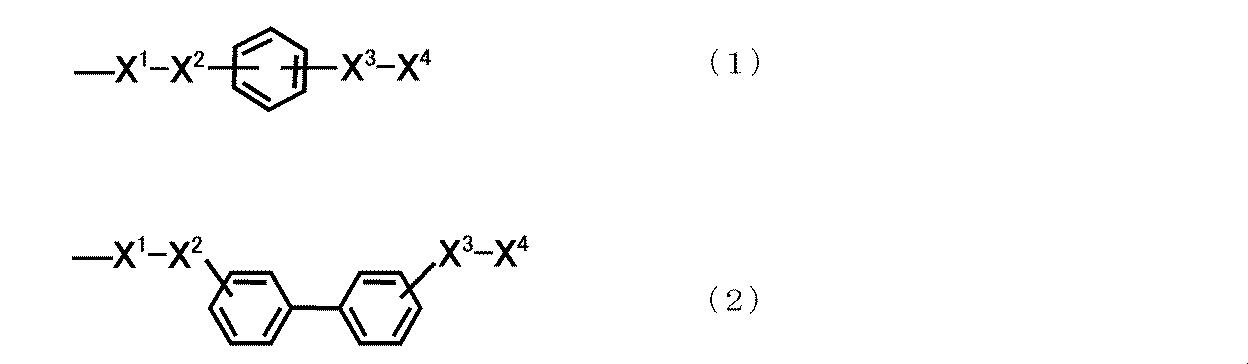
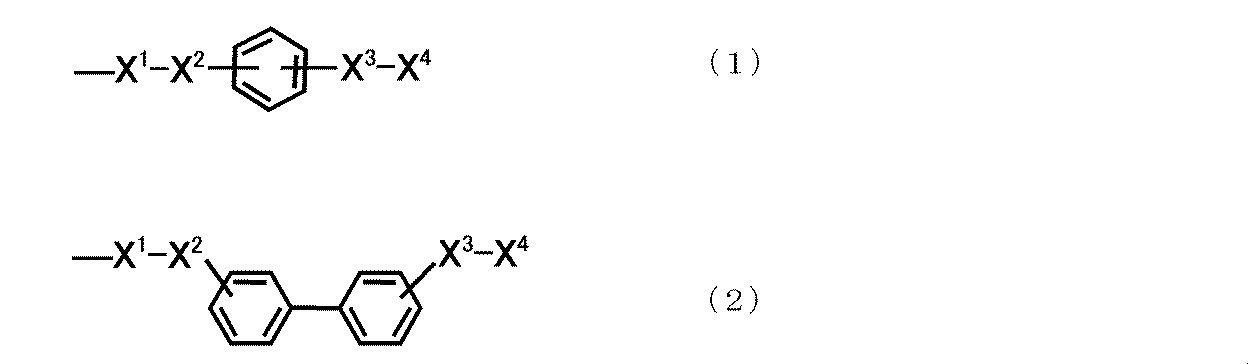
- the present invention achieves the above object, and has the following gist. 1. It contains a polymer having at least one side chain selected from the group consisting of a side chain represented by formula (1) and a side chain represented by formula (2), and a photoreactive group. A liquid crystal aligning agent.
- X 1 is an alkylene group having 1 to 20 carbon atoms
- X 2 and X 3 are each independently selected from the group consisting of a single bond, ether and ester.
- a bonding group and X 4 is an alkyl group having 1 to 20 carbon atoms.
- X 6 is an alkylene group having a carbon number of 1 ⁇ 20, X 6 is unsubstituted or cyano, optionally substituted by halogen .
- X 7 is a single bond, -O -, - COO -, - NR 1 CO -, - NR 1 -, or -NR 1 CONR 1 - is a linking group, R 1 is an alkyl group having a hydrogen atom or an atom number of 1 to 4
- X 8 is a cinnamoyl group or a derivative thereof, a chalcone group, a coumarin group, a maleimide group, or an anthracene group. 3.
- the polymer is a polymer obtained by polymerizing at least one compound selected from the group consisting of unsaturated carboxylic acid, acrylic ester, methacrylic ester, maleimide, acrylonitrile, maleic anhydride, styrene and vinyl compounds. 5.
- a monomer having at least one side chain selected from the group consisting of a side chain represented by formula (1) and a side chain represented by formula (2), and a monomer having a photoreactive group;
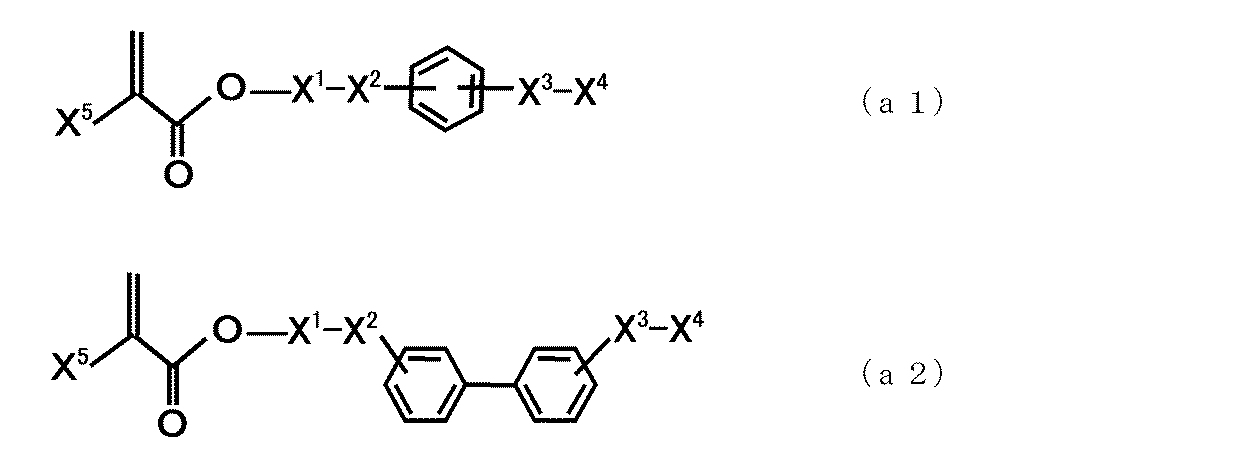
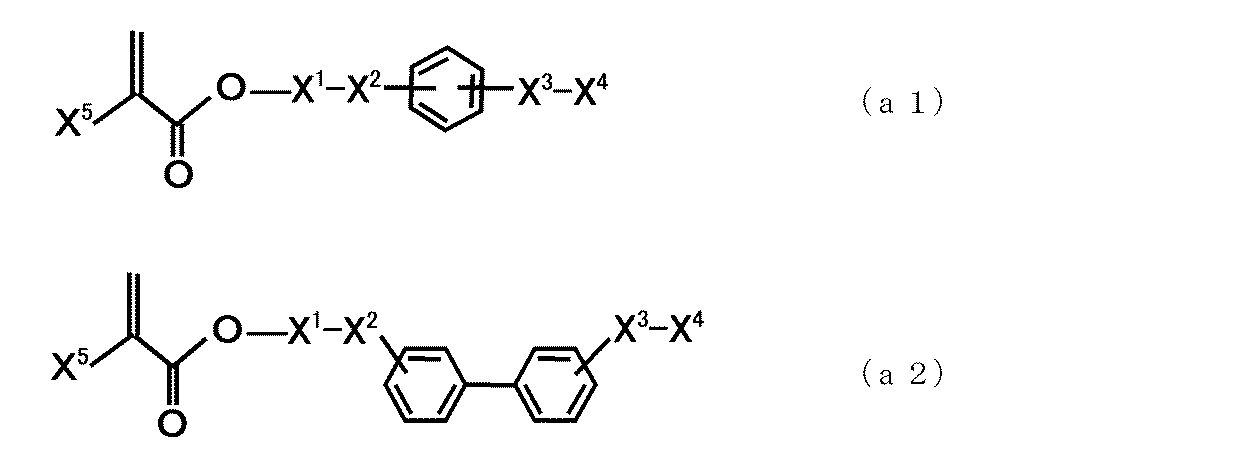
- a monomer having at least one side chain selected from the group consisting of the side chain represented by the formula (1) and the side chain represented by the formula (2) is a compound and a formula represented by the following formula (a1): 8.
- X 1 is an alkylene group having 1 to 20 carbon atoms
- X 2 and X 3 are each independently a linking group selected from the group consisting of a single bond, ether and ester.
- X 4 is an alkyl group having 1 to 20 carbon atoms
- X 5 is hydrogen or CH 3.
- a liquid crystal aligning agent that can form a liquid crystal aligning film that is excellent in response speed and can obtain a good alignment state even in a liquid crystal display element in which no polymerizable compound is added to the liquid crystal, and obtained from this liquid crystal aligning agent.
- a liquid crystal alignment film and a liquid crystal display element having the liquid crystal alignment film are provided.
- the liquid crystal aligning agent of this invention contains the polymer which has at least one of the side chain represented by Formula (1), and the side chain represented by Formula (2), and a photoreactive group.
- X 1 is an alkylene group having 1 to 20 carbon atoms, preferably 4 to 10 carbon atoms.
- X 1 is an alkylene group which is unsubstituted or monosubstituted or polysubstituted by cyano or halogen.
- X 1 is more preferably a linear alkylene group.
- X 2 and X 3 are each independently a single bond, —O—, or COO—.
- X 4 is a hydrogen atom or an alkyl group having 1 to 20 carbon atoms, preferably 4 to 12 carbon atoms.
- X 4 is an alkyl group which is unsubstituted or monosubstituted or polysubstituted by cyano or halogen.
- X 4 is more preferably a linear alkyl group.
- X 1 is an alkylene group having 1 to 20 carbon atoms, preferably 4 to 10 carbon atoms.
- X 1 is an alkylene group which is unsubstituted or monosubstituted or polysubstituted by cyano or halogen.
- X 1 is more preferably a linear alkylene group.
- X 2 and X 3 are each independently a single bond, —O—, or COO—.
- X 2 and X 3 are each independently a single bond, —O—, or COO—.
- X 4 is a hydrogen atom or an alkyl group having 1 to 20 carbon atoms, preferably 4 to 12 carbon atoms.
- X 4 is an alkyl group which is unsubstituted or monosubstituted or polysubstituted by cyano or halogen.
- X 4 is more preferably a linear alkyl group.
- Preferred examples of the side chain represented by the formula (2) are those in which the phenylene group is substituted with a biphenylene group in the preferred example of the side chain of the formula (1).
- the photoreactive group is not particularly limited as long as it causes a crosslinking reaction by light.
- the preferable photoreactive group is represented by Formula (3).
- X 6 is an alkylene group having 1 to 20 carbon atoms, preferably 4 to 10 carbon atoms.
- X 6 is an alkylene group which is unsubstituted, monosubstituted by cyano or halogen, or polysubstituted.
- X 6 is preferably a linear alkylene group.
- X 7 represents a single bond or O -, - COO -, - NR 1 CO -, - NR 1 -, - NR 1 CONR 1 - is a linking group such as.
- R 1 in the bonding group is a hydrogen atom or an alkyl group having 1 to 4 carbon atoms.
- X 8 is a photocrosslinkable photoreactive group.
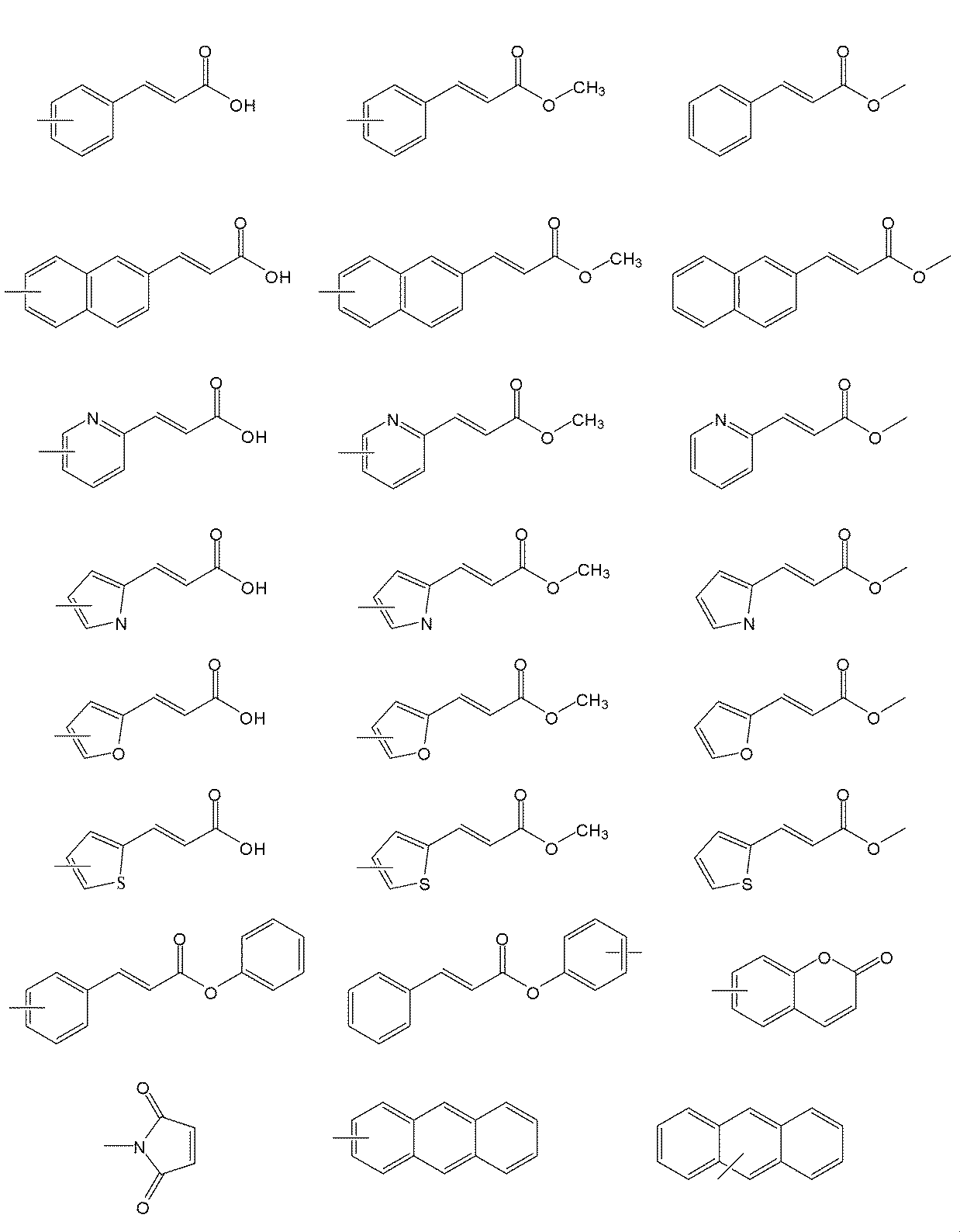
- Examples of the photoreactive group include a cinnamoyl group or a derivative thereof, a chalcone group, a coumarin group, a maleimide group, and an anthracene group. Of these, a cinnamoyl group or a derivative group thereof, or an anthracene group is preferable.
- photoreactive group examples include the structures shown below.
- the polymer contained in the liquid crystal aligning agent of this invention will not be specifically limited if it is a polymer of the structure which contains at least one of Formula (1) and Formula (2), and Formula (3) in a side chain. Preferably, it has a main chain and a side chain bonded to the main chain.
- a polymer is preferably a polymer produced by addition polymerization from the viewpoint of a polymerization reaction, for example.
- such a polymer has an unsaturated carboxylic acid such as acrylic acid or methacrylic acid, an acrylic ester compound, a methacrylic ester compound, a maleimide compound, acrylonitrile, a maleic anhydride, a styrene compound, in terms of the monomer species.
- an acrylic polymer or copolymer such as an unsaturated carboxylic acid such as acrylic acid or methacrylic acid, an acrylic ester compound, or a methacrylic ester compound is preferable.
- the acrylic copolymer is preferably a copolymer of the monomer of the formula (4) having the structure represented by the formula (1) and the monomer of the formula (5) including the structure represented by the formula (3). It is obtained by doing. It can also be obtained by copolymerizing the monomer of formula (6) having the structure represented by formula (2) with the monomer of formula (5). Furthermore, it can also be obtained by copolymerizing the monomer of formula (4) and the monomer of formula (6) with the monomer of formula (5). That is, the acrylic copolymer is obtained by copolymerizing at least one selected from the group consisting of the monomer of formula (4) and the monomer of formula (6) with the monomer of formula (5).
- Such an acrylic copolymer is obtained by copolymerization with the monomer a3 represented by the formula (a3) using at least one of the monomer a1 represented by the formula (a1) and the monomer a2 represented by the formula (a2).
- X 1 to X 4 and X 5 to X 8 are as defined above.
- X 5 is hydrogen or CH 3 .
- a preferred example of the monomer a2 is a monomer obtained by substituting a phenylene group with a biphenylene group in the preferred example of the monomer a1 shown below.
- the acrylate compound corresponding to the monomer a1 represented by the formula (a1) is commercially available. Alternatively, it can also be obtained by reacting acrylic acid chloride or methacrylic acid chloride with a compound represented by formula (7) having a hydroxy group in formula (1) in the presence of an alkali.
- the compound represented by formula (7) is commercially available. Alternatively, it can also be obtained by reacting the compound of formula (8) with the compound of formula (9) in the presence of an alkali such as KI or K 2 CO 3 .
- the acrylate compound corresponding to monomer a2 is commercially available. Alternatively, it can also be obtained by reacting acrylic acid chloride or methacrylic acid chloride with a compound represented by formula (10) having a hydroxy group in formula (2) in the presence of an alkali.
- the compound of formula (10) can be easily synthesized by a known method using biphenol as a starting material.
- the acrylic copolymer contained in the liquid crystal aligning agent of the present invention (hereinafter referred to as copolymer (A)) is a monomer having at least one of monomer a1 and monomer a2 and a photoreactive group in the side chain. a copolymer containing a3, and a polymer obtained by copolymerizing other monomers.
- the molecular weight of this polymer is not particularly limited, but is preferably 1,000 to 200,000, more preferably 4 in terms of polyethylene-based weight average molecular weight, from the viewpoint of ease of handling and stability of characteristics when a film is formed. , 50,000 to 50,000.
- the weight average molecular weight is a value determined by GPC (Gel Permeation Chromatography).
- the monomer species for obtaining the copolymer (A) one or more monomers other than the above-described monomers (hereinafter referred to as other monomers) can be used in combination.
- Other monomers are not particularly limited as long as they can be copolymerized with monomer a1, monomer a2, and monomer a3, as long as the properties of the copolymer (A) are not impaired.
- the other monomer examples include unsaturated carboxylic acid, acrylic ester compound, methacrylic ester compound, maleimide compound, acrylonitrile, maleic anhydride, styrene compound and vinyl compound.
- unsaturated carboxylic acid examples include acrylic acid, methacrylic acid, itaconic acid, maleic acid, fumaric acid and the like.
- acrylic ester compounds examples include methyl acrylate, ethyl acrylate, isopropyl acrylate, benzyl acrylate, naphthyl acrylate, anthryl acrylate, anthryl methyl acrylate, phenyl acrylate, 2,2,2-trifluoroethyl acrylate, tert- Butyl acrylate, cyclohexyl acrylate, isobornyl acrylate, 2-methoxyethyl acrylate, methoxytriethylene glycol acrylate, 2-ethoxyethyl acrylate, tetrahydrofurfuryl acrylate, 3-methoxybutyl acrylate, 2-methyl-2-adamantyl acrylate, 2 -Propyl-2-adamantyl acrylate, 8-methyl-8-tricyclodecyl acrylate And 8-ethyl-8-tricyclodecyl acrylate.
- methacrylic acid ester compound examples include methyl methacrylate, ethyl methacrylate, isopropyl methacrylate, benzyl methacrylate, naphthyl methacrylate, anthryl methacrylate, anthryl methyl methacrylate, phenyl methacrylate, 2,2,2-trifluoroethyl methacrylate, tert- Butyl methacrylate, cyclohexyl methacrylate, isobornyl methacrylate, 2-methoxyethyl methacrylate, methoxytriethylene glycol methacrylate, 2-ethoxyethyl methacrylate, tetrahydrofurfuryl methacrylate, 3-methoxybutyl methacrylate, 2-methyl-2-adamantyl methacrylate, 2 -Propyl-2-adamantyl methacrylate, 8 Methyl-8-tricyclodecyl methacrylate, 8-e
- Examples of the vinyl compound include vinyl ether, methyl vinyl ether, benzyl vinyl ether, 2-hydroxyethyl vinyl ether, phenyl vinyl ether, propyl vinyl ether, and the like.
- Examples of the styrene compound include styrene, methylstyrene, chlorostyrene, bromostyrene, and the like.
- Examples of the maleimide compound include maleimide, N-methylmaleimide, N-phenylmaleimide, N-cyclohexylmaleimide and the like.
- the method for obtaining the copolymer (A) used in the present invention is not particularly limited.
- at least one of the monomer of formula (4) and the monomer of formula (6), the monomer of formula (5), and a desired Can be obtained by subjecting another monomer and, if desired, a polymerization initiator or the like to a polymerization reaction in a solvent at a temperature of 50 ° C. to 110 ° C.
- the solvent used in that case will not be specifically limited if the monomer and copolymer (A) which comprise a copolymer (A) are melt
- the solvent include ethylene glycol monomethyl ether, ethylene glycol monoethyl ether, methyl cellosolve acetate, ethyl cellosolve acetate, diethylene glycol monomethyl ether, diethylene glycol monoethyl ether, propylene glycol, propylene glycol monomethyl ether, propylene glycol monomethyl ether acetate, propylene Glycol propyl ether acetate, toluene, xylene, methyl ethyl ketone, cyclopentanone, cyclohexanone, 2-heptanone, ⁇ -butyrolactone, ethyl 2-hydroxypropionate, ethyl 2-hydroxy-2-methylpropionate, ethyl ethoxy acetate, ethyl hydroxyacetate 2-hydroxy-3-methylbutanoic acid , Methyl 3-methoxypropionate, ethyl 3-methoxypropionate, ethyl 3-
- the total of the proportion of the monomer a1 and the proportion of the monomer a2 is preferably 1% by mass to 70% by mass, more preferably the total amount of the monomer species used for obtaining the polymer. Is 10% to 50%.
- the proportion of the monomer a3 in the copolymer (A) is preferably 1% by mass to 70% by mass, more preferably 10% to 50%, of the total amount of the monomer species used for obtaining the polymer. is there.
- the solution of the copolymer (A) obtained as described above is reprecipitated by adding methanol, ethanol, water and the like with stirring, and the produced precipitate is filtered and washed, and then is subjected to normal pressure or reduced pressure.
- the copolymer (A) can be obtained as a powder by drying at room temperature or under heating. By this operation, the polymerization initiator and unreacted monomer coexisting with the copolymer (A) can be removed, and as a result, a powder of the copolymer (A) with high purity can be obtained. If sufficient purification cannot be achieved by a single operation, the obtained powder may be redissolved in a solvent and the above operation may be repeated.
- the liquid crystal aligning agent of the present invention is a solution obtained by dissolving the copolymer (A) in an organic solvent, but may contain other components (hereinafter referred to as component (C)) as necessary. .
- component (C) may be used alone or in combination.
- the component (C) may be mixed in a solution in which the copolymer (A) is dissolved in an organic solvent, and the solution in which the component (C) is dissolved in the organic solvent The union (A) may be mixed. Further, the copolymer (A) and the component (C) may be simultaneously dissolved in an organic solvent.
- the organic solvent used for obtaining the liquid crystal aligning agent of the present invention is not particularly limited as long as it is a solvent capable of dissolving the copolymer (A).
- solvents include N, N′-dimethylformamide, N, N′-dimethylacetamide, N-methyl-2-pyrrolidone, N-methylcaprolactam, 2-pyrrolidone, N-ethylpyrrolidone, N-vinylpyrrolidone, Dimethyl sulfoxide, tetramethyl urea, pyridine, dimethyl sulfone, hexamethyl sulfoxide, ⁇ -butyrolactone, 1,3-dimethyl-imidazolidinone, dipentene, ethyl amyl ketone, methyl nonyl ketone, methyl ethyl ketone, methyl isoamyl ketone, methyl isopropyl ketone, Examples include cyclohexanone, ethylene carbon
- the copolymer (A) When the copolymer (A) is dissolved in the above solvent, it may be heated for the purpose of promoting the dissolution. At that time, if the temperature is too high, the molecular weight of the polymer may increase. Therefore, the temperature is preferably 30 ° C. to 100 ° C., more preferably 40 ° C. to 60 ° C.
- the content (concentration) of the copolymer (A) in the liquid crystal aligning agent of the present invention is not particularly limited, but is preferably 1 to 20% by mass, more preferably 3 to 15% by mass, and particularly preferably 3 to 10% by mass.
- the other component (C) contained in the liquid crystal aligning agent of the present invention is a solvent or compound that improves the film thickness uniformity or surface smoothness when the liquid crystal aligning agent is applied, and the adhesion between the liquid crystal aligning film and the substrate. And compounds that improve the properties.
- the other component (C) may be added during the mixing of the copolymer (A) with other desired compounds, or may be added later to these mixed solutions.
- solvents may be used alone or as a mixture of two or more.
- it is preferably 5 to 80% by mass, more preferably 20 to 60% by mass, based on the total amount of the solvent contained in the liquid crystal aligning agent.
- Examples of other compounds (C) that improve film thickness uniformity and surface smoothness include fluorine-based surfactants, silicone-based surfactants, and nonionic surfactants. . More specifically, for example, F-top EF301, EF303, EF352 (above, manufactured by Tochem Products), MegaFuck F171, F173, R-30 (above, manufactured by Dainippon Ink, Inc.), Florard FC430, FC431 ( As mentioned above, Asahi Guard AG710, Surflon S-382, SC101, SC102, SC103, SC104, SC105, SC106 (above, Asahi Glass Co., Ltd.) and the like can be mentioned.
- the ratio of these surfactants to be used is preferably 0.01 parts by weight to 2 parts by weight, more preferably 0.01 parts by weight to 1 part by weight with respect to 100 parts by weight of the resin component contained in the liquid crystal aligning agent. Part.
- Specific examples of the compound that improves the adhesion between the liquid crystal alignment film and the substrate, which is another component (C), include the following functional silane-containing compounds and epoxy group-containing compounds.
- the amount is preferably 0.1 to 30 parts by mass, more preferably 1 to 20 parts by mass with respect to 100 parts by mass of the resin component contained in the liquid crystal aligning agent. It is. If it is less than 0.1 part by mass, the effect of improving the adhesion cannot be expected, and if it exceeds 30 parts by mass, the orientation of the liquid crystal may deteriorate.
- liquid crystal aligning agent of the present invention in addition to the above, as long as the effects of the present invention are not impaired, polymer components other than the copolymer (A), and electrical properties such as dielectric constant and conductivity of the liquid crystal aligning film A compound (dielectric material, conductive material, etc.) that changes characteristics, and a crosslinkable compound for the purpose of increasing the hardness and density of the liquid crystal alignment film may be added.
- concentration of the solid content in the liquid crystal aligning agent of the present invention can be appropriately changed depending on the film thickness of the target liquid crystal aligning film. Is preferably 1% by mass to 20% by mass, and more preferably 2% by mass to 10% by mass. However, the solid content mentioned here means the mass of the liquid crystal aligning agent excluding the solvent.
- the liquid crystal alignment film of the present invention can be obtained using the liquid crystal aligning agent of the present invention described above.
- a cured film obtained by applying the liquid crystal aligning agent of the present invention to a suitable substrate, followed by drying and baking can be used as it is as the liquid crystal aligning film.
- the cured film can be used as a liquid crystal alignment film after being rubbed or irradiated with polarized light, light of a specific wavelength, ion beam, or the like.
- PSA alignment film it is possible to irradiate UV with a voltage applied to the liquid crystal display element after filling the liquid crystal (hereinafter referred to as PSA treatment).
- PSA treatment a voltage applied to the liquid crystal display element after filling the liquid crystal
- coats the liquid crystal aligning agent of this invention will not be specifically limited if it is a highly transparent board
- a glass substrate or a plastic substrate such as an acrylic substrate or a polycarbonate substrate can be used.
- the use of a substrate on which an ITO (Indium Tin Oxide) electrode or the like for driving a liquid crystal is formed is preferable from the viewpoint of simplification of the process.
- an opaque substrate such as a silicon wafer can be used as long as only one substrate is used, and a material that reflects light such as aluminum can be used for the electrode in this case.
- the application method of the liquid crystal aligning agent is not particularly limited, but industrially, a method of screen printing, offset printing, flexographic printing, ink jet, or the like is common.
- Other coating methods include a dipping method, a roll coater method, a slit coater method, and a spin coater method, and these may be used depending on the purpose.
- the coating film can be formed by evaporating the solvent at 50 ° C. to 300 ° C., preferably 80 ° C. to 250 ° C., by heating means such as a hot plate. If the thickness of the coating film after baking is too thick, it is disadvantageous in terms of power consumption of the liquid crystal display element, and if it is too thin, the reliability of the liquid crystal display element may be lowered. Therefore, it is preferably 5 nm to 300 nm, more preferably 10 nm to 100 nm.
- the liquid crystal display element of the present invention is a liquid crystal display element obtained by using the liquid crystal aligning agent of the present invention to obtain a substrate with a liquid crystal alignment film and then using this to produce a liquid crystal cell by a known method. is there.
- a pair of substrates on which a liquid crystal alignment film is formed is prepared, spacers are dispersed on the liquid crystal alignment film of one substrate, and the liquid crystal alignment film surface is on the inner side. Examples include a method in which one substrate is attached and liquid crystal is injected under reduced pressure to seal, or a method in which a substrate is attached after sealing a liquid crystal on a liquid crystal alignment film surface on which spacers are dispersed, and sealing is performed.
- the thickness of the spacer at this time is preferably 1 ⁇ m to 30 ⁇ m, more preferably 2 ⁇ m to 10 ⁇ m.
- a liquid crystal to which a small amount (typically 0.2 mass% to 1 mass%) of a photopolymerizable compound is used is used as the liquid crystal.
- the polymerizable compound is polymerized by crosslinking.
- the tilt angle is given to the liquid crystal molecules that are aligned substantially perpendicular to the substrate surface, the tilt angle of the liquid crystal molecules that has been given only to the periphery of the cage structure can be given to the entire pixel.
- the response characteristic can be improved by eliminating the propagation process from the saddle-like structure, which was the cause of the slow response.
- the PSA liquid crystal display element of the present invention it is possible to use a liquid crystal that does not contain a photopolymerizable compound.
- UV irradiation is performed with a voltage applied between the substrates of the liquid crystal cell sandwiching the liquid crystal
- the photoreactive groups of the liquid crystal alignment film of the present invention described above are polymerized by crosslinking.
- a tilt angle is imparted to the liquid crystal molecules, so that the propagation process from the saddle-like structure that caused the slow response is eliminated and the response characteristics can be improved as in the conventional liquid crystal display element.
- the following effects can be further obtained by using a liquid crystal containing no photopolymerizable compound. That is, when the polymerizable compound is dissolved in the liquid crystal, there is a problem that the addition amount is increased to precipitate from the liquid crystal layer at a low temperature. However, according to the present invention, such a problem can be solved. Moreover, the problem that the unreacted polymerizable compound remaining in the liquid crystal becomes an impurity (contamination) in the liquid crystal and decreases the reliability of the liquid crystal display element can be solved.
- the voltage applied between the substrates of the liquid crystal cell is 5 Vp-p to 30 Vp-p, preferably 5 Vp-p to 20 Vp-p.
- the UV irradiation amount to be irradiated is preferably 1J to 60J, more preferably 10J to 40J.
- a smaller UV irradiation amount can suppress a decrease in reliability due to destruction of members constituting the liquid crystal display element.
- it is also suitable from the point that the manufacturing tact increases by reducing the UV irradiation time.
- the substrate used in the liquid crystal display element of the present invention is not particularly limited as long as it is a highly transparent substrate, and usually a substrate in which a transparent electrode for driving liquid crystal is formed on the substrate.
- a specific example is the same as the substrate when the liquid crystal alignment film is described.
- standard PVA and MVA electrode patterns and protrusion patterns can be used for substrates that can be used in PSA type liquid crystal cells, but a line / slit electrode pattern of 1 ⁇ m to 10 ⁇ m is formed on one side substrate, and the opposite substrate is formed.
- a structure in which no slit pattern or protrusion pattern is formed can also be used.
- a high-performance element such as a TFT type element, an element in which an element such as a transistor is formed between an electrode for driving a liquid crystal and a substrate is used.
- MMA methyl methacrylate 3MA: anthracen-9-ylmethyl-methacrylate 9MA: octadecyl methacrylate
- NMP N-methylpyrrolidone BC: butyl cellosolve
- ⁇ -BL gamma butyl lactone
- AIBN azobisisobutyronitrile
- the reaction solution was cooled to 20-30 ° C., the precipitate was removed by filtration, and the filtrate was washed with ethyl acetate (200 g). Thereafter, the obtained filtrate was evaporated, ethyl acetate (1400 g) was added to the residue, and further insoluble matters were removed by filtration.
- 10% aqueous sodium hydroxide solution 500.8 g was added for liquid separation, the aqueous layer was removed, and distilled water (1300 g) was further added to wash the organic layer with water.
- the filtered product was washed with cooled methanol (600 mL), and the filtered product was taken out. Further, methanol (600 mL) was added to the filtrate, and the mixture was heated to reflux for 30 minutes and then cooled to 40 ° C. The slurry solution was filtered, and the obtained filtered product was washed with cooled methanol (600 mL), and the obtained filtered product was taken out and dried to obtain 58.87 g of 4MA-1.
- the residue was filtered through silica gel (72.4 g), washed three times with dichloroethane (217 g), the solvent of the filtrate was distilled off, and then vacuum dried at 30 ° C. to obtain 77.54 g of light skin-colored crystals. .
- the filtered product was washed twice with water (500 g) to take out crystals.
- the obtained crystals are dissolved in chloroform (1500 g), 5% aqueous hydrochloric acid solution (1000 g) is added, and after liquid separation, the organic layer is washed three times with water (1000 g), and then the organic layer is dried over magnesium sulfate. It was. After filtering the magnesium sulfate, the solvent of the obtained filtrate was distilled off, acetone (400 g) was added to the residue, and the mixture was heated under reflux for 2 hours. Thereafter, hot filtration was performed, and the obtained filtrate was cooled to 0 ° C. to precipitate crystals. The crystals were filtered, washed with cooled acetone (26 g) and dried to obtain 21.71 g of 8MA-2.
- Example 1 MMA 0.132 g (1.2 ⁇ 10 ⁇ 3 mol), 1MA 0.554 g (1.6 ⁇ 10 ⁇ 3 mol), 3MA 0.433 g (1) in a 50 mL eggplant flask equipped with a three-way cock equipped with a nitrogen-filled balloon 2 ⁇ 10 ⁇ 3 mol) and 10.367 g of NMP were added and stirred to prepare a methacrylate monomer solution. This solution was degassed by reducing the pressure for 2 minutes using a diaphragm pump and repeating the return pressure four times with nitrogen.
- MMA 0.132 g (1.2 ⁇ 10 ⁇ 3 mol), 2MA 0.442 g (1.6 ⁇ 10 ⁇ 3 mol), 3MA 0.433 g (1) were added to a 50 mL eggplant flask equipped with a three-way cock equipped with a nitrogen-filled balloon. .2 ⁇ 10 ⁇ 3 mol) and 9.36 g of NMP were added and stirred to prepare a methacrylate monomer solution. This solution was degassed by reducing the pressure for 2 minutes using a diaphragm and repeating the return pressure with nitrogen four times.
- a liquid crystal aligning agent (A2) having a polymer solid content of 8% by weight, NMP of 72% by weight and BC of 20% by weight.
- the number average molecular weight of the polymer was 3,000, and the weight average molecular weight was 4,000.
- Example 3 In a 50 mL eggplant flask equipped with a three-way cock equipped with a nitrogen-filled balloon, MMA 0.22 g (2.0 ⁇ 10 ⁇ 3 mol), 1MA 0.554 g (1.6 ⁇ 10 ⁇ 3 mol), 4MA 0.181 g (0 4 ⁇ 10 ⁇ 3 mol) and 8.896 g of NMP were added and stirred to prepare a methacrylate monomer solution. This solution was degassed by reducing the pressure for 2 minutes using a diaphragm and repeating the return pressure with nitrogen four times.
- Example 4 In a 50 mL eggplant flask equipped with a three-way cock fitted with a nitrogen-filled balloon, MMA 0.044 g (0.4 ⁇ 10 ⁇ 3 mol), 1MA 1.109 g (3.2 ⁇ 10 ⁇ 3 mol), 5MA 0.209 g (0 .4 ⁇ 10 ⁇ 3 mol) and 12.551 g of NMP were added and stirred to prepare a methacrylate monomer solution. This solution was degassed by reducing the pressure for 2 minutes using a diaphragm and repeating the return pressure with nitrogen four times.
- MMA 0.132 g (1.2 ⁇ 10 ⁇ 3 mol), 3MA 0.442 g (1.6 ⁇ 10 ⁇ 3 mol), 2MA 0.433 g (1) were added to a 50 mL eggplant flask equipped with a three-way cock fitted with a nitrogen-filled balloon. .2 ⁇ 10 ⁇ 3 mol) and 9.36 g of NMP were added and stirred to prepare a methacrylate monomer solution. This solution was degassed by reducing the pressure for 2 minutes using a diaphragm and repeating the return pressure with nitrogen four times.
- liquid crystal alignment agent (A1, A2, A3, A4, A5, A6, A7, A9, prepared without turbidity and precipitation) Using A11 and A13), a PSA type liquid crystal cell was manufactured as follows. The production and property evaluation will be described. Each liquid crystal aligning agent was spin-coated on the ITO surface of the ITO electrode substrate on which an ITO electrode pattern having a pixel size of 100 ⁇ m ⁇ 300 ⁇ m and a line / space of 5 ⁇ m was formed, and dried on an 80 ° C. hot plate for 90 seconds. Thereafter, baking was performed for 60 minutes in a hot air circulation oven at 160 ° C. to form a liquid crystal alignment film having a thickness of 100 nm.
- each liquid crystal aligning agent is spin-coated on the ITO surface on which no electrode pattern is formed, dried on a hot plate at 80 ° C. for 90 seconds, and then baked in a hot air circulation oven at 160 ° C. for 60 minutes.
- a liquid crystal alignment film having a thickness of 100 nm was formed.
- the sealing compound was printed from on it.
- the liquid crystal alignment film surface of the other substrate was set to the inside, and after bonding to the previous substrate, the sealing agent was cured to produce an empty cell.
- Liquid crystal MLC-6608 (trade name, manufactured by Merck & Co., Inc.) was injected into the empty cell by a reduced pressure injection method to produce each liquid crystal cell.
- the response speed of the liquid crystal was measured by the method mentioned later. After that, with a voltage of 20 Vp-p applied to the liquid crystal cell, UV that passed through a 313 nm bandpass filter was irradiated from the outside of the liquid crystal cell to 20 J / cm 2 in terms of 313 nm, and then the response speed was measured again. The response speed before and after irradiation was compared. The results are shown in Table 2. In addition, the liquid crystal cell using liquid crystal aligning agent A6, A7, A8, A10, and A12 did not show vertical alignment property, and response speed characteristic was not able to be evaluated.
- the response speed characteristics were evaluated as follows. The change in luminance of the liquid crystal panel over time when a square wave having a voltage of ⁇ 4 V and a frequency of 1 kHz was applied to a liquid crystal cell to which no voltage was applied was captured in an oscilloscope. The time required for the luminance to change from 10% to 90%, assuming that the luminance when no voltage is applied is 0% and the luminance when the voltage of +/- 4V is applied and saturated is 100% (rise time) ) As the response speed.
- the liquid crystal cell to be evaluated is a liquid crystal cell using liquid crystal aligning agents A1, A2, A3, A4 and A5 in which the liquid crystal exhibits vertical alignment. The results are shown in Table 2.
- the liquid crystal alignment film formed using the liquid crystal aligning agent A3 does not have a photoreactive group, and even if the liquid crystal cell is irradiated with UV, it does not cause a crosslinking reaction as in other examples. Therefore, it is understood that the response speed of the liquid crystal cannot be improved.
- liquid crystal aligning agent A1, A2, A3, A4 and A5 in which the liquid crystal showed vertical alignment was subjected to heat treatment, as shown in Table 2, the liquid crystal aligning agents A4 and A5 were used. In the liquid crystal cells of Examples 3 and 4, no alignment failure of the liquid crystal occurred. Therefore, it was found that these liquid crystal cells have high stability of liquid crystal alignment.
- the polymer which liquid crystal aligning agent A4 and A5 contains is synthesize
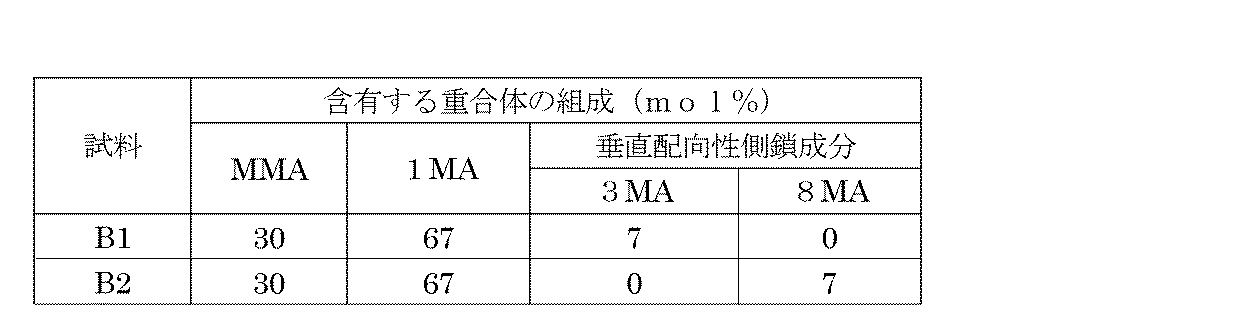
- Table 3 shows the composition of the liquid crystal aligning agents (B1, B2) prepared using the polymers synthesized for the stability evaluation.
- MMA 0.132 g (1.2 ⁇ 10 ⁇ 3 mol), 1MA 0.873 g (2.52 ⁇ 10 ⁇ 3 mol), 2MA 0.101 g (0 .28 ⁇ 10 ⁇ 3 mol), 1.42 g of NMP, and 8.83 g of ⁇ -BL were added and stirred to prepare a methacrylate monomer solution.
- This solution was degassed by reducing the pressure for 2 minutes using a diaphragm and repeating the return pressure with nitrogen four times. Thereafter, 0.033 g (0.2 ⁇ 10 ⁇ 3 mol) of AIBN was added, and after stirring and dissolving, the pressure was reduced again for 2 minutes and the depressurization was repeated four times with nitrogen.
- the liquid crystal aligning agent had a polymer solid content of 8 wt%, NMP of 10 wt%, ⁇ -BL of 62 wt%, and BC of 20 wt%. (B1) was obtained.
- the number average molecular weight of the polymer was 13,000, and the weight average molecular weight was 39,000.
- the liquid crystal aligning agent had a polymer solid content of 8 wt%, NMP of 10 wt%, ⁇ -BL of 62 wt%, and BC of 20 wt%. (B2) was obtained.
- the number average molecular weight of the polymer was 14,000, and the weight average molecular weight was 40,000.
- the liquid crystal display element by a PSA system can be provided, without adding a polymeric compound to a liquid crystal. Therefore, it is useful for PSA type TFT liquid crystal display elements, TN liquid crystal display elements, VA liquid crystal display elements, and the like.
- the liquid crystal aligning agent excellent in varnish stability is provided by introduce
Landscapes
- Physics & Mathematics (AREA)
- Chemical & Material Sciences (AREA)
- Nonlinear Science (AREA)
- Chemical Kinetics & Catalysis (AREA)
- Health & Medical Sciences (AREA)
- Medicinal Chemistry (AREA)
- Polymers & Plastics (AREA)
- Organic Chemistry (AREA)
- Crystallography & Structural Chemistry (AREA)
- Mathematical Physics (AREA)
- General Physics & Mathematics (AREA)
- Optics & Photonics (AREA)
- Spectroscopy & Molecular Physics (AREA)
- Liquid Crystal (AREA)
- Addition Polymer Or Copolymer, Post-Treatments, Or Chemical Modifications (AREA)
Abstract
Description
本発明の他の目的及び利点は、以下の記載から明らかにされる。
1.式(1)で表される側鎖及び式(2)で表される側鎖からなる群から選ばれる少なくとも一種の側鎖と、光反応性基と、を有する重合体を含有することを特徴とする液晶配向剤。

3.前記重合体を形成する全モノマーに対して、前記式(1)で表される側鎖及び式(2)で表される側鎖からなる群から選ばれる少なくとも一種の側鎖を10~40モル%、光反応性基を30~80モル%含有する上記1又は2に記載の液晶配向剤。
5.前記重合体は、不飽和カルボン酸、アクリル酸エステル、メタクリル酸エステル、マレイミド、アクリロニトリル、マレイン酸無水物、スチレン及びビニル化合物よりなる群から選ばれる少なくとも1種の化合物を重合させて得られる重合体である上記1~4のいずれか1項に記載の液晶配向剤。
6.式(1)で表される側鎖及び式(2)で表される側鎖からなる群から選ばれる少なくとも一種の側鎖を有するモノマーと、光反応性基を有するモノマーと、を重合して得られる共重合体を含有することを特徴とする液晶配向剤。
7.前記共重合体を形成する全モノマーに対して、前記式(1)で表される側鎖及び式(2)で表される側鎖からなる群から選ばれる少なくとも一種の側鎖を有するモノマーを10~40モル%、前記光反応性基を含有するモノマーを30~80モル%含有する上記6に記載の液晶配向剤。
10.前記重合体を2~10質量%含有する上記1~9のいずれか1項に記載の液晶配向剤。
11.上記1~10のいずれか1項に記載の液晶配向剤から得られる液晶配向膜。
12.上記11に記載の液晶配向膜を有する液晶表示素子。
13.上記11に記載の液晶配向膜が形成された2枚の基板で液晶を挟持した液晶セルに光照射して製造された液晶表示素子。
本発明の液晶配向剤は、式(1)で表される側鎖及び式(2)で表される側鎖の少なくとも一方と、光反応性基とを有する重合体を含む。

X2とX3は、それぞれ独立に、単結合、-O-、又はCOO-である。
X4は、水素原子又は炭素原子数1~20、好ましくは4~12のアルキル基である。また、X4は、非置換であるか、又は、シアノ若しくはハロゲンによって一置換されているか若しくは多置換されているアルキル基である。X4は、直鎖状のアルキル基であることがより好ましい。

X2とX3は、それぞれ独立に、単結合、-O-、又はCOO-である。
X2とX3は、それぞれ独立に、単結合、-O-、又はCOO-である。
X4は、水素原子又は炭素原子数1~20、好ましくは4~12のアルキル基である。また、X4は、非置換であるか、又は、シアノ若しくはハロゲンによって一置換されているか若しくは多置換されているアルキル基である。X4は、直鎖状のアルキル基であることがより好ましい。

本発明において、光反応性基は、光によって架橋反応を起こすものであれば特に制限はされない。その好ましい光反応性基は、式(3)で表される。

X7は、単結合又はO-、-COO-、-NR1CO-、-NR1-、-NR1CONR1-などの結合基である。但し、結合基中のR1は、水素原子、又は炭素原子数1~4のアルキル基である。
X8は、光架橋性の光反応基である。
光反応性基としては、例えば、シンナモイル基若しくはその誘導体、カルコン基、クマリン基、マレイミド基、アントラセン基などが挙げられる。なかでも、シンナモイル基若しくはその誘導体基、又はアントラセン基が好ましい。
また、かかる重合体は、そのモノマー種という点からは、アクリル酸若しくはメタクリル酸などの不飽和カルボン酸、アクリル酸エステル化合物、メタクリル酸エステル化合物、マレイミド化合物、アクリロニトリル、マレイン酸無水物、スチレン化合物、及びビニル化合物などのモノマーが挙げられる。なかでも、電気特性の面から、アクリル酸若しくはメタクリル酸などの不飽和カルボン酸、アクリル酸エステル化合物、メタクリル酸エステル化合物などのアクリル系重合体若しくは共重合体が好ましい。
すなわち、アクリル系共重合体は、式(4)のモノマー及び式(6)のモノマーからなる群から選ばれる少なくとも1種と、式(5)のモノマーとを共重合することで得られる。






式(a1)で示されるモノマーa1に対応するアクリレート化合物は、商業的に入手可能である。あるいは、アクリル酸クロリド又はメタクリル酸クロリドと、式(1)にヒドロキシ基を持つ式(7)に示す化合物とをアルカリ存在下で反応させることでも得られる。




上記不飽和カルボン酸の具体例としては、アクリル酸、メタクリル酸、イタコン酸、マレイン酸、フマル酸などが挙げられる。
上記スチレン化合物としては、例えば、スチレン、メチルスチレン、クロロスチレン、ブロモスチレン等が挙げられる。
上記マレイミド化合物としては、例えば、マレイミド、N-メチルマレイミド、N-フェニルマレイミド、N-シクロヘキシルマレイミドなどが挙げられる。
上記のようにして得られた共重合体(A)の溶液を、メタノール、エタノール、水などを撹拌下に投入して再沈殿させ、生成した沈殿物を濾過・洗浄した後、常圧又は減圧下で、常温あるいは加熱乾燥することで、共重合体(A)を粉体として得ることができる。かかる操作により、共重合体(A)と共存する重合開始剤や未反応モノマーを除去することができ、その結果、純度の高い共重合体(A)の粉体が得られる。単一の操作で充分に精製できない場合は、得られた粉体を溶媒に再溶解し、上記の操作を繰り返し行えばよい。
より具体的には、例えば、エフトップEF301、EF303、EF352(以上、トーケムプロダクツ社製))、メガファックF171、F173、R-30(以上、大日本インキ社製)、フロラードFC430、FC431(以上、住友スリーエム社製)、アサヒガードAG710、サーフロンS-382、SC101、SC102、SC103、SC104、SC105、SC106(以上、旭硝子社製)などが挙げられる。これらの界面活性剤の使用割合は、液晶配向剤に含有される樹脂成分の100質量部に対して、好ましくは0.01質量部~2質量部、より好ましくは0.01質量部~1質量部である。
例えば、3-アミノプロピルトリメトキシシラン、3-アミノプロピルトリエトキシシラン、2-アミノプロピルトリメトキシシラン、2-アミノプロピルトリエトキシシラン、N-(2-アミノエチル)-3-アミノプロピルトリメトキシシラン、N-(2-アミノエチル)-3-アミノプロピルメチルジメトキシシラン、3-ウレイドプロピルトリメトキシシラン、3-ウレイドプロピルトリエトキシシラン、N-エトキシカルボニル-3-アミノプロピルトリメトキシシラン、N-エトキシカルボニル-3-アミノプロピルトリエトキシシラン、N-トリエトキシシリルプロピルトリエチレントリアミン、N-トリメトキシシリルプロピルトリエチレントリアミン、10-トリメトキシシリル-1,4,7-トリアザデカン、10-トリエトキシシリル-1,4,7-トリアザデカン、9-トリメトキシシリル-3,6-ジアザノニルアセテート、9-トリエトキシシリル-3,6-ジアザノニルアセテート、N-ベンジル-3-アミノプロピルトリメトキシシラン、N-ベンジル-3-アミノプロピルトリエトキシシラン、N-フェニル-3-アミノプロピルトリメトキシシラン、N-フェニル-3-アミノプロピルトリエトキシシラン、N-ビス(オキシエチレン)-3-アミノプロピルトリメトキシシラン、N-ビス(オキシエチレン)-3-アミノプロピルトリエトキシシラン、エチレングリコールジグリシジルエーテル、ポリエチレングリコールジグリシジルエーテル、プロピレングリコールジグリシジルエーテル、トリプロピレングリコールジグリシジルエーテル、ポリプロピレングリコールジグリシジルエーテル、ネオペンチルグリコールジグリシジルエーテル、1,6-ヘキサンジオールジグリシジルエーテル、グリセリンジグリシジルエーテル、2,2-ジブロモネオペンチルグリコールジグリシジルエーテル、1,3,5,6-テトラグリシジル-2,4-ヘキサンジオール、N,N,N’,N’,-テトラグリシジル-m-キシレンジアミン、1,3-ビス(N,N-ジグリシジルアミノメチル)シクロヘキサン、N,N,N’,N’,-テトラグリシジル-4、4’-ジアミノジフェニルメタンなどが挙げられる。
本発明の液晶配向剤における固形分の濃度は、目的とする液晶配向膜の膜厚によって適宜変更することができるが、欠陥のない塗膜を形成させ、且つ、液晶配向膜として適切な膜厚を得ることができるという理由から1質量%~20質量%とすることが好ましく、より好ましくは2質量%~10質量%である。但し、ここで言うところの固形分とは、液晶配向剤から溶媒を除いた質量を意味する。
本発明の液晶配向膜は、上記した本発明の液晶配向剤を用いて得ることができる。この場合、例えば、本発明の液晶配向剤を、適当な基板に塗布した後、乾燥・焼成を行うことで得られる硬化膜を、そのまま液晶配向膜として用いることができる。また、この硬化膜をラビングしたり、偏光又は特定の波長の光やイオンビームなどを照射したりした後に、液晶配向膜として使用することも可能である。さらに、PSA方式用配向膜として使用する場合には、液晶充填後の液晶表示素子に電圧を印加した状態でUVを照射すること(以下、PSA処理と称する。)も可能である。本発明の液晶配向膜は、特に、PSA方式用配向膜として好適である。
液晶配向剤の塗布方法は特に限定されないが、工業的には、スクリーン印刷、オフセット印刷、フレキソ印刷、インクジェットなどで行う方法が一般的である。その他の塗布方法としては、ディップ法、ロールコータ法、スリットコータ法、スピンコータ法などがあり、目的に応じてこれらを用いてもよい。
本発明の液晶表示素子は、本発明の液晶配向剤を用いて液晶配向膜付きの基板を得た後、これを使用して公知の方法で液晶セルを作製し、液晶表示素子としたものである。
液晶セル作製の例としては、液晶配向膜の形成された1対の基板を用意し、片方の基板の液晶配向膜上にスペーサーを散布し、液晶配向膜面が内側になるようにして、もう片方の基板を貼り合わせ、液晶を減圧注入して封止する方法、又は、スペーサーを散布した液晶配向膜面に液晶を滴下した後に基板を貼り合わせて封止を行う方法などが挙げられる。このときのスペーサーの厚みは、好ましくは1μm~30μm、より好ましくは2μm~10μmである。
また、液晶中に残留する未反応の重合性化合物が液晶中で不純物(コンタミ)となって、液晶表示素子の信頼性を低下させるといった問題も解消できる。
本発明において、液晶セルの基板間に印加する電圧は、5Vp-p~30Vp-pであるが、好ましくは5Vp-p~20Vp-pである。照射するUV照射量は、好ましくは、1J~60J、より好ましくは10J~40Jである。UV照射量が少ない方が、液晶表示素子を構成する部材の破壊からなる信頼性低下を抑制できる。また、UV照射時間を減らせることで製造上のタクトが上がる点からも好適である。
<化合物の構造>

MMA:メチルメタクリレート
3MA:アントラセン-9-イルメチル-メタクリレート
9MA:オクタデシルメタクリレート
<溶媒の略号>
NMP:N-メチルピロリドン
BC:ブチルセロソルブ
γ-BL:ガンマブチルラクトン
AIBN:アゾビスイソブチロニトリル
<3MAの合成>
a.3MA-1の合成


得られたオイル状化合物は、1H NMR分析結果により、3MAであることを確認した。
1H NMR (CDCl3、δppm ) : 0.87(m、3H )、1.23-1.32(m、8H)、1.43-1.60(m、6H)、1.68-1.82(m、4H)、1.94(t、3H)、2.53(t、2H)、3.93(t、2H)、4.15(t、2H)、5.55(m、1H)、6.10(m、1H)、6.80(dd、2H)、7.07(dd、2H)
a.4MA-1の合成
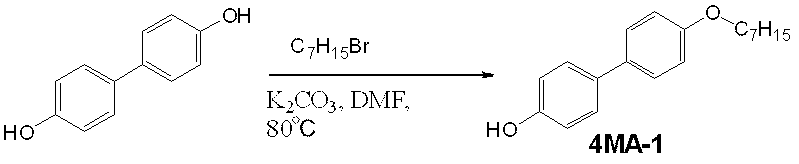


得られた白色結晶は、1H NMR分析結果により、4MAであることを確認した。
1H NMR (CDCl3、δppm ):δ0.90(t、3H)、1.29-1.38(m、6H)、1.45-1.58(m、6H)、1.70-1.84(m、6H)、1.95(s、3H)、3.98(m、4H)、4.16(t、2H)、5.55(s、1H)、6.10(m、1H)、6.94(dd、4H)、7.45(d、4H)
a.5MA-1の合成



1H NMR (CDCl3、δppm ): 0.88(t、3H)、1.26-1.40(m、16H)、1.43-1.57(m、6H)、1.68-1.85(m、6H)、1.94(t、3H)、3.96-4.01(m、4H)、4.16(t、2H)、5.55(t、1H)、6.10(t、1H)、6.94(dd、4H)、7.45(d、4H)
a.6MA-2の合成


得られた白色結晶は、1H NMR分析結果により、6MAであることを確認した。
1H NMR (CDCl3、δppm):0.89(t、3H )、1.00-1.08(m、2H)、1.22-1.56(m、19H)、1.66-1.87(m、8H)、1.94(s、3H)、2.40(t、1H)、3.93(t、2H)、4.15(t、2H)、5.55(s、1H)、6.09(s、1H)、6.81(d、2H)、7.10(d、2H)
a.8MA-2の合成


得られた白色結晶は、1H NMR分析結果により、8MAであることを確認した。
1H NMR (CDCl3、δppm): 0.86-1.55(m、26H)、1.68-1.91(m、12H)、1.94(s、3H)、2.38(t、1H)、3.93(t、2H)、4.15(t、2H)、5.55(s、1H)、6.09(s、1H)、6.81(d、2H)、7.10(d、2H)
表1には、以下に記載する本実施例の液晶配向剤(A1~A14)について、その組成をまとめて示す。

窒素封入したバルーンを装着した三方コックを備え付けた50mLナスフラスコに、MMA0.132g(1.2×10⁻³mol)、1MA0.554g(1.6×10⁻³mol)、3MA0.433g(1.2×10⁻³mol)、NMP10.367gを加えて攪拌し、メタクリレートモノマー溶液を調製した。この溶液を、ダイアフラムポンプを用いて、2分間減圧し窒素にて復圧を4回繰り返して脱気処理を行った。この後、AIBN0.033g(0.2×10⁻³mol)を添加し、攪拌溶解後、再び2分間減圧し窒素にて復圧を4回繰り返して脱気処理を行った。その後、60℃のオイルバスにて20時間反応させて後、冷却し、空気開放して反応を停止し、ポリメタクリレート溶液を得た。
得られたポリメタクリレート溶液に、BC2.88gを混合し、3時間攪拌して、ポリマー固形分8重量%、NMPが72重量%、BCが20重量%の液晶配向剤(A1)を得た。
ポリマーの数平均分子量は13,000、重量平均分子量は39,000であった。
窒素封入したバルーンを装着した三方コックを備え付けた50mLナスフラスコに、MMA0.132g(1.2×10⁻³mol)、2MA0.442g(1.6×10⁻³mol)、3MA0.433g(1.2×10⁻³mol)、NMP9.36gを加えて攪拌し、メタクリレートモノマー溶液を調製した。この溶液を、ダイアフラムを用いて、2分間減圧し窒素にて復圧を4回繰り返して脱気処理を行った。この後、AIBN0.033g(0.2×10⁻³mol)を添加し、攪拌溶解後、再び2分間減圧し窒素にて復圧を4回繰り返して脱気処理を行った。その後、60℃のオイルバスにて20時間反応後、冷却し、空気開放して反応を停止し、ポリメタクリレート溶液を得た。
ポリマーの数平均分子量は3,000、重量平均分子量は4,000であった。
窒素封入したバルーンを装着した三方コックを備え付けた50mLナスフラスコに、MMA0.463g(4.2×10⁻³mol)、3MA0.649g(1.8×10⁻³mol)、NMP10.446gを加えて攪拌し、メタクリレートモノマー溶液を調製した。この溶液を、ダイアフラムを用いて、2分間減圧し窒素にて復圧を4回繰り返して脱気処理を行った。この後、AIBN0.049g(0.3×10⁻³mol)を添加し、攪拌溶解後、再び2分間減圧し窒素にて復圧を4回繰り返して脱気処理を行った。その後、60℃のオイルバスにて20時間反応後、冷却し、空気開放して反応を停止し、ポリメタクリレート溶液を得た。
得られたポリメタクリレート溶液に、BC2.90gを混合し、3時間攪拌してポリマー固形分8重量%、NMPが72重量%、BCが20重量%の液晶配向剤(A3)を得た。
ポリマーの数平均分子量は6,000、重量平均分子量は12,000であった。
窒素封入したバルーンを装着した三方コックを備え付けた50mLナスフラスコに、MMA0.22g(2.0×10⁻³mol)、1MA0.554g(1.6×10⁻³mol)、4MA0.181g(0.4×10⁻³mol)、NMP8.896gを加え、攪拌してメタクリレートモノマー溶液を調製した。この溶液を、ダイアフラムを用いて、2分間減圧し窒素にて復圧を4回繰り返して脱気処理を行った。この後、AIBN0.033g(0.2×10⁻³mol)を添加し、攪拌溶解後、再び2分間減圧し窒素にて復圧を4回繰り返して脱気処理を行った。その後、60℃のオイルバスにて20時間反応後、冷却し、空気開放して反応を停止し、ポリメタクリレート溶液を得た。
得られたポリメタクリレート溶液に、BC2.47gを混合し、3時間攪拌してポリマー固形分8重量%、NMPが72重量%、BCが20重量%の液晶配向剤(A4)を得た。
ポリマーの数平均分子量16,000は、重量平均分子量は59,000であった。
窒素封入したバルーンを装着した三方コックを備え付けた50mLナスフラスコに、MMA0.044g(0.4×10⁻³mol)、1MA1.109g(3.2×10⁻³mol)、5MA0.209g(0.4×10⁻³mol)、NMP12.551gを加えて攪拌し、メタクリレートモノマー溶液を調製した。この溶液を、ダイアフラムを用いて、2分間減圧し窒素にて復圧を4回繰り返して脱気処理を行った。この後、AIBN0.033g(0.2×10⁻³mol)を添加し、攪拌溶解後、再び2分間減圧し窒素にて復圧を4回繰り返して脱気処理を行った。その後、60℃のオイルバスにて20時間反応後、冷却し、空気開放して反応を停止し、ポリメタクリレート溶液を得た。
得られたポリメタクリレート溶液に、BC3.4875gを混合し、3時間攪拌してポリマー固形分8重量%、NMPが72重量%、BCが20重量%の液晶配向剤(A5)を得た。
ポリマーの数平均分子量33,000は、重量平均分子量は114,000であった。
窒素封入したバルーンを装着した三方コックを備え付けた50mLナスフラスコに、MMA0.044g(0.4×10⁻³mol)、1MA1.109g(3.2×10⁻³mol)、6MA0.177g(0.4×10⁻³mol)、NMP12.263gを加えて攪拌し、メタクリレートモノマー溶液を調製した。この溶液を、ダイアフラムを用いて、2分間減圧し窒素にて復圧を4回繰り返して脱気処理を行った。この後、AIBN0.033g(0.2×10⁻³mol)を添加し、攪拌溶解後、再び2分間減圧し窒素にて復圧を4回繰り返して脱気処理を行った。その後、60℃のオイルバスにて20時間反応後、冷却し、空気開放して反応を停止し、ポリメタクリレート溶液を得た。
得られたポリメタクリレート溶液に、BC3.4075gを混合し、3時間攪拌してポリマー固形分8重量%、NMPが72重量%、BCが20重量%の液晶配向剤(A6)を得た。
ポリマーの数平均分子量14,000は、重量平均分子量は33,000であった。
窒素封入したバルーンを装着した三方コックを備え付けた50mLナスフラスコに、MMA0.044g(0.4×10⁻³mol)、1MA1.039g(3.0×10⁻³mol)、6MA0.266g(0.6×10⁻³mol)、NMP12.436gを加えて攪拌し、メタクリレートモノマー溶液を調製した。この溶液を、ダイアフラムを用いて、2分間減圧し窒素にて復圧を4回繰り返して脱気処理を行った。この後、AIBN0.033g(0.2×10⁻³mol)を添加し、攪拌溶解後、再び2分間減圧し窒素にて復圧を4回繰り返して脱気処理を行った。その後、60℃のオイルバスにて20時間反応後、冷却し、空気開放して反応を停止し、ポリメタクリレート溶液を得た。
得られたポリメタクリレート溶液に、BC3.455gを混合し、3時間攪拌してポリマー固形分8重量%、NMPが72重量%、BCが20重量%の液晶配向剤(A7)を得た。
ポリマーの数平均分子量15,000は、重量平均分子量は32,000であった。
窒素封入したバルーンを装着した三方コックを備え付けた50mLナスフラスコに、MMA0.044g(0.4×10⁻³mol)、1MA0.970g(2.8×10⁻³mol)、6MA0.354g(0.8×10⁻³mol)、NMP12.609gを加えて攪拌し、メタクリレートモノマー溶液を調製した。この溶液を、ダイアフラムを用いて、2分間減圧し窒素にて復圧を4回繰り返して脱気処理を行った。この後、AIBN0.033g(0.2×10⁻³mol)を添加し、攪拌溶解後、再び2分間減圧し窒素にて復圧を4回繰り返して脱気処理を行った。その後、60℃のオイルバスにて重合反応を行ったところ、反応中に重合液が白濁し溶解物が析出してしまった。
窒素封入したバルーンを装着した三方コックを備え付けた50mLナスフラスコに、MMA0.044g(0.4×10⁻³mol)、1MA1.178g(3.4×10⁻³mol)、7MA0.079g(0.2×10⁻³mol)、NMP12.003gを加えて攪拌し、メタクリレートモノマー溶液を調製した。この溶液を、ダイアフラムを用いて、2分間減圧し窒素にて復圧を4回繰り返して脱気処理を行った。この後、AIBN0.033g(0.2×10⁻³mol)を添加し、攪拌溶解後、再び2分間減圧し窒素にて復圧を4回繰り返し脱気処理を行った。その後、60℃のオイルバスにて20時間反応後、冷却し、空気開放して反応を停止し、ポリメタクリレート溶液を得た。
得られたポリメタクリレート溶液に、BC3.335gを混合し、3時間攪拌してポリマー固形分8重量%、NMPが72重量%、BCが20重量%の液晶配向剤(A9)を得た。
ポリマーの数平均分子量は26,000、重量平均分子量は81,000であった。
窒素封入したバルーンを装着した三方コックを備え付けた50mLナスフラスコに、MMA0.132g(1.2×10⁻³mol)、3MA0.442g(1.6×10⁻³mol)、2MA0.433g(1.2×10⁻³mol)、NMP9.36gを加えて攪拌し、メタクリレートモノマー溶液を調製した。この溶液を、ダイアフラムを用いて、2分間減圧し窒素にて復圧を4回繰り返して脱気処理を行った。この後、AIBN0.033g(0.2×10⁻³mol)を添加し、攪拌溶解後、再び2分間減圧し窒素にて復圧を4回繰り返して脱気処理を行った。その後、60℃のオイルバスにて重合反応を行ったところ、反応中に重合液が白濁し溶解物が析出してしまった。
窒素封入したバルーンを装着した三方コックを備え付けた50mLナスフラスコに、MMA0.044g(0.4×10⁻³mol)、1MA1.178g(3.4×10⁻³mol)、8MA0.099g(0.2×10⁻³mol)、NMP12.187gを加えて攪拌し、メタクリレートモノマー溶液を調製した。この溶液を、ダイアフラムを用いて、2分間減圧し窒素にて復圧を4回繰り返して脱気処理を行った。この後、AIBN0.033g(0.2×10⁻³mol)を添加し、攪拌溶解後、再び2分間減圧し窒素にて復圧を4回繰り返して脱気処理を行った。その後、60℃のオイルバスにて20時間反応後、冷却し、空気開放して反応を停止し、ポリメタクリレート溶液を得た。
得られたポリメタクリレート溶液に、BC3.385gを混合し、3時間攪拌してポリマー固形分8重量%、NMPが72重量%、BCが20重量%の液晶配向剤(A11)を得た。
ポリマーの数平均分子量は14,000、重量平均分子量は34,000であった。
窒素封入したバルーンを装着した三方コックを備え付けた50mLナスフラスコに、MMA0.044g(0.4×10⁻³mol)、1MA1.109g(3.2×10⁻³mol)、8MA0.199g(0.4×10⁻³mol)、NMP12.457gを加えて攪拌し、メタクリレートモノマー溶液を調製した。この溶液を、ダイアフラムを用いて、2分間減圧し窒素にて復圧を4回繰り返して脱気処理を行った。この後、AIBN0.033g(0.2×10⁻³mol)を添加し、攪拌溶解後、再び2分間減圧し窒素にて復圧を4回繰り返して脱気処理を行った。その後、60℃のオイルバスにて重合反応を行ったところ、反応中に重合液が白濁し溶解物が析出してしまった。
窒素封入したバルーンを装着した三方コックを備え付けた50mLナスフラスコに、MMA0.044g(0.4×10⁻³mol)、1MA0.97g(2.8×10⁻³mol)、9MA0.271g(0.8×10⁻³mol)、NMP11.859gを加えて攪拌し、メタクリレートモノマー溶液を調製した。この溶液を、ダイアフラムを用いて、2分間減圧し窒素にて復圧を4回繰り返して脱気処理を行った。この後、AIBN0.033g(0.2×10⁻³mol)を添加し、攪拌溶解後、再び2分間減圧し窒素にて復圧を4回繰り返して脱気処理を行った。その後、60℃のオイルバスにて20時間反応後、冷却し、空気開放して反応を停止し、ポリメタクリレート溶液を得た。
得られたポリメタクリレート溶液に、BC3.295gを混合し、3時間攪拌してポリマー固形分8重量%、NMPが72重量%、BCが20重量%の液晶配向剤(A13)を得た。
ポリマーの数平均分子量は24,000、重量平均分子量は58,000であった。
窒素封入したバルーンを装着した三方コックを備え付けた50mLナスフラスコに、MMA0.044g(0.4×10⁻³mol)、1MA0.831g(2.4×10⁻³mol)、9MA0.406g(1.2×10⁻³mol)、NMP11.831gを加えて攪拌し、メタクリレートモノマー溶液を調製した。この溶液を、ダイアフラムを用いて、2分間減圧し窒素にて復圧を4回繰り返して脱気処理を行った。この後、AIBN0.033g(0.2×10⁻³mol)を添加し、攪拌溶解後、再び2分間減圧し窒素にて復圧を4回繰り返して脱気処理を行った。その後、60℃のオイルバスにて重合反応を行ったところ、反応中に重合液が白濁し溶解物が析出してしまった。
上記で得られた、白濁して溶解物が析出すること無く調製された液晶配向剤(A1、A2、A3、A4、A5、A6、A7、A9、A11及びA13)を用いて、以下のようにしてPSA方式の液晶セルを製造した。、それらの製造と特性評価について説明する。
それぞれの液晶配向剤を、画素サイズが100μm×300μmでライン/スペースがそれぞれ5μmのITO電極パターンが形成されているITO電極基板のITO面にスピンコートし、80℃のホットプレートで90秒間乾燥した後、160℃の熱風循環式オーブンで60分間焼成を行い、膜厚100nmの液晶配向膜を形成した。
上記の2枚の基板について、一方の基板の液晶配向膜上に厚み6μmのビーズスペーサを散布した後、その上からシール剤を印刷した。次いで、もう一方の基板の液晶配向膜面を内側にして、先の基板と貼り合わせた後、シール剤を硬化させて空セルを作製した。この空セルに液晶MLC-6608(メルク社製商品名)を減圧注入法によって注入し、各液晶セルを作製した。
なお、液晶配向剤A6、A7、A8、A10及びA12を使用した液晶セルは、垂直配向性を示さず、応答速度特性を評価することはできなかった。
電圧を印加していない液晶セルに、電圧±4V、周波数1kHzの短形波を印加した際の、液晶パネルの輝度の時間変化をオシロスコープに取り込んだ。電圧を印加していないときの輝度を0%とし、±4Vの電圧を印加して飽和したときの輝度を100%として、輝度が10%~90%まで変化するのに必要な時間(立ち上がり時間)を応答速度とした。
評価対象とする液晶セルは、液晶が垂直配向性を示した液晶配向剤A1、A2、A3、A4及びA5を使用した液晶セルである。結果を表2に示す。
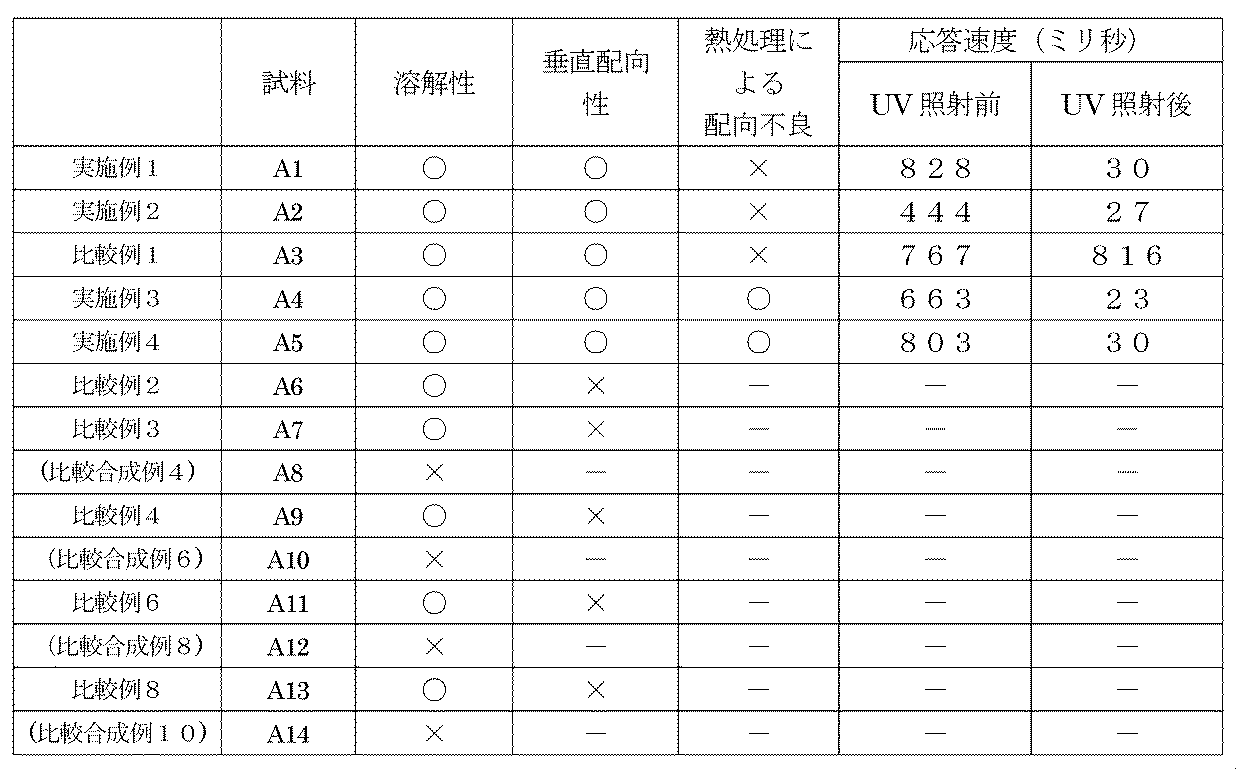
表3に、安定性評価のために合成された重合体を用いて調製された液晶配向剤(B1、B2)の組成を示す。
窒素封入したバルーンを装着した三方コックを備え付けた50mLナスフラスコに、MMA0.132g(1.2×10⁻³mol)、1MA0.873g(2.52×10⁻³mol)、2MA0.101g(0.28×10⁻³mol)、NMP1.42g、γ-BL8.83gを加えて攪拌し、メタクリレートモノマー溶液を調製した。この溶液を、ダイアフラムを用いて、2分間減圧し窒素にて復圧を4回繰り返して脱気処理を行った。この後、AIBN0.033g(0.2×10⁻³mol)を添加し、攪拌溶解後、再び2分間減圧し窒素にて復圧を4回繰り返し脱気処理を行った。その後、60℃のオイルバスにて20時間反応後、冷却し、空気開放して反応を停止し、ポリメタクリレート溶液を得た。
得られたポリメタクリレート溶液に、BC2.85gを混合し、3時間攪拌してポリマー固形分8重量%、NMPが10重量%、γ-BLが62重量%、BCが20重量%の液晶配向剤(B1)を得た。
ポリマーの数平均分子量は13,000、重量平均分子量は39,000であった。
窒素封入したバルーンを装着した三方コックを備え付けた50mLナスフラスコに、MMA0.132g(1.2×10⁻³mol)、1MA0.873g(2.52×10⁻³mol)、4MA0.139g(0.28×10⁻³mol)、NMP1.47g、γ-BL9.12gを加えて攪拌し、メタクリレートモノマー溶液を調製した。この溶液を、ダイアフラムを用いて、2分間減圧し窒素にて復圧を4回繰り返して脱気処理を行った。この後、AIBN0.033g(0.2×10⁻³mol)を添加し、攪拌溶解後、再び2分間減圧し窒素にて復圧を4回繰り返して脱気処理を行った。その後、60℃のオイルバスにて20時間反応後、冷却し、空気開放して反応を停止し、ポリメタクリレート溶液を得た。
得られたポリメタクリレート溶液に、BC2.94gを混合し、3時間攪拌してポリマー固形分8重量%、NMPが10重量%、γ-BLが62重量%、BCが20重量%の液晶配向剤(B2)を得た。
ポリマーの数平均分子量は14,000、重量平均分子量は40,000であった。
Cr基板に上記液晶配向剤(B1)又は(B2)を1滴滴下し、温度20℃、湿度50%のクリーンルーム内に放置し、ワニスの吸湿により溶解性が低下して固形分が凝集(白化)するまでの時間を測定した。それらの結果を表4に示した。

なお、2010年3月31日に出願された日本特許出願2010-083369号の明細書、特許請求の範囲、図面及び要約書の全内容をここに引用し、本発明の明細書の開示として、取り入れるものである。
Claims (13)
- 式(1)で表される側鎖及び式(2)で表される側鎖からなる群から選ばれる少なくとも一種の側鎖と、光反応性基と、を有する重合体を含有することを特徴とする液晶配向剤。
- 前記光反応性基が、下式(3)で表される基である請求項1に記載の液晶配向剤。

- 前記重合体を形成する全モノマーに対して、前記式(1)で表される側鎖及び式(2)で表される側鎖からなる群から選ばれる少なくとも一種の側鎖を10~40モル%、光反応性基を30~80モル%含有する請求項1又は2に記載の液晶配向剤。
- 前記重合体は、付加重合によって生成された重合体である請求項1~3のいずれか1項に記載の液晶配向剤。
- 前記重合体は、不飽和カルボン酸、アクリル酸エステル、メタクリル酸エステル、マレイミド、アクリロニトリル、マレイン酸無水物、スチレン 及びビニル化合物よりなる群から選ばれる少なくとも1種の化合物を重合させて得られる重合体である請求項1~4のいずれか1項に記載の液晶配向剤。
- 式(1)で表される側鎖及び式(2)で表される側鎖からなる群から選ばれる少なくとも一種の側鎖を有するモノマーと、光反応性基を有するモノマーと、を重合して得られる共重合体を含有することを特徴とする液晶配向剤。
- 前記共重合体を形成する全モノマーに対して、前記式(1)で表される側鎖及び式(2)で表される側鎖からなる群から選ばれる少なくとも一種の側鎖を有するモノマーを10~40モル%、前記光反応性基を含有するモノマーを30~80モル%含有する請求項6に記載の液晶配向剤。
- 前記式(1)で表される側鎖及び式(2)で表される側鎖からなる群から選ばれる少なくとも一種の側鎖を有するモノマーが、下式(a1)で表される化合物及び式(a2)で表される化合物からなる群から選ばれるモノマーである請求項6又は7に記載の液晶配向剤。
- 前記光反応性基が、シンナモイル基若しくはその誘導体基、又はアントラセン基である請求項1~8のいずれか1項に記載の液晶配向剤。
- 前記重合体を2~10質量%含有する請求項1~9のいずれか1項に記載の液晶配向剤。
- 請求項1~10のいずれか1項に記載の液晶配向剤から得られる液晶配向膜。
- 請求項11に記載の液晶配向膜を有する液晶表示素子。
- 請求項11に記載の液晶配向膜が形成された2枚の基板で液晶を挟持した液晶セルに光照射して製造された液晶表示素子。
Priority Applications (3)
| Application Number | Priority Date | Filing Date | Title |
|---|---|---|---|
| CN201180026754.9A CN102934012B (zh) | 2010-03-31 | 2011-03-31 | 液晶取向剂、液晶取向膜和液晶显示元件 |
| JP2012509591A JP5920212B2 (ja) | 2010-03-31 | 2011-03-31 | 液晶配向剤、液晶配向膜及び液晶表示素子 |
| KR1020127027549A KR101829478B1 (ko) | 2010-03-31 | 2011-03-31 | 액정 배향제, 액정 배향막 및 액정 표시 소자 |
Applications Claiming Priority (2)
| Application Number | Priority Date | Filing Date | Title |
|---|---|---|---|
| JP2010083369 | 2010-03-31 | ||
| JP2010-083369 | 2010-03-31 |
Publications (1)
| Publication Number | Publication Date |
|---|---|
| WO2011125876A1 true WO2011125876A1 (ja) | 2011-10-13 |
Family
ID=44762814
Family Applications (1)
| Application Number | Title | Priority Date | Filing Date |
|---|---|---|---|
| PCT/JP2011/058287 Ceased WO2011125876A1 (ja) | 2010-03-31 | 2011-03-31 | 液晶配向剤、液晶配向膜及び液晶表示素子 |
Country Status (5)
| Country | Link |
|---|---|
| JP (1) | JP5920212B2 (ja) |
| KR (1) | KR101829478B1 (ja) |
| CN (1) | CN102934012B (ja) |
| TW (1) | TWI510508B (ja) |
| WO (1) | WO2011125876A1 (ja) |
Cited By (6)
| Publication number | Priority date | Publication date | Assignee | Title |
|---|---|---|---|---|
| WO2014077248A1 (ja) * | 2012-11-14 | 2014-05-22 | 日産化学工業株式会社 | 光反応性組成物、それを用いた光配向膜、及び光学異方性膜 |
| KR20140109451A (ko) * | 2011-12-28 | 2014-09-15 | 닛산 가가쿠 고교 가부시키 가이샤 | 액정 배향제, 액정 표시 소자, 액정 표시 소자의 제조 방법 및 중합성 화합물 |
| CN104603167A (zh) * | 2012-08-27 | 2015-05-06 | Lg化学株式会社 | 光取向共聚物、使用该光取向共聚物的光学各向异性膜及其制备方法 |
| CN108027537A (zh) * | 2015-09-16 | 2018-05-11 | 日产化学工业株式会社 | 液晶取向剂、液晶取向膜和液晶表示元件 |
| CN108752278A (zh) * | 2018-06-27 | 2018-11-06 | 吉林化工学院 | 一类含联苯基团的咪唑化合物及其制备方法 |
| JPWO2020196698A1 (ja) * | 2019-03-27 | 2020-10-01 |
Families Citing this family (5)
| Publication number | Priority date | Publication date | Assignee | Title |
|---|---|---|---|---|
| KR102261699B1 (ko) * | 2013-05-13 | 2021-06-04 | 닛산 가가쿠 가부시키가이샤 | 횡전계 구동형 액정 표시 소자용 액정 배향막을 갖는 기판의 제조 방법 |
| CN105916865B (zh) * | 2014-01-17 | 2019-06-25 | 日产化学工业株式会社 | 环丁烷四羧酸衍生物的制造方法 |
| KR102430605B1 (ko) * | 2014-06-30 | 2022-08-08 | 닛산 가가쿠 가부시키가이샤 | 액정 배향제, 액정 배향막 및 액정 표시 소자 |
| WO2016113930A1 (ja) * | 2015-01-15 | 2016-07-21 | 日産化学工業株式会社 | 光反応性の水素結合性高分子液晶を用いた液晶配向剤、及び液晶配向膜 |
| CN113728270B (zh) * | 2019-04-24 | 2025-02-18 | 日产化学株式会社 | 液晶取向剂、液晶取向膜以及使用了该液晶取向膜的液晶显示元件 |
Citations (6)
| Publication number | Priority date | Publication date | Assignee | Title |
|---|---|---|---|---|
| JPH07230086A (ja) * | 1994-02-16 | 1995-08-29 | Sumitomo Chem Co Ltd | 液晶表示装置 |
| JPH11513502A (ja) * | 1995-09-29 | 1999-11-16 | イギリス国 | 液晶の配向用ポリマー |
| JP2001066605A (ja) * | 1999-08-30 | 2001-03-16 | Hayashi Telempu Co Ltd | 液晶配向膜およびその製造方法、液晶表示装置 |
| JP2002155113A (ja) * | 2000-11-20 | 2002-05-28 | Science Univ Of Tokyo | カルコン誘導体を有する新規液晶高分子の製造方法およびそれらの光橋かけ膜材料の液晶配向特性 |
| JP2004302061A (ja) * | 2003-03-31 | 2004-10-28 | Fujitsu Display Technologies Corp | 液晶表示装置及びその製造方法 |
| JP2010031281A (ja) * | 2002-05-31 | 2010-02-12 | Elsicon Inc | 液晶配向層用ハイブリッドポリマー材料 |
Family Cites Families (2)
| Publication number | Priority date | Publication date | Assignee | Title |
|---|---|---|---|---|
| JP2000212310A (ja) | 1999-01-19 | 2000-08-02 | Hayashi Telempu Co Ltd | 配向膜およびその製造方法、液晶表示装置 |
| AU2003218476A1 (en) * | 2002-05-31 | 2003-12-19 | Elsicon, Inc. | Hybrid polymer materials for liquid crystal alignment layers |
-
2011
- 2011-03-31 TW TW100111350A patent/TWI510508B/zh active
- 2011-03-31 WO PCT/JP2011/058287 patent/WO2011125876A1/ja not_active Ceased
- 2011-03-31 JP JP2012509591A patent/JP5920212B2/ja active Active
- 2011-03-31 CN CN201180026754.9A patent/CN102934012B/zh active Active
- 2011-03-31 KR KR1020127027549A patent/KR101829478B1/ko active Active
Patent Citations (6)
| Publication number | Priority date | Publication date | Assignee | Title |
|---|---|---|---|---|
| JPH07230086A (ja) * | 1994-02-16 | 1995-08-29 | Sumitomo Chem Co Ltd | 液晶表示装置 |
| JPH11513502A (ja) * | 1995-09-29 | 1999-11-16 | イギリス国 | 液晶の配向用ポリマー |
| JP2001066605A (ja) * | 1999-08-30 | 2001-03-16 | Hayashi Telempu Co Ltd | 液晶配向膜およびその製造方法、液晶表示装置 |
| JP2002155113A (ja) * | 2000-11-20 | 2002-05-28 | Science Univ Of Tokyo | カルコン誘導体を有する新規液晶高分子の製造方法およびそれらの光橋かけ膜材料の液晶配向特性 |
| JP2010031281A (ja) * | 2002-05-31 | 2010-02-12 | Elsicon Inc | 液晶配向層用ハイブリッドポリマー材料 |
| JP2004302061A (ja) * | 2003-03-31 | 2004-10-28 | Fujitsu Display Technologies Corp | 液晶表示装置及びその製造方法 |
Cited By (14)
| Publication number | Priority date | Publication date | Assignee | Title |
|---|---|---|---|---|
| KR101988067B1 (ko) | 2011-12-28 | 2019-06-11 | 닛산 가가쿠 가부시키가이샤 | 액정 배향제, 액정 표시 소자, 액정 표시 소자의 제조 방법 및 중합성 화합물 |
| KR20140109451A (ko) * | 2011-12-28 | 2014-09-15 | 닛산 가가쿠 고교 가부시키 가이샤 | 액정 배향제, 액정 표시 소자, 액정 표시 소자의 제조 방법 및 중합성 화합물 |
| US20150219794A1 (en) * | 2012-08-27 | 2015-08-06 | Lg Chem, Ltd. | PHOTO-ALIGNMENT COPOLYMER, OPTICAL ANISTROPIC FILM AND ITS PREPARATION METHOD (As Amended) |
| CN104603167B (zh) * | 2012-08-27 | 2016-12-07 | Lg化学株式会社 | 光取向共聚物、光学各向异性膜及其制备方法 |
| US9720136B2 (en) | 2012-08-27 | 2017-08-01 | Lg Chem, Ltd. | Photo-alignment copolymer, optical anistropic film and its preparation method |
| CN104603167A (zh) * | 2012-08-27 | 2015-05-06 | Lg化学株式会社 | 光取向共聚物、使用该光取向共聚物的光学各向异性膜及其制备方法 |
| WO2014077248A1 (ja) * | 2012-11-14 | 2014-05-22 | 日産化学工業株式会社 | 光反応性組成物、それを用いた光配向膜、及び光学異方性膜 |
| JPWO2014077248A1 (ja) * | 2012-11-14 | 2017-01-05 | 日産化学工業株式会社 | 光反応性組成物、それを用いた光配向膜、及び光学異方性膜 |
| CN108027537A (zh) * | 2015-09-16 | 2018-05-11 | 日产化学工业株式会社 | 液晶取向剂、液晶取向膜和液晶表示元件 |
| CN108027537B (zh) * | 2015-09-16 | 2021-06-08 | 日产化学工业株式会社 | 液晶取向剂、液晶取向膜和液晶表示元件 |
| CN108752278A (zh) * | 2018-06-27 | 2018-11-06 | 吉林化工学院 | 一类含联苯基团的咪唑化合物及其制备方法 |
| JPWO2020196698A1 (ja) * | 2019-03-27 | 2020-10-01 | ||
| WO2020196698A1 (ja) * | 2019-03-27 | 2020-10-01 | 日産化学株式会社 | 重合体組成物、液晶配向膜、液晶表示素子、及び液晶配向膜を有する基板の製造方法 |
| JP7513018B2 (ja) | 2019-03-27 | 2024-07-09 | 日産化学株式会社 | 液晶配向膜を有する基板の製造方法、及び液晶表示素子の製造方法 |
Also Published As
| Publication number | Publication date |
|---|---|
| JPWO2011125876A1 (ja) | 2013-07-11 |
| JP5920212B2 (ja) | 2016-05-18 |
| CN102934012B (zh) | 2016-05-25 |
| KR101829478B1 (ko) | 2018-02-14 |
| TWI510508B (zh) | 2015-12-01 |
| KR20130018786A (ko) | 2013-02-25 |
| TW201300428A (zh) | 2013-01-01 |
| CN102934012A (zh) | 2013-02-13 |
Similar Documents
| Publication | Publication Date | Title |
|---|---|---|
| JP5920212B2 (ja) | 液晶配向剤、液晶配向膜及び液晶表示素子 | |
| CN106661336B (zh) | 液晶取向剂、液晶取向膜和液晶表示元件 | |
| CN105378033B (zh) | 具有横向电场驱动型液晶表示元件用液晶取向膜的基板的制造方法 | |
| JPWO2014148569A1 (ja) | 横電界駆動型液晶表示素子の製造方法 | |
| CN107614621B (zh) | 使用了非光反应性氢键性高分子液晶的液晶取向剂和液晶取向膜 | |
| TWI689543B (zh) | 使用光反應性的氫鍵結性高分子液晶之液晶配向劑及液晶配向膜 | |
| CN105658730B (zh) | 具有横向电场驱动型液晶表示元件用液晶取向膜的基板的制造方法 | |
| KR20210096099A (ko) | 액정배향제, 액정배향막 및 위상차재 | |
| KR102466047B1 (ko) | 액정 배향제, 액정 배향막 및 액정 표시 소자 | |
| CN108368350A (zh) | 液晶取向剂、液晶取向膜和液晶表示元件 | |
| KR20140139115A (ko) | 액정 표시 소자 및 그 제조 방법 | |
| JP7302591B2 (ja) | 液晶配向剤、液晶配向膜及び液晶表示素子 | |
| CN105431770A (zh) | 具有横向电场驱动型液晶表示元件用液晶取向膜的基板的制造方法 | |
| KR20210112333A (ko) | 액정 배향제, 액정 배향막, 및 액정 표시 소자 | |
| WO2023106365A1 (ja) | 液晶配向剤、及び液晶表示素子 | |
| JP2025124534A (ja) | 液晶配向剤、液晶配向膜、及び液晶表示素子 |
Legal Events
| Date | Code | Title | Description |
|---|---|---|---|
| WWE | Wipo information: entry into national phase |
Ref document number: 201180026754.9 Country of ref document: CN |
|
| 121 | Ep: the epo has been informed by wipo that ep was designated in this application |
Ref document number: 11765776 Country of ref document: EP Kind code of ref document: A1 |
|
| WWE | Wipo information: entry into national phase |
Ref document number: 2012509591 Country of ref document: JP |
|
| NENP | Non-entry into the national phase |
Ref country code: DE |
|
| ENP | Entry into the national phase |
Ref document number: 20127027549 Country of ref document: KR Kind code of ref document: A |
|
| 122 | Ep: pct application non-entry in european phase |
Ref document number: 11765776 Country of ref document: EP Kind code of ref document: A1 |