WO2011096349A1 - フラーレン誘導体とその製造方法、並びにこれを用いたアレルゲン吸着剤 - Google Patents
フラーレン誘導体とその製造方法、並びにこれを用いたアレルゲン吸着剤 Download PDFInfo
- Publication number
- WO2011096349A1 WO2011096349A1 PCT/JP2011/051864 JP2011051864W WO2011096349A1 WO 2011096349 A1 WO2011096349 A1 WO 2011096349A1 JP 2011051864 W JP2011051864 W JP 2011051864W WO 2011096349 A1 WO2011096349 A1 WO 2011096349A1
- Authority
- WO
- WIPO (PCT)
- Prior art keywords
- fullerene
- halogen group
- fullerene derivative
- derivative according
- hydroxylated
- Prior art date
- Legal status (The legal status is an assumption and is not a legal conclusion. Google has not performed a legal analysis and makes no representation as to the accuracy of the status listed.)
- Ceased
Links
Images



Classifications
-
- B—PERFORMING OPERATIONS; TRANSPORTING
- B01—PHYSICAL OR CHEMICAL PROCESSES OR APPARATUS IN GENERAL
- B01J—CHEMICAL OR PHYSICAL PROCESSES, e.g. CATALYSIS OR COLLOID CHEMISTRY; THEIR RELEVANT APPARATUS
- B01J20/00—Solid sorbent compositions or filter aid compositions; Sorbents for chromatography; Processes for preparing, regenerating or reactivating thereof
- B01J20/22—Solid sorbent compositions or filter aid compositions; Sorbents for chromatography; Processes for preparing, regenerating or reactivating thereof comprising organic material
-
- B—PERFORMING OPERATIONS; TRANSPORTING
- B82—NANOTECHNOLOGY
- B82Y—SPECIFIC USES OR APPLICATIONS OF NANOSTRUCTURES; MEASUREMENT OR ANALYSIS OF NANOSTRUCTURES; MANUFACTURE OR TREATMENT OF NANOSTRUCTURES
- B82Y30/00—Nanotechnology for materials or surface science, e.g. nanocomposites
-
- B—PERFORMING OPERATIONS; TRANSPORTING
- B82—NANOTECHNOLOGY
- B82Y—SPECIFIC USES OR APPLICATIONS OF NANOSTRUCTURES; MEASUREMENT OR ANALYSIS OF NANOSTRUCTURES; MANUFACTURE OR TREATMENT OF NANOSTRUCTURES
- B82Y40/00—Manufacture or treatment of nanostructures
-
- C—CHEMISTRY; METALLURGY
- C01—INORGANIC CHEMISTRY
- C01B—NON-METALLIC ELEMENTS; COMPOUNDS THEREOF; METALLOIDS OR COMPOUNDS THEREOF NOT COVERED BY SUBCLASS C01C
- C01B32/00—Carbon; Compounds thereof
- C01B32/15—Nano-sized carbon materials
- C01B32/152—Fullerenes
- C01B32/156—After-treatment
-
- C—CHEMISTRY; METALLURGY
- C07—ORGANIC CHEMISTRY
- C07C—ACYCLIC OR CARBOCYCLIC COMPOUNDS
- C07C17/00—Preparation of halogenated hydrocarbons
- C07C17/013—Preparation of halogenated hydrocarbons by addition of halogens
- C07C17/02—Preparation of halogenated hydrocarbons by addition of halogens to unsaturated hydrocarbons
-
- C—CHEMISTRY; METALLURGY
- C07—ORGANIC CHEMISTRY
- C07C—ACYCLIC OR CARBOCYCLIC COMPOUNDS
- C07C25/00—Compounds containing at least one halogen atom bound to a six-membered aromatic ring
- C07C25/18—Polycyclic aromatic halogenated hydrocarbons
- C07C25/22—Polycyclic aromatic halogenated hydrocarbons with condensed rings
-
- C—CHEMISTRY; METALLURGY
- C07—ORGANIC CHEMISTRY
- C07C—ACYCLIC OR CARBOCYCLIC COMPOUNDS
- C07C29/00—Preparation of compounds having hydroxy or O-metal groups bound to a carbon atom not belonging to a six-membered aromatic ring
- C07C29/09—Preparation of compounds having hydroxy or O-metal groups bound to a carbon atom not belonging to a six-membered aromatic ring by hydrolysis
- C07C29/12—Preparation of compounds having hydroxy or O-metal groups bound to a carbon atom not belonging to a six-membered aromatic ring by hydrolysis of esters of mineral acids
- C07C29/124—Preparation of compounds having hydroxy or O-metal groups bound to a carbon atom not belonging to a six-membered aromatic ring by hydrolysis of esters of mineral acids of halides
-
- C—CHEMISTRY; METALLURGY
- C07—ORGANIC CHEMISTRY
- C07C—ACYCLIC OR CARBOCYCLIC COMPOUNDS
- C07C29/00—Preparation of compounds having hydroxy or O-metal groups bound to a carbon atom not belonging to a six-membered aromatic ring
- C07C29/48—Preparation of compounds having hydroxy or O-metal groups bound to a carbon atom not belonging to a six-membered aromatic ring by oxidation reactions with formation of hydroxy groups
-
- C—CHEMISTRY; METALLURGY
- C07—ORGANIC CHEMISTRY
- C07C—ACYCLIC OR CARBOCYCLIC COMPOUNDS
- C07C29/00—Preparation of compounds having hydroxy or O-metal groups bound to a carbon atom not belonging to a six-membered aromatic ring
- C07C29/62—Preparation of compounds having hydroxy or O-metal groups bound to a carbon atom not belonging to a six-membered aromatic ring by introduction of halogen; by substitution of halogen atoms by other halogen atoms
-
- C—CHEMISTRY; METALLURGY
- C07—ORGANIC CHEMISTRY
- C07C—ACYCLIC OR CARBOCYCLIC COMPOUNDS
- C07C35/00—Compounds having at least one hydroxy or O-metal group bound to a carbon atom of a ring other than a six-membered aromatic ring
- C07C35/48—Halogenated derivatives
- C07C35/52—Alcohols with a condensed ring system
-
- C—CHEMISTRY; METALLURGY
- C07—ORGANIC CHEMISTRY
- C07C—ACYCLIC OR CARBOCYCLIC COMPOUNDS
- C07C2604/00—Fullerenes, e.g. C60 buckminsterfullerene or C70
-
- Y—GENERAL TAGGING OF NEW TECHNOLOGICAL DEVELOPMENTS; GENERAL TAGGING OF CROSS-SECTIONAL TECHNOLOGIES SPANNING OVER SEVERAL SECTIONS OF THE IPC; TECHNICAL SUBJECTS COVERED BY FORMER USPC CROSS-REFERENCE ART COLLECTIONS [XRACs] AND DIGESTS
- Y10—TECHNICAL SUBJECTS COVERED BY FORMER USPC
- Y10S—TECHNICAL SUBJECTS COVERED BY FORMER USPC CROSS-REFERENCE ART COLLECTIONS [XRACs] AND DIGESTS
- Y10S977/00—Nanotechnology
- Y10S977/70—Nanostructure
- Y10S977/734—Fullerenes, i.e. graphene-based structures, such as nanohorns, nanococoons, nanoscrolls or fullerene-like structures, e.g. WS2 or MoS2 chalcogenide nanotubes, planar C3N4, etc.
-
- Y—GENERAL TAGGING OF NEW TECHNOLOGICAL DEVELOPMENTS; GENERAL TAGGING OF CROSS-SECTIONAL TECHNOLOGIES SPANNING OVER SEVERAL SECTIONS OF THE IPC; TECHNICAL SUBJECTS COVERED BY FORMER USPC CROSS-REFERENCE ART COLLECTIONS [XRACs] AND DIGESTS
- Y10—TECHNICAL SUBJECTS COVERED BY FORMER USPC
- Y10S—TECHNICAL SUBJECTS COVERED BY FORMER USPC CROSS-REFERENCE ART COLLECTIONS [XRACs] AND DIGESTS
- Y10S977/00—Nanotechnology
- Y10S977/70—Nanostructure
- Y10S977/734—Fullerenes, i.e. graphene-based structures, such as nanohorns, nanococoons, nanoscrolls or fullerene-like structures, e.g. WS2 or MoS2 chalcogenide nanotubes, planar C3N4, etc.
- Y10S977/735—Carbon buckyball
-
- Y—GENERAL TAGGING OF NEW TECHNOLOGICAL DEVELOPMENTS; GENERAL TAGGING OF CROSS-SECTIONAL TECHNOLOGIES SPANNING OVER SEVERAL SECTIONS OF THE IPC; TECHNICAL SUBJECTS COVERED BY FORMER USPC CROSS-REFERENCE ART COLLECTIONS [XRACs] AND DIGESTS
- Y10—TECHNICAL SUBJECTS COVERED BY FORMER USPC
- Y10S—TECHNICAL SUBJECTS COVERED BY FORMER USPC CROSS-REFERENCE ART COLLECTIONS [XRACs] AND DIGESTS
- Y10S977/00—Nanotechnology
- Y10S977/70—Nanostructure
- Y10S977/734—Fullerenes, i.e. graphene-based structures, such as nanohorns, nanococoons, nanoscrolls or fullerene-like structures, e.g. WS2 or MoS2 chalcogenide nanotubes, planar C3N4, etc.
- Y10S977/735—Carbon buckyball
- Y10S977/736—Carbon buckyball having atoms interior to the carbon cage
-
- Y—GENERAL TAGGING OF NEW TECHNOLOGICAL DEVELOPMENTS; GENERAL TAGGING OF CROSS-SECTIONAL TECHNOLOGIES SPANNING OVER SEVERAL SECTIONS OF THE IPC; TECHNICAL SUBJECTS COVERED BY FORMER USPC CROSS-REFERENCE ART COLLECTIONS [XRACs] AND DIGESTS
- Y10—TECHNICAL SUBJECTS COVERED BY FORMER USPC
- Y10S—TECHNICAL SUBJECTS COVERED BY FORMER USPC CROSS-REFERENCE ART COLLECTIONS [XRACs] AND DIGESTS
- Y10S977/00—Nanotechnology
- Y10S977/70—Nanostructure
- Y10S977/734—Fullerenes, i.e. graphene-based structures, such as nanohorns, nanococoons, nanoscrolls or fullerene-like structures, e.g. WS2 or MoS2 chalcogenide nanotubes, planar C3N4, etc.
- Y10S977/735—Carbon buckyball
- Y10S977/737—Carbon buckyball having a modified surface
- Y10S977/74—Modified with atoms or molecules bonded to the surface
Definitions
- the present invention relates to a fullerene derivative that rapidly adsorbs an allergen and a method for producing the same.
- Patent Document 1 proposes that tea polyphenols inactivate allergenic activity of allergen substances.
- Patent Document 2 discloses that an inorganic fine particle such as silica or titanium oxide is impregnated and supported on a nonwoven fabric to adsorb an allergen.
- Patent Document 3 proposes a pollen adsorbent using a polymer fiber having a positively charged functional group such as a quaternary ammonium salt.
- the present invention provides an adsorbent that does not efficiently adsorb and re-release allergens that cause hay fever in a short time and does not contain metals that adversely affect the human body.
- the purpose is to do.
- the present invention aims to provide a method for producing such an adsorbent or fullerene derivative.
- the present invention has achieved the above object with a fullerene derivative characterized by having both a hydroxyl group and a halogen group.
- the present invention is a fullerene derivative in which both a hydroxyl group and a halogen group are directly bonded to a fullerene nucleus, and has a general formula CpXn (OH) m (p is an even number of 60 or more, X is a halogen group, and n is greater than 0 (
- the above-mentioned object was achieved by a fullerene derivative characterized by being represented by a number of 48 or less (not including 0) and m being a number of 44 or less greater than 0).
- the halogen group is not particularly limited, but is preferably chlorine, bromine or fluorine.
- the present invention also provides a halogenated fullerene in which a halogen group is bonded to a fullerene nucleus, and a hydroxyl group is bonded to the fullerene nucleus while leaving a part of the halogen group, thereby producing a partially halogenated hydroxylated fullerene.
- the above object was achieved by a method for producing a fullerene derivative characterized by the following.
- chlorinated fullerene in which the halogen group is chlorine, it can be reacted with hydrogen peroxide, sodium hydroxide or potassium hydroxide to produce partially chlorinated fullerene hydroxide.
- a partially brominated fullerene hydroxide can be produced by reacting brominated fullerenes whose halogen group is bromine with sodium hydroxide or potassium hydroxide.
- the present invention provides that a partially halogenated hydroxylated fullerene is produced by bonding a fullerene hydroxide having a hydroxyl group bonded to a fullerene nucleus to a halogen group bonded to the fullerene nucleus while leaving a part of the hydroxyl groups.
- the above object has been achieved by the production method of the characteristic fullerene derivative.
- the present invention reacts a fullerene hydroxide having a hydroxyl group bonded to a fullerene nucleus with iodine chloride to leave a partial hydroxyl group to bond chlorine to the fullerene nucleus, thereby partially chlorinated hydroxylating.
- an allergen adsorbent containing the above-mentioned fullerene derivative is provided.
- the fullerene derivative of the present invention has a hydroxyl group and a halogen group directly bonded to the fullerene nucleus, and does not contain a metal that adversely affects the human body.
- the fullerene derivative of the present invention can efficiently adsorb allergens causing hay fever in a short time, and does not re-release the adsorbed allergens once again. That is, proteins such as allergens have many amino groups and carboxyl groups, so they easily interact chemically with functional groups with high polarizability such as hydroxyl groups and halogen groups. Can be adsorbed.
- a protein such as an allergen has a hydrophilic functional group. Therefore, it is considered necessary for the fullerene to have a hydrophilic surface.
- the fullerene derivative to which only is bonded was examined, but sufficient results were not obtained.
- the fullerene derivative having both a hydroxyl group and a halogen group of the present invention sufficient results have been obtained with respect to allergen adsorption.
- the surface area can be increased and it is suitable as an adsorbent. That is, if the weight of the adsorbent is the same, the particle size and surface area of the adsorbent are in an inversely proportional relationship, and the surface area of adsorption increases as the particle size decreases, so the fullerene derivative of the present invention is suitable as an adsorbent. ing.
- the fullerene derivative of the present invention has both a hydroxyl group and a halogen group, and has an amphiphilic property having both hydrophilicity and hydrophobicity. For this reason, the fullerene derivative of the present invention can be applied, impregnated, or chemically bonded to the surface of various materials.
- the fullerene derivative of the present invention can be used as an adsorbent for allergens that cause pollenosis (in the case of cedar pollen, the protein Cry j 1 ⁇ is the main substance) and can be used as a mask for removing pollen and for air cleaner filters. Can be applied.
- a novel fullerene derivative having both a large number of hydroxyl groups and halogen groups can be produced by a relatively simple method. That is, it can be synthesized by partial hydroxylation of a halogenated fullerene or partial halogenation of a fullerene hydroxide.
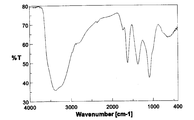
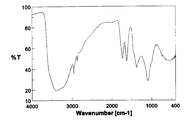
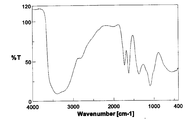
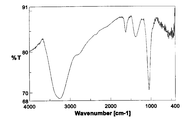
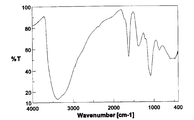
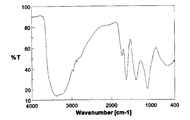
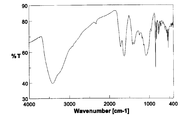
- FIG. 4 is an FT-IR spectrum diagram of partially chlorinated hydroxylated fullerene C 60 Cl 10 (OH) 30 ⁇ 5H 2 O. It is a FT-IR spectrum of the partially chlorinated fullerene C 60 Cl 2 (OH) 38 ⁇ 6H 2 O. It is a FT-IR spectrum of the hydroxylated fullerene C 60 (OH) 12 ⁇ 5H 2 O.
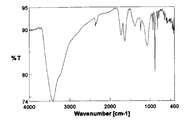
- FIG. 4 is an FT-IR spectrum diagram of chlorinated fullerene C 60 Cl 8 . Partially chlorinated fullerene C 60 Cl 0. Is 5 (OH) 35. 5 ⁇ 8H 2 FT-IR spectrum of the O.
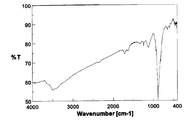
- FIG. 4 is an FT-IR spectrum diagram of chlorinated fullerene C 60 Cl 28 . It is a FT-IR spectrum of the partially chlorinated fullerene C 60 Cl 3 (OH) 25 ⁇ 6H 2 O.
- the novel fullerene derivative according to the present invention has a halogen group as well as a hydroxyl group in the fullerene nucleus.
- fullerene represented by the general formula CpXn (OH) m (p is an even number of 60 or more, X is a halogen group, n is a number of 48 or less greater than 0, and m is a number of 44 or less greater than 0). Is a derivative.
- the fullerene derivative of the present invention may or may not contain secondary bond water.
- secondary bond water When the number of hydroxyl groups is small, secondary bond water is not included, and as the number increases, secondary bond water tends to be included.
- the fullerene used in the production of the fullerene derivative of the present invention is not particularly limited as long as it is a spherical carbon molecule, but preferably C 60 , C 70, or C 60 and C 70 or higher fullerenes (for example, C 76 , C 70 78 , C80 , C84 , C86, etc.).
- fullerene examples are C 60, not only the fullerene C 60, mixed fullerene chemical and physical properties including or similar fullerene C 70 or C 60, (C 60, C 70, a mixture of higher fullerenes )
- a compound having a similar structure and similar properties can be obtained.
- the halogen group (X) in the present invention is preferably fluorine (F), chlorine (Cl) and bromine (Br) among monovalent elements belonging to Group 7B of the periodic table.
- the fullerene derivative of the present invention is produced by partial hydroxylation or partial halogenation by hydroxylation (or hydrolysis) of a halogenated fullerene or halogenation of a fullerene hydroxide (or halogen group substitution reaction).
- substitution reaction is carried out, it is carried out only to a moderate degree of progress (ie partial hydroxylation or partial halogenation).
- the reaction may theoretically be performed until the reaction is completed.
- hydroxylation of the halogenated fullerene is mainly carried out by a substitution reaction, the reaction is allowed to proceed only until a part of the halogen groups remain (can be controlled by reaction conditions, time, reagent equivalents, etc.).
- a hydroxyl group addition reaction may be carried out at the same time or may be contained as secondary bond water.
- Halogenation of hydroxylated fullerene is mainly carried out by an addition reaction. According to the examples, when the number of hydroxyl groups in the starting fullerene hydroxide is large, the number of hydroxyl groups in the product after the reaction is reduced. It is thought that the introduction of the group was performed by a substitution reaction.
- halogenated fullerene or hydroxylated fullerene that is the starting material for the fullerene derivative of the present invention is already known.
- Non-Patent Document 1 J. Am. Chem. Soc., 1991, 113, 9900
- Non-Patent Document 2 J. Chem. Soc., Chem. Commun., 1993, 1230
- Patent Document 3 Eur. J. Org. Chem., 2005, 4951
- Patent Document 4 Japanese Patent Application Laid-Open No.
- Non-Patent Document 4 discloses a method for producing fluorinated fullerene C 60 F 48 .
- Non-Patent Document 4 Angew. Chem. Int. Ed. 2001, 40, 2285
- Non-Patent Document 5 discloses a method for producing brominated fullerene C 60 Br 16 .
- Non-Patent Document 5 Science, 1992, 256, 822
- the manufacturing method of the fullerene derivative of this invention the halogenated fullerene used as a starting material may be manufactured by what kind of method.
- Hydroxylene fullerene C 60 (OH) m is obtained by hydroxylating fullerene C 60 as a starting material, and its production method is already known.
- Patent Document 5 Japanese Patent Application Laid-Open No. 7-48302
- Patent Document 6 International Publication WO 2008/096763
- Non-Patent Document 6 J. Org. Chem., 1994, 59, 3960
- Non-Patent Document 7 Synth. Commun., 2005, 35, 1803
- Non-Patent Document 8 ACS Nano, 2008, 2, 327 It can manufacture by the method currently disclosed by these.
- the fullerene hydroxide used as a starting material may be produced by any method.
- Non-Patent Document 9 Fullerenes, Nanotubes, and Carbon Nanostructures, 2005, 13, 331
- halogenated fullerenes and hydroxylated fullerenes are conventionally known.
- partially halogenated hydroxylated fullerene derivatives in which a halogen group and a hydroxyl group coexist are not known so far, such as the fullerene derivatives of the present invention. .
- the fullerene derivative of the present invention can be obtained by partial hydroxylation of a chlorinated fullerene after the fullerene is converted into a chlorinated fullerene or a hydroxylated fullerene or by using a known chlorinated fullerene or a hydroxylated fullerene. It can be synthesized by partial chlorination (method B) of (method A) or fullerene hydroxide. For example, when the fullerene is C 60 , the following formula 1 is obtained.
- Partial hydroxylation methods include a general hydrolysis reaction using a base catalyst such as sodium hydroxide and potassium hydroxide, and a hydroxylation reaction using a hydrogen peroxide solution, but these methods are particularly limited. is not.
- hydroxylating reagent for partial hydroxylation in addition to sodium hydroxide and potassium hydroxide, LiOH, RbOH, CsOH, Ca (OH) 2 , Sr (OH) 2 , Ba (OH) 2 , TlOH , NBuN (OH), Triton B, and the like.
- the number m of hydroxyl groups introduced is the same as the number m 'of substituents in the starting fullerene hydroxide, or is reduced by a substitution reaction with chlorine, or It may be increased by an operation during the reaction process.
- chlorination reaction using iodine chloride (ICl) is shown in the examples as the method of partial chlorination, it is not particularly limited to this reagent.
- ICl iodine chloride
- POCl 3 , PCl 5 , SbCl 5 , VCl 4 , VOCl 3 , MoCl 5 , KICl 4 and the like can be mentioned.
- Solvents usable in the production of the starting material (halogenated fullerene or hydroxylated fullerene) of the present invention hydroxylation of halogenated fullerene or halogenation of hydroxylated fullerene include, for example, o-dichlorobenzene, chlorobenzene, trimethylbenzene, xylene , Aromatic solvents such as toluene and benzene, Halogen solvents such as methylene chloride, chloroform, carbon tetrachloride, dichloroethane, tetrachloroethane, Aprotic polar solvents such as THF, ether, ethyl acetate, dioxane, DMF, DMSO, Other examples include carbon disulfide and acetonitrile.
- n and m are at least larger than 0, and n is smaller than the maximum number 30 known in C 60 Cln ′ (see Non-Patent Document 3 above).
- M is smaller than the maximum number 44 known in C 60 (OH) m ′ (see the aforementioned Patent Document 5).
- native to one type of isomer may be sufficient, and the average number of many isomer mixtures may be sufficient.
- the position of introduction of these substituents on the surface of the fullerene nucleus is not particularly specified.
- brominated fullerene or fluorinated fullerene is subjected to a general hydrolysis reaction using a base catalyst such as sodium hydroxide or potassium hydroxide, hydrogen peroxide Partial hydroxylation may be performed by a hydroxylation reaction using water.
- the number n of bromine or fluorine substituents in the synthesized fullerene derivative is the same as the number of substituents n ′ in the starting material, or is reduced by a substitution reaction with a hydroxyl group. Since C 60 F 48 is known as described in Non-patent Document 4 and Patent Document 4 as a brominated fullerene or fluorinated fullerene as a starting material having a large number of substituents, the fullerene of the present invention The number n of halogen substituents in the derivative is 48 or less at the maximum.
- Synthesis methods of the present invention is not limited to the fullerene C 60, chemical and physical properties and similar fullerene C 70, or C 60 mixed fullerenes containing (C 60, C 70, a mixture of higher fullerenes) starting material It is considered that a compound having a similar structure and similar properties can be obtained.
- the aqueous layer after removal of the toluene layer was added dropwise to 85 mL of a solution in which hexane, diethyl ether and 2-propanol were mixed at a ratio of 5: 5: 7, respectively, while irradiating with ultrasonic waves to precipitate a pale yellow solid.
- the resulting precipitate was allowed to settle by centrifugation, and then the supernatant was removed by decantation.
- This solid was washed with 60 mL of diethyl ether and re-precipitated, and then the supernatant was removed and dried in vacuo at room temperature overnight.
- the reaction crude product, fullerene hydroxide was obtained as a pale yellow powder.
- this solid was dissolved in 3 mL of water, and passed through column chromatography packed with a length of about 6 cm with about 1 g of Florisil (60-100 mesh).
- the aqueous solution after removing the catalyst was passed through a 0.45 ⁇ m membrane filter to completely remove Florisil. Hexane, diethyl ether and 2-propanol were added to this aqueous solution at a ratio of 5: 5: 7 with respect to the volume of water to precipitate a pale yellow solid.
- This solid was vacuum-dried overnight at room temperature to obtain a purified product, fullerene hydroxide C 60 (OH) 4 4H 2 O, as a pale yellow powder (yield 149 mg, 67%).
- the infrared absorption (IR) spectrum of the obtained product is shown in FIG.
- the infrared absorption (IR) spectrum of the product thus obtained is shown in FIG.
- the IR spectrum shown in FIG. 2 is slightly different from the spectrum of fullerene hydroxide C 60 (OH) 4 4H 2 O used as a starting material (FIG. 1), suggesting that the reaction has progressed, (with large broad absorption around 3400 cm -1 based on O-H stretching of the hydroxyl group, broad absorption around 1620,1380,1080Cm -1 based on C-C and C-O stretch) characteristic of the spectrum of oxidized fullerenes I left it. Further, in the thermogravimetric analysis of this product, a weight reduction of 5.0 wt% was observed while heating from room temperature to around 100 ° C.
- This weight loss was estimated as the amount of secondary bound water contained in the product.
- the elemental analysis values were C; 41.87%, H; 3.00%, Cl; 21.84%.
- the IR spectrum of the product thus obtained is shown in FIG.
- the IR spectrum shown in FIG. 3 is slightly different from the IR spectrum shown in FIG. 1 of the fullerene hydroxide C 60 (OH) 44 ⁇ 8H 2 O used as the starting material, suggesting that the reaction has proceeded, The spectral characteristics of the fullerene hydroxide remained. Further, according to the thermogravimetric analysis of this product, a weight loss of 7.4 wt% was observed during heating from room temperature to around 120 ° C. This weight loss was estimated as the amount of secondary bound water contained in the product.
- the IR spectrum of the product is shown in FIG. IR spectrum in FIG. 6, the spectrum of the hydroxylated fullerene C 60 (OH) 12 ⁇ 5H 2 O was used as the starting material is different (see FIG. 4) and is slightly with it suggests that the reaction proceeded, water The spectral characteristics of fullerene oxide were retained. Moreover, according to the thermogravimetric analysis of the product, a weight loss of 7.9 wt% was observed during heating from room temperature to around 110 ° C. This weight loss was estimated as the amount of secondary bound water contained in the product.
- the IR spectrum of this product is shown in FIG.
- the IR spectrum of FIG. 8 is greatly different from the IR spectrum of chlorinated fullerene C 60 Cl 8 used as the starting material (see FIG. 7), suggesting that the reaction has progressed, and also the characteristics of the spectrum of fullerene hydroxide. Was leaving. Further, in the thermogravimetric analysis, a weight loss of 9.8 wt% was observed during heating from room temperature to around 100 ° C. This weight loss was estimated as the amount of secondary bound water contained in the product. Elemental value analysis C; 48.29%, H; 3.10 %, Cl; becomes 1.06%, C 60 Cl 0 5 (OH) 35 5 ⁇ 8H 2 O Calculated (C;.. 48 .49%, H; 3.49%, Cl; 1.19%, water; 9.7 wt%).
- the IR spectrum of this product is shown in FIG.
- the IR spectrum in FIG. 9 shows a broad C—Cl stretching vibration at 883 cm ⁇ 1 , which is very similar to the spectrum of chlorinated fullerene C 60 Cl 28 described in Non-Patent Document 3.
- the elemental analysis values were C; 40.96%, Cl; 58.28%, which was in good agreement with the calculated value of C 60 Cl 28 (C; 42.06%, Cl; 57.94%).
- the IR spectrum of this product is shown in FIG.
- the IR spectrum in FIG. 10 is significantly different from the spectrum of chlorinated fullerene C 60 Cl 28 used as a starting material (see FIG. 9), suggesting that the reaction has progressed, and that the hydroxylated fullerene and chlorinated fullerene It had both spectral features.
- the thermogravimetric analysis showed that a weight loss of 8.2 wt% was observed during heating from room temperature to around 115 ° C., so this weight loss was estimated as the amount of secondary bound water contained in the product. .
- the IR spectrum of the product is shown in FIG.
- the IR spectrum of FIG. 11 shows a sharp and large C—Br stretching vibration at 848 cm ⁇ 1 , which is very similar to the spectrum of brominated fullerenes C 60 Br 8 and C 60 Br 24 described in Non-Patent Document 5, It showed the grounds for the average structure of 60 Br 16 .
- the elemental analysis values were C; 35.48%, H; 0.45%, Br; 62.47%, and the calculated value of C 60 Br 16 (C; 36.05%, Br; 63.95%) Matched well.
- the IR spectrum of this product is shown in FIG.
- the IR spectrum in FIG. 12 is significantly different from the spectrum of brominated fullerene C 60 Br 16 used as the starting material (see FIG. 11), suggesting that the reaction has progressed, and that the hydroxylated fullerene and brominated fullerene It had both spectral features.
- the thermogravimetric analysis showed that a weight reduction of 5.0 wt% was observed during heating from room temperature to around 100 ° C., so this weight reduction was estimated as the amount of secondary bound water contained in the product. . Elemental value analysis C; 55.26%, H; 1.43 %, Br;. Becomes 27.12%, C 60 Br 4 5 (OH) 9 ⁇ 4H 2 O becomes Calculated (C; 55.21 %, H; 1.31%, Br; 27.55%, water; 5.5 wt%).
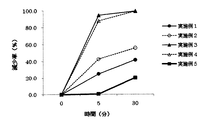
- Anti-Cry j 1 antibody is immobilized on each well of the microplate, washed and post-coated. Further, after washing, a sample solution or a standard allergen solution is added to perform a primary reaction. After washing, anti-Cry j 1 biotin-labeled antibody is added and a secondary reaction is performed. Further, after washing, the enzyme reagent streptavidin HRP is added, and after washing, the substrate o-phenylenediamine is added to perform a color reaction. After stopping the reaction by adding dilute sulfuric acid, the absorbance at a wavelength of 490 nm is measured using a microplate reader. The allergen concentration in each sample is obtained from a calibration curve prepared in advance using a standard allergen solution.
- the fullerene derivative of the present invention has antiallergen / antivirus performance and can be used in masks and filter products.
- the fullerene derivative of the present invention has an amphiphilic property having both hydrophilicity and hydrophobicity, and can be applied, impregnated, or chemically bonded to the surface of various materials. Therefore, it can be used in new organic synthesis, polymer modification, surface modification, medical field and the like.
Landscapes
- Chemical & Material Sciences (AREA)
- Organic Chemistry (AREA)
- Engineering & Computer Science (AREA)
- Nanotechnology (AREA)
- Crystallography & Structural Chemistry (AREA)
- Chemical Kinetics & Catalysis (AREA)
- Physics & Mathematics (AREA)
- Condensed Matter Physics & Semiconductors (AREA)
- General Physics & Mathematics (AREA)
- Materials Engineering (AREA)
- Analytical Chemistry (AREA)
- Composite Materials (AREA)
- Manufacturing & Machinery (AREA)
- Inorganic Chemistry (AREA)
- Organic Low-Molecular-Weight Compounds And Preparation Thereof (AREA)
- Carbon And Carbon Compounds (AREA)
Priority Applications (4)
| Application Number | Priority Date | Filing Date | Title |
|---|---|---|---|
| EP11739697.8A EP2535313B1 (en) | 2010-02-08 | 2011-01-31 | Fullerene derivative, process for production of same, and allergen adsorbent comprising same |
| CN201180006254.9A CN102858686B (zh) | 2010-02-08 | 2011-01-31 | 富勒烯衍生物及其制备方法、以及使用其的变应原吸附剂 |
| US13/577,868 US8957261B2 (en) | 2010-02-08 | 2011-01-31 | Method for producing partially halogenated, hydroxylated fullerene |
| US14/495,438 US8987526B2 (en) | 2010-02-08 | 2014-09-24 | Partially halogenated, hydroxylated fullerene and allergen adsorbent using the same |
Applications Claiming Priority (2)
| Application Number | Priority Date | Filing Date | Title |
|---|---|---|---|
| JP2010-025303 | 2010-02-08 | ||
| JP2010025303A JP4980437B2 (ja) | 2010-02-08 | 2010-02-08 | フラーレン誘導体とその製造方法、並びにこれを用いたアレルゲン吸着剤 |
Related Child Applications (2)
| Application Number | Title | Priority Date | Filing Date |
|---|---|---|---|
| US13/577,868 A-371-Of-International US8957261B2 (en) | 2010-02-08 | 2011-01-31 | Method for producing partially halogenated, hydroxylated fullerene |
| US14/495,438 Division US8987526B2 (en) | 2010-02-08 | 2014-09-24 | Partially halogenated, hydroxylated fullerene and allergen adsorbent using the same |
Publications (1)
| Publication Number | Publication Date |
|---|---|
| WO2011096349A1 true WO2011096349A1 (ja) | 2011-08-11 |
Family
ID=44355347
Family Applications (1)
| Application Number | Title | Priority Date | Filing Date |
|---|---|---|---|
| PCT/JP2011/051864 Ceased WO2011096349A1 (ja) | 2010-02-08 | 2011-01-31 | フラーレン誘導体とその製造方法、並びにこれを用いたアレルゲン吸着剤 |
Country Status (5)
| Country | Link |
|---|---|
| US (2) | US8957261B2 (https=) |
| EP (1) | EP2535313B1 (https=) |
| JP (1) | JP4980437B2 (https=) |
| CN (1) | CN102858686B (https=) |
| WO (1) | WO2011096349A1 (https=) |
Families Citing this family (10)
| Publication number | Priority date | Publication date | Assignee | Title |
|---|---|---|---|---|
| JP2013026155A (ja) | 2011-07-25 | 2013-02-04 | Yazaki Corp | 防水コネクタ用端子 |
| JP5806077B2 (ja) * | 2011-10-11 | 2015-11-10 | 本荘ケミカル株式会社 | フラーレン内包シリカゲルの製造方法 |
| US20150333124A1 (en) * | 2012-12-20 | 2015-11-19 | Basf Se | Edge halogenation of graphene materials |
| JP2016017063A (ja) * | 2014-07-10 | 2016-02-01 | 国立大学法人大阪大学 | 長鎖アルキルエーテル化フラーレン誘導体およびその製造方法、並びにそれを用いた樹脂組成物 |
| KR20200010806A (ko) | 2018-07-23 | 2020-01-31 | 삼성전자주식회사 | 연마 슬러리 및 그 제조 방법과 반도체 소자의 제조 방법 |
| KR102653892B1 (ko) | 2018-08-30 | 2024-04-02 | 삼성전자주식회사 | 화학적 기계적 연마용 슬러리 조성물, 그의 제조 방법, 및 그를 이용한 반도체 소자의 제조 방법 |
| CN110963480A (zh) * | 2018-09-29 | 2020-04-07 | 蔡蓼芸 | 一种富勒烯衍生物、制备方法及其应用 |
| US10934168B1 (en) * | 2020-04-21 | 2021-03-02 | Terry Earl Brady | Synthetic, multifaceted halogenated, functionalized fullerenes engineered for microbicidal effects employing controlled contact for safe therapeutic and environmental utility |
| US11638720B1 (en) * | 2022-08-15 | 2023-05-02 | Terry Earl Brady | Risk mitigation of infectious disease transmission from incidental and intimate contact using atomic scale molecular disruption and biocidal halo-fullerenes delivered via topical, flushing and enteral mechanisms |
| US12005132B1 (en) * | 2023-08-11 | 2024-06-11 | Terry Earl Brady | Atomic scale topical composition with enhanced interstitial cellular uptake for increased moisturizing, fluidity, antioxidant and radiation protection, antimicrobial cleansing and therapeutics for optimal dermal integrity and homeostasis |
Citations (10)
| Publication number | Priority date | Publication date | Assignee | Title |
|---|---|---|---|---|
| JPH0748302A (ja) | 1993-07-30 | 1995-02-21 | Tokyo Gas Co Ltd | フラロールの合成方法 |
| JP2000005531A (ja) | 1998-06-19 | 2000-01-11 | Matsushita Seiko Co Ltd | 抗アレルゲンフィルターと該フィルターを設けた空気清浄機および換気装置およびマスク |
| JP2002167332A (ja) | 2000-11-30 | 2002-06-11 | Lion Corp | アレルゲン吸着組成物 |
| JP2002193861A (ja) | 2000-12-25 | 2002-07-10 | Sony Corp | フラーレン誘導体の製造方法及びそのフラーレン誘導体、プロトン伝導体、並びに電気化学デバイス |
| JP2004204401A (ja) | 2002-12-26 | 2004-07-22 | Ebara Corp | 花粉吸着材 |
| JP2005104907A (ja) * | 2003-09-30 | 2005-04-21 | Neos Co Ltd | 含フッ素フラレノール誘導体及びその製造方法 |
| JP2007254246A (ja) * | 2006-03-27 | 2007-10-04 | Central Glass Co Ltd | フッ化フラーレンを含有する溶解液、または分散液 |
| JP2008094656A (ja) * | 2006-10-11 | 2008-04-24 | Chemicals Evaluation & Research Institute | フラーレン類の水分散方法 |
| WO2008096763A1 (ja) | 2007-02-09 | 2008-08-14 | Osaka University | 相間移動触媒およびポリ水酸化フラーレンの製造方法 |
| JP2008280290A (ja) * | 2007-05-10 | 2008-11-20 | Mitsubishi Chemicals Corp | フラーレン誘導体及びその製造方法 |
Family Cites Families (2)
| Publication number | Priority date | Publication date | Assignee | Title |
|---|---|---|---|---|
| CN1874981A (zh) * | 2003-10-28 | 2006-12-06 | 理想星株式会社 | 内含式富勒烯衍生物、质子导体和燃料电池 |
| WO2005049538A1 (ja) * | 2003-10-28 | 2005-06-02 | Ideal Star Inc. | 内包フラーレン誘導体、プロトン伝導体、及び、燃料電池 |
-
2010
- 2010-02-08 JP JP2010025303A patent/JP4980437B2/ja not_active Expired - Fee Related
-
2011
- 2011-01-31 CN CN201180006254.9A patent/CN102858686B/zh not_active Expired - Fee Related
- 2011-01-31 WO PCT/JP2011/051864 patent/WO2011096349A1/ja not_active Ceased
- 2011-01-31 US US13/577,868 patent/US8957261B2/en active Active
- 2011-01-31 EP EP11739697.8A patent/EP2535313B1/en not_active Not-in-force
-
2014
- 2014-09-24 US US14/495,438 patent/US8987526B2/en not_active Expired - Fee Related
Patent Citations (10)
| Publication number | Priority date | Publication date | Assignee | Title |
|---|---|---|---|---|
| JPH0748302A (ja) | 1993-07-30 | 1995-02-21 | Tokyo Gas Co Ltd | フラロールの合成方法 |
| JP2000005531A (ja) | 1998-06-19 | 2000-01-11 | Matsushita Seiko Co Ltd | 抗アレルゲンフィルターと該フィルターを設けた空気清浄機および換気装置およびマスク |
| JP2002167332A (ja) | 2000-11-30 | 2002-06-11 | Lion Corp | アレルゲン吸着組成物 |
| JP2002193861A (ja) | 2000-12-25 | 2002-07-10 | Sony Corp | フラーレン誘導体の製造方法及びそのフラーレン誘導体、プロトン伝導体、並びに電気化学デバイス |
| JP2004204401A (ja) | 2002-12-26 | 2004-07-22 | Ebara Corp | 花粉吸着材 |
| JP2005104907A (ja) * | 2003-09-30 | 2005-04-21 | Neos Co Ltd | 含フッ素フラレノール誘導体及びその製造方法 |
| JP2007254246A (ja) * | 2006-03-27 | 2007-10-04 | Central Glass Co Ltd | フッ化フラーレンを含有する溶解液、または分散液 |
| JP2008094656A (ja) * | 2006-10-11 | 2008-04-24 | Chemicals Evaluation & Research Institute | フラーレン類の水分散方法 |
| WO2008096763A1 (ja) | 2007-02-09 | 2008-08-14 | Osaka University | 相間移動触媒およびポリ水酸化フラーレンの製造方法 |
| JP2008280290A (ja) * | 2007-05-10 | 2008-11-20 | Mitsubishi Chemicals Corp | フラーレン誘導体及びその製造方法 |
Non-Patent Citations (12)
| Title |
|---|
| A.ABDUL-SADA ET AL.: "Isolation and characterisation of fluorinated derivatives of [76]- and [78]fullerenes", JOURNAL OF THE CHEMICAL SOCIETY, PERKIN TRANSACTIONS 2, vol. 12, no. 12, 1999, pages 2659 - 2666, XP008165185 * |
| A.AVENT ET AL.: "In the first proven SN2' fullerene reaction, both C3 and C1 C6oF36 hydrolyse to C1 isomers of C6oF35OH that eliminate HF to give epoxides C6oF340; C6oF360 oxides are shown to be ethers, and a fourth isomer of C6oF36 exists", ORGANIC & BIOMOLECULAR CHEMISTRY, vol. 1, no. 6, 21 March 2003 (2003-03-21), pages 1026 - 1033, XP008165183 * |
| ACS NANO, vol. 2, 2008, pages 37 |
| ANGEW. CHEM. INT. ED., vol. 40, 2001, pages 2285 |
| EUR. J. ORG. CHEM., 2005, pages 4951 |
| FULLERENES, NANOTUBES, AND CARBON NANOSTRUCTURES, vol. 13, 2005, pages 331 |
| J. AM. CHEM. SOC., vol. 113, 1991, pages 9900 |
| J. CHEM. SOC., CHEM. COMMUN., 1993, pages 1230 |
| J. ORG. CHEM., vol. 59, 1994, pages 3960 |
| SCIENCE, vol. 256, 1992, pages 822 |
| See also references of EP2535313A4 * |
| SYNTH. COMMUN., vol. 35, 2005, pages 1803 |
Also Published As
| Publication number | Publication date |
|---|---|
| US20130041185A1 (en) | 2013-02-14 |
| US8957261B2 (en) | 2015-02-17 |
| JP4980437B2 (ja) | 2012-07-18 |
| EP2535313A1 (en) | 2012-12-19 |
| EP2535313B1 (en) | 2017-11-29 |
| EP2535313A4 (en) | 2014-05-07 |
| US20150011802A1 (en) | 2015-01-08 |
| CN102858686B (zh) | 2016-01-20 |
| US8987526B2 (en) | 2015-03-24 |
| JP2011162468A (ja) | 2011-08-25 |
| CN102858686A (zh) | 2013-01-02 |
Similar Documents
| Publication | Publication Date | Title |
|---|---|---|
| JP4980437B2 (ja) | フラーレン誘導体とその製造方法、並びにこれを用いたアレルゲン吸着剤 | |
| US8410196B2 (en) | Surface-modified nanodiamond and its producing method | |
| CN105860957B (zh) | 一种用于药物载体的氧化石墨烯复合材料的制备方法 | |
| El Kadib et al. | Hybrid materials and periodic mesoporous organosilicas containing covalently bonded organic anion and cation featuring MCM-41 and SBA-15 structure | |
| Vieira et al. | Synthesis and characterization of 3-[(thiourea)-propyl]-functionalized silica gel and its application in adsorption and catalysis | |
| CN109174049B (zh) | 印迹多孔吸附锂/铷离子材料的制备方法及应用 | |
| Prabu et al. | Non-covalent polyhedral oligomeric silsesquioxane-polyoxometalates as inorganic–organic–inorganic hybrid materials for visible-light photocatalytic splitting of water | |
| Epelde-Elezcano et al. | Adapting BODIPYs to singlet oxygen production on silica nanoparticles | |
| CN104448321B (zh) | 一种改性有序介孔有机硅材料及其制备方法和应用 | |
| Ziarani et al. | 2-Chloroquinoline-3-carbaldehyde modified nanoporous SBA-15-propylamine (SBA-Pr-NCQ) as a selective and sensitive Ag+ ion sensor in aqueous media | |
| CN113173575B (zh) | 一种铜纳米颗粒/富勒醇纳米复合材料及其制备方法和应用 | |
| JP6910602B2 (ja) | 表面修飾ナノダイヤモンドの製造方法、及び表面修飾ナノダイヤモンド | |
| Jin et al. | Controlled drug delivery from mesoporous silica using a pH-response release system | |
| Paris et al. | Phthalocyanine–titanate nanotubes: a promising nanocarrier detectable by optical imaging in the so-called imaging window | |
| CN113861205A (zh) | 一种卟啉马来酰亚胺衍生物共价功能化二硫化钼纳米片非线性杂化材料及其制备与应用 | |
| RU2548971C2 (ru) | Способ получения водных нанодисперсий фуллерена | |
| US20220241419A1 (en) | Highly dispersible zinc phthalocyanine-silica nanotubes and preparation method therefor | |
| JP2005239863A (ja) | キラル配向構造を有する有機/無機複合体及びその製造法 | |
| CN103923090B (zh) | 1,4-卟啉-二氢吡啶-氧化石墨烯复合物的制备方法 | |
| CN102786046B (zh) | 一种基于n负离子的共价键修饰石墨烯的方法 | |
| Markiewicz et al. | Ring-opening reactions of epoxidized SWCNT with nucleophilic agents: a convenient way for sidewall functionalization | |
| CN115254073A (zh) | 一种表面增强型色谱填料的制备方法 | |
| Nosach et al. | Gas-phase crosslinking of the lignin on the nanoscale fumed silica surface | |
| JPH0770470A (ja) | 無機化合物の製造方法 | |
| Radchatawin et al. | Synthesis of copper supported on natural rubber-derived mesoporous carbon/silica composite for efficient adsorption of caffeine |
Legal Events
| Date | Code | Title | Description |
|---|---|---|---|
| WWE | Wipo information: entry into national phase |
Ref document number: 201180006254.9 Country of ref document: CN |
|
| 121 | Ep: the epo has been informed by wipo that ep was designated in this application |
Ref document number: 11739697 Country of ref document: EP Kind code of ref document: A1 |
|
| REEP | Request for entry into the european phase |
Ref document number: 2011739697 Country of ref document: EP |
|
| WWE | Wipo information: entry into national phase |
Ref document number: 2011739697 Country of ref document: EP |
|
| NENP | Non-entry into the national phase |
Ref country code: DE |
|
| WWE | Wipo information: entry into national phase |
Ref document number: 13577868 Country of ref document: US |