WO2011065115A1 - 耐変色性に優れた熱硬化性白色インク組成物及びその硬化物 - Google Patents
耐変色性に優れた熱硬化性白色インク組成物及びその硬化物 Download PDFInfo
- Publication number
- WO2011065115A1 WO2011065115A1 PCT/JP2010/066356 JP2010066356W WO2011065115A1 WO 2011065115 A1 WO2011065115 A1 WO 2011065115A1 JP 2010066356 W JP2010066356 W JP 2010066356W WO 2011065115 A1 WO2011065115 A1 WO 2011065115A1
- Authority
- WO
- WIPO (PCT)
- Prior art keywords
- compound
- ink composition
- white ink
- thermosetting
- molecule
- Prior art date
- Legal status (The legal status is an assumption and is not a legal conclusion. Google has not performed a legal analysis and makes no representation as to the accuracy of the status listed.)
- Ceased
Links
Classifications
-
- C—CHEMISTRY; METALLURGY
- C09—DYES; PAINTS; POLISHES; NATURAL RESINS; ADHESIVES; COMPOSITIONS NOT OTHERWISE PROVIDED FOR; APPLICATIONS OF MATERIALS NOT OTHERWISE PROVIDED FOR
- C09D—COATING COMPOSITIONS, e.g. PAINTS, VARNISHES OR LACQUERS; FILLING PASTES; CHEMICAL PAINT OR INK REMOVERS; INKS; CORRECTING FLUIDS; WOODSTAINS; PASTES OR SOLIDS FOR COLOURING OR PRINTING; USE OF MATERIALS THEREFOR
- C09D11/00—Inks
- C09D11/02—Printing inks
- C09D11/10—Printing inks based on artificial resins
- C09D11/101—Inks specially adapted for printing processes involving curing by wave energy or particle radiation, e.g. with UV-curing following the printing
-
- C—CHEMISTRY; METALLURGY
- C08—ORGANIC MACROMOLECULAR COMPOUNDS; THEIR PREPARATION OR CHEMICAL WORKING-UP; COMPOSITIONS BASED THEREON
- C08G—MACROMOLECULAR COMPOUNDS OBTAINED OTHERWISE THAN BY REACTIONS ONLY INVOLVING UNSATURATED CARBON-TO-CARBON BONDS
- C08G59/00—Polycondensates containing more than one epoxy group per molecule; Macromolecules obtained by polymerising compounds containing more than one epoxy group per molecule using curing agents or catalysts which react with the epoxy groups
- C08G59/14—Polycondensates modified by chemical after-treatment
- C08G59/1433—Polycondensates modified by chemical after-treatment with organic low-molecular-weight compounds
- C08G59/1438—Polycondensates modified by chemical after-treatment with organic low-molecular-weight compounds containing oxygen
- C08G59/1455—Monocarboxylic acids, anhydrides, halides, or low-molecular-weight esters thereof
- C08G59/1461—Unsaturated monoacids
-
- C—CHEMISTRY; METALLURGY
- C08—ORGANIC MACROMOLECULAR COMPOUNDS; THEIR PREPARATION OR CHEMICAL WORKING-UP; COMPOSITIONS BASED THEREON
- C08L—COMPOSITIONS OF MACROMOLECULAR COMPOUNDS
- C08L63/00—Compositions of epoxy resins; Compositions of derivatives of epoxy resins
- C08L63/10—Epoxy resins modified by unsaturated compounds
-
- C—CHEMISTRY; METALLURGY
- C09—DYES; PAINTS; POLISHES; NATURAL RESINS; ADHESIVES; COMPOSITIONS NOT OTHERWISE PROVIDED FOR; APPLICATIONS OF MATERIALS NOT OTHERWISE PROVIDED FOR
- C09D—COATING COMPOSITIONS, e.g. PAINTS, VARNISHES OR LACQUERS; FILLING PASTES; CHEMICAL PAINT OR INK REMOVERS; INKS; CORRECTING FLUIDS; WOODSTAINS; PASTES OR SOLIDS FOR COLOURING OR PRINTING; USE OF MATERIALS THEREFOR
- C09D11/00—Inks
- C09D11/02—Printing inks
- C09D11/03—Printing inks characterised by features other than the chemical nature of the binder
- C09D11/037—Printing inks characterised by features other than the chemical nature of the binder characterised by the pigment
-
- H—ELECTRICITY
- H05—ELECTRIC TECHNIQUES NOT OTHERWISE PROVIDED FOR
- H05K—PRINTED CIRCUITS; CASINGS OR CONSTRUCTIONAL DETAILS OF ELECTRIC APPARATUS; MANUFACTURE OF ASSEMBLAGES OF ELECTRICAL COMPONENTS
- H05K3/00—Apparatus or processes for manufacturing printed circuits
- H05K3/22—Secondary treatment of printed circuits
- H05K3/28—Applying non-metallic protective coatings
- H05K3/285—Permanent coating compositions
Definitions
- the present invention relates to a white ink composition suitable for a solder resist and various resists, and a cured product obtained by curing the white ink composition.
- a printed wiring board is used to form a pattern of a conductor circuit on a substrate and to mount electronic components on the soldering land of the pattern by soldering, and the circuit portion excluding the soldering land is used as a permanent protective film. It is covered with a solder resist film. This prevents solder from adhering to unnecessary parts when soldering electronic components to a printed wiring board, and prevents circuit conductors from being directly exposed to air and being corroded by oxidation or humidity. To do.
- solder resist film formed on the mounting surface is required to have a function of improving the reflectance of light from the light source.
- a white solder resist is mainly used as a solder resist composition for forming a solder resist film.
- the white solder resist when the coating film is heated and cured, the color change may occur and the color may be colored, and the light reflectance is lowered.
- discoloration and a decrease in reflectance are conspicuous, resulting in a reduction in commercial value.
- Patent Document 1 discloses (A) an alicyclic skeleton epoxy resin, and at least two ethylenically unsaturated bonds in one molecule. Contains an active energy ray curable resin, (B) a thiol compound, (C) a photopolymerization initiator, (D) a diluent, (E) a rutile titanium oxide, and (F) an epoxy thermosetting compound.
- a photosensitive resin composition has been proposed.
- Patent Document 2 describes a white curable resin composition containing (A) a rutile type titanium oxide produced by a chlorine method and (B) a curable resin.
- a white curable resin composition in which (B) the curable resin is (B-1) a thermosetting resin and / or (B-2) a photocurable resin has been proposed.
- Patent Document 2 also proposes that it is desirable to use a photopolymerization initiator when a photocurable resin is used.
- photopolymerization initiators examples include oxime initiators, benzoin, acetophenone, 2-hydroxy-2-methyl-1-phenylpropan-1-one, 1-hydroxycyclohexyl phenyl ketone, and benzophenone. It can. However, the photopolymerization initiator itself has a light yellow to brownish color, and the oxidative degradation progresses over time to turn yellow. There is a problem that will decrease.
- an object of the present invention is to reduce a change in white color of a white ink composition to suppress a decrease in reflectance, and to achieve a thermosetting white ink composition excellent in solder heat resistance and insulation resistance. Is to provide.
- a first aspect of the present invention is a thermosetting white ink composition excellent in color fastness that does not contain a photopolymerization initiator, and (A) heat having two or more unsaturated groups in one molecule.
- a thermosetting white ink composition comprising a curable compound, (B) a compound having at least one amino group or imino group in one molecule, and (C) a rutile-type titanium oxide.
- thermosetting white ink composition containing a photopolymerization initiator has a high polymerization reaction speed and a short curing time, but a thermosetting white ink composition that is cured by heat without using a photopolymerization initiator is The reaction rate is slow and a long time is required for curing.
- polymerization of the thermosetting compound is performed by blending a predetermined amount of a compound having at least one amino group or imino group in one molecule with a thermosetting compound having two or more unsaturated groups in one molecule. It has been found that the reaction speed is increased to the same level as in the case of the photocurable white ink composition. From this finding, the present invention does not incorporate a photopolymerization initiator into the white ink composition, thereby providing a white ink composition. The change to yellow of a thing is reduced and the fall of a reflectance is suppressed.
- thermosetting compound having two or more unsaturated groups in one molecule is saturated with a reaction product of an alicyclic epoxy resin and an unsaturated monocarboxylic acid.
- an unsaturated polybasic acid or polybasic acid anhydride is reacted to obtain a carboxyl group-containing compound, and the carboxyl group of the carboxyl group-containing compound further has one or more radically polymerizable unsaturated groups and an epoxy group.
- a thermosetting white ink composition which is a compound obtained by reacting a glycidyl compound.
- the third aspect of the present invention is a thermosetting white ink composition further comprising (D) a compound having an epoxy group
- the fourth aspect of the present invention is the above-mentioned (D)
- the thermosetting white wherein the compound having an epoxy group is contained in an amount of 1 to 75 parts by mass with respect to 100 parts by mass of the thermosetting compound having 2 or more unsaturated groups in one molecule (A). Ink composition.
- the sixth aspect of the present invention is a cured product obtained by curing the thermosetting white ink composition.
- the first aspect of the present invention since it does not contain a photopolymerization initiator, a decrease in reflectance is suppressed and the color fastness is excellent. In addition, since the color difference due to heating with time can be reduced, coloring due to deterioration of the white ink composition can be suppressed.
- the reflectance, discoloration resistance, solder heat resistance, and insulation resistance can be improved in a balanced manner.
- solder heat resistance can be further improved by further containing (D) a compound having an epoxy group.
- the reaction rate is comparable to that of a photocurable white ink composition containing a photopolymerization initiator. Production efficiency can be maintained. Furthermore, more excellent discoloration resistance can be obtained.
- the sixth aspect of the present invention it is possible to obtain a cured film that suppresses a decrease in reflectance and is excellent in discoloration resistance.
- thermosetting white ink composition of the present invention is a thermosetting white ink composition excellent in discoloration resistance that does not contain a photopolymerization initiator, and (A) two or more unsaturated groups in one molecule.
- thermosetting compound having two or more unsaturated groups in one molecule thermosetting which is cured by heating and exhibits electrical insulation properties As long as it has two or more unsaturated bonds in one molecule, any compound can be used, for example, it does not contain a carboxyl group having two or more ethylenically unsaturated groups in the molecule.
- the compound include a carboxyl group-containing compound having two or more ethylenically unsaturated groups in the molecule.
- the compound not containing a carboxyl group include a reaction product of an alicyclic epoxy resin and a radically polymerizable unsaturated monocarboxylic acid.
- the above carboxyl group-containing compound is reacted with, for example, a reaction product of an alicyclic epoxy resin and a radical polymerizable unsaturated monocarboxylic acid with a saturated or unsaturated polybasic acid or polybasic acid anhydride. There is something that was obtained.
- the point of improvement in discoloration resistance, solder heat resistance and reactivity in particular, from the point of improvement in reactivity, containing a carboxyl group obtained by reacting as described above
- a thermosetting compound having two or more unsaturated groups in one molecule obtained by further reacting the carboxyl group of the compound with a glycidyl compound having one or more radically polymerizable unsaturated groups and an epoxy group is preferable. This is because the radically polymerizable unsaturated group is bonded to the side chain of the carboxyl group-containing compound skeleton by the reaction of the glycidyl compound, thereby increasing the degree of unsaturation and improving the reactivity.
- the alicyclic epoxy resin is a resin having an alicyclic skeleton, and the skeleton is an epoxy resin formed by a chain of aliphatic cyclic compounds.
- the epoxy equivalent one having a molecular weight of usually 1000 or less, preferably 100 to 500 is used.
- alicyclic skeleton epoxy resin for example, “EHPE-3150” (2,2-bis (hydroxymethyl) -1-butanol of 1,2-epoxy-4- (2-oxiranyl) manufactured by Daicel Chemical Industries, Ltd. ) Cyclohexene adduct).
- epoxy resins When these epoxy resins are reacted with radically polymerizable unsaturated monocarboxylic acid, the epoxy group is cleaved by the reaction of the epoxy group and the carboxyl group to form a hydroxyl group and an ester bond.
- the radically polymerizable unsaturated monocarboxylic acid to be used is not particularly limited, and examples thereof include acrylic acid, methacrylic acid, crotonic acid, and cinnamic acid. However, at least one of acrylic acid and methacrylic acid (hereinafter referred to as (meth) acrylic). It is sometimes referred to as an acid.), And acrylic acid is particularly preferable.
- the reaction method between the epoxy resin and the radically polymerizable unsaturated monocarboxylic acid is not particularly limited, and for example, the epoxy resin and acrylic acid can be reacted by heating in an appropriate diluent.
- the diluent include ketones such as methyl ethyl ketone and cyclohexanone, aromatic hydrocarbons such as toluene and xylene, alcohols such as methanol, isopropanol and cyclohexanol, and alicyclic hydrocarbons such as cyclohexane and methylcyclohexane.
- Petroleum solvents such as petroleum ether and petroleum naphtha, cellosolves such as cellosolve and butylcellosolve, carbitols such as carbitol and butylcarbitol, ethyl acetate, butyl acetate, cellosolve acetate, butyl cellosolve acetate, carbitol acetate, butyl Examples include acetates such as carbitol acetate.
- the catalyst include amines such as triethylamine and tributylamine, and phosphorus compounds such as triphenylphosphine and triphenylphosphate.
- the reaction between the epoxy resin and the radically polymerizable unsaturated monocarboxylic acid is preferably carried out in a heated state, and the reaction temperature is particularly preferably from 80 to 140 ° C. If the reaction temperature exceeds 140 ° C., the radically polymerizable unsaturated monocarboxylic acid may undergo thermal polymerization and may be difficult to synthesize. If the reaction temperature is less than 80 ° C., the reaction rate becomes slow and the production efficiency decreases. .
- the blending amount of the diluent is preferably 20 to 50% with respect to the total weight of the reaction system.
- the reaction product of the epoxy resin and the radically polymerizable unsaturated monocarboxylic acid can be subjected to the reaction with the following polybasic acids, if necessary, in the form of a diluent solution without isolation.
- an unsaturated monocarboxylic oxide epoxy resin which is a reaction product of the above-described epoxy resin and radically polymerizable unsaturated monocarboxylic acid, is added to a polybasic acid or its The anhydride is reacted.
- the polybasic acid or polybasic acid anhydride reacts with the hydroxyl group produced by the reaction between the epoxy resin and the radically polymerizable unsaturated monocarboxylic acid to give the resin a free carboxyl group.
- the polybasic acid or its anhydride is not particularly limited, and either saturated or unsaturated can be used.
- the polybasic acid include succinic acid, maleic acid, adipic acid, citric acid, phthalic acid, tetrahydrophthalic acid, 3-methyltetrahydrophthalic acid, 4-methyltetrahydrophthalic acid, 3-ethyltetrahydrophthalic acid, 4- Ethyltetrahydrophthalic acid, hexahydrophthalic acid, 3-methylhexahydrophthalic acid, 4-methylhexahydrophthalic acid, 3-ethylhexahydrophthalic acid, 4-ethylhexahydrophthalic acid, methyltetrahydrophthalic acid, methylhexahydro Examples include phthalic acid, endomethylenetetrahydrophthalic acid, methylendomethylenetetrahydrophthalic acid, trimellitic acid, pyromellitic acid, and diglycolic acid. Examples of polybas
- the amount of the polybasic acid or polybasic acid anhydride used is such that the reactivity with the amino group or imino group decreases with respect to 1 mol of the hydroxyl group of the reaction product of the epoxy resin and the radically polymerizable unsaturated monocarboxylic acid.
- the lower limit is 0.3 mol from the standpoint of preventing the deterioration of solder heat resistance, and the upper limit is 1. from the viewpoint of preventing the deterioration of various properties (for example, water resistance) of the finally obtained cured coating film. 0 mole.
- the reaction is preferably carried out at a reaction temperature of 70 to 130 ° C.
- reaction temperature exceeds 130 ° C.
- synthesis may be difficult due to thermal polymerization of radical-polymerized unsaturated groups of the epoxy resin or unreacted monomers, and the reaction rate is below 70 ° C. This is because the production efficiency is lowered due to the delay.
- Examples of the compound having one or more radically polymerizable unsaturated group and epoxy group to be reacted with the polybasic acid-modified unsaturated monocarboxylic oxide epoxy resin include glycidyl acrylate, glycidyl methacrylate, allyl glycidyl ether, pentaerythritol tris. Examples include acrylate monoglycidyl ether. In addition, you may have multiple glycidyl groups in 1 molecule. These compounds may be used alone or in combination of two or more.
- the glycidyl compound is added to the solution of the polybasic acid-modified unsaturated monocarboxylic oxide epoxy resin and reacted.
- the glycidyl compound is reacted in an amount of 0.05 to 0.5 mol with respect to 1 mol of the carboxyl group introduced into the polybasic acid-modified unsaturated monocarboxylic oxide epoxy resin. It is preferable to carry out a reaction of ⁇ 0.5 mol.
- the reaction temperature is preferably 80 to 120 ° C.
- (B) Compound having at least one amino group or imino group in one molecule Any compound having at least one amino group or imino group in one molecule may be used as long as it is a conventionally known compound. Examples thereof include melamine and melamine derivatives. Examples of the melamine derivative include alkylated melamines containing a functional group such as an imino group, a methylol group, and a methoxymethyl group. Examples of the alkylated melamine include the following general formula (i):
- R 1 , R 2 , R 3 , R 4 , R 5 , and R 6 each independently represents hydrogen, a methylol group, or a methoxymethyl group).
- Examples of commercially available melamine derivatives include “Nicarak MW-30HM”, “Nicarak MW-390”, “Nicarac MW-100LM”, “Nicarac MX-750LM” manufactured by Sanwa Chemical Co., Ltd. be able to.
- the lower limit of the compounding amount of the compound having at least one amino group or imino group in one molecule with respect to 100 parts by mass of the thermosetting compound having two or more unsaturated groups in one molecule is cured
- the amount is 0.2 part by mass from the viewpoint of securing the speed, 1.0 part by mass is preferable from the viewpoint of further improving discoloration resistance, and 1.5 part by mass is particularly preferable from the viewpoint of further improving the solder heat resistance.
- the upper limit of the amount is 10 parts by mass from the viewpoint of water resistance, 5 parts by mass is preferable from the viewpoint of improving electrical characteristics in humidity, and 3 parts by mass is particularly preferable from the viewpoint of high insulation resistance.
- the average particle size of the particles is not particularly limited, but is usually 0.01 to 1 ⁇ m.
- the surface treating agent for rutile type titanium oxide particles is not particularly limited.
- the rutile type titanium oxide is, for example, “TR-600”, “TR-700”, “TR-750”, “TR-840” manufactured by Fuji Titanium Industry Co., Ltd., “R-550” manufactured by Ishihara Sangyo Co., Ltd. , “R-580”, “R-630”, “R-820”, “CR-50”, “CR-60”, “CR-90”, “CR-93”, manufactured by Titanium Industry Co., Ltd.
- the compounding amount of rutile-type titanium oxide is preferably 30 to 200 parts by mass, more preferably 50 to 150 parts by mass with respect to 100 parts by mass of (A) thermosetting compound having two or more unsaturated groups in one molecule. Part.
- thermosetting white ink composition of the present invention can contain (D) a compound having an epoxy group, if necessary.
- a compound having an epoxy group that is, an epoxy compound is used to increase the crosslink density of a cured coating film to obtain a sufficient cured coating film, and for example, an epoxy resin is added.
- the epoxy resin include bisphenol A type epoxy resin, novolak type epoxy resin (phenol novolak type epoxy resin, o-cresol novolak type epoxy resin, p-tert-butylphenol novolak type, etc.), bisphenol F and bisphenol S with epichlorohydrin.
- Bisphenol F-type and bisphenol S-type epoxy resins obtained by reaction, alicyclic epoxy resins having cyclohexene oxide groups, tricyclodecane oxide groups, cyclopentene oxide groups, and the like, tris (2,3-epoxypropyl) isocyanurate , Triglycidyl isocyanurate having a triazine ring such as triglycidyl tris (2-hydroxyethyl) isocyanurate, dicyclopentadiene type epoxy resin, Adama It can be exemplified Tan type epoxy resin. These compounds may be used alone or in combination of two or more.
- the amount of the epoxy compound used is such that (A) a thermosetting compound having two or more unsaturated groups in one molecule is obtained from the point of obtaining a sufficient coating film after curing and improving solder heat resistance. 1 to 75 parts by mass, and preferably 20 to 60 parts by mass from the viewpoint of the balance between coating film curability and solder heat resistance.
- thermosetting white ink composition of the present invention may contain various additive components as necessary, such as antifoaming agents, various additives, solvents, and constitutions. A pigment or the like can be contained.
- antifoaming agent known ones can be used, and examples thereof include silicone-based, hydrocarbon-based and acrylic-based agents.
- additives examples include dispersants such as coupling agents such as silane, titanate, and alumina, boron trifluoride-amine complex, dicyandiamide (DICY) and its derivatives, organic acid hydrazide, and diaminomaleonitrile (DAMN).
- dispersants such as coupling agents such as silane, titanate, and alumina, boron trifluoride-amine complex, dicyandiamide (DICY) and its derivatives, organic acid hydrazide, and diaminomaleonitrile (DAMN).
- guanamine and derivatives thereof guanamine and derivatives thereof, amine imide (AI) and latent curing agents such as polyamines, metal salts of acetylacetone such as acetylacetonate Zn and acetylacetonate Cr, enamines, tin octylates, quaternary sulfonium salts And thermosetting accelerators such as triphenylphosphine, imidazole, imidazolium salt and triethanolamine borate.
- AI amine imide
- latent curing agents such as polyamines, metal salts of acetylacetone such as acetylacetonate Zn and acetylacetonate Cr, enamines, tin octylates, quaternary sulfonium salts
- thermosetting accelerators such as triphenylphosphine, imidazole, imidazolium salt and triethanolamine borate.
- the solvent is for adjusting the viscosity and drying property of the thermosetting white ink composition.
- ketones such as methyl ethyl ketone and cyclohexane
- aromatic hydrocarbons such as toluene and xylene
- methanol isopropanol
- cyclohexane Alcohols such as hexanol, alicyclic hydrocarbons such as cyclohexane and methylcyclohexane
- petroleum solvents such as petroleum ether and petroleum naphtha
- cellosolves such as cellosolve and butylcellosolve
- carbitols such as carbitol and butylcarbitol
- Examples thereof include acetates such as ethyl acetate, butyl acetate, cellosolve acetate, butyl cellosolve acetate, carbitol acetate, and butyl carbitol acetate.
- the extender pigment is for increasing the physical strength of the coated solder resist film, and examples thereof include silica, barium sulfate, alumina, aluminum hydroxide, talc, and mica.
- thermosetting white ink composition of the present invention is not limited to a specific method.
- a kneading means such as a three-roll, ball mill or sand mill, or a stirring means such as a super mixer or a planetary mixer.
- preliminary kneading or premixing may be performed prior to the kneading or mixing.
- thermosetting white ink composition of the present invention obtained as described above has a desired thickness, for example, a printed wiring board having a circuit pattern formed by etching a copper foil of a copper-clad laminate. It is applied with a thickness of 5 to 100 ⁇ m.
- a coating means printing by a screen printing method using a printing mask is generally used as a coating means, but there is no particular limitation as long as it is a coating means that can be applied uniformly including this.
- coating means other than the screen printing method examples include spray coater, honmelt coater, bar coater, applicator, blade coater, knife coater, air knife coater, curtain flow coater, roll coater, gravure coater, offset printing, dip coater, brush A paint etc. can be mentioned.
- the white ink composition is thermally cured by heating for 20 to 80 minutes with a hot-air circulating drier at 130 to 170 ° C. to form a desired white ink composition film on the printed wiring board. Can be formed.
- An electronic circuit unit is formed by soldering an electronic component to the printed wiring board coated with the white ink composition film thus obtained by a jet soldering method, a reflow soldering method, or the like.
- thermosetting white ink composition used in 1 to 3 was prepared. Moreover, the number in a table
- surface represents a mass part.
- Thermosetting compound / synthetic compound having two or more unsaturated bonds in one molecule 240 parts by mass of bisphenol A type epoxy resin (manufactured by Japan Epoxy Resin Co., Ltd., JER834) as an epoxy resin A compound having a molecular weight of about 500, obtained by adding 72 parts by mass of acrylic acid (radically polymerizable unsaturated monocarboxylic acid) to 120 parts by mass of ethyl ether acetate and reacting by a conventional method under heating and refluxing conditions. .
- Synthetic compound 2 Acrylic acid (radically polymerizable unsaturated monocarboxylic acid) in 270 parts by mass of alicyclic skeleton epoxy resin (EHPE-3150, manufactured by Daicel Chemical Industries, Ltd.) in 400 parts by mass of cellosolve acetate ) 110 parts by mass are added, and the reaction product (a) is obtained by a conventional method under heating and refluxing conditions. Tetrahydrophthalic anhydride (polybasic acid anhydride) 160 is added to the obtained reaction product (a).
- EHPE-3150 alicyclic skeleton epoxy resin
- cellosolve acetate cellosolve acetate
- a product (b) is obtained by reacting parts by mass with a conventional method, and 40 parts by mass of glycidyl methacrylate (a compound having a radically polymerizable unsaturated group and an epoxy group) is heated and refluxed to the resulting product (b).
- glycidyl methacrylate a compound having a radically polymerizable unsaturated group and an epoxy group
- Compound obtained by reacting by the method Aronix M-408: Ditrimethylolpropane tetraacrylate manufactured by Toa Gosei Co., Ltd.
- Cyclomer P (ACA) Z-250 A carboxyl group-containing resin using an acrylic copolymer structure resin manufactured by Daicel Chemical Industries, Ltd.
- (B) Compound having at least one amino group or imino group in one molecule.
- MX-750LM Melamine derivative manufactured by Sanwa Chemical Co., Ltd.
- C Rutile titanium oxide CR-93: Ishihara Sangyo Co., Ltd.
- D Epoxy group compound EPICRON 860: Dainippon Ink & Chemicals, bisphenol A type epoxy resin.
- Irgacure 907 is a photopolymerization initiator manufactured by Ciba Specialty Chemicals
- KS-66 is a silicone antifoaming agent manufactured by Shin-Etsu Chemical Co., Ltd.
- R-974 which is an additive is Nippon Aerosil ( It is a thixotropy imparting agent manufactured by Co., Ltd.
- thermosetting white ink composition prepared as described above was applied by screen printing so that the DRY film thickness was 20 to 23 ⁇ m, and the BOX furnace Inside, it heated at 150 degreeC for 60 minutes, and the test piece coat
- Reflectance Initial The reflectance of the cured coating film at 500 nm was measured for the test piece using a spectrophotometer U-3410 (manufactured by Hitachi, Ltd .: ⁇ 60 mm integrating sphere). After heating: After heating the test piece at 170 ° C. for 100 hours, the reflectance of the cured coating film at 500 nm was measured with a spectrophotometer U-3410 (manufactured by Hitachi, Ltd .: ⁇ 60 mm integrating sphere).
- Color difference ( ⁇ E) The test piece was heated at 170 ° C. for 100 hours and then measured with a color difference meter SE2000 (manufactured by Nippon Denshoku Industries Co., Ltd.).
- the coating state after the repetition was observed visually and evaluated according to the following criteria.
- Table 2 shows the measurement results of reflectance, discoloration resistance, solder heat resistance, and insulation resistance of Examples 1 to 6 and Comparative Examples 1 to 3.
- thermosetting compound having two or more unsaturated groups in one molecule (B) a predetermined amount of a compound having at least one amino group or imino group in one molecule
- a coating film of a white ink composition having a high reflectance and a low color difference and excellent in resistance to discoloration and solder heat resistance.
- Comparative Examples 1 to 3 in which the component (B) was not blended, the discoloration resistance was particularly inferior, and in Comparative Example 2 to which a photopolymerization initiator was added, not only the discoloration resistance, The reflectance and color difference were also extremely inferior.
- Example 1 which mix
- Example 5 which mix
- discoloration resistance And the solder heat resistance was excellent.
- blended the melamine derivative mutually acquired the substantially equivalent characteristic.
- Example 3 In Comparative Example 3 in which (D) the epoxy compound was blended, the solder heat resistance was excellent, but not only the discoloration resistance was remarkably decreased, but also the reflectance was decreased and the color difference was increased. In Example 6 in which the component (B) was blended, the discoloration resistance, reflectance, and color difference were excellent.
- the present invention provides a thermosetting white ink composition that is excellent in reflectance, color difference, discoloration resistance and solder heat resistance, and also has electrical insulation, so that a printed wiring board requiring high reflectance and discoloration resistance is required.
- the utility value is high in the field of printed wiring boards for mounting LEDs.
Landscapes
- Chemical & Material Sciences (AREA)
- Organic Chemistry (AREA)
- Chemical Kinetics & Catalysis (AREA)
- Health & Medical Sciences (AREA)
- Life Sciences & Earth Sciences (AREA)
- Polymers & Plastics (AREA)
- General Chemical & Material Sciences (AREA)
- Medicinal Chemistry (AREA)
- Engineering & Computer Science (AREA)
- Materials Engineering (AREA)
- Wood Science & Technology (AREA)
- Emergency Medicine (AREA)
- Non-Metallic Protective Coatings For Printed Circuits (AREA)
- Macromonomer-Based Addition Polymer (AREA)
- Inks, Pencil-Leads, Or Crayons (AREA)
- Materials For Photolithography (AREA)
Abstract
白色インク組成物の黄色への変化を低減して反射率が低下するのを抑え、かつはんだ耐熱性と絶縁抵抗に優れた熱硬化性白色インク組成物を提供することである。 光重合開始剤が含まれない耐変色性に優れた熱硬化性白色インク組成物であって、(A)1分子中に2以上の不飽和基を有する熱硬化性化合物、(B)1分子中にアミノ基またはイミノ基を少なくとも1以上有する化合物、及び(C)ルチル型酸化チタンを含有することを特徴とする熱硬化性白色インク組成物である。
Description
本発明は、ソルダーレジストや各種レジストなどに適した白色インク組成物、及びこれを硬化させた硬化物に関するものである。
プリント配線板は、基板の上に導体回路のパターンを形成し、そのパターンのはんだ付けランドに電子部品をはんだ付けにより搭載するために使用され、そのはんだ付けランドを除く回路部分は永久保護皮膜としてのソルダーレジスト膜で被覆される。これにより、プリント配線板に電子部品をはんだ付けする際に、はんだが不必要な部分に付着するのを防止すると共に、回路導体が空気に直接曝されて酸化や湿度により腐食されるのを防止する。
また、近年、プリント配線板は発光ダイオード素子(LED)等の実装用基板としても使用され、実装面に形成されるソルダーレジスト膜には、光源からの光の反射率を向上させる機能が求められている。このような用途では、ソルダーレジスト膜を形成するソルダーレジスト組成物として、白色ソルダーレジストが主に使用されている。
しかし、白色ソルダーレジストの場合、塗膜を加熱して硬化させたときに変色が起こって着色することがあり、光反射率が低下していた。特に、白色ソルダーレジストの場合には変色と反射率の低下が目立つために、商品価値が低下していた。
そこで、紫外線照射、熱履歴による変色及び反射率の低下を抑えるために、特許文献1では、(A)脂環骨格エポキシ樹脂から得られ、1分子中に少なくとも2個のエチレン性不飽和結合を有する活性エネルギー線硬化性樹脂、(B)チオール系化合物、(C)光重合開始剤、(D)希釈剤、(E)ルチル型酸化チタン、および(F)エポキシ系熱硬化性化合物を含有する感光性樹脂組成物が提案されている。
また、高反射率を長期間にわたり維持するために、特許文献2では、(A)塩素法により製造されたルチル型酸化チタン、及び(B)硬化性樹脂を含有する白色硬化性樹脂組成物であって、(B)硬化性樹脂が、(B-1)熱硬化性樹脂、及び/又は(B-2)光硬化性樹脂である白色硬化性樹脂組成物が提案されている。特許文献2では、光硬化性樹脂を使用する場合には光重合開始剤を使用することが望ましいことも提案している。
これらの光重合開始剤には、例えば、オキシム系開始剤、ベンゾイン、アセトフェノン、2-ヒドロキシ-2-メチル-1-フェニルプロパン-1-オン、1-ヒドロキシシクロヘキシルフェニルケトン、ベンゾフェノン等を挙げることができる。しかしながら、光重合開始剤は、それ自体が薄黄色から褐色を帯びているとともに、経時的に酸化分解が進んで黄変していくので、やはり、塗膜の表面が黄色に変化して反射率が低下してしまうという問題がある。
上記事情に鑑み、本発明の目的は、白色インク組成物の黄色への変化を低減して反射率が低下するのを抑え、かつはんだ耐熱性と絶縁抵抗に優れた熱硬化性白色インク組成物を提供することである。
本発明の第1の態様は、光重合開始剤が含まれない耐変色性に優れた熱硬化性白色インク組成物であって、(A)1分子中に2以上の不飽和基を有する熱硬化性化合物、(B)1分子中にアミノ基またはイミノ基を少なくとも1以上有する化合物、及び(C)ルチル型酸化チタンを含有することを特徴とする熱硬化性白色インク組成物である。
本来、光重合開始剤を配合した光硬化性白色インク組成物は、重合反応の速度が速く硬化時間が短いが、光重合開始剤を使用せず熱により硬化させる熱硬化性白色インク組成物は、反応速度が遅く硬化に長時間を要する。しかし、1分子中に2以上の不飽和基を有する熱硬化性化合物に、1分子中にアミノ基またはイミノ基を少なくとも1以上有する化合物を所定量配合することにより、前記熱硬化性化合物の重合反応の速度が、光硬化性白色インク組成物の場合と同等程度まで速くなることを見出し、この知見から、本発明では、光重合開始剤を白色インク組成物に配合しないことにより、白色インク組成物の黄色への変化を低減し、反射率の低下を抑制したものである。
本発明の第2の態様は、前記(A)1分子中に2以上の不飽和基を有する熱硬化性化合物が、脂環式エポキシ樹脂と不飽和モノカルボン酸との反応生成物に、飽和または不飽和の多塩基酸または多塩基酸無水物を反応させてカルボキシル基含有化合物を得、前記カルボキシル基含有化合物のカルボキシル基に、さらに1つ以上のラジカル重合性不飽和基とエポキシ基を有するグリシジル化合物を反応させて得られる化合物であることを特徴とする熱硬化性白色インク組成物である。
本発明の第3の態様は、さらに、(D)エポキシ基を有する化合物を含有することを特徴とする熱硬化性白色インク組成物であり、本発明の第4の態様は、前記(D)エポキシ基を有する化合物が、前記(A)1分子中に2以上の不飽和基を有する熱硬化性化合物100質量部に対して、1~75質量部含有することを特徴とする熱硬化性白色インク組成物である。
本発明の第5の態様は、前記(B)1分子中にアミノ基またはイミノ基を少なくとも1以上有する化合物が、メラミンまたはメラミン誘導体であることを特徴とする熱硬化性白色インク組成物である。
本発明の第6の態様は、前記熱硬化性白色インク組成物を硬化させたことを特徴とする硬化物である。
本発明の第1の態様によれば、光重合開始剤を含まないので、反射率の低下が抑制され、耐変色性にも優れている。また、経時、加熱による色差を小さく抑えることができるので、白色インク組成物の劣化による着色を抑えることができる。
本発明の第2の態様によれば、反射率、耐変色性、はんだ耐熱性及び絶縁抵抗をよりバランスよく向上させることができる。
本発明の第3、第4の態様によれば、さらに、(D)エポキシ基を有する化合物を含有することで、はんだ耐熱性をより向上させることができる。
本発明の第5の態様によれば、前記(B)成分をメラミンまたはメラミン誘導体とすることで、光重合開始剤を配合した光硬化性白色インク組成物と同程度の反応速度となるので、生産効率を維持できる。さらに、より優れた耐変色性が得られる。
本発明の第6の態様によれば、反射率の低下が抑制され、耐変色性にも優れている硬化被膜を得ることができる。
次に、本発明の熱硬化性白色インク組成物の各成分について説明する。本発明の熱硬化性白色インク組成物は、光重合開始剤が含まれない耐変色性に優れた熱硬化性白色インク組成物であって、(A)1分子中に2以上の不飽和基を有する熱硬化性化合物、(B)1分子中にアミノ基またはイミノ基を少なくとも1以上有する化合物、及び(C)ルチル型酸化チタンを含有するものであって、上記各成分は、以下の通りである。
(A)1分子中に2以上の不飽和基を有する熱硬化性化合物
1分子中に2以上の不飽和基を有する熱硬化性化合物としては、加熱により硬化して電気絶縁性を示す熱硬化性化合物のうち、1分子中に2以上の不飽和結合を有するものであれば、いずれも使用することができ、例えば、分子内にエチレン性不飽和基を2個以上有するカルボキシル基を含有しない化合物、分子内にエチレン性不飽和基を2個以上有するカルボキシル基含有化合物を挙げることができる。上記したカルボキシル基を含有しない化合物には、例えば、脂環式エポキシ樹脂とラジカル重合性不飽和モノカルボン酸との反応生成物がある。また、上記したカルボキシル基含有化合物には、例えば、脂環式エポキシ樹脂とラジカル重合性不飽和モノカルボン酸との反応生成物に、飽和または不飽和の多塩基酸または多塩基酸無水物を反応させて得られたものがある。
1分子中に2以上の不飽和基を有する熱硬化性化合物としては、加熱により硬化して電気絶縁性を示す熱硬化性化合物のうち、1分子中に2以上の不飽和結合を有するものであれば、いずれも使用することができ、例えば、分子内にエチレン性不飽和基を2個以上有するカルボキシル基を含有しない化合物、分子内にエチレン性不飽和基を2個以上有するカルボキシル基含有化合物を挙げることができる。上記したカルボキシル基を含有しない化合物には、例えば、脂環式エポキシ樹脂とラジカル重合性不飽和モノカルボン酸との反応生成物がある。また、上記したカルボキシル基含有化合物には、例えば、脂環式エポキシ樹脂とラジカル重合性不飽和モノカルボン酸との反応生成物に、飽和または不飽和の多塩基酸または多塩基酸無水物を反応させて得られたものがある。
光重合開始剤が含まれない本発明では、耐変色性、はんだ耐熱性及び反応性の向上の点、特に、反応性の向上の点から、上記のように反応させて得られたカルボキシル基含有化合物のカルボキシル基に、さらに1つ以上のラジカル重合性不飽和基とエポキシ基を有するグリシジル化合物を反応させて得られる、1分子中に2以上の不飽和基を有する熱硬化性化合物が好ましい。これは、グリシジル化合物の反応によってラジカル重合性不飽和基が、前記カルボキシル基含有化合物骨格の側鎖に結合することで、不飽和度が増加し、上記反応性の向上が得られるためである。
前記脂環式エポキシ樹脂とは、脂環骨格を有する樹脂であり、骨格が脂肪族環式化合物の連鎖によって形成されているエポキシ樹脂である。エポキシ当量の制限は特にないが、通常1000以下、好ましくは100~500のものを用いる。
脂環骨格エポキシ樹脂としては、例えば、ダイセル化学工業(株)社製「EHPE-3150」(2,2-ビス(ヒドロキシメチル)-1-ブタノールの1,2-エポキシ-4-(2-オキシラニル)シクロヘキセン付加物)などを挙げることができる。
これらのエポキシ樹脂とラジカル重合性不飽和モノカルボン酸を反応させると、エポキシ基とカルボキシル基の反応によりエポキシ基が開裂して水酸基とエステル結合が生成する。
使用するラジカル重合性不飽和モノカルボン酸は、特に限定されず、例えば、アクリル酸、メタクリル酸、クロトン酸、桂皮酸などがあるが、アクリル酸及びメタクリル酸の少なくとも一方(以下、(メタ)アクリル酸ということがある。)が好ましく、特にアクリル酸が好ましい。
また、エポキシ樹脂とラジカル重合性不飽和モノカルボン酸との反応方法は、特に限定されず、例えば、エポキシ樹脂とアクリル酸を適当な希釈剤中で加熱することにより反応させることができる。希釈剤としては、例えば、メチルエチルケトン、シクロヘキサノン等のケトン類、トルエン、キシレン等の芳香族炭化水素類、メタノール、イソプロパノール、シクロヘキサノール、などのアルコール類、シクロヘキサン、メチルシクロヘキサン等の脂環式炭化水素類、石油エーテル、石油ナフサ等の石油系溶剤類、セロソルブ、ブチルセロソルブ等のセロソルブ類、カルビトール、ブチルカルビトール等のカルビトール類、酢酸エチル、酢酸ブチル、セロソルブアセテート、ブチルセロソルブアセテート、カルビトールアセテート、ブチルカルビトールアセテート等の酢酸エステル類等を挙げることができる。また触媒としては、例えば、トリエチルアミン、トリブチルアミンなどのアミン類、トリフェニルホスフィン、トリフェニルホスフェートなどのリン化合物類等を挙げることができる。
上記したエポキシ樹脂とラジカル重合性不飽和モノカルボン酸との反応において、エポキシ樹脂が有するエポキシ基1当量あたり、ラジカル重合性不飽和モノカルボン酸を0.7~1.2当量反応させる。ラジカル重合性不飽和モノカルボン酸が0.7当量未満であると、後続の工程の合成反応時にゲル化を起こし、樹脂の安定性が低下する。また、ラジカル重合性不飽和モノカルボン酸が1.2当量を超えると、未反応のカルボン酸が多く残存するため、硬化物の諸特性(例えば耐水性等)が低下する。アクリル酸又はメタクリル酸の少なくとも一方を用いるときは、エポキシ樹脂が有するエポキシ基1当量あたり、0.8~1.0当量反応させるのが好ましい。エポキシ樹脂とラジカル重合性不飽和モノカルボン酸の反応は、加熱状態で行うのが好ましく、その反応温度は、80~140℃が特に好ましい。反応温度が140℃を超えるとラジカル重合性不飽和モノカルボン酸が熱重合を起こして合成が困難になることがあり、また80℃未満では反応速度が遅くなって生産効率が低下するためである。
エポキシ樹脂とラジカル重合性不飽和モノカルボン酸の希釈剤中での反応において、希釈剤の配合量は、反応系の総重量に対して20~50%が好ましい。エポキシ樹脂とラジカル重合性不飽和モノカルボン酸の反応生成物は単離することなく、希釈剤の溶液のまま、必要に応じて、次の多塩基酸類との反応に供することができる。
熱硬化性化合物にカルボキシル基含有化合物を使用する場合には、上記したエポキシ樹脂とラジカル重合性不飽和モノカルボン酸との反応生成物である不飽和モノカルボン酸化エポキシ樹脂に、多塩基酸又はその無水物を反応させる。多塩基酸または多塩基酸無水物は、エポキシ樹脂とラジカル重合性不飽和モノカルボン酸との反応で生成した水酸基に反応して、樹脂に遊離のカルボキシル基を持たせる。
多塩基酸又はその無水物は、特に限定されず、飽和、不飽和のいずれも使用できる。多塩基酸としては、例えば、コハク酸、マレイン酸、アジピン酸、クエン酸、フタル酸、テトラヒドロフタル酸、3-メチルテトラヒドロフタル酸、4-メチルテトラヒドロフタル酸、3-エチルテトラヒドロフタル酸、4-エチルテトラヒドロフタル酸、ヘキサヒドロフタル酸、3-メチルヘキサヒドロフタル酸、4-メチルヘキサヒドロフタル酸、3-エチルヘキサヒドロフタル酸、4-エチルヘキサヒドロフタル酸、メチルテトラヒドロフタル酸、メチルヘキサヒドロフタル酸、エンドメチレンテトラヒドロフタル酸、メチルエンドメチレンテトラヒドロフタル酸、トリメリット酸、ピロメリット酸及びジグリコール酸等が挙げられ、多塩基酸無水物としてはこれらの無水物が挙げられる。これらの化合物は単独でも2種以上を混合してもよい。
多塩基酸または多塩基酸無水物の使用量は、エポキシ樹脂とラジカル重合性不飽和モノカルボン酸との反応生成物が有する水酸基1モルに対して、アミノ基またはイミノ基との反応性の低下防止、はんだ耐熱性の低下防止の点から下限値は0.3モルであり、最終的に得られる硬化塗膜の諸特性(例えば耐水性等)の低下を防止する点から上限値は1.0モルである。
多塩基酸は、上記した不飽和モノカルボン酸化エポキシ樹脂に添加されて脱水縮合反応するにあたり、脱水縮合反応時に生成した水は反応系から連続的に取り出すことが好ましく、またその反応は加熱状態で行うのが好ましく、その反応温度は、70~130℃であることが好ましい。反応温度が130℃を超えると、エポキシ樹脂に結合されたものや、未反応モノマーのラジカル重合性不飽和基が熱重合を起こして合成が困難になることがあり、また70℃以下では反応速度が遅くなって生産効率が低下するためである。
上記した多塩基酸変性不飽和モノカルボン酸化エポキシ樹脂に反応させる1つ以上のラジカル重合性不飽和基とエポキシ基を持つ化合物には、例えば、グリシジルアクリレート、グリシジルメタクリレート、アリルグリシジルエーテル、ペンタエリスリトールトリアクリレートモノグリシジルエーテル等が挙げられる。なお、グリシジル基は1分子中に複数有していてもよい。これらの化合物は単独で用いてもよく、2種以上を混合して用いてもよい。
このグリシジル化合物は、上記した多塩基酸変性不飽和モノカルボン酸化エポキシ樹脂の溶液に添加して反応させる。グリシジル化合物は、多塩基酸変性不飽和モノカルボン酸化エポキシ樹脂に導入したカルボキシル基1モルに対し、0.05~0.5モル反応させ、電気絶縁性等の電気特性の点から、0.1~0.5モル反応させるのが好ましい。また、反応温度は80~120℃が好ましい。
(B)1分子中にアミノ基またはイミノ基を少なくとも1以上有する化合物
1分子中にアミノ基またはイミノ基を少なくとも1以上有する化合物としては、従来公知のものであれば、いずれも使用することができ、例えば、メラミン、メラミン誘導体を挙げることができる。メラミン誘導体には、イミノ基、メチロール基、メトキシメチル基の官能基を含むアルキル化メラミン等を例示することができ、アルキル化メラミンには、例えば、下記一般式(i)
1分子中にアミノ基またはイミノ基を少なくとも1以上有する化合物としては、従来公知のものであれば、いずれも使用することができ、例えば、メラミン、メラミン誘導体を挙げることができる。メラミン誘導体には、イミノ基、メチロール基、メトキシメチル基の官能基を含むアルキル化メラミン等を例示することができ、アルキル化メラミンには、例えば、下記一般式(i)

(式中、R1、R2、R3、R4、R5、R6は、それぞれ相互に独立に、水素、メチロール基またはメトキシメチル基を表す)のものを挙げることができる。
市販されているメラミン誘導体には、例えば、(株)三和ケミカル社製の「ニカラックMW-30HM」、「ニカラックMW-390」、「ニカラックMW-100LM」、「ニカラックMX-750LM」等を挙げることができる。
(A)1分子中に2以上の不飽和基を有する熱硬化性化合物100質量部に対して、1分子中にアミノ基またはイミノ基を少なくとも1以上有する化合物の配合量の下限値は、硬化速度を確保する点から0.2質量部であり、耐変色性をより高める点から1.0質量部が好ましく、さらにはんだ耐熱性もより高める点から1.5質量部が特に好ましい。また、配合量の上限値は、耐水性の点から10質量部であり、湿中における電気特性の向上の点から5質量部が好ましく、高絶縁抵抗の点から3質量部が特に好ましい。
(C)ルチル型酸化チタン
ルチル結晶構造を有する酸化チタン粒子であり、塗膜を白色化する。この粒子の平均粒径は特に限定されないが、通常は、0.01~1μmである。また、ルチル型酸化チタン粒子の表面処理剤も特に限定されない。ルチル型酸化チタンは、例えば、富士チタン工業(株)製「TR-600」、「TR-700」、「TR-750」、「TR-840」、石原産業(株)製「R-550」、「R-580」、「R-630」、「R-820」、「CR-50」、「CR-60」、「CR-90」、「CR-93」、チタン工業(株)製「KR-270」、「KR-310」、「KR-380」等を使用することができる。ルチル型酸化チタンの配合量は、(A)1分子中に2以上の不飽和基を有する熱硬化性化合物100質量部に対して、好ましくは30~200質量部、より好ましくは50~150質量部である。
ルチル結晶構造を有する酸化チタン粒子であり、塗膜を白色化する。この粒子の平均粒径は特に限定されないが、通常は、0.01~1μmである。また、ルチル型酸化チタン粒子の表面処理剤も特に限定されない。ルチル型酸化チタンは、例えば、富士チタン工業(株)製「TR-600」、「TR-700」、「TR-750」、「TR-840」、石原産業(株)製「R-550」、「R-580」、「R-630」、「R-820」、「CR-50」、「CR-60」、「CR-90」、「CR-93」、チタン工業(株)製「KR-270」、「KR-310」、「KR-380」等を使用することができる。ルチル型酸化チタンの配合量は、(A)1分子中に2以上の不飽和基を有する熱硬化性化合物100質量部に対して、好ましくは30~200質量部、より好ましくは50~150質量部である。
本発明の熱硬化性白色インク組成物には、上記した成分(A)~(C)の他に、必要に応じて、(D)エポキシ基を有する化合物を含有させることができる。エポキシ基を有する化合物、すなわちエポキシ化合物は、硬化塗膜の架橋密度を上げて十分な硬化塗膜を得るためのものであり、例えば、エポキシ樹脂を添加する。エポキシ樹脂としては、例えば、ビスフェノールA型エポキシ樹脂、ノボラック型エポキシ樹脂(フェノールノボラック型エポキシ樹脂、o-クレゾールノボラック型エポキシ樹脂、p-tert-ブチルフェノールノボラック型など)、ビスフェノールFやビスフェノールSにエピクロルヒドリンを反応させて得られたビスフェノールF型やビスフェノールS型エポキシ樹脂、さらにシクロヘキセンオキシド基、トリシクロデカンオキシド基、シクロペンテンオキシド基などを有する脂環式エポキシ樹脂、トリス(2,3-エポキシプロピル)イソシアヌレート、トリグリシジルトリス(2-ヒドロキシエチル)イソシアヌレート等のトリアジン環を有するトリグリシジルイソシアヌレート、ジシクロペンタジエン型エポキシ樹脂、アダマンタン型エポキシ樹脂を挙げることができる。これらの化合物は単独で使用してもよく、2種以上混合して使用してもよい。
エポキシ化合物の使用量は、硬化後に十分な塗膜を得、かつはんだ耐熱性を向上させる点から、(A)1分子中に2以上の不飽和基を有する熱硬化性化合物100質量部に対して1~75質量部であり、塗膜硬化性とはんだ耐熱性のバランスの点から20~60質量部が好ましい。
本発明の熱硬化性白色インク組成物には、上記した成分(A)~(D)の他に、必要に応じて、種々の添加成分、例えば、消泡剤、各種添加剤、溶剤、体質顔料などを含有させることができる。
消泡剤には、公知のものを使用でき、例えば、シリコーン系、炭化水素系、アクリル系等を挙げることができる。
各種添加剤には、例えば、シラン系、チタネート系、アルミナ系等のカップリング剤といった分散剤、三フッ化ホウ素-アミンコンプレックス、ジシアンジアミド(DICY)及びその誘導体、有機酸ヒドラジド、ジアミノマレオニトリル(DAMN)及びその誘導体、グアナミン及びその誘導体、アミンイミド(AI)並びにポリアミン等の潜在性硬化剤、アセチルアセナートZn及びアセチルアセナートCr等のアセチルアセトンの金属塩、エナミン、オクチル酸錫、第4級スルホニウム塩、トリフェニルホスフィン、イミダゾール、イミダゾリウム塩並びにトリエタノールアミンボレート等の熱硬化促進剤を挙げることができる。
溶剤は、熱硬化性白色インク組成物の粘度や乾燥性を調節するためのものであり、例えば、メチルエチルケトン、シクロヘキサン等のケトン類、トルエン、キシレン等の芳香族炭化水素類、メタノール、イソプロパノール、シクロヘキサノール等のアルコール類、シクロヘキサン、メチルシクロヘキサン等の脂環式炭化水素類、石油エーテル、石油ナフサ等の石油系溶剤、セロソルブ、ブチルセロソルブ等のセロソルブ類、カルビトール、ブチルカルビトール等のカルビトール類、酢酸エチル、酢酸ブチル、セロソルブアセテート、ブチルセロソルブアセテート、カルビトールアセテート、ブチルカルビトールアセテート等の酢酸エステル類等を挙げることができる。
体質顔料は、塗工したソルダーレジスト膜の物理的強度を上げるためのものであり、例えば、シリカ、硫酸バリウム、アルミナ、水酸化アルミニウム、タルク、マイカ等を挙げることができる。
上記した本発明の熱硬化性白色インク組成物の製造方法は、特定の方法に限定されないが、例えば、上記成分(A)~(C)および必要に応じてその他の成分を所定割合で配合後、室温にて、三本ロール、ボールミル、サンドミル等の混練手段、またはスーパーミキサー、プラネタリーミキサー等の攪拌手段により混練または混合して製造することができる。また、前記混練または混合の前に、必要に応じて、予備混練または予備混合してもよい。
次に、上記した本発明の熱硬化性白色インク組成物の塗工方法について説明する。上記のようにして得られた本発明の熱硬化性白色インク組成物は、例えば、銅張り積層板の銅箔をエッチングして形成した回路パターンを有するプリント配線板に、所望の厚さ、例えば5~100μmの厚さで塗布される。塗工の手段としては、現在、印刷マスクを用いたスクリーン印刷法による印刷が一般に多く用いられるが、これを含めて均一に塗工できる塗工手段であれば、特に限定されない。スクリーン印刷法以外の塗工手段には、例えば、スプレーコーター、ホンメルトコーター、バーコータ、アプリケータ、ブレードコータ、ナイフコータ、エアナイフコータ、カーテンフローコータ、ロールコータ、グラビアコータ、オフセット印刷、ディップコータ、刷毛塗り等を挙げることができる。
塗工後、130~170℃の熱風循環式の乾燥機等で20~80分間加熱することで白色インク組成物を熱硬化させて、プリント配線板上に目的とする白色インク組成物の皮膜を形成させることができる。
このようにして得られた白色インク組成物の皮膜にて被覆されたプリント配線板に、噴流はんだ付け方法、リフローはんだ付け方法等により電子部品がはんだ付けされることで、電子回路ユニットが形成される。
次に、本発明の実施例を説明するが、本発明はその趣旨を超えない限り、これらの例に限定されるものではない。
実施例1~6、比較例1~3
下記表1に示す各成分を下記表1に示す配合割合にて配合し、攪拌機にて予備混合した後、3本ロールを用いて室温にて混合分散させて、実施例1~6、比較例1~3にて使用する熱硬化性白色インク組成物を調製した。また、表中の数字は質量部を表す。
下記表1に示す各成分を下記表1に示す配合割合にて配合し、攪拌機にて予備混合した後、3本ロールを用いて室温にて混合分散させて、実施例1~6、比較例1~3にて使用する熱硬化性白色インク組成物を調製した。また、表中の数字は質量部を表す。
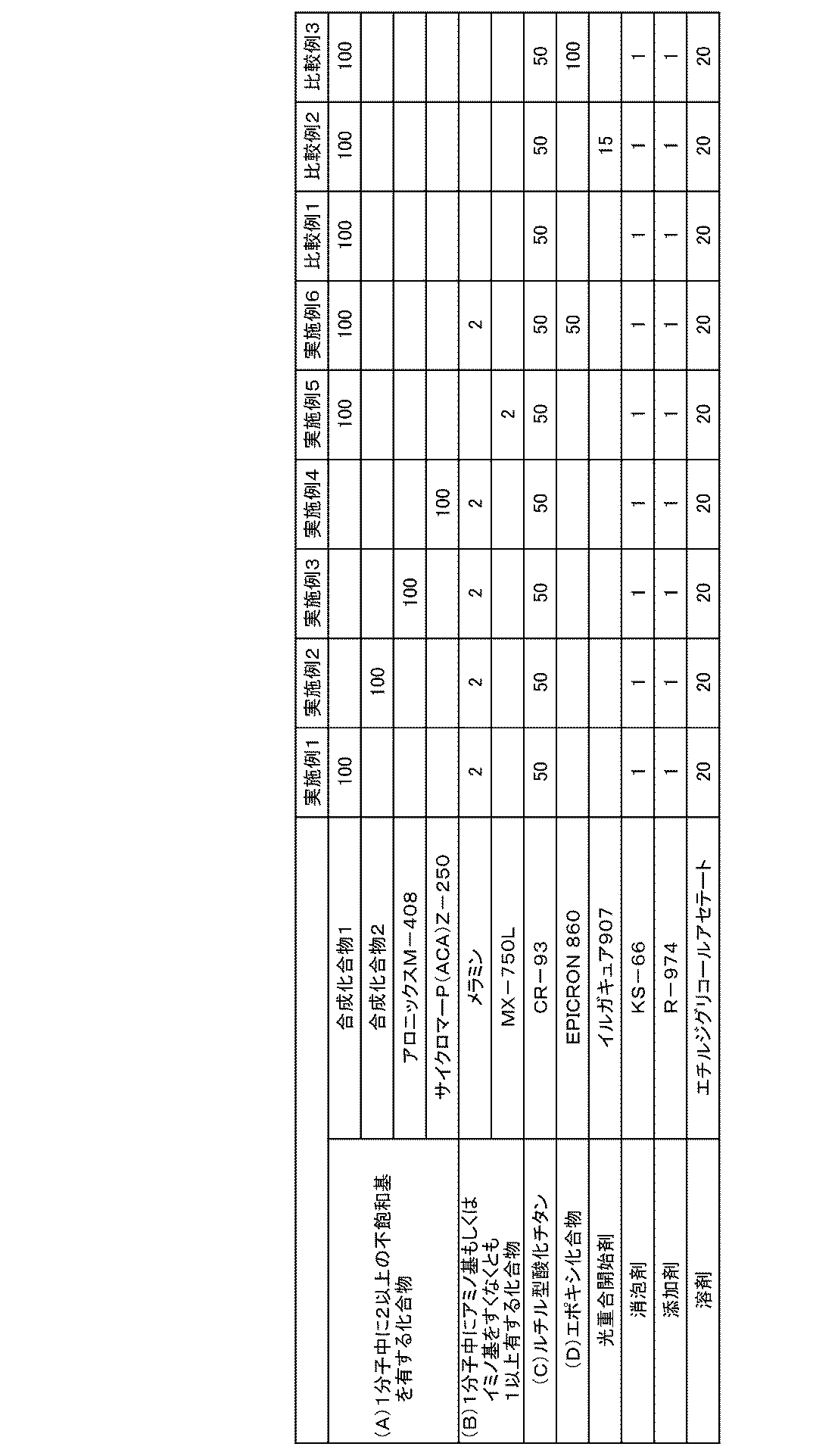
なお、表1中の各成分についての詳細は以下の通りである。
(A)1分子中に2以上の不飽和結合を有する熱硬化性化合物
・合成化合物1:エポキシ樹脂としてビスフェノールA型エポキシ樹脂(ジャパンエポキシレジン(株)社製、JER834)240質量部をジエチレングリコールモノエチルエーテルアセテート120質量部に溶解したものに、アクリル酸(ラジカル重合性不飽和モノカルボン酸)72質量部を加え、加熱還流条件下にて定法により反応させて得られた、分子量約500の化合物。
・合成化合物2:脂環骨格エポキシ樹脂(ダイセル化学工業(株)社製、EHPE-3150)270質量部を、セロソルブアセテート400質量部に溶解したものにアクリル酸(ラジカル重合性不飽和モノカルボン酸)110質量部を加え、加熱還流条件下にて定法により反応させて反応生成物(a)を得、得られた反応生成物(a)に、テトラヒドロ無水フタル酸(多塩基酸無水物)160質量部を定法により反応させて生成物(b)を得、得られた生成物(b)に、グリシジルメタアクリレート(ラジカル重合性不飽和基とエポキシ基を持つ化合物)40質量部を加熱還流下定法により反応させて得られた化合物。
・アロニックスM-408:東亜合成(株)社製、ジトリメチロールプロパンテトラアクリレート。
・サイクロマーP(ACA)Z-250:ダイセル化学工業(株)社製、アクリル共重合構造の樹脂を使用したカルボキシル基含有樹脂。
(B)1分子中にアミノ基またはイミノ基を少なくとも1以上有する化合物
・MX-750LM:(株)三和ケミカル社製、メラミン誘導体。
(C)ルチル型酸化チタン
・CR-93:石原産業(株)社製
(D)エポキシ基化合物
・EPICRON 860:大日本インキ化学工業(株)製、ビスフェノールA型エポキシ樹脂。
(A)1分子中に2以上の不飽和結合を有する熱硬化性化合物
・合成化合物1:エポキシ樹脂としてビスフェノールA型エポキシ樹脂(ジャパンエポキシレジン(株)社製、JER834)240質量部をジエチレングリコールモノエチルエーテルアセテート120質量部に溶解したものに、アクリル酸(ラジカル重合性不飽和モノカルボン酸)72質量部を加え、加熱還流条件下にて定法により反応させて得られた、分子量約500の化合物。
・合成化合物2:脂環骨格エポキシ樹脂(ダイセル化学工業(株)社製、EHPE-3150)270質量部を、セロソルブアセテート400質量部に溶解したものにアクリル酸(ラジカル重合性不飽和モノカルボン酸)110質量部を加え、加熱還流条件下にて定法により反応させて反応生成物(a)を得、得られた反応生成物(a)に、テトラヒドロ無水フタル酸(多塩基酸無水物)160質量部を定法により反応させて生成物(b)を得、得られた生成物(b)に、グリシジルメタアクリレート(ラジカル重合性不飽和基とエポキシ基を持つ化合物)40質量部を加熱還流下定法により反応させて得られた化合物。
・アロニックスM-408:東亜合成(株)社製、ジトリメチロールプロパンテトラアクリレート。
・サイクロマーP(ACA)Z-250:ダイセル化学工業(株)社製、アクリル共重合構造の樹脂を使用したカルボキシル基含有樹脂。
(B)1分子中にアミノ基またはイミノ基を少なくとも1以上有する化合物
・MX-750LM:(株)三和ケミカル社製、メラミン誘導体。
(C)ルチル型酸化チタン
・CR-93:石原産業(株)社製
(D)エポキシ基化合物
・EPICRON 860:大日本インキ化学工業(株)製、ビスフェノールA型エポキシ樹脂。
その他、イルガキュア907は、チバ スペシャルティ ケミカルズ社製の光重合開始剤、KS-66は、信越化学工業(株)社製のシリコーン系消泡剤であり、添加剤であるR-974は日本アエロジル(株)社製のチクソ性付与剤である。
試験片作成工程
プリント配線板の表面をバフ研磨処理した後、上記のように調製した熱硬化性白色インク組成物をDRY膜厚が20~23μmとなるようスクリーン印刷法にて塗布し、BOX炉内にて、150℃、60分加熱して、硬化塗膜で被覆された試験片を作成した。
プリント配線板の表面をバフ研磨処理した後、上記のように調製した熱硬化性白色インク組成物をDRY膜厚が20~23μmとなるようスクリーン印刷法にて塗布し、BOX炉内にて、150℃、60分加熱して、硬化塗膜で被覆された試験片を作成した。
(1)反射率
初期:試験片について、分光光度計U-3410((株)日立製作所製:φ60mm積分球)にて、500nmおける硬化塗膜の反射率を測定した。
加熱後:試験片を170℃で100時間加熱後、分光光度計U-3410((株)日立製作所製:φ60mm積分球)にて、500nmおける硬化塗膜の反射率を測定した。
(2)色差(ΔE)
試験片を170℃で100時間加熱後、色差計SE2000(日本電色工業(株)社製)で測定した。
(3)変色性評価(耐変色性)
加熱後:試験片を170℃で100時間加熱後、硬化塗膜を目視にて評価した。
無電解金メッキ後:試験片を、無電解ニッケルめっき液(メルプレートNI-865T、メルテックス社製、商品名)の入った85℃のめっき槽に15分間浸漬し、続いて、無電解金めっき液(メルプレートAU-601、メルテックス社製、商品名)の入った90℃のめっき槽に10分間浸漬してめっき処理を行い、表面変色を目視にて評価した。
無電解金メッキ+リフロー処理後:無電解金メッキ後、さらにプリヒート温度60~120℃、1℃/秒、ピーク温度230℃、30秒にてリフロー処理を行い、表面変色を目視にて評価した。評価結果は、変色なしを○、変色が若干認められるものを△、黄変を×とした。
(4)はんだ耐熱性
試験片の硬化塗膜を、JIS C-6481の試験方法に従って、260℃のはんだ槽に30秒間浸せき後、セロハンテープによるピーリング試験を1サイクルとし、これを1~3回繰り返した後の塗膜状態を目視により観察し、以下の基準に従って評価した。
◎:3サイクル繰り返し後も塗膜に変化が認められない、○:3サイクル繰り返し後の塗膜にほんの僅か変化が認められる、△:2サイクル繰り返し後の塗膜に変化が認められる、×:1サイクル後の塗膜に剥離が認められる。
(5)絶縁抵抗
IPC-TM-650のIPC-SM840B B-25テストクーポンのくし形電極を用い、85℃、85%R.H.で200時間加湿した後の絶縁抵抗を、DC50Vを印加して測定した。
初期:試験片について、分光光度計U-3410((株)日立製作所製:φ60mm積分球)にて、500nmおける硬化塗膜の反射率を測定した。
加熱後:試験片を170℃で100時間加熱後、分光光度計U-3410((株)日立製作所製:φ60mm積分球)にて、500nmおける硬化塗膜の反射率を測定した。
(2)色差(ΔE)
試験片を170℃で100時間加熱後、色差計SE2000(日本電色工業(株)社製)で測定した。
(3)変色性評価(耐変色性)
加熱後:試験片を170℃で100時間加熱後、硬化塗膜を目視にて評価した。
無電解金メッキ後:試験片を、無電解ニッケルめっき液(メルプレートNI-865T、メルテックス社製、商品名)の入った85℃のめっき槽に15分間浸漬し、続いて、無電解金めっき液(メルプレートAU-601、メルテックス社製、商品名)の入った90℃のめっき槽に10分間浸漬してめっき処理を行い、表面変色を目視にて評価した。
無電解金メッキ+リフロー処理後:無電解金メッキ後、さらにプリヒート温度60~120℃、1℃/秒、ピーク温度230℃、30秒にてリフロー処理を行い、表面変色を目視にて評価した。評価結果は、変色なしを○、変色が若干認められるものを△、黄変を×とした。
(4)はんだ耐熱性
試験片の硬化塗膜を、JIS C-6481の試験方法に従って、260℃のはんだ槽に30秒間浸せき後、セロハンテープによるピーリング試験を1サイクルとし、これを1~3回繰り返した後の塗膜状態を目視により観察し、以下の基準に従って評価した。
◎:3サイクル繰り返し後も塗膜に変化が認められない、○:3サイクル繰り返し後の塗膜にほんの僅か変化が認められる、△:2サイクル繰り返し後の塗膜に変化が認められる、×:1サイクル後の塗膜に剥離が認められる。
(5)絶縁抵抗
IPC-TM-650のIPC-SM840B B-25テストクーポンのくし形電極を用い、85℃、85%R.H.で200時間加湿した後の絶縁抵抗を、DC50Vを印加して測定した。
実施例1~6及び比較例1~3の反射率、耐変色性、はんだ耐熱性、絶縁抵抗の測定結果を表2に示す。
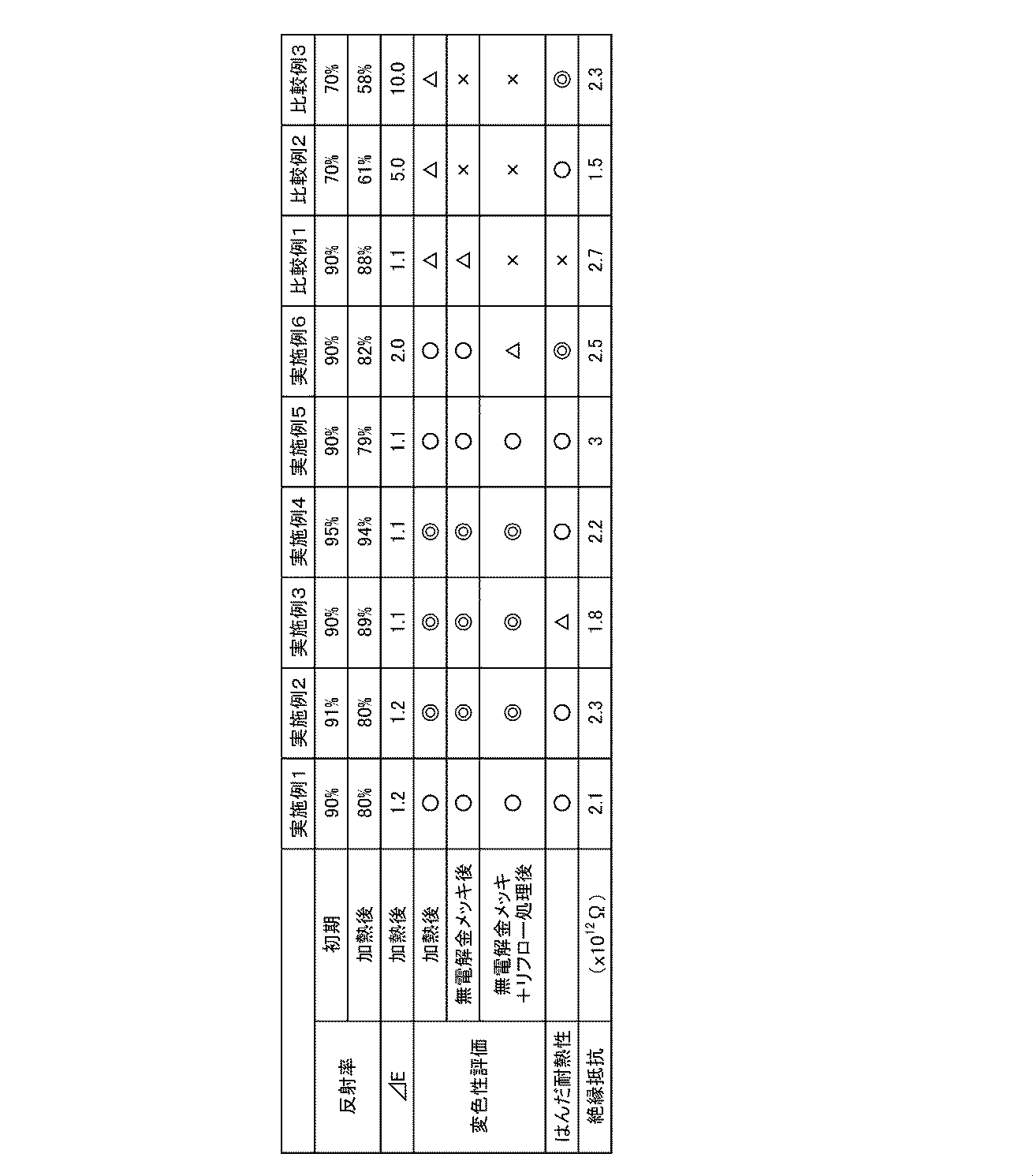
上記表2に示すように、(A)1分子中に2以上の不飽和基を有する熱硬化性化合物に、(B)1分子中にアミノ基またはイミノ基を少なくとも1以上有する化合物を所定量配合した実施例1~6では、高反射率、低色差であって、耐変色性及びはんだ耐熱性に優れた白色インク組成物の塗膜を得ることができた。これに対し上記(B)成分を配合しなかった比較例1~3では、特に、耐変色性が著しく劣っており、光重合開始剤を添加した比較例2では、耐変色性だけでなく、反射率、色差も著しく劣っていた。また、光重合開始剤を配合しなかった試験片のうち、(B)成分を配合した実施例1、5では、(B)成分を配合しなかった比較例1と比較して、耐変色性とはんだ耐熱性が優れていた。なお、メラミンを配合した実施例1とメラミン誘導体を配合した実施例5は、お互いにほぼ同等の特性が得られた。
(D)エポキシ化合物を配合した比較例3では、はんだ耐熱性に優れる一方で、耐変色性が著しく低下しただけでなく、反射率が低下し、色差も上昇したが、(D)エポキシ化合物と(B)成分を配合した実施例6では、耐変色性、反射率、色差とも優れていた。
本発明は、反射率、色差、耐変色性及びはんだ耐熱性に優れ、電気絶縁性も有する熱硬化性白色インク組成物を提供するので、高反射率及び耐変色性が要求されるプリント配線板の分野、特にLEDの実装用プリント配線板の分野で利用価値が高い。
Claims (6)
- 光重合開始剤が含まれない耐変色性に優れた熱硬化性白色インク組成物であって、
(A)1分子中に2以上の不飽和基を有する熱硬化性化合物、
(B)1分子中にアミノ基またはイミノ基を少なくとも1以上有する化合物、
及び(C)ルチル型酸化チタンを含有することを特徴とする熱硬化性白色インク組成物。 - 前記(A)1分子中に2以上の不飽和基を有する熱硬化性化合物が、脂環式エポキシ樹脂と不飽和モノカルボン酸との反応生成物に、飽和または不飽和の多塩基酸または多塩基酸無水物を反応させてカルボキシル基含有化合物を得、前記カルボキシル基含有化合物のカルボキシル基に、さらに1つ以上のラジカル重合性不飽和基とエポキシ基を有するグリシジル化合物を反応させて得られる化合物であることを特徴とする請求項1に記載の熱硬化性白色インク組成物。
- さらに、(D)エポキシ基を有する化合物を含有することを特徴とする請求項1または2に記載の熱硬化性白色インク組成物。
- 前記(D)エポキシ基を有する化合物が、前記(A)1分子中に2以上の不飽和基を有する化合物100質量部に対して、1~75質量部含有することを特徴とする請求項3に記載の熱硬化性白色インク組成物。
- 前記(B)1分子中にアミノ基またはイミノ基を少なくとも1以上有する化合物が、メラミンまたはメラミン誘導体であることを特徴とする請求項1に記載の熱硬化性白色インク組成物。
- 請求項1乃至5のいずれか1項に記載の熱硬化性白色インク組成物を硬化させたことを特徴とする硬化物。
Priority Applications (1)
| Application Number | Priority Date | Filing Date | Title |
|---|---|---|---|
| JP2011543154A JP5802133B2 (ja) | 2009-11-26 | 2010-09-22 | 耐変色性に優れた熱硬化性白色インク組成物及びその硬化物 |
Applications Claiming Priority (2)
| Application Number | Priority Date | Filing Date | Title |
|---|---|---|---|
| JP2009269128 | 2009-11-26 | ||
| JP2009-269128 | 2009-11-26 |
Publications (1)
| Publication Number | Publication Date |
|---|---|
| WO2011065115A1 true WO2011065115A1 (ja) | 2011-06-03 |
Family
ID=44066219
Family Applications (1)
| Application Number | Title | Priority Date | Filing Date |
|---|---|---|---|
| PCT/JP2010/066356 Ceased WO2011065115A1 (ja) | 2009-11-26 | 2010-09-22 | 耐変色性に優れた熱硬化性白色インク組成物及びその硬化物 |
Country Status (2)
| Country | Link |
|---|---|
| JP (1) | JP5802133B2 (ja) |
| WO (1) | WO2011065115A1 (ja) |
Cited By (1)
| Publication number | Priority date | Publication date | Assignee | Title |
|---|---|---|---|---|
| JP2013072005A (ja) * | 2011-09-28 | 2013-04-22 | Tamura Seisakusho Co Ltd | 熱硬化性白色インク組成物 |
Citations (6)
| Publication number | Priority date | Publication date | Assignee | Title |
|---|---|---|---|---|
| JP2000044865A (ja) * | 1998-07-27 | 2000-02-15 | Shinto Paint Co Ltd | 艶消し電着塗料およびその電着塗装方法 |
| JP2003076012A (ja) * | 2001-09-07 | 2003-03-14 | Tokyo Ohka Kogyo Co Ltd | 感光性樹脂組成物及びそれを用いたパターンの形成方法 |
| JP2006219656A (ja) * | 2005-01-14 | 2006-08-24 | Daiso Co Ltd | 表面平滑性が良好な高光沢化粧板 |
| JP2008255338A (ja) * | 2007-03-14 | 2008-10-23 | Nippon Gosei Kako Kk | ジアリルフタレート樹脂組成物 |
| JP2009014884A (ja) * | 2007-07-03 | 2009-01-22 | Dainippon Printing Co Ltd | 光学フィルム |
| JP2009149878A (ja) * | 2007-11-30 | 2009-07-09 | Taiyo Ink Mfg Ltd | 白色硬化性樹脂組成物、その硬化物を有するプリント配線板、及びその硬化物からなる発光素子用反射板 |
Family Cites Families (3)
| Publication number | Priority date | Publication date | Assignee | Title |
|---|---|---|---|---|
| JP5164092B2 (ja) * | 2007-03-14 | 2013-03-13 | 太陽ホールディングス株式会社 | 熱硬化性組成物及びその硬化物 |
| US20090141505A1 (en) * | 2007-11-30 | 2009-06-04 | Taiyo Ink Mfg., Co,. Ltd. | White heat-hardening resin composition, hardened material, printed-wiring board and reflection board for light emitting device |
| JP5711473B2 (ja) * | 2010-06-21 | 2015-04-30 | 株式会社タムラ製作所 | 熱硬化性白色インク組成物の皮膜を有する反射シート |
-
2010
- 2010-09-22 JP JP2011543154A patent/JP5802133B2/ja active Active
- 2010-09-22 WO PCT/JP2010/066356 patent/WO2011065115A1/ja not_active Ceased
Patent Citations (6)
| Publication number | Priority date | Publication date | Assignee | Title |
|---|---|---|---|---|
| JP2000044865A (ja) * | 1998-07-27 | 2000-02-15 | Shinto Paint Co Ltd | 艶消し電着塗料およびその電着塗装方法 |
| JP2003076012A (ja) * | 2001-09-07 | 2003-03-14 | Tokyo Ohka Kogyo Co Ltd | 感光性樹脂組成物及びそれを用いたパターンの形成方法 |
| JP2006219656A (ja) * | 2005-01-14 | 2006-08-24 | Daiso Co Ltd | 表面平滑性が良好な高光沢化粧板 |
| JP2008255338A (ja) * | 2007-03-14 | 2008-10-23 | Nippon Gosei Kako Kk | ジアリルフタレート樹脂組成物 |
| JP2009014884A (ja) * | 2007-07-03 | 2009-01-22 | Dainippon Printing Co Ltd | 光学フィルム |
| JP2009149878A (ja) * | 2007-11-30 | 2009-07-09 | Taiyo Ink Mfg Ltd | 白色硬化性樹脂組成物、その硬化物を有するプリント配線板、及びその硬化物からなる発光素子用反射板 |
Cited By (1)
| Publication number | Priority date | Publication date | Assignee | Title |
|---|---|---|---|---|
| JP2013072005A (ja) * | 2011-09-28 | 2013-04-22 | Tamura Seisakusho Co Ltd | 熱硬化性白色インク組成物 |
Also Published As
| Publication number | Publication date |
|---|---|
| JPWO2011065115A1 (ja) | 2013-04-11 |
| JP5802133B2 (ja) | 2015-10-28 |
Similar Documents
| Publication | Publication Date | Title |
|---|---|---|
| JP5802126B2 (ja) | 白色硬化性樹脂組成物 | |
| JP5325805B2 (ja) | 感光性樹脂組成物およびその硬化膜を用いたプリント配線板 | |
| JP5147820B2 (ja) | スプレー塗装用白色ソルダーレジスト組成物 | |
| JP5352340B2 (ja) | 感光性樹脂組成物、プリント配線板用のソルダーレジスト組成物およびプリント配線板 | |
| JP5007453B2 (ja) | 黒色硬化性樹脂組成物 | |
| JP5066376B2 (ja) | プリント配線板用のソルダーレジスト組成物およびプリント配線板 | |
| JP5117416B2 (ja) | 感光性樹脂組成物、プリント配線板用のソルダーレジスト組成物およびプリント配線板 | |
| JP5855405B2 (ja) | 感光性樹脂組成物 | |
| JP5583091B2 (ja) | 黒色硬化性樹脂組成物 | |
| JP5766671B2 (ja) | 黒色硬化性樹脂組成物およびそれを用いたプリント配線基板 | |
| WO2011062053A1 (ja) | 難燃性ソルダーレジスト組成物及びそれを用いて得られるフレキシブル配線板 | |
| JP6222764B2 (ja) | 硬化性樹脂組成物並びに硬化性樹脂組成物の被膜を有するフレキシブル基板及び反射シート | |
| JP5419618B2 (ja) | 感光性樹脂組成物、プリント配線板用のソルダーレジスト組成物およびプリント配線板 | |
| JP5832973B2 (ja) | 白色活性エネルギー線硬化性樹脂組成物 | |
| JP6538390B2 (ja) | 感光性樹脂組成物 | |
| JP5802133B2 (ja) | 耐変色性に優れた熱硬化性白色インク組成物及びその硬化物 | |
| JP6073007B2 (ja) | 硬化性樹脂組成物 | |
| JP6376927B2 (ja) | 黒色熱硬化性樹脂組成物、並びにそれを硬化した皮膜を有するフレキシブル基板 | |
| JP5685097B2 (ja) | 硬化性樹脂組成物 | |
| JP2019020713A (ja) | 感光性樹脂組成物 | |
| JP6114799B2 (ja) | 感光性樹脂組成物並びに感光性樹脂組成物の硬化被膜を有するプリント配線板及び反射シートの製造方法 | |
| JP7405803B2 (ja) | 感光性樹脂組成物、感光性樹脂組成物の光硬化物及び感光性樹脂組成物を塗布したプリント配線板 | |
| JP5711473B2 (ja) | 熱硬化性白色インク組成物の皮膜を有する反射シート | |
| JP5971977B2 (ja) | 白色硬化性樹脂組成物 |
Legal Events
| Date | Code | Title | Description |
|---|---|---|---|
| 121 | Ep: the epo has been informed by wipo that ep was designated in this application |
Ref document number: 10832962 Country of ref document: EP Kind code of ref document: A1 |
|
| WWE | Wipo information: entry into national phase |
Ref document number: 2011543154 Country of ref document: JP |
|
| NENP | Non-entry into the national phase |
Ref country code: DE |
|
| 122 | Ep: pct application non-entry in european phase |
Ref document number: 10832962 Country of ref document: EP Kind code of ref document: A1 |