WO2011024759A1 - 水性エマルジョン樹脂組成物およびそれを配合した塗料 - Google Patents
水性エマルジョン樹脂組成物およびそれを配合した塗料 Download PDFInfo
- Publication number
- WO2011024759A1 WO2011024759A1 PCT/JP2010/064183 JP2010064183W WO2011024759A1 WO 2011024759 A1 WO2011024759 A1 WO 2011024759A1 JP 2010064183 W JP2010064183 W JP 2010064183W WO 2011024759 A1 WO2011024759 A1 WO 2011024759A1
- Authority
- WO
- WIPO (PCT)
- Prior art keywords
- weight
- parts
- resin composition
- aqueous emulsion
- acrylate
- Prior art date
- Legal status (The legal status is an assumption and is not a legal conclusion. Google has not performed a legal analysis and makes no representation as to the accuracy of the status listed.)
- Ceased
Links
Classifications
-
- C—CHEMISTRY; METALLURGY
- C09—DYES; PAINTS; POLISHES; NATURAL RESINS; ADHESIVES; COMPOSITIONS NOT OTHERWISE PROVIDED FOR; APPLICATIONS OF MATERIALS NOT OTHERWISE PROVIDED FOR
- C09D—COATING COMPOSITIONS, e.g. PAINTS, VARNISHES OR LACQUERS; FILLING PASTES; CHEMICAL PAINT OR INK REMOVERS; INKS; CORRECTING FLUIDS; WOODSTAINS; PASTES OR SOLIDS FOR COLOURING OR PRINTING; USE OF MATERIALS THEREFOR
- C09D143/00—Coating compositions based on homopolymers or copolymers of compounds having one or more unsaturated aliphatic radicals, each having only one carbon-to-carbon double bond, and containing boron, silicon, phosphorus, selenium, tellurium, or a metal; Coating compositions based on derivatives of such polymers
- C09D143/04—Homopolymers or copolymers of monomers containing silicon
-
- C—CHEMISTRY; METALLURGY
- C08—ORGANIC MACROMOLECULAR COMPOUNDS; THEIR PREPARATION OR CHEMICAL WORKING-UP; COMPOSITIONS BASED THEREON
- C08F—MACROMOLECULAR COMPOUNDS OBTAINED BY REACTIONS ONLY INVOLVING CARBON-TO-CARBON UNSATURATED BONDS
- C08F2/00—Processes of polymerisation
- C08F2/12—Polymerisation in non-solvents
- C08F2/16—Aqueous medium
- C08F2/22—Emulsion polymerisation
- C08F2/24—Emulsion polymerisation with the aid of emulsifying agents
-
- C—CHEMISTRY; METALLURGY
- C08—ORGANIC MACROMOLECULAR COMPOUNDS; THEIR PREPARATION OR CHEMICAL WORKING-UP; COMPOSITIONS BASED THEREON
- C08F—MACROMOLECULAR COMPOUNDS OBTAINED BY REACTIONS ONLY INVOLVING CARBON-TO-CARBON UNSATURATED BONDS
- C08F220/00—Copolymers of compounds having one or more unsaturated aliphatic radicals, each having only one carbon-to-carbon double bond, and only one being terminated by only one carboxyl radical or a salt, anhydride ester, amide, imide or nitrile thereof
- C08F220/02—Monocarboxylic acids having less than ten carbon atoms; Derivatives thereof
- C08F220/10—Esters
- C08F220/12—Esters of monohydric alcohols or phenols
- C08F220/16—Esters of monohydric alcohols or phenols of phenols or of alcohols containing two or more carbon atoms
- C08F220/18—Esters of monohydric alcohols or phenols of phenols or of alcohols containing two or more carbon atoms with acrylic or methacrylic acids
- C08F220/1804—C4-(meth)acrylate, e.g. butyl (meth)acrylate, isobutyl (meth)acrylate or tert-butyl (meth)acrylate
-
- C—CHEMISTRY; METALLURGY
- C08—ORGANIC MACROMOLECULAR COMPOUNDS; THEIR PREPARATION OR CHEMICAL WORKING-UP; COMPOSITIONS BASED THEREON
- C08F—MACROMOLECULAR COMPOUNDS OBTAINED BY REACTIONS ONLY INVOLVING CARBON-TO-CARBON UNSATURATED BONDS
- C08F220/00—Copolymers of compounds having one or more unsaturated aliphatic radicals, each having only one carbon-to-carbon double bond, and only one being terminated by only one carboxyl radical or a salt, anhydride ester, amide, imide or nitrile thereof
- C08F220/02—Monocarboxylic acids having less than ten carbon atoms; Derivatives thereof
- C08F220/10—Esters
- C08F220/12—Esters of monohydric alcohols or phenols
- C08F220/16—Esters of monohydric alcohols or phenols of phenols or of alcohols containing two or more carbon atoms
- C08F220/18—Esters of monohydric alcohols or phenols of phenols or of alcohols containing two or more carbon atoms with acrylic or methacrylic acids
- C08F220/1806—C6-(meth)acrylate, e.g. (cyclo)hexyl (meth)acrylate or phenyl (meth)acrylate
-
- C—CHEMISTRY; METALLURGY
- C08—ORGANIC MACROMOLECULAR COMPOUNDS; THEIR PREPARATION OR CHEMICAL WORKING-UP; COMPOSITIONS BASED THEREON
- C08F—MACROMOLECULAR COMPOUNDS OBTAINED BY REACTIONS ONLY INVOLVING CARBON-TO-CARBON UNSATURATED BONDS
- C08F230/00—Copolymers of compounds having one or more unsaturated aliphatic radicals, each having only one carbon-to-carbon double bond, and containing phosphorus, selenium, tellurium or a metal
- C08F230/04—Copolymers of compounds having one or more unsaturated aliphatic radicals, each having only one carbon-to-carbon double bond, and containing phosphorus, selenium, tellurium or a metal containing a metal
- C08F230/08—Copolymers of compounds having one or more unsaturated aliphatic radicals, each having only one carbon-to-carbon double bond, and containing phosphorus, selenium, tellurium or a metal containing a metal containing silicon
- C08F230/085—Copolymers of compounds having one or more unsaturated aliphatic radicals, each having only one carbon-to-carbon double bond, and containing phosphorus, selenium, tellurium or a metal containing a metal containing silicon the monomer being a polymerisable silane, e.g. (meth)acryloyloxy trialkoxy silanes or vinyl trialkoxysilanes
Definitions
- the present invention relates to an aqueous emulsion resin composition and a paint containing the same.
- an alkylalkoxysilane compound having 1 to 3 hydrolyzable alkoxyl groups or a hydrolyzate thereof, an alkoxysilane compound having 4 hydrolyzable alkoxyl groups or a hydrolyzate thereof, and a terminal An unsaturated monomer composition containing 0.1% by mass to 2% by mass of a silane coupling agent is emulsified in the presence of a nonionic compound having a polyalkylene glycol chain in which is an OH group.
- An aqueous emulsion resin composition obtained by polymerization has been proposed (see, for example, Patent Document 1). However, the aqueous emulsion resin composition has good weather resistance and stain resistance, but has long-term storage stability.
- the problem to be solved by the present invention is to provide an aqueous emulsion resin composition excellent in weather resistance, stain resistance and long-term storage stability, and a paint containing the same.
- the present inventors have determined that an aqueous emulsion resin composition obtained by emulsion polymerization of an unsaturated monomer composition having a specific composition in the presence of a specific surfactant has a weather resistance.
- the present invention has been completed. That is, the present invention relates to (A) ⁇ -methacryloxypropyltrimethoxysilane, (B) cyclohexyl methacrylate, (C) methyl methacrylate, butyl (meth) acrylate, and 2-ethylhexyl (meth) acrylate.
- An aqueous emulsion resin composition obtained by emulsion polymerization of an unsaturated monomer composition containing at least one unsaturated monomer selected from the group consisting of in the presence of a radical reactive surfactant.
- (A) ⁇ -methacryloxypropyltrimethoxysilane is contained in the unsaturated monomer composition in an amount of 0.1% to 2% by weight
- (B) cyclohexyl methacrylate is an unsaturated monomer.
- An aqueous emulsion resin composition containing 25 wt% to 75 wt% in the composition.
- an aqueous emulsion resin composition excellent in weather resistance, stain resistance and long-term storage stability it is possible to provide an aqueous emulsion resin composition excellent in weather resistance, stain resistance and long-term storage stability.
- the aqueous emulsion resin composition of the present invention comprises ⁇ -methacryloxypropyltrimethoxysilane as component (A), cyclohexyl methacrylate as component (B), methyl methacrylate as component (C), (meth)
- An unsaturated monomer composition containing, as an essential component, at least one unsaturated monomer selected from the group consisting of butyl acrylate and 2-ethylhexyl (meth) acrylate is used as a radical-reactive surfactant. It is obtained by emulsion polymerization in the presence.
- these components (A) to (C) act synergistically to improve not only weather resistance and stain resistance, but also significantly improve long-term storage stability. .
- the component (A) ⁇ -methacryloxypropyltrimethoxysilane has three hydrolyzable alkoxyl groups and one unsaturated group, and is excellent in the aqueous emulsion resin composition of the present invention due to its high self-crosslinking property. Weather resistance and stain resistance can be imparted. It is essential that ⁇ -methacryloxypropyltrimethoxysilane is contained in the unsaturated monomer composition in an amount of 0.1% by weight to 2% by weight, and preferably 0.2% by weight to 1% by weight. . When the content of ⁇ -methacryloxypropyltrimethoxysilane is less than 0.1% by weight, the weather resistance and stain resistance are inferior, and when it exceeds 2% by weight, the polymerization stability and the film forming property are inferior.
- the component (B), cyclohexyl methacrylate can mainly impart weather resistance and stain resistance to the aqueous emulsion resin composition of the present invention. It is essential that cyclohexyl methacrylate is contained in the unsaturated monomer composition in an amount of 25 wt% to 75 wt%, preferably 25 wt% to 70 wt%. When the content of cyclohexyl methacrylate is less than 25% by weight, the weather resistance and stain resistance are inferior. When the content of cyclohexyl methacrylate exceeds 75% by weight, the polymerization stability and the film-forming property are inferior.
- the unsaturated monomer as component (C) is at least one selected from the group consisting of methyl methacrylate, butyl (meth) acrylate, and 2-ethylhexyl (meth) acrylate.
- the component (C) can mainly impart weather resistance and stain resistance to the aqueous emulsion resin composition of the present invention.
- Component (C) is preferably contained in the unsaturated monomer composition in an amount of 30% to 70% by weight, more preferably 35% to 68% by weight.
- various unsaturated monomers other than the components (A) to (C) may be added to the unsaturated monomer composition.
- unsaturated monomers include methyl acrylate, ethyl (meth) acrylate, iso-butyl (meth) acrylate, tert-butyl (meth) acrylate, cyclohexyl acrylate, and lauryl (meth) acrylate.
- (Meth) acrylic acid ester having 1 to 18 carbon atoms such as stearyl (meth) acrylate, isobornyl (meth) acrylate, etc., having a linear, branched or cyclic alkyl chain, styrene, ⁇ -methyl Aromatic vinyl compounds such as styrene, p-methylstyrene and ethyl vinyl benzene, heterocyclic vinyl compounds such as vinyl pyrrolidone, (meth) acrylic acid 2-hydroxyethyl, (meth) acrylic acid 2-hydroxypropyl, etc.
- Hydroxyalkyl acrylate ethylene glycol (meth) acrylate, butyre Polyalkylene glycol (meth) acrylate such as glycol (meth) acrylate, alkylamino (meth) acrylate such as N, N-dimethylaminoethyl (meth) acrylate, N, N-dimethylaminopropyl (meth) acrylate, vinyl formate , Vinyl ester compounds such as vinyl acetate, vinyl propionate and vinyl versatate (trade name), monoolefin compounds such as ethylene, propylene, butylene and isobutylene, conjugated diolefin compounds such as butadiene, isoprene and chloroprene, acrylic acid and methacrylic acid ⁇ , ⁇ -unsaturated mono- or dicarboxylic acids such as acid, crotonic acid, citraconic acid, itaconic acid, maleic acid, maleic anhydride, fumaric acid, monohydroxye
- the epoxy group-containing ⁇ , ⁇ -ethylenically unsaturated compound and the polyfunctional vinyl compound can be crosslinked by themselves or in combination with an ethylenically unsaturated compound component having an active hydrogen group, Or a carbonyl group-containing ⁇ , ⁇ -ethylenically unsaturated compound (especially limited to those containing a keto group), particularly a compound having two or more hydrazide groups; oxalic acid dihydrazide, succinic acid dihydrazide, adipic acid dihydrazide, It is also possible to crosslink in combination with a polyhydrazine compound such as polyacrylic acid hydrazide.
- a crosslinkable compound having no radical reactivity during emulsion polymerization or after completion of emulsion polymerization for example, alkyl silicates such as tetramethoxysilane, tetraethoxysilane, and methyltrimethoxysilane, ethylene glycol diglycidyl
- alkyl silicates such as tetramethoxysilane, tetraethoxysilane, and methyltrimethoxysilane
- polyfunctional epoxy compounds such as ether, polyethylene glycol diglycidyl ether, glycerol polyglycidyl ether, bisphenol A glycidyl ether and the like to crosslink.
- the theoretical glass transition temperature (hereinafter sometimes abbreviated as Tg) of the unsaturated monomer composition to be used is in the range of 0 ° C. to 50 ° C. from the viewpoint of preventing blocking of the coating film surface and film formability. Preferably there is.
- W n are ratios (% by weight) of each unsaturated monomer to the unsaturated monomer composition, and T 1 , T 2 , T 3.
- ⁇ ⁇ T n is the glass transition temperature of the homopolymer of the respective unsaturated monomer (absolute temperature (K)).
- K absolute temperature
- the glass transition temperature of the homopolymer of each unsaturated monomer is a value according to Polymer Hand Book (Second Edition, edited by J. Brandrup / E. H. Immergut).
- radical-reactive surfactant in emulsion polymerization of the components (A) to (C) and other unsaturated monomers blended as necessary.
- the radical-reactive surfactant can mainly impart weather resistance and stain resistance to the aqueous emulsion resin composition of the present invention.
- the radical-reactive surfactant is not particularly limited as long as it has radical reactivity, and specifically, ADEKA rear soap (registered trademark, manufactured by ADEKA Corporation) SE-10N, SR-10 SR-20, SR-30, ER-20, ER-30, Aqualon (registered trademark, manufactured by Daiichi Kogyo Seiyaku Co., Ltd.) HS-10, KH-5, KH-10, Eleminol (registered trademark, Sanyo Chemical Industries) JS-20, Emalgen (registered trademark, manufactured by Kao Corporation) PD-104, PD-420, PD-430 and the like.
- the amount of the radical reactive surfactant used is preferably 0.5 to 5% by weight based on the unsaturated monomer composition used.
- radical-reactive surfactant used is too small, the polymerization stability may decrease, while if too large, the water resistance may decrease.
- These radical-reactive surfactants are basically required to be added before or during emulsion polymerization for the purpose of emulsifying unsaturated monomers, but give stability to emulsions after emulsion polymerization. It may be added later for the purpose.
- non-reactive surfactant may be used in combination with the above-described radical reactive surfactant.
- non-reactive surfactants that can be used in combination include anionic surfactants such as sodium dodecylbenzenesulfonate and sodium dodecylsulfate, nonionic surfactants such as polyoxyethylene lauryl ether and polyoxyethylene nonylphenyl ether, Examples include cationic surfactants such as ceyltrimethylammonium bromide and laurylpyridinium chloride, and amphoteric surfactants such as laurylbetaine.
- non-reactive surfactants may be added before or during emulsion polymerization for the purpose of emulsifying unsaturated monomers, or post-added for the purpose of imparting stability to the emulsion after emulsion polymerization. May be.
- polymerization initiators examples include persulfate-based initiators such as potassium persulfate and ammonium persulfate, and water-soluble such as 2,2′-azobis (2-methylpropionamidine) dihydrochloride. Azo initiators, organic peroxides such as t-butyl hydroperoxide and cumene hydroperoxide, and hydrogen peroxide. These polymerization initiators may be used alone or in combination of two or more. The amount of the polymerization initiator used is usually 0.1% by weight to 1% by weight with respect to the unsaturated monomer composition used.
- a reducing agent may be used together with these polymerization initiators as necessary.
- reducing agents include reducing organic compounds such as ascorbic acid, tartaric acid, citric acid, glucose, formaldehyde sulfoxylate metal salts, reducing properties such as sodium thiosulfate, sodium sulfite, sodium bisulfite, and sodium metabisulfite.
- An inorganic compound etc. are mentioned. What is necessary is just to determine the usage-amount of a reducing agent suitably in the range which does not impair the effect of this invention.
- a chain transfer agent may be used as necessary.
- chain transfer agents include n-dodecyl mercaptan, tert-dodecyl mercaptan, n-butyl mercaptan, 2-ethylhexyl thioglycolate, 2-mercaptoethanol, ⁇ -mercaptopropionic acid and the like. What is necessary is just to determine the usage-amount of a chain transfer agent suitably in the range which does not impair the effect of this invention.
- the emulsion polymerization in the present invention is usually performed under a temperature condition of about 5 ° C. to about 100 ° C., preferably about 50 ° C. to 90 ° C.
- the reaction time is not particularly limited, and may be appropriately adjusted according to the blending amount of each component, the reaction temperature, and the like.
- An aqueous emulsion resin composition is obtained by adding an acid or a base to an aqueous emulsion resin composition obtained by emulsion polymerization so as to have a pH of 4 to 10 and neutralizing it to increase the surface charge of the polymer.
- Common acids that can be used include acetic acid, lactic acid, hydrochloric acid, phosphoric acid, sulfuric acid and the like.
- Examples of a general base that can be used include amine compounds such as triethylamine, ammonia, diethanolamine, and diethylaminoethanol, and alkali metal hydroxides such as potassium hydroxide, sodium hydroxide, and lithium hydroxide.
- the paint of the present invention contains the above-mentioned aqueous emulsion resin composition.
- the paint of the present invention includes thickeners, antifoaming agents, pigments (external pigments, colored pigments, hollow balloons, heat shielding pigments, etc.), dispersants, wetting agents, light stabilizers, UV absorbers, antiseptics, antibacterial agents An agent or the like can be appropriately added.
- the paint of the present invention can be used as various coating agents such as architectural paints, heat-shielding paints, heat-insulating paints, sizing board paints, road marking paints, and mortar clothing materials.
- aqueous emulsion resin composition (1-1)
- Nonvolatile content The aqueous emulsion resin composition whose weight was previously measured was dried at 105 ° C. for 1 hour, and the weight of the volatile residue was measured. From the initial weight and the weight of the volatile residue, the ratio of nonvolatile content (% by weight) was calculated.
- Viscosity The viscosity of the aqueous emulsion resin composition was measured using a BM viscometer at 23 ° C. and 60 rpm.
- pH The pH of the aqueous emulsion resin composition was measured using a pH meter.
- MFT Minimum film-forming temperature
- Example 1 In a polymerization apparatus equipped with a stirrer, a thermometer and a reflux condenser, 200 parts by weight of deionized water and 0.2 part by weight of ADEKA rear soap SR-10 (anionic reactive surfactant, manufactured by ADEKA Corporation) ) And after sufficient nitrogen substitution, the temperature was raised to 75 ° C.
- ADEKA rear soap SR-10 anionic reactive surfactant, manufactured by ADEKA Corporation
- the theoretical Tg of the unsaturated monomer composition in Example 1 is 15 ° C.
- the properties of the obtained aqueous emulsion resin composition were a non-volatile content of 50.3% by weight, a viscosity (BM type viscometer, 60 rpm, 23 ° C.) 170 mPa ⁇ s, pH 9.0, and MFT 47 ° C.
- Example 2> instead of the emulsion of Example 1, 258 parts by weight of deionized water, 9.8 parts by weight of Adekari Soap SR-10, 22.5 parts by weight of methyl methacrylate, 300 parts by weight of cyclohexyl methacrylate, 160 An emulsion composed of 2-ethylhexyl acrylate, 2.5 parts by weight ⁇ -methacryloxypropyltrimethoxysilane, 10 parts by weight methacrylic acid and 5 parts by weight 2-hydroxyethyl methacrylate was used. Except for the above, the same operation as in Example 1 was performed to obtain an aqueous emulsion resin composition of Example 2.
- the theoretical Tg of the unsaturated monomer composition in Example 2 is 20 ° C.
- the properties of the obtained aqueous emulsion resin composition were a non-volatile content of 50.4% by weight, a viscosity (BM type viscometer, 60 rpm, 23 ° C.) 190 mPa ⁇ s, pH 8.8, and MFT 46 ° C.
- Example 3> Instead of the emulsion of Example 1, 235.5 parts by weight of deionized water, 9.8 parts by weight of ADEKA rear soap SR-10, 55 parts by weight of methyl methacrylate, 150 parts by weight of cyclohexyl methacrylate, 150 Parts by weight of n-butyl methacrylate, 128.5 parts by weight of n-butyl acrylate, 1.5 parts by weight of ⁇ -methacryloxypropyltrimethoxysilane, 12.5 parts by weight of 80% acrylic acid and 5 parts by weight An emulsion composed of parts by weight of diacetone acrylamide was used, and after cooling, 3.5 parts by weight of ammonia water and 2.6 parts by weight of adipic acid dihydrazide dissolved in 18 parts by weight of deionized water were added.
- Example 3 Except for the above, the same operation as in Example 1 was performed to obtain an aqueous emulsion resin composition of Example 3.
- the theoretical Tg of the unsaturated monomer composition in Example 3 is 20 ° C.
- the properties of the obtained aqueous emulsion resin composition were a non-volatile content of 51.1% by weight, a viscosity (BM type viscometer, 60 rpm, 23 ° C.) 330 mPa ⁇ s, pH 7.8, and MFT 35 ° C.
- Example 4 The same procedure as in Example 1 was carried out except that Aqualon KH-10 (Daiichi Kogyo Seiyaku Co., Ltd.) was used instead of Adekaria soap SR-10 in Example 1, and the aqueous emulsion resin in Example 4 was used. A composition was obtained. The theoretical Tg of the unsaturated monomer composition in Example 4 is 15 ° C. The properties of the obtained aqueous emulsion resin composition were a non-volatile content of 50.3% by weight, a viscosity (BM viscometer, 60 rpm, 23 ° C.) 150 mPa ⁇ s, pH 8.9, and MFT 48 ° C.
- BM viscometer 60 rpm, 23 ° C.
- ⁇ Comparative Example 1> In a polymerization apparatus equipped with a stirrer, a thermometer, and a reflux condenser, 250 parts by weight of deionized water and 5 parts by weight of Emulgen 147 (polyoxyethylene lauryl ether, manufactured by Kao Corporation) are sufficiently substituted with nitrogen. The temperature was raised to 75 ° C. While maintaining the temperature in the polymerization apparatus at 75 ° C., 75 parts by weight of methyltrimethoxysilane (MTMS) and 50 parts by weight of tetraethoxysilane (TEOS) were added and held for 30 minutes.
- MTMS methyltrimethoxysilane
- TEOS tetraethoxysilane
- the theoretical Tg of the unsaturated monomer composition in Comparative Example 1 is 10 ° C.
- the properties of the obtained aqueous emulsion resin composition were a non-volatile content of 41.8% by weight, a viscosity (BM type viscometer, 60 rpm, 23 ° C.), 60 mPa ⁇ s, pH 5.3, and MFT of 38 ° C.
- the properties of the obtained aqueous emulsion resin composition were a non-volatile content of 50.2 wt%, a viscosity (BM type viscometer, 60 rpm, 23 ° C.) 150 mPa ⁇ s, pH 8.9, MFT 46 ° C.
- ⁇ Comparative Example 3> instead of the emulsion of Comparative Example 2, 260 parts by weight of deionized water, 9.8 parts by weight of Adekari Soap SR-10, 305.5 parts by weight of methyl methacrylate, 183 parts by weight of acrylic acid-2-
- the aqueous emulsion resin of Comparative Example 3 was prepared in the same manner as in Comparative Example 2, except that an emulsion composed of ethylhexyl, 1.5 parts by weight of ⁇ -methacryloxypropyltrimethoxysilane and 10 parts by weight of methacrylic acid was used. A composition was obtained.
- the theoretical Tg of the unsaturated monomer composition in Comparative Example 3 is 15 ° C.
- the properties of the obtained aqueous emulsion resin composition were a non-volatile content of 50.1% by weight, a viscosity (BM type viscometer, 60 rpm, 23 ° C.) 190 mPa ⁇ s, pH 9.0, and MFT 42 ° C.
- the theoretical Tg of the unsaturated monomer composition in Comparative Example 4 is 20 ° C.
- the properties of the obtained aqueous emulsion resin composition were a non-volatile content of 50.2% by weight, a viscosity (BM type viscometer, 60 rpm, 23 ° C.) 160 mPa ⁇ s, pH 9.2, and MFT 49 ° C.
- ⁇ Comparative Example 5> instead of the emulsion of Comparative Example 2, 260 parts by weight of deionized water, 9.8 parts by weight of Adekari Soap SR-10, 200 parts by weight of cyclohexyl methacrylate, 285 parts by weight of ethyl acrylate, 5 parts by weight
- An aqueous emulsion resin composition of Comparative Example 5 was obtained in the same manner as in Comparative Example 2 except that an emulsion comprising ⁇ -methacryloxypropyltrimethoxysilane and 10 parts by weight of methacrylic acid was used.
- the theoretical Tg of the unsaturated monomer composition in Comparative Example 5 is 15 ° C.
- the properties of the obtained aqueous emulsion resin composition were a non-volatile content of 49.9% by weight, a viscosity (BM type viscometer, 60 rpm, 23 ° C.) 160 mPa ⁇ s, pH 8.9, and MFT 28 ° C.
- the theoretical Tg of the unsaturated monomer composition in Comparative Example 6 is 15 ° C.
- the properties of the obtained aqueous emulsion resin composition were a non-volatile content of 50.2% by weight, a viscosity (BM type viscometer, 60 rpm, 23 ° C.) 140 mPa ⁇ s, pH 8.9, and MFT over 90 ° C.
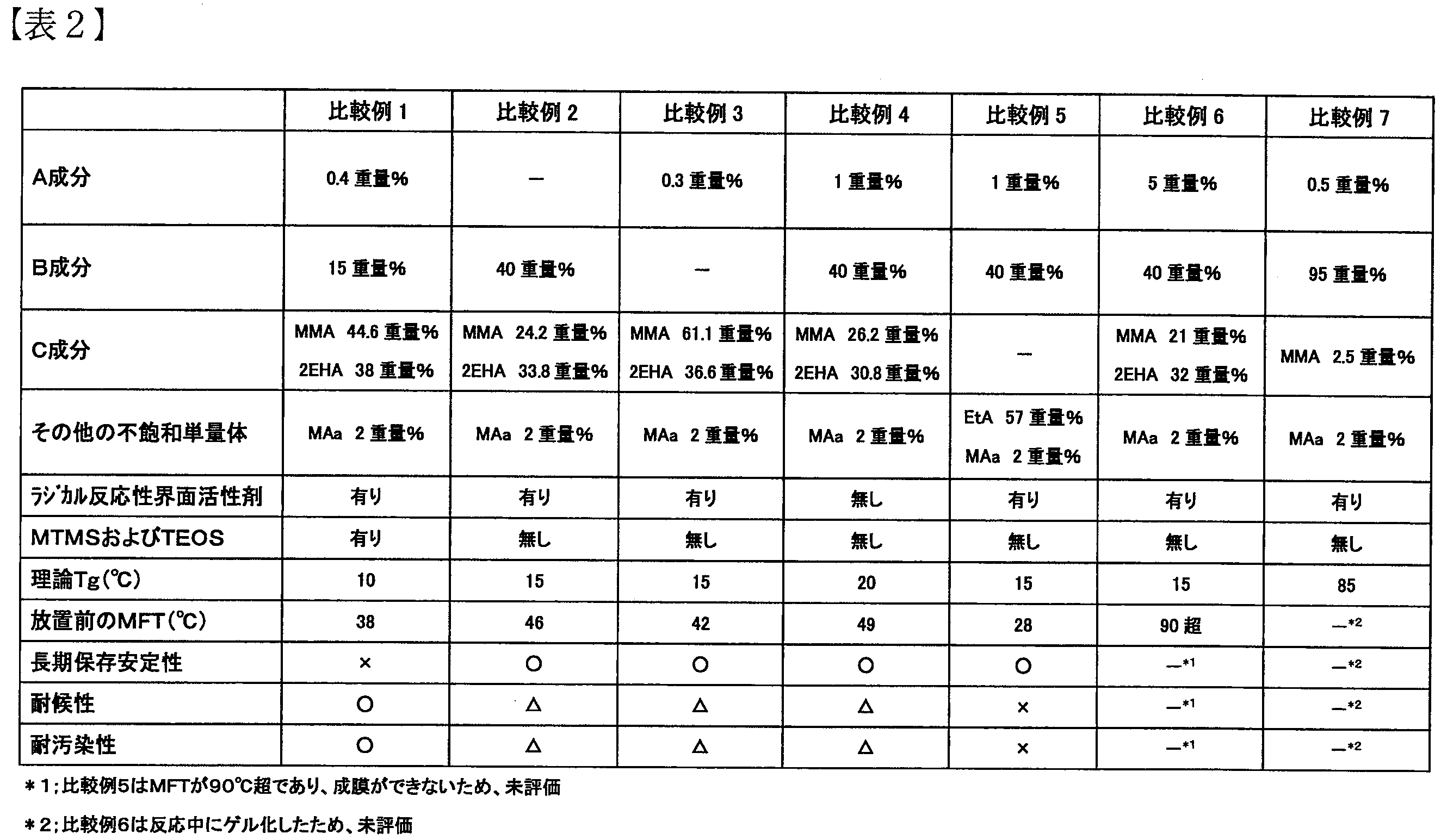
- Tables 1 and 2 show the evaluation results on the weather resistance, stain resistance and long-term storage stability of the aqueous emulsion resin compositions obtained in Examples 1 to 4 and Comparative Examples 1 to 7.
- MMA is methyl methacrylate
- 2EHA is 2-ethylhexyl acrylate
- MAa is methacrylic acid
- 2HEMA is 2-hydroxyethyl methacrylate
- nBMA methacrylic acid.
- nBA is acrylic acid-n-butyl
- Aa is acrylic acid
- DAAm is diacetone acrylamide
- EtA is ethyl acrylate
- MTMS is methyltrimethoxysilane
- TEOS Represents tetraethoxysilane.
- Comparative Example 1 corresponding to the water-dispersible resin composition of Patent Document 1 is excellent in weather resistance and stain resistance, but is inferior in long-term storage stability. Since Comparative Example 2 does not contain the component (A), it can be seen that it is inferior in weather resistance and stain resistance. Since the comparative example 3 does not mix
- Comparative Example 6 Since the comparative example 5 does not mix
- Comparative Example 6 since the blending amount of the component (A) was excessive, the film formability was remarkably lowered and evaluation could not be performed.
- Comparative Example 7 since the blending amount of the component (B) was excessive, the polymerization stability was lowered and each evaluation could not be performed.
Landscapes
- Chemical & Material Sciences (AREA)
- Organic Chemistry (AREA)
- Polymers & Plastics (AREA)
- Health & Medical Sciences (AREA)
- Chemical Kinetics & Catalysis (AREA)
- Medicinal Chemistry (AREA)
- Materials Engineering (AREA)
- Wood Science & Technology (AREA)
- Engineering & Computer Science (AREA)
- Life Sciences & Earth Sciences (AREA)
- Paints Or Removers (AREA)
- Polymerisation Methods In General (AREA)
- Addition Polymer Or Copolymer, Post-Treatments, Or Chemical Modifications (AREA)
Abstract
Description
即ち、本発明は、(A)γ-メタクリロキシプロピルトリメトキシシランと、(B)メタクリル酸シクロヘキシルと、(C)メタクリル酸メチル、(メタ)アクリル酸ブチルおよび(メタ)アクリル酸-2-エチルヘキシルからなる群から選択される少なくとも1つの不飽和単量体とを含む不飽和単量体組成物を、ラジカル反応性界面活性剤の存在下で乳化重合して得られる水性エマルジョン樹脂組成物であって、(A)γ-メタクリロキシプロピルトリメトキシシランが、不飽和単量体組成物中に0.1重量%~2重量%含まれ、且つ(B)メタクリル酸シクロヘキシルが、不飽和単量体組成物中に25重量%~75重量%含まれる水性エマルジョン樹脂組成物である。
本発明の水性エマルジョン樹脂組成物は、(A)成分としてのγ-メタクリロキシプロピルトリメトキシシランと、(B)成分としてのメタクリル酸シクロヘキシルと、(C)成分としてのメタクリル酸メチル、(メタ)アクリル酸ブチルおよび(メタ)アクリル酸-2-エチルヘキシルからなる群から選択される少なくとも1つの不飽和単量体とを必須成分として含む不飽和単量体組成物を、ラジカル反応性界面活性剤の存在下で乳化重合して得られるものである。本発明では、これらの(A)~(C)成分が相乗的に作用することにより、耐候性および耐汚染性を向上させることができるだけでなく、長期の保存安定性も著しく向上させることができる。
γ-メタクリロキシプロピルトリメトキシシランは、不飽和単量体組成物中に0.1重量%~2重量%含まれることが必須であり、0.2重量%~1重量%含まれることが好ましい。γ-メタクリロキシプロピルトリメトキシシランの含有量が、0.1重量%未満であると耐候性および耐汚染性が劣り、2重量%を超えると重合安定性および造膜性が劣る。
メタクリル酸シクロヘキシルは、不飽和単量体組成物中に25重量%~75重量%含まれることが必須であり、25重量%~70重量%含まれることが好ましい。メタクリル酸シクロヘキシルの含有量が、25重量%未満であると耐候性および耐汚染性が劣り、メタクリル酸シクロヘキシルの含有量が、75重量%を超えると重合安定性および造膜性が劣る。
(C)成分は、不飽和単量体組成物中に30重量%~70重量%含まれていることが好ましく、35重量%~68重量%含まれていることがより好ましい。
1/Tg(K)=W1/T1+W2/T2+W3/T3+・・・+Wn/Tn
Tg(℃)=Tg(K)-273
式中、W1、W2、W3・・・Wnは、不飽和単量体組成物に対する各不飽和単量体の割合(重量%)であり、T1、T2、T3・・・Tnは、各不飽和単量体の単独重合体のガラス転移温度(絶対温度(K))である。ここで、各不飽和単量体の単独重合体のガラス転移温度は、Polymer Hand Book(Second Edition, J. Brandrup・E. H. Immergut 編)による値である。
ラジカル反応性界面活性剤の使用量は、使用する不飽和単量体組成物に対して、0.5重量%~5重量%であることが好ましい。ラジカル反応性界面活性剤の使用量が少な過ぎると重合安定性が低下する場合があり、一方、多過ぎると耐水性が低下する場合がある。これらのラジカル反応性界面活性剤は、基本的に不飽和単量体を乳化させる目的で乳化重合前或いは乳化重合中に添加することが必須であるが、乳化重合後のエマルジョンに安定性を付与する目的で後添加してもよい。
(1-1)不揮発分
予め重量が測定された水性エマルジョン樹脂組成物を105℃で1時間乾燥させ、揮発残分の重量を測定した。初期の重量と揮発残分の重量から不揮発分の割合(重量%)を計算した。
(1-2)粘度
水性エマルジョン樹脂組成物の粘度は、BM型粘度計を用いて23℃、60rpmにおいて測定した。
(1-3)pH
水性エマルジョン樹脂組成物のpHは、pHメーターを用いて測定した。
(1-4)最低造膜温度(以下、MFTと略すことがある)
熱勾配式最低造膜温度測定装置を用いて測定した。また、水性エマルジョン樹脂組成物を50℃で1ヶ月間放置した後のMFTも同様に測定した。
(1-4)で測定した水性エマルジョン樹脂組成物の初期のMFTと放置後のMFTからMFTの変化率を計算し、下記評価基準に従って評価した。
○:MFTの変化率が10%以下である
×:MFTの変化率が10%を超える
(3-1)グロス塗料の調製
脱イオン水82.6重量部、増粘剤としてのナトロゾール250HR(ハーキュレース製)0.8重量部、中和剤としてのアンモニア水0.2重量部、防腐剤としてのアモルデンFS-14D(大和化学工業株式会社製)1.1重量部、分散剤としてのポイズ521(花王株式会社製)4.2重量部、消泡剤としてのSNデフォーマー371(サンノプコ株式会社製)1.1重量部、酸化チタンとしてのタイペークCR-97(石原産業製)210重量部を容器中でホモディスパーを用いて約2000rpmで撹拌しながら上記順に仕込み、更に約2000rpmで1時間撹拌した。その後、120メッシュのテフロン(登録商標)メッシュで濾過し、固形分濃度70重量%(酸化チタンを固形分として計算)のミルベース300重量部を得た。
別容器に、得られたミルベース300重量部、水性エマルジョン樹脂組成物600重量部(不揮発分50重量%の場合。不揮発分が50重量%以外の場合は、それぞれの不揮発分に応じて、300重量部の樹脂が含まれるように添加量を設定した)、造膜助剤としてのCS-12(チッソ株式会社製)をα重量部(α=MFT÷5×6)、粘性調整剤としてのアデカノールUH-420(株式会社ADEKA製)1重量部を仕込み、ホモディスパーを用いて約2000rpmで10分間撹拌した。その後、150メッシュのテフロン(登録商標)メッシュで濾過し、固形分濃度53.4重量%、顔料濃度15.5体積%(酸化チタンの比重を4.2、水性エマルジョン樹脂組成物の比重を1.1として計算した)のグロス塗料955重量部を得た。
得られたグロス塗料に水を添加して約800mPa・s(BH型粘度計、20rpm、23℃)の粘度に調整した。この塗料をシーラー処理が予め施されたフレキ板にスプレーを用いて150g/m2×2回吹きした後、23℃、65%RHで1週間養生し、塗板を得た。上記操作を繰り返して塗板を合計2枚作製した。
作製した塗板の1枚をメタリングウエザーメーター(スガ試験機)で試験し、400hr照射後の光沢保持率を測定した。メタリングウエザーメーターの条件は、ブラックパネル温度63℃、湿度50%RH、照度1.55kW/m2、照射2時間→照射+降雨2分(3サイクル)→結露2時間(雰囲気30℃、95%RH、塗板25℃)の8時間サイクル試験とした。耐候性を下記基準に従って評価した。
○:光沢保持率が70%以上である
△:光沢保持率が50%以上70%未満である
×:光沢保持率が50%未満である
作製した塗板のもう一枚を屋外に3ヶ月間暴露(兵庫県たつの市、南向き45°)し、暴露前後の色差(ΔE)を測定した。耐汚染性を下記基準に従って評価した。
○:ΔEが4未満である
△:ΔEが4以上8未満である
×:ΔEが8以上である
撹拌機、温度計および還流凝縮機を備えた重合装置内に、200重量部の脱イオン水および0.2重量部のアデカリアソープSR-10(アニオン性反応性界面活性剤、株式会社ADEKA製)を入れ、窒素置換を十分に行った後、75℃に昇温した。
258重量部の脱イオン水、9.8重量部のアデカリアソープSR-10、118重量部のメタクリル酸メチル、200重量部のメタクリル酸シクロヘキシル、167重量部のアクリル酸-2-エチルヘキシル、5重量部のγ-メタクリロキシプロピルトリメトキシシランおよび10重量部のメタクリル酸をホモミキサーにて予め混合乳化したものを用意し、重合装置内の温度を75℃に保ちながら、その乳化物の一部(5重量%)を重合装置内に加えた。
次いで、重合装置内に0.2重量部の過硫酸カリウムを加えて重合を開始し、80℃で15分反応させた。さらに、重合装置内の温度を80℃に保ちながら、先の乳化物の残り(95重量%)および50重量部の2%過硫酸カリウム水溶液を4時間掛けて重合装置内に滴下した。さらに、80℃で2時間反応させ、その後、室温(25℃)に冷却した。最後に3.5重量部のアンモニア水を入れてpHを調整し、実施例1の水性エマルジョン樹脂組成物を得た。なお、実施例1における不飽和単量体組成物の理論Tgは15℃である。得られた水性エマルジョン樹脂組成物の性状は、不揮発分50.3重量%、粘度(BM型粘度計、60rpm、23℃)170mPa・s、pH9.0、MFT47℃であった。
実施例1の乳化物の代わりに、258重量部の脱イオン水、9.8重量部のアデカリアソープSR-10、22.5重量部のメタクリル酸メチル、300重量部のメタクリル酸シクロヘキシル、160重量部のアクリル酸-2-エチルヘキシル、2.5重量部のγ-メタクリロキシプロピルトリメトキシシラン、10重量部のメタクリル酸および5重量部のメタクリル酸-2-ヒドロキシエチルからなる乳化物を用いた以外は、実施例1と同様の操作を行い、実施例2の水性エマルジョン樹脂組成物を得た。なお、実施例2における不飽和単量体組成物の理論Tgは20℃である。得られた水性エマルジョン樹脂組成物の性状は、不揮発分50.4重量%、粘度(BM型粘度計、60rpm、23℃)190mPa・s、pH8.8、MFT46℃であった。
実施例1の乳化物の代わりに、235.5重量部の脱イオン水、9.8重量部のアデカリアソープSR-10、55重量部のメタクリル酸メチル、150重量部のメタクリル酸シクロヘキシル、150重量部のメタクリル酸-n-ブチル、128.5重量部のアクリル酸-n-ブチル、1.5重量部のγ-メタクリロキシプロピルトリメトキシシラン、12.5重量部の80%アクリル酸および5重量部のジアセトンアクリルアミドからなる乳化物を用い、冷却後に3.5重量部のアンモニア水と、2.6重量部のアジピン酸ジヒドラジドを18重量部の脱イオン水で溶解したものとを添加した以外は、実施例1と同様の操作を行い、実施例3の水性エマルジョン樹脂組成物を得た。なお、実施例3における不飽和単量体組成物の理論Tgは20℃である。得られた水性エマルジョン樹脂組成物の性状は、不揮発分51.1重量%、粘度(BM型粘度計、60rpm、23℃)330mPa・s、pH7.8、MFT35℃であった。
実施例1のアデカリアソープSR-10の代わりに、アクアロンKH-10(第一工業製薬株式会社製)を用いた以外は、実施例1と同様の操作を行い、実施例4の水性エマルジョン樹脂組成物を得た。なお、実施例4における不飽和単量体組成物の理論Tgは15℃である。そして、得られた水性エマルジョン樹脂組成物の性状は、不揮発分50.3重量%、粘度(BM型粘度計、60rpm、23℃)150mPa・s、pH8.9、MFT48℃であった。
撹拌機、温度計および還流凝縮機を備えた重合装置内に、250重量部の脱イオン水および5重量部のエマルゲン147(ポリオキシエチレンラウリルエーテル、花王株式会社製)を入れ、窒素置換を十分に行った後、75℃に昇温した。重合装置内の温度を75℃に保ちながら、75重量部のメチルトリメトキシシラン(MTMS)および50重量部のテトラエトキシシラン(TEOS)を加え、30分保持した。さらに、440重量部の脱イオン水、10重量部のアクアロンKH-10、223重量部のメタクリル酸メチル、75重量部のメタクリル酸シクロヘキシル、190重量部のアクリル酸-2-エチルヘキシル、2重量部のγ-メタクリロキシプロピルトリメトキシシランおよび10重量部のメタクリル酸をホモミキサーにて予め混合乳化したものを用意し、重合装置内の温度を75℃に保ちながら、その乳化物の一部(5重量%)を重合装置内に加えた。
次いで、重合装置内に0.2重量部の過硫酸カリウムを加えて重合を開始し、80℃で15分反応させた。さらに、重合装置内の温度を80℃に保ちながら、先の乳化物の残り(95重量%)および50重量部の2%過硫酸カリウム水溶液を4時間掛けて重合装置内に滴下した。さらに、80℃で2時間反応させ、その後、室温(25℃)に冷却した。最後に3.5重量部のアンモニア水を入れてpHを調整し、比較例1の水性エマルジョン樹脂組成物を得た。なお、比較例1における不飽和単量体組成物の理論Tgは10℃である。得られた水性エマルジョン樹脂組成物の性状は、不揮発分41.8重量%、粘度(BM型粘度計、60rpm、23℃)60mPa・s、pH5.3、MFT38℃であった。
撹拌機、温度計および還流凝縮機を備えた重合装置内に、200重量部の脱イオン水および0.2重量部のアデカリアソープSR-10を入れ、窒素置換を十分に行った後、75℃に昇温した。260重量部の脱イオン水、9.8重量部のアデカリアソープSR-10、121重量部のメタクリル酸メチル、200重量部のメタクリル酸シクロヘキシル、169重量部のアクリル酸-2-エチルヘキシルおよび10重量部のメタクリル酸をホモミキサーにて予め混合乳化したものを用意し、重合装置内の温度を75℃に保ちながら、その乳化物の一部(5重量%)を重合装置内に加えた。
次いで、重合装置内に0.2重量部の過硫酸カリウムを加えて重合を開始し、80℃で15分反応させた。さらに、重合装置内の温度を80℃に保ちながら、先の乳化物の残り(95重量%)および50重量部の2%過硫酸カリウム水溶液を4時間掛けて重合装置内に滴下した。さらに、80℃で2時間反応させ、その後、室温(25℃)に冷却した。最後に3.5重量部のアンモニア水を入れてpHを調整し、比較例2の水性エマルジョン樹脂組成物を得た。なお、比較例2における不飽和単量体組成物の理論Tgは15℃である。得られた水性エマルジョン樹脂組成物の性状は、不揮発分50.2重量%、粘度(BM型粘度計、60rpm、23℃)150mPa・s、pH8.9、MFT46℃であった。
比較例2の乳化物の代わりに、260重量部の脱イオン水、9.8重量部のアデカリアソープSR-10、305.5重量部のメタクリル酸メチル、183重量部のアクリル酸-2-エチルヘキシル、1.5重量部のγ-メタクリロキシプロピルトリメトキシシランおよび10重量部のメタクリル酸からなる乳化物を用いた以外は、比較例2と同様の操作を行い、比較例3の水性エマルジョン樹脂組成物を得た。なお、比較例3における不飽和単量体組成物の理論Tgは15℃である。得られた水性エマルジョン樹脂組成物の性状は、不揮発分50.1重量%、粘度(BM型粘度計、60rpm、23℃)190mPa・s、pH9.0、MFT42℃であった。
撹拌機、温度計および還流凝縮機を備えた重合装置内に、199.4重量部の脱イオン水および0.8重量部のニューレックスR-25(アニオン性非反応性界面活性剤、日油株式会社製)を入れ、窒素置換を十分に行った後、75℃に昇温した。230.6重量部の脱イオン水、39.2重量部のニューレックスR-25、131重量部のメタクリル酸メチル、200重量部のメタクリル酸シクロヘキシル、154重量部のアクリル酸-2-エチルヘキシル、5重量部のγ-メタクリロキシプロピルトリメトキシシランおよび10重量部のメタクリル酸をホモミキサーにて予め混合乳化したものを用意し、重合装置内の温度を75℃に保ちながら、その乳化物の一部(5重量%)を重合装置内に加えた。
次いで、重合装置内に0.2重量部の過硫酸カリウムを加えて重合を開始し、80℃で15分反応させた。さらに、重合装置内の温度を80℃に保ちながら、先の乳化物の残り(95重量%)および50重量部の2%過硫酸カリウム水溶液を4時間掛けて重合装置内に滴下した。さらに、80℃で2時間反応させ、その後、室温(25℃)に冷却した。最後に3.5重量部のアンモニア水を入れてpHを調整し、比較例4の水性エマルジョン樹脂組成物を得た。なお、比較例4にける不飽和単量体組成物の理論Tgは20℃である。得られた水性エマルジョン樹脂組成物の性状は、不揮発分50.2重量%、粘度(BM型粘度計、60rpm、23℃)160mPa・s、pH9.2、MFT49℃であった。
比較例2の乳化物の代わりに、260重量部の脱イオン水、9.8重量部のアデカリアソープSR-10、200重量部のメタクリル酸シクロヘキシル、285重量部のアクリル酸エチル、5重量部のγ-メタクリロキシプロピルトリメトキシシランおよび10重量部のメタクリル酸からなる乳化物を用いた以外は、比較例2と同様の操作を行い、比較例5の水性エマルジョン樹脂組成物を得た。なお、比較例5における不飽和単量体組成物の理論Tgは15℃である。得られた水性エマルジョン樹脂組成物の性状は、不揮発分49.9重量%、粘度(BM型粘度計、60rpm、23℃)160mPa・s、pH8.9、MFT28℃であった。
撹拌機、温度計および還流凝縮機を備えた重合装置内に、200重量部の脱イオン水および0.2重量部のアデカリアソープSR-10を入れ、窒素置換を十分に行った後、75℃に昇温した。285重量部の脱イオン水、9.8重量部のアデカリアソープSR-10、105重量部のメタクリル酸メチル、200重量部のメタクリル酸シクロヘキシル、160重量部のアクリル酸-2-エチルヘキシル、10重量部のメタクリル酸および25重量部のγ-メタクリロキシプロピルトリメトキシシランをホモミキサーにて予め混合乳化したものを用意し、重合装置内の温度を75℃に保ちながら、その乳化物の一部(5重量%)を重合装置内に加えた。
次いで、重合装置内に0.2重量部の過硫酸カリウムを加えて重合を開始し、80℃で15分反応させた。さらに、重合装置内の温度を80℃に保ちながら、先の乳化物の残り(95重量%)および50重量部の2%過硫酸カリウム水溶液を4時間掛けて重合装置内に滴下した。さらに、80℃で2時間反応させ、その後、室温(25℃)に冷却した。最後に3.5重量部のアンモニア水を入れてpHを調整し、比較例6の水性エマルジョン樹脂組成物を得た。なお、比較例6における不飽和単量体組成物の理論Tgは15℃である。得られた水性エマルジョン樹脂組成物の性状は、不揮発分50.2重量%、粘度(BM型粘度計、60rpm、23℃)140mPa・s、pH8.9、MFT90℃超であった。
比較例2の乳化物の代わりに、260重量部の脱イオン水、9.8重量部のアデカリアソープSR-10、12.5重量部のメタクリル酸メチル、475重量部のメタクリル酸シクロヘキシル、2.5重量部のγ-メタクリロキシプロピルトリメトキシシランおよび10重量部のメタクリル酸からなる乳化物を用い、比較例2と同様の操作を行ったところ、反応途中で凝集を起こし、ゲル化した。なお、比較例7における不飽和単量体組成物の理論Tgは85℃である。

Claims (2)
- (A)γ-メタクリロキシプロピルトリメトキシシランと、(B)メタクリル酸シクロヘキシルと、(C)メタクリル酸メチル、(メタ)アクリル酸ブチルおよび(メタ)アクリル酸-2-エチルヘキシルからなる群から選択される少なくとも1つの不飽和単量体とを含む不飽和単量体組成物を、ラジカル反応性界面活性剤の存在下で乳化重合して得られる水性エマルジョン樹脂組成物であって、
(A)γ-メタクリロキシプロピルトリメトキシシランが、不飽和単量体組成物中に0.1~2重量%含まれ、且つ(B)メタクリル酸シクロヘキシルが、不飽和単量体組成物中に25~75重量%含まれる水性エマルジョン樹脂組成物。 - 請求項1に記載の水性エマルジョン樹脂組成物が配合された塗料。
Priority Applications (2)
| Application Number | Priority Date | Filing Date | Title |
|---|---|---|---|
| CN2010800296373A CN102471391A (zh) | 2009-08-25 | 2010-08-23 | 水性乳液树脂组合物及用该组合物配制的涂料 |
| SG2012006292A SG178152A1 (en) | 2009-08-25 | 2010-08-23 | Aqueous emulsion type resin composition and coating materials containing same |
Applications Claiming Priority (2)
| Application Number | Priority Date | Filing Date | Title |
|---|---|---|---|
| JP2009194540A JP2011046783A (ja) | 2009-08-25 | 2009-08-25 | 水性エマルジョン樹脂組成物およびそれを配合した塗料 |
| JP2009-194540 | 2009-08-25 |
Publications (1)
| Publication Number | Publication Date |
|---|---|
| WO2011024759A1 true WO2011024759A1 (ja) | 2011-03-03 |
Family
ID=43627864
Family Applications (1)
| Application Number | Title | Priority Date | Filing Date |
|---|---|---|---|
| PCT/JP2010/064183 Ceased WO2011024759A1 (ja) | 2009-08-25 | 2010-08-23 | 水性エマルジョン樹脂組成物およびそれを配合した塗料 |
Country Status (4)
| Country | Link |
|---|---|
| JP (1) | JP2011046783A (ja) |
| CN (1) | CN102471391A (ja) |
| SG (1) | SG178152A1 (ja) |
| WO (1) | WO2011024759A1 (ja) |
Cited By (1)
| Publication number | Priority date | Publication date | Assignee | Title |
|---|---|---|---|---|
| CN116285431A (zh) * | 2023-03-16 | 2023-06-23 | 安徽五星高新材料有限公司 | 一种与树脂高亲和性的铝颜料的制备方法 |
Families Citing this family (9)
| Publication number | Priority date | Publication date | Assignee | Title |
|---|---|---|---|---|
| JP6517086B2 (ja) * | 2015-06-05 | 2019-05-22 | 日立化成株式会社 | 熱放射性塗膜、及びそれを有する発光ダイオード(led)照明、ヒートシンク、太陽電池モジュール用バックシート |
| JP7099692B2 (ja) * | 2018-03-28 | 2022-07-12 | 日本カーバイド工業株式会社 | 紙コーティング用(メタ)アクリル樹脂エマルション、膜、及び積層体 |
| JP6512352B2 (ja) * | 2018-07-09 | 2019-05-15 | 日立化成株式会社 | 熱放射性塗料、及びそれを塗布した発光ダイオード(led)照明、ヒートシンク、太陽電池モジュール用バックシート |
| WO2020085263A1 (ja) * | 2018-10-22 | 2020-04-30 | 株式会社日本触媒 | 水性分散体、その製造方法およびその利用 |
| JP7217146B2 (ja) * | 2018-12-27 | 2023-02-02 | 株式会社日本触媒 | 新規エマルション及びこのエマルションを用いた塗料用組成物 |
| CN114044857B (zh) * | 2021-12-02 | 2024-04-09 | 万华化学集团股份有限公司 | 表面富含羧基的聚丙烯酸酯水性分散体的制备方法、分散体及其应用 |
| KR102865288B1 (ko) * | 2022-10-06 | 2025-09-26 | (주)디어스아이 | 강판용 칼라형 광촉매도료 조성물 |
| WO2025255320A1 (en) * | 2024-06-05 | 2025-12-11 | Ennis-Flint, Inc. | Waterborne road-marking paint compositions and latex resin compositions |
| CN118791928B (zh) * | 2024-09-02 | 2024-12-17 | 广州保赐利化工有限公司 | 一种高性能喷漆及其制备方法 |
Citations (3)
| Publication number | Priority date | Publication date | Assignee | Title |
|---|---|---|---|---|
| JPH06122734A (ja) * | 1992-10-09 | 1994-05-06 | Hoechst Gosei Kk | 耐久性塗料用合成樹脂水性エマルジョン |
| JP2007197644A (ja) * | 2006-01-30 | 2007-08-09 | Nippon Shokubai Co Ltd | α−(ヒドロキシアルキル)アクリル酸エステル共重合体 |
| JP2009209182A (ja) * | 2008-02-29 | 2009-09-17 | Dic Corp | 水性樹脂組成物および塗装物 |
-
2009
- 2009-08-25 JP JP2009194540A patent/JP2011046783A/ja active Pending
-
2010
- 2010-08-23 SG SG2012006292A patent/SG178152A1/en unknown
- 2010-08-23 WO PCT/JP2010/064183 patent/WO2011024759A1/ja not_active Ceased
- 2010-08-23 CN CN2010800296373A patent/CN102471391A/zh active Pending
Patent Citations (3)
| Publication number | Priority date | Publication date | Assignee | Title |
|---|---|---|---|---|
| JPH06122734A (ja) * | 1992-10-09 | 1994-05-06 | Hoechst Gosei Kk | 耐久性塗料用合成樹脂水性エマルジョン |
| JP2007197644A (ja) * | 2006-01-30 | 2007-08-09 | Nippon Shokubai Co Ltd | α−(ヒドロキシアルキル)アクリル酸エステル共重合体 |
| JP2009209182A (ja) * | 2008-02-29 | 2009-09-17 | Dic Corp | 水性樹脂組成物および塗装物 |
Cited By (1)
| Publication number | Priority date | Publication date | Assignee | Title |
|---|---|---|---|---|
| CN116285431A (zh) * | 2023-03-16 | 2023-06-23 | 安徽五星高新材料有限公司 | 一种与树脂高亲和性的铝颜料的制备方法 |
Also Published As
| Publication number | Publication date |
|---|---|
| SG178152A1 (en) | 2012-03-29 |
| CN102471391A (zh) | 2012-05-23 |
| JP2011046783A (ja) | 2011-03-10 |
Similar Documents
| Publication | Publication Date | Title |
|---|---|---|
| WO2011024759A1 (ja) | 水性エマルジョン樹脂組成物およびそれを配合した塗料 | |
| JP5468802B2 (ja) | 水性塗料用組成物及びトップコート用塗料 | |
| JP6359953B2 (ja) | 成膜助剤 | |
| US9499680B2 (en) | Hydroxyethyl cellulose grafted acrylic latex | |
| WO1993010184A1 (en) | Highly weather-resistant one-pack cross-linking emulsion | |
| JP5695823B2 (ja) | シーラー用塗料組成物 | |
| JP5287555B2 (ja) | エマルション組成物 | |
| JP2019052230A (ja) | 水性インキ用樹脂分散液およびその製造方法 | |
| JP2011111487A (ja) | シーラー用樹脂エマルション | |
| JP3484209B2 (ja) | 塗料用樹脂組成物 | |
| JP4615737B2 (ja) | 水性樹脂組成物 | |
| JP3736674B2 (ja) | 無機系多孔質基材用水性下塗塗料組成物 | |
| JP5469812B2 (ja) | 水分散性樹脂組成物および塗料 | |
| JPH11152439A (ja) | 水性重合体被覆組成物 | |
| JP3845098B2 (ja) | 速乾性水性樹脂組成物及びこれを用いた塗料 | |
| JP2011111488A (ja) | シーラー用樹脂組成物 | |
| JP3582920B2 (ja) | 路面標示用水性塗料組成物 | |
| JP2012207103A (ja) | 塗料用樹脂組成物 | |
| JP2004099823A (ja) | 水性被覆組成物 | |
| JP5154062B2 (ja) | 水分散性樹脂組成物及びこれを含む塗料 | |
| JP2005023189A (ja) | 水系コーティング組成物 | |
| JP4846256B2 (ja) | 水性塗料組成物 | |
| JP4610960B2 (ja) | 水性分散液及びその製造方法 | |
| JP2006045494A (ja) | 水性塗料 | |
| JP2007091915A (ja) | 水性被覆剤 |
Legal Events
| Date | Code | Title | Description |
|---|---|---|---|
| WWE | Wipo information: entry into national phase |
Ref document number: 201080029637.3 Country of ref document: CN |
|
| 121 | Ep: the epo has been informed by wipo that ep was designated in this application |
Ref document number: 10811809 Country of ref document: EP Kind code of ref document: A1 |
|
| WWE | Wipo information: entry into national phase |
Ref document number: 1201000719 Country of ref document: TH |
|
| NENP | Non-entry into the national phase |
Ref country code: DE |
|
| 122 | Ep: pct application non-entry in european phase |
Ref document number: 10811809 Country of ref document: EP Kind code of ref document: A1 |