WO2010146979A1 - 光半導体封止用樹脂組成物 - Google Patents
光半導体封止用樹脂組成物 Download PDFInfo
- Publication number
- WO2010146979A1 WO2010146979A1 PCT/JP2010/059064 JP2010059064W WO2010146979A1 WO 2010146979 A1 WO2010146979 A1 WO 2010146979A1 JP 2010059064 W JP2010059064 W JP 2010059064W WO 2010146979 A1 WO2010146979 A1 WO 2010146979A1
- Authority
- WO
- WIPO (PCT)
- Prior art keywords
- resin composition
- optical semiconductor
- resin
- viscosity
- meth
- Prior art date
- Legal status (The legal status is an assumption and is not a legal conclusion. Google has not performed a legal analysis and makes no representation as to the accuracy of the status listed.)
- Ceased
Links
Images
Classifications
-
- C—CHEMISTRY; METALLURGY
- C08—ORGANIC MACROMOLECULAR COMPOUNDS; THEIR PREPARATION OR CHEMICAL WORKING-UP; COMPOSITIONS BASED THEREON
- C08G—MACROMOLECULAR COMPOUNDS OBTAINED OTHERWISE THAN BY REACTIONS ONLY INVOLVING UNSATURATED CARBON-TO-CARBON BONDS
- C08G59/00—Polycondensates containing more than one epoxy group per molecule; Macromolecules obtained by polymerising compounds containing more than one epoxy group per molecule using curing agents or catalysts which react with the epoxy groups
- C08G59/18—Macromolecules obtained by polymerising compounds containing more than one epoxy group per molecule using curing agents or catalysts which react with the epoxy groups ; e.g. general methods of curing
- C08G59/20—Macromolecules obtained by polymerising compounds containing more than one epoxy group per molecule using curing agents or catalysts which react with the epoxy groups ; e.g. general methods of curing characterised by the epoxy compounds used
- C08G59/32—Epoxy compounds containing three or more epoxy groups
-
- H—ELECTRICITY
- H10—SEMICONDUCTOR DEVICES; ELECTRIC SOLID-STATE DEVICES NOT OTHERWISE PROVIDED FOR
- H10W—GENERIC PACKAGES, INTERCONNECTIONS, CONNECTORS OR OTHER CONSTRUCTIONAL DETAILS OF DEVICES COVERED BY CLASS H10
- H10W74/00—Encapsulations, e.g. protective coatings
- H10W74/40—Encapsulations, e.g. protective coatings characterised by their materials
- H10W74/47—Encapsulations, e.g. protective coatings characterised by their materials comprising organic materials, e.g. plastics or resins
-
- C—CHEMISTRY; METALLURGY
- C08—ORGANIC MACROMOLECULAR COMPOUNDS; THEIR PREPARATION OR CHEMICAL WORKING-UP; COMPOSITIONS BASED THEREON
- C08G—MACROMOLECULAR COMPOUNDS OBTAINED OTHERWISE THAN BY REACTIONS ONLY INVOLVING UNSATURATED CARBON-TO-CARBON BONDS
- C08G59/00—Polycondensates containing more than one epoxy group per molecule; Macromolecules obtained by polymerising compounds containing more than one epoxy group per molecule using curing agents or catalysts which react with the epoxy groups
- C08G59/18—Macromolecules obtained by polymerising compounds containing more than one epoxy group per molecule using curing agents or catalysts which react with the epoxy groups ; e.g. general methods of curing
- C08G59/20—Macromolecules obtained by polymerising compounds containing more than one epoxy group per molecule using curing agents or catalysts which react with the epoxy groups ; e.g. general methods of curing characterised by the epoxy compounds used
- C08G59/32—Epoxy compounds containing three or more epoxy groups
- C08G59/3236—Heterocylic compounds
-
- C—CHEMISTRY; METALLURGY
- C08—ORGANIC MACROMOLECULAR COMPOUNDS; THEIR PREPARATION OR CHEMICAL WORKING-UP; COMPOSITIONS BASED THEREON
- C08G—MACROMOLECULAR COMPOUNDS OBTAINED OTHERWISE THAN BY REACTIONS ONLY INVOLVING UNSATURATED CARBON-TO-CARBON BONDS
- C08G59/00—Polycondensates containing more than one epoxy group per molecule; Macromolecules obtained by polymerising compounds containing more than one epoxy group per molecule using curing agents or catalysts which react with the epoxy groups
- C08G59/18—Macromolecules obtained by polymerising compounds containing more than one epoxy group per molecule using curing agents or catalysts which react with the epoxy groups ; e.g. general methods of curing
- C08G59/40—Macromolecules obtained by polymerising compounds containing more than one epoxy group per molecule using curing agents or catalysts which react with the epoxy groups ; e.g. general methods of curing characterised by the curing agents used
- C08G59/42—Polycarboxylic acids; Anhydrides, halides or low molecular weight esters thereof
-
- C—CHEMISTRY; METALLURGY
- C08—ORGANIC MACROMOLECULAR COMPOUNDS; THEIR PREPARATION OR CHEMICAL WORKING-UP; COMPOSITIONS BASED THEREON
- C08L—COMPOSITIONS OF MACROMOLECULAR COMPOUNDS
- C08L33/00—Compositions of homopolymers or copolymers of compounds having one or more unsaturated aliphatic radicals, each having only one carbon-to-carbon double bond, and only one being terminated by only one carboxyl radical, or of salts, anhydrides, esters, amides, imides or nitriles thereof; Compositions of derivatives of such polymers
- C08L33/04—Homopolymers or copolymers of esters
- C08L33/06—Homopolymers or copolymers of esters of esters containing only carbon, hydrogen and oxygen, which oxygen atoms are present only as part of the carboxyl radical
- C08L33/062—Copolymers with monomers not covered by C08L33/06
- C08L33/068—Copolymers with monomers not covered by C08L33/06 containing glycidyl groups
-
- C—CHEMISTRY; METALLURGY
- C08—ORGANIC MACROMOLECULAR COMPOUNDS; THEIR PREPARATION OR CHEMICAL WORKING-UP; COMPOSITIONS BASED THEREON
- C08L—COMPOSITIONS OF MACROMOLECULAR COMPOUNDS
- C08L63/00—Compositions of epoxy resins; Compositions of derivatives of epoxy resins
-
- C—CHEMISTRY; METALLURGY
- C08—ORGANIC MACROMOLECULAR COMPOUNDS; THEIR PREPARATION OR CHEMICAL WORKING-UP; COMPOSITIONS BASED THEREON
- C08L—COMPOSITIONS OF MACROMOLECULAR COMPOUNDS
- C08L63/00—Compositions of epoxy resins; Compositions of derivatives of epoxy resins
- C08L63/06—Triglycidylisocyanurates
-
- H—ELECTRICITY
- H10—SEMICONDUCTOR DEVICES; ELECTRIC SOLID-STATE DEVICES NOT OTHERWISE PROVIDED FOR
- H10H—INORGANIC LIGHT-EMITTING SEMICONDUCTOR DEVICES HAVING POTENTIAL BARRIERS
- H10H20/00—Individual inorganic light-emitting semiconductor devices having potential barriers, e.g. light-emitting diodes [LED]
- H10H20/80—Constructional details
- H10H20/85—Packages
- H10H20/852—Encapsulations
- H10H20/854—Encapsulations characterised by their material, e.g. epoxy or silicone resins
Definitions
- the present invention relates to a colorless and transparent resin composition for encapsulating an optical semiconductor.
- package packages used in the field of optical semiconductor chips for receiving or emitting light such as LEDs (light emitting diode elements), phototransistors, photodiodes, CCDs (charge coupled devices), EPROMs (erasable / writable ROM), etc.
- a resin composition for semiconductor sealing is filled in a syringe and supplied to a package container containing an optical semiconductor chip from a thin nozzle (approximately 10 ⁇ m) of the syringe or mounted on a mounting substrate.
- a dispensing method in which potting is performed on the manufactured optical semiconductor chip is widely used.
- the optical semiconductor sealing resin composition applied to such a dispensing method exhibits a low viscosity when discharged from a dispenser during sealing, particularly potting, and has a high viscosity after potting. It is required to exhibit high thixotropy so that it is difficult to flow. Moreover, the transparency which does not change with time is calculated
- the conventional resin composition for encapsulating an optical semiconductor applied to the dispensing system is a liquid bisphenol A type epoxy main agent or alicyclic ring from the viewpoint of light transmittance, adhesiveness, and cost. It is composed of a relatively high viscosity resin composition in which an acid anhydride-based curing agent such as hexahydrophthalic anhydride, a curing accelerator, and an anti-aging agent as necessary is blended with a basic epoxy compound. .
- An object of the present invention is to solve the conventional problems as described above, and an optical semiconductor using triglycidyl isocyanurates such as tris- (2,3-epoxypropyl) isocyanurate as an epoxy main agent. It is to impart high thixotropy to the encapsulating resin composition and to simultaneously impart good transparency, good crack resistance and good heat-resistant durability to the cured product over time.
- triglycidyl isocyanurates such as tris- (2,3-epoxypropyl) isocyanurate
- the present inventor has dispersed triglycidyl isocyanurates, which are epoxy base materials, in a highly thixotropic glycidyl group-containing (meth) acrylic acid ester-based resin exhibiting a specific weight average molecular weight and a specific viscosity, thereby encapsulating an optical semiconductor.
- the inventors have found that the above-mentioned object can be achieved by adjusting the viscosity of the stopping resin composition itself to a specific range and adjusting the thixotropic index to a specific range, and completed the present invention.
- the present invention relates to an epoxy component containing triglycidyl isocyanurates, an acid anhydride curing agent, a glycidyl group-containing (meth) acrylic having a weight average molecular weight of 20,000 to 65,000 and a viscosity of 1,000 to 10,000 Pa ⁇ s.
- a resin composition for optical semiconductor encapsulation is provided.
- the present invention also provides an optical semiconductor device in which an optical semiconductor chip is sealed in a semiconductor package with the above-described resin composition for sealing an optical semiconductor.
- the resin composition for encapsulating an optical semiconductor according to the present invention is a high thixotrope having a specific weight average molecular weight and a specific viscosity as a dispersion medium of an epoxy component by blending triglycidyl isocyanurates with an epoxy component as an epoxy main component. Glycidyl group-containing (meth) acrylic ester resin is used. For this reason, the resin composition for optical semiconductor sealing shows high thixotropy, and the triglycidyl isocyanurates are in a well dispersed state without being settled. Therefore, the resin composition for sealing an optical semiconductor of the present invention is suitable for a dispensing method. Moreover, since the cured product contains triglycidyl isocyanurates in an epoxy compound as an epoxy main agent, it has good transparency over time, good crack resistance, and good heat-resistant durability at the same time. Show.
- the resin composition for encapsulating an optical semiconductor of the present invention is for encapsulating an optical semiconductor chip in a semiconductor package, and basically comprises an epoxy component which is an epoxy main component and a glycidyl group-containing (meth) acrylic ester resin. And a curing accelerator.
- the optical semiconductor chip include a semiconductor chip having a function of emitting or receiving light. Specifically, an LED (light emitting diode element), a phototransistor, a photodiode, a CCD (charge coupled device), an EPROM (erasing / erasing device). And a writable ROM).
- the thing similar to what is used for the conventional optical semiconductor package can be used.
- the resin composition for encapsulating an optical semiconductor of the present invention is 25 using a rheometer (for example, rheostress RS-150, manufactured by HAAKE, using a parallel plate, gap 0.052 mm, frequency 0.6 to 600 s ⁇ 1 ).
- a rheometer for example, rheostress RS-150, manufactured by HAAKE, using a parallel plate, gap 0.052 mm, frequency 0.6 to 600 s ⁇ 1 .
- ⁇ viscosity measured at 10s -1 is 10 200 Pa ⁇ s, preferably from 12 ⁇ 20Pa ⁇ s, a and viscosity values measured at 1s -1 was obtained by dividing the viscosity value measured at 10s -1
- the thixotropic index is 3 to 15, preferably 4 to 7.
- the viscosity is less than 10 Pa ⁇ s
- triglycidyl isocyanurates precipitate, and when it exceeds 200 Pa ⁇ s, it becomes difficult to discharge from the dispenser nozzle.
- the thixotropic index is less than 3, it means that the content of the powdered epoxy component in the resin composition is too small, and this means that the functional group of the acid anhydride curing agent as the crosslinking partner is 100.
- % Cannot be cross-linked, in other words, part of the functional group does not contribute to the cross-linking reaction, which adversely affects the heat resistant light characteristics.
- the epoxy component used in the present invention contains triglycidyl isocyanurates.
- Triglycidyl isocyanurates include tris- (2,3-epoxypropyl) isocyanurate, lower alkyl group, lower alkoxy group or lower acyloxy group-substituted triglycidyl isocyanurate (Japanese Patent Laid-Open No. 2008-45014, paragraphs 0021 to 0023). ), Aliphatic or alicyclic carboxylic acid-modified triglycidyl isocyanurate (Japanese Patent Laid-Open No. 2008-45014, paragraphs 0025 to 0032).
- Particularly preferable triglycidyl isocyanurates include the aforementioned tris- (2,3-epoxypropyl) isocyanurates.
- the total amount of the epoxy compound may be triglycidyl isocyanurates.
- the epoxy component may contain a known epoxy compound other than triglycidyl isocyanurates as necessary.
- a liquid compound having no double bond in the molecule is preferable, and in particular, an alicyclic epoxy compound and / or a hydrogenated aromatic epoxy compound should be used.
- alicyclic epoxy compounds include 3,4-epoxycyclohexenylmethyl-3 ′, 4′-epoxycyclohexenecarboxylate, 2,2-bis (hydroxymethyl) -1-butanol, and 1,2-epoxy-4- Examples include 2 (oxiranyl) cyclohexane adducts.
- Examples of the hydrogenated aromatic epoxy compound include a hydrogenated bisphenol A type epoxy compound and a hydrogenated bisphenol F type epoxy compound. Among them, 3,4-epoxycyclohexenylmethyl-3 ′, 4′-epoxycyclohexenecarboxylate or hydrogenated bisphenol A type epoxy compound can be preferably used from the viewpoint of heat and light transmittance. Liquid 1,3,5-tri-2-propenyl-1,3,5-triazine-2,4,5 (1H, H, 5H) -trione, monoallyl diglycidyl isocyanurate, diallyl glycidyl isocyanurate Can also be used together.
- the epoxy component, the acid anhydride curing agent, and the glycidyl group-containing (meth) acrylic acid The amount is preferably 30 to 70% by mass, more preferably 40 to 60% by mass, based on the total amount with the ester resin.
- the content of triglycidyl isocyanurates is preferably 30 to 50% by mass, more preferably based on the total of the epoxy component, the acid anhydride curing agent, and the glycidyl group-containing (meth) acrylic ester resin. 35 to 45% by mass.
- the resin composition for optical semiconductor encapsulation of the present invention uses an acid anhydride curing agent as a curing agent for the epoxy component.
- an acid anhydride curing agent for the epoxy component.
- those having no double bond in the molecule are preferable, and alicyclic or aliphatic acid anhydrides are particularly preferable.
- the alicyclic acid anhydride include hexahydrophthalic acid anhydride and methylhexahydrophthalic acid anhydride.
- Examples of the aliphatic acid anhydride include dodecenyl succinic anhydride. Among these, methylhexahydrophthalic anhydride can be preferably used from the viewpoint of heat resistance and light transmittance.
- an epoxy component, an acid anhydride curing agent, and a glycidyl group-containing It is preferably 40 to 60% by mass, more preferably 45 to 55% by mass, based on the total amount with the (meth) acrylate resin.
- the equivalent ratio obtained by dividing the acid anhydride equivalent of the acid anhydride curing agent by the total epoxy equivalent of the epoxy component and the glycidyl group-containing (meth) acrylic ester resin when viewed from the viewpoint of functional group concentration, the equivalent ratio obtained by dividing the acid anhydride equivalent of the acid anhydride curing agent by the total epoxy equivalent of the epoxy component and the glycidyl group-containing (meth) acrylic ester resin.
- the equivalent ratio is preferably 0.85 to 1.15, more preferably 0.95 to 1.05.
- An acid anhydride curing agent is blended so as to be.
- a glycidyl group-containing (meth) acrylic acid is used as a dispersion resin that stably disperses triglycidyl isocyanurates and imparts high thixotropy to the entire resin composition.
- Use ester resin is used.
- (meth) acryl includes “acryl” and “methacryl”. The reason why this (meth) acrylic acid ester resin must contain a glycidyl group is that it is compatible with the epoxy component and crosslinks to give the cured product excellent heat resistance and appropriate surface hardness. Because.
- the weight average molecular weight of the glycidyl group-containing (meth) acrylic ester resin is in the range of 20000 to 65000, preferably 30000 to 55000 in order to exhibit sufficient structural viscosity.
- the viscosity of the glycidyl group-containing (meth) acrylic acid ester resin measured with a rheometer at 25 ° C. and 10S ⁇ 1 is 100 to 10,000 Pa ⁇ s, preferably 200 to 5000 Pa ⁇ s.
- a viscosity of less than 100 Pa ⁇ s means that the resin has an excessively low molecular weight, which results in a decrease in the adhesive strength of the cured product, while exceeding 10000 Pa ⁇ s This means that the resin has an excessively high molecular weight, and thus the viscosity of the resin composition becomes excessively high, resulting in a decrease in compatibility with the acid anhydride curing agent.
- the glycidyl group-containing (meth) acrylic acid ester resin was obtained by dividing the viscosity value measured at 25 ° C. and 1 s ⁇ 1 using a rheometer by the viscosity value measured at 10 s ⁇ 1 . If the thixotropic index of the glycidyl group-containing (meth) acrylic acid ester resin is too small, it will not function sufficiently as a dispersion resin, and the powdered epoxy component will settle, and it will be too viscous to be discharged from the dispenser nozzle. Therefore, it is preferably 2 to 50, more preferably 4 to 30.
- the amount of the glycidyl group-containing (meth) acrylic acid ester-based resin in the resin composition for encapsulating an optical semiconductor is too small, sufficient function as a dispersion resin cannot be expressed, and a powdery epoxy component is precipitated. Then, phase separation occurs, and the adhesiveness of the sealing resin composition decreases. On the other hand, if the amount is too large, the heat-resistant light property of the cured product is lowered. More preferably, it is 7 to 15% by mass.
- the glycidyl group-containing (meth) acrylic acid ester-based resin is an alkyl (meth) such as ethyl, propyl or butyl (meth) acrylate, 2-ethylhexyl (meth) acrylate, with respect to 30 parts by mass of glycidyl group (meth) acrylate. It can be prepared by radical polymerization of 70 parts by mass of acrylate in the presence of a radical polymerization initiator such as azobisbutyronitrile.
- the resin composition for optical semiconductor encapsulation of the present invention contains a curing accelerator that does not impair the transparency of the cured product of the resin composition.
- a curing accelerator a quaternary ammonium salt, 1,8-diazabicyclo [5.4.0] undec-7-ene (DBU) -p-toluenesulfonate, organic phosphine, etc. should be used. Can do. Among them, it is preferable to use tetraphenylphosphonium tetraphenylborate from the viewpoint of heat-resistant light characteristics.
- the amount is preferably 0.1 to 5 parts by mass, more preferably 0.15 to 3 parts by mass with respect to 100 parts by mass in total of the anhydride type curing agent and the glycidyl group-containing (meth) acrylic acid ester resin.
- the resin composition for encapsulating an optical semiconductor of the present invention can contain an anti-aging agent as necessary.
- an anti-aging agent a primary antioxidant such as a radical chain inhibitor that captures radicals (ROO.) Generated during the deterioration process of the cured product, for example, a phenol-based antioxidant, an amine-based antioxidant, or the like is used. be able to.
- secondary antioxidants such as peroxide decomposers that trap unstable peroxides (ROOH) and actively decompose them into stable compounds, such as ionic antioxidants, phosphorus-based compounds Antioxidants and the like can also be used.
- Such an anti-aging agent is preferably dissolved in the resin composition at the curing temperature of the optical semiconductor sealing resin composition, and for example, those having a melting point of 150 ° C. or lower are preferable.
- the amount of the anti-aging agent in the resin composition for encapsulating an optical semiconductor is too small or too large, the heat-resistant light characteristics will deteriorate, so an epoxy component, an acid anhydride curing agent, and a glycidyl group-containing (meth)
- the amount is preferably 0.1 to 5 parts by mass, more preferably 0.5 to 3 parts by mass with respect to 100 parts by mass in total with the acrylic ester resin.
- optical semiconductor encapsulating resin composition of the present invention known ultraviolet absorbers, coupling agents, flame retardants and the like can be blended depending on the use of the cured product.
- the optical semiconductor encapsulating resin composition of the present invention comprises an epoxy component, an acid anhydride-based curing agent, a glycidyl group-containing (meth) acrylic acid ester-based resin, a curing accelerator, and other components as necessary, such as anti-aging. It can be prepared by mixing the agent uniformly.
- the resin composition for sealing an optical semiconductor of the present invention can be preferably applied to an optical semiconductor device.
- Such an optical semiconductor device is also a part of the present invention.
- such an optical semiconductor device is an optical semiconductor chip in which an optical semiconductor chip is sealed in a semiconductor package with an optical semiconductor package sealing resin material. Except for the use of the resin composition for use, the same structure as that of the conventional optical semiconductor device can be adopted.
- Epoxy compound Tris- (2,3-epoxypropyl) isocyanurate (TEPIC-P, Nissan Chemical Industries, Ltd .: powder melting point 90 ° C.); 3,4-epoxycyclohexenylmethyl-3 ′, 4′-epoxycyclohexene Carboxylate (CEL2021P, Daicel Chemical Industries, Ltd.)
- Acid anhydride curing agent Methylhexahydrophthalic anhydride (MH-700 (Shin Nihon Rika Co., Ltd.))
- Curing accelerator Tetraphenylphosphonium tetraphenylborate (TPP-K, Hokuko Chemical Co., Ltd.)
- Anti-aging agent Octadecyl-3- (3,5-di-tert-butyl-4-hydroxyphenyl) propionate (Irganox 1076, Ciba Specialty Chemicals: powder melting point 55 ° C.)
- Examples 1-2 and Comparative Examples 1-7 By uniformly mixing the components shown in Table 1, an optical semiconductor encapsulating resin composition giving a transparent cured product by heating at 150 ° C. for 2 hours was obtained. The following evaluation tests (a) to (g) were performed on the obtained sealing resin composition. The obtained results are shown in Table 1.
- a rheometer Letostress RS-150, HAAKE Corporation (measuring environmental conditions: 25 ° C., parallel plate used, gap 0.052 mm, frequency 0.6 to 600 s ⁇ 1 )
- Thixotropic index value TI value
- the viscosity value measured at 1s -1 a value obtained by dividing the viscosity value measured at 10s -1.
- a desirable viscosity for the dispensing method is 10 to 200 Pa ⁇ s.
- (B) Viscosity change evaluation test of resin composition A sealing resin composition is filled in a glass syringe having an inner diameter of 20 mm and a length of 200 mm, and left in a 25 ° C., 50% RH environment for 100 hours, 200 hours, and 300 hours, and then the sealing resin composition is discharged from the syringe.
- the viscosity was measured at 10 s ⁇ 1 in the same manner as in the initial viscosity evaluation test (a) of the resin composition described above.
- the absence of viscosity change indicates that the pot life is good.
- the desirable viscosity for the dispensing method is 10 to 200 Pa ⁇ s even after long-term storage.
- (D) Initial light transmittance evaluation test The encapsulating resin material was cured into a 10 mm square and 1 mm thick plate, and the initial light transmittance of the cured product with respect to 400 nm light was measured using a spectrophotometer (U-3300 Spectro Photometer, Hitachi High-Technologies Corporation). .
- the initial light transmittance is desirably 92% or more.
- (E) Initial haze evaluation test The turbidity of the plate-like cured product used in the initial light transmittance evaluation test was measured using a haze meter ( ⁇ 80 Color Measuring System, Nippon Denshoku Industries Co., Ltd.). Specifically, it was calculated by dividing the scattered light transmittance value obtained by this measurement by the total light transmittance value.
- the initial haze is desirably 0.5 or less.
- (F) Heat-resistant light transmittance evaluation test The cured product obtained by curing the encapsulating resin material is put into a reflow tank, and heat treatment with a temperature profile of 260 ° C. at maximum is repeated 3 times (10 seconds each), and then the heat treated cured product is heated to 180 ° C. It was put into a kept oven. A sample was taken out after 100 hours, and the light transmittance was measured again using a spectrophotometer (U-3300 Spectro Photometer, Hitachi High-Technologies Corporation). The heat resistant light transmittance is desirably 70% or more.
- (G) Heat-resistant and light-resistant transmittance evaluation test The cured product obtained by curing the encapsulating resin material is put into a reflow tank, and heat treatment with a temperature profile that reaches a maximum of 260 ° C. is repeated three times (each 10 seconds).
- (Suga Test Instruments Co., Ltd.) ultraviolet fading test (30 W / m 2 , 380 nm peak wavelength light source, 60 ° C.) was conducted for 100 hours, and light transmittance was again measured with a spectrophotometer (U-3300 Spectro Photometer, Hitachi High-Technologies) ).
- the heat and light resistance and light transmittance are desired to be 80% or more.
- the initial viscosities of the sealing resin compositions of Examples 1 and 2 all show viscosities (10 to 200 Pa ⁇ s) suitable for the dispensing method, and after long-term storage of 300 hours. It can also be seen that the viscosity range is suitable for the dispensing method. In addition, the thixotropic index is 4.8 or 4.9, and it can be seen that good dispersibility of the powdered epoxy compound is secured. It was also found that desirable results were shown for all evaluation items of crack resistance, initial light transmittance, initial haze, heat-resistant light transmittance, and heat-resistant light-resistant light transmittance.
- the sealing resin composition of Example 2 decreased in viscosity with increasing temperature, and the viscosity became 0.1 Pa ⁇ s or less near 100 ° C.
- the epoxy compound (TEPIC-P) was melted and became a uniform molten phase. A sudden increase in viscosity was observed at around 150 ° C., and curing of the encapsulating resin composition could be confirmed.
- the sealing resins of Comparative Examples 4 to 6 in which the mixing ratio of the acrylic resin A and the epoxy compound is different from that of Example 2, the sealing resins of Comparative Examples 4 and 6 having a thixotropic index exceeding 15 The composition was too low in viscosity when ejected from a dispenser nozzle, and phase separated after ejection.
- the sealing resin composition of Comparative Example 5 having a thixotropic index of less than 3 has a relatively high acrylic resin ratio relative to the epoxy component, so that the heat resistance light transmittance and heat resistance light resistance transmittance results. However, it was inferior to the sealing resin composition of Example 2.
- Example 2 and Comparative Example 1 were filled in a dispenser syringe (inner diameter 20 mm, length 200 mm).
- the light transmittance of the cured product obtained from this syringe according to the following (a) to (d) with respect to 400 nm light was measured using a spectrophotometer (U-3300 Spectro Photometer, Hitachi High-Technologies Corporation).
- (b) Cured product of (a) is put into a reflow tank, and heat treatment with a temperature profile of 260 ° C. at maximum is performed three times.
- the heat-treated cured product was subjected to an ultraviolet fade test (30 W / m 2 , 380 nm peak) using a fade meter (Suga Test Instruments Co., Ltd.). Cured product obtained by performing a 100-hour long wavelength light source, 60 ° C.)
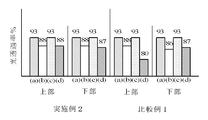
- FIG. 1 shows the light transmittance of the cured products (a) to (d) described above.
- FIG. 1 clearly shows that in the case of Comparative Example 1, the concentration of the epoxy compound at the upper portion of the syringe is lowered.
- the resin composition for encapsulating an optical semiconductor according to the present invention is a high thixotrope having a specific weight average molecular weight and a specific viscosity as a dispersion medium of an epoxy component by blending triglycidyl isocyanurates with an epoxy component as an epoxy main component. Glycidyl group-containing (meth) acrylic ester resin is used. For this reason, the resin composition for optical semiconductor sealing shows high thixotropy, and the triglycidyl isocyanurates are in a well dispersed state without being settled. Therefore, the resin composition for encapsulating an optical semiconductor of the present invention is useful when encapsulating an optical semiconductor by a dispense method.
Landscapes
- Chemical & Material Sciences (AREA)
- Health & Medical Sciences (AREA)
- Chemical Kinetics & Catalysis (AREA)
- Medicinal Chemistry (AREA)
- Polymers & Plastics (AREA)
- Organic Chemistry (AREA)
- Epoxy Resins (AREA)
- Structures Or Materials For Encapsulating Or Coating Semiconductor Devices Or Solid State Devices (AREA)
- Led Device Packages (AREA)
- Compositions Of Macromolecular Compounds (AREA)
Abstract
光半導体封止用樹脂組成物は、トリグリシジルイソシアヌレート類を含有するエポキシ成分と、酸無水物系硬化剤と、重量平均分子量が20000~65000、粘度が100~10000Pa・sであるグリシジル基含有(メタ)アクリル酸エステル系樹脂と、硬化促進剤とを含有し、粘度が10~200Pa・sであり、且つチクソトロピックインデックスが3~15である。
Description
本発明は、無色透明な光半導体封止用樹脂組成物に関する。
一般に、LED(発光ダイオード素子)、フォトトランジスタ、フォトダイオード、CCD(電荷結合素子)、EPROM(消去・書込可能ROM)等の受光あるいは発光するための光半導体チップ分野で利用されているパッケージ封止の代表的態様の一つとして、半導体封止用樹脂組成物をシリンジに充填し、シリンジの細いノズル(約10μm経)から光半導体チップを収容したパッケージ容器に供給したり、実装基板に実装された光半導体チップにポッティングしたりするというディスペンス方式が広く利用されている。
このようなディスペンス方式に適用される光半導体封止用樹脂組成物に対しては、封止作業、特にポッティングの作業の際に、ディスペンサーから吐出させるときには低粘度を示し、ポッティング後には高粘度を示して流動しにくくなるように、高チクソ性を示すことが求められている。また、光半導体封止用樹脂組成物の硬化物に対しては、経時的に変化しない透明性が求められている。更に、硬化物と封止すべき光半導体チップを搭載する基材との間の線膨張係数の差に起因して硬化物に反りやクラックが生ずることがあるが、硬化物に対してはそのような反りやクラックの発生がないという性質、即ち、良好な耐クラック性を示すこと等が求められている。さらに、硬化した封止樹脂材料の紫外線による変色の抑制が急務の問題となっている。
このような様々な要求を満たすべく、ディスペンス方式に適用される従来の光半導体封止用樹脂組成物は、光透過性、接着性、コストの観点から、液状のビスフェノールA型エポキシ主剤あるいは脂環式エポキシ主剤に、ヘキサヒドロフタル酸無水物等の酸無水物系硬化剤と、硬化促進剤と、必要に応じて老化防止剤とを配合した比較的高粘度の樹脂組成物から構成されている。
ところが、近年、光半導体チップにおいては、使用する光源の短波長化や高出力化が大きく進行しており、光半導体封止用樹脂組成物に対しても今まで以上の耐熱光耐久性が求められるようになっている。このため、液状のエポキシ主剤の一部を、より良好な耐熱光耐久性を示す室温で粉末固体のトリス-(2,3-エポキシプロピル)イソシアヌレートに換えることが提案されている(特許文献1の実施例1)。この半導体封止樹脂組成物の硬化物は、エポキシ主剤の一部にトリス-(2,3-エポキシプロピル)イソシアヌレートを使用しているために、経時的に良好な透明性と、良好な耐クラック性と、良好な耐熱光耐久性とを示すと期待できる。
しかしながら、特許文献1の光半導体封止用樹脂組成物の場合、トリス-(2,3-エポキシプロピル)イソシアヌレートが液状のビスフェノールA型エポキシ主剤あるいは脂環式エポキシ主剤に溶解しにくく、いったん加熱溶解させたとしても冷却により析出してしまう場合があるという問題があった。このため、エポキシ主剤に高濃度でトリス-(2,3-エポキシプロピル)イソシアヌレートを配合した光半導体封止用樹脂組成物あるいはエポキシ主剤としてトリス-(2,3-エポキシプロピル)イソシアヌレートのみを使用した光半導体封止用樹脂組成物の場合、ディスペンサーノズルに目詰まりが生じるおそれがあるため、ディスペンス方式への適用が難しいという問題があった。しかも、析出したトリス-(2,3-エポキシプロピル)イソシアヌレートが樹脂組成物中で沈降してしまい、均一な組成で樹脂封止することができないという問題もあった。しかも、特許文献1の光半導体封止用樹脂組成物の場合、ディスペンス方式に適した高チクソ性を実現するための考慮は全くなされていない。
本発明の目的は、上述したような従来の問題点を解決しようとするものであり、トリス-(2,3-エポキシプロピル)イソシアヌレートなどのトリグリシジルイソシアヌレート類をエポキシ主剤として使用する光半導体封止用樹脂組成物に高チクソ性を付与し、しかもその硬化物に経時的に良好な透明性と良好な耐クラック性と良好な耐熱光耐久性とを同時に付与することである。
本発明者は、エポキシ主剤であるトリグリシジルイソシアヌレート類を、特定の重量平均分子量と特定の粘度とを示す高チクソ性のグリシジル基含有(メタ)アクリル酸エステル系樹脂に分散させ、光半導体封止用樹脂組成物自体の粘度を特定範囲に調整すると共に、チクソトロピックインデックスも特定範囲に調整することにより、上述の目的を達成できることを見出し、本発明を完成させた。
即ち、本発明は、トリグリシジルイソシアヌレート類を含有するエポキシ成分と、酸無水物系硬化剤と、重量平均分子量が20000~65000、粘度が1000~10000Pa・sであるグリシジル基含有(メタ)アクリル酸エステル系樹脂と、硬化促進剤とを含有する光半導体封止用樹脂組成物であって、粘度が10~200Pa・sであり、且つチクソトロピックインデックスが3~15であることを特徴とする光半導体封止用樹脂組成物を提供する。
また、本発明は、光半導体チップが、上述の光半導体封止用樹脂組成物で半導体パッケージに封止されてなる光半導体装置を提供する。
本発明の光半導体封止用樹脂組成物は、エポキシ主剤となるエポキシ成分にトリグリシジルイソシアヌレート類を配合し、且つエポキシ成分の分散媒体として特定の重量平均分子量と特定の粘度とを示す高チクソ性のグリシジル基含有(メタ)アクリル酸エステル系樹脂を使用する。このため、光半導体封止用樹脂組成物は、高チクソ性を示し、しかもトリグリシジルイソシアヌレート類は沈降せずに良好な分散状態となっている。従って、本発明の光半導体封止用樹脂組成物は、ディスペンス方式に適したものとなっている。また、その硬化物は、エポキシ主剤となるエポキシ化合物にトリグリシジルイソシアヌレート類を配合しているために、経時的に良好な透明性と良好な耐クラック性と良好な耐熱光耐久性とを同時に示す。
本発明の光半導体封止用樹脂組成物は、光半導体チップを半導体パッケージに封止するためのものであり、基本的にエポキシ主剤となるエポキシ成分とグリシジル基含有(メタ)アクリル酸エステル系樹脂と硬化促進剤とを含有する。ここで、光半導体チップとしては、発光または受光する機能を有する半導体チップが挙げられ、具体的にはLED(発光ダイオード素子)、フォトトランジスタ、フォトダイオード、CCD(電荷結合素子)、EPROM(消去・書込可能ROM)等が挙げられる。また、従来の光半導体パッケージに使用されているものと同様のものを使用することができる。
本発明の光半導体封止用樹脂組成物は、レオメーター(例えば、レオストレスRS-150、HAAKE社製、パラレルプレート使用、ギャップ0.052mm、周波数0.6~600s-1)を用いて25℃、10s-1で測定した粘度が10~200Pa・s、好ましくは12~20Pa・sであり、且つ1s-1で測定した粘度値を10s-1で測定した粘度値で除して得たチクソトロピックインデックスが3~15、好ましくは4~7であることを特徴とする。粘度が10Pa・s未満であるとトリグリシジルイソシアヌレート類が沈降し、200Pa・sを超えるとディスペンサーノズルからの吐出が困難となる。また、チクソトロピックインデックスが3未満であると、粉末のエポキシ成分の樹脂組成物中の含有量が少なすぎることを意味し、このことは、架橋相手の酸無水物系硬化剤の官能基が100%架橋できず、換言すれば官能基の一部が架橋反応に寄与しないこととなり、耐熱光特性に悪影響を与える。また、15を超えると粉末成分に対する液状成分の割合が高いことを意味し、樹脂組成物の吐出時及び吐出後に相分離が生じることが懸念される。ここで、レオメーター測定において「10s-1」という条件は、ディスペンサーノズルから吐出されるときのような強い剪断力が付加された状態を想定しており、「1s-1」という条件は、シリンジ中で保存あるいは移送されているような弱い剪断力が付加された状態を想定している。
本発明において使用するエポキシ成分は、トリグリシジルイソシアヌレート類を含有する。トリグリシジルイソシアヌレート類としては、トリス-(2,3-エポキシプロピル)イソシアヌレート、低級アルキル基、低級アルコキシ基または低級アシルオキシ基置換トリグリシジルイソシアヌレート(特開2008-45014号公報、段落0021~0023)、脂肪族または脂環式カルボン酸変性トリグリシジルイソシアヌレート(特開2008-45014号公報、段落0025~0032)を挙げることができる。特に好ましいトリグリシジルイソシアヌレート類としては、前述のトリス-(2,3-エポキシプロピル)イソシアヌレートを挙げることができる。
エポキシ成分中のトリグリシジルイソシアヌレート類の含有量は、少なすぎると耐熱光耐久性が不十分となるので、少なくとも60質量%、好ましくは80質量%以上である。エポキシ化合物の全量がトリグリシジルイソシアヌレート類でもよい。
エポキシ成分は、必要に応じて、トリグリシジルイソシアヌレート類以外の公知のエポキシ化合物を含有してもよい。この場合、透明性(特に無色透明性)を確保する観点から分子内に二重結合が存在しない液状のものが好ましく、特に脂環式エポキシ化合物および/または水添芳香族エポキシ化合物を使用することが好ましい。脂環式エポキシ化合物としては、3,4-エポキシシクロヘキセニルメチル-3´,4´-エポキシシクロヘキセンカルボキシレートあるいは2,2-ビス(ヒドロキシメチル)-1-ブタノール、1,2-エポキシ-4-2(オキシラニル)シクロヘキサン付加物等が挙げられる。水添芳香族エポキシ化合物としては、水添ビスフェノールA型エポキシ化合物、水添ビスフェノールF型エポキシ化合物等が挙げられる。中でも、耐熱光透過性の点から3,4-エポキシシクロヘキセニルメチル-3´,4´-エポキシシクロヘキセンカルボキシレート又は水添ビスフェノールA型エポキシ化合物を好ましく使用することができる。また、液状の1,3,5-トリ-2-プロペニル-1,3,5-トリアジン-2,4,5(1H,H,5H)-トリオン、モノアリルジグリシジルイソシアヌレート、ジアリルグリシジルイソシアヌレートも併用できる。
エポキシ成分の光半導体封止用樹脂組成物の配合量は、少なすぎても多すぎても耐熱光特性を低下させるので、エポキシ成分と酸無水物系硬化剤とグリシジル基含有(メタ)アクリル酸エステル系樹脂との合計に対し、好ましくは30~70質量%、より好ましくは40~60質量%である。特に、トリグリシジルイソシアヌレート類の含有量は、エポキシ成分と酸無水物系硬化剤とグリシジル基含有(メタ)アクリル酸エステル系樹脂との合計に対し、好ましくは30~50質量%、より好ましくは35~45質量%である。
本発明の光半導体封止用樹脂組成物は、エポキシ成分の硬化剤として酸無水物系硬化剤を使用する。この場合、硬化物の透明性を確保する観点から分子内に二重結合が存在しないものが好ましく、特に脂環式または脂肪族酸無水物が好ましい。脂環式酸無水物としては、ヘキサヒドロフタル酸無水物、メチルヘキサヒドロフタル酸無水物等が挙げられる。脂肪族酸無水物としては、ドデセニル無水コハク酸が挙げられる。中でも、耐熱光透過性の点からメチルヘキサヒドロフタル酸無水物を好ましく使用することができる。
酸無水物系硬化剤の光半導体封止用樹脂組成物中の配合量は、少なすぎても多すぎても耐熱光特性を低下させるので、エポキシ成分と酸無水物硬化剤とグリシジル基含有(メタ)アクリル酸エステル系樹脂との合計に対し、好ましくは40~60質量%、より好ましくは45~55質量%である。なお、官能基濃度という観点から見た場合には、酸無水物系硬化剤の酸無水物当量を、エポキシ成分並びにグリシジル基含有(メタ)アクリル酸エステル系樹脂の合算エポキシ当量で除した当量比が、小さすぎると吸湿性が低下し、多すぎると耐熱光透過性及び吸湿性が低下するので、当量比が好ましくは0.85~1.15、より好ましくは0.95~1.05となるように酸無水物系硬化剤を配合する。
本発明の光半導体封止用樹脂組成物においては、トリグリシジルイソシアヌレート類を安定的に分散させ、且つ樹脂組成物全体に高チクソ性を付与する分散樹脂として、グリシジル基含有(メタ)アクリル酸エステル系樹脂を使用する。ここで、“(メタ)アクリル”なる用語は、“アクリル”と“メタクリル”とを包含する。また、この(メタ)アクリル酸エステル系樹脂がグリシジル基を含有しなければならない理由は、エポキシ成分と相溶し、架橋反応することで硬化物に優れた耐熱性と適度な表面硬度とを与えるためである。
このグリシジル基含有(メタ)アクリル酸エステル系樹脂の重量平均分子量は、十分な構造粘性を示すために20000~65000、好ましくは30000~55000という範囲である。
また、このグリシジル基含有(メタ)アクリル酸エステル系樹脂の、レオメーターを用いて25℃、10S-1で測定した粘度は、100~10000Pa・s、好ましくは200~5000Pa・sである。粘度が100Pa・s未満であることは、当該樹脂が過度に低分子量であることを意味し、このため硬化物の接着力の低下をもたらす結果となり、他方、10000Pa・sを超えることは、当該樹脂が過度に高分子量であることを意味し、このため樹脂組成物の粘度が過度に高いものとなり、酸無水物系硬化剤に対する相溶性の低下をもたらす。
また、このグリシジル基含有(メタ)アクリル酸エステル系樹脂について、レオメーターを用いて25℃、1s-1で測定したその粘度値を、10s-1で測定したその粘度値で除して得たグリシジル基含有(メタ)アクリル酸エステル系樹脂のチクソトロピックインデックスは、小さすぎると分散樹脂として十分に機能せず、粉末状のエポキシ成分が沈降してしまい、高粘度すぎてディスペンサーノズルから吐出できなくなることが懸念されるので、好ましくは2~50、より好ましくは4~30である。
グリシジル基含有(メタ)アクリル酸エステル系樹脂の光半導体封止用樹脂組成物中の配合量は、少なすぎると分散樹脂として十分な機能を発現することができず、粉末状のエポキシ成分が沈殿し、相分離が生じ、封止用樹脂組成物の接着性が低下する。他方、多すぎると硬化物の耐熱光特性が低下するので、エポキシ成分と酸無水物系硬化剤とグリシジル基含有(メタ)アクリル酸エステル系樹脂との合計に対し、好ましくは5~30質量%、より好ましくは7~15質量%である。
なお、グリシジル基含有(メタ)アクリル酸エステル系樹脂は、グリシジル基(メタ)アクリレート30質量部に対し、エチル、プロピルまたはブチル(メタ)アクリレート、2-エチルヘキシル(メタ)アクリレート等のアルキル(メタ)アクリレート70質量部とを、アゾビスブチロニトリル等のラジカル重合開始剤の存在下で、ラジカル重合させることにより調製することができる。
本発明の光半導体封止用樹脂組成物は、樹脂組成物の硬化物の透明性を損なわない硬化促進剤を含有する。このような硬化促進剤としては、第四級アンモニウム塩、1,8-ジアザビシクロ[5.4.0]ウンデカ-7-エン(DBU)-p-トルエンスルホン酸塩、有機ホスフィン等を使用することができる。中でも、耐熱光特性の点からテトラフェニルホスホニウムテトラフェニルボレートを使用することが好ましい。
硬化促進剤の光半導体封止用樹脂組成物中の配合量は、少なすぎると硬化反応が著しく遅くなり、多すぎると硬化反応が著しく早くなり、耐熱光特性が低下するので、エポキシ成分と酸無水物系硬化剤とグリシジル基含有(メタ)アクリル酸エステル系樹脂との合計100質量部に対し、好ましくは0.1~5質量部、より好ましくは0.15~3質量部である。
本発明の光半導体封止用樹脂組成物は、必要に応じて、老化防止剤を含有することができる。老化防止剤としては、硬化物の劣化過程で生成するラジカル(ROO・)を捕捉するラジカル連鎖禁止剤等の一次酸化防止剤、例えば、フェノール系酸化防止剤、アミン系酸化防止剤等を使用することができる。また、不安定な過酸化物(ROOH)を捕捉して積極的に分解して安定な化合物に変化させる過酸化物分解剤等の二次酸化防止剤、例えば、イオン系酸化防止剤、リン系酸化防止剤等を使用することもできる。このような老化防止剤は、光半導体封止用樹脂組成物の硬化温度で樹脂組成物中に溶解することが好ましく、例えば、融点が150℃以下のものが好ましい。
老化防止剤の光半導体封止用樹脂組成物中の配合量は、少なすぎても多すぎても耐熱光特性が低下するので、エポキシ成分と酸無水物系硬化剤とグリシジル基含有(メタ)アクリル酸エステル系樹脂との合計100質量部に対し、好ましくは0.1~5質量部、より好ましくは0.5~3質量部である。
更に、本発明の光半導体封止樹脂組成物には、硬化物の用途などに応じて、公知の紫外線吸収剤、カップリング剤、難燃剤等を配合することができる。
本発明の光半導体封止樹脂組成物は、エポキシ成分、酸無水物系硬化剤、グリシジル基含有(メタ)アクリル酸エステル系樹脂、硬化促進剤、及び必要に応じて他の成分、例えば老化防止剤を均一に混合することにより調製することができる。
本発明の光半導体封止用樹脂組成物は、光半導体装置に好ましく適用できる。かかる光半導体装置も本発明の一部である。このような光半導体装置は、具体的には、光学用半導体チップが、光半導体パッケージ封止樹脂材料で半導体パッケージに封止されてなるものであり、封止樹脂として本発明の光半導体封止用樹脂組成物を使用する以外は、従来の光半導体装置と同様の構成とすることができる。
以下、本発明を実施例により具体的に説明する。なお、グリシジル基含有(メタ)アクリル酸エステル系樹脂(分散樹脂)として使用したアクリル樹脂A、B及びCの製造例を以下に説明する。また、その後に使用した他の成分を説明する。
<アクリル樹脂Aの製造例>
撹拌棒と冷却管とを備えた四つ口フラスコに、ブチルアクリレートと、ブチルメタクリレートと、グリシジルメタクリレートと、2-エチルヘキシルメタクリレートと、ラジカル重合開始剤(2,2′-アゾビス(2-メチルプロピオニトリル))とを合計で100g(但し、30:30:30:2:0.05の質量比)、MEK300g、及びアセトン10gを投入し、80℃で4時間撹拌し、重量平均分子量35800、粘度300Pa・s(レオメーター(レオストレスRS-150、HAAKE社製;パラレルプレート使用、ギャップ0.052mm、周波数0.6~600s-1)用いて25℃、10s-1で測定した粘度)、チクソトロピックインデックス(TI)5.0(1s-1で測定した粘度を10s-1で測定した粘度値で除した数値)のグリシジル基を含有するアクリル樹脂Aを得た。
撹拌棒と冷却管とを備えた四つ口フラスコに、ブチルアクリレートと、ブチルメタクリレートと、グリシジルメタクリレートと、2-エチルヘキシルメタクリレートと、ラジカル重合開始剤(2,2′-アゾビス(2-メチルプロピオニトリル))とを合計で100g(但し、30:30:30:2:0.05の質量比)、MEK300g、及びアセトン10gを投入し、80℃で4時間撹拌し、重量平均分子量35800、粘度300Pa・s(レオメーター(レオストレスRS-150、HAAKE社製;パラレルプレート使用、ギャップ0.052mm、周波数0.6~600s-1)用いて25℃、10s-1で測定した粘度)、チクソトロピックインデックス(TI)5.0(1s-1で測定した粘度を10s-1で測定した粘度値で除した数値)のグリシジル基を含有するアクリル樹脂Aを得た。
<アクリル樹脂Bの製造例>
撹拌棒と冷却管とを備えた四つ口フラスコに、ブチルアクリレートと、ブチルメタクリレートと、グリシジルメタクリレートと、ラジカル重合開始剤(2,2′-アゾビス(2-メチルプロピオニトリル))とを合計で100g(但し、30:50:20:0.05の質量比)、MEK300g、及びアセトン10gを投入し、80℃で4時間撹拌し、重量平均分子量31500、粘度250Pa・s(レオメーター(レオストレスRS-150、HAAKE社製;パラレルプレート使用、ギャップ0.052mm、周波数0.6~600s-1)用いて25℃、10s-1で測定した粘度)、チクソトロピックインデックス4.8(1s-1で測定した粘度を10s-1で測定した粘度値で除した数値)のグリシジル基を含有するアクリル樹脂Bを得た。
撹拌棒と冷却管とを備えた四つ口フラスコに、ブチルアクリレートと、ブチルメタクリレートと、グリシジルメタクリレートと、ラジカル重合開始剤(2,2′-アゾビス(2-メチルプロピオニトリル))とを合計で100g(但し、30:50:20:0.05の質量比)、MEK300g、及びアセトン10gを投入し、80℃で4時間撹拌し、重量平均分子量31500、粘度250Pa・s(レオメーター(レオストレスRS-150、HAAKE社製;パラレルプレート使用、ギャップ0.052mm、周波数0.6~600s-1)用いて25℃、10s-1で測定した粘度)、チクソトロピックインデックス4.8(1s-1で測定した粘度を10s-1で測定した粘度値で除した数値)のグリシジル基を含有するアクリル樹脂Bを得た。
<アクリル樹脂Cの製造例>
撹拌棒と冷却管とを備えた四つ口フラスコに、ブチルアクリレートと、ブチルメタクリレートと、グリシジルメタクリレートと、2-エチルヘキシルメタクリレートと、ラジカル重合開始剤(2,2′-アゾビス(2-メチルプロピオニトリル))とを合計で100g(但し、30:30:30:2:0.05の質量比)、MEK300g、及びアセトン10gを投入し、80℃で2時間撹拌し、重量平均分子量10000、粘度105Pa・s(レオメーター(レオストレスRS-150、HAAKE社製;パラレルプレート使用、ギャップ0.052mm、周波数0.6~600s-1)用いて25℃、10s-1で測定した粘度)、チクソトロピックインデックス4.5(1s-1で測定した粘度を10s-1で測定した粘度値で除した数値)のグリシジル基を含有するアクリル樹脂Cを得た。
撹拌棒と冷却管とを備えた四つ口フラスコに、ブチルアクリレートと、ブチルメタクリレートと、グリシジルメタクリレートと、2-エチルヘキシルメタクリレートと、ラジカル重合開始剤(2,2′-アゾビス(2-メチルプロピオニトリル))とを合計で100g(但し、30:30:30:2:0.05の質量比)、MEK300g、及びアセトン10gを投入し、80℃で2時間撹拌し、重量平均分子量10000、粘度105Pa・s(レオメーター(レオストレスRS-150、HAAKE社製;パラレルプレート使用、ギャップ0.052mm、周波数0.6~600s-1)用いて25℃、10s-1で測定した粘度)、チクソトロピックインデックス4.5(1s-1で測定した粘度を10s-1で測定した粘度値で除した数値)のグリシジル基を含有するアクリル樹脂Cを得た。
<その他の成分>
エポキシ化合物:トリス-(2,3-エポキシプロピル)イソシアヌレート(TEPIC-P、日産化学工業(株):粉末 融点90℃);3,4-エポキシシクロヘキセニルメチル-3′,4′-エポキシシクロヘキセンカルボキシレート(CEL2021P、ダイセル化学工業(株))
酸無水物系硬化剤:メチルヘキサヒドロフタル酸無水物(MH-700(新日本理化(株))
硬化促進剤:テトラフェニルホスホニウムテトラフェニルボレート(TPP-K、北興化学工業(株))
老化防止剤:オクタデシル-3-(3,5-ジ-tert-ブチル-4-ヒドロキシフェニル)プロピオネート(Irganox 1076、チバ・スペシャリティ・ケミカルズ:粉末 融点 55℃)
エポキシ化合物:トリス-(2,3-エポキシプロピル)イソシアヌレート(TEPIC-P、日産化学工業(株):粉末 融点90℃);3,4-エポキシシクロヘキセニルメチル-3′,4′-エポキシシクロヘキセンカルボキシレート(CEL2021P、ダイセル化学工業(株))
酸無水物系硬化剤:メチルヘキサヒドロフタル酸無水物(MH-700(新日本理化(株))
硬化促進剤:テトラフェニルホスホニウムテトラフェニルボレート(TPP-K、北興化学工業(株))
老化防止剤:オクタデシル-3-(3,5-ジ-tert-ブチル-4-ヒドロキシフェニル)プロピオネート(Irganox 1076、チバ・スペシャリティ・ケミカルズ:粉末 融点 55℃)
実施例1~2及び比較例1~7
表1に示した配合の成分を均一に混合することにより、150℃で2時間加熱することで透明な硬化物を与える光半導体封止樹脂組成物を得た。得られた封止樹脂組成物に関し、以下の評価試験(a)~(g)を行った。得られた結果を表1に示す。
表1に示した配合の成分を均一に混合することにより、150℃で2時間加熱することで透明な硬化物を与える光半導体封止樹脂組成物を得た。得られた封止樹脂組成物に関し、以下の評価試験(a)~(g)を行った。得られた結果を表1に示す。
((a)樹脂組成物の初期粘度評価試験)
封止用樹脂組成物のチクソ性を評価するために、レオメーター(レトストレスRS-150、HAAKE社(測定環境条件:25℃、パラレルプレート使用、ギャップ0.052mm、周波数0.6~600s-1))を用いて10s-1で封止用樹脂組成物の初期粘度を測定し、また、チクソトロピックインデックス値を求めた。チクソトロピックインデックス値(TI値)は、1s-1で測定した粘度値を、10s-1で測定した粘度値で除した値である。ディスペンス方式に望ましい粘度は10~200Pa・sである。
封止用樹脂組成物のチクソ性を評価するために、レオメーター(レトストレスRS-150、HAAKE社(測定環境条件:25℃、パラレルプレート使用、ギャップ0.052mm、周波数0.6~600s-1))を用いて10s-1で封止用樹脂組成物の初期粘度を測定し、また、チクソトロピックインデックス値を求めた。チクソトロピックインデックス値(TI値)は、1s-1で測定した粘度値を、10s-1で測定した粘度値で除した値である。ディスペンス方式に望ましい粘度は10~200Pa・sである。
((b)樹脂組成物の粘度経時変化評価試験)
封止用樹脂組成物を、内径20mm、長さ200mmのガラスシリンジに充填し、25℃、50%RH環境下に100時間、200時間、300時間放置した後に、シリンジから封止用樹脂組成物を取り出し、上述の(a) 樹脂組成物の初期粘度評価試験と同様に、10s-1で粘度を測定した。粘度変化がないことは、ポットライフが良好であることを示している。また、ディスペンス方式に望ましい粘度は長期保存後でも10~200Pa・sである。
封止用樹脂組成物を、内径20mm、長さ200mmのガラスシリンジに充填し、25℃、50%RH環境下に100時間、200時間、300時間放置した後に、シリンジから封止用樹脂組成物を取り出し、上述の(a) 樹脂組成物の初期粘度評価試験と同様に、10s-1で粘度を測定した。粘度変化がないことは、ポットライフが良好であることを示している。また、ディスペンス方式に望ましい粘度は長期保存後でも10~200Pa・sである。
((c)耐クラック性評価試験)
0.2mm厚のガラスエポキシ基板(60mm角)上に、Siチップ(0.5mm厚、2mm角)を貼り付け、そのSiチップに封止用樹脂組成物を適用し硬化させ、Siチップを10mm×10mm×0.5mm厚の封止用樹脂組成物の硬化物で封止したパッケージサンプルを作成した。このサンプルを-40℃(30分)~100℃(30分)の冷熱サイクル試験等に48時間投入した。48時間後にSiチップのエッジ周辺におけるクラック発生の有無を目視にて観察した。クラックがされないことが望ましい。
0.2mm厚のガラスエポキシ基板(60mm角)上に、Siチップ(0.5mm厚、2mm角)を貼り付け、そのSiチップに封止用樹脂組成物を適用し硬化させ、Siチップを10mm×10mm×0.5mm厚の封止用樹脂組成物の硬化物で封止したパッケージサンプルを作成した。このサンプルを-40℃(30分)~100℃(30分)の冷熱サイクル試験等に48時間投入した。48時間後にSiチップのエッジ周辺におけるクラック発生の有無を目視にて観察した。クラックがされないことが望ましい。
((d)初期光透過率評価試験)
封止樹脂材料を、10mm角で1mm厚のプレート状に硬化させ、硬化物の400nmの光に対する初期光透過率を分光光度計(U-3300 Spectro Photometer、日立ハイテクノロジーズ社)を用いて測定した。初期光透過率は92%以上であることが望まれる。
封止樹脂材料を、10mm角で1mm厚のプレート状に硬化させ、硬化物の400nmの光に対する初期光透過率を分光光度計(U-3300 Spectro Photometer、日立ハイテクノロジーズ社)を用いて測定した。初期光透過率は92%以上であることが望まれる。
((e)初期へーズ評価試験)
初期光透過率評価試験に用いたプレート状の硬化物の濁度を、へーズメータ(Σ80 Color Measuring System、日本電色工業社)を用いて測定した。具体的には、この測定で得られた散乱光透過率の値を、全光線透過率の値で除することにより算出した。初期へーズは0.5以下であることが望まれる。
初期光透過率評価試験に用いたプレート状の硬化物の濁度を、へーズメータ(Σ80 Color Measuring System、日本電色工業社)を用いて測定した。具体的には、この測定で得られた散乱光透過率の値を、全光線透過率の値で除することにより算出した。初期へーズは0.5以下であることが望まれる。
((f)耐熱光透過率評価試験)
封止樹脂材料を硬化させて得られた硬化物を、リフロー槽に投入し、最高260℃となる温度プロファイルの熱処理を3度(それぞれ10秒)繰り返した後、熱処理した硬化物を180℃に保たれたオーブンへ投入した。そして100時間経過後にサンプルを取り出し、再度光透過率を分光光度計(U-3300 Spectro Photometer、日立ハイテクノロジーズ社)を用いて測定した。耐熱光透過率は70%以上であることが望まれる。
封止樹脂材料を硬化させて得られた硬化物を、リフロー槽に投入し、最高260℃となる温度プロファイルの熱処理を3度(それぞれ10秒)繰り返した後、熱処理した硬化物を180℃に保たれたオーブンへ投入した。そして100時間経過後にサンプルを取り出し、再度光透過率を分光光度計(U-3300 Spectro Photometer、日立ハイテクノロジーズ社)を用いて測定した。耐熱光透過率は70%以上であることが望まれる。
((g)耐熱耐光光透過率評価試験)
封止樹脂材料を硬化させて得られた硬化物を、リフロー槽に投入し、最高260℃となる温度プロファイルの熱処理を3度(それぞれ10秒)繰り返した後、熱処理した硬化物を、フェードメーター(スガ試験機社)を用いて、紫外線フェード試験(30W/m2、380nmピーク波長光源、60℃)を100時間行い、再度光透過率を分光光度計(U-3300 Spectro Photometer、日立ハイテクノロジーズ社)を用いて測定した。耐熱耐光光透過率は、80%以上であることが望まれる。
封止樹脂材料を硬化させて得られた硬化物を、リフロー槽に投入し、最高260℃となる温度プロファイルの熱処理を3度(それぞれ10秒)繰り返した後、熱処理した硬化物を、フェードメーター(スガ試験機社)を用いて、紫外線フェード試験(30W/m2、380nmピーク波長光源、60℃)を100時間行い、再度光透過率を分光光度計(U-3300 Spectro Photometer、日立ハイテクノロジーズ社)を用いて測定した。耐熱耐光光透過率は、80%以上であることが望まれる。

表1の結果から、実施例1及び2の封止用樹脂組成物の初期粘度は、いずれもディスペンス方式に適した粘度(10~200Pa・s)を示しており、しかも300時間という長期保存後もディスペンス方式に適した粘度範囲にあることがわかる。しかもチクソトロピックインデックスが4.8又は4.9であり、粉末のエポキシ化合物の良好な分散性を確保していることがわかる。また、耐クラック性、初期光透過率、初期ヘーズ、耐熱光透過率、耐熱耐光光透過率のいずれの評価項目についても、望ましい結果を示していたことがわかった。
なお、実施例2の封止用樹脂組成物は、昇温とともに低粘度化し、100℃付近で粘度が0.1Pa・s以下となった。この段階では、エポキシ化合物(TEPIC―P)は溶融しており、均一な溶融相となっていた。150℃付近で急激な粘度上昇が観察され、封止用樹脂組成物の硬化が確認できた。
また、表1の実施例1及び2の結果から、封止用樹脂組成物に老化防止剤を添加することにより、耐熱光透過率と耐熱耐光光透過率とを向上させ得ることがわかった。
他方、分散樹脂を含有していない比較例1の封止用樹脂組成物の場合、昇温とともに低粘度化し、75℃付近で粘度が0.1Pa・s以下となった。エポキシ化合物(TEPIC―P)の融点が90℃であるから、封止用樹脂組成物中で、粉末のエポキシ化合物が溶解しきれておらず、しかも樹脂組成物の粘度が低いものであるから、エポキシ化合物の粉末が沈降し、樹脂組成物中のエポキシ化合物と硬化剤との存在比が不均一になっていることがわかった。この点については、後述の試験例にて詳細に説明する。
エポキシ成分として、トリス-(2,3-エポキシプロピル)イソシアヌレートに代えて液状の脂環式エポキシ化合物を使用した比較例2の封止用樹脂組成物の場合、チクソ性を有するアクリル樹脂Aを使用しているにも関わらず、封止用樹脂組成物としてチクソ性を示さず、ディスペンス方式に適用できないものであった。しかも、脂環式エポキシ化合物が液状であるため硬化剤と反応し易く、ポットライフが100時間も持たないものであった。
分散樹脂においてグリシジルメタクリレートの量が比較的少ないアクリル樹脂Bを使用した比較例3の封止用樹脂組成物の場合、エポキシ化合物とアクリル樹脂Bとの相溶性及び反応性が十分ではないため、硬化物が白濁してしまった。
アクリル樹脂Aとエポキシ化合物との混合比が実施例2と異なる比較例4~6の封止用樹脂組成物の場合、チクソトロピックインデックスが15を超えていた比較例4及び6の封止用樹脂組成物は、ディスペンサーノズルから吐出させる際に粘度が低すぎ、吐出後に相分離してしまった。また、チクソトロピックインデックスが3未満の比較例5の封止用樹脂組成物は、相対的にアクリル樹脂の割合がエポキシ成分に対し過剰となるため、耐熱光透過率及び耐熱耐光光透過率の結果が、実施例2の封止用樹脂組成物に比べ劣っていた。
分散樹脂として重量平均分子量10000のアクリル樹脂Cを使用した比較例7の封止用樹脂組成物の場合、耐クラック性が低下してしまった。
試験例
分散樹脂を使用した場合(実施例2)と分散樹脂を使用しない場合(比較例1)とで、粉末のトリス-(2,3-エポキシプロピル)イソシアヌレートの樹脂組成物中の沈降現象を以下のように確認した。
分散樹脂を使用した場合(実施例2)と分散樹脂を使用しない場合(比較例1)とで、粉末のトリス-(2,3-エポキシプロピル)イソシアヌレートの樹脂組成物中の沈降現象を以下のように確認した。
実施例2及び比較例1の封止用樹脂組成物を、ディスペンサーのシリンジ(内径20mm、長さ200mm)に充填した。このシリンジから以下の(a)~(d)に従って得た硬化物の400nmの光に対する光透過率を分光光度計(U-3300 Spectro Photometer、日立ハイテクノロジーズ社)を用いて測定した。
(a)シリンジ充填直後に採取した樹脂組成物を150℃で硬化させた硬化物
(b)(a)の硬化物を、リフロー槽に投入し、最高260℃となる温度プロファイルの熱処理を3度(それぞれ10秒)繰り返した後、熱処理した硬化物を、フェードメーター(スガ試験機社)を用いて、紫外線フェード試験(30W/m2、380nmピーク波長光源、60℃)を100時間行った硬化物
(c)シリンジ充填後300時間経過後に採取した樹脂組成物を150℃で硬化させた硬化物
(d)(c)の硬化物を、リフロー槽に投入し、最高260℃となる温度プロファイルの熱処理を3度(それぞれ10秒)繰り返した後、熱処理した硬化物を、フェードメーター(スガ試験機社)を用いて、紫外線フェード試験(30W/m2、380nmピーク波長光源、60℃)を100時間行った硬化物
(a)シリンジ充填直後に採取した樹脂組成物を150℃で硬化させた硬化物
(b)(a)の硬化物を、リフロー槽に投入し、最高260℃となる温度プロファイルの熱処理を3度(それぞれ10秒)繰り返した後、熱処理した硬化物を、フェードメーター(スガ試験機社)を用いて、紫外線フェード試験(30W/m2、380nmピーク波長光源、60℃)を100時間行った硬化物
(c)シリンジ充填後300時間経過後に採取した樹脂組成物を150℃で硬化させた硬化物
(d)(c)の硬化物を、リフロー槽に投入し、最高260℃となる温度プロファイルの熱処理を3度(それぞれ10秒)繰り返した後、熱処理した硬化物を、フェードメーター(スガ試験機社)を用いて、紫外線フェード試験(30W/m2、380nmピーク波長光源、60℃)を100時間行った硬化物
上述の(a)~(d)の硬化物の光透過率を図1に示す。図1は、比較例1の場合には、明らかにシリンジの上部でのエポキシ化合物濃度が低下していることを示している。
本発明の光半導体封止用樹脂組成物は、エポキシ主剤となるエポキシ成分にトリグリシジルイソシアヌレート類を配合し、且つエポキシ成分の分散媒体として特定の重量平均分子量と特定の粘度とを示す高チクソ性のグリシジル基含有(メタ)アクリル酸エステル系樹脂を使用する。このため、光半導体封止用樹脂組成物は、高チクソ性を示し、しかもトリグリシジルイソシアヌレート類は沈降せずに良好な分散状態となっている。従って、本発明の光半導体封止用樹脂組成物は、ディスペンス方式で光半導体を封止する際に有用である。
Claims (9)
- トリグリシジルイソシアヌレート類を含有するエポキシ成分と、酸無水物系硬化剤と、重量平均分子量が20000~65000、粘度が100~10000Pa・sであるグリシジル基含有(メタ)アクリル酸エステル系樹脂と、硬化促進剤とを含有する光半導体封止用樹脂組成物であって、粘度が10~200Pa・sであり、且つチクソトロピックインデックスが3~15であることを特徴とする光半導体封止用樹脂組成物。
- 粘度が12~20Pa・sであり、チクソトロピックインデックスが4~7であることを特徴とする請求項1記載の光半導体封止用樹脂組成物。
- トリグリシジルイソシアヌレート類が、トリス-(2,3-エポキシプロピル)イソシアヌレートである請求項1または2記載の光半導体封止用樹脂組成物。
- エポキシ成分中のトリグリシジルイソシアヌレート類の含有量が、少なくとも60質量%である請求項1~3のいずれかに記載の光半導体封止用樹脂組成物。
- エポキシ成分と酸無水物系硬化剤とグリシジル基含有(メタ)アクリル酸エステル系樹脂との合計に対するトリグリシジルシアヌレート類の割合が30~50質量%である請求項1~4のいずれかに記載の光半導体封止用樹脂組成物。
- グリシジル基含有(メタ)アクリル酸エステル系樹脂の重量平均分子量が30000~55000、粘度が200~5000Pa・sである請求項1~5のいずれかに記載の光半導体封止用樹脂組成物。
- グリシジル基含有(メタ)アクリル酸エステル系樹脂について、グリシジル基含有(メタ)アクリル酸エステル系樹脂のチクソトロピックインデックスが、2~50である請求項1~6記載の光半導体封止用樹脂組成物。
- 更に、老化防止剤を含有する請求項1~7のいずれかに記載の光半導体封止用樹脂組成物。
- 光半導体チップが、請求項1~8のいずれかに記載の光半導体封止用樹脂組成物で半導体パッケージに封止されてなる光半導体装置。
Applications Claiming Priority (2)
| Application Number | Priority Date | Filing Date | Title |
|---|---|---|---|
| JP2009144119A JP5564835B2 (ja) | 2009-06-17 | 2009-06-17 | 光半導体封止用樹脂組成物 |
| JP2009-144119 | 2009-06-17 |
Publications (1)
| Publication Number | Publication Date |
|---|---|
| WO2010146979A1 true WO2010146979A1 (ja) | 2010-12-23 |
Family
ID=43356299
Family Applications (1)
| Application Number | Title | Priority Date | Filing Date |
|---|---|---|---|
| PCT/JP2010/059064 Ceased WO2010146979A1 (ja) | 2009-06-17 | 2010-05-28 | 光半導体封止用樹脂組成物 |
Country Status (3)
| Country | Link |
|---|---|
| JP (1) | JP5564835B2 (ja) |
| KR (1) | KR20120036795A (ja) |
| WO (1) | WO2010146979A1 (ja) |
Cited By (1)
| Publication number | Priority date | Publication date | Assignee | Title |
|---|---|---|---|---|
| CN113365680A (zh) * | 2019-03-29 | 2021-09-07 | 纳美仕有限公司 | 填充有树脂组合物的注射器、其制造方法及保存方法 |
Families Citing this family (6)
| Publication number | Priority date | Publication date | Assignee | Title |
|---|---|---|---|---|
| US9373730B2 (en) | 2011-04-26 | 2016-06-21 | Sanyu Rec Co., Ltd. | Method and apparatus for manufacturing optical device |
| US9184352B2 (en) | 2011-10-07 | 2015-11-10 | Konica Minolta, Inc. | Phosphor dispersion liquid, and production method for LED device using same |
| JP2015054965A (ja) * | 2013-09-13 | 2015-03-23 | 株式会社東芝 | 封止用樹脂、半導体装置、および光結合装置 |
| JP2015101633A (ja) * | 2013-11-25 | 2015-06-04 | スリーボンドファインケミカル株式会社 | エポキシ樹脂組成物 |
| JP6307352B2 (ja) * | 2014-05-30 | 2018-04-04 | 京セラ株式会社 | 光半導体封止用樹脂組成物および光半導体装置 |
| KR102818953B1 (ko) * | 2019-09-30 | 2025-06-11 | 동우 화인켐 주식회사 | 에폭시 수지 조성물 및 이를 포함하는 반도체 소자용 밀봉재 |
Citations (4)
| Publication number | Priority date | Publication date | Assignee | Title |
|---|---|---|---|---|
| JP2003160640A (ja) * | 2001-09-14 | 2003-06-03 | Sumitomo Chem Co Ltd | 光半導体封止用樹脂組成物 |
| JP2005036218A (ja) * | 2003-06-30 | 2005-02-10 | Mitsubishi Gas Chem Co Inc | 熱硬化性樹脂組成物及びその用途 |
| JP2005306952A (ja) * | 2004-04-20 | 2005-11-04 | Japan Epoxy Resin Kk | 発光素子封止材用エポキシ樹脂組成物 |
| JP2008045014A (ja) * | 2006-08-14 | 2008-02-28 | Mitsubishi Chemicals Corp | エポキシ樹脂組成物およびその用途 |
Family Cites Families (1)
| Publication number | Priority date | Publication date | Assignee | Title |
|---|---|---|---|---|
| KR101026127B1 (ko) * | 2002-10-09 | 2011-04-05 | 닛산 가가쿠 고교 가부시키 가이샤 | 리소그라피용 반사방지막 형성 조성물 |
-
2009
- 2009-06-17 JP JP2009144119A patent/JP5564835B2/ja not_active Expired - Fee Related
-
2010
- 2010-05-28 KR KR1020117020900A patent/KR20120036795A/ko not_active Ceased
- 2010-05-28 WO PCT/JP2010/059064 patent/WO2010146979A1/ja not_active Ceased
Patent Citations (4)
| Publication number | Priority date | Publication date | Assignee | Title |
|---|---|---|---|---|
| JP2003160640A (ja) * | 2001-09-14 | 2003-06-03 | Sumitomo Chem Co Ltd | 光半導体封止用樹脂組成物 |
| JP2005036218A (ja) * | 2003-06-30 | 2005-02-10 | Mitsubishi Gas Chem Co Inc | 熱硬化性樹脂組成物及びその用途 |
| JP2005306952A (ja) * | 2004-04-20 | 2005-11-04 | Japan Epoxy Resin Kk | 発光素子封止材用エポキシ樹脂組成物 |
| JP2008045014A (ja) * | 2006-08-14 | 2008-02-28 | Mitsubishi Chemicals Corp | エポキシ樹脂組成物およびその用途 |
Cited By (3)
| Publication number | Priority date | Publication date | Assignee | Title |
|---|---|---|---|---|
| CN113365680A (zh) * | 2019-03-29 | 2021-09-07 | 纳美仕有限公司 | 填充有树脂组合物的注射器、其制造方法及保存方法 |
| US11623813B2 (en) | 2019-03-29 | 2023-04-11 | Namics Corporation | Resin composition-filled syringe, and production method and preservation method for same |
| CN113365680B (zh) * | 2019-03-29 | 2023-12-01 | 纳美仕有限公司 | 填充有树脂组合物的注射器、其制造方法及保存方法 |
Also Published As
| Publication number | Publication date |
|---|---|
| KR20120036795A (ko) | 2012-04-18 |
| JP5564835B2 (ja) | 2014-08-06 |
| JP2011001418A (ja) | 2011-01-06 |
Similar Documents
| Publication | Publication Date | Title |
|---|---|---|
| JP5564835B2 (ja) | 光半導体封止用樹脂組成物 | |
| EP2500932B1 (en) | Adhesive composition | |
| EP2083038B1 (en) | Diglycidylisocyanuryl-modified organopolysiloxane and composition containing the same | |
| JP5154340B2 (ja) | 光半導体封止用樹脂組成物 | |
| TW201631044A (zh) | 硬化性聚矽氧樹脂組成物及其硬化物 | |
| KR101657528B1 (ko) | 가열경화형 도전성 실리콘 조성물, 이 조성물로 이루어진 도전성 접착제, 이 조성물로 이루어진 도전성 다이본드재, 이 다이본드재의 경화물을 갖는 광반도체 장치 | |
| JP2016216606A (ja) | 硬化性樹脂組成物及びその硬化物、並びに半導体装置 | |
| JP5253260B2 (ja) | Led用蛍光樹脂組成物、それを用いた封止材及び蓄光材料 | |
| KR102340593B1 (ko) | 투명수지 조성물, 이 조성물로 이루어진 접착제, 이 조성물로 이루어진 다이본드재, 이 조성물을 이용한 도전접속방법, 및 이 방법에 의해 얻어진 광반도체 장치 | |
| KR101947621B1 (ko) | 가열경화형 실리콘 조성물, 이 조성물로 이루어진 다이본드재 및 이 다이본드재의 경화물을 이용한 광반도체 장치 | |
| JP4433876B2 (ja) | エポキシ樹脂組成物及びそれを用いた光半導体用接着剤 | |
| JP4802667B2 (ja) | エポキシ樹脂接着組成物及びそれを用いた光半導体用接着剤 | |
| JP5556671B2 (ja) | 硬化性組成物、硬化膜及び半導体発光素子 | |
| JP2009215520A (ja) | 光半導体封止用エポキシ樹脂組成物および光半導体装置 | |
| CN103965581B (zh) | 固化性树脂组合物和光半导体封装用树脂组合物 | |
| JP2020037702A (ja) | エポキシ樹脂硬化剤組成物、それを含有するエポキシ樹脂組成物、その硬化物 | |
| KR101915341B1 (ko) | 경화성 에폭시 수지 조성물 | |
| JP6148870B2 (ja) | 硬化性樹脂組成物、及び、硬化物 | |
| JP2011225779A (ja) | 透明樹脂組成物および光半導体装置 | |
| KR20170084028A (ko) | 접착제, 이 접착제로 이루어진 다이본드재, 이 접착제를 이용한 도전접속방법, 및 이 방법에 의해 얻어진 광반도체 장치 | |
| JP2011042762A (ja) | 透明封止材用組成物 | |
| JP2011037996A (ja) | 透明樹脂組成物およびその製造方法、並びに光半導体装置 | |
| WO2023090317A1 (ja) | 硬化性樹脂組成物 | |
| WO2016072458A1 (ja) | 樹脂組成物、樹脂フィルム、樹脂硬化物、電子部品及び電子部品の製造方法 | |
| KR102818953B1 (ko) | 에폭시 수지 조성물 및 이를 포함하는 반도체 소자용 밀봉재 |
Legal Events
| Date | Code | Title | Description |
|---|---|---|---|
| 121 | Ep: the epo has been informed by wipo that ep was designated in this application |
Ref document number: 10789354 Country of ref document: EP Kind code of ref document: A1 |
|
| ENP | Entry into the national phase |
Ref document number: 20117020900 Country of ref document: KR Kind code of ref document: A |
|
| NENP | Non-entry into the national phase |
Ref country code: DE |
|
| 122 | Ep: pct application non-entry in european phase |
Ref document number: 10789354 Country of ref document: EP Kind code of ref document: A1 |