WO2010143676A1 - 炭化水素系ガス改質用触媒、その製造方法、および合成ガスの製造方法 - Google Patents
炭化水素系ガス改質用触媒、その製造方法、および合成ガスの製造方法 Download PDFInfo
- Publication number
- WO2010143676A1 WO2010143676A1 PCT/JP2010/059817 JP2010059817W WO2010143676A1 WO 2010143676 A1 WO2010143676 A1 WO 2010143676A1 JP 2010059817 W JP2010059817 W JP 2010059817W WO 2010143676 A1 WO2010143676 A1 WO 2010143676A1
- Authority
- WO
- WIPO (PCT)
- Prior art keywords
- nio
- tio
- hydrocarbon
- reforming
- solid solution
- Prior art date
- Legal status (The legal status is an assumption and is not a legal conclusion. Google has not performed a legal analysis and makes no representation as to the accuracy of the status listed.)
- Ceased
Links
Images


Classifications
-
- C—CHEMISTRY; METALLURGY
- C01—INORGANIC CHEMISTRY
- C01B—NON-METALLIC ELEMENTS; COMPOUNDS THEREOF; METALLOIDS OR COMPOUNDS THEREOF NOT COVERED BY SUBCLASS C01C
- C01B3/00—Hydrogen; Gaseous mixtures containing hydrogen; Separation of hydrogen from mixtures containing it; Purification of hydrogen; Reversible storage of hydrogen
- C01B3/02—Production of hydrogen; Production of gaseous mixtures containing hydrogen
- C01B3/32—Production of hydrogen; Production of gaseous mixtures containing hydrogen by reaction of gaseous or liquid organic compounds with gasifying agents, e.g. water, carbon dioxide or air
- C01B3/34—Production of hydrogen; Production of gaseous mixtures containing hydrogen by reaction of gaseous or liquid organic compounds with gasifying agents, e.g. water, carbon dioxide or air by reaction of hydrocarbons with gasifying agents
- C01B3/38—Production of hydrogen; Production of gaseous mixtures containing hydrogen by reaction of gaseous or liquid organic compounds with gasifying agents, e.g. water, carbon dioxide or air by reaction of hydrocarbons with gasifying agents using catalysts
- C01B3/40—Production of hydrogen; Production of gaseous mixtures containing hydrogen by reaction of gaseous or liquid organic compounds with gasifying agents, e.g. water, carbon dioxide or air by reaction of hydrocarbons with gasifying agents using catalysts characterised by the catalyst
-
- B—PERFORMING OPERATIONS; TRANSPORTING
- B01—PHYSICAL OR CHEMICAL PROCESSES OR APPARATUS IN GENERAL
- B01J—CHEMICAL OR PHYSICAL PROCESSES, e.g. CATALYSIS OR COLLOID CHEMISTRY; THEIR RELEVANT APPARATUS
- B01J23/00—Catalysts comprising metals or metal oxides or hydroxides, not provided for in group B01J21/00
- B01J23/002—Mixed oxides other than spinels, e.g. perovskite
-
- B—PERFORMING OPERATIONS; TRANSPORTING
- B01—PHYSICAL OR CHEMICAL PROCESSES OR APPARATUS IN GENERAL
- B01J—CHEMICAL OR PHYSICAL PROCESSES, e.g. CATALYSIS OR COLLOID CHEMISTRY; THEIR RELEVANT APPARATUS
- B01J23/00—Catalysts comprising metals or metal oxides or hydroxides, not provided for in group B01J21/00
- B01J23/70—Catalysts comprising metals or metal oxides or hydroxides, not provided for in group B01J21/00 of the iron group metals or copper
- B01J23/76—Catalysts comprising metals or metal oxides or hydroxides, not provided for in group B01J21/00 of the iron group metals or copper combined with metals, oxides or hydroxides provided for in groups B01J23/02 - B01J23/36
- B01J23/78—Catalysts comprising metals or metal oxides or hydroxides, not provided for in group B01J21/00 of the iron group metals or copper combined with metals, oxides or hydroxides provided for in groups B01J23/02 - B01J23/36 with alkali- or alkaline earth metals
-
- B—PERFORMING OPERATIONS; TRANSPORTING
- B01—PHYSICAL OR CHEMICAL PROCESSES OR APPARATUS IN GENERAL
- B01J—CHEMICAL OR PHYSICAL PROCESSES, e.g. CATALYSIS OR COLLOID CHEMISTRY; THEIR RELEVANT APPARATUS
- B01J37/00—Processes, in general, for preparing catalysts; Processes, in general, for activation of catalysts
- B01J37/08—Heat treatment
-
- B—PERFORMING OPERATIONS; TRANSPORTING
- B01—PHYSICAL OR CHEMICAL PROCESSES OR APPARATUS IN GENERAL
- B01J—CHEMICAL OR PHYSICAL PROCESSES, e.g. CATALYSIS OR COLLOID CHEMISTRY; THEIR RELEVANT APPARATUS
- B01J2523/00—Constitutive chemical elements of heterogeneous catalysts
-
- C—CHEMISTRY; METALLURGY
- C01—INORGANIC CHEMISTRY
- C01B—NON-METALLIC ELEMENTS; COMPOUNDS THEREOF; METALLOIDS OR COMPOUNDS THEREOF NOT COVERED BY SUBCLASS C01C
- C01B2203/00—Integrated processes for the production of hydrogen or synthesis gas
- C01B2203/02—Processes for making hydrogen or synthesis gas
- C01B2203/0205—Processes for making hydrogen or synthesis gas containing a reforming step
- C01B2203/0227—Processes for making hydrogen or synthesis gas containing a reforming step containing a catalytic reforming step
- C01B2203/0233—Processes for making hydrogen or synthesis gas containing a reforming step containing a catalytic reforming step the reforming step being a steam reforming step
-
- C—CHEMISTRY; METALLURGY
- C01—INORGANIC CHEMISTRY
- C01B—NON-METALLIC ELEMENTS; COMPOUNDS THEREOF; METALLOIDS OR COMPOUNDS THEREOF NOT COVERED BY SUBCLASS C01C
- C01B2203/00—Integrated processes for the production of hydrogen or synthesis gas
- C01B2203/02—Processes for making hydrogen or synthesis gas
- C01B2203/0205—Processes for making hydrogen or synthesis gas containing a reforming step
- C01B2203/0227—Processes for making hydrogen or synthesis gas containing a reforming step containing a catalytic reforming step
- C01B2203/0238—Processes for making hydrogen or synthesis gas containing a reforming step containing a catalytic reforming step the reforming step being a carbon dioxide reforming step
-
- C—CHEMISTRY; METALLURGY
- C01—INORGANIC CHEMISTRY
- C01B—NON-METALLIC ELEMENTS; COMPOUNDS THEREOF; METALLOIDS OR COMPOUNDS THEREOF NOT COVERED BY SUBCLASS C01C
- C01B2203/00—Integrated processes for the production of hydrogen or synthesis gas
- C01B2203/10—Catalysts for performing the hydrogen forming reactions
- C01B2203/1041—Composition of the catalyst
- C01B2203/1047—Group VIII metal catalysts
- C01B2203/1052—Nickel or cobalt catalysts
- C01B2203/1058—Nickel catalysts
-
- Y—GENERAL TAGGING OF NEW TECHNOLOGICAL DEVELOPMENTS; GENERAL TAGGING OF CROSS-SECTIONAL TECHNOLOGIES SPANNING OVER SEVERAL SECTIONS OF THE IPC; TECHNICAL SUBJECTS COVERED BY FORMER USPC CROSS-REFERENCE ART COLLECTIONS [XRACs] AND DIGESTS
- Y02—TECHNOLOGIES OR APPLICATIONS FOR MITIGATION OR ADAPTATION AGAINST CLIMATE CHANGE
- Y02P—CLIMATE CHANGE MITIGATION TECHNOLOGIES IN THE PRODUCTION OR PROCESSING OF GOODS
- Y02P20/00—Technologies relating to chemical industry
- Y02P20/141—Feedstock
-
- Y—GENERAL TAGGING OF NEW TECHNOLOGICAL DEVELOPMENTS; GENERAL TAGGING OF CROSS-SECTIONAL TECHNOLOGIES SPANNING OVER SEVERAL SECTIONS OF THE IPC; TECHNICAL SUBJECTS COVERED BY FORMER USPC CROSS-REFERENCE ART COLLECTIONS [XRACs] AND DIGESTS
- Y02—TECHNOLOGIES OR APPLICATIONS FOR MITIGATION OR ADAPTATION AGAINST CLIMATE CHANGE
- Y02P—CLIMATE CHANGE MITIGATION TECHNOLOGIES IN THE PRODUCTION OR PROCESSING OF GOODS
- Y02P20/00—Technologies relating to chemical industry
- Y02P20/50—Improvements relating to the production of bulk chemicals
- Y02P20/52—Improvements relating to the production of bulk chemicals using catalysts, e.g. selective catalysts
Definitions
- the present invention relates to a hydrocarbon gas reforming catalyst used for producing a synthesis gas containing hydrogen and carbon monoxide by reforming a hydrocarbon-based source gas, a method for producing the same, and the hydrocarbon-based gas
- the present invention relates to a method for producing synthesis gas using a gas reforming catalyst.
- hydrocarbon gases are generated from technical fields such as petroleum refining and petrochemistry, but they are not necessarily efficiently used as raw material gases for various substances, and a method for converting them into more effective substances is required. ing.
- hydrocarbon gas reforming hydrocarbon steam reforming
- saturated hydrocarbons are methods for producing synthesis gas containing hydrogen and carbon monoxide by reforming hydrocarbon gas.
- a method such as a combined reforming of carbon dioxide and steam in which both carbon dioxide and steam react in the presence of a catalyst is known.
- Carbon dioxide reforming of hydrocarbons is suitable for producing a synthesis gas having a relatively high carbon monoxide concentration by reacting a saturated hydrocarbon such as methane with carbon dioxide in the presence of a catalyst.
- steam reforming of hydrocarbons is suitable for producing a synthesis gas having a relatively high hydrogen concentration by reacting a saturated hydrocarbon such as methane with steam in the presence of a catalyst.
- carbon may be deposited on the catalyst during the process of hydrocarbon decomposition.
- the degree of carbon deposition varies depending on the hydrocarbon reforming conditions. It is said that carbon is most likely to precipitate in carbon dioxide reforming of hydrocarbons, and that the amount of carbon deposition is relatively small in hydrocarbon steam reforming.
- the carbon deposited on the catalyst gradually accumulates to reduce the catalytic activity, and if it is deposited in large quantities, the reaction tube may be clogged.
- hydrocarbon ratio hereinafter, “steam / hydrocarbon ratio” is set high, and carbon deposition is suppressed by introducing excessive steam.
- the hydrocarbon carbon dioxide or steam reforming catalyst includes a nickel-based catalyst in which nickel is supported on a substrate such as alumina, a ruthenium-based catalyst in which ruthenium is supported (see Patent Document 1), and alumina.
- a rhodium-based catalyst in which rhodium is supported on a substrate is known.
- the hydrocarbon carbon dioxide reforming catalyst includes at least one alkaline earth metal carbonate selected from Ca, Sr, and Ba, Ni, Rh, Ru, Ir, Pd, Pt, Re, and Co. , Fe, Mo, etc., and a catalyst for carbon dioxide reforming comprising ATiO 3 (A is at least one alkaline earth metal selected from the group consisting of Ca, Sr and Ba) have been proposed. (See Patent Document 3).
- Nickel-based catalysts in which nickel is supported on a substrate such as alumina, which is common as a hydrocarbon steam reforming catalyst, are likely to cause carbon deposition on the catalyst. Therefore, there is a need to carry out a hydrocarbon steam reforming reaction under conditions of a high steam / hydrocarbon ratio with excess steam.
- excess water vapor has the problem of increased energy consumption during the water vaporization process, and the concentration of carbon monoxide in the synthesis gas composition to be produced decreases, resulting in monoxide oxidation such as fuel synthesis.
- it is not suitable for applications that require synthesis gas with a high carbon concentration.
- this is a reforming reaction that is more likely to cause carbon deposition.
- the ruthenium-based catalyst as shown in Patent Document 1 has an action of suppressing carbon deposition, carbon deposition is less than that of a nickel-based catalyst and the activity can be easily maintained.
- unsaturated hydrocarbons coexist in the raw material, thermal carbon deposition and activity decrease are likely to occur, and even if the ruthenium-based catalyst has an effect of suppressing carbon deposition, it may be caused by unsaturated hydrocarbons contained in the raw material gas. There is a problem that poisoning and activity decrease.
- the rhodium-based catalyst in which rhodium is supported on a substrate such as alumina as shown in Patent Document 2 is said to have similar problems.
- the present invention solves the above-mentioned problem, and reacts a hydrocarbon-based raw material gas with carbon dioxide and / or water vapor while suppressing carbon deposition, thereby efficiently producing hydrogen and carbon monoxide.
- Hydrocarbon-based gas reforming catalyst, method for producing the same, and method for producing synthesis gas capable of efficiently producing hydrogen and carbon monoxide using the hydrocarbon-based gas reforming catalyst The purpose is to provide.
- the hydrocarbon-based gas reforming catalyst of the present invention comprises: A hydrocarbon-based gas reforming catalyst used for reforming a hydrocarbon-based gas with carbon dioxide and / or steam to produce a synthesis gas containing carbon monoxide and hydrogen, NiO contains a NiO—Sr 2 TiO 4 solid solution in which Sr 2 TiO 4 is dissolved.
- the ratio of NiO in the NiO—Sr 2 TiO 4 solid solution is 2.2 to 13.5 mol parts with respect to 100 mol parts of Sr 2 TiO 4. preferable.
- the hydrocarbon gas reforming catalyst of the present invention is A hydrocarbon-based gas reforming catalyst used for reforming a hydrocarbon-based gas with carbon dioxide and / or steam to produce a synthesis gas containing carbon monoxide and hydrogen, It is characterized by containing SrTiO 3 , SrCO 3 , Ni and / or NiO produced by allowing carbon dioxide to act on the NiO—Sr 2 TiO 4 solid solution according to claim 1 or 2.
- the method for producing the hydrocarbon gas reforming catalyst of the present invention comprises: NiO—Sr in which NiO is dissolved in Sr 2 TiO 4 , which is used to reform a hydrocarbon-based source gas with carbon dioxide and / or steam to produce a synthesis gas containing carbon monoxide and hydrogen.
- a method for producing a hydrocarbon-based gas reforming catalyst containing 2 TiO 4 solid solution as a main component A step of producing a NiO—Sr 2 TiO 4 solid solution in which NiO is solid-dissolved in Sr 2 TiO 4 by heat-treating a mixture containing SrTiO 3 , SrCO 3 and Ni and / or NiO at a temperature of 900 ° C. or higher. It is characterized by comprising.
- the method for producing the hydrocarbon gas reforming catalyst of the present invention comprises: NiO—Sr in which NiO is dissolved in Sr 2 TiO 4 , which is used to reform a hydrocarbon-based source gas with carbon dioxide and / or steam to produce a synthesis gas containing carbon monoxide and hydrogen.
- a method for producing a hydrocarbon-based gas reforming catalyst containing 2 TiO 4 solid solution as a main component A step of producing a NiO—Sr 2 TiO 4 solid solution in which NiO is dissolved in Sr 2 TiO 4 by heat-treating a mixture containing TiO 2 , SrCO 3 and Ni and / or NiO at a temperature of 900 ° C. or higher. It is characterized by comprising.
- the method for producing the hydrocarbon gas reforming catalyst of the present invention comprises: SrTiO 3 , SrCO 3 , Ni and / or NiO used for reforming a hydrocarbon-based source gas with carbon dioxide and / or steam to produce a synthesis gas containing carbon monoxide and hydrogen
- a process for producing a hydrocarbon-based gas reforming catalyst containing as a main component A step of producing a NiO—Sr 2 TiO 4 solid solution in which NiO is solid-dissolved in Sr 2 TiO 4 by heat-treating a mixture containing SrTiO 3 , SrCO 3 and Ni and / or NiO at a temperature of 900 ° C. or higher.
- the method for producing the hydrocarbon gas reforming catalyst of the present invention comprises: SrTiO 3 , SrCO 3 , Ni and / or NiO used for reforming a hydrocarbon-based source gas with carbon dioxide and / or steam to produce a synthesis gas containing carbon monoxide and hydrogen
- a process for producing a hydrocarbon-based gas reforming catalyst containing as a main component A step of producing a NiO—Sr 2 TiO 4 solid solution in which NiO is dissolved in Sr 2 TiO 4 by heat-treating a mixture containing TiO 2 , SrCO 3 and Ni and / or NiO at a temperature of 900 ° C. or higher.
- a method of manufacturing a synthesis gas of the present invention comprises the steps of NiO is to produce a NiO-Sr 2 TiO 4 solid solution was dissolved in Sr 2 TiO 4, Allowing carbon dioxide to act on the NiO—Sr 2 TiO 4 solid solution to produce SrTiO 3 , SrCO 3 , Ni and / or NiO;
- a gas containing a hydrocarbon-based raw material gas and carbon dioxide and / or water vapor is passed through a reformer filled with a catalyst containing SrTiO 3 , SrCO 3 and Ni and / or NiO as main components.
- Hydrocarbon gas reforming catalyst (hereinafter simply referred to as a reforming catalyst) of the present invention is a catalyst which NiO contains NiO-Sr 2 TiO 4 solid solution was dissolved in Sr 2 TiO 4, the carbon dioxide Ni and / or NiO deposited by the action becomes fine particles.
- a reforming catalyst capable of suppressing carbon deposition even when a reforming reaction is performed by reacting a hydrocarbon-based source gas with carbon dioxide and / or steam at a high pressure is obtained. Is possible.
- the conversion rate to a synthetic product increases as the reaction is carried out at high pressure. Therefore, it is desirable that the production process of the synthesis gas used as the raw material is also under high pressure, but the fine process is fine.
- the reforming catalyst according to the present invention in which Ni and / or NiO is deposited can be used without causing carbon deposition even under high pressure. This is particularly significant when used as part of a synthesis process. That is, by using the reforming catalyst according to the present invention, a process for repressurizing the synthesis gas obtained at a low pressure becomes unnecessary.
- the reforming catalyst on which fine Ni and / or NiO according to the present invention is deposited can be used under an absolute pressure of 5 atm or higher.
- the reforming catalyst according to the present invention functions as a catalyst for causing the following reaction by circulating hydrocarbons such as methane and carbon dioxide at a high temperature of, for example, 800 ° C. to 1100 ° C. CH 4 ⁇ C + 2H 2 (1) C + CO 2 ⁇ 2CO (2) CH 4 + CO 2 ⁇ 2H 2 + 2CO (3)
- carbon dioxide reforming reaction of methane (CH 4 ) the decomposition reaction of CH 4 of formula (1) and the reaction of generating CO of formula (2) proceed, and as a result, carbon dioxide is expressed by formula (3).
- a reforming reaction is represented.
- the reaction rate of the formula (2) is slower than the reaction of the formula (1), so that the decomposition of CH 4 by the formula (1) proceeds. Carbon precipitation may occur or the reverse reaction of formula (2) may proceed to cause carbon precipitation.
- the reforming catalyst of the present invention has an effect of particularly promoting the reaction of the formula (2), and carbon generated by the reaction of the formula (1) due to the catalytic function of fine Ni and / or NiO. Can be removed by the reaction of formula (2), and as a result, carbon deposition can be suppressed.
- the reforming catalyst according to the present invention also works effectively as a catalyst for causing a reaction represented by the following formula (4) between methane, which is a hydrocarbon, and water vapor at a high temperature.
- methane which is a hydrocarbon
- water vapor at a high temperature.
- the reforming catalyst according to the present invention includes a carbon dioxide reforming reaction in which methane, which is a hydrocarbon, and carbon dioxide are reacted as in the above formulas (1) to (3), and methane, which is a hydrocarbon.
- a steam to be reacted steam reforming reaction and was simultaneously performed as in the above formula (4), the ratio of H 2 and CO, for example, to obtain a H 2 / CO 3 ⁇ 1 of the synthesis gas at a volume ratio Even in this case, it works effectively as a reforming catalyst.
- the ratio of NiO in the NiO—Sr 2 TiO 4 solid solution is in the range of 2.2 mol parts to 13.5 mol parts with respect to 100 mol parts of Sr 2 TiO 4 , so that all of the NiO is Sr.
- 2 TiO 4 can be dissolved in a solid solution, and carbon dioxide is allowed to act on the NiO—Sr 2 TiO 4 solid solution, thereby precipitating fine Ni and / or NiO, thereby reforming carbon dioxide, steam reforming,
- NiO—Sr 2 TiO 4 solid solution in which NiO is solid-solved in Sr 2 TiO 4 (Sr ⁇ Ti composite oxide)
- a mixture containing SrTiO 3 , SrCO 3 and Ni and / or NiO is used.
- heat treatment at 900 ° C. or higher temperatures NiO is possible to reliably produce a NiO-Sr 2 TiO 4 solid solution was dissolved in Sr 2 TiO 4.
- NiO has when to produce NiO-Sr 2 TiO 4 solid solution was dissolved in Sr 2 TiO 4, and TiO 2, and SrCO 3, the mixture is heat-treated at 900 ° C. or higher temperatures containing Ni and / or NiO by also, NiO can be reliably produce a NiO-Sr 2 TiO 4 solid solution was dissolved in Sr 2 TiO 4 can.
- the heat treatment temperature in the heat treatment step for generating the NiO—Sr 2 TiO 4 solid solution is desirably 900 ° C. or higher, and there is no particular restriction on the upper limit of the heat treatment temperature. Considering the energy consumption in the process, it is usually desirable to set the temperature to 1300 ° C. or lower.
- synthesis gas of the present invention carbon dioxide reforming for reforming by reacting hydrocarbon and carbon dioxide, steam reforming for reforming by reacting hydrocarbon and steam, and dioxide
- the synthesis gas containing hydrogen and carbon monoxide is efficiently produced from hydrocarbon-based source gas while suppressing carbon deposition. Can be manufactured well.
- FIG. 1 shows schematic structure of the test apparatus used in order to implement the manufacturing method of the synthesis gas concerning the Example of this invention.
- (a) shows a TEM image of the reforming catalyst A produced in the example of the present invention, and (b) shows an EDX mapping image regarding Ni of the reforming catalyst A.
- (a) shows a TEM image of the reforming catalyst D (comparative example) produced for comparison in the examples of the present invention, and (b) shows an EDX mapping image regarding Ni of the reforming catalyst D. is there.
- [1] Manufacture of reforming catalyst (1) Manufacture of reforming catalyst A according to examples of the present invention Strontium carbonate (SrCO 3 ) and titanium oxide (TiO 2 ) in a molar ratio of 2.0: 1.0 Then, nickel oxide (NiO) was further added and mixed at a ratio of 8.9 mol parts with respect to 100 mol parts of Sr 2 TiO 4 to be produced. Next, a binder was added to this mixture and granulated to obtain a spherical granulated body having a diameter of 2 to 5 mm. And the catalyst A was obtained by baking the obtained granule on the conditions for 1100 degreeC and 1 hour in the air.
- SrCO 3 Strontium carbonate
- TiO 2 titanium oxide
- NiO nickel oxide
- a binder was added to this mixture and granulated to obtain a spherical granulated body having a diameter of 2 to 5 mm.
- the catalyst A was obtained by baking the obtained granul
- the obtained diffraction line was only the diffraction line of Sr 2 TiO 4 structure. Accordingly, the resulting catalyst A is a NiO-Sr 2 TiO 4 solid solution of Ni component is dissolved in the crystal structure of Sr 2 TiO 4, a solid solution of Ni component for Sr 2 TiO 4 100mol 8 .9 mol part was confirmed.
- this NiO—Sr 2 TiO 4 solid solution becomes a mixture of SrTiO 3 , SrCO 3 , Ni and / or NiO after the modification test.
- This mixture can also be used as a catalyst.
- Strontium carbonate (SrCO 3 ) and titanium oxide (TiO 2 ) were weighed to a molar ratio of 2.0: 1.0, and further oxidized.
- nickel (NiO) was added and mixed such that the ratio of 13.5mol portion relative produced Sr 2 TiO 4 100 mol unit.
- a binder was added to this mixture and granulated to obtain a spherical granulated body having a diameter of 2 to 5 mm.
- the catalyst B was obtained by baking the obtained granule on the conditions for 1100 degreeC and 1 hour in the air.
- the obtained catalyst B was subjected to X-ray diffraction measurement.
- the obtained diffraction line was only the diffraction line of the Sr 2 TiO 4 structure.
- the resulting catalyst B is a NiO-Sr 2 TiO 4 solid solution of Ni component is dissolved in the crystal structure of Sr 2 TiO 4, a solid solution of Ni component for Sr 2 TiO 4 13.5mol To be confirmed.
- Carbon dioxide is allowed to act on the NiO—Sr 2 TiO 4 solid solution to produce SrTiO 3 , SrCO 3 and Ni and / or NiO. This mixture can also be used as a catalyst.
- Strontium carbonate (SrCO 3 ) and titanium oxide (TiO 2 ) were weighed to a molar ratio of 2.0: 1.0, and further oxidized.
- Nickel (NiO) was added and mixed at a ratio of 2.2 mol parts with respect to 100 mol parts of Sr 2 TiO 4 to be produced.
- a binder was added to this mixture and granulated to obtain a spherical granulated body having a diameter of 2 to 5 mm.
- the obtained catalyst C was subjected to X-ray diffraction measurement. As a result, the obtained diffraction line was only the diffraction line of the Sr 2 TiO 4 structure. Accordingly, the resulting catalyst C is NiO-Sr 2 TiO 4 solid solution of Ni component is dissolved in the crystal structure of Sr 2 TiO 4, a solid solution of Ni component for Sr 2 TiO 4 100 mol 2 It was confirmed to be 2 mol parts.
- a mixture of SrTiO 3 , SrCO 3 and Ni and / or NiO obtained by allowing carbon dioxide to act on the NiO—Sr 2 TiO 4 solid solution can also be used as a catalyst.
- the obtained granulated material was calcined in air at 1100 ° C. for 1 hour to obtain a comparative reforming catalyst D.
- the obtained granulated body was calcined in the air at 800 ° C. for 1 hour to obtain a reforming catalyst E for comparison.
- the obtained catalyst E was subjected to X-ray diffraction measurement. As a result, the diffraction line of the Sr 2 TiO 4 structure was not confirmed, and the obtained fired product was confirmed to be a mixture of NiO phase, SrCO 3 phase, and SrTiO 3 phase. This is because the firing temperature was low and the Sr 2 TiO 4 phase was not generated.
- the obtained granulated body was calcined in air at 1100 ° C. for 1 hour to obtain a comparative reforming catalyst F.
- the obtained catalyst F was subjected to X-ray diffraction measurement.
- the obtained sintered body it is a mixture of NiO phase and Ba 2 TiO 4 phase, i.e., a solid solution of NiO phase and Ba 2 TiO 4 phase was confirmed that not formed.
- the obtained catalyst G was subjected to X-ray diffraction measurement.
- the obtained sintered body it is a mixture of NiO phase and Sr 2 ZrO 4 phase, i.e., a solid solution of NiO phase and Sr 2 ZrO 4 phase was confirmed that not formed.
- the reforming catalysts A to C having the requirements of the present invention prepared as described above and the reforming catalysts D to G of the comparative example are used as reforming catalysts by the method described below. The characteristics were examined and evaluated.
- the back pressure valve 6 provided on the outlet 5 side of the reaction tube 1 was adjusted to adjust the pressure in the reaction tube 1 to 9 atm in absolute pressure.
- the gas obtained from the outlet 5 was introduced into the analyzer and the gas concentration was measured.
- the reforming catalyst 3 from the reaction tube 1 was taken out, it was subjected to thermal gravimetric under CO 2 flow.
- thermogravimetry carbon and CO 2 deposited on the sample are expressed by the following formula: (2) C + CO 2 ⁇ 2CO (2)
- the decrease in the sample weight was estimated as the carbon deposition amount.
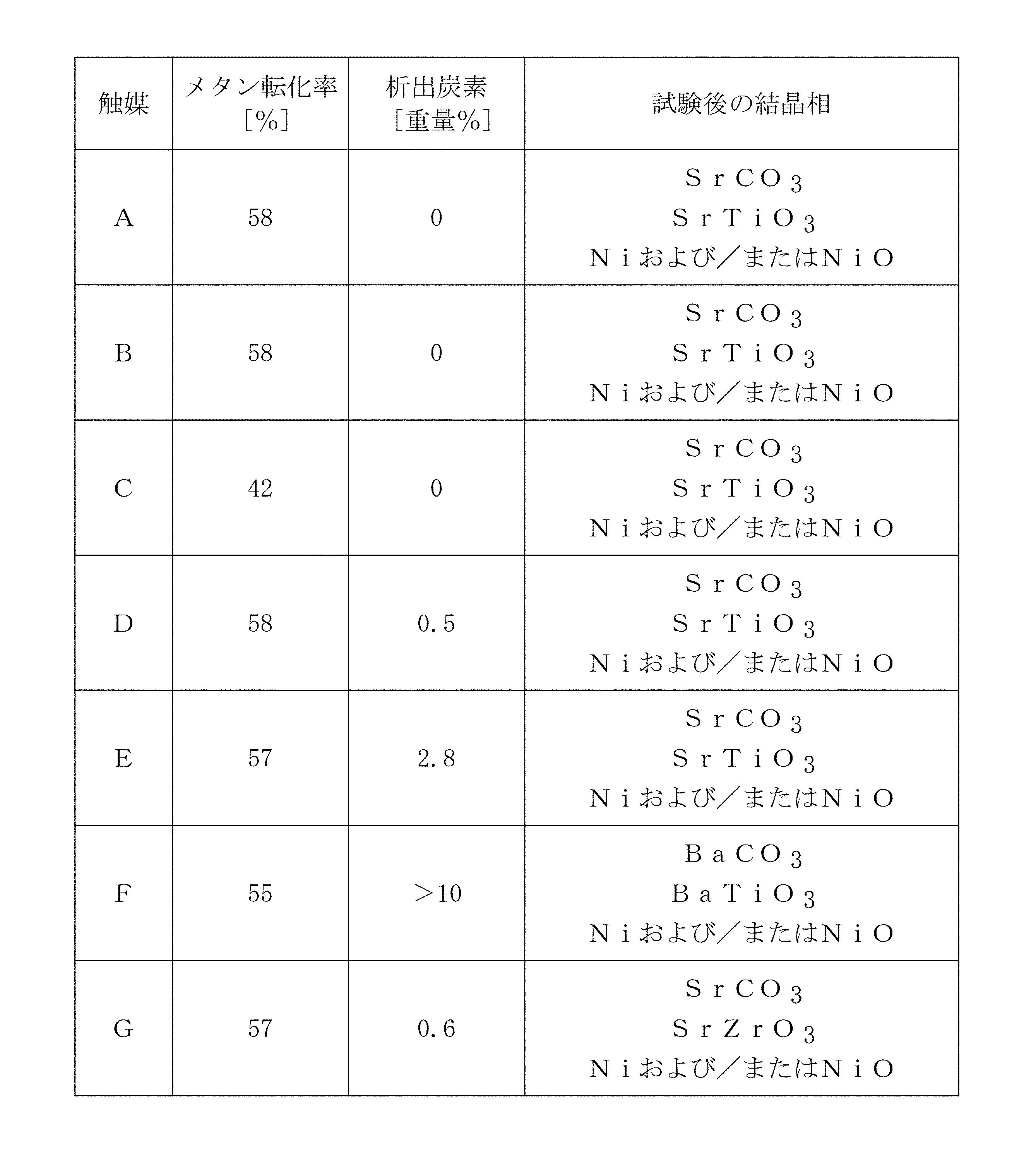
- Table 1 shows the following formula (3) based on the reforming reaction.
- CH 4 + CO 2 ⁇ 2H 2 + 2CO (3) Shows the methane conversion rate.
- the methane conversion rate is a value indicating how much of the introduced methane has been converted into other substances (here mainly carbon monoxide and hydrogen) by the reforming reaction, and the methane conversion rate in Table 1 is The percentage of methane converted to other substances with respect to the introduced methane is a percentage value.
- Table 1 shows the amount of carbon deposited and the crystal phase identified by X-ray diffraction measurement for the catalyst after the test.
- the reforming catalysts A, B, and D to G showed a methane conversion rate close to the equilibrium gas composition under the conditions of 800 ° C. and 9 atm. Precipitation occurred. In addition, although the catalyst C did not reach the equilibrium gas composition, carbon deposition did not occur.
- FIGS. 2 (a), 3 (a) and 4 (a) The TEM images of the reforming catalysts A, D and F after the test are shown in FIGS. 2 (a), 3 (a) and 4 (a), and the reforming catalysts A, D and F Mapping images of Ni by energy dispersive X-ray spectroscopy (EDX) are shown in FIGS. 2 (b), 3 (b), and 4 (b).
- EDX energy dispersive X-ray spectroscopy
- the reforming catalyst A As shown in FIGS. 2 (a) and 2 (b), Ni particles having a particle size of 50 nm or less can be confirmed, whereas the raw material NiO is NiO—Ba 2 TiO 4 solid solution during the production process.
- the reforming catalyst F that did not form NO consists only of Ni particles having a particle size of 100 nm or more, and is equivalent to the raw material NiO particles. It can be seen that the particle size is maintained.
- the Ni component is sufficiently solid solution / dispersed in the entire solid solution at the time of solid solution formation. It becomes. Therefore, it is possible to obtain metal Ni and / or NiO particles having a small particle diameter of 50 nm or less when the Ni phase and / or NiO phase is precipitated, and carbon precipitation due to the effect of atomization of Ni and / or NiO. It is considered that the function of suppressing the increase is enhanced.
- the solid solution amount of the Ni component is preferably in the range of 2.2 mol part to 13.5 mol part with respect to 100 mol part of Sr 2 TiO 4. .
- the reforming catalyst E has the same composition as the reforming catalyst A and the raw material composition, but the firing temperature in the production process is as low as 800 ° C., and NiO—Sr 2 TiO 4 is produced in the production process. Solid solution is not formed. Therefore, Ni and / or NiO particles having a large particle size equivalent to that of the raw material NiO remain, and as a result, it is considered that carbon deposition is likely to occur under high pressure conditions.
- NiO—Ba 2 TiO 4 solid solution and NiO—Sr 2 ZrO 4 solid solution are not formed in the production process, so that Ni and / or NiO having a large particle size remain in the catalyst. It is considered that carbon deposition is likely to occur.
- a NiO—Sr 2 TiO 4 solid solution was formed by heat-treating a mixture of NiO, SrCO 3 and TiO 2 , but Ni and / or NiO, SrCO 3 , SrTiO 3 and The modification of the present invention containing SrTiO 3 , SrCO 3 , Ni and / or NiO also by forming a NiO—Sr 2 TiO 4 solid solution by heat-treating a mixture containing at least 900 ° C. It is possible to produce a catalyst for use.
- a reforming test for 8 hours was started by circulating various raw material mixed gases shown in Table 2 at a rate of 10 NL / h for 8 hours.
- the back pressure valve 6 provided on the outlet 5 side of the reaction tube 1 was adjusted to adjust the pressure in the reaction tube 1 to 5 atm in absolute pressure.
- the gas obtained from the outlet 5 was introduced into the analyzer and the gas concentration was measured.
- the reforming catalyst 3 from the reaction tube 1 was taken out, it was subjected to thermal gravimetric under CO 2 flow.
- thermogravimetry carbon and CO 2 deposited on the sample are expressed by the following formula: (2) C + CO 2 ⁇ 2CO (2)
- the decrease in the sample weight was estimated as the carbon deposition amount.
- Table 2 shows the raw material gas composition, the reaction conversion rate of methane to carbon monoxide, and the amount of carbon deposited.
- Test number 1 in Table 2 is carbon dioxide reforming in which methane, which is a hydrocarbon, and carbon dioxide are reacted.
- Test numbers 2 and 3 are combined reforming using both carbon dioxide and steam.
- Test number 4 is steam reforming in which methane, which is a hydrocarbon, reacts with steam.
- the catalyst A was superior to the commercially available reforming catalyst H in the ability to suppress and prevent carbon deposition. Moreover, it was confirmed that the effect is not limited to the case of the carbon dioxide reforming reaction of methane, but also a remarkable effect in the steam reforming reaction of methane.
- the present invention is not limited to the embodiments described above, conditions in the step of generating a NiO-Sr 2 TiO 4 solid solution, by the action of carbon dioxide on the NiO-Sr 2 TiO 4 solid solution
- conditions in the step of generating a NiO-Sr 2 TiO 4 solid solution by the action of carbon dioxide on the NiO-Sr 2 TiO 4 solid solution
- Various applications and modifications can be made within the scope of the invention with respect to the conditions in the process of producing SrTiO 3 , SrCO 3 , Ni and / or NiO, the specific conditions of the reforming reaction, etc. is there.
- the present invention carbon dioxide reforming for reforming by reacting hydrocarbon and carbon dioxide, steam reforming for reforming by reacting hydrocarbon and steam, or carbon dioxide and steam Even when used in any reforming reaction using both of these, the synthesis gas containing hydrogen and carbon monoxide is efficiently produced from the hydrocarbon-based source gas while suppressing the precipitation of carbon.
- This makes it possible to efficiently produce a reforming catalyst that can be used. Therefore, the present invention can be widely applied to the field of reforming catalysts and technical fields related to the production of synthesis gas containing hydrogen and carbon monoxide.
Landscapes
- Chemical & Material Sciences (AREA)
- Chemical Kinetics & Catalysis (AREA)
- Engineering & Computer Science (AREA)
- Materials Engineering (AREA)
- Organic Chemistry (AREA)
- Thermal Sciences (AREA)
- Physics & Mathematics (AREA)
- Health & Medical Sciences (AREA)
- General Health & Medical Sciences (AREA)
- Combustion & Propulsion (AREA)
- Inorganic Chemistry (AREA)
- Catalysts (AREA)
- Hydrogen, Water And Hydrids (AREA)
Abstract
Description
炭化水素系ガスを二酸化炭素および/または水蒸気を用いて改質し、一酸化炭素と水素とを含む合成ガスを生成するために用いられる炭化水素系ガス改質触媒であって、
NiOがSr2TiO4に固溶したNiO-Sr2TiO4固溶体を含有すること
を特徴としている。
炭化水素系ガスを二酸化炭素および/または水蒸気を用いて改質し、一酸化炭素と水素とを含む合成ガスを生成するために用いられる炭化水素系ガス改質触媒であって、
請求項1または2記載のNiO-Sr2TiO4固溶体に二酸化炭素を作用させることにより生じるSrTiO3と、SrCO3と、Niおよび/またはNiOとを含有すること
を特徴としている。
炭化水素系の原料ガスを二酸化炭素および/または水蒸気を用いて改質し、一酸化炭素と水素を含む合成ガスを生成するために用いられる、NiOがSr2TiO4に固溶したNiO-Sr2TiO4固溶体を主たる成分として含有する炭化水素系ガス改質触媒の製造方法であって、
SrTiO3と、SrCO3と、Niおよび/またはNiOとを含む混合物を、900℃以上の温度で熱処理することによりNiOがSr2TiO4に固溶したNiO-Sr2TiO4固溶体を生成させる工程
を具備することを特徴としている。
炭化水素系の原料ガスを二酸化炭素および/または水蒸気を用いて改質し、一酸化炭素と水素を含む合成ガスを生成するために用いられる、NiOがSr2TiO4に固溶したNiO-Sr2TiO4固溶体を主たる成分として含有する炭化水素系ガス改質触媒の製造方法であって、
TiO2と、SrCO3と、Niおよび/またはNiOとを含む混合物を、900℃以上の温度で熱処理することによりNiOがSr2TiO4に固溶したNiO-Sr2TiO4固溶体を生成させる工程
を具備することを特徴としている。
炭化水素系の原料ガスを二酸化炭素および/または水蒸気を用いて改質し、一酸化炭素と水素を含む合成ガスを生成するために用いられる、SrTiO3と、SrCO3と,Niおよび/またはNiOとを主たる成分として含有する炭化水素系ガス改質触媒の製造方法であって、
SrTiO3と、SrCO3と、Niおよび/またはNiOとを含む混合物を、900℃以上の温度で熱処理することによりNiOがSr2TiO4に固溶したNiO-Sr2TiO4固溶体を生成させる工程と、
前記NiO-Sr2TiO4固溶体に二酸化炭素を作用させて、SrTiO3と、SrCO3と、Niおよび/またはNiOとを生じさせる工程と
を具備することを特徴としている。
炭化水素系の原料ガスを二酸化炭素および/または水蒸気を用いて改質し、一酸化炭素と水素を含む合成ガスを生成するために用いられる、SrTiO3と、SrCO3と,Niおよび/またはNiOとを主たる成分として含有する炭化水素系ガス改質触媒の製造方法であって、
TiO2と、SrCO3と、Niおよび/またはNiOとを含む混合物を、900℃以上の温度で熱処理することによりNiOがSr2TiO4に固溶したNiO-Sr2TiO4固溶体を生成させる工程と、
前記NiO-Sr2TiO4固溶体に二酸化炭素を作用させて、SrTiO3と、SrCO3と、Niおよび/またはNiOとを生じさせる工程と
を具備することを特徴としている。
NiO-Sr2TiO4固溶体に二酸化炭素を作用させて、SrTiO3と、SrCO3と、Niおよび/またはNiOとを生じさせる工程と、
前記SrTiO3と、SrCO3と、Niおよび/またはNiOを主たる成分として含有する触媒が充填された改質器に、炭化水素系の原料ガスと二酸化炭素および/または水蒸気とを含むガスを通過させ、前記改質用触媒と接触させることにより、一酸化炭素と水素を含む合成ガスを生成する工程と
を具備することを特徴としている。
CH4 ⇒ C + 2H2 (1)
C + CO2 ⇒ 2CO (2)
CH4 + CO2 ⇒ 2H2 + 2CO (3)
なお、メタン(CH4)の二酸化炭素改質反応においては、式(1)のCH4の分解反応および式(2)のCOを生成する反応が進行し、結果として式(3)により二酸化炭素改質反応が表される。
従来のアルミナやシリカなどの酸化物を担体とした触媒では、式(1)の反応に比べて式(2)の反応速度が遅いために、式(1)によるCH4の分解が進行して炭素析出が発生することや、式(2)の逆反応が進行して炭素析出が発生することがある。
CH4 + H2O ⇒ 3H2 + CO (4)
(1)本発明の実施例にかかる改質用触媒Aの製造
炭酸ストロンチウム(SrCO3)と酸化チタン(TiO2)をモル比で2.0:1.0となるように秤量し、さらに酸化ニッケル(NiO)を、生成するSr2TiO4100mol部に対して8.9mol部の割合となるように加えて混合した。次に、この混合物にバインダーを加えて造粒し、直径2~5mmの球状の造粒体を得た。
それから、得られた造粒体を空気中において、1100℃、1時間の条件で焼成することにより触媒Aを得た。
炭酸ストロンチウム(SrCO3)と酸化チタン(TiO2)をモル比で2.0:1.0となるように秤量し、さらに酸化ニッケル(NiO)を、生成するSr2TiO4100mol部に対して13.5mol部の割合となるように加えて混合した。次に、この混合物にバインダーを加えて造粒し、直径2~5mmの球状の造粒体を得た。
得られた触媒BについてX線回折測定を行った結果、得られた回折線はSr2TiO4構造の回折線のみであった。従って、得られた触媒BはSr2TiO4の結晶構造中にNi成分が固溶したNiO-Sr2TiO4固溶体であり、Ni成分の固溶量はSr2TiO4に対して13.5mol部であることが確認された。
炭酸ストロンチウム(SrCO3)と酸化チタン(TiO2)をモル比で2.0:1.0となるように秤量し、さらに酸化ニッケル(NiO)を、生成するSr2TiO4100mol部に対して2.2mol部の割合となるように加えて混合した。次に、この混合物にバインダーを加えて造粒し、直径2~5mmの球状の造粒体を得た。
炭酸ストロンチウム(SrCO3)と酸化チタン(TiO2)をモル比で2.0:1.0となるように秤量し、さらに酸化ニッケル(NiO)を、生成するSr2TiO4100mol部に対して22.2mol部の割合となるように加えて混合した。次に、この混合物にバインダーを加えて造粒し、直径2~5mmの球状の造粒体を得た。
炭酸ストロンチウム(SrCO3)と酸化チタン(TiO2)をモル比で2.0:1.0となるように秤量し、さらに酸化ニッケル(NiO)を、触媒Aの場合と同量加えて混合した。次に、この混合物にバインダーを加えて造粒し、直径2~5mmの球状の造粒体を得た。
炭酸バリウム(BaCO3)と酸化チタン(TiO2)をモル比で2.0:1.0となるように秤量し、さらに酸化ニッケル(NiO)を生成するBa2TiO4100mol部に対して8.4mol部の割合となるように加えて混合した。次に、この混合物にバインダーを加えて造粒し、直径2~5mmの球状の造粒体を得た。
炭酸ストロンチウム(SrCO3)と酸化ジルコニウム(ZrO2)をモル比で2.0:1.0となるように秤量し、さらに酸化ニッケル(NiO)を、生成するSr2ZrO4100mol部に対して8.9mol部の割合となるように加えて混合した。次に、この混合物にバインダーを加えて造粒し、直径2~5mmの球状の造粒体を得た。
図1に示すように、外部にヒーター2を備えた金属製の反応管1に、上記のようにして製造した改質用触媒3を5cc充填し、反応管1の入口4から、窒素と二酸化炭素の混合ガス(二酸化炭素の割合:20vol%)を所定の割合で流通させ、ヒーター2により混合ガス入口温度を800℃に制御した。流通させた混合ガスの温度が安定した後、上記混合ガスの代わりに、10NL/hの割合でメタンと二酸化炭素の混合ガス(CH4:CO2=1:1(容積比))を原料ガスとして流通させることにより8時間の改質試験を行った。
また、試験中は出口5から得られたガスを分析装置へと導入してガス濃度を測定した。
C + CO2 ⇒ 2CO (2)
のように反応させ、試料重量の減少分を炭素析出量として見積もった。
CH4 + CO2 ⇒ 2H2 + 2CO (3)
によるメタン転化率を示す。メタン転化率とは、導入したメタンのうちどれだけが改質反応によって他の物質(ここでは主に一酸化炭素と水素)に転化したかを示す値であって、表1のメタン転化率は、導入したメタンに対する他の物質に転化したメタンの割合を百分率で示した値である。
さらに、表1には、炭素析出量、および、試験後の触媒についてX線回折測定により同定した結晶相を示す。
なお、改質用触媒A,B,C,Dの結果からみて、Ni成分の固溶量はSr2TiO4100mol部に対して2.2mol部 ~ 13.5mol部の範囲とすることが望ましい。
図1に示すように、外部にヒーター2を備えた金属製の反応管1に、上記のようにして製造した改質用触媒Aを5cc充填し、反応管1の入口4から、窒素と二酸化炭素の混合ガス(二酸化炭素の割合:20vol%)を流通させ、ヒーター2により混合ガス入口温度を900℃に制御した。
改質試験中は、反応管1の出口5側に設けた背圧弁6を調整することによって、反応管1内の圧力を絶対圧で5気圧となるように調整を行った。
また、試験中は出口5から得られたガスを分析装置へと導入してガス濃度を測定した。
C + CO2 ⇒ 2CO (2)
のように反応させ、試料重量の減少分を炭素析出量として見積もった。
なお、表2の試験番号1は、炭化水素であるメタンと二酸化炭素とを反応させる二酸化炭素改質であり、試験番号2および3は、二酸化炭素および水蒸気の両方を利用した併用改質であり、試験番号4は、炭化水素であるメタンと水蒸気とを反応させる水蒸気改質である。
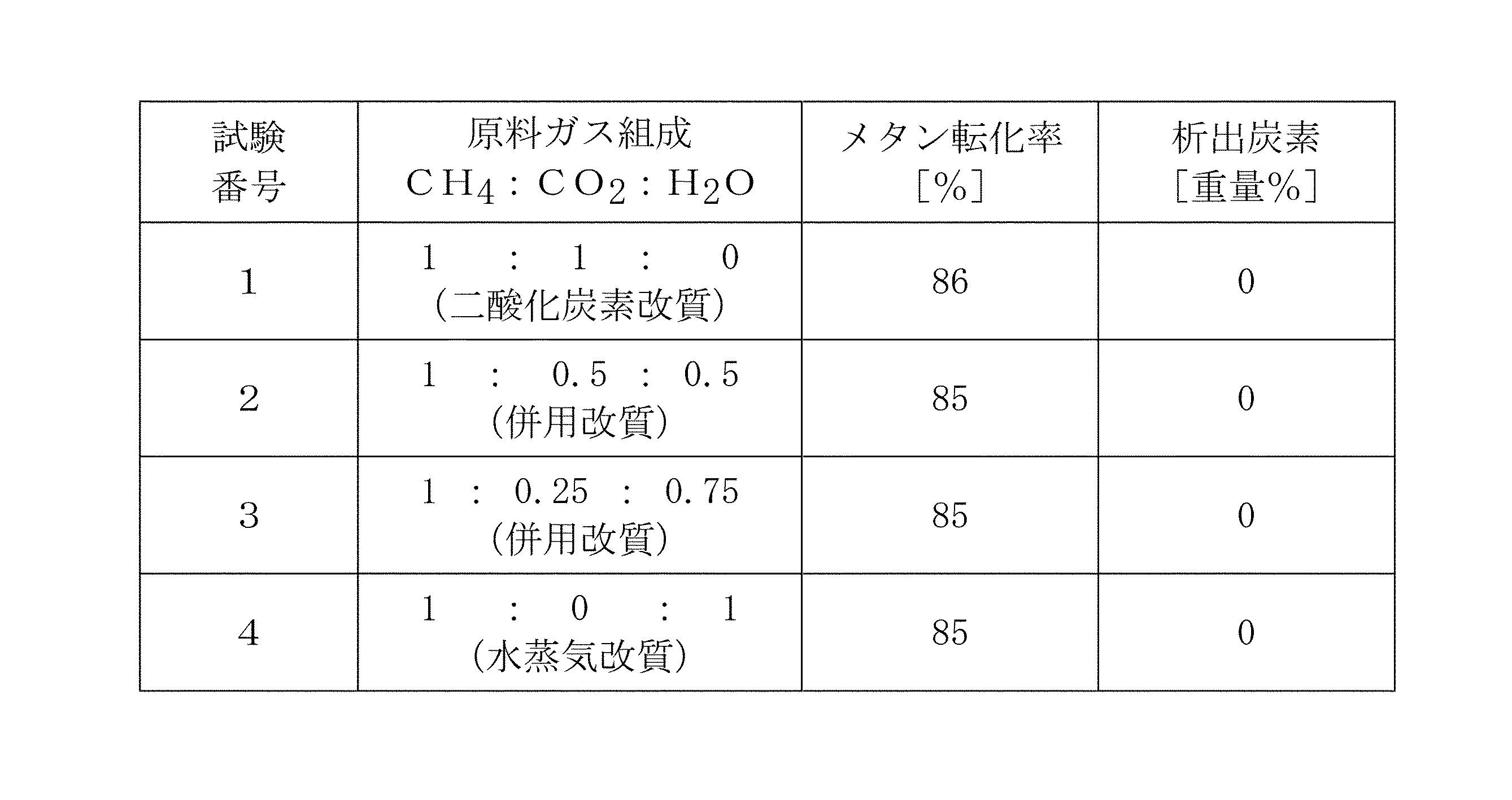
さらに、CH4/H2O=1としたメタンの水蒸気改質反応においても炭素析出は発生しないことが確認された。
上記触媒A5ccを、図1に示す装置の反応管1内に5cc充填し、反応管1の入口4から、窒素と二酸化炭素の混合ガス(二酸化炭素の割合:20vol%)を所定の割合で流通させ、ヒーター2により混合ガス入口温度を900℃に制御した。
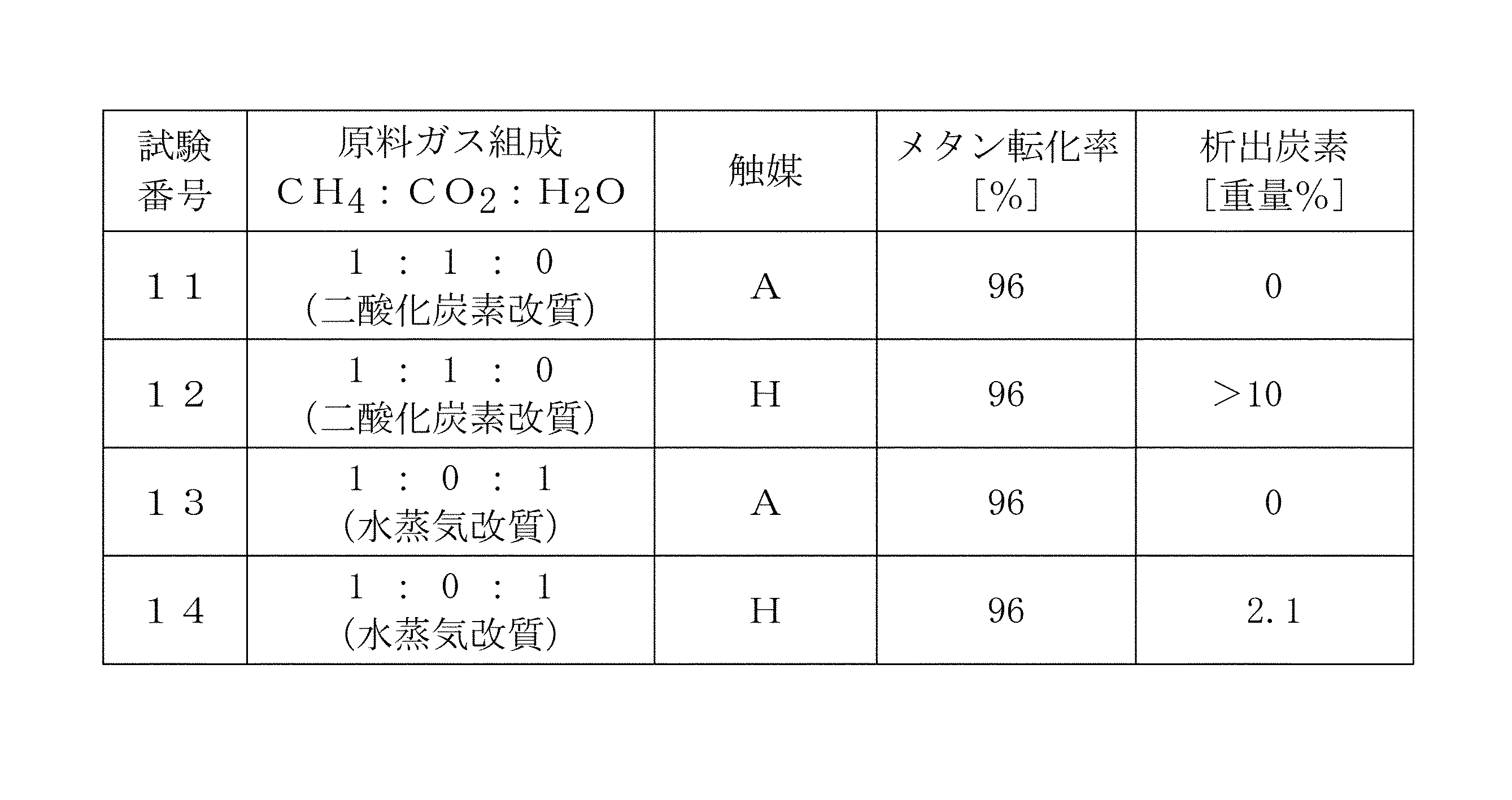
その後、表3の試験番号11または13に示す各種原料混合ガスを10NL/hの速度で流通させることにより100時間の改質試験を実施した。なお、改質試験中は背圧弁を開放して1気圧とした。
比較のためにNiOとアルミナを主成分とする市販改質触媒Hを、図1に示す装置の反応管1内に5cc充填し、反応管1の入口4から窒素ガスを流通させ、ヒーター2により混合ガス入口温度を900℃に制御した。
その後、表3の試験番号12または14に示す各種原料混合ガスを10NL/hの速度で流通させることにより100時間の改質試験を実施した。なお、改質試験中は背圧弁を開放して1気圧とした。
表3に、原料ガス組成およびメタンの一酸化炭素への反応転化率と炭素析出量を示す。
したがって、本発明は、改質用触媒の分野や、水素および一酸化炭素を含む合成ガスの製造に関わる技術分野に広く適用することが可能である。
2 ヒーター
3 改質用触媒
4 反応管の入口
5 反応管の出口
6 背圧弁
Claims (8)
- 炭化水素系ガスを二酸化炭素および/または水蒸気を用いて改質し、一酸化炭素と水素とを含む合成ガスを生成するために用いられる炭化水素系ガス改質触媒であって、
NiOがSr2TiO4に固溶したNiO-Sr2TiO4固溶体を含有すること
を特徴とする炭化水素系ガス改質触媒。 - 前記NiO-Sr2TiO4固溶体中のNiOの割合が、Sr2TiO4100mol部に対して2.2~13.5mol部の割合であることを特徴とする請求項1記載の炭化水素系ガス改質触媒。
- 炭化水素系ガスを二酸化炭素および/または水蒸気を用いて改質し、一酸化炭素と水素とを含む合成ガスを生成するために用いられる炭化水素系ガス改質触媒であって、
請求項1または2記載のNiO-Sr2TiO4固溶体に二酸化炭素を作用させることにより生じるSrTiO3と、SrCO3と、Niおよび/またはNiOとを含有すること
を特徴とする炭化水素系ガス改質触媒。 - 炭化水素系の原料ガスを二酸化炭素および/または水蒸気を用いて改質し、一酸化炭素と水素を含む合成ガスを生成するために用いられる、NiOがSr2TiO4に固溶したNiO-Sr2TiO4固溶体を主たる成分として含有する炭化水素系ガス改質触媒の製造方法であって、
SrTiO3と、SrCO3と、Niおよび/またはNiOとを含む混合物を、900℃以上の温度で熱処理することによりNiOがSr2TiO4に固溶したNiO-Sr2TiO4固溶体を生成させる工程
を具備することを特徴とする炭化水素系ガス改質触媒の製造方法。 - 炭化水素系の原料ガスを二酸化炭素および/または水蒸気を用いて改質し、一酸化炭素と水素を含む合成ガスを生成するために用いられる、NiOがSr2TiO4に固溶したNiO-Sr2TiO4固溶体を主たる成分として含有する炭化水素系ガス改質触媒の製造方法であって、
TiO2と、SrCO3と、Niおよび/またはNiOとを含む混合物を、900℃以上の温度で熱処理することによりNiOがSr2TiO4に固溶したNiO-Sr2TiO4固溶体を生成させる工程
を具備することを特徴とする炭化水素系ガス改質触媒の製造方法。 - 炭化水素系の原料ガスを二酸化炭素および/または水蒸気を用いて改質し、一酸化炭素と水素を含む合成ガスを生成するために用いられる、SrTiO3と、SrCO3と,Niおよび/またはNiOとを主たる成分として含有する炭化水素系ガス改質触媒の製造方法であって、
SrTiO3と、SrCO3と、Niおよび/またはNiOとを含む混合物を、900℃以上の温度で熱処理することによりNiOがSr2TiO4に固溶したNiO-Sr2TiO4固溶体を生成させる工程と、
前記NiO-Sr2TiO4固溶体に二酸化炭素を作用させて、SrTiO3と、SrCO3と、Niおよび/またはNiOとを生じさせる工程と
を具備することを特徴とする炭化水素系ガス改質触媒の製造方法。 - 炭化水素系の原料ガスを二酸化炭素および/または水蒸気を用いて改質し、一酸化炭素と水素を含む合成ガスを生成するために用いられる、SrTiO3と、SrCO3と,Niおよび/またはNiOとを主たる成分として含有する炭化水素系ガス改質触媒の製造方法であって、
TiO2と、SrCO3と、Niおよび/またはNiOとを含む混合物を、900℃以上の温度で熱処理することによりNiOがSr2TiO4に固溶したNiO-Sr2TiO4固溶体を生成させる工程と、
前記NiO-Sr2TiO4固溶体に二酸化炭素を作用させて、SrTiO3と、SrCO3と、Niおよび/またはNiOとを生じさせる工程と
を具備することを特徴とする炭化水素系ガス改質触媒の製造方法。 - NiOがSr2TiO4に固溶したNiO-Sr2TiO4固溶体を生成させる工程と、
NiO-Sr2TiO4固溶体に二酸化炭素を作用させて、SrTiO3と、SrCO3と、Niおよび/またはNiOとを生じさせる工程と、
前記SrTiO3と、SrCO3と、Niおよび/またはNiOを主たる成分として含有する触媒が充填された改質器に、炭化水素系の原料ガスと二酸化炭素および/または水蒸気とを含むガスを通過させ、前記改質用触媒と接触させることにより、一酸化炭素と水素を含む合成ガスを生成する工程と
を具備することを特徴とする合成ガスの製造方法。
Priority Applications (4)
| Application Number | Priority Date | Filing Date | Title |
|---|---|---|---|
| EP10786207.0A EP2441517B1 (en) | 2009-06-12 | 2010-06-10 | Hydrocarbon gas reforming catalyst, method for producing same, and method for producing synthetic gas |
| JP2011518570A JP5327323B2 (ja) | 2009-06-12 | 2010-06-10 | 炭化水素系ガス改質用触媒、その製造方法、および合成ガスの製造方法 |
| CN201080026390.XA CN102802789B (zh) | 2009-06-12 | 2010-06-10 | 烃类气体重整用催化剂、其制造方法及合成气体的制造方法 |
| US13/311,646 US8329612B2 (en) | 2009-06-12 | 2011-12-06 | Catalyst for reforming hydrocarbon gas, method of manufacturing the same, and method of manufacturing synthesized gas |
Applications Claiming Priority (4)
| Application Number | Priority Date | Filing Date | Title |
|---|---|---|---|
| JP2009141085 | 2009-06-12 | ||
| JP2009-141085 | 2009-06-12 | ||
| JP2009191712 | 2009-08-21 | ||
| JP2009-191712 | 2009-08-21 |
Related Child Applications (1)
| Application Number | Title | Priority Date | Filing Date |
|---|---|---|---|
| US13/311,646 Continuation US8329612B2 (en) | 2009-06-12 | 2011-12-06 | Catalyst for reforming hydrocarbon gas, method of manufacturing the same, and method of manufacturing synthesized gas |
Publications (1)
| Publication Number | Publication Date |
|---|---|
| WO2010143676A1 true WO2010143676A1 (ja) | 2010-12-16 |
Family
ID=43308931
Family Applications (1)
| Application Number | Title | Priority Date | Filing Date |
|---|---|---|---|
| PCT/JP2010/059817 Ceased WO2010143676A1 (ja) | 2009-06-12 | 2010-06-10 | 炭化水素系ガス改質用触媒、その製造方法、および合成ガスの製造方法 |
Country Status (5)
| Country | Link |
|---|---|
| US (1) | US8329612B2 (ja) |
| EP (1) | EP2441517B1 (ja) |
| JP (1) | JP5327323B2 (ja) |
| CN (1) | CN102802789B (ja) |
| WO (1) | WO2010143676A1 (ja) |
Cited By (5)
| Publication number | Priority date | Publication date | Assignee | Title |
|---|---|---|---|---|
| WO2013187436A1 (ja) * | 2012-06-13 | 2013-12-19 | 株式会社村田製作所 | 改質用触媒、その製造方法、および合成ガスの製造方法 |
| KR101363384B1 (ko) | 2012-09-28 | 2014-02-14 | 한국과학기술연구원 | 천연가스의 혼합 개질반응용 페롭스카이트 담지촉매 |
| WO2014189006A1 (ja) * | 2013-05-21 | 2014-11-27 | 株式会社村田製作所 | 炭化水素系ガスの改質用触媒およびそれを用いた炭化水素系ガスの改質方法 |
| JP2018010749A (ja) * | 2016-07-12 | 2018-01-18 | 東京瓦斯株式会社 | 燃料電池システム |
| WO2019215951A1 (ja) * | 2018-05-11 | 2019-11-14 | 株式会社村田製作所 | 有機物分解用触媒、有機物分解用凝集体、および、有機物分解装置 |
Families Citing this family (7)
| Publication number | Priority date | Publication date | Assignee | Title |
|---|---|---|---|---|
| CN102076604B (zh) * | 2008-07-04 | 2014-11-12 | 株式会社村田制作所 | 二氧化碳重整方法 |
| WO2011027727A1 (ja) * | 2009-09-02 | 2011-03-10 | 株式会社村田製作所 | 炭化水素系ガス改質触媒、その製造方法および、合成ガスの製造方法 |
| CN102665896A (zh) | 2009-11-27 | 2012-09-12 | 株式会社村田制作所 | 逆转移反应用催化剂和使用其的合成气体的制造方法 |
| CN105188915B (zh) * | 2013-05-09 | 2021-03-09 | 沙特基础工业全球技术公司 | 碱土金属/金属氧化物负载型催化剂 |
| BR112022021340A2 (pt) * | 2020-05-04 | 2023-04-11 | Infinium Technology Llc | Processo de captura de dióxido de carbono do ar e a conversão direta de dióxido de carbono em combustíveis e químicos |
| KR102768685B1 (ko) | 2022-03-22 | 2025-02-18 | 한국과학기술연구원 | 탄소 스윙 흡착을 이용한 합성가스의 제조 방법 |
| CN120861056B (zh) * | 2025-07-29 | 2026-03-06 | 四川氢碳氧科技有限公司 | 一种Ni/TiO2纳米棒催化剂的制备方法及应用 |
Citations (7)
| Publication number | Priority date | Publication date | Assignee | Title |
|---|---|---|---|---|
| JPH08231204A (ja) | 1994-12-27 | 1996-09-10 | Sekiyu Sangyo Kasseika Center | 二酸化炭素改質反応による水素及び一酸化炭素の製造法 |
| JPH09168740A (ja) | 1995-12-20 | 1997-06-30 | Sekiyu Sangyo Kasseika Center | 二酸化炭素改質化触媒及びこれを用いた改質化法 |
| JPH10194703A (ja) * | 1997-01-09 | 1998-07-28 | Agency Of Ind Science & Technol | 合成ガスの製造用触媒及び合成ガスの製造方法 |
| JP2002059006A (ja) * | 2000-08-23 | 2002-02-26 | National Institute Of Advanced Industrial & Technology | 水素の製造用触媒及び水素の製造方法 |
| JP2004089812A (ja) * | 2002-08-30 | 2004-03-25 | Mitsubishi Heavy Ind Ltd | 水素製造触媒およびその調製方法 |
| JP2006346598A (ja) * | 2005-06-16 | 2006-12-28 | Nissan Motor Co Ltd | 水蒸気改質触媒 |
| WO2008084785A1 (ja) * | 2007-01-09 | 2008-07-17 | Murata Manufacturing Co., Ltd. | 二酸化炭素改質用触媒およびその製造方法 |
Family Cites Families (6)
| Publication number | Priority date | Publication date | Assignee | Title |
|---|---|---|---|---|
| GB8514209D0 (en) * | 1985-06-05 | 1985-07-10 | Unilever Plc | Catalyst additives |
| US6130182A (en) * | 1997-07-25 | 2000-10-10 | International Business Machines Corporation | Dielectric catalyst structures |
| US20040018409A1 (en) * | 2002-02-28 | 2004-01-29 | Shiqiang Hui | Solid oxide fuel cell components and method of manufacture thereof |
| CN100490965C (zh) * | 2004-08-03 | 2009-05-27 | 株式会社村田制作所 | 二氧化碳吸收材料、使用该材料的二氧化碳分离方法、和二氧化碳分离装置 |
| WO2006137211A1 (ja) * | 2005-06-24 | 2006-12-28 | Murata Manufacturing Co., Ltd. | 燃料電池用改質装置 |
| JP2009509751A (ja) * | 2005-09-29 | 2009-03-12 | トラスティーズ オブ ボストン ユニバーシティ | 混合イオン及び電子伝導性膜 |
-
2010
- 2010-06-10 EP EP10786207.0A patent/EP2441517B1/en active Active
- 2010-06-10 CN CN201080026390.XA patent/CN102802789B/zh active Active
- 2010-06-10 JP JP2011518570A patent/JP5327323B2/ja active Active
- 2010-06-10 WO PCT/JP2010/059817 patent/WO2010143676A1/ja not_active Ceased
-
2011
- 2011-12-06 US US13/311,646 patent/US8329612B2/en active Active
Patent Citations (7)
| Publication number | Priority date | Publication date | Assignee | Title |
|---|---|---|---|---|
| JPH08231204A (ja) | 1994-12-27 | 1996-09-10 | Sekiyu Sangyo Kasseika Center | 二酸化炭素改質反応による水素及び一酸化炭素の製造法 |
| JPH09168740A (ja) | 1995-12-20 | 1997-06-30 | Sekiyu Sangyo Kasseika Center | 二酸化炭素改質化触媒及びこれを用いた改質化法 |
| JPH10194703A (ja) * | 1997-01-09 | 1998-07-28 | Agency Of Ind Science & Technol | 合成ガスの製造用触媒及び合成ガスの製造方法 |
| JP2002059006A (ja) * | 2000-08-23 | 2002-02-26 | National Institute Of Advanced Industrial & Technology | 水素の製造用触媒及び水素の製造方法 |
| JP2004089812A (ja) * | 2002-08-30 | 2004-03-25 | Mitsubishi Heavy Ind Ltd | 水素製造触媒およびその調製方法 |
| JP2006346598A (ja) * | 2005-06-16 | 2006-12-28 | Nissan Motor Co Ltd | 水蒸気改質触媒 |
| WO2008084785A1 (ja) * | 2007-01-09 | 2008-07-17 | Murata Manufacturing Co., Ltd. | 二酸化炭素改質用触媒およびその製造方法 |
Non-Patent Citations (1)
| Title |
|---|
| See also references of EP2441517A4 |
Cited By (12)
| Publication number | Priority date | Publication date | Assignee | Title |
|---|---|---|---|---|
| WO2013187436A1 (ja) * | 2012-06-13 | 2013-12-19 | 株式会社村田製作所 | 改質用触媒、その製造方法、および合成ガスの製造方法 |
| KR101363384B1 (ko) | 2012-09-28 | 2014-02-14 | 한국과학기술연구원 | 천연가스의 혼합 개질반응용 페롭스카이트 담지촉매 |
| WO2014189006A1 (ja) * | 2013-05-21 | 2014-11-27 | 株式会社村田製作所 | 炭化水素系ガスの改質用触媒およびそれを用いた炭化水素系ガスの改質方法 |
| JP2018010749A (ja) * | 2016-07-12 | 2018-01-18 | 東京瓦斯株式会社 | 燃料電池システム |
| WO2019215951A1 (ja) * | 2018-05-11 | 2019-11-14 | 株式会社村田製作所 | 有機物分解用触媒、有機物分解用凝集体、および、有機物分解装置 |
| CN110785229A (zh) * | 2018-05-11 | 2020-02-11 | 株式会社村田制作所 | 有机物分解用催化剂、有机物分解用凝聚体以及有机物分解装置 |
| US11383226B2 (en) | 2018-05-11 | 2022-07-12 | Murata Manufacturing Co., Ltd. | Catalyst for organic substance decomposition and organic substance decomposing apparatus |
| CN110785229B (zh) * | 2018-05-11 | 2022-10-18 | 株式会社村田制作所 | 有机物分解用催化剂、有机物分解用凝聚体以及有机物分解装置 |
| US11529613B2 (en) | 2018-05-11 | 2022-12-20 | Murata Manufacturing Co., Ltd. | Organic matter decomposition catalyst, organic matter decomposition aggregate, and organic matter decomposition apparatus |
| US11571683B2 (en) | 2018-05-11 | 2023-02-07 | Murata Manufacturing Co., Ltd. | Honeycomb-structured catalyst for organic substance decomposition and organic substance decomposing apparatus |
| US11642661B2 (en) | 2018-05-11 | 2023-05-09 | Murata Manufacturing Co., Ltd. | Supported catalyst for organic substance decomposition and organic substance decomposition device |
| US11648537B2 (en) | 2018-05-11 | 2023-05-16 | Murata Manufacturing Co., Ltd. | Supported catalyst for organic substance decomposition and organic substance decomposing apparatus |
Also Published As
| Publication number | Publication date |
|---|---|
| US20120074357A1 (en) | 2012-03-29 |
| CN102802789B (zh) | 2014-10-15 |
| JP5327323B2 (ja) | 2013-10-30 |
| JPWO2010143676A1 (ja) | 2012-11-29 |
| EP2441517B1 (en) | 2022-04-13 |
| US8329612B2 (en) | 2012-12-11 |
| EP2441517A1 (en) | 2012-04-18 |
| CN102802789A (zh) | 2012-11-28 |
| EP2441517A4 (en) | 2014-03-12 |
Similar Documents
| Publication | Publication Date | Title |
|---|---|---|
| JP5327323B2 (ja) | 炭化水素系ガス改質用触媒、その製造方法、および合成ガスの製造方法 | |
| JP5126560B2 (ja) | 炭化水素系ガス改質触媒、その製造方法および、合成ガスの製造方法 | |
| JP4988552B2 (ja) | 炭化水素の蒸気改質によって水素を生成するための触媒 | |
| CN106362735B (zh) | 用于蒸汽重整过程的催化剂 | |
| KR101994152B1 (ko) | 탄소 침적의 감소를 위해, 금속이온이 치환된 페로브스카이트 금속산화물 촉매 및 이의 제조 방법, 그리고 이를 이용한 메탄 개질 반응 방법 | |
| JP5105007B2 (ja) | 逆シフト反応用触媒およびそれを用いた合成ガスの製造方法 | |
| JP4420127B2 (ja) | 二酸化炭素改質用触媒およびその製造方法 | |
| JP5141765B2 (ja) | 二酸化炭素改質方法 | |
| JP5402683B2 (ja) | 逆シフト反応用触媒、その製造方法、および合成ガスの製造方法 | |
| JP6940002B2 (ja) | 炭化水素改質触媒および炭化水素改質装置 | |
| JP6187282B2 (ja) | 炭化水素改質触媒 | |
| JP2024500507A (ja) | メタン改質用触媒及びその製造方法 | |
| JP5531462B2 (ja) | 二酸化炭素改質用触媒、その製造方法、二酸化炭素改質用触媒の担体、改質器、および合成ガスの製造方法 | |
| KR102092736B1 (ko) | 탄소 침적을 감소시킬 수 있는, 금속이온이 치환된 페로브스카이트 금속산화물 촉매의 제조 방법 및 이를 이용한 메탄 개질 반응 방법 | |
| JP2011183346A (ja) | 水素製造用触媒、その製造方法および水素製造方法 | |
| WO2013187436A1 (ja) | 改質用触媒、その製造方法、および合成ガスの製造方法 | |
| JP5626446B2 (ja) | 炭化水素の二酸化炭素改質用触媒および炭化水素の二酸化炭素改質方法 | |
| Ramadhan et al. | OPTIMIZING CATALYST PERFORMANCE: A STUDY OF SUPPORT ADDITION EFFECTS ON LA-NI-MN IN CATALYTIC DRY REFORMING OF METHANE. | |
| JP4333976B2 (ja) | メタンの部分酸化用触媒とその製造方法およびそれを使用する合成ガスの製造方法 | |
| JP7347541B2 (ja) | 炭化水素改質触媒、炭化水素改質装置、および、炭化水素改質触媒の硫黄劣化回復方法 | |
| JP2015229125A (ja) | 炭化水素改質触媒の前処理方法、炭化水素改質触媒、および炭化水素改質方法 | |
| WO2014189006A1 (ja) | 炭化水素系ガスの改質用触媒およびそれを用いた炭化水素系ガスの改質方法 |
Legal Events
| Date | Code | Title | Description |
|---|---|---|---|
| WWE | Wipo information: entry into national phase |
Ref document number: 201080026390.X Country of ref document: CN |
|
| 121 | Ep: the epo has been informed by wipo that ep was designated in this application |
Ref document number: 10786207 Country of ref document: EP Kind code of ref document: A1 |
|
| ENP | Entry into the national phase |
Ref document number: 2011518570 Country of ref document: JP Kind code of ref document: A |
|
| WWE | Wipo information: entry into national phase |
Ref document number: 2010786207 Country of ref document: EP |
|
| NENP | Non-entry into the national phase |
Ref country code: DE |