WO2010131616A1 - 粘着剤、粘着シート及び電子部品の製造方法 - Google Patents
粘着剤、粘着シート及び電子部品の製造方法 Download PDFInfo
- Publication number
- WO2010131616A1 WO2010131616A1 PCT/JP2010/057861 JP2010057861W WO2010131616A1 WO 2010131616 A1 WO2010131616 A1 WO 2010131616A1 JP 2010057861 W JP2010057861 W JP 2010057861W WO 2010131616 A1 WO2010131616 A1 WO 2010131616A1
- Authority
- WO
- WIPO (PCT)
- Prior art keywords
- pressure
- sensitive adhesive
- mass
- parts
- meth
- Prior art date
- Legal status (The legal status is an assumption and is not a legal conclusion. Google has not performed a legal analysis and makes no representation as to the accuracy of the status listed.)
- Ceased
Links
Images

Classifications
-
- C—CHEMISTRY; METALLURGY
- C09—DYES; PAINTS; POLISHES; NATURAL RESINS; ADHESIVES; COMPOSITIONS NOT OTHERWISE PROVIDED FOR; APPLICATIONS OF MATERIALS NOT OTHERWISE PROVIDED FOR
- C09J—ADHESIVES; NON-MECHANICAL ASPECTS OF ADHESIVE PROCESSES IN GENERAL; ADHESIVE PROCESSES NOT PROVIDED FOR ELSEWHERE; USE OF MATERIALS AS ADHESIVES
- C09J133/00—Adhesives based on homopolymers or copolymers of compounds having one or more unsaturated aliphatic radicals, each having only one carbon-to-carbon double bond, and at least one being terminated by only one carboxyl radical, or of salts, anhydrides, esters, amides, imides, or nitriles thereof; Adhesives based on derivatives of such polymers
- C09J133/04—Homopolymers or copolymers of esters
- C09J133/14—Homopolymers or copolymers of esters of esters containing halogen, nitrogen, sulfur or oxygen atoms in addition to the carboxy oxygen
-
- C—CHEMISTRY; METALLURGY
- C09—DYES; PAINTS; POLISHES; NATURAL RESINS; ADHESIVES; COMPOSITIONS NOT OTHERWISE PROVIDED FOR; APPLICATIONS OF MATERIALS NOT OTHERWISE PROVIDED FOR
- C09J—ADHESIVES; NON-MECHANICAL ASPECTS OF ADHESIVE PROCESSES IN GENERAL; ADHESIVE PROCESSES NOT PROVIDED FOR ELSEWHERE; USE OF MATERIALS AS ADHESIVES
- C09J133/00—Adhesives based on homopolymers or copolymers of compounds having one or more unsaturated aliphatic radicals, each having only one carbon-to-carbon double bond, and at least one being terminated by only one carboxyl radical, or of salts, anhydrides, esters, amides, imides, or nitriles thereof; Adhesives based on derivatives of such polymers
- C09J133/04—Homopolymers or copolymers of esters
-
- C—CHEMISTRY; METALLURGY
- C08—ORGANIC MACROMOLECULAR COMPOUNDS; THEIR PREPARATION OR CHEMICAL WORKING-UP; COMPOSITIONS BASED THEREON
- C08F—MACROMOLECULAR COMPOUNDS OBTAINED BY REACTIONS ONLY INVOLVING CARBON-TO-CARBON UNSATURATED BONDS
- C08F220/00—Copolymers of compounds having one or more unsaturated aliphatic radicals, each having only one carbon-to-carbon double bond, and only one being terminated by only one carboxyl radical or a salt, anhydride ester, amide, imide or nitrile thereof
- C08F220/02—Monocarboxylic acids having less than ten carbon atoms; Derivatives thereof
- C08F220/10—Esters
- C08F220/12—Esters of monohydric alcohols or phenols
- C08F220/16—Esters of monohydric alcohols or phenols of phenols or of alcohols containing two or more carbon atoms
- C08F220/18—Esters of monohydric alcohols or phenols of phenols or of alcohols containing two or more carbon atoms with acrylic or methacrylic acids
- C08F220/1802—C2-(meth)acrylate, e.g. ethyl (meth)acrylate
-
- C—CHEMISTRY; METALLURGY
- C09—DYES; PAINTS; POLISHES; NATURAL RESINS; ADHESIVES; COMPOSITIONS NOT OTHERWISE PROVIDED FOR; APPLICATIONS OF MATERIALS NOT OTHERWISE PROVIDED FOR
- C09J—ADHESIVES; NON-MECHANICAL ASPECTS OF ADHESIVE PROCESSES IN GENERAL; ADHESIVE PROCESSES NOT PROVIDED FOR ELSEWHERE; USE OF MATERIALS AS ADHESIVES
- C09J133/00—Adhesives based on homopolymers or copolymers of compounds having one or more unsaturated aliphatic radicals, each having only one carbon-to-carbon double bond, and at least one being terminated by only one carboxyl radical, or of salts, anhydrides, esters, amides, imides, or nitriles thereof; Adhesives based on derivatives of such polymers
- C09J133/04—Homopolymers or copolymers of esters
- C09J133/06—Homopolymers or copolymers of esters of esters containing only carbon, hydrogen and oxygen, the oxygen atom being present only as part of the carboxyl radical
-
- C—CHEMISTRY; METALLURGY
- C09—DYES; PAINTS; POLISHES; NATURAL RESINS; ADHESIVES; COMPOSITIONS NOT OTHERWISE PROVIDED FOR; APPLICATIONS OF MATERIALS NOT OTHERWISE PROVIDED FOR
- C09J—ADHESIVES; NON-MECHANICAL ASPECTS OF ADHESIVE PROCESSES IN GENERAL; ADHESIVE PROCESSES NOT PROVIDED FOR ELSEWHERE; USE OF MATERIALS AS ADHESIVES
- C09J175/00—Adhesives based on polyureas or polyurethanes; Adhesives based on derivatives of such polymers
- C09J175/04—Polyurethanes
- C09J175/14—Polyurethanes having carbon-to-carbon unsaturated bonds
- C09J175/16—Polyurethanes having carbon-to-carbon unsaturated bonds having terminal carbon-to-carbon unsaturated bonds
-
- C—CHEMISTRY; METALLURGY
- C09—DYES; PAINTS; POLISHES; NATURAL RESINS; ADHESIVES; COMPOSITIONS NOT OTHERWISE PROVIDED FOR; APPLICATIONS OF MATERIALS NOT OTHERWISE PROVIDED FOR
- C09J—ADHESIVES; NON-MECHANICAL ASPECTS OF ADHESIVE PROCESSES IN GENERAL; ADHESIVE PROCESSES NOT PROVIDED FOR ELSEWHERE; USE OF MATERIALS AS ADHESIVES
- C09J7/00—Adhesives in the form of films or foils
- C09J7/20—Adhesives in the form of films or foils characterised by their carriers
- C09J7/22—Plastics; Metallised plastics
-
- C—CHEMISTRY; METALLURGY
- C09—DYES; PAINTS; POLISHES; NATURAL RESINS; ADHESIVES; COMPOSITIONS NOT OTHERWISE PROVIDED FOR; APPLICATIONS OF MATERIALS NOT OTHERWISE PROVIDED FOR
- C09J—ADHESIVES; NON-MECHANICAL ASPECTS OF ADHESIVE PROCESSES IN GENERAL; ADHESIVE PROCESSES NOT PROVIDED FOR ELSEWHERE; USE OF MATERIALS AS ADHESIVES
- C09J7/00—Adhesives in the form of films or foils
- C09J7/30—Adhesives in the form of films or foils characterised by the adhesive composition
-
- C—CHEMISTRY; METALLURGY
- C09—DYES; PAINTS; POLISHES; NATURAL RESINS; ADHESIVES; COMPOSITIONS NOT OTHERWISE PROVIDED FOR; APPLICATIONS OF MATERIALS NOT OTHERWISE PROVIDED FOR
- C09J—ADHESIVES; NON-MECHANICAL ASPECTS OF ADHESIVE PROCESSES IN GENERAL; ADHESIVE PROCESSES NOT PROVIDED FOR ELSEWHERE; USE OF MATERIALS AS ADHESIVES
- C09J7/00—Adhesives in the form of films or foils
- C09J7/30—Adhesives in the form of films or foils characterised by the adhesive composition
- C09J7/38—Pressure-sensitive adhesives [PSA]
-
- C—CHEMISTRY; METALLURGY
- C09—DYES; PAINTS; POLISHES; NATURAL RESINS; ADHESIVES; COMPOSITIONS NOT OTHERWISE PROVIDED FOR; APPLICATIONS OF MATERIALS NOT OTHERWISE PROVIDED FOR
- C09J—ADHESIVES; NON-MECHANICAL ASPECTS OF ADHESIVE PROCESSES IN GENERAL; ADHESIVE PROCESSES NOT PROVIDED FOR ELSEWHERE; USE OF MATERIALS AS ADHESIVES
- C09J7/00—Adhesives in the form of films or foils
- C09J7/30—Adhesives in the form of films or foils characterised by the adhesive composition
- C09J7/38—Pressure-sensitive adhesives [PSA]
- C09J7/381—Pressure-sensitive adhesives [PSA] based on macromolecular compounds obtained by reactions involving only carbon-to-carbon unsaturated bonds
- C09J7/385—Acrylic polymers
-
- H—ELECTRICITY
- H10—SEMICONDUCTOR DEVICES; ELECTRIC SOLID-STATE DEVICES NOT OTHERWISE PROVIDED FOR
- H10P—GENERIC PROCESSES OR APPARATUS FOR THE MANUFACTURE OR TREATMENT OF DEVICES COVERED BY CLASS H10
- H10P72/00—Handling or holding of wafers, substrates or devices during manufacture or treatment thereof
- H10P72/04—Apparatus for manufacture or treatment
- H10P72/0442—Apparatus for placing on an insulating substrate, e.g. tape
-
- C—CHEMISTRY; METALLURGY
- C08—ORGANIC MACROMOLECULAR COMPOUNDS; THEIR PREPARATION OR CHEMICAL WORKING-UP; COMPOSITIONS BASED THEREON
- C08F—MACROMOLECULAR COMPOUNDS OBTAINED BY REACTIONS ONLY INVOLVING CARBON-TO-CARBON UNSATURATED BONDS
- C08F220/00—Copolymers of compounds having one or more unsaturated aliphatic radicals, each having only one carbon-to-carbon double bond, and only one being terminated by only one carboxyl radical or a salt, anhydride ester, amide, imide or nitrile thereof
- C08F220/02—Monocarboxylic acids having less than ten carbon atoms; Derivatives thereof
- C08F220/10—Esters
- C08F220/12—Esters of monohydric alcohols or phenols
- C08F220/16—Esters of monohydric alcohols or phenols of phenols or of alcohols containing two or more carbon atoms
- C08F220/18—Esters of monohydric alcohols or phenols of phenols or of alcohols containing two or more carbon atoms with acrylic or methacrylic acids
- C08F220/1804—C4-(meth)acrylate, e.g. butyl (meth)acrylate, isobutyl (meth)acrylate or tert-butyl (meth)acrylate
-
- C—CHEMISTRY; METALLURGY
- C08—ORGANIC MACROMOLECULAR COMPOUNDS; THEIR PREPARATION OR CHEMICAL WORKING-UP; COMPOSITIONS BASED THEREON
- C08G—MACROMOLECULAR COMPOUNDS OBTAINED OTHERWISE THAN BY REACTIONS ONLY INVOLVING UNSATURATED CARBON-TO-CARBON BONDS
- C08G2170/00—Compositions for adhesives
- C08G2170/40—Compositions for pressure-sensitive adhesives
-
- C—CHEMISTRY; METALLURGY
- C08—ORGANIC MACROMOLECULAR COMPOUNDS; THEIR PREPARATION OR CHEMICAL WORKING-UP; COMPOSITIONS BASED THEREON
- C08L—COMPOSITIONS OF MACROMOLECULAR COMPOUNDS
- C08L2666/00—Composition of polymers characterized by a further compound in the blend, being organic macromolecular compounds, natural resins, waxes or and bituminous materials, non-macromolecular organic substances, inorganic substances or characterized by their function in the composition
- C08L2666/02—Organic macromolecular compounds, natural resins, waxes or and bituminous materials
-
- C—CHEMISTRY; METALLURGY
- C08—ORGANIC MACROMOLECULAR COMPOUNDS; THEIR PREPARATION OR CHEMICAL WORKING-UP; COMPOSITIONS BASED THEREON
- C08L—COMPOSITIONS OF MACROMOLECULAR COMPOUNDS
- C08L2666/00—Composition of polymers characterized by a further compound in the blend, being organic macromolecular compounds, natural resins, waxes or and bituminous materials, non-macromolecular organic substances, inorganic substances or characterized by their function in the composition
- C08L2666/02—Organic macromolecular compounds, natural resins, waxes or and bituminous materials
- C08L2666/04—Macromolecular compounds according to groups C08L7/00 - C08L49/00, or C08L55/00 - C08L57/00; Derivatives thereof
-
- C—CHEMISTRY; METALLURGY
- C08—ORGANIC MACROMOLECULAR COMPOUNDS; THEIR PREPARATION OR CHEMICAL WORKING-UP; COMPOSITIONS BASED THEREON
- C08L—COMPOSITIONS OF MACROMOLECULAR COMPOUNDS
- C08L33/00—Compositions of homopolymers or copolymers of compounds having one or more unsaturated aliphatic radicals, each having only one carbon-to-carbon double bond, and only one being terminated by only one carboxyl radical, or of salts, anhydrides, esters, amides, imides or nitriles thereof; Compositions of derivatives of such polymers
- C08L33/04—Homopolymers or copolymers of esters
-
- C—CHEMISTRY; METALLURGY
- C08—ORGANIC MACROMOLECULAR COMPOUNDS; THEIR PREPARATION OR CHEMICAL WORKING-UP; COMPOSITIONS BASED THEREON
- C08L—COMPOSITIONS OF MACROMOLECULAR COMPOUNDS
- C08L33/00—Compositions of homopolymers or copolymers of compounds having one or more unsaturated aliphatic radicals, each having only one carbon-to-carbon double bond, and only one being terminated by only one carboxyl radical, or of salts, anhydrides, esters, amides, imides or nitriles thereof; Compositions of derivatives of such polymers
- C08L33/04—Homopolymers or copolymers of esters
- C08L33/06—Homopolymers or copolymers of esters of esters containing only carbon, hydrogen and oxygen, which oxygen atoms are present only as part of the carboxyl radical
-
- C—CHEMISTRY; METALLURGY
- C08—ORGANIC MACROMOLECULAR COMPOUNDS; THEIR PREPARATION OR CHEMICAL WORKING-UP; COMPOSITIONS BASED THEREON
- C08L—COMPOSITIONS OF MACROMOLECULAR COMPOUNDS
- C08L33/00—Compositions of homopolymers or copolymers of compounds having one or more unsaturated aliphatic radicals, each having only one carbon-to-carbon double bond, and only one being terminated by only one carboxyl radical, or of salts, anhydrides, esters, amides, imides or nitriles thereof; Compositions of derivatives of such polymers
- C08L33/04—Homopolymers or copolymers of esters
- C08L33/14—Homopolymers or copolymers of esters of esters containing halogen, nitrogen, sulfur, or oxygen atoms in addition to the carboxy oxygen
-
- C—CHEMISTRY; METALLURGY
- C08—ORGANIC MACROMOLECULAR COMPOUNDS; THEIR PREPARATION OR CHEMICAL WORKING-UP; COMPOSITIONS BASED THEREON
- C08L—COMPOSITIONS OF MACROMOLECULAR COMPOUNDS
- C08L75/00—Compositions of polyureas or polyurethanes; Compositions of derivatives of such polymers
- C08L75/04—Polyurethanes
-
- C—CHEMISTRY; METALLURGY
- C08—ORGANIC MACROMOLECULAR COMPOUNDS; THEIR PREPARATION OR CHEMICAL WORKING-UP; COMPOSITIONS BASED THEREON
- C08L—COMPOSITIONS OF MACROMOLECULAR COMPOUNDS
- C08L83/00—Compositions of macromolecular compounds obtained by reactions forming in the main chain of the macromolecule a linkage containing silicon with or without sulfur, nitrogen, oxygen or carbon only; Compositions of derivatives of such polymers
-
- C—CHEMISTRY; METALLURGY
- C08—ORGANIC MACROMOLECULAR COMPOUNDS; THEIR PREPARATION OR CHEMICAL WORKING-UP; COMPOSITIONS BASED THEREON
- C08L—COMPOSITIONS OF MACROMOLECULAR COMPOUNDS
- C08L83/00—Compositions of macromolecular compounds obtained by reactions forming in the main chain of the macromolecule a linkage containing silicon with or without sulfur, nitrogen, oxygen or carbon only; Compositions of derivatives of such polymers
- C08L83/04—Polysiloxanes
-
- C—CHEMISTRY; METALLURGY
- C09—DYES; PAINTS; POLISHES; NATURAL RESINS; ADHESIVES; COMPOSITIONS NOT OTHERWISE PROVIDED FOR; APPLICATIONS OF MATERIALS NOT OTHERWISE PROVIDED FOR
- C09J—ADHESIVES; NON-MECHANICAL ASPECTS OF ADHESIVE PROCESSES IN GENERAL; ADHESIVE PROCESSES NOT PROVIDED FOR ELSEWHERE; USE OF MATERIALS AS ADHESIVES
- C09J2203/00—Applications of adhesives in processes or use of adhesives in the form of films or foils
- C09J2203/326—Applications of adhesives in processes or use of adhesives in the form of films or foils for bonding electronic components such as wafers, chips or semiconductors
-
- H—ELECTRICITY
- H10—SEMICONDUCTOR DEVICES; ELECTRIC SOLID-STATE DEVICES NOT OTHERWISE PROVIDED FOR
- H10W—GENERIC PACKAGES, INTERCONNECTIONS, CONNECTORS OR OTHER CONSTRUCTIONAL DETAILS OF DEVICES COVERED BY CLASS H10
- H10W72/00—Interconnections or connectors in packages
- H10W72/071—Connecting or disconnecting
- H10W72/073—Connecting or disconnecting of die-attach connectors
-
- Y—GENERAL TAGGING OF NEW TECHNOLOGICAL DEVELOPMENTS; GENERAL TAGGING OF CROSS-SECTIONAL TECHNOLOGIES SPANNING OVER SEVERAL SECTIONS OF THE IPC; TECHNICAL SUBJECTS COVERED BY FORMER USPC CROSS-REFERENCE ART COLLECTIONS [XRACs] AND DIGESTS
- Y10—TECHNICAL SUBJECTS COVERED BY FORMER USPC
- Y10T—TECHNICAL SUBJECTS COVERED BY FORMER US CLASSIFICATION
- Y10T428/00—Stock material or miscellaneous articles
- Y10T428/28—Web or sheet containing structurally defined element or component and having an adhesive outermost layer
-
- Y—GENERAL TAGGING OF NEW TECHNOLOGICAL DEVELOPMENTS; GENERAL TAGGING OF CROSS-SECTIONAL TECHNOLOGIES SPANNING OVER SEVERAL SECTIONS OF THE IPC; TECHNICAL SUBJECTS COVERED BY FORMER USPC CROSS-REFERENCE ART COLLECTIONS [XRACs] AND DIGESTS
- Y10—TECHNICAL SUBJECTS COVERED BY FORMER USPC
- Y10T—TECHNICAL SUBJECTS COVERED BY FORMER US CLASSIFICATION
- Y10T428/00—Stock material or miscellaneous articles
- Y10T428/28—Web or sheet containing structurally defined element or component and having an adhesive outermost layer
- Y10T428/2852—Adhesive compositions
- Y10T428/2878—Adhesive compositions including addition polymer from unsaturated monomer
- Y10T428/2891—Adhesive compositions including addition polymer from unsaturated monomer including addition polymer from alpha-beta unsaturated carboxylic acid [e.g., acrylic acid, methacrylic acid, etc.] Or derivative thereof
-
- Y—GENERAL TAGGING OF NEW TECHNOLOGICAL DEVELOPMENTS; GENERAL TAGGING OF CROSS-SECTIONAL TECHNOLOGIES SPANNING OVER SEVERAL SECTIONS OF THE IPC; TECHNICAL SUBJECTS COVERED BY FORMER USPC CROSS-REFERENCE ART COLLECTIONS [XRACs] AND DIGESTS
- Y10—TECHNICAL SUBJECTS COVERED BY FORMER USPC
- Y10T—TECHNICAL SUBJECTS COVERED BY FORMER US CLASSIFICATION
- Y10T428/00—Stock material or miscellaneous articles
- Y10T428/31504—Composite [nonstructural laminate]
- Y10T428/31551—Of polyamidoester [polyurethane, polyisocyanate, polycarbamate, etc.]
Definitions
- the present invention relates to a pressure-sensitive adhesive, a pressure-sensitive adhesive sheet using a pressure-sensitive adhesive, and an electronic component manufacturing method, and in particular, a pressure-sensitive adhesive used for wafer dicing, a pressure-sensitive adhesive sheet, and a wafer-based electronic component manufacturing method.
- a pressure-sensitive adhesive used for wafer dicing, a pressure-sensitive adhesive sheet, and a wafer-based electronic component manufacturing method.
- Patent Documents 1 to 3 are pressure-sensitive adhesive sheets used when manufacturing electronic components by wafer dicing. These pressure-sensitive adhesive sheets are pressure-sensitive adhesive sheets which have a function of a pressure-sensitive adhesive sheet for dicing and a function of an adhesive for fixing a chip to a lead frame or the like by laminating die attach films. By laminating the die attach film, the step of applying the adhesive after dicing is omitted in the manufacture of the electronic component.
- the present invention has been made in view of such circumstances, is excellent in chip pickup properties, It is an object of the present invention to provide a pressure-sensitive adhesive that can prevent a die attach film from falling off from a die chip.
- a pressure-sensitive adhesive containing a (meth) acrylic acid ester polymer, a urethane acrylate oligomer having 4 or more vinyl groups, and silicone fine particles.
- This pressure-sensitive adhesive can be suitably used as a material for the pressure-sensitive adhesive layer of a DAF-integrated pressure-sensitive adhesive sheet comprising a pressure-sensitive adhesive layer and a die attach film (hereinafter referred to as “DAF”) on a base sheet, If an adhesive sheet having an adhesive layer made of this adhesive is used, when a chip is picked up after dicing, the die attach film (hereinafter referred to as “DAF”) and the adhesive layer can be easily separated. Therefore, chip pickup defects can be suppressed. In addition, dropping of the DAF from the chip can be suppressed. Furthermore, the chip retainability during dicing is excellent, and the contamination with DAF due to a small amount of adhesive residue is low.
- various embodiments of the present invention will be exemplified. The various embodiments shown below can be combined with each other.
- the content of the silicone fine particles is preferably 0.05 parts by mass or more and 150 parts by mass or less with respect to 100 parts by mass of the (meth) acrylic acid ester polymer.
- the pickup property of the chip is particularly excellent, and the DAF is particularly difficult to drop off from the wafer.
- the content of the urethane acrylate oligomer is preferably 15 parts by mass or more and 225 parts by mass or less with respect to 100 parts by mass of the (meth) acrylic acid ester polymer.
- the pickup property of the chip is particularly excellent, and the DAF is particularly difficult to drop off from the wafer.
- the content of the silicone fine particles is 0.1 parts by mass or more and 100 parts by mass or less with respect to 100 parts by mass of the (meth) acrylic acid ester polymer, and the content of the urethane acrylate oligomer is 20 parts by mass or more. It may be 200 parts by mass or less.
- the silicone fine particles are preferably those obtained by coating silicone rubber spherical fine particles with a polyorganosilsesquioxane resin.
- the DAF is particularly difficult to drop from the wafer.
- the pickup property of the chip is particularly excellent, and the DAF is particularly difficult to drop off from the wafer.
- the content of the silicone graft polymer is preferably 0.05 parts by mass or more and 12.5 parts by mass or less with respect to 100 parts by mass of the (meth) acrylic acid ester polymer.
- the pickup property of the chip is particularly excellent, and the DAF is particularly difficult to drop off from the wafer.
- the present invention also provides a pressure-sensitive adhesive sheet having a base film and a pressure-sensitive adhesive layer obtained by applying the above-described pressure-sensitive adhesive on the base film.
- This pressure-sensitive adhesive sheet has excellent chip pick-up properties, and DAF does not easily fall off the wafer. Moreover, this adhesive sheet is suitable for electronic component fixation. Moreover, it is preferable that DAF is laminated
- the present invention provides a wafer bonding step in which a wafer is bonded to the DAF surface of the pressure-sensitive adhesive sheet described above, a dicing step in which the wafer bonded to the pressure-sensitive adhesive sheet is diced into a die chip, and the DAF after the dicing step. And a method of manufacturing an electronic component including a pick-up step of separating the pressure-sensitive adhesive layer and picking up the die chip together with the DAF.
- the present invention also includes a coating step of applying a paste adhesive on the entire back surface of the wafer, a semi-curing step of heating the paste adhesive and semi-curing it into a sheet to form an adhesive semi-cured layer, A pressure-sensitive adhesive sheet bonding step for bonding the adhesive semi-cured layer and the pressure-sensitive adhesive layer of the pressure-sensitive adhesive sheet, a dicing step for dicing the wafer into a die chip after the pressure-sensitive adhesive sheet bonding step, There is also provided a method of manufacturing an electronic component having a pickup step of separating the adhesive semi-cured layer and the pressure-sensitive adhesive layer after the dicing step and picking up the die chip together with the adhesive semi-cured layer.
- the pickup property of the chip after dicing is excellent, and the pickup after the wafer is diced into a die chip even for an adhesive sheet laminated with DAF Sometimes DAF does not fall off the die chip.
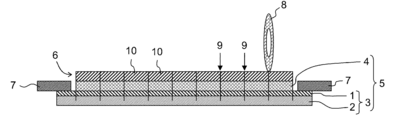
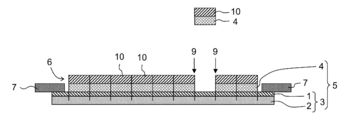
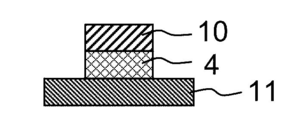
- Explanatory drawing which showed typically the manufacturing method of the adhesive sheet and electronic component of one Embodiment of this invention. Explanatory drawing which showed the next process of FIG. 1 and the adhesive sheet at that time typically. Explanatory drawing which showed the next process of FIG. 2 and the adhesive sheet at that time typically. Explanatory drawing which showed the next process of FIG. 3 typically.
- Adhesive layer 2 Base film 3 Adhesive sheet 4 DAF (Die attach film) 5 DAF integrated adhesive sheet 6 Silicon wafer 7 Ring frame 8 Dicing blade 9 Notch 10 Die chip 11 Lead frame
- the monomer means the monomer itself or a structure derived from the monomer. Unless otherwise indicated, parts and% in this specification are based on mass.
- (meth) acrylic acid is a generic term for compounds containing (meth) acrylic acid (meth), and compounds not having (meth).
- (meth) acrylate is a general term for acrylate and methacrylate.
- ⁇ Outline of Embodiment> 1 to 4 are explanatory views showing a method for manufacturing an adhesive sheet and an electronic component according to this embodiment.
- the pressure-sensitive adhesive sheet 3 of this embodiment has a base film 2 and a pressure-sensitive adhesive layer 1.
- a DAF (die attach film) 4 is laminated on the pressure-sensitive adhesive layer 1, and the pressure-sensitive adhesive sheet 3 and the DAF 4 form a DAF-integrated pressure-sensitive adhesive sheet 5.
- a silicon wafer 6 is laminated on the DAF 4.
- the pressure-sensitive adhesive layer 1 is obtained by applying a pressure-sensitive adhesive containing a (meth) acrylic acid ester polymer, a urethane acrylate oligomer having four or more vinyl groups, and silicone fine particles to the base film 2.
- the DAF-integrated pressure-sensitive adhesive sheet 5 using the pressure-sensitive adhesive having this composition is easy to peel off from the pressure-sensitive adhesive layer 1 of the DAF 4 and the pressure-sensitive adhesive sheet 3 when the die chip 10 is picked up.
- the DAF-integrated pressure-sensitive adhesive sheet 5 is excellent in chip retainability, it is possible to prevent the die chip 10 from being peeled off during dicing (so-called “chip jump”).
- the die chip 10 is picked up with the DAF 4 attached to the back surface of the die chip 10, and the die chip 10 is mounted on the lead frame 11 or the like as it is. Can be bonded together. At that time, the contamination of the DAF 4 due to a small amount of adhesive residue is low and the DAF 4 does not fall off from the die chip 10, so that the occurrence of adhesion failure can be suppressed.
- the pressure-sensitive adhesive of this embodiment contains a (meth) acrylic acid ester polymer, a urethane acrylate oligomer having 4 or more vinyl groups, and silicone fine particles.
- the pressure-sensitive adhesive is 100 parts by mass of a (meth) acrylic acid ester polymer, 20 parts by mass or more and 200 parts by mass or less of urethane acrylate oligomer having 4 or more vinyl groups, and 0.1 part by mass or more and 100 parts by mass of silicone fine particles. Contains no more than part by mass.
- This pressure-sensitive adhesive may contain substantially only these three components, but a curing agent, a tackifier resin, a polymerization initiator, a softening agent, an anti-aging agent, a filler, and an antistatic agent. Various known additives such as UV absorbers and light stabilizers may be added.
- the pressure-sensitive adhesive is preferably composed mainly of the above three components.
- the total content of the three components in the pressure-sensitive adhesive is, for example, 50, 60, 70, 80, 90, 95, 99, 100%.
- the total content of the three components may be any one or more of the values exemplified here, or may be within the range of any two values.
- the (meth) acrylic acid ester polymer is a polymer obtained by polymerizing a (meth) acrylic acid ester monomer. Further, the (meth) acrylic acid ester polymer may contain a vinyl compound monomer other than the (meth) acrylic acid ester monomer. Moreover, the (meth) acrylic acid ester monomer used for manufacture of a (meth) acrylic acid ester polymer may be one type, or may be two or more types.
- Examples of the (meth) acrylic acid ester monomer include butyl (meth) acrylate, 2-butyl (meth) acrylate, t-butyl (meth) acrylate, pentyl (meth) acrylate, octyl (meth) acrylate, 2- Ethylhexyl (meth) acrylate, nonyl (meth) acrylate, decyl (meth) acrylate, lauryl (meth) acrylate, methyl (meth) acrylate, ethyl (meth) acrylate, isopropyl (meth) acrylate, tridecyl (meth) acrylate, myristyl ( (Meth) acrylate, cetyl (meth) acrylate, stearyl (meth) acrylate, cyclohexyl (meth) acrylate, isobornyl (meth) acrylate, dicyclopentanyl (meth) acryl
- the (meth) acrylic acid ester monomer preferably has a hydroxyl group.
- the hydroxyl group reacts with at least the isocyanate group in the reaction residue of the urethane acrylate oligomer and the isocyanate group in the isocyanate curing agent, thereby causing contamination by the silicone graft polymer. This is because it can be suppressed.
- vinyl compound monomer one kind of functional group consisting of hydroxyl group, carboxyl group, epoxy group, amide group, amino group, methylol group, sulfonic acid group, sulfamic acid group, and (phosphite) ester group What has the above can be used conveniently.
- Examples of the vinyl compound monomer having a hydroxyl group include vinyl alcohol.
- Examples of the vinyl compound monomer having a carboxyl group include (meth) acrylic acid, crotonic acid, maleic acid, maleic anhydride, itaconic acid, fumaric acid, acrylamide N-glycolic acid, and cinnamic acid.
- Examples of the vinyl compound monomer having an epoxy group include allyl glycidyl ether and (meth) acrylic acid glycidyl ether.
- An example of a vinyl compound monomer having an amide group is (meth) acrylamide.
- Examples of the vinyl compound monomer having an amino group include N, N-dimethylaminoethyl (meth) acrylate.
- An example of a vinyl compound monomer having a methylol group is N-methylolacrylamide.
- the weight average molecular weight (Mw) of the (meth) acrylic acid ester polymer is not particularly limited, but is preferably 200,000 to 2.5 million. In such a case, the characteristics of the pressure-sensitive adhesive are particularly preferable.
- the number average molecular weight is, for example, 200,000, 400,000, 600,000, 800,000, 1 million, 1.5 million, 2 million, or 2.5 million. This weight average molecular weight may be within the range of any two values exemplified here.
- Embodision polymerization, solution polymerization, etc. can be used as the method for producing the (meth) acrylic acid ester polymer).
- Acrylic rubber that can be produced by emulsion polymerization is preferred so that the pressure-sensitive adhesive sheet 3 and the die attach film 4 can be easily peeled after irradiation.
- the (meth) acrylic acid ester polymer is, in particular, 35 to 75% by weight of ethyl acrylate, 10 to 30% by weight of butyl acrylate, and methoxyethyl acrylate when the total of ethyl acrylate, butyl acrylate and methoxyethyl acrylate is 100% by weight.
- Copolymers containing these components in a proportion of 15 to 35% by mass, and those obtained by emulsion polymerization are preferred. This is because the initial adhesive force of the adhesive sheet 3 is sufficient, and the adhesive sheet 3 is securely fixed to the ring frame 11.
- the die attach film 4 and the pressure-sensitive adhesive layer 1 may not be easily separated after irradiation, and the pick-up property of the die chip 10 may be deteriorated.
- the upper limit of the number of vinyl groups in the urethane acrylate oligomer is not particularly limited, but is preferably about 15 in consideration of availability and production cost.
- the number of vinyl groups is, for example, 4, 6, 9, 10, 15, 20, 25.
- the number of vinyl groups may be any one or more of the values exemplified here, or may be within the range of any two values.
- the weight average molecular weight (Mw) of the urethane acrylate oligomer is not particularly limited, but is preferably 1000 to 20000. In such a case, the characteristics of the pressure-sensitive adhesive are particularly preferable.
- the number average molecular weight is, for example, 1000, 2000, 3000, 4000, 5000, 6000, 8000, 10000, 15000, 20000. This weight average molecular weight may be within the range of any two values exemplified here.
- the compounding quantity of urethane acrylate oligomer is not specifically limited, For example, they are 5 mass parts or more and 300 mass parts or less with respect to 100 mass parts of (meth) acrylic acid ester polymer, and 15 mass parts or more and 225 mass parts or less are preferable. 20 parts by mass or more and 200 parts by mass or less is more preferable.
- This compounding quantity is 5, 10, 15, 20, 50, 100, 150, 200, 250, 300 mass parts with respect to 100 mass parts of (meth) acrylic acid ester polymer, for example.
- This blending amount may be within the range of any two values exemplified here.
- the pressure-sensitive adhesive sheet 3 and the die attach film 4 are not easily peeled after irradiation with ultraviolet rays and / or radiation, and a problem may occur in the pick-up property of the die chip 10.
- excessive mixing may cause pick-up failure due to glue scraping during dicing, and a minute adhesive residue may be generated due to a reaction residue.
- Adhesion failure may occur during heating.
- the method for producing the urethane acrylate oligomer is not particularly limited.
- a urethane is obtained by reacting a hydroxyl group and a (meth) acrylate compound containing a plurality of (meth) acrylate groups with a compound having a plurality of isocyanate groups (for example, a diisocyanate compound).
- a method using an acrylate oligomer is mentioned.
- the urethane acrylate oligomer is a polyol oligomer having a plurality of hydroxyl group ends and a compound having a plurality of isocyanate groups (for example, a diisocyanate compound) added in an excessive amount to react to form an oligomer having a plurality of isocyanate ends. It can also be produced by reacting a group with a (meth) acrylate compound containing a plurality of (meth) acrylate groups.
- Examples of (meth) acrylate compounds containing a hydroxyl group and a plurality of (meth) acrylate groups include hydroxypropylated trimethylolpropane triacrylate, pentaerythritol triacrylate, dipentaerythritol-droxy-pentaacrylate, and bis (pentaerythritol). ) -Tetraacrylate, tetramethylolmethane-triacrylate, glycidol-diacrylate, and compounds in which some or all of these acrylate groups are methacrylate groups.
- isocyanate having a plurality of isocyanate groups examples include aromatic isocyanate, alicyclic isocyanate, and aliphatic isocyanate.
- aromatic isocyanates or alicyclic isocyanates are preferably used.
- As the form of the isocyanate compound there are a monomer, a dimer, and a trimer, and a trimer is preferably used.
- Aromatic diisocyanates include, for example, tolylene diisocyanate, 4,4-diphenylmethane diisocyanate, and xylylene diisocyanate.
- Examples of the alicyclic diisocyanate include isophorone diisocyanate and methylenebis (4-cyclohexyl isocyanate). Examples of the aliphatic diisocyanate include hexamethylene diisocyanate and trimethylhexamethylene diisocyanate.
- polyol oligomers having a plurality of hydroxyl group terminals examples include poly (propylene oxide) diol, poly (propylene oxide) triol, copoly (ethylene oxide-propylene oxide) diol, poly (tetramethylene oxide) diol, ethoxylated bisphenol A, There are ethoxylated bisphenol S spiroglycol, caprolactone modified diol, and carbonate diol.
- Silicone fine particles are fine particles made of a compound (silicone) having a siloxane bond (—SiO—) in the basic skeleton, for example, spherical fine particles made of polyorganosiloxane or polyorganosilsesquioxane.
- the blending amount of the silicone fine particles is not particularly limited, but is, for example, 0.01 parts by mass or more and 200 parts by mass or less, preferably 0.05 parts by mass or more with respect to 100 parts by mass of the (meth) acrylic acid ester polymer. 150 parts by mass or less, and more preferably 0.1 parts by mass or more and 100 parts by mass or less of the silicone fine particles, the pressure-sensitive adhesive sheet 3 and the die attach film 4 after ultraviolet and / or radiation irradiation There is a case where the pick-up property of the die chip 10 does not easily peel and a problem occurs.
- the compounding quantity of silicone microparticles is 0.05, 0.1, 0.5, 1, 5, 10, 50, 100, 150, 200 mass parts, for example. This blending amount may be within the range of any two values exemplified here.
- the average particle size of the silicone fine particles can be appropriately selected from those having a thickness of the pressure-sensitive adhesive layer 1 or less, but is preferably 0.01 ⁇ m or more and 10 ⁇ m or less. If the average particle size is too small, the dispersibility in the pressure-sensitive adhesive may be deteriorated, which may cause a problem in pick-up properties. If the average particle size is too large, the pressure-sensitive adhesive will be deteriorated, and the initial adhesive strength may be reduced. And chip skipping may occur during dicing.
- the average particle diameter of the silicone fine particles is, for example, 0.01, 0.05, 0.1, 0.5, 1, 1.5, 2, 2.5, 3, 5, 10 ⁇ m. This average particle diameter may be within the range of any two values exemplified here. In the present specification, “average particle size” means a particle size at an integrated value of 50% in the particle size distribution obtained by the laser diffraction / scattering method.
- the silicone fine particles are preferably formed by coating a silicone rubber spherical fine particle with a polyorganosilsesquioxane resin. Such fine particles have good dispersibility in the pressure-sensitive adhesive and are preferably used.
- Silicone rubber spherical fine particles are spherical silicone fine particles having rubber elasticity, for example, General formula (1) in the molecular structure -(R1 2 SiO) A- (1) (Where R1 is an alkyl group such as a methyl group, an ethyl group, a propyl group or a butyl group, an aryl group such as a phenyl group or a tolyl group, an alkenyl group such as a vinyl group or an allyl group, a ⁇ -phenylethyl group, a ⁇ -phenylpropylene group) Reactions such as aralkyl groups such as alkyl groups, monovalent halogenated hydrocarbon groups such as chloromethyl groups and 3,3,3-trifluoropropyl groups, as well as epoxy groups, amino groups, mercapto groups, acryloxy groups, methacryloxy groups, etc.
- R1 is an alkyl group such as a methyl group, an ethyl
- the groups selected from one or two or more monovalent organic groups having 1 to 20 carbon atoms selected from the organic group-containing organic groups are methyl groups. If less than 5, the characteristics of the linear organopolysiloxane are not sufficiently exhibited, and the maximum value of A is not specifically defined. From the spherical silicone cured product having rubber elasticity, having a linear polyorganosiloxane block represented by A is a number of 5 to 5,000, preferably 10 to 1,000). It will be.
- the silicone rubber spherical fine particles may contain silicone oil, organosilane, inorganic powder, organic powder, etc. in the particles.
- Polyorganosilsesquioxane resin is represented by the general formula (2) R2SiO 3/2 (2)
- R2 is an alkyl group such as a methyl group, an ethyl group, a propyl group or a butyl group, an aryl group such as a phenyl group or a tolyl group, an alkenyl group such as a vinyl group or an allyl group, ⁇ - Aralkyl groups such as phenylethyl group and ⁇ -phenylpropyl group, monovalent halogenated hydrocarbon groups such as chloromethyl group and 3,3,3-trifluoropropyl group, epoxy group, amino group, mercapto group, acryloxy Resin-like resin having an organosilsesquioxane unit which is a monovalent organic group having 1 to 20 carbon atoms selected from a reactive group-containing organic group such as a group or a methacryloxy group as a structural unit It is a polymerized product.
- R2 of the polyorganosilsesquioxane resin is a methyl group.
- R2SiO 3/2 units a small amount of R2 2 SiO 2/2 units, R2 3 SiO 1/2 units, and SiO 2 units may be contained as long as the covering property is not impaired.
- the number average molecular weight (Mn) of the polyorganosilsesquioxane resin is not particularly limited, but is preferably 500 to 10,000. In such a case, the characteristics of the pressure-sensitive adhesive are particularly preferable.
- the number average molecular weight is, for example, 500, 1000, 2000, 3000, 4000, 5000, 6000, 7000, 8000, 9000, 10,000. This number average molecular weight may be within the range of any two values exemplified here.
- the polyorganosilsesquioxane resin may be uniformly coated on the entire surface of the silicone rubber spherical fine particles, or may cover a part of the surface, but with respect to 100 parts by mass of the silicone rubber spherical fine particles.
- the polyorganosilsesquioxane resin is less than 1 part by mass, the dispersibility in the pressure-sensitive adhesive becomes poor, and when it exceeds 500 parts by mass, the characteristics of the silicone rubber spherical particles are not sufficiently exhibited.
- the compounding amount of the polyorganosilsesquioxane resin is preferably 1 part by mass or more and 500 parts by mass or less, and preferably 5 parts by mass or more and 100 parts by mass or less with respect to 100 parts by mass of the silicone rubber spherical fine particles. Further preferred.
- the blending amount is, for example, 1, 5, 10, 20, 50, 100, 150, 200, 250, 300, 350, 400, 500 parts by mass with respect to 100 parts by mass of the silicone rubber spherical fine particles. This blending amount may be within the range of any two values exemplified here.
- the pressure-sensitive adhesive of the present invention preferably contains a silicone graft polymer in order to reduce the adhesion between the die attach film 4 and the pressure-sensitive adhesive layer 1 and improve the pickup property.
- the silicone graft polymer is, for example, a homopolymer of a silicone macromonomer or a silicone macromonomer, except that a monomer having a vinyl group at the terminal of a silicone molecular chain (hereinafter referred to as “silicone macromonomer”) is polymerized. Mention may be made of copolymers of monomers with other vinyl compounds.
- silicone macromonomer a compound in which the end of the silicone molecular chain is a vinyl group such as a (meth) acryloyl group or a styryl group is preferably used.
- a (meth) acrylic acid ester monomer having high compatibility with other polymers blended in the pressure-sensitive adhesive is preferable. This is because the use of a highly compatible material makes the entire pressure-sensitive adhesive homogeneous.
- (Meth) acrylic acid ester monomers include, for example, alkyl (meth) acrylates, hydroxyalkyl (meth) acrylates, modified hydroxy (meth) acrylates, and (meth) acrylic acids, which prevent fine glue residue called particles Therefore, a reactive hydroxyalkyl (meth) acrylate or modified hydroxy (meth) acrylate is preferable.
- alkyl (meth) acrylate examples include methyl (meth) acrylate, ethyl (meth) acrylate, n-propyl (meth) acrylate, n-butyl (meth) acrylate, isobutyl (meth) acrylate, and t-butyl (meth) acrylate.
- hydroxyalkyl (meth) acrylate examples include hydroxyethyl (meth) acrylate, hydroxypropyl (meth) acrylate, and hydroxybutyl (meth) acrylate.
- modified hydroxy (meth) acrylate examples include ethylene oxide-modified hydroxy (meth) acrylate and lactone-modified hydroxy (meth) acrylate.
- the silicone graft polymer in particular, 5 to 95 parts by mass of a silicone macromonomer having a (meth) acryloyl group, 5 to 95 parts by mass of methyl methacrylate (the total of the silicone macromonomer and methyl methacrylate is 100 parts by mass) It is a silicone graft polymer obtained by polymerizing a polymer, and has at least one hydroxyl group at the terminal and / or side chain of the silicone graft polymer by polymerization using an initiator having a hydroxyl group. preferable. This is because the pressure-sensitive adhesive sheet and the die attach film are easily peeled off and the pick-up property of the die chip is improved.
- the weight average molecular weight (Mw) of the silicone graft polymer is not particularly limited, but is preferably 1000 to 50,000. In such a case, the characteristics of the pressure-sensitive adhesive are particularly preferable.
- the weight average molecular weight is, for example, 1000, 2000, 3000, 5000, 10,000, 20,000, 30,000, 50,000. This weight average molecular weight may be within the range of any two values exemplified here.
- the compounding quantity of a silicone graft polymer is 0.01 mass part or more and 15 mass parts or less with respect to 100 mass parts of (meth) acrylic acid ester polymers, for example, Preferably it is 0.05 mass part or more and 12.5 masses. Part or less, more preferably 0.1 parts by mass or more and 10 parts by mass or less. If the blending amount of the silicone graft polymer is too small, the pressure-sensitive adhesive sheet 3 and the die attach film 4 are not easily peeled after irradiation with ultraviolet rays and / or radiation, and a problem may occur in the pick-up property of the die chip 10. Moreover, when it mix
- This compounding quantity is 0.01, 0.05, 0.1, 0.5, 1, 2, 5, 10, 12.5, 15 with respect to 100 mass parts of (meth) acrylic acid ester polymers, for example. Part by mass.
- This blending amount may be within the range of any two values exemplified here.
- the pressure-sensitive adhesive sheet 3 is manufactured by applying a pressure-sensitive adhesive on the base film 2, and includes a base film 2 and a pressure-sensitive adhesive layer 1 laminated on the base film 2.
- the adhesive sheet 3 can be used for fixing electronic parts used during dicing or backgrinding, but the DAF 4 and the adhesive sheet 3 are laminated to fix both the electronic parts in the dicing process and the fixing process to the lead frame 11. It is preferable to use it as a DAF-integrated pressure-sensitive adhesive sheet 5 that can be used.
- the thickness of the pressure-sensitive adhesive layer 1 is preferably 1 ⁇ m or more, and more preferably 2 ⁇ m or more.
- the thickness of the pressure-sensitive adhesive layer 1 is preferably 100 ⁇ m or less, and more preferably 40 ⁇ m or less. If the thickness of the pressure-sensitive adhesive layer 1 is too thin, the pressure-sensitive adhesive force is lowered, the chip retention during dicing is lowered, and peeling between the ring frame 7 and the pressure-sensitive adhesive sheet 3 may occur. On the other hand, if the thickness of the pressure-sensitive adhesive layer 1 is too thick, the pressure-sensitive adhesive force becomes too high, and pickup failure may occur.
- the thickness of the base film 2 is preferably 30 ⁇ m or more, and more preferably 60 ⁇ m or more in order to prevent the adhesive sheet from tearing when the adhesive sheet is stretched in the pickup process.
- the thickness of the base film 2 is preferably 300 ⁇ m or less, and more preferably 200 ⁇ m or less in order to obtain high extensibility when the pressure-sensitive adhesive sheet is stretched in the pickup process.
- the material of the base film 2 is, for example, polyvinyl chloride, polyethylene terephthalate, ethylene-vinyl acetate copolymer, ethylene-acrylic acid-acrylate film, ethylene-ethyl acrylate copolymer, polyethylene, polypropylene, ethylene-acrylic acid.
- copolymers and ionomer resins obtained by crosslinking an ethylene- (meth) acrylic acid copolymer, an ethylene- (meth) acrylic acid- (meth) acrylic acid ester copolymer, and the like with metal ions.
- a mixture of these resins, a copolymer, and a multilayer film can be used for the base film 2.
- an ionomer resin as the material of the base film 2.
- ionomer resins when an ionomer resin obtained by crosslinking a copolymer having an ethylene unit, a (meth) acrylic acid unit, and a (meth) acrylic acid alkyl ester unit with a metal ion such as Na + , K + , or Zn 2+ is used. Since it is possible to suppress generation of shaving-like cutting waste, it is preferably used.
- the base film 2 particularly preferably has a melt flow rate (MFR) of 0.5 to 6.0 g / 10 min (JIS K7210, 210 ° C.).
- MFR melt flow rate
- the base film 2 is particularly preferably a film having a melting point of 80 to 98 ° C. and containing Zn 2+ ions.
- the molding method of the base film 2 includes, for example, a calendar molding method, a T-die extrusion method, an inflation method, and a casting method.
- the base film 2 may be coated with an antistatic agent on one side or both sides of the base film 2 in order to prevent charging when the DAF 4 is peeled off. Further, an antistatic agent may be kneaded into the resin. Examples of the antistatic agent include a polymer antistatic agent, a low molecular antistatic agent, a conductive polymer, a conductive filler, and an ionic liquid.
- the base film 2 can have an opposite surface on which the pressure-sensitive adhesive layer 1 is provided as an embossed surface having an average surface roughness (Ra) of 0.3 ⁇ m or more and 1.5 ⁇ m or less.
- Ra average surface roughness
- a lubricant can be applied to the opposite surface of the base film 2 where the adhesive layer 1 is provided, or the lubricant can be kneaded into the resin.
- the lubricant is not particularly limited as long as it is a substance that lowers the coefficient of friction between the pressure-sensitive adhesive sheet 3 and the expanding device (not shown).
- silicone compounds such as silicone resins and (modified) silicone oils, fluororesins, hexagonal boron nitride , Carbon black, molybdenum disulfide, and the like. These friction reducing agents may mix a plurality of components. Since manufacture of an electronic component is performed in a clean room, it is preferable to use a silicone compound or a fluororesin.
- the method of forming the pressure-sensitive adhesive layer 1 on the base film 2 to form the pressure-sensitive adhesive sheet 3 is, for example, a pressure-sensitive adhesive on the base film 2 with a coater such as a gravure coater, comma coater, bar coater, knife coater, or roll coater. There is a method of applying directly.
- the adhesive may be printed on the base film 2 by letterpress printing, intaglio printing, planographic printing, flexographic printing, offset printing, screen printing, or the like.
- DAF4 Die attach film>
- DAF4 is an adhesive sheet obtained by forming a pressure-sensitive adhesive or adhesive into a film.
- DAF4 is commercially available in a state where an adhesive or pressure-sensitive adhesive is laminated on a peeling film made of polyethylene terephthalate resin or the like, and can transfer the adhesive or pressure-sensitive adhesive to an adherend.
- the material of DAF4 may be any commonly used adhesive or adhesive component.
- adhesive or adhesive component for example, epoxy, polyamide, acrylic, polyimide, vinyl acetate, ethylene / vinyl acetate copolymer, ethylene / acrylic acid ester copolymer
- coalesced polyethylene, polysulfone, polyamic acid, silicone, phenol, rubber polymer, fluororubber polymer and fluororesin.
- DAF 4 may be mixed with additives such as a curing agent, an ultraviolet polymerization initiator, an antistatic agent, a curing accelerator, a silane coupling agent, and a filler as required.
- the method of manufacturing an electronic component by the method using the DAF integrated pressure-sensitive adhesive sheet 5 includes a wafer bonding step of bonding a silicon wafer 6 to the DAF 4 surface of the DAF integrated pressure-sensitive adhesive sheet 5, and The silicon wafer 6 is diced into a die chip 10 while being bonded to the DAF integrated pressure-sensitive adhesive sheet 5, and after the dicing process, the DAF 4 and the pressure-sensitive adhesive layer 1 are peeled off, and the die chip 10 is picked up together with the DAF 4.
- a die chip mounting step for mounting the picked die chip 10 on the lead frame 11 or the circuit board may be included.
- each step will be described in detail.
- Wafer bonding step In this step, the silicon wafer 6 is bonded to the surface of the DAF 4 of the DAF integrated pressure-sensitive adhesive sheet 5 and fixed. Further, it is preferable to fix the DAF integrated pressure-sensitive adhesive sheet 5 to the ring frame 7.
- the silicon wafer 6 is diced into the die chip 10 in a state where the silicon wafer 6 is bonded to the DAF integrated pressure-sensitive adhesive sheet 5.
- Dicing can be performed using a dicing blade 8. Since the pressure-sensitive adhesive sheet 3 is excellent in chip retention before irradiation with ultraviolet rays and / or radiation, it is possible to prevent the die chip 10 from being peeled off (chip jump) during dicing.
- this step can be performed, for example, by the following method. After irradiating ultraviolet rays and / or radiation (not shown) from the base film 2 side of the DAF-integrated pressure-sensitive adhesive sheet 5, the DAF-integrated pressure-sensitive adhesive sheet 5 is radially expanded to widen the space between the die chips 10, and then the die chip 10 Is pushed up with a needle or the like (not shown).
- the die chip 10 is adsorbed by a vacuum collet or air tweezers (not shown), peeled between the DAF 4 and the adhesive layer 1, and the die chip 10 to which the DAF 4 is attached is picked up.
- a vacuum collet or air tweezers not shown
- the die chip 10 to which the DAF 4 is attached is picked up.
- a well-known thing can be used for the light source of an ultraviolet-ray and / or a radiation.
- the radiation electron beams, ⁇ rays, ⁇ rays, and ⁇ rays are preferably used.
- the vinyl groups in the compound molecules constituting the pressure-sensitive adhesive layer 1 can be made into a three-dimensional network, and the pressure-sensitive adhesive force of the pressure-sensitive adhesive layer 1 can be reduced.
- the adhesive layer 1 has the initial high adhesive force, it can show the outstanding chip
- the die chip 10 to which the DAF 4 is attached is mounted (mounted) on the lead frame 11. Then, the DAF 4 is heated, and the die chip 10 and the lead frame 11 or the circuit board are bonded by heating. Finally, the die chip 10 mounted on the lead frame 11 is molded with resin (not shown). Instead of the lead frame 11, a circuit board on which a circuit pattern is formed can be used.
- the DAF-integrated pressure-sensitive adhesive sheet 5 is used, contamination due to a small amount of adhesive residue on the DAF 4 is low. Therefore, when the die chip 10 to which the DAF 4 is attached is mounted on the lead frame 11 and bonded by heating, adhesion due to contamination is caused. The occurrence of defects can be suppressed.
- the electronic component manufacturing method using the DAF-free pressure-sensitive adhesive sheet 3 is an application process (non-applying) in which the paste adhesive 4 is applied to the entire back surface of the silicon wafer 6. And a semi-curing step (not shown) in which the paste-like adhesive 4 is heated and semi-cured into a sheet to form the adhesive semi-cured layer 4, and the adhesive semi-cured layer 4 of the silicon wafer 6 and the adhesive A bonding step (FIG. 1) for bonding the adhesive layer 1 of the sheet 3, a dicing step (FIG.
- a pick-up step for picking up the die chip 10 and the adhesive semi-cured layer 4 adhering to the back surface thereof by peeling the adhesive semi-cured layer 4 and the pressure-sensitive adhesive layer 1 together.
- a die chip mounting step for mounting the picked die chip 10 on the lead frame 11 or the circuit board may be included.
- the adhesive semi-cured layer 4 has the same function as the DAF 4 described above. Therefore, the adhesive semi-cured layer and the pressure-sensitive adhesive layer 1 are brought into contact with the silicon wafer 6 on which the adhesive semi-cured layer 4 is formed and the pressure-sensitive adhesive sheet 3 composed of the pressure-sensitive adhesive layer 1 and the base film 2. When bonded together, the configuration is the same as in FIG. Thereafter, as in the case of using DAF 4, dicing is performed using the dicing blade 8, the die chip to which the adhesive semi-cured layer is attached is picked up, mounted on the lead frame 11 or the circuit board, and heat-bonded. .
- thermosetting for example, acrylic, vinyl acetate, ethylene / vinyl acetate copolymer, ethylene / acrylic ester copolymer, polyamide, polyethylene, polysulfone, epoxy, polyimide, polyamide
- acids silicones, phenols, rubber polymers, fluororubber polymers, and fluororesins.
- the adhesive semi-cured layer 4 is formed on the back surface of the die chip 10 by irradiating ultraviolet rays and / or radiation (not shown) from the base film 2 side of the pressure-sensitive adhesive sheet 3.
- the die chip 10 can be easily picked up in the attached state, and the die chip 10 is mounted and bonded to the lead frame 11 or the like as it is.
- the adhesive layer 1 reduces the contamination of the adhesive semi-cured layer 4, the die chip 10 to which the adhesive semi-cured layer 4 is attached is mounted on the lead frame 11 and heated. By doing so, it is possible to suppress the occurrence of adhesion failure due to contamination.
- the silicon wafer 6 may be a wafer made of another material (for example, a GaN wafer). Even for wafers of other materials, the wafer processing method similar to that of the above embodiment can be executed using the dicing blade 8 suitable for cutting the wafer, and in this case, the same effect can be obtained. It is done.
- Urethane acrylate oligomer A A terminal acrylate oligomer obtained by reacting dipentaerythritol pentaacrylate with a trimer of hexamethylene diisocyanate (aliphatic diisocyanate).
- Urethane acrylate oligomer B a terminal acrylate oligomer obtained by further reacting 2-hydroxyethyl acrylate with a terminal isocyanate oligomer obtained by reacting hexamethylene diisocyanate at the end of poly (propylene oxide) diol.
- Number average molecular weight (Mn) is 3,400, and the number of vinyl groups is 2 per molecule (bifunctional) (our polymerized product).
- Silicone fine particles A Silicone fine particles having an average particle size of 2 ⁇ m formed by coating a silicone rubber spherical fine particle with a polyorganosilsesquioxane resin (manufactured by Shin-Etsu Chemical Co., Ltd., model KMP-605)
- Silicone fine particle B Silicone rubber spherical fine particle having an average particle diameter of 5 ⁇ m (manufactured by Shin-Etsu Chemical Co., Ltd., model KMP-597)
- Silicone fine particles C Silicone fine particles of polyorganosilsesquioxane resin having an average particle diameter of 2 ⁇ m (manufactured by Shin-Etsu Chemical Co., Ltd., model KMP-590)
- Silicone graft polymer Hydroxyl group-containing silicone graft polymer obtained by polymerizing 30 parts by mass of silicone macromonomer and 70 parts by mass of methyl methacrylate with two hydroxyl groups (our polymer, weight average molecular weight (Mw)) : 5000).
- silicone macromonomer a silicone macromonomer having a methacryloyl group at the end of the silicone molecular chain (our polymerized product, number average molecular weight (Mn): 1000) was used.
- Photopolymerization initiator benzyldimethyl ketal (manufactured by Ciba Specialty Chemicals, product name Irgacure 651).
- Curing agent Trimethylolpropane adduct of 1,6-hexamethylene diisocyanate (manufactured by Nippon Polyurethane Co., Ltd., product name Coronate HL).
- Base film Made of ionomer resin mainly composed of Zn salt of ethylene-methacrylic acid-methacrylic acid alkyl ester copolymer, melt flow rate (MFR) 1.5 g / 10 min (JIS K7210, 210 ° C.) A film (Mitsui / DuPont Polychemical Co., Ltd., product name: High Milan 1650) containing a melting point of 96 ° C. and Zn 2+ ions was used.
- MFR melt flow rate
- Die attach film 30 ⁇ m thick film (mixture of epoxy resin and acrylic resin)
- the pressure-sensitive adhesive is applied onto a polyethylene terephthalate separator film, coated so that the thickness of the pressure-sensitive adhesive layer 1 after drying is 10 ⁇ m, and this pressure-sensitive adhesive layer 1 is laminated on the base film 2 to form a pressure-sensitive adhesive sheet. 3 was obtained. Thereafter, DAF 4 having a thickness of 30 ⁇ m was laminated on the pressure-sensitive adhesive layer 1 of the pressure-sensitive adhesive sheet 3 to obtain a DAF-integrated pressure-sensitive adhesive sheet 5.
- the silicon wafer 6 was bonded to the DAF 4 surface of the DAF integrated pressure-sensitive adhesive sheet 5.
- the silicon wafer 6 a silicon wafer having a diameter of 8 inches and a thickness of 75 ⁇ m on which a dummy circuit pattern was formed was used.
Landscapes
- Chemical & Material Sciences (AREA)
- Organic Chemistry (AREA)
- Chemical Kinetics & Catalysis (AREA)
- Health & Medical Sciences (AREA)
- Medicinal Chemistry (AREA)
- Polymers & Plastics (AREA)
- Adhesive Tapes (AREA)
- Adhesives Or Adhesive Processes (AREA)
- Die Bonding (AREA)
Abstract
Description
本発明はこのような事情に鑑みてなされたものであり、チップのピックアップ性に優れかつ、
ダイアタッチフィルムのダイチップからの脱落が抑制される粘着剤を提供するものである。
以下、本発明の種々の実施形態を例示する。以下の示す種々の実施形態は互いに組み合わせ可能である。
2 基材フィルム
3 粘着シート
4 DAF(ダイアタッチフィルム)
5 DAF一体型粘着シート
6 シリコンウエハ
7 リングフレーム
8 ダイシングブレード
9 切り込み
10 ダイチップ
11 リードフレーム
本明細書において、単量体とは、単量体そのもの又は単量体に由来する構造を意味する。本明細書の部及び%は、特に記載がない限り質量基準とする。本明細書において(メタ)アクリル酸とは、(メタ)アクリル酸の(メタ)を含む化合物、(メタ)を有さない化合物の総称である。また、(メタ)アクリレートとは、アクリレート及びメタアクリレートの総称である。
図1~図4は、本実施形態の粘着シート及び電子部品の製造方法を示した説明図である。
図1に示すように、本実施形態の粘着シート3は、基材フィルム2と粘着剤層1を有する。粘着剤層1にはDAF(ダイアタッチフィルム)4が積層され、粘着シート3とDAF4でDAF一体型粘着シート5を形成している。DAF4にはシリコンウエハ6が積層されている。
最初に、本実施形態の粘着剤について説明する。本実施形態の粘着剤は、(メタ)アクリル酸エステル重合体と、ビニル基を4個以上有するウレタンアクリレートオリゴマと、シリコーン微粒子とを含有する。
この粘着剤は、一例では、(メタ)アクリル酸エステル重合体100質量部と、ビニル基を4個以上有するウレタンアクリレートオリゴマ20質量部以上200質量部以下と、シリコーン微粒子0.1質量部以上100質量部以下とを含有する。
(メタ)アクリル酸エステル重合体は、(メタ)アクリル酸エステル単量体を重合した重合体である。また、(メタ)アクリル酸エステル重合体は、(メタ)アクリル酸エステル単量体以外のビニル化合物単量体を含んでもよい。また、(メタ)アクリル酸エステル重合体の製造に使用する(メタ)アクリル酸エステル単量体は、1種類であっても2種類以上であってもよい。
ビニル基を4個以上有するウレタンアクリレートオリゴマ(以下、単に「ウレタンアクリレートオリゴマ」ともいう。)とは、ビニル基を4個以上有し、分子内にウレタン結合を有する(メタ)アクリレートオリゴマであれば特に限定されない。
シリコーン微粒子とは、基本骨格にシロキサン結合(-SiO-)を有する化合物(シリコーン)からなる微粒子であり、例えば、ポリオルガノシロキサン又はポリオルガノシルセスキオキサンからなる球状微粒子である。
分子構造中に一般式(1)
-(R12SiO)A- ・・・・・(1)
(ここでR1はメチル基、エチル基、プロピル基、ブチル基などのアルキル基、フェニル基、トリル基などのアリール基、ビニル基、アリル基などのアルケニル基、β-フェニルエチル基、β-フェニルプロピル基などのアラルキル基、クロロメチル基、3,3,3-トリフルオロプロピル基などの1価ハロゲン化炭化水素基、さらにはエポキシ基、アミノ基、メルカプト基、アクリロキシ基、メタクリロキシ基などの反応性基含有の有機基から選択される1種または2種以上の炭素数1~20の1価の有機基から選択される基で、その90モル%以上がメチル基であることが好ましい。Aは5未満では線状オルガノポリシロキサンの特徴が充分に発揮されず、Aの最大値は特に定めるこのではないが、実際に5,000より大きいとシリコーンゴム微粒子の製造が困難になる為、Aは5~5,000、好ましくは10~1,000の数)で示される線状ポリオルガノシロキサンブロックを有する、ゴム弾性を持つ球状のシリコーン硬化物からなるものである。このシリコーンゴム球状微粒子はその粒子中にシリコーンオイル、オルガノシラン、無機系粉末、有機系粉末などを含有してもよい。
R2SiO3/2・・・・・(2)
で示されるもので、この式中のR2がメチル基、エチル基、プロピル基、ブチル基などのアルキル基、フェニル基、トリル基などのアリール基、ビニル基、アリル基などのアルケニル基、β-フェニルエチル基、β-フェニルプロピル基などのアラルキル基、クロロメチル基、3,3,3-トリフルオロプロピル基などの1価ハロゲン化炭化水素基、さらにはエポキシ基、アミノ基、メルカプト基、アクリロキシ基、メタクリロキシ基などの反応性基含有の有機基から選択される1種または2種以上の炭素数1~20の1価の有機基であるオルガノシルセスキオキサン単位を構成単位とする樹脂状の重合物である。
本発明の粘着剤には、ダイアタッチフィルム4と粘着剤層1の密着性を低下し、ピックアップ性を向上させる為に、シリコーングラフト重合体を含有するのが好ましい。
粘着シート3は、粘着剤を基材フィルム2上に塗布することによって製造され、基材フィルム2と、その基材フィルム2上に積層されてなる粘着剤層1とからなる。粘着シート3はダイシング時やバックグラインディング時に用いる電子部品固定用にも使用可能であるが、DAF4と粘着シート3を積層し、ダイシング工程の電子部品固定と、リードフレーム11への固定工程の両方に使用可能なDAF一体型粘着シート5として用いることが好ましい。
基材フィルム2の厚さは30μm以上とすることが好ましく、ピックアップ工程での粘着シート伸張時に粘着シートが裂けることを防止する為に60μm以上とすることがさらに好ましい。また、基材フィルム2の厚さは、300μm以下とすることが好ましく、ピックアップ工程での粘着シート伸張時に、高伸張性を得る為に200μm以下とすることがさらに好ましい。
DAF4は、粘着剤や接着剤をフィルム状に成形した粘接着性のシートである。DAF4は、ポリエチレンテレフタレート樹脂等からなる剥離用フィルム等に接着剤や粘着剤を積層した状態で市販されており、接着剤や粘着剤を被着体に転写することができる。
次に、粘着シート3又はDAF一体型粘着シート5を用いて電子部品を製造する方法について説明する。ここでは、電子部品の製造には、粘着シート3の粘着剤塗布面にDAF4を積層してなるDAF一体型粘着シート5を使用する方法と、粘着シート3とペースト状接着剤を使用する方法について説明する。
図1~図4に示すように、DAF一体型粘着シート5を用いた方法による電子部品の製造方法は、DAF一体型粘着シート5のDAF4表面にシリコンウエハ6を貼り合わせるウエハ貼合工程と、DAF一体型粘着シート5に貼り合わされた状態で、シリコンウエハ6のダイシングを行ってダイチップ10にするダイシング工程と、ダイシング工程後に、DAF4及び粘着剤層1とを剥離し、ダイチップ10をDAF4ごとピックアップするピックアップ工程とを含む。また、ピックアップしたダイチップ10をリードフレーム11又は回路基板に搭載するダイチップマウント工程を含んでもよい。
以下、各工程について詳細に説明する。
この工程では、DAF一体型粘着シート5のDAF4表面にシリコンウエハ6を貼り合わせて固定する。また、DAF一体型粘着シート5をリングフレーム7に固定することが好ましい。
この工程では、シリコンウエハ6がDAF一体型粘着シート5に貼り合わされた状態で、シリコンウエハ6のダイシングを行ってダイチップ10にする。ダイシングは、ダイシングブレード8を用いて行うことができる。粘着シート3は、紫外線及び/又は放射線照射前のチップ保持性に優れているため、ダイシング時に、ダイチップ10が剥離してしまうこと(チップ飛び)を抑制できる。
この工程では、ダイシング工程後に、DAF4と粘着剤層1を剥離し、ダイチップ10をDAF4ごとピックアップする。この工程は、具体的には、例えば、以下の方法で行うことができる。DAF一体型粘着シート5の基材フィルム2側から紫外線及び/又は放射線(不図示)を照射し、次いで、DAF一体型粘着シート5を放射状に拡大してダイチップ10間隔を広げた後、ダイチップ10をニードル等(不図示)で突き上げる。そして、真空コレット又はエアピンセット等(不図示)でダイチップ10を吸着し、DAF4と粘着剤層1の間で剥離し、DAF4が付着したダイチップ10をピックアップする。紫外線及び/又は放射線の光源は、公知のものが使用できる。紫外線源として、低圧水銀灯、高圧水銀灯、超高圧水銀灯、メタルハライドランプがある。放射線は電子線、α線、β線、γ線が好適に用いられる。
この工程では、DAF4が付着したダイチップ10をリードフレーム11上に搭載(マウント)する。そして、DAF4を加熱し、ダイチップ10とリードフレーム11又は回路基板とを加熱接着する。最後に、リードフレーム11に搭載したダイチップ10を樹脂(不図示)でモールドする。リードフレーム11の代わりに回路パターンを形成した回路基板等を用いることができる。DAF一体型粘着シート5を用いれば、DAF4に対する微少な糊残りによる汚染性が低いため、DAF4が付着したダイチップ10をリードフレーム11上にマウントさせ加温することによって接着する際に、汚染による接着不良の発生を抑制することができる。
図1~図4を引用して説明すれば、DAFなしの粘着シート3を用いた方法による電子部品の製造方法は、シリコンウエハ6の裏面にペースト状接着剤4を全面塗布する塗布工程(不図示)と、ペースト状接着剤4を加熱してシート状に半硬化させて接着剤半硬化層4を形成する半硬化工程(不図示)と、シリコンウエハ6の接着剤半硬化層4と粘着シート3の粘着剤層1とを貼り合わせる貼合工程(図1)と、粘着シート3に貼り合わされた状態で、シリコンウエハ6のダイシングを行ってダイチップ10にするダイシング工程(図2)と、ダイシング後に、接着剤半硬化層4及び粘着剤層1とを剥離することによって、ダイチップ10及びその裏面に付着している接着剤半硬化層4を併せてピックアップするピックアップ工程(図3)を含む。また、ピックアップしたダイチップ10をリードフレーム11又は回路基板に搭載するダイチップマウント工程を含んでもよい。
(メタ)アクリル酸エステル重合体:エチルアクリレート54%、ブチルアクリレート22%、メトキシエチルアクリレート24%の共重合体であって乳化重合により得られたもの(当社重合品)。重量平均分子量(Mw)は150万である。
表1に示す成分と配合量に従って、表1の各実験番号に対応する粘着剤の調製を行った。各粘着剤の調製にあたっては、表1に示した成分に加えて、光重合開始剤を3質量部及び硬化剤を3質量部配合した。なお、表1においては、配合した化合物の種類とその配合量を簡潔に表すべく、例えばウレタンアクリレートオリゴマAを100質量部配合した場合には、該当する欄に単に「A100」と表示した。
次いで、粘着剤をポリエチレンテレフタレート製セパレーターフィルム上に塗布し、乾燥後の粘着剤層1の厚みが10μmとなるように塗工し、この粘着剤層1を基材フィルム2上に積層し粘着シート3を得た。またその後に、30μm厚さのDAF4を、粘着シート3の粘着剤層1上にラミネートしてDAF一体型粘着シート5とした。
以下の方法に従って、製造したDAF一体型粘着シート5の評価を行った。
まず、DAF一体型粘着シート5のDAF4表面にシリコンウエハ6を貼り合わせた。シリコンウエハ6には、ダミーの回路パターンを形成した直径8インチ×厚さ75μmのシリコンウエハを用いた。
次に、DAF一体型粘着シート5に貼り合わされた状態で、シリコンウエハ6のダイシングを行ってダイチップ10にした。
ダイシングの際の粘着シート3への切り込み量は30μmとした。ダイシングは、ダイチップ10のサイズが10mm×10mmになるように行った。
ダイシング装置はDISCO社製 DAD341を用いた。ダイシングブレードはDISCO社製NBC-ZH205O-27HEEEを用いた。ダイシング条件は以下の通りである。
ダイシングブレード形状:外径55.56mm、刃幅35μm、内径19.05mm。
ダイシングブレード回転数:40,000rpm。
ダイシングブレード送り速度:80mm/秒。
切削水温度:25℃。
切削水量 :1.0L/分。
次に、ダイシング工程後に、DAF一体型粘着シート5の基材フィルム2側から紫外線を照射し、ダイチップ10をDAF4ごとピックアップした。
紫外線の照射は、トーヨーアドテック社製、型式TUV-815USを用い、照度8mW/cm、照射量500mJ/cm2という条件で行った。
ピックアップ装置はキヤノンマシナリー社製CAP-300IIを用いた。ピックアップの条件は、以下の通りである。
ニードルピンの数:5本
ニードルピンのハイト:0.3mm
エキスパンド量:5mm
(4-1)ピックアップ性
シリコンウエハ6を上述の条件にてダイシングした後、DAF4が付着した状態でダイチップ10をピックアップできた数を評価した。
◎(優):95%以上のダイチップ10がピックアップできた。
○(良):80%以上95%未満のダイチップ10がピックアップできた。
×(不可):80%未満のダイチップ10がピックアップできた。
シリコンウエハ6を上述の件にてダイシングし、ダイチップ10をピックアップした際、ダイチップ10からダイアタッチフィルム4の脱落(剥がれ)について次のように評価した。
◎(優):ダイチップ10の面積に対して、ダイアタッチフィルム4の脱落面積が5%未満
○(良):ダイチップ10の面積に対して、ダイアタッチフィルム4の脱落面積が5%以上10%未満
×(不可):ダイチップ10の面積に対して、ダイアタッチフィルム4の脱落面積が10%以上

表1に示した実験結果からわかるように、本発明に係る粘着剤を用いたDAF一体型粘着シート5は、ピックアップ作業時にダイアタッチフィルム4と粘着剤層1との剥離が容易であり、かつ、ダイアタッチフィルムのチップからの脱落も抑制することができた。
Claims (12)
- (メタ)アクリル酸エステル重合体と、ビニル基を4個以上有するウレタンアクリレートオリゴマと、シリコーン微粒子とを含有する粘着剤。
- 前記シリコーン微粒子の含有量は、前記(メタ)アクリル酸エステル重合体100質量部に対して、0.05質量部以上150質量部以下である請求項1に記載の粘着剤。
- 前記ウレタンアクリレートオリゴマの含有量は、前記(メタ)アクリル酸エステル重合体100質量部に対して、15質量部以上225質量部以下である請求項1に記載の粘着剤。
- 前記(メタ)アクリル酸エステル重合体100質量部に対して、前記シリコーン微粒子の含有量は、0.1質量部以上100質量部以下であり、前記ウレタンアクリレートオリゴマの含有量は、20質量部以上200質量部以下である請求項1に記載の粘着剤。
- 前記シリコーン微粒子は、シリコーンゴム球状微粒子にポリオルガノシルセスキオキサン樹脂を被覆したものである請求項1に記載の粘着剤。
- シリコーングラフト重合体をさらに含有する請求項1に記載の粘着剤。
- 前記シリコーングラフト重合体の含有量は、前記(メタ)アクリル酸エステル重合体100質量部に対して、0.05質量部以上12.5質量部以下である請求項6に記載の粘着剤。
- 基材フィルムと、前記基材フィルム上に請求項1に記載の粘着剤を塗布した粘着剤層とを有する粘着シート。
- 電子部品固定用である請求項8記載の粘着シート。
- 前記粘着剤層上にダイアタッチフィルムが積層されている請求項8に記載の粘着シート。
- 請求項10に記載の粘着シートのダイアタッチフィルム表面にウエハを貼り合わせるウエハ貼合工程と、前記粘着シートに貼り合わされた前記ウエハをダイシングしてダイチップにするダイシング工程と、ダイシング工程後に前記ダイアタッチフィルム及び前記粘着剤層とを剥離し、前記ダイチップを前記ダイアタッチフィルムごとピックアップするピックアップ工程を含む電子部品の製造方法。
- ウエハの裏面にペースト状接着剤を全面塗布する塗布工程と、前記ペースト状接着剤を加熱してシート状に半硬化させて接着剤半硬化層を形成する半硬化工程と、前記接着剤半硬化層と請求項8に記載の粘着シートの粘着剤層とを貼り合わせる粘着シート貼合工程と、前記粘着シート貼合工程後、前記ウエハをダイシングしてダイチップにするダイシング工程と、前記ダイシング工程後、前記接着剤半硬化層と前記粘着剤層を剥離し、前記ダイチップを前記接着剤半硬化層ごとピックアップするピックアップ工程を有する電子部品の製造方法。
Priority Applications (5)
| Application Number | Priority Date | Filing Date | Title |
|---|---|---|---|
| CN2010800204155A CN102421865B (zh) | 2009-05-12 | 2010-05-10 | 粘合剂、粘合片及电子元件的制造方法 |
| SG2011081999A SG175933A1 (en) | 2009-05-12 | 2010-05-10 | Adhesive, adhesive sheet, and process for producing electronic components |
| JP2011513326A JP5618994B2 (ja) | 2009-05-12 | 2010-05-10 | 粘着剤、粘着シート及び電子部品の製造方法 |
| US13/318,411 US8415235B2 (en) | 2009-05-12 | 2010-05-10 | Adhesive, adhesive sheet, and process for producing electronic components |
| KR1020117027449A KR101297315B1 (ko) | 2009-05-12 | 2010-05-10 | 점착제, 점착 시트 및 전자부품의 제조 방법 |
Applications Claiming Priority (2)
| Application Number | Priority Date | Filing Date | Title |
|---|---|---|---|
| JP2009115166 | 2009-05-12 | ||
| JP2009-115166 | 2009-05-12 |
Publications (1)
| Publication Number | Publication Date |
|---|---|
| WO2010131616A1 true WO2010131616A1 (ja) | 2010-11-18 |
Family
ID=43084988
Family Applications (1)
| Application Number | Title | Priority Date | Filing Date |
|---|---|---|---|
| PCT/JP2010/057861 Ceased WO2010131616A1 (ja) | 2009-05-12 | 2010-05-10 | 粘着剤、粘着シート及び電子部品の製造方法 |
Country Status (8)
| Country | Link |
|---|---|
| US (1) | US8415235B2 (ja) |
| JP (1) | JP5618994B2 (ja) |
| KR (1) | KR101297315B1 (ja) |
| CN (1) | CN102421865B (ja) |
| MY (1) | MY160284A (ja) |
| SG (1) | SG175933A1 (ja) |
| TW (1) | TWI471397B (ja) |
| WO (1) | WO2010131616A1 (ja) |
Cited By (11)
| Publication number | Priority date | Publication date | Assignee | Title |
|---|---|---|---|---|
| WO2011077835A1 (ja) * | 2009-12-21 | 2011-06-30 | 電気化学工業株式会社 | 粘着シート及び電子部品の製造方法 |
| WO2013089982A1 (en) * | 2011-12-15 | 2013-06-20 | Henkel Corporation | Method of preparing an adhesive film into a precut semiconductor wafer shape on a dicing tape |
| JP2014135469A (ja) * | 2012-12-10 | 2014-07-24 | Nitto Denko Corp | 接着シート、ダイシングテープ一体型接着シート、半導体装置の製造方法、及び、半導体装置 |
| JP2016104859A (ja) * | 2014-11-25 | 2016-06-09 | 日本合成化学工業株式会社 | 活性エネルギー線硬化性樹脂組成物及びコーティング剤 |
| WO2016111283A1 (ja) * | 2015-01-09 | 2016-07-14 | デンカ株式会社 | ダイシングテープ |
| JP2017195336A (ja) * | 2016-04-22 | 2017-10-26 | 日東電工株式会社 | ダイシングダイボンディングフィルム、ダイシングダイボンディングテープおよび半導体装置の製造方法 |
| JP2018107386A (ja) * | 2016-12-28 | 2018-07-05 | 日立化成株式会社 | ダイシング用粘着シート及びその製造方法、ダイシングダイボンディング一体型シート、並びに、半導体装置の製造方法 |
| JP2021014541A (ja) * | 2019-07-12 | 2021-02-12 | 信越ポリマー株式会社 | 粘着保持治具及びその製造方法 |
| JP2021050266A (ja) * | 2019-09-24 | 2021-04-01 | 積水化学工業株式会社 | 粘着テープ |
| JP2021089995A (ja) * | 2019-12-05 | 2021-06-10 | 株式会社ディスコ | テープ、被加工物の分割方法、判定方法、及び切削ブレードの高さ確認方法 |
| JP2023093908A (ja) * | 2021-12-23 | 2023-07-05 | リンテック株式会社 | ワーク加工用シート、ワーク加工方法、および、ワーク加工用シートの使用 |
Families Citing this family (9)
| Publication number | Priority date | Publication date | Assignee | Title |
|---|---|---|---|---|
| TWI502705B (zh) * | 2009-08-19 | 2015-10-01 | 精材科技股份有限公司 | 晶片封裝體及其製造方法 |
| TWI618131B (zh) * | 2013-08-30 | 2018-03-11 | 半導體能源研究所股份有限公司 | 剝離起點形成裝置及形成方法、疊層體製造裝置 |
| US9905451B2 (en) * | 2014-03-03 | 2018-02-27 | Lintec Corporation | Sheet for semiconductor-related-member processing and method of manufacturing chips using the sheet |
| WO2015174381A1 (ja) * | 2014-05-12 | 2015-11-19 | 電気化学工業株式会社 | 半導体検査用の耐熱性粘着シート、及び半導体検査方法 |
| WO2015175322A1 (en) * | 2014-05-16 | 2015-11-19 | Applied Materials, Inc. | Carrier with thermally resistant film frame for supporting wafer during singulation |
| JP6787900B2 (ja) * | 2015-09-01 | 2020-11-18 | リンテック株式会社 | 粘着シート |
| JP7201386B2 (ja) | 2018-10-23 | 2023-01-10 | 株式会社ダイセル | 半導体装置製造方法 |
| JP7224138B2 (ja) * | 2018-10-23 | 2023-02-17 | 株式会社ダイセル | 半導体装置製造方法 |
| WO2020085257A1 (ja) * | 2018-10-23 | 2020-04-30 | 株式会社ダイセル | 半導体装置製造方法 |
Citations (4)
| Publication number | Priority date | Publication date | Assignee | Title |
|---|---|---|---|---|
| JP2001207154A (ja) * | 2000-01-27 | 2001-07-31 | Toyo Chem Co Ltd | カバーテープ |
| JP2008001817A (ja) * | 2006-06-23 | 2008-01-10 | Denki Kagaku Kogyo Kk | 粘着剤、粘着剤を用いた粘着シート、粘着シートを用いた多層粘着シート、及び多層粘着シートを用いた電子部品の製造方法。 |
| JP2008124141A (ja) * | 2006-11-09 | 2008-05-29 | Shin Etsu Chem Co Ltd | ダイシング・ダイボンド用接着フィルム |
| WO2009050785A1 (ja) * | 2007-10-16 | 2009-04-23 | Denki Kagaku Kogyo Kabushiki Kaisha | 粘着剤、粘着シート、多層粘着シート及び電子部品の製造方法 |
Family Cites Families (9)
| Publication number | Priority date | Publication date | Assignee | Title |
|---|---|---|---|---|
| CA1299304C (en) * | 1986-11-04 | 1992-04-21 | Dow Corning Corporation | Process for preparing silicone microparticles cured by a michael addition reaction |
| US4876039A (en) * | 1986-11-04 | 1989-10-24 | Dow Corning Corporation | Process for preparing silicone microparticles cured by a Michael addition reaction |
| JPH0715087B2 (ja) * | 1988-07-21 | 1995-02-22 | リンテック株式会社 | 粘接着テープおよびその使用方法 |
| JP2832143B2 (ja) * | 1993-12-28 | 1998-12-02 | 信越化学工業株式会社 | シリコーン微粒子およびその製造方法 |
| JP4776189B2 (ja) | 2004-08-03 | 2011-09-21 | 古河電気工業株式会社 | ウエハ加工用テープ |
| JP5089895B2 (ja) | 2006-03-15 | 2012-12-05 | 電気化学工業株式会社 | 多層粘着シート、多層粘着シート用の粘着シート、及び多層粘着シートを用いた電子部品の製造方法。 |
| KR100820175B1 (ko) * | 2006-09-29 | 2008-04-07 | 주식회사 옴니켐 | 편광판용 접착제용 조성물 및 이를 이용한 편광판의제조방법 |
| JP2010108987A (ja) * | 2008-10-28 | 2010-05-13 | Hitachi Chem Co Ltd | ダイボンドダイシングシート |
| JP2010260893A (ja) * | 2009-04-30 | 2010-11-18 | Nitto Denko Corp | 積層フィルム及び半導体装置の製造方法 |
-
2010
- 2010-05-10 US US13/318,411 patent/US8415235B2/en not_active Expired - Fee Related
- 2010-05-10 SG SG2011081999A patent/SG175933A1/en unknown
- 2010-05-10 JP JP2011513326A patent/JP5618994B2/ja active Active
- 2010-05-10 KR KR1020117027449A patent/KR101297315B1/ko active Active
- 2010-05-10 CN CN2010800204155A patent/CN102421865B/zh active Active
- 2010-05-10 MY MYPI2011005272A patent/MY160284A/en unknown
- 2010-05-10 WO PCT/JP2010/057861 patent/WO2010131616A1/ja not_active Ceased
- 2010-05-11 TW TW99114916A patent/TWI471397B/zh active
Patent Citations (4)
| Publication number | Priority date | Publication date | Assignee | Title |
|---|---|---|---|---|
| JP2001207154A (ja) * | 2000-01-27 | 2001-07-31 | Toyo Chem Co Ltd | カバーテープ |
| JP2008001817A (ja) * | 2006-06-23 | 2008-01-10 | Denki Kagaku Kogyo Kk | 粘着剤、粘着剤を用いた粘着シート、粘着シートを用いた多層粘着シート、及び多層粘着シートを用いた電子部品の製造方法。 |
| JP2008124141A (ja) * | 2006-11-09 | 2008-05-29 | Shin Etsu Chem Co Ltd | ダイシング・ダイボンド用接着フィルム |
| WO2009050785A1 (ja) * | 2007-10-16 | 2009-04-23 | Denki Kagaku Kogyo Kabushiki Kaisha | 粘着剤、粘着シート、多層粘着シート及び電子部品の製造方法 |
Cited By (18)
| Publication number | Priority date | Publication date | Assignee | Title |
|---|---|---|---|---|
| WO2011077835A1 (ja) * | 2009-12-21 | 2011-06-30 | 電気化学工業株式会社 | 粘着シート及び電子部品の製造方法 |
| WO2013089982A1 (en) * | 2011-12-15 | 2013-06-20 | Henkel Corporation | Method of preparing an adhesive film into a precut semiconductor wafer shape on a dicing tape |
| CN103999195A (zh) * | 2011-12-15 | 2014-08-20 | 汉高知识产权控股有限责任公司 | 将粘合膜在切割带上制备成预切割的半导体晶圆形状的方法 |
| KR101449909B1 (ko) | 2011-12-15 | 2014-10-13 | 헨켈 아이피 앤드 홀딩 게엠베하 | 캐리어 지지 테이프로부터 접착제 필름의 잘려진 스크랩을 제거하는 방법 |
| CN103999195B (zh) * | 2011-12-15 | 2016-03-30 | 汉高知识产权控股有限责任公司 | 将粘合膜在切割带上制备成预切割的半导体晶圆形状的方法 |
| JP2014135469A (ja) * | 2012-12-10 | 2014-07-24 | Nitto Denko Corp | 接着シート、ダイシングテープ一体型接着シート、半導体装置の製造方法、及び、半導体装置 |
| JP2016104859A (ja) * | 2014-11-25 | 2016-06-09 | 日本合成化学工業株式会社 | 活性エネルギー線硬化性樹脂組成物及びコーティング剤 |
| JPWO2016111283A1 (ja) * | 2015-01-09 | 2017-10-19 | デンカ株式会社 | ダイシングテープ |
| WO2016111283A1 (ja) * | 2015-01-09 | 2016-07-14 | デンカ株式会社 | ダイシングテープ |
| JP2017195336A (ja) * | 2016-04-22 | 2017-10-26 | 日東電工株式会社 | ダイシングダイボンディングフィルム、ダイシングダイボンディングテープおよび半導体装置の製造方法 |
| JP2018107386A (ja) * | 2016-12-28 | 2018-07-05 | 日立化成株式会社 | ダイシング用粘着シート及びその製造方法、ダイシングダイボンディング一体型シート、並びに、半導体装置の製造方法 |
| JP2021014541A (ja) * | 2019-07-12 | 2021-02-12 | 信越ポリマー株式会社 | 粘着保持治具及びその製造方法 |
| JP7273636B2 (ja) | 2019-07-12 | 2023-05-15 | 信越ポリマー株式会社 | 粘着保持治具及びその製造方法 |
| JP2021050266A (ja) * | 2019-09-24 | 2021-04-01 | 積水化学工業株式会社 | 粘着テープ |
| JP2021089995A (ja) * | 2019-12-05 | 2021-06-10 | 株式会社ディスコ | テープ、被加工物の分割方法、判定方法、及び切削ブレードの高さ確認方法 |
| JP7412854B2 (ja) | 2019-12-05 | 2024-01-15 | 株式会社ディスコ | テープ、被加工物の分割方法、及び、判定方法 |
| JP2023093908A (ja) * | 2021-12-23 | 2023-07-05 | リンテック株式会社 | ワーク加工用シート、ワーク加工方法、および、ワーク加工用シートの使用 |
| JP7784294B2 (ja) | 2021-12-23 | 2025-12-11 | リンテック株式会社 | ワーク加工用シート、ワーク加工方法、および、ワーク加工用シートの使用 |
Also Published As
| Publication number | Publication date |
|---|---|
| SG175933A1 (en) | 2011-12-29 |
| JP5618994B2 (ja) | 2014-11-05 |
| US20120052655A1 (en) | 2012-03-01 |
| JPWO2010131616A1 (ja) | 2012-11-01 |
| TWI471397B (zh) | 2015-02-01 |
| KR20120022980A (ko) | 2012-03-12 |
| US8415235B2 (en) | 2013-04-09 |
| KR101297315B1 (ko) | 2013-08-14 |
| MY160284A (en) | 2017-02-28 |
| CN102421865A (zh) | 2012-04-18 |
| CN102421865B (zh) | 2013-11-13 |
| TW201100509A (en) | 2011-01-01 |
Similar Documents
| Publication | Publication Date | Title |
|---|---|---|
| JP5618994B2 (ja) | 粘着剤、粘着シート及び電子部品の製造方法 | |
| JP5178732B2 (ja) | 粘着剤、粘着シート、多層粘着シート及び電子部品の製造方法 | |
| TWI500728B (zh) | 黏著薄片及電子零件 | |
| JP6541775B2 (ja) | ワーク加工用粘着テープ | |
| CN102971839B (zh) | 多层粘合片及电子元件的制造方法 | |
| JP4874011B2 (ja) | 粘着剤、粘着剤を用いた粘着シート、粘着シートを用いた多層粘着シート、及び多層粘着シートを用いた電子部品の製造方法。 | |
| JP5161283B2 (ja) | 電子部品の製造方法 | |
| CN102217040B (zh) | 电子部件的制造方法 | |
| CN102047393B (zh) | 切割方法 | |
| WO2011004825A1 (ja) | ウエハ貼着用粘着シートおよびそれを用いたウエハの加工方法 | |
| JP2010163518A (ja) | 粘着剤、粘着剤を用いた粘着シート、粘着シートを用いたガラス部品の製造方法 | |
| JP5210346B2 (ja) | 粘着シート及び電子部品の製造方法 | |
| WO2011077835A1 (ja) | 粘着シート及び電子部品の製造方法 | |
| JP2011089073A (ja) | 粘着剤、粘着シート、多層粘着シート及び電子部品の製造方法 | |
| JP2011044444A (ja) | 多層粘着シート及び多層粘着シートを用いた電子部品の製造方法。 | |
| JP2019075449A (ja) | ダイシングダイボンディングシート及び半導体チップの製造方法 | |
| JP5016703B2 (ja) | 粘着シート及び電子部品の製造方法 |
Legal Events
| Date | Code | Title | Description |
|---|---|---|---|
| WWE | Wipo information: entry into national phase |
Ref document number: 201080020415.5 Country of ref document: CN |
|
| 121 | Ep: the epo has been informed by wipo that ep was designated in this application |
Ref document number: 10774873 Country of ref document: EP Kind code of ref document: A1 |
|
| ENP | Entry into the national phase |
Ref document number: 2011513326 Country of ref document: JP Kind code of ref document: A |
|
| WWE | Wipo information: entry into national phase |
Ref document number: 13318411 Country of ref document: US |
|
| NENP | Non-entry into the national phase |
Ref country code: DE |
|
| ENP | Entry into the national phase |
Ref document number: 20117027449 Country of ref document: KR Kind code of ref document: A |
|
| 122 | Ep: pct application non-entry in european phase |
Ref document number: 10774873 Country of ref document: EP Kind code of ref document: A1 |