WO2010128684A1 - 表面処理金属板 - Google Patents
表面処理金属板 Download PDFInfo
- Publication number
- WO2010128684A1 WO2010128684A1 PCT/JP2010/058074 JP2010058074W WO2010128684A1 WO 2010128684 A1 WO2010128684 A1 WO 2010128684A1 JP 2010058074 W JP2010058074 W JP 2010058074W WO 2010128684 A1 WO2010128684 A1 WO 2010128684A1
- Authority
- WO
- WIPO (PCT)
- Prior art keywords
- layer
- coating
- metal plate
- paint
- treated metal
- Prior art date
- Legal status (The legal status is an assumption and is not a legal conclusion. Google has not performed a legal analysis and makes no representation as to the accuracy of the status listed.)
- Ceased
Links
Images

Classifications
-
- B—PERFORMING OPERATIONS; TRANSPORTING
- B32—LAYERED PRODUCTS
- B32B—LAYERED PRODUCTS, i.e. PRODUCTS BUILT-UP OF STRATA OF FLAT OR NON-FLAT, e.g. CELLULAR OR HONEYCOMB, FORM
- B32B15/00—Layered products comprising a layer of metal
- B32B15/04—Layered products comprising a layer of metal comprising metal as the main or only constituent of a layer, which is next to another layer of the same or of a different material
- B32B15/08—Layered products comprising a layer of metal comprising metal as the main or only constituent of a layer, which is next to another layer of the same or of a different material of synthetic resin
-
- B—PERFORMING OPERATIONS; TRANSPORTING
- B05—SPRAYING OR ATOMISING IN GENERAL; APPLYING FLUENT MATERIALS TO SURFACES, IN GENERAL
- B05D—PROCESSES FOR APPLYING FLUENT MATERIALS TO SURFACES, IN GENERAL
- B05D1/00—Processes for applying liquids or other fluent materials
- B05D1/36—Successively applying liquids or other fluent materials, e.g. without intermediate treatment
-
- B—PERFORMING OPERATIONS; TRANSPORTING
- B05—SPRAYING OR ATOMISING IN GENERAL; APPLYING FLUENT MATERIALS TO SURFACES, IN GENERAL
- B05D—PROCESSES FOR APPLYING FLUENT MATERIALS TO SURFACES, IN GENERAL
- B05D7/00—Processes, other than flocking, specially adapted for applying liquids or other fluent materials to particular surfaces or for applying particular liquids or other fluent materials
- B05D7/14—Processes, other than flocking, specially adapted for applying liquids or other fluent materials to particular surfaces or for applying particular liquids or other fluent materials to metal, e.g. car bodies
-
- B—PERFORMING OPERATIONS; TRANSPORTING
- B05—SPRAYING OR ATOMISING IN GENERAL; APPLYING FLUENT MATERIALS TO SURFACES, IN GENERAL
- B05D—PROCESSES FOR APPLYING FLUENT MATERIALS TO SURFACES, IN GENERAL
- B05D7/00—Processes, other than flocking, specially adapted for applying liquids or other fluent materials to particular surfaces or for applying particular liquids or other fluent materials
- B05D7/50—Multilayers
- B05D7/52—Two layers
-
- C—CHEMISTRY; METALLURGY
- C23—COATING METALLIC MATERIAL; COATING MATERIAL WITH METALLIC MATERIAL; CHEMICAL SURFACE TREATMENT; DIFFUSION TREATMENT OF METALLIC MATERIAL; COATING BY VACUUM EVAPORATION, BY SPUTTERING, BY ION IMPLANTATION OR BY CHEMICAL VAPOUR DEPOSITION, IN GENERAL; INHIBITING CORROSION OF METALLIC MATERIAL OR INCRUSTATION IN GENERAL
- C23C—COATING METALLIC MATERIAL; COATING MATERIAL WITH METALLIC MATERIAL; SURFACE TREATMENT OF METALLIC MATERIAL BY DIFFUSION INTO THE SURFACE, BY CHEMICAL CONVERSION OR SUBSTITUTION; COATING BY VACUUM EVAPORATION, BY SPUTTERING, BY ION IMPLANTATION OR BY CHEMICAL VAPOUR DEPOSITION, IN GENERAL
- C23C22/00—Chemical surface treatment of metallic material by reaction of the surface with a reactive liquid, leaving reaction products of surface material in the coating, e.g. conversion coatings, passivation of metals
- C23C22/05—Chemical surface treatment of metallic material by reaction of the surface with a reactive liquid, leaving reaction products of surface material in the coating, e.g. conversion coatings, passivation of metals using aqueous solutions
- C23C22/06—Chemical surface treatment of metallic material by reaction of the surface with a reactive liquid, leaving reaction products of surface material in the coating, e.g. conversion coatings, passivation of metals using aqueous solutions using aqueous acidic solutions with pH less than 6
- C23C22/40—Chemical surface treatment of metallic material by reaction of the surface with a reactive liquid, leaving reaction products of surface material in the coating, e.g. conversion coatings, passivation of metals using aqueous solutions using aqueous acidic solutions with pH less than 6 containing molybdates, tungstates or vanadates
- C23C22/42—Chemical surface treatment of metallic material by reaction of the surface with a reactive liquid, leaving reaction products of surface material in the coating, e.g. conversion coatings, passivation of metals using aqueous solutions using aqueous acidic solutions with pH less than 6 containing molybdates, tungstates or vanadates containing also phosphates
-
- C—CHEMISTRY; METALLURGY
- C23—COATING METALLIC MATERIAL; COATING MATERIAL WITH METALLIC MATERIAL; CHEMICAL SURFACE TREATMENT; DIFFUSION TREATMENT OF METALLIC MATERIAL; COATING BY VACUUM EVAPORATION, BY SPUTTERING, BY ION IMPLANTATION OR BY CHEMICAL VAPOUR DEPOSITION, IN GENERAL; INHIBITING CORROSION OF METALLIC MATERIAL OR INCRUSTATION IN GENERAL
- C23C—COATING METALLIC MATERIAL; COATING MATERIAL WITH METALLIC MATERIAL; SURFACE TREATMENT OF METALLIC MATERIAL BY DIFFUSION INTO THE SURFACE, BY CHEMICAL CONVERSION OR SUBSTITUTION; COATING BY VACUUM EVAPORATION, BY SPUTTERING, BY ION IMPLANTATION OR BY CHEMICAL VAPOUR DEPOSITION, IN GENERAL
- C23C22/00—Chemical surface treatment of metallic material by reaction of the surface with a reactive liquid, leaving reaction products of surface material in the coating, e.g. conversion coatings, passivation of metals
- C23C22/05—Chemical surface treatment of metallic material by reaction of the surface with a reactive liquid, leaving reaction products of surface material in the coating, e.g. conversion coatings, passivation of metals using aqueous solutions
- C23C22/06—Chemical surface treatment of metallic material by reaction of the surface with a reactive liquid, leaving reaction products of surface material in the coating, e.g. conversion coatings, passivation of metals using aqueous solutions using aqueous acidic solutions with pH less than 6
- C23C22/48—Chemical surface treatment of metallic material by reaction of the surface with a reactive liquid, leaving reaction products of surface material in the coating, e.g. conversion coatings, passivation of metals using aqueous solutions using aqueous acidic solutions with pH less than 6 not containing phosphates, hexavalent chromium compounds, fluorides or complex fluorides, molybdates, tungstates, vanadates or oxalates
- C23C22/50—Treatment of iron or alloys based thereon
-
- B—PERFORMING OPERATIONS; TRANSPORTING
- B05—SPRAYING OR ATOMISING IN GENERAL; APPLYING FLUENT MATERIALS TO SURFACES, IN GENERAL
- B05D—PROCESSES FOR APPLYING FLUENT MATERIALS TO SURFACES, IN GENERAL
- B05D2202/00—Metallic substrate
-
- B—PERFORMING OPERATIONS; TRANSPORTING
- B05—SPRAYING OR ATOMISING IN GENERAL; APPLYING FLUENT MATERIALS TO SURFACES, IN GENERAL
- B05D—PROCESSES FOR APPLYING FLUENT MATERIALS TO SURFACES, IN GENERAL
- B05D7/00—Processes, other than flocking, specially adapted for applying liquids or other fluent materials to particular surfaces or for applying particular liquids or other fluent materials
- B05D7/50—Multilayers
- B05D7/52—Two layers
- B05D7/54—No clear coat specified
- B05D7/542—No clear coat specified the two layers being cured or baked together
-
- B—PERFORMING OPERATIONS; TRANSPORTING
- B05—SPRAYING OR ATOMISING IN GENERAL; APPLYING FLUENT MATERIALS TO SURFACES, IN GENERAL
- B05D—PROCESSES FOR APPLYING FLUENT MATERIALS TO SURFACES, IN GENERAL
- B05D7/00—Processes, other than flocking, specially adapted for applying liquids or other fluent materials to particular surfaces or for applying particular liquids or other fluent materials
- B05D7/50—Multilayers
- B05D7/52—Two layers
- B05D7/54—No clear coat specified
- B05D7/542—No clear coat specified the two layers being cured or baked together
- B05D7/5423—No clear coat specified the two layers being cured or baked together the two layers being applied simultaneously
-
- B—PERFORMING OPERATIONS; TRANSPORTING
- B05—SPRAYING OR ATOMISING IN GENERAL; APPLYING FLUENT MATERIALS TO SURFACES, IN GENERAL
- B05D—PROCESSES FOR APPLYING FLUENT MATERIALS TO SURFACES, IN GENERAL
- B05D7/00—Processes, other than flocking, specially adapted for applying liquids or other fluent materials to particular surfaces or for applying particular liquids or other fluent materials
- B05D7/50—Multilayers
- B05D7/52—Two layers
- B05D7/54—No clear coat specified
- B05D7/544—No clear coat specified the first layer is let to dry at least partially before applying the second layer
-
- Y—GENERAL TAGGING OF NEW TECHNOLOGICAL DEVELOPMENTS; GENERAL TAGGING OF CROSS-SECTIONAL TECHNOLOGIES SPANNING OVER SEVERAL SECTIONS OF THE IPC; TECHNICAL SUBJECTS COVERED BY FORMER USPC CROSS-REFERENCE ART COLLECTIONS [XRACs] AND DIGESTS
- Y10—TECHNICAL SUBJECTS COVERED BY FORMER USPC
- Y10T—TECHNICAL SUBJECTS COVERED BY FORMER US CLASSIFICATION
- Y10T428/00—Stock material or miscellaneous articles
- Y10T428/24—Structurally defined web or sheet [e.g., overall dimension, etc.]
- Y10T428/24942—Structurally defined web or sheet [e.g., overall dimension, etc.] including components having same physical characteristic in differing degree
-
- Y—GENERAL TAGGING OF NEW TECHNOLOGICAL DEVELOPMENTS; GENERAL TAGGING OF CROSS-SECTIONAL TECHNOLOGIES SPANNING OVER SEVERAL SECTIONS OF THE IPC; TECHNICAL SUBJECTS COVERED BY FORMER USPC CROSS-REFERENCE ART COLLECTIONS [XRACs] AND DIGESTS
- Y10—TECHNICAL SUBJECTS COVERED BY FORMER USPC
- Y10T—TECHNICAL SUBJECTS COVERED BY FORMER US CLASSIFICATION
- Y10T428/00—Stock material or miscellaneous articles
- Y10T428/24—Structurally defined web or sheet [e.g., overall dimension, etc.]
- Y10T428/24942—Structurally defined web or sheet [e.g., overall dimension, etc.] including components having same physical characteristic in differing degree
- Y10T428/2495—Thickness [relative or absolute]
Definitions
- the present invention relates to a surface-treated steel sheet having a multilayer coating film excellent in coating film adhesion that can be suitably used in the automotive field, the home appliance field, the building material field, etc., without impairing the function of each of the laminated coating layers.
- the present invention relates to a surface-treated metal plate excellent in interlayer adhesion between a film layer and a coating film layer.
- Patent Document 1 discloses a technique relating to a lubricated surface-treated steel sheet in which an aqueous resin such as a urethane resin, an organic lubricant, a silane coupling agent, or the like is blended.
- Patent Document 4 which is composed of an upper layer of an amino-modified phenol resin and a lower layer of a silica-containing resin, and imparts corrosion resistance and adhesion to the top coat.
- Patent Document 4 the interlayer adhesion between the coating film layer and the coating film layer is maintained by a chemical bond between the coating films and a physical bond such as a hydrogen bond and van der Waals force. ing.
- interlayer adhesion between the lower layer and the upper layer is formed by forming a protrusion in which a part of the thermoplastic resin particles dispersed in the lower layer coating film enters a wedge shape in the upper layer coating film.
- Techniques for improving are disclosed. However, in this technique, only the adhesion in the vicinity of the wedge due to the thermoplastic resin particles is improved, so that it is difficult to obtain sufficient interlayer adhesion.
- Patent Document 7 a technique is disclosed in which an upper layer and a lower layer are applied by a simultaneous multilayer coating method or a wet-on-wet method, and the interlayer adhesion is improved by an anchor effect of fine unevenness at the interface. Has been. However, the effect of improving the interlayer adhesion due to the unevenness described in Patent Document 7 is slight, and the required interlayer adhesion cannot be obtained.
- Patent Document 8 discloses a technique for improving interlayer adhesion by applying an upper layer of a specific composition in a state where the lower layer is not completely cured (semi-cured) and dissolving a part of the lower layer in the upper layer. .
- a technique for improving interlayer adhesion by applying an upper layer of a specific composition in a state where the lower layer is not completely cured (semi-cured) and dissolving a part of the lower layer in the upper layer.
- such a technique has problems such that only a specific paint can be used and lacks versatility.
- the present invention has been made in view of the above-described state of the art, and in a surface-treated metal plate having at least two coating layers using a continuous coating facility for surface-treated metal plates, A surface-treated metal plate that is excellent in interlayer adhesion between the coating layer and a coating layer immediately thereunder and that can be easily and inexpensively manufactured having both coating performances of both coating layers.
- the gist of the present invention is as follows. (1) In a surface-treated metal plate having at least two coating layers having different blending components on one side or both sides of a metal plate, the first coating layer on the upper layer side and immediately below the first coating layer A diffusion layer in which the components of each layer are mixed is formed at the boundary with the second coating layer, and the thickness of the diffusion layer is t, and the diffusion layer, the first coating layer, and the first 2. A surface-treated metal sheet, wherein 0.2 ⁇ t / T ⁇ 0.8, where T is the total film thickness of the two coating layers.
- the surface-treated metal plate according to (6), wherein the water-based paint is a water-based dispersion paint or an emulsion paint.
- the second coating layer contains one or more rust preventive pigments composed of a compound containing any one or more elements selected from Si, P, and V, (1) to (7), wherein the coating layer of 1 does not contain a compound containing Si, P, and V, the elements contained in the second coating layer.
- the surface treatment metal plate in any one.
- the first coating material for forming the first coating layer and the second coating material for forming the second coating layer are applied to one or both surfaces of the metal plate by a wet-on-wet method or a simultaneous multilayer coating method, respectively.
- the manufacturing method of a surface treatment metal plate is ⁇ 10 to 200 mPa ⁇ s.
- the interlayer between the first coating layer and the second coating layer immediately below the first coating layer the compounding components of which are different. It is possible to provide a surface-treated metal plate that has excellent adhesion and has the performances of the first coating layer and the second coating layer, and can be manufactured easily and inexpensively.
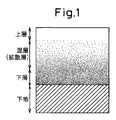
- FIG. 1 is a conceptual cross-sectional view of a coating film structure having a mixed layer (diffusion layer) of a surface-treated metal sheet according to an embodiment of the present invention.
- FIG. 2 is a conceptual cross-sectional view of a coating film structure having no conventional mixed layer (diffusion layer).
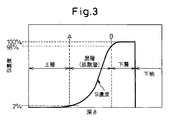
- FIG. 3 is an explanatory diagram of Si concentration distribution of a coating film having a mixed layer (diffusion layer) of a surface-treated metal plate according to an embodiment of the present invention.
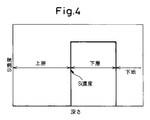
- FIG. 4 is an explanatory diagram of the Si concentration distribution of a coating film having no conventional mixed layer (diffusion layer).
- the surface-treated metal plate is a surface-treated metal plate having at least two or more coating layers on one or both surfaces of the metal plate, and an upper layer (uppermost layer) and a lower layer (immediately below the upper layer).
- Layer has a mixed layer (diffusion layer) in which the component concentrations of the upper and lower layers are continuously changing by mixing the components of each layer at the boundary with the coating layer, and the film thickness of this mixed layer (diffusion layer) Is a surface-treated metal, wherein 0.2 ⁇ t / T ⁇ 0.8, where t is T and the total thickness of the mixed layer (diffusion layer) and its upper and lower coating layers is T It is a board.
- the upper layer is an example of the first coating layer of the present invention
- the lower layer is an example of the second coating layer of the present invention.
- the lower layer is formed closer to the surface treatment substrate than the upper layer.
- the lower layer is formed on the surface treatment substrate side and immediately below the upper layer.
- the mixed layer (diffusion layer) is a new layer formed as described above by allowing the components of the upper layer and the lower layer to diffuse to each other, and the upper and lower coating layers that form the mixed layer (diffusion layer) Each component is contained in an amount of 2% by mass or more.
- This mixed layer (diffusion layer) can be generated by laminating the upper layer coating material and the lower layer coating material in a liquid state, the viscosity of each coating material being small, and the surface tension variation due to heating in the baking process. Pre-heating the uneven interface formed by a solvent-based paint having a high viscosity as shown in Patent Document 7 and the lower layer generally used in the automotive field, etc., and coating the upper layer in a semi-solidified state. Such a mixed layer (diffusion layer) cannot be produced at the interface by wet-on-wet.
- the total film thickness T can be obtained by measuring the actual film thickness.
- a known method may be applied, for example, a measurement using an electromagnetic film thickness meter, a weight method for measuring a film thickness from a coating film density by measuring a weight difference before and after the coating film coating, or coating with a corrosive liquid. Examples include an erosion method obtained by peeling a film and determining the weight, time, gas generation, and the like, and a method obtained from a result of cross-sectional observation using an optical microscope, an electron microscope (SEM), or the like.
- the film thickness t of the mixed layer (diffusion layer) can be obtained by analyzing the distribution state in the film thickness direction of components contained only in either the upper layer or the lower layer.
- the analysis method a known analysis method may be used.
- X-ray probe microanalyzer or electron beam microanalyzer EPMA
- X-ray photoelectron spectroscopy XPS
- Auger electron spectroscopy AES
- glow discharge luminescence Analyze the element concentration distribution in the depth direction of the coating film using analysis (GDS) or the like, or analyze the cross-section of the coating film to obtain the mixed layer (diffusion layer) film thickness t from the concentration distribution of the target component.
- the film thickness of an upper layer and a lower layer can be calculated
- the type and method of component analysis to be applied may be appropriately selected according to the film thickness, component amount, and the like.
- any method other than EPMA, XPS, AES, and GDS may be selected as long as the component analysis in the depth direction is possible.
- Typical examples of components that can be used for the analysis of the mixed layer (diffusion layer) include Si, Ti, P, S, Ni, Zn, Al, V, and Nb, but other components may be used.
- FIG. 2 are conceptual diagrams of cross sections for each of the coating films, and the Si concentration distribution in the film thickness direction obtained by analyzing Si in the coating film depth direction by high frequency GDS is shown in FIG. And in FIG.
- the coating layer according to this embodiment has no clear interface between the upper coating layer without Si and the lower coating layer containing Si, and is continuous.
- the presence of a mixed layer (diffusion layer) in which the Si concentration changes is recognized.
- the conventional product does not have a Si-concentration gradient structure, and an interface between the upper layer and the lower layer is recognized.
- the conditions of the mixed layer (diffusion layer) are that the components of the laminated coating film diffuse each other and both components occupy 2% by mass or more. Therefore, in the example shown in FIG. 3, the portion between the A portion and the B portion where the Si concentration is 2% by mass to 98% by mass of the lower layer concentration is a mixed layer (diffusion layer).
- a method for forming a mixed layer will be described.
- a substance having a surface active action is added to the upper and lower layers.
- the surfactant in the coating film to be laminated has a hydrophobic part at the interface between the upper layer and the lower layer.
- a molecular layer is formed so as to be oriented. Therefore, the molecular layer of the upper layer side surfactant and the molecular layer of the lower layer side surfactant are aligned through the respective hydrophobic portions at the interface between the upper layer paint and the lower layer paint, thereby forming a film (alignment film). It is considered that the interface is stable and no mixed layer (diffusion layer) is generated.
- the diffusion start temperature is preferably more than 60 ° C.
- the thickness of the diffusion layer depends on the temperature difference between the diffusion start temperature and the diffusion end temperature and the rate of temperature increase therebetween. By setting this temperature difference to 5 degrees or more and less than 40 degrees, it becomes possible to ensure the thickness of the diffusion layer required under the heating temperature raising conditions of the coating baking equipment used in general industrial production. From the viewpoint of more stable diffusion layer thickness control, the temperature difference between the diffusion start temperature and the diffusion end temperature is preferably 10 degrees or more and less than 40 degrees, and more preferably 20 degrees or more and less than 40 degrees.
- the diffusion start temperature can be controlled by the type and amount of the solvent, the solid content concentration, the type and concentration of the surfactant, and the diffusion end temperature can be controlled by the type and amount of the solvent, the solid content concentration and the heating rate. In this way, the diffusion layer can be controlled by satisfying the above-described surface tension and viscosity conditions of the coating material and further setting the diffusion start temperature and the end temperature within appropriate ranges.
- t / T is the ratio of the thickness of the mixed layer (diffusion layer) to the total thickness of all layers involved in the formation of the mixed layer (diffusion layer) and the mixed layer (diffusion layer), including the mixed layer (diffusion layer) and the upper and lower layers. It is. In the present embodiment, a range of 0.2 ⁇ t / T ⁇ 0.8 is preferable, and a range of 0.4 ⁇ t / T ⁇ 0.6 is more preferable.
- the thickness t of the mixed layer (diffusion layer) is as thin as 0.2> t / T, the effect of improving the adhesion between the layers by the mixed layer (diffusion layer) cannot be obtained stably.
- the mixed layer (diffusion layer) becomes too thick, it becomes difficult to sufficiently secure the thicknesses of the upper and lower coating layers that share the necessary functions. Therefore, when the upper layer is the uppermost layer, it becomes difficult to maintain the performance of the upper layer coating film and the lower layer coating film itself, such as poor appearance due to insufficient thickness of the uppermost layer, and the upper layer coating material and the lower layer coating material are substantially mixed. Since it becomes the same performance as the coating film formed with a coating material, the performance of the required upper layer film and lower layer film cannot be obtained.
- the thickness t of the mixed layer (diffusion layer) becomes more sufficient, and the adhesion between the layers can be further improved. Furthermore, in order to stably express the function sharing of the upper layer film or the lower layer film regardless of the type of coating film, it is preferable that the thickness t of the mixed layer (diffusion layer) is t / T ⁇ 0.6. That is, the thickness t of the mixed layer (diffusion layer) is more preferably 0.4 ⁇ t / T ⁇ 0.6.
- the total film thickness T including the mixed layer (diffusion layer), the upper layer, and the lower layer is preferably 20.0 ⁇ m or less. If the total film thickness T is thicker than 20.0 ⁇ m, an increase in the absolute amount of non-volatile components is likely to cause appearance defects such as cracks, which is not suitable. When the total film thickness T is less than 1.0 ⁇ m, it is difficult to control the mixed layer (diffusion layer), and it is impossible to substantially secure the necessary film thickness for the mixed layer (diffusion layer), the upper layer, and the lower layer. Therefore, it is impossible to secure performance by sharing the functions of each layer.
- the thickness of the lower layer is preferably 0.2 ⁇ m or more. If the film thickness of the upper layer and the lower layer is smaller than 0.2 ⁇ m, it will be difficult to exhibit the film performance of the upper and lower layers, and the performance will be substantially the same as that of a coating film obtained by coating a mixture of the upper layer paint and the lower layer paint. There is.
- the paint used in this embodiment is preferably a water-based paint whose surface tension and viscosity can be easily adjusted. Furthermore, since the above water-based paint is a water-based emulsion or dispersion paint, since the resin is dispersed, the mutual diffusion of components at the paint interface becomes easy, and a mixed layer (diffusion layer) is easily generated. preferable.
- the lower layer coating film contains at least one element selected from Si, P, and V, it is more preferable because the corrosion resistance is improved.
- Si, P, and V generally known compounds containing any one or more of Si, P, and V can be used. Examples of these include silica, aluminum phosphate, aluminum dihydrogen tripolyphosphate, magnesium dihydrogen phosphate, ammonium vanadate, vanadium oxide, and the like.
- the alkali resistance may be lowered. It is desirable that it be contained only in the coating film.
- the upper layer coating includes Si, P, and V in the lower layer. It is preferable not to include a compound containing the contained element as a component because the layer structure can be easily specified.
- a generally known metal material can be used for the metal plate used in the present embodiment.
- the metal material may be an alloy material, and examples thereof include a steel plate, a stainless steel plate, an aluminum plate, an aluminum alloy plate, a titanium plate, and a steel plate.
- the surface of these metal plates may be plated. Examples of the type of plating include zinc plating, aluminum plating, copper plating, nickel plating, and the like, and may be alloy plating thereof.
- the metal plate is a steel plate, hot-rolled steel plate, cold-rolled steel plate, hot-dip galvanized steel plate, electrogalvanized steel plate, zinc-nickel alloy plated steel plate, hot-dip galvanized steel plate, aluminum-plated steel plate, aluminum-zinc alloy
- the galvanized steel sheet is a zinc-plated steel sheet plated with zinc such as a hot-dip galvanized steel sheet or an electrogalvanized steel sheet, a zinc-nickel alloy-plated steel sheet, a hot-dip alloyed galvanized steel sheet, or an aluminum-zinc alloyed plating.
- galvanized steel sheets such as hot dip galvanized steel sheets and electrogalvanized steel sheets are more suitable because they have a large sacrificial anticorrosive effect and excellent corrosion resistance, and are also excellent in productivity and cost. .
- a known chemical conversion treatment it is more preferable to apply a known chemical conversion treatment to the surface of the metal plate because adhesion between the metal plate and the coating layer is improved.
- the chemical conversion treatment zinc phosphate chemical conversion treatment, coating chromate treatment, electrolytic chromic acid treatment, reaction chromate treatment, chromate-free chemical conversion treatment, or the like can be used.
- the chromate-free chemical conversion treatment those treated with an aqueous solution containing a silane coupling agent, a zirconium compound, a titanium compound, tannin or tannic acid, a resin, silica and the like are known, and Japanese Patent Laid-Open No. 53-9238 is known.
- JP-A-9-241576, JP-A-2001-89868, JP-A-2001-316845, JP-A-2002-60959, JP-A-2002-38280, JP-A-2002-266081 You may use the well-known technique described in Kaikai 2003-353464.
- a commercially available chromate-free chemical conversion treatment “CT-E300N” manufactured by Nippon Parkerizing Co., Ltd., a trivalent chromium-based chemical conversion treatment coating “Surf Coat NRC1000” manufactured by Nippon Paint Co., Ltd., etc. are used. can do.
- the surface-treated metal plate according to this embodiment can be manufactured by multilayer simultaneous application or wet-on-wet coating. That is, a mixed layer (diffusion layer) in which components of each layer are mixed can be produced by bringing the upper layer paint and the lower layer paint into contact with each other in liquid form.
- the upper and lower layers can be regarded as the upper layer and the lower layer in the same manner as in this embodiment.
- the surface-active substance contained in the upper and lower layers may be any substance that has both a hydrophobic part and a hydrophilic part.
- resins such as polyvinyl alcohol and polyethylene glycol, synthetic products thereof, and commercially available leveling agents , Surfactants, antifoaming agents, resin dispersants and the like may be mentioned, but other than these may be used.
- Multi-layer simultaneous application is a method in which a multi-layer coating is applied to a substrate in a state of being laminated simultaneously using a slot die coater or a slide hopper type curtain coater, and then the multi-layer simultaneous application is simultaneously dried and baked. It is.
- wet-on-wet coating means that once a paint is applied on a substrate, another paint is applied on the wet state before the paint is dried, and the laminated multilayer paint is applied. It is a method of drying and baking at the same time.
- a wet-on-wet coating method after a single coating layer is applied by a generally known coating method such as roll coater, dip, curtain flow coater, roller curtain coater, etc., before this coating layer is dried and baked Furthermore, it is applied by a method that can be applied in a non-contact manner with a generally known substrate such as curtain flow coating, roller curtain coating, slide hopper type curtain coater, slot die coater, etc. It can be painted by dry baking at the same time. Moreover, as a multilayer simultaneous application method, the method of apply
- the mixed layer (stable mixed layer) (Diffusion layer) generation and film thickness control can be achieved.
- ⁇ 20 mN / m or less
- a sufficiently thick mixed layer (diffusion layer) can be formed, and the interlayer adhesion is further improved.
- ⁇ 2 mN / m or more
- the film thicknesses of the upper layer coating film and the lower layer coating film become sufficient, and the performance of each of the upper layer coating film and the lower layer coating film can be more stably ensured.
- ⁇ is ⁇ 10 mPa ⁇ s or more, the film thickness of the upper layer coating film and the lower layer coating film becomes sufficient, and the performance of each of the upper layer coating film and the lower layer coating film can be secured more stably. .
- ⁇ is 0 mPa ⁇ s or more, the performance of each of the upper coating film and the lower coating film can be more stably ensured. Further, when ⁇ is 200 mPa ⁇ s or less, it is possible to form a mixed layer (diffusion layer) with a sufficient thickness, so that the interlayer adhesion is further improved.
- the surface tension in the present invention can be measured by a platinum ring pulling method at 20 ° C.
- the viscosity can be measured at 20 ° C. using a B-type viscometer.
- the surface tension of the upper layer and the lower layer is more preferably 20 to 50 mN / m. When it is less than 20 mN / m, bubbles tend to enter the coating liquid, and when it is larger than 50 mN / m, the coating liquid contracts and cannot be sufficiently concealed.
- a low-viscosity paint having a viscosity of 250 mPa or less for both the upper layer coating material and the lower layer coating material.
- a mixed layer can be formed by using a low-viscosity paint and increasing the diffusion rate of the component of the paint for upper layer coating and the component of the paint for lower layer coating.
- a coating layer used for the surface-treated metal plate As a coating layer used for the surface-treated metal plate according to this embodiment, generally known coatings such as polyester resin, epoxy resin, urethane resin, olefin resin, acrylic resin, melamine resin, etc.
- a coating film can be used 1 type or in combination of 2 or more types.
- polyester resin generally known resins can be used. Examples of commercially available resins include “Byron (registered trademark) series” and “Bironal (registered trademark) series” manufactured by Toyobo Co., Ltd. and Sumika Bayer Urethane Co., Ltd. "Desmophen (registered trademark) series” or the like can be used.
- Urethane resins include “Baihydrol (registered trademark) series” manufactured by Sumika Bayer Urethane Co., Ltd., “Cosmonate (registered trademark) series” manufactured by Mitsui Chemicals, “Hicell (registered trademark) series” manufactured by Toho Chemical Industries, Ltd., DIC “Bondick (registered trademark) series” manufactured by the company can be used.
- olefin resin “Hitech (registered trademark) series” manufactured by Toho Chemical Industry Co., Ltd. can be used.
- acrylic resin “Acridic (registered trademark) series” manufactured by DIC, acrylic resin “Acryset (registered trademark) series” manufactured by Nippon Shokubai Co., Ltd., and the like can be used.
- melamine resins Mitsui Cytec's melamine resins "Cymel (registered trademark) series” and “My Coat (registered trademark) series”, DIC's "Beccamin (registered trademark) series”, “Super Becamine (registered) Trademark) series "can be used.
- a surfactant including an antifoaming agent and a leveling agent.
- Known surfactants can be used, and examples of commercially available ones include BYK-333 and BYK-307 from BYK and Ermagen from Kao, but there are many others depending on the paint. It can be added as appropriate.
- adjustment methods other than surfactants such as dilution and mixing with another solvent, may be used. If the surface tension is too large, the paintability may be deteriorated. Therefore, the surface tension of both the upper layer coating material and the lower layer coating material is preferably 50 mN / m or less.
- a thickener including a rheology modifier and a viscosity modifier
- Any thickener may be used as long as it is publicly known, and examples of commercially available ones include BYK-411 and BYK-425 manufactured by BYK. There are countless others, and they can be appropriately added depending on the paint. That's fine. Moreover, you may be adjustment methods other than a thickener, such as mixing dilution or another solvent, or increasing the ratio of a solid component.
- a low-viscosity paint having a viscosity of 250 mPa or less for both the upper layer coating material and the lower layer coating material.
- a mixed layer can be formed by using a low-viscosity paint and increasing the diffusion rate of the component of the paint for upper layer coating and the component of the paint for lower layer coating.
- the surface-treated metal plate according to the present embodiment may be further provided with performance by providing different coating layers on the upper layer of the upper layer coating or the lower layer of the lower layer coating as necessary. .
- the metal plate of this embodiment is a galvanized steel sheet, in a line having wet-on-wet coating equipment or simultaneous multi-layer coating equipment after the plating process of continuous electroplated steel sheet equipment or continuous hot-dip galvanized steel sheet equipment
- coat before the oxide film of a plating metal surface is formed and the cissing appearance defect by an oxide film does not occur.
- the baking process of a lower layer coating film can be omitted, the productivity of the coating line can be improved, and the manufacturing cost can be reduced.
- dry baking methods such as a hot air oven, a direct type oven, a far-infrared oven, and a dielectric superheated oven can be used.
- Example-1 The details of Example-1 are described below.
- Lower layer coating resin A A polyolefin resin “HITEC AR-2300” manufactured by Toho Chemical Industries, Ltd. was used.
- Resin B Acrylic resin “Acridic ACRYDICA-405” manufactured by DIC was used.
- Resin C A water-dispersed polyester resin “Vylonal MD-1400” manufactured by Toyobo Co., Ltd. was used.
- -V containing rust preventive agent Vanadium oxide (Kanto Chemical) which is a reagent was used.
- Upper layer coating resin D An aqueous polyurethane “Bihydrol PR135” manufactured by Sumika Bayer Urethane Co., Ltd. was used.
- Resin E An epoxy resin “jER (registered trademark) series W1144R55” manufactured by Japan Epoxy Resin Co., Ltd. was used.
- -Ti-containing rust preventive agent Titanium chloride (III) (Kanto Chemical) was used.
- -V containing rust preventive agent Vanadium oxide (Kanto Chemical) which is a reagent was used.
- the value of (surface tension of lower layer: ⁇ 2) ⁇ (surface tension of upper layer: ⁇ 1) is ⁇
- the value of (lower layer viscosity: ⁇ 2) ⁇ (upper layer viscosity: ⁇ 1) is represented by ⁇ .
- the surface tension was adjusted in the range of 20 to 50 mN / m and the viscosity in the range of 1 to 250 mPa so as not to impair the paintability so as to satisfy the conditions of the present application.
- test plate Various metal plates were degreased by immersing them in an aqueous solution of FC-4336 (manufactured by Nihon Parkerizing) having a temperature of 60 ° C. and a concentration of 2% by mass, and washed with water. After that, it was dried.
- FC-4336 manufactured by Nihon Parkerizing
- the lower layer paint and the upper layer paint are simultaneously laminated on the metal plate with a slide popper type curtain coater, and the laminated paint is simultaneously applied under the condition that the ultimate plate temperature of the metal plate is 180 ° C. in an induction heating furnace in which hot air is blown.
- a test plate was obtained by drying and baking and water-cooling (the test plate produced by this method is hereinafter referred to as “2 coat 1 bake” or “2C1B”).
- the upper layer paint is applied wet-on-wet with a slide popper type curtain coater, and the reached plate temperature of the metal plate is increased in an induction heating furnace in which hot air is blown into the laminated paint.
- a test plate was obtained by simultaneous drying and baking under conditions of 180 ° C. and water cooling (the test plate prepared by this method is hereinafter referred to as “Wet on Wet 2 Coat 1 Bake” or “WOW2C1B”).
- the lower layer paint is coated on a metal plate with a roll coater, dried and baked at the same time in an induction heating furnace in which hot air is blown under the condition that the ultimate plate temperature of the steel plate is 180 ° C., water-cooled, and then overcoated on it.
- the pre-coated steel sheet is hereinafter referred to as [2 coat 2 bake] or “2C2B”).
- the lower layer paint or the upper layer paint is applied with a roll coater, dried and baked at the same time when the ultimate temperature of the metal plate reaches 180 ° C. in an induction heating furnace blown with hot air, and water-cooled to obtain a test plate.
- the precoated steel sheet produced by this method is hereinafter referred to as [1 coat 1 bake] or “1C1B”).
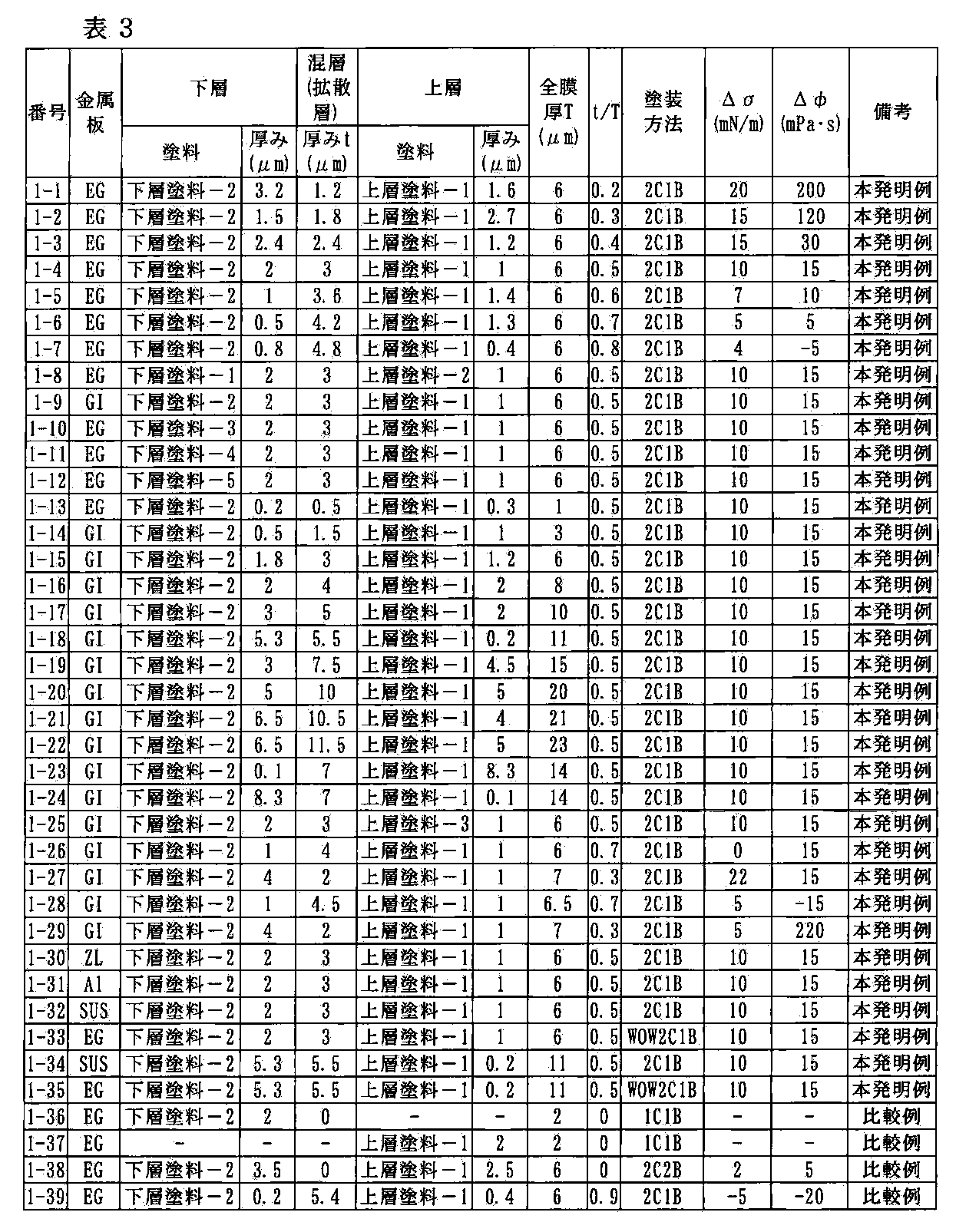
- the total film thickness T was determined from an electron microscope observation photograph.
- the upper layer thickness, the lower layer thickness, and the mixed layer (diffusion layer) thickness were Si, P in the depth direction of the coating film using System 3860 manufactured by Rigaku Denki Kogyo Co., Ltd. under the conditions of a discharge power of 30 W and an argon flow rate of 250 ml / min. V, Ti spectral intensities were measured, and the sampling time was converted to film thickness from the relationship between the sampling time and the total film thickness.
- the interface between the upper layer and the mixed layer (diffusion layer) has a maximum Si concentration or a concentration of 2% by mass with respect to the P concentration, V concentration, and Ti concentration, and the interface between the mixed layer (diffusion layer) and the lower layer has the maximum Si concentration.
- the concentration is 98% by mass with respect to the P concentration, the V concentration, and the Ti concentration.
- Interlayer adhesion test Draw 100 squares of 1 mm square on the painted surface to reach the substrate, and peel off with cello tape (registered trademark). The evaluation was divided into the following ranks according to the number of residual grids after the tape peeling of the lower layer coating film. Since the part adhered to the cello tape (registered trademark) and the test plate after peeling are dyed with methyl violet, the stained part is matched, so the upper layer coating film and the lower layer coating film are not peeled off together. It was found that peeling occurred between the upper layer and the lower layer.
- ⁇ Number of remaining grids 100: Number of remaining grids 95 or more
- ⁇ Number of remaining grids 80 or more
- test plate was extruded 8 mm with an Erich Centa tester, and then a cellophane (registered trademark) tape (manufactured by Nichiban) was applied to the extruded portion and forcedly peeled off.
- a cellophane (registered trademark) tape manufactured by Nichiban
- Appearance Evaluation A product having a beautiful appearance was evaluated as ⁇ , and a sample having unevenness was evaluated as ⁇ .
- Table 4 shows the evaluation results of the metal plates produced.
- Single-layer coating films (Nos. 1-36, 37) have poor alkali resistance or poor corrosion resistance.
- the metal plate of the present invention in which these coating films are designed as upper and lower layers is excellent in interlayer adhesion, alkali resistance, workability, corrosion resistance, and appearance.
- the range of 0.4 ⁇ t / T ⁇ 0.6 is particularly excellent and more preferable.
- the corrosion resistance tended to be slightly inferior to that of the surface-treated metal plate including the rust preventive pigment in the lower layer (No. 1-8).
- the alkali resistance as the upper layer performance tends to be slightly inferior, and 0.2 ⁇ m or more is preferable.
- the lower layer is less than 0.2 ⁇ m (number 1-23), the corrosion resistance that is the lower layer performance tends to be slightly inferior, and 0.2 ⁇ m or more is preferable.
- Example-2 Metal plate A hot-dip galvanized steel sheet “Silver Zinc (registered trademark)” (hereinafter referred to as GI) manufactured by Nippon Steel Corporation was used as a plate. A plate thickness of 0.6 mm was used.
- Resin F A silicone resin “Silicone Smile Clean” manufactured by DNT was used.
- Resin G A water-dispersed polyester resin “Vylonal MD-1200” manufactured by Toyobo Co., Ltd. was used.
- Fluorine resin “FLUON PTFE” manufactured by AGC was added in an amount of 5 to 20 parts by mass based on the resin solid content.
- test plate Degrease by immersing various metal plates in FC-4336 (manufactured by Nihon Parkerizing) aqueous solution having a temperature of 60 ° C and a concentration of 2% by mass, followed by washing with water , Dried.
- the lower layer paint and the upper layer paint are simultaneously laminated on the metal plate with a slide popper type curtain coater, and the laminated paint is simultaneously applied under the condition that the ultimate plate temperature of the metal plate is 180 ° C. in an induction heating furnace in which hot air is blown.
- a test plate was obtained by drying and baking and water-cooling (the test plate produced by this method is hereinafter referred to as “2 coat 1 bake” or “2C1B”).
- the lower layer paint is coated on a metal plate with a roll coater, dried and baked simultaneously in an induction heating furnace in which hot air is blown in a condition where the ultimate plate temperature of the steel plate is 180 ° C., water-cooled, and then the upper layer paint thereon was coated with a roll coater, dried and baked simultaneously in an induction heating furnace blown with hot air under the condition that the ultimate temperature of the metal plate was 180 ° C., and water-cooled to obtain a test plate (produced by this method)
- the pre-coated steel sheet is hereinafter referred to as [2 coat 2 bake] or “2C2B”).
- the lower layer paint or the upper layer paint is applied with a roll coater, dried and baked at the same time when the ultimate temperature of the metal plate reaches 180 ° C. in an induction heating furnace blown with hot air, and water-cooled to obtain a test plate.
- the precoated steel sheet produced by this method is hereinafter referred to as [1 coat 1 bake] or “1C1B”).
- the total film thickness T was determined from an electron microscope observation photograph.
- the upper layer thickness, the lower layer thickness, and the mixed layer (diffusion layer) thickness were measured using a System 3860 manufactured by Rigaku Denki Kogyo Co., Ltd., with a discharge power of 30 W and an argon flow rate of 250 ml / min.
- the intensity was measured, and the sampling time was converted into a film thickness from the relationship between the sampling time and the total film thickness.
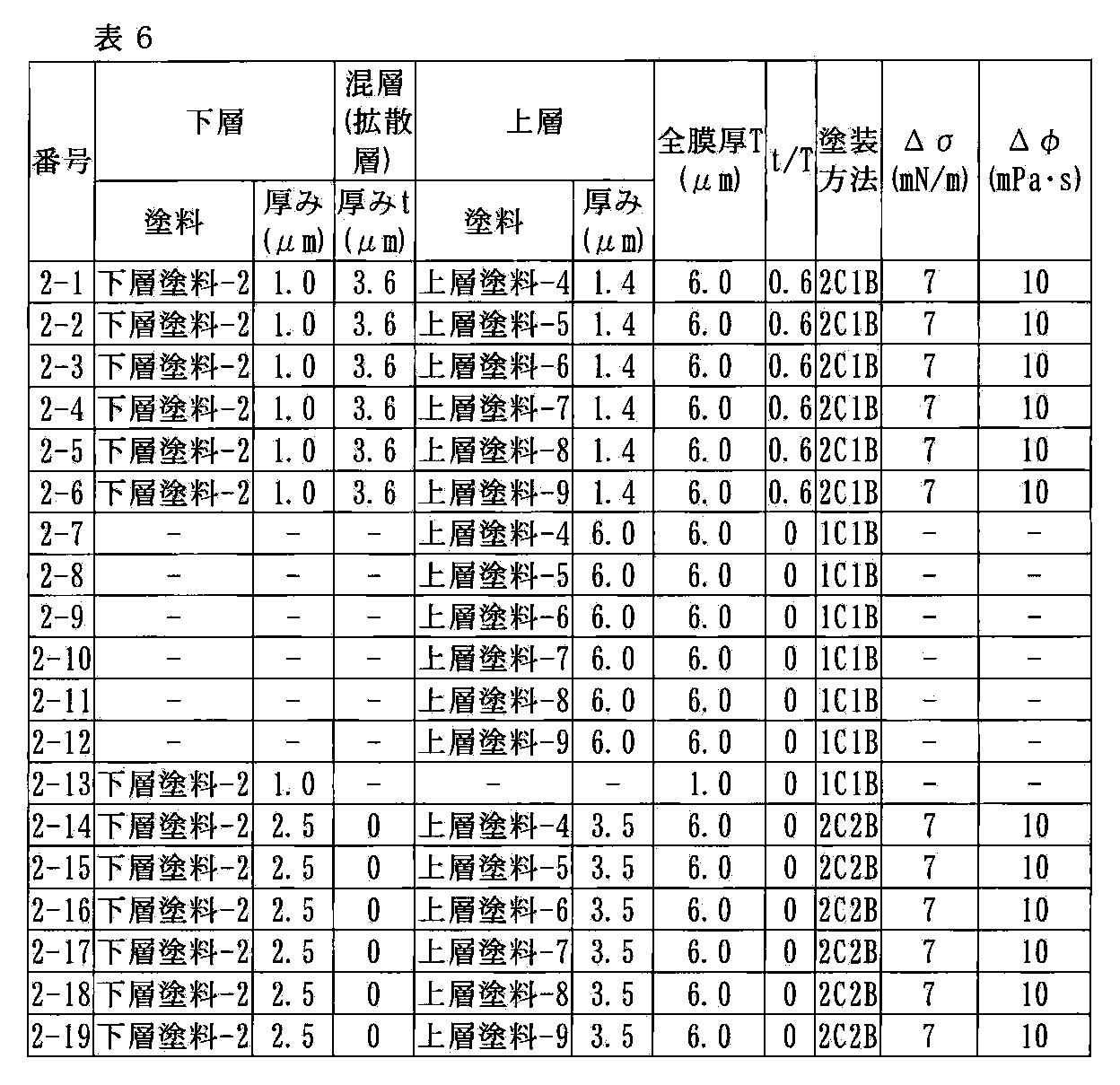
- the interface between the upper layer and the mixed layer (diffusion layer) has a concentration of 2% by mass with respect to the maximum P concentration, and the interface between the mixed layer (diffusion layer) and the lower layer has a concentration of 98% by mass with respect to the maximum P concentration. It shall be shown. From this, the upper layer thickness, the mixed layer (diffusion layer) thickness, and the lower layer thickness were determined. The produced test plates are summarized in Table 6.
- Contamination resistance A solution obtained by adding 20% by mass of commercially available carbon black as a contaminant to “G-6216FS” manufactured by Nippon Kogyo Co., Ltd., which is a volatile lubricating oil, was applied to the surface of the coating film, and then applied to the coating surface. It was left in the atmosphere for 24 hours. The coating film appearance after wiping off the coating film surface with ethanol after standing was visually observed. And the case where the black contaminant was not adhering was evaluated as (circle), and the case where the coating-film surface layer was contaminated black was evaluated as x.
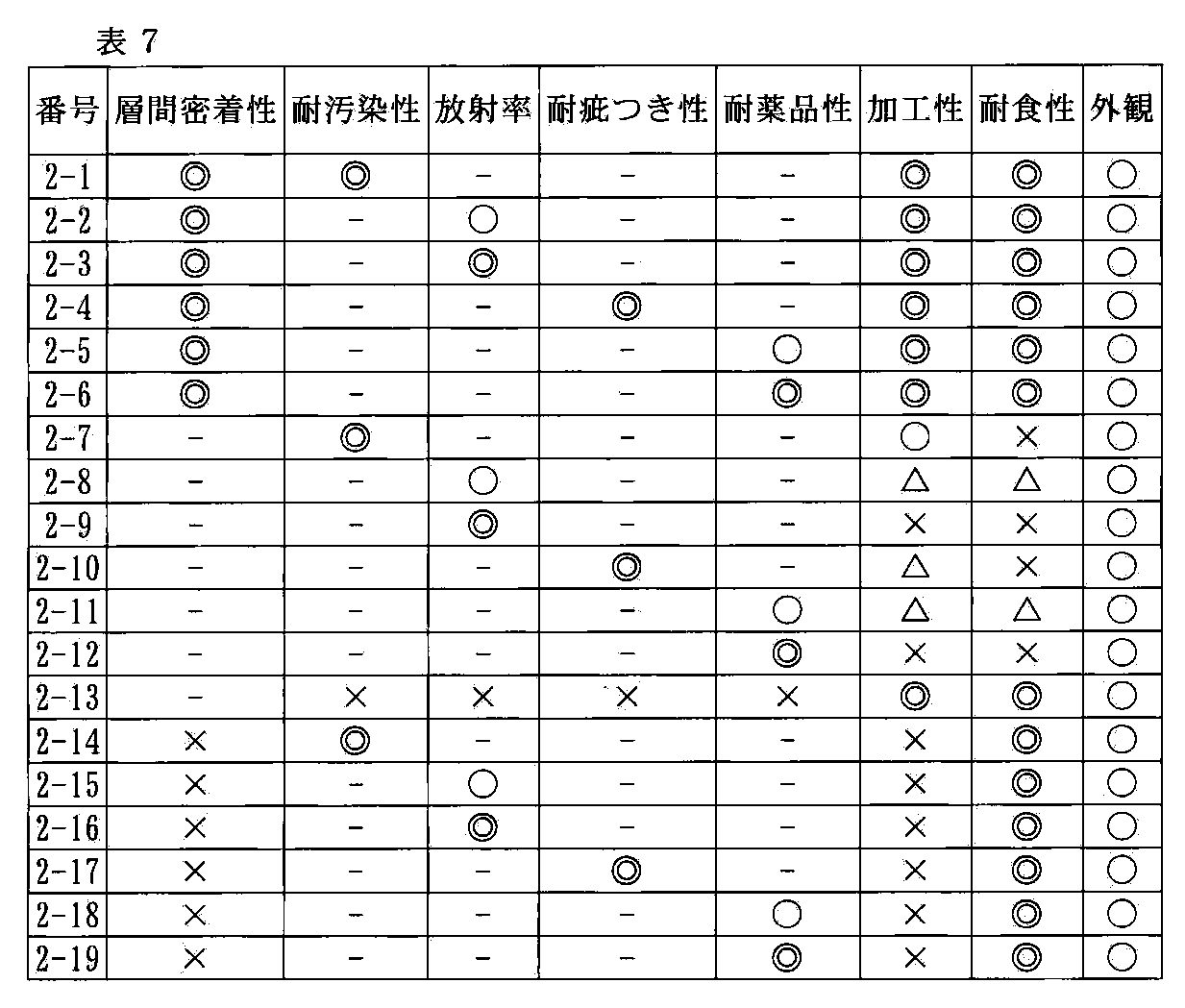
- Table 7 shows the evaluation results of the metal plates produced.
- the surface-treated metal plate having only a single upper coating layer was inferior in workability and corrosion resistance (numbers 2-7 to 2-12).
- the surface-treated metal plate having only a single lower layer coating film was inferior in contamination resistance, emissivity, scratch resistance, and chemical resistance (No. 2-13).
- the surface-treated metal plate according to the present invention is excellent in workability and corrosion resistance, stain resistance (No. 2-1), emissivity (No. 2-2, 3), scratch resistance (No. 2-4), It was also excellent in chemical properties (numbers 2-5 and 6).
- the surface-treated metal plate according to the present invention was excellent in workability and corrosion resistance (Nos. 2-2 and 3).
- the fluororesin was added, the chemical resistance tended to be excellent, but the workability and corrosion resistance tended to be inferior (numbers 2-11, 12).
- the surface-treated metal plate according to the present invention was excellent in workability and corrosion resistance (Nos. 2-5 and 6).
- test plates Nos. 2-14 to 2-19
- 2C2B had a mixed layer (diffusion layer) thickness t of 0, that is, t / T was 0, so that workability and interlayer adhesion were inferior.
Landscapes
- Chemical & Material Sciences (AREA)
- Engineering & Computer Science (AREA)
- Materials Engineering (AREA)
- Wood Science & Technology (AREA)
- General Chemical & Material Sciences (AREA)
- Chemical Kinetics & Catalysis (AREA)
- Life Sciences & Earth Sciences (AREA)
- Mechanical Engineering (AREA)
- Metallurgy (AREA)
- Organic Chemistry (AREA)
- Laminated Bodies (AREA)
- Other Surface Treatments For Metallic Materials (AREA)
- Application Of Or Painting With Fluid Materials (AREA)
Abstract
Description
(1)金属板の片面または両面に、配合成分が異なる少なくとも2層以上の塗膜層を有する表面処理金属板において、上層側の第1の塗膜層と当該第1の塗膜層の直下にある第2の塗膜層との境界部に各層の成分が混在する拡散層が形成され、前記拡散層の膜厚をtとし、前記拡散層、前記第1の塗膜層、及び前記第2の塗膜層の総膜厚をTとしたとき、0.2≦t/T≦0.8であることを特徴とする、表面処理金属板。
(2)前記t/Tが、0.4≦t/T≦0.6であることを特徴とする、前記(1)に記載の表面処理金属板。
(3)前記膜厚総Tが1.0μm≦T≦20.0・μmであることを特徴とする、前記(1)または(2)に記載の表面処理金属板。
(4)前記第1の塗膜層の膜厚が、0.2μm以上であることを特徴とする、前記(1)~(3)のいずれかに記載の表面処理金属板。
(5)前記第2の塗膜層の膜厚が、0.2μm以上であることを特徴とする、前記(1)~(4)のいずれかに記載の表面処理金属板。
(6)前記第1の塗膜層と前記第2の塗膜層とが、各々水系塗料によって形成されることを特徴とする、上記(1)~(5)のいずれかに記載の表面処理金属板。
(7)前記水系塗料が、水系ディスパージョン塗料もしくはエマルジョン塗料であることを特徴とする、前記(6)に記載の表面処理金属板。
・前記、水系塗料が、界面活性作用のある物質を含むことを特徴とする、前記(6)、(7)に記載の表面処理金属板。
(8)前記第2の塗膜層にSi、P、及びVの中から選択されるいずれか一つ以上の元素を成分とする化合物からなる防錆顔料1種または複数種含有し、前記第1の塗膜層にはSi、P、及びVの内、前記第2の塗膜層に含まれる元素を成分とする化合物を含まないことを特徴とする、前記(1)~(7)のいずれかに記載の表面処理金属板。
(9)前記金属板が亜鉛系めっき鋼板であることを特徴とする、前記(1)~(8)のいずれかに記載の表面処理金属板。
(10)前記(1)~(9)のいずれかに記載の表面処理金属板の製造方法であって、
金属板の片面または両面に、前記第1の塗膜層を形成する第1の塗料および前記第2の塗膜層を形成する第2の塗料をそれぞれウェットオンウェット方式もしくは同時多層塗布方式によって塗布することで前記第1の塗膜層と前記第2の塗膜層との境界部に各層の成分が混在する拡散層を形成し、且つ、白金リング引き上げ法によって測定される前記第1の塗料の20℃における表面張力(σ1)と前記第2の塗料の20℃における表面張力(σ2)との差(Δσ=σ2−σ1)が2~20mN/mであり、B型粘度計により測定される前記第1の塗料の20℃における粘度(φ1)と前記第2の塗料の20℃における粘度(φ2)との差(Δφ=φ2−φ1)が−10~200mPa・sであることを特徴とする、表面処理金属板の製造方法。
図2は、従来の混層(拡散層)のない塗膜構造に断面概念図である。
図3は、本発明の実施形態に係る表面処理金属板の混層(拡散層)を有する塗膜のSi濃度分布の説明図である。
図4は、従来の混層(拡散層)のない塗膜のSi濃度分布の説明図である。
本発明の一実施形態に係る表面処理金属板は、金属板の片面または両面に、少なくとも2層以上の塗膜層を有する表面処理金属板において、上層(最上層)と下層(上層の直下の層)の塗膜層との境界部に各層の成分が混在することで上下各層の成分濃度が連続的に変化している混層(拡散層)を有し、この混層(拡散層)の膜厚をtとし、混層(拡散層)及びその上層と下層の塗膜層との総膜厚をTとしたとき、0.2≦t/T≦0.8であることを特徴とする表面処理金属板である。なお、本実施形態において、上層とは、本発明の第1の塗膜層の一例であり、下層とは、本発明の第2の塗膜層の一例である。また、上層よりも下層は、表面処理基板により近い側に形成される。このように、例えば、下層は、表面処理基板側であって、上層の直下に形成される。
この混層(拡散層)は上層用塗料と下層用塗料とを液体の状態で積層させること、かつ各々塗料の粘度が小さいこと、更に焼付け工程での加熱による表面張力の変動により生成が可能となるものであって、特許文献7で示されるような粘度の高い溶剤系塗料により形成される凹凸の界面や一般に自動車分野等で用いられている下層をプレヒートし半固化状態で上層を重ねて塗装するウェットオンウェットによる界面ではこのような混層(拡散層)を作製することはできない。
全膜厚Tは、実際の塗膜膜厚を測定し求めることができる。測定方法は、公知の方法を適用すればよく、例えば、電磁式膜厚計での測定や塗膜付着前後の重量差を測定し塗膜密度から膜厚を測定する重量法、腐食液で塗膜を剥がし、重量、時間、ガスの発生などにより求める侵食法、光学顕微鏡や電子顕微鏡(SEM)等を用いて断面観察した結果から求める方法などが挙げられる。
混層(拡散層)の膜厚tは、上層、又は下層のいずれか一方にのみ含まれる成分の膜厚方向の分布状態を分析することによって求めることが出来る。分析方法は、公知の分析方法を使用すればよく、例えば、X線プローブマイクロアナライザーもしくは電子線マイクロアナライザー(EPMA)、X線光電子分光分析(XPS)、オージェ電子分光分析(AES)、グロー放電発光分析(GDS)等を利用して、塗膜の深さ方向の元素濃度分布を分析するか、或いは塗膜断面からの分析により、対象となる成分の濃度分布から混層(拡散層)膜厚t及び上層、下層の膜厚を求めることができる。適用する成分分析の種類や方法は、膜厚、成分量などに応じて適宜選択して行えばよい。EPMA、XPS、AES、GDS以外であっても深さ方向の成分分析が可能な方法であれば選択してかまわない。混層(拡散層)の分析に使用可能な成分の代表例としては、Si、Ti、P、S、Ni、Zn、Al、V、Nb等が挙げられるが、これ以外であってもかまわない。
この上下塗料層界面の表面張力バランスが崩れることによる拡散開始温度が低すぎると、拡散層が厚くなりすぎる、或いは下層塗料が上層塗料の表面に露出する層不良が発生する等の問題が起きやすくなるため、拡散開始温度は60℃超が好ましい。
拡散開始温度は溶媒の種類と量、固形分濃度、界面活性剤の種類と濃度により、拡散終了温度は溶媒の種類と量、固形分濃度及び昇温速度により制御できる。
このように、前述した塗料の前記表面張力、粘度の条件を満たし、さらにこの拡散開始温度と終了温度を適切な範囲に設定することで拡散層を制御することができる。
以下に実施例−1の詳細について記載する。
新日本製鐵株式会社製の溶融亜鉛めっき鋼板「シルバージンク(登録商標)」(以降、GIと称す)、新日本製鐵株式会社製の電気亜鉛めっき鋼板「ジンコート(登録商標)」(以降、EGと称す)、新日本製鐵株式会社製の亜鉛−ニッケル合金めっき鋼板「ジンクライト(登録商標)」(以降、ZLと称す)、アルミニウム板「JIS3004」(以降、Al)、ステンレス鋼板「SUS430」(以降、SUS)を原板として使用した。板厚は0.6mmのものを使用した。
樹脂A:
東邦化学工業株式会社製のポリオレフィン樹脂「ハイテックAR−2300」を用いた。
樹脂B:
DIC社製のアクリル樹脂「アクリディックACRYDICA−405」を用いた。
樹脂C:
東洋紡績社製水分散ポリエステル樹脂「バイロナールMD−1400」を用いた。
日本アエロジル社製のシリカ「AEROSIL(登録商標)200」(平均粒径:約12nm)を用いた。
・P含有防錆剤
試薬であるリン酸二水素マグネシウム(関東化学)を用いた。
・V含有防錆剤
試薬である酸化バナジウム(関東化学)を用いた。
これらの樹脂と顔料を表1に示す組み合わせで配合し、塗料を調合した。防錆剤は樹脂固形分に対して1質量部添加した。

樹脂D:
住化バイエルウレタン株式会社製の水性ポリウレタン「バイヒドロールPR135」を用いた。
樹脂E:
ジャパンエポキシレジン社製のエポキシ樹脂「jER(登録商標)シリーズW1144R55」を用いた。
・Ti含有防錆剤
塩化チタン(III)(関東化学)を用いた。
・V含有防錆剤
試薬である酸化バナジウム(関東化学)を用いた。
これらの樹脂と顔料を表2に示す組み合わせで配合し、塗料を調合した。防錆剤は樹脂固形分100質量に対して1質量部で添加した。

上層及び下層の塗料に界面活性剤BYK−333(BYK社製)、BYK−307(BYK社製)および増粘剤BYK−425(BYK社製)を添加し、表面張力および粘度を調整した。成膜後の皮膜性能に影響がないよう、界面活性剤および増粘剤の添加量は塗料に対する濃度で1.0質量%以下とした。表面張力は、BYK社製ダイノメーターを用い、20℃における白金リング引き上げ法によって測定した。粘度は、B型粘度計(東京計器社製)を用い、20℃で測定した。(下層の表面張力:σ2)−(上層の表面張力:σ1)の値をΔσとし、(下層の粘度:φ2)−(上層の粘度:φ1)の値をΔφで表す。尚、表面張力は塗装性を損なわないよう20~50mN/mの範囲で、粘度は1~250mPaの範囲で、本願の条件を満たす様調整した。
各種金属板を、温度が60℃であって、濃度が2質量%であるFC−4336(日本パ−カライジング製)の水溶液中に10秒間浸漬することで脱脂を行い、水洗後、乾燥した。
素地に達するように、塗装面に1mm四方の碁盤目を100個描き、セロテープ(登録商標)で剥離する。下層塗膜のテープ剥離後の残存碁盤目数により下記のランクに分けて評価した。セロテープ(登録商標)に付着した部分と、剥離した後の試験板をメチルバイオレットで染色し、染色された部分が一致したことから、上層塗膜と下層塗膜がともに剥離することはなく、剥離した場合は上層と下層との層間で剥離したことが分かった。
◎:残存碁盤目数100個
○:残存碁盤目数95個以上
△:残存碁盤目数80個以上
×:残存碁盤目数80個未満
試験板を55℃のアルカリ脱脂剤(サーフクリーナー53、日本ペイント社製)2%水溶液(pH12.5)に攪拌しながら30分間浸漬した後の皮膜状態を観察し、皮膜残存面積%を下記基準で評価した。
◎:剥離なし
○:剥離が10%未満
△:剥離が50%未満
×:剥離が50%以上
試験板をエリクセンテスターにて8mm押出し加工した後、押出し部にセロハン(登録商標)テープ(ニチバン製)を貼り、強制剥離した。剥離なしの場合を○、剥離ありの場合を△、完全剥離の場合を×として評価した。
試験板のエッジ、裏面をテープシールし、SST(JIS−Z−2371)試験を行った。72時間後の白錆発生状況を観察し、白錆発生面積%を下記基準で評価した。
○:白錆発生なし
△:白錆発生が10%未満
×:白錆発生が10%以上
外観が美麗なものを○、むらが見られるものを×として評価した。
表4に作製した金属板の評価結果を示す。

1.金属原板
新日本製鐵株式会社製の溶融亜鉛めっき鋼板「シルバージンク(登録商標)」(以降、GIと称す)を原板として使用した。板厚は0.6mmのものを使用した。
実施例1と同じ下層塗料−2を用いた。
樹脂として、実施例1と同じ樹脂Bと樹脂D、及び以下に示す樹脂Fと樹脂Gを用いた。
樹脂F:
DNT社製のシリコーン樹脂「シリコーンスマイルクリーン」を用いた。
樹脂G:
東洋紡績社製水分散ポリエステル樹脂「バイロナールMD−1200」を用いた。

実施例1と同様に調整した。
各種金属板を、温度が60℃であって、濃度が2質量%であるFC−4336(日本パ−カライジング製)水溶液中に10秒間浸漬することで脱脂を行い、水洗後、乾燥した。
実施例1と同様にして行った。
揮発性の潤滑油である日本工作油社製の「G−6216FS」に汚染物として市販のカーボンブラックを20質量%添加して攪拌した溶液を、塗膜表面に塗布し、50℃雰囲気中に24時間放置した。放置後に塗膜表面をエタノールで拭き取った後の塗膜外観を目視観察した。そして、黒い汚染物が付着していなかった場合を○、塗膜表層が黒く汚染されている場合を×と評価した。
日本分光社製のフーリエ変換赤外分光光度計「VALOR−III」を用いて、作製した金属板の板温を80℃にしたときの波数600~3000cm−1の領域における赤外発光スペクトルを測定し、これを標準黒体の発光スペクトルと比較することで、金属板の全放射率を測定した。なお、標準黒体は、鉄板にタコスジャパン社販売(オキツモ社製造)の「THI−1B黒体スプレー」を30±2μmの膜厚でスプレー塗装したものを用いた。
ラビングテスターに設置後、直径10mmのステンレス球を、荷重4.9033N(0.5kgf)、1回(往復)/secの条件で5回(往復)ラビングした後の試験板表面の疵つき具合を下記基準で評価した。
◎:全く疵跡がない。
○:かすかに疵跡が残る。
△:疵跡が残る。
×:金属光沢の疵跡が残る。
試験板をラビングテスターに設置後、エタノールを含浸させた脱脂綿を49.033kpa(0.5kgf/cm2)の荷重で10回(往復)、及び、ケロシン含浸させた脱脂綿を49.033kpa(0.5kgf/cm2)の荷重で50回(往復)擦った後の皮膜状態を下記の評価基準で評価した。
◎:擦り面に全く跡が付かない
○:擦り面にわずかに跡が付く
△:擦り面に白い跡が付く
×:擦り面に皮膜がなくなる
実施例1と同様にして行った。
実施例1と同様にして行った。
実施例1と同様にして行った。
Claims (10)
- 金属板の片面または両面に、配合成分が異なる少なくとも2層以上の塗膜層を有する表面処理金属板において、
上層側の第1の塗膜層と当該第1の塗膜層の直下にある第2の塗膜層との境界部に各層の成分が混在する拡散層が形成され、
前記拡散層の膜厚をtとし、前記拡散層、前記第1の塗膜層、及び前記第2の塗膜層の総膜厚をTとしたとき、0.2≦t/T≦0.8であることを特徴とする、表面処理金属板。 - 前記t/Tが、0.4≦t/T≦0.6であることを特徴とする、請求項1に記載の表面処理金属板。
- 前記総膜厚Tが、1.0μm≦T≦20.0μmであることを特徴とする、請求項1または2に記載の表面処理板。
- 前記第1の塗膜層の膜厚が、0.2μm以上であることを特徴とする、請求項1~3のいずれか1項に記載の表面処理金属板。
- 前記第2の塗膜層の膜厚が、0.2μm以上であることを特徴とする、請求項1~4のいずれか1項に記載の表面処理金属板。
- 前記第1の塗膜層と前記第2の塗膜層とが、各々水系塗料によって形成されることを特徴とする、請求項1~5のいずれか1項に記載の表面処理金属板。
- 前記水系塗料が、水系ディスパージョン塗料もしくは水系エマルジョン塗料であることを特徴とする、請求項6に記載の表面処理金属板。
- 前記第2の塗膜層にSi、P、及びVの中から選択されるいずれか一つ以上の元素を成分とする化合物からなる防錆顔料を1種または複数種含有し、前記第1の塗膜層にはSi、P、及びVの内、前記第2の塗膜層に含まれる元素を成分とする化合物を含まないことを特徴とする、請求項1~7のいずれか1項に記載の表面処理金属板。
- 前記金属板が亜鉛系めっき鋼板であることを特徴とする、請求項1~8のいずれか1項に記載の表面処理金属板。
- 請求項1~9のいずれか1項に記載の表面処理金属板の製造方法であって、 金属板の片面または両面に、前記第1の塗膜層を形成する第1の塗料および前記第2の塗膜層を形成する第2の塗料をそれぞれウェットオンウェット方式もしくは同時多層塗布方式によって塗布して、乾燥焼付けすることで前記第1の塗膜層と前記第2の塗膜層との境界部に各層の成分が混在する拡散層を形成することを特徴とし、さらに、
白金リング引き上げ法によって測定される前記第1の塗料の20℃における表面張力(σ1)と前記第2の塗料の20℃における表面張力(σ2)との差(Δσ=σ2−σ1)が2~20mN/mであり、
B型粘度計により測定される前記第1の塗料の20℃における粘度(φ1)と前記第2の塗料の20℃における粘度(φ2)との差(Δφ=φ2−φ1)が−10~200mPa・sであることを特徴とする、表面処理金属板の製造方法。
Priority Applications (5)
| Application Number | Priority Date | Filing Date | Title |
|---|---|---|---|
| JP2010538670A JP4850971B2 (ja) | 2009-05-08 | 2010-05-06 | 表面処理金属板 |
| MX2011011647A MX2011011647A (es) | 2009-05-08 | 2010-05-06 | Placa de metal tratada en la superficie. |
| KR1020117026534A KR101166212B1 (ko) | 2009-05-08 | 2010-05-06 | 표면 처리 금속판 |
| US13/319,251 US8658275B2 (en) | 2009-05-08 | 2010-05-06 | Surface-treated metal plate |
| CN2010800201852A CN102421595B (zh) | 2009-05-08 | 2010-05-06 | 表面处理金属板 |
Applications Claiming Priority (2)
| Application Number | Priority Date | Filing Date | Title |
|---|---|---|---|
| JP2009113903 | 2009-05-08 | ||
| JP2009-113903 | 2009-05-08 |
Publications (1)
| Publication Number | Publication Date |
|---|---|
| WO2010128684A1 true WO2010128684A1 (ja) | 2010-11-11 |
Family
ID=43050180
Family Applications (1)
| Application Number | Title | Priority Date | Filing Date |
|---|---|---|---|
| PCT/JP2010/058074 Ceased WO2010128684A1 (ja) | 2009-05-08 | 2010-05-06 | 表面処理金属板 |
Country Status (8)
| Country | Link |
|---|---|
| US (1) | US8658275B2 (ja) |
| JP (1) | JP4850971B2 (ja) |
| KR (1) | KR101166212B1 (ja) |
| CN (1) | CN102421595B (ja) |
| MX (1) | MX2011011647A (ja) |
| MY (1) | MY155827A (ja) |
| TW (1) | TWI460025B (ja) |
| WO (1) | WO2010128684A1 (ja) |
Cited By (3)
| Publication number | Priority date | Publication date | Assignee | Title |
|---|---|---|---|---|
| JP2015202686A (ja) * | 2014-04-16 | 2015-11-16 | 新日鐵住金株式会社 | 抵抗溶接性、耐食性、成形性に優れる自動車用塗装金属板 |
| WO2016047649A1 (ja) * | 2014-09-25 | 2016-03-31 | 富士フイルム株式会社 | パターン形成体の製造方法 |
| JP2018521853A (ja) * | 2015-07-21 | 2018-08-09 | ビーエーエスエフ コーティングス ゲゼルシャフト ミット ベシュレンクテル ハフツングBASF Coatings GmbH | サーフェイサー及びトップコートからなる被覆の製造方法 |
Families Citing this family (6)
| Publication number | Priority date | Publication date | Assignee | Title |
|---|---|---|---|---|
| DE102017204522A1 (de) | 2017-03-17 | 2018-09-20 | Voestalpine Stahl Gmbh | Verfahren zur Herstellung von lackbeschichteten Elektroblechbändern und lackbeschichtetes Elektroblechband |
| CN109556651A (zh) * | 2017-09-25 | 2019-04-02 | 上海宝钢工业技术服务有限公司 | 彩涂板色差光泽和涂层膜厚检测仪及检测方法 |
| US10481052B2 (en) | 2018-03-28 | 2019-11-19 | Ford Global Technologies, Llc | Quality control process to assess the aluminized coating characteristics of hot stamped parts |
| DE102018209553A1 (de) | 2018-06-14 | 2019-12-19 | Voestalpine Stahl Gmbh | Verfahren zur herstellung von lackbeschichteten elektrobändern und lackbeschichtetes elektroband |
| CN115360395A (zh) * | 2022-08-04 | 2022-11-18 | 上海韵量新能源科技有限公司 | 一种膜电极结合体及其一体成型的制备方法 |
| AU2023351887A1 (en) * | 2022-09-27 | 2025-03-13 | Nippon Steel Corporation | Surface-treated steel sheet |
Citations (2)
| Publication number | Priority date | Publication date | Assignee | Title |
|---|---|---|---|---|
| JPH06145392A (ja) * | 1992-11-12 | 1994-05-24 | Toppan Printing Co Ltd | 表面改質ポリエステルフィルム |
| JP2007111988A (ja) * | 2005-10-20 | 2007-05-10 | Nippon Steel Corp | 耐汚染性と加工性に優れた塗装板及びその製造方法 |
Family Cites Families (4)
| Publication number | Priority date | Publication date | Assignee | Title |
|---|---|---|---|---|
| US4568014A (en) * | 1983-09-29 | 1986-02-04 | The United States Of America As Represented By The Secretary Of Interior | Bonding of metallic glass to crystalline metal |
| JP3831266B2 (ja) * | 2002-01-22 | 2006-10-11 | 日本ペイント株式会社 | 塗膜形成方法 |
| JP4159998B2 (ja) | 2003-02-05 | 2008-10-01 | 株式会社神戸製鋼所 | 表面処理金属板 |
| CN101253001B (zh) | 2005-08-31 | 2012-09-05 | 新日本制铁株式会社 | 加工性和耐损伤性优异的涂装板及其制造方法 |
-
2010
- 2010-05-05 TW TW099114371A patent/TWI460025B/zh active
- 2010-05-06 MX MX2011011647A patent/MX2011011647A/es active IP Right Grant
- 2010-05-06 CN CN2010800201852A patent/CN102421595B/zh active Active
- 2010-05-06 MY MYPI2011005264A patent/MY155827A/en unknown
- 2010-05-06 US US13/319,251 patent/US8658275B2/en not_active Expired - Fee Related
- 2010-05-06 KR KR1020117026534A patent/KR101166212B1/ko active Active
- 2010-05-06 JP JP2010538670A patent/JP4850971B2/ja active Active
- 2010-05-06 WO PCT/JP2010/058074 patent/WO2010128684A1/ja not_active Ceased
Patent Citations (2)
| Publication number | Priority date | Publication date | Assignee | Title |
|---|---|---|---|---|
| JPH06145392A (ja) * | 1992-11-12 | 1994-05-24 | Toppan Printing Co Ltd | 表面改質ポリエステルフィルム |
| JP2007111988A (ja) * | 2005-10-20 | 2007-05-10 | Nippon Steel Corp | 耐汚染性と加工性に優れた塗装板及びその製造方法 |
Cited By (5)
| Publication number | Priority date | Publication date | Assignee | Title |
|---|---|---|---|---|
| JP2015202686A (ja) * | 2014-04-16 | 2015-11-16 | 新日鐵住金株式会社 | 抵抗溶接性、耐食性、成形性に優れる自動車用塗装金属板 |
| WO2016047649A1 (ja) * | 2014-09-25 | 2016-03-31 | 富士フイルム株式会社 | パターン形成体の製造方法 |
| JPWO2016047649A1 (ja) * | 2014-09-25 | 2017-07-06 | 富士フイルム株式会社 | パターン形成体の製造方法 |
| TWI626999B (zh) * | 2014-09-25 | 2018-06-21 | 日商富士軟片股份有限公司 | Method of manufacturing pattern forming body |
| JP2018521853A (ja) * | 2015-07-21 | 2018-08-09 | ビーエーエスエフ コーティングス ゲゼルシャフト ミット ベシュレンクテル ハフツングBASF Coatings GmbH | サーフェイサー及びトップコートからなる被覆の製造方法 |
Also Published As
| Publication number | Publication date |
|---|---|
| MY155827A (en) | 2015-12-15 |
| JPWO2010128684A1 (ja) | 2012-11-01 |
| KR101166212B1 (ko) | 2012-07-18 |
| US8658275B2 (en) | 2014-02-25 |
| TW201105426A (en) | 2011-02-16 |
| CN102421595B (zh) | 2013-10-23 |
| MX2011011647A (es) | 2011-11-18 |
| KR20120008046A (ko) | 2012-01-25 |
| US20120064316A1 (en) | 2012-03-15 |
| TWI460025B (zh) | 2014-11-11 |
| CN102421595A (zh) | 2012-04-18 |
| JP4850971B2 (ja) | 2012-01-11 |
Similar Documents
| Publication | Publication Date | Title |
|---|---|---|
| JP4850971B2 (ja) | 表面処理金属板 | |
| CN100585004C (zh) | 用于镀锌钢板表面的无铬钝化液 | |
| US20140287257A1 (en) | Chromate-free precoated metal sheet having metallic appearance and water-based coating composition used in the same | |
| JP5380033B2 (ja) | 耐食性と塗料密着性に優れた塗装金属材 | |
| JP2019081941A (ja) | 前処理剤、前処理方法、化成皮膜を有する金属材料およびその製造方法、並びに塗装金属材料およびその製造方法 | |
| CN102438762B (zh) | 多层包覆金属板的制造方法 | |
| JP5085439B2 (ja) | 金属(水)酸化物被覆金属材料 | |
| JP4874153B2 (ja) | プレコート金属板、これを成形加工した金属成形体及びプレコート金属板の製造方法 | |
| JP4808717B2 (ja) | プレコート金属板及びその製造方法 | |
| JP5418478B2 (ja) | 塗装亜鉛系めっき鋼板 | |
| WO2023017668A1 (ja) | 6価クロムフリー水性表面処理液、表面処理金属および表面処理方法 | |
| JP2000279881A (ja) | 太陽熱反射性表面処理金属板 | |
| JPWO2011099638A1 (ja) | 成形性に優れたプレコート金属板 | |
| CN107250434B (zh) | 镀锌钢材用或镀锌基合金钢材用的金属表面处理剂、被覆方法及被覆钢材 | |
| JP4757564B2 (ja) | プレコート金属板とその製造方法,及び塗装金属成形物 | |
| JP4873974B2 (ja) | プレコート金属板及びその製造方法 | |
| JP2005052997A (ja) | 絞り成形性に優れるプレコート金属板 | |
| JP5150916B2 (ja) | プレコート金属板及びその製造方法 | |
| WO2023090458A1 (ja) | 表面処理鋼材 | |
| JP4324063B2 (ja) | 加工性、耐汚染性及び耐溶剤性に優れるプレコート金属板及びその製造方法 | |
| JP4116945B2 (ja) | 曲げ加工性に優れるプレコート金属板 | |
| JP2025161754A (ja) | プレコート金属板、部材及び表面処理金属板 | |
| JPH11310749A (ja) | 水系表面処理剤、表面処理鋼板、及びその製造方法 | |
| JP4983305B2 (ja) | 塗装鋼板、加工品及び薄型テレビ用パネル | |
| JP2012149352A (ja) | 金属(水)酸化物被覆金属材料 |
Legal Events
| Date | Code | Title | Description |
|---|---|---|---|
| WWE | Wipo information: entry into national phase |
Ref document number: 201080020185.2 Country of ref document: CN |
|
| WWE | Wipo information: entry into national phase |
Ref document number: 2010538670 Country of ref document: JP |
|
| 121 | Ep: the epo has been informed by wipo that ep was designated in this application |
Ref document number: 10772201 Country of ref document: EP Kind code of ref document: A1 |
|
| WWE | Wipo information: entry into national phase |
Ref document number: 8478/DELNP/2011 Country of ref document: IN |
|
| WWE | Wipo information: entry into national phase |
Ref document number: MX/A/2011/011647 Country of ref document: MX |
|
| ENP | Entry into the national phase |
Ref document number: 20117026534 Country of ref document: KR Kind code of ref document: A |
|
| WWE | Wipo information: entry into national phase |
Ref document number: 13319251 Country of ref document: US |
|
| NENP | Non-entry into the national phase |
Ref country code: DE |
|
| 122 | Ep: pct application non-entry in european phase |
Ref document number: 10772201 Country of ref document: EP Kind code of ref document: A1 |