WO2010110049A1 - 液晶表示パネルシール用光硬化性組成物及び液晶表示パネル - Google Patents
液晶表示パネルシール用光硬化性組成物及び液晶表示パネル Download PDFInfo
- Publication number
- WO2010110049A1 WO2010110049A1 PCT/JP2010/053861 JP2010053861W WO2010110049A1 WO 2010110049 A1 WO2010110049 A1 WO 2010110049A1 JP 2010053861 W JP2010053861 W JP 2010053861W WO 2010110049 A1 WO2010110049 A1 WO 2010110049A1
- Authority
- WO
- WIPO (PCT)
- Prior art keywords
- liquid crystal
- crystal display
- display panel
- manufactured
- photocurable composition
- Prior art date
- Legal status (The legal status is an assumption and is not a legal conclusion. Google has not performed a legal analysis and makes no representation as to the accuracy of the status listed.)
- Ceased
Links
Classifications
-
- C—CHEMISTRY; METALLURGY
- C08—ORGANIC MACROMOLECULAR COMPOUNDS; THEIR PREPARATION OR CHEMICAL WORKING-UP; COMPOSITIONS BASED THEREON
- C08L—COMPOSITIONS OF MACROMOLECULAR COMPOUNDS
- C08L83/00—Compositions of macromolecular compounds obtained by reactions forming in the main chain of the macromolecule a linkage containing silicon with or without sulfur, nitrogen, oxygen or carbon only; Compositions of derivatives of such polymers
- C08L83/10—Block- or graft-copolymers containing polysiloxane sequences
- C08L83/12—Block- or graft-copolymers containing polysiloxane sequences containing polyether sequences
-
- C—CHEMISTRY; METALLURGY
- C08—ORGANIC MACROMOLECULAR COMPOUNDS; THEIR PREPARATION OR CHEMICAL WORKING-UP; COMPOSITIONS BASED THEREON
- C08F—MACROMOLECULAR COMPOUNDS OBTAINED BY REACTIONS ONLY INVOLVING CARBON-TO-CARBON UNSATURATED BONDS
- C08F2/00—Processes of polymerisation
- C08F2/46—Polymerisation initiated by wave energy or particle radiation
- C08F2/48—Polymerisation initiated by wave energy or particle radiation by ultraviolet or visible light
-
- C—CHEMISTRY; METALLURGY
- C08—ORGANIC MACROMOLECULAR COMPOUNDS; THEIR PREPARATION OR CHEMICAL WORKING-UP; COMPOSITIONS BASED THEREON
- C08F—MACROMOLECULAR COMPOUNDS OBTAINED BY REACTIONS ONLY INVOLVING CARBON-TO-CARBON UNSATURATED BONDS
- C08F2/00—Processes of polymerisation
- C08F2/46—Polymerisation initiated by wave energy or particle radiation
- C08F2/48—Polymerisation initiated by wave energy or particle radiation by ultraviolet or visible light
- C08F2/50—Polymerisation initiated by wave energy or particle radiation by ultraviolet or visible light with sensitising agents
-
- C—CHEMISTRY; METALLURGY
- C08—ORGANIC MACROMOLECULAR COMPOUNDS; THEIR PREPARATION OR CHEMICAL WORKING-UP; COMPOSITIONS BASED THEREON
- C08G—MACROMOLECULAR COMPOUNDS OBTAINED OTHERWISE THAN BY REACTIONS ONLY INVOLVING UNSATURATED CARBON-TO-CARBON BONDS
- C08G77/00—Macromolecular compounds obtained by reactions forming a linkage containing silicon with or without sulfur, nitrogen, oxygen or carbon in the main chain of the macromolecule
- C08G77/42—Block-or graft-polymers containing polysiloxane sequences
- C08G77/46—Block-or graft-polymers containing polysiloxane sequences containing polyether sequences
-
- C—CHEMISTRY; METALLURGY
- C09—DYES; PAINTS; POLISHES; NATURAL RESINS; ADHESIVES; COMPOSITIONS NOT OTHERWISE PROVIDED FOR; APPLICATIONS OF MATERIALS NOT OTHERWISE PROVIDED FOR
- C09K—MATERIALS FOR MISCELLANEOUS APPLICATIONS, NOT PROVIDED FOR ELSEWHERE
- C09K3/00—Materials not provided for elsewhere
- C09K3/10—Materials in mouldable or extrudable form for sealing or packing joints or covers
-
- G—PHYSICS
- G02—OPTICS
- G02F—OPTICAL DEVICES OR ARRANGEMENTS FOR THE CONTROL OF LIGHT BY MODIFICATION OF THE OPTICAL PROPERTIES OF THE MEDIA OF THE ELEMENTS INVOLVED THEREIN; NON-LINEAR OPTICS; FREQUENCY-CHANGING OF LIGHT; OPTICAL LOGIC ELEMENTS; OPTICAL ANALOGUE/DIGITAL CONVERTERS
- G02F1/00—Devices or arrangements for the control of the intensity, colour, phase, polarisation or direction of light arriving from an independent light source, e.g. switching, gating or modulating; Non-linear optics
- G02F1/01—Devices or arrangements for the control of the intensity, colour, phase, polarisation or direction of light arriving from an independent light source, e.g. switching, gating or modulating; Non-linear optics for the control of the intensity, phase, polarisation or colour
- G02F1/13—Devices or arrangements for the control of the intensity, colour, phase, polarisation or direction of light arriving from an independent light source, e.g. switching, gating or modulating; Non-linear optics for the control of the intensity, phase, polarisation or colour based on liquid crystals, e.g. single liquid crystal display cells
- G02F1/133—Constructional arrangements; Operation of liquid crystal cells; Circuit arrangements
- G02F1/1333—Constructional arrangements; Manufacturing methods
- G02F1/1339—Gaskets; Spacers; Sealing of cells
Definitions
- the present invention relates to a photocurable composition for liquid crystal display panel seals, and more particularly to a photocationic curable photocurable composition for liquid crystal display panel seals.
- a liquid crystal display panel is configured such that a rear substrate including a thin film transistor, a pixel electrode, an alignment film, and the like is opposed to a front substrate including a color filter, an electrode, an alignment film, and the like, and liquid crystal is sealed between the substrates.
- a sealing agent is used for the purpose of bonding the two substrates.
- thermosetting sealant composed mainly of an epoxy-based thermosetting resin
- it is often cured at 150 degrees, but substrates with different temperature differences between the upper and lower substrates or different thermal expansion coefficients are attached to each other.
- a photocurable sealant mainly composed of acrylate or the like is suitable for plastic substrates because it does not require heat for curing and can be cured in a short time.
- acrylate has a large cure shrinkage, its adhesiveness is weak and it may be peeled off by a simple impact or the like.
- a photo-thermosetting sealant that uses a photo-curing component and a thermo-curing component together, first semi-cured by photo-curing, and then fully cured by heating (usually using heating during annealing).
- Patent Documents 3 to 6 the adhesiveness to the plastic substrate is still weak and there is a problem in practical use.
- a photo-curable sealing agent having a light binary curing system (for example, see Patent Document 7) that uses a photo-cationic curable material mainly composed of epoxy or the like and a photo-radical curable acrylate, etc. It is not necessary and not only can be cured in a short time, but also the adhesion to the organic protective layer and SiOx can be greatly improved by utilizing the photo-ring-opening reaction. However, the adhesiveness to the surface of SiNx or ITO electrode substrate is weak, and there is a problem that usable substrates are limited.
- the problem to be solved by the present invention is superior to a substrate for a liquid crystal cell having excellent electrical properties and adhesiveness, particularly a substrate made of plastic and having a base material having a SiOx, SiNx, ITO electrode as an adhesive surface.
- Another object of the present invention is to provide a photocurable composition for sealing a liquid crystal display panel having high adhesiveness.
- the present inventors solved the above problems by adding a small amount of a nonionic surfactant to the photocurable composition for sealing a liquid crystal display panel.
- surfactant has the ability to reduce surface tension, it mainly has wettability, permeability, spreadability, foam stability, fluidity, leveling, defoaming, emulsification, dispersibility, and water and oil repellency. It is an additive used for the purpose of imparting or improving.
- the present inventors have found that a specific surfactant can enhance the adhesion of the liquid crystal sealant and does not decrease the voltage holding ratio.
- the present invention provides a photocurable composition for sealing a liquid crystal display panel comprising 0.1 to 4% by mass of a nonionic surfactant having an HLB value of 10 or more based on the total amount of the solid content of the photocurable composition. .
- the present invention also provides a liquid crystal display panel using the above-mentioned photocurable composition for sealing a liquid crystal display panel.
- the present invention has excellent electrical properties and adhesiveness, and in particular has excellent adhesiveness to a liquid crystal cell substrate having a base material made of plastic and having an SiOx, SiNx, ITO electrode as an adhesive surface.
- a photocurable composition for liquid crystal display panel seals is obtained.
- Nonionic surfactant for example, a higher alcohol, a higher amine, a higher fatty acid, or a silicone main chain having an alkylene oxide added thereto can be used.
- a higher alcohol, a higher amine, a higher fatty acid, or a silicone main chain having an alkylene oxide added thereto can be used.
- alkylene such as alkylene oxide modified polydimethylsiloxane Kishido modified silicone surfactants are preferred because it does not lower the better and voltage holding ratio in potentiation of the adhesive.
- the silicone surfactant represented by the general formula (1) in which an alkylene oxide is added to the silicone main chain is more preferable because a particularly excellent adhesive property can be imparted even when a small amount is added.
- R represents a hydrogen atom, a butyl group, or an acetyl group
- x, y, z, a, and b represent integers of repeating units
- x is 0 ⁇ x ⁇ 50
- y is 1 ⁇ y ⁇
- z is 0 ⁇ z ⁇ 10
- a is 1 ⁇ a ⁇ 200
- b is 0 ⁇ b ⁇ 100.
- a which is the number of repeating units of the ethylene oxide chain in the general formula (1) is a ⁇ 100.
- a hydrophobic part and a hydrophilic part are appropriately mixed in the nonionic surfactant represented by the general formula (1). .
- the nonionic surfactant may have an epoxy group. Having an epoxy group is more preferable because it is incorporated into the structure of the curable composition by photocationic curing and works advantageously on adhesion.
- the nonionic surfactant has an HLB value of 10 or more. Of these, 11 to 14 is most preferable. If the HLB value is less than 10, the adhesion to the SiOx, ITO and SiNx surfaces tends to be lost. On the other hand, if the HLB value exceeds 15, adverse effects on the electrical characteristics are likely to occur.
- the HLB value is used as an index representing the hydrophilicity and lipophilicity of the surfactant, and several calculation methods have been proposed. For example, the nonionic surfactant HLB value is represented by the following formula:
- the nonionic surfactant is added in a very small amount to the photocurable composition for sealing a liquid crystal display panel of the present invention (hereinafter sometimes abbreviated as “photocurable composition for sealing”), so that SiOx, SiNx.
- photocurable composition for sealing since it is exerted on a base material having an ITO electrode as an adhesive surface, a plastic liquid crystal cell substrate provided with these members can be satisfactorily adhered.
- the addition amount is preferably in the range of 0.1 to 4.0% by mass with respect to the total solid content of the photocurable composition for sealing of the present invention, preferably 0.1 to 2%. 0.0 mass% is most preferable. If the amount is too large, elution into the liquid crystal occurs, and the electrical characteristics are affected, such as a decrease in voltage holding ratio, which is not preferable.
- the curing form of the photocurable composition for sealing a liquid crystal display panel of the present invention may be any of radical photocuring system, cationic photocuring system, or a combination of these, cationic photocuring system or radical photocuring system.
- a cationic photocuring system are preferred because they are excellent in the balance between light-curing property and adhesion to a substrate having SiOx, SiNx, or ITO on the surface, and the effects of the present invention can be exhibited more.
- a cationic photocurable composition (hereinafter referred to as a cationic photocurable composition) is a composition comprising a cationic polymerizable compound and a cationic photopolymerization initiator.
- the cationically polymerizable compound is not particularly limited as long as it is a known and commonly used compound having an epoxy group, an oxetanyl group, or a vinyl ether group, which is generally used in the field of UV curing.
- a compound having an oxetanyl group is preferably used only in a small amount because it is disadvantageous in adhesiveness to a plastic substrate that is largely deformed compared to a glass substrate because the amount of hydroxyl groups produced by polymerization is small. .
- Examples of the cationically polymerizable compound having one or more epoxy groups in one molecule include bisphenol A type epoxy resins (trade names “Epicron 850CRP”, “Epicron 850S”, “Epicron 1050”, “Epicron” manufactured by DIC Corporation).
- Examples of the cationically polymerizable compound having one or more oxetanyl groups in one molecule include 3-ethyl-3- (phenoxymethyl) oxetane (trade name “OXT-211” manufactured by Toagosei Co., Ltd.), 3-ethyl -3- (cyclohexyl) methyloxetane (trade name “CHOX” manufactured by Toa Gosei Co., Ltd.) and the like.
- a polymerizable compound having an epoxy group having an aromatic ring is particularly preferable because cohesive force is obtained by utilizing the interaction between aromatic rings, which is advantageous for adhesion.
- bisphenol A type epoxy resin (trade names “Epicron 850CRP”, “Epicron 850S”, “Epicron 1050”, “Epicron 1055” manufactured by DIC), bisphenol F type epoxy resin (trade names manufactured by DIC) "Epicron 830CRP", “Epicron 830”) and the like.
- Examples of the cationic photopolymerization initiator include onium salts such as aromatic diazonium salts, aromatic iodonium salts, and aromatic sulfonium salts.
- onium salts such as aromatic diazonium salts, aromatic iodonium salts, and aromatic sulfonium salts.
- onium salts commercially available products include, for example, Optomer SP-150, Optomer SP-151, Optomer SP-170, Optomer SP-171 (all manufactured by Asahi Denka Kogyo Co., Ltd.), UVE-1014 (General Electronics Co., Ltd.), Irgacure-261 (Ciba Geigy), Sun-Aid SI-60L, Sun-Aid SI-80L, UVI-6990 (Union Carbide), BBI-103, MPI-103, TPS-103, MDS-103, DTS-103, NAT-103, NDS-103 (all manufactured by Midori Chemical Co., Ltd.), Sun-Aid SI-100L (all manufactured by Sanshin Chemical Industry Co., Ltd.), CI-2064, CI-2639, CI-2624, CI-2481 (Both made by Nippon Soda Co., Ltd.), RHODORSIL HOTOINITIATOR 2074 (manufactured by Rh
- the cationic photopolymerization initiator may be used alone or in combination of two or more. Moreover, you may use together sensitizers, such as anthracene type and a thioxanthone type, as needed.
- the proportion of the cationic photopolymerization initiator is not particularly limited, but it is usually used within the range of 0.1 to 10% by mass with respect to the total amount of the cationic polymerizable compound. If it is less than 0.1% by mass, the curability of the sealing agent of the present invention may be insufficient, and if it exceeds 10% by mass, a cationic photopolymerization initiator that cannot be reacted can remain and dissolve into the liquid crystal. There is sex. Among these, 0.3 to 3% by mass is preferable.
- a radical photocurable composition (hereinafter referred to as a radical photocurable composition) is a composition comprising a radical polymerizable compound and a radical photopolymerization initiator.
- the radically polymerizable compound is not particularly limited as long as it is a known and commonly used compound having a (meth) acryloyl group as commonly used in the field of UV curing, but when used as a liquid crystal display panel seal Those that are difficult to mix with liquid crystal can be used more preferably.
- (meth) acrylate such as dipentaerythritol penta, hexaacrylate, pentaerythritol tetraacrylate and the like, which are considered to have large curing shrinkage.
- the radically polymerizable compound which has a carboxylic acid group may react with an epoxy group during storage and may increase the viscosity of the composition rapidly, it is preferable to use only a small amount.
- polyester (meth) acrylate, epichlorohydrin which is called “photopolymerizable oligomer” in the field of UV curing, has an ester bond in the main chain structure and has at least two (meth) acryloyl groups
- Epoxy (meth) acrylate, ethyl oxide, propylene oxide, (meth) acrylate modified with cyclic lactone, and the like obtained in this manner can also be preferably used.
- an acrylate having a urethane group is used in combination with a cationic curing system, curing inhibition by the urethane group occurs, so it is preferable to use only a small amount.
- (meth) acrylate used in the present invention include, for example, glycerin monomethacrylate (trade name “Blemmer GLM” manufactured by NOF Corporation), acryloyloxyethyl phthalate (trade name “HOA-MPE” manufactured by Kyoeisha Chemical Co., Ltd.).
- (meth) acrylate modified with lactone and (meth) acrylate modified with rosin are particularly preferable because they make the curable composition flexible and improve adhesion.
- lactone-modified hydroxypivalate neopentyl glycol diacrylate (trade name “HX620” manufactured by Nippon Kayaku Co., Ltd.)
- lactone-modified BPA epoxy phthalate ester diacrylate (trade name “Evecryl 3708” manufactured by Daicel Cytec Co., Ltd.)
- Rosin-modified epoxy acrylate trade name “Beamset 101” manufactured by Arakawa Chemical Co., Ltd.
- the amount of the (meth) acrylate used is not particularly limited as long as it does not impair the scope of the present invention. Specifically, it is preferably in the range of 20 to 70% by mass with respect to the total solid content of the photocurable composition for sealing of the present invention.
- radical photopolymerization initiators examples include benzophenone, 2,2-diethoxyacetophenone, benzyl, benzoyl isopropyl ether, benzyl dimethyl ketal, 1-hydroxycyclohexyl phenyl ketone, and thioxanthone. These radical photopolymerization initiators may be used alone or in combination of two or more.
- a maleimide compound having photoinitiating ability can also be used. Specific examples of the maleimide compound having photoinitiating ability include maleimide compounds described in, for example, JP-A Nos. 2000-19868 and 2004-070297.
- a combination of a radical photocuring system and a cationic photocuring system specifically, a (meth) acryloyl group as a radical photocuring system and an epoxy group as a cationic photocuring system in the composition. It is still preferred that the composition coexist with the epoxy group by cationic irradiation and the (meth) acryloyl group can be radically polymerized and cured by light irradiation and firmly bonded to the substrate.
- a cationic photopolymerization initiator that cationically polymerizes an epoxy group in the photocurable composition and a radical photopolymerization initiator that radically polymerizes a (meth) acryloyl group. It is preferable to use together.
- silane coupling agent (Other components Silane coupling agent) Moreover, in order to improve adhesiveness, the well-known and usual silane coupling agent can also be mixed with the photocurable composition for liquid crystal display panel seals of this invention.
- silane coupling agents a silane coupling agent having a polymerizable group such as a (meth) acryloyl group or an epoxy group is copolymerized with the compound represented by the general formula (1) upon photocuring. In particular, it is particularly preferable because high adhesiveness can be obtained.
- silane coupling agent having a polymerizable group examples include 3- (meth) acryloyloxypropyltrimethoxysilane, 3-epoxyoxypropyltrimethoxysilane, and the like.
- examples of commercially available silane coupling agents having such a polymerizable group include, for example, trade names “KBM503”, “KBE503”, “KBM502”, “KBE502”, “KBM5102”, and “KBM5103” manufactured by Shin-Etsu Chemical Co., Ltd. , “KBM403” and the like.
- additives and fillers can be appropriately added depending on the purpose such as viscosity adjustment and storage stability.
- the filler is added for the purpose of improving the adhesiveness of the photocurable composition for sealing of the present invention by the stress dispersion effect and improving the linear expansion coefficient.
- talc asbestos, silica, diatomaceous earth, smectite, bentonite, calcium carbonate, magnesium carbonate, alumina, montmorillonite, diatomaceous earth, magnesium oxide, titanium oxide, magnesium hydroxide, aluminum hydroxide, glass beads, barium sulfate, gypsum, calcium silicate Inorganic fillers such as talc, glass beads, sericite activated clay, bentonite, and organic fillers such as polyester fine particles, polyurethane fine particles, vinyl polymer fine particles, and acrylic polymer fine particles.
- the blending ratio of the filler is not particularly limited, but is preferably 1 to 100% by mass with respect to the amount of the curable composition. If it is 1% by mass or less, the effect of adding a filler is hardly obtained, and if it exceeds 100% by mass, the handling property such as the drawability of the photocurable composition for sealing of the present invention may be lowered. A more preferred lower limit is 5 parts by mass, and a more preferred upper limit is 50 parts by mass.
- the viscosity of the photocurable composition for sealing a liquid crystal display panel of the present invention measured at 25 ° C. using an E-type viscometer is 100 Pa ⁇ s or more
- the liquid crystal for producing a liquid crystal display element by a dropping method described later is used. More preferably, it can be used as a sealant. If the liquid crystal display panel is less than 100 Pa ⁇ s, when the liquid crystal display panel is manufactured by the dropping method, the shape of the seal pattern formed on the transparent substrate cannot be maintained, and the sealant component is eluted in the liquid crystal, resulting in liquid crystal contamination. It may end up.
- a more preferred lower limit is 100 Pa ⁇ s, and a more preferred upper limit is 500 Pa ⁇ s.
- the drawing property of the sealing agent of the present invention is not sufficient, and it may be difficult to produce a liquid crystal display panel by a dropping method.
- the E-type viscometer for measuring the viscosity is not particularly limited, and, for example, “DV-III” manufactured by Brookfield can be used.
- the liquid crystal display panel is, for example, the photocurable composition for sealing a liquid crystal display panel according to the present invention on one of the front and back substrates provided with thin film transistors, pixel electrodes, alignment films, color filters, electrodes, and the like.
- the other substrate is bonded, and light is irradiated from the substrate surface side or the side surface of the substrate to cure the photocurable composition for liquid crystal display panel seals of the present invention.
- the injection port is sealed with a sealant, whereby a liquid crystal display panel can be produced.
- the liquid crystal display panel is coated with the photocurable composition for sealing a liquid crystal display panel of the present invention in a frame shape on the outer edge portion of one of the substrate surfaces.
- the photocurable composition for sealing a liquid crystal display panel of the present invention in a frame shape on the outer edge portion of one of the substrate surfaces.
- a dispenser may be used or a screen printing method may be used.
- the coating is generally applied to a line width of 0.08 to 0.1 mm and a line height of 5 to 50 ⁇ m.
- the light used for curing the photocurable composition for sealing a liquid crystal display panel of the present invention is preferably ultraviolet light or visible light, and particularly preferably light having a wavelength of 300 nm to 400 nm.
- the light source for example, a high-pressure mercury lamp, a metal halide lamp, or the like can be used. When the illuminance of the light source is 500 W / m 2 or more, it is preferable that curing is quick. If the light quantity to be irradiated is 20000 J / m 2 or more in terms of the integrated light quantity, it can be cured well.
- the photocurable composition for liquid crystal display panel seals of the present invention shows good photocurability even in an air atmosphere, but when photocured in an inert gas atmosphere such as nitrogen, it cures with a small amount of accumulated light. This is more preferable.
- ⁇ Substrate used for adhesive test> Glass with entire surface (SiN) x
- a non-alkali glass plate having a thickness of about 50 nm is formed by sputtering on the entire surface of a non-alkali glass plate having a thickness of 0.7 mm (product name “cornig 1737” manufactured by Corning). did.
- An ITO layer was formed by sputtering on the entire surface of a non-alkali glass plate having a thickness of 0.7 mm (product name “cornig 1737” manufactured by Corning) so as to have a surface resistance of 100 ⁇ , thereby obtaining an alkali-free glass plate with ITO.
- Example of combination test A> 1% by mass of spherical spacer “Haya Beads L-11S” having an average particle diameter of about 5.5 ⁇ m is added to a photocurable composition for sealing, which will be described later.
- a sample was obtained by stirring and defoaming with Rentaro AR250 "). The sample was discharged from the tip of a syringe equipped with a precision nozzle having a diameter of 0.2 mm, and cut in advance to 150 mm ⁇ 15 mm using a desktop coating robot (trade name “SHOT MINI” manufactured by Musashi Engineering Co., Ltd.).
- a high-pressure metal halide lamp was applied from the “entire glass (SiN) x-attached glass” side in the pressurized state. It was used and irradiated with UV light of 500 W / m 2 for 40 seconds. The irradiation at this time was performed in an air atmosphere through a quartz window of the pressure curing apparatus with a quartz window. As a result, an evaluation sample having an adhesive width of 1 mm and an adhesive layer thickness of 5.5 ⁇ m was obtained.
- the evaluation sample thus bonded was subjected to a floating roller method peeling test (90 ° peeling at a speed of 100 mm / min) described in JIS K 6854-1, and also obtained by the optimum linear method described in JIS K 6854-1.
- the adhesive strength (mN / mm) was determined by dividing the peel load (mN) by the adhesive width.
- a liquid crystal composition for driving a TFT (thin film transistor) (composition will be described later) is injected into a two-hole cell, and the liquid crystal composition is masked so as not to be directly exposed to ultraviolet rays, and then a photocurable composition for sealing. Two holes were sealed, and a high-pressure metal halide lamp was used to re-irradiate with 500 W / m 2 of ultraviolet light for 40 seconds under a nitrogen atmosphere, thereby producing a liquid crystal display panel.
- TFT thin film transistor
- LCD panel production 2 Two glass substrates RS-B107M1N (with a rubbed alignment film and with ITO) made by EHC were prepared, and one of them was sprayed with a 5% ethanol dispersion of a spacer “LH11S” made by Hayakawa Rubber. Next, the sealing material produced in Example 6 was applied to another glass substrate in a rectangular shape with a seal width of about 1 mm on the outer edge of the substrate using a dispenser. Next, an appropriate amount of a TFT (thin film transistor) driving liquid crystal composition (composition will be described later) is dropped inside the rectangular upper sealant on the substrate under a vacuum, and the rubbing directions of the two glass substrates are perpendicularly bonded. A cell was produced.
- TFT thin film transistor
- the sealant part was irradiated with UV light of 500 W / m 2 for 40 seconds using a high-pressure meta-harara lamp.
- a liquid crystal display panel was produced.
- the liquid crystal display panel was sandwiched between two orthogonal polarizing plates with the optical axis aligned, to produce a liquid crystal display element.
- the display appeared transparent and bright, and when the voltage was applied, the electrode portion of the cell did not transmit light and dark display, indicating a good display state.
- Liquid crystal composition for driving TFT used for preparing liquid crystal display panel
- the liquid crystal display panel produced by any of the above methods was subjected to a 60 ° C. and 90% RH wet heat exposure test, and the voltage holding ratio after 120 hours was measured.
- the voltage holding ratio was calculated by applying an initial voltage of 5V AC to the liquid crystal display panel at 24 ° C. for 64 microseconds and multiplying the voltage ratio before and after the frame time of 167 milliseconds by 100.
- a photocurable composition for sealing a liquid crystal display panel was obtained in the same manner as described in Example 1 except that the parts were used.
- This composition while producing the liquid crystal display panel by the method of the said liquid crystal display panel preparation 1, it evaluated according to the said evaluation method, The result was shown in Table 1.
- a photocurable composition for a liquid crystal display panel seal was obtained according to the same method as described in Example 1 except that 0.3 part was used.
- This composition while producing the liquid crystal display panel by the method of the said liquid crystal display panel preparation 1, it evaluated according to the said evaluation method, The result was shown in Table 1.
- Example 7 (using oxetane)
- an epoxy compound having a bisphenol A skeleton (trade name “EPICRON 1050” manufactured by DIC was replaced with 10 parts, and 10 parts of a biphenol type oxetane compound (trade name “OXBP” manufactured by Ube Industries, Ltd.) was used.
- a photocurable composition for sealing a liquid crystal display panel was obtained according to the same method as described in Example 1.
- a liquid crystal display panel was prepared by the method of liquid crystal display panel preparation 1, Evaluation was performed according to the evaluation method, and the results are shown in Table 1.
- a photocurable composition for a liquid crystal display panel seal was obtained according to the same method as described in Example 1 except that. About this composition, while producing the liquid crystal display panel by the method of the said liquid crystal display panel preparation 1, it evaluated according to the said evaluation method, The result was shown in Table 1.
- ER ethylene oxide
- R is an alkyl group having 10 to 14 carbon atoms
- n represents an integer of repeating units
- n 30.
- Example 9 (No additive, comparison with Cited Document 7)
- a photocurable composition for liquid crystal display panel seals was obtained according to the same method as described in 7. About this composition, while producing the liquid crystal display panel by the method of the said liquid crystal display panel preparation 1, it evaluated according to the said evaluation method, The result was shown in Table 1.
- Example 7 (Fluorosurfactant 1.0 part) Example 1 except that 1.0 part of a perfluoroalkylethylene oxide compound (trade name “Megafac F-444” manufactured by DIC Corporation) was used instead of 1 part of compound (A) in Example 1. According to the same method as described in 1, a photocurable composition for sealing was obtained. About this composition, while producing the liquid crystal display panel by the method of the said liquid crystal display panel preparation 1, it evaluated according to the said evaluation method, The result was shown in Table 1.
- a perfluoroalkylethylene oxide compound trade name “Megafac F-444” manufactured by DIC Corporation
- Comparative Examples 1 and 5 are examples in which a nonionic surfactant is not added.
- Comparative Examples 2, 3, and 6 are examples in which a nonionic surfactant having an HLB of less than 10 is added, and Comparative Example 7 is an example in which a fluorosurfactant is added. All were inferior in adhesiveness.
- Comparative Example 4 is an example in which the addition amount exceeds 4% by mass, but the voltage holding ratio has decreased.
Landscapes
- Chemical & Material Sciences (AREA)
- Organic Chemistry (AREA)
- Health & Medical Sciences (AREA)
- Polymers & Plastics (AREA)
- Physics & Mathematics (AREA)
- Medicinal Chemistry (AREA)
- Chemical Kinetics & Catalysis (AREA)
- Nonlinear Science (AREA)
- Optics & Photonics (AREA)
- General Physics & Mathematics (AREA)
- Crystallography & Structural Chemistry (AREA)
- Mathematical Physics (AREA)
- Engineering & Computer Science (AREA)
- Materials Engineering (AREA)
- Sealing Material Composition (AREA)
- Liquid Crystal (AREA)
Abstract
Description
一方、エポキシ等を主成分とする光カチオン硬化性と光ラジカル硬化性を有するアクリレート等を併用する光2元硬化系を有する光硬化性シール剤(例えば 特許文献7参照)は、硬化に熱を必要とせず、短時間での硬化が可能であるばかりでなく、光開環反応を利用することで、有機保護層とSiOxへの接着性が大幅に改善することができる。しかしながらSiNxやITO電極基材表面への接着性には弱く、使用出来る基材が制限される問題があった。
界面活性剤は表面張力低下能を有することから、主に湿潤性、浸透性、展着性、泡安定性、流動性、レベリング性、消泡性、乳化性、分散性、撥水撥油性を付与したり、向上させたりする目的で使用される添加剤である。本発明者らは、特定の界面活性剤が、液晶シール剤の接着性を増強させることが出来、且つ電圧保持率は低下させないことを見出した。
本発明で使用するノニオン系界面活性剤としては、例えば、高級アルコール、高級アミン、高級脂肪酸、あるいはシリコーン主鎖にアルキレンオキシドが付加したものを使用することができる。具体的には、例えば、ポリオキシエチレンアルキルエーテル、ポリオキシエチレン・プロピレンアルキルエーテル、ポリオキシエチレンアルキルフェニルエーテル、ポリオキシエチレンアルキルアミン、ポリオキシエチレン脂肪酸アミド、ポリオキシエチレンステロール、ポリオキシエチレン水素添加ステロール、ポリオキシエチレンアルキルフェニルホルムアルデヒド縮合物、ポリエチレングリコール脂肪酸エステル、ポリオキシエチレンソルビット脂肪酸エステル、ポリオキシエチレンソルビタン脂肪酸エステル、ポリグリセリン脂肪酸エステル、ポリオキシエチレングリセリン脂肪酸エステル、ポリオキシエチレンアルキルエーテル酢酸等が好ましく、更に好ましくは、アルキレンオキシド変性ポリジメチルシロキサン等のアルキレンオキシド変性シリコーン系界面活性剤が接着性の増強作用に優れ且つ電圧保持率を低下させないことから好ましい。
具体的には、シリコーン主鎖にアルキレンオキシドが付加した一般式(1)で表されるシリコーン系界面活性剤が少量添加でも特に優れた接着性を付与できる点からより好ましい。

(1)
なおHLB値は界面活性剤の親水性、親油性を表す指標として用いられるものであって、計算方法がいくつか提案されており、例えば、ノニオン系界面活性剤HLB値は下記式、

本発明の液晶表示パネルシール用光硬化性組成物の硬化形態は、ラジカル光硬化系、カチオン光硬化系、あるいはこれらを併用させたもののいずれでも構わないが、カチオン光硬化系あるいはラジカル光硬化系とカチオン光硬化系とを併用させたものが、光速硬化性とSiOx、SiNxやITOを表面に有する基板に対する密着性とのバランスに優れ、本発明の効果をより発揮できることから好ましい。
カチオン光硬化系の組成物(以下カチオン光硬化性組成物と称す)は、カチオン重合性化合物とカチオン光重合開始剤とを含む組成物である。カチオン重合性化合物としては、UV硬化の分野で一般的に使用されるようなエポキシ基、オキセタニル基、ビニルエーテル基を有する公知慣用の化合物であれば特に限定はない。但し、オキセタニル基を有する化合物は、重合によって生成する水酸基量が少ない為に、ガラス基板と比べて変形が大きいプラスチック基板との接着性に不利であることから少量の使用にとどめておく方が好ましい。
特に粘度が低く、一般式(1)であらわされる化合物との希釈効果も高いことから、ビスフェノールA型エポキシ樹脂(DIC社製の商品名「エピクロン850CRP」)、ビスフェノールF型エポキシ樹脂(DIC社製の商品名「エピクロン830CRP」)が特に好ましい。
これらのオニウム塩のうち市販されているものとしては、例えば、オプトマーSP-150、オプトマーSP-151、オプトマーSP-170、オプトマーSP-171(いずれも旭電化工業社製)、UVE-1014(ゼネラルエレクトロニクス社製)、イルガキュア-261(チバガイギー社製)、サンエイドSI-60L、サンエイドSI-80L、UVIー6990(ユニオンカーバイド社製)、BBIー103、MPIー103、TPSー103、MDSー103、DTSー103、NATー103、NDSー103(いずれもミドリ化学社製)、サンエイドSI-100L(いずれも三新化学工業社製)、CI-2064、CI-2639、CI-2624、CI-2481(いずれも日本曹達社製)、RHODORSIL PHOTOINITIATOR 2074(ローヌ・プーラン社製)、CD-1012(サートマー社製)等が挙げられる。なかでも、オプトマーSP-150は、オニウム塩による電極腐食を引き起こしにくく、且つ実効的な硬化性が得られやすいのでより好ましい。
ラジカル光硬化系の組成物(以下ラジカル光硬化性組成物と称す)とは、ラジカル重合性化合物とラジカル光重合開始剤とを含む組成物である。ラジカル重合性化合物としては、UV硬化の分野で一般的に使用されるような(メタ)アクリロイル基を有する公知慣用の化合物であれば特に限定はないが、液晶表示パネルシール用として使用する場合は、液晶と混和し難いものがより好ましく用いることができる。但し、過度の硬化収縮を避けるために、硬化収縮が大きいとされる、ジペンタエリスリトールペンタおよびヘキサアクリレート、ペンタエリスリトールテトラアクリレート等の(メタ)アクリレートは少量の使用にとどめておく方が好ましい。また、カルボン酸基を有するラジカル重合性化合物は、保存中にエポキシ基と反応し、組成物粘度を急激に上昇させる恐れがあることから、少量の使用にとどめておく方が好ましい。
また、光開始能を有するマレイミド化合物を用いることもできる。光開始能を有するマレイミド化合物の具体例としては、例えば特開2000-19868号公報、特開2004-070297号公報に記載のマレイミド化合物が挙げられる。
中でも、BPAエポキシハーフアクリレート、BPFエポキシハーフアクリレートが、一般式(1)であらわされる化合物との希釈効果が高くより好ましい。
また、本発明の液晶表示パネルシール用光硬化性組成物には、接着性を向上させるために、公知慣用のシランカップリング剤を混合することもできる。そのようなシランカップリング剤の中でも、(メタ)アクリロイル基やエポキシ基などの重合性基を有するシランカップリング剤は、光硬化の際前記一般式(1)で表される化合物等と共重合し、高い接着性を得ることができるため特に好ましい。
本発明のシール用光硬化性組成物には、粘度調整や保存安定性などの目的に応じて、公知慣用の添加剤、充填剤を適宜添加することもできる。
本発明の液晶表示パネルシール用光硬化性組成物は、E型粘度計を用いて25℃で測定した粘度が100Pa・s以上であると、後述の滴下工法による液晶表示素子の製造用の液晶シール剤としてより好ましく使用できる。
100Pa・s未満であると、滴下工法により液晶表示パネルを製造した際に、透明基板上に形成したシールパターンの形状を保持できず、液晶中にシール剤成分が溶出して液晶汚染が生じてしまうことがある。より好ましい下限は100Pa・sであり、より好ましい上限は500Pa・sである。500Pa・sを超えると、本発明のシール剤の描画性が充分でなく、滴下工法による液晶表示パネルの製造が困難となることがある。この際の、粘度を測定するE型粘度計としては特に限定されず、例えば、ブルックフィールド社製「DV-III」等を使用することができる。
本発明の液晶表示パネルシール用光硬化性組成物は、液晶表示パネルを作成する時のシール剤として、また、液晶表示パネルに液晶材料を注入した後、注入口を封止する封止剤として使用することができる。
(全面(SiN)x付きガラス )
厚さ0.7mmの無アルカリガラス板(コーニング社製の製品名「cornig1737」)表面全面に、厚さ約50nmの(SiN)x層をスパッタリング形成し、(SiN)x付き無アルカリガラス板とした。
全面に渡ってITO膜が形成されているポリエーテルスルフォンフィルム(住友ベークライト社製の商品名「FS-5300」)を用いた。
厚さ0.7mmの無アルカリガラス板(コーニング社製の製品名「cornig1737」)表面全面に、特許第3321858号公報に記載の実施例1に従ってアクリルをコートし、全面アクリルコート付き無アルカリガラス板とした。
厚さ0.125mmのポリカーボネートフィルム(帝人化成の商品名「パンライト」)の全面に厚さ50nmの(SiN)x層を特開2006-57121号公報の実施例3実施例Cに従って形成し、(SiN)x付PCフィルム基板とした。
とした。
SiOx層をスパッタリング形成した(SiO)x付PESフィルム基板(住友ベークライトの商品名「FST1300」)を用いた。
厚さ0.7mmの無アルカリガラス板(コーニング社製の製品名「cornig1737」)表面全面に、表面抵抗100ΩとなるようにITO層をスパッタリング形成し、ITO付き無アルカリガラス板とした。
前記基板の組み合わせは、以下の通りである。
組み合わせA: 全面ITO付きプラスチックフィルム/全面(SiN)x付きガラス
組み合わせB: 全面ITO付きプラスチックフィルム/全面アクリルコートガラス
組み合わせC: 全面(SiN)x付きプラスチックフィルム/全面(SiN)x付きガラス
組み合わせD: 全面(SiN)x付きプラスチックフィルム/全面アクリルコートガラス
組み合わせE: 全面(SiO)x付きプラスチックフィルム/全面(SiN)x付きガラス
組み合わせF: 全面(SiO)x付きプラスチックフィルム/全面ITO付きガラス
後述のシール用光硬化性組成物に、平均粒径が約5.5μmの球状スペーサ-「ハヤビーズ L-11S」を1質量%添加し、攪拌脱泡機(シンキー社製の商品名「泡取り錬太郎 AR250」)にて攪拌・脱泡を行い、試料とした。
前記試料を、0.2mm径の精密ノズルを装備したシリンジの先から吐出させ、卓上型塗布ロボット(武蔵エンジニアリング社製の商品名「SHOT MINI」)を用いて、150mm×15mmに予め切り取った「全面ITO付きプラスチックフィルム」上に、該基板の長軸方向と平行となるように9cmの長さにわたって直線状に塗布した。この上に、「全面(SiN)x付きガラス」(大きさ95×15mm)を、該面が前記プラスチックフィルムの面と平行になるように重ね合わせた。
貼り合わせた該評価サンプルを、JIS K 6854-1に記載の浮動ローラー法剥離試験(100mm/分の速度で90度剥離)を行い、同じくJIS K 6854-1に記載の最適直線法で求めた剥離荷重(mN)を接着幅で除することで接着強度(mN/mm)を求めた。
1.液晶表示パネル作製1(注入方式)
EHC社製のITO付きガラス基板「RZ-B107N1N」1枚に、早川ゴム社製のスペーサ-「LH11S」の5%エタノール分散液を噴霧した。次にもう1枚のITO付きガラス基板に、シール用光硬化性組成物を、それぞれディスペンサーを用いて、基板の外縁部に2箇所の液晶注入口が設けられるように約1mm幅で塗布した後、2枚のガラス基板を対向させて貼り合わせ、窒素雰囲気下、高圧メタルハライドランプを使用して500W/m2の紫外線を40秒間、該シール剤部分に照射し、2穴セルを作製した。2穴セルに真空下で、TFT(薄膜トランジスタ)駆動用液晶組成物(組成は後述)を注入し、前記液晶組成物が紫外線に直接さらされない様にマスクした後、シール用光硬化性組成物で2穴を封止し、窒素雰囲気下、高圧メタルハライドランプを使用して500W/m2の紫外線を40秒間再照射して、液晶表示パネルを作製した。
EHC社製のガラス基板RS-B107M1N(ラビング済みの配向膜付き、ITO付き)を2枚用意し、その一方に早川ゴム社製のスペーサ-「LH11S」の5%エタノール分散液を噴霧した。次にもう1枚のガラス基板に、実施例6で作製したシール材を、ディスペンサを用いて、基板の外縁部にシール幅約1mmで矩形状に塗布した。次いでこの基板上の矩形上シール剤の内側に、真空下でTFT(薄膜トランジスタ)駆動用液晶組成物(組成は後述)を適当量滴下し、2枚のガラス基板のラビング方向を直交させて貼り合わせセルを作製した。このセルを大気圧下に戻して基板間の間隔がスペーサのサイズになった後、高圧メタハラ灯を使用して500W/m2の紫外線を40秒間、該シール剤部分に照射し、TN型の液晶表示パネルを作製した。
この液晶表示パネルを2枚の直交する偏光板の間に光学軸を合わせて挟み込み、液晶表示素子を作成した。電圧を印加しない状態で透明に見え明表示となり、電圧を印加するとセルの電極部分が光を通さず暗表示となり、良好な表示状態を示した。
本実施例で使用するTFT(薄膜トランジスタ)駆動用液晶組成物としては以下の3種を用いた。
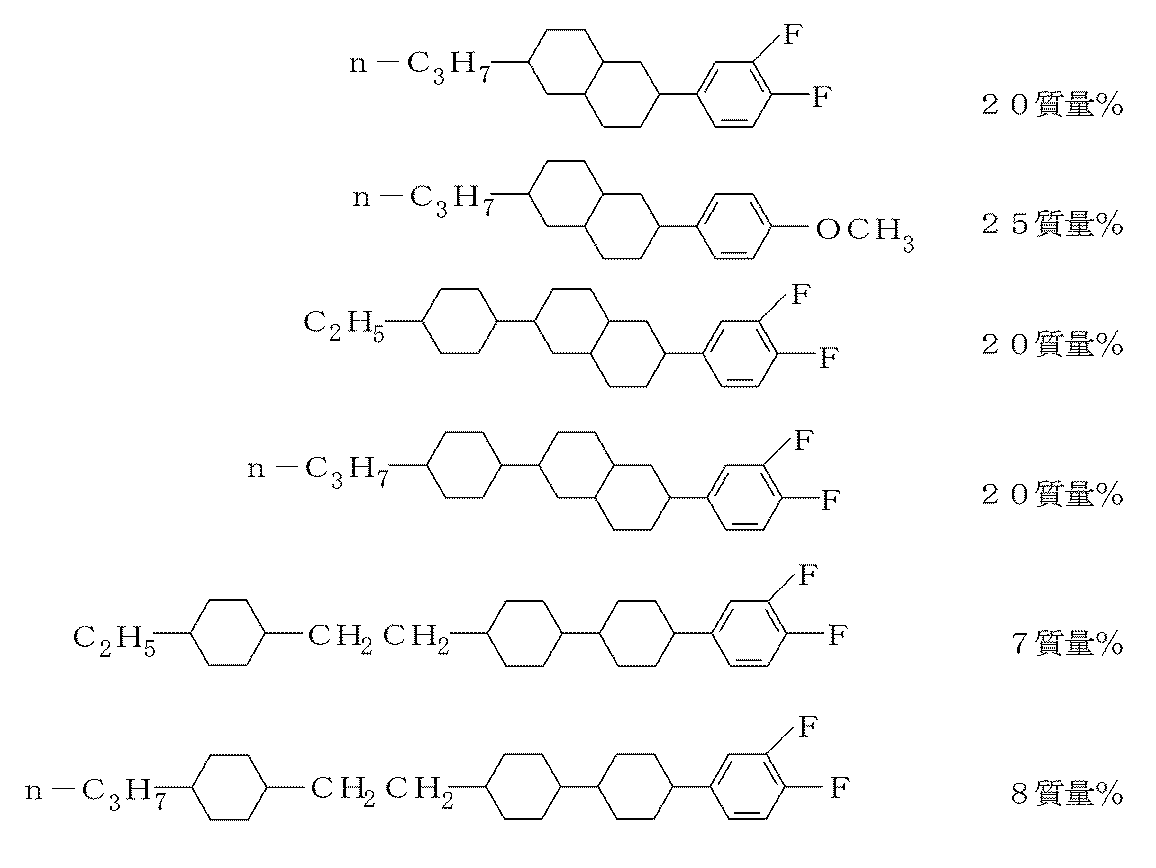
誘電率の異方性(△ε):5.30
比抵抗値 :5.2×10¹⁴Ω・m

誘電率の異方性(△ε):-3.1
複屈折(Δn) :0.07
比抵抗値 :5.6×10¹⁴Ω・m
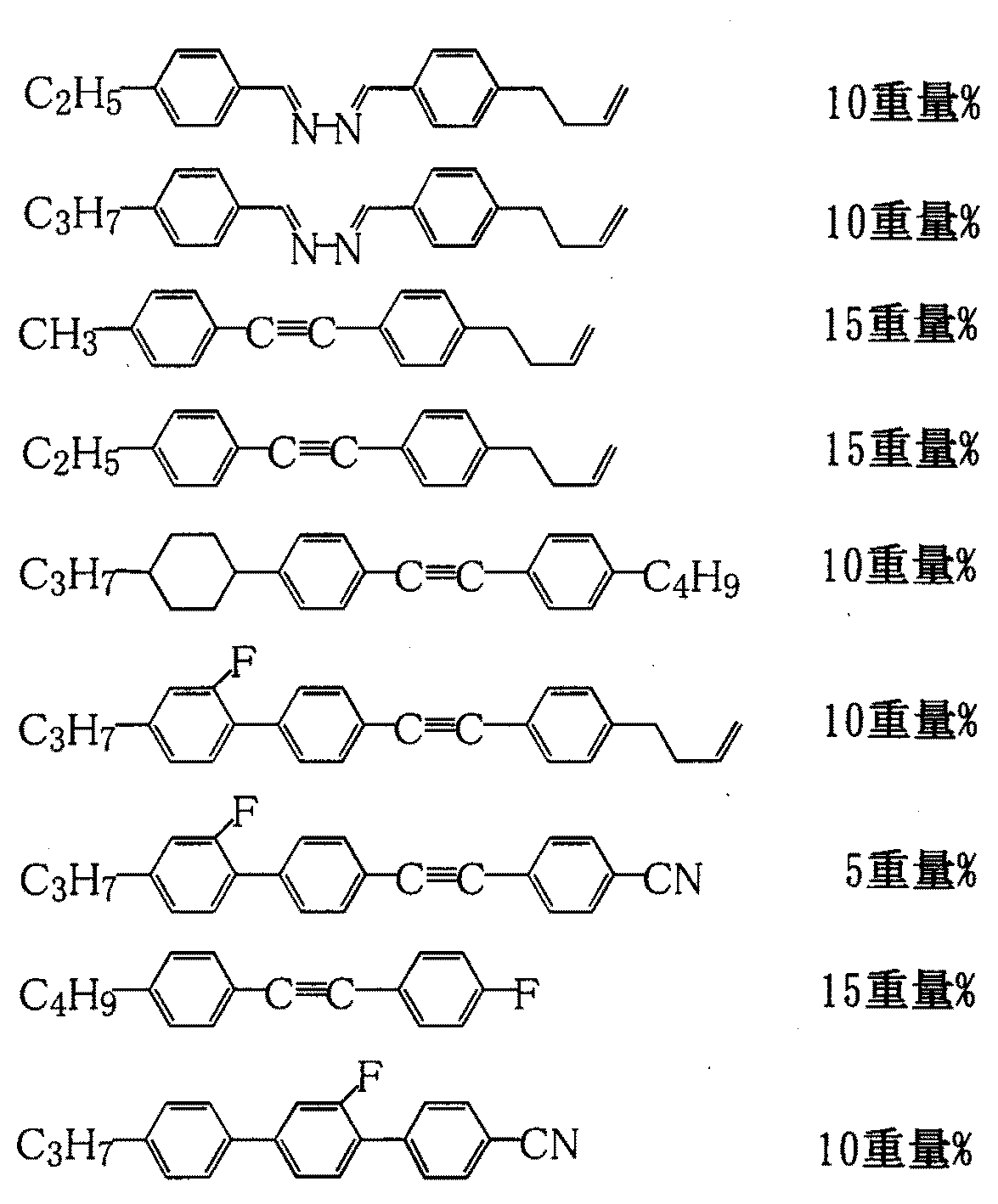
液晶組成物(3)
誘電率の異方性(△ε):4.7
複屈折(Δn) :0.29
比抵抗値 :1.6×10¹⁴Ω・m
前記いずれかの方法で作成した液晶表示パネルを、60℃90%RH湿熱暴露試験を行い、120時間後の電圧保持率を測定した。電圧保持率は、24℃で液晶表示パネルに交流5Vの初期電圧を64マイクロ秒印加し、167ミリ秒のフレームタイム前後の電圧比に100を乗じた値を算出した。
ビスフェノールA骨格を有するジエポキシ化合物(DIC化学工業社製の商品名「EPICRON 850CRP」を25部、ビスフェノールA骨格を有するエポキシ化合物(DIC化学工業社製の商品名「EPICRON 1050」を10部、ビスフェノールA骨格を有するエポキシと無水フタル酸とを反応させて得られる反応中間体に対してγカプロラクトン、ヒドロキシエチルアクリル酸エチルを順次反応させて得られるエポキシエステルアクリレート(ダイセルサイテック社製の商品名「エベクリル3708」)20部、ビスフェノールA型エポキシハーフアクリレート(ダイセルサイテック社製の商品名「UVa1561」10部を140度で溶解させた。その後、120度にて撹拌しながら、カプロラクトン変性ヒドロキシピバリン酸ネオペンチルグリコールジアクリレート(日本化薬社製の商品名「KAYARAD HX620」)25部、ロジン変性エポキシアクリレート(荒川化学社製の商品名「ビームセット101」)10部を加え、になるまで攪拌した。混合物を室温とし、ノニオン性界面活性剤であるエチレンオキシド及びプロピレンオキシド変性ポリジメチルシロキサン化合物(以下化合物Aとする)(信越化学社製の商品名「KF6011」、HLB=12)1部を加え、良く攪拌した。
スルフォニウム塩系光カチオン開始剤(旭電化社製の商品名「SP150」)2.5部、シラン系カップリング剤(信越化学工業株式会社の商品名「KBM5103」)5.0部、及びラジカル光重合開始剤である2,2-ジメトキシ-2-フェニルアセトフェノン(チバ・スペシャリティケミカルズの商品名「IRGACURE 651」)を加え、必要に応じて加熱して溶解させながら攪拌した後、日本アエロジル社製の商品名「RY-200S」を5部添加して、3本ロールにて混練し、液晶表示パネルシール用光硬化性組成物Aを得た。
液晶表示パネルシール用光硬化性組成物Aについて、前記液晶表示パネル作製1の方法で液晶表示パネルを作製するとともに、前記評価方法に従い評価して、その結果を表1に示した。
実施例1における、化合物(A)1部に代えて、ポリエチレンオキシドで変性されたポリジメチルシロキサン化合物(B)(東レダウコーニング社製の商品名「TSF-4440」、HLB=14)1部を用いた以外は、実施例1に記載と同様の方法に従って液晶表示パネルシール用光硬化性組成物を得た。該組成物について、前記液晶表示パネル作製1の方法で液晶表示パネルを作製するとともに、前記評価方法に従い評価して、その結果を表1に示した。
実施例1における、化合物(A)1部に代えて、ポリエチレンオキシドで変性されたポリジメチルシロキサン化合物(C)(信越化学工業社製の商品名「KF-353」,HLB=10, 430mPas)1部を用いた以外は、実施例1に記載と同様の方法に従って液晶表示パネルシール用光硬化性組成物を得た。該組成物について、前記液晶表示パネル作製1の方法で液晶表示パネルを作製するとともに、前記評価方法に従い評価して、その結果を表1に示した。
実施例1における、化合物(A)1部に代えて、ポリエチレンオキシド、ポリプロピレンオキシド、及びグリシジルエーテル基で変性されたポリジメチルシロキサン化合物(D)(信越化学社製の商品名「X22-4741」、HLB=13)0.75部を用いた以外は、実施例1に記載と同様の方法に従って液晶表示パネルシール用光硬化性組成物を得た。該組成物について、前記液晶表示パネル作製1の方法で液晶表示パネルを作製するとともに、前記評価方法に従い評価して、その結果を表1に示した。
実施例1における、化合物(A)1部に代えて、ポリエチレンオキシド、ポリプロピレンオキシド、及びグリシジルエーテル基で変性されたポリジメチルシロキサン化合物(D)(信越化学社製の商品名「X22-4741」、HLB=13)0.3部を用いた以外は、実施例1に記載と同様の方法に従って液晶表示パネルシール用光硬化性組成物を得た。該組成物について、前記液晶表示パネル作製1の方法で液晶表示パネルを作製するとともに、前記評価方法に従い評価して、その結果を表1に示した。
実施例1における、化合物(A)1部に代えて、ポリエチレンオキシド、ポリプロピレンオキシド、グリシジルエーテル基で変性されたポリジメチルシロキサン化合物(D)(信越化学社製の商品名「X22-4741」、HLB=13)0.3部を用いた以外は、実施例1に記載と同様の方法に従って液晶表示パネルシール用光硬化性組成物を得た。該組成物について、前記液晶表示パネル作製1の方法で液晶表示パネルを作製するとともに、前記評価方法に従い評価して、その結果を表1に示した。
実施例4における、ビスフェノールA骨格を有するエポキシ化合物(DIC社製の商品名「EPICRON 1050」を10部に代えて、ビフェノール型オキセタン化合物 (宇部興産社製の商品名「OXBP」)10部を用いた以外は、実施例1に記載と同様の方法に従って液晶表示パネルシール用光硬化性組成物を得た。該組成物について、前記液晶表示パネル作製1の方法で液晶表示パネルを作製するとともに、前記評価方法に従い評価して、その結果を表1に示した。
実施例1における、化合物(A)1部に代えて、ポリエチレンオキシド、ポリプロピレンオキシド、及びグリシジルエーテル基で変性されたポリジメチルシロキサン化合物(D)(信越化学社製の商品名「X22-4741」、HLB=13)1.0部とし、ビスフェノールA骨格を有するエポキシ化合物(DIC社製の商品名「EPICRON 1050」10部に代えて、引用文献7に記載の下記一般式で示される、化合物(EP) 10部を用いた以外は、実施例1に記載と同様の方法に従って液晶表示パネル液晶表示パネルシール用光硬化性組成物を得た。該組成物について、前記液晶表示パネル作製1の方法で液晶表示パネルを作製するとともに、前記評価方法に従い評価して、その結果を表1に示した。
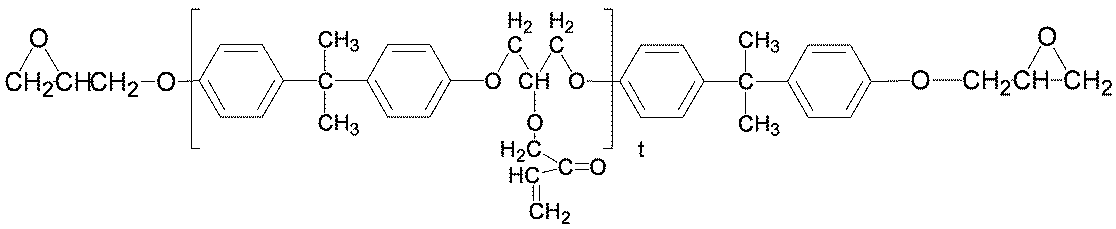
(EP)
実施例1における、化合物(A)1部に代えて、ポリオキシエチレンラウリルエーテル化合物(花王株式会社製の商品名「エマルゲン109P」、HLB=13)1.0部を用いた以外は、実施例1に記載と同様の方法に従って液晶表示パネルシール用光硬化性組成物を得た。該組成物について、前記液晶表示パネル作製1の方法で液晶表示パネルを作製するとともに、前記評価方法に従い評価して、その結果を表1に示した。
実施例1における、化合物(A)1部に代えて、モノラウリル酸デカグリセリル化合物(日光ケミカルズ株式会社製の商品名「DECAGLYN-1-L」、HLB=15.5)1.0部を用いた以外は、実施例1に記載と同様の方法に従って液晶表示パネルシール用光硬化性組成物を得た。該組成物について、前記液晶表示パネル作製1の方法で液晶表示パネルを作製するとともに、前記評価方法に従い評価して、その結果を表1に示した。
実施例1における、化合物(A)1部に代えて、ポリオキシエチレンソルビタン モノオレイン酸エステル化合物(日光ケミカルズ株式会社製の商品名「TO-10V」、HLB=15.0)1.0部を用いた以外は、実施例1に記載と同様の方法に従って液晶表示パネルシール用光硬化性組成物を得た。該組成物について、前記液晶表示パネル作製1の方法で液晶表示パネルを作製するとともに、前記評価方法に従い評価して、その結果を表1に示した。
実施例1における、化合物(A)1部に代えて、1-(アリルオキシ)-2,3-エポキシプロパンを炭素数11-14のアルコールとエチレンオキシドで変性した下記一般式で示される化合物(ER)(株式会社ADEKA製の商品名「ER-30」、HLB=16.3、65%水溶液)を凍結乾燥にて脱水処理したもの1.0部を用いた以外は、実施例1に記載と同様の方法に従って液晶表示パネルシール用光硬化性組成物を得た。該組成物について、前記液晶表示パネル作製1の方法で液晶表示パネルを作製するとともに、前記評価方法に従い評価して、その結果を表1に示した。

(ER)
実施例1における、化合物(A)1部の添加を行わない以外は、実施例1に記載と同様の方法に従って液晶表示パネルシール用光硬化性組成物を得た。該組成物について、前記液晶表示パネル作製1の方法で液晶表示パネルを作製するとともに、前記評価方法に従い評価して、その結果を表1に示した。
実施例1における、化合物(A)1部に代えて、ポリエチレンオキシド、ポリプロピレンオキシドで変性されたポリジメチルシロキサン化合物(E)(信越化学社製の商品名「KF-6015」、HLB=5)以外は、実施例1に記載と同様の方法に従って液晶表示パネルシール用光硬化性組成物を得た。該組成物について、前記液晶表示パネル作製1の方法で液晶表示パネルを作製するとともに、前記評価方法に従い評価して、その結果を表1に示した。
実施例1における、化合物(A)1部に代えて、ポリエチレンオキシド、ポリプロピレンオキシドで変性されたポリジメチルシロキサン化合物(E)(信越化学社製の商品名「KF-6012」、HLB=7)以外は、実施例1に記載と同様の方法に従って液晶表示パネルシール用光硬化性組成物を得た。該組成物について、前記液晶表示パネル作製1の方法で液晶表示パネルを作製するとともに、前記評価方法に従い評価して、その結果を表1に示した。
実施例1における、化合物(A)1部を5部とした以外は、実施例1に記載と同様の方法に従って液晶表示パネルシール用光硬化性組成物を得た。該組成物について、前記液晶表示パネル作製1の方法で液晶表示パネルを作製するとともに、前記評価方法に従い評価して、その結果を表1に示した。
実施例9における、ポリエチレンオキシド、ポリプロピレンオキシド、グリシジルエーテル基で変性されたポリジメチルシロキサン化合物(D)(信越化学社製の商品名「X22-4741」、HLB=13)を添加しない以外は実施例7に記載と同様の方法に従って液晶表示パネルシール用光硬化性組成物を得た。該組成物について、前記液晶表示パネル作製1の方法で液晶表示パネルを作製するとともに、前記評価方法に従い評価して、その結果を表1に示した。
実施例1における、化合物(A)1部に代えて、ポリオキシエチレンソルビタン モノステアリン酸エステル化合物(日光ケミカルズ社製の商品名「TS-106」、HLB=9.6)を、1.0部を用いた以外は、実施例1に記載と同様の方法に従ってシール用光硬化性組成物を得た。該組成物について、前記液晶表示パネル作製1の方法で液晶表示パネルを作製するとともに、前記評価方法に従い評価して、その結果を表1に示した。
実施例1における、化合物(A)1部に代えて、パーフルオロアルキルエチレンオキシド化合物(DIC株式会社製の商品名「メガファック F-444」)を、1.0部を用いた以外は、実施例1に記載と同様の方法に従ってシール用光硬化性組成物を得た。該組成物について、前記液晶表示パネル作製1の方法で液晶表示パネルを作製するとともに、前記評価方法に従い評価して、その結果を表1に示した。
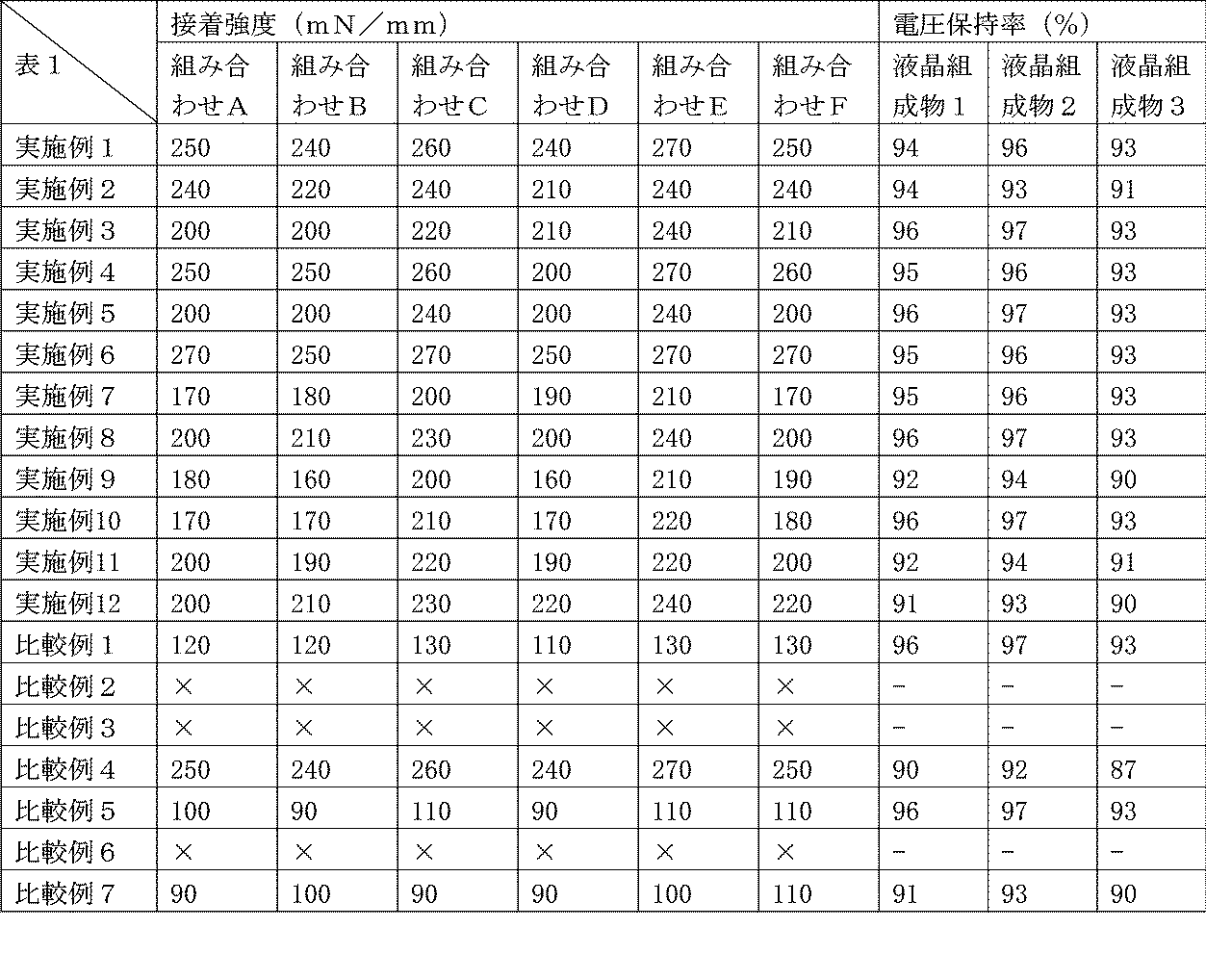
比較例1、5はノニオン性界面活性剤を添加しない例である。また比較例2、3、6はHLBが10未満のノニオン性界面活性剤を添加した例、比較例7はフッ素系界面活性剤を添加した例である。いずれも接着性に劣った。また、比較例4は添加量が4質量%を超える例であるが、電圧保持率が下がってしまった。
Claims (5)
- HLB値が10以上であるノニオン系界面活性剤を光硬化性組成物固形分全量に対し0.1~4質量%含むことを特徴とする液晶表示パネルシール用光硬化性組成物。
- 前記ノニオン系界面活性剤が、アルキレンオキシド変性ポリジメチルシロキサンである請求項1に記載の液晶表示パネルシール用光硬化性組成物。
- カチオン重合性化合物、及び光カチオン重合開始剤を含む請求項1又は2に記載の液晶表示パネルシール用光硬化性組成物。
- ラジカル重合性化合物を含む請求項3に記載の液晶表示パネルシール用光硬化性組成物。
- 請求項1~4のいずれか1項に記載の液晶表示パネルシール用光硬化性組成物を用いることを特徴とする液晶表示パネル。
Priority Applications (3)
| Application Number | Priority Date | Filing Date | Title |
|---|---|---|---|
| KR1020117008638A KR101279877B1 (ko) | 2009-03-24 | 2010-03-09 | 액정 표시 패널 씰용 광경화성 조성물 및 액정 표시 패널 |
| JP2010534167A JP4702502B2 (ja) | 2009-03-24 | 2010-03-09 | 液晶表示パネルシール用光硬化性組成物及び液晶表示パネル |
| CN201080003823.XA CN102265212B (zh) | 2009-03-24 | 2010-03-09 | 液晶显示面板密封用光固化性组合物和液晶显示面板 |
Applications Claiming Priority (2)
| Application Number | Priority Date | Filing Date | Title |
|---|---|---|---|
| JP2009071733 | 2009-03-24 | ||
| JP2009-071733 | 2009-03-24 |
Publications (1)
| Publication Number | Publication Date |
|---|---|
| WO2010110049A1 true WO2010110049A1 (ja) | 2010-09-30 |
Family
ID=42780744
Family Applications (1)
| Application Number | Title | Priority Date | Filing Date |
|---|---|---|---|
| PCT/JP2010/053861 Ceased WO2010110049A1 (ja) | 2009-03-24 | 2010-03-09 | 液晶表示パネルシール用光硬化性組成物及び液晶表示パネル |
Country Status (5)
| Country | Link |
|---|---|
| JP (1) | JP4702502B2 (ja) |
| KR (1) | KR101279877B1 (ja) |
| CN (1) | CN102265212B (ja) |
| TW (1) | TWI558754B (ja) |
| WO (1) | WO2010110049A1 (ja) |
Cited By (3)
| Publication number | Priority date | Publication date | Assignee | Title |
|---|---|---|---|---|
| JP2014201617A (ja) * | 2013-04-02 | 2014-10-27 | ナガセケムテックス株式会社 | 電子部品封止用接着剤 |
| KR20160046850A (ko) * | 2013-08-22 | 2016-04-29 | 바스프 에스이 | 에멀젼 중합체의 제조 방법 |
| US10502995B2 (en) | 2014-06-19 | 2019-12-10 | Inkron Oy | Dielectric siloxane particle films, and devices having the same |
Families Citing this family (2)
| Publication number | Priority date | Publication date | Assignee | Title |
|---|---|---|---|---|
| KR101453848B1 (ko) * | 2010-12-13 | 2014-10-22 | 디아이씨 가부시끼가이샤 | 양이온 경화형 액정 씰제, 및 액정 표시 소자 |
| KR101526007B1 (ko) * | 2013-01-11 | 2015-06-04 | 제일모직주식회사 | 광경화 조성물, 이를 포함하는 장벽층 및 이를 포함하는 봉지화된 장치 |
Citations (3)
| Publication number | Priority date | Publication date | Assignee | Title |
|---|---|---|---|---|
| JP2005181986A (ja) * | 2003-11-28 | 2005-07-07 | Shin Etsu Chem Co Ltd | 液晶表示素子用シール剤組成物 |
| JP2005292801A (ja) * | 2004-03-09 | 2005-10-20 | Sekisui Chem Co Ltd | 液晶表示素子用遮光シール剤、上下導通材料、及び、液晶表示素子 |
| JP2008165222A (ja) * | 2006-12-08 | 2008-07-17 | Mitsubishi Chemicals Corp | 保護膜用熱硬化性組成物、硬化物、tftアクティブマトリックス基板、及び液晶表示装置 |
Family Cites Families (3)
| Publication number | Priority date | Publication date | Assignee | Title |
|---|---|---|---|---|
| TW200708528A (en) * | 2005-08-24 | 2007-03-01 | Nippon Catalytic Chem Ind | Radiation-curable composition and cured product thereof |
| WO2008149662A1 (ja) * | 2007-06-01 | 2008-12-11 | Fujifilm Corporation | カラーフィルタ用硬化性組成物、カラーフィルタ用硬化性組成物の製造方法、着色硬化性樹脂組成物、着色パターン形成方法、着色パターン、カラーフィルタの製造方法、カラーフィルタ、及び液晶表示素子 |
| JP4994305B2 (ja) * | 2008-06-03 | 2012-08-08 | 横浜ゴム株式会社 | 高熱伝導性エポキシ樹脂系組成物 |
-
2010
- 2010-03-09 JP JP2010534167A patent/JP4702502B2/ja not_active Expired - Fee Related
- 2010-03-09 WO PCT/JP2010/053861 patent/WO2010110049A1/ja not_active Ceased
- 2010-03-09 KR KR1020117008638A patent/KR101279877B1/ko not_active Expired - Fee Related
- 2010-03-09 CN CN201080003823.XA patent/CN102265212B/zh not_active Expired - Fee Related
- 2010-03-23 TW TW099108446A patent/TWI558754B/zh not_active IP Right Cessation
Patent Citations (3)
| Publication number | Priority date | Publication date | Assignee | Title |
|---|---|---|---|---|
| JP2005181986A (ja) * | 2003-11-28 | 2005-07-07 | Shin Etsu Chem Co Ltd | 液晶表示素子用シール剤組成物 |
| JP2005292801A (ja) * | 2004-03-09 | 2005-10-20 | Sekisui Chem Co Ltd | 液晶表示素子用遮光シール剤、上下導通材料、及び、液晶表示素子 |
| JP2008165222A (ja) * | 2006-12-08 | 2008-07-17 | Mitsubishi Chemicals Corp | 保護膜用熱硬化性組成物、硬化物、tftアクティブマトリックス基板、及び液晶表示装置 |
Cited By (5)
| Publication number | Priority date | Publication date | Assignee | Title |
|---|---|---|---|---|
| JP2014201617A (ja) * | 2013-04-02 | 2014-10-27 | ナガセケムテックス株式会社 | 電子部品封止用接着剤 |
| KR20160046850A (ko) * | 2013-08-22 | 2016-04-29 | 바스프 에스이 | 에멀젼 중합체의 제조 방법 |
| JP2016530374A (ja) * | 2013-08-22 | 2016-09-29 | ビーエーエスエフ ソシエタス・ヨーロピアBasf Se | エマルションポリマーの製造法 |
| KR102270314B1 (ko) | 2013-08-22 | 2021-06-30 | 바스프 에스이 | 에멀젼 중합체의 제조 방법 |
| US10502995B2 (en) | 2014-06-19 | 2019-12-10 | Inkron Oy | Dielectric siloxane particle films, and devices having the same |
Also Published As
| Publication number | Publication date |
|---|---|
| KR20110069094A (ko) | 2011-06-22 |
| JP4702502B2 (ja) | 2011-06-15 |
| KR101279877B1 (ko) | 2013-07-01 |
| JPWO2010110049A1 (ja) | 2012-09-27 |
| CN102265212A (zh) | 2011-11-30 |
| TWI558754B (zh) | 2016-11-21 |
| CN102265212B (zh) | 2016-01-20 |
| TW201037029A (en) | 2010-10-16 |
Similar Documents
| Publication | Publication Date | Title |
|---|---|---|
| EP1630215B1 (en) | Photocurable resin composition and resin composition for plastics comprising the same | |
| CN103781870B (zh) | 密封剂组合物 | |
| JP2010018797A (ja) | 光学部品用硬化性組成物、光学部品用接着剤及び有機エレクトロルミネッセンス素子用封止剤 | |
| JP4702502B2 (ja) | 液晶表示パネルシール用光硬化性組成物及び液晶表示パネル | |
| JPWO2008153076A1 (ja) | 基板貼り合わせ用光学接着剤、及び、基板貼り合わせ用光学接着剤硬化体 | |
| US7495035B2 (en) | Photo-curable resin composition and sealing agent for flat panel display using the same | |
| JP2009298887A (ja) | 光学部品用硬化性組成物 | |
| JP5671825B2 (ja) | カチオン硬化性接着剤、及び液晶表示素子 | |
| WO2012020754A1 (ja) | 液晶滴下工法用シール剤 | |
| JP4645804B2 (ja) | 液晶表示装置用硬化性組成物 | |
| JP5919073B2 (ja) | 液晶滴下工法用シール剤、上下導通材料、及び、液晶表示素子 | |
| JP2013015645A (ja) | 液晶シール剤及びそれを用いた液晶表示セル | |
| US20090098315A1 (en) | Photoreactive adhesive composition and liquid crystal panel prepared by using the same | |
| JP5109324B2 (ja) | シール剤用光硬化性組成物、液晶シール剤、及び液晶パネル | |
| JP4924772B1 (ja) | カチオン硬化型液晶シール剤、及び液晶表示素子 | |
| JP4639684B2 (ja) | 液晶表示装置のシール剤 | |
| KR20100028556A (ko) | 액정 실링제 및 그것을 이용한 액정 표시 셀 | |
| KR20070085142A (ko) | 감광성 수지 조성물 | |
| KR20240166463A (ko) | 액정 표시 소자용 씰제 및 액정 표시 소자 | |
| JP2009298888A (ja) | 光後硬化性組成物 | |
| JP2011028254A (ja) | カチオン硬化型液晶シール剤、及び液晶表示素子 | |
| CN113661438A (zh) | 液晶密封剂、使用其的液晶显示面板、及其制造方法 | |
| JP2011118105A (ja) | カチオン光硬化型液晶パネルシール剤及びそれを用いた液晶パネルの製造方法 | |
| JP2005306949A (ja) | 光硬化性組成物 | |
| TWI879899B (zh) | 液晶滴下工法用密封劑及液晶顯示面板的製造方法 |
Legal Events
| Date | Code | Title | Description |
|---|---|---|---|
| WWE | Wipo information: entry into national phase |
Ref document number: 201080003823.X Country of ref document: CN |
|
| WWE | Wipo information: entry into national phase |
Ref document number: 2010534167 Country of ref document: JP |
|
| 121 | Ep: the epo has been informed by wipo that ep was designated in this application |
Ref document number: 10755850 Country of ref document: EP Kind code of ref document: A1 |
|
| ENP | Entry into the national phase |
Ref document number: 20117008638 Country of ref document: KR Kind code of ref document: A |
|
| NENP | Non-entry into the national phase |
Ref country code: DE |
|
| 122 | Ep: pct application non-entry in european phase |
Ref document number: 10755850 Country of ref document: EP Kind code of ref document: A1 |