WO2010095730A1 - 耐サワーラインパイプ用鋼板の製造方法 - Google Patents
耐サワーラインパイプ用鋼板の製造方法 Download PDFInfo
- Publication number
- WO2010095730A1 WO2010095730A1 PCT/JP2010/052586 JP2010052586W WO2010095730A1 WO 2010095730 A1 WO2010095730 A1 WO 2010095730A1 JP 2010052586 W JP2010052586 W JP 2010052586W WO 2010095730 A1 WO2010095730 A1 WO 2010095730A1
- Authority
- WO
- WIPO (PCT)
- Prior art keywords
- less
- sour
- temperature
- steel
- cooling
- Prior art date
- Legal status (The legal status is an assumption and is not a legal conclusion. Google has not performed a legal analysis and makes no representation as to the accuracy of the status listed.)
- Ceased
Links
Classifications
-
- C—CHEMISTRY; METALLURGY
- C22—METALLURGY; FERROUS OR NON-FERROUS ALLOYS; TREATMENT OF ALLOYS OR NON-FERROUS METALS
- C22C—ALLOYS
- C22C38/00—Ferrous alloys, e.g. steel alloys
- C22C38/14—Ferrous alloys, e.g. steel alloys containing titanium or zirconium
-
- C—CHEMISTRY; METALLURGY
- C21—METALLURGY OF IRON
- C21D—MODIFYING THE PHYSICAL STRUCTURE OF FERROUS METALS; GENERAL DEVICES FOR HEAT TREATMENT OF FERROUS OR NON-FERROUS METALS OR ALLOYS; MAKING METAL MALLEABLE, e.g. BY DECARBURISATION OR TEMPERING
- C21D8/00—Modifying the physical properties of ferrous metals or ferrous alloys by deformation combined with, or followed by, heat treatment
- C21D8/02—Modifying the physical properties of ferrous metals or ferrous alloys by deformation combined with, or followed by, heat treatment during manufacturing of plates or strips
- C21D8/0221—Modifying the physical properties of ferrous metals or ferrous alloys by deformation combined with, or followed by, heat treatment during manufacturing of plates or strips characterised by the working steps
- C21D8/0226—Hot rolling
-
- C—CHEMISTRY; METALLURGY
- C21—METALLURGY OF IRON
- C21D—MODIFYING THE PHYSICAL STRUCTURE OF FERROUS METALS; GENERAL DEVICES FOR HEAT TREATMENT OF FERROUS OR NON-FERROUS METALS OR ALLOYS; MAKING METAL MALLEABLE, e.g. BY DECARBURISATION OR TEMPERING
- C21D8/00—Modifying the physical properties of ferrous metals or ferrous alloys by deformation combined with, or followed by, heat treatment
- C21D8/02—Modifying the physical properties of ferrous metals or ferrous alloys by deformation combined with, or followed by, heat treatment during manufacturing of plates or strips
- C21D8/0247—Modifying the physical properties of ferrous metals or ferrous alloys by deformation combined with, or followed by, heat treatment during manufacturing of plates or strips characterised by the heat treatment
- C21D8/0263—Modifying the physical properties of ferrous metals or ferrous alloys by deformation combined with, or followed by, heat treatment during manufacturing of plates or strips characterised by the heat treatment following hot rolling
-
- C—CHEMISTRY; METALLURGY
- C21—METALLURGY OF IRON
- C21D—MODIFYING THE PHYSICAL STRUCTURE OF FERROUS METALS; GENERAL DEVICES FOR HEAT TREATMENT OF FERROUS OR NON-FERROUS METALS OR ALLOYS; MAKING METAL MALLEABLE, e.g. BY DECARBURISATION OR TEMPERING
- C21D9/00—Heat treatment, e.g. annealing, hardening, quenching or tempering, adapted for particular articles; Furnaces therefor
- C21D9/08—Heat treatment, e.g. annealing, hardening, quenching or tempering, adapted for particular articles; Furnaces therefor for tubular bodies or pipes
- C21D9/14—Heat treatment, e.g. annealing, hardening, quenching or tempering, adapted for particular articles; Furnaces therefor for tubular bodies or pipes wear-resistant or pressure-resistant pipes
-
- C—CHEMISTRY; METALLURGY
- C22—METALLURGY; FERROUS OR NON-FERROUS ALLOYS; TREATMENT OF ALLOYS OR NON-FERROUS METALS
- C22C—ALLOYS
- C22C38/00—Ferrous alloys, e.g. steel alloys
- C22C38/001—Ferrous alloys, e.g. steel alloys containing N
-
- C—CHEMISTRY; METALLURGY
- C22—METALLURGY; FERROUS OR NON-FERROUS ALLOYS; TREATMENT OF ALLOYS OR NON-FERROUS METALS
- C22C—ALLOYS
- C22C38/00—Ferrous alloys, e.g. steel alloys
- C22C38/002—Ferrous alloys, e.g. steel alloys containing In, Mg, or other elements not provided for in one single group C22C38/001 - C22C38/60
-
- C—CHEMISTRY; METALLURGY
- C22—METALLURGY; FERROUS OR NON-FERROUS ALLOYS; TREATMENT OF ALLOYS OR NON-FERROUS METALS
- C22C—ALLOYS
- C22C38/00—Ferrous alloys, e.g. steel alloys
- C22C38/02—Ferrous alloys, e.g. steel alloys containing silicon
-
- C—CHEMISTRY; METALLURGY
- C22—METALLURGY; FERROUS OR NON-FERROUS ALLOYS; TREATMENT OF ALLOYS OR NON-FERROUS METALS
- C22C—ALLOYS
- C22C38/00—Ferrous alloys, e.g. steel alloys
- C22C38/04—Ferrous alloys, e.g. steel alloys containing manganese
Definitions
- the present invention relates to a method for producing a steel sheet having excellent resistance to hydrogen-induced cracking in an environment containing hydrogen sulfide (H 2 S), that is, sour resistance.
- H 2 S hydrogen sulfide
- Sour oil is required for steel pipes used for sour oils containing hydrogen sulfide, line pipes for transporting sour gas, and pipe accessory equipment.
- the sour resistance is hydrogen-induced crack resistance (HIC resistance) in a corrosive environment containing hydrogen sulfide.
- Patent Document 1 In addition to MnS, there are Nb-Ti-CN-based inclusions as the base point of HIC, and the Nb-Ti-CN-based inclusions are completely dissolved by appropriate heat treatment conditions of the steel material. A method has been proposed (for example, Patent Document 2).
- Patent Document 3 a method for producing a steel plate having a strength of about X70, a metal structure that is uniform in the thickness direction and fine bainite and excellent in sour resistance has been proposed.
- Patent Documents 4 to 6 a method for producing a high-strength steel sheet with improved low-temperature toughness and sour resistance has been proposed (for example, Patent Documents 4 to 6). These suppress the increase in hardness by reducing the amount of C, control the form of MnS by reducing the amount of S and adding Ca, control the form of oxide by reducing the amount of Al, sour resistance and low temperature toughness It is intended to be compatible with. On the other hand, it contains a certain amount of carbon, and by adding Cr, the strength is increased without lowering the toughness, and the refinement of crystal grains is improved by specifying the manufacturing conditions to improve the low temperature toughness. (Patent Document 7).
- JP-A-62-112722 JP 2006-63351 A JP-A-61-165207 Japanese Patent Laid-Open No. 03-236420 JP 05-295434 A Japanese Patent Application Laid-Open No. 07-242944 Japanese Patent Laid-Open No. 06-136440
- the present invention solves such problems, and can provide a method for producing a steel plate for line pipes that can cope with fluctuations in the heating temperature and plate thickness of hot rolling and has excellent sour resistance. Is an issue.
- the present invention strictly limits the contents of S and O, adds Ca, [Ca] (1-124 [O]) / 1.25 [S]
- the hot rolling temperature and rolling ratio are controlled so that the ESSP value represented by the above is controlled to control the form of sulfide, and the crystal grain size before starting the accelerated cooling after hot rolling becomes fine.
- the amount of C is limited to a low value, the amount of Mn is increased, and the ratio of the amount of C to the amount of Mn [C / Mn] and the relationship between the accelerated cooling start temperature Tc This is based on the knowledge that even when the starting temperature Tc is decreased, the formation of polygonal ferrite is suppressed and the deterioration of sour resistance can be prevented, and the gist thereof is as follows.
- the finish temperature is set to 800 ° C. or more, the reduction ratio R of 950 ° C. or less is set to more than 3.125, the finish rolling is performed, and the reduction ratio R of the finish rolling and the cooling start temperature Tc are 20 / (R-3) + 640 ⁇ Tc ⁇ 800
- the steel slab is further in mass%, Ni: 0.5% or less, Cu: 0.5% or less, Cr: 0.5% or less, Mo: 0.3% or less,
- the steel slab is further mass%, V: It contains 0.10% or less, The manufacturing method of the steel plate for sour-proof pipes as described in said (1) or (2) characterized by the above-mentioned.
- the steel slab is further in mass%, B: 0.0020% or less is contained,
- the steel slab is further mass%, Mg: 0.01% or less, One or both of these are contained,
- the sour resistance was evaluated by the presence or absence of occurrence of HIC (hydrogen induced cracking) by conducting a test based on TM0284 of NACE (National Association of Corrosion and Engineer). If the HIC fracture surface ratio is about 5% or less, the sour resistance is considered good.
- HIC hydrogen induced cracking
- the NACE test is a test method in which hydrogen sulfide gas is saturated in a solution of 5% NaCl solution + 0.5% acetic acid, pH 2.7 to investigate whether cracks are generated after 96 hours. As a result of investigating the structure of the sample in which HIC was generated, it was found that polygonal ferrite was generated in the steel sheet having deteriorated sour resistance.
- the steel sheet in which polygonal ferrite does not form even if the accelerated cooling start temperature is lowered is qualitatively high in C content and Mn content. It turns out that there are few things.
- the present inventors considered that the cooling start temperature Tc of accelerated cooling can be reduced by reducing the ratio of C amount to Mn amount [C / Mn], and arranged the test data.
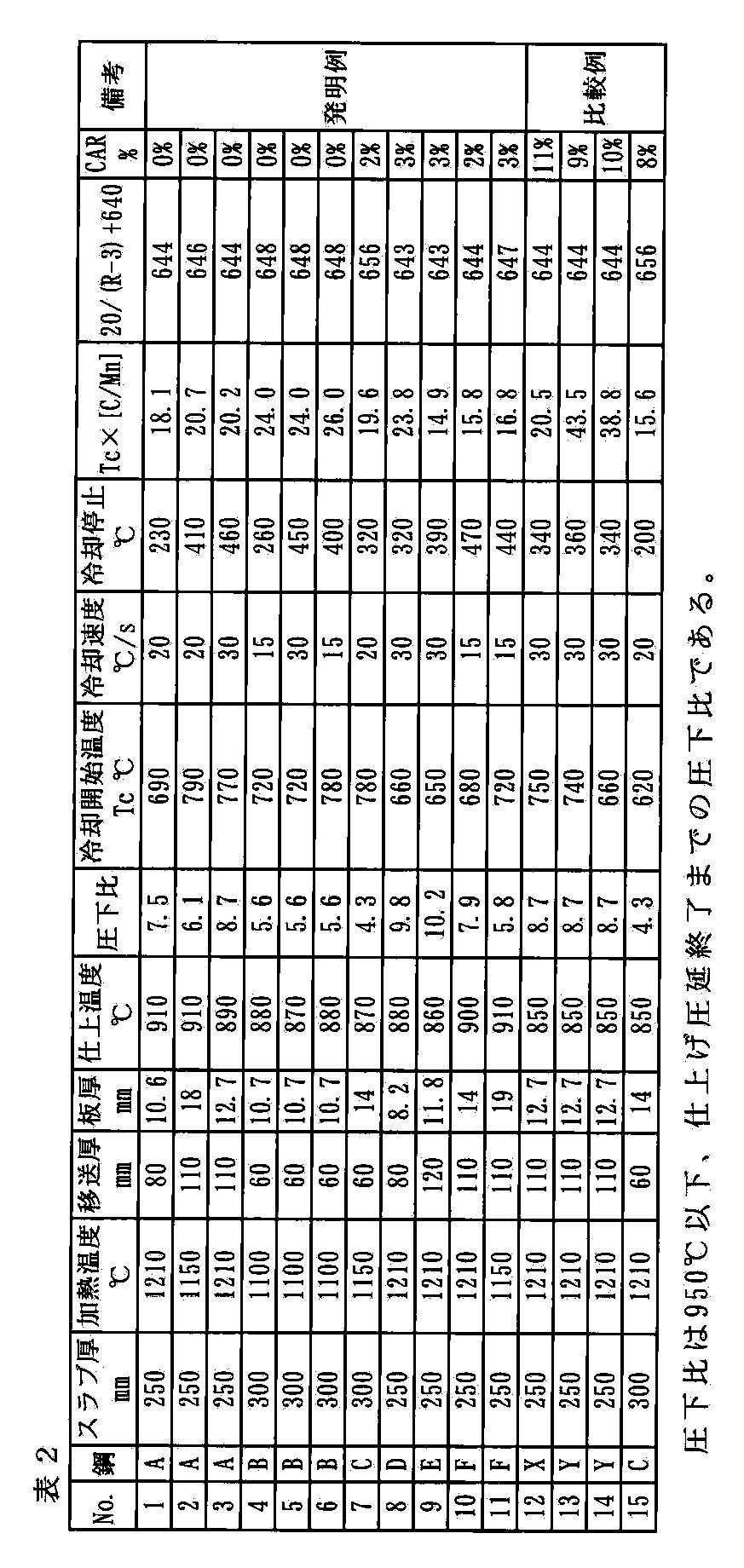
- Tc and [C / Mn] are 4 ⁇ Tc ⁇ [C / Mn] ⁇ 32 If the relationship is satisfied, the inventors have found that the cooling start temperature Tc can be lowered without generating polygonal ferrite.
- the present inventors manufactured a steel sheet with a reduction ratio of 950 ° C. or less and a rolling reduction until finish rolling exceeding 3.125, and investigated the relationship between the reduction ratio and the cooling start temperature Tc. As a result, it was found that when the reduction ratio is increased, the crystal grain size becomes finer, and even if the cooling start temperature Tc is lowered, the metal structure does not become a layered structure and sour resistance is improved.
- the present inventors arranged test data on the relationship between the finish rolling conditions, the cooling start temperature Tc of accelerated cooling, and the sour resistance. as a result, 20 / (R-3) + 640 ⁇ Tc ⁇ 800 Satisfying the relationship, the metal structure does not become a layered structure, and it has been found that good sour resistance can be obtained.
- % means mass%
- C 0.01 to 0.06%
- C is an element that improves the strength of steel, and as an effective lower limit, addition of 0.01% or more is necessary.
- the amount of C is increased, the formation of carbides is promoted and the HIC resistance is impaired. Therefore, in the present invention, the carbon content is reduced.
- the C content is 0.06% or less, preferably 0.05% or less, more preferably 0.038% or less.
- Si 0.1 to 0.5%
- Si is a deoxidizing element, and addition of 0.1% or more is necessary.
- the Si content exceeds 0.5%, the toughness of the weld heat affected zone (HAZ) decreases, so the upper limit is made 0.5%.
- a preferred range is 0.15 to 0.35%.
- Mn 1.0 to 1.5%
- Mn is an element that improves strength and toughness, and it is necessary to add 1.0% or more.
- Mn is an element that generates MnS and degrades sour resistance. Therefore, in order to suppress HIC, the upper limit of the amount of Mn needs to be 1.5%.
- a preferred range is 1.1 to 1.4%.
- Nb 0.010 to 0.040%
- Nb is an element that expands the non-recrystallization temperature range, refines the crystal grain size, forms carbides and nitrides, and contributes to improving the strength, and needs to be added in an amount of 0.010% or more. .
- the upper limit must be 0.040% or less.
- a preferable range of Nb is 0.011 to 0.025%, and a more preferable range is 0.012 to 0.020%.
- Ca 0.001 to 0.004%
- Ca is an element that generates sulfide CaS, suppresses the generation of MnS extending in the rolling direction, and contributes significantly to the improvement of HIC resistance. If the addition amount of Ca is less than 0.001%, the effect cannot be obtained, so the lower limit is made 0.001%. On the other hand, if the Ca content exceeds 0.004%, oxides accumulate and the HIC resistance is impaired, so the upper limit is made 0.004%. A preferred range is 0.0025 to 0.0035%.
- Ti 0.005-0.030%
- Ti is an element used for refining crystal grains as a deoxidizer or nitride-forming element, and it is necessary to add 0.005% or more.
- the upper limit is made 0.030%.
- a preferred range is 0.010 to 0.020%.
- Al 0.08% or less
- Al is a deoxidizing element. However, if the addition amount exceeds 0.08%, an Al oxide integrated cluster is formed, which impairs sour resistance. Restrict to: When toughness is required, the Al content is preferably 0.03% or less. Furthermore, the upper limit of the preferable amount of Al is 0.01%. The lower limit of the amount of Al is not particularly limited, but 0.0005% or more is preferably added in order to reduce the amount of oxygen in the molten steel.
- P 0.015% or less
- P is an impurity.
- the upper limit of the P content is 0.015%.
- S 0.0008% or less
- S is an element that reduces the HIC resistance by generating MnS that extends in the rolling direction during hot rolling. Therefore, in the present invention, it is necessary to reduce the amount of S, and the upper limit is set to 0.0008%. The smaller the amount of S, the better, but it is difficult to make it less than 0.0001%. Moreover, it is preferable to make it 0.0001% or more also from a viewpoint of manufacturing cost.
- O 0.0030% or less
- O is an impurity, and the upper limit is required to be 0.0030% in order to suppress the accumulation of oxides and improve the HIC resistance.
- the O content is preferably 0.0020% or less.
- N is an impurity.
- the upper limit of the N amount is set to 0.0050%.
- toughness etc. required, in order to suppress the coarsening of TiN, it is preferable to make N amount 0.0035% or less.
- nitrides such as TiN and NbN, and refinement
- [Ca] (1-124 [O]) / 1.25 [S] that is, it is necessary to increase the ESSP value.
- the ESSP value is a ratio of the Ca amount to the S amount necessary for generating CaS considering that Ca forms an oxide. In order to fix Ca by adding Ca to form CaS, the ESSP value needs to be more than 3.0.
- Ni, Cu, Cr, Mo, V, and B are elements among Ni, Cu, Cr, Mo, V, and B as elements for improving strength and toughness.
- Ni 0.5% or less
- Ni is an element effective for improving toughness and strength, and contributes to improvement of corrosion resistance. Therefore, addition of 0.01% or more is preferable.
- Ni is an expensive element, and it is preferable to limit the upper limit to 0.5% in order to reduce manufacturing costs.
- Cu 0.5% or less
- Cu is an element effective for increasing the strength and contributes to the improvement of corrosion resistance, so 0.01% or more is preferably added.
- Cu is also an expensive element, and it is preferable to limit the upper limit to 0.5% in order to reduce manufacturing costs.
- Cr 0.5% or less
- Cr is an element effective for increasing the strength, and is preferably added in an amount of 0.01% or more. On the other hand, if added in a large amount, the hardenability becomes high and the toughness may be lowered, so the upper limit is preferably 0.5%.
- Mo 0.3% or less Mo
- Mo is an element that improves hardenability and at the same time forms carbonitride to improve strength. To obtain the effect, addition of 0.01% or more is necessary. preferable.
- Mo is an expensive element, and the upper limit is preferably made 0.30% in order to reduce manufacturing costs. Moreover, since the HIC property and toughness may decrease when the strength of the steel increases, the preferable upper limit is 0.20%.
- V 0.10% or less
- V is an element that forms carbides and nitrides and contributes to the improvement of strength. To obtain the effect of addition, 0.01% or more is preferable. On the other hand, if V exceeding 0.10% is added, the toughness may be lowered, so the upper limit is preferably 0.10%.
- B 0.0020% or less
- B is an element that segregates at the grain boundaries of steel and contributes significantly to improving the hardenability. In order to obtain this addition effect, 0.0001% or more of B is preferably added. on the other hand. When B is added excessively, segregation to the grain boundary becomes excessive and the toughness may be lowered. Therefore, the upper limit is preferably 0.0020%.
- Mg 0.01% or less
- Mg is an element that acts as a deoxidizing agent and a desulfurizing agent. In particular, it produces fine oxides and suppresses coarsening of the particle size, so it is effective in improving toughness. It is. In order to obtain this addition effect, addition of 0.0001% or more is preferable. On the other hand, if Mg is added in excess of 0.01%, the oxide tends to agglomerate and coarsen, and the HIC property and toughness may be lowered. Therefore, the upper limit is preferably 0.01%.
- the steel containing the above-mentioned components is made into a steel plate by melting it in the steel making process, turning it into a steel slab by continuous casting, heating the steel slab, and performing thick plate rolling consisting of rough rolling and finish rolling.
- Heating temperature 1000 ⁇ 1250 °C
- NbC deposited on the steel slab does not dissolve, and coarse NbC remains in the steel sheet, sour resistance is lowered.
- the heating temperature of the steel slab exceeds 1250 ° C., the crystal grain size of the steel sheet becomes coarse, the metal structure after finish rolling becomes a layered structure, and sour resistance is lowered. Therefore, the heating temperature of the steel slab is in the range of 1000 to 1250 ° C.
- Accelerated cooling is performed after finish rolling. Accelerated cooling is preferably performed immediately after finish rolling. However, when the thickness of the steel plate is reduced, the temperature is likely to decrease. Therefore, in the present invention, the accelerated cooling condition is extremely important because it suppresses the formation of polygonal ferrite and prevents a layered structure of ferrite and a low-temperature transformation phase (bainite or martensite).
- Cooling start temperature Tc for accelerated cooling Accelerated cooling is performed in order to make the structure of the steel sheet into fine acicular ferrite or bainitic ferrite.
- the cooling start temperature of accelerated cooling is lowered, polygonal ferrite transformation is promoted.
- the polygonal ferrite transformation is suppressed by reducing the C content and increasing the Mn content.
- the ratio of C amount to Mn amount [C / Mn] and the cooling start temperature Tc (° C.) Product: Tc ⁇ [C / Mn] is 32 or less.
- the upper limit of Tc ⁇ [C / Mn] is preferably 30, and more preferably 27.
- Tc ⁇ [C / Mn] is preferably 4.5 or more, and more preferably 10 or more.
- the cooling start temperature of accelerated cooling when the cooling start temperature of accelerated cooling is less than 650 ° C., the formation of polygonal ferrite is promoted. Therefore, in order to ensure sour resistance, the cooling start temperature of accelerated cooling should be set to 650 ° C. or higher. preferable.
- the hot rolling finishing temperature in order to improve the sour resistance, it is preferable to reduce the hot rolling finishing temperature to about 900 to 800 ° C. to homogenize the structure. Since the cooling start temperature for accelerated cooling is equal to or lower than the finishing temperature for hot rolling, the cooling start temperature for accelerated cooling is preferably set to 800 ° C. or lower.
- Accelerated cooling rate 10-40 ° C / s Accelerated cooling is performed in order to make the structure of the steel sheet into fine acicular ferrite or bainitic ferrite. In order to suppress polygonal ferrite transformation and prevent the formation of pearlite, the cooling rate needs to be 10 ° C./s or more.
- the cooling rate of accelerated cooling exceeds 40 ° C./s, excessive martensite is generated, the hardness becomes non-uniform, and sour resistance and toughness decrease. Therefore, the cooling rate of accelerated cooling is 10 to 40 ° C./s.
- the cooling rate is the rate at the center of the plate thickness.
- Accelerated cooling stop temperature 200-500 ° C
- the accelerated cooling stop temperature is set in the range of 200 to 500 ° C. in order to suppress the formation of martensite.
- the finishing temperature for hot rolling is preferably 800 ° C. or higher in order to make the structure homogeneous. This is because, depending on the component composition, ferrite is generated at a temperature lower than 800 ° C., and the structure of the steel sheet after rolling becomes layered, sour resistance may be impaired. Moreover, depending on the conditions of finish rolling, the processed ferrite may remain on the steel sheet and the toughness may be impaired.
- the structure of the steel sheet can be refined by increasing the rolling ratio at low temperature and performing finish rolling. Since recrystallization occurs when the rolling temperature exceeds 950 ° C., the reduction ratio R at 950 ° C. or less is important.
- the rolling ratio at 950 ° C. or lower is 3.125 or lower, the structure is not homogeneous and sour resistance may be lowered. Therefore, it is preferable that the rolling ratio until 950 ° C. or less and finish rolling is finished is more than 3.125, and more preferably 4 or more.
- the upper limit of the reduction ratio at 950 ° C. or lower is not specified, but 20 is a preferable upper limit in consideration of the slab thickness and the plate thickness after finish rolling.
- the reduction ratio from 950 ° C. or lower to the end of finish rolling is the ratio of the plate thickness after rolling to the plate thickness at 950 ° C.
- the cooling start temperature of accelerated cooling is equal to or lower than the finishing temperature of hot rolling.
- the hot rolling finishing temperature it is preferable to lower the hot rolling finishing temperature to about 900 to 800 ° C. Therefore, it is preferable that the cooling start temperature of accelerated cooling is 800 ° C. or less.
- the reduction ratio of finish rolling is increased, the plate thickness becomes thin, so that the start of accelerated cooling is delayed and the cooling start temperature is lowered.
- the crystal grain size becomes finer due to the increase in the reduction ratio of the finish rolling, even if the cooling start temperature is lowered, it can be prevented that a layered structure is formed. Therefore, if the reduction ratio is increased and the cooling start temperature Tc is decreased, the allowable range of manufacturing conditions for manufacturing a thin steel plate having excellent sour resistance is increased.
- the relationship between the reduction ratio R up to 950 ° C. and finish rolling and the cooling start temperature Tc is 20 / (R-3) + 640 ⁇ Tc ⁇ 800 If the relationship is satisfied, the metal structure does not become a layered structure, good sour resistance can be obtained, and the allowable range of manufacturing conditions can be expanded.
- the present invention it is possible to provide a steel plate for a line pipe excellent in sour resistance even when the heating temperature and the plate thickness of hot rolling fluctuate. Therefore, the present invention has a significant industrial contribution and has a high industrial applicability.
Landscapes
- Chemical & Material Sciences (AREA)
- Engineering & Computer Science (AREA)
- Materials Engineering (AREA)
- Mechanical Engineering (AREA)
- Metallurgy (AREA)
- Organic Chemistry (AREA)
- Physics & Mathematics (AREA)
- Thermal Sciences (AREA)
- Crystallography & Structural Chemistry (AREA)
- Heat Treatment Of Steel (AREA)
- Metal Rolling (AREA)
Abstract
Description
〔Ca〕(1−124〔O〕)/1.25〔S〕
で表されるESSP値を高く制御して、硫化物の形態を制御し、熱間圧延後の加速冷却を開始する前の結晶粒径が微細になるように、熱間圧延の温度と圧下比とを制御し、更に、C量を低く制限し、Mn量を増加するとともに、C量とMn量の比[C/Mn]と、加速冷却の開始温度Tcの関係を規定することにより、冷却開始温度Tcが低下しても、ポリゴナルフェライトの生成が抑制され、耐サワー性の劣化が防止され得るという知見に基づいてなされたものであり、その要旨は以下のとおりである。
C :0.01~0.06、
Si:0.1~0.5%、
Mn:1.0~1.5%、
Nb:0.010~0.040%、
Ca:0.001~0.004%、
Ti:0.005~0.030%
を含有し、
Al:0.08%以下、
P: 0.015%以下、
S: 0.0008%以下、
O: 0.0030%以下、
N: 0.0050%以下
に制限し、Ca、O、及び、Sの含有量が、
[Ca](1−124[O])/1.25[S]>3.0
を満足する鋼片を、1000~1250℃に再加熱後、粗圧延を行い、更に、仕上げ圧延を行い、C量とMn量の比[C/Mn]と、冷却開始温度Tcが、
4≦Tc×[C/Mn]≦32
を満足するように、冷却速度が10~40℃/sの加速冷却を、前記冷却開始温度Tcから開始し、200~500℃で該加速冷却を停止することを特徴とする耐サワーラインパイプ用鋼板の製造方法。
20/(R−3)+640≦Tc≦800
を満足することを特徴とする上記(1)に記載の耐サワーラインパイプ用鋼板の製造方法。
Ni:0.5%以下、
Cu:0.5%以下、
Cr:0.5%以下、
Mo:0.3%以下、
の1種又は2種以上を含有することを特徴とする上記(1)又は(2)に記載の耐サワーラインパイプ用鋼板の製造方法。
V:0.10%以下
を含有することを特徴とする上記(1)又は(2)に記載の耐サワーラインパイプ用鋼板の製造方法。
B:0.0020%以下
を含有することを特徴とする上記(1)又は(2)に記載の耐サワーラインパイプ用鋼板の製造方法。
Mg:0.01%以下、
の一方又は双方を含有することを特徴とする上記(1)又は(2)に記載の耐サワーラインパイプ用鋼板の製造方法。
〔Ca〕(1−124〔O〕)/1.25〔S〕
によって求められるESSP値を制御した鋼板を製造し、耐サワー性を評価した。
4≦Tc×[C/Mn]≦32
との関係を満足すれば、ポリゴナルフェライトを生成させることなく、冷却開始温度Tcを低下させることが可能であるという知見を得るに至った。
20/(R−3)+640≦Tc≦800
との関係を満足すれば、金属組織が層状組織にならず、良好な耐サワー性が得られるという知見を得るに至った。
C:Cは鋼の強度を向上させる元素であり、その有効な下限として0.01%以上の添加が必要である。一方、C量を増やすと、炭化物の生成が促進されて、耐HIC性が損なわれるので、本発明では、低炭素化を図っている。HIC性、溶接性、靱性等の低下を抑制するには、C量を0.06%以下、好ましくは0.05%以下、より好ましくは0.038%以下とするとよい。
Si:Siは脱酸元素であり、0.1%以上の添加が必要である。一方、Si量が0.5%を超えると、溶接熱影響部(HAZ)の靱性が低下するので、上限を0.5%とする。好ましい範囲は、0.15~0.35%である。
Mn:Mnは、強度及び靱性を向上させる元素であり、1.0%以上の添加が必要である。一方、Mnは、MnSを生成して、耐サワー性を劣化させる元素であるため、HICを抑制するには、Mn量の上限を1.5%とすることが必要である。好ましい範囲は、1.1~1.4%である。
Nb:Nbは、未再結晶温度域を拡大して結晶粒径を微細化し、炭化物、窒化物を形成し、強度の向上に寄与する元素であり、0.010%以上の添加が必要である。一方、本発明では、粗大な炭化物の生成を防止することが極めて重要であり、上限を0.040%以下にすることが必要である。Nbの好ましい範囲は、0.011~0.025%であり、更に好ましい範囲は、0.012~0.020%である。
Ca:Caは硫化物CaSを生成し、圧延方向に伸長するMnSの生成を抑制し、耐HIC性の改善に顕著に寄与する元素である。Caの添加量が0.001%未満では、効果が得られないため、下限を0.001%とする。一方、Caの添加量が0.004%を超えると、酸化物が集積し、耐HIC性を損なうので、上限を0.004%とする。好ましい範囲は、0.0025~0.0035%である。
Ti:Tiは、脱酸剤や窒化物形成元素として結晶粒の細粒化に利用される元素であり、0.005%以上を添加する必要がある。一方、Tiを過剰に添加すると、粗大な窒化物の形成によって、靱性が低下するので、上限を0.030%とする。好ましい範囲は、0.010~0.020%である。
Al:Alは脱酸元素であるが、添加量が0.08%を超えると、Al酸化物の集積クラスターが生成し、耐サワー性を損なうため、0.08%以下に制限する。また、靭性が要求される場合には、Al量を0.03%以下にすることが好ましい。更に好ましいAl量の上限は0.01%である。Al量の下限は特に限定しないが、溶鋼中の酸素量を低減させるためには、0.0005%以上添加することが好ましい。
P:Pは不純物であり、含有量が0.015%を超えると、耐HIC性を損なうことになる。したがって、Pの含有量の上限を0.015%とする。
S:Sは、熱間圧延時に圧延方向に延伸するMnSを生成して、耐HIC性を低下させる元素である。したがって、本発明では、S量を低減することが必要であり、上限を0.0008%とする。S量は、少ないほど好ましいが、0.0001%未満にすることは困難である。また、製造コストの観点からも、0.0001%以上にすることが好ましい。
O:Oは不純物であり、酸化物の集積を抑制して耐HIC性を向上させるためには、上限を0.0030%とすることが必要である。酸化物の生成を抑制して、靭性を向上させるためには、O量を0.0020%以下とすることが好ましい。
N:Nは、不純物であり、Nの含有量が0.0050%を超えると、TiとNbの炭窒化物が集積し易くなり、耐HIC性を損なう。したがって、N量の上限を0.0050%とする。なお、靭性などが要求される場合には、TiNの粗大化を抑制するため、N量を0.0035%以下にすることが好ましい。また、TiN、NbNなどの窒化物を利用し、加熱時のオーステナイト粒径の微細化を図る場合は、0.0010%以上のNを含有させることが好ましい。
本発明では、[Ca](1−124[O])/1.25[S]、即ち、ESSP値を大きくすることが必要である。ESSP値は、Caが酸化物を形成することを考慮し、CaSを生成させるために必要な、S量に対するCa量の比である。Caを添加して、CaSを形成させて、Sを固定するためには、ESSP値を3.0超とすることが必要である。
Ni:Niは、靱性及び強度の改善に有効な元素であり、耐食性の向上にも寄与するため、0.01%以上の添加が好ましい。一方、Niは高価な元素であり、製造コストを削減するためには、上限を、0.5%に制限することが好ましい。
Cu:Cuは、強度の上昇に有効な元素であり、耐食性の向上にも寄与するので、0.01%以上の添加が好ましい。一方、Cuも高価な元素であり、製造コストを削減するためには、上限を、0.5%に制限することが好ましい。
Cr:Crは、強度の上昇に有効な元素であり、0.01%以上の添加が好ましい。一方、多量に添加すると、焼入れ性が高くなり、靱性が低下することがあるので、上限は、0.5%が好ましい。
Mo:Moは、焼入れ性を向上させると同時に、炭窒化物を形成し強度を改善する元素であり、その効果を得るためには、0.01%以上の添加が好ましい。一方、Moは、高価な元素であり、製造コストを削減するために、上限を0.30%にすることが好ましい。また、鋼の強度が上昇すると、HIC性及び靱性が低下することがあるので、好ましい上限は、0.20%である。
V:Vは、炭化物、窒化物を形成し、強度の向上に寄与する元素であり、添加効果を得るためには、0.01%以上の添加が好ましい。一方、0.10%を超えるVを添加すると、靱性の低下を招くことがあるので、上限は、0.10%が好ましい。
B:Bは、鋼の粒界に偏析して焼入れ性の向上に著しく寄与する元素である。この添加効果を得るには、0.0001%以上のBの添加が好ましい。一方。Bを過剰に添加すると、粒界への偏析が過剰になり、靱性の低下を招くことがあるので、上限は、0.0020%が好ましい。
Mg:Mgは、脱酸剤及び脱硫剤として作用する元素であり、特に、微細な酸化物を生じて、粒径の粗大化を抑制するので、靭性の向上に有効である。この添加効果を得るには、0.0001%以上の添加が好ましい。一方、Mgを0.01%超添加すると、酸化物が凝集、粗大化し易くなり、HIC性や靱性を低下させることがあるので、上限は、0.01%が好ましい。
鋼片の加熱温度が1000℃未満であると、鋼片に析出したNbCが固溶せず、粗大なNbCが鋼板に残存し、耐サワー性が低下する。一方、鋼片の加熱温度が1250℃を超えると、鋼板の結晶粒径が粗大になり、仕上げ圧延後の金属組織が層状組織となり、耐サワー性が低下する。したがって、鋼片の加熱温度は、1000~1250℃の範囲内とする。
加速冷却は、鋼板の組織を微細なアシキュラーフェライトやベイニティックフェライトにするために行うものである。加速冷却の冷却開始温度が低下すると、ポリゴナルフェライト変態が促進される。一方、C量の低減及びMn量の増加により、ポリゴナルフェライト変態は抑制される。
加速冷却は、鋼板の組織を微細なアシキュラーフェライトやベイニティックフェライトにするために行うものである。ポリゴナルフェライト変態を抑制し、パーライトの生成を防止するには、冷却速度を10℃/s以上にすることが必要である。
加速冷却の停止温度は、マルテンサイトの生成を抑制するために、200~500℃の範囲内とする。ポリゴナルフェライト変態を抑制し、パーライトの生成を防止するには、加速冷却の停止温度を500℃以下にすることが必要である。
熱間圧延の仕上げ温度は、組織を均質にするために、800℃以上とすることが好ましい。これは、成分組成よっては、800℃未満でフェライトが生成して、圧延後の鋼板の組織が層状になり、耐サワー性が損なわれることがあるからである。また、仕上げ圧延の条件によっては、鋼板に加工フェライトが残存し、靭性が損なわれることがある。
仕上げ圧延では、結晶粒径を微細化するために、圧延温度と圧下比とを制御することが必要である。特に、低温での圧下比を大きくして、仕上げ圧延を行うことにより、鋼板の組織を微細にすることができる。圧延温度が950℃を超えている場合、再結晶が生じるので、950℃以下での圧下比Rが重要である。
本発明では、熱間圧延後、そのまま加速冷却を行うため、加速冷却の冷却開始温度は、熱間圧延の仕上げ温度以下になる。耐サワー性を向上させるためには、熱間圧延の仕上げ温度を900~800℃程度に低下させることが好ましい。したがって、加速冷却の冷却開始温度も、800℃以下にすることが好ましい。
20/(R−3)+640≦Tc≦800
との関係を満足すれば、金属組織が層状組織にならず、良好な耐サワー性が得られ、しかも、製造条件の許容範囲を広げることができる。

Claims (7)
- 質量%で、
C :0.01~0.06、
Si:0.1~0.5%、
Mn:1.0~1.5%、
Nb:0.010~0.040%、
Ca:0.001~0.004%、
Ti:0.005~0.030%
を含有し、
Al:0.08%以下、
P: 0.015%以下、
S: 0.0008%以下、
O: 0.0030%以下、
N: 0.0050%以下
に制限し、Ca、O、及び、Sの含有量が、
[Ca](1−124[O])/1.25[S]>3.0
を満足する鋼片を1000~1250℃に再加熱後、粗圧延を行い、更に、仕上げ圧延を行い、C量とMn量との比[C/Mn]と冷却開始温度Tcとが、
4≦Tc×[C/Mn]≦32
を満足するように、冷却速度が10~40℃/sの加速冷却を、前記冷却開始温度Tcから開始し、200~500℃で該加速冷却を停止することを特徴とする耐サワーラインパイプ用鋼板の製造方法。 - 仕上げ温度を800℃以上とし、950℃以下の圧下比Rを3.125超として、前記仕上げ圧延を行い、該仕上げ圧延の圧下比Rと冷却開始温度Tcとが、
20/(R−3)+640≦ Tc ≦800
を満足することを特徴とする請求項1に記載の耐サワーラインパイプ用鋼板の製造方法。 - 前記冷却開始温度Tcが、650~800℃の範囲内であることを特徴とする請求項1又は2に記載の耐サワーラインパイプ用鋼板の製造方法。
- 前記鋼片が、更に、質量%で、
Ni:0.5%以下、
Cu:0.5%以下、
Cr:0.5%以下、
Mo:0.3%以下、
の1種又は2種以上を含有することを特徴とする請求項1又は2に記載の耐サワーラインパイプ用鋼板の製造方法。 - 前記鋼片が、更に、質量%で、
V:0.10%以下
を含有することを特徴とする請求項1又は2に記載の耐サワーラインパイプ用鋼板の製造方法。 - 前記鋼片が、更に、質量%で、
B:0.0020%以下
を含有することを特徴とする請求項1又は2に記載の耐サワーラインパイプ用鋼板の製造方法。 - 前記鋼片が、更に、質量%で、
Mg:0.01%以下、
の一方又は双方を含有することを特徴とする請求項1又は2に記載の耐サワーラインパイプ用鋼板の製造方法。
Priority Applications (3)
| Application Number | Priority Date | Filing Date | Title |
|---|---|---|---|
| KR1020147001966A KR101601000B1 (ko) | 2009-02-18 | 2010-02-16 | 내사워 라인 파이프용 강판의 제조 방법 |
| CN201080008173.8A CN102325909B (zh) | 2009-02-18 | 2010-02-16 | 耐酸干线管用钢板的制造方法 |
| BRPI1008927-6A BRPI1008927B1 (pt) | 2009-02-18 | 2010-02-16 | método de produção de chapa de aço resistente à acidez para uso em tubos para oleodutos |
Applications Claiming Priority (2)
| Application Number | Priority Date | Filing Date | Title |
|---|---|---|---|
| JP2009035659A JP4700740B2 (ja) | 2009-02-18 | 2009-02-18 | 耐サワーラインパイプ用鋼板の製造方法 |
| JP2009-035659 | 2009-02-18 |
Publications (1)
| Publication Number | Publication Date |
|---|---|
| WO2010095730A1 true WO2010095730A1 (ja) | 2010-08-26 |
Family
ID=42634005
Family Applications (1)
| Application Number | Title | Priority Date | Filing Date |
|---|---|---|---|
| PCT/JP2010/052586 Ceased WO2010095730A1 (ja) | 2009-02-18 | 2010-02-16 | 耐サワーラインパイプ用鋼板の製造方法 |
Country Status (5)
| Country | Link |
|---|---|
| JP (1) | JP4700740B2 (ja) |
| KR (2) | KR101601000B1 (ja) |
| CN (1) | CN102325909B (ja) |
| BR (1) | BRPI1008927B1 (ja) |
| WO (1) | WO2010095730A1 (ja) |
Cited By (5)
| Publication number | Priority date | Publication date | Assignee | Title |
|---|---|---|---|---|
| EP3730643A4 (en) * | 2017-12-22 | 2020-10-28 | Posco | STEEL SHEET HAVING EXCELLENT HYDROGEN-INDUCED CRACK RESISTANCE AND EXCELLENT LONGITUDINAL STRENGTH UNIFORMITY, AND ITS MANUFACTURING PROCESS |
| CN113083892A (zh) * | 2021-03-29 | 2021-07-09 | 天津市新天钢联合特钢有限公司 | 一种燃气管道用热轧窄带钢的制备方法 |
| CN115612919A (zh) * | 2022-08-28 | 2023-01-17 | 武汉科技大学 | 一种耐酸抗氢x70管线钢及其制备方法 |
| CN116288017A (zh) * | 2023-05-22 | 2023-06-23 | 江苏省沙钢钢铁研究院有限公司 | 大厚壁耐低温管线钢及其制造方法 |
| CN116875883A (zh) * | 2023-06-29 | 2023-10-13 | 鞍钢股份有限公司 | 一种655MPa级抗氢致开裂石油套管用卷板及制造方法 |
Families Citing this family (6)
| Publication number | Priority date | Publication date | Assignee | Title |
|---|---|---|---|---|
| KR101982014B1 (ko) | 2012-06-18 | 2019-05-24 | 제이에프이 스틸 가부시키가이샤 | 후육 고강도 내사우어 라인 파이프, 그의 제조 방법 및 그의 내hic성능의 판정 방법 |
| US20150152982A1 (en) | 2012-07-09 | 2015-06-04 | Jfe Steel Corporation | Thick-walled high-strength sour-resistant line pipe and method for producing same |
| JP6070642B2 (ja) * | 2014-06-20 | 2017-02-01 | Jfeスチール株式会社 | 高強度でかつ低温靭性に優れた熱延鋼板およびその製造方法 |
| CN111607747A (zh) * | 2020-07-01 | 2020-09-01 | 武汉科技大学 | 一种海底用抗硫化氢腐蚀x70级管线钢及其生产方法 |
| CN113106354A (zh) * | 2021-03-31 | 2021-07-13 | 五矿营口中板有限责任公司 | 一种易焊接耐油气腐蚀造船结构钢及其制造方法 |
| CN118814089B (zh) * | 2024-09-19 | 2024-12-27 | 江苏省沙钢钢铁研究院有限公司 | 一种具有优异抗hic性能的大壁厚管线用钢板及其制造方法 |
Citations (8)
| Publication number | Priority date | Publication date | Assignee | Title |
|---|---|---|---|---|
| JPH0625743A (ja) * | 1992-07-10 | 1994-02-01 | Nippon Steel Corp | 優れた低温靭性を有する耐サワー鋼板の製造方法 |
| JPH0625742A (ja) * | 1992-07-10 | 1994-02-01 | Nippon Steel Corp | 優れた低温靭性を有する耐サワー鋼板の製造方法 |
| JPH06136440A (ja) * | 1992-10-28 | 1994-05-17 | Nippon Steel Corp | 耐サワー性の優れた高強度鋼板の製造法 |
| JPH075968B2 (ja) * | 1990-02-13 | 1995-01-25 | 新日本製鐵株式会社 | 耐水素誘起割れ性、耐硫化物応力腐食割れ性および低温靭性に優れた鋼板の製造方法 |
| JPH07109519A (ja) * | 1993-10-06 | 1995-04-25 | Nippon Steel Corp | 耐水素誘起割れ性および低温靭性の優れた高強度鋼板の製造法 |
| JPH07173536A (ja) * | 1993-12-16 | 1995-07-11 | Nippon Steel Corp | 耐サワー性の優れた高強度ラインパイプ用鋼板の製造法 |
| JPH07242944A (ja) * | 1994-03-04 | 1995-09-19 | Nippon Steel Corp | 優れた低温靭性を有する耐サワー高強度鋼板の製造方法 |
| JP2647302B2 (ja) * | 1992-03-30 | 1997-08-27 | 新日本製鐵株式会社 | 耐水素誘起割れ性の優れた高強度鋼板の製造方法 |
Family Cites Families (6)
| Publication number | Priority date | Publication date | Assignee | Title |
|---|---|---|---|---|
| JPS61165207A (ja) | 1985-01-14 | 1986-07-25 | Nippon Steel Corp | 耐サワ−特性の優れた非調質鋼板の製造方法 |
| JPS62112722A (ja) | 1985-11-13 | 1987-05-23 | Nippon Steel Corp | 耐水素誘起割れ性及び耐硫化物応力腐食割れ性の優れた鋼板の製造方法 |
| JPH05295434A (ja) | 1992-04-20 | 1993-11-09 | Nippon Steel Corp | 耐水素誘起割れ性,耐硫化物応力腐食割れ性および低温靱性に優れた高張力鋼板の製造方法 |
| JP4305216B2 (ja) * | 2004-02-24 | 2009-07-29 | Jfeスチール株式会社 | 溶接部の靭性に優れる耐サワー高強度電縫鋼管用熱延鋼板およびその製造方法 |
| JP2006063351A (ja) | 2004-08-24 | 2006-03-09 | Sumitomo Metal Ind Ltd | 耐水素誘起割れ性に優れた高強度鋼板および製造方法、並びにラインパイプ用鋼管 |
| JP4969915B2 (ja) * | 2006-05-24 | 2012-07-04 | 新日本製鐵株式会社 | 耐歪時効性に優れた高強度ラインパイプ用鋼管及び高強度ラインパイプ用鋼板並びにそれらの製造方法 |
-
2009
- 2009-02-18 JP JP2009035659A patent/JP4700740B2/ja active Active
-
2010
- 2010-02-16 KR KR1020147001966A patent/KR101601000B1/ko active Active
- 2010-02-16 WO PCT/JP2010/052586 patent/WO2010095730A1/ja not_active Ceased
- 2010-02-16 KR KR1020117015756A patent/KR20110102436A/ko not_active Ceased
- 2010-02-16 CN CN201080008173.8A patent/CN102325909B/zh active Active
- 2010-02-16 BR BRPI1008927-6A patent/BRPI1008927B1/pt active IP Right Grant
Patent Citations (8)
| Publication number | Priority date | Publication date | Assignee | Title |
|---|---|---|---|---|
| JPH075968B2 (ja) * | 1990-02-13 | 1995-01-25 | 新日本製鐵株式会社 | 耐水素誘起割れ性、耐硫化物応力腐食割れ性および低温靭性に優れた鋼板の製造方法 |
| JP2647302B2 (ja) * | 1992-03-30 | 1997-08-27 | 新日本製鐵株式会社 | 耐水素誘起割れ性の優れた高強度鋼板の製造方法 |
| JPH0625743A (ja) * | 1992-07-10 | 1994-02-01 | Nippon Steel Corp | 優れた低温靭性を有する耐サワー鋼板の製造方法 |
| JPH0625742A (ja) * | 1992-07-10 | 1994-02-01 | Nippon Steel Corp | 優れた低温靭性を有する耐サワー鋼板の製造方法 |
| JPH06136440A (ja) * | 1992-10-28 | 1994-05-17 | Nippon Steel Corp | 耐サワー性の優れた高強度鋼板の製造法 |
| JPH07109519A (ja) * | 1993-10-06 | 1995-04-25 | Nippon Steel Corp | 耐水素誘起割れ性および低温靭性の優れた高強度鋼板の製造法 |
| JPH07173536A (ja) * | 1993-12-16 | 1995-07-11 | Nippon Steel Corp | 耐サワー性の優れた高強度ラインパイプ用鋼板の製造法 |
| JPH07242944A (ja) * | 1994-03-04 | 1995-09-19 | Nippon Steel Corp | 優れた低温靭性を有する耐サワー高強度鋼板の製造方法 |
Cited By (8)
| Publication number | Priority date | Publication date | Assignee | Title |
|---|---|---|---|---|
| EP3730643A4 (en) * | 2017-12-22 | 2020-10-28 | Posco | STEEL SHEET HAVING EXCELLENT HYDROGEN-INDUCED CRACK RESISTANCE AND EXCELLENT LONGITUDINAL STRENGTH UNIFORMITY, AND ITS MANUFACTURING PROCESS |
| US11746401B2 (en) | 2017-12-22 | 2023-09-05 | Posco Co., Ltd | Steel sheet having excellent hydrogen induced cracking resistance and longitudinal strength uniformity, and manufacturing method therefor |
| CN113083892A (zh) * | 2021-03-29 | 2021-07-09 | 天津市新天钢联合特钢有限公司 | 一种燃气管道用热轧窄带钢的制备方法 |
| CN115612919A (zh) * | 2022-08-28 | 2023-01-17 | 武汉科技大学 | 一种耐酸抗氢x70管线钢及其制备方法 |
| CN115612919B (zh) * | 2022-08-28 | 2023-06-16 | 武汉科技大学 | 一种耐酸抗氢x70管线钢及其制备方法 |
| CN116288017A (zh) * | 2023-05-22 | 2023-06-23 | 江苏省沙钢钢铁研究院有限公司 | 大厚壁耐低温管线钢及其制造方法 |
| CN116288017B (zh) * | 2023-05-22 | 2023-07-25 | 江苏省沙钢钢铁研究院有限公司 | 大厚壁耐低温管线钢及其制造方法 |
| CN116875883A (zh) * | 2023-06-29 | 2023-10-13 | 鞍钢股份有限公司 | 一种655MPa级抗氢致开裂石油套管用卷板及制造方法 |
Also Published As
| Publication number | Publication date |
|---|---|
| CN102325909B (zh) | 2014-04-23 |
| JP4700740B2 (ja) | 2011-06-15 |
| CN102325909A (zh) | 2012-01-18 |
| JP2010189720A (ja) | 2010-09-02 |
| BRPI1008927A2 (pt) | 2016-03-15 |
| KR101601000B1 (ko) | 2016-03-08 |
| KR20140019483A (ko) | 2014-02-14 |
| BRPI1008927B1 (pt) | 2021-01-26 |
| KR20110102436A (ko) | 2011-09-16 |
Similar Documents
| Publication | Publication Date | Title |
|---|---|---|
| JP4700740B2 (ja) | 耐サワーラインパイプ用鋼板の製造方法 | |
| JP4700741B2 (ja) | 靭性に優れた厚肉耐サワーラインパイプ用鋼板の製造方法 | |
| JP5423324B2 (ja) | 耐水素誘起割れ性に優れた高強度ラインパイプ用鋼板及び高強度ラインパイプ用鋼管 | |
| WO2015030210A1 (ja) | 耐サワー性、耐圧潰特性及び低温靭性に優れた厚肉高強度ラインパイプ用鋼板とラインパイプ | |
| WO2013147197A1 (ja) | 耐水素誘起割れ性に優れた高強度ラインパイプ用鋼管及びこれに用いる高強度ラインパイプ用鋼板、並びにこれらの製造方法 | |
| WO2013011791A1 (ja) | 低温靭性に優れた低降伏比高強度熱延鋼板およびその製造方法 | |
| WO2012036309A1 (ja) | 曲げ加工性に優れた高強度熱延鋼板およびその製造方法 | |
| JP5903880B2 (ja) | 耐サワー特性と溶接熱影響部靭性に優れたラインパイプ用高強度鋼板及びその製造方法 | |
| JP2010209460A (ja) | 耐水素誘起割れ性に優れた高強度ラインパイプ用鋼板及び高強度ラインパイプ用鋼管 | |
| JP2005298924A (ja) | 打ち抜き加工性に優れた高強度熱延鋼板及びその製造方法 | |
| JP5181697B2 (ja) | 耐pwht特性に優れた高強度鋼板およびその製造方法 | |
| WO2014115548A1 (ja) | 引張強さ540MPa以上の高強度ラインパイプ用熱延鋼板 | |
| JP5509654B2 (ja) | 耐pwht特性および一様伸び特性に優れた高強度鋼板並びにその製造方法 | |
| JP3941211B2 (ja) | 耐hic性に優れた高強度ラインパイプ用鋼板の製造方法 | |
| JP3981615B2 (ja) | 非水冷型薄手低降伏比高張力鋼およびその製造方法 | |
| JP4585483B2 (ja) | 溶接部靭性と変形能に優れた高強度鋼管および高強度鋼板の製造方法 | |
| JP4116817B2 (ja) | 低温靭性と変形能に優れた高強度鋼管および鋼管用鋼板の製造法 | |
| JP2000256777A (ja) | 強度および低温靱性に優れた高張力鋼板 | |
| JP3785376B2 (ja) | 溶接熱影響部靭性及び変形能に優れた鋼管及び鋼管用鋼板の製造法 | |
| WO2010143433A1 (ja) | 高強度鋼管及びその製造方法 | |
| JP3745722B2 (ja) | 変形能及び溶接部靭性に優れた高強度鋼管及び高強度鋼板の製造法 | |
| JP3854412B2 (ja) | 溶接熱影響部靱性に優れた耐サワー鋼板およびその製造法 | |
| JP5020691B2 (ja) | 低温靱性に優れた高強度ラインパイプ用鋼板および高強度ラインパイプならびにこれらの製造方法 | |
| JP2004332083A (ja) | 低温靭性の優れた高強度ベンド管の製造法 | |
| JPH11302776A (ja) | 耐サワ−性に優れた高強度鋼板およびその製造法 |
Legal Events
| Date | Code | Title | Description |
|---|---|---|---|
| WWE | Wipo information: entry into national phase |
Ref document number: 201080008173.8 Country of ref document: CN |
|
| 121 | Ep: the epo has been informed by wipo that ep was designated in this application |
Ref document number: 10743853 Country of ref document: EP Kind code of ref document: A1 |
|
| ENP | Entry into the national phase |
Ref document number: 20117015756 Country of ref document: KR Kind code of ref document: A |
|
| NENP | Non-entry into the national phase |
Ref country code: DE |
|
| 122 | Ep: pct application non-entry in european phase |
Ref document number: 10743853 Country of ref document: EP Kind code of ref document: A1 |
|
| REG | Reference to national code |
Ref country code: BR Ref legal event code: B01A Ref document number: PI1008927 Country of ref document: BR |
|
| ENP | Entry into the national phase |
Ref document number: PI1008927 Country of ref document: BR Kind code of ref document: A2 Effective date: 20110817 |