WO2010095656A1 - 脂肪族ポリエステルの製造方法 - Google Patents
脂肪族ポリエステルの製造方法 Download PDFInfo
- Publication number
- WO2010095656A1 WO2010095656A1 PCT/JP2010/052362 JP2010052362W WO2010095656A1 WO 2010095656 A1 WO2010095656 A1 WO 2010095656A1 JP 2010052362 W JP2010052362 W JP 2010052362W WO 2010095656 A1 WO2010095656 A1 WO 2010095656A1
- Authority
- WO
- WIPO (PCT)
- Prior art keywords
- reactor
- cyclic ester
- production method
- polymerization
- aliphatic polyester
- Prior art date
- Legal status (The legal status is an assumption and is not a legal conclusion. Google has not performed a legal analysis and makes no representation as to the accuracy of the status listed.)
- Ceased
Links
Images
Classifications
-
- C—CHEMISTRY; METALLURGY
- C08—ORGANIC MACROMOLECULAR COMPOUNDS; THEIR PREPARATION OR CHEMICAL WORKING-UP; COMPOSITIONS BASED THEREON
- C08G—MACROMOLECULAR COMPOUNDS OBTAINED OTHERWISE THAN BY REACTIONS ONLY INVOLVING UNSATURATED CARBON-TO-CARBON BONDS
- C08G63/00—Macromolecular compounds obtained by reactions forming a carboxylic ester link in the main chain of the macromolecule
- C08G63/78—Preparation processes
- C08G63/785—Preparation processes characterised by the apparatus used
-
- B—PERFORMING OPERATIONS; TRANSPORTING
- B01—PHYSICAL OR CHEMICAL PROCESSES OR APPARATUS IN GENERAL
- B01J—CHEMICAL OR PHYSICAL PROCESSES, e.g. CATALYSIS OR COLLOID CHEMISTRY; THEIR RELEVANT APPARATUS
- B01J19/00—Chemical, physical or physico-chemical processes in general; Their relevant apparatus
- B01J19/0053—Details of the reactor
- B01J19/006—Baffles
-
- B—PERFORMING OPERATIONS; TRANSPORTING
- B01—PHYSICAL OR CHEMICAL PROCESSES OR APPARATUS IN GENERAL
- B01J—CHEMICAL OR PHYSICAL PROCESSES, e.g. CATALYSIS OR COLLOID CHEMISTRY; THEIR RELEVANT APPARATUS
- B01J19/00—Chemical, physical or physico-chemical processes in general; Their relevant apparatus
- B01J19/0053—Details of the reactor
- B01J19/0066—Stirrers
-
- B—PERFORMING OPERATIONS; TRANSPORTING
- B01—PHYSICAL OR CHEMICAL PROCESSES OR APPARATUS IN GENERAL
- B01J—CHEMICAL OR PHYSICAL PROCESSES, e.g. CATALYSIS OR COLLOID CHEMISTRY; THEIR RELEVANT APPARATUS
- B01J19/00—Chemical, physical or physico-chemical processes in general; Their relevant apparatus
- B01J19/18—Stationary reactors having moving elements inside
- B01J19/1862—Stationary reactors having moving elements inside placed in series
-
- B—PERFORMING OPERATIONS; TRANSPORTING
- B01—PHYSICAL OR CHEMICAL PROCESSES OR APPARATUS IN GENERAL
- B01J—CHEMICAL OR PHYSICAL PROCESSES, e.g. CATALYSIS OR COLLOID CHEMISTRY; THEIR RELEVANT APPARATUS
- B01J19/00—Chemical, physical or physico-chemical processes in general; Their relevant apparatus
- B01J19/18—Stationary reactors having moving elements inside
- B01J19/20—Stationary reactors having moving elements inside in the form of helices, e.g. screw reactors
-
- B—PERFORMING OPERATIONS; TRANSPORTING
- B29—WORKING OF PLASTICS; WORKING OF SUBSTANCES IN A PLASTIC STATE IN GENERAL
- B29C—SHAPING OR JOINING OF PLASTICS; SHAPING OF MATERIAL IN A PLASTIC STATE, NOT OTHERWISE PROVIDED FOR; AFTER-TREATMENT OF THE SHAPED PRODUCTS, e.g. REPAIRING
- B29C48/00—Extrusion moulding, i.e. expressing the moulding material through a die or nozzle which imparts the desired form; Apparatus therefor
- B29C48/25—Component parts, details or accessories; Auxiliary operations
- B29C48/285—Feeding the extrusion material to the extruder
- B29C48/287—Raw material pre-treatment while feeding
-
- B—PERFORMING OPERATIONS; TRANSPORTING
- B29—WORKING OF PLASTICS; WORKING OF SUBSTANCES IN A PLASTIC STATE IN GENERAL
- B29C—SHAPING OR JOINING OF PLASTICS; SHAPING OF MATERIAL IN A PLASTIC STATE, NOT OTHERWISE PROVIDED FOR; AFTER-TREATMENT OF THE SHAPED PRODUCTS, e.g. REPAIRING
- B29C48/00—Extrusion moulding, i.e. expressing the moulding material through a die or nozzle which imparts the desired form; Apparatus therefor
- B29C48/25—Component parts, details or accessories; Auxiliary operations
- B29C48/36—Means for plasticising or homogenising the moulding material or forcing it through the nozzle or die
- B29C48/375—Plasticisers, homogenisers or feeders comprising two or more stages
- B29C48/385—Plasticisers, homogenisers or feeders comprising two or more stages using two or more serially arranged screws in separate barrels
-
- B—PERFORMING OPERATIONS; TRANSPORTING
- B29—WORKING OF PLASTICS; WORKING OF SUBSTANCES IN A PLASTIC STATE IN GENERAL
- B29C—SHAPING OR JOINING OF PLASTICS; SHAPING OF MATERIAL IN A PLASTIC STATE, NOT OTHERWISE PROVIDED FOR; AFTER-TREATMENT OF THE SHAPED PRODUCTS, e.g. REPAIRING
- B29C48/00—Extrusion moulding, i.e. expressing the moulding material through a die or nozzle which imparts the desired form; Apparatus therefor
- B29C48/25—Component parts, details or accessories; Auxiliary operations
- B29C48/36—Means for plasticising or homogenising the moulding material or forcing it through the nozzle or die
- B29C48/375—Plasticisers, homogenisers or feeders comprising two or more stages
- B29C48/39—Plasticisers, homogenisers or feeders comprising two or more stages a first extruder feeding the melt into an intermediate location of a second extruder
-
- C—CHEMISTRY; METALLURGY
- C08—ORGANIC MACROMOLECULAR COMPOUNDS; THEIR PREPARATION OR CHEMICAL WORKING-UP; COMPOSITIONS BASED THEREON
- C08G—MACROMOLECULAR COMPOUNDS OBTAINED OTHERWISE THAN BY REACTIONS ONLY INVOLVING UNSATURATED CARBON-TO-CARBON BONDS
- C08G63/00—Macromolecular compounds obtained by reactions forming a carboxylic ester link in the main chain of the macromolecule
- C08G63/02—Polyesters derived from hydroxycarboxylic acids or from polycarboxylic acids and polyhydroxy compounds
- C08G63/06—Polyesters derived from hydroxycarboxylic acids or from polycarboxylic acids and polyhydroxy compounds derived from hydroxycarboxylic acids
-
- C—CHEMISTRY; METALLURGY
- C08—ORGANIC MACROMOLECULAR COMPOUNDS; THEIR PREPARATION OR CHEMICAL WORKING-UP; COMPOSITIONS BASED THEREON
- C08G—MACROMOLECULAR COMPOUNDS OBTAINED OTHERWISE THAN BY REACTIONS ONLY INVOLVING UNSATURATED CARBON-TO-CARBON BONDS
- C08G63/00—Macromolecular compounds obtained by reactions forming a carboxylic ester link in the main chain of the macromolecule
- C08G63/78—Preparation processes
- C08G63/80—Solid-state polycondensation
-
- B—PERFORMING OPERATIONS; TRANSPORTING
- B01—PHYSICAL OR CHEMICAL PROCESSES OR APPARATUS IN GENERAL
- B01J—CHEMICAL OR PHYSICAL PROCESSES, e.g. CATALYSIS OR COLLOID CHEMISTRY; THEIR RELEVANT APPARATUS
- B01J2219/00—Chemical, physical or physico-chemical processes in general; Their relevant apparatus
- B01J2219/00049—Controlling or regulating processes
- B01J2219/00051—Controlling the temperature
- B01J2219/00074—Controlling the temperature by indirect heating or cooling employing heat exchange fluids
- B01J2219/00087—Controlling the temperature by indirect heating or cooling employing heat exchange fluids with heat exchange elements outside the reactor
- B01J2219/00094—Jackets
-
- B—PERFORMING OPERATIONS; TRANSPORTING
- B01—PHYSICAL OR CHEMICAL PROCESSES OR APPARATUS IN GENERAL
- B01J—CHEMICAL OR PHYSICAL PROCESSES, e.g. CATALYSIS OR COLLOID CHEMISTRY; THEIR RELEVANT APPARATUS
- B01J2219/00—Chemical, physical or physico-chemical processes in general; Their relevant apparatus
- B01J2219/00761—Details of the reactor
- B01J2219/00763—Baffles
- B01J2219/00779—Baffles attached to the stirring means
-
- B—PERFORMING OPERATIONS; TRANSPORTING
- B01—PHYSICAL OR CHEMICAL PROCESSES OR APPARATUS IN GENERAL
- B01J—CHEMICAL OR PHYSICAL PROCESSES, e.g. CATALYSIS OR COLLOID CHEMISTRY; THEIR RELEVANT APPARATUS
- B01J2219/00—Chemical, physical or physico-chemical processes in general; Their relevant apparatus
- B01J2219/18—Details relating to the spatial orientation of the reactor
- B01J2219/182—Details relating to the spatial orientation of the reactor horizontal
-
- B—PERFORMING OPERATIONS; TRANSPORTING
- B01—PHYSICAL OR CHEMICAL PROCESSES OR APPARATUS IN GENERAL
- B01J—CHEMICAL OR PHYSICAL PROCESSES, e.g. CATALYSIS OR COLLOID CHEMISTRY; THEIR RELEVANT APPARATUS
- B01J2219/00—Chemical, physical or physico-chemical processes in general; Their relevant apparatus
- B01J2219/18—Details relating to the spatial orientation of the reactor
- B01J2219/185—Details relating to the spatial orientation of the reactor vertical
-
- B—PERFORMING OPERATIONS; TRANSPORTING
- B01—PHYSICAL OR CHEMICAL PROCESSES OR APPARATUS IN GENERAL
- B01J—CHEMICAL OR PHYSICAL PROCESSES, e.g. CATALYSIS OR COLLOID CHEMISTRY; THEIR RELEVANT APPARATUS
- B01J2219/00—Chemical, physical or physico-chemical processes in general; Their relevant apparatus
- B01J2219/19—Details relating to the geometry of the reactor
- B01J2219/194—Details relating to the geometry of the reactor round
- B01J2219/1941—Details relating to the geometry of the reactor round circular or disk-shaped
- B01J2219/1943—Details relating to the geometry of the reactor round circular or disk-shaped cylindrical
-
- B—PERFORMING OPERATIONS; TRANSPORTING
- B01—PHYSICAL OR CHEMICAL PROCESSES OR APPARATUS IN GENERAL
- B01J—CHEMICAL OR PHYSICAL PROCESSES, e.g. CATALYSIS OR COLLOID CHEMISTRY; THEIR RELEVANT APPARATUS
- B01J2219/00—Chemical, physical or physico-chemical processes in general; Their relevant apparatus
- B01J2219/19—Details relating to the geometry of the reactor
- B01J2219/194—Details relating to the geometry of the reactor round
- B01J2219/1941—Details relating to the geometry of the reactor round circular or disk-shaped
- B01J2219/1946—Details relating to the geometry of the reactor round circular or disk-shaped conical
-
- B—PERFORMING OPERATIONS; TRANSPORTING
- B29—WORKING OF PLASTICS; WORKING OF SUBSTANCES IN A PLASTIC STATE IN GENERAL
- B29C—SHAPING OR JOINING OF PLASTICS; SHAPING OF MATERIAL IN A PLASTIC STATE, NOT OTHERWISE PROVIDED FOR; AFTER-TREATMENT OF THE SHAPED PRODUCTS, e.g. REPAIRING
- B29C48/00—Extrusion moulding, i.e. expressing the moulding material through a die or nozzle which imparts the desired form; Apparatus therefor
- B29C48/03—Extrusion moulding, i.e. expressing the moulding material through a die or nozzle which imparts the desired form; Apparatus therefor characterised by the shape of the extruded material at extrusion
-
- B—PERFORMING OPERATIONS; TRANSPORTING
- B29—WORKING OF PLASTICS; WORKING OF SUBSTANCES IN A PLASTIC STATE IN GENERAL
- B29C—SHAPING OR JOINING OF PLASTICS; SHAPING OF MATERIAL IN A PLASTIC STATE, NOT OTHERWISE PROVIDED FOR; AFTER-TREATMENT OF THE SHAPED PRODUCTS, e.g. REPAIRING
- B29C48/00—Extrusion moulding, i.e. expressing the moulding material through a die or nozzle which imparts the desired form; Apparatus therefor
- B29C48/25—Component parts, details or accessories; Auxiliary operations
- B29C48/285—Feeding the extrusion material to the extruder
- B29C48/288—Feeding the extrusion material to the extruder in solid form, e.g. powder or granules
Definitions
- the present invention relates to an improvement in a method for producing an aliphatic polyester by ring-opening polymerization of a cyclic ester such as glycolide.
- aliphatic polyesters such as polyglycolic acid and polylactic acid are decomposed by water, microorganisms or enzymes existing in nature such as soil and sea, they are attracting attention as biodegradable polymer materials with a low environmental impact.
- polyglycolic acid has excellent barrier properties such as oxygen gas barrier properties, carbon dioxide gas barrier properties, and water vapor barrier properties, as well as excellent heat resistance and mechanical strength. Or, it is being used in combination with other resin materials.
- the aliphatic polyester can be synthesized, for example, by dehydration polycondensation of ⁇ -hydroxycarboxylic acid such as glycolic acid or lactic acid, but it is difficult to produce a high molecular weight aliphatic polyester by this method.
- a method of synthesizing a dimer cyclic ester of ⁇ -hydroxycarboxylic acid and subjecting the cyclic ester to ring-opening polymerization is employed. For example, when glycolide which is a dimer cyclic ester of glycolic acid is subjected to ring-opening polymerization, polyglycolic acid is obtained.
- Polylactic acid is obtained by ring-opening polymerization of lactide, which is a dimer cyclic ester of lactic acid.
- Aliphatic polyesters can also be obtained by ring-opening polymerization of lactones. Methods for producing aliphatic polyesters by ring-opening polymerization of these cyclic esters are known, for example, from Patent Documents 1 to 6 below.
- the present inventors also introduced a partial polymer in a solid pulverized state by continuously introducing a melt of a partial polymer into a biaxial agitator when ring-opening polymerization of a cyclic ester to produce an aliphatic polyester.
- Patent Document 7 Proposing a method for producing an aliphatic polyester (Patent Document 7) characterized in that it is continuously obtained, further subjected to solid-phase polymerization, and then the resulting polymer is melt-kneaded with a heat stabilizer and pelletized. is doing.
- the polymerization atmosphere be an inert gas atmosphere such as nitrogen gas.
- the use of moisture having a molecular weight adjusting effect is not necessarily suitable for producing an aliphatic polyester having a high molecular weight and good water resistance.
- JP 7-126358 A Japanese Patent Laid-Open No. 10-60101 JP 2005-220203 A WO2005 / 035623A (External 1764WO) Japanese Patent Laid-Open No. 11-349670 Japanese Patent Laid-Open No. 10-168171 WO2007 / 086563A (External special 1921WO)
- the present invention aims to improve the polymerization process described in the above patent document, and in particular, to provide a method for producing an aliphatic polyester with improved production efficiency while maintaining product characteristics.
- the production method of the aliphatic polyester of the present invention is based on such knowledge, and more specifically, the aliphatic polyester is subjected to at least two stages of serial bulk ring-opening polymerization step and solid phase polymerization step.
- the cyclic ester held in the dry air atmosphere is supplied to the first reactor to perform the first stage polymerization, and the produced partial polymer melt is kept in the dry inert gas atmosphere.
- the second stage polymerization is performed by supplying to the reactor.
- the polymerization proceeds effectively due to the presence of oxygen contained in the cyclic ester at an appropriate concentration by contact with dry air, and then the dry inert gas.
- the subsequent polymerization process in an atmosphere, deterioration of the characteristics represented by the water resistance of the product aliphatic polyester due to the presence of excess oxygen and moisture present in the atmosphere is prevented, and the polymerization process is stabilized. Figured.
- ⁇ -hydroxycarboxylic acid dimer cyclic ester and lactone are preferable.
- the ⁇ -hydroxycarboxylic acid forming the dimer cyclic ester include glycolic acid, L- and / or D-lactic acid, ⁇ -hydroxybutyric acid, ⁇ -hydroxyisobutyric acid, ⁇ -hydroxyvaleric acid, ⁇ -hydroxy
- Examples include caproic acid, ⁇ -hydroxyisocaproic acid, ⁇ -hydroxyheptanoic acid, ⁇ -hydroxyoctanoic acid, ⁇ -hydroxydecanoic acid, ⁇ -hydroxymyristic acid, ⁇ -hydroxystearic acid, and alkyl-substituted products thereof. Can do.
- lactone examples include ⁇ -propiolactone, ⁇ -butyrolactone, pivalolactone, ⁇ -butyrolactone, ⁇ -valerolactone, ⁇ -methyl- ⁇ -valerolactone, and ⁇ -caprolactone.
- cyclic ether ester examples include dioxanone.
- the cyclic ester having an asymmetric carbon may be any of D-form, L-form and racemate. These cyclic esters can be used alone or in combination of two or more. When two or more cyclic esters are used, any aliphatic copolyester can be obtained.
- the cyclic ester can be copolymerized with other copolymerizable comonomers, if desired. Examples of other comonomers include cyclic monomers such as trimethylene carbonate and 1,3-dioxolane.
- glycolide which is a dimer cyclic ester of glycolic acid
- L- and / or D-lactide which is a dimer cyclic ester of L- and / or D-lactic acid, and a mixture thereof
- Glycolide can be used alone, but it can also be used in combination with other cyclic monomers to produce a polyglycolic acid copolymer (copolyester).
- the proportion of glycolide in the copolymer is preferably 70% by weight, more preferably 80% by weight, from the viewpoint of physical properties such as crystallinity and gas barrier properties of the resulting copolyester. As described above, it is particularly preferable that the content is 90% by weight or more.
- the cyclic monomer copolymerized with glycolide is preferably lactide, ⁇ -caprolactone, or trimethylene carbonate.
- glycolide can be obtained by a method of depolymerizing glycolic acid oligomers.
- the depolymerization method of glycolic acid oligomer include, for example, a melt depolymerization method described in US Pat. No. 2,668,162, a solid-phase depolymerization method described in JP-A No. 2000-119269, The solution phase depolymerization method described in Japanese Patent No. 328881 and International Publication No. 02 / 14303A1 can be employed.
- K. Glycolide obtained as a cyclic condensate of chloroacetate, as reported in Chujo et al., Die Makromolekulare Chem, 100 (1967), 262-266, can also be used.
- the solution phase depolymerization method is preferable among the above depolymerization methods.
- a mixture containing a glycolic acid oligomer and at least one high-boiling polar organic solvent having a boiling point in the range of 230 to 450 ° C. is subjected to the decomposition of the oligomer under normal pressure or reduced pressure.
- the oligomer is dissolved in the solvent until the residual ratio (volume ratio) of the melt phase of the oligomer is 0.5 or less, and (3) further at the same temperature.
- the oligomer is depolymerized by continuing heating, (4) the dimer cyclic ester (that is, glycolide) formed is distilled together with the high-boiling polar organic solvent, and (5) glycolide is recovered from the distillate.
- high-boiling polar organic solvents include bis (alkoxyalkyl esters) phthalates such as di (2-methoxyethyl) phthalate, alkylene glycol dibenzoates such as diethylene glycol dibenzoate, and aromatic carboxyls such as benzylbutyl phthalate and dibutyl phthalate.
- bis (alkoxyalkyl esters) phthalates such as di (2-methoxyethyl) phthalate
- alkylene glycol dibenzoates such as diethylene glycol dibenzoate
- aromatic carboxyls such as benzylbutyl phthalate and dibutyl phthalate.
- acid esters aromatic phosphate esters such as tricresyl phosphate
- polyalkylene glycol ethers such as polyethylene dialkyl ether, etc.
- usually 0.3 to 50 times (weight ratio) with respect to the oligomer Use at a rate of.
- the depolymerization temperature of the glycolic acid oligomer is usually 230 ° C. or higher, preferably 230 to 320 ° C.
- the depolymerization is carried out under normal pressure or reduced pressure, and it is preferable to depolymerize by heating under reduced pressure of 0.1 to 90.0 kPa (1 to 900 mbar).
- an aliphatic polyester can be produced using the above-described cyclic ester as a starting material and using an apparatus system shown in FIG.
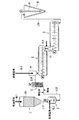
- this apparatus system includes a monomer tank 1, a monomer dissolution tank 2, a first reaction apparatus 3, a second reaction apparatus 4, and a solidification / pulverization apparatus 5, as a schematic configuration, arranged in series, Thereafter, a plurality of (only one shown) solid-phase polymerization apparatuses 6 that can be switched are arranged.
- each of the monomer dissolution tank 2 and the devices 3 to 6 includes a temperature control segment.
- the temperature control segment is a jacket type using heat transfer oil, steam, hot water, cold water, etc. as a heat medium, a non-jacket type such as an electric heater, an infrared heater, an air cooling fan, or a combination type of these temperature control segments. Is included.
- the gas phase space existing in the monomer tank 1 and the monomer dissolution tank 2 is made a dry air atmosphere by the dry air supplied to the pipes GL1 and GL2, respectively.
- the dry air is typically a dry product of air mainly composed of about 21% oxygen and slightly over 78% nitrogen.
- oxygen or nitrogen is added.
- the oxygen concentration can be adjusted in the range of about 10 to 21%.
- an air-dried product is used as it is, but it can be diluted as necessary to suppress the effect of promoting oxygen polymerization.
- the oxygen concentration may be increased to increase the polymerization promoting effect.
- moisture in the air has the effect of reducing the molecular weight of the product aliphatic polyester and lowering the water resistance, and this effect increases or decreases due to changes in the amount of moisture in the atmosphere, so the air used at this stage is
- those dried so that the dew point is preferably ⁇ 10 ° C. or lower, more preferably ⁇ 30 ° C. or lower are used.
- a cyclic ester monomer having a diameter of 3 mm or less is held to dissolve the monomer.
- it is supplied to the monomer dissolving tank 2 through the pipe L12 at appropriate times.
- the granular cyclic ester monomer supplied from the monomer tank 1 is heated to a temperature not lower than its melting point, generally about 85 to 150 ° C., dissolved, and supplied to the first reactor. .
- the dissolved monomer in the monomer dissolution tank 2 thus formed generally has a concentration of 1.0 to 3.0 vol% (standard state of dissolved oxygen: 0 ° C., volume at 1 atm / monomer liquid volume ⁇ 100), preferably Contains dissolved oxygen at a concentration controlled to 1.0 to 2.5 vol%, and moisture is suppressed to less than 60 ppm (wt.), Preferably less than 30 ppm.
- the first reactor 3 is supplied with an initiator (molecular weight regulator) and a catalyst together with the cyclic ester monomer.
- the initiator molecular weight regulator
- monohydric alcohols such as water, butanol and dodecanol (lauryl alcohol), preferably higher alcohols
- polyhydric alcohols such as butanediol, hexanediol and glycerin are used.
- the catalyst is not particularly limited as long as it is used as a ring-opening polymerization catalyst for various cyclic esters.
- specific examples of such catalysts include metal compounds such as tin (Sn), titanium (Ti), aluminum (Al), antimony (Sb), germanium (Ge), zirconium (Zr), and zinc (Zn).
- examples thereof include oxides, halides, carboxylates, and alkoxides.
- preferable catalysts include, for example, tin such as tin halide (for example, tin dichloride and tin tetrachloride) and organic carboxylate (for example, tin octoate such as tin 2-ethylhexanoate).
- examples thereof include, but are not limited to, titanium compounds such as alkoxy titanates; aluminum compounds such as alkoxyaluminum; zirconium compounds such as zirconium acetylacetone; antimony compounds such as antimony halides. .
- the amount of the catalyst used is generally small with respect to the cyclic ester, and is usually 300 ppm or less, preferably 1 to 100 ppm, more preferably 10 to 60 ppm on a weight basis, based on the cyclic ester.
- the first reaction apparatus 3 can be directly supplied with the cyclic ester monomer in the monomer tank 1 without using the monomer dissolution tank 2 by using a dry feed apparatus. Further, the initiator and the catalyst can be directly supplied to the first reactor 3. However, in order to uniformly disperse these auxiliaries in the monomers before polymerization, it is preferable to dissolve the monomers in the monomer dissolving tank 2 in advance and disperse them in the dissolved monomers before supplying them to the first reactor 3. That is, the initiator is preferably supplied in the monomer dissolution tank 2 or in the middle of the supply pipe L23 to the first reactor 3.
- the catalyst is preferably supplied in the form of a paste, a melt or a solution, more preferably in the form of a solution.
- ethers such as diethyl ether and ketones such as acetone.
- a low boiling point solvent that can be volatilized at the polymerization temperature such as carboxylic acid esters such as ethyl acetate. It is preferable to dilute to / ml and supply in the middle of the monomer supply path 1 supplied in a molten state. The concentration is not limited as long as the concentration can be supplied quantitatively.
- the supplied catalyst solution is preferably maintained in an inert gas atmosphere such as nitrogen.
- the initiator is added to the monomer prior to the catalyst, or is added simultaneously with the catalyst on the monomer feed path.
- a mixer such as a static mixer can be provided in the supply line after the supply.
- First reactor 3 In the first reactor 3, the content is kept in a molten state by setting the polymerization temperature to 100 to 240 ° C., preferably 120 to 220 ° C., controlled by a heating medium entering and exiting the jacket divided into two or more as required.
- the reaction rate is preferably 5 to 50%, more preferably 10 to 40%, and a residence time in the range of 1 to 30 minutes, preferably 3 to 15 minutes, so as to obtain the reaction rate.
- a stirring device As the stirring device, a multi-stage paddle blade, a helical ribbon blade, a helical screw blade or the like suitable for stirring highly viscous contents, or a vertical or horizontal twin-screw type stirring as disclosed in JP-A-11-279267 is used. An apparatus is preferably used.
- the partial polymer from the first reactor 3 is introduced into the second reactor 4 in a molten state through the pipe L34 and the connecting portion 41 having a dry nitrogen atmosphere.
- the connection part 41 is a box-shaped space for receiving the viscous reaction mixture that flows in and flowing it down to the hopper of the second reaction apparatus 4, and the inside is held in a dry nitrogen atmosphere introduced from the pipe GL3.
- the internal temperature of the second reactor 4 is controlled to a temperature of 120 to 240 ° C., preferably 140 to 220 ° C., preferably 50 to 90 ° C. by a heat medium entering and exiting the jacket divided into two or more as necessary. %, More preferably 60 to 87%.
- a vertical or horizontal biaxial stirring device is preferably used as the stirring device of the second reactor 4.
- a horizontal biaxial agitator as shown in FIG. 1 is preferable because it has transportability and self-cleaning property.
- the residence time can also be adjusted by the inclination of the installation angle of the stirrer or the outlet diameter of the stirrer.
- Solidification / Crushing device 5 In the solidification / pulverization apparatus 5 which is a biaxial agitation apparatus used in a preferred embodiment of the present invention, the partial polymer from the second reaction apparatus 4 is introduced in a molten state through the connecting part 51 in a dry nitrogen atmosphere. . At least in the subsequent stage of the solidification / pulverization apparatus 5, the partial polymer is solidified and continuously discharged in a pulverized state using the solid pulverization force of the biaxial stirring apparatus. For this purpose, it is necessary to set the partial polymer temperature at the outlet of the apparatus 5 to be equal to or lower than the melting point of the produced aliphatic polyester, and the heat medium temperature entering and exiting the jacket divided into two or more as required is usually set.
- the melting point and the crystallization temperature from the molten state vary depending on the reaction rate of the partial polymer. Generally, the higher the reaction rate, the higher the melting point and the crystallization temperature.
- the heat medium temperature approaches the melting point of the partial polymer, the partial polymer discharged from the solidification / pulverization apparatus 5 is likely to be fused and become a large granular material.
- the heat medium temperature is too low with respect to the crystallization temperature of the partial polymer, the partial polymer discharged from the solidification / pulverization apparatus 5 is not crystallized due to rapid cooling and becomes amorphous and easily adheres.
- the heat medium temperature of the solidification / pulverization apparatus 5 is appropriately determined depending on the reaction rate of the supplied partial polymer. That is, the main function of the solidification / pulverization apparatus 5 is solidification and pulverization of the partial polymer. Further polymerization of the partial polymer is based on the heat capacity of the partial polymer introduced from the second reactor 4 and the melt. It becomes a subordinate function depending on the heat capacity accompanying the change during solidification and the allowable residence time (for example, 1 to 10 minutes) in the solidification / pulverization apparatus 5.
- the reaction rate in the solidification / pulverization device 5 is usually 5% or less, particularly about 0 to 3%, and the discharged solid portion In order to suppress coloring of the polymer, the final reaction rate is preferably 50 to 95%, particularly preferably 60 to 90%.
- the solidification / pulverization apparatus 5 a vertical or horizontal biaxial stirring apparatus in different directions or the same direction is used, but a same direction biaxial stirring apparatus with good transportability of the partial polymer is preferable, and for the same reason. A horizontal biaxial stirring device is more preferable.
- the pulverized product a granular material containing fine powder and having a particle size exceeding 30 mm can be obtained. From the viewpoint of operability, the average particle size is preferably about 1 to 20 mm. In order to obtain uniformity of the degree of polymerization in the subsequent solid phase polymerization step, it is preferable to make the particle diameter as uniform as possible.
- the partial pulverized solid polymer product obtained by using the solidification / pulverization apparatus 5 as described above is preferably heated to a temperature below its melting point, preferably within a range of -100 ° C to -20 ° C for a predetermined time. And a reaction rate of 98% or more, preferably 99 to 100%, is achieved, and the residual monomer amount is preferably 2% or less, more preferably 1% or less.
- the apparatus includes a partial polymer in a predetermined temperature and an inert gas atmosphere such as nitrogen for a predetermined time necessary to achieve the above reaction rate, for example, 0.5 to 10 hours, preferably 1 to 5 hours.
- Arbitrary batch or continuous transfer type devices such as inverted conical conduction heat transfer devices, drum type devices, groove type conduction heat transfer devices, fluidized bed dryers, air flow dryers, conveyors, etc. can be used.
- a continuous transfer type apparatus When a continuous transfer type apparatus is used, the amount of residual cyclic ester in the produced polymer can be further reduced by setting the subsequent stage as a reduced pressure atmosphere.
- an inverted conical conduction heat transfer device 6 having a powder stirring blade 61 is used.
- this apparatus 6 is basically operated in a batch system, a plurality of the apparatuses 6 are provided and can be switched between receiving and accumulating a solid pulverized product of a partial polymer from a polymerization / pulverization system and for solid-phase polymerization. Is preferred.
- the pulverized polymer obtained as described above, that is, the aliphatic polyester, is preferably melt-kneaded together with a heat stabilizer and pelletized.
- heat stabilizer examples include cyclic neopentanetetrayl bis (2,6-di-tert-butyl-4-methylphenyl) phosphite, cyclic neopentanetetrayl bis (2,4-di-tert).
- phosphate ester having a pentaerythritol skeleton structure such as cyclic neopentanetetraylbis (octadecyl) phosphite; mono- or di-stearyl acid phosphate, or a mixture thereof, preferably Are phosphoric acid alkyl esters or phosphorous acid alkyl esters having 8 to 24 alkyl groups; metal carbonates such as calcium carbonate and strontium carbonate; and bis [2- (2- Hydroxybenzoyl) hydrazine] Hydrazine compounds having a —CONHNH—CO— unit such as decanoic acid, N, N′-bis [3- (3,5-di-t-butyl-4-hydroxyphenyl) propionyl] hydrazine; 3- (N— Salicyloyl) triazole compounds such as amino-1,2,4-triazole, and triazine compounds.
- pentaerythritol skeleton structure such as
- heat stabilizers The structure of these heat stabilizers is shown in WO2003 / 037956A1, if necessary. These heat stabilizers are preferably used in an amount of 3 parts by weight or less, more preferably 0.003 to 1 part by weight, and most preferably 0.01 to 0.05 parts by weight, based on 100 parts by weight of the aliphatic polyester. It is done.
- the water resistance (hydrolysis resistance) of the obtained pellet-shaped aliphatic polyester can be improved by adding a carboxyl group-blocking agent in addition to the heat stabilizer.
- carboxyl group blocking agent those known as water resistance improvers for aliphatic polyesters such as polylactic acid can be generally used.
- monocarbodiimides such as N, N-2,6-diisopropylphenylcarbodiimide And carbodiimide compounds including polycarbodiimide compounds, 2,2'-m-phenylenebis (2-oxazoline), 2,2'-p-phenylenebis (2-oxazoline), 2-phenyl-2-oxazoline, styrene iso
- Oxazoline compounds such as propenyl-2-oxazoline
- Oxazine compounds such as 2-methoxy-5,6-dihydro-4H-1,3-oxazine
- Epoxy compounds such as N-glycidylphthalimide, cyclohexene oxide and triglycidyl isocyanurate Etc.
- carbodiimide compounds and epoxy compounds are preferred.
- carboxyl group-capping agents can be used in combination of two or more as required. 0.01 to 10 parts by weight, further 0.1 to 2 parts by weight with respect to 100 parts by weight of the aliphatic polyester It is preferable to blend in an amount of 0.2 part to 1 part by weight.
- the above-mentioned aliphatic polyester pulverized product and heat stabilizer, and further a carboxyl group blocking agent to be added as necessary, have a melting point of the aliphatic polyester of +5 to + 60 ° C., for example, when the aliphatic polyester is polyglycolic acid (PGA) It is preferably melted (mixed) by heating to a temperature range of 230 to 280 ° C., more preferably 240 to 270 ° C.
- the melting (mixing) means is basically arbitrary, and a stirrer, a continuous kneader, etc.
- an extruder that can be processed in a short time and can be smoothly transferred to the subsequent cooling step For example, heating and melting (mixing) in a co-rotating twin-screw kneading extruder is preferable.
- heating and melting (mixing) in a co-rotating twin-screw kneading extruder is preferable.
- the heat melting temperature is less than 230 ° C.
- the effect of additives such as a heat stabilizer and a carboxyl group sealing agent tends to be insufficient.
- the PGA resin composition tends to be colored.
- the heat stabilizer is supplied from the extruder inlet hopper together with the aliphatic polyester, and the carboxyl group sealant is supplied from the middle stage of the extruder.
- the additive effect can be maximized.
- a reduced pressure can be applied to the melt in the middle stage of the extruder to further reduce the residual cyclic ester.
- a filler In order to impart mechanical strength and other properties to the aliphatic polyester, it is possible to use a filler, the type of which is not particularly limited, but fibrous, plate-like, powdery, Granular fillers can be used. Specifically, organic fibers such as glass fibers, PAN and pitch carbon fibers, stainless fibers, metal fibers such as aluminum fibers and brass fibers, natural fibers such as chitin / chitosan, cellulose and cotton, and aromatic polyamide fibers.
- organic fibers such as glass fibers, PAN and pitch carbon fibers, stainless fibers, metal fibers such as aluminum fibers and brass fibers, natural fibers such as chitin / chitosan, cellulose and cotton, and aromatic polyamide fibers.
- the kind of glass fiber is not particularly limited as long as it is generally used for reinforcing resin, and can be selected from, for example, long fiber type, short fiber type chopped strand, milled fiber, and the like. Two or more kinds of the above fillers can be used in combination.
- the surface of the filler can also be used by treating the surface with a known coupling agent (for example, a silane coupling agent, a titanate coupling agent, etc.) or other surface treatment agents.
- the glass fibers may be coated or bundled with a thermoplastic resin such as an ethylene / vinyl acetate copolymer or a thermosetting resin such as an epoxy resin.
- the addition amount of the filler is 0.1 to 100 parts by weight, particularly preferably 1 to 50 parts by weight with respect to 100 parts by weight of the PGA resin.
- Reaction rate The glycolide content in the reaction mixture was measured and calculated as the conversion rate of glycolide.
- a special grade dimethyl sulfoxide (Kanto Chemical Co., Ltd.) was prepared by dissolving an internal standard substance 4-chlorobenzophenone (manufactured by Kanto Chemical Co., Ltd.) at a concentration of 0.2 g / l in about 100 mg of a sample. 2) 2 ml was added, heated at 150 ° C. for about 5 minutes to dissolve, cooled to room temperature, and then filtered. 1 ⁇ l of the filtrate was collected and injected into a gas chromatography (GC) apparatus for measurement.
- GC gas chromatography
- Yellowness A color difference meter (“TC-1800” manufactured by Tokyo Denshoku Technical Center), in which a pellet sample was laid down in a dedicated petri dish (diameter 3 cm ⁇ height 1.3 m) to be closely packed and calibrated with a standard white plate (No. 88417) ).
- Measurement conditions 2 times visual field, standard light C, reflected light measurement, average value of three measurements performed by changing the position of the sample placed on the measurement stage.
- Moisture content Measured with a Karl Fischer moisture meter (KF) using glycolide monomer precisely weighed to about 2 g: [KF measurement conditions] Equipment: “CA-100” manufactured by Mitsubishi Chemical (vaporizer “VA-100”) Vaporization temperature: 140 ° C Carrier gas: Nitrogen, 250 ml / min End sense: The measurement was terminated when the level decreased to +0.05 ⁇ g / s from the background.
- melt viscosity The measurement was performed using a “Capillograph 1-C” manufactured by Toyo Seiki equipped with a capillary (1 mmf ⁇ 10 mmL). About 20 g of a sample was introduced into an apparatus heated to a set temperature of 270 ° C., and held for 5 minutes, and then the melt viscosity (unit: Pa ⁇ s) at a shear rate of 121 sec ⁇ 1 was measured.
- polyglycolic acid (PGA) was produced by ring-opening polymerization of glycolide using the apparatus system shown in FIG. That is, granular glycolide having a particle size (major axis reference) of about 2 mm is accommodated in the monomer tank 1 maintained in an atmosphere of dry air (oxygen concentration: about 21 vol%, dew point: about ⁇ 40 ° C.) supplied through the pipe GL1 as appropriate. did.
- the granular glycolide was supplied through the pipe L12 to the monomer dissolution tank 2 having an internal volume of 50 L held in a dry air atmosphere appropriately supplied through the pipe GL2, and heated at 100 ° C. to melt.
- the dissolved oxygen content in the molten glycolide was 2.0 vol%, and the water content was less than 30 ppm.
- the first reactor of the vertical cylindrical full liquid type with an internal volume of 1.8 L set to an internal temperature of about 180 ° C. while stirring the molten glycolide in the monomer dissolution tank 2 through a pipe L23 with a biaxial multistage paddle blade.
- the bottom of 3 was continuously fed at 30 kg / h.
- 1-dodecanol (initiator) is 0.25 mol% with respect to glycolide, and tin dichloride (catalyst) in ethyl acetate (concentration: 0.015 g / ml).
- the reaction product (melt) at about 180 ° C. from the first reactor 3 was continuously divided into four in the longitudinal direction through the pipe L34 and independently set at 200 ° C., 210 ° C., 210 ° C., and 210 ° C. It was supplied to a device connecting part (hopper) 41 of a second reactor 4 having the same direction and rotating biaxial horizontal type having a jacket (“KRC kneader S5 type” manufactured by Kurimoto Iron Works).
- KRC kneader S5 type manufactured by Kurimoto Iron Works.
- the inside of the device connecting portion 41 was maintained in a dry nitrogen atmosphere supplied from the pipe GL3.
- the dry nitrogen (dew point: about ⁇ 40 ° C.) supplied to the pipe GL3 is designed to keep the space generated in the upper part of the apparatus 4 in the dry nitrogen atmosphere.
- the reactant discharged with an average residence time of about 12 minutes under stirring showed a reaction rate of 75% and a weight average molecular weight of about 200,000 monomer.
- the reaction product discharged from the second reactor 4 at a temperature of about 215 ° C. passes through the connecting portion 51, and has a jacket set at a temperature of about 80 ° C. Incorporated by Kurimoto Iron Works “KRC Kneader S4”).
- the connecting portion 51 has an airtight structure that covers the hopper of the device 5, and the dry nitrogen introduced from the pipe GL 4 keeps the connecting portion 51 in a dry nitrogen atmosphere and also makes the internal space of the device 5 have a dry nitrogen atmosphere. Designed.
- the average residence time in the apparatus 5 was about 2 minutes, and a granular reaction product having an average particle diameter (major axis reference) of about 5 mm was discharged from the discharge section at about 30 kg / hr.
- the increase in the reaction rate in the apparatus 5 is about 2%, and there is substantially no role as a polymerization apparatus.
- the devices 3 to 5 were continuously operated for 60 hours.
- the granular reactant discharged from the solidification / pulverization apparatus 5 passes through a transfer path L56, and a planetary screw stirrer 61 (although slightly different from the figure, a screw-like stirring blade having a helical blade around the inner surface of the inverted conical container is used.
- the solid phase is composed of an inverted cone-shaped mixing device (“SV mixer” manufactured by Shinko Environmental Solution Co., Ltd.) having an internal volume of about 1 m 3 and capable of controlling the internal temperature. After being sent to the polymerization apparatus 6 and accumulating the granular reactant up to about 480 kg, solid phase polymerization was performed at an internal temperature of 170 ° C. for 2 hours.
- the obtained PGA had a melting point (Tm) of 222 ° C., a weight average molecular weight (Mw) of 220,000, a polydispersity (Mw / Mn) of 2.0, and a yellowness (YI) of 16.
- pelletization was performed as follows.
- N, N-2,6-diisopropylphenylcarbodiimide (manufactured by Kawaguchi Chemical Industry Co., Ltd.) as a carboxyl group-capping agent is side-fed from the middle of the extruder to 0.3 parts by weight with respect to PGA.
- the PGA composition was pelletized.
- the obtained PGA pellets had a major axis length average diameter of 3 mm, residual glycolide content of 0.2%, melting point of 222 ° C., weight average molecular weight of 220,000, polydispersity of 2.0, color tone YI of 18, and melting.
- the viscosity was 600 Pa ⁇ s and the residual carboxyl group end temperature was 0.8 eq / t.
- PGA was produced in the same manner as in the example except that the supply gas from the pipes GL1 and GL2 was changed from dry air to dry nitrogen and the inside of the monomer tank 1 and the monomer dissolution tank 2 was changed to a dry nitrogen atmosphere. However, since the reaction rate at the end of 2 hours of solid phase polymerization at an internal temperature of 170 ° C. was about 85 to 90%, heating was continued for 6 hours to achieve a polymerization reaction rate of 99% or more. Was necessary.
- Comparative Example 3 A comparative example is used, except that the apparatus shown in FIG. 1 is used, except that the dry nitrogen atmosphere control in the inter-apparatus connecting portions 41 and 51 is not performed (that is, open to the atmosphere (relative humidity: about 60%)). In the same manner as in No. 2, the devices 1 to 5 were continuously operated.
Landscapes
- Chemical & Material Sciences (AREA)
- Organic Chemistry (AREA)
- Chemical Kinetics & Catalysis (AREA)
- Health & Medical Sciences (AREA)
- Medicinal Chemistry (AREA)
- Polymers & Plastics (AREA)
- Engineering & Computer Science (AREA)
- Mechanical Engineering (AREA)
- Polyesters Or Polycarbonates (AREA)
- Biological Depolymerization Polymers (AREA)
Abstract
環状エステルを少なくとも二段の直列塊状開環重合工程および固相重合工程に付して脂肪族ポリエステルを製造するに際して、乾燥空気雰囲気下に保持した環状エステルを、第1反応装置に供給して第1段重合を行い、生成した部分重合体溶融物を乾燥不活性ガス雰囲気下に保持した第2反応装置に供給して第2段重合を行う脂肪族ポリエステルの製造方法。これにより、製品脂肪族ポリエステルの性状を良好に維持しつつ、製造効率を改善する。
Description
本発明は、グリコリドなどの環状エステルを開環重合して脂肪族ポリエステルを製造する方法の改良に関する。
ポリグリコール酸やポリ乳酸等の脂肪族ポリエステルは、土壌や海中などの自然界に存在する水、微生物または酵素により分解されるため、環境に対する負荷が小さい生分解性高分子材料として注目されている。
脂肪族ポリエステルの中でも、ポリグリコール酸は、酸素ガスバリア性、炭酸ガスバリア性、水蒸気バリア性などのバリア性に優れ、耐熱性や機械的強度にも優れているので、包装材料などの分野において、単独で、あるいは他の樹脂材料などと複合化して用途展開が図られている。
脂肪族ポリエステルは、例えば、グリコール酸や乳酸などのα-ヒドロキシカルボン酸の脱水重縮合により合成することができるが、この方法によっては、高分子量の脂肪族ポリエステルを製造することが困難である。これに対し、高分子量の脂肪族ポリエステルを効率よく製造するために、α-ヒドロキシカルボン酸の二量体環状エステルを合成し、該環状エステルを開環重合する方法が採用されている。例えば、グリコール酸の二量体環状エステルであるグリコリドを開環重合すると、ポリグリコール酸が得られる。乳酸の二量体環状エステルであるラクチドを開環重合すると、ポリ乳酸が得られる。またラクトンの開環重合によっても脂肪族ポリエステルが得られる。これら環状エステルの開環重合による脂肪族ポリエステルの製造方法は、例えば下記特許文献1~6などにより知られている。また本発明者らも、環状エステルを開環重合して脂肪族ポリエステルを製造するに際して、部分重合体の溶融物を二軸撹拌装置中に連続的に導入して固体粉砕状態の部分重合体を連続的に得、これを更に固相重合に付した後、生成した重合体を熱安定剤とともに溶融混練してペレット化することを特徴とする脂肪族ポリエステルの製造方法(特許文献7)を提案している。
これら環状エステルの開環重合による脂肪族ポリエステルの製造方法においては、いずれも重合雰囲気を窒素ガス等の不活性ガス雰囲気とすることが望ましいとされ、わずかに特許文献4において、反応器内雰囲気中水分の寄与を含むモノマー中水分の開始剤および製品ポリエステル分子量調節剤としての積極的利用が図られている程度である。しかしながら、分子量調整効果を持つ水分の利用は、高分子量で耐水性の良好な脂肪族ポリエステルの製造には必ずしも適していない。
本発明は、上記特許文献の重合工程の改良を目的とし、特に製品特性を維持しつつ製造効率を改善した脂肪族ポリエステルの製造方法を提供することを目的とする。
本発明者らの研究によれば、重合の前半工程における雰囲気制御を適切に行うことにより、上記目的の達成が可能であることが見出された。本発明の脂肪族ポリエステルの製造方法は、このような知見に基づくものであり、より詳しくは、環状エステルを少なくとも二段の直列塊状開環重合工程および固相重合工程に付して脂肪族ポリエステルを製造するに際して、乾燥空気雰囲気下に保持した環状エステルを、第1反応装置に供給して第1段重合を行い、生成した部分重合体溶融物を乾燥不活性ガス雰囲気下に保持した第2反応装置に供給して第2段重合を行うことを特徴とするものである。
本発明の脂肪族ポリエステルの製造方法によれば、重合初期には乾燥空気との接触により適度の濃度で環状エステル中に含まれる酸素の存在により重合が効果的に進行し、次いで乾燥不活性ガス雰囲気下で引き続く重合過程を進行させることにより、大気中に存在する過剰な酸素および水分の存在による製品脂肪族ポリエステルの耐水性で代表される特性の劣化が防止され、また重合工程の安定化が図られる。
(環状エステル)
本発明で用いる環状エステルとしては、α-ヒドロキシカルボン酸の二量体環状エステル及びラクトンが好ましい。二量体環状エステルを形成するα-ヒドロキシカルボン酸としては、例えば、グリコール酸、L-及び/またはD-乳酸、α-ヒドロキシ酪酸、α-ヒドロキシイソ酪酸、α-ヒドロキシ吉草酸、α-ヒドロキシカプロン酸、α-ヒドロキシイソカプロン酸、α-ヒドロキシヘプタン酸、α-ヒドロキシオクタン酸、α-ヒドロキシデカン酸、α-ヒドロキシミリスチン酸、α-ヒドロキシステアリン酸、及びこれらのアルキル置換体などを挙げることができる。
本発明で用いる環状エステルとしては、α-ヒドロキシカルボン酸の二量体環状エステル及びラクトンが好ましい。二量体環状エステルを形成するα-ヒドロキシカルボン酸としては、例えば、グリコール酸、L-及び/またはD-乳酸、α-ヒドロキシ酪酸、α-ヒドロキシイソ酪酸、α-ヒドロキシ吉草酸、α-ヒドロキシカプロン酸、α-ヒドロキシイソカプロン酸、α-ヒドロキシヘプタン酸、α-ヒドロキシオクタン酸、α-ヒドロキシデカン酸、α-ヒドロキシミリスチン酸、α-ヒドロキシステアリン酸、及びこれらのアルキル置換体などを挙げることができる。
ラクトンとしては、例えば、β-プロピオラクトン、β-ブチロラクトン、ピバロラクトン、γ-ブチロラクトン、δ-バレロラクトン、β-メチル-δ-バレロラクトン、ε-カプロラクトンなどが挙げられる。また環状エーテルエステルとしては、例えばジオキサノンなどが挙げられる。
環状エステルは、不斉炭素を有する物は、D体、L体、及びラセミ体のいずれでもよい。これらの環状エステルは、それぞれ単独で、あるいは2種以上を組み合わせて使用することができる。2種以上の環状エステルを使用すると、任意の脂肪族コポリエステルを得ることができる。環状エステルは、所望により、共重合可能なその他のコモノマーと共重合させることができる。他のコモノマーとしては、例えば、トリメチレンカーボネート、1,3-ジオキソランなどの環状モノマーなどが挙げられる。
環状エステルの中でも、グリコール酸の二量体環状エステルであるグリコリド、L-及び/またはD-乳酸の二量体環状エステルであるL-及び/またはD-ラクチド、及びこれらの混合物が好ましく、グリコリドがより好ましい。グリコリドは、単独で使用することができるが、他の環状モノマーと併用してポリグリコール酸共重合体(コポリエステル)を製造することもできる。ポリグリコール酸共重合体を製造する場合、生成コポリエステルの結晶性、ガスバリア性などの物性上の観点から、共重合体中のグリコリドの割合は、好ましくは70重量%、より好ましくは80重量%以上、特に好ましくは90重量%以上とすることが望ましい。また、グリコリドと共重合させる環状モノマーとしては、ラクチド、ε-カプロラクトン、トリメチレンカーボネートが好ましい。
環状エステルの製造方法は、特に限定されない。例えば、グリコリドは、グリコール酸オリゴマーを解重合する方法により得ることができる。グリコール酸オリゴマーの解重合法として、例えば、米国特許第2,668,162号明細書に記載の溶融解重合法、特開2000-119269号公報に記載の固相解重合法、特開平9-328481号公報や国際公開第02/14303A1公報に記載の溶液相解重合法等を採用することができる。K.ChujoらのDie Makromolekulare Cheme,100(1967),262-266に報告されているクロロ酢酸塩の環状縮合物として得られるグリコリドも用いることができる。
グリコリドを得るには、上記解重合法の中でも、溶液相解重合法が好ましい。溶液相解重合法では、(1)グリコール酸オリゴマーと230~450℃の範囲内の沸点を有する少なくとも一種の高沸点極性有機溶媒とを含む混合物を、常圧下または減圧下に、該オリゴマーの解重合が起こる温度に加熱して、(2)該オリゴマーの融液相の残存率(容積比)が0.5以下になるまで、該オリゴマーを該溶媒に溶解させ、(3)同温度で更に加熱を継続して該オリゴマーを解重合させ、(4)生成した二量体環状エステル(すなわち、グリコリド)を高沸点極性有機溶媒と共に溜出させ、(5)溜出物からグリコリドを回収する。
高沸点極性有機溶媒としては、例えば、ジ(2-メトキシエチル)フタレートなどのフタル酸ビス(アルコキシアルキルエステル)、ジエチレングリコールジベンゾエートなどのアルキレングリコールジベンゾエート、ベンジルブチルフタレートやジブチルフタレートなどの芳香族カルボン酸エステル、トリクレジルホスフェートなどの芳香族リン酸エステル、ポリエチレンジアルキルエーテルなどのポリアルキレングリコールエーテル等を挙げることができ、該オリゴマーに対して、通常、0.3~50倍量(重量比)の割合で使用する。高沸点極性有機溶媒と共に、必要に応じて、該オリゴマーの可溶化剤として、テトラエチレングリコール、ポリエチレングリコール、ポリプロピレングリコールなどを併用することができる。グリコール酸オリゴマーの解重合温度は、通常、230℃以上であり、好ましくは230~320℃である。解重合は、常圧下または減圧下に行うが、0.1~90.0kPa(1~900mbar)の減圧下に加熱して解重合させることが好ましい。
≪脂肪族ポリエステルの製造≫
本発明法においては、上記した環状エステルを出発原料として、図1に好適な一例を示す装置系を用いて、脂肪族ポリエステルを製造することができる。図1を参照して、この装置系は、概略構成として、モノマータンク1、モノマー溶解槽2、第1反応装置3、第2反応装置4および固化・粉砕装置5をほぼ直列に配設し、その後に切替使用可能な複数(一のみ図示)の固相重合装置6を配置してなる。ここで、モノマー溶解槽2および装置3~6は、それぞれ温度制御セグメントを備える。ここで、温度制御セグメントとは、熱媒油、スチーム、温水、冷水等を熱媒体とするジャケット型、電気ヒーター、赤外線ヒーター、空冷ファン等の非ジャケット型、またはこれらの組み合わせ型の温度制御セグメントを含むものである。
本発明法においては、上記した環状エステルを出発原料として、図1に好適な一例を示す装置系を用いて、脂肪族ポリエステルを製造することができる。図1を参照して、この装置系は、概略構成として、モノマータンク1、モノマー溶解槽2、第1反応装置3、第2反応装置4および固化・粉砕装置5をほぼ直列に配設し、その後に切替使用可能な複数(一のみ図示)の固相重合装置6を配置してなる。ここで、モノマー溶解槽2および装置3~6は、それぞれ温度制御セグメントを備える。ここで、温度制御セグメントとは、熱媒油、スチーム、温水、冷水等を熱媒体とするジャケット型、電気ヒーター、赤外線ヒーター、空冷ファン等の非ジャケット型、またはこれらの組み合わせ型の温度制御セグメントを含むものである。
以下、本発明の好ましい実施態様であるグリコリドの開環重合によるポリグリコール酸の例を主として、本発明の脂肪族ポリエステルの製造方法の好ましい態様を説明する。
(乾燥空気、モノマータンク1、モノマー溶解槽2)
本発明に従い、モノマータンク1およびモノマー溶解槽2内に存在する気相空間は配管GL1およびGL2よりそれぞれに供給された乾燥空気により乾燥空気雰囲気とされる。ここで乾燥空気とは、代表的には約21%の酸素および78%強の窒素を主成分とする大気の乾燥物であるが、環状エステルの重合性に応じて、例えば酸素あるいは窒素の追加により、酸素濃度を10~21%程度の範囲で増減調整することができる。例えば、比較的重合性の高いグリコリドについては、大気乾燥物がそのまま用いられるが、必要に応じて希釈して酸素の重合促進効果を抑制することもできる。他方、ラクチド等のより重合性の低い環状エステルモノマーについては、酸素濃度を上昇させて、重合促進効果を増大してもよい。一般に、大気中の水分は製品脂肪族ポリエステルの分子量を低減させ、また耐水性を低下させる効果があり、また大気中の水分量の変化によりこの効果が増減するので、この段階で使用する空気は、露点が好ましくは-10℃以下、より好ましくは-30℃以下となるように乾燥させたものを用いる。
本発明に従い、モノマータンク1およびモノマー溶解槽2内に存在する気相空間は配管GL1およびGL2よりそれぞれに供給された乾燥空気により乾燥空気雰囲気とされる。ここで乾燥空気とは、代表的には約21%の酸素および78%強の窒素を主成分とする大気の乾燥物であるが、環状エステルの重合性に応じて、例えば酸素あるいは窒素の追加により、酸素濃度を10~21%程度の範囲で増減調整することができる。例えば、比較的重合性の高いグリコリドについては、大気乾燥物がそのまま用いられるが、必要に応じて希釈して酸素の重合促進効果を抑制することもできる。他方、ラクチド等のより重合性の低い環状エステルモノマーについては、酸素濃度を上昇させて、重合促進効果を増大してもよい。一般に、大気中の水分は製品脂肪族ポリエステルの分子量を低減させ、また耐水性を低下させる効果があり、また大気中の水分量の変化によりこの効果が増減するので、この段階で使用する空気は、露点が好ましくは-10℃以下、より好ましくは-30℃以下となるように乾燥させたものを用いる。
モノマータンク1内には、次のモノマー溶解槽2中での環状エステルモノマーの溶解(融解)を促進するために、例えば、直径が3mm以下の粉粒状とした環状エステルモノマーが保持され、モノマー溶解槽2中での溶解モノマーの残留量に応じて、適時、配管L12を通じて、モノマー溶解槽2へと供給される。
モノマー溶解槽2中では、モノマータンク1から供給された粉粒状環状エステルモノマーが、その融点以上、一般に85~150℃程度の温度に加熱され、溶解されて、第1反応装置へと供給される。このようにして形成されるモノマー溶解槽2中の溶解モノマーには、一般に1.0~3.0vol%(溶存酸素の標準状態:0℃、1気圧における容積/モノマー液容積×100)、好ましくは1.0~2.5vol%に制御された濃度の溶存酸素が含まれ、水分は60ppm(wt.)未満、好ましくは30ppm未満に抑制される。
(開始剤、触媒)
第1反応装置3には、上記環状エステルモノマーとともに開始剤(分子量調節剤)および触媒を供給する。
第1反応装置3には、上記環状エステルモノマーとともに開始剤(分子量調節剤)および触媒を供給する。
開始剤(分子量調節剤)としては、水、ブタノール、ドデカノール(ラウリルアルコール)等の一価アルコール、好ましくは高級アルコール;ブタンジオール、ヘキサンジオール、グリセリンなどの多価アルコール等が用いられる。
触媒としては、各種環状エステルの開環重合触媒として使用されているものであればよく、特に限定されない。このような触媒の具体例としては、例えば、スズ(Sn)、チタン(Ti)、アルミニウム(Al)、アンチモン(Sb)、ゲルマニウム(Ge),ジルコニウム(Zr)、亜鉛(Zn)など金属化合物の酸化物、ハロゲン化物、カルボン酸塩、アルコキシドなどが挙げられる。より具体的に、好ましい触媒としては、例えば、ハロゲン化スズ(例えば、二塩化スズ、四塩化スズなど)、有機カルボン酸スズ(例えば、2-エチルヘキサン酸スズなどのオクタン酸スズ)などのスズ系化合物;アルコキシチタネートなどのチタン系化合物;アルコキシアルミニウムなどのアルミニウム系化合物;ジルコニウムアセチルアセトンなどのジルコニウム系化合物;ハロゲン化アンチモンなどのアンチモン系化合物を挙げることができるが、これらに限定されるものではない。
触媒の使用量は、一般に、環状エステルに対して少量でよく、環状エステルを基準として、重量基準で通常300ppm以下、好ましくは1~100ppm、より好ましくは10~60ppmである。
第1反応装置3には、モノマー溶解槽2を経由せずに、モノマータンク1中の環状エステルモノマーを、ドライフィード装置を用いて直接に供給することもできる。また開始剤および触媒を直接第1反応装置3に供給することもできる。しかし、これら助剤を重合前にモノマー中に均一分散するために、予めモノマー溶解槽2中でモノマーを溶解させ、溶解モノマーに分散させてから、第1反応装置3に供給することが好ましい。すなわち、開始剤はモノマー溶解槽2中、あるいは第1反応装置3への供給配管L23の途中に供給することが好ましい。また触媒は、ペースト状、溶融状または溶液状、より好ましくは溶液状で供給することが好ましく、特に生成ポリマー中における溶媒の残存を防止するためにジエチルエーテルなどのエーテル類、アセトンなどのケトン類、酢酸エチルなどのカルボン酸エステル類等の重合温度で揮散し得る低沸点溶媒を用い、0.1g/ml以下、より好ましくは0.05g/ml以下、更に好ましくは0.001~0.02g/mlに稀釈して、溶融状態で供給されるモノマーの供給経路1の途中に供給することが好ましい。定量的に供給できる濃度であれば、これに限らない。供給される触媒溶液は、窒素等の不活性ガス雰囲気に保持されていることが好ましい。一般的には、開始剤は、触媒より前にモノマーに添加され、あるいはモノマーの供給系路上で触媒と同時に添加される。これら助剤の分散性をより向上させるために、供給後に、スタティックミキサー等の混合機を供給ライン中に装備することもできる。
(第1反応装置3)
第1反応装置3においては、必要に応じて二以上に分割されたジャケットに出入りする熱媒により制御される重合温度を100~240℃、好ましくは120~220℃として内容物の溶融状態を維持しつつ、5~50%、より好ましくは10~40%の反応率とすることが好ましく、その反応率が得られるよう、1~30分、好ましくは3~15分の範囲内の滞留時間を設定する。本発明においては、乾燥空気雰囲気中で保持された、特に好ましくは乾燥空気雰囲気下のモノマー溶解槽2中で溶解されることにより、1.0~3.0vol%の濃度で溶存する酸素の作用により、第2段以降の重合負荷の軽減が可能な、上記反応効率が達成される。但し、過度に高い反応率とすると、部分重合体の着色が増加するとともに第1反応装置3での撹拌の負荷を増大するので制約がある。
第1反応装置3においては、必要に応じて二以上に分割されたジャケットに出入りする熱媒により制御される重合温度を100~240℃、好ましくは120~220℃として内容物の溶融状態を維持しつつ、5~50%、より好ましくは10~40%の反応率とすることが好ましく、その反応率が得られるよう、1~30分、好ましくは3~15分の範囲内の滞留時間を設定する。本発明においては、乾燥空気雰囲気中で保持された、特に好ましくは乾燥空気雰囲気下のモノマー溶解槽2中で溶解されることにより、1.0~3.0vol%の濃度で溶存する酸素の作用により、第2段以降の重合負荷の軽減が可能な、上記反応効率が達成される。但し、過度に高い反応率とすると、部分重合体の着色が増加するとともに第1反応装置3での撹拌の負荷を増大するので制約がある。
撹拌装置としては、高粘性内容物の撹拌に適した多段パドル翼、ヘリカルリボン翼、ヘリカルスクリュー翼など、あるいは特開平11-279267号公報に示されるような縦型あるいは横型の二軸スクリュー式撹拌装置が好ましく用いられる。
また撹拌層内の液レベルの変動に伴う撹拌槽の空間部の槽壁等への付着の防止および空間気相雰囲気(存在する場合は、より低減した酸素濃度の乾燥空気雰囲気とする必要がある)の制御の必要性を除く意味で、図1に示すような満液型の撹拌槽3(この例では二軸多段パドル翼撹拌装置を備える)を用いることが好ましい。
(第2反応装置4)
第2反応装置4には、第1反応装置3からの部分重合体が、配管L34および乾燥窒素雰囲気とされた連結部41を通じて、溶融状態で導入される。連結部41は、流入する粘稠な反応混合物を受け入れ第2反応装置4のホッパーへと流下させるための箱状空間であり、内部は配管GL3より導入される乾燥窒素雰囲気に保持される。第2反応装置4の内温は、必要に応じて二以上に分割されたジャケットに出入りする熱媒により、120~240℃、好ましくは140~220℃の温度に制御され、好ましくは50~90%、より好ましくは60~87%まで重合率を高める。必要な滞留時間、たとえば5~20分、を与えつつ、このような高粘性内容物を処理するため第2反応装置4の撹拌装置としては縦型あるいは横型の二軸撹拌装置が好ましく用いられ、特に図1に示すような横型の二軸撹拌装置が搬送性、セルフクリーニング性を有しているため好ましい。滞留時間は、撹拌装置の設置角度の傾斜あるいは撹拌装置の排出部口径によっても調節可能である。この段階での反応率も高いほうが望ましいが、重合率を高めることには、得られる部分重合体の着色も増加傾向を示すという制約がある。
第2反応装置4には、第1反応装置3からの部分重合体が、配管L34および乾燥窒素雰囲気とされた連結部41を通じて、溶融状態で導入される。連結部41は、流入する粘稠な反応混合物を受け入れ第2反応装置4のホッパーへと流下させるための箱状空間であり、内部は配管GL3より導入される乾燥窒素雰囲気に保持される。第2反応装置4の内温は、必要に応じて二以上に分割されたジャケットに出入りする熱媒により、120~240℃、好ましくは140~220℃の温度に制御され、好ましくは50~90%、より好ましくは60~87%まで重合率を高める。必要な滞留時間、たとえば5~20分、を与えつつ、このような高粘性内容物を処理するため第2反応装置4の撹拌装置としては縦型あるいは横型の二軸撹拌装置が好ましく用いられ、特に図1に示すような横型の二軸撹拌装置が搬送性、セルフクリーニング性を有しているため好ましい。滞留時間は、撹拌装置の設置角度の傾斜あるいは撹拌装置の排出部口径によっても調節可能である。この段階での反応率も高いほうが望ましいが、重合率を高めることには、得られる部分重合体の着色も増加傾向を示すという制約がある。
(固化・粉砕装置5)
本発明の好ましい態様で用いられる二軸撹拌装置である固化・粉砕装置5においては、第2反応装置4からの部分重合体が乾燥窒素雰囲気とされた連結部51を通じて、溶融状態で導入される。固化・粉砕装置5の少なくとも後段においては、部分重合体が固化され、二軸撹拌装置の持つ固体粉砕力を利用して、粉砕状態で連続的に排出される。このためには、装置5の出口において部分重合体温度を、生成脂肪族ポリエステルの融点以下にする必要があり、必要に応じて二以上に分割されたジャケットに出入りする熱媒体温度を、通常は当該融点以下に、調整することになる。部分重合体の反応率により、その融点、溶融状態からの結晶化温度が変化する。一般的には、反応率が高いほど融点、結晶化温度は高くなる。熱媒体温度が部分重合体の融点に近づくほど、固化・粉砕装置5から排出される部分重合体は、融着して大きい粒状物となりやすくなる。熱媒体温度が部分重合体の結晶化温度に対して低すぎるほど、固化・粉砕装置5から排出される部分重合体は、急冷によって結晶化しきれずに非晶状態となり粘着しやすくなる。そのため、固化・粉砕装置5の熱媒体温度は、供給される部分重合体の反応率によって適宜決定される。すなわち、この固化・粉砕装置5の主たる機能は、部分重合体の固化ならびに粉砕であり、部分重合体の更なる重合は、第2反応装置4から導入される部分重合体の熱容量および融液から固化するときの変化に伴う熱容量と、許容される固化・粉砕装置5内の滞留時間(例えば、1~10分)に依存した、従たる機能となる。したがって、第2段反応装置の出口反応率にもよるが、この固化・粉砕装置5における反応率は、5%以下、特に0~3%程度となるのが通常であり、排出される固体部分重合体の着色を抑制するためにも、最終反応率としては、好ましくは50~95%、特に60~90%とすることが好ましい。固化・粉砕装置5としては、異方向あるいは同方向の縦型または横型の二軸撹拌装置が用いられるが、部分重合体の搬送性の良い同方向二軸撹拌装置が好ましく、また同様の理由により横型二軸撹拌装置がより好ましい。粉砕物としては、微粉を含む30mmを超える粒径までの粒状体が得られるが、操作性の点で、その平均粒径としては、1~20mm程度が好ましい。その後の固相重合工程における重合度の均一性を得るため、できるだけ均一な粒径とすることが好ましい。
本発明の好ましい態様で用いられる二軸撹拌装置である固化・粉砕装置5においては、第2反応装置4からの部分重合体が乾燥窒素雰囲気とされた連結部51を通じて、溶融状態で導入される。固化・粉砕装置5の少なくとも後段においては、部分重合体が固化され、二軸撹拌装置の持つ固体粉砕力を利用して、粉砕状態で連続的に排出される。このためには、装置5の出口において部分重合体温度を、生成脂肪族ポリエステルの融点以下にする必要があり、必要に応じて二以上に分割されたジャケットに出入りする熱媒体温度を、通常は当該融点以下に、調整することになる。部分重合体の反応率により、その融点、溶融状態からの結晶化温度が変化する。一般的には、反応率が高いほど融点、結晶化温度は高くなる。熱媒体温度が部分重合体の融点に近づくほど、固化・粉砕装置5から排出される部分重合体は、融着して大きい粒状物となりやすくなる。熱媒体温度が部分重合体の結晶化温度に対して低すぎるほど、固化・粉砕装置5から排出される部分重合体は、急冷によって結晶化しきれずに非晶状態となり粘着しやすくなる。そのため、固化・粉砕装置5の熱媒体温度は、供給される部分重合体の反応率によって適宜決定される。すなわち、この固化・粉砕装置5の主たる機能は、部分重合体の固化ならびに粉砕であり、部分重合体の更なる重合は、第2反応装置4から導入される部分重合体の熱容量および融液から固化するときの変化に伴う熱容量と、許容される固化・粉砕装置5内の滞留時間(例えば、1~10分)に依存した、従たる機能となる。したがって、第2段反応装置の出口反応率にもよるが、この固化・粉砕装置5における反応率は、5%以下、特に0~3%程度となるのが通常であり、排出される固体部分重合体の着色を抑制するためにも、最終反応率としては、好ましくは50~95%、特に60~90%とすることが好ましい。固化・粉砕装置5としては、異方向あるいは同方向の縦型または横型の二軸撹拌装置が用いられるが、部分重合体の搬送性の良い同方向二軸撹拌装置が好ましく、また同様の理由により横型二軸撹拌装置がより好ましい。粉砕物としては、微粉を含む30mmを超える粒径までの粒状体が得られるが、操作性の点で、その平均粒径としては、1~20mm程度が好ましい。その後の固相重合工程における重合度の均一性を得るため、できるだけ均一な粒径とすることが好ましい。
(固相重合)
上記のようにして好ましくは固化・粉砕装置5を用いることにより得られた部分重合体の固体粉砕物を、その融点以下、好ましくは融点-100℃~-20℃の範囲内の温度に所定時間保持して、98%以上、好ましくは99~100%の反応率を達成し、残留モノマー量を好ましくは2%以下、より好ましくは1%以下とする。その装置としては、上記反応率を達成するために必要な所定時間だけ、例えば0.5~10時間、好ましくは1~5時間、部分重合体を所定温度、且つ窒素等の不活性ガス雰囲気に保持できる、逆円錐形伝導伝熱装置、ドラム型装置、溝型伝導伝熱装置、流動層乾燥機、気流乾燥機、コンベア等の、任意の回分または連続移送型の装置が用いられる。連続移送型の装置を用いる場合、その後段を減圧雰囲気として生成ポリマー中の残留環状エステル量を更に低減することもできる。図1に示す例では、粉体撹拌翼61を備えた逆円錐形伝導伝熱装置6が用いられている。この装置6は、基本的に回分式に運転されるため、複数設けて、重合・粉砕系からの部分重合体の固体粉砕物の受入・蓄積用と、固相重合用とで切替使用することが好ましい。
上記のようにして好ましくは固化・粉砕装置5を用いることにより得られた部分重合体の固体粉砕物を、その融点以下、好ましくは融点-100℃~-20℃の範囲内の温度に所定時間保持して、98%以上、好ましくは99~100%の反応率を達成し、残留モノマー量を好ましくは2%以下、より好ましくは1%以下とする。その装置としては、上記反応率を達成するために必要な所定時間だけ、例えば0.5~10時間、好ましくは1~5時間、部分重合体を所定温度、且つ窒素等の不活性ガス雰囲気に保持できる、逆円錐形伝導伝熱装置、ドラム型装置、溝型伝導伝熱装置、流動層乾燥機、気流乾燥機、コンベア等の、任意の回分または連続移送型の装置が用いられる。連続移送型の装置を用いる場合、その後段を減圧雰囲気として生成ポリマー中の残留環状エステル量を更に低減することもできる。図1に示す例では、粉体撹拌翼61を備えた逆円錐形伝導伝熱装置6が用いられている。この装置6は、基本的に回分式に運転されるため、複数設けて、重合・粉砕系からの部分重合体の固体粉砕物の受入・蓄積用と、固相重合用とで切替使用することが好ましい。
(変形例)
上記において本発明の脂肪族ポリエステルの製造方法を、図1を参照しつつ、その好ましい一態様について説明したが、本発明の範囲内で種々の変形が可能である。例えば、第1段反応を攪拌型の回分式反応装置で進め、生成した部分重合体を回分式の管型静置重合装置に充填して第2段反応を進めることが可能である。
上記において本発明の脂肪族ポリエステルの製造方法を、図1を参照しつつ、その好ましい一態様について説明したが、本発明の範囲内で種々の変形が可能である。例えば、第1段反応を攪拌型の回分式反応装置で進め、生成した部分重合体を回分式の管型静置重合装置に充填して第2段反応を進めることが可能である。
(ペレット化)
上記のようにして得られた粉砕状態の重合体、すなわち脂肪族ポリエステルを、熱安定剤とともに溶融混練してペレット化することが好ましい。
上記のようにして得られた粉砕状態の重合体、すなわち脂肪族ポリエステルを、熱安定剤とともに溶融混練してペレット化することが好ましい。
熱安定剤の好ましい例としては、サイクリックネオペンタンテトライルビス(2,6-ジ-tert-ブチル-4-メチルフェニル)ホスファイト、サイクリックネオペンタンテトライルビス(2,4-ジ-tert-ブチルフェニル)ホスファイト、サイクリックネオペンタンテトライルビス(オクタデシル)ホスファイト等のペンタエリスリトール骨格構造を有するリン酸エステル;モノ-またはジ-ステアリルアシッドホスフェートあるいはこれらの混合物等の、炭素数が好ましくは8~24のアルキル基を有するリン酸アルキルエステルまたは亜リン酸アルキルエステル;炭酸カルシウム、炭酸ストロンチウム等の炭酸金属塩;更には一般に重合触媒不活性剤として知られる、ビス[2-(2-ヒドロキシベンゾイル)ヒドラジン]ドデカン酸、N,N′-ビス[3-(3,5-ジ-t-ブチル-4-ヒドロキシフェニル)プロピオニル]ヒドラジンなどの-CONHNH-CO-単位を有するヒドラジン系化合物;3-(N-サリチロイル)アミノ-1,2,4-トリアゾール等のトリアゾール系化合物、更には、トリアジン系化合物などが挙げられる。これら熱安定剤の構造は、必要であれば、WO2003/037956A1公報に示されている。これら熱安定剤は、脂肪族ポリエステル100重量部に対して、好ましくは3重量部以下、より好ましくは0.003~1重量部、最も好ましくは0.01~0.05重量部の割合で用いられる。
更に、熱安定剤に加えて、カルボキシル基封止剤を加えることにより、得られるペレット状脂肪族ポリエステルの耐水性(耐加水分解性)を向上することもできる。
カルボキシル基封止剤としては、ポリ乳酸等の脂肪族ポリエステルの耐水性向上剤として知られているものを一般に用いることができ、例えば、N,N-2,6-ジイソプロピルフェニルカルボジイミドなどのモノカルボジイミドおよびポリカルボジイミド化合物を含むカルボジイミド化合物、2,2′-m-フェニレンビス(2-オキサゾリン)、2,2′-p-フェニレンビス(2-オキサゾリン)、2-フェニル-2-オキサゾリン、スチレン・イソプロペニル-2-オキサゾリンなどのオキサゾリン化合物;2-メトキシ-5,6-ジヒドロ-4H-1,3-オキサジンなどのオキサジン化合物;N-グリシジルフタルイミド、シクロへキセンオキシド、トリグリシジルイソシアヌレートなどのエポキシ化合物などが挙げられる。なかでもカルボジイミド化合物やエポキシ化合物が好ましい。これらカルボキシル基封止剤は、必要に応じて2種以上を併用することが可能であり、脂肪族ポリエステル100重量部に対して、0.01~10重量部、更には0.1~2重量部、特に0.2~1重量部の割合で配合することが好ましい。
上述した脂肪族ポリエステル粉砕物および熱安定剤、更には必要に応じて加えるカルボキシル基封止剤、を脂肪族ポリエステルの融点+5~+60℃、例えば脂肪族ポリエステルがポリグリコール酸(PGA)の場合、好ましくは230~280℃、より好ましくは、240~270℃の温度範囲に加熱して溶融(混合)する。溶融(混合)手段は基本的には任意であり、撹拌機、連続式混練機等も用いられるが、短時間処理が可能であり、その後の冷却工程への移行も円滑に行われる押出機(たとえば、同方向回転二軸混練押出機)中での加熱溶融(混合)が好ましい。例えばPGAの場合、熱溶融温度が230℃未満では、熱安定剤やカルボキシル基封止剤などの添加剤効果が不十分となりやすい。他方280℃を超えると、PGA樹脂組成物の着色が起こりやすい。押出機を用い、且つ熱安定剤に加えて、カルボキシル基封止剤を添加する場合、脂肪族ポリエステルとともに熱安定剤を押出機入口ホッパーから供給し、カルボキシル基封止剤を押出機中段から供給することにより、添加剤効果を最大にすることができる。また、必要に応じて押出機の中段以降において溶融物に減圧を付与して、残留環状エステルの一層の低減を図ることもできる。
脂肪族ポリエステルに、機械的強度、その他の特性を付与するために、充填材を使用することが可能であり、その種類は特に限定されるものではないが、繊維状、板状、粉末状、粒状などの充填材を使用することができる。具体的には、ガラス繊維、PAN系やピッチ系の炭素繊維、ステンレス繊維、アルミニウム繊維や黄銅繊維などの金属繊維、キチン・キトサン、セルロース、綿などの天然繊維、芳香族ポリアミド繊維などの有機合成繊維、石膏繊維、セラミック繊維、アスベスト繊維、ジルコニア繊維、アルミナ繊維、シリカ繊維、酸化チタン繊維、炭化ケイ素繊維、ロックウール、チタン酸カリウムウイスカー、チタン酸バリウムウイスカー、ほう酸アルミニウムウイスカー、窒化ケイ素ウイスカーなどの繊維状あるいはウイスカー状充填材;マイカ、タルク、カオリン、シリカ、砂などの天然無機鉱物、炭酸カルシウム、ガラスビーズ、ガラスフレーク、ガラスマイクロバルーン、クレー、二硫化モリブデン、ワラステナイト、モンモリロナイト、酸化チタン、酸化亜鉛、ポリ燐酸カルシウム、グラファイトなどの粉状、粒状あるいは板状の充填材が挙げられる。ガラス繊維の種類は、一般に樹脂の強化に用いられるものなら特に限定はなく、たとえば長繊維タイプや短繊維タイプのチョップドストランド、ミルドファイバーなどから選択して用いることができる。また上記の充填材は2種以上を併用することもできる。上記の充填材は、その表面を公知のカップリング剤(たとえばシラン系カップリング剤、チタネート系カップリング剤など)、その他の表面処理剤で処理して用いることもできる。またガラス繊維は、エチレン/酢酸ビニル共重合体などの熱可塑性樹脂、エポキシ樹脂などの熱硬化性樹脂で被覆あるいは集束されていてもよい。充填材の添加量は、PGA樹脂100重量部に対して0.1~100重量部、特に好ましくは1~50重量部である。
以下、脂肪族ポリエステルとしてPGAを製造する実施例により、本発明を更に具体的に説明する。以下の記載を含めて、本明細書中に記載した物性(値)は、以下の方法による測定値に基づく。
(1)反応率:
反応混合物中のグリコリド含有量を測定し、グリコリドの転化率として算出した。またグリコリド含有量測定のためには、サンプル約100mgに、内部標準物質の4-クロロベンゾフェノン(関東化学(株)製)を0.2g/lの濃度で溶解した特級ジメチルスルホキシド(関東化学(株)製)2mlを加え、150℃で約5分間加熱して溶解させ、室温まで冷却した後、濾過を行った。その濾液を1μl採取し、ガスクロマトグラフィー(GC)装置に注入して測定した。
反応混合物中のグリコリド含有量を測定し、グリコリドの転化率として算出した。またグリコリド含有量測定のためには、サンプル約100mgに、内部標準物質の4-クロロベンゾフェノン(関東化学(株)製)を0.2g/lの濃度で溶解した特級ジメチルスルホキシド(関東化学(株)製)2mlを加え、150℃で約5分間加熱して溶解させ、室温まで冷却した後、濾過を行った。その濾液を1μl採取し、ガスクロマトグラフィー(GC)装置に注入して測定した。
<GC条件>
装置:(株)島津製作所製「GC-2010」
カラム:「TC-17」、0.25mmφ×30m
カラム温度:150℃5分間保持、20℃/minで270℃まで昇温、270℃3分間保持
インジェクション温度:180℃
検出器:FID(水素炎イオン化検出器)、温度:300℃。
装置:(株)島津製作所製「GC-2010」
カラム:「TC-17」、0.25mmφ×30m
カラム温度:150℃5分間保持、20℃/minで270℃まで昇温、270℃3分間保持
インジェクション温度:180℃
検出器:FID(水素炎イオン化検出器)、温度:300℃。
(2)分子量:
275℃で90秒加熱、更に2MPaで60秒のプレス後、氷水中で急冷することにより、非晶質化したポリマーシートを形成し、これから切り出したポリマーサンプル10mgを、下記GPC溶離液に溶解させて10mlのサンプル溶液とした。その溶液をPTFE製0.1μmメンブランフィルターで濾過後、ゲルパーミエーションクロマトグラフィー(GPC)装置に注入して分子測定した。なお、溶解から注入までの時間は30分以内とした。測定された分子量分布に基づき、重量平均分子量(Mw)、数平均分子量(Mn)を求め、これから更に多分散度(=重量平均分子量/数平均分子量)を求めた。
275℃で90秒加熱、更に2MPaで60秒のプレス後、氷水中で急冷することにより、非晶質化したポリマーシートを形成し、これから切り出したポリマーサンプル10mgを、下記GPC溶離液に溶解させて10mlのサンプル溶液とした。その溶液をPTFE製0.1μmメンブランフィルターで濾過後、ゲルパーミエーションクロマトグラフィー(GPC)装置に注入して分子測定した。なお、溶解から注入までの時間は30分以内とした。測定された分子量分布に基づき、重量平均分子量(Mw)、数平均分子量(Mn)を求め、これから更に多分散度(=重量平均分子量/数平均分子量)を求めた。
<GPC条件>
装置:昭和電工(株)製Shodex-104
カラム:HFIP-606M(2本)、プレカラム:HFIP-G(1本)を直列接続。カラム温度:40℃
溶離液:5mMトリフルオロ酢酸ナトリウム/HFIP(ヘキサフルオロイソプロパノール)中溶液
流速:0.6ml/min
検出器:RI(示差屈折率検出器)
分子量決定基準物質:標準ポリメタクリル酸メチル(昭和電工(株)製、分子量195.0万、65.9万、21.8万、5.0万、2.1万、0.7万及び0.2万)。
装置:昭和電工(株)製Shodex-104
カラム:HFIP-606M(2本)、プレカラム:HFIP-G(1本)を直列接続。カラム温度:40℃
溶離液:5mMトリフルオロ酢酸ナトリウム/HFIP(ヘキサフルオロイソプロパノール)中溶液
流速:0.6ml/min
検出器:RI(示差屈折率検出器)
分子量決定基準物質:標準ポリメタクリル酸メチル(昭和電工(株)製、分子量195.0万、65.9万、21.8万、5.0万、2.1万、0.7万及び0.2万)。
(3)黄色度(YI):
ペレットサンプルを専用シャーレ(直径3cm×高さ1.3m)に最密充填となるように敷き詰め、標準白色板(No.88417)により校正した色差計(東京電色技術センター製「TC-1800」)を用いて測定した。
ペレットサンプルを専用シャーレ(直径3cm×高さ1.3m)に最密充填となるように敷き詰め、標準白色板(No.88417)により校正した色差計(東京電色技術センター製「TC-1800」)を用いて測定した。
測定条件:2度視野、標準光C、反射光測定、測定ステージに載せたサンプル位置を変えて行った3回の測定の平均値。
(4)溶存酸素:
100℃で融解させたグリコリドモノマー100μlをGC装置に注入し、得られた酸素のピーク面積から、グリコリド中の溶存酸素(単位:vol%(標準状態酸素容積/モノマー液容積×100))を算出した。予め、ガスクロマトグラフィー(GC)に体積1~50μlの空気(酸素濃度:約21vol%)を注入し、得られるピーク面積から酸素の検量線を作成した:
[GC測定条件]
装置 :島津製作所製「GC-7A」
キャリヤーガス :ヘリウム,50ml/min
カラム :3mmf×3m,モレキュラーシーブス5A充填
カラム温度 :50℃
インジェクション温度 :室温
検出器 :TCD(熱伝導度型検出器,125mA,150℃)。
(5)水分量:
約2gに精秤したグリコリドモノマーを用いて、カールフィッシャー水分計(KF)で測定した:
[KF測定条件]
装置 :三菱化学製「CA-100」(気化装置「VA-100」)
気化温度 :140℃
キャリヤーガス :窒素,250ml/min
エンドセンス :バックグラウンドより+0.05μg/sまで低下した時点で測定を終了した。
約2gに精秤したグリコリドモノマーを用いて、カールフィッシャー水分計(KF)で測定した:
[KF測定条件]
装置 :三菱化学製「CA-100」(気化装置「VA-100」)
気化温度 :140℃
キャリヤーガス :窒素,250ml/min
エンドセンス :バックグラウンドより+0.05μg/sまで低下した時点で測定を終了した。
(6)残存カルボン酸末端(COOH)濃度
ポリマーサンプル200~300mgを精秤し、そこにジメチルスルホキシド(DMSO)を10ml加え150℃で溶解させた後、1wt.%ブロモチモールブルー/アルコール溶液を数滴添加し約0.02Nの水酸化ナトリウム/ベンジルアルコール溶液で滴定を行い、その滴下量より、ポリマー1トンあたりに存在するカルボキシル基の当量数(単位:eq/t)として算出した。
ポリマーサンプル200~300mgを精秤し、そこにジメチルスルホキシド(DMSO)を10ml加え150℃で溶解させた後、1wt.%ブロモチモールブルー/アルコール溶液を数滴添加し約0.02Nの水酸化ナトリウム/ベンジルアルコール溶液で滴定を行い、その滴下量より、ポリマー1トンあたりに存在するカルボキシル基の当量数(単位:eq/t)として算出した。
(7)溶融粘度:
キャピラリー(1mmf×10mmL)を装着した東洋精機製「キャピログラフ 1-C」を用いて測定した。設定温度270℃に加熱した装置に、サンプル約20gを導入し、5分間保持した後、剪断速度121sec-1での溶融粘度(単位:Pa・s)を測定した。
キャピラリー(1mmf×10mmL)を装着した東洋精機製「キャピログラフ 1-C」を用いて測定した。設定温度270℃に加熱した装置に、サンプル約20gを導入し、5分間保持した後、剪断速度121sec-1での溶融粘度(単位:Pa・s)を測定した。
(8)耐水性測定:
ポリマーサンプルから作製した非晶質シートを80℃で10分間かけて結晶化させ、それを50℃/90%RHの条件下で所定時間暴露し、暴露後のシートの分子量より重量平均分子量が7万まで低下するのに要する時間を算出した。その時間の相対比率を耐水性指数として表した。
ポリマーサンプルから作製した非晶質シートを80℃で10分間かけて結晶化させ、それを50℃/90%RHの条件下で所定時間暴露し、暴露後のシートの分子量より重量平均分子量が7万まで低下するのに要する時間を算出した。その時間の相対比率を耐水性指数として表した。
(実施例)
概要を図1に示す装置系によりグリコリドの開環重合によりポリグリコール酸(PGA)の製造を行った。すなわち、適宜配管GL1を通して供給される乾燥空気(酸素濃度:約21vol%、露点:約-40℃)雰囲気に保持されたモノマータンク1中には粒径(長径基準)約2mmの粒状グリコリドを収容した。この粒状グリコリドを、配管GL2を通して適宜供給される乾燥空気雰囲気に保持された内容積50Lのモノマー溶解槽2に配管L12を通して適時に供給して100℃で加熱して融解した。融解グリコリド中の溶存酸素量は2.0vol%、水分量は30ppm未満であった。
概要を図1に示す装置系によりグリコリドの開環重合によりポリグリコール酸(PGA)の製造を行った。すなわち、適宜配管GL1を通して供給される乾燥空気(酸素濃度:約21vol%、露点:約-40℃)雰囲気に保持されたモノマータンク1中には粒径(長径基準)約2mmの粒状グリコリドを収容した。この粒状グリコリドを、配管GL2を通して適宜供給される乾燥空気雰囲気に保持された内容積50Lのモノマー溶解槽2に配管L12を通して適時に供給して100℃で加熱して融解した。融解グリコリド中の溶存酸素量は2.0vol%、水分量は30ppm未満であった。
モノマー溶解槽2中の融解グリコリドを配管L23を通して、二軸の多段パドル翼による撹拌下で内温約180℃に設定された内容積1.8Lの縦型円筒状満液型の第1反応装置3の底部に30kg/hで連続的に供給した。同時に、配管L23の途中には、1-ドデカノール(開始剤)をグリコリドに対して0.25mol%となるように、また二塩化スズ(触媒)の酢酸エチル溶液(濃度:0.015g/ml)をグリコリドに対して30ppm(二塩化スズ重量基準)となるように、それぞれ供給して、装置3の底部に連続的に供給した。平均滞留時間約5分で第1反応装置3の上部から排出される内容物は、定常状態におけるその一部の分析の結果、グリコリド反応率が約30%で、生成ポリマーの重量平均分子量は約10万であることが確認された。
第1反応装置3からの約180℃の反応物(融液)は、連続的に配管L34を通じて長手方向に4分割され、独立に200℃、210℃、210℃、210℃に温度設定されたジャケットを有する同方向・回転2軸横型の第2反応装置4((株)栗本鉄工所製「KRCニーダーS5型」)の装置連結部(ホッパー)41に供給された。この装置連結部41内は、配管GL3から供給される乾燥窒素雰囲気に保持された。配管GL3に供給される乾燥窒素(露点:約-40℃)は、同装置4の上部に生ずる空間も乾燥窒素雰囲気に保持するように設計されている。撹拌下に平均滞留時間約12分で排出された反応物は、反応率75%、モノマーの重量平均分子量約20万の値を示した。
第2反応装置4から約215℃の温度で排出される反応物は、連結部51を経て、温度約80℃に設定されたジャケットを有する同方向軸2軸横型の固化・粉砕装置5((株)栗本鉄工所製「KRCニーダーS4型」)に導入された。連結部51は、装置5のホッパーを覆う気密構造とされ、配管GL4より導入された乾燥窒素は、連結部51を乾燥窒素雰囲気に保持するとともに装置5の内部空間も乾燥窒素雰囲気とするように設計されている。装置5内の平均滞留時間は約2分であり、その排出部からは平均粒径(長径基準)が約5mmの粒状反応物が約30kg/hrで排出された。装置5内での反応率の上昇は、約2%であり、重合装置としての役割は実質的にない。
定常状態に到達した後、装置3~5の連続運転を60時間続けた。
固化・粉砕装置5から排出された粒状反応物は移送路L56を経て、遊星型スクリュー撹拌機61(図示とは若干異なるが、周囲にヘリカル翼を有するスクリュー状攪拌翼が逆円錐型容器の内面を周回しながら内容物を攪拌する機能を有する)を備え且つ内温制御可能な内容量約1m3の逆円錐形状の混合装置((株)神鋼環境ソリューション製「SVミキサー」)からなる固相重合装置6に送られ、ここで約480kgまで粒状反応物を蓄積してから、内温170℃で2時間の固相重合を行った。その結果、重合反応率は99%超(残留モノマー量:0.2wt.%)に達した。得られたPGAの融点(Tm)は222℃、重量平均分子量(Mw)は22万、多分散度(Mw/Mn)は、2.0、黄色度(YI)は16だった。
上記のようにして安定状態で固相重合後に、若干角のとれた粒状のPGAが約720kg得られ、これをシリンダー温度を200~265℃に設定した二軸混練押出機(東芝機械(株)製「TEM41SS」)を用いて、以下のようにしてペレット化した。すなわち、上記PGA粒子と、その200ppm(重量基準)の割合の熱安定剤としてのモノおよびジステアリルアシットホスフェートのほぼ等モル混合物(旭電化工業(株)製、商品名「アデカスタブAX-71」)とを、上記押出機のホッパー上で同時フィードしながら、合計量として80kg/hの速度で同押出機に供給した。同時に、カルボキシル基封止剤としてN,N-2,6-ジイソプロピルフェニルカルボジイミド(川口化学工業(株)製)をPGAに対して0.3重量部となるように押出機の途中からサイドフィードしながら、PGA組成物のペレット化を行った。得られたPGAペレットの長軸長さ平均径は3mm,残留グリコリド量は0.2%,融点は222℃,重量平均分子量は22万,多分散度は2.0,色調YIは18,溶融粘度は600Pa・s,残留カルボキシル基末端温度は0.8eq/tだった。
また、得られたPGAペレットから作製したプレスシートを50℃/90%RHの環境下で暴露し、経時的に分子量変化を追跡したところ、重量分子量7万に達する時間は152時間だった。
上記実施例におけるモノマー溶解槽および第1反応装置-第2反応装置間連結部の気相雰囲気、ならびに得られた製品PGAペレット性状の概要を後記表1に、また各重合工程後の反応率および生成ポリマーの重量平均分子量(Mw)(および固相重合については時間)を後記表2に、以下の比較例の結果とまとめて記す。
(比較例1)
配管GL3からの供給ガスとして乾燥窒素から、乾燥空気(露点:-40℃)に変更して第1反応装置-第2反応装置間連結部を乾燥空気雰囲気とする以外は、実施例と同様にPGAの製造を行った。
配管GL3からの供給ガスとして乾燥窒素から、乾燥空気(露点:-40℃)に変更して第1反応装置-第2反応装置間連結部を乾燥空気雰囲気とする以外は、実施例と同様にPGAの製造を行った。
(比較例2)
配管GL1およびGL2からの供給ガスを乾燥空気から乾燥窒素に変更して、モノマータンク1およびモノマー溶解槽2内を乾燥窒素雰囲気とする以外は、実施例と同様にしてPGAの製造を行った。但し、内温170℃での固相重合の2時間終了時の反応率は85~90%程度であったので、加熱を続け、重合反応率99%以上を達成するには、6時間の加熱が必要であった。
配管GL1およびGL2からの供給ガスを乾燥空気から乾燥窒素に変更して、モノマータンク1およびモノマー溶解槽2内を乾燥窒素雰囲気とする以外は、実施例と同様にしてPGAの製造を行った。但し、内温170℃での固相重合の2時間終了時の反応率は85~90%程度であったので、加熱を続け、重合反応率99%以上を達成するには、6時間の加熱が必要であった。
(比較例3)
図1に示す概要を示す装置を用い、但し、装置間連結部41および51内の乾燥窒素雰囲気制御を行わない(すなわち大気(相対湿度:約60%)へ開放とする)以外は、比較例2と同様にして、装置1~5の連続運転を行った。
図1に示す概要を示す装置を用い、但し、装置間連結部41および51内の乾燥窒素雰囲気制御を行わない(すなわち大気(相対湿度:約60%)へ開放とする)以外は、比較例2と同様にして、装置1~5の連続運転を行った。
しかし、定常状態に到達後、更に1時間を過ぎた頃から徐々にKRCニーダーS4型から排出される被重合物の粘度が上昇し始め、反応が暴走して最終的には制御不能となった。これは、第1反応装置からの低い反応率の反応液が、第2反応装置において、大気中の酸素および水分による重合促進効果で急激に反応したためと考えられる。
上記の定常状態で得られたPGA部分重合体の粉砕物20kgを窒素雰囲気に保ちながら、内温制御可能な30Lオートクレーブに仕込んだ。内温170℃で2時間加熱を続け、固相重合を行ったところ、重合反応率は99%以上に達した。この固相重合後の粒状ポリマーを用いて、実施例と同様にペレット化を行い、特性評価を行った。
(比較例4)
図1に概要を示す装置を用い、但し、モノマータンク1内、モノマー溶解槽2内ならびに装置間連結部41および51内の雰囲気制御を行わない(すなわち大気開放とする)以外は、実施例と同様にPGAの製造を行った。
図1に概要を示す装置を用い、但し、モノマータンク1内、モノマー溶解槽2内ならびに装置間連結部41および51内の雰囲気制御を行わない(すなわち大気開放とする)以外は、実施例と同様にPGAの製造を行った。
上記実施例および比較例の概要および製品の評価結果をまとめて次表1および2に示す。
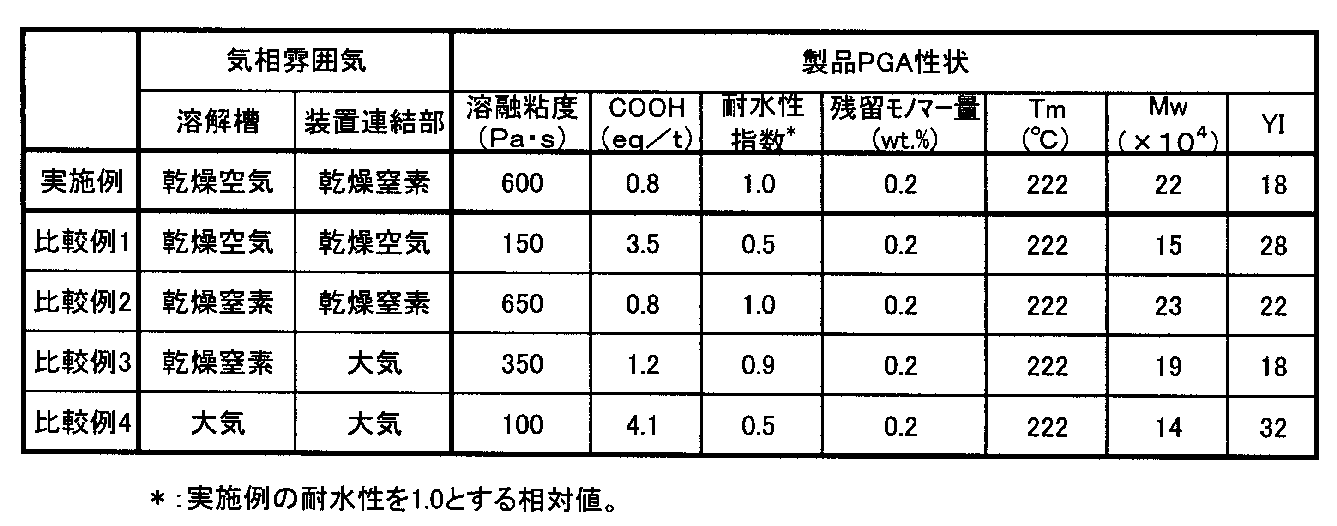
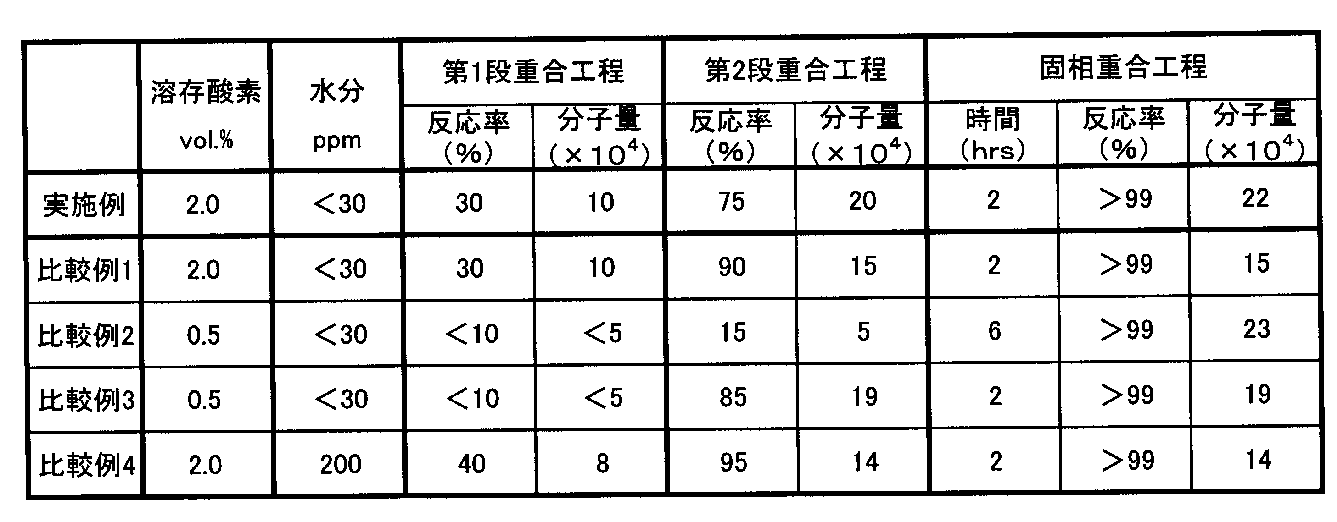
表1および表2の結果を見れば、本発明に従い、環状エステルを少なくとも二段の直列塊状開環重合工程および固相重合工程に付して脂肪族ポリエステルを製造するに際して、第1段重合までの環状エステルモノマーを乾燥空気雰囲気に保持し、第1段重合後の生成物を乾燥窒素雰囲気に制御することにより、製品脂肪族ポリエステルの性状と製造効率の好ましい両立が得られることが分る。
Claims (11)
- 環状エステルを少なくとも二段の直列塊状開環重合工程および固相重合工程に付して脂肪族ポリエステルを製造するに際して、乾燥空気雰囲気下に保持した環状エステルを、第1反応装置に供給して第1段重合を行い、生成した部分重合体溶融物を乾燥不活性ガス雰囲気下に保持した第2反応装置に供給して第2段重合を行うことを特徴とする脂肪族ポリエステルの製造方法。
- 乾燥空気雰囲気下で溶解した環状エステルを第1反応装置に供給して第1段重合を行う請求項1に記載の製造方法。
- 第1反応装置が満液二軸撹拌型反応装置である請求項1または2に記載の製造方法。
- 第1反応装置との連結部が乾燥不活性ガス雰囲気に保持された第2反応装置中で第2段重合を行う請求項1~3のいずれかに記載の製造方法。
- 乾燥不活性ガスが乾燥窒素である請求項1~4のいずれかに記載の製造方法。
- 環状エステルがグリコリドである請求項1~5のいずれかに記載の製造方法。
- グリコリドが、溶液相解重合法によるグリコール酸オリゴマーの解重合物である請求項6に記載の製造方法。
- 第1段反応装置への供給に先立って、環状エステルには、第1段重合温度で揮散し得る低沸点溶媒に溶解された触媒が添加される請求項1~7のいずれかに記載の製造方法。
- 環状エステルには、触媒と同時またはこれに先立って開始剤が添加される請求項8に記載の製造方法。
- 第2反応装置で生成した部分重合体溶融物を固化粉砕後に固相重合工程に付す請求項1~5のいずれかに記載の製造方法。
- 部分重合体の固化粉砕物を熱安定剤とともにペレット化後に固相重合工程に付す請求項10に記載の製造方法。
Priority Applications (2)
| Application Number | Priority Date | Filing Date | Title |
|---|---|---|---|
| US13/202,646 US8691912B2 (en) | 2009-02-23 | 2010-02-17 | Aliphatic polyester manufacturing method |
| US14/183,848 US9458287B2 (en) | 2009-02-23 | 2014-02-19 | Aliphatic polyester manufacturing method |
Applications Claiming Priority (2)
| Application Number | Priority Date | Filing Date | Title |
|---|---|---|---|
| JP2009-039675 | 2009-02-23 | ||
| JP2009039675A JP5559482B2 (ja) | 2009-02-23 | 2009-02-23 | 脂肪族ポリエステルの製造方法 |
Related Child Applications (2)
| Application Number | Title | Priority Date | Filing Date |
|---|---|---|---|
| US13/202,646 A-371-Of-International US8691912B2 (en) | 2009-02-23 | 2010-02-17 | Aliphatic polyester manufacturing method |
| US14/183,848 Continuation-In-Part US9458287B2 (en) | 2009-02-23 | 2014-02-19 | Aliphatic polyester manufacturing method |
Publications (1)
| Publication Number | Publication Date |
|---|---|
| WO2010095656A1 true WO2010095656A1 (ja) | 2010-08-26 |
Family
ID=42633936
Family Applications (1)
| Application Number | Title | Priority Date | Filing Date |
|---|---|---|---|
| PCT/JP2010/052362 Ceased WO2010095656A1 (ja) | 2009-02-23 | 2010-02-17 | 脂肪族ポリエステルの製造方法 |
Country Status (3)
| Country | Link |
|---|---|
| US (1) | US8691912B2 (ja) |
| JP (1) | JP5559482B2 (ja) |
| WO (1) | WO2010095656A1 (ja) |
Cited By (2)
| Publication number | Priority date | Publication date | Assignee | Title |
|---|---|---|---|---|
| WO2013022851A3 (en) * | 2011-08-11 | 2013-07-11 | Abbott Cardiovascular Systems Inc. | Controlling moisture in and plasticization of bioresorbable polymer for melt processing |
| US9670314B2 (en) * | 2012-08-16 | 2017-06-06 | Purac Biochem B.V. | Poly(2-hydroxyalkanoic acid) and method of its manufacture |
Families Citing this family (9)
| Publication number | Priority date | Publication date | Assignee | Title |
|---|---|---|---|---|
| US20040231845A1 (en) | 2003-05-15 | 2004-11-25 | Cooke Claude E. | Applications of degradable polymers in wells |
| US20090107684A1 (en) | 2007-10-31 | 2009-04-30 | Cooke Jr Claude E | Applications of degradable polymers for delayed mechanical changes in wells |
| US8486135B2 (en) | 2006-06-01 | 2013-07-16 | Abbott Cardiovascular Systems Inc. | Implantable medical devices fabricated from branched polymers |
| US9458287B2 (en) * | 2009-02-23 | 2016-10-04 | Kureha Corporation | Aliphatic polyester manufacturing method |
| JP5761559B2 (ja) * | 2011-04-04 | 2015-08-12 | 株式会社リコー | トナー用樹脂、該トナー用樹脂を使用したトナー、及び該トナーを用いた現像剤 |
| JP5946309B2 (ja) * | 2011-04-11 | 2016-07-06 | 株式会社クレハ | 脂肪族ポリエステル系樹脂組成物、及びその製造方法 |
| JP2013124429A (ja) * | 2011-12-15 | 2013-06-24 | Kureha Corp | ポリグリコール酸樹脂繊維製品 |
| AT516968B1 (de) * | 2015-03-23 | 2018-01-15 | Next Generation Recyclingmaschinen Gmbh | Anlage sowie Verfahren zur Behandlung einer Kunststoffschmelze |
| KR102184849B1 (ko) * | 2017-10-12 | 2020-12-01 | 가부시끼가이샤 구레하 | 중합체의 연속 제조 장치 및 연속 제조 방법 |
Citations (5)
| Publication number | Priority date | Publication date | Assignee | Title |
|---|---|---|---|---|
| JPH0299518A (ja) * | 1988-10-06 | 1990-04-11 | Daicel Chem Ind Ltd | ラクトンモノマーの重合方法 |
| JP2005097361A (ja) * | 2003-09-22 | 2005-04-14 | National Institute Of Advanced Industrial & Technology | ポリエステル複合材料 |
| WO2007086563A1 (ja) * | 2006-01-30 | 2007-08-02 | Kureha Corporation | 脂肪族ポリエステルの製造方法 |
| JP2008163073A (ja) * | 2006-12-27 | 2008-07-17 | Musashino Chemical Laboratory Ltd | 脂肪族ポリエステルの製造方法 |
| JP2009030068A (ja) * | 2001-10-31 | 2009-02-12 | Kureha Corp | 結晶性ポリグリコール酸、ポリグリコール酸組成物、及びこれらの製造方法 |
Family Cites Families (1)
| Publication number | Priority date | Publication date | Assignee | Title |
|---|---|---|---|---|
| DE69509927T2 (de) * | 1994-01-21 | 2000-01-27 | Shimadzu Corp., Kyoto | Methode zur Herstellung von Polymilchsäure |
-
2009
- 2009-02-23 JP JP2009039675A patent/JP5559482B2/ja active Active
-
2010
- 2010-02-17 WO PCT/JP2010/052362 patent/WO2010095656A1/ja not_active Ceased
- 2010-02-17 US US13/202,646 patent/US8691912B2/en not_active Expired - Fee Related
Patent Citations (5)
| Publication number | Priority date | Publication date | Assignee | Title |
|---|---|---|---|---|
| JPH0299518A (ja) * | 1988-10-06 | 1990-04-11 | Daicel Chem Ind Ltd | ラクトンモノマーの重合方法 |
| JP2009030068A (ja) * | 2001-10-31 | 2009-02-12 | Kureha Corp | 結晶性ポリグリコール酸、ポリグリコール酸組成物、及びこれらの製造方法 |
| JP2005097361A (ja) * | 2003-09-22 | 2005-04-14 | National Institute Of Advanced Industrial & Technology | ポリエステル複合材料 |
| WO2007086563A1 (ja) * | 2006-01-30 | 2007-08-02 | Kureha Corporation | 脂肪族ポリエステルの製造方法 |
| JP2008163073A (ja) * | 2006-12-27 | 2008-07-17 | Musashino Chemical Laboratory Ltd | 脂肪族ポリエステルの製造方法 |
Cited By (8)
| Publication number | Priority date | Publication date | Assignee | Title |
|---|---|---|---|---|
| WO2013022851A3 (en) * | 2011-08-11 | 2013-07-11 | Abbott Cardiovascular Systems Inc. | Controlling moisture in and plasticization of bioresorbable polymer for melt processing |
| CN103842149A (zh) * | 2011-08-11 | 2014-06-04 | 雅培心血管系统公司 | 用于熔体加工的可生物再吸收聚合物中的水分及其塑化的控制 |
| US8841412B2 (en) | 2011-08-11 | 2014-09-23 | Abbott Cardiovascular Systems Inc. | Controlling moisture in and plasticization of bioresorbable polymer for melt processing |
| US20140298675A1 (en) * | 2011-08-11 | 2014-10-09 | Abbott Cardiovascular Systems Inc. | Controlling moisture in and plasticization of bioresorbable polymer for melt processing |
| US9168677B2 (en) * | 2011-08-11 | 2015-10-27 | Abbott Cardiovascular Systems Inc. | Controlling moisture in and plasticization of bioresorbable polymer for melt processing |
| US10213949B2 (en) | 2011-08-11 | 2019-02-26 | Abbott Cardiovascular Systems Inc. | Controlling moisture in and plasticization of bioresorbable polymer for melt processing |
| US9670314B2 (en) * | 2012-08-16 | 2017-06-06 | Purac Biochem B.V. | Poly(2-hydroxyalkanoic acid) and method of its manufacture |
| CN110156966A (zh) * | 2012-08-16 | 2019-08-23 | 普拉克生化公司 | 聚(2-羟基链烷酸)及其制备方法 |
Also Published As
| Publication number | Publication date |
|---|---|
| JP5559482B2 (ja) | 2014-07-23 |
| JP2010195867A (ja) | 2010-09-09 |
| US8691912B2 (en) | 2014-04-08 |
| US20110306733A1 (en) | 2011-12-15 |
Similar Documents
| Publication | Publication Date | Title |
|---|---|---|
| JP5595639B2 (ja) | 脂肪族ポリエステル組成物の製造方法 | |
| JP5559482B2 (ja) | 脂肪族ポリエステルの製造方法 | |
| JP5224815B2 (ja) | ポリグリコール酸樹脂粒状体組成物およびその製造方法 | |
| CN1930211B (zh) | 残留环酯少的脂族聚酯的制造方法 | |
| JP4672554B2 (ja) | 脂肪族ポリエステルの製造方法 | |
| JP4711828B2 (ja) | 脂肪族ポリエステルの製造方法 | |
| US20150361214A1 (en) | Polylactic acid composition, and production method and production apparatus of the same | |
| JPWO2007034805A1 (ja) | ポリグリコール酸樹脂組成物の製造方法 | |
| KR101730744B1 (ko) | 폴리머 조성물 | |
| JP5164576B2 (ja) | ポリグリコール酸樹脂組成物 | |
| RU2713408C2 (ru) | Способ стабилизации композиции конденсированной фазы, содержащей циклический сложный эфир, в процессе производства сложного полиэфира из лактида | |
| US9458287B2 (en) | Aliphatic polyester manufacturing method | |
| JP5555690B2 (ja) | 脂肪族ポリエステルの製造方法 | |
| JP3517857B2 (ja) | ポリ乳酸の製造法 | |
| JP6144562B2 (ja) | 脂肪族ポリエステルの製造方法 | |
| JP2017094565A (ja) | 粒状ポリグリコール酸系樹脂組成物の製造方法 | |
| WO2012144511A1 (ja) | 生分解性脂肪族ポリエステル粒子、及びその製造方法 | |
| JP2013147565A (ja) | 脂肪族ポリエステル樹脂組成物 | |
| WO2016158876A1 (ja) | 脂肪族ポリエステル組成物及び成形物並びに脂肪族ポリエステルの製造方法 | |
| CN119406363A (zh) | 一种改性聚酯的连续生产系统及生产方法 |
Legal Events
| Date | Code | Title | Description |
|---|---|---|---|
| 121 | Ep: the epo has been informed by wipo that ep was designated in this application |
Ref document number: 10743782 Country of ref document: EP Kind code of ref document: A1 |
|
| WWE | Wipo information: entry into national phase |
Ref document number: 13202646 Country of ref document: US |
|
| NENP | Non-entry into the national phase |
Ref country code: DE |
|
| 122 | Ep: pct application non-entry in european phase |
Ref document number: 10743782 Country of ref document: EP Kind code of ref document: A1 |