WO2010084804A1 - アルミニウムキレート系潜在性硬化剤及びその製造方法 - Google Patents
アルミニウムキレート系潜在性硬化剤及びその製造方法 Download PDFInfo
- Publication number
- WO2010084804A1 WO2010084804A1 PCT/JP2010/050250 JP2010050250W WO2010084804A1 WO 2010084804 A1 WO2010084804 A1 WO 2010084804A1 JP 2010050250 W JP2010050250 W JP 2010050250W WO 2010084804 A1 WO2010084804 A1 WO 2010084804A1
- Authority
- WO
- WIPO (PCT)
- Prior art keywords
- curing agent
- aluminum chelate
- epoxy resin
- compound
- latent curing
- Prior art date
- Legal status (The legal status is an assumption and is not a legal conclusion. Google has not performed a legal analysis and makes no representation as to the accuracy of the status listed.)
- Ceased
Links
Images





Classifications
-
- C—CHEMISTRY; METALLURGY
- C08—ORGANIC MACROMOLECULAR COMPOUNDS; THEIR PREPARATION OR CHEMICAL WORKING-UP; COMPOSITIONS BASED THEREON
- C08G—MACROMOLECULAR COMPOUNDS OBTAINED OTHERWISE THAN BY REACTIONS ONLY INVOLVING UNSATURATED CARBON-TO-CARBON BONDS
- C08G59/00—Polycondensates containing more than one epoxy group per molecule; Macromolecules obtained by polymerising compounds containing more than one epoxy group per molecule using curing agents or catalysts which react with the epoxy groups
- C08G59/18—Macromolecules obtained by polymerising compounds containing more than one epoxy group per molecule using curing agents or catalysts which react with the epoxy groups ; e.g. general methods of curing
- C08G59/68—Macromolecules obtained by polymerising compounds containing more than one epoxy group per molecule using curing agents or catalysts which react with the epoxy groups ; e.g. general methods of curing characterised by the catalysts used
- C08G59/70—Chelates
-
- C—CHEMISTRY; METALLURGY
- C08—ORGANIC MACROMOLECULAR COMPOUNDS; THEIR PREPARATION OR CHEMICAL WORKING-UP; COMPOSITIONS BASED THEREON
- C08K—Use of inorganic or non-macromolecular organic substances as compounding ingredients
- C08K5/00—Use of organic ingredients
- C08K5/0091—Complexes with metal-heteroatom-bonds
-
- C—CHEMISTRY; METALLURGY
- C08—ORGANIC MACROMOLECULAR COMPOUNDS; THEIR PREPARATION OR CHEMICAL WORKING-UP; COMPOSITIONS BASED THEREON
- C08K—Use of inorganic or non-macromolecular organic substances as compounding ingredients
- C08K5/00—Use of organic ingredients
- C08K5/04—Oxygen-containing compounds
- C08K5/15—Heterocyclic compounds having oxygen in the ring
- C08K5/151—Heterocyclic compounds having oxygen in the ring having one oxygen atom in the ring
- C08K5/1525—Four-membered rings
-
- C—CHEMISTRY; METALLURGY
- C08—ORGANIC MACROMOLECULAR COMPOUNDS; THEIR PREPARATION OR CHEMICAL WORKING-UP; COMPOSITIONS BASED THEREON
- C08L—COMPOSITIONS OF MACROMOLECULAR COMPOUNDS
- C08L63/00—Compositions of epoxy resins; Compositions of derivatives of epoxy resins
Definitions
- the present invention relates to an aluminum chelate-based latent curing agent in which an aluminum chelate-based curing agent is held by a porous resin.
- thermosetting epoxy resin composition in which a silane coupling agent having a polymerizable group such as a vinyl group and a trialkoxy group and an epoxy resin are blended with the aluminum chelate-based latent curing agent is a one-component type. In spite of this, it is said that it has excellent storage stability and has the property of being rapidly cured at low temperature by cationic polymerization (the same patent document).
- thermosetting epoxy resin composition containing an aluminum chelate-based latent curing agent, a silane coupling agent, and an epoxy resin disclosed in Patent Document 1
- a polymerization (curing) reaction is started by heating
- the silanolate anion generated from the silane coupling agent was added to the ⁇ -position carbon of the epoxy group of the epoxy resin to cause a polymerization termination reaction.
- the aluminum chelate-based latent curing agent disclosed in Patent Document 1 it is difficult to polymerize a glycidyl ether-based epoxy resin that easily undergoes a ⁇ -carbon addition reaction without causing a polymerization termination reaction.
- an alicyclic epoxy compound is inevitably used which is high in production cost but hardly causes an addition reaction to the ⁇ -position carbon by the silanolate anion.
- thermosetting epoxy resin composition when manufacturing a thermosetting epoxy resin composition from an aluminum chelate-based latent curing agent, a silane coupling agent, and an epoxy resin, a step of dissolving or dispersing the silane coupling agent in the epoxy resin in advance is essential. In order to reduce the manufacturing cost, it has been required to omit such a dissolution or dispersion process. Moreover, since the silane coupling agent (or a silanol compound that can be used in place of it) is directly mixed in the thermosetting epoxy resin composition, an epoxy resin having a functional group that causes an unintended reaction with it, etc. There was a problem that use was restricted.
- the object of the present invention is to solve the above-mentioned problems of the conventional technology, and without using an alicyclic epoxy compound, a low temperature rapid curing of a glycidyl ether epoxy resin with an aluminum chelate latent curing agent.
- the step of dissolving or dispersing the silane coupling agent in the epoxy resin in advance can be omitted.
- An object is to make it possible to use an epoxy resin having a functional group that reacts with (or a silanol compound).
- the present inventor researched the use of silanol compounds having a specific highly sterically hindered chemical structure in order to promote the formation of a cationic catalyst of an aluminum chelate-based latent curing agent.
- Porous resin that is a microcapsule wall obtained by low reactivity with isocyanate groups during interfacial polymerization, and co-existence of polyfunctional radical polymerizable compounds during interfacial polymerization and simultaneous radical polymerization is retained, and the specific silanol compound retained in the porous resin unexpectedly suppresses the polymerization termination reaction, thereby
- the present invention has found that the above-mentioned object can be achieved by forming a cationically active species with a system curing agent. It was completed.
- the aluminum chelate curing agent is held in a porous resin obtained by radical polymerization of a polyfunctional radical polymerizable compound in the presence of a radical polymerization initiator at the same time as interfacial polymerization of the polyfunctional isocyanate compound.
- a radical polymerization initiator at the same time as interfacial polymerization of the polyfunctional isocyanate compound.
- an aluminum chelate-based latent curing agent wherein the silanol compound represented by formula (A) is held in the porous resin.
- n 2 or 3
- Ar is an aryl group which may be substituted.
- the present invention is a method for producing the above-mentioned aluminum chelate-based latent curing agent, An oil phase obtained by dissolving or dispersing an aluminum chelate curing agent, a polyfunctional isocyanate compound, a polyfunctional radical polymerizable compound, a radical polymerization initiator, and a silanol compound of the formula (A) in an organic solvent contains a dispersant.
- the polyfunctional isocyanate compound is subjected to an interfacial polymerization and simultaneously a radical polymerization reaction of the polyfunctional radical polymerizable compound by adding the aluminum chelate curing agent and the porous resin obtained by stirring while heating into the aqueous phase.
- a production method characterized by retaining a silanol compound of the formula (A).
- thermosetting epoxy resin composition containing the above-described aluminum chelate-based latent curing agent and an epoxy resin.
- a silanol compound having a specific highly sterically hindered chemical structure causes a mixture of a polyfunctional isocyanate compound and a polyfunctional radical polymerizable compound to simultaneously undergo interfacial polymerization and radical polymerization, respectively. It is retained (in other words, protected) by the porous resin obtained. For this reason, while being able to suppress polymerization termination reaction, an aluminum chelate type hardening
- thermosetting epoxy resin composition containing the aluminum chelate-based latent curing agent of the present invention the glycidyl ether type epoxy resin is rapidly cured at low temperature as an epoxy resin even though the silanol compound is used in combination. It becomes possible.
- the specific silanol compound is held in the porous resin that is the capsule wall, there is no need to dissolve or disperse the silanol compound in the epoxy resin in advance when manufacturing the thermosetting epoxy resin composition. It becomes.
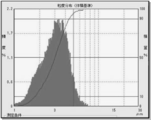
- FIG. 2 is a particle size distribution diagram of an aluminum chelate-based latent curing agent of Example 1.
- FIG. 2 is an electron micrograph (magnification: 2000 times) of the aluminum chelate-based latent curing agent of Example 1.
- 2 is an electron micrograph (magnification: 5000 times) of the aluminum chelate-based latent curing agent of Example 1.
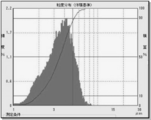
- 3 is a particle size distribution diagram of an aluminum chelate-based latent curing agent of Example 2.
- FIG. 4 is an electron micrograph (magnification: 2000 times) of the aluminum chelate-based latent curing agent of Example 2.
- 4 is an electron micrograph (magnification: 5000 times) of the aluminum chelate-based latent curing agent of Example 2.
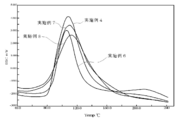
- FIG. 3 is a DSC measurement diagram of thermosetting epoxy resin compositions of Example 4, Example 5, and Comparative Example 2.
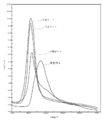
- FIG. FIG. 4 is a DSC measurement diagram of the thermosetting epoxy resin compositions of Example 4 and Examples 6 to 8.
- 4 is a DSC measurement diagram of thermosetting epoxy resin compositions of Example 4 and Example 9.
- FIG. 3 is a DSC measurement diagram of the thermosetting epoxy resin compositions of Example 4 and Examples 10 to 12.
- the aluminum chelate-based latent curing agent of the present invention is obtained by radically polymerizing a polyfunctional radically polymerizable compound in the presence of a radical polymerization initiator at the same time that the aluminum chelate-based curing agent interfacially polymerizes the polyfunctional isocyanate compound.
- the porous resin also holds a highly sterically hindered silanol compound. More specifically, it is not a microcapsule having a simple structure in which a core of an aluminum chelate curing agent is covered with a porous resin shell, but an aluminum chelate system in a large number of fine pores existing in a porous resin matrix. It has a structure in which a curing agent is held.
- the aluminum chelate-based latent curing agent of the present invention is produced using an interfacial polymerization method, its shape is spherical, and its particle diameter is preferably 0.5 to from the viewpoint of curability and dispersibility.
- the pore size is preferably 5 to 150 nm from the viewpoint of curability and latency.
- the aluminum chelate-based latent curing agent has a tendency to decrease if the degree of crosslinking of the porous resin to be used is too small, and if too large, the thermal responsiveness tends to decrease. It is preferable to use a porous resin whose degree of crosslinking is adjusted. Here, the degree of crosslinking of the porous resin can be measured by a micro compression test.
- the aluminum chelate-based latent curing agent does not substantially contain an organic solvent used at the time of interfacial polymerization, specifically, 1 ppm or less.
- the amount of the aluminum chelate-based curing agent is preferably 10 to 200 parts by mass, more preferably 10 to 150 parts by mass with respect to 100 parts by mass of the porous resin. Part.
- the blending amount of the highly sterically hindered silanol compound in the aluminum chelate-based latent curing agent of the present invention is too small, the curing is insufficient, and if it is too large, the latency is lowered, so silanol with respect to 100 parts by mass of the porous resin.
- the compounding amount of the compound is preferably 10 to 200 parts by mass, more preferably 10 to 150 parts by mass.
- the highly sterically hindered silanol compound used in the present invention is an arylsilane all having a chemical structure of the following formula (A).
- m is 2 or 3, preferably 3, provided that the sum of m and n is 4. Therefore, the silanol compound of the formula (A) becomes a mono or diol form.
- “Ar” is an optionally substituted aryl group, and examples of the aryl group include a phenyl group, a naphthyl group (for example, 1 or 2-naphthyl group), an anthracenyl group (for example, 1, 2, or 9-anthracenyl group).
- Benz [a] -9-anthracenyl group phenaryl group (eg 3 or 9-phenaryl group), pyrenyl group (eg 1-pyrenyl group), azulenyl group, fluorenyl group, biphenyl group (eg 2,3 Or 4-biphenyl group), thienyl group, furyl group, pyrrolyl group, imidazolyl group, pyridyl group, and the like.
- a phenyl group is preferable from the viewpoint of availability and cost.
- the m Ars may be the same or different, but are preferably the same from the viewpoint of availability.
- aryl groups may have 1 to 3 substituents such as halogen such as chloro and bromo; trifluoromethyl; nitro; sulfo; alkoxycarbonyl such as carboxyl, methoxycarbonyl and ethoxycarbonyl; formyl and the like Electron-withdrawing groups, alkyl such as methyl, ethyl and propyl; alkoxy such as methoxy and ethoxy; hydroxy; amino; monoalkylamino such as monomethylamino; and electron-donating groups such as dialkylamino such as dimethylamino.
- substituents such as halogen such as chloro and bromo; trifluoromethyl; nitro; sulfo; alkoxycarbonyl such as carboxyl, methoxycarbonyl and ethoxycarbonyl; formyl and the like
- Electron-withdrawing groups alkyl such as methyl, ethyl and propyl; alkoxy such as meth
- the acidity of the hydroxyl group of silanol can be increased by using an electron withdrawing group as a substituent, and conversely, the acidity can be lowered by using an electron donating group, so that the curing activity can be controlled.
- the substituents may be different for each of the m Ars, but the substituents are preferably the same for the m Ars from the viewpoint of availability. Further, only some Ar may have a substituent, and other Ar may not have a substituent.
- phenyl group having a substituent examples include 2,3 or 4-methylphenyl group; 2,6-dimethyl, 3,5-dimethyl, 2,4-dimethyl, 2,3-dimethyl, 2,5- Examples include dimethyl or 3,4-dimethylphenyl group; 2,4,6-trimethylphenyl group; 2 or 4-ethylphenyl group.
- triphenylsilanol or diphenylsilanediol is preferable. Particularly preferred is triphenylsilanol.
- the aluminum chelate-based curing agent constituting the aluminum chelate-based latent curing agent of the present invention includes a complex compound in which three ⁇ -keto enolate anions are coordinated to aluminum represented by the formula (1). It is done.
- R 1 , R 2 and R 3 are each independently an alkyl group or an alkoxyl group.
- the alkyl group include a methyl group and an ethyl group.
- the alkoxyl group include a methoxy group, an ethoxy group, and an oleyloxy group.
- aluminum chelate curing agent represented by the formula (1) examples include aluminum tris (acetylacetonate), aluminum tris (ethylacetoacetate), aluminum monoacetylacetonate bis (ethylacetoacetate), and aluminum monoacetyl.
- aluminum tris acetylacetonate
- aluminum tris ethylacetoacetate
- aluminum monoacetylacetonate bis ethylacetoacetate
- aluminum monoacetyl aluminum monoacetyl.
- examples include acetonate bisoleyl acetoacetate, ethyl acetoacetate aluminum diisopropylate, and alkyl acetoacetate aluminum diisopropylate.
- the polyfunctional isocyanate compound for constituting the porous resin is preferably a compound having two or more isocyanate groups, preferably three isocyanate groups in one molecule.
- a trifunctional isocyanate compound a TMP adduct of formula (2) obtained by reacting 3 mol of a diisocyanate compound with 1 mol of trimethylolpropane, and a formula (3) obtained by self-condensing 3 mol of a diisocyanate compound.
- An isocyanurate of formula (4) and a biuret of formula (4) obtained by condensing the remaining 1 mol of diisocyanate with diisocyanate urea obtained from 2 mol of 3 mol of diisocyanate compound.
- the substituent R is a portion excluding the isocyanate group of the diisocyanate compound.
- diisocyanate compounds include toluene 2,4-diisocyanate, toluene 2,6-diisocyanate, m-xylylene diisocyanate, hexamethylene diisocyanate, hexahydro-m-xylylene diisocyanate, isophorone diisocyanate, methylene diphenyl-4. , 4'-diisocyanate and the like.
- the polyfunctional radical polymerizable compound which is another component for constituting the porous resin, is simultaneously radically polymerized during the interfacial polymerization of the polyfunctional isocyanate compound, and the porous resin constituting the microcapsule wall.
- Improve mechanical properties Thereby, the thermal responsiveness at the time of hardening of an epoxy resin can be improved.
- Such a polyfunctional radically polymerizable compound has two or more CC unsaturated bonds in the molecule, and is composed of a vinyl monomer typified by divinylbenzene, 1,6-hexanediol diacrylate, trimethylolpropane triacrylate. Examples thereof include acrylic monomers such as acrylate. Among these, divinylbenzene can be preferably used from the viewpoints of latency and heat responsiveness.
- radical polymerization can be initiated under the interfacial polymerization conditions of the polyfunctional isocyanate compound.
- a peroxide initiator, an azo initiator, or the like can be used. .
- a porous resin obtained by interfacially polymerizing such a polyfunctional isocyanate compound and simultaneously radically polymerizing the polyfunctional radical polymerizable compound in the presence of a radical polymerization initiator has a portion of the isocyanate groups during interfacial polymerization. Hydrolysis leads to an amino group, which reacts with the amino group and isocyanate group to form a urea bond to form a polymer, thereby decomposing the radical polymerization initiator during radical polymerization
- radicals generated by the above are formed by chaining unsaturated bonds in a chain.
- An aluminum chelate latent curing agent comprising a porous resin having such a side surface, an aluminum chelate curing agent held in the pores thereof, and a silanol compound of the formula (A) is heated for curing the epoxy resin. Then, although a clear reason is unclear, the retained aluminum chelate curing agent and the silanol compound of the formula (A) can come into contact with the epoxy resin, and the curing reaction can proceed.
- the aluminum chelate-based latent curing agent is considered to have an aluminum chelate-based curing agent on its surface, but it is deactivated by water present in the polymerization system during the interfacial polymerization, and aluminum Only the chelate-based curing agent retained inside the porous resin retains the activity, and the resulting curing agent is considered to have acquired the potential.
- the aluminum chelate-based latent curing agent of the present invention is obtained by dissolving or dispersing an aluminum chelate-based curing agent, a polyfunctional isocyanate compound, a polyfunctional radical polymerizable compound, a radical polymerization initiator, and a silanol compound of the formula (A) in an organic solvent.
- the resulting oil phase is heated and stirred while being put into an aqueous phase containing a dispersant to cause interfacial polymerization of the polyfunctional isocyanate compound and at the same time to cause radical polymerization reaction of the polyfunctional radical polymerizable compound.
- an aluminum chelate curing agent, a polyfunctional isocyanate compound, a polyfunctional radical polymerizable compound, a radical polymerization initiator and a silanol compound of the formula (A) are dissolved in an organic solvent, preferably a volatile organic solvent.
- an organic solvent preferably a volatile organic solvent.
- it is dispersed to prepare a solution that becomes an oil phase in interfacial polymerization.
- the preferred reason for using the volatile organic solvent is as follows. That is, when a high-boiling solvent having a boiling point exceeding 300 ° C. as used in a normal interfacial polymerization method is used, the organic solvent does not volatilize during the interfacial polymerization, so the contact probability with isocyanate-water does not increase.
- volatile organic solvents examples include aluminum chelate curing agents, polyfunctional isocyanate compounds, polyfunctional radical polymerizable compounds, radical polymerization initiators, and respective good solvents for the silanol compounds of formula (A) (the respective solubility is Preferably, it is 0.1 g / ml (organic solvent) or more) and does not substantially dissolve in water (the solubility of water is 0.5 g / ml (organic solvent) or less). Those having a boiling point of 100 ° C. or lower are preferred.
- volatile organic solvents include alcohols, acetate esters, ketones and the like. Among them, acetates, particularly ethyl acetate is preferable in terms of high polarity, low boiling point, and poor water solubility.
- the amount of the volatile organic solvent used is too small relative to 100 parts by mass of the total amount of the aluminum chelate curing agent, the polyfunctional isocyanate compound, the polyfunctional radical polymerizable compound, the radical polymerization initiator and the silanol compound of the formula (A).
- the particle size and curing characteristics are polydispersed. If the particle size is too large, the curing characteristics are lowered. Therefore, the amount is preferably 10 to 500 parts by mass.
- the viscosity of the oil phase solution can be lowered by using a relatively large amount of the volatile organic solvent within the amount of volatile organic solvent used.
- the oil phase droplets in the reaction system can be made finer and more uniform, and the resulting latent hardener particle size can be controlled to submicron to several microns.
- the particle size distribution can be monodispersed.
- the viscosity of the oil phase solution is preferably set to 1 to 100 mPa ⁇ s.
- the blending amount of the aluminum chelate curing agent is preferably 1 ⁇ 2 or less, more preferably 3 or less by weight of the polyfunctional isocyanate compound.
- the blending amount of the aluminum chelate curing agent is preferably at least equal to the weight of the polyfunctional isocyanate compound, more preferably 1.0 to 2.0 times.
- concentration in the oil phase droplet surface falls.
- the polyfunctional isocyanate compound has a higher reaction rate (interfacial polymerization) with the amine formed by hydrolysis than the hydroxyl group, the reaction probability between the polyfunctional isocyanate compound and PVA can be lowered.
- an oil phase obtained by dissolving or dispersing an aluminum chelate curing agent, a polyfunctional isocyanate compound, a polyfunctional radical polymerizable compound, a radical polymerization initiator and a silanol compound of the formula (A) in an organic solvent is prepared.
- interfacial polymerization and radical polymerization are carried out by adding to a water phase containing a dispersant and stirring with heating.
- a dispersing agent what is used in normal interfacial polymerization methods, such as polyvinyl alcohol, carboxymethylcellulose, gelatin, can be used.
- the amount of the dispersant used is usually 0.1 to 10.0% by mass of the aqueous phase.
- the blending amount of the oil phase with respect to the aqueous phase is preferably 5 to 70 parts by mass with respect to 100 parts by mass of the aqueous phase because polydispersion occurs when the oil phase is too small, and aggregation occurs when the oil phase is too large.
- stirring conditions such that the size of the oil phase is preferably from 0.5 to 100 ⁇ m are usually obtained at a temperature of 30 to 80 ° C. under atmospheric pressure.
- the conditions of stirring with heating for 2 to 12 hours can be given.
- the polymer fine particles are separated by filtration and then naturally dried or vacuum dried to obtain an aluminum chelate-based latent curing agent that can be used in the present invention.
- the curing characteristics of the aluminum chelate-based latent curing agent can be controlled by changing the usage amount and radical polymerization conditions. For example, if the polymerization temperature is lowered, the curing temperature can be lowered, and conversely, if the polymerization temperature is raised, the curing temperature can be raised.
- the low-temperature fast-curing thermosetting epoxy resin composition can be provided by adding the aluminum chelate-based latent curing agent of the present invention to an epoxy resin.
- a thermosetting epoxy resin composition is also part of the present invention.
- the content of the aluminum chelate-based latent curing agent in the thermosetting epoxy resin composition of the present invention is too small, it will not be cured sufficiently, and if it is too large, the resin properties of the cured product of the composition (for example, acceptable (Flexibility) is lowered, so that it is 1 to 70 parts by mass, preferably 1 to 50 parts by mass with respect to 100 parts by mass of epoxy resin.
- the epoxy resin constituting the thermosetting epoxy resin composition of the present invention is used as a film forming component.
- an epoxy resin not only an alicyclic epoxy resin but also a glycidyl ether type epoxy resin that could not be conventionally used in a mixed system of an aluminum chelate-based latent curing agent and a silanol compound can be used.
- a glycidyl ether type epoxy resin may be liquid or solid, and preferably has an epoxy equivalent of usually about 100 to 4000 and having two or more epoxy groups in the molecule.
- bisphenol A type epoxy resin, phenol novolac type epoxy resin, cresol novolac type epoxy resin, ester type epoxy resin and the like can be mentioned.
- bisphenol A type epoxy resins can be preferably used from the viewpoint of resin characteristics. These epoxy resins also include monomers and oligomers.
- thermosetting epoxy resin composition of the present invention can be used in combination with an oxetane compound in order to sharpen the exothermic peak.
- Preferred oxetane compounds include 3-ethyl-3-hydroxymethyloxetane, 1,4-bis ⁇ [(3-ethyl-3-oxetanyl) methoxy] methyl ⁇ benzene, 4,4′-bis [(3-ethyl- 3-Oxetanyl) methoxymethyl] biphenyl, 1,4-benzenedicarboxylic acid bis [(3-ethyl-3-oxetanyl)] methyl ester, 3-ethyl-3- (phenoxymethyl) oxetane, 3-ethyl-3- ( 2-ethylhexyloxymethyl) oxetane, di [1-ethyl (3-oxetanyl)] methyl ether, 3-eththyl-3-hydroxymethyloxetane,
- thermosetting epoxy resin composition of the present invention can further contain a silane coupling agent, a filler such as silica and mica, a pigment, an antistatic agent, and the like, if necessary.
- the silane coupling agent is made of a thermosetting resin (for example, a thermosetting epoxy resin) in cooperation with an aluminum chelate-based curing agent.
- a thermosetting resin for example, a thermosetting epoxy resin
- silane coupling agent one having 1 to 3 lower alkoxy groups in the molecule, a group having reactivity with the functional group of the thermosetting resin in the molecule, such as a vinyl group, It may have a styryl group, an acryloyloxy group, a methacryloyloxy group, an epoxy group, an amino group, a mercapto group, and the like.
- the silane coupling agent having an amino group or a mercapto group is used when the latent curing agent of the present invention is a cationic curing agent, so that the amino group or mercapto group does not substantially trap the generated cationic species. be able to.
- silane coupling agents include vinyltris ( ⁇ -methoxyethoxy) silane, vinyltriethoxysilane, vinyltrimethoxysilane, ⁇ -styryltrimethoxysilane, ⁇ -methacryloxypropyltrimethoxysilane, ⁇ - Acryloxypropyltrimethoxysilane, ⁇ - (3,4-epoxycyclohexyl) ethyltrimethoxysilane, ⁇ -glycidoxypropyltrimethoxysilane, ⁇ -glycidoxypropylmethyldiethoxysilane, N- ⁇ - (aminoethyl) ) - ⁇ -aminopropyltrimethoxysilane, N- ⁇ - (aminoethyl) - ⁇ -aminopropylmethyldimethoxysilane, ⁇ -aminopropyltriethoxysilane, N-phenyl- ⁇ -aminopropy
- the amount is 1 to 300 parts by weight, preferably 1 to 100 parts by weight, based on 100 parts by weight of the chelate-based latent curing agent.
- thermosetting epoxy resin composition of the present invention uses an aluminum chelate-based latent curing agent as a curing agent.
- an aluminum chelate-based latent curing agent as a curing agent.
- it contains a glycidyl ether epoxy resin that could not be sufficiently cured with an aluminum chelate latent curing agent
- a highly sterically hindered silanol compound is an aluminum chelate latent curing agent Since it is contained without impairing the ability of accelerating the cationic polymerization catalyst, the thermosetting epoxy resin composition can be cationically polymerized by low temperature rapid curing.
- Example 1 (Production of aluminum chelate-based latent curing agent) 800 parts by weight of distilled water, 0.05 part by weight of a surfactant (Newlex RT, Nippon Oil & Fats Co., Ltd.), and 4 parts by weight of polyvinyl alcohol (PVA-205, Kuraray Co., Ltd.) as a dispersant.
- a surfactant Newlex RT, Nippon Oil & Fats Co., Ltd.
- PVA-205 polyvinyl alcohol
- the aqueous phase was further mixed with 100 parts by mass of a 24% isopropanol solution of aluminum monoacetylacetonate bis (ethylacetoacetate) (Aluminum Chelate D, Kawaken Fine Chemical Co., Ltd.) and methylenediphenyl-4,4′-diisocyanate ( 3 parts of trimethylolpropane (1 mole) adduct (D-109, Mitsui Chemicals Polyurethane Co., Ltd.), 50 parts by weight of triphenylsilanol (TPS, Tokyo Chemical Industry Co., Ltd.), and divinylbenzene (Merck Co., Ltd.) 30 parts by mass and radical polymerization initiator (Perroyl L, Nippon Oil & Fats Co., Ltd.) 0.3 parts by mass were added to an oil phase in 100 parts by mass of ethyl acetate, and a homogenizer (10000 rpm) / 5 minutes), and interfacial polymerization and radical polymer
- the polymerization reaction solution was allowed to cool to room temperature, and the polymer particles were filtered off and dried naturally to obtain 100 parts by weight of a spherical aluminum chelate-based latent curing agent.
- the particle size distribution in terms of volume was measured using a sheath flow electric resistance type particle size distribution measuring apparatus (SD-2000, Sysmex Corporation). The obtained results are shown in FIG. Moreover, an electron micrograph is shown in FIG. 2A (magnification: 2000 times) and FIG. 2B (magnification: 5000 times). From these results, it can be seen that all of this aluminum chelate-based latent curing agent is controlled to a single micron size, the average particle size is 3.14 ⁇ m, and the maximum particle size is 8.43 ⁇ m.
- Example 2 (Production of aluminum chelate-based latent curing agent) 150 parts by weight of a spherical aluminum chelate-based latent curing agent was obtained in the same manner as in Example 1 except that the amount of triphenylsilanol was increased from 50 parts by weight to 100 parts by weight.
- the particle size distribution in terms of volume was measured using a sheath flow electric resistance type particle size distribution measuring apparatus (SD-2000, Sysmex Corporation). The obtained results are shown in FIG. Electron micrographs are shown in FIG. 4A (magnification: 2000 times) and FIG. 4B (magnification: 5000 times).
- Example 3 (Production of aluminum chelate-based latent curing agent) 100 parts by mass of a spherical aluminum chelate-based latent curing agent was obtained in the same manner as in Example 1 except that 50 parts by mass of diphenylsilanediol (DPSD) was used instead of triphenylsilanol.
- DPSD diphenylsilanediol
- Comparative Example 1 50 parts by weight of a spherical aluminum chelate-based latent curing agent was obtained in the same manner as in Example 1 except that no triphenylsilanol was used.
- thermosetting epoxy resin composition Thermosetting type by uniformly mixing 20 parts by mass of the aluminum chelate-based latent curing agent of Examples 1 and 2 or Comparative Example 1 and 80 parts by mass of bisphenol A type epoxy resin (EP828, Japan Epoxy Resin Co., Ltd.). An epoxy resin composition was prepared.
- thermosetting epoxy resin composition was subjected to thermal analysis using a differential thermal analyzer (DSC) (DSC6200, Seiko Instruments Inc.).
- DSC differential thermal analyzer
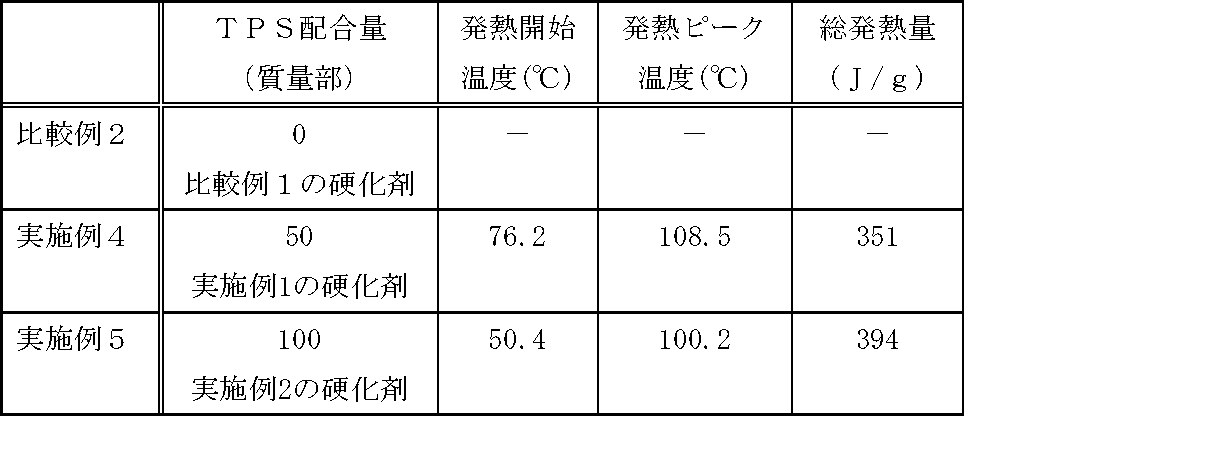
- Table 1 the exothermic start temperature
- the exothermic peak temperature means the temperature at which curing is most active
- the exothermic end temperature is the curing It means end temperature
- peak area means calorific value.
- the total calorific value is desired to be practically 250 J / g or more in order to achieve good low-temperature rapid curability.
- thermosetting epoxy resin composition of Comparative Example 2 in which the aluminum chelate-based latent curing agent of Comparative Example 1 that does not hold a silanol compound is used alone, It can be seen that it cannot be cured.
- thermosetting epoxy resin compositions of Examples 4 and 5 using an aluminum chelate-based latent curing agent holding a silanol compound the latency and low-temperature rapid curing properties are achieved. Recognize.
- thermosetting epoxy resin composition can be controlled by adjusting the amount of TPS held in the aluminum chelate-based latent curing agent.
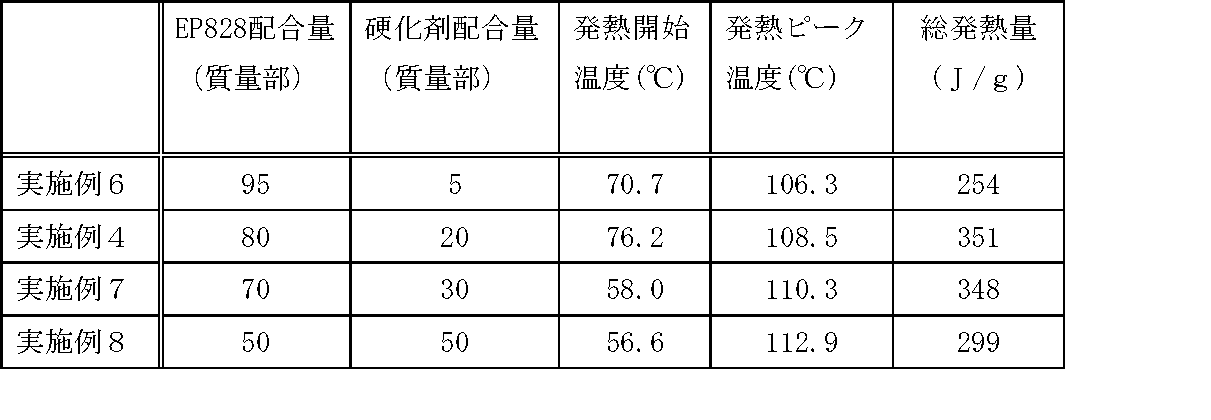
- thermosetting epoxy resin composition was prepared by mixing the aluminum chelate-based latent curing agent of Example 1 and a bisphenol A type epoxy resin (EP828, Japan Epoxy Resin Co., Ltd.) at a blending ratio shown in Table 2. .
- thermosetting epoxy resin composition was subjected to thermal analysis using a differential thermal analyzer (DSC) (DSC6200, Seiko Instruments Inc.).
- DSC differential thermal analyzer
- Table 2 The results of Example 4 are also shown for reference.
- the blending ratio of the aluminum chelate-based latent curing agent increases, the heat generation start temperature of the thermosetting epoxy resin composition shifts to the low temperature side and the curve becomes broad.
- the blending ratio is the least, it can be observed that a shoulder occurs in the high temperature region. Accordingly, in order to achieve good low-temperature rapid curability, in order to ensure a total calorific value of 250 J / g or more practically, the blending amount of the aluminum chelate-based latent curing agent in the thermosetting epoxy resin composition is 5 It can be seen that it is preferable to set the amount to ⁇ 50 mass%.
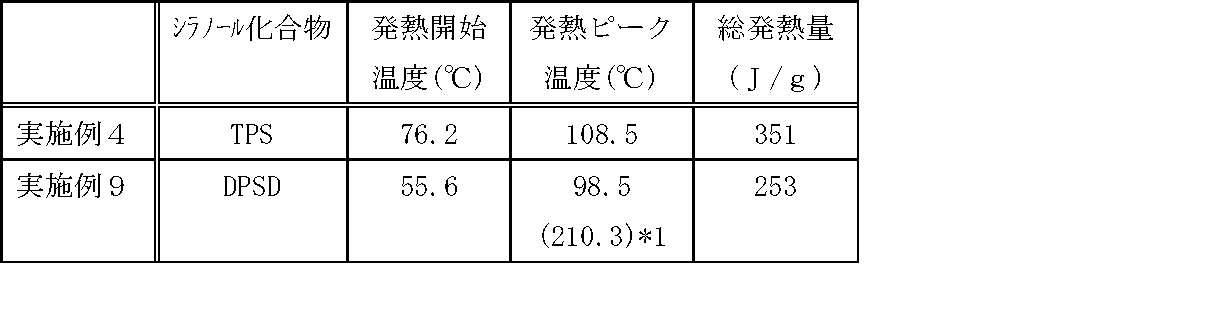
- Example 9 A thermosetting epoxy resin composition was prepared in the same manner as in Example 4 except that the aluminum chelate-based latent curing agent of Example 3 using diphenylsilanediol instead of triphenylsilanol was used.
- the obtained thermosetting epoxy resin composition was subjected to thermal analysis using a differential thermal analyzer (DSC) (DSC6200, Seiko Instruments Inc.). The obtained results are shown in Table 3 and FIG. The results of Example 4 are also shown for reference.
- DSC differential thermal analyzer
- thermosetting epoxy resin composition was prepared in the same manner as in Example 4 except that OXT-221 (Toagosei Co., Ltd.) was used.
- the obtained thermosetting epoxy resin composition was subjected to thermal analysis using a differential thermal analyzer (DSC) (DSC6200, Seiko Instruments Inc.). The obtained results are shown in Table 4 and FIG. The results of Example 4 are also shown for reference.
- DSC differential thermal analyzer
- the aluminum chelate-based latent curing agent of the present invention can cure an epoxy resin containing an inexpensive and general-purpose glycidyl ether type epoxy resin at a low temperature and in a short time. Therefore, it is useful as a latent curing agent for epoxy adhesives for low-temperature short-time connection.
Landscapes
- Chemical & Material Sciences (AREA)
- Health & Medical Sciences (AREA)
- Chemical Kinetics & Catalysis (AREA)
- Medicinal Chemistry (AREA)
- Polymers & Plastics (AREA)
- Organic Chemistry (AREA)
- Epoxy Resins (AREA)
Abstract
Description

アルミニウムキレート系硬化剤、多官能イソシアネート化合物、多官能ラジカル重合性化合物、ラジカル重合開始剤および式(A)のシラノール化合物とを有機溶媒に溶解または分散させて得た油相を、分散剤を含有する水相に投入しながら加熱撹拌することにより、多官能イソシアネート化合物を界面重合させると同時に多官能ラジカル重合性化合物をラジカル重合反応させ、それにより得られる多孔性樹脂に、アルミニウムキレート系硬化剤および式(A)のシラノール化合物を保持させることを特徴とする製造方法を提供する。


蒸留水800質量部と、界面活性剤(ニューレックスR-T、日本油脂(株))0.05質量部と、分散剤としてポリビニルアルコール(PVA-205、(株)クラレ)4質量部とを、温度計を備えた3リットルの界面重合容器に入れ、均一に混合し水相を調製した。
トリフェニルシラノールの配合量を50質量部から100質量部に増加させた以外は、実施例1と同様にして、球状のアルミニウムキレート系潜在性硬化剤を150質量部得た。得られたアルミニウムキレート系潜在性硬化剤について、体積換算の粒度分布を、シースフロー電気抵抗式粒度分布測定装置(SD-2000、シスメックス(株))を用いて測定した。得られた結果を図3に示す。また、電子顕微鏡写真を図4A(倍率:2000倍)と図4B(倍率:5000倍)に示す。これらの結果から、このアルミニウムキレート系潜在性硬化剤はすべてシングルミクロンサイズに制御されており、平均粒子径が3.62μm、最大粒子径が8.72μmであることがわかる。なお、シラノール化合物の量が多い実施例2の場合の方が、異形粒子の存在量が増加していることがわかる。
トリフェニルシラノールに代えて、ジフェニルシランジオール(DPSD)を50質量部使用した以外は、実施例1と同様にして、球状のアルミニウムキレート系潜在性硬化剤を100質量部得た。
トリフェニルシラノールを全く使用しない以外は、実施例1と同様にして、球状のアルミニウムキレート系潜在性硬化剤を50質量部得た。
実施例1、2または比較例1のアルミニウムキレート系潜在性硬化剤20質量部及びビスフェノールA型エポキシ樹脂(EP828、ジャパンエポキシレジン(株))80質量部を、均一に混合することにより熱硬化型エポキシ樹脂組成物を調製した。
実施例1のアルミニウムキレート系潜在性硬化剤とビスフェノールA型エポキシ樹脂(EP828、ジャパンエポキシレジン(株))とを、表2の配合割合で混合することにより熱硬化型エポキシ樹脂組成物を調製した。
トリフェニルシラノールに代えてジフェニルシランジオールを使用する実施例3のアルミニウムキレート系潜在性硬化剤を使用すること以外は、実施例4と同様に熱硬化型エポキシ樹脂組成物を調製した。得られた熱硬化型エポキシ樹脂組成物を、示差熱分析装置(DSC)(DSC6200、セイコーインスツル(株))を用いて熱分析した。得られた結果を表3及び図7に示す。参照のために、実施例4の結果も併記する。
実施例4の熱硬化性エポキシ樹脂組成物中のビスフェノールA型エポキシ樹脂(EP828)の一部を、表4に示すように、オキセタン化合物(ジ[1-エチル(3-オキセタニル)]メチルエーテル:OXT-221、東亜合成(株))に代えること以外は実施例4と同様に熱硬化型エポキシ樹脂組成物を調製した。得られた熱硬化型エポキシ樹脂組成物を、示差熱分析装置(DSC)(DSC6200、セイコーインスツル(株))を用いて熱分析した。得られた結果を表4及び図8に示す。参照のために、実施例4の結果も併記する。

Claims (8)
- アルミニウムキレート系硬化剤が、多官能イソシアネート化合物を界面重合させると同時に、ラジカル重合開始剤の存在下で多官能ラジカル重合性化合物をラジカル重合させて得た多孔性樹脂に保持されているアルミニウムキレート系潜在性硬化剤であって、更に、式(A)のシラノール化合物が該多孔性樹脂に保持されていることを特徴とするアルミニウムキレート系潜在性硬化剤。
(式中、mは2又は3であり、但しmとnとの和は4である。Arは、置換されてもよいアリール基である。)
- Arが、置換されていてもよいフェニル基である請求項1記載のアルミニウムキレート系潜在性硬化剤。
- シラノール化合物が、トリフェニルシラノール又はジフェニルシランジオールである請求項1又は2記載のアルミニウムキレート系潜在性硬化剤。
- 多官能ラジカル重合性化合物が、ジビニルベンゼンである請求項1~3のいずれかに記載のアルミニウムキレート系潜在性硬化剤。
- 請求項1記載のアルミニウムキレート系潜在性硬化剤の製造方法であって、
アルミニウムキレート系硬化剤、多官能イソシアネート化合物、多官能ラジカル重合性化合物、ラジカル重合開始剤および式(A)のシラノール化合物とを有機溶媒に溶解または分散させて得た油相を、分散剤を含有する水相に投入しながら加熱撹拌することにより、多官能イソシアネート化合物を界面重合させると同時に多官能ラジカル重合性化合物をラジカル重合反応させ、それにより得られる多孔性樹脂に、アルミニウムキレート系硬化剤および式(A)のシラノール化合物を保持させることを特徴とする製造方法。
(式中、mは2又は3であり、但しmとnとの和は4である。Arは、置換されてもよいアリール基である。)
- 請求項1~4のいずれかに記載のアルミニウムキレート系潜在性硬化剤と、エポキシ樹脂とを含有する熱硬化型エポキシ樹脂組成物。
- エポキシ樹脂が、グリシジルエーテル型エポキシ樹脂である請求項6記載の熱硬化型エポキシ樹脂組成物。
- 更に、オキセタン化合物を含有する請求項6または7記載の熱硬化型エポキシ樹脂組成物。
Priority Applications (4)
| Application Number | Priority Date | Filing Date | Title |
|---|---|---|---|
| CN201080005068.9A CN102292373B (zh) | 2009-01-21 | 2010-01-13 | 铝螯合物类潜固化剂及其制造方法 |
| HK12102095.6A HK1161609B (en) | 2009-01-21 | 2010-01-13 | Aluminum chelate type latent hardener and process for producing same |
| US12/866,597 US8198342B2 (en) | 2009-01-21 | 2010-01-13 | Aluminum chelate latent curing agent and production method thereof |
| KR1020107025855A KR101246468B1 (ko) | 2009-01-21 | 2010-01-13 | 알루미늄 킬레이트계 잠재성 경화제 및 그 제조 방법 |
Applications Claiming Priority (2)
| Application Number | Priority Date | Filing Date | Title |
|---|---|---|---|
| JP2009-011337 | 2009-01-21 | ||
| JP2009011337A JP5321082B2 (ja) | 2009-01-21 | 2009-01-21 | アルミニウムキレート系潜在性硬化剤及びその製造方法 |
Publications (1)
| Publication Number | Publication Date |
|---|---|
| WO2010084804A1 true WO2010084804A1 (ja) | 2010-07-29 |
Family
ID=42355858
Family Applications (1)
| Application Number | Title | Priority Date | Filing Date |
|---|---|---|---|
| PCT/JP2010/050250 Ceased WO2010084804A1 (ja) | 2009-01-21 | 2010-01-13 | アルミニウムキレート系潜在性硬化剤及びその製造方法 |
Country Status (5)
| Country | Link |
|---|---|
| US (1) | US8198342B2 (ja) |
| JP (1) | JP5321082B2 (ja) |
| KR (1) | KR101246468B1 (ja) |
| CN (1) | CN102292373B (ja) |
| WO (1) | WO2010084804A1 (ja) |
Cited By (1)
| Publication number | Priority date | Publication date | Assignee | Title |
|---|---|---|---|---|
| CN106661202A (zh) * | 2014-09-09 | 2017-05-10 | 迪睿合株式会社 | 铝螯合物系潜伏性固化剂、其制造方法及热固型环氧树脂组合物 |
Families Citing this family (15)
| Publication number | Priority date | Publication date | Assignee | Title |
|---|---|---|---|---|
| JP4381255B2 (ja) * | 2003-09-08 | 2009-12-09 | ソニーケミカル&インフォメーションデバイス株式会社 | 潜在性硬化剤 |
| JP5146645B2 (ja) * | 2007-08-28 | 2013-02-20 | デクセリアルズ株式会社 | マイクロカプセル型潜在性硬化剤 |
| JP5707662B2 (ja) * | 2008-01-25 | 2015-04-30 | デクセリアルズ株式会社 | 熱硬化型エポキシ樹脂組成物 |
| JP5481995B2 (ja) | 2009-07-24 | 2014-04-23 | デクセリアルズ株式会社 | アルミニウムキレート系潜在性硬化剤及びそれらの製造方法 |
| KR101659139B1 (ko) | 2014-01-29 | 2016-09-22 | 제일모직주식회사 | 접착층을 포함하는 이방 도전성 필름 및 상기 필름에 의해 접속된 반도체 장치 |
| JP6323247B2 (ja) | 2014-08-11 | 2018-05-16 | デクセリアルズ株式会社 | アルミニウムキレート系潜在性硬化剤及びその製造方法 |
| JP2017101164A (ja) * | 2015-12-03 | 2017-06-08 | デクセリアルズ株式会社 | アルミニウムキレート系潜在性硬化剤、その製造方法及び熱硬化型エポキシ樹脂組成物 |
| KR102036751B1 (ko) * | 2015-12-17 | 2019-10-25 | 데쿠세리아루즈 가부시키가이샤 | 알루미늄 킬레이트계 잠재성 경화제의 제조 방법 및 열경화형 에폭시 수지 조성물 |
| JP2017122144A (ja) * | 2016-01-05 | 2017-07-13 | デクセリアルズ株式会社 | 接着剤組成物 |
| JP6670688B2 (ja) * | 2016-06-15 | 2020-03-25 | デクセリアルズ株式会社 | 潜在性硬化剤、及びその製造方法、並びに熱硬化型エポキシ樹脂組成物 |
| WO2021039480A1 (ja) * | 2019-08-26 | 2021-03-04 | デクセリアルズ株式会社 | カチオン硬化剤及びその製造方法、並びにカチオン硬化性組成物 |
| JP7520609B2 (ja) * | 2019-08-26 | 2024-07-23 | デクセリアルズ株式会社 | カチオン硬化剤及びその製造方法、並びにカチオン硬化性組成物 |
| JP7028280B2 (ja) * | 2020-06-09 | 2022-03-02 | デクセリアルズ株式会社 | アルミニウムキレート系潜在性硬化剤の製造方法及び熱硬化型エポキシ樹脂組成物 |
| JP2022127332A (ja) | 2021-02-19 | 2022-08-31 | デクセリアルズ株式会社 | カチオン硬化剤及びその製造方法、並びにカチオン硬化性組成物 |
| CN120137484B (zh) * | 2025-03-14 | 2025-11-04 | 大一(云浮)新材料科技有限公司 | 一种基于环氧树脂的木器面漆及其生产方法 |
Citations (5)
| Publication number | Priority date | Publication date | Assignee | Title |
|---|---|---|---|---|
| WO2007007725A1 (ja) * | 2005-07-11 | 2007-01-18 | Sony Chemical & Information Device Corporation | 熱硬化型エポキシ樹脂組成物 |
| WO2008090792A1 (ja) * | 2007-01-24 | 2008-07-31 | Sony Chemical & Information Device Corporation | 潜在性硬化剤 |
| WO2009019906A1 (ja) * | 2007-08-03 | 2009-02-12 | Sony Chemical & Information Device Corporation | 潜在性硬化剤 |
| WO2009093364A1 (ja) * | 2008-01-25 | 2009-07-30 | Sony Chemical & Information Device Corporation | 熱硬化型エポキシ樹脂組成物 |
| JP2009221465A (ja) * | 2008-02-18 | 2009-10-01 | Sony Chemical & Information Device Corp | アルミニウムキレート系潜在性硬化剤、その製造方法及び熱硬化型エポキシ樹脂組成物 |
Family Cites Families (5)
| Publication number | Priority date | Publication date | Assignee | Title |
|---|---|---|---|---|
| JP2002212537A (ja) | 2001-01-24 | 2002-07-31 | Sony Chem Corp | 接着剤及び電気装置 |
| JP4381255B2 (ja) | 2003-09-08 | 2009-12-09 | ソニーケミカル&インフォメーションデバイス株式会社 | 潜在性硬化剤 |
| JP4811555B2 (ja) * | 2005-01-12 | 2011-11-09 | ソニーケミカル&インフォメーションデバイス株式会社 | 潜在性硬化剤 |
| JP5057011B2 (ja) * | 2005-06-06 | 2012-10-24 | ソニーケミカル&インフォメーションデバイス株式会社 | 潜在性硬化剤 |
| JP5267757B2 (ja) * | 2006-02-07 | 2013-08-21 | デクセリアルズ株式会社 | 潜在性硬化剤 |
-
2009
- 2009-01-21 JP JP2009011337A patent/JP5321082B2/ja active Active
-
2010
- 2010-01-13 US US12/866,597 patent/US8198342B2/en active Active
- 2010-01-13 WO PCT/JP2010/050250 patent/WO2010084804A1/ja not_active Ceased
- 2010-01-13 CN CN201080005068.9A patent/CN102292373B/zh active Active
- 2010-01-13 KR KR1020107025855A patent/KR101246468B1/ko active Active
Patent Citations (5)
| Publication number | Priority date | Publication date | Assignee | Title |
|---|---|---|---|---|
| WO2007007725A1 (ja) * | 2005-07-11 | 2007-01-18 | Sony Chemical & Information Device Corporation | 熱硬化型エポキシ樹脂組成物 |
| WO2008090792A1 (ja) * | 2007-01-24 | 2008-07-31 | Sony Chemical & Information Device Corporation | 潜在性硬化剤 |
| WO2009019906A1 (ja) * | 2007-08-03 | 2009-02-12 | Sony Chemical & Information Device Corporation | 潜在性硬化剤 |
| WO2009093364A1 (ja) * | 2008-01-25 | 2009-07-30 | Sony Chemical & Information Device Corporation | 熱硬化型エポキシ樹脂組成物 |
| JP2009221465A (ja) * | 2008-02-18 | 2009-10-01 | Sony Chemical & Information Device Corp | アルミニウムキレート系潜在性硬化剤、その製造方法及び熱硬化型エポキシ樹脂組成物 |
Cited By (2)
| Publication number | Priority date | Publication date | Assignee | Title |
|---|---|---|---|---|
| CN106661202A (zh) * | 2014-09-09 | 2017-05-10 | 迪睿合株式会社 | 铝螯合物系潜伏性固化剂、其制造方法及热固型环氧树脂组合物 |
| CN106661202B (zh) * | 2014-09-09 | 2019-04-09 | 迪睿合株式会社 | 铝螯合物系潜伏性固化剂、其制造方法及热固型环氧树脂组合物 |
Also Published As
| Publication number | Publication date |
|---|---|
| KR101246468B1 (ko) | 2013-03-21 |
| JP2010168449A (ja) | 2010-08-05 |
| CN102292373B (zh) | 2014-07-16 |
| KR20110020775A (ko) | 2011-03-03 |
| CN102292373A (zh) | 2011-12-21 |
| US8198342B2 (en) | 2012-06-12 |
| HK1161609A1 (en) | 2012-07-27 |
| JP5321082B2 (ja) | 2013-10-23 |
| US20100331435A1 (en) | 2010-12-30 |
Similar Documents
| Publication | Publication Date | Title |
|---|---|---|
| JP5321082B2 (ja) | アルミニウムキレート系潜在性硬化剤及びその製造方法 | |
| JP5458596B2 (ja) | アルミニウムキレート系潜在性硬化剤、その製造方法及び熱硬化型エポキシ樹脂組成物 | |
| JP5707662B2 (ja) | 熱硬化型エポキシ樹脂組成物 | |
| JP6489494B2 (ja) | アルミニウムキレート系潜在性硬化剤、その製造方法及び熱硬化型エポキシ樹脂組成物 | |
| JP5481995B2 (ja) | アルミニウムキレート系潜在性硬化剤及びそれらの製造方法 | |
| JP5365811B2 (ja) | アルミニウムキレート系潜在性硬化剤 | |
| JP6875999B2 (ja) | アルミニウムキレート系潜在性硬化剤の製造方法及び熱硬化型エポキシ樹脂組成物 | |
| JP5664366B2 (ja) | 熱潜在性硬化剤及びその製造方法並びに熱硬化型エポキシ樹脂組成物 | |
| JP6323247B2 (ja) | アルミニウムキレート系潜在性硬化剤及びその製造方法 | |
| JP6670688B2 (ja) | 潜在性硬化剤、及びその製造方法、並びに熱硬化型エポキシ樹脂組成物 | |
| JP2017101164A (ja) | アルミニウムキレート系潜在性硬化剤、その製造方法及び熱硬化型エポキシ樹脂組成物 | |
| JP5354192B2 (ja) | 熱硬化型導電ペースト組成物 | |
| JP7097665B2 (ja) | アルミニウムキレート系潜在性硬化剤の製造方法及び熱硬化型エポキシ樹脂組成物 | |
| JP7028280B2 (ja) | アルミニウムキレート系潜在性硬化剤の製造方法及び熱硬化型エポキシ樹脂組成物 | |
| JP6915671B2 (ja) | アルミニウムキレート系潜在性硬化剤、その製造方法及び熱硬化型エポキシ樹脂組成物 | |
| HK1161609B (en) | Aluminum chelate type latent hardener and process for producing same |
Legal Events
| Date | Code | Title | Description |
|---|---|---|---|
| WWE | Wipo information: entry into national phase |
Ref document number: 201080005068.9 Country of ref document: CN |
|
| WWE | Wipo information: entry into national phase |
Ref document number: 12866597 Country of ref document: US |
|
| 121 | Ep: the epo has been informed by wipo that ep was designated in this application |
Ref document number: 10733411 Country of ref document: EP Kind code of ref document: A1 |
|
| ENP | Entry into the national phase |
Ref document number: 20107025855 Country of ref document: KR Kind code of ref document: A |
|
| NENP | Non-entry into the national phase |
Ref country code: DE |
|
| 122 | Ep: pct application non-entry in european phase |
Ref document number: 10733411 Country of ref document: EP Kind code of ref document: A1 |