WO2010073590A1 - 複合軟磁性材料とその製造方法 - Google Patents
複合軟磁性材料とその製造方法 Download PDFInfo
- Publication number
- WO2010073590A1 WO2010073590A1 PCT/JP2009/007070 JP2009007070W WO2010073590A1 WO 2010073590 A1 WO2010073590 A1 WO 2010073590A1 JP 2009007070 W JP2009007070 W JP 2009007070W WO 2010073590 A1 WO2010073590 A1 WO 2010073590A1
- Authority
- WO
- WIPO (PCT)
- Prior art keywords
- powder
- sendust alloy
- soft magnetic
- magnetic material
- iron powder
- Prior art date
- Legal status (The legal status is an assumption and is not a legal conclusion. Google has not performed a legal analysis and makes no representation as to the accuracy of the status listed.)
- Ceased
Links
Images



Classifications
-
- H—ELECTRICITY
- H01—ELECTRIC ELEMENTS
- H01F—MAGNETS; INDUCTANCES; TRANSFORMERS; SELECTION OF MATERIALS FOR THEIR MAGNETIC PROPERTIES
- H01F41/00—Apparatus or processes specially adapted for manufacturing or assembling magnets, inductances or transformers; Apparatus or processes specially adapted for manufacturing materials characterised by their magnetic properties
- H01F41/02—Apparatus or processes specially adapted for manufacturing or assembling magnets, inductances or transformers; Apparatus or processes specially adapted for manufacturing materials characterised by their magnetic properties for manufacturing cores, coils, or magnets
- H01F41/0206—Manufacturing of magnetic cores by mechanical means
- H01F41/0246—Manufacturing of magnetic circuits by moulding or by pressing powder
-
- B—PERFORMING OPERATIONS; TRANSPORTING
- B22—CASTING; POWDER METALLURGY
- B22F—WORKING METALLIC POWDER; MANUFACTURE OF ARTICLES FROM METALLIC POWDER; MAKING METALLIC POWDER; APPARATUS OR DEVICES SPECIALLY ADAPTED FOR METALLIC POWDER
- B22F1/00—Metallic powder; Treatment of metallic powder, e.g. to facilitate working or to improve properties
- B22F1/12—Metallic powder containing non-metallic particles
-
- B—PERFORMING OPERATIONS; TRANSPORTING
- B22—CASTING; POWDER METALLURGY
- B22F—WORKING METALLIC POWDER; MANUFACTURE OF ARTICLES FROM METALLIC POWDER; MAKING METALLIC POWDER; APPARATUS OR DEVICES SPECIALLY ADAPTED FOR METALLIC POWDER
- B22F1/00—Metallic powder; Treatment of metallic powder, e.g. to facilitate working or to improve properties
- B22F1/16—Metallic particles coated with a non-metal
-
- C—CHEMISTRY; METALLURGY
- C22—METALLURGY; FERROUS OR NON-FERROUS ALLOYS; TREATMENT OF ALLOYS OR NON-FERROUS METALS
- C22C—ALLOYS
- C22C38/00—Ferrous alloys, e.g. steel alloys
- C22C38/02—Ferrous alloys, e.g. steel alloys containing silicon
-
- C—CHEMISTRY; METALLURGY
- C22—METALLURGY; FERROUS OR NON-FERROUS ALLOYS; TREATMENT OF ALLOYS OR NON-FERROUS METALS
- C22C—ALLOYS
- C22C38/00—Ferrous alloys, e.g. steel alloys
- C22C38/06—Ferrous alloys, e.g. steel alloys containing aluminium
-
- H—ELECTRICITY
- H01—ELECTRIC ELEMENTS
- H01F—MAGNETS; INDUCTANCES; TRANSFORMERS; SELECTION OF MATERIALS FOR THEIR MAGNETIC PROPERTIES
- H01F1/00—Magnets or magnetic bodies characterised by the magnetic materials therefor; Selection of materials for their magnetic properties
- H01F1/01—Magnets or magnetic bodies characterised by the magnetic materials therefor; Selection of materials for their magnetic properties of inorganic materials
- H01F1/03—Magnets or magnetic bodies characterised by the magnetic materials therefor; Selection of materials for their magnetic properties of inorganic materials characterised by their coercivity
- H01F1/12—Magnets or magnetic bodies characterised by the magnetic materials therefor; Selection of materials for their magnetic properties of inorganic materials characterised by their coercivity of soft-magnetic materials
- H01F1/14—Magnets or magnetic bodies characterised by the magnetic materials therefor; Selection of materials for their magnetic properties of inorganic materials characterised by their coercivity of soft-magnetic materials metals or alloys
- H01F1/20—Magnets or magnetic bodies characterised by the magnetic materials therefor; Selection of materials for their magnetic properties of inorganic materials characterised by their coercivity of soft-magnetic materials metals or alloys in the form of particles, e.g. powder
- H01F1/22—Magnets or magnetic bodies characterised by the magnetic materials therefor; Selection of materials for their magnetic properties of inorganic materials characterised by their coercivity of soft-magnetic materials metals or alloys in the form of particles, e.g. powder pressed, sintered, or bound together
- H01F1/24—Magnets or magnetic bodies characterised by the magnetic materials therefor; Selection of materials for their magnetic properties of inorganic materials characterised by their coercivity of soft-magnetic materials metals or alloys in the form of particles, e.g. powder pressed, sintered, or bound together the particles being insulated
-
- H—ELECTRICITY
- H01—ELECTRIC ELEMENTS
- H01F—MAGNETS; INDUCTANCES; TRANSFORMERS; SELECTION OF MATERIALS FOR THEIR MAGNETIC PROPERTIES
- H01F1/00—Magnets or magnetic bodies characterised by the magnetic materials therefor; Selection of materials for their magnetic properties
- H01F1/01—Magnets or magnetic bodies characterised by the magnetic materials therefor; Selection of materials for their magnetic properties of inorganic materials
- H01F1/03—Magnets or magnetic bodies characterised by the magnetic materials therefor; Selection of materials for their magnetic properties of inorganic materials characterised by their coercivity
- H01F1/12—Magnets or magnetic bodies characterised by the magnetic materials therefor; Selection of materials for their magnetic properties of inorganic materials characterised by their coercivity of soft-magnetic materials
- H01F1/14—Magnets or magnetic bodies characterised by the magnetic materials therefor; Selection of materials for their magnetic properties of inorganic materials characterised by their coercivity of soft-magnetic materials metals or alloys
- H01F1/147—Alloys characterised by their composition
- H01F1/14766—Fe-Si based alloys
- H01F1/14791—Fe-Si-Al based alloys, e.g. Sendust
-
- H—ELECTRICITY
- H01—ELECTRIC ELEMENTS
- H01F—MAGNETS; INDUCTANCES; TRANSFORMERS; SELECTION OF MATERIALS FOR THEIR MAGNETIC PROPERTIES
- H01F1/00—Magnets or magnetic bodies characterised by the magnetic materials therefor; Selection of materials for their magnetic properties
- H01F1/01—Magnets or magnetic bodies characterised by the magnetic materials therefor; Selection of materials for their magnetic properties of inorganic materials
- H01F1/03—Magnets or magnetic bodies characterised by the magnetic materials therefor; Selection of materials for their magnetic properties of inorganic materials characterised by their coercivity
- H01F1/12—Magnets or magnetic bodies characterised by the magnetic materials therefor; Selection of materials for their magnetic properties of inorganic materials characterised by their coercivity of soft-magnetic materials
- H01F1/14—Magnets or magnetic bodies characterised by the magnetic materials therefor; Selection of materials for their magnetic properties of inorganic materials characterised by their coercivity of soft-magnetic materials metals or alloys
- H01F1/20—Magnets or magnetic bodies characterised by the magnetic materials therefor; Selection of materials for their magnetic properties of inorganic materials characterised by their coercivity of soft-magnetic materials metals or alloys in the form of particles, e.g. powder
- H01F1/22—Magnets or magnetic bodies characterised by the magnetic materials therefor; Selection of materials for their magnetic properties of inorganic materials characterised by their coercivity of soft-magnetic materials metals or alloys in the form of particles, e.g. powder pressed, sintered, or bound together
- H01F1/24—Magnets or magnetic bodies characterised by the magnetic materials therefor; Selection of materials for their magnetic properties of inorganic materials characterised by their coercivity of soft-magnetic materials metals or alloys in the form of particles, e.g. powder pressed, sintered, or bound together the particles being insulated
- H01F1/26—Magnets or magnetic bodies characterised by the magnetic materials therefor; Selection of materials for their magnetic properties of inorganic materials characterised by their coercivity of soft-magnetic materials metals or alloys in the form of particles, e.g. powder pressed, sintered, or bound together the particles being insulated by macromolecular organic substances
Definitions
- the present invention relates to a composite soft magnetic material obtained by mixing and compacting an insulating iron powder and a sendust alloy powder together with a binder and firing the mixture, and a method for producing the same.
- This application claims priority based on Japanese Patent Application No. 2008-330597 for which it applied to Japan on December 25, 2008, and uses the content here.
- Electromagnetic components for electronic devices such as inverters, transformer cores, and choke coils are required to have stricter material properties as electronic devices become smaller and have higher performance.
- metal magnetic materials such as Sendust alloy and silicon steel, and oxide magnetic materials such as ferrite have been used as soft magnetic materials for such parts.
- metallic magnetic materials such as Sendust alloy have a high hardness when powdered, and there is a problem that it is difficult to increase the density by powder molding.
- a metal soft magnetic powder having an insulating coating, and a raw material powder consisting of a lubricant powder and a binder added as needed are filled in a mold cavity. After that, a green compact having a desired shape is produced by pressure molding, and then the green compact is fired to produce a composite soft magnetic material.
- Sendust alloy has very little plastic deformation when processed at room temperature and can be pulverized by pulverization, but cannot be formed into a plate shape. Therefore, when Sendust alloy powder is molded to produce magnetic parts such as magnetic cores, plastic deformation hardly occurs. Therefore, Sendust alloy powder is simply connected with the added binder. Even if the permeability of the sendust alloy powder itself is high, there is a problem that a high permeability cannot be obtained when a dust core is used.
- Patent Document 1 Also known is a composite magnetic material obtained by mixing a Sendust alloy powder having an oxide film, a highly compressible soft magnetic metal powder, a soft ferrite powder, and a binder, followed by sintering and sintering.
- the soft magnetic composite material produced by coating the metal magnetic powder such as Permalloy with an oxide magnetic material such as ferrite has a problem that the magnetic properties deteriorate because the metal and ferrite easily react at the interface between them when heat-treated. Had. Further, in the method of mixing Sendust alloy powder and other soft magnetic metal powder, since Sendust alloy powder is very hard, even if soft magnetic metal powder having good compressibility is mixed, 20 ton / cm 2. A high pressure molding technique of a certain level is required, and there is a problem that only a product having a simple shape such as a cylindrical shape such as a dust core can be obtained.
- the present invention has been proposed in view of such conventional circumstances, and its purpose is to select iron powders to be mixed with Sendust alloy powder, the range of their addition amount, and the respective particle size ranges.
- it is made into an optimal composition, while maintaining high saturation magnetic flux density inherent in iron powder, while high permeability, low coercivity, inherent in Sendust alloy powder,
- the composite soft magnetic material according to the present invention comprises an insulating iron powder, a sendust alloy powder, and a binder mixed and compacted and fired, and the iron powder and the sendust alloy powder are compacted.
- a fired main phase and a grain boundary phase mainly composed of a binder formed around the main phase are provided, and the proportion of Sendust alloy in the main phase is 5% by mass or more and less than 20% by mass.
- the saturation magnetic flux density is 1 T or more at a magnetic field of 10 kA / m
- the coercive force is 260 A / m or less
- the iron loss (at 0.1 T, 10 kHz) is 20 W / kg or less.
- the average particle size of the iron main phase formed by compacting and firing the iron powder is 20 to 50 ⁇ m, and the average particle size of the alloy main phase formed by compacting and firing the Sendust alloy powder.
- the thickness can be 50 to 120 ⁇ m.
- pure iron powder having an Mg-containing oxide film can be used as the insulated iron powder.
- the method for producing a composite soft magnetic material according to the present invention comprises a main phase formed by compacting at least mixed compacted and sintered iron powder, sendust alloy powder and binder, and then compacting the iron powder and sendust alloy powder. And a sendust alloy occupying the total mass of the insulated iron powder and sendust alloy powder in producing a composite soft magnetic material having a grain boundary phase mainly composed of a binder formed around the main phase.
- the addition ratio of the powder is 5 mass% or more and less than 20 mass%
- the insulated iron powder and Sendust alloy powder are mixed and compacted and fired to obtain a saturation magnetic flux density of 1 T or more at a magnetic field of 10 kA / m, a coercive force.
- a composite soft magnetic material having 260 A / m or less and iron loss (at 0.1 T, 10 kHz) of 20 W / kg or less is obtained.
- the addition ratio or blending ratio of Sendust alloy powder is the ratio of Sendust alloy powder to the total mass of Sendust alloy powder and the iron powder insulated with Mg-containing oxide coating or the like. It means a compounding ratio (mass%).
- the method for producing a composite soft magnetic material according to the present invention is characterized by using an insulated iron powder having an average particle diameter of 20 to 50 ⁇ m and a sendust alloy powder having an average particle diameter of 50 to 120 ⁇ m.
- the method for producing a composite soft magnetic material according to the present invention is characterized in that pure iron powder insulated with an Mg-containing oxide film is used as the insulated iron powder.
- the soft magnetic characteristics such as low iron loss, low coercive force, and low eddy current loss of the proper amount of sendust alloy powder are effective.
- the composite soft magnetic material obtained in the above can be provided.
- a soft magnetic material can be provided.
- pure iron powder insulated with an Mg-containing oxide coating is used as the insulated iron powder to ensure high saturation magnetic flux density, low iron loss, low coercive force, and low eddy current loss. It is possible to get to.
- FIG. 1 is a graph showing the relationship between the blending ratio of sendust alloy powder and the specific resistance in an example of a composite soft magnetic material according to the present invention.
- FIG. 2 is a diagram showing the relationship between the blending ratio of the sendust alloy powder and the saturation magnetic flux density in the example of the composite soft magnetic material according to the present invention.
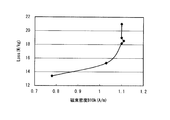
- FIG. 3 is a diagram showing the relationship between the saturation magnetic flux density and the loss in the example of the composite soft magnetic material according to the present invention.
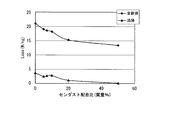
- FIG. 4 is a diagram showing the relationship between the blending ratio of the sendust alloy powder and the loss in the example of the composite soft magnetic material according to the present invention.
- FIG. 5 is a diagram showing the relationship between the blending ratio of Sendust alloy powder and mechanical strength in the example of the composite soft magnetic material according to the present invention.
- a powder compact having a predetermined shape can be obtained by filling the mixed powder obtained by adding and mixing a binder and a lubricant as necessary into a mold cavity of a compacting device, followed by pressure molding. Thereafter, the obtained green compact is fired in a predetermined temperature range, whereby a composite soft magnetic material having a desired shape can be obtained.
- Insulated pure iron powder used in the present invention is, for example, an Mg-containing oxide in which a Mg—Fe—O ternary oxide deposition film containing (Mg, Fe) O is coated on the surface of pure iron particles.
- Wet powder-coated pure iron powder, phosphate-coated pure iron powder, or a wet solution such as silica sol-gel solution (silicate) or alumina sol-gel solution is mixed and coated on the surface of pure iron powder, then dried and fired
- the present invention is not limited to this, and it is possible to widely apply insulated pure iron powder having a structure in which pure iron powder is coated with an insulating coating layer. it can.
- the Mg-containing oxide-coated pure iron powder coated with the Mg—Fe—O ternary oxide deposited film is obtained, for example, by the following production method (A), (B), (C) or (D). be able to.
- A Pure iron powder is subjected to an oxidation treatment in an oxidizing atmosphere at room temperature to 500 ° C., and then mixed powder obtained by adding and mixing Mg powder to this powder is temperature: 150 to 1100 ° C., pressure When heated in an inert gas atmosphere or vacuum atmosphere of 1 ⁇ 10 ⁇ 12 to 1 ⁇ 10 ⁇ 1 MPa and further heated in an oxidizing atmosphere at a temperature of 50 to 400 ° C.
- the surface of pure iron powder Mg-containing oxide-coated pure iron particles having an oxide insulating film containing Mg are obtained.
- B After subjecting the pure iron powder to the oxidation treatment described above, after adding and mixing the silicon monoxide powder, or while mixing, heating in a vacuum atmosphere at a temperature of 600 to 1200 ° C., After adding and mixing Mg powder, or heating while mixing in a vacuum atmosphere at a temperature of 400 to 800 ° C., an Mg—Si containing oxide film is formed on the surface of pure iron powder. A material-coated pure iron powder is obtained.
- the Mg—Si-containing oxide film is formed on the surface of the pure iron powder.
- the addition amount of the silicon monoxide powder can be in the range of 0.01 to 1% by mass, and the addition amount of the Mg powder can be in the range of 0.05 to 1% by mass.
- the vacuum atmosphere may be a vacuum atmosphere at a pressure of 1 ⁇ 10 ⁇ 12 to 1 ⁇ 10 ⁇ 1 MPa.
- the Mg-containing oxide-coated pure iron particles obtained by these production methods have remarkably excellent coating adhesion of the Mg—Fe—O ternary oxide deposited film containing (Mg, Fe) O, Even if these particles are pressed to produce a green compact, the insulating coating is less likely to be broken and peeled off.
- the oxide-coated pure iron powder is preferably a powder having an average particle size in the range of 20 to 50 ⁇ m. The reason is that if the average particle size is too small, the compressibility of the powder decreases and the value of the saturation magnetic flux density decreases, which is not preferable. On the other hand, if the average particle size is too large, the eddy current inside the soft magnetic powder is not preferable. This is because the magnetic permeability at a high frequency is likely to increase and decrease.
- a sendust alloy for example, composition ratio: 10 mass% Si-6 mass% Al-residual Fe
- a powder having a particle size range of 50 to 120 ⁇ m can be used.
- the oxide-coated pure iron powder and Sendust alloy powder are each mixed with a binder material containing Si, such as silicone resin as a binder material, and each powder is made into a silicone resin-coated powder. .
- the temperature is in the range of 150 to 250 ° C, more preferably 200 to 250 ° C. Can be baked and coated in the range of.
- the temperature is in the range of 80 to 250 ° C., more preferably in the range of 100 to 200 ° C. It can be baked and coated by heating.
- the baking temperature can be selected from a range of 150 to 250 ° C. A decrease in specific resistance, which is considered to be caused by damage to the insulation coating, is observed, and if it exceeds 250 ° C., the binder material becomes hard and the packing density during molding is decreased, which is not desirable. Even within this range, a baking temperature in the range of 200 to 250 ° C. is more preferable in order to obtain higher density and specific resistance.
- a temperature range of 80 to 250 ° C can be selected as the baking temperature. If the temperature is outside this range, a decrease in density or variation may be observed during molding. At temperatures exceeding 250 ° C., the specific resistance is decreased, which is not desirable. Even within this range, a baking temperature in the range of 100 to 200 ° C. is more preferable in order to obtain higher density and specific resistance.
- the ratio of the mass of the Sendust alloy powder coated with the binder material to the total mass of the oxide-coated pure iron powder coated with these binder materials and the Sendust alloy powder coated with the binder material is 5% by mass or more and 20% by mass.
- These powders are mixed so as to be less than the minimum, accommodated in a mold of a compacting apparatus, and warm-molded into a desired shape with a molding temperature of about 8 to 10 Ton / cm 2 at a mold temperature of 80 to 150 ° C. and consolidated. Let it be the body.
- the molding pressure of about 8 to 10 Ton / cm 2 used here is much lower than the conventional molding pressure of about 20 Ton / cm 2 used for compacting Sendust alloy powder, and the compacting force used for general powder molding methods.
- the Sendust alloy powder to produce an excellent composite soft magnetic material according to the present invention even at a general molding pressure.
- the compact is fired at a temperature of 500 ° C. to 800 ° C. for about 1 hour in a vacuum atmosphere, an inert gas atmosphere (Ar, N 2 ), or in a non-oxidizing atmosphere (H 2 atmosphere) to obtain the desired composite.
- a soft magnetic material can be obtained.
- the pure iron powder subjected to insulation treatment is consolidated into an iron main phase
- Sendust alloy powder is consolidated into a Sendust alloy main phase.
- the target composite soft magnetic material can be obtained by exhibiting a structure in which a grain boundary phase formed as a result of firing the binder material so as to be present at those grain boundaries with respect to the main phase constituted by.
- the composite soft magnetic material manufactured as described above has low loss in the high frequency range (10 to 20 kHz), excellent iron loss, hysteresis loss, coercive force, low eddy current loss, and high specific resistance. Has soft magnetic properties. This is because the composite soft magnetic material of the present invention covers pure iron powder with a film of the Mg—Fe—O ternary oxide deposited film containing (Mg, Fe) O having excellent insulation and adhesion.
- the pure iron powder with a suitable particle size range is mixed with a suitable amount of Sendust alloy powder with a suitable particle size range, consolidated, and fired to form a composite soft magnetic material.
- the insulation treatment of the pure iron powder is not limited to the above-described coating with the Mg—Fe—O ternary oxide deposited film containing (Mg, Fe) O, and the phosphate-coated pure iron powder, A similar composite soft magnetic material can be obtained also by a film subjected to another insulation treatment.
- the composite soft magnetic material obtained by mixing pure iron powder and Sendust alloy powder and compacting as described above is mixed with soft pure iron powder in an appropriate blending ratio compared to Sendust alloy, compacted, and fired. Therefore, sufficient magnetic properties can be exhibited at a molding pressure of about 8 to 10 Ton / cm 2 .
- the composite soft magnetic material of the present invention has a low loss in the high frequency range (10 to 20 kHz) inherent to the sendust alloy powder by setting the addition ratio of the sendust alloy powder in the range of 5% by mass or more and less than 20% by mass. Excellent soft magnetic properties such as low iron loss, hysteresis loss, coercive force, low eddy current loss, and high specific resistance can be obtained.
- the send rate of the sendust alloy powder is less than the above range, these characteristics cannot be exhibited effectively.
- the addition ratio of Sendust alloy powder is too large, the amount of pure iron powder decreases, so it becomes difficult to obtain a high saturation magnetic flux density and the pressure required during molding becomes high, and the molding pressure in the above range is good. It becomes difficult to obtain the density.
- Examples of the electromagnetic circuit component configured using the composite soft magnetic material of the present invention include a magnetic core, a motor core, a generator core, a solenoid core, an ignition core, a reactor core, a transformer core, a choke coil core, and a magnetic sensor core. These are electromagnetic circuit components that can exhibit excellent characteristics in any case. Examples of electric devices incorporating these electromagnetic circuit components include an electric motor, a generator, a solenoid, an injector, an electromagnetically driven valve, an inverter, a converter, a transformer, a relay, or a magnetic sensor system.
- the composite soft magnetic material of the present invention has the effect of contributing to high efficiency, high performance, small size and light weight of these electric devices.
- MICROTRAC FRA manufactured by LEED & NORTHRUP was used.
- pure Mg powder coated with Mg oxide the pure iron powder was heat-treated at 220 ° C. in the atmosphere to form an oxide film on the surface, and 0.3% by mass of Mg powder was added to the soft magnetic powder. Blending and rolling this blended powder with a granulation rolling agitation and mixing device in vacuum at 650 ° C.
- Insulated pure iron powder As other insulation-coated pure iron powder, iron phosphate-coated iron powder S110i manufactured by Heganes Japan was prepared, and as a comparative sample, pure iron powder having a particle size equivalent to the above was prepared. .
- the blending ratio of Sendust alloy powder (the blending ratio of Sendust alloy powder in the total mass of oxide-coated pure iron powder and Sendust alloy powder, mass%) is displayed in Table 1, and water density (g / cm 3), the specific resistance ( ⁇ m), ⁇ max, the saturation magnetic flux density when a magnetic field 10kA / m (B 10k a / m: T), the coercive force (Hc: a / m), iron loss (total Table 1 also shows the results of measuring the loss, hysteresis loss, eddy current loss) and mechanical strength (compression crushing strength: N / mm 2 ).
- FIG. 1 is a graph plotting the relationship between the blending ratio and specific resistance of Sendust alloy powder shown in Table 1. According to the results shown in FIG. 1, the specific resistance value is remarkably low at 0% by mass in the blending ratio of Sendust alloy powder, but the specific resistance value increases rapidly in the sample to which 5% by mass of Sendust alloy powder is added. . Further, when the blending ratio is 20% by mass or more, the reduction ratio of specific resistance increases. Therefore, the blending ratio of Sendust alloy powder is preferably 5% by mass or more and less than 20% by mass.
- FIG. 2 is a graph plotting the relationship between the blending ratio of Sendust alloy powder shown in Table 1 and the saturation magnetic flux density. According to the results shown in FIG. 2, the saturation magnetic flux density rapidly decreases when the blending ratio is 20% by mass or more. Therefore, the blending ratio of Sendust alloy powder to oxide-coated pure iron powder is preferably 5% by mass or more and less than 20% by mass in order to obtain a saturation magnetic flux density of 1T or more at a magnetic field of 10 kA / m, and a magnetic field of 10 kA / m. In order to obtain a saturation magnetic flux density of 1.1 T, 5 mass% or more and 10 mass% or less are more preferable.
- FIG. 3 is a graph plotting the relationship between the magnetic flux density and the iron loss at the magnetic field of 10 kA / m shown in Table 1 (when the magnetic flux density is 0.1 T and the frequency is 10 kHz). According to the results shown in FIG. 3, the iron loss can be reduced without reducing the magnetic flux density by blending the sendust alloy powder.
- FIG. 4 is a graph plotting the relationship between the blending ratio of the Sendust alloy powder shown in Table 1 and the loss. According to the result shown in FIG. 4, a blending ratio of less than 20% by mass is preferable for the loss. Moreover, when the blending ratio of Sendust alloy powder is 5 mass% or more and less than 20 mass%, an iron loss (at a magnetic flux density of 0.1 T and a frequency of 10 kHz) of 20 W / kg or less can be realized.
- FIG. 5 is a graph plotting the relationship between the blending ratio of Sendust alloy powder shown in Table 1 and the mechanical strength. According to the results shown in FIG. 5, it is clear that the crushing strength has a mechanical strength peak between 5 and 10% by mass, but there is no problem in the practical range for the blending ratio of Sendust alloy powder. It turns out that it is.
- a silicone resin-coated sendust in which 0.5% by mass of a silicone resin is mixed with pure iron powder and then baked at 250 ° C. is mixed with 1% by mass of silicone resin and baked at 200 ° C.
- the alloy powder was blended so that the blending ratio of the silicone resin-coated Sendust alloy powder in the total mass of the silicone resin-coated pure iron powder and the silicone resin-coated Sendust alloy powder was 7% by mass.
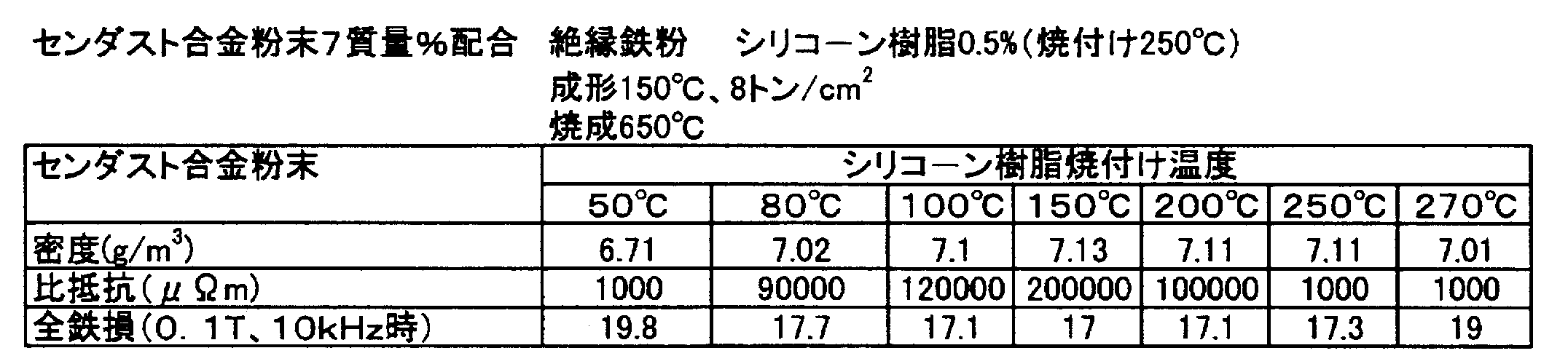
- the silicone resin-coated Sendust alloy powder obtained by mixing 1% by mass of silicone resin with Sendust alloy powder and baking at 150 ° C. 0.5% by mass of silicone resin is mixed to 150 ° C., 200 ° C., 250 ° C. , And 270 ° C.
- the blending ratio of the silicone resin-coated Sendust alloy powder occupying the total mass of the silicone resin-coated Sendust alloy powder and the silicone resin-coated Sendiron alloy powder is 7%. %.
- the baking temperature of the silicone resin with respect to the pure iron powder can be selected in the range of 150 to 250 ° C, more preferably in the range of 200 to 250 ° C.
- Silicone resin-coated pure iron powder obtained by mixing 0.5% by mass of a silicone resin with pure iron powder and baking at 250 ° C. and 1% by mass of silicone resin were mixed at 50 ° C., 80 ° C., 100 ° C., 150 ° C., The silicone resin-coated Sendust alloy powder occupies the total mass of the silicone resin-coated pure iron powder and the silicone resin-coated Sendust alloy powder. It mix
- the baking temperature of the silicone resin in the Sendust alloy powder can be selected in the range of 80 to 250 ° C, more preferably in the range of 100 to 200 ° C.
- the soft magnetic characteristics such as low iron loss, low coercive force, and low eddy current loss of the proper amount of sendust alloy powder are effective.
- the composite soft magnetic material obtained in the above can be provided.
Landscapes
- Engineering & Computer Science (AREA)
- Chemical & Material Sciences (AREA)
- Power Engineering (AREA)
- Materials Engineering (AREA)
- Mechanical Engineering (AREA)
- Metallurgy (AREA)
- Organic Chemistry (AREA)
- Manufacturing & Machinery (AREA)
- Dispersion Chemistry (AREA)
- Soft Magnetic Materials (AREA)
- Powder Metallurgy (AREA)
Abstract
Description
本願は、2008年12月25日に日本に出願された特願2008-330597号に基づき優先権を主張し、その内容をここに援用する。
例えば、粉末成形による高密度複合軟磁性材料の製造では、先ず、絶縁被膜を有する金属軟磁性粉末と、必要に応じて添加される潤滑剤粉末とバインダーからなる原料粉末を金型のキャビティに充填した後、加圧成形することによって目的の形状の圧粉体を作製し、その後、圧粉体を焼成することによって複合軟磁性材料が製造されている。
例えば、パーマロイなどの金属磁性粉末をフェライトなどの酸化物磁性材料で被覆し、その後に成形して熱処理する方法が知られている。(特許文献1参照)
また、酸化被膜を有するセンダスト合金粉末と高圧縮性の軟磁性金属粉末とソフトフェライト粉末とバインダーを混合し、圧密後に焼成処理してなる複合磁性材料が知られている。(特許文献2参照)
また、センダスト合金粉末と他の軟磁性金属粉末を混合する方法にあっては、センダスト合金粉末が非常に硬いために、圧縮性の良好な軟磁性金属粉末を混合したとしても、20ton/cm2程度の高圧成形技術が必要となり、ダストコアなど、円筒形のような単純な形状の製品しか得られないという問題を有していた。
本発明に係る複合軟磁性材料において、前記鉄粉末を圧密し焼成してなる鉄主相の平均粒径を20~50μm、センダスト合金粉末を圧密し焼成してなる合金主相の平均粒径を50~120μmとすることができる。
本発明に係る複合軟磁性材料において、絶縁処理された鉄粉末として、Mg含有酸化物被膜を具備してなる純鉄粉末を用いることができる。
本明細書において、特に断りのない限り、センダスト合金粉末の添加割合または配合比とは、Mg含有酸化物被膜等により絶縁処理された鉄粉末とセンダスト合金粉末の質量の総和に占めるセンダスト合金粉末の配合比(質量%)を意味する。
本発明に係る複合軟磁性材料の製造方法は、平均粒径20~50μmの絶縁処理された鉄粉末を用い、平均粒径50~120μmのセンダスト合金粉末を用いることを特徴とする。
本発明に係る複合軟磁性材料の製造方法は、絶縁処理された鉄粉末として、Mg含有酸化物被膜により絶縁処理された純鉄粉末を用いることを特徴とする。
また、本発明において、絶縁処理した鉄粉末として、Mg含有酸化物被膜により絶縁処理された純鉄粉末を用いることにより、高い飽和磁束密度と低鉄損と低い保磁力と少ない渦電流損失を確実に得ることが可能である。
本発明を用いて複合軟磁性材料を製造するには、例えばプレス成型機などの圧密装置を用い、複合軟磁性材料の原料粉末として例えばMgO系絶縁被膜付き純鉄粉末と、センダスト合金粉末に、バインダーと必要に応じて潤滑剤を添加し混合した混合粉末を圧密装置の金型のキャビティに充填した後に、加圧成形することによって所定形状の圧粉体を得ることができる。その後、得られた圧粉体を所定の温度範囲で焼成することにより目的の形状の複合軟磁性材料を得ることができる。
(A)純鉄粉末に酸化雰囲気中で室温~500℃に保持する酸化処理を施した後、この粉末にMg粉末を添加し混合して得られた混合粉末を温度:150~1100℃、圧力:1×10-12~1×10⁻¹MPaの不活性ガス雰囲気または真空雰囲気中で加熱し、さらに必要に応じて酸化雰囲気中、温度:50~400℃で加熱すると、純鉄粉末表面にMgを含む酸化絶縁被膜を有するMg含有酸化物被覆純鉄粒子が得られる。
(B)純鉄粉末に前述の酸化処理を施した後、一酸化ケイ素粉末を添加し混合した後、または混合しながら、真空雰囲気中、温度:600~1200℃保持の条件で加熱し、さらにMg粉末を添加し混合した後または混合しながら真空雰囲気中、温度:400~800℃保持の条件で加熱すると、純鉄粉末の表面にMg-Si含有酸化膜が形成されたMg-Si含有酸化物被膜純鉄粉末が得られる。
(D)純鉄粉末に前述の酸化処理を施した後、Mg粉末を添加し混合した後、または混合しながら、真空雰囲気中、温度:400~800℃保持の条件で加熱すると純鉄粉末の表面にMg含有酸化膜が形成されたMg含有酸化物被覆純鉄粉末が得られる。
この粉末にさらに一酸化ケイ素粉末を添加し混合した後、または混合しながら、真空雰囲気中、温度:600~1200℃保持の条件で加熱すると、純鉄粉末の表面にMg-Si含有酸化物膜が形成されたMg-Si含有酸化物被覆軟磁性粉末が得られる。
前記一酸化ケイ素粉末の添加量は0.01~1質量%の範囲内にすることができ、前記Mg粉末の添加量を0.05~1質量%の範囲内にすることができる。前記真空雰囲気は圧力:1×10-12~1×10⁻¹MPaの真空雰囲気とすることができる。
前述の酸化物被覆純鉄粉末は平均粒径:20~50μmの範囲内にある粉末を使用することが好ましい。その理由は、平均粒径が小さすぎると、粉末の圧縮性が低下し、飽和磁束密度の値が低下するので好ましくなく、一方、平均粒径が大きすぎると、軟磁性粉末内部の渦電流が増大して高周波における透磁率が低下するおそれを生じやすいことによるものである。
これらの粉末を用意したならば、酸化物被覆純鉄粉末とセンダスト合金粉末にそれぞれバインダー材としてのシリコーンレジンなどのSiを含むバインダー材を個々に混合し、それぞれの粉末をシリコーン樹脂被覆粉末とする。
酸化物被覆純鉄粉末にバインダー材を被覆するには、0.01~1質量%程度のバインダー材を添加して攪拌混合被覆した後、150~250℃の範囲、より好ましくは200~250℃の範囲に加熱して焼付け被覆することができる。センダスト合金粉末にバインダー材を被覆するには、0.05~3質量%程度のバインダー材を添加して攪拌混合被覆した後、80~250℃の範囲、より好ましくは100~200℃の範囲に加熱して焼付け被覆することができる。
センダスト合金粉末にバインダー材を被覆して焼き付ける場合、焼付け温度として、80~250℃の範囲を選択できるが、この範囲を外れると80℃以下であると成形時に密度の低下やばらつきが見られること、250℃を超える温度では比抵抗の低下が見られるので望ましくない。また、この範囲内であっても、より高い密度と比抵抗を得るために、100~200℃の範囲の焼付け温度がより好ましい。
ここで用いる8~10Ton/cm2程度の成形圧力は、センダスト合金粉末の圧密に使用する従来の20Ton/cm2程度の成形圧力よりも格段に低く、一般的な粉末成形法に利用する圧密力と同等レベルなので、一般的な成形圧力であってもセンダスト合金粉末を利用して本発明に係る優れた複合軟磁性材料の製造に利用できる。
その後、この圧密体を500℃~800℃の温度で1時間程度、真空雰囲気あるいは不活性ガス雰囲気(Ar、N2)中、または、非酸化雰囲気(H2雰囲気)において焼成して目的の複合軟磁性材料を得ることができる。
前述の圧密処理と焼成処理によって、絶縁処理を施した純鉄粉末は圧密されて鉄主相となり、センダスト合金粉末は圧密されてセンダスト合金主相となり、それらの鉄主相とセンダスト合金主相とが構成する主相に対してそれらの粒界に存在するようにバインダー材が焼成された結果として生成する粒界相が存在する組織を呈し、目的の複合軟磁性材料を得ることができる。
なお、純鉄粉末の絶縁処理は、前述の(Mg,Fe)Oを含むMg-Fe-O三元系酸化物堆積膜による被膜に限られるものではなく、リン酸塩被覆純鉄粉末など、他の絶縁処理を施した被膜によっても同様の複合軟磁性材料を得ることができる。
本発明の複合軟磁性材料は、センダスト合金粉末の添加割合を5質量%以上、20質量%未満の範囲としたことにより、センダスト合金粉末が本来有する高周波域(10~20kHz)において低損失であり、鉄損、ヒステリシス損、保磁力が低く、渦電流損失が少なく、比抵抗が高いという優れた軟磁気特性を得ることができる。センダスト合金粉末の添加割合が前述の範囲を下回るとこれらの特性を有効に発揮することができなくなる。また、センダスト合金粉末の添加割合が多すぎると純鉄粉末の量が少なくなるので、高い飽和磁束密度を得難くなるとともに、成形時に必要な圧力が高くなり、前述の範囲の成形圧力では良好な密度が得難くなる。
これら電磁気回路部品を組み込んだ電気機器には、電動機、発電機、ソレノイド、インジェクタ、電磁駆動弁、インバータ、コンバータ、変圧器、継電器、または磁気センサシステム等がある。本発明の複合軟磁性材料は、これら電気機器の高効率高性能化や小型軽量化に寄与するという効果を有する。
Mg酸化物被覆純鉄粉末として、純鉄粉末に対して大気中220℃にて加熱処理を行って表面に酸化膜を形成し、この軟磁性粉末に対して0.3質量%のMg粉末を配合し、この配合粉末を造粒転動攪拌混合装置によって、真空中、650℃にて1時間転動することにより膜厚30nmの(Mg,Fe)Oで示されるMg含有酸化物被膜を形成した絶縁処理済み純鉄粉末を用いた。
他の絶縁被覆純鉄粉末として、へガネスジャパン製リン酸鉄被覆鉄粉S110iを用意し、比較例試料として、上記と同等の粒径を有する、被覆を施していない純鉄粉末を用意した。

図4は表1に示すセンダスト合金粉末の配合比と損失との関係をプロットした図である。図4に示す結果によれば、配合比20質量%未満が損失については好ましい。また、センダスト合金粉末の配合比において5質量%以上、20質量%未満において、鉄損(磁束密度0.1T、周波数10kHz時)20W/kg以下を実現できる。


Claims (6)
- 絶縁処理された鉄粉末とセンダスト合金粉末とバインダーが混合圧密され、焼成されてなり、前記鉄粉末とセンダスト合金粉末が圧密され焼成された主相と、前記主相の周囲に生成されたバインダーを主体とする粒界相とが具備されてなり、前記主相に占めるセンダスト合金の割合が5質量%以上、20質量%未満であり、磁場10kA/m時の飽和磁束密度1T以上、保磁力260A/m以下、鉄損(0.1T、10kHz時)20W/kg以下であることを特徴とする複合軟磁性材料。
- 絶縁処理された鉄粉末とセンダスト合金粉末が圧密され焼成された主相において、鉄主相の平均粒径が20~50μm、センダスト合金主相の平均粒径が50~120μmであることを特徴とする請求項1に記載の複合軟磁性材料。
- 絶縁処理された鉄粉末が、Mg含有酸化物被膜を具備してなる純鉄粉末であることを特徴とする請求項1または2に記載の複合軟磁性材料。
- 絶縁処理された鉄粉末とセンダスト合金粉末とバインダーを少なくとも混合圧密し、焼成することにより、前記鉄粉末とセンダスト合金粉末を圧密し焼成してなる主相と、前記主相の周囲に生成されたバインダーを主体とする粒界相とを具備した複合軟磁性材料を製造するにあたり、
絶縁処理された鉄粉末とセンダスト合金粉末の質量の総和に占めるセンダスト合金粉末の添加割合を5質量%以上、20質量%未満として、絶縁処理された鉄粉末およびセンダスト合金粉末を混合圧密し、焼成することにより、磁場10kA/m時の飽和磁束密度1T以上、保磁力260A/m以下、鉄損(0.1T、10kHz時)20W/kg以下の複合軟磁性材料を得ることを特徴とする複合軟磁性材料の製造方法。 - 平均粒径20~50μmの絶縁処理された鉄粉末を用い、平均粒径50~120μmのセンダスト合金粉末を用いることを特徴とする請求項4に記載の複合軟磁性材料の製造方法。
- 絶縁処理された鉄粉末として、Mg含有酸化物被膜により絶縁処理された純鉄粉末を用いることを特徴とする請求項4または5に記載の複合軟磁性材料の製造方法。
Priority Applications (2)
| Application Number | Priority Date | Filing Date | Title |
|---|---|---|---|
| CN2009801528854A CN102264492A (zh) | 2008-12-25 | 2009-12-21 | 复合软磁性材料及其制造方法 |
| JP2010543839A JPWO2010073590A1 (ja) | 2008-12-25 | 2009-12-21 | 複合軟磁性材料とその製造方法 |
Applications Claiming Priority (2)
| Application Number | Priority Date | Filing Date | Title |
|---|---|---|---|
| JP2008-330597 | 2008-12-25 | ||
| JP2008330597 | 2008-12-25 |
Publications (1)
| Publication Number | Publication Date |
|---|---|
| WO2010073590A1 true WO2010073590A1 (ja) | 2010-07-01 |
Family
ID=42287240
Family Applications (1)
| Application Number | Title | Priority Date | Filing Date |
|---|---|---|---|
| PCT/JP2009/007070 Ceased WO2010073590A1 (ja) | 2008-12-25 | 2009-12-21 | 複合軟磁性材料とその製造方法 |
Country Status (3)
| Country | Link |
|---|---|
| JP (1) | JPWO2010073590A1 (ja) |
| CN (1) | CN102264492A (ja) |
| WO (1) | WO2010073590A1 (ja) |
Cited By (10)
| Publication number | Priority date | Publication date | Assignee | Title |
|---|---|---|---|---|
| JP2012138494A (ja) * | 2010-12-27 | 2012-07-19 | Tdk Corp | 圧粉コア |
| US20130298730A1 (en) * | 2011-02-22 | 2013-11-14 | Diamet Corporation | Composite soft magnetic material having low magnetic strain and high magnetic flux density, method for producing same, and electromagnetic circuit component |
| CN103430250A (zh) * | 2011-03-24 | 2013-12-04 | 住友电气工业株式会社 | 复合材料、电抗器用磁芯、电抗器、转换器和功率转换器装置 |
| JP2015213148A (ja) * | 2013-11-29 | 2015-11-26 | 株式会社神戸製鋼所 | 圧粉磁心用混合粉末および圧粉磁心 |
| JP2017143259A (ja) * | 2011-04-07 | 2017-08-17 | ホガナス アクチボラグ (パブル) | 新規な組成物及び方法 |
| US9847156B2 (en) | 2011-03-24 | 2017-12-19 | Sumitomo Electric Industries, Ltd. | Composite material, reactor-use core, reactor, converter, and power converter apparatus |
| WO2019002434A1 (de) * | 2017-06-28 | 2019-01-03 | Fraunhofer-Gesellschaft zur Förderung der angewandten Forschung e.V. | Verfahren zum herstellen eines weichmagnetischen kompositwerkstoffs und weichmagnetischer kompositwerkstoff |
| CN114713817A (zh) * | 2022-02-17 | 2022-07-08 | 苏州创浩新材料科技有限公司 | 一种电磁屏蔽铁基复合材料及其制备方法 |
| JP2023085967A (ja) * | 2021-12-09 | 2023-06-21 | 株式会社タムラ製作所 | 軟磁性粉末及び圧粉磁心 |
| JP2025006199A (ja) * | 2023-06-29 | 2025-01-17 | トヨタ自動車株式会社 | 圧粉磁心の製造方法 |
Families Citing this family (8)
| Publication number | Priority date | Publication date | Assignee | Title |
|---|---|---|---|---|
| CN104028748B (zh) * | 2014-05-28 | 2015-12-02 | 浙江大学 | 一种软磁复合材料的表面硼化绝缘包覆方法 |
| WO2016185940A1 (ja) * | 2015-05-19 | 2016-11-24 | アルプス・グリーンデバイス株式会社 | 圧粉コア、当該圧粉コアの製造方法、該圧粉コアを備えるインダクタ、および該インダクタが実装された電子・電気機器 |
| CN105742049A (zh) * | 2016-04-29 | 2016-07-06 | 成都锦粼科技有限公司 | 一种铁芯及其制作方法 |
| CN107419157B (zh) * | 2017-06-15 | 2019-08-02 | 江苏大学 | 一种用还原铁粉替代纯铁冶炼钕铁硼合金的方法 |
| CN107958762A (zh) * | 2017-10-17 | 2018-04-24 | 华南理工大学 | 一种Fe/FeSiB复合磁粉芯及其制备方法 |
| CN113555178B (zh) * | 2020-04-23 | 2024-03-01 | 山东精创磁电产业技术研究院有限公司 | 一种双主相软磁复合材料及其制备方法 |
| CN114823032B (zh) * | 2022-05-19 | 2022-12-20 | 广东泛瑞新材料有限公司 | 一种合金磁芯及其制备方法和应用 |
| CN116666101B (zh) * | 2023-07-24 | 2024-03-08 | 通友微电(四川)有限公司 | 有机包覆软磁粉体的制备方法 |
Citations (5)
| Publication number | Priority date | Publication date | Assignee | Title |
|---|---|---|---|---|
| JPH06236808A (ja) * | 1993-02-10 | 1994-08-23 | Kawasaki Steel Corp | 複合磁性材料およびその製造方法 |
| JP2002093612A (ja) * | 2000-09-18 | 2002-03-29 | Daido Steel Co Ltd | 磁気素子およびその製造方法 |
| JP2005093350A (ja) * | 2003-09-19 | 2005-04-07 | Toyota Central Res & Dev Lab Inc | 絶縁皮膜、磁心用粉末および圧粉磁心並びにそれらの製造方法 |
| JP2005303006A (ja) * | 2004-04-12 | 2005-10-27 | Sumitomo Electric Ind Ltd | 圧粉磁心の製造方法および圧粉磁心 |
| JP2006332524A (ja) * | 2005-05-30 | 2006-12-07 | Mitsubishi Materials Pmg Corp | 高強度、高磁束密度および高抵抗を有する鉄損の少ない高強度複合軟磁性材およびその製造方法 |
Family Cites Families (1)
| Publication number | Priority date | Publication date | Assignee | Title |
|---|---|---|---|---|
| CN101118797B (zh) * | 2006-08-04 | 2011-06-22 | 安泰科技股份有限公司 | 低损耗磁粉芯用复合粉末及其磁粉芯 |
-
2009
- 2009-12-21 WO PCT/JP2009/007070 patent/WO2010073590A1/ja not_active Ceased
- 2009-12-21 JP JP2010543839A patent/JPWO2010073590A1/ja active Pending
- 2009-12-21 CN CN2009801528854A patent/CN102264492A/zh active Pending
Patent Citations (5)
| Publication number | Priority date | Publication date | Assignee | Title |
|---|---|---|---|---|
| JPH06236808A (ja) * | 1993-02-10 | 1994-08-23 | Kawasaki Steel Corp | 複合磁性材料およびその製造方法 |
| JP2002093612A (ja) * | 2000-09-18 | 2002-03-29 | Daido Steel Co Ltd | 磁気素子およびその製造方法 |
| JP2005093350A (ja) * | 2003-09-19 | 2005-04-07 | Toyota Central Res & Dev Lab Inc | 絶縁皮膜、磁心用粉末および圧粉磁心並びにそれらの製造方法 |
| JP2005303006A (ja) * | 2004-04-12 | 2005-10-27 | Sumitomo Electric Ind Ltd | 圧粉磁心の製造方法および圧粉磁心 |
| JP2006332524A (ja) * | 2005-05-30 | 2006-12-07 | Mitsubishi Materials Pmg Corp | 高強度、高磁束密度および高抵抗を有する鉄損の少ない高強度複合軟磁性材およびその製造方法 |
Cited By (15)
| Publication number | Priority date | Publication date | Assignee | Title |
|---|---|---|---|---|
| JP2012138494A (ja) * | 2010-12-27 | 2012-07-19 | Tdk Corp | 圧粉コア |
| US20130298730A1 (en) * | 2011-02-22 | 2013-11-14 | Diamet Corporation | Composite soft magnetic material having low magnetic strain and high magnetic flux density, method for producing same, and electromagnetic circuit component |
| US9773597B2 (en) * | 2011-02-22 | 2017-09-26 | Mitsubishi Materials Corporation | Composite soft magnetic material having low magnetic strain and high magnetic flux density, method for producing same, and electromagnetic circuit component |
| CN103430250A (zh) * | 2011-03-24 | 2013-12-04 | 住友电气工业株式会社 | 复合材料、电抗器用磁芯、电抗器、转换器和功率转换器装置 |
| US9349511B2 (en) | 2011-03-24 | 2016-05-24 | Sumitomo Electric Industries, Ltd. | Composite material, reactor-use core, reactor, converter, and power converter apparatus |
| CN103430250B (zh) * | 2011-03-24 | 2017-08-18 | 住友电气工业株式会社 | 复合材料、电抗器用磁芯、电抗器、转换器和功率转换器装置 |
| US9847156B2 (en) | 2011-03-24 | 2017-12-19 | Sumitomo Electric Industries, Ltd. | Composite material, reactor-use core, reactor, converter, and power converter apparatus |
| JP2019134166A (ja) * | 2011-04-07 | 2019-08-08 | ホガナス アクチボラグ (パブル) | 新規な組成物及び方法 |
| JP2017143259A (ja) * | 2011-04-07 | 2017-08-17 | ホガナス アクチボラグ (パブル) | 新規な組成物及び方法 |
| JP2015213148A (ja) * | 2013-11-29 | 2015-11-26 | 株式会社神戸製鋼所 | 圧粉磁心用混合粉末および圧粉磁心 |
| WO2019002434A1 (de) * | 2017-06-28 | 2019-01-03 | Fraunhofer-Gesellschaft zur Förderung der angewandten Forschung e.V. | Verfahren zum herstellen eines weichmagnetischen kompositwerkstoffs und weichmagnetischer kompositwerkstoff |
| JP2023085967A (ja) * | 2021-12-09 | 2023-06-21 | 株式会社タムラ製作所 | 軟磁性粉末及び圧粉磁心 |
| JP7405817B2 (ja) | 2021-12-09 | 2023-12-26 | 株式会社タムラ製作所 | 軟磁性粉末及び圧粉磁心 |
| CN114713817A (zh) * | 2022-02-17 | 2022-07-08 | 苏州创浩新材料科技有限公司 | 一种电磁屏蔽铁基复合材料及其制备方法 |
| JP2025006199A (ja) * | 2023-06-29 | 2025-01-17 | トヨタ自動車株式会社 | 圧粉磁心の製造方法 |
Also Published As
| Publication number | Publication date |
|---|---|
| CN102264492A (zh) | 2011-11-30 |
| JPWO2010073590A1 (ja) | 2012-06-07 |
Similar Documents
| Publication | Publication Date | Title |
|---|---|---|
| WO2010073590A1 (ja) | 複合軟磁性材料とその製造方法 | |
| JP6071211B2 (ja) | 低磁歪高磁束密度複合軟磁性材とその製造方法 | |
| JP5626672B1 (ja) | 圧粉磁心の製造方法、圧粉磁心およびコイル部品 | |
| CN106663513B (zh) | 磁芯、磁芯的制造方法以及线圈部件 | |
| CN106537527B (zh) | 磁芯的制造方法、磁芯以及使用该磁芯的线圈部件 | |
| JP5263653B2 (ja) | 圧粉磁心およびその製造方法 | |
| WO2006028100A1 (ja) | Mg含有酸化膜被覆軟磁性金属粉末の製造方法およびこの粉末を用いて複合軟磁性材を製造する方法 | |
| JP7128439B2 (ja) | 圧粉磁芯およびインダクタ素子 | |
| JP6471881B2 (ja) | 磁心およびコイル部品 | |
| JP4534523B2 (ja) | 複合焼結磁性材料の製造方法 | |
| CN102693826B (zh) | 压粉磁心及其制造方法 | |
| JP2010236020A (ja) | 複合軟磁性材料及びその製造方法と電磁気回路部品 | |
| JP2011216571A (ja) | 高強度低損失複合軟磁性材とその製造方法及び電磁気回路部品 | |
| JP5472694B2 (ja) | アルミニウム酸化物と鉄の複合焼結体、およびその製造方法 | |
| JP6582745B2 (ja) | 複合軟磁性材料及びその製造方法 | |
| JP2010185126A (ja) | 複合軟磁性材料とその製造方法 | |
| JP7016713B2 (ja) | 圧粉磁心および磁心用粉末 | |
| JP2007013069A (ja) | MgおよびSi含有酸化物被覆軟磁性粉末の製造方法 | |
| JP2006097124A (ja) | Mg含有酸化膜被覆軟磁性金属粉末の製造方法およびこの粉末を用いて複合軟磁性材を製造する方法 | |
| JP2006241583A (ja) | Mg含有酸化膜被覆軟磁性金属粉末の製造方法およびこの粉末を用いて複合軟磁性材を製造する方法 | |
| JP2019201154A (ja) | 圧粉磁芯およびインダクタ素子 | |
| JP2011208184A (ja) | 磁性複合粉末、およびその製造方法 | |
| JP2018137349A (ja) | 磁心およびコイル部品 | |
| JP2002043154A (ja) | 複合圧粉焼結磁芯の製造方法 | |
| JPH1083910A (ja) | 磁心とこれに用いる粉末 |
Legal Events
| Date | Code | Title | Description |
|---|---|---|---|
| WWE | Wipo information: entry into national phase |
Ref document number: 200980152885.4 Country of ref document: CN |
|
| 121 | Ep: the epo has been informed by wipo that ep was designated in this application |
Ref document number: 09834401 Country of ref document: EP Kind code of ref document: A1 |
|
| ENP | Entry into the national phase |
Ref document number: 2010543839 Country of ref document: JP Kind code of ref document: A |
|
| NENP | Non-entry into the national phase |
Ref country code: DE |
|
| 122 | Ep: pct application non-entry in european phase |
Ref document number: 09834401 Country of ref document: EP Kind code of ref document: A1 |