WO2010052877A1 - フェノール樹脂混合物、エポキシ樹脂混合物、エポキシ樹脂組成物、及び硬化物 - Google Patents
フェノール樹脂混合物、エポキシ樹脂混合物、エポキシ樹脂組成物、及び硬化物 Download PDFInfo
- Publication number
- WO2010052877A1 WO2010052877A1 PCT/JP2009/005783 JP2009005783W WO2010052877A1 WO 2010052877 A1 WO2010052877 A1 WO 2010052877A1 JP 2009005783 W JP2009005783 W JP 2009005783W WO 2010052877 A1 WO2010052877 A1 WO 2010052877A1
- Authority
- WO
- WIPO (PCT)
- Prior art keywords
- epoxy resin
- resin mixture
- biphenyl
- phenol
- reaction
- Prior art date
- Legal status (The legal status is an assumption and is not a legal conclusion. Google has not performed a legal analysis and makes no representation as to the accuracy of the status listed.)
- Ceased
Links
Classifications
-
- C—CHEMISTRY; METALLURGY
- C08—ORGANIC MACROMOLECULAR COMPOUNDS; THEIR PREPARATION OR CHEMICAL WORKING-UP; COMPOSITIONS BASED THEREON
- C08G—MACROMOLECULAR COMPOUNDS OBTAINED OTHERWISE THAN BY REACTIONS ONLY INVOLVING UNSATURATED CARBON-TO-CARBON BONDS
- C08G61/00—Macromolecular compounds obtained by reactions forming a carbon-to-carbon link in the main chain of the macromolecule
- C08G61/02—Macromolecular compounds containing only carbon atoms in the main chain of the macromolecule, e.g. polyxylylenes
-
- C—CHEMISTRY; METALLURGY
- C08—ORGANIC MACROMOLECULAR COMPOUNDS; THEIR PREPARATION OR CHEMICAL WORKING-UP; COMPOSITIONS BASED THEREON
- C08G—MACROMOLECULAR COMPOUNDS OBTAINED OTHERWISE THAN BY REACTIONS ONLY INVOLVING UNSATURATED CARBON-TO-CARBON BONDS
- C08G59/00—Polycondensates containing more than one epoxy group per molecule; Macromolecules obtained by polymerising compounds containing more than one epoxy group per molecule using curing agents or catalysts which react with the epoxy groups
- C08G59/02—Polycondensates containing more than one epoxy group per molecule
- C08G59/04—Polycondensates containing more than one epoxy group per molecule of polyhydroxy compounds with epihalohydrins or precursors thereof
- C08G59/06—Polycondensates containing more than one epoxy group per molecule of polyhydroxy compounds with epihalohydrins or precursors thereof of polyhydric phenols
- C08G59/063—Polycondensates containing more than one epoxy group per molecule of polyhydroxy compounds with epihalohydrins or precursors thereof of polyhydric phenols with epihalohydrins
-
- C—CHEMISTRY; METALLURGY
- C08—ORGANIC MACROMOLECULAR COMPOUNDS; THEIR PREPARATION OR CHEMICAL WORKING-UP; COMPOSITIONS BASED THEREON
- C08G—MACROMOLECULAR COMPOUNDS OBTAINED OTHERWISE THAN BY REACTIONS ONLY INVOLVING UNSATURATED CARBON-TO-CARBON BONDS
- C08G59/00—Polycondensates containing more than one epoxy group per molecule; Macromolecules obtained by polymerising compounds containing more than one epoxy group per molecule using curing agents or catalysts which react with the epoxy groups
- C08G59/18—Macromolecules obtained by polymerising compounds containing more than one epoxy group per molecule using curing agents or catalysts which react with the epoxy groups ; e.g. general methods of curing
- C08G59/40—Macromolecules obtained by polymerising compounds containing more than one epoxy group per molecule using curing agents or catalysts which react with the epoxy groups ; e.g. general methods of curing characterised by the curing agents used
- C08G59/62—Alcohols or phenols
- C08G59/621—Phenols
-
- C—CHEMISTRY; METALLURGY
- C08—ORGANIC MACROMOLECULAR COMPOUNDS; THEIR PREPARATION OR CHEMICAL WORKING-UP; COMPOSITIONS BASED THEREON
- C08L—COMPOSITIONS OF MACROMOLECULAR COMPOUNDS
- C08L63/00—Compositions of epoxy resins; Compositions of derivatives of epoxy resins
-
- C—CHEMISTRY; METALLURGY
- C08—ORGANIC MACROMOLECULAR COMPOUNDS; THEIR PREPARATION OR CHEMICAL WORKING-UP; COMPOSITIONS BASED THEREON
- C08L—COMPOSITIONS OF MACROMOLECULAR COMPOUNDS
- C08L65/00—Compositions of macromolecular compounds obtained by reactions forming a carbon-to-carbon link in the main chain; Compositions of derivatives of such polymers
Definitions
- the present invention relates to a novel phenol resin mixture, an epoxy resin mixture, an epoxy resin composition, and a cured product.
- Epoxy resin composition has excellent workability and excellent electrical properties, heat resistance, chemical resistance, mechanical strength, adhesion, moisture resistance (water resistance), dimensional stability, optical characteristics, etc. Utilized in a wide range of fields such as electrical / electronic component materials, reinforced fiber composite materials, resist materials, optical materials, liquid crystal sealing materials, overcoat materials, prepregs, molding materials, adhesives, adhesives, paints, etc. Yes.
- electrical / electronic component materials (1) semiconductor sealing materials, specifically (a) potting, dipping, transfer mold sealing, flip-flops for capacitors, transistors, diodes, light emitting diodes, ICs, LSIs, etc. Underfill for chips, etc.
- optical material examples include lens materials.
- electrical / electronic component materials As electrical / electronic equipment has become more sophisticated, electrical / electronic components have become increasingly dense and highly integrated, Due to the expansion of fields of application to high-temperature environments, outdoor environments, the vicinity of the human body, etc., and the shift to environmentally friendly technologies, the required characteristics have become widespread and sophisticated. For example, in the fields of semiconductor sealing materials and substrates, epoxy resins are required to have flame resistance and solder crack resistance in addition to heat resistance, water absorption, electrical insulation, low thermal expansion coefficient, and the like.
- solder crack resistance changes in the mounting process have an effect.
- the surface mounting method has become common, and the semiconductor package is often directly exposed to high temperatures during solder reflow, and when the semiconductor is mounted as the awareness of environmental problems in recent years has increased.
- lead-free solder Since lead-free solder has a melting temperature about 20 ° C. higher than that of conventional solder (about 260 ° C.), the possibility of package cracks during solder reflow is much higher than before.
- the plating thickness is reduced, cracks may occur during thermal shock, and the wiring board is required to have high solder crack resistance.
- the epoxy resin composition used for electrical and electronic materials around semiconductors such as semiconductor encapsulating materials and printed wiring boards is hardened by lead-free solder, which has a higher temperature than conventional solder.
- lead-free solder which has a higher temperature than conventional solder.
- This crack is caused by the stress generated in the cured product when subjected to the thermal shock of lead-free solder.
- a storage elastic modulus by a dynamic viscoelasticity test can be used.
- the storage elastic modulus at a high temperature is preferably lower if the storage elastic modulus at 160 ° C. is 100 MPa or more (Patent Document 3).
- the storage elastic modulus at high temperature should be higher than a certain level even above the glass transition temperature.
- An epoxy resin composition having a storage elastic modulus at 220 ° C. of 0.5 GPa to 0.9 GPa is disclosed as a highly reliable resin that does not cause cracks in a test (Patent Document 4). Therefore, an appropriate storage elastic modulus at a high temperature is considered to be very important in order to suppress the occurrence of cracks due to thermal shock.
- a phenol-biphenyl aralkyl type epoxy resin excellent in flame retardancy for example, NC-3000 series manufactured by Nippon Kayaku Co., Ltd. is known as a commercial product.
- This epoxy resin can be produced by reacting 4,4'-dimethylolbiphenyl with phenol, isolating the resulting bisphenol compound, and then epoxidizing the isolated bisphenol compound with epichlorohydrin or the like.
- Patent Document 5 a method using 4,4′-bis (chloromethyl) -biphenyl instead of the above 4,4′-dimethylolbiphenyl is also known (Patent Document 6).
- Patent Document 7 phenol resins in which biphenyl derivatives such as 4,4′-bis (chloromethyl) -biphenyl have been previously oligomerized and condensed with phenols have been proposed.
- Patent Document 7 a method for synthesizing 4,4′-bis (chloromethyl) -biphenyl which is the above raw material by bischloromethylation of biphenyl is generally known.
- biphenyl, paraformaldehyde and chlorinated in a cyclohexane solvent 4,4'-bis (chloromethyl) -biphenyl can be obtained by introducing hydrogen chloride gas and reacting with vigorous stirring of zinc (Patent Document 8, page 10, columns 19 to 20).
- An object of the present invention is to provide an epoxy resin cured product having flame retardancy equivalent to or higher than that of a cured product using a phenol-biphenylaralkyl type epoxy resin excellent in flame retardancy, and having a more optimal storage elastic modulus.
- the present inventors surprisingly include bishalomethylbiphenyl as a main component, a certain amount of tri- and tetrahalomethylbiphenyl as side reaction products, and the balance.
- a phenol resin mixture obtained by reacting a reaction product (mixture) obtained by halomethylation of biphenyl containing a small amount of monohalomethylbiphenyl and bisbiphenylylmethane compound with phenol without isolation and purification is The present invention was completed by finding that it is very suitable as a raw material for an epoxy resin mixture satisfying the above required performance.
- Bi (halomethyl) biphenyl obtained by halomethylation reaction of biphenyl and in a ratio (GC area ratio) to the total reaction product by GC-MS of bishalomethylbiphenyl is 60% or more and less than 80%.
- a phenol resin mixture obtained by a methylene crosslinking reaction of phenol with a reaction product containing a total of 15 to 30% of tetra (halomethyl) biphenyl and the balance of other by-products (2)
- the above (1) having a softening point of 65 to 85 ° C., a number average molecular weight by GPC (gel permeation chromatography) of 350 to 1200, a weight average molecular weight of 400 to 2000, and an OH equivalent of 160 to 250 g / eq.
- a phenolic resin mixture according to (3) An epoxy resin mixture obtained by epoxidizing the phenol resin mixture according to (1) or (2) above, (4) Softening point 50 to 75 ° C., ICI viscosity 0.02 to 0.50 Pa ⁇ s, number average molecular weight 400 to 1200 and weight average molecular weight 800 to 2000 by GPC (gel permeation chromatography), epoxy The epoxy resin mixture according to the above (3), wherein the equivalent is 200 to 360 g / eq, (5) An epoxy resin composition containing the epoxy resin mixture and a curing agent according to (3) above, (6) The epoxy resin composition according to the above (5), wherein the content of the curing agent is 0.7 to 1.2 equivalents with respect to 1 equivalent of the epoxy group of the epoxy resin mixture, (7) The epoxy resin composition according to the above (6), further comprising 50 to 90% by weight of a filler based on the total amount of the epoxy resin composition,
- Epoxy resin mixture obtained by epoxidizing the phenol resin mixture described in (1) above, and 0.7 to 1.2 equivalents of curing agent with respect to 1 equivalent of epoxy groups of the epoxy resin mixture A cured product obtained by curing an epoxy resin composition containing (9) An epoxy resin mixture obtained by epoxidizing the phenol resin mixture described in (1) above, 0.7 to 1.2 equivalents of a curing agent with respect to 1 equivalent of epoxy groups of the epoxy resin mixture, and A cured product obtained by curing an epoxy resin composition containing 50 to 90% by weight of an inorganic filler with respect to the total amount of the epoxy resin composition; (10) In the presence of zinc halide, 2 to 8 equivalents of formaldehyde and hydrogen halide are reacted in the presence of an excess amount of hydrogen halide with respect to 1 mol of biphenyl and biphenyl, and halomethyl of biphenyl is reacted.
- the ratio of GC-MS to the total reaction product was 60% or more and less than 80% of bishalomethylbiphenyl, and totaled tri (halomethyl) biphenyl and tetra (halomethyl) biphenyl.
- a reaction product containing 15 to 30% and other by-products, and reacting with phenol without purifying the reaction product
- (11) An epoxy resin mixture characterized by reacting the phenol resin mixture obtained by the production method of (10) with 0.8 to 12 equivalents of epihalohydrin with respect to 1 equivalent of a hydroxyl group of the phenol resin mixture.
- Production method (12) An epoxy resin composition containing the phenol resin mixture according to (1) or (2) as a curing agent, About.
- the phenol resin mixture obtained by the present invention is useful as a raw material for an epoxy resin mixture or an epoxy resin composition that gives a cured product having excellent flame retardancy and moderate storage elastic modulus, and is easy to produce. It is. Moreover, when the epoxy resin mixture or epoxy resin composition of this invention hardens
- the halomethylation reaction of biphenyl is a reaction for obtaining a halomethylated product of biphenyl using biphenyl, formaldehydes or equivalent acetals (hereinafter collectively referred to as carbon source), hydrogen halide, catalyst and solvent.
- carbon source biphenyl, formaldehydes or equivalent acetals
- the halomethylated product of biphenyl may further react to produce diarylmethane.
- Patent Document 8 Japanese Patent Publication No. 54-929
- 4,4′-bis (chloromethyl) is obtained in a chloromethylation reaction using biphenyl, paraformaldehyde, hydrogen chloride gas, zinc chloride, and cyclohexane.
- -1,1′-biphenyl can be produced.
- the methods described in JP-A-9-208506, JP-A-10-139699, and Japanese Patent No. 3784865 can be mentioned.
- the halomethylation reaction in the present invention comprises the above composition, that is, 60 to 80% by weight of bishalomethylbiphenyl, 15 to 30% in total of tri (halomethyl) biphenyl and tetra (halomethyl) biphenyl, and the remaining other by-products. Any method described above may be used as long as the reaction product can be obtained.
- the halomethylation reaction in the present invention will be described with reference to the reaction example of Patent Document 8, which is the most typical example.
- methyl group carbon source in the halomethylation include formaldehyde such as formalin, paraformaldehyde, methylal, and trioxane, with paraformaldehyde being preferred.
- the charge equivalent of the carbon source (for example, formaldehyde in the reaction example of Patent Document 8) varies depending on the halomethylation rate relative to biphenyl (the number of halomethyl groups per molecule), but is 1 equivalent to 15 to 1 mole of biphenyl. Equivalents are preferred, 1.5 to 10 equivalents are more preferred, and 2 to 8 equivalents are even more preferred. If the amount is less than 1 equivalent, the reaction point with biphenyl having a phenolic hydroxyl group may be insufficient. If the amount exceeds 15 equivalents, the reaction point / cross-linking point is too much and the molecular weight becomes too large, or the solid content concentration is increased and stirred. The condition may worsen.
- any of hydrogen halide and any one that generates hydrogen halide by reaction can be used.
- hydrogen halide is most commonly used.
- Preferred examples of the hydrogen halide include hydrogen chloride, hydrogen bromide, and hydrogen iodide, with hydrogen chloride being preferred.
- These hydrogen halides can be used in the form of a gas.
- the reaction can be carried out by directly blowing a raw material mixture other than hydrogen halide.
- the hydrogen halide can also be dissolved in water, acetic acid or other organic solvents and used as a hydrogen halide solution, but the method using hydrogen chloride in the form of gas is most preferred.
- preferred catalysts include sulfuric acid, thionyl chloride, orthophosphoric acid, zinc chloride, aluminum chloride, iron chloride, tin chloride and other Friedel-Crafts type reaction catalysts, tetrabutylammonium bromide, trimethylbenzyl chloride, chloride Quaternary ammonium salts such as cetylpyridinium can be mentioned.
- zinc chloride, aluminum chloride, iron chloride, tin chloride, tetrabutylammonium bromide, trimethylbenzyl chloride, and cetylpyridinium chloride are more preferable, and zinc chloride is particularly preferable because it is inexpensive and easy to handle.
- These catalysts may be used alone or in combination of two or more.
- the amount of the catalyst used is not particularly limited, but is preferably in the range of 0.01 mol to 3 mol with respect to biphenyl. 0.1 mol to 1 mol is more preferable.
- the solvent used in the reaction is not particularly limited as long as it is a non-reactive solvent.
- Preferred solvents include aliphatic hydrocarbon solvents (for example, chain alkanes such as hexane and heptane, cyclic alkanes such as cyclopentane and cyclohexane, and kerosene), aliphatic carboxylic acid solvents (for example, formic acid, acetic acid, propionic acid, etc.
- Aromatic hydrocarbon solvents with low electron density of aromatic rings eg chlorobenzene, nitrobenzene, orthodichlorobenzene, trichlorobenzene, etc.
- aliphatic halogenated hydrocarbon solvents eg chloroform, dichloromethane, dichloroethane, tetrachloroethane, etc. organic solvents
- solvents may be used alone or in combination of two or more.
- Preferred examples of the solvent include C5-C6 cyclic alkanes, and the most preferred examples include cyclohexane which is inexpensive and has a low boiling point and can be easily removed.
- an aliphatic alcohol such as 1-pentanol or 1-hexanol, or water may be added in an amount equivalent to the catalyst. These additions are known to increase the solubility of the catalyst and improve the reaction activity in some cases (Bull. Chem. Soc. Jpn. 66, 3520 (1993)). In the present invention, it may not be added in particular.
- the amount of the solvent used is not particularly limited, but it is preferably about 1 ⁇ 2 to 10 parts by weight of solid content, more preferably 8 parts by weight or less.
- the reaction temperature is not particularly limited as long as it is within an acceptable temperature range for the solvent used. Usually, it is 0 to 100 ° C., preferably about 15 to 60 ° C. When the reaction proceeds at around room temperature, around room temperature is preferred. In general, methylene-bridged diarylmethane, which is observed as a by-product in the chloromethylation reaction, is known to be preferentially produced when the reaction temperature is high. Therefore, it is preferable to lower the reaction temperature.
- the reaction time is not particularly limited. Usually, it can be performed in about 6 to 36 hours.
- the charging method is not particularly limited.
- raw materials other than hydrogen halide are charged first, and hydrogen halide gas is blown into the system so as to maintain an excessive amount of hydrohalic acid in the system during the reaction.
- hydrogen halide hydrogen chloride is preferred.
- the composition of the reaction product obtained above is the same as the ratio (GC area ratio) to the total reaction product (total amount) in GC-MS (Gas Chromatograph / Mass Spectrometry), unless otherwise specified.
- a bishalomethylbiphenyl preferably bischloromethylbiphenyl
- tri (halomethyl) biphenyl preferably tri (chloromethyl) biphenyl
- tetra (halomethyl) biphenyl preferably Is preferably a mixture of 15% to 30% of the total content of tetra (chloromethyl) biphenyl
- the remainder of other by-products hereinafter also referred to as a mixture of biphenyl compounds having a halomethyl group.
- the total of the three of bishalomethylbiphenyl, tri (halomethyl) biphenyl and tetra (halomethyl) biphenyl is preferably 75% to 97%, more preferably 80% to 95%.
- the main component, bishalomethylbiphenyl is composed of 4,4'-bishalomethylbiphenyl and its positional isomers.
- 4,4'-bishalomethylbiphenyl is about 50-98%. Preferably, it accounts for about 60 to 95%, and the balance is considered to be the isomer.
- the main compounds contained in the reaction product are represented by the formulas of the compounds in the case where the halomethyl group is a chloromethyl group.
- the “chloromethyl” group in Table A and the “chloromethyl” in the following description can be read as “halomethyl” in the present invention.
- 4,4′-bischloromethyl-biphenyl represented by formula 1-3 is a main component in bischloromethylbiphenyl, and accounts for about 50 to 98%, preferably about 60 to 98% of bischloromethylbiphenyl. Conceivable.
- bischloromethylbiphenyl the remainder other than 4,4′-bischloromethyl-biphenyl is considered to be a positional isomer such as 2,4′-bischloromethyl-biphenyl represented by Formula 1-4.
- Tri (chloromethyl) biphenyl and tetra (chloromethyl) biphenyl are considered to be composed of, for example, compounds represented by formula 1-5 to formula 1-8 and isomers thereof (substitution isomers).
- Other by-products include, for example, monochloromethylbiphenyl (eg, compounds represented by Formula 1-1 and Formula 1-2), bisbiphenylylmethane (Formula 1-9), monochloromethyl-bisbiphenylylmethane ( A compound represented by formula 1-10), bischloromethyl-bisbiphenylylmethane (a compound represented by formula 1-11), and the like.
- the content of bischloromethylbiphenyl with respect to the total amount of the reaction product is 60% or more, less than 80%, and more preferably 65 to 75%.
- the total content of tri (chloromethyl) biphenyl and tetra (chloromethyl) biphenyl with respect to the total amount of the reaction product is about 15 to 30%, preferably about 15 to 25%.
- the proportions of tri (chloromethyl) biphenyl and tetra (chloromethyl) biphenyl vary depending on the reaction conditions and cannot be generally stated. However, the content of trichloromethylbiphenyl with respect to the total amount of the reaction product is about 5% to 25%. 10% to 20% is preferable.
- the content of tetra (chloromethyl) biphenyl with respect to the total amount of the reaction product is preferably 1% to 15%, more preferably 2% to 10%.
- monochloromethylbiphenyl is usually the most abundant, and the ratio (GC area ratio) to the total reaction product in GC-MS (hereinafter the same unless otherwise specified) is about 1% to 10%. It is.
- the reaction of the reaction product obtained above with phenol also referred to as methylene crosslinking reaction
- the methylene crosslinking reaction is a condensation reaction
- the reaction product (mixture of biphenyl compounds having a halomethyl group) obtained as described above is condensed with phenol.
- the methylene crosslinking reaction is preferably carried out under acidic conditions, for example, at a pH of about 1 to 4.
- the reaction can generally refer to the 5th edition, Experimental Chemistry Course 26 (2) p142 (2005).
- the halomethylation reaction product of biphenyl is a mixture, and in the present invention, the mixture is used as it is for a methylene crosslinking reaction with phenol. Therefore, usually, the reaction solution obtained by the halomethylation reaction can be used as it is. If necessary, the reaction solution can be used as a raw material for the reaction with phenol after being subjected to treatments such as concentration, dilution, degassing, washing with water, neutralization and filtration. Even in that case, it is preferable that it is substantially within the range of the composition of the reaction product. Usually, it is preferable to use the reaction liquid of the halomethylation reaction of biphenyl as it is for the next methylene crosslinking reaction with phenol.
- an acid catalyst can be added as necessary, and it is usually preferable to carry out in the presence of an acid catalyst.
- Various acid catalysts can be used.
- organic or inorganic acids such as sulfuric acid, p-toluenesulfonic acid, oxalic acid, methanesulfonic acid, trifluoromethanesulfonic acid, zinc chloride, aluminum chloride, iron chloride, chloride Friedel-Crafts type Lewis acid catalyst such as tin.
- the amount of the acid catalyst used varies depending on the type of the catalyst, but it can be added within a range of 0.001 to 10 times in molar ratio to phenol. Preferably, the amount is about 0.05 to 3 moles.
- the reaction solution of the halomethylation reaction is used as it is, and then the condensation reaction is performed. Therefore, the acid catalyst used in the halomethylation reaction can be used as it is, and there is no need to add an acid catalyst again. .
- Biphenyl halomethylation reaction product and phenol can be reacted in any proportion. Usually, it is preferable to use 1.5 mol to 40 mol of phenol with respect to 1 mol of halomethyl group in the halomethylation reaction product of biphenyl, more preferably 2 mol to 10 mol. If the amount is 1.5 mol or less, there is a concern that the molecular weight will increase, and if it exceeds 40 mol, the pot efficiency will deteriorate.
- the amount of phenol added is roughly 0.3 to 2 times (by weight) the total amount of biphenyl, carbon source and acid catalyst added for halomethylation of biphenyl, preferably The amount is 0.5 to 1.5 times.
- the total amount of saponifiable chlorine can be applied according to the description of JIS K7246.
- it can also be traced by performing a pretreatment for reacting a dye or the like as a marker to the halomethyl group of the reactive mixture.
- the methylene crosslinking reaction can be performed in the absence of a solvent or in the presence of a solvent.
- the reaction solution of the halomethylation reaction is preferably used as it is, and the organic solvent mentioned in the section of the halomethylation reaction can be used as it is.
- the preferred solvent can similarly include C5-C6 cyclic alkanes, and most preferred is cyclohexane.
- the amount of the solvent used is usually 5 to 300% by weight, preferably 10 to 200% by weight, based on the total weight of the halomethylation reaction product of biphenyl and phenol.
- the reaction temperature of the methylene crosslinking reaction is usually about 0 to 120 ° C, preferably about 15 to 100 ° C.
- the reaction time is usually 1 to 10 hours.
- the reaction solution of the halomethylation reaction can be added to phenol (and optionally a mixture of an acid catalyst and a solvent). Further, if necessary, operations such as dilution, degassing, washing with water and neutralization can be performed before and after the reaction product composition within a range in which the composition of the reaction product is not significantly changed.
- the acid catalyst is removed by neutralization, washing with water, etc., and then the solvent used under heating under reduced pressure is removed to take out the desired phenol resin mixture. It is desirable to remove unreacted phenol together with the solvent used under heating and reduced pressure.
- the phenol resin mixture obtained by removing the solvent and unreacted phenol after removing the acid catalyst by neutralization, washing with water, etc. after completion of the methylene crosslinking reaction usually without recrystallization treatment. It is preferable to take it to the next epoxidation reaction.
- the reaction solution after completion of the methylene crosslinking reaction can be continued to the next epoxidation step without removing the solvent and unreacted phenol, but in this case, the hydrogen halide and acid catalyst used in the reaction are used in the middle.
- an operation of treating an alkali metal hydroxide such as sodium hydroxide or potassium hydroxide with a base is required.
- unreacted phenol reacts with epoxidized epichlorohydrin and the like, it cannot be said that it is very preferable.
- the phenol resin mixture of the present invention obtained as described above is a phenol resin mixture in which phenol and biphenyl are linked by a methylene crosslinking group (partially biphenyls are linked by methylene crosslinking, and further, phenol is mixed with biphenyl. (Including phenol resins linked by methylene crosslinking), and is useful as a raw material for the epoxy resin mixture of the present invention, and can be used as an epoxy resin mixture through the following epoxidation reaction.
- the phenol resin mixture of the present invention obtained as described above has a softening point of 65 to 85 ° C. and a number average molecular weight of about 350 to 1,200, preferably about 400 to 1,000, more preferably by GPC (gel permeation chromatography). Is about 450 to 950, most preferably about 500 to 900, and the weight average molecular weight is about 400 to 2000, preferably about 500 to 1700, more preferably about 550 to 1600, and most preferably about 600 to 1000.
- the OH equivalent is about 160 to 250 g / eq, preferably about 170 to 240 g / eq, and most preferably about 180 to 230 g / eq.
- the chemical structure of a typical compound of the phenol resin mixture of the present invention is considered to be F2-1 to F2-6 and the like exemplified below from the analysis result of the reaction product of the halomethylation reaction.
- N in the formula is about 1 to 10.
- the phenol resin mixture of the present invention is, for example, a mixture of linear molecules or branched molecules as is apparent from the following examples.
- the epoxy resin mixture of the present invention is an epoxidized product of the phenol resin mixture of the present invention obtained above, and can be obtained by epoxidizing the phenol resin mixture by a reaction with epihalohydrin by a conventional method. More specifically, the following method is mentioned.
- a method of epoxidation a method of reacting the phenol resin mixture of the present invention with an epihalohydrin in the presence or absence of a solvent in the presence of an alkali metal hydroxide to glycidyl ether can be mentioned.
- the reaction temperature is usually about 10 to 100 ° C., preferably about 30 to 90 ° C.
- the alkali metal hydroxide may use an aqueous solution thereof.
- the aqueous solution of the alkali metal hydroxide is continuously added to the reaction system, and water and epihalohydrin are continuously distilled off under reduced pressure or normal pressure, followed by liquid separation to remove the water and remove the epihalohydrin. May be a method of continuously returning to the reaction system.
- the catalyst used up to the previous step since the catalyst used up to the previous step remains without being removed unless specially operated, an operation of neutralizing the alkali metal hydroxide by adding it more than usual. By doing this, the reaction can proceed smoothly. Further, a quaternary ammonium salt such as tetramethylammonium chloride, tetramethylammonium bromide, trimethylbenzylammonium chloride or the like is added as a catalyst to the mixture of the phenol resin mixture of the present invention and epihalohydrin, and 0.5 to 50 ° C to 150 ° C.
- a quaternary ammonium salt such as tetramethylammonium chloride, tetramethylammonium bromide, trimethylbenzylammonium chloride or the like is added as a catalyst to the mixture of the phenol resin mixture of the present invention and epihalohydrin, and 0.5 to 50 ° C to 150 ° C.
- epihalohydrin examples include epichlorohydrin, epibromohydrin, epiiodohydrin, ⁇ -methylepichlorohydrin, ⁇ -methylepichlorohydrin, and ⁇ -methylepichlorohydrin.
- epichlorohydrin is preferable.
- the amount of epihalohydrin used for the epoxidation reaction is usually 0.8 equivalents to 12 equivalents, preferably 0.9 equivalents to 11 equivalents, relative to 1 equivalent of the hydroxyl group of the phenol resin of the present invention.
- a polar solvent preferably an alcohol (eg, a C1-C4 alcohol such as methanol or ethanol) or an aprotic polar solvent (eg, dimethylsulfone, dimethylsulfoxide, etc.) is used. It is preferable to add and perform the reaction.
- the amount of the polar solvent used may be appropriately selected from 2% to 150% by weight based on the amount of epihalohydrin, depending on the type of solvent and the like. For example, when alcohols are used, the amount used is usually 2 to 20% by weight, preferably 4 to 15% by weight, based on the amount of epihalohydrin.
- an aprotic polar solvent it is usually 5% to 150% by weight, preferably 10% to 140% by weight, based on the amount of epihalohydrin.
- alkali metal hydroxide examples include lithium hydroxide, sodium hydroxide, potassium hydroxide, rubidium hydroxide, and cesium hydroxide, and sodium hydroxide and potassium hydroxide are preferable.
- the epoxy resin mixture of the present invention can be obtained by removing the epihalohydrin, the solvent, and the like after the epoxidation reaction is washed with water or without washing with water under reduced pressure. Further, in order to obtain an epoxy resin mixture with less hydrolyzable halogen, the recovered epoxy resin mixture is dissolved in a solvent such as toluene, methyl isobutyl ketone, etc., and alkali metal water such as sodium hydroxide or potassium hydroxide is dissolved therein. It is preferable to add an aqueous solution of an oxide and react with the hydrolyzable halogen contained in the reaction product to remove the hydrolyzable halogen. This post-treatment can also secure the epoxy ring.
- a solvent such as toluene, methyl isobutyl ketone, etc.
- alkali metal water such as sodium hydroxide or potassium hydroxide
- the amount of alkali metal hydroxide used in this post-treatment is usually 0.01 equivalent to 0.3 equivalent, preferably 0.05 equivalent to 0.2 equivalent, relative to 1 equivalent of epoxy group in the reaction product.
- the post-treatment temperature is usually 50 ° C. to 120 ° C., and the reaction time is usually 0.5 hours to 2 hours.
- the produced salt is removed by filtration, washing with water, etc., and the solvent is distilled off under heating and reduced pressure to obtain the epoxy resin mixture of the present invention.
- the epoxy resin mixture of the present invention obtained as described above has a softening point of 50 to 75 ° C, preferably 52 to 65 ° C, more preferably 54 to 60 ° C, and an ICI viscosity of 0.02 to 0.50 Pa ⁇ s. , Preferably 0.04 to 0.40 Pa ⁇ s, more preferably 0.06 to 0.20 Pa ⁇ s, number average molecular weight by GPC (gel permeation chromatography) of about 400 to 1200, preferably about 500 to 1000, More preferably, it is about 600 to 900, most preferably about 600 to 850, and the weight average molecular weight is about 800 to 2000, preferably about 900 to 1800, more preferably about 1000 to 1600, and most preferably about 1000 to 1500. is there.
- GPC gel permeation chromatography
- the epoxy equivalent is about 200 to 360 g / eq, preferably about 230 to 340 g / eq, and most preferably about 250 to 310 g / eq.
- Typical chemical structures of the epoxy resin mixture in the present invention are exemplified in the following F3-1 to F3-6. Since the epoxy resin mixture of the present invention is a reaction product of the phenol resin mixture of the present invention and epihalohydrin, it becomes a mixture of linear molecules or branched molecules as will be apparent from the following examples. Note that n in the formula is the same as in F2-1 to F2-6.
- the epoxy resin composition of the present invention contains the epoxy resin mixture and hardening
- the epoxy resin composition of the present invention in addition to the epoxy resin mixture of the present invention, another epoxy resin can be used in combination as one of optional components.
- the proportion of the epoxy resin mixture of the present invention in the total epoxy resin is preferably 30% by weight or more and 100% by weight or less, more preferably 40% by weight or more and 100% by weight or less, and still more preferably 50%. % By weight or more and 100% by weight or less.
- the epoxy resin mixture of the invention is preferably 60% by weight or more, more preferably 70% by weight. Or more, more preferably 80% by weight or more, and most preferably 90% by weight or more.
- the upper limit is up to 100% by weight.
- Examples of other epoxy resins that can be used in combination with the epoxy resin mixture of the present invention include novolac type epoxy resins, bisphenol A type epoxy resins, and triphenylmethane type epoxy resins.
- a glycidyl etherified product of an aromatic compound having 2 to 4 hydroxyl groups for example, bisphenol A, bisphenol F, bisphenol S, fluorenylidene diphenol, terpene diphenol, 4,4′-biphenol, 2, 2'-biphenol, 3,3'-5,5'-tetramethyl- [1,1'-biphenyl] -4,4'-diol, hydroquinone, resorcin, naphthalenediol, tris- (4-hydroxyphenyl) methane 1,1,2,2-tetrakis (4-hydroxy) ethane ⁇ ; or phenols (phenol, alkyl-substituted phenol, naphthol, alkyl-substituted naphthol, dihydroxy
- the phenol resin mixture of the present invention can be used as a curing agent alone or in combination with other curing agents.
- the proportion of the phenol resin mixture of the present invention in the total curing agent is preferably 30% by weight or more, particularly preferably 40% by weight or more.
- the upper limit is 100% by weight.
- the curing agent used in the epoxy resin composition of the present invention include amine compounds, acid anhydride compounds, amide compounds, and phenol compounds.
- amine compounds such as diaminodiphenylmethane, diethylenetriamine, triethylenetetramine, diaminodiphenylsulfone, isophoronediamine, trifluoroborane-amine complex; dicyandiamide, dimer of linolenic acid and polyamide resin synthesized from ethylenediamine, etc.
- Amide compounds phthalic anhydride, trimellitic anhydride, pyromellitic anhydride, maleic anhydride, tetrahydrophthalic anhydride, methyltetrahydrophthalic anhydride, methyl nadic anhydride, hexahydrophthalic anhydride, methylhexahydrophthalic anhydride, etc.
- Acid anhydride compounds phenols having 2 to 4 hydroxyl groups ⁇ bisphenol A, bisphenol F, bisphenol S, fluorenylidene diphenol, terpene diphenol, 4,4'-bif Enol, 2,2'-biphenol, 3,3'-5,5'-tetramethyl- [1,1'-biphenyl] -4,4'-diol, hydroquinone, resorcin, naphthalenediol, tris- (4- Hydroxyphenyl) methane, 1,1,2,2-tetrakis (4-hydroxyphenyl) ethane ⁇ , phenols (phenol, alkyl-substituted phenol, naphthol, alkyl-substituted naphthol, dihydroxybenzene, dihydroxynaphthalene, etc.
- Benzene or naphthalene having a hydroxyl group which may have an alkyl substitution, and the alkyl group is preferably C1-C4 alkyl
- an aldehyde or ketone (formaldehyde, acetaldehyde, benzaldehyde, p-hydroxybenzaldehyde, o-hydroxybenzaldehyde, p -
- phenol compound or an amine compound is preferable, and a phenol compound, further a phenol aralkyl resin, or a phenol resin mixture of the present invention is preferable. Most preferred is phenol aralkyl resin.
- the amount of the curing agent used is the equivalent of the active group that reacts with the epoxy of the curing agent with respect to 1 equivalent of the epoxy group of the epoxy resin (hydroxyl equivalent in the phenol compound, amino group in the amine compound). Equivalents), preferably 0.7 equivalents to 1.2 equivalents.
- the active group equivalent of the curing agent is less than 0.7 equivalent to 1 equivalent of epoxy group, or exceeds 1.2 equivalent, there is a possibility that curing will be incomplete and good cured properties will not be obtained. is there.
- a curing accelerator may be used.
- curing accelerators include imidazoles such as 2-methylimidazole, 2-ethylimidazole, 2-ethyl-4-methylimidazole; 2- (dimethylaminomethyl) phenol, 1,8-diaza-bicyclo Tertiary amines such as (5,4,0) undecene-7; phosphines such as triphenylphosphine; metal compounds such as tin octylate.
- a curing accelerator may not be used, but when used, 0.1 to 5.0 parts by weight with respect to 100 parts by weight of the epoxy resin can be appropriately used as necessary.
- An inorganic filler (also referred to as filler) can be added to the epoxy resin composition of the present invention as necessary.
- Inorganic fillers include powders such as crystalline silica, fused silica, alumina, zircon, calcium silicate, calcium carbonate, silicon carbide, silicon nitride, boron nitride, zirconia, fosterite, steatite, spinel, titania, talc, etc. Examples thereof include, but are not limited to, spherical beads. These may be used alone or in combination of two or more.
- the content of these inorganic fillers is 0 to 95% by weight, preferably 20% to 95% by weight, more preferably 50% to 95% by weight, still more preferably 70% by weight, based on the total amount of the epoxy resin composition. % To 95% by weight, most preferably 70% to 90% by weight.
- a release agent such as silane coupling agent, stearic acid, palmitic acid, zinc stearate, calcium stearate; coloring of carbon black, phthalocyanine blue, phthalocyanine green, etc.
- Agent Polybutadiene and its modified products, modified products of acrylonitrile copolymer, polyphenylene ether, polystyrene, polyethylene, polyimide, fluororesin, maleimide compound, cyanate resin (or prepolymer thereof), silicone gel, silicone oil and other resins Etc. Additives such as may be added.
- the preferred epoxy resin composition of the present invention is as follows.
- (1) The epoxy resin mixture of the present invention and a curing agent, and 0.7 to 1.2 equivalent of a curing agent in terms of an active group that reacts with the epoxy group of the curing agent with respect to 1 equivalent of the epoxy group of the epoxy resin
- An epoxy resin composition comprising 4 wt% to 80 wt% of the epoxy resin mixture of the present invention with respect to the total amount of the epoxy resin composition, the balance being optional addition components.
- the epoxy resin mixture of the present invention has a softening point of 52 to 65 ° C., an ICI viscosity of 0.04 to 0.40 Pa ⁇ s, a number average molecular weight of 400 to 1200 by GPC (gel permeation chromatography) and a weight.
- the epoxy resin mixture of the present invention is obtained by a halomethylation reaction of biphenyl, and is a ratio (GC area ratio) to the total reaction product in GC-MS.
- a phenol resin mixture obtained by methylene cross-linking reaction of phenol with a reaction product containing less 15 to 30% total of tri (halomethyl) biphenyl and tetra (halomethyl) biphenyl and the balance of other by-products,
- the epoxy resin composition according to any one of (1) to (5) above, which is an epoxy resin mixture obtained by epoxidation.
- the phenol resin mixture has a softening point of 65 to 85 ° C., a GPC (gel permeation chromatography) number average molecular weight of 350 to 1200, a weight average molecular weight of 400 to 2000, and an OH equivalent of 160 to 250 g / eq.
- the epoxy resin composition of the present invention can be obtained by uniformly mixing the epoxy resin mixture of the present invention, a curing agent, and optional additive components.
- the epoxy resin composition of the present invention can be easily made into a cured product by a method similar to a conventionally known method. More specifically, first, for example, selected from the group consisting of the epoxy resin mixture of the present invention and a curing agent, and if necessary, optional additional components (for example, a curing accelerator, an inorganic filler, a coupling agent, and a release agent). And the like are sufficiently mixed until they become uniform using, for example, an extruder, a kneader, a roll or the like to obtain the epoxy resin composition of the present invention.
- the obtained epoxy resin composition is melted and then molded by using a casting or transfer molding machine, an injection molding machine, a casting machine, or the like, and more preferably at 80 to 200 ° C. for 2 to
- the cured product of the epoxy resin composition of the present invention can be obtained by heating for 16 hours.
- the viscosity of the epoxy resin composition of the present invention is lowered by heating or melting, or the viscosity is lowered by mixing a solvent with the epoxy resin composition, and the resulting mixture is made of glass fiber, carbon fiber, polyester fiber, polyamide. It is also possible to obtain a cured product by hot press molding a prepreg obtained by impregnating a substrate such as fiber, alumina fiber or paper and heating and semi-drying.
- the solvent examples include aromatic solvents such as toluene and xylene; ketone solvents such as acetone, methyl ethyl ketone, and methyl isobutyl ketone; N, N-dimethylformamide, N, N-dimethylacetamide, N, N-dimethylimidazolide Amide solvents such as non; Sulfone solvents such as dimethyl sulfoxide and tetramethylene sulfone; Lactam solvents such as N-methylpyrrolidone; Lactone solvents such as ⁇ -butyrolactone; Diethylene glycol dimethyl ether, diethylene glycol diethyl ether, propylene glycol monomethyl ether, Examples of the solvent include ether solvents such as propylene glycol monomethyl ether monoacetate and propylene glycol monobutyl ether.
- aromatic solvents such as toluene and xylene
- ketone solvents such as acetone, methyl e
- the solvent used above may be a single solvent or a mixed solvent of two or more.
- the amount occupying usually 10 wt% to 70 wt%, preferably 15 wt% to 70 wt%, with respect to the total amount of the epoxy resin composition of the present invention and the solvent mixture.
- the above-mentioned prepreg is cut into a desired shape, and if necessary, laminated with a copper foil or the like, and then cured by heating under pressure by a method such as a press molding method, an autoclave molding method, or a sheet winding molding method, Or it can be set as the laminated board which has this hardened
- a circuit is formed on a laminated plate made by stacking copper foil on the surface, and the prepreg and copper foil are stacked thereon, or a copper foil having the prepreg is stacked to form a circuit, and necessary Accordingly, the operation can be repeated to obtain a multilayer circuit board.
- a semiconductor device that can be manufactured by sealing a semiconductor element (semiconductor chip) with the epoxy resin composition of the present invention
- DIP dual inline package
- QFP quad flat package
- BGA ball grid array
- CSP chip size package
- SOP small outline package
- TSOP thin small outline package
- TQFP think quad flat package
- encapsulated optical semiconductor elements such as light emitting diodes (LEDs), phototransistors, CCDs (charge coupled devices), EPROMs such as UV-EPROMs.
- the epoxy resin composition of the present invention can be used as a photo-thermosetting resin composition by mixing with a compound having an ethylenically unsaturated group.
- the composition further comprises a compound having an ethylenically unsaturated group, preferably a crosslinker (B), photopolymerization, in addition to the alkaline aqueous solution-soluble resin (A), as an optional additive component.
- a crosslinker B
- photopolymerization in addition to the alkaline aqueous solution-soluble resin (A), as an optional additive component.
- the content of the epoxy resin mixture of the present invention is usually 1% to 50% by weight, preferably 2% to 30% by weight.
- Each component of the photocurable resin composition containing the epoxy resin mixture of the present invention will be described more specifically below.
- An aqueous alkali solution-soluble resin (A) for example, an epoxycarboxylate compound obtained by reacting an epoxy compound having two or more epoxy groups in a molecule with a monocarboxylic acid compound having an ethylenically unsaturated group in the molecule; Reaction products with polybasic acid anhydrides, such as KAYARAD CCR-1159H, KAYARAD PCR-1169H, KAYARAD TCR-1310H, KAYARAD ZFR-1401H, KAYARAD ZAR-1395H (all Nippon Kayaku Co., Ltd.) Manufactured) and the like.
- polybasic acid anhydrides such as KAYARAD CCR-1159H, KAYARAD PCR-1169H, KAYARAD TCR-1310H, KAYARAD ZFR-1401H, KAYARAD ZAR-1395H (all Nippon Kayaku Co., Ltd.) Manufactured) and the like.
- Crosslinking agent (B) compounds having an ethylenically unsaturated group, such as acrylates and methacrylate compounds, and specific examples include KAYARAD HX-220, KAYARAD HX-620, KAYARAD DPHA, KAYARAD DPCA-60 (all Nippon Kayaku Co., Ltd.).
- Photopolymerization initiator (C) for example, benzoins, acetophenones, anthraquinones, thioxanthones, ketals, benzophenones, phosphine oxides, etc.
- benzoins for example, benzoins, acetophenones, anthraquinones, thioxanthones, ketals, benzophenones, phosphine oxides, etc.
- KAYACURE DETX-S manufactured by Nippon Kayaku Co., Ltd.
- Irgacure 907 Ciba Specialty Chemical
- additives for example, fillers such as talc, barium sulfate, aluminum hydroxide, aluminum oxide, silica, clay; thixotropic agents such as aerosil; coloring of phthalocyanine blue, phthalocyanine green, titanium oxide, etc. Agents; silicones, fluorine-based leveling agents and antifoaming agents; polymerization inhibitors such as hydroquinone and hydroquinone monomethyl ether can be added for the purpose of enhancing various performances of the composition.
- fillers such as talc, barium sulfate, aluminum hydroxide, aluminum oxide, silica, clay
- thixotropic agents such as aerosil
- silicones silicones, fluorine-based leveling agents and antifoaming agents
- polymerization inhibitors such as hydroquinone and hydroquinone monomethyl ether can be added for the purpose of enhancing various performances of the composition.
- the photocurable resin composition can contain a solvent as necessary.
- solvents include, for example, ketones such as acetone, methyl ethyl ketone, and cyclohexanone; aromatic hydrocarbons such as benzene, toluene, xylene, and tetramethylbenzene; ethylene glycol dimethyl ether, ethylene glycol diethyl ether, dipropylene glycol dimethyl ether, Glycol ethers such as dipropylene glycol diethyl ether, triethylene glycol dimethyl ether, triethylene glycol diethyl ether; ethyl acetate, butyl acetate, methyl cellosolve acetate, ethyl cellosolve acetate, butyl cellosolve acetate, carbitol acetate, propylene glycol monomethyl ether acetate, glutar Dialkyl acid, dialkyl succinate, dialkyl adipate, etc.
- Esters ; cyclic esters such as ⁇ -butyrolactone; petroleum solvents such as petroleum ether, petroleum naphtha, hydrogenated petroleum naphtha, solvent naphtha, etc., but these may be used alone or in combination of two or more. May be.
- the photo-curable resin composition containing the epoxy resin mixture of the present invention is useful as a resist material such as an insulating material between electronic component layers, an optical waveguide connecting optical components, a solder resist for printed circuit boards, and a coverlay. Besides, it can also be used as a color filter, printing ink, sealant, paint, coating agent, adhesive.
- the photocurable resin composition containing the epoxy resin mixture of the present invention can be cured by irradiation with energy rays such as ultraviolet rays. Curing by irradiation with energy rays such as ultraviolet rays can be performed by a conventional method.
- an ultraviolet generator such as a low-pressure mercury lamp, a high-pressure mercury lamp, an ultrahigh-pressure mercury lamp, a xenon lamp, or an ultraviolet light emitting laser (such as an excimer laser) may be used.
- the photocurable resin composition containing the epoxy resin mixture of the present invention includes, for example, a resist film, an interlayer insulating material for a build-up method and an optical waveguide as a printed board, an electric / electronic / optical substrate such as an optoelectronic board and an optical board. Used for materials. Specific articles using these include, for example, computers, home appliances, portable devices, and the like. Specifically, for example, when manufacturing a printed wiring board constituting a printed circuit board, when using a liquid resin composition, first, a screen printing method, a spray method, a roll coating method, an electrostatic coating method, a curtain is applied to the printed wiring board.
- the photocurable resin composition containing the epoxy resin of the present invention is applied with a film thickness of 5 to 160 ⁇ m by a coating method or the like, and the coating film is usually dried at 50 to 110 ° C., preferably 60 to 100 ° C. As a result, a coating film is formed. Thereafter, the coating film is directly or indirectly irradiated with high-energy rays such as ultraviolet rays with an intensity of about 10 to 2000 mJ / cm 2 through a photomask having an exposure pattern such as a negative film, and the unexposed portion is developed later. Using the liquid, development is performed, for example, by spraying, rocking dipping, brushing, scrubbing, or the like.
- Examples of the developer include potassium hydroxide, sodium hydroxide, sodium carbonate, potassium carbonate, sodium hydrogen carbonate, potassium hydrogen carbonate, sodium phosphate, potassium phosphate, and other inorganic alkaline aqueous solutions, tetramethyl ammonium hydroxide, tetraethyl Organic alkaline aqueous solutions such as ammonium hydroxide, tetrabutylammonium hydroxide, monoethanolamine, diethanolamine, and triethanolamine can be used.
- Ion source EI ⁇ Measurement model of SEM-EDS (Scanning Electron Microscopy-Energy Disperse Spectroscopy): JED-2140 (manufactured by JEOL) Acceleration voltage: 20 kV Working distance: 10mm Measurement of number average molecular weight and weight average molecular weight by GPC (gel permeation chromatography) Column: Shodex KF-801, KF-802, KF-802.5, KF-803 manufactured by Showa Denko KK Column temperature: 40 ° C Injection volume: 0.02 mL Liquid feeding amount: 1.0 mL / min Detector: RI Solvent: Tetrahydrofuran Viscosity measurement: Measured at 150 ° C.
- OH equivalent measurement average mass number of compounds per OH group, according to JIS K-0070 Measured by acetylation method according to the same method.
- Measurement of epoxy equivalent Average mass number of the compound per epoxy group. Measured according to JIS K-7236.
- DMA (dynamic viscoelasticity measurement) analysis DMA 2980 manufactured by TA Instruments (Dynamic viscoelasticity measuring machine) Tg and the storage elastic modulus at 250 ° C. were measured using a frequency of 10 Hz.
- Example 1 Chloromethylation reaction of biphenyl Cyclohexane 200 mL, biphenyl 77.05 g, paraformaldehyde 33.55 g, and zinc chloride 46.38 g were charged into a glass 300 mL flask equipped with a stirrer, a thermometer, and a condenser. While vigorously stirring them, hydrogen chloride gas was blown into them vigorously and reacted until a homogeneous solution was obtained. Meanwhile, the liquid temperature was kept at 50 ° C. The liquid temperature was further lowered by 30 ° C., hydrogen chloride gas was blown in for 24 hours, and the reaction was continued to obtain a reaction liquid.
- the composition of the phenol resin mixture is 72% of bischloromethylbiphenyl-derived component (F2-1) and trichloromethylbiphenyl-derived component (previously described) than the composition of the biphenyl chloromethylation reaction product obtained in (1) above.
- F2-2 is estimated to be 15%, tetrachloromethylbiphenyl-derived component (said F2-3) 6%, and other components (said F2-4, F2-5, F2-6, etc.) 7%.
- Example 2 Synthesis of epoxy resin mixture
- a glass 300 mL flask equipped with a stirrer, a thermometer, and a condenser 26.3 g of the phenol resin mixture of the present invention obtained in Example 1, 52.0 g of epichlorohydrin, 8.6 g of dimethyl sulfoxide, 12.3 g of 30% by weight aqueous sodium hydroxide solution was added and mixed with stirring at 45 ° C. for 1 hour. Next, 3.95 g of flaky sodium hydroxide was added in portions, and the mixture was stirred at 45 ° C. for 2 hours and at 70 ° C. for 1 hour.
- Methyl isobutyl ketone was added to the obtained reaction solution for dilution, and then water was added to perform water washing by liquid / liquid separation.
- To the obtained organic layer 0.93 g of a 30 wt% aqueous sodium hydroxide solution was added and stirred at 70 ° C. for 1 hour. Again, water washing by liquid / liquid separation was performed in the same manner as described above.
- the obtained reaction solution was concentrated to obtain 20.5 g of the epoxy resin mixture of the present invention.
- the obtained resin mixture had a softening point of 57.6 ° C., an ICI viscosity of 0.11 Pa ⁇ s, an epoxy equivalent of 292 g / eq, a number average molecular weight of 668 by GPC (gel permeation chromatography), and a weight average molecular weight of 1187.
- the composition of the epoxy resin mixture is 72% bischloromethylbiphenyl-derived component (F3-1) and trichloromethylbiphenyl-derived component (F3-F3) based on the composition of the biphenyl chloromethylation reaction product obtained in (1) above. 2) Estimated to be 15%, tetrachloromethylbiphenyl-derived component (F3-3) 6%, and other components (F3-4, F3-5, F3-6, etc.) 7%.
- Example 3 and Comparative Example 1 Preparation of Flame Retardant Resin Composition and Evaluation of Cured Product
- the cured product was obtained by molding at 175 ° C. using a transfer molding machine.
- Example 3 Comparative Example 1 Epoxy resin (epoxy resin mixture of Example 2) (NC-3000) 6.17g 6.17g Curing agent (XLC-3L) 3.6 g 3.8 g Curing catalyst (TPP) 0.105 g 0.105 g Filler (MSR-2212) 50.2g 51.2g Mold release agent (Carnauba No. 1) 0.18 g 0.19 g Coupling agent (KBM-303) 0.20g 0.20g
- XLC-3L Phenol aralkyl resin, TPP manufactured by Mitsui Chemicals Co., Ltd .
- Triphenylphosphine MSR-2212 Kicross MSR-2212 Carnauba No. 1 manufactured by Tatsumori Co., Ltd. Coupling agent Shin-Etsu Chemical Co., Ltd.
- Table 2 shows the results of evaluating the flame retardancy and the storage elastic modulus at 250 ° C. of the cured product thus obtained based on the following method.
- Measurement of flame retardancy In the flame retardancy test, the total burning time (time until self-digestion) was measured for a test piece (cured product) having a thickness of 0.8 mm in accordance with UL-94.
- Measurement of storage elastic modulus at 250 ° C . Tg and storage elastic modulus at 250 ° C. were measured using DMA 2980 (dynamic viscoelasticity measuring machine) manufactured by TA Instruments using a frequency of 10 Hz.
- the epoxy resin composition containing the epoxy resin mixture of the present invention is excellent in flame retardancy, with the same or higher flame retardance as NC-3000, which is widely used as an excellent flame retardant resin,
- the storage elastic modulus at a high temperature of 250 ° C., which is higher than the glass transition point, is within the range of 500 to 1000 MPa, which is considered preferable for solder crack resistance, compared to the value of NC-3000 of 2000 MPa or more. It can be seen that this also has excellent properties.
- the epoxy resin mixture of the present invention has excellent properties as described above, can be produced consistently from biphenyl, and is easy to produce.
- Example 4 Chloromethylation reaction of biphenyl Cyclohexane 200 mL, biphenyl 154 g, paraformaldehyde 66 g, and zinc chloride 93 g were charged into a glass 1000 mL flask equipped with a stirrer, a thermometer, and a condenser. While stirring them, hydrogen chloride gas was strongly blown into them and reacted until a uniform solution was obtained. Meanwhile, the temperature was maintained at 30 ° C. Thereafter, hydrogen chloride gas was further blown for 10 hours at 50 ° C., and the reaction was continued to obtain a reaction solution. A part of the reaction solution was taken and subjected to LC measurement as an N, N′-dimethylformamide solution.
- the resin mixture had a softening point of 79.6 ° C., a number average molecular weight of 855 by GPC (gel permeation chromatography), a weight average molecular weight of 1332, and an OH equivalent of 196 g / eq.
- the composition of the phenol resin mixture was 8% monochloromethylbiphenyl, 68% bischloromethylbiphenyl-derived component (F2-1) and tri (chloro) from the composition of the chloromethylation reaction product obtained in (1) above. It is estimated that 18% is included in total of the component derived from methyl) biphenyl (F2-2) and the component derived from tetra (chloromethyl) biphenyl (F2-3 etc.).
- Example 5 Synthesis of Epoxy Resin Mixture
- Methyl isobutyl ketone was added thereto for dilution, and then 13.3 g of a 30 wt% aqueous sodium hydroxide solution was added and stirred at 70 ° C. for 1 hour. Water was added thereto, followed by washing with liquid / liquid separation. The reaction solution after washing with water was concentrated to obtain 215 g of the epoxy resin mixture of the present invention.
- the epoxy mixture had a softening point of 56.5 ° C., an ICI viscosity of 0.11 Pa ⁇ s, an epoxy equivalent of 264 g / eq, a number average molecular weight of 803 by GPC (gel permeation chromatography), and a weight average molecular weight of 1419.
- the composition of the epoxy resin mixture was 8% monochloromethylbiphenyl-derived component and bischloromethylbiphenyl-derived component (structural formula: F3-1) based on the composition of the chloromethylation reaction product obtained in Example 4 (1) above. Etc.) and 68% of total components derived from tri (chloromethyl) biphenyl (structural formula: F3-3 etc.) and tetra (chloromethyl) biphenyl derived components (structural formula: F3-3 etc.) Is done.
- Example 6 In the same manner as in Example 3, the epoxy resin mixture of the present invention obtained in Example 5 was prepared into a flame retardant resin composition having the composition shown in Table 3 below, and molded with a transfer molding machine to obtain a cured product. It was.
- Example 7 500 g of the phenol resin mixture of the present invention obtained in the same manner as in Example 4 was dissolved in 1000 ml of methyl isobutyl ketone, the insoluble matter was filtered, water was added thereto, and water washing was performed by liquid / liquid separation. It was. As a result, a phenol resin mixture (referred to as EX7PhnolMix) having a hydroxyl group (OH) equivalent of 204 g / eq was obtained. The obtained phenol resin mixture is used as a curing agent, and the epoxy resin of the present invention having the composition shown in Table 5 below is used as the epoxy resin, using the above-mentioned Nippon Kayaku Co., Ltd. phenol-biphenyl aralkyl epoxy resin NC-3000. A composition was prepared and molded with a transfer molding machine to obtain a cured product.
- EX7PhnolMix a phenol resin mixture having a hydroxyl group (OH) equivalent of 204 g
- Example 8 and Comparative Example 2 Using the phenol resin mixture of the present invention obtained in Example 7 (EX7PhnolMix) as a curing agent and using the above-mentioned phenol-biphenylaralkyl type epoxy resin NC-3000 manufactured by Nippon Kayaku Co., Ltd. as Table 7
- the epoxy resin composition (EX8 EPOXY COM) of the present invention having the composition shown in FIG.
- Comparative Example 2 as a curing agent, instead of the phenol resin mixture (EX7PhnolMix) of the present invention, a phenol-biphenylaralkyl type phenol resin GPH-65 (OH equivalent 199 g / eq, softening point 65. 1 ° C) was used to prepare a comparative epoxy resin composition (Comparative Example 2) (CPA2 EPOXY COM) shown in Table 7 below.
- the epoxy resin composition prepared above was roll-kneaded to obtain an epoxy resin composition for evaluation.
- the epoxy resin composition of Example 8 is the epoxy resin of Comparative Example 2. It shows that the composition is excellent in fluidity.
- the cured product of the epoxy resin composition containing the epoxy resin mixture of the present invention is not only excellent in flame retardancy, but also has a storage elastic modulus at 250 ° C. within a certain range as compared with the conventional flame retardant epoxy resin cured product, Since it is reduced, it also has excellent resistance to solder cracks, and the epoxy resin mixture of the present invention and the epoxy resin composition containing it are suitable as electrical and electronic materials around semiconductors such as semiconductor sealing materials and printed wiring boards. ing.
- the phenol resin mixture of the present invention is an intermediate raw material for the epoxy resin mixture of the present invention having the above-mentioned excellent properties, and can be produced without isolating and purifying the intermediate halomethylbiphenyl. It is easy to manufacture and has high industrial utility.
Landscapes
- Chemical & Material Sciences (AREA)
- Health & Medical Sciences (AREA)
- Chemical Kinetics & Catalysis (AREA)
- Medicinal Chemistry (AREA)
- Polymers & Plastics (AREA)
- Organic Chemistry (AREA)
- Epoxy Resins (AREA)
- Polyoxymethylene Polymers And Polymers With Carbon-To-Carbon Bonds (AREA)
- Structures Or Materials For Encapsulating Or Coating Semiconductor Devices Or Solid State Devices (AREA)
Abstract
Description
例えば、電気・電子部品材料としては、(1)半導体封止材料、具体的には(a)コンデンサ、トランジスタ、ダイオード、発光ダイオード、IC、LSIなど用のポッティング、ディッピング、トランスファーモールド封止、フリップチップなど用のアンダーフィル、(b)QFP、BGA、CSPなどのICパッケージ類実装時の封止および補強用のアンダーフィルなど、(2)プリント配線板、ビルドアップ積層板などの基板材料、及び多層基版の層間接着剤、ダイボンディング剤、アンダーフィル等の半導体用接着剤、(3)BGA補強用アンダーフィル、異方導電性フィルム、異方性導電性ペーストなどの実装用接着剤などが挙げられる。また、強化繊維複合材料としては車の車体や船舶、航空機の構造材、テニスラケットやゴルフクラブのシャフトなどのレジャー・スポーツ器具用材料、及び燃料電池用セパレータ、などに用いられるCFRPを代表とする構造材料が挙げられる。レジスト材料としてはソルダーレジスト、カラーレジスト、ブラックマトリックスなどが挙げられる。光学材料としてはレンズ用材料などが挙げられる。
近年、電気・電子部品材料の用途においては、電気・電子機器の高性能化に伴って、電気・電子部品の高密度化・高集積化が進められていることや、自動車のエンジン近傍などの高温環境、屋外環境、人体近傍などへの利用分野の拡大化が進められていること、環境対応技術への転換が進められていることから、要求特性が広範囲化かつ高度化している。
例えば半導体封止材料や基板の分野において、エポキシ樹脂に対しては、耐熱性、吸水性、電気絶縁性、低熱膨張率などに加えて、難燃性、耐半田クラック性が求められている。
フェノール-ビフェニルアラルキル型エポキシ樹脂に関する近年の開発では、例えば4,4’-ビス(クロロメチル)-ビフェニルなどのビフェニル誘導体を予めオリゴマー化処理したものをフェノール類と縮合させるフェノール樹脂が提案されている(特許文献7)。
また、上記の原料である4,4’-ビス(クロロメチル)-ビフェニルを、ビフェニルのビスクロロメチル化で合成する方法は一般に公知であり、例えば、シクロヘキサン溶媒中で、ビフェニル、パラホルムアルデヒド及び塩化亜鉛を激しく撹拌しながら、塩化水素ガスを導入して反応させることにより、4,4’-ビス(クロロメチル)-ビフェニルを得ることができる(特許文献8、10頁、19~20欄)。
(1) ビフェニルのハロメチル化反応によって得られ、GC-MSでの反応生成物全体に対する割合(GC面積比)で、ビスハロメチルビフェニルを60%以上で、80%より少なく、トリ(ハロメチル)ビフェニル及びテトラ(ハロメチル)ビフェニルを合計で15~30%及びその他の副生物を残部含む反応生成物と、フェノールとのメチレン架橋反応により得られるフェノール樹脂混合物、
(2) 軟化点が65~85℃、GPC(ゲルパーミエーションクロマトグラフィー)による数平均分子量が350~1200、重量平均分子量が400~2000、及びOH当量160~250g/eqである上記(1)に記載のフェノール樹脂混合物、
(3) 上記(1)又は(2)に記載のフェノール樹脂混合物をエポキシ化して得られたエポキシ樹脂混合物、
(4) 軟化点が50~75℃、ICI粘度が0.02~0.50Pa・s、GPC(ゲルパーミエーションクロマトグラフィー)による数平均分子量が400~1200及び重量平均分子量が800~2000、エポキシ当量が200~360g/eqである上記(3)に記載のエポキシ樹脂混合物、
(5) 上記(3)に記載のエポキシ樹脂混合物及び硬化剤を含有するエポキシ樹脂組成物、
(6) 硬化剤の含量が、エポキシ樹脂混合物のエポキシ基1当量に対して、硬化剤の含量が0.7当量~1.2当量である上記(5)に記載のエポキシ樹脂組成物、
(7) 更に、フィラーを、エポキシ樹脂組成物の総量に対して、50~90重量%含む上記(6)に記載のエポキシ樹脂組成物、
(9) 上記(1)に記載のフェノール樹脂混合物をエポキシ化して得られたエポキシ樹脂混合物、該エポキシ樹脂混合物のエポキシ基1当量に対して、0.7当量~1.2当量の硬化剤及びエポキシ樹脂組成物の総量に対して50~90重量%の無機充填剤を含むエポキシ樹脂組成物を硬化させた硬化物、
(10) ハロゲン化亜鉛の存在下に、ビフェニル、ビフェニル1モルに対して、2~8当量のホルムアルデヒド類及びハロゲン化水素を、過剰量のハロゲン化水素の存在下に、反応させ、ビフェニルのハロメチル化を行い、GC-MSでの反応生成物全体に対する割合(GC面積比)で、ビスハロメチルビフェニルを60%以上で、80%より少なく、トリ(ハロメチル)ビフェニル及びテトラ(ハロメチル)ビフェニルを合計で15~30%及びその他の副生物を残部含む反応生成物を得、該反応生成物を精製することなく、フェノールと反応させることを特徴とするフェノール樹脂混合物の製造方法、
(11) 上記(10)の製造方法によって得られたフェノール樹脂混合物を、該フェノール樹脂混合物の水酸基1当量に対して、エピハロヒドリンを0.8~12当量反応させることを特徴とするエポキシ樹脂混合物の製造方法、
(12) 上記(1)又は(2)に記載のフェノール樹脂混合物を硬化剤として含有するエポキシ樹脂組成物、
に関する。
まず、本発明のフェノール樹脂混合物を得るためのビフェニルのハロメチル化反応について説明する。
ビフェニルのハロメチル化反応は、ビフェニル、ホルムアルデヒド類またはその等価体であるアセタール類(以下これらを合わせて炭素源という)、ハロゲン化水素、触媒及び溶剤を用いてビフェニルのハロメチル化物を得る反応である。反応条件によっては、ビフェニルのハロメチル化物がさらに反応してジアリールメタンを生成することもある。一般的には例えば第5版実験化学講座 13(2)p439(2005)や、SYNTHESIS,1003(1991)に記載のクロロメチル化反応を参照することができる。
本発明におけるハロメチル化反応は、前記の組成、即ち、ビスハロメチルビフェニルを60~80重量%、トリ(ハロメチル)ビフェニル及びテトラ(ハロメチル)ビフェニルを合計で15~30%及び残部その他の副生物を含む反応生成物を得ることが出来る方法であれば、前記の何れの方法であっても、また、他の方法であってもよい。
以下、本発明におけるハロメチル化反応につき、最も典型的な例である特許文献8の反応例を例にして説明する。
炭素源(例えば特許文献8の反応例においては、ホルムアルデヒド)の仕込み当量は、ビフェニルに対するハロメチル化率(一分子当たりのハロメチル基の数)によって異なるが、ビフェニル1モルに対して、1当量~15当量が好ましく、1.5当量~10当量がより好ましく、2当量~8当量が更に好ましい。1当量以下では、フェノール性水酸基を有するビフェニルとの反応点が不足することがあり、15当量を超えると反応点・架橋点が多すぎて分子量が大きくなりすぎたり、固形分濃度が高まって撹拌状態が悪化したりすることがある。
ハロゲン化水素は、また、水や酢酸、その他の有機溶剤に溶解させ、ハロゲン化水素溶液として使用することもできるが、塩化水素をガス状で用いる方法が、最も好ましい。
ハロメチル化反応においては、前記の組成の反応生成物を得るため、副生成物として観測されるメチレン架橋したジアリールメタンの生成を抑えるのが好ましい。反応系におけるハロゲン化水素の濃度が低い場合にはジアリールメタンが優先して生成することが知られている。該副生成物の生成を抑制するため、ハロゲン化水素の濃度を高めることが好ましい。そのため、塩化水素ガスを反応液中に過剰量導入することが望ましい。塩化水素ガスを過剰量導入する方法としては、加圧条件下又は低温条件下で、塩化水素ガスを導入する方法などが挙げられる。
これらの触媒は単独で用いてもよいが、2種以上を混合して用いることもできる。
触媒の使用量は、特に限定されるものではないが、ビフェニルに対して0.01モル~3モルの範囲が好ましい。0.1モル~1モルがより好ましい。
これらの溶剤は単独であっても、また2種以上の混合溶剤であってもよい。溶剤として好ましいものとしては、C5-C6環状アルカンを挙げることができ、最も好ましいものとしては、安価で低沸点であるため除去が容易であるシクロヘキサンが挙げられる。
また、塩化亜鉛を触媒としたときには、1-ペンタノール、1-ヘキサノール、などの脂肪族アルコールや、水を触媒と等モル程度添加添加してもよい。これらの添加は、場合により、触媒の溶解性を高めて反応活性を向上させることが知られている(Bull.Chem.Soc.Jpn.66,3520(1993))。本発明においては特に添加しなくてもよい。
溶剤の使用量は、特に限定されるものではないが固形分の2分の1重量部~10倍重量部程度が好ましく、8重量部以下がより好ましい。
一般に、クロロメチル化反応における副生成物として観測されるメチレン架橋したジアリールメタンは、反応温度が高い場合には優先して生成することが知られているため、こういった副生成物を少なく抑えるためには反応温度を低くするのが好ましい。
反応時間は、特に限定されない。通常6時間~36時間程度で行うことができる。
仕込み方法については、特に限定されない。好ましい方法としては、ハロゲン化水素以外の原料を最初に仕込み、系内にハロゲン化水素ガスを、反応中、系内のハロゲン化水素酸が過剰に存在する状態を維持するように、吹き込むのが好ましい。ハロゲン化水素としては塩化水素が好ましい。
主成分であるビスハロメチルビフェニルは、4,4’-ビスハロメチルビフェニル及びその位置異性体からなり、ビスハロメチルビフェニルのうち、4,4’-ビスハロメチルビフェニルは、50~98%程度、好ましくは60~95%程度を占め、残部がその異性体と考えられる。
式1-3で表される4,4’-ビスクロロメチル-ビフェニルはビスクロロメチルビフェニルにおける主成分であり、ビスクロロメチルビフェニルのうち50~98%程度、好ましくは60~98%程度占めると考えられる。ビスクロロメチルビフェニルにおいて、4,4’-ビスクロロメチル-ビフェニル以外の残部は式1-4で表される2,4’-ビスクロロメチル-ビフェニル等の位置異性体と考えられる。
その他の副生物としては、例えば、モノクロロメチルビフェニル(例えば式1-1及び式1-2で表される化合物など)、ビスビフェニリルメタン(式1-9)、モノクロロメチル-ビスビフェニリルメタン(式1-10で表される化合物など)、ビスクロロメチル-ビスビフェニリルメタン(式1-11で表される化合物など)等を挙げることが出来る。
反応生成物の総量に対する、トリ(クロロメチル)ビフェニル及びテトラ(クロロメチル)ビフェニルの合計含量は15~30%程度であり、好ましくは、15~25%程度である。トリ(クロロメチル)ビフェニル及びテトラ(クロロメチル)ビフェニルのそれぞれの割合は、反応条件により変わるので一概に言えないが、反応生成物の総量に対するトリクロロメチルビフェニルの含量は5%~25%程度であり、10%~20%が好ましい。
反応生成物の総量に対するテトラ(クロロメチル)ビフェニルの含量は、1%~15%が好ましく、2%~10%がより好ましい。
上記その他の副生物の中では、通常、モノクロロメチルビフェニルが最も多く、GC-MSでの反応生成物全体に対する割合(GC面積比)(以下特に断らない限り同じ)で、1%~10%程度である。

メチレン架橋反応は縮合反応であり、上記のようにして得られた反応生成物(前記ハロメチル基を有するビフェニル化合物の混合物)と、フェノールとを縮合するものである。該メチレン架橋反応は酸性条件下、例えば、pH1~4程度で行うのが好ましい。
例えば、該反応は一般的には第5版実験化学講座 26(2)p142(2005)を参照することができる。
また、必要に応じて、該反応液を、濃縮、希釈、脱気、水洗、中和、濾過などの処理を行ってから、フェノールとの反応の原料として用いることもできる。その場合においても、実質的に前記反応生成物の組成の範囲内であることが好ましい。
通常は、ビフェニルのハロメチル化反応の反応液を、そのまま、次のフェノールとのメチレン架橋反応に使用するのが好ましい。
これら酸触媒の使用量は触媒の種類により異なるが、フェノールに対してモル比で0.001~10倍の範囲内で添加することができる。好ましくはその量は0.05~3モル程度である。
本発明の好ましい態様においては、ハロメチル化反応の反応液を、そのまま用いて、引き続き上記縮合反応を行うので、ハロメチル化反応において使用した酸触媒がそのまま使用出来、改めて酸触媒を添加する必要はない。
ビフェニルのハロメチル化反応生成物とフェノールとは、任意の割合で反応させることができる。通常、ビフェニルのハロメチル化反応生成物中のハロメチル基1モルに対して、フェノールを1.5モル~40モル使用するのが好ましく、より好ましくは、2モル~10モルである。1.5モル以下だと高分子量化する懸念があり、40モルを超えると釜効率が悪くなってしまうことからである。
フェノールの添加量は、大まかには、ビフェニルのハロメチル化のために加えた、ビフェニル、炭素源及び酸触媒の合計量に対して、0.3~2倍量(重量割合)であり、好ましくは0.5~1.5倍量である。
なお、この反応の反応追跡には、ハロメチル基の残存量を分析して、ハロメチル基の消失を確認することが好ましい。また、例えばJIS K7246の記載に準じて全可けん化塩素量を適用することができる。他に、反応性混合物のハロメチル基にマーカーとなる色素等を反応させる前処理を施して分析することで追跡することもできる。
溶剤の使用量としてはビフェニルのハロメチル化反応生成物とフェノールの合計重量に対して通常5~300重量%、好ましくは10~200重量%である。メチレン架橋反応の反応温度は通常0~120℃、好ましくは15~100℃程度である。反応時間は通常1~10時間である。
本発明においては、通常、再結晶処理をせずに、メチレン架橋反応終了後、中和、水洗などにより酸触媒を除去した後、溶媒及び未反応フェノールを除去して得られたフェノール樹脂混合物を、次のエポキシ化反応に持って行くのが好ましい。
メチレン架橋反応終了後の反応液を、溶媒及び未反応フェノールの除去無しに、次のエポキシ化の工程まで引き続き行うこともできるが、この場合は反応で用いられたハロゲン化水素や酸触媒を中和するために水酸化ナトリウム、水酸化カリウムといったアルカリ金属水酸化物などを塩基にて処理する操作が必要となる。また、未反応フェノールがエポキシ化のエピクロルヒドリンなどと反応するため、あまり好ましいとは言えない。
上記のようにして得られた本発明のフェノール樹脂混合物は、フェノールとビフェニルとがメチレン架橋基により連結されたフェノール樹脂混合物(一部にビフェニルどうしがメチレン架橋で連結し、更に、フェノールがビフェニルとメチレン架橋で連結したフェノール樹脂も含む)であり、本発明のエポキシ樹脂混合物の原料として有用であり、次のエポキシ化反応を経てエポキシ樹脂混合物として利用することができる。
本発明のフェノール樹脂混合物の代表的な化合物の化学構造は、ハロメチル化反応の反応生成物の分析結果等から、下記に例示するF2-1~F2-6等であろうと考えられる。式中におけるnは1~10程度である。
本発明のフェノール樹脂混合物は、例えば下記例示で明らかな通り、直鎖状分子または分岐状分子の混合物となる。

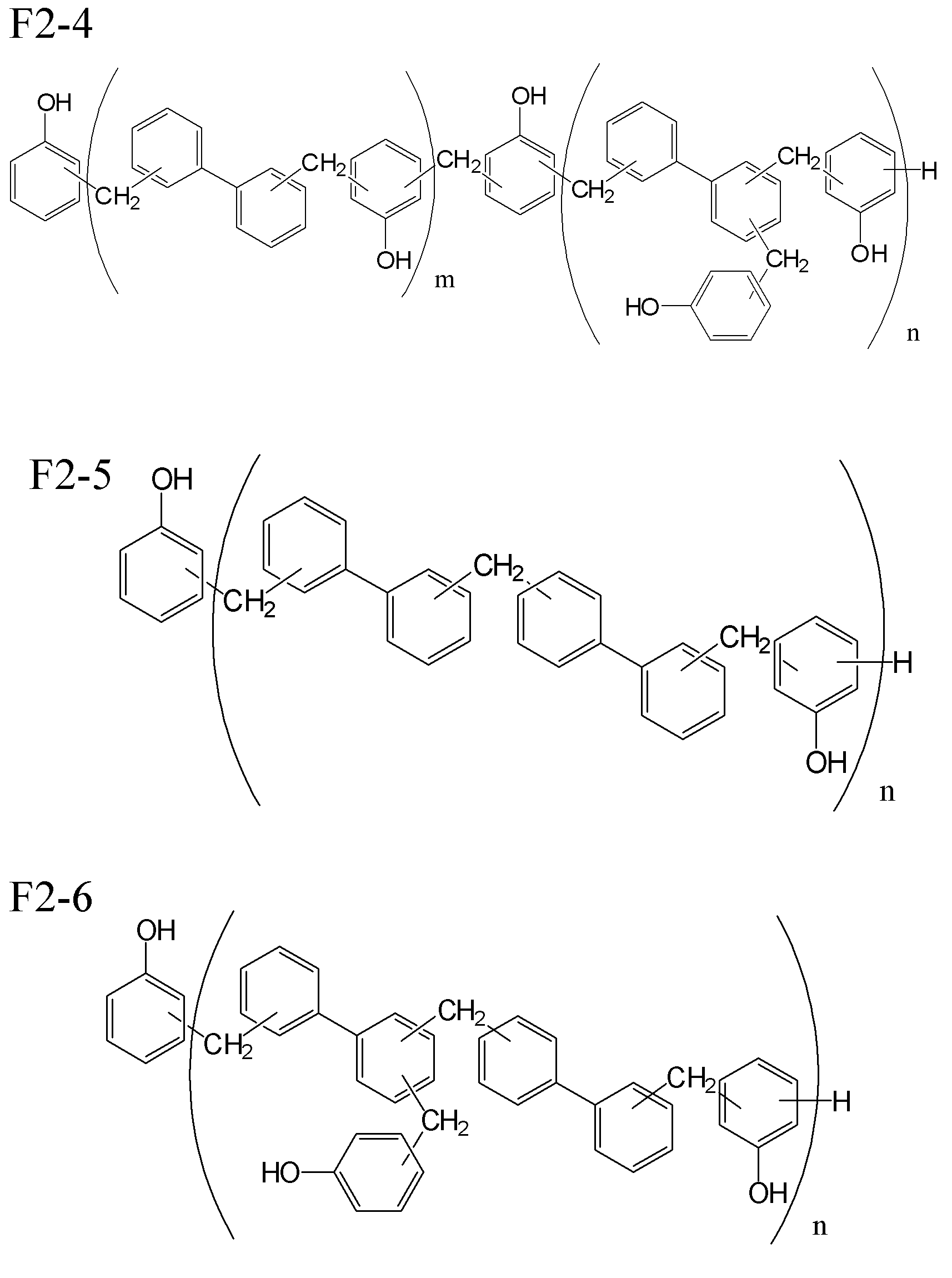
本発明のエポキシ樹脂混合物は上記で得られた本発明のフェノール樹脂混合物のエポキシ化物であり、該フェノール樹脂混合物を、常法により、エピハロヒドリンとの反応によって、エポキシ化することによって得ることが出来る。より具体的には、以下の方法が挙げられる。
エポキシ化の好ましい方法としては、本発明のフェノール樹脂混合物を、溶媒の存在下又は不存在下に、アルカリ金属水酸化物の存在下、エピハロヒドリンと反応させ、グリシジルエーテル化する方法を挙げることができる。該方法においては、反応温度は通常10~100℃程度、好ましくは30~90℃程度である。 該エピハロヒドリンを用いるエポキシ化反応は、特許3934829号公報に記載されているエポキシ化反応、特開2007-308642号公報に記載されている1段法、フュージョン法が挙げられる。
本発明のエポキシ樹脂を得る反応において、アルカリ金属水酸化物はその水溶液を使用してもよい。その場合は該アルカリ金属水酸化物の水溶液を連続的に反応系内に添加すると共に、減圧下または常圧下、連続的に水及びエピハロヒドリンを留出させ、更に分液して水は除去しエピハロヒドリンは反応系内に連続的に戻す方法でもよい。また、本発明においては、前工程までに利用していた触媒が特別に操作をしない限り除去されずに残存していることから、アルカリ金属水酸化物を通常より過剰に仕込んで中和する操作をすることで、円滑に反応を進めることができる。
また、本発明のフェノール樹脂混合物とエピハロヒドリンの混合物に、塩化テトラメチルアンモニウム、臭化テトラメチルアンモニウム、塩化トリメチルベンジルアンモニウム等の4級アンモニウム塩を触媒として添加し、50℃~150℃で0.5~8時間反応させて得られるフェノール樹脂のハロヒドリンエーテル化物に、さらにアルカリ金属水酸化物の固体または水溶液を加え、20℃~120℃で1時間~10時間反応させ脱ハロゲン化水素(閉環)させる方法でもよい。
上記エポキシ化反応に使用するエピハロヒドリンの使用量は、本発明のフェノール樹脂の水酸基1当量に対し通常0.8当量~12当量、好ましくは0.9当量~11当量である。この際、反応を円滑に進行させるために、極性溶媒、好ましくはアルコール類(例えば、メタノール、エタノールなどのC1-C4アルコール類)又は、非プロトン性極性溶媒(例えばジメチルスルホン、ジメチルスルホキシド等)を添加して反応を行うことが好ましい。該極性溶媒の使用量は、エピハロヒドリンの量に対し通常2重量%~150重量%の間で溶媒等の種類等に応じて適宜選択して使用すればよい。例えば、アルコール類を使用する場合、その使用量はエピハロヒドリンの量に対し通常2重量%~20重量%、好ましくは4重量%~15重量%である。また非プロトン性極性溶媒を用いる場合はエピハロヒドリンの量に対し通常5重量%~150重量%、好ましくは10重量%~140重量%である。
また、更に加水分解性ハロゲンの少ないエポキシ樹脂混合物とするために、回収したエポキシ樹脂混合物を溶剤、例えばトルエン、メチルイソブチルケトンなどに溶解し、そこに水酸化ナトリウム、水酸化カリウムなどのアルカリ金属水酸化物の水溶液を加えて、反応生成物中に含まれる加水分解性ハロゲンと反応させ、加水分解性ハロゲンを除去するのが好ましい。この後処理により、エポキシ環を確実なものにすることも出来る。この後処理におけるアルカリ金属水酸化物の使用量は反応生成物におけるエポキシ基1当量に対して通常0.01当量~0.3当量、好ましくは0.05当量~0.2当量である。この後処理の温度は通常50℃~120℃、反応時間は通常0.5時間~2時間である。
この後処理後、生成した塩を濾過、水洗などにより除去し、更に加熱減圧下に溶剤を留去することにより本発明のエポキシ樹脂混合物が得られる。
本発明におけるエポキシ樹脂混合物の代表的な化学構造を下記F3-1~F3-6に例示する。本発明のエポキシ樹脂混合物は、本発明のフェノール樹脂混合物とエピハロヒドリンの反応物であるので、下記例示で明らかな通り、直鎖状分子または分岐状分子の混合物となる。
なお、式中のnは、前記F2-1~F2-6におけると同じである。


本発明のエポキシ樹脂組成物は、本発明のエポキシ樹脂混合物及び硬化剤を含有すれば、他の任意の添加成分に特に制限はない。
例えば、本発明のエポキシ樹脂組成物において、本発明のエポキシ樹脂混合物の他に、任意添加成分の成分の一つとして、他のエポキシ樹脂を併用することができる。併用する場合、本発明のエポキシ樹脂混合物の全エポキシ樹脂中に占める割合は30重量%以上、100重量%以下が好ましく、より好ましくは40重量%以上、100重量%以下であり、更に好ましくは50重量%以上、100重量%以下である。発明のエポキシ樹脂混合物の特性、特に硬化物における優れた難燃性及び適度な貯蔵弾性率を十分に達成する点からは、発明のエポキシ樹脂混合物が60重量%以上が好ましく、より好ましく70重量%以上であり、更に好ましくは80重量%以上であり、最も好ましくは90重量%以上である。上限は100重量%までである。
具体的には、2~4個の水酸基を有する芳香族化合物のグリシジルエーテル化物{例えばビスフェノールA、ビスフェノールF、ビスフェノールS、フルオレニリデンジフェノール、テルペンジフェノール、4,4’-ビフェノール、2,2’-ビフェノール、3,3’-5,5’-テトラメチル-[1,1’-ビフェニル]-4,4’-ジオール、ハイドロキノン、レゾルシン、ナフタレンジオール、トリス-(4-ヒドロキシフェニル)メタン、1,1,2,2-テトラキス(4-ヒドロキシ)エタン};又はフェノール類(フェノール、アルキル置換フェノール、ナフトール、アルキル置換ナフトール、ジヒドロキシベンゼン、ジヒドロキシナフタレン等)とアルデヒド類又はケトン類、又はそれらの反応性誘導体{例えばホルムアルデヒド、アセトアルデヒド、ベンズアルデヒド、p-ヒドロキシベンズアルデヒド、o-ヒドロキシベンズアルデヒド、p-ヒドロキシアセトフェノン又はo-ヒドロキシアセトフェノン、ジシクロペンタジエン、フルフラール、4,4’-ビス(クロロメチル)-1,1’-ビフェニル、4,4’-ビス(メトキシメチル)-1,1’-ビフェニル、1、4-ビス(クロロメチル)ベンゼン、1,4-ビス(メトキシメチル)ベンゼン等}との重縮合物のグリシジルエーテル化物及び該重縮合物の変性物のグリシジルエーテル化物;テトラブロモビスフェノールA等のハロゲン化ビスフェノール類又はアルコール類から誘導されるグリシジルエーテル化物;脂環式エポキシ樹脂;グリシジルアミン系エポキシ樹脂;グリシジルエステル系エポキシ樹脂;等の固形または液状エポキシ樹脂が挙げられる。これらは単独で用いてもよく、2種以上併用しても良い。また、これら以外のエポキシ樹脂も併用可能である。
本発明のエポキシ樹脂組成物で使用する硬化剤としては、例えばアミン化合物、酸無水物化合物、アミド化合物、フェノール化合物などが挙げられる。具体例としては、ジアミノジフェニルメタン、ジエチレントリアミン、トリエチレンテトラミン、ジアミノジフェニルスルホン、イソホロンジアミン、トリフルオロボラン-アミン錯体等のアミン化合物;ジシアンジアミド、リノレン酸の2量体とエチレンジアミンより合成されるポリアミド樹脂等のアミド化合物;無水フタル酸、無水トリメリット酸、無水ピロメリット酸、無水マレイン酸、テトラヒドロ無水フタル酸、メチルテトラヒドロ無水フタル酸、無水メチルナジック酸、ヘキサヒドロ無水フタル酸、メチルヘキサヒドロ無水フタル酸等の酸無水物化合物;2~4個の水酸基を有するフェノール類{ビスフェノールA、ビスフェノールF、ビスフェノールS、フルオレニリデンジフェノール、テルペンジフェノール、4,4’-ビフェノール、2,2’-ビフェノール、3,3’-5,5’-テトラメチル-[1,1’-ビフェニル]-4,4’-ジオール、ハイドロキノン、レゾルシン、ナフタレンジオール、トリス-(4-ヒドロキシフェニル)メタン、1,1,2,2-テトラキス(4-ヒドロキシフェニル)エタン}、フェノール類(フェノール、アルキル置換フェノール、ナフトール、アルキル置換ナフトール、ジヒドロキシベンゼン、ジヒドロキシナフタレン等の1~2個の水酸基を有するベンゼン又はナフタレンで、アルキル置換を有しても良く、アルキル基としてはC1-C4アルキルが好ましい)とアルデヒド又はケトン{ホルムアルデヒド、アセトアルデヒド、ベンズアルデヒド、p-ヒドロキシベンズアルデヒド、o-ヒドロキシベンズアルデヒド、p-ヒドロキシアセトフェノン、o-ヒドロキシアセトフェノン}との重縮合物、又は、上記フェノール類とアルデヒド又はケトンの反応性誘導体{ジシクロペンタジエン、フルフラール、4,4’-ビス(クロロメチル)-1,1’-ビフェニル、4,4’-ビス(メトキシメチル)-1,1’-ビフェニル、1,4-ビス(クロロメチル)ベンゼン、1,4-ビス(メトキシメチル)ベンゼン等}との重縮合物、及びこれらの重縮合物の変性物、テトラブロモビスフェノールA等、のフェノール化合物;イミダゾール;グアニジン誘導体;などが挙げられるが、これらに限定されるものではない。
これらは単独で用いても良く、2種以上を用いても良い。
これらの硬化剤の中で、フェノール化合物またはアミン化合物が好ましく、フェノール化合物、更にはフェノールアラルキル樹脂、又は本発明のフェノール樹脂混合物が好ましい。最も好ましくはフェノールアラルキル樹脂である。
(1)本発明のエポキシ樹脂混合物と硬化剤を含み、該エポキシ樹脂のエポキシ基1当量に対して、硬化剤のエポキシ基と反応する活性基当量で0.7~1.2当量の硬化剤を含み、本発明のエポキシ樹脂混合物を、エポキシ樹脂組成物の総量に対して、4重量%~80重量%含み、残部が任意の添加成分であるエポキシ樹脂組成物。
(2)任意の添加成分が無機充填剤であり、エポキシ樹脂組成物全量に対して、50重量%~95重量%、好ましくは70重量%~90重量%含む上記(1)のエポキシ樹脂組成物。
(3)本発明のエポキシ樹脂混合物と無機充填剤の総量に対し、本発明のエポキシ樹脂混合物が5重量%~30重量%であり、残部が無機充填剤である上記(2)に記載のエポキシ樹脂組成物。
(4)任意の添加成分が離型剤又はカップリング剤の何れか一方又は両者であり、エポキシ樹脂組成物全量に対して、0.05重量%~1重量%含む上記(1)~(3)のエポキシ樹脂組成物。
(5)本発明のエポキシ樹脂混合物が、軟化点が52~65℃、ICI粘度が0.04~0.40Pa・s、GPC(ゲルパーミエーションクロマトグラフィー)による数平均分子量が400~1200及び重量平均分子量が800~2000、エポキシ当量が200~360g/eqである上記(1)~(4)の何れか一項に記載のエポキシ樹脂組成物。
(7)フェノール樹脂混合物が、軟化点が65~85℃、GPC(ゲルパーミエーションクロマトグラフィー)による数平均分子量が350~1200、重量平均分子量が400~2000、及びOH当量160~250g/eqである上記(6)に記載のエポキシ樹脂組成物。
(8)硬化剤がフェノール化合物である上記(1)~(7)に記載のエポキシ樹脂組成物。
より具体的には、まず、例えば、本発明のエポキシ樹脂混合物と硬化剤、及び必要により、任意の添加成分(例えば硬化促進剤、無機充填剤、カップリング剤及び離型剤からなる群から選ばれる成分など)とを、例えば、押出機、ニーダ、ロール等を用いて均一になるまで充分に混合して本発明のエポキシ樹脂組成物とする。次いで、得られたそのエポキシ樹脂組成物を溶融後、注型あるいはトランスファー成型機、インジェクション成型機、注型機などを採用して成型し、さらに好ましくはポストキューアーとして80~200℃で2~16時間加熱することにより、本発明のエポキシ樹脂組成物の硬化物を得ることができる。
上記プリプレグを、所望の形に裁断し、必要により銅箔などと積層後、プレス成型法やオートクレーブ成型法、シートワインディング成型法などの方法で加圧下に加熱硬化させることにより、プリプレグの硬化物、又は該硬化物を有する積層板とすることができる。また、表面に銅箔を重ねてできた積層板に回路を形成し、その上に、上記プリプレグと銅箔を重ねるか、又は、上記プリプレグを有する銅箔等を重ね、回路を形成し、必要に応じて、その操作を繰り返して、多層の回路基板を得ることもできる。
このような光硬化性樹脂組成物において、本発明のエポキシ樹脂混合物の含有量は内割りで通常1重量%~50重量%、好ましくは2重量%~30重量%である。
本発明のエポキシ樹脂混合物を含有する光硬化性樹脂組成物のそれぞれの成分等につき、より具体的に以下に説明する。
なお、以下において、樹脂物性は、以下の方法によって測定した。
・軟化点の測定:JIS K-7234に準じた方法で測定
・GC-MS(ガスクロマトグラフィー-マススペクトロメトリー)の測定
モデル:5975 inert MSD (Agilent社製)
カラム:HP-5MS 15m-0.25mm-0.25μm
キャリアガス:ヘリウム 1.0mL/min(Constant flow mode)
オーブン:50℃(2min)-10℃/min-300℃(23min)
インジェクション:1μl、Split(30:1)、300℃
イオンソース:EI
・SEM-EDS(スキャニングエレクトロンマイクロスコピー-エネルギーディスパーブスペクトロスコピー)の測定
モデル:JED-2140(JEOL社製)
加速電圧:20kV
ワーキングディスタンス:10mm
・GPC(ゲルパーミエーションクロマトグラフィー)による数平均分子量、重量平均分子量の測定
カラム:昭和電工株式会社製Shodex KF-801、KF-802、KF-802.5、KF-803
カラム温度:40℃
注入量:0.02mL
送液量:1.0mL/min
検出器:RI
溶剤:テトラヒドロフラン
・粘度の測定:ICI粘度計(株式会社コーディックス製)を用いて150℃で測定
・OH当量の測定:OH基1つあたりの化合物の平均質量数であり、JIS K-0070に準じたアセチル化法で測定
・エポキシ当量の測定:エポキシ基1つあたりの化合物の平均質量数であり、JIS K-7236に準じて測定
・DMA(動的粘弾性測定)分析:TA Instruments製DMA2980(動的粘弾性測定機)にて、10Hzの周波数を用いて、Tgと250℃における貯蔵弾性率を測定した。
(1)ビフェニルのクロロメチル化反応
撹拌機、温度計、冷却器を備えたガラス製300mLフラスコに、シクロヘキサン200mL、ビフェニル77.05g、パラホルムアルデヒド33.55g、塩化亜鉛46.38gを仕込んだ。それらを激しく撹拌しながら、その中に、塩化水素ガスを強く吹き込み、均一な溶液になるまで反応させた。その間液温を50℃に保持した。さらに液温を30℃下げて、24時間塩化水素ガスを吹き込み、反応を続け、反応液を得た。
得られた反応液を少量取り、ジクロロメタン溶液としてGC-MS測定を行った。その結果、モノ(クロロメチル)ビフェニル2.5%、ビスクロロメチルビフェニル72.0%、トリ(クロロメチル)ビフェニル14.9%及びテトラ(クロロメチル)ビフェニル5.8%を検出した。また、上記モノ(クロロメチル)ビフェニル以外のその他の副生物として、ペンタ(クロロメチル)ビフェニル0.3%、ビスビフェニリルメタン0.5%、モノクロロメチル-ビスビフェニリルメタン1.1%、ビスクロロメチル-ビスビフェニリルメタン0.6%を検出した。更に化合物を特定出来ない成分を含め、その他の副生物として、2.3%(全てGC面積%)を検出した。
また、反応液をGC-MS測定用のジクロロメタン溶液にした際に生じた不溶解分からは、SEM-EDS(Scanning Electron Microscopy / Energy Dispersive Spectroscopy) を用いた元素分析により亜鉛元素(Zn)が検出された。
続いて、上記(1)で得られた反応液にフェノール157.77gを加え、室温で2時間撹拌した。反応容器の脱気を行った後、減圧下に、180℃まで10時間かけて昇温し、溶剤のシクロヘキサンと未反応のフェノールを留去した。
その結果、本発明のフェノール樹脂混合物181.5gを得た。該樹脂混合物は、軟化点74.9℃、GPC(ゲルパーミエーションクロマトグラフィー)による数平均分子量513、重量平均分子量639、OH当量215g/eqであった。
該フェノール樹脂混合物の組成は、上記(1)で得られたビフェニルのクロロメチル化反応生成物の組成より、ビスクロロメチルビフェニル由来成分(前記F2-1)72%、トリクロロメチルビフェニル由来成分(前記F2-2)15%、テトラクロロメチルビフェニル由来成分(前記F2-3)6%、その他成分(前記F2-4、F2-5、F2-6など)7%と推定される。
エポキシ樹脂混合物の合成
撹拌機、温度計、冷却器を備えたガラス製300mLフラスコに、実施例1で得られた本発明のフェノール樹脂混合物26.3g、エピクロルヒドリン52.0g、ジメチルスルホキシド8.6g、30重量%水酸化ナトリウム水溶液12.3gを入れ、45℃で1時間撹拌混合した。次いで、そこにフレーク状の水酸化ナトリウム3.95gを分割添加し、45℃で2時間、70℃で1時間撹拌した。得られた反応液に、メチルイソブチルケトンを加えて、希釈した後、水を加えて、液/液分離による水洗を行った。得られた有機層に30重量%水酸化ナトリウム水溶液0.93gを加えて70℃で1時間撹拌した。再度上記と同様に液/液分離による水洗を行った。得られた反応液を濃縮し、本発明のエポキシ樹脂混合物20.5gを得た。
得られた樹脂混合物は、軟化点57.6℃、ICI粘度0.11Pa・s、エポキシ当量292g/eq、GPC(ゲルパーミエーションクロマトグラフィー)による数平均分子量668、重量平均分子量1187であった。
該エポキシ樹脂混合物の組成は、上記(1)で得られたビフェニルのクロロメチル化反応生成物の組成より、ビスクロロメチルビフェニル由来成分(F3-1)72%、トリクロロメチルビフェニル由来成分(F3-2)15%、テトラクロロメチルビフェニル由来成分(F3-3)6%、その他成分(F3-4、F3-5、F3-6など)7%と推定される。
難燃性樹脂組成物の調製及びその硬化物の評価
実施例2で得られた本発明のエポキシ樹脂混合物または比較例として日本化薬株式会社製フェノール-ビフェニルアラルキル型エポキシ樹脂NC-3000(軟化点57.4℃、ICI粘度0.08Pa・s、エポキシ当量277g/eq、GPCによる数平均分子量793、重量平均分子量1229)を用いて下記表1に示す組成の難燃性樹脂組成物を調製し、トランスファー成型機にて175℃にて成型し、硬化物を得た。
実施例3 比較例1
エポキシ樹脂 (実施例2のエポキシ樹脂混合物) (NC-3000)
6.17g 6.17g
硬化剤(XLC-3L) 3.6g 3.8g
硬化触媒(TPP) 0.105g 0.105g
フィラー(MSR-2212) 50.2g 51.2g
離型剤(カルナバ1号) 0.18g 0.19g
カップリング剤(KBM-303) 0.20g 0.20g
XLC-3L:フェノールアラルキル樹脂、三井化学株式会社製
TPP:トリフェニルホスフィン
MSR-2212:キクロスMSR-2212 株式会社龍森製
カルナバ1号:カルナウバワックス1号 株式会社セラリカ野田製
KBM-303:シランカップリング剤 信越化学工業株式会社製
・難燃性の測定:難燃性試験はUL-94に準拠して、厚み0.8mmの試験片(硬化物)についてトータル燃焼時間(自己消化するまでの時間)を測定した。
・250℃における貯蔵弾性率の測定:TA Instruments製DMA2980(動的粘弾性測定機)にて、10Hzの周波数を用いて、Tgと250℃における貯蔵弾性率を測定した。
実施例3 比較例1
トータル燃焼時間(sec) 32(V-0) 35(V-0)
貯蔵弾性率(MPa、250℃) 933 2218
Tg(ガラス転移点:℃) 136 146
本発明のエポキシ樹脂混合物は、上記の通り優れた性質を有すると共に、ビフェニルから一貫した製造が可能であり、製造も容易である。
(1)ビフェニルのクロロメチル化反応
撹拌機、温度計、冷却器を備えたガラス製1000mLフラスコに、シクロヘキサン200mL、ビフェニル154g、パラホルムアルデヒド66g、塩化亜鉛93gを仕込んだ。それらを撹拌しながら、その中に、塩化水素ガスを強く吹き込み、均一な溶液になるまで反応させた。その間30℃に保持した。その後さらに50℃で10時間塩化水素ガスを吹き込み、反応を続け、反応液を得た。
反応液の一部を取り、N,N’-ジメチルホルムアミド溶液としてLC測定を行ったところ、モノクロロメチルビフェニル8.1%、ビスクロロメチルビフェニル68.2%、トリ(クロロメチル)ビフェニルとテトラ(クロロメチル)ビフェニルを合わせて18.2%(LC面積%)を検出した。
(2)クロロメチル化反応生成物とフェノールの反応
続いて、上記(1)で得られた反応液にフェノール301gを加え、70℃で2時間撹拌した。減圧下に、180℃まで昇温しながら、溶剤のシクロヘキサンと未反応のフェノールを留去した。
その結果、本発明のフェノール樹脂混合物329gを得た。
該樹脂混合物は、軟化点79.6℃、GPC(ゲルパーミエーションクロマトグラフィー)による数平均分子量855、重量平均分子量1332、OH当量196g/eqであった。
該フェノール樹脂混合物の組成は、上記(1)で得られたクロロメチル化反応生成物の組成より、モノクロロメチルビフェニル8%、ビスクロロメチルビフェニル由来成分(F2-1)68%と、トリ(クロロメチル)ビフェニル由来成分(F2-2)及びテトラ(クロロメチル)ビフェニル由来成分(F2-3等)を合わせて18%を含むと推定される。
エポキシ樹脂混合物の合成
撹拌機、温度計、冷却器を備えたガラス製1000mLフラスコに、実施例4で得られた本発明のフェノール樹脂混合物196g、エピクロルヒドリン555g、及びメタノール29.6gを入れ混合した。該混合物を70℃で撹拌しながら、フレーク状の水酸化ナトリウム42gを分割添加した。その後70℃でさらに1時間撹拌した。得られた反応液に水150gを添加し混合した後、静置し、2層に分離した下層の水層を除去した。水洗後の反応液から未反応のエピクロルヒドリンを留去した。そこにメチルイソブチルケトンを加えて希釈し、次いで30重量%水酸化ナトリウム水溶液13.3gを加えて70℃で1時間撹拌した。そこに水を加えて、液/液分離による水洗を行った。該水洗後の反応液を濃縮して、本発明のエポキシ樹脂混合物215gを得た。
該エポキシ混合物は、軟化点56.5℃、ICI粘度0.11Pa・s、エポキシ当量264g/eq、GPC(ゲルパーミエーションクロマトグラフィー)による数平均分子量803、重量平均分子量1419であった。
該エポキシ樹脂混合物の組成は、上記実施例4(1)で得られたクロロメチル化反応生成物の組成より、モノクロロメチルビフェニル由来成分8%、ビスクロロメチルビフェニル由来成分(構造式:F3-1等)68%と、トリ(クロロメチル)ビフェニル由来成分(構造式:F3-2等)及びテトラ(クロロメチル)ビフェニル由来成分(構造式:F3-3等)を合わせて18%を含むと推定される。
実施例5で得られた本発明のエポキシ樹脂混合物を、実施例3と同様に、下記表3に示す組成の難燃性樹脂組成物に調製し、トランスファー成型機で成型し、硬化物を得た。
実施例6
エポキシ樹脂 (実施例5のエポキシ樹脂混合物)
12g
硬化剤(XLC-3L) 7.7g
硬化触媒(TPP) 0.204g
フィラー(MSR-2212) 100.8g
離型剤(カルナバ1号) 0.36g
カップリング剤(KBM-303) 0.40g
実施例6
トータル燃焼時間(sec) 35(V-0)
貯蔵弾性率(MPa、250℃) 608
Tg(℃) 145
実施例4と同様にして得られた本発明のフェノール樹脂混合物500gを、メチルイソブチルケトン1000mlに溶解し、不溶解分を濾過した後、そこに水を加えて、液/液分離による水洗を行った。その結果、水酸基(OH)当量204g/eqのフェノール樹脂混合物(EX7PhnolMixという)を得た。
得られたフェノール樹脂混合物を硬化剤として使用して、エポキシ樹脂として、前記日本化薬株式会社製フェノール-ビフェニルアラルキル型エポキシ樹脂NC-3000を用いて、下記表5に示す組成の本発明エポキシ樹脂組成物を調製し、トランスファー成型機で成型し硬化物を得た。
実施例7
エポキシ樹脂(NC-3000) 18g
硬化剤(EX7PhnolMix) 13.3g
硬化触媒(TPP) 0.45g
フィラー(MSR-2212) 160.8g
離型剤(カルナバ1号) 0.58g
カップリング剤(KBM-303) 0.64g
実施例7
トータル燃焼時間(sec) 27
貯蔵弾性率(250℃)(MPa) 449
Tg(℃) 147
実施例7で得られた本発明のフェノール樹脂混合物(EX7PhnolMix)を硬化剤として使用し、エポキシ樹脂として前記日本化薬株式会社製フェノール-ビフェニルアラルキル型エポキシ樹脂NC-3000を用いて、下表7に示す組成の本発明エポキシ樹脂組成物(EX8 EPOXY COM)を調製した。
一方比較例2として、硬化剤として、本発明のフェノール樹脂混合物(EX7PhnolMix)の代わりに、日本化薬株式会社製フェノール-ビフェニルアラルキル型フェノール樹脂GPH-65(OH当量199g/eq、軟化点65.1℃)を用いて下記表7に示す比較用エポキシ樹脂組成物(比較例2)(CPA2 EPOXY COM)を調製した。
上記で調製したエポキシ樹脂組成物をロール混練し、評価用のエポキシ樹脂組成物とした。
EX8 EPOXY COM CPA2 EPOXY COM
エポキシ樹脂(NC-3000) 15g 15g
硬化剤 EX7PhnolMix 11g -
GPH-65 - 10.8g
硬化触媒(TPP) 0.315g 0.405g
フィラー(MSR-2212) 156g 155g
離型剤(カルナバ1号) 0.55g 0.55g
カップリング剤(KBM-303) 0.62g 0.62g
また、流動性の評価として、175℃、成型圧力70kg/cm2の条件にてスパイラルフローを測定した(ASTM F3133に準拠)。その結果を、表8に示す。
EX8 EPOXY COM CPA2 EPOXY COM
キュラストトルク(N・m) 10.5 9.3
スパイラルフロー(inch、n=5) 33.5 30.7
ゲルタイム(sec) 29.4 29.6
また、ゲルタイムが同じエポキシ樹脂組成物においては、流動性の指標であるスパイラルフローが長い方が、流動性が高いことを示すので、実施例8のエポキシ樹脂組成物は、比較例2のエポキシ樹脂組成物に対して流動性に優れていることを示している。
また、本発明のフェノール樹脂混合物は、上記優れた性質を有する本発明のエポキシ樹脂混合物のための中間原料であり、且つ、中間体のハロメチルビフェニルを単離精製することなく製造しうることから、製造も容易であり、産業上の有用性は高い。
Claims (12)
- ビフェニルのハロメチル化反応によって得られ、GC-MSでの反応生成物全体に対する割合(GC面積比)で、ビスハロメチルビフェニルを60%以上で、80%より少なく、トリ(ハロメチル)ビフェニル及びテトラ(ハロメチル)ビフェニルを合計で15~30%及びその他の副生物を残部含む反応生成物と、フェノールとのメチレン架橋反応により得られるフェノール樹脂混合物。
- 軟化点が65~85℃、GPC(ゲルパーミエーションクロマトグラフィー)による数平均分子量が350~1200、重量平均分子量が400~2000、及びOH当量160~250g/eqである請求項1に記載のフェノール樹脂混合物。
- 請求項1又は2に記載のフェノール樹脂混合物をエポキシ化して得られたエポキシ樹脂混合物。
- 軟化点が50~75℃、ICI粘度が0.02~0.50Pa・s、GPC(ゲルパーミエーションクロマトグラフィー)による数平均分子量が400~1200及び重量平均分子量が800~2000、エポキシ当量が200~360g/eqである請求項3に記載のエポキシ樹脂混合物。
- 請求項3に記載のエポキシ樹脂混合物及び硬化剤を含有するエポキシ樹脂組成物。
- 硬化剤の含量が、エポキシ樹脂混合物のエポキシ基1当量に対して、硬化剤の含量が0.7当量~1.2当量である請求項5に記載のエポキシ樹脂組成物。
- 更に、フィラーを、エポキシ樹脂組成物の総量に対して、50~90重量%含む請求項6に記載のエポキシ樹脂組成物。
- 請求項1に記載のフェノール樹脂混合物をエポキシ化して得られたエポキシ樹脂混合物及び、該エポキシ樹脂混合物のエポキシ基1当量に対して、0.7当量~1.2当量の硬化剤を含むエポキシ樹脂組成物を硬化させた硬化物。
- 請求項1に記載のフェノール樹脂混合物をエポキシ化して得られたエポキシ樹脂混合物、該エポキシ樹脂混合物のエポキシ基1当量に対して、0.7当量~1.2当量の硬化剤及びエポキシ樹脂組成物の総量に対して50~90重量%の無機充填剤を含むエポキシ樹脂組成物を硬化させた硬化物。
- ハロゲン化亜鉛の存在下に、ビフェニル、ビフェニル1モルに対して、2~8当量のホルムアルデヒド類及びハロゲン化水素を、過剰量のハロゲン化水素の存在下に、反応させ、ビフェニルのハロメチル化を行い、GC-MSでの反応生成物全体に対する割合(GC面積比)で、ビスハロメチルビフェニルを60%以上で、80%より少なく、トリ(ハロメチル)ビフェニル及びテトラ(ハロメチル)ビフェニルを合計で15~30%及びその他の副生物を残部含む反応生成物を得、該反応生成物を精製することなく、フェノールと反応させることを特徴とするフェノール樹脂混合物の製造方法。
- 請求項10の製造方法によって得られたフェノール樹脂混合物を、該フェノール樹脂混合物の水酸基1当量に対して、エピハロヒドリンを0.8~12当量反応させることを特徴とするエポキシ樹脂混合物の製造方法。
- 請求項1又は2に記載のフェノール樹脂混合物を硬化剤として含有するエポキシ樹脂組成物。
Priority Applications (2)
| Application Number | Priority Date | Filing Date | Title |
|---|---|---|---|
| CN200980144467.0A CN102209742B (zh) | 2008-11-06 | 2009-10-30 | 酚醛树脂混合物、环氧树脂混合物、环氧树脂组合物及固化物 |
| JP2010536675A JP5486505B2 (ja) | 2008-11-06 | 2009-10-30 | フェノール樹脂混合物、エポキシ樹脂混合物、エポキシ樹脂組成物、及び硬化物 |
Applications Claiming Priority (2)
| Application Number | Priority Date | Filing Date | Title |
|---|---|---|---|
| JP2008-285856 | 2008-11-06 | ||
| JP2008285856 | 2008-11-06 |
Publications (1)
| Publication Number | Publication Date |
|---|---|
| WO2010052877A1 true WO2010052877A1 (ja) | 2010-05-14 |
Family
ID=42152691
Family Applications (1)
| Application Number | Title | Priority Date | Filing Date |
|---|---|---|---|
| PCT/JP2009/005783 Ceased WO2010052877A1 (ja) | 2008-11-06 | 2009-10-30 | フェノール樹脂混合物、エポキシ樹脂混合物、エポキシ樹脂組成物、及び硬化物 |
Country Status (6)
| Country | Link |
|---|---|
| JP (1) | JP5486505B2 (ja) |
| KR (1) | KR101564957B1 (ja) |
| CN (1) | CN102209742B (ja) |
| MY (1) | MY153048A (ja) |
| TW (1) | TWI530511B (ja) |
| WO (1) | WO2010052877A1 (ja) |
Cited By (3)
| Publication number | Priority date | Publication date | Assignee | Title |
|---|---|---|---|---|
| JP2010138311A (ja) * | 2008-12-12 | 2010-06-24 | Jfe Chemical Corp | 4,4’−ビフェニルジイルメチレン−フェノール樹脂の製造方法 |
| JP2013237715A (ja) * | 2012-05-11 | 2013-11-28 | Sumitomo Bakelite Co Ltd | 樹脂組成物、プリプレグ、回路基板および半導体装置 |
| JP2019048998A (ja) * | 2018-11-14 | 2019-03-28 | 日立化成株式会社 | モールドアンダーフィル用樹脂組成物及び電子部品装置 |
Families Citing this family (3)
| Publication number | Priority date | Publication date | Assignee | Title |
|---|---|---|---|---|
| TWI666307B (zh) * | 2015-06-04 | 2019-07-21 | 日商住友電木股份有限公司 | 密封用樹脂組成物、半導體裝置、及構造體 |
| CN114276650B (zh) * | 2021-11-05 | 2025-01-07 | 衡所华威电子有限公司 | 一种环氧树脂组合物及其制备方法 |
| TWI901332B (zh) * | 2024-09-03 | 2025-10-11 | 長春人造樹脂廠股份有限公司 | 環氧樹脂及其應用 |
Citations (8)
| Publication number | Priority date | Publication date | Assignee | Title |
|---|---|---|---|---|
| JPH08143648A (ja) * | 1994-09-20 | 1996-06-04 | Meiwa Kasei Kk | 新規フェノールノボラック縮合体 |
| JPH1180047A (ja) * | 1997-09-12 | 1999-03-23 | Ube Ind Ltd | 4,4’−ビスクロロメチルビフェニルの製造法 |
| JPH11130706A (ja) * | 1997-10-31 | 1999-05-18 | Ube Ind Ltd | 4,4’−ビスクロロメチルビフェニルの製造方法 |
| JP2001040053A (ja) * | 1999-07-26 | 2001-02-13 | Nippon Kayaku Co Ltd | 4,4’−ビフェニルジイルジメチレン−フェノール樹脂及びその製造法 |
| JP2001064340A (ja) * | 1999-08-30 | 2001-03-13 | Nippon Kayaku Co Ltd | 4,4’−ビフェニルジイルジメチレン−フェノール樹脂、エポキシ樹脂、エポキシ樹脂組成物及びその硬化物 |
| JP2006124492A (ja) * | 2004-10-28 | 2006-05-18 | Nippon Kayaku Co Ltd | エポキシ樹脂及びフェノール樹脂 |
| WO2006090662A1 (ja) * | 2005-02-25 | 2006-08-31 | Nippon Kayaku Kabushiki Kaisha | エポキシ樹脂、それを含有する硬化性樹脂組成物およびその用途 |
| WO2007063894A1 (ja) * | 2005-11-30 | 2007-06-07 | Nippon Kayaku Kabushiki Kaisha | フェノール樹脂、その製造法、エポキシ樹脂及びその用途 |
Family Cites Families (3)
| Publication number | Priority date | Publication date | Assignee | Title |
|---|---|---|---|---|
| JPH11140277A (ja) * | 1997-11-10 | 1999-05-25 | Sumitomo Bakelite Co Ltd | エポキシ樹脂組成物及びこれを用いた半導体装置 |
| WO2007015591A1 (en) * | 2005-08-02 | 2007-02-08 | Cheil Industries Inc. | Epoxy resin composition for packaging semiconductor device |
| JP4979251B2 (ja) * | 2006-03-24 | 2012-07-18 | エア・ウォーター株式会社 | フェノール系重合体、その製法及びその用途 |
-
2009
- 2009-10-30 MY MYPI20111931 patent/MY153048A/en unknown
- 2009-10-30 WO PCT/JP2009/005783 patent/WO2010052877A1/ja not_active Ceased
- 2009-10-30 KR KR1020117010791A patent/KR101564957B1/ko not_active Expired - Fee Related
- 2009-10-30 JP JP2010536675A patent/JP5486505B2/ja not_active Expired - Fee Related
- 2009-10-30 CN CN200980144467.0A patent/CN102209742B/zh not_active Expired - Fee Related
- 2009-11-03 TW TW098137197A patent/TWI530511B/zh not_active IP Right Cessation
Patent Citations (8)
| Publication number | Priority date | Publication date | Assignee | Title |
|---|---|---|---|---|
| JPH08143648A (ja) * | 1994-09-20 | 1996-06-04 | Meiwa Kasei Kk | 新規フェノールノボラック縮合体 |
| JPH1180047A (ja) * | 1997-09-12 | 1999-03-23 | Ube Ind Ltd | 4,4’−ビスクロロメチルビフェニルの製造法 |
| JPH11130706A (ja) * | 1997-10-31 | 1999-05-18 | Ube Ind Ltd | 4,4’−ビスクロロメチルビフェニルの製造方法 |
| JP2001040053A (ja) * | 1999-07-26 | 2001-02-13 | Nippon Kayaku Co Ltd | 4,4’−ビフェニルジイルジメチレン−フェノール樹脂及びその製造法 |
| JP2001064340A (ja) * | 1999-08-30 | 2001-03-13 | Nippon Kayaku Co Ltd | 4,4’−ビフェニルジイルジメチレン−フェノール樹脂、エポキシ樹脂、エポキシ樹脂組成物及びその硬化物 |
| JP2006124492A (ja) * | 2004-10-28 | 2006-05-18 | Nippon Kayaku Co Ltd | エポキシ樹脂及びフェノール樹脂 |
| WO2006090662A1 (ja) * | 2005-02-25 | 2006-08-31 | Nippon Kayaku Kabushiki Kaisha | エポキシ樹脂、それを含有する硬化性樹脂組成物およびその用途 |
| WO2007063894A1 (ja) * | 2005-11-30 | 2007-06-07 | Nippon Kayaku Kabushiki Kaisha | フェノール樹脂、その製造法、エポキシ樹脂及びその用途 |
Cited By (3)
| Publication number | Priority date | Publication date | Assignee | Title |
|---|---|---|---|---|
| JP2010138311A (ja) * | 2008-12-12 | 2010-06-24 | Jfe Chemical Corp | 4,4’−ビフェニルジイルメチレン−フェノール樹脂の製造方法 |
| JP2013237715A (ja) * | 2012-05-11 | 2013-11-28 | Sumitomo Bakelite Co Ltd | 樹脂組成物、プリプレグ、回路基板および半導体装置 |
| JP2019048998A (ja) * | 2018-11-14 | 2019-03-28 | 日立化成株式会社 | モールドアンダーフィル用樹脂組成物及び電子部品装置 |
Also Published As
| Publication number | Publication date |
|---|---|
| JP5486505B2 (ja) | 2014-05-07 |
| KR101564957B1 (ko) | 2015-11-13 |
| TWI530511B (zh) | 2016-04-21 |
| JPWO2010052877A1 (ja) | 2012-04-05 |
| TW201026737A (en) | 2010-07-16 |
| CN102209742B (zh) | 2013-03-27 |
| KR20110094278A (ko) | 2011-08-23 |
| CN102209742A (zh) | 2011-10-05 |
| MY153048A (en) | 2014-12-31 |
Similar Documents
| Publication | Publication Date | Title |
|---|---|---|
| JP6240069B2 (ja) | エポキシ樹脂組成物、およびその硬化物、並びに、硬化性樹脂組成物 | |
| JP5559154B2 (ja) | オレフィン樹脂、エポキシ樹脂、硬化性樹脂組成物及びその硬化物 | |
| JP5486505B2 (ja) | フェノール樹脂混合物、エポキシ樹脂混合物、エポキシ樹脂組成物、及び硬化物 | |
| JP5284586B2 (ja) | エポキシ樹脂、エポキシ樹脂組成物及びその硬化物 | |
| CN101522747B (zh) | 变性液性环氧树脂、以及使用该树脂的环氧树脂组成物及其硬化物 | |
| JP6090765B2 (ja) | フェノール樹脂、エポキシ樹脂、および硬化性樹脂組成物 | |
| JP5319289B2 (ja) | エポキシ樹脂及びその製造方法、並びにそれを用いたエポキシ樹脂組成物及びその硬化物 | |
| JP6715249B2 (ja) | エポキシ樹脂、変性エポキシ樹脂、エポキシ樹脂組成物およびその硬化物 | |
| TWI659974B (zh) | 環氧樹脂、硬化性樹脂組成物及其硬化物 | |
| JP6284732B2 (ja) | エポキシ樹脂混合物、および硬化性樹脂組成物 | |
| JP2005200544A (ja) | フェノール樹脂、エポキシ樹脂、エポキシ樹脂組成物及びその硬化物 | |
| JP5131961B2 (ja) | エポキシ樹脂、エポキシ樹脂組成物、およびその硬化物 | |
| JP5878865B2 (ja) | ジオレフィン化合物、エポキシ樹脂、硬化性樹脂組成物及びその硬化物 | |
| JPWO2006121030A1 (ja) | エポキシ樹脂、その製造方法及びその用途 | |
| JP2025118710A (ja) | エポキシ樹脂、硬化性樹脂組成物、およびその硬化物 | |
| WO2015083748A1 (ja) | フェノール樹脂、エポキシ樹脂、エポキシ樹脂組成物、およびその硬化物 | |
| JP5254036B2 (ja) | フェノール樹脂、エポキシ樹脂、硬化性樹脂組成物、その硬化物、およびフェノール樹脂の製造方法 | |
| JP2007204604A (ja) | 液状エポキシ樹脂、エポキシ樹脂組成物、および硬化物 | |
| JP2005139285A (ja) | 液状エポキシ樹脂、エポキシ樹脂組成物及びその硬化物 |
Legal Events
| Date | Code | Title | Description |
|---|---|---|---|
| WWE | Wipo information: entry into national phase |
Ref document number: 200980144467.0 Country of ref document: CN |
|
| 121 | Ep: the epo has been informed by wipo that ep was designated in this application |
Ref document number: 09824578 Country of ref document: EP Kind code of ref document: A1 |
|
| ENP | Entry into the national phase |
Ref document number: 2010536675 Country of ref document: JP Kind code of ref document: A |
|
| NENP | Non-entry into the national phase |
Ref country code: DE |
|
| ENP | Entry into the national phase |
Ref document number: 20117010791 Country of ref document: KR Kind code of ref document: A |
|
| 122 | Ep: pct application non-entry in european phase |
Ref document number: 09824578 Country of ref document: EP Kind code of ref document: A1 |