WO2010050430A1 - 柱状ZnO粒子の製造方法及びそれによって得られた柱状ZnO粒子 - Google Patents
柱状ZnO粒子の製造方法及びそれによって得られた柱状ZnO粒子 Download PDFInfo
- Publication number
- WO2010050430A1 WO2010050430A1 PCT/JP2009/068329 JP2009068329W WO2010050430A1 WO 2010050430 A1 WO2010050430 A1 WO 2010050430A1 JP 2009068329 W JP2009068329 W JP 2009068329W WO 2010050430 A1 WO2010050430 A1 WO 2010050430A1
- Authority
- WO
- WIPO (PCT)
- Prior art keywords
- columnar
- zno
- compound
- zno particles
- plate
- Prior art date
- Legal status (The legal status is an assumption and is not a legal conclusion. Google has not performed a legal analysis and makes no representation as to the accuracy of the status listed.)
- Ceased
Links
Images





Classifications
-
- C—CHEMISTRY; METALLURGY
- C01—INORGANIC CHEMISTRY
- C01G—COMPOUNDS CONTAINING METALS NOT COVERED BY SUBCLASSES C01D OR C01F
- C01G9/00—Compounds of zinc
- C01G9/02—Oxides; Hydroxides
-
- C—CHEMISTRY; METALLURGY
- C01—INORGANIC CHEMISTRY
- C01P—INDEXING SCHEME RELATING TO STRUCTURAL AND PHYSICAL ASPECTS OF SOLID INORGANIC COMPOUNDS
- C01P2002/00—Crystal-structural characteristics
- C01P2002/70—Crystal-structural characteristics defined by measured X-ray, neutron or electron diffraction data
- C01P2002/72—Crystal-structural characteristics defined by measured X-ray, neutron or electron diffraction data by d-values or two theta-values, e.g. as X-ray diagram
-
- C—CHEMISTRY; METALLURGY
- C01—INORGANIC CHEMISTRY
- C01P—INDEXING SCHEME RELATING TO STRUCTURAL AND PHYSICAL ASPECTS OF SOLID INORGANIC COMPOUNDS
- C01P2004/00—Particle morphology
- C01P2004/01—Particle morphology depicted by an image
- C01P2004/03—Particle morphology depicted by an image obtained by SEM
-
- C—CHEMISTRY; METALLURGY
- C01—INORGANIC CHEMISTRY
- C01P—INDEXING SCHEME RELATING TO STRUCTURAL AND PHYSICAL ASPECTS OF SOLID INORGANIC COMPOUNDS
- C01P2004/00—Particle morphology
- C01P2004/10—Particle morphology extending in one dimension, e.g. needle-like
-
- C—CHEMISTRY; METALLURGY
- C01—INORGANIC CHEMISTRY
- C01P—INDEXING SCHEME RELATING TO STRUCTURAL AND PHYSICAL ASPECTS OF SOLID INORGANIC COMPOUNDS
- C01P2004/00—Particle morphology
- C01P2004/20—Particle morphology extending in two dimensions, e.g. plate-like
-
- C—CHEMISTRY; METALLURGY
- C01—INORGANIC CHEMISTRY
- C01P—INDEXING SCHEME RELATING TO STRUCTURAL AND PHYSICAL ASPECTS OF SOLID INORGANIC COMPOUNDS
- C01P2004/00—Particle morphology
- C01P2004/50—Agglomerated particles
Definitions
- the present invention relates to a method for producing columnar ZnO particles using a plate-like Zn compound as a starting material, and substantially columnar and columnar ZnO particles having alignment properties obtained thereby.
- nano-sized or micro-sized ZnO (zinc oxide) particles in various forms such as nanowires, nanorods, nanobelts, and nanorings have been reported.
- particles having a hollow structure such as a tube have a low density and a high specific surface area compared to solid particles, and also exhibit intrinsic optical activity, and new or improved characteristics in the application field. It is of particular interest because it can be found and can be expected to be applied as an optical or electrical device by arranging these particles on a substrate.
- Non-Patent Document 1 an aqueous solution of zinc acetate and CTAB (cetyl bromide). It has been shown that ZnO nanotubes can be produced by heating a mixture of (trimethylammonium) in an autoclave at 160 ° C. for 24 hours.
- Non-Patent Document 2 a mixture of zinc oxide powder and graphite powder was heated to 1100 ° C. in a tubular furnace, so that ZnO nanorods arranged on a silicon substrate installed in the furnace and It is clear that nanotubes can be produced.
- column shape here means the shape extended long in one direction, and shapes, such as a nanosize and a macrosize wire, a rod, a tube, are included.
- Patent Document 1 the present inventors have proposed a method for producing columnar ZnO particles in which columnar ZnO particles can be obtained under low temperature and normal pressure synthesis conditions.
- the present invention has been made in the background of such circumstances, the place to solve the problem is to provide a novel and practical method capable of industrially advantageously producing columnar ZnO particles,
- An object of the present invention is to provide columnar ZnO particles having the alignment obtained by the method.
- the first feature of the present invention is that the plate-like Zn compound is heated in water at a temperature below the boiling point under normal pressure, and then subjected to a drying treatment by heating, whereby one particle extends in one direction for a long time.
- the ZnO particles have the same orientation in the major axis direction of the ZnO particles and are arranged in the direction perpendicular to the major axis direction to form a plurality of columnar ZnO particles.
- the second feature of the present invention is that the heat treatment is performed at a temperature of 50 ° C. or higher and 80 ° C. or lower.
- the third feature of the present invention is that after depositing a plate-like Zn compound by dissolving NH salt in water and introducing NH 3 gas or NH 3 aqueous solution into the aqueous solution in which Zn ions are generated,
- the purpose is to perform the heat treatment in a state where the precipitated plate-like Zn compound is dispersed in water that does not contain Zn ions, anions derived from Zn salts, and ammonium ions.
- the fourth feature of the present invention is that a hexagonal plate compound having a diameter of 5 ⁇ m to 100 ⁇ m and a thickness of 0.5 ⁇ m to 2 ⁇ m is used as the plate-like Zn compound.
- a fifth feature of the present invention is that the drying treatment is performed by heating a plate-like Zn compound at a temperature not higher than the boiling point of water under normal pressure, so that the ZnO content of the columnar ZnO particles is 85% by weight. It is to raise more.
- a sixth feature of the present invention is a ZnO particle obtained by the production method of any one of the first to fifth features, wherein the ZnO particle has a columnar shape in which one particle extends in one direction and has a diameter. Is 10 nm or more and 3 ⁇ m or less, the length is longer than 10 nm and 10 ⁇ m or less, and is substantially composed of ZnO, and the plurality of ZnO particles are aligned in the major axis direction, and the plurality of ZnO particles are arranged in a direction perpendicular to the major axis direction. It has an array property of being lined up.
- the diameter here means the maximum length of the ZnO particles in the minor axis direction.
- the plate-like Zn compound was used as a starting material, and had alignment properties depending on the synthesis conditions at a low temperature of the boiling point of water under normal pressure. Since columnar ZnO particles can be generated, it can be said that this is a novel and practical method that can be advantageously produced industrially.
- the columnar ZnO particles obtained by the method for producing columnar ZnO particles of the present invention are aligned in the direction of the major axis and have an array property in which a plurality of columns are arranged in a direction perpendicular to the major axis direction. Can be advantageously used.
- Example 2 is an SEM image of a plate-like Zn compound used as a starting material in Example 1.
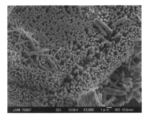
- Example 1 it is a SEM image of the particle
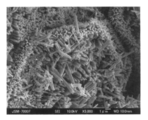
- Example 1 it is a SEM image of the particle
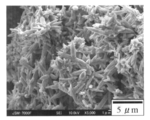
- Example 1 it is a SEM image of the substantially columnar particle
- Example 1 it is a SEM image of the particle
- Example 1 it is a SEM image of the particle
- Example 2 it is a SEM image of the particle
- Example 2 it is a SEM image of the particle
- Example 2 it is a SEM image of the particle
- Example 2 it is a SEM image of the particle
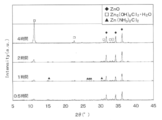
- Example 2 it is a figure which shows the X-ray-diffraction pattern of the particle
- a comparative example it is a SEM image of the particle
- the columnar ZnO particles of the present invention are nano- and micro-sized ZnO particles that are elongated in one direction, and have a hollow structure such as a nanotube, a solid structure such as a nanowire, a nanorod, or the like. Contains particles.
- a plate-like Zn compound having a thin and flat shape used as a starting material is prepared.
- This plate-like Zn compound is prepared as follows. Manufacturing is possible.
- the plate-like Zn compound is produced by dissolving a Zn salt in water and introducing NH 3 gas or an NH 3 aqueous solution into an aqueous solution in which Zn ions are generated.
- any water-soluble one can be used.
- organic compounds such as carboxylic acid salts and sulfonic acid salts.
- zinc chloride (ZnCl 2 ) is preferably used.
- tap water, distilled water, pure water, or the like can be used as water for dissolving the Zn salt.
- the temperature of the aqueous solution, a Zn salt is soluble temperature, for example, in the case of using zinc chloride (ZnCl 2), and 70 °C ⁇ 90 °C.
- the plate-like Zn compound thus obtained has a hexagonal plate shape with a diameter of 5 ⁇ m to 100 ⁇ m and a thickness of 0.5 ⁇ m to 2 ⁇ m.
- the plate-like Zn compound thus produced is dispersed in water, subjected to heat treatment in water at low temperature and normal pressure conditions, and then subjected to drying treatment by heating.
- an aqueous medium such as tap water, distilled water, or pure water can be used, but water that does not contain Zn ions, anions derived from Zn salts and ammonium ions is used.
- the heat treatment conditions are normal pressure and a temperature below the boiling point of water, generally a temperature below 100 ° C.
- the reason why the temperature is set to 100 ° C. or lower is to synthesize ZnO particles at a lower temperature and at a normal pressure.
- the heating temperature at this time is preferably 50 ° C. or higher and 80 ° C. or lower.
- the precipitate after the heat treatment in water like this is taken out from the water by a normal separation operation such as filtration and centrifugation, and heated at a temperature below the boiling point of water under normal pressure, that is, at a temperature of 100 ° C. or less.
- a normal separation operation such as filtration and centrifugation
- ZnO particles are obtained.
- the particles extracted from the water after the heat treatment also contain Zn hydroxide, and by heat treatment at a temperature of 100 ° C. or less, the Zn hydroxide is thermally decomposed into ZnO and obtained.
- the ZnO content of the particles is increased to 85 mass% or more.
- the ZnO particles obtained in this way are columnar in which one particle extends long in one direction, the diameter is 10 nm or more and 3 ⁇ m or less, the length is longer than 10 nm and 10 ⁇ m or less, and is substantially composed of ZnO.
- the ZnO particles have the same orientation in the major axis direction and are arranged in a plurality in a direction perpendicular to the major axis direction.
- the columnar ZnO particles having such an arrangement are currently formed by dissolution and reprecipitation of a plate-like Zn compound.
- the plate-like Zn compound when the plate-like Zn compound is dispersed in water that does not contain Zn ions, anions derived from Zn salts and ammonium ions, and the plate-like Zn compound is heated in water at a low temperature, the surface of the plate-like Zn compound is By dissolving and drying the Zn compound after the heat treatment, the shape becomes columnar and the crystal structure is considered to be ZnO instead of Zn hydroxide.
- the obtained product was dried at room temperature to obtain a plate-like Zn compound. About the obtained plate-like Zn compound, the form was observed using the scanning electron microscope (SEM), and the result was shown in FIG.
- the obtained plate-like Zn compound was large and had a hexagonal plate shape with a diameter of about 50 ⁇ m and a thickness of about 0.5 ⁇ m.
- a suspension obtained by mixing 1 g of the plate-like Zn compound in 50 mL of distilled water was heated and held at various temperatures and times using a water bath.
- the suspension kept heated at a predetermined temperature for a predetermined time was separated by filtration, and the obtained product was dried at a temperature of 90 ° C. for 48 hours to obtain target particles.
- columnar ZnO particles are generated in all cases. It is recognized that The produced columnar ZnO particles had a diameter of 0.3 to 1 ⁇ m and a length of 1.5 to 5 ⁇ m. In addition, it is recognized that the generated columnar ZnO particles are aligned in the major axis direction and have an array property in which a plurality of columns are arranged in a direction perpendicular to the major axis direction.
- columnar ZnO particles had a solid structure, but as can be seen from the SEM image in FIG. 4, some of the columnar ZnO particles had a hollow structure.
- the obtained columnar ZnO particles have a hexagonal shape in which a plurality of arrays arranged in a direction perpendicular to the major axis direction is a hexagonal shape. It is assumed that it was obtained by growing from the compound surface.
- the plate-like Zn compound was Zn hydroxide, and the obtained columnar ZnO particles were all ZnO.
- Example 1 NH 3 gas was introduced to produce a plate-like Zn compound. However, even if NH 3 aqueous solution was introduced instead of NH 3 gas, the same columnar ZnO particles as in this example were produced. Obtained.
- Example 1 For the experimental procedure of Example 1, the heating and holding temperature was changed to 50 ° C., and the others were the same as Example 1.
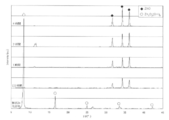
- FIG. 12 shows X-ray diffraction patterns of particles obtained when the heating and holding times are 0.5, 1, 2, and 4 hours, respectively.
- the crystal phase of the obtained columnar particles was mainly ZnO.
- All samples contained a crystal phase containing a hydroxyl group in addition to ZnO.
- the heating and holding temperature was changed to 25 ° C., which was room temperature, and the holding time was changed to 4 hours and 1 day. Others are the same as in the first embodiment.
- FIG. 13 shows an SEM image of the liquid taken out from the liquid when the heating and holding time is 1 day.
- the plate-like ZnO particles with the retention time of 4 hours and 1 day remained as plate-like Zn compounds, and the columnar ZnO particles having the alignment were not generated.
- Example 1 had better ZnO crystallinity, and Example 1 did not show any crystal phase other than ZnO, so the holding temperature was higher than 50 ° C. A higher one is preferable, and 80 ° C. is particularly preferable.
- columnar zinc oxide particles can be synthesized by low-temperature heat treatment and drying treatment of a plate-like Zn compound in water, and the obtained columnar zinc oxide particles have a specific surface area depending on their shape and arrangement. Since it can be expected to increase or develop light scattering characteristics, it can be used in various industrial fields such as optical devices, gas sensor elements, adsorbents, and catalysts.
Landscapes
- Chemical & Material Sciences (AREA)
- Organic Chemistry (AREA)
- Inorganic Chemistry (AREA)
- Inorganic Compounds Of Heavy Metals (AREA)
Abstract
【課題】 柱状ZnO粒子を工業的に有利に製造し得る、新規且つ実用的な方法及びそのような方法によって得られた新規材料として有利に用いられ得る柱状ZnO粒子を提供する。 【解決手段】 ZnCl2水溶液にNH3を導入することにより析出せしめた板状Zn化合物を出発原料とし、これを液中で低温加熱処理した後、加熱して乾燥させることにより、1つの粒子が一方向に長く延びる柱状のZnO粒子であって、ZnO粒子の長軸方向の向きが揃っており、長軸方向に垂直な方向に複数並ぶという配列性を持たせて、複数の柱状ZnO粒子を生成させる。
Description
本発明は、板状Zn化合物を出発原料とした柱状ZnO粒子の製造方法及びそれによって得られた配列性を持つ略柱状及び柱状ZnO粒子に関するものである。
従来から、ナノワイヤーやナノロッド、ナノベルト、ナノリングなど様々な形態のナノサイズ又はマイクロサイズのZnO(酸化亜鉛)粒子が報告されている。特にチューブのような中空構造を持つ粒子は、中実の粒子と比較して低密度、高比表面積であり、また、固有の光学活性を示し、その適用分野において、新規な若しくは改良された特性が見いだされ得る、また、それらの粒子を基板上へ配列させることで光学的又は電気的なデバイスとしても応用が期待できるところから、特別な興味を惹いている。
ところで、このような各種の形態のZnO材料を得るべく、各種の方法が、これまでに提案されてきており、例えば、Liming Shenらは非特許文献1において、酢酸亜鉛水溶液とCTAB(臭化セチルトリメチルアンモニウム)の混合物をオートクレーブ中で160℃で24時間加熱することによって、ZnOナノチューブを製造し得ることを明らかにしている。また、Samuel L. Mensahらは非特許文献2において、酸化亜鉛粉末とグラファイト粉末の混合物を管状炉で1100℃に加熱することで、炉内に設置してあるシリコン基板上に配列したZnOナノロッド及びナノチューブを製造し得ることを明らかにしている。
しかしながら、これら従来の方法では、高温高圧での条件を必要としているため、複雑な装置等が必要となり、実用化を図る上では、好ましくない。それ故に、低温常圧の合成条件によって、柱状ZnO粒子を製造し得るようにした手法の必要性が要請されている。なお、ここでいう柱状とは、一方向に長く延びている形状を意味し、ナノサイズ及びマクロサイズのワイヤー、ロッド、チューブ等の形状が含まれる。
そこで、本発明者らは、特許文献1に開示されるように、低温常圧の合成条件によって柱状ZnO粒子が得られる柱状ZnO粒子の製造方法を提案している。
Samuel L. Mensah,「Applied Physics Letters」, 2007, 113108
ところで、低温常圧の合成条件によって柱状ZnO粒子が得られる柱状ZnO粒子の製造方法について、本発明者らがさらに研究を進めたところ、特許文献1に記載の方法とは異なる柱状ZnO粒子の製造方法を創出するに至った。
本発明は、かかる事情を背景にして為されたものであって、その解決課題とするところは、柱状ZnO粒子を工業的に有利に製造し得る、新規且つ実用的な方法を提供するとともに、その方法によって得られた配列性を持つ柱状ZnO粒子を提供することにある。
本発明の第1の特徴は、常圧下において、板状Zn化合物を水中で沸点以下の温度で加熱処理した後、加熱による乾燥処理を施すことで、1つの粒子が一方向に長く延びる柱状のZnO粒子であって、ZnO粒子の長軸方向の向きが揃っており、長軸方向に垂直な方向に複数並ぶという配列性を持たせて、複数の柱状ZnO粒子を生成させることにある。
本発明の第2の特徴は、前記加熱処理では、50℃以上80℃以下の温度で加熱することにある。
本発明の第3の特徴は、Zn塩を水に溶解せしめてZnイオンの生じた水溶液中に、NH3ガス又はNH3水溶液を導入することにより、板状Zn化合物を析出させた後、
析出した板状Zn化合物を、Znイオン、Zn塩由来の陰イオン及びアンモニウムイオンを含まない水に分散させた状態で、加熱処理を行うことにある。
析出した板状Zn化合物を、Znイオン、Zn塩由来の陰イオン及びアンモニウムイオンを含まない水に分散させた状態で、加熱処理を行うことにある。
本発明の第4の特徴は、板状Zn化合物として、直径が5μm以上100μm以下、厚みが0.5μm以上2μm以下の六角板状のものを用いることにある。
なお、ここでいう直径とは、六角形の中心を通る六角形の幅のうち最大幅を意味する。
本発明の第5の特徴は、乾燥処理は、板状Zn化合物を加熱処理したものを、常圧下で水の沸点以下の温度で加熱することによって、柱状ZnO粒子のZnO含有率を85重量%以上に高めることにある。
本発明の第6の特徴は、第1から第5の特徴の何れか1つの製造方法によって得られたZnO粒子であって、ZnO粒子は、1つの粒子が一方向に長く延びる柱状で、直径が10nm以上3μm以下、長さが10nmより長く10μm以下であって、実質的にZnOからなり、複数のZnO粒子は、長軸方向の向きが揃っており、長軸方向に垂直な方向に複数並ぶという配列性を持っていることにある。
なお、ここでいう直径とは、ZnO粒子の短軸方向での最大長さを意味する。
このように、本発明に従う柱状ZnO粒子の製造方法によれば、板状Zn化合物を出発原料として用いて、常圧下で水の沸点以下の温度という低温での合成条件によって、配列性を持った柱状ZnO粒子を生成できるので、柱状ZnO粒子を工業的に有利に製造し得る、新規且つ実用的な方法であると言える。また、本発明の柱状ZnO粒子の製造方法によって得られた柱状ZnO粒子は、長軸方向の向きが揃っており、長軸方向に垂直な方向に複数並ぶという配列性を持っており、新規材料として有利に用いられ得るものである。
本発明の柱状ZnO粒子には、上述の通り、一方向に長く延びる形状のナノおよびマイクロサイズのZnO粒子であり、ナノチューブのように中空構造や、ナノワイヤー、ナノロッド等のように中実構造の粒子が含まれる。
このような本発明の柱状ZnO粒子を製造するのに際しては、先ず、出発原料として用いる薄く平たい形状である板状Zn化合物を用意することになるが、この板状Zn化合物は以下のようにして製造が可能である。
板状Zn化合物は、Zn塩を水に溶解せしめてZnイオンの生じた水溶液中に、NH3ガス又はNH3水溶液を導入することによって製造される。
ここで、Zn塩としては、水溶性のものであれば、如何なるものであっても用いることができ、例えば、ハロゲン化物、硝酸塩、硫酸塩、リン酸塩の無機系の化合物や、酢酸塩等のカルボン酸塩や、スルホン酸塩等の有機の化合物を挙げることが出来る。そしてそれらの中でも、特に、本発明にあっては、塩化亜鉛(ZnCl2)が、好適に用いられることとなる。また、Zn塩を溶解させる水としては、水道水、蒸留水、純水等を用いることができる。なお、水溶液の温度は、Zn塩が溶解可能な温度とし、例えば、塩化亜鉛(ZnCl2)を用いる場合では、70℃~90℃とする。
また、Znイオンの生じた水溶液中にNH3ガスを導入する際では、例えば、水溶液を収容した反応容器内の底部において、多孔ノズルを通じてNH3ガスを吹き込むことで、水溶液中にアンモニアを溶解させる。このとき、水溶液が酸性から弱塩基性、例えば、pH=7.5となるまで、NH3ガスを導入する。
NH3ガスを導入するのは、水溶液中にアンモニアを溶解させることを目的としていることから、NH3ガスを導入する代わりに、NH3が溶解したNH3水溶液を導入させて良い。この場合も、水溶液が酸性から弱塩基性、例えば、pH=7.5となるまで、NH3水溶液を導入する。
Znイオンの生じた水溶液中に、NH3ガス又はNH3水溶液を導入すると、水溶液中に白色の沈殿物が析出するので、この沈殿物をろ過により水溶液と分離することで、板状Zn化合物を得ることができる。ここで、沈殿物をろ過するのは、得られた板状Zn化合物と、水溶液中の未反応物とを分離するためである。また、pH=7.5となるまでNH3ガス又はNH3水溶液等を導入するのは、Znイオンの生じた水溶液にNH3ガス又はNH3水溶液を導入していくと、pH=7付近から板状Zn化合物が多く生成し、最終的にpH=7.5で完全に板状Zn化合物のみとなるからである。
このようにして得られた板状Zn化合物は、直径が5μm以上100μm以下、厚みが0.5μm以上2μm以下の六角板状となる。
そして、このようにして製造された板状Zn化合物を、水に分散させ、水中で低温常圧条件での加熱処理を行った後、加熱による乾燥処理を施す。
ここで、水としては、水道水、蒸留水、純水等の水性媒体を用いることができるが、Znイオン、Zn塩由来の陰イオン及びアンモニウムイオンを含まないものを用いる。
また、加熱処理条件は、常圧下であって、水の沸点以下の温度、一般的には、100℃以下の温度とする。100℃以下とするのは、従来よりも低温かつ常圧でZnO粒子を合成するためである。なお、後述する実施例からわかるように、このときの加熱温度は50℃以上80℃以下が好ましい。
そのような液温を与えるには、水を予め所定の温度に加熱せしめたり、或いは板状Zn化合物を水に導入したものを加熱せしめたりすることによって実現され、目的とする水温となるように調整されることとなるのである。
かくの如く水中で加熱処理した後の沈殿物を、ろ過や遠心分離等の通常の分離操作によって、水中から取り出して、常圧下で水の沸点以下、すなわち、100℃以下の温度で加熱して乾燥させることにより、ZnO粒子が得られる。加熱処理後に、水中から取り出された粒子には、Zn水酸化物も含まれており、100℃以下の温度で加熱処理されることによって、Zn水酸化物が熱分解されてZnOとなり、得られた粒子のZnO含有率が85mass%以上に高められる。
このようにして得られたZnO粒子は、1つの粒子が一方向に長く延びる柱状で、直径が10nm以上3μm以下、長さが10nmより長く10μm以下であって、実質的にZnOからなり、複数のZnO粒子は、長軸方向の向きが揃っており、長軸方向に垂直な方向に複数並ぶという配列性を持っている。
ところで、このような配列性を持つ柱状ZnO粒子は、現在のところ、板状Zn化合物の溶解再析出によって生成するものと考えられている。
すなわち、Znイオン、Zn塩由来の陰イオン及びアンモニウムイオンを含まない水に対して、板状Zn化合物を分散させた状態として、板状Zn化合物を水中で低温加熱すると、板状Zn化合物表面が溶解し、加熱処理後のZn化合物を乾燥させることで、形状が柱状となるとともに、結晶構造がZn水酸化物ではなくZnOになるものと考えられる。
ちなみに、加熱処理後のZn化合物を自然乾燥させた場合、柱状のZnO粒子が得られなかったことから、乾燥処理は、自然乾燥ではなく加熱によって強制的に乾燥させることが重要である。
以下に、本発明の代表的な実施例を示し、本発明を更に具体的に明らかにすることとするが、本発明が、そのような実施例の記載によって、何等の制約をも受けるものでないことは、言うまでもないところである。また、本発明には、以下の実施例の他にも、更には上記の具体的記述以外にも、本発明の趣旨を逸脱しない限りにおいて、種々なる変更、修正、改良等を加え得るものであることが、理解されるべきである。
先ず、濃度0.5mol/L、90℃のZnCl2水溶液400mL中に、PH=7.5となるように、NH3ガスを導入して白色の沈殿物を析出せしめ、生成した沈殿物をろ過により分離した。得られた生成物を室温乾燥させることで板状Zn化合物を得た。得られた板状Zn化合物について走査型電子顕微鏡(SEM)を用いて、その形態を観察し、その結果を図1に示した。
図1のSEM画像からわかるように、得られた板状Zn化合物は、大きいもので直径が50μm程度、厚みが0.5μm程度の六角板状であった。
次いで、板状Zn化合物1gを50mLの蒸留水に混合せしめた懸濁液を、ウォーターバスを用いて各種の温度、及び時間において加熱保持せしめられるようにした。
次いで、板状Zn化合物1gを50mLの蒸留水に混合せしめた懸濁液を、ウォーターバスを用いて各種の温度、及び時間において加熱保持せしめられるようにした。
所定の温度において所定の時間、加熱保持した懸濁液をろ過により分離し、得られた生成物を90℃の温度で48時間乾燥することで目的とする粒子を得た。
そして、上記の実験手順において、ウォーターバスの加熱保持温度を80℃として、0.5、1、2、又は4 時間加熱保持した沈殿物を、ろ過により分離し乾燥させた。得られた生成物について走査型電子顕微鏡(SEM)を用いてその形態を観察し、また、粉末X線回折により結晶構造を評価した。その結果を図2乃至6及び図7に示した。
それら図2乃至6に示されるSEM画像から明らかなように、板状Zn化合物を液中において80℃で加熱処理を行った場合(図2乃至6)では、何れも、柱状ZnO粒子が生成されていることが認められる。生成した柱状ZnO粒子は、直径が0.3~1μm、長さが1.5~5μmであった。また、生成した柱状ZnO粒子は、長軸方向の向きが揃っており、長軸方向に垂直な方向に複数並ぶという配列性を有することも認められる。
また、得られた柱状ZnO粒子の多くは中実構造であったが、図4のSEM画像からわかるように、一部の柱状ZnO粒子は中空構造であった。
更に、図6等のSEM画像に示されるように、得られた柱状ZnO粒子は、長軸方向に垂直な方向に複数並ぶ配列が六角形をなしていることから、出発原料である板状Zn化合物表面より成長して得られたことが想定される。
また、図7に示されるように、板状Zn化合物はZn水酸化物であり、得られた柱状ZnO粒子は、どれもZnOであることが確認された。
なお、この実施例1では、NH3ガスを導入して板状Zn化合物を生成したが、NH3ガスの代わりに、NH3水溶液を導入しても、本実施例と同様の柱状ZnO粒子が得られた。
実施例1の実験手順に対して、加熱保持温度を50℃に変更し、その他は、実施例1と同様である。
図8~11に、それぞれ、加熱保持時間を0.5、1、2、4時間とした場合に得られた粒子のSEM画像を示す。図8~11に示されるSEM画像から明らかなように、本実施例においても、実施例1と同様に、配列性を持った柱状粒子が生成されていることが認められる。
また、図12に、それぞれ、加熱保持時間を0.5、1、2、4時間とした場合に得られた粒子のX線回折パターンを示す。図12からわかるように、得られた柱状粒子の結晶相は、主にZnOであることが確認された。なお、全ての試料において、ZnO以外に水酸基を含む結晶相が含まれていた。
(比較例)
実施例1の実験手順に対して、加熱保持温度を室温の25℃に変更し、保持時間を4時間、1日に変更した。その他は、実施例1と同様である。
(比較例)
実施例1の実験手順に対して、加熱保持温度を室温の25℃に変更し、保持時間を4時間、1日に変更した。その他は、実施例1と同様である。
図13に、加熱保持時間を1日とした場合の液中から取り出したもののSEM画像を示す。図13のSEM画像からわかるように、保持時間が4時間、1日のどちらのものも、板状Zn化合物のままであり、配列性を持った柱状ZnO粒子は生成していなかった。
したがって、実施例1、2および比較例から、配列性を持った柱状ZnO粒子を生成させるためには、加熱温度を50℃以上にすることが好ましいと言える。また、実施例1と実施例2を比較すると、実施例1の方がZnOの結晶性が良く、実施例1ではZnO以外の結晶相が見られなかったことから、保持温度は50℃よりも高い方が好ましく、80℃が特に好ましいと言える。
本発明は、板状Zn化合物の水中での低温加熱処理及び乾燥処理により柱状酸化亜鉛粒子の合成が可能であり、さらに、得られる柱状酸化亜鉛粒子については、その形状及び配列性による比表面積の増大や光散乱特性の発現などが期待できる事から、光学デバイスやガスセンサー素子または吸着剤、触媒などの様々な産業分野での利用が可能である。
Claims (6)
- 常圧下において、板状Zn化合物を水中で沸点以下の温度で加熱処理した後、加熱による乾燥処理を施すことで、
1つの粒子が一方向に長く延びる柱状のZnO粒子であって、
前記ZnO粒子の長軸方向の向きが揃っており、前記長軸方向に垂直な方向に複数並ぶという配列性を持たせて、複数の柱状ZnO粒子を生成させることを特徴とする柱状ZnO粒子の製造方法。 - 前記加熱処理では、50℃以上80℃以下の温度で加熱することを特徴とする請求項1に記載の柱状ZnO粒子の製造方法。
- Zn塩を水に溶解せしめてZnイオンの生じた水溶液中に、NH3ガス又はNH3水溶液を導入することにより、前記板状Zn化合物を析出させた後、
析出した前記板状Zn化合物を、Znイオン、前記Zn塩由来の陰イオン及びアンモニウムイオンを含まない水に分散させた状態で、前記加熱処理を行うことを特徴とする請求項1又は2に記載の柱状ZnO粒子の製造方法。 - 前記板状Zn化合物として、直径が5μm以上100μm以下、厚みが0.5μm以上2μm以下の六角板状のものを用いることを特徴とする請求項1乃至3の何れか1項に記載の柱状ZnO粒子の製造方法。
- 前記乾燥処理は、前記板状Zn化合物を前記加熱処理したものを、常圧下で水の沸点以下の温度で加熱することによって、前記柱状ZnO粒子のZnO含有率を85重量%以上に高めることを特徴とする請求項1乃至4の何れか1項に記載の柱状ZnO粒子の製造方法。
- 請求項1乃至5の何れか1項に記載の製造方法によって得られたZnO粒子であって、 前記ZnO粒子は、1つの粒子が一方向に長く延びる柱状で、直径が10nm以上3μm以下、長さが10nmより長く10μm以下であって、実質的にZnOからなり、
複数の前記ZnO粒子は、長軸方向の向きが揃っており、前記長軸方向に垂直な方向に複数並ぶという配列性を持っていることを特徴とする柱状ZnO粒子。
Priority Applications (1)
| Application Number | Priority Date | Filing Date | Title |
|---|---|---|---|
| JP2010535778A JP5641225B2 (ja) | 2008-10-27 | 2009-10-26 | 柱状ZnO粒子の製造方法 |
Applications Claiming Priority (2)
| Application Number | Priority Date | Filing Date | Title |
|---|---|---|---|
| JP2008-275056 | 2008-10-27 | ||
| JP2008275056 | 2008-10-27 |
Publications (1)
| Publication Number | Publication Date |
|---|---|
| WO2010050430A1 true WO2010050430A1 (ja) | 2010-05-06 |
Family
ID=42128792
Family Applications (1)
| Application Number | Title | Priority Date | Filing Date |
|---|---|---|---|
| PCT/JP2009/068329 Ceased WO2010050430A1 (ja) | 2008-10-27 | 2009-10-26 | 柱状ZnO粒子の製造方法及びそれによって得られた柱状ZnO粒子 |
Country Status (2)
| Country | Link |
|---|---|
| JP (1) | JP5641225B2 (ja) |
| WO (1) | WO2010050430A1 (ja) |
Cited By (8)
| Publication number | Priority date | Publication date | Assignee | Title |
|---|---|---|---|---|
| WO2011013477A1 (ja) * | 2009-07-31 | 2011-02-03 | 独立行政法人産業技術総合研究所 | 酸化亜鉛ロッド状結晶のツイン連結構造体、ツイン連結構造膜、及びツイン連結構造膜の製造方法 |
| WO2012147886A1 (ja) * | 2011-04-28 | 2012-11-01 | 堺化学工業株式会社 | 六角板状酸化亜鉛粒子、その製造方法、それを配合した化粧料、放熱性フィラー、放熱性樹脂組成物、放熱性グリース及び放熱性塗料組成物 |
| WO2012147887A1 (ja) * | 2011-04-28 | 2012-11-01 | 堺化学工業株式会社 | 六角柱状酸化亜鉛粒子、その製造方法、並びに、それを配合した化粧料、放熱性フィラー、放熱性樹脂組成物、放熱性グリース及び放熱性塗料組成物 |
| WO2013137037A1 (ja) * | 2012-03-13 | 2013-09-19 | 国立大学法人名古屋工業大学 | 3b族元素が固溶された酸化亜鉛微細粉末 |
| WO2013137228A1 (ja) * | 2012-03-13 | 2013-09-19 | 国立大学法人名古屋工業大学 | 酸化亜鉛微細粒子及び/又は酸化亜鉛膜の製造方法 |
| CN104096560A (zh) * | 2014-07-21 | 2014-10-15 | 安徽师范大学 | 一种ZnO/Pt异质纳米阵列结构材料、制备方法及其应用 |
| US9120681B2 (en) | 2011-04-28 | 2015-09-01 | Sakai Chemical Industry Co., Ltd. | Method for production of zinc oxide particles |
| WO2023190356A1 (ja) | 2022-03-31 | 2023-10-05 | 株式会社フジミインコーポレーテッド | 柱状酸化亜鉛の製造方法および柱状酸化亜鉛 |
Citations (2)
| Publication number | Priority date | Publication date | Assignee | Title |
|---|---|---|---|---|
| JP2007182370A (ja) * | 2006-01-02 | 2007-07-19 | Samsung Electronics Co Ltd | 酸化亜鉛ナノワイヤの製造方法及びその製造方法により製造された酸化亜鉛ナノワイヤ |
| JP2007290892A (ja) * | 2006-04-24 | 2007-11-08 | Nagoya Institute Of Technology | ZnO系ナノチューブの製造方法及びそれによって得られたZnO系ナノチューブ |
Family Cites Families (4)
| Publication number | Priority date | Publication date | Assignee | Title |
|---|---|---|---|---|
| FR2665156B1 (fr) * | 1990-07-24 | 1992-10-16 | Centre Nat Rech Scient | Procede de fabrication d'une poudre d'oxyde de zinc dope, et poudre obtenue. |
| JP3242468B2 (ja) * | 1992-11-09 | 2001-12-25 | 三井金属鉱業株式会社 | 導電性針状酸化亜鉛の製造方法 |
| CN100360420C (zh) * | 2005-11-02 | 2008-01-09 | 东南大学 | 水热分解生长纳米管型氧化锌的方法 |
| JP4899229B2 (ja) * | 2007-03-20 | 2012-03-21 | 独立行政法人産業技術総合研究所 | ZnOウィスカー膜及びそれらの作製方法 |
-
2009
- 2009-10-26 WO PCT/JP2009/068329 patent/WO2010050430A1/ja not_active Ceased
- 2009-10-26 JP JP2010535778A patent/JP5641225B2/ja not_active Expired - Fee Related
Patent Citations (2)
| Publication number | Priority date | Publication date | Assignee | Title |
|---|---|---|---|---|
| JP2007182370A (ja) * | 2006-01-02 | 2007-07-19 | Samsung Electronics Co Ltd | 酸化亜鉛ナノワイヤの製造方法及びその製造方法により製造された酸化亜鉛ナノワイヤ |
| JP2007290892A (ja) * | 2006-04-24 | 2007-11-08 | Nagoya Institute Of Technology | ZnO系ナノチューブの製造方法及びそれによって得られたZnO系ナノチューブ |
Non-Patent Citations (1)
| Title |
|---|
| QIAN, H. ET AL.: "Growth of ZnO Crystals with Branched Spindles and Prismatic Whiskers from Zn3 (OH)2V2O7 H2O Nanosheets by a Hydrothermal Route", CRYST. GROWTH DES., vol. 5, no. 3, 2005, pages 935 - 939 * |
Cited By (19)
| Publication number | Priority date | Publication date | Assignee | Title |
|---|---|---|---|---|
| JP5669048B2 (ja) * | 2009-07-31 | 2015-02-12 | 独立行政法人産業技術総合研究所 | 酸化亜鉛ロッド状結晶のツイン連結構造体、ツイン連結構造膜、及びツイン連結構造膜の製造方法 |
| WO2011013477A1 (ja) * | 2009-07-31 | 2011-02-03 | 独立行政法人産業技術総合研究所 | 酸化亜鉛ロッド状結晶のツイン連結構造体、ツイン連結構造膜、及びツイン連結構造膜の製造方法 |
| CN103459318B (zh) * | 2011-04-28 | 2015-10-14 | 堺化学工业株式会社 | 六方柱状氧化锌颗粒、其制造方法、以及混配有该颗粒的化妆料、散热性填料、散热性树脂组合物、散热性脂膏和散热性涂料组合物 |
| US9339445B2 (en) | 2011-04-28 | 2016-05-17 | Sakai Chemical Industry Co., Ltd. | Hexagonal plate-shaped zinc oxide particles, method for production of the same, and cosmetic, heat releasing filler, heat releasing resin composition, heat releasing grease, and heat releasing coating composition comprising the same |
| US9404195B2 (en) | 2011-04-28 | 2016-08-02 | Sakai Chemical Industry Co., Ltd. | Hexagonal prism-shaped zinc oxide particles, method for production of the same, and cosmetic, heat releasing filler, heat releasing resin composition, heat releasing grease, and heat releasing coating composition comprising the same |
| CN103459318A (zh) * | 2011-04-28 | 2013-12-18 | 堺化学工业株式会社 | 六方柱状氧化锌颗粒、其制造方法、以及混配有该颗粒的化妆料、散热性填料、散热性树脂组合物、散热性脂膏和散热性涂料组合物 |
| CN103492320A (zh) * | 2011-04-28 | 2014-01-01 | 堺化学工业株式会社 | 六方板状氧化锌颗粒、其制造方法、混配有该颗粒的化妆料、散热性填料、散热性树脂组合物、散热性脂膏及散热性涂料组合物 |
| JP5907166B2 (ja) * | 2011-04-28 | 2016-04-20 | 堺化学工業株式会社 | 六角板状酸化亜鉛粒子、その製造方法、それを配合した化粧料、放熱性フィラー、放熱性樹脂組成物、放熱性グリース及び放熱性塗料組成物 |
| WO2012147887A1 (ja) * | 2011-04-28 | 2012-11-01 | 堺化学工業株式会社 | 六角柱状酸化亜鉛粒子、その製造方法、並びに、それを配合した化粧料、放熱性フィラー、放熱性樹脂組成物、放熱性グリース及び放熱性塗料組成物 |
| CN103492320B (zh) * | 2011-04-28 | 2015-07-22 | 堺化学工业株式会社 | 六方板状氧化锌颗粒、其制造方法、混配有该颗粒的化妆料、散热性填料、散热性树脂组合物、散热性脂膏及散热性涂料组合物 |
| JP5907167B2 (ja) * | 2011-04-28 | 2016-04-20 | 堺化学工業株式会社 | 六角柱状酸化亜鉛粒子、その製造方法、並びに、それを配合した化粧料、放熱性フィラー、放熱性樹脂組成物、放熱性グリース及び放熱性塗料組成物 |
| US9120681B2 (en) | 2011-04-28 | 2015-09-01 | Sakai Chemical Industry Co., Ltd. | Method for production of zinc oxide particles |
| WO2012147886A1 (ja) * | 2011-04-28 | 2012-11-01 | 堺化学工業株式会社 | 六角板状酸化亜鉛粒子、その製造方法、それを配合した化粧料、放熱性フィラー、放熱性樹脂組成物、放熱性グリース及び放熱性塗料組成物 |
| JPWO2013137228A1 (ja) * | 2012-03-13 | 2015-08-03 | 国立大学法人 名古屋工業大学 | 酸化亜鉛微細粒子及び/又は酸化亜鉛膜の製造方法 |
| WO2013137037A1 (ja) * | 2012-03-13 | 2013-09-19 | 国立大学法人名古屋工業大学 | 3b族元素が固溶された酸化亜鉛微細粉末 |
| WO2013137228A1 (ja) * | 2012-03-13 | 2013-09-19 | 国立大学法人名古屋工業大学 | 酸化亜鉛微細粒子及び/又は酸化亜鉛膜の製造方法 |
| CN104096560A (zh) * | 2014-07-21 | 2014-10-15 | 安徽师范大学 | 一种ZnO/Pt异质纳米阵列结构材料、制备方法及其应用 |
| WO2023190356A1 (ja) | 2022-03-31 | 2023-10-05 | 株式会社フジミインコーポレーテッド | 柱状酸化亜鉛の製造方法および柱状酸化亜鉛 |
| EP4501854A4 (en) * | 2022-03-31 | 2026-04-15 | Fujimi Inc | PROCESS FOR THE MANUFACTURE OF ZINC OXIDE IN COLUMN AND ZINC OXIDE IN COLUMN |
Also Published As
| Publication number | Publication date |
|---|---|
| JP5641225B2 (ja) | 2014-12-17 |
| JPWO2010050430A1 (ja) | 2012-03-29 |
Similar Documents
| Publication | Publication Date | Title |
|---|---|---|
| JP5641225B2 (ja) | 柱状ZnO粒子の製造方法 | |
| Shrestha et al. | Fullerene nanoarchitectonics: from zero to higher dimensions | |
| Song et al. | Mesocrystals—ordered nanoparticle superstructures | |
| Ogawa et al. | Homogeneous precipitation of uniform hydrotalcite particles | |
| Coffer et al. | Dictation of the shape of mesoscale semiconductor nanoparticle assemblies by plasmid DNA | |
| Shi et al. | Growth of flower-like ZnO via surfactant-free hydrothermal synthesis on ITO substrate at low temperature | |
| JP4899229B2 (ja) | ZnOウィスカー膜及びそれらの作製方法 | |
| Anžlovar et al. | Impact of inorganic hydroxides on ZnO nanoparticle formation and morphology | |
| Qiu et al. | Synthesis and Characterization of Flower‐Like Bundles of ZnO Nanosheets by a Surfactant‐Free Hydrothermal Process | |
| CN102951672B (zh) | 一种ZnO纳米晶体的制备方法 | |
| Guo et al. | Sodium lignosulfonate induced vaterite calcium carbonate with multilayered structure | |
| Ye et al. | Facile solution synthesis and characterization of ZnO mesocrystals and ultralong nanowires from layered basic zinc salt precursor | |
| KR20160120851A (ko) | 화학적 환원방법을 통한 금/은 코어/셀 금속 나노입자를 표면에 포함하는 이산화티타늄 중공구조 나노입자 및 그 제조방법 | |
| CN105731535A (zh) | 一种氧化锌/二氧化钛复合纳米材料的制备方法 | |
| Petrović et al. | Hydrothermal processing of electrospun fibers in the synthesis of 1D ZnO nanoparticles | |
| KR20130070092A (ko) | 산화 이트륨 분말의 제조방법 및 이에 의해 제조된 산화 이트륨 분말 | |
| Senthamilselvi et al. | Microstructure and photocatalytic properties of bismuth oxide (Bi2O3) nanocrystallites | |
| Bhuyan et al. | Flower shaped homocentric pencil like ZnO nanorod bundles: synthesis, characterisation and study of their photocatalytic activity | |
| CN113979870B (zh) | 一种二维杂化卤化物钙钛矿纳米片的制备方法 | |
| KR20160040186A (ko) | 아연 화합물의 제조 및 용도 | |
| Thakur et al. | Wet chemical synthesis of ZnO nanocrystals: dependence of growth and morphology on the solvent composition | |
| Silambarasan et al. | Monodispersed synthesis of hierarchical wurtzite ZnS nanostructures and its functional properties | |
| Liu et al. | Semiconductor CdS Magic‐Size Clusters: From Material Synthesis to Applications | |
| JP4967120B2 (ja) | ZnO系ナノチューブの製造方法 | |
| You et al. | Controlled Synthesis of Hierarchically Assembled Porous ZnO Microspheres with Enhanced Gas‐Sensing Properties |
Legal Events
| Date | Code | Title | Description |
|---|---|---|---|
| 121 | Ep: the epo has been informed by wipo that ep was designated in this application |
Ref document number: 09823540 Country of ref document: EP Kind code of ref document: A1 |
|
| DPE1 | Request for preliminary examination filed after expiration of 19th month from priority date (pct application filed from 20040101) | ||
| ENP | Entry into the national phase |
Ref document number: 2010535778 Country of ref document: JP Kind code of ref document: A |
|
| NENP | Non-entry into the national phase |
Ref country code: DE |
|
| 122 | Ep: pct application non-entry in european phase |
Ref document number: 09823540 Country of ref document: EP Kind code of ref document: A1 |