WO2010047411A1 - 熱硬化性樹脂組成物 - Google Patents
熱硬化性樹脂組成物 Download PDFInfo
- Publication number
- WO2010047411A1 WO2010047411A1 PCT/JP2009/068310 JP2009068310W WO2010047411A1 WO 2010047411 A1 WO2010047411 A1 WO 2010047411A1 JP 2009068310 W JP2009068310 W JP 2009068310W WO 2010047411 A1 WO2010047411 A1 WO 2010047411A1
- Authority
- WO
- WIPO (PCT)
- Prior art keywords
- weight
- resin composition
- manufactured
- component
- thermosetting resin
- Prior art date
- Legal status (The legal status is an assumption and is not a legal conclusion. Google has not performed a legal analysis and makes no representation as to the accuracy of the status listed.)
- Ceased
Links
Images

Classifications
-
- C—CHEMISTRY; METALLURGY
- C08—ORGANIC MACROMOLECULAR COMPOUNDS; THEIR PREPARATION OR CHEMICAL WORKING-UP; COMPOSITIONS BASED THEREON
- C08L—COMPOSITIONS OF MACROMOLECULAR COMPOUNDS
- C08L63/00—Compositions of epoxy resins; Compositions of derivatives of epoxy resins
-
- C—CHEMISTRY; METALLURGY
- C08—ORGANIC MACROMOLECULAR COMPOUNDS; THEIR PREPARATION OR CHEMICAL WORKING-UP; COMPOSITIONS BASED THEREON
- C08G—MACROMOLECULAR COMPOUNDS OBTAINED OTHERWISE THAN BY REACTIONS ONLY INVOLVING UNSATURATED CARBON-TO-CARBON BONDS
- C08G59/00—Polycondensates containing more than one epoxy group per molecule; Macromolecules obtained by polymerising compounds containing more than one epoxy group per molecule using curing agents or catalysts which react with the epoxy groups
- C08G59/18—Macromolecules obtained by polymerising compounds containing more than one epoxy group per molecule using curing agents or catalysts which react with the epoxy groups ; e.g. general methods of curing
- C08G59/40—Macromolecules obtained by polymerising compounds containing more than one epoxy group per molecule using curing agents or catalysts which react with the epoxy groups ; e.g. general methods of curing characterised by the curing agents used
- C08G59/62—Alcohols or phenols
- C08G59/621—Phenols
-
- C—CHEMISTRY; METALLURGY
- C08—ORGANIC MACROMOLECULAR COMPOUNDS; THEIR PREPARATION OR CHEMICAL WORKING-UP; COMPOSITIONS BASED THEREON
- C08K—Use of inorganic or non-macromolecular organic substances as compounding ingredients
- C08K5/00—Use of organic ingredients
- C08K5/04—Oxygen-containing compounds
- C08K5/13—Phenols; Phenolates
-
- C—CHEMISTRY; METALLURGY
- C08—ORGANIC MACROMOLECULAR COMPOUNDS; THEIR PREPARATION OR CHEMICAL WORKING-UP; COMPOSITIONS BASED THEREON
- C08L—COMPOSITIONS OF MACROMOLECULAR COMPOUNDS
- C08L33/00—Compositions of homopolymers or copolymers of compounds having one or more unsaturated aliphatic radicals, each having only one carbon-to-carbon double bond, and only one being terminated by only one carboxyl radical, or of salts, anhydrides, esters, amides, imides or nitriles thereof; Compositions of derivatives of such polymers
- C08L33/04—Homopolymers or copolymers of esters
-
- C—CHEMISTRY; METALLURGY
- C09—DYES; PAINTS; POLISHES; NATURAL RESINS; ADHESIVES; COMPOSITIONS NOT OTHERWISE PROVIDED FOR; APPLICATIONS OF MATERIALS NOT OTHERWISE PROVIDED FOR
- C09J—ADHESIVES; NON-MECHANICAL ASPECTS OF ADHESIVE PROCESSES IN GENERAL; ADHESIVE PROCESSES NOT PROVIDED FOR ELSEWHERE; USE OF MATERIALS AS ADHESIVES
- C09J7/00—Adhesives in the form of films or foils
- C09J7/20—Adhesives in the form of films or foils characterised by their carriers
- C09J7/22—Plastics; Metallised plastics
-
- C—CHEMISTRY; METALLURGY
- C09—DYES; PAINTS; POLISHES; NATURAL RESINS; ADHESIVES; COMPOSITIONS NOT OTHERWISE PROVIDED FOR; APPLICATIONS OF MATERIALS NOT OTHERWISE PROVIDED FOR
- C09J—ADHESIVES; NON-MECHANICAL ASPECTS OF ADHESIVE PROCESSES IN GENERAL; ADHESIVE PROCESSES NOT PROVIDED FOR ELSEWHERE; USE OF MATERIALS AS ADHESIVES
- C09J7/00—Adhesives in the form of films or foils
- C09J7/30—Adhesives in the form of films or foils characterised by the adhesive composition
- C09J7/35—Heat-activated
-
- H—ELECTRICITY
- H05—ELECTRIC TECHNIQUES NOT OTHERWISE PROVIDED FOR
- H05K—PRINTED CIRCUITS; CASINGS OR CONSTRUCTIONAL DETAILS OF ELECTRIC APPARATUS; MANUFACTURE OF ASSEMBLAGES OF ELECTRICAL COMPONENTS
- H05K3/00—Apparatus or processes for manufacturing printed circuits
- H05K3/30—Assembling printed circuits with electric components, e.g. with resistors
- H05K3/303—Assembling printed circuits with electric components, e.g. with resistors with surface mounted components
- H05K3/305—Affixing by adhesive
-
- C—CHEMISTRY; METALLURGY
- C09—DYES; PAINTS; POLISHES; NATURAL RESINS; ADHESIVES; COMPOSITIONS NOT OTHERWISE PROVIDED FOR; APPLICATIONS OF MATERIALS NOT OTHERWISE PROVIDED FOR
- C09J—ADHESIVES; NON-MECHANICAL ASPECTS OF ADHESIVE PROCESSES IN GENERAL; ADHESIVE PROCESSES NOT PROVIDED FOR ELSEWHERE; USE OF MATERIALS AS ADHESIVES
- C09J2301/00—Additional features of adhesives in the form of films or foils
- C09J2301/50—Additional features of adhesives in the form of films or foils characterized by process specific features
-
- H—ELECTRICITY
- H05—ELECTRIC TECHNIQUES NOT OTHERWISE PROVIDED FOR
- H05K—PRINTED CIRCUITS; CASINGS OR CONSTRUCTIONAL DETAILS OF ELECTRIC APPARATUS; MANUFACTURE OF ASSEMBLAGES OF ELECTRICAL COMPONENTS
- H05K1/00—Printed circuits
- H05K1/18—Printed circuits structurally associated with non-printed electric components
- H05K1/182—Printed circuits structurally associated with non-printed electric components associated with components mounted in printed circuit boards [PCB], e.g. insert-mounted components [IMC]
- H05K1/185—Printed circuits structurally associated with non-printed electric components associated with components mounted in printed circuit boards [PCB], e.g. insert-mounted components [IMC] associated with components encapsulated in the insulating substrate of the PCBs; associated with components incorporated in internal layers of multilayer circuit boards
-
- H—ELECTRICITY
- H05—ELECTRIC TECHNIQUES NOT OTHERWISE PROVIDED FOR
- H05K—PRINTED CIRCUITS; CASINGS OR CONSTRUCTIONAL DETAILS OF ELECTRIC APPARATUS; MANUFACTURE OF ASSEMBLAGES OF ELECTRICAL COMPONENTS
- H05K2201/00—Indexing scheme relating to printed circuits covered by H05K1/00
- H05K2201/02—Fillers; Particles; Fibers; Reinforcement materials
- H05K2201/0203—Fillers and particles
- H05K2201/0206—Materials
- H05K2201/0209—Inorganic, non-metallic particles
-
- H—ELECTRICITY
- H05—ELECTRIC TECHNIQUES NOT OTHERWISE PROVIDED FOR
- H05K—PRINTED CIRCUITS; CASINGS OR CONSTRUCTIONAL DETAILS OF ELECTRIC APPARATUS; MANUFACTURE OF ASSEMBLAGES OF ELECTRICAL COMPONENTS
- H05K2201/00—Indexing scheme relating to printed circuits covered by H05K1/00
- H05K2201/10—Details of components or other objects attached to or integrated in a printed circuit board
- H05K2201/10613—Details of electrical connections of non-printed components, e.g. special leads
- H05K2201/10621—Components characterised by their electrical contacts
- H05K2201/10636—Leadless chip, e.g. chip capacitor or resistor
-
- Y—GENERAL TAGGING OF NEW TECHNOLOGICAL DEVELOPMENTS; GENERAL TAGGING OF CROSS-SECTIONAL TECHNOLOGIES SPANNING OVER SEVERAL SECTIONS OF THE IPC; TECHNICAL SUBJECTS COVERED BY FORMER USPC CROSS-REFERENCE ART COLLECTIONS [XRACs] AND DIGESTS
- Y02—TECHNOLOGIES OR APPLICATIONS FOR MITIGATION OR ADAPTATION AGAINST CLIMATE CHANGE
- Y02P—CLIMATE CHANGE MITIGATION TECHNOLOGIES IN THE PRODUCTION OR PROCESSING OF GOODS
- Y02P70/00—Climate change mitigation technologies in the production process for final industrial or consumer products
- Y02P70/50—Manufacturing or production processes characterised by the final manufactured product
Definitions
- the present invention relates to a thermosetting resin composition useful for producing a component-embedded substrate, an adhesive film having an adhesive layer using the thermosetting resin composition, and a method for producing a component-embedded substrate using the adhesive film. About.
- the printed wiring board is required to have higher density by being lighter, thinner and shorter. Even in the component-embedded substrate, a component to be embedded becomes small, and high positional accuracy is required when embedding. Further, since it is necessary to reduce the size of the entire board, a material having high insulation is required between the embedded component and the circuit around the component.
- a method for manufacturing a component-embedded substrate a method is disclosed in which a component is temporarily fixed with a sheet agent and a sheet agent with an adhesive, and after the component is sealed with a resin, the sheet is removed (Patent Document 1).
- the specific composition is not disclosed. Moreover, since it is necessary to remove an adhesive after components sealing, the number of processes increases.
- Patent Document 2 Also disclosed is a method (Patent Document 2) in which a component is temporarily fixed to an electronic component mounting surface of a core substrate with an adhesive and the component is sealed with a resin.
- the adhesive material it is desirable to use a material that is electrically insulative and becomes vaporized or gas when high heat is applied.
- Specific examples of polymers to be used include acrylic resin, polyester resin, and maleation. It is said that oil resin, polybutene resin, epoxy resin, etc. can be used alone or as a mixture of any combination.
- rosin-based, terpene-based and petroleum resin-based tackifying resins can be added as necessary.
- the specific composition of the adhesive material is not disclosed.
- Patent Document 3 a component is temporarily fixed on an insulating substrate provided on the entire surface of the adhesive layer as well as an adhesion portion of the electronic component, and the component is sealed with resin.
- the adhesive layer include epoxy resin-based, polyurethane-based, reactive acrylic-based, ultraviolet curable, and silicone-based materials.
- examples include epoxy resin-based and silicone-based materials such as phenol resins, organic acid anhydrides, amines, and cured materials.
- a curing agent such as an accelerator is used in combination.
- cure by the heating at a curing temperature or irradiation of an ultraviolet-ray for fixing components is disclosed.
- the specific composition of the adhesive layer is not disclosed. Further, when an electronic component is fixed by thermosetting the adhesive layer, there is a problem that the fixing position accuracy of the component decreases due to melting of the adhesive layer. Further, curing with ultraviolet rays has a problem that the process becomes complicated.
- the problem of the present invention is that the electronic component is fixed to the adhesive layer by the adhesiveness (tackiness) of the adhesive layer, and when the adhesive layer is thermally cured, the component-embedded substrate with high component fixing position accuracy and insulation reliability It is providing the thermosetting resin composition which can manufacture.
- thermosetting resin composition containing a liquid epoxy resin, a phenolic curing agent, an inorganic filler, and an acrylic resin.
- thermosetting resin composition used for fixing components and forming an insulating layer on a component-embedded substrate, wherein the epoxy resin is liquid at 25 ° C. when the nonvolatile content of the thermosetting resin composition is 100% by weight. 25 to 40% by weight, acrylic resin 0.1 to 5% by weight, phenolic curing agent 5 to 30% by weight and inorganic filler 20 to 70% by weight.
- acrylic resin is an acrylic ester copolymer.
- the acrylic resin is an acrylic ester copolymer containing methyl acrylate, butyl acrylate, and acrylonitrile.
- the acrylic resin contains a hydroxyl group and a carboxyl group.
- An adhesive film for fixing components and forming an insulating layer on a component-embedded substrate having an adhesive layer formed of the thermosetting resin composition according to the above [1] to [5] on a support.
- a component-embedded substrate including a step of fixing an electronic component on the adhesive layer of the adhesive film according to any one of [1] to [9] and a step of thermally curing the adhesive layer to form an insulating layer Manufacturing method.
- thermosetting resin composition containing a liquid epoxy resin, a phenolic curing agent, an inorganic filler, and an acrylic resin
- the electronic component can be controlled by the adhesiveness (tackiness) of the adhesive layer.
- the adhesive layer is fixed to the adhesive layer and the adhesive layer is thermally cured, it is possible to provide a thermosetting resin composition capable of producing a component-embedded substrate having high component fixing position accuracy and insulation reliability.
- epoxy resin in liquid form at 25 ° C mainly improves the heat resistance and insulation of the cured product and contributes to the tackiness of the thermosetting resin composition.
- Specific examples of epoxy resins that are liquid at 25 ° C. include bisphenol A type epoxy resins, bisphenol F type epoxy resins, novolac phenol type epoxy resins, naphthalene type epoxy resins, tertiary butyl catechol type epoxy resins, and butadiene structures.
- bisphenol A type epoxy resins bisphenol A type epoxy resins, naphthol type epoxy resins, naphthalene type epoxy resins, aliphatic glycidyl ethers, and epoxy resins having a butadiene structure are preferable from the viewpoints of heat resistance and insulation reliability.
- Specific examples of the epoxy resin include liquid bisphenol A type epoxy resin (“Epicoat 828EL” manufactured by Japan Epoxy Resin Co., Ltd.), liquid bisphenol F type epoxy resin (“Epicoat 807” manufactured by Japan Epoxy Resin Co., Ltd.), naphthalene.
- Type bifunctional epoxy resin (“HP4032”, “HP4032D” manufactured by Dainippon Ink & Chemicals, Inc.), aliphatic glycidyl ether (“ZX-1658” manufactured by Tohto Kasei Co., Ltd.), epoxy resin having a butadiene structure ( Daicel Chemical Industries, Ltd. "PB-3600”) etc. are mentioned. Two or more “epoxy resins that are liquid at 25 ° C.” may be used in combination.
- the upper limit of the content of the epoxy resin that is liquid at 25 ° C. prevents the adhesive force from increasing and the peelability of the cover film from deteriorating, Further, from the viewpoint of preventing the positional deviation of the components from being easily generated during film curing, 40% by weight is preferable, and 35% by weight is more preferable.
- the lower limit of the content of the epoxy resin that is liquid at 25 ° C. is from the viewpoint of preventing the component from becoming difficult to be fixed to the adhesive film. 25% by weight is preferable, and 30% by weight is more preferable.
- the “acrylic resin” mainly contributes to the tackiness of the thermosetting resin composition.
- the acrylic resin include polyacrylic acid, polymethacrylic acid, polyacrylic acid ester, polymethacrylic acid ester, polyacrylic acid ester copolymer, polymethacrylic acid ester copolymer, and the like.
- the acrylic resin is particularly preferably an acrylic ester copolymer having excellent adhesiveness, and more preferably an acrylic acid methyl ester copolymer and an acrylic acid ethyl ester copolymer.
- the copolymer compound examples include methyl acrylate, butyl acrylate, vinyl acetate, acrylonitrile, acrylamide, and the like, and methyl acrylate, butyl acrylate, and acrylonitrile are particularly preferable.
- the acrylic acid methyl ester copolymer or acrylic acid ethyl ester copolymer preferably further contains one or more groups selected from an epoxy group, a hydroxy group, and a carboxyl group, and in particular, a hydroxyl group and / or a carboxyl group. It is preferable to contain a group. These can be used alone or in combination of two or more.
- the upper limit of the acrylic resin content is to prevent the adhesive force from increasing, the peelability of the cover film from being poor, and inferior handling properties. Therefore, 5% by weight is preferable, and 3% by weight is more preferable.
- the lower limit value of the acrylic resin content is 0. 0 from the viewpoint of preventing difficulty in fixing components due to a decrease in adhesiveness. 1 weight% is preferable and 0.5 weight% is more preferable.
- the upper limit of the weight average molecular weight of the acrylic resin is 1, from the viewpoint of preventing the solubility in the solvent and the epoxy resin from being lowered and making it difficult to create a uniform thermosetting resin composition. 200,000 is preferable, and 900,000 is more preferable.
- the lower limit of the weight average molecular weight of the acrylic resin is preferably 400,000 and more preferably 500,000 from the viewpoint of preventing the adhesiveness of the composition from being lowered and fixing the parts.
- the weight average molecular weight in this invention is measured by the gel permeation chromatography (GPC) method (polystyrene conversion).
- the weight average molecular weight by the GPC method is LC-9A / RID-6A manufactured by Shimadzu Corporation as a measuring device, and Shodex K-800P / K-804L / K manufactured by Showa Denko KK as a column. -804L is measured at a column temperature of 40 ° C. using chloroform or the like as a mobile phase, and can be calculated using a standard polystyrene calibration curve.
- acrylic resins include ARONTAC S-1511L, S-1511X, S-1515, S-1517 (manufactured by Toagosei Co., Ltd.) Toacron AR-601, AR-602, AR- 603 (manufactured by Toupe Co., Ltd.) Nipol AR-31, AR-51, AR-54 (manufactured by Nippon Zeon Co., Ltd.), Noxtite PA-301, PA-501, PA-502 (NOK Corporation) Manufactured), Teisan Resin WS-022, WS-023, SG-51, SG-70L, SG-80 (manufactured by Nagase ChemteX Corporation), KH-LT, KH-CT (Hitachi Chemical Industries, Ltd.) Manufactured). Two or more “acrylic resins” may be used in combination.
- the “phenolic curing agent” mainly functions as an epoxy resin curing agent.
- the phenolic curing agent is not particularly limited as long as it has a phenolic hydroxyl group and functions as a curing agent for an epoxy resin.
- a phenol compound having two or more phenolic hydroxyl groups in the molecule is used, and specific examples include phenol novolak resins and cresol novolak resins.
- Examples of commercially available phenolic curing agents include MEH-7700, MEH-7810, MEH-7785 (Maywa Kasei Co., Ltd.), NHN, CBN, GPH (Nippon Kayaku Co., Ltd.), SN170, SN180.
- SN190, SN475, SN485, SN495, SN375, SN395 manufactured by Toto Kasei Co., Ltd.
- TD2090, TD2093, KA1160, KA1163, LA7052, LA7054, LA3018, LA1356 manufactured by Dainippon Ink and Chemicals, Inc. It is done.
- Two or more “phenolic curing agents” may be used in combination.
- the upper limit of the content of the phenol-based curing agent is to prevent a decrease in adhesive force and the curing agent component is excessive, such as heat resistance and insulation. From the viewpoint of preventing the deterioration of characteristics important as an insulating material, it is preferably 30% by weight, more preferably 25% by weight, still more preferably 20% by weight, and particularly preferably 15% by weight.
- the lower limit of the content of the phenolic curing agent is that the curing agent component becomes too small and the curing of the resin becomes very slow, and the heat resistance From the viewpoint of preventing the deterioration of characteristics important as insulating materials such as insulating properties, 5% by weight is preferable, and 10% by weight is more preferable.
- the “inorganic filler” is mainly used for the purpose of reducing the thermal expansion coefficient of the insulating layer to be formed.
- the inorganic filler include silica, alumina, barium sulfate, talc, clay, mica powder, aluminum hydroxide, magnesium hydroxide, calcium carbonate, magnesium carbonate, magnesium oxide, boron nitride, aluminum borate, and titanium.
- examples include barium oxide, strontium titanate, calcium titanate, magnesium titanate, bismuth titanate, titanium oxide, barium zirconate, calcium zirconate, among these, amorphous silica, fused silica, crystalline silica, synthetic silica, etc.
- the silica is particularly preferred.
- the silica is preferably spherical. These can be used alone or in combination of two or more.
- the upper limit of the average particle size of the inorganic filler is preferably 3 ⁇ m or less, and more preferably 1.5 ⁇ m or less, from the viewpoint of insulation reliability.
- the lower limit value of the average particle size of the inorganic filler is 0.05 ⁇ m from the viewpoint of preventing the viscosity of the varnish from increasing and handling properties from decreasing when the thermosetting resin composition is a resin varnish. The above is preferable.
- the maximum particle size of the inorganic filler is preferably 5 ⁇ m or less from the viewpoint of insulation.
- the average particle size of the inorganic filler can be measured by a laser diffraction / scattering method based on the Mie scattering theory. Specifically, the particle size distribution of the inorganic filler can be created on a volume basis with a laser diffraction particle size distribution measuring device, and the median diameter can be measured as the average particle diameter.
- an inorganic filler dispersed in water by ultrasonic waves can be preferably used.
- LA-500 manufactured by Horiba, Ltd. can be used as a laser diffraction type particle size distribution measuring apparatus.
- the upper limit of the content of the inorganic filler prevents the fluidity of the adhesive film from decreasing and makes it difficult to laminate with a vacuum laminator or the like. From the viewpoint of preventing the flexibility of the cured adhesive film from being greatly impaired and causing deterioration of the original cured product properties, 70% by weight is preferable, and 60% by weight is more preferable. On the other hand, when the non-volatile component of the thermosetting resin composition is 100% by weight, the lower limit of the content of the inorganic filler is that the fluidity of the resin varnish becomes too high, the handling property is deteriorated, and the film formation is reduced. From the viewpoint of preventing difficulty, 30% by weight is preferable, and 20% by weight is more preferable.
- the inorganic filler is preferably surface-treated with a surface treatment agent such as an epoxy silane coupling agent, an aminosilane coupling agent, or a titanate coupling agent in order to improve moisture resistance.
- a surface treatment agent such as an epoxy silane coupling agent, an aminosilane coupling agent, or a titanate coupling agent in order to improve moisture resistance.
- the thermosetting resin composition of the present invention may be blended with a solid epoxy resin at 25 ° C. for the purpose of improving the Tg of the cured product accompanying the improvement in the crosslink density of the cured resin and the breaking strength.
- a solid epoxy resin at 25 ° C. examples include a tetrafunctional naphthalene type epoxy resin, a bifunctional dicyclopentadiene type epoxy resin, and a trisphenol epoxy resin.
- Examples of commercially available products include EXA4700, EXA7200, Nippon Kayaku Co., Ltd. EPPN-502H manufactured by Dainippon Ink & Chemicals, Inc.
- Two or more “epoxy resins that are solid at 25 ° C.” may be used in combination.
- the content when blending a solid epoxy resin at 25 ° C. is preferably 30% by weight or less, preferably 20% by weight or less when the nonvolatile component of the thermosetting resin composition is 100% by weight. is there. If the content is too large, the adhesive film becomes brittle at room temperature, and handling properties deteriorate.
- thermoplastic resin in the thermosetting resin composition of the present invention, a thermoplastic resin can be blended for the purpose of imparting appropriate flexibility to the cured thermosetting resin composition.
- thermoplastic resins include phenoxy resins, polyvinyl acetal resins, polyimide resins, polyamideimide resins, polyethersulfone resins, polysulfone resins, and the like. Two or more “thermoplastic resins” may be used in combination.
- the content of the thermoplastic resin in the thermosetting resin composition is preferably blended at a rate of 0.5 to 60% by weight, more preferably 3 to 50% by weight.
- phenoxy resins examples include FX280 and FX293 manufactured by Toto Kasei Co., Ltd., YX8100, YL6954, and YL6974 manufactured by Japan Epoxy Resin Co., Ltd.
- a polyvinyl acetal resin As a polyvinyl acetal resin, a polyvinyl butyral resin is preferable, and as a commercially available product of such a polyvinyl acetal resin, for example, Denki Butyral 4000-2, 5000-A, 6000-C, 6000-EP, manufactured by Denki Kagaku Kogyo Co., Ltd. Sekisui Chemical Co., Ltd. S REC BH series, BX series, KS series, BL series, BM series, etc. are mentioned.
- polyimide products examples include polyimides “Rika Coat SN20” and “Rika Coat PN20” manufactured by Shin Nippon Rika Co., Ltd.
- linear polyimides (described in JP-A-2006-37083) obtained by reacting a bifunctional hydroxyl group-terminated polybutadiene, a diisocyanate compound and a tetrabasic acid anhydride, and polysiloxane skeleton-containing polyimides (JP-A-2002).
- Modified polyimides such as those described in JP-A No. 12667 and JP-A No. 2000-319386.
- polyamideimide examples include polyamideimides “Vilomax HR11NN” and “Vilomax HR16NN” manufactured by Toyobo Co., Ltd. Further, modified polyamideimides such as polysiloxane skeleton-containing polyamideimides “KS9100” and “KS9300” manufactured by Hitachi Chemical Co., Ltd. may be mentioned.
- polyethersulfone examples include polyethersulfone “PES5003P” manufactured by Sumitomo Chemical Co., Ltd.
- polysulfones examples include polysulfone “P1700” and “P3500” manufactured by Solven Advanced Polymers, Inc.
- the thermosetting resin composition of the present invention may further contain a curing accelerator for the purpose of shortening the curing time.
- a curing accelerator for the purpose of shortening the curing time.
- the curing accelerator include imidazole compounds and organic phosphine compounds, and specific examples include 2-methylimidazole and triphenylphosphine. These may be used alone or in combination of two or more.
- the curing accelerator is preferably used in the range of 0.1 to 3.0% by mass with respect to the epoxy resin.
- thermosetting resin composition of the present invention can further contain other components as necessary.
- Other components include, for example, organic phosphorus flame retardants, organic nitrogen-containing phosphorus compounds, nitrogen compounds, silicone flame retardants, flame retardants such as metal hydroxides; organic fillings such as silicone powder, nylon powder, and fluorine powder Agents; thickeners such as olben and benton; silicone-based, fluorine-based and other polymeric antifoaming agents or leveling agents; imidazole-based, thiazole-based, triazole-based, and silane-based coupling agents; phthalocyanine -Coloring agents such as blue, phthalocyanine green, iodin green, disazo yellow, carbon black and the like. These may be used alone or in combination of two or more.
- organic solvent examples include ketones such as acetone, methyl ethyl ketone, and cyclohexanone, ethyl acetate, butyl acetate, cellosolve acetate, propylene glycol monomethyl ether acetate, acetate esters such as carbitol acetate, cellosolve, and butyl.
- ketones such as acetone, methyl ethyl ketone, and cyclohexanone
- ethyl acetate butyl acetate
- cellosolve acetate propylene glycol monomethyl ether acetate
- acetate esters such as carbitol acetate, cellosolve, and butyl.
- carbitols such as carbitol, aromatic hydrocarbons such as toluene and xylene, dimethylformamide, dimethylacetamide, and N-methylpyrrolidone. These may be used alone or in combination of two or more.
- the adhesive film of the present invention is composed of a support layer and an adhesive layer having tackiness formed on the support layer by a thermosetting resin composition.
- the adhesive layer may be formed on both sides of the support layer.
- a plastic film is suitably used as the support layer.
- release paper, copper foil, metal foil such as aluminum foil, and the like can also be used as the support layer.
- the plastic film include polyethylene terephthalate (hereinafter may be abbreviated as “PET”), polyester such as polyethylene naphthalate, polycarbonate, acrylic, cyclic polyolefin, triacetyl cellulose, polyether sulfide, polyether ketone, and polyimide.
- PET polyethylene terephthalate
- polyester such as polyethylene naphthalate, polycarbonate, acrylic, cyclic polyolefin, triacetyl cellulose, polyether sulfide, polyether ketone, and polyimide.
- PET polyethylene terephthalate
- polyester such as polyethylene naphthalate, polycarbonate, acrylic, cyclic polyolefin, triacetyl cellulose, polyether sulfide, polyether ketone, and polyimide.
- thermosetting resin composition layer is subjected to a release treatment.
- a support having a mold layer the metal foil can be removed with an etching solution, but when the thermosetting resin composition is thermoset using the plastic film as a support, it is difficult to peel the plastic film from the cured product without a release layer.
- the release agent used for the release treatment is not particularly limited as long as the cured product can be removed from the support, and examples thereof include silicone release agents and alkyd resin release agents.
- a commercially available plastic film with a release layer may be used, and a preferable one is, for example, a PET film having a release layer mainly composed of an alkyd resin release agent, Lintec Corporation. Examples include SK-1, AL-5, and AL-7. Further, the plastic film may be subjected to mat treatment or corona treatment, and a release layer may be formed on the treated surface. Moreover, when using copper foil as a support body, you may utilize this copper foil as a conductor layer, without peeling.
- the thickness of the support is not particularly limited, but is preferably 10 to 150 ⁇ m, and preferably 25 to 50 ⁇ m.
- the thickness of the adhesive layer of the thermosetting resin composition is preferably 1 to 200 ⁇ m, more preferably in the range of 5 to 100 ⁇ m, and still more preferably in the range of 5 to 40 ⁇ m, for an insulating resin sheet suitable for thinning. A range of ⁇ 30 ⁇ m is particularly preferred. If the thickness of the adhesive layer is too thin, the insulation between the external terminals of the electronic component and the circuit tends to be insufficient, and the manufacturing tends to be difficult. On the other hand, if the thickness of the adhesive layer is too thick, it is difficult to reduce the thickness of the multilayer printed wiring board.
- the adhesive film of the present invention is prepared by first dissolving a thermosetting resin composition in an organic solvent to form a resin varnish, and then applying this onto a support layer and drying the solvent by hot air spraying or the like. It can be formed with a predetermined thickness.
- the protective film of the adhesive layer can prevent the adhesion and scratches of dust etc. to the surface of the adhesive layer, and is effective in improving the reliability of a printed wiring board manufactured using such an insulating resin sheet.
- the protective film include polyolefins such as polyethylene, polypropylene, and polyvinyl chloride, polyesters such as polyethylene terephthalate, polycarbonate, polyimide, release paper, and aluminum foil.
- the protective film may be subjected to a release treatment such as a mud treatment, a corona treatment, or a silicone release film layer.
- the thickness of the protective film is preferably 1 to 40 ⁇ m.
- the method for producing a component-embedded substrate using the adhesive film of the present invention includes at least (A) a step of fixing an electronic component on the adhesive layer of the adhesive film, and (B) thermosetting the adhesive layer to form an insulating layer. Process.
- the adhesive film of the present invention is characterized by having an adhesive force capable of firmly fixing components.
- A a step of fixing an electronic component or an electronic component and a circuit board on the adhesive layer of the adhesive film
- (C) sealing The component-embedded substrate is manufactured through a process of sealing the electronic component or the electronic component and the circuit board with a stopping resin composition, an adhesive film, or a prepreg.
- the upper limit of the fixing temperature is preferably 70 ° C., more preferably 60 ° C., still more preferably 55 ° C., still more preferably 50 ° C., even more preferably 45 ° C., and 40 ° C. from the viewpoint of efficient work. Is particularly preferred.
- the lower limit of the temperature at the time of fixing is preferably ⁇ 20 ° C., more preferably ⁇ 10 ° C., further preferably ⁇ 5 ° C., still more preferably 0 ° C., and 5 ° C. from the viewpoint of not reducing the adhesiveness.
- Particularly preferred is 10 ° C.
- thermosetting the curing temperature is preferably 140 to 200 ° C, more preferably 150 to 180 ° C.
- the curing time is preferably 15 minutes to 2 hours, more preferably 30 to 90 minutes.
- the electronic component or the electronic component and the circuit board are sealed with a sealing resin composition, an adhesive film, or a prepreg.
- a method known to those skilled in the art can be employed. For example, a method of laminating an adhesive film having a thermosetting resin composition layer formed on a support with a laminator such as a vacuum laminator and thermosetting, a method of laminating a prepreg with a laminating press and thermosetting, etc.
- the adhesive film of the present invention it is preferable to use a belt conveyor that can be accompanied by vibrations in the steps (A), (B), and (C) by using the adhesive film of the present invention.
- the adhesive film of the present invention the adhesive layer can be used as it is as a thermosetting layer.
- the adhesive film of the present invention it is possible to seal the electronic component with high positional accuracy. In addition, since the number of processes is reduced, it is possible to manufacture a component-embedded substrate at a lower cost.
- parts means “parts by weight”.
- Example 1 20 parts by weight of bisphenol type epoxy resin (“ZX1059” manufactured by Tohto Kasei Co., Ltd., epoxy equivalent of about 165), 8 parts by weight of epoxidized polybutadiene (“PB3600M” manufactured by Daicel Chemical Industries, Ltd., MEK solution having a nonvolatile content of 80% by weight) , 14 parts by weight of a naphthalene type tetrafunctional epoxy (“HP-4700” manufactured by Dainippon Ink Co., Ltd.), a novolac type phenol resin (“LA7054” manufactured by Dainippon Ink Co., Ltd.), a hydroxyl group equivalent of about 125, and a nonvolatile content of 60% by weight 25 parts by weight of methyl ethyl ketone (hereinafter abbreviated as MEK), 40 parts by weight of spherical silica (“SO-C4" manufactured by Admatechs), 6 parts of flame retardant filler (“HCA-HQ” manufactured by Sanko Co.
- the resin composition varnish was dried on a release-treated polyethylene terephthalate film (thickness 38 ⁇ m) (AL-5, manufactured by Lintec Corporation) (hereinafter abbreviated as 38 ⁇ m release PET).
- the composition layer (adhesive layer) was uniformly coated with a bar coater so that the thickness was 40 ⁇ m, and dried at 65 to 120 ° C. (average 100 ° C.) for 10 minutes (residual solvent amount in the resin composition layer: about 1% by weight).
- a polyethylene terephthalate film (thickness: 25 ⁇ m) (AL-5 manufactured by Lintec Co., Ltd.) (hereinafter abbreviated as 25 ⁇ m release PET) is bonded to the surface of the resin composition layer after drying.
- An adhesive film having a three-layer structure was prepared.
- Example 2 The bisphenol type epoxy resin of Example 1 (“ZX1059” manufactured by Tohto Kasei Co., Ltd., epoxy equivalent of about 165) was changed to 21 parts by weight, and an acrylic ester copolymer resin (“SG-70L manufactured by Nagase ChemteX Corporation)” was used. ”12.5 wt% MEK and toluene 1.3: 1 mixed solution) was changed to 17.2 parts by weight (25.0 wt% liquid epoxy resin in the resin composition (nonvolatile content), The adhesive film was obtained by the same method as Example 1 except a phenol type hardening
- Example 3 The bisphenol type epoxy resin of Example 1 (“ZX1059” manufactured by Tohto Kasei Co., Ltd., epoxy equivalent of about 165) was changed to 22 parts by weight, and a naphthalene type tetrafunctional epoxy (“HP-4700” manufactured by Dainippon Ink Co., Ltd.).
- Example 1 An acrylic ester copolymer resin (“SG-70L” manufactured by Nagase ChemteX Corporation, a 1.3: 1 mixed solution of MEK and toluene having a nonvolatile content of 12.5% by weight) was changed to 44.5 parts by weight (Example 1) except that the liquid epoxy resin in the resin composition (nonvolatile content) was 25.0% by weight, the phenolic curing agent was 13.5% by weight, and the acrylic resin was 5% by weight. By the same method, an adhesive film was obtained.
- SG-70L manufactured by Nagase ChemteX Corporation, a 1.3: 1 mixed solution of MEK and toluene having a nonvolatile content of 12.5% by weight
- Example 4 The bisphenol type epoxy resin of Example 1 (“ZX1059” manufactured by Tohto Kasei Co., Ltd., epoxy equivalent of about 165) was changed to 26 parts by weight, and a naphthalene type tetrafunctional epoxy (manufactured by Dainippon Ink Co., Ltd. “HP-4700”). )) was changed to 9 parts by weight (Example 1) except that the liquid epoxy resin in the resin composition (nonvolatile content was 30% by weight, the phenolic curing agent was 14.2% by weight, and the acrylic resin was 0.1% by weight). By the same method, an adhesive film was obtained.
- Example 5 The bisphenol type epoxy resin of Example 1 (“ZX1059” manufactured by Tohto Kasei Co., Ltd., epoxy equivalent of about 165) was changed to 26 parts by weight, and a naphthalene type tetrafunctional epoxy (“HP-4700” manufactured by Dainippon Ink Co., Ltd.).
- Example 6 The bisphenol type epoxy resin of Example 1 (“ZX1059” manufactured by Toto Kasei Co., Ltd., epoxy equivalent of about 165) was changed to 27 parts by weight, and a naphthalene type tetrafunctional epoxy (“HP-4700” manufactured by Dainippon Ink Co., Ltd.).
- Example 7 The bisphenol type epoxy resin of Example 1 (“ZX1059” manufactured by Toto Kasei Co., Ltd., epoxy equivalent of about 165) was changed to 35 parts by weight, and a naphthalene type tetrafunctional epoxy (“HP-4700” manufactured by Dainippon Ink Co., Ltd.).
- Example 8 The bisphenol type epoxy resin of Example 1 (“ZX1059” manufactured by Toto Kasei Co., Ltd., epoxy equivalent of about 165) was changed to 35 parts by weight, and a naphthalene type tetrafunctional epoxy (“HP-4700” manufactured by Dainippon Ink Co., Ltd.). ), And spherical silica (“SO-C4” manufactured by Admatechs Co., Ltd.) is changed to 35 parts by weight.
- ZX1059 manufactured by Toto Kasei Co., Ltd., epoxy equivalent of about 165
- HP-4700 manufactured by Dainippon Ink Co., Ltd.
- SO-C4 spherical silica
- an acrylic ester copolymer resin (“SG-70L” manufactured by Nagase ChemteX Corp.), nonvolatile content 12.5 wt% of MEK and toluene 1.3: 1 mixed solution) was changed to 16.4 parts by weight, and MEK was changed to 5 parts by weight (liquid epoxy resin 39 in the resin composition (nonvolatile content)).
- An adhesive film was obtained in the same manner as in Example 1 except for .8 wt%, phenolic curing agent 14.6 wt%, and acrylic resin 1.99 wt%.
- Example 9 The bisphenol type epoxy resin of Example 1 (“ZX1059” manufactured by Toto Kasei Co., Ltd., epoxy equivalent of about 165) was changed to 35 parts by weight, and a naphthalene type tetrafunctional epoxy (“HP-4700” manufactured by Dainippon Ink Co., Ltd.). ), And spherical silica (“SO-C4” manufactured by Admatechs Co., Ltd.) is changed to 32 parts by weight.
- ZX1059 manufactured by Toto Kasei Co., Ltd., epoxy equivalent of about 165
- HP-4700 manufactured by Dainippon Ink Co., Ltd.
- SO-C4 spherical silica
- an acrylic ester copolymer resin (“SG-70L” manufactured by Nagase ChemteX Corp.), nonvolatile content 12.5 wt% of MEK and toluene 1.3: 1 mixed solution) was changed to 41 parts by weight, and MEK was changed to 5 parts by weight (liquid epoxy resin in resin composition (non-volatile content) 40 weights) %, Phenolic curing agent 14.6% by weight, acrylic resin 4.99% by weight), an adhesive film was obtained in the same manner as in Example 1.
- Comparative Example 1 0.43 parts by weight of the acrylic ester copolymer resin of Example 1 (“SG-70L” manufactured by Nagase ChemteX Corp., 1.3: 1 mixed solution of MEK and toluene having a nonvolatile content of 12.5% by weight)
- the liquid epoxy resin in the resin composition was 25 wt%
- the phenolic curing agent was 14.2 wt%
- the acrylic resin was 0.05 wt%. A film was obtained.
- Example 2 The bisphenol type epoxy resin of Example 1 (“ZX1059” manufactured by Tohto Kasei Co., Ltd., epoxy equivalent of about 165) was changed to 22 parts by weight, and a naphthalene type tetrafunctional epoxy (“HP-4700” manufactured by Dainippon Ink Co., Ltd.).
- Example 3 The bisphenol type epoxy resin of Example 1 (“ZX1059” manufactured by Tohto Kasei Co., Ltd., epoxy equivalent of about 165) was changed to 26 parts by weight, and a naphthalene type tetrafunctional epoxy (“HP-4700” manufactured by Dainippon Ink Co., Ltd.).
- Example 4 The bisphenol type epoxy resin of Example 1 (“ZX1059” manufactured by Tohto Kasei Co., Ltd., epoxy equivalent of about 165) was changed to 28 parts by weight, and a naphthalene type tetrafunctional epoxy (“HP-4700” manufactured by Dainippon Ink Co., Ltd.).
- Example 5 The bisphenol type epoxy resin of Example 1 (“ZX1059” manufactured by Toto Kasei Co., Ltd., epoxy equivalent of about 165) was changed to 35 parts by weight, and a naphthalene type tetrafunctional epoxy (“HP-4700” manufactured by Dainippon Ink Co., Ltd.). ), And spherical silica (“SO-C4” manufactured by Admatechs Co., Ltd.) was changed to 37 parts by weight.
- ZX1059 manufactured by Toto Kasei Co., Ltd., epoxy equivalent of about 165
- HP-4700 manufactured by Dainippon Ink Co., Ltd.
- SO-C4 spherical silica
- acrylic ester copolymer resin (“SG-70L” manufactured by Nagase ChemteX Corporation), non-volatile content 12.5 wt% MEK and toluene 1.3: 1 mixed solution) was changed to 0.4 parts by weight, and MEK was changed to 5 parts by weight (liquid epoxy resin in resin composition (non-volatile content))
- the adhesive film was obtained by the same method as Example 1 except 40 weight%, phenolic hardening
- Example 6 The bisphenol type epoxy resin of Example 1 (“ZX1059” manufactured by Toto Kasei Co., Ltd., epoxy equivalent of about 165) was changed to 35 parts by weight, and a naphthalene type tetrafunctional epoxy (“HP-4700” manufactured by Dainippon Ink Co., Ltd.). ), And the spherical silica (“SO-C4” manufactured by Admatechs Co., Ltd.) is changed to 30 parts by weight.
- ZX1059 manufactured by Toto Kasei Co., Ltd., epoxy equivalent of about 165
- HP-4700 manufactured by Dainippon Ink Co., Ltd.
- SO-C4 spherical silica
- an acrylic ester copolymer resin (“SG-70L” manufactured by Nagase ChemteX Corporation), nonvolatile content 12.5 wt% MEK and toluene 1.3: 1 mixed solution) was changed to 49.2 parts by weight, and MEK was changed to 5 parts by weight (liquid epoxy resin in resin composition (nonvolatile content))
- the adhesive film was obtained by the same method as Example 1 except 40 weight%, the phenol type hardening
- Example 7 The bisphenol type epoxy resin of Example 1 (“ZX1059” manufactured by Tohto Kasei Co., Ltd., epoxy equivalent of about 165) was changed to 16 parts by weight, and a naphthalene type tetrafunctional epoxy (“HP-4700” manufactured by Dainippon Ink Co., Ltd.).
- Example 8 The bisphenol type epoxy resin of Example 1 (“ZX1059” manufactured by Toto Kasei Co., Ltd., epoxy equivalent of about 165) was changed to 35 parts by weight, and a naphthalene type tetrafunctional epoxy (“HP-4700” manufactured by Dainippon Ink Co., Ltd.). ), And spherical silica (“SO-C4” manufactured by Admatechs Co., Ltd.) is changed to 23 parts by weight.
- ZX1059 manufactured by Toto Kasei Co., Ltd., epoxy equivalent of about 165
- HP-4700 manufactured by Dainippon Ink Co., Ltd.
- SO-C4 spherical silica
- an acrylic ester copolymer resin (“SG-70L” manufactured by Nagase ChemteX Corporation), nonvolatile content 12.5 wt% MEK and toluene 1.3: 1 mixed solution) was changed to 14.5 parts by weight, and MEK was changed to 5 parts by weight (liquid epoxy resin in resin composition (non-volatile content))
- the adhesive film was obtained by the same method as Example 1 except 45 weight%, the phenol type hardening
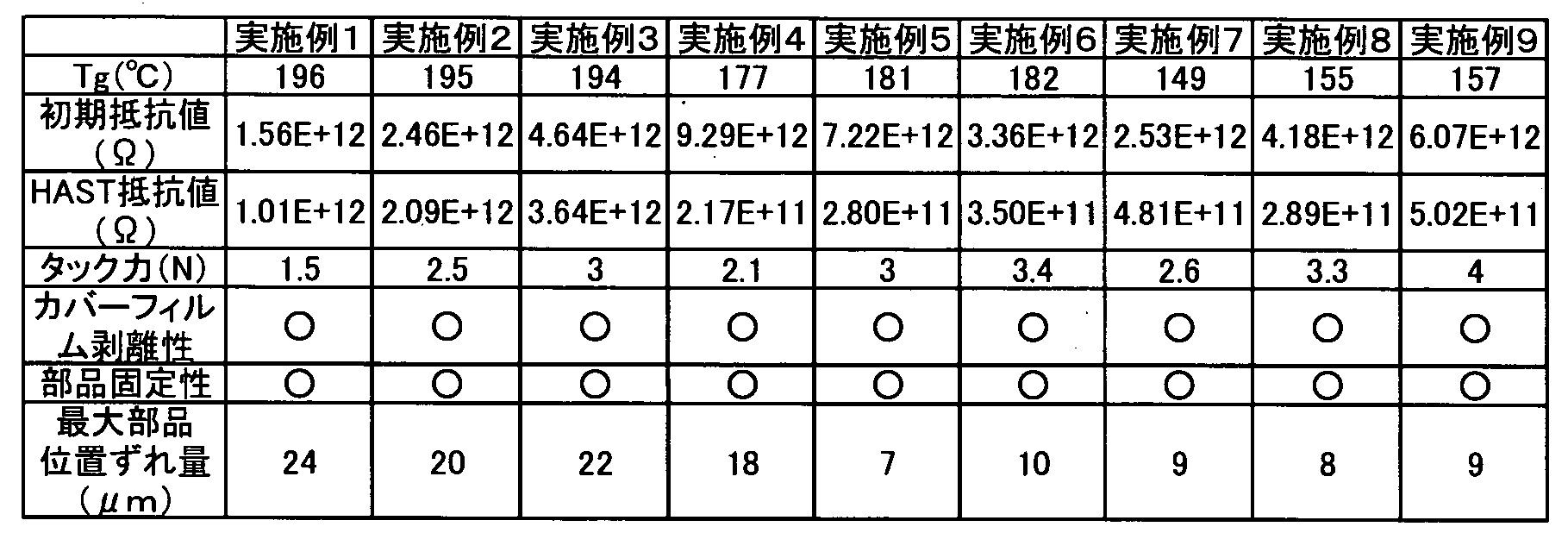
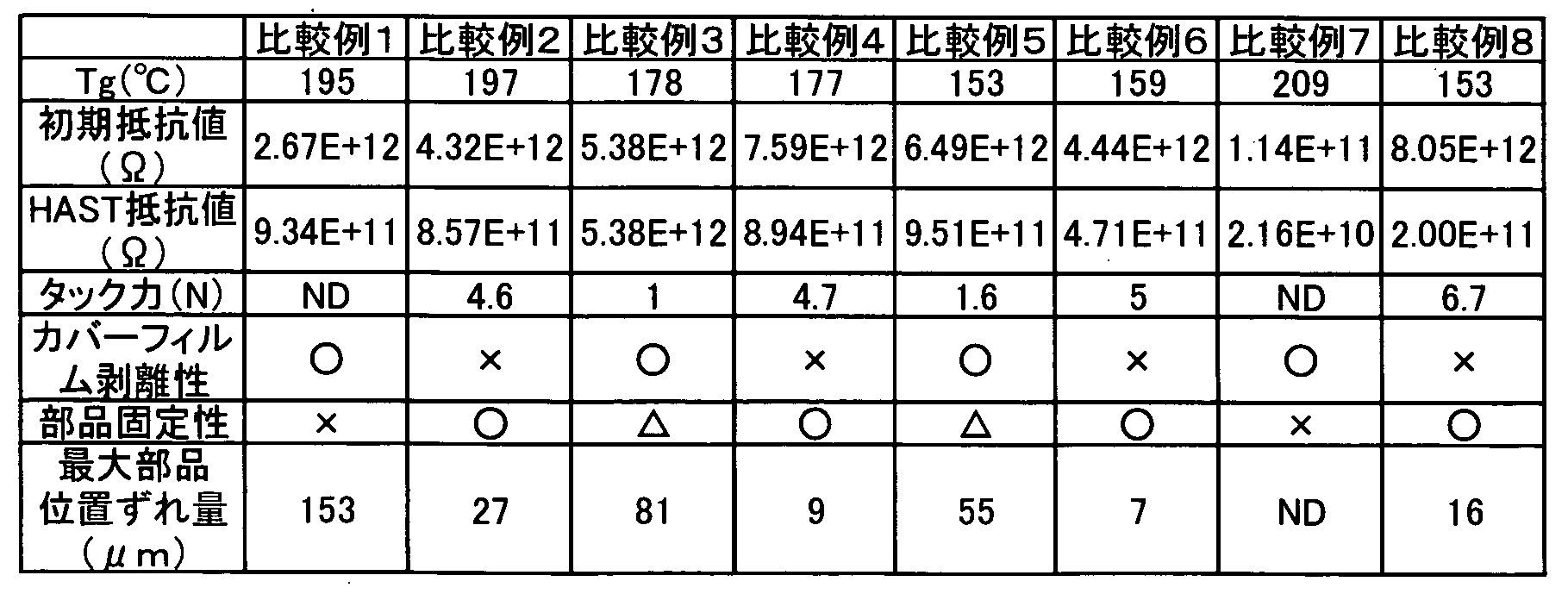
- Tg glass transition temperature
- insulation resistance value measurement insulation resistance value measurement
- tack force measurement 25 ⁇ m release PET (cover film) peelability evaluation
- component fixability evaluation The maximum component position deviation was measured.
- ⁇ Tg (glass transition temperature) measurement> The 25 ⁇ m release PET was peeled off from the adhesive films prepared in Examples and Comparative Examples, and a 200 mm ⁇ 200 mm polyimide film (Ube Industries (Ube Industries, Ltd., manufactured by Nichigo Morton Co., Ltd., “Morton-724”) was peeled off. Co., Ltd., “UPILEX50S”). Vacuum suction was performed for 30 seconds, and thereafter, pressure-resistant rubber was used under the condition of pressing at a pressure of 1 kg / cm 2 for 30 seconds.
- the 38 ⁇ m release PET of the sample prepared above was peeled off, placed in a batch oven, and heated at 180 ° C. for 90 minutes to cure the resin composition layer (adhesive layer).
- the Tg of the cured product was measured with a thermal analyzer (“DMS6100” manufactured by Seiko Instruments Inc.).
- the resistance value of the cured sample was measured and used as the initial resistance value. Subsequently, the sample was left in a HAST tester (“ETAC PM422” manufactured by Enomoto Kasei Co., Ltd.) at 130 ° C. and 85 wt% Rh for 100 hours, and then the resistance value (HAST resistance value) was measured.
- HAST tester (“ETAC PM422” manufactured by Enomoto Kasei Co., Ltd.) at 130 ° C. and 85 wt% Rh for 100 hours, and then the resistance value (HAST resistance value) was measured.
- ⁇ Measurement of tack force> The 25 ⁇ m release PET of the adhesive films prepared in Examples and Comparative Examples was peeled off and attached to a jig dedicated to the apparatus, and the tack force on the resin composition layer (adhesive layer) side was measured.
- the apparatus uses a probe tack tester (TE6002 manufactured by Tester Sangyo Co., Ltd.), a ⁇ 5.05 mm stainless probe, and presses the probe against the adhesive layer surface of the adhesive film at 25 ° C., a load of 1 kgf / cm 2 , and a contact speed of 5 mm / min. Hold for 10 seconds.
- peeling was performed at a peeling speed of 1 mm / min, and the load at that time was measured. This measurement was performed five times, and the average value of the three measured values excluding the maximum value and the minimum value was taken as the tack force. 0.25 N or less was determined as ND within the measurement error.
- the 38 ⁇ m release PET of the sample prepared above was peeled off, and three 1608 chip capacitors were placed on the adhesive film with tweezers.
- vacuum suction is performed for 30 seconds with a batch type vacuum pressure laminator (manufactured by Nichigo Morton Co., Ltd., “Morton-724”), and then 1 kg / cm for 30 seconds at room temperature (25 ° C.) using a pressure-resistant rubber.
- the capacitor was fixed on the adhesive film under the condition of pressing at a pressure of 2 .
- the capacitor fixed on the adhesive film was peeled off in the vertical direction with tweezers, and the trace of the capacitor left on the surface of the adhesive layer was observed. As shown in FIG. 1, if there was a trace on the surface of the adhesive layer in accordance with the shape of the capacitor, the symbol “ ⁇ ” was given.
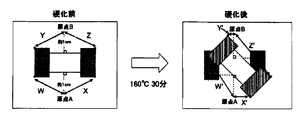
- Measurement of the position of the parts after fixing the parts is performed by determining the origins A and B as shown in FIG. 2 with a length measuring machine (trade name, MF-UD2017B, manufactured by Mitutoyo Corporation). The distance (W, X, Y, Z) was measured from the (corner).
- the sample was cured by placing the sample in a batch oven so that the resin was vertical and heating at 180 ° C. for 30 minutes to cure the resin composition layer (adhesive layer).
- the positions of the parts after curing were measured by measuring the distances (W ′, X ′, Y ′, Z ′) from the origins A and B determined before curing and the corners (four corners) of the parts after curing.
- are component displacement amounts, and the maximum of these four numerical values is the maximum component displacement amount. did. Those in which the part was peeled off from the adhesive layer during curing were determined as ND.
- the adhesive films of the examples have good component fixing properties, a small maximum component positional deviation amount, and good peelability of the cover film (25 ⁇ m release PET).
- the adhesive film of the comparative example is inferior in component fixing property, so the maximum component position shift is large, and when the tack force is too strong, the peelability of the cover film (25 ⁇ m release PET) is lowered. Yes.
Landscapes
- Chemical & Material Sciences (AREA)
- Organic Chemistry (AREA)
- Engineering & Computer Science (AREA)
- Health & Medical Sciences (AREA)
- Chemical Kinetics & Catalysis (AREA)
- Medicinal Chemistry (AREA)
- Polymers & Plastics (AREA)
- Microelectronics & Electronic Packaging (AREA)
- Manufacturing & Machinery (AREA)
- Adhesive Tapes (AREA)
- Adhesives Or Adhesive Processes (AREA)
- Compositions Of Macromolecular Compounds (AREA)
Abstract
Description
[1] 部品内蔵基板の部品固定及び絶縁層形成に用いられる熱硬化性樹脂組成物であって、熱硬化性樹脂組成物の不揮発分を100重量%した場合に、25℃で液状のエポキシ樹脂を25~40重量%、アクリル樹脂を0.1~5重量%、前記フェノール系硬化剤を5~30重量%及び無機フィラーを20~70重量%含有する熱硬化性樹脂組成物。
[2] アクリル樹脂がアクリル酸エステル共重合体である上記[1]記載の熱硬化性樹脂組成物。
[3] アクリル樹脂がアクリル酸メチル、アクリル酸ブチル、アクリロニトリルを含有するアクリル酸エステル共重合体である上記[1]又は[2]に記載の熱硬化性樹脂組成物。
[4]アクリル樹脂がエポキシ基、ヒドロキシル基、カルボキシル基から選択される1種以上の基を含有する上記[1]~[3]に記載の熱硬化性樹脂組成物。
[5]
アクリル樹脂がヒドロキシル基及びカルボキシル基を含有する上記[1]~[4]に記載の熱硬化性樹脂組成物。
[6] 支持体上に、上記[1]~[5]記載の熱硬化性樹脂組成物により形成された接着層を有する、部品内蔵基板の部品固定及び絶縁層形成に用いられる接着フィルム。
[7] 接着層の厚みが5~100μmである上記[6]記載の接着フィルム
[8] 支持体がプラスチックフィルムである、上記[6]又は[7]記載の接着フィルム。
[9] 支持体の接着層側の面が離型処理されている上記[6]~[8]のいずれかに記載の接着フィルム。
[10] 上記[1]~[9]のいずれかに記載の接着フィルムの接着層上に電子部品を固定する工程及び該接着層を熱硬化して絶縁層を形成する工程を含む部品内蔵基板の製造方法。
本発明において「25℃で液状のエポキシ樹脂」は、主として、硬化物の耐熱性及び絶縁性を高めるとともに、熱硬化性樹脂組成物の粘着性に寄与する。25℃で液状のエポキシ樹脂としては、具体的には、ビスフェノールA型エポキシ樹脂、ビスフェノールF型エポキシ樹脂、ノボラックフェノール型エポキシ樹脂、ナフタレン型エポキシ樹脂、ターシャリーブチルカテコール型エポキシ樹脂、ブタジエン構造を有するエポキシ樹脂、脂肪族系グリシジルエーテル、アルコール類のグリシジルエーテル化物、並びにこれらのエポキシ樹脂のハロゲン化物及び水素添加物などがある。これらは1種又は2種以上組み合わせて用いることができる。
本発明において「アクリル樹脂」は、主として、熱硬化性樹脂組成物の粘着性に寄与する。アクリル樹脂としては、ポリアクリル酸、ポリメタクリル酸、ポリアクリル酸エステル、ポリメタクリル酸エステル、ポリアクリル酸エステル共重合体、ポリメタクリル酸エステル共重合体等が挙げられる。またアクリル樹脂は特に粘着性に優れるアクリル酸エステル共重合体が好ましく、さらにアクリル酸メチルエステル共重合体、アクリル酸エチルエステル共重合体が好ましい。共重合化合物としては、アクリル酸メチル、アクリル酸ブチル、酢酸ビニル、アクリロニトリル、アクリルアミド等が挙げられ、なかでもアクリル酸メチル、アクリル酸ブチル、アクリロニトリルが好ましい。またアクリル酸メチルエステル共重合体又はアクリル酸エチルエステル共重合体は、さらにエポキシ基、ヒドロキシ基、カルボキシル基から選択される1種以上の基を含有するのが好ましく、特にヒドロキシル基及び/又はカルボキシル基を含有することが好ましい。これらは1種又は2種以上組み合わせて用いることができる。
本発明において「フェノール系硬化剤」は、主としてエポキシ樹脂の硬化剤として機能する。フェノール系硬化剤としてはフェノール性水酸基を有しエポキシ樹脂の硬化剤として機能すれば特に限定されない。一般には、分子内に2個以上のフェノール性水酸基を有するフェノール化合物が使用され、具体的には、フェノールノボラック樹脂、クレーゾールノボラック樹脂等が挙げられる。市販されているフェノール系硬化剤としては、例えばMEH−7700、MEH−7810、MEH−7851(明和化成(株)製)、NHN、CBN、GPH(日本化薬(株)製)、SN170、SN180、SN190、SN475、SN485、SN495、SN375、SN395(東都化成(株)製)、TD2090、TD2093、KA1160、KA1163、LA7052、LA7054、LA3018、LA1356(大日本インキ化学工業(株)製)等があげられる。「フェノール系硬化剤」は2種以上組み合わせて用いてもよい。
本発明において「無機フィラー」は、主として形成される絶縁層の熱膨張率を低下させる目的で使用される。無機充填材としては、具体的には、シリカ、アルミナ、硫酸バリウム、タルク、クレー、雲母粉、水酸化アルミニウム、水酸化マグネシウム、炭酸カルシウム、炭酸マグネシウム、酸化マグネシウム、窒化ホウ素、ホウ酸アルミニウム、チタン酸バリウム、チタン酸ストロンチウム、チタン酸カルシウム、チタン酸マグネシウム、チタン酸ビスマス、酸化チタン、ジルコン酸バリウム、ジルコン酸カルシウムなどが挙げられ、これらの中でも無定形シリカ、溶融シリカ、結晶シリカ、合成シリカ等のシリカが特に好適である。シリカとしては球状のものが好ましい。これらは1種又は2種以上組み合わせて用いることができる。
本発明の熱硬化性樹脂組成物には、樹脂硬化物の架橋密度の向上に伴う硬化物のTg、破断強度の向上等の目的で、25℃で固形状のエポキシ樹脂を配合してもよい。25℃で固形状のエポキシ樹脂としては、例えば、4官能ナフタレン型エポキシ樹脂、2官能ジシクロペンタジエン型エポキシ樹脂、トリスフェノールエポキシ樹脂など等が挙げられる。市販されているものとしては、大日本インキ化学工業(株)製EXA4700、EXA7200、日本化薬(株)EPPN−502H等が挙げられる。「25℃で固形状のエポキシ樹脂」は2種以上組み合わせて用いてもよい。25℃で固形状のエポキシ樹脂を配合する場合の含有量は、熱硬化性樹脂組成物の不揮発成分を100重量%とした場合、好ましくは30重量%以下であり、好ましくは20重量%以下である。含有量が大きすぎると接着フィルムが常温において脆くなり、ハンドリング性が悪化する。
本発明の熱硬化性樹脂組成物には、硬化後の熱硬化性樹脂組成物に適度な可とう性を付与すること等を目的として、熱可塑性樹脂を配合することができる。かかる熱可塑性樹脂としては、例えば、フェノキシ樹脂、ポリビニルアセタール樹脂、ポリイミド樹脂、ポリアミドイミド樹脂、ポリエーテルスルホン樹脂、ポリスルホン樹脂等が挙げられる。「熱可塑性樹脂」は2種以上組み合わせて用いてもよい。熱硬化性樹脂組成物中の熱可塑性樹脂の含有量は、0.5~60重量%の割合で配合するのが好ましく、3~50重量%の割合で配合するのがより好ましい。
本発明の熱硬化性樹脂組成物には、硬化剤に加え、硬化時間の短縮等の目的で、硬化促進剤をさらに含有させることができる。かかる硬化促進剤としては、例えば、イミダゾール系化合物、有機ホスフィン系化合物等が挙げられ、具体例としては、2−メチルイミダゾール、トリフェニルホスフィン等が挙げられる。これらは1種又は2種以上組み合わせて用いてもよい。硬化促進剤を用いる場合、硬化促進剤はエポキシ樹脂に対して0.1~3.0質量%の範囲で用いるのが好ましい。
本発明の熱硬化性樹脂組成物には、必要に応じてさらに他の成分を含有させることができる。他の成分としては、例えば、有機リン系難燃剤、有機系窒素含有リン化合物、窒素化合物、シリコーン系難燃剤、金属水酸化物等の難燃剤;シリコーンパウダー、ナイロンパウダー、フッ素パウダー等の有機充填剤;オルベン、ベントン等の増粘剤;シリコーン系、フッ素系等の高分子系消泡剤又はレベリング剤;イミダゾール系、チアゾール系、トリアゾール系、シラン系カップリング剤等の密着性付与剤;フタロシアニン・ブルー、フタロシアニン・グリーン、アイオジン・グリーン、ジスアゾイエロー、カーボンブラック等の着色剤等が挙げられる。これらは1種又は2種以上組み合わせて用いてもよい。
ワニスを調製する場合の有機溶剤としては、例えば、アセトン、メチルエチルケトン、シクロヘキサノン等のケトン類、酢酸エチル、酢酸ブチル、セロソルブアセテート、プロピレングリコールモノメチルエーテルアセテート、カルビトールアセテート等の酢酸エステル類、セロソルブ、ブチルカルビトール等のカルビトール類、トルエン、キシレン等の芳香族炭化水素類、ジメチルホルムアミド、ジメチルアセトアミド、N−メチルピロリドン等を挙げることができる。これらは1種又は2種以上組み合わせて用いてもよい。
本発明の接着フィルムは、支持体層、該支持体層上に熱硬化性樹脂組成物により形成された粘着性を有する接着層から構成される。接着層は支持体層の両面に形成されてもよい。
本発明の接着フィルムにより部品内蔵基板を製造する方法は、少なくとも、(A)接着フィルムの接着層上に電子部品を固定する工程、(B)該接着層を熱硬化して絶縁層を形成する工程を含む。本発明の接着フィルムは、部品の固定を強固に行える粘着力を有することを特徴とする。
ビスフェノール型エポキシ樹脂(東都化成(株)製「ZX1059」、エポキシ当量約165)20重量部、エポキシ化ポリブタジエン(ダイセル化学(株)製「PB3600M」、不揮発分80重量%のMEK溶液)8重量部、ナフタレン型4官能エポキシ(大日本インキ(株)製「HP−4700」)14重量部、ノボラック型フェノール樹脂(大日本インキ(株)製「LA7054」、水酸基当量約125、不揮発分60重量%のメチルエチルケトン(以下MEKと略す)溶液)25重量部、球形シリカ((株)アドマテックス製「SO−C4」)40重量部、難燃フィラー(三光(株)製「HCA−HQ」)6重量部、有機フィラー(ガンツ化成(株)製「AC3816N」)3重量部、ブチラール樹脂(積水化学(株)製「BL−1」をトルエンとメタノールを1:1で希釈して不揮発分15%の溶液にしたもの)10重量部、およびアクリル樹脂としてアクリル酸エステル共重合樹脂((株)ナガセケムテックス(株)製「SG−70L」、不揮発分12.5重量%のMEKとトルエンの1.3:1混合溶液)0.85重量部を、石油ナフサ(純正化学(株)製「イプゾール150」)5重量部、およびMEK21重量部とともに混合し、高速回転ミキサーで均一に分散し、熱硬化性樹脂組成物ワニス(樹脂組成物(不揮発分)中の液状エポキシ樹脂25重量%、フェノール系硬化剤14.2重量%、アクリル樹脂0.10重量%)を作製した。次に、かかる樹脂組成物ワニスを、離型処理されたポリエチレンテレフタレートフィルム(厚さ38μm)(リンテック(株)製AL−5)(以下、38μm離型PETと略す)上に、乾燥後の樹脂組成物層(接着層)の厚みが40μmとなるようにバーコーターにて均一に塗布し、65~120℃(平均100℃)で10分間乾燥した(樹脂組成物層中の残留溶媒量:約1重量%)。乾燥後の樹脂組成物層表面に離型処理されたポリエチエレンテレフタレートフィルム(厚さ25μm)(リンテック(株)製AL−5)(以下、25μm離型PETと略す)を貼り合わせて、シート状の3層構造を有する接着フィルムを作製した。
実施例1のビスフェノール型エポキシ樹脂(東都化成(株)製「ZX1059」、エポキシ当量約165)を21重量部に変更し、アクリル酸エステル共重合樹脂(ナガセケムテックス(株)製「SG−70L」、不揮発分12.5重量%のMEKとトルエンの1.3:1混合溶液)を17.2重量部に変更した(樹脂組成物(不揮発分)中の液状エポキシ樹脂25.0重量%、フェノール系硬化剤13.9重量%、アクリル樹脂2重量%)以外は、実施例1と同じ方法により、接着フィルムを得た。
実施例1のビスフェノール型エポキシ樹脂(東都化成(株)製「ZX1059」、エポキシ当量約165)を22重量部に変更し、ナフタレン型4官能エポキシ(大日本インキ(株)製「HP−4700」)を13重量部に変更し、さらにアクリル酸エステル共重合樹脂(ナガセケムテックス(株)製「SG−70L」、不揮発分12.5重量%のMEKとトルエンの1.3:1混合溶液)を44.5重量部に変更した(樹脂組成物(不揮発分)中の液状エポキシ樹脂25.0重量%、フェノール系硬化剤13.5重量%、アクリル樹脂5重量%)以外は、実施例1と同じ方法により、接着フィルムを得た。
実施例1のビスフェノール型エポキシ樹脂(東都化成(株)製「ZX1059」、エポキシ当量約165)を26重量部に変更し、さらにナフタレン型4官能エポキシ(大日本インキ(株)製「HP−4700」)を9重量部に変更した(樹脂組成物(不揮発分)中の液状エポキシ樹脂30重量%、フェノール系硬化剤14.2重量%、アクリル樹脂0.1重量%)以外は、実施例1と同じ方法により、接着フィルムを得た。
実施例1のビスフェノール型エポキシ樹脂(東都化成(株)製「ZX1059」、エポキシ当量約165)を26重量部に変更し、ナフタレン型4官能エポキシ(大日本インキ(株)製「HP−4700」)を8重量部に変更し、さらにアクリル酸エステル共重合樹脂(ナガセケムテックス(株)製「SG−70L」、不揮発分12.5重量%のMEKとトルエンの1.3:1混合溶液)を17.3重量部に変更した(樹脂組成物(不揮発分)中の液状エポキシ樹脂30重量%、フェノール系硬化剤13.9重量%、アクリル樹脂2重量%)以外は、実施例1と同じ方法により、接着フィルムを得た。
実施例1のビスフェノール型エポキシ樹脂(東都化成(株)製「ZX1059」、エポキシ当量約165)を27重量部に変更し、ナフタレン型4官能エポキシ(大日本インキ(株)製「HP−4700」)を7重量部に変更し、さらにアクリル酸エステル共重合樹脂(ナガセケムテックス(株)製「SG−70L」、不揮発分12.5重量%のMEKとトルエンの1.3:1混合溶液)を44.5重量部に変更した(樹脂組成物(不揮発分)中の液状エポキシ樹脂30重量%、フェノール系硬化剤13.5重量%、アクリル樹脂5重量%)以外は、実施例1と同じ方法により、接着フィルムを得た。
実施例1のビスフェノール型エポキシ樹脂(東都化成(株)製「ZX1059」、エポキシ当量約165)を35重量部に変更し、ナフタレン型4官能エポキシ(大日本インキ(株)製「HP−4700」)を除き、球形シリカ((株)アドマテックス製「SO−C4」)を37重量部に変更し、アクリル酸エステル共重合樹脂(ナガセケムテックス(株)製「SG−70L」、不揮発分12.5重量%のMEKとトルエンの1.3:1混合溶液)を0.83重量部に変更し、さらにMEKを5量部に変更した(樹脂組成物(不揮発分)中の液状エポキシ樹脂39.8重量%、フェノール系硬化剤14.5重量%、アクリル樹脂0.1重量%)以外は、実施例1と同じ方法により、接着フィルムを得た。
実施例1のビスフェノール型エポキシ樹脂(東都化成(株)製「ZX1059」、エポキシ当量約165)を35重量部に変更し、ナフタレン型4官能エポキシ(大日本インキ(株)製「HP−4700」)を除き、球形シリカ((株)アドマテックス製「SO−C4」)を35重量部に変更し、さらにアクリル酸エステル共重合樹脂(ナガセケムテックス(株)製「SG−70L」、不揮発分12.5重量%のMEKとトルエンの1.3:1混合溶液)を16.4重量部変更し、さらにMEKを5量部に変更した(樹脂組成物(不揮発分)中の液状エポキシ樹脂39.8重量%、フェノール系硬化剤14.6重量%、アクリル樹脂1.99重量%)以外は、実施例1と同じ方法により、接着フィルムを得た。
実施例1のビスフェノール型エポキシ樹脂(東都化成(株)製「ZX1059」、エポキシ当量約165)を35重量部に変更し、ナフタレン型4官能エポキシ(大日本インキ(株)製「HP−4700」)を除き、球形シリカ((株)アドマテックス製「SO−C4」)を32重量部に変更し、さらにアクリル酸エステル共重合樹脂(ナガセケムテックス(株)製「SG−70L」、不揮発分12.5重量%のMEKとトルエンの1.3:1混合溶液)を41重量部に変更し、さらにMEKを5量部に変更した(樹脂組成物(不揮発分)中の液状エポキシ樹脂40重量%、フェノール系硬化剤14.6重量%、アクリル樹脂4.99重量%)以外は、実施例1と同じ方法により、接着フィルムを得た。
実施例1のアクリル酸エステル共重合樹脂(ナガセケムテックス(株)製「SG−70L」、不揮発分12.5重量%のMEKとトルエンの1.3:1混合溶液)を0.43重量部に変更した(樹脂組成物(不揮発分)中の液状エポキシ樹脂25重量%、フェノール系硬化剤14.2重量%、アクリル樹脂0.05重量%)以外は、実施例1と同じ方法により、接着フィルムを得た。
実施例1のビスフェノール型エポキシ樹脂(東都化成(株)製「ZX1059」、エポキシ当量約165)を22重量部に変更し、ナフタレン型4官能エポキシ(大日本インキ(株)製「HP−4700」)を13重量部に変更し、さらにアクリル酸エステル共重合樹脂(ナガセケムテックス(株)製「SG−70L」、不揮発分12.5重量%のMEKとトルエンの1.3:1混合溶液)を53.9重量部に変更した(樹脂組成物(不揮発分)中の液状エポキシ樹脂25重量%、フェノール系硬化剤13.4重量%、アクリル樹脂6重量%)以外は、実施例1と同じ方法により、接着フィルムを得た。
実施例1のビスフェノール型エポキシ樹脂(東都化成(株)製「ZX1059」、エポキシ当量約165)を26重量部に変更し、ナフタレン型4官能エポキシ(大日本インキ(株)製「HP−4700」)を9重量部に変更し、さらにアクリル酸エステル共重合樹脂(ナガセケムテックス(株)製「SG−70L」、不揮発分12.5重量%のMEKとトルエンの1.3:1混合溶液)を0.43重量部に変更した(樹脂組成物(不揮発分)中の液状エポキシ樹脂30重量%、フェノール系硬化剤14.2重量%、アクリル樹脂0.05重量%)以外は、実施例1と同じ方法により、接着フィルムを得た。
実施例1のビスフェノール型エポキシ樹脂(東都化成(株)製「ZX1059」、エポキシ当量約165)を28重量部に変更し、ナフタレン型4官能エポキシ(大日本インキ(株)製「HP−4700」)を7重量部に変更し、さらにアクリル酸エステル共重合樹脂(ナガセケムテックス(株)製「SG−70L」、不揮発分12.5重量%のMEKとトルエンの1.3:1混合溶液)を54重量部に変更した(樹脂組成物(不揮発分)中の液状エポキシ樹脂30重量%、フェノール系硬化剤13.3重量%、アクリル樹脂6重量%)以外は、実施例1と同じ方法により、接着フィルムを得た。
実施例1のビスフェノール型エポキシ樹脂(東都化成(株)製「ZX1059」、エポキシ当量約165)を35重量部に変更し、ナフタレン型4官能エポキシ(大日本インキ(株)製「HP−4700」)を除き、球形シリカ((株)アドマテックス製「SO−C4」)を37重量部に変更し、さらにアクリル酸エステル共重合樹脂(ナガセケムテックス(株)製「SG−70L」、不揮発分12.5重量%のMEKとトルエンの1.3:1混合溶液)を0.4重量部に変更し、さらにMEKを5量部に変更した(樹脂組成物(不揮発分)中の液状エポキシ樹脂40重量%、フェノール系硬化剤14.6重量%、アクリル樹脂0.05重量%)以外は、実施例1と同じ方法により、接着フィルムを得た。
実施例1のビスフェノール型エポキシ樹脂(東都化成(株)製「ZX1059」、エポキシ当量約165)を35重量部に変更し、ナフタレン型4官能エポキシ(大日本インキ(株)製「HP−4700」)を除き、球形シリカ((株)アドマテックス製「SO−C4」)を30重量部に変更し、さらにアクリル酸エステル共重合樹脂(ナガセケムテックス(株)製「SG−70L」、不揮発分12.5重量%のMEKとトルエンの1.3:1混合溶液)を49.2重量部に変更し、さらにMEKを5量部に変更した(樹脂組成物(不揮発分)中の液状エポキシ樹脂40重量%、フェノール系硬化剤14.6重量%、アクリル樹脂6重量%)以外は、実施例1と同じ方法により、接着フィルムを得た。
実施例1のビスフェノール型エポキシ樹脂(東都化成(株)製「ZX1059」、エポキシ当量約165)を16重量部に変更し、ナフタレン型4官能エポキシ(大日本インキ(株)製「HP−4700」)を19重量部に変更し、さらにアクリル酸エステル共重合樹脂(ナガセケムテックス(株)製「SG−70L」、不揮発分12.5重量%のMEKとトルエンの1.3:1混合溶液)を17.2重量部に変更した(樹脂組成物(不揮発分)中の液状エポキシ樹脂20重量%、フェノール系硬化剤13.9重量%、アクリル樹脂2重量%)以外は、実施例1と同じ方法により、接着フィルムを得た。
実施例1のビスフェノール型エポキシ樹脂(東都化成(株)製「ZX1059」、エポキシ当量約165)を35重量部に変更し、ナフタレン型4官能エポキシ(大日本インキ(株)製「HP−4700」)を除き、球形シリカ((株)アドマテックス製「SO−C4」)を23重量部に変更し、さらにアクリル酸エステル共重合樹脂(ナガセケムテックス(株)製「SG−70L」、不揮発分12.5重量%のMEKとトルエンの1.3:1混合溶液)を14.5重量部に変更し、さらにMEKを5量部に変更した(樹脂組成物(不揮発分)中の液状エポキシ樹脂45重量%、フェノール系硬化剤16.6重量%、アクリル樹脂2重量%)以外は、実施例1と同じ方法により、接着フィルムを得た。
実施例および比較例で作成した接着フィルムから25μm離型PETを剥がし、バッチ式真空加圧ラミネーター(ニチゴーモートン(株)製、「Morton−724」)により、200mm×200mmのポリイミドフィルム(宇部興産(株)製、「UPILEX50S」)にラミネートした。30秒間真空吸引し、その後耐圧ゴムを用いて、30秒間1kg/cm2の圧力でプレスする条件にて行った。上記で作成したサンプルの38μm離型PETをはがし、バッチ式オーブンに入れて180℃、90分間加熱し、樹脂組成物層(接着層)を硬化させた。本硬化物のTgを熱分析装置(セイコーインスツル(株)製、「DMS6100」)により測定した。
実施例および比較例で作成した接着フィルムの25μm離型PETを剥がし、バッチ式真空加圧ラミネーター(ニチゴーモートン(株)製、「Morton−724」)によりL/S=15μm/15μmのTABテープ(三井金属(株)製、「AJ−C0002−30/40」)にラミネートした。ラミネートは、30秒間真空吸引し、その後耐圧ゴムを用いて、30秒間1kg/cm2の圧力でプレスする条件で行った。上記で作成したサンプルの38μm離型PETをはがし、バッチ式オーブンにて180℃、90分間加熱し、樹脂組成物層(接着層)を硬化させた。硬化後のサンプルの抵抗値を測定し、初期抵抗値とした。つづけてHAST試験機(楠本化成(株)製、「ETAC PM422」)に130℃、85重量%Rhの条件下、100時間放置し、その後の抵抗値(HAST抵抗値)を測定した。
実施例および比較例で作製した接着フィルムの25μm離型PETを剥がし、装置専用の冶具に取り付け、樹脂組成物層(接着層)側のタック力を測定した。装置はプローブタックテスター(テスター産業(株)製、TE6002)、φ5.05mmステンレスのプローブを用い、25℃、荷重1kgf/cm2、コンタクトスピード5mm/minでプローブを接着フィルムの接着層面に押し付け、10秒間保持した。その後に剥離スピード1mm/minにて剥離させ、その時の荷重を測定した。この測定を5回行い、最大値と最小値を除いた3測定値の平均値をタック力とした。0.25N以下は測定誤差内としてNDとした。
実施例および比較例で作製した接着フィルムを約10cm角に切り出し、38μmの離型PET側を固定ステージ(減圧によりシートを固定することの出来るステージ)に固定した。次に室温(25℃)で四隅の1箇所の25μm離型PETのみを手でつまみ、接着フィルムに90度の角度で垂直に約5cm引っ張りあげた。25μm離型PETと接着層の間で剥離した場合を○、接着層と38μm離型PETの間で剥離するか、又は接着フィルムが層間で剥離せず固定ステージより剥離した場合を×とした。
実施例および比較例で作製した接着フィルムから25μm離型PETをはがし、バッチ式真空加圧ラミネーター(ニチゴーモートン(株)製、「Morton−724」)により、26mm×76mmのスライドガラス片面にラミネートした。ラミネートは、室温(25℃)で30秒間真空吸引し、その後耐圧ゴムを用いて、30秒間1kg/cm2の圧力でプレスする条件で行った。
部品固定性の評価と同じ方法で部品固定されたスライドグラスを作成し、図2に示される要領でコンデンサーの固定直後および硬化後における位置ずれ量を測定した。
Claims (10)
- 部品内蔵基板の部品固定及び絶縁層形成に用いられる熱硬化性樹脂組成物であって、熱硬化性樹脂組成物の不揮発分を100重量%した場合に、25℃で液状のエポキシ樹脂を25~40重量%、アクリル樹脂を0.1~5重量%、前記フェノール系硬化剤を5~30重量%及び無機フィラーを20~70重量%含有する熱硬化性樹脂組成物。
- アクリル樹脂がアクリル酸エステル共重合体である請求項1記載の熱硬化性樹脂組成物。
- アクリル樹脂がアクリル酸メチル、アクリル酸ブチル、アクリロニトリルを含有するアクリル酸エステル共重合体である請求項1又は2に記載の熱硬化性樹脂組成物。
- アクリル樹脂がエポキシ基、ヒドロキシル基、カルボキシル基から選択される1種以上の基を含有する請求項1~3に記載の熱硬化性樹脂組成物。
- アクリル樹脂がヒドロキシル基及びカルボキシル基を含有する請求項1~4に記載の熱硬化性樹脂組成物。
- 支持体上に、請求項1~5記載の熱硬化性樹脂組成物により形成された接着層を有する、部品内蔵基板の部品固定及び絶縁層形成に用いられる接着フィルム。
- 接着層の厚みが5~100μmである請求項6記載の接着フィルム。
- 支持体がプラスチックフィルムである、請求項6又は7記載の接着フィルム。
- 支持体の接着層側の面が離型処理されている請求項6~8のいずれか1項に記載の接着フィルム。
- 請求項1~9のいずれか1項に記載の接着フィルムの接着層上に電子部品を固定する工程及び該接着層を熱硬化して絶縁層を形成する工程を含む部品内蔵基板の製造方法。
Priority Applications (2)
| Application Number | Priority Date | Filing Date | Title |
|---|---|---|---|
| KR1020117006014A KR101864110B1 (ko) | 2008-10-21 | 2009-10-20 | 열경화성 수지 조성물 |
| JP2010534856A JP5771988B2 (ja) | 2008-10-21 | 2009-10-20 | 熱硬化性樹脂組成物 |
Applications Claiming Priority (2)
| Application Number | Priority Date | Filing Date | Title |
|---|---|---|---|
| JP2008-271166 | 2008-10-21 | ||
| JP2008271166 | 2008-10-21 |
Publications (1)
| Publication Number | Publication Date |
|---|---|
| WO2010047411A1 true WO2010047411A1 (ja) | 2010-04-29 |
Family
ID=42119442
Family Applications (1)
| Application Number | Title | Priority Date | Filing Date |
|---|---|---|---|
| PCT/JP2009/068310 Ceased WO2010047411A1 (ja) | 2008-10-21 | 2009-10-20 | 熱硬化性樹脂組成物 |
Country Status (4)
| Country | Link |
|---|---|
| JP (1) | JP5771988B2 (ja) |
| KR (1) | KR101864110B1 (ja) |
| TW (1) | TWI452083B (ja) |
| WO (1) | WO2010047411A1 (ja) |
Cited By (6)
| Publication number | Priority date | Publication date | Assignee | Title |
|---|---|---|---|---|
| JP2013023511A (ja) * | 2011-07-15 | 2013-02-04 | Dainippon Printing Co Ltd | 熱硬化性樹脂組成物 |
| JP2013213114A (ja) * | 2012-03-30 | 2013-10-17 | Furukawa Electric Co Ltd:The | 封止材用組成物、封止材、及び有機エレクトロルミネッセンス素子 |
| WO2013176224A1 (ja) * | 2012-05-23 | 2013-11-28 | 味の素株式会社 | 多層プリント配線板の製造方法 |
| KR20140145078A (ko) * | 2013-06-12 | 2014-12-22 | 아지노모토 가부시키가이샤 | 수지 조성물 |
| JP2016141757A (ja) * | 2015-02-03 | 2016-08-08 | 日立化成株式会社 | エポキシ樹脂組成物、フィルム状エポキシ樹脂組成物及び電子部品装置 |
| EP4667548A1 (en) * | 2024-06-21 | 2025-12-24 | Denso Corporation | Adherend with adhesive layer, roll-shaped adherend with adhesive layer, and structure |
Families Citing this family (1)
| Publication number | Priority date | Publication date | Assignee | Title |
|---|---|---|---|---|
| KR102466931B1 (ko) * | 2016-11-18 | 2022-11-11 | 쇼와덴코머티리얼즈가부시끼가이샤 | 봉지용 필름 및 그 경화물, 및 전자 장치 |
Citations (3)
| Publication number | Priority date | Publication date | Assignee | Title |
|---|---|---|---|---|
| JPH10183086A (ja) * | 1996-12-24 | 1998-07-07 | Hitachi Chem Co Ltd | 熱伝導性接着剤組成物及び該組成物を用いた熱伝導性接着フィルム |
| JPH10338839A (ja) * | 1997-06-10 | 1998-12-22 | Hitachi Chem Co Ltd | 絶縁層用接着フィルム |
| JP2001049221A (ja) * | 1999-08-05 | 2001-02-20 | Tomoegawa Paper Co Ltd | 電子部品用接着剤組成物及び接着シート |
Family Cites Families (8)
| Publication number | Priority date | Publication date | Assignee | Title |
|---|---|---|---|---|
| JP4885366B2 (ja) | 2000-01-31 | 2012-02-29 | 日本特殊陶業株式会社 | 配線基板の製造方法 |
| JP4535567B2 (ja) * | 2000-06-19 | 2010-09-01 | 日東電工株式会社 | 熱硬化型接着剤組成物及び接着シート類 |
| JP2004296562A (ja) | 2003-03-26 | 2004-10-21 | Sharp Corp | 電子部品内蔵基板及びその製造方法 |
| JP4487883B2 (ja) | 2005-08-03 | 2010-06-23 | パナソニック株式会社 | 電子部品内蔵モジュールの製造方法 |
| ATE534703T1 (de) * | 2005-08-24 | 2011-12-15 | Henkel Kgaa | Epoxidzusammensetzungen mit verbesserter schlagzähigkeit |
| KR20080033687A (ko) * | 2006-10-13 | 2008-04-17 | 바프렉스 주식회사 | 에폭시 수지, 그 제조 방법, 및 상기 에폭시 수지를포함하는 에폭시 수지 조성물 및 이를 주성분으로 하는접착제 |
| KR101023841B1 (ko) * | 2006-12-08 | 2011-03-22 | 주식회사 엘지화학 | 접착제 수지 조성물 및 이를 이용한 다이싱 다이 본딩 필름 |
| KR101056688B1 (ko) * | 2007-01-10 | 2011-08-12 | 주식회사 엘지화학 | 접착제 조성물, 이를 이용한 접착 필름 및 다이싱 다이본딩 필름 |
-
2009
- 2009-10-20 WO PCT/JP2009/068310 patent/WO2010047411A1/ja not_active Ceased
- 2009-10-20 KR KR1020117006014A patent/KR101864110B1/ko not_active Expired - Fee Related
- 2009-10-20 JP JP2010534856A patent/JP5771988B2/ja active Active
- 2009-10-20 TW TW098135436A patent/TWI452083B/zh not_active IP Right Cessation
Patent Citations (3)
| Publication number | Priority date | Publication date | Assignee | Title |
|---|---|---|---|---|
| JPH10183086A (ja) * | 1996-12-24 | 1998-07-07 | Hitachi Chem Co Ltd | 熱伝導性接着剤組成物及び該組成物を用いた熱伝導性接着フィルム |
| JPH10338839A (ja) * | 1997-06-10 | 1998-12-22 | Hitachi Chem Co Ltd | 絶縁層用接着フィルム |
| JP2001049221A (ja) * | 1999-08-05 | 2001-02-20 | Tomoegawa Paper Co Ltd | 電子部品用接着剤組成物及び接着シート |
Cited By (10)
| Publication number | Priority date | Publication date | Assignee | Title |
|---|---|---|---|---|
| JP2013023511A (ja) * | 2011-07-15 | 2013-02-04 | Dainippon Printing Co Ltd | 熱硬化性樹脂組成物 |
| JP2013213114A (ja) * | 2012-03-30 | 2013-10-17 | Furukawa Electric Co Ltd:The | 封止材用組成物、封止材、及び有機エレクトロルミネッセンス素子 |
| WO2013176224A1 (ja) * | 2012-05-23 | 2013-11-28 | 味の素株式会社 | 多層プリント配線板の製造方法 |
| JPWO2013176224A1 (ja) * | 2012-05-23 | 2016-01-14 | 味の素株式会社 | 多層プリント配線板の製造方法 |
| KR20140145078A (ko) * | 2013-06-12 | 2014-12-22 | 아지노모토 가부시키가이샤 | 수지 조성물 |
| JP2019011475A (ja) * | 2013-06-12 | 2019-01-24 | 味の素株式会社 | 樹脂組成物 |
| KR102186661B1 (ko) * | 2013-06-12 | 2020-12-07 | 아지노모토 가부시키가이샤 | 수지 조성물 |
| JP7060478B2 (ja) | 2013-06-12 | 2022-04-26 | 味の素株式会社 | 樹脂組成物 |
| JP2016141757A (ja) * | 2015-02-03 | 2016-08-08 | 日立化成株式会社 | エポキシ樹脂組成物、フィルム状エポキシ樹脂組成物及び電子部品装置 |
| EP4667548A1 (en) * | 2024-06-21 | 2025-12-24 | Denso Corporation | Adherend with adhesive layer, roll-shaped adherend with adhesive layer, and structure |
Also Published As
| Publication number | Publication date |
|---|---|
| JPWO2010047411A1 (ja) | 2012-03-22 |
| TW201030083A (en) | 2010-08-16 |
| JP5771988B2 (ja) | 2015-09-02 |
| TWI452083B (zh) | 2014-09-11 |
| KR101864110B1 (ko) | 2018-06-05 |
| KR20110085969A (ko) | 2011-07-27 |
Similar Documents
| Publication | Publication Date | Title |
|---|---|---|
| JP6267140B2 (ja) | 樹脂組成物 | |
| TWI718258B (zh) | 樹脂薄片 | |
| TW201904759A (zh) | 樹脂組成物 | |
| JP5771988B2 (ja) | 熱硬化性樹脂組成物 | |
| CN107129589B (zh) | 带支撑体的树脂片 | |
| JP5446866B2 (ja) | エポキシ樹脂組成物 | |
| KR20170100434A (ko) | 지지체 부착 수지 시트 | |
| KR20140104909A (ko) | 부품 내장 배선 기판의 제조 방법 및 반도체 장치 | |
| KR102308969B1 (ko) | 부품 밀봉용 필름의 제조 방법 | |
| KR20140146542A (ko) | 부품 내장 배선 기판의 제조 방법, 및 반도체 장치 | |
| JP2017059779A (ja) | プリント配線板の製造方法 | |
| CN110016203A (zh) | 树脂组合物 | |
| KR102511657B1 (ko) | 지지체 부착 수지 시트 | |
| JP2015034300A (ja) | 樹脂組成物 | |
| JP2017036423A (ja) | 熱硬化性樹脂組成物 | |
| JP6269401B2 (ja) | 表面処理無機充填材、該無機充填材の製造方法、および該無機充填材を含有する樹脂組成物 | |
| CN101637070A (zh) | 带基材绝缘片、多层印刷布线板、半导体装置和多层印刷布线板的制造方法 | |
| TW202028009A (zh) | 積層電路板之製造方法 | |
| JP6582807B2 (ja) | 樹脂シートの製造方法 | |
| JP2018101703A (ja) | プリント配線板の製造方法 | |
| KR101203156B1 (ko) | 에폭시 수지 조성물, 이를 이용하여 제조된 접착필름 및 다층 프린트 배선판 | |
| JP2010087013A (ja) | 層間絶縁シート、ビルドアップ型多層基板および回路基板の製造方法 | |
| JP2024010670A (ja) | 硬化性樹脂組成物、硬化性フィルム、及び、積層フィルム | |
| WO2024014435A1 (ja) | 硬化性樹脂組成物、硬化性フィルム、及び、積層フィルム | |
| JP2022111097A (ja) | プリント配線板の製造方法 |
Legal Events
| Date | Code | Title | Description |
|---|---|---|---|
| 121 | Ep: the epo has been informed by wipo that ep was designated in this application |
Ref document number: 09822105 Country of ref document: EP Kind code of ref document: A1 |
|
| ENP | Entry into the national phase |
Ref document number: 20117006014 Country of ref document: KR Kind code of ref document: A |
|
| ENP | Entry into the national phase |
Ref document number: 2010534856 Country of ref document: JP Kind code of ref document: A |
|
| NENP | Non-entry into the national phase |
Ref country code: DE |
|
| 122 | Ep: pct application non-entry in european phase |
Ref document number: 09822105 Country of ref document: EP Kind code of ref document: A1 |