WO2010041708A1 - 熱伝導性湿気硬化型樹脂組成物 - Google Patents
熱伝導性湿気硬化型樹脂組成物 Download PDFInfo
- Publication number
- WO2010041708A1 WO2010041708A1 PCT/JP2009/067541 JP2009067541W WO2010041708A1 WO 2010041708 A1 WO2010041708 A1 WO 2010041708A1 JP 2009067541 W JP2009067541 W JP 2009067541W WO 2010041708 A1 WO2010041708 A1 WO 2010041708A1
- Authority
- WO
- WIPO (PCT)
- Prior art keywords
- heat
- composition
- electronic component
- component
- polypropylene glycol
- Prior art date
- Legal status (The legal status is an assumption and is not a legal conclusion. Google has not performed a legal analysis and makes no representation as to the accuracy of the status listed.)
- Ceased
Links
Classifications
-
- C—CHEMISTRY; METALLURGY
- C08—ORGANIC MACROMOLECULAR COMPOUNDS; THEIR PREPARATION OR CHEMICAL WORKING-UP; COMPOSITIONS BASED THEREON
- C08G—MACROMOLECULAR COMPOUNDS OBTAINED OTHERWISE THAN BY REACTIONS ONLY INVOLVING UNSATURATED CARBON-TO-CARBON BONDS
- C08G65/00—Macromolecular compounds obtained by reactions forming an ether link in the main chain of the macromolecule
- C08G65/02—Macromolecular compounds obtained by reactions forming an ether link in the main chain of the macromolecule from cyclic ethers by opening of the heterocyclic ring
- C08G65/32—Polymers modified by chemical after-treatment
- C08G65/329—Polymers modified by chemical after-treatment with organic compounds
- C08G65/336—Polymers modified by chemical after-treatment with organic compounds containing silicon
-
- C—CHEMISTRY; METALLURGY
- C08—ORGANIC MACROMOLECULAR COMPOUNDS; THEIR PREPARATION OR CHEMICAL WORKING-UP; COMPOSITIONS BASED THEREON
- C08L—COMPOSITIONS OF MACROMOLECULAR COMPOUNDS
- C08L71/00—Compositions of polyethers obtained by reactions forming an ether link in the main chain; Compositions of derivatives of such polymers
- C08L71/02—Polyalkylene oxides
-
- C—CHEMISTRY; METALLURGY
- C09—DYES; PAINTS; POLISHES; NATURAL RESINS; ADHESIVES; COMPOSITIONS NOT OTHERWISE PROVIDED FOR; APPLICATIONS OF MATERIALS NOT OTHERWISE PROVIDED FOR
- C09J—ADHESIVES; NON-MECHANICAL ASPECTS OF ADHESIVE PROCESSES IN GENERAL; ADHESIVE PROCESSES NOT PROVIDED FOR ELSEWHERE; USE OF MATERIALS AS ADHESIVES
- C09J171/00—Adhesives based on polyethers obtained by reactions forming an ether link in the main chain; Adhesives based on derivatives of such polymers
- C09J171/02—Polyalkylene oxides
-
- C—CHEMISTRY; METALLURGY
- C08—ORGANIC MACROMOLECULAR COMPOUNDS; THEIR PREPARATION OR CHEMICAL WORKING-UP; COMPOSITIONS BASED THEREON
- C08K—Use of inorganic or non-macromolecular organic substances as compounding ingredients
- C08K3/00—Use of inorganic substances as compounding ingredients
- C08K3/18—Oxygen-containing compounds, e.g. metal carbonyls
- C08K3/20—Oxides; Hydroxides
- C08K3/22—Oxides; Hydroxides of metals
-
- C—CHEMISTRY; METALLURGY
- C08—ORGANIC MACROMOLECULAR COMPOUNDS; THEIR PREPARATION OR CHEMICAL WORKING-UP; COMPOSITIONS BASED THEREON
- C08K—Use of inorganic or non-macromolecular organic substances as compounding ingredients
- C08K5/00—Use of organic ingredients
- C08K5/54—Silicon-containing compounds
Definitions
- the present invention relates to a moisture curable resin composition having thermal conductivity, and a heat dissipation method for dissipating the generated heat to the outside.
- heat dissipation material is introduced between the heat generating electronic component and the heat sink, or between the heat generating electronic component and the metal heat transfer plate, and the heat generated from the electronic component is transferred to other members. In general, it is not stored in electronic parts.
- this heat radiation material heat radiation grease, a heat conductive sheet, a heat conductive adhesive, or the like is used.
- the heat conductive adhesive Since the heat conductive adhesive is curable, it does not evaporate or the liquid component flows to contaminate the electronic component. However, stress is applied to the electronic component during curing, and the position of the electronic component may be shifted. Moreover, the operation
- JP-A-3-162493 Japanese Patent Laid-Open No. 2005-60594 JP 2000-273426 A JP 2002-363429 A JP 2002-36312 A
- thermally conductive adhesive has uncured portions, so there remains anxiety in adhesiveness, and in order to make the inside uncured, it is necessary to use a small amount of curing catalyst, resulting in a curing time. There is a problem that it takes.
- the present invention provides a composition having high adhesiveness and fast curability in order to solve the above-mentioned problems.
- the present invention (A) polypropylene glycol having a hydrolyzable silyl group at one end of the molecular chain, A composition comprising (B) a condensation curing catalyst and (C) a thermally conductive filler is provided.
- the present invention (A) polypropylene glycol having a hydrolyzable silyl group at one end of the molecular chain, (B) a condensation curing catalyst, and (C) a thermally conductive filler, wherein the blending amount of component (B) is 0.01 to 10% by mass with respect to the blending amount of component (A);
- the composition of component (C) is preferably 60 to 95% by mass based on the total composition, and further preferably (D) a composition containing a silane coupling agent.
- a composition containing a carbon material is preferred.
- the present invention provides a heat conductive moisture curable adhesive comprising the composition, and also provides the cured body of the composition.
- the present invention also provides a heat dissipation method for dissipating heat generated from an electronic component to the outside by applying the composition to the electronic component that generates heat.
- composition of the present invention has high adhesiveness and fast curability.
- (A) polypropylene glycol having a hydrolyzable silyl group at one end of a molecular chain used in the present invention at least one hydrolyzable group is bonded to a silicon atom.
- the hydrolyzable group include a carboxyl group, a ketoxime group, an alkoxy group, an alkenoxy group, an amino group, an aminoxy group, and an amide group (for example, “S-1000” manufactured by Asahi Glass Co., Ltd.).
- the curing catalyst used in the present invention is not particularly limited, and includes a compound that accelerates the condensation reaction of polypropylene glycol having the hydrolyzable silyl group.
- the curing catalyst for the component (B) can be used without limitation as long as it is a silanol compound condensation catalyst.
- titanates such as tetrabutyl titanate and tetrapropyl titanate; dibutyltin dilaurate, dibutyltin maleate, dibutyl Organotin compounds such as tin diacetate, tin octylate, tin naphthenate, reaction product of dibutyltin and normal ethyl silicate: organic bismuth compounds such as lead octylate, bismuth octylate, vanadyl triethoxide, butylamine, Octylamine, laurylamine, dibutylamine, monoethanolamine, diethanolamine, triethanolamine, diethylenetriamine, triethylenetetramine, oleylamine, cyclohexylamine, benzylamine, diethylaminopropylamine, xylyl Diamine, triethylenediamine, guanidine, diphenylguanidine, 2,4,6-tris (dimethyla)
- Amine compounds or salts thereof with carboxylic acids, etc . low molecular weight polyamide resins obtained from excess polyamines and polybasic acids; known silanol condensation catalysts such as reaction products of excess polyamines and epoxy compounds It is done.
- an organic tin compound and / or an organic bismuth compound are preferably used from the viewpoint of reaction promotion.
- the (C) thermally conductive filler used in the present invention is not particularly limited as long as it is a filler having high thermal conductivity such as alumina such as aluminum oxide, aluminum powder, zinc oxide, aluminum nitride, boron nitride, carbon fiber and the like.
- the shape of the thermally conductive filler may be any shape such as a spherical shape or a crushed shape, and has an average particle size of about 0.1 to 100 ⁇ m. Among these, from the viewpoint of viscosity, a thermally conductive filler having an average particle diameter of 1 to 40 ⁇ m is preferably used.
- the compounding amount of the component (B) is preferably 0.01 to 10% by mass, and more preferably 0.1 to 5% by mass with respect to the compounding amount of the component (A). If the blending amount of the component (B) is 0.01% by mass or more, the effect of accelerating curing can be surely obtained, and if it is 10% by mass or less, a sufficient curing rate can be obtained.
- the blending amount of the component (C) is preferably 60 to 95% by mass, more preferably 70 to 90% by mass with respect to the entire composition.
- the blending amount of the component (C) is 60% by mass or more, sufficient heat conduction performance is obtained, and when it is 95% by mass or less, the adhesion between the electronic component and the heat dissipation material is improved.
- the (D) silane coupling agent used in the present invention is blended to improve adhesiveness, curability and stability, and may be a known silane coupling agent.
- silane coupling agents vinyltrimethoxysilane, vinyltriethoxysilane, vinyltrichlorosilane, 3-glycidoxypropylmethyldimethoxysilane, 3-glycidoxypropyltrimethoxysilane, 3-glycidoxysilyltriethoxysilane N-2- (aminoethyl) -3-aminopropyltrimethoxysilane, N-2- (aminoethyl) -3-aminopropylmethyldimethoxysilane, N-2- (aminoethyl) -3-aminopropylmethyltri Methoxysilane, N-2- (aminoethyl) -3-aminopropylmethyltriethoxysilane, 3-aminopropyltrimethoxysilane,
- Species or a combination of two or more can be used.
- vinyltrimethoxysilane is used from the viewpoint of stabilizer, and 3-glycidoxypropylmethyltrimethoxysilane, N-2- (aminoethyl) -3-aminopropyl is used from the viewpoint of adhesiveness and curability.
- Trimethoxysilane is preferably used.
- the compounding amount of the component (D) is preferably 0.1 to 10% by mass and more preferably 1 to 5% by mass with respect to the compounding amount of the component (A).
- (D) Sufficient storage stability will be acquired if the compounding quantity of a component is 0.1 mass% or more, and sclerosis
- the carbon material used in the present invention is blended for improving thermal conductivity, and may be a known carbon material.
- Examples of the carbon material include carbon fibers such as ketjen black and lahima.
- the compounding amount of the component (E) is preferably 1 to 10% by mass and more preferably 2 to 7% by mass with respect to the compounding amount of the component (A).
- the blending amount of the component (E) is 2% by mass or more, a sufficient effect of improving thermal conductivity is obtained, and when it is 7% by mass or less, an increase in viscosity is suppressed.
- an organic solvent an antioxidant, a flame retardant, a plasticizer, a thixotropic agent, and the like can be further used as additives.
- composition of the present invention can be cured by moisture in the air.
- composition of the present invention is applied to laser diodes used in precision devices such as arithmetic circuits such as CUP and MPU and optical pickup modules, and is disposed between heat radiating materials such as metal heat transfer plates.
- Example 1 100 g of polypropylene glycol having a methoxysilyl group at one end (base polymer at one end), 6 g of a reaction product of dibutyltin and normal ethyl silicate (Neostan U700), 1010 g of aluminum oxide (average particle size 25 ⁇ m), 6 g of vinyltrimethoxysilane Were mixed to prepare a heat conductive resin composition.
- Example 2 100 g of polypropylene glycol having a methoxysilyl group at one end, 1 g of a reaction product of dibutyltin and normal ethyl silicate, 1400 g of aluminum oxide (average particle size 25 ⁇ m), 150 g of aluminum nitride (average particle size 20 ⁇ m), 3-glycidoxy
- a heat conductive resin composition was prepared by mixing 6 g of propylmethyltrimethoxysilane.
- Example 3 100 g of polypropylene glycol having a methoxysilyl group at one end, 2 g of bismuth octylate (Bucat B7), 1000 g of aluminum oxide (average particle size 25 ⁇ m), 80 g of aluminum nitride (average particle size 20 ⁇ m), 40 g of boron nitride (average particle size 13 ⁇ m) Then, 6 g of vinyltrimethoxysilane was mixed to prepare a heat conductive resin composition.
- Bucat B7 bismuth octylate
- Al oxide average particle size 25 ⁇ m
- 80 g of aluminum nitride average particle size 20 ⁇ m
- 40 g of boron nitride average particle size 13 ⁇ m
- Example 4 100 g of polypropylene glycol having a methoxysilyl group at one end, 2 g of a reaction product of dibutyltin and normal ethyl silicate, 700 g of aluminum oxide (average particle size 25 ⁇ m), 400 g of aluminum nitride (average particle size 20 ⁇ m), 30 g of boron nitride (average) A particle size of 13 ⁇ m) and 6 g of vinyltrimethoxysilane were mixed to prepare a heat conductive resin composition.
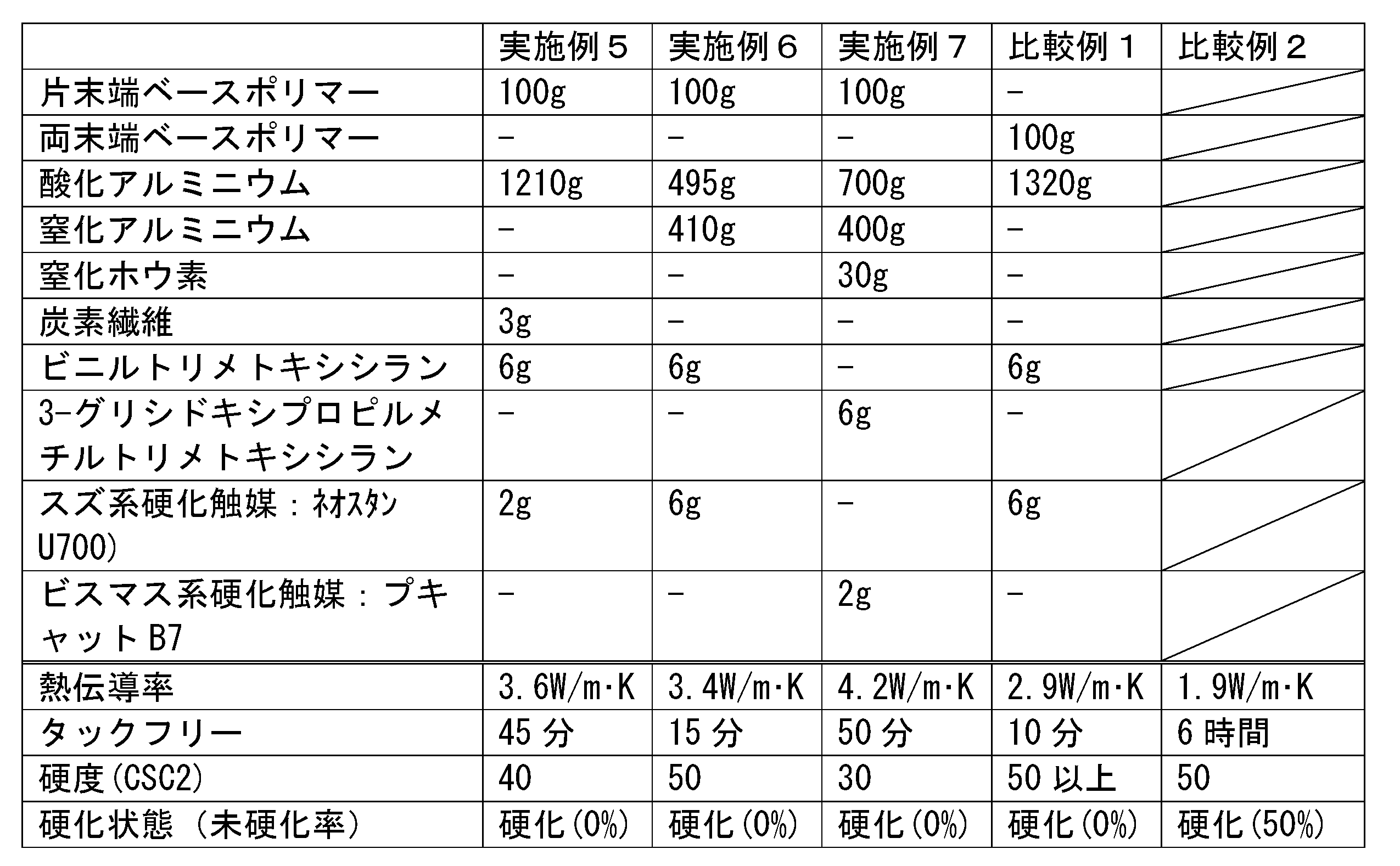
- Example 5 100 g of polypropylene glycol having a methoxysilyl group at one end, 2 g of a reaction product of dibutyltin and normal ethyl silicate, 1210 g of aluminum oxide (average particle size 25 ⁇ m), 3 g of carbon fiber (Ketjen black), 6 g of vinyltrimethoxysilane A heat conductive resin composition was prepared by mixing.
- Example 6 100 g of polypropylene glycol having a methoxysilyl group at one end, 6 g of a reaction product of dibutyltin and normal ethyl silicate, 495 g of aluminum oxide (average particle size 25 ⁇ m), 410 g of aluminum nitride (average particle size 20 ⁇ m), 6 g of vinyltrimethoxysilane Were mixed to prepare a heat conductive resin composition.
- Example 7 100 g of polypropylene glycol having a methoxysilyl group at one end, 2 g of bismuth octylate, 700 g of aluminum oxide (average particle size 25 ⁇ m), 400 g of aluminum nitride (average particle size 20 ⁇ m), 30 g of boron nitride (average particle size 13 ⁇ m) 3-glycid
- a thermally conductive resin composition was prepared by mixing 6 g of xyloxymethyltrimethoxysilane.
- Average particle size evaluation The average particle diameter was measured by a laser diffraction / scattering method using “SALD-2200 manufactured by Shimadzu Corporation”.
- the thermal conductivity represents the ease of heat transfer in the material, and is desired to be large.
- the thermal conductivity of each composition obtained above was evaluated. Thermal conductivity was measured at 25 ° C. by a laser flash method using “LFA447 manufactured by NETZSCH”. As a result, the thermal conductivity was 2.1 W / m ⁇ K in Example 1, 5.1 W / m ⁇ K in Example 2, 4.2 W / m ⁇ K in Example 3, and 4. W in Example 4.
- the tack-free time is one guideline for workability and curability. If the tack-free time is too long, the productivity is lowered, and if the tack-free time is too short, curing starts during the work and causes defects.
- the range of tack-free time required depending on the work situation varies, but 10 to 60 minutes, more preferably 13 to 40 minutes is considered preferable from the viewpoint of workability.
- the composition obtained above was exposed by pouring into a mold having a width of 20 mm, a length of 20 mm, and a thickness of 5 mm in an atmosphere of 23 ° C. and 50% RH. The time from pouring until it did not adhere to the finger was defined as the tack-free time.
- the tack-free time is 15 minutes in Example 1, 30 minutes in Example 2, 30 minutes in Example 3, 40 minutes in Example 4, 45 minutes in Example 5, 15 minutes in Example 6, It was 50 minutes in Example 7, 10 minutes in Comparative Example 1, and 6 hours in Comparative Example 2.
- the thermally conductive moisture curable resin composition of the present invention has high thermal conductivity, flexibility after curing, and quick curing, and is optimal as a heat dissipation medium for electronic components fixed with high precision.
- the composition of the present invention has high productivity because its curing rate is improved.
- the composition of the present invention exhibits a softness that is so soft that almost no stress is applied to the electronic component during curing.
Landscapes
- Chemical & Material Sciences (AREA)
- Chemical Kinetics & Catalysis (AREA)
- Organic Chemistry (AREA)
- Health & Medical Sciences (AREA)
- Medicinal Chemistry (AREA)
- Polymers & Plastics (AREA)
- General Chemical & Material Sciences (AREA)
- Compositions Of Macromolecular Compounds (AREA)
- Paints Or Removers (AREA)
- Adhesives Or Adhesive Processes (AREA)
Abstract
本発明の課題は、高い接着性および速硬化性を有する熱伝導性湿気硬化型樹脂組成物の提供である。 本発明の組成物は、(A)分子鎖片末端に加水分解性シリル基を有するポリプロピレングリコール、(B)縮合硬化触媒、(C)熱伝導性フィラーを含有する。該組成物はさらに(D)シランカップリング剤を含有することが好ましく、(C)熱伝導性フィラーがアルミナであることが好ましい。本発明は、該組成物からなる熱伝導性湿気硬化型接着剤、および該組成物の硬化体も提供し、該組成物を発熱する電子部品に塗布することにより、電子部品から発生した熱を外部へ放熱させる放熱方法も提供する。
Description
本発明は、熱伝導性を有する湿気硬化型樹脂組成物、及び発熱した熱を外部へ放熱させる放熱方法に関する。
近年、電子部品の集積化、高密度化、高性能化に伴い、電子部品自身の発熱量が大きくなってきている。発熱量の増加は、電子部品の性能の著しい低下、もしくは故障の原因となることから、電子部品の効率的な放熱は重要な技術である。
電子部品の放熱方法として、発熱する電子部品と放熱器との間や、発熱する電子部品と金属製伝熱板との間に放熱材を導入し、電子部品から発生する熱を他の部材に伝え、電子部品に蓄積させないことが一般的である。この放熱材としては、放熱グリース、熱伝導性シート、熱伝導性接着剤等が用いられている。
放熱グリースを用いた場合、発熱量が多量であるため、グリース成分が蒸発してしまったり、グリースと熱伝導性フィラーが分離してしまったりする。蒸発成分が電子部品に悪影響を及ぼすおそれがあるため、放熱グリースの使用は好ましくない。また、フィラーから分離したグリースが流れ、電子部品を汚染するおそれもある(特許文献1参照)。
また、熱伝導性シートを用いると、成分の流出の問題は解決するが、電子部品および放熱器等が固体のシートを押し付けられるため、両者間の密着性に不安が残る(特許文献2参照)。
熱伝導性接着剤は硬化性であるため、蒸発したり、液状成分が流れたりして、電子部品を汚染することがない。しかし、硬化の際に電子部品に応力がかかり、電子部品の位置がずれてしまう恐れがある。また、接着した物を取り外す作業は困難であり、さらに電子部品を破壊してしまうおそれがある(特許文献3参照)。
そこで、電子部品と放熱材との間において、表面部分のみが硬化し内部に未硬化部分が残る熱伝導性接着剤を用いることが提案された。この熱伝導性接着剤によれば、電子部品と放熱材との密着性が大きい一方、未硬化部分があるので電子部品と放熱材との間の応力をなくすことができ、また取り外し作業が容易である(特許文献4,5)。
しかしながら、前述の熱伝導性接着剤には、未硬化部分が存在するため接着性に不安が残り、かつ内部を未硬化にするために硬化触媒を少量にする必要があり、その結果、硬化時間がかかるといった課題がある。
本発明は、上記課題を解決するため、高い接着性および速硬化性を有する組成物を提供するものである。
本発明は、
(A)分子鎖片末端に加水分解性シリル基を有するポリプロピレングリコール、
(B)縮合硬化触媒、および
(C)熱伝導性フィラー
を含有する組成物を提供する。
本発明は、
(A)分子鎖片末端に加水分解性シリル基を有するポリプロピレングリコール、
(B)縮合硬化触媒、および
(C)熱伝導性フィラー
を含有してなり、(B)成分の配合量が(A)成分の配合量に対して0.01~10質量%であり、(C)成分の配合量が組成物全体に対して60~95質量%である組成物であることが好ましく、さらに(D)シランカップリング剤を含有する組成物であることが好ましく、さらに(E)炭素物質を含有する組成物であることが好ましい。
本発明は、該組成物からなる熱伝導性湿気硬化型接着剤を提供し、該組成物の該硬化体も提供する。
本発明は、該組成物を発熱する電子部品に塗布することにより、電子部品から発生した熱を外部へ放熱させる放熱方法も提供する。
(A)分子鎖片末端に加水分解性シリル基を有するポリプロピレングリコール、
(B)縮合硬化触媒、および
(C)熱伝導性フィラー
を含有する組成物を提供する。
本発明は、
(A)分子鎖片末端に加水分解性シリル基を有するポリプロピレングリコール、
(B)縮合硬化触媒、および
(C)熱伝導性フィラー
を含有してなり、(B)成分の配合量が(A)成分の配合量に対して0.01~10質量%であり、(C)成分の配合量が組成物全体に対して60~95質量%である組成物であることが好ましく、さらに(D)シランカップリング剤を含有する組成物であることが好ましく、さらに(E)炭素物質を含有する組成物であることが好ましい。
本発明は、該組成物からなる熱伝導性湿気硬化型接着剤を提供し、該組成物の該硬化体も提供する。
本発明は、該組成物を発熱する電子部品に塗布することにより、電子部品から発生した熱を外部へ放熱させる放熱方法も提供する。
本発明の組成物は、高い接着性および速硬化性を有する。
本発明で使用する(A)分子鎖片末端に加水分解性シリル基を有するポリプロピレングリコールでは、ケイ素原子に少なくとも一個の加水分解性基が結合している。加水分解性基としては、カルボキシル基、ケトオキシム基、アルコキシ基、アルケノキシ基、アミノ基、アミノキシ基、アミド基等が挙げられる(例えば、旭硝子社製「S-1000」)。
本発明で使用される(B)硬化触媒は、特に限定されず、前記加水分解性シリル基を有するポリプロピレングリコールの縮合反応を促進する化合物を含む。前記(B)成分の硬化触媒としては、シラノール化合物の縮合触媒であれば制限なく用いられるが、例えば、テトラブチルチタネート、テトラプロピルチタネート等のチタン酸エステル類;ジブチル錫ジラウレート、ジブチル錫マレエート、ジブチル錫ジアセテート、オクチル酸錫、ナフテン酸錫、ジブチル錫と正ケイ酸エチルとの反応物等の有機錫化合物:オクチル酸鉛、オクチル酸ビスマス等の有機ビスマス化合物、バナジルトリエトキシド、;ブチルアミン、オクチルアミン、ラウリルアミン、ジブチルアミン、モノエタノールアミン、ジエタノールアミン、トリエタノールアミン、ジエチレントリアミン、トリエチレンテトラミン、オレイルアミン、シクロヘキシルアミン、ベンジルアミン、ジエチルアミノプロピルアミン、キシリレンジアミン、トリエチレンジアミン、グアニジン、ジフェニルグアニジン、2,4,6-トリス(ジメチルアミノメチル)フェノール、モルホリン、N-メチルモルホリン、1,8-ジアザビシクロ(5.4.0)ウンデセン-7(DBU)等のアミン系化合物又はこれらとカルボン酸等との塩;過剰のポリアミンと多塩基酸とから得られる低分子量ポリアミド樹脂;過剰のポリアミンとエポキシ化合物との反応生成物等の公知のシラノール縮合触媒が挙げられる。これらの中で、反応促進性の観点から、有機錫化合物及び/又は有機ビスマス化合物が好ましく用いられる。
本発明で使用される(C)熱伝導性フィラーは、酸化アルミニウム等のアルミナやアルミニウム粉、酸化亜鉛、窒化アルミニウム、窒化ホウ素、炭素繊維等の熱伝導性が高いフィラーであれば、特に限定されない。また、熱伝導性フィラーの形状は球状、破砕状等の任意の形状であってよく、0.1~100μm程度の平均粒径を有する。これらの中で、粘度の観点から、平均粒径1~40μmの熱伝導性フィラーが好ましく用いられる。
(B)成分の配合量は、(A)成分の配合量に対して0.01~10質量%であることが好ましく、0.1~5質量%であることがより好ましい。(B)成分の配合量が0.01質量%以上であれば、硬化促進の効果が確実に得られるし、10質量%以下であれば、充分な硬化速度を得ることができる。
(C)成分の配合量は組成物全体に対して60~95質量%が好ましく、より好ましくは70~90質量%である。(C)成分の配合量が60質量%以上であれば、充分な熱伝導性能が得られ、95質量%以下であれば、電子部品と放熱材との接着性が良化する。
本発明で使用する(D)シランカップリング剤は、接着性、硬化性、安定性を向上するために配合されるものであり、公知のシランカップリング剤であってよい。シランカップリング剤としては、ビニルトリメトキシシラン、ビニルトリエトキシシラン、ビニルトリクロロシラン、3-グリシドキシプロピルメチルジメトキシシラン、3-グリシドキシプロピルトリメトキシシラン、3-グリシドキシシリルトリエトキシシラン、N-2-(アミノエチル)-3-アミノプロピルトリメトキシシラン、N-2-(アミノエチル)-3-アミノプロピルメチルジメトキシシラン、N-2-(アミノエチル)-3-アミノプロピルメチルトリメトキシシラン、N-2-(アミノエチル)-3-アミノプロピルメチルトリエトキシシラン、3-アミノプロピルトリメトキシシラン、3-アミノプロピルトリエトキシシラン、N-フェニル-3-アミノプロピルトリメトキシシラン、3-クロロプロピルトリメトキシシラン、テトラメトキシシラン、ジメチルジメトキシシラン、メチルトリメトキシシラン、フェニルトリメトキシシラン、ジフェニルジメトキシシラン、テトラエトキシシラン、メチルトリエトキシシラン、ジメチルジエトキシシラン、フェニルトリエトキシシラン等が挙げられ、これらの1種又は2種以上を組み合わせて用いることができる。これらの中で、安定剤の観点からはビニルトリメトキシシランが、接着性、硬化性の観点からは3-グリシドキシプロピルメチルトリメトキシシラン、N-2-(アミノエチル)-3-アミノプロピルトリメトキシシランが好ましく用いられる。
(D)成分の配合量は(A)成分の配合量に対して0.1~10質量%であることが好ましく、1~5質量%であることがより好ましい。(D)成分の配合量が0.1質量%以上であれば充分な保存安定性が得られ、10質量%以下であれば硬化性および接着性が良化する。
本発明で使用する(E)炭素物質は熱伝導性向上のために配合されるものであり、公知の炭素物質であってよい。炭素物質としては、ケッチェンブラック、ラヒーマ等の炭素繊維が挙げられる。
(E)成分の配合量は(A)成分の配合量に対して1~10質量%であることが好ましく、2~7質量%であることがより好ましい。(E)成分の配合量が2質量%以上であれば充分な熱伝導性の向上効果が得られ、7質量%以下であれば粘度上昇が抑えられる。
本発明においては、必要に応じ、さらに添加剤として、有機溶剤、酸化防止剤、難燃剤、可塑剤、チクソ性付与剤等も使用することができる。
本発明の組成物は空気中の湿分により硬化することができる。
本発明の組成物は、CUPやMPU等の演算回路、光ピックアップモジュール等の精密機器に使用されるレーザーダイオードに適用され、金属製伝熱板等の放熱材との間に配置される。
以下に実施例及び比較例をあげて本発明を更に詳細に説明するが、本発明はこれら実施例に限定されるものではない。

(実施例1)
メトキシシリル基を片末端に有するポリプロピレングリコール(片末端ベースポリマー)100g、ジブチル錫と正ケイ酸エチルとの反応物(ネオスタンU700)6g、酸化アルミニウム1010g(平均粒径25μm)、ビニルトリメトキシシラン6gを混合して熱伝導性樹脂組成物を調製した。
メトキシシリル基を片末端に有するポリプロピレングリコール(片末端ベースポリマー)100g、ジブチル錫と正ケイ酸エチルとの反応物(ネオスタンU700)6g、酸化アルミニウム1010g(平均粒径25μm)、ビニルトリメトキシシラン6gを混合して熱伝導性樹脂組成物を調製した。
(実施例2)
メトキシシリル基を片末端に有するポリプロピレングリコール100g、ジブチル錫と正ケイ酸エチルとの反応物1g、酸化アルミニウム1400g(平均粒径25μm)、窒化アルミニウム150g(平均粒径20μm)、3-グリシドキシプロピルメチルトリメトキシシラン6gを混合して熱伝導性樹脂組成物を調製した。
メトキシシリル基を片末端に有するポリプロピレングリコール100g、ジブチル錫と正ケイ酸エチルとの反応物1g、酸化アルミニウム1400g(平均粒径25μm)、窒化アルミニウム150g(平均粒径20μm)、3-グリシドキシプロピルメチルトリメトキシシラン6gを混合して熱伝導性樹脂組成物を調製した。
(実施例3)
メトキシシリル基を片末端に有するポリプロピレングリコール100g、オクチル酸ビスマス(ブキャットB7)2g、酸化アルミニウム1000g(平均粒径25μm)、窒化アルミニウム80g(平均粒径20μm)、窒化ホウ素40g(平均粒径13μm)、ビニルトリメトキシシラン6gを混合して熱伝導性樹脂組成物を調製した。
メトキシシリル基を片末端に有するポリプロピレングリコール100g、オクチル酸ビスマス(ブキャットB7)2g、酸化アルミニウム1000g(平均粒径25μm)、窒化アルミニウム80g(平均粒径20μm)、窒化ホウ素40g(平均粒径13μm)、ビニルトリメトキシシラン6gを混合して熱伝導性樹脂組成物を調製した。
(実施例4)
メトキシシリル基を片末端に有するポリプロピレングリコール100g、ジブチル錫と正ケイ酸エチルとの反応物2g、酸化アルミニウム700g(平均粒径25μm)、窒化アルミニウム400g(平均粒径20μm)、窒化ホウ素30g(平均粒径13μm)、ビニルトリメトキシシラン6gを混合して熱伝導性樹脂組成物を調製した。
メトキシシリル基を片末端に有するポリプロピレングリコール100g、ジブチル錫と正ケイ酸エチルとの反応物2g、酸化アルミニウム700g(平均粒径25μm)、窒化アルミニウム400g(平均粒径20μm)、窒化ホウ素30g(平均粒径13μm)、ビニルトリメトキシシラン6gを混合して熱伝導性樹脂組成物を調製した。
(実施例5)
メトキシシリル基を片末端に有するポリプロピレングリコール100g、ジブチル錫と正ケイ酸エチルとの反応物2g、酸化アルミニウム1210g(平均粒径25μm)、炭素繊維(ケッチェンブラック)3g、ビニルトリメトキシシラン6gを混合して熱伝導性樹脂組成物を調製した。
メトキシシリル基を片末端に有するポリプロピレングリコール100g、ジブチル錫と正ケイ酸エチルとの反応物2g、酸化アルミニウム1210g(平均粒径25μm)、炭素繊維(ケッチェンブラック)3g、ビニルトリメトキシシラン6gを混合して熱伝導性樹脂組成物を調製した。
(実施例6)
メトキシシリル基を片末端に有するポリプロピレングリコール100g、ジブチル錫と正ケイ酸エチルとの反応物6g、酸化アルミニウム495g(平均粒径25μm)、窒化アルミニウム410g(平均粒径20μm)、ビニルトリメトキシシラン6gを混合して熱伝導性樹脂組成物を調製した。
メトキシシリル基を片末端に有するポリプロピレングリコール100g、ジブチル錫と正ケイ酸エチルとの反応物6g、酸化アルミニウム495g(平均粒径25μm)、窒化アルミニウム410g(平均粒径20μm)、ビニルトリメトキシシラン6gを混合して熱伝導性樹脂組成物を調製した。
(実施例7)
メトキシシリル基を片末端に有するポリプロピレングリコール100g、オクチル酸ビスマス2g、酸化アルミニウム700g(平均粒径25μm)、窒化アルミニウム400g(平均粒径20μm)、窒化ホウ素30g(平均粒径13μm)3-グリシドキシプロピルメチルトリメトキシシラン6gを混合して熱伝導性樹脂組成物を調製した。
メトキシシリル基を片末端に有するポリプロピレングリコール100g、オクチル酸ビスマス2g、酸化アルミニウム700g(平均粒径25μm)、窒化アルミニウム400g(平均粒径20μm)、窒化ホウ素30g(平均粒径13μm)3-グリシドキシプロピルメチルトリメトキシシラン6gを混合して熱伝導性樹脂組成物を調製した。
(比較例1)
メトキシシリル基を両末端に有するポリプロピレングリコール(両末端ベースポリマー)100g、ジブチル錫と正ケイ酸エチルとの反応物6g、酸化アルミニウム1320g(平均粒径25μm)、ビニルトリメトキシシラン6gを混合して熱伝導性樹脂組成物を調製した。
メトキシシリル基を両末端に有するポリプロピレングリコール(両末端ベースポリマー)100g、ジブチル錫と正ケイ酸エチルとの反応物6g、酸化アルミニウム1320g(平均粒径25μm)、ビニルトリメトキシシラン6gを混合して熱伝導性樹脂組成物を調製した。
(比較例2)
比較として市販されている湿気硬化型放熱樹脂「製品名:ThreeBond 2955(スリーボンド社製)」を評価した。
比較として市販されている湿気硬化型放熱樹脂「製品名:ThreeBond 2955(スリーボンド社製)」を評価した。
(平均粒径評価)
平均粒径は「島津製作所製 SALD-2200」を用い、レーザー回析・散乱法にて測定した。
平均粒径は「島津製作所製 SALD-2200」を用い、レーザー回析・散乱法にて測定した。
(熱伝導率評価)
熱伝導率は物質中の熱の伝わり易さを表し、大きいことが望まれる。上記で得られた各組成物について熱伝導率の評価を行った。熱伝導率は、「NETZSCH社製 LFA447」を用い、レーザーフラッシュ法にて、25℃で測定した。その結果、熱伝導率は、実施例1で2.1W/m・K、実施例2で5.1W/m・K、実施例3で4.2W/m・K、実施例4で4.0W/m・K、実施例5で3.6W/m・K、実施例6で3.4W/m・K、実施例7で4.2W/m・K、比較例1で2.9W/m・K、比較例2で1.9W/m・Kであった。
熱伝導率は物質中の熱の伝わり易さを表し、大きいことが望まれる。上記で得られた各組成物について熱伝導率の評価を行った。熱伝導率は、「NETZSCH社製 LFA447」を用い、レーザーフラッシュ法にて、25℃で測定した。その結果、熱伝導率は、実施例1で2.1W/m・K、実施例2で5.1W/m・K、実施例3で4.2W/m・K、実施例4で4.0W/m・K、実施例5で3.6W/m・K、実施例6で3.4W/m・K、実施例7で4.2W/m・K、比較例1で2.9W/m・K、比較例2で1.9W/m・Kであった。
(タックフリー時間評価)
タックフリー時間は作業性および硬化性の一つの指針であり、タックフリー時間が長すぎると生産性が落ち、タックフリー時間が短すぎると作業途中で硬化が始まり、不良の発生原因となる。作業状況により求められるタックフリー時間の範囲は変化するが、10~60分、より好ましくは13~40分が作業性の観点で好ましいと考えられる。上記で得られた組成物を23℃・50%RH雰囲気下にて幅20mm×長さ20mm×厚さ5mmの型枠に流し込んで暴露させ、触指した。流し込んでから指に付着しなくなるまでの時間をタックフリー時間と定義した。この結果、タックフリー時間は、実施例1で15分、実施例2で30分、実施例3で30分、実施例4で40分、実施例5で45分、実施例6で15分、実施例7で50分、比較例1で10分、比較例2で6時間であった。
タックフリー時間は作業性および硬化性の一つの指針であり、タックフリー時間が長すぎると生産性が落ち、タックフリー時間が短すぎると作業途中で硬化が始まり、不良の発生原因となる。作業状況により求められるタックフリー時間の範囲は変化するが、10~60分、より好ましくは13~40分が作業性の観点で好ましいと考えられる。上記で得られた組成物を23℃・50%RH雰囲気下にて幅20mm×長さ20mm×厚さ5mmの型枠に流し込んで暴露させ、触指した。流し込んでから指に付着しなくなるまでの時間をタックフリー時間と定義した。この結果、タックフリー時間は、実施例1で15分、実施例2で30分、実施例3で30分、実施例4で40分、実施例5で45分、実施例6で15分、実施例7で50分、比較例1で10分、比較例2で6時間であった。
(硬度評価)
幅60mm×長さ40mm×厚さ5mmの型枠に流し込んだ各組成物を23℃・50%RH雰囲気下で10日間養生して作製した試験片について、アスカー高分子計器社製、デュロメーターアスカー硬度計「CSC2型」により硬度の測定を行った。測定値が50以下を示した場合、試験片が柔軟性を有すると定義した。測定値は、実施例1で40、実施例2で45、実施例3で45、実施例4で50、実施例5で40、実施例6で50、実施例7で30を示し、各試験片が優れた柔軟性を有していた。一方、測定値は比較例1で50以上を示し、試験片が充分な柔軟性を有さなかった。比較例2では測定値が50を示した。
幅60mm×長さ40mm×厚さ5mmの型枠に流し込んだ各組成物を23℃・50%RH雰囲気下で10日間養生して作製した試験片について、アスカー高分子計器社製、デュロメーターアスカー硬度計「CSC2型」により硬度の測定を行った。測定値が50以下を示した場合、試験片が柔軟性を有すると定義した。測定値は、実施例1で40、実施例2で45、実施例3で45、実施例4で50、実施例5で40、実施例6で50、実施例7で30を示し、各試験片が優れた柔軟性を有していた。一方、測定値は比較例1で50以上を示し、試験片が充分な柔軟性を有さなかった。比較例2では測定値が50を示した。
(接着性評価)
幅50mm×長さ50mm×厚さ1.5mmのアルミ板の中央部に3gの各組成物を塗布し、アルミ板同士を押し付けた後、23℃70%RHの雰囲気下で1ヶ月間放置した。アルミ板を剥離したところ、実施例1~実施例7、比較例1では剥離面がすべて硬化していることを確認したが、比較例2では剥離面の50%が未硬化であった。
幅50mm×長さ50mm×厚さ1.5mmのアルミ板の中央部に3gの各組成物を塗布し、アルミ板同士を押し付けた後、23℃70%RHの雰囲気下で1ヶ月間放置した。アルミ板を剥離したところ、実施例1~実施例7、比較例1では剥離面がすべて硬化していることを確認したが、比較例2では剥離面の50%が未硬化であった。
本発明の熱伝導性湿気硬化型樹脂組成物は、高い熱伝導性、硬化後の柔軟性、速硬化性を有し、高精度に固定化された電子部品の放熱媒体として最適である。また、本発明の組成物は、その硬化速度が向上したため、高い生産性を有する。本発明の組成物は、硬化の際に電子部品に応力がほぼかからない程に軟らかい柔軟性を示す。
Claims (7)
- (A)分子鎖片末端に加水分解性シリル基を有するポリプロピレングリコール、
(B)縮合硬化触媒、および
(C)熱伝導性フィラー
を含有する組成物。 - (A)分子鎖片末端に加水分解性シリル基を有するポリプロピレングリコール、
(B)縮合硬化触媒、および
(C)熱伝導性フィラー
を含有し、(B)成分の配合量が(A)成分の配合量に対して0.01~10質量%であり、(C)成分の配合量が組成物全体に対して60~95質量%である組成物。 - さらに(D)シランカップリング剤を含有する請求項1又は2記載の組成物。
- さらに(E)炭素物質を含有する請求項1乃至3記載の組成物。
- 請求項1乃至4のいずれか1項に記載の組成物からなる熱伝導性湿気硬化型接着剤。
- 請求項1乃至4のいずれか1項に記載の組成物の硬化体。
- 請求項1乃至4のいずれか1項に記載の組成物を発熱する電子部品に塗布することにより、電子部品から発生した熱を外部へ放熱させる放熱方法。
Applications Claiming Priority (2)
| Application Number | Priority Date | Filing Date | Title |
|---|---|---|---|
| JP2008-262016 | 2008-10-08 | ||
| JP2008262016A JP2011256214A (ja) | 2008-10-08 | 2008-10-08 | 熱伝導性湿気硬化型樹脂組成物 |
Publications (1)
| Publication Number | Publication Date |
|---|---|
| WO2010041708A1 true WO2010041708A1 (ja) | 2010-04-15 |
Family
ID=42100656
Family Applications (1)
| Application Number | Title | Priority Date | Filing Date |
|---|---|---|---|
| PCT/JP2009/067541 Ceased WO2010041708A1 (ja) | 2008-10-08 | 2009-10-08 | 熱伝導性湿気硬化型樹脂組成物 |
Country Status (2)
| Country | Link |
|---|---|
| JP (1) | JP2011256214A (ja) |
| WO (1) | WO2010041708A1 (ja) |
Cited By (9)
| Publication number | Priority date | Publication date | Assignee | Title |
|---|---|---|---|---|
| WO2011125636A1 (ja) * | 2010-04-08 | 2011-10-13 | 電気化学工業株式会社 | 熱伝導性湿気硬化型樹脂組成物 |
| WO2011161505A1 (en) * | 2010-06-23 | 2011-12-29 | Toyota Jidosha Kabushiki Kaisha | Reactor |
| WO2012108458A1 (ja) * | 2011-02-09 | 2012-08-16 | サンスター技研株式会社 | 熱伝導性組成物 |
| WO2013051721A1 (ja) * | 2011-10-06 | 2013-04-11 | 電気化学工業株式会社 | 低アウトガス用熱伝導性組成物 |
| CN103602304A (zh) * | 2013-11-11 | 2014-02-26 | 苏州毫邦新材料有限公司 | 湿气速固化组成物 |
| KR20140063722A (ko) | 2011-09-21 | 2014-05-27 | 쓰리본드 화인 케미칼 가부시키가이샤 | 열전도성 습기 경화형 수지 조성물 |
| JP2015534596A (ja) * | 2012-09-19 | 2015-12-03 | モーメンティブ・パフォーマンス・マテリアルズ・インク | 熱伝導性プラスチックを製造するための熱伝導性プラスチック組成物、押出装置および方法 |
| US9752007B2 (en) | 2012-07-30 | 2017-09-05 | Dow Corning Corporation | Thermally conductive condensation reaction curable polyorganosiloxane composition and methods for the preparation and use of the composition |
| WO2024250189A1 (en) * | 2023-06-07 | 2024-12-12 | Dow Global Technologies Llc | Macromolecular treatment agents for surface modification |
Families Citing this family (1)
| Publication number | Priority date | Publication date | Assignee | Title |
|---|---|---|---|---|
| CN121925461A (zh) * | 2023-09-29 | 2026-04-24 | 积水化学工业株式会社 | 电池用固化性粘接剂 |
Citations (7)
| Publication number | Priority date | Publication date | Assignee | Title |
|---|---|---|---|---|
| JPH0559267A (ja) * | 1991-09-04 | 1993-03-09 | Asahi Glass Co Ltd | 硬化性組成物 |
| JPH0995609A (ja) * | 1995-09-29 | 1997-04-08 | Asahi Glass Co Ltd | 室温硬化性組成物およびその製造方法 |
| JP2000086881A (ja) * | 1998-09-16 | 2000-03-28 | Ge Toshiba Silicones Co Ltd | 室温で硬化しうるケイ素官能性ポリエーテル組成物 |
| JP2001302936A (ja) * | 2000-02-15 | 2001-10-31 | Sekisui Chem Co Ltd | 熱伝導性樹脂組成物 |
| JP2002363429A (ja) * | 2001-06-07 | 2002-12-18 | Three Bond Co Ltd | 熱伝導性組成物 |
| JP2005325314A (ja) * | 2004-05-17 | 2005-11-24 | Kaneka Corp | 硬化性組成物 |
| JP2007056052A (ja) * | 2005-08-22 | 2007-03-08 | Dow Corning Toray Co Ltd | オルガノポリシロキサン組成物、塗料添加剤および防汚塗料組成物 |
-
2008
- 2008-10-08 JP JP2008262016A patent/JP2011256214A/ja active Pending
-
2009
- 2009-10-08 WO PCT/JP2009/067541 patent/WO2010041708A1/ja not_active Ceased
Patent Citations (7)
| Publication number | Priority date | Publication date | Assignee | Title |
|---|---|---|---|---|
| JPH0559267A (ja) * | 1991-09-04 | 1993-03-09 | Asahi Glass Co Ltd | 硬化性組成物 |
| JPH0995609A (ja) * | 1995-09-29 | 1997-04-08 | Asahi Glass Co Ltd | 室温硬化性組成物およびその製造方法 |
| JP2000086881A (ja) * | 1998-09-16 | 2000-03-28 | Ge Toshiba Silicones Co Ltd | 室温で硬化しうるケイ素官能性ポリエーテル組成物 |
| JP2001302936A (ja) * | 2000-02-15 | 2001-10-31 | Sekisui Chem Co Ltd | 熱伝導性樹脂組成物 |
| JP2002363429A (ja) * | 2001-06-07 | 2002-12-18 | Three Bond Co Ltd | 熱伝導性組成物 |
| JP2005325314A (ja) * | 2004-05-17 | 2005-11-24 | Kaneka Corp | 硬化性組成物 |
| JP2007056052A (ja) * | 2005-08-22 | 2007-03-08 | Dow Corning Toray Co Ltd | オルガノポリシロキサン組成物、塗料添加剤および防汚塗料組成物 |
Cited By (13)
| Publication number | Priority date | Publication date | Assignee | Title |
|---|---|---|---|---|
| WO2011125636A1 (ja) * | 2010-04-08 | 2011-10-13 | 電気化学工業株式会社 | 熱伝導性湿気硬化型樹脂組成物 |
| WO2011161505A1 (en) * | 2010-06-23 | 2011-12-29 | Toyota Jidosha Kabushiki Kaisha | Reactor |
| WO2012108458A1 (ja) * | 2011-02-09 | 2012-08-16 | サンスター技研株式会社 | 熱伝導性組成物 |
| JP2012162699A (ja) * | 2011-02-09 | 2012-08-30 | Sunstar Engineering Inc | 熱伝導性組成物 |
| KR20140063722A (ko) | 2011-09-21 | 2014-05-27 | 쓰리본드 화인 케미칼 가부시키가이샤 | 열전도성 습기 경화형 수지 조성물 |
| WO2013051721A1 (ja) * | 2011-10-06 | 2013-04-11 | 電気化学工業株式会社 | 低アウトガス用熱伝導性組成物 |
| KR20140069008A (ko) * | 2011-10-06 | 2014-06-09 | 덴끼 가가꾸 고교 가부시키가이샤 | 저아웃가스용 열전도성 조성물 |
| JPWO2013051721A1 (ja) * | 2011-10-06 | 2015-03-30 | 電気化学工業株式会社 | 低アウトガス用熱伝導性組成物 |
| TWI553110B (zh) * | 2011-10-06 | 2016-10-11 | Denka Company Ltd | Heat-conductive composition for low exhaust gas |
| US9752007B2 (en) | 2012-07-30 | 2017-09-05 | Dow Corning Corporation | Thermally conductive condensation reaction curable polyorganosiloxane composition and methods for the preparation and use of the composition |
| JP2015534596A (ja) * | 2012-09-19 | 2015-12-03 | モーメンティブ・パフォーマンス・マテリアルズ・インク | 熱伝導性プラスチックを製造するための熱伝導性プラスチック組成物、押出装置および方法 |
| CN103602304A (zh) * | 2013-11-11 | 2014-02-26 | 苏州毫邦新材料有限公司 | 湿气速固化组成物 |
| WO2024250189A1 (en) * | 2023-06-07 | 2024-12-12 | Dow Global Technologies Llc | Macromolecular treatment agents for surface modification |
Also Published As
| Publication number | Publication date |
|---|---|
| JP2011256214A (ja) | 2011-12-22 |
Similar Documents
| Publication | Publication Date | Title |
|---|---|---|
| JP5828835B2 (ja) | 熱伝導性湿気硬化型樹脂組成物 | |
| WO2010041708A1 (ja) | 熱伝導性湿気硬化型樹脂組成物 | |
| JP7277796B2 (ja) | 熱伝導性湿気硬化型樹脂組成物およびその硬化物 | |
| JP5733087B2 (ja) | 室温湿気増粘型熱伝導性シリコーングリース組成物 | |
| CN1908065A (zh) | 环氧树脂组合物以及半导体装置 | |
| TW201542695A (zh) | 導熱性聚矽氧組合物及電氣、電子機器 | |
| JP5970462B2 (ja) | 低アウトガス用熱伝導性組成物 | |
| JP2020002236A (ja) | 熱伝導性シリコーン組成物、熱伝導性シリコーンシート及びその製造方法 | |
| JP2013222836A (ja) | 放熱性及びリワーク性に優れる電子装置及びその製造方法 | |
| WO2010071168A1 (ja) | カルボン酸化合物及びそれを含有するエポキシ樹脂組成物 | |
| CN1558931A (zh) | 低热膨胀性的热固性树脂组合物以及树脂膜 | |
| JP7256944B2 (ja) | 湿気硬化型樹脂組成物および硬化物 | |
| JP5699901B2 (ja) | 室温湿気増粘型熱伝導性シリコーングリース組成物 | |
| US20240218150A1 (en) | Thermally conductive silicone composition | |
| TWI748126B (zh) | 樹脂組成物、樹脂薄膜、半導體層合體、半導體層合體之製造方法及半導體裝置之製造方法 | |
| CN101104737A (zh) | 固化性有机聚硅氧烷组合物、含有该组合物的平板显示器用密封剂及平板显示元件 | |
| US20230183483A1 (en) | Thermally conductive silicone composition, production method for same, and semiconductor device | |
| JP2015065368A (ja) | 樹脂シート及び電子デバイスパッケージの製造方法 | |
| JP5917993B2 (ja) | 熱伝導性樹脂を含む接合体 | |
| JP2015088514A (ja) | 電子デバイス封止用樹脂シート及び電子デバイスパッケージの製造方法 | |
| CN1282697C (zh) | 热固性有机树脂组合物 | |
| JP2015183050A (ja) | 絶縁フィルム、および半導体装置 | |
| JP2002363412A (ja) | 熱伝導性組成物 | |
| JP2023027752A (ja) | 熱伝導性樹脂組成物 | |
| JP6234410B2 (ja) | 電子デバイス封止用樹脂シート及び電子デバイスパッケージの製造方法 |
Legal Events
| Date | Code | Title | Description |
|---|---|---|---|
| 121 | Ep: the epo has been informed by wipo that ep was designated in this application |
Ref document number: 09819242 Country of ref document: EP Kind code of ref document: A1 |
|
| NENP | Non-entry into the national phase |
Ref country code: DE |
|
| NENP | Non-entry into the national phase |
Ref country code: JP |
|
| 122 | Ep: pct application non-entry in european phase |
Ref document number: 09819242 Country of ref document: EP Kind code of ref document: A1 |