WO2010010864A1 - 軟質シートの製造方法 - Google Patents
軟質シートの製造方法 Download PDFInfo
- Publication number
- WO2010010864A1 WO2010010864A1 PCT/JP2009/063036 JP2009063036W WO2010010864A1 WO 2010010864 A1 WO2010010864 A1 WO 2010010864A1 JP 2009063036 W JP2009063036 W JP 2009063036W WO 2010010864 A1 WO2010010864 A1 WO 2010010864A1
- Authority
- WO
- WIPO (PCT)
- Prior art keywords
- extrusion
- mixture
- producing
- rolling
- sheet
- Prior art date
- Legal status (The legal status is an assumption and is not a legal conclusion. Google has not performed a legal analysis and makes no representation as to the accuracy of the status listed.)
- Ceased
Links
Images


Classifications
-
- B—PERFORMING OPERATIONS; TRANSPORTING
- B29—WORKING OF PLASTICS; WORKING OF SUBSTANCES IN A PLASTIC STATE IN GENERAL
- B29C—SHAPING OR JOINING OF PLASTICS; SHAPING OF MATERIAL IN A PLASTIC STATE, NOT OTHERWISE PROVIDED FOR; AFTER-TREATMENT OF THE SHAPED PRODUCTS, e.g. REPAIRING
- B29C48/00—Extrusion moulding, i.e. expressing the moulding material through a die or nozzle which imparts the desired form; Apparatus therefor
- B29C48/001—Combinations of extrusion moulding with other shaping operations
- B29C48/0022—Combinations of extrusion moulding with other shaping operations combined with cutting
-
- B—PERFORMING OPERATIONS; TRANSPORTING
- B29—WORKING OF PLASTICS; WORKING OF SUBSTANCES IN A PLASTIC STATE IN GENERAL
- B29C—SHAPING OR JOINING OF PLASTICS; SHAPING OF MATERIAL IN A PLASTIC STATE, NOT OTHERWISE PROVIDED FOR; AFTER-TREATMENT OF THE SHAPED PRODUCTS, e.g. REPAIRING
- B29C69/00—Combinations of shaping techniques not provided for in a single one of main groups B29C39/00 - B29C67/00, e.g. associations of moulding and joining techniques; Apparatus therefore
-
- B—PERFORMING OPERATIONS; TRANSPORTING
- B29—WORKING OF PLASTICS; WORKING OF SUBSTANCES IN A PLASTIC STATE IN GENERAL
- B29C—SHAPING OR JOINING OF PLASTICS; SHAPING OF MATERIAL IN A PLASTIC STATE, NOT OTHERWISE PROVIDED FOR; AFTER-TREATMENT OF THE SHAPED PRODUCTS, e.g. REPAIRING
- B29C43/00—Compression moulding, i.e. applying external pressure to flow the moulding material; Apparatus therefor
- B29C43/02—Compression moulding, i.e. applying external pressure to flow the moulding material; Apparatus therefor of articles of definite length, i.e. discrete articles
- B29C43/14—Compression moulding, i.e. applying external pressure to flow the moulding material; Apparatus therefor of articles of definite length, i.e. discrete articles in several steps
-
- B—PERFORMING OPERATIONS; TRANSPORTING
- B29—WORKING OF PLASTICS; WORKING OF SUBSTANCES IN A PLASTIC STATE IN GENERAL
- B29C—SHAPING OR JOINING OF PLASTICS; SHAPING OF MATERIAL IN A PLASTIC STATE, NOT OTHERWISE PROVIDED FOR; AFTER-TREATMENT OF THE SHAPED PRODUCTS, e.g. REPAIRING
- B29C48/00—Extrusion moulding, i.e. expressing the moulding material through a die or nozzle which imparts the desired form; Apparatus therefor
- B29C48/022—Extrusion moulding, i.e. expressing the moulding material through a die or nozzle which imparts the desired form; Apparatus therefor characterised by the choice of material
-
- B—PERFORMING OPERATIONS; TRANSPORTING
- B29—WORKING OF PLASTICS; WORKING OF SUBSTANCES IN A PLASTIC STATE IN GENERAL
- B29C—SHAPING OR JOINING OF PLASTICS; SHAPING OF MATERIAL IN A PLASTIC STATE, NOT OTHERWISE PROVIDED FOR; AFTER-TREATMENT OF THE SHAPED PRODUCTS, e.g. REPAIRING
- B29C55/00—Shaping by stretching, e.g. drawing through a die; Apparatus therefor
- B29C55/02—Shaping by stretching, e.g. drawing through a die; Apparatus therefor of plates or sheets
- B29C55/18—Shaping by stretching, e.g. drawing through a die; Apparatus therefor of plates or sheets by squeezing between surfaces, e.g. rollers
-
- B—PERFORMING OPERATIONS; TRANSPORTING
- B29—WORKING OF PLASTICS; WORKING OF SUBSTANCES IN A PLASTIC STATE IN GENERAL
- B29D—PRODUCING PARTICULAR ARTICLES FROM PLASTICS OR FROM SUBSTANCES IN A PLASTIC STATE
- B29D7/00—Producing flat articles, e.g. films or sheets
-
- B—PERFORMING OPERATIONS; TRANSPORTING
- B29—WORKING OF PLASTICS; WORKING OF SUBSTANCES IN A PLASTIC STATE IN GENERAL
- B29C—SHAPING OR JOINING OF PLASTICS; SHAPING OF MATERIAL IN A PLASTIC STATE, NOT OTHERWISE PROVIDED FOR; AFTER-TREATMENT OF THE SHAPED PRODUCTS, e.g. REPAIRING
- B29C2793/00—Shaping techniques involving a cutting or machining operation
- B29C2793/0063—Cutting longitudinally
-
- B—PERFORMING OPERATIONS; TRANSPORTING
- B29—WORKING OF PLASTICS; WORKING OF SUBSTANCES IN A PLASTIC STATE IN GENERAL
- B29C—SHAPING OR JOINING OF PLASTICS; SHAPING OF MATERIAL IN A PLASTIC STATE, NOT OTHERWISE PROVIDED FOR; AFTER-TREATMENT OF THE SHAPED PRODUCTS, e.g. REPAIRING
- B29C48/00—Extrusion moulding, i.e. expressing the moulding material through a die or nozzle which imparts the desired form; Apparatus therefor
- B29C48/001—Combinations of extrusion moulding with other shaping operations
- B29C48/0019—Combinations of extrusion moulding with other shaping operations combined with shaping by flattening, folding or bending
-
- B—PERFORMING OPERATIONS; TRANSPORTING
- B29—WORKING OF PLASTICS; WORKING OF SUBSTANCES IN A PLASTIC STATE IN GENERAL
- B29C—SHAPING OR JOINING OF PLASTICS; SHAPING OF MATERIAL IN A PLASTIC STATE, NOT OTHERWISE PROVIDED FOR; AFTER-TREATMENT OF THE SHAPED PRODUCTS, e.g. REPAIRING
- B29C48/00—Extrusion moulding, i.e. expressing the moulding material through a die or nozzle which imparts the desired form; Apparatus therefor
- B29C48/03—Extrusion moulding, i.e. expressing the moulding material through a die or nozzle which imparts the desired form; Apparatus therefor characterised by the shape of the extruded material at extrusion
- B29C48/07—Flat, e.g. panels
-
- B—PERFORMING OPERATIONS; TRANSPORTING
- B29—WORKING OF PLASTICS; WORKING OF SUBSTANCES IN A PLASTIC STATE IN GENERAL
- B29C—SHAPING OR JOINING OF PLASTICS; SHAPING OF MATERIAL IN A PLASTIC STATE, NOT OTHERWISE PROVIDED FOR; AFTER-TREATMENT OF THE SHAPED PRODUCTS, e.g. REPAIRING
- B29C48/00—Extrusion moulding, i.e. expressing the moulding material through a die or nozzle which imparts the desired form; Apparatus therefor
- B29C48/03—Extrusion moulding, i.e. expressing the moulding material through a die or nozzle which imparts the desired form; Apparatus therefor characterised by the shape of the extruded material at extrusion
- B29C48/07—Flat, e.g. panels
- B29C48/08—Flat, e.g. panels flexible, e.g. films
-
- B—PERFORMING OPERATIONS; TRANSPORTING
- B29—WORKING OF PLASTICS; WORKING OF SUBSTANCES IN A PLASTIC STATE IN GENERAL
- B29C—SHAPING OR JOINING OF PLASTICS; SHAPING OF MATERIAL IN A PLASTIC STATE, NOT OTHERWISE PROVIDED FOR; AFTER-TREATMENT OF THE SHAPED PRODUCTS, e.g. REPAIRING
- B29C53/00—Shaping by bending, folding, twisting, straightening or flattening; Apparatus therefor
- B29C53/16—Straightening or flattening
- B29C53/18—Straightening or flattening of plates or sheets
-
- B—PERFORMING OPERATIONS; TRANSPORTING
- B29—WORKING OF PLASTICS; WORKING OF SUBSTANCES IN A PLASTIC STATE IN GENERAL
- B29K—INDEXING SCHEME ASSOCIATED WITH SUBCLASSES B29B, B29C OR B29D, RELATING TO MOULDING MATERIALS OR TO MATERIALS FOR MOULDS, REINFORCEMENTS, FILLERS OR PREFORMED PARTS, e.g. INSERTS
- B29K2027/00—Use of polyvinylhalogenides or derivatives thereof as moulding material
- B29K2027/12—Use of polyvinylhalogenides or derivatives thereof as moulding material containing fluorine
- B29K2027/18—PTFE, i.e. polytetrafluoroethylene, e.g. ePTFE, i.e. expanded polytetrafluoroethylene
-
- B—PERFORMING OPERATIONS; TRANSPORTING
- B29—WORKING OF PLASTICS; WORKING OF SUBSTANCES IN A PLASTIC STATE IN GENERAL
- B29K—INDEXING SCHEME ASSOCIATED WITH SUBCLASSES B29B, B29C OR B29D, RELATING TO MOULDING MATERIALS OR TO MATERIALS FOR MOULDS, REINFORCEMENTS, FILLERS OR PREFORMED PARTS, e.g. INSERTS
- B29K2105/00—Condition, form or state of moulded material or of the material to be shaped
- B29K2105/06—Condition, form or state of moulded material or of the material to be shaped containing reinforcements, fillers or inserts
- B29K2105/16—Fillers
-
- B—PERFORMING OPERATIONS; TRANSPORTING
- B29—WORKING OF PLASTICS; WORKING OF SUBSTANCES IN A PLASTIC STATE IN GENERAL
- B29L—INDEXING SCHEME ASSOCIATED WITH SUBCLASS B29C, RELATING TO PARTICULAR ARTICLES
- B29L2007/00—Flat articles, e.g. films or sheets
- B29L2007/002—Panels; Plates; Sheets
Definitions
- the present invention relates to a method for producing a soft sheet such as a sheet gasket, and more particularly, to a method for producing a soft sheet having uniform properties obtained by cutting and rolling a mixture extruded by an extruder.
- Filled fluororesin sheet is a sheet made by filling fluororesin with a filler.
- It is often used for sealing materials by adding the unique functions and characteristics of, or improving the wear resistance and creep resistance, which are disadvantages of fluororesin.
- the material is stirred and mixed, and the mixture obtained by heating the mixture is extruded into a flat plate shape by an extruder, and then cut.
- a forming method of rolling into a sheet is employed.
- FIG. 4 and 5 are explanatory diagrams of a method for producing a soft sheet according to the prior art.
- FIG. 4 shows an extrusion process in which the material 110 is extruded as a flat plate-like long object 120 by the extruder 100
- FIG. 5 shows a continuous flat plate-like long piece 120 cut and rolled. The process of forming the flexible sheet 130 is shown.
- the material 110 put in from the hopper 104 is heated and pressurized in the cylinder 108 and integrated.
- the integrated material 110 is extruded in the direction of the tip of the extruder 100 and passes through the die 102 provided at the tip.
- the die 102 is a so-called flat die that extrudes the mixture, that is, the mixed material 110 into a flat plate shape, and the mixture passes through the cross-sectional hole 102a of the die 102 so that a continuous flat plate-like long object 120 is obtained. Is extruded.
- the continuous flat plate-like long object 120 formed by the extruder 100 is cut by cutting the continuous flat plate-like long object 120 into a predetermined size by the cutting step shown in FIG. An object 122 is obtained.
- the cut product 122 is folded back by the rolling process shown in FIG. 5B, and then repeatedly rolled until it reaches a predetermined thickness.
- the cut product 122 is folded and then rolled in order to remove internal voids and to give strength by orienting molecular chains, that is, to promote the fiberization of the fluororesin. This is because the number of rolling is necessary.
- FIG. 5 (C) the sheet end portion 124 that has been dried and deteriorated by repeated rolling is cut, and thereafter, the respective steps such as drying, baking, and correction (not shown) are performed, and FIG. ) Is produced.
- the present invention has been made in view of the above-described problems, and an object of the present invention is to provide a method for producing a flexible sheet that is more efficient than the prior art and has uniform properties.
- the method for producing a flexible sheet of the present invention includes: Preparing a mixture that is a raw material of the soft sheet and a die having a cross-sectional hole through which the mixture passes, and an extrusion step of forming a long product by passing the mixture through the cross-sectional hole of the die; and A cutting step of obtaining a predetermined cut product by cutting the long product formed by the extrusion step; A rolling step of rolling a predetermined cut product obtained by the cutting step to form a sheet having a uniform property,
- the material of the mixture is a composition in which an inorganic filler is blended with a fluororesin,
- the long product formed by the extrusion process has a circular cross-sectional shape.
- Structuring the present invention as described above can increase the extrusion ratio in the extrusion process, thereby promoting the fiberization of the fluororesin in the extrusion process, thereby reducing the number of rolling operations in the rolling process. Moreover, it becomes possible to produce a soft sheet more efficiently than before, such as an improvement in yield rate.
- the fluororesin is preferably a polytetrafluoroethylene resin.
- the ratio of the inorganic filler to the material of the mixture is preferably 20% by weight or more.
- the extrusion ratio in the extrusion step is preferably 5 to 10.
- Structuring the present invention as described above makes it possible to produce a flexible sheet more efficiently than before with a reduced number of rolling operations without deteriorating the efficiency in the extrusion process.
- the fiberization of the fluororesin in the extrusion process can be promoted, so that the rolling process can be shortened compared to the conventional method.
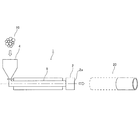
- FIG. 1 is a view showing an extrusion process, which is a method for producing a flexible sheet according to the present invention.
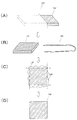
- FIG. 2 is a view showing a process for forming a soft sheet by cutting and rolling, which is a method for producing a soft sheet according to the present invention.
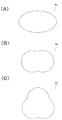
- FIG. 3 is a diagram showing a cross-sectional shape of another long object according to the present invention.
- FIG. 4 is a view showing an extrusion process, which is a method for producing a flexible sheet according to the prior art.
- FIG. 5 is a view showing a process for forming a soft sheet by cutting and rolling, which is a method for manufacturing a soft sheet according to the prior art.
- FIG. 1 and FIG. 2 are explanatory views of a method for producing a soft sheet according to the present invention.
- FIG. 1 shows an extrusion process in which a material 10 is extruded as an annular long object 20 by an extruder 1
- FIG. 2 shows a continuous annular long object 20 cut and rolled. The process of forming the flexible sheet 30 is shown.
- the material 10 charged from the hopper 4 is heated in the cylinder 8 to be mixed.
- the material 10 is preferably a composition in which an inorganic filler is blended with a polytetrafluoroethylene resin.
- the material 10 in the mixed state is extruded toward the tip of the extruder 1 and passes through the die 2 provided at the tip.
- the die 2 is a so-called circular die that extrudes the mixture, that is, the mixed material 10 into an annular shape. By passing the mixture through the cross-sectional hole 2a of the die 2, the continuous annular long object 20 is obtained. Is extruded.
- the continuous annular long object 20 formed by the extruder 1 is cut by cutting the continuous annular long object 20 into a predetermined dimension by the cutting step shown in FIG. An object 22 is obtained. Then, after the cut product 22 is expanded into a flat plate shape by the rolling process shown in FIG. 2 (B), it is repeatedly rolled until it reaches a predetermined thickness. Thereafter, the flexible sheet 30 shown in FIG. 2C is manufactured through steps such as drying, baking, and correction (not shown).
- extruders such as a hydraulic press type extruder and a screw type extruder can be used.
- a rolling mill used at said rolling process the conventionally used rolling mill can be used.
- the shearing force acting on the end portion is larger than that in the central portion. Further, when the extrusion ratio is increased, the shearing force that acts during extrusion increases. Therefore, when extrusion molding is performed in a flat plate shape with a high extrusion ratio, the difference in shearing force acting between the central portion and the end portion increases, and the progress of fiberization differs between the central portion and the end portion.
- the long product 20 of the present invention that has been extrusion molded at a high extrusion ratio is more fiberized as a whole than the conventional long product 120, and therefore the number of rolling operations in the rolling process is reduced. And there is no need to wrap. Therefore, since the sheet edge portion does not dry and deteriorate as in the prior art, a step of cutting the sheet edge portion is unnecessary, and the yield rate is improved.
- the extrusion ratio is defined as (cross-sectional area in the cylinder of the extruder) / (cross-sectional area of the cross-sectional hole of the die). As described above, the higher the extrusion ratio, the smaller the number of rollings in the rolling process. On the other hand, if the extrusion ratio is too high, extrusion becomes difficult and the efficiency in the extrusion process deteriorates.
- the extrusion ratio in the present invention is preferably 5 or more, particularly preferably 5 to 10.
- the cross-sectional shape of the long object is taken as an example of an annular shape, but the cross-sectional shape of the long object according to the present invention is not limited to an annular shape.
- Shape 80 etc. may be sufficient. That is, it is sufficient that the cross-sectional shape has no break so that a density difference does not occur in any part of the long product when being extruded from the extruder.
- “annular” means a shape having no break.
- the extrusion ratio of the example is 7.5
- the extrusion ratio of the comparative example is 5.0.
- the dimensions of the cut product 22 before rolling in the example are 305 mm in width, 20 mm in thickness, and 490 mm in length.
- the dimensions of the cut product 122 before rolling in the comparative example are 365 mm wide, 15 mm thick, and 620 mm long. The cut pieces 22 and 122 are rolled until the sheet thickness of the finished product is 1.5 mm.
- the number of rollings in the example is 15 times, which is half the number of rolling times of 30 in the comparative example. This is because in the examples, fiberization of polytetrafluoroethylene resin (PTFE) proceeds in the extrusion process. Further, in the embodiment where the number of rolling operations is small, the sheet end portion is not dried and deteriorated, so that the step of cutting the sheet end portion is not necessary. By reducing the number of rolling operations and omitting the step of cutting the sheet edge, it was confirmed in the Examples that the rolling time per sheet can be significantly shortened as shown in Table 2.
- PTFE polytetrafluoroethylene resin
- Table 3 shows the physical properties of the flexible sheet produced by the above molding method.
- the physical property values shown in No. 1 to No. 8 of Examples in Table 3 are the physical properties of each gasket obtained by punching out eight test pieces from one product sheet (1100 mm ⁇ 1100 mm). Is measured.
- yield rate Table 4 shows the yield rates of the examples and comparative examples.
- the yield rate of the example is 85% with respect to the yield rate of 65% of the comparative example, and it was confirmed that the yield rate was significantly improved in the example.
- the rolling process can be shortened compared to the conventional method, and the yield rate is also improved. It was confirmed that it was possible to produce a soft sheet with properties.
Landscapes
- Engineering & Computer Science (AREA)
- Mechanical Engineering (AREA)
- Casting Or Compression Moulding Of Plastics Or The Like (AREA)
- Extrusion Moulding Of Plastics Or The Like (AREA)
- Shaping By String And By Release Of Stress In Plastics And The Like (AREA)
Priority Applications (2)
| Application Number | Priority Date | Filing Date | Title |
|---|---|---|---|
| CN2009801265539A CN102089143B (zh) | 2008-07-23 | 2009-07-21 | 软质片材的制造方法 |
| KR1020117003548A KR101258765B1 (ko) | 2008-07-23 | 2009-07-21 | 연질 시트의 제조방법 |
Applications Claiming Priority (2)
| Application Number | Priority Date | Filing Date | Title |
|---|---|---|---|
| JP2008-190089 | 2008-07-23 | ||
| JP2008190089A JP2010023412A (ja) | 2008-07-23 | 2008-07-23 | 軟質シートの製造方法 |
Publications (1)
| Publication Number | Publication Date |
|---|---|
| WO2010010864A1 true WO2010010864A1 (ja) | 2010-01-28 |
Family
ID=41570324
Family Applications (1)
| Application Number | Title | Priority Date | Filing Date |
|---|---|---|---|
| PCT/JP2009/063036 Ceased WO2010010864A1 (ja) | 2008-07-23 | 2009-07-21 | 軟質シートの製造方法 |
Country Status (4)
| Country | Link |
|---|---|
| JP (1) | JP2010023412A (https=) |
| KR (1) | KR101258765B1 (https=) |
| CN (1) | CN102089143B (https=) |
| WO (1) | WO2010010864A1 (https=) |
Families Citing this family (2)
| Publication number | Priority date | Publication date | Assignee | Title |
|---|---|---|---|---|
| JP5989371B2 (ja) * | 2012-03-24 | 2016-09-07 | 日本バルカー工業株式会社 | 配管シール用フッ素樹脂製ガスケット |
| JP6065864B2 (ja) * | 2014-03-20 | 2017-01-25 | セイコーエプソン株式会社 | シート製造装置およびシートの製造方法 |
Citations (3)
| Publication number | Priority date | Publication date | Assignee | Title |
|---|---|---|---|---|
| JPH10309744A (ja) * | 1997-05-13 | 1998-11-24 | Tokai Rubber Ind Ltd | ゴムシートの製法 |
| JP2000034467A (ja) * | 1998-07-21 | 2000-02-02 | Nippon Valqua Ind Ltd | ジョイントシート形成用組成物、ジョイントシートおよびその製造方法 |
| JP2005232365A (ja) * | 2004-02-20 | 2005-09-02 | Nippon Valqua Ind Ltd | 非石綿系ジョイントシートの製造方法および該製法により得られた非石綿系ジョイントシート |
Family Cites Families (4)
| Publication number | Priority date | Publication date | Assignee | Title |
|---|---|---|---|---|
| JPH0660886A (ja) * | 1992-08-04 | 1994-03-04 | Fuji Electric Co Ltd | 燃料電池の製造方法 |
| CN100503218C (zh) * | 2004-06-23 | 2009-06-24 | 上海达凯塑胶有限公司 | 用于证件的共聚酯片材生产的成型方法 |
| KR100671009B1 (ko) * | 2005-06-13 | 2007-01-17 | 명성산업(주) | 폴리염화비닐수지 연질 후육 시트 제조장치 |
| JP4213167B2 (ja) | 2006-03-24 | 2009-01-21 | 日本バルカー工業株式会社 | 充填材入りフッ素樹脂シートの製造方法 |
-
2008
- 2008-07-23 JP JP2008190089A patent/JP2010023412A/ja active Pending
-
2009
- 2009-07-21 CN CN2009801265539A patent/CN102089143B/zh active Active
- 2009-07-21 KR KR1020117003548A patent/KR101258765B1/ko not_active Expired - Fee Related
- 2009-07-21 WO PCT/JP2009/063036 patent/WO2010010864A1/ja not_active Ceased
Patent Citations (3)
| Publication number | Priority date | Publication date | Assignee | Title |
|---|---|---|---|---|
| JPH10309744A (ja) * | 1997-05-13 | 1998-11-24 | Tokai Rubber Ind Ltd | ゴムシートの製法 |
| JP2000034467A (ja) * | 1998-07-21 | 2000-02-02 | Nippon Valqua Ind Ltd | ジョイントシート形成用組成物、ジョイントシートおよびその製造方法 |
| JP2005232365A (ja) * | 2004-02-20 | 2005-09-02 | Nippon Valqua Ind Ltd | 非石綿系ジョイントシートの製造方法および該製法により得られた非石綿系ジョイントシート |
Also Published As
| Publication number | Publication date |
|---|---|
| CN102089143A (zh) | 2011-06-08 |
| JP2010023412A (ja) | 2010-02-04 |
| KR20110046473A (ko) | 2011-05-04 |
| KR101258765B1 (ko) | 2013-04-29 |
| CN102089143B (zh) | 2013-05-08 |
Similar Documents
| Publication | Publication Date | Title |
|---|---|---|
| CN103113653B (zh) | 一种hdpe/ldpe共混发泡材料及其制备方法 | |
| CN101633768A (zh) | 一种丙烯酸酯橡胶及其制备方法 | |
| CN113861646B (zh) | 一种可降解鼻梁条及其制备方法 | |
| CN102516623A (zh) | 一种耐高温化学交联聚乙烯泡棉及其制备方法 | |
| CN103589070B (zh) | 物理发泡聚丙烯电缆料及其制备方法 | |
| JPS5978811A (ja) | 模様のあるプラスチック帯状物を製造する方法及び装置 | |
| WO2010010864A1 (ja) | 軟質シートの製造方法 | |
| JP2013515104A (ja) | 平面状のゴム製カバー材の製造方法及び平面状のゴム製カバー材 | |
| JP6163338B2 (ja) | 配管シール用フッ素樹脂製ガスケット | |
| EP3348889A1 (en) | Tearable tube formed from fluororesin | |
| JP3742568B2 (ja) | ポリテトラフルオロエチレン製シートまたはフィルム、それから得られるガスケットテープおよびそれらの製造法 | |
| CN110774558A (zh) | 木塑材料、其制备方法及木塑无缝地板 | |
| CN100473516C (zh) | 聚烯烃系列树脂膜、其制备用的组合物、其制备用的组合物的制备方法以及其制备用的设备 | |
| Toghyani et al. | Feasibility assessment of a wood-plastic composite post-production process: Cuttability | |
| JP4627908B2 (ja) | スクリュー混練装置及びこれを用いた樹脂組成物の製造方法 | |
| CN104558878A (zh) | 应用于玩具制作的可均匀收缩的聚苯乙烯片材及制造方法 | |
| CN100408304C (zh) | 乙丙橡胶/聚丙烯热塑弹性体胶管的制备方法 | |
| CN108164856A (zh) | 一种超高耐热、高熔体强度吹塑abs材料及其制备方法 | |
| CN103408845B (zh) | 一种高发泡倍率epdm泡沫材料及其发泡成型方法 | |
| CN103369964A (zh) | 挤出成型面条用模具拼块 | |
| CN106854346B (zh) | 一种聚乳酸复合膜材及其制备方法 | |
| CN105647027B (zh) | Tpv热塑性弹性体复合片材、tpv热塑性弹性体复合片材的制作方法 | |
| CN116572451B (zh) | 一种pla/pcl复合材料及其制备与应用 | |
| CN220031127U (zh) | 一种啮合型双转子混炼挤出机构 | |
| JPS5828107B2 (ja) | 4 フツカエチレンジユシカンザイリヨウ ノ オシダシセイケイホウホウ オヨビ ソノソウチ |
Legal Events
| Date | Code | Title | Description |
|---|---|---|---|
| WWE | Wipo information: entry into national phase |
Ref document number: 200980126553.9 Country of ref document: CN |
|
| 121 | Ep: the epo has been informed by wipo that ep was designated in this application |
Ref document number: 09800378 Country of ref document: EP Kind code of ref document: A1 |
|
| NENP | Non-entry into the national phase |
Ref country code: DE |
|
| ENP | Entry into the national phase |
Ref document number: 20117003548 Country of ref document: KR Kind code of ref document: A |
|
| 122 | Ep: pct application non-entry in european phase |
Ref document number: 09800378 Country of ref document: EP Kind code of ref document: A1 |