WO2008012902A1 - Polyvinyl alcohol-based film for optical uses and polarizing membrane and polarizing plate - Google Patents
Polyvinyl alcohol-based film for optical uses and polarizing membrane and polarizing plate Download PDFInfo
- Publication number
- WO2008012902A1 WO2008012902A1 PCT/JP2006/314911 JP2006314911W WO2008012902A1 WO 2008012902 A1 WO2008012902 A1 WO 2008012902A1 JP 2006314911 W JP2006314911 W JP 2006314911W WO 2008012902 A1 WO2008012902 A1 WO 2008012902A1
- Authority
- WO
- WIPO (PCT)
- Prior art keywords
- polybulal
- alcohol
- film
- optical
- resin
- Prior art date
- Legal status (The legal status is an assumption and is not a legal conclusion. Google has not performed a legal analysis and makes no representation as to the accuracy of the status listed.)
- Ceased
Links
Classifications
-
- G—PHYSICS
- G02—OPTICS
- G02B—OPTICAL ELEMENTS, SYSTEMS OR APPARATUS
- G02B5/00—Optical elements other than lenses
- G02B5/30—Polarising elements
- G02B5/3025—Polarisers, i.e. arrangements capable of producing a definite output polarisation state from an unpolarised input state
- G02B5/3033—Polarisers, i.e. arrangements capable of producing a definite output polarisation state from an unpolarised input state in the form of a thin sheet or foil, e.g. Polaroid
-
- C—CHEMISTRY; METALLURGY
- C08—ORGANIC MACROMOLECULAR COMPOUNDS; THEIR PREPARATION OR CHEMICAL WORKING-UP; COMPOSITIONS BASED THEREON
- C08J—WORKING-UP; GENERAL PROCESSES OF COMPOUNDING; AFTER-TREATMENT NOT COVERED BY SUBCLASSES C08B, C08C, C08F, C08G or C08H
- C08J5/00—Manufacture of articles or shaped materials containing macromolecular substances
- C08J5/18—Manufacture of films or sheets
-
- C—CHEMISTRY; METALLURGY
- C08—ORGANIC MACROMOLECULAR COMPOUNDS; THEIR PREPARATION OR CHEMICAL WORKING-UP; COMPOSITIONS BASED THEREON
- C08L—COMPOSITIONS OF MACROMOLECULAR COMPOUNDS
- C08L29/00—Compositions of homopolymers or copolymers of compounds having one or more unsaturated aliphatic radicals, each having only one carbon-to-carbon double bond, and at least one being terminated by an alcohol, ether, aldehydo, ketonic, acetal or ketal radical; Compositions of hydrolysed polymers of esters of unsaturated alcohols with saturated carboxylic acids; Compositions of derivatives of such polymers
- C08L29/02—Homopolymers or copolymers of unsaturated alcohols
- C08L29/04—Polyvinyl alcohol; Partially hydrolysed homopolymers or copolymers of esters of unsaturated alcohols with saturated carboxylic acids
-
- G—PHYSICS
- G02—OPTICS
- G02B—OPTICAL ELEMENTS, SYSTEMS OR APPARATUS
- G02B5/00—Optical elements other than lenses
- G02B5/30—Polarising elements
-
- C—CHEMISTRY; METALLURGY
- C08—ORGANIC MACROMOLECULAR COMPOUNDS; THEIR PREPARATION OR CHEMICAL WORKING-UP; COMPOSITIONS BASED THEREON
- C08J—WORKING-UP; GENERAL PROCESSES OF COMPOUNDING; AFTER-TREATMENT NOT COVERED BY SUBCLASSES C08B, C08C, C08F, C08G or C08H
- C08J2329/00—Characterised by the use of homopolymers or copolymers of compounds having one or more unsaturated aliphatic radicals, each having only one carbon-to-carbon double bond, and at least one being terminated by an alcohol, ether, aldehydo, ketonic, acetal, or ketal radical; Hydrolysed polymers of esters of unsaturated alcohols with saturated carboxylic acids; Derivatives of such polymer
- C08J2329/02—Homopolymers or copolymers of unsaturated alcohols
- C08J2329/04—Polyvinyl alcohol; Partially hydrolysed homopolymers or copolymers of esters of unsaturated alcohols with saturated carboxylic acids
-
- C—CHEMISTRY; METALLURGY
- C08—ORGANIC MACROMOLECULAR COMPOUNDS; THEIR PREPARATION OR CHEMICAL WORKING-UP; COMPOSITIONS BASED THEREON
- C08L—COMPOSITIONS OF MACROMOLECULAR COMPOUNDS
- C08L2205/00—Polymer mixtures characterised by other features
- C08L2205/02—Polymer mixtures characterised by other features containing two or more polymers of the same C08L -group
-
- Y—GENERAL TAGGING OF NEW TECHNOLOGICAL DEVELOPMENTS; GENERAL TAGGING OF CROSS-SECTIONAL TECHNOLOGIES SPANNING OVER SEVERAL SECTIONS OF THE IPC; TECHNICAL SUBJECTS COVERED BY FORMER USPC CROSS-REFERENCE ART COLLECTIONS [XRACs] AND DIGESTS
- Y10—TECHNICAL SUBJECTS COVERED BY FORMER USPC
- Y10T—TECHNICAL SUBJECTS COVERED BY FORMER US CLASSIFICATION
- Y10T428/00—Stock material or miscellaneous articles
- Y10T428/26—Web or sheet containing structurally defined element or component, the element or component having a specified physical dimension
-
- Y—GENERAL TAGGING OF NEW TECHNOLOGICAL DEVELOPMENTS; GENERAL TAGGING OF CROSS-SECTIONAL TECHNOLOGIES SPANNING OVER SEVERAL SECTIONS OF THE IPC; TECHNICAL SUBJECTS COVERED BY FORMER USPC CROSS-REFERENCE ART COLLECTIONS [XRACs] AND DIGESTS
- Y10—TECHNICAL SUBJECTS COVERED BY FORMER USPC
- Y10T—TECHNICAL SUBJECTS COVERED BY FORMER US CLASSIFICATION
- Y10T428/00—Stock material or miscellaneous articles
- Y10T428/26—Web or sheet containing structurally defined element or component, the element or component having a specified physical dimension
- Y10T428/261—In terms of molecular thickness or light wave length
-
- Y—GENERAL TAGGING OF NEW TECHNOLOGICAL DEVELOPMENTS; GENERAL TAGGING OF CROSS-SECTIONAL TECHNOLOGIES SPANNING OVER SEVERAL SECTIONS OF THE IPC; TECHNICAL SUBJECTS COVERED BY FORMER USPC CROSS-REFERENCE ART COLLECTIONS [XRACs] AND DIGESTS
- Y10—TECHNICAL SUBJECTS COVERED BY FORMER USPC
- Y10T—TECHNICAL SUBJECTS COVERED BY FORMER US CLASSIFICATION
- Y10T428/00—Stock material or miscellaneous articles
- Y10T428/29—Coated or structually defined flake, particle, cell, strand, strand portion, rod, filament, macroscopic fiber or mass thereof
- Y10T428/2913—Rod, strand, filament or fiber
- Y10T428/2933—Coated or with bond, impregnation or core
- Y10T428/2964—Artificial fiber or filament
- Y10T428/2967—Synthetic resin or polymer
Definitions
- the present invention relates to a polybulal alcohol film for optical use, and more specifically, is a polybulualcohol film excellent in stretchability, and is polarized in the entire visible light region, particularly in the vicinity of a wavelength of 460 nm.
- the present invention relates to an optical polybulal alcohol film for producing a polarizing film having excellent performance. Background art
- a polyvinyl alcohol film is prepared by dissolving a polyvinyl alcohol resin in a solvent such as water to prepare a stock solution, and then forming a film by a solution casting method (casting method), and using a metal heating roll or the like. Manufactured by using and drying.
- the polybulal alcohol film thus obtained is used in many applications as a film having excellent transparency, and one of its useful applications is a polarizing film. Powerful polarizing films are used as the basic components of liquid crystal displays, and in recent years their use has been expanded to equipment that requires high quality and high reliability! Speak.
- polyvinyl alcohol-based resin has been improved to obtain a polarizing film.
- the amount of 1,2-glycol bonded directly to the main chain is 1.8 mol% or more.
- poly Bulle alcohol polymer physical strength becomes uniaxially stretched film as a base Henkofu Ilm (e.g., see Patent Document 1.) is or cationic group of the containing unit from 0.01 to 20 mole 0/0 contains, and (for example, refer to Patent Document 2.) the polarizing film prepared with poly Bulle alcohol film made Bulle alcohol polymer strength containing 5 to 24 mole 0/0 0. number 4 following ⁇ - Orefin unit carbons such as is proposed ing.
- Patent Document 1 Japanese Patent Laid-Open No. 8-136728
- Patent Document 2 Japanese Patent Laid-Open No. 2003-248123
- Patent Document 3 Japanese Patent Application Laid-Open No. 2004-341503
- Patent Document 1 the obtained polarizing film made of a polyvinyl alcohol film has poor polarization performance in the vicinity of 460 nm, which is the wavelength range of visible light. Therefore, there is a problem that the contrast display performance of the liquid crystal display is not improved, and further improvement is desired.
- Patent Document 3 can improve the polarization performance in the vicinity of 400 to 500 nm, since the film is washed with water mixed with inorganic substances, foreign matter (optical defects) on the film. Have problems such as a lot.
- the present invention under such a background, it is a polybular alcoholic film excellent in stretchability, and even under the manufacturing conditions of a conventional polarizing film, it is in the entire visible light region, particularly in the vicinity of a wavelength of 460 nm. It is an object of the present invention to provide an optical polyvinyl alcohol film for producing a polarizing film having excellent polarizing performance.
- polyvinyl alcohol containing 1,2-glycol bonds in the side chain as polyvinyl alcohol-based resin.
- the system resin (A) it is preferable that the polyvinyl alcohol system resin (A) containing a 1,2-glycol bond in the side chain and a polyvinyl alcohol system resin other than the polyvinyl alcohol system resin (A).
- the fat (B) it is possible to obtain a poly (vinyl alcohol) film excellent in stretchability and a polyvinyl alcohol film for producing a polarizing film excellent in polarization performance near the wavelength of 460 nm. The present invention was completed.
- the gist of the present invention is that, in an optical poly (vinyl alcohol) film containing a poly (bull alcohol) resin, the poly (b) alcohol resin has a 1,2-glycol bond in the side chain. Consists only of polybulal alcohol-based rosin (A) and contains 1, 2-glycol bond amount is from 0.01 to 6 mol 0/0, optical poly Bulle alcohol Fi Lum, or poly Bulle alcohol ⁇ is 1 in a side chain, containing 2-glycol bond poly
- An optical polyalcohol alcohol comprising a polyalcohol-based resin (B) other than the above-described polyalcohol-based resin (A) and polybulal alcohol-based resin (B), and satisfying the following formula (1) It relates to film.
- A is the content (weight ratio) of the polyvinyl alcohol-based resin (A) with respect to the total amount of the polybulal alcohol-based resin (A) and the polybulal alcohol-based resin (B), and B is the above-mentioned total the content of the polyvinyl alcohol-based ⁇ to the amount (B) (weight ratio),
- G represents a side chain 1, 2-glycol bond content (mol 0/0).
- a polyvinyl alcohol-based resin (A) containing a 1,2-glycol bond in the side chain and a polyvinyl alcohol-based resin other than the polybulal alcohol-based resin (A) (B) It is preferable that the content of polybula alcohol-based rosin (A) is 50% by weight or less based on the total amount!
- the film width is 2 m or more and the thickness of the film is 30 to 70 ⁇ m, respectively.
- the present invention also provides a polarizing film having the above-described optical polybulal alcohol film strength, and further a polarizing plate having a protective film provided on at least one surface of the polarizing film.
- the polybulal alcohol film for optics of the present invention is a polybulal alcohol film excellent in stretchability, and when a polarizing film excellent in polarization performance is obtained in the entire visible light region, particularly in the vicinity of a wavelength of 460 nm, Used in liquid crystal display devices such as polarized sunglasses and liquid crystal televisions, and used in 1Z2 and 1Z4 wavelength plates, and in liquid crystal display devices. It is very useful as a film for retardation films.
- the polybulal alcoholic resin used consists only of a polyvinyl alcoholic resin (A) containing a 1,2-glycol bond in the side chain, of the side chain 1, 2-film-glycol bond amount is from 0.01 to 6 mol 0/0, or 1 in a side chain, 2-glycol containing bound poly Bulle alcohol ⁇ (a) ⁇ beauty the Polybulal alcohol-based resin (A) Other than polybulal alcohol-based resin (B), the film satisfies the above formula (1).
- A polyvinyl alcoholic resin
- 2-film-glycol bond amount is from 0.01 to 6 mol 0/0, or 1 in a side chain
- the film satisfies the above formula (1).
- the polybula alcohol-based resin (A) used in the present invention is a polybulal alcohol-based resin having a 1,2-glycol bond in the side chain, that is, usually represented by the general formula (1)
- Examples include polybulal alcohol-based resin containing 1,2-glycol structural units.
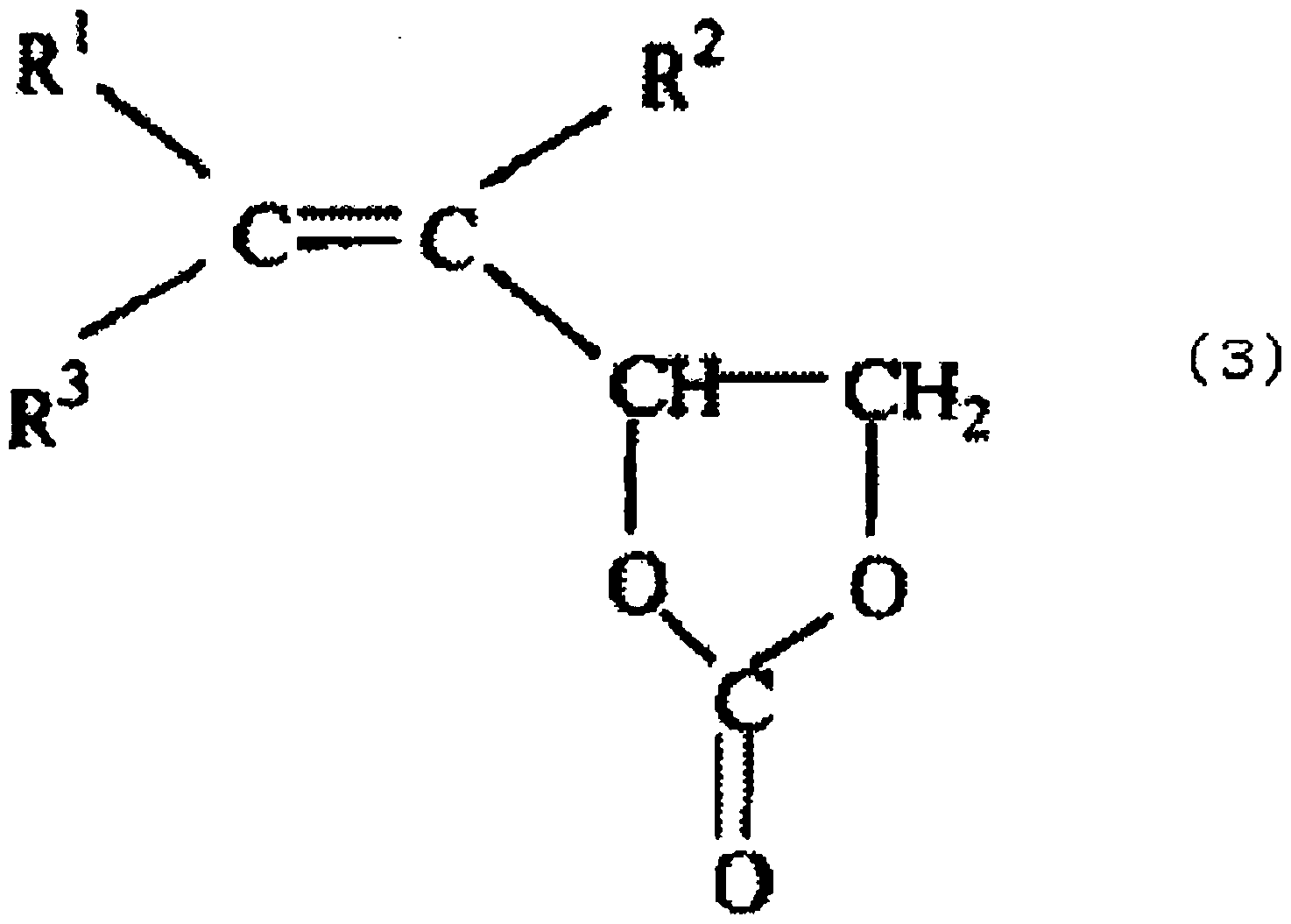
- R 2 and R 3 are each independently hydrogen or an alkyl group.
- Such a polybulualcohol-based resin (A) can be produced, for example, by saponifying a copolymer of (a) a butyl ester monomer and 3,4-diacetoxy 1-butene. It is out.
- strong bull ester monomers include formate, vinyl acetate, propionate, valerate, butyrate, isobutyrate, pivalate, force purate, laurate, stearate, benzoate. , Versatic acid bule, etc., among which butyl acetate is preferably used.
- R is an alkyl group, preferably a methyl group.
- the compound represented by the above formula (2) can be obtained from the market as a product of Eastman Chemical Co., Ltd., or it can be used by purifying an intermediate at the time of butanediol production.
- copolymer it is preferable to use the above-mentioned copolymer.
- other monomers are added in a small amount, for example, 5 mol% within the range not impairing the object of the present invention.
- copolymerize with, for example, olefins such as ethylene, propylene, isobutylene, ⁇ -octene, ⁇ -dodecene, ⁇ -octadecene, acrylic acid, methacrylic acid, crotonic acid, maleic acid, maleic anhydride, Unsaturated acids such as itaconic acid or salts thereof, mono- or dialkyl esters, etc., -tolyls such as acrylonitrile and methacrylonitrile, amides such as diacetone acrylamide, acrylamide and methacrylamide, ethylene sulfonic acid, allylic sulfonic acid, meta Olefin sulfonic acid such as
- Polyoxyalkylene (meth) acrylates such as relates, polyoxypropylene (meth) acrylates, polyoxyalkylene (meth) acrylamides such as polyoxyethylene (meth) acrylamide, polyoxypropylene (meth) acrylamide, polyoxyethylene (1- (meth) acrylamido-1, 1-dimethylpropyl) ester, polyoxyethylene vinyl ether, polyoxypropylene butyl ether, polyoxyethylene arylamine, polyoxypropylene amine, polyoxyethylene vinylamine, Examples thereof include polyoxypropylene vinylamine, ethylene carbonate, and allyl acetate.
- N-acrylamidomethyltrimethylammonium chloride N-acrylamidoethyltrimethylammonium chloride, N-acrylamidopropyltrimethylammonium chloride, 2-ataryloxetyltrimethylammonium chloride, 2-methacrylochichetyltrimethyl Ammonium chloride, 2-hydroxy-1-methacryloyloxypropyltrimethylammonium chloride, allyltrimethylammonium chloride, methallyltrimethylammonium chloride, 3-butenetrimethylammonium chloride, dimethyldiarylammonium chloride, Cationic group-containing monomers such as jetyl diallyl ammonium chloride, and acetoacetyl group-containing monomers are also included.
- polymerization technique for example, known methods such as bulk polymerization, solution polymerization, suspension polymerization, dispersion polymerization, or emulsion polymerization can be employed. Usually, solution polymerization is performed.
- the charging method of the monomer component at the time of copolymerization is not particularly limited, and any method such as batch charging, split charging, continuous charging, etc. may be adopted, but 3, 4 diacetoxy 1-butene is a polyvinyl ester type.
- Point power in terms of physical properties such as uniform distribution in the molecular chain of the polymer, lowering of the melting point of polyhydric alcohol, drop polymerization is preferred.
- Polymerization based on the HANNA method is particularly preferred.
- Solvents used in intensive copolymerization usually include lower alcohols such as methanol, ethanol, propanol and butanol, and ketones such as acetone and methyl ethyl ketone. Industrially, methanol is preferably used.
- the amount of the solvent used may be appropriately selected in consideration of the chain transfer constant of the solvent in accordance with the degree of polymerization of the target copolymer.
- S (solvent) ZM ( Monomer) 0.01 to 10 (weight ratio), preferably selected from the range of about 0.05 to 3 (weight ratio).
- a polymerization catalyst is used.
- a known radical polymerization catalyst such as azobisisobutyl-tolyl, peroxide acetyl, benzoyl peroxide, lauryl peroxide, or the like is used.
- low-temperature active radical polymerization catalysts such as dimethylvale-tolyl and azobismethoxydimethylvaleryl-tolyl.
- the amount of polymerization catalyst varies depending on the type of catalyst and cannot be determined in general. It is arbitrarily selected according to. For example, Azoisobuchi port -..
- 01-0 2 Monore 0/0 force preferably 0.5, based on the vinyl ester-based monomer, in particular ⁇ or from 0.02 to 0 15 Monore 0 / 0 force S preferred.
- the reaction temperature of the copolymerization reaction is preferably about 40 ° C to the boiling point depending on the solvent and pressure used.
- the copolymerization ratio of 3,4-diacetoxy-1-butene is determined in accordance with the amount of 1,2-glycol bond introduced later.
- the obtained copolymer is then subjected to the following quenching reaction.
- This Kenning reaction is basically the same as the Kenning conditions of known polyvinyl alcohol resins. That is, usually, the copolymer obtained above is dissolved or dispersed in alcohol or hydrous alcohol, and the reaction is carried out using an alkali catalyst or an acid catalyst.
- the alcohol methanol, ethanol, propanol, tert-butanol and the like are particularly preferably used.
- the concentration of the copolymer in the alcohol is appropriately selected according to the viscosity of the system. Usually, a range force of 10 to 60% by weight is also selected.
- the catalyst used in the ken-yi includes alkali metal hydroxides such as sodium hydroxide, potassium hydroxide, sodium methylate, sodium ethylate, potassium methylate, lithium methylate, and alkali metals such as alcoholate.
- Acid catalysts such as catalyst, sulfuric acid, hydrochloric acid, nitric acid, metasulfonic acid, zeolite, cation exchange resin [0025]
- the amount of the strong ken-y catalyst used is appropriately selected depending on the ken-y method, the target ken-y degree, etc. However, when an alkali catalyst is used, the butyl ester monomer and 3, 4 diacetoxy are usually used.
- the amount of 1-butene is 0.1-30 mmol, preferably 2-17 mmol, per 1 mol.
- the reaction temperature for the saponification reaction is not particularly limited, but 10 to 60 ° C is preferable, and 20 to 50 ° C is more preferable.
- the polybula alcohol-based resin (A) is produced by simultaneously converting the ester part of the butyl ester monomer and the acetoxy part of 3,4-diacetoxy 1-butene into hydroxyl groups during saponification.
- a polybulal alcohol-based resin (A) containing a 1,2 glycol bond in the side chain is obtained.
- a strong polybulal alcohol-based resin (A) is obtained.
- the degree of kenning is usually 90 mol% or more, especially 95 mol% or more, and more preferably 98 mol% or more. If the kenning degree is too small, the water resistance at the time of forming a polarizing film tends to be insufficient. is there.
- the degree of Keny is expressed as the rate of change (mol%) of the total amount of the ester moiety of the butyl ester monomer and the acetoxy moiety of 3,4 dicetoxy 1-butene to the hydroxyl group (%).
- the saponification reaction the acetoxy part of 3, 4 diacetoxy 1-butene is almost completely saponified).
- the viscosity of the polyvinyl alcohol-based resin (A) is usually 8% by weight when an aqueous solution viscosity of at least one selected from the group forces that only the polyvinyl alcohol-based resin (A) is capable of. ⁇ 400mPa's, especially ⁇ 40 ⁇ 300mPa's, and even ⁇ 50 ⁇ 270mPa's force S Slight force 4% by weight Viscosity of aqueous solution is too small. If it is too large, the flatness and transmittance of the film tend to decrease.
- the viscosity of the polyvinyl alcohol-based resin (A) when the polyvinyl alcohol-based resin (A) and the polybulal alcohol-based resin (B) are used in combination is usually 8 to 400 mPa ′ as a 4 wt% aqueous solution viscosity. s, in particular 12 to 300 mPa's, and moreover 16 to 270 mPa's force S A favorable force 4% by weight Viscosity of aqueous solution is too small, stretchability at the time of forming a polarizing film tends to be insufficient. Tendency to decrease flatness and transmittance of film There is.
- the amount of 1, 2 glycol bond introduced into the side chain of the polybula alcohol-based rosin (A) at least one kind selected from the group force that only the polybulal alcohol-based rosin (A) has power is selected.
- it is 0.01 to 6 mol%, preferably 0.05 to 4 mol%, particularly preferably 0.1 to 3 mol%, and if it is less than the lower limit, the effect of the present invention cannot be obtained. If the upper limit is exceeded, the water resistance during the production of the polarizing film will be insufficient.
- the 1,2-glycol bond amount of the polyvinyl alcohol-based resin (A) is 0.01. 20 mol 0/0 .05 to 15 mole 0/0 preferably tool particularly preferably, more Ri preferably from 0.1 to 12 mole 0/0 der the force mowing bond amount is too small If the effect of the present invention is difficult to obtain, on the contrary, if it is too much, it tends to be difficult to produce poly (vinyl alcohol) resin.
- Each R 3 is independently hydrogen or an alkyl group c
- R 2 , R 3 , R 4 , R are each independently hydrogen or an alkyl group.
- the present invention when only the polyvinyl alcohol-based resin (A) is used as the polyvinyl alcohol-based resin, it exhibits excellent suitability as an optical film. However, in the present invention, it is more ductile and dyeable when the polyvinyl alcohol-based resin (A) is used in combination with a polyvinyl alcohol-based resin (B) other than the polyvinyl alcohol-based resin (A). Liked in terms of further improvement.
- polybula alcohol-based rosin (A) two or more polybular alcohols having different 1,2-glycol bond amount, saponification degree, 4% by weight aqueous solution viscosity and the like are used. You can also use leuco-based oil.
- the polybulal alcohol-based resin (B) used in the present invention is not particularly limited, but it is usually preferable that the chain strength is 90 mol% or more, particularly preferably 95 mol% or more, More preferably, it is 98 mol% or more. If the strength of the strength is too small, the water resistance at the time of forming the polarizing film tends to be insufficient.
- the viscosity of the strong polyvinyl alcohol-based resin (B) is preferably 8 to 500 mPa's, particularly 20 to 400 mPa's, as a 4% by weight aqueous solution viscosity, 40 ⁇ 400mPa ⁇ s is preferred. If the viscosity of the 4% by weight aqueous solution is too small, the stretchability at the time of forming the polarizing film tends to be insufficient, and if it is too large, the flatness and transparency of the film are lowered.
- the strong polybulal alcohol-based resin (B) is not particularly limited as long as it is a polyvinyl alcohol-based resin other than the polybulal alcohol-based resin (A), but is usually unmodified polyvinyl alcohol-based resin.
- a cocoa is preferred.
- small amounts of unsaturated carboxylic acids including salts, esters, amides, nitriles, etc.
- olefins having 2 to 30 carbon atoms ethylene, propylene, n-butene, isobutene, etc.
- butyl ethers unsaturated sulfones. It may be a polybulu alcohol alcohol containing a component copolymerizable with butyl acetate such as an acid salt.
- polyvinyl alcohol-based resin (B) two or more types of polybulal alcohol-based resin having different saponification degree and 4% by weight aqueous solution viscosity may be used in combination.
- the polybulal alcohol-based resin (A) and the polybulal alcohol-based resin (A) are identical to the polybulal alcohol-based resin (A) and the polybulal alcohol-based resin (A).
- A is the content ratio (weight ratio) of polybulal alcoholic resin (A) to the total amount of polybulal alcoholic resin (A) and polybulal alcoholic resin (B).
- the content of the polyvinyl alcohol-based resin (A) is preferably 50% by weight or less, particularly preferably 5 to 50% by weight, and more preferably 10 to 40% by weight in terms of stretchability and optical performance. Is. If the content of the strong polybulal alcohol-based resin (A) is too small, excellent polarization performance near the wavelength of 460 nm tends to be difficult to obtain, and if it is too large, the stretchability tends to decrease when forming a polarizing film.
- polybulal alcoholic resin (A) and polybulal alcoholic resin (B) are contained, saponification of polybulal alcoholic resin (A) and polybulal alcoholic resin (B)
- the difference in degree is preferably 6 mol% or less, particularly preferably 3 mol% or less, from the viewpoint of the transparency of the film. If the difference in the Kenya degree is too large, the transmittance of the film tends to decrease.
- the polybulal alcohol-based resin (A) and the polybulal alcohol-based resin (A) are identical to the polybulal alcohol-based resin (A) and the polybulal alcohol-based resin (A).
- the plasticizer (C) used in the present invention effectively contributes to stretchability when producing a polarizing film.
- ethylene glycol, glycerin, propylene glycol, polyethylene glycol, diglycerin. , Triethylene glycol, tetraethylenedaricol, trimethylolpropane, and polyhydric alcohols such as polyethylene glycol having a degree of polymerization of 300 or less. These polyhydric alcohols are used alone or in combination of two or more. be able to. Of these, glycerin alone or a combination of glycerin and diglycerin or glycerin and trimethylolpropane is particularly preferred.
- the plasticizer (C) used in the present invention effectively contributes to stretchability when producing a polarizing film.
- the content of the plasticizer (C) is preferably 1 to 35 parts by weight, more preferably 3 to 30 parts by weight, with respect to 100 parts by weight of the total polybutyl alcohol resin used. Further, it is preferably 7 to 25 parts by weight. If the content of the plasticizer (C) is too small, the stretchability tends to be lowered during the production of the polarizing film, and if it is too much, the temporal stability of the obtained optical polyvinyl alcohol film tends to be lowered.
- the surfactant (D) used in the present invention provides smoothness of the film surface and adhesion between films when wound into a roll when an optical polybulal alcohol film is formed.
- anionic surfactants and nonionic surfactants it is preferable to use an agent together in terms of transparency of the film.
- Examples of powerful ion-based surfactants include:
- aliphatic alkyl sulfonate examples include, for example, sodium hexyl sulfonate, sodium heptyl sulfonate, sodium octyl sulfonate, sodium nonyl sulfonate, sodium decyl sulfonate, and dodecyl sulfonic acid.
- Examples thereof include sodium, sodium tetradecyl sulfonate, sodium hexadecyl sulfonate, sodium octadecyl sulfonate, sodium aliphatic alkyl sulfonate having 6 to 18 carbon atoms, and preferably sodium dodecyl sulfonate, A mixture of sodium tetradecyl sulfonate, sodium hexadecyl sulfonate, sodium secondary alkyl sulfonate having 10 to 18 carbon atoms, or the like is used.
- the counter counter of the earned aliphatic alkyl sulfonate is not particularly limited, but Ca +, NH +, or a mixture thereof. Among these, Na + is particularly preferable.
- alkyl sulfate salt examples include sodium hexyl sulfate, sodium heptyl sulfate, sodium octyl sulfate, sodium nonyl sulfate, sodium decyl sulfate, sodium dodecyl sulfate, sodium tetradecyl sulfate, Examples include sodium xadecyl sulfate, sodium octadecyl sulfate, sodium eicosyl sulfate, alkali metal salts such as potassium salts thereof, alkaline earth metal salts such as calcium salts, and organic amine salts such as ammonium salts.
- Sodium dodecyl sulfate, sodium octadecyl sulfate, etc. are used. Further, the counter force thione is not particularly limited, and examples thereof include a mixture of these, and Na + is particularly preferable.
- polyoxyethylene alkyl ether sulfate examples include, for example, polyoxyethylene hexyl ether sodium sulfate, polyoxyethylene heptyl ether sodium sulfate, polyoxyethylene octyl ether sodium sulfate, polyoxyethylene lenno- Sodium ether sulfate, sodium polyoxyethylene decyl ether sulfate, sodium polyoxyethylene dodecyl ether sulfate, sodium polyoxyethylene tetradecyl ether sulfate, sodium polyoxyethylene hexadecyl ether sulfate, polyoxyethylene octadecyl ether sulfate
- Examples include sodium, sodium polyoxyethylene eicosyl ether sulfate, or organic amine salts such as alkali metal salts and ammonium salts of these potassium salts. Is, preferably polyoxyethylene dodecyl ether sodium sulfate,
- polyoxyethylene alkylphenol ether sulfate examples include, for example, sodium polyoxyethylene hexyl ether ether sulfate, sodium polyoxyethylene heptyl ether ether sulfate, polyoxyethylene octyl ether Sodium tersulfate, sodium polyoxyethylene nonyl phenyl ether sulfate, sodium polyoxyethylene decyl phenyl ether sulfate, sodium polyoxyethylene dodecyl phenyl ether sulfate, polyoxyethylene tetradecyl phenyl ether Sodium sulfate, sodium polyoxyethylene hexadecyl ether ether sulfate, sodium polyoxyethylene octadecyl ether ether sulfate, sodium polyoxyethylene ethylene glycol ether sulfate, or alkali metal salts such as potassium salts thereof, ammonia Examples thereof include organic amine salts such as um salt
- Na + is particularly preferable.
- higher fatty acid alkanolamide sulfate include, for example, strength pro-acid ethanolamide sulfate, strength prillic acid ethanolamide sulfate, capric acid ethanolamide sulfate, lauric acid ethanolamide Sodium sulfate, sodium normitic acid ethanolamide sulfate, sodium stearic acid ethanolamide sodium sulfate, oleic acid ethanolamide or potassium salts thereof, and propanolamide and butanolamide instead of these ethanolamides may be mentioned.
- the counter counter force thione is not particularly limited, and includes, or a mixture thereof.
- Na + is particularly preferred.
- sulfate esters such as sulfated oils, higher alcohol sulfates and monoglycolates, and fatty acid stones N-acyl amino acids and salts thereof, polyoxyethylene alkyl ester carboxylates, carboxylate types such as acylated peptides, alkylbenzene sulfonates, alkyl naphthalene sulfonates, naphthalene sulfonate salt formalin polycondensates, Melamine sulfonic acid salt Formalin condensate, dialkyl sulfosuccinic acid ester salt, sulfosuccinic acid alkyl disalt, polyoxyethylene alkyl sulfosuccinic acid disalt, alkyl sulfoacetate, ⁇ -olefin sulphonate, ⁇ -acyl Sulfonic acids such as methyl taurine salt
- nonionic surfactants examples include:
- R is an alkyl group or an alkenyl group, and its carbon number is 6-22, preferably 8-18. These may be a single alkyl group or a mixed alkyl group. (Also, it is possible to use an alkyl group having an alkyl distribution that can provide palm oil, palm oil, palm kernel oil, beef tallow, etc.)
- R is an alkyl group or a alkenyl group, and the carbon number thereof is preferably 6 to 22, preferably 8 to 18. These may be a single alkyl group or a mixed alkyl group. Alkyl groups having an alkyl distribution that can also be obtained such as palm oil, palm oil, palm kernel oil, beef tallow, etc. can also be used X is a phenyl group, n is 1 to 20, preferably 2 Represents an integer of ⁇ 10)
- R is an alkyl group or a alkenyl group, and the carbon number thereof is preferably 6 to 22, preferably 8 to 18. These may be a single alkyl group or a mixed alkyl group. Alkyl groups with an alkyl distribution that can also be obtained from palm oil, palm oil, palm kernel oil, beef tallow, etc. can also be used R 'is —CH—, —CH—, —CH—
- R is an alkyl group or a alkenyl group, and the carbon number thereof is preferably 6 to 22, preferably 8 to 18. These may be a single alkyl group or a mixed alkyl group. In addition, it is also possible to use an alkyl group having an alkyl distribution that can provide strength such as palm oil, palm oil, palm kernel oil, and beef tallow.
- R is an alkyl group, and its carbon number is preferably 6 to 22, preferably 8 to 18. These may be a single alkyl group or a mixed alkyl group. Moreover, the alkyl group which has the alkyl distribution obtained from coconut oil, palm oil, palm kernel oil, beef tallow, etc. can also be used X and y show 1-30, Preferably the integer of 3-15 is shown. ) Polyoxyethylene alkylamine represented by
- polyoxyethylene alkyl ether examples include, for example, polyoxyethylene hexyl ether, polyoxyethylene heptyl ether, polyoxyethylene octyl ether, polyoxyethylene nonyl ether, polyoxyethylene decyl ether. 1 ter, polyoxyethylene dodecyl ether, polyoxyethylene tetradecyl ether, polyoxyethylene hexadecyl ether, polyoxyethylene octadecyl ether, polyoxyethylene oleyl ether, polyoxyethylene eicosyl ether, etc. Is mentioned. In particular, polyoxyethylene dodecyl ether, polyoxyethylene octadecyl ether, and the like are preferable.
- polyoxyethylene alkyl phenyl ether examples include, for example, polyoxyethylene hexyl phenyl ether, polyoxyethylene heptyl phenyl ether, polyoxyethylene octyl phenyl ether, polyoxyethylene Nouryl ether, polyoxyethylene decyl phenyl ether, polyoxyethylene dodecyl phenyl ether, polyoxyethylene tetradecyl phenyl ether, polyoxyethylene hexadecyl phenyl ether, polyoxyethylene octadecyl ether, polyoxyethylene Examples include eicosyl phenol ether. In particular, polyoxyethylene normether is suitable.
- higher fatty acid mono- or dialkanolamide include, for example, cabronic acid Mono- or diethanolamide, force-puric acid mono- or diethanolamide, force-puric acid mono- or diethanolamide, lauric acid mono- or diethanolamide, palmitic acid mono- or diethanolamide, stearic acid mono- or diethanolamide, oleic acid mono- or diethanolamide Palm oil fatty acid mono- or diethanolamide, or propanolamide and butanolamide instead of these ethanolamides.
- alkyljetanol amide is preferred.
- lauric acid diethanolamide and coconut oil fatty acid diethanolamide are preferably used.
- the ethanolamide and diethanolamine [? Mixture of ⁇ 1— (CH OH)] and attached products (1: 2
- the molar type is advantageous in terms of water solubility.
- higher fatty acid amides include, for example, cabronic acid amide, force prillic acid amide, force puric acid amide, lauric acid amide, normitic acid amide, stearic acid amide, oleic acid amide and the like. Of these, palmitic acid amide and stearic acid amide are preferred.
- polyoxyethylene alkylamine examples include, for example, polyoxyethylene hexylamine, polyoxyethylene heptylamine, polyoxyethyleneoctylamine, polyoxyethylene nonylamine, polyoxyethylene decyl. And polyoxyethylene dodecylamine, polyoxyethylenetetradecylamine, polyoxyethylenehexadecylamine, polyoxyethyleneoctadecylamine, polyoxyethyleneeicosylamine, and the like. Is preferred.
- polyoxyethylene higher fatty acid amide examples include, for example, polyoxyethylene caproic acid amide, polyoxyethylene strength prillic acid amide, polyoxyethylene capric acid amide, polyoxyethylene lauric acid amide, polyoxyethylene Examples include ethylene myristic acid amide, polyoxyethylene palmitic acid amide, polyoxyethylene stearic acid amide, and polyoxyethylene oleic acid amide. Among them, polyoxyethylene lauric acid amide and polyoxyethylene stearic acid amide are preferable. It is.
- amine oxide examples include dimethyl lauryl amine oxide, dimethyl stearyl oxide, dihydroxyethyl lauryl amine oxide, and the like. Among them, dimethyl lauryl amine oxide is preferable. .
- an alkylphenol formaldehyde is also used.
- Type surfactants such as type-one surfactants, polyethylene glycol fatty acid esters, sorbitan fatty acid esters, fatty acid monoglycerides, propylene glycol fatty acid esters and sucrose fatty acid esters can be used in combination.
- the content of the strong surfactant (D) is preferably 0.01 to 1 part by weight, particularly preferably 0 with respect to 100 parts by weight of the total polybutyl alcohol-based resin. 02-0. 5 parts by weight, more preferably 0.03 to 0.2 parts by weight. If the content of the surfactant (D) is too small, it is difficult to obtain an anti-blocking effect. If the content is too large, the transparency of the film tends to decrease.
- the anionic surfactant is added in an amount of from 0.001 to 100 parts by weight based on 100 parts by weight of the total polyvinyl alcohol-based resin. 1 part by weight, in particular 0.02-0. 2 parts by weight, more preferably 0.03-0. 1 part by weight of non-ionic surfactant is preferably 0.01-1 part by weight, In particular, it is preferably 0.02-0.2 parts by weight, more preferably 0.03-0.1 parts by weight. If the amount of the surfactant is too small, the dispersibility of the dye at the time of forming the polarizing film tends to be reduced and the dyeing spots tend to increase.
- an antioxidant in order to prevent yellowing of the film, and an arbitrary anti-oxidation agent such as a phenolic anti-oxidation agent.
- an arbitrary anti-oxidation agent such as a phenolic anti-oxidation agent.
- 2,6-di-t-butyl-p-taresol, 2,2'-methylenebis (4-methyl-6-t-butylphenol), 4,4'-butylidenebis (3-methyl-6-t-butylphenol), etc. are suitable. is there.
- Antioxidant is used in the range of 2 to about LOOppm for poly (bull alcohol).
- the polyvinyl alcohol-based resin (A) containing a 1,2-glycol bond in the side chain or the polyvinyl alcohol-based resin containing a 1,2-glycol bond in the side chain.
- a polybulualcohol-based film is formed.
- An aqueous solution of a polyvinyl alcohol-based resin composition is preferably prepared using a plasticizer (C) and Z or a surfactant (D), and the aqueous solution is used as a drum-type roll or endless belt, preferably a drum.
- Polyvinyl alcohol film is produced by casting on a mold roll to form a film and drying.
- the polybulualcohol-based resin powder is usually washed in order to remove sodium acetate contained in the resin.
- washing the ability to be washed with methanol or water
- the method of washing with methanol requires solvent recovery, so the method of washing with water is more preferable.
- the water-containing polyvinyl alcohol-based rosin wet cake after washing is dissolved to prepare a polyvinyl alcohol-based rosin aqueous solution.
- the powerful water-containing polybulal alcohol-based rosin wet cake is dissolved in water as it is.
- the dehydration method is not particularly limited, but a method using centrifugal force is common.
- a wet polyvinyl alcohol-based rosin wet cake having a water content of 50 wt% or less, preferably 30 to 45 wt%, by the washing and dehydration. If the water content is too high, it tends to be difficult to obtain a desired aqueous solution concentration.
- an aqueous solution of the polybulualcohol-based rosin composition used for forming the polybulualcohol-based film is placed in a dissolution tank with water and the dehydrated polyuric alcohol after dehydration. It is prepared by charging a mono-based rosin wet cake, plasticizer (C), surfactant (D), etc., heating, stirring and dissolving.
- a mono-based rosin wet cake, plasticizer (C), surfactant (D), etc. heating, stirring and dissolving.
- the inside of the can at the time when the water vapor is blown and the temperature of the resin reaches 90 to: LOO ° C, preferably 95 to: LOO ° C, from the viewpoint of uniform dissolution. If the temperature of the resin is too low, undissolved products tend to be formed. When the temperature of the resin reaches 130 to 150 ° C., the blowing of water vapor is finished, and stirring is continued for 0.5 to 3 hours to perform dissolution. After dissolution, the concentration is adjusted so that the desired concentration is obtained.
- the concentration of the aqueous solution of the polybulal alcohol-based rosin composition obtained by force is preferably 10 to 50% by weight, more preferably 15 to 40% by weight, particularly preferably 20 to 30%. % By weight. If the concentration of the aqueous solution is too small, the drying load tends to increase and the production capacity tends to be inferior. If the concentration is too large, the viscosity becomes too high and uniform dissolution can be achieved.
- Examples of the defoaming method include stationary defoaming and defoaming with a multi-screw extruder.
- a method of defoaming using a multi-screw extruder is used. I like it.
- the aqueous solution of the polybulal alcohol-based resin composition discharged by the force of the multi-screw extruder is introduced into a T-type slit die by a certain amount, and a drum-type roll or an endless belt. The film is cast and dried.
- the resin temperature at the exit of the T-shaped slit die is preferably 80 to 100 ° C, more preferably 85 to 98 ° C. If the resin temperature at the exit of the T-type slit die is too low, flow failure will occur and If it is too much, it tends to foam.
- the casting is preferably performed using a point-type drum-type roll such as a widening or lengthening of the force performed by a drum-type roll or an endless belt, and uniformity of film thickness.
- the rotational speed of the drum is preferably 5 to 30 mZ, and particularly preferably 6 to 20 mZ.
- the surface temperature of the drum-type roll is preferably 70 to 99 ° C, more preferably 75 to 97 ° C. If the surface temperature of the drum-type roll is too low, drying will be poor, and if it is too large, foaming tends to occur.
- Drying of the polybulualcohol-based film formed by the drum-type roll is performed by alternately passing the front and back surfaces of the film through a plurality of drying rolls.
- the surface temperature of the drying roll is not particularly limited, but it is preferably 60 to 100 ° C, more preferably 65 to 90 ° C. If the surface temperature is too low, it will result in poor drying, and if it is too high, it will be too dry, leading to poor appearance. In the present invention, it is preferable to perform heat treatment after drying.
- a method of adjusting 2 to 2m rolls (1 to 30) to a temperature of 60 to 180 ° C (2) Floating dryer (length: 2 to 30m, temperature 80 to 180 ° C) For example.
- the polybula alcohol-based film of the present invention obtained by force has a light transmittance of 90% or more in the entire visible light region, and is very useful as an optical polybulal alcohol-based film. Therefore, the polybulal alcohol film for optics of the present invention is particularly preferably used as a raw film for a polarizing film.
- the polarizing film of the present invention is produced through processes such as ordinary dyeing, stretching, boric acid crosslinking and heat treatment.
- the polarizing film can be produced by stretching a polyvinyl alcohol film, immersing it in an iodine or dichroic dye solution and dyeing it, and then treating with a boron compound. After dyeing with iodine or dichroic dye and stretching, after treating with boron compound, after dyeing, There are methods such as stretching in a solution of a boron compound, which can be appropriately selected and used.
- the polybulualcohol-based film unstretched film
- Stretching is desirably performed 3 to 10 times, preferably 3.5 to 7 times in a uniaxial direction.
- a slight stretching may be performed in a direction perpendicular to the stretching direction. It is desirable to select a temperature of 20 to 170 ° C as the temperature during stretching.
- the drawing operation may be carried out not only in one stage but also in any stage of the manufacturing process.
- the film is dyed by bringing the film into contact with a liquid containing iodine or a dichroic dye.
- a liquid containing iodine or a dichroic dye usually, an iodine-potassium iodide aqueous solution is used.
- concentration of iodine is 0.1 to 2 gZL
- concentration of potassium iodide is 10 to 50 gZL
- the weight ratio of potassium iodide Z iodine is 20 to: LOO Is appropriate.
- the practical dyeing time is about 30 to 500 seconds.
- the temperature of the treatment bath is preferably 5 to 50 ° C.
- the aqueous solution may contain a small amount of an organic solvent compatible with water in addition to the aqueous solvent.
- any means such as dipping, coating, and spraying can be applied.
- the dyed film is then treated with a boron compound.
- Boric acid and borax are practical as boron compounds.
- the boron compound is used in the form of an aqueous solution or a water-organic solvent mixture at a concentration of about 0.3 to 2 mol ZL, and it is practically desirable that a small amount of potassium iodide coexists in the solution.
- the treatment method is preferably an immersion method, but of course, a coating method and a spraying method can also be implemented.
- the temperature during the treatment is preferably about 20 to 60 ° C, and the treatment time is preferably about 3 to 20 minutes. If necessary, the stretching operation may be performed during the treatment.
- the polarizing film of the present invention thus obtained can also be used as a polarizing plate by laminating and bonding an optically isotropic polymer film or sheet as a protective film on one or both sides thereof.
- the protective film used in the polarizing plate of the present invention include cellulose triacetate, cellulose diacetate, polycarbonate, polymethylmethacrylate, polystyrene, polyethersulfone, polyarylene ester, poly-4-methylpentene, Examples thereof include films or sheets of ri-lene oxide, cyclo-type or norbornene-type polyolefin.
- the polarizing film is coated with a curable resin such as urethane resin, acrylic resin, and urea resin on one or both sides instead of the protective film. Then, it can be done by stacking.
- a curable resin such as urethane resin, acrylic resin, and urea resin
- a method in which a polarizing film includes a transparent pressure-sensitive adhesive layer on one surface thereof as required.
- the pressure-sensitive adhesive layer includes acrylic acid esters such as butyric acrylate, ethyl acrylate, methyl acrylate, 2-ethylhexyl acrylate, acrylic acid, maleic acid, itaconic acid, methacrylic acid, and croton.
- a polarizing film is mainly composed of a copolymer of a monoolefin carboxylic acid such as an acid (including those added with a butyl monomer such as acryl-tolyl, butyl acetate and styrene).
- a monoolefin carboxylic acid such as an acid (including those added with a butyl monomer such as acryl-tolyl, butyl acetate and styrene).
- any pressure-sensitive adhesive having transparency without being limited thereto can be used.
- a polyvinyl ether type or a rubber type may be used.
- the polarizing film of the present invention is an electronic desk calculator, electronic clock, word processor, personal computer, television, portable information terminal, liquid crystal display device such as automobiles and machinery instruments, sunglasses, eye protection, three-dimensional. Used for glasses, anti-reflection layers for display elements (CRT, LCD, etc.), medical equipment, building materials, toys, etc.
- the water temperature was adjusted to 20 ° C and measured with a Heppler viscometer.
- the polarization degree, transmittance, and dichroic ratio of the obtained polarizing film were measured at wavelengths of 460 nm, 540 nm, and 640 nm. .
- an aqueous solution of the polyvinyl alcohol-based resin composition (liquid temperature: 147 ° C) was supplied to a twin-screw extruder and defoamed.
- An aqueous solution of the defoamed polyvinyl alcohol resin composition was cast from a T-type slit die (straight-mould hold die) onto a cast drum to form a film.
- the conditions for powerful casting film formation are as follows.
- Drying was performed while the front and back surfaces of the obtained film were alternately passed through a drying roll under the following conditions.
- Floating type dryer (length: 18.5 m) that blows hot air on both sides of the membrane continuously [length, heat treatment at 140 ° C! /, Width 4 m, thickness 50 ⁇ m, length 4000 m Optical plastic, A nyl alcohol film was obtained.
- a polarizing film was obtained in the following manner using the optical polybulal alcohol film of the present invention obtained above, and the polarization characteristics were evaluated.
- the obtained polybulal alcohol film for optics was stretched 1.5 times while immersed in a water bath at a water temperature of 30 ° C. Next, it was stretched 1.3 times while being immersed for 240 seconds in a dyeing tank (30 ° C) consisting of 0.2 g of iodine / 15 g of potassium iodide, and further composed of boric acid 50 gZL and potassium iodide 30 gZL. While being immersed in a boric acid treatment tank (40 ° C), boric acid treatment was performed for 5 minutes while simultaneously uniaxially stretching 2.8 times. Thereafter, it was dried to obtain a polarizing film.
- a polyvinyl alcohol-based aqueous solution was used as an adhesive on both surfaces of the obtained polarizing film, a 80 m-thick triacetyl cellulose film was bonded, and dried at 50 ° C. to obtain a polarizing plate. About this polarizing plate, the polarization degree and the light transmittance were measured. Table 1 shows the measurement results. As shown in Table 1, a very high polarization performance at a wavelength of 460 nm was obtained.
- Table 1 shows the evaluation results.
- the polybulu alcohol film was stretched 1.5 times while immersed in a water bath with a water temperature of 30 ° C.
- the film was stretched 1.3 times while immersed for 240 seconds in a dyeing tank (30 ° C.) consisting of iodine 0.2 gZL and potassium iodide 15 g / L.
- the film was immersed in a boric acid treatment tank (40 ° C) composed of boric acid 50gZL and potassium iodide 30gZL, and the film before immersion in the boric acid treatment tank was uniaxially stretched 40% per minute.
- the total draw ratio with respect to the original film when it was ruptured was defined as the limit draw ratio, and the evaluation was performed according to the following evaluation criteria.
- Example 1 4% aqueous solution viscosity 107 mPa ′ s, Keny degree 99. 3 mol%, 1,2-glycol bond in the side chain 1 mol% polybulal alcoholic resin (A) 21 kg and 4% aqueous solution viscosity 64 mPa's, Keny degree 99.8 mol 0/0 except that the non-denatured polyvinyl alcohol ⁇ (B) 21 kg of performed in the same manner to obtain optical poly Bulle alcohol film (length 4000 m, width 4m, thickness 50 mu m) a.
- Example 1 For the obtained polybulal alcohol film, a polarizing film and a polarizing plate were obtained in the same manner as in Example 1, and the degree of polarization and light transmittance were measured. Table 1 shows the measurement results. As shown in Table 1, a very high polarization performance at a wavelength of 460 nm was obtained. Further, in the same manner as in Example 1, the limit stretch ratio was evaluated separately. Table 1 shows the evaluation results.
- Example 1 As a poly Bulle alcohol ⁇ , a 4% aqueous solution viscosity of 16 mPa 's, Keni ⁇ 99.7 mole 0/0, the side chain 1, 2-glycol bond content 6 mole% of Poribyuruaru call system ⁇ fat (a) 6. 3 kg and a 4% aqueous solution viscosity of 64 MPa 's, except that the Keni ⁇ 99.8 mole 0/0 of unmodified polyvinyl alcohol ⁇ (B) 35. 7 kg is performed in the same manner, optical A polybulu alcohol film (length 4000 m, width 4 m, thickness 65 ⁇ m) was obtained.
- Example 1 About the obtained polybulal alcohol film for optics, a polarizing film and a polarizing plate were obtained in the same manner as in Example 1, and the degree of polarization and light transmittance were measured. Table 1 shows the measurement results. As shown in Table 1, a very high polarization performance at a wavelength of 460 nm was obtained. Further, in the same manner as in Example 1, the limit stretch ratio was evaluated separately. Table 1 shows the evaluation results.
- Example 1 As a poly Bulle alcohol ⁇ , a 4% aqueous solution viscosity of 30 mPa 's, Keni ⁇ 99.2 mole 0/0, the side chain 1, 2-glycol bond content 1 mol% of Poribyuruaru call system ⁇ fat (a) 12. 6 kg and a 4% aqueous solution viscosity of 64 MPa 's, except that the Keni ⁇ 99.8 mole 0/0 of unmodified polyvinyl alcohol ⁇ (B) 29. 4 kg is performed in the same manner, optical A polybulu alcohol film (length 4000 m, width 4 m, thickness 65 ⁇ m) was obtained.
- Example 5 About the obtained polybulal alcohol film for optics, a polarizing film and a polarizing plate were obtained in the same manner as in Example 1, and the degree of polarization and light transmittance were measured. Table 1 shows the measurement results. As shown in Table 1, a very high polarization performance at a wavelength of 460 nm was obtained. Further, in the same manner as in Example 1, the limit stretch ratio was evaluated separately. Table 1 shows the evaluation results. [0103] Example 5
- Example 1 a polybulal alcohol-based resin having a 4% aqueous solution viscosity of 107 mPa's, a Ken degree of 99.3 mol% and a side chain 1,2-glycol bond amount of 1 mol% (A) 25 kg unmodified polyvinyl alcohol-based resin with 2 kg and 4% aqueous solution viscosity of 64 mPa's and ken degree of 99.8 mol% (B) 16. A system film (length 4000 m, width 4 m, thickness 65 ⁇ m) was obtained.
- Example 1 About the obtained polybulal alcohol film for optics, a polarizing film and a polarizing plate were obtained in the same manner as in Example 1, and the degree of polarization and light transmittance were measured. Table 1 shows the measurement results. As shown in Table 1, a very high polarization performance at a wavelength of 460 nm was obtained. Further, in the same manner as in Example 1, the limit stretch ratio was evaluated separately. Table 1 shows the evaluation results.
- Example 1 As a poly Bulle alcohol ⁇ , a 4% aqueous solution viscosity of 16 mPa 's, Keni ⁇ 99.8 mole 0/0, the side chain 1, 2-glycol bond content 8 mole% of Poribyuruaru call system ⁇ Fat (A) 2.1% and 4% aqueous solution viscosity 64mPa's, Saponification degree 99.8mol% unmodified polyvinyl alcohol-based resin (B) Except for the change to 39.9kg, A bull alcohol film (length 4000 m, width 4 m, thickness 65 ⁇ m) was obtained.
- Example 1 About the obtained polybulal alcohol film for optics, a polarizing film and a polarizing plate were obtained in the same manner as in Example 1, and the degree of polarization and light transmittance were measured. Table 1 shows the measurement results. As shown in Table 1, a very high polarization performance at a wavelength of 460 nm was obtained. Further, in the same manner as in Example 1, the limit stretch ratio was evaluated separately. Table 1 shows the evaluation results.
- Example 1 the same procedure was carried out except that the polybulb alcohol-based resin was changed to 42 kg of unmodified polybulal alcohol-based resin having a 4% aqueous solution viscosity of 64 mPa's and a Ken degree of 99.8 mol%.
- An alcohol film (length 4000 m, width 4 m, thickness 50 ⁇ m) was obtained.
- Example 1 For the obtained polyvinyl alcohol film, a polarizing film and a polarizing plate were obtained in the same manner as in Example 1, and the degree of polarization and light transmittance were measured. Table 1 shows the measurement results. As shown in Table 1, the dichroic ratio at a wavelength of 460 nm is 31.72. It was. Further, in the same manner as in Example 1, the limit draw ratio was evaluated separately. The evaluation results are shown in Table 1.
- Example 1 Te Contact, poly Bulle alcohol ⁇ the (A), 4% aqueous solution viscosity 1 lOmPa • s, Keni ⁇ 99.8 mole 0/0, the side chain 1, 2-glycol bond amount 8
- the same procedure was followed except for changing to mol% polybulal alcohol-based resin ( a ) to obtain a polybulal alcohol-based film (length 4000 m, width 4 m, thickness 50 fragrance j).
- Example 1 as a poly Bulle alcohol ⁇ , a 4% aqueous solution viscosity of 27 mPa 's, Keni ⁇ 99.8 mole 0/0, the main chain 1, polyvinyl having 1.8 mol% of 2-glycol bond - Except for the change to 42 kg of alcoholic resin, the same procedure was carried out to obtain a polybulualcohol-based film (length 4000 m, width 4 m, thickness 50 ⁇ m).
- Example 1 For the obtained polyvinyl alcohol film, a polarizing film and a polarizing plate were obtained in the same manner as in Example 1, and the degree of polarization and light transmittance were measured. Table 1 shows the measurement results. As shown in Table 1, the dichroic ratio at a wavelength of 460 nm was 27.01, and sufficient polarization performance could not be obtained. Further, in the same manner as in Example 1, the limit draw ratio was evaluated separately. The evaluation results are shown in Table 1.
- the polyvinyl alcohol-based film for optical use of the present invention consists only of polyvinyl alcohol-based resin (A) containing 1,2-glycol bond in the side chain of polyvinyl alcohol resin, and 1, 2 of the side chain.
- - film-glycol bond amount is from 0.01 to 6 mol 0/0, or a polyvinyl alcohol-based ⁇ , 1 in a side chain, polyvinyl containing 2-glycol bond - alcohol system ⁇ (a) and Polyvinyl alcohol other than the polyvinyl alcohol-based resin (A) -Polyalcohol-based film excellent in stretchability because it is a film using rualcohol-based resin (B) at a specific ratio, and in the entire visible light region, particularly in the vicinity of a wavelength of 460 nm, When a polarizing film with excellent polarization performance is obtained, it has an effective effect, such as electronic desk calculators, electronic clocks, word processors, personal computers, TVs, personal digital assistants, and liquid crystal
Landscapes
- Chemical & Material Sciences (AREA)
- Medicinal Chemistry (AREA)
- Organic Chemistry (AREA)
- Engineering & Computer Science (AREA)
- Manufacturing & Machinery (AREA)
- Polymers & Plastics (AREA)
- Physics & Mathematics (AREA)
- Health & Medical Sciences (AREA)
- Chemical Kinetics & Catalysis (AREA)
- Materials Engineering (AREA)
- General Physics & Mathematics (AREA)
- Optics & Photonics (AREA)
- Polarising Elements (AREA)
- Manufacture Of Macromolecular Shaped Articles (AREA)
- Compositions Of Macromolecular Compounds (AREA)
Description




Claims
Priority Applications (4)
| Application Number | Priority Date | Filing Date | Title |
|---|---|---|---|
| US12/309,657 US8772400B2 (en) | 2006-07-27 | 2006-07-27 | Polyvinyl alcohol-based film for optical use, polarizing film, and polarizing plate |
| KR1020097001751A KR101226875B1 (ko) | 2006-07-27 | 2006-07-27 | 광학용 폴리비닐알콜계 필름, 편광막 및 편광판 |
| CN2006800555070A CN101528817B (zh) | 2006-07-27 | 2006-07-27 | 光学用聚乙烯醇基膜、偏光膜和起偏振片 |
| PCT/JP2006/314911 WO2008012902A1 (en) | 2006-07-27 | 2006-07-27 | Polyvinyl alcohol-based film for optical uses and polarizing membrane and polarizing plate |
Applications Claiming Priority (1)
| Application Number | Priority Date | Filing Date | Title |
|---|---|---|---|
| PCT/JP2006/314911 WO2008012902A1 (en) | 2006-07-27 | 2006-07-27 | Polyvinyl alcohol-based film for optical uses and polarizing membrane and polarizing plate |
Publications (1)
| Publication Number | Publication Date |
|---|---|
| WO2008012902A1 true WO2008012902A1 (en) | 2008-01-31 |
Family
ID=38981217
Family Applications (1)
| Application Number | Title | Priority Date | Filing Date |
|---|---|---|---|
| PCT/JP2006/314911 Ceased WO2008012902A1 (en) | 2006-07-27 | 2006-07-27 | Polyvinyl alcohol-based film for optical uses and polarizing membrane and polarizing plate |
Country Status (4)
| Country | Link |
|---|---|
| US (1) | US8772400B2 (ja) |
| KR (1) | KR101226875B1 (ja) |
| CN (1) | CN101528817B (ja) |
| WO (1) | WO2008012902A1 (ja) |
Cited By (3)
| Publication number | Priority date | Publication date | Assignee | Title |
|---|---|---|---|---|
| WO2011132592A1 (ja) * | 2010-04-20 | 2011-10-27 | 株式会社クラレ | ポリビニルアルコール系重合体フィルム |
| JP2013124317A (ja) * | 2011-12-15 | 2013-06-24 | Kuraray Co Ltd | ポリビニルアルコール系重合体及びこれを用いた加水分解性セルロースの製造方法 |
| JPWO2017204270A1 (ja) * | 2016-05-27 | 2019-03-22 | 日本合成化学工業株式会社 | 光学用ポリビニルアルコール系フィルム、およびその製造方法、ならびにその光学用ポリビニルアルコール系フィルムを用いた偏光膜 |
Families Citing this family (10)
| Publication number | Priority date | Publication date | Assignee | Title |
|---|---|---|---|---|
| WO2011024686A1 (ja) * | 2009-08-31 | 2011-03-03 | 日本合成化学工業株式会社 | 多層構造体 |
| JP6274843B2 (ja) * | 2012-12-14 | 2018-02-07 | 日本合成化学工業株式会社 | 樹脂組成物及びその樹脂組成物から形成されるフィルム |
| KR102173669B1 (ko) * | 2013-03-18 | 2020-11-03 | 미쯔비시 케미컬 주식회사 | 편광판용 적층체, 편광판용 적층체의 제조방법, 및 편광판 |
| JP6385106B2 (ja) * | 2013-04-12 | 2018-09-05 | 日本合成化学工業株式会社 | 偏光子の製造方法、及び偏光板の製造方法 |
| US10213999B1 (en) * | 2013-05-13 | 2019-02-26 | Rockwell Collins, Inc. | Systems and methods for roll to roll laminations |
| JP6472380B2 (ja) * | 2013-12-19 | 2019-02-20 | 株式会社クラレ | フィルム |
| TWI740963B (zh) * | 2016-06-13 | 2021-10-01 | 日商三菱化學股份有限公司 | 聚乙烯醇系薄膜及其製造方法、以及使用該聚乙烯醇系薄膜之偏光膜 |
| CN107163463B (zh) * | 2017-06-06 | 2020-04-17 | 中国石化长城能源化工(宁夏)有限公司 | 一种可熔融加工的聚乙烯醇组合物及制备方法 |
| KR102256125B1 (ko) | 2017-07-12 | 2021-05-24 | 한국화학연구원 | 셀룰로오스 나노섬유를 포함하는 폴리비닐 알콜계 수지 조성물 및 이를 이용한 필름 |
| TWI799607B (zh) * | 2018-06-29 | 2023-04-21 | 日商可樂麗股份有限公司 | 聚乙烯醇薄膜、偏光薄膜及此等之製造方法、以及薄膜卷 |
Citations (2)
| Publication number | Priority date | Publication date | Assignee | Title |
|---|---|---|---|---|
| JP2004285143A (ja) * | 2003-03-20 | 2004-10-14 | Nippon Synthetic Chem Ind Co Ltd:The | 側鎖に1,2−グリコール結合を有するポリビニルアルコール系樹脂およびその製造方法 |
| JP2005120115A (ja) * | 2003-10-14 | 2005-05-12 | Nippon Synthetic Chem Ind Co Ltd:The | ポリビニルアルコール系樹脂組成物 |
Family Cites Families (14)
| Publication number | Priority date | Publication date | Assignee | Title |
|---|---|---|---|---|
| JPH08136728A (ja) | 1994-11-10 | 1996-05-31 | Kuraray Co Ltd | 偏光フィルム |
| JPH11119023A (ja) | 1997-10-17 | 1999-04-30 | Kuraray Co Ltd | 偏光フィルム |
| JP4573934B2 (ja) * | 2000-01-27 | 2010-11-04 | 株式会社クラレ | アルカリ性物質包装用フィルム |
| JP4693978B2 (ja) | 2000-11-09 | 2011-06-01 | 株式会社クラレ | ポリビニルアルコールフィルム及びその製造法 |
| JP5079184B2 (ja) * | 2000-12-06 | 2012-11-21 | 株式会社クラレ | 偏光フィルム |
| JP4060174B2 (ja) | 2001-12-17 | 2008-03-12 | 株式会社クラレ | ポリビニルアルコールフィルムおよび偏光膜 |
| TWI240724B (en) * | 2001-12-17 | 2005-10-01 | Kuraray Co | Polyvinyl alcohol film and polarizing film |
| KR100508822B1 (ko) * | 2002-03-20 | 2005-08-17 | 가부시키가이샤 구라레 | 폴리비닐 알콜계 필름 |
| JP4079723B2 (ja) * | 2002-08-20 | 2008-04-23 | 日本合成化学工業株式会社 | 溶融成形品 |
| JP4293543B2 (ja) | 2003-04-21 | 2009-07-08 | 日東電工株式会社 | 偏光子、その製造方法、偏光板、光学フィルムおよび画像表示装置 |
| JP2005120114A (ja) * | 2003-10-14 | 2005-05-12 | Nippon Synthetic Chem Ind Co Ltd:The | 薄膜状物およびその用途 |
| DE602004029617D1 (de) | 2004-08-18 | 2010-11-25 | Nippon Synthetic Chem Ind | Polyvinylalkohol mit 1,2-glykolbindung in der seitenkette und herstellungsverfahren dafür |
| TW200607817A (en) | 2004-08-23 | 2006-03-01 | Nippon Synthetic Chem Ind | Polyvinyl alcohol having 1,2-glycol bond in side chain and its manufacturing method |
| US20080113173A1 (en) | 2004-11-02 | 2008-05-15 | The Nippon Synthetic Chemical Industry Co., Ltd. | Polyvinyl Alcohol Film and Process for Producing the Same |
-
2006
- 2006-07-27 US US12/309,657 patent/US8772400B2/en not_active Expired - Fee Related
- 2006-07-27 KR KR1020097001751A patent/KR101226875B1/ko active Active
- 2006-07-27 WO PCT/JP2006/314911 patent/WO2008012902A1/ja not_active Ceased
- 2006-07-27 CN CN2006800555070A patent/CN101528817B/zh active Active
Patent Citations (2)
| Publication number | Priority date | Publication date | Assignee | Title |
|---|---|---|---|---|
| JP2004285143A (ja) * | 2003-03-20 | 2004-10-14 | Nippon Synthetic Chem Ind Co Ltd:The | 側鎖に1,2−グリコール結合を有するポリビニルアルコール系樹脂およびその製造方法 |
| JP2005120115A (ja) * | 2003-10-14 | 2005-05-12 | Nippon Synthetic Chem Ind Co Ltd:The | ポリビニルアルコール系樹脂組成物 |
Cited By (4)
| Publication number | Priority date | Publication date | Assignee | Title |
|---|---|---|---|---|
| WO2011132592A1 (ja) * | 2010-04-20 | 2011-10-27 | 株式会社クラレ | ポリビニルアルコール系重合体フィルム |
| JP5638533B2 (ja) * | 2010-04-20 | 2014-12-10 | 株式会社クラレ | ポリビニルアルコール系重合体フィルム |
| JP2013124317A (ja) * | 2011-12-15 | 2013-06-24 | Kuraray Co Ltd | ポリビニルアルコール系重合体及びこれを用いた加水分解性セルロースの製造方法 |
| JPWO2017204270A1 (ja) * | 2016-05-27 | 2019-03-22 | 日本合成化学工業株式会社 | 光学用ポリビニルアルコール系フィルム、およびその製造方法、ならびにその光学用ポリビニルアルコール系フィルムを用いた偏光膜 |
Also Published As
| Publication number | Publication date |
|---|---|
| KR101226875B1 (ko) | 2013-01-25 |
| US20090316264A1 (en) | 2009-12-24 |
| CN101528817B (zh) | 2012-11-28 |
| US8772400B2 (en) | 2014-07-08 |
| CN101528817A (zh) | 2009-09-09 |
| KR20090036120A (ko) | 2009-04-13 |
Similar Documents
| Publication | Publication Date | Title |
|---|---|---|
| JP4800269B2 (ja) | 偏光膜用ポリビニルアルコール系フィルム、偏光膜、及び偏光板 | |
| JP4870236B1 (ja) | ポリビニルアルコール系フィルム、ポリビニルアルコール系フィルムの製造方法、偏光フィルム及び偏光板 | |
| JP5904725B2 (ja) | ポリビニルアルコール系フィルムの製造方法、ポリビニルアルコール系フィルム、偏光フィルム及び偏光板 | |
| JP5911219B2 (ja) | ポリビニルアルコール系フィルムの製造方法、ポリビニルアルコール系フィルム、偏光フィルム及び偏光板 | |
| JP2009013368A (ja) | 光学用ポリビニルアルコール系フィルム、偏光膜、及び偏光板 | |
| WO2016060097A1 (ja) | ポリビニルアルコール系フィルムおよびその製造方法、並びに偏光フィルム、偏光板 | |
| JP4968669B2 (ja) | 偏光膜用ポリビニルアルコール系フィルム及びそれを用いた偏光膜、偏光板 | |
| JP2008050574A (ja) | 光学用ポリビニルアルコール系フィルム、偏光膜、及び偏光板 | |
| WO2008012902A1 (en) | Polyvinyl alcohol-based film for optical uses and polarizing membrane and polarizing plate | |
| CN105408783B (zh) | 光学膜制造用初始膜 | |
| CN105917256A (zh) | 光学膜制造用初始膜 | |
| JP6858499B2 (ja) | 光学フィルムの製造方法 | |
| JP7545401B2 (ja) | 光学フィルム製造用フィルム及び光学フィルムの製造方法 | |
| JP5000127B2 (ja) | 光学用ポリビニルアルコール系フィルム及び偏光膜、偏光板 | |
| JP4761945B2 (ja) | 偏光膜用ポリビニルアルコール系フィルム及び偏光膜、偏光板 | |
| JP7724126B2 (ja) | ポリビニルアルコールフィルム、ポリビニルアルコールフィルムの製造方法、延伸フィルム及び偏光フィルム | |
| TWI741974B (zh) | 薄膜、光學薄膜的製造方法及含羥甲基之乙烯醇系聚合物的製造方法 | |
| TWI403543B (zh) | A polyvinyl alcohol-based film for optical use, a polarizing film, and a polarizing plate | |
| TWI896805B (zh) | 偏光薄膜之製造方法及偏光薄膜 | |
| CN115594934A (zh) | 膜 |
Legal Events
| Date | Code | Title | Description |
|---|---|---|---|
| WWE | Wipo information: entry into national phase |
Ref document number: 200680055507.0 Country of ref document: CN |
|
| 121 | Ep: the epo has been informed by wipo that ep was designated in this application |
Ref document number: 06781822 Country of ref document: EP Kind code of ref document: A1 |
|
| WWE | Wipo information: entry into national phase |
Ref document number: 12309657 Country of ref document: US |
|
| NENP | Non-entry into the national phase |
Ref country code: DE |
|
| WWE | Wipo information: entry into national phase |
Ref document number: 1020097001751 Country of ref document: KR |
|
| NENP | Non-entry into the national phase |
Ref country code: RU |
|
| NENP | Non-entry into the national phase |
Ref country code: JP |
|
| 122 | Ep: pct application non-entry in european phase |
Ref document number: 06781822 Country of ref document: EP Kind code of ref document: A1 |