WO2006080256A1 - 1-(6-メチルピリジン-3-イル)-2-[4-(メチルスルホニル)フェニル]エタノンの製造方法および製造中間体 - Google Patents
1-(6-メチルピリジン-3-イル)-2-[4-(メチルスルホニル)フェニル]エタノンの製造方法および製造中間体 Download PDFInfo
- Publication number
- WO2006080256A1 WO2006080256A1 PCT/JP2006/300869 JP2006300869W WO2006080256A1 WO 2006080256 A1 WO2006080256 A1 WO 2006080256A1 JP 2006300869 W JP2006300869 W JP 2006300869W WO 2006080256 A1 WO2006080256 A1 WO 2006080256A1
- Authority
- WO
- WIPO (PCT)
- Prior art keywords
- formula
- carbon atoms
- group
- chemical
- phenol
- Prior art date
- Legal status (The legal status is an assumption and is not a legal conclusion. Google has not performed a legal analysis and makes no representation as to the accuracy of the status listed.)
- Ceased
Links
Classifications
-
- C—CHEMISTRY; METALLURGY
- C07—ORGANIC CHEMISTRY
- C07D—HETEROCYCLIC COMPOUNDS
- C07D213/00—Heterocyclic compounds containing six-membered rings, not condensed with other rings, with one nitrogen atom as the only ring hetero atom and three or more double bonds between ring members or between ring members and non-ring members
- C07D213/02—Heterocyclic compounds containing six-membered rings, not condensed with other rings, with one nitrogen atom as the only ring hetero atom and three or more double bonds between ring members or between ring members and non-ring members having three double bonds between ring members or between ring members and non-ring members
- C07D213/04—Heterocyclic compounds containing six-membered rings, not condensed with other rings, with one nitrogen atom as the only ring hetero atom and three or more double bonds between ring members or between ring members and non-ring members having three double bonds between ring members or between ring members and non-ring members having no bond between the ring nitrogen atom and a non-ring member or having only hydrogen or carbon atoms directly attached to the ring nitrogen atom
- C07D213/24—Heterocyclic compounds containing six-membered rings, not condensed with other rings, with one nitrogen atom as the only ring hetero atom and three or more double bonds between ring members or between ring members and non-ring members having three double bonds between ring members or between ring members and non-ring members having no bond between the ring nitrogen atom and a non-ring member or having only hydrogen or carbon atoms directly attached to the ring nitrogen atom with substituted hydrocarbon radicals attached to ring carbon atoms
- C07D213/44—Radicals substituted by doubly-bound oxygen, sulfur, or nitrogen atoms, or by two such atoms singly-bound to the same carbon atom
- C07D213/46—Oxygen atoms
- C07D213/50—Ketonic radicals
Definitions
- the present invention relates to a process for producing 1- (6-methylpyridine-3-yl) -2- [4- (methylsulfoyl) phenol] ethanone and a production intermediate.
- the production method of (1) above the amine compound used for producing the raw material 6-methylnicotinamide compound and the Grignard reagent used for amidating the amine compound are used. Is expensive, and requires many steps for its production, and (4 methylthio) benzylmagnesium halide is expensive, resulting in poor productivity and high cost.
- the production method (2) has a problem that, when producing (4-methylthio-phenyl) acetonitrile, highly toxic sodium cyanate or the like is used, and the yield is insufficient.
- the object of the present invention is to produce 1- (6-methylpyridine-3-yl) -2- [4- (methylsulfoyl) phenyl] ethanone in a safe, easy and efficient manner. It is to provide a method and an intermediate for its production.
- the present invention provides a production method and production intermediate of 1- (6-methylpyridine-3-yl) -2- [4- (methylsulfonyl) phenyl] ethanone as shown below.
- R 8 represents an alkyl group having 1 to 4 carbon atoms and Me represents a methyl group
- R 1 each independently represents a hydrogen atom, a halogen atom, a nitro group, an alkyl group having 1 to 4 carbon atoms, or an alkoxyl group having 1 to 4 carbon atoms].
- 6-methylnicotinic acid phenyl ester is reacted in the presence of a base and the resulting formula (6);
- 6-methylnicotinic acid phenol ester represented by the following formula: 6-methylnicotinic acid and formula (1);
- R 6 represents an alkyl group having 1 to 4 carbon atoms or an aryl group
- I ⁇ to R 5 each independently represents a hydrogen atom, a halogen atom, a nitro group, an alkyl group having 14 carbon atoms, or an alkoxyl group having 1 to 4 carbon atoms.
- 6-methyl nicotinic acid phenol ester is converted to 6-methyl nicotinic acid and formula (2);
- a phenolic compound represented by the formula (4) is represented by the following formula (4);
- 6-methylnicotinic acid phenol ester reacts 5-ethyl-2-methylpyridine with nitric acid in the presence of sulfuric acid, and the resulting 6-methylnicotinic acid is converted to the formula (2 )
- R 8 represents an alkyl group having 1 to 4 carbon atoms, and Me represents a methyl group.
- 2 [4 (methylsulfol) phenol] 3— (6— Formula (7), characterized by hydrolysis and decarboxylation of methylpyridine 3-yl) -3-oxopuccinate pionate;
- R 8 represents an alkyl group having 1 to 4 carbon atoms, and Me represents a methyl group
- R 8 represents an alkyl group having 1 to 4 carbon atoms, and Me represents a methyl group
- R 9 represents an alkyl group having 1 to 4 carbon atoms, Me represents a methyl group
- a formula (3)
- 6-methylnicotinic acid ester is 6-methylnicotinic acid and formula (1);
- R 6 represents an alkyl group having 1 to 4 carbon atoms or an aryl group
- I ⁇ to R 5 each independently represents a hydrogen atom, a halogen atom, a nitro group, an alkyl group having 1 to 4 carbon atoms, or an alkoxyl group having 1 to 4 carbon atoms.
- 6-methylnicotinic acid phenol ester represented by the reaction of 5-ethyl-2-methylpyridine and nitric acid in the presence of sulfuric acid, and the resulting 6-methylnicotinic acid is converted into the formula in the presence of sulfuric acid.
- R 9 represents an alkyl group having 1 to 4 carbon atoms, and Me represents a methyl group.
- R 9 represents an alkyl group having 1 to 4 carbon atoms, Me represents a methyl group
- each of R 1 to independently represents a hydrogen atom, a halogen atom, a nitro group, an alkyl group having 1 to 4 carbon atoms, or an alkoxyl group having 1 to 4 carbon atoms.
- 6-methylnicotinic acid phenyl ester is reacted in the presence of a base (9);
- R 9 represents an alkyl group having 1 to 4 carbon atoms, and Me represents a methyl group.
- R 6 represents an alkyl group having 1 to 4 carbon atoms or an aryl group.
- I ⁇ to R 5 each independently represents a hydrogen atom, a halogen atom, a nitro group, an alkyl group having 1 to 4 carbon atoms, or an alkoxyl group having 1 to 4 carbon atoms.
- R 7 represents an alkyl group having 1 to 4 carbon atoms or a substituted !, may be! /, A phenyl group
- Characteristic formula (3) a sulfonic acid represented by Characteristic formula (3)
- 6-methylnicotinic acid fuel represented by the formula (where! ⁇ ⁇ Is the same as above) Tell production method.
- 6-methenorenicotinic acid fenoreestenole represented by
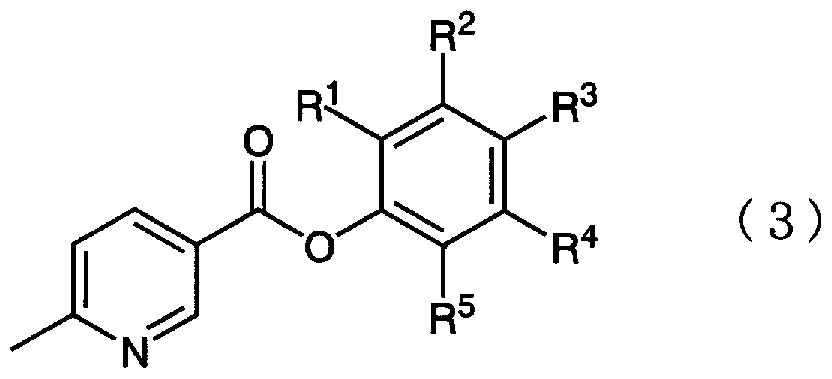
- 6-Methylnicotinic acid phenol ester represented by the following formula (3) is a novel substance useful as an intermediate for the production of pharmaceuticals.
- Examples of the nitrogen atom and the rogen atom include a chlorine atom and a bromine atom.
- alkyl group having 1 to 4 carbon atoms examples include a methyl group, an ethyl group, an n-propyl group, an isopropyl group, an n-butyl group, an isobutyl group, a sec-butyl group, and a tert-butyl group. be able to.
- alkoxyl group having 1 to 4 carbon atoms examples include a methoxy group, an ethoxy group, a propoxy group, and a butoxy group.
- preferred examples of R 1 to include a hydrogen atom, a chlorine atom, and a methyl group.
- 6 methyl nicotinic acid ester represented by the formula (3) include 6 methyl nicotinic acid ester, 6 methyl nicotinic acid (2-clonal ester) ester, 6- Methyl nicotinic acid (4 chlorophenol) ester, 6-Methyl nicotinic acid (3 chlorophenol) ester, 6 Methyl nicotinic acid (2-trophel) ester, 6 Methyl nicotinic acid (4-tropifer) Ester), 6-methylnicotinic acid (3-methylphenol) ester, 6-methylnicotinic acid (2-methylphenol) ester, 6-methyl-cotinoic acid (4-methylphenol) ester, 6-methylnicotine Acid (3-methylphenol) ester, 6-methylnicotinic acid (2,3-dimethylphenol) ester, 6-methylnicotinic acid (2,4-dimethylphenol) ester, 6-methylnicotinic acid (2,5
- 6-methylnicotinic acid phenol ester 6-methylnicotinic acid (2 black mouth) ester, 6 methyl nicotinic acid (4 black mouth) ester , 6-methylnicotinic acid (3-methylphenol) ester, 6-methylnicotinic acid (2-methylphenol) ester, 6-methylnicotinic acid (4-methylphenol) ester, 6-methyl-cotynic acid (3 methylphenol) ester, 6 methylnicotinic acid (2,3 dimethylphenol) ester, 6 methylnicotinic acid (2,4 dimethylphenol) ester, 6 methylnicotinic acid (2,5 dimethylphenol) ester 6-Methylnicotinic acid (2,6-dimethylphenol) ester, 6-methylnicotinic acid (3,4-dimethylphenol) ester Ter and 6-methylnicotinic acid (3,5-dimethylphenol) esters are preferred.
- 6-methylnicotinic acid phenol ester represented by the formula (3) can be produced, for example, as follows. That is, 6-methylnicotinic acid and formula (1);
- R. represents an alkyl group or aryl group having 1 to 4 carbon atoms
- the reaction is carried out in the presence of a base. 2;
- examples of the alkyl group having 1 to 4 carbon atoms represented by R 6 include a methyl group, an ethyl group, an n-propyl group, an isopropyl group, n —Butyl group, isobutyl group, sec-butyl group, tert-butyl group and the like can be mentioned.
- Examples of the aryl group represented by R 6 include a phenol group, a 4-methylphenol group, a 2-chlorophenol group, and a 4-chlorophenol group. .
- chloroformate represented by the formula (1) include, for example, methyl chloroformate, ethyl chloroformate, n-propino chloroformate, isopropino chloroformate, n-butyl chloroformate, chloroformate Examples include isobutyl acid and chloroformic acid phenol.
- the amount of chloroformate used is preferably 1 to 4 moles per mole of 6-methylnicotinic acid from the viewpoint of improving yield and economy.
- the base used in the reaction is not particularly limited, and examples thereof include triethylamine, diisopropylethylamine, tributylamine and pyridine.
- the amount of the base used is preferably 1 to 10 mol with respect to 1 mol of 6-methylnicotinic acid from the viewpoint of improving the yield and economical efficiency.
- the reaction using phenolic compound to obtain 6-methylnicotinic acid phenol ester is, for example, phenolic compound in a reaction solution of 6-methylnicotinic acid and chloroformate. It can be done by holding things. At this time, in order to prevent a decrease in the reaction rate between 6-methylnicotinic acid and chloroformate due to the reaction between the phenolic compound and unreacted chloroformate, It is preferable to add a phenol compound to the reaction solution after confirming that the reaction with the acid ester has been completed by high performance liquid chromatography (HPLC) or the like.
- HPLC high performance liquid chromatography
- phenol compounds include phenol, 2-chlorophenol, 4-chlorophenol, 2-methylphenol, 2,3 dimethylphenol, 2-methoxyphenol, and 2,3 dimethoxyphenol. be able to.
- the amount of phenolic compound used is preferably 0.5 to 10 moles per mole of 6-methylnicotinic acid from the viewpoint of improving the yield and economical efficiency.
- the solvent used in the first production method is not particularly limited as long as it is an inert solvent for the reaction, and examples thereof include benzene, toluene, xylene, monochrome benzene, and dichlorobenzene. be able to.
- the amount of the solvent used is preferably 300 to 10,000 parts by weight with respect to 100 parts by weight of 6-methyl-cotynic acid from the viewpoint of improving operability and economical efficiency.
- the reaction temperature is not particularly limited, but is preferably 20 ° C to 80 ° C. If the reaction temperature exceeds 80 ° C, side reactions will be a problem. On the other hand, if the reaction temperature is less than 20 ° C, the reaction rate is too slow for practical use. Since the reaction time varies depending on the reaction temperature, it cannot be generally stated, but it is preferably 1 to 24 hours.
- 6-methylnicotinic acid phenol ester represented by the formula (3) is as follows. Can be manufactured. That is, 6-methylnicotinic acid and formula (2);
- R 7 represents an alkyl group having 1 to 4 carbon atoms or substituted !, may be! / Represents a phenol group
- second production method t
- the same phenolic compound used in the first production method can be used.
- the amount of the phenolic compound used is 1 to 25 mol per 1 mol of 6-methylnicotinic acid from the viewpoint of improving the yield and economical efficiency. Is preferred.
- the alkyl group having 1 to 4 carbon atoms represented by R 7 includes, for example, a methyl group, an ethyl group, an n-propyl group, and n -It is possible to list butyl groups.
- substituents represented by R 7 may be substituted !, or may be! /,
- a substituent in the phenyl group for example, a halogen atom, a hydroxyl group, an alkyl group having 1 to 4 carbon atoms, and a carbon number Examples thereof include 1 to 4 alkoxyl groups.
- Examples of the nitrogen atom and the rogen atom include a chlorine atom and a bromine atom.
- Examples of the alkyl group having 1 to 4 carbon atoms include methyl group, ethyl group, n propyl group, isopropyl group, n butyl group, isobutyl group, sec butyl group and tert butyl group.
- alkoxyl group having 1 to 4 carbon atoms examples include a methoxy group, an ethoxy group, a propoxy group, and a butoxy group.
- Specific examples of the sulfonic acid represented by the formula (4) include, for example, methanesulfonic acid, ethanesulfonic acid, propanesulfonic acid, benzenesulfonic acid, 4-methylbenzenesulfonic acid, 4-hydroxybenzenesulfonic acid, Examples include 4-hydroxy-3-methylbenzenesulfonic acid and 4-chloro-2-hydroxybenzenesulfonic acid.
- the commercially available sulfonic acid may be used as it is.
- R 7 in formula (4) is a phenyl group which may be substituted and one of the substituents is a hydroxyl group
- the sulfonic acid is represented by formula (2). It is also possible to use a mixture prepared from phenolic compound and sulfuric acid.
- the amount of the sulfonic acid used is preferably 0.5 to 5 mol with respect to 1 mol of 6-methylnicotinic acid, from the viewpoint of improving the yield and economical efficiency.
- the solvent used is not particularly limited as long as it is an inert solvent for the reaction.
- isopia pills Ether such as ether
- aromatic hydrocarbon such as toluene and monochlorobenzene
- aliphatic hydrocarbon such as heptane
- DMSO dimethyl sulfoxide
- NMP N-methylpyrrolidone
- aprotic polar solvents such as sulfolane.
- aromatic hydrocarbons are preferably used from the viewpoint of easy removal of by-product water by azeotropic dehydration in the reaction for obtaining 6-methylnicotinic acid ester.
- the amount of the solvent used is preferably 10 to 3000 parts by weight with respect to 100 parts by weight of 6-methyl-cotynic acid from the viewpoints of improving operability and economy.
- the reaction temperature is not particularly limited, but is preferably 40 ° C to 300 ° C, more preferably 80 ° C to 200 ° C. If the reaction temperature exceeds 300 ° C, side reactions will be a problem. On the other hand, if it is less than 40 ° C, the reaction rate is too low for practical use. Reaction time is Since it differs depending on the temperature, it cannot be generally stated, but it is preferably 1 to 40 hours.
- the 6-methylnicotinic acid phenol ester represented by the formula (3) can be produced as follows. That is, 5-ethyl 2-methylpyridine and nitric acid were reacted in the presence of sulfuric acid, and the obtained 6-methylnicotinic acid was converted into the formula (2) in the presence of sulfuric acid.
- a method for producing 6-methylnicotinic acid in which 3 to 10 mol of nitric acid is added dropwise to 1 mol of methylpyridine is disclosed. According to this method, 6-methylnicotinic acid can be safely obtained in a high yield.
- hydroxybenzenesulfonic acid is a sulfonic acid used in the second production method, a phenol group in which R 7 in formula (4) may be substituted, and one of the substituents. One of which is a hydroxyl group.
- 6-methylnicotinic acid phenol ester can be produced by reacting 6 methylnicotinic acid with a phenol compound represented by the formula (2) in the presence of hydroxybenzene sulfonic acid. .
- the same phenol compound used in the first production method can be used.
- the amount of the phenol compound used is preferably 1 to 30 moles per mole of 5-ethyl-2-methylpyridine! /.
- a solvent is not necessarily used.
- the solvent for use is not particularly limited as long as it is an inert solvent for the reaction.
- ether such as isopropyl ether
- aromatic hydrocarbon such as toluene and monochlorobenzene, heptane, etc.
- aprotic polar solvents such as ⁇ , ⁇ ⁇ ⁇ ⁇ dimethylformamide (DMF), dimethyl sulfoxide (DMSO), ⁇ -methylpyrrolidone ( ⁇ ), and sulfolane.
- aromatic hydrocarbons are preferred from the viewpoint that water produced as a by-product in the reaction of obtaining 6-methylnicotinic acid phenol ester from 6-methylnicotinic acid and a phenol compound can be easily removed by azeotropic dehydration. Used.
- the amount of solvent used is 5 ethyl from the viewpoint of improving operability and economy.
- the reaction temperature in the reaction for obtaining hydroxybenzenesulfonic acid is not particularly limited, but it is preferably 0 ° C to 300 ° C. 40 ° C to 180 ° More preferably, it is C.
- the reaction temperature exceeds 300 ° C, side reactions become a problem, while 0 ° C If it is less than 1, the reaction rate is too slow for practical use. Since the reaction time varies depending on the reaction temperature, it cannot be generally stated, but it is preferably 1 to 20 hours.
- the reaction temperature in the reaction for obtaining 6-methylnicotinic acid ester from 6-methylnicotinic acid and a phenol compound is not particularly limited, but it is preferably 40 ° C to 300 ° C. 80 ° More preferably, the temperature is C to 200 ° C. If the reaction temperature exceeds 300 ° C, side reactions will be a problem. On the other hand, if it is less than 40 ° C, the reaction rate is too slow for practical use. Since the reaction time varies depending on the reaction temperature, it cannot be generally stated, but it is preferably 1 to 40 hours.
- reaction for obtaining hydroxybenzene sulfonic acid from sulfuric acid and phenol compound and reaction for obtaining 6-methyl nicotinic acid phenol ester from 6-methylnicotinic acid and phenol compound
- reaction for obtaining hydroxybenzene sulfonic acid from sulfuric acid and phenol compound and reaction for obtaining 6-methyl nicotinic acid phenol ester from 6-methylnicotinic acid and phenol compound
- the sulfonic acid present in the reaction system is considered to contribute to the reaction as an acid catalyst.
- the method for isolating and purifying the desired 6-methylnicotinic acid phenol ester from the reaction mixture obtained by various production methods as described above is not particularly limited.
- the 6-methylnicotinic acid ester is a liquid, a method of distillation under reduced pressure and the like, when it is a solid, a method of crystallization as it is, a method of extraction and recrystallization, and the like can be mentioned.
- R 8 represents an alkyl group having 1 to 4 carbon atoms, Me represents a methyl group
- I ⁇ to R 5 each independently represents a hydrogen atom, a halogen atom, a nitro group, an alkyl group having 1 to 4 carbon atoms, or an alkoxyl group having 1 to 4 carbon atoms.
- 3-yl) 3-oxopropionic acid ester is a novel substance useful as an intermediate for the production of 1 (6 methylpyridine-3-yl) 2- [4 (methylsulfonyl) phenyl] ethanone.
- R 8 represents an alkyl group having 1 to 4 carbon atoms
- Me represents a methyl group.
- Examples of the alkyl group having 1 to 4 carbon atoms represented by R 8 include a methyl group, an ethyl group, an n propyl group, an isopropyl group, an n butyl group, an isobutyl group, a sec butyl group, and a t ert butyl group. Can be mentioned. Among these, from the viewpoint of industrial productivity in the production of 1- (6 methylpyridine 3-yl) 2- [4 (methylsulfol) phenol] ethanone, methyl group, ethyl group, isopropyl group and The tert butyl group is preferred.
- 3-yl) 3-oxopropionic acid ester consists of a phenylacetic acid ester represented by formula (5) and a 6-methylnicotinic acid phenol ester represented by formula (3) in the presence of a base. It can be produced from the reaction from below.
- R 8 is the same as R 8 in formula (6).
- the phenylacetic acid ester represented by the formula (5) can be produced by a known method. For example, it can be easily obtained by a method described in US Pat. No. 6,127,545 using thioanol and ethyloxalyl chloride as starting materials.
- 6-methylnicotinic acid ester represented by the formula (3) the same 6-methyl-cotinoic acid ester can be used.
- the base used in the reaction is not particularly limited, and examples thereof include alkali metal hydrides such as lithium hydride, sodium hydride and potassium hydride; alkaline earth metal hydrides such as calcium hydride; and sodium methylate.
- alkali metal hydrides such as lithium hydride, sodium hydride and potassium hydride
- alkaline earth metal hydrides such as calcium hydride
- sodium methylate sodium methylate
- alkali metal alcoholates such as sodium ethylate, sodium butoxide and potassium butoxide.
- sodium hydride is particularly preferable among alkali metal hydride, alkaline earth metal hydride and idride from the viewpoint of industrial productivity.
- These bases may be used alone or in combination of two or more.
- the use amount of the base is preferably 1 to 8 mol with respect to 1 mol of ester furacetate from the viewpoint of obtaining an effect corresponding to the use amount. Is more preferred.
- the solvent used in the reaction is not particularly limited as long as it is inert to the reaction.
- alcohols such as methanol, ethanol, propanol and butanol
- ethers such as dimethyl ether, tetrahydrofuran, methyl tert butyl ether and dioxane Etc.
- hydrocarbons and ethers are preferred from the viewpoint of industrial productivity.
- the amount of the solvent used is preferably 300 to 5000 parts by weight, preferably 500 to 2000 parts by weight, with respect to 100 parts by weight of the vinyl acetate ester from the viewpoint of ease of reaction operation. More preferred.
- the temperature of the reaction is as follows.
- the temperature is preferably 20 ° C to 100 ° C, more preferably 0 ° C to 50 ° C. Since the reaction time varies depending on the reaction temperature, it cannot be generally stated, but it is preferably 0.5 to 24 hours. Good.
- Examples of the hydrolysis method include a method using neutral water, a method using alkaline water, a method using acidic water, and the like as usual, but acidic water is used from the viewpoint of industrial productivity. The method is preferred.
- Acids used in acidic water include mineral acids such as sulfuric acid, hydrochloric acid, nitric acid, and phosphoric acid; organic carboxylic acids such as acetic acid, oxalic acid, malonic acid, benzoic acid, and phthalic acid; and methanesulfonic acid, p And organic sulfonic acids such as ruene sulfonic acid; and salts thereof.
- mineral acids such as sulfuric acid, hydrochloric acid, nitric acid, and phosphoric acid
- organic carboxylic acids such as acetic acid, oxalic acid, malonic acid, benzoic acid, and phthalic acid
- methanesulfonic acid, p And organic sulfonic acids such as ruene sulfonic acid; and salts thereof.
- the amount of acid used is not particularly limited, but is generally 2— [4— (methylsulfol) phenol] — 3— (6 from the viewpoint of improving the yield and economy.
- -Methylpyridine-3-yl) 3-oxopropionic acid ester It is preferably 1 to 30 mol, more preferably 1 to 20 mol, per 1 mol.
- the temperature for hydrolysis and decarboxylation is not particularly limited, but from the viewpoints of operability, prevention of reaction rate reduction, prevention of side reactions, and reduction in yield. It is preferable that the temperature is from ° C to 150 ° C, more preferably from 20 ° C to 100 ° C.
- a phenylacetic acid ester represented by the formula (5) and a 6-methylnicotinic acid phenol ester represented by the formula (3) are added in the presence of a base.
- the formula 2- [4 (Methylsulfurol) phenol] represented by (6) 3- (6 Methylpyridine-3-yl) -3-oxoporate pionate is obtained, and this is not isolated and purified.
- 1- (6 methylpyridine 3yl) -2- [4 (methylsulfol) phenol] ethanone represented by the formula (7) Can be produced in a pot. According to this method, 1- (6-methylpyridine-3-yl) -2- [4 (methylsulfol) phenol] ethanone can be produced very efficiently.
- R 9 represents an alkyl group having 1 to 4 carbon atoms, Me represents a methyl group), and a phenyl acetate represented by formula (3);
- R 9 represents an alkyl group having 1 to 4 carbon atoms
- Me represents a methyl group.
- Examples of the alkyl group having 1 to 4 carbon atoms represented by R 9 include a methyl group, an ethyl group, an n propyl group, an isopropyl group, an n butyl group, an isobutyl group, a sec butyl group, and a t ert butyl group. Can be mentioned. Among these, from the viewpoint of industrial productivity in the production of 1- (6 methylpyridine 3-yl) 2- [4 (methylsulfol) phenol] ethanone, methyl group, ethyl group, isopropyl group and The tert butyl group is preferred.
- R 9 is the same as R 9 in the formula (9).
- the phenylacetic acid ester represented by the formula (8) can be produced by a known method. For example, it can be easily obtained by a method described in US Pat. No. 6,127,545 using thioanol and ethyloxalyl chloride as starting materials.
- the 6-methylnicotinic acid phenol ester represented by the formula (3) may be the same as the 6-methyl-cotinoic acid phenol ester described above.
- the base used in the reaction is not particularly limited, and examples thereof include alkali metal hydrides such as lithium hydride, sodium hydride and potassium hydride; alkaline earth metal hydrides such as calcium hydride; and sodium methylate.
- alkali metal hydrides such as lithium hydride, sodium hydride and potassium hydride
- alkaline earth metal hydrides such as calcium hydride
- sodium methylate sodium methylate
- alkali metal alcoholates such as sodium ethylate, sodium butoxide and potassium butoxide.
- sodium hydride is particularly preferable among alkali metal hydride, alkaline earth metal hydride and idride from the viewpoint of industrial productivity.
- These bases may be used alone or in combination of two or more.
- the amount of the base used is preferably 1 to 8 mol with respect to 1 mol of ester furacetate, from the viewpoint of obtaining an effect corresponding to the amount used. Is more preferred.
- the solvent used in the reaction is not particularly limited as long as it is inert to the reaction.
- Hydrogen 1,2-dichloroethane, methylene chloride, black benzene, dichloroben And halogenated hydrocarbons such as zen; alcohols such as methanol, ethanol, propanol and butanol; and ethers such as dimethyl ether, tetrahydrofuran, methyl tert butyl ether and dioxane.
- hydrocarbons and ethers are preferred from the viewpoint of industrial productivity.
- the amount of the solvent used is preferably 300 to 5000 parts by weight and more preferably 500 to 2000 parts by weight with respect to 100 parts by weight of the phenylacetate ester from the viewpoint of ease of reaction operation. preferable.
- the temperature of the reaction is preferably from 20 ° C to 150 ° C from the viewpoint of preventing a decrease in reaction rate and suppressing side reactions. More preferred. Since the reaction time varies depending on the reaction temperature, it cannot be generally stated, but it is preferably 0.5 to 24 hours.
- the desired 2- [4 (methylthio) phenol] —3— (6-methylpyridine-1-yl) 3-oxo-1-propionate is obtained.
- the isolation and purification method is not particularly limited, and includes a method of crystallizing as it is, a method of extraction and recrystallization as usual.
- Examples of the hydrolysis method include a method using neutral water, a method using alkaline water, a method using acidic water, and the like as usual, but from the viewpoint of industrial productivity, acidic water is used. The method is preferred.
- Acids used in acidic water include mineral acids such as sulfuric acid, hydrochloric acid, nitric acid, and phosphoric acid; organic carboxylic acids such as acetic acid, oxalic acid, malonic acid, benzoic acid, and phthalic acid; and methanesulfonic acid, p And organic sulfonic acids such as ruene sulfonic acid; and salts thereof.
- mineral acids such as sulfuric acid, hydrochloric acid, nitric acid, and phosphoric acid
- organic carboxylic acids such as acetic acid, oxalic acid, malonic acid, benzoic acid, and phthalic acid
- methanesulfonic acid, p And organic sulfonic acids such as ruene sulfonic acid; and salts thereof.
- the amount of acid used is not particularly limited, but is usually 2— [4 (methylthio) phenol] 3— (6 methylpyridine 3 3) 3-Oxopropionic acid ester is preferably 1 to 30 mol per 1 mol 1 to 20 mol is more preferable.
- the temperature for hydrolysis and decarboxylation is not particularly limited, but from the viewpoints of operability, prevention of reaction rate reduction, and prevention of side reactions and suppression of yield reduction.
- the temperature is preferably 0 ° C to 150 ° C, more preferably 20 ° C to 120 ° C.
- the method of oxidizing is not particularly limited, and examples thereof include a method of reacting with an oxidizing agent such as hydrogen peroxide, perbenzoic acid and peracetic acid.
- the amount of oxidizing agent used is 2- [4 (methylthio) phenol] -3- (6-methylpyridine 3-yl) -3 from the viewpoint of improving yield and economical efficiency.
- —Oxopropionic acid ester is preferably 1 to 10 mol, more preferably 1 to 4 mol, relative to 1 mol.
- the solvent used in the oxidation reaction is not particularly limited as long as it is inert to the reaction.
- alcohols such as methanol, ethanol, propanol and butanol
- ketones such as acetone and methyl isobutyl ketone it can.
- alcohol and ketone are preferable from the viewpoint of industrial productivity.
- the amount of the solvent used for the oxidation reaction is 2- [4 from the viewpoint of ease of reaction operation.
- the temperature of the oxidation reaction is not particularly limited. From the viewpoint of operability and the prevention of a decrease in reaction rate, and from the viewpoint of preventing the occurrence of side reactions and suppressing the decrease in yield, 0 °
- the temperature is preferably C to 100 ° C, more preferably 20 ° C to 70 ° C.
- a catalyst such as sodium tungstate can be used for the purpose of further promoting the reaction.
- the amount of catalyst used is 2— [4— (Methylthio) phenol] -3- (6-Methylpyridine-3-yl) -3-oxo-propionic acid ester is preferably 0.1 to 10 parts by weight with respect to 100 parts by weight.
- 11 useful as an intermediate for pharmaceuticals and the like (6 methylpyridine-3-yl)
- Example I-1 the same procedure as in Example I 1 was carried out except that 15.4 g (0.12 mol) of 4-clonal phenol was used instead of 11.3 g (0.12 mol) of phenol.
- Methodhylnicotinic acid (4 black mouth) ester (14.8 g) was obtained as white crystals.
- the yield of the obtained 6 methyl nicotinic acid (4 chlorophenol) ester was 61% based on 6 methyl nicotinic acid.
- a four-necked flask equipped with a stirrer, thermometer and condenser is charged with 33.6 g (0.84 mol) of 60 wt% sodium hydride mineral oil dispersion and 500 g of tetrahydrofuran, and maintained at 0 ° C with stirring. While adding a tetrahydrofuran solution of 44.8 g (0.21 mol) of 6-methylnicotinic acid phenol and 45.6 g (0.20 mol) of methyl 4-methylsulfol-sulfurate over 2 hours The mixture was further stirred at the same temperature for 2 hours.
- a four-necked flask equipped with a stirrer, thermometer and condenser is charged with 33.6 g (0.84 mol) of 60 wt% sodium hydride mineral oil dispersion and 500 g of tetrahydrofuran, and maintained at 5 ° C with stirring. While adding a tetrahydrofuran solution of 44.8 g (0.21 mol) of 6-methylnicotinic acid and 48.4 g (0.20 mol) of 4-methylsulfol-sulfuryl acetate over 2 hours The mixture was further stirred at the same temperature for 1 hour.
- a four-necked flask equipped with a stirrer, thermometer and condenser is charged with 16.8 g (0.42 mol) of 60 wt% sodium hydride mineral oil dispersion and 300 g of tetrahydrofuran, and kept at 0 ° C with stirring. Then, a tetrahydrofuran solution of 44.8 g (0.21 mol) of 6-methylnicotinic acid and 51.2 g (0.20 mol) of 4-methylsulfolphenol acetate was added dropwise over 2 hours. Thereafter, the mixture was further stirred at the same temperature for 6 hours.
- Example 3 A four-necked flask equipped with a stirrer, thermometer and condenser was obtained in Example 1-3
- a four-necked flask equipped with a stirrer, thermometer and condenser is charged with 50.4 g (l. 26 mol) of 60 wt% sodium hydride mineral oil dispersion and 300 g of tetrahydrofuran, and kept at 0 ° C with stirring. While using a tetrahydrofuran solution of 67.2 g (0.32 mol) of 6-methylnicotinic acid and 68.5 g (0.30 mol) of methyl 4-methylsulfol-vinyl acetate, 2 After dropwise addition over time, the mixture was further stirred at the same temperature for 2 hours.
- the resulting reaction solution was acidified with an acid, heated to 95 ° C, neutralized with an aqueous solution of sodium hydroxide and sodium hydroxide, and the precipitated crystals were filtered and dried to give 1 (6 methylpyridine- 3yl) -2- [4- (methylsulfol) phenol] ethanone 69.5 g was obtained.
- the yield of 1- (6-methylpyridine-3-yl) 2- [4 (methylsulfol) phenol] ethanone obtained was 80% based on methyl methanesulfolphenol acetate. there were.
- a four-necked flask equipped with a stirrer, thermometer and condenser is charged with 25.2 g (0.63 mol) of 60 wt% sodium hydride mineral oil dispersion and 500 g of tetrahydrofuran, and kept at 5 ° C with stirring. While adding a tetrahydrofuran solution of 67.2 g (0.32 mol) of 6-methylnicotinic acid and 72.3 g (0.30 mol) of 4-methylsulfol-sulfuryl acetate over 2 hours The mixture was further stirred at the same temperature for 5 hours.
- the resulting reaction solution was acidified using an acid, and further heated with copper and quinoline to 100 ° C, neutralized with an aqueous sodium hydroxide solution, and the precipitated crystals were filtered and dried.
- 56.4 g of 1- (6-methylpyridine-3-yl) -2- [4 (methylsulfol) phenol] ethanone was obtained.
- the yield of 1- (6-methylpyridine-3-yl) -2- [4- (methylsulfoyl) phenol] ethanone obtained was 65% relative to 4 methanesulfuryl ether acetate. %Met.
- a four-necked flask equipped with a stirrer, thermometer and condenser is charged with 50.4 g (l. 26 mol) of 60 wt% sodium hydride mineral oil dispersion and 500 g of tetrahydrofuran, and kept at 0 ° C with stirring. While being added dropwise, a tetrahydrofuran solution of 67.2 g (0.32 mol) of 6-methylnicotinic acid and 76.9 g (0.30 mol) of isopropyl 4-phenylsulfol acetate was added dropwise over 2 hours. Thereafter, the mixture was further stirred at the same temperature for 1 hour.
- a four-necked flask equipped with a stirrer, thermometer, and condenser is charged with 32. Og (0.8 mol) of 60 wt% sodium hydride mineral oil dispersion and 800 g of tetrahydrofuran, and the temperature is maintained at 60 ° C. While stirring, a tetrahydrofuran solution of 44.8 g (0.21 mol) of 6-methylnicotinic acid and 39.3 g (0.20 mol) of methyl 4-methylthiophenylacetate was added dropwise over 2 hours. The mixture was further stirred at the same temperature for 2 hours.
- a four-necked flask equipped with a stirrer, thermometer and condenser is charged with 32.0 g (0.8 mol) of 60 wt% sodium hydride mineral oil dispersion and 800 g of tetrahydrofuran, and the temperature is maintained at 60 ° C. While stirring, a tetrahydrofuran solution of 44.8 g (0.21 mol) of 6-methylnicotinic acid and 44.9 g (0.20 mol) of isopropyl 4-methylthiophenol acetate was added dropwise over 2 hours. The mixture was further stirred at the same temperature for 1 hour.
- a four-necked flask equipped with a stirrer, thermometer and condenser is charged with 32.0 g (0.8 mol) of 60 wt% sodium hydride mineral oil dispersion and 800 g of tetrahydrofuran, and the temperature is maintained at 60 ° C. While stirring, a tetrahydrofuran solution of 44.8 g (0.21 mol) of 6-methylnicotinic acid and 47.7 g (0.20 mol) of tert-butyl 4-methylthiophenol acetate was added dropwise over 2 hours. Thereafter, the mixture was further stirred at the same temperature for 6 hours.
- Example III 6 A four-necked flask equipped with a stirrer, thermometer and condenser is charged with 60% by weight sodium hydride mineral oil dispersion 48. Og (l. 20 mol) and 1200 g of tetrahydrofuran, and the temperature is maintained at 60 ° C. While stirring, a tetrahydrofuran solution of 67.2 g (0.32 mol) of 6-methylnicotinic acid and 59.0 g (0.30 mol) of methyl 4-methylthiophenylacetate was added dropwise over 2 hours. The mixture was stirred at the same temperature for 5 hours.
- the resulting reaction solution was acidified using an acid, heated to 95 ° C, added with 3000 g of methanol and 1.5 g of sodium tungstate, and kept at 50 ° C to maintain a hydrogen peroxide solution. 2 (0.6 mol) was added dropwise over 2 hours, followed by stirring at the same temperature for 2 hours. Then add aqueous sodium hydroxide solution to neutralize, filter the precipitated crystals and dry them.
- 1- (6-Methylpyridine-3-yl)-2- [4- (Methylsulfol) file] Etanone 34.7 g was obtained.
- the yield of the obtained 1- (6-methylpyridin-3-yl) -2- [4 (methylsulfol) phenol] ethanone was 40% with respect to methyl 4-methylthiophenylacetate.
- a four-necked flask equipped with a stirrer, thermometer and condenser is charged with 60% by weight sodium hydride mineral oil dispersion 48. Og (l. 20 mol) and 1200 g of tetrahydrofuran. While stirring, a solution of 66.2 g (0.32 mol) of 6-methylnicotinic acid and 67.3 g (0.30 mol) of isopropyl 4-methylthiophenol acetate was added dropwise over 2 hours. The mixture was further stirred at the same temperature for 6 hours. The resulting reaction solution was acidified by adding 3000 g of water and 294.6 g (3.0 mol) of sulfuric acid.
Landscapes
- Chemical & Material Sciences (AREA)
- Organic Chemistry (AREA)
- Pyridine Compounds (AREA)
Abstract
1-(6-メチルピリジン-3-イル)-2-[4-(メチルスルホニル)フェニル]エタノンを、安全で容易且つ効率よく製造することのできる方法を提供する。
本発明は、フェニル酢酸エステルと6-メチルニコチン酸フェニルエステルとを、塩基の存在下で反応させ、得られた2-[4-(メチルスルホニル)フェニル]-3-(6-メチルピリジン-3-イル)-3-オキソ-プロピオン酸エステルを、加水分解および脱炭酸することを特徴とする1-(6-メチルピリジン-3-イル)-2-[4-(メチルスルホニル)フェニル]エタノンの製造方法;ならびに、フェニル酢酸エステルと6-メチルニコチン酸フェニルエステルとを、塩基の存在下で反応させ、得られた2-[4-(メチルチオ)フェニル]-3-(6-メチルピリジン-3-イル)-3-オキソ-プロピオン酸エステルを、加水分解、脱炭酸および酸化することを特徴とする1-(6-メチルピリジン-3-イル)-2-[4-(メチルスルホニル)フェニル]エタノンの製造方法を提供する。
Description
1 _ (6_メチルピリジン _ 3_ィル) _ 2_ [4_ (メチルスルホニル)フエ二 ル]エタノンの製造方法および製造中間体
技術分野
[0001] 本発明は、 1— (6—メチルピリジン— 3—ィル)—2— [4— (メチルスルホ -ル)フエ -ル]エタノンの製造方法および製造中間体に関する。
背景技術
[0002] 1— (6—メチルピリジン— 3—ィル)—2— [4— (メチルスルホ -ル)フエ-ル]ェタノ ンは、医薬中間体として有用である。 1— (6—メチルピリジン— 3—ィル)—2— [4— ( メチルスルホ -ル)フエ-ル]エタノンの製造方法として、以下のような方法が知られて いる。
[0003] (1) 6 メチルニコチンアミド化合物と(4ーメチルチオ)ベンジルマグネシウムハライ ドとを反応させる方法 (WO99Z15503);
[0004] [化 1]

[0005] (2) (4ーメチルチオ フエ-ル)ァセトニトリルと 6 メチルニコチン酸エステルとを 用いて得られる 3— [2—(4 (メチルチオ)フエ-ル) 2 シァノアセチル] (6—メチ ル)—ピリジンを、加水分解して脱炭酸した後、酸ィ匕させる方法 (WO01Z07410);
[0006] [化 2]


発明が解決しょうとする課題
[0010] 本発明の課題は、 1— (6—メチルピリジン— 3—ィル)—2— [4— (メチルスルホ- ル)フエニル]エタノンを、安全で容易且つ効率よく製造することのできる製造方法お よびその製造中間体を提供することにある。
課題を解決するための手段
[0011] 本発明は、下記に示すとおりの 1ー(6—メチルピリジンー3—ィル) - 2- [4- (メチ ルスルホニル)フエニル]エタノンの製造方法および製造中間体を提供するものであ る。
[0012] 1.式(5) ;
[0013] [化 4]

[0014] (式中、 R8は炭素数 1〜4のアルキル基を示し、 Meはメチル基を示す。 )で表されるフ ェニル酢酸エステルと、式(3);
[0015] [化 5]

[0016] (式中、 R1〜 はそれぞれ独立して、水素原子、ハロゲン原子、ニトロ基、炭素数 1〜 4のアルキル基、または炭素数 1〜4のアルコキシル基を示す。)で表される 6—メチ ルニコチン酸フヱ-ルエステルとを、塩基の存在下で反応させ、得られた式(6);
[0017] [化 6]
S02Me
[0018] (式中、 R8および Meは前記と同様である。 )で表される 2— [4— (メチルスルホニル) フエ-ル]— 3— (6—メチルピリジン一 3—ィル) 3—ォキソ一プロピオン酸エステル を、加水分解および脱炭酸することを特徴とする式 (7);
[0019] [化 7]

[0020] (式中、 Meは前記と同様である。)で表される 1一(6 メチルピリジン 3 ィル)—2
[4 (メチルスルホ -ル)フエ-ル]エタノンの製造方法。
[0021] 2.塩基が、アルカリ金属ノ、イドライドおよびアルカリ土類金属ハイドライドからなる群 より選択される少なくとも 1種である上記項 1に記載の方法。
[0022] 3.式(3) ;
[0023] [化 8]

[0024] (式中、!^〜 はそれぞれ独立して、水素原子、ハロゲン原子、ニトロ基、炭素数 1〜
4のアルキル基、または炭素数 1〜4のアルコキシル基を示す。)で表される 6—メチ ルニコチン酸フエ-ルエステルが、 6 メチルニコチン酸と、式(1);
[0025] [化 9]
( l )
CI义ひ
[0026] (式中、 R6は炭素数 1〜4のアルキル基またはァリール基を示す。 )で表されるクロ口 ギ酸エステルとを、塩基の存在下で反応させ、次いで式(2);
[0027] [化 10]

[0028] (式中、!^〜 は前記と同様である。)で表されるフエノールイ匕合物と反応させること により得られることを特徴とする上記項 1に記載の方法。
[0029] 4.式(3) ;
[0030] [化 11]

[0031] (式中、 I^〜R5はそれぞれ独立して、水素原子、ハロゲン原子、ニトロ基、炭素数 1 4のアルキル基、または炭素数 1〜4のアルコキシル基を示す。)で表される 6—メチ ルニコチン酸フエ-ルエステルが、 6—メチルニコチン酸と、式(2);
[0032] [化 12]

[0033] (式中、!^〜 は前記と同様である。)で表されるフエノールイ匕合物とを、式 (4);
R -SO H (4)
3
(式中、 R7は炭素数 1〜4のアルキル基または置換されて!、てもよ!/、フエ-ル基を示 す。 )で表されるスルホン酸の存在下で反応させることにより得られることを特徴とする 上記項 1に記載の方法。
[0034] 5.式(3) ;
[0035] [化 13]

[0036] (式中、!^〜 はそれぞれ独立して、水素原子、ハロゲン原子、ニトロ基、炭素数 1〜 4のアルキル基、または炭素数 1〜4のアルコキシル基を示す。)で表される 6—メチ ルニコチン酸フエ-ルエステルが、 5—ェチルー 2—メチルピリジンと硝酸とを硫酸の 存在下で反応させ、得られた 6—メチルニコチン酸を、前記硫酸の存在下で、式(2)
[0037] [化 14]

[0038] (式中、!^〜 は前記と同様である。 )で表されるフエノールイ匕合物と反応させること により得られることを特徴とする上記項 1に記載の方法。
[0039] 6.式(6) ;
[0040] [化 15]

[0042] [化 16]

[0043] (式中、 Meは前記と同様である。)で表される 1— (6—メチルピリジン一 3—ィル) 2
[4 (メチルスルホ -ル)フエ-ル]エタノンの製造方法。
[0044] 7.式(5) ;
[0045] [化 17]

[0046] (式中、 R8は炭素数 1〜4のアルキル基を示し、 Meはメチル基を示す。)で表されるフ ェニル酢酸エステルと、式(3);
[0047] [化 18]

[0048] (式中、!^〜 はそれぞれ独立して、水素原子、ハロゲン原子、ニトロ基、炭素数 1〜 4のアルキル基、または炭素数 1〜4のアルコキシル基を示す。)で表される 6—メチ ルニコチン酸フヱ-ルエステルとを、塩基の存在下で反応させることを特徴とする式( 6) ;
[0049] [化 19]

[0050] (式中、 R8および Meは前記と同様である。)で表される 2— [4- (メチルスルホニル) フエ-ル]— 3— (6—メチルピリジン一 3—ィル) 3—ォキソ一プロピオン酸エステル の製造方法。
[0051] 8.式(6);
[0052] [化 20]

[0053] (式中、 R8は炭素数 1〜4のアルキル基を示し、 Meはメチル基を示す。)で表される 2
[4 (メチルスルホ -ル)フエ-ル ] 3—(6—メチルピリジン 3—ィル)ー3—ォ キソープロピオン酸エステノレ。
[0054] 9.式(8);
[0055] [化 21]

[0056] (式中、 R9は炭素数 1〜4のアルキル基を示し、 Meはメチル基を示す。)で表されるフ ェニル酢酸エステルと、式(3);
[0057] [化 22]

[0058] (式中、!^〜 はそれぞれ独立して、水素原子、ハロゲン原子、ニトロ基、炭素数 1〜 4のアルキル基、または炭素数 1〜4のアルコキシル基を示す。)で表される 6—メチ ルニコチン酸フヱ-ルエステルとを、塩基の存在下で反応させ、得られた式(9);
[0059] [化 23]

[0060] (式中、 R9および Meは前記と同様である。)で表される 2— [4— (メチルチオ)フエ- ル]— 3— (6—メチルピリジン一 3—ィル) 3—ォキソ一プロピオン酸エステルを、加 水分解、脱炭酸および酸化することを特徴とする式 (7);
[0061] [化 24]

[0062] (式中、 Meは前記と同様である。)で表される 1— (6—メチルピリジン一 3—ィル) 2
[4 (メチルスルホ -ル)フエ-ル]エタノンの製造方法。
[0063] 10.塩基が、アルカリ金属ハイドライドおよびアルカリ土類金属ハイドライドからなる 群より選択される少なくとも 1種である上記項 9に記載の方法。
[0064] 11.式(3) ;
[0065] [化 25]

[0066] (式中、!^〜 はそれぞれ独立して、水素原子、ハロゲン原子、ニトロ基、炭素数 1 4のアルキル基、または炭素数 1〜4のアルコキシル基を示す。)で表される 6—メチ ルニコチン酸フエ-ルエステルが、 6—メチルニコチン酸と、式(1);
[0067] [化 26] ス ( 1 )
cr 、ひ
[0068] (式中、 R6は炭素数 1〜4のアルキル基またはァリール基を示す。)で表されるクロ口 ギ酸エステルとを、塩基の存在下で反応させ、次いで式(2);
[0069] [化 27]

[0070] (式中、!^〜 は前記と同様である。)で表されるフエノールイ匕合物と反応させること により得られることを特徴とする上記項 9に記載の方法。
[0071] 12.式(3);
[0072] [化 28]

[0073] (式中、!^〜 はそれぞれ独立して、水素原子、ハロゲン原子、ニトロ基、炭素数 4のアルキル基、または炭素数 1〜4のアルコキシル基を示す。)で表される 6—メチ
ルニコチン酸フエ. .ルエステルが、 6—メチルニコチン酸と、式(2);
[0074] [化 29]

[0075] (式中、 I^〜R5は前記と同様である。)で表されるフ ノールイ匕合物とを、式 (4);
R7— SO H
(式中、 R7は炭素数 1〜4のアルキル基または置換されて!、てもよ!/、フエ-ル基を示 す。 )で表されるスルホン酸の存在下で反応させることにより得られることを特徴とする 上記項 9に記載の方法。
[0076] 13.式(3) ;
[0077] [化 30]

[0078] (式中、 I^〜R5はそれぞれ独立して、水素原子、ハロゲン原子、ニトロ基、炭素数 1〜 4のアルキル基、または炭素数 1〜4のアルコキシル基を示す。)で表される 6—メチ ルニコチン酸フエ-ルエステルが、 5—ェチルー 2—メチルピリジンと硝酸とを硫酸の 存在下で反応させ、得られた 6—メチルニコチン酸を、前記硫酸の存在下で、式(2)
[0079] [化 31]

[0080] (式中、!^〜 は前記と同様である。 )で表されるフエノールイ匕合物と反応させること
により得られることを特徴とする上記項 9に記載の方法。
[0081] 14.式(9) ;
[0082] [化 32]

[0083] (式中、 R9は炭素数 1〜4のアルキル基を示し、 Meはメチル基を示す。)で表される 2
[4 (メチルチオ)フエ-ル ] 3—(6—メチルピリジン 3—ィル)ー3—ォキソ プロピオン酸エステルを、加水分解、脱炭酸および酸化することを特徴とする式(7);
[0084] [化 33]

[0085] (式中、 Meは前記と同様である。)で表される 1— (6—メチルピリジン一 3—ィル) 2
[4 (メチルスルホ -ル)フエ-ル]エタノンの製造方法。
[0086] 15.式(8) ;
[0087] [化 34]

[0088] (式中、 R9は炭素数 1〜4のアルキル基を示し、 Meはメチル基を示す。)で表されるフ ェニル酢酸エステルと、式(3);
[0089] [化 35]

[0090] (式中、 R1〜 はそれぞれ独立して、水素原子、ハロゲン原子、ニトロ基、炭素数 1〜 4のアルキル基、または炭素数 1〜4のアルコキシル基を示す。)で表される 6—メチ ルニコチン酸フヱ-ルエステルとを、塩基の存在下で反応させることを特徴とする式( 9) ;
[0091] [化 36]

[0092] (式中、 R9および Meは前記と同様である。)で表される 2— [4— (メチルチオ)フエ- ル]— 3— (6—メチルピリジン— 3—ィル)—3—ォキソ—プロピオン酸エステルの製 造方法。
[0093] 16.式(9) ;
[0094] [化 37]

[0095] (式中、 R9は炭素数 1〜4のアルキル基を示し、 Meはメチル基を示す。)で表される 2
[4 (メチルチオ)フエ-ル ] 3—(6—メチルピリジン 3—ィル)ー3—ォキソ プロピオン酸エステル。
[0096] 17. 6 メチルニコチン酸と、式(1);
[0097] [化 38]
( 1 )
CI义 0'
[0098] (式中、 R6は炭素数 1〜4のアルキル基またはァリール基を示す。 )で表されるクロ口 ギ酸エステルとを、塩基の存在下で反応させ、次いで式(2);
[0099] [化 39]

[0100] (式中、!^〜 はそれぞれ独立して、水素原子、ハロゲン原子、ニトロ基、炭素数 1 4のアルキル基、または炭素数 1〜4のアルコキシル基を示す。)で表されるフエノー ル化合物と反応させることを特徴とする式 (3);
[0101] [化 40]

[0102] (式中、!^〜 は前記と同様である。)で表される 6—メチルニコチン酸フエ-ルエス テルの製造方法。
[0103] 18. 6—メチルニコチン酸と、式(2);
[0104] [化 41]

[0105] (式中、 I^〜R5はそれぞれ独立して、水素原子、ハロゲン原子、ニトロ基、炭素数 1へ 4のアルキル基、または炭素数 1〜4のアルコキシル基を示す。)で表されるフエノー
ルイ匕合物とを、式 (4) ;
R7— SO H (
(式中、 R7は炭素数 1〜4のアルキル基または置換されて!、てもよ!/、フエ-ル基を示 す。)で表されるスルホン酸の存在下で反応させることを特徴とする式(3);
[0106] [化 42]

[0107] (式中、!^〜 は前記と同様である。)で表される 6—メチルニコチン酸フエ-ルエス テルの製造方法。
[0108] 19. 5—ェチルー 2—メチルピリジンと硝酸とを硫酸の存在下で反応させ、得られた
6—メチルニコチン酸を、前記硫酸の存在下で、式(2);
[0109] [化 43]

[0110] (式中、!^〜 はそれぞれ独立して、水素原子、ハロゲン原子、ニトロ基、炭素数 1〜 4のアルキル基、または炭素数 1〜4のアルコキシル基を示す。)で表されるフエノー ル化合物と反応させることを特徴とする式 (3);
[0111] [化 44]
[0112] (式中、!^〜 は前記と同様である。)で表される 6—メチルニコチン酸フエ-ルエス
テルの製造方法。
[0113] 20.式(3) ;
[0114] [化 45]

[0115] (式中、!^〜 はそれぞれ独立して、水素原子、ハロゲン原子、ニトロ基、炭素数 1〜
4のアルキル基、または炭素数 1〜4のアルコキシル基を示す。)で表される 6—メチ ノレニコチン酸フエ二ノレエステノレ。
[0116] 以下、本発明を詳細に説明する。
[0117] 6—メチルニコチン酸フエニルエステル
下記式(3)で表される 6—メチルニコチン酸フエ-ルエステルは、医薬等の製造中 間体として有用な新規物質である。
[0118] [化 46]

[0119] 式(3)中、!^〜 はそれぞれ独立して、水素原子、ハロゲン原子、ニトロ基、炭素 数 1〜4のアルキル基、または炭素数 1〜4のアルコキシル基を示す。
[0120] ノ、ロゲン原子としては、例えば、塩素原子および臭素原子等を挙げることができる。
[0121] 炭素数 1〜4のアルキル基としては、例えば、メチル基、ェチル基、 n—プロピル基、 イソプロピル基、 n—ブチル基、イソブチル基、 sec—ブチル基および tert—ブチル基 等を挙げることができる。
[0122] 炭素数 1〜4のアルコキシル基としては、例えば、メトキシ基、エトキシ基、プロポキ シ基およびブトキシ基等を挙げることができる。
[0123] これらの中で、 R1〜 の好ましい例としては、水素原子、塩素原子およびメチル基 を挙げることができる。
[0124] 式(3)で表される 6 メチルニコチン酸フエ-ルエステルの具体例としては、例えば 、 6 メチルニコチン酸フエ-ルエステル、 6 メチルニコチン酸(2 クロ口フエ-ル) エステル、 6—メチルニコチン酸(4 クロ口フエ-ル)エステル、 6—メチルニコチン酸 (3 クロ口フエ-ル)エステル、 6 メチルニコチン酸(2 -トロフエ-ル)エステル、 6 メチルニコチン酸(4 -トロフエ-ル)エステル、 6—メチルニコチン酸(3— -トロフ ェ -ル)エステル、 6 メチルニコチン酸(2 メチルフエ-ル)エステル、 6—メチル- コチン酸(4 メチルフエ-ル)エステル、 6—メチルニコチン酸(3—メチルフエ-ル) エステル、 6 メチルニコチン酸(2, 3 ジメチルフエ-ル)エステル、 6 メチルニコ チン酸(2, 4 ジメチルフエ-ル)エステル、 6 メチルニコチン酸(2, 5 ジメチルフ ェ -ル)エステル、 6—メチルニコチン酸(2, 6 ジメチルフエ-ル)エステル、 6—メチ ルニコチン酸(3, 4—ジメチルフエ-ル)エステル、 6—メチルニコチン酸(3, 5—ジメ チルフエ-ル)エステル、 6 メチルニコチン酸(2—メトキシフエ-ル)エステル、 6—メ チルニコチン酸(4ーメトキシフエ-ル)エステル、 6—メチルニコチン酸(3—メトキシフ ェ -ル)エステル、 6—メチルニコチン酸(2, 3 ジメトキシフエ-ル)エステル、 6—メ チル-コチン酸(2, 4 ジメトキシフエ-ル)エステル、 6—メチルニコチン酸(2, 5— ジメトキシフエ-ル)エステル、 6 メチルニコチン酸(2, 6 ジメトキシフエ-ル)エス テル、 6—メチルニコチン酸(3, 4—ジメトキシフエ-ル)エステルおよび 6—メチル- コチン酸(3, 5—ジメトキシフエ-ル)エステル等を挙げることができる。これらの中で、 工業的生産性の観点から、 6—メチルニコチン酸フエ-ルエステル、 6—メチルニコチ ン酸(2 クロ口フエ-ル)エステル、 6 メチルニコチン酸(4 クロ口フエ-ル)エステ ル、 6 メチルニコチン酸(3 クロ口フエ-ル)エステル、 6 メチルニコチン酸(2—メ チルフエ-ル)エステル、 6—メチルニコチン酸(4 メチルフエ-ル)エステル、 6—メ チル-コチン酸(3 メチルフエ-ル)エステル、 6 メチルニコチン酸(2, 3 ジメチ ルフエ-ル)エステル、 6 メチルニコチン酸(2, 4 ジメチルフエ-ル)エステル、 6 メチルニコチン酸(2, 5 ジメチルフエ-ル)エステル、 6 メチルニコチン酸(2, 6 ージメチルフエ-ル)エステル、 6—メチルニコチン酸(3, 4—ジメチルフエ-ル)エス
テルおよび 6—メチルニコチン酸(3, 5—ジメチルフエ-ル)エステルが好まし 、。
[0125] 6—メチルニコチン酸フエニルエステルの製造
式(3)で表される 6—メチルニコチン酸フエ-ルエステルは、例えば、以下のように して製造できる。すなわち、 6—メチルニコチン酸と、式(1);
[0126] [化 47] 人 A6
[0127] (式中、 R。は炭素数 1〜4のアルキル基またはァリ—ル基を示す。)で表されるクロ口 ギ酸エステルとを、塩基の存在下で反応させ、次いで式(2);
[0128] [化 48]

[0129] (式中、!^〜 は式(3)における R1〜 と同様である。)で表されるフエノール化合 物と反応させることにより、 目的とする 6—メチルニコチン酸フエニルエステルを得るこ とができる(以下、「第 1の製造方法」ということがある)。
[0130] 式(1)で表されるクロロギ酸エステルにおいて、 R6で示される炭素数 1〜4のアルキ ル基としては、例えば、メチル基、ェチル基、 n—プロピル基、イソプロピル基、 n—ブ チル基、イソブチル基、 sec—ブチル基および tert—ブチル基等を挙げることができ る。
[0131] R6で示されるァリール基としては、例えば、フエ-ル基、 4—メチルフエ-ル基、 2— クロ口フエ-ル基および 4—クロ口フエ-ル基等を挙げることができる。
[0132] 式(1)で表されるクロロギ酸エステルの具体例としては、例えば、クロ口ギ酸メチル、 クロロギ酸ェチノレ、クロロギ酸 n—プロピノレ、クロロギ酸イソプロピノレ、クロロギ酸 n—ブ チル、クロロギ酸イソブチルおよびクロロギ酸フエ-ル等を挙げることができる。
[0133] クロロギ酸エステルの使用量は、収率を向上させる観点および経済性の観点から、 6 -メチルニコチン酸 1モルに対して、 1〜4モルであることが好まし!/、。
[0134] 前記反応に用いる塩基としては、特に限定されないが、例えば、トリェチルァミン、 ジイソプロピルェチルァミン、トリブチルァミンおよびピリジン等を挙げることができる。
[0135] 塩基の使用量は、収率を向上させる観点および経済性の観点から、 6 メチルニコ チン酸 1モルに対して、 1〜10モルであることが好ましい。
[0136] 第 1の製造方法において、 6 メチルニコチン酸フエ-ルエステルを得るためのフエ ノールイ匕合物を用いる反応は、例えば、 6—メチルニコチン酸とクロロギ酸エステルと の反応溶液にフエノールイ匕合物をカ卩えることで実施することができる。このとき、フエノ 一ルイ匕合物と未反応のクロロギ酸エステルとが反応することによる、 6—メチルニコチ ン酸とクロロギ酸エステルとの反応率の低下を防ぐために、 6—メチルニコチン酸とク ロロギ酸エステルとの反応が終了したことを高速液体クロマトグラフィー (HPLC)等で 確認した後、該反応溶液にフエノール化合物を加えることが好まし ヽ。
[0137] 式(2)で表されるフエノール化合物における!^〜 は、式(3)で表される 6—メチル ニコチン酸フエ-ルエステルにおける R1 !^と同様である。
[0138] フエノール化合物の具体例としては、例えば、フエノール、 2 クロ口フエノール、 4 —クロ口フエノール、 2—メチルフエノール、 2, 3 ジメチルフエノール、 2—メトキシフ ェノールおよび 2, 3 ジメトキシフエノール等を挙げることができる。
[0139] フエノールイ匕合物の使用量は、収率を向上させる観点および経済性の観点から、 6 メチルニコチン酸 1モルに対して、 0. 5〜 10モルであることが好ましい。
[0140] 第 1の製造方法に用いられる溶媒は、当該反応に対して不活性な溶媒であるなら 特に限定されず、例えば、ベンゼン、トルエン、キシレン、モノクロ口ベンゼンおよびジ クロ口ベンゼン等を挙げることができる。
[0141] 溶媒の使用量は、操作性を向上させる観点および経済性の観点から、 6—メチル- コチン酸 100重量部に対して、 300〜 10000重量部であること力好ましい。
[0142] 反応温度は、特に限定はないが、 20°C〜80°Cであるのが好ましい。反応温度が 80°Cを超えると、副反応が問題となり、一方、 20°C未満であると、反応速度が実用 上遅過ぎるので好ましくない。反応時間は、反応温度により異なるために一概には言 えないが、 1〜24時間であるのが好ましい。
[0143] また、式(3)で表される 6 メチルニコチン酸フエ-ルエステルは、以下のようにして
製造することができる。すなわち、 6—メチルニコチン酸と、式(2);
[0144] [化 49]
(2 )

[0145] (式中、!^〜 は式(3)における R1〜 と同様である。)で表されるフエノール化合 物とを、式 (4) ;
R7— SO H (4)
3
(式中、 R7は炭素数 1〜4のアルキル基または置換されて!、てもよ!/、フエ-ル基を示 す。)で表されるスルホン酸の存在下で反応させることにより、 目的とする 6—メチル- コチン酸フエニルエステルを得ることができる(以下、「第 2の製造方法」 t 、うことがあ る)。
[0146] この第 2の製造方法によれば、高価なクロロギ酸エステルを用いることなぐまた反 応工程が短縮されることから、第 1の製造方法に較べてより安価で容易に 6—メチル ニコチン酸フエ-ルエステルを得ることができる。
[0147] 第 2の製造方法に用いられるフエノールイ匕合物としては、第 1の製造方法に用いら れるフエノールイ匕合物と同じものを用いることができる。
[0148] 第 2の製造方法において、フエノールイ匕合物の使用量は、収率を向上させる観点 および経済性の観点から、 6—メチルニコチン酸 1モルに対して、 1〜25モルであるこ とが好ましい。
[0149] 式 (4)で表されるスルホン酸にお!、て、 R7で示される炭素数 1〜4のアルキル基とし ては、例えば、メチル基、ェチル基、 n—プロピル基および n—ブチル基等を挙げるこ とがでさる。
[0150] また、 R7で示される置換されて!、てもよ!/、フエ-ル基における置換基としては、例え ば、ハロゲン原子、水酸基、炭素数 1〜4のアルキル基および炭素数 1〜4のアルコ キシル基等を挙げることができる。
[0151] ノ、ロゲン原子としては、例えば、塩素原子および臭素原子等を挙げることができる。
[0152] 炭素数 1〜4のアルキル基としては、例えば、メチル基、ェチル基、 n プロピル基、 イソプロピル基、 n ブチル基、イソブチル基、 sec ブチル基および tert ブチル基 等を挙げることができる。
[0153] 炭素数 1〜4のアルコキシル基としては、例えば、メトキシ基、エトキシ基、プロポキ シ基およびブトキシ基等を挙げることができる。
[0154] 式 (4)で表されるスルホン酸の具体例としては、例えば、メタンスルホン酸、エタンス ルホン酸、プロパンスルホン酸、ベンゼンスルホン酸、 4 メチルベンゼンスルホン酸 、 4ーヒドロキシベンゼンスルホン酸、 4ーヒドロキシー 3—メチルベンゼンスルホン酸 および 4 クロロー 2 ヒドロキシベンゼンスルホン酸等を挙げることができる。
[0155] スルホン酸は、市販されているものをそのまま使用してもよい。また、スルホン酸が、 式 (4)における R7が置換されていてもよいフエ-ル基であって、その置換基のうちの 一つが水酸基である場合には、式 (2)で表されるフエノールイ匕合物と硫酸とより調製 したものを使用してもよい。
[0156] スルホン酸の使用量は、収率を向上させる観点および経済性の観点から、 6—メチ ルニコチン酸 1モルに対して、 0. 5〜5モルであることが好ましい。
[0157] 第 2の製造方法において、必ずしも溶媒を用いる必要はないが、用いる際の溶媒と しては、当該反応に対して不活性な溶媒であるなら特に限定されず、例えば、イソプ 口ピルエーテル等のエーテル、トルエンおよびモノクロ口ベンゼン等の芳香族炭化水 素、ヘプタン等の脂肪族炭化水素、ならびに、 Ν,Ν ジメチルホルムアミド(DMF)、 ジメチルスルホキシド(DMSO)、 N—メチルピロリドン(NMP)およびスルホラン等の 非プロトン性極性溶媒等を挙げることができる。これらの中で、 6—メチルニコチン酸 フエ-ルエステルを得る反応にぉ 、て副生する水を共沸脱水により除去し易 ヽと 、つ た観点から、芳香族炭化水素が好ましく用いられる。
[0158] 溶媒の使用量は、操作性を向上させる観点および経済性の観点から、 6—メチル- コチン酸 100重量部に対して、 10〜3000重量部であることが好ましい。
[0159] 反応温度は、特に限定はないが、 40°C〜300°Cであるのが好ましぐ 80°C〜200 °Cであるのがより好ましい。反応温度が 300°Cを超えると、副反応が問題となり、一方 、 40°C未満であると、反応速度が実用上遅過ぎるので好ましくない。反応時間は、反
応温度により異なるために一概には言えないが、 1〜40時間であるのが好ましい。
[0160] また、式(3)で表される 6 メチルニコチン酸フエ-ルエステルは、以下のようにして 製造することができる。すなわち、 5 ェチル 2—メチルピリジンと硝酸とを硫酸の 存在下で反応させ、得られた 6 メチルニコチン酸を、前記硫酸の存在下で、式(2)
[0161] [化 50]

[0162] (式中、!^〜 は式(3)における!^〜 と同様である。)で表されるフエノール化合 物と反応させることにより、 目的とする 6—メチルニコチン酸フエニルエステルを得るこ とができる(以下、「第 3の製造方法」 、うことがある)。
[0163] この第 3の製造方法によれば、高価な 6 メチルニコチン酸やクロロギ酸エステルを 用いる必要がないこと、また生成した 6—メチルニコチン酸を単離することなぐ反応 溶液のままで 6—メチルニコチン酸フエ-ルエステルの合成反応に供することができ ることなどから、極めて安価で容易に 6—メチルニコチン酸フエ-ルエステルを得るこ とがでさる。
[0164] 通常、 5 ェチルー 2 メチルピリジンと硝酸とを用いて 6 メチルニコチン酸を製 造する際には、反応性が高く危険な 5 ェチルー 2 メチルピリジンの硝酸塩が副生 するのを防ぐために、硫酸の存在下で反応させる方法が用いられる。例えば、特開 2 002— 3476号には、 5 ェチル—2—メチルピリジン 1モルに対して 1〜5モルの硫 酸と、必要に応じて硝酸バナジウム、硫酸バナジウム、塩化亜鉛、硝酸銅等の酸ィ匕 触媒を添加した後、 130°C〜140°Cでの精留により気相部の硝酸濃度を調整しなが ら、 20〜80重量0 /0の硝酸水溶液を用いて、 5 ェチルー 2 メチルピリジン 1モルに 対して 3〜10モルの硝酸を滴下する 6 メチルニコチン酸の製造方法が開示されて いる。この方法によると、安全に高収率で 6—メチルニコチン酸を得ることができる。
[0165] 第 3の製造方法にぉ 、ては、このようにして 6 メチルニコチン酸を製造し、反応液
から未反応の硝酸および水を留去した後、残留して 、る硫酸と式(2)で表されるフ ノールイ匕合物とを反応させることにより、ヒドロキシベンゼンスルホン酸を生じせしめる 。このヒドロキシベンゼンスルホン酸は、第 2の製造方法において使用されるスルホン 酸のうち、式 (4)における R7が置換されていてもよいフエ-ル基であって、その置換 基のうちの一つが水酸基であるものに相当する。引き続いて、このヒドロキシベンゼン スルホン酸の存在下で、 6 メチルニコチン酸と式(2)で表されるフエノール化合物と を反応させることにより、 6—メチルニコチン酸フエ-ルエステルを製造することができ る。
[0166] 第 3の製造方法に用いられるフエノールイ匕合物としては、第 1の製造方法に用いら れるフエノールイ匕合物と同じものを用いることができる。
[0167] フエノール化合物の使用量は、 5 ェチルー 2 メチルピリジン 1モルに対して、 1 〜30モルであることが好まし!/、。
[0168] 硫酸とフエノール化合物とからヒドロキシベンゼンスルホン酸を得る反応、および引 き続き行われる 6—メチルニコチン酸とフエノール化合物とから 6—メチルニコチン酸 フエニルエステルを得る反応において、必ずしも溶媒を用いる必要はないが、用いる 場合の溶媒としては、当該反応に対して不活性な溶媒であるなら特に限定されず、 例えば、イソプロピルエーテル等のエーテル、トルエンおよびモノクロ口ベンゼン等の 芳香族炭化水素、ヘプタン等の脂肪族炭化水素、ならびに、 Ν,Ν ジメチルホルム アミド(DMF)、ジメチルスルホキシド(DMSO)、 Ν—メチルピロリドン(ΝΜΡ)および スルホラン等の非プロトン性極性溶媒等を挙げることができる。これらの中で、 6—メ チルニコチン酸とフエノール化合物とから 6—メチルニコチン酸フエ-ルエステルを得 る反応において副生する水を共沸脱水により除去し易いといった観点から、芳香族 炭化水素が好ましく用いられる。
[0169] 溶媒の使用量は、操作性を向上させる観点および経済性の観点から、 5 ェチル
2 メチルピリジン 100重量部に対して、 10〜3000重量部であることが好ましい。
[0170] 硫酸とフエノールイ匕合物と力 ヒドロキシベンゼンスルホン酸を得る反応における反 応温度は、特に限定はないが、 0°C〜300°Cであるのが好ましぐ 40°C〜180°Cであ るのがより好ましい。反応温度が 300°Cを超えると、副反応が問題となり、一方、 0°C
未満であると、反応速度が実用上遅過ぎるので好ましくない。反応時間は、反応温度 により異なるために一概には言えないが、 1〜20時間であるのが好ましい。
[0171] 6 メチルニコチン酸とフエノール化合物とから 6 メチルニコチン酸フエ-ルエステ ルを得る反応における反応温度は、特に限定はないが、 40°C〜300°Cであるのが好 ましぐ 80°C〜200°Cであるのがより好ましい。反応温度が 300°Cを超えると、副反応 が問題となり、一方、 40°C未満であると、反応速度が実用上遅過ぎるので好ましくな い。反応時間は、反応温度により異なるために一概には言えないが、 1〜40時間で あるのが好ましい。
[0172] なお、第 3の製造方法において、硫酸とフエノールイ匕合物とからヒドロキシベンゼン スルホン酸を得る反応、および 6—メチルニコチン酸とフエノール化合物とから 6—メ チルニコチン酸フエ-ルエステルを得る反応は、両反応にお 、て同じフエノール化合 物を用いる場合には、必ずしも明確に反応工程を分ける必要はな 、。
[0173] 第 2および第 3の製造方法において、反応系内に存在するスルホン酸は、酸触媒と して反応に寄与して 、るものと考えられる。
[0174] 上記のようにして、各種の製造方法により得られる反応混合物から、 目的とする 6— メチルニコチン酸フエ-ルエステルを単離および精製する方法としては、特に限定さ れるものではなぐ常法通り、該 6—メチルニコチン酸フエ-ルエステルが液体の場合 は、減圧蒸留する方法等を、また固体の場合は、そのまま晶析させる方法や抽出し て再結晶させる方法等を挙げることができる。
[0175] 1 (6 メチルピリジンー3 ィル)ー2—「4 (メチルスルホニル)フエニル Ίエタノ ンの製造
上記のようにして得られた 6 メチルニコチン酸フエ-ルエステルから、 1 (6—メ チルピリジン 3 ィル) 2— [4 (メチルスルホ -ル)フエ-ル]エタノンを製造する には、 2— [4— (メチルスルホ -ル)フエ-ル]— 3— (6—メチルピリジン— 3—ィル) 3—ォキソープ口ピオン酸エステルを製造中間体として経由する方法と、 2— [4一 ( メチルチオ)フエ-ル]— 3— (6—メチルピリジン一 3—ィル) 3—ォキソ一プロピオ ン酸エステルを製造中間体として経由する方法とがある。
[0176] 2 4—メチルスルホ -ル)フエ-ル 1—3— ½—メチルビ ジン一 3— レ 1—3—
ォキソ プロピオン酸エステルを製造中間体として経由する方法
式 (5) ;
[0177] [化 51]

[0178] (式中、 R8は炭素数 1〜4のアルキル基を示し、 Meはメチル基を示す。 )で表されるフ ェニル酢酸エステルと、式(3);
[0179] [化 52]

[0180] (式中、 I^〜R5はそれぞれ独立して、水素原子、ハロゲン原子、ニトロ基、炭素数 1〜 4のアルキル基、または炭素数 1〜4のアルコキシル基を示す。)で表される 6—メチ ルニコチン酸フヱ-ルエステルとを、塩基の存在下で反応させ、得られた式(6);
[0181] [化 53]

[0182] (式中、 R8および Meは前記と同様である。 )で表される 2— [4— (メチルスルホ -ル) フエ-ル]— 3— (6—メチルピリジン一 3—ィル) 3—ォキソ一プロピオン酸エステル を、加水分解および脱炭酸することにより、 目的の式 (7);
[0183] [化 54]

[0184] (式中、 Meは前記と同様である。)で表される 1一(6 メチルピリジン 3 ィル)—2
[4 (メチルスルホ -ル)フエ-ル]エタノンを得ることができる。
[0185] 式(6)で表される 2— [4 (メチルスルホ -ル)フエ-ル] 3—(6 メチルピリジン
3 ィル) 3—ォキソープロピオン酸エステルは、 1 (6 メチルピリジンー3—ィ ル) 2— [4 (メチルスルホニル)フ ニル]エタノンの製造中間体として有用な新 規物質である。
[0186] 式(6)中、 R8は炭素数 1〜4のアルキル基を示し、 Meはメチル基を示す。
[0187] R8で示される炭素数 1〜4のアルキル基としては、例えば、メチル基、ェチル基、 n プロピル基、イソプロピル基、 n ブチル基、イソブチル基、 sec ブチル基および t ert ブチル基等を挙げることができる。これらの中で、 1一(6 メチルピリジン 3— ィル) 2— [4 (メチルスルホ -ル)フエ-ル]エタノンの製造における工業的生産 性の観点から、メチル基、ェチル基、イソプロピル基および tert ブチル基が好まし い。
[0188] 式(6)で表される 2— [4 (メチルスルホ -ル)フエ-ル] 3—(6 メチルピリジン
3—ィル) 3—ォキソープロピオン酸エステルは、式(5)で表されるフエ-ル酢酸 エステルと式(3)で表される 6—メチルニコチン酸フエ-ルエステルとを、塩基の存在 下で反応させること〖こより、製造することができる。
[0189] 式(5)中、 R8は式(6)における R8と同様である。
[0190] 式(5)で表されるフエニル酢酸エステルは、公知の方法により製造することができる 。例えば、米国特許第 6127545号に記載のチオア-ノールとェチルォキサリルクロ ライドを出発原料とする方法等により、容易に得ることができる。
[0191] 式(3)で表される 6 メチルニコチン酸フエ-ルエステルは、上述した 6—メチル- コチン酸フエ-ルエステルと同じものを用いることができる。
[0192] フエ-ル酢酸エステルと 6 メチルニコチン酸フエ-ルエステルとを反応させて 2— [
4 (メチルスルホ -ル)フエ-ル ] 3—(6—メチルピリジン 3—ィル)ー3—ォキソ プロピオン酸エステルを得る際に用いられる 6—メチルニコチン酸フエ-ルエステ ルの使用量は、収率を向上させる観点および経済性の観点から、フエニル酢酸エス テル 1モルに対して、 0. 5〜2. 0モルであることが好ましい。
[0193] 前記反応に用いられる塩基としては、特に限定されないが、例えば、リチウムハイド ライド、ナトリウムハイドライドおよびカリウムハイドライド等のアルカリ金属ハイドライド; カルシウムハイドライド等のアルカリ土類金属ハイドライド;並びにナトリウムメチラート
、ナトリウムェチラート、ナトリウムブトキシドおよびカリウムブトキシド等のアルカリ金属 アルコラ一ト等を挙げることができる。これらの中で、工業的生産性の観点から、アル カリ金属ハイドライドおよびアルカリ土類金属ノ、イドライドが好ましぐ中でもナトリウム ハイドライドが特に好ましい。なお、これら塩基は、それぞれ単独で、あるいは 2種以 上を組み合わせて用いてもょ 、。
[0194] 塩基の使用量は、使用量に見合うだけの効果を得る観点から、フ -ル酢酸エステ ル 1モルに対して、 1〜8モルであることが好ましぐ 1〜4モルであることがより好まし い。
[0195] 前記反応に用いられる溶媒は、当該反応に対して不活性であるなら特に限定され ず、例えば、 n—へキサン、 n—ヘプタン、シクロへキサン、ベンゼン、トルエン、キシレ ン等の炭化水素; 1, 2—ジクロロエタン、塩化メチレン、クロ口ベンゼン、ジクロロベン ゼン等のハロゲン化炭化水素;メタノール、エタノール、プロパノール、ブタノール等 のアルコール;およびジメチルエーテル、テトラヒドロフラン、メチル tert ブチルエー テル、ジォキサン等のエーテル等を挙げることができる。これらの中では、工業的生 産性の観点から、炭化水素およびエーテルが好ま 、。
[0196] 溶媒の使用量は、反応操作の容易性の観点から、フ ニル酢酸エステル 100重量 部に対して、 300〜5000重量部であることが好ましぐ 500〜2000重量部であるこ とがより好ましい。
[0197] 前記反応の温度は、反応速度の低下を防ぐ観点および副反応を抑える観点から、
20°C〜100°Cであるのが好ましぐ 0°C〜50°Cであるのがより好ましい。反応時間 は、反応温度により異なるために一概には言えないが、 0. 5〜24時間であるのが好
ましい。
[0198] 上記のようにして得られる反応混合物から、 目的とする 2— [4 (メチルスルホニル )フエ-ル]— 3— (6—メチルピリジン一 3—ィル) 3—ォキソ一プロピオン酸エステ ルを単離および精製する方法としては、特に限定されるものではなぐ常法通り、その まま晶析させる方法や抽出して再結晶させる方法等を挙げることができる。
[0199] 式(7)で表される 1一(6 メチルピリジン 3 ィル) 2— [4 (メチルスルホ -ル )フエニル]エタノンは、上述した反応により得られる式 (6)で表される 2— [4 (メチ ルスルホ -ル)フエ-ル]— 3— (6—メチルピリジン— 3—ィル)—3—ォキソ—プロピ オン酸エステルを、加水分解および脱炭酸することにより、製造することができる。
[0200] 加水分解する方法としては、常法通り、中性水を用いる方法、アルカリ水を用いる 方法および酸性水を用いる方法等が挙げられるが、工業的生産性の観点から、酸性 水を用いる方法が好ましい。
[0201] 酸性水に用いる酸としては、硫酸、塩酸、硝酸、リン酸等の鉱酸;酢酸、シユウ酸、 マロン酸、安息香酸、フタル酸等の有機カルボン酸;およびメタンスルホン酸、 p ト ルエンスルホン酸等の有機スルホン酸等;並びにそれらの塩等が挙げられる。
[0202] 酸の使用量は、特に限定はされないが、収率を向上させる観点および経済性の観 点から、通常、 2— [4— (メチルスルホ -ル)フエ-ル]— 3— (6—メチルピリジン— 3 ィル) 3—ォキソープロピオン酸エステル 1モルに対して、 1〜30モルであるのが 好ましぐ 1〜20モルであるのがより好ましい。
[0203] 加水分解および脱炭酸する温度としては、特に限定されないが、操作性の観点や 反応速度の低下を防ぐ観点、および副反応の発生を防ぎ、収率の低下を抑制する 観点から、 0°C〜150°Cであるのが好ましぐ 20°C〜100°Cであるのがより好ましい。
[0204] 脱炭酸は、通常、加水分解した際に速やかに実現されるが、必要に応じて、銅およ びキノリン等を適当量加えることにより、反応を促進させることができる。
[0205] 上記のようにして得られた 1一(6 メチルピリジン 3 ィル)ー2— [4 (メチルス ルホ -ル)フエ-ル]エタノンは、濾過等の常法により単離することができる。
[0206] 本発明にお!/、ては、式(5)で表されるフ ニル酢酸エステルと、式(3)で表される 6 メチルニコチン酸フエ-ルエステルとを、塩基の存在下で反応させることにより、式
(6)で表される 2— [4 (メチルスルホ -ル)フエ-ル ] 3—(6 メチルピリジンー3 ィル)ー3—ォキソープ口ピオン酸エステルを得て、これを単離および精製すること なぐ反応液のままで加水分解および脱炭酸することにより、式(7)で表される 1一(6 メチルピリジン 3 ィル)ー2— [4 (メチルスルホ -ル)フエ-ル]エタノンを、ヮ ンポットで製造することができる。この方法によると、きわめて効率的に 1— (6—メチル ピリジンー3 ィル)ー2— [4 (メチルスルホ -ル)フエ-ル]エタノンを製造すること ができる。
[0207] 2—「4 (メチルチオ)フエニル Ί 3—(6 メチルピリジン 3 ィル) 3 ォキソ プロピオン酸エステルを製; ί告中間体 して経由する方法
式 (8) ;
[0208] [化 55]

[0209] (式中、 R9は炭素数 1〜4のアルキル基を示し、 Meはメチル基を示す。 )で表されるフ ェニル酢酸エステルと、式(3);
[0210] [化 56]

[0211] (式中、!^〜 はそれぞれ独立して、水素原子、ハロゲン原子、ニトロ基、炭素数 1〜 4のアルキル基、または炭素数 1〜4のアルコキシル基を示す。)で表される 6—メチ ルニコチン酸フヱ-ルエステルとを、塩基の存在下で反応させ、得られた式(9);
[0212] [化 57]

[0213] (式中、 R9および Meは前記と同様である。)で表される 2— [4— (メチルチオ)フエ- ル]— 3— (6—メチルピリジン一 3—ィル) 3—ォキソ一プロピオン酸エステルを、加 水分解、脱炭酸および酸化することにより、 目的の式 (7);
[0214] [化 58]

[0215] (式中、 Meは前記と同様である。)で表される 1一(6 メチルピリジン 3 ィル)—2
[4 (メチルスルホ -ル)フエ-ル]エタノンを得ることができる。
[0216] 式(9)で表される 2— [4 (メチルチオ)フエ-ル] 3—(6 メチルピリジン 3— ィル) 3—ォキソープロピオン酸エステルは、 1一(6 メチルピリジン 3 ィル) 2- [4 (メチルスルホニル)フ ニル]エタノンの製造中間体として有用な新規物質 である。
[0217] 式(9)中、 R9は炭素数 1〜4のアルキル基を示し、 Meはメチル基を示す。
[0218] R9で示される炭素数 1〜4のアルキル基としては、例えば、メチル基、ェチル基、 n プロピル基、イソプロピル基、 n ブチル基、イソブチル基、 sec ブチル基および t ert ブチル基等を挙げることができる。これらの中で、 1一(6 メチルピリジン 3— ィル) 2— [4 (メチルスルホ -ル)フエ-ル]エタノンの製造における工業的生産 性の観点から、メチル基、ェチル基、イソプロピル基および tert ブチル基が好まし い。
[0219] 式(9)で表される 2— [4 (メチルチオ)フエ-ル] 3—(6 メチルピリジン 3—
ィル) 3—ォキソープロピオン酸エステルは、式(8)で表されるフエ-ル酢酸エステ ルと式(3)で表される 6—メチルニコチン酸フエ-ルエステルとを、塩基の存在下で反 応させること〖こより、製造することができる。
[0220] 式(8)中、 R9は式(9)における R9と同様である。
[0221] 式 (8)で表されるフエニル酢酸エステルは、公知の方法により製造することができる 。例えば、米国特許第 6127545号に記載のチオア-ノールとェチルォキサリルクロ ライドを出発原料とする方法等により、容易に得ることができる。
[0222] 式(3)で表される 6 メチルニコチン酸フエ-ルエステルは、上述した 6—メチル- コチン酸フエ-ルエステルと同じものを用いることができる。
[0223] フエ-ル酢酸エステルと 6 メチルニコチン酸フエ-ルエステルとを反応させて 2— [ 4 (メチルチオ)フエ-ル ] 3—(6—メチルピリジン 3—ィル)ー3—ォキソープ口 ピオン酸エステルを得る際に用いられる 6—メチルニコチン酸フエニルエステルの使 用量は、収率を向上させる観点および経済性の観点から、フエ-ル酢酸エステル 1モ ノレに対して、 0. 5〜2. 0モノレであること力 子まし!/、。
[0224] 前記反応に用いられる塩基としては、特に限定されないが、例えば、リチウムハイド ライド、ナトリウムハイドライドおよびカリウムハイドライド等のアルカリ金属ハイドライド; カルシウムハイドライド等のアルカリ土類金属ハイドライド;並びにナトリウムメチラート
、ナトリウムェチラート、ナトリウムブトキシドおよびカリウムブトキシド等のアルカリ金属 アルコラ一ト等を挙げることができる。これらの中で、工業的生産性の観点から、アル カリ金属ハイドライドおよびアルカリ土類金属ノ、イドライドが好ましぐ中でもナトリウム ハイドライドが特に好ましい。なお、これら塩基は、それぞれ単独で、あるいは 2種以 上を組み合わせて用いてもょ 、。
[0225] 塩基の使用量は、使用量に見合うだけの効果を得る観点から、フ -ル酢酸エステ ル 1モルに対して、 1〜8モルであることが好ましぐ 1〜4モルであることがより好まし い。
[0226] 前記反応に用いられる溶媒は、当該反応に対して不活性であるなら特に限定され ず、例えば、 n—へキサン、 n—ヘプタン、シクロへキサン、ベンゼン、トルエン、キシレ ン等の炭化水素; 1, 2—ジクロロエタン、塩化メチレン、クロ口ベンゼン、ジクロロベン
ゼン等のハロゲン化炭化水素;メタノール、エタノール、プロパノール、ブタノール等 のアルコール;およびジメチルエーテル、テトラヒドロフラン、メチル tert ブチルエー テル、ジォキサン等のエーテル等を挙げることができる。これらの中では、工業的生 産性の観点から、炭化水素およびエーテルが好ま 、。
[0227] 溶媒の使用量は、反応操作の容易性の観点から、フエニル酢酸エステル 100重量 部に対して、 300〜5000重量部であることが好ましぐ 500〜2000重量部であるこ とがより好ましい。
[0228] 前記反応の温度は、反応速度の低下を防ぐ観点および副反応を抑える観点から、 — 20°C〜150°Cであるのが好ましぐ 0°C〜100°Cであるのがより好ましい。反応時 間は、反応温度により異なるために一概には言えないが、 0. 5〜24時間であるのが 好ましい。
[0229] 上記のようにして得られる反応混合物から、 目的とする 2— [4 (メチルチオ)フエ- ル]— 3— (6—メチルピリジン一 3—ィル) 3—ォキソ一プロピオン酸エステルを単 離および精製する方法としては、特に限定されるものではなぐ常法通り、そのまま晶 祈させる方法や抽出して再結晶させる方法等を挙げることができる。
[0230] 式(7)で表される 1一 (6 メチルピリジン一 3 ィル)一 2— [4一(メチルスルホ -ル )フエニル]エタノンは、上述した反応により得られる式(9)で表される 2— [4 (メチ ルチオ)フエ-ル]— 3— (6—メチルピリジン— 3—ィル)—3—ォキソ—プロピオン酸 エステルを、加水分解、脱炭酸および酸化することにより、製造することができる。
[0231] 加水分解する方法としては、常法通り、中性水を用いる方法、アルカリ水を用いる 方法および酸性水を用いる方法等が挙げられるが、工業的生産性の観点から、酸性 水を用いる方法が好ましい。
[0232] 酸性水に用いる酸としては、硫酸、塩酸、硝酸、リン酸等の鉱酸;酢酸、シユウ酸、 マロン酸、安息香酸、フタル酸等の有機カルボン酸;およびメタンスルホン酸、 p ト ルエンスルホン酸等の有機スルホン酸等;並びにそれらの塩等が挙げられる。
[0233] 酸の使用量は、特に限定はされないが、収率を向上させる観点および経済性の観 点から、通常、 2— [4 (メチルチオ)フエ-ル ] 3—(6 メチルピリジン 3 ィル) 3—ォキソープロピオン酸エステル 1モルに対して、 1〜30モルであるのが好ましく
、 1〜20モルであるのがより好ましい。
[0234] 加水分解および脱炭酸する温度としては、特に限定されな 、が、操作性の観点や 反応速度の低下を防ぐ観点、および副反応の発生を防ぎ、収率の低下を抑制する 観点から、 0°C〜150°Cであるのが好ましぐ 20°C〜120°Cであるのがより好ましい。
[0235] 脱炭酸は、通常、加水分解した際に速やかに実現されるが、必要に応じて、銅およ びキノリン等を適当量加えることにより、反応を促進させることができる。
[0236] 酸化する方法としては、特に限定はされないが、例えば、過酸化水素、メタクロ口過 安息香酸および過酢酸等の酸化剤と反応させる方法を挙げることができる。
[0237] 酸化剤の使用量は、収率を向上させる観点および経済性の観点から、 2- [4 (メ チルチオ)フエ-ル ]ー3—(6—メチルピリジン 3—ィル)ー3—ォキソープロピオン 酸エステル 1モルに対して、 1〜 10モルであるのが好ましぐ 1〜4モルであるのがより 好ましい。
[0238] 酸化反応に用いられる溶媒は、当該反応に対して不活性であるなら特に限定され ず、例えば、 n—へキサン、 n—ヘプタン、シクロへキサン、ベンゼン、トルエン、キシレ ン等の炭化水素; 1, 2—ジクロロエタン、塩化メチレン、クロ口ベンゼン、ジクロロベン ゼン等のハロゲン化炭化水素;メタノール、エタノール、プロパノール、ブタノール等 のアルコール;およびアセトン、メチルイソブチルケトン等のケトン等を挙げることがで きる。これらの中では、工業的生産性の観点から、アルコールおよびケトンが好ましい
[0239] 酸化反応に用いられる溶媒の使用量は、反応操作の容易性の観点から、 2- [4
(メチルチオ)フエ-ル ] 3—(6—メチルピリジン 3—ィル)ー3—ォキソープ口ピオ ン酸エステノレ 100重量咅に対して、 300〜5000重量咅であること力 S好ましく、 500〜 2000重量部であることがより好まし!/、。
[0240] 酸化反応の温度は、特に限定されな!ヽが、操作性の観点や反応速度の低下を防ぐ 観点、および副反応の発生を防いで収率の低下を抑制する観点から、 0°C〜100°C であるのが好ましぐ 20°C〜70°Cであるのがより好ましい。
[0241] 酸化反応において、より反応を促進させることを目的として、タングステン酸ナトリウ ム等の触媒を用いることができる。触媒の使用量は、 2— [4— (メチルチオ)フエ-ル]
- 3- (6—メチルピリジン— 3—ィル)—3—ォキソ—プロピオン酸エステル 100重量 部に対して、 0. 1〜10重量部であることが好ましい。
[0242] 加水分解および脱炭酸と酸化とは、どちらを先に実施してもよい。すなわち、式 (9) で表される 2— [4 (メチルチオ)フエ-ル ] 3—(6 メチルピリジン 3 ィル)ー3 ーォキソープロピオン酸エステルを加水分解および脱炭酸した後に酸ィ匕してもよいし 、 2—[4 (メチルチオ)フエ-ル ] 3—(6 メチルピリジン 3 ィル)ー3 ォキソ プロピオン酸エステルを酸ィ匕した後に加水分解および脱炭酸してもよ!/ヽ。
[0243] 上記のようにして得られた 1一(6 メチルピリジン 3 ィル)ー2— [4 (メチルス ルホ -ル)フエ-ル]エタノンは、濾過等の常法により単離することができる。
[0244] 本発明にお!/、ては、式(8)で表されるフ ニル酢酸エステルと、式(3)で表される 6 メチルニコチン酸フエ-ルエステルとを、塩基の存在下で反応させることにより、式 (9)で表される 2— [4 (メチルチオ)フエ-ル] 3—(6 メチルピリジン 3 ィル) 3—ォキソープ口ピオン酸エステルを得て、これを単離および精製することなぐ反 応液のままで加水分解、脱炭酸および酸化することにより、式 (7)で表される 1一(6 メチルピリジン 3 ィル)ー2— [4 (メチルスルホ -ル)フエ-ル]エタノンを、ヮ ンポットで製造することができる。この方法によると、きわめて効率的に 1— (6—メチル ピリジンー3 ィル)ー2— [4 (メチルスルホ -ル)フエ-ル]エタノンを製造すること ができる。
発明の効果
[0245] 本発明によれば、医薬等の中間体として有用な 1一(6 メチルピリジンー3 ィル)
2— [4 (メチルスルホニル)フエニル]エタノンを、安全で容易且つ効率よく製造 することができる。
発明を実施するための最良の形態
[0246] 以下に実施例を挙げ、本発明を具体的に説明するが、本発明は、これらの実施例 によってなんら限定されるものではない。
[0247] 実施例 I 1
撹拌機、温度計および冷却管を備えた 300ml容の四つ口フラスコに、 6—メチル- コチン酸 13. 7g (0. 10モル)、卜リエチルァミン 14. 2g (0. 14モル)およびモノクロ口
ベンゼン 200gを仕込み、 5°Cに維持して、撹拌しながらクロロギ酸イソブチル 16. 4g (0. 12モル)を 1時間かけて滴下した後、さらに同温度で 2時間撹拌した。続いて、フ ェノール 11. 3g (0. 12モル)およびモノクロ口ベンゼン 12gからなる混合溶液を 5°C で 1時間かけて滴下した後、 15°Cに昇温して 2時間撹拌して反応させた。この反応液 に水 70gを添加して分液し、得られた有機層力もモノクロ口ベンゼンを留去した後、冷 却することにより 6 メチルニコチン酸フエ-ルエステルの白色結晶 13. 8gを得た。 得られた 6—メチルニコチン酸フエ-ルエステルの収率は、 6—メチルニコチン酸に対 して 50%であった。
[0248] この白色結晶が 6 メチルニコチン酸フエ-ルエステルであることを、下記の分析結 果により確認した。
融点: 53〜54°C
元素分析: C73. 2 ;H5. 4 ;N6. 5 (計算値 C73. 2 ;H5. 2 ;N6. 6)
赤外吸収スペクトル (ATRcm—1) : 1732, 1593, 1485, 1269, 1190, 1086, 10
18cm"1
ェ!!—核磁気共鳴スペクトル(CDC1溶媒、 TMS基準) δ (ppm) : 2. 68 (3H, s,
3
CH ), 7. 20- 7. 48 (6H, m,芳香環), 8. 33 (1H, dd, 8Ηζ, J22Hz,芳香環)
3
, 9. 28 (1Η, d, J2Hz,芳香環)。
[0249] 実施例 I 2
実施 ί列 I : Uこお ヽて、フエノーノレ 11. 3g (0. 12モノレ)【こ代えて、 o タレ:/一ノレ 13 . 0g (0. 12モル)を用いた以外は実施例 I 1と同様にして、 6—メチルニコチン酸(2 メチルフエ-ル)エステルの白色結晶 10. 9gを得た。得られた 6 メチルニコチン 酸(2 メチルフエ-ル)エステルの収率は、 6 メチルニコチン酸に対して 48%であ つた o
[0250] この白色結晶が 6 メチルニコチン酸(2 メチルフエ-ル)エステルであることを、 下記の分析結果により確認した。
融点: 77〜78°C
元素分析: C73. 9 ;H5. 7 ;N6. 2 (計算値 C74. 0 ;H5. 8 ;N6. 2)
赤外吸収スペクトル (ATRcm—1;) : 1726, 1595, 1489, 1281, 1172, 1115, 10
88cm
ェ!!—核磁気共鳴スペクトル(CDC1溶媒、 TMS基準) δ (ppm) : 2. 23 (3H, s,
3
CH ) , 2. 68 (3H, s, CH ) , 7. 13— 7. 34 (5H, m,芳香環), 8. 34 (1H, dd
3 3
, j'eHz, J22Hz,芳香環), 9. 30 (1H, d, J2Hz,芳香環)。
[0251] 実施例 I 3
実施例 I— 1において、フエノール 11. 3g (0. 12モル)に代えて、 4 クロ口フエノー ル 15. 4g (0. 12モル)を用いた以外は実施例 I 1と同様にして、 6—メチルニコチン 酸(4 クロ口フエ-ル)エステルの白色結晶 14. 8gを得た。得られた 6 メチルニコ チン酸(4 クロロフヱ-ル)エステルの収率は、 6 メチルニコチン酸に対して 61 % であった。
[0252] この白色結晶が 6 メチルニコチン酸(4 クロ口フエ-ル)エステルであることを、下 記の分析結果により確認した。
融点: 71〜72°C
元素分析: C63. 2 ;H4. 0 ;N5. 5 (計算値 C63. 0 ;H4. 1 ;N5. 7)
赤外吸収スペクトル (ATRcm—1) : 1741, 1598, 1487, 1288, 1269, 1205, 10
8ocm
ェ!!—核磁気共鳴スペクトル(CDC1溶媒、 TMS基準) δ (ppm) : 2. 68 (3H, s,
3
CH ), 7. 14- 7. 43 (5H, m,芳香環), 8. 31 (1H, dd, 8Ηζ, J22Hz,芳香環)
3
, 9. 26 (1Η, d, J2Hz,芳香環)。
[0253] 実施例 I 4
撹拌機および温度計を備えた 3L容の四つ口フラスコに、 6—メチルニコチン酸 137 . lg (lモル)、メタンスルホン酸 192. 2g (2モル)、フエノール 752. 9g (8モル)およ びトルエン 200gを仕込んだ後、ディーンスターク脱水装置を用いて発生する水を除 去しながら 120°Cで 24時間撹拌した。反応終了後、減圧蒸留により未反応のフエノ 一ルを留去した後、トルエンおよび炭酸水素ナトリウム水溶液を添加して分液し、得ら れた有機層の溶媒を留去した後、さらに単蒸留により精製することにより、 6—メチル ニコチン酸フエ-ルエステルの白色結晶 185. 5gを得た。得られた 6—メチルニコチ ン酸フエ-ルエステルの収率は、 6 メチルニコチン酸に対して 87%であった。
[0254] 実施例 I 5
撹拌機および温度計を備えた 3L容の四つ口フラスコに、 6—メチルニコチン酸 137 . lg (lモル)、硫酸 204. 2g (2モル)、フエノール 941. lg (10モル)およびトルエン 2 00gを仕込んだ後、ディーンスターク脱水装置を用いて発生する水を除去しながら 1 20°Cで 24時間撹拌した。反応終了後、減圧蒸留により未反応のフエノールを留去し た後、トルエンおよび炭酸水素ナトリウム水溶液を添加して分液し、得られた有機層 の溶媒を留去した後、さらに単蒸留により精製することにより、 6—メチルニコチン酸フ ェ-ルエステルの白色結晶 181. 2gを得た。得られた 6—メチルニコチン酸フエ-ル エステルの収率は、 6 メチルニコチン酸に対して 85%であった。
[0255] 実施例 I 6
撹拌機、温度計、滴下ロートおよび段数 5段の精留装置を備えた 3L容の四つロフ ラスコ〖こ、硫酸 204. 2g (2モル)および硫酸バナジウム 3. 6g (0. 031モル)を仕込ん だ後、 5 ェチル—2—メチルピリジン 121. 28 (1モル)を20でで0. 5時間を要して 滴下した。滴下後、 130°Cに昇温し、同温度で 68重量%硝酸水溶液 365. 2g (4モ ル)を lgZ分の速度で滴下した。滴下開始後、反応容器内の気相中の硝酸濃度が 9 5重量%に到達した後、 51重量%に低下した時点で、還流比 3で精留を開始し、精 留により系内の水および硝酸を留去しながら 68重量%硝酸水溶液の滴下を続けた。 滴下終了後、同温度でさらに 1時間反応させた。反応終了後、減圧蒸留により未反 応の硝酸および水を留去し、 6—メチルニコチン酸の硫酸塩溶液 349. 6gを得た。高 速液体クロマトグラフィーにより測定したところ、得られた 6—メチルニコチン酸の収率 は、 5—ェチル—2—メチルピリジンに対して 79%であった。
[0256] 引き続いて、フエノール 188. 2g (2モル)を添カ卩し、 80°Cで 2時間撹拌した。さらに 、フエノール 752. 9g (8モル)およびトルエン 200gを添カ卩した後、ディーンスターク脱 水装置を用いて発生する水を除去しながら 120°Cで 24時間撹拌した。反応終了後、 減圧蒸留により未反応のフエノールを留去した後、トルエンおよび炭酸水素ナトリウム 水溶液を添加して分液し、得られた有機層の溶媒を留去した後、さらに単蒸留により 精製することにより、 6—メチルニコチン酸フエ-ルエステルの白色結晶 139. 8gを得 た。得られた 6—メチルニコチン酸フエ-ルエステルの収率は、 6—メチルニコチン酸
に対して 83%であった。
[0257] 実施例 I 7
実施 f列 I 6【こお!ヽて、フエノーノレ 188. 2g (2モノレ)【こ代えて o タレ:/一ノレ 216. 3 g (2モル)を、また、フエノール 752. 9g (8モル)〖こ代えて o—タレゾール 865. lg (8 モル)を用いた以外は実施例卜 6と同様にして、反応を実施した。反応終了後、減圧 蒸留により未反応の o クレゾ一ルを留去した後、トルエンおよび炭酸水素ナトリウム 水溶液を添加して分液し、得られた有機層の溶媒を留去した後、反応生成物をエタ ノール水溶液により再結晶することにより、 6 メチルニコチン酸(2 メチルフエ-ル) エステルの白色結晶 145. 4gを得た。得られた 6 メチルニコチン酸(2 メチルフエ -ル)エステルの収率は、 6 メチルニコチン酸に対して 81%であった。
[0258] 実施例 II 1
撹拌機、温度計および冷却管を備えた四つ口フラスコに、 60重量%ナトリウムハイ ドライド鉱油分散体 33. 6g (0. 84モル)およびテトラヒドロフラン 500gを仕込み、 0°C に保持して、撹拌しながら 6 メチルニコチン酸フエ-ル 44. 8g (0. 21モル)と 4ーメ タンスルホ -ルフヱ-ル酢酸メチル 45. 6g (0. 20モル)とのテトラヒドロフラン溶液を 2 時間かけて滴下した後、さらに同温度で 2時間撹拌した。得られた反応液を常法によ り処理することにより、 2- [4 (メチルスルホ -ル)フエ-ル ] 3—(6—メチルピリジ ン一 3—ィル) 3—ォキソ一プロピオン酸メチル 45. lgを得た。得られた 2— [4— ( メチルスルホ -ル)フエ-ル ] 3—(6—メチルピリジン 3—ィル)ー3—ォキソープ 口ピオン酸メチルの収率は、 4 メタンスルホユルフェ-ル酢酸メチルに対して 65% であった。
[0259] 得られた 2— [4 (メチルスルホ -ル)フエ-ル ] 3—(6 メチルピリジンー3—ィ ル) 3—ォキソープロピオン酸メチルは、下記の物性により同定した。
融点: 139〜140°C
元素分析: C58. 9 ;H4. 9 ;N4. 0 (計算値 C58. 8 ;H4. 9 ;N4. 0)
赤外吸収スペクトル (ATRcm—1) : 1730, 1689, 1591, 1294, 1149, 773cm"1 ェ!!—核磁気共鳴スペクトル(CDC1溶媒、 TMS基準) δ (ppm) : 2. 62 (3H, s,
3
CH ) , 3. 05 (3H, s, —CH ) , 3. 80 (3H, s, —CH ) , 5. 68 (1H, s, CH— )
, 7. 26-8. 14 (6H, m,芳香環), 9. 05 (1H, d, J2Hz,芳香環)。
[0260] 実施例 II 2
撹拌機、温度計および冷却管を備えた四つ口フラスコに、 60重量%ナトリウムハイ ドライド鉱油分散体 33. 6g (0. 84モル)およびテトラヒドロフラン 500gを仕込み、 5°C に保持して、撹拌しながら 6 メチルニコチン酸フエ-ル 44. 8g (0. 21モル)と 4ーメ タンスルホ -ルフヱ-ル酢酸ェチル 48. 4g (0. 20モル)とのテトラヒドロフラン溶液を 2時間かけて滴下した後、さらに同温度で 1時間撹拌した。得られた反応液を常法に より処理することにより、 2- [4 (メチルスルホ -ル)フエ-ル ] 3—(6—メチルピリ ジン 3—ィル) 3—ォキソープロピオン酸ェチル 44. 8gを得た。得られた 2—[4 (メチルスルホ -ル)フエ-ル ] 3—(6—メチルピリジン 3—ィル) 3—ォキソ プロピオン酸ェチルの収率は、 4 メタンスルホユルフェ-ル酢酸ェチルに対して 62 %であった。
[0261] 得られた 2— [4 (メチルスルホ -ル)フエ-ル ] 3—(6 メチルピリジンー3—ィ ル) 3—ォキソープロピオン酸ェチルは、下記の物性により同定した。
融点: 36〜37°C
元素分析: C60. 0 ;H5. 4 ;N3. 8 (計算値 C59. 8 ;H5. 3 ;N3. 9)
赤外吸収スペクトル (ATRcm—1) : 1735, 1684, 1591, 1304, 1146cm"1
—核磁気共鳴スペクトル (CDC1溶媒、 TMS基準) δ (ppm) : 1. 26 (3H, t, J7
3
Hz, — CH ), 2. 63 (3H, s, 一 CH ), 3· 05 (3H, s, 一CH ), 4· 25 (2H, q, J7
3 3 3
Hz, — CH―), 5. 65 (1H, s, — CH— ), 7. 16— 8. 15 (6H, m,芳香環), 9· 0
2
7 (1H, d, J2Hz,芳香環)。
[0262] 実施例 II 3
撹拌機、温度計および冷却管を備えた四つ口フラスコに、 60重量%ナトリウムハイ ドライド鉱油分散体 16. 8g (0. 42モル)およびテトラヒドロフラン 300gを仕込み、 0°C に保持して、撹拌しながら 6 メチルニコチン酸フエ-ル 44. 8g (0. 21モル)と 4ーメ タンスルホ-ルフエ-ル酢酸イソプロピル 51. 2g (0. 20モル)とのテトラヒドロフラン溶 液を 2時間かけて滴下した後、さらに同温度で 6時間撹拌した。得られた反応液を常 法により処理することにより、 2- [4 (メチルスルホ -ル)フエ-ル ]ー3—(6—メチ
ルビリジン一 3—ィル) 3—ォキソ一プロピオン酸イソプロピル 48. 8gを得た。得ら れた 2— [4 (メチルスルホ -ル)フエ-ル ] 3—(6 メチルピリジン 3 ィル)ー3 —ォキソ プロピオン酸イソプロピルの収率は、 4—メタンスルホユルフェ-ル酢酸ィ ソプロピルに対して 65%であった。
[0263] 得られた 2— [4 (メチルスルホ -ル)フエ-ル ] 3—(6 メチルピリジンー3—ィ ル) 3—ォキソープロピオン酸イソプロピルは、下記の物性により同定した。
融点: lo e
元素分析: C60. 9 ;H5. 4 ;N3. 8 (計算値 C60. 8 ;H5. 6 ;N3. 7)
赤外吸収スペクトル (ATRcm—1) : 1730, 1674, 1593, 1304, 1149cm"1 ェ!!—核磁気共鳴スペクトル(CDC1溶媒、 TMS基準) δ (ppm) : 1. 23 (6H, m, J6
3
Hz, — CH ) , 2. 63 (3H, s, — CH ) , 3. 05 (3H, s, — CH ) , 5. 09 (1H, m, J6
3 3 3
Hz, — CH— ) , 5. 60 (1H, s, CH) , 7. 16— 8. 15 (6H, m,芳香環), 9. 06 (1H , d, J2Hz,芳香環)。
[0264] 実施例 II 4
撹拌機、温度計および冷却管を備えた四つ口フラスコに、実施例 1卜3で得られた
2- [4 (メチルスルホ -ル)フエ-ル ] 3—(6 メチルピリジン 3 ィル)ー3— ォキソ—プロピオン酸イソプロピル 48. 8g (0. 13モル)、水 700gおよび硫酸 63. 7g (0. 65モル)を仕込み、 100°Cに加熱した。得られた反応液に水酸ィ匕ナトリウム水溶 液を加えて中和し、析出した結晶を濾過、乾燥することにより、 1— (6—メチルピリジ ン— 3—ィル)—2— [4— (メチルスルホ -ル)フエ-ル]エタノン 31. 8gを得た。得ら れた 1一 (6 メチルピリジン一 3 ィル)ー2— [4一(メチルスルホ -ル)フエ-ル]ェ タノンの収率は、 2— [4 (メチルスルホ -ル)フエ-ル ] 3—(6 メチルピリジン
3—ィル) 3—ォキソ一プロピオン酸イソプロピルに対して 85%であった。
[0265] 実施例 II 5
撹拌機、温度計および冷却管を備えた四つ口フラスコに、 60重量%ナトリウムハイ ドライド鉱油分散体 50. 4g (l. 26モル)およびテトラヒドロフラン 300gを仕込み、 0°C に保持して、撹拌しながら 6 メチルニコチン酸フエ-ル 67. 2g (0. 32モル)と 4ーメ タンスルホ -ルフヱ-ル酢酸メチル 68. 5g (0. 30モル)とのテトラヒドロフラン溶液を 2
時間かけて滴下した後、さらに同温度で 2時間撹拌した。得られた反応液を酸を用い て酸性ィ匕した後、 95°Cに加熱し、水酸ィ匕ナトリウム水溶液をカ卩えて中和し、析出した 結晶を濾過、乾燥して 1 (6 メチルピリジンー3 ィル) - 2- [4- (メチルスルホ -ル)フエ-ル]エタノン 69. 5gを得た。得られた 1— (6—メチルピリジン一 3—ィル) 2— [4 (メチルスルホ -ル)フエ-ル]エタノンの収率は、 4 メタンスルホ -ルフ ェ-ル酢酸メチルに対して 80%であった。
[0266] 実施例 II 6
撹拌機、温度計および冷却管を備えた四つ口フラスコに、 60重量%ナトリウムハイ ドライド鉱油分散体 25. 2g (0. 63モル)およびテトラヒドロフラン 500gを仕込み、 5°C に保持して、撹拌しながら 6 メチルニコチン酸フエ-ル 67. 2g (0. 32モル)と 4ーメ タンスルホ -ルフヱ-ル酢酸ェチル 72. 3g (0. 30モル)とのテトラヒドロフラン溶液を 2時間かけて滴下した後、さらに同温度で 5時間撹拌した。得られた反応液を酸を用 いて酸性ィ匕した後、さらに銅およびキノリンをカ卩えて 100°Cに加熱し、水酸化ナトリウ ム水溶液を加えて中和し、析出した結晶を濾過、乾燥して 1— (6—メチルピリジン— 3 ィル) - 2- [4 (メチルスルホ -ル)フエ-ル]エタノン 56. 4gを得た。得られた 1 - (6—メチルピリジン— 3—ィル) - 2- [4— (メチルスルホ -ル)フエ-ル]エタノン の収率は、 4 メタンスルホユルフェ-ル酢酸ェチルに対して 65%であった。
[0267] 実施例 II 7
撹拌機、温度計および冷却管を備えた四つ口フラスコに、 60重量%ナトリウムハイ ドライド鉱油分散体 50. 4g (l. 26モル)およびテトラヒドロフラン 500gを仕込み、 0°C に保持して、撹拌しながら 6 メチルニコチン酸フエ-ル 67. 2g (0. 32モル)と 4ーメ タンスルホ-ルフエ-ル酢酸イソプロピル 76. 9g (0. 30モル)とのテトラヒドロフラン溶 液を 2時間かけて滴下した後、さらに同温度で 1時間撹拌した。得られた反応液を酸 を用いて酸性ィ匕した後、 95°Cに加熱し、水酸ィ匕ナトリウム水溶液を加えて中和し、析 出した結晶を濾過、乾燥して 1 (6 メチルピリジンー3 ィル) - 2- [4 (メチル スルホ -ル)フエ-ル]エタノン 68. 6gを得た。得られた 1— (6—メチルピリジン一 3— ィル)ー2— [4 (メチルスルホ -ル)フエ-ル]エタノンの収率は、 4 メタンスルホ- ルフエ-ル酢酸イソプロピルに対して 79%であった。
[0268] 実施例 III 1
撹拌機、温度計および冷却管を備えた四つ口フラスコに、 60重量%ナトリウムハイ ドライド鉱油分散体 32. Og (0. 8モル)およびテトラヒドロフラン 800gを仕込み、 60°C に昇温保持して、撹拌しながら 6—メチルニコチン酸フエ-ル 44. 8g (0. 21モル)と 4 ーメチルチオフエ-ル酢酸メチル 39. 3g (0. 20モル)とのテトラヒドロフラン溶液を 2 時間かけて滴下した後、さらに同温度で 2時間撹拌した。得られた反応液を常法によ り処理することにより、 2—[4 (メチルチオ)フエ-ル ] 3—(6 メチルピリジンー3 ィル) 3—ォキソープロピオン酸メチル 49. 2gを得た。得られた 2— [4 (メチル チォ)フエ-ル]— 3— (6—メチルピリジン一 3—ィル) 3—ォキソ一プロピオン酸メ チルの収率は、 4ーメチルチオフエ-ル酢酸メチルに対して 78%であった。
[0269] 得られた 2— [4 (メチルチオ)フエ-ル] 3—(6 メチルピリジン 3 ィル) 3 ーォキソープロピオン酸メチルは、下記の物性により同定した。
融点: 88°C
元素分析: C64. 8 ;H5. 3 ;N4. 5 (計算値 C64. 7 ;H5. 4 ;N4. 4)
赤外吸収スペクトル (ATRcm—1) : 1735, 1677, 1590, 1299, 1143cm"1 ェ!!—核磁気共鳴スペクトル(CDC1溶媒、 TMS基準) δ (ppm) : 2. 45 (3H, s,
3
CH ) , 2. 60 (3H, s, —CH ) , 3. 75 (3H, s, —CH ) , 5. 41 (1H, s, CH— )
3 3 3
, 7. 22- 7. 33 (5H, m,芳香環), 8. 10 (1H, dd, J^Hz, J22Hz,芳香環), 9. 0 5 (1H, d, J2Hz,芳香環)。
[0270] 実施例 III 2
撹拌機、温度計および冷却管を備えた四つ口フラスコに、 60重量%ナトリウムハイ ドライド鉱油分散体 32. 0g (0. 8モル)およびテトラヒドロフラン 800gを仕込み、 60°C に昇温保持して、撹拌しながら 6—メチルニコチン酸フエ-ル 44. 8g (0. 21モル)と 4 ーメチルチオフエ-ル酢酸イソプロピル 44. 9g (0. 20モル)とのテトラヒドロフラン溶 液を 2時間かけて滴下した後、さらに同温度で 1時間撹拌した。得られた反応液を常 法により処理することにより、 2- [4 (メチルチオ)フエ-ル ] 3—(6—メチルピリジ ン一 3—ィル) 3—ォキソ一プロピオン酸イソプロピル 54. 9gを得た。得られた 2— [ 4 (メチルチオ)フエ-ル ] 3—(6—メチルピリジン 3—ィル)ー3—ォキソープ口
ピオン酸イソプロピルの収率は、 4ーメチルチオフエ-ル酢酸イソプロピルに対して 80 %であった。
[0271] 得られた 2— [4 (メチルチオ)フエ-ル] 3—(6 メチルピリジン 3 ィル) 3 ーォキソープロピオン酸イソプロピルは、下記の物性により同定した。
融点: 110°C
元素分析: C66. 5 ;H6. 1 ;N4. 0 (計算値 C66. 5 ;H6. 2 ;N4. 1)
赤外吸収スペクトル (ATRcm—1) : 1735, 1670, 1591, 1309, 1143cm"1 ェ!!—核磁気共鳴スペクトル(CDC1溶媒、 TMS基準) δ (ppm) : 1. 23 (6H, m, J6
3
Hz, — CH ) , 2. 44 (3H, s, — CH ) , 2. 60 (3H, s, — CH ) , 5. 09 (1H, m, J6
3 3 3
Hz, — CH— ) , 5. 38 (1H, s, — CH— ) , 7. 20— 7. 32 (5H, m,芳香環), 8. 11 (1H, dd, j'eHz, J22Hz,芳香環)、9. 06 (1H, d, J2Hz,芳香環)。
[0272] 実施例 III 3
撹拌機、温度計および冷却管を備えた四つ口フラスコに、 60重量%ナトリウムハイ ドライド鉱油分散体 32. 0g (0. 8モル)およびテトラヒドロフラン 800gを仕込み、 60°C に昇温保持して、撹拌しながら 6—メチルニコチン酸フエ-ル 44. 8g (0. 21モル)と 4 ーメチルチオフエ-ル酢酸 tert ブチル 47. 7g (0. 20モル)とのテトラヒドロフラン溶 液を 2時間かけて滴下した後、さらに同温度で 6時間撹拌した。得られた反応液を常 法により処理することにより、 2- [4 (メチルチオ)フエ-ル ] 3—(6—メチルピリジ ン— 3—ィル)—3—ォキソ—プロピオン酸 tert—ブチル 60. 7gを得た。得られた 2— [4 (メチルチオ)フエ-ル ] 3—(6—メチルピリジン 3—ィル)ー3—ォキソープ ロピオン酸 tert ブチルの収率は、 4ーメチルチオフエ-ル酢酸 tert ブチルに対し て 85%であった。
[0273] 得られた 2— [4 (メチルチオ)フエ-ル] 3—(6 メチルピリジン 3 ィル) 3 ォキソ プロピオン酸 tert ブチルは、下記の物性により同定した。
融点: 122°C
元素分析: C67. 3 ;H6. 6 ;N3. 8 (計算値 C67. 2 ;H6. 5 ;N3. 9)
赤外吸収スペクトル (ATRcm—1) : 1738, 1672, 1591, 1309, 1143cm"1 ェ!!—核磁気共鳴スペクトル(CDC1溶媒、 TMS基準) δ (ppm) : 1. 44 (9H, s,
CH ) , 2. 45 (3H, s, —CH ) , 2. 60 (3H, s, —CH ) , 5. 38 (1H, s, CH— )
3 3 3
, 7. 21 - 7. 31 (5H, m,芳香環), 8. 11 (1H, dd, ΐ'δΗζ, J22Hz,芳香環)、 9. 0 5 (1H, d, J2Hz,芳香環)。
[0274] 実施例 III 4
撹拌機、温度計および冷却管を備えた四つ口フラスコに、実施例 ΠΙ— 3で得られた 2— [4 (メチルチオ)フエ-ル ] 3—(6 メチルピリジン 3 ィル) 3 ォキソ プロピォン酸 6 —ブチル35. 7g (0. 10モル)、水 lOOOgおよび硫酸 98. Og (l. 0 0モル)を仕込み、 100°Cに加熱した。引き続き、メタノール lOOOgおよびタンダステ ン酸ナトリウム 0. 5gを添加し、 50°Cに保持して、過酸化水素水 19. 4g (0. 2モル)を 2時間かけて滴下した後、水酸ィ匕ナトリウム水溶液を加えて中和し、析出した結晶を 濾過、乾燥することにより、 1— (6—メチルピリジン一 3—ィル) - 2- [4— (メチルス ルホ -ル)フエ-ル]エタノン 26. 6gを得た。得られた 1— (6—メチルピリジン一 3—ィ ル)ー2— [4 (メチルスルホ -ル)フエ-ル]エタノンの収率は、 2— [4 (メチルチ ォ)フエ-ル ]ー3—(6—メチルピリジン 3—ィル) 3—ォキソープロピオン酸 tert ブチルに対して 92%であった。
[0275] 実施例 III 5
撹拌機、温度計および冷却管を備えた四つ口フラスコに、実施例 ΠΙ— 1で得られた 2— [4 (メチルチオ)フエ-ル ] 3—(6 メチルピリジン 3 ィル) 3 ォキソ プロピオン酸メチル 31. 5g (0. 10モル)、水 lOOOgおよび硫酸 98. Og (l. 00モル) を仕込み、 50°Cに加熱した。引き続き、メタノール lOOOgおよびタングステン酸ナトリ ゥム 0. 5gを添加し、 50°Cに保持して、過酸化水素水 19. 4g (0. 2モル)を 2時間か けて滴下した後、 100°Cに加熱して同温度で 2時間撹拌した。その後、水酸化ナトリ ゥム水溶液を加えて中和し、析出した結晶を濾過、乾燥すること〖こより、 1— (6—メチ ルビリジンー3 ィル)ー2— [4 (メチルスルホ -ル)フエ-ル]エタノン 23. 7gを得 た。得られた 1一 (6 メチルピリジン一 3 ィル)ー2— [4一(メチルスルホ -ル)フエ -ル]エタノンの収率は、 2— [4 (メチルチオ)フエ-ル ] 3—(6 メチルピリジン 3 ィル) 3 ォキソ プロピオン酸メチルに対して 82 %であつた。
[0276] 実施例 III 6
撹拌機、温度計および冷却管を備えた四つ口フラスコに、 60重量%ナトリウムハイ ドライド鉱油分散体 48. Og (l. 20モル)およびテトラヒドロフラン 1200gを仕込み、 60 °Cに昇温保持して、撹拌しながら 6 メチルニコチン酸フエ-ル 67. 2g (0. 32モル) と 4ーメチルチオフエ-ル酢酸メチル 59. 0g (0. 30モル)とのテトラヒドロフラン溶液を 2時間かけて滴下した後、さらに同温度で 5時間撹拌した。得られた反応液を酸を用 いて酸性ィ匕した後、 95°Cに加熱してメタノール 3000gおよびタングステン酸ナトリウ ム 1. 5gを添加し、 50°Cに保持して、過酸化水素水 58. 2 (0. 6モル)を 2時間かけて 滴下した後、同温度で 2時間撹拌した。その後、水酸化ナトリウム水溶液を加えて中 和し、析出した結晶を濾過、乾燥して 1— (6—メチルピリジン— 3—ィル) - 2- [4— (メチルスルホ -ル)フエ-ル]エタノン 34. 7gを得た。得られた 1一(6 メチルピリジ ン 3 ィル)ー2— [4 (メチルスルホ -ル)フエ-ル]エタノンの収率は、 4 メチル チォフエ-ル酢酸メチルに対して 40%であった。
実施例 III 7
撹拌機、温度計および冷却管を備えた四つ口フラスコに、 60重量%ナトリウムハイ ドライド鉱油分散体 48. Og (l. 20モル)およびテトラヒドロフラン 1200gを仕込み、 60 °Cに昇温保持して、撹拌しながら 6 メチルニコチン酸フエ-ル 67. 2g (0. 32モル) と 4—メチルチオフエ-ル酢酸イソプロピル 67. 3g (0. 30モル)とのテトラヒドロフラン 溶液を 2時間かけて滴下した後、さらに同温度で 6時間撹拌した。得られた反応液に 水 3000gおよび硫酸 294. 6g (3. 0モル)を加えて酸性ィ匕した。引き続き、テトラヒド 口フランを留去した後、メタノール 3000gおよびタングステン酸ナトリウム 1. 5gを添加 し、 50°Cに保持して、過酸化水素水 58. 2g (0. 6モル)を 2時間かけて滴下した後、 同温度で 2時間撹拌し、次いで 100°Cに加熱した。その後、水酸化ナトリウム水溶液 を加えて中和し、析出した結晶を濾過、乾燥して 1一(6 メチルピリジンー3 ィル) —2— [4— (メチルスルホ -ル)フエ-ル]エタノン 57. 3gを得た。得られた 1— (6—メ チルピリジン 3 ィル)ー2— [4 (メチルスルホ -ル)フエ-ル]エタノンの収率は、 4ーメチルチオフエ-ル酢酸イソプロピルに対して 66 %であった。
Claims
請求の範囲
式 (5)

(式中、 R8は炭素数 1〜4のアルキル基を示し、 Meはメチル基を示す。)で表されるフ ェニル酢酸エステルと、式(3);
[化 2]

(式中、 I^〜R5はそれぞれ独立して、水素原子、ハロゲン原子、ニトロ基、炭素数 1〜 4のアルキル基、または炭素数 1〜4のアルコキシル基を示す。)で表される 6—メチ ルニコチン酸フヱ-ルエステルとを、塩基の存在下で反応させ、得られた式(6); [化 3]

(式中、 R8および Meは前記と同様である。)で表される 2— [4— (メチルスルホニル) フエ-ル]— 3— (6—メチルピリジン一 3—ィル) 3—ォキソ一プロピオン酸エステル を、加水分解および脱炭酸することを特徴とする式 (7);
[化 4]

(式中、 Meは前記と同様である。)で表される 1— (6—メチルピリジン— 3—ィル) - 2
[4 (メチルスルホ -ル)フエ-ル]エタノンの製造方法。
[2] 塩基が、アルカリ金属ハイドライドおよびアルカリ土類金属ハイドライドからなる群よ り選択される少なくとも 1種である請求項 1に記載の方法。
[3] 式 (3) ;
[化 5]

(式中、!^〜 はそれぞれ独立して、水素原子、ハロゲン原子、ニトロ基、炭素数 4のアルキル基、または炭素数 1〜4のアルコキシル基を示す。)で表される 6—メチ ルニコチン酸フエ-ルエステルが、 6 メチルニコチン酸と、式(1);
[化 6] cスr ( 1 )
、ひ
(式中、 R6は炭素数 1〜4のアルキル基またはァリール基を示す。)で表されるクロ口 ギ酸エステルとを、塩基の存在下で反応させ、次いで式(2);
[化 7]
( 2 )
 (式中、 I^〜R5は前記と同様である。)で表されるフエノールイ匕合物と反応させること により得られることを特徴とする請求項 1に記載の方法。
式 (3) ;
[化 8]

(式中、!^〜 はそれぞれ独立して、水素原子、ハロゲン原子、ニトロ基、炭素数 1〜 4のアルキル基、または炭素数 1〜4のアルコキシル基を示す。)で表される 6—メチ ルニコチン酸フエ-ルエステルが、 6—メチルニコチン酸と、式(2);
[化 9]

(式中、 I^〜R5は前記と同様である。)で表されるフエノールイ匕合物とを、式 (4); R7— SO H (4)
3
(式中、 R7は炭素数 1〜4のアルキル基または置換されて!、てもよ!/、フエ-ル基を示 す。 )で表されるスルホン酸の存在下で反応させることにより得られることを特徴とする 請求項 1に記載の方法。
式 (3) ;
[化 10]

[化 11]

(式中、!^〜 は前記と同様である。)で表されるフエノールイ匕合物と反応させること により得られることを特徴とする請求項 1に記載の方法。
[6] 式 (6) ;
[化 12]

(式中、 R8は炭素数 1〜4のアルキル基を示し、 Meはメチル基を示す。)で表される 2
[4 (メチルスルホ -ル)フエ-ル ] 3—(6—メチルピリジン 3—ィル)ー3—ォ キソープ口ピオン酸エステルを、加水分解および脱炭酸することを特徴とする式 (7); [化 13]
( 7 )
 (式中、 Meは前記と同様である。)で表される 1— (6—メチルピリジン— 3—ィル) - 2 [4 (メチルスルホ -ル)フエ-ル]エタノンの製造方法。
[7] 式 (5) ;
[化 14]

(式中、 Rは炭素数 1〜4のアルキル基を示し、 Meはメチル基を示す。)で表されるフ ェニル酢酸エステルと、式(3);
[化 15]

(式中、!^〜 はそれぞれ独立して、水素原子、ハロゲン原子、ニトロ基、炭素数 1〜 4のアルキル基、または炭素数 1〜4のアルコキシル基を示す。)で表される 6—メチ ルニコチン酸フヱ-ルエステルとを、塩基の存在下で反応させることを特徴とする式( 6) ;
[化 16]

(式中、 R8および Meは前記と同様である。)で表される 2— [4— (メチルスルホニル) フエ-ル]— 3— (6—メチルピリジン一 3—ィル) 3—ォキソ一プロピオン酸エステル の製造方法。
[8] 式 (6) ;
[化 17]

(式中、 R8は炭素数 1〜4のアルキル基を示し、 Meはメチル基を示す。)で表される 2
[4 (メチルスルホ -ル)フエ-ル ] 3—(6—メチルピリジン 3—ィル)ー3—ォ キソープロピオン酸エステノレ。
式 (8) ;
[化 18]

(式中、 R9は炭素数 1〜4のアルキル基を示し、 Meはメチル基を示す。)で表されるフ ェニル酢酸エステルと、式(3);
[化 19]

(式中、 I^〜R5はそれぞれ独立して、水素原子、ハロゲン原子、ニトロ基、炭素数 1 4のアルキル基、または炭素数 1〜4のアルコキシル基を示す。)で表される 6—メチ ルニコチン酸フヱ-ルエステルとを、塩基の存在下で反応させ、得られた式(9); [化 20]
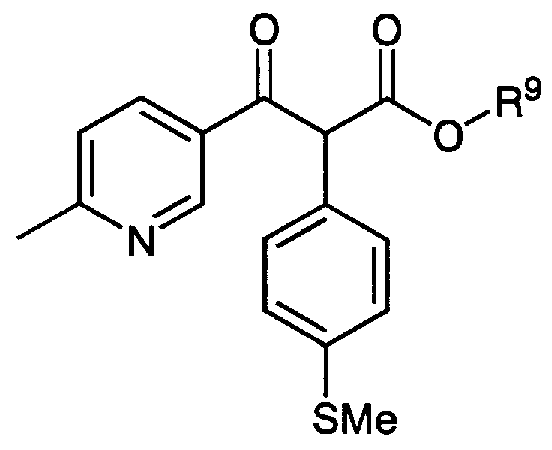
(式中、 R9および Meは前記と同様である。)で表される 2— [4— (メチルチオ)フエ- ル]— 3— (6—メチルピリジン一 3—ィル) 3—ォキソ一プロピオン酸エステルを、加 水分解、脱炭酸および酸化することを特徴とする式 (7);
[化 21]

(式中、 Meは前記と同様である。)で表される 1— (6—メチルピリジン— 3—ィル) - 2
[4 (メチルスルホ -ル)フエ-ル]エタノンの製造方法。
[10] 塩基が、アルカリ金属ハイドライドおよびアルカリ土類金属ハイドライドからなる群よ り選択される少なくとも 1種である請求項 9に記載の方法。
[11] 式 (3) ;
[化 22]
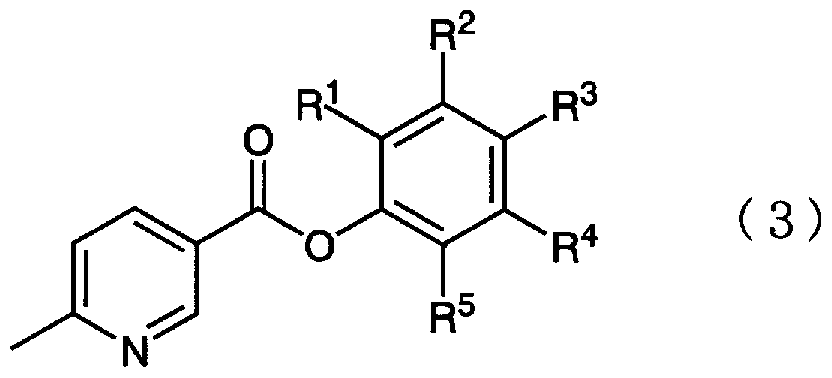
(式中、!^〜 はそれぞれ独立して、水素原子、ハロゲン原子、ニトロ基、炭素数 1〜 4のアルキル基、または炭素数 1〜4のアルコキシル基を示す。)で表される 6—メチ ルニコチン酸フエ-ルエステルが、 6 メチルニコチン酸と、式(1);
[化 23]
。人
(式中、 R6は炭素数 1〜4のアルキル基またはァリール基を示す。)で表されるクロ口 ギ酸エステルとを、塩基の存在下で反応させ、次いで式(2);
[化 24]

(式中、!^〜 は前記と同様である。)で表されるフエノールイ匕合物と反応させること により得られることを特徴とする請求項 9に記載の方法。
式 (3) ;
[化 25]

(式中、 I^〜R5はそれぞれ独立して、水素原子、ハロゲン原子、ニトロ基、炭素数 1 4のアルキル基、または炭素数 1〜4のアルコキシル基を示す。)で表される 6—メチ ルニコチン酸フエ-ルエステルが、 6—メチルニコチン酸と、式(2);
[化 26]

(式中、!^〜 は前記と同様である。)で表されるフエノールイ匕合物とを、式 (4); R7— SO H (4)
(式中、 R7は炭素数 1〜4のアルキル基または置換されて!、てもよ!/、フエ-ル基を示 す。 )で表されるスルホン酸の存在下で反応させることにより得られることを特徴とする 請求項 9に記載の方法。

(式中、!^〜 はそれぞれ独立して、水素原子、ハロゲン原子、ニトロ基、炭素数 1〜 4のアルキル基、または炭素数 1〜4のアルコキシル基を示す。)で表される 6—メチ ルニコチン酸フエ-ルエステルが、 5—ェチルー 2—メチルピリジンと硝酸とを硫酸の 存在下で反応させ、得られた 6—メチルニコチン酸を、前記硫酸の存在下で、式(2)
[化 28]

(式中、 I^〜R5は前記と同様である。)で表されるフエノールイ匕合物と反応させること により得られることを特徴とする請求項 9に記載の方法。
[14] 式 (9) ;
[化 29]


(式中、 Meは前記と同様である。)で表される 1— (6—メチルピリジン— 3—ィル) - 2
[4 (メチルスルホ -ル)フエ-ル]エタノンの製造方法。

(式中、 R9は炭素数 1〜4のアルキル基を示し、 Meはメチル基を示す。)で表されるフ ェニル酢酸エステルと、式(3);
[化 32]

(式中、!^〜 はそれぞれ独立して、水素原子、ハロゲン原子、ニトロ基、炭素数 1〜 4のアルキル基、または炭素数 1〜4のアルコキシル基を示す。)で表される 6—メチ ルニコチン酸フヱ-ルエステルとを、塩基の存在下で反応させることを特徴とする式( 9) ;
[化 33]

(式中、 R9および Meは前記と同様である。)で表される 2— [4— (メチルチオ)フエ二 ル]— 3— (6—メチルピリジン— 3—ィル)—3—ォキソ—プロピオン酸エステルの製 造方法。
式 (9) ;
[化 34]

(式中、 R9は炭素数 1〜4のアルキル基を示し、 Meはメチル基を示す。)で表される 2
[4 (メチルチオ)フエ-ル ] 3—(6—メチルピリジン 3—ィル)ー3—ォキソ プロピオン酸エステル。
6 メチルニコチン酸と、式(1);
[化 35]
。ΛΖ ")
(式中、 R6は炭素数 1〜4のアルキル基またはァリール基を示す。)で表されるクロ口 ギ酸エステルとを、塩基の存在下で反応させ、次いで式(2);
[化 36]

(式中、!^〜 はそれぞれ独立して、水素原子、ハロゲン原子、ニトロ基、炭素数 1〜 4のアルキル基、または炭素数 1〜4のアルコキシル基を示す。)で表されるフエノー ル化合物と反応させることを特徴とする式 (3);
[化 37]

(式中、!^〜 は前記と同様である。)で表される 6—メチルニコチン酸フエ-ルエス テルの製造方法。
6—メチルニコチン酸と、式(2);
[化 38]

(式中、!^〜 はそれぞれ独立して、水素原子、ハロゲン原子、ニトロ基、炭素数 1〜 4のアルキル基、または炭素数 1〜4のアルコキシル基を示す。)で表されるフエノー ルイ匕合物とを、式 (4) ;
R7— SO H (4)
3
(式中、 R7は炭素数 1〜4のアルキル基または置換されて!、てもよ!/、フエ-ル基を示 す。)で表されるスルホン酸の存在下で反応させることを特徴とする式(3);
[化 39]

(式中、!^〜 は前記と同様である。)で表される 6—メチルニコチン酸フエ-ルエス テルの製造方法。
5—ェチルー 2—メチルピリジンと硝酸とを硫酸の存在下で反応させ、得られた 6— メチルニコチン酸を、前記硫酸の存在下で、式(2);
[化 40]

(式中、!^〜 はそれぞれ独立して、水素原子、ハロゲン原子、ニトロ基、炭素数 1〜 4のアルキル基、または炭素数 1〜4のアルコキシル基を示す。)で表されるフエノー ル化合物と反応させることを特徴とする式 (3);
[化 41]

(式中、!^〜 は前記と同様である。)で表される 6—メチルニコチン酸フエ-ルエス テルの製造方法。
式 (3) ;
[化 42]

(式中、!^〜 はそれぞれ独立して、水素原子、ハロゲン原子、ニトロ基、炭素数 1〜 4のアルキル基、または炭素数 1〜4のアルコキシル基を示す。)で表される 6—メチ ノレニコチン酸フエ-ルエステル。
Applications Claiming Priority (8)
| Application Number | Priority Date | Filing Date | Title |
|---|---|---|---|
| JP2005-018425 | 2005-01-26 | ||
| JP2005-018424 | 2005-01-26 | ||
| JP2005-018423 | 2005-01-26 | ||
| JP2005018423 | 2005-01-26 | ||
| JP2005018425A JP2006206470A (ja) | 2005-01-26 | 2005-01-26 | 3−オキソ−プロピオン酸エステル類およびそれを用いた1,2−ジアリールエタノンの製造方法 |
| JP2005018424A JP2006206469A (ja) | 2005-01-26 | 2005-01-26 | 3−オキソ−プロピオン酸エステル類およびそれを用いた1,2−ジアリールエタノンの製造方法 |
| JP2005138740 | 2005-05-11 | ||
| JP2005-138740 | 2005-05-11 |
Publications (1)
| Publication Number | Publication Date |
|---|---|
| WO2006080256A1 true WO2006080256A1 (ja) | 2006-08-03 |
Family
ID=36740289
Family Applications (1)
| Application Number | Title | Priority Date | Filing Date |
|---|---|---|---|
| PCT/JP2006/300869 Ceased WO2006080256A1 (ja) | 2005-01-26 | 2006-01-20 | 1-(6-メチルピリジン-3-イル)-2-[4-(メチルスルホニル)フェニル]エタノンの製造方法および製造中間体 |
Country Status (1)
| Country | Link |
|---|---|
| WO (1) | WO2006080256A1 (ja) |
Cited By (1)
| Publication number | Priority date | Publication date | Assignee | Title |
|---|---|---|---|---|
| CN114989075A (zh) * | 2021-12-24 | 2022-09-02 | 四川青木制药有限公司 | 一种依托考昔中间体的制备方法 |
Citations (1)
| Publication number | Priority date | Publication date | Assignee | Title |
|---|---|---|---|---|
| JPH03501969A (ja) * | 1987-08-24 | 1991-05-09 | ボード オブ リージェンツ,ザ ユニバーシィティ オブ テキサス システム | 極く僅かのヒスタミンを放出するホルモン放出黄体形成ホルモンの効果的拮抗物質 |
-
2006
- 2006-01-20 WO PCT/JP2006/300869 patent/WO2006080256A1/ja not_active Ceased
Patent Citations (1)
| Publication number | Priority date | Publication date | Assignee | Title |
|---|---|---|---|---|
| JPH03501969A (ja) * | 1987-08-24 | 1991-05-09 | ボード オブ リージェンツ,ザ ユニバーシィティ オブ テキサス システム | 極く僅かのヒスタミンを放出するホルモン放出黄体形成ホルモンの効果的拮抗物質 |
Cited By (2)
| Publication number | Priority date | Publication date | Assignee | Title |
|---|---|---|---|---|
| CN114989075A (zh) * | 2021-12-24 | 2022-09-02 | 四川青木制药有限公司 | 一种依托考昔中间体的制备方法 |
| CN114989075B (zh) * | 2021-12-24 | 2024-05-24 | 四川青木制药有限公司 | 一种依托考昔中间体的制备方法 |
Similar Documents
| Publication | Publication Date | Title |
|---|---|---|
| TWI732808B (zh) | 1,3-苯并二氧雜環戊烯雜環化合物之製備方法 | |
| JP2012255014A (ja) | 安息香酸類の製造方法 | |
| CN112851546A (zh) | 一种(E)-2-甲基-α-甲氧亚胺基苯乙酸甲酯及其中间体的制备方法 | |
| WO2006021974A1 (en) | A process for synthesizing diol (viii)-an intermediate of montelukast sodium | |
| JP2017025014A (ja) | ベンゾオキサゾール化合物の製造方法 | |
| CN120247782B (zh) | 氟吡菌酰胺类化合物及其制备方法 | |
| JP2001081065A (ja) | [ビス−(トリフルオロメチル)−フェニル]−酢酸及びそのアルキルエステル及びジアルキル[ビス−(トリフルオロメチル)−フェニル]−マロネートを製造する方法 | |
| JPH06256257A (ja) | フルオロ−トリフルオロメチル安息香酸誘導体類 | |
| WO1999029699A1 (en) | Process for producing toluene derivatives | |
| CN110563606A (zh) | 一种(r)-2-[4-(4-氰基-2-氟苯氧基)苯氧基]丙酸的合成方法 | |
| EP0840717A1 (en) | Preparation of aldehydes or ketones from alcohols | |
| WO2007117027A1 (ja) | 有機酸化物の製造方法 | |
| WO2014129612A1 (en) | Process for producing pyridazinone compound and production intermediates thereof | |
| Shin et al. | Convenient synthesis of 3-aminocoumarin derivatives by the condensation of 1, 4-diacetyl-or 3-substituent-2, 5-piperazinediones with various salicylaldehyde derivatives. | |
| JPS63264439A (ja) | 3,5,6−トリフルオロ−4−ヒドロキシフタル酸の製造法 | |
| JPS6343389B2 (ja) | ||
| ZA200210300B (en) | Process for the preparation of trifluoroethoxy-substituted benzoic acids. | |
| JP5417860B2 (ja) | α−ヒドロキシエステル類の製造方法 | |
| Bakke et al. | Substitution reactions of 5-nitropyridine-2-sulfonic acid. A new pathway to 2, 5-disubstituted pyridines | |
| CN100389110C (zh) | 一种制备芳环取代的异噁唑啉类化合物的方法 | |
| WO2019117179A1 (ja) | キノリン‐4(1h)-オン誘導体の製造方法 | |
| JP2006342150A (ja) | 6−メチルニコチン酸フェニルエステル類およびその製造方法 | |
| KR102719583B1 (ko) | 테리플루노미드의 신규한 제조 공정 | |
| CN102408334A (zh) | 一种酯交换合成对氟苯基醋酸酯的方法 | |
| JP3655540B2 (ja) | 炭素環式芳香族カルボン酸類の製造方法 |
Legal Events
| Date | Code | Title | Description |
|---|---|---|---|
| 121 | Ep: the epo has been informed by wipo that ep was designated in this application | ||
| 122 | Ep: pct application non-entry in european phase |
Ref document number: 06712094 Country of ref document: EP Kind code of ref document: A1 |
|
| WWW | Wipo information: withdrawn in national office |
Ref document number: 6712094 Country of ref document: EP |