WO2006033147A1 - ポリシルセスキオキサングラフト重合体、その製造方法及び粘着剤 - Google Patents

ポリシルセスキオキサングラフト重合体、その製造方法及び粘着剤 Download PDF

Info

Publication number
WO2006033147A1
WO2006033147A1 PCT/JP2004/013842 JP2004013842W WO2006033147A1 WO 2006033147 A1 WO2006033147 A1 WO 2006033147A1 JP 2004013842 W JP2004013842 W JP 2004013842W WO 2006033147 A1 WO2006033147 A1 WO 2006033147A1
Authority
WO
WIPO (PCT)
Prior art keywords
group
formula
polysilsesquioxane
graft polymer
meth
Prior art date
Legal status (The legal status is an assumption and is not a legal conclusion. Google has not performed a legal analysis and makes no representation as to the accuracy of the status listed.)
Ceased
Application number
PCT/JP2004/013842
Other languages
English (en)
French (fr)
Inventor
Atsuko Kimura
Mikihiro Kashio
Toshio Sugizaki
Osamu Moriya
Current Assignee (The listed assignees may be inaccurate. Google has not performed a legal analysis and makes no representation or warranty as to the accuracy of the list.)
Lintec Corp
Original Assignee
Lintec Corp
Priority date (The priority date is an assumption and is not a legal conclusion. Google has not performed a legal analysis and makes no representation as to the accuracy of the date listed.)
Filing date
Publication date
Application filed by Lintec Corp filed Critical Lintec Corp
Priority to PCT/JP2004/013842 priority Critical patent/WO2006033147A1/ja
Publication of WO2006033147A1 publication Critical patent/WO2006033147A1/ja
Anticipated expiration legal-status Critical
Ceased legal-status Critical Current

Links

Classifications

    • CCHEMISTRY; METALLURGY
    • C08ORGANIC MACROMOLECULAR COMPOUNDS; THEIR PREPARATION OR CHEMICAL WORKING-UP; COMPOSITIONS BASED THEREON
    • C08FMACROMOLECULAR COMPOUNDS OBTAINED BY REACTIONS ONLY INVOLVING CARBON-TO-CARBON UNSATURATED BONDS
    • C08F283/00Macromolecular compounds obtained by polymerising monomers on to polymers provided for in subclass C08G
    • C08F283/12Macromolecular compounds obtained by polymerising monomers on to polymers provided for in subclass C08G on to polysiloxanes
    • CCHEMISTRY; METALLURGY
    • C08ORGANIC MACROMOLECULAR COMPOUNDS; THEIR PREPARATION OR CHEMICAL WORKING-UP; COMPOSITIONS BASED THEREON
    • C08GMACROMOLECULAR COMPOUNDS OBTAINED OTHERWISE THAN BY REACTIONS ONLY INVOLVING UNSATURATED CARBON-TO-CARBON BONDS
    • C08G77/00Macromolecular compounds obtained by reactions forming a linkage containing silicon with or without sulfur, nitrogen, oxygen or carbon in the main chain of the macromolecule
    • C08G77/42Block-or graft-polymers containing polysiloxane sequences
    • C08G77/442Block-or graft-polymers containing polysiloxane sequences containing vinyl polymer sequences
    • CCHEMISTRY; METALLURGY
    • C09DYES; PAINTS; POLISHES; NATURAL RESINS; ADHESIVES; COMPOSITIONS NOT OTHERWISE PROVIDED FOR; APPLICATIONS OF MATERIALS NOT OTHERWISE PROVIDED FOR
    • C09JADHESIVES; NON-MECHANICAL ASPECTS OF ADHESIVE PROCESSES IN GENERAL; ADHESIVE PROCESSES NOT PROVIDED FOR ELSEWHERE; USE OF MATERIALS AS ADHESIVES
    • C09J151/00Adhesives based on graft polymers in which the grafted component is obtained by reactions only involving carbon-to-carbon unsaturated bonds; Adhesives based on derivatives of such polymers
    • C09J151/08Adhesives based on graft polymers in which the grafted component is obtained by reactions only involving carbon-to-carbon unsaturated bonds; Adhesives based on derivatives of such polymers grafted on to macromolecular compounds obtained otherwise than by reactions only involving carbon-to-carbon unsaturated bonds
    • C09J151/085Adhesives based on graft polymers in which the grafted component is obtained by reactions only involving carbon-to-carbon unsaturated bonds; Adhesives based on derivatives of such polymers grafted on to macromolecular compounds obtained otherwise than by reactions only involving carbon-to-carbon unsaturated bonds on to polysiloxanes
    • CCHEMISTRY; METALLURGY
    • C09DYES; PAINTS; POLISHES; NATURAL RESINS; ADHESIVES; COMPOSITIONS NOT OTHERWISE PROVIDED FOR; APPLICATIONS OF MATERIALS NOT OTHERWISE PROVIDED FOR
    • C09JADHESIVES; NON-MECHANICAL ASPECTS OF ADHESIVE PROCESSES IN GENERAL; ADHESIVE PROCESSES NOT PROVIDED FOR ELSEWHERE; USE OF MATERIALS AS ADHESIVES
    • C09J183/00Adhesives based on macromolecular compounds obtained by reactions forming in the main chain of the macromolecule a linkage containing silicon, with or without sulfur, nitrogen, oxygen, or carbon only; Adhesives based on derivatives of such polymers
    • C09J183/10Block or graft copolymers containing polysiloxane sequences

Definitions

  • the present invention relates to a polysilsesquioxane graft polymer obtained by graft-polymerizing a butyl compound such as a methacrylate with a polysilsesquioxane compound having a mercapto group at a terminal portion, and
  • the present invention relates to a production method, and a pressure-sensitive adhesive and pressure-sensitive adhesive sheet using the polysilsesquioxane graft polymer.
  • an adhesive sheet formed by applying an adhesive to a base material sheet to form an adhesive layer is known.
  • This pressure-sensitive adhesive sheet is widely used in many industrial fields for printing labels, packaging, and the like because of the convenience that it can be applied immediately by pressing.
  • bar code printed adhesive sheets labels are attached to parts.
  • Japanese Patent Application Laid-Open No. 2002-275438 which solves such a problem, has a coating layer for printing on one surface of a base material having a polyethylene naphtharate film force, and the base material.
  • a heat-resistant label characterized by having a heat-resistant pressure-sensitive adhesive layer having an adhesive strength at a temperature of 150 ° C of 0.5 NZ25 mm or more on the opposite surface.
  • rubber-based or acrylic pressure-sensitive adhesives are used as the pressure-sensitive adhesive constituting the heat-resistant pressure-sensitive adhesive layer.
  • JP-A-2003-138229 discloses a pressure-sensitive adhesive sheet comprising a heat-sensitive pressure-sensitive adhesive layer containing a heat-resistant water-based pressure-sensitive adhesive on at least one surface of a base sheet.
  • a heat-resistant water-based pressure-sensitive adhesive a general water-based pressure-sensitive adhesive mainly composed of an acrylic polymer emulsion or rubber latex and blended with a tackified resin emulsion is used.
  • the present invention has been made in view of such a state of the art, and a novel polysilsesquioxane graft polymer that can be an adhesive having both excellent heat resistance and cohesive force, and production thereof It is an object to provide a method, and a pressure-sensitive adhesive and pressure-sensitive adhesive sheet using the polysilsesquioxane graft polymer.
  • the present inventors synthesized a polysilsesquioxane compound having a ladder type structure by reacting 3-mercaptopropyltrimethoxysilane with phenol trimethoxysilane in the presence of an acid catalyst.
  • the inventors have found that a polysilsesquioxane graft polymer can be efficiently obtained by a graft polymerization reaction with a methacrylic ester having a terminal mercapto group of the obtained polysilsesquioxane compound as a reaction initiation point.
  • the pressure-sensitive adhesive containing the obtained polysilsesquioxane graft polymer was found to have excellent heat resistance and cohesive strength, and the present invention was completed.
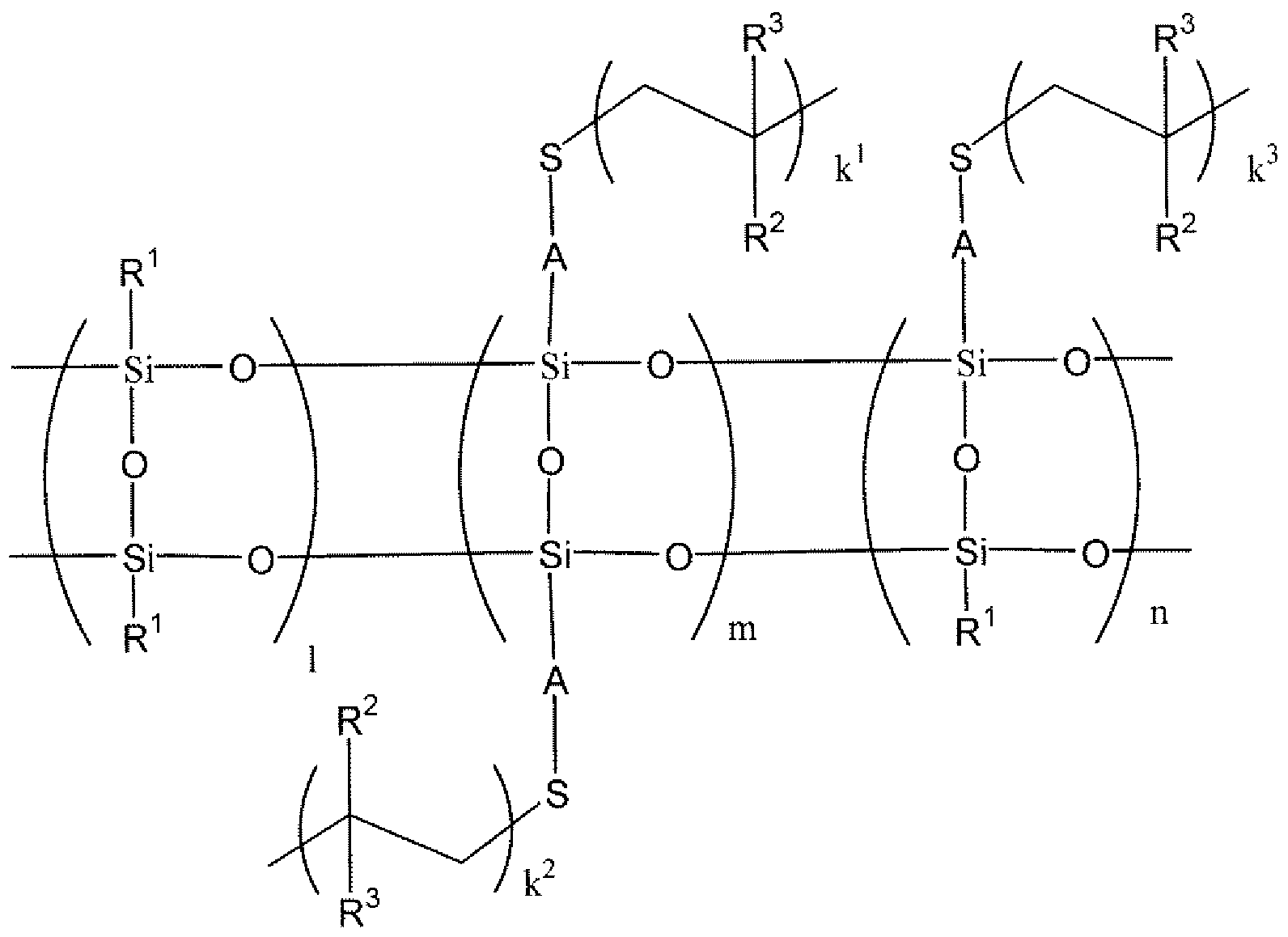
  • R 1 represents an optionally substituted hydrocarbon group
  • R 2 represents a hydrogen atom or an alkyl group having 1 to 18 carbon atoms
  • R 3 represents an aryl group which may have a polar group or a substituent
  • kl, k2 and k3 each independently represent an arbitrary natural number.
  • the groups can be the same or different.
  • the polysilsesquioxane graft polymer of the present invention preferably has a number average molecular weight of 5,000 to 1,000,000.
  • A represents a linking group
  • R 1 represents an optionally substituted hydrocarbon group.
  • m and n each independently represents 0 or an arbitrary natural number.
  • a polysilsesquioxane compound having a repeating unit represented by formula (3): CH C ( R 2 ) -R 3 (wherein R 2 is a hydrogen atom or a carbon number of 1
  • R 3 has a polar group or a substituent, and may represent an aryl group.
  • a method for producing a polysilsesquioxane graphene polymer comprises reacting with a vinyl compound represented by formula (I).
  • the method for producing a polysilsesquioxane sesqui O hexanes graft polymer of the present invention have the formula (4): (ASH) Si (OR 4) (X 1) (wherein, A represents as defined above, R 4 is an alkyl group with 1 to 6 carbon atoms
  • X 1 represents a halogen atom
  • p represents an integer of 0-3.
  • an adhesive comprising the polysilsesquioxane graft polymer of the present invention.
  • a base sheet and the adhesive of the present invention formed on the base sheet A pressure-sensitive adhesive sheet comprising the pressure-sensitive adhesive layer is provided.
  • the present invention is classified into 1) a polysilsesquioxane graft polymer, 2) a process for producing a polysilsesquioxane graft polymer, 3) an adhesive, and 4) an adhesive sheet.
  • 1) a polysilsesquioxane graft polymer 2) a process for producing a polysilsesquioxane graft polymer, 3) an adhesive, and 4) an adhesive sheet.
  • the polysilsesquioxane graft polymer of the present invention has a repeating unit represented by the formula (1) in the molecule.
  • A represents a linking group
  • the linking group is not particularly limited as long as it plays a role of linking a key atom as a central metal and a mercapto group.
  • a saturated or unsaturated alkylene group which may have a substituent, It may have a substituent and may be a / or a arylene group.
  • the saturated alkylene group include a saturated alkylene group having 1 to 20 carbon atoms such as a methylene group, an ethylene group, a propylene group, a trimethylene group, a tetramethylene group, a pentamethylene group, and a hexamethylene group.
  • the unsaturated alkylene group include unsaturated alkylene groups having 2 to 20 carbon atoms such as a beylene group, a probelene group, a butylene group, and a pentylene group.
  • Specific examples of the arylene group include o-phenylene group, m-phenylene group, p-phenylene group and the like.
  • the saturated and unsaturated alkylene group may have a substituent such as an amino group, a methylamino group, or a dimethylamino group, and may have an amino group; a hydroxyl group; a mercapto group; an amide group, N , An amide group which may have a substituent such as N-dimethylamide group; a carboxyl group
  • a halogen atom such as a fluorine atom, a chlorine atom or a bromine atom; an alkoxy group such as a methoxy group or an ethoxy group; an alkylthio group such as a methylthio group or an ethylthio group; an alkoxycarbon such as a methoxycarbonyl group or an ethoxycarbonyl group; Group; etc. are mentioned.
  • substituents for the arylene group include cyano group; nitro group; halogen atom such as fluorine atom, chlorine atom and bromine atom; alkoxy group such as methoxy group and ethoxy group; alkylthio group such as methylthio group and ethylthio group. ; Etc. are mentioned. These substituents may be bonded to any position of the alkylene group or arylene group, and a plurality of these substituents may be bonded to each other. You may do it.
  • A is a saturated or unsaturated alkylene group which may have a substituent.
  • R 1 may have a substituent and may represent a hydrocarbon group.
  • the hydrocarbon group for R 1 includes methyl, ethyl, n propyl, isopropyl, n butyl, sec butyl, isobutyl, t butyl, n pentyl, n-hexyl, n ⁇ Alkyl groups such as heptyl group, n-octyl group, n-nor group, n-decyl group; beer group, 1 prop group, 2 prop group, isopropyl group, Alkyl groups such as 3-butyl group, 4-pentyl group, and 5-hexyl group; alkyl groups such as ethur group, propargyl group, and butur group; phenol group, 1 naphthyl group, 2 — Aryl group such as naphthyl group;
  • Examples of the substituent for the hydrocarbon group of R 1 include the same groups as those exemplified as the substituent for the alkylene group and arylene group of A. Further, the substituents may be bonded to any position of the hydrocarbon group, or a plurality of substituents may be bonded to each other or the same or different.
  • R 2 is a hydrogen atom; or a methyl group, an ethyl group, an n propyl group, an isopropyl group, an n-butyl group, a t-butyl group, an n pentyl group, an n-hexyl group, an n-heptyl group, n —Denotes an alkyl group having 1 to 18 carbon atoms such as a cutyl group, an n-nor group, an n-decyl group, and an n-dodecyl group.
  • R 3 has a polar group or a substituent, and may represent an aryl group.
  • Examples of the polar group include a carboxyl group; an alkoxy carbo group such as a methoxy carbo ol group, an ethoxy carbo ol group, a propoxy carboxy group, an isopropoxy carbonyl group, a butoxy carbo ol group, and a t butyl carboxy group.
  • aryl groups such as phenol-nolesnorehoninole group and p-methylphenolsulfonyl group.
  • a substituent! / but as an aryl group, a phenyl group, a double-opened phenyl group, 3 —Substituents such as black-opened phenyl group, 4-black-opened phenyl group, 4-methylphenol group, 4-methoxyphenyl group, 4 t-butoxyphenyl group, 2,4,6-trimethylphenol group, etc.
  • a naphthyl group or the like may be used. Examples thereof include a naphthyl group and a 2-naphthyl group.
  • kl, k2 and k3 each independently represent an arbitrary natural number.
  • kl, k2 and k3 are each 2 or more, a group represented by the formula: CH-C (R 2 ) (R 3 ) — Are the same but different
  • the number average molecular weight (Mn) of the polysilsesquioxane graft polymer used in the present invention is not particularly limited, and it is usually 5,000—1,000,000, preferably ⁇ . 10 000—
  • the molecular weight distribution (Mw / Mn) of the polysilsesquioxane graft polymer used in the present invention is not particularly limited, but is usually 1.0 to 5.0, preferably 1.5 to 3.0.
  • the polysilsesquioxane graft polymer of the present invention has a weight loss rate (WL) of 10% or less, preferably 7% when heated to 300 ° C in thermogravimetric analysis (TGA) measurement. Less than
  • the polysilsesquioxane graft polymer of the present invention exhibits a cohesive force equal to or greater than that of a conventional acrylic pressure-sensitive adhesive. That is, the probe tack measured according to JIS Z0237 is 400 or more, preferably 450 or more, the holding power is lOOsec or more, preferably 1500 sec or more, more preferably 1800 sec or more, and the adhesive strength is 15NZ25mm or more. Preferably, it is 18 NZ25 mm or more, more preferably 19 NZ25 mm or more.
  • the vinyl compound (3) to be used is not particularly limited as long as it is a compound having a radical polymerizable vinyl group (double bond). Examples thereof include acrylic compounds, aromatic vinyl compounds, bur-tolyl compounds, benzene ketone compounds, butyl ether compounds, vinyl sulfone compounds, vinyl ester compounds.
  • the acrylic compound is not particularly limited as long as it is a compound having a (meth) atalyloyl group in the molecule.
  • Specific examples of the acrylate compound include methyl (meth) acrylate, ethyl (meth) acrylate, n-propyl (meth) acrylate, isopropyl (meth) acrylate, n-butyl (meth) acrylate, isobutyl.
  • Trimethylolpropane tritalylate trimethylolpropane tri (oxetyl) (meth) acrylate, pentaerythritol tri (meth) acrylate, pentaerythritol tetra (meth) acrylate, dipentaerythritol hex (meta )
  • Atarylate tetramethylol methane tri (meth) acrylate, tetramethylol methane tetra (meth) acrylate, tris (ataryloxy) isocyanurate, tris (2-hydroxyethyl) isocyanurate
  • polyfunctional (meta) attareito toy compounds such as hydroxy (propyl) isocyanurate tri (meth) acrylate.
  • Examples of the aromatic bur compound include styrene, ⁇ -methylstyrene, 4-methylstyrene, 4-methoxystyrene, 4 t-butoxystyrene, 3-chlorostyrene and the like.
  • Examples of bur nitrile compounds include acrylonitrile and meta-tallow-tolyl.
  • Examples of the burketone compound include burmethyl ketone and burphe ketone.
  • Examples of the butyl ether compound include ethyl butyl ether and propyl butyl ether.
  • Examples of the bulsulfone compound include bulmethylsulfone.
  • Examples of the bull ester compound include bull acetate. Among these, heat resistance The use of acrylic compounds is particularly preferred because a graft polymer having excellent properties and cohesive strength can be obtained efficiently.
  • two or more of the vinyl compounds (3) may be used in combination.
  • a polymer can be obtained.
  • the amount of the vinyl compound (3) used is usually in the range of 1000 parts by weight, preferably 10-200 parts by weight, per 1 part by weight of the polysilsesquioxane compound (2). .
  • organic peroxides include disilver oxides such as lauroyl peroxide and benzoyl peroxide, 1, 1 bis (t-butylperoxy) cyclohexane, 1
  • azo compound 1 Bis (t-butylperoxy) 3, 3, 5-peroxyketals such as trimethylcyclohexane, diisopropylperoxydicarbonate, peroxydicarbonates such as diethylhexyloxydicarbonate, t-butylperoxy 2 —Peroxyesters such as ethylhexanoate and t-butylperoxyisobutyrate.
  • the azo compound include azobisisobutyoxy-tolyl and 1,1-azobiscyclohexane t carbo-tolyl. These can be used alone or in combination of two or more.
  • the amount of the radical polymerization initiator used is the formula introduced into the polysilsesquioxane compound (2).
  • the ratio is usually 0.25-4 mol times, preferably 0.4-2 mol times the amount of the Silane compound represented by (4).
  • a predetermined amount of a radical polymerization initiator and a vinyl compound (3) is added to a solvent solution of a polysilsesquioxane compound (2). It can be carried out by adding and stirring the whole volume. This reaction is preferably carried out in an inert gas atmosphere such as nitrogen gas, argon gas or helium gas.
  • the solvent to be used is not particularly limited as long as it is inert to the reaction.
  • aromatic hydrocarbons such as benzene, toluene, xylene
  • aliphatic hydrocarbons such as n pentane, n-hexane, n-hexane, n-octane
  • cyclopentane cyclohexane, cyclohexane
  • Cycloaliphatic hydrocarbons such as heptane and cyclooctane
  • ethers such as jetyl ether, diisopropyl ether, 1,2-dimethoxyethane, dibutyl ether, tetrahydrofuran and dioxane
  • black mouth form, carbon tetrachloride, 1, 2 —Halogenated hydrocarbons such as dichloroethane and black benzene
  • Esters such as ethyl acetate, propyl acetate, butyl
  • the amount of the solvent to be used is generally 0.5-10,000 ml, preferably 1000 ml, per lg of the polysilsesquioxane compound (2).
  • the reaction temperature is not particularly limited! However, it is usually in the temperature range up to the boiling point of the solvent to be used, preferably 20-100 ° C.
  • the reaction time is usually several minutes to several tens of hours, preferably 1 hour to 20 hours.
  • the target polymer can be isolated by pouring the reaction solution into a large amount of insoluble solvent and collecting the precipitated solid by filtration.
  • the polysilsesquioxane compound (2) can be produced as follows. That is, a silanic compound represented by the formula (4): (ASH) Si (OR 4 ) (X 1 ) (hereinafter referred to as “silanic compound”).
  • Silane compounds (4) 0 to 100 times the amount of 1 part by weight of Silane compounds represented by formula (5): R'SKOR 5 ) (X 2 ) Q 3-q abbreviated as "Composite (5)"
  • R 4 and R 5 each independently represent an alkyl group having 1 to 16 carbon atoms such as a methyl group, an ethyl group, an n-propyl group, an isopropyl group, or an n-butyl group, and a methyl group or an ethyl group is preferred.
  • X 1 and X 2 each independently represent a halogen atom such as a chlorine atom or a bromine atom, and a chlorine atom is preferred.
  • P and q represent an integer of 0-3.
  • Silane compound (4) include mercaptomethyltrimethoxysilane, mercaptomethyltriethoxysilane, mercaptomethyltripropoxysilane, mercaptomethyltributoxysilane, 2-mercaptoethyltrimethoxysilane, 2-Mercaptoethyltriethoxysilane, 2-Mercaptoethyltripropoxysilane, 2-Mercaptoethyltributoxysilane, 1 Mercaptoethyltrimethoxysilane, 1 Mercaptoethyltriethoxysilane, 1-mercapto Tiltripropoxysilane, 1 Mercaptotiltriboxysilane, 3 Mercaptopropyltrimethoxysilane, 3-Mercaptopropyltriethoxysilane, 3-Mercaptopropyltripropoxysilane, 3-Mercaptopropyltributoxy 4-mercaptobutyltrimethoxysilane, 4-mercaptobutyltrime
  • silane compound (5) examples include (substituted) phenols such as phenyltrimethoxysilane, 4-chloropolymethoxysilane, phenyltriethoxysilane, and 2-methoxyphenyltriethoxysilane.
  • Alkyltrialkoxysilanes methyltrimethoxysilane, methyltriethoxysilane, etyltrimethoxysilane, etyltriethoxysilane, n-propyltrimethoxysilane, n-propyltriethoxysilane, and other alkyltrialkoxysilanes; cyanomethyltrimethoxy Silane, Cyanomethyltriethoxysilane, 2-Chanoethyltrimethoxysilane, 2-Chanoethyltriethoxysilane, 3-Cyanopropyltrimethoxysilane, 3-Cyanopropyltriethoxysilane, 4-Cyanobutyltrimethoxy Silane, 4-Syanobuchi Cyanoalkyltrialkoxysilanes such as triethoxysilane; Acetoxy groups such as acetomethylmethyltrimethoxysilane, acet
  • phenylhalogenosilanes methyl chloromethoxysilane, methyltributyl silane, methylchlorojetoxysilane, etyltrichlorosilane, ethylchlorodimethoxysilane, ethyldichloromethoxysilane, etyltribromosilane, n-propyltrichlorosilane, n-propyl Chlorodimethoxysilane, n-pro Alkylhalogenosilanes such as pyrdichloromethoxysilane; cyanomethyltrichlorosilane
  • Examples of the organic solvent used in the reaction for obtaining the polysilsesquioxane compound (2) include aromatic hydrocarbons such as benzene, toluene and xylene; methyl acetate, ethyl acetate, propyl acetate, and methyl propionate.
  • Esters such as acetone, ketones such as methyl ethyl ketone, methyl isobutyl ketone, cyclohexanone, etc .; methyl alcohol, ethyl alcohol, n propyl alcohol, isopropyl alcohol, n butyl alcohol, isobutyl alcohol, sec-butyl Alcohols such as alcohol and t-butyl alcohol; water; and the like.
  • aromatic hydrocarbons such as benzene, toluene and xylene
  • Esters such as acetone, ketones such
  • Examples of the acid catalyst used include inorganic acids such as hydrochloric acid and sulfuric acid; organic solvents such as p-toluenesulfonic acid, p-toluenesulfonic acid monohydrate, sulfonic acid, methanesulfonic acid, ethanesulfonic acid, acetic acid, and formic acid. Examples include acids.
  • Examples of the base catalyst used include metal hydroxides such as sodium hydroxide, potassium hydroxide, magnesium hydroxide, and calcium hydroxide; sodium methoxide, sodium ethoxide, potassium Metal alkoxides such as methoxide, potassium tert-butoxide, magnesium methoxide and magnesium ethoxide; primary amines such as methylamine, ethylamine and butylamine; secondary amines such as dimethylamine and dibutylamine; tertiary amines such as triethylamine and diisopropylethylamine Pyridine, nitrogen-containing heterocyclic compounds such as 1,8-diazabicyclo [5.4.0] undece-7-en (DB U); and the like.
  • the amount of the acid catalyst or base catalyst used is usually in the range of 0.001% to 25% by weight, preferably 0.01% to 20% by weight, based on the silanic compound (4). is there.
  • the reaction temperature is usually in the temperature range from 0 ° C to the boiling point of the solvent used, preferably in the range of 40 ° C to 130 ° C. If the reaction temperature is too low, the progress of the condensation reaction may be insufficient. On the other hand, if the reaction temperature becomes too high, it is difficult to suppress gelling. The reaction is usually completed in minutes to hours.
  • the repeating unit of the copolycondensate obtained by the Silane compound (4) and the silane compound (5) is represented by any of the following formulas (a) to (c).
  • the polysilsesquioxane compound (2) used in the present invention is not particularly limited as long as it has at least the repeating units (a) and Z or (b) in the molecule.
  • the polysilsesquioxane compound (2) used in the present invention has the above-mentioned (a) and (b), (a) and (c), (b) and (c), or (a), (b) And (c) a copolymer having a repeating unit, this copolymer may be any copolycondensate such as a random copolymer, a partial block copolymer, a complete block copolymer, etc. Good.
  • the repeating unit represented by (b) may be bonded in a form rotated up and down 180 °.
  • the repeating unit represented by (b) may be the repeating unit shown in (d) below.
  • a polysilsesquioxane compound (2) having a repeating unit structure called a linearly extending ladder structure can be obtained. Whether or not it has a ladder structure can be confirmed, for example, by performing an infrared absorption spectrum or X-ray diffraction measurement of the reaction product.
  • the number average molecular weight (Mn) of the resulting polysilsesquioxane compound (2) is usually in the range of 500-30000, preferably 1,000-20000.
  • the number average molecular weight can be obtained, for example, by polystyrene conversion by SEC (size “exclusion” chromatography).
  • the molecular weight distribution (Mw / Mn) of the polysilsesquioxane compound (2) is not particularly limited, but is usually in the range of 1.0 to 3.0.
  • the pressure-sensitive adhesive of the present invention is characterized by containing the polysilsesquioxane graft polymer of the present invention.
  • the pressure-sensitive adhesive of the present invention can be produced by dissolving one or more of the polysilsesquioxane graft polymers of the present invention in a suitable solvent.
  • the solvent to be used is not particularly limited as long as it dissolves the polysilsesquioxane graft polymer of the present invention.
  • esters such as ethyl acetate, propyl acetate, butyl acetate, methyl propionate; acetone, methyl ethyl ketone, jetyl ketone, Ketones such as tilisobutylketone and cyclohexanone; amides such as N, N-dimethylformamide, N, N dimethylacetamide and N methylpyrrolidone; -tolyls such as acetonitrile and benzo-tolyl; dimethyl sulfoxide; Sulfoxides such as sulfolane; Aromatic hydrocarbons such as benzene, toluene, xylene; Aliphatic hydrocarbons such as n pentane, n-hexane, n heptane, n o
  • the pressure-sensitive adhesive of the present invention contains the polysilsesquioxane graft polymer of the present invention as a main component, and, if desired, other pressure-sensitive adhesives, tackifiers, antioxidants, ultraviolet absorbers, light stabilizers. Agents, softeners, fillers and the like can be added.
  • the pressure-sensitive adhesive of the present invention contains the polysilsesquioxane graft polymer of the present invention as a main component, it has excellent heat resistance and excellent cohesive strength.
  • paper base materials such as dalasin paper, coated paper and cast paper; polyester films such as polyethylene terephthalate film, polybutylene terephthalate film and polyethylene naphthalate film; polyolefin films such as polypropylene film and polyethylene film Polyvinyl chloride film; Polyurethane film; Synthetic paper, cellulose sheets and films, non-woven fabrics, woven fabrics and knitted fabrics made of various materials.
  • these substrate sheets can be printed by printing appropriate characters and designs on the surface as desired.
  • the method for forming the pressure-sensitive adhesive layer on the base sheet is as follows: (i) The pressure-sensitive adhesive of the present invention is applied on the base sheet so as to have a predetermined thickness, and is heated at 40-150 ° C. A method of drying, on the GO release sheet (or process paper), apply the pressure-sensitive adhesive of the present invention to a predetermined thickness, and paste a substrate sheet on the coated surface at 40-150 ° C. After drying, it can be produced by a method such as peeling the release sheet. In the case of the GO method, the release sheet may be adhered as it is without being peeled off if desired, and may be peeled off when the adhesive sheet is used.
  • release sheets include paper substrates such as dalasin paper, coated paper, cast paper; polyester films such as polyethylene terephthalate film, polybutylene terephthalate film, polyethylene naphthalate film; polypropylene film, polyethylene film, etc. Polyolefin film; etc. are mentioned. These release sheets are usually coated with a release agent such as silicone resin on the surface, but the release sheet itself has releasability.
  • the method of applying the pressure-sensitive adhesive on the base sheet is not particularly limited, and a known coating method can be employed.
  • the thickness of the pressure-sensitive adhesive layer obtained is usually 5-100 ⁇ m, preferably 10-60 ⁇ m.
  • the pressure-sensitive adhesive sheet of the present invention has a pressure-sensitive adhesive layer formed from the pressure-sensitive adhesive of the present invention having excellent heat resistance and cohesive strength, the pressure-sensitive adhesive strength may be lowered even when used in a high temperature environment. Absent.
  • Mn number average molecular weight
  • MwZMn molecular weight distribution
  • the structure of the obtained polymer was confirmed by measuring NMR and 13 C-NMR. Moreover, the number average molecular weight (Mn) of the obtained polysilsesquioxane compound (PPhMeSQ) was 1,100, and molecular weight distribution (MwZMn) was 1.3.
  • V PPhMeSQ
  • (meth) acrylic acid ester and ethyl acetate were used as radical polymerization initiators, and stirred at 70 ° C. for 7 hours.
  • reaction charge was 0.2 g for AIBN, 1.34 g for PPhMeSQ, 100 g for ethyl acetate, and 100 g for (meth) acrylic acid ester.
  • MMA, BMA, DMA and BA have the same meaning as above.
  • Table 1 below shows the types of (meth) acrylic acid esters, the number average molecular weight (Mn), molecular weight distribution (MwZMn), and reaction yield of the obtained polymer.
  • Mn number average molecular weight
  • MwZMn molecular weight distribution
  • Each adhesive obtained above is applied to a transparent polyethylene terephthalate film (PET film) with a thickness of 50 m so that the dry film thickness is 20 im, and heated at 100 ° C for 2 minutes. The membrane was dried. Next, a PET film that had been subjected to a release treatment with silicone resin was attached to the surface of the pressure-sensitive adhesive layer as a release sheet.
  • PET film transparent polyethylene terephthalate film
  • Thermogravimetric analysis (TGA) measurement was performed using a thermogravimetric analyzer (manufactured by Shimadzu Corporation). The measurement was carried out by accurately weighing lOmg of the polymer and raising the temperature at 10 ° CZ in an air stream (lOOmlZ). Table 2 shows the measurement results. In Table 2, WL is the weight at 300 ° C.
  • the adhesive of this example was excellent in heat resistance with very little thermogravimetric loss as measured by TGA.
  • the probe tack is equivalent to the adhesive of the comparative example (Comparative Example 3), and the holding power and adhesive strength are much better than the adhesive of the comparative example, and it has excellent cohesive strength. It was.
  • a novel polysilsesquioxane graft polymer that can be a pressure-sensitive adhesive having both excellent heat resistance and cohesion, a method for producing the same, a pressure-sensitive adhesive using the polysilsesquioxane graft polymer, and An adhesive sheet is provided.

Landscapes

  • Chemical & Material Sciences (AREA)
  • Chemical Kinetics & Catalysis (AREA)
  • Organic Chemistry (AREA)
  • Health & Medical Sciences (AREA)
  • Medicinal Chemistry (AREA)
  • Polymers & Plastics (AREA)
  • Silicon Polymers (AREA)
  • Adhesives Or Adhesive Processes (AREA)

Abstract

 本発明は、分子内に、下記式(1)で表される繰り返し単位を有する、優れた耐熱性と凝集力とを兼ね備えた粘着剤となり得る新規ポリシルセスキオキサングラフト重合体、及びその製造方法、並びにこのポリシルセスキオキサングラフト重合体を用いる粘着剤及び粘着シートである。(式中、Aは連結基を表し、R1は置換基を有していてもよい炭化水素基を表し、R2は水素原子又は炭素数1~18のアルキル基を表し、R3は極性基又は置換基を有していてもよいアリール基を表す。l、m、nは0又は任意の自然数を表す。但し、m=n=0の場合を除く。k1、k2及びk3は任意の自然数を表す。)

Description

明 細 書
ポリシルセスキォキサングラフト重合体、その製造方法及び粘着剤 技術分野
[0001] 本発明は、末端部にメルカプト基を有するポリシルセスキォキサンィ匕合物に、メタク リル酸エステル等のビュル化合物をグラフト重合させて得られるポリシルセスキォキサ ングラフト重合体及びその製造方法、並びにこのポリシルセスキォキサングラフト重合 体を用いる粘着剤及び粘着シートに関する。
背景技術
[0002] 従来、各種の部材ゃ機器に貼着するラベルシートとして、基材シートに粘着剤を塗 布して粘着剤層を形成してなる粘着シートが知られている。
この粘着シートは、押圧するだけで直ぐに貼り付けることができるという利便性から、 印刷ラベル用、包装貼付用等として多くの産業分野で広く利用されている。例えば、 自動車や電気 ·電子製品の生産ラインにおける生産管理においては、部品にバーコ ード印字された粘着シート (ラベル)を貼付することが行われて 、る。
[0003] ところで、この自動車や電気'電子製品の生産ラインにおける生産管理等において は、部品によっては熱処理が施される工程があり、ラベルを使用する場合には、該ラ ベルに対して耐熱性が求められることがある。このような耐熱用途のバーコードラベ ルとしては、従来、ポリイミドフィルムやポリエーテルイミドフィルムが用いられているが 、これらのフィルムは高価であり、得られるバーコードラベルがコスト高になるという欠 点がある。また、バーコードラベルの基材として、一般的に用いられているポリェチレ ンテレフタレートフィルムやポリエチレンフィルムは、安価であるものの、而熱性に劣る という問題がある。
[0004] このような問題を解決すベぐ特開 2002— 275438号公報には、ポリエチレンナフ タレートフィルム力もなる基材の一方の側の面に印字用コート層を有し、かつ該基材 の反対側の面に、温度 150°Cにおける粘着力が 0. 5NZ25mm以上である耐熱性 粘着剤層を有することを特徴とする耐熱性ラベルが提案されている。ここでは、耐熱 性粘着剤層を構成する粘着剤として、ゴム系やアクリル系の粘着剤等が使用されて いる。
[0005] また、特開 2003— 138229号公報には、基材シートの少なくとも一方の面に、耐熱 性の水系粘着剤を含む感熱性粘着剤層を形成してなることを特徴とする粘着シート が記載されている。耐熱性の水系粘着剤として、アクリル系重合体ェマルジヨン又は ゴム系ラテックスを主成分とし、粘着付与榭脂ェマルジヨンを配合した一般的な水系 粘着剤が用いられている。
[0006] しカゝしながら、これらの文献に記載された粘着シートに用いられる粘着剤は従来公 知のものであり、耐熱性等の面からは十分なものとはいいがたい。従って、より耐熱性 及び粘着力に優れる新 、粘着剤の開発が求められて!/ヽた。
[0007] 本発明は、このような従来技術の実情に鑑みてなされたものであり、優れた耐熱性 と凝集力とを兼ね備えた粘着剤となり得る新規ポリシルセスキォキサングラフト重合体 及びその製造方法、並びにこのポリシルセスキォキサングラフト重合体を用いる粘着 剤及び粘着シートを提供することを課題とする。
発明の開示
[0008] 本発明者らは、 3—メルカプトプロピルトリメトキシシランとフエ-ルトリメトキシシランと を酸触媒の存在下に反応させることにより、ラダー型構造を有するポリシルセスキォ キサン化合物を合成した。そして、得られたポリシルセスキォキサン化合物の末端メ ルカプト基を反応開始点とするメタクリル酸エステルとのグラフト重合反応により、ポリ シルセスキォキサングラフト重合体が効率よく得られることを見出した。また、得られた ポリシルセスキォキサングラフト重合体を含有する粘着剤は、優れた耐熱性及び凝集 力を有することを見出し、本発明を完成するに至った。
[0009] 力べして本発明の第 1によれば、分子内に、式(1) [0010] [化 1]
Figure imgf000005_0001
[0011] (式中、 Aは連結基を表し、 R1は置換基を有していてもよい炭化水素基を表し、 R2は 水素原子又は炭素数 1一 18のアルキル基を表し、 R3は極性基又は置換基を有して いてもよいァリール基を表す。 1、 m、 nは、それぞれ独立して 0又は任意の自然数を 表す。但し、 m=n = 0の場合を除く。 kl、 k2及び k3は、それぞれ独立して任意の自 然数を表し、 kl、 k2及び k3がそれぞれ 2以上のとき、式; -CH -C (R2) (R3)-で表
2
される基は同一であっても、相異なっていてもよレ、。)で表される繰り返し単位を有す るポリシルセスキォキサングラフト重合体が提供される。
[0012] 本発明のポリシルセスキォキサングラフト重合体は、数平均分子量が 5, 000— 1 , 000, 000であるちのカ好まし ヽ。
本発明の第 2によれば、分子内に、式 (2) [0013] [化 2]
Figure imgf000006_0001
[0014] (式中、 Aは連結基を表し、 R1は置換基を有していてもよい炭化水素基を表す。 1、 m 、 nは、それぞれ独立して 0又は任意の自然数を表す。但し、 m=n=0の場合を除く 。)で表される繰り返し単位を有するポリシルセスキォキサンィ匕合物を、ラジカル重合 開始剤の存在下、式 (3): CH =C (R2)-R3 (式中、 R2は水素原子又は炭素数 1
2 一 1
8のアルキル基を表し、 R3は極性基又は置換基を有して 、てもよ 、ァリール基を表す 。)で表されるビニルイ匕合物と反応させることを特徴とする、ポリシルセスキォキサング ラフト重合体の製造方法が提供される。
[0015] 本発明のポリシルセスキォキサングラフト重合体の製造方法は、式 (4): (ASH) Si ( OR4) (X1) (式中、 Aは前記と同じ意味を表し、 R4は炭素数 1一 6のアルキル基を
P 3-p
表し、 X1はハロゲン原子を表し、 pは 0— 3の整数を表す。)で表されるシランィ匕合物、 及び前記式 (4)で表されるシラン化合物 1重量部に対し、 0— 100倍量の式(5): R1 Si (OR5) (X2) (式中、 R1は前記と同じ意味を表し、 R5は炭素数 1
q 3-q 一 6のアルキル 基を表し、 X2はハロゲン原子を表し、 qは 0— 3の整数を表す。)で表されるシランィ匕 合物を、酸触媒又は塩基触媒の存在下に縮合させることにより、分子内に、式 (2)で 表される繰り返し単位を有するポリシルセスキォキサンィ匕合物を得る工程と、得られた ポリシルセスキォキサンィ匕合物を、ラジカル重合開始剤の存在下、前記式(3)で表さ れるビ二ルイ匕合物と反応させる工程を有するものであるのが好ましい。
[0016] 本発明の第 3によれば、本発明のポリシルセスキォキサングラフト重合体を含有す ることを特徴とする粘着剤が提供される。
本発明の第 4によれば、基材シートと、該基材シート上に本発明の粘着剤から形成 されてなる粘着剤層を有することを特徴とする粘着シートが提供される。 発明を実施するための最良の形態
[0017] 以下、本発明を、 1)ポリシルセスキォキサングラフト重合体、 2)ポリシルセスキォキ サングラフト重合体の製造方法、 3)粘着剤、及び 4)粘着シートに項分けして詳細に 説明する。
[0018] 1)ポリシルセスキォキサングラフト重合体
本発明のポリシルセスキォキサングラフト重合体は、分子内に、前記式(1)で表され る繰り返し単位を有することを特徴とする。
[0019] 前記式(1)で表される繰り返し単位において、 Aは連結基を表す。
連結基としては、中心金属であるケィ素原子とメルカプト基とを連結する役割を果す ものであれば特に制限されず、例えば、置換基を有していてもよい飽和又は不飽和 のアルキレン基、置換基を有して!/ヽてもよ ヽァリーレン基等が挙げられる。
[0020] 飽和のアルキレン基の具体例としては、メチレン基、エチレン基、プロピレン基、トリ メチレン基、テトラメチレン基、ペンタメチレン基、へキサメチレン基等の炭素数 1一 20 の飽和のアルキレン基が挙げられる。不飽和のアルキレン基の具体例としては、ビ- レン基、プロべ-レン基、ブテ-レン基、ペンテ-レン基等の炭素数 2— 20の不飽和 のアルキレン基が挙げられる。ァリーレン基の具体例としては、 o—フエ-レン基、 m— フエ-レン基、 p—フエ-レン基等が挙げられる。
[0021] 前記飽和及び不飽和のアルキレン基の置換基としては、アミノ基、メチルァミノ基、 ジメチルァミノ基等の置換基を有して 、てもよ 、ァミノ基;水酸基;メルカプト基;アミド 基、 N, N-ジメチルアミド基等の置換基を有していてもよいアミド基;カルボキシル基
;フッ素原子、塩素原子、臭素原子等のハロゲン原子;メトキシ基、エトキシ基等のァ ルコキシ基;メチルチオ基、ェチルチオ基等のアルキルチオ基;メトキシカルボ-ル基 、エトキシカルボニル基等のアルコキシカルボ-ル基;等が挙げられる。また、前記ァ リーレン基の置換基としては、シァノ基;ニトロ基;フッ素原子、塩素原子、臭素原子等 のハロゲン原子;メトキシ基、エトキシ基等のアルコキシ基;メチルチオ基、ェチルチオ 基等のアルキルチオ基;等が挙げられる。これらの置換基は、アルキレン基又はァリ 一レン基の任意の位置に結合していてもよぐ同一若しくは相異なって複数個が結合 していてもよい。
[0022] これらの中でも、本発明においては、耐熱性及び粘着力に優れるグラフト重合体が 得られることから、 Aとしては、置換基を有していてもよい飽和又は不飽和のアルキレ ン基が好ましぐ置換基を有していてもよい飽和のアルキレン基がより好ましぐ炭素 数 1一 20の飽和のアルキレン基が特に好ましい。
[0023] R1は置換基を有して 、てもよ 、炭化水素基を表す。
R1の炭化水素基としては、メチル基、ェチル基、 n プロピル基、イソプロピル基、 n ブチル基、 sec ブチル基、イソブチル基、 t ブチル基、 n ペンチル基、 n—へキシ ル基、 n -へプチル基、 n -ォクチル基、 n -ノ-ル基、 n -デシル基等のアルキル基;ビ -ル基、 1 プロぺ-ル基、 2 プロぺ-ル基、イソプロぺ-ル基、 3—ブテュル基、 4 ペンテ-ル基、 5—へキセ -ル基等のアルケ-ル基;ェチュル基、プロパルギル基、 ブチュル基等のアルキ-ル基;フエ-ル基、 1 ナフチル基、 2—ナフチル基等のァリ ール基;等が挙げられる。
[0024] R1の炭化水素基の置換基としては、前記 Aのアルキレン基及びァリーレン基の置 換基として例示したものと同様のものが挙げられる。また置換基は、炭化水素基の任 意の位置に結合していてもよぐ同一若しくは相異なって複数個が結合していてもよ い。
[0025] R2は水素原子;又はメチル基、ェチル基、 n プロピル基、イソプロピル基、 n—ブチ ル基、 t ブチル基、 n ペンチル基、 n—へキシル基、 n—へプチル基、 n—才クチル基 、 n ノ-ル基、 n デシル基、 n—ドデシル基等の炭素数 1一 18のアルキル基を表す。
[0026] R3は、極性基又は置換基を有して 、てもよ 、ァリール基を表す。
極性基としては、カルボキシル基;メトキシカルボ-ル基、エトキシカルボ-ル基、プ 口ポキシカルボ-ル基、イソプロポキシカルボニル基、ブトキシカルボ-ル基、 t ブト キシカルボ-ル基等のアルコキシカルボ-ル基;ァセチル基、プロピオ-ル基、ベン ゾィル基等のァシル基;シァノ基;メトキシ基、エトキシ基等のアルコキシ基;メチルス ノレホ-ノレ基、ェチノレスノレホ-ノレ基等のァノレキノレスノレホ-ノレ基;フエ-ノレスノレホニノレ基 、 p メチルフエ-ルスルホ -ル基等のァリールスルホ -ル基;等が挙げられる。
[0027] 置換基を有して!/、てもよ 、ァリール基としては、フエ-ル基、 2 クロ口フエ-ル基、 3 —クロ口フエ-ル基、 4 クロ口フエ-ル基、 4 メチルフエ-ル基、 4ーメトキシフエ-ル 基、 4 t ブトキシフエ-ル基、 2, 4, 6—トリメチルフエ-ル基等の置換基を有してい てもよ 、フエ-ル基; 1 ナフチル基、 2—ナフチル基等の置換基を有して 、てもよ ヽ ナフチル基等が挙げられる。
[0028] 1、 m、 nは、それぞれ独立して 0又は任意の自然数を表す。但し、 m=n=0の場合 を除く。
kl、 k2及び k3は、それぞれ独立して任意の自然数を表し、 kl、 k2及び k3がそれ ぞれ 2以上のとき、式: CH -C (R2) (R3)—で表される基は同一であっても、相異な
2
つていてもよい。
[0029] 本発明に用いるポリシルセスキォキサングラフト重合体の数平均分子量 (Mn)は特 に限定されるもので ίまな ヽ力 通常、 5, 000— 1, 000, 000、好まし < ίま 10, 000—
1, 000, 000、より好まし <は 50, 000— 500, 000である。
本発明に用いるポリシルセスキォキサングラフト重合体の分子量分布 (Mw/Mn) は特に制限されないが、通常 1. 0-5. 0、好ましくは 1. 5-3. 0の範囲である。
[0030] 本発明のポリシルセスキォキサングラフト重合体は、熱重量分析 (TGA)測定にお いて、 300°Cまで加熱したときの重量損失率 (WL )が 10%以下、好ましくは 7%以
300
下であって、耐熱性に優れている。
[0031] また、本発明のポリシルセスキォキサングラフト重合体は、従来のアクリル系粘着剤 と同等又は同等以上の凝集力を示す。すなわち、 JIS Z0237に準拠して測定した プローブタックが、 400以上、好ましくは 450以上であり、保持力が lOOsec以上、好 ましくは 1500sec以上、より好ましくは 1800sec以上であり、粘着力が 15NZ25mm 以上、好ましくは 18NZ25mm以上、より好ましくは 19NZ25mm以上である。
[0032] 2)ポリシルセスキォキサングラフト重合体の製造方法
本発明のポリシルセスキォキサングラフト重合体の製造方法は、分子内に、前記式 (2)で表される繰り返し単位を有するポリシルセスキォキサンィ匕合物(以下、「ポリシル セスキォキサン化合物(2)」と略記する。)を、ラジカル重合開始剤の存在下、式(3): CH =C (R2)-R3 (R2、R3は前記と同じ意味を表す。)で表されるビ-ルイ匕合物(以
2
下、「ビュル化合物(3)」と略記する。)と反応させることを特徴とする。 [0033] 用いるビニル化合物(3)としては、ラジカル重合性のビニル基(二重結合)を有する 化合物であれば特に制限されない。例えば、アクリル系化合物、芳香族ビニル化合 物、ビュル-トリル化合物、ビ-ルケトン化合物、ビュルエーテル化合物、ビニルスル ホンィ匕合物、ビニルエステルイ匕合物等が挙げられる。
[0034] アクリル系化合物としては、分子内に (メタ)アタリロイル基を有する化合物であれば 特に制限はない。アタリレート系化合物の具体例としては、メチル (メタ)アタリレート、 ェチル (メタ)アタリレート、 n—プロピル (メタ)アタリレート、イソプロピル (メタ)アタリレー ト、 n—ブチル (メタ)アタリレート、イソブチル (メタ)アタリレート、 t—ブチル (メタ)アタリレ ート、 n—ペンチル (メタ)アタリレート、 n—へキシル (メタ)アタリレート、 2—ェチルへキシ ル (メタ)アタリレート、ォクチル (メタ)アタリレート、ノ-ル (メタ)アタリレート、デシル (メ タ)アタリレート、ゥンデシル (メタ)アクレート、ドデシル (メタ)アタリレート、メトキシメチ ル (メタ)アタリレート、メトキシエチレングリコール (メタ)アタリレート、メトキシポリエチレ ングリコール(メタ)アタリレート、ノ-ルフエノキシェチル(メタ)アタリレート、 3—クロ口— シポリエチレングリコール (メタ)アタリレート、ブトキシポリエチレングリコール (メタ)ァク リレート、シクロへキシル (メタ)アタリレート、テトラヒドロフルフリル (メタ)アタリレート、ィ ソボル-ル (メタ)アタリレート、ベンジル (メタ)アタリレート、 2—ヒドロキシェチル (メタ) アタリレート、 2— (メタ)アタリロイルォキシェチルー 2—ヒドロキシェチルフタル酸、グリセ リンモノ(メタ)アタリレート、 2—ヒドロキシブチル (メタ)アタリレート、ポリプロピレングリコ ール (メタ)アタリレート、ポリエチレングリコールモノ(メタ)アタリレート、ポリ ε—力プロ ラタトンモノ (メタ)アタリレート、ジアルキルアミノエチル (メタ)アタリレート、グリシジル( メタ)アタリレート、モノ [ (メタ)ァクロィルォキシェチル]アシッドホスフェート、トリフルォ 口ェチル (メタ)アタリレート、 2, 2, 3, 3—テトラフルォロプロピル (メタ)アタリレート、 2, 2 , 3, 4, 4, 4一へキサフルォロブチル (メタ)アタリレート、パーフルォロォクチルェチル( メタ)アタリレート、ジシクロペンテ-ルォキシアルキル (メタ)アタリレート、トリシクロデカ -ルォキシェチル (メタ)アタリレート、イソボル-ルォキシェチル (メタ)アタリレート、モ ルホリン (メタ)アタリレート、 Ν, Ν'-ジメチルアクリルイミド等の単官能性 (メタ)アタリレ ート化合物; [0035] 2, 2—ジメチル— 3—ヒドロキシプロピル 2, 2 ジメチルー 3—ヒドロキシプロピオネート のジ (メタ)アタリレート、エチレングリコールジ (メタ)アタリレート、テトラエチレングリコー ルジ (メタ)アタリレート、ポリエチレングリコールジ (メタ)アタリレート、プロピレングリコー ルジ (メタ)アタリレート、ポリプロピレングリコールジ (メタ)アタリレート、 1, 4 ブタンジォ ールジ (メタ)アタリレート、 1, 6 キサンジオールジ (メタ)アタリレート、グリセリンジ (メ タ)アタリレート、ネオペンチルグリコールジ (メタ)アタリレート、ビスフエノール Aのェチ レンォキシド付カ卩物のジ (メタ)アタリレート、ビスフエノール Aのプロピレンォキシド付カロ 物のジ (メタ)アタリレート、 2, 2'—ジ(ヒドロキシプロポキシフエ-ル)プロパンのジ (メタ) アタリレート、 2, 2'—ジ(ヒロドロキシエトキシフエ-ル)プロパンのジ (メタ)アタリレート、 トリシクロデカンジメチロールのジ (メタ)アタリレート、ジシクロペンタジェンジ (メタ)アタリ レート、ペンタンジ (メタ)アタリレート、トリシクロデカンジメタノールジ (メタ)アタリレート、 2, 2'—ジ(グリシジルォキシフエ-ル)プロパンの (メタ)アクリル酸付カ卩物、 2—ヒドロキ シー1ー (メタ)アタリロキシー3— (メタ)アタリロキシプロパン等の 2官能性 (メタ)アタリレート 化合物;
[0036] トリメチロールプロパントリアタリレート、トリメチロールプロパントリ(ォキシェチル) (メ タ)アタリレート、ペンタエリスリトールトリ (メタ)アタリレート、ペンタエリスリトールテトラァ( メタ)アタリレート、ジペンタエリスリトールへキサ (メタ)アタリレート、テトラメチロールメタ ントリ (メタ)アタリレート、テトラメチロールメタンテトラ (メタ)アタリレート、トリス (アタリロキ シ)イソシァヌレート、トリス(2—ヒドロキシェチル)イソシァヌレートのトリ (メタ)アタリレー ト、トリス (ヒドロキシプロピル)イソシァヌレートのトリ (メタ)アタリレート等の多官能性 (メ タ)アタリレートイ匕合物;等が挙げられる。
[0037] 芳香族ビュル化合物としては、スチレン、 α—メチルスチレン、 4ーメチルスチレン、 4 ーメトキシスチレン、 4 tーブトキシスチレン、 3—クロロスチレン等が挙げられる。ビュル 二トリルイ匕合物としては、アクリロニトリル、メタタリ口-トリル等が挙げられる。ビュルケト ン化合物としては、ビュルメチルケトン、ビュルフエ-ルケトン等が挙げられる。ビュル エーテル化合物としては、ェチルビ-ルエーテル、プロピルビュルエーテル等が挙 げられる。ビュルスルホン化合物としてはビュルメチルスルホン等が挙げられる。また 、ビュルエステルイ匕合物としては酢酸ビュル等が挙げられる。これらの中でも、耐熱 性及び凝集力に優れるグラフト重合体が効率よく得られることから、アクリル系化合物 の使用が特に好ましい。
[0038] また本発明にお 、ては、上記ビニル化合物(3)の 2種以上を組み合わせて用いる こともできる。この場合には、重合反応液に種類の異なるビ-ルイ匕合物(3)を段階的 に添加することにより、分子末端に、ビニルイ匕合物(3)のブロック共重合体がグラフト したグラフト重合体を得ることができる。
[0039] ビニル化合物(3)の使用量は、ポリシルセスキォキサンィ匕合物(2) 1重量部に対し、 通常、 1一 1000重量部、好ましくは 10— 200重量部の範囲である。
[0040] ラジカル重合開始剤としては、有機過酸ィ匕物やァゾ系化合物等を使用することが できる。有機過酸ィ匕物としては、ラウロイルパーオキサイド、ベンゾィルパーオキサイド 等のジァシルバーオキサイド類、 1, 1 ビス(t ブチルパーォキシ)シクロへキサン、 1
, 1 ビス(t ブチルパーォキシ)3, 3, 5—トリメチルシクロへキサン等のパーォキシケ タール類、ジイソプロピルパーォキシジカーボネート、ジー 2 ェチルへキシルバーオ キシジカーボネート等のパーォキシジカーボネート類、 t ブチルパーォキシ 2—ェ チルへキサノエート、 t ブチルパーォキシイソブチレート等のパーォキシエステル類 等が挙げられる。また、ァゾ系化合物としては、ァゾビスイソブチ口-トリル、 1, 1ーァ ゾビスシクロへキサン t カルボ-トリル等が挙げられる。これらは 1種単独で、あるい は 2種以上を混合して使用することができる。
[0041] ラジカル重合開始剤の使用量は、ポリシルセスキォキサン化合物 (2)に導入した式
(4)で表されるシランィ匕合物に対し、通常 0. 25— 4モル倍量、好ましくは 0. 4— 2モ ル倍量の割合である。
[0042] 本発明のポリシルセスキォキサングラフト重合体の製造方法は、ポリシルセスキォキ サン化合物(2)の溶媒溶液に、ラジカル重合開始剤及びビニルイ匕合物(3)の所定量 を添加して、全容を撹拌することにより実施することができる。この反応は窒素ガス、 アルゴンガス、ヘリウムガス等の不活性ガス雰囲気下で行うのが好まし 、。
[0043] 用いる溶媒としては、反応に不活性なものであれば特に制限されな 、。例えば、ベ ンゼン、トルエン、キシレン等の芳香族炭化水素類; n ペンタン、 n—へキサン、 n—へ ブタン、 n-オクタン等の脂肪族炭化水素類;シクロペンタン、シクロへキサン、シクロ ヘプタン、シクロオクタン等の脂環式炭化水素類;ジェチルエーテル、ジイソプロピル エーテル、 1, 2—ジメトキシェタン、ジブチルエーテル、テトラヒドロフラン、ジォキサン 等のエーテル類;クロ口ホルム、四塩化炭素、 1, 2—ジクロロェタン、クロ口ベンゼン等 のハロゲン化炭化水素類;酢酸ェチル、酢酸プロピル、酢酸ブチル、プロピオン酸メ チル等のエステル類;アセトン、メチルェチルケトン、ジェチルケトン、メチルイソブチ ルケトン、シクロへキサノン等のケトン類; N, N—ジメチルホルムアミド、 N, N—ジメチ ルァセタミド、 N—メチルピロリドン等のアミド類;ァセトニトリル、ベンゾ-トリル等の-ト リル類;ジメチルスルホキシド、スルホラン等のスルホキシド類;等が挙げられる。これ らの溶媒は 1種単独で、あるいは 2種以上を組み合わせて用いることができる。
[0044] 溶媒の使用量は、ポリシルセスキォキサン化合物(2) lgあたり、通常、 0. 5— 10, 0 00ml、好ましくは 1一 1000mlである。
[0045] 反応温度は特に制約されな!、が、通常 0°C力 用いる溶媒の沸点までの温度範囲 、好ましくは 20— 100°Cである。
反応時間は、通常数分から数十時間、好ましくは 1時間一 20時間である。 反応終了後は、反応液を大量の不溶性溶媒に注加して、沈殿した固体を濾取する ことにより、 目的とする重合体を単離することができる。
[0046] ポリシルセスキォキサン化合物(2)は、次のようにして製造することができる。すなわ ち、式 (4): (ASH) Si (OR4) (X1) で表されるシランィ匕合物(以下、「シランィ匕合物
P 3-p
(4)」と略記する。)、及びシランィ匕合物 (4) 1重量部に対し、 0— 100倍量の、式(5): R'SKOR5) (X2) で表されるシランィ匕合物(以下、「シランィ匕合物(5)」と略記する q 3-q
。)を、酸触媒又は塩基触媒の存在下に縮合させることにより、ポリシルセスキォキサ ン化合物(2)を得ることができる。
[0047] 上記式 (4)及び式(5)中、 A及び R1は前記と同じ意味を表す。
R4及び R5は、それぞれ独立してメチル基、ェチル基、 n—プロピル基、イソプロピル 基, n—ブチル基などの炭素数 1一 6のアルキル基を表し、メチル基又はェチル基が それぞれ好ましい。
X1および X2は、それぞれ独立して塩素原子、臭素原子などのハロゲン原子を表し 、塩素原子がそれぞれ好ましい。 また、 p及び qは 0— 3の整数を表す。
[0048] シランィ匕合物(4)の具体例としては、メルカプトメチルトリメトキシシラン、メルカプトメ チルトリエトキシシラン、メルカプトメチルトリプロボキシシラン、メルカプトメチルトリブト キシシラン、 2—メルカプトェチルトリメトキシシラン、 2—メルカプトェチルトリエトキシシ ラン、 2—メルカプトェチルトリプロポキシシラン、 2—メルカプトェチルトリブトキシシラン 、 1 メルカプトェチルトリメトキシシラン、 1 メルカプトェチルトリエトキシシラン、 1ーメ ルカプトェチルトリプロポキシシラン、 1 メルカプトェチルトリブトキシシラン、 3 メルカ プトプロピルトリメトキシシラン、 3—メルカプトプロピルトリエトキシシラン、 3—メルカプト プロピルトリプロポキシシラン、 3—メルカプトプロピルトリブトキシシラン、 4 メルカプト ブチルトリメトキシシラン、 4 メルカプトブチルトリエトキシシラン、 4 メルカプトブチル トリプロポキシシラン、 4 メルカプトブチルトリブトキシシラン、 5—メルカプトペンチルト リメトキシシラン、 5—メルカプトペンチルトリエトキシシラン、 5—メルカプトペンチルトリ プロポキシシラン、 5—メルカプトペンチルトリブトキシシラン、 4 メルカプトフエニルトリ メトキシシラン、 4 メルカプトフエニルトリエトキシシラン、 4 メルカプトフエニルトリプロ ポキシシラン、 4 メルカプトフエニルトリブトキシシラン、 4 メルカプトフエニルトリエト キシシラン、 6—メルカプトへキシルトリメトキシシラン等のアルコキシシラン化合物;
[0049] メルカプトメチルトリクロロシラン、メルカプトメチルクロロジメトキシシラン、メルカプトメ チルジクロロメトキシシラン、メルカプトメチルクロロジェトキシシラン、メルカプトメチル ジクロロエトキシシラン、メルカプトメチルトリブ口モシラン、 2—メルカプトェチルトリクロ ロシラン、 2—メルカプトェチルクロロジメトキシシラン、 2—メルカプトェチルジクロロメト キシシラン、 2—メルカプトェチルクロロジェトキシシラン、 2—メルカプトェチルジクロ口 エトキシシラン、 2—メルカプトェチルトリブ口モシラン、 1 メルカプトェチルトリクロロシ ラン、 1 メルカプトェチルクロロジメトキシシラン、 1 メルカプトェチルジクロロメトキシ シラン、 1 メルカプトェチルクロロジェトキシシラン、 1 メルカプトェチルジクロ口エト キシシラン、 1 メルカプトェチルトリブ口モシラン、 3 メルカプトプロピルトリクロロシラ ン、 3—メルカプトプロピルクロロジメトキシシラン、 3—メルカプトプロピルジクロロメトキ シシラン、 3—メルカプトプロピルクロロジェトキシシラン、 3—メルカプトプロピルジクロロ エトキシシラン、 3—メルカプトプロピルトリブロモシラン、 4 メルカプトブチルトリクロ口 シラン、 4 メルカプトブチルクロロジメトキシシラン、 4 メルカプトブチルジクロロメトキ シシラン、 4 メルカプトブチルクロロジェトキシシラン、 4 メルカプトブチルジクロロェ トキシシラン、 4 メルカプトブチルトリブ口モシラン、 5—メルカプトペンチルトリクロロシ ラン、 5—メルカプトペンチルクロロジメトキシシラン、 5—メルカプトペンチルジクロロメト キシシラン、 5—メルカプトペンチルクロロジェトキシシラン、 5—メルカプトペンチルジク ロロエトキシシラン、 5—メルカプトペンチルトリブ口モシラン、 6—メルカプトトリクロロシラ ン、 4 メルカプトフエニルトリクロロシラン、 4 メルカプトフエニルクロロジメトキシシラン 、 4 メルカプトフエニルジクロロメトキシシラン、 4 メルカプトフエニルトリブ口モシラン 、 4 メルカプトフエ-ルトリエトキシシラン等のハロゲノシラン化合物;及びこれらの 2 種以上力 なる組み合わせが挙げられる。
[0050] シラン化合物(5)の具体例としては、フエ-ルトリメトキシシラン、 4 クロ口フエ-ルト リメトキシシラン、フエニルトリエトキシシラン、 2—メトキシフエ二ルトリエトキシシラン等 の(置換)フエ-ルトリアルコキシシラン類;メチルトリメトキシシラン、メチルトリエトキシ シラン、ェチルトリメトキシシラン、ェチルトリエトキシシラン、 n プロピルトリメトキシシラ ン、 n プロピルトリエトキシシラン等のアルキルトリアルコキシシラン類;シァノメチルト リメトキシシラン、シァノメチルトリエトキシシラン、 2—シァノエチルトリメトキシシラン、 2 —シァノエチルトリエトキシシラン、 3—シァノプロピルトリメトキシシラン、 3—シァノプロピ ルトリエトキシシラン、 4—シァノブチルトリメトキシシラン、 4—シァノブチルトリエトキシシ ラン等のシァノアルキルトリアルコキシシラン類;ァセトキシメチルトリメトキシシラン、ァ セトキシメチノレトリエトキシシラン、 3—ァセトキシプロピノレトリメトキシシラン、 3—ァセトキ シプロピルトリエトキシシラン等のァセトキシ基を有するアルコキシシラン類;
[0051] フエ-ルトリクロロシラン、フエ-ルクロロジメトキシシラン、フエ-ルジクロロメトキシシ ラン、フエニルトリブ口モシラン、 4—クロ口フエニルトリクロロシラン、フエニルトリクロロシ ラン、 2—メトキシフエ-ルトリクロロシラン等の(置換)フエ-ルハロゲノシラン類;メチル クロロメトキシシラン、メチルトリブ口モシラン、メチルクロロジェトキシシラン、ェチルトリ クロロシラン、ェチルクロロジメトキシシラン、ェチルジクロロメトキシシラン、ェチルトリ ブロモシラン、 n プロピルトリクロロシラン、 n プロピルクロロジメトキシシラン、 n プロ ピルジクロロメトキシシラン等のアルキルハロゲノシラン類;シァノメチルトリクロロシラン
ブロモシラン、 3—シァノプロピルトリクロロシラン、 3—シァノプロピルトリブロモシラン、 4 ハロゲノシラン類;ァセトキシメチルトリクロロシラン、ァセトキシメチルトリブ口モシラン、 3—ァセトキシプロピルトリクロロシラン、 3—ァセトキシプロビルトリブ口モシラン等のァセ トキシ基を有するハロゲノシラン類;及びこれら 2種以上の組合せ等が挙げられる。
[0052] シランィ匕合物 (4)とシランィ匕合物(5)との混合割合は任意に設定することができるが 、通常、重量比で、シランィ匕合物(4):シランィ匕合物(5) = 100 : 0— 1 : 99の範囲であ る。
[0053] ポリシルセスキォキサン化合物(2)を得る反応に用いる有機溶媒としては、例えば、 ベンゼン、トルエン、キシレン等の芳香族炭化水素類;酢酸メチル、酢酸ェチル、酢 酸プロピル、プロピオン酸メチル等のエステル類;アセトン、メチルェチルケトン、メチ ルイソブチルケトン、シクロへキサノン等のケトン類;メチルアルコール、ェチルアルコ ール、 n プロピルアルコール、イソプロピルアルコール、 n ブチルアルコール、イソ ブチルアルコール、 sec -ブチルアルコール、 t ブチルアルコール等のアルコール類 ;水;等が挙げられる。これらの溶媒は 1種単独で、あるいは 2種以上を混合して用い ることがでさる。
[0054] 用いる酸触媒としては、塩酸、硫酸等の無機酸; p—トルエンスルホン酸、 p—トルェ ンスルホン酸 1水和物、スルホン酸、メタンスルホン酸、エタンスルホン酸、酢酸、蟻酸 等の有機酸が挙げられる。
[0055] また用いる塩基触媒としては、水酸化ナトリウム、水酸ィ匕カリウム、水酸ィ匕マグネシゥ ム、水酸ィ匕カルシウムなどの金属水酸ィ匕物;ナトリウムメトキシド、ナトリウムエトキシド、 カリウムメトキシド、カリウム tーブトキシド、マグネシウムメトキシド、マグネシウムエトキシ ド等の金属アルコキシド;メチルァミン、ェチルァミン、ブチルァミン等の 1級ァミン;ジ ェチルァミン、ジブチルァミン等の 2級ァミン;トリェチルァミン、ジイソプロピルェチル ァミン等の 3級ァミン;ピリジン、 1, 8—ジァザビシクロ [5. 4. 0]ゥンデセ— 7—ェン(DB U)などの含窒素複素環化合物;等が挙げられる。 [0056] 酸触媒又は塩基触媒の使用量は、シランィ匕合物 (4)に対して、通常、 0. 001重量 %— 25重量%、好ましくは 0. 01重量%—20重量%の範囲である。
反応温度は、通常 0°Cから用いられる溶媒の沸点までの温度範囲、好ましくは 40°C 一 130°Cの範囲である。反応温度があまりに低いと縮合反応の進行が不十分となる 場合がある。一方、反応温度が高くなりすぎるとゲルィ匕抑制が困難となる。反応は、 通常数分から数時間で完結する。
[0057] シランィ匕合物 (4)及びシラン化合物(5)力 得られる共重縮合物の繰り返し単位は 、下記式 (a)—(c)のいずれかで表される。
[0058] [化 3]
Figure imgf000017_0001
[0059] (式中、 A及び R1は前記と同じ意味を表す。 )
本発明に用いるポリシルセスキォキサンィ匕合物(2)は、分子内に、少なくとも(a)及 び Z又は (b)の繰り返し単位を有して ヽれば特に制限されな 、。本発明に用いるポリ シルセスキォキサン化合物(2)が、上記に示す (a)及び (b)、 (a)及び (c)、 (b)及び ( c)、又は(a) , (b)及び (c)の繰り返し単位を有する共重合体の場合、この共重合体 は、ランダム共重合体、部分ブロック共重合体、完全ブロック共重合体等、どのような 共重縮合物であってもよい。
[0060] また、本発明においては、前記 (b)で表される繰り返し単位は、上下 180° 回転し た形で結合していてもよい。例えば、前記 (b)で表される繰り返し単位は、下記 (d)に 示す繰り返し単位等であってもよ 、。 [0061] [化 4]
Figure imgf000018_0001
(d)
[0062] 以上のようにして、線状にのびたラダー構造と称される繰り返し単位構造を有する ポリシルセスキォキサン化合物 (2)を得ることができる。ラダー構造を有して ヽるか否 かは、例えば、反応生成物の赤外線吸収スペクトルや X線回折測定を行うことによつ て確認することができる。
[0063] 得られるポリシルセスキォキサン化合物(2)の数平均分子量(Mn)は、通常 500— 30, 000、好ましくは 1, 000— 20, 000の範囲である。数平均分子量は、例えば、 S EC (サイズ'ェクスクルージョン'クロマトグラフィー)によるポリスチレン換算により求め ることがでさる。
また、ポリシルセスキォキサン化合物 (2)の分子量分布 (Mw/Mn)は、特に制限 されないが、通常 1. 0-3. 0.好ましくは 1. 1-2. 0の範囲である。
[0064] 3)粘着剤
本発明の粘着剤は、本発明のポリシルセスキォキサングラフト重合体を含有するこ とを特徴とする。
本発明の粘着剤は、本発明のポリシルセスキォキサングラフト重合体の 1種又は 2 種以上を適当な溶剤に溶解することにより製造することができる。
[0065] 用いる溶剤としては、本発明のポリシルセスキォキサングラフト重合体を溶解するも のであれば特に制限されない。例えば、酢酸ェチル、酢酸プロピル、酢酸ブチル、プ ロピオン酸メチル等のエステル類;アセトン、メチルェチルケトン、ジェチルケトン、メ チルイソブチルケトン、シクロへキサノン等のケトン類; N, N—ジメチルホルムアミド、 N , N ジメチルァセタミド、 N メチルピロリドン等のアミド類;ァセトニトリル、ベンゾ-トリ ル等の-トリル類;ジメチルスルホキシド、スルホラン等のスルホキシド類;ベンゼン、ト ルェン、キシレン等の芳香族炭化水素類; n ペンタン、 n—へキサン、 n ヘプタン、 n オクタン等の脂肪族炭化水素類;シクロペンタン、シクロへキサン、シクロヘプタン、 シクロオクタン等の脂環式炭化水素類;ジェチルエーテル、ジイソプロピルエーテル 、 1, 2—ジメトキシェタン、ジブチルエーテル、テトラヒドロフラン、ジォキサン等のエー テル類;クロ口ホルム、四塩化炭素、 1, 2—ジクロロェタン、クロ口ベンゼン等のハロゲ ン化炭化水素類;等が挙げられる。これらの溶媒は 1種単独で、あるいは 2種以上を 組み合わせて用いることができる。
[0066] 溶剤の使用量は任意である力 本発明のポリシルセスキォキサングラフト重合体 10 0重量部に対して、通常、 1一 10, 000重量部、好ましくは 10— 1, 000重量部である
[0067] 本発明の粘着剤は、主成分として本発明のポリシルセスキォキサングラフト重合体 を含み、さらに所望により、その他の粘着剤、粘着付与剤、酸化防止剤、紫外線吸収 剤、光安定剤、軟化剤、充填剤等を添加することができる。
[0068] 本発明の粘着剤は、主成分として本発明のポリシルセスキォキサングラフト重合体 を含むものであるため、耐熱性に優れ、優れた凝集力を有している。
[0069] 4)粘着シート
本発明の粘着シートは、基材シートと、該基材シート上に本発明の粘着剤から形成 されてなる粘着剤層を有することを特徴とする。
用いる基材シートとしては、ダラシン紙、コート紙、キャスト紙等の紙基材;ポリエチレ ンテレフタレートフィルム、ポリブチレンテレフタレートフィルム、ポリエチレンナフタレ 一トフイルム等のポリエステルフィルム;ポリプロピレンフィルム、ポリエチレンフィルム 等のポリオレフインフィルム;ポリ塩化ビュルフィルム;ポリウレタンフィルム;合成紙、セ ルロース系シートやフィルム、種々の材料からなる不織布、織布、編布等が挙げられ る。また、これらの基材シートは、所望により表面に適当な文字や図柄等の印刷を施 しておくことちでさる。 [0070] 基材シート上に粘着剤層を形成する方法としては、 (i)基材シート上に、本発明の 粘着剤を所定の厚みとなるように塗工し、 40— 150°Cで乾燥する方法、 GO剥離シー ト (又は工程紙)上に、本発明の粘着剤を所定の厚みとなるように塗工し、該塗工面 に基材シートを貼合わせて 40— 150°Cで乾燥した後、剥離シートを剥離する方法等 により製造することができる。 GOの方法による場合、剥離シートは、所望により剥離す ることなくそのまま付着させてぉ 、て、粘着シートの使用時に剥離するようにしてもよ い。
[0071] 用いる剥離シートとしては、ダラシン紙、コート紙、キャスト紙等の紙基材;ポリエチレ ンテレフタレートフィルム、ポリブチレンテレフタレートフィルム、ポリエチレンナフタレ 一トフイルム等のポリエステルフィルム;ポリプロピレンフィルム、ポリエチレンフィルム 等のポリオレフインフィルム;等が挙げられる。これらの剥離シートは、通常、表面にシ リコーン榭脂等の剥離剤を塗布されているが、剥離シート自身が剥離性を有していて ちょい。
[0072] 粘着剤を基材シート上に塗工する方法は特に限定されず、公知の塗工方法を採用 できる。得られる粘着剤層の厚みは、通常 5— 100 μ m、好ましくは 10— 60 μ mであ る。
[0073] 本発明の粘着シートは、耐熱性及び凝集力に優れる本発明の粘着剤から形成され てなる粘着剤層を有するため、高温環境下で使用しても、粘着力が低下することがな い。
実施例
[0074] 次に実施例及び比較例により本発明を更に詳細に説明するが、本発明は下記の 実施例に限定されるものではな 、。
なお、数平均分子量 (Mn)及び分子量分布 (MwZMn)は、得られた重合体を、テ トラヒドロフラン (THF)を展開溶媒とするサイズ'ェクスクルージョン ·クロマトグラフィ 一(SEC)により測定し、ポリスチレン換算値として求めた。
1)ポリシルセスキォキサン化合物 (PPhMeSQ)の合成 [0075] [化 5]
CO—
Figure imgf000021_0001
[0076] (式中、 aは自然数を表す。)
ナスフラスコに、溶媒としてトルエン Z水混合溶液 (体積比 = 2Zl、 15mL)、 3—メ ルカプトプロピルトリメトキシシラン(2. 00g、 10. 18mmol)及びフエ-ルトリメトキシシ ラン(2. 00g、 10. 18mmol)、濃度 6molZリットルの塩酸 0. 3mlを仕込み、 80°Cで 6時間撹拌した。反応終了後、反応液を大量の n—へキサンに滴下し、沈殿した固体 を濾別 ·乾燥し、目的とするポリシルセスキォキサンィ匕合物(PPhMeSQ)を得た (収 率: 71%)。
得られた重合体の構造は、 NMR及び13 C— NMRを測定することにより確認し た。また、得られたポリシルセスキォキサン化合物(PPhMeSQ)の数平均分子量(M n)は 1, 100、分子量分布(MwZMn)は 1. 3であった。
2)グラフト重合体の合成 [0077] [化 6]
Figure imgf000022_0001
[0078] (式中、 a、b、b 'は自然数を表す。)
窒素雰囲気下、ラジカル重合開始剤としてァゾビスイソプチ口-トリル (AIBN)を用 V、、 PPhMeSQ及び (メタ)アクリル酸エステル及び酢酸ェチルをガラス管に仕込み、 70°Cで 7時間撹拌した。
[0079] 反応仕込み量は、 AIBNが 0. 2g、 PPhMeSQが 1. 34g、酢酸ェチルが 100g、(メ タ)アクリル酸エステルが 100gである。
また、(メタ)アクリル酸エステルとして次のものを使用した。
実施例 1:メチルメタタリレート(MMA)
実施例 2: n—ブチルメタタリレート(BMA)
実施例 3: n—ドデシルメタタリレート(DMA)
実施例 4: n—ブチルアタリレート (BA)
[0080] 反応終了後、大量のへキサンに滴下し、沈殿した固体を濾別 '乾燥し、重合体を得 た。用いた (メタ)アクリル酸エステルの種類、得られた重合体の数平均分子量 (Mn) 、分子量分布 (MwZMn)、及び反応収率を下記第 1表に示す。
なお、第 1表中、 MMA、 BMA、 DMA及び BAは上記と同じ意味を表す。
列 1
[0081] [化 7]
Figure imgf000023_0001
[0082] (式中、 n は自然数を表す。)
窒素雰囲気下、ラジカル重合開始剤として AIBNを用い、対応するモノマー(MM A、 BMA、 DMA、 BA)及び酢酸ェチルをガラス管に仕込み、 75°Cで 15時間撹拌 した。反応終了後、大量の n—へキサンに滴下し、沈殿した固体を濾別 '乾燥して重 合体を得た。反応仕込み量は、 AIBNO. 2g、酢酸ェチル 100g、(メタ)アクリル酸ェ ステル 100gである。
[0083] 用 、た (メタ)アクリル酸エステルの種類、得られた重合体の数平均分子量 (Mn)、 分子量分布 (MwZMn)、及び反応収率を下記第 1表に示す。
なお、数平均分子量 (Mn)及び分子量分布 (MwZMn)は、実施例と同様に SEC により測定し、ポリスチレン換算値として求めた。
[0084] [表 1]
第 1 表
Figure imgf000024_0001
[0085] 3)粘着剤の調製
上記実施例 3及び比較例 3で得た重合体の固形分 50重量部に対して、酢酸ェチ ル 100mlを加えて十分に混合することにより、実施例及び比較例の粘着剤をそれぞ れ調製した。
[0086] 4)粘着シートの作製
上記で得た各粘着剤を、厚さ 50 mの透明なポリエチレンテレフタレートフィルム( PETフィルム)に、乾燥被膜の厚さが 20 i mとなるように塗布し、 100°Cで 2分間加 熱して塗膜を乾燥させた。次いで、粘着剤層の表面に、剥離シートとして、シリコーン 榭脂で剥離処理が施された PETフィルムを貼り付けた。
[0087] 熱 ¾量損失試,験
熱重量分析装置 (島津製作所 (株)製)を用い、熱重量分析 (TGA)測定を行った。 測定は重合体を lOmg精秤し、空気気流(lOOmlZ分)下、 10°CZ分で昇温するこ とにより測定した。測定結果を第 2表に示す。第 2表中、 WL は 300°Cにおける重
300
量損失率を示す。
[0088] 粘羞物件試験
上記で得られた粘着シートについて、 JIS Z0237に準拠して、保持力、プローブタ ック及び粘着力の測定を行った。測定結果を第 2表に示す。 [0089] [表 2] 第 : 2 表
Figure imgf000025_0001
*:凝集破壊
[0090] 第 2表より、本実施例(実施例 3)の粘着剤は、 TGA測定による熱重量損失が極め て少なぐ耐熱性に優れていた。また、プローブタックは比較例(比較例 3)の粘着剤 と同等であり、保持力及び粘着力は比較例の粘着剤に比して格段に優れており、優 れた凝集力を有していた。
産業上の利用可能性
[0091] 本発明によれば、優れた耐熱性及び凝集力を兼ね備えた粘着剤となり得る新規ポ リシルセスキォキサングラフト重合体及びその製造方法、並びにこのポリシルセスキ ォキサングラフト重合体を用いる粘着剤及び粘着シートが提供される。

Claims

Figure imgf000026_0001
(式中、 Aは連結基を表し、 R1は置換基を有していてもよい炭化水素基を表し、 R2は 水素原子又は炭素数 1一 18のアルキル基を表し、 R3は極性基又は置換基を有して いてもよいァリール基を表す。 1、 m、 nは、それぞれ独立して 0又は任意の自然数を 表す。但し、 m=n=0の場合を除く。 kl、 k2及び k3は、それぞれ独立して任意の自 然数を表し、 kl、 k2及び k3がそれぞれ 2以上のとき、式: -CH -C (R2) (R3)-で表
2
される基は同一であっても、相異なっていてもよい。)で表される繰り返し単位を有す るポリシルセスキォキサングラフト重合体。
[2] 数平均分子量が 5, 000— 1, 000, 000であることを特徴とする請求項 1に記載の ポリシルセスキォキサングラフト重合体。
[3] 分子内に、式 (2)
[化 2]
Figure imgf000027_0001
(式中、 Aは連結基を表し、 R1は置換基を有していてもよい炭化水素基を表す。 1、 m 、 nは、それぞれ独立して 0又は任意の自然数を表す。但し、 m=n=0の場合を除く 。)で表される繰り返し単位を有するポリシルセスキォキサンィ匕合物を、ラジカル重合 開始剤の存在下、式 (3): CH =C (R2)-R3 (式中、 R2は水素原子又は炭素数 1
2 一 1
8のアルキル基を表し、 R3は極性基又は置換基を有して 、てもよ 、ァリール基を表す 。)で表されるビニルイ匕合物と反応させることを特徴とする、請求項 1又は 2に記載の ポリシルセスキォキサングラフト重合体の製造方法。
[4] 式 (4) : (ASH) Si (OR4) (X1) (式中、 Aは前記と同じ意味を表し、 R4は炭素数 1
P 3-p
一 6のアルキル基を表し、 X1はハロゲン原子を表し、 pは 0— 3の整数を表す。)で表 されるシラン化合物、及び前記式 (4)で表されるシランィ匕合物 1重量部に対し、 0-1 00倍量の式(5): R'SKOR5) (X2) (式中、 R1は前記と同じ意味を表し、 R5は炭素 q 3-q
数 1一 6のアルキル基を表し、 X2はハロゲン原子を表し、 qは 0— 3の整数を表す。)で 表されるシラン化合物を、酸触媒又は塩基触媒の存在下に縮合させることにより、分 子内に、式(2)で表される繰り返し単位を有するポリシルセスキォキサンィ匕合物を得 る工程と、
得られたポリシルセスキォキサンィ匕合物を、ラジカル重合開始剤の存在下、前記式 (3)で表されるビニル化合物と反応させる工程を有することを特徴とする請求項 3〖こ 記載のポリシルセスキォキサングラフト重合体の製造方法。
[5] 請求項 1又は 2に記載のポリシルセスキォキサングラフト重合体を含有することを特 徴とする粘着剤。
[6] 基材シートと、該基材シート上に請求項 5に記載の粘着剤から形成されてなる粘着 剤層を有することを特徴とする粘着シート。
PCT/JP2004/013842 2004-09-22 2004-09-22 ポリシルセスキオキサングラフト重合体、その製造方法及び粘着剤 Ceased WO2006033147A1 (ja)

Priority Applications (1)

Application Number Priority Date Filing Date Title
PCT/JP2004/013842 WO2006033147A1 (ja) 2004-09-22 2004-09-22 ポリシルセスキオキサングラフト重合体、その製造方法及び粘着剤

Applications Claiming Priority (1)

Application Number Priority Date Filing Date Title
PCT/JP2004/013842 WO2006033147A1 (ja) 2004-09-22 2004-09-22 ポリシルセスキオキサングラフト重合体、その製造方法及び粘着剤

Publications (1)

Publication Number Publication Date
WO2006033147A1 true WO2006033147A1 (ja) 2006-03-30

Family

ID=36089914

Family Applications (1)

Application Number Title Priority Date Filing Date
PCT/JP2004/013842 Ceased WO2006033147A1 (ja) 2004-09-22 2004-09-22 ポリシルセスキオキサングラフト重合体、その製造方法及び粘着剤

Country Status (1)

Country Link
WO (1) WO2006033147A1 (ja)

Cited By (5)

* Cited by examiner, † Cited by third party
Publication number Priority date Publication date Assignee Title
WO2013176238A1 (ja) 2012-05-25 2013-11-28 株式会社ダイセル 硬化性樹脂組成物及びその硬化物、封止剤、並びに光半導体装置
JP2019099775A (ja) * 2017-12-08 2019-06-24 日鉄ケミカル&マテリアル株式会社 平坦化膜形成用塗布液およびその製造方法、ならびに平坦化膜付き金属箔コイルおよびその製造方法
JP2019099774A (ja) * 2017-12-08 2019-06-24 日鉄ケミカル&マテリアル株式会社 平坦化膜形成用塗布液およびその製造方法、ならびに平坦化膜付き金属箔コイルおよびその製造方法
CN110494472A (zh) * 2017-10-30 2019-11-22 瓦克化学股份公司 用于生产球形聚倍半硅氧烷粒子的方法
US20210214584A1 (en) * 2020-01-09 2021-07-15 Tesa Se Adhesive printing form attachment layer, method for its manufacture, and printing form attachment cylinder comprising the same

Citations (5)

* Cited by examiner, † Cited by third party
Publication number Priority date Publication date Assignee Title
JPH06279586A (ja) * 1993-03-25 1994-10-04 Showa Denko Kk ポリメチルシルセスキオキサン系重合体およびポリメチルシルセスキオキサン構造を有するポリマー
JPH06306173A (ja) * 1993-04-26 1994-11-01 Showa Denko Kk 反応性ポリオルガノシロキサン
JPH09216922A (ja) * 1996-02-08 1997-08-19 Showa Denko Kk 耐水性付与剤
JPH09324054A (ja) * 1996-06-06 1997-12-16 Showa Denko Kk ポリオルガノシロキサン変性重合体及びその製造方法
JPH10130393A (ja) * 1996-09-03 1998-05-19 Showa Denko Kk 全側鎖メルカプト基含有ポリオルガノシルセスキオキサンおよびその製造方法

Patent Citations (5)

* Cited by examiner, † Cited by third party
Publication number Priority date Publication date Assignee Title
JPH06279586A (ja) * 1993-03-25 1994-10-04 Showa Denko Kk ポリメチルシルセスキオキサン系重合体およびポリメチルシルセスキオキサン構造を有するポリマー
JPH06306173A (ja) * 1993-04-26 1994-11-01 Showa Denko Kk 反応性ポリオルガノシロキサン
JPH09216922A (ja) * 1996-02-08 1997-08-19 Showa Denko Kk 耐水性付与剤
JPH09324054A (ja) * 1996-06-06 1997-12-16 Showa Denko Kk ポリオルガノシロキサン変性重合体及びその製造方法
JPH10130393A (ja) * 1996-09-03 1998-05-19 Showa Denko Kk 全側鎖メルカプト基含有ポリオルガノシルセスキオキサンおよびその製造方法

Cited By (7)

* Cited by examiner, † Cited by third party
Publication number Priority date Publication date Assignee Title
WO2013176238A1 (ja) 2012-05-25 2013-11-28 株式会社ダイセル 硬化性樹脂組成物及びその硬化物、封止剤、並びに光半導体装置
CN110494472A (zh) * 2017-10-30 2019-11-22 瓦克化学股份公司 用于生产球形聚倍半硅氧烷粒子的方法
JP2019099775A (ja) * 2017-12-08 2019-06-24 日鉄ケミカル&マテリアル株式会社 平坦化膜形成用塗布液およびその製造方法、ならびに平坦化膜付き金属箔コイルおよびその製造方法
JP2019099774A (ja) * 2017-12-08 2019-06-24 日鉄ケミカル&マテリアル株式会社 平坦化膜形成用塗布液およびその製造方法、ならびに平坦化膜付き金属箔コイルおよびその製造方法
JP7020889B2 (ja) 2017-12-08 2022-02-16 日鉄ケミカル&マテリアル株式会社 平坦化膜形成用塗布液およびその製造方法、ならびに平坦化膜付き金属箔コイルおよびその製造方法
JP7020890B2 (ja) 2017-12-08 2022-02-16 日鉄ケミカル&マテリアル株式会社 平坦化膜形成用塗布液およびその製造方法、ならびに平坦化膜付き金属箔コイルおよびその製造方法
US20210214584A1 (en) * 2020-01-09 2021-07-15 Tesa Se Adhesive printing form attachment layer, method for its manufacture, and printing form attachment cylinder comprising the same

Similar Documents

Publication Publication Date Title
EP2954022B1 (en) Clustered functional polyorganosiloxanes, processes for forming same and methods for their use
JP4963781B2 (ja) ポリシルセスキオキサングラフト共重合体の製造方法、粘着剤および粘着シート
JP2939309B2 (ja) シリコーン−ビニル共重合体
EP2499185B1 (en) Process for preparing clustered functional polyorganosiloxanes, and methods for their use
CN107636038B (zh) 含巯基官能的硅化合物的反应性组合物
JP7467891B2 (ja) オルガノポリシロキサンおよびそれを含有するコーティング用組成物
JP2018534168A (ja) 積層体およびその製造方法
CN103797036A (zh) 硅烷化聚丁二烯
CN108473607A (zh) 无溶剂型有机硅改性聚酰亚胺树脂组合物
CN115485336A (zh) 用于聚合物固化的固化催化剂及其制造方法、湿气固化型组合物、固化物的制造方法
JPS6084375A (ja) プライマ−組成物
WO2006033147A1 (ja) ポリシルセスキオキサングラフト重合体、その製造方法及び粘着剤
JP7621479B2 (ja) 硬化性組成物および硬化物
CN115335484B (zh) 聚有机硅氧烷混合压敏粘合剂及其制备和使用方法
JP4656845B2 (ja) ポリシルセスキオキサングラフト重合体、その製造方法及び粘着剤
CN110997732B (zh) 光固化性树脂组合物、墨和涂料
JPH0790205B2 (ja) 有機珪素化合物の硬化物からなる剥離性硬化皮膜の製造法
CN114058017B (zh) 一种环氧基硅氧烷的用途
WO2006033148A1 (ja) ポリシルセスキオキサングラフト重合体、その製造方法及び粘着剤
JP7752175B2 (ja) 硬化性組成物、硬化物、および2液型硬化性組成物
JP7752174B2 (ja) 硬化性組成物および硬化物
EP4130148A1 (en) Curable composition and cured product
JP5291326B2 (ja) 接着剤組成物
TWI899410B (zh) 底塗劑組成物
JP4566577B2 (ja) ポリシルセスキオキサングラフト重合体、その製造方法及び粘着剤

Legal Events

Date Code Title Description
AK Designated states

Kind code of ref document: A1

Designated state(s): AE AG AL AM AT AU AZ BA BB BG BR BW BY BZ CA CH CN CO CR CU CZ DE DK DM DZ EC EE EG ES FI GB GD GE GH GM HR HU ID IL IN IS JP KE KG KP KR KZ LC LK LR LS LT LU LV MA MD MG MK MN MW MX MZ NA NI NO NZ OM PG PH PL PT RO RU SC SD SE SG SK SL SY TJ TM TN TR TT TZ UA UG US UZ VC VN YU ZA ZM ZW

AL Designated countries for regional patents

Kind code of ref document: A1

Designated state(s): GM KE LS MW MZ NA SD SL SZ TZ UG ZM ZW AM AZ BY KG KZ MD RU TJ TM AT BE BG CH CY CZ DE DK EE ES FI FR GB GR HU IE IT LU MC NL PL PT RO SE SI SK TR BF BJ CF CG CI CM GA GN GQ GW ML MR NE SN TD TG

121 Ep: the epo has been informed by wipo that ep was designated in this application
NENP Non-entry into the national phase

Ref country code: DE

122 Ep: pct application non-entry in european phase
NENP Non-entry into the national phase

Ref country code: JP