WO2005019305A1 - ベンゾオキサゾール樹脂前駆体、ポリベンゾオキサゾール樹脂、樹脂膜および半導体装置 - Google Patents

ベンゾオキサゾール樹脂前駆体、ポリベンゾオキサゾール樹脂、樹脂膜および半導体装置 Download PDF

Info

Publication number
WO2005019305A1
WO2005019305A1 PCT/JP2004/011949 JP2004011949W WO2005019305A1 WO 2005019305 A1 WO2005019305 A1 WO 2005019305A1 JP 2004011949 W JP2004011949 W JP 2004011949W WO 2005019305 A1 WO2005019305 A1 WO 2005019305A1
Authority
WO
WIPO (PCT)
Prior art keywords
formula
group
resin
acid
bis
Prior art date
Legal status (The legal status is an assumption and is not a legal conclusion. Google has not performed a legal analysis and makes no representation as to the accuracy of the status listed.)
Ceased
Application number
PCT/JP2004/011949
Other languages
English (en)
French (fr)
Inventor
Takashi Enoki
Masanori Fujimoto
Mitsumoto Murayama
Current Assignee (The listed assignees may be inaccurate. Google has not performed a legal analysis and makes no representation or warranty as to the accuracy of the list.)
Sumitomo Bakelite Co Ltd
Original Assignee
Sumitomo Bakelite Co Ltd
Priority date (The priority date is an assumption and is not a legal conclusion. Google has not performed a legal analysis and makes no representation as to the accuracy of the date listed.)
Filing date
Publication date
Application filed by Sumitomo Bakelite Co Ltd filed Critical Sumitomo Bakelite Co Ltd
Priority to JP2005513298A priority Critical patent/JP4702057B2/ja
Publication of WO2005019305A1 publication Critical patent/WO2005019305A1/ja
Anticipated expiration legal-status Critical
Ceased legal-status Critical Current

Links

Classifications

    • CCHEMISTRY; METALLURGY
    • C08ORGANIC MACROMOLECULAR COMPOUNDS; THEIR PREPARATION OR CHEMICAL WORKING-UP; COMPOSITIONS BASED THEREON
    • C08GMACROMOLECULAR COMPOUNDS OBTAINED OTHERWISE THAN BY REACTIONS ONLY INVOLVING UNSATURATED CARBON-TO-CARBON BONDS
    • C08G73/00Macromolecular compounds obtained by reactions forming a linkage containing nitrogen with or without oxygen or carbon in the main chain of the macromolecule, not provided for in groups C08G12/00 - C08G71/00
    • C08G73/06Polycondensates having nitrogen-containing heterocyclic rings in the main chain of the macromolecule
    • C08G73/22Polybenzoxazoles

Definitions

  • the present invention relates to a benzoxazole resin precursor, a polybenzoxazole resin, a resin film, and a semiconductor device.
  • oxide films (SiO x films) prepared by CVD (chemical vapor deposition) 'etc. are mainly used as interlayer insulating films for semiconductors.
  • an inorganic insulating film such as an oxide film has a high dielectric constant, so that it is difficult to cope with high-speed and high-performance semiconductors. Therefore, application of an organic material as a low dielectric constant interlayer insulating film is being studied.
  • the organic material used for the interlayer insulating film is required to have excellent heat resistance and electrical properties, and to have a low dielectric constant.
  • polyimide resin As an organic material, a polyimide resin, a polyquinoline resin, a polyquinoxalin resin, and the like have been studied (for example, see JP-A-2000-198553).
  • polyimide resins have problems such as low heat resistance, high dielectric constant, and high P and moisture resistance. Therefore, its use was limited to some semiconductor devices such as bipolar semiconductor devices in terms of reliability.
  • polyquinoline resin and boroquinoxaline resin which have higher heat resistance, lower dielectric constant, and lower moisture absorption than U-imide, are thermoplastic resins, so they are exposed to temperatures higher than the glass transition point of the resin. In this case, the resin pattern may be deformed, which may cause a problem in semiconductor manufacturing.
  • An object of the present invention is to provide a benzoxazole resin precursor having excellent heat resistance when used as a polybenzoxazole resin.
  • Another object of the present invention is to provide a polybenzoxazole resin having a heat resistance and a low dielectric constant, a resin film, and a semiconductor device using the same.
  • the benzoxazole resin precursor of the present invention comprises a first repeating unit obtained by reacting a bisaminophenol compound having a functional group with a dicarboxylic acid compound.
  • the benzoxazole resin precursor of the present invention further contains a second repeating unit obtained by reacting a bisaminophenol compound having no functional group with a dicarboxylic acid compound having no functional group. .
  • the functional group of the bisaminophenol compound preferably has an acetylene bond.
  • the dicarboxylic acid compound is preferably at least one selected from phthalic acid, bisbenzoic acid, and biphenyldicarboxylic acid.
  • the dicarboxylic acid compound preferably further has a functional group.
  • the functional group of the dicarboxylic acid preferably has an acetylene bond.
  • the solubility of the oxazole resin precursor in the solvent can be further improved.
  • the first repeating unit and the second repeating unit are preferably copolymerized.
  • benzoxazole resin precursor of the present invention is characterized by having a third repeating unit represented by the following formula (1).
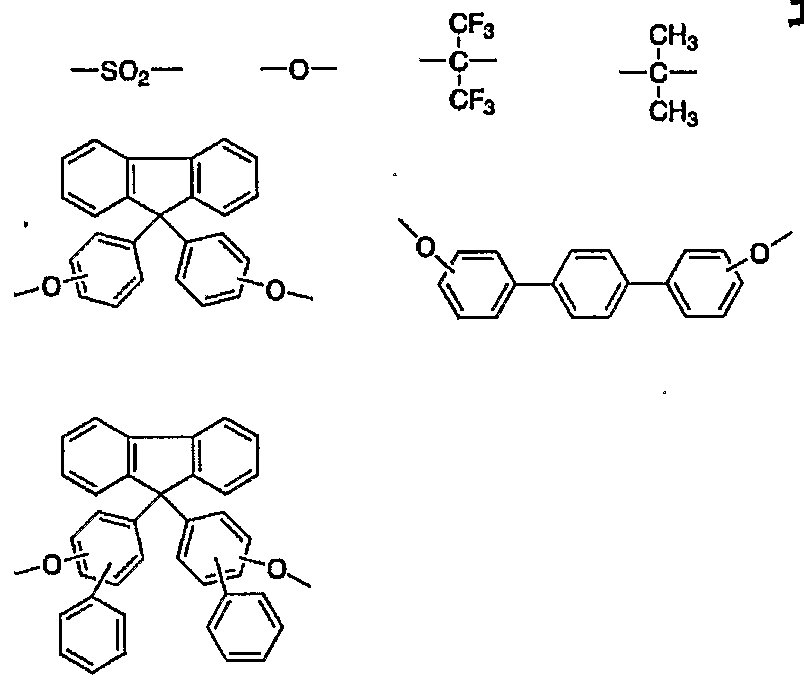
  • R1 and R2 are each independently a hydrogen atom or a monovalent organic group, k is an integer between 2 and 1,000; XI is selected from those represented by the formula (2). At least one tetravalent radical
  • W in the formula (3) is: at least one divalent group selected from those represented by the formula (4)
  • the benzoxazole resin precursor of the present invention further has a fourth repeating unit represented by the following formula (5).
  • HQO a fourth repeating unit represented by the following formula (5).
  • Rl and R 2 are each independently a hydrogen atom or a monovalent organic group, m is an integer between 2 and 1,000; XI is selected from those represented by the formula (2). At least one tetravalent radical
  • (Chi-square in the formula (2) is Echiniru group or propargyl ether group; is ⁇ , - 0-, - S0 2 -, - CH 2 -, one C (CH 3) 2 -, - C (CF 3) 2- or divalent aromatic group (including fluorenylidene group);
  • Ar is a trivalent or higher aromatic group; r is 0 or 1; q is an integer of 1 to 4;
  • a tetravalent group selected from the group: Y2 is represented by the following formula (6-1), formula (6-2), formula (7-1), formula (7-2), formula (8) or formula (9) At least one divalent group selected from [I-Did 7-7]
  • the benzoxazole resin precursor of the present invention further comprises a fifth compound represented by the following formula (10): Preferably, it has a repeating unit.
  • R 1 and R 2 in the formula (10) are each independently a hydrogen atom or a monovalent organic group, n is an integer between 2 and 1,000;
  • X3 is a group represented by the formula (11): At least one tetravalent group selected from
  • X4 in the formula (11) is: at least one divalent group selected from those represented by the formula (12) (12)
  • Yl is at least one divalent group selected from those represented by the formula (3):
  • W in the formula (3) is: at least one divalent group selected from those represented by the formula (4) [Formula 1 5]
  • the third repeating unit and the fourth repeating unit are copolymerized.
  • the benzoxazole resin of the present invention is obtained by reacting the benzoxazole resin precursor described above.
  • the resin film of the present invention is characterized by being composed of a resin composition containing the above-mentioned polybenzoxazole resin.
  • the resin film of the present invention preferably has fine pores having an average pore diameter of 1 O nm or less. This results in particularly excellent electrical (particularly dielectric), physical and mechanical properties.
  • the resin film of the present invention is preferably one selected from an interlayer insulating film for a semiconductor, a protective film for a semiconductor, and an etching protective film.
  • a semiconductor device according to the present invention includes the shelf film described above.
  • FIG. 1 is a cross-sectional view schematically showing one example of the semiconductor device of the present invention.
  • the benzoxazole resin precursor of the present invention contains a first repeating unit obtained by reacting a bisaminophenol conjugate having a functional group with a dicarboxylic acid compound. Further, the polybenzoxazole resin of the present invention is obtained by reacting the benzoxazole resin precursor described above.
  • the resin film of the present invention is composed of a resin composition containing the polybenzoxazole resin described above. '
  • a semiconductor device of the present invention has the resin film described above.
  • the benzoxazole resin precursor of the present invention contains a first repeating unit obtained by reacting a bisaminophenol compound having a functional group with a dicarponic acid compound. As a result, a benzoxazole resin precursor having a functional group in a side chain can be obtained. Further, the heat resistance of the polybenzoxazole resin obtained from the benzoxazole resin precursor can be improved.
  • the term “heat resistance” means that the elasticity at high temperatures (specifically, 200 ° C.) is excellent.
  • the heat resistance of polybenzoxazole resin is improved because the bisaminophenol compound in the benzoxazole resin precursor has a functional group, which improves the crosslink density of the resulting polybenzoxazole resin. Because you can.
  • the nanofoam may aggregate when an interlayer insulating film is obtained by forming a nanofoam (micropores) using such a polybenzoxazole resin. Without The shape can be maintained. Thereby, the dielectric constant of the interlayer insulating film can be reduced.
  • crosslinking reaction can be performed at a relatively low temperature. That is, crosslinking can be performed at a temperature lower than the temperature at which the porogen forming the nanoform decomposes, and has a high elastic modulus at the temperature at which the porogen is generated. Therefore, it is possible to easily form fine and uniform nanofoams.
  • the bisaminophenol compound having a functional group is a compound having a functional group capable of performing a cross-linking reaction in a molecule, and the functional group is, for example, a three-dimensional cross-linking reaction when obtaining a polybenzoxazole resin. It is possible to do.
  • Examples of the functional group constituting the bisaminophenol compound having a functional group include a functional group having an acetylene bond, a biphenylene group, a cyanato group, a maleimide group, a nadimide group, a vinyl group, and a cyclopentagenenyl group. .
  • a functional group having an acetylene bond is preferable.
  • the solubility of the benzoxazole resin precursor in the solvent can be improved.
  • the heat resistance of the polybenzoxazole resin obtained from the benzoxazole resin precursor can be improved.
  • the functional group having an acetylene bond examples include an ethenyl group, a phenylethynyl group, a naphthylethynyl group, an anthrylethynyl group, a quinolylethynyl group, a quinoxalylethynyl group, an alkylethynyl group, and a propargyl ether group. Is received. Among these, one or more functional groups selected from among neutral, phenylethinyl and naphthylethynyl groups are preferred. Thereby, particularly, the glass transition temperature of the polybenzoxazole resin can be improved.
  • the bisaminophenol-containing compound having the functional group is excellent in industrial productivity. Furthermore, a benzoxoxy compound obtained by reacting the bisaminophenol compound having the functional group introduced therein with a dicarboxylic acid. Excellent workability of sazol resin precursor (can be cross-linked at an appropriate temperature), and excellent balance of heat resistance and dielectric properties of polybenzoxazole resin finally obtained.
  • Examples of a method for introducing a functional group into a bisaminophenol compound described later include a method of force coupling reaction to a halogenated compound. Specifically, based on the coupling reaction of ethynylbenzene to a halogenated conjugate having an ortho-hydroxy-nitrophenol structure, the acetylene bond is not reduced by deprotection of the phenol group and selection of an optimal catalyst. By carrying out an amination reaction, a functional group can be introduced into the bisaminophenol compound. ,
  • bisaminophenol compound examples include compounds having dihydroxylbenzene such as 2,4-diaminomonoresorcinol and 2,5-diamino-1,4-dihydroxylbenzene:
  • Bisaminophenol compounds having a dihydroxydiphenyl ether such as 3,3'-diamino-1,4,1-dihydroxy-1-diphenyl ether:
  • one or more bisaminophenol compounds selected from a compound having dihydroxylbenzene, a compound having dihydroxydiphenyl ether, a compound having a fluorene skeleton, and a compound having a binaphthalene skeleton are preferable. This makes it possible to easily introduce the above-described functional group into the bisaminophenol compound as compared with other bisphenol compounds.
  • bisaminophenol compounds having a functional group include 2,2,1-bis (3-hydroxy-14-aminophenoxy) -1,6,6′-bis-ethynyl-1,1, -binaphthalene and 2,2 ′ —Bis- (3-hydroxy-4-aminophenoxy) -1,6,6′-bis-1-phenylethynyl— 1,1, -binaphthalene and other ethynyl (phenylenyl) -binaminophthalene-containing bisaminophenol compounds: 1,5-bis-1 (3-Hydroxy-4-aminophenoxy) _2,6-bis-ethynyl-naphthylene, 1,5-bis- (3-hydroxy-14-amid-phenoxy) -1,2,6-bis-phenyl-2-ethynyl-naphthalene), 1 , 5-bis- (3-hydroxy-4-aminophenoxy) -1-2-phenyl-2-naphthalene, 1,5
  • bisaminophenol compounds having one or more functional groups selected from bisaminophenol compounds having ethenyl (phenylenetin) -naphthylene, and bisaminophenol compounds having ethynyl (phenylene) -phenylene Compounds are preferred.
  • the elastic modulus of the polybenzoxazole resin at a high temperature can be improved.
  • dicarboxylic acid examples include phthalic acid such as isophthalic acid, terephthalic acid, 2-fluoroisophthalic acid, 2,3,5,6-tetrafluoroterephthalic acid, 4,4′-biphenyldicarboxylic acid, 3 , 4'-Piphenyldicarboxylic acid, 3,3'-biphenyldicarboxylic acid, 4,4'-Bis (4-dioxypropyloxy) biphenyl, 4,4,1-bis (3-dioxydiphenyl) B) biphenyldicarboxylic acid such as biphenyl, 1,4-naphthylenedicarboxylic acid, 2,3-naphthalenedicarboxylic acid, 2,6-naphthylenedicarboxylic acid such as dicarboxylic acid, 4,4'-sulfonylbis 3,4'-Sulfonylbisbenzoic acid, 3,3'-Sulfonylbisbenzo
  • the dicarboxylic acid is not particularly limited, but preferably has a functional group. Thereby, the heat resistance of the polybenzoxazole resin can be further improved.
  • the dicarboxylic acid having a functional group has a functional group capable of performing a cross-linking reaction in a molecule, and the functional group undergoes a three-dimensional cross-linking reaction when, for example, obtaining a polybenzoxazole resin. It becomes possible.
  • Examples of the functional group include a functional group having an acetylene bond, a biphenylene group, a cyanate group, a maleimide group, a nadimide group, a vinyl group, and a cyclopentadenyl group.
  • Examples of those having a functional group in the molecule include dicarponic acid having an acetylene skeleton in the molecule and dicarponic acid having a biphenylene skeleton.
  • a functional group having an acetylene bond is preferable. As a result, the solubility of the oxazole resin forebody in the solvent can be improved.
  • the functional group having an acetylene bond include an ethoxy group, a phenylethynyl group, a naphthylethynyl group, an anthrylethynyl group, a quinollethynyl group, a quinoxalylethynyl group, an alkylethynyl group, and a propargyl ether group.
  • one or more functional groups selected from ethynyl, phenylethynyl and naphthylethynyl groups are preferred. This makes it possible to improve the heat resistance, particularly the glass transition temperature, of the obtained polybenzoxazole resin.
  • the improvement in the heat resistance of the polybenzoxazole resin is attributed to the fact that the bisaminophenol compound in the benzoxazole resin precursor has a functional group, thereby increasing the crosslink density of the resulting polybenzoxazole resin. Because you can. Furthermore, when the crosslink density of the polybenzoxazole resin is improved, the nanofoam may aggregate when the nanofoam is formed using such a polybenzoxazole resin to obtain an interlayer insulating film. It is possible to maintain the shape without any change. Thereby, the dielectric constant of the interlayer insulating film can be reduced.
  • a benzoxazole resin precursor having a first repeating unit obtained by reacting a functional group-containing bisaminophenol compound with a functional group-containing dicarboxylic acid is most preferable. This makes it possible to further improve the shape retention of the nanofoam of the interlayer insulating film composed of the polybenzoxazole resin obtained using the benzoxazole resin precursor. If the nanofoam is excellent in shape retention, further lowering the dielectric constant can be achieved. The reason why the shape retention of the nanofoam is excellent is that the crosslinking density is improved when both the bisaminophenol compound and the dicarboxylic acid have a crosslinkable functional group during the reaction of the polybenzoxazole resin. It is believed that there is.
  • dicarboxylic acid having a functional group examples include, for example, 3-ethynylphthalic acid,
  • Ethynylbutyric acid such as ethynylisophthalic acid such as 4-ethynylphthalic acid and 5-ethynylisophthalic acid; ethynylterephthalic acid such as 2-ethynylterephthalic acid and 3-ethynylterephthalic acid;
  • Ethynylnaphthalenedicarboxylic acids such as 2-ethynyl-1,5-naphthalenedicarboxylic acid and 3-ethynyl-1,5_naphthalenedicarboxylic acid:
  • phenylethynylphthalic acid such as 5-phenylethynylisophthalic acid, 2-phenylethynylterephthalic acid, and phenylethynylterephthalic acid such as 3-phenylethynylterephthalic acid
  • Dilethynylphthalic acid 2-phenylethynyl-1,5-naphthylenedicarboxylic acid, etc.
  • Dicarboxylic acids having a biphenylene skeleton such as 1,2-biphenylenedicarboxylic acid and 1,3-biphenylenedicarboxylic acid; and the like. These can be used alone or in combination of two or more. Of these, one or more dicarboxylic acids selected from ethynyl isophthalic acid, (ethynyl-phenoxy) isophthalic acid, phenylethynyl phthalic acid, and (phenylethiophene) monoisophthalic acid are preferred. As a result, the crosslink density of the finally obtained polybenzoxazole resin can be further improved.
  • Examples of a method for introducing such a functional group into the dicarboxylic acid include a method described in JP-A-2002-201158. That is, a functional group can be introduced using a dicarponic acid ester into which a lip is formed or a dicarponic acid ester into which a hydroxyl group is introduced. More specifically, as a starting material A phenylacetylene ester is obtained by a coupling reaction with phenylacetylene using a halogenated dicarboxylic acid ester, and further de-esterified by alkali hydrolysis to obtain phenylene dicarboxylic acid. Obtainable.
  • the transdicarboxylic acid is prepared by, for example, preparing a stilbene from a benzoate derivative and then preparing and synthesizing a tran skeleton, and introducing a tran skeleton from a benzoate derivative and a phenylethynyl derivative using a Heck reaction. Then, it can be obtained by a synthesis method or the like.
  • dicarboxylic acid having a biphenylene skeleton examples include a method described in, for example, Journal of Polymer Science: Polymer Letters Edition, Vol. 16, 653-656 (1978). Specifically, iodination of dimethyl 4,4'-biphenylenedicarboxylate, biphenylenylene deiodination, and deesterification give 2,7-biphenylenedicarboxylic acid. it can.
  • the reaction between the bisaminophenol compound having a functional group and dicarboxylic acid includes, for example, An acid chloride method can be mentioned. Specifically, in the presence of a catalyst such as ⁇ , ⁇ '-dimethylformamide, a dicarboxylic acid is reacted with an excess amount of dithithionil at room temperature to about 130 ° C., and the excess thionyl chloride is heated and After distilling off under reduced pressure, the residue is recrystallized with a solvent such as hexane to obtain dicarbonic acid chloride.
  • a catalyst such as ⁇ , ⁇ '-dimethylformamide
  • this dicarboxylic acid chloride and a bisaminophenol compound having a functional group are dissolved in a polar solvent such as N-methyl-2-pyrrolidone, ⁇ , ⁇ '-dimethylacetoamide, and an acid acceptor such as pyridine is dissolved.
  • a benzoxazole resin precursor having a first repeating unit (a benzoxazole resin precursor having a functional group in a side chain) is obtained.
  • the number of repeating units of the first repeating unit is not particularly limited, but is preferably from 2 to 100, and particularly preferably from 5 to 100. When the number of repeating units is within the above range, particularly dissolution Excellent workability and workability.
  • the benzoxazole resin precursor having the first repeating unit may further include the second repeating unit.
  • the second repeating unit is obtained by reacting a bisaminophenol compound having no functional group (unsubstituted bisaminophenol compound) with a dicarboxylic acid having no functional group (unsubstituted dicarboxylic acid). . .
  • the benzoxazole resin precursor having the second repeating unit forms a linear polybenzoxazole resin having no functional group in a side chain.
  • the first repeating unit and the second repeating unit may constitute a benzoxazole resin precursor in a state of a copolymer or a simple mixture. Further, in the case of a copolymer, the first repeating unit and the second repeating unit may be a random copolymer, an alternating copolymer, or a block copolymer.
  • bisaminophenol compound having no functional group means an unsubstituted bisaminophenol compound, and specifically includes dihydroxy compounds such as 2,4-diamino-resorcinol and 2,5-diamino-1,4-dihydroxybenzene.
  • dihydroxy compounds such as 2,4-diamino-resorcinol and 2,5-diamino-1,4-dihydroxybenzene.
  • one or more bisaminophenol compounds selected from a compound having dihydroxy-1-biphenyl, a compound having a fluorene skeleton, and a compound having a binaphthalene skeleton are preferable. Thereby, heat resistance can be particularly improved. Further, when a compound having a fluorene or binaphthalene skeleton is used, the solubility of the resin precursor is excellent.
  • the dicarboxylic acid having no functional group means an unsubstituted dicarboxylic acid, specifically, isophthalic acid, terephthalic acid, 2-fluoroisophthalic acid, 2,3,5,6-tetrafluoro acid Phthalic acid such as roterephthalic acid, 4, 4'-biphenyldicarboxylic acid,
  • dicarboxylic acids selected from terephthalic acid, isophthalic acid, biphenyl carboxylic acid, dicarboxylic acid having a fluorene skeleton, and the like are preferable. Thereby, solubility, toughness, and thermal decomposition resistance can be improved.
  • 00 is preferable, and especially 5 to 100 is preferable.
  • solubility and workability are particularly excellent.
  • the benzoxazole resin precursor of the present invention has a third repeating unit represented by the following formula (1).
  • R 1 and R 2 in the formula (1) are each independently a hydrogen atom or a monovalent organic group; X 1 is at least one tetravalent group selected from those represented by the formula (2).
  • X2 in the formula (2) is Echiniru group or propargyl ether group; Z is - ⁇ one, - S0 2 -, one CH 2 -, - C (CH 3) 2 _, - C (CF 3) 2- or divalent aromatic group (including fluorenylidene group); Ar is a trivalent or higher aromatic group; r is 0 or 1; Q is an integer of 1 to 4).
  • a tetravalent group selected from compounds represented by the following formula: Y 1 is: at least one divalent group selected from those represented by the formula (3)
  • the benzoxazole resin precursor having the third repeating unit is a benzoxazole resin precursor having a functional group in a side chain (derived from a bisaminophenol compound).
  • a side chain derived from a bisaminophenol compound.
  • the X 2 include an ethynyl group, a phenylenyl group, a naphthylethynyl group, an anthrylethynyl group, a quinolyl chelyl group, a quinoxalyl ethynyl group, an ethenyl group such as an alkylethynyl group, and a propargyl ether group.
  • the number of repeating units (k) in the third repeating unit is not particularly limited, but is preferably an integer of 2 to 100, particularly preferably an integer of 5 to 600, and most preferably 10 to 8 Integers up to 0 are preferred. When the number of repeating units is within the above range, workability when the benzoxazole resin precursor is dissolved in a solvent is excellent.
  • a method for obtaining the benzoxazole resin precursor having the third repeating unit examples include a method of reacting the bisaminophenol compound having a functional group with a dicarboxylic acid having no functional group by the acid chloride method as described above.
  • the benzoxazole resin precursor having the third repeating unit is not particularly limited, but preferably has a fourth repeating unit represented by the following formula (5).
  • [Rl and R2 in the formula (5) are each independently a hydrogen atom or a monovalent organic group; X 1 is: at least one tetravalent group selected from those represented by the formula (2).
  • X2 in the formula (2) is an ethynyl group or a propargyl ether group
  • Z is — ⁇ , —S ⁇ 2 —, —CH 2 —, one C (CH 3 ) 2 —, one C (CF 3 ) 2- or divalent aromatic group (including fluorenylidene group)
  • Ar is a trivalent or higher aromatic group
  • r is 0 or 1
  • q is an integer of 1 to 4
  • an ethynyl group, a phenylethynyl group, a naphthylethy And ethynyl groups such as an enyl group, anthrenylenyl group, a quinolylethynyl group, a quinoxalylethynyl group, and an alkylethynyl group, and a propargyl ether group.
  • the number of repeating units (m) of the fourth repeating unit is not particularly limited, but is preferably an integer of 2 to 100, particularly preferably an integer of 5 to 600, and most preferably 10 to 8 Integers up to 0 are preferred. When the number of repeating units is within the above range, workability when the benzoxazole resin precursor is dissolved in a solvent is excellent.
  • the third repeating unit and the fourth repeating unit may constitute a benzoxazole resin precursor in a state of a copolymer or a simple mixture. Further, in the case of a copolymer, the third repeating unit and the fourth repeating unit may be any of a random copolymer, an alternating copolymer, and a block copolymer.
  • a method for obtaining the benzoxazole resin precursor having the fourth repeating unit includes, for example, a bisaminophenol compound having the functional group. And a dicarboxylic acid having a functional group by an acid chloride method as described above. 5.
  • Benzoxazo resin precursor having the fifth repeating unit includes, for example, a bisaminophenol compound having the functional group. And a dicarboxylic acid having a functional group by an acid chloride method as described above. 5.
  • benzoxazole resin precursor having the third repeating unit is not particularly limited, but preferably has a fifth repeating unit represented by the following formula (10).
  • ROO ⁇ 3 ⁇ 4 n are each independently a hydrogen atom or a monovalent organic group X 3: at least one kind selected from those represented by the formula (11) Tetravalent group [Formula 27]
  • Yl is: at least one divalent group selected from those represented by the formula (3):
  • the number of repeating units (n) in the fifth repeating unit is not particularly limited, but is preferably an integer of 2 to 100, particularly preferably an integer of 5 to 100. When the number of repeating units is within the above range, workability when the benzoxazole resin precursor is dissolved in a solvent is excellent. .
  • the third repeating unit and the fifth repeating unit may constitute a benzoxazole resin precursor in a state of a copolymer or a simple mixture. Further, in the case of a copolymer, the third repeating unit and the fifth repeating unit may be a random copolymer, an alternating copolymer, or a block copolymer.
  • the third repeating unit, the fourth repeating unit, and the fifth repeating unit may constitute a benzoxazole resin precursor in a state of a copolymer or a simple mixture.
  • the third repeating unit, the fourth repeating unit, and the fifth repeating unit may be any of a random copolymer, an alternating copolymer, and a block copolymer. May be.
  • the polybenzoxazole resin of the present invention can be obtained by reacting the above-mentioned benzoxazole resin precursor.
  • the reaction is, for example, a condensation reaction and a crosslinking reaction.
  • a method in which the above-mentioned benzoxazole resin precursor is reacted at 150 to 425 ° C X 5 (min) to 24 (hour) UV irradiation is used. And electron beam irradiation.
  • a reactive oligomer having a substituent capable of reacting with a hydroxyl group, an amino group or a hydroxyl group of the benzoxazole resin precursor is used. It is preferable to use those obtained by reacting —This makes it easy to form nanofoam when forming an interlayer insulating film from polybenzoxazole resin. .
  • Examples of the substituent capable of reacting with the carboxyl group include an amino group, a hydroxyl group and an isocyanate group.
  • Examples of the substituent capable of reacting with the amino group include a propyloxyl group, an isocyanate group, a glycidyl group, a maleic anhydride group, a maleimide group, an acid anhydride group, and an acrylate group.
  • examples of the substituent capable of reacting with the hydroxyl group include an acid anhydride group, a propyloxyl group, and a daricidyl group.
  • the base resin for the reactive oligomer examples include polyoxyalkylene, polymethyl methacrylate, poly ⁇ -methylstyrene, polystyrene, polyester, polyetherester, polycaprolactone, polyurethane, and polycarbonate.
  • polyoxyalkylene or polycarboxylic acid is preferred.
  • the number average molecular weight of the reactive oligomer is not particularly limited, but is preferably from 100 to 40,000, more preferably from 200 to 200,000. When the number average molecular weight is within the above range, the nanofoam is hard to aggregate, and a fine and uniform nanofoam can be formed.
  • the glass transition temperature of the polybenzoxazole resin is not particularly limited, but is preferably 400 ° C. or higher, particularly preferably 420 ° C. or higher, and most preferably 450 ° to 500 ° C. When the glass transition temperature is within the above range, the coefficient of linear expansion of the resin film obtained from the benzoxazole resin can be reduced.
  • the resin film of the present invention is composed of a resin composition containing the above-described polybenzoxazole resin. This results in excellent adhesion and dimensional stability.
  • the resin film include an interlayer insulating film and a surface protective film for a semiconductor, an interlayer insulating film of a multilayer circuit, a cover coat of a flexible copper clad board, a solder resist film, a liquid crystal alignment film, and an etching protective film (etching stopper). 1), adhesives and the like. Among them, they are suitably used as an interlayer insulating film, a surface protective film, and an etching protective film for semiconductors.
  • various additives such as a surfactant and a coupling agent represented by a silane coupling agent, and radical initiation for generating oxygen radicals and radicals by heating.
  • Agents, catalysts such as disulfides and the like can be added.
  • the resin composition can be used as a photosensitive surface protective film.
  • the interlayer insulating film is not particularly limited, but preferably has micropores (nanoform).
  • the average pore size of the nanoform is not particularly limited, but is preferably 1 O nm or less, more preferably 6 nm or less, and most preferably 3 nm or less. Average pore size within the above range If so, they are particularly compatible in the process and have good dielectric properties in pattern formation.
  • the polybenzoxazole resin constituting the resin composition may react with a carboxyl group, an amino group or a hydroxyl group of the benzoxazole resin precursor described above. Those obtained by reacting with a reactive oligomer having a substituent are preferred. Thereby, nanofoam can be easily formed on the interlayer insulating film.
  • a blowing agent for forming a nanofoam may be added to the resin composition.
  • foaming agent examples include carbon nanotubes and fullerenes having a hollow structure, cage silsesquioxane, cyclodextrin, organic compounds having a high melting point, surfactants, azobis compounds, organic oxides, and dendrites. Dreamers, hyperbranched polymers and the like can be mentioned. Of these, surfactants and hyperbranched polymers are preferred. This makes it possible to uniformly disperse the blowing agent in the polybenzoxazole resin. If the foaming agent can be dispersed uniformly, fine nanofoam can be obtained by further heating and extraction.
  • the porosity of the interlayer insulating film is not particularly limited, but is preferably 5 to 70%, and particularly preferably 7 to 50%. If the porosity is less than the lower limit, a sufficient decrease in the dielectric constant may not occur, and if the porosity exceeds the upper limit, the mechanical strength of the film may be reduced, and the elastic modulus or the adhesiveness may be reduced.
  • the thickness of the interlayer insulating film is not particularly limited, but is preferably from 0.01 to 20 m, particularly preferably from 0.05 to: L 0 m, and most preferably from 0.1 to 0.7 m. When the thickness is within the above range, process suitability is excellent.
  • a varnish is prepared by dissolving the benzoxazole resin precursor in an organic solvent such as N-methyl-2-pyrrolidone.
  • an organic solvent such as N-methyl-2-pyrrolidone.
  • the application method includes spin coating using a spinner, spray coating using a sprayer, Examples include dipping, printing, and roll coating. After that, it is dried and subjected to a heat treatment, followed by removal of the solvent, followed by a condensation reaction and a cross-linking reaction, to obtain a polybenzoxazole resin, and an interlayer insulating film composed of a resin composition containing the same. be able to. Further, in the case of forming a nanoform, the interlayer insulating film may be further subjected to a heat treatment to form an interlayer insulating film having fine holes.
  • the benzoxazole resin precursor may be replaced with an organic material such as propylene carbonate, diacetone alcohol, N-methyl-2-pyrrolidone, or the like.
  • a varnish is prepared by dissolving in a solvent, and the varnish is applied to a suitable support, for example, a silicon wafer or a ceramic substrate. Examples of the coating method include spin coating using a spinner, spray coating using a spray coater, dipping, printing, and roll coating.
  • the thickness of the protective film is not particularly limited, but is preferably 0.05 to 7 Om, and particularly preferably 0.1 to 50 m. When the thickness is within the above range, both the protection characteristics and workability of the semiconductor element are particularly excellent.
  • FIG. 1 is a cross-sectional view schematically showing one example of the semiconductor device of the present invention.
  • the semiconductor device 10 Q includes a semiconductor substrate 1 on which elements are formed, a silicon nitride film 2 provided above the semiconductor substrate 1 (the upper side in FIG. 1), and an interlayer provided on the silicon nitride film 2. It has a copper wiring layer 4 covered with an insulating film 3 and a barrier layer 6.
  • a concave portion corresponding to a pattern to be wired is formed in the interlayer insulating film 3, and a wiring layer 4 is provided in the concave portion.
  • nanofoams (micropores) 31 are formed.
  • a modification processing layer 5 is provided between the interlayer insulating film 3 and the copper wiring layer 4.
  • a hard mask layer 7 is formed on the upper side of the interlayer insulating film 3 (the side opposite to the silicon nitride film 2). Is formed.
  • the nanoform 31 is formed in the interlayer insulating film 3, but the present invention is not limited to this.
  • the semiconductor device 100 using the interlayer insulating film 3 has been described, but the present invention is not limited to this.
  • the semiconductor device of the present invention uses the above-described interlayer insulating film, it is excellent in dimensional accuracy and can sufficiently exhibit insulation properties, and thus has excellent connection reliability.
  • the interlayer insulating film as described above has excellent adhesion to the wiring layer, the connection reliability of the semiconductor device can be further improved.
  • the interlayer insulating film as described above has excellent dielectric properties, so that signal loss of the semiconductor device can be reduced.
  • the interlayer insulating film as described above has excellent dielectric properties, wiring delay can be reduced.
  • MS Mass spectrometry
  • Terephthalic acid chloride manufactured by Tokyo Chemical Industry
  • the number average molecular weight (Mn) of the obtained benzoxazole resin precursor was determined to be 21,000 in terms of polystyrene using GPC manufactured by Tosoichi Co., Ltd.
  • the benzoxazole resin precursor was dissolved in N-methyl_2_pyrrolidone and filtered through a Teflon (“Teflon” is a registered trademark) filter to obtain a coating material.
  • Teflon is a registered trademark
  • This varnish was applied on a silicon wafer using a spinco all night. Thereafter, in a nitrogen atmosphere oven, heating was performed in the order of 9 CTC / 1 minute, 250 ° C./1 hour, and 330 ° C. Z1 hour to obtain a resin film.
  • Example 1 was carried out in the same manner as in Example 1 except that the bisaminophenol compound and dicarponic acid used were those obtained by the following synthesis method.
  • the obtained recrystallized product was dried under reduced pressure to obtain 70 g of a product.
  • the flask was cooled to 0 ° C. or lower, and the above-mentioned aqueous solution of diazonium salt was added dropwise over 2 hours. After completion of the dropwise addition, the mixture was stirred at room temperature for 30 minutes and then refluxed for 30 minutes. After cooling, the precipitate was separated by filtration, washed twice with 2 L of distilled water, and the obtained white solid was dried under reduced pressure at 50 ° C for 2 days to obtain 117 g of a crude product. Used for the next reaction without purification.
  • a 50 OmL flask equipped with a stirrer and a Dimroth condenser was charged with 110 g of the first intermediate (5-monobromoisophthalic acid), 50 OmL of methanol, and 10 g of concentrated sulfuric acid, and refluxed for 6 hours. After allowing to cool, the mixture was dropped into 1 L (liter) of distilled water and neutralized with a 5% by weight aqueous sodium hydrogencarbonate solution. The precipitate was separated by filtration, washed twice with 2 L (liter) of distilled water, and the obtained white solid was dried under reduced pressure at 50 ° C for 2 days. 109 g (0.4 mol) of dimethyl phthalate was obtained (89% yield).
  • the number average molecular weight (Mn) of the obtained benzoxazole resin precursor was determined to be 22,000 in terms of polystyrene using GPC manufactured by Tosoichi Co., Ltd. [Embodiment 3]
  • Example 1 was repeated except that the bisaminophenol compound and dicarboxylic acid used were those obtained by the following synthesis method.
  • a second intermediate was obtained in the same manner as in Example 1 1-2) except that 89.9 g (0.10 mol) of the first intermediate was used.
  • dicarboxylic acid 4,4'-biphenyldicarponic acid dichloride (manufactured by Tokyo Chemical Industry) was used.
  • the number average molecular weight (Mn) of the obtained benzoxazole resin precursor was determined to be 20,000 by polystyrene conversion using GPC manufactured by Tosoh Corporation. [Example 4]
  • Example 1 was repeated except that a bisaminophenol compound and a dicarboxylic acid obtained by a synthesis method described below were used.
  • Example 1 In the synthesis of 1-1) in Example 1, instead of 38 g (0.20 mo 1) of 5-bromoresorcinol, 9,9-bis (4-hydroxy-monophenyl) -2,7-difluoride morphofluorene The reaction was carried out in the same manner as in Example 1-1-1) except that 101.6 g (0.2 Omo 1) was used, to obtain a first intermediate.
  • a second intermediate was obtained in the same manner as in the synthesis of 1-2) of Example 1, except that 96.3 g (0.10 mol) of the first intermediate was used.
  • the precipitate was separated by filtration, washed with ion-exchanged water and ethanol, and the obtained pale yellow solid was dried under reduced pressure at 50 ° C for 1 day to obtain 142.01 g of a first intermediate (yield 68). %).
  • a diazonium salt aqueous solution was obtained.
  • a solution prepared by dissolving 27.39 g (0.165 mol) of potassium iodide in 33 mL of ion-exchanged water was added. Subsequently, the mixture was stirred at 5 ° C or lower for 1 hour and at room temperature for 1 hour. The precipitate was separated by filtration, dissolved in 30 OmL of ethyl acetate, and washed twice with 200 mL of a 10% aqueous sodium bisulfite solution and twice with 20 OmL of ion-exchanged water.
  • Isophthalic dichloride (Tokyo Kasei) was used.
  • the number average molecular weight (Mn) of the obtained benzoxazole resin precursor was determined to be 21,000 by polystyrene conversion using GPC manufactured by Tosoh Corporation.
  • the reaction was carried out in the same manner as 3) of Example 1 except that benzoxazole resin precursor was obtained.
  • the number average molecular weight (Mn) of the obtained benzoxazole resin precursor was found to be 19,000 by polystyrene conversion using GPC manufactured by Tosoichi Co., Ltd.
  • a benzoxazole resin precursor composed of bisaminophenol having a functional group and dicarbonic acid having a functional group, bisaminophenol having no functional group, and dicarbonic acid having no functional group
  • a varnish having a resin solid content of 20% by weight was dissolved in a solvent N-methylpiperidone in 50% by weight of a benzoxazole resin precursor composed of the following.
  • Example 1 was carried out in the same manner as in Example 1 except that the bisaminophenol compound and dicarponic acid which were obtained by the following synthesis method were used.
  • 2,6-Naphthalenedicarboxylic acid dichloride was synthesized from 2,6-naphthalenedicarboxylic acid by acid chloride reaction with thionyl chloride.
  • 9,9-Bis (3-amino-4-hydroxy-phenyl) -fluorene is obtained by using 9,9-bis (4-hydroxy-phenyl) -fluorene as a raw material, and is converted to the hydroxyl group at the ortho-position by nitration with nitric acid.
  • the nitro group was introduced, and the nitro group was converted to an amino group by a reduction reaction using a palladium carbonate catalyst.
  • reaction temperature was raised to 0 ° C for 1 hour, and further raised to room temperature for 5 hours.
  • the obtained reaction mixture was poured into 4 L of ice water, and an aqueous layer and an organic layer were separated. Further, the aqueous layer was extracted twice with 500 mL of toluene, and this was combined with the organic layer.
  • the organic layer was washed twice with water and dried twice, dried over anhydrous magnesium sulfate (100 g), filtered to remove anhydrous magnesium sulfate, distilled off toluene with a rotary evaporator, and dried under reduced pressure.
  • the number average molecular weight (Mn) of the obtained benzoxazole resin precursor was determined to be 20,000 by polystyrene conversion using GPC manufactured by Tosoh Corporation. [Example 6]
  • Example 2 2-Fuenylethyrutherate diphthalide dichloride was synthesized in the same manner as in Example 1 except that dimethyl 2-hydroxy-terephthalate was used instead of dimethyl 5-hydroxy-isophthalate.
  • 9,9-Bis [4- (3-hydroxy-1-aminophenoxy) -phenyl] -fluorene is composed of 9,9-bis (4-hydroxyphenyl) -fluorene and 1-fluoro-3-benzyloxy-412 After etherification from benzene, 9,9-bis [4- (3-benzyloxy- 412-trophenoxy) -phenyl] -fluorene is synthesized, followed by palladium-carbon-catalyzed debenzylation. And from the reduction reaction of the nitro group.
  • Isophthalic dichloride (Tokyo Kasei) was used.
  • the number average molecular weight (Mn) of the obtained benzoxazole resin precursor was determined to be 21,000 by polystyrene conversion using GPC manufactured by Tosoh Corporation.
  • isofluoric acid.dichloride manufactured by Tokyo Chemical Industry
  • the number average molecular weight (Mn) of the obtained benzoxazole resin precursor was determined to be 17,000 by polystyrene conversion using GPC manufactured by Tosoh Corporation.
  • the reaction was carried out in the same manner as in Example 1, 3) except that the benzoxazole resin precursor was obtained.
  • the number average molecular weight (Mn) of the obtained benzoxazole resin precursor was determined to be 19,000 in terms of polystyrene using GPC manufactured by Tosoichi Co., Ltd.
  • the following evaluation was performed on the resin films obtained in Examples 1 to 6 and Comparative Examples 1 and 2. The evaluation items are shown together with the method. Table 1 shows the obtained results.
  • the glass transition temperature was measured using a dynamic viscoelasticity measuring device (DMS 6100, manufactured by Seiko Instruments Inc.) under a nitrogen gas flow of 30 OmL Znmin. Under a flow rate of 3 ° C / min. The measurement was performed under the condition of 1 Hz, and the peak top temperature of ta ⁇ ⁇ was defined as the glass transition temperature.
  • the thermal decomposition temperature was measured using a TGZDTA measuring device (TGZDTA220, manufactured by Seiko Instruments Inc.) to measure the obtained resin film with nitrogen gas at 20 OmL / min. Under the flow, the temperature was measured under the conditions of a heating rate of 10 ° C / min. The temperature at which the weight loss reached 5% was defined as the pyrolysis temperature.
  • Relative permittivity (capacitance measured value x film thickness) / (vacuum permittivity x measured area) [Table 1] Table 1
  • Examples 1 to 6 had high glass transition temperatures and thermal decomposition temperatures and were excellent in heat resistance.
  • Examples 1 to 6 were soluble in a solvent, had a low dielectric constant, and were excellent in workability and dielectric properties.
  • the number average molecular weight (Mn) of the obtained benzoxazole resin precursor was 26,000 as calculated as polystyrene using GPC manufactured by Tosoichi Co., Ltd.
  • the benzoxazole resin precursor was dissolved in N-methyl-2-pyrrolidone and filtered through a Teflon (“Temalon” is a registered trademark) filter to obtain a coating varnish.
  • a silicon nitride layer is formed on the semiconductor substrate, the coating varnish obtained in Example 7 is applied on the silicon nitride layer, and heated at 250 ° C. for 1 hour and at 420 ° C. for 1 hour. Then, an interlayer insulating film having a thickness of 0.3 was formed.
  • Example 7 was carried out in the same manner as in Example 7, except that the following varnish for coating was used.
  • poly (propylene glycol) bis (2-aminopropyl ether) (manufactured by Aldrich) having a molecular weight of 4,000 was used.
  • the number average molecular weight (Mn) of the obtained benzoxazole resin precursor was determined to be 28,000 by polystyrene conversion using GPC manufactured by Tosoichi Co., Ltd.
  • the benzoxazole resin precursor was dissolved in N-methyl-2-pyrrolidone and filtered through a Teflon (“Teflon” is a registered trademark) filter to obtain a varnish for coating.
  • Examples 7 and 8 exhibited high glass transition temperatures and high thermal decomposition temperatures and excellent heat resistance. +.
  • Examples 7 and 8 were soluble in a solvent, had a particularly low dielectric constant, and were particularly excellent in workability and dielectric properties. -In Examples 7 and 8, it was confirmed that fine holes were formed.
  • a semiconductor device obtained by using the interlayer insulating films of Examples 7 and 8 were compared with the degree of wiring delay of a semiconductor device having an S I_ ⁇ 2 insulating film at the semiconductor device and the same configuration.
  • the evaluation criterion the signal delay time calculated from the transmission frequency of the ring oscillation was adopted.
  • the wiring delay was small and the speed was improved by about 20%.
  • a polybenzoxazole resin when used, a polybenzoxazole resin is used, a benzene having excellent heat resistance is obtained.
  • a zoxazole resin precursor can be obtained.
  • a functional group having an acetylene bond as a functional group of the bisaminophenol compound, it is possible to maintain solubility in an organic solvent, thereby maintaining workability and heat resistance after ring closure. Can be improved.
  • the resin film since the resin film has fine pores having an average pore diameter of 1 O nm or less, it is particularly excellent in electrical properties (particularly, dielectric properties), physical properties, and mechanical properties.

Landscapes

  • Chemical & Material Sciences (AREA)
  • Health & Medical Sciences (AREA)
  • Chemical Kinetics & Catalysis (AREA)
  • Medicinal Chemistry (AREA)
  • Polymers & Plastics (AREA)
  • Organic Chemistry (AREA)
  • Macromolecular Compounds Obtained By Forming Nitrogen-Containing Linkages In General (AREA)
  • Formation Of Insulating Films (AREA)

Abstract

本発明のべンゾオキサゾール樹脂前駆体は、官能基を有するビスアミノフェノール化合物と、ジカルボン酸化合物とを反応して得られる第1の繰り返し単位を含む。また、本発明のポリベンゾオキサゾール樹脂は、上記に記載のべンゾオキサゾール樹指前駆体を反応して得られる。また、本発明の樹脂膜は、上記に記載のポリベンゾオキサゾール樹脂を含む樹脂組成物で構成される。また、本発明の半導体装置は、上記に記載の樹脂膜を有する。

Description

ベンゾォキサゾール樹脂前駆体、 ポリべンゾォキサゾール樹脂、 樹脂膜および半
技術分野
本発明は、 ベンゾォキサゾ一ル樹脂前駆体、 ポリベンゾォキサゾ一ル樹脂、 樹脂 膜および半導体装置に関する。 明
背景技術 書
半導体用の層間絶縁膜としては、 現在、 C VD法 (化学蒸着法) '等で作製した酸 化膜 (S i O x膜) が主に使用されている。 しかし、 酸化膜等の無機絶縁膜は、 誘 電率が高いため、 半導体の高速化、 高性能化に対応するのが困難である。 そこで、 低誘電率の層間絶縁膜として、 有機材料の適用が検討されている。 層間絶縁膜に用 いられる有機材料としては、 耐熱性、 電気特性に優れ、.かつ低誘電率であることが 要求される。
従来、 有機材料としては、 ポリイミド樹脂、 ポリキノリン樹脂、 ポリキノキサリ ン樹脂等が検討されている (例えば、 特開 2 0 0 0— 1 9 5 8 5 3号公報参照)。 しかし、 ポリイミド樹脂は、 耐熱性が低い、 誘電率が高い、 P及湿性が高い等の問 題があった。 そのため、 その用途は信頼性の上でバイポーラ半導体素子などの一部 の半導体素子に限られていた。
一方、 ポ Uイミド棚旨より高耐熱性、 低誘電率性、 低吸湿性を兼ね備えたポリキ ノリン樹脂、 ボリキノキサリン樹脂は、 熱可塑性樹脂であるため、 樹脂のガラス転 移点以上の温度に曝された場合、 樹脂のパターンが変形し、 半導体製造時に問題と なる場合があった。
発明の開示 本発明の目的は、 ポリベンゾォキサゾ一ル樹脂とした場合に耐熱性に優れるベン ゾォキサゾール樹脂前駆体を提供することにある。
また、 本発明の目的は、 耐熱性および低誘電率であるポリべンゾォキサゾール樹 脂、 樹脂膜およびそれを用いた半導体装置を提供することにある。
上記目的を達成するために、 本発明のベンゾォキサゾール樹脂前駆体は、 官能基を有するビスアミノフエノール化合物と、 ジカルボン酸化合物とを反応して 得られる第 1の繰り返し単位を含むことを特徴とする。
これにより、 ポリベンゾォキサゾ一ル樹脂とした場合に耐熱性に優れるベンゾォ キサゾール樹脂前駆体を得ることができる。
本発明のベンゾォキサゾ一ル樹脂前駆体は、 さらに、 官能基を有しないビスアミ ノフエノール化合物と、 官能基を有しないジカルボン酸化合物とを反応して得られ る第 2の繰り返し単位を含むことが好ましい。 .
本発明のベンゾォキサゾール樹脂前駆体は、 前記ビスアミノフエノ一ル化合物の 官能基がアセチレン結合を有することが好ましい。
これにより、 有機溶剤への溶解性を保持することが!き、 それによつて加工性を 維持すると共に、 閉環後の耐熱性を向上させることができる。
本発明のベンゾォキサゾール樹脂前駆体は、前記ジカルボン酸化合物がフタル酸、 ビス安息香酸、 ビフエニルジカルボン酸の中から選ばれる 1種以上であることが好 ましい。
本発明のベンゾォキサゾ一ル樹脂前駆体は、 前記ジカルボン酸化合物がさらに官 能基を有することが好ましい。
これにより、 ポリベンゾォキサゾール樹脂の耐熱性をさらに向上することができ る。
本発明のベンゾォキサゾール樹脂前駆体は、 前記ジカルボン酸の官能基がァセチ レン結合を有することが好ましい。
これにより、 ォキサゾール樹脂前駆体の溶媒への溶解性をより向上することがで さる。 本発明のベンゾォキサゾ一ル樹脂前駆体は、 前記第 1の繰り返し単位と、 第 2の 繰り返し単位とが共重合されていることが好ましい。
また、 本発明のベンゾォキサゾール樹脂前駆体は、 下記式 (1) に示す第 3の繰 り返し単位を有することを特徴とする。
【化 1】
式(1)
Figure imgf000005_0001
[式(1)中の Rlおよび R 2はそれぞれ独立に水素原子または一価の有機基、 kは 2〜1, 000の間の整数; XIは:式 (2) で示されるものの中から選ばれる少 なくとも 1種の 4価の基
【化 2】
Figure imgf000005_0002
(Χ2). (X2)f 式 (2)
Figure imgf000005_0003
(式 (2) 中の Χ2は、 ェチェル基またはプロパギルエーテル基; Ζは、 一 0—、 一 S〇2 —、 -CH2―、 -C (CH3 ) 2 —、 一 C (CF3 ) 2 ―、 または 2価 の芳香族基(フルォレニリデン基を含む); Arは 3価以上の芳香族基; rは 0また は 1; Qは 1〜4の整数;)で表される化合物の中から選ばれる 4価の基; Y1は: 式 (3) で示されるものの中から選ばれる少なくとも 1種の 2価の基 【化 3】
式 (3)
Figure imgf000006_0001
式 (3) 中の Wは:式 (4) で示されるものの中から選ばれる少なくとも 1種の 2 価の基
【化 4】
式(4)
Figure imgf000006_0002
で表される化合物]
本発明のベンゾォキサゾ一ル樹脂前駆体は、 さらに下記式 (5) に示す第 4の繰 り返し単位を有することが好ましい。 H Q O
— N、 N— C— Y2— C- 式 (5)
HI ヽ
RiO O ¾
m
[式(5) 中の Rlおよび R 2はそれぞれ独立に水素原子または一価の有機基、 mは 2〜1, 000の間の整数; XIは:式 (2) で示されるものの中から選ばれる少 なくとも 1種の 4価の基
【化 6】
Figure imgf000007_0001
Ζ)Λ\
(Χ2), (X2)f 式 (2)
Figure imgf000007_0002
(式 (2) 中の Χ2は、 ェチニル基またはプロパギルエーテル基; Ζは、 — 0—、 — S02 ―、 — CH2 ―、 一 C (CH3 ) 2—、 — C (CF3 ) 2 ―、 または 2価 の芳香族基(フルォレニリデン基を含む); A rは 3価以上の芳香族基; rは 0また は 1; qは 1〜4の整数;)で表される化合物の中から選ばれる 4価の基; Y2は: 式 (6-1) 式 (6-2), 式 (7— 1)、 式 (7-2), 式 (8) または式 (9) で 示されるものの中から選ばれる少なくとも 1種の 2価の基 【ィ匕 7— 1】
Figure imgf000008_0001
C¾H3 ^ 一 CF3"TU
CH CH
【化 7— 2】 式(6— 2)
Figure imgf000009_0001
00
Υ
( 。
oo Q
o 。
Figure imgf000010_0001
7
a 【ィ匕 8— 2】
式(7— 2)
Figure imgf000011_0001
。ぞ
【化 9】
Figure imgf000011_0002
式 (8)
【化 1 0】
式 (9)
Figure imgf000011_0003
で表される化合物]
本発明のベンゾォキサゾール樹脂前駆体は、 さらに下記式 (1 0) に示す第 5の 繰り返し単位を有するものであることが好ましい。
【化 11】
H H 0 0
— N、 ,N-C-Y2-C- 式(10)
3\
RO 01¾ n
[式 (10) 中の R 1および R 2は、 それぞれ独立に水素原子または一価の有機基、 nは 2〜1, 000の間の整数; X3は:式 (11) で示されるものの中から選ば れる少なくとも 1種の 4価の基
【化 12】
式(11)
Figure imgf000012_0001
式 (11) 中の X4は:式 (12) で示されるものの中から選ばれる少なくとも 1 種の 2価の基 (12)
Figure imgf000013_0001
Ylは:式 (3) で示されるものの中から選ばれる少なくとも 1種の 2価の基 【化 14】
式 (3)
Figure imgf000013_0002
式 (3) 中の Wは:式 (4) で示されるものの中から選ばれる少なくとも 1種の 2 価の基 【化 1 5】
O'
Figure imgf000014_0001
¾
— so,— "9-
CF3 式 (4)
c ? cl
Figure imgf000014_0002
で表される化合物]
本発明のベンゾォキサゾール樹脂前駆体は、 前記第 3の繰り返し単位と、 第 4の 繰り返し単位とが共重合されていることが好ましい。
本発明のベンゾォキサゾール樹脂は、 上述に記載のベンゾォキサゾール樹脂前駆 体を反応して得られることを特徴とする。
これにより、 耐熱性に優れ、 かつ低誘電率であるポリべンゾォキサゾール樹脂を 得ることができる。
本発明の樹脂膜は、 上述に記載のポリべンゾォキサゾール樹脂を含む樹脂組成物 で構成されることを特徴とする。
本発明の樹脂膜は、 平均孔径 1 O nm以下の微細孔を有することが好ましい。 これにより、特に電気特性 (特に誘電特性)、物理特性および機械特性にも優れる。 本発明の樹脂膜は、 半導体用層間絶縁膜、 半導体用保護膜およびエッチング保護 膜の中から選ばれるものの一つであることが好ましい。
本発明の半導体装置は、 上述に記載の棚旨膜を有することを特徴とする。
これにより、 接続信頼性に優れ、 信号損失および配線遅延等が低く電気特性にも 優れる半導体装置を得ることができる。
図面の簡単な説明
第 1図は、 本発明の半導体装置の一例を模式的に示す断面図である。
発明を実施するための最良の形態 '
以下、 本発明のベンゾォキサゾール樹脂前駆体、 ポリべンゾォキサゾール樹脂、 樹脂膜および半導体装置について説明する。
本発明のベンゾォキサゾール樹脂前駆体は、 官能基を有するビスアミノフエノ一 ルイ匕合物と、ジカルボン酸化合物とを反応して得られる第 1の繰り返し単位を含む。 また、 本発明のポリべンゾォキサゾール樹脂は、 上記に記載のベンゾォキサゾ一 ル樹脂前駆体を反応して得られることを特徴とするものである。
また、 本発明の樹脂膜は、 上記に記載のポリベンゾォキサゾ一ル樹脂を含む樹脂 組成物で構成される。 '
また、 本発明の半導体装置は、 上記に記載の樹脂膜を有するものである。
まず、 本発明のベンゾォキサゾ一ル樹脂前駆体について説明する。
本発明のベンゾォキサゾール樹脂前駆体は、 官能基を有するビスアミノフエノ一 ル化合物と、ジカルポン酸化合物とを反応して得られる第 1の繰り返し単位を含む。 これにより、 側鎖に官能基を有するベンゾォキサゾ一ル樹脂前駆体を得ることがで きる。 さらに、 前記ベンゾォキサゾ一ル樹脂前駆体から得られるポリべンゾォキサ ゾ一ル樹脂の耐熱性を向上することができる。 ここで、 耐熱性とは、 高温時 (具体 的には 2 0 0 °C) の弾性率に優れることを意味する。 ポリベンゾォキサゾ一ル樹脂 の耐熱性が向上するのは、 ベンゾォキサゾ一ル樹脂前駆体中のビスアミノフエノー ル化合物が官能基を有することによって、 得られるポリべンゾォキサゾール樹脂の 架橋密度を向上することができるからである。 ポリベンゾォキサゾ一ル樹脂の架橋 密度を向上すると、 かかるポリべンゾォキサゾール樹脂を用いてナノフォーム (微 細孔) を形成して層間絶縁膜を得た場合に、 ナノフォームが凝集等すること無く、 その形状を保持することが可能となる。 これにより、 層間絶縁膜の誘電率を低下す ることができる。
さらに、 架橋反応を比較的低温で行うことができる。 すなわち、 ナノフォームを 形成するポロジェンが分解する温度以下で架橋することができ、 ポロジェンが発生 する温度では高い弾性率を有する。 したがって、 微細で均一なナノフォームの形成 を容易にできる。
1 . 第 1の繰り返し単位を有するベンゾォキサゾ一ル樹脂前駆体
1 - 1 官能基を有するビスアミノフエノ一ル化合物
前記官能基を有するビスアミノフエノール化合物とは、 分子内に架橋反応可能な 官能基を有するものであって、 該官能基は例えばポリベンゾォキサゾ一ル樹脂を得 る際に 3次元架橋反応することが可能となるものである。
1 - 1 - 1 ビスアミノフエノール化合物の官能基
前記官能基を有するビスアミノフエノール化合物を構成する官能基としては、 例 えばアセチレン結合を有する官能基、ビフエ二レン基、シアナト基、マレイミド基、 ナジイミド基、 ビニル基、 シクロペンタジェニル基等が.挙げられる。 これらの中で もアセチレン結合を有する官能基が好ましい。 これにより、 ベンゾォキサゾール樹 脂前駆体の溶媒への溶解性を向上することができる。 さらに、 このべンゾォキサゾ —ル樹脂前駆体から得られるポリべンゾォキサゾール樹脂の耐熱性を向上すること もできる。
前記アセチレン結合を有する官能基として、 具体的にはェチェル基、 フエニルェ チニル基、 ナフチルェチニル基、 アントリルェチニル基、 キノリルェチニル基、 キ ノキサリルェチニル基、 アルキルェチニル基、 プロパルギルエーテル基等が挙げら れる。 これらの中でもェチェル基、 フエニルェチニル基、 ナフチルェチニル基の中 力 選ばれる' 1以上の官能基が好ましい。 これにより、 特にポリベンゾォキサゾ一 ル樹脂のガラス転移温度を向上することができる。 また、 前記官能基を有するビス アミノフエノ一ルイ匕合物は工業的な生産性にも優れる。 さらに、 前記官能基を導入 したビスアミノフエノール化合物とジカルボン酸とを反応して得られるベンゾォキ サゾ一ル樹脂前駆体の作業性に優れ(適度な温度で架橋させることが可能)、かつ最 終的に得られるポリベンゾォキサゾ一ル樹脂の耐熱性、 誘電特性のバランスに優れ る。
従来、 ァセチレン結合のような官能基をビスアミノフエノ一ル化合物に導入する 場合、 例えばニトロ基をァミノ基に還元する際に、 導入したアセチレン結合等の官 能基も一緒に還元されてしまい、 ビスアミノフエノール化合物に官能基を導入する のは困難であった。
これに対して、 本発明では以下の方法によりビスアミノフエノール化合物に官能 基を導入することが可能となった。
官能基を後述するビスアミノフエノール化合物に導入する方法としては、 例えば ハロゲン化化合物への力ップリング反応の方法を挙げることができる。具体的には、 オルソ一ヒドロキシ一ニトロフエノール構造を有するハロゲン化ィ匕合物へのェチニ ルベンゼンのカツプリング反応を基本とし、 フエノール基の脱保護および最適な触 媒の選択によりアセチレン結合を還元せずにアミノ化反応を行うことで官能基をビ スァミノフエノール化合物に導入することができる。 ,
1 - 1 - 2 ビスアミノフエノ一ル化合物
前記ビスアミノフエノール化合物としては、 例えば 2, 4ージァミノ一レゾルシ ノール、 2 , 5—ジァミノ— 1 , 4—ジヒドロキシルベンゼン等のジヒドロキシル ベンゼンを有する化合物:、
3 , 3, 一ジァミノ一 4, 4 ' —ジヒドロキシービフエニル、 3, 3, 一ジヒドロ キシ— 4 , 4, ージァミノ—ビフエ二ル等のジヒドロキシービフエニルを有する化 合物:、 .
3, 3 ' ージァミノ一 4, 4, 一ジヒドロキシ一ジフエ二ルェ一テル等のジヒドロ キシージフェニルエーテルを有するビスアミノフエノ一ル化合物:、
9 , 9一ビス ( 3—ァミノ一 4—ヒドロキシーフエニル) フルオレン、 9 , 9ービ ス ( 4 - ( 4—ァミノ一 3—ヒドロキシ) 一フエノキシ一フエニル) フルオレン等 のフルオレン骨格を有する化合物:、 2, 2 ' —ビス一 (4ーァミノ一 3—ヒドロキシーフエノキシ) 一 1, 一ピナ フタレン等のビナフタレン骨格を有する化合物:、
3, 3 ' ージアミノー 4, 4, ージヒドロキシ一ジフエニルスルホン、 ビス (4- (4ーァミノ _3—ヒドロキシ) 一フエノキシ一フエニル) スルホン、 ビス (4- (4ーヒドロキシー 3—ァミノ) フエノキシ一フエニル) スルホン等のスルホン基 を有する化合物:、
2, 2—ビス (3—アミノー 4ーヒドロキシフエニル) へキサフルォロプロパン等 のフッ素またはフッ素化アルキル基を有する化合物が挙げられる。
これらの中でもジヒドロキシルベンゼンを有する化合物、 ジヒドロキシ一ジフエ 二ルェ一テルを有する化合物、 フルオレン骨格を有する化合物、 ビナフタレン骨格 を有する化合物の中から選ばれる 1種以上のビスアミノフエノール化合物が好まし い。 これにより、 ビスアミノフエノール化合物に前述したような官能基を他のビス フエノ一ル化合物と比較して容易に導入できる。
1- 1-3 官能基を有するビスアミノフエノール化合物の具体例
具体的に官能基を有するビスアミノフエノール化合物.としては、 2, 2, 一ビス 一 (3—ヒドロキシ一4—アミノフエノキシ) 一 6, 6 ' —ビス一ェチニルー 1, 1, ービナフタレン、 2, 2'—ビス一 (3—ヒドロキシ 4—アミノフエノキシ) 一 6, 6 ' 一ビス一フエ二ルェチニル— 1, 1, ービナフタレン等のェチニル (フ ェニルェチェル) ービナフタレンを有するビスアミノフエノール化合物:、 1, 5—ビス一 (3—ヒドロキシ一4—アミノフエノキシ) _2, 6—ビスーェチ ニル一ナフ夕レン、 1, 5 _ビス一 (3—ヒドロキシ一 4—アミヅフエノキシ) 一 2, 6—ビス一フエ二ルェチニル一ナフタレン)、 1, 5—ビス一 (3—ヒドロキシ —4—アミノフエノキシ) 一 2—フエ二ルェチ二ルナフタレン、 1, 5—ビス一 (3 ーヒドロキシー 4—アミノフエノキシ) - 3—フエ二ルェチ二ルナフタレン等のェ チニル(フエ二ルェチニル)一ナフ夕レンを有するビスアミノフエノール化合物:、 9, 9—ビス一 4— (3—ヒドロキシ一 4一アミノフエノキシ) フエニル一2, 7 一ビス一ェチニルーフルォレン、 9, 9_ビス一 4— (3—ヒドロキシー 4一アミ ノフエノキシ) フエニル一 2 , 7—ビス一フエ二ルェチ二ルーフルオレン、 9 , 9 一ビス (3—アミノー 4—ヒドロキシ一フエニル) 一 2 , 7—ビス一ェチェル一フ ルオレン、 9, 9—ビス ( 3 _アミノー 4—ヒドロキシ一フエニル) - 2 , 7—ビ ス -フエ二ルェチ二ルーフルオレン等のェチニル (フエ二ルェチニル) 一フルォレ ンを有するビスアミノフエノール化合物:、
■1, 3—ビス一 ( 3—ヒドロキシ一4—アミノフエノキシ) _ 4 _ェチニルーベン ゼン、 1, 3—ビス一 ( 3—ヒドロキシ一 4—アミノフエノキシ) 一4一フエニル ェチニル一ベンゼン、 1, 4—ビス一 ( 3—ヒドロキシ一4—アミノフエノキシ) 一 3—ェチニルーベンゼン、 1, 4—ビス一 ( 3—ヒドロキシ一 4 _アミノフエノ キシ) — 3—フエ二ルェチ二ルーベンゼン等のェチニル (フエ二ルェチニル) 一べ ンゼンを有するビスアミノフエノール化合物:、
3 , 3 ' ージアミノー 4, 4 ' ージヒドロキシ一 2 _フエ二ルェチ二ルージフエ二 ルエーテル、 3, 3, —ジアミノー 4, 4 ' ージヒドロキシー 5—フェニルェチニ ルージフエニルエーテル; 3 , 3 ' ージアミノー 4, 4, ージヒドロキシー 6—フ ェニルェチニルージフエニルエーテル等のェチェル (スェ二ルェチニル) —ジフエ 二ルェ一テルを有するビスアミノフエノ一ル化合物:、
3, 3 ' —ジァミノ一 4 , 4 ' ージヒドロキシー 2—フェニルェチニル一ビフエ二 ル、 3, 3, —ジアミノー 4 , 4, —ジヒドロキシ一 5—フエニルェチニル一ビフ ェニル、 3, 3 ' ージアミノー 4, 4, ージヒドロキシ _ 6—フエ二ルェチニル— ビフエニル等のェチニル (フエ二ルェチニル) ービフエニルを有するビスアミノフ ェノール化合物:、
3 , 3, ージアミノー 4 , 4, ージヒドロキシ _ 6, 6 ' —ジフエ二ルェチ二ルー ジフエニルスルホン、 3, 3, ージヒドロキシ— 4, 4 ' ージアミノー 6 , 6 ' - ジフエ二ルェチ二ルージフエニルスルホン、 3 , 3 ' ージァミノ一 4 , 4, —ジヒ ドロキシ— 2, 2 ' -ジフエ二ルェチ二ルージフエニルスルホン等のェチニル (フ ェニルェチニル) ージフエニルスルホンを有するビスアミノフエノール化合物:、 2, 2—ビス一 (3—ァミノ— 4ーヒドロキシ _ 6—ェチニルーフエニル) —プロ パン、 2, 2_ビス一 (3—アミノー 4ーヒドロキシー 6 _フエ二ルェチ二ルーフ ェニル) 一プロパン、 2, 2—ビス一 (3—ヒドロキシー 4—ァミノ一 6—フエ二 ルェチニル—フエニル) 一プロパン、 2, 2—ビス一 (3—ァミノ _4ーヒドロキ シー 2—フエ二ルェチ二ルーフエニル) —プロパン等のェチニル (フエ二ルェチ二 ル) 一フエ二ループロパンを有するビスアミノフエノール化合物:、
2, 2—ビス一 (3—アミノー 4ーヒドロキシー 6—ェチニル—フエニル) —へキ サフルォロプロパン、 2, 2—ビス一 (3—ァミノ一 4—ヒドロキシー 6 _フエ二 ルェチ二ルーフエニル) —へキサフルォロプロパン、 2, 2—ビス— (3—ヒドロ キシー 4一アミノー 6—フエ二ルェチニル—フエ二ル)—へキサフルォロプロパン、 2, 2—ビス一 (3—ァミノ一 4—ヒドロキシー2—フエニルェチニル一フエニル) —へキサフルォロプロパン等のェチニル (フエ二ルェチニル) —フエ二ルーへキサ フルォ口プロパンを有するビスアミノフエノール化合物等が挙げられ、 これらを単 独また 2種類以上を組み合わせて使用してもよい。
これらの中でもェチェル (フエ二ルェチニル) 一ナフ夕レンを有するビスアミノ フエノール化合物、 ェチニル (フエ二ルェチニル) -フ.ルォレンを有するビスァミ ノフエノ一ル化合物より選ばれる 1種以上の官能基を有するビスアミノフエノール 化合物が好ましい。 これにより、 ポリべンゾォキサゾール樹脂の高温時の弾性率を 向上することができる。
1-2 ジカルボン酸
前記ジカルボン酸としては、 例えばイソフタル酸、 テレフタル酸、 2—フルォロ イソフタル酸、 2, 3, 5, 6—テトラフルォロテレフタル酸等のフタル酸、 4, 4' -ビフエ二ルジカルボン酸、 3, 4' —ピフエニルジカルボン酸、 3, 3 ' ービフエ ニルジカルボン酸、 4, 4' —ビス (4一力ルポキシフエノキシ) ビフエニル、 4, 4,一ビス(3—力ルポキシフエノキシ)ビフエニル等のビフエ二ルジカルボン酸、 1 , 4—ナフ夕レンジカルボン酸、 2, 3—ナフタレンジカルボン酸、 2, 6—ナフ夕 レンジカルポン酸等のナフ夕レンジカルボン酸、 4, 4 'ースルホニルビス 息香酸、 3, 4' —スルホニルビス安息香酸、 3, 3' —スルホニルビス安息香酸、 4, 4' 一 ォキシビス安息香酸、 3, 4' 一ォキシビス安息香酸、 3, 3' 一ォキシビス安息香 酸等のビス安息香酸、 2, 2—ビス (4一力ルポキシフエニル) プロパン、 2, 2— ビス(3—力ルポキシフエニル)プロパン、 2, 2—ビス(4一力ルポキシフエニル) へキサフルォロプロパン、 2, 2 -ビス ( 3 _カルポキシフエニル)へキサフルォロ プロパン等のビス一力ルポキシフエニル—プロパン(へキサフルォロプロパン)、 9, 9—ビス (4— (4一力ルポキシフエノキシ) フエニル) フルオレン、 9, 9—ビス (4- (3 _カルボキシフエノキシ) フエニル) フルオレン、 9, 9一ビス一(2— 力ルポキシーフエニル)フルオレン、 9, 9一ビス一(3—力ルポキシーフエニル)フ ルオレン等のフルオレン骨格を有するジカルボン酸、 4, 4' —ビス (4一力ルポキ シフエノキシ) _p—ターフェニル、 4, 4, —ビス (4一カルボキシフエノキシ) 一 m—夕一フエニル等のビス一力ルポキシフエ二ルー夕一フエニル等が挙げられ、 これらを単独また 2種類以上を組み合わせて使用してもよい。
1-2- 1 ジカルポン酸の官能基
前記ジカルボン酸は、 特に限定されないが、 官能基を有することが好ましい。 こ れにより、 ポリべンゾォキサゾール樹脂の耐熱性をさら.に向上することができる。 ここで、 官能基を有するジカルボン酸とは、 分子内に架橋反応可能な官能基を有 するものであって、 該官能基は例えばポリベンゾォキサゾール樹脂を得る際に 3次 元架橋反応することが可能となるものである。
前記官能基としては、 例えばアセチレン結合を有する官能基、 ビフエ二レン基、 シアナト基、 マレイミド基、 ナジイミド基、 ビニル基、 シクロペンタジェ二ル基等 が挙げられる。 また、 分子内に官能基を有するものとして分子内部にアセチレン骨 格を有するジカルポン酸、ビフエニレン骨格を有するジカルポン酸等が挙げられる。 これらの中でもアセチレン結合を有する官能基が好ましい。 これにより、 ォキサゾ ール樹脂前馬体の溶媒への溶解性を向上することができる。
前記アセチレン結合を有する官能基として、 具体的にはエヂ二ル基、 フエニルェ チニル基、 ナフチルェチニル基、 アントリルェチニル基、 キノリルェチニル基、 キ ノキサリルェチニル基、 アルキルェチニル基、 プロパルギルエーテル基等が挙げら れる。 これらの中でもェチニル基、 フエニルェチニル基、 ナフチルェチニル基の中 から選ばれる 1以上の官能基が好ましい。 これにより、 得られるポリべンゾォキサ ゾール樹脂の耐熱性、 特にガラス転移温度を向上することができる。 ポリべンゾォ キサゾ一ル樹脂の耐熱性が向上するのは、 ベンゾォキサゾ一ル樹脂前駆体中のビス ァミノフエノール化合物が官能基を有することによって、 得られるポリベンゾォキ サゾール樹脂の架橋密度を向上することができるからである。 さらに、 ポリべンゾ ォキサゾール樹脂の架橋密度を向上すると、 かかるポリベンゾォキサゾ一ル樹脂を 用いてナノフォームを形成して層間絶縁膜を得た場合に、 ナノフォームが凝集等す ること無くその形状を保持することが可能となる。 .これにより、 層間絶縁膜の誘電 率を低下することができる。
さらに、 官能基を有するビスアミノフエノール化合物と、 官能基を有するジカル ボン酸とを反応して得られる第 1の繰り返し単 ^ϊ.を有するベンゾォキサゾ一ル樹脂 前駆体が最も好ましい。 これにより、 このベンゾォキサゾ一ル樹脂前駆体を用いて 得られるポリべンゾォキサゾール樹脂で構成される層間絶縁膜のナノフォームの形 状保持性にさらに優れることができる。 ナノフォームの,形状保持性に優れると、 さ らなる低誘電率化を図ることができる。ナノフォームの形状保持性に優れる理由は、 ポリベンゾォキサゾ一ル樹脂の反応する際に架橋可能な官能基がビスアミノフエノ ール化合物およびジカルボン酸の両方に有る場合、 架橋密度が向上するからである と考えられる。
1 - 2 - 2 官熊基を有するジカルボン酸の具体例
具体的に官能基を有するジカルボン酸としては、 例えば 3—ェチニルフタル酸、
4ーェチエルフタル酸、 5一ェチニルイソフタル酸等のェチニルイソフタル酸、 2 ーェチニルテレフタル酸、 3ーェチニルテレフタル酸等のェチニルテレフタル酸等 のェチニルブタル酸:、
2—ェチ二ルー 1, 5—ナフタレンジカルボン酸、 3—ェチニル— 1 , 5 _ナフタレ ンジカルボン酸等のェチニルーナフタレンジカルボン酸:、
4 , 4 '一ジェチニル— 2, 2 '—ビフエニルジカルポン酸、 5 , 5 '—ジェチ二ルー 2 , 2'—ビフエニルジカルボン酸等のジェチ二ル―ビフエニルジカルボン酸:、 2, 2-ビス (2—力ルポキシー 3—ェチニルフエニル)プロパン、 2, 2—ビス(2 一力ルポキシ— 4ーェチニルフエニル) プロパン等のビス (カルボキシーェチニル フエニル) プロパン:、
2, 2 _ビス ( 2一力ルポキシー 4ーェチニルフエニル) へキサフルォロプロパン、 2, 2—ビス(3—力ルポキシー 5—ェチニルフエニル)へキサフルォロプロパン等 のビス (カルポキシーェチニルフエニル) へキサフルォロプロパン:、
4—ェチニル— 1, 3—ジカルポキシシクロプロパン、 5—ェチニルー 2, 2—ジカ ルポキシシクロプロパン、 1, 3-ビス (4—カルポキシーフエノキシ) 一 5—ェチ 二ルーベンゼンの構造異性体、 1, 3_ビス (4—力ルポキシーフエニル) 一 5—ェ チニル—ベンゼンの構造異性体、 5- (3—ェチニルーフエノキシ) —イソフタル 酸等の (ェチ二ルーフエノキシ) イソフタル酸、 2- (1—ェチニルーフエノキシ) テレフタル酸等の (ェチ二ルーフエノキシ) テレフタル酸等の (ェチ二ルーフエノ キシ) フタル酸:、 - 5― (1一ェチニルーフエニル) —イソフ夕ル酸等の (.ェチニル—フエニル) —ィ ソフタル酸、 2 - (1—ェチニル一フエニル) ーテレフタル酸等の (ェチ二ルーフ ェニル) —テレフタル酸等の (ェチ二ルーフエニル) —フ夕ル酸:、
3 -フエ二ルェチニルフタル酸、 5一フエ二ルェチ二ルイソフタル酸等のフエニル ェチニルフタル酸、 2 _フエ二ルェチニルテレフタル酸、 3 _フエ二ルェチニルテ レフタル酸等のフエ二ルェチニルテレフタル酸等のフエ二ルェチニルフタル酸:、 2—フエ二ルェチニル— 1, 5一ナフ夕レンジカルボン酸等のフエ二ルェチ二ルー ナフタレンジカルボン酸、
3, 3'—ジフエ二ルェチニル— 2, 2'—ビフエニルジカルポン酸等のジフエ二ルェ チェル—ビブェニルジカルボン酸、 2, 2—ビス ( 2一力ルポキシ— 3—フエニルェ チニルフエニル) プロパン等のビス (カルボキシーフエニルェチニルフエニル) プ 口パン、 2, 2-ビス (2—カルポキシ _ 4一フエニルェチニルフエニル) へキサフ ルォロプロパン等のビス (力ルポキシ—フエニルェチニルフエニル) へキサフルォ 口プロパン、
5- (1一フエ二ルェチ二ルーフエノキシ) —イソフタル酸、 5- (2—フエニル ェチニルーフエノキシ) —イソフタル酸、 5 - (3—フエ二ルェチ二ルーフエノキ シ)イソフ夕ル酸等の (フエ二ルェチ二ルーフエノキシ) 一イソフ夕ル酸、 2— (1 一フエ二ルェチニル—フエノキシ) テレフタル酸等の (フエ二ルェチ二ルーフエノ キシ) テレフタル酸等の (フエ二ルェチニル—フエノキシ) フ夕ル酸等のフエニル ェチニル骨格を有するジカルボン酸:、.
3一へキシニルフタル酸、 2—へキシニルテレフタル酸、 2—へキシニル _ 1, 5 - ナフタレンジカルボン酸、 3, 3'—ジへキシニルー 2, 2'—ビフエニルジカルポン 酸、 2, 2—ビス (2—カルボキシ— 3—へキシニルフエニル) プロパン、 2, 2- ビス ( 3—カルボキシー 5—へキシニルフエニル) へキサフルォロプロパン、 4— へキシェル— 1, 3—ジカルポキシシクロプロパ 、 1, 3-ビス (4一力ルポキシ —フエノキシ) _ 5—へキシニルーベンゼンの構造異性体、 5— (3—へキシェル ーフエノキシ)一イソフタル酸等のアルキル基ェチニル基を有するジカルボン酸:、 4, 4'一トランジカルボン酸、 3, 4'一トランジカル ン酸等のトランジカルボン 酸等の分子内にアセチレン骨格を有するジカルボン酸:、
1, 2—ビフエ二レンジカルボン酸、 1, 3—ビフエ二レンジカルボン酸等のビフエ 二レン骨格を有するジカルボン酸:、 等が挙げられ、 これらを単独また 2種類以上 を組み合わせて使用してもよレ^これらの中でもェチニルイソフタル酸、 (ェチニル ーフエノキシ)イソフタル酸、 フエ二ルェチニルフタル酸、 (フエ二ルェチ二ルーフ エノキシ) 一イソフタル酸から選ばれる 1種以上のジカルボン酸が好ましい。 これ により、 最終的に得られるポリべンゾォキサゾール樹脂の架橋密度をより向上する ことができる。
このような官能基を前記ジカルボン酸に導入する方法としては、 例えば特開 20 02 - 201158号公報に記載されている方法を挙げることができる。すなわち、 ハ口ゲン化されたジカルポン酸エステルまたは水酸基が導入されたジカルポン酸ェ ステルを用いて官能基を導入することができる。 より具体的には、 出発原料として ハロゲン化されたジカルボン酸エステルを用いてフエニルアセチレンとカツプリン グ反応によって、 フエ二ルェチ二ルージカルボン酸エステルを得て、 更にアルカリ 加水分解で脱エステルすることにより、 フエ二ルェチ二ルージカルボン酸を得るこ とができる。
また、 前記トランジカルボン酸は、 例えば安息香酸エステル誘導体からスチルベ ンを作製し、 その後にトラン骨格を作製して合成する方法、 安息香酸エステル誘導 体とフェニルェチニル誘導体からヘック反応を用いてトラン骨格を導入することに より合成する方法等で得ることができる。
また、前記ビフエ二レン骨格を有するジカルボン酸は、例えば Journal of Polymer Science : Polymer Let ters Edi t ion, Vol. 16, 653- 656 (1978)に記載されている方法 を挙げることができる。 具体的には、 4, 4 ' —ビフエ二ルージカルボン酸ジメチ ルのヨウ素化、 脱ヨウ素によるビフエ二レン化、 .更に脱エステル化反応で、 2 , 7 -ビフエ二レンジカルボン酸を得ることができる。
1 - 3 第 1の繰り返し単位を有するベンゾォキサゾ一ル樹脂前駆体の製法 前記官能基を有するビスアミノフヱノール化合物と、.ジカルボン酸 (官能基を有 するジカルボン酸) との反応には、 例えば酸クロリド法を挙げることができる。 具 体的には、 Ν, Ν'—ジメチルホルムアミド等の触媒存在下で、 ジカルボン酸と過剰 量の塩ィヒチォニルとを、 室温ないし 1 3 0 °C程度で反応させ、 過剰の塩化チォニル を加熱及び減圧により留去した後、 残查をへキサン等の溶媒で再結晶化してジカル ボン酸クロリドを得る。
次に、 このジカルボン酸クロリドと、 官能基を有するビスアミノフエノール化合 物とを N—メチルー 2—ピロリドン、 Ν,Ν'—ジメチルァセトアミド等の極性溶媒 に溶解し、 ピリジン等の酸受容剤存在下で、 一 3 0 °Cないし室温程度で反応させる ことにより、'第 1の繰り返し単位を有するベンゾォキサゾール樹脂前駆体 (側鎖に 官能基を有するベンゾォキサゾ一ル樹脂前駆体) を得ることができる。 前記第 1の 繰り返し単位の繰り返し単位数は、 特に限定されないが、 2〜1 , 0 0 0が好まし く、 特に 5〜1 0 0が好ましい。 繰り返し単位数が前記範囲内であると、 特に溶解 性、 作業性に優れる。
2 . 第 2の繰り返し単位を有するベンゾォキサゾール樹脂
前記第 1の繰り返し単位を有するベンゾォキサゾール樹脂前駆体は、 さらに前記 第 2の繰り返し単位を含んでいても構わない。 前記第 2の繰り返し単位は、 官能基 を有しないビスアミノフエノール化合物 (無置換のビスアミノフエノール化合物) と、 官能基を有しないジカルボン酸 (無置換のジカルボン酸) とを反応して得られ る。 .
前記第 2の繰り返し単位を有するベンゾォキサゾール樹脂前駆体は、 側鎖に官能 基を有しない直鎖状のポリベンゾォキサゾ一ル榭脂を形成するものである。
前記第 1の繰り返し単位と第 2の繰り返し単位とは、 共重合体または単なる混合 物の状態でベンゾォキサゾール樹脂前駆体を構成しても良い。 さらに、 共重合体の 場合、 前記第 1の繰り返し単位と第 2の繰り返し単位とはランダム共重合体、 交互 共重合体、 ブロック共重合体のレずれであっても良い。
2 - 1 官能基を有しないビスアミノフェノール化合物
前記官能基を有しないビスアミノフエノール化合物と 、 無置換のビスアミノフ エノ一ル化合物を意味し、 具体的には 2, 4ージアミノーレゾルシノール、 2 , 5 ージァミノ— 1, 4ージヒドロキシルべンゼン等のジヒドロキシルべンゼンを有す る化合物:、
3 , 3 ' —ジァミノ一 4 , 4, ージヒドロキシ一ビフエ二ル、 3 , 3, ージヒドロ キシ一 4 , 4, ージアミノービフエ二ル等のジヒドロキシ一ビフエ二ルを有する化 合物:、
3, 3 ' —ジアミノー 4, 4, ージヒドロキシ—ジフエ二ルェ一テル等のジヒドロ キシ—ジフエ二ルェ一テルを有する化合物:、
9 , 9一ビス'(3—ァミノ一 4—ヒドロキシ一フエニル) フルオレン、 9 , 9 _ビ ス ( 4 - ( 4—ァミノ一 3—ヒドロキシ) 一フエノキシ一フエニル) フルオレン等 のフルオレン骨格を有する化合物:、
2 , 2 ' —ビス一 (4ーァミノ一 3—ヒドロキシーフエノキシ) _ 1, 1, —ピナ フタレン等のビナフタレン骨格を有する化合物:、
2, 2—ビス (3—アミノー 4—ヒドロキシフエニル) へキサフルォロプロパン等 のフッ素またはフッ素化アルキル基を有する化合物が挙げられる。
これらの中でもジヒドロキシ一ビフエ二ルを有する化合物、 フルオレン骨格を有 する化合物、 ビナフタレン骨格を有する化合物の中から選ばれる 1種以上のビスァ ミノフエノール化合物が好ましい。 これにより、 耐熱性を特に向上することができ る。 さらに、 フルオレンまたはビナフタレン骨格を有する化合物を用いると樹脂前 駆体の溶解性にも優れる。
2-2 官能基を有しないジカルボン酸
前記官能基を有しないジカルボン酸としては、 未置換のジカルボン酸を意味し、 具体的には、 イソフタル酸、 テレフタル酸、 2—フルォロイソフタル酸、 2, 3, 5, 6ーテトラフルォロテレフタル酸等のフタル酸、 4, 4'—ビフエ二ルジカルボン酸、
3, 4'—ビフエ二ルジカルボン酸、 3, 3 '—ビフエニルジカルボン酸、 4, 4'ービ ス (4—カルボキシフエノキシ) ビフエニル、 4 , 4 '—ビス (3—カルボキシフエ ノキシ)ビフエニル等のビフエニルジカルボン酸、 1, 4—ナフタレンジカルボン酸、 2, 3—ナフタレンジカルボン酸、 2, 6 _ナフ夕レンジカルボン酸等のナフ夕レン ジカルポ 酸、 4, 4'ースルホニルビス安息香酸、 3, 4'.ースルホニルビス安息香 酸、 3, 3'—スルホニルビス安息香酸、 4, 4'一ォキシビス安息香酸、' 3, 4'—ォ キシビス安息香酸、 3, 3'—ォキシビス安息香酸等のビス安息香酸、 2, 2—ビス(4 一力ルポキシフエニル) プロパン、 2, 2—ビス (3—カルボキシフエニル) プロパ ン、 2, 2—ビス (4一カルボキシフエニル) へキサフルォロプロパン、 2, 2—ビ ス (3 _カルボキシフエニル) へキサフルォロプロパン等のビス—カルポキシフエ 二ループロパン (へキサフルォロプロパン)、 9 , 9—ビス (4一 (4一力ルポキシ フエノキシ) フエニル) フルオレン、 9, 9 _ビス (4一 (3—カルポキシフエノキ シ)フエニル)フルオレン、 9, 9—ビス一(2—力ルポキシ一フエニル)フルオレン、 9, 9—ビス一( 3一力ルポキシ -フエニル)フルォレン等のフルォレン骨格を有す るジカルボン酸、 4, 4 ' _ビス (4—力ルポキシフエノキシ)—p—ターフェニル、 4, 4 '—ビス ( 4一力ルポキシフエノキシ) 一 m—夕一フエニル等のビス一カルボ キシフエ二ルータ一フエニル等が挙げられ、 これらを単独また 2種類以上を組み合 わせて使用してもよい。 これらの中でもテレフタル酸、 イソフタル酸、 ビフエ二ル カルボン酸、 フルオレン骨格を有するジカルボン酸等から選ばれる 1種以上のジカ ルボン酸が好ましい。 これにより、 溶解性、 靭性、 耐熱分解性を向上することがで きる。
2 - 3 第 2の繰り返し単位を有するベンゾォキサゾ一ル樹脂前駆体の製造 前記官能基を有しないビスアミノフエノール化合物と、 官能基を有しないジカル ボン酸との反応には、 前述したような酸クロリド法を挙げることができる。 その結 果、 側鎖に官能基を有しないベンゾォキサゾール樹脂前駆体を得ることができる。 前記第 2の繰り返し単位の繰り返し単位数は、 特に限定されないが、 2〜1, 0
0 0が好ましく、 特に 5〜1 0 0が好ましい。 繰.り返し単位数が前記範囲内である と、 特に溶解性、 作業性が優れる。
3 . 第 3の繰り返し単位を有するベンゾォキサゾール樹脂前駆体
さらに、 本発明のベンゾォキサゾール樹脂前駆体を詳田に説明すると下記式( 1 ) で示される第 3の繰り返し単位を有するものである。
【化 1 6】
式(1 )
Figure imgf000028_0001
[式( 1 ) 中の R 1および R 2は、 それぞれ独立に水素原子または一価の有機基; X 1は:式 ( 2 ) で示されるものの中から選ばれる少なくとも 1種の 4価の基 【化 17】
Figure imgf000029_0001
(X2). (X2)c 式 (2)
Figure imgf000029_0002
(式 (2) 中の X2は、 ェチニル基またはプロパギルエーテル基; Zは、 ー〇一、 — S02 —、 一 CH2 ―、 — C (CH3 ) 2 _、 — C (CF3 ) 2 ―、 または 2価 の芳香族基(フルォレニリデン基を含む); A rは 3価以上の芳香族基; rは、 0ま たは 1 ; Qは、 1〜4の整数;) で表される化合物の中から選ばれる 4価の基; Y 1は:式 (3) で示されるものの中から選ばれる少なくとも 1種の 2価の基
【化 18】
式 (3)
Figure imgf000029_0003
(式 (3) 中の Wは:式 (4) で示されるものの中から選ばれる少なくとも 1種の 2価の基 【化 1 9】
式 (4)
Figure imgf000030_0001
で表される化合物]
前記第 3の繰り返し単位を有するベンゾォキサゾ一ル樹脂前駆体は、 側鎖 (ビス ァミノフエノール化合物に由来する) に官能基を有するベンゾォキサゾ一ル樹脂前 駆体である。 これにより、 ポリベンゾォキサゾ一ル樹脂とした場合に架橋密度が向 上する。 架橋密度が向上すると前述したようにナノフォームの形状保持性が向上す るため、 層間絶縁膜とした際の誘電特性に優れる。
前記 X 2としては、 具体的にはェチニル基、 フエニルェチェル基、 ナフチルェチ ニル基、 アントリルェチニル基、 キノリルェチェル基、 キノキサリルェチニル基、 アルキルェチニル基等のェチェル基、 プロパルギルェ一テル基が挙げられる。 前記第 3の繰り返し単位の繰り返し単位数 (k) は、 特に限定されないが、 2〜 1, 0 0 0までの整数が好ましく、 特に 5〜 6 0 0までの整数が好ましく、 最も 1 0〜8 0までの整数が好ましい。 前記繰り返し単位数が前記範囲内であると、 ベン ゾォキサゾール樹脂前駆体を溶剤に溶解した際の作業性に優れる。
3― 1 第 3の繰り返し単位を有するベンゾォキサゾール樹脂前駆体の製造 前記第 3の繰り返し単位を有するベンゾォキサゾール樹脂前駆体を得る方法とし ては、 例えば前記官能基を有するビスアミノフエノール化合物と、 官能基を有しな ぃジカルボン酸とを前述したような酸クロリド法で反応させる方法が挙げられる。
4. 第 4の繰り返し単位を有するベンゾォキサゾ一ル樹脂前駆体
さらに、 前記第 3の繰り返し単位を有するベンゾォキサゾ一ル樹脂前駆体は、 特 に限定されないが、 下記式( 5 )で示される第 4の繰り返し単位を有することが好ま しい。 HI
【化 20】 on
H I I II O Π
— N、 ,N-C-Y2-C 式 (5)
RiO O l¾
m
[式(5) 中の Rlおよび R2は、 それぞれ独立に水素原子または一価の有機基; X 1は:式 (2) で示されるものの中から選ばれる少なくとも 1種の 4価の基
【ィ匕 21】 -
式 (2)
Figure imgf000031_0001
(式 (2) 中の X2は、 ェチニル基またはプロパギルエーテル基; Zは、 —〇一、 — S〇2 ―、 -CH2 ―、 一 C (CH3 ) 2 —、 一 C (CF3 ) 2 ―、 または 2価 の芳香族基(フルォレニリデン基を含む); A rは 3価以上の芳香族基; rは、 0ま たは 1 ; qは、 1〜4の整数;) で表される化合物の中から選ばれる 4価の基; Y は:式 (6— 1)、 式 (6— 2)、 式 (7— 1)、 式 (7— 2)、 式 (8) または式 (9) で示されるものの中から選ばれる少なくとも 1種の 2価の基
【化 22— 1】
式(6— 1)
Figure imgf000032_0001
【化 22— 2】 CH
。 ' 式(6— 2)
Figure imgf000033_0001
【化 23— 1】
式 (7 1)
Figure imgf000034_0001
【化 2 3— 2】
式 (7— 2)
Figure imgf000035_0001
【化 2 4】 / csc一 式 (8)
【化 2 5】 式 (9)
Figure imgf000035_0002
で表される化合物]
前記 X 2としては、 具体的にはェチニル基、 フエニルェチニル基、 ナフチルェチ ニル基、 アン卜リルエヂニル基、 キノリルェチニル基、 キノキサリルェチニル基、 アルキルェチニル基等のェチニル基、 プロパルギルエーテル基が挙げられる。 前記第 4の繰り返し単位の繰り返し単位数 (m) は、 特に限定されないが、 2〜 1 , 0 0 0までの整数が好ましく、 特に 5〜 6 0 0までの整数が好ましく、 最も 1 0〜8 0までの整数が好ましい。 前記繰り返し単位数が前記範囲内であると、 ベン ゾォキサゾール樹脂前駆体を溶剤に溶解した際の作業性に優れる。
前記第 3の繰り返し単位と第 4の繰り返し単位とは、 共重合体または単なる混合 物の状態でベンゾォキサゾール樹脂前駆体を構成しても良い。 さらに、 共重合体の 場合、 前記第 3の繰り返し単位と第 4の繰り返し単位とはランダム共重合体、 交互 共重合体、 ブロック共重合体のいずれであっても良い。
4 - 1 第 4の繰り返し単位を有するベンゾォキサゾール樹脂前駆体の製造 前記第 4の繰り返し単位を有するベンゾォキサゾ一ル樹脂前駆体を得る方法とし ては、 例えば前記官能基を有するビスアミノフエノール化合物と、 官能基を有する ジカルボン酸とを前述したような酸クロリド法で反応させる方法が挙げられる。 5 . 第 5の繰り返し単位を有するベンゾォキサゾ一 樹脂前駆体
さらに、 前記第 3の繰り返し単位を有するベンゾォキサゾール樹脂前駆体は、 特 に限定されないが、 下記式(1 0 )で示される第 5の繰り返し単位を有することが好 ましい。
【化 2 6 ]
H I H I 0 I I 0 I I
— N、 ,N-C-Y2-C 式(10)
zズ 3ヽ
R O O Ι¾ n [式( 1 0 ) 中の R 1および R 2は、 それぞれ独立に水素原子または一価の有機基 X 3は:式 (1 1 ) で示されるものの中から選ばれる少なくとも 1種の 4価の基 【化 27】
式(11)
Figure imgf000037_0001
(式 (11) 中の Χ4は:式 (12) で示されるものの ·Φから選ばれる少なくとも 種の 2価の基
【化 2.8】
Λ
Figure imgf000038_0001
-d一。 、。^ (12)
Figure imgf000038_0002
Ylは:式 (3) で示されるものの中から選ばれる少なくとも 1種の 2価の基 【化 29】
式 (3)
Figure imgf000038_0003
(式 (3) 中の Wは:式 (4) で示されるものの中から選ばれる少なくとも 1種の 2価の基 【化 3 0】
■v
Figure imgf000039_0001
9
— so2- 一 ο一 — 9—
CF3 "9-
CH3 式 (4)
Figure imgf000039_0002
で表される化合物]
前記第 5の繰り返し単位の繰り返し単位数 (n) は、 特に限定されないが、 2〜 1 , 0 0 0までの整数が好ましく、 特に 5〜 1 0 0までの整数が好ましい。 前記繰 り返し単位数が前記範囲内であると、 ベンゾォキサゾール樹脂前駆体を溶剤に溶解 した際の作業性に優れる。 .
前記第 3の繰り返し単位と第 5の繰り返し単位とは、 共重合体または単なる混合 物の状態でベンゾォキサゾール樹脂前駆体を構成しても良い。 さらに、 共重合体の 場合、 前記第 3の繰り返し単位と第 5の繰り返し単位とはランダム共重合体、 交互 共重合体、 ブロック共重合体のレ ^ずれであっても良い。
また、 さらに前記第 3の繰り返し単位と、 第 4の繰り返し単位と、 第 5の繰り返 し単位とは、 共重合体または単なる混合物の状態でベンゾォキサゾ一ル樹脂前駆体 を構成しても '良い。 さらに、 共重合体の場合、 前記第 3の繰り返し単位と、 第 4の 繰り返し単位と、 第 5の繰り返し単位とはランダム共重合体、 交互共重合体、 プロ ック共重合体のいずれであっても良い。
5 - 1 第 5の繰り返し単位を有するベンゾォキサゾール樹脂前駆体の製造 前記第 5の繰り返し単位を有するベンゾォキサゾ一ル樹脂前駆体を得る方法とし ては、 例えば前記官能基を有しないビスアミノフエノール化合物と、 官能基を有し ないジカルボン酸とを前述したような酸クロリド法で反応させる方法が挙げられる。 6 . ポリベンゾォキサゾール樹脂
次にポリべンゾォキサゾール樹脂について説明する。
, 本発明のポリベンゾォキサゾ一ル樹脂は、 上述したようなベンゾォキサゾール樹 脂前駆体を反応して得られる。前記反応は、例えば縮合反応および架橋反応である。 ポリベンゾォキサゾ一ル樹脂を得るには、 例えば前記ベンゾォキサゾ一ル樹脂前 駆体を 1 5 0〜4 2 5 °C X 5 (分)〜 2 4 (時間) で反応する方法、 UV照射する方 法、 電子線照射する方法等が挙げられる。
また、前記ポリベンゾォキサゾ一ル樹脂を後述する層間絶縁膜として用いる場合、 前記べンゾォキサゾール樹脂前駆体の力ルポキシル基、 アミノ基またはヒドロキシ ル基と反応し得る置換基を有する反応性オリゴマーとを反応させて得られるものを 用いることが好ましい。 —これにより、 ポリベンゾォキサゾ一ル樹脂から層間絶縁膜 を形成した際にナノフォームを容易に形成できる。 .
前記カルボキシル基と反応し得る置換基としては、.例えばアミノ基、 ヒドロキシ ル基、 イソシァネート基等が挙げられる。 ·
また、 前記アミノ基と反応し得る置換基としては、 例えば力ルポキシル基、 イソ シァネート基、 グリシジル基、 無水マレイン酸基、 マレイミド基、 酸無水物基、 ァ クリレート基等が挙げられる。
また、 前記ヒドロキシル基と反応し得る置換基としては、 例えば酸無水物基、 力 ルポキシル基、 ダリシジル基等が挙げられる。
前記反応性オリゴマーのベース樹脂としては、 例えばポリオキシアルキレン、 ポ リメチルメタクリレート、ポリ α—メチルスチレン、ポリスチレン、ポリエステル、 ポリエーテルエステル、 ポリ力プロラクトン、 ポリウレタン、 ポリカーボネート等 が挙げられる。 これらの中でもポリオキシアルキレンまたはポリ力一ポネートが好 ましい。 これにより、 特に微細なナノフォームを形成できる。 前記反応性オリゴマーの数平均分子量は、 特に限定されないが、 1 0 0〜4 0 , 0 0 0が好ましく、 特に 2 0 0〜 2 0 , 0 0 0が好ましい。 数平均分子量が前記範 囲内であると、 ナノフォームが凝集し難く、 微細で均一なナノフォームを形成でき る。
前記ポリべンゾォキサゾール樹脂のガラス転移温度は、 特に限定されないが、 4 0 0 °C以上が好ましく、 特に 4 2 0 °C以上が好ましく、 最も 4 5 0〜 5 0 0 °Cが好 ましい。 ガラス転移温度が前記範囲内であると、 ベンゾォキサゾ一ル樹脂から得ら れる樹脂膜の線膨張係数を低下することができる。
7 . 樹脂膜
次に、 樹脂膜について説明する。
本発明の樹脂膜は、 前述したようなポリベンゾォキサゾ一ル樹脂を含む樹脂組成 物で構成されるものである。 これにより、 密着性.および寸法安定性に優れる。 前記樹脂膜としては、 例えば半導体用の層間絶縁膜や表面保護膜、 多層回路の層 間絶縁膜、フレキシブル銅張板のカバ一コート、ソルダーレジスト膜、液晶配向膜、 エッチング保護膜(エッチングストツバ一)、接着剤等 挙げられる。 これらの中で も半導体用の層間絶縁膜および表面保護膜、 エッチング保護膜として好適に用いら れる。
前記樹脂膜を構成する樹脂組成物には、 必要に応じて、 各種添加剤として、 界面 活性剤、 シランカップリング剤に代表されるカップリング剤、 加熱により酸素ラジ カルやィォゥラジカルを発生するラジカル開始剤、 ジスルフィド類等の触媒等を添 加することができる。
また、 前記樹脂組成物に感光剤としてのナフトキノンジアジド化合物等を添加す ることにより、 感光性を有する表面保護膜として用いることもできる。
樹脂膜が前'記半導体用の層間絶縁膜の場合、 該層間絶縁膜は、 特に限定されない が、 微細孔 (ナノフォーム) を有することが好ましい。
前記ナノフォームの平均孔径は、特に限定されないが、 1 O nm以下が好ましく、 より 6 n m以下が好ましく、 最も 3 nm以下が好ましい。 平均孔径が前記範囲内で あると、 特にプロセス中での適合性が高く、 パターン形成における誘電特性に優れ る。
樹脂膜が半導体用の層間絶縁膜の場合、 前記樹脂組成物を構成するポリべンゾォ キサゾール樹脂としては、 前述したベンゾォキサゾール樹脂前駆体のカルボキシル 基、 アミノ基またはヒドロキシル基と、 反応し得る置換基を有する反応性オリゴマ —とを反応させて得られるものが好ましい。 これにより、 層間絶縁膜に容易にナノ フォームを形成することができる。
また、 前記樹脂組成物にナノフォームを形成する発泡剤 (ポロゲン、 ポア 'ジェ ネレ一ター) を添加しても良い。
前記発泡剤としては、 例えば中空構造を有する力一ボンナノチューブやフラーレ ン、 かご型シルセスキォキサン、 シクロデキストリン、 融点の高い有機化合物、 界 面活性剤、 ァゾビス化合物、 有機化酸化物、 デン.ドリマー、 ハイパーブランチポリ マー等が挙げられる。 これらの中でも界面活性剤またはハイパーブランチポリマー が好ましい。 これにより 発泡剤をポリベンゾォキサゾ一ル樹脂中に均一に分散す ることが可能となる。 発泡剤を均一に分散できると、 更,に加熱、 抽出処理により、 微細なナノフォームを得ることができる。
前記層間絶縁膜の空隙率は、 特に限定されないが、 5〜 7 0 %が好ましく、 特に 7〜5 0 %が好ましい。 空隙率が前記下限値未満であると十分な誘電率の低下が発 現しなくなる場合があり、 前記上限値を超えると膜の機械強度が低下し、 弾性率や 接着性が低下する場合がある。
前記層間絶縁膜の厚さは、特に限定されないが、 0 . 0 1〜2 0 mが好ましく、 特に 0 . 0 5〜: L 0 mが好ましく、 最も 0 . 1〜0 . 7 mが好ましい。 厚さが 前記範囲内であると、 プロセス適合性に優れる。
前記層間絶綠膜を得る場合、 前記ベンゾォキサゾ一ル樹脂前駆体を、 例えば N— メチル— 2—ピロリドン等の有機溶媒に溶解することでワニスを作製し、 このヮニ スを適当な支持体、 例えば、 シリコンウェハやセラミック基板等に塗布する。 塗布 方法としては、スピンナーを用いた回転塗布、スプレーコ一夕一を用いた噴霧塗布、 浸漬、 印刷、 ロールコーティング等が挙げられる。 その後、 乾燥し、 加熱処理をし て、 溶媒除去に続いて、 縮合反応および架橋反応させ、 ポリベンゾォキサゾ一ル樹 脂とし、 それを含む樹脂組成物で構成される層間絶縁膜とすることができる。 さらに、 ナノフォームを形成する場合、 前記層間絶縁膜を、 さらに加熱処理する ことにより、 微細孔を有する層間絶縁膜とすることもできる。
. また、 樹脂膜が前記半導体用の保護膜の場合も層間絶縁膜同様に、 前記べンゾォ キサゾ—ル樹脂前駆体を、 例えば炭酸プロピレン、 ジアセトンアルコール、 N—メ チルー 2—ピロリドン等の有機溶媒に溶解することでワニスを作製し、 このワニス を適当な支持体、 例えば、 シリコンウェハやセラミック基板等に塗布する。 塗布方 法としては、 スピンナ一を用いた回転塗布、 スプレーコーターを用いた噴霧塗布、 浸漬、 印刷、 ロールコーティング等が挙げられる。 その後、 乾燥し、 加熱処理をし て、 溶媒除去に続いて、 縮合反応および架橋反応させ、 ポリベンゾォキサゾ一ル樹 脂とし、 それを含む樹脂組成物で構成される保護膜とすることができる。
前記保護膜の厚さは、 特に限定されないが、 0 . 0 5〜7 O mが好ましく、 特 に 0 . 1〜5 0 mが好ましい。 厚さが前記範囲内であ.ると、 特に半導体素子の保 護特性および加工性の両方に優れる。
8 . 半導体装置
次に、 半導体装置について好適な実施の形態に基づいて説明する。
図 1は、 本発明の半導体装置の一例を模式的に示す断面図である。
半導体装置 1 0 Qは、素子が形成された半導体基板 1と、半導体基板 1の上側(図 1上側) に設けられた窒化珪素膜 2と、 窒ィヒ珪素膜 2の上に設けられた層間絶縁膜 3およびバリア層 6で覆われた銅配線層 4を有している。
層間絶縁膜 3には、 配線すべきパターンに対応した凹部が形成されており、 その 凹部内には鲴配線層 4が設けられている。
層間絶縁膜 3は、 ナノフォーム (微細孔) 3 1が形成されている。
また、層間絶縁膜 3と、銅配線層 4との間には、改質処理層 5が設けられている。 また、 層間絶縁膜 3の上側 (窒化珪素膜 2と反対側面) には、 ハードマスク層 7 が形成されている。
なお、 本実施の形態では、 層間絶縁膜 3にはナノフォーム 31が形成されている が、 本発明はこれに限定されない。
また、 本実施の形態では、 層間絶縁膜 3を用いた半導体装置 100について説明 したが、 本発明はこれに限定されない。
本発明の半導体装置は、 上述したような層間絶縁膜を用いているので寸法精度に 優れ、 絶縁性を十分に発揮できるので、.それにより接続信頼性が優れている。
また、 上述したような層間絶縁膜は、 配線層との密着性に優れるので、 半導体装 置の接続信頼性をさらに向上できる。
また、 上述したような層間絶縁膜は、 誘電特性に優れているので、 半導体装置の 信号損失を低下することができる。
また、 上述したような層間絶縁膜は、 誘電特性に優れているので、 配線遅延を低 下することができる。
(実施例) ―
以下、 本発明を実施例および比較例に基づいて詳細 説明するが、 本発明はこれ に限定されるものではない。 なお、 得られた化合物の同定には、 以下の方法を用い た。 -
1. 核磁気共鳴スペクトル分析 CH-NMR, 13C OH) -NMR):日本電子 製 JNM—GSX400型を用いて測定した。1 H— NMRは共鳴周波数 400 MH z , 13 C (' H ) — NMRは共鳴周波数 100MHzで、 それぞれ測定した。 測定 溶媒は、 重水素化溶媒である重水素化ジメチルスルホキシド DMSO_d6 を用い た。
2. 赤外分光分析 (I R): PERK I N E LME R社製 1640型を用いて、 KB r錠剤法により測定した。
3. 質量分析 (MS):日本電子(株) 製 J MS— 700型を用いてフィールド脱 着 (FD) 法で測定した。
【実施例 1】 1) 官能基を有するビスアミノフエノール化合物の合成
下記の 4工程により、 1, 3—ビス一 (3—ヒドロキシ一4—アミノフエノキシ) 一 5 _フエニルェチニルベンゼンを得た。
1-1) 1, 3—ビス一 (3 _ベンジロキシー 4一二トロフエノキシ) 一 5—ブロ モベンゼン (第 1の中間体) の合成
温度計、 攪拌機、 還流管、 窒素導入管を備えた 4つ口の 50 OmLフラスコに、 5—ブロモレソルシノ一ル 38 g (0. -2 Omo 1 ), 2—ベンジロキシー4一フル ォロニトロベンゼン 109 g (0. 44mo 1)、 DMF 30 OmLを入れ、 窒素気 流下、 室温で攪拌した。
完全に溶解した後に、炭酸カリウム 152g (1. 1 Omo 1)を加え、 120°C まで加熱し、その温度で攪拌を続けた。その後、冷水約 2, 00 OmL中に注いで、 粗生成物を濾別し、 純水で洗い、 乾燥した。 さらに、 粗生成物を、 熱エタノールに より再結晶した。
得られた再結晶物を減圧乾燥することにより、 生成物 110 gを得た。 赤外線吸 収スぺクトル ( I R) 測定によりニト口基の吸収が 1, .500 c m— 1付近および
1, 370 cm" 1付近にある点、 分子量が 642である点および質量分析の結果 より、 生成物が第 1の中間体であることが示された。 -
1-2) 1, 3—ビス一 (3—ヒドロキシ— 4—ニトロフエノキシ) —5—ブロモ ベンゼン (第 2の中間体) の合成
温度計、 攪拌機、.窒素導入管を備えた 4つ口の 50 OmLフラスコに、 上記第 1 の中間体 64 g (0. 1 Omo 1)、ジクロロメタン 300 mLを入れ、窒素気流下、 室温で攪拌した。
そこに、 シリンジを使用して、 ョードトリメチルシラン 48 g (0. 24mo 1) を、 少しずつ加えていった。 添加終了後、 2時間反応を続けた。 その後、 冷水約 2 00 OmLに注いで、 粗生成物を濾別し、 純水で洗い、 乾燥した。
粗生成物を、 熱エタノールにより再結晶した。 得られた固体を、 減圧乾燥するこ とにより、 生成物 34 gを得た。 核磁気共鳴 (NMR) 測定により OH基のプロトンの吸収が 8. 8〜9. 5 pp mにある点、 分子量が 462である点より、 生成物が第 2の中間体であることが示 された。
1-3) 1, 3—ビス一 (3—ヒドロキシ一4—ニトロフエノキシ) 一 5—フエ二 ルェチニルベンゼン (第 3の中間体) の合成
温度計、ジムロート冷却管、窒素導入管を備えた 4つ口の 50 OmLフラスコに、 上記第 2の中間体 28 g(0.06mo .1)、トリフエニルホスフィン 0.79 g(0. 003mo 1 )、 ヨウ化銅 0. 23 g (0. 0012mo 1 )、 ェチニルベンゼン 1 3. 48 g (0. 132mo 1)、脱水トリェチルァミン 72mLおよび脱水ピリジ ン 38mL、 ジクロロビス(トリフエニルホスフィン)パラジウム 0. 25 g (0. 00036mo 1) を仕込み、 窒素を流しながら、 105°Cで 1時間、 加熱還流し た。 その後、 トリェチルァミンおよびピリジンを減圧留去し、 粘稠な褐色溶液を得 た。 これに、水 20 OmL、塩酸 5 mLを注ぎ、析出した固形物を濾取し、 さらに、 水 50 OmLで洗浄した
この固形物を、 50でで 1日間、 減圧乾燥すること より、 生成物 26. 5 gを 得た。 I R測定によりェチニル基の吸収が 2, 260〜2, 190 cm— 1付近に ある点、 分子量が 484である点および質量分析の結果より、 生成物が第 3の中間 体であることが示された。
1-4) 1, 3—ビス一 (3—ヒドロキシー 4_アミノフエノキシ) _5_フエ二 ルェチニルベンゼン (官能基を有するビスアミノフエノ一ル) の合成
温度計、ジムロート冷却管、窒素導入管を備えた 4つ口の 20 OmLフラスコに、 上記第 3の中間体 4. 84 g (0. 01mo l)、 ジクロロメタン 50 mLを入れ、 室温下で完全に溶解するまで攪拌し、 その後、 純水 1 OmLを加えて、 そのまま窒 素気流下、室温で攪拌を続けた。そこに、ハイドロサルフアイト 13. 92 g (0. 08mo 1 )、 1, 1 ' ージォクチルー 4, 4, —ピピリジゥム 0. 54 g (0. 0 0 lmo 1 )、 炭酸カリウム 8. 29 g (0. 06mo 1 ) を水 4 OmLに溶解させ た水溶液を、 滴下漏斗を用いて、 徐々に滴下した。 35 Xで 6時間反応させた後、 分液漏斗を用いて有機溶媒層を抽出した。 カラム操作により、 精製を行い、 生成物
2. 64 gを得た。
I R測定によりェチニル基の吸収が 2, 260〜 2, 190 cm— 1付近にある 点、 NMR測定により OH基のプロトンの吸収が 8. 8— 9. 5 p pmに、 NH2 基のプロトンの吸収が 4〜4. 5 p pmにある点、 分子量が 424である点および 質量分析の結果より、 生成物が 1, 3—ビス— (3—ヒドロキシ—4—ァミノフエ ノキシ) _ 5—フエニルェチニルベンゼン (官能基を有するピスァミノフエノール 化合物) であることが示された。
2) ジカルボン酸 (無置換)
ジカルボン酸として、 テレフタル酸クロリド (東京化成製) を用いた。
3) ベンゾォキサゾール樹脂前駆体の製造
窒素ガスフロー下で、 1, 3—ビス (3—ヒドロキシー 4 _アミノフエノキシ) — 5—フエ二ルェチ二ルーベンゼン 38. 2 g (0. 09mo 1 ) を、 乾燥した N ーメチルー 2—ピロリドン 200 gに溶解し、 ピリジン 17.4g (0.22mo 1) を添加した後、 一 15°Cに冷却し、 テレフタル酸ジクロ.リド 20. 3 g (0.10m o l) を、 少しずつ添加した。 滴下終了後、 —15°Cで、 1時間撹拌後、 室温まで 戻し、 室温で 5時間撹拌した。 その後、 反応液を蒸留水 4·リットルに小さな液滴で 滴下し、沈殿物を集めて乾燥することにより、 (側鎖に)官能基を有するベンゾォキ サゾール樹脂前駆体を得た。
得られたベンゾォキサゾール樹脂前駆体の数平均分子量 (Mn) を、 東ソ一株式 会社製 GPCを用いてポリスチレン換算で求めたところ、 21, 000であった。
4) 樹脂膜の製造
上記ベンゾォキサゾ一ル樹脂前駆体を、 N—メチル _2_ピロリドンに溶解し、 テフロン (「テフロン」 は登録商標) フィル夕一で濾過して、 コ一ティング用のヮニ スを得た。 このワニスを、 シリコンウェハ上にスピンコ一夕一を用いて塗布した。 その後、窒素雰囲気のオーブン中で、 9 CTC/1分間、 250°C/1時間、 330°C Z1時間の順で加熱し、 樹脂膜を得た。 【実施例 2】
ビスアミノフエノール化合物およびジカルポン酸として下記に記載の合成方法に より得られたものを用いた以外は、 実施例 1と同様にした。
1) 官能基を有するビスアミノフエノール化合物の合成
下記の 4工程により、 9, 9—ビス一 (3—アミノー 4ーヒドロキシーフエニル) 一 2, 7—ジフエ二ルェチ二ルーフルオレンを得た。
1-1) 9, 9一ビス一 (3—二トロ一 4—ヒドロキシフエニル) 一フルオレンの (第 1の中間体) 合成
温度計、 撹拌機、 還流管を備えた 4つ口の 50 OmLフラスコに、 20%硝酸水 溶液 20 OmL (0. 64mo 1 ) を入れ、 激しく撹拌しながら、 9, 9一ビス一 (4—ヒドロキシフエニル) 一フルオレン 102 g (0. 29mo 1) を、 少量ず つ添加した。 添加中、 内温は 20°C〜30°Cに保った。 添加終了後、 温度が上昇し なくなったら、 引き続き 1時間反応を続けた。 その後、 冷水約 50 OmL中に注い で、 粗生成物を濾別し、 純水で洗い、 乾燥した。 さらに、 粗生成物を、 熱エタノー ルにより再結晶した。 .
得られた再結晶物を、 減圧乾燥することにより、 生成物 70 gを得た。
I Rによりニトロ基の吸収が 1, 500 cm— 1付近および 1, 370 cm— 1 付近にある点、 分子量が 440である点および質量分析の結果により、 生成物が第 1の中間体であることが示された。
1-2) 9, 9—ビス— (3—ニトロ— 4—ヒドロキシフエニル) —2, 7—ジブ 口モーフルオレン (第 2の中間体) の合成
温度計、 撹 機、 還流管を備えた 4つ口の 50 OmLフラスコに四塩化炭素 20 OmL, 臭素 10g (0. 063mo 1) を入れ、 撹拌しながら、 上記第 1の中間 体 25 g (θ'. 057mo 1 ) を、 少量ずつ添加した。 添加中、 内温は 20°C〜3 0°Cに保った。 添加終了後、 温度が上昇しなくなったら、 引き続き 1時間反応を続 けた。 その後、 冷水約 50 OmLに注いで、 粗生成物を濾別し、 純水で洗い、 乾燥 した。 粗生成物を、 熱エタノールにより再結晶した。得られた再結晶物を、 減圧乾 燥することにより、 生成物 29. 0 gを得た。 I R測定によりブロモ基の吸収が 6 90〜515 cm— 1 にある点、 分子量が 598である点および質量分析の結果に より、 生成物が第 2の中間体であることが示された。
1-3) 9, 9_ビス一 (3—ニトロ一 4—ヒドロキシフエニル) 一2, 7—ジフ ェニルェチニルーフルオレン (第 3の中間体) の合成
温度計、ジムロート冷却管、窒素導入管を備えた 4つ口の 50 OmLフラスコに、 上記で第 2の中間体 35. 9 g (0. 06mo l)、 トリフエニルホスフィン 0. 7 9 g (0. 003mo l)、 ヨウ化銅 0. 23g (0. 0012mo l)、 ェチニル ベンゼン 6. 74g (0. 066mo 1)、脱水トリェチルァミン 72mLおよび脱 水ピリジン 38mL、 ジクロロビス (トリフエニルホスフィン) パラジウム 0. 2 5 g (0. 00036mo 1) を仕込み、 窒素を流しながら、 105 で1時間、 加熱還流した。 その後、 トリェチルァミンおよびピリジンを減圧留去し、 粘稠な褐 色溶液を得た。 これに、 水 200mL、 塩酸 5mLを注ぎ、 析出した固形物を濾取 し、 さらに、 水 50 OmLで洗浄した。 この固形物を、 50°Cで 1日間、 減圧乾燥 することにより、 生成物 28. 8 gを得た。 . .
I R測定によりェチニル基の吸収が 2, 260〜 2, 190 cm— 1付近にある 点、 分子量が 641である点および質量分析の結果により、 生成物が第 3の中間体 であることが示された。
1-4) 9, 9一ビス一 (3—ァミノ一 4—ヒドロキシ一フエニル) _2, 7—ジ フエ二ルェチ二ルーフルオレン (官能基を有するビスアミノフエノ一ル) の合成 温度計、ジムロート冷却管、窒素導入管を備えた 4つ口の 20 OmLフラスコに、 濃塩酸 2 OmLとエタノール 3 OmLを仕込み、 さらに、 上記第 3の中間体 13. 7 g (0. 02 lmo 1) を、 撹拌しながら添加し、 浮遊させた。 これに、 塩化ス ズ (Π) 二水和物 15 gをエタノール 2 OmLに溶かしたものを、 30°C以下の温 度で、 1時間かけて加えた。 12時間後、 析出した結晶を濾過し、 エタノール一塩 酸混合液から再結晶した。 得られた塩酸塩を、 水で加水分解させ、 エタノールによ り再結晶し、 減圧乾燥させることにより、 生成物 1ひ. 4gを得た。 I R測定によりェチニル基の吸収が 2, 260〜 2, 190 cm" 1付近にある 点、 NMR測定により OH基のプロトンの吸収が 8. 8〜9. 5 p pmにある点、 NH2基のプロトンの吸収が 4〜4. 5 p pmにある点、 分子量が 581である点 および質量分析の結果により、 生成物が 9, 9_ビス— (3—アミノー 4ーヒドロ キシーフエニル) 一 2, 7—ジフエ二ルェチ二ルーフルオレン (官能基を有するビ スァミノフエノール化合物) であることが示された。
2) 官能基を有するジカルボン酸
下記の工程により、 官能基を有するジカルボン酸 (5—フエ二ルェチ二ルイソフ タル酸ジクロリド) を得た。
2-1) 5—ブロモイソフタル酸 (箄 1の中間体) の合成
温度計、 撹拌機、 滴下ロートを備えた 4つ口の 1Lフラスコに 5—ァミノイソフ タル酸 99.18 g (0.55mo 1) と 48重量%臭ィ匕水素酸 165 mL、 蒸留水 150mLを入れ、 撹拌した。 フラスコを 5 °C以下まで冷却し、 ここへ亜硝酸ナト リウム 39.4 g (0.57mo 1 ) を、 蒸留水 525mLに溶解したものを、 1時 間かけて滴下し、 ジァゾニゥム塩水溶液を得た。.温度計, ジムロート冷却管、 滴下 ロート、 撹拌機を備えた 4つ口の 3 Lフラスコに、 臭化第一銅 94.25 g (0.6 6mo 1) と 48重量%臭化水素酸 45mLを入れ、 撹拌した。
フラスコを 0 °C以下に冷却し、 上記のジァゾニゥム塩水溶液を 2時間かけて滴下 した。 滴下終了後に室温で 30分間撹拌し、 続けて 30分間還流させた。 放冷後、 析出物を濾別し、 蒸留水 2Lで 2回洗浄し、 得られた白色固体を 50°Cで 2日間減 圧乾燥し、 粗生成物 117gを得た。 精製せずに次の反応へ用いた。
2-2) 5—プロモイソフタル酸ジメチル (第 2の中間体) の合成
撹拌機、ジムロート冷却管を備えた 50 OmLフラスコに、上記第 1の中間体(5 一プロモイソフタル酸) 110 g、 メタノール 50 OmL、 濃硫酸 10 gを入れ、 6時間還流させた。 放冷後、 蒸留水 1L (リットル) に滴下し、 これを 5重量%炭 酸水素ナトリウム水溶液で中和した。 析出物を濾別し、 蒸留水 2L (リットル) で 2回洗浄した後、 得られた白色固体を 50°Cで 2日間減圧乾燥し、 5_ブロモイソ フタル酸ジメチル 109g (0.4mo 1) を得た (収率 89%)。
2-3) 5—フエニルェチニルイソフタル酸ジメチル (第 3の中間体)の合成
温度計、 ジムロート冷却管、 窒素導入管、 撹拌機を備えた 4つ口の 1Lフラスコ に、 上記第 2の中間体(5—プロモイソフタル酸ジメチル) 99. 7 g (0.365 mo l)、 トリフエニルホスフィン 1.1 g (0.00419mo 1 )、 ヨウ化銅 0. .275 g (0.00144mo 1)、 3—メチル— 1—ブチン— 3—オール 33.73 g (0.40 lmo 1) を仕込み、 窒素を流した。脱水トリェチルァミン 375mL および脱水ピリジン 20 OmLを加え、撹拌溶解した。 1時間窒素を流し続けた後、 ジクロロビス (トリフエニルホスフィン) パラジウム 0.3 g (0.000427m o 1) を素早く添加し、 オイルバスで 1時間加熱還流した。 その後、 トリェチルァ ミンおよびピリジンを減圧留去し、 粘稠な褐色溶液を得た。 これを水 50 OmLに 注ぎ析出した固形物を濾取し、 さらに水 500mL、 5モル/リットル濃度塩酸 5 0 OmL、 水 50 OmLで各 2回洗浄した。 この固形物を、 50°Cで減圧乾燥する ことにより、 80. 6 gの 5—フエニルェチェルイソフタル酸ジメチルを得た (収 率 7 5%)。 . .
2-4) 5—フエ二ルェチ二ルイソフタル酸ニ力リウム塩 (第 4の中間体)の合成 温度計、 ジムロート冷却管、 撹拌機を備えた 5 Lの 4つ口フラスコに n—ブタノ —ル 3リットル、 τΚ酸化力リウム(85%) 180 g (2. 72mo 1) を仕込み、 加熱還流して溶解した。 これに上記第 3の中間体 (5—フエニルェチニルイソフタ ル酸ジメチル) 8 Qg (0. 272mo 1) を加えて 30分間加熱還流した。 これ を氷浴にて冷却し、 析出した結晶を濾取した。 この結晶をエタノール 1リットルで 2回洗、净し、 60でで減圧乾燥することによって 90. 35 gの 5—フエ二ルェチ 二ルイソフタル酸二力リゥム塩を得た。
2-5) 5—フエニルェチニルイソフタル酸ジクロリドの合成
温度計、 ジムロート冷却管、 撹拌機を備えた 2Lの 4つ口フラスコに 5—フエ二 ルェチ二ルイソフタル酸二カリウム塩 82. 1 g (0. 24mo l)、 1, 2—ジク ロロエタン 40 OmLを仕込み、 O に冷却した。これに塩化チォニル 391 g(4. 5mo 1) を 5 °C以下で 1時間かけて滴下した。 その後、 ジメチルホルムアミド 4 mL、 ヒドロキノン 4gを加え、 45〜50°Cで 3時間撹拌した。 冷却後、 濾過し て結晶を除き、 結晶をクロ口ホルム 15 OmLで洗浄した。 濾液と洗浄液とを併せ て、 40°C以下で減圧濃縮し、 得られた残渣をジェチルエーテル 20 OmLで 2回 抽出濾過した。 抽出液からジェチルエーテルを減圧留去することで、 半固体の組成 生物を得た。 これを乾燥した n—へキサンで洗浄し、 続いてジェチルェ一テルで再 結晶することで 13. 8 gの 5—フエニルェチニルイソフタル酸ジクロリド (官能 基を有するジカルボン酸) を得た (収率 19%)。
3) ベンゾォキサゾ一ル樹脂前駆体の製造
1, 3—ビス (3—ヒドロキシ一 4一アミノフエノキシ) 一5—フエニルェチェル 一ベンゼン 38. 2 g (0. 09mo 1 ) の代わりに、 9, 9一ビス— (3—アミ ノ一4ーヒドロキシ一フエニル)_ 2, 7—ジフエ.二ルェチニル一フルオレン 52. 3 g (0. 09mo 1 ) を、 テレフタル酸ジクロリド 20. 3 g (O. l Omo l) の代わりに 5—フエ二ルェチ二ルイソフ夕ル酸ジクロリド 30. 3 g (0. 10m o 1) を用いた以外は、 実施例 1の 3) と同様に反応を.行い、 ベンゾォキサゾール 樹脂前駆体を得た。
得られたベンゾォキサゾ一ル樹脂前駆体の数平均分子量 (Mn) を、 東ソ一株式 会社製 GPCを用いてポリスチレン換算で求めたところ、 22, 000であった。 【実施例 3】
ビスアミノフエノール化合物およびジカルボン酸として下記に記載の合成方法に より得られたものを用いた以外は、 実施例 1と同様にした。
1) 官能基を有するビスアミノフエノール化合物の合成
下記の 4工程により、 2, 2, 一ビス (3—ヒドロキシ一 4一アミノフエノキシ)
-6, 6, ージフエ二ルェチ二ルー 1, 1, ージナフタレンを得た。
1-1) 2, 2, —ビス (3—ベンジロキシ一 4一二トロ一フエノキシ) —6, 6 ' 一ジブ口モー 1, 1' —ジナフ夕レン (第 1の中間体) の合成
実施例 1の 1— 1) の合成において、 5—ブロモレソルシノール 38 g (0. 20 mo 1 ) の代わりに 2, 2 ' ージヒドロキシー 6, 6 ' 一ジブロモ一 1, ージ ナフタレン 88. 8g (0. 2 Omo 1) を用いた以外は、 実施例 1の 1一 1) と 同様に反応を行い、 第 1の中間体を得た。
1 -2) 2, 2 ' -ビス (3—ヒドロキシー 4一二トロ一フエノキシ) 一 6, 6 ' 一 ジブロモ— 1, 1' ージナフ夕レン (第 2の中間体) の合成
実施例 1の 1一 2) の合成において、 上記第 1の中間体 89. 9 g (0. 10m o 1) を用いた以外は、 同様に反応を行い、 第 2の中間体を得た。
1-3) 2, 2 ' 一ビス (3—ヒドロキシー 4一二トロ一フエノキシ) 6, 6 ' 一 ジフエ二ルェチニル— 1, 1' —ジナフ夕レン (第 3の中間体) の合成
実施例 1の 1一 3) の合成において、 上記第 2の中間体 43. 1 g (0. 06m
01) を用いた以外は、 同様に反応を行い、 第 3の中間体を得た。
1—4) 2, 2, -ビス (3—ヒドロキシー 4 _アミノフエノキシ) 一6, 6' —ジ フエ二ルェチ二ルー 1, 1' ージナフタレンの合成
実施例 1の 1一 4) の合成において、 上記第 3の中間体 7. 61 g (0. 01m ο 1) を用いた以外は、 同様に反応を行い、 架橋基を有するビスアミノフエノール を得た。
2) ジカルボン酸 (無置換)
ジカルボン酸として、 4, 4' —ビフエ二ルジカルポン酸ジクロリド (東京化成 製) を用いた。
3 ) 官能基を有しないビスアミノフエノール (無置換)
3、 3 ' ージァミノ _4, 4, —ジヒドロキシ—ビフエ二ル (東京化成製) を用 いた。
4) 官能基を有しないジカルボン酸 (無置換)
テレフタル酸ジクロリド (東京化成製) を用いた。
5 ) ベンゾォキサゾ一ル樹脂前駆体の製造
1, 3—ビス (3—ヒドロキシ一4—アミノフエノキシ) 一 5—フエ二ルェチ二 ル—ベンゼン 38. 2 g (0. 09mo 1 ) の代わりに、 2, 2, 一ビス (3—ヒ ドロキシ一 4一アミノフエノキシ) 一6, 6 ' ージフエ二ルェチ二ルーナフタレン 31. 6 g (0. 045mo 1) と 3、 3, 一ジァミノ一 4, 4, ージヒドロキシ ービフエニル 9. 73 g (0. 045mo 1 ) を、 テレフタル酸ジクロリド 20. 3 g (0.1 Omo 1 ) の代わりに 4, 4' ービフエ二ルジカルポン酸ジクロリド 1 4. 0 g (0. 05mo 1) とテレフ夕ル酸ジクロリド 10. 2 g (0. 05mo 1) を用いた以外は、 実施例 1の 3) と同様に反応を行い、 ベンゾォキサゾール樹 脂前駆体を得た。
得られたベンゾォキサゾール樹脂前駆体の数平均分子量 (Mn) を、 東ソ一株式 会社製 GPCを用いてポリスチレン換算で求めたところ、 20, 000であった。 【実施例 4】
ビスアミノフエノ一ル化合物およびジカルボン酸として下記に記載の合成方法に より得られたものを用いた以外は、 実施例 1と同様にした。
1)官能基を有するビスァミノフエノール化合物(9, 9—ビス一 [4— (4一アミ ノー 3—ヒドロキシ—フ—エノキシ)一フエ二ルー]一 2, 7—ジェチ二ルーフルォレ ンの) 合成 ,
1- 1) 9, 9一ビス [4 (3—べンジロキシー 4 _ニトロ一フエノキシ) 一フエ二 ル]— 2, 7—ジブ口モーフルオレン (第 1の中間体) の合成
実施例 1の 1— 1) の合成において、 5—ブロモレソルシノール 38 g (0. 20 mo 1 ) の代わりに 9, 9 -ビス (4—ヒドロキシ一フエニル) -2, 7一ジブ口 モーフルオレン 101. 6 g (0. 2 Omo 1) を用いた以外は、 実施例 1の 1一 1) と同様に反応を行い、 第 1の中間体を得た。
1-2) 9, 9_ビス [4 (3—ヒドロキシ一 4—ニトローフエノキシ) 一フエ二 ル]一 2, 7—ジブ口モーフルオレン (第 2の中間体) の合成
実施例 1の 1一 2) の合成において、 上記第 1の中間体 96. 3 g (0. 10m o 1) を用いた以外は、 同様に反応を行い、 第 2の中間体を得た。
1-3) 9, 9一ビス [4一 (3—ヒドロキシ一4—ニトローフエノキシ) 一フエ二 ル]— 2, 7—ジ (3—ヒドロキシー 3—メチルー 1—プチニル) 一フルオレン (第 3の中間体) の合成
実施例 1の 1一 3) の合成において、 上記第 2の中間体 46. 9 g (0. 06m o 1)、 およびェチェルベンゼン 6. 74 g (0. 066mo 1 ) の代わりに 3—メ チル— 1ーブチン— 3—オール 5. 55 g (0. 066 mo 1) を用いた以外は、 同様に反応を行い、 第 3の中間体を得た。
1-4) 9, 9一ビス [4— (3—ヒドロキシー 4一二トロ一フエノキシ) 一フエ二 ル]一 2, 7—ジ (ェチニル) 一フルオレン (第 4の中間体) の合成
温度計、 ジムロート冷却管、 撹拌機を備えた 5 Lの 4つ口フラスコに n—ブ夕ノ ール 3L、 水酸ィ匕カリウム (85%) 182 g (2, 763mo 1) を仕込み、 加熱 還流して溶解した。 これに上記で合成した第 3の中間体 271. 3 g (0.344m
01) を加えて 30分間加熱還流した。 これを氷浴にて冷却し、 析出した結晶を濾 取した。 この結晶をエタノ一ル 1 Lで 2回洗浄レ、 60°Cで減圧乾燥することによ つて、 第 4の中間体を得た。
1- 5) 9, 9—ビス [4一 (3—ヒドロキシ一4—アミノフエノキシ)—フエニル] 一 2, 7_ジ (ェチニル) —フルオレン (架橋基を有 :るァミノフエノール) の合 成
上記第 4の中間体 6. 73 g (0. O lmo l) を用いた以外は、 実施例 1の 1 -4) と同様に反応を行い、 架橋基を有するビスアミノフエノールを得た。
2) 官能基を有するジカルボン酸の合成
5— (4—ェチニルーフエノキシ) 一イソフタル酸ジクロリドは、 以下の反応経 路で合成した。
2- 1) [5- (4—ニトロフエノキシ) イソフタル酸ジメチル(第 1の中間体) の 合成]
温度計、 攪拌機、 ディ一ンスターク蒸留器を備えた 4つ口の 2Lフラスコに 5— ヒドロキシイソフタル酸ジメチル 133. 24 g (0. 63mo 1 ) と 4—フルォ ロニトロベンゼン 107. 33 g (0. 76mo 1 )、 N, N_ジメチルホルムアミ ド 76 OmL、 トルエン 19 OmLをいれ、 副生する水をトルエンで共沸除去しな がら 165°Cで 4時間攪拌した。 冷却後、 反応液を 3 Lのイオン交換水に投入し、 生成物を析出させた。 析出物を濾別し、 イオン交換水、 エタノールで洗浄し、 得ら れた淡黄色固体を 50 °Cで 1日間減圧乾燥し、 第 1の中間体 142. 01 gを得た (収率 68%)。
2-2) [5- (4—アミノフエノキシ) イソフタル酸ジメチル(第 2の中間体) の 合成]
1Lナスフラスコに上記で得た第 1の中間体である 5— (4—二トロフエノキシ) イソフタル酸ジメチル 66. 24 g (0. 2mo 1 ) と 10 %パラジウム一活性炭 6. 39 g、 テトラヒドロフラン 440mL、 エタノ一ル 22 OmLをいれ、 水素 雰囲気下で 24時間攪拌した。 反応液をセライトで濾過し、 濾液を減圧濃縮した。 これにへキサンを加え、 析出物を濾別し、 得られた白色固体を 50°Cで 1日間減圧 乾燥し、 第 2の中間体 55. 96 gを得た (収率 93%)。
2-3) [5— (4—ョ一ドフエノキシ) イソフタル酸ジメチル(第 3の中間体) の 合成] - 温度計、 攪拌機、 滴下口一トを備えた 4つ口の 1Lスラスコにイオン交換水 45 OmL、 濃硫酸 75mL、 上記で得た第 2の中間体である 5— (4一アミノフエノ キシ) イソフタル酸ジメチル 45. 20 g (0. 15mo l ) をいれ、 攪拌した。 フラスコを 5 °C以下まで冷却し、 亜硝酸ナトリウム 12. 42 g (0. 18mo 1) をイオン交換水 25mLに溶解したものを、 20分かけて滴下し、 5°C以下で 40 分間攪拌してジァゾニゥム塩水溶液を得た。 この溶液に、 ョゥ化カリウム 27. 3 9 g (0. 165mo 1) をイオン交換水 33 mLに溶解したものを加えた。 つづ けて 5°C以下で 1時間、 室温で 1時間攪拌した。 析出物を濾別し、 酢酸ェチル 30 OmLに溶解後、 10 %亜硫酸水素ナトリゥム水溶液 200mLで 2回、 イオン交 換水 20 OmLで 2回洗浄した。 有機層を無水硫酸マグネシウムで乾燥後、 溶媒を 減圧留去し、 少量のへキサンを加えて褐色の粗生成物を析出させた。 ソックスレー 抽出器を用いて生成物をへキサンで抽出し、 溶媒留去後にメタノ一ルで再結晶する ことにより、 淡黄色固体を得た。 濾別した固体を 50°Cで 1日間減圧乾燥し、 第 3 の中間体 25. 40 gを得た (収率 41 %)。
2-4) [5- (4- (3—ヒドロキシ一 3—メチルー 1ーブチン) フエノキシ) ィ ソフ夕ル酸ジメチル (第 4の中間体) の合成]
温度計、ジムロート冷却管、窒素導入管を備えた 4つ口の 50 OmLフラスコに、 上記で得た第 3の中間体である 5 _ (4—ョ一ドフエノキシ) イソフタル酸ジメチ ル 24. 73 g (0. 06mo l)、 トリフエニルホスフィン 0. 79 g (0. 00 3 mo 1)、 ヨウ化銅 0. 23 g (0. 0012mo l)、 3—メチル— 1—ブチン 一 3—オール 5. 55 g (0. 066mo 1)、 脱水トリェチルァミン 72mLおよ び脱水ピリジン 38mしジクロロビス(トリフエニルホスフィン)パラジウム 0. 25 g (0. 00036mo 1) を仕込み、 窒素を流しながら 105°Cで 1時間加 熱還流した。 その後トリェチルァミンおよびピリジンを減圧留去し、 粘稠な褐色溶 液を得た。 これに水 200mL、 塩酸 5mLを注ぎ、 析出した固形物を濾取し、 さ らに水 50 OmLで洗浄した。 この固形物を 50 °Cで 1日間減圧乾燥することによ り、 第 4の中間体 15. 14gを得た (収率 75%)。
2-5) [5- (4ーェチニル) フエノキシ]イソフタ 酸ニカリウム塩 (第 5の中 間体) の合成]
1 Lのナスフラスコに n—ブタノール 45 OmL, 水酸ィ匕カリウム (85%) 4 7. 53 g (0. 32mo 1) を仕込み、 加熱還流して溶解した。 これに合成した 上記で得た第 4の中間体である 5— (4— (3—ヒドロキシー 3—メチルー 1—ブ チン) フエノキシ) イソフタル酸ジメチル 13. 46 g (0. 04mo 1) を加え て 30分間加熱還流した。 これを氷浴にて冷却し、 析出した結晶を濾取した。 この 結晶をイソプロパノール 200 m Lで 2回洗浄し、 濾取後 50 °Cで減圧乾燥するこ とにより、 第 5の中間体 13. 91 gを得た (収率 97%)。
2-6) [5— (4- (ェチニル) ーフエノキシ) イソフタル酸ニカリウム塩から 5 一 (4一 (ェチェル) ーフエノキシ) イソフタル酸 (第 6の中間体) の合成] 上記で得た第 5の中間体である 5— (4一 (ェチェル) ーフエノキシ) イソフタ ル酸ニカリウム塩 7. 17 g (0. 02mo 1) を 40 mLのイオン交換水に溶解 し、 5 C濾紙にて濾過する事によって不溶物を除去した。 この濾液に塩酸を pHが 1になるまで撹拌しながら加えた。 析出した固形物を濾取し、 更にイオン交換水で の洗浄、濾過を 2回繰り返した。得られた固形物を 50 °Cで減圧乾燥する事により、 第 6の中間体 5. 42 gを得た (収率 96%)。
2-7) [5 - (4— (ェチニル) フエノキシ) イソフタル酸から 5 _ (4- (ェチ ニル) フエノキシ) イソフタル酸ジクロリドの合成]
温度計、 ジムロート冷却管を備えた 50 OmLの 4つ口フラスコに上記で得た第 6の中間体である 5— (4- (ェチニル)フエノキシ)ィゾフタル酸 9. 88 g (0. 035mo 1)、 1, 2—ジクロロェタン 10 OmL.、塩化チォニル 9. 16 g (0. 077mo 1)、塩化べンジルトリェチルアンモニゥム 8. Omg (0. 00035 mo 1) を仕込み、 3時間加熱還流した。 溶液を熱時濾過し、 溶媒を減圧濃縮後、 へキサンを加え再結晶した。 得られた固体を減圧乾燥することにより、 融点 68— 69 °Cで淡黄色の結晶の生成物 5. 14 gを得た (収率 46 %)。
3) 官能基を有しないビスアミノフエノール (無置換)
3、 3' —ジァミノ— 4, 4' —ジヒドロキシ—ジフ?:二ルェ一テルは、 4, 4'
—ジヒドロキシージフエニルエーテルを原料として、 硝酸を用いたヒドロキシル基 のオルソ位のニトロ化、 さらに、 ニトロ基からァミノ基へのパラジウム力一ボン触 媒による還元反応により合成した。
4) 官能基を有しないジカルボン酸 (無置換)
イソフタル酸ジクロリド (東京化成製) を用いた。
5) ベンゾォキサゾ一ル樹脂前駆体の製造
5-1) 官能基を有するビスアミノフエノールと、 官能基を有するジカルボン酸と で構成されるベンゾォキサゾ一ル樹脂前駆体の合成
1, 3一ピス (3—ヒドロキシ一4—アミノフエノキシ) - 5—フエ二ルェチ二 ルーベンゼン 38. 2 g (0. 09mo l) の代わりに、 9, 9—ビス [4一 (3— ヒドロキシ一 4—アミノフエノキシ) —フエニル]一 2, 7—ジ (ェチニル) 一フル オレン 55. 1 g (0. 09mo 1 ) を、 テレフタル酸ジクロリド 20. 3 g (0. l Omo l) の代わりに 5_ (4—ェチニルーフエノキシ) 一イソフタル酸ジクロ リド 31. 9 g (0. l Omo l) を用いた以外は、 実施例 1の 3) と同様に反応 を行い、 ベンゾォキサゾ一ル樹脂前駆体を得た。
得られたベンゾォキサゾール樹脂前駆体の数平均分子量 (Mn) を、 東ソー株式 会社製 GPCを用いてポリスチレン換算で求めたところ、 21, 000であった。
.5-2) 官能基を有しないビスアミノフエノールと、 官能基を有しないジカルボン 酸とで構成されるベンゾォキサゾール樹脂前駆体の合成
1, 3—ビス (3—ヒドロキシー 4_アミノフエノキシ) _5_フエ二ルェチ二 ル一ベンゼン 38. 2 g (0. 09mo l) の代わりに、 3、 3, 一ジァミノ一 4, 4, —ジヒドロキシ—ジフエ二ルェ一テル 20. 9 g (0. 09mo 1) を、 テレ フタル酸ジクロリド 20. 3 g (0. l Omo l) の代わりにイソフタル酸ジクロ リド 27. 9 g (0. l Omo l) を用いた以外は、 実施例 1の 3) と同様に反応 を行い、 ベンゾォキサゾ一ル樹脂前駆体を得た。
得られたベンゾォキザゾール樹脂前駆体の数平均分子量 (Mn) を、 東ソ一株式 会社製 GPCを用いてポリスチレン換算で求めたとこ 、 19, 000であった。
5— 3) ベンゾォキサゾ一ル樹脂のブレンド
官能基を有するビスアミノフヱノールと、 官能基を有するジカルポン酸とで構成 されるベンゾォキサゾール樹脂前駆体 50重量%と、 官能基を有しないビスアミノ フエノールと、 官能基を有しないジカルポン酸とで構成されるベンゾォキサゾ一ル 樹脂前駆体 50重暈%とを溶剤 N -メチルピ口リドンに溶解して樹脂固形分 20重 量%のワニスとした。
【実施例 5】
ビスアミノフエノール化合物およびジカルポン酸として下記に記載の合成方法に より得られこものを用いた以外は、 実施例 1と同様にした。
1) 官能基を有するビスアミノフエノール化合物
実施例 1で合成した 1, 3—ビス— (3—ヒドロキシー 4—アミノフエノキシ) 一 5一フエニルェチニルベンゼンを用いた。 . 2) 官能基を有しないジカルボン酸 (無置換)
2, 6 _ナフタレンジ力ルポン酸ジクロリドは、 2, 6—ナフタレンジカルボン 酸を原料として、 塩化チォニルによる酸クロライド化反応により合成した。
3) 官能基を有しないビスァミノフエノール (無置換)
9, 9一ビス (3—アミノー 4ーヒドロキシ一フエニル) 一フルオレンは、 9, 9一ビス (4—ヒドロキシ一フエニル) 一フルオレンを原料として、 硝酸による二 ト口化でヒドロキシル基のオルソ位に二ト口基を導入し、 さらにニト口基をパラジ ゥムカ一ボン触媒による還元反応によりアミノ基に変換して合成した。
4) 官能基を有するジカルボン酸の合成
4-1) 5—トリフルォロメタンスルホ二ロキシイソフタル酸ジメチル (第 1の中 間体) の合成
温度計、 ジム口一卜冷却管、 塩化カルシウム管、 撹拌機を備えた 4つ口の 5 Lフ ラスコに、 5—ヒドロキシイソフタル酸ジメチル 190.0 g (0.904mo l)、 脱水トルエン 3 L、 脱水ピリジン 214.7 g (2.718mo 1) を仕込み、 撹拌 しながら一 30 まで冷却した。ここに無水トリ.フルォ pメタンスルホン酸 510. 2 g(l.808mo 1)を、温度が一 25 °C以上に上がらないように注意しながら、 ゆっくりと滴下した。 この場合、 滴下が終了するまでに 1·時間を要した。 滴下終了 後、 反応温度を 0°Cに昇温し 1時間、 さらに室温に昇温し 5時間反応した。 得られ た反応混合物を 4 Lの氷水に注ぎ、 水層と有機層を分離した。 更に水層を 500m Lのトルエンで 2回抽出し、 これを先の有機層とあわせた。 この有機層を水 3しで 2回洗浄し、 無水硫酸マグネシウム 100 gで乾燥、 濾過により無水硫酸マグネシ ゥムを除去し、 ロータリーエバポレー夕一でトルエンを留去、 減圧乾燥することに よって、 淡黄色固体の 5—トリフルォロメタンスルホ二ロキシイソフタル酸ジメチ ル(第 1の中 ¾体)を 294.0 g得た(収率 95%)。この粗生成物をへキサンで、 再結晶することによって白色針状晶を得、 これを次の反応に用いた。
4-2) 4— [3, 5—ビス (メトキシカルポニル) フエニル] 一 2—メチル—3— ブチン一 1一オール (第 2の中間体) の合成 温度計、 ジムロート冷却管、 窒素導入管、 撹拌機を備えた 4つ口の 1Lフラスコ に、 上記 1) で得られた 5_トリフルォロメタンスルホ二ロキシイソフタル酸ジメ チル 125 g (0.365mo l)、 トリフエニルホスフィン 1.1 g (0.0041 9mo l)、 ヨウ化銅 0.275 g (0.00144mo 1), 3—メチル—1ーブチ ン— 3—ォ一ル 33.73 g (0.40 lmo 1) を仕込み、 窒素を流した。 脱水ト リエチルァミン 375mLおよび脱水ピリジン 20 OmLを加え、 撹拌溶解した。 1時間窒素を流し続けた後、 ジクロロビス (トリフエニルホスフィン) パラジウム 0.3 g (0.000427mo 1) を素早く添加し、 オイルバスで 1時間加熱還流 した。 その後、 トリェチルァミンおよびピリジンを減圧留去し、 粘稠な褐色溶液を 得た。 これを水 50 OmLに注ぎ析出した固形物を濾取し、 さらに水 500mL、 5モル/リットル濃度塩酸 50 OmL, 水 50 OmLで各 2回洗浄した。 この固形 物を、 50°Cで減圧乾燥することにより、 98.8 gの 4— [3, 5_ビス (メトキ シカルボニル) フエニル] 一 2ーメチル— 3—ブチン— 1一オール (第 2の中間体) を得た (収率 98 )0 - 4-3) 5—ェチニルイソフタル酸二カリウム塩 (第 3.の中間体) の合成
温度計、 ジムロート冷却管、 撹拌機を備えた 5 Lの 4つ口フラスコに n—ブタノ —ル 3 L、 水酸化力リウム (85%) 182 g (2.763mo 1) を仕込み、 加熱 還流して溶解した。 これに上記第 2の中間体である 4一 [3, 5—ビス (メトキシカ ルポニル) フエニル] — 2—メチルー 3—ブチン—1—オール 95 g (0.344m o 1) を加えて 3 Q分間加熱還流した。 これを氷浴にて冷却し、 析出した結晶を濾 取した。 この結晶をエタノール 1 Lで 2回洗浄し、 60°Cで減圧乾燥することによ つて、 88.87 gの 5—ェチニルイソフタル酸二カリウム塩(第 3の中間体) を得 た (収率 97%)。
4-4) 5一ェチニルイソフタル酸ジク口リドの合成
温度計、 ジムロート冷却管、 撹拌機を備えた 2Lの 4つ口フラスコに、 上記第 3 の中間体である 5—ェチニルイソフタル酸二カリウム塩 80 g (0.3mo l)、 ク ロロホルム 400Lを仕込み、 0°Cに冷却した。 これに塩化チォニル 391 g (4. 5mo 1) を、 5 °C以下で 1時間かけて滴下した。 その後、 ジメチルホルムアミド 4mL、 ヒドロキノン 4 gを加え、 45〜50°Cで 3時間撹拌した。 冷却後濾過し て結晶を除き、 結晶をクロ口ホルム 15 OmLで洗浄した。 濾液と洗浄液をあわせ て 40°C以下で減圧濃縮し、 得られた残渣をジェチルエーテル 20 OmLで 2回抽 出濾過した。 抽出液からジェチルェ一テルを減圧留去することで、 半固体の粗生成 物を得た。 これを乾燥した n—へキサンで洗浄し、 続いてジェチルェ一テルで再結 晶することで 13 gの 5—ェチニルイソフタル酸ジクロリドを得た (収率 19%)。 5) ベンゾォキサゾ一ル樹脂前駆体の製造
窒素ガスフロ一下で、 1, 3—ビス (3—ヒドロキシ一 4—アミノフエノキシ) _ 5—フエニルェチニル—ベンゼン 19. 1 g (0. 045mo 1 ) を、 乾燥した N—メチルー 2—ピロリドン 200 gに溶解し、 ピリジン 17.4 g (0.22mo 1) を添加した後、 一 15 に冷却し、 2, 6—ナフ夕レンジカルボン酸ジク口リ ド 12. 7 g (0.05 mo 1) を、 少しずつ添加した。 添加終了後、 一 15°Cで、 1時間撹拌後、 室温まで戻し、 室温で 5時間撹拌した。 更に、 — 15°Cに冷却した 後、 9, 9 _ビス (3—ァミノ一 4—ヒドロキシーフエ,ニル) 一フルオレン 17. 1 g (0. 045mo 1) を滴下して、 均一に溶解した後に、 5—ェチニルイソフ 夕ル酸ジクロリド 11. 4g (0. 05mo 1 ) を、 少しずつ添加した。 添加終了 後、 _15°Cで、 1時間攪拌後、 室温まで戻し、 室温で 5時間撹拌した。 その後、 反応液を蒸留水 4 Lに小さな液滴で滴下し、 沈殿物を集めて乾燥することにより、 (側鎖に) 官能基 ¾有するベンゾォキサゾ一ル樹脂前駆体を得た。
得られたベンゾォキサゾ一ル樹脂前駆体の数平均分子量 (Mn) を、 東ソー株式 会社製 GPCを用いてポリスチレン換算で求めたところ、 20, 000であった。 【実施例 6】
1) 官能基を有するビスアミノフエノール
2、 2, 一ビス (3—ヒドロキシ一 4—アミノフエノキシ) 一 6, 6, —ジフエ 二ルェチ二ルー 1, 1, ージナフタレンを実施例 3と同様にして合成した。
2) 官能基を有するジカルボン酸 5—ヒドロキシーイソフタル酸ジメチルの代わりに、 2—ヒドロキシ一テレフタ ル酸ジメチルを用いた以外は、 実施例 1と同様にして、 2—フエ二ルェチ二ルーテ レフタル酸ジクロリドを合成した。
また、 5—ェチニルーイソフタル酸ジクロリドは、 実施例 5と同様にして合成し た。
3) 官能基を有さないビスアミノフエノール (無置換)
3, 3, —ジヒドロキシ _ 4, 4' ジアミノービフエニル (東京化成製) およ び 9, 9—ビス [4一 (3—ヒドロキシー 4一アミノフエノキシ) 一フエニル]ーフ ルオレンを用いた。 9, 9—ビス [4— (3—ヒドロキシ一 4—アミノフエノキシ) —フエニル]—フルオレンは、 9, 9一ビス (4—ヒドロキシフエニル) 一フルォレ ンと 1一フルオロー 3—べンジロキシー 4一二トロ一ベンゼンからのエーテル化反 応で、 9, 9一ビス [4— (3—ベンジロキシ一 4一二トロ一フエノキシ) —フエ二 ル]—フルオレンを合成した後に、パラジウムカーボン触媒による脱べンジル及び二 トロ基の還元反応から合成した。
4) 官能基を有さないジカルボン酸 (無置換) . .
イソフタル酸ジクロリド (東京化成製) を用いた。
5) ベンゾォキサゾ一ル樹脂前駆体の製造
窒素ガスフロー下で、 2、 2 ' —ビス (3—ヒドロキシ一 4一アミノフエノキシ) 一 6, 6, ージフエ二ルェチ二ルー 1, 1 ' —ジナフ夕レン 21. 0 g (0. 03 mo 1) を、 乾燥レた N—メチル一 2—ピロリドン 200 gに溶解し、 ピリジン 1 7.4 g (0.22mo 1 ) を添加した後、 —15°Cに冷却し、 2—フエ二ルェチ二 ルーテレフタル酸ジクロリド 10. 0 g (0.033mo 1 )を、少しずつ添加した。 滴下終了後、 一 15°Cで、 1時間撹拌後、 室温まで戻し、 室温で 5時間撹拌した。 更に、 一 15°Cに冷却した後、 3, 3 ' ージヒドロキシー 4, 4' ージアミノービ フエニル 6. 49 g (0. 03mo 1 ) を滴下して、 均一に溶解した後に、 5—ェ チニルイソフタル酸ジクロリド 7. 49 g (0. 033mo 1 ) を、 少しずつ添加 した。 添加終了後、 —15°Cで、 1時間攪拌後、 室温まで戻し、 室温で 5時間撹拌 した。 更に、 一 1 5°Cに冷却した後、 9, 9一ビス (3—ヒドロキシ— 4ーァミノ フエノキシ一フエニル) 一フルオレン 1 6. 9 g (0. 0 3mo 1 ) を添加して、 均一に溶解した後に、イソフタル酸ジクロリド 6. 7 0 g (0. 03 3mo l) を、 少しずつ添加した。 添加終了後、 一 1 5°Cで、 1時間攪拌後、 室温まで戻し、 室温 で 5時間撹拌した。 その後、 反応液を蒸留水 4リットルに小さな液滴で滴下し、 沈 殿物を集めて乾燥することにより、 (側鎖に)官能基を有するベンゾォキサゾール樹 脂前駆体を得た。
得られたベンゾォキサゾール樹脂前駆体の数平均分子量 (Mn) を、 東ソー株式 会社製 GPCを用いてポリスチレン換算で求めたところ、 2 1, 000であった。
(比較例 1)
1) 官能基を有しないビスアミノフエノール化合物
官能基を有しないビスアミノフエノールとして、 3, 3 ' —ジヒドロキシ一 4, 4' ージァミノ一ビフエエル (東京化成製) を用いた。
2) 官能基を有しないジカルボン酸
官能基を有しないジカルボン酸として、 イソフ夕ル酸.ジクロリド (東京化成製) を用いた。
3) ベンゾォキサゾール樹脂前駆体の製造
1, 3 -ビス (3—ヒドロキシ _ 4一アミノフエノキシ) - 5 _フエ二ルェチ二 ル—ベンゼン 38. 2 g (0. 0 9mo 1 ) の代わりに、 3, 3 ' —ジヒドロキシ -4, 4, 一ジアミノービフエニル 1 9. 5 g (0. 0 9mo 1 ) を、 テレフタル 酸ジクロリド 20. 3 g(0. 1 Omo 1 )の代わりにイソフタル酸ジクロリド 20. 3 g (0. 1 Omo 1) を用いた以外は、 実施例 1の 3) と同様に反応を行い、 ベ ンゾォキサゾール樹脂前駆体を得た。
得られたベンゾォキサゾール樹脂前駆体の数平均分子量 (Mn) を、 東ソー株式 会社製 G PCを用いてポリスチレン換算で求めたところ、 1 7, 000であった。
(比較例 2)
1) 官能基を有しないビスアミノフエノール化合物 (無置換) 官能基を有しないビスアミノフエノールとして、 実施例 4の 3) で合成した 3, 3, —ジアミノー 4, 4' ージヒドロキシージフエニルエーテルを用いた。
2) 官能基を有するジカルボン酸
官能基を有するジカルボン酸として、 実施例 2で合成した 5—フエニルェチェル イソフタル酸ジクロリドを用いた。
.3) ベンゾォキサゾール翩旨前駆体の製造
1, 3_ビス (3—ヒドロキシー 4·^アミノフエノキシ) 一5—フエ二ルェチ二 ルーベンゼン 38. 2 g (0. 09mo 1 ) の代わりに、 3, 3, ージァミノ— 4, 4, —ジヒドロキシ—ジフエ二ルエーテル 20. 9 g (0. 09mo 1 ) を、 テレ フタル酸ジクロリド 20. 3 g (0.1 Omo 1) の代わりに 5—フエニルェチニル イソフタル酸ジクロリド 30. 3 g (0. 1 Omo 1) を用いた以外は、 実施例 1 の 3) と同様に反応を行い、 ベンゾォキサゾール樹脂前駆体を得た。
得られたベンゾォキサゾール樹脂前駆体の数平均分子量 (Mn) を、 東ソ一株式 会社製 GPCを用いてボリスチレン換算で求めたところ、 19, 000であった。 実施例 1〜 6および比較例 1、 2で得られた樹脂膜に いて以下の評価を行つた。 評価項目を方法と共に示す。 得られた結果を表 1に示す。
1. 溶解性
ポリベンゾォキサゾ一ル樹脂前,駆体 1 gと、 N—メチル—2—ピロリドン 3 gを、 ふた付きのガラス製サンカレ容器に精秤し、 撹拌子で 1時間撹拌後の不溶物の有無 により判断した。 .
2. 耐熱性
耐熱性は、 ガラス転移温度および熱分解温度で評価した。 ガラス転移温度は、 得 られた樹脂膜を動的粘弾性測定装置 (セィコ一インスツルメンッ (株)製 DMS 61 00) で窒素ガス 30 OmLZmi n.フロー下、 昇温速度 3 °C/m i n .、 周波数 1Hzの条件により測定し、 t a η δのピークトップ温度をガラス転移温度とした。 また、 熱分解温度は、 得られた樹脂膜を TGZDTA測定装置 (セイコーインス ツルメンッ(株)製 TGZDTA220) を用いて、 窒素ガス 20 OmL/m i n. フロー下、昇温速度 l 0°C/mi n.の条件により測定し、重量の減少が 5%に到達 した温度を熱分解温度とした。
3. 比誘電率
J I S-K6911に準拠し、 周波数 100 kHzで、 ヒュ一レツトパッカード 社製 HP—4284A P r e c i s i on L C Rメーターを用いて半導体用接 着フィルムの容量測定を行い下記計算式により比誘電率を算出した。
比誘電率 = (容量測定値 Xフィルムの厚み) / (真空の誘電率 X測定面積) 【表 1】 表 1
Figure imgf000066_0001
表 1から明らかなように実施例 1〜 6は、 ガラス転移温度および熱分解温度が高 く、 耐熱性に優れていた。
また、 実施例 1〜6は、 溶剤に溶解可能であり、 かつ誘電率が低く、 作業性およ び誘電特性に優れていることが示された。
また、 比較例 1は、 溶解性が悪く、 榭脂膜を作製することができず、 ガラス転移 温度、 熱分解温度、 誘電率が測定できなかった。
次に、 層間絶縁膜および半導体装置について説明する。
【実施例 7】
コーティング用ワニスの製造
1) 官能基を有するビスアミノフエノール化合物の合成
実施例 1で得られた 1, 3—ビス一 (3—ヒドロキシー 4一アミノフエノキシ) 一 5 _フエニルェチニルベンゼンを用いた。
2) ジカルボン酸 (無置換) ジカルボン酸として、 テレフタル酸クロリド (東京化成製) を用いた。
3) 反応性オリゴマー
反応性オリゴマーとして、 数平均分子量 2, 000のポリ (プロピレングリコー ル) —ブロック—ポリ (エチレングリコール) 一ブロック一ポリ (プロピレンダリ コール) ビス (2—ァミノプロピルエーテル) (アルドリッチ製) を用いた。
4) ベンゾォキサゾール樹脂前駆体の製造
窒素ガスフロー下で、 1, 3—ビス .(3—ヒドロキシ一 4—アミノフエノキシ) _ 5—フエ二ルェチニル—ベンゼン 38. 2 g (0. 09mo 1 ) を、 乾燥した N 一メチル _ 2—ピロリドン 200 gに溶解し、ピリジン 17.4 g (0.22 mo 1) を添加した後、 一 15 に冷却し、 テレフ夕ル酸ジクロリド 20. 3 g (0.10m o 1) を、 少しずつ添加した。 滴下終了後、 _15°Cで、 1時間撹拌後、 室温まで 戻し、室温で 5時間撹拌した。その後、一 15°Cに冷却した後に、数平均分子量 2, 000のポリ (プロピレングリコール) —ブロック一ポリ (エチレングリコール) 一ブロック—ポリ (プロピレングリコール) ビス (2—ァミノプロピルエーテル) 40 g (0. 02mo 1) を少しずつ滴下し、 _ 15 °Qで 1時間攪拌後、 室温まで 戻し、室温で 5時間撹拌した。その後、反応液を蒸留水 4 Lに小さな液滴で滴下し、 沈殿物を集めて乾燥することにより、 (側鎖に)官能基を有するベンゾォキサゾール 樹脂前駆体を得た。
得られたベンゾォキサゾ一ル樹脂前駆体の数平均分子量 (Mn) を、 東ソ一株式 会社製 G PCを用いてポリスチレン換算で求めたところ、 26, 000であった。 上記ベンゾォキサゾ一ル樹脂前駆体を、 N—メチル—2—ピロリドンに溶解し、 テ フロン (「テマロン」 は登録商標) フィルタ一で濾過して、 コーティング用ワニスを 得た。
半導体基 の上に窒化珪素層を形成し、 該窒化珪素層上に実施例 7で得られたコ —ティング用ワニスを塗布して、 250°Cで 1時間および 420°Cで 1時間加熱処 理して、 厚さ 0. 3 の層間絶縁膜を形成した。
次に、 前記層間絶縁膜に所定のパターンを形成するように金属配線を形成して、 半導体装置を得た。
【実施例 8】
コーティング用ワニスとして以下のものを用いた以外は、 実施例 7と同様にした。
1) 官能基を有するビスアミノフエノール
官能基を有するビスアミノフエノールとして、 実施例 2で合成した 9, 9—ビス 一 (3—ァミノ一 4ーヒドロキシ一フエニル) 一2, 7—ジフエ二ルェチ二ルーフ ルオレンを用いた。
2) 官能基を有するジカルボン酸
官能基を有するジカルボン酸として、 実施例 2で合成した 5—フエニルェチニル イソフタリレ酸ジクロリドを用いた。
3) 反応性オリゴマー
反応性オリゴマーとして、 分子量 4, 000のポリ (プロピレングリコール) ビ ス (2—ァミノプロピルエーテル) (アルドリッチ製) を用いた。
4) ベンゾォキサゾール樹脂前駆体の製造
窒素ガスフロー下で、 9, 9—ビス一 (3—アミノー 一ヒドロキシーフエニル) 一 2, 7—ジフエ二ルェチ二ルーフルオレン 52. 3 g (0. 09mo 1 ) を、 乾 燥した N—メチル一2—ピロリドン 200 gに溶解し、 ピリジン 17.4 g (0.2 2mo 1) を添加した後、 — 15°Cに冷却し、 5 _フエ二ルェチ二ルイソフタル酸 ジクロリド 30. 3 g (0.10 mo 1) を、 少しずつ添加した。滴下終了後、 一 1 5でで、 1時間撹拌後、 室温まで戻し、 室温で 5時間撹拌した。 その後、 _15°C に冷却した後に、数平均分子量 4, 000のポリ (プロピレングリコール) ビス(2 ーァミノプロピルエーテル) 40 g (0. 01mo l)を少しずつ滴下し、 — 15°C で 1時間攪拌後、 室温まで戻し、 室温で 5時間撹拌した。 その後、 反応液を蒸留水 4リットルに小さな液滴で滴下し、 沈殿物を集めて乾燥することにより、 (側鎖に) 官能基を有するベンゾォキサゾール樹脂前駆体を得た。
得られたベンゾォキサゾール樹脂前駆体の数平均分子量 (Mn) を、 東ソ一株式 会社製 G PCを用いてポリスチレン換算で求めたところ、 28, 000であった。 上記べンゾォキサゾール樹脂前駆体を、 N—メチル—2—ピロリドンに溶解し、 テ フロン (「テフロン」 は登録商標) フィルタ一で濾過して、 コーティング用のワニス を得た。
得られた層間絶縁膜および半導体装置について、 前記樹脂膜と同様の評価を行つ た。 得られた結果を表 2に示す。 なお、 空孔サイズの評価には、 小角 X線散乱法を 用いた。
【表 2】
表 2
Figure imgf000069_0001
表 2から明らかなよう—に実施例 7および 8は、 ガラス転移温度および熱分解温度 が高く耐熱性に優れていることが示された。 + .
また、 実施例 7および 8は、 溶剤に溶解可能であり、 かつ誘電率が特に低く、 作 業性および誘電特性が特に優れていた。 - また、 実施例 7および 8は、 微細な空孔が形成されているのが確認された。
次に、 得られた半導体装置について配線遅延速度を評価した。
実施例 7および 8の層間絶縁膜を用いて得られた半導体装置と、 この半導体装置 と同様な構成で S i〇2絶縁膜を有する半導体装置との配線遅延の程度を比較した。 評価の基準には、 リングオシユレ一夕の発信周波数から換算して求めた信号遅延時 間を採用した。 両者を比較した結果、 本発明で得られた半導体装置では、 配線遅延 が少なく、 約 2 0 %の速度の向上があることが確認された。
産業上の利用可能性
本発明によれば、 ポリべンゾォキサゾール樹脂とした場合に耐熱性に優れるベン ゾォキサゾール樹脂前駆体を得ることができる。 また、 ビスアミノフエノール化合 物の官能基として、 アセチレン結合を有するものを用いることにより、 有機溶剤へ の溶解性を保持することができ、 それによつて加工性を維持すると共に、 閉環後の 耐熱性を向上させることができる。 また、 本発明によれば、 耐熱性および低誘電率 であるポリベンゾォキサゾ一ル樹脂、 樹脂膜およびそれを用いた半導体装置をえる ことができる。 また、 樹脂膜は、 平均孔径 1 O nm以下の微細孔を有することによ り、 特に電気特性 (特に誘電特性)、 物理特性および機械特性にも優れる。
したがって、 産業上の利用可能性を有する。

Claims

請 求 の 範 囲
1 . 官能基を有するビスアミノフエノール化合物と、 ジカルボン酸ィヒ合物とを反応 して得られる第 1の繰り返し単位を含むことを特徴とするベンゾォキサゾ一ル樹脂 前駆体。
.2 . さらに、 官能基を有しないビスアミノフエノール化合物と、 官能基を有しな ぃジカルポン酸ィ匕合物とを反応して得られる第 2の繰り返し単位を含む請求の範囲 第 1項に記載のベンゾォキサゾ一ル樹脂前駆体。
3 . 前記ビスアミノフエノ一ル化合物の官能基は、 アセチレン結合を有するもの である請求の範囲第 1項に記載のベンゾォキサゾール樹脂前駆体。
4. 前記ジカルボン酸化合物は、 フタル酸、 ビス安息香酸、 ビフエ二ルジカルポ ン酸の中から選ばれる 1種以上である請求の範囲第 1項に記載のベンゾォキサゾー ル樹脂前駆体。
5 . 前記ジカルボン酸化合物が、 さらに官能基を有するものである請求の範囲第 1項に記載のベンゾォキサゾ一ル樹脂前駆体。 . .
6 . 前記ジカルボン酸の官能基は、 アセチレン結合を有するものである請求の範 囲第 5項に記載のベンゾォキサゾール樹脂前駆体。 ·
7 . 前記第 1の繰り返し単位と、 第 2の繰り返し単位とが共重合されているもの である請求の範囲第 2項に記載のベンゾォキサゾ一ル樹脂前駆体。
8 . 下記式 (1 ) に示す第 3の繰り返し単位を有することを特徴とするベンゾォ キサゾール樹脂前駆体。
【化 3 1】
H H 0 Q
— N、 ,Ν-C-Y -C- 式(1 )
\
^0 0 F¾ k [式(1) 中の Rlおよび R 2はそれぞれ独立に水素原子または一価の有機基、 kは 2〜1, 000の間の整数; XIは:式 (2) で示されるものの中から選ばれる少 なくとも 1種の 4価の基
【化 32】 y=\_ ^ 「ベ
(Χ2). (X2)f 式 (2)
Figure imgf000072_0001
(式 (2) 中の X2は、 ェチニル基またはプロパギルェ一テル基; Zは、 _0—、 -S02 ―、 -CH, —、- 一 C (CH3 ) 2 —、 一 C (CF3 ) 2 ―、 または 2価 の芳香族基(フルォレニリデン基を含む); A rは 3価以上の芳香族基; rは 0また は 1; Qは 1〜 4の整数; )で表される化合物の中から選ばれる 4価の基; Y 1は: 式 (3) で示されるものの中から選ばれる少なくとも 1種の 2価の基
【化 33】
式(3)
Figure imgf000072_0002
式 (3) 中の Wは:式 (4) で示されるものの中から選ばれる少なくとも 1種の 2 価の基
【化 34】
Figure imgf000073_0001
〕 、xxf
9
— so2- 一 o一 - C-F3. - 9
CH3 式 (4)
Figure imgf000073_0002
で表される化合物]
9. さらに、 下記式 (5) に示す第 4の繰り返し単 を有するものである請求の 範囲第 8項に記載のベンゾォキサゾール樹脂前駆体。
【化 35】
Figure imgf000073_0003
— N、 ,N— C— Y2— C- 式 (5)
八 1\
RiO Ο F¾
m
[式 (5) 中の Rlおよび R 2はそれぞれ独立に水素原子または一価の有機基、 mは 2〜1, 000の間の整数;: XIは:式 (2) で示されるものの中から選ばれる少 なくとも 1種の 4価の基 【化 36】
(2)
Figure imgf000074_0001
(式 (2) 中の X2は、 ェチニル基またはプロパギルエーテル基; Zは、 _〇 一 SO CH. 、 一 C (CH 3, )^ 2 C (CF, ) ? -, または 2価 の芳香族基(フルォレニリデン基を含む); A rは 3価以上の芳香族基; rは 0また は 1; Qは 1〜4の整数;)で表される化合物の中から選ばれる 4価の基; Y2は: 式 (6— 1) 式 (6— 2)、 式 (7— 1)、 式 (7— 2)、 式 (8) または式 (9) で 示されるものの中から選ばれる少なくとも 1種の 2価の基
【ィ匕 37— 1】
式(6— 1)
Figure imgf000075_0001
【化 3 7— 2】
(6— 2)
Figure imgf000076_0001
CO CO
Figure imgf000077_0001
【化 38-2]
式(7— 2)
Figure imgf000078_0001
XT
S-
【化 39】
Figure imgf000078_0002
式(8)
【化 40】
式 (9)
Figure imgf000078_0003
で表される化合物]
10. さらに、 下記式 (10) に示す第 5の繰り返し単位を有するものである 求の範囲第 8項に記載 ォキサゾール樹脂前駆体。
【化 41】
H I 0 II 9
— N、 ,N-C-Y2-C- 式(10)
z八 3\
n
[式 (10) 中の R1および R2は、 それぞれ独立に水素原子または一価の有機基、 nは 2〜1, 000の間の整数; X3は:式 (11) で示されるものの中から選ば れる少なくとも 1種の 4価の基
【化 42】
式 (11)
Figure imgf000079_0001
式 (11) 中の X4は:式 (12) で示されるものの中から選ばれる少なくとも 種の 2価の基 【化 43】
(12)
Figure imgf000080_0001
Ylは:式 (3) で示されるものの中から選ばれる少なくとも 1種の 2価の基 【化 44】
式(3)
Figure imgf000080_0002
式 (3) 中の Wは:式 (4) で示されるものの中から選ばれる少なくとも 1種の 2 価の基 【化 4 5】
式 (4)
Figure imgf000081_0001
で表される化合物] ·
1 1 . 前記第 3の繰り返し単位と、 第 4の繰り返し単位とが共重合されているも のである請求の範囲第 9項に記載のベンゾォキサゾ一ル樹脂前駆体。
1 2. 請求の範囲第 1項に記載のベンゾォキサゾール樹脂前駆体を反応して得ら れることを特徴とするポリベンゾォキサゾ一ル樹脂。
1 3 . 請求の範囲第 8項に記載のベンゾォキサゾール樹脂前駆体を反応して得ら れるべンゾォキサゾール樹脂。
1 4. 請求の範囲第 1 2項に記載のポリベンゾォキサゾ一ル樹脂を含む樹脂組成 物で構成されることを特徴とする樹脂膜。
1 5. 請求の範囲第 1 3項に記載のポリベンゾォキサゾ一ル樹脂を含む樹脂組成 物で構成されることを特徴とする樹脂膜。
1 6 . 前記樹脂膜は、 平均孔径 1 0 nm以下の微細孔を有するものである請求の 範囲第 1 4項に記載の樹脂膜。
1 7. 前記樹脂膜は、 平均孔径 1 0 nm以下の微細孔を有するものである請求の 範囲第 1 5項に記載の樹脂膜。
1 8 . 前記樹脂膜は、 半導体用層間絶縁膜、 半導体用保護膜およびエッチング保 護膜の中から選ばれるものの一つである請求の範囲第 1 4項に記載の樹脂膜。
1 9. 前記樹脂膜は、 半導体用層間絶縁膜、 半導体用保護膜およびエッチング保 護膜の中から選ばれるものの一つである請求の範囲第 1 5項に記載の樹脂膜。
2 0. 請求の範囲第 1 4項に記載の樹脂膜を有することを特徴とする半導体装置。 2 1 . 請求の範囲第 1 5項に記載の樹脂膜を有することを特徴とする半導体装置。
PCT/JP2004/011949 2003-08-20 2004-08-13 ベンゾオキサゾール樹脂前駆体、ポリベンゾオキサゾール樹脂、樹脂膜および半導体装置 Ceased WO2005019305A1 (ja)

Priority Applications (1)

Application Number Priority Date Filing Date Title
JP2005513298A JP4702057B2 (ja) 2003-08-20 2004-08-13 ベンゾオキサゾール樹脂前駆体、ポリベンゾオキサゾール樹脂、樹脂膜および半導体装置

Applications Claiming Priority (2)

Application Number Priority Date Filing Date Title
JP2003296367 2003-08-20
JP2003-296367 2003-08-20

Publications (1)

Publication Number Publication Date
WO2005019305A1 true WO2005019305A1 (ja) 2005-03-03

Family

ID=34213590

Family Applications (1)

Application Number Title Priority Date Filing Date
PCT/JP2004/011949 Ceased WO2005019305A1 (ja) 2003-08-20 2004-08-13 ベンゾオキサゾール樹脂前駆体、ポリベンゾオキサゾール樹脂、樹脂膜および半導体装置

Country Status (2)

Country Link
JP (1) JP4702057B2 (ja)
WO (1) WO2005019305A1 (ja)

Cited By (4)

* Cited by examiner, † Cited by third party
Publication number Priority date Publication date Assignee Title
JP2007063202A (ja) * 2005-08-31 2007-03-15 Sumitomo Bakelite Co Ltd ビスアミノフェノール化合物
WO2010067683A1 (ja) 2008-12-10 2010-06-17 富士フイルム株式会社 組成物
JP2010260983A (ja) * 2009-05-09 2010-11-18 Sumitomo Bakelite Co Ltd ポリアミド系樹脂、光学部品用樹脂組成物、被覆部材、光学部品および光学デバイス
JP2016533394A (ja) * 2013-09-30 2016-10-27 エルジー・ケム・リミテッド 重合性液晶化合物、これを含む液晶組成物および光学フィルム

Citations (6)

* Cited by examiner, † Cited by third party
Publication number Priority date Publication date Assignee Title
JPS4313640B1 (ja) * 1965-02-09 1968-06-08
US4142037A (en) * 1977-12-21 1979-02-27 The United States Of America As Represented By The Secretary Of The Air Force Readily curable fluorocarbon ether bibenzoxazole polymers
JPH08183857A (ja) * 1994-12-28 1996-07-16 Toyobo Co Ltd ポリベンザゾールの製造方法
US20020086968A1 (en) * 2000-03-10 2002-07-04 Jorg Haussmann Polybenzoxazole precursors, photoresist solution, polybenzoxazole, and process for preparing a polybenzoxazole precursor
JP2002298653A (ja) * 2001-03-29 2002-10-11 Sumitomo Bakelite Co Ltd 絶縁材用樹脂組成物及びこれを用いた絶縁材
JP2003105086A (ja) * 2001-09-28 2003-04-09 Sumitomo Bakelite Co Ltd 耐熱性樹脂前駆体、耐熱性樹脂及び絶縁膜材料並びに半導体装置

Family Cites Families (2)

* Cited by examiner, † Cited by third party
Publication number Priority date Publication date Assignee Title
JP4360076B2 (ja) * 2001-09-26 2009-11-11 住友ベークライト株式会社 絶縁膜用コーティングワニス、及びこれを用いた絶縁膜並びに半導体装置
JP3844121B2 (ja) * 2001-10-30 2006-11-08 住友ベークライト株式会社 絶縁膜用材料、絶縁膜用コーティングワニス及びこれらを用いた絶縁膜並びに半導体装置

Patent Citations (6)

* Cited by examiner, † Cited by third party
Publication number Priority date Publication date Assignee Title
JPS4313640B1 (ja) * 1965-02-09 1968-06-08
US4142037A (en) * 1977-12-21 1979-02-27 The United States Of America As Represented By The Secretary Of The Air Force Readily curable fluorocarbon ether bibenzoxazole polymers
JPH08183857A (ja) * 1994-12-28 1996-07-16 Toyobo Co Ltd ポリベンザゾールの製造方法
US20020086968A1 (en) * 2000-03-10 2002-07-04 Jorg Haussmann Polybenzoxazole precursors, photoresist solution, polybenzoxazole, and process for preparing a polybenzoxazole precursor
JP2002298653A (ja) * 2001-03-29 2002-10-11 Sumitomo Bakelite Co Ltd 絶縁材用樹脂組成物及びこれを用いた絶縁材
JP2003105086A (ja) * 2001-09-28 2003-04-09 Sumitomo Bakelite Co Ltd 耐熱性樹脂前駆体、耐熱性樹脂及び絶縁膜材料並びに半導体装置

Cited By (4)

* Cited by examiner, † Cited by third party
Publication number Priority date Publication date Assignee Title
JP2007063202A (ja) * 2005-08-31 2007-03-15 Sumitomo Bakelite Co Ltd ビスアミノフェノール化合物
WO2010067683A1 (ja) 2008-12-10 2010-06-17 富士フイルム株式会社 組成物
JP2010260983A (ja) * 2009-05-09 2010-11-18 Sumitomo Bakelite Co Ltd ポリアミド系樹脂、光学部品用樹脂組成物、被覆部材、光学部品および光学デバイス
JP2016533394A (ja) * 2013-09-30 2016-10-27 エルジー・ケム・リミテッド 重合性液晶化合物、これを含む液晶組成物および光学フィルム

Also Published As

Publication number Publication date
JP4702057B2 (ja) 2011-06-15
JPWO2005019305A1 (ja) 2006-10-19

Similar Documents

Publication Publication Date Title
EP2000510B1 (en) Resin composition, varnish, resin film, and semiconductor device using the resin film
TWI277629B (en) Material for insulating film, coating varnish for insulating film, and insulating film using thereof
JP5169219B2 (ja) 樹脂組成物、ワニス、樹脂膜および半導体装置
JP3442049B2 (ja) 耐熱性樹脂前駆体、耐熱性樹脂及び絶縁膜並びに半導体装置
CN103562261A (zh) 含氟聚合性单体及使用其的高分子化合物
KR101199664B1 (ko) 벤조옥사졸 수지 전구체, 폴리벤조옥사졸 수지, 수지막 및반도체 장치
JP6292976B2 (ja) ポリベンゾオキサゾール樹脂の製造方法
WO2005019305A1 (ja) ベンゾオキサゾール樹脂前駆体、ポリベンゾオキサゾール樹脂、樹脂膜および半導体装置
JP2006206857A (ja) ベンゾオキサゾール樹脂前駆体、ポリベンゾオキサゾール樹脂、樹脂膜および半導体装置
JP4852864B2 (ja) ポリエステル化合物、ポリベンゾオキサゾール樹脂、ワニス、樹脂膜および半導体装置
JP2005272352A (ja) 環状アミノフェノール化合物、環状熱硬化性樹脂、その製造法、絶縁膜用材料、絶縁膜用コーティングワニス、及び、これらを用いた絶縁膜並びに半導体装置
TW570941B (en) Precursor of heat-resist resins and heat-resist resins
JP4442065B2 (ja) 有機絶縁膜用材料及び有機絶縁膜
JP4852865B2 (ja) ベンゾオキサゾール樹脂前駆体、ポリベンゾオキサゾール樹脂、ワニス、樹脂膜および半導体装置
CN101031606B (zh) 树脂组合物、聚酰亚胺树脂组合物、聚苯并噁唑树脂组合物、清漆、树脂膜及采用它的半导体装置
JP4281384B2 (ja) 絶縁膜用材料、絶縁膜用コーティングワニス及びこれらを用いた絶縁膜並びに半導体装置
JP4821238B2 (ja) 樹脂組成物、ポリイミド樹脂組成物、ポリベンゾオキサゾール樹脂組成物、ワニス、樹脂膜およびそれを用いた半導体装置
JP4345614B2 (ja) 高分子組成物、コーティングワニス、樹脂膜および半導体装置
JP2010168591A (ja) ベンゾオキサゾール樹脂前駆体、ポリベンゾオキサゾール樹脂、樹脂膜および半導体装置
JP2005247997A (ja) ベンゾオキサゾール樹脂前駆体、ポリベンゾオキサゾール樹脂、樹脂膜および半導体装置
JP2010138408A (ja) ベンゾオキサゾール樹脂前駆体、ポリベンゾオキサゾール樹脂、樹脂膜および半導体装置
CN103597008A (zh) 含氟聚合性单体及使用其的高分子化合物

Legal Events

Date Code Title Description
AK Designated states

Kind code of ref document: A1

Designated state(s): AE AG AL AM AT AU AZ BA BB BG BR BW BY BZ CA CH CN CO CR CU CZ DE DK DM DZ EC EE EG ES FI GB GD GE GH GM HR HU ID IL IN IS JP KE KG KP KR KZ LC LK LR LS LT LU LV MA MD MG MK MN MW MX MZ NA NI NO NZ OM PG PH PL PT RO RU SC SD SE SG SK SL SY TJ TM TN TR TT TZ UA UG US UZ VC VN YU ZA ZM ZW

AL Designated countries for regional patents

Kind code of ref document: A1

Designated state(s): BW GH GM KE LS MW MZ NA SD SL SZ TZ UG ZM ZW AM AZ BY KG KZ MD RU TJ TM AT BE BG CH CY CZ DE DK EE ES FI FR GB GR HU IE IT LU MC NL PL PT RO SE SI SK TR BF BJ CF CG CI CM GA GN GQ GW ML MR NE SN TD TG

121 Ep: the epo has been informed by wipo that ep was designated in this application
WWE Wipo information: entry into national phase

Ref document number: 2005513298

Country of ref document: JP

122 Ep: pct application non-entry in european phase