WO2004113404A1 - 重合性単量体、高分子化合物、フォトレジスト用樹脂組成物、及び半導体の製造方法 - Google Patents
重合性単量体、高分子化合物、フォトレジスト用樹脂組成物、及び半導体の製造方法 Download PDFInfo
- Publication number
- WO2004113404A1 WO2004113404A1 PCT/JP2004/008399 JP2004008399W WO2004113404A1 WO 2004113404 A1 WO2004113404 A1 WO 2004113404A1 JP 2004008399 W JP2004008399 W JP 2004008399W WO 2004113404 A1 WO2004113404 A1 WO 2004113404A1
- Authority
- WO
- WIPO (PCT)
- Prior art keywords
- group
- formula
- trifluoromethyl
- compound
- polymer
- Prior art date
- Legal status (The legal status is an assumption and is not a legal conclusion. Google has not performed a legal analysis and makes no representation as to the accuracy of the status listed.)
- Ceased
Links
Classifications
-
- C—CHEMISTRY; METALLURGY
- C07—ORGANIC CHEMISTRY
- C07D—HETEROCYCLIC COMPOUNDS
- C07D493/00—Heterocyclic compounds containing oxygen atoms as the only ring hetero atoms in the condensed system
- C07D493/02—Heterocyclic compounds containing oxygen atoms as the only ring hetero atoms in the condensed system in which the condensed system contains two hetero rings
- C07D493/04—Ortho-condensed systems
-
- C—CHEMISTRY; METALLURGY
- C08—ORGANIC MACROMOLECULAR COMPOUNDS; THEIR PREPARATION OR CHEMICAL WORKING-UP; COMPOSITIONS BASED THEREON
- C08F—MACROMOLECULAR COMPOUNDS OBTAINED BY REACTIONS ONLY INVOLVING CARBON-TO-CARBON UNSATURATED BONDS
- C08F20/00—Homopolymers and copolymers of compounds having one or more unsaturated aliphatic radicals, each having only one carbon-to-carbon double bond, and only one being terminated by only one carboxyl radical or a salt, anhydride, ester, amide, imide or nitrile thereof
- C08F20/02—Monocarboxylic acids having less than ten carbon atoms, Derivatives thereof
- C08F20/10—Esters
- C08F20/26—Esters containing oxygen in addition to the carboxy oxygen
-
- C—CHEMISTRY; METALLURGY
- C08—ORGANIC MACROMOLECULAR COMPOUNDS; THEIR PREPARATION OR CHEMICAL WORKING-UP; COMPOSITIONS BASED THEREON
- C08F—MACROMOLECULAR COMPOUNDS OBTAINED BY REACTIONS ONLY INVOLVING CARBON-TO-CARBON UNSATURATED BONDS
- C08F16/00—Homopolymers and copolymers of compounds having one or more unsaturated aliphatic radicals, each having only one carbon-to-carbon double bond, and at least one being terminated by an alcohol, ether, aldehydo, ketonic, acetal or ketal radical
- C08F16/12—Homopolymers and copolymers of compounds having one or more unsaturated aliphatic radicals, each having only one carbon-to-carbon double bond, and at least one being terminated by an alcohol, ether, aldehydo, ketonic, acetal or ketal radical by an ether radical
- C08F16/14—Monomers containing only one unsaturated aliphatic radical
- C08F16/26—Monomers containing oxygen atoms in addition to the ether oxygen
-
- C—CHEMISTRY; METALLURGY
- C08—ORGANIC MACROMOLECULAR COMPOUNDS; THEIR PREPARATION OR CHEMICAL WORKING-UP; COMPOSITIONS BASED THEREON
- C08F—MACROMOLECULAR COMPOUNDS OBTAINED BY REACTIONS ONLY INVOLVING CARBON-TO-CARBON UNSATURATED BONDS
- C08F20/00—Homopolymers and copolymers of compounds having one or more unsaturated aliphatic radicals, each having only one carbon-to-carbon double bond, and only one being terminated by only one carboxyl radical or a salt, anhydride, ester, amide, imide or nitrile thereof
- C08F20/02—Monocarboxylic acids having less than ten carbon atoms, Derivatives thereof
- C08F20/10—Esters
- C08F20/26—Esters containing oxygen in addition to the carboxy oxygen
- C08F20/30—Esters containing oxygen in addition to the carboxy oxygen containing aromatic rings in the alcohol moiety
-
- G—PHYSICS
- G03—PHOTOGRAPHY; CINEMATOGRAPHY; ANALOGOUS TECHNIQUES USING WAVES OTHER THAN OPTICAL WAVES; ELECTROGRAPHY; HOLOGRAPHY
- G03F—PHOTOMECHANICAL PRODUCTION OF TEXTURED OR PATTERNED SURFACES, e.g. FOR PRINTING, FOR PROCESSING OF SEMICONDUCTOR DEVICES; MATERIALS THEREFOR; ORIGINALS THEREFOR; APPARATUS SPECIALLY ADAPTED THEREFOR
- G03F7/00—Photomechanical, e.g. photolithographic, production of textured or patterned surfaces, e.g. printing surfaces; Materials therefor, e.g. comprising photoresists; Apparatus specially adapted therefor
- G03F7/004—Photosensitive materials
- G03F7/039—Macromolecular compounds which are photodegradable, e.g. positive electron resists
-
- G—PHYSICS
- G03—PHOTOGRAPHY; CINEMATOGRAPHY; ANALOGOUS TECHNIQUES USING WAVES OTHER THAN OPTICAL WAVES; ELECTROGRAPHY; HOLOGRAPHY
- G03F—PHOTOMECHANICAL PRODUCTION OF TEXTURED OR PATTERNED SURFACES, e.g. FOR PRINTING, FOR PROCESSING OF SEMICONDUCTOR DEVICES; MATERIALS THEREFOR; ORIGINALS THEREFOR; APPARATUS SPECIALLY ADAPTED THEREFOR
- G03F7/00—Photomechanical, e.g. photolithographic, production of textured or patterned surfaces, e.g. printing surfaces; Materials therefor, e.g. comprising photoresists; Apparatus specially adapted therefor
- G03F7/004—Photosensitive materials
- G03F7/039—Macromolecular compounds which are photodegradable, e.g. positive electron resists
- G03F7/0392—Macromolecular compounds which are photodegradable, e.g. positive electron resists the macromolecular compound being present in a chemically amplified positive photoresist composition
- G03F7/0397—Macromolecular compounds which are photodegradable, e.g. positive electron resists the macromolecular compound being present in a chemically amplified positive photoresist composition the macromolecular compound having an alicyclic moiety in a side chain
Definitions
- the present invention provides a polymerizable monomer useful as a monomer component of a resin for photoresist used when performing microfabrication of a semiconductor, a polymer compound containing a repeating unit corresponding to the monomer,
- the present invention relates to a resin composition for a photoresist containing the polymer compound, and a method for producing a semiconductor using the resin composition.
- the resin for photoresist used in the semiconductor manufacturing process has a portion that shows adhesion to the substrate, such as a silicon wafer, and a resin that is desorbed by the acid generated from the photoacid generator upon exposure to the developer. A soluble part is needed.
- the photoresist resin must also have resistance to dry etching.
- Japanese Patent Application Laid-Open No. 2000-24664 describes an alicyclic hydrocarbon skeleton containing a lactone ring as a structure that imparts substrate adhesion and has dry etching resistance. I have. Further, Japanese Patent Application Laid-Open No. Hei 9-73137 proposes an alicyclic hydrocarbon skeleton containing a tertiary carbon atom as a structure that imparts acid desorption properties and has dry etching resistance. ing. Therefore, by copolymerizing monomers having these two skeletons, it is possible to obtain a polymer in which the functions necessary for photoresist resin are integrated.
- Such copolymers can be used for substrate adhesion, acid desorption, dry etching It is resistant, but has very low polarity due to its alicyclic hydrocarbon skeleton and low hydrophilicity, making it difficult to dissolve in photoresist solvents. In addition, problems such as difficulty in dissolving easily occur, and the balance of performance as a resin for these resists is poor.
- the exposure light source for lithography used in the manufacture of semiconductors has been decreasing in wavelength year by year.
- F 2 excimer laser with a wavelength of 1 5 7 nm is promising as a next-generation exposure light source.
- Resins used for conventional KrF excimer laser exposure resists and ArF excimer laser exposure resists show sufficient transparency to vacuum ultraviolet light (light having a wavelength of 190 nm or less). Absent. Therefore, as such a resin having high transparency to vacuum ultraviolet light, several polymer compounds containing a fluorine atom in the molecule have been proposed (for example, Japanese Patent Application Laid-Open No. 2002-65001). Gazette, Japanese Patent Application Laid-Open No. 2000-1505 1-18, Japanese Patent Application Laid-Open No. 2002-1797971, Japanese Patent Application Laid-Open No. 200202-199, Japanese Patent Application Laid-Open No. 200-29
- An object of the present invention is to provide a novel polymerizable monomer capable of imparting appropriate hydrophilicity or hydrophilicity and transparency to a polymer for a photo resist, and a novel polymerizable monomer containing a repeating unit corresponding to the monomer.
- Molecular compound, and a photoresist containing the polymer compound An object of the present invention is to provide a resin composition for a dist, and a method for producing a semiconductor using the resin composition. .
- Another object of the present invention is to provide a polymer having appropriate hydrophilicity, or hydrophilicity and transparency, and to easily cooperate with other monomers for imparting various functions required as a photoresist. It is to provide a novel polymerizable monomer that can be polymerized.
- Still another object of the present invention is to provide a polymer compound having well-balanced properties such as transparency to light used for exposure, appropriate hydrophilicity, acid desorption property, etching resistance, and substrate adhesion.
- An object of the present invention is to provide a resin composition for photoresist containing a molecular compound, and a method for producing a semiconductor using the resin composition.
- Another object of the present invention is to provide a polymer compound having a wavelength of 300 nm or less, particularly high transparency to vacuum ultraviolet light, a resin composition for photoresist containing the polymer compound, and the resin composition.
- An object of the present invention is to provide a method for manufacturing a semiconductor using a product.
- Still another object of the present invention is to provide a resin composition for photoresist capable of forming a fine pattern with high accuracy, and a method for manufacturing a semiconductor.
- the present inventors have found a novel polymerizable monomer having a 2,6-dioxabicyclo [3.3.0] octane skeleton, and this monomer has It can be easily copolymerized with other monomers that can provide various functions required as a resist, and because of this copolymerization, it has transparency to light used for exposure, moderate hydrophilicity, acid elimination property, and resistance to acid. It has been found that a polymer compound having well-balanced properties such as etching properties and substrate adhesion can be produced. The present invention has been completed based on these findings. That is, the present invention provides the following formula (1)
- RR 2 and R 3 each represent a hydrogen atom, a fluorine atom, an alkyl group or a fluoroalkyl group
- W represents a single bond or a linking group
- n represents 0 or 1
- n In the case of 1, at least one of RR 2 and R 3 is a fluorine atom or a fluoroalkyl group.
- the ring in the formula may have a substituent.
- Preferred polymerizable monomers are those wherein n is 1, R 1 and R 2 are a hydrogen atom, R 3 is a trifluoromethyl group, n is 0, I 1 , R 2 And monomers in which R 3 is a hydrogen atom.
- the present invention also provides a polymer compound containing a repeating unit corresponding to the polymerizable monomer.
- the polymer compound may further include a repeating unit having an acid-eliminating function.
- the present invention further provides a resin composition for photoresist containing at least the polymer compound and a photoacid generator.
- the present invention still further provides a method for producing a semiconductor, comprising a step of applying the resin composition for photoresist to a substrate or a substrate to form a resist coating film and forming a pattern through exposure and development.
- a method for producing a semiconductor comprising a step of applying the resin composition for photoresist to a substrate or a substrate to form a resist coating film and forming a pattern through exposure and development.
- the vinyl ether-based monomer and vinyl ester compound in this specification also include a compound in which a hydrogen atom of a vinyl group is substituted with a substituent.
- the a, -unsaturated carboxylic acid ester monomer may be referred to as an acrylic acid ester monomer or an acrylyl monomer for convenience.
- the term “organic group” in this specification is used in a broad sense including not only a group containing a carbon atom but also a group containing a nonmetal atom such as a halogen atom, a nitro group, and a sulfonic acid group.
- a novel polymerizable monomer capable of imparting appropriate hydrophilicity or hydrophilicity and transparency to a polymer for photoresist.
- the polymer can be imparted with appropriate hydrophilicity or hydrophilicity and transparency, and can be easily copolymerized with other monomers for imparting various functions required as a photoresist.
- a monomer is provided.
- the polymer compound of the present invention can exhibit appropriate hydrophilicity required for a photoresist, or hydrophilicity and transparency (for example, transparency to light having a wavelength of 300 nm or less, particularly vacuum ultraviolet light).
- various properties such as transparency to light used for exposure, moderate hydrophilicity, acid desorption, etching resistance, and substrate adhesion can be exhibited in a well-balanced manner. Therefore, according to the resin composition for photoresist containing the polymer compound and the method for manufacturing a semiconductor using the resin composition, a fine pattern can be formed with high accuracy.
- the polymerizable monomer of the present invention is represented by the above formula (1).
- n When n is 0, it indicates a vinyl ether monomer, and when n is 1, it indicates an acrylate monomer.
- This monomer polymerizes at the double bond site shown in the formula to give a high molecular weight compound.
- This monomer has a 2,6-dioxabicyclo [3.3.0] octane skeleton containing two cyclic ether structures, and a hydroxyl group is bonded to the skeleton, so that a polymer is obtained.
- Hydrophilic for resist
- substrate adhesion for resist
- this monomer may be any of various monomers used for imparting various functions required as a photoresist (for example, acid desorption properties, substrate adhesion, transparency, and etching resistance). It is easily copolymerized with fluorine-containing acryl-based monomers and vinyl ether-based monomers. Therefore, it is easy to prepare a polymer compound having excellent transparency to, for example, vacuum ultraviolet light, and having well-balanced properties such as acid desorption, substrate adhesion, etching resistance, and hydrophilicity. Can be.
- the light transmittance of the polymer (in particular, the transmittance to vacuum ultraviolet light) can be improved.
- R 1 R 2. And R 3 each represent a hydrogen atom, a fluorine atom, an alkyl group or a fluoroalkyl group. However, when n is 1, at least one of RR 2 and R 3 is a fluorine atom or a fluoroalkyl group.
- the alkyl group include methyl, ethyl, propyl, isopropynole, butynole, isobutynole, s-butynole, t-butynole, pentyl, isopenpentole, hexinole, heptyl, octynole, noel, decyl, dodecyl and the like. Examples thereof include a linear or branched alkyl group having about 1 to 15 carbon atoms.
- fluoroalkyl group examples include a linear or branched fluoroalkyl group having about 1 to 15 carbon atoms in which at least one hydrogen atom of the alkyl group is substituted with a fluorine atom.
- fluoroalkyl groups include, for example, trifluoromethyl, pentafuronolenothinole, 2,2,2-trifroleoloethyl, 2,2,2-trifluorene.
- R ⁇ R 2 are a hydrogen atom and an alkyl group having 1 to 3 carbon atoms, respectively.
- a fluoroalkyl group having 1 to 3 carbon atoms is preferred, and a hydrogen atom is particularly preferred.
- R 3 is preferably a hydrogen atom, a fluorine atom, an alkyl group having 1 to 3 carbon atoms, or a fluoroalkyl group having 1 to 3 carbon atoms.
- ⁇ is 0, particularly preferably a hydrogen atom as a R 3, when ⁇ is 1, R 3 and a fluorine atom or a Furuoroarukiru group (and Riwake preparative Rifuruorome ethyl group) with carbon number from 1 to 3 Is particularly preferred.
- w represents a single bond or a linking group.
- the linking group include a divalent hydrocarbon group which may have a substituent, an ether bond (oxygen atom), a thioether bond (sulfur atom), a carbonyl group, a thiocarbonyl group, And a divalent group in which a plurality of these groups are bonded.
- the divalent hydrocarbon group includes a divalent aliphatic hydrocarbon group, a divalent alicyclic hydrocarbon group, a divalent aromatic hydrocarbon group, and a hydrocarbon group in which two or more of these groups are bonded. .
- One or more monovalent hydrocarbon groups (aliphatic hydrocarbon groups, alicyclic hydrocarbon groups, aromatic hydrocarbon groups, or hydrocarbon groups in which two or more of these groups are bonded) are bonded to these hydrocarbon groups. May be.
- the divalent hydrocarbon group also includes a hydrocarbon group having a substituent. Examples of the substituent include the same groups as the substituents that the 2,6-dioxabicyclo [3.3.0] octane ring in formula (1) described below may have.
- divalent hydrocarbon groups include, for example, Alkylene groups such as ethylene, propylene, trimethylene and tetramethylene groups; alkenylene groups such as propenylene groups; 1,3-cyclopentylene, 1,2-cyclohexylene, 1,3-cyclohexylene, Cycloalkylene groups such as 1,4-cyclohexylene group; cycloalkylidene groups such as cyclopropylene, cyclopentylidene and cyclohexylidene group; arylene groups such as phenylene group; benzylidene group; Examples include a group in which at least one of the hydrogen atoms has been replaced with a fluorine atom.
- Examples of —NH— group substituents include alkyl groups such as methyl and ethyl groups (such as Ci-4 alkyl groups), and acyl groups such as acetyl groups (such as' d-6-acyl groups).
- Examples of the divalent group in which a plurality of divalent hydrocarbon groups are bonded include a group in which a divalent hydrocarbon group is bonded to an oxygen atom, and a group in which two or more divalent hydrocarbon groups are oxygen. Examples include a group bonded via an atom, an ester group, and an amide group.
- octane ring may have a substituent.
- substituents include a halogen atom, an alkyl group, a haloalkyl group, an aryl group, a hydroxyl group which may be protected by a protecting group, and a hydroxy group which may be protected by a protecting group.
- Examples include an acyl group that may be protected with a protecting group.
- halogen atom examples include a fluorine, chlorine, and bromine atom.
- alkyl group examples include C such as methyl, ethyl, propyl, isopropyl, butynole, isobutyl, s-butyl, t-butynole, hexyl, octyl, and decyl.
- Alkyl group preferably, d- 5 alkyl groups.
- haloalkyl group examples include C such as chloromethinole, trifnoroleolomethinole, 2,2,2-trifnoroleolochinole, and pentafluoroethyl group.
- a haloalkyl group (preferably, d- 5 haloalkyl group).
- aryl groups include phenyl and naphthyl groups.
- the aromatic ring of the aryl group is, for example, a halogen atom such as a fluorine atom, a C alkyl group such as a methyl group, a C haloalkyl group such as a trifluoromethyl group, a C alkoxy group such as a hydroxyl group or an amino group, an amino group, Dialkylamino group
- a substituent such as a carboxyl group, a phenolic phenol group such as a methoxy canoleponinole group, an acyl group such as a nitro group, a cyano group or an acetyl group.
- the hydroxy (C) alkyl group include, for example, hydroxymethyl ⁇ ⁇ , hydroxyxetinole, hydroxypropinole, 1-hydroxyl 1-methylethyl group, 2,2,2_trifluoro-1-triethyl such Furuo port methyl-1 Ichihi Dorokishechiru group [preferably, human Dorokishi C Bok 4 alkyl group, human Dorokishi _ C 4 haloalkyl group], and.
- Examples of the protecting group for the hydroxy group in the hydroxy group or the hydroxy (c) alkyl group include protecting groups commonly used in the field of organic synthesis, for example, an alkyl group (eg, methyl, t-butyl group, etc.).
- alkenyl group eg, aryl group, etc.
- cycloalkyl group eg, cyclohexyl group, etc.
- aryl group eg, 2,4-dinitrophenyl group, etc.
- aralkyl group eg, benzyl group, etc.
- a substituted methyl group eg, methoxymethyl, methylthiomethyl, benzyloxymethyl, t-butoxymethyl, 2-methoxyethoxymethyl group, etc.
- a substituted ethyl group eg, 1-ethoxyxethyl group, etc.
- tetrathyl Lobiranyl, tetrahydrofuranyl, 1-hydroxyalkyl eg
- a hydroxyyl group and an acetate A group capable of forming a hydroxyl group or a hemiacetal group
- an acyl group for example, a C 6 aliphatic acetyl
- Examples of the protecting group for the amino group include the alkyl group, aralkyl group, acyl group, and alkoxycarbonyl group exemplified as the protecting group for the hydroxy group.
- Examples of the carboxyl group and sulfo group protecting group include, for example, an alkoxy group (for example, a C 6 alkoxy group such as methoxy, ethoxy, butoxy group, etc.), a cycloalkyloxy group, an aryloxy group, and an aralkyloxy group.
- the acryl group examples include C ⁇ 6 aliphatic acryl groups such as formyl, acetyl, propionyl, butyryl, isoptyryl, and bivaloyl groups; acetylacetyl groups; and aromatic acryl groups such as benzoyl groups.
- the protecting group for the acyl group a protecting group commonly used in the field of organic synthesis can be used. Examples of the protected form of the acyl group include acetal (including hemiacetal).
- a fluorine atom for example, C i -i such as triphenylenomethylol, 2,2,2-triphenyloleethyl, and a pentaphenyloleethyl group; a fluoroalkyl group, particularly C i -. 5 Furuoroaru kill group), an alkyl group (e.g., methyl, Echiru, propyl, isopropoxy port pills, etc. C alkyl group such as butyl group) and the like are preferable.
- the number of the substituents in the ring is about 0 to 5, preferably about 0 to 3.
- Typical examples of the polymerizable monomer represented by the formula (1) include the following compounds.
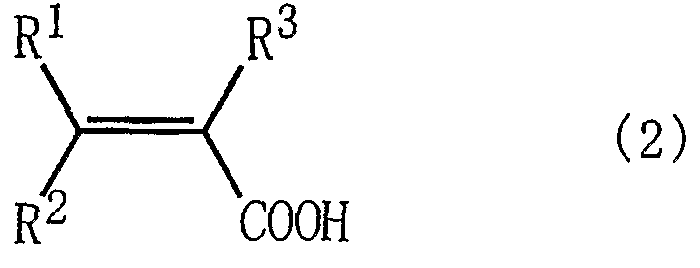
- the amount of the unsaturated carboxylic acid represented by the formula (2) or its reactive derivative is usually about 0.9 to 1.3 mol per 1 mol of the hydroxy compound represented by the formula (3). It is.
- the reaction may be performed in a suitable solvent (for example, toluene and the like).
- the reaction temperature varies depending on the starting materials used, but can generally be appropriately selected from the range of about 10 ° C. to 150 ° C.
- the reaction product can be separated and purified by a separation means such as filtration, concentration, distillation, extraction, crystallization, recrystallization, and column chromatography.
- R 4 represents a hydrogen atom, an alkyl group or a phenyl group.
- R 1 R 2 and R 3 are the same as described above.
- examples of the alkyl group for R 4 include about 1 to about 10 carbon atoms such as methyl, ethyl, propyl, butyl, isobutyl, s-butyl, t-butynole, and hexyl. Alkyl group.
- R 4 an alkyl group having 1 to 3 carbon atoms such as a methyl group and a phenyl group are particularly preferable.
- the iridium compound catalyst is not particularly limited, but is preferably an iridium complex.
- Organic iridium complexes having as ligands unsaturated hydrocarbons such as pentadiene, benzene and tonolene; ditolyls such as acetonitrile; ethers such as tetrahydrofuran are preferably used.
- organic iridium complexes include g- ⁇ -chlorotetrakis (cyclooctene) diiridium (I), di-1 ⁇ -chlorotetrakis (ethylene) diiridium (I), di-1 ⁇ — Bis (1,5-cyclotactogen) diiridium (I), bis (1,5-cyclotactogen) iridium trafluoroborate, (1,5-cyclotactogen) (ase (Tonitril) iridium tetrafluoroborate.
- the amount of the catalyst used for the compound is, for example, 0.001 to: I mole, preferably 0.01 to 0.3 mole, per mole of the hydroxy compound represented by the formula (3). It is about.
- the reaction is performed in the presence or absence of a solvent.
- a solvent include aliphatic hydrocarbons such as hexane, alicyclic hydrocarbons such as cyclohexane, aromatic hydrocarbons such as toluene, and halogenated hydrocarbons such as dichloromethane.
- Chain or cyclic ether such as tetrahydrofuran, ester such as ethyl acetate, ketone such as acetone, amide such as ⁇ , ⁇ -dimethylformamide, etc.
- the amount of the vinyl ester compound to be used is, for example, about 0.9 to 1.3 mol per 1 mol of the hydroxy compound represented by the formula (3).
- Bases include inorganic bases and organic bases.
- the inorganic base include alkali metal hydroxides such as sodium hydroxide, alkaline earth metal hydroxides such as magnesium hydroxide, alkaline metal carbonates such as sodium carbonate, and magnesium carbonate. And alkaline metal bicarbonate such as sodium bicarbonate.
- the organic base include alkali metal organic acid salts such as sodium acetate, alkali metal alkoxides such as sodium methoxide, tertiary amines such as triethylamine, and nitrogen-containing aromatic heterocyclic compounds such as pyridine. And the like.
- the amount of the base to be used is, for example, about 0.001 to 3 mol, preferably about 0.005 to 2 mol, per 1 mol of the hydroxy compound represented by the formula (3).
- the reaction may be performed in the presence of a polymerization inhibitor.
- the reaction temperature can be appropriately selected depending on the type of the reaction components and the like, and is, for example, about 50 to 150 ° C.
- the reaction product can be separated and purified by separation means such as filtration, concentration, distillation, extraction, crystallization, recrystallization, and column chromatography.
- the polymer compound of the present invention contains a repeating unit (monomer unit) corresponding to the polymerizable monomer of the present invention.
- the repeating unit may be one type or two or more types.
- Such a polymer compound can be obtained by subjecting the above polymerizable monomer to polymerization.
- repeating unit corresponding to the polymerizable monomer of the present invention has various functions required as a resist in a well-balanced manner, in addition to the above-mentioned repeating unit corresponding to the polymerizable monomer of the present invention, other repeating units May be provided. like this Other repeating units can be produced by copolymerizing the polymerizable unsaturated monomer corresponding to the repeating unit with the polymerizable monomer of the present invention.
- the other repeating unit for example, a repeating unit that enhances substrate adhesion and Z or hydrophilicity function, a repeating unit that has an acid desorption property, a repeating unit that has an etching resistance function, and enhances transparency Repeating units are listed.
- a monomer used to promote copolymerization smoothly or to make the copolymer composition uniform can be used as a comonomer.
- the repeating unit that enhances substrate adhesion or hydrophilicity can be introduced into a polymer by using a polymerizable unsaturated monomer having a polar group as a comonomer.
- the polar group include a hydroxyl group optionally having a protective group, a carboxyl group optionally having a protective group, an amino group optionally having a protective group, and a protective group. And a lactone ring-containing group.
- the protective group those commonly used in the field of organic synthesis (for example, the protective groups exemplified above) can be used.
- the polymerizable unsaturated monomer having a polar group a compound known in the field of resist can be used.
- the repeating unit having an acid-eliminating function includes, for example, (1) an oxygen atom constituting an ester Is a (meth) acrylic ester derivative in which a tertiary carbon-containing hydrocarbon group, 2-tetrahydrofuranyl group, 2-tetrahydroviranyl group, etc.
- the oxygen constituting the ester A hydrocarbon group (an alicyclic hydrocarbon group, an aliphatic hydrocarbon group, a group in which these groups are bonded, etc.) at the adjacent position of the atom, and the hydrocarbon group has one C ⁇ R group ( R represents a tertiary hydrocarbon group, a 2-tetrahydrofuranyl group or a 2-tetrahydrovinylyl group, etc.) directly or via a linking group;
- R represents a tertiary hydrocarbon group, a 2-tetrahydrofuranyl group or a 2-tetrahydrovinylyl group, etc.
- At least one carbon atom to which at least one hydrogen atom is bonded is present at the position adjacent to the tertiary carbon of the tertiary hydrocarbon group in R.
- a (meth) acrylic acid ester derivative a compound known in the field of resist can be used.
- Y 1 represents an alkylene group, an oxygen atom or a sulfur atom
- Y 2 , ⁇ 3 , ⁇ ⁇ 5 represent an alkylene group, an oxygen atom, a sulfur atom
- a, c, d, and e each represent an integer of 0 to 3, and b represents 1 or 2.
- the ring in the formula may have a substituent
- W 1 represents a divalent hydrocarbon group.
- R 5 , R 6 and R 7 are the same or different and each represent a hydrogen atom or an organic group. At least two of the rings Z 1 W ⁇ R 5 , R 6 and R 7 may be bonded to each other to form a ring together with one or more adjacent atoms.
- p represents 0 or 1
- q represents an integer of 1 to 8. When q is 2 or more, the groups in q parentheses may be the same or different.
- R 8 represents an alkyl group which may have a substituent
- R 9 and R 1 are the same or different and each represent a hydrogen atom or an organic group.
- At least two of R 8 , R 9 , and R 1 R 11 may be bonded to each other to form a ring together with one or more adjacent atoms.
- r represents an integer of 1 to 8. When r is 2 or more, the groups in the r parentheses may be the same or different.].
- the etching resistance of the polymer can be improved. Further, by using a vinyl ether-based monomer having a polar group in the molecule, it is possible to enhance the substrate adhesion and Z or hydrophilicity.
- These vinyl ether monomers can be used alone or in combination of two or more.
- the alkylene group in the ⁇ ⁇ ⁇ ⁇ ⁇ 5, For example, methylene, ethylene, pro pyrene, linear or branched number 1 about 3 carbon atoms, such as trimethylene group (preferably 1 or 2) And an alkylene group.
- substituents include, for example, fluorine atom, fluorophore Alkyl group (e.g., tri Furuoromechiru, 2, 2, 2-preparative Rifuruoroe Chinore, C.
- Furuoroarukiru group such as penta full O Roe butyl group, especially C I 5 Furuoroarukiru group
- an alkyl group e.g., methyl, Echiru, propyl Isopropyl, butyl, and other C. alkyl groups, especially C 5 alkyl groups.
- the number of substituents in each ring is about 0 to 5, preferably about 0 to 3.
- these may be bonded to each other to form a four- or more-membered ring, for example, a cycloalkane ring, a ratatone ring, or the like, together with the carbon atoms constituting the ring.
- W 1 represents a divalent hydrocarbon group.
- the divalent hydrocarbon group includes a divalent aliphatic hydrocarbon group, a divalent alicyclic hydrocarbon group, a divalent aromatic hydrocarbon group, and a hydrocarbon group in which two or more of these groups are bonded. These hydrocarbon groups have one or more monovalent hydrocarbon groups (aliphatic hydrocarbon groups, alicyclic hydrocarbon groups, aromatic hydrocarbon groups or hydrocarbon groups in which two or more of these groups are bonded). You may have.
- the divalent hydrocarbon group also includes a hydrocarbon group having a substituent.
- substituents examples include a halogen atom (eg, a fluorine atom), an oxo group, a hydroxyl group, a substituted oxy group (eg, an alkoxy group, an aryloxy group, an aralkyloxy group, an acyloxy group, etc.), a carboxyl group, a substituted Oxycarbonyl group (alkoxycarbonyl group, aryloxycarbonyl group, aralkyloxycarbonyl group, etc.), substituted or unsubstituted rubamoyl group, cyano group, nitro group, substituted or unsubstituted amino group, sulfo group And a heterocyclic group.
- a halogen atom eg, a fluorine atom
- an oxo group eg, an alkoxy group, an aryloxy group, an aralkyloxy group, an acyloxy group, etc.
- carboxyl group e.g
- hydroxyl xyl group or carboxyl group may be protected with a protecting group commonly used in the field of organic synthesis.
- an aromatic or non-aromatic heterocyclic ring may be condensed on the ring of the alicyclic hydrocarbon group or the aromatic hydrocarbon group.
- divalent hydrocarbon groups include, for example, methylene, methylmethylene, ethynolemethylene, dimethynolemethylene, ethynolemethynolemethylene, Alkylene groups such as ethylene, propylene, trimethylene and tetramethylene groups; alkenylene groups such as propenylene group; 1,3-cyclopentylene, 1,2-cyclohexylene, 1,3-cyclohexylene, 1, A cycloalkylene group such as 4-cyclohexylene group; a cycloalkylidene group such as cyclopropylene, cyclopentylidene and cyclohexylidene group; an arylene group such as phenylene group; a benzylidene group; and a hydrogen atom contained in these groups. And a group in which at least one of them is substituted by a fluorine atom.
- W 1 includes, for example, the following formula (7)
- R 12 and R 13 are the same or different and each represent a hydrogen atom or a hydrocarbon group. R 12 and R 13 are bonded to each other to form an alicyclic ring together with adjacent carbon atoms. May be)
- the group represented by is included.
- Examples of the hydrocarbon group in R 12 and R 13 include an aliphatic hydrocarbon group (an alkyl group having about 1 to 20 carbon atoms, an alkenyl group having about 2 to 20 carbon atoms, and an about 2 to 20 carbon atoms). Alkynyl group), alicyclic hydrocarbon group (3 to 20 membered cycloalkyl group, 3 to 20 membered cycloalkenyl group, bridged cyclic hydrocarbon group, etc.), aromatic hydrocarbon group ( An aromatic hydrocarbon group having about 6 to 14 carbon atoms), and a group in which two or more of these groups are bonded.
- the hydrocarbon group includes a hydrocarbon group having a substituent. Examples of the substituent include the same substituents that the divalent hydrocarbon group for W 1 may have.
- R 12 and R 13 include a hydrogen atom; methyl, ethyl, propyl, Ci such as isopropyl and butyl.
- Alkyl group (especially Ci- 5 alkyl group); which may have a substituent such as cyclopentyl group or cyclohexyl group; cycloalkynole group; nonolebornane-1-yl group, adamantane-11-yl group
- a bridged cyclic group which may have a substituent.
- substituent which the cycloalkyl group or the bridged cyclic group may have include the same substituents as those which the ring in the above formulas (6a) to (6h) may have. I can do it.
- examples of the organic group represented by R 5 , R 6 , and R 7 include a halogen atom, a hydrocarbon group, a heterocyclic group, a substituted oxycarbonyl group (an alkoxycarbonyl group, an aryloxy group).
- An aliphatic acyl group such as a benzoyl group, an alkoxy group (a C 6 alkoxy group such as a methoxy group or an ethoxy group), an N, N-disubstituted amino group (an N , N-dimethylamino group, piperidino group, etc.), and a group in which two or more of them are bonded.
- the carboxyl group is known or commonly used in the field of organic synthesis. May be protected by a protecting group.
- the Haguchi atom include fluorine, chlorine, bromine and iodine atoms.
- these organic groups a hydrocarbon group, a heterocyclic group and the like are preferable.
- the hydrocarbon group and the heterocyclic group include a hydrocarbon group and a heterocyclic group having a substituent.
- Examples of the hydrocarbon group include the same hydrocarbon groups as those described above for R 12 and R 13 .
- heterocyclic ring constituting the heterocyclic group in R 5 and the like include aromatic heterocyclic rings and non-aromatic heterocyclic ring.
- heterocyclic ring include, for example, a heterocyclic ring containing an oxygen atom, a zeolite atom or a nitrogen atom as a hetero atom.
- the heterocyclic group includes, in addition to the substituents that the hydrocarbon group may have, an alkyl group (for example, a Ci-4alkyl group such as a methyl or ethyl group), a cycloalkyl group, an aryl group ( For example, it may have a substituent such as a phenyl or naphthyl group.
- an alkyl group for example, a Ci-4alkyl group such as a methyl or ethyl group
- a cycloalkyl group for example, it may have a substituent such as a phenyl or naphthyl group.
- R 5 , R 6 , and R 7 include a hydrogen atom and a hydrocarbon group (for example, d
- the ring ZW ⁇ R 5, ring Two at least of forming together with one or more atoms adjacent bonded to each other among the RR 7, include carbocyclic or heterocyclic ring non-aromatic.
- vinyl ether compound represented by the formula (5a) include the following compounds.
- examples of the vinyl ether compound in which the ring Z 1 is a group represented by the formula (6a) include, for example, 2-buloxynorbornane, 5-methoxycarbonyl_2-buloxynorbornane, 2- [1- (norborna 1-2-vinyloleoxyethyl] norrebornane, 2- (vinyloxymethyl) norbornane, 2- (1-methyl-1-bieroxyethyl) norbornane, 2- (1-methyl-1-vinyloxypentyl) norbornane , 3—hydroxy 4—bieroxyte tracyclo [4 . 4.
- Examples of the vinyl ether compound in which the ring Z 1 is a group represented by the formula (6b) include, for example, vinylinoxycyclopentane, vinylinoxycyclohexane, cis-1,1,3-trimethyl-15-vinyloxycycline Mouth hexane, trans-1,1,1,3-trimethyl-1-5-vinyloxycyclohexane, 1-isopropyl-14-methyl_2-buloxycyclohexane, 3-vinyloxytricyclo [6. 2. 1. 0 2 ' 7 ] pendane, 4-vinyloxytricyclo [6.2. 1.
- Examples of the vinyl ether compound in which ring Z 1 is a group represented by the formula (6c) include, for example, 1-vinyloxydamantane, 2-vinyloxyadamantane, 2-methinolay 2-vinylinoxy Adamantane, 2-ethylethyl 2-bininoleoxy adamantane, 1-hydroxyl 3-bininoleoxy adamantane, 1,3-dihydroxy-5-bieroxy adamantane, 1, 3, 5 — Trihydroxy 7-vinyloxy-adamantane, 1,3-Dimethyl-1-5-vinyloxy-adamantane, 1-Hydroxy-1 3,5, -dimethylinole 7-vininoleoxy-adamantane -1, 1-strength norreoxy 1- 3-vinylinolex-adamantane, 1-amino-3-buloxy-damantane, 1-nitro-13-bin-nor-e-oxy-damantane, 1-snor
- Ring Z 1 is a Bulle ether compound is a group represented by the formula (6d), for example, 8-Byuruokishi one 4 Okisato Rishikuro [5.2.1 ⁇ 0 2 '6] decane one 3, 5-dione , 4 one Biniruokishi _ 1 1 one Okisapenta cyclo [6. 5. 1. I 3 '6 . 0 2' 7. 0 9 '13] pentadecane one 1 0, 1 2-dione, Isopurobe corresponding to ⁇ pico these -Ruethers and the like.
- ring Z 1 is a group represented by the formula (6e)
- Examples of the vinyl ether compound in which ring 1 is a group represented by the formula (6f) include, for example, 4-butyloxy-1,2,7-dioxabicyclo [3.3.0] octane-3,6-dione, Corresponding isopropenyl ethers and the like can be mentioned.
- Ring Z 1 is a vinyl ether compound is a group represented by the formula (6 g), for example, 5- Byuruokishi one 3- Okisatorishikuro [4.2.4 1.0 4 '8] nonan one-2-one, 5- methyl-5- Bieruokishi one 3- Okisa Application Benefits cyclo [4.2.4 1.0 4 '8] nonan one-2-one, 9 one methyl one 5- Biniruokishi one 3- Okisato Li cyclo [4.2.1 1.0 4 '8] nonan one-2-one, and we like Isopuro Bae vinyl ether compounds corresponding to these; Ru.
- Ring Zeta 1 is a Bulle ether compound is a group represented by the formula (6h), for example, 6- Biniruokishi one 3- Okisatorishikuro [4. 3.1.1 4 '8] Undekan one-2-one, 6 —Hydroxy 8—Buroxy 1 3—Oxatricyclo [4.3.1.1. I 4 ' 8 ] Pindecan 1 2—one, 8—Hydroxy 1 6—vinyloxy 1 3—oxatricyclo [4.3.1.1. I 4 ' 8 ] Indecane-2-one and the corresponding isopropylamine Ethers and the like.
- 6h 6- Biniruokishi one 3- Okisatorishikuro [4. 3.1.1 4 '8] Undekan one-2-one, 6 —Hydroxy 8—Buroxy 1 3—Oxatricyclo [4.3.1.1. I 4 ' 8 ] Pindecan 1 2—one, 8—Hydroxy 1 6—vinyloxy
- examples of the alkyl group for R 8 include methyl, ethyl, propyl, isopropinole, petitinole, isobutynole, s-butynole, t-butynole, pentyl, neopentynole, hexyl, octynole, and decyl groups.
- a linear or branched alkyl group having about 1 to 20 carbon atoms (preferably, 1 to 10 carbon atoms) is exemplified.
- Examples of the substituent which the alkyl group may have include, for example, a halogen atom (a fluorine atom, a chlorine atom, a bromine atom, etc.), an oxo group, a hydroxyl group, a substituted oxy group (for example, an alkoxy group, Aryloxy group, aralkyloxy group, acyloxy group, etc.), carboxyl group, substituted oxycarbonyl group (alkoxycarbonyl group, aryloxycarbonyl group, aralkyloxycarbonyl group, etc.), substituted or unsubstituted rubamoyl group, cyano It may have a group, a nitro group, a substituted or unsubstituted amino group, a sulfo group, an aromatic hydrocarbon group, a heterocyclic group and the like.
- the above-mentioned hydroxyl group and carboxyl group may be protected with a protecting group commonly used in the field of organic synthesis.
- the organic group for R 11 include the same organic groups as for R 5 , R 6 and R 7 .
- Desirable R 9 , R 1 Q and R 11 include a hydrogen atom and a hydrocarbon group (for example, Ci-i. Alkyl group, C 2-. Alkenyl group, C 2 -i. Alkynyl group, C 3-). i 5 cycloalkyl group, C 6 -. i aromatic hydrocarbon group, C 3 - 2 a cycloalkyl - C Bok 4 alkyl groups, C 7 - 14, etc. Ararukiru group).
- R 9 and R ⁇ R 11 a hydrogen atom, a C ⁇ 3 alkyl group such as a methyl group is particularly preferable.
- a ring in which at least two of R 8 , R 9 and R′R 11 can be bonded to each other to form one or more adjacent atoms includes a non-aromatic carbon ring or a heterocyclic ring. It is.
- Representative examples of the vinyl ether compound represented by the formula (5b) include, for example, methyl vinylinoleatene, ethinolebininoleatenole, and propinolevinyle.
- ring Z 1 is the formula of the represented reduction Gobutsu in (5a) (6d), (6e), (6f), (6 g) or (6h)
- ring Z 1 is a ring represented by the formula (6a), (6b) or (6c);
- a compound represented by the formula (5b) Among them, a compound in which R 8 , R 9 , R 1Q or RH is a group containing a polar group forms a repeating unit having a substrate adhesion property and a hydrophilic function by subjecting it to copolymerization as a comonomer.
- the bier ether type monomer can be produced by a known method or by utilizing a known reaction. Further, it can be produced according to the method described as a method for producing a compound in which n is 0 among the compounds represented by the above formula (1).
- the ring Z 2 is any one of the above formulas (6a), (6b), (6c), (6d), (6e), (6f), (6g) or (6h)
- W 2 represents a divalent hydrocarbon group.
- the ring in the formula may have a substituent.
- R 14 , R 15 and R 16 each represent a hydrogen atom, a fluorine atom, an alkyl group or a fluoroalkyl group.
- s represents 0 or 1
- t represents an integer of 1 to 8.
- t groups in parentheses may be the same or different It may be.
- R 17 represents an alkyl group which may have a substituent.
- R 14 , R 15 and R 16 are the same as above.
- u represents an integer of 1 to 8. When u is 2 or more, the groups in u parentheses may be the same or different.
- the transparency to light having a wavelength of 300 nm or less, particularly vacuum ultraviolet light, is reduced.
- the etching resistance of the polymer can be improved, and the acrylate monomer having a polar group in the molecule can be obtained.
- the adhesion to the substrate and / or the hydrophilicity can be increased.
- an acrylate ester monomer in which a tertiary carbon atom is bonded to an oxygen atom forming an ester bond, or a hydrocarbon group (an alicyclic compound) is located adjacent to the oxygen atom forming an ester bond.
- These acrylic monomers can be used alone or in combination of two or more.
- W 2 As the divalent hydrocarbon group for W 2, the same as the divalent hydrocarbon group for W 1 can be mentioned.
- Preferred examples of W 2 include, for example, the following formula (9)
- R 19 (In the formula, R 18 and R 19 are the same or different and each represent a hydrogen atom or a hydrocarbon group. R 18 and R 19 are bonded to each other to form an alicyclic ring together with adjacent carbon atoms. May be)
- the group represented by is included.
- hydrocarbon group for R 18 and R 19 an aliphatic hydrocarbon group (carbon number)
- the hydrocarbon group includes a hydrocarbon group having a substituent. Examples of the substituent include the same substituents that the divalent hydrocarbon group for W 1 may have.
- R 18 and R 19 include a hydrogen atom; methyl, ethyl, propyl, isopropynole, butylinole, isobutynole, s-butynole, t-butynole, pentinole, isopentinole, hexinole, heptinole, otatinole, noninole, deninole
- Alkyl group may have a substituent such as a pentyl group or a hexyl group in the mouth; and an alkyl group in the mouth; having a substituent such as a norbornolenan-1-yl group or an adamantane-1-yl group.
- a bridged cyclic group which may be included.
- the substituent which the cycloalkyl group or the bridged cyclic group may have, the same substituents as those which the ring in the above formulas (6a) to (6h) may have I can't.
- R 14 , R 15 , and R 16 are the same as the alkyl group and fluoroalkyl group for R 1 RR 3 , respectively.
- R 14 is preferably a C 1-3 alkyl group such as a hydrogen atom, a fluorine atom or a methyl group, or a C 1-3 fluoroalkyl group such as a trifluoromethyl group.
- R 15 and R 16 are each preferably a hydrogen atom, an alkyl group having 1 to 3 carbon atoms such as a methyl group, a fluoroalkyl group having 1 to 3 carbon atoms such as a trifluoromethyl group, and particularly preferably a hydrogen atom.
- R 17 may have a substituent
- There alkyl group is the same as the alkyl group which may have a substituent in the R 8.
- R 2 ° is a hydrogen atom, a fluorine atom, an alkyl group or Furuoroarukiru a group) compound represented by the Is preferred.
- Examples of the alkyl group and fluoroalkyl group at R 2 ° include the same groups as the alkyl group and fluoroalkyl group at R 1 R ⁇ R 3 , respectively.
- Representative compounds in which ring Z 2 is a ring represented by formula (6a) include, for example, 2- [1- (2-trifluoromethyl-2-propinoyloxy) -1-methylethyl] norbornane, 2— [11- (2-Trifluoromethyl_2-propinoyloxy) 1-1,2-dimethylpropyl] norbornane, 2-—11- (2-Trifluoromethyl-2-propinoinoleoxy) 1-1— Methylpentyl] norbornane, 2,3-bis (trifluoromethyl) -1-5- [1- (2_trifluoromethyl-1-2-propinoyloxy) -1-methylpentyl] norbornane, 1,2,3,3,3, 4, 5, 5, 6, 6, 7, 7 — ⁇ 1-methinolepentinole] norbornane, 2- [3,3,3-trifluoro-1- (2-trimethanole 2-methinoole
- dodecane 2- [1 - (2-trifluoromethinole 2-propinoinoleoxy) -11-methylpentinole] -7-oxabicyclo [2.2.1] Heptane and other compounds in which R 14 is a trifluormethyl group, and R 14 is Examples thereof include compounds corresponding to the above compounds which are a fluorine atom, a hydrogen atom or a methyl group.
- Representative compounds in which the ring Z 2 is a ring represented by the formula (6b) include, for example, 1- [1— (2-trifluoromethyl-12-propinoyloxy) -1-methylethyl] cyclo Hexane, 1- [2,2,2—Trifluoro 1_ (2_trifluoromethyl-2- 2-propinoinoleoxy) 1-1-Methynoletinol] Hexane, 1- [3,3,4,4 , 5,5,6,6,6,7,7,8,8,9,9,10,10,10—Heptadecafolo-1-(2— Trifnoreolomethinolay 2-Pro ⁇ Noinoleoxy) 1 1-me Chinoredecinole] cyclohexane, 3 — [1 — (2 — trifluoronorelomethinolei 2 -propinoyloxy) 1 -methylethyl]-tricyclo [6.2
- Representative compounds in which ring 2 is a ring represented by the formula (6c) include, for example, 1- [1— (2-trifluoromethyl-2_propinoyloxy) _1-methylethyl] adamantane , 1 — [2,2,2—Trifluoro — 1 — (2 — Trifluoromethyl-1 2 —Prodinoyloxy) _ 1 —Metylechinole] adamantane, 1 Fluoro 3 — [1 1 (2—Trifrenole) 1,2-Difluoro-5- [1— (2-trifluoromethylinole 2-propinoyloxy) _1-methylethyl] adamantane, 1,3,5 — Trifluoro-7— [1— (2-Trifluoromethinole 1—2-Provenyloxy) -1-methylethyl] adamantane, 2,2,3,4,4,5,6,6,7,8,8,8 9, 9, 10, 0, 10 Pentadeca
- ring Z 2 is a ring represented by formula (6a)
- Representative compounds in which ring Z 2 is a ring represented by formula (6a) include, for example, 2 _ (2,2,2-trifluoroethyl) _ 2— (2-trifluoromethyl _ 2 _Propnoyloxy) Norbornane, 2-Nonafluorobutinolei 5— (2-Trifluoromethyl-2-propinoyloxy) _ 5—Methinolenolenorebornan, 2, 3, 3, 4, 4, 5, 5, 5, 6-octafluoro-8-(2-trifluoromethinolate 2-propinoinolexy) — 8-methyltricyclo [5.2.1.0 2 'decane, 2- (2-triphenyloleromethyl _ 2-propenyl Noiruokishi) Norubonorenan, 3-arsenide de port Kishi 4 _ (2-triflate Ruo b methyl one 2 _ propenyl Noiru
- I 7' 10 dodecane , 3—Hydroxy — 8— (2 _ Trifrenoleolomethinole 2 — Prodino Noreokishi) Te Torashi Black [4. 4. 0. I 2 '. 5
- I 7' 10 dodecane, 3-arsenide Dorokishimechiru - 8 - (2-Torifunoreo port Mechinore 2- propenyl Noiruokishi) Te Torashi black [4.4 0. I 2 ' 5.
- I 7 ' 10 dodecane, 3-hydroxymethyl-9-(2-trinoleolomethinoley 2-propinoinoleoxy) tetracyclo [4. 4. 0. I 2 ' 5.
- Representative compounds in which ring Z 2 is a ring represented by the formula (6b) include, for example, 1 _ (2-trifluoromethyl-2-propinoyloxy) cyclopentane, 1- (2-trifluoromethyl 1 2—Propyloxy) Cyclic hexane, cis 1 5— (2—Trifluoromethyl-2 _propionyloxy) 1 1, 1,3,3-Trimethylcyclohexane, trans 5 1 (2—Tri) Fluoromethyl-2-propynyloxy)-1,1,3,1-trimethylcyclohexane, 2- (2-trifluoromethyl-2-propynyloxy) _-1-isopropyl-14-methylcyclohexane, 3- (2-Application Benefits Furuoromechiru 2- propenyl Noiruokishi) tricyclo [6.2.2 1.0 2 '7] Undekan, 4 one (2-tri Furuoromechiru 2 one propenyl Noiruokishi) Application Benefits
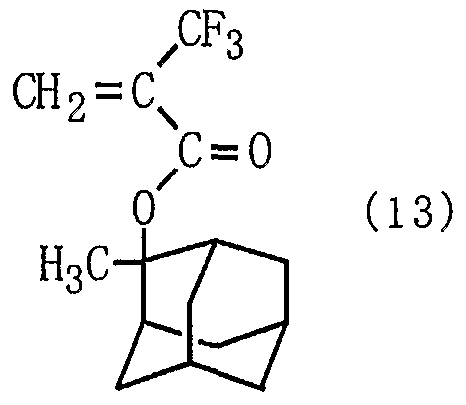
- Representative compounds in which the ring Z 2 is a ring represented by the formula (6c) include, for example, 2- (2,2,2-trifluoroethyl) 1-2- (2-trifluoromethylinole 2-pro (Noinoleoxy) adamantane, 1-Fnoroleol 4- 1- (2-trifluoromethyl-1_2_propinoyloxy) 1-41-Methyladamantane, 1,3-difluoro-6- (2-trifnoroleolomethyl-1-2-propinoyloxy) 1 6-Methyladamantane, 1- (2-trifluoromethyl-1-2-propanolyloxy) adamantan, 2- (2-Trifluoromethyl-1-2-propanolyloxy) adamantane, 2- (2-trifluoromethyl-2 _ 1-Methyladamantane, 2-Ethyl-1-2- (2-Triphenylenomethylone-2-propionyl) 1- (2-Trifluoro
- Representative compounds in which ring Z 2 is a ring represented by the formula (6d) include, for example, 8- (2-trifluoromethyl-2_propinoyloxy) -14-oxatricyclo [5 2. 1. 0 2 ' 6 ] decane 3, 5-dione, 4- (2-trifluoromethyl-2-propinoyloxy) -11-oxosapentacyclo [6.5. 1. I 3 ' 6 . 0 2, 7. 0 9 '13] pentadecane one 1 0, 1 2-dione is R 14 Gat Rifuruoromechiru group, such as a compound, and corresponds to the compound R 14 is a fluorine atom, a hydrogen atom or a methyl group And the like. 4008399
- ring Z 2 is a ring represented by the formula (6e), for example, ⁇ — (2-trifinoleo-methinole 2-one-propinoinoleoxy) - ⁇ -butyrolactone, ⁇ — (2- Fluoromethyl-2-propinoinoleoxy) 1 ⁇ 1 petit mouth ratatone, y ⁇ (2 ⁇ Trinorolemethinolate 2 2 propinoinoleoxy) 1 ⁇ -butyrolactone, ⁇ - (2-trifluoro Romechiru 2 _ propenyl Noinoreokishi) one gamma, gamma - Jimechinore .gamma.
- butyrolactone tons a - (2-tri unloading Leo Lome Chino rate 2- propenyl Noinoreokishi) one, y, y - trimethyl _ .gamma. butyrolactone tons, 8 - (2-tri Furuoromechiru one 2 one propenyl Noiruokishi) Single 4 Okisa preparative Rishikuro [5 2 1 0 2 '6...] decane one 3 - one, 9 i (2 Application Benefits Furuoromechiru 2- Puropenoi Ruo Xy) _ 4-oxatricyclo [5.2.1.0 2 ' 6 ] a compound in which R 14 is a trifluoromethyl group such as decane-3-one, and R 14 is a fluorine atom, a hydrogen atom or a methyl group And the like.
- Examples of the compound in which ring 2 is a ring represented by the formula (6f) include, for example, 4- (2-trifinoleomethyl-2-propinoyloxy) -12,7-dioxabicyclo [3.3.0] Examples thereof include compounds in which R 14 is a trifluoromethyl group, such as 1,3-dione, and compounds corresponding to the above compounds in which R 14 is a fluorine atom, a hydrogen atom, or a methyl group.
- Ring Z 2 is a compound which is a ring represented by the formula (6 g), for example, 5 - (2-DOO Rifuruoromechiru - 2-propenyl Noiruokishi) Single 3 -...
- R 14 such as nonane one-2-one is collected by Li full And a compound corresponding to the above compound wherein R 14 is a fluorine atom, a hydrogen atom or a methyl
- Representative examples of the compound represented by the formula (8b) include, for example, 2-trifluoromethyl_2-propenoic acid methinolate, 2-trifluoromethylinole 2- 2-ethinoethyl propenolate, and 2 _trifnorolelomethino 2-propinolate propenolate, 2-trifluoromethyl-2-isopropyl propenoate, 2-trifluoromethyl-2-propane s-butyl, 2-trifoleolomethinolate 2-proptylate t- butyl, 2-Trifluoromethinole 2-hexyl monopropenoate, 2-Trifluoromethyl-2-propenoic acid (2-hydroxyxethyl), 2-Trifluoromethyl 1-2-Trifluoromethinolate, 2-trifluoro 2-methyl-2-propenoic acid (2,2,2-trifluoroethyl), 2-trifluoromethyl-2-propenoic acid (2,2,3,3,3-penta
- the ring Z 2 is represented by the formula (6d), (6e), (6f), (6g) or (6h).
- the ring Z 2 is (6a Or a compound represented by the formula (6b) or (6c), wherein the polar group or a group containing a polar group is bonded to the ring Z 2 , or W 2 is a group containing a polar group
- the compound in which R 17 is a group containing a polar group is subjected to copolymerization as a comonomer to form a repeating unit having a substrate adhesion and / or hydrophilic function.
- the compound represented by the formula (8a) has a tertiary carbon atom at an oxygen atom-O- constituting an ester bond represented by the formula: compound [e.g., formula (8a- 1), or (8a-2) Table is a compound of etc.], (2) among the compounds represented by formula (8a), the ring Z 2 to a C OOR group (R is A tertiary hydrocarbon group, 2-tetrahydrofuranyl group or 2-tetrahydrovinylyl group) directly or via a linking group; (3) a compound represented by the formula (8b) Of the compounds represented by the formula (8b), wherein R 17 is a tertiary hydrocarbon group, and R 17 is a CO OR group (R is a tertiary hydrocarbon group). , 2-tetrahydrofuranyl group or 2-tetrahydropyrael group, etc.) are bonded directly or via a linking group.
- the acryl-based monomer can be produced by a known method or by utilizing a known reaction. For example, a conventional method using an unsaturated carboxylic acid containing or not containing a fluorine atom or a reactive derivative thereof (acid halide, acid anhydride, ester, etc.) and a hydroxy compound using a base, an acid catalyst, a transesterification catalyst, etc.
- the corresponding acryl-based monomer can be obtained by reacting according to the esterification method.
- Y 6 and Y 7 each represent an alkylene group, an oxygen atom, a sulfur atom, or no bond.
- Y 8 represents an oxygen atom or a mono-NH— group.
- f represents an integer of 0 to 3. The atoms constituting the ring in the formula may have a substituent.
- the compound of the formula (10a) can improve the etching resistance of the polymer, and the compound of the formula (10b) can improve the substrate adhesion. it can.
- the compound of the formula (10b) can improve the substrate adhesion. it can.
- the compound of the formula (10a) when a ring has a fluorine atom or a fluorine atom-containing group, transparency to light having a wavelength of 300 nm or less, particularly vacuum ultraviolet light, can be enhanced, and When the polar group or a group containing a polar group is bonded, the substrate adhesion and Z or hydrophilicity can be improved.
- the acid elimination function can be improved.
- the alkylene group is the same as the alkylene group for Y 1 and the like.
- substituents that the ring may have include the same substituents as the ring Z 1 [the ring represented by the formulas (6a) to (6h)] may have.
- the ring may be bonded to each other to form a four- or more-membered ring, such as a cycloalkane ring or a lactone ring, together with the carbon atoms constituting the ring.
- These rings include a substituent such as a fluorine atom (the above-mentioned ring Z (Substituents similar to the substituents that the atom constituting 1 may have).
- cyclic unsaturated monomer represented by the formula (10b) include, for example, maleic anhydride, 2-fluoromaleic anhydride, 2-trifluoromethyl maleic anhydride, maleimide, N-carboxymaleimi And N-methylmaleamide.
- cyclic unsaturated monomer (1) a compound in which the polar group or a group containing a polar group is bonded to a ring among the compounds represented by the formula (10a); and (2) a compound represented by the formula (10b)
- the compound represented by) forms a repeating unit having a substrate adhesion property and / or a hydrophilic function by being subjected to copolymerization as a comonomer.
- the cyclic unsaturated monomer can be produced by a known method or by utilizing a known reaction.
- the proportion of the repeating unit corresponding to the polymerizable monomer represented by the formula (1) is not particularly limited, but is generally from 1 to 1 based on all the monomer units constituting the polymer. 9 9 mol%, preferably 3 to 9 5 mole 0/0, more preferably 5-8 0 mole 0/0, especially for 5-7 about 0 molar% is preferred.
- the proportion of the repeating unit having an acid-eliminating function is, for example, about 5 to 80 mol%, preferably about 10 to 60 mol%, based on all monomer units constituting the polymer.
- a repeating unit corresponding to the vinyl ether monomer represented by the formula (5a) or (5b), or a acrylate monomer corresponding to the formula (8a) or (8b) can be appropriately selected according to the function of each monomer unit.
- the total proportion of these repeating units, based on all monomer units constituting the polymer from 1 to 9 9 mole 0/0, preferably 5-9 7 mole 0/0, rather more preferably 2 0-9 5 mole 0/0, and particularly preferably 3 0-9 about 5 mol%.
- polymerization includes solution polymerization, bulk polymerization, suspension polymerization, bulk-suspension polymerization, emulsion polymerization, and the like. It can be carried out by a conventional method used for producing an acrylic polymer or the like, but solution polymerization is particularly preferred. At the time of solution polymerization, a drop polymerization method may be used to obtain a homogeneous polymer.
- polymerization solvent known solvents can be used, and examples thereof include ethers (chain ethers such as glycol ethers such as methyl ether, propylene glycol monomethyl ether), and cyclic ethers such as tetrahydrofuran and dioxane.
- chain ethers such as glycol ethers such as methyl ether, propylene glycol monomethyl ether
- cyclic ethers such as tetrahydrofuran and dioxane.
- Esters (methyl acetate, ethyl acetate, butyl acetate, ethyl lactate, glycol ether esters such as propylene glycol monomethyl ether acetate), ketones (acetone, methyl ethyl ketone, methyl isobutyl ketone, cyclohexane) Xanone), amides (N, N-dimethylacetamide, N, N-dimethylformamide, etc.), sulfoxides (dimethylsulfoxide, etc.), alcohols (methanol, ethanol, propanol, etc.), hydrocarbons (benzene, Rue And aromatic hydrocarbons such as xylene, xylene, etc., aliphatic hydrocarbons such as hexane, alicyclic hydrocarbons such as cyclohexane, etc.), and mixed solvents thereof.
- a known polymerization initiator can be used as the polymerization initiator.
- the polymer obtained by polymerization can be purified by precipitation or reprecipitation.
- the precipitation or reprecipitation solvent may be either an organic solvent or water, or may be a mixed solvent.
- the organic solvent used as the precipitation or reprecipitation solvent include hydrocarbons (aliphatic hydrocarbons such as pentane, hexane, heptane, and octane; alicyclic hydrocarbons such as cyclohexane and methylcyclohexane); Aromatic hydrocarbons such as benzene, toluene, xylene, etc., halogenated hydrocarbons (methylene chloride, chlorinated form, carbon tetrachloride, etc., chlorinated aliphatic hydrocarbons), benzene, benzene, etc.
- the weight average molecular weight (M w) of the polymer compound is, for example, about 100 to 500,000, preferably about 300 to 500,000, and the molecular weight distribution (M w / M n) is, for example, about 1.5 to 2.5.
- Mn represents a number average molecular weight
- both Mn and Mw are values in terms of polystyrene.
- the resin composition for photoresist of the present invention contains at least the above-mentioned polymer compound of the present invention and a photoacid generator.
- a polymer other than the polymer compound may be contained as long as the resist performance is not impaired.
- the photoacid generator include commonly used or known compounds that efficiently generate an acid upon exposure to light, such as diazonium salts, eodonium salts (for example, diphenyl-hexahexenoleophosphate), and snorehonium salts (for example, Triphenylenolesnorrexane hexafluoroantimonate, triphenylenolesnorrexane hexafluoronore phosphate, triphenylenoresnorelenium methanesulfonate, etc.), sulfonic acid ester [For example, 1-phenyl- 1- (4-methynolephen-2-ole) sulfoninoleoxy _ 1-
- the amount of the photoacid generator to be used can be appropriately selected according to the strength of the acid generated by light irradiation ⁇ the ratio of each repeating unit in the polymer.
- 0.1 to 100 parts by weight of the polymer compound To 30 parts by weight, preferably 1 to 25 parts by weight, more preferably about 2 to 20 parts by weight.
- the resin composition for a photo resist may be an alkali-soluble resin (for example, a novolak resin, a phenol resin, an imido resin, or a carboxy resin).
- Alcohol-soluble components such as phenolic resins, coloring agents (eg, dyes), organic solvents (eg, hydrocarbons, halogenated hydrocarbons, alcohols, esters, amides) , Ketones, ethers, cellosolves, carbitols, glycol ether esters, mixed solvents thereof, etc.), basic compounds (hindered amine compounds, etc.), surfactants, dissolution inhibitors, sensitizers And stabilizers.
- coloring agents eg, dyes
- organic solvents eg, hydrocarbons, halogenated hydrocarbons, alcohols, esters, amides
- Ketones eg, ethers, cellosolves, carbitols, glycol ether esters, mixed solvents thereof, etc.
- basic compounds hinderes, etc.
- surfactants e.g., dissolution inhibitors, sensitizers And stabilizers.
- the resin composition for photoresist obtained in this way is coated on a substrate or a substrate, dried, and then exposed to a light beam on a coating film (resist film) through a predetermined mask (or Further, baking is performed after exposure) By forming a latent image pattern and then developing, a fine pattern can be formed with high accuracy.
- the base material or the substrate examples include a silicon wafer, metal, plastic, glass, and ceramic.
- the application of the resin composition for photoresist can be carried out using a conventional application means such as a spin coater, a dip coater or a roller coater.
- the thickness of the coating film is, for example, 0.01 to 20 ⁇ m, preferably 0.05 to :! It is about ⁇ .
- wavelengths of light such as ultraviolet rays and X-rays
- Various wavelengths of light can be used for exposure.
- semiconductor resists g- rays, i-rays, excimer lasers (eg, XeCl, KrF, K r C l, A r F , A r C l, F 2, K r 2, K r A r, A r 2 , etc.) and the like are used.
- the exposure energy is, for example, 0.
- an acid is generated from the photoacid generator, and this acid causes the elimination site of the acid-labile group of the polymer compound, for example, to be rapidly eliminated, thereby generating a carboxyl group or the like that contributes to solubilization. I do. Therefore, a predetermined pattern can be accurately formed by development with water or an alkaline developer.
- the number at the lower right of the parenthesis in the structural formula of the polymer indicates the charged mole% of the monomer corresponding to the repeating unit (monomer unit).
- Weight average molecular weight (Mw) and molecular weight distribution (Mw / Mn) were determined by standard polystyrene conversion by GPC using a refractometer (RI) as a detector and tetrahydrofuran (THF) as an eluent. .
- GPC uses three columns of KF-806 L (trade name) manufactured by Showa Denko KK connected in series. Column temperature is 40 ° C, 11 temperature is 40 ° (, eluent Production example 1 performed at a flow rate of 0.8 m 1 / min
- 1,3,5-Adamantanetriol 12 9 g (0.7 monole) in three roflacos with Dean Stark instrument and thermometer
- the ethyl acetate layer was concentrated until the liquid volume reached 1.2 L, and 250 g of a 10% by weight aqueous solution of sodium hydrogen carbonate was added. weight. /.
- the extract was washed successively with 250 g of a saline solution, dried over anhydrous magnesium sulfate, and concentrated until the liquid volume reached 500 g. While the concentrated solution was cooled with ice, 1 L of n-hexane was added dropwise over 30 minutes, and the mixture was stirred for 30 minutes.
- y ⁇ -dimethyl-hybininoleoxy- ⁇ -butyral ratone used as a monomer in the following examples was obtained by combining hydroxyhydroxy ⁇ ′′ ⁇ -dimethyl- ⁇ -butyrolactone and butyl acetate.
- 1,3-dihydroxy-5-buloxyadamantane can be prepared from 1,3,5-adamantantriol and vinyl acetate according to the method described in JP-A-2003-73321. The product was purified by subjecting it to alumina column chromatography.
- 11-hydroxy-3-vinyloxyadamantane was synthesized from 1,3-adamantanediol and butyl acetate according to the method described in JP-A-2003-73332. The product is subjected to alumina column chromatography And purified.
- the 1,4: 3,6 dianhydro-1-D-glucitol 2 _ (2-trifluoromethyl-2-pro) represented by the following formula (A) is obtained.
- Isosorbide manufactured by Tokyo Kasei Kogyo Co., Ltd.
- 88 g vinyl acetate 60 g, sodium carbonate 38.lg, toluene 700 ml, g ⁇ -chlorovis (1, 5-
- a mixture of 4.0 g of cyclooctadiene iridium (I) was stirred at 90 ° C. for 4 hours under an argon atmosphere.
- the precipitate in the reaction solution was separated by filtration, and the filtrate was concentrated under reduced pressure.
- the polymer obtained after drying under reduced pressure was 8.2 g.
- GPC analysis of this polymer showed a weight average molecular weight in terms of standard polystyrene of 780 and a molecular weight distribution of 2.13. I got it.
- 13 C-NMR (in CDC 13 ) analysis the composition of the polymer was 43:42:15 (molar ratio) (from left to right in the structural formula).
- the polymer obtained after drying under reduced pressure was 9.2 g.
- GPC analysis of this polymer revealed a weight average molecular weight in terms of standard polystyrene of 750, and a molecular weight distribution of 2.05. Further, as a result of 13 C_NMR (in CDC 13 ) analysis, the composition of the polymer was 38:22:40 (molar ratio) (in order from the left of the structural formula).
- the polymer obtained after drying under reduced pressure was 9.2 g.
- GPC analysis of this polymer revealed a weight average molecular weight in terms of standard polystyrene of 7,700 and a molecular weight distribution of 2.08. Further, 13 C-NMR (CD C 1 3) analysis of the results, the composition of polymer 3 7: 2 2: 4 1 (molar ratio) (in order of the left side of the formula).
- the polymer obtained after drying under reduced pressure was 8.2 g.
- GPC analysis of this polymer showed that the weight average molecular weight in terms of standard polystyrene was 970, and the molecular weight distribution was 2.18. Further, 13 C-NMR (CDC 1 3) analysis of the results, the composition of polymer 3 8: 2 0: 4 2 (molar ratio) (in order of the left side of the formula).
- the amount of the polymer obtained after drying under reduced pressure was 8.9 g.
- GPC analysis of this polymer showed that the weight-average molecular weight in terms of standard polystyrene was 1,200,000 and the molecular weight distribution was 2.05.
- the amount of the polymer obtained after drying under reduced pressure was 8.6 g.
- GPC analysis of this polymer revealed a weight average molecular weight in terms of standard polystyrene of 8200 and a molecular weight distribution of 2.19. Further, 13 C-NMR (CDC 1 3) of the analysis results, the composition of polymer 3 6: 4 3: 2 1 (molar ratio) (in order of the left side of the formula).
- the resin composition for photoresist containing a polymer compound containing a repeating unit corresponding to the polymerizable monomer of the present invention in the production of a semiconductor, a fine pattern can be accurately formed.
Landscapes
- Chemical & Material Sciences (AREA)
- Organic Chemistry (AREA)
- Physics & Mathematics (AREA)
- Spectroscopy & Molecular Physics (AREA)
- Health & Medical Sciences (AREA)
- Chemical Kinetics & Catalysis (AREA)
- Medicinal Chemistry (AREA)
- Polymers & Plastics (AREA)
- General Physics & Mathematics (AREA)
- Materials For Photolithography (AREA)
- Addition Polymer Or Copolymer, Post-Treatments, Or Chemical Modifications (AREA)
- Organic Low-Molecular-Weight Compounds And Preparation Thereof (AREA)
Description





Claims

Priority Applications (1)
| Application Number | Priority Date | Filing Date | Title |
|---|---|---|---|
| US10/516,176 US20060058480A1 (en) | 2003-06-19 | 2004-06-09 | Polymerizable monomer polymeric compound resin compositions for photoresist and method for producing semiconductor |
Applications Claiming Priority (2)
| Application Number | Priority Date | Filing Date | Title |
|---|---|---|---|
| JP2003-174691 | 2003-06-19 | ||
| JP2003174691A JP2005008757A (ja) | 2003-06-19 | 2003-06-19 | 重合性単量体、高分子化合物、フォトレジスト用樹脂組成物、及び半導体の製造方法 |
Publications (1)
| Publication Number | Publication Date |
|---|---|
| WO2004113404A1 true WO2004113404A1 (ja) | 2004-12-29 |
Family
ID=33534798
Family Applications (1)
| Application Number | Title | Priority Date | Filing Date |
|---|---|---|---|
| PCT/JP2004/008399 Ceased WO2004113404A1 (ja) | 2003-06-19 | 2004-06-09 | 重合性単量体、高分子化合物、フォトレジスト用樹脂組成物、及び半導体の製造方法 |
Country Status (4)
| Country | Link |
|---|---|
| US (1) | US20060058480A1 (ja) |
| JP (1) | JP2005008757A (ja) |
| KR (1) | KR20060018894A (ja) |
| WO (1) | WO2004113404A1 (ja) |
Cited By (1)
| Publication number | Priority date | Publication date | Assignee | Title |
|---|---|---|---|---|
| US9988393B2 (en) | 2015-02-09 | 2018-06-05 | Regents Of The University Of Minnesota | Isosorbide-based polymethacrylates |
Families Citing this family (10)
| Publication number | Priority date | Publication date | Assignee | Title |
|---|---|---|---|---|
| JP4717640B2 (ja) * | 2005-12-12 | 2011-07-06 | 東京応化工業株式会社 | 液浸露光用レジスト組成物およびレジストパターン形成方法 |
| JP4757766B2 (ja) * | 2006-10-13 | 2011-08-24 | 東京応化工業株式会社 | 液浸露光用ポジ型レジスト組成物およびレジストパターン形成方法 |
| KR100830599B1 (ko) * | 2007-01-05 | 2008-05-21 | 금호석유화학 주식회사 | 두개의 (메트)아크릴 결합을 가지는 가교제를 단량체로포함하는 포토레지스트용 공중합체 및 이를 포함하는화학증폭형 포토레지스트 조성물 |
| JP5116349B2 (ja) * | 2007-04-18 | 2013-01-09 | 株式会社ダイセル | ビニルエーテル化合物の製造方法 |
| JP5002323B2 (ja) * | 2007-04-27 | 2012-08-15 | 東京応化工業株式会社 | 含フッ素高分子化合物、液浸露光用ポジ型レジスト組成物、及びレジストパターン形成方法 |
| JP5270510B2 (ja) * | 2009-10-19 | 2013-08-21 | 第一工業製薬株式会社 | 環状(メタ)アクリレート化合物、その製造方法、及び樹脂組成物 |
| EP2388262A1 (en) * | 2010-05-20 | 2011-11-23 | Stichting Dutch Polymer Institute | New biobased chiral compounds |
| JP6148051B2 (ja) * | 2013-03-27 | 2017-06-14 | 日本カーバイド工業株式会社 | ポリビニルエーテルの製造方法 |
| WO2016063805A1 (ja) * | 2014-10-21 | 2016-04-28 | 日産化学工業株式会社 | レジスト下層膜形成組成物 |
| JP7236830B2 (ja) * | 2018-09-13 | 2023-03-10 | 株式会社ダイセル | 単量体、フォトレジスト用樹脂、フォトレジスト用樹脂組成物、及びパターン形成方法 |
Citations (6)
| Publication number | Priority date | Publication date | Assignee | Title |
|---|---|---|---|---|
| JPH0920781A (ja) * | 1995-06-09 | 1997-01-21 | Basf Ag | 重合可能なキラル化合物 |
| JP2000162772A (ja) * | 1998-11-27 | 2000-06-16 | Hyundai Electronics Ind Co Ltd | フォトレジスト架橋剤、フォトレジスト組成物、フォトレジストパタ―ン形成方法、及び半導体素子 |
| JP2001323125A (ja) * | 2000-05-19 | 2001-11-20 | Nitto Denko Corp | コレステリック性液晶組成物、配向フィルムおよび多色反射板 |
| JP2002229193A (ja) * | 2001-02-06 | 2002-08-14 | Fuji Photo Film Co Ltd | 電子線又はx線用ポジ型レジスト組成物 |
| JP2002338633A (ja) * | 2001-05-21 | 2002-11-27 | Shin Etsu Chem Co Ltd | 高分子化合物、レジスト材料、及びパターン形成方法 |
| WO2004041881A1 (ja) * | 2002-11-05 | 2004-05-21 | Daicel Chemical Industries, Ltd. | フォトレジスト用高分子化合物及びフォトレジスト用樹脂組成物 |
Family Cites Families (5)
| Publication number | Priority date | Publication date | Assignee | Title |
|---|---|---|---|---|
| TW555837B (en) * | 2001-07-02 | 2003-10-01 | Merck Patent Gmbh | Chiral compounds |
| JP4141120B2 (ja) * | 2001-08-16 | 2008-08-27 | 富士フイルム株式会社 | 平版印刷版用原版 |
| JP3999030B2 (ja) * | 2001-12-13 | 2007-10-31 | セントラル硝子株式会社 | 含フッ素重合性単量体およびそれを用いた高分子化合物、反射防止膜材料 |
| KR100475076B1 (ko) * | 2002-05-28 | 2005-03-10 | 삼성전자주식회사 | 불소 함유 감광성 폴리머 및 이를 포함하는 레지스트 조성물 |
| US7138479B2 (en) * | 2003-12-31 | 2006-11-21 | General Electric Company | Aliphatic diol polycarbonates and their preparation |
-
2003
- 2003-06-19 JP JP2003174691A patent/JP2005008757A/ja active Pending
-
2004
- 2004-06-09 KR KR1020057024220A patent/KR20060018894A/ko not_active Withdrawn
- 2004-06-09 US US10/516,176 patent/US20060058480A1/en not_active Abandoned
- 2004-06-09 WO PCT/JP2004/008399 patent/WO2004113404A1/ja not_active Ceased
Patent Citations (6)
| Publication number | Priority date | Publication date | Assignee | Title |
|---|---|---|---|---|
| JPH0920781A (ja) * | 1995-06-09 | 1997-01-21 | Basf Ag | 重合可能なキラル化合物 |
| JP2000162772A (ja) * | 1998-11-27 | 2000-06-16 | Hyundai Electronics Ind Co Ltd | フォトレジスト架橋剤、フォトレジスト組成物、フォトレジストパタ―ン形成方法、及び半導体素子 |
| JP2001323125A (ja) * | 2000-05-19 | 2001-11-20 | Nitto Denko Corp | コレステリック性液晶組成物、配向フィルムおよび多色反射板 |
| JP2002229193A (ja) * | 2001-02-06 | 2002-08-14 | Fuji Photo Film Co Ltd | 電子線又はx線用ポジ型レジスト組成物 |
| JP2002338633A (ja) * | 2001-05-21 | 2002-11-27 | Shin Etsu Chem Co Ltd | 高分子化合物、レジスト材料、及びパターン形成方法 |
| WO2004041881A1 (ja) * | 2002-11-05 | 2004-05-21 | Daicel Chemical Industries, Ltd. | フォトレジスト用高分子化合物及びフォトレジスト用樹脂組成物 |
Cited By (1)
| Publication number | Priority date | Publication date | Assignee | Title |
|---|---|---|---|---|
| US9988393B2 (en) | 2015-02-09 | 2018-06-05 | Regents Of The University Of Minnesota | Isosorbide-based polymethacrylates |
Also Published As
| Publication number | Publication date |
|---|---|
| JP2005008757A (ja) | 2005-01-13 |
| US20060058480A1 (en) | 2006-03-16 |
| KR20060018894A (ko) | 2006-03-02 |
Similar Documents
| Publication | Publication Date | Title |
|---|---|---|
| KR101604623B1 (ko) | 아크릴산에스테르 유도체 및 고분자 화합물 | |
| TW201100965A (en) | Positive resist composition and method of forming resist pattern | |
| JP2001240625A (ja) | フォトレジスト用高分子化合物及びフォトレジスト用樹脂組成物 | |
| WO2004113404A1 (ja) | 重合性単量体、高分子化合物、フォトレジスト用樹脂組成物、及び半導体の製造方法 | |
| WO2001057597A1 (en) | Polymeric compound for photoresist and resin composition for photoresist | |
| JP4301872B2 (ja) | ラクトン環含有重合性単量体、高分子化合物、フォトレジスト用樹脂組成物、及び半導体の製造方法 | |
| KR100711691B1 (ko) | α 위치 메틸기에 산소 치환기를 갖는 지환 함유메타크릴레이트 화합물 | |
| WO2004041881A1 (ja) | フォトレジスト用高分子化合物及びフォトレジスト用樹脂組成物 | |
| JP2003064131A (ja) | 化学増幅レジスト用単量体、化学増幅レジスト用重合体、化学増幅レジスト組成物、パターン形成方法 | |
| US9823563B2 (en) | Alcohol compound and method for producing same, method for producing lactone compound, (meth)acrylate ester and method for producing same, polymer and method for producing same, and resist composition and method for producing substrate using same | |
| JP4071021B2 (ja) | ラクトン構造を有する(メタ)アクリレート化合物、その重合体、レジスト材料及びパターン形成方法 | |
| WO2005075446A1 (ja) | 不飽和カルボン酸ヘミアセタールエステル、高分子化合物及びフォトレジスト用樹脂組成物 | |
| JP2003252928A (ja) | フッ素含有アセタールまたはケタール構造を有する単量体、重合体、ならびに化学増幅型レジスト組成物 | |
| JP4780945B2 (ja) | 不飽和カルボン酸ヘミアセタールエステル、高分子化合物及びフォトレジスト用樹脂組成物 | |
| JP5329211B2 (ja) | ラクトン骨格を含む高分子化合物及びフォトレジスト組成物 | |
| US20050282985A1 (en) | Fluorine-atom-containing polymerizable unsaturated-monomer, fluorine-atom-containing polymeric compound and photoresist resin composition | |
| JP2005029520A (ja) | 重合性アダマンタン誘導体、高分子化合物、フォトレジスト用樹脂組成物、及び半導体の製造方法 | |
| JP4565820B2 (ja) | 6−トリフルオロメチル−2−ビニルオキシ−4−オキサトリシクロ[4.2.1.03,7]ノナン−5−オン、及び高分子化合物 | |
| JP5090259B2 (ja) | アダマンタノン骨格を有する重合性化合物、フォトレジスト用樹脂組成物、及び半導体の製造方法 | |
| JP4295052B2 (ja) | フッ素原子含有重合性不飽和単量体、フッ素原子含有高分子化合物及びフォトレジスト用樹脂組成物 | |
| US11312804B2 (en) | Polymerizable compound, polymerizable composition, polymer, and photoresist composition | |
| WO2005005346A2 (ja) | 重合性アダマンタン誘導体とその製造法、及び高分子化合物 | |
| JP5202398B2 (ja) | 重合性化合物及び該重合性化合物を重合させた高分子化合物 | |
| US7470499B2 (en) | Alicyclic unsaturated compound, polymer, chemically amplified resist composition and method for forming pattern using said composition | |
| JP2019184917A (ja) | レジスト組成物 |
Legal Events
| Date | Code | Title | Description |
|---|---|---|---|
| ENP | Entry into the national phase |
Ref document number: 2006058480 Country of ref document: US Kind code of ref document: A1 |
|
| WWE | Wipo information: entry into national phase |
Ref document number: 10516176 Country of ref document: US |
|
| AK | Designated states |
Kind code of ref document: A1 Designated state(s): AE AG AL AM AT AU AZ BA BB BG BR BW BY BZ CA CH CN CO CR CU CZ DE DK DM DZ EC EE EG ES FI GB GD GE GH GM HR HU ID IL IN IS KE KG KP KR KZ LC LK LR LS LT LU LV MA MD MG MK MN MW MX MZ NA NI NO NZ OM PG PH PL PT RO RU SC SD SE SG SK SL SY TJ TM TN TR TT TZ UA UG US UZ VC VN YU ZA ZM ZW |
|
| AL | Designated countries for regional patents |
Kind code of ref document: A1 Designated state(s): BW GH GM KE LS MW MZ NA SD SL SZ TZ UG ZM ZW AM AZ BY KG KZ MD RU TJ TM AT BE BG CH CY CZ DE DK EE ES FI FR GB GR HU IE IT LU MC NL PL PT RO SE SI SK TR BF BJ CF CG CI CM GA GN GQ GW ML MR NE SN TD TG |
|
| 121 | Ep: the epo has been informed by wipo that ep was designated in this application | ||
| WWE | Wipo information: entry into national phase |
Ref document number: 1020057024220 Country of ref document: KR |
|
| WWP | Wipo information: published in national office |
Ref document number: 1020057024220 Country of ref document: KR |
|
| WWP | Wipo information: published in national office |
Ref document number: 10516176 Country of ref document: US |
|
| 122 | Ep: pct application non-entry in european phase |